


Abstract
Marine oil spills and microplastic (MP) pollution frequently coexist, but the effects of microplastic aging on microplastic–oil agglomerates’ (MOAs) formation and transport remain poorly resolved. In this study, polybutylene terephthalate and polyvinyl chloride microplastics were subjected to acid, UV, and sequential UV→Acid aging and then interacted with three crude oils under controlled mixing conditions. Surface properties were related to oil dispersion efficiency, MOA size, composition, and settling behavior. Aging generated pathway-specific surface states rather than a single monotonic weathering trend. Acid aging increased negative surface charge and wettability, coinciding with reduced oil capture and smaller MP-enriched aggregates. UV aging caused surface roughening and was associated with larger, more MP-rich aggregates, consistent with a greater contribution of MP-MP contacts despite reduced hydrophobic affinity. Sequential UV→Acid aging combined more negative charge, increased roughness and elevated surface free energy. These MPs formed large, MP-rich MOAs with relatively high settling velocities despite reduced oil affinity. Aggregate size became decoupled from captured oil mass after aging, while relatively high oil dispersion could coexist with rapid MOA settling. These findings indicate the potential for partial separation of petroleum-hydrocarbon and MP transport and highlight the importance of aging pathway, polymer chemistry, and aggregate composition.
1. Introduction
Marine oil spills and microplastic (MP) contamination increasingly overlap in coastal waters, shipping lanes, estuaries, and offshore production regions. Once released, spilled oil is redistributed by spreading, dispersion, emulsification, dissolution, evaporation, biodegradation, and sedimentation, while MPs undergo transport, aggregation, surface weathering, and contaminant sorption [1,2]. The coexistence of these pollutants creates opportunities for direct interactions that cannot be described adequately by considering either pollutant alone. Suspended MPs can directly interact with dispersed oil droplets through collision and adhesion under wave-driven turbulence. These encounters may generate microplastic–oil agglomerates (MOAs), which modify the size, density, interfacial state, and vertical transport of both pollutants [3]. The formation of oil-containing particle aggregates is controlled by a balance among collision frequency, interfacial energy, particle wettability, oil viscosity, and the stability of the oil–water interface [4]. For microplastics, the surface chemistry and topography add another level of complexity. Pristine MPs are generally hydrophobic and experimental studies further show that MPs can interact with dispersed oil and participate in oil-containing agglomerates [5,6]. Under dispersant application, two characteristic structures have been identified: MP-in-oil agglomerates and MP–oil droplet-embedded agglomerates [7]. Their formation was interpreted using the surface-free-energy minimization principle and was sensitive to MP size, dispersant dosage, mixing energy, and salinity.
In natural aquatic environments, photo-oxidation and other weathering processes can progressively modify MP surfaces. Photo-oxidation introduces oxygen-containing functional groups, increases surface polarity, changes zeta potential, and often generates cracks, pores, and irregular surface features [8]. Acid exposure can also corrode polymer surfaces through polymer-specific reactions [9]. For polybutylene terephthalate (PBT), ester-containing chains are susceptible to hydrolytic cleavage [10]. For polyvinyl chloride (PVC), dehydrochlorination and dechlorination have been reported under thermal or wet chemical recycling treatments [11]. However, the occurrence and extent of analogous transformations during acidic aging are dependent on the treatment conditions and cannot be inferred directly from those conditions. A recent study showed that acid-corroded PBT and PVC became more hydrophilic and more negatively charged and that the inhibition of oil dispersion by MPs weakened with aging [12]. These findings indicate that MP aging influences oil transport and further suggest that different aging pathways may either represent varying degrees of a common weathering process or generate qualitatively distinct interfacial states. This distinction is important because chemical oxidation, electrostatic stabilization, and physical roughening need not evolve in parallel. Therefore, it is hypothesized that an aging treatment could reduce oil affinity by increasing hydrophilicity while simultaneously creating surface roughness that may promote mechanical interlocking between particles [13]. Under such conditions, the factors that favor oil–MP adhesion can weaken at the same time that the factors favoring MP-MP aggregation become stronger. The resulting MOA may therefore become larger without becoming more oil-rich. Although MPs in natural environments are exposed to diverse aging stressors that vary in sequence, intensity, and duration, direct comparisons among distinct aging pathways remain limited. For this reason, the UV→Acid treatment serves as a controlled sequential-aging scenario to investigate how stepwise aging modifies MP surface characteristics and the subsequent MOA behavior.
In this study, PBT and PVC were selected as two high-density microplastics with contrasting backbone chemistries, and evaluated under four surface conditions: pristine, acid-aged, UV-aged, and sequential UV–acid aging (UV→Acid). The selection was intended to provide a mechanistic contrast rather than to represent the most prevalent environmental polymers, enabling a comparison between ester-containing PBT and chlorine-containing PVC. Three crude oils with distinct properties were used to explore the role of oil composition. Surface alterations were characterized by multiple complementary techniques, and correlated with key oil–MOA interaction metrics including time-dependent oil dispersion efficiency, morphological features, equivalent diameter, captured oil mass, incorporated MP mass, and settling velocity. We hypothesize that acid, UV, and sequential UV→Acid treatments generate distinct combinations of MP surface properties that differentially influence MOA formation, composition, and settling behavior. The objective is therefore to characterize aging-induced changes in MP surface physicochemical properties and evaluate their associations with the experimentally measured oil dispersion efficiency, MOA morphology and size, aggregate composition, and settling velocity.
2. Materials and Methods
2.1. Microplastics, Crude Oils and Artificial Seawater
Polybutylene terephthalate (PBT) and polyvinyl chloride (PVC) were used as the two test microplastics, purchased from Dingyang Plastic Co., Ltd. (Jinhua, China). The same particle-size fraction was used across all weathering and oil-interaction treatments (50–375 μm). Artificial seawater was prepared at a salinity of 30‰ and used throughout the experiments to minimize variability associated with natural seawater composition. The artificial seawater was prepared according to the standard formulation described by ASTM D1141-98, containing major seawater ions including Na+, Mg2+, Ca2+, K+, Cl−, SO42−, and HCO3− at prescribed concentrations. Oman, Iran and Merey crude oils were selected to span a broad physicochemical range. Their measured properties are summarized in Table 1.
Table 1.
Physicochemical properties of the three crude oils.
2.2. Accelerated Laboratory Aging Treatments of Microplastics
The pristine MPs were used without accelerated weathering. For UV aging, MPs were spread in a thin layer and continuously irradiated with a UVA source centered at 365 nm at an incident irradiance of approximately 10 W/m2 for 10 d at 25 ± 2 °C [14]. For context, the cumulative UVA radiant exposure in this treatment was approximately 8.64 mJ/m2. Using the ASTM G173 reference solar spectrum, this dose corresponds, on an irradiance-only basis, to about 52 h of peak UVA exposure, or roughly 1–2 weeks of sunny outdoor exposure assuming 4–6 equivalent peak-sun hours per day. For accelerated acid aging, MPs were immersed in 1.0 M HCl for 24 h at 25 ± 2 °C, using a solid-to-liquid ratio of approximately 1:20 (w/v). The acid concentration and exposure duration were adapted from previously reported chemical-aging protocols employing 1–5 M HCl for polypropylene MPs, while room-temperature immersion conditions and comparable solid-to-liquid ratios have also been used in assessments of MP stability under strong acidic and alkaline media [15]. Because polymer chemistry influences acid susceptibility, this protocol was selected as an accelerated acidic-stress condition to induce measurable surface alterations in PBT and PVC while allowing comparison of pathway-dependent responses. The resulting polymer-specific differences in oxidation, wettability, charge, and morphology were subsequently characterized rather than assumed to be equivalent across polymers. Importantly, this treatment was not intended to reproduce the pH of ambient seawater or to represent a typical marine exposure. Rather, 1.0 M HCl was used as an accelerated chemical-aging condition to generate an acid-modified surface endpoint and to examine how strong acid-induced surface changes affect subsequent oil–MP interactions. The acid-aging condition was interpreted as a laboratory perturbation of surface chemistry rather than as a direct simulation of natural seawater aging.
For the sequential treatment, MPs were first subjected to the UVA-aging procedure described above and were subsequently transferred to the acid-aging treatment under the same acidic conditions. After each aging treatment, the particles were recovered by filtration, repeatedly rinsed with ultrapure water until the wash solution approached neutral pH, and dried for 24 h before physicochemical characterization and subsequent oil-interaction experiments.
2.3. Characterization of Microplastic Surface Physicochemical Properties
To characterize wettability, MP particles were evenly fixed as a dense layer on double-sided adhesive tape attached to clean glass slides. Water contact angles were measured using the sessile-drop method with a CCD-equipped CA microscope (KRUSS DSA100, Hamburg, Germany). Three independently prepared specimens were analyzed for each treatment, and five 3 μL droplets were measured at different positions on each specimen. Surface free energy was calculated from contact angles measured with ultrapure water and diiodomethane using the Owens–Wendt–Rabel–Kaelble (OWRK) model. Zeta potential was measured using a Nano-ZS90 (Malvern Instruments, Malvern, UK). For each treatment, three independently prepared MP suspensions (4 mg/mL) in artificial seawater (salinity 30‰, pH 8.1 ± 0.1) were sonicated for 20 min at 25 °C before analysis, and each suspension was measured three times. Surface roughness was characterized using atomic force microscopy (AFM; Dimension Icon, Bruker, Karlsruhe, Germany) and determined from five randomly selected surface regions on each of three specimens per treatment. AFM topographic images were analyzed using NanoScope software, and surface roughness was expressed as the arithmetic mean roughness (Ra). Surface elemental oxidation was quantified by the O/C atomic ratio obtained by X-ray photoelectron spectroscopy (Thermo Fisher Scientific, Waltham, MA, USA), with three specimens analyzed per treatment. Chemical transformations were further characterized by Fourier-transform infrared spectroscopy (Vertex 70, Bruker, Karlsruhe, Germany), with three specimens analyzed per treatment. The carbonyl index was calculated by normalizing the carbonyl band to a polymer-specific stable reference band, using A1715/A1408 for PBT and A1730/A1431 for PVC. Scanning electron microscopy (Nova Nano 450, FEI, Hillsboro, OR, USA) was used to visualize cracks, peeling, grooves, pores, and other aging-induced topographical features. Together, these measurements were selected to distinguish changes in interfacial chemistry from changes in physical surface architecture.
2.4. Oil Dispersion and MOA Formation Experiments
Interaction experiments between MPs and crude oil were conducted using the baffled-flask approach recommended by the U.S. Environmental Protection Agency. A 500 mL baffled flask containing 400 mL of artificial seawater was placed in an orbital shaking incubator and agitated at 160 rpm to provide controlled laboratory mixing. The MP dosage was fixed at 100 mg/L, equivalent to approximately 30 particles/mL. The selected loading was experimentally elevated relative to typical ambient seawater conditions and was chosen to provide sufficient MPs–oil encounters and reproducible aggregate recovery within the experimental duration. A 20 min pre-mixing period was applied to facilitate particle wetting and obtain a uniform MP suspension before the interaction experiment. Suspension uniformity was assessed by visual inspection immediately before oil addition. No obvious accumulation of MPs at the water surface, flask wall, or bottom was observed, and particles were distributed throughout the water column. Subsequently, approximately 0.20 g of crude oil was carefully introduced onto the water surface using a 1 mL syringe. The actual amount of oil delivered to each flask was quantified gravimetrically from the difference in syringe mass measured before and after oil addition. Following oil addition, the flasks were continuously shaken at 160 rpm for 6 h, which was selected with reference to the protocol reported in a previous study of interactions among microplastics, spilled oil, and dispersant under marine environmental conditions [16]. Oil dispersion efficiency (ODE) was defined as the percentage of initially added oil remaining in the sampled aqueous phase, including freely dispersed oil and oil associated with suspended agglomerates. ODE was evaluated at 10, 30, 60, 120, 240, and 360 min to resolve the evolution toward a quasi-steady dispersion state. Three independent replicates were performed for each experimental condition.
2.5. Morphology and Settling Behavior of MOAs
To minimize morphological disturbance caused by sampling and transfer, MOA morphology and settling behavior were characterized using a non-contact in situ microscopic imaging system. The system employed dual-mode imaging based on white-light reflection and ultraviolet fluorescence, which enabled oil droplets, microplastics, and their aggregates to be distinguished without disrupting the original structure of the MOAs. A 5-megapixel camera was used as the core imaging component, and the working distance was optimized to allow direct observation through the wall of the Erlenmeyer flask. The camera was mounted on a motorized stage to enable observations at different positions and viewing angles. For MOA morphology analysis, images were acquired from multiple observation positions across the flask. All clearly resolved MOAs present in the acquired images were included in the sampling frame regardless of aggregate size or apparent oil content. Eligible aggregates were numbered in acquisition order, and 20 MOAs per replicate were selected using a random-number procedure. Aggregates were excluded only when overlap or loss of focus prevented reliable delineation of their boundaries. Images were further analyzed using Image-Pro Plus 6.0. After grayscale conversion, the threshold was manually adjusted to separate the target objects from the background and to eliminate interference from shadows and other optical artifacts. The dimensions of individual MOAs were subsequently determined from the calibrated images. For irregularly shaped MOAs, the projected size was characterized based on their maximum dimensions and/or equivalent projected diameter derived from the two-dimensional aggregate outline.
The settling behavior of MOAs was determined by in situ tracking of individual aggregates after the mixing process was terminated. The imaging system was positioned at a fixed observation region, and sequential images were acquired as the MOAs migrated vertically through the water column. The vertical position of the centroid of each aggregate was determined from consecutive images using Image-Pro Plus 6.0 and converted from pixels to actual distance using the calibrated spatial scale. The settling velocity of an individual MOA was calculated from its vertical displacement over the corresponding time interval. When multiple observations were available for the same aggregate, settling velocity was obtained from the slope of the linear portion of the vertical displacement-time relationship. Aggregates that contacted the flask wall, moved outside the focal plane, or exhibited obvious lateral movement that prevented reliable trajectory determination were excluded from the settling analysis. At least 5 individual MOAs were tracked for each replicate to obtain representative settling-velocity distributions.
2.6. Quantification of Oil and Microplastic Contents in MOAs
Following the dispersion experiments and visual characterization of the settled MOAs, the amounts of oil and MPs incorporated into the aggregates were quantified separately. Prior to MOA collection, the residual floating oil layer was carefully removed to avoid contamination of the settled fraction. The overlying aqueous phase was then withdrawn slowly using a peristaltic pump equipped with silicone tubing until a liquid layer of approximately 3 mm remained above the vessel bottom. The settled MOAs, together with the remaining liquid, were collected using a Pasteur pipette and transferred to a 250 mL separatory funnel. Oil associated with the recovered MOAs was extracted by adding 20 mL of n-hexane and 2 mL of dilute sulfuric acid to the separatory funnel. The mixture was agitated continuously for 5 min and subsequently allowed to stand for 10 min to achieve phase separation. The organic extract was passed through a 0.70 μm glass-fiber filter and dehydrated with anhydrous sodium sulfate. The oil concentration in the resulting n-hexane extract was determined using a TD-560 oil-in-water monitor, and the measured concentration was converted to the total mass of oil recovered from the MOAs.
The MP fraction retained after oil extraction was subsequently recovered for mass determination. The inner surface of the separatory funnel was rinsed repeatedly with n-hexane to ensure quantitative transfer of residual MPs onto the filter membrane. The membrane containing the collected particles was dried in an oven for 24 h, after which the recovered MPs were transferred to a 50 mL conical flask. Ten milliliters of 30% hydrogen peroxide was then added for further purification. Following treatment, the suspension was filtered using the same filtration procedure described above. The resulting filter membranes were transferred immediately to clean glass dishes, dried, and subjected to subsequent gravimetric analysis.
3. Results and Discussion
3.1. Distinct Surface Physicochemical Evolution Induced by Different Aging Pathways
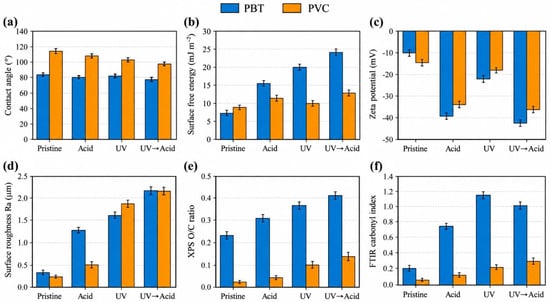
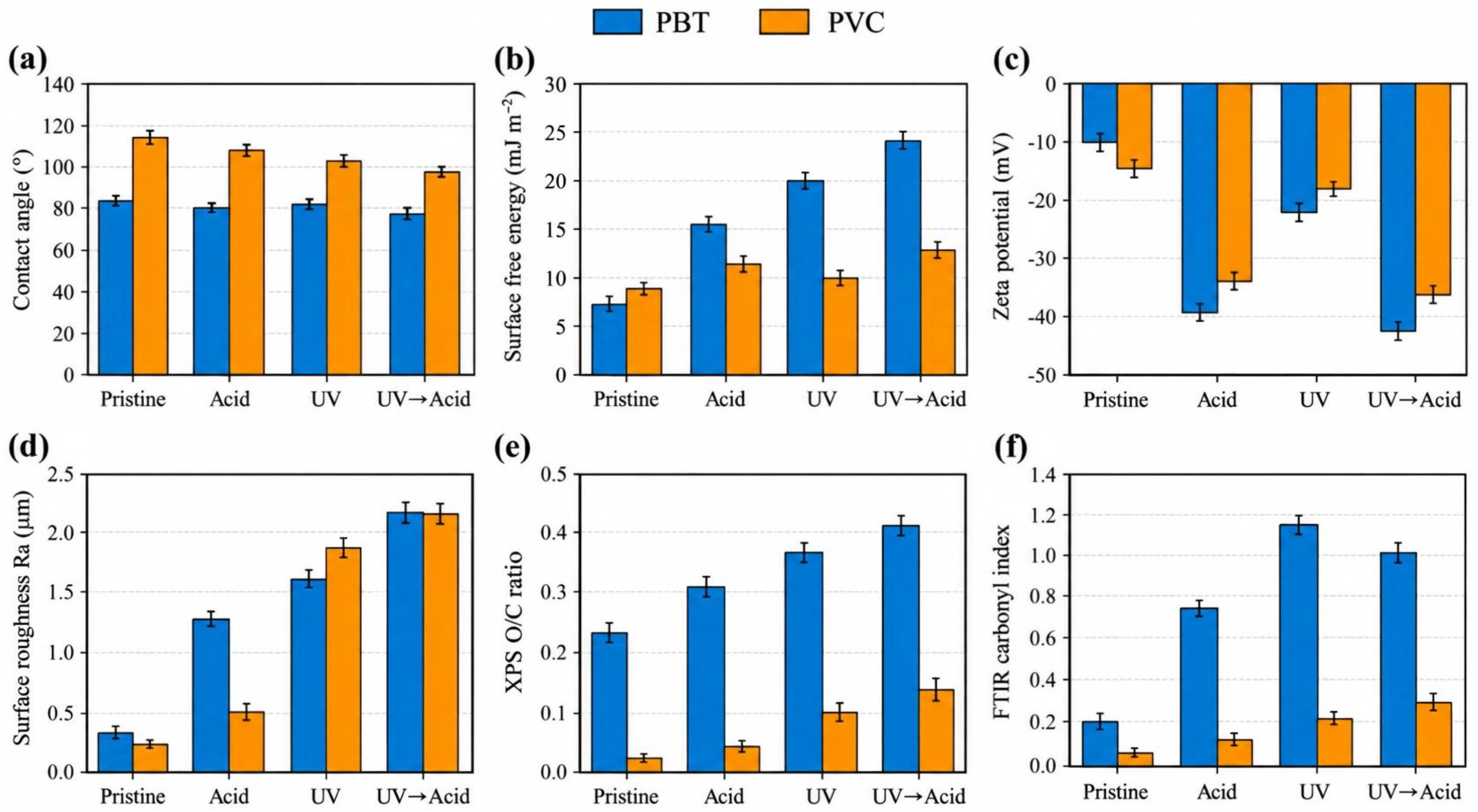
The six surface descriptors presented in Figure 1 indicate that the four MP surface states cannot be arranged along a single monotonic aging trajectory. Instead, acid exposure, UV irradiation, and sequential UV→Acid aging induced distinct combinations of changes in wettability, surface charge, oxidation state, and surface morphology. For PBT, the water contact angle decreased progressively from 83.12° in the pristine state to 80.12° after acid aging and further to 77.15° after UV→Acid aging (Figure 1a). PVC remained more hydrophobic, with contact angle decreased from 113.42° to 98.25° after UV→Acid aging. The retention of a contact angle above 98° for PVC indicates that sequential aging enhanced its wettability while maintaining its intrinsically hydrophobic character. This wettability-dependent behavior is important for understanding the subsequent differences in oil capture. Surface free energy increased for PBT, from 7.27 mJ/m2 in the pristine state to 15.51 mJ/m2 after acid aging, 20.03 mJ/m2 after UV aging, and 24.08 mJ/m2 after UV→Acid aging (Figure 1b). In comparison, PVC exhibited a smaller change in surface free energy, increasing from 8.85 mJ/m2 to 12.96 mJ/m2 after sequential aging. The zeta-potential evolution followed a different pattern from that of surface free energy (Figure 1c). Acid aging shifted the PBT zeta potential from approximately −10 mV to nearly −40 mV, whereas UV-aged PBT exhibited a less negative value of approximately −22 mV. UV→Acid aging again generated a more negative surface potential, approaching −43 mV. PVC showed a similar pathway-dependent trend, with acid aging and UV→Acid aging producing more negative surfaces potentials than UV aging alone. This non-parallel evolution indicates that surface charge cannot serve as a direct indicator of the overall extent of chemical modification during aging. Surface roughness evolution exhibited a distinct pattern. The Ra values of both pristine MPs were below 0.4 μm (Figure 1d). Acid aging was associated with a larger increase in roughness for PBT than for PVC, whereas UV aging increased roughness for both MPs. After UV→Acid aging, the Ra values reached approximately 2.1 μm for both MPs.
Figure 1.
Surface physicochemical properties of pristine, acid-aged, UV-aged, and sequential UV→Acid aging PBT and PVC: (a) water contact angle, (b) surface free energy, (c) zeta potential, (d) arithmetic surface roughness (Ra), (e) XPS O/C atomic ratio, and (f) FTIR carbonyl index.
The chemical characterization results reveal that surface oxidation and oxygen-containing functional groups varied with the aging pathway. For PBT, the XPS O/C ratio increased progressively from 0.23 in the pristine state to approximately 0.41 after UV→Acid aging (Figure 1e), whereas the FTIR carbonyl index reached its highest value after UV aging and subsequently decreased moderately after the acid treatment (Figure 1f). This apparent divergence provides mechanistic insight. XPS reflects the overall oxygen content within the near-surface region, whereas the carbonyl index represents changes in a specific class of oxygen-containing functional groups. The increased O/C ratio accompanied by a reduced carbonyl index after UV→Acid aging may suggest transformation, hydrolysis, or loss of certain UV-generated carbonyl-containing structures, while other oxygen-containing groups continue to accumulate [17]. Acid-induced degradation of ester-containing PBT has previously been associated with chain scission and redistribution of C–O, O–H, and carbonyl-related functionalities. PVC exhibited lower O/C ratios and carbonyl indices than PBT under all aging conditions, consistent with its distinct backbone chemistry and greater resistance to oxygen-containing functionalization under the investigated conditions [18,19].
Collectively, these observations indicate that acid aging was associated with changes in electrochemical properties and wettability, whereas UV aging was associated with greater changes in surface morphology and oxidation. UV→Acid aging generated a surface state characterized by increased oxidation, roughness, and more negative surface charge. Such a surface state may generate competing effects on MOA formation. Reduced contact angles are consistent with weaker hydrophobic oil–MP affinity, whereas the more negative zeta potential is interpreted here primarily as a marker of aging-induced changes in interfacial chemistry. Because seawater ionic strength compresses the electrical double layer, any direct contribution of electrostatic repulsion to MOA formation under the present conditions is expected to be limited. Increased surface roughness may increase the opportunity for solid–solid contact and roughness-mediated particle association, including possible mechanical interlocking, but the present measurements do not directly quantify interparticle adhesion forces.
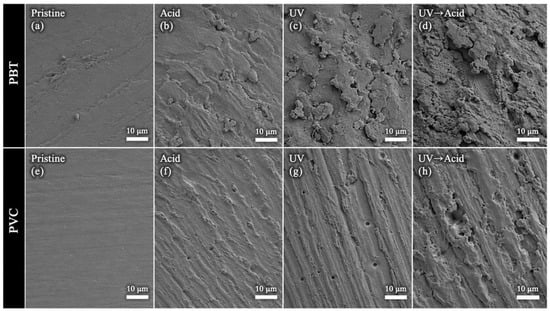
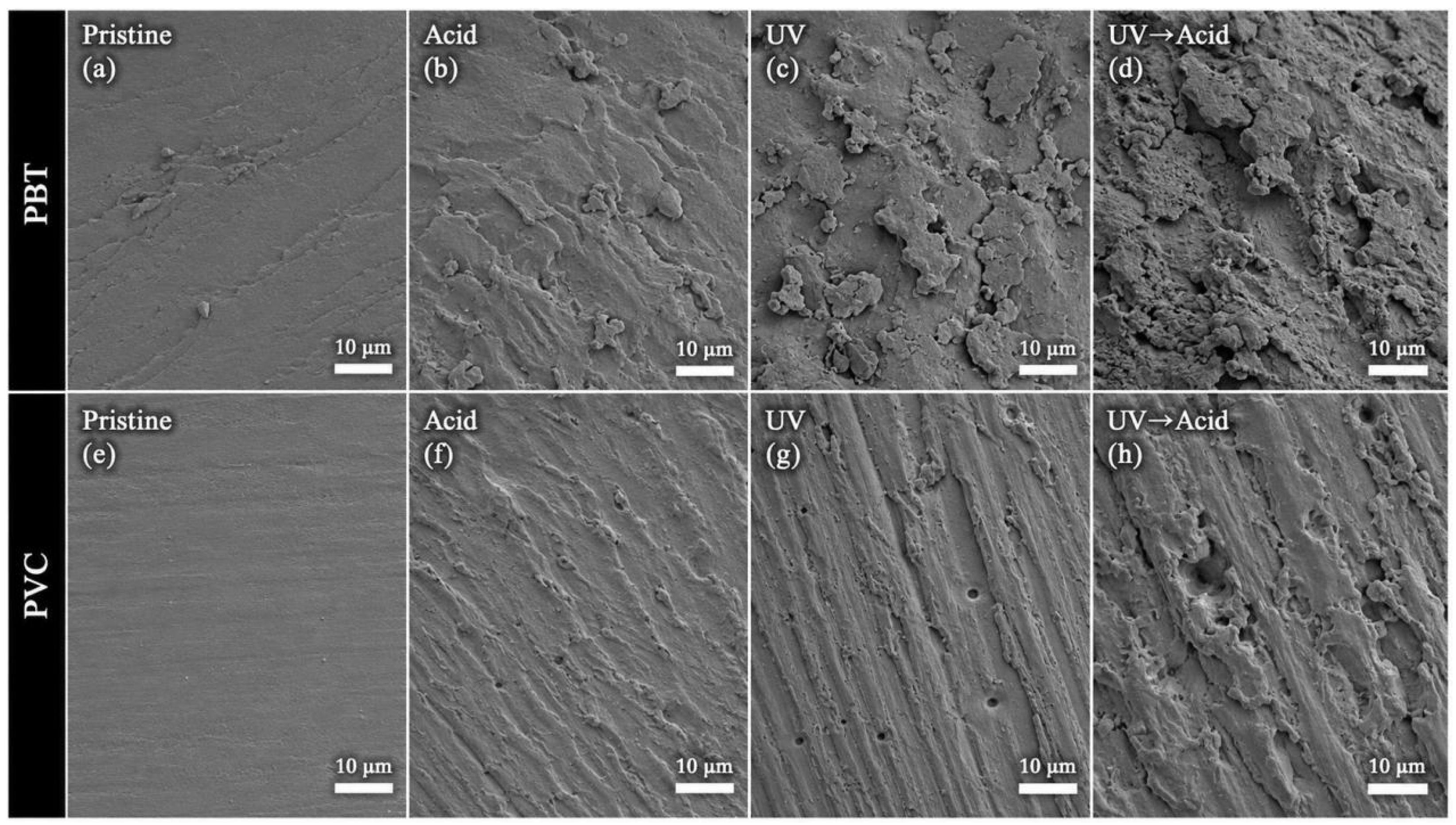
SEM observations (Figure 2) further support the above analysis. Pristine PBT and PVC were comparatively smooth. Acid-aged PBT developed obvious peeling and irregular surface relief, while acid-aged PVC showed more moderate grooves and pits. UV exposure generated flaking and debris on PBT and elongated grooves and pores on PVC. Sequential UV→Acid-treated surfaces showed cracks, eroded domains, cavities, and fragmented features. The surface generated by the sequential pathway therefore cannot be described merely as a more hydrophilic version of the pristine polymer. It represents a distinct physical architecture that may favor increased mechanical contact and other roughness-mediated particle–particle interactions.
Figure 2.
SEM micrographs showing aging-pathway-dependent morphology evolution of PBT (a–d) and PVC (e–h): pristine, acid-aged, UV-aged, and sequential UV→Acid-aged surfaces. Scale bars = 10 μm.
3.2. Aging-Induced Changes in Oil Dispersion Dynamics
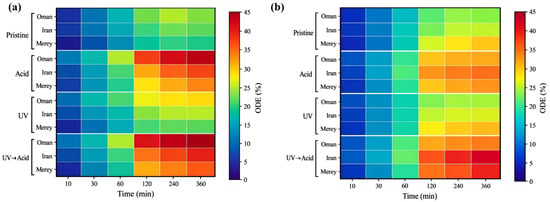
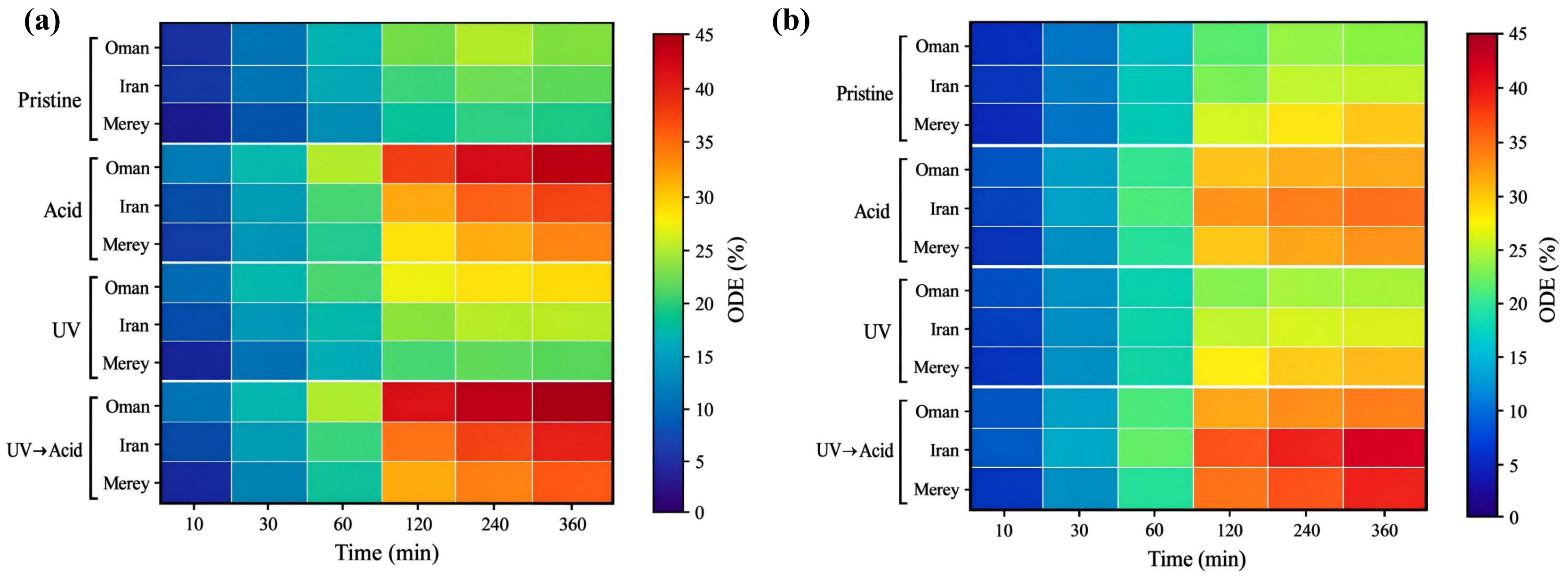
The ODE heatmaps reveal a progressive redistribution of oil from the initial oil slick at the surface into the water column throughout the 360 min interaction period (Figure 3). For both MPs, ODE remained relatively low during the first 10–30 min, increased between approximately 60 and 120 min, and subsequently approached a quasi-steady state between 240 and 360 min. The four MP surface states resulted in distinct dispersion trajectories. Pristine MPs generally exhibited the lowest ODE values, which is consistent with their hydrophobic affinity for oil and their tendency to facilitate oil–MP attachment, droplet coalescence, and removal of oil droplets from the dispersed phase. This observation is consistent with previous reports showing that pristine MPs can inhibit oil dispersion through particle aggregation and droplet resurfacing processes [20].
Figure 3.
Time-resolved oil dispersion efficiency for Oman, Iran, and Merey crude oils interacting with (a) PBT and (b) PVC under pristine, acid-aged, UV-aged, and sequential UV→Acid-aged conditions.
For PBT, acid aging was associated with an increase in ODE, while UV→Acid aging generated a comparable or even higher final dispersion level depending on the oil type (Figure 3a). For example, at 240 and 360 min, the ODE values for Oman were 23.21 ± 1.75% and 23.29 ± 2.52% for pristine PBT, 38.51 ± 1.73% and 38.62 ± 1.51% for acid-aged PBT, 30.23 ± 1.70% and 30.26 ± 1.53% for UV-aged PBT, and 41.09 ± 2.25% and 41.21 ± 1.56% for UV→Acid-aged PBT, respectively. In addition, Oman generally showed higher ODE values than Iran and Merey. At the later stage of the experiment, Oman in the acid-aged and UV→Acid-aged systems approached the upper range of the heatmap intensity scale, whereas Merey remained relatively lower. This trend is consistent with the greater resistance of viscous, heavy-fraction-rich oils to droplet breakup and may also reflect potentially different interactions between the PBT surface and aromatic/polar petroleum fractions. PVC exhibited a distinct oil-dependent dispersion pattern (Figure 3b). At 240 and 360 min, for example, the ODE values for Iran changed from 21.25 ± 2.85% and 21.43 ± 1.37% for pristine PVC to 33.97 ± 3.26% and 34.03 ± 2.29% after acid aging, 26.78 ± 2.27% and 27.89 ± 1.88% after UV aging, 36.73 ± 2.63% and 36.81 ± 1.53% after sequential UV→Acid aging. Although aging increased ODE relative to the pristine state, the ranking among Oman, Iran, and Merey was less consistent, with Iran or Merey occasionally exhibiting comparable or higher ODE values than Oman during the later stages. This behavior may be associated with the persistent hydrophobicity of PVC and its chlorine-containing surface chemistry, which can interact differently with polar and heavy oil fractions compared with the aromatic ester-containing backbone of PBT. These results indicate that the influence of aging on oil dispersion varies with both polymer chemistry and oil composition.
The increased ODE observed after acid and UV→Acid aging is consistent with a reduced tendency of the aged MPs to promote oil bridging and removal of dispersed oil. The reduced contact angle indicates greater MPs–water affinity, whereas the more negative zeta potentials primarily document changes in interfacial chemistry. Because the high ionic strength of seawater compresses the electrical double layer, the direct stabilizing contribution of electrostatic repulsion under the present conditions may be limited. Meanwhile, oxidation and increased surface free energy are consistent with enhanced surface hydration and a reduced effective area for direct hydrophobic contact with oil droplets [3].
3.3. Evolution of MOA Morphology with MP Aging
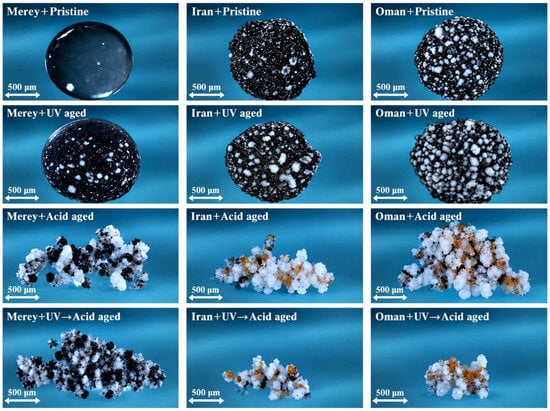
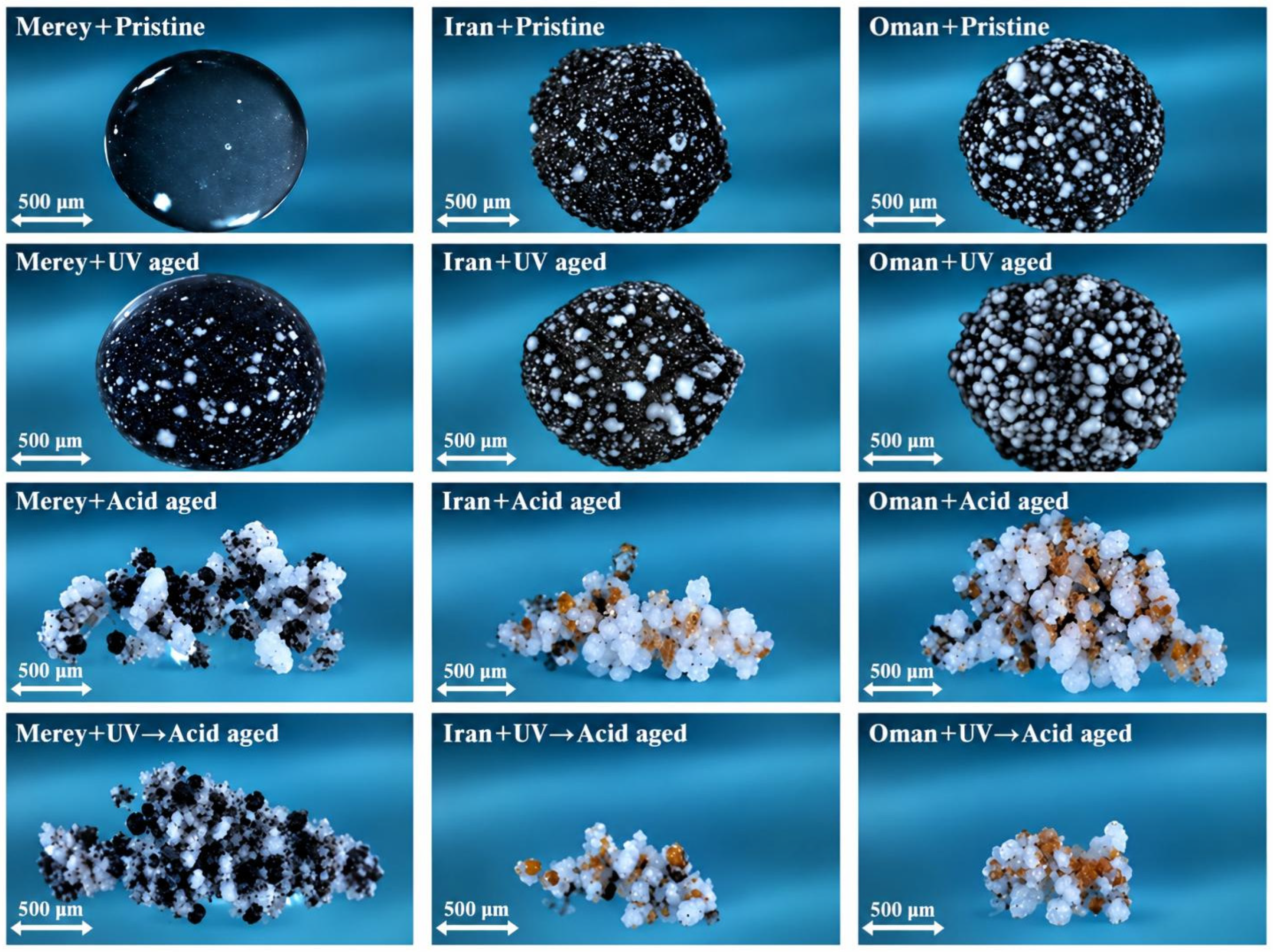
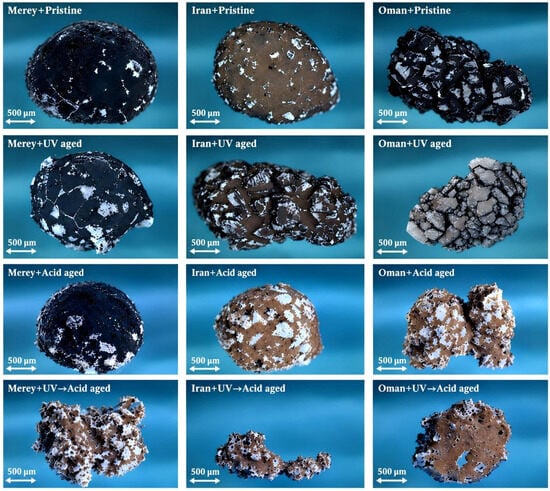
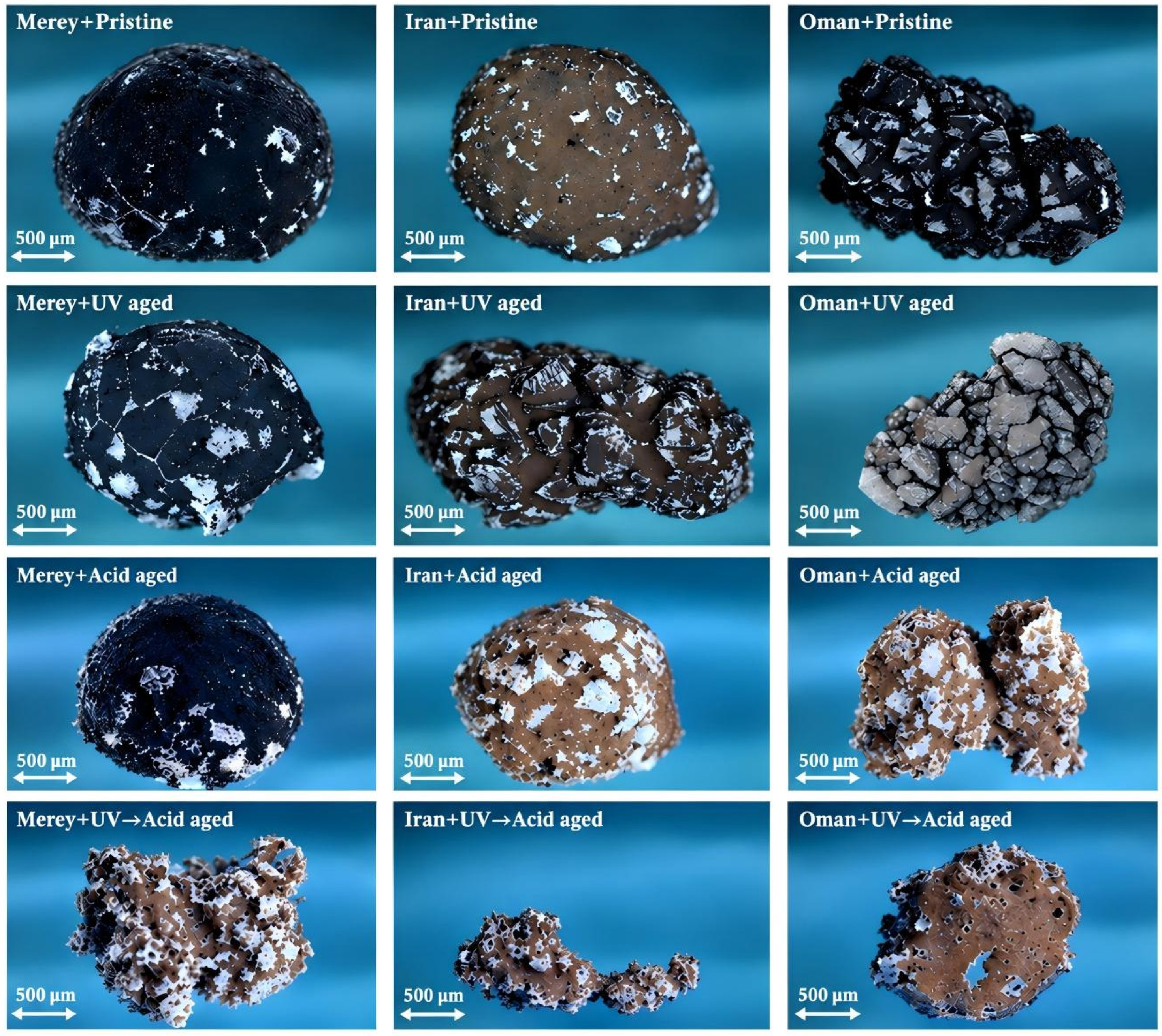
The morphologies of the recovered MOAs provide direct visual evidence that the dominant aggregation pathway shifted as a function of MP aging (Figure 4 and Figure 5). For pristine PBT, Merey yielded a smooth MOA dominated by oil, whereas the Iran and Oman yielded spherical MOAs with progressively greater wrapping of MP particles at their surfaces (Figure 4). These morphologies are characteristic of oil-mediated aggregation, in which hydrophobic MPs are wetted by the oil phase and the continuous oil matrix acts as a binder, thereby minimizing the energetically unfavorable MP–water interfacial area. Acid aging was associated with a morphological transition in the MOAs formed by PBT. The spherical oil matrix was largely lost, giving way to loose, irregular particle clusters with greater exposure of MP surfaces. This pattern was evident for Iran and Oman. This morphological transition is consistent with the decrease in the PBT contact angle, the shift toward more negative zeta potentials, and the decline in oil capture discussed below. Accordingly, acid-aged PBT is consistent with a mode in which oil contributes less effectively as a continuous binder. The resulting MOAs are therefore better described as weakly oil-associated particle clusters than as conventional oil-coated agglomerates. MOAs formed by UV-aged PBT exhibited an intermediate morphology. The aggregates remained relatively large and cohesive, but their surfaces were more particle-rich than those of pristine PBT. Following UV→Acid treatment, MPs dominated the external structure, and the aggregates became increasingly irregular. Thus, the sequential treatment did not restore the oil-rich morphology lost during aging. This finding demonstrates that large aggregates can arise through particle–particle assembly rather than through the accumulation of large oil volumes.
Figure 4.
Representative MOA morphologies formed by PBT with Merey, Iran, and Oman crude oils under pristine, UV-aged, acid-aged, and sequential UV→Acid-aged conditions.
Figure 5.
Representative MOA morphologies formed by PVC with Merey, Iran, and Oman crude oils under pristine, UV-aged, acid-aged, and sequential UV→Acid-aged conditions.
PVC exhibited the same overall transition, but oil-coated structures persisted to a greater extent (Figure 5). Pristine PVC formed oil-rich, spheroidal or blocky MOAs, whereas acid-aged PVC retained a more continuous oil phase than did acid-aged PBT. This behavior is consistent with the higher water contact angle of PVC, which remained above 90° even after sequential aging. UV and UV→Acid treatments progressively increased solid-particle exposure and generated rough, cracked, porous, or irregular MOA surfaces. Nevertheless, the transition from an oil-rich to a particle-rich morphology was less abrupt in PVC than in PBT, suggesting that residual hydrophobic affinity between PVC and oil continued to contribute to aggregate integrity.
Taken together, the imaging observations and surface-characterization data are consistent with three aggregation mechanisms that differ in their relative contributions. First, pristine MPs appear to undergo predominantly oil-mediated aggregation, in which oil wetting and bridging contribute to interparticle cohesion [21]. Second, acid aging weakens this pathway, coinciding with greater surface hydration, more negative zeta potential, and the formation of smaller, oil-poor clusters. Third, UV aging and, particularly UV→Acid treatment produces increased roughness, cracking, and asperities that may increase the contribution of roughness-mediated MP–MP contacts and possible mechanical interlocking.
3.4. Distinct Effects of Aging on MOA Size and Composition
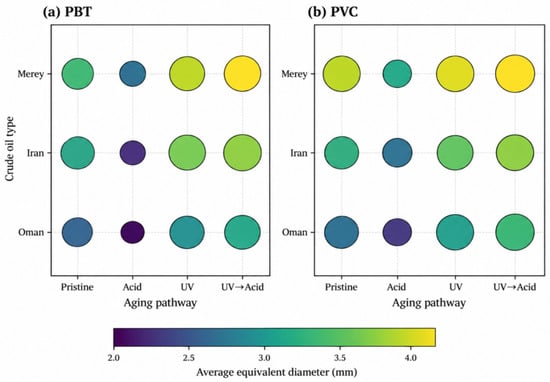
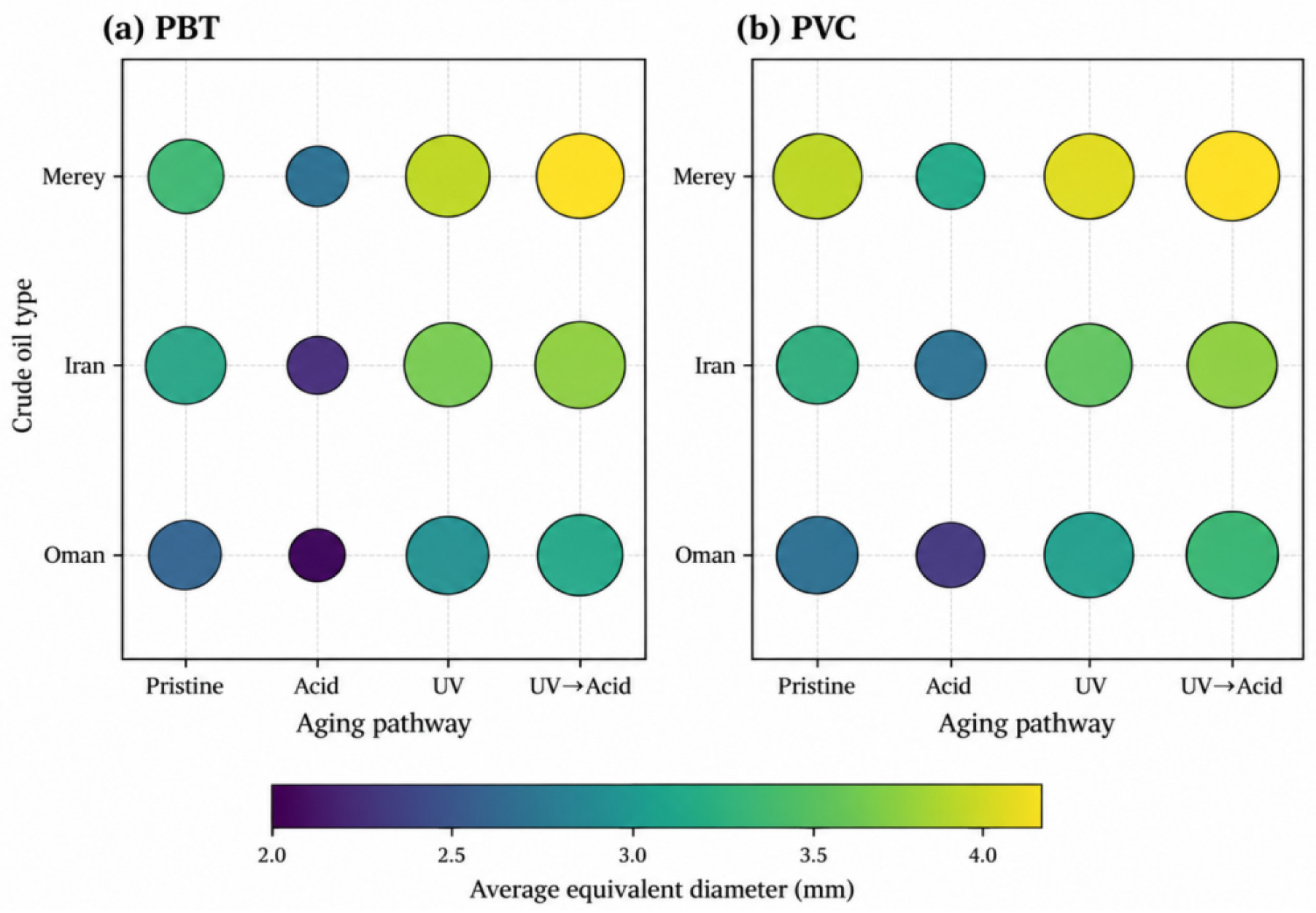
The average equivalent diameter data reveal contrasting effects of acid and UV aging on MOA size (Figure 6). Acid-aged PBT and PVC generally produced smaller MOAs for all three oils. In contrast, UV aging increased MOA size, and UV→Acid produced diameters comparable to or larger than the UV treatment. Merey tended to form larger MOAs, particularly after UV or sequential aging. Oman generally formed smaller agglomerates. The large size of Merey-derived MOAs is consistent with the high viscosity and heavy-fraction content of this crude oil, which increase oil cohesion and the persistence of oil–MP contacts [22]. However, the aging-pathway effect cannot be explained by oil viscosity alone because the same crude oil formed smaller MOAs after acid aging and larger MOAs after UV→Acid.
Figure 6.
Average equivalent diameter of MOAs formed by (a) PBT and (b) PVC with Merey, Iran, and Oman crude oils under pristine, acid-aged, UV-aged, and sequential UV→Acid-aged conditions.
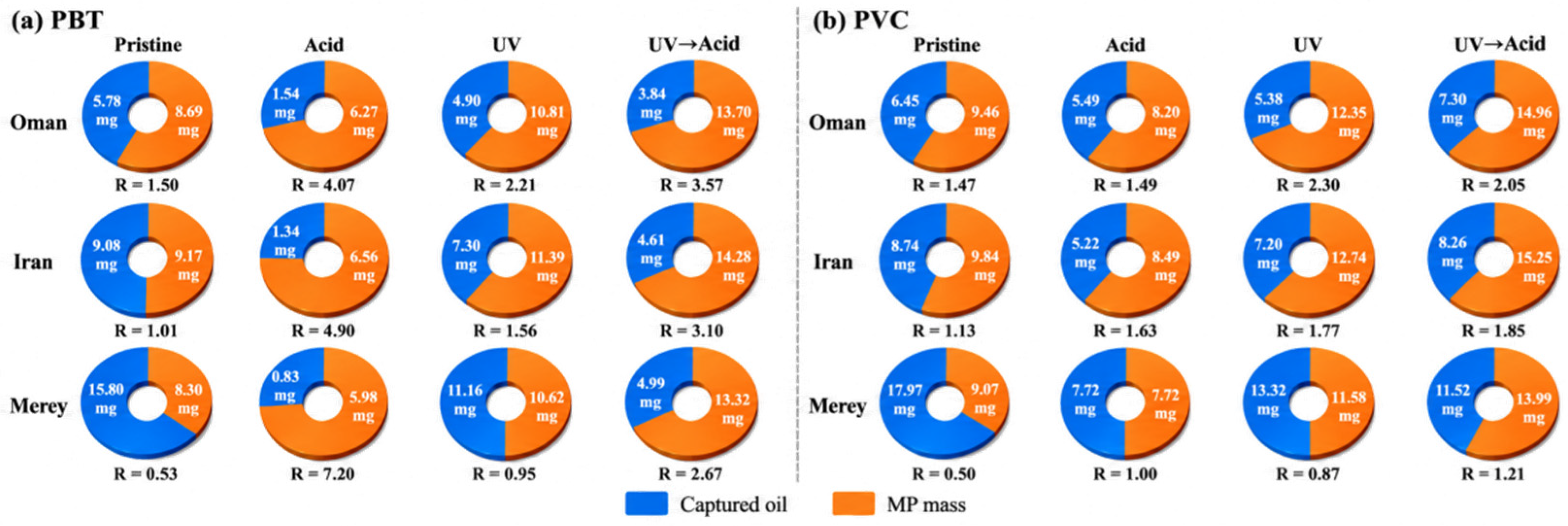
The composition data in Figure 7 provide the key explanation. For PBT, acid aging was associated with a reduction in oil capture. With Merey, captured oil decreased from 15.80 mg in the pristine MOA to 0.83 mg after acid aging, while the incorporated MP mass decreased to a lesser extent, from 8.30 to 5.98 mg. Consequently, the MPs-to-oil mass ratio (R) increased from 0.53 to 7.20, representing a transition from an oil-rich aggregate to a MP-enriched structure. Similar shifts occurred for Oman and Iran. These quantitative changes are consistent with the loose particle-rich morphology observed for acid-aged PBT and suggest that acid aging primarily weakens oil-mediated cohesion. UV aging produced a distinct compositional balance. For PBT–Merey, the captured oil mass remained relatively high at 11.16 mg, while the incorporated MP mass increased to 10.62 mg. Following UV→Acid treatment, the captured oil mass decreased to 4.99 mg, whereas the incorporated MP mass increased further to 13.32 mg. A similar enrichment of MPs after sequential aging was observed for Oman and Iran, for which the incorporated MP mass increased to 13.70 and 14.28 mg, respectively. Within the limits of the extraction-based measurement, these results suggest that the large MOAs formed after UV→Acid treatment were not accompanied by greater recoverable oil; instead, their large size coincided with increased MP incorporation. PVC exhibited a more gradual compositional transition. MOAs formed by pristine PVC and Merey were oil-rich. Acid aging reduced the captured oil mass to 7.72 mg, whereas UV and UV→Acid treatments resulted in R values of 0.87 and 1.21, respectively. For Oman, sequential aging moderately increased the captured oil mass relative to pristine PVC, while producing a larger increase in the incorporated MP mass. Thus, unlike PBT, PVC did not exhibit a consistent loss of captured oil following UV or sequential aging. This behavior is consistent with the higher residual hydrophobicity of PVC and suggests that oil-mediated cohesion can be partially retained even as the aggregates become increasingly particle-rich.
Figure 7.
Captured oil mass (blue) and incorporated MP mass (orange) in recovered MOAs formed by (a) PBT and (b) PVC. R is the MPs-to-oil mass ratio.
The above results indicate a decoupling between MOA size and composition. For pristine MPs, larger MOAs are generally associated with a larger continuous oil phase, particularly for Merey. Following aging, however, increases in aggregate size increasingly reflect enhanced MP incorporation and particle–particle assembly rather than greater oil accumulation. Consequently, under the present experimental conditions, MOA diameter alone was not a reliable predictor of the recoverable oil mass associated with an aggregate. This distinction is important when interpreting aggregate-associated hydrocarbon transport, because using MOA diameter alone as a proxy for oil loading could overestimate the hydrocarbon mass associated with highly weathered MP aggregates.
3.5. Aging-Dependent Changes in MOA Settling Behavior
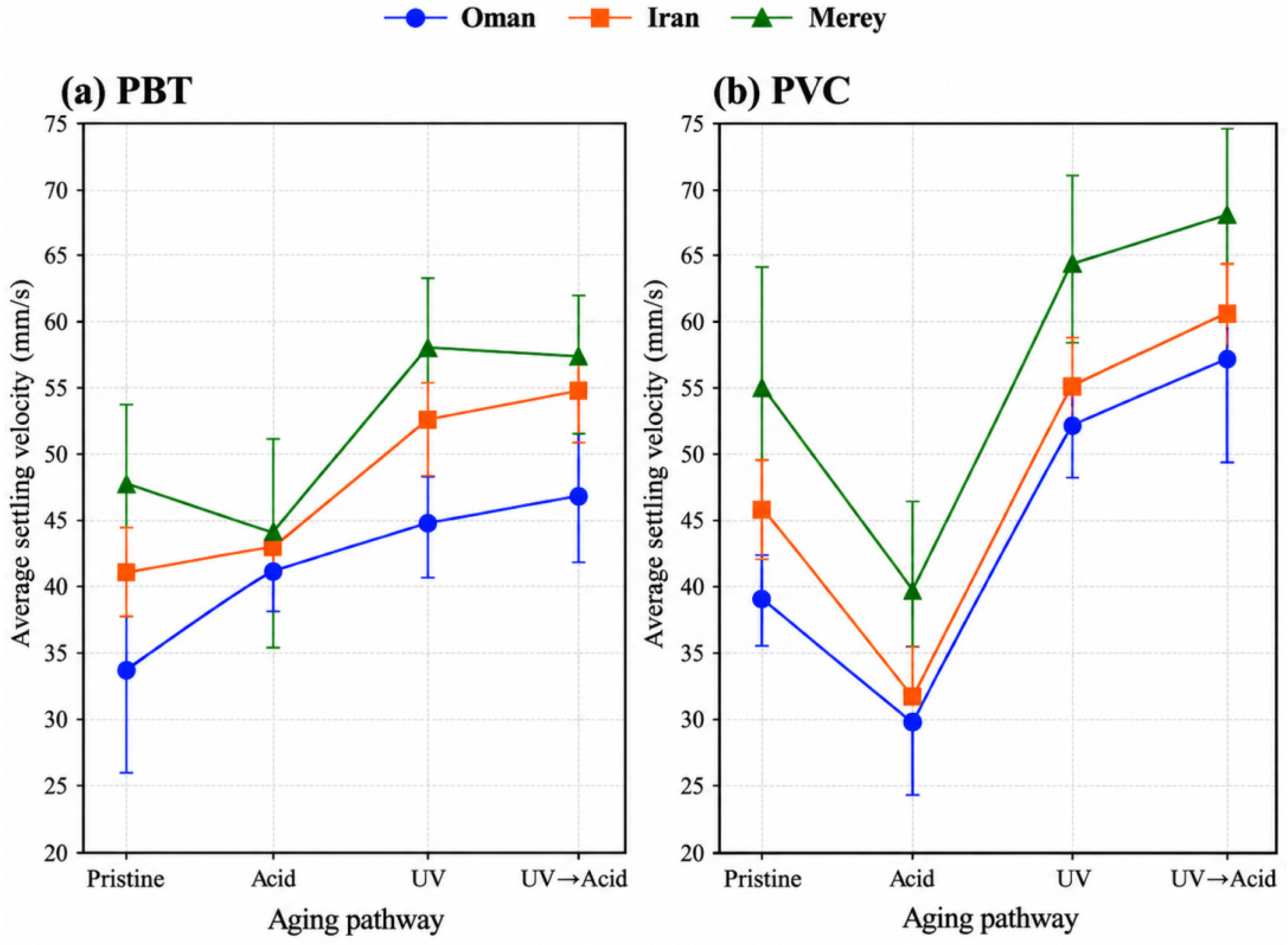
The settling-velocity data further indicate that MOA settling behavior is not governed solely by oil content (Figure 8). For pristine PBT, the formed MOAs exhibited mean settling velocities of approximately 34, 41, and 48 mm/s for Oman, Iran, and Merey, respectively. Acid aging increased the settling velocity of Oman-derived MOAs, had little effect on those formed with Iran, and resulted in a modest decrease for Merey. In contrast, UV-aged and UV→Acid-aged PBT generally formed MOAs that settled faster than their pristine counterparts, with mean velocities reaching approximately 45–47 mm/s for Oman and 55–58 mm/s for Iran and Merey. The enhanced settling observed after UV-containing aging treatments is consistent with the formation of larger, more MP-rich aggregates. PVC also exhibited a pathway-dependent settling pattern. Acid-aged PVC produced MOAs with lower settling velocities for all three oils, with mean velocities of approximately 30–40 mm/s. Settling velocities were higher after UV aging, while sequential UV→Acid aging produced the mean values approximately 57 mm/s for Oman, 61 mm/s for Iran, and 68 mm/s for Merey. These trends are consistent with the surface roughening of PVC induced by UV and sequential aging, together with the greater incorporation of MPs into the aggregates. Collectively, these results suggest that a reduction in oil content does not necessarily lead to slower settling if it is accompanied by increases in aggregate size and MP incorporation.
Figure 8.
Average settling velocity of MOAs formed by (a) PBT and (b) PVC with Oman, Iran, and Merey crude oils under different aging pathways.
Settling velocity is jointly controlled by aggregate size, effective density, morphology, porosity, and hydrodynamic drag [23,24]. Although the present data do not permit the individual contributions of these factors to be quantified, the observed variations in aggregate composition and morphology provide a consistent qualitative explanation for the settling behavior. Acid-aged MOAs were generally smaller and, particularly for PBT, contained less captured oil and relatively low amounts of incorporated MPs. In contrast, UV- and UV→Acid-aged MOAs were generally larger and incorporated greater amounts of MPs, characteristics that are consistent with their higher settling velocities. The response observed for PVC may reflect the combined effects of persistent hydrophobic oil–PVC interactions and surface roughening, which together favor both oil-mediated cohesion and the formation of particle-rich aggregates. UV→Acid treatment generally increased ODE or maintained it at a relatively high level while producing large MOAs that exhibited relatively high settling velocities after mixing was stopped. Because ODE includes both freely dispersed oil and oil associated with suspended agglomerates, the present measurements do not establish that a greater fraction of petroleum hydrocarbons remained freely dispersed in the water column. In addition, the settling measurements were conducted under quiescent post-mixing conditions using an experimentally elevated MP concentration. The composition data nevertheless show that the settled MOAs became increasingly MP-rich and did not carry oil in proportion to aggregate size. Taken together, these observations suggest that aging could alter the relative transport tendencies of MPs and petroleum hydrocarbons. One possible hypothesis is that, under some field conditions, weathered MPs incorporated into relatively fast-settling agglomerates could be transported downward while part of the hydrocarbon pool remains suspended or dispersed; however, the balance between freely dispersed oil and oil associated with suspended agglomerates, as well as any consequences for pelagic hydrocarbon exposure or transfer of MPs to deeper or benthic environments, requires direct testing under environmentally relevant MP concentrations and hydrodynamic conditions [25,26].
4. Conclusions
This study demonstrates that different aging pathways alter microplastic surfaces through distinct physicochemical processes; these pathway-specific surface changes were associated with corresponding differences in MOA formation, composition, and transport behavior. Acid aging increased the negative surface charge and suppressed oil-mediated aggregation, with PBT exhibiting a reduction in captured oil and enrichment of MPs relative to oil. In contrast, UV aging induced surface oxidation and roughening, promoting particle–particle assembly that partially compensated for the reduced hydrophobic affinity for oil. Sequential UV→Acid aging produced a distinct combination of surface properties, characterized by increased roughness, a high O/C ratio and surface free energy, and a more negative zeta potential. Despite the reduced affinity for oil, sequentially aged MPs formed large, MP-rich MOAs with relatively high settling velocities. Collectively, these findings indicate a shift from predominantly oil-mediated agglomeration toward MP-rich particle–particle aggregation consistent with an increased contribution of MP-MP contacts associated with aging-induced surface roughness. Crucially, MOA size was not directly proportional to the amount of captured oil. The coexistence of relatively high ODE and rapid MOA settling following UV and sequential aging suggests a partial decoupling between petroleum hydrocarbon dispersion and the downward transport of MPs. One hypothesis is that, under some field conditions, weathered MPs incorporated into relatively fast-settling MOAs could be transported toward deeper waters or sediments, while some petroleum hydrocarbons remain suspended or dispersed. Taken together, these results underscore the importance of considering MP aging pathways, aggregate composition, and polymer-specific surface responses when assessing the environmental fate of coexisting oil and plastic particles. Incorporating these factors into future transport models should improve predictions of the distribution, transport, and ecological exposure associated with composite oil–plastic pollution.
The implications of these results must, however, be considered in light of the study’s experimental scope. Specifically, only one treatment dose was tested for each aging pathway, only one particle-size fraction was examined, biological weathering was not considered, and the MP concentration used was higher than typical ambient seawater levels. In addition, dedicated oil-recovery tests were not conducted on the cracked or porous surfaces generated by UV and sequential UV→Acid aging, leaving the effects of these surface features on oil retention and recovery unresolved. Future work should therefore establish dose–response relationships by systematically varying UV exposure intensity and/or duration and acid concentration and/or exposure duration, including sequential treatments. Studies should also incorporate multiple particle-size classes and biologically weathered or biofouled MPs to assess the robustness of the observed pathway-dependent effects and determine the extent to which the proposed mechanisms apply under natural environmental conditions.
Author Contributions
Conceptualization, S.J.; methodology, Y.Y.; software, M.J.; validation, M.J.; formal analysis, W.L.; investigation, Y.Y. and S.J.; data curation, W.L.; writing—original draft preparation, Y.Y.; writing—review and editing, W.L.; visualization, Q.S.; project administration, Y.Y.; funding acquisition, M.J. All authors have read and agreed to the published version of the manuscript.
Funding
This research was funded by the National Natural Science Foundation of China, grant number 42306181; the Dalian Science Technology Talent Innovation Support Policy Implementation Plan, grant number 2024RY039; and the Natural Science Foundation of Liaoning Province, China, grant number 2025-BS-0956.
Institutional Review Board Statement
Not applicable.
Informed Consent Statement
Not applicable.
Data Availability Statement
Data will be made available on request.
Conflicts of Interest
The authors declare no conflicts of interest.
References
- Fu, H.; Liu, W.; Sun, X.; Zhang, F.; Wei, J.; Li, Y.; Li, Y.; Lu, J.; Bao, M. Assessment of spilled oil dispersion affected by dispersant: Characteristic, stability, and related mechanism. J. Environ. Manag. 2024, 358, 120888. [Google Scholar] [CrossRef] [Scilit] [PubMed]
- Conesa, J.A. Adsorption of PAHs and PCDD/Fs in Microplastics: A Review. Microplastics 2022, 1, 346–358. [Google Scholar] [CrossRef] [Scilit]
- Gui, X.; Ren, Z.; Xu, X.; Chen, X.; Zhao, L.; Qiu, H.; Cao, X. Oil spills enhanced dispersion and transport of microplastics in sea water and sand at coastal beachheads. J. Hazard. Mater. 2022, 436, 129312. [Google Scholar] [CrossRef] [Scilit] [PubMed]
- Gaweł, B.; Nourani, M.; Tichelkamp, T.; Øye, G. Influence of the wettability of particles on the morphology and stability of crude oil–particle aggregates in synthetic produced water. J. Pet. Sci. Eng. 2016, 139, 198–204. [Google Scholar] [CrossRef] [Scilit]
- de Almeida, M.P.; Gaylarde, C.; Pompermayer, F.C.; Lima, L.S.; Delgado, J.F.; Scott, D.; Neves, C.V.; Vieira, K.S.; Baptista Neto, J.A.; Fonseca, E.M. The Complex Dynamics of Microplastic Migration through Different Aquatic Environments: Subsidies for a Better Understanding of Its Environmental Dispersion. Microplastics 2023, 2, 62–77. [Google Scholar] [CrossRef] [Scilit]
- Yang, M.; Chen, B.; Xin, X.; Song, X.; Liu, J.; Dong, G.; Lee, K.; Zhang, B. Interactions between microplastics and oil dispersion in the marine environment. J. Hazard. Mater. 2021, 403, 123944. [Google Scholar] [CrossRef] [Scilit] [PubMed]
- Yang, M.; Zhang, B.; Xin, X.; Liu, B.; Zhu, Z.; Dong, G.; Zhao, Y.; Lee, K.; Chen, B. Microplastic-oil-dispersant agglomerates in the marine environment: Formation mechanism and impact on oil dispersion. J. Hazard. Mater. 2022, 426, 127825. [Google Scholar] [CrossRef] [Scilit] [PubMed]
- Alimi, O.S.; Claveau-Mallet, D.; Kurusu, R.S.; Lapointe, M.; Bayen, S.; Tufenkji, N. Weathering pathways and protocols for environmentally relevant microplastics and nanoplastics: What are we missing? J. Hazard. Mater. 2022, 423, 126955. [Google Scholar] [CrossRef] [Scilit] [PubMed]
- Vohlídal, J. Polymer degradation: A short review. Chem. Teach. Int. 2021, 3, 213–220. [Google Scholar] [CrossRef] [Scilit]
- Loyer, C.; Régnier, G.; Duval, V.; Ould, Y.; Richaud, E. PBT plasticity loss induced by oxidative and hydrolysis ageing. Polym. Degrad. Stab. 2020, 181, 109368. [Google Scholar] [CrossRef] [Scilit]
- Lu, L.; Li, W.; Cheng, Y.; Liu, M. Chemical recycling technologies for PVC waste and PVC-containing plastic waste: A review. Waste Manag. 2023, 166, 245–258. [Google Scholar] [CrossRef] [Scilit] [PubMed]
- Qin, X.; Qi, Z.; Liu, J.; He, X.; Xiong, D. Dispersion of spilled oil and formation of oil-containing agglomerates under the action of acid-corroded microplastics. Mar. Pollut. Bull. 2026, 233, 120151. [Google Scholar] [CrossRef] [Scilit] [PubMed]
- Sorasan, C.; Ortega-Ojeda, F.E.; Rodríguez, A.; Rosal, R. Modelling the Photodegradation of Marine Microplastics by Means of Infrared Spectrometry and Chemometric Techniques. Microplastics 2022, 1, 198–210. [Google Scholar] [CrossRef] [Scilit]
- Binda, G.; Zanetti, G.; Bellasi, A.; Spanu, D.; Boldrocchi, G.; Bettinetti, R.; Pozzi, A.; Nizzetto, L. Physicochemical and biological ageing processes of (micro)plastics in the environment: A multi-tiered study on polyethylene. Environ. Sci. Pollut. Res. 2023, 30, 6298–6312. [Google Scholar] [CrossRef] [Scilit] [PubMed]
- He, W.; Chen, X.; Xu, C.; Zhou, C.; Luo, J. Effect of microplastic aging degree on filter cake formation and membrane fouling characteristics in ultrafiltration process with pre-coagulation. Sep. Purif. Technol. 2023, 310, 123221. [Google Scholar] [CrossRef] [Scilit]
- Yu, X.; He, X.; Qi, Z.; Yang, M.; Li, X.; Xiong, D. Interactions among microplastics, spilled oil and dispersant: Impacts of marine environmental conditions. Mar. Pollut. Bull. 2026, 222, 118501. [Google Scholar] [CrossRef] [Scilit] [PubMed]
- Cai, L.; Wang, J.; Peng, J.; Wu, Z.; Tan, X. Observation of the degradation of three types of plastic pellets exposed to UV irradiation in three different environments. Sci. Total Environ. 2018, 628–629, 740–747. [Google Scholar] [CrossRef] [Scilit] [PubMed]
- Liu, P.; Qian, L.; Wang, H.; Zhan, X.; Lu, K.; Gu, C.; Gao, S. New Insights into the Aging Behavior of Microplastics Accelerated by Advanced Oxidation Processes. Environ. Sci. Technol. 2019, 53, 3579–3588. [Google Scholar] [CrossRef] [Scilit] [PubMed]
- Ding, L.; Mao, R.; Ma, S.; Guo, X.; Zhu, L. High temperature depended on the ageing mechanism of microplastics under different environmental conditions and its effect on the distribution of organic pollutants. Water Res. 2020, 174, 115634. [Google Scholar] [CrossRef] [Scilit] [PubMed]
- Yang, M.; Zhang, B.; Chen, Y.; Xin, X.; Lee, K.; Chen, B. Impact of Microplastics on Oil Dispersion Efficiency in the Marine Environment. Sustainability 2021, 13, 13752. [Google Scholar] [CrossRef] [Scilit]
- Daly, K.L.; Passow, U.; Chanton, J.; Hollander, D. Assessing the impacts of oil-associated marine snow formation and sedimentation during and after the Deepwater Horizon oil spill. Anthropocene 2016, 13, 18–33. [Google Scholar] [CrossRef] [Scilit]
- Nissanka, I.D.; Yapa, P.D. Oil slicks on water surface: Breakup, coalescence, and droplet formation under breaking waves. Mar. Pollut. Bull. 2017, 114, 480–493. [Google Scholar] [CrossRef] [Scilit] [PubMed]
- Kaiser, D.; Kowalski, N.; Waniek, J.J. Effects of biofouling on the sinking behavior of microplastics. Environ. Res. Lett. 2017, 12, 124003. [Google Scholar] [CrossRef] [Scilit]
- Kooi, M.; van Nes, E.H.; Scheffer, M.; Koelmans, A.A. Ups and Downs in the Ocean: Effects of Biofouling on Vertical Transport of Microplastics. Environ. Sci. Technol. 2017, 51, 7963–7971. [Google Scholar] [CrossRef] [Scilit] [PubMed]
- Long, M.; Moriceau, B.; Gallinari, M.; Lambert, C.; Huvet, A.; Raffray, J.; Soudant, P. Interactions between microplastics and phytoplankton aggregates: Impact on their respective fates. Mar. Chem. 2015, 175, 39–46. [Google Scholar] [CrossRef] [Scilit]
- Porter, A.; Lyons, B.P.; Galloway, T.S.; Lewis, C. Role of Marine Snows in Microplastic Fate and Bioavailability. Environ. Sci. Technol. 2018, 52, 7111–7119. [Google Scholar] [CrossRef] [Scilit] [PubMed]

Disclaimer/Publisher’s Note: The statements, opinions and data contained in all publications are solely those of the individual author(s) and contributor(s) and not of MDPI and/or the editor(s). MDPI and/or the editor(s) disclaim responsibility for any injury to people or property resulting from any ideas, methods, instructions or products referred to in the content. |
© 2026 by the authors. Licensee MDPI, Basel, Switzerland. This article is an open access article distributed under the terms and conditions of the Creative Commons Attribution (CC BY) license.