


Abstract
Compostable plastics have been proposed as a more sustainable alternative to conventional polyethylene for bags. However, very little is known about the effects of these plastics on soil biota. This study evaluated the ecotoxicological effects of microplastics (MPs) derived from a compostable bag, a commercial polyethylene bag (PE1), and virgin polyethylene resin (PE2) on the earthworm Eisenia andrei. To this end, the OECD standardized reproduction test was adapted by replacing artificial soil with sewage sludge as the exposure substrate. This approach incorporates the physicochemical complexity and pre-existing contaminants characteristic of a real environmental organic matrix, providing a more ecologically representative exposure scenario. A total of 480 individual earthworms were evaluated after exposure to three different concentrations (250, 750, and 1250 mg·kg−1) of each MP type. No significant differences in survival or adult biomass were observed among treatments. By contrast, reproductive parameters were particularly sensitive to exposure. Cocoon production was significantly altered (p = 0.001), with a 39.9% increase in the compostable-material treatment and reductions of up to 54.2% in the polyethylene treatments in comparison with the control. Likewise, the number of juveniles decreased significantly only in the groups exposed to polyethylene, with an average reduction of up to 34 individuals (44%, p < 0.001), and PE2 had the greatest inhibitory effect. The findings call into question the supposed biological inertness of virgin polymers and highlight the need to develop ecotoxicological assessment strategies based on environmentally realistic matrices that allow for an understanding of the polymer’s intrinsic effect and its interaction with pre-existing contaminants.
1. Introduction
Plastic waste has become one of the most ubiquitous pollutants on the planet. The gradual fragmentation of this waste gives rise to microplastics (MPs), i.e., plastic particles smaller than 5 mm, which accumulate in almost all ecosystems [1]. The persistence and widespread distribution of these particles are of increasing concern because MPs can negatively impact organisms and ecosystem processes [2]. In general, the adverse effects associated with MPs have primarily been attributed to the release of additives incorporated during the manufacturing process (e.g., plasticizers, UV stabilizers, flame retardants, and pigments), residual monomers, and other leachable compounds, as well as to the adsorption and subsequent transport of environmental contaminants [3]. These mechanisms may be further intensified as polymeric materials undergo weathering and degradation in the environment. Exposure to UV radiation, oxidation, and mechanical abrasion can promote progressive polymer fragmentation and facilitate the release of additives incorporated into the polymer matrix [4]. At the same time, fragmentation and surface modifications may increase the specific surface area and generate new functional groups, potentially enhancing the capacity of particles to adsorb and transport environmental contaminants [5].
Consequently, most research has focused on the leaching of additives from degraded plastics and on the role of MPs as vectors for organic and inorganic contaminants [6]. By contrast, the release of low-molecular-weight fragments derived from the degradation of the polymers has been much less studied, despite the potential contribution of these fragments to MP-associated toxicity [7]. The pristine polymers have generally been considered chemically inert material, primarily acting as a vehicle for potentially toxic substances [8].
Beyond these mechanisms, recent studies have shown that plastic particles can elicit biological responses even in the absence of adsorbed contaminants or substantial additive release, suggesting that intrinsic properties of polymers, such as chemical composition, size, morphology, and surface characteristics, may also contribute to the toxicity [9]. Although the mechanisms involved are not fully understood and the number of studies remains limited, these results suggest that the hazard posed by MPs cannot be explained solely by their leachates but also by particle-specific effects [10].
Compared with aquatic ecosystems, terrestrial systems have received much less attention, despite being a major environmental sink for MPs, with agricultural soils alone potentially storing more MPs than ocean basins [11]. The agricultural application of sewage sludge, the use of plastic mulch, organic fertilizers, and atmospheric deposition are major pathways whereby MPs reach the soil [12]. Once in the soil, these particles can alter the physicochemical properties, modify the microbial community structure, and interfere with organisms essential to ecosystem functioning, thereby disrupting processes such as organic matter decomposition, nutrient recycling, and soil structure formation [13].
MP concentrations reported in soils vary widely worldwide, ranging from <0.001% to 6.7% of soil weight (<0.01–67,000 mg kg−1) [14]. Nevertheless, many experimental studies have used exposure levels substantially higher than those commonly encountered in the environment, with some experiments reaching 10% MP content to facilitate the detection of biological effects [15]. These levels greatly exceed the concentrations typically reported in soils (<0.1%) [16]. Even in highly contaminated agricultural soils, MP concentrations rarely exceed 1% [17]. Therefore, the use of excessively high exposure levels may limit the extrapolation of experimental findings to real environmental conditions, highlighting the need for further research at lower and environmentally relevant MP concentrations that better reflect actual exposure levels in terrestrial ecosystems.
Earthworms are frequently used as bioindicators to assess soil quality and contamination, due to the existing diversity of species and their fundamental role in soil ecosystems [18]. In particular, Eisenia fetida and Eisenia andrei have become model species in standardized ecotoxicological assays and have been used to study the effects of polyethylene (PE)-derived MPs and compostable plastic materials [19,20]. These studies have provided valuable information on parameters such as survival, growth, and reproduction; however, most of the available evidence comes from tests conducted according to Organization for Economic Cooperation and Development (OECD) protocols on standardized artificial soils [21].
Although artificial substrates ensure high experimental reproducibility, they are also much less complex than natural edaphic ecosystems. Real agricultural soils exhibit heterogeneous mineralogical and organic compositions, complex microbial communities, and mixtures of contaminants that can interact with MPs and modify their bioavailability and effects [22]. Consequently, extrapolating results from simplified conditions to real-world environmental scenarios may be difficult. Given this context, the use of sewage sludge as an exposure matrix is particularly relevant, despite its physicochemical and biological characteristics differing from those of agricultural soils. Its complex composition, determined by the coexistence of microplastics, organic matter, metals, persistent organic pollutants and other emerging contaminants, makes it possible to assess the potential synergistic or antagonistic effects that may arise [23,24,25].
In this context, the present study aimed to evaluate the impact of MPs derived from polyethylene bags, compostable bags, and virgin polyethylene on the survival, growth, and reproduction of E. andrei. Sewage sludge was used as the exposure matrix, with the goal of generating findings more representative of environmental conditions. In addition, the study analyzed the influence of additives by comparing the effects of polyethylene plastic bags and those of pure polyethylene resin on different biological responses of the earthworms.
2. Materials and Methods
2.1. Origin and Preparation of Compostable, Non-Compostable, and Reference Polymer Materials
Three types of plastic materials were used in the study: a commercial compostable plastic bag (COMP; 072_LPS_COMPOST_BAG_10), a commercial polyethylene plastic bag (PE1; 087_LPS_WHITEBAG10), and a commercial polyethylene resin (PE2; CAS 9002-88-4; (C2H4)n; Sigma-Aldrich/Thermo Fisher Scientific). According to the manufacturer’s specifications, the polyethylene resin was white, with a particle size of 500 μm, and a density of 0.95 g cm−3 at 20 °C. For the earthworm ecotoxicity assays, the plastic bags and resin were cryogenically micronized using an ultracentrifugal mill (ZM 200; Retsch Verder Scientific, Haan, Germany) operating at 16,000 rpm to obtain particles smaller than 250 μm. Dry ice was added during milling to prevent overheating. Further details on the composition and additives of the plastic materials are provided in Beiras et al. (2025) [26] and summarized in Supplementary Table S1.
2.2. Exposure Substrate
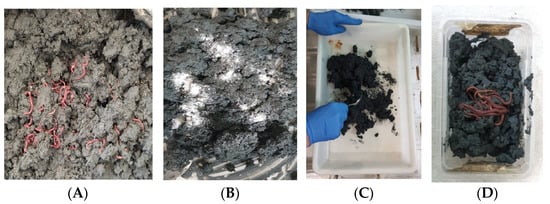
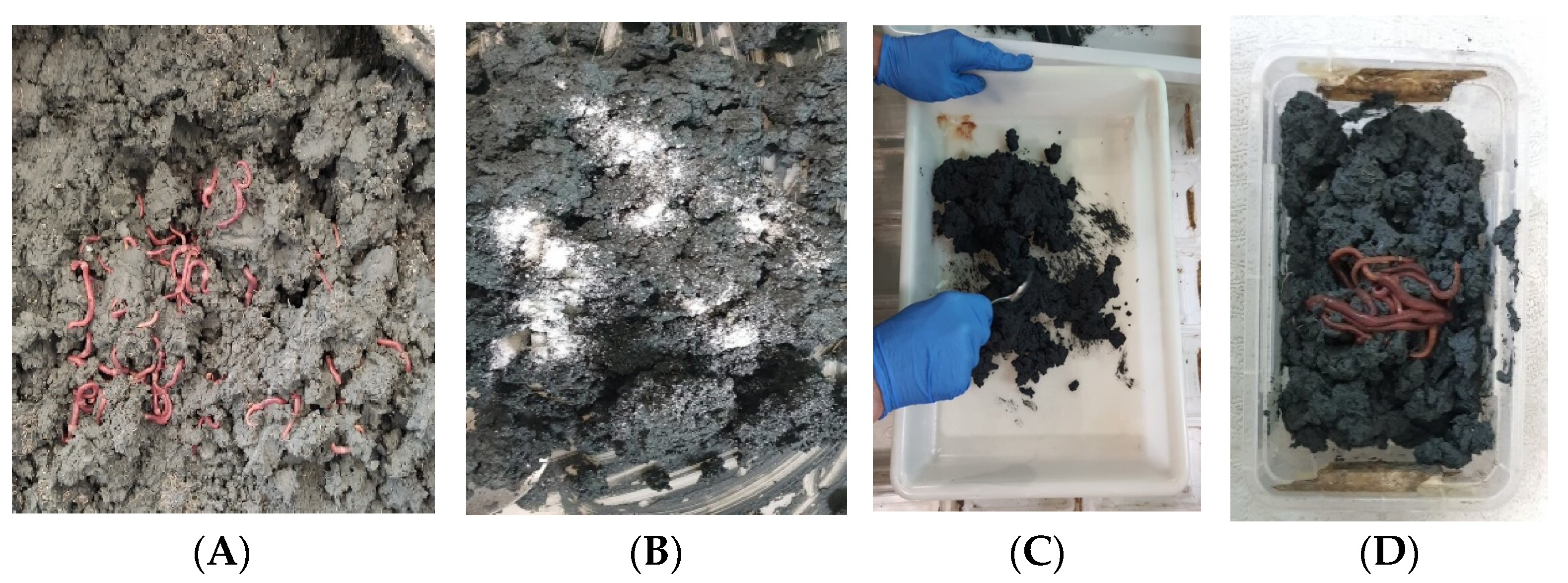
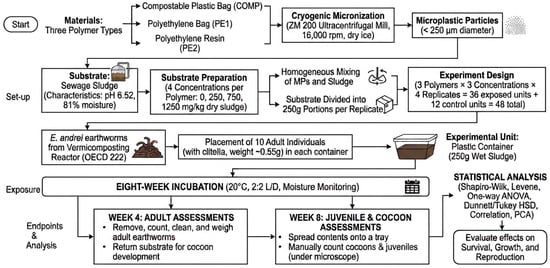
A survival and reproduction test was conducted with the earthworm E. andrei in accordance with OECD Guideline 222 (OECD, 2016) to evaluate the effects of the different polymer materials [21]. Eisenia andrei is an epigeal earthworm that naturally inhabits substrates rich in organic matter; therefore, for the exposure tests, E. andrei specimens were obtained from a continuous vermicomposting reactor, in which the population had been maintained at a stable level using sewage sludge as the substrate (Figure 1A). The sewage sludge used was obtained from the wastewater treatment plant in Cerceda (Galicia, Spain). A previous study characterized the sewage sludge from this treatment plant, reporting pre-existing MP concentrations ranging from 380 to 1003 MP·g−1 dry weight [19].
Figure 1.
Experimental set-up. (A) Eisenia andrei earthworms in a vermicomposting reactor fed with sewage sludge. (B) Plastic material was added to and (C) incorporated in the sewage sludge, and (D) plastic boxes with sewage sludge and 10 adult earthworm individuals at the start of the experiment.
The sewage sludge was slightly acidic and had a high organic matter content, along with elevated concentrations of organic and inorganic nitrogen, dissolved organic carbon, and an active microbial community (Table 1).
Table 1.
Main physico-chemical and biological characteristics of the sewage sludge used.
2.3. Experiment Set-Up of Survival and Reproduction Test
The experiment was conducted with four concentrations of microplastics (0, 250, 750, and 1250 mg kg−1 dry sludge) for each of the three polymer materials (COMP, PE1, and PE2). The moisture content of the sludge was determined prior to the experiment and used to calculate the amount of microplastics required to achieve the target concentrations on a dry-weight basis. Each treatment was replicated four times, resulting in 36 exposed experimental units (3 polymers × 3 concentrations × 4 replicates), while the control group consisted of 12 replicates, resulting in a total of 48 experimental units. These concentrations corresponded to 0, 0.025, 0.075, and 0.125% (w/w) microplastics relative to the dry weight of the sludge and fall within the range of environmentally realistic concentrations reported in soil samples [27,28].
The assays were conducted in plastic containers (17.5 × 11 × 5 cm; width × length × height), each containing 250 g of wet sewage sludge. To prepare the treatments, the appropriate amount of microplastic was thoroughly mixed with 1 kg of sewage sludge, ensuring homogeneous distribution of particles throughout the substrate (Figure 1B,C). The prepared substrate was then divided into four equal 250 g portions.
Ten adult E. andrei individuals with fully developed clitella (mean body weight 0.55 ± 0.03 g) were placed in each container (Figure 1D).
2.4. Survival and Reproduction Test
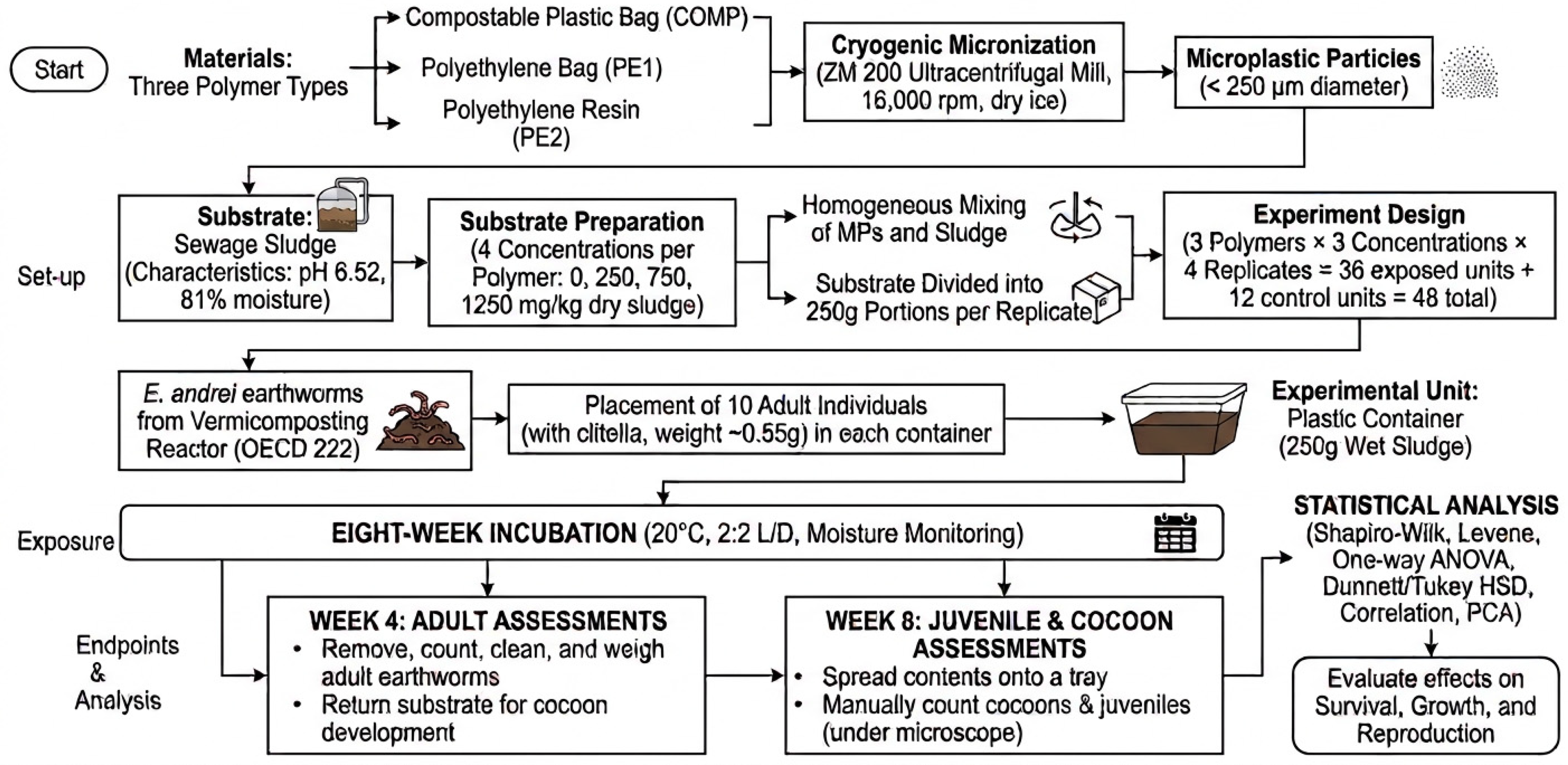
The experimental units (Figure 2) were maintained in an incubation chamber at 20 ± 2 °C for eight weeks. The moisture content was monitored weekly and adjusted as required throughout the exposure period.
Figure 2.
Experimental flowchart of the study procedure for evaluating the ecotoxicological effects of compostable (COMP) and non-compostable microplastics (PE1, PE2) on Eisenia andrei.
After four weeks of exposure, all surviving adult earthworms were carefully removed from each container with forceps, counted, gently rinsed with tap water to remove adhering sludge particles, blotted dry with laboratory paper, and individually weighed to determine changes in body biomass.
The exposure substrate was then returned to the incubation chamber and incubated for an additional four weeks to allow cocoon development and juvenile emergence. At the end of the exposure period, the contents of each container were carefully spread onto a white tray, and cocoons and juvenile earthworms were manually separated with forceps and counted under a microscope.
The validity of the assay was assessed in accordance with OECD Guideline 222 [21]. The test met all validity criteria, including adult mortality below 10% after four weeks, a coefficient of variation for juvenile production in the control treatment below 30%, and mean juvenile production exceeding 30 individuals per replicate.
2.5. Statistical Analysis
Statistical analyses were conducted to determine whether exposure to different polymer materials and MP concentrations affected the survival, growth, and reproduction of E. andrei. Before conducting inferential analyses, the normality was assessed using the Shapiro–Wilk test, and the homogeneity of variance was evaluated using the Levene and Brown–Forsythe tests. Treatment effects were subsequently evaluated by one-way ANOVA, followed by Dunnett’s post hoc test (p < 0.05). In addition, Tukey’s honestly significant difference (HSD) test was performed to compare all pairs of treatments. Particular emphasis was given to assessing differences between the virgin polyethylene resin (PE2) and the corresponding commercial polyethylene bag (PE1), and also between both polyethylene materials and the compostable plastic. This approach allowed us to distinguish between the contribution of the polymer itself and the influence of additives. Finally, correlation analysis and principal component analysis (PCA) were used to investigate associations among the measured biological endpoints and to identify the variables contributing most to the observed biological responses. All analyses and graphical representations were performed using Origin Pro 2026 (OriginLab Corporation, Northampton, MA, USA).
3. Results
3.1. Response of Eisenia Andrei to Microplastics Derived from Compostable and Conventional Plastic Bags
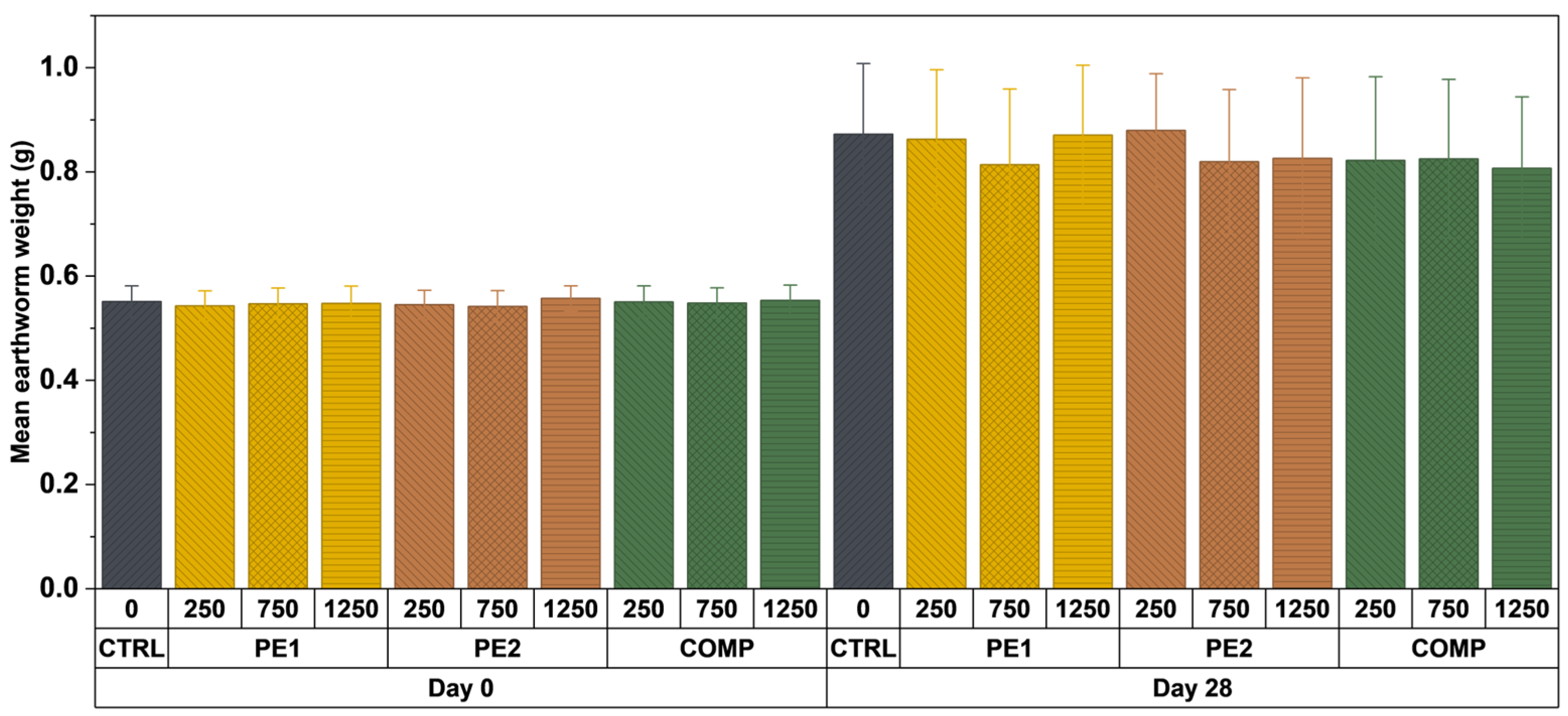
According to the validity criteria established by the OECD test guideline, the results of this study were considered valid. The control treatment met all acceptance criteria, with a mean production of 77 ± 12 juveniles, a coefficient of variation of 16%, and 0% mortality. Initial body weight was measured individually for each of the 480 earthworms, corresponding to 10 experimental groups (control and nine polymer–concentration combinations), with four replicates per treatment and 10 earthworms per replicate. At day 0, body weight was homogeneous among groups (one-way ANOVA, F9,38 = 1.89, p = 0.084), with a mean value of 0.55 ± 0.03 g and a coefficient of variation of 5.4%.
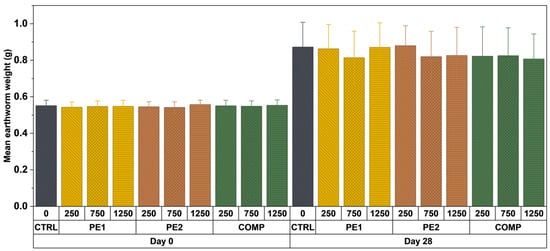
Exposure of E. andrei to COMP, PE1, and PE2 for four weeks (Figure 3) did not result in significant differences in body weight among the experimental groups (one-way ANOVA, F9,38 = 1.41, p = 0.216). A tendency towards reduced body weight was observed in the COMP treatment at 1250 mg kg−1 and in the PE1 and PE2 treatments at 750 mg kg−1. However, Dunnett’s post hoc test showed that none of the individual treatments differed significantly from the control (p > 0.05).
Figure 3.
Effect of microplastics derived from compostable and conventional plastic bags and from virgin polyethylene resin on the body weight of Eisenia andrei after 28 days of exposure.
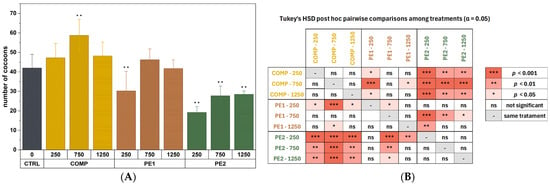
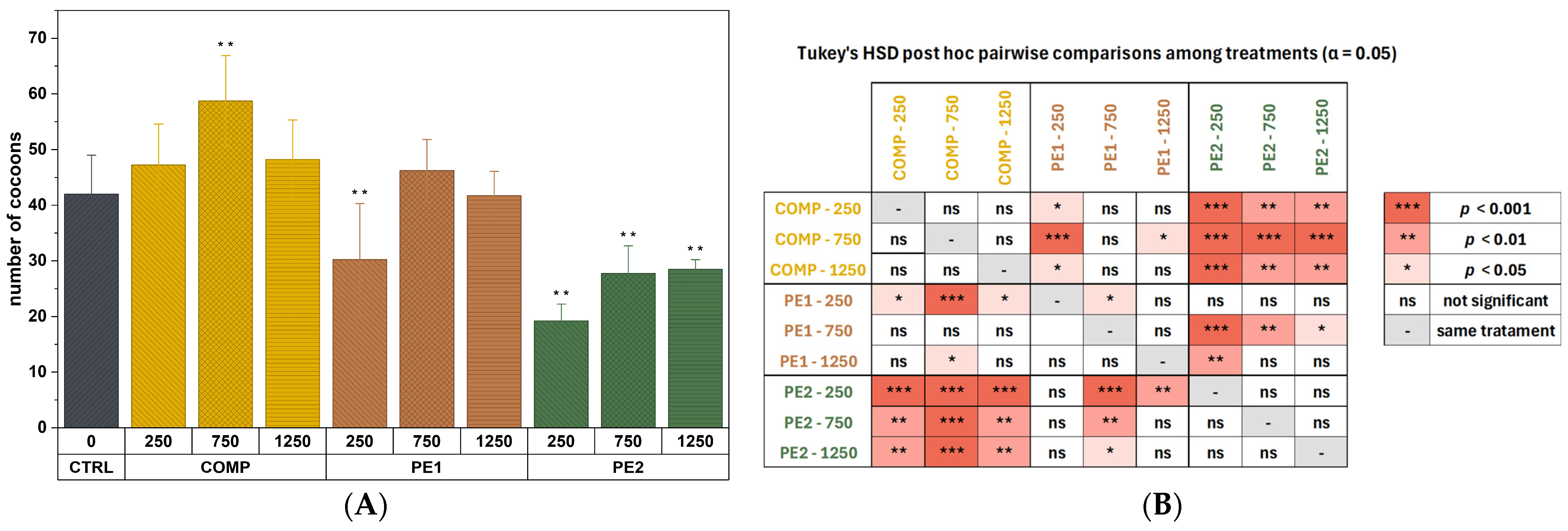
Cocoon production (Figure 4A) was significantly affected by exposure to the polymers (F9,38 = 13.85, p < 0.001). The response pattern across treatments did not support the hypothesis that plastic additives are the primary drivers of toxic effects on E. andrei. Notably, the reference polymer PE2 induced stronger adverse effects than PE1, significantly reducing cocoon production at all concentrations tested. The greatest reduction occurred at 250 mg kg−1, with a 54% decrease (19 cocoons; p < 0.001), whereas smaller reductions of 33% were recorded at 750 and 1250 mg kg−1 (28 cocoons; p = 0.005 and p = 0.008, respectively), indicating attenuation of the effect with increasing concentration.
Figure 4.
Effects of microplastics derived from compostable and conventional plastic bags and from virgin polyethylene resin on cocoon production by Eisenia andrei. (A) Cocoon production (mean ± SD, n = 4); asterisks indicate significant differences from the control using Dunnett’s test. (B) Heat map of Tukey’s HSD post hoc pairwise comparisons between treatments (α = 0.05), showing the significance level of each comparison.
In turn, PE1 significantly affected cocoon production only at the lowest concentration tested (250 mg kg−1), producing a 28% reduction (30 cocoons; p = 0.029). No significant differences were observed at the higher concentrations. This behavior may indicate a non-monotonic dose–response relationship, in which low-intensity exposure elicits a biological response that is subsequently modulated at higher concentrations, potentially as a result of adaptive or compensatory mechanisms. Biphasic dose–response relationships and hormetic responses have previously been described in E. andrei, demonstrating that increasing contaminant concentrations do not necessarily result in proportionally greater biological effects [29].
The response of the compostable polymer was markedly different from that of the conventional polymers. A significant 39% increase in cocoon production was observed at the intermediate concentration of 750 mg kg−1 (59 cocoons; p < 0.001), whereas no significant changes were detected at the lowest (250 mg kg−1) or highest (1250 mg kg−1) concentrations.
Pairwise comparisons between polymers (Figure 4B) showed that, overall, the compostable plastic did not differ significantly from PE1 in cocoon production at the intermediate and highest concentrations, but a significant difference was observed at 250 mg kg−1. By contrast, the compostable plastic differed significantly from the reference polymer (PE2) at all three exposure concentrations. Comparisons between virgin polyethylene resin (PE2) and the corresponding commercial polyethylene bag (PE1) showed a concentration-dependent pattern. The effect of PE1 at 250 mg kg−1 was not significantly different from that of any of the PE2 treatments, whereas the effect of PE1 at 750 mg kg−1 differed significantly from the effects of all PE2 concentrations. By contrast, the effect of PE1 at 1250 mg kg−1 differed significantly only from that of PE2 at 250 mg kg−1.
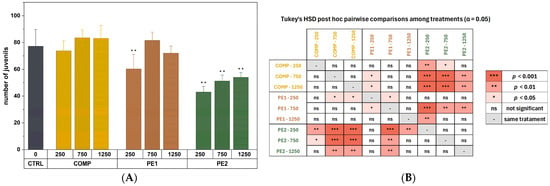
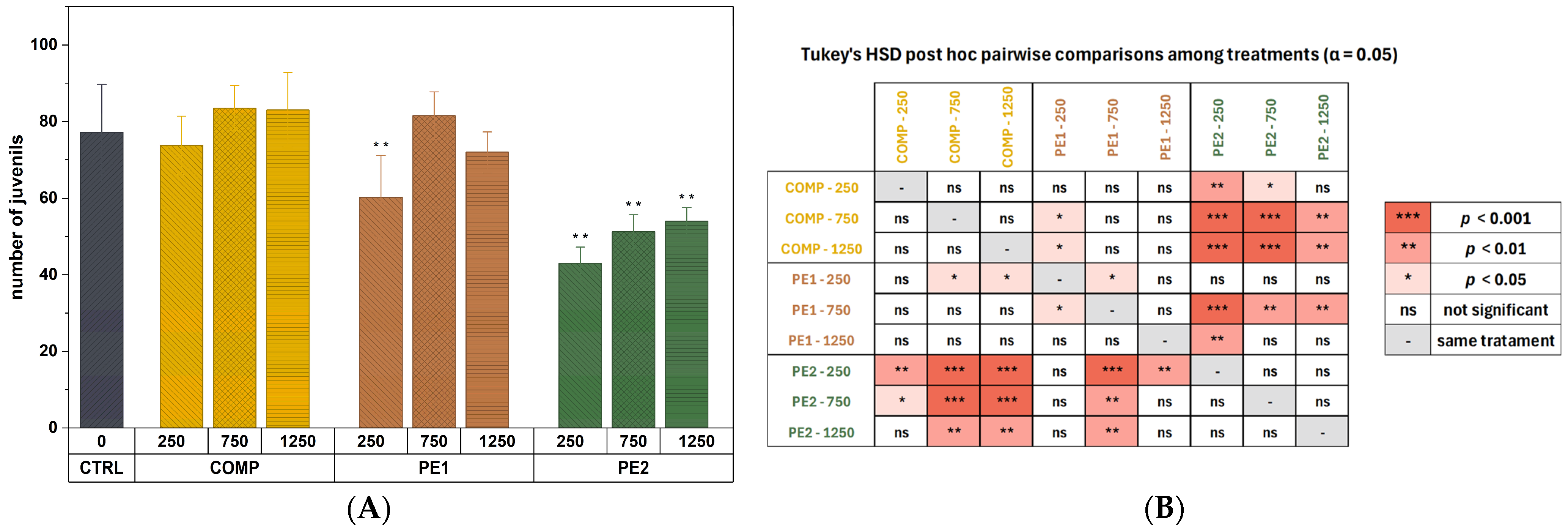
Juvenile production (Figure 5A) showed lower ecotoxicological sensitivity than cocoon production, with less pronounced responses across polymer types and concentrations. The compostable polymer did not significantly affect the number of juveniles at any concentration tested. By contrast, PE2 significantly reduced juvenile production at all exposure levels, consistent with the pattern observed for cocoon production. The strongest effect occurred at 250 mg kg−1, with a 44% reduction (43 juveniles; p < 0.001). Smaller reductions were observed at 750 and 1250 mg kg−1 (51 and 54 juveniles; p < 0.001 and p = 0.001, respectively). PE1 significantly affected juvenile production only at the lowest concentration tested (250 mg kg−1), resulting in a 22% reduction (60 juveniles; p = 0.018), thereby following the same response pattern observed for cocoon production, with both reproductive endpoints exhibiting non-monotonic responses.
Figure 5.
Effects of microplastics derived from compostable and conventional plastic bags and from virgin polyethylene resin on juvenile production by Eisenia andrei. (A) Juvenile production (mean ± SD, n = 4); asterisks indicate significant differences from the control according to Dunnett’s test. (B) Heat map of Tukey’s HSD post hoc pairwise comparisons between treatments (α = 0.05), showing the significance level of each comparison.
As with cocoon production, comparison of the different polymers (Figure 5B) showed that the compostable material did not differ significantly from PE1 at the intermediate and highest concentrations (750 and 1250 mg kg−1), and significant differences were only observed at the lowest concentration tested. By contrast, the effects of the compostable material generally differed significantly from those of PE2 across exposure levels. Comparisons between the virgin resin and the conventional polyethylene bag revealed that the effect of PE1 at 250 mg kg−1 did not differ significantly from those of any PE2 treatment, whereas the greatest divergence in the effects of these materials was observed at the intermediate concentration of PE1.
3.2. Multivariate Analysis and Relationships
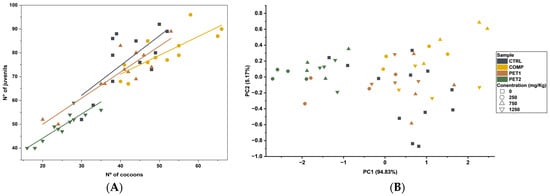
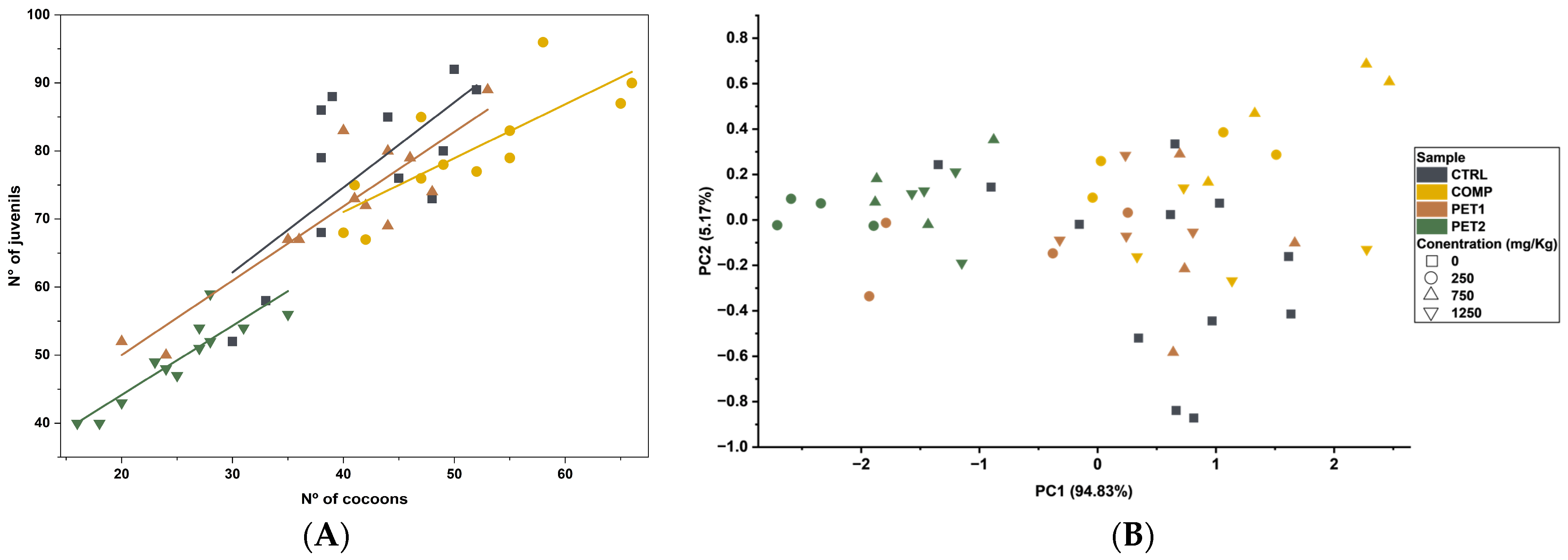
The correlation analysis (Figure 6) revealed a linear relationship between the number of cocoons and the number of E. andrei juveniles after 56 days of exposure, with a juvenile-to-cocoon ratio of 1.82 juveniles per cocoon. The COMP treatment showed the highest reproductive values, particularly at 750 mg kg−1, where the juvenile-to-cocoon ratio decreased to 1.43 juveniles per cocoon, reflecting a relative increase in cocoon production compared with juvenile output. By contrast, the PE2 group showed decreases in both reproductive parameters and an increase in the juvenile-to-cocoon ratio, which was most pronounced at 250 mg kg−1, reaching 2.25 juveniles per cocoon. The PE1 group showed an intermediate pattern and greater variation in the values depending on the concentration tested. The variation in reproductive performance among the groups suggests that the properties of each material influence the organism differently and that an increase in dose does not necessarily imply a trend.
Figure 6.
(A) Linear relationship between cocoon and juvenile production in Eisenia andrei after 56 days of exposure to microplastics derived from compostable plastic bags (COMP), commercial polyethylene bags (PE1), and virgin polyethylene resin (PE2). Each point represents an independent replicate. Linear regression parameters are provided as slope (b), intercept (a), and coefficient of determination (R2): COMP (b = 0.791, a = 39.413, R2 = 0.650); PE1 (b = 1.093, a = 28.170, R2 = 0.815); PE2 (b = 1.017, a = 23.820, R2 = 0.806); CTRL (b = 1.250, a = 24.667, R2 = 0.491). (B) Principal component analysis (PCA) of cocoon and juvenile production, showing clustering by polymer type and exposure concentration (0, 250, 750, and 1250 mg kg−1).
Consistent with these findings, principal component analysis (Figure 6B) of cocoon and juvenile production showed that sample separation was primarily driven by polymer type and, to a lesser extent, by exposure concentration. The control group was broadly distributed across the multivariate space, reflecting the natural variability of the biological endpoints. By contrast, polyethylene-treated samples, particularly those exposed to PE2, formed more clearly defined clusters, indicating a consistent response and a discernible separation by both polymer type and concentration. PE1 showed an intermediate, more variable response, with some overlap with the control group. The compostable polymer showed the greatest dispersion, with some replicates clustering close to the control and others displaced within the ordination space, suggesting a less consistent response, possibly influenced by exposure concentration.
4. Discussion
The objective of this study was to evaluate the effects of different types and concentrations of MPs on the survival and reproduction of E. andrei by using an adaptation of the standardized OECD 222 test [21]. The main methodological modification was to use sewage sludge as the experimental substrate rather than the artificial soil established by the OECD, with the aim of assessing the effects of microplastics on an environmentally relevant organic matrix characterized by greater physicochemical and biological complexity. Unlike the artificial soils generally used in standardized ecotoxicological assays, use of the sewage sludge as the exposure matrix minimized the physiological stress associated with transferring earthworms between substrates with contrasting physicochemical properties, thereby providing exposure conditions that more closely resemble their natural habitat and enhancing the ecological relevance of the assay [30]. Moreover, sewage sludge constitutes one of the major environmental reservoirs of microplastics and its application to land is one of the main pathways through which they are introduced into agricultural systems [12].
Several researchers have noted the limitations associated with artificial soils regarding replicating the physicochemical and microbiological complexity of terrestrial ecosystems, which reduce the ability to extrapolate results to real-world environmental conditions [23,24,25]. In this context, the use of sewage sludge provided an opportunity to assess the toxicity of MPs within a complex environmental matrix while meeting the OECD validity criteria for survival and reproduction. Furthermore, this approach took into account the potential influence of synergistic or antagonistic interactions between MPs and substrate components, which could modulate the observed biological response.
No significant differences in survival and growth of E. andrei were observed between the three polymers at any of the concentrations tested, confirming the limited sensitivity of these endpoints as indicators of ecotoxicological stress induced by MP exposure. This finding is consistent with the high adaptability of E. andrei to complex organic matrices, such as sewage sludge, where the species is commonly exposed to contaminant mixtures, including MPs [19]. Furthermore, various studies have shown that survival and growth are considerably less sensitive than reproductive parameters for detecting sublethal effects resulting from exposure to pollutants [31].
By contrast, reproductive endpoints showed significant responses that varied depending on the polymer type. Both the commercial polyethylene and the pristine reference resin significantly reduced cocoon production, with larger effects than those observed for the compostable material. This pattern is consistent with previous reports of reduced reproduction in E. fetida exposed to polyethylene MPs in artificial soil, whereas compostable polymers generally induced much weaker effects [32]. Other studies conducted with E. fetida in pretreated soils also report a decrease in reproductive activity following the incorporation of PE microplastics [33]. Few studies have evaluated the effect of MP concentrations below 100 mg kg−1 on the number of cocoons in earthworms; although a trend toward a decrease in the number of E. fetida cocoons was reported in studies using these concentrations, the decrease was not statistically significant [34].
Overall, these previous studies differ significantly in methodology from the present work. Most use artificial soils or pre-conditioned matrices to replicate the standardized conditions of OECD 222, employ E. fetida as a model organism, add nutrients such as grains or cattle manure as food for the earthworms, and use varying MP sizes derived from virgin polyethylene ranging from 30 to 120 μm (Table 2).
Table 2.
Comparison of experimental conditions used in previous studies investigating the effects of microplastics on earthworms.
To the best of our knowledge, only one study, by Quigley et al. [35], has reported significant reductions in juvenile production after exposure to pristine polyethylene microplastics at concentrations below 200 mg kg−1. Notably, the strongest effects were observed at the lowest exposure concentration, which is consistent with the findings of the present study. However, the authors observed these effects with an aged polymer, whereas with a pristine polymer at low concentrations, an antagonistic effect was observed, significantly increasing juvenile formation.
These discrepancies could be at least partly attributed to differences in the nature of the experimental substrate. In artificial substrates free of contaminant loads and enriched with nutrients, E. andrei is known to exhibit adaptive or hormetic responses to low-intensity exposures, characterized by transient stimulation of biological performance in the face of moderate environmental stress. By contrast, in the wastewater sludge used in this study, which has a baseline load of contaminants and microplastics, this adaptive capacity may be limited, favoring the emergence of reproductive effects even at low PE concentrations. Additionally, differences in substrate availability and nutritional quality, as well as in the feeding strategies used across studies, may contribute to explaining the varying magnitudes of the observed responses.
The importance of the exposure matrix has also been highlighted by Gutiérrez-Rial et al. 2025 [36]. In a comparison of polyethylene (PE) microplastic exposure in an artificial substrate (OECD) and a vermicompost, these authors reported significantly greater impairment of E. andrei reproduction in vermicompost, as evidenced by reduced cocoon production and juvenile output.
Altogether, these results highlight that the physicochemical properties of the substrate are a determining factor in the ecotoxicological assessment of MPs and suggest that, under more complex environmental conditions and in the presence of pre-existing contamination, the adaptive capacity of E. andrei in response to new exposure to MPs could be impaired. Thus, the biological response of E. andrei would be expected to differ significantly when the analysis is conducted in a substrate other than sewage sludge, as evidenced by Mendes et al. 2024 [30], who observed differential polymer degradation depending on the substrate used, with certain polymers showing greater degradation in sewage sludge and others in coffee grounds.
Furthermore, the linear relationship between cocoon and juvenile production (Figure 6A) confirms the close association between these reproductive endpoints. However, differences in regression slopes across treatments indicate that the polymers not only altered overall reproductive performance but also affected the efficiency with which cocoon production was translated into juvenile emergence. Previous studies have shown that exposure to 500 ppm polypropylene increased cocoon production while reducing juvenile output, whereas exposure to 2% polypropylene decreased cocoon production but enhanced hatching success [37]. These contrasting responses suggest that specific MP concentrations may not induce direct lethal effects but rather may impair zygote viability, thereby reducing hatching success. Conversely, other exposure levels may increase mortality as a consequence of environmental stress, ultimately decreasing cocoon production.
For compostable material, the higher cocoon production relative to the control group may reflect a hormetic or compensatory response to sublethal exposure.
This pattern is consistent with previous reports on various contaminants, where moderate stress has been shown to transiently stimulate specific reproductive parameters, such as the increased juvenile production in E. fetida exposed to low concentrations of microplastics [35] and the enhanced cocoon production in E. fetida exposed to lead [38]. This interpretation is further supported by the relationship between cocoon and juvenile production (Figure 6A), in which the compostable material exhibited the lowest regression slope, indicating lower hatching efficiency. Nevertheless, the absence of significant differences in final juvenile production suggests that the increased investment in cocoon production may have partly compensated for reduced viability of individual offspring, thereby maintaining overall reproductive output.
Multivariate analysis further reinforced the patterns identified in the univariate analyses, showing that the type of polymer was the primary source of variation in the reproductive response of E. andrei. By contrast, the absence of a consistent concentration-dependent gradient suggests a non-monotonic dose–response relationship. This interpretation is consistent with the findings of a review study by Agathokleous et al. (2021), who emphasized that biological responses to microplastics rarely follow linear dose–response patterns and are modulated by multiple factors, including polymer type, particle size, the presence of additives, and the physicochemical characteristics of the exposure medium [39]. These authors further noted that non-monotonic and even hormetic responses are frequently reported, indicating that increasing MP concentrations do not necessarily result in proportionally greater biological effects.
5. Conclusions
The study found that reproductive measures, particularly cocoon production, are more sensitive indicators of the sublethal effects of MPs on E. andrei than survival and growth. Furthermore, the use of sewage sludge as an exposure matrix made it possible to assess these effects in the presence of pre-existing contaminants, thereby providing an environmentally relevant exposure scenario.
The biological response was primarily determined by polymer type rather than by a gradual increase in concentration, indicating a non-monotonic dose–response relationship. In this context, the fact that the virgin polyethylene had stronger effects on reproduction than the commercial polyethylene suggests that the intrinsic properties of the polymer may play a role in MP ecotoxicity that is as important as that of the additives.
Compostable plastic did not adversely affect survival or juvenile production; however, it led to an increase in cocoon production, thus significantly altering the reproductive response. This is consistent with a potential hormetic response, although the increase in cocoon production was not accompanied by a proportional increase in juvenile output. Consequently, enhanced cocoon production may represent an adaptive response to stress, potentially at the expense of embryonic developmental.
These findings highlight the need for further investigation into the behavior of MPs in complex environmental matrices. They also call into question the safety of compostable plastics and the presumed biological inertness of virgin polymers, indicating the need for ecotoxicological assessments tailored to real exposure scenarios. Likewise, future studies should further investigate the mechanisms underlying these responses through the assessment of biomarkers and other indicators of cellular and tissue damage, in order to better understand the processes involved in the ecotoxicity of different polymeric materials.
Supplementary Materials
The following supporting information can be downloaded at: https://www.mdpi.com/article/10.3390/microplastics5030182/s1. Table S1. Characterization and chemical identification of the polymers used in the study.
Author Contributions
Conceptualization, J.D. and R.B.; methodology, J.D., M.A. and R.B.; software, A.C. and M.A.; validation, A.C. and M.A.; formal analysis, A.C. and M.A.; investigation, A.C., J.D. and M.A.; resources, J.D. and M.A.; data curation, A.C. and M.A.; writing—original draft preparation, A.C., J.D. and M.A.; writing—review and editing, A.C., J.D., M.A. and R.B.; visualization, J.D. and M.A.; supervision, J.D., M.A. and R.B.; project administration, J.D.; funding acquisition, J.D. All authors have read and agreed to the published version of the manuscript.
Funding
This study was supported by the Spanish Ministerio de Ciencia e Innovación (PID2021-124265OB-100), the Xunta de Galicia (Grant number ED431C 2026/055), and the MCIN/AEI and European Union Next Generation_EU (project TED2021-129437B-100). A. Castillo acknowledges support from the Program and the Ministry of Science, Innovation and Universities, Spain (MCIN) for a contract within the grant DIN2021-011976 funded by the MCIN/AEI/10.13039/501100011033.
Institutional Review Board Statement
The ASAB/ABS Guidelines for the Use of Animals in Research were followed and the research complied with current Spanish regulation for the maintenance and use of animals in scientific research (RD53/2013). As an earthworm species was used as the experimental model, approval from the ethical committee was not required. Throughout the experiment, earthworms did not exhibit any adverse signs as a result of the experimental manipulations.
Informed Consent Statement
Not applicable.
Data Availability Statement
The original contributions presented in this study are included in the article. Further inquiries can be directed to the corresponding author.
Acknowledgments
The authors thank Hugo Martínez and Alberto Da Silva for help with the vermicomposting process and sample collection.
Conflicts of Interest
Author Aly Castillo was employed by the i-Grape Laboratory, S.L. The remaining authors declare that the research was conducted in the absence of any commercial or financial relationships that could be construed as a potential conflict of interest.
Abbreviations
The following abbreviations are used in this manuscript:
| COMP | Microplastics from a compostable plastic bag |
| CTRL | Control treatment |
| MPs | Microplastics |
| OECD | Organization for Economic Co-operation and Development |
| PCA | Principal Component Analysis |
| PE | Polyethylene |
| PE1 | Microplastics from a commercial polyethylene plastic bag |
| PE2 | Virgin polyethylene resin |
| WWTP | Wastewater Treatment Plant |
References
- Koelmans, A.A.; Redondo-Hasselerharm, P.E.; Nor, N.H.M.; de Ruijter, V.N.; Mintenig, S.M.; Kooi, M. Risk assessment of microplastic particles. Nat. Rev. Mater. 2022, 7, 138–152. [Google Scholar] [CrossRef] [Scilit]
- Ghosh, S.; Sinha, J.K.; Ghosh, S.; Vashisth, K.; Han, S.; Bhaskar, R. Microplastics as an emerging threat to the global environment and human health. Sustainability 2023, 15, 10821. [Google Scholar] [CrossRef] [Scilit]
- Esterhuizen, M.; Vikfors, S.; Penttinen, O.P.; Kim, Y.J.; Pflugmacher, S. Lolium multiflorum germination and growth affected by virgin, naturally, and artificially aged high-density polyethylene microplastic and leachates. Front. Environ. Sci. 2022, 10, 964230. [Google Scholar] [CrossRef] [Scilit]
- Sun, J.; Zheng, H.; Xiang, H.; Fan, J.; Jiang, H. The surface degradation and release of microplastics from plastic films studied by UV radiation and mechanical abrasion. Sci. Total Environ. 2022, 838, 156369. [Google Scholar] [CrossRef] [Scilit] [PubMed]
- Özen, E.Y.; Canbulat Özdemir, M.; Hatinoğlu, M.D.; Apul, O.G.; İmamoğlu, İ. Mechanistic inferences from empirical and LSER modeling approaches concerning sorption of organic compounds by pristine and aged PE microplastics. Chemosphere 2024, 368, 143695. [Google Scholar] [CrossRef] [Scilit] [PubMed]
- Li, Y.; Liu, C.; Yang, H.; He, W.; Li, B.; Zhu, X.; Liu, S.; Jia, S.; Li, R.; Tang, K.H.D. Leaching of chemicals from microplastics: A review of chemical types, leaching mechanisms and influencing factors. Sci. Total Environ. 2024, 906, 167666. [Google Scholar] [CrossRef] [Scilit] [PubMed]
- Salehi, M.; Pincus, L.N.; Deng, B.; Peters, C.A. Microplastics: From intrinsic properties to environmental fate. Environ. Eng. Sci. 2024, 41, 425–435. [Google Scholar] [CrossRef] [Scilit]
- Hoang, H.G.; Nguyen, N.S.H.; Zhang, T.; Tran, H.T.; Mukherjee, S.; Naidu, R. A review of microplastic pollution and human health risk assessment: Current knowledge and future outlook. Front. Environ. Sci. 2025, 13, 1606332. [Google Scholar] [CrossRef] [Scilit]
- Masseroni, A.; Federico, L.; Becchi, A.; Quinto, M.; Saliu, F.; Villa, S. Effects of pristine and aged LDPE and PP microplastic leachates on behavioural responses of the soil arthropods Folsomia candida and Porcellionides pruinosus. Toxics 2026, 14, 502. [Google Scholar] [CrossRef] [Scilit] [PubMed]
- Boháčková, J.; Cajthaml, T. Contribution of chemical toxicity to the overall toxicity of microplastic particles: A review. Sci. Total Environ. 2024, 957, 177611. [Google Scholar] [CrossRef] [Scilit] [PubMed]
- de Souza Machado, A.A.; Kloas, W.; Zarfl, C.; Hempel, S.; Rillig, M.C. Microplastics as an emerging threat to terrestrial ecosystems. Glob. Change Biol. 2018, 24, 1405–1416. [Google Scholar] [CrossRef] [Scilit] [PubMed]
- Mendes, L.A.; Beiras, R.; Domínguez, J. Earthworm (Eisenia andrei)-mediated degradation of commercial compostable bags and potential toxic effects. Microplastics 2024, 3, 322–338. [Google Scholar] [CrossRef] [Scilit]
- Muñiz González, A.B.; Mendes, L.A.; Brandón, M.G.; Quintela-Sabarís, C.; Rupani, P.F.; Domínguez, J. Earthworms and microplastics: Transport from sewage sludge to soil, antibiotic-resistant genes, and soil remediation. In Earthworm Technology in Organic Waste Management: Recent Trends and Advances; Elsevier: Amsterdam, The Netherlands, 2024; pp. 207–229. [Google Scholar] [CrossRef] [Scilit]
- Fuller, S.; Gautam, A. A procedure for measuring microplastics using pressurized fluid extraction. Environ. Sci. Technol. 2016, 50, 5774–5780. [Google Scholar] [CrossRef] [Scilit] [PubMed]
- Zhang, L.; Jiang, C.; Wang, W.; Xie, B. Revisiting the environmental impacts of microplastics in soils: Insights from a meta-analysis. Environ. Pollut. 2026, 404, 128465. [Google Scholar] [CrossRef] [Scilit] [PubMed]
- Wang, Y.; Jing, S.; Hou, P.; Ni, R.; Niu, L.; Wanger, T.C.; Liu, W.; Liu, K. Soil erosion is a major driver for nano & micro-plastics to enter riverine systems from cultivated land. Water Res. 2024, 256, 121597. [Google Scholar] [CrossRef] [Scilit] [PubMed]
- Zhang, L.; Wang, F.; Wang, W.; Su, Y.; Zhan, M.; Lu, J.; Xie, B. Using machine learning to reveal drivers of soil microplastics and assess their stock: A national-scale study. J. Hazard. Mater. 2024, 478, 135466. [Google Scholar] [CrossRef] [Scilit] [PubMed]
- Klimasz, M.; Grobelak, A. Effects of microplastics on selected earthworm species. Toxics 2025, 13, 201. [Google Scholar] [CrossRef] [Scilit] [PubMed]
- Castillo, A.; Lores, M.; Aira, M.; Domínguez, J. Microplastics in sewage sludge: Changes in abundance, size distribution and composition during short and long-term vermicomposting. Microplastics 2026, 5, 118. [Google Scholar] [CrossRef] [Scilit]
- Li, B.; Song, W.; Cheng, Y.; Zhang, K.; Tian, H.; Du, Z.; Wang, J.; Wang, J.; Zhang, W.; Zhu, L. Ecotoxicological effects of different size ranges of industrial-grade polyethylene and polypropylene microplastics on earthworms Eisenia fetida. Sci. Total Environ. 2021, 783, 147007. [Google Scholar] [CrossRef] [Scilit] [PubMed]
- OECD. Test No. 222: Earthworm Reproduction Test (Eisenia fetida/Eisenia andrei). In OECD Guidelines for the Testing of Chemicals, Section 2; OECD Publishing: Paris, France, 2016. [Google Scholar] [CrossRef] [Scilit]
- He, S.; Wei, Y.; Yang, C.; He, Z. Interactions of microplastics and soil pollutants in soil-plant systems. Environ. Pollut. 2022, 315, 120357. [Google Scholar] [CrossRef] [Scilit] [PubMed]
- Brami, C.; Glover, A.R.; Butt, K.R.; Lowe, C.N. Avoidance, biomass and survival response of soil dwelling (endogeic) earthworms to OECD artificial soil: Potential implications for earthworm ecotoxicology. Ecotoxicology 2017, 26, 576–583. [Google Scholar] [CrossRef] [Scilit] [PubMed]
- Römbke, J.; Jänsch, S.; Junker, T.; Pohl, B.; Scheffczyk, A.; Schallnaß, H.J. Improvement of the applicability of ecotoxicological tests with earthworms, springtails, and plants for the assessment of metals in natural soils. Environ. Toxicol. Chem. 2006, 25, 776–787. [Google Scholar] [CrossRef] [Scilit] [PubMed]
- Aderjan, E.; Wagenhoff, E.; Kandeler, E.; Moser, T. Natural soils in OECD 222 testing—Influence of soil water and soil properties on earthworm reproduction toxicity of carbendazim. Ecotoxicology 2023, 32, 403–415, Correction in Ecotoxicology 2023, 32, 416–417. [Google Scholar] [CrossRef] [Scilit] [PubMed]
- Beiras, R.; Vilas, A.; Sieiro, J.G.; Schönemann, A.M.; Laranjeiro, F.M.G. Alternative plastic materials pose higher chemical hazard and aquatic ecotoxicity than conventional plastics. Aquat. Toxicol. 2025, 284, 107360. [Google Scholar] [CrossRef] [Scilit] [PubMed]
- Büks, F.; Kaupenjohann, M. Global concentrations of microplastics in soils—A review. SOIL 2020, 6, 649–662. [Google Scholar] [CrossRef] [Scilit]
- Zhou, Y.; Wang, J.; Zou, M.; Jia, Z.; Zhou, S.; Li, Y. Microplastics in soils: A review of methods, occurrence, fate, transport, ecological and environmental risks. Sci. Total Environ. 2020, 748, 141368. [Google Scholar] [CrossRef] [Scilit] [PubMed]
- Hackenberger, B.K.; Velki, M.; Stepić, S.; Hackenberger, D.K. The effect of formalin on acetylcholinesterase and catalase activities, and on the concentration of oximes, in the earthworm species Eisenia andrei. Eur. J. Soil Biol. 2012, 50, 137–143. [Google Scholar] [CrossRef] [Scilit]
- Mendes, L.A.; Domínguez, J. Spent coffee grounds as a suitable alternative to standard soil in ecotoxicological tests. Environ. Sci. Pollut. Res. 2024, 31, 16725–16734. [Google Scholar] [CrossRef] [Scilit] [PubMed]
- Van Gestel, C.A.M.; Dirven-Van Breemen, E.M.; Baerselman, R.; Emans, H.J.B.; Janssen, J.A.M.; Postuma, R.; Van Vliet, P.J.M. Comparison of sublethal and lethal criteria for nine different chemicals in standardized toxicity tests using the earthworm Eisenia andrei. Ecotoxicol. Environ. Saf. 1992, 23, 206–220. [Google Scholar] [CrossRef] [Scilit] [PubMed]
- Ding, W.; Li, Z.; Qi, R.; Jones, D.L.; Liu, Q.; Liu, Q.; Yan, C. Effect thresholds for the earthworm Eisenia fetida: Toxicity comparison between conventional and biodegradable microplastics. Sci. Total Environ. 2021, 781, 146884. [Google Scholar] [CrossRef] [Scilit]
- Yang, X.; Zhang, X.; Shu, X.; Gong, J.; Yang, J.; Li, B.; Lin, J.; Chai, Y.; Liu, J. The effects of polyethylene microplastics on the growth, reproduction, metabolic enzymes, and metabolomics of earthworms Eisenia fetida. Ecotoxicol. Environ. Saf. 2023, 263, 115390. [Google Scholar] [CrossRef] [Scilit] [PubMed]
- Gautam, K.; Dwivedi, S.; Verma, R.; Vamadevan, B.; Patnaik, S.; Anbumani, S. Combined effects of polyethylene microplastics and carbendazim on Eisenia fetida: A comprehensive ecotoxicological study. Environ. Pollut. 2024, 348, 123854. [Google Scholar] [CrossRef] [Scilit] [PubMed]
- Quigley, E.; Silva, A.L.P.; Chelinho, S.; Cunha, L.; Briones, M.J.; Sousa, J.P. Pristine and UV-aged polyethylene microplastics’ impact on gut microbiome and reproduction of earthworm Eisenia andrei. Eur. J. Soil Biol. 2024, 122, 103640. [Google Scholar] [CrossRef] [Scilit]
- Gutiérrez-Rial, D.; Lagoa, A.; Villar, I.; Feijoo, P.; Mariño, F.; Garrido, J.; Soto, B.; Mato, S. Short- and medium-term effects of biodegradable microplastics (PLA and PHB) on earthworm development and reproduction. Ecotoxicology 2025, 34, 701–711. [Google Scholar] [CrossRef] [Scilit] [PubMed]
- Liu, X.; Dong, W.; Gao, H.; Wang, K.; Liu, X.; Yan, C. Ecotoxicological effects of soil microplastic types and concentrations on earthworms. Environ. Pollut. 2026, 393, 127720. [Google Scholar] [CrossRef] [Scilit] [PubMed]
- Reinecke, A.J.; Maboeta, M.S.; Reinecke, S.A. Stimulating effects of low lead concentrations on growth and cocoon production of Eisenia fetida (Oligochaeta). S. Afr. J. Zool. 1997, 32, 72–75. [Google Scholar] [CrossRef] [Scilit]
- Agathokleous, E.; Iavicoli, I.; Barceló, D.; Calabrese, E.J. Micro/nanoplastics effects on organisms: A review focusing on ‘dose’. J. Hazard. Mater. 2021, 417, 126084. [Google Scholar] [CrossRef] [Scilit] [PubMed]

Disclaimer/Publisher’s Note: The statements, opinions and data contained in all publications are solely those of the individual author(s) and contributor(s) and not of MDPI and/or the editor(s). MDPI and/or the editor(s) disclaim responsibility for any injury to people or property resulting from any ideas, methods, instructions or products referred to in the content. |
© 2026 by the authors. Licensee MDPI, Basel, Switzerland. This article is an open access article distributed under the terms and conditions of the Creative Commons Attribution (CC BY) license.