


Abstract
Plastic pollution is a growing concern in urban estuarine environments, where hydrodynamic conditions and structural features of vegetated habitats can promote the interception and accumulation of plastic debris. This study evaluated the coconut-fiber matrix of a mangrove-based floating island as a passive retention substrate for plastic pellets and smaller plastic particles under real field conditions in the Estero Salado, Guayaquil, Ecuador. The system consisted of three connected floating modules containing coconut fiber and 27 mangrove propagules and was originally developed to support mangrove establishment and local phytoremediation. Following approximately one month of estuarine exposure, the floating structure remained stable and plastic particles were visibly retained within the coconut-fiber substrate. A total of 300 visible plastic particles were recovered, of which 40 were randomly selected for morphological and ATR-FTIR characterization. Pellet-like particles represented 72.5% of the analyzed subset, and polymer analysis identified polyethylene (PE) in 87.5% and polypropylene (PP) in 12.5% of the characterized visible particles. Smaller retained particles were additionally recovered from coconut-fiber subsamples using saturated NaCl flotation, membrane filtration, stereomicroscopy, and FTIR microspectroscopy. Spectroscopic analysis provided evidence of synthetic microplastics, including spectra associated with PET and LLDPE, together with a separate fraction of cellulosic fiber-like materials associated with cotton, linen, and regenerated cellulose (rayon). Overall, the results demonstrate that the coconut-fiber matrix performed an additional function beyond its original role as a planting substrate by acting as a retrievable passive interception matrix for plastic particles under urban estuarine exposure. These findings support the further development of coconut-fiber-based floating systems for plastic interception while providing a basis for future quantitative assessments of retention performance.
1. Introduction
Plastic pollution is recognized as a pervasive stressor across land–sea interfaces, while estuaries are especially important because they receive riverine, urban, industrial, wastewater, and maritime inputs while also acting as transitional zones where plastic particles can be trapped, resuspended or buried [1,2]. Vegetated coastal habitats do not simply passively receive plastic waste; they modify its transport through physical interception and hydrodynamic effects [1,3]. Mangroves are particularly relevant in this context because their above- and belowground structure alters flow, traps sediment, and creates complex three-dimensional retention zones. Field studies have shown that mangroves act as sinks for macro-litter and marine debris, with aerial roots acting as sieves for larger items, while pneumatophore density and root complexity influence the distribution and retention of microplastics [4,5]. Across mangrove environments, microplastics are often more abundant in mangrove-associated zones than in adjacent non-vegetated areas, and smaller particles can become enriched in mangrove sediment systems through coupled retention and adsorption processes [5,6].
Floating treatment wetlands and related artificial floating-island systems are increasingly investigated as nature-based approaches for water-quality improvement, with their performance strongly influenced by plant roots, floating media, and associated microbial communities [7,8]. Full-scale treatment wetlands, including floating-plant systems, have demonstrated substantial retention of microplastics, with macrophyte roots contributing importantly to particle retention [9]. In parallel, coconut coir has shown capacity to retain microplastics in wastewater-treatment experiments, supporting its potential as a natural fibrous interception medium [10].
Coconut-based media have been previously incorporated into floating wetland systems; however, their potential role as direct retention matrices for plastic debris remains comparatively underexplored [10]. The floating island evaluated in this study was originally designed to support mangrove establishment and local phytoremediation. During field deployment, however, plastic particles were observed retained within the coconut-fiber substrate, suggesting an additional passive interception function. This observation motivated the present assessment of coconut fiber as a potential retention matrix for plastic particles under real estuarine exposure conditions. Such retention may represent an additional functional benefit of nature-based floating systems, although the accumulation of plastics within biogenic substrates also highlights the importance of monitoring and periodic maintenance to prevent retained material from becoming a secondary source of contamination. Therefore, this study aimed to evaluate whether the coconut-fiber matrix of a mangrove-based floating island could function as a passive retention substrate for visible plastic pellets and selected microplastic particles in an urban estuarine environment. Specifically, the study documented the occurrence, morphology, and polymeric identity of retained particles, without attempting to quantify estuary-scale removal efficiency.
2. Methods
2.1. Study Site, Floating-Island Design, and Field Deployment
The study was conducted in an urban estuarine environment associated with the Estero Salado, Guayaquil, coastal Ecuador. The site is characterized by tidal influence, low-energy water circulation in some sectors, urban pressure, and the recurrent presence of floating anthropogenic debris. The floating structure evaluated in this work corresponded to a previously developed mangrove-based modular island system, originally designed as a support platform for mangrove establishment under estuarine conditions. In the present study, the system was assessed specifically for its additional capacity to passively retain visible plastic particles and smaller retained particles within the coconut-fiber substrate. The floating island was deployed for approximately one month (February–March 2026). During this period, the structure remained exposed to tidal exchange, urban runoff influence, and floating anthropogenic debris. No systematic removal of retained plastic particles was performed before final retrieval.
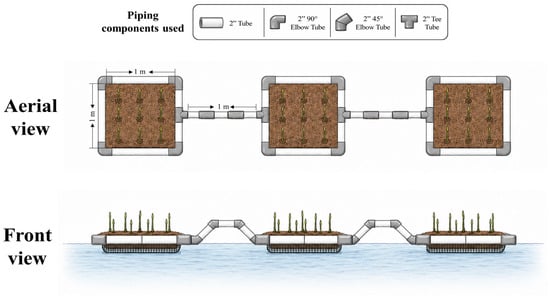
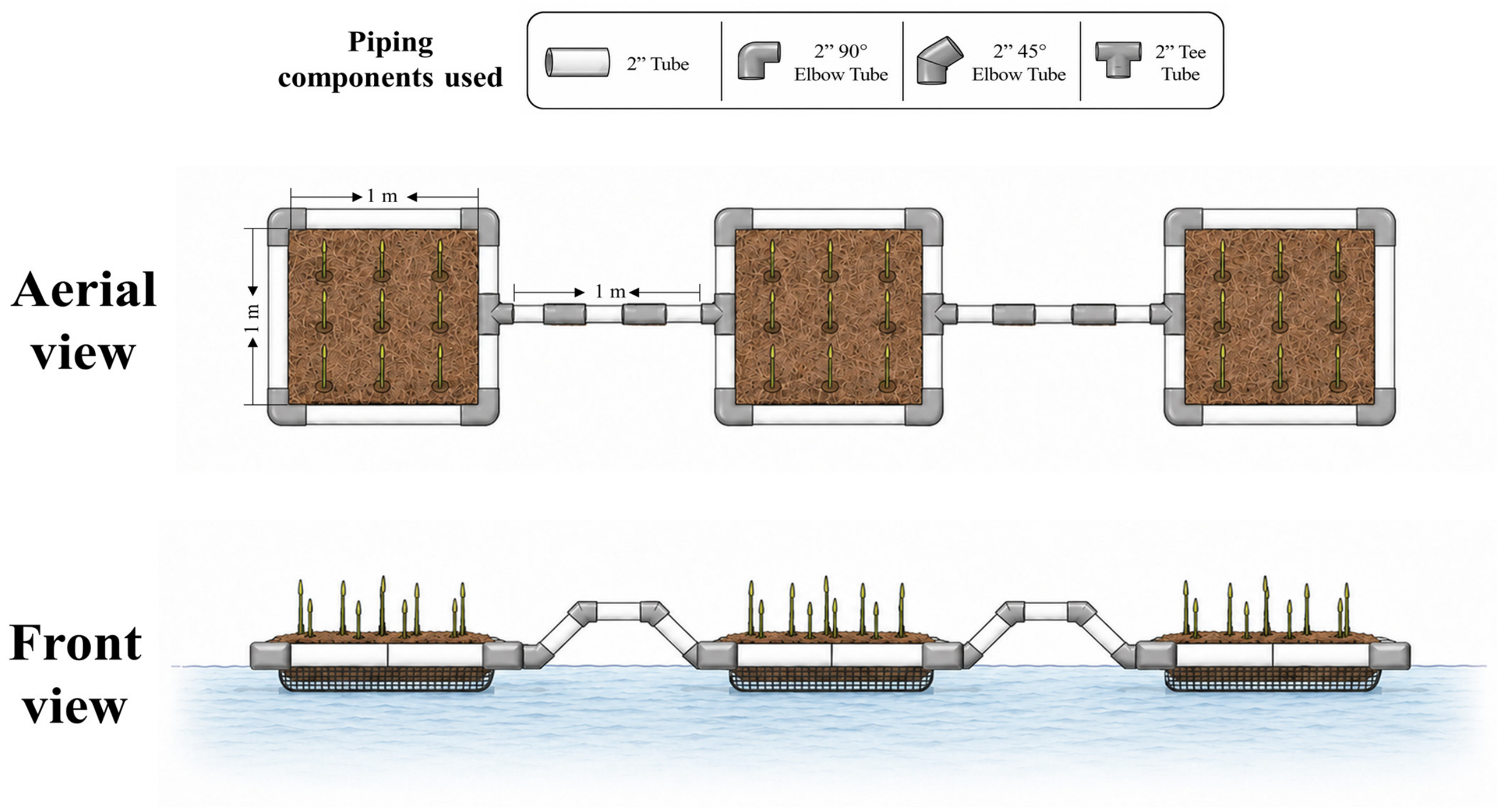
The floating island consisted of three connected square modules, each with an approximate planting area of 1 × 1 m. The frame was constructed using 2-inch PVC pipes, 90° elbows, 45° elbows, and tee connectors. Each module included a lower mesh support that held the coconut fiber matrix in place while allowing direct contact between the fibrous substrate and the surrounding water column. Coconut fiber was used as the internal fill material and planting substrate. Nine mangrove propagules were arranged in a 3 × 3 pattern in each module, for a total of 27 propagules across the three-module system (Figure 1). Although the structure supported mangrove establishment, the present work focused on the plastic-retention function of the coconut fiber matrix rather than on the full phytoremediation performance of the island.
Figure 1.
Modular mangrove-based floating island design.
Mangrove survival was visually recorded as a supporting operational observation to verify that the floating platform maintained its original planting function during deployment. Survival was expressed as the number of living propagules relative to those 27 initially established in the system. No quantitative assessment of mangrove growth, root development, physiology, or phytoremediation performance was conducted, as these variables were outside the scope of the present study.
2.2. Recovery and Characterization of Retained Particles
After field exposure, the coconut-fiber matrix was inspected to identify retained plastic particles. Visible plastic pellets, fragments, and other plastic debris were manually recovered from the surface and accessible internal portions of the substrate using clean forceps. A total of 300 visible plastic particles were recovered, photographed, and individually numbered. From this assemblage, 40 particles were selected without replacement using a simple random-number procedure for detailed morphological and ATR-FTIR characterization, representing 13.3% of the total recovered visible-particle assemblage. No stratification by color, size, or morphology was applied during selection. The retained material was subsequently classified according to particle morphology, including pellet-like particles, irregular fragments, and other visible plastic debris.
Particle terminology was defined according to the analytical workflow for consistency. Manually recovered pellets, fragments and other readily observable items are referred as visible plastic particles throughout the manuscript. Microplastics are conventionally defined as synthetic polymer particles <5 mm; however, because a systematic size-distribution analysis was not performed for the complete recovered assemblage, unmeasured visible particles were not assigned to specific microplastic size classes. Particles recovered from coconut-fiber subsamples by density separation and membrane filtration are referred to as smaller retained particles or suspected microplastics prior to spectroscopic identification, whereas the term microplastic is used following confirmation of the actual synthetic polymer identity by FTIR microspectroscopy.
A flotation method was employed to recover smaller particles potentially retained between the coconut fibers. Coconut-fiber subsamples were placed in saturated NaCl solution and manually agitated to promote the release and flotation of retained particles. After sedimentation of heavier organic and mineral residues, the supernatant was carefully recovered and vacuum-filtered through membranes. The membranes were subsequently examined using a Nikon SMZ445 stereomicroscope (Nikon Corporation, Tokyo, Japan) to locate and classify suspected microplastics, which were then transferred to gold-coated slides for further spectroscopic analysis. Because saturated NaCl preferentially promotes the separation of lower-density polymers, this procedure was used as a practical approach for detecting the smaller retained particle fraction rather than for quantitatively representing the complete polymer or size distribution of material retained within the coconut-fiber matrix [11,12].
2.3. Ftir and Mftir Polymer Identification
Visible plastic pellets and larger recovered fragments were analyzed by attenuated total reflectance Fourier-transform infrared spectroscopy using a Thermo Scientific Nicolet iS50 FTIR spectrometer (Thermo Fisher Scientific Inc., Madison, WI, USA). Spectra were acquired using 16 scans at a spectral resolution of 4 cm−1. Before analysis, particles were visually inspected and cleaned when necessary to reduce the interference of superficial organic residues. The obtained spectra were compared with polymer reference libraries to assign the most probable polymer identity. This analysis was used to confirm the composition of the larger retained particles, particularly pellet-like items recovered from the coconut fiber matrix.
Suspected microplastics retained on filtration membranes after NaCl flotation were analyzed using a Thermo Scientific Nicolet RaptIR FTIR microscope (Thermo Fisher Scientific Inc., Madison, WI, USA). Spectra were acquired using 16 scans at a spectral resolution of 4 cm−1. FTIR microspectroscopy was used to determine the chemical identity of selected particles detected during stereomicroscopic examination. Particle identification was based on spectral matching with reference libraries and visual inspection of diagnostic absorption bands. Polymer assignments were considered valid only when the measured spectrum showed sufficient quality and agreement with the corresponding reference material [13,14,15].
2.4. Quality Assurance and Data Analysis
To reduce contamination during sample handling and analysis, visible particles were manipulated with clean forceps and stored individually when possible. Procedural membrane blanks were inspected before sample processing, and the distilled water used during the procedure was filtered three consecutive times before use. The saturated NaCl solution used for density separation was also filtered after preparation to minimize the introduction of external microparticles from the solution into the microplastic analysis [16]. The PVC frame, mesh, and other construction materials were considered potential sources of synthetic particles during interpretation. Polymer identification was therefore used to distinguish retained environmental particles from possible particles derived from the floating platform.
Particle identification was based on a combination of spectral-library matching and visual assessment of diagnostic absorption bands. Because environmental microparticles may exhibit lower library-match values as a consequence of particle size, surface weathering, contamination, substrate interference, and spectral signal quality, polymer assignments were not based exclusively on the numerical library-match score. Assignments were accepted when the measured spectrum showed sufficient spectral quality and the principal diagnostic bands were consistent with the corresponding reference material. Lower-scoring matches were interpreted conservatively and were retained only when supported by recognizable diagnostic spectral features [13,14,15].
Morphological and polymeric data from the randomly selected 40-particle subset were descriptively analyzed. Categorical variables including particle morphology, color, and polymer identity, were expressed as absolute frequencies and percentages. Dimensional variables were summarized using appropriate descriptive statistics according to their distribution. The 40-particle analytical subset was selected from the 300 recovered visible particles using a simple random-number procedure, without stratification by morphology, color, or size.
3. Results and Discussion
3.1. Floating-Island Stability and Field Retention of Plastic Particles
The floating-island system remained structurally stable throughout the field-deployment period and maintained the coconut-fiber matrix in direct contact with the surrounding estuarine water. All 27 mangrove propagules remained alive throughout the deployment period, corresponding to 100% survival and indicating that the floating platform maintained its original planting function during field exposure. The principal field observation relevant to the present study was the accumulation of plastic particles within the coconut-fiber substrate. A total of 300 visible plastic particles were recovered across the three interconnected modules after approximately one month of estuarine exposure, although particle accumulation varied among individual modules. This measurable accumulation under real field conditions provides direct evidence that the coconut-fiber matrix was capable of intercepting and retaining plastic material transported through the surrounding water column.
3.2. Morphological and Polymeric Composition of Visible Retained Particles
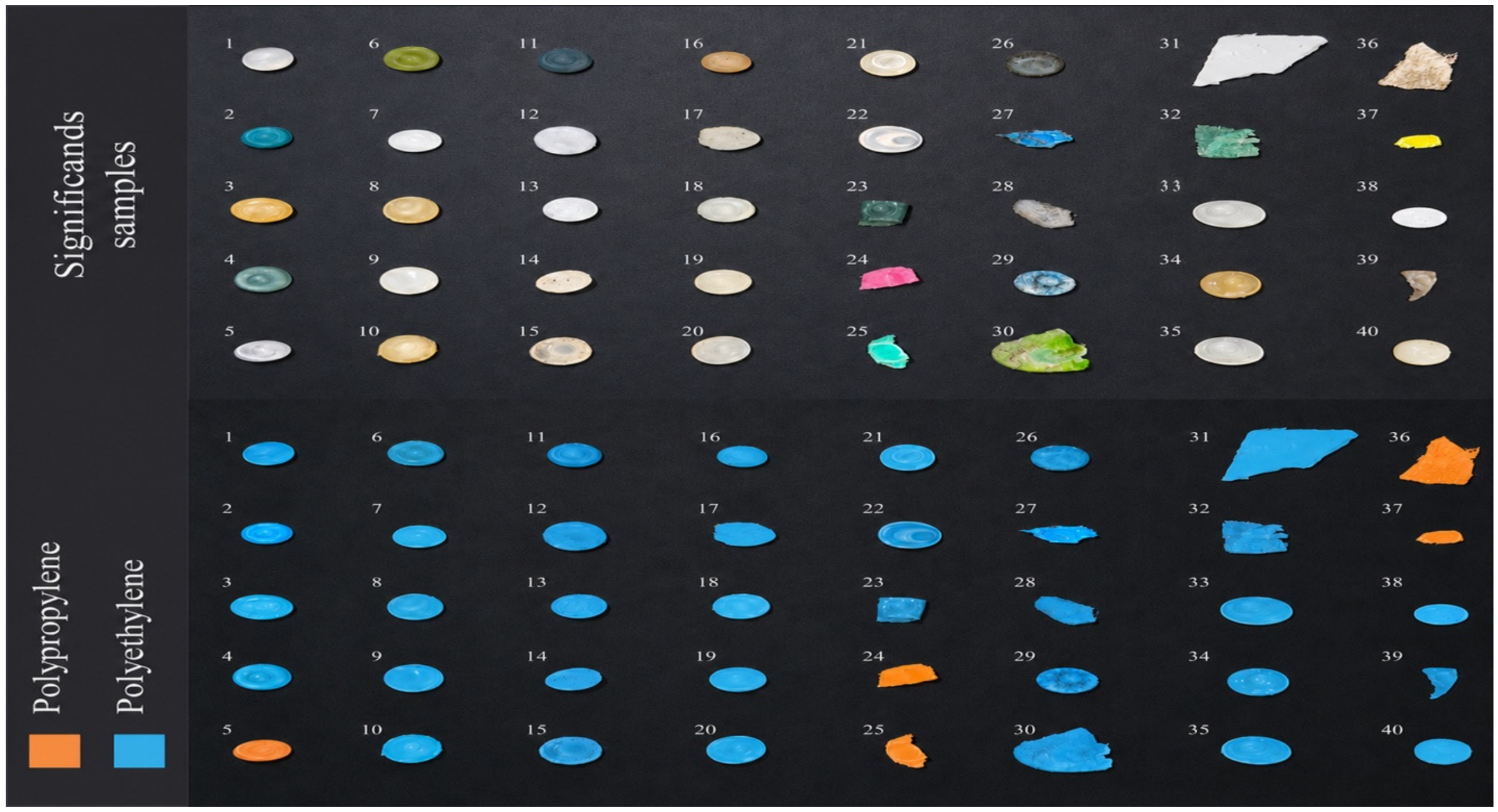
40 particles (13.3% of the total assemblage) of the 300 visible plastic particles recovered from the floating system were randomly selected for detailed morphological and ATR-FTIR characterization. This analytical subset was employed to characterize the morphology, color distribution, dimensional characteristics, and polymer identity of the retained material. The analyzed subset was dominated by pellet-like particles, together with a smaller proportion of irregular fragments and other visible plastic debris. Within the 40-particle subset, pellets accounted for 29 particles (72.5%), whereas irregular fragments and other visible debris accounted for 11 particles (27.5%). The pellet fraction showed variable coloration.
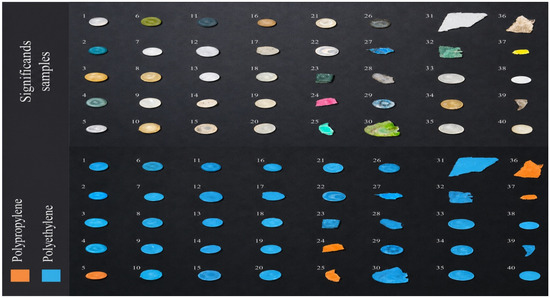
White, cream, and light-gray pellets were predominant, accounting for 19 of the 29 pellets (66%). Yellow or orange pellets accounted for 5 particles (17%), blue or turquoise pellets for four particles (14%), and green pellets for one particle (3%). The predominance of pellet-like particles suggests that the coconut-fiber matrix acted as a passive interception medium for plastic waste transported by local estuarine hydrodynamics. ATR-FTIR analysis showed that the 40 randomly selected particles were predominantly composed of polyethylene (PE) and polypropylene (PP). Of the analyzed particles, 35 (87.5%) were identified as PE and 5 (12.5%) as PP (Figure 2). The estimated proportion of PE was 87.5%, with a 95% confidence interval of approximately 73.9–94.5%, indicating a clear predominance of polyethylene within the analyzed assemblage. Conversely, PP represented 12.5% of the analyzed particles. The predominance of PE and PP is consistent with previous observations of pellet-rich microplastic contamination in the Salado Estuary and with the dominance of PE and PP among plastic pellets reported from coastal environments [17,18]. Furthermore, the identification of PE and PP supports the interpretation that the recovered particles corresponded to environmental plastics intercepted by the coconut fiber matrix rather than fragments originating from the PVC frame of the floating structure.
Figure 2.
Morphological and polymeric identification of retained plastic pellets.
3.3. Detection and Identification of Smaller Retained Microparticles
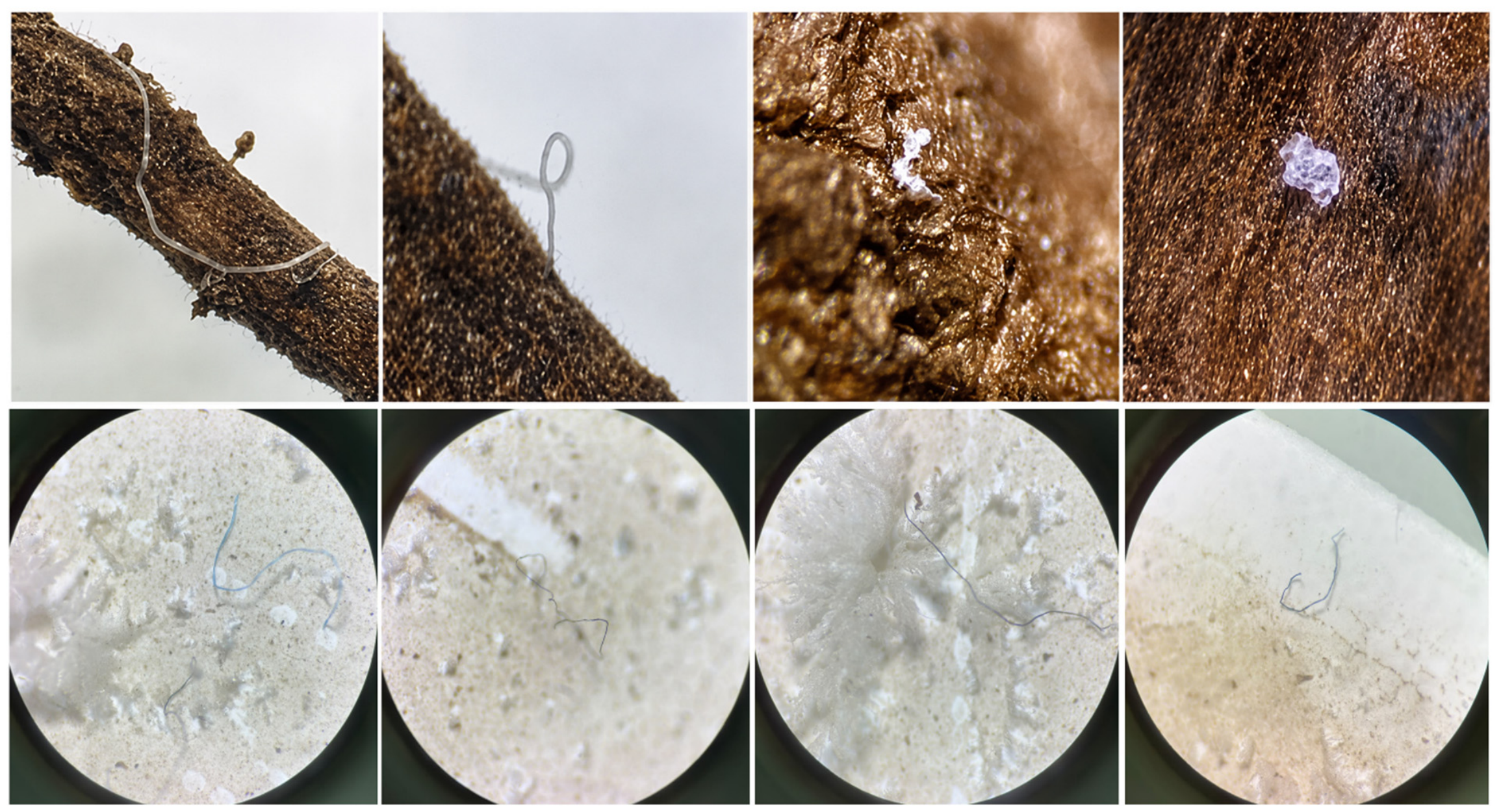
In addition to the visible particle fraction, smaller retained particles were recovered from coconut-fiber subsamples using saturated NaCl flotation, membrane filtration, stereomicroscopic observation, and FTIR micro-spectroscopy. This analysis was designed to confirm the occurrence and polymeric nature of the smaller retained fraction rather than to establish a complete particle-size distribution or size-dependent capture efficiency. The filtration membranes contained small fragments and fiber-like particles visually consistent with suspected microplastics (Figure 3). Selected particles were subsequently analyzed by FTIR micro-spectroscopy to determine their chemical identity.
Figure 3.
Microplastic-like particles retained in the coconut fiber matrix.
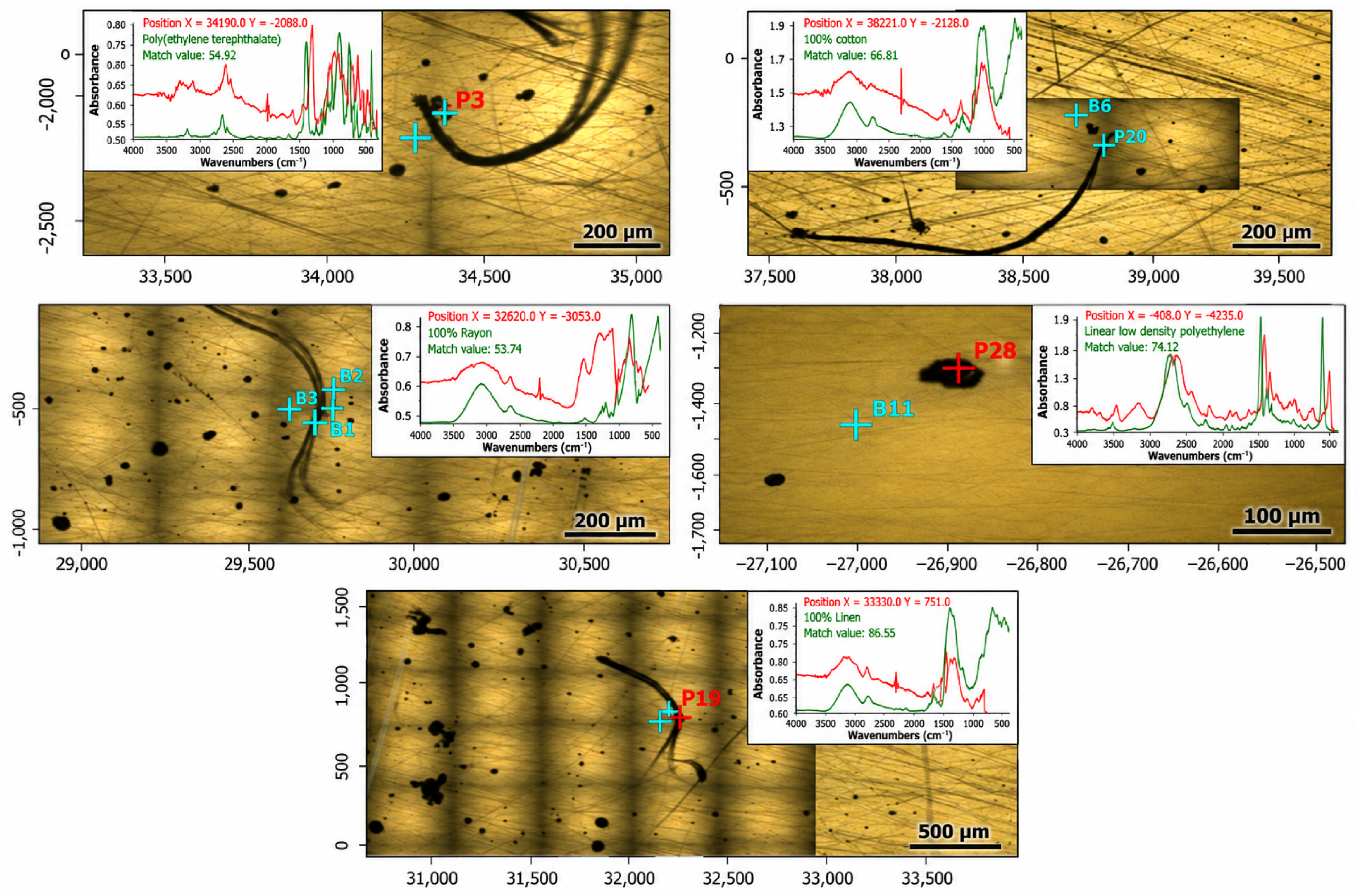
FTIR micro-spectroscopy confirmed the presence of polymeric and fiber-like particles retained within the coconut fiber matrix used in the floating-island system (Figure 4). The combined optical micrographs and FTIR spectra allowed individual microparticles or areas of interest to be visually selected and chemically compared against reference spectra. In the micrographs, points labeled as P correspond to selected microparticles or suspected anthropogenic fragments, whereas points labeled as B correspond to nearby background or cleaner reference areas of the substrate. This comparison was used to distinguish the spectral response of retained microparticles from that of the natural coconut fiber matrix.
Figure 4.
Optical micrographs and FTIR micro-spectroscopy spectra of selected microparticles retained within the coconut-fiber matrix. Points labeled as P indicate analyzed microparticles or suspected anthropogenic fragments, whereas points labeled as B correspond to nearby background regions. Representative spectra illustrate the occurrence of synthetic polymers and fiber-like materials retained within the substrate.
FTIR micro-spectroscopy provided evidence of both synthetic polymer microparticles and cellulosic fiber-like materials retained within the coconut-fiber matrix. Among the selected microparticles, one spectrum showed spectral features consistent with poly (ethylene terephthalate) (PET), with a library match value of 54.82, whereas another particle was assigned to linear low-density polyethylene (LLDPE), with a library match value of 74.12. These results support the occurrence of synthetic microplastic particles within the retained material and complement the predominance of PE and PP observed among the larger particles characterized by ATR-FTIR. PET and polyethylene-based materials are widely used in packaging, bottles, films, bags, textiles, and other consumer applications, and their detection is therefore consistent with common sources of plastic contamination in urban aquatic environments. In addition to these synthetic polymers, fiber-like particles showed spectral characteristics associated with cotton (library match value: 68.81), rayon (53.74), and linen (80.35). These materials were considered separately from the synthetic microplastic fraction: cotton and linen are natural cellulosic fibers, whereas rayon is a manufactured regenerated-cellulose fiber. Their occurrence indicates that the coconut-fiber matrix retained not only synthetic polymer microparticles but also cellulosic and potentially textile-associated fibrous debris transported within the estuarine environment.
The detection of PET should also be considered in relation to the density-separation procedure used for the coconut-fiber subsamples. Saturated NaCl preferentially promotes the flotation of lower-density particles and may therefore underrepresent denser polymers within the recovered fraction. Accordingly, the polymer identities obtained after flotation were used to demonstrate the occurrence and diversity of retained particles rather than to establish their relative polymer abundance. The presence of a spectrum consistent with PET nevertheless indicates that higher-density synthetic particles were also retained within the coconut-fiber matrix, together with the lower-density polyolefin particles identified in the study.
3.4. Passive Retention Mechanisms of the Coconut-Fiber Matrix
FTIR micro-spectroscopy results demonstrate that the fibrous substrate retained microparticles with different chemical compositions and morphologies. Synthetic polymers represented by PET- and LLDPE-associated spectra occurred alongside natural and regenerated cellulosic fibers, indicating that interception was not restricted to a single particle type. This behavior can be related to the physical architecture of the coconut-fiber substrate. Its rough, irregular, and highly fibrous structure creates numerous inter-fiber spaces capable of intercepting microparticles transported by tidal flow, surface-water movement, and localized hydrodynamic circulation. Once microparticles enter the matrix, mechanical lodging, frictional contact, surface roughness, and entanglement between fibers may contribute to their retention. The lower supporting mesh may further favor this process by limiting the downward loss of trapped material while maintaining direct water exchange through the floating island.
The combined optical and spectroscopic evidence indicates that the coconut-fiber matrix functioned as a passive interception substrate for plastic particles and cellulosic fibrous debris transported through the estuarine environment. The occurrence of PET- and LLDPE-associated spectra supports the presence of synthetic microplastics among the smaller retained particles, whereas cotton, linen, and regenerated-cellulose fibers represent a distinct fraction of cellulosic debris. Together with the predominance of PE and PP among the larger recovered particles, these observations indicate that the floating substrate was capable of retaining plastic material spanning different sizes, morphologies, and polymeric compositions. The observed retention pattern therefore supports an additional function of the coconut-fiber matrix beyond its original role as a planting substrate: passive interception of particles transported through the surrounding water column [3].
The recovery of 300 visible plastic particles across the three-module system provides a quantitative field indicator of particle accumulation within the floating substrate under real urban estuarine exposure. Determination of capture efficiency represents the next level of process evaluation and will require replicated deployments coupled with particle-flux measurements, hydrodynamic characterization, and inlet–outlet or equivalent mass-balance approaches [3,9]. The present results therefore establish a field-based foundation for subsequent quantitative evaluation of interception performance.
3.5. Design Implications and Methodological Scope
These findings also possess methodological and design implications for future floating-island applications. The floating frame used in the present study was constructed primarily from PVC, whereas the larger retained particles were predominantly identified as PE and PP. Polymer characterization therefore provided an important means of distinguishing the recovered particles from the principal construction material of the platform. This distinction is relevant for floating systems intended to investigate plastic interception, because their construction materials should be considered when interpreting retained synthetic particles. In the present study, the predominance of PE and PP among visible retained particles, together with the occurrence of other synthetic polymers within the coconut-fiber matrix, supports their interpretation as externally transported material. More importantly, the results demonstrate that the coconut-fiber component acted as a retrievable three-dimensional retention matrix rather than simply as a planting medium. This additional functionality supports the consideration of coconut fiber in future floating systems designed to intercept buoyant plastic particles in urban estuarine environments [3,9,10].
The interpretation of the retained particles was further supported by laboratory contamination controls, including membrane blanks, triple-filtered distilled water, and filtered saturated NaCl solution. These procedures reduced the likelihood that particles detected following flotation and filtration originated from laboratory processing. Polymer identification was additionally supported by the comparison of particle spectra with reference libraries and by the examination of particle and background regions within the coconut-fiber matrix. Although field blanks and pre-exposure coconut-fiber blanks were not available for the present deployment, the combined optical, spectroscopic, and laboratory-control evidence supports the occurrence and retention of synthetic polymer particles within the recovered coconut-fiber substrate.
4. Conclusions
This study demonstrates that coconut fiber incorporated into a mangrove-supporting floating island can function as a retrievable passive interception matrix for plastic particles under real urban estuarine conditions. During approximately one month of deployment, a total of 300 visible plastic particles were recovered across the three interconnected modules, providing direct field evidence of measurable particle accumulation within the fibrous substrate. Spectroscopic characterization further confirmed that the retained material included synthetic polymers with different morphologies and compositions, supporting the capacity of the coconut-fiber matrix to intercept a heterogeneous plastic assemblage. The present study was designed as a field-based demonstration of passive retention rather than as a quantitative assessment of capture efficiency or size-resolved removal performance. Particle accumulation varied among modules, and the smaller-particle analysis was used to confirm occurrence and polymer identity rather than to establish a complete size distribution. These considerations define the current scope of the results while providing a clear basis for more quantitative process evaluation. Future work will be focused on replicated deployments incorporating particle-flux measurements, hydrodynamic characterization, standardized substrate areas or masses, and appropriate mass-balance approaches to quantify capture efficiency and temporal accumulation. Size-resolved recovery protocols, expanded µFTIR analysis, assessment of substrate saturation and maintenance intervals, and longer-term monitoring of mangrove performance would further support the development of this system toward a quantitatively characterized nature-based strategy for plastic interception in urban estuarine environments.
Author Contributions
Conceptualization, K.A.S.-L.; Methodology, K.A.S.-L., E.S. and K.A.Q.-S.; Validation, K.A.S.-L., M.B.-O., C.F.S., E.S., K.A.Q.-S. and R.L.; Formal analysis, K.A.S.-L., M.B.-O., C.F.S., O.N.-P. and R.L.; Investigation, K.A.S.-L., O.N.-P. and E.S.; Resources, O.N.-P. and K.A.Q.-S.; Data curation, M.B.-O., O.N.-P., E.S., K.A.Q.-S. and R.L.; Writing—original draft, K.A.S.-L.; Writing—review & editing, K.A.S.-L., M.B.-O., C.F.S., E.S., K.A.Q.-S. and R.L.; Visualization, K.A.S.-L. and C.F.S.; Supervision, R.L.; Project administration, K.A.S.-L. and R.L. All authors have read and agreed to the published version of the manuscript.
Funding
This research received no external funding.
Institutional Review Board Statement
Not applicable.
Informed Consent Statement
Not applicable.
Data Availability Statement
The original contributions presented in this study are included in the article. Further inquiries can be directed to the corresponding authors.
Conflicts of Interest
The authors declare no conflicts of interest.
References
- Malli, A.; Corella-Puertas, E.; Hajjar, C.; Boulay, A.-M. Transport mechanisms and fate of microplastics in estuarine compartments: A review. Mar. Pollut. Bull. 2022, 177, 113553. [Google Scholar] [CrossRef] [Scilit] [PubMed]
- Kumar, S.S.; Sangeetha, D. Toxic effects of microplastics in aquatic environments and the pathways to sustainable management. RSC Adv. 2026, 16, 16718–16747. [Google Scholar] [CrossRef] [Scilit] [PubMed]
- Corbau, C.; Skalny, M.; Bajda, T.; Le Coustumer, P.; Filipović Marijić, V.; Lazarou, A.; Nardin, W.; Coltorti, M.; Simeoni, U. Plastic pollution interception by vegetation: A mechanistic review across diverse habitats. J. Hazard. Mater. 2026, 508, 141908. [Google Scholar] [CrossRef] [Scilit] [PubMed]
- Cerri, F.; Mohamed, S.; Galli, P. Mangrove forests as a natural trap for marine plastic litter: Insights from the Maldives. Mar. Pollut. Bull. 2025, 213, 117677. [Google Scholar] [CrossRef] [Scilit] [PubMed]
- Duan, J.; Han, J.; Cheung, S.G.; Chong, R.K.Y.; Lo, C.-M.; Lee, F.W.-F.; Xu, S.J.-L.; Yang, Y.; Tam, N.F.-y.; Zhou, H.-C. How mangrove plants affect microplastic distribution in sediments of coastal wetlands: Case study in Shenzhen Bay, South China. Sci. Total Environ. 2021, 767, 144695. [Google Scholar] [CrossRef] [Scilit] [PubMed]
- Primus, A.; Hadibarata, T.; Jusoh, M.N.H. Accumulation of microplastics in mangrove ecosystem: Source, properties, and impacts for conservation. Environ. Sustain. 2026, 9, 711–728. [Google Scholar] [CrossRef] [Scilit]
- Barco, A.; Bona, S.; Borin, M. Plant species for floating treatment wetlands: A decade of experiments in North Italy. Sci. Total Environ. 2021, 751, 141666. [Google Scholar] [CrossRef] [Scilit] [PubMed]
- Sahreen, S.; Mukhtar, H. Floating Treatment Wetlands (FTW) for Sustainable Industrial Wastewater Treatment. In Microbial Bioremediation and Multiomics Technologies for Sustainable Development: Recent Trends; Ameen, F., Bhat, S.A., Kumar, V., Eds.; Royal Society of Chemistry: London, UK, 2024; Volume 13, pp. 291–318. [Google Scholar] [CrossRef] [Scilit]
- Cabrera, D.C.; Wang, Q.; Martín, M.; Rajadel, N.O.; Rousseau, D.P.L.; Hernández-Crespo, C. Microplastics occurrence and fate in full-scale treatment wetlands. Water Res. 2023, 240, 120106. [Google Scholar] [CrossRef] [Scilit] [PubMed]
- Zharkenov, Y.; Mkilima, T.; Abduova, A.; Zhaksylykova, L.; Turashev, A.; Imambayeva, R.; Imambaev, N.; Jaxymbetova, M.; Smagulova, A.; Beysenbaeva, E. Utilizing biofilm-enhanced coconut coir for microplastic removal in wastewater. Case Stud. Chem. Environ. Eng. 2024, 9, 100726. [Google Scholar] [CrossRef] [Scilit]
- Coppock, R.L.; Cole, M.; Lindeque, P.K.; Queirós, A.M.; Galloway, T.S. A small-scale, portable method for extracting microplastics from marine sediments. Environ. Pollut. 2017, 230, 829–837. [Google Scholar] [CrossRef] [Scilit] [PubMed]
- Hurley, R.R.; Lusher, A.L.; Olsen, M.; Nizzetto, L. Validation of a Method for Extracting Microplastics from Complex, Organic-Rich, Environmental Matrices. Environ. Sci. Technol. 2018, 52, 7409–7417. [Google Scholar] [CrossRef] [Scilit] [PubMed]
- Cowger, W.; Booth, A.M.; Hamilton, B.M.; Thaysen, C.; Primpke, S.; Munno, K.; Lusher, A.L.; Dehaut, A.; Vaz, V.P.; Liboiron, M.; et al. Reporting Guidelines to Increase the Reproducibility and Comparability of Research on Microplastics. Appl. Spectrosc. 2020, 74, 1066–1077. [Google Scholar] [CrossRef] [Scilit] [PubMed]
- Song, Y.K.; Hong, S.H.; Eo, S.; Shim, W.J. A comparison of spectroscopic analysis methods for microplastics: Manual, semi-automated, and automated Fourier transform infrared and Raman techniques. Mar. Pollut. Bull. 2021, 173, 113101. [Google Scholar] [CrossRef] [Scilit] [PubMed]
- Kozloski, R.; Cowger, W.; Arienzo, M.M. Moving toward automated µFTIR spectra matching for microplastic identification: Addressing false identifications and improving accuracy. Microplast. Nanoplast. 2024, 4, 27. [Google Scholar] [CrossRef] [Scilit]
- Noonan, M.J.; Grechi, N.; Mills, C.L.; Ferraz, d.A.M.M. Microplastics analytics: Why we should not underestimate the importance of blank controls. Microplast. Nanoplast. 2023, 3, 17. [Google Scholar] [CrossRef] [Scilit] [PubMed]
- Arteaga, I.; Pinos-Vélez, V.; Capparelli, M.; Moulatlet, G.M.; Cipriani-Avila, I.; Cabrera, M.; Rebolledo, E.; Arnés-Urgellés, C.; Cazar, M.E. Microplastic occurrence and distribution in the Gulf of Guayaquil, Ecuador. Mar. Pollut. Bull. 2024, 209, 117288. [Google Scholar] [CrossRef] [Scilit] [PubMed]
- Jiang, X.; Lu, K.; Tunnell, J.W.; Liu, Z. The impacts of weathering on concentration and bioaccessibility of organic pollutants associated with plastic pellets (nurdles) in coastal environments. Mar. Pollut. Bull. 2021, 170, 112592. [Google Scholar] [CrossRef] [Scilit] [PubMed]
Disclaimer/Publisher’s Note: The statements, opinions and data contained in all publications are solely those of the individual author(s) and contributor(s) and not of MDPI and/or the editor(s). MDPI and/or the editor(s) disclaim responsibility for any injury to people or property resulting from any ideas, methods, instructions or products referred to in the content. |
© 2026 by the authors. Licensee MDPI, Basel, Switzerland. This article is an open access article distributed under the terms and conditions of the Creative Commons Attribution (CC BY) license.