


Abstract
As microplastics act as ubiquitous carriers for endocrine-disrupting additives in aquatic environments, understanding their leaching dynamics is of critical concern. This study systematically investigated the effects of ultraviolet (UV) aging on the release behavior of phthalates (di-n-butyl phthalate [DnBP] and di(2-ethylhexyl) phthalate [DEHP]) from polyvinyl chloride (PVC) microplastics across diverse environmental conditions, along with the underlying mechanisms. Kinetic analyses and experimental results indicated that the release of plasticizers under UV irradiation was driven by a dynamic competition between the photochemical stability of the plasticizers and the aging of the microplastics: the apparent cumulative amount of photolabile DnBP decreased as irradiation time increased. In contrast, the release of photoresistant DEHP significantly exceeded that under dark conditions in the later stages of aging. Furthermore, highly variable environmental factors exhibited significant selectivity in regulating the release: high ionic strength inhibited plasticizer release through salting-out and cationic bridging effects, with divalent ions (Mg2+) in particular suppressing DEHP release by up to 96%; conversely, dissolved humic acid caused a 13-fold surge in DEHP release via robust hydrophobic solubilization. Comprehensive multitechnique characterizations (including SEM, FTIR, XRD, and XPS) confirmed that UV-induced aging—encompassing intense dehydrochlorination reactions, a marked increase in polar oxygen-containing functional groups and the amorphization of crystalline regions—fundamentally dismantled the internal mass transfer resistance, thereby creating physical pathways for the outward migration of internal plasticizers. Ultimately, this study emphasizes that the synergistic interactions between material aging and complex hydrochemical conditions must be fully integrated into assessments of long-term ecological risks and predictions of the real-world environmental fate of microplastic-associated contaminants.
1. Introduction
Since the widespread adoption of plastics in the 1950s, global plastic production has surged to nearly 400 million tons annually. However, only 9% of the generated waste is recycled and 12% is incinerated, with the remainder ultimately landfilled or released into the environment [1,2]. With this sharp increase in production and massive accumulation of waste, microplastics (MPs)—acting as highly persistent pollutants—have been widely detected across various environmental media, ranging from freshwater and oceans to terrestrial soils [2,3,4].
Characterized by their minute size and expansive surface area, microplastics not only readily migrate within the environment but also extensively accumulate external pollutants, posing profound ecological and health risks [5]. These threats are essentially twofold. Microplastics can serve as transport vectors for various environmental contaminants, including organic pollutants and, under specific environmental conditions, heavy metals [6]. In contrast, they constitute intrinsic sources of pollutant release [7,8]. Commercial plastics inherently contain a myriad of functional additives, such as phthalate esters (PAEs), bisphenol A, and brominated flame retardants, many of which are potent endocrine disruptors [9]. Consequently, the leaching of these toxic additives into environmental matrices represents a severe hazard to biological systems and public health [10,11].
Phthalate esters (PAEs) are predominantly used as plasticizers in polyvinyl chloride (PVC) products to reduce intermolecular forces and enhance material flexibility [12]. PAEs are extensively incorporated into flexible PVC products as plasticizers, with total plasticizer contents typically ranging from 10 to 60 wt%, depending on the intended application. Among them, DnBP is commonly used in products requiring moderate flexibility and is generally added at approximately 5–20 wt%, whereas DEHP has historically been the dominant plasticizer for flexible PVC, with typical concentrations of 20–40 wt%, and in some products reaching 50–60 wt%. These high additive loadings make PVC an important long-term source of phthalate release into the environment [9]. However, lacking covalent linkages to the polymer matrix, these physically blended additives are highly susceptible to interphase mass transfer, leading to continuous release into the aqueous phase upon environmental exposure [13,14]. The environmental leaching of PAEs is of great concern because they are potent endocrine disruptors that cause reproductive and developmental toxicity in biological systems [15,16]. Consequently, driven by unprecedented global demand, di-n-butyl phthalate (DnBP) and di(2-ethylhexyl) phthalate (DEHP) have emerged as the most ubiquitous PAE pollutants in aquatic environments, exhibiting profound endocrine-disrupting potential and imposing sustained ecological risks [17].
In natural aquatic bodies and surface soils, microplastics are inevitably exposed to intense solar ultraviolet (UV) irradiation. This UV exposure initiates complex physicochemical alterations, inducing photooxidation within the microplastics, evidenced by enhanced surface roughness, incorporation of polar, oxygen-containing functional groups, and deterioration of crystalline regions [18], while simultaneously triggering the release and photolysis of PVC-bound plasticizers [7]. Consequently, the leaching behavior of plasticizers in aquatic environments has garnered significant research attention. For example, Yan et al. [12] investigated how particle size, plasticizer loading, and aging dictate DnBP release.
In contrast, Xu et al. [7] examined the interactive kinetics among additive leaching, photodegradation, and microplastic aging. Despite these advances, previous investigations have largely focused on the behaviors of individual PAE release under varying microplastic properties and degrees of aging, often relying on kinetic modeling to estimate environmental risks [19,20]. However, a fundamental gap remains in understanding the dynamic coupling between the UV-induced aging of the PVC matrix and the concurrent photolytic degradation of the PAEs. Specifically, it remains unclear how these interacting mechanisms govern the cumulative release of PAEs with different molecular dimensions and degrees of hydrophobicity (e.g., DnBP and DEHP). More importantly, the current literature lacks systematic, quantitative evaluations of how highly variable environmental factors, such as pH shifts, inorganic ion-induced salting-out and cross-linking effects, and DOM-driven hydrophobic solubilization, collectively regulate the internal mass-transfer resistance and ultimate release capacity of photo-aged microplastics.
In light of the aforementioned knowledge gaps, this study aimed to conduct an in-depth analysis of the leaching dynamics of DnBP and DEHP from UV-aged PVC microplastics. We systematically evaluated the interactive effects of plastic properties (e.g., plasticizer content, plasticizer type, and UV aging) and highly variable environmental conditions (e.g., pH fluctuations, ion valency and concentration, and the presence of humic acid). The driving mechanisms are explored by fitting release kinetics models and using material characterization techniques. The findings of this study will provide a robust theoretical foundation for accurately assessing the fate of real-world environmental and ecological risks of microplastics and their additives under natural light conditions.
2. Materials and Methods
2.1. Reagents and Materials
The chemicals used in this study are listed in the Supplementary Information (Text S1). PVC films containing or not containing DnBP and DEHP (at concentrations of 0%, 3%, 15%, and 30%) were prepared using a tetrahydrofuran solvent dissolution method [12,21]; the specific preparation steps are provided in the Supplementary Information (Text S2). This concentration range was selected to represent the broad spectrum of plasticizer contents in commercial rigid (3%), semi-rigid (15%), and flexible PVC products (30%), thereby enabling a systematic evaluation of the effect of initial plasticizer content on leaching behavior [12,22]. To minimize volatilization loss, solvent evaporation was performed at room temperature under a fume hood, followed by vacuum drying until reaching constant weight. A mass balance was performed for each batch by comparing the dry film mass against the sum of initial PVC resin and plasticizer masses, yielding recoveries of 96.8–99.1%. Prepared PVC was ground using a ball mill under liquid nitrogen. Ground plastic was then spread out on aluminum foil to air-dry naturally. A stainless-steel sieve was used to separate 60–100-mesh PVC microplastic particles. Before experimentation, all plastic samples were stored in sealed amber glass bottles.
2.2. Release Experiments
The release experiments were designed to simulate the release of PAEs from PVC microplastics in aquatic environments under UV irradiation. Before the experiment, all glassware was rinsed with ultrapure water and acetone, then heated at 500 °C for 2 h to eliminate organic contaminants. PVC microplastics containing 0%, 3%, 15%, and 30% DnBP and DEHP, respectively, were placed in 50-mL quartz glass bottles (UV-transparent, >90% transmittance at 313 nm) sealed with PTFE-lined screw caps for the release experiment and exposed to UV light at 313 nm [23,24]. Each bottle contained 250 mg of PVC microplastics and 50 mL ultrapure water as the background solution at a solid-to-liquid ratio of 1:200 [17,25]. The glass bottles were placed in a bench-top shaker at 25 °C with a stirring speed of 150 rpm. All treatments were conducted in triplicate, with destructive sampling performed at predetermined time points (1 h, 3 h, 6 h, 12 h, 24 h, 4 d, 7 d, 14 d, 21 d, and 28 d). One milliliter of leachate was collected and stored in amber glass vials. Additionally, additive release experiments conducted in the dark served as a control group for comparison with those conducted under UV irradiation. Microplastic samples were collected only at 28 days to observe changes in physicochemical properties.
Using pure water as the background solution, we also investigated the effects of pH (3, 5, 7, 9, and 11), humic acid (0, 5, 20, 50, and 100 mg/L), ionic strength (0, 0.01, 0.1, and 0.2 mol/L), and ion species (Na+, K+, Ca2+, and Mg2+) on the release of DnBP and DEHP from aged PVC microplastics. We evaluated differences in the release behavior of DnBP and DEHP from aged PVC microplastics under various environmental conditions. All treatments were conducted in triplicate. Based on the preliminary release kinetics results, PAEs release approached equilibrium after approximately 4 days. Therefore, samples were collected only on Day 4 in the environmental factor experiments. Each treatment was performed in triplicate (n = 3). Specific microplastic aging procedures are provided in the Supplementary Information (Text S3).
2.3. Characterization and Analytical Methods
The specific morphology, water contact angle, surface functional groups, surface elemental composition, and crystallinity of the microplastics were characterized. Detailed instrumental conditions are provided in the Supplementary Information (Text S4).
One milliliter of the filtrate was diluted 100-fold with deionized water, and the solution was then concentrated using a solid-phase extraction column (200 mg/6 mL; Waters, HLB, Milford, MA, USA). The analytes were eluted with acetonitrile, concentrated to 1 mL, and finally analyzed by high-performance liquid chromatography (HPLC). This method was validated using blank-spiked standard samples, with recovery rates exceeding 85%. DnBP and DEHP stock solutions (1000 mg·L−1) were prepared in acetonitrile and then diluted with phosphate buffer (pH = 8.0 ± 0.1) to 5 mg·L−1 for further degradation experiments. These solutions were also placed in 50-mL sealed transparent glass bottles and exposed to UV light at 313 nm. From 0 to 28 days, 1 mL of liquid samples was collected at regular intervals to measure concentrations, thereby evaluating the UV degradation behavior of DnBP and DEHP.
HPLC with DAD detector (1260 Infinity, Agilent, Santa Clara, CA, USA) was used to determine the released PAE content and the UV degradation properties of the PAEs. A Waters-BET C18 column (100 mm × 2.1 mm, 1.7 μm) was employed at a column temperature of 30 °C. The injection volume was 20 μL, with acetonitrile/deionized water as the mobile phase in a 70:30 volume ratio, and the detection wavelength was 225 nm. PAE concentrations were calculated from a calibration curve generated using standard solutions.
2.4. Kinetic Models
The release kinetics data were fitted to pseudo-first-order (PFO), pseudo-second-order (PSO), and intraparticle diffusion (IPD) models, as shown below (Equations (1)–(3)) [7,17].
PFO model:
PSO model:
Intraparticle diffusion:
where k1 (d−1) and k2 (μg·g−1·d−1) are the rate constants for the PFO and PSO models, respectively, while qe,1 (μg·g−1) and qe,2 (μg·g−1) are the equilibrium release capacities for the PFO and PSO models. Kp (μg·g−1·d−0.5) is the rate constant of the intraparticle diffusion model, and ci (μg·g−1) is the interface thickness. qt (μg·g−1) is the amount of plasticizer released over time, and t is the release time.
In addition, we quantitatively analyzed the degree of aging on the microplastic surface using the normalized hydroxyl index (HI) (Equation (4)) and the carbonyl index (CI) (Equation (5)) [7,26]. Due to the presence of C=O groups in PAEs, the HI was used to quantify the degree of aging in the PVC [6].
2.5. Statistical Analysis
All data are presented as the mean ± standard deviation of three replicate experiments. All statistical analyses were performed using R software (v4.2.0, R Core Team, Vienna, Austria), employing one-way analysis of variance and Duncan’s multiple range test to assess differences between groups (p < 0.05).
3. Results and Discussion
3.1. Release Behavior of Plasticizers and the Kinetic Analysis
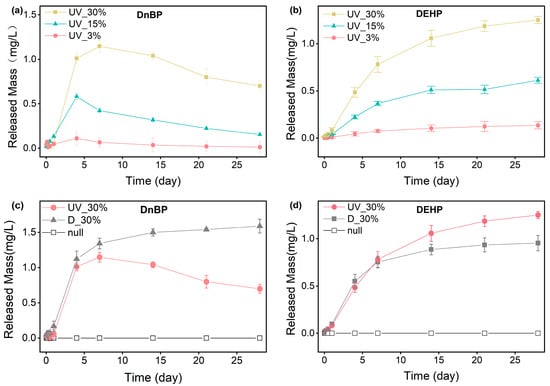
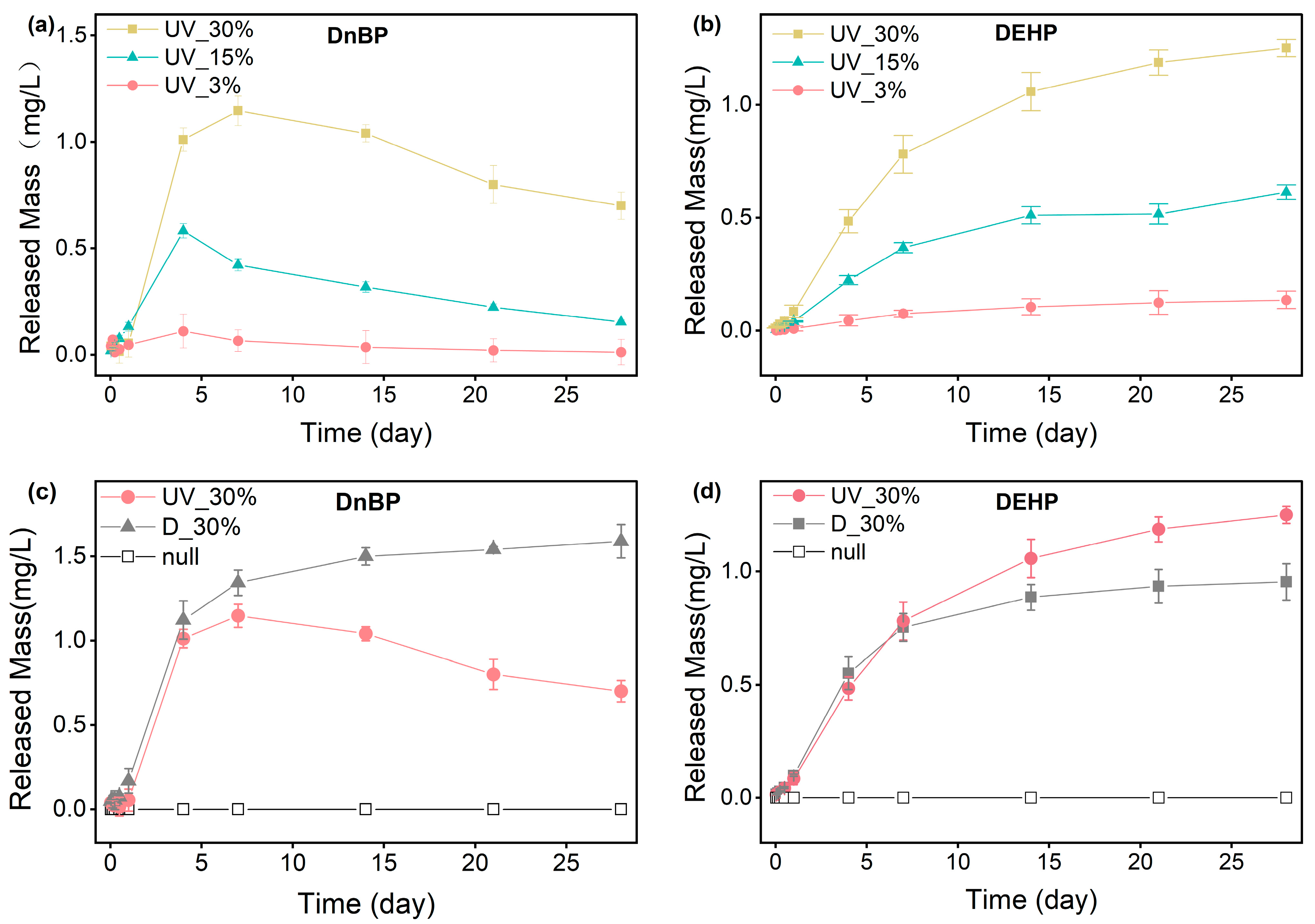
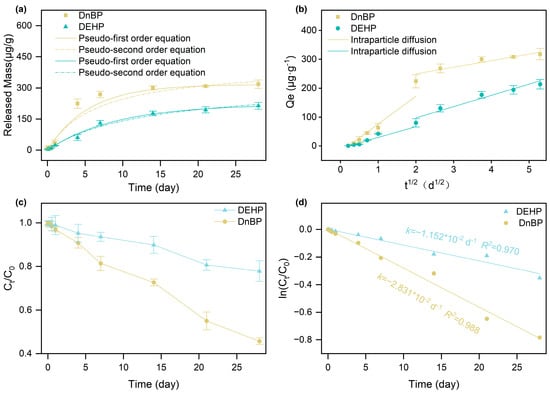
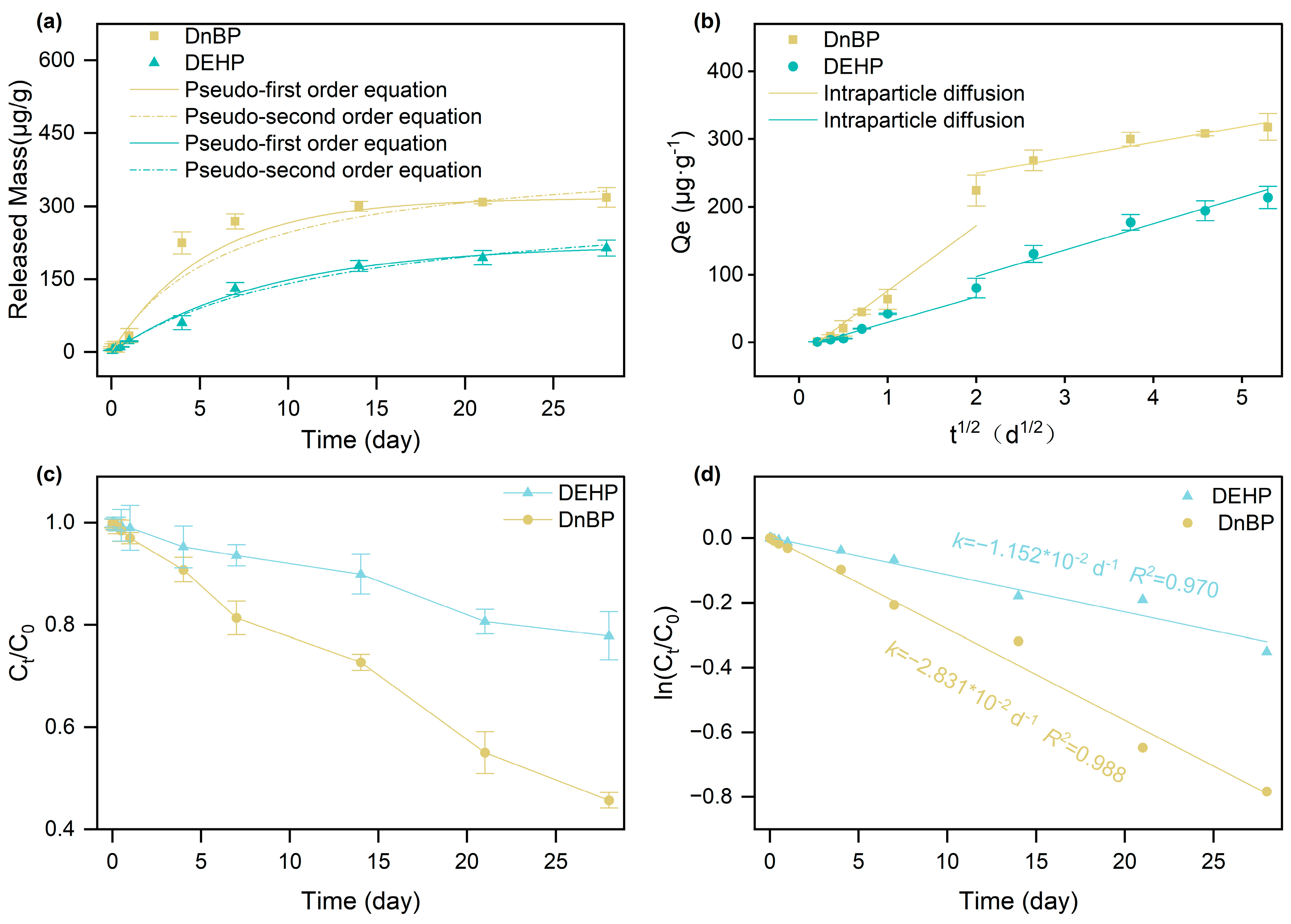
Figure 1 shows the cumulative release profiles of PVC microplastics with initial concentrations of DnBP and DEHP (0%, 3%, 15%, and 30%) under dark and UV irradiation. The release kinetics of DnBP and DEHP from the microplastics under dark conditions were fitted using the PFO and PSO models (Figure 2a).
Figure 1.
Release of DnBP (a) and DEHP (b) from PVC microplastics with different plasticizer concentrations under UV irradiation. Release of DnBP (c) and DEHP (d) from PVC microplastics under UV irradiation and in the dark.
Figure 2.
Different mathematical models fitting the kinetics of plasticizer release from PVC under dark conditions: pseudo-first-order and pseudo-second-order models (a), and an internal diffusion model (b). Degradation behavior of microplastic plasticizers: degradation rates of DnBP and DEHP under UV irradiation (c), and simulation of degradation rates using a pseudo-first-order kinetic model (d).
To comprehensively elucidate the leaching behavior of PAEs, the influences of intrinsic physicochemical properties, microplastic aging, and environmental conditions were systematically investigated. As depicted in Figure 1a,b, the initial PAE content played a pivotal role in the leaching capacity; the amount of PAE released was significantly and positively correlated with its initial mass fraction in the PVC matrix (30% > 15% > 3%). Kinetic analysis revealed that during the initial phase (0–4 days), the release rates of PAEs under UV irradiation were highly comparable to those observed in the dark. However, as the exposure was prolonged, the release profiles under UV irradiation diverged significantly from the dark controls (Figure 1c,d). This pronounced divergence suggests that the long-term leaching process is dynamically governed by the coupled effects of UV-induced microplastic aging and inherent photodegradation of the PAEs. Consequently, the release dynamics under UV irradiation were highly complex, rendering the conventional pseudo-first-order kinetic model, which adequately described the dark conditions, ineffective. This indicates that the UV-irradiated release is a multifaceted process driven by complex interactions among the polymer matrix, additives, and environmental stressors.
Compared with the PSO model, the release kinetics of DnBP and DEHP from microplastics were better described by the PFO model, as evidenced by the higher correlation coefficients (R2; Table S1). This observation aligns with previous studies reporting that PAE leaching from plastics typically adheres to PFO kinetics [6]. Furthermore, the calculated rate constant for DnBP was notably higher than that for DEHP (Table S1), indicating a more rapid release of DnBP from the microplastic matrix. This difference in leaching velocity is likely attributable to the distinct inherent physicochemical properties of the two phthalates (e.g., molecular size and hydrophobicity). The PFO model yielded R2 values consistently exceeding 0.90, suggesting that under dark conditions, the PAE release process is predominantly governed by a single monolithic mechanism with minimal interference from external confounding factors. To further elucidate the underlying mass transfer processes within the PVC matrix, the IPD model was applied [17]. Under dark conditions, the release profiles of both DnBP and DEHP exhibited characteristic two-phase physical desorption behavior (Figure 2b).
Specifically, the initial phase (0–4 days) can be attributed to the rapid leaching of PAEs from the microplastic surface, a process characteristic of film diffusion (or boundary layer diffusion). Conversely, the subsequent phase (4–28 days) corresponds to the migration of PAE molecules from the interior of the polymer matrix to the exterior, representing an IPD process [27]. The non-zero intercepts (Ci) obtained from the linear regressions for both stages (Table S2) indicate that the overall leaching mechanism is jointly driven by film and intraparticle diffusion [27]. Furthermore, the leaching rate constants in the initial stage were significantly higher than those in the second stage (Table S2), illustrating a transition from rapid surface desorption to a prolonged matrix-hindered release. Ultimately, because the entire process is dictated by the rate-limiting step of the second stage, it can be concluded that the release of PAEs from PVC is predominantly governed by intraparticle diffusion [17].
Environmental factors govern the release of PAEs from microplastics through diverse mechanisms, including the alteration of concentration equilibria in the aqueous phase [28], the direct photodegradation of additives [29], and the structural aging of the polymer matrix [12]. A comparative analysis of PAE leaching under dark and UV-irradiated conditions revealed that UV exposure fundamentally alters the release dynamics. Notably, pronounced discrepancies were observed between the release profiles of the photolabile DnBP and the photoresistant DEHP. These findings suggest that, in contrast to the straightforward, monolithic desorption mechanism observed in the dark, PAE leaching under UV irradiation constitutes a highly complex, multifaceted phenomenon driven by competing physicochemical processes.
3.2. Effects of Plasticizer UV Degradation, Content, and Type on Plasticizer Release
The preceding kinetic analysis reveals that additive release from microplastics under UV irradiation is not merely an interphase mass-transfer process but rather a complex phenomenon closely coupled to both the photochemical degradation of the PAEs and aging of the PVC matrix. To isolate and quantify the interference of UV degradation, the photo-oxidative degradation characteristics of DnBP and DEHP were independently evaluated in pure aqueous solutions under an identical UV irradiation dose (Figure 2c). Over the 28-d irradiation period, the two PAEs exhibited markedly different photochemical stabilities: approximately 54.31% of DnBP was degraded compared with only 22.16% for DEHP. Furthermore, the photodegradation kinetics of these additives were well described by a pseudo-first-order (PFO) kinetic model (Figure 2d). The excellent model fits across all time points (R2 > 0.90) confirmed that the aqueous photodegradation of PAEs follows pseudo-first-order kinetics. Notably, the degradation rate constant for DnBP (k = 2.831 × 10⁻² d−1) was substantially higher than that for DEHP (k = 1.152× 10⁻² d−1), indicating a much faster photolysis rate for DnBP. These results highlight the complexity of additive leaching under realistic environmental conditions and underscore the necessity of accounting for concurrent photodegradation processes.
The aforementioned photodegradation kinetics in the pure aqueous phase provide direct mechanistic evidence to elucidate the anomalous release profiles of PAEs from microplastics in complex UV-irradiated systems. Specifically, in the DnBP system, the photolytic degradation rate significantly outpaced its leaching rate from the PVC matrix, leading to a marked decline in the apparent cumulative release during the later stages (Figure 1c). The pronounced decline in aqueous DnBP concentration after prolonged UV irradiation is primarily attributed to the photodegradation of DnBP. As UV exposure continued, the photodegradation rate gradually exceeded the release rate from the aged PVC matrix, leading to a decrease in the apparent aqueous concentration. In contrast, the late-stage release of DEHP under UV irradiation was slightly higher than in the dark control (Figure 1d). This suggests that although DEHP undergoes photolysis under UV exposure, its relatively slower degradation kinetics are overwhelmed by the continuous leaching process. Furthermore, although UV-induced degradation mitigates the absolute accumulation of these additives in the aqueous environment to some extent, the continuous consumption of the released PAEs maintains a steep concentration gradient across the microplastic–water interface. This gradient, in turn, acts as a continuous thermodynamic driving force, promoting further desorption and release of the additives. Ultimately, this analysis highlights the intricate dynamic coupling between additive leaching and photodegradation, underscoring that both kinetic processes must be evaluated in tandem to accurately predict the environmental fate of microplastic-associated chemicals.
Beyond the inherent photodegradation of PAEs, the leaching behavior is profoundly dictated by the initial loading and molecular type of the additives. As illustrated in Figure 1a,b, the release rate of PAEs was significantly and positively correlated with their initial mass fractions in the PVC matrix (30% > 15% > 3%). Notably, this concentration-dependent release capacity did not follow a strictly linear relationship, consistent with previous findings [12]. Mechanistically, higher plasticizer loadings induce greater expansion of the free volume between tightly packed polymer chains, thereby diminishing internal mass-transfer resistance and accelerating PAE outward migration [22]. Concurrently, a higher initial content establishes a steeper concentration gradient across the plastic–water interface, further facilitating the mass transfer of PAEs into the aqueous phase [13]. Furthermore, under identical plastic matrices and additive loadings, different PAE congeners exhibit disparate leaching kinetics governed by their distinct physicochemical properties [30,31]. Compared with DnBP, DEHP has a longer alkyl side chain and greater hydrophobicity [32,33]. Consequently, under equivalent experimental conditions, the equilibrium release amount of DEHP (220 μg/g) was substantially lower than that of DnBP (317 μg/g; Figure 2a, Table S1).
3.3. Effects of Microplastic Aging on Plasticizer Release
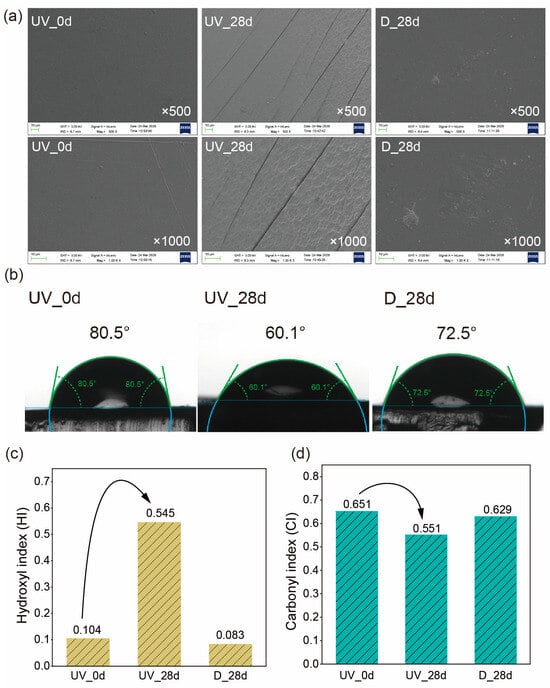
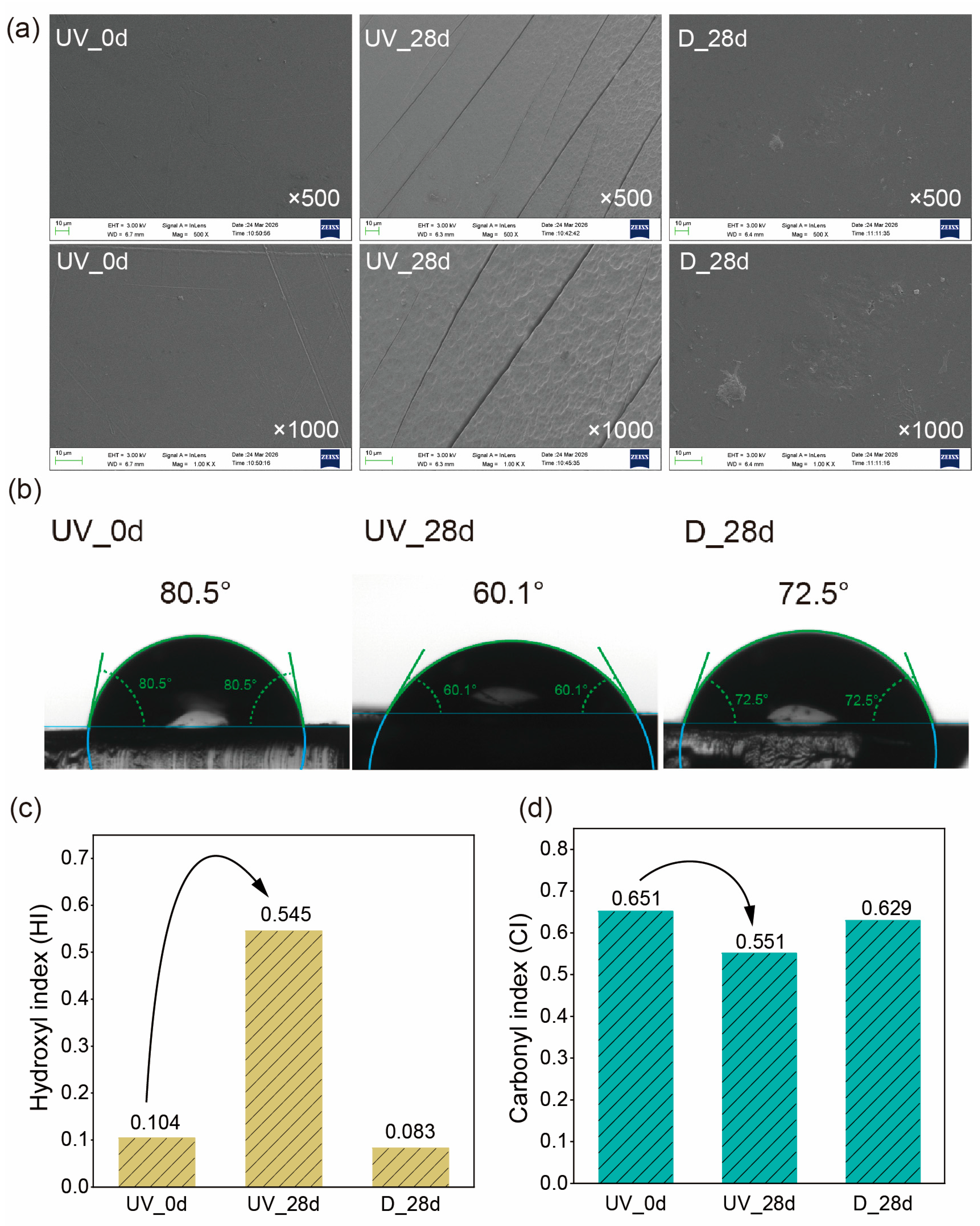
The influence of plastic aging on the leaching behavior of PAEs is highly complex. Previous studies have documented that aging processes substantially alter the physicochemical properties of microplastics, including surface morphology, hydrophilicity, crystallinity, elemental composition, and functional group profiles, thereby fundamentally modifying their interfacial leaching and adsorption dynamics [34,35]. To systematically evaluate these surface alterations induced by UV and dark treatments, a comprehensive suite of characterization techniques, composed of scanning electron microscopy (SEM), Fourier-transform infrared (FTIR) spectroscopy, X-ray diffraction (XRD), X-ray photoelectron spectroscopy (XPS), and contact angle measurements, was employed. As depicted in Figure 3a, the pristine PVC surface was originally flat, dense, and smooth. Following UV aging, the surface became markedly rough and uneven, characterized by deep cracks and irregular pits. Under dark conditions, the microplastics exhibited a less severely degraded surface, albeit with noticeable unevenness and the development of irregular pores. Contact angle measurements further confirmed significant shifts in surface hydrophilicity (Figure 3b). The water contact angle of the PVC decreased from an initial 80.5° to 72.5° after dark treatment and then to 60.1° after UV exposure. This pronounced decrease indicates a substantial increase in the hydrophilicity of the aged microplastics, consistent with previous observations [12,36]. Mechanistically, this enhanced hydrophilicity can be attributed to the photo-oxidative introduction of polar oxygen-containing functional groups, coupled with the increased surface roughness. These aging-induced structural modifications collectively improve the wettability of the PVC matrix, promoting its interaction with the surrounding aqueous medium and thereby facilitating the outward diffusion and release of PAEs [37].
Figure 3.
SEM images at 500× and 1000× magnification (a), water contact angle measurements (b), hydroxyl index (HI) (c), and carbonyl index (CI) (d) of PVC microplastics after 0 days, 28 days of UV irradiation, and 28 days in the dark.
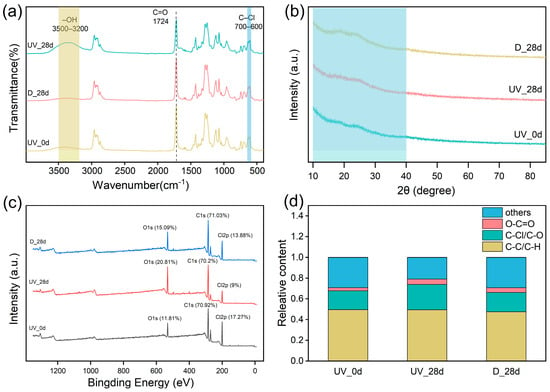
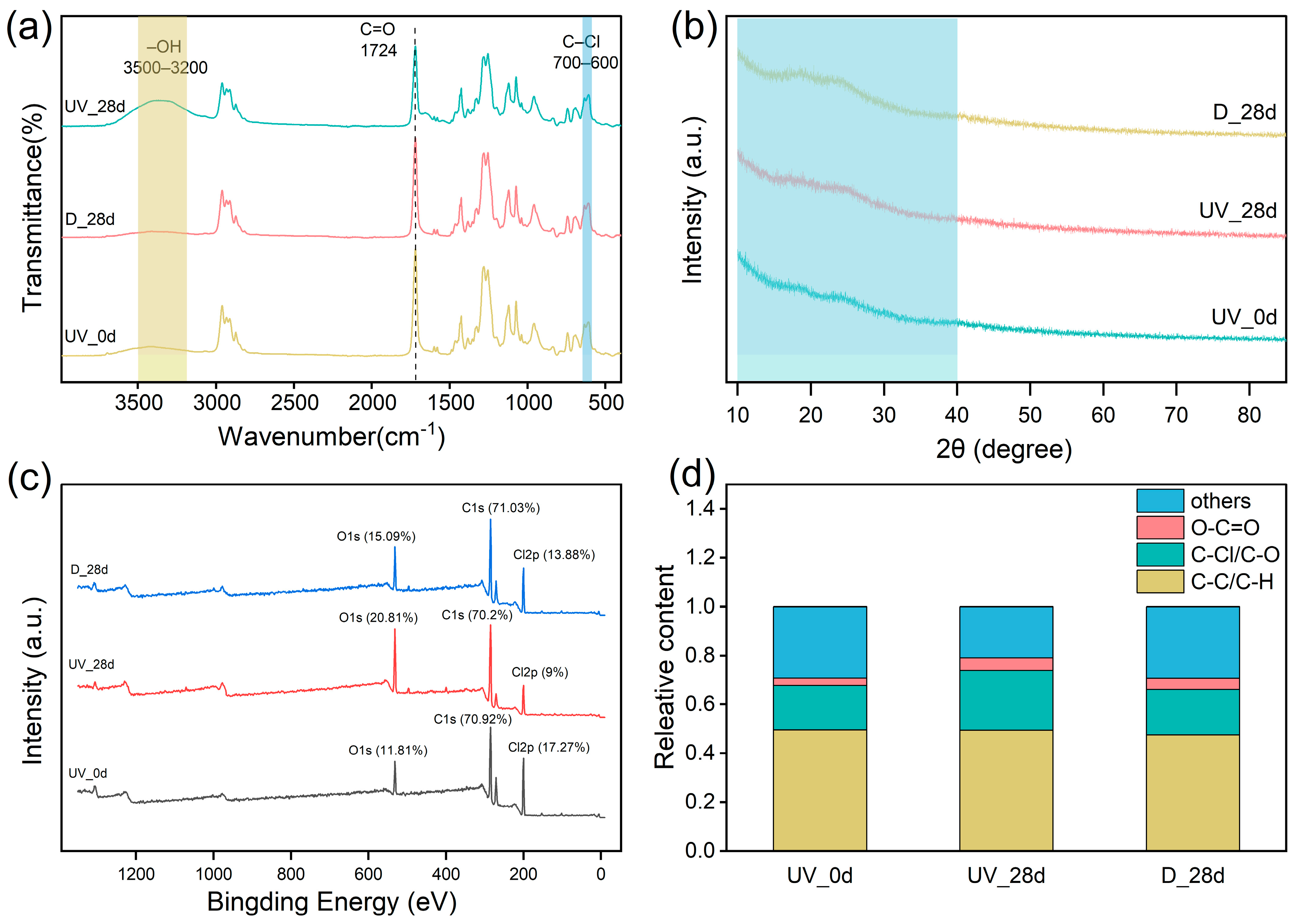
FTIR spectroscopy was utilized to elucidate the chemical structural alterations of the microplastics. As depicted in Figure 4a, the aged PVC exhibited a distinct new broadband between 3200 and 3500 cm−1, characteristic of hydroxyl (–OH) group formation [12], alongside a notable intensification of the carbonyl (C=O) peak at 1724 cm−1. However, because PAEs inherently possess abundant C=O double bonds, the band at 1724 cm−1 cannot serve as a definitive indicator of PVC photo-oxidation [7]. To accurately quantify these alterations, the carbonyl index (CI) was calculated as the area ratio of the normalized peaks at 1726 cm−1 (C=O) and 1460 cm−1 (C–H) [7]. Surprisingly, the CI of the UV-aged PVC decreased from 0.651 to 0.551. In contrast, the dark treatment resulted in only a minor reduction to 0.629 (Figure 3d). Although previous studies indicate that UV aging of PVC typically generates C=O groups and elevates the CI [17], this minor generative effect was substantially eclipsed by the massive depletion of C=O bonds resulting from the intense leaching and photolysis of PAEs. Consequently, this marked decline in the CI provides compelling spectroscopic evidence for the large-scale release of PAEs from the microplastic matrix. Furthermore, the hydroxyl index (HI), defined as the peak area ratio of the 3200–3500 cm−1 (-OH) region to the 1460 cm−1 (C-H) region, was used to quantify the extent of PVC oxidation [18]. Following UV irradiation, the HI increased from 0.104 to 0.545. In contrast, it remained relatively stable at 0.083 under dark conditions (Figure 3c). This confirms that UV exposure profoundly exacerbated the surface oxidation of PVC. Notably, the absorption peak spanning 600–700 cm−1, assigned to the symmetric stretching vibration of the C-Cl bond [38], exhibited a significant reduction in the integrated area after aging, yet remained virtually unchanged in the dark (Table S3). This depletion signifies that UV irradiation disrupted the polymer backbone and triggered surface dehydrochlorination reactions, thereby creating broader structural channels that facilitated the outward migration and PAE release [39,40].
Figure 4.
FTIR spectra (a), XRD spectra (b), full XPS spectra (c), and relative abundances of different functional groups in the C1s band (d) of PVC microplastics after 0 days, 28 days of UV irradiation, and 28 days of darkness treatment.
Crystallinity, which represents the proportion of highly ordered polymer chains, profoundly impacts the mass transfer and adsorption properties of plastic matrices. A decline in crystallinity is typically attributed to polymer chain scission and the generation of low-molecular-weight fragments during aging [41,42]. As depicted in Figure 4b, the XRD patterns for pristine PVC lacked sharp, high-intensity crystalline peaks, displaying a broad diffraction halo in the 2θ range of 10–40°. This confirms that the PVC matrix is predominantly a low-crystallinity polymer. To semi-quantitatively evaluate the microstructural relaxation, the integrated area of this broad diffraction band (10–40°) was utilized as a relative indicator. The integration results revealed that after 28 days of UV aging, the scattering area associated with the amorphous region increased substantially from 10,958 to 12,288 (Table S4). This measurable decrease in microstructural order reflects a significant expansion of the free volume within the polymer network. Consequently, the enlarged free space reduces the internal mass-transfer resistance to additive migration. These XRD findings provide direct physical evidence for why PAE release kinetics are accelerated post-aging, aligning well with previous reports that UV exposure degrades the crystalline domains of PVC [12].
The XPS survey spectra revealed that the pristine PVC exhibited characteristic O1s (11.81 at%) and Cl2p (17.27 at%) peaks (Figure 4c). Following UV aging, the O1s atomic percentage surged to 20.81%, and the O/C ratio increased from 0.17 to 0.30, accompanied by a sharp decline in the Cl2p percentage to 9.00%. This significant elemental shift corroborates the FTIR findings, confirming the formation of oxygen-containing functional groups (e.g., -OH and C=O) during aging. The severe depletion of chlorine is primarily attributed to intense dehydrochlorination reactions, which fundamentally disrupt the PVC polymer backbone and consequently generate additional free volume that facilitates PAE migration [43]. In the high-resolution C1s spectrum, pristine PVC exhibited a relatively symmetrical peak profile, with peaks predominantly assigned to C-C/C-H bonds at 284.8 eV and C-Cl bonds at 286.0 eV, reflecting a typical mixed signal from the PVC backbone and the alkyl chains of PAEs. As aging proceeded, the C1s spectrum underwent significant broadening and distortion toward higher binding energies (Figure S1). This spectral deformation is largely driven by the proportional increase in C-O, C=O, and O-C=O functional groups (Figure 4d), thus confirming the formation of dense polar sites. Cross-validating the multitechnique characterizations reveals a coherent release mechanism. The emergence of abundant polar oxygen-containing functional groups, evidenced by both XPS and FTIR, fundamentally dictates the sharp decrease in the water contact angle and the enhanced hydrophilicity of the PVC surface. Simultaneously, the dehydrochlorination and chain scission reactions physically account for the severe surface cracking and fragmentation observed via SEM. Ultimately, UV-induced aging triggers deep surface oxidation and structural degradation, which synergistically diminish the interfacial diffusion barrier and greatly accelerate the outward release of internal PAEs.
Based on the preceding analysis, the apparent release behavior of PAEs from PVC microplastics under UV irradiation is dictated by a dynamic competition between additive photodegradation and polymer aging. In the DnBP system, the rapid photolysis of DnBP significantly outpaced its leaching rate; consequently, continuous UV-induced decomposition sharply reduced its aqueous accumulation, ultimately causing it to fall below the levels observed in the dark control. Conversely, the DEHP system exhibited a different trajectory. While the initial apparent release under UV was lower than that in the dark due to concurrent DEHP degradation, prolonged UV exposure severely aged the PVC matrix. This extensive structural aging facilitated a massive outward migration of internal PAEs. Ultimately, the cumulative DEHP concentration under UV irradiation exceeded that under dark conditions. These divergent phenomena demonstrate that while microplastic aging fundamentally promotes the release of internal plasticizers, the net environmental release is a highly variable outcome governed by the complex interplay among plasticizer content, intrinsic molecular photostability, and external environmental stressors. Ultimately, the extent of microplastic aging is a dominant factor governing both the kinetics and absolute magnitude of PAE release.
3.4. Effects of pH, Ionic Strength, and HA on Plasticizer Release
Environmental conditions profoundly modulate the environmental fate, surface physicochemical properties, and degradation kinetics of microplastics [36]. In particular, specific aqueous parameters, namely, solution pH, ionic strength, and dissolved organic matter (DOM), have been identified as critical variables governing the interfacial interactions between polymer matrices and organic contaminants [44,45]. Building upon this premise, this study systematically evaluated the influence of these ubiquitous environmental factors on the leaching behavior of PAEs from aged PVC microplastics.
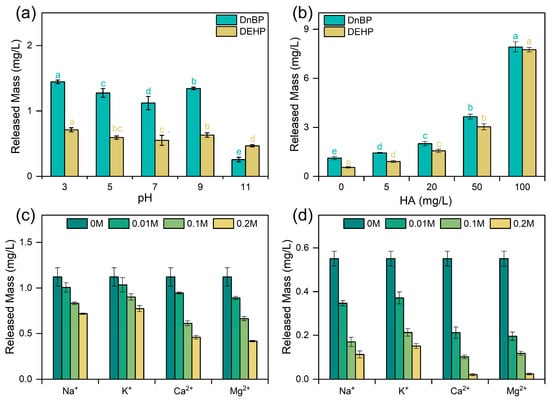
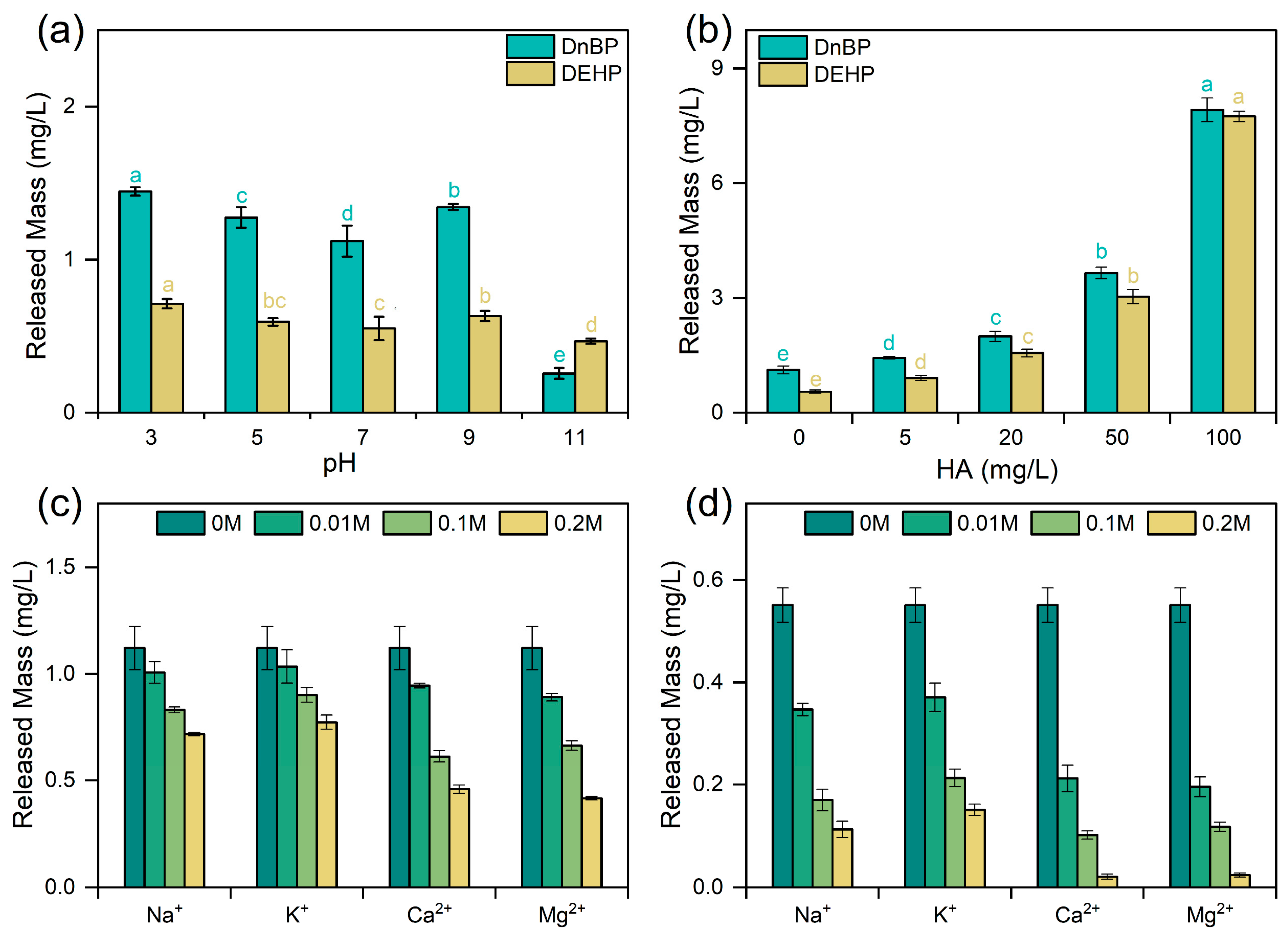
The effect of solution pH on the leaching behavior of PAEs was systematically evaluated. As shown in Figure 5a, the release rates of both DnBP and DEHP exhibited minor fluctuations across a broad pH range of 3–9—initially decreasing slightly from pH 3 to 7 and subsequently increasing from pH 7–9, with the overall variance not exceeding 23%. Throughout this range, the released amount of DnBP remained consistently and significantly higher than that of DEHP. This relative insensitivity to mild pH variations is primarily caused by non-ionic, neutral molecules PAEs and the strong acid–base stability of PVC polymer matrix [46,47]. Notably, under strongly alkaline conditions (from pH 9 to 11), the apparent release of DnBP plummeted by 80.8%, whereas DEHP exhibited a much less pronounced decrease of 25.9%. The substantial reduction in detectable aqueous PAE concentrations in alkaline environments aligns perfectly with the previous findings [2]. Mechanistically, this phenomenon is driven by alkaline hydrolysis. Compared with DEHP, DnBP has a shorter alkyl side chain, which imposes less steric hindrance and renders it significantly more susceptible to hydrolytic degradation [48]. Consequently, the rapid degradation of DnBP at high pH levels led to the sharp decline in its apparent release accumulation.
Figure 5.
Effects of solution pH (a) and HA concentration (b) on the release of DnBP and DEHP from PVC microplastics. Effects of ionic strength and ion type on the release of DnBP (c) and DEHP (d) from PVC microplastics. Note: (a) Different lowercase letters indicate significant differences (p < 0.05) in the release of PAEs at different pH levels; (b) different lowercase letters indicate significant differences (p < 0.05) in the release of PAEs at different HA strengths, whereas green letters represent DnBP, and yellow letters represent DEHP.
The effects of ionic strength and specific ion types on the leaching behavior of DnBP and DEHP were systematically evaluated (Figure 5c,d). Generally, the apparent release of PAEs negatively correlated with the ionic strength of the aqueous medium. Specifically, as the concentrations of background ions (Na+, K+, Ca2+, and Mg2+) increased to 0.2 M, the release of DnBP from the PVC matrix decreased by 36%, 31%, 59%, and 63%, respectively (Figure 5c). Concurrently, the release of DEHP experienced a much more drastic reduction of 79%, 72%, 96%, and 95%, respectively (Figure 5d). This inverse relationship aligns well with previous observations that elevated salinity in aquatic environments tends to inhibit the desorption of plastic additives [49]. Notably, divalent cations exhibited a substantially stronger inhibitory effect on PAE leaching compared to monovalent cations. This amplified suppression can be primarily ascribed to the intensified salting-out effect induced by higher-valent ions.
Furthermore, on the surface of aged PVC, divalent ions (Ca2+ and Mg2+) can readily form robust cationic bridges with newly generated oxygen-containing functional groups, thereby structurally compacting the polymer network and obstructing the outward diffusion channels of PAEs [50,51,52]. Moreover, sensitivity to increasing ionic strength varied markedly between the two phthalates, with DEHP exhibiting a much more pronounced suppression upon its release than DnBP. This discrepancy is fundamentally rooted in their distinct physicochemical properties. Consistent with previous findings in which the salting-out effect profoundly inhibited the leaching of hydrophobic compounds, such as bisphenol A, due to its limited aqueous solubility, the longer alkyl side chains of DEHP render it significantly more hydrophobic and less soluble than DnBP [13,53]. Consequently, DEHP is far more susceptible to the salting-out effect, resulting in a dramatic reduction in its aqueous release with increasing ion concentration. It should be noted that only representative cations were investigated in this study. Naturally occurring anions, such as carbonate, bicarbonate, and sulfate, may also influence plasticizer leaching by modifying solution chemistry and ionic interactions. Their potential effects warrant systematic investigation in future studies.
Humic acid (HA), a ubiquitous fraction of DOM, is widely present in natural aquatic environments. Previous studies have documented that interactions between DOM and microplastics significantly facilitate the leaching of associated additives [54,55]. In this study, as the HA concentration was increased to 5, 20, and 50 mg/L, DnBP release increased by 28%, 78%, and 225%, respectively, while DEHP exhibited even more pronounced increases of 40%, 183%, and 450%, respectively. Upon further increasing the HA concentration to 100 mg/L, the equilibrium aqueous concentrations of DnBP and DEHP surged to 7.914 mg/L and 7.743 mg/L, representing approximately 6-fold and 13-fold increases compared with the pure water controls, respectively (Figure 5b). These results unambiguously demonstrate a strong promoting effect of HA on PAE release. Mechanistically, DOM acts as a hydrophobic solubilizer for hydrophobic organic compounds [56,57], thereby reducing the aqueous phase resistance and accelerating the diffusion of PAEs into the surrounding water; this is consistent with previous findings [12], which reported that the presence of fulvic acid could enhance the apparent solubility of plasticizers and promote their migration. Notably, the promoting effect of HA was substantially more potent for DEHP than for DnBP. As previously discussed, DEHP possesses longer alkyl side chains, rendering it more hydrophobic than DnBP. According to classical partition theory, the ability of DOM to enhance the apparent solubility of organic pollutants is strongly and positively correlated with the pollutants’ intrinsic hydrophobicity [56]. Consequently, high concentrations of HA effectively overcome the physicochemical barrier posed by the extremely low intrinsic water solubility of DEHP. Through this robust hydrophobic solubilization effect, HA significantly enhances the release potential of DEHP, which would otherwise be severely restricted in pure water.
Overall, environmental factors play a pivotal role in regulating the release of PAEs from PVC microplastics, with the magnitude of these effects being highly dependent on the side-chain structure and intrinsic hydrophobicity of the plasticizers. For instance, while solution pH generally exerts a marginal influence on PAE leaching, highly alkaline conditions (e.g., pH 11) can accelerate alkaline hydrolysis, thereby drastically reducing the apparent accumulation of PAEs in the aqueous phase. In contrast, inorganic salts strongly inhibit PAE release by increasing interfacial mass-transfer resistance. This suppression is driven by the salting-out effect and the formation of cationic bridges by divalent ions. This inhibitory mechanism is particularly pronounced for the highly hydrophobic and largely insoluble DEHP. Conversely, DOM, such as humic acid (HA), acts as a strong positive driver for leaching. Through hydrophobic solubilization, HA effectively overcomes the aqueous solubility barriers of highly hydrophobic compounds, unleashing the release potential of DEHP and amplifying its aqueous concentration by an order of magnitude. Collectively, these mechanistic insights elucidate the complex interactions between varying environmental conditions and additive leaching in realistic aquatic systems (e.g., high-salinity oceans or DOM-rich wetlands), thereby underscoring the long-term ecological risks posed by microplastics.
4. Conclusions
In this study, the leaching behavior of DnBP and DEHP from PVC microplastics under UV aging was systematically investigated, revealing a profound coupling mechanism between additive photolysis and polymer weathering. We found that UV-driven additive release is governed by a kinetic competition: UV-induced matrix degradation physically facilitates outward migration by alleviating internal mass transfer resistance, while concurrent photolysis of additives counteracts this accumulation. Consequently, the apparent release of the photolabile DnBP significantly declined in later stages, whereas the photoresistant DEHP exhibited enhanced late-stage release. Moreover, environmental variables selectively modulated the release kinetics based on additive hydrophobicity. Specifically, high concentrations of divalent cations (Ca2+) suppressed DEHP release by up to 96% via cationic bridging and salting-out effects. At the same time, humic acid vastly unleashed its release potential through hydrophobic solubilization, triggering a 13-fold surge. Multidimensional characterizations confirmed that severe dehydrochlorination, surface oxidation, and crystalline amorphization were intrinsic drivers that reduced the diffusion barrier. Overall, this study highlights that microplastic aging and environmental conditions synergistically dictate the environmental fate of plasticizers. The dynamic leaching of diverse microplastic-associated contaminants in complex, real-world aquatic scenarios warrants further investigation to comprehensively assess their ecological risks.
In summary, microplastics are not merely vectors for exogenous environmental contaminants but also enduring intrinsic sources of pollution whose release dynamics are profoundly modulated by solar irradiation and hydrochemical variables. To accurately evaluate the real-world ecological risks posed by microplastics, accounting for the synergistic interactions between the polymer matrix’s inherent weathering characteristics and complex hydrochemical systems (e.g., hypersaline marine environments or DOM-enriched wetlands) is imperative. Ultimately, this work establishes a robust theoretical framework for precisely predicting the environmental fate and long-term ecological impacts of microplastics and their associated plasticizers in natural aquatic ecosystems.
Supplementary Materials
The following supporting information can be downloaded at: https://www.mdpi.com/article/10.3390/microplastics5030162/s1.
Author Contributions
Y.X.: Writing—original draft, Methodology, Investigation, Data curation, Conceptualization. H.Z.: Supervision, Validation. X.C.: Investigation, Supervision. T.Z.: Writing—review & editing, Project administration, Funding acquisition. All authors have read and agreed to the published version of the manuscript.
Funding
This research was funded by the National Natural Science Foundation of China Projects grant number (U21A2003) And The APC was funded by U21A2003.
Data Availability Statement
Data will be made available on request.
Acknowledgments
This study was financially supported by a National Natural Science Foundation of China project (U21A2003).
Conflicts of Interest
The authors declare that they have no known competing financial interests or personal relationships that could have appeared to influence the work reported in this paper.
References
- Barhoumi, B.; Metian, M.; Oberhaensli, F.; Mourgkogiannis, N.; Karapanagioti, H.K.; Bersuder, P.; Tolosa, I. Extruded polystyrene microplastics as a source of brominated flame retardant additives in the marine environment: Long-term field and laboratory experiments. Environ. Int. 2023, 172, 107797. [Google Scholar] [CrossRef] [Scilit] [PubMed]
- Cao, Y.; Lin, H.; Zhang, K.; Xu, S.; Yan, M.; Leung, K.M.Y.; Lam, P.K.S. Microplastics: A major source of phthalate esters in aquatic environments. J. Hazard. Mater. 2022, 432, 128731. [Google Scholar] [CrossRef] [Scilit] [PubMed]
- Ge, X.; Xu, F.; Li, B.; Liu, L.; Lu, X.; Wang, L.; Zhang, Y.; Li, J.; Li, J.; Tang, Y. Unveiling microplastic distribution and interactions in the benthic layer of the Yangtze River Estuary and East China Sea. Environ. Sci. Ecotechnol. 2024, 20, 100340. [Google Scholar] [CrossRef] [Scilit] [PubMed]
- Wei, X.-F.; Bohlén, M.; Lindblad, C.; Hedenqvist, M.; Hakonen, A. Microplastics generated from a biodegradable plastic in freshwater and seawater. Water Res. 2021, 198, 117123. [Google Scholar] [CrossRef] [Scilit] [PubMed]
- Mei, W.; Chen, G.; Bao, J.; Song, M.; Li, Y.; Luo, C. Interactions between microplastics and organic compounds in aquatic environments: A mini review. Sci. Total Environ. 2020, 736, 139472. [Google Scholar] [CrossRef] [Scilit] [PubMed]
- Xiang, Y.; Jiang, L.; Zhou, Y.; Luo, Z.; Zhi, D.; Yang, J.; Lam, S.S. Microplastics and environmental pollutants: Key interaction and toxicology in aquatic and soil environments. J. Hazard. Mater. 2022, 422, 126843. [Google Scholar] [CrossRef] [Scilit] [PubMed]
- Xu, Z.; Zhang, J.; Qi, R.; Liu, Q.; Cao, H.; Wen, F.; Liao, Y.; Shih, K.; Tang, Y. Complex release dynamics of microplastic additives: An interplay of additive degradation and microplastic aging. J. Hazard. Mater. 2025, 490, 137711. [Google Scholar] [CrossRef] [Scilit] [PubMed]
- Lin, L.; Li, H.; Hong, H.; Yuan, B.; Sun, X.; He, L.; Xue, C.; Lu, H.; Liu, J.; Yan, C. Enhanced heavy metal adsorption on microplastics by incorporating flame retardant hexabromocyclododecanes: Mechanisms and potential migration risks. Water Res. 2022, 225, 119144. [Google Scholar] [CrossRef] [Scilit] [PubMed]
- Hahladakis, J.N.; Velis, C.A.; Weber, R.; Iacovidou, E.; Purnell, P. An overview of chemical additives present in plastics: Migration, release, fate and environmental impact during their use, disposal and recycling. J. Hazard. Mater. 2018, 344, 179–199. [Google Scholar] [CrossRef] [Scilit] [PubMed]
- Hermabessiere, L.; Dehaut, A.; Paul-Pont, I.; Lacroix, C.; Jezequel, R.; Soudant, P.; Duflos, G. Occurrence and effects of plastic additives on marine environments and organisms: A review. Chemosphere 2017, 182, 781–793. [Google Scholar] [CrossRef] [Scilit] [PubMed]
- Chen, Y.; Yang, J.; Yao, B.; Zhi, D.; Luo, L.; Zhou, Y. Endocrine disrupting chemicals in the environment: Environmental sources, biological effects, remediation techniques, and perspective. Environ. Pollut. 2022, 310, 119918. [Google Scholar] [CrossRef] [Scilit] [PubMed]
- Yan, Y.; Zhu, F.; Zhu, C.; Chen, Z.; Liu, S.; Wang, C.; Gu, C. Dibutyl phthalate release from polyvinyl chloride microplastics: Influence of plastic properties and environmental factors. Water Res. 2021, 204, 117597. [Google Scholar] [CrossRef] [Scilit] [PubMed]
- Henkel, C.; Hüffer, T.; Hofmann, T. Polyvinyl Chloride Microplastics Leach Phthalates into the Aquatic Environment over Decades. Environ. Sci. Technol. 2022, 56, 14507–14516. [Google Scholar] [CrossRef] [Scilit] [PubMed]
- Net, S.; Sempéré, R.; Delmont, A.; Paluselli, A.; Ouddane, B. Occurrence, Fate, Behavior and Ecotoxicological State of Phthalates in Different Environmental Matrices. Environ. Sci. Technol. 2015, 49, 4019–4035. [Google Scholar] [CrossRef] [Scilit] [PubMed]
- Sedha, S.; Lee, H.; Singh, S.; Kumar, S.; Jain, S.; Ahmad, A.; Bin Jardan, Y.A.; Sonwal, S.; Shukla, S.; Simal-Gandara, J.; et al. Reproductive toxic potential of phthalate compounds—State of art review. Pharmacol. Res. 2021, 167, 105536. [Google Scholar] [CrossRef] [Scilit] [PubMed]
- Mankidy, R.; Wiseman, S.; Ma, H.; Giesy, J.P. Biological impact of phthalates. Toxicol. Lett. 2013, 217, 50–58. [Google Scholar] [CrossRef] [Scilit] [PubMed]
- Lin, L.; Yuan, B.; Liu, H.; Ke, Y.; Zhang, W.; Li, H.; Lu, H.; Liu, J.; Hong, H.; Yan, C. Microplastics emerge as a hotspot for dibutyl phthalate sources in rivers and oceans: Leaching behavior and potential risks. J. Hazard. Mater. 2024, 475, 134920. [Google Scholar] [CrossRef] [Scilit] [PubMed]
- Duan, J.; Li, Y.; Gao, J.; Cao, R.; Shang, E.; Zhang, W. ROS-mediated photoaging pathways of nano- and micro-plastic particles under UV irradiation. Water Res. 2022, 216, 118320. [Google Scholar] [CrossRef] [Scilit] [PubMed]
- Zhong, X.; Yi, X.; Cheng, F.; Tong, H.; Xu, W.; Yang, X. Leaching of di-2-ethylhexyl phthalate from biodegradable and conventional microplastics and the potential risks. Chemosphere 2023, 311, 137208. [Google Scholar] [CrossRef] [Scilit] [PubMed]
- Zhao, E.; Xu, Z.; Xiong, X.; Hu, H.; Wu, C. The impact of particle size and photoaging on the leaching of phthalates from plastic waste. J. Clean. Prod. 2022, 367, 133109. [Google Scholar] [CrossRef] [Scilit]
- Takehisa, H.; Naoko, E.; Masahiko, S.; Katsuhide, T.; Moriyuki, O.; Keizoh, S.; Mutsuko, T.; Kenji, K.; Shin’ichiro, N.; Toshio, O. Release behavior of diethylhexyl phthalate from the polyvinyl-chloride tubing used for intravenous administration and the plasticized PVC membrane. Int. J. Pharm. 2005, 297, 30–37. [Google Scholar] [CrossRef] [Scilit] [PubMed]
- Rahman, M.; Brazel, C.S. The plasticizer market: An assessment of traditional plasticizers and research trends to meet new challenges. Prog. Polym. Sci. 2004, 29, 1223–1248. [Google Scholar] [CrossRef] [Scilit]
- Zhu, T.; Sheng, J.; Chen, J.; Ren, K.; Wu, Z.; Wu, H.; Li, J.; Lin, J. Staining of wood veneers with anti-UV property using the natural dye extracted from Dalbergia cohinchinensis. J. Clean. Prod. 2021, 284, 124770. [Google Scholar] [CrossRef] [Scilit]
- Wang, Q.; Wangjin, X.; Zhang, Y.; Wang, N.; Wang, Y.; Meng, G.; Chen, Y. The toxicity of virgin and UV-aged PVC microplastics on the growth of freshwater algae Chlamydomonas reinhardtii. Sci. Total Environ. 2020, 749, 141603. [Google Scholar] [CrossRef] [Scilit] [PubMed]
- Menger, F.; Römerscheid, M.; Lips, S.; Klein, O.; Nabi, D.; Gandrass, J.; Joerss, H.; Wendt-Potthoff, K.; Bedulina, D.; Zimmermann, T.; et al. Screening the release of chemicals and microplastic particles from diverse plastic consumer products into water under accelerated UV weathering conditions. J. Hazard. Mater. 2024, 477, 135256. [Google Scholar] [CrossRef] [Scilit] [PubMed]
- Wang, C.; Liang, S.; Bai, L.; Gu, X.; Jin, X.; Ok, Y.S.; Gu, C. Photoaging of Typical Microplastics as Affected by Air Humidity: Mechanistic Insights into the Important Role of Water Molecules. Environ. Sci. Technol. 2023, 57, 5967–5977. [Google Scholar] [CrossRef] [Scilit] [PubMed]
- Alkurdi, S.S.A.; Al-Juboori, R.A.; Bundschuh, J.; Bowtell, L.; Marchuk, A. Inorganic arsenic species removal from water using bone char: A detailed study on adsorption kinetic and isotherm models using error functions analysis. J. Hazard. Mater. 2021, 405, 124112. [Google Scholar] [CrossRef] [Scilit] [PubMed]
- Do, A.T.N.; Ha, Y.; Kwon, J.-H. Leaching of microplastic-associated additives in aquatic environments: A critical review. Environ. Pollut. 2022, 305, 119258. [Google Scholar] [CrossRef] [Scilit] [PubMed]
- Bridson, J.H.; Abbel, R.; Smith, D.A.; Northcott, G.L.; Gaw, S. Impact of accelerated weathering on the leaching kinetics of stabiliser additives from microplastics. J. Hazard. Mater. 2023, 459, 132303. [Google Scholar] [CrossRef] [Scilit] [PubMed]
- Beiras, R.; Verdejo, E.; Campoy-López, P.; Vidal-Liñán, L. Aquatic toxicity of chemically defined microplastics can be explained by functional additives. J. Hazard. Mater. 2021, 406, 124338. [Google Scholar] [CrossRef] [Scilit] [PubMed]
- Allan, I.J.; Samanipour, S.; Manoli, K.; Gigault, J.; Fatta-Kassinos, D. Examining the Relevance of the Microplastic-Associated Additive Fraction in Environmental Compartments. ACS ES T Water 2022, 2, 405–413. [Google Scholar] [CrossRef] [Scilit]
- Alharthi, S.; Bibi, T.; Santali, E.Y.; Ali, A. Highly efficient removal of dibutyl phthalate from wastewater using a novel hydrophilic–lipophilic magnetic adsorbent based on silica-coated iron oxide nanoparticles††Electronic supplementary information (ESI) available. Nanoscale Adv. 2025, 7, 4962–4979. [Google Scholar] [CrossRef] [Scilit] [PubMed]
- Lee, Y.K.; He, W.; Guo, H.; Karanfil, T.; Hur, J. Effects of organic additives on spectroscopic and molecular-level features of photo-induced dissolved organic matter from microplastics. Water Res. 2023, 242, 120272. [Google Scholar] [CrossRef] [Scilit] [PubMed]
- Liu, X.; Sun, P.; Qu, G.; Jing, J.; Zhang, T.; Shi, H.; Zhao, Y. Insight into the characteristics and sorption behaviors of aged polystyrene microplastics through three type of accelerated oxidation processes. J. Hazard. Mater. 2021, 407, 124836. [Google Scholar] [CrossRef] [Scilit] [PubMed]
- Luo, H.; Liu, C.; He, D.; Xu, J.; Sun, J.; Li, J.; Pan, X. Environmental behaviors of microplastics in aquatic systems: A systematic review on degradation, adsorption, toxicity and biofilm under aging conditions. J. Hazard. Mater. 2022, 423, 126915. [Google Scholar] [CrossRef] [Scilit] [PubMed]
- Zhang, J.; Chen, H.; He, H.; Cheng, X.; Ma, T.; Hu, J.; Yang, S.; Li, S.; Zhang, L. Adsorption behavior and mechanism of 9-Nitroanthracene on typical microplastics in aqueous solutions. Chemosphere 2020, 245, 125628. [Google Scholar] [CrossRef] [Scilit] [PubMed]
- Wu, L.; Zhong, Z.; Wang, Z.; Du, X.; Tao, X.; Zhou, J.; Dang, Z.; Lu, G. Antimony release from e-waste-derived microplastics in aqueous environments: Effect of plastic properties and environmental factors. Environ. Pollut. 2025, 368, 125774. [Google Scholar] [CrossRef] [Scilit] [PubMed]
- Yu, F.; Li, Y.; Huang, G.; Yang, C.; Chen, C.; Zhou, T.; Zhao, Y.; Ma, J. Adsorption behavior of the antibiotic levofloxacin on microplastics in the presence of different heavy metals in an aqueous solution. Chemosphere 2020, 260, 127650. [Google Scholar] [CrossRef] [Scilit] [PubMed]
- Pok, Š.; Kralj Cigić, I.; Strlič, M.; Rijavec, T. Poly(vinyl chloride) degradation: Identification of acidic degradation products, their emission rates, and implications for heritage collections. npj Herit. Sci. 2025, 13, 382. [Google Scholar] [CrossRef] [Scilit]
- Gardi, S.; Giannone, L.; Sarti, G.; Sarti, G. Surface Chalking upon Weathering of Dark-Colored PVC Articles and Relevant Stabilizers. Polymers 2024, 16, 1047. [Google Scholar] [CrossRef] [Scilit] [PubMed]
- Sun, P.; Liu, X.; Zhang, M.; Li, Z.; Cao, C.; Shi, H.; Yang, Y.; Zhao, Y. Sorption and leaching behaviors between aged MPs and BPA in water: The role of BPA binding modes within plastic matrix. Water Res. 2021, 195, 116956. [Google Scholar] [CrossRef] [Scilit] [PubMed]
- Zjacić, J.P.; Katančić, Z.; Kovacic, M.; Kusic, H.; Hrnjak Murgić, Z.; Dionysiou, D.D.; Karamanis, P.; Loncaric Bozic, A. Fragmentation of polypropylene into microplastics promoted by photo-aging; release of metals, toxicity and inhibition of biodegradability. Sci. Total Environ. 2024, 935, 173344. [Google Scholar] [CrossRef] [Scilit] [PubMed]
- Leite-Barbosa, O.; de Oliveira, M.F.; de Oliveira, M.G.; Padilha, M.C.; Veiga-Junior, V.F. Rapid Detection of Plasticizer Migration From UV-Aged PVC Films by DART-HRMS. Rapid Commun. Mass Spectrom. 2026, 40, e70048. [Google Scholar] [CrossRef] [Scilit] [PubMed]
- Zhou, X.; Guo, J.; Lin, K.; Huang, K.; Deng, J. Leaching characteristics of heavy metals and brominated flame retardants from waste printed circuit boards. J. Hazard. Mater. 2013, 246–247, 96–102. [Google Scholar] [CrossRef] [Scilit] [PubMed]
- Liu, X.; Shi, H.; Xie, B.; Dionysiou, D.D.; Zhao, Y. Microplastics as Both a Sink and a Source of Bisphenol A in the Marine Environment. Environ. Sci. Technol. 2019, 53, 10188–10196. [Google Scholar] [CrossRef] [Scilit] [PubMed]
- Kumagai, S.; Hirahashi, S.; Grause, G.; Kameda, T.; Toyoda, H.; Yoshioka, T. Alkaline hydrolysis of PVC-coated PET fibers for simultaneous recycling of PET and PVC. J. Mater. Cycles Waste Manag. 2018, 20, 439–449. [Google Scholar] [CrossRef] [Scilit]
- Liu, F.-F.; Liu, G.-Z.; Zhu, Z.-L.; Wang, S.-C.; Zhao, F.-F. Interactions between microplastics and phthalate esters as affected by microplastics characteristics and solution chemistry. Chemosphere 2019, 214, 688–694. [Google Scholar] [CrossRef] [Scilit] [PubMed]
- Wolfe, N.L.; Steen, W.C.; Burns, L.A. Phthalate ester hydrolysis: Linear free energy relationships. Chemosphere 1980, 9, 403–408. [Google Scholar] [CrossRef] [Scilit]
- Suhrhoff, T.J.; Scholz-Böttcher, B.M. Qualitative impact of salinity, UV radiation and turbulence on leaching of organic plastic additives from four common plastics—A lab experiment. Mar. Pollut. Bull. 2016, 102, 84–94. [Google Scholar] [CrossRef] [Scilit] [PubMed]
- Wang, F.; Wong, C.S.; Chen, D.; Lu, X.; Wang, F.; Zeng, E.Y. Interaction of toxic chemicals with microplastics: A critical review. Water Res. 2018, 139, 208–219. [Google Scholar] [CrossRef] [Scilit] [PubMed]
- Barnie, S.; Zhang, J.; Wang, H.; Yin, H.; Chen, H. The influence of pH, co-existing ions, ionic strength, and temperature on the adsorption and reduction of hexavalent chromium by undissolved humic acid. Chemosphere 2018, 212, 209–218. [Google Scholar] [CrossRef] [Scilit] [PubMed]
- Henkel, C.; Lamprecht, J.; Hüffer, T.; Hofmann, T. Environmental factors strongly influence the leaching of di(2-ethylhexyl) phthalate from polyvinyl chloride microplastics. Water Res. 2023, 242, 120235. [Google Scholar] [CrossRef] [Scilit] [PubMed]
- Cousins, I.; Mackay, D. Correlating the physical–chemical properties of phthalate esters using the ‘three solubility’ approach. Chemosphere 2000, 41, 1389–1399. [Google Scholar] [CrossRef] [Scilit] [PubMed]
- Luo, H.; Liu, C.; He, D.; Sun, J.; Zhang, A.; Li, J.; Pan, X. Interactions between polypropylene microplastics (PP-MPs) and humic acid influenced by aging of MPs. Water Res. 2022, 222, 118921. [Google Scholar] [CrossRef] [Scilit] [PubMed]
- Rama, P.; Gallego-Urrea, J.A.; Abbas, Z. Interfacial interactions of humic acids with polystyrene nano-plastics in aqueous/ionic environments: A molecular dynamics exploration. Environ. Sci. Nano 2023, 10, 1385–1393. [Google Scholar] [CrossRef] [Scilit]
- Chiou, C.T.; Malcolm, R.L.; Brinton, T.I.; Kile, D.E. Water solubility enhancement of some organic pollutants and pesticides by dissolved humic and fulvic acids. Environ. Sci. Technol. 1986, 20, 502–508. [Google Scholar] [CrossRef] [Scilit] [PubMed]
- Aiken, G.R.; Hsu-Kim, H.; Ryan, J.N. Influence of Dissolved Organic Matter on the Environmental Fate of Metals, Nanoparticles, and Colloids. Environ. Sci. Technol. 2011, 45, 3196–3201. [Google Scholar] [CrossRef] [Scilit] [PubMed]
Disclaimer/Publisher’s Note: The statements, opinions and data contained in all publications are solely those of the individual author(s) and contributor(s) and not of MDPI and/or the editor(s). MDPI and/or the editor(s) disclaim responsibility for any injury to people or property resulting from any ideas, methods, instructions or products referred to in the content. |
© 2026 by the authors. Licensee MDPI, Basel, Switzerland. This article is an open access article distributed under the terms and conditions of the Creative Commons Attribution (CC BY) license.