


Microplastics is a new, open access, peer-reviewed journal from MDPI that has just completed its fourth year of publication (2025). It provides an advanced forum for scientists to discuss the challenges caused by the ubiquitous presence of microplastics in the environment, as well as their impact on human health and ecosystem services. Microplastics (MPs) have been found in all environmental compartments, such as seawater and freshwater bodies, municipal wastewater and urban runoff, agricultural soils, sediments, and the air. The level of plastic debris in the environment, mainly in the form of microplastics, is reaching unprecedented levels, and there is worldwide concern about adverse effects on both living organisms and ecosystems. When Microplastics was launched, our vision was clear: to create a dedicated, high-quality forum to discuss one of the most pressing environmental challenges of our time. Today, I am honored to report that this vision is being achieved even faster and more effectively than we had initially hoped.
In the summer of 2025, Microplastics was awarded its first Impact Factor of 5.1 and its first CiteScore of 6.8. This is a remarkable achievement for a new journal and demonstrates that the research published is not only of high quality but also well accepted by the scientific community. This Impact Factor reflects the hard work of our authors, the diligence of our reviewers, and the rigorous standards maintained by our editorial board. It confirms that our aim from the day the journal was established has become a reality: Microplastics has quickly become a key journal for critical discussions regarding plastic pollution, toxicology, and the environmental remediation of microplastics. I would like to congratulate the Managing Editors of the journal as well as the whole editorial team, for their excellent job during these first 4 years.
Success in scientific publishing is a collective endeavor. I must extend my profound thanks to our Editorial Board members for their guidance and experience, which have been instrumental in attracting high-quality research. To our reviewers, thank you for your critical eye and constructive feedback. And most importantly, to our authors, thank you for choosing Microplastics for the publication of your important work.
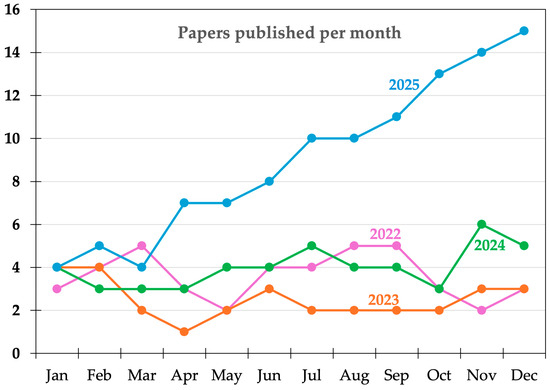
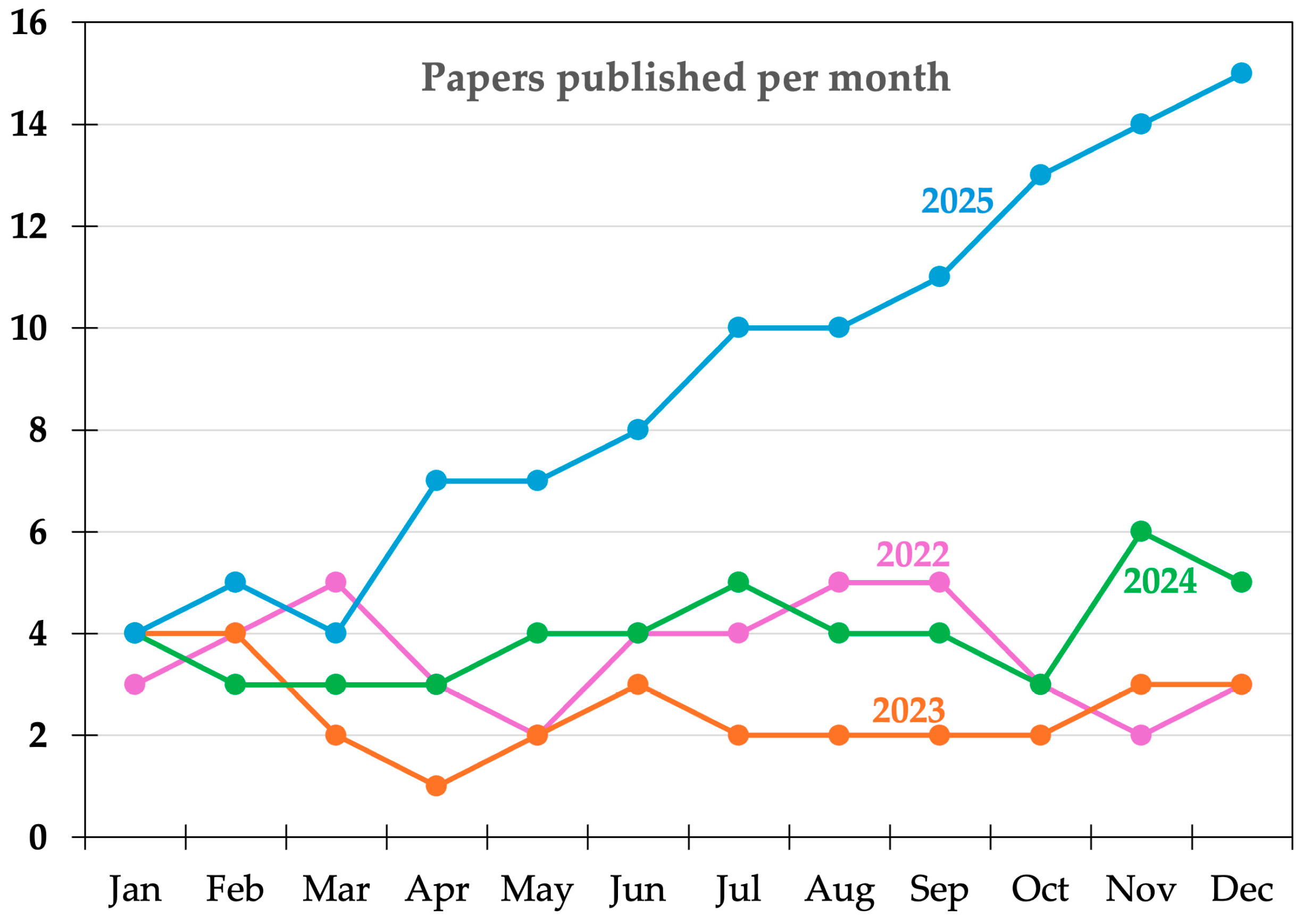
As shown in Figure 1, the number of articles published per month increased substantially in 2025 after the news on the Impact Factor of the journal was publicized. We expect this trend to continue in the next few years, establishing Microplastics as a premier journal for publishing research findings on microplastics and nanoplastics.
Figure 1.
Number of papers published monthly in Microplastics since 2022. The increased monthly publication rate in 2025 after the journal I.F. was announced can be prominently seen.
By the end of 2025, Microplastics had published 235 articles. Reaching this number demonstrates the trust that authors place in our editorial team and our open access model. I feel obliged to report the top 10 most viewed publications in Microplastics. As seen in Table 1, articles related to human health have a high number of views.
Table 1.
Title, date of publication, and citations of the 10 articles in Microplastics with the highest number of views.
Microplastics is expected to continue to present relevant challenges, e.g., the fate of microplastics in the environment; the development of reliable and validated detection methods for MP characterization and quantification including nanoplastics; microplastics as carriers for hydrophobic chemicals, heavy metals, and antibiotic resistance genes; the biodegradation of microplastics and nanoplastics; modelling the behavior of MPs in the environment from generation to mineralization, sequestration, or ingestion, including global transport modelling of plastic fragments; and the health effects of human exposure to microplastics and nanoplastics.
In the past year, we have had several submissions on the effects of microplastics and nanoplastics on human health through the ingestion of food and drinking water and the inhalation of airborne particulates, resulting in adverse health effects. We expect this area to receive more attention in the coming years.
There are still significant knowledge gaps that future research is expected to address, leading to sustainable mitigation strategies to combat the adverse effects of MPs. We hope that Microplastics will be one of your top choices for publishing your research findings. Submit your best work, challenge existing paradigms, and help us write the next chapter of Microplastics. Our goal is to double the Impact Factor of Microplastics within the next few years.
Funding
This research received no external funding.
Conflicts of Interest
The author declares no conflicts of interest.
References
- Abbas, G.; Ahmed, U.; Ahmad, M.A. Impact of Microplastics on Human Health: Risks, Diseases, and Affected Body Systems. Microplastics 2025, 4, 23. [Google Scholar] [CrossRef] [Scilit]
- Sacco, N.A.; Zoppas, F.M.; Devard, A.; González Muñoz, M.d.P.; García, G.; Marchesini, F.A. Recent Advances in Microplastics Removal from Water with Special Attention Given to Photocatalytic Degradation: Review of Scientific Research. Microplastics 2023, 2, 278–303. [Google Scholar] [CrossRef] [Scilit]
- Geppner, L.; Grammatidis, S.; Wilfing, H.; Henjakovic, M. First Evidence of the Possible Influence of Avoiding Daily Liquid Intake from Plastic and Glass Beverage Bottles on Blood Pressure in Healthy Volunteers. Microplastics 2024, 3, 419–432. [Google Scholar] [CrossRef] [Scilit]
- Damaj, S.; Trad, F.; Goevert, D.; Wilkesmann, J. Bridging the Gaps between Microplastics and Human Health. Microplastics 2024, 3, 46–66. [Google Scholar] [CrossRef] [Scilit]
- Lackner, M.; Branka, M. Microplastics in Farmed Animals—A Review. Microplastics 2024, 3, 559–588. [Google Scholar] [CrossRef] [Scilit]
- Brancaleone, E.; Mattei, D.; Fuscoletti, V.; Lucentini, L.; Favero, G.; Cecchini, G.; Frugis, A.; Gioia, V.; Lazzazzara, M. Microplastic in Drinking Water: A Pilot Study. Microplastics 2024, 3, 31–45. [Google Scholar] [CrossRef] [Scilit]
- Casillas, G.; Hubbard, B.C.; Telfer, J.; Zarate-Bermudez, M.; Muianga, C.; Zarus, G.M.; Carroll, Y.; Ellis, A.; Hunter, C.M. Microplastics Scoping Review of Environmental and Human Exposure Data. Microplastics 2023, 2, 78–92. [Google Scholar] [CrossRef] [Scilit]
- Almeida, M.P.d.; Gaylarde, C.; Pompermayer, F.C.; Lima, L.d.S.; Delgado, J.d.F.; Scott, D.; Neves, C.V.; Vieira, K.S.; Baptista Neto, J.A.; Fonseca, E.M. The Complex Dynamics of Microplastic Migration through Different Aquatic Environments: Subsidies for a Better Understanding of Its Environmental Dispersion. Microplastics 2023, 2, 62–77. [Google Scholar] [CrossRef] [Scilit]
- Goodrum, R.; Bartokova, B.; Roy, P. Life Cycle Assessment of Banned Single-Use Plastic Products and Their Alternatives. Microplastics 2024, 3, 614–633. [Google Scholar] [CrossRef] [Scilit]
- Bhowmik, A.; Saha, G. Microplastics in Our Waters: Insights from a Configurative Systematic Review of Water Bodies and Drinking Water Sources. Microplastics 2025, 4, 24. [Google Scholar] [CrossRef] [Scilit]

Disclaimer/Publisher’s Note: The statements, opinions and data contained in all publications are solely those of the individual author(s) and contributor(s) and not of MDPI and/or the editor(s). MDPI and/or the editor(s) disclaim responsibility for any injury to people or property resulting from any ideas, methods, instructions or products referred to in the content. |
© 2026 by the author. Licensee MDPI, Basel, Switzerland. This article is an open access article distributed under the terms and conditions of the Creative Commons Attribution (CC BY) license.