


Abstract
Indole-3-acetic acid (IAA) is an essential phytohormone that regulates several tropic responses in plants and serves as signaling molecule in plant–bacteria interactions. In this study, a high indolic-compound-producing actinobacterial strain, designated OP15, was isolated from the roots of Opuntia ficus-indica as an endophyte and identified as a member of the Streptomyces genus based on 16S rRNA gene sequence analysis. Synthetic dairy wastewater (SDWW) was used as a low-cost fermentation substrate for the production of IAA-equivalent compounds, providing a sustainable approach that links microbial metabolite production with agro-industrial waste valorization. Fermentation conditions were optimized using a Box–Behnken design coupled with response surface methodology. To address model overfitting, a backward elimination procedure was applied, yielding a reduced statistical model (R2 = 0.658, adjusted R2 = 0.628, predicted R2 = 0.583) with adequate predictive performance. Under the optimized conditions (1 g/L NaCl, 1 g/L L-tryptophan, 100% SDWW, 7.5% inoculum, 4.5 days), the model predicted a maximum response of 278.2 µg/mL (95% prediction interval: 230.0–326.4 µg/mL). Experimental validation yielded a response of 296.838 µg/mL, falling within the prediction interval and confirming the model’s reliability within the experimental domain. This agreement supports the model’s utility for process optimization within the experimental domain. In addition, treatment of wheat seeds with the culture supernatant of OP15 isolate significantly (p < 0.05) promoted root length and root dry weight. Overall, these findings highlight the potential of the OP15 strain for the sustainable production of IAA-equivalent compounds using SDWW and support the valorization of dairy effluents as low-cost substrates for biotechnological applications.
1. Introduction
The primary auxin in plants is indole-3-acetic acid (IAA), which interacts with other phytohormones to regulate various aspects of plant growth and development [1]. IAA regulates diverse physiological processes, such as tropic bending, organogenesis, root hair formation, shoot elongation, floral initiation, and responses to biotic and abiotic stresses [2,3,4]. In addition to plants, numerous plant-associated microorganisms, comprising both beneficial rhizosphere bacteria and endophytes, have the capacity to synthesize this phytohormone [5]. Microbial IAA serves as a key mediator in microbe–plant interactions by modulating plant auxin levels and consequently influencing plant development [6]. IAA produced by rhizosphere bacteria can increase root length and surface area, thereby enhancing plant uptake to water and nutrients and indirectly supporting microbial growth in the rhizosphere [1,5]. Despite its natural abundance and central role in plant physiology and plant–microbe interactions, the large-scale production of IAA remains limited by economic and technical constraints. IAA is a commercially important bio-based agrochemical with broad applications in horticulture, plant cell and tissue culture, root formation, fruit development, and stress tolerance [7]. However, industrial IAA production still relies mainly on chemical synthesis, which is often associated with high production costs, limited sustainability, and challenges in achieving economically viable yields [1]. At the same time, global demand for sustainable, bio-based agricultural inputs is rapidly increasing, driven by the need to enhance crop productivity while reducing dependence on synthetic fertilizers and chemical hormones [8,9]. In light of the increasing interest in IAA as valuable bioactive compound, considerable attention has been directed toward IAA production by plant-associated microorganisms [5], as well as to the development production processes that are both economically feasible and environmentally sustainable. In this context, the use of agro-industrial effluents as alternative fermentation substrates has emerged as promising approach to reduce production costs while promoting waste valorization [10].
Among industrial sectors, the dairy industry is recognized as major sources of highly polluted wastewater [11]. It has been estimated that the production of one liter of milk generates between 0.2 and 10 L of wastewater [12]. It has been estimated that dairy effluents generation reached approximately 852 million tons in 2019 and may increase to 997 million tons by 2029, reflecting the growing environmental concerns associated with wastewater management in this industry [13,14]. Dairy effluents are characterized by substantial organic content, mainly associated with fats, proteins, and lactose, together with high levels of nutrients and suspended solids [12].
The use of alternative substrates, such as dairy effluents, for the microbial production of IAA has emerged as a promising approach, although it remains insufficiently explored. In addition to strain improvement strategies, medium optimization has been recognized as an effective means of enhancing product yield and overall process performance [15]. In recent years, medium optimization has gained considerable attention because it can improve process efficiency, reduce production time, and lower labor costs, thereby contributing to the economic viability of the bioprocess [16]. Among the available statistical tools, response surface methodology has proven to be one of the most effective approaches for evaluating and optimizing process conditions [17]. Once preliminary information on the fermentation process has been obtained from the literature or from conventional experiments, the use of experimental design becomes a reliable and efficient approach to assess the effects of several variables and their interactions [15]. In this context, response surface methodology serves as a powerful tool for modeling and optimizing the process parameters that influence overall fermentation performance, thereby maximizing product yield and operational efficiency [17,18].
Despite the growing interest in microbial IAA production, the use of dairy effluents as a fermentation substrate remains poorly explored, particularly in Streptomyces-based production systems optimized through statistical approaches such as response surface methodology. Therefore, the present study aimed to optimize the key fermentation parameters governing the production of IAA-equivalent compounds by OP15 isolate under submerged culture conditions using synthetic dairy wastewater (SDWW). By linking this fermentation approach with preliminary wheat-growth validation, this study provides an initial agriculturally relevant framework, while further validation using dairy effluents is required to confirm its broader sustainability and circular bioeconomy potential.
2. Materials and Methods
2.1. Sampling and Isolation of Actinobacteria
Actinobacteria were isolated from the root system of Opuntia ficus-indica. Root samples were collected from three different plants growing in the El-Aouana region, Jijel province, Algeria (36°46′21.40″ N, 5°35′47.18″ E). The samples were placed in a sterile sampling container, transported to the laboratory, and stored at 4 °C until use. Endophytic bacteria were isolated as described by Cao et al. [19] using two different solid media ISP2 [20] and Olsen medium [21]. After 10 days of incubation at 30 °C, Streptomyces-like isolates were selected on the basis of their macroscopic and microscopic characteristics. Suspensions of hyphal fragments and spores were prepared in 15% (v/v) glycerol at −20 °C [22].
2.2. Media Preparation and Culture Conditions
The SDWW was prepared according to the method described by Kuravi and Mohan [23]. The medium consisted of milk powder (800 mg/L), (NH4)2SO4 (60 mg/L), K3PO4 (150 mg/L), MgSO4⋅7H2O (5.0 mg/L), CaCl2⋅2H2O (0.37 mg/L), MnCl2⋅4H2O (0.28 mg/L), FeCl3⋅6H2O (1.45 mg/L), CH3COONa (200 mg/L), ZnSO4⋅7H2O (0.45 mg/L), Na2MoO4⋅2H2O (1.25 mg/L), CoCl2 (0.4 mg/L), and CuSO4⋅5H2O (0.48 mg/L).
2.3. Screening for IAA Production
Indolic compound production was screened according to the method described by Patten and Glick [24]. Briefly, 1 mL of spore suspension (106 spores/mL) was inoculated into 100 mL Erlenmeyer flasks containing 40 mL of either TSB medium or DWW supplemented with 1 g/L of L-tryptophan; after incubation at 30 °C for 6 days, the cultures were centrifuged at 6000 rpm for 15 min. The supernatant was then mixed with Salkowski reagent at a 1:1 (v/v) ratio. After 30 min of incubation, absorbance was measured at 535 nm. The colorimetric response was estimated using a standard curve prepared with authentic IAA and was therefore expressed as IAA equivalents. The calibration curve was established using standard IAA solutions at concentrations of 0, 5, 10, 20, 50, and 100 μg/mL. The standard curve was generated by plotting absorbance values (y) against IAA concentrations (x, μg/mL). The obtained linear regression equation was y = 0.009x + 0.0073, with a correlation coefficient of R2 = 0.98. Since the Salkowski reagent can react with IAA and other indolic metabolites, the measured response was considered as Salkowski-reactive indolic compounds expressed as IAA equivalents.
2.4. Integrated Characterization of Isolate OP15
Based on its indolic compound production ability, isolate OP15 was selected for further characterization and molecular identification and was subsequently used for optimization of IAA-equivalent compounds production.
2.4.1. Biochemical Characterization
The biochemical and physiological characteristics of the isolate were evaluated following the modified methods of Williams et al. [25]. The assimilation of D-glucose, α-lactose, L-rhamnose, maltose, sucrose, sorbitol, xylitol, D-mannose, L-arabinose, D-fructose, D-galactose, D-xylose, and D-mannitol was examined using ISP-9 medium supplemented with 1% (w/v) of each carbohydrate. Furthermore, nitrogen source utilization was assessed on ISP-9 medium supplemented with 0.1% (w/v) of each nitrogen compound: methionine, valine, tryptophan, asparagine, histidine, proline arginine, tyrosine, alanine, or glycine.
Growth at specific pH values (4, 7 and 9) and tolerance to NaCl (6, 8 and 10%, w/v) were assessed using ISP2 medium. The presence of growth was evaluated after 7 days of incubation at 30 °C. Growth at different temperatures (25, 30, 35, 40, and 45 °C) was also tested using ISP2 medium incubated for seven days.
Extracellular enzyme production by isolate OP15 was characterized through selective agar assays. Cellulose production was evaluated using 1% (w/v) carboxymethyl cellulose (CMC) agar [26]. Following seven days of incubation at 30 °C, cellulolytic activity was visualized by treating the plates with 0.1% (w/v) Congo red for 30 min, followed by destaining with 1M NaCl to reveal distinct degradation halos. Caseinase synthesis was evaluated using 10% skimmed milk agar. After spot inoculation, proteolytic activity was evaluated through the presence of a clear hydrolysis zone around the colony after four days of incubation at 30 °C [27]. Amylolytic activity was examined on starch-casein agar (SCA) containing 1% (w/v) soluble starch. After inoculation and incubation for five days at 30 °C, amylase production was identified by the formation of a clear halo upon the addition of Lugol’s iodine solution [28].
2.4.2. Detection of Indolic Compounds by GC-MS
The selected bacterial strain was cultivated in TSB medium enriched with L-tryptophan (1 g/L). After 7 days of incubation at 30 °C, cultures were centrifuged, and 100 µL of the supernatant were collected and lyophilized. The dried residues were derivatized with 200 µL of BSTFA/pyridine mixture (v/v) and incubated at 60 °C for 2 h. The resulting samples were analyzed for indolic compounds using a 7890A GC system coupled to a 5975C quadrupole mass spectrometer (Agilent Technologies, Wilmington, DE, USA) equipped with a 70 eV electron impact (EI) ionization source. Chromatographic separation was performed on an Agilent HP-5MS capillary column (95% dimethyl/5% phenyl polysiloxane, 30 m × 0.25 mm, with 0.25 µm film thickness). One microliter of sample was injected in split mode (25:1). The injector, transfer line, and ion source temperature were set at 230 °C, 280 °C, and 250 °C, respectively. The oven temperature program started at 70 °C, increased at 6 °C/min to 280 °C, and was held for 10 min. Helium was used as the carrier gas at a flow rate of 1.1 mL/min. Samples were analyzed in both full-scan and selected ion monitoring (SIM) modes. Identification of indolic compounds was based on comparison with a reference library generated from pure standards. Moreover, 2,4,7-trimethyl-1H-indol-3-yl-acetic acid was used as an internal standard. Quality control was supported by the stable retention time and well-defined peak of the internal standard, confirming the stability of the chromatographic conditions. The combined use of full-scan and SIM modes further supported the reliability of indolic compound detection.
2.4.3. Molecular Identification and Phylogeny
Genomic DNA was extracted according to the protocol cited by Liu et al. [29]. The 16S rDNA was amplified using the universal primers F27 (5′AGAGTTTGATCCTGGCTCAG3′) and R1492 (5′TACGGCTACCTTGTTACGACTT3′). The similarities of 16S rDNA sequences were analyzed using the BLAST tool available on the NCBI website (https://www.ncbi.nlm.nih.gov/ accessed on 9 January 2026). The 16S rDNA sequences of bacterial strains were aligned using CLUSTAL W program and compared with the other related Streptomyces spp. retrieved from EzTaxon server accessed on 9 January 2026 (http://eztaxon-e.ezbiocloud.net). The phylogenetic tree was constructed using MEGA version 11 package [30], following the Maximum Likelihood method [31] with the Tamura–Nei substitution model [32], and branch support was evaluated with 1000 bootstrap replicates [33]. The 16S rRNA gene sequence was deposited in GenBank with accession no. PZ384355.
2.5. Optimization of IAA Production
2.5.1. Box–Behnken Design
Response surface methodology based on a Box–Behnken design was used to evaluate the process variables identified through preliminary experiments.
The factors examined were incubation time, inoculum amount, concentrations of NaCl, DWW, glucose, casein hydrolysate, and L-tryptophan (Table 1).
Table 1.
Actual and coded values for the independent variables evaluated in the Box–Behnken design.
The factors included in the Box–Behnken design were selected based on preliminary screening, literature reports on IAA production by Streptomyces spp. [34,35], and physiological characterization of the isolate. Factor levels (−1, 0, +1) were defined according to preliminary one-factor-at-a-time experiments; the levels of each factor were selected according to the ranges that showed measurable effects on bacterial growth and IAA production during preliminary assays.
The experiment was carried out in 180 mL amber flasks containing 50 mL of culture medium and incubated at 30 °C. At the end of the incubation period, the culture broth was centrifuged at 6000 rpm for 15 min.
Minitab 19.0 software was used to optimize the response and to mathematically model the relationship between the independent variables and the response. This study generated sixty-two experiments for 7-factor BBD with six central points (Table 1 and Table 2). Each factor was evaluated at three coded levels (−1, 0, +1), corresponding to low, central, and high values, respectively. The coded and actual values are presented in Table 1. Each experiment was carried out in triplicate, and the experimental response was expressed as the mean IAA-equivalent concentration ± standard deviation (SD). The experimental responses were then fitted to a second-order polynomial model expressed in Equation (1).
Y = β0 + ∑ βixi + ∑ βiixi2 + ∑ βijxixj
Table 2.
Box–Behnken design matrix in coded units with the corresponding experimental data.
In this model, Y represents the IAA concentration (µg/mL), β0 is the intercept term, βi and βii are the coefficients of the linear and quadratic effects, respectively, and βij represents the interaction coefficients. xi and xj denote the coded independent variables.
The coded value xi, in Equation (2) below, of each independent variable was related to its actual value Xi according to the following equation, where X0 is the actual value at the center point and ΔX is the step change of the variable.
The adequacy of the model was assessed by analysis of variance (ANOVA), while its overall significance was determined using the Fisher test and the corresponding probability value. The fit of the polynomial equation was evaluated using the coefficient of determination (R2) and the adjusted R2. Non-significant model terms (p > 0.05) were removed from the full quadratic model to obtain a reduced model used for response prediction and optimization.
2.5.2. Experimental Validation of the Proposed Model
The proposed model was validated experimentally through triplicate fermentation runs performed under the optimum conditions predicted by the Box–Behnken design, corresponding to a desirability value of 1.0.
2.6. Plant Growth-Promoting Activity of OP15 Culture Supernatant
The effect of OP15 culture supernatant on the growth of durum wheat (cv. Numidia) was evaluated. The assay was conducted according to Goudjal et al. [36], with minor modifications. Wheat seeds were surface-sterilized by immersion in 70% (v/v) ethanol for 5 min, followed by 0.9% (w/v) sodium hypochlorite (available chlorine) for 20 min, and then rinsed three times with sterile distilled water. Three treatments were applied: (1) seeds soaked in a standard IAA solution (50 µg mL−1); (2) seeds soaked in OP15 culture supernatant adjusted to the same IAA concentration; and (3) control seeds soaked in sterile distilled water. After 24 h of soaking, the seeds were placed under germination conditions. The experiment was conducted in 0.5 L pots filled with a sterile soil–perlite mixture (2:1, v/v). The agricultural soil used was collected from an agricultural field in Constantine province, Algeria (36°13′56.87″ N, 6°33′20.58″ E), and its main physical and chemical properties are reported in Table 3. Each pot was sown with three germinated seeds, with five replicates per treatment, and the mean value of the three plants per pot was used for statistical analysis. Pots were maintained in a greenhouse under natural light, at 25 ± 4 °C (night/day), 45 ± 8% relative humidity, and a 16 h photoperiod. Pots were watered three times per week. After 30 days, root length, shoot length, root dry weight, and shoot dry weight were measured (Table 3).
Table 3.
Important physical and chemical properties of the agricultural soil.
2.7. Statistical Analysis
The data were subjected to analysis of variance (ANOVA), and significant differences among means were evaluated using Tukey’s HSD test at p < 0.05. Statistical analyses and graphical representations were performed using GraphPad Prism 10 software.
2.8. Molecular Docking Details
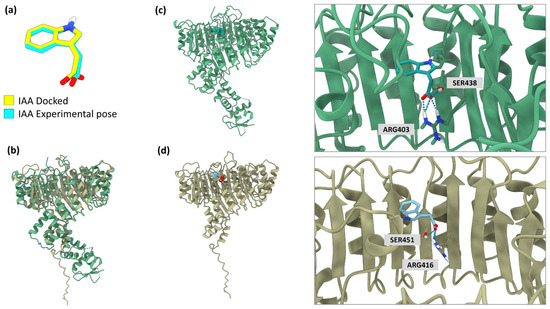
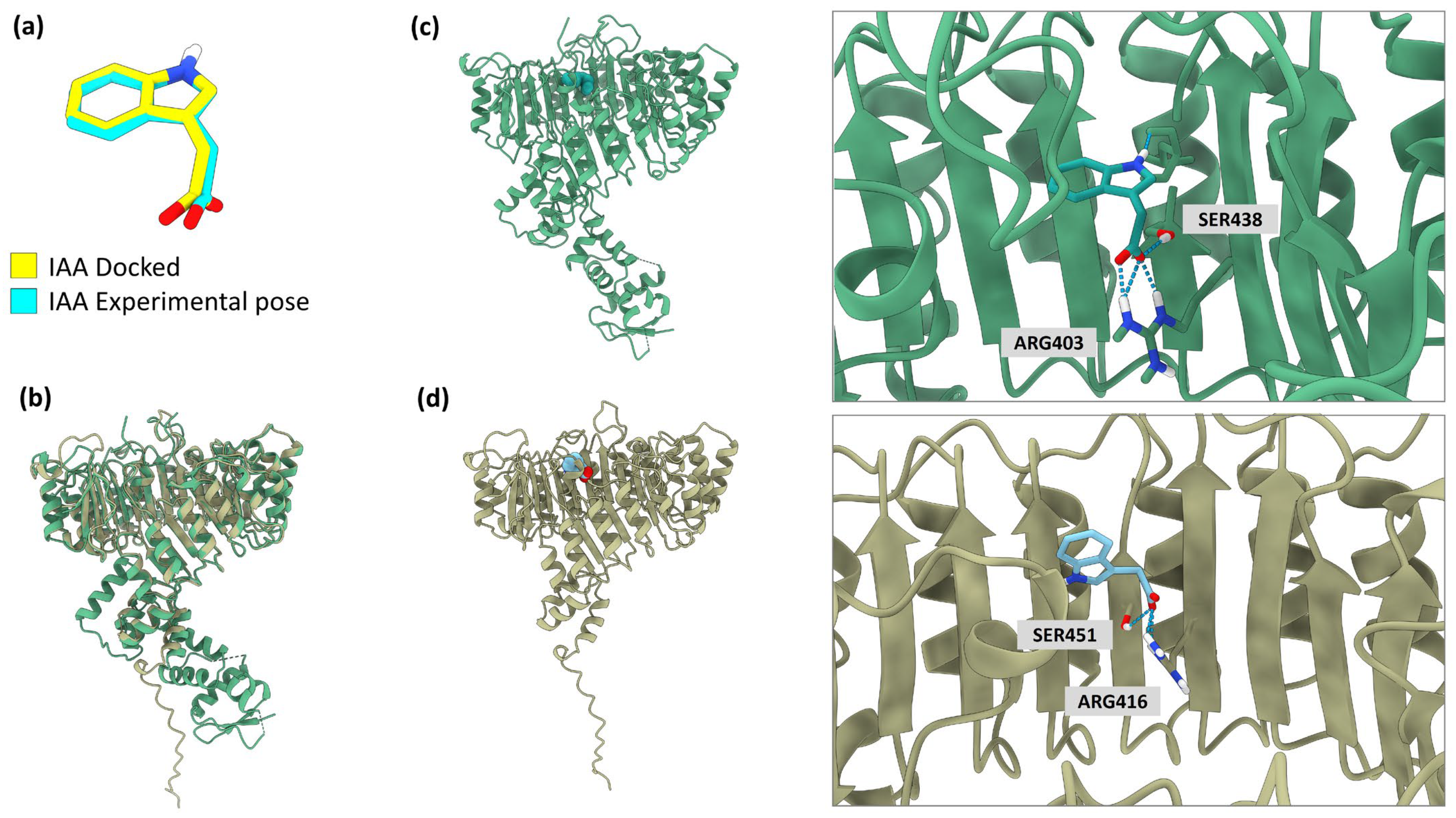
Molecular docking was performed to investigate the potential interaction of IAA with the auxin receptor. The ligand structure of IAA was extracted from the crystallographic complex 2P1Q and used for all docking simulations. In the absence of an experimental PDB structure for the wheat receptor, the predicted structure from the AlphaFold database (AF-A0A3B5XVN8-F1) was used as the target model for TaTIR1, while the crystal structure 2P1Q was used for docking validation and active-site identification. Protein and ligand preparation were carried out using AutoDockTools v1.5.7 [37]. Docking calculations were performed with AutoDock Vina v1.2.7 [38] using an exhaustiveness value of 40. For validation, IAA was redocked into the binding pocket of 2P1Q using a grid box centered at x = 7.03, y = −111.71, z = −26.11. The redocking procedure reproduced the experimental binding mode with an RMSD of 0.84 Å, confirming the reliability of the docking protocol. The validated protocol was then applied to the wheat model AF-A0A3B5XVN8-F1 using a grid centered at x = 12.76, y = −5.54, z = −9.80. Docking poses and molecular interactions were analyzed and visualized using Discovery Studio Visualizer 2025 (Dassault Systèmes BIOVIA) and UCSF Chimera V1.19 [39]. The best-ranked conformations were selected based on binding energy and consistency with the reference binding mode observed in 2P1Q.
3. Results and Discussion
3.1. Actinobacteria Isolates and IAA Production
A total of 21 independent colonies, showing filamentous microscopic morphology, were isolated from the root system of healthy Opuntia ficus-indica plants. In fact, based on their frequency terrestrial soil, actinobacteria are commonly divided into two main groups, Streptomyces and non-Streptomyces, also referred to as rare actinobacteria [40]. Indeed, Streptomyces represent up to 95% of total actinobacteria isolated, followed by Nocardia sp. and Micromonospora sp. [41,42].
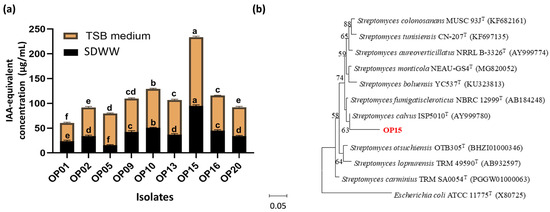
After six days of incubation, nine isolates exhibited IAA-equivalent compounds production in both TSB medium and SDWW (Figure 1a). The IAA-equivalent compounds yield ranged from 36.9 to 138.5 µg/mL in TSB medium and from 15.6 to 95.17 µg/mL in SDWW. Among the isolates, OP15 showed the highest IAA production in both media.
Figure 1.
(a) IAA-equivalent compounds production in TSB medium and synthetic dairy wastewater (different letters indicate significant differences at p < 0.05 according to one-way ANOVA followed by Tukey’s HSD test and error bars represent the standard error); (b) phylogenetic tree based on 16S rRNA gene sequences of OP15 isolate and related Streptomyces strains, constructed using the maximum likelihood method with the Tamura–Nei substitution model (bootstrap values were calculated from 1000 replicates).
Across actinobacteria, Streptomyces species are known to dominate in IAA production and are frequently associated with improved plant growth [40], although the amount synthesized varies strongly among species and is strongly influenced by culture conditions, growth phase, and the availability of precursors such as L-tryptophan [5,6]. Numerous studies have demonstrated that the majority of Streptomyces possess the ability to synthesize IAA [40]. Nevertheless, reports describing IAA production using dairy effluents as a substrate remain scarce.
Our results are consistent with previously reported IAA-equivalent compounds production levels in Streptomyces spp., although considerable variability has been observed among strains and culture conditions. Reported values range from low to moderate levels, such as 6.34 µg/mL in Streptomyces roseocinereus MS1B15 and 18.1–20.3 µg/mL in Streptomyces roietensis and Streptomyces samsunensis, to higher levels such as 80.06 µg/mL in Streptomyces sp. DH16, 96.60 µg/mL in Streptomyces corchorusii CASL5, 122.3 µg/mL in some isolates, and 273.02 µg/mL in Streptomyces tricolor HM10 [13,43,44,45,46,47,48]. Therefore, OP15 can be considered a promising IAA-equivalent compound-producing strain, particularly under the optimized fermentation conditions used in this study.
3.2. Biochemical Properties of OP15
The isolate OP15 demonstrated a broad capacity to utilize a wide range of carbon sources. Positive results were recorded for fructose, arabinose, galactose, glucose, mannitol, maltose, lactose, sorbitol, sucrose, mannose, xylitol and xylose, whereas the only sugar that yielded a negative result was rhamnose (Table 4). The strain assimilated all ten tested nitrogen sources. In addition, phenotypic in vitro assays revealed the production of caseinase, amylase and cellulase. This metabolic profile, combining large carbon source flexibility, extensive amino acid utilization, and a three-enzyme hydrolytic capacity, makes OP15 an exceptionally promising candidate for industrial biotechnology. Its potential extends across multiple sectors, as well as its ability to metabolize different by-products, thereby reducing the cost of industrial fermentation [49,50].
Table 4.
Biochemical and physiological characteristics of isolate OP15.
3.3. Molecular Identification of OP 15
The molecular identification of the OP15 strain was performed based on 16S rRNA gene sequencing. A sequence of 1393 bp was obtained. Alignment of 16S rRNA sequence of OP15, using EzTaxon database [34], showed 95.36–100% similarity with different Streptomyces spp. It was found to be closely related to the species Streptomyces calvus, with the highest similarity percentage of 100%, and Streptomyces monticola with the similarity percentage of 97.86. However, in the phylogenetic tree shown in Figure 1b, the affiliation of OP15 is not clearly defined in relation to the closest species. Therefore, complementary taxonomic approaches, including DNA–DNA hybridization and whole-genome sequencing, are required.
3.4. GC-MS Analysis of Indolic Compounds
The production of IAA by the OP15 strain was investigated following cultivation in TSB medium. Culture supernatants were directly used for indolic compound detection without additional extraction steps. BSTFA with pyridine, used in this study, is a common trimethylsilyl (TMS) derivatization system in GC-MS and is particularly suitable for small polar molecules [51,52]. Methyl-IAA, used as an internal standard, was detected in constant retention time and a well-defined peak, confirming the stability of the chromatographic conditions and supporting the reliability of the qualitative detection of IAA and related tryptophan-derived metabolites. In the same context, Porfirio et al. [53] reported the detection and quantification of IAA and indole-3-butyric acid using GC-MS analysis with BSTFA derivatization.
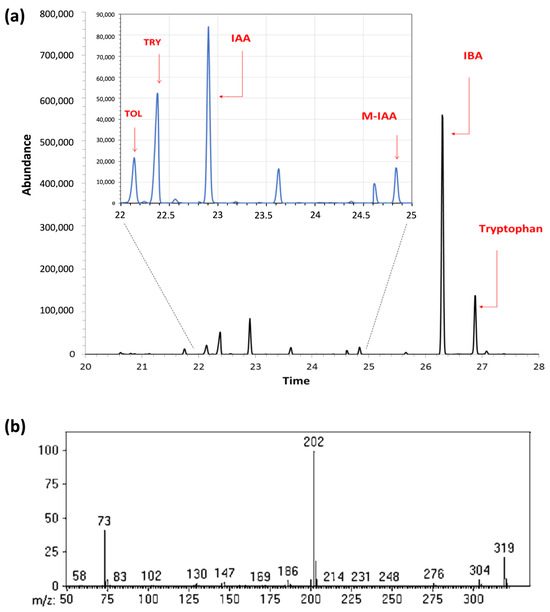
The obtained GC-MS chromatogram revealed the presence of several indole-related compounds (Figure 2); in addition to IAA, indole-3-butyric acid, tryptophol, and tryptamine were detected. The identification of intermediate metabolites is a key determinant for elucidating IAA biosynthetic pathways in microorganisms. It was reported that various microbial species can have one, two or even three functional IAA biosynthesis pathways [54]. Duca et al. [55] reported that multi-route biosynthetic systems provide a robust system for IAA production in bacteria, suggesting that the synthesis of IAA was clearly very important for the life and functioning of several microbial species. Several studies have reported that Streptomyces spp. can produce IAA via the indole-3-acetamide pathway from L-tryptophan [5,56,57].
Figure 2.
(a) GC-MS chromatogram of indolic compounds produced by isolate OP15, and (b) mass spectrum of the detected indole-3-acetic acid. IBA: indole-3-butyric acid; TOL: tryptophol; TRY: tryptamine; IAA: indole-3-acetic acid; M-IAA: trimethyl-indole-3-acetic.
It should be noted that GC-MS analysis supported the qualitative detection of IAA and related indolic compounds produced by OP15. However, since the Salkowski assay may react with different indolic metabolites, the colorimetric quantification of IAA should be considered a preliminary estimation. Therefore, further studies using validated HPLC, LC-MS, GC-MS, or NMR-based quantification with appropriate internal standards are required to confirm the exact IAA concentration in the optimized broth.
3.5. Box–Behnken Design Optimization
The optimization of the bioprocess was conducted using a Box–Behnken design with seven independent variables: NaCl concentration (A), L-tryptophan (B), SDWW (C), inoculum (D), time (E), casein (F), and glucose (G). The experimental design consisted of 62 distinct runs, each performed in triplicate, to ensure statistical robustness (Table 1 and Table 2).
3.5.1. Box–Behnken Design
The analysis of variance (ANOVA) for the reduced model revealed that the model was statistically significant (F-value = 21.57, p < 0.0001) with no significant lack of fit (p = 0.867) (Table 5). This indicates that the reduced model adequately represents the relationship between the significant factors and the response. The coefficient of determination (R2) was 0.658, the adjusted R2 was 0.628, and the predicted R2 was 0.583.
Table 5.
Analysis of variance for the reduced response surface model.
The predicted R2 value (0.583) indicated an acceptable agreement between predicted and experimental values, supporting the adequacy of the reduced model for response prediction. The adequate precision value of 4.64 indicates an acceptable signal-to-noise ratio. Among the linear effects, NaCl (A), L-tryptophan (B), and SDWW (C) were identified as the most influential factors, with statistically significant contributions (p < 0.001). L-tryptophan and SDWW exhibited large positive coefficients in the coded model, indicating that higher levels of these factors tend to increase the response. Conversely, NaCl showed a negative coefficient, suggesting that excessive NaCl concentrations could lower the response. The quadratic term E2 (Time) proved highly significant (p < 0.0001), implying that the response is optimized at an intermediate time rather than at extreme values. The quadratic term D2 (Inoculum) was marginally significant (p = 0.018), suggesting a weak curvature effect for this factor. No statistically significant interaction terms were retained in the reduced model, indicating that the main effects operate independently within the ranges studied.
The final equation in terms of coded factors for the reduced model is
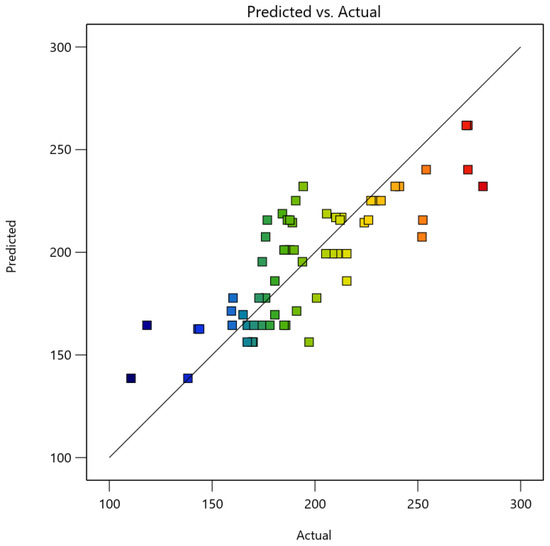
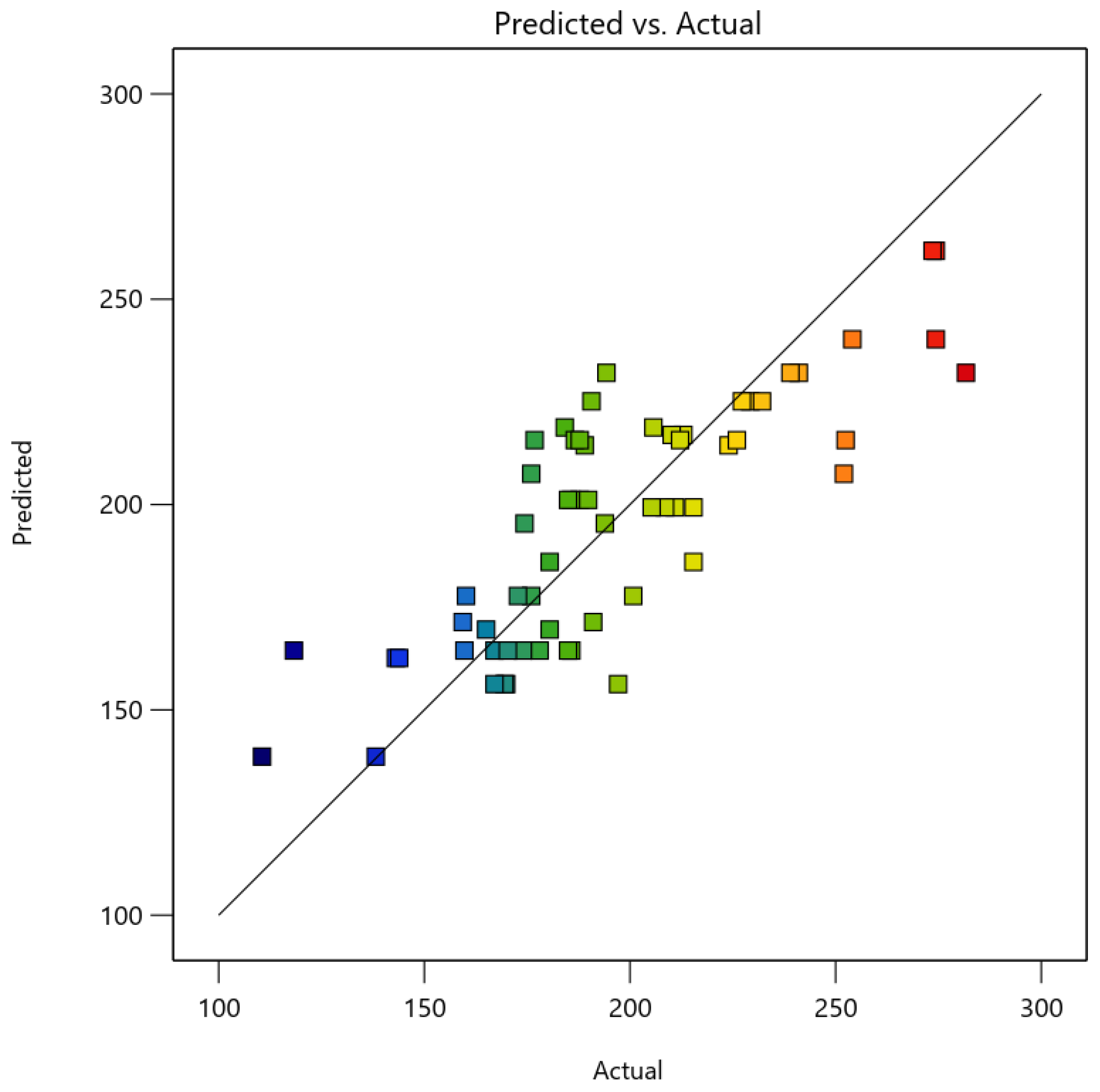
where Y is the predicted IAA concentration (µg/mL), and A, B, C, D, and E are the coded values for NaCl, L-tryptophan, SDWW, inoculum, and time, respectively. The analysis of predicted versus actual values revealed a robust correlation pattern across the response range (100–300 µg/mL) (Figure 3). The diagnostic plot demonstrates that the majority of experimental points cluster around the diagonal reference line, indicating reasonable prediction accuracy. Notably, the reduced model eliminates the systematic deviations observed in the upper response region (>250 µg/mL) with the full model, thereby improving predictive reliability.
Y = 215.70 − 16.38A + 22.43B + 23.70C − 14.25D2 − 36.99E2
Figure 3.
Predicted vs. actual responses (based on the reduced model (R2 = 0.658, predicted R2 = 0.583)).
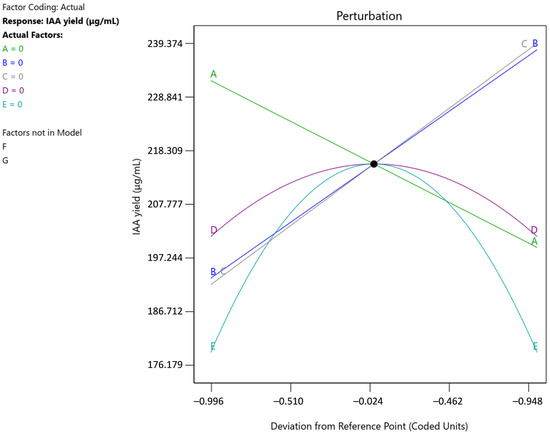
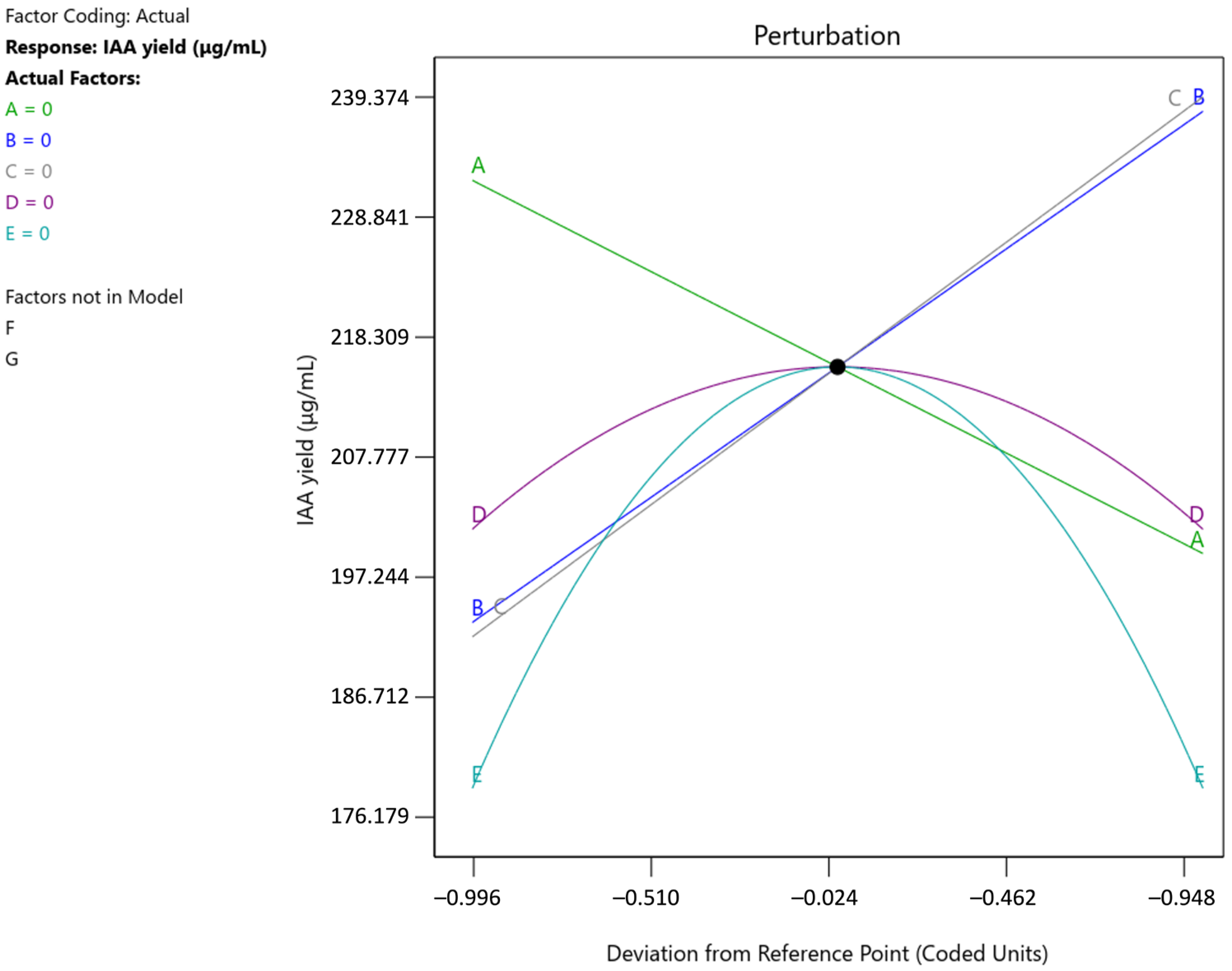
The perturbation analysis revealed distinct response patterns for the significant experimental factors while maintaining others at their reference points (coded value = 0) (Figure 4). SDWW (C) and L-tryptophan (B) emerged as primary positive modulators, exhibiting the steepest positive slopes with nearly parallel trajectories, indicating consistent positive influence across the experimental range. NaCl concentration (A) demonstrated a strong negative influence, with the response decreasing by approximately 33 units across the studied range, emphasizing the critical nature of salt concentration control. Time (E) displayed the most pronounced non-linear behavior, characterized by a distinct parabolic curve with maximum response near the center point (4.5 days), suggesting an optimal processing duration. Inoculum (D) demonstrated a weak quadratic effect with optimal response near the center point (7.5%). The relative positioning of response curves establishes a clear hierarchy of factor influences, with L-tryptophan and SDWW emerging as dominant positive modulators, while NaCl and time require precise optimization within specific ranges to maximize process efficiency.
Figure 4.
Deviation from reference point (coded units).
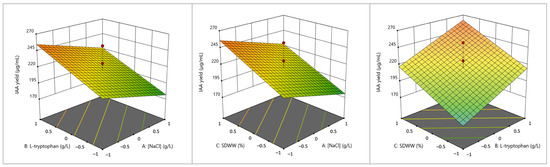
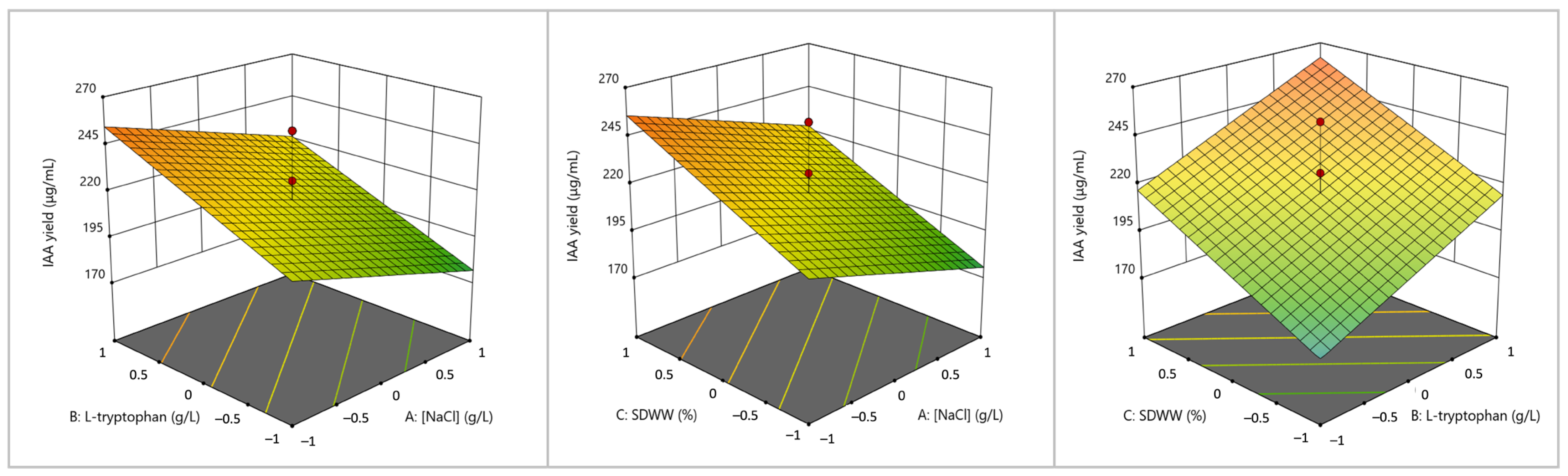
The three-dimensional response surface curves (Figure 5) provide a visual representation of the interactions between variables. These plots are particularly useful for understanding the complex relationships between factors and identifying regions of optimal response. The curvature in the time-related surfaces corroborates the significance of the quadratic term in the model. The results suggest that careful tuning of NaCl, L-tryptophan, and SDWW concentrations, along with optimal time settings, is crucial for maximizing the response. The negative impact of high NaCl levels indicates the importance of maintaining an appropriate osmotic environment for the microorganisms. The highly significant effect of L-tryptophan on IAA-equivalent compound production confirms its central role as a metabolic precursor in auxin biosynthesis. The significant effect of SDWW highlights its role as an alternative fermentation substrate, likely supplying essential nutrients that stimulated bacterial growth and IAA biosynthesis.
Figure 5.
Three-dimensional response surface curve that illustrates how several variables interact.
It should be emphasized that the reduced model was considered reliable for interpolation within the experimental ranges investigated; however, extrapolation beyond these limits is not recommended. The positive predicted R2 value and the non-significant lack of fit further support the adequacy of the model for describing and predicting IAA-equivalent compounds production under the tested conditions.
3.5.2. Optimization and Experimental Validation
The Box–Behnken design optimization yielded optimal conditions for maximizing the response, which were subsequently validated through experimental confirmation. Numerical optimization of the reduced model suggested optimal parameter values of 1 g/L NaCl, 1 g/L L-tryptophan, 100% SDWW, 7.5% inoculum, and 4.5 days incubation time. Under these conditions, the reduced model predicted a response of 278.2 µg/mL with a desirability value of 1.0. The 95% prediction interval for this optimal point was [230.0; 326.4] µg/mL. The experimental validation of these optimal conditions resulted in a response of 296.838 µg/mL, which falls within the 95% prediction interval and represents 106.7% of the predicted value. This close agreement between predicted and experimental results validates the reduced model’s reliability and confirms its utility for process optimization within the experimental domain. The slight deviation between predicted and experimental values (approximately 6.7%) falls well within acceptable limits for biological systems, considering their inherent variability.
The optimization results for L-tryptophan, SDWW, and NaCl were located at the limits of the experimental domain (high levels for L-tryptophan and SDWW, low level for NaCl), indicating that IAA-equivalent compound production increased with increasing availability of precursor and nutrients and decreased with increasing salt concentration, within the investigated range. In particular, the strong effect of L-tryptophan is consistent with its recognized role as direct precursor in microbial IAA biosynthesis [5]. Likewise, the optimal value of 100% SDWW demonstrates that SDWW can serve as an efficient fermentation substrate for OP15 isolate; dairy effluents have been increasingly explored as low-cost fermentation substrates for the production of enzymes, organic acids, biofuels, polymers, and microbial biomass [58,59,60]. In contrast, the optimal NaCl concentration was the lowest tested level, suggesting that higher salt concentrations may negatively affect IAA-equivalent compounds production. The optimal incubation time of 4.5 days corresponds to the center point of the experimental design, reflecting the parabolic nature of the time–response relationship identified in the reduced model.
3.6. Plant Growth-Promoting Activity of the OP15 Supernatant
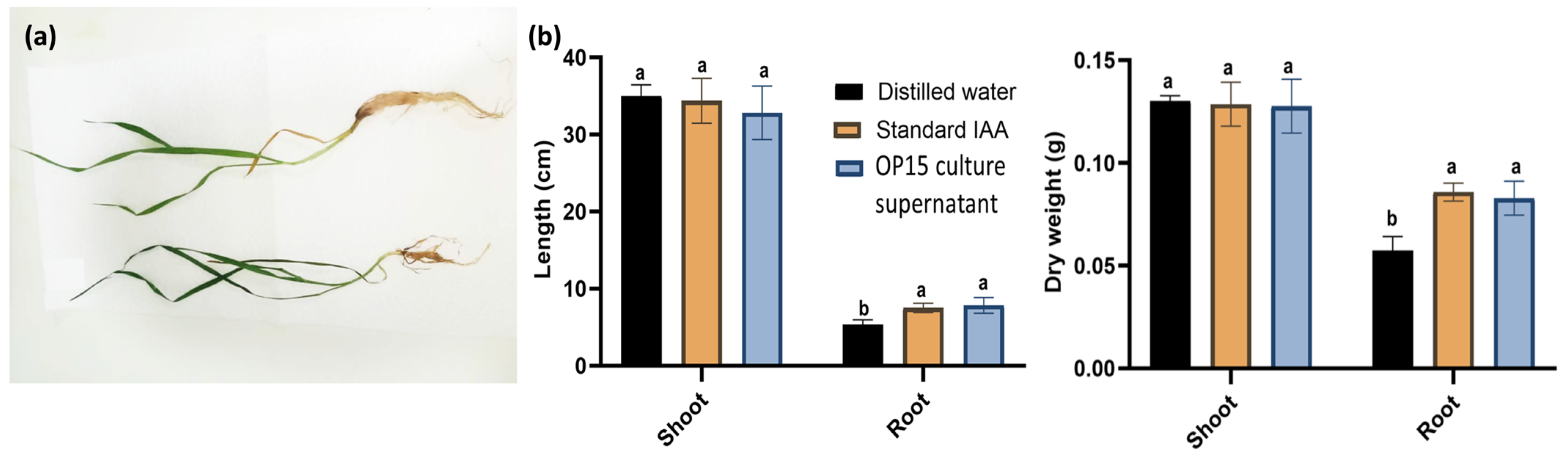
The effects of seed treatment on the growth-promotion parameters of wheat are presented in Figure 6a,b. Treatment with standard IAA and the OP15 supernatant significantly increased root length and dry weight compared with the control treatment using distilled water (p < 0.05, one-way ANOVA followed by Tukey’s HSD test). In contrast, no significant differences were observed among the three treatments for shoot length and shoot dry weight (p > 0.05). Although the OP15 supernatant was adjusted to the same IAA concentration as the standard solution, the involvement of other compounds present in the culture supernatant cannot be ruled out. Besides IAA, the supernatant may contain residual nutrients and other microbial metabolites that could contribute to the observed growth-promoting effect, either individually or through synergistic interactions. Therefore, the stimulation of wheat seedling growth observed in this study cannot be attributed exclusively to IAA alone.
Figure 6.
(a) Effect of presoaking treatment on wheat seedling development (top: seeds presoaked in OP15 culture supernatant; bottom: seeds presoaked in distilled water). (b) Effect of presoaking periods of wheat seeds in sterile distilled water, standard IAA, and OP15 culture supernatant on shoot and root growth and dry biomass. Bars labeled with different letters indicate significant differences at p < 0.05 according to one-way ANOVA followed by Tukey’s HSD test.
Goudjal et al. [36] showed that treating tomato seeds for 24 h with the culture supernatant of Streptomyces sp. PT2 containing crude IAA had the strongest effect on seed germination and root elongation. Likewise, Chandra et al. [61] reported increased root dry biomass in mung bean and sorghum inoculated with bacterial strains producing high level of IAA. Similar findings were reported by Lebrazi et al. [62], who demonstrated that an IAA-producing strain stimulated both shoot and root dry weight compared to the control. In agreement with these results, Myo et al. [63] found that tomato seedlings treated with kaolin powder formulated with an IAA-producing strain exhibited a significant increase in root and shoot length, as well as high fresh weight and dry weight compared to control.
To provide preliminary in silico support for the possible involvement of auxin perception in the observed wheat growth response, a molecular docking study was conducted on the auxin receptor TIR1, which was selected as a plausible molecular target because it is one of the primary sites of auxin perception in plants [64]. However, this analysis was not intended to establish a complete mechanism of plant-growth promotion, since auxin perception involves TIR1/AFB–Aux/IAA co-receptor interactions and additional downstream signaling components. Due to the lack of a crystallographic structure available in the Protein Data Bank (PDB) for the wheat TaTIR1 receptor, the three-dimensional model of this protein was obtained from the AlphaFold database (entry: AF-A0A3B5XVN8-F1) [65]. Although AlphaFold models provide useful structural predictions, they may not fully capture protein flexibility, ligand-induced conformational changes, or the complete TIR1/AFB–Aux/IAA co-receptor environment involved in auxin perception. Therefore, the docking results should be interpreted as preliminary in silico evidence rather than definitive mechanistic proof. To validate the docking strategy and identify the active binding site for IAA, the crystal structure of the Arabidopsis thaliana TIR1 receptor in the complex with IAA and an Aux/IAA peptide (PDB: 2P1Q) was used as a structural reference. This approach allowed us to assess the structural plausibility of IAA interaction with the auxin perception system in wheat.
As shown in Figure 7b, the structural alignment between the wheat TaTIR1 model and the experimental structure of A. thaliana TIR1 highlights a high degree of conservation in the overall folding, particularly in the domain forming the auxin-binding pocket [66]. This structural similarity suggests that the mode of interaction between IAA and TaTIR1 could be comparable to that already described experimentally in A. thaliana [64]. Docking of IAA into the 2P1Q reference structure (Figure 7c) revealed a binding energy of −8.12 kcal/mol, with a conformation localized within the canonical auxin-binding pocket, situated at the heart of the LRR domain. In this conformation, IAA adopts an orientation consistent with the experimental binding site and forms two hydrogen-bond interactions with residues SER438 and ARG403, supporting the consistency of the docking protocol. Similarly, docking of IAA onto the wheat TaTIR1 model (Figure 7d) revealed a binding pose localized in the same active site, with a binding energy of −6.40 kcal/mol. Here, IAA exhibits an anchoring mode comparable to that observed in the reference structure, also forming two hydrogen bonds with homologous residues, namely ARG416 and SER451. Although the binding energy is slightly less favorable than that obtained with the Arabidopsis receptor, the conservation of the ligand’s position and the nature of the interactions suggest that IAA could potentially be recognized in a similar manner by the wheat TaTIR1 receptor.
Figure 7.
Molecular docking analysis of IAA in the TIR1 receptor. (a) Comparison between the experimental conformation and the redocked conformation of IAA in 2P1Q (RMSD = 0.84 Å). (b) Superimposition of the A. thaliana TIR1 structure with the wheat TaTIR1 model. (c) Interactions of IAA with the active site of A. thaliana TIR1. (d) Interactions of IAA with the active site of the wheat TaTIR1 model.
These molecular docking results indicate that IAA shows a plausible in silico interaction with the TaTIR1 receptor and interacts with it in a manner broadly comparable to that described experimentally for TIR1 in A. thaliana. Nevertheless, these results should be interpreted as speculative computational support only and do not by themselves demonstrate the molecular mechanism responsible for wheat growth promotion. Therefore, the observed improvement in wheat growth may be partly associated with IAA-related auxin signaling, but further molecular and physiological studies are required to confirm this mechanism.
3.7. Implications for Sustainable Agriculture and the Circular Bioeconomy
The use of dairy effluent as a fermentation substrate offers an effective way to convert an agro-industrial effluent into a value-added bioproduct. In this study, SDWW enabled the production of IAA-equivalent compounds by the OP15 strain, highlighting its potential as a low-cost nutrient source for microbial fermentation. This approach aligns with the principles of the circular bioeconomy, as it combines waste recovery with the development of environmentally friendly agricultural inputs [67,68,69]. Furthermore, the positive effect of the fermented supernatant on wheat germination and seedling growth suggests that the resulting product could be further explored as a sustainable formulation to promote plant growth. Consequently, this study provides a preliminary framework for the sustainable production of IAA-equivalent compounds using SDWW and highlights the potential for future exploitation of dairy effluents as low-cost substrates in sustainable agricultural biotechnology.
4. Conclusions
In this study, the endophytic bacterial strain OP15, identified as member of Streptomyces genus, isolated from Opuntia ficus-indica, was identified as a promising producer of IAA-equivalent compounds. To the best of our knowledge, this work is among the first studies to optimize IAA-equivalent compounds production by an endophytic Streptomyces strain using SDWW-based medium as a low-cost fermentation substrate. Optimization by Box–Behnken design, followed by backward elimination to address overfitting, significantly improved IAA-equivalent compounds production, highlighting the effectiveness of statistical tools for enhancing process performance. The reduced response surface model (R2 = 0.658, adjusted R2 = 0.628, predicted R2 = 0.583) demonstrated adequate predictive reliability within the experimental domain, as confirmed by validation experiments. The strain also displayed relevant enzymatic activities, further supporting its potential for biotechnological applications. Moreover, the culture supernatant of the OP15 strain, obtained under optimal IAA-inducing conditions, significantly improved root length and root dry weight in wheat, providing preliminary evidence of its plant growth-promoting potential.
Taken together, these findings underline the originality and significance of this work, which combines microbial production of IAA-equivalent compounds with the preliminary evaluation of SDWW-based medium as an alternative fermentation substrate. This approach may contribute to the development of a cost-effective and environmentally friendly auxin production process and provides an initial basis for future agro-industrial waste valorization strategies. Beyond process optimization, the positive effect of the fermented supernatant on wheat germination and seedling growth highlights the agricultural relevance of the produced bioproduct. However, further validation using dairy effluents, together with physicochemical characterization and process-scale assessment, is required before broader sustainability and circular-bioeconomy implications can be confirmed. In addition, the formulation of residual bacterial biomass after IAA extraction and its possible agricultural use should be considered as future work, rather than as a demonstrated outcome of the present study.
Author Contributions
Conceptualization, K.K., H.N.B. and D.M.; methodology, K.K., H.N.B., D.M. and F.M.; software, K.K., H.N.B., DM., F.M. and H.B.; validation, K.K., H.N.B., D.M., F.M. and H.B.; formal analysis, K.K., H.N.B., D.M. and F.M.; writing—original draft preparation, K.K., F.M. and H.B.; writing—review and editing, K.K., F.M. and H.B.; visualization, K.K., F.M. and H.B.; supervision, K.K.; project administration, K.K. All authors have read and agreed to the published version of the manuscript.
Funding
This research received no external funding.
Data Availability Statement
The original contributions presented in this study are included in the article. Further inquiries can be directed to the corresponding authors.
Conflicts of Interest
The authors declare no conflicts of interest.
References
- Nsanzabera, F.; Liu, B. Multiplex metabolic engineering for enhanced indole-3-acetic acid production via optimized biosynthetic pathways in E. coli. Process Biochem. 2025, 157, 147–161. [Google Scholar] [CrossRef] [Scilit]
- Waadt, R.; Seller, C.A.; Hsu, P.-K.; Takahashi, Y.; Munemasa, S.; Schroeder, J.I. Plant hormone regulation of abiotic stress responses. Nat. Rev. Mol. Cell Biol. 2022, 23, 680–694. [Google Scholar] [CrossRef] [Scilit] [PubMed]
- Cohen, J.D.; Strader, L.C. An auxin research odyssey: 1989–2023. Plant Cell 2024, 36, 1410–1428. [Google Scholar] [CrossRef] [Scilit]
- Vanneste, S.; Pei, Y.; Friml, J. Mechanisms of auxin action in plant growth and development. Nat. Rev. Mol. Cell Biol. 2025, 26, 648–666. [Google Scholar] [CrossRef] [Scilit]
- Etesami, H.; Glick, B.R. Bacterial indole-3-acetic acid: A key regulator for plant growth, plant-microbe interactions, and agricultural adaptive resilience. Microbiol. Res. 2024, 281, 127602. [Google Scholar] [CrossRef] [Scilit]
- Spaepen, S.; Vanderleyden, J.; Remans, R. Indole-3-acetic acid in microbial and microorganism-plant signaling. FEMS Microbiol. Rev. 2007, 31, 425–448. [Google Scholar] [CrossRef] [Scilit]
- Bunsangiam, S.; Thongpae, N.; Limtong, S.; Srisuk, N. Large scale production of indole-3-acetic acid and evaluation of the inhibitory effect of indole-3-acetic acid on weed growth. Sci. Rep. 2021, 11, 13094. [Google Scholar] [CrossRef] [Scilit] [PubMed]
- Sangiorgio, D.; Cellini, A.; Donati, I.; Pastore, C.; Onofrietti, C.; Spinelli, F. Facing Climate Change: Application of Microbial Biostimulants to Mitigate Stress in Horticultural Crops. Agronomy 2020, 10, 794. [Google Scholar] [CrossRef] [Scilit]
- Fadiji, A.E.; Babalola, O.O.; Santoyo, G.; Perazzolli, M. The Potential Role of Microbial Biostimulants in the Amelioration of Climate Change-Associated Abiotic Stresses on Crops. Front. Microbiol. 2022, 12, 829099. [Google Scholar] [CrossRef] [Scilit]
- Lopes, F.C.; Ligabue-Braun, R. Agro-Industrial Residues: Eco-Friendly and Inexpensive Substrates for Microbial Pigments Production. Front. Sustain. Food Syst. 2021, 5, 589414. [Google Scholar] [CrossRef] [Scilit]
- Obayomi, O.V.; Mustapha, L.S.; Olawoyin, D.C.; Oladoye, P.O.; Obayomi, K.S. Waste to wealth: Circular utilization of dairy waste for sustainability in agri-food industries. Sustain. Chem. One World 2026, 10, 100217. [Google Scholar] [CrossRef] [Scilit]
- Mazaheri, A.; Doosti, M.R. Dairy Wastewater Treatment through a Novel Combined HABR-RBC System. J. Hazard. Mater. Adv. 2025, 19, 100842. [Google Scholar] [CrossRef] [Scilit]
- Aallam, Y.; Maliki, B.E.; Dhiba, D.; Lemriss, S.; Souiri, A.; Haddioui, A.; Tarkka, M.; Hamdali, H. Multiple Potential Plant Growth Promotion Activities of Endemic Streptomyces spp. from Moroccan Sugar Beet Fields with Their Inhibitory Activities against Fusarium spp. Microorganisms 2021, 9, 1429. [Google Scholar] [CrossRef] [Scilit] [PubMed]
- Ye, M.; Li, Y.-Y. Methanogenic treatment of dairy wastewater: A review of current obstacles and new technological perspectives. Sci. Total Environ. 2023, 866, 161447. [Google Scholar] [CrossRef] [Scilit]
- Singh, V.; Haque, S.; Niwas, R.; Srivastava, A.; Pasupuleti, M.; Tripathi, C.K.M. Strategies for Fermentation Medium Optimization: An In-Depth Review. Front. Microbiol. 2017, 7, 2087. [Google Scholar] [CrossRef] [Scilit]
- Zournas, A.; Incha, M.R.; Radivojevic, T.; Blay, V.; Martí, J.M.; Costello, Z.; Schmidt, M.; Chung, T.; Thompson, M.G.; Pearson, A.; et al. Machine learning-led semi-automated medium optimization reveals salt as key for flaviolin production in Pseudomonas putida. Commun. Biol. 2025, 8, 630. [Google Scholar] [CrossRef] [Scilit]
- Breig, S.J.M.; Luti, K.J.K. Response surface methodology: A review on its applications and challenges in microbial cultures. Mater. Today Proc. 2021, 42, 2277–2284. [Google Scholar] [CrossRef] [Scilit]
- Zhang, S.; Jiang, Z.; An, S.; Jiang, X.; Zhang, Y. Optimization of fermentation conditions for physcion production of Aspergillus chevalieri BYST01 by response surface methodology. PeerJ 2024, 12, e18380. [Google Scholar] [CrossRef] [Scilit]
- Cao, L.; Qiu, Z.; You, J.; Tan, H.; Zhou, S. Isolation and characterization of endophytic Streptomyces strains from surface-sterilized tomato (Lycopersicon esculentum) roots. Lett. Appl. Microbiol. 2004, 39, 425–430. [Google Scholar] [CrossRef] [Scilit] [PubMed]
- Badji, B.; Riba, A.; Mathieu, F.; Lebrihi, A.; Sabaou, N. Activité antifongique d’une souche d’Actinomadura d’origine saharienne sur divers champignons pathogènes et toxinogènes. J. Mycol. Méd. 2005, 15, 211–219. [Google Scholar] [CrossRef] [Scilit]
- Atlas, R.M. Handbook of Microbiological Media; CRC Press: Boca Raton, FL, USA, 2004. [Google Scholar]
- Shirling, E.B.; Gottlieb, D. Methods for characterization of Streptomyces species. Int. J. Syst. Evol. Microbiol. 1966, 16, 313–340. [Google Scholar] [CrossRef] [Scilit]
- Divya Kuravi, S.; Venkata Mohan, S. Mixotrophic cultivation of Monoraphidium sp. in dairy wastewater using Flat-Panel photobioreactor and photosynthetic performance. Bioresour. Technol. 2022, 348, 126671. [Google Scholar] [CrossRef] [Scilit] [PubMed]
- Patten, C.L.; Glick, B.R. Bacterial biosynthesis of indole-3-acetic acid. Can. J. Microbiol. 1996, 42, 207–220. [Google Scholar] [CrossRef] [Scilit] [PubMed]
- Williams, S.T.; Goodfellow, M.; Alderson, G.; Wellington, E.M.H.; Sneath, P.H.A.; Sackin, M.J. Numerical Classification of Streptomyces and Related Genera. Microbiology 1983, 129, 1743–1813. [Google Scholar] [CrossRef] [Scilit]
- Iqbal, S.; Xu, J.; Saleem Arif, M.; Shakoor, A.; Worthy, F.R.; Gui, H.; Khan, S.; Bu, D.; Nader, S.; Ranjitkar, S. Could soil microplastic pollution exacerbate climate change? A meta-analysis of greenhouse gas emissions and global warming potential. Environ. Res. 2024, 252, 118945. [Google Scholar] [CrossRef] [Scilit]
- Abdelmoteleb, A.; Troncoso-Rojas, R.; Gonzalez-Soto, T.; González-Mendoza, D. Antifungical Activity of Autochthonous Bacillus subtilis Isolated from Prosopis juliflora against Phytopathogenic Fungi. Mycobiology 2017, 45, 385–391. [Google Scholar] [CrossRef] [Scilit]
- Slama, H.B.; Cherif-Silini, H.; Chenari Bouket, A.; Qader, M.; Silini, A.; Yahiaoui, B.; Alenezi, F.N.; Luptakova, L.; Triki, M.A.; Vallat, A.; et al. Screening for Fusarium Antagonistic Bacteria from Contrasting Niches Designated the Endophyte Bacillus halotolerans as Plant Warden Against Fusarium. Front. Microbiol. 2019, 9, 3236. [Google Scholar] [CrossRef] [Scilit]
- Liu, D.; Coloe, S.; Baird, R.; Pedersen, J. Rapid mini-preparation of fungal DNA for PCR. J. Clin. Microbiol. 2000, 38, 471. [Google Scholar] [CrossRef] [Scilit]
- Kumar, S.; Stecher, G.; Tamura, K. MEGA7: Molecular Evolutionary Genetics Analysis Version 7.0 for Bigger Datasets. Mol. Biol. Evol. 2016, 33, 1870–1874. [Google Scholar] [CrossRef] [Scilit]
- Felsenstein, J. Evolutionary trees from DNA sequences: A maximum likelihood approach. J. Mol. Evol. 1981, 17, 368–376. [Google Scholar] [CrossRef] [Scilit]
- Tamura, K.; Nei, M. Estimation of the number of nucleotide substitutions in the control region of mitochondrial DNA in humans and chimpanzees. Mol. Biol. Evol. 1993, 10, 512–526. [Google Scholar] [CrossRef] [Scilit] [PubMed]
- Felsenstein, J. Confidence Limits on Phylogenies: An Approach Using the Bootstrap. Evolution 1985, 39, 783–791. [Google Scholar] [CrossRef] [Scilit]
- Kim, O.-S.; Cho, Y.-J.; Lee, K.; Yoon, S.-H.; Kim, M.; Na, H.; Park, S.-C.; Jeon, Y.S.; Lee, J.-H.; Yi, H.; et al. Introducing EzTaxon-e: A prokaryotic 16S rRNA gene sequence database with phylotypes that represent uncultured species. Int. J. Syst. Evol. Microbiol. 2012, 62, 716–721. [Google Scholar] [CrossRef] [Scilit] [PubMed]
- Alloun, W.; Berkani, M.; Shavandi, A.; Beddiar, A.; Pellegrini, M.; Garzia, M.; Lakhdari, D.; Ganachari, S.V.; Aminabhavi, T.M.; Vasseghian, Y.; et al. Harnessing artificial intelligence-driven approach for enhanced indole-3-acetic acid from the newly isolated Streptomyces rutgersensis AW08. Environ. Res. 2024, 252, 118933. [Google Scholar] [CrossRef] [Scilit]
- Goudjal, Y.; Toumatia, O.; Sabaou, N.; Barakate, M.; Mathieu, F.; Zitouni, A. Endophytic actinomycetes from spontaneous plants of Algerian Sahara: Indole-3-acetic acid production and tomato plants growth promoting activity. World J. Microbiol. Biotechnol. 2013, 29, 1821–1829. [Google Scholar] [CrossRef] [Scilit] [PubMed]
- Morris, G.M.; Huey, R.; Lindstrom, W.; Sanner, M.F.; Belew, R.K.; Goodsell, D.S.; Olson, A.J. AutoDock4 and AutoDockTools4: Automated docking with selective receptor flexibility. J. Comput. Chem. 2009, 30, 2785–2791. [Google Scholar] [CrossRef] [Scilit]
- Trott, O.; Olson, A.J. AutoDock Vina: Improving the speed and accuracy of docking with a new scoring function, efficient optimization, and multithreading. J. Comput. Chem. 2010, 31, 455–461. [Google Scholar] [CrossRef] [Scilit]
- Pettersen, E.F.; Goddard, T.D.; Huang, C.C.; Couch, G.S.; Greenblatt, D.M.; Meng, E.C.; Ferrin, T.E. UCSF Chimera—A visualization system for exploratory research and analysis. J. Comput. Chem. 2004, 25, 1605–1612. [Google Scholar] [CrossRef] [Scilit]
- Boubekri, K.; Soumare, A.; Mardad, I.; Lyamlouli, K.; Ouhdouch, Y.; Hafidi, M.; Kouisni, L. Multifunctional role of Actinobacteria in agricultural production sustainability: A review. Microbiol. Res. 2022, 261, 127059. [Google Scholar] [CrossRef] [Scilit]
- Arifuzzaman, M.; Khatun, M.R.; Rahman, H. Isolation and screening of actinomycetes from Sundarbans soil for antibacterial activity. Afr. J. Biotechnol. 2010, 9, 4615–4619. [Google Scholar]
- Balagurunathan, R.; Radhakrishnan, M.; Somasundaram, S.T. L-Glutaminase producing actinomycetes from marine sediments–selective isolation, semi quantitative assay and characterization of potential strain. Aust. J. Basic Appl. Sci. 2010, 4, 698–705. [Google Scholar]
- Rehan, M.; Alsohim, A.S.; Abidou, H.; Rasheed, Z.; Al Abdulmonem, W. Isolation, Identification, Biocontrol Activity, and Plant Growth Promoting Capability of a Superior Streptomyces tricolor Strain HM10. Pol. J. Microbiol. 2021, 70, 245–256. [Google Scholar] [CrossRef] [Scilit] [PubMed]
- Kaur, T.; Manhas, R.K. Evaluation of ACC deaminase and indole acetic acid production by Streptomyces hydrogenans DH16 and its effect on plant growth promotion. Biocatal. Agric. Biotechnol. 2022, 42, 102321. [Google Scholar] [CrossRef] [Scilit]
- Silambarasan, S.; Logeswari, P.; Sivaramakrishnan, R.; Cornejo, P.; Sipahutar, M.K.; Pugazhendhi, A. Amelioration of aluminum phytotoxicity in Solanum lycopersicum by co-inoculation of plant growth promoting Kosakonia radicincitans strain CABV2 and Streptomyces corchorusii strain CASL5. Sci. Total Environ. 2022, 832, 154935. [Google Scholar] [CrossRef] [Scilit]
- Dave, A.; Ingle, S. Streptomyces sp. S-9 promotes plant growth and confers resistance in Pigeon pea (Cajanus cajan) against Fusarium wilt. 3 Biotech. 2021, 11, 459. [Google Scholar] [CrossRef] [Scilit] [PubMed]
- Djuidje, P.F.K.; Asultan, W.; Beaulieu, C.; Wong, M.Y.; Boudjeko, T. Characterization of endophytic Streptomyces strains from roots of cocoyam (Xanthosoma sagittifolium L. Schott) in the South West Region of Cameroon, their in vitro plant growth promoting abilities and biocontrol efficacy against Pythium myriotylum. South Afr. J. Bot. 2022, 144, 145–155. [Google Scholar] [CrossRef] [Scilit]
- Chouyia, F.E.; Romano, I.; Fechtali, T.; Fagnano, M.; Fiorentino, N.; Visconti, D.; Idbella, M.; Ventorino, V.; Pepe, O. P-Solubilizing Streptomyces roseocinereus MS1B15 With Multiple Plant Growth-Promoting Traits Enhance Barley Development and Regulate Rhizosphere Microbial Population. Front. Plant Sci. 2020, 11, 2020. [Google Scholar] [CrossRef] [Scilit]
- Cuebas-Irizarry, M.F.; Grunden, A.M. Streptomyces spp. as biocatalyst sources in pulp and paper and textile industries: Biodegradation, bioconversion and valorization of waste. Microb. Biotechnol. 2024, 17, e14258. [Google Scholar] [CrossRef] [Scilit]
- Benhamiche, H.; Zerizer, H.; Boughachiche, F.; Azzouz, Z.; Messaoudi, M. Solid-state fermentation for protease production using agro-industrial residues by a novel thermotolerant Streptomyces sp. isolated from algerian arid soil. FEMS Microbiol. Lett. 2025, 372, fnaf095. [Google Scholar] [CrossRef] [Scilit]
- Crozier, A.; Moritz, T. New Comprehensive Biochemistry; Physico-Chemical Methods of Plant Hormone Analysis; Hooykaas, P.J.J., Hall, M.A., Libbenga, K.R., Eds.; Elsevier: Amsterdam, The Netherlands, 1999; Volume 33, pp. 23–60. [Google Scholar]
- Schummer, C.; Delhomme, O.; Appenzeller, B.M.R.; Wennig, R.; Millet, M. Comparison of MTBSTFA and BSTFA in derivatization reactions of polar compounds prior to GC/MS analysis. Talanta 2009, 77, 1473–1482. [Google Scholar] [CrossRef] [Scilit]
- Porfírio, S.; Sonon, R.; Gomes da Silva, M.D.R.; Peixe, A.; Cabrita, M.J.; Azadi, P. Quantification of free auxins in semi-hardwood plant cuttings and microshoots by dispersive liquid–liquid microextraction/microwave derivatization and GC/MS analysis. Anal. Methods 2016, 8, 6089–6098. [Google Scholar] [CrossRef] [Scilit]
- Olanrewaju, O.S.; Glick, B.R.; Babalola, O.O. Mechanisms of action of plant growth promoting bacteria. World J. Microbiol. Biotechnol. 2017, 33, 197. [Google Scholar] [CrossRef] [Scilit]
- Duca, D.R.; Rose, D.R.; Glick, B.R. Indole acetic acid overproduction transformants of the rhizobacterium Pseudomonas sp. UW4. Antonie Van Leeuwenhoek 2018, 111, 1645–1660. [Google Scholar] [CrossRef] [Scilit]
- Chrisment, A.; Loiseau, P.; Feugeas, J.L.; Masson-Laborde, P.E.; Mathiaud, J.; Tikhonchuk, V.; Nicolaï, P. Analysis of a kinetic model for electron heat transport in inertial confinement fusion plasmas. Phys. Plasmas 2022, 29, 062301, Erratum in Phys. Plasmas 2022, 29, 079901. [Google Scholar] [CrossRef] [Scilit]
- Lin, L.; Xu, X. Indole-3-Acetic Acid Production by Endophytic Streptomyces sp. En-1 Isolated from Medicinal Plants. Curr. Microbiol. 2013, 67, 209–217. [Google Scholar] [CrossRef] [Scilit]
- Sar, T.; Harirchi, S.; Ramezani, M.; Bulkan, G.; Akbas, M.Y.; Pandey, A.; Taherzadeh, M.J. Potential utilization of dairy industries by-products and wastes through microbial processes: A critical review. Sci. Total Environ. 2022, 810, 152253. [Google Scholar] [CrossRef] [Scilit]
- Das, P.; Paul, K.K. A Review on Different Treatment Possibilities of Dairy Wastewater. Theor. Found. Chem. Eng. 2023, 57, 563–580. [Google Scholar] [CrossRef] [Scilit]
- Moradi, S.; Zeraatpisheh, F.; Tabatabaee-Yazdi, F. Investigation of lactic acid production in optimized dairy wastewater culture medium. Biomass Convers. Biorefin. 2023, 13, 14837–14848. [Google Scholar] [CrossRef] [Scilit]
- Chandra, S.; Askari, K.; Kumari, M. Optimization of indole acetic acid production by isolated bacteria from Stevia rebaudiana rhizosphere and its effects on plant growth. J. Genet. Eng. Biotechnol. 2018, 16, 581–586. [Google Scholar] [CrossRef] [Scilit]
- Lebrazi, S.; Niehaus, K.; Bednarz, H.; Fadil, M.; Chraibi, M.; Fikri-Benbrahim, K. Screening and optimization of indole-3-acetic acid production and phosphate solubilization by rhizobacterial strains isolated from Acacia cyanophylla root nodules and their effects on its plant growth. J. Genet. Eng. Biotechnol. 2020, 18, 71. [Google Scholar] [CrossRef] [Scilit] [PubMed]
- Myo, E.M.; Ge, B.; Ma, J.; Cui, H.; Liu, B.; Shi, L.; Jiang, M.; Zhang, K. Indole-3-acetic acid production by Streptomyces fradiae NKZ-259 and its formulation to enhance plant growth. BMC Microbiol. 2019, 19, 155. [Google Scholar] [CrossRef] [Scilit] [PubMed]
- Tan, X.; Calderon-Villalobos, L.I.A.; Sharon, M.; Zheng, C.; Robinson, C.V.; Estelle, M.; Zheng, N. Mechanism of auxin perception by the TIR1 ubiquitin ligase. Nature 2007, 446, 640–645. [Google Scholar] [CrossRef] [Scilit]
- Varadi, M.; Anyango, S.; Deshpande, M.; Nair, S.; Natassia, C.; Yordanova, G.; Yuan, D.; Stroe, O.; Wood, G.; Laydon, A.; et al. AlphaFold Protein Structure Database: Massively expanding the structural coverage of protein-sequence space with high-accuracy models. Nucleic Acids Res. 2022, 50, D439–D444. [Google Scholar] [CrossRef] [Scilit]
- Gidhi, A.; Mohapatra, A.; Fatima, M.; Jha, S.K.; Kumar, M.; Mukhopadhyay, K. Insights of auxin signaling F-box genes in wheat (Triticum aestivum L.) and their dynamic expression during the leaf rust infection. Protoplasma 2023, 260, 723–739. [Google Scholar] [CrossRef] [Scilit] [PubMed]
- Usmani, Z.; Sharma, M.; Gaffey, J.; Sharma, M.; Dewhurst, R.J.; Moreau, B.; Newbold, J.; Clark, W.; Thakur, V.K.; Gupta, V.K. Valorization of dairy waste and by-products through microbial bioprocesses. Bioresour. Technol. 2022, 346, 126444. [Google Scholar] [CrossRef] [Scilit] [PubMed]
- Nguyen, T.H.; Wang, X.; Utomo, D.; Gage, E.; Xu, B. Circular bioeconomy and sustainable food systems: What are the possible mechanisms? Clean. Circ. Bioeconomy 2025, 11, 100145. [Google Scholar] [CrossRef] [Scilit]
- Mesa, J.A.; Sierra-Fontalvo, L.; Ortegon, K.; Gonzalez-Quiroga, A. Advancing circular bioeconomy: A critical review and assessment of indicators. Sustain. Prod. Consum. 2024, 46, 324–342. [Google Scholar] [CrossRef] [Scilit]

Disclaimer/Publisher’s Note: The statements, opinions and data contained in all publications are solely those of the individual author(s) and contributor(s) and not of MDPI and/or the editor(s). MDPI and/or the editor(s) disclaim responsibility for any injury to people or property resulting from any ideas, methods, instructions or products referred to in the content. |
© 2026 by the authors. Licensee MDPI, Basel, Switzerland. This article is an open access article distributed under the terms and conditions of the Creative Commons Attribution (CC BY) license.