


Abstract
Rapid population growth is intensifying global energy demand and waste generation. Slaughterhouse waste is creating important environmental problems. Transforming this into renewable energy through technologies like anaerobic digestion offers a sustainable pathway to reduce environmental impacts and support the energy transition. The main objective of this study was to examine the biodegradability of the slaughterhouse semi-liquid fraction (S), slaughterhouse liquid fractions (L), and their mixtures (25%, 50%, and 75%) through a two-phase anaerobic co-digestion (TPAcD) process. Batch reactors were operated in two separate microbiological and thermal phases. In the first, a thermophilic 55 °C–acidogenic stage, biochemical hydrogen potential (BHP) assays were conducted to evaluate green hydrogen production, while in the second, a mesophilic 35 °C–methanogenic stage, biochemical methane potential (BMP) assays were carried out to assess biomethane generation. The most relevant findings revealed that while liquid fractions maximized hydrogen recovery, overall yields remained limited due to competitive metabolic pathways. Notably, the 25L:75S configuration optimized hydrolysis, with a 1280% increase in soluble COD, establishing the semi-liquid fraction as a critical organic reservoir for thermophilic–acidogenic activity. In the subsequent stage, the acidogenic pre-treatment significantly enhanced methanogenesis, where the same 25L:75S mixture exhibited a synergistic methane yield of 495.46 mL CH4/g VS. This 13.8% improvement over the theoretical additive potential confirms that strategic substrate balancing overcomes individual feedstock limitations, maximizing energy recovery in sequential anaerobic digestion. These results highlight the potential of phase-separated anaerobic co-digestion as a strategy to improve the valorization of slaughterhouse wastes.
1. Introduction
Worldwide population growth continues to drive up energy demand and waste generation, placing sustainability under increasing pressure. Fossil fuels still supply a large share of global energy, leading to resource depletion, rising energy prices, higher living costs, and environmental pollution, which particularly contributes to climate change. Recent studies, such as [1,2], emphasize that the need to find renewable energy sources and value-added uses for waste is no longer optional, but urgent. The valorization of biomass waste from industrial activities holds promise for both mitigating environmental impacts and contributing to the energy transition [3,4].
Anaerobic digestion (AD) is a suitable technology for this valorization, based on a microbiological process that decomposes organic matter in the absence of oxygen, yielding biogas (primarily CH4 and CO2) and a digestate usable for agricultural purposes. The application of digestate as a bio-fertilizer enhances nutrient cycling and soil health, providing a sustainable alternative to synthetic fertilizers while significantly reducing the carbon footprint of agricultural production. Besides energy recovery, AD offers nutrient recycling and waste stabilization [5]. Despite its benefits, the performance of AD depends strongly on the nature of the substrate, operational parameters, and process configuration.
One industrial source of organic waste that can create serious environmental problems and is a suitable source for AD is slaughterhouse waste, including slaughterhouse liquid fraction and semi-liquid fraction. These wastes contain high loads of organic matter, fats, suspended solids, blood, etc., which make them strong candidates for AD, but also can be recalcitrant due to their composition [6]. Slaughterhouse wastewater often also contains nutrients, such as nitrogen or phosphorus, as well as pathogen loads and other contaminants like heavy metals, antibiotics, or detergents, that complicate treatment and disposal [7,8]. The semi-liquid fraction from such processes—semi-solid and highly organic but often poorly accessible to microbiological degradation—poses further challenges [9].
To improve the efficiency of the process, several strategies have been explored. One is co-digestion: combining different waste streams to balance nutrient content, dilute inhibitors, and adjust characteristics such as the C/N ratio [10]. Another is multi-phase or phase-separated anaerobic digestion (including separation by temperature or microbiological activity) to exploit different optimal conditions for hydrolysis/acidogenesis vs. methanogenesis (thermophilic acidogenic first phase; mesophilic methanogenic second phase). Studies show that high temperatures in the hydrolytic/acidogenic stage improve the solubilization of organic substrate, increase volatile fatty acids (VFA), and can enhance downstream biomethane production, as well as comparisons of two-phase high-solid sludge [11].
Recent studies of biochemical methane potential (BMP) for slaughterhouse waste, as well as mixtures that are based on flotates and slaughterhouse waste, show promising methane yields [12]. Similarly, co-digestion with other agricultural or food industry waste, like tomato and dairy industry byproducts, has been shown to improve COD removal, methane yield, and economic feasibility in Spain [13].
However, the literature on the separation of stages—acidogenic and methanogenic—with both thermophilic acidogenesis and mesophilic methanogenesis, combined with varying substrate mixing proportions of semi-liquid fraction and liquid fraction from the meat industry, remains relatively sparse.
Temperature-Phased Anaerobic Digestion (TPAD), sometimes operating through co-digestion (TPAcD), is based on a thermophilic/acidogenic stage followed by a mesophilic/methanogenic stage, which are recognized for their ability to decouple hydrolysis/acidogenesis from methanogenesis, allowing each stage to operate under its optimum environmental regime [14]. Typical operating conditions involve a first thermophilic reaction at 50–60 °C, with short HRTs and pH control, to promote hydrolysis and volatile fatty acid (VFA) accumulation, followed by a mesophilic reaction at 35–37 °C, with longer retention to convert intermediates into methane [14]. The microbiological consortia in two-stage systems often manifest clear functional stratification: the first stage enriches hydrogenogenic fermenters (e.g., Clostridia, Thermoanaerobacter), homoacetogens, and syntrophic VFA oxidizers, whereas the second stage is dominated by methanogenic archaea—particularly hydrogenotrophic methanogens such as Methanothermobacter and Methanoculleus, with acetoclastic methanogens often suppressed under thermophilic pre-treatment [15].
The advantages of the TPAcD include the increment of hydrolysis and acid production, reducing intermediate inhibition, improving flexibility in temperature and pH control, and yielding higher overall methane or biohythane output [16]. However, limitations include higher capital and operational costs (extra reactor, heat demand, pumps) [17]. On the economic side, a few life cycle and techno-economic assessments suggest that the extra costs can be offset by gains in energy recovery and stability [17,18,19]. Additionally, while temperature-phase anaerobic co-digestion (TPAcD) has shown clear benefits in terms of the hydrolysis rate and methane yield in studies with sewage sludge and food waste, its application to animal waste remains under-represented in the recent literature [20].
In this study, the initial hypotheses are that a phase-separated anaerobic co-digestion process, based on a thermophilic–acidogenic first stage, followed by a mesophilic–methanogenic second stage, will yield higher overall methane production compared to single-stage digestion or non-phase-separated processes. On the other hand, although hydrogen yields in the acidogenic stage may be limited due to the complex nature of the waste; they can vary depending on the proportion of liquid fraction vs. semi-liquid fraction. To bridge the gap between TPAcD theory and practical application in livestock waste streams, this study explicitly investigates the effect of the liquid/semi-liquid ratio on hydrolysis and methane production under temperature-phased operation. Accordingly, the main objective of this study is to assess the biodegradability of the slaughterhouse semi-liquid fraction, liquid fraction, and their mixtures through a two-stage anaerobic co-digestion process with phase separation, both microbiological and thermal (TPAcD). Batch assays were conducted under varying substrate proportions to evaluate process performance and stability. The sequential configuration comprised a thermophilic 55 °C–acidogenic stage, assessed through biochemical hydrogen potential (BHP) tests, followed by a mesophilic 35 °C–methanogenic stage, evaluated via biochemical methane potential (BMP) tests. This approach aimed to optimize the anaerobic digestion of slaughterhouse byproducts by enhancing hydrolysis and acidogenesis in the first stage and maximizing biomethane generation in the second. In short, this study aimed to determine optimal conditions for each phase and clarify how substrate composition influences process stability and H2/CH4 yields, comparing the TPAcD systems with the conventional mono-stage AD. Basically, this work advances the state-of-the-art by applying a two-phase temperature-separated anaerobic digestion (TPAcD) strategy to mixed liquid and semi-liquid slaughterhouse wastes, a substrate combination that has been scarcely addressed in recent studies. In addition, it provides novel insight into the role of the liquid-to-semi-liquid ratio in enhancing phase decoupling and maximizing overall energy recovery.
2. Materials and Methods
All experimental assays were conducted at the Centro Andaluz Superior de Estudios Marinos (CASEM) of the University of Cádiz (Spain).
2.1. Substrates and Inocula
The substrates used in this study were obtained from Montesierra S.A., located in Jerez de la Frontera (Spain), and comprised two distinct swine slaughterhouse wastes: semi-liquid fraction and liquid fraction. The semi-liquid fraction is a semi-solid waste with a high moisture content, generated from the grinding and processing of bones, excreta, and fats, and thus is rich in organic matter. However, due to industrial cleaning procedures, it also contains inorganic and persistent compounds, which limit the accessibility of its organic fraction to microbiological degradation. In contrast, the liquid fraction is a liquid waste primarily composed of slurry and wash water from carcass cutting and swine meat processing. Although its organic load is lower due to dilution, the organic matter is more readily available and easily biodegradable. On the other hand, two inocula were used: a thermophilic inoculum (IT) and a mesophilic inoculum (IM), both derived from the liquid fractions of stable 5 L anaerobic reactors, operating at 55 °C and 35 °C, respectively. The use of temperature-adapted inocula from long-term stable reactors ensured process stability and the acquisition of reliable data. These reactors were fed with sewage semi-liquid fraction from a municipal Wastewater Treatment Plant (WWTP), and they were operated at a hydraulic retention time of 20 days, until stationary conditions. In the IM, the archaeal population was basically composed of the acetoclastic methanogen Methanosaeta. In contrast, IT was predominantly composed of hydrogenotrophic methanogens, Methanothermobacter.
Batch biochemical hydrogen potential (BHP) and biochemical methane potential (BMP) assays were carried out using five different semi-liquid fraction–liquid fraction mixing ratios, with three replicates for each condition, plus one control (inoculum + water). During the thermophilic–acidogenic phase, pH was adjusted with HCl whenever values exceeded 5.5 to suppress methanogenesis and favor acidogenesis [21,22].
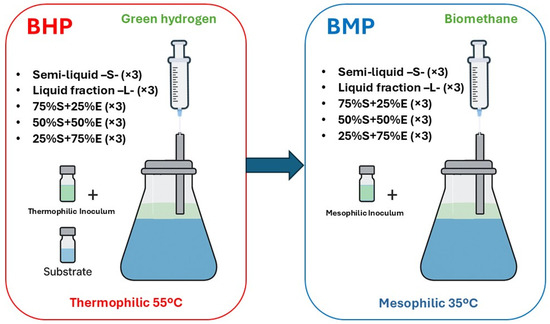
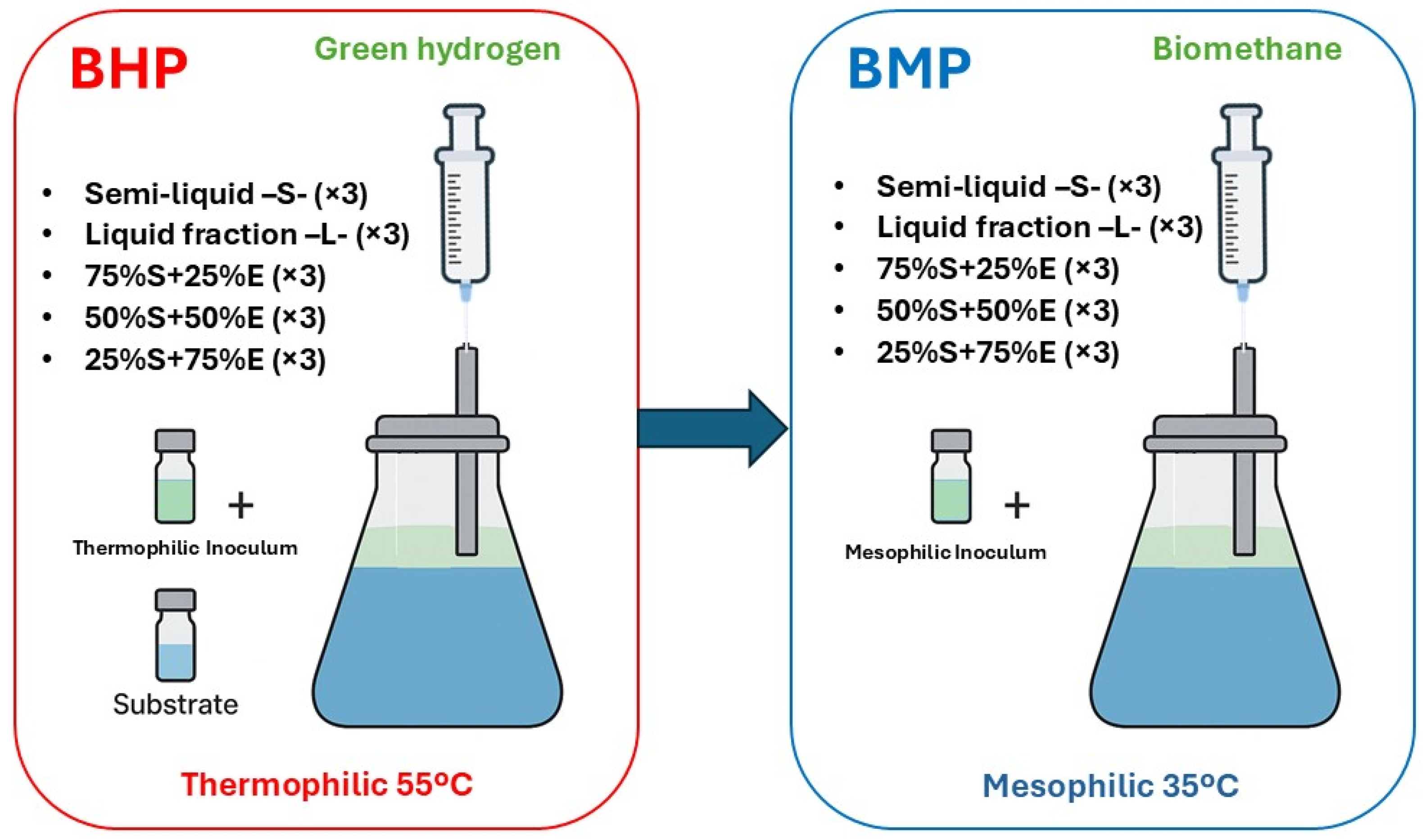
In the experimental set-up (Figure 1), 17 hermetic 250 mL reactors were employed, each with a working volume of 120 mL and a 130 mL headspace for biogas accumulation, a volume specifically selected for an optimal liquid-to-headspace ratio, ensuring precise biogas quantification and stable operation. Each reactor was loaded with 60 mL of inoculum (IT or IM, depending on the assay) and 60 mL of substrate. Thus, the inoculum-to-substrate (I/S) ratio was optimized based on the literature and the previous experience of the research group [23,24], preventing organic overloading and acidification. An anaerobic atmosphere was established in all reactors prior to the batch experiments by flushing the headspace with nitrogen (N2), at atmospheric pressure, for 5 min after substrate and inoculum loading. This procedure ensured oxygen removal and standardized the initial headspace composition, thereby minimizing potential bias in initial gas quantification. The reactors were maintained under constant orbital agitation. The experimental design is summarized in Table 1.
Figure 1.
Experimental set-up for sequential two-phase anaerobic co-digestion of slaughterhouse waste, showing the thermophilic hydrolysis (BHP) and mesophilic methane production (BMP) reactor configuration.
Table 1.
Reactor set-up and nomenclature according to substrate composition.
To evaluate the benefits of phase separation, parallel Conventional Mono-Stage Anaerobic Digestion batch assays were conducted. These assays utilized the identical substrate mixture (liquid and semi-liquid fractions) and inoculum at the same organic loading ratios as those employed in the sequential TPAcD process. The mono-stage tests were carried out under mesophilic conditions, maintaining the same substrates and inoculum-to-substrate ratio used for the methanogenic stage of the sequential system. The biomethane yield obtained from this conventional process served as the comparative reference to quantify the impact and efficiency gains provided by the sequential acidogenic/methanogenic process.
2.2. Sample Characterization
Initial and final characterizations of substrates, inocula, and mixtures were carried out to evaluate biodegradability and calculate the green hydrogen and biomethane yields. Standard physicochemical analyses were performed to determine [25]: pH, total and soluble chemical oxygen demand (CODt, CODs), total solids (TS), volatile solids (VS), volatile fatty acids (VFAs), alkalinity, and ammoniacal nitrogen. The pH was monitored with a SensION+ pH meter calibrated at pH 4, 7, and 9 (method 4500B, APHA). COD was measured according to the standard colorimetric method 5520D [25]. CODt was determined directly from diluted samples, while CODs was measured after centrifugation at 13,000 rpm for 10 min using an Unicen 21 centrifuge (Álvarez Redondo, S.A., Ortoalresa, Daganzo, Madrid, Spain), followed by analysis of the supernatant. Absorbance was measured at 610 nm with a HI 83399 multiparametric photometer. TS and VS were determined gravimetrically by following method 2540B (APHA). VFAs were quantified using a Shimadzu GC-2010 Plus gas chromatograph. Samples were centrifuged, filtered (0.22 μm), and prepared with an internal standard solution (phosphoric acid/phenol, 4:1). The main VFAs analyzed were acetic, propionic, butyric, isobutyric, isovaleric, isocaproic, caproic, and heptanoic acids. Concentrations were expressed as g/L of acetic acid equivalent. The VFAs were quantified by gas chromatography using a Shimadzu GC-2010 equipped with an automatic injector Shimadzu AOC-20i and a flame ionization detector (FID) (Shimadzu Corporation, Kyoto, Japan). Chromatographic separation was achieved on a polar capillary column Nukol (30 m × 0.25 mm i.d., 0.25 μm film thickness), consisting of nitroterephthalic acid-modified polyethylene glycol, which enables efficient resolution of VFAs according to their polarity and acid strength. A 1 μL sample volume was injected automatically in split mode (1:25), with the injector maintained at 250 °C and a purge flow of 5 mL/min. Hydrogen was used as the carrier gas (42.1 mL/min, 75.5 kPa), corresponding to a linear velocity of 45 cm/s and a column flow of 1.43 mL/min under the applied split and purge conditions. The FID was operated with synthetic air (400 mL/min, 50 kPa) and hydrogen (40 mL/min, 60 kPa). The oven temperature program consisted of an initial temperature of 115 °C that was held for 0.5 min, followed by ramps of 30 °C/min to 150 °C and 15 °C/min to 180 °C, with a final hold at 180 °C for 4 min. Quantification was performed using a commercial certified VFA standard mixture (Sigma-Aldrich Supelco, Bellefonte, PA, USA, CRM46975, Sigma-Aldrich, Bellefonte, PA, USA). The standard was diluted to several concentration levels, covering the expected sample range, and calibration curves were obtained by plotting the peak area versus concentration, showing good linearity (R2 > 0.99). Ammoniacal nitrogen (NH3–N) was determined using a HI 83399 multiparametric photometer (Hanna®, Woonsocket, RI, USA), following the ammonium HR method at 420 nm. Alkalinity was measured with the Hanna® alkalinity test kit and HI 83399 photometer, following the manufacturer’s protocol.
Additionally, the biogas, both green hydrogen and biomethane, were quantified. Gas pressure in the reactors was measured daily with a C95071S manometer (Dwyer Instruments, Inc., Michigan, IN, USA) through septa in the reactor caps. Gas volumes were calculated through the Ideal Gas Law. Hydrogen concentration in the biogas was determined by gas chromatography (Shimadzu GC-2010 Plus) using nitrogen as the carrier gas. Related to the biogas composition (H2, O2, CH4, and CO2), it was determined by gas chromatography using a Shimadzu GC-2010 equipped with a thermal conductivity detector (TCD). Gas samples were collected from Tedlar® bags (DuPont Electronics, Inc., Wilmington, DE, USA) using a 0.5 mL gas-tight syringe, and 0.2 mL was injected manually into the chromatograph. Separation was carried out on a Supelco Carboxen 1010 PLOT column (30 m × 0.53 mm) (Merck KGaA, Bellefonte, PA, USA), suitable for permanent gases and light compounds. The injector temperature was set at 150 °C, and nitrogen was used as the carrier gas at a flow rate of 7.67 mL/min (35 kPa). The oven temperature program started at 50 °C and was increased at 10 °C/min to 80 °C, which was held for 5 min. Quantification was based on calibration with certified gas mixtures containing different known concentrations of H2, O2, CH4, and CO2. Individual calibration curves were constructed for each gas under the same analytical conditions as the samples and were used to quantify the biogas composition, expressed as volumetric percentages (% v/v). Additionally, the samples (0.25 mL) were extracted directly from the headspace and injected manually. Biomethane concentration was measured with a BIOGAS 5000 portable gas analyzer (Geotech, Denver, CO, USA), which also provided readings for CO2, O2, H2, CO, and H2S. All the biogas values are given in normalized conditions (273.15 K and 1 atm).
Anaerobic microbiota, including Eubacteria and Archaea, were analyzed in the reactors using Fluorescence In Situ Hybridization (FISH) with 16S rRNA-targeted oligonucleotide probes. Samples were collected before and after digestion, preserved with absolute ethanol (1:1 v/v), and stored at −20 °C until analysis. For high-solid samples, pre-treatment with Tween 80 and 120 s shaking was applied prior to fixation. FISH procedures involved cell fixation, permeabilization, and hybridization with the following specific oligonucleotide probes: EUB338, ARC915, MSAE825, and MBAC1174. The relative abundances of Eubacteria and Archaea were determined by direct microscopic enumeration using a Zeiss Axio Imager Upright epifluorescence microscope (Carl Zeiss Microscopy GmbH, Jena, Germany) equipped with a 100 W mercury lamp and 100× oil immersion objective.
2.3. Calculation of Removal Efficiencies and Yields
Removal efficiencies of total and soluble chemical oxygen demand (CODt and CODs), total solids (TS), and volatile solids (VS) were determined based on the difference between their initial (0) and final (f) concentrations, following standard calculation procedures. The specific yields of green hydrogen (H2) and biomethane (CH4) were quantified relative to the initial TS, VS, CODs, and CODt contents, allowing for a direct comparison of substrate conversion efficiency under different operational conditions.
2.4. Statistical Analysis
All batch assays were conducted in triplicate for each experimental condition, including the different substrate mixing ratios, with one control reactor (inoculum + water) per inoculum. Results are expressed as mean values ± standard error (SE), calculated from three independent replicates. Biogas production (green hydrogen and biomethane) was monitored daily until stabilization was achieved. Biogas stabilization was defined as the point at which the cumulative gas production varied by less than 5% over three consecutive days, indicating negligible additional gas generation and completion of the biological conversion process. Removal efficiencies and specific gas yields were calculated based on the initial and final values of total solids (TS), volatile solids (VS), total chemical oxygen demand (CODt), and soluble chemical oxygen demand (CODs). Statistical data processing, including calculation of means and standard errors, was performed using standard spreadsheet software (Microsoft Excel®). Statistical significance was evaluated using Minitab® 18 software (Minitab Inc., State College, PA, USA) through a one-way Analysis of Variance (ANOVA) to determine the effect of the reactor configuration (L/S ratio) on the performance parameters of the coupled two-stage system (BHP and BMP).
3. Results and Discussion
3.1. Characterization of Inocula and Substrate Mixtures
Table 2 shows the initial characterization of the semi-liquid fraction (S), liquid fraction (L), their mixtures at different ratios (75L + 25S, 50L + 50S, 25L + 75S), and the inocula: thermophilic (IT) and mesophilic (IM).
Table 2.
Characterization of substrates, inocula, and mixtures—IT: inocula thermophilic; IM: inocula mesophilic; S: semi-liquid fraction; L: liquid fraction.
The substrate mixtures, semi-liquid fraction, and liquid fraction exhibit a near-neutral pH (7.0–7.2). The thermophilic inoculum (IT) has a much lower pH (4.98), consistent with acidogenic conditions, which enhances hydrolysis and acidogenesis by selectively favoring fermentative bacteria while suppressing methanogenic activity, thereby maximizing volatile fatty acid (VFA) and hydrogen production. The IM is higher (7.7), aligning with the stability of methanogenic consortia to achieve consistent methane production. The two-phase system ensures that acidogens are favored in the first stage while methanogens are promoted in the second phase. The pH control is crucial in the acidogenic stage, with values 5–6, which enhances VFA accumulation and hydrogen production, while neutral to slightly alkaline pH is preferable for methanogenesis [26].
According to the organic matter, the CODt increases with a higher semi-liquid fraction: from 1.78 gO2/L (L) to 19.46 gO2/L (S). This shows that the semi-liquid fraction has more organic load, but in a non-soluble or suspended form, as evidenced by relatively low CODs in the semi-liquid fraction vs. higher CODs in the liquid fraction and mixtures with high liquid fraction content [27]. The ratio CODs/CODt is highest for E, indicating more readily biodegradable dissolved organics. The CODs is relevant for the acidogenic phase since it is more quickly utilized by microorganisms [13].
The semi-liquid fraction showed high content in solids: 39 g/L TS and 29.7 g/L VS, while liquid fraction was less concentrated: 1.29 g/L TS and 0.23 g/L VS. Considering the Volatile Solids (VS) content relative to Total Solids (TS), the VS/TS ratio was substantially higher in the semi-liquid fraction (76.2%) compared to the liquid fraction (17.8%). This indicates that the semi-liquid fraction contained a greater proportion of readily volatile and potentially bioavailable organic material. Consequently, the VS/TS ratio of the mixtures declined as the proportion of the liquid fraction increased. The VS content serves as the initial proxy for the potential energy content and the readily convertible organic load in the substrate, distinguishing it from inert solids. The significantly higher VS/TS ratio in the semi-liquid fraction, therefore, indicates a greater initial potential for microbial conversion relative to the total mass, which is a key factor in maximizing the Organic Loading Rate (OLR) [7,28]. Thus, the co-digestion strategy is justified by this complementary nature: mixing the high-organic-load semi-liquid fraction with the more fluid and potentially more bioavailable liquid fraction helps overcome limitations in mass transfer and substrate contact, thereby synergistically optimizing the overall degradation rates and bioconversion efficiency [29]. Reference to VFA, the high concentrations in inoculum, especially in the thermophilic one, 3285 mg/L, suggest that the inoculum is already producing or carrying over acid products, which is likely due to prior acidogenic activity [30]. Among the substrates, L has the highest VFA, 462.93 mg/L, and the semi-liquid fraction has the lowest, 89.16 mg/L. The increment of L in the mixtures implies the higher VFA, which can mean that the liquid fraction contributes more immediately fermentable components [31].
3.2. Evaluation of Biochemical Hydrogen Potential (BHP) of Slaughterhouse Waste Codigestion
The Biochemical Hydrogen Potential (BHP) was assessed during the first stage of the sequential thermophilic–acidogenic process (TPAD) through Dark Fermentation (DF) batch tests, aiming to maximize hydrogen production. Table 3 shows the characterization of the main parameters at the beginning and the end of the BHP.
Table 3.
Characterization of pH, total and soluble COD, total solids (TS), and volatile solids (VS), and alkalinity at the beginning and the end of the BHP assays—IT: inocula thermophilic; S: semi-liquid fraction; L: liquid fraction *.
3.2.1. Performance of pH and Organic Matter
During the BHP assays, acidic conditions (pH 5.5–6.0) were maintained to stimulate hydrolytic and acidogenic activity while suppressing methanogens, whose activity is strongly inhibited below this pH range [32,33,34]. In fact, the initial pH of the mixtures was adjusted and maintained in an acidic range between 4.78 and 5.56, via constant acidification using HCl. The lowest final pH was recorded for the liquid fraction (L + IT) mixture, reaching 4.78.
Regarding the Chemical Oxygen Demand (COD), a consumption of organic matter was observed, evidenced by the decrease in the Total COD (CODt) across all assays. For instance, the 75L + 25S + IT mixture showed a CODt drop from 16.04 g O2/L to 12.09 g O2/L.
The Soluble COD (CODs) concentration increased in all assays at the end of the BHP phase. This indicates effective organic matter solubilization during the hydrolysis stage, making the organic matter more available for microbiological uptake in later stages. In fact, Ref. [34] showed that in hydrolytic–acidogenic reactors, a lower HRT or higher temperature favors high SCOD (or CODs) and VFA accumulation. The Liquid fraction assay (L + IT) exhibited the highest increase, rising from 0.44 pm 0.13 g O2/L to 4.97 pm 0.23 g O2/L, representing an increment of 1030.38%.
The efficiency of CODt elimination gradually decreased as the proportion of semi-liquid fraction increased (from 81.01% for L + IT to 8.72% for S + IT). This pattern is attributed to the complex nature of the semi-liquid fraction (S), which is less readily biodegradable than the liquid fraction (L). In fact, the high initial COD removal in the hydrolysis/acidogenesis phase for L + IT is primarily due to the conversion of organic matter into Volatile Fatty Acids (VFA) (Section 3.2.2). Conversely, the removal efficiency of Total Solids (TS) and Volatile Solids (VS) showed an increase with higher semi-liquid fraction concentrations. The S + IT assay achieved the remarkable removal rates (48.94% TS and 67.19% VS), compared to L + IT (18.74% of TS and 25.92% of VS). This reduction in VS confirms the conversion of complex organic solids into simpler, more volatile compounds through acidogenic microbiological activity.
3.2.2. Volatile Fatty Acids (VFA) Production
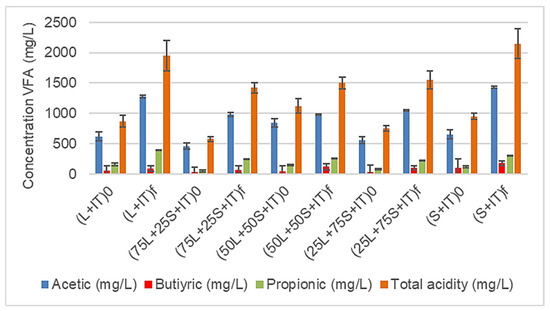
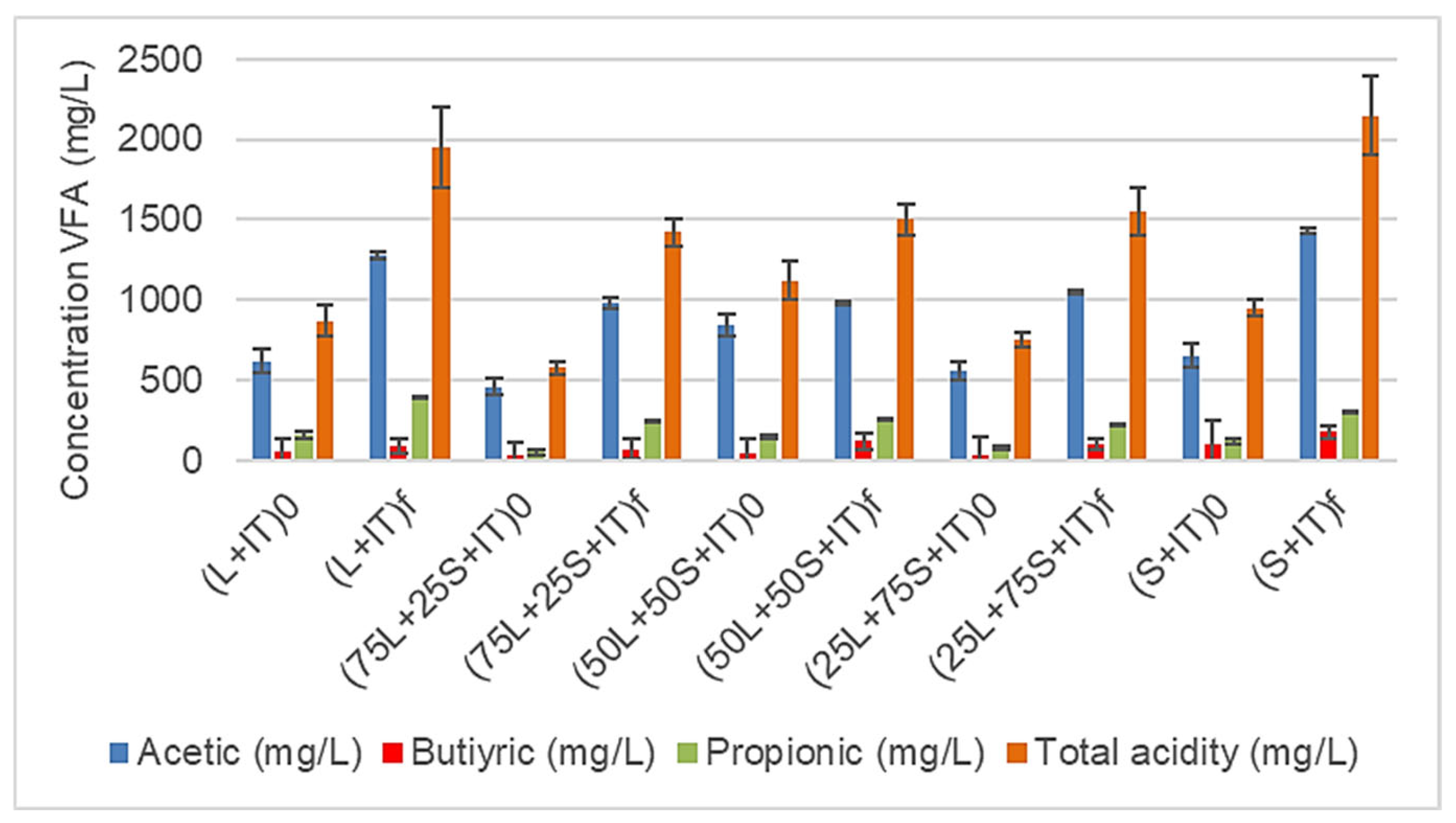
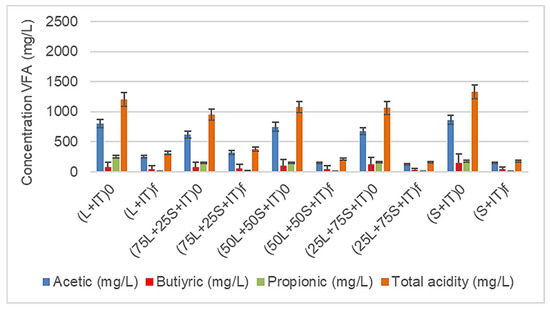
Analysis of metabolic byproducts showed a substantial increase in total Volatile Fatty Acid (VFA) concentrations across all tested mixtures, confirming the acidogenic activity (Figure 2). The highest VFA production was observed in the semi-liquid fraction (S + IT) assay (2123.67 mg/L), followed closely by the liquid fraction (L + IT) assay (1949.39 mg/L). Among all the acids, acetic acid was identified as the most abundant VFA. Acetic acid is the main direct precursor for methane production, whereas propionic acid is more problematic due to its thermodynamically constrained degradation and its inhibitory effects on methanogenesis, even at low concentrations, ultimately hindering biogas production. However, Ref. [35] shows that a high acetic/proprionic acid ratio is favorable to anaerobic digestion performance. The observed VFA generation suggests that mixtures that successfully transform more organic matter into VFA are expected to yield higher biogas production.
Figure 2.
VFA concentration at the beginning (0) and the final (f) of the BHP of slaughterhouse waste codigestion.
3.2.3. Total Ammoniacal Nitrogen (TAN) and Alkalinity in BHP
Total Ammoniacal Nitrogen (TAN) concentrations increased in all assays during the BHP phase because of the hydrolysis of proteins and nitrogenous compounds from the semi-liquid fraction and liquid fraction in the initial stages of anaerobic digestion. Although a high nitrogen content in slaughterhouse residues is often reported as a potential inhibitory factor [28], in this study, TAN levels remained well below the thresholds typically associated with inhibition, generally above 1.5–3.0 g TAN/L [36,37], thus ensuring process stability. For instance, TAN for L + IT increased from 69.2 mg/L to 78.7 mg/L.
Crucially, the final TAN concentrations remained far below the known inhibition threshold (3.8 g/L), indicating that inhibition due to nitrogen compounds did not occur during this phase.
As expected in an acidogenic environment, alkalinity, which measures the medium’s capacity to neutralize acids, decreased notably in all assays. The semi-liquid fraction (S + IT) initially provided the highest alkalinity (5600 mg CaCO3/L). Semi-liquid fraction-rich reactors have higher initial alkalinity and witness a larger absolute buffer content, which helps moderate pH swings. This suggests that including the semi-liquid fraction in the ratio may help with buffering, but also, the semi-liquid fraction brings complexity and slower acid accumulation.
However, the largest decrease was observed in the Liquid fraction (L + IT) assay, from 4200 to 1450 mg CaCO3/L, which correlates with its higher hydrogen production, increased acid generation, and consumption of buffering capacity.
3.2.4. Green Hydrogen Yield
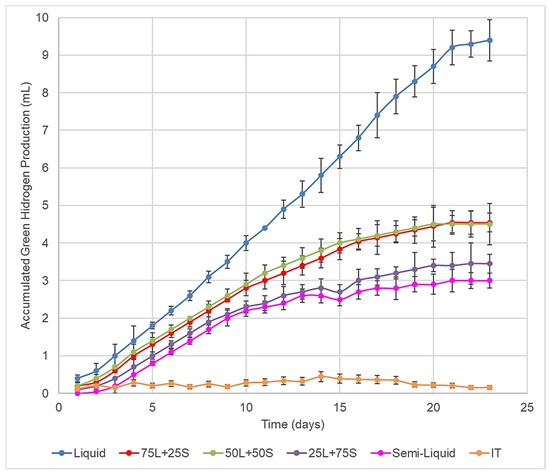
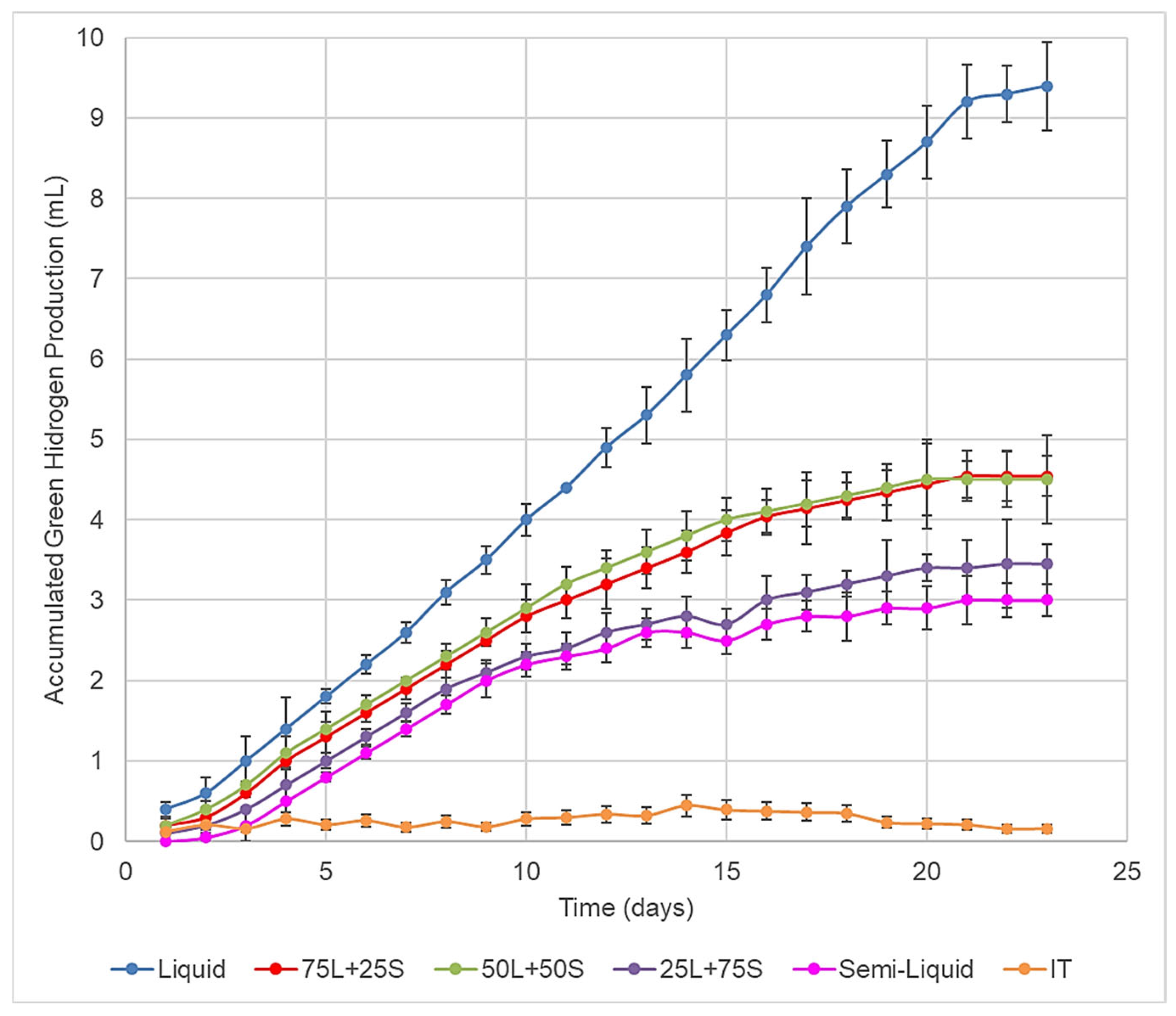
The accumulated green H2 production was monitored over 23 days (Figure 3) until the biogas generation stabilized and the cessation of the assays. The biogas production from the inocula IT 55 °C-H2- was subtracted from the total biogas production (H2 and CH4, respectively, in BHP and BMP) to accurately represent the H2 yield from the reactors.
Figure 3.
Accumulated green hydrogen production from slaughterhouse waste codigestion.
The liquid fraction (L + IT) was the most efficient substrate for hydrogen production, accumulating 9.51 mL H2. In fact, H2 production showed a decreasing trend as the semi-liquid fraction concentration increased, reaching a minimum of 3.46 mL H2 for L + IT. This pattern aligns with the initial characterization, where L + IT exhibited higher initial VFA concentrations, which potentiate the acidogenesis stage and H2 production. The higher hydrogen production observed in the L + IT condition was mainly related to the biodegradability of the liquid fraction rather than to the initial pH alone. Although L + IT exhibited a lower initial pH due to higher VFA content, values remained within the optimal range for acidogenic hydrogen-producing bacteria and promoted fermentative pathways associated with hydrogen generation. Increasing proportions of the semi-liquid fraction introduced more complex organic matter, limiting hydrolysis and reducing H2 accumulation. Consequently, the acidic conditions in L + IT reflect enhanced acidogenic activity rather than a direct pH-driven effect. The final H2 yields, calculated relative to the initial volatile solids (VS), are presented in Table 4.
Table 4.
Green hydrogen yields of the slaughterhouse waste codigestion—IT: inocula thermophilic; S: semi-liquid fraction; L: liquid fraction.
The maximum observed hydrogen yield of 6.32 mL H2/g VS during the hydrogen production stage at 55 °C is herein classified as a limited yield. The hydrogen yields obtained in this study (maximum 6.32 mL H2/g VS) were lower than those typically reported for carbohydrate-rich substrates, which can be attributed to the complex, protein-rich nature of slaughterhouse waste. The low C/N ratio and high buffering capacity of the substrate promoted VFA and ammonium accumulation, thereby shifting fermentation pathways away from optimal hydrogen production. Moreover, the operational conditions applied during the thermophilic–acidogenic phase (BHP) of the two-phase anaerobic co-digestion (TPAcD) process were deliberately selected to balance acidogenesis and VFA generation for subsequent methanogenesis rather than to maximize hydrogen production alone. Microbial competition, including potential hydrogen consumption by homoacetogens and residual methanogens, further constrained the measurable H2 output. Consequently, the observed hydrogen yields obtained with the liquid fraction mixture (L + IT) are consistent with a two-stage anaerobic digestion strategy aimed at maximizing overall energy recovery and process stability instead of standalone hydrogen optimization. The literature reports that substantially higher yields in comparable co-fermentation systems [38] achieved hydrogen yields of 35.19 mL H2/g VSadded in the co-fermentation of sewage semi-liquid fraction with wine vinasse under thermophilic conditions. On the other hand, the co-digestion system combining sewage semi-liquid fraction, vinasse, and poultry manure with phase-separated acidogenic and methanogenic stages, achieved a hydrogen yield of 40.41 mL H2/g VSadded in the acidogenic phase at 5 days HRT.
Systems using the organic fraction of municipal solid waste (OFMSW) have been given in the first stage yields of 40–50 mL H2/g VS [39]. In contrast, hydrogen yields from waste activated semi-liquid fraction alone typically remain below 25 mL H2/g VS under many operational schemes [40].
3.2.5. Microbiological Analysis of Acidogenic–Thermophilic Phase
The low hydrogen productivity observed in this study can be attributed to an unfavorable microbiological community structure in which hydrogen consumers outcompete hydrogen producers. The homoacengs are represented at 25% over the total bacteria in the system. In fact, in systems exhibiting limited H2 yields, a higher proportion of H2-consuming homoacetogens to produce acetate can be reported, consuming 43% of the H2 yield [41].
On the other hand, the hydrogenotrophic methanogens was 18%. This archaeal presence is primarily attributable to the residual load introduced with the thermophilic inoculum. Despite their physical persistence, methane production remained extremely low (typically <2%), indicating that pH control was kinetically effective in suppressing methanogenic activity. Nevertheless, the residual hydrogenotrophic methanogens likely acted as a significant hydrogen sink, contributing to the low observed H2 yields. Therefore, while pH successfully inhibited CH4 formation, it did not eliminate the archaeal biomass, which competed for the nascent hydrogen during the thermophilic acidogenic stage. The results were in concordance with [38,39], since the archaeal community, with respect to hydrogenotrophic methanogens such as Methanothermobacter, Methanobrevibacter, and Methanoculleus, typically constitutes 8–20% of the total microbiological population under thermophilic conditions. This microbiological distribution explains the low net hydrogen yield (6.32 mL H2 g−1 VS) observed: although hydrogenogenic bacteria are present, a considerable fraction of the biomass—particularly homoacetogens and hydrogenotrophic methanogens—actively consumes H2 before it can accumulate as gas. The competition between homoacetogens and methanogens during the acidogenic–thermophilic phase can modulate hydrogen availability, redirecting metabolic fluxes toward acetate formation. Such competition for molecular hydrogen between bacteria and archaea has been widely recognized as a key limitation in dark fermentation and two-phase anaerobic systems [42], but promotes the acetate to be consumed in the following methanogenic phase [43]. In fact, although hydrogen production may be limited in the first stage, the acetate generated provides a readily utilizable substrate for acetoclastic methanogens in the subsequent mesophilic phase, enhancing overall energy recovery.
3.3. Evaluation of Biochemical Methane Potential (BMP) in a Sequential TPAD of Slaughterhouse Waste Codigestion
The BMP assay was conducted in the second stage of the sequential TPAD process, operating under mesophilic (35 °C) and methanogenic conditions. The feedstock for this stage was the liquid fraction generated from the previous thermophilic–acidogenic (BHP) phase, which was rich in intermediate products, particularly volatile fatty acids (VFA), restoring the neutral pH [16,44]. This phase aims to maximize methane (CH4) production and reduce the remaining organic load. Table 5 shows the characterization of the main parameters at the beginning and the end of the BMP.
Table 5.
Characterization of pH, total and soluble COD, total solids (TS), volatile solids (VS), and alkalinity at the beginning and the end of the BMP assays—IM: inocula mesophilic; S: semi-liquid fraction; L: liquid fraction *.
3.3.1. Performance of pH and Solids: Total and Volatile
The initial pH values of the BMP mixtures (Liquid fraction L + IM to Semi-liquid fraction L + IM) ranged from 7.18 to 7.43. By the end of the 40-day assay, the final pH values exhibited a slight increase, stabilizing between 7.42 and 7.61. This stable pH range is ideal for methanogenic microorganisms, which typically thrive between pH 6.5–8.2, with an optimum near pH 7.0. The stability and increase in pH are favorable outcomes of the complex microbiological consortium’s ability to self-regulate the environment by consuming acidic intermediates [45].
In terms of organic matter removal, the total Chemical Oxygen Demand (CODt) decreased across all proportions, confirming the degradation of organic matter during methanogenesis. The highest CODt elimination, 44.50%, was achieved by the semi-liquid fraction (L + IM) mixture, followed by 50L + 50S + IM (28.30%) and 25L + 75S + IM (28.21%). Conversely, the Liquid fraction (L + IM) and 75L + 25S + IM mixtures registered negative CODs elimination percentages, which indicates a net increase in soluble organic matter due to the solubilization of suspended solids, like the process observed in the BHP stage. This transformation makes the material available for further microbiological consumption.
The removal of Total Solids (TS) and Volatile Solids (VS) ranged from 13.37% to 27.11% for TS and 17.97% to 28.92% for VS. The highest VS removal (28.92%) occurred in the 25L + 75S + IM mixture. Mixtures rich in the semi-liquid fraction exhibited higher CODt elimination, suggesting that higher semi-liquid fraction concentrations lead to a greater consumption of organic matter and potentially superior methane productivity.
3.3.2. Volatile Fatty Acids (VFA) Consumption
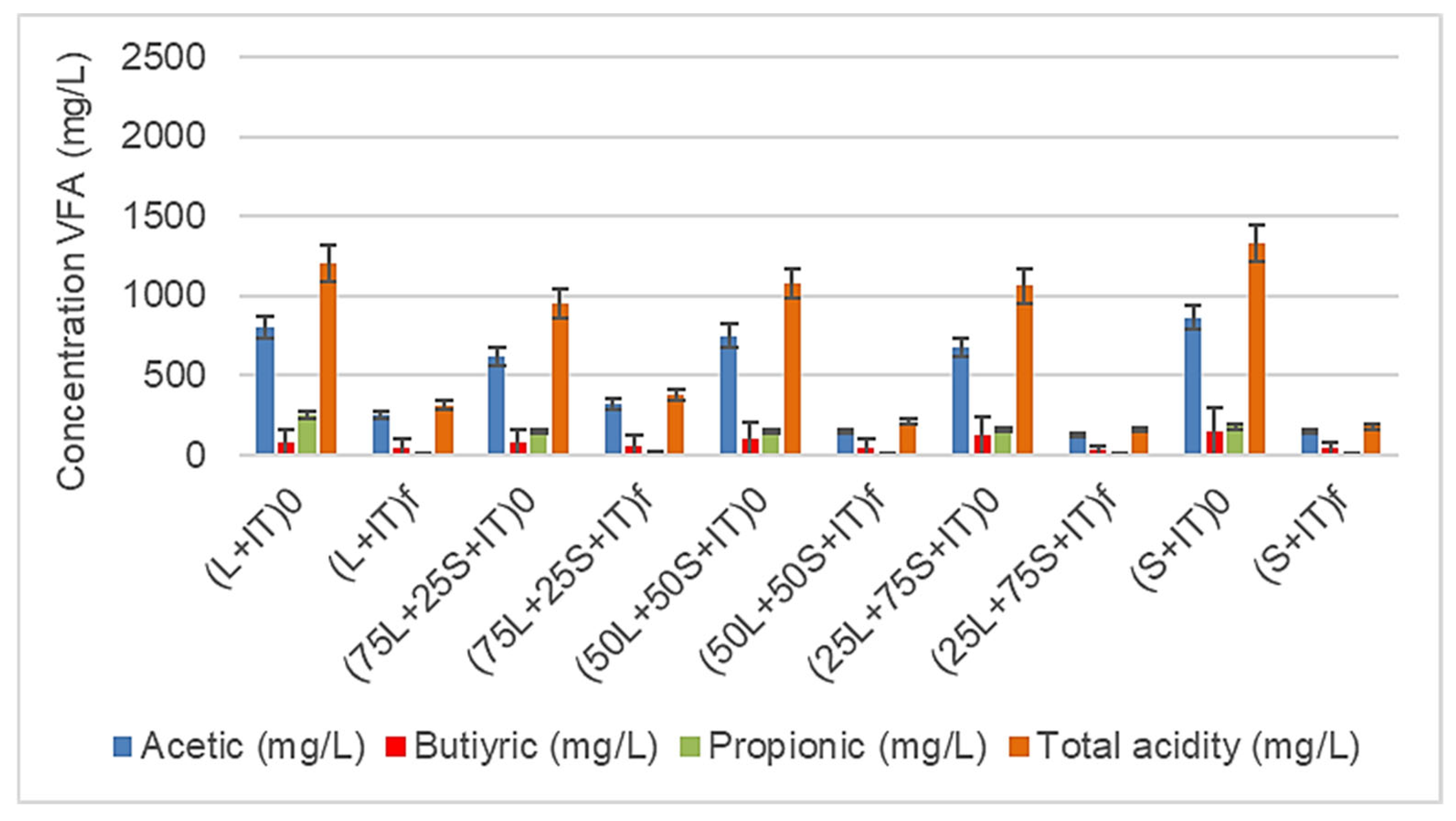
The VFA produced during the initial BHP stage served as essential precursors for methanogenesis in the BMP stage. The results showed a significant consumption of initial VFA across all proportions (Figure 4). Specifically, propionic acid disappeared entirely in all assays. The consumption of VFA is critical as it directly facilitates the acetogenesis and methanogenesis pathways [16,46,47]. A direct relationship was observed where the mixtures exhibiting higher consumption of total VFA were also the mixtures that generated the greatest volumes of biogas. The lowest final VFA concentration, 159.17 mg/L, was recorded for the 75L + 25S + IM assay.
Figure 4.
VFA concentration at the beginning (0) and the final (f) of the BMP of slaughterhouse waste codigestion.
3.3.3. Total Ammoniacal Nitrogen (TAN) and Alkalinity in BMP
The increase in Total Ammoniacal Nitrogen (TAN) observed during the BHP phase can be interpreted as an indicator of beneficial hydrolysis rather than inhibition, as protein-based compounds are broken down, releasing ammoniacal nitrogen and reflecting effective substrate degradation. However, the TAN concentrations decreased across all assays during the BMP phase. For instance, TAN for the 75L + 25S + IM mixture dropped from 101.3 mg/L to 60.9 mg/L. This reduction is favorable and is explained by the consumption of nitrogen compounds during microbiological metabolism. In fact, the initial rise in TAN does not indicate inhibitory conditions, as concentrations subsequently decreased across all assays, reaching final values (56.0–61.0 mg/L) well below the documented ammonia inhibition thresholds [37,48].
Alkalinity values increased during the BMP phase in all mixtures. The initially high alkalinity of the semi-liquid fraction played a key role in maintaining pH stability by buffering acid accumulation, while the observed increase during the BMP phase further supports process stability through the consumption of VFAs by methanogens and acetogens. Thus, the alkalinity of 25L + 75S + IM increased from 6500 mg CaCO3/L initially to 7700 mg CaCO3/L at the end. This increase contrasts with the decrease seen in the BHP phase and is a result of the consumption of VFA by methanogens and acetogens. As alkalinity rises, the process becomes more stable because the system’s capacity to buffer against acid accumulation is enhanced. This is consistent with the consumption of acids and the buffering action. This supports process stability and matches behavior in other two-phase AD studies: acids from the acidogenic phase are neutralized or consumed in the methanogenic stage, leading to rising alkalinity [14,16].
3.3.4. Biomethane Yield
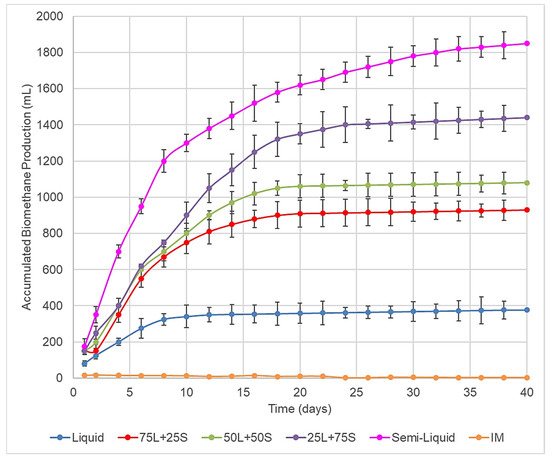
Accumulated CH4 production was monitored for 40 days, until gas production stabilized and the end of the assays (Figure 5). As indicated previously, the biogas production from the inocula, IM 35 °C -CH4-, represented in Figure 5, was subtracted from the total biogas production (CH4, respectively, in BMP) to accurately represent the CH4 yield from the reactors. Throughout the entire assay, the biogas composition remained highly stable, averaging 60–65% CH4 and 35–40% CO2.
Figure 5.
Accumulated biomethane production from slaughterhouse waste codigestion.
The Semi-liquid fraction (S + IM) mixture was the top performer in methane production, achieving a cumulative volume of 1847.67 mL (1.85 L) in 40 days. Biomethane production exhibited a clear inverse correlation with the proportion of Liquid fraction, decreasing to 319.49 mL for the liquid fraction (L + IM) assay. This high production capacity in the semi-liquid fraction is attributed to its high organic load and the concentration of VFA carried over from the BHP stage. In fact, the CH4 yields relative to initial Volatile Solids (VS) ranged significantly (Table 6).
Table 6.
Biomethane yields of the slaughterhouse waste codigestion.
The maximum yield of 521.76 mL CH4/g VS was achieved by L + IM. For comparison, the literature reports BMP values typically ranging from 58 to 482 mL/g VS for diverse substrates, and yields up to 335 mL CH4/g VS have been reported for food waste in two-phase AD. For instance, Ref. [28], in co-digestion of slaughterhouse waste with the sewage semi-liquid fraction, reported methane yields exceeding 600 dm3 CH4/kg VS (600 mL CH4/g VS). The high yields observed here demonstrate the efficacy of the acidogenic pre-treatment stage in maximizing subsequent methanogenesis. The highest yield for a co-digestion mixture was 495.46 mL CH4/g VS for the 25L + 75S + IM ratio. The methane potential of the slaughterhouse waste mixtures exhibited a synergistic effect when compared to the expected additive contributions of the individual fractions. Specifically, the 75L + 25S mixture produced 379.2 mL CH4/g VS, exceeding the calculated additive potential of 262.3 mL/g VS by 44.5%, indicating enhanced microbial conversion likely due to improved substrate balance. The 50L + 50S and 25L + 75S combinations also showed positive synergy, with observed methane yields of 9.1% and 13.8% higher than expected, respectively. These results suggest that the co-digestion of liquid and semi-liquid fractions not only optimizes overall methane production but may also mitigate limitations inherent to the individual substrates, such as recalcitrant compounds in the semi-liquid fraction or low organic loading in the liquid fraction.
On the other hand, a COD balance was developed to evaluate organic matter conversion and energy recovery in the two-phase temperature anaerobic co-digestion (TPAcD) process. The process separates anaerobic digestion into a thermophilic acidogenic hydrogen-producing phase (BHP, 55 °C) and a mesophilic methanogenic phase (BMP, 35 °C), improving COD partitioning toward gaseous energy carriers. During the BHP phase, extensive hydrolysis and solubilization of organic matter were observed. Total COD removal reached 81.01% in the liquid fraction, while soluble COD increased by more than 1000%, confirming efficient conversion of particulate COD into soluble intermediates and volatile fatty acids (VFAs). Volatile solids removal reached 67.19%, and maximum VFA concentrations of 2123.67 mg L−1 indicated intense acidogenic activity. Part of the converted COD was directly recovered as hydrogen, with a maximum yield of 6.32 mL H2/g VS (15.95 mL H2 g−1 CODs). The soluble COD and VFAs generated during BHP were subsequently converted into methane during the BMP phase. Total COD removal reached 44.50%, accompanied by additional VS removal and stable process conditions, as indicated by final pH values between 7.42 and 7.61 and increased alkalinity. Methane yields reached up to 521.76 mL CH4/g VS, with a stable biogas composition of 60–65% CH4. From a global COD balance perspective, TPAcD enabled sequential recovery of hydrogen and methane, maximizing energy recovery from organic matter. Although hydrogen represented a smaller fraction of COD conversion, its integration with methane supports hythane production and enhances the energetic value of the gaseous output.
Statistical significance was assessed using a one-way ANOVA to evaluate the influence of the substrate configuration on the performance of the two-stage system (Table 7). In the acidogenic phase (BHP), the configuration of the reactors had a highly significant impact on both organic matter removal (F_{4, 10} = 346.80, p < 0.001) and solubilization efficiency (F_{4, 10} = 185.12, p < 0.001). These results, supported by the low residual error (MS = 6.76), confirm that the hydrolytic capacity of the thermophilic stage is strictly dependent on the initial solid-to-liquid ratio. Subsequently, in the methanogenic phase (BMP), the system maintained statistical significance in terms of volatile solids removal (F_{4, 10} = 12.45, p = 0.0084) and total COD reduction (F_{4, 10} = 28.14, p = 0.0012). The transition from a highly variable acidogenic environment to a more stable methanogenic performance—as evidenced by the decrease in F-values—highlights the strong buffering capacity and metabolic adaptability of the coupled system. Post hoc Tukey’s HSD tests further confirmed that intermediate substrate mixtures (50/50 and 25/75) optimized metabolic fluxes between phases, allowing the high acidogenic activity in the BHP stage to be effectively converted into stable methane production during the BMP stage.
Table 7.
One-way ANOVA summary for performance parameters in the BHP and BMP phases, based on F and p-value analyses.
3.3.5. Microbiological Analysis of Methanogenic–Mesophilic Phase
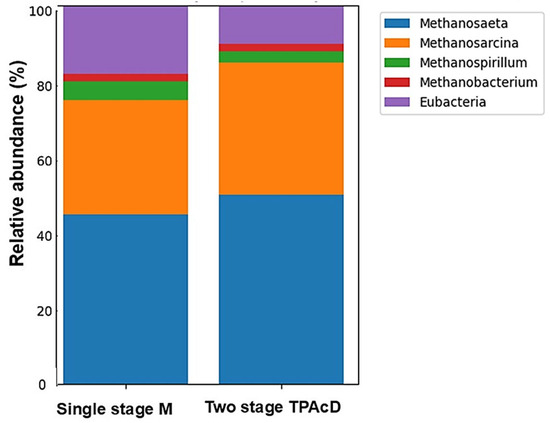
Comprehensive microbiological analysis of the methanogenic–mesophilic phase in anaerobic co-digestion reactors treating slaughterhouse wastes, under optimal study conditions, reveals the formation of a specialized archaeal consortium, mainly composed of aceticlastic methanogens such as Methanosaeta and Methanosarcina (Figure 6). It represents a comparative analysis of the microbial population shifts during the methanogenic–mesophilic stage and two-stage anaerobic co-digestion of slaughterhouse wastes. Representative epifluorescence micrographs and relative abundance data were obtained using 16S rRNA-targeted oligonucleotide probes. Total Eubacteria were identified using the EUB338 probe, while the Archaeal community was characterized using the ARC915 (total Archaea), MSAE825, and MBAC1174 (specific methanogenic groups) probes. In the mesophilic phase, these genera often dominate, with Methanosaeta and Methanosarcina together comprising up to 75% of the archaeal community, consistent with both experimental results and reports from various co-digestion systems [49]. This dominance correlates with high acetate concentrations typical of slaughterhouse waste digestion, favoring acetoclastic pathways for methane production [50].
Figure 6.
Microbial community dynamics analyzed by Fluorescence In Situ Hybridization (FISH) in anaerobic reactors, both mesophilic single-stage and two-stage TPAcD.
Hydrogenotrophic methanogens, including species such as Methanospirillum and Methanobacterium, are frequently present at much lower relative abundances (<5%), which is consistent with the low hydrogen concentrations in these systems under stable mesophilic conditions. This observation supports the notion that hydrogenotrophic methanogenesis represents a secondary metabolic route in digesters where acetoclastic methanogens are prevalent, and where volatile fatty acid removal is efficient.
In two-stage anaerobic digestion configurations, especially those with thermophilic–acidogenic and mesophilic–methanogenic phases (TPAcD systems), the selective pressure further increases the predominance of acetoclastic methanogens and sustains low hydrogenotrophic populations [51]. Such a shift in community structure is empirically linked to improved methane yield and process stability, as higher diversity and population sizes of Methanosaeta and Methanosarcina correlate with greater resistance to inhibitory compounds and operational disturbances [49].
These findings are consistent with the current literature, which indicates that acetoclastic methanogenesis predominates during mesophilic anaerobic co-digestion of slaughterhouse wastes, whereas a shift toward hydrogenotrophic methanogenesis typically occurs only under stress conditions, such as elevated free ammonia concentrations or excessive volatile fatty acid loads [50].
3.4. Comparative Analysis (TPAD vs. Conventional Mono-Stage AD)
A comparison was conducted between the methane yields obtained in this sequential Thermo-Acidogenic Mesophilic–Methanogenic (TPAD) process and those from a conventional mono-stage mesophilic process conducted in our laboratory with the same ratios (Table 8).
Table 8.
Biomethane yields from different assays expressed in mL CH4/g VS.
The results obtained reveal significant differences in methane yields between the conventional mesophilic single-stage process and the TPAcD, with temperature-phase separation and specialized microbiological consortia.
In both systems, a positive correlation was observed between the proportion of semi-liquid fraction in the substrate mixture and the methane yield (mL CH4/g VSadded). (mL CH4/g VSadded). This trend suggests that the semi-liquid fraction may contribute to process stabilization, likely by improving substrate homogeneity, buffering capacity, and the availability of readily biodegradable organic matter. Similar trends have been reported by several authors, who emphasize the role of the semi-liquid fraction in improving substrate biodegradability and microbiological activity [52,53].
However, the absolute yields differ markedly between the two configurations, with the TPAcD process achieving substantially higher values (up to 521.76 mL CH4/g VSadded) compared to the single-stage system (60.43 mL CH4/g VSadded). This improvement can be attributed to several operational and microbiological factors like phase separation and pH control. The TPAD configuration allows the acidogenic phase to proceed under thermophilic conditions (55 °C), which enhances hydrolysis and acidogenesis, leading to controlled accumulation of VFA [54]. Subsequently, the mesophilic methanogenic stage (35 °C) effectively converts these intermediates into methane. Conversely, the single-stage mesophilic system cannot simultaneously optimize conditions for both microbiological communities, thereby limiting its overall efficiency [11,55].
On the other hand, the separation of specialized microbiological populations in each stage enhances system robustness and reduces inhibition from VFAs or ammonia, frequently present in high organic loading scenarios [44,53]. Some studies have reported improvements of 100–200% in methane yields for TPAD systems compared with single-stage digesters [56,57].
Furthermore, the thermophilic pre-treatment in TPAD promotes solubilization of particulate organic matter, increasing substrate bioavailability for methanogenesis [47,58]. This leads to higher specific methane yields and more complete digestion, as reflected in the greater reduction of VS [59].
In the single-stage test, negative methane yields were observed under control conditions (−3.33 mL CH4/g VSadded), likely due to limited methanogenic activity and insufficient precursor formation in the absence of a microbiological acidogenic phase. As the semi-liquid fraction increases, the enhanced availability of biodegradable organic matter and micronutrients stimulates microbiological metabolism, resulting in gradually improved methane production. By contrast, the TPAcD process, due to its staged design and controlled environmental conditions, consistently maximized methane production across all substrate ratios, achieving 3–9-fold higher specific methane yields compared to the single-stage mesophilic digester. These findings align with previous studies on the co-digestion of complex waste mixtures, such as the semi-liquid fraction and industrial liquid fractions, which reported significant gains in energy recovery and process stability under TPAD configurations [54,55,56].
4. Conclusions
The findings of this study highlight the effectiveness of a sequential thermophilic–acidogenic and mesophilic–methanogenic process for the anaerobic co-digestion of slaughterhouse wastes. The combined treatment of the semi-liquid fraction and liquid fractions proved beneficial, as each substrate contributed complementary characteristics: the semi-liquid fraction provided higher organic and volatile solids loadings, while liquid fractions improved the physicochemical properties and fluidity of the mixture, promoting better microbiological substrate contact and enhancing overall bioconversion efficiency. Distinct substrate-specific patterns were observed across the two stages. During the acidogenic phase, liquid fractions achieved superior hydrogen yields, whereas the semi-liquid fraction exhibited a substantially higher methane production capacity in the methanogenic stage. Among the tested substrate ratios, the mixture containing the 25% liquid fraction and 75% semi-liquid fraction displayed the most balanced and favorable performance, achieving both stable hydrogen production and the highest methane yield (495.46 mL CH4/g VS0). In contrast, the mixture with the 75% liquid fraction and 25% semi-liquid fraction maximized hydrogen recovery (1.77 mL H2/g VS0), confirming that substrate composition plays a crucial role in determining the dominant fermentation pathway and gas output. Thus, statistical validation via one-way ANOVA confirmed that these performance differences were strictly attributable to the L/S ratios, with a highly significant effect on both solubilization (F_{4, 10} = 185.12, p < 0.001) and subsequent methanogenic stability (p = 0.0084$). However, hydrogen production remained stable across the evaluated conditions; the absolute H2 yields were comparatively low, which was primarily attributed to microbial competition and the complex, high organic load of the slaughterhouse waste that intrinsically favors methanogenic and other competitive metabolic pathways. The sequential configuration clearly outperformed the single-stage mesophilic co-digestion system in terms of methane productivity and purification efficiency. The thermophilic pre-treatment enhanced hydrolysis and acidogenesis, improving substrate accessibility for methanogens in the subsequent mesophilic stage. This phase separation also contributed to better process control and stability, minimizing potential inhibition and favoring a more robust methanogenic activity. Overall, these results demonstrate that sequential anaerobic digestion is a promising strategy for the valorization of complex slaughterhouse residues, enabling both hydrogen and methane recovery. By optimizing substrate proportions and operational conditions, this approach can significantly enhance biogas yields and contribute to sustainable waste-to-energy conversion within circular bioeconomy frameworks.
Author Contributions
Conceptualization, J.F.-R. and M.P.; methodology, J.F.-R. and M.M.; software, J.F.-R., M.M. and M.P.; validation, M.P. and J.F.-R.; formal analysis, M.M. and J.F.-R.; investigation, J.F.-R. and M.M.; resources, M.P. and J.F.-R.; writing—original draft preparation, M.M. and J.F.-R.; writing—review and editing, J.F.-R. and M.P.; visualization, J.F.-R. and M.P.; supervision, J.F.-R. and M.P.; project administration, M.P.; funding acquisition, M.P. All authors have read and agreed to the published version of the manuscript.
Funding
This research was funded by the Spanish Ministry of Science and Innovation and the State Research Agency (MCIN/AEI/10.13039/501100011033), with co-funding from the European Union. This work was supported by project PID2021-123174OB-I00, financed by MCIN/AEI and the European Regional Development Fund (ERDF/EU).
Data Availability Statement
The original contributions presented in this study are included in the article. Further inquiries can be directed to the corresponding author.
Conflicts of Interest
The authors declare no conflicts of interest.
References
- Su, C.W.; Pang, L.D.; Qin, M.; Lobonţ, O.R.; Umar, M. The Spillover Effects among Fossil Fuel, Renewables and Carbon Markets: Evidence under the Dual Dilemma of Climate Change and Energy Crises. Energy 2023, 274, 127304. [Google Scholar] [CrossRef] [Scilit]
- Pirmoradi, N.; Ghaneian, M.T.; Ehrampoush, M.H.; Salmani, M.H.; Hatami, B. The Conversion of Poultry Slaughterhouse Wastewater Sludge into Biodiesel: Process Modeling and Optimization. Renew. Energy 2021, 178, 1236–1249. [Google Scholar] [CrossRef] [Scilit]
- Parvathy Eswari, A.; Ravi, Y.K.; Kavitha, S.; Rajesh Banu, J. Recent Insight into Anaerobic Digestion of Lignocellulosic Biomass for Cost Effective Bioenergy Generation. e-Prime Adv. Electr. Eng. Electron. Energy 2023, 3, 100119. [Google Scholar] [CrossRef] [Scilit]
- Sadh, P.K.; Chawla, P.; Kumar, S.; Das, A.; Kumar, R.; Bains, A.; Sridhar, K.; Duhan, J.S.; Sharma, M. Recovery of Agricultural Waste Biomass: A Path for Circular Bioeconomy. Sci. Total Environ. 2023, 870, 161904. [Google Scholar] [CrossRef] [Scilit]
- Skrzypczak, D.; Trzaska, K.; Mikula, K.; Gil, F.; Izydorczyk, G.; Mironiuk, M.; Polomska, X.; Moustakas, K.; Witek-Krowiak, A.; Chojnacka, K. Conversion of Anaerobic Digestates from Biogas Plants: Laboratory Fertilizer Formulation, Scale-up and Demonstration of Applicative Properties on Plants. Renew. Energy 2023, 203, 506–517. [Google Scholar] [CrossRef] [Scilit]
- Saghir, A.; Hajjar, S. Biological Treatment of Slaughterhouse Wastewater Using Up Flow Anaerobic Sludge Blanket (UASB)—Anoxic-Aerobic System. Sci. Afr. 2022, 16, e01236. [Google Scholar] [CrossRef] [Scilit]
- Salehiyoun, A.R.; Di Maria, F.; Sharifi, M.; Norouzi, O.; Zilouei, H.; Aghbashlo, M. Anaerobic Co-Digestion of Sewage Sludge and Slaughterhouse Waste in Existing Wastewater Digesters. Renew. Energy 2020, 145, 2503–2509. [Google Scholar] [CrossRef] [Scilit]
- Caballero, P.; Ágabo-García, C.; Solera, R.; Parrado, J.; Pérez, M. Eco-Energetic Management of Activated Sludge Derived from Slaughterhouse Wastewater Treatment: Pre-Treatments for Enhancing Biogas Production under Anaerobic Conditions. Sustain. Energy Fuels 2020, 4, 5072–5079. [Google Scholar] [CrossRef] [Scilit]
- Guamán-Marquines, C.W.; Mendoza-Loor, R.J.; Gómez-Salcedo, Y.; Baquerizo-Crespo, R.J. Assessment of the Start-up of Tubular Reactors on a Laboratory Scale for the Anaerobic Digestion of Slaughterhouse Wastewater. Int. J. Thermofluids 2023, 19, 100378. [Google Scholar] [CrossRef] [Scilit]
- Sillero, L.; Solera, R.; Perez, M. Improvement of the Anaerobic Digestion of Sewage Sludge by Co-Digestion with Wine Vinasse and Poultry Manure: Effect of Different Hydraulic Retention Times. Fuel 2022, 321, 124104. [Google Scholar] [CrossRef] [Scilit]
- Van Dinh, P.; Fujiwara, T. Biogas Production and Energy Balance in a Two-Stage Anaerobic Digestion of Fruit and Vegetable Waste: Thermophilic versus Mesophilic. Fermentation 2023, 9, 601. [Google Scholar] [CrossRef] [Scilit]
- Philipp, M.; Ackermann, H.; Barbana, N.; Pluschke, J.; Geißen, S.U. Possibilities for Anaerobic Digestion of Slaughter Waste and Flotates for Biomethane Production. Water 2023, 15, 1818. [Google Scholar] [CrossRef] [Scilit]
- González-González, A.; Cuadros, F.; Ruiz-Celma, A.; López-Rodríguez, F. Energy-Environmental Benefits and Economic Feasibility of Anaerobic Codigestion of Iberian Pig Slaughterhouse and Tomato Industry Wastes in Extremadura (Spain). Bioresour. Technol. 2013, 136, 109–116. [Google Scholar] [CrossRef] [Scilit]
- Wu, L.J.; Ye, F.; Yang, F.; Lyu, Y.K. Applicability of Temperature-Phased Anaerobic Digestion in Enhancing Methanation of High-Solid Sludge: Process Performance, Microbial Community Analysis and Energy Balance Assessment. Bioresour. Technol. 2025, 431, 132614. [Google Scholar] [CrossRef] [Scilit]
- Harirchi, S.; Wainaina, S.; Sar, T.; Nojoumi, S.A.; Parchami, M.; Parchami, M.; Varjani, S.; Khanal, S.K.; Wong, J.; Awasthi, M.K.; et al. Microbiological Insights into Anaerobic Digestion for Biogas, Hydrogen or Volatile Fatty Acids (VFAs): A Review. Bioengineered 2022, 13, 6521–6557. [Google Scholar] [CrossRef] [Scilit]
- Sung, S.; Santha, H. Performance of Temperature-Phased Anaerobic Digestion (TPAD) System Treating Dairy Cattle Wastes. Water Res. 2003, 37, 1628–1636. [Google Scholar] [CrossRef] [Scilit]
- Sillero, L.; Sganzerla, W.G.; Carneiro, T.F.; Solera, R.; Perez, M. Techno-Economic Analysis of Single-Stage and Temperature-Phase Anaerobic Co-Digestion of Sewage Sludge, Wine Vinasse, and Poultry Manure. J. Environ. Manag. 2023, 325, 116419. [Google Scholar] [CrossRef] [Scilit]
- Sanaye, S.; Borzuei, D. Techno-Economic Modeling and Optimizing the Hydrogen Production System from Gasification of Digestate in Wastewater Treatment Plants. Int. J. Hydrogen Energy 2025, 179, 151671. [Google Scholar] [CrossRef] [Scilit]
- Nayeem, S.M.A.; Ahmed, N.; Guidugli, L.F.; Ismail, M.; Saha, C.K.; Reza, T.; Kabir, K.B.; Kirtania, K. Techno-Economic Analysis of Integrated Biohydrogen Generation Process from Biogenic Residues of Bangladesh. Int. J. Hydrogen Energy 2025, 145, 705–716. [Google Scholar] [CrossRef] [Scilit]
- Hu, Y.; Shen, C. Thermophilic-Mesophilic Temperature Phase Anaerobic Co-Digestion Compared with Single Phase Co-Digestion of Sewage Sludge and Food Waste. Sci. Rep. 2024, 14, 11967. [Google Scholar] [CrossRef] [Scilit] [PubMed]
- Gupta, S.; Fernandes, A.; Lopes, A.; Grasa, L.; Salafranca, J. Microbes and Parameters Influencing Dark Fermentation for Hydrogen Production. Appl. Sci. 2024, 14, 10789. [Google Scholar] [CrossRef] [Scilit]
- Gadhe, A.; Sonawane, S.S.; Varma, M.N. Optimization of Conditions for Hydrogen Production from Complex Dairy Wastewater by Anaerobic Sludge Using Desirability Function Approach. Int. J. Hydrogen Energy 2013, 38, 6607–6617. [Google Scholar] [CrossRef] [Scilit]
- Sillero, L.; Solera, R.; Perez, M. Effect of Temperature on Biohydrogen and Biomethane Production Using a Biochemical Potential Test with Different Mixtures of Sewage Sludge, Vinasse and Poultry Manure. J. Clean. Prod. 2023, 382, 135237. [Google Scholar] [CrossRef] [Scilit]
- Sillero, L.; Solera, R.; Perez, M. Effect of Temperature and Bagasse Addition on Anaerobic Co-Digestion of Brewery Waste by Biochemical Methane Potential Test. Fuel 2024, 357, 129737. [Google Scholar] [CrossRef] [Scilit]
- APHA; AWWA; WEF. Standard Methods for the Examination of Water and Wastewater, 22nd ed.; American Public Health Association: Washington, DC, USA, 2012. [Google Scholar]
- Saadoun, L.; Campitelli, A.; Kannengiesser, J.; Stanojkovski, D.; El Alaoui El Fels, A.; Mandi, L.; Ouazzani, N. Acidogenic Digestion of Organic Municipal Solid Waste in a Pilot Scale Reactor: Effect of Waste Ratio and Leachate Recirculation and Dilution on Hydrolysis and Medium Chain Fatty Acid Production. Bioresour. Technol. Rep. 2022, 17, 100872. [Google Scholar] [CrossRef] [Scilit]
- Wong, Y.M.; Wu, T.Y.; Juan, J.C. A Review of Sustainable Hydrogen Production Using Seed Sludge via Dark Fermentation. Renew. Sustain. Energy Rev. 2014, 34, 471–482. [Google Scholar] [CrossRef] [Scilit]
- Borowski, S.; Kubacki, P. Co-Digestion of Pig Slaughterhouse Waste with Sewage Sludge. Waste Manag. 2015, 40, 119–126. [Google Scholar] [CrossRef] [Scilit]
- Kabouris, J.C.; Tezel, U.; Pavlostathis, S.G.; Engelmann, M.; Dulaney, J.; Gillette, R.A.; Todd, A.C. Methane Recovery from the Anaerobic Codigestion of Municipal Sludge and FOG. Bioresour. Technol. 2009, 100, 3701–3705. [Google Scholar] [CrossRef] [Scilit] [PubMed]
- Atchala, M.S.R.; Rao, P.V.; Pilli, S.; Tyagi, R.D. Optimizing Autoclave Pretreatment and Inoculum-to-Substrate Ratio for Enhanced Anaerobic Digestion of Poultry Slaughterhouse Wastewater. J. Environ. Manag. 2025, 375, 124427. [Google Scholar] [CrossRef] [Scilit] [PubMed]
- Sekoai, P.T.; Chunilall, V.; Ezeokoli, O. Creating Value from Acidogenic Biohydrogen Fermentation Effluents: An Innovative Approach for a Circular Bioeconomy That Is Acquired via a Microbial Biorefinery-Based Framework. Fermentation 2023, 9, 602. [Google Scholar] [CrossRef] [Scilit]
- Wang, J.; Wan, W. Factors Influencing Fermentative Hydrogen Production: A Review. Int. J. Hydrogen Energy 2009, 34, 799–811. [Google Scholar] [CrossRef] [Scilit]
- Tsapekos, P.; Alvarado-Morales, M.; Angelidaki, I. H2 Competition between Homoacetogenic Bacteria and Methanogenic Archaea during Biomethanation from a Combined Experimental-Modelling Approach. J. Environ. Chem. Eng. 2022, 10, 107281. [Google Scholar] [CrossRef] [Scilit]
- Qiu, S.; Zhang, X.; Xia, W.; Li, Z.; Wang, L.; Chen, Z.; Ge, S. Effect of Extreme PH Conditions on Methanogenesis: Methanogen Metabolism and Community Structure. Sci. Total Environ. 2023, 877, 162702. [Google Scholar] [CrossRef] [Scilit]
- Han, Y.; Green, H.; Tao, W. Reversibility of Propionic Acid Inhibition to Anaerobic Digestion: Inhibition Kinetics and Microbial Mechanism. Chemosphere 2020, 255, 126840. [Google Scholar] [CrossRef] [Scilit]
- Chen, Y.; Cheng, J.J.; Creamer, K.S. Inhibition of Anaerobic Digestion Process: A Review. Bioresour. Technol. 2008, 99, 4044–4064. [Google Scholar] [CrossRef] [Scilit]
- Rajagopal, R.; Massé, D.I.; Singh, G. A Critical Review on Inhibition of Anaerobic Digestion Process by Excess Ammonia. Bioresour. Technol. 2013, 143, 632–641. [Google Scholar] [CrossRef] [Scilit]
- Tena, M.; Perez, M.; Solera, R. Effect of Hydraulic Retention Time on Hydrogen Production from Sewage Sludge and Wine Vinasse in a Thermophilic Acidogenic CSTR: A Promising Approach for Hydrogen Production within the Biorefinery Concept. Int. J. Hydrogen Energy 2021, 46, 7810–7820. [Google Scholar] [CrossRef] [Scilit]
- Sillero, L.; Perez, M.; Solera, R. Optimisation of Anaerobic Co-Digestion in Two-Stage Systems for Hydrogen, Methane and Biofertiliser Production. Fuel 2024, 365, 131186. [Google Scholar] [CrossRef] [Scilit]
- Tena, M.; Luque, B.; Perez, M.; Solera, R. Enhanced Hydrogen Production from Sewage Sludge by Cofermentation with Wine Vinasse. Int. J. Hydrogen Energy 2020, 45, 15977–15984. [Google Scholar] [CrossRef] [Scilit]
- Saady, N.M.C. Homoacetogenesis during Hydrogen Production by Mixed Cultures Dark Fermentation: Unresolved Challenge. Int. J. Hydrogen Energy 2013, 38, 13172–13191. [Google Scholar] [CrossRef] [Scilit]
- Guo, X.M.; Trably, E.; Latrille, E.; Carrre, H.; Steyer, J.P. Hydrogen Production from Agricultural Waste by Dark Fermentation: A Review. Int. J. Hydrogen Energy 2010, 35, 10660–10673. [Google Scholar] [CrossRef] [Scilit]
- Oliveira, H.R.; Anacleto, T.M.; Abreu, F.; Enrich-Prast, A. New Insights into the Factors Influencing Methanogenic Pathways in Anaerobic Digesters. Anaerobe 2025, 91, 102925. [Google Scholar] [CrossRef] [Scilit]
- Mustafa, A.M.; Chen, X.; Lin, H.; Sheng, K. Effect of Ammonia Concentration on Hythane (H2 and CH4) Production in Two-Phase Anaerobic Digestion. Int. J. Hydrogen Energy 2019, 44, 27297–27310. [Google Scholar] [CrossRef] [Scilit]
- Meneses Quelal, O.; Pilamunga Hurtado, D. Anaerobic Fermentation of Slaughterhouse Waste—Codigestion with Wheat Straw to Determine Methane Biochemical Potential and Kinetic Analysis. Fermentation 2023, 9, 726. [Google Scholar] [CrossRef] [Scilit]
- Lanko, I.; Hejnic, J.; Říhová-Ambrožová, J.; Ferrer, I.; Jenicek, P.; Lanko, I.; Hejnic, J.; Říhová-Ambrožová, J.; Ferrer, I.; Jenicek, P. Digested Sludge Quality in Mesophilic, Thermophilic and Temperature-Phased Anaerobic Digestion Systems. Water 2021, 13, 2839. [Google Scholar] [CrossRef] [Scilit]
- Ge, H.; Jensen, P.D.; Batstone, D.J. Pre-Treatment Mechanisms during Thermophilic–Mesophilic Temperature Phased Anaerobic Digestion of Primary Sludge. Water Res. 2010, 44, 123–130. [Google Scholar] [CrossRef] [Scilit] [PubMed]
- Yenigün, O.; Demirel, B. Ammonia inhibition in anaerobic digestion: A review. Process Biochem. 2013, 48, 901–911. [Google Scholar] [CrossRef] [Scilit]
- Vavilin, V.A.; Qu, X.; Mazéas, L.; Lemunier, M.; Duquennoi, C.; He, P.; Bouchez, T. Methanosarcina as the Dominant Aceticlastic Methanogens during Mesophilic Anaerobic Digestion of Putrescible Waste. Antonie Leeuwenhoek 2008, 94, 593–605. [Google Scholar] [CrossRef] [Scilit]
- Kong, D.; Zhang, K.; Liang, J.; Gao, W.; Du, L. Methanogenic Community during the Anaerobic Digestion of Different Substrates and Organic Loading Rates. Microbiologyopen 2019, 8, e00709. [Google Scholar] [CrossRef] [Scilit]
- Zhang, L.; Loh, K.C.; Zhang, J.; Mao, L.; Tong, Y.W.; Wang, C.H.; Dai, Y. Three-Stage Anaerobic Co-Digestion of Food Waste and Waste Activated Sludge: Identifying Bacterial and Methanogenic Archaeal Communities and Their Correlations with Performance Parameters. Bioresour. Technol. 2019, 285, 121333. [Google Scholar] [CrossRef] [Scilit]
- Appels, L.; Baeyens, J.; Degrève, J.; Dewil, R. Influence of Temperature and Retention Time on Methane Yield in Anaerobic Digestion of Solid Organic Waste. Bioresour. Technol. 2008, 99, 8180–8187. [Google Scholar]
- Li, Y.; Park, S.Y.; Zhu, J. Solid-State Anaerobic Digestion for Methane Production from Organic Waste. Renew. Sustain. Energy Rev. 2011, 15, 821–826. [Google Scholar] [CrossRef] [Scilit]
- Demirel, B.; Yenigun, O.; Onay, T.T. Anaerobic Treatment of Dairy Wastewaters: A Review. Process Biochem. 2005, 40, 2583–2595. [Google Scholar] [CrossRef] [Scilit]
- Kim, M.; Ahn, Y.H.; Speece, R.E. Comparative Process Stability and Efficiency of Anaerobic Digestion; Mesophilic vs. Thermophilic. Water Res. 2002, 36, 4369–4385. [Google Scholar] [CrossRef] [Scilit]
- Song, Y.C.; Kwon, S.J.; Woo, J.H. Mesophilic and Thermophilic Temperature Co-Phase Anaerobic Digestion Compared with Single-Stage Mesophilic- and Thermophilic Digestion of Sewage Sludge. Water Res. 2004, 38, 1653–1662. [Google Scholar] [CrossRef] [Scilit]
- El-Mashad, H.M.; Zhang, R. Biogas Production from Co-Digestion of Dairy Manure and Food Waste. Bioresour. Technol. 2010, 101, 4021–4028. [Google Scholar] [CrossRef] [Scilit]
- Auxiliadora López, R.; Tena, M.; Solera, R.; Pérez, M. Anaerobic Co-Digestion of Sewage Sludge and Wine Vinasse Mixtures in Single-Stage and Sequential-Temperature Processes. Fuel 2023, 348, 128531. [Google Scholar] [CrossRef] [Scilit]
- Ariunbaatar, J.; Panico, A.; Esposito, G.; Pirozzi, F.; Lens, P.N.L. Pretreatment Methods to Enhance Anaerobic Digestion of Organic Solid Waste. Appl. Energy 2014, 123, 143–156. [Google Scholar] [CrossRef] [Scilit]

Disclaimer/Publisher’s Note: The statements, opinions and data contained in all publications are solely those of the individual author(s) and contributor(s) and not of MDPI and/or the editor(s). MDPI and/or the editor(s) disclaim responsibility for any injury to people or property resulting from any ideas, methods, instructions or products referred to in the content. |
© 2026 by the authors. Licensee MDPI, Basel, Switzerland. This article is an open access article distributed under the terms and conditions of the Creative Commons Attribution (CC BY) license.