


Abstract
Post-quantum cryptography (PQC) is driven by the threat posed by quantum computers, particularly the harvest-now-decrypt-later attack. PQC aims to prepare classical systems and hardware to become resilient against quantum attacks. This research discusses the system vulnerabilities, the need to migrate to PQC, and how to integrate this migration. PQC has become one of the solutions for addressing today’s vulnerabilities and threats while increasing security. The paper concludes that harvest-now-decrypt-later, Q-Day attacks, and new quantum attacks are today’s most critical threats, which can be addressed by deploying PQC solutions and, thus, increasing security. This research proposes a conceptual multi-phased model framework for the migration. The framework first addresses system objectives, goals and assets, then ranks assets based on the highest sensitivity. Crypto-Agility is achieved via the automation of PQC migration, such as the automation of re-keying endpoints, followed by the automation of auditing and testing of each migration stage. Human judgment is required to review the migration process. Once one asset is successfully transitioned, the framework goes to the next highest asset; otherwise, testing is repeated. This is expected to help systems migrate at the lowest cost and with the fewest consequences. However, the limitation of PQC migration is its high resource cost, time, requirement of human professionals, burden on existing systems, and financial expenses. Lastly, the paper recommends creating an ML model to help rank a system’s data and vulnerabilities. Moreover, the paper recommends conducting experiments to evaluate the effectiveness of the proposed framework. In addition, the paper recommends performing migration in relation to a real-world company.
1. Introduction
Today, technology is continually evolving, and various organizations, such as schools and hospitals, now store most of their data online. Users’ sensitive data must be secured on those systems because attackers are constantly finding ways to breach systems and access sensitive data for exploitation. With the introduction of quantum computing, the computing experience is shifting. Quantum computers work differently: they use quantum bits (Qubits), which can be 1 or 0 or both at the same time, allowing them to operate in polynomial time on selected hard problems and increase performance to exponential speed-up, such as in the case of Shor’s algorithm that achieves a speed of . Grover’s unstructured search algorithm performs in , which is a quadratic speed-up compared to classical algorithms. As such, symmetric algorithms [1], considering brute force attacks (AES-128), would be reduced to in terms of speed in quantum operations [2]. Thus, the quantum processing unit (QPU)-based computer is considered faster than CPU-based computers, which use only 1 or 0, never both [3,4]. Quantum computers also use quantum gates, such as the Hadamard gate and the phase shift gate, which work differently from CPU gates [5,6,7]. This has given us the advantage of high-speed, high-performance computers, and it is not just about speed; it does things more efficiently. Quantum computing offers significant benefits, but it is also powerful enough to break the strong encryption used in traditional methods, such as RSA and ECC. If attackers gain access to quantum computers, they can gain access to sensitive data and easily break ciphers [7,8].
Quantum cryptography enhances the security of sensitive data; its protection method depends crucially on hardware [5,9]. Because of its high cost, it is large enterprises that can afford quantum technology; thus, it is usually banks and data centers that currently consider quantum security for their sensitive data. Moreover, quantum cryptography is used to enhance eavesdropping detection using quantum key distribution (QKD), the BB84 protocol, which adds an additional physical layer [10] and uses spin-orbit hybrid states to ensure unbiased bases to get the lowest quantum bit error rate (QBER) [11]. Quantum cryptography is not accessible to everyone yet. Still, the problem of Q-Day, when current traditional cryptography methods would be easily breakable using quantum computing and former classical cryptography algorithms are expected to be categorized as legacy, remains. The date of Q-Day is not known yet; it mostly depends on the winner in the quantum race, such as IBM’s milestone of achieving 1 billion gates, and hardware availability and tolerance to fault scaling [2]. Researchers have different date predictions, but they agree it will be soon. Therefore, attackers have been harvesting encrypted data until then to decrypt it later; this attack is called harvest-now-decrypt-later (HNDL) [12,13].
Therefore, data protection has become crucial as technology and attacks continue to evolve. Cryptography is one of the various solutions researchers are integrating to protect sensitive data, and it is a major target for attackers. To defend against harvest-now-decrypt-later (HNDL) attacks, researchers developed post-quantum cryptography (PQC) [14], a software-based approach used today to encrypt sensitive data and to increase security until and after Q-Day [4,13,15,16,17]. It is considered more efficient than other cryptographic methods introduced [14,18]. It can provide a level of protection that former cryptographic methods, such as AES [7] and RSA [19,20], are limited in furfilling [21]. NIST has announced a recommendation to migrate to post-quantum cryptography to increase security and protection against the Q-Day [22,23,24].
PQC integration involves upgrading systems that use traditional cryptographic algorithms by removing them and replacing them with PQC algorithms, such as ML-KEM (formerly Kyber) and ML-DSA (formerly Dilithium). ML-KEM is applied to assets that prioritize confidentiality and offers high performance with encapsulation. ML-DSA is suitable for assets that prioritize authentication and integrity and can be used for digital signatures, offering fast verification [25]. Table 1 illustrates an overview comparison of quantum key distribution and post-quantum cryptography.
Table 1.
QKD vs. PQC algorithms overview.
Post-quantum cryptography (PQC) has become important for protecting system data and for guaranteeing confidentiality, authentication, and integrity. Confidentiality and integrity are among the system’s core values that help users trust it and maintain its good reputation. PQC can be a suitable replacement for classical cryptographic methods to address current system security attacks, such as eavesdropping [26,27,28,29], in which attackers can intercept the victim’s communications, review all data being transferred, and even modify it. User communications should remain secret and protected, as most systems exchange sensitive data that should be kept protected from attackers. The harvest-now-decrypt-later vulnerability [30,31] is another risk: encrypted data from today’s strongest traditional algorithms could be stolen or leaked and harvested until Q-Day, when attackers can decrypt it easily. Q-Day is when traditional cryptographic methods might become legacy, and researchers have predicted it could be soon. Therefore, it is important to migrate from traditional cryptographic methods for data protection ahead of the upcoming Q-Day.
This paper aims to review the vulnerabilities of traditional cryptographic methods and identify systems that should integrate post-quantum cryptography. This paper proposes a dynamic structured framework for migrating systems to PQC, where the PQC type used would depend on each asset’s objective; the framework would have multiple PQC types that the framework chooses based on the asset’s objective sensitivity level, along with using Crypto-Agility, with migration carried out sequentially to handle each asset at a time and ensure success. It also uses automation to handle repetitive, time-consuming tasks, decreasing the error rate and increasing efficiency. The proposed framework would help organizations address their system’s objectives and security goals before starting system migration, as it is important to determine whether post-quantum cryptography is a good fit for the system and avoid wasting time and resources.
The paper is organized as follows. Section 2 reviews the relevant literature on the implementation of post-quantum cryptography across various fields. Section 3 details the methodology used to address the research questions. Section 4 discusses the research questions. Finally, Section 5 summarizes the findings, presents concluding remarks, and suggests future work.
2. Related Works
This section reviews prior work by other researchers on the foundations of quantum computing and post-quantum cryptography, the most common vulnerabilities, and how researchers have addressed them. This section will address the research questions that this paper seeks to answer.
Nowadays, attackers are targeting systems to retrieve their encrypted sensitive data and harvest it until Q-Day, when they can easily decrypt it. Researchers have explored this issue by focusing on the risk of harvesting now and decrypting later in the context of Bitcoin. They recommended using PQC to address this risk and defend against other malicious risks. NIST has recommended migrating to PQC and set a 2035 deadline [4], enabling systems to enhance privacy and protect sensitive data. Migration has been carried out in stages, prioritizing data by sensitivity and the current cryptographic method by strength. Therefore, systems should be migrated to PQC, which is expected to require additional resources to enhance data security and comply with NIST standards; it is recommended to do so sequentially to save time [13].
Crypto-Agility is an approach that most researchers have been using to integrate PQC, which consists of first ranking the currently used algorithms based on their vulnerabilities, ranking the primitives based on the most vulnerabilities, choosing a structured plan to integrate, such as ML-DSA (formerly Dilithium) or ML-KEM (formerly Kyber), and lastly, setting a clear plan and governance. It is important to establish a structured plan and study the current system vulnerabilities before starting migration to identify the system’s critical vulnerabilities accurately. PQC is still a new technology, and moving to it would require time and specialized resources. No one would want to waste time and invest high-cost resources only to find out they deployed unsuitable technology or did so in the wrong way. Therefore, it is important and recommended to follow the Crypto-Agility PQC approach, which allows one to deploy PQC in stages to ensure sustainable long-term effectiveness [32].
Another researcher has predicted that Q-Day might occur in the near future. Still, it is not clear whether it is close, such as tomorrow, or years away, making systems more vulnerable to attacks, such as harvest-now-decrypt-later. However, since it is predicted to happen so soon, attackers have greater urgency to steal and harvest encrypted data for later use. Vulnerable systems, such as medical systems, also contain sensitive data that attackers target for various reasons [33].
Harvest-now, decrypt-later is one of the system security vulnerabilities that today’s systems face. Systems that deploy traditional cryptographic methods such as Elliptic Curve Cryptography (ECC) and RSA are especially vulnerable to HNDL attacks [34,35]; researchers have deployed PQC to resolve the security weakness of the system, and they switch to PQC using the cryptographic agile method to control security in case of a surprising event. This has added strong infrastructure to the system, but it is limited to new quantum attacks and requires larger storage [5].
The Rivest–Shamir–Adleman (RSA) and Elliptic Curve Cryptography (ECC) methods might be easy to break on Q-Day. AES-256 will need a larger key length, as will all the traditional cryptographic algorithms; their core structures differ from those of quantum cryptography, making their chances of surviving on Q-Day very low. Therefore, researchers have recommended replacing traditional cryptographic algorithms with post-quantum cryptography, which offers stronger protections for sensitive data and more robust defenses. This replacement should be carried out in stages to replace each part at a time rather than all at once to achieve better outcomes [36,37].
Moreover, another common security attack on traditional cryptographic algorithms is eavesdropping, where attackers can intercept communications and monitor all messages exchanged between victims. The attackers can then exploit sensitive messages exchanged and use them to exploit victims. Moreover, attackers can intercept communication between a victim and a server, which is dangerous because they can see all the data transmitted. This jeopardizes the system’s privacy and the protection of sensitive data, and it compromises their confidentiality. Systems should implement additional security measures to ensure data confidentiality and protect servers and users from attacks. Therefore, although classical cryptographic algorithms were effective against such attacks, they have become less effective with technological advances, and attackers continue to find new ways to harm systems [38].
Eavesdropping is a vulnerability in traditional cryptographic algorithms; therefore, researchers have deployed quantum cryptography to protect systems and data using the BB84 quantum key distribution protocol. The system can detect an eavesdropper using quantum bit error rate (QBER) [39]. Another researcher deployed the same method, but it had a limitation: it could not mitigate or detect Man-In-The-Middle attacks [40]. Therefore, the cryptographic method to be deployed should be selected after addressing the system’s goals and objectives.
Another reason to migrate from traditional cryptographic methods to PQC is speed; traditional cryptographic methods are considered slow compared to PQC, especially when it is an IoT system, where its highest priority is speed; therefore, the security measures deployed for it should not be heavy to the point that they might cause a delay in system performance. After the migration, researchers identified a decrease in costs as performance increased. However, they face a limitation in the complexity of the migration [41].
Traditional cryptographic methods are easy to break using new quantum attacks, such as Shor’s algorithm, which can break asymmetric algorithms using high speed and can solve the problem in steps. Moreover, Grover’s algorithm attack has the advantage of a quadratic speed of in breaking symmetric traditional cryptographic methods [9,42,43].
Furthermore, researchers have tackled post-quantum cryptography using a hashed puzzle to address denial-of-service attacks, which harm system efficiency, cost the company money and reputation, and threaten system availability. Given the new quantum attacks, current security measures are not ready for them; no single solution addresses all concerns. However, they deployed multiple security measures to address these issues and enhance the system’s privacy and availability. Although their solution has provided broader security, it has come at a high cost, which may not be suitable for all systems [44].
New threats have come to light with the revolution in quantum computing, such as the development of algorithms that target today’s most secure systems and break through the cryptographic methods applied. This is a major concern, as quantum computing can defend against attackers but can also help them reach sensitive systems in many useful ways, a phenomenon known as algorithm subversion. Researchers have addressed this by combining KEM with QC-MDPC to defend against these attacks and classical algorithm attacks and to increase system privacy [45].
Quantum computing can also generate strong, undetectable deepfakes; quantum biometric spoofing has a high success rate against traditional biometric methods. This would give attackers a powerful weapon, making it harder for victims to detect. However, researchers proposed using a Quantum Convolutional Neural Network (CNN), which should decrease the spoofing error rate. The deepfake can be detected by tracing the quantum ink and locating the synthetic chemical used [46].
Researchers have proposed adapting PQC to defend against future attacks enabled by quantum computing, such as harvest-now-decrypt-later, and to integrate PQC strategically; otherwise, resolving unexpected outcomes could come at the cost of time and resources. Therefore, they proposed a framework to integrate it into stages. The first stage is a strategic mandate, which involves discussing the plan with executives to keep everyone involved in the process; then, the discovery plan, which involves going through the company’s system and identifying the outdated security measures and placing them at the head of the list to give them the highest priority in the integration of PQC. Then, there is the testing stage, where the new integration’s effect on the company’s system is tested, and lastly, the safe roll-out stage: go live with the integration. However, this has the limitation that it requires substantial resources, such as a large amount of memory, high processing power, and a high-speed internet connection. Moreover, this integration would take a long time, as it is carried out carefully and in stages [47]. Even though it has limitations or demands high resources for integration, it would be good for the quality of the company’s security measures, as the company would conduct the integration in stages over a long time; they cannot rush through the process, and that would be a good reflection of integration in the company.
However, the long-term integration might not be suitable for all types of business, such as banks, which still use legacy network technologies, and they cannot risk their systems with technologies that might fail and compromise them. Researchers have proposed a “pragmatic playbook” to guide them toward safe integration without harming the systems. The framework has standards for setting a goal deadline, such as 2030–2031. First, prioritize data sensitivity and rank from highest to lowest; second, keep some of the legacy security measures and combine them with the new ones of the PQC integration; third, ensure API software updates are up to date; fourth, test the new integrations, and keep up with the government rules and regulations and follow them accordingly. This framework has the limitation of being time-consuming to complete. However, it also has the advantage of ensuring compatibility with system security and financial stability and of avoiding cost increases [3]. The framework outlines a long-term plan, but it comes at the cost of ensuring compatibility and reducing resource and cost losses.
The process of integrating into PQC requires installing and using software tools, and some of these tools have complex usability and poor user experience, leading to poor outcomes when developers use them incorrectly. So, researchers conducted a comprehensive review of various software tools and monitored developers’ remote usability to test user interactions with the tools and propose a more user-friendly tool. They concluded that the current tools lack a step-by-step guide and are targeted toward highly expert professionals [48].
Researchers have integrated PQC into intelligent transportation systems, such as traffic lights and self-driving cars, to enhance security and prepare for future quantum attacks. They chose a hybrid integration framework to ensure sustainability throughout an integration plan. However, PQC integration requires significant resources, including numerous digital keys, signatures, and memory, as well as network bandwidth. A car’s hardware, such as microchips, remains susceptible to physical attacks, including theft and tampering, especially in components like the car’s power supply [6].
Upgrading AI systems, such as self-driving cars and IoT devices, to PQC is a crucial step in defending against future quantum attacks. Other researchers have proposed methods to optimize resources to increase speed, such as optimizing hardware accelerators and algorithmic compression. It should provide a strong defense in quantum end-to-end systems and enhance performance. This optimization has the limitation that it requires more resources and higher energy consumption. If PQC keys are large, it could cause network delays, affecting fields such as the autonomous cars industry [49].
Moreover, to address the crucial demands of PQC, such as large key sizes, memory, and network bandwidth, researchers have proposed several measures, including compressing data to fit within smaller spaces and replacing signatures with new protocols such as KEMTLS. This would resolve the matter of large network bandwidth. For large key sizes, the system usually splits the keys and sends them in fragments, so researchers propose using a different, more reliable protocol, such as TCP. Lastly, instead of exchanging keys through a communication tunnel, they propose caching keys before starting the connection. This approach should reduce the effort and time required for security checks [50].
Researchers proposed a PQC framework that aligns with global standards and regulations, based on international agencies NIST, ANSSI, BSI, CRYPTREC, and ENISA. They also proposed a 10-step migration guide to gradually migrate their system over years while still complying with global regulations. First, conduct an inventory on the system; second, classify the priorities of each industry domain; third, start integrating using a hybrid approach; fourth, plan the PKI by testing the integrated measures; fifth, use short-lived certificates to set the network communication for a large data exchange; sixth, align upgrades with government rules; seventh, analyze risk; eighth, track key performance indicators (KPIs); ninth, review the impact of budget; and lastly, tenth, set a timeline to have a strict schedule to ensure the plan is carried out. However, a limitation of their framework is that it requires crucial considerations during the development stage, such as performance overhead, system compatibility with legacy and new PQC securities, and technical fragmentation [51].
Some PQC integrations require expertise, including cybersecurity professionals, to handle the complex systems and tools. Therefore, researchers proposed an educational program to train professionals on the NIST PQC standards and developed a structured plan to prepare for defense against quantum attacks. The educational program was accessed online to reach as many users as possible, regardless of background. However, a limitation of this educational program is that company decision-makers did not attend. Their attendance is important to increase their awareness and involvement in the integration, where they are the leaders who set the budgets and resources. Having them attend would give them a comprehensive overview of the actual requirements, and that would benefit the technical professionals by providing them with the resources needed for smooth integrations [52]. Usually, organizations’ leads want high-quality outcomes on limited budgets, but with PQC integration, that is not possible; these educational programs are better suited to this audience. Programs should be tailored to them, with a separate one for decision-makers, designed to capture their attention and provide only the details they need.
IoT devices are widely used, especially in smart homes, and are susceptible to future quantum attacks, such as the harvest-now-decrypt-later attack. These devices have low hardware specifications and may not support PQC integration. Researchers have proposed adding a layer to handle the additional calculations required by the mitigation, in which the system routes the computationally intensive part of the PQC to a nearby gateway to offload the load from the IoT device. However, this method has the limitation that it requires a strong network connection because it relies on looking up a gateway device on the network; if the network is weak, the device might not perform as expected [53].
Some problems in unplanned integrations can be complex because, for example, a delay or disruption in one layer can ripple through other layers, causing network delays that affect hardware. Companies choosing to integrate PQC sequentially over the long term might find it difficult because they would have to handle and monitor other projects simultaneously, such as zero trust architecture (ZTA) and artificial intelligence (AI) security projects. Researchers have proposed a framework that manages all projects simultaneously without affecting any of them. The framework consists of four layers; the core layer is the cryptographic services of the new PQC integration; then, a layer of identity management handles the AI’s network access; another analytical pipeline layer is used to monitor and handle AI procedures; another layer of policy orchestration that orchestrates rules and standards among projects; and lastly, another maturity model layer to keep track of a project’s progress. This framework should ensure productivity and high performance of all current running projects. However, a limitation of the method is the complexity of setting up each layer’s infrastructure due to the large projects it handles; this might take a long time and incur high costs [54].
Researchers have analyzed a couple of techniques that overcome the issue of heavy computation by increasing the polynomial speed by optimizing the number-theoretic transform (NTT). To handle the large key size of PQC, they propose utilizing PU processors and configurable hardware. However, designing backup algorithms requires significant resources, effort, and time to implement [25].
Companies that depend on cloud servers should also upgrade to PQC to protect their data. Researchers have deployed Crypto-Agility, which uses hybrid cryptography, to upgrade the system without disrupting the network infrastructure. They used algorithms derived from NIST standards, such as ML-DSA (formerly Dilithium) and ML-KEM (formerly Kyber), and maintained compliance with government regulations. However, the integration methods lacked automation tools, resulting in unnecessarily long deployment times and increased effort [15].
Researchers integrated PQC using a hybrid method, retaining some legacy algorithms, even though this increases security against future attacks. The system is still vulnerable to other attacks, such as theft or data breaches regarding the keys, through the physical device’s computational timing or power [55].
Integrating post-quantum cryptography would require companies to invest time and effort in deployment. Initially, they would need to identify their goals, objectives, and assets and assess each asset’s sensitivity. Once that is achieved, they can start migration using a solid plan, using ML-KEM and ML-DSA in various environments, such as IoTs [56].
Furthermore, for companies that require secure communications, ML-KEM (formerly Kyber) would provide high performance, with encapsulation taking 5 ms and decapsulation taking 10 ms. It has a key size of 1184 bytes. Still, it has a limitation when deploying the algorithm, which demands a large memory footprint for the large key size, and that comes at the cost of being fast [16,25,49,50,51,53,57,58]. Furthermore, ML-DSA (formerly Dilithium) requires a key size of around 2 KB and a signature of around 2.4 KB. It takes around 15 ms to generate a key and 2–3 ms to verify it. Some of its applications include blockchain, authentication, and digital signatures due to its high speed. However, it has the limitation of requiring a large key size, which might cause bandwidth constraints [15,16,25,51,55,58].
Table 2 summarizes the related work by other researchers mentioned in this section, illustrating their main focus, proposed solutions, the advantages of their findings, and the limitations they encountered. In conclusion, based on previous researchers’ work, most researchers converge on the need to increase system protection, and they use quantum key distribution and post-quantum cryptography to achieve that goal. Each has used a different mechanism in integrating PQC and a different PQC algorithm to achieve their goals, such as integrating PQC in a multilayer security of VPN tunneling and trusted execution environment (TEE) to increase the security of the 5G networks and hash-based client-server puzzles to defend against Counter Denial of Service (DoS) attacks. They also used quantum key distribution protocols, such as BB84 and E91, to defend against eavesdropping.
Table 2.
Main findings in recommended papers using PRISMA.
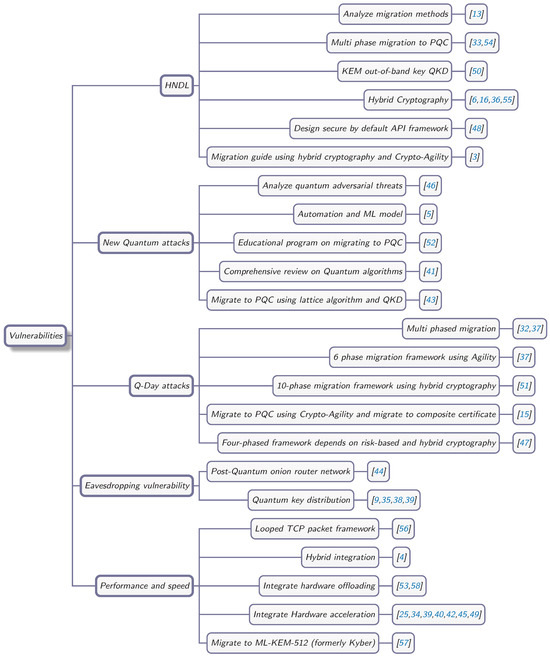
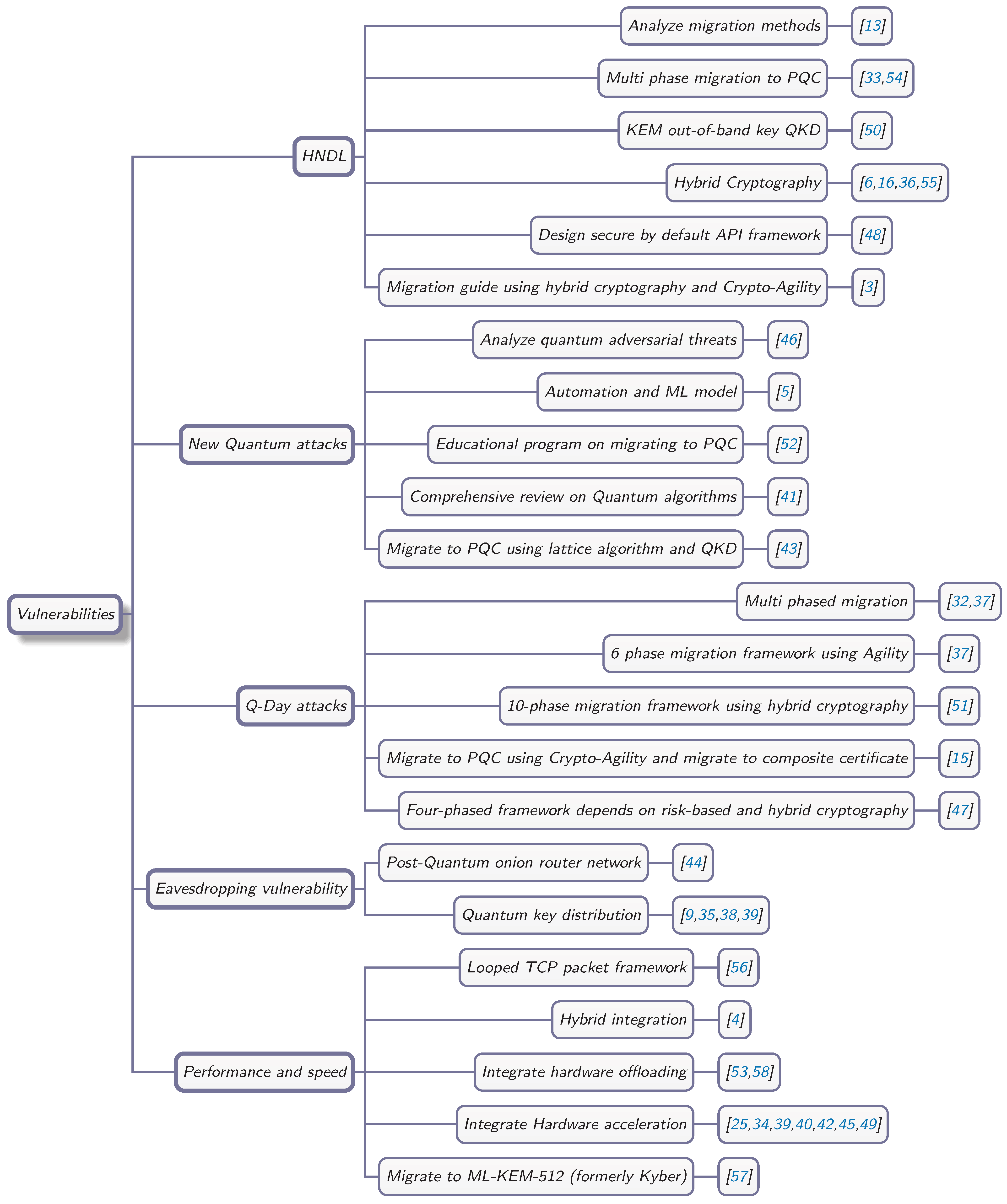
Moreover, there are various PQC methods for securing network communications; each is deployed based on the system’s vulnerabilities, goals, and objectives, which must be identified before remedies are proposed. Moreover, Figure 1 illustrates a taxonomy of the most common vulnerabilities in traditional cryptographic methods and the solutions proposed by previous researchers, as discussed in detail in this section. The taxonomy summarizes various solutions to address these vulnerabilities and validates the effectiveness of integrating PQC.
Figure 1.
Taxonomy of related works summary.
Integrating a dynamic PQC framework that uses ML-DSA and TLS, using Crypto-Agility and automation, is novel compared to existing PQC migration studies, where other studies have used different types of PQC algorithms such as SPHINCS; they have been avoiding ML-DSA because it has a large signature size, which ranges from around 2420 bytes to 4627 bytes; it is considered fast, but it has a larger signature size than others. This paper aims to tackle this issue by using Crypto-Agility to focus on each asset at a time and deploy a different type of ML-DSA depending on the objective of the asset, such as whether the asset is a QR code of medium level sensitivity data; if it is, then the proposed framework uses ML-DSA-44 with a signature of size 2420 bytes, which is a larger size than traditional cryptography methods used for QR codes and can be an acceptable trade-off for the increase in security and protection over medium-level sensitive data (such as the QR codes for prompting users to enter data such as a registration forms). In the case of high-level sensitivity data, the PQC type used is ML-DSA-87 with a signature size of 4627 bytes, and in the case of low-level sensitivity data, this research uses PQC TLS; in this case, there is no need to integrate ML-DSA, as it would be too large for it. It would not be suitable for low-sensitivity data, as there is no need for a high level of cybersecurity protection for low-sensitivity data; therefore, the PQC type is integrated based on the asset’s objective. It is crucial to deploy the suitable type of PQC for a suitable asset objective because deploying the same type for all would be a waste of resources. Therefore, researchers have recommended deploying a dynamic system for integrating ML-DSA, and that is what the proposed framework is aiming for. Additionally, they recommend deploying Crypto-Agility to address excessive size when integrating PQC; this approach has helped conserve resources, such as energy. Table 3 presents prior work related to PQC migration (some researchers have used Crypto-Agility and automation), along with the limitations of each method deployed.
Table 3.
Literature review summary of PQC migration.
3. Methodology
This paper aims to address the most significant vulnerabilities of current traditional cryptography methods. These vulnerabilities have put cryptographic security at risk from quantum attacks, such as Shor’s algorithm, which could undermine the security of traditional cryptographic methods. PQC could provide solutions and enhance overall security. Based on previous work by other researchers, harvest-now-decrypt-later and eavesdropping are among the most crucial vulnerabilities and threats that put a system and data at risk. This emphasizes the need to identify and rank these vulnerabilities as the highest priority for mitigation, as they could jeopardize confidentiality, authentication, integrity, and data privacy.
Based on the previous sections, it was shown that migration from traditional algorithms to PQC should be carried out by selecting the appropriate PQC type based on the asset to avoid wasting resources and lagging; furthermore, the migration should be carried out in stages, using the Crypto-Agility framework. The first stage should be to rank the system vulnerabilities, and then deploy a remedy for each vulnerability at each stage, starting with the highest risk. Researchers have found that this framework provides greater time flexibility and reduces costs and resource waste. Therefore, this paper proposes a framework for PQC migration using Crypto-Agility and automation. The framework is detailed in Section 4.3.
3.1. Research Questions
The following questions are addressed in this study:
RQ1: What are the system vulnerabilities that require migration to post-quantum cryptography?
RQ2: When is it recommended for systems to migrate to post-quantum cryptography?
RQ3: How should systems integrate a migration to post-quantum cryptography?
3.2. Search Strategy
The search strategy used throughout this paper to address the research questions is illustrated in the PRISMA flow diagram in Figure 2. This systematic review was conducted in accordance with the PRISMA 2020 guidelines. The complete PRISMA 2020 reporting checklist, documenting adherence to each of the 27 items of the guideline, is provided in the Supplementary Materials. The search began on 17 October 2025, with regular searches to keep up to date with new publications, and it ended in May 2026. The search was conducted in databases such as Google Scholar, the Imam Abdulrahman Bin Faisal University library, IEEE, MDPI, and Springer, given their extensive coverage of fields such as cybersecurity and PQC. Searches were conducted using keywords such as the following:
- (“PQC” OR “Post-Quantum Cryptography”);
- (“PQC” OR “Post-Quantum Cryptography”) AND (“PQC vulnerabilities” OR “PQC integration”);
- (“harvest-now-decrypt-later” OR “HNDL”);
- (“Traditional cryptography algorithm vulnerabilities”);
- (“Q-Day”).
Figure 2.
PRISMA flow diagram for search strategy.
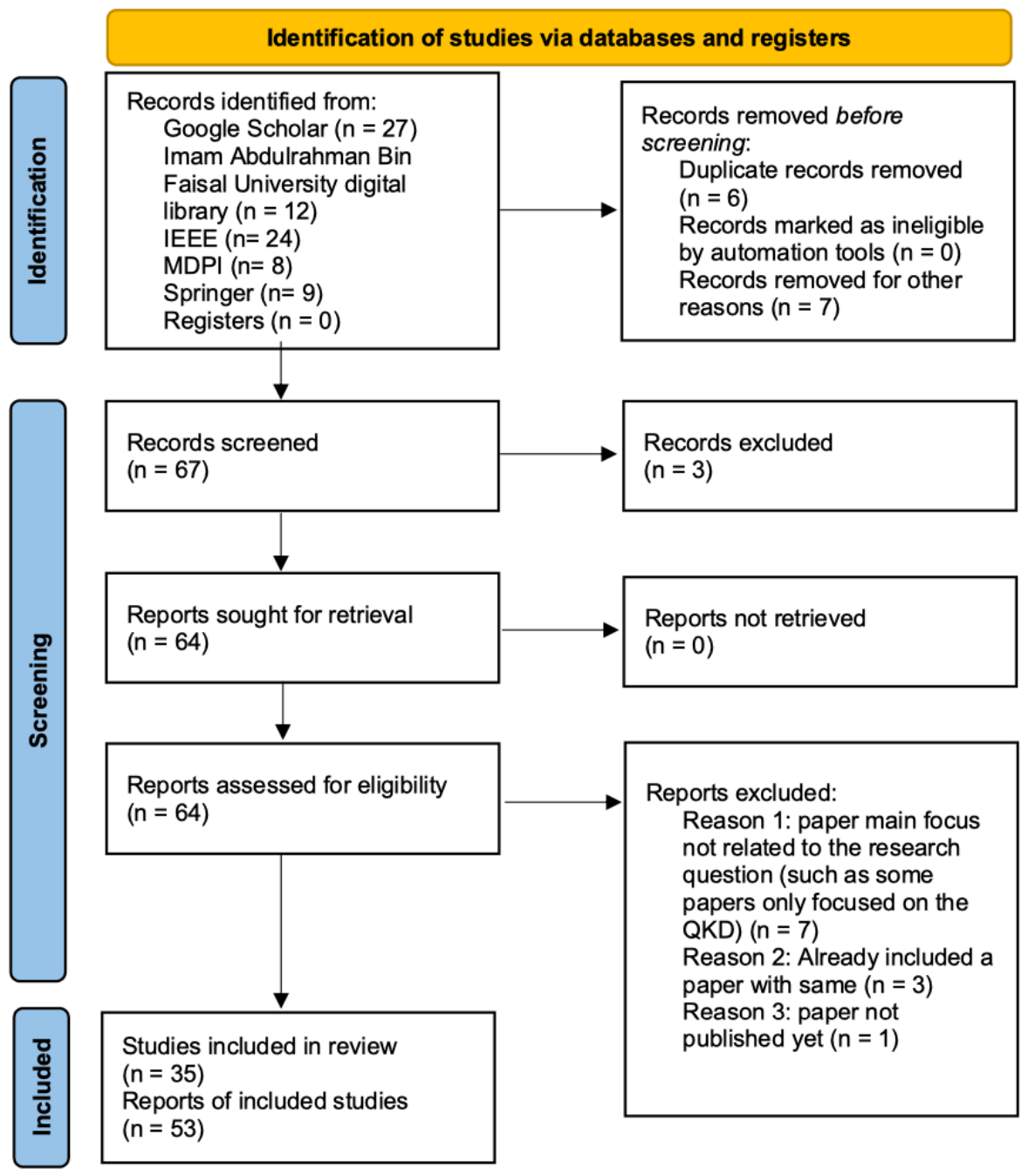
Then, the number of resulting papers was 80; after removing the 6 duplicated papers, along with 7 papers that were not related to the research questions, only the papers that had a main focus on QKD, PQC, and cryptography were included, resulting in 67 papers.
For each of the 67 papers, the quality assessment criteria were based on reviewing the abstract to determine whether it was relevant to these research questions, and then verifying whether the paper was already included in this research; it mentions PQC. The next step is the screening stage, where the papers are read in detail to address this paper’s research questions. A total of 11 papers were excluded because their main topic was not related to this paper’s research question, such as papers that focus only on key distribution, papers that are not yet published, or papers whose publication date is outdated; finally, this resulted in 53 papers.
3.3. Selection Criteria
For the papers selected through search engines and academic journals, we used the methods described in the previous section to filter them for relevance to post-quantum cryptography. This included papers that mentioned quantum computing, PQC, PQC protocols and algorithms, traditional algorithm vulnerabilities, Q-Day, and NIST recommendations for migrating to PQC. It excluded any papers that did not focus on quantum computing and PQC, as this is the paper’s main focus.
3.4. Data Extraction
The data in Table 2 have been extracted to summarize each paper used in the analysis, providing a comprehensive overview of the main points of each paper selected. The summarization included each paper’s main focus, problem, solution, advantages of the deployed solution, and limitations.
4. Results
This section discusses the results of the research questions of the paper.
4.1. What Are the System Vulnerabilities That Require the Migration to Post-Quantum Cryptography?
There are various system vulnerabilities in traditional cryptographic algorithms that can be addressed by post-quantum cryptography, including reliance on mathematical problems such as discrete logarithms and integer factorization. These vulnerabilities would make cryptographic methods that depend on these algorithms, such as the symmetric algorithm AES, vulnerable with the introduction of quantum computing. Breaking these mathematical algorithms is achievable using a regular computer; it would take a long time for attackers to break the encryption, probably even years, but with quantum computing, it would be so fast that it could take days, hours, minutes, or even seconds, using algorithms such as Shor’s algorithm. This is because the algorithms would be using the principle of superposition. Another vulnerability is symmetric cryptography, such as AES; this is vulnerable to brute-force attacks, but professionals have deployed various methods to enhance security and defend against it. Regarding passwords, users are prompted to choose a strong password that contains symbols, numbers, letters in uppercase and lowercase, and to update their password every 3 months. By following these measures, they could increase security. With traditional brute-force attacks, it would take attackers longer to get through when the previously mentioned regulations are followed; the attacks might take months, even years, to crack a password or encrypted message. By the time the attacker figures out the password, the user would have updated it, meaning the attacker would have to start over. However, with quantum computing, the attack would be much faster; it has exponential time complexity and tries half the possible values, so by the time it reaches the halfway point, the attacker should not be able to break the encrypted message. This is achieved using the Grover algorithm, which can break the encryption using a brute-force attack, and it is faster than trying all possible secret keys.
Conceptually, all algorithms that depend on the mathematics of integer factorization would be breakable because quantum computing would provide an exponential speed-up. Nowadays, quantum computing is not accessible to everyone; therefore, attackers are storing encrypted data to decrypt it later. This vulnerability is known as harvest-now-decrypt-later (HNDL). Attackers are harvesting leaked data by breaking into systems to collect encrypted data and storing it for later use. Despite the strong encryption of some traditional algorithms, they are vulnerable to quantum computing; therefore, researchers have created post-quantum cryptography algorithms to be used on the current data, so even if attackers have harvested data for Q-Day, post-quantum cryptography is expected to provide a high level of protection against breaking it using quantum computing.
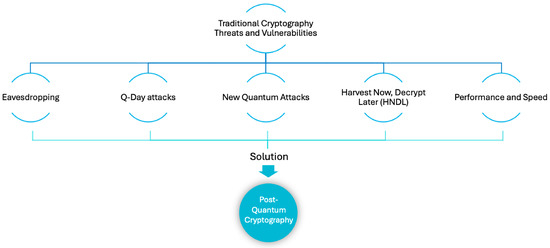
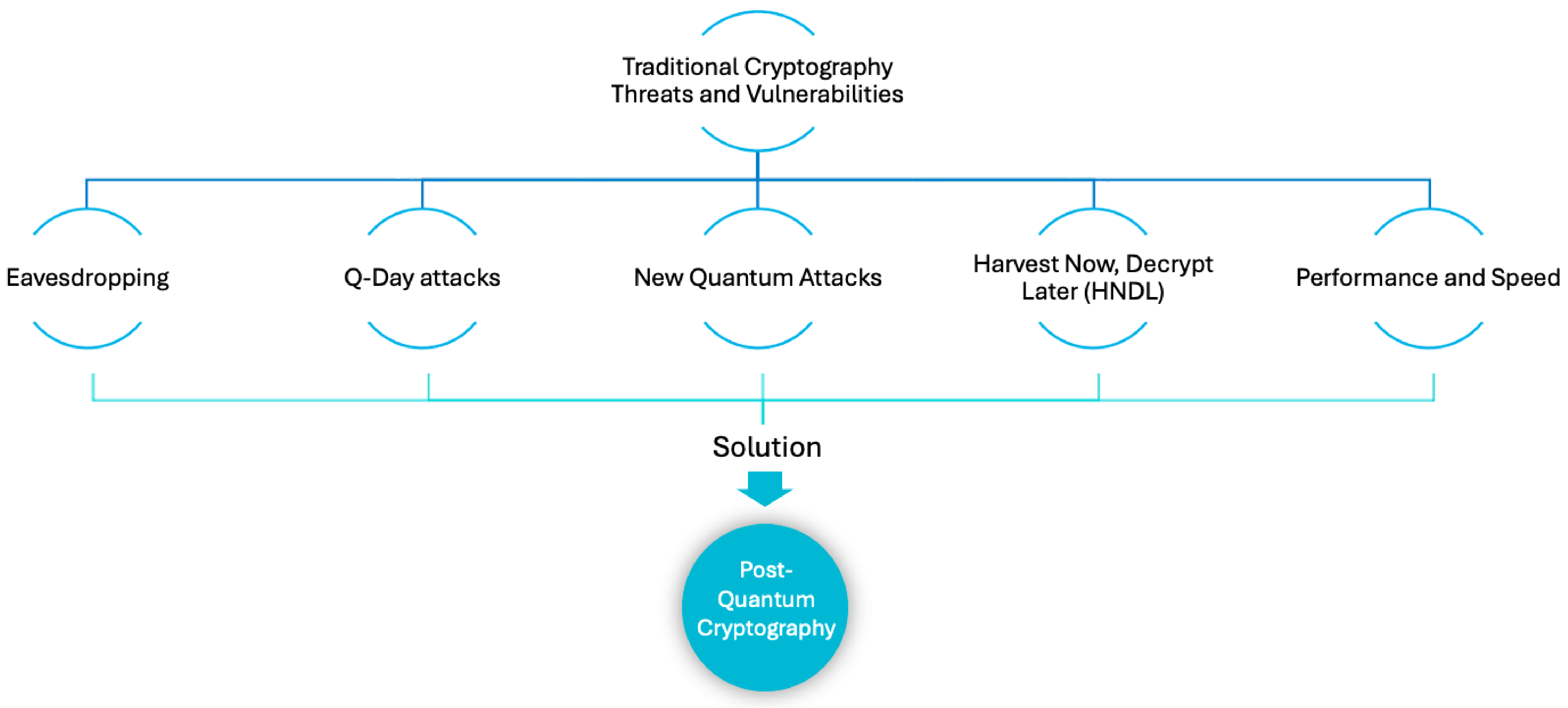
However, this paper has analyzed some of the most serious vulnerabilities and threats that could bring systems down, jeopardize their reputation and infrastructure security, and affect confidentiality, integrity, authentication, and privacy; these include eavesdropping, harvest-now-decrypt-later, and Q-Day attacks. Moreover, eavesdropping attacks using quantum computing on systems that use traditional cryptography methods would increase the chance of the communication data being decrypted by the attacker. Therefore, the migration to PQC should protect the system’s future communications from such attacks and increase protection for the data being transferred. The following Figure 3 is a taxonomy that presents a comprehensive overview of the research question.
Figure 3.
The taxonomy of research question 1.
4.2. When Is It Recommended for Systems to Migrate to Post-Quantum Cryptography?
NIST has issued a recommendation to start immediately migrating to PQC, with a deadline of 2030. For now, they are only recommending the migration, and by 2030, they might start enforcing the migration of systems. With new quantum attacks and the expected Q-Day, when attackers will attack systems to harvest data and decrypt it later, it is important to migrate systems now to protect data from future exploitation and enhance security.
Another vulnerability is the harvest-now-decrypt-later model, in which attackers collect data from various systems until Q-Day, when it will then be easier to decrypt. Even the strongest traditional cryptography methods used today might be decrypted using quantum computing. This is a major vulnerability to systems’ data, as it might not be detected until after Q-Day. Q-Day has not yet been dated exactly, but researchers have predicted it might occur in the next couple of years. Therefore, it is recommended that current systems begin migrating to defend against future attacks while there is still time before reaching Q-Day.
4.3. How Should Systems Integrate the Migration to Post-Quantum Cryptography?
This section proposes a model framework for migrating to PQC. This paper has focused on proposing a conceptual model without testing; experiments and testing are planned for future work. The goal is to upgrade company systems with the least consequences and at the lowest cost, loss, and resource use. Therefore, the paper recommends using Crypto-Agility, which is crucially beneficial to companies’ resources regarding waste [5,54] and investing the right amount at the right time. Large enterprises would have multiple projects running simultaneously, so conducting PQC migration would not be adequate for them. Therefore, deploying Crypto-Agility is the solution for such problems; it allows enterprises to keep running their other projects while conducting the migration [15,32] by migrating sequentially, one asset at a time. This would allow flexibility and would decrease losses [48] in resources, cost [36], and timing, and defend against HNDL [3] and increase protection on Q-Day [37]. It should help the system reach the goal while incurring the lowest possible losses. Having it carried out in stages would help handle unexpected issues as they arise and resolve them early, rather than migrating the whole system at once. Issues could be hidden between chunks of data, making them harder to detect. Researchers have migrated to PQC using Crypto-Agility to enforce a dynamic, phased approach: migrate each asset individually, test and audit, and then move on to the next asset once the migration is successful.
Technology is revolutionizing how we get tasks done, making actions more efficient and with minimal consequences. As a result, automation is used for sequential, repetitive, time-consuming tasks that can lead humans to make unexpected mistakes, take up extensive time, and drain energy from other tasks. When using automation, we reduce human error and free up human energy to focus on the most complex human-judgment tasks. Researchers have used automation for testing to ensure all objects go through the same testing standards [56] and to allow objects to be tested thoroughly against predefined attacks [49], reducing wasted time and effort, with automated robots handling these repetitive tasks and increasing performance speed [54] and allowing a wide range of testing [5,47]. Therefore, automation is incorporated into the proposed method to rely on robots for repetitive tasks and free up human energy for tasks that require judgment. Automation should enforce a more structured, comprehensive, and scalable environment for tasks to be carried out.
Table 4 shows a comparison between ML-KEM (formerly Kyber) and ML-DSA (formerly Dilithium). The migration uses either of them, depending on the asset and whether confidentiality or authentication and integrity are required. These algorithms are among those recommended by NIST and provide a suitable balance between key size and performance. Previous researchers have used ML-KEM (formerly Kyber) to increase encryption security and the security of the key exchange [6,15,16,25,40,49,53,55,56,57,58]. However, ML-KEM (formerly Kyber) has a limitation too, such as encrypted data and keys having a larger size than traditional methods, which could cause a delay in network communication. However, this comes at the cost of increased security to defend against critical attacks such as HNDL. ML-DSA (formerly Dilithium) has been used by previous researchers as a digital signature to increase security, authentication, and integrity. It provides high speed in the verification process, but it has a larger key size than classical algorithm methods [16,25,49,53,58], which provides a smaller digital signature size than the size of the key [40]. It has a limitation of causing bandwidth overhead due to the size of the digital signature [15], and with blockchain, it can consume a large amount of energy during transmission [55].
Table 4.
PQC algorithms overview.
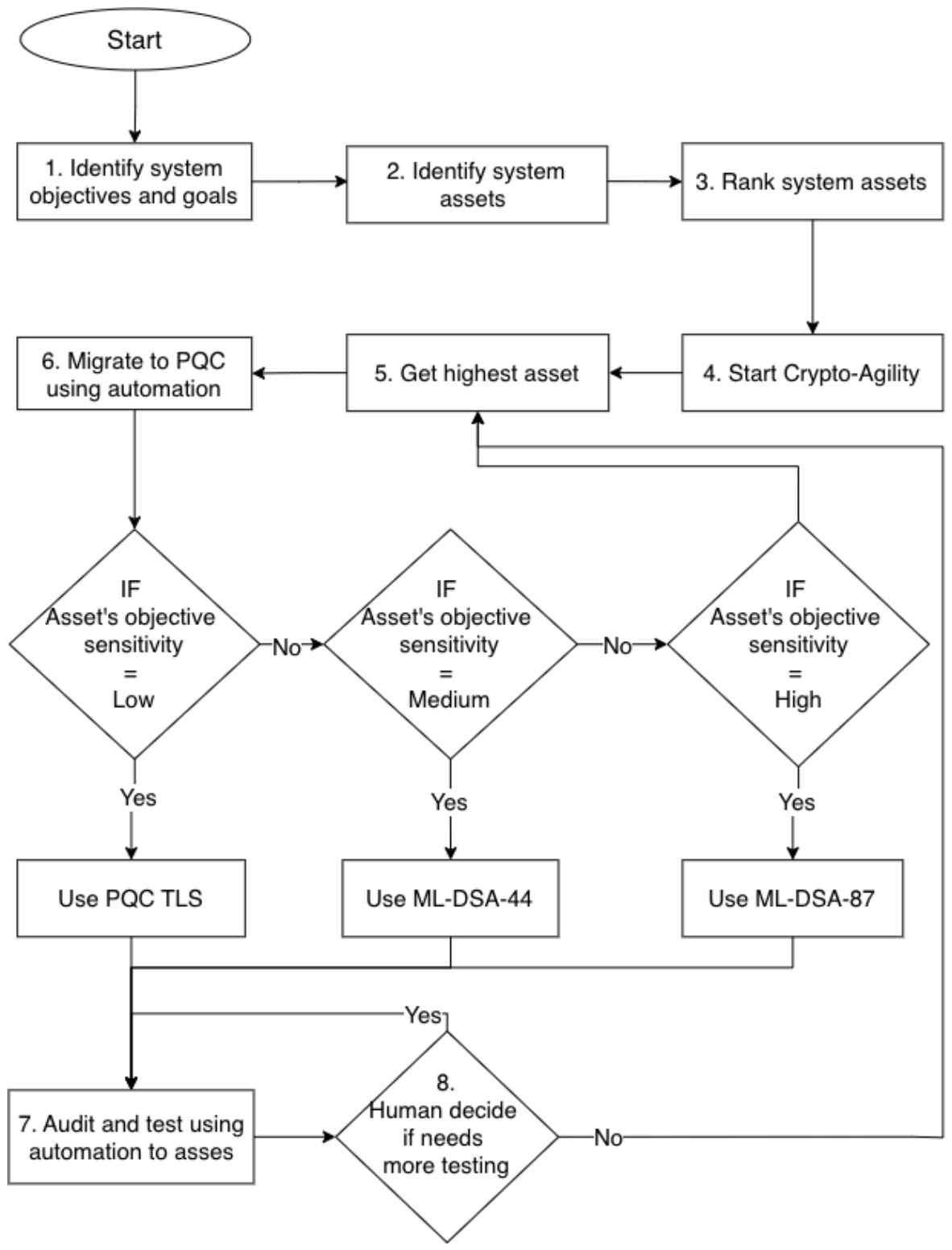
The proposed model would begin with company employees identifying system objectives and goals, laying the groundwork for a solid plan to achieve them. Identify the company’s assets and rank them by their highest sensitivity. Then, after clarifying the main aspects and establishing the goals, the proposed model aims to achieve the company’s objectives and the most sensitive standards it uses. These steps are fully human-based; they require the employee to identify them thoroughly, and then the model applies the Crypto-Agility framework. It starts the first loop by focusing on the highest asset; after identifying it, it then migrates to PQC by replacing the currently used cryptographic algorithms with PQC algorithms. The paper recommends that, if the company prioritizes authentication and integrity, it should use ML-DSA (formerly Dilithium) for digital signatures. If it prioritizes confidentiality, it should use ML-KEM (formerly Kyber) for encryption. These two algorithms are recommended for their suitability in providing high performance without requiring a large key size and increasing the security of the assets. The proposed model uses automation to assist with re-keying and rotating QR code certificates. After the migration, the automation process continues to audit and test. After testing is carried out, the employee should review the data analysis to determine whether to continue testing or whether the migration is a success. If so, the migration loop moves on to the next-highest asset and repeats until all assets have been migrated. The following is a summary of the steps of the proposed framework model. Figure 4 illustrates a flow diagram of the framework, and Figure 5 presents a detailed flowchart.
- Identify system objectives and goals.
- Identify assets.
- Rank assets based on the highest sensitivity.
- Begin the Crypto-Agility framework (loop all assets).
- Select the highest-priority asset.
- Migrate to PQC using automation for tasks such as re-keying endpoints.
- Audit and test using automation to assist in testing.
- A human decides whether testing is carried out or if it needs more.
- If yes, repeat point 7.
- If no, testing is completed; proceed to point 5 to obtain the next highest asset.
Figure 4.
Proposed model framework diagram.
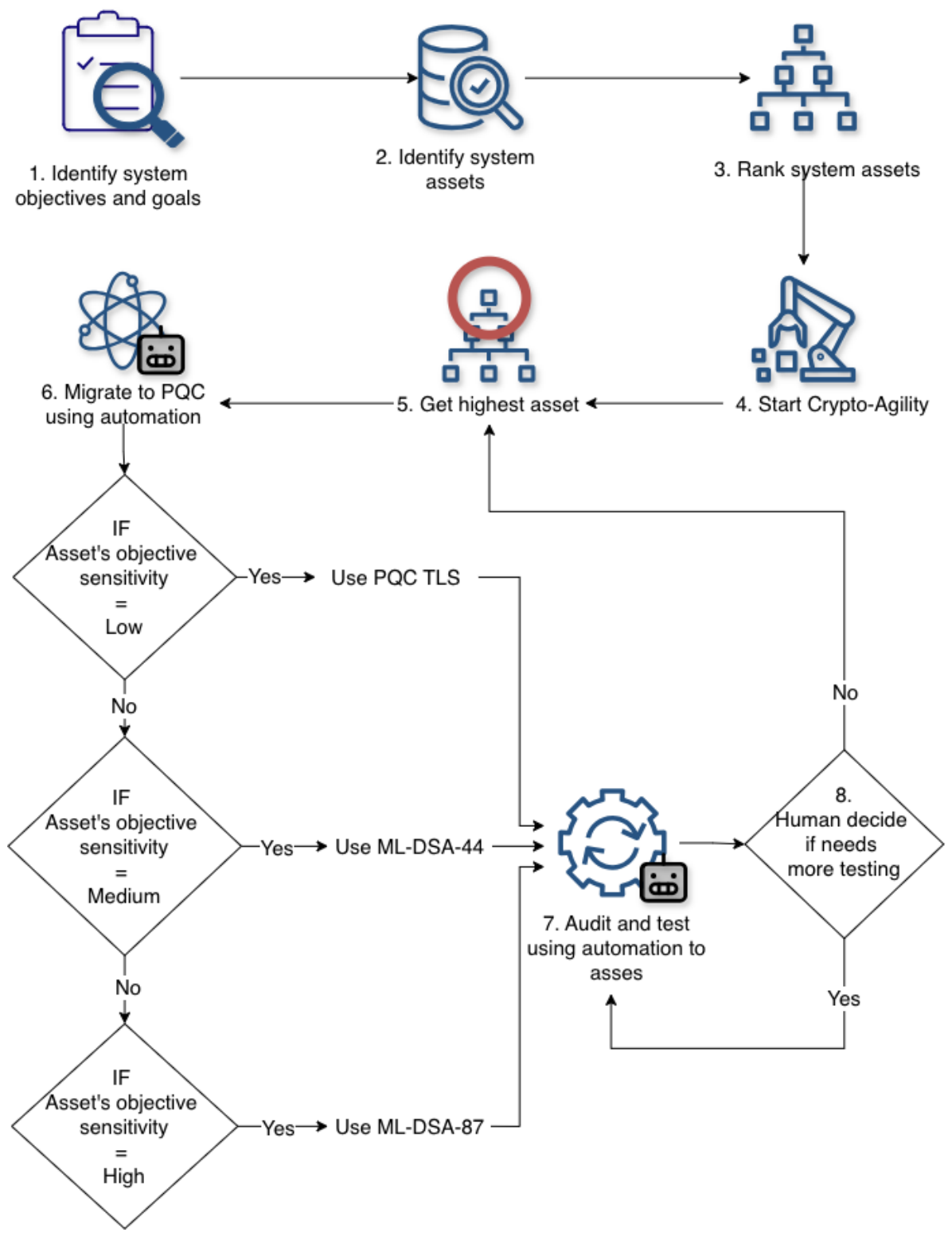
Figure 5.
Proposed model framework flowchart.
Automation plays a crucial role in the framework by reducing migration risks, reducing time, minimizing manual human involvement, reducing errors, and improving operational quality and performance. Automation is a good addition for handling or taking over repetitive, time-consuming tasks; it does not eliminate human involvement, but it reduces it. Human involvement is limited to overseeing task completion, intervening when necessary, tracking everything, and reviewing reports. Instead of doing a day’s worth of tasks, they conduct only a couple of hours’ worth of check-ups and audits to get an overview of what’s been done. Therefore, the automation handles migration for each asset. Automation has various tools for operation; in the proposed model framework, UiPath is selected due to its compatibility with the framework’s needs, as it can migrate to PQC while keeping in contact with the designated employees, such as the IT admin, keep track of the transaction details, alert the IT admin when needed, and generate reports.
4.4. Use Case Scenario
The migration will start when the employee sends a request to the robot to start automation using an Excel sheet table, and the employee fills in the requested data. The Excel file contains data such as the system asset ID, asset type, asset objective, asset priority, etc. This data can be adjusted depending on the organization, and during the development of the automation robot, the employee will define the list of data objectives. There should be a fixed category list, based on which the PQC type is determined as PQC-TLS, ML-DSA-44, or ML-DSA-87.
It starts with the robot reading the Excel file and ensuring that all necessary data is filled in. If any data is missing, the robot sends an email to the IT admin to correct it and resend it. Otherwise, it continues to loop through the table data and, for each row containing asset details, performs the migration to the PQC.
Furthermore, if the asset were a QR code, each branch of an organization would use a different one for registration forms. Therefore, for each asset, the automation robot will re-key it to PQC keys and rotate the certificate to PQC, turning off traditional cryptographic methods, testing, and auditing. The following illustrates the steps of the use case scenario:
- The robot runs lines of code to generate a new quantum key.
- The robot gets the original QR code’s embedded data, such as the registration form’s URL.
- The robot combines, in one string, the newly generated quantum key with the original data and a PQC signature; the signature is decided based on the QR code objective: if it was only for reviewing data such as menus, then use PQC-TLS; if it was for registration forms, then it uses ML-DSA-44; if it was for highly sensitive data or payment, then it uses ML-DSA-87.
- The robot generates a new QR code.
- The robot updates the system with the new QR code.
- The robot runs tests to validate the success of the migration.
- It sends an email to the IT admin with the current transaction details.
- The IT admin needs to check this manually so that the robot can mark the migration as done or retry testing.
- The IT admin must respond to the robot, either to request the robot to conduct more testing or to confirm that the migration is a success.
- If the IT admin responds with more testing, the robot will repeat step 6. If the response indicates that the migration was successful, it will move on to the next asset.
- After all data are migrated, the robot creates a report and sends it to the IT admin.
Therefore, the robot assists the employee, who only needs to take a quick look to confirm the migration’s success. Human involvement remains essential at this step to ensure migration quality and prevent major errors. For instance, IT should be involved if an issue such as system lag is detected during auditing. In this case, the IT team would investigate the cause of the lag. If the issue is due to limited available storage, the IT administrator should procure and install a new hard drive with greater capacity.
After the robot processes all the requested data in the Excel file and successfully migrates all QR codes, it generates an output report. This report is an Excel table that provides detailed information, including the migration start and end times, the number of testing rounds conducted, user responses with timestamps, and other related details. This data gives the IT admin a clear overview of actions taken and their timing, enabling thorough review and analysis to determine whether adjustments are needed.
The exact steps for re-keying endpoints and rotating certificates would differ based on the assets, and this is a step to be handled in the development of the robot automation to develop exactly what is needed based on the organization, the system, and the assets required for migration to PQC.
4.5. Limitations
The migration to PQC has various limitations that would depend on the systems and data. However, the most identified limitation is the shortage of quantum computing professionals. Because it is a new technology and people are still getting used to it, there are not many experts. The migration might involve complex computations that might require an expert. Moreover, it might require specialized resources, which could be expensive for some systems.
Companies already have the traditional cryptography algorithm installed. If they had to migrate to PQC, it would require them to hold meetings to discuss the plan, requirements, timetable, resources needed, and cost; what most companies try to avoid is a high cost. They would prefer the strongest technologies at a lower cost, with high performance and fast integration. Therefore, most companies are still ignoring PQC migration until they are forced to do it. However, even though the migration requires significant resources, ignoring it until Q-Day or quantum attacks would have more severe consequences. Therefore, companies should conduct an in-depth analysis of their systems to identify the need for PQC migration and avoid future consequences that could harm their data and reputation.
5. Future Work and Conclusions
In conclusion, the current systems that use traditional cryptographic methods are at risk of data being decrypted using eavesdropping attacks, harvest-now-decrypt-later attacks, or Q-Day attacks. These systems should migrate to PQC to enhance security and address these vulnerabilities, using a multi-phased framework that emphasizes Crypto-Agility and automation to reduce costs and resource waste. The proposed framework model starts by identifying the company’s objectives, goals, and assets, and then ranks the assets by highest sensitivity. It then initiates Crypto-Agility by selecting the highest-priority asset and migrating it using automation. The migration would be carried out using ML-KEM (formerly Kyber) or ML-DSA (formerly Dilithium) depending on the asset’s priority. Afterward, testing and auditing would also be automated to establish a structured testing environment for all assets. Lastly, human judgment is required to review whether the migration was a success; then, automation is prompted to continue to the next asset for migration or prompt testing and audit automation. However, PQC migration is too expensive, requires significant resources, and relies on quantum computing professionals for complex computations.
Therefore, for future work, this paper recommends conducting experiments and testing on the proposed model to validate its strengths and weaknesses. In addition to conducting a case study of a real-world company that uses traditional cryptographic algorithms, it is recommended to integrate PQC migration using Crypto-Agility and analyze a system’s performance, efficiency, and attack resistance before and after the migration to understand the effectiveness of the PQC migration. Moreover, there is a shortage of experts in quantum computing because the field is new. Moreover, the paper recommends creating a machine learning model that scans system logs and network traffic to identify vulnerabilities and sensitive data, analyze attack complexity, and rank vulnerabilities by priority for PQC migration first. This should help professionals during the migration process to save time, energy, and resources.
Supplementary Materials
The following supporting information can be downloaded at https://www.mdpi.com/article/10.3390/network6030070/s1: File S1: The PRISMA Checklist.
Author Contributions
Conceptualization, T.A.; methodology, T.A.; validation, N.N.; formal analysis, N.N.; investigation, N.N. and A.A.; data curation, N.N.; writing—original draft preparation, T.A.; writing—review and editing, N.N. and A.A.; supervision, A.A.; project administration, A.A. All authors have read and agreed to the published version of the manuscript.
Funding
We would like to thank the Saudi ARAMCO Cybersecurity Chair for funding this project.
Data Availability Statement
No new data were created or analyzed in this study. Data sharing is not applicable to this article.
Conflicts of Interest
The authors declare no conflicts of interest.
Abbreviations
The following abbreviations are used in this manuscript:
| PQC | Post-Quantum Cryptography |
| HNDL | Harvest-Now-Decrypt-Later |
| Q-Day | Quantum Day |
| KEM | Key Encapsulation Mechanism |
| QKD | Quantum Key Distribution |
| AI | Artificial Intelligence |
References
- Zhou, J. Quantum Finance: Exploring the Implications of Quantum Computing on Financial Models. Comput. Econ. 2026, 67, 1043–1072. [Google Scholar] [CrossRef] [Scilit]
- Giraldo-Quintero, A.; Sierra-Sosa, D.; Imam, I.; Elmaghraby, A.S. Quantum Computing Optimization: An Introduction. IEEE Access 2026, 14, 63363–63393. [Google Scholar] [CrossRef] [Scilit]
- Kuka, C.; Muhyaddin, S.; Lee Teh, P.; Davies, L. Global Roadmaps for Post-Quantum Era in Finance: Policies, Timelines, and a Pragmatic Playbook for Migration. FinTech 2026, 5, 16. [Google Scholar] [CrossRef] [Scilit]
- Talha, M.; Bajwa, T.; Afzal, M.N.; Afzal, M.H.; Ullah, M.S.; Umar, T.; Maqsood, H.; Nabeel, M.; Muhammad, A.; Ullah, S. Post-quantum cryptography for big data security. Asian Bull. Big Data Manag. 2025, 5, 81–94. [Google Scholar] [CrossRef] [Scilit]
- Alam, N.; Shakil, F.; Ahmed, I.; Mia, R. Data Science Approaches to Quantum Vulnerability Assessment and Post-Quantum Cryptography Schemes. Sage Sci. Rev. Appl. Mach. Learn. 2024, 7, 144–161. [Google Scholar]
- Mamun, A.A.; Abrar, A.; Rahman, M.; Salek, M.S.; Chowdhury, M. Post-quantum cryptography for intelligent transportation systems: An implementation-focused review. Veh. Commun. 2026, 60, 101028. [Google Scholar] [CrossRef] [Scilit]
- Gorine, A.; Suhaib, M. Exploring AES Encryption Implementation Through Quantum Computing Techniques. Am. J. Comput. Sci. Technol. 2024, 7, 139–155. [Google Scholar] [CrossRef] [Scilit]
- Babbush, R.; Zalcman, A.; Gidney, C.; Broughton, M.; Khattar, T.; Neven, H.; Bergamaschi, T.; Drake, J.; Boneh, D. Securing Elliptic Curve Cryptocurrencies against Quantum Vulnerabilities: Resource Estimates and Mitigations. arXiv 2026, arXiv:2603.28846. [Google Scholar] [CrossRef] [Scilit]
- Ul Ain, N.; Waqar, M.; Bilal, A.; Kim, A.; Ali, H.; Ullah Tariq, U.; Shahroz Nadeem, M. A Novel Approach Based on Quantum Key Distribution Using BB84 and E91 Protocol for Resilient Encryption and Eavesdropper Detection. IEEE Access 2025, 13, 32819–32833. [Google Scholar] [CrossRef] [Scilit]
- Al-Kuwari, A.; Mohamed, N.; Al-Kuwari, S.; Farouk, A.; Behera, B.K. Resisting Quantum Key Distribution Attacks Using Quantum Machine Learning. IET Quantum Commun. 2026, 7, e70028. [Google Scholar] [CrossRef] [Scilit]
- Omshankar; Venkataraman, V.; Ghosh, J. Robust hybrid-entanglement for misalignment-resilient free-space QKD. APL Quantum 2025, 2. [Google Scholar] [CrossRef] [Scilit]
- Kagai, F.; Branch, P.; But, J.; Allen, R. Harvest-Now, Decrypt-Later: A Temporal Cybersecurity Risk in the Quantum Transition. Telecom 2025, 6, 100. [Google Scholar] [CrossRef] [Scilit]
- Mascelli, J.; Rodden, M. “Harvest Now Decrypt Later”: Examining Post-Quantum Cryptography and the Data Privacy Risks for Distributed Ledger Networks. Financ. Econ. Discuss. Ser. 2025. [Google Scholar] [CrossRef] [Scilit]
- Cherkaoui Dekkaki, K.; Tasic, I.; Cano, M.D. Exploring Post-Quantum Cryptography: Review and Directions for the Transition Process. Technologies 2024, 12, 241. [Google Scholar] [CrossRef] [Scilit]
- Patel, A.; Upadhyay, A.; Vashishth, A.; Aggarawal, D.; Vishwakarma, H. Architectural Integration and Strategic Risk Management of Post-Quantum Cryptography in Hybrid Enterprise Networks: A Systematic Review of Crypto-Agility, Implementation, and Policy Compliance. DMPedia Lect. Notes Multidiscip. Res. 2026, 1, 494–515. [Google Scholar] [CrossRef]
- Kalaiselvi, N.; Prasaad, S.S.; Jayakandhan, A.; Madhan, C. A Resilient Post Quantum Key Management System for Cloud-based SaaS using CRYSTALS-Kyber and Dilithium. In Proceedings of the International Conference on Artificial Intelligence and Secure Data Analytics (ICAISDA 2025); Atlantis Press: Paris, France, 2026; pp. 1488–1503. [Google Scholar] [CrossRef] [Scilit]
- Başol, A.E.; Bahtiyar, Ş.; Sandikkaya, M.T. Effects of Post Quantum Cryptography on Financial Blockchains. In Proceedings of the 2025 10th International Conference on Computer Science and Engineering (UBMK); Institute of Electrical and Electronics Engineers (IEEE): New York, NY, USA, 2025; pp. 1380–1385. [Google Scholar] [CrossRef] [Scilit]
- Shirisha, N.; Manoj, H.M.; Hussain, S.J.; Kotoju, R.; Kolikipogu, R.; Mohan, A. Post-quantum security framework for resource-constrained systems: Emerging trends, challenges, sustainability, and future directions. Discov. Comput. 2026, 29, 85. [Google Scholar] [CrossRef] [Scilit]
- Khaled, H.; Metawei, M.A.; Saif, S.M.; Taher, M.; Nassar, S.M. Unveiling the Threat: Quantum Factorization Techniques and Their Impact on RSA Cryptosystems. In Proceedings of the 2025 International Telecommunications Conference, ITC-Egypt 2025; Institute of Electrical and Electronics Engineers Inc.: New York, NY, USA, 2025; pp. 48–55. [Google Scholar] [CrossRef] [Scilit]
- Fernandes, K.R.; Shreyas, S.; Sinchana, S.; Sathish, D.; Kamath, V.; Sanjana. Implementation of RSA Algorithm using FPGA and Analysis of Post Quantum Cryptography. In Proceedings of the International Conference on Electrical Engineering and Informatics; Institute of Electrical and Electronics Engineers Inc.: New York, NY, USA, 2025. [Google Scholar] [CrossRef] [Scilit]
- Santa Quintero, R.A.; Meneses Velandia, S.L. Integrating Post-Quantum Cryptography in Document Lifecycle Management. In Proceedings of the 2025 8th International Conference on Systems Engineering-Cybersecurity & AI: Building a Reliable Digital Future; Association for Computing Machinery (ACM): New York, NY, USA, 2025; pp. 47–52. [Google Scholar] [CrossRef] [Scilit]
- Choudhury, B.; Hota, A.; Karmakar, M.; Saha, S.; Nag, A.; Nandi, S. A Comprehensive Survey on Pre Versus Post Quantum Security Schemes for 5G-Enabled IoT Applications. IEEE Access 2025, 13, 159305–159333. [Google Scholar] [CrossRef] [Scilit]
- Anand, A.; Hassabnis, A. Qcrypt: Leveraging Post-Quantum Cryptography for Enhanced Security of Data at Rest. In Proceedings of the 2024 15th International Conference on Computing Communication and Networking Technologies, ICCCNT 2024; Institute of Electrical and Electronics Engineers Inc.: New York, NY, USA, 2024. [Google Scholar] [CrossRef] [Scilit]
- Moody, D.; Perlner, R.; Regenscheid, A.; Robinson, A.; Cooper, D. Transition to Post-Quantum Cryptography Standards; Technical report; National Institute of Standards and Technology: Gaithersburg, MD, USA, 2024. [CrossRef] [Scilit]
- Truong, Q.D.; Nguyen, H.; Nguyen, T.T.; Lee, H. NIST Post-Quantum Cryptography Standards: A Comprehensive Review of Theoretical Foundations and Implementations. IEEE Access 2026, 14, 14069–14097. [Google Scholar] [CrossRef] [Scilit]
- Wang, J.; Yang, W.; Chen, G.; Zhou, J.; Ding, W. Security Analysis and Defense of Multi-Encoding Mechanism Against Eavesdropping Attacks. IEEE Trans. Netw. Sci. Eng. 2025, 12, 3758–3769. [Google Scholar] [CrossRef] [Scilit]
- Farraj, A.; Hammad, E. Noise-Based Active Defense Strategy for Mitigating Eavesdropping Threats in Internet of Things Environments. Computers 2025, 14, 6. [Google Scholar] [CrossRef] [Scilit]
- Ramakrishna, D.; Ali Shaik, M. A Comprehensive Analysis of Cryptographic Algorithms: Evaluating Security, Efficiency, and Future Challenges. IEEE Access 2025, 13, 11576–11593. [Google Scholar] [CrossRef] [Scilit]
- Ahn, J.; Hussain, R.; Kang, K.; Son, J. Exploring Encryption Algorithms and Network Protocols: A Comprehensive Survey of Threats and Vulnerabilities. IEEE Commun. Surv. Tutor. 2025, 27, 3587–3614. [Google Scholar] [CrossRef] [Scilit]
- Okika, N.; Nwatuzie, G.A.; Olarinoye, H.S.; Nwaka, U.A.; Igba, E.; Dunee, R. Assessing the Vulnerability of Traditional and Post-Quantum Cryptographic Systems through Penetration Testing and Strengthening Cyber Defenses with Zero Trust Security in the Era of Quantum Computing. Int. J. Innov. Sci. Res. Technol. 2025, 10, 1240–1258. [Google Scholar] [CrossRef]
- Kandula, S.R. Breaking Traditional Encryption: Quantum Computing Risks to Web and Mobile Applications. Int. J. Adv. Res. Eng. Technol. 2025, 16, 329–342. [Google Scholar] [CrossRef] [Scilit]
- Nather, C.; Herzinger, D.; Gazdag, S.L.; Steghofer, J.P.; Daum, S.; Loebenberger, D. Migrating Software Systems Toward Post-Quantum Cryptography—A Systematic Literature Review. IEEE Access 2024, 12, 132107–132126. [Google Scholar] [CrossRef] [Scilit]
- Freyer, O.; Ostermann, M.; Minssen, T.; Gilbert, S. Quantum cryptography and data protection for medical devices before and after they meet Q-Day. npj Digit. Med. 2025, 8, 620. [Google Scholar] [CrossRef] [Scilit]
- Mamatha, G.; Dimri, N.; Sinha, R. Post-Quantum Cryptography- Securing Digital Communication in the Quantum Era. arXiv 2024, arXiv:2403.11741. [Google Scholar]
- Deshpande, A.; Nalwade, A.; Gutte, V.S.; Patil, D.R. Journeying Through Securing Digital Communication: A Comparative Analysis from Classical to Post-Quantum Cryptography. In Proceedings of the 2024 IEEE International Conference on Blockchain and Distributed Systems Security, ICBDS 2024; Institute of Electrical and Electronics Engineers Inc.: New York, NY, USA, 2024. [Google Scholar] [CrossRef] [Scilit]
- Erol, V. The Strategic Imperative of Quantum Readiness: A Comprehensive Review of Post-Quantum Cryptography. Preprints 2025, 2025091720. [Google Scholar] [CrossRef] [Scilit]
- Muhammad Mushtaher Uddin, S.; Azim, N. Cybersecurity Challenges and Strategic Migration Pathways in the Era of Quantum Computing: Risks, Standards, and Post-Quantum Cryptographic Readiness. Spectr. Eng. Sci. 2025, 3, 131–141. [Google Scholar] [CrossRef]
- Tripathi, T.; Awasthi, A.; Singh, S.P.; Chaturvedi, A. Post Quantum Cryptography and its Comparison with Classical Cryptography. arXiv 2024, arXiv:2403.19299. [Google Scholar] [CrossRef] [Scilit]
- Manimozhi, M.; Mugelan, R.K. Post-quantum AES encryption using ECC points derived from BB84 sifted keys. EPJ Quantum Technol. 2025, 12, 109. [Google Scholar] [CrossRef] [Scilit]
- Ghashghaei, F.R.; Ahmed, Y.; Elmrabit, N.; Yousefi, M. Enhancing the Security of Classical Communication with Post-Quantum Authenticated-Encryption Schemes for the Quantum Key Distribution. Computers 2024, 13, 163. [Google Scholar] [CrossRef] [Scilit]
- Karakaya, A.; Ulu, A. A survey on post-quantum based approaches for edge computing security. Wiley Interdiscip. Rev. Comput. Stat. 2024, 16, e1644. [Google Scholar] [CrossRef] [Scilit]
- Dong, Y.; Tong, L.; Lv, Y.; Wu, H.; Yao, H.; Cao, Q. Post-Quantum Cryptography and TEE for 5G VPN in Power Systems: Assessment and Security. In Proceedings of the 2024 4th International Conference on Artificial Intelligence, Robotics, and Communication, ICAIRC 2024; Institute of Electrical and Electronics Engineers Inc.: New York, NY, USA, 2024; pp. 721–726. [Google Scholar] [CrossRef] [Scilit]
- Khan, M.A.; Javaid, S.; Mohsan, S.A.H.; Tanveer, M.; Ullah, I. Future-Proofing Security for UAVs with Post-Quantum Cryptography: A Review. IEEE Open J. Commun. Soc. 2024, 5, 6849–6871. [Google Scholar] [CrossRef] [Scilit]
- Darzi, S.; Yavuz, A.A. Privacy-Preserving and Post-Quantum Counter Denial of Service Framework for Wireless Networks. In Proceedings of the—IEEE Military Communications Conference MILCOM; Institute of Electrical and Electronics Engineers Inc.: New York, NY, USA, 2024; pp. 1076–1081. [Google Scholar] [CrossRef] [Scilit]
- Latif, M. Breakthrough Solutions for Post-Quantum Security with QC-MDPC Codes. In Proceedings of the 5th IEEE International Women in Technology Conference, WINTECHCON 2024; Institute of Electrical and Electronics Engineers Inc.: New York, NY, USA, 2024. [Google Scholar] [CrossRef] [Scilit]
- Sihare, S.R. Quantum Voice-Based Cyber-Attacks: Threats, Vulnerabilities, and Post-Quantum Mitigation Strategies. Secur. Priv. 2025, 8, e70106. [Google Scholar] [CrossRef] [Scilit]
- Qureshi, A. Risk-Adaptive Framework for Enterprise Post-Quantum Cryptography Readiness and Transition. SSRN 2026, 34. [Google Scholar] [CrossRef] [Scilit]
- Toruan, M.; Shakya, R.D.N.; Tseitkin, S.; Zhao, R.K.; Arachchilage, N. When Security Meets Usability: An Empirical Investigation of Post-Quantum Cryptography APIs. arXiv 2026, arXiv:2602.14539. [Google Scholar] [CrossRef] [Scilit]
- Taj, N.; Masood, A.; Arshad, J. Post-Quantum Cryptography in Intelligent Systems. Spectr. Eng. Sci. 2026, 4, 773–799. [Google Scholar] [CrossRef]
- Chang, S.Y.; Khan, Q. Post-Quantum Cryptography in Networking Protocols: Challenges, Solutions, and Future Directions. Cryptography 2026, 10, 12. [Google Scholar] [CrossRef] [Scilit]
- Bizri, M.E.; Haidar, A.M.; El-Hajj, A.M.; Sliman, L. Institutional Approaches to Post-Quantum Cryptography: A Comparative Analysis of Migration Frameworks. IEEE Access 2026, 14, 3259–3283. [Google Scholar] [CrossRef] [Scilit]
- Steinfeld, R.; Esgin, M.F.; Jagganath, N.; Sakzad, A.; Rudolph, C.; Boorman, J. PQCIP: A Post-Quantum Cryptography Educational Program for Cybersecurity Professionals. In SIGCSE TS 2026—Proceedings of the 57th ACM Technical Symposium on Computer Science Education V.1; Association for Computing Machinery, Inc.: New York, NY, USA, 2026; pp. 1026–1032. [Google Scholar] [CrossRef] [Scilit]
- Elnour, A.A.H. Integrating Post Quantum Cryptography (PQC) for End-to-End Security in Edge and IoT Environments. IEEE Trans. Consum. Electron. 2026, 1. [Google Scholar] [CrossRef] [Scilit]
- Campbell, R. Synchronizing Concurrent Security Modernization Programs: A Systems Integration Framework for Post-Quantum Cryptography, Zero Trust Architecture, and AI Security. Systems 2026, 14, 233. [Google Scholar] [CrossRef] [Scilit]
- Wang, Y.; Shahril Ismail, E. A Review on the Advances, Applications, and Future Prospects of Post-Quantum Cryptography in Blockchain and IoT. IEEE Access 2025, 13, 112962–112977. [Google Scholar] [CrossRef] [Scilit]
- Almutairi, M.G.; Sheldon, F.T. Methodology and Architecture for Benchmarking End-to-End PQC Protocol Resilience in an IoT Context. Internet Things 2026, 7, 17. [Google Scholar] [CrossRef] [Scilit]
- Diaz-Gorrin, J.; Caballero-Gil, C. Enhancing Vehicle IoT Security with PQC: A Lightweight Approach for Encrypted Sensor Data Transmission. Electronics 2026, 15, 684. [Google Scholar] [CrossRef] [Scilit]
- Zhou, R.; Guo, H.; Teo, F.E.C. Investigating Post-Quantum Cryptography to Secure Transmitted Data via Mobile Communication. Electronics 2026, 15, 1275. [Google Scholar] [CrossRef] [Scilit]

Disclaimer/Publisher’s Note: The statements, opinions and data contained in all publications are solely those of the individual author(s) and contributor(s) and not of MDPI and/or the editor(s). MDPI and/or the editor(s) disclaim responsibility for any injury to people or property resulting from any ideas, methods, instructions or products referred to in the content. |
© 2026 by the authors. Licensee MDPI, Basel, Switzerland. This article is an open access article distributed under the terms and conditions of the Creative Commons Attribution (CC BY) license.