


Abstract
The growing need to safeguard sensitive data in various fields, including in relation to education, banking over the phone, private voice conferences, and the military, has grown as dependence on technology in daily life has increased. Encryption schemes based on chaotic systems are among the most commonly utilized approaches in the security field due to their high levels of safety and reliability. This study proposes a secure audio encryption framework based on the Chameleon chaotic algorithm implemented on a Xilinx ZedBoard Zynq-7000 FPGA. The system was designed using a fixed-point arithmetic format with 32-bit precision (eight integers; 24 fractional bits) with the Xilinx System Generator in MATLAB Simulink R2021b and verified using Vivado. The Chameleon Chaotic System, characterized by its transition from self-excited to hidden attractors through parameter variation, adds complexity to the system dynamics and strengthens the encryption algorithm. The Adaptive Feedback Control technique was applied to synchronize the signals. These methods enhance the security of audio data by ensuring robust and fast synchronization during transmission. The performance of the proposed system was assessed using correlation analysis, the mean squared error, histogram analysis, and audio spectrogram analysis. The system demonstrated strong encryption capabilities with low correlation values (−0.0033). In decryption, they achieved high fidelity with a correlation exceeding 0.999 in noise-free conditions and above 0.9933 under 20 dB AWGN. Adaptive Feedback Control showed superior decryption precision with lower MSEU and higher PSNR, confirming its effectiveness under noisy environments.
1. Introduction
Since audio data is used extensively in many sensitive applications, including in government, military, medical, and commercial communications, its protection is crucial in the current digital era. Advanced encryption methods are used to guarantee the integrity and secrecy of the data to accomplish this aim. In the modern digital age, protecting sensitive data and maintaining its privacy are of the utmost importance. Data encryption techniques are widely employed to safeguard data from unapproved access or interception. The application of chaotic systems has attracted significant interest in encryption. Modern open communication networks face several challenges, including the security of multimedia data, which can be compromised by many forms of assaults. Encryption is the primary mechanism for attaining this security. Generally speaking, audio data is larger than many other digital data types, such as text data or images. Therefore, traditional encryption methods like DES [1], RSA [2], and AES [3] are often not appropriate for encrypting audio data since they need a lot of processing power and time to process, making them unsuitable for real-time communication. Therefore, a primary objective in multimedia security research has shifted to developing a newly developed audio encryption approach techniques with excellent security and computational efficiency [4,5,6]. A perception-based technique for partly encrypting telephone conversations was presented in [7]. Two approaches for selective encryption strategies for audio signals have been presented in [8,9]. The authors of [10] suggested a progressive audio scrambling technique combined with compression. Diffusion and misunderstanding serve as the foundation for the majority of contemporary encryption techniques [11]. Diffusion indicates that all of the plaintext statistics have been fully absorbed into the ciphertext statistics, whilst confusion denotes the most complicated relationship imaginable between the ciphertext and the key. Encryption has shown chaos theory to be a cause of confusion and dispersion [12].
The behavior of a chaotic system is dynamic and highly dependent on the system’s parameters and initial states, which demonstrates that an important variation in the output is produced by little alteration in the initial conditions. This issue increases the randomness of the system. Due to the occurrence of nonlinear dynamics together with pronounced sensitivity to initial states, chaotic systems have attracted a great deal of interest in a variety of scientific disciplines. Despite seeming random at first, many systems have underlying patterns and structures. Chaotic signals are used as encryption components in increasingly popular encryption schemes that use them [13,14,15,16,17]. These signals serve as the basis for encryption transformations, pseudo-random number generators, or encryption keys, [17,18]. Chaotic system integration increases complexity and makes it more difficult for unauthorized parties to decode encrypted data. When several oscillators are connected or affect one another, coordinated phase shifts between systems are ensured, and a phenomenon known as chaotic synchronization takes place. To ensure effective transmission and decryption, sender and recipient systems must display comparable chaotic behaviors, which is why synchronization is essential for safe communication and data transfer [19,20,21].
Understanding the basic distinctions between different encryption algorithms and the platforms on which they are implemented requires first classifying them. In this regard, the work described in [22] offers an approach to the methodical categorization of encryption techniques, grouping encryption schemes based on their mathematical structure and type of implementation (hardware based or software based). This categorization comprises hardware-accelerated methods, methods based on chaotic systems, and classical approaches. Each category’s benefits and drawbacks are examined. This study introduces a chaotic system termed the chaotic Chameleon because, depending on the value of the parameters, the attractor can switch between the coexistence of hidden and self-excited attractors. The Chameleon Chaotic System is one such system that provides a strong level of security resulting from its dynamic and unpredictable nature.
2. Literature Review
In this section, research is presented that employs chaotic systems for communication security and information encryption. To follow the development of techniques and advances in technology throughout time, the literature is arranged according to the dates of publication.
In 2020, E.A.R. Hussein et al. [23], suggested a secure communication method using double chaotic disguise. The Lorenz system was used in the first stage, while the Rössler chaotic system was used in the second. Tests over an AWGN channel showed that the signal was recoverable with an MSE of 0.0061 and a minimum SNR of 37 dB. By integrating digital processing, the system functioned at an SNR of 21 dB with an MSE of 3.7135 × , despite increased complexity. However, this requires higher bandwidth as the data type shifts from analog to binary.
In 2021, W. Dai et al. [24], proposed a technique for encrypting audio transmissions into color graphics that is based on the Chen memristor chaotic system. The technique compresses and denoises using the Fast Walsh Hadamard Transform (FWHT), offering better energy compression than FFT and DCT. The audio is mapped into the R and B channels of a digital image, while the Chen chaotic system fills the G channel to create a color audio image. Channel shuffling that is interactive and diffusion encryption that overlaps enhance security, reducing correlation and protecting against plaintext attacks. Experimental results show the algorithm resists common cryptographic attacks, offering better security and efficiency compared to similar methods. However, it requires significant processing power and increases data size, which may affect the transmission speed.
In 2023, S. Fu et al. [25] investigated a novel four-dimensional hyperchaotic system based on the three-dimensional chaos, analyzing its dynamics through bifurcation diagrams, equilibrium stability, chaotic attractors, and Lyapunov exponents. An approach to linear feedback control is introduced for system stabilization, and validated through simulations in MATLAB, Multisim, and integrated STM32 hardware. The method is used for audio encryption by the cross-XOR method, showing encrypted audio as random noise in the frequency domain while remaining identical in the time domain, enhancing decryption difficulty. However, the method’s computational complexity and the need for high processing power for real-time applications pose challenges.
In 2023, M. Afendee Mohamed et al. [26] suggested a novel chaos dynamic system in three dimensions with an equilibrium curve shaped like a capsule. The existence of an unlimited number of equilibrium points in the suggested chaotic system indicates the presence of a hidden attractor. Also, with the same parameter values but different starting circumstances, the suggested system shows two chaotic attractors and multistability coexisting. The proposed speech cryptosystem, based on this novel chaotic system, has been implemented on an FPGA platform. The encryption approach uses around of the FPGA resources with a maximum clock frequency of 178.28 MHz, according to experimental results. Further optimization may be needed for real-time applications due to computational demands.
In 2024, Benkouider K. et al. [27] introduced a 4D hyperchaotic system exhibiting chaotic, periodic, hyperchaotic, and near-periodic behaviors by adjusting parameters. It demonstrates multi-stability with multiple coexisting attractors for the same parameter values. The study analyzed the system’s dynamics using Lyapunov exponents, bifurcation diagrams, stability of equilibrium points, and phase plots. The mathematical model’s feasibility was confirmed through implementation in Multisim. The system was applied to voice encryption and evaluated through histogram analysis and correlation, proving its resilience against attacks. However, the method has limitations such as its high computational complexity and sensitivity to initial conditions, which can affect real-time processing and scalability in low-resource environments.
In 2024, A. El-Nahas [28] proposed a method for secure audio transmission that combines three techniques: a Chen-based chaotic system, an S-box, and a Q matrix. The steps involved in encryption include three phases: first, the audio data is XORed with the key generated from the Chen system, then the S-box is applied to the resulting data, and finally, the data is multiplied by the Q matrix. To decrypt, the inverse process is applied: multiplying the data by the inverse Q matrix, using the inverse S-box, and XORing with the key. The security of the system is evaluated using metrics such as PSNR and UACI, with the results showing that the system is highly secure and more effective than other encryption techniques. The high UACI may introduce local variations that could affect the perceptibility of the signal in some applications, though overall signal quality remains intact.
In 2024, Elrefai, H.M. et al. [29], put into practice, on an Artix-7 FPGA platform, a 2D chaotic map-based audio encryption system utilizing S-box architecture. Because of its exceptional throughput and power efficiency—it can achieve 2880 Mbps at 180 MHz while using just 0.13 W—the 2D-LF map was chosen. With minimal correlation, high entropy, and resilience to typical cryptographic assaults, the system exhibits great statistical performance, proving its appropriateness for real-time applications and effective FPGA resource use. However, the system could need to adjust the chaotic map settings for various kinds of audio, and high-resolution audio might make computations take longer and use more memory.
In 2024, Mohamed Salah Azzaz et al. [30] put forth a hyperchaotic voice cryptosystem with a unique FPGA implementation. In order to improve security and bandwidth efficiency, the system employs a hardware–software (HW/SW) co-design method. The wavelet transform is used to produce masks and permutation keys. The cryptosystem achieved real-time encrypted speech transmission with low FPGA resource usage, decreased power consumption, and strong resistance against brute force assaults when it was experimentally validated on inexpensive Nexys-4 DDR FPGA devices. According to the study, it is possible to implement safe, portable, and effective audio encryption in real-time communication applications using FPGA-based hyperchaotic frameworks. But because the system depends on certain FPGA platforms and wavelet transform levels, it might not be as applicable to other hardware designs and could need to have its hyperchaotic settings carefully adjusted for the best results.
In 2024, Esra Ince [31], suggested, for audio encryption, using Lorenz chaotic circuits to create real random bit sequences. An Analog Discovery-2 device was used to send the analog values from the chaotic circuit to the computer. The MATLAB application then postprocessed the data using a von Neumann corrector for the sampled values and a fixed-point number representation format. The primary goal of this technique is to produce safe and effective statistically random bits; the analog values are digitized and randomized. High levels of unpredictability and security were ensured by using the random sequences as keys to encrypt audio transmissions. Strong entropy levels appropriate for cryptographic applications and robust resilience to statistical assaults were shown by the experimental findings. Nevertheless, further preprocessing could be required for FPGA implementation to guarantee consistent key generation, and hardware noise from analog chaotic circuits might need to be calibrated.
In 2025, Hasan Ulutas [32], a hyperchaotic hybrid encryption scheme based on memristors, was suggested for safe audio transfer. The system combines conventional cryptography, DNA coding, and hyperchaotic dynamics to provide high entropy and strong defense against statistical and brute force attacks. The results of the simulation showed excellent security levels appropriate for real-time applications and strong randomness. However, the method calls for the careful calibration of hybrid chaotic parameters for various audio sources, and it depends on memristor technology, which may not yet be generally accessible.
In 2025, via Al Zahawy, B. W. H. et al. [33], a strong voice encryption system that combines the International Data Encryption Algorithm (IDEA) with a Digital Chaotic Scrambler (DCS) based on the Lorenz chaotic system was suggested to enhance speech security and get around the drawbacks of IDEA alone. Using classical cryptography for secrecy and chaos for scrambling operations, the hybrid architecture aims to improve resistance against known cryptanalytic assaults. The evaluation’s findings show stronger encryption and more unpredictable keys. The suggested solution, however, primarily concentrates on simulation analysis and algorithmic design, with little investigation into hardware deployment and real-time performance measurements on FPGA or embedded platforms.
In 2025, Zhou, S. et al. [34] presented an innovative discrete hyperchaotic system, to be used for audio encryption. In contrast to traditional low-dimensional chaotic models, the suggested family of hyperchaotic maps exhibits more ergodicity, larger Lyapunov exponents, and superior unpredictability. Additionally, it was combined with a fractal K-means (FKM-AE) audio encryption technique. According to simulation findings, the approach delivers strong resistance to several types of attacks and the significant decorrelation of consecutive audio samples, suggesting good encryption performance. Nevertheless, the lack of experimental validation on real hardware platforms, such as FPGAs, implies that real-time applications require a hardware implementation and resource efficiency analysis.
In this paper, the FPGA implementation of the Chameleon chaotic algorithm-based secure audio encryption system is suggested. One parameter (d) may be adjusted to alternate between self-excited and concealed attractors, which is the defining feature of the Chameleon chaos system. The audio encryption process is made more secure and resilient by utilizing this special feature.
To synchronize the chaotic sender and receiver, the suggested system makes use of an Adaptive Feedback Control technique. Adaptive Feedback Control dynamically modifies system parameters to preserve synchronization. The FPGA implementation is selected due to its appropriateness for embedded systems applications and its ability to manage intricate algorithms in real time. Compared to typical microcontroller-based systems, FPGAs’ programmable nature enables effective hardware optimization, which boosts processing speeds and reduces power consumption [35]. The remaining portions of the paper are arranged as follows. Section 2 provides a detailed literature review, focusing on research related to chaotic systems and their applications in information encryption and secure communications. Section 3 introduces the Chameleon Chaotic System, explaining its dynamics and properties, including its ability to transition from a self-excited attractor to a hidden attractor by varying the parameter (b). This section also covers the system deployment on an FPGA board. Section 4 discusses the creation and execution of the audio encryption system using the Chameleon Chaotic System. This includes the system’s MATLAB simulation, the process of encrypting and decrypting audio signals, and the use of the XOR logical function for signal masking, and explores synchronization techniques for the Chameleon Chaotic System, specifically focusing on Adaptive Feedback Control. The section covers their implementation, simulation in MATLAB, and the validation of the design using the Vivado tool. It analyzes the maximum clock frequency achievable with both synchronization techniques, providing insights into the system’s performance and efficiency on the FPGA platform. Section 5 presents the methods used to evaluate the system’s functionality, such as audio spectrogram evaluation, histogram analysis, and correlational examination. The conclusion is presented in the last Section 6.
3. The Chameleon Chaotic System and the FPGA Implementation
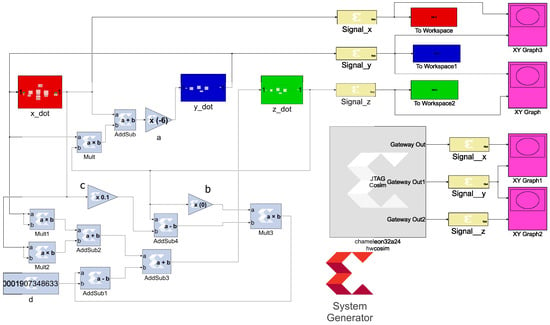
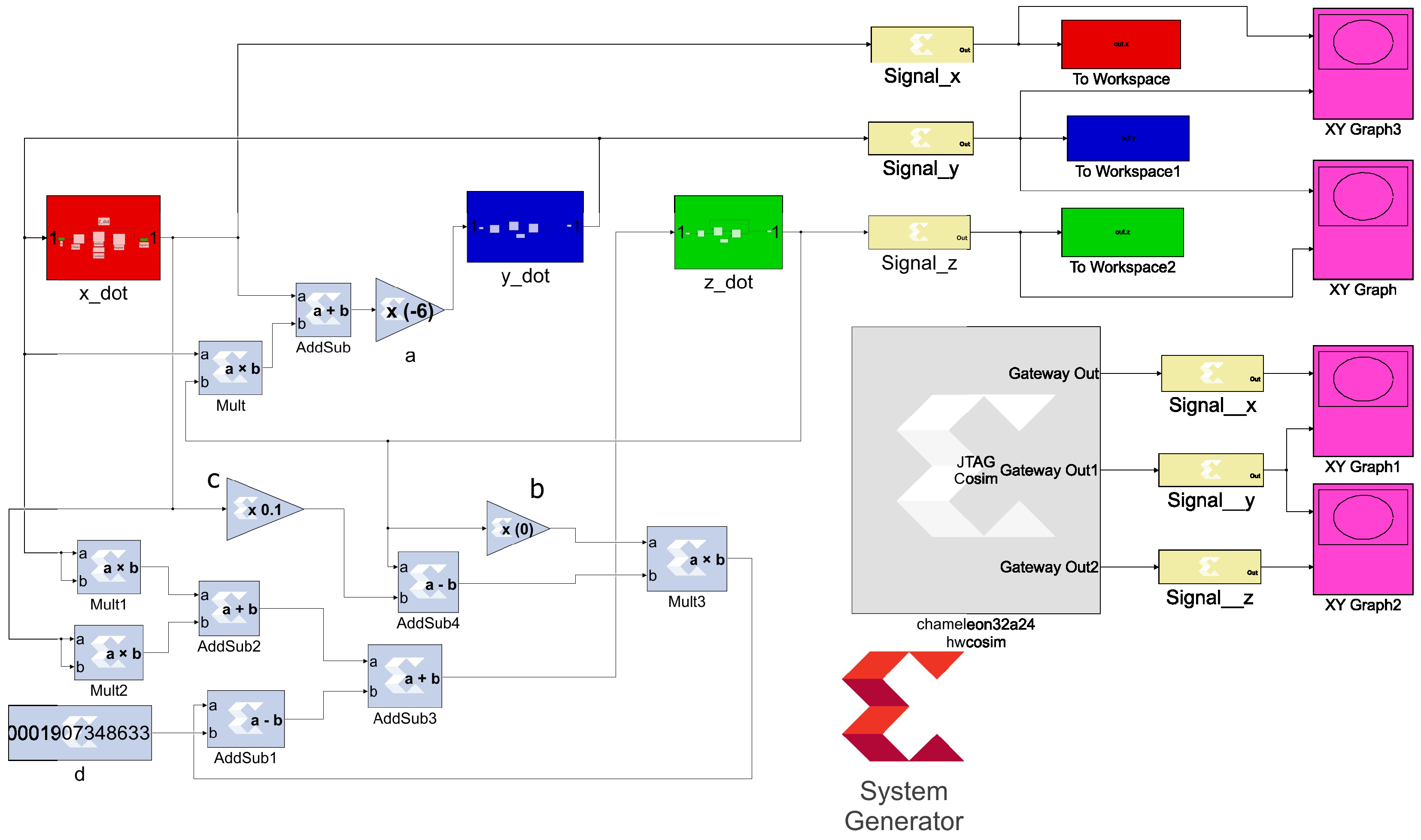
The chaotic system of Chameleons is an advanced model within the context of chaotic theory to generate unpredictable and complex behaviors from nonlinear equations. It is a type of nonlinear dynamical system that exhibits chaotic behavior. The intricacy and extreme sensitivity to the beginning circumstances of these systems are well-known. They contain multiple attractors, including self and hidden attractors, making them suitable for encryption and security applications. The proposed chaotic system is designed under MATLAB-Simulink environment according to Figure 1. The Chameleon Chaotic System is capable of producing a chaotic sequence that is employed to hide an audio signal. The inherent unpredictability of a chaotic system ensures that the encrypted audio is highly secure. Unauthorized parties will find it extremely difficult to decrypt the audio without precise knowledge of the system’s starting circumstances and settings. This system can be described the system by Equation (1) [36]:
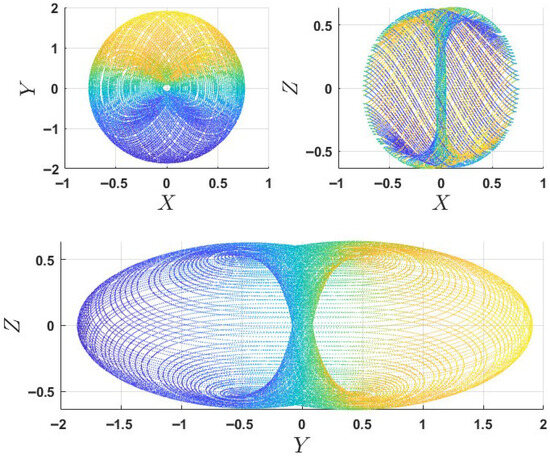
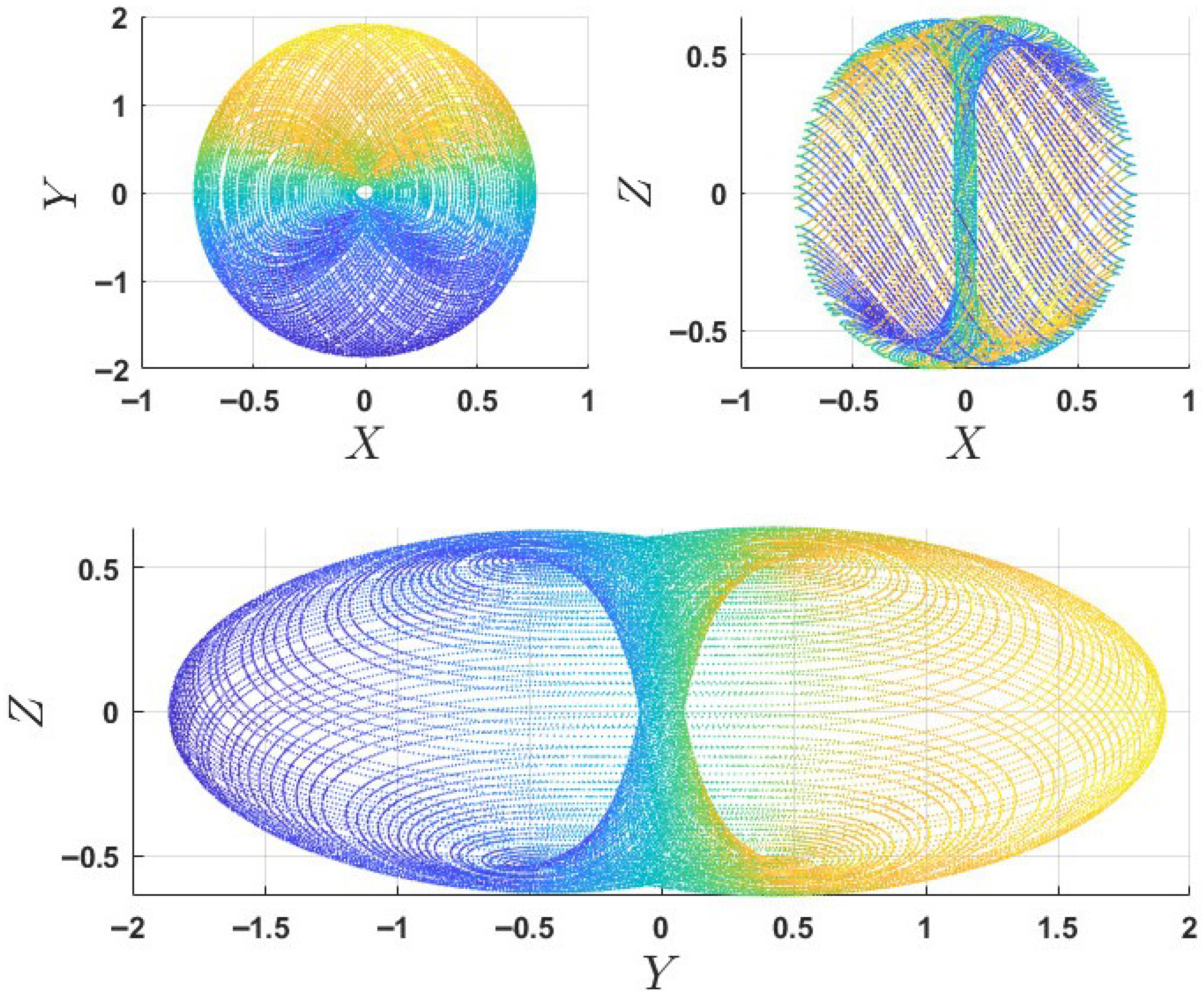
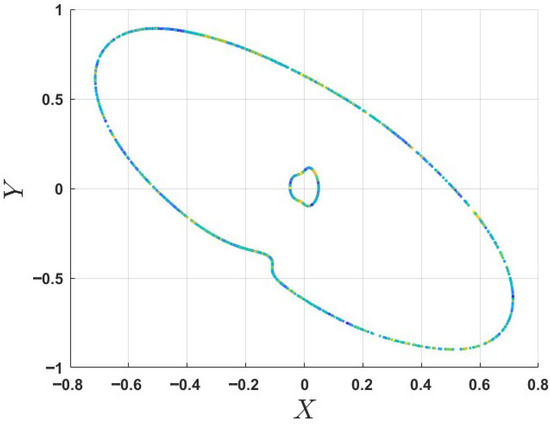
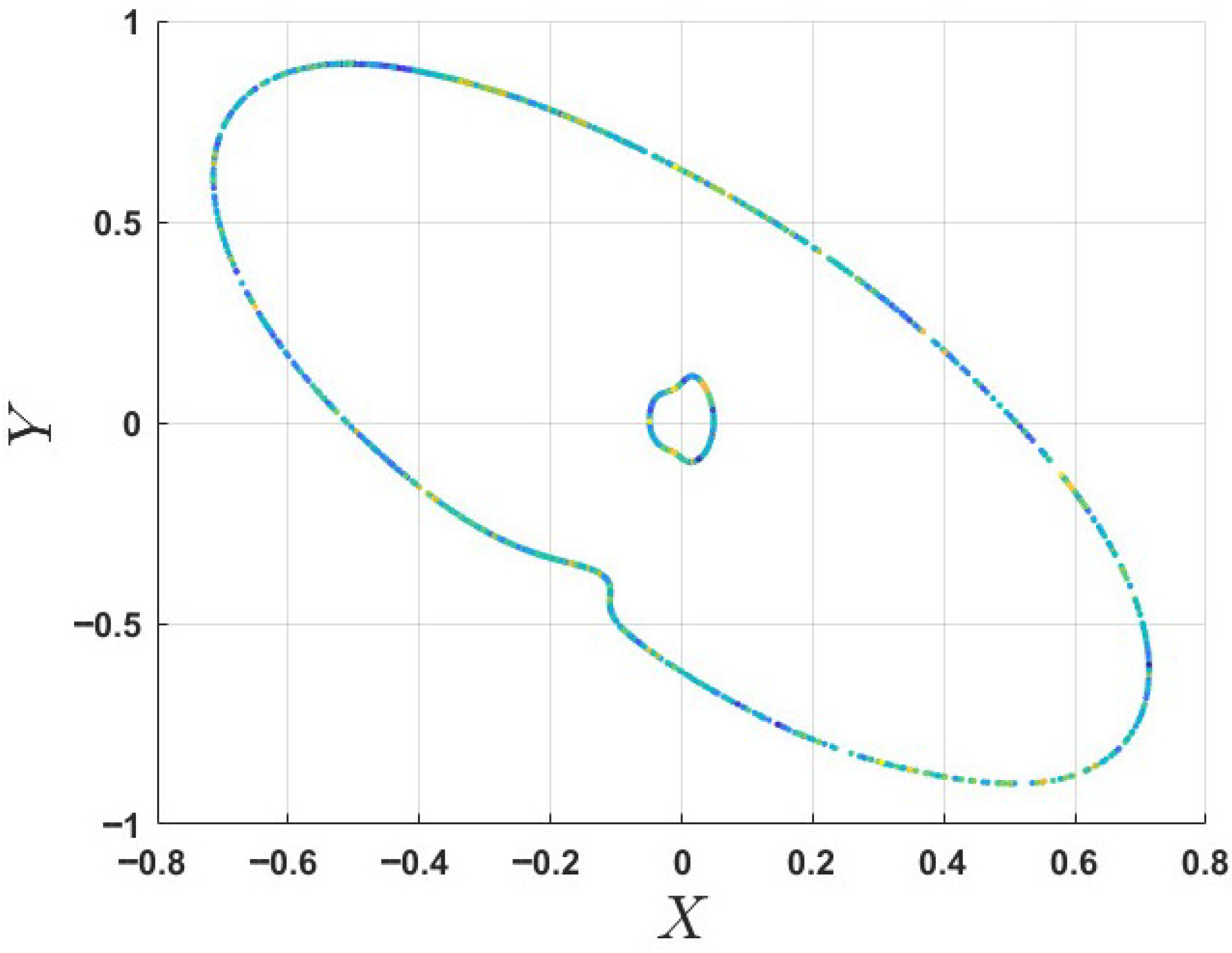
where a, b, c and d are the system’s parameters. The chaotic Chameleon system can transition between different types of attractors depending on the parameter b. System (1) behaves as a self-excited attractor when which is a common chaotic attractor with a basin of attraction that intersects with any small neighborhood of the equilibrium point. It has unstable equilibrium points defined as . The phase portrait of the presented chaotic system was acquired using the system parameters (, , , and ) and initial conditions ( and ). It is a self-excited attractor of the Chameleon Chaotic System (1) at , as shown in Figure 2. Where the system parameter is selected as and . When , the system does not possess any specific equilibrium points and consequently exhibits hidden chaotic oscillations, which are attractors whose equilibrium point neighborhoods are not intersected by the basin of attraction. Figure 2 provides a visual validation of the steady-state nonlinear behavior of the system in the phase space. By varying the parameter b within a specific range, the system can switch between exhibiting self-excited attractors and hidden attractors. This unique characteristic makes the chaotic chameleon system particularly useful for applications in secure communications, such as audio encryption.
Figure 1.
The chaotic Chameleon system (1) is designed under MATLAB-Simulink environment.
Figure 2.
Self-excited attractor of the Chameleon Chaotic System at (1) at , showing the steady-state nonlinear dynamic behavior of the system in the phase space. The color gradient represents the temporal evolution of system trajectories.
This section’s figures are all supplied to improve the comprehension of the suggested system’s nonlinear dynamics and to offer supplementary visual confirmation of the analytical findings.
A series of analytical tests that are common in the literature on chaotic systems was conducted in order to verify the chaotic behavior of the chaotic chameleon system and to show its nonlinear dynamic character. Poincaré maps, bifurcation diagrams, and coexistence analysis of attractors were among these tests. These tools are some of the most significant, widely used, and trustworthy techniques for describing chaotic systems and exposing their intricate dynamic characteristics.
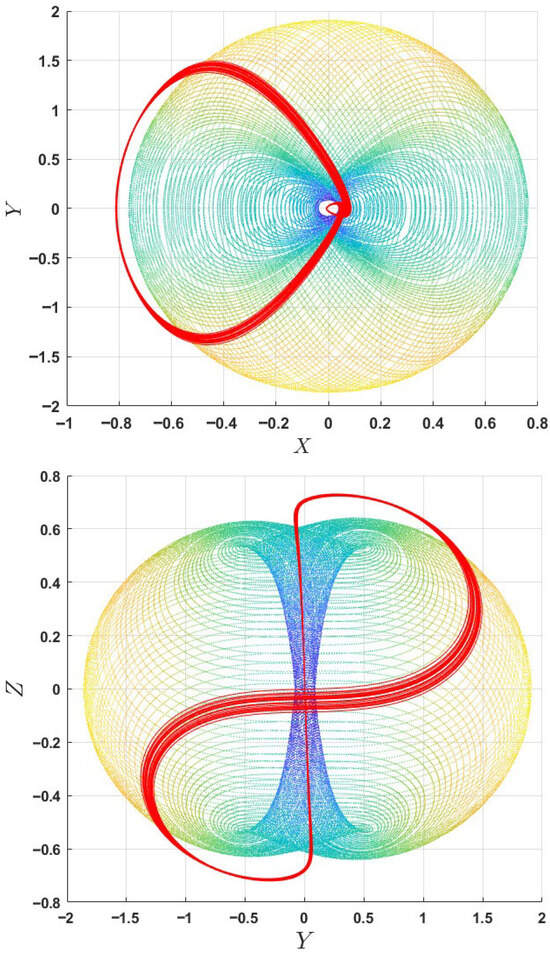
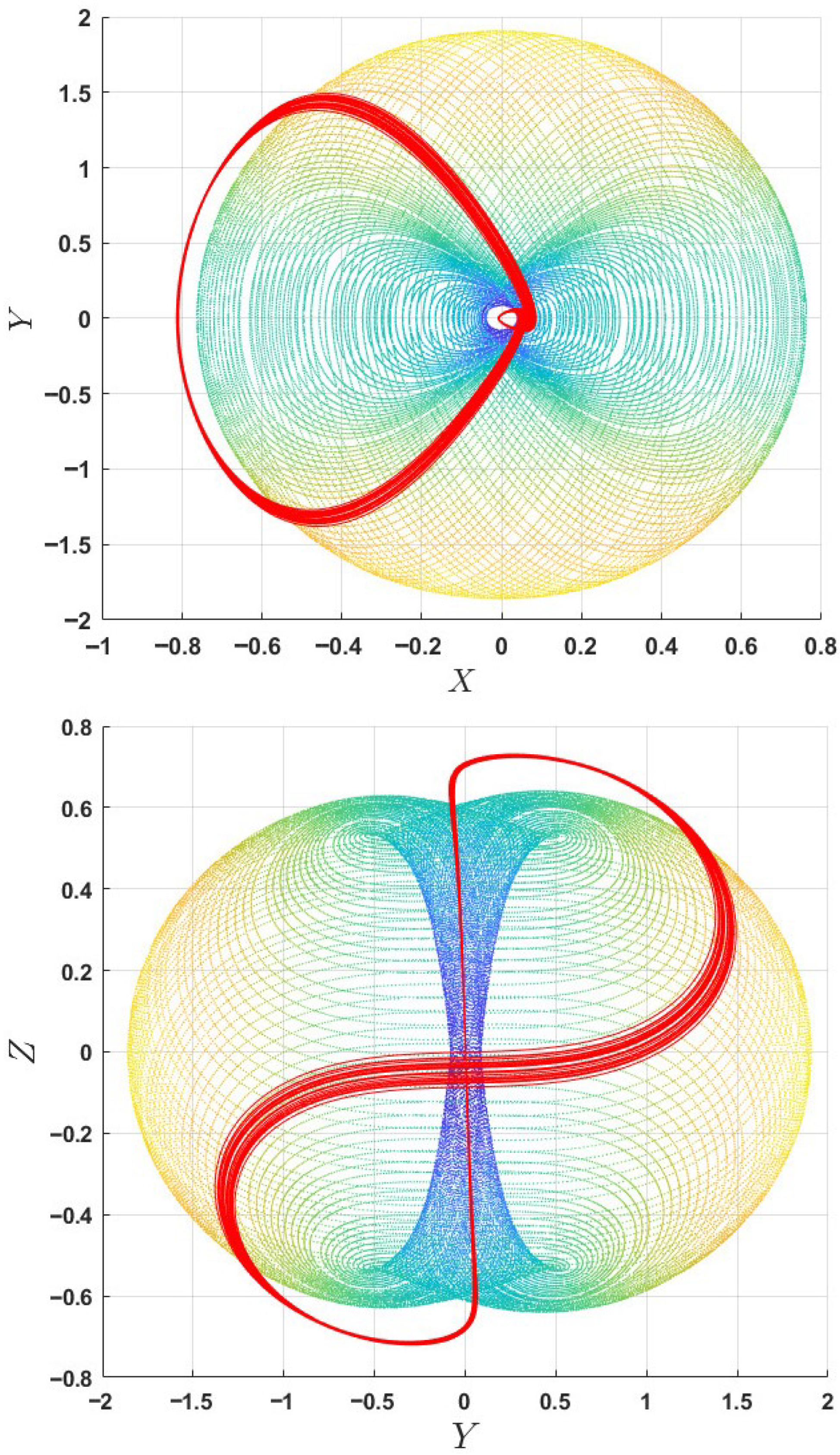
Attractors coexisting in a chaotic system are shown in the Figure 3, which shows that several attractors may be formed for the same system at the same parameter values, but only under different beginning circumstances. The attractors are projected in the plane in the top diagram, and in the plane in the bottom picture.
Figure 3.
Coexisting attractors of the Chameleon Chaotic System (1), demonstrating multistability behavior and sensitivity to initial conditions, which are important properties for secure encryption applications.
The system’s extreme sensitivity to beginning circumstances is indicated and confirmed by the colored routes (red and various shades), which demonstrate that the system may develop into several stable attractors with different geometries depending on the starting point. The presence of separate attraction pools is also indicated by changes in density and form in the phase space, which reflects the system’s complexity and nonlinearity. This coexistence occurrence improves the system’s adaptability for security and cryptography applications and is a significant signal of the richness of chaotic dynamics. It increases security and complicates prediction by enabling the development of various, surprising answers within the same parameter space. Figure 3 visually confirms the presence of multistability and sensitivity to the initial conditions.
The existence of multistability, a potent sign of intricate chaotic dynamics, is confirmed by this behavior. Practically speaking, this feature greatly improves encryption performance by raising key sensitivity and broadening the potential state space, which makes unauthorized prediction more challenging.
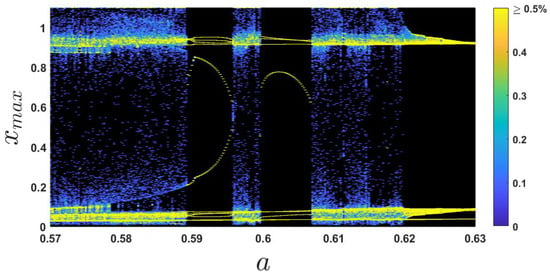
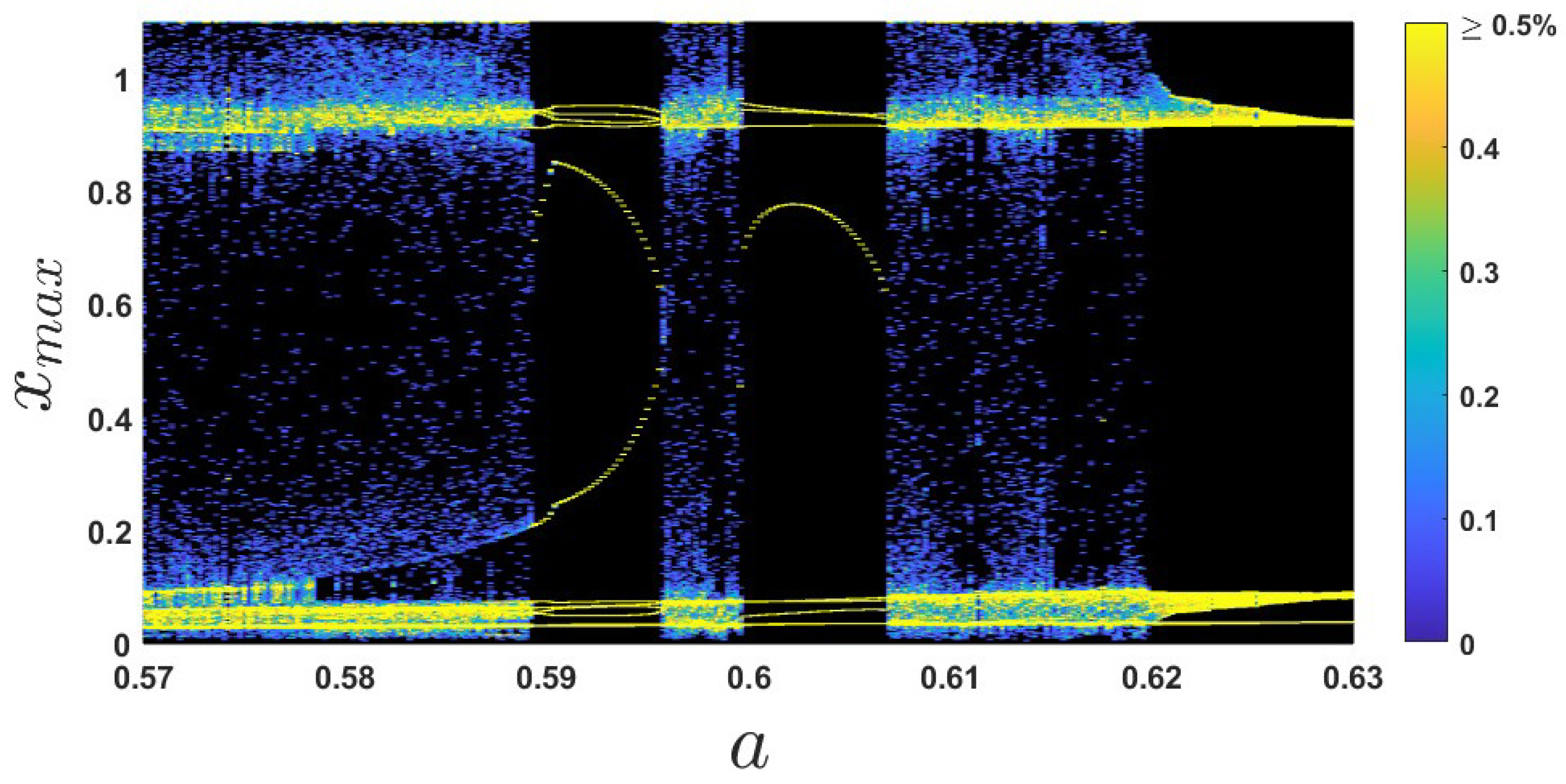
Density-colored bifurcation diagrams. These diagrams show how changing a certain parameter affects the status of the system visually. Density-colored diagrams, in contrast to conventional bifurcation diagrams, use color to show the density of states, providing more information about the dynamics of the system. The density-colored bifurcation diagram of the Chameleon Chaotic System as the parameter varies is seen in Figure 4. The vertical axis displays the highest values of the current variable , while the horizontal axis displays the value of the parameter .
Figure 4.
Density-colored bifurcation diagrams of the Chameleon Chaotic System (1).
The frequency of values is reflected in the color gradient; parts of a higher frequency are shown by brighter colors (yellow), while regions of lower frequency are represented by darker colors (blue). The graphic illustrates the existence of periodic windows inside the chaotic areas as well as the system’s transition from chaotic to periodic behavior when the parameter varies. The system’s great sensitivity to changes in parameters is indicated by the black patches, which show ranges of stability or dynamic transition. These findings support the Chameleon system’s complexity and capacity to produce rich dynamics, which qualify it for uses like signal and data encryption that demand high degrees of unpredictability and security. Figure 4 provides a graphical interpretation of parameter-dependent transitions and chaotic regions.
The density-colored depiction offers more information about the distribution and stability of system states than traditional bifurcation diagrams. This makes it possible to identify chaotic areas and transition points more precisely, which is crucial for choosing the best settings in secure communication systems.
Poincaré maps are useful analytical instruments for understanding continuous dynamical systems because they reduce the dimensionality of the state space through trajectory crossings with a lower-dimensional surface. This technique makes it simpler to discern between various patterns of dynamical activity, such as steady-state cycles, quasi-periodic behavior, and chaotic states, by turning the continuous flow into a discrete map. In chaotic systems, the presence of an odd attractor is indicated by the uneven geometric distribution of points. This structure reflects intrinsic nonlinearity, strong sensitivity to beginning circumstances, and dynamic folding and stretching processes. The dynamical behavior of the Chameleon system was investigated by using the Poincaré map as a tool to lower the dimensions of the state space via trajectory crossings with a dimensional surface. The geometric distribution of points in Figure 5 confirms the system’s nonlinear and complex dynamic character, which also shows how the system remains contained within a certain range in the state space without clustering at a single point or following a simple periodic path, supporting both the proposed Adaptive Control strategies and the reliability of the synchronization findings. Figure 5 offers a reduced-dimensional validation of the system’s non-periodic and chaotic behavior. The scattered and non-repetitive distribution of points further confirms the absence of periodicity and supports the existence of deterministic chaos. Such behavior is consistent with nonlinear stretching and folding mechanisms, which are fundamental characteristics of chaotic systems.
Figure 5.
The Poincaré map of the Chameleon Chaotic System (1).
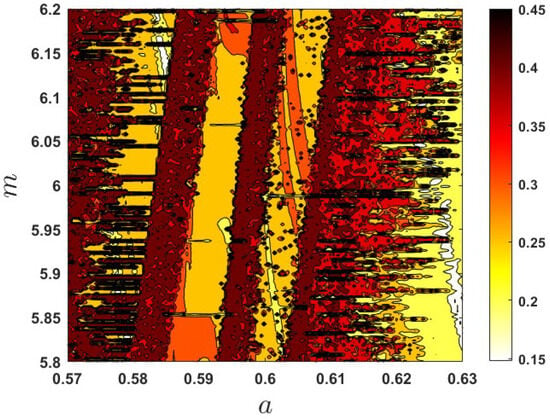
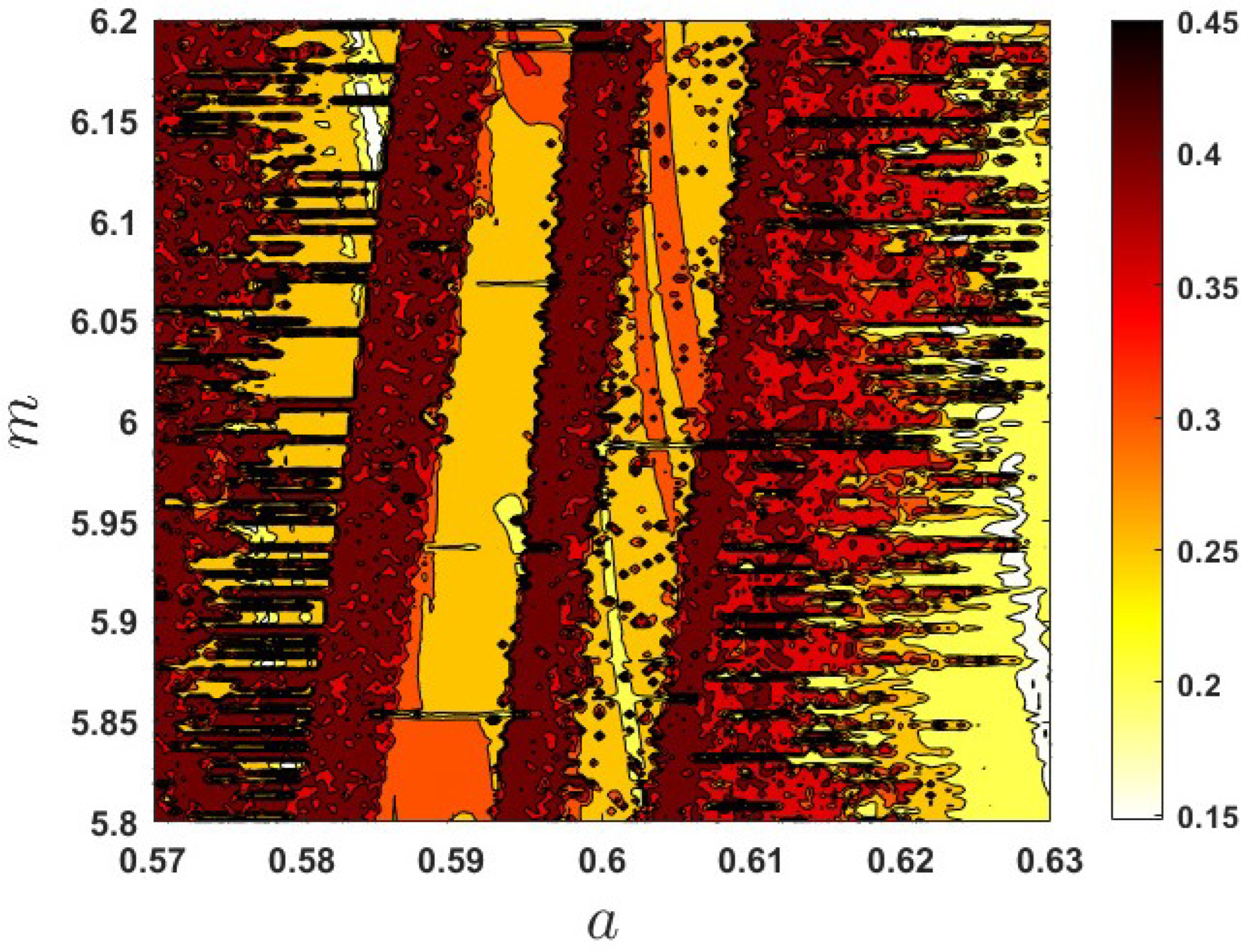
A two-dimensional dynamic map in the transaction space , with the horizontal axis denoting the coefficient a and the vertical axis denoting the coefficient m, is displayed in Figure 6. The values of the coefficients fall between and . Spectral entropy (SE) values are represented by the color scale and fall roughly between 0.15 and 0.45. Regions from dark red to black show high spectral entropy levels and intense chaotic dynamics, whereas light yellow regions show low spectral entropy values and periodic or quasi-periodic activity. Transitional areas between order and chaos are indicated by intermediate hues ranging from orange to red. Certain intervals of the coefficient a clearly exhibit chaotic behavior. In particular, severe disorder is shown with the following values:
where the largest values of the spectral entropy are found. Dense, continuous black bands in these areas show wide spectral features and significant sensitivity to beginning circumstances. While the parameter m mainly influences the breadth and continuity of the disordered areas, it is clear that the parameter a is crucial in regulating the system dynamics. Because of their resilience to parameter changes, these large, continuous disordered regions are ideal for secure applications, especially in disorder-based cryptographic systems. Figure 6 quantitatively supports the complexity analysis through spectral entropy distribution.
Figure 6.
Spectral entropy (SE) complexity map of the of the Chameleon Chaotic System (1), as a function of parameters a and m.
The dependability of the data acquired without depending on a single chaos indicator is increased by the consistency between these complementing techniques. The literature makes extensive use of alternate chaos detection techniques including the 0–1 test and Lyapunov exponent analysis in addition to the selected analytic tools. The chosen techniques in this work give a more thorough mix of phase–space visualization and complexity quantification, even if these techniques offer robust mathematical validation of chaoticity. They are therefore especially well-suited for encryption-focused applications where statistical complexity and unpredictability are crucial. Furthermore, the use of multiple complementary tools, including attractor coexistence analysis, bifurcation diagrams, Poincaré maps, and spectral entropy, ensures the robust and reliable characterization of the system dynamics without relying on a single chaos indicator.
4. Audio Encryption System
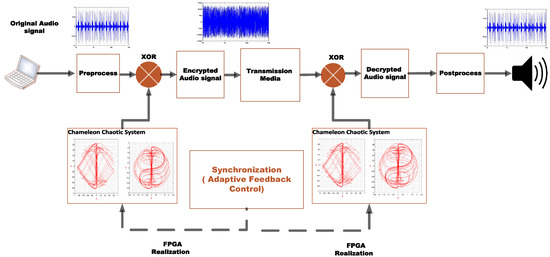
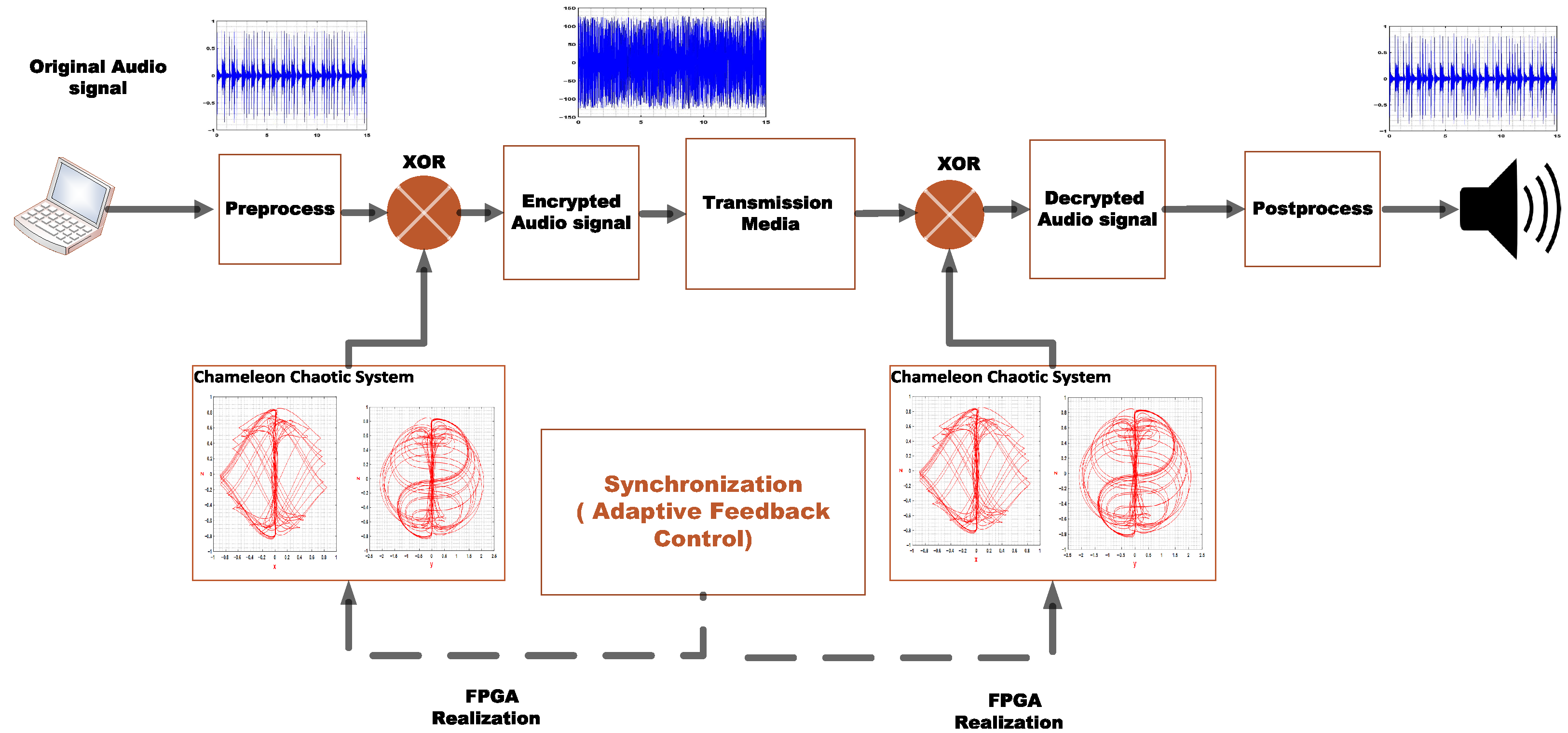
This section explains the development and application of a speech encryption system that utilizes the chaotic characteristics of the Chameleon system. The general framework of the system is illustrated in Figure 7, which presents the main functional blocks involved in both the encryption and decryption procedures. The encryption process begins with parallel data being converted into serial data using the preprocessing function, which includes the following operations: reshape, transpose, frame, and unbuffer. In this stage, the original audio signal is transformed into digital data and reformatted into a suitable structure for encryption. The data is then segmented into consecutive 32-bit samples and converted into a fixed-point structure, with a word length of 32 bits and a fractional part of 24 bits, using the Gateway-in module in the MATLAB/Simulink environment. The encryption method employs the Chameleon Chaotic System as a source for chaos-based key generation. The audio signal, which serves as the input, undergoes preprocessing to be converted into a digital format and structured into manageable samples. The encryption is performed using the XOR technique, where the audio stream is combined with the output of the Chameleon Chaotic System. This process enhances security by introducing a high level of complexity through the chaotic arrangement produced by the system’s parameters. At the receiving end, decryption is carried out using the same XOR operation, where the encrypted signal is combined again with the output of the Chameleon system. To ensure accurate decryption, synchronization between the chaotic systems at both ends is essential. An Adaptive Feedback Control technique is employed. Once the decryption is completed, postprocessing is applied to restore the signal to what it was originally. The decrypted data is passed through the Gateway-out module and restructured using buffering and remapping functions to match the original signal format. Finally, the recovered data is played through speakers to verify the success of the decryption process. The system is implemented on an FPGA platform, ensuring high performance and fast processing. Using the Xilinx toolkit, VHDL code is generated based on the System Generator architecture in MATLAB Simulink. The design’s correctness and performance were validated using Vivado. The Chameleon Chaotic System provides a high level of security and reliability in audio data transmission. The encrypted audio signal is transferred between the sender and the recipient through a wireless communication channel, which can include mobile or Wi-Fi networks.
Figure 7.
A schematic illustration of the suggested system for audio encryption.
4.1. Chaotic Chameleon System Synchronization
In secure communication systems, it is possible to synchronize and use chaotic systems for data encryption to convey text, image, video, and audio information, even though they are aperiodic and manifest randomly in the temporal domain [37]. For data encryption techniques, the most appealing aspect of deterministic chaotic systems is their extremely unpredictable and random-looking character [38]. Until Pecora and Carroll demonstrated that two or more dynamically chaotic and/or hyperchaotic entities may synchronize, the synchronization of chaos or hyperchaos was insignificant [39]. Common techniques for the safe conveyance of sensitive information signals based on chaos include chaotic shift keying, chaotic switching, chaotic frequency modulation, chaotic parameter modulation, and additive masking [40].
In this work, the Adaptive Feedback Control approach has been used to study the synchronization of the Chameleon Chaotic System, based on the master–slave synchronization paradigm, where the slave system dynamically follows the trajectory of the master system.
Due to the high sensitivity of chaotic systems to initial conditions and parameter variations, even nearly identical chaotic oscillators can quickly diverge. This inherent nature makes synchronization challenging, yet it provides valuable benefits for secure communication. Feedback-based synchronization methods, such as adaptive control, continuously adjust the slave system’s behavior to conform to that of the master, ensuring robust signal recovery in the presence of disturbances.
To implement secure synchronization, the XOR-masking technique was adopted due to its computational simplicity, resistance to external noise, and suitability for real-time applications. This method enhances synchronization stability and ensures consistent and secure data exchange even in dynamic or noisy environments.
The primary challenge addressed by synchronization schemes is in compensating for the divergence between chaotic systems due to parameter mismatches and initial condition variations. Feedback-based approaches continuously adjust the response of the slave system, enabling the accurate reconstruction of the chaotic signal and maintaining secure transmission. As demonstrated in this study, the proposed synchronization framework achieves high performance, real-time response, and practical applicability, as illustrated in Figure 7. This section discusses chaotic synchronization of the Chameleon Chaotic System using Adaptive Feedback Control. Because of the significant potential of synchronization in various fields, including physics, economics, chemistry, engineering, and particularly secure communications, it has been the subject of extensive research over the past three decades [41]. Master–slave formalism is used in most chaotic synchronization techniques to match the slave system’s behavior in comparison to the master system. Using the output of the master system to control the slave system is the primary objective of synchronization. Being extremely sensitive to beginning circumstances is a common characteristic of chaotic systems. That is, if there is a slight variation in the initial states of the two extremely near oscillators, after sufficient transient time, the resulting trajectories will be significantly divergent. Thus, managing the synchronization of chaotic systems has emerged as a noteworthy subject in the field of nonlinear research [42].
4.2. Adaptive Feedback Control Synchronization Method
In this section, it is possible to fully synchronize two identical new chaotic systems utilizing the Adaptive Feedback Control method with the master–slave formalization. The following is the master system equation which is described by the Equation (2) [36]:
The equation for the slave system is as follows in Equation (3):
In these equations, a, b, c and d are the system parameters, and , and are the control functions The objective is to evaluate the control function based on the active control method.
Equation (2) is regarded as a master chaotic system, whereas Equation (3) is the slave chaotic system. Using the Adaptive Feedback Control approach, we want to ascertain the control function. The synchronization performance between the master and slave Chameleon Chaotic Systems is evaluated by defining the synchronization error between their corresponding state variables. The synchronization error represents the difference between the slave system states and the master system states. This error definition allows the stability and convergence behavior of the synchronization process to be analyzed mathematically.
The synchronization error between the master and slave systems is defined as follows:
The synchronization error vector can be expressed as
where
Differentiating the error signals according to time allows one to determine the synchronization error’s temporal progression. This results in the dynamic error equations utilized in stability analysis and controller design:
The rate at which the synchronization errors between the master and slave systems vary is described by the error dynamic equations that were derived. The Adaptive Feedback Controller’s design and the synchronization errors’ gradual convergence to zero, which ensures total synchronization between the two chaotic systems, depend on these equations. The error dynamic is obtained as follows in Equation (8):
To ensure that the error drives to zero, the controller u is constructed for the Adaptive Feedback Control functions. The Adaptive Feedback Controller may be found in Equation (9).
Here, , , and denote the estimated values of the unknown parameters a, b, and c, respectively. Substituting Equation (9) into Equation (8) yields the error dynamics given in Equation (10).
In this case, the estimation error for unknown parameters is provided as Equation (11):
By differentiating Equation (11),
Consider a Lyapunov function candidate as Equation (13):
By substituting Equations (10) and (12) in Equation (13),
The parameter update law will be selected as
Equation (14) indicates that by Lyapunov stability theory, it is determined that the synchronization error and the parameter estimation error , and decay to zero exponentially with time.
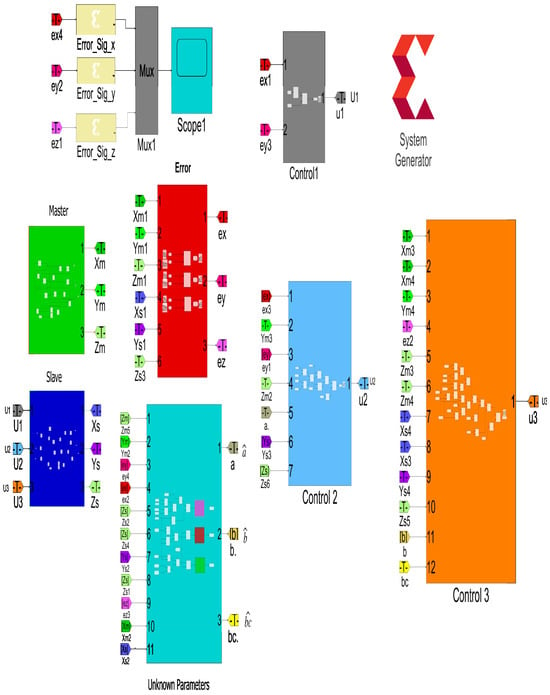
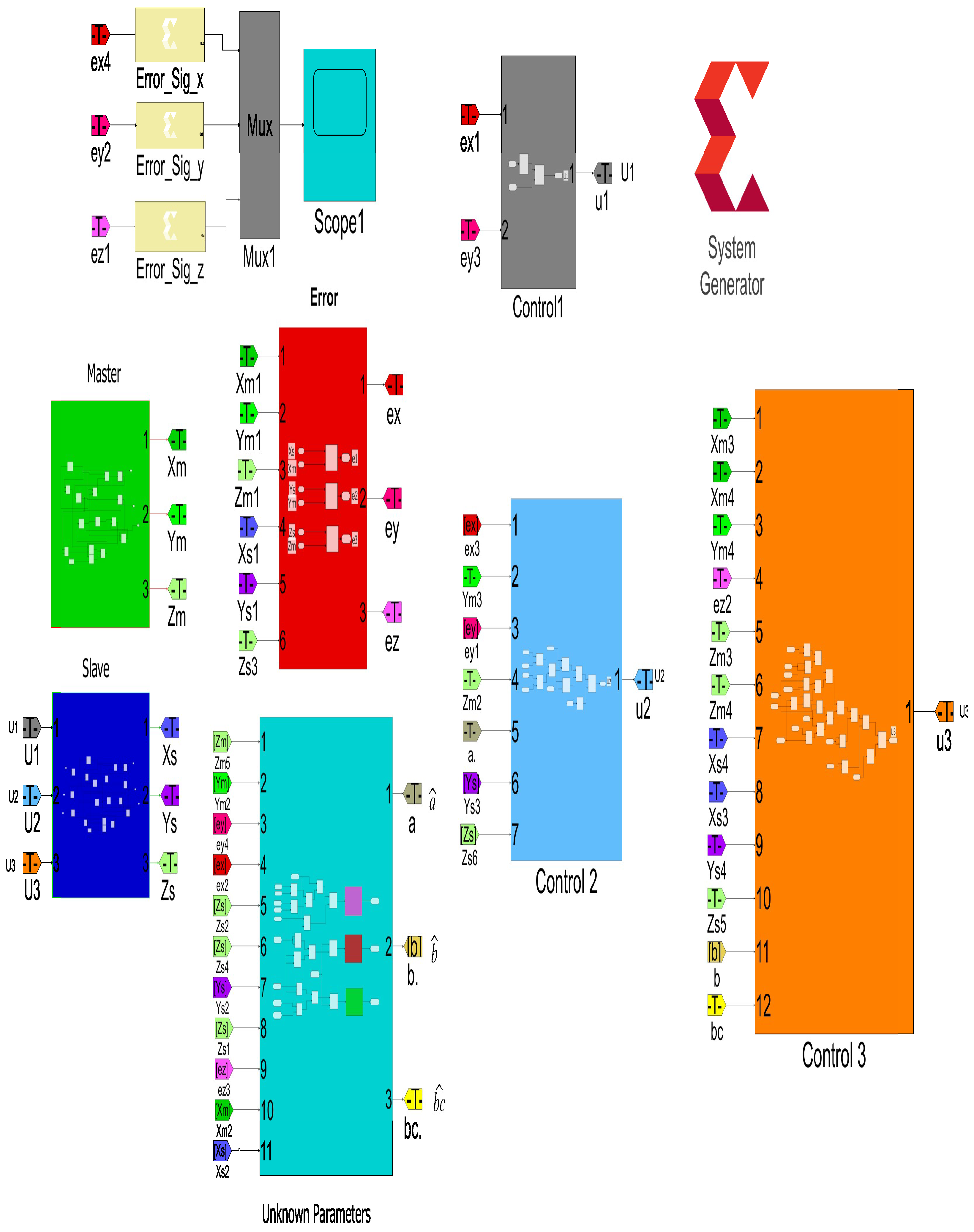
The implementation of the suggested technique is accomplished on FPGA. The novel Chameleon Chaotic System associated with Equation (2), adaptive controllers described by Equation (6), and parameter update laws described by Equation (12) are developed utilizing MATLAB Simulink and XSG box tools. Figure 8 illustrates the FPGA realization of the suggested adaptive feedback control for the novel Chameleon system employing XSG blocks. This FPGA implementation utilizes a fixed-point representation of actual data in 32 bits (32Q24), with 32 bits used for the total and 24 bits for the fractional part. The initial conditions for the master chaotic system are , , and . The beginning conditions for the state variables of the slave system can be chosen as , , and .
Figure 8.
FPGA development and execution of the Chameleon Chaotic System with Adaptive Feedback Control.
4.3. FPGA-Based Adaptive Feedback Control for Chaotic Chameleon Systems
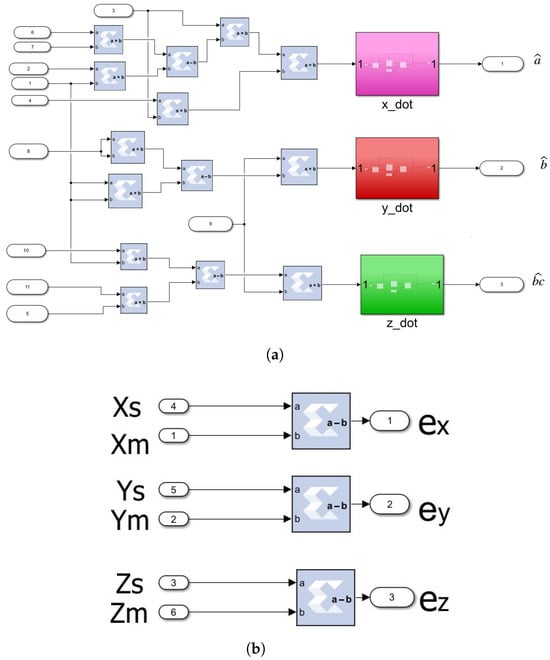
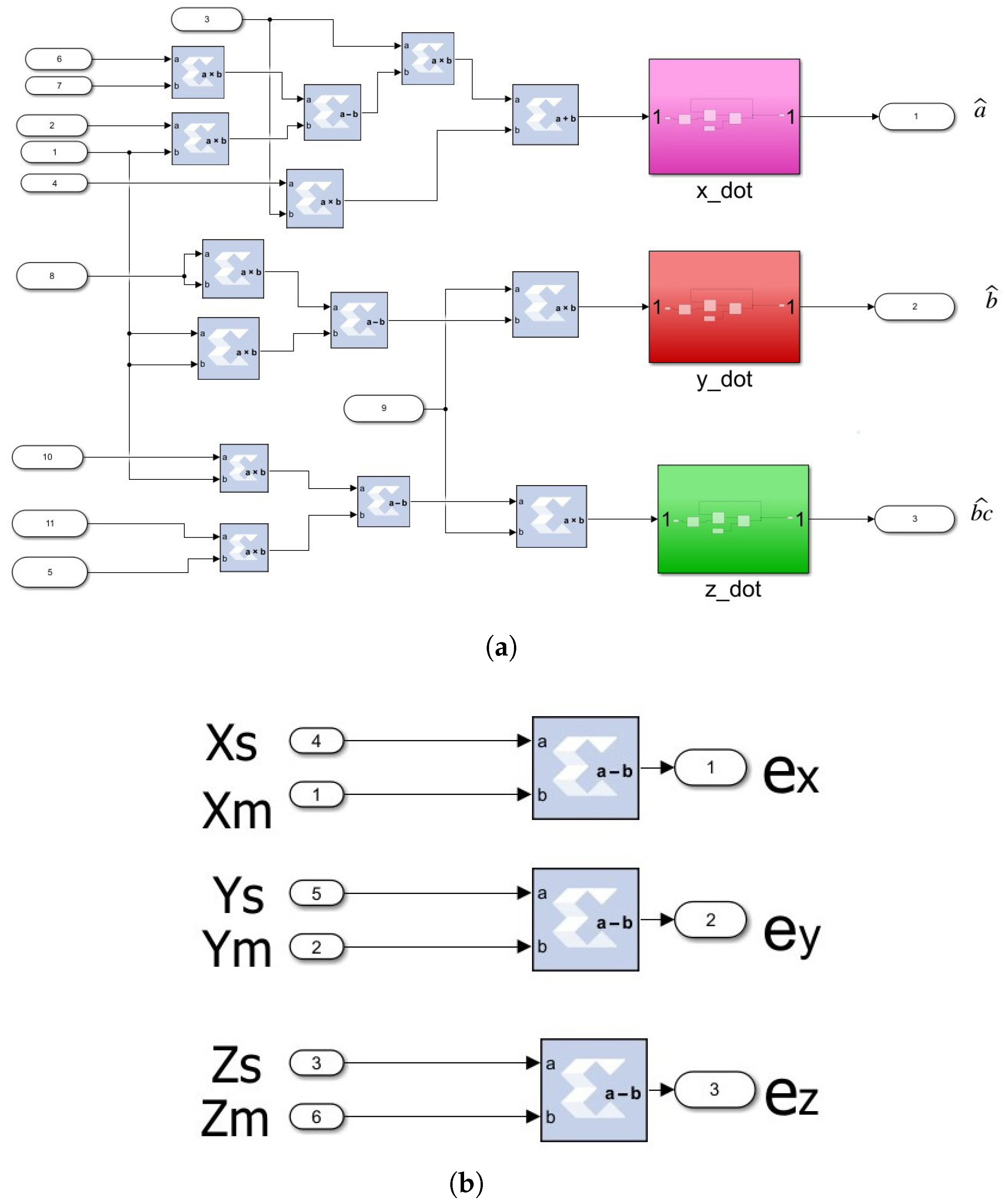
This section contains the implementation of the suggested technique on an FPGA. The novel Chameleon Chaotic System associated with Equation (1), adaptive controllers described by Equation (9), and parameter update laws described by Equation (15) are developed utilizing MATLAB Simulink and XSG box tools. Figure 9a illustrates the FPGA implementation of the parameter estimation subsystem, where , and represent the estimated values of the unknown parameters and c respectively. These parameters are part of the adaptive control algorithm for real-time system identification within the chaotic system model. The design leverages XSG within MATLAB Simulink, utilizing fixed-point arithmetic to ensure high precision in parameter estimation while optimizing FPGA resource utilization. Figure 9b shows the FPGA implementation of the error calculation subsystem, which is a critical part of the adaptive feedback mechanism. The error subsystem computes the discrepancy between the estimated and actual output of the system, feeding this error back to the parameter update equations. This design, also implemented using the Xilinx block set, ensures that the synchronization and estimation processes remain accurate under real-time conditions. The use of hardware-accelerated error computation on an FPGA allows for efficient real-time processing, making the system highly suitable for high-speed encryption and control applications.
Figure 9.
FPGA Implementation of (a) parameter estimation (unknown parameters) and (b) error subsystem using Xilinx block set for Adaptive Control in the Chameleon Chaotic Systems.
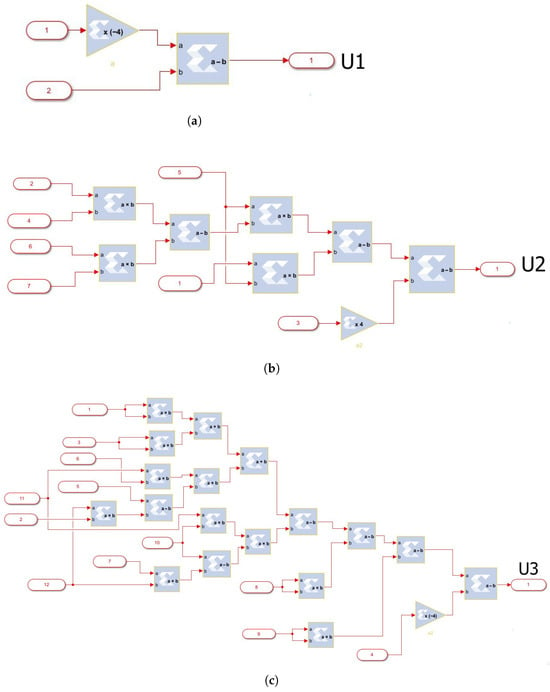
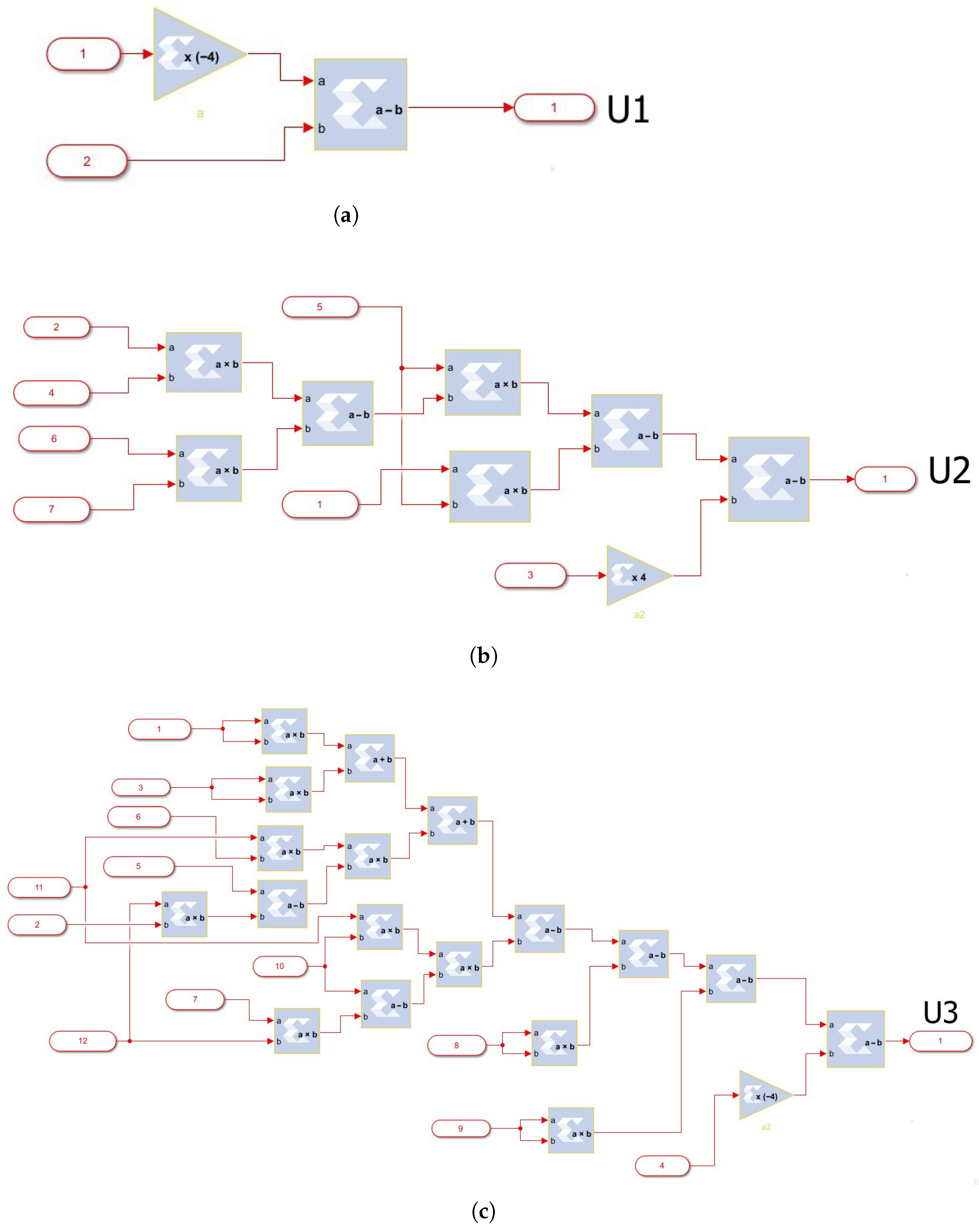
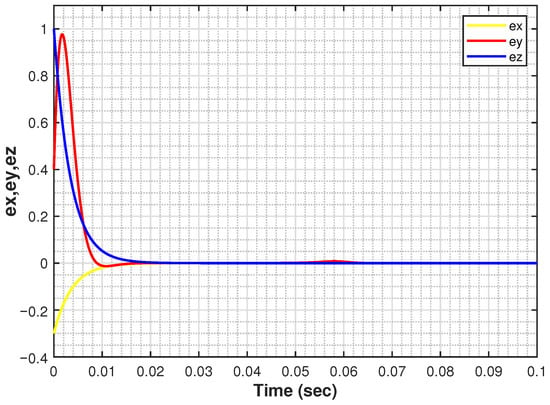
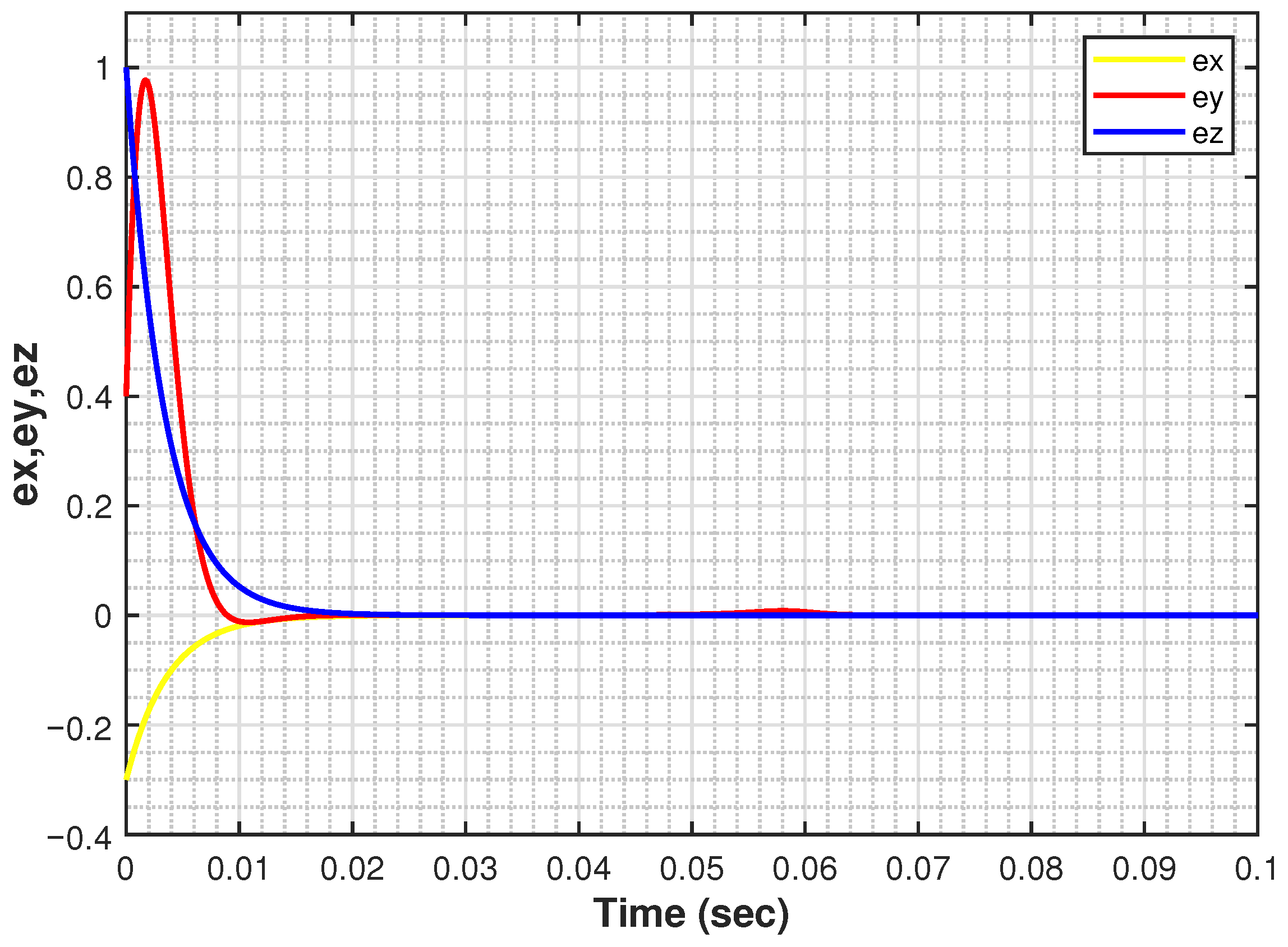
Figure 10 illustrates the FPGA implementation of the adaptive controllers , , and using the Xilinx block set. These controllers are designed to dynamically adjust the system settings in real time, guaranteeing peak performance in a variety of scenarios. The implementation leverages fixed-point arithmetic to optimize resource utilization on the FPGA while maintaining high precision in controlling the chaotic system. The design integrates efficiently within the overall system, providing robust synchronization and stability in chaotic signal generation, essential for secure communication applications. Figure 11 displays the time response to , , and of the dynamic system error status in Equation (7) by using Equation (9). From the synchronization error waveforms shown in Figure 11, we conclude that the complete synchronization of the active control method used took place in a short time.
Figure 10.
FPGA Implementation of Adaptive Controllers (a) U1 (b) U2 and (c) U3 for Synchronization of the Chameleon Chaotic Systems Using Xilinx block set.
Figure 11.
Synchronization error dynamics of the Adaptive Feedback Control method showing the fast convergence of synchronization errors , , and toward zero, confirming successful synchronization performance.
4.4. The Design and Execution of an Adaptive Feedback Control for the Chameleon Chaotic System Using FPGA
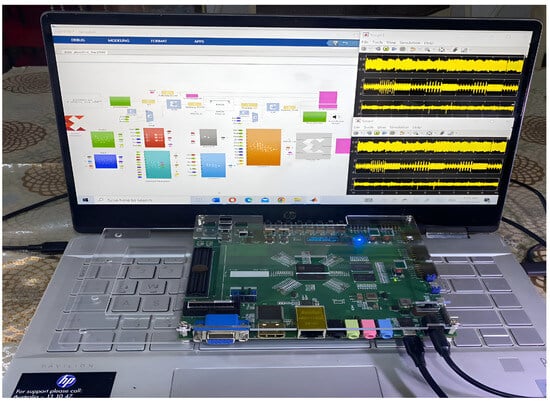
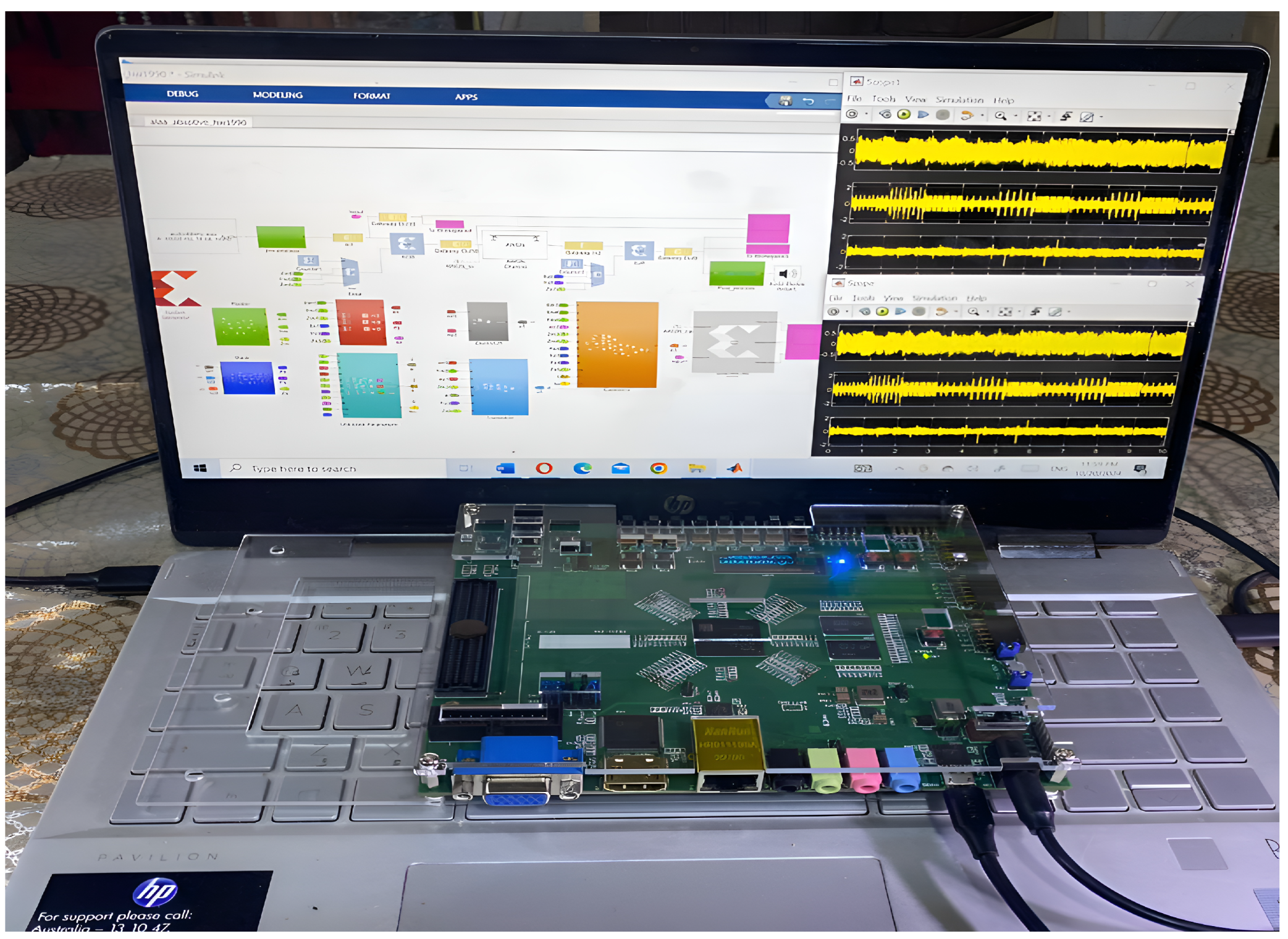
The Chameleon Chaotic System’s suggested Adaptive Feedback Control utilizes Xilinx System Generator blocks in an FPGA realization. A fixed point and 32 bits (32Q24) representing actual data—32 for the total and 24 for the fraction—are used in this FPGA design. The initial conditions for the master chaotic system are , and . The beginning circumstances for the slave system’s state variables to be selected as , and . For hardware co-simulation, the ZedBoard Zynq-7000 FPGA is employed to test the output of the Chameleon Chaotic System. A hardware co-simulation block was generated using the System Generator tool after completing the design process. This block was subsequently converted and deployed onto the FPGA via the Joint Test Action Group (JTAG) interface. The models were executed on the FPGA, with the results transmitted back to the PC through the JTAG interface and displayed in MATLAB. Figure 12 illustrates the hardware co-simulation setup for the execution of the Adaptive Feedback Control scheme for the Chameleon Chaotic System.
Figure 12.
The Chameleon Chaotic System was designed using FPGAs to provide an Adaptive Feedback Control technique.
4.5. Maximum Clock Frequency Calculated of Both Synchronization Methods
An FPGA board based on the Xilinx Zed Board Zynq-7000 chip to build and co-simulate hardware. To modify the FPGA architecture to meet the timing needs, timing closure is employed. The maximum frequency of an FPGA template cannot be directly generated using the Vivado (2020.2) software tool.
The clock period and , as described in the execution timing report, may be used to calculate it, as shown in Equation (16) [43].
If the implementation successfully satisfies all timing constraints, the value of must be positive, allowing for the use of a faster or a shorter . Moreover, the will be negative if the execution fails to meet all timing requirements, and the time limit to ensure temporal closure for a successful execution, , may be increased without altering the specification. Only once the implementation is finished and there is no timing problem can the be calculated (16) [43]:
where is the clock time, while is the highest frequency and the Worst Negative Slack.
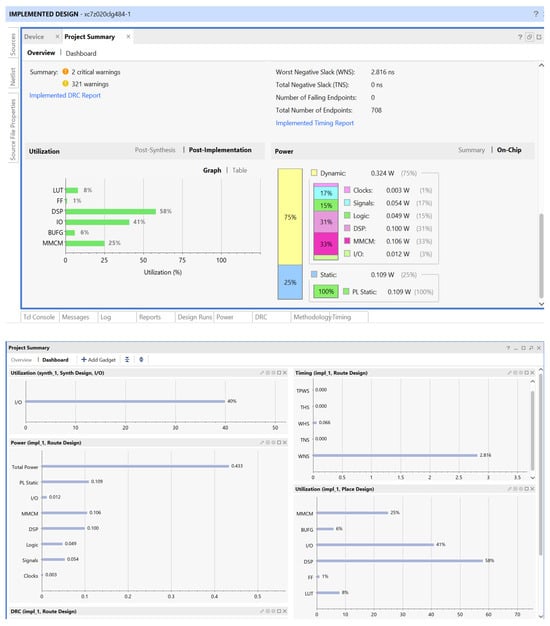
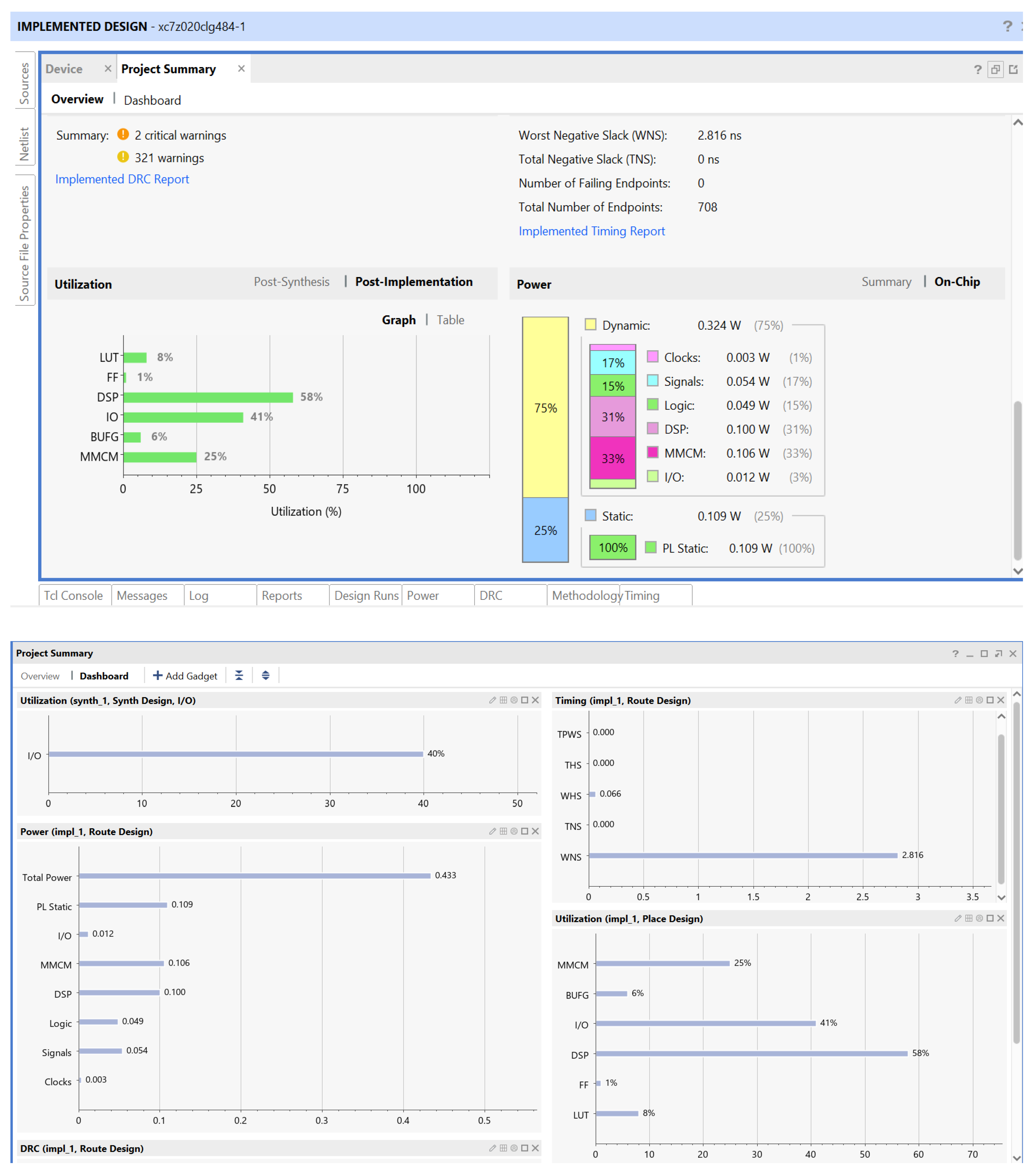
The one sign bit, twenty-four fractional bits, and seven integer bits make up the data format for constructing XSG models. This model is utilized to produce the FPGA realization of the Vivado project. Figure 13 shows a timing implementation report for the AFC synchronization method, where the is (2.8 ns) the maximum clock frequency
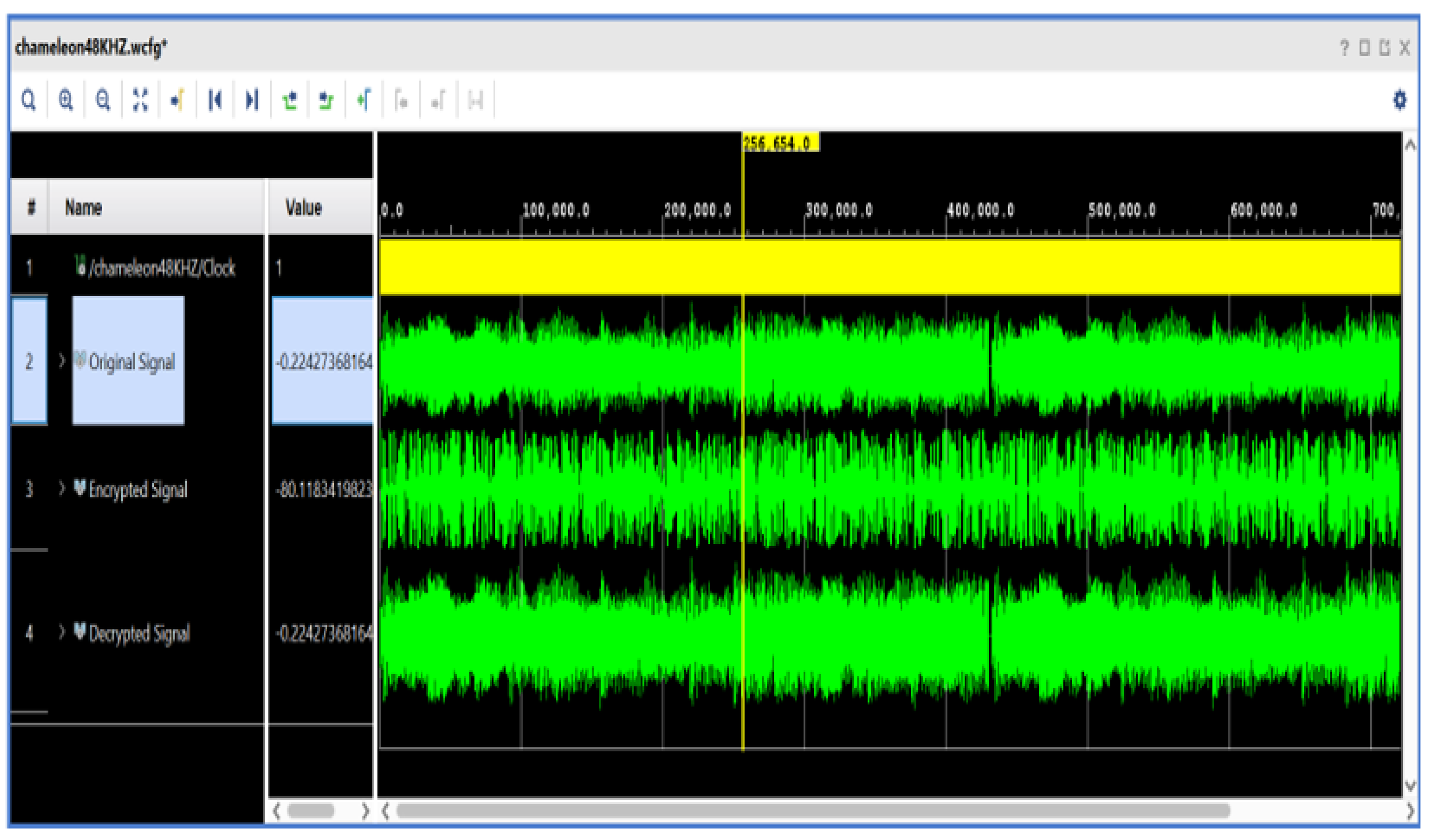
The results of plotting system signals before, after, and during encryption are shown in Figure 14.
Figure 13.
FPGA resources utilization after model hardware implementation using Vivado software in the Adaptive Feedback Control synchronization method.
Figure 14.
The time domain representation of the original, encrypted, and decrypted speech signals.
The FPGA resource utilization results in Table 1 demonstrate that the proposed implementation achieves a competitive hardware performance compared with recently reported chaotic encryption FPGA architectures [43,44,45,46].
Table 1.
FPGA hardware resource comparison with recent chaotic encryption implementations.
The proposed design achieves very low flip-flop utilization while maintaining acceptable LUT usage, considering the computational complexity of chaotic synchronization and nonlinear encryption operations. Although the DSP utilization is relatively higher than some lightweight chaotic PRNG-based implementations, this is expected due to the nonlinear mathematical operations required in the proposed chaotic encryption model.
Furthermore, the positive worst negative slack value confirms successful timing closure and stable hardware operation. These results confirm that the proposed implementation achieves a good balance between hardware cost, timing performance, and encryption security. The obtained results confirm that the proposed system is suitable for real-time secure audio encryption applications implemented on modern FPGA platforms.
5. Analysis of Speech Security
The encryption system’s performance will be discussed in this section. Multiple methods are employed to assess the system, such as statistical analysis, of which MSE, correlation, histogram, and spectrogram analysis are examples. Strong encryption must be extremely resilient to all quantitative tests. Different criteria are used in the field of speech encryption to assess the security and efficiency of the cryptosystem. These metrics evaluate the degree to which the voice data is shielded from unwanted access or interpretation by the encryption technique, all the while preserving the speech’s integrity and quality upon decryption. These are a few essential, often-used metrics:
5.1. Correlation Analysis
The original, encrypted, and decrypted data’s correlation audio is a measure that shows the extent of the relationship among the audio signals in these three cases. One metric that illustrates the degree of link between the audio signals in these three scenarios is the correlation among the original, encrypted, and decrypted audio. A correlation coefficient that is almost (0) indicates that the audio is being encoded to make the encrypted signal uncorrelated with the original signal. The correlation coefficient must be around one as the decrypted signal must either be exactly the same as the original signal or extremely close to it. The stronger the association, the closer the coefficient is to (1 or −1). On the other hand, values around (0) denote minimal or insignificant correlations. The correlation coefficient can be calculated as follows, as given by Equation (17) [47]:
where is the covariance between the original signal x and the encrypted signal y. and are the variances of the signals x and y.
Table 2 presents the correlation results of audio signals (original, encryption, and decryption) using the Adaptive Feedback Control synchronization method, under the effect of AWGN at different SNR levels. It displays the correlation coefficient among the original and encrypted audios for both methods. The correlation value is in all cases, which is close to zero. This indicates that the encrypted signal is significantly different from the input signal, which is desirable in encryption systems, as it suggests the encrypted signal contains no information related to the original signal (enhancing security).
Table 2.
Correlation results for encrypted and decrypted speech using the Adaptive Feedback Control synchronization method.
The table also shows the correlation coefficients among the original and decrypted signals using the Adaptive Feedback Control method. Without noise, the correlation coefficient is very close to one (), meaning the original signal is almost perfectly restored. With the addition of noise at , a slight decrease in correlation is observed (), but the values remain very close to one, indicating that decryption is still highly accurate. As noise increases at , , and , a continuous slight decrease in correlation is observed. However, the values remain high (ranging from to ), indicating that the system continues to perform well even in noise. Even with significant noise (at ), the results are very good, showing that the proposed encryption and decryption system is highly effective. The high correlation values reflect the system’s high signal recovery and decryption accuracy.
5.2. Mean Squared Error (MSE) for Audio Encryption and Decryption
An important statistical metric for comparing encrypted or decrypted audio signals to their original counterparts is the mean squared error (MSE). To obtain a numerical figure that represents the magnitude of the mistake, it averages the squared discrepancies among the two signals. If the MSE is small, then the decoded signal closely resembles the original, meaning that both the encryption and decryption processes were quite accurate. To ensure that the encryption process has successfully distorted the original signal and prevented unwanted access or interpretation, it is preferable for the mean squared error (MSE) between the two signals to be large. The decryption procedure should have successfully recreated the original audio with minimum error, retaining the integrity and quality of the signal, if among the original and decrypted signals’ mean square error is as low as feasible. The following formula may be used to calculate MSE [48]:
where X represents the original speech signal, Y represents the encrypted signal, and N is the length of the original and encrypted signals. Table 3 displays the mean square error values between the initial, encrypted, and decrypted signals using the Adaptive Feedback Control synchronization methods, under the effect of AWGN at different SNR levels. It displays the MSE value among the original and encrypted audio signals using the Adaptive Feedback Control. The value remains constant at 1.3701 for all noise levels. This indicates that the encryption was successful, as this MSE value signifies that the encrypted signal is entirely different from the original signal, which is desirable because it suggests that the encryption is strong and unpredictable. The table also shows the MSE values between the original and decrypted signals using the Adaptive Feedback Control. The values start very low at when no noise is added (without AWGN), indicating that encryption and decryption were highly accurate. As noise increases, there is a gradual rise in the MSE values, reaching when 20 dB of noise is added. However, despite this increase, the values remain relatively low, which means that the system is still capable of accurate decryption even with significant noise.
Table 3.
MSE values of the audio between original speech signal, encrypted and decrypted speech in the Adaptive Feedback Control synchronization method.
Overall, the ideal MSE values for decryption are close to zero, indicating the accurate recovery of the original signal. The values presented in the table are very good, as the MSE values remain low even in the presence of high noise levels (20 dB). This indicates that the proposed encryption and decryption system is highly effective, showing strong resistance to noise and achieving high decryption accuracy.
5.3. Peak Signal-to-Noise Ratio (PSNR)
PSNR, or peak signal-to-noise ratio, is a useful metric for assessing the quality of digital signals after being exposed to distortion or noise. PSNR is a mathematical metric based on comparing the original signal to the signal that was decrypted by calculating the amount of noise or difference between them. The higher the PSNR value, the closer the decoded signal is to the original, indicating higher signal quality.
MSE measures the average deviation of the decoded signal from the original signal. Its value quantifies the average error between the two signals. The lower the MSE value, the closer the decoded signal is to the original. A low PSNR value indicates a high level of noise and a greater loss in signal quality, meaning that the decoded signal differs significantly from the original signal. Ideal PSNR values are typically higher than 40 dB, indicating minimal distortion and very high quality. The PSNR is calculated by applying the formula that follows (19) [24]:
where MAX denotes the audio signal’s maximum value and MSE is the mean squared error between the original and reconstructed (decrypted) signal.
Table 4 presents the PSNR values among the original and decrypted signals using the ANFC and Adaptive Feedback Control synchronization methods under the effect of AWGN at different SNR levels. Without AWGN, the Adaptive method achieved the highest PSNR (43.5800), indicating better performance under ideal conditions. With AWGN at 35 dB and lower, both methods show a gradual decrease in PSNR as noise increases, yet maintain relatively good performance and resilience.
Table 4.
Peak signal-to-noise ratio between original and decrypted signals in the Adaptive Feedback Control synchronization method.
5.4. Analysis of the Number of Sample Change Rate (NSCR) and the Unified Average Changing Intensity (UACI)
The strength of an encryption system is evaluated using the UACI metric. It measures the degree to which the cryptographic technique is affected by subtle changes in the input signal. A high UACI value means that the encryption algorithm performs effectively, producing significant changes in the encrypted signal even when the original signal changes slightly. The UACI is calculated as the average absolute deviation among the original and encrypted signals. Effective encryption is achieved when the UACI value is high. It is mathematically defined as follows (20) [48]:
where and are the original and encrypted signals respectively, N is the number of audio samples, and Q is the bit depth used to represent the signal.
The NSCR is another key metric used to evaluate encryption strength. It measures the percentage of samples that are different when comparing the encrypted and original signals. A higher NSCR value indicates better encryption, reflecting greater transformation in the encrypted signal. The NSCR is defined by Equation (21) [48]:
Table 5 presents the UACI and NSCR values for the Adaptive Feedback Control synchronization method under different AWGN SNR levels. For the UACI, all values are identical (39.59%) across all SNR levels, indicating consistent encryption behavior regardless of noise. The NSCR values are also stable at 0.99993, meaning that approximately 99.99% of samples are altered by the encryption process. These results demonstrate a highly effective encryption method. Ideal UACI values typically range from 33% to 40%, and ideal NSCR values are close to one. The values obtained here fall within the ideal range, confirming the dependability and resilience of the suggested encryption system.
Table 5.
UACI and NSCR values in the Adaptive Feedback Control synchronization method under different AWGN SNR levels.
5.5. Histogram Analysis
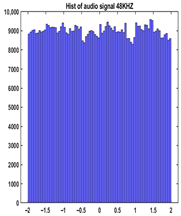
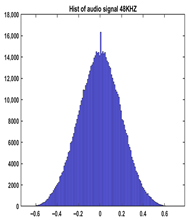
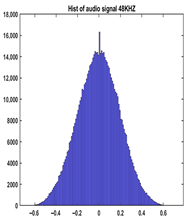
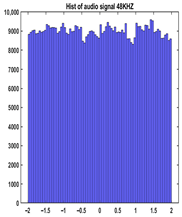
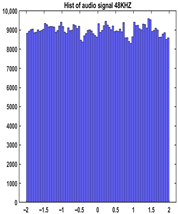
Histogram analysis is a dependable method for evaluating an encrypted speech stream’s quality. A well-designed encryption algorithm should produce an encrypted voice signal that resembles random noise, with nearly uniform probability distribution of sample values. As a result, the encrypted speech contains no meaningful information for statistical attacks. The histogram clearly demonstrates that the proposed method provides effective protection against statistical threats.
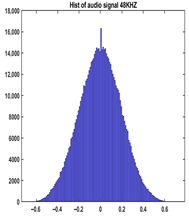
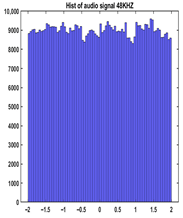
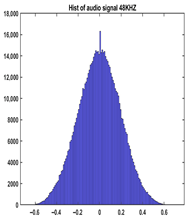
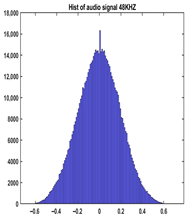
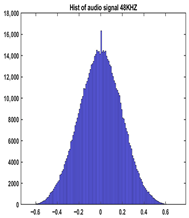
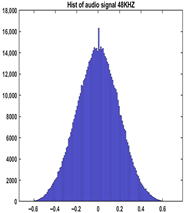
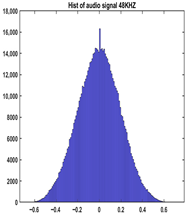
Table 6 presents the histogram analysis of original, encrypted, and decrypted audio signals under different AWGN noise levels (no noise, 30 dB, 25 dB, and 20 dB). The histogram of the original audio signal shows a normal (Gaussian) distribution typical of natural audio. After encryption, the histogram becomes nearly uniform, confirming the high complexity and randomness of the encrypted signal. This uniformity ensures that the encrypted signal does not reveal any statistical patterns from the original.
Table 6.
Histogram-based evaluation of audio encryption performance using Adaptive Feedback Control synchronization.
As AWGN noise increases, the encrypted signal remains statistically unaffected, which implies strong noise resistance. Additionally, in every case, the decrypted signal’s histogram stays around the original, indicating that the decryption procedure correctly recovers the original audio stream.
5.6. Audio Spectrogram Analysis
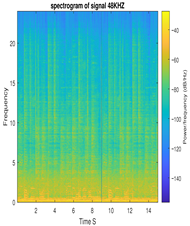
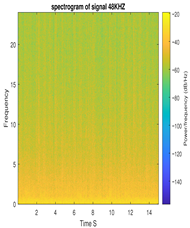
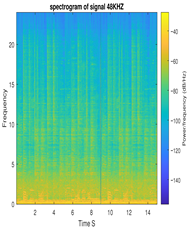
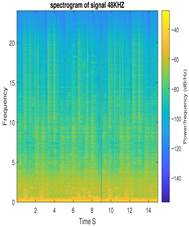
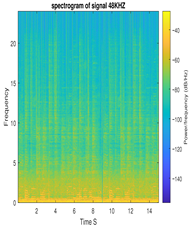
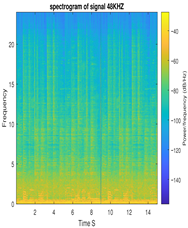
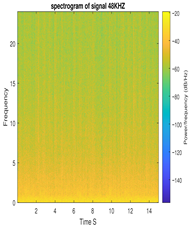
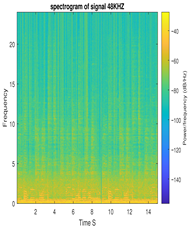
Spectrogram analysis is a critical aspect of evaluating the performance and robustness of cryptographic systems for audio communication. It reveals the impact of encryption on the frequency content of the audio signal and helps identify possible distortions or information loss. The spectrogram provides a time frequency representation of audio data, making it a valuable tool for examining signal transformations.
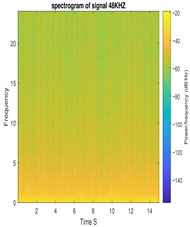
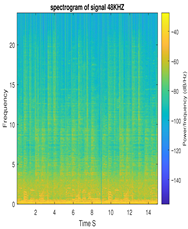
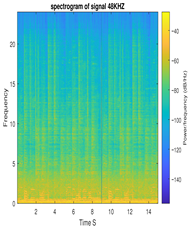
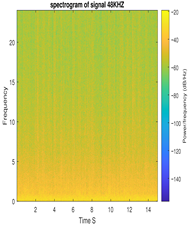
Table 7 shows the spectrograms of the original, encrypted, and decrypted audio signals under different noise conditions using the Adaptive Feedback Control synchronization method. The encrypted audio signals show significant changes in spectral content, indicating successful encryption. These distortions reflect the complexity added to the signal, which enhances security. Decrypted signals using the Adaptive Feedback Control method appear visually similar to the original, even in the presence of AWGN. At 35 dB AWGN, minor spectral deviations are observed, but the overall structure remains intact, showing strong resistance to noise. The spectrogram of the encrypted signals indicates that both synchronization methods introduce necessary distortions, while the decrypted spectrograms confirm accurate signal recovery, even under moderate noise. Overall, the Adaptive Feedback Control method shows effective encryption and slightly better decryption performance.
Table 7.
Spectrogram-based evaluation of audio encryption robustness under different AWGN Levels using Adaptive Feedback Control synchronization.
5.7. Cryptographic Attack Resistance Analysis
The security performance of the proposed chaotic audio encryption system is evaluated using both statistical and cryptographic security metrics to ensure robustness against common cryptanalytic attacks.
5.7.1. Differential Attack Resistance
Differential attack resistance is evaluated using the Unified Average Changing Intensity (UACI) and Number of Sample Change Rate (NSCR) metrics. High NSCR values indicate that small changes in plaintext samples lead to significant changes in ciphertext samples. Similarly, high UACI values indicate strong diffusion characteristics.
The obtained NSCR and UACI results confirm that the proposed system provides strong resistance against differential attacks due to the nonlinear dynamics and high sensitivity properties of the Chameleon Chaotic System.
Although NSCR and UACI are mainly used to evaluate differential attack resistance, their high values also indicate strong plaintext sensitivity, which indirectly supports resistance against chosen plaintext attacks.
5.7.2. Chosen Plaintext Attack Resistance
The proposed encryption system also demonstrates strong resistance against chosen plaintext attacks. Due to the chaotic system’s sensitivity to initial conditions and control parameters, even minimal variations in plaintext signals lead to significant and unpredictable changes in the encrypted output. This makes it computationally infeasible for an attacker to predict encryption behavior even when plaintext inputs are known.
A comparison with contemporary chaotic and hyperchaotic audio encryption systems (2024–2025) is included in order to better place the suggested work within the current state-of-the-art.
The suggested approach achieves comparable UACI values (39.6%) while maintaining significantly lower correlation (−0.0033), indicating strong decorrelation between the original and encrypted signals, in contrast to El-Nahas’s work [28], which combines chaotic systems with S-box and matrix transformations. The suggested system retains a more straightforward structure while performing well, in contrast to hybrid systems that add computing complexity. The suggested system allows real-time processing in a similar manner to FPGA-based solutions like Elrefai et al. [29] and Azzaz et al. [30], while also accomplishing successful timing closure and effective hardware usage. A decryption correlation of 0.9997 and a very low MSE are also achieved by using Adaptive Feedback Control (AFC), which allows for extremely precise signal recovery and shows excellent reconstruction quality. The suggested system strikes a good compromise between security performance and implementation efficiency when compared to more recent hyperchaotic and hybrid approaches [32,33,34], which frequently rely on intricate structures (such as DNA coding, memristors, or hybrid cryptography). Furthermore, the suggested study offers a comprehensive FPGA-based implementation, demonstrating its appropriateness for real-time secure communication applications, in contrast to a number of studies that are restricted to simulation-based validation.
Overall, the results demonstrate that the proposed system is competitive with, and in some aspects outperforms, recent state-of-the-art chaotic audio encryption methods in terms of security strength, reconstruction accuracy, and hardware feasibility.
6. Conclusions
This paper describes the hardware execution and construction of a Chameleon Chaotic-based secure audio encryption system algorithm, utilizing the capabilities of FPGA technology. The system was developed using MATLAB and Xilinx tools, and deployed on a Zynq-7000 FPGA platform, with validation carried out via Vivado.
A key feature of the capacity of the Chameleon Chaotic System to alternate between self-excited and concealed attractors was effectively leveraged to enhance the unpredictability and robustness of the encryption process. Synchronization was achieved utilizing the Adaptive Feedback Control (AFC) method. A detailed performance evaluation based on encryption strength and decryption fidelity was conducted. The results showed strong encryption, with correlation values around −0.0033 between original and encrypted signals, and consistent UACI (39.6%) and NSCR (0.99999) values. AFC demonstrated excellent performance in signal recovery, achieving a decryption correlation of 0.9997. It also resulted in a low decryption MSE (as low as 2.26 × ) and a high PSNR of 43.58 dB, indicating reduced distortion and improved audio quality. Beyond the performance metrics, the FPGA-based implementation offered significant advantages with regard to parallelism, actual time processing, energy efficiency, and the practicality of the suggested system for embedded secure communication applications.
Based on the findings, the AFC method offers a balanced solution for applications requiring both security and high audio fidelity, such as encrypted voice transmission. Future directions may explore fractional-order chaotic systems, hardware-level optimization, and intelligent control schemes to further enhance system adaptability and resilience.
Author Contributions
Conceptualization, A.-B.A.A.-H.; formal analysis, V.-T.P.; investigation, A.S.; methodology, A.S.; software, A.S.; supervision, V.-T.P.; visualization, A.-B.A.A.-H.; writing—original draft, A.-B.A.A.-H.; and writing—review and editing, V.-T.P. All authors have read and agreed to the published version of the manuscript.
Funding
This research received no external funding.
Data Availability Statement
Data is contained within the article.
Conflicts of Interest
The authors declare no conflicts of interest.
Abbreviations
| FPGA | Field Programmable Gate Array |
| MSE | Mean Squared Error |
| PSNR | Peak Signal-to-Noise Ratio |
| UACI | Unified Average Changing Intensity |
| SNR | Signal-to-Noise Ratio |
| AWGN | Additive White Gaussian Noise |
| SE | Spectral Entropy |
| VHDL | Very High Speed Integrated Circuit Hardware Description Language |
| XSG | Xilinx System Generator |
| JTAG | Joint Test Action Group |
| DSP | Digital Signal Processing |
| NSCR | Number of Sample Change Rate |
References
- Wahid, A.; Wardoyo, R. An implementation of audio security using DES algorithm. Indones. J. Comput. Cybern. Syst. 2007, 1, 1–6. [Google Scholar] [CrossRef] [Scilit]
- Rivest, R.L.; Shamir, A.; Adleman, L. A method for obtaining digital signatures and public-key cryptosystems. Commun. ACM 1978, 21, 120–126. [Google Scholar] [CrossRef] [Scilit]
- Mossa, E. Security enhancement for AES encrypted speech in communications. Int. J. Speech Technol. 2017, 20, 163–169. [Google Scholar] [CrossRef] [Scilit]
- Bhargava, B.; Shi, C.; Wang, S.-Y. MPEG video encryption algorithms. Multimed. Tools Appl. 2004, 24, 57–79. [Google Scholar] [CrossRef] [Scilit]
- El-Latif, A.A.A.; Li, L.; Niu, X. A new image encryption scheme based on cyclic elliptic curve and chaotic system. Multimed. Tools Appl. 2014, 70, 1559–1584. [Google Scholar] [CrossRef] [Scilit]
- Shakir, H.R. An image encryption method based on selective AES coding of wavelet transform and chaotic pixel shuffling. Multimed. Tools Appl. 2019, 78, 26073–26087. [Google Scholar] [CrossRef] [Scilit]
- Servetti, A.; De Martin, J.C. Perception-based partial encryption of compressed speech. IEEE Trans. Speech Audio Process. 2002, 10, 637–643. [Google Scholar] [CrossRef] [Scilit]
- Thorwirth, N.J.; Horvatic, P.; Weis, R.; Zhao, J. Security methods for MP3 music delivery. Proc. Asilomar Conf. Signals Syst. Comput. 2000, 2, 1831–1835. [Google Scholar]
- Servetti, A.; Testa, C.; De Martin, J.C. Frequency-selective partial encryption of compressed audio. In Proceedings of the 2003 IEEE International Conference on Acoustics, Speech, and Signal Processing (ICASSP), Hong Kong, China, 6–10 April 2003; Volume V, p. 668, ISBN 0-7803-7663-3/03. [Google Scholar]
- Yan, W.-Q.; Fu, W.-G.; Kankanhalli, M.S. Progressive audio scrambling in compressed domain. IEEE Trans. Multimed. 2008, 10, 960–968. [Google Scholar] [CrossRef] [Scilit]
- Shannon, C.E. Communication theory of secrecy systems. Bell Syst. Tech. J. 1949, 28, 656–715. [Google Scholar] [CrossRef] [Scilit]
- Alvarez, G.; Li, S. Some basic cryptographic requirements for chaos-based cryptosystems. Int. J. Bifurc. Chaos 2006, 16, 2129–2151. [Google Scholar] [CrossRef] [Scilit]
- Grassi, G. Special issue editorial: Chaotic systems and nonlinear dynamics. Symmetry 2022, 14, 1137. [Google Scholar] [CrossRef] [Scilit]
- Veeman, D.; Mehrabbeik, M.; Natiq, H.; Rajagopal, K.; Jafari, S.; Hussain, I. A new chaotic system with coexisting attractors. Int. J. Bifurc. Chaos 2022, 32, 2230007. [Google Scholar] [CrossRef] [Scilit]
- Chaudhary, H.; Khan, A.; Nigar, U.; Kaushik, S.; Sajid, M. An effective synchronization approach to stability analysis for chaotic generalized Lotka–Volterra biological models using active and parameter identification methods. Entropy 2022, 24, 529. [Google Scholar] [CrossRef] [Scilit] [PubMed]
- James, N.; Menzies, M.; Chin, K. Economic state classification and portfolio optimization with application to stagflationary environments. Chaos Solitons Fractals 2022, 164, 112664. [Google Scholar] [CrossRef] [Scilit]
- Bonny, T. Chaotic or hyper-chaotic oscillator? Numerical solution, circuit design, MATLAB HDL-coder implementation, VHDL code, security analysis, and FPGA realization. Circuits Syst. Signal Process. 2021, 40, 1061–1088. [Google Scholar] [CrossRef] [Scilit]
- Bonny, T.; Al Debsi, R.; Majzoub, S.; Elwakil, A.S. Hardware optimized FPGA implementations of high-speed true random bit generators based on switching-type chaotic oscillators. Circuits Syst. Signal Process. 2019, 38, 1342–1359. [Google Scholar] [CrossRef] [Scilit]
- Taheri, M.; Zhang, C.; Berardehi, Z.R.; Chen, Y.; Roohi, M. No-chatter model-free sliding mode control for synchronization of chaotic fractional-order systems with application in image encryption. Multimed. Tools Appl. 2022, 81, 24167–24197. [Google Scholar] [CrossRef] [Scilit]
- Kekha Javan, A.A.; Zare, A.; Alizadehsani, R.; Balochian, S. Robust multi-mode synchronization of chaotic fractional order systems in the presence of disturbance, time delay and uncertainty with application in secure communications. Big Data Cogn. Comput. 2022, 6, 51. [Google Scholar] [CrossRef] [Scilit]
- Martínez-Fuentes, O.; Montesinos-García, J.J.; Gómez-Aguilar, J.F. Generalized synchronization of commensurate fractional-order chaotic systems: Applications in secure information transmission. Digit. Signal Process. 2022, 126, 103494. [Google Scholar] [CrossRef] [Scilit]
- Shumran, A.; Al-Hussein, A.-B.A. Study of Chaotic-Based Audio Encryption Algorithms: A Review. Iraqi J. Electr. Electron. Eng. 2024, 20, 8. [Google Scholar] [CrossRef] [Scilit]
- Hussein, E.A.R.; Khashan, M.K.; Jawad, A.K. A high security and noise immunity of speech based on double chaotic masking. Int. J. Electr. Comput. Eng. 2020, 10, 4270–4278. [Google Scholar] [CrossRef] [Scilit]
- Dai, W.; Xu, X.; Song, X.; Li, G. Audio encryption algorithm based on Chen memristor chaotic system. Symmetry 2021, 14, 17. [Google Scholar] [CrossRef] [Scilit]
- Fu, S.; Cheng, X.; Liu, J. Dynamics, circuit design, feedback control of a new hyperchaotic system and its application in audio encryption. Sci. Rep. 2023, 13, 19385. [Google Scholar] [CrossRef] [Scilit] [PubMed]
- Mohamed, M.A.; Bonny, T.; Sambas, A.; Vaidyanathan, S.; Nassan, W.A.; Zhang, S.; Obaideen, K.; Mamat, M.; Nawawi, M.K.M. A speech cryptosystem using the new chaotic system with a capsule-shaped equilibrium curve. Comput. Mater. Contin. 2023, 75, 5987–6006. [Google Scholar] [CrossRef] [Scilit]
- Benkouider, K.; Sambas, A.; Bonny, T.; Nassan, W.A.; Moghrabi, I.A.R.; Sulaiman, I.M.; Hassan, B.A.; Mamat, M. A comprehensive study of the novel 4D hyperchaotic system with self-exited multistability and application in the voice encryption. Sci. Rep. 2024, 14, 12993. [Google Scholar] [CrossRef] [Scilit]
- El-Nahas, A. Hyperchaotic Chen System Based Audio Signal Encryption. Bachelor’s Thesis, The German University in Cairo, New Cairo, Egypt, 2024. [Google Scholar]
- Elrefai, H.M.; Sayed, W.S.; Said, L.A. Hardware Implementation of a 2D Chaotic Map-Based Audio Encryption System Using S-Box. Electronics 2024, 13, 4254. [Google Scholar] [CrossRef] [Scilit]
- Azzaz, M.S.; Kaibou, R.; Madani, B. Co-design Based FPGA Implementation of an Efficient New Speech Hyperchaotic Cryptosystem in the Transform Domain. Integration 2024, 97, 102197. [Google Scholar] [CrossRef] [Scilit]
- Ince, E.; Karakaya, B.; Turk, M. Novel True Random Bit Generation and Its Audio Encryption Application with Lorenz Chaotic Circuit-Based Entropy Source. NOHU J. Eng. Sci. 2024, 13, 540–549. [Google Scholar] [CrossRef] [Scilit]
- Ulutas, H. A Novel Memristor-Based Hyperchaotic Hybrid Encryption System with DNA for Image Encryption on the Jetson TX2. Sci. Rep. 2025, 15, 35745. [Google Scholar] [CrossRef] [Scilit]
- Al Zahawy, B.W.H.; Hreshee, S.S. Merging the International Data Encryption Algorithm and Digital Chaotic Scrambler (DCS) to Enhance Audio Security. Eng. Technol. Appl. Sci. Res. 2025, 15, 26171–26180. [Google Scholar] [CrossRef] [Scilit]
- Zhou, S.; Yin, Y.; Erkan, U.; Toktas, A.; Zhang, Y. Novel Hyperchaotic System: Implementation to Audio Encryption. Chaos Solitons Fractals 2025, 193, 116088. [Google Scholar] [CrossRef] [Scilit]
- Shumran, A.; Al-Hussein, A.-B.A. Chameleon Chaotic System-Based Audio Encryption Algorithm and FPGA Implementation. Iraqi J. Electr. Electron. Eng. 2025, 21, 23. [Google Scholar] [CrossRef] [Scilit]
- Al-Hussein, A.-B.A.; Tahir, F.R.; Abdulkareem, H.; Adam, G.; Rajagopal, K. PLC implementation of a new chaotic chameleon system. IEICE Proc. Ser. 2023, 76, 265–268. [Google Scholar]
- Abel, A.; Schwarz, W. Chaos communications: Principles, schemes, and system analysis. Proc. IEEE 2002, 90, 691–710. [Google Scholar] [CrossRef] [Scilit]
- Gámez-Guzmán, L.; Cruz-Hernández, C.; López-Gutiérrez, R.; Garcia-Guerrero, E. Synchronization of multi-scroll chaos generators: Application to private communication. Rev. Mex. Fís. 2008, 54, 299–305. [Google Scholar]
- Pecora, L.M.; Carroll, T.L. Synchronization in chaotic systems. Phys. Rev. Lett. 1990, 64, 821–824. [Google Scholar] [CrossRef] [Scilit]
- Merah, L.; Ali-Pacha, A.; Said, N.H.; Mamat, M. A pseudo random number generator based on the chaotic system of Chua’s circuit and its real time FPGA implementation. Appl. Math. Sci. 2013, 7, 2719–2734. [Google Scholar] [CrossRef] [Scilit]
- Wang, J.; Yang, C. Chaos synchronization of a finance chaotic system with an integral sliding mode controller. J. Math. 2021, 2021, 6611031. [Google Scholar] [CrossRef] [Scilit]
- Zhou, X.; Jiang, M.; Du, S. Adaptive chaos synchronization of a new chaotic system with uncertain parameters based on passive control. In Proceedings of the 2009 Chinese Control and Decision Conference, Guilin, China, 17–19 June 2009; pp. 2218–2221. [Google Scholar] [CrossRef] [Scilit]
- Zhang, L. System Generator model-based FPGA design optimization and hardware co-simulation for Lorenz chaotic generator. In Proceedings of the 2nd Asia-Pacific Conference on Intelligent Robot Systems (ACIRS), Wuhan, China, 16–18 June 2017; pp. 170–174. [Google Scholar] [CrossRef] [Scilit]
- Rameshbabu, R.; Suresh, G.R. Design of Adaptive Feedback Control for New 3D Chaotic System and its Digital Implementation on FPGA. Indian J. Sci. Technol. 2020, 13, 1977–1990. [Google Scholar] [CrossRef] [Scilit]
- Alroubaie, Z.M.; Hashem, M.A.; Hasan, F.S. FPGA Design of Encryption Speech System Using Synchronized Fixed-Point Chaotic Maps Based Stream Ciphers. Int. J. Eng. Adv. Technol. (IJEAT) 2019, 8, 1538–1544. [Google Scholar]
- Aryalekshmi, B.N. FPGA Implementation of Lorenz’s Chaotic Generator. Int. J. Sci. Res. Sci. Technol. (IJSRST) 2019, 6, 226–231. [Google Scholar]
- Aranzabal, N.; Suárez, A.; Torres, J.; García-Olcina, R.; Martos, J.; Soret, J.; Menéndez, A.; Martínez, P.A. Design of digital advanced systems based on programmable system on chip. In Field-Programmable Gate Array; IntechOpen: London, UK, 2017; pp. 1–20. [Google Scholar] [CrossRef] [Scilit]
- Tolba, M.F.; Sayed, W.S.; Radwan, A.G.; Abd-El-Hafiz, S.K. Chaos-based hardware speech encryption scheme using modified tent map and bit permutation. In Proceedings of the 2018 7th International Conference on Modern Circuits and Systems Technologies (MOCAST), Thessaloniki, Greece, 7–9 May 2018; pp. 1–4. [Google Scholar] [CrossRef] [Scilit]

Disclaimer/Publisher’s Note: The statements, opinions and data contained in all publications are solely those of the individual author(s) and contributor(s) and not of MDPI and/or the editor(s). MDPI and/or the editor(s) disclaim responsibility for any injury to people or property resulting from any ideas, methods, instructions or products referred to in the content. |
© 2026 by the authors. Licensee MDPI, Basel, Switzerland. This article is an open access article distributed under the terms and conditions of the Creative Commons Attribution (CC BY) license.