


Abstract
This paper investigates the dynamics of a permanent magnet synchronous motor (PMSM) and controls its chaotic speed behavior using the synergetic control technique (SCT). The model includes electrical dynamics in the dq frame and mechanical speed dynamics, with a scalar parameter capturing cross-coupling effects. The equilibrium structure and local stability properties of the PMSM are analyzed. For zero input voltages and zero load torque, the system exhibits a pitchfork-type bifurcation in the electrical–mechanical equilibrium as crosses a critical value. Explicit expressions are derived for all equilibria, and their stability is characterized using eigenvalue analysis and the Routh–Hurwitz criterion, and a secondary loss of stability via a Hopf-type mechanism is identified. The case of nonzero input voltages with zero load torque is also discussed. Numerical simulations confirm the analytical results and highlight the parameter regions that admit stable operation. Bifurcation diagrams show the different PMSM behaviors as the parameter varies. For a certain interval of , the PMSM speed undergoes chaotic oscillations. The SCT is introduced to control the chaos. Macro variables are chosen to design the SCT. The derived SCT is implemented to eliminate the chaotic speed. The controller provides good performance in suppressing the chaos. The controller is tested under sudden reference speed change where the controller gets the new reference speed accurately. It is also evaluated under sudden and sinusoidal load torque variations.
1. Introduction
PMSM technology benefits significantly from advanced drive electronics and control techniques that enable precise torque and speed control over a broad range of speeds. Unlike induction motors which rely on induced flux, PMSMs have permanent magnets to create flux, which requires the variable frequency drive (VFD) controlling them to manage flux current differently for optimal performance. This allows for excellent efficiency, high power density, high torque-to-weight ratio, and precise dynamic response, making PMSMs very suitable as variable speed drives in many industrial and high-performance settings [1,2,3].
PMSMs are widely used in applications such as electric vehicles and hybrid vehicles [4,5], industrial robotics and CNC machines [6,7], HVAC systems (compressors, fans) and pumps [8,9], elevators and escalators [10], servo systems [11], and wind turbines [12].
However, the nonlinear nature of the differential equations governing the dynamics of these motors makes them susceptible to complex dynamic phenomena, most notably chaotic behavior. This undesirable behavior presents a significant challenge, leading to degraded motor performance, increased noise and vibration, and ultimately, system failure [13]. The bifurcation and chaos in nonlinear systems have been investigated in various scientific fields. Recently, in PMSM [14,15] induction motor drives [16], brushless DC motors [17], oil drilling systems actuated by induction motor [18], rotor stator system [19], 3D brushless DC motor [20], and DC motor [21] have been investigated.
Researchers have continued to deepen their understanding of the conditions that lead to disorder in PMSM systems, confirming that disorder typically arises when system parameters, such as source frequency, load torque, or resistor and inductor values, exceed certain critical limits [22].
Nonlinear systems and bifurcation theory provide a natural framework to analyze the qualitative behavior of such models [23,24,25]. In particular, the structure and stability of equilibrium points, as system parameters vary, can reveal critical thresholds beyond which conventional control strategies fail or require significant redesign.
The study of chaotic behavior relies primarily on the tools of nonlinear systems theory. Research studies focus on bifurcation diagrams, Lyapunov exponents, and Poincaré sections to identify chaotic operating regions [26]. For example, Huang et al. (2011) analyzed the fundamental dynamical properties of PMSMs, confirming their nonlinear nature and susceptibility to chaotic states [27].
More complex mathematical models of PMSMs, incorporating load torque effects or irregular air-gap conditions, have been developed, leading to the discovery of new chaotic patterns [28]. In this context, recent research (e.g., Fotsa et al., 2025) has highlighted the importance of studying motor dynamics under load torque, as this may result in unexpected chaotic behavior [29].
Controlling chaos in PMSMs represents one of the most active research directions, with proposed methods aiming to suppress chaotic behavior and restore the system to a desired stable or periodic state. These strategies can be categorized into several main groups, including adaptive control [30], single-state feedback control [31], inverse system control [32], fuzzy logic control [33], delay feedback control with analog circuit validation [34], adaptive terminal sliding mode control (ATSMC) [35], fixed-time adaptive control [36], sliding mode control (SMC) [37], time-limited control [38], adaptive backstepping-based tracking control [39], Lyapunov-based predictive control [40], neural network-based control [41], and genetic algorithm approaches [42].
Most of the aforementioned chaos-control methods for PMSMs are affected by parameter variations, and some, such as SMC, may introduce chattering due to discontinuous control action. In contrast, the synergetic control technique (SCT) offers a simpler design and is well suited for real-time implementation. Therefore, SCT is considered suitable for suppressing chaotic dynamics in PMSMs, as it is chattering-free and relatively independent of system parameter variations [43]. SCT has been successfully applied to control chaotic dynamics in power systems [44] and in indirect field-oriented induction motor drive systems [45].
In this paper, SCT is employed to eliminate chaotic dynamics due to its continuous control action and robustness against parameter variations. A simplified PMSM model is analyzed with a coupling parameter representing cross-coupling effects in the dq frame. The analysis shows that:
- For small , the origin is the unique equilibrium and is locally asymptotically stable.
- When exceeds a threshold, two additional nonzero equilibria appear, while the origin becomes unstable (pitchfork-type bifurcation).
- At a larger value of , the nonzero equilibria lose stability via a Hopf-type mechanism.
All results are obtained analytically and confirmed numerically. The SCT strategy is derived by proposing three macro variables and implemented numerically to suppress the chaotic oscillations in the PMSM dynamics. The SCT suppresses chaotic behavior by driving the system trajectories toward a stable manifold associated with a stable equilibrium point.
In addition, to quantitatively demonstrate the effectiveness of the proposed approach, key performance indicators are explicitly reported in Section 7. These include a chaos suppression time of approximately 1.1 s following controller activation, fast speed tracking under multiple step changes (settling times below 1.1 s), and strong robustness against both sudden and sinusoidal load torque disturbances. These results confirm the dynamic performance and practical feasibility of the proposed SCT strategy.
The remainder of the paper is organized as follows. Section 2 presents the mathematical model of the PMSM. Section 3 provides the equilibrium and stability analysis. Section 4 presents numerical simulations, including bifurcation diagrams, Lyapunov exponents, Poincaré maps, and phase portraits. Section 5 derives the SCT controller. Section 6 introduces the extended state observer (ESO) for torque estimation. Section 7 discusses the control results, and Section 8 concludes the paper.
2. System State Equations
A three-phase PMSM model consists of three nonlinear differential equations [46]:
Here, , , , , , and denote the direct–quadrature axis stator components of current, inductances, and voltages, respectively. The variables , , J, , , , and represent the motor angular speed, stator winding resistance, moment of inertia, load torque, viscous damping coefficient, permanent magnet flux, and number of pole pairs, respectively.
By applying the transformation given in Equation (2) and the time-scaling transformation in Equation (3), the dimensionless model can be expressed as Equation (5):
where
with
After normalization, the dimensionless model becomes:
The dimensionless parameters are defined as
and the scaled voltages are given by
For a smooth-air-gap PMSM (), the nonlinear normalized model can be written as:
3. Dynamical Analysis
3.1. Equilibrium Equations
An equilibrium point satisfies
Solving gives
Solving yields
Substituting these expressions into gives
After simplification, the following cubic equation is obtained:
Let z be a real root of the above cubic equation. Then the equilibrium point is given by
3.2. Equilibrium Analysis for Special Case
- If , the origin is the unique equilibrium point:
- If , three equilibrium points exist:
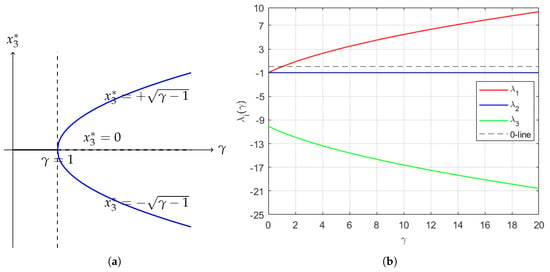
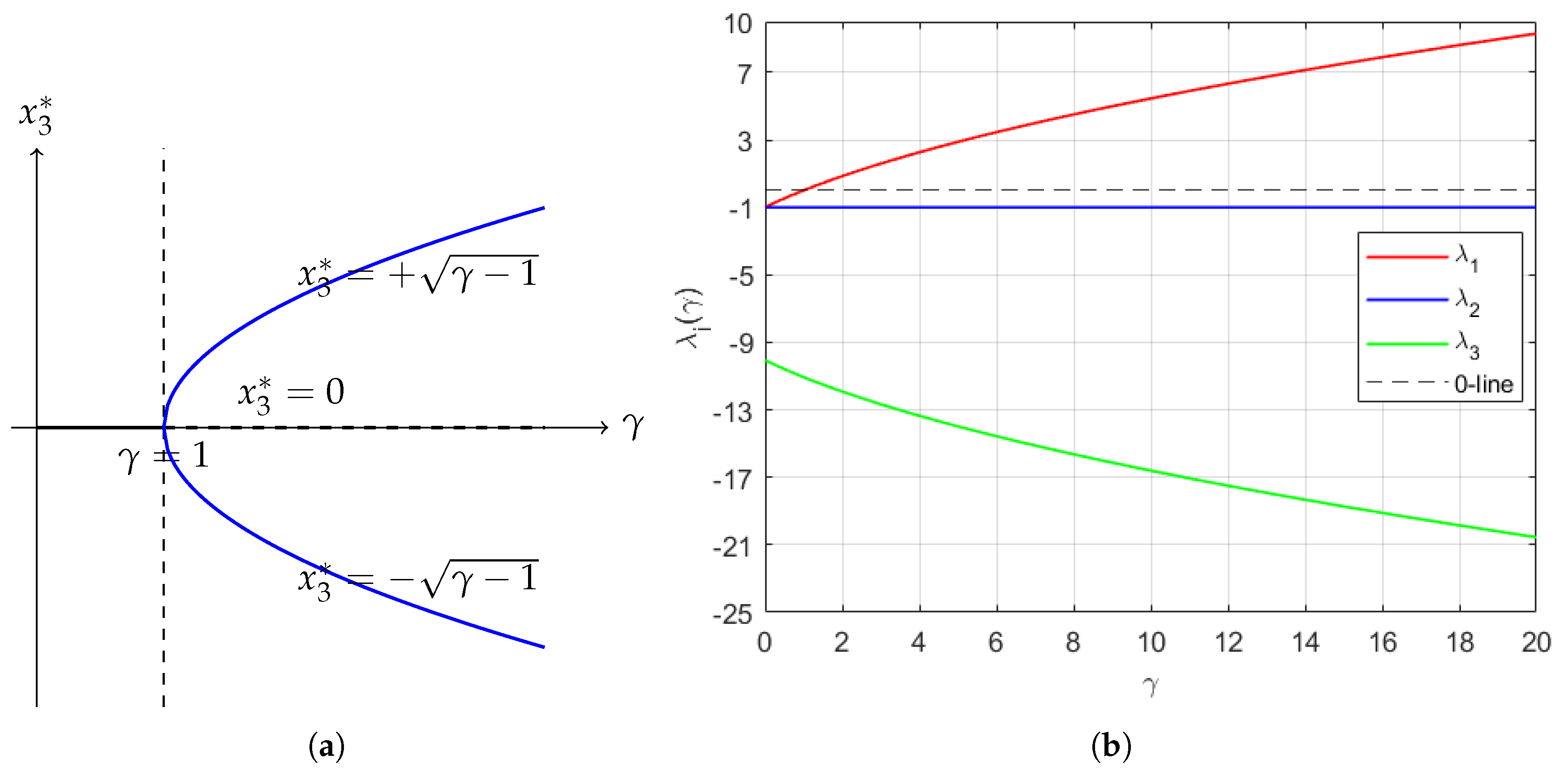
Figure 1a shows the branches of : the trivial branch exists for all , while the two nonzero branches exist only for . This structure corresponds to a pitchfork-type bifurcation [25].
Figure 1.
(a) Equilibrium bifurcation diagram of versus for the PMSM model (9). A pitchfork-type branching occurs at , generating two nonzero equilibria. (b) Eigenvalue trajectories of the linearization at the origin as varies. Stability is lost at when one eigenvalue crosses zero.
3.2.1. Linearization and Local Stability
3.2.2. Stability of the Origin
At the origin, the Jacobian becomes
Its characteristic polynomial is
The quadratic factor has the form
For Equation (9):
- For , , , so both roots are in the open left half-plane by the Routh–Hurwitz criterion [24] (all eigenvalues of satisfy ). Together with the eigenvalue , this implies asymptotic stability of the origin.
- For , and one eigenvalue is zero. Hence, the origin is non-hyperbolic and a bifurcation occurs.
- For , and the product of the two roots is negative, so one is positive. Therefore, the origin becomes unstable (a saddle point).
3.2.3. Stability of the Nonzero Equilibria
For , consider the equilibrium point
(the other nonzero equilibrium is symmetric with and has the same eigenvalues). Substituting into Equation (10) gives
Its characteristic polynomial is
The two nonzero equilibria of Equation (9) are:
The characteristic polynomial can be written in the standard form
For , this becomes
The third-order Routh–Hurwitz conditions [23,24] require
For , it is clear that , , and . The remaining condition yields
- For , all eigenvalues have negative real parts; therefore, the nonzero equilibria are asymptotically stable.
- For , the inequality is reversed, and at least one eigenvalue has a positive real part, implying instability.
Figure 1 illustrates the equilibrium structure and local stability of the normalized PMSM model under the special case . The bifurcation diagram in Figure 1a represents the evolution of equilibrium points in the dq-frame state space as the coupling parameter varies. For < 1, the origin is the unique asymptotically stable equilibrium. At = 1, an eigenvalue crosses zero (Figure 1b), leading to loss of hyperbolicity and the emergence of two symmetric nonzero equilibria for = 1, consistent with a pitchfork-type bifurcation. The eigenvalue trajectories in Figure 1b corroborate the Routh–Hurwitz stability analysis presented above. Figure 1 therefore provides a dynamical stability map of the reduced PMSM system, rather than an electromagnetic field representation.
To further characterize the loss of stability at , observe that the Routh–Hurwitz condition defines the critical boundary where the real part of a complex-conjugate pair of eigenvalues becomes zero. Since the coefficients , , and remain positive at the critical value, and the instability occurs through violation of the inequality , the transition is associated with a pair of eigenvalues crossing the imaginary axis.
Numerically, for , the system exhibits sustained oscillatory behavior, as observed in the bifurcation diagrams and time-series simulations (Section 4). This combination of (i) the analytical stability boundary determined via the Routh–Hurwitz conditions and (ii) the numerical emergence of persistent oscillations is consistent with a Hopf-type bifurcation mechanism.
A full center-manifold reduction and normal-form derivation of the Hopf bifurcation conditions is beyond the scope of the present study. Nevertheless, the analytical eigenvalue crossing condition, together with the observed oscillatory attractor, provides strong evidence supporting the Hopf-type interpretation.
3.2.4. Summary
- For , the nonzero equilibria are asymptotically stable.
- At , the eigenvalues cross the imaginary axis, leading to critical slowing down.
- For , the nonlinear PMSM model exhibits a stable oscillatory attractor, consistent with a supercritical Hopf-type bifurcation.
These results demonstrate that the bifurcation parameter fundamentally alters the stability of the PMSM equilibrium, a finding consistent with well-known nonlinear motor dynamics [23,24].
3.3. Equilibrium and Stability for Constant q–Axis Excitation
In this section, the PMSM model in Equation (6) is revisited under the following operating condition:
Then, Equation (6) reduces to
which corresponds to a constant q-axis excitation and zero d-axis voltage and load torque. Such operating modes are common in torque-producing PMSM.
Equilibria and their stability are analyzed for . The equilibrium of Equation (15) can be satisfied by making:
From ,
From ,
Define
Then from Equations (16) and (17)
Substituting into yields
that is,
or equivalently,
For , this equation can be written in the depressed cubic form with
Its discriminant is
According to classical cubic theory [25]:
- implies one real root and two complex-conjugate roots;
- implies multiple (coincident) roots;
- implies three distinct real roots.
Solving gives
Hence, there is always at least one real root, and for there are three distinct real roots. The corresponding equilibria follow from and .
- For , the “main” physically relevant equilibrium branch corresponds to the positive root of Equation (19), which increases monotonically from
- For , two additional equilibria with appear, as expected from the discriminant analysis.
3.3.1. Linearization and Characteristic Polynomial
The Jacobian matrix of system (15), for , is
At an equilibrium , the Jacobian becomes
A straightforward computation yields the characteristic polynomial
with
Using the equilibrium relation (19), we can eliminate in favor of z. From
Substituting into the expressions for and gives
3.3.2. Stability of the Positive Equilibrium Branch
We focus on the positive-root branch of Equation (19), which exists for all and satisfies . For a cubic , the Routh–Hurwitz conditions for all roots to lie in the open left half-plane are [23,24]:
Along the positive branch (with ), . From Equation (24),
For ,
For ,
Along the equilibrium branch, we have (since and increases with ). Hence, and , which implies that .
Finally,
Define
Then
For , the sign of coincides with the sign of .
Differentiating,
which vanishes at . Thus, has a unique maximum at and is strictly decreasing for .
Moreover,
and
Since the positive equilibrium branch satisfies for , it follows that on this interval.
Hence,
All Routh–Hurwitz conditions are therefore satisfied for the positive equilibrium branch over , which proves that all eigenvalues of have negative real parts. Local asymptotic stability follows from standard linearization theory [24].
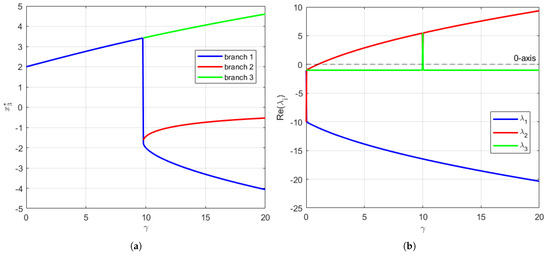
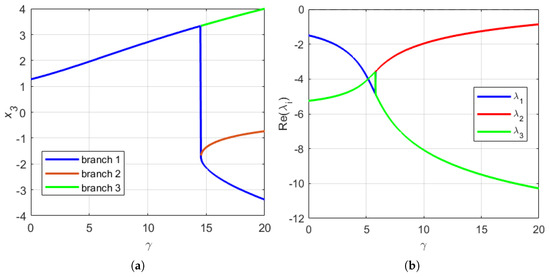
Figure 2 illustrates the equilibrium bifurcation diagram and corresponding eigenvalue trajectories for the PMSM model under constant q-axis excitation.
Figure 2.
(a) Equilibrium bifurcation diagram of versus for the PMSM model (9) with , , , and . (b) Eigenvalue trajectories of the linearization with , , , and varies.
3.3.3. Summary
For , the cubic Equation (19) admits two additional real roots with , and hence two additional equilibria . Direct evaluation of the Jacobian matrix in Equation (21) at these points shows that at least one eigenvalue has a positive real part (for example, for , the negative roots and each yield one eigenvalue with positive real part). Therefore, these additional equilibria are unstable, and the positive equilibrium branch is the unique locally asymptotically stable equilibrium for .
3.4. Equilibria and Their Stability for , ,
3.4.1. The Equilibria
For the PMSM system (6) with fixed parameters
an equilibrium satisfies .
From Equation (8), we obtain
and
For each fixed , the real roots z of the above cubic equation determine the equilibrium values
3.4.2. Linearization and Local Stability
The Jacobian matrix of the vector field at a state is given in Equation (10). The linear stability of an equilibrium point is determined by the eigenvalues of .
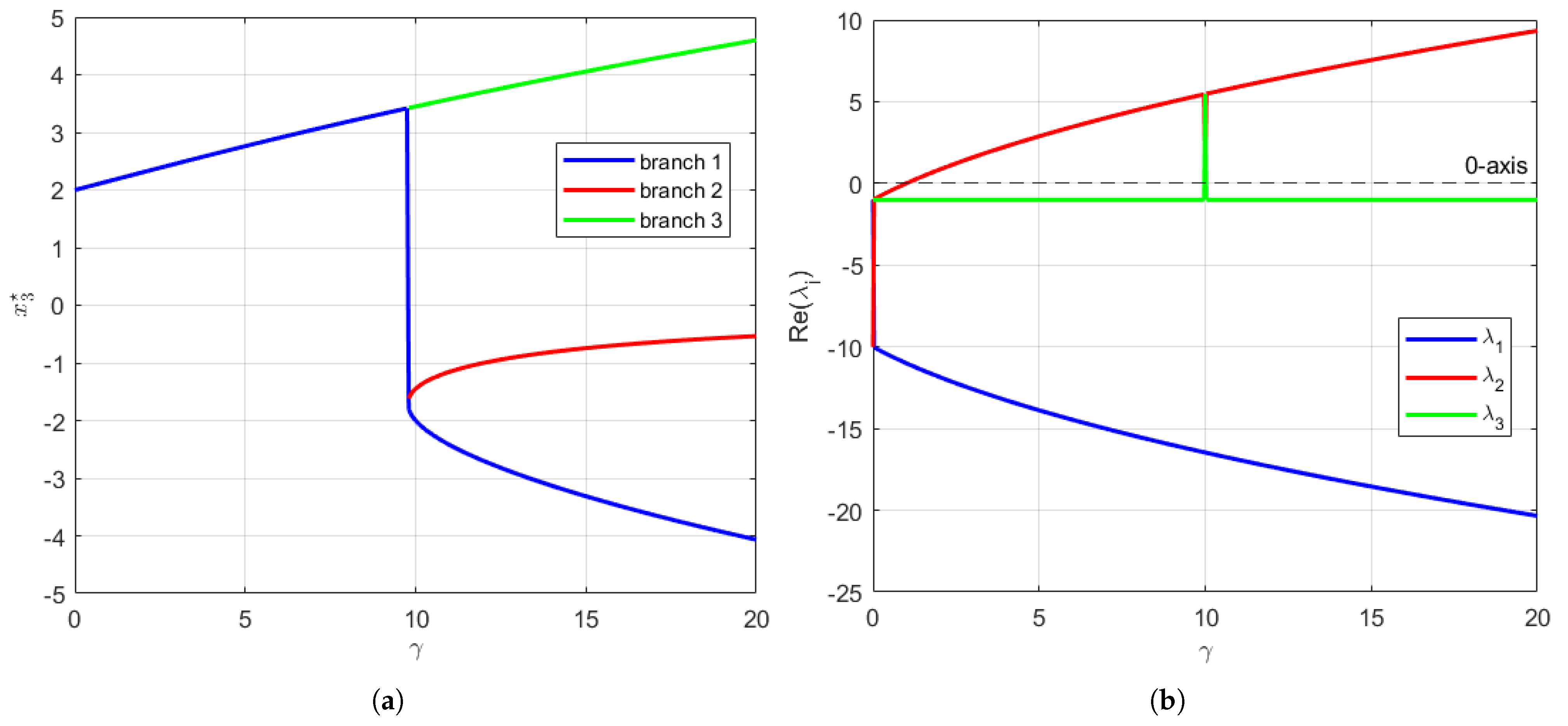
Numerical evaluation of the roots of the cubic equation (Equation (28)) and the eigenvalues of for shows the following behavior:
- For , the cubic equation has a single real root . The corresponding equilibriumhas all eigenvalues of with negative real parts, and is therefore asymptotically stable.
- For , the cubic equation has three distinct real roots:The equilibrium associated with the positive root remains asymptotically stable (all eigenvalues of J have negative real parts).In contrast, the two equilibria corresponding to the negative roots and each have one eigenvalue with a positive real part and are therefore unstable (saddle-type equilibria).
As illustrated in Figure 3, the positive equilibrium branch remains asymptotically stable over the considered range of , while additional negative branches are unstable.
Figure 3.
(a) Equilibrium bifurcation diagram of versus for the PMSM model (9) with , , , and . (b) The corresponding eigenvalue trajectories of the linearization .
3.4.3. Summary
In summary, for the parameter set and :
- the positive equilibrium branch is asymptotically stable over the entire interval;
- the additional equilibria that appear for and satisfy are unstable.
4. Numerical Results of the PMSM Dynamics
This section presents numerical simulations of the nonlinear PMSM model. The PMSM parameters are [47] H, H, , , , Wb, and .
To visualize the analytical results, the PMSM dynamics are analyzed at , while varies in the range with a resolution of .
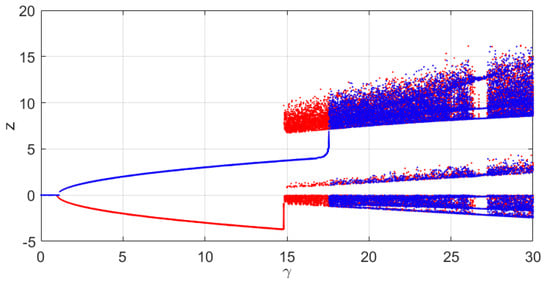
Two bifurcation diagrams are shown in Figure 4, obtained in two directions. The first is achieved by increasing from 0 to 30 (blue curve), and the second by decreasing from 30 to 0 (red curve).
Figure 4.
Bifurcation diagram for the PMSM rotor speed described in (9) with . The diagram in blue for the forward direction and the red color for the backward direction. The color bar represents the peak values of the rotor-speed oscillation waveform.
For each direction, the initial values of the state variables are set to for the first run, while the initial values for the subsequent run are taken as the final values of the previous run. The integration was performed using a fourth-order Runge–Kutta method with a sampling interval of s over a 100 s time horizon. From Figure 4, the system trajectories converge to the zero equilibrium for in both directions. In the forward direction (blue curve), the trajectories converge to the corresponding stable nonzero equilibrium for , while the speed exhibits chaotic oscillations for . In the backward direction (red curve), the trajectories converge to the nonzero stable equilibrium for , while the PMSM speed exhibits chaotic behavior for . These numerical results are consistent with the mathematical analysis.
Quantitative identification of chaos can be achieved using indicators such as Lyapunov exponents, which measure the exponential divergence of nearby trajectories, and Poincaré maps, which reveal the geometric structure of attractors.
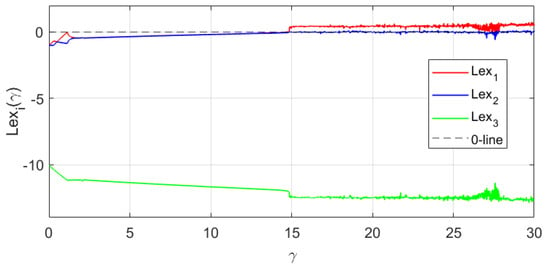
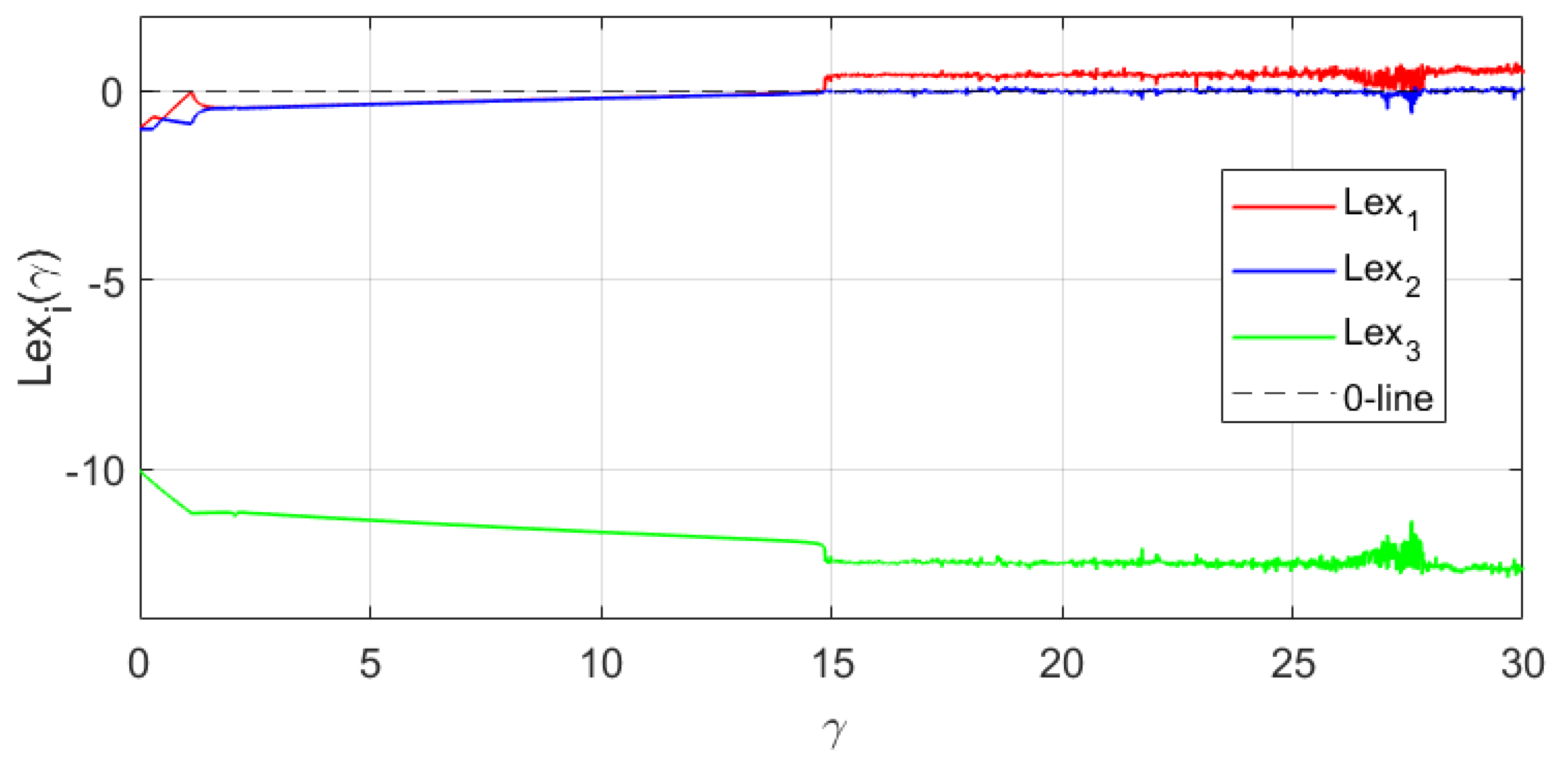
Figure 5 shows the Lyapunov exponents of the PMSM for with in the backward direction, using initial conditions . It is observed that all exponents are negative for , indicating a stable fixed-point response, while the largest exponent becomes positive for , which indicates chaotic behavior. The Lyapunov exponent plot confirms the system behavior observed previously in the bifurcation diagram (Figure 4).
Figure 5.
Lyapunov exponents (Lex) for the PMSM with . The diagram is for the backward direction.
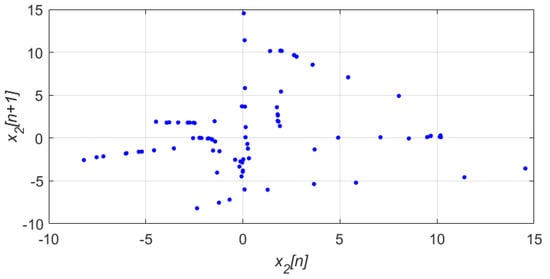
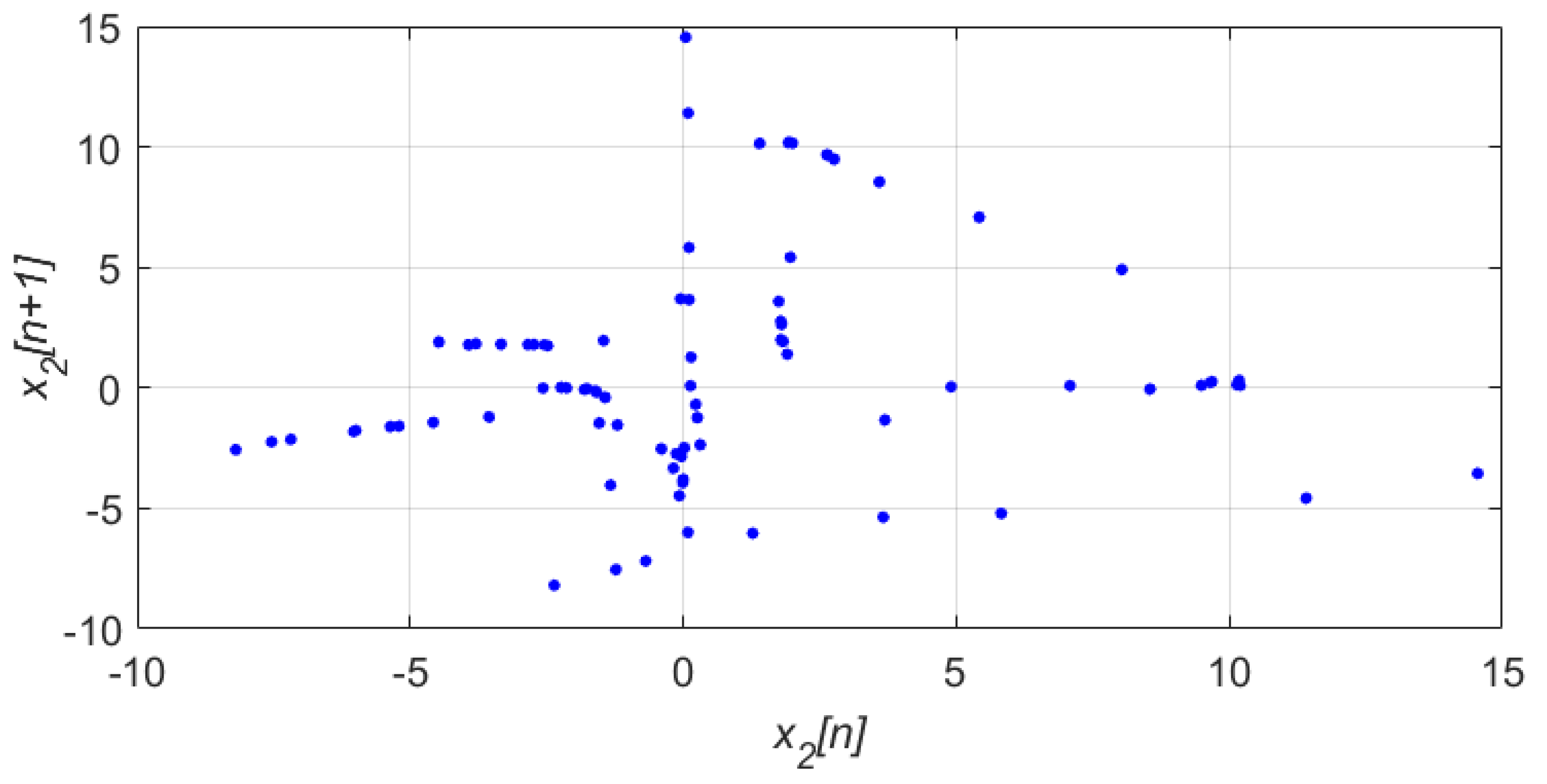
Figure 6 displays the Poincaré map of for , , , , and . The Poincaré section consists of multiple scattered points, which indicates chaotic behavior.
Figure 6.
Poincaré map of (chaos case) with , = 16, , , .
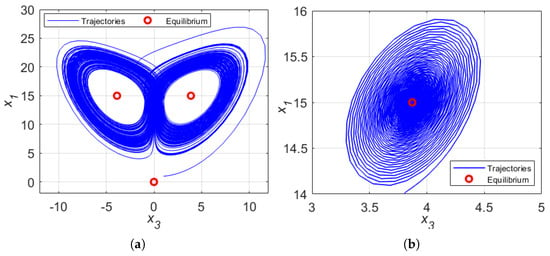
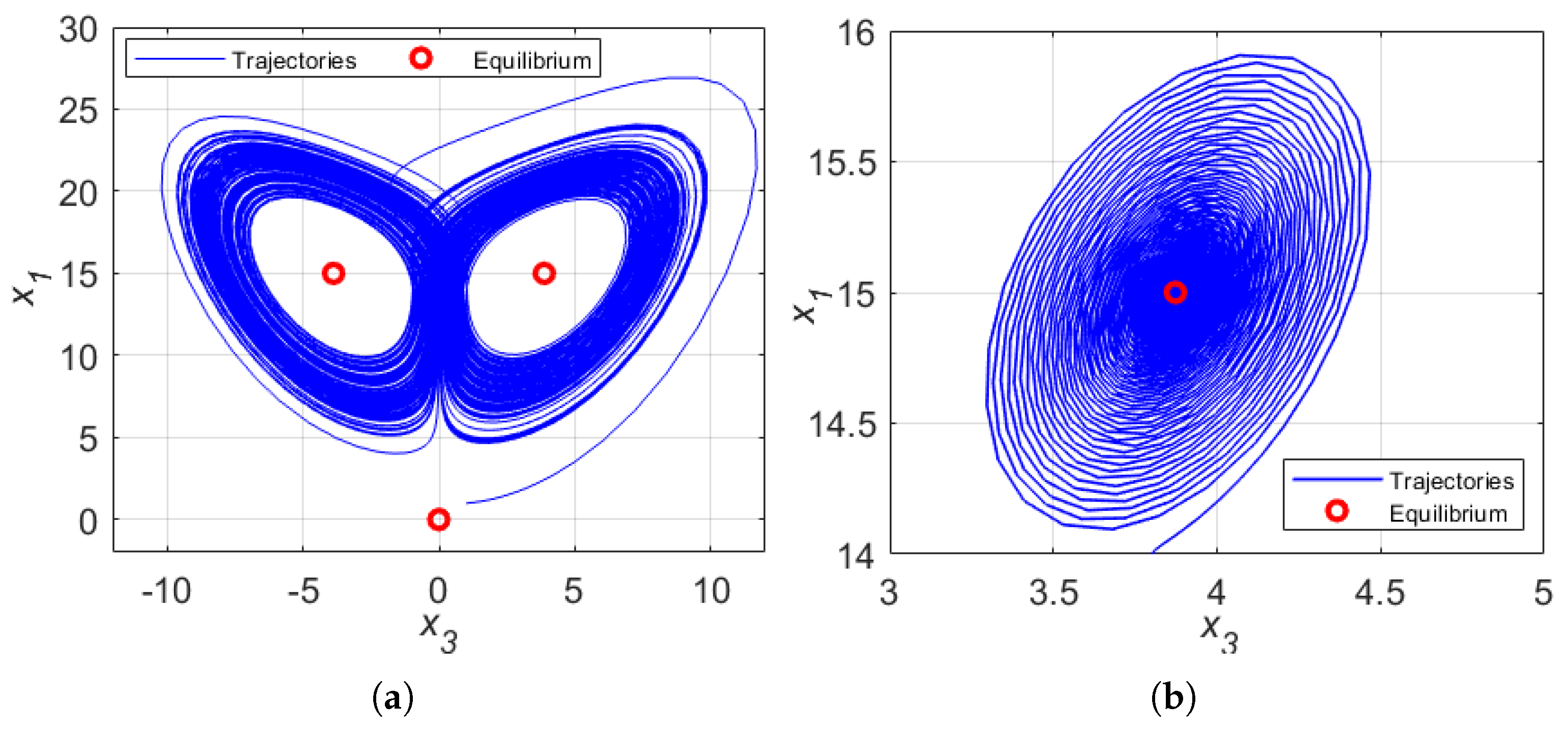
The PMSM exhibits coexistence of attractors for , as illustrated in Figure 4. The phase portraits of these attractors with and are shown in Figure 7. Figure 7a represents the chaotic regime for initial conditions , where the trajectories exhibit chaotic oscillations away from the unstable equilibria (red markers). In contrast, Figure 7b, with initial conditions , shows trajectories converging to the stable equilibrium, indicating asymptotic stability.
Figure 7.
Phase portraits show different attractors for same PMSM parameters ( and ). (a) Phase portrait for . The attractor becomes unstable with chaos regime. (b) Phase portrait for . Trajectories converge to the equilibrium, indicating asymptotic stability.
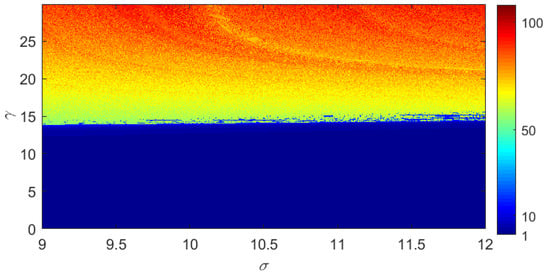
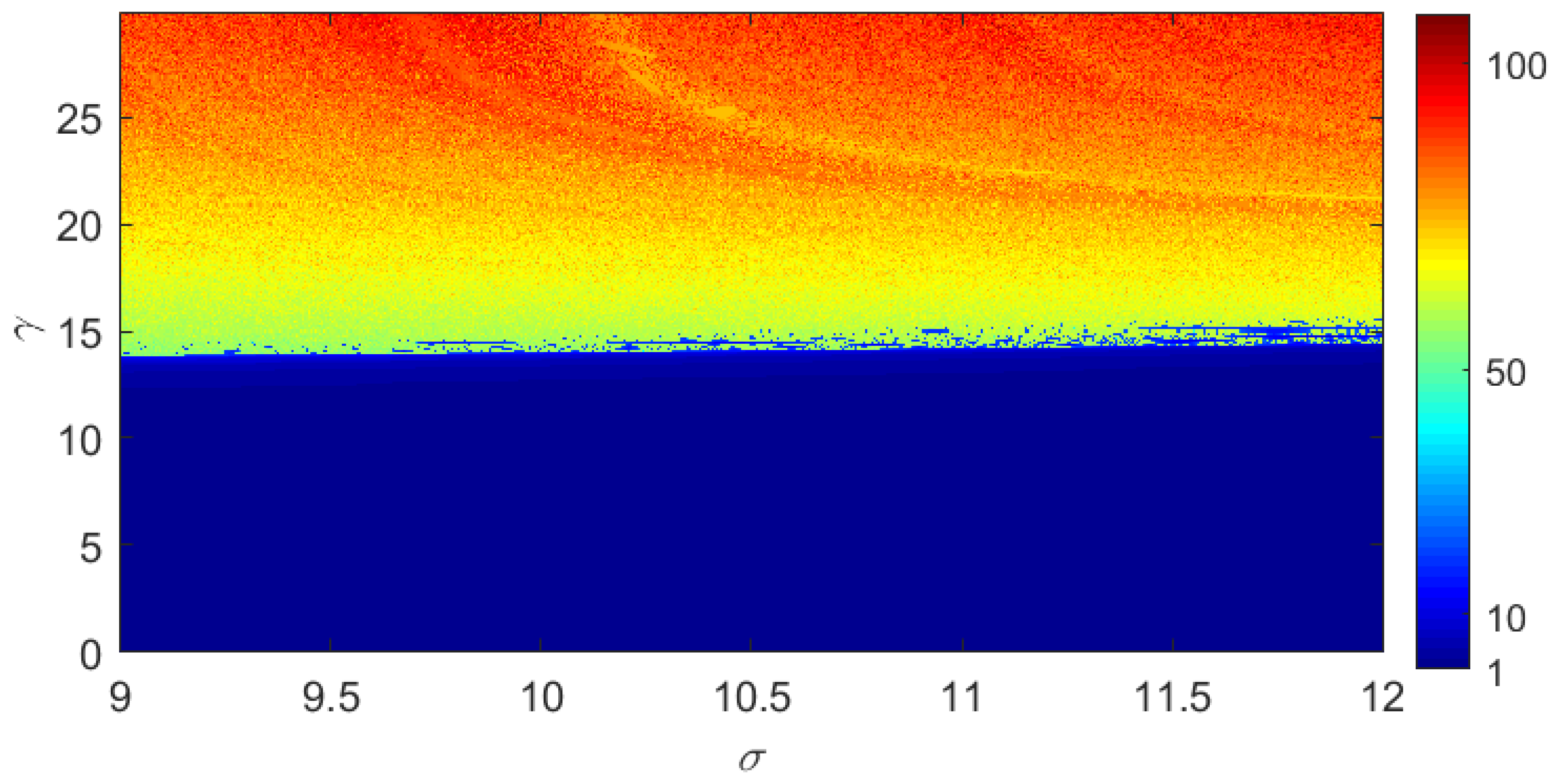
Figure 8 presents a two-dimensional bifurcation diagram for and .
Figure 8.
Two-dimensional bifurcation diagram of the PMSM rotor speed described in (9). The color bar numbers denote to the peaks of the oscillation wave form.
The results show that the PMSM exhibits chaotic speed oscillations for within . The chaotic behavior becomes more pronounced as increases.
5. Synergetic Control Technique
The synergetic control technique (SCT) implies that the time required to reach a steady state generally depends on the initial conditions of the system. It aims to force the trajectories to follow a specific desired path, called the synergetic manifold. SCT is known for avoiding the “chattering” issue present in some other control techniques, such as SMC.
The steps for designing the SCT begin with selecting a macro-variable () according to the system variables to ensure that the system trajectories converge to a stable manifold, after which they slide along it toward a stable equilibrium point at the origin.
The manifold equation is described as follows:
where T is a time constant designed to determine the convergence time toward the manifold, and is a selected function that must satisfy the following three conditions:
- it must be invertible and differentiable;
- ;
- .
In the following SCT design procedure, the summation of term in Equation (30) will be determined by:
The mathematical model of the PMSM under SCT control can be expressed as follows:
where is the vector of the state variables, , is the SCT control input, and is defined as
The controller is implemented in the PMSM model described in Equation (6) to ensure stabilization of its equilibrium point under a wide range of parameter variations, thereby suppressing unwanted chaotic behavior.
Within the PMSM drive structure, three macro-variables (, , and ) are selected to achieve the control objectives.
5.1. Direct-Axis Path
The d-axis part macro variable can be chosen as the sum of d-axis current error and its integral, as follows:
5.2. Speed Path
This path consists of two loops: an outer synergetic speed loop and an inner synergetic q-axis loop.
5.2.1. Outer Synergetic Speed Loop
For the outer speed loop, the macro-variable is chosen as
Impose
5.2.2. Inner Synergetic q-Axis Loop
In the inner loop, is forced to track by defining
Impose
From the system model in Equations (32), (40), and (41), solving for the control input yields
Here, , , , , , , and are positive design constants. The selection of macro variables , , and is motivated by the cascade control structure of the PMSM drive. The d-axis macro-variable (Equation (33)) incorporates integral action to eliminate steady-state current error and ensure convergence of the d-axis current. The speed macro-variable (Equation (36)) defines the outer-loop speed regulation objective and generates the virtual q-axis reference through Equation (39). The inner-loop macro-variable (Equation (40)) ensures convergence of the actual q-axis current to the virtual reference .
The imposed manifold dynamics (Equations (34) and (37)) are first-order stable differential equations with positive time constants , , and . Under standard synergetic control assumptions, these dynamics guarantee exponential convergence of the macro-variables to zero. Consequently, the tracking errors converge asymptotically, and the closed-loop trajectories are driven toward the desired stable manifold, resulting in suppression of chaotic oscillations and stable speed regulation.
6. Torque Observer
The extended state observer (ESO) is adopted for this purpose. ESO was first proposed by Han [48,49]. It has been used with IPMSMs for position and speed estimation [50] and as a speed observer for PMSMs [51].
The ESO observer dynamics is defined as:
where and are the estimated speed and load torque, respectively, and are observer gains.
6.1. Observer Stability
Define the estimation errors:
The error dynamics become:
This yields the second-order characteristic polynomial:
Equation (48) is asymptotically stable for
6.2. Observer Gains Selection
A commonly used choice is critical damping [51]:
where is the ESO bandwidth. The closed-loop speed error dynamics can be obtained from Equations (36) and (37) as
where
Thus, the corresponding pole is
Typically:
where is the speed-loop bandwidth. Since the speed-loop is first-order, the pole magnitude corresponding to the dB bandwidth is
7. Results and Discussion
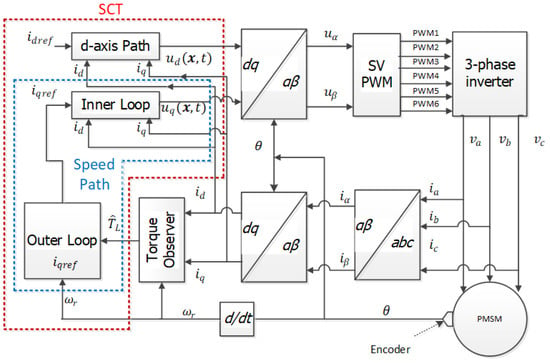
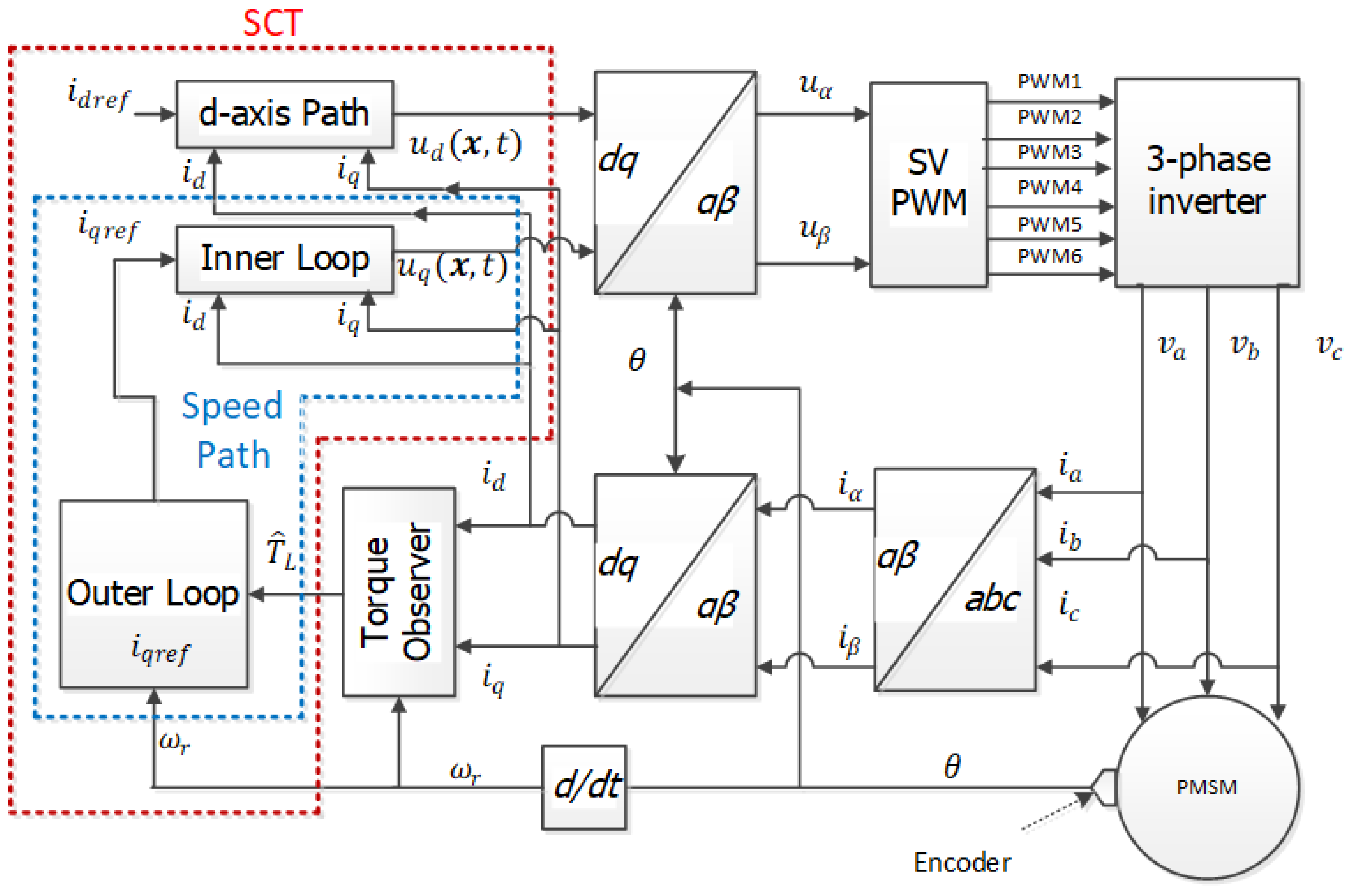
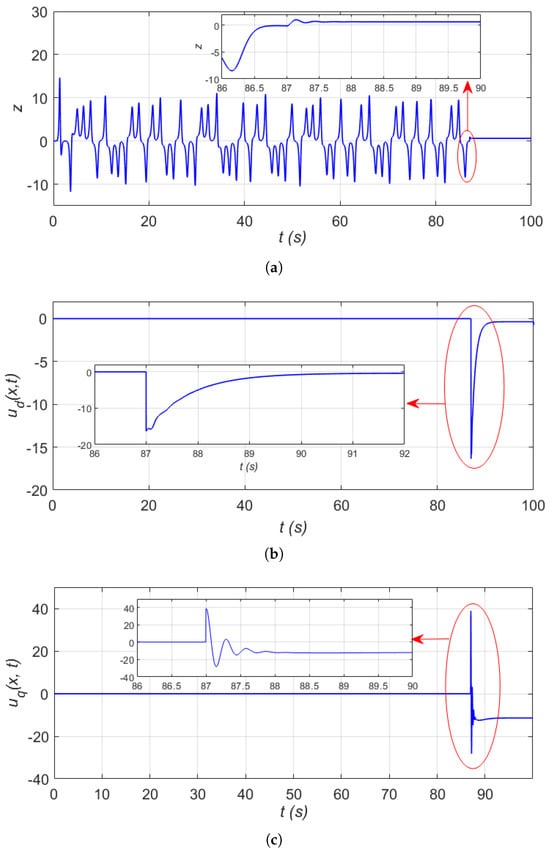
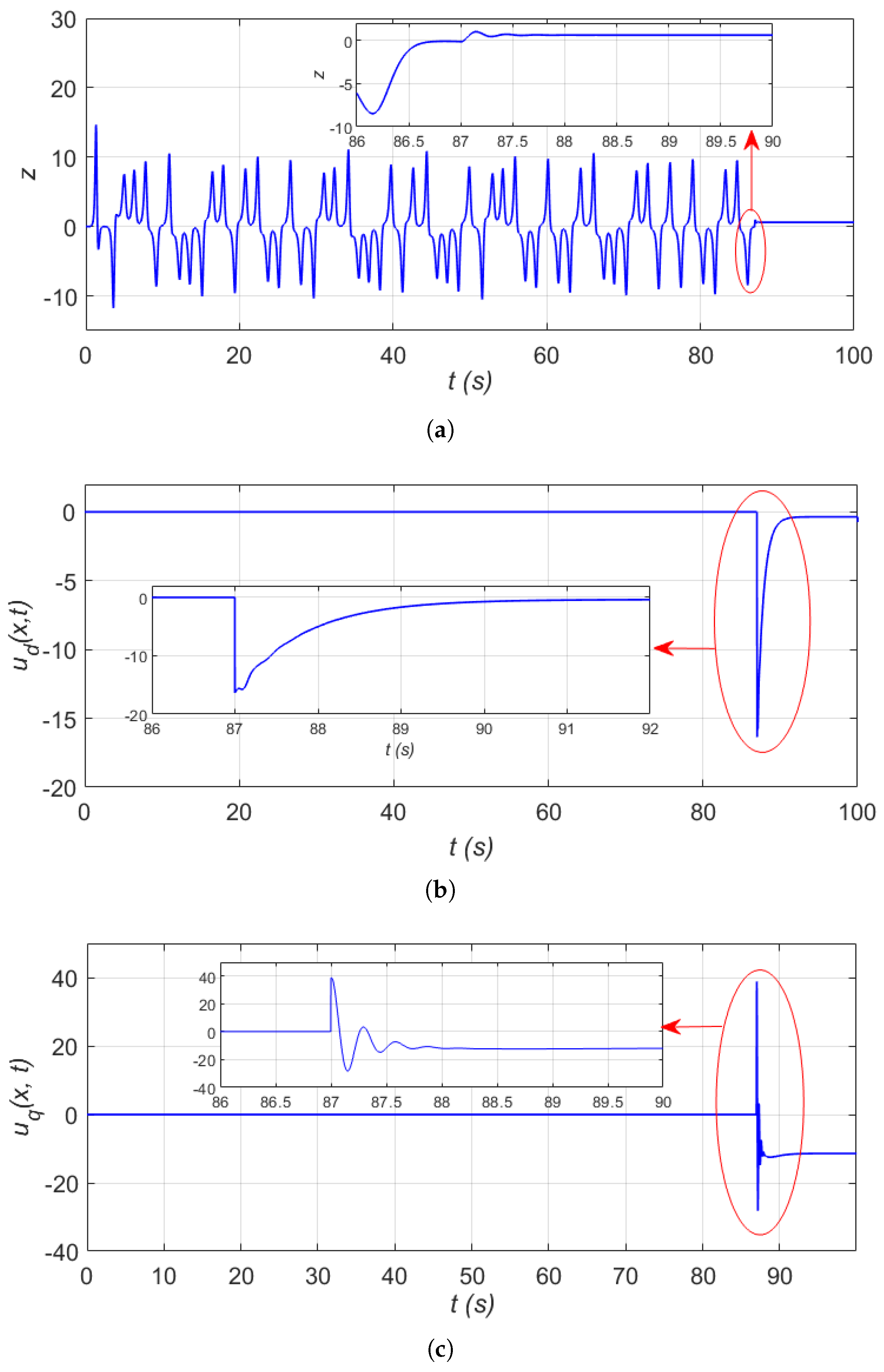
The drive system consists of a PMSM controlled by SCT, as illustrated in Figure 9. The controller outputs ( and ) are applied to the PMSM drive at s, as shown in Figure 10. The controller parameters are , , , , , , and . These values were selected to ensure fast manifold convergence while maintaining smooth control action (thus avoiding chattering) and stable tracking under torque disturbances. From Figure 10a, the controller stabilizes the chaotic behavior within approximately 1.1 s. The d-axis and q-axis control signals are illustrated in Figure 10b and Figure 10c, respectively.
Figure 10.
Time response of chaotic PMSM after and before applying the SCT controller. The controller parameters are , , , , , , and . (a) Time response of with , , and . The SCT controller outputs are applied at , and the state variables become stable after applying the controller. (b) Time response of . (c) Time response of .
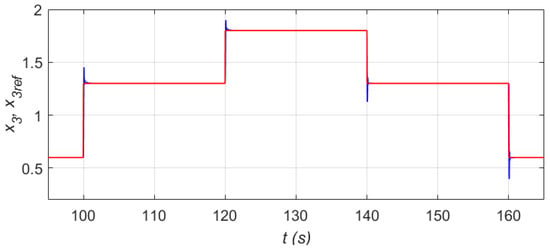
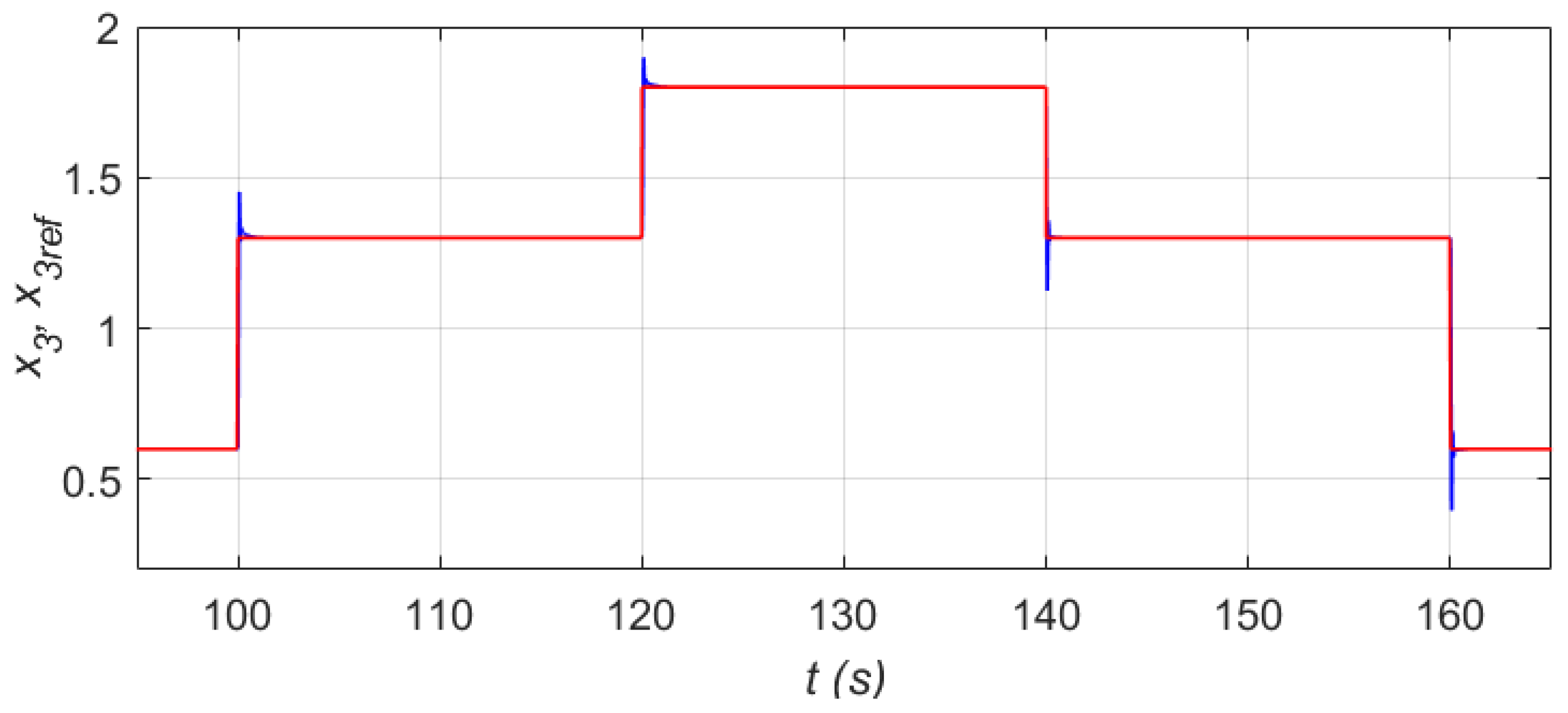
The controller performance is tested under sudden changes in the reference speed, as shown in Figure 11. First, the reference speed is varied from 0.6 to 1.3, where the controller requires approximately 0.9 s to reach the new reference value. The second speed step is from 1.3 to 1.8, where the PMSM reaches the final speed within approximately 0.75 s. The third step is from 1.8 to 1.3, which requires about 1.05 s to track the new reference. Finally, approximately 1.1 s is required when the reference speed is changed from 1.3 to 0.6. These results indicate that the SCT controller effectively tracks the new command under successive reference speed changes.
Figure 11.
PMSM under SCT controller with sudden reference speed change.
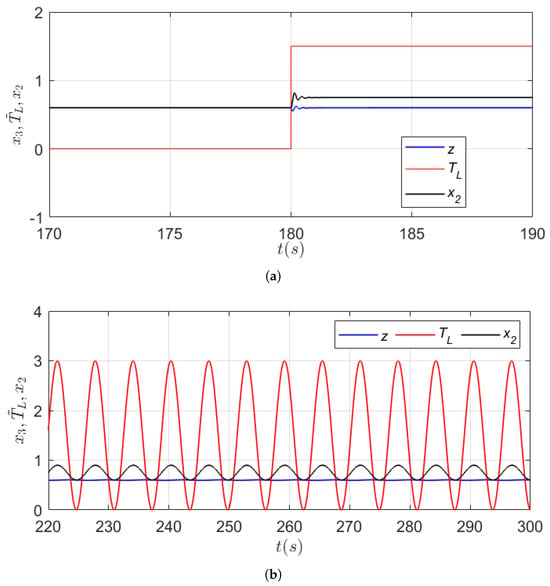
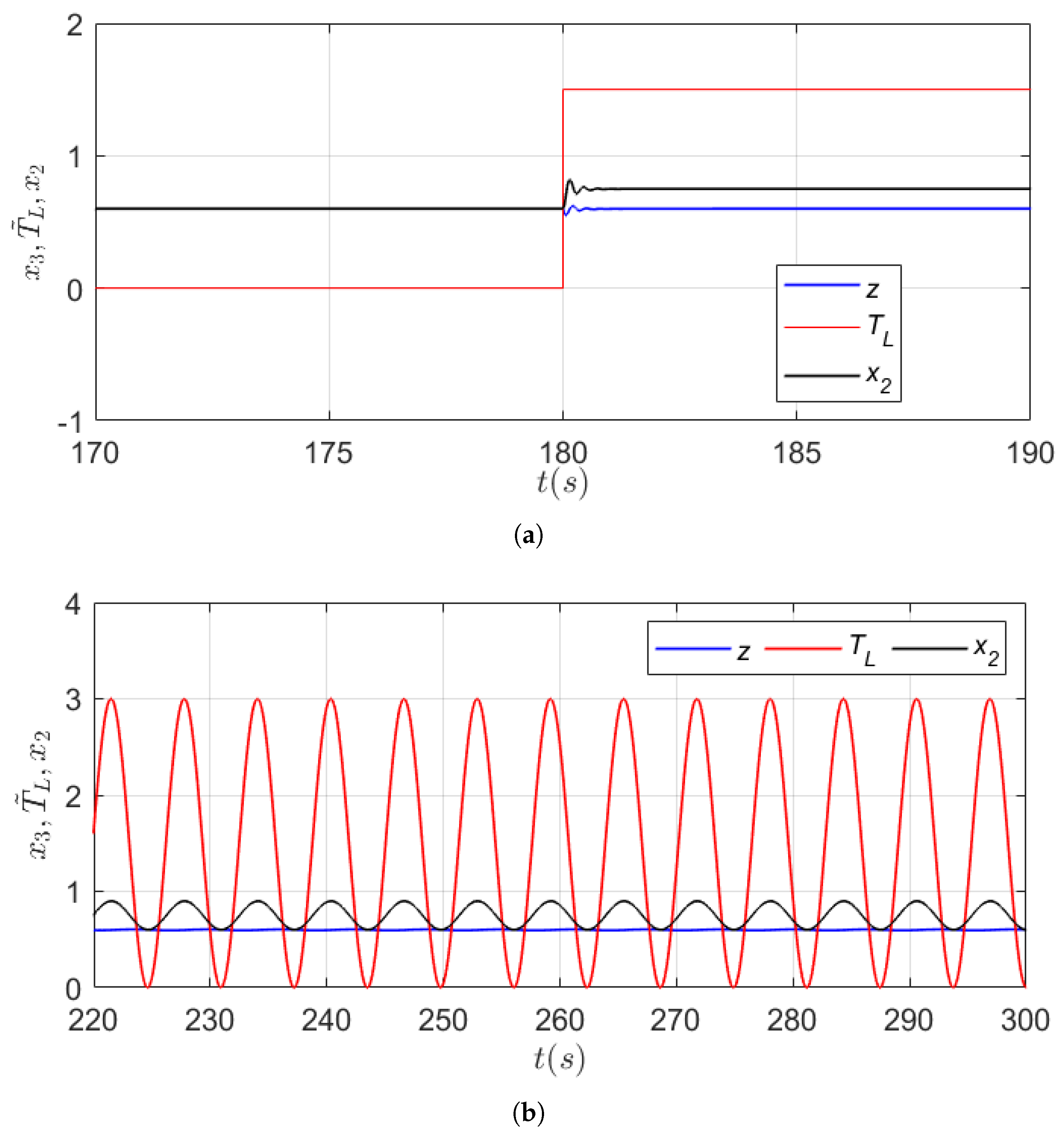
To evaluate the SCT performance under load torque variations, two scenarios are considered: a sudden change and a sinusoidal variation, as presented in Figure 12a. From the time response, the SCT controller maintains the motor speed close to the reference value when the load torque changes suddenly from 0 to 1.5. In this case, the q-axis current increases from 0.6 to 0.75 within approximately 0.14 s, as shown in Figure 12a. For the sinusoidal load torque, the motor speed remains near the reference value (0.6), as illustrated in Figure 12b. These results demonstrate that the SCT controller preserves the PMSM speed at the desired reference under load disturbances.
Figure 12.
PMSM under SCT controller with load torque change. (a) Time response of sudden change in the load torque. (b) Time response of sine-wave load torque.
For clarity, the main quantitative performance indicators are summarized as follows. The SCT suppresses chaotic oscillations within approximately 1.1 s after controller activation (Figure 10a). During step reference transitions (Figure 11), the speed tracking response time ranges between 0.75 s and 1.1 s, depending on the step magnitude. Under sudden load torque variation (0 to 1.5), the speed deviation remains small and recovers within approximately 0.14 s. Under sinusoidal torque disturbances, only minor speed fluctuations are observed (Figure 12). The control signals shown in Figure 10b,c confirm smooth control action without high-frequency chattering.
For contextual comparison, the SCT is qualitatively compared with widely used chaos-control strategies such as sliding mode control (SMC) and fuzzy logic control. While SMC offers robustness, it may introduce chattering due to discontinuous control action, which can excite high-frequency oscillations in motor drives [52]. Fuzzy approaches reduce chattering but often require heuristic tuning and may lack explicit stability guarantees [53,54].
In contrast, the proposed SCT employs continuous manifold-based dynamics (Equations (34), (37), and (41)), resulting in smooth control signals (Figure 10b,c) and rapid chaos suppression (approximately 1.1 s; Figure 10a), with stable tracking under speed and torque variations (Figure 11 and Figure 12). A comprehensive benchmark comparison under identical tuning conditions is left for future work.
8. Conclusions
This study investigated the nonlinear dynamics and chaos control of a permanent magnet synchronous motor (PMSM) using a normalized electromechanical model with coupling parameter . The analytical results revealed a structural transition in the equilibrium configuration: a pitchfork-type bifurcation occurs at , where the origin loses stability and two symmetric nonzero equilibria emerge. For the special case with zero input voltages and load torque, further analysis using the Routh–Hurwitz conditions showed that the nonzero equilibria remain asymptotically stable for , with loss of stability occurring near , consistent with a Hopf-type mechanism.
Numerical simulations confirmed the analytical predictions and demonstrated coexistence of attractors and chaotic oscillations for larger values of . The bifurcation diagrams and phase portraits illustrated the transition from stable equilibrium behavior to oscillatory and chaotic regimes.
To suppress chaotic oscillations, a synergetic control technique (SCT) was designed based on manifold dynamics and implemented in the PMSM model. The proposed controller achieved chaos suppression within approximately 1.1 s after activation (Figure 10), ensured reliable speed tracking under step reference changes (Figure 11), and maintained robustness under sudden and sinusoidal load torque disturbances (Figure 12). The continuous control action avoided chattering and provided smooth control signals.
Overall, the combined analytical and numerical results demonstrate that the proposed SCT effectively stabilizes chaotic PMSM behavior while preserving fast dynamic response and disturbance robustness. Future work may include extended quantitative chaos diagnostics and comprehensive benchmark comparisons with alternative nonlinear control strategies.
Author Contributions
Conceptualization, F.N.A.; formal analysis, A.S.H.; investigation, F.N.A.; methodology, A.S.H.; project administration, F.R.T.; resources, F.N.A.; software, A.S.H.; supervision, V.-T.P.; validation, V.-T.P.; visualization, F.R.T.; writing—original draft, F.R.T.; writing—review & editing, V.-T.P. All authors have read and agreed to the published version of the manuscript.
Funding
This research received no external funding.
Data Availability Statement
The original contributions presented in this study are included in the article. Further inquiries can be directed to the corresponding author.
Conflicts of Interest
Authors Ahmed Sadeq Hunaish and Fatma Noori Ayoob were employed by the Basrah Oil Company. The remaining authors declare that the research was conducted in the absence of any commercial or financial relationships that could be construed as a potential conflict of interest.
Abbreviations
The following abbreviations are used in this manuscript:
| CNC | Computer numerical control |
| DC | Direct current |
| ESO | Extended state observer |
| HVAC | Heating, ventilation, and air conditioning |
| PMSM | Permanent magnet synchronous motor |
| PMSMLT | Permanent magnet synchronous motor load torque |
| SCT | Synergetic control technique |
| VFD | Variable frequency drive |
References
- Thangarajan, K.; Soundarrajan, A. Performance comparison of permanent magnet synchronous motor (PMSM) drive with delay compensated predictive controllers. Microprocess. Microsyst. 2020, 75, 102081. [Google Scholar] [CrossRef] [Scilit]
- Sethupathi, P.; Senthilnathan, N. Comparative analysis of line-start permanent magnet synchronous motor and squirrel cage induction motor under customary power quality indices. Electr. Eng. 2020, 102, 1339–1349. Available online: https://link.springer.com/article/10.1007/s00202-020-00955-2 (accessed on 15 November 2025). [CrossRef] [Scilit]
- Mathew, K.K.; Abraham, D.M.; Harish, A. Speed regulation of PMSM drive in electric vehicle applications with sliding mode controller based on Harris Hawks optimization. e-Prime-Adv. Electr. Eng. 2024, 9, 100623. [Google Scholar] [CrossRef] [Scilit]
- Morimoto, S.; Sanada, M.; Takeda, Y.A. High-Performance Permanent Magnet Synchronous Motor Drive for Electric Vehicle Applications. IEEE Trans. Ind. Electron. 2006, 53, 1609–1615. [Google Scholar] [CrossRef] [Scilit]
- Madichetty, S.; Mishra, S.; Basu, M. New trends in electric motors and selection for electric vehicle propulsion systems. IET Electr. Syst. Transp. 2021, 11, 186–199. [Google Scholar] [CrossRef] [Scilit]
- Huo, J.; Ji, H.; Yang, P. Research on sensorless control system of permanent magnet synchronous motor for CNC machine tool. In 2021 40th Chinese Control Conference (CCC), Shanghai, China, 26–28 July 2021; IEEE: Piscataway, NJ, USA, 2021; Available online: https://ieeexplore.ieee.org/abstract/document/9550563/ (accessed on 15 November 2025).
- Singh, S.; Singh, S.N.; Tiwari, A.N. PMSM drives and its application: An overview. Recent Adv. Electr. Electron. Eng. 2023, 16, 4–16. [Google Scholar] [CrossRef] [Scilit]
- Abubakar, U.; Wang, X.; Haleem Shah, S.; Gao, P.; Wang, L. High-speed PMSM thermal analysis of totally enclosed fan cooled axial ventilation for centrifugal blower application. Int. J. Appl. Electromagn. Mech. 2022, 69, 13–43. Available online: https://journals.sagepub.com/doi/abs/10.3233/JAE-210087 (accessed on 15 November 2025). [CrossRef] [Scilit]
- Yi, F.; Su, Q.; Feng, C.; Wang, X.; Yang, L.; Zhou, J.; Fan, Z.; Jiang, S.; Zhang, Z.; Yu, T.; et al. Response analysis and stator optimization of ultrahigh-speed PMSM for fuel cell electric air compressor. IEEE Trans. Transp. Electrif. 2022, 9, 5098–5110. [Google Scholar] [CrossRef] [Scilit]
- Bakhtiarzadeh, H.; Polat, A.; Ergene, L.T. Design and analysis of a permanent magnet synchronous motor for elevator applications. In 2017 International Conference on Optimization of Electrical and Electronic Equipment (OPTIM) and 2017 Intl Aegean Conference on Electrical Machines and Power Electronics (ACEMP), Brasov, Romania, 25–27 May 2017; IEEE: Piscataway, NJ, USA, 2017. [Google Scholar] [CrossRef] [Scilit]
- Ping, Z.; Wang, T.; Huang, Y.; Wang, H.; Lu, J.G.; Li, Y. Internal model control of PMSM position servo system: Theory and experimental results. IEEE Trans. Ind. Inform. 2019, 16, 2202–2211. [Google Scholar] [CrossRef] [Scilit]
- Nouraldin, N.A.; Chebaani, M.; Számel, L.; Abdelwahab, S.A.M.; Abdellatif, W.S. Experimental investigation of predictive control for PMSM-based wind turbine generation system. Comput. Electr. Eng. 2024, 119, 109554. [Google Scholar] [CrossRef] [Scilit]
- Zribi, M.; Oteafy, A.; Smaoui, N. Controlling chaos in the permanent magnet synchronous motor. Chaos Solitons Fractals 2009, 41, 1266–1276. [Google Scholar] [CrossRef] [Scilit]
- Chen, X.; Hu, J.; Peng, Z.; Yuan, C. Bifurcation and chaos analysis of torsional vibration in a PMSM-based driven system considering electromechanically coupled effect. Nonlinear Dyn. 2017, 88, 277–292. [Google Scholar] [CrossRef] [Scilit]
- Babaei, M.; Feyzi, M.; Nazari Marashi, A. Study of bifurcation and chaos in scalar drive systems of permanent magnet synchronous machines. Int. Trans. Electr. Energy Syst. 2021, 31, e13023. [Google Scholar] [CrossRef] [Scilit]
- Hunaish, A.S.; Tahir, F.R. Bifurcation and Chaos in indirect field-oriented controlled induction motor drive system. Eur. Phys. J. Plus 2021, 136, 405. [Google Scholar] [CrossRef] [Scilit]
- Chang, S.C. Analytical routes to chaos and controlling chaos in brushless dc motors. Processes 2022, 10, 814. [Google Scholar] [CrossRef] [Scilit]
- Hunaish, A.S.; Tahir, F.R. Bifurcation and chaos from drilling system driven by IFOCIM. Chaos Solitons Fractals 2023, 175, 113914. [Google Scholar] [CrossRef] [Scilit]
- Ferdek, U. Regular and chaotic vibrations of a nonlinear rotor-stator system. Appl. Sci. 2024, 14, 10214. [Google Scholar] [CrossRef] [Scilit]
- Chen, B.; Xu, Y.; Jiao, Y.; Chen, Z. Period-1 Motions and Bifurcations of a 3D Brushless DC Motor System with Voltage Disturbance. Appl. Sci. 2024, 14, 4820. [Google Scholar] [CrossRef] [Scilit]
- Alaviyan Shahri, E.S.; Chen, Y.; Pariz, N. Advanced Stability Analysis for Fractional-Order Chaotic DC Motors Subject to Saturation and Rate Limitations. Fractal Fract. 2025, 9, 369. [Google Scholar] [CrossRef] [Scilit]
- Ye, Z.W.; Wei, D.Q. Predicting chaos in permanent magnet synchronous motor using dual reservoir interaction with high-order state reservoir computing. Phys. Scr. 2025, 1000, 036010. Available online: https://iopscience.iop.org/article/10.1088/1402-4896/adb4af/meta (accessed on 16 November 2025). [CrossRef] [Scilit]
- Slotine, J.-J.E.; Li, W. Applied Nonlinear Control, 2nd ed.; Prentice Hall: Englewood Cliffs, NJ, USA, 1991; pp. 1123–1131. [Google Scholar]
- Khalil, H.K. Nonlinear Systems, 3rd ed.; Prentice Hall: Upper Saddle River, NJ, USA, 2002; pp. 301–310. [Google Scholar]
- Strogatz, S.H. Nonlinear Dynamics and Chaos, 2nd ed.; Perseus Books Publishing, L.L.C: New York, NY, USA, 1994; pp. 44–92. [Google Scholar]
- Hou, Y.Y. Finite-time chaos suppression of permanent magnet synchronous motor systems. Entropy 2014, 16, 2234–2243. [Google Scholar] [CrossRef] [Scilit]
- Huang, G.Q.; Wu, X. Analysis of permanent-magnet synchronous motor chaos system. In International Conference on Artificial Intelligence and Computational Intelligence; Springer: Berlin/Heidelberg, Germany, 2011. [Google Scholar] [CrossRef] [Scilit]
- Ma, C.; Wang, L.; Yin, Z.; Liu, J.; Chen, D. Sliding mode control of chaos in the noise-perturbed permanent magnet synchronous motor with non-smooth air-gap. Min. Sci. Technol. 2011, 21, 835–838. [Google Scholar] [CrossRef] [Scilit]
- Fotsa, R.T.; Papemsi, P.K.K.; Kuete, G.P.A.; Pone, J.R.M.; Naoussi, S.R.D.; Momo, F.; Ele, P. Permanent magnet synchronous motor with load torque: Dynamics, circuitry execution and control. Chaos Fractals 2025, 2, 14–19. Available online: https://journals.adbascientific.com/chf/article/view/61 (accessed on 16 November 2025). [CrossRef] [Scilit]
- Choi, H.H. Adaptive control of a chaotic permanent magnet synchronous motor. Nonlinear Dyn. 2012, 69, 1311–1322. Available online: https://link.springer.com/article/10.1007/s11071-012-0349-7 (accessed on 16 November 2025). [CrossRef] [Scilit]
- Cheukem, A.; Kemnang Tsafack, A.S.; Takougang Kingni, S.; André, C.C.; Mboupda Pone, J.R. Permanent magnet synchronous motor: Chaos control using single controller, synchronization and circuit implementation. SN Appl. Sci. 2020, 2, 420. Available online: https://link.springer.com/article/10.1007/s42452-020-2204-7 (accessed on 16 November 2025). [CrossRef] [Scilit]
- Zhang, R.; Gong, C.; Shi, P.; Zhao, L.; Zheng, C. Research on chaos control of permanent magnet synchronous motor based on the synthetical sliding mode control of inverse system decoupling. J. Vib. Control 2021, 27, 1009–1019. Available online: https://journals.sagepub.com/doi/abs/10.1177/1077546320936499 (accessed on 16 November 2025).
- Zhang, J.; Sun, J.; Gu, H.; Poloei, H.; Karami, A. Control of PMSM chaos using backstepping-based adaptive fuzzy method in the presence of uncertainty and disturbance. Syst. Sci. Control Eng. 2021, 9, 673–688. Available online: https://www.tandfonline.com/doi/abs/10.1080/21642583.2021.1980130 (accessed on 16 November 2025). [CrossRef] [Scilit]
- Ngonting Topy, A.; Mboupda Pone, J.R.; Kemnang Tsafack, A.S.; Kengne, R. Chaos and dynamics induced by the amplitude of load torque: Analysis and control. Int. Trans. Electr. Energy Syst. 2022, 2022, 5440326. Available online: https://onlinelibrary.wiley.com/doi/abs/10.1155/2022/5440326 (accessed on 10 February 2026). [CrossRef] [Scilit]
- Karimi, A.; Akbari, H.; Mousavi, S.; Beheshtipour, Z. Design of an adaptive terminal sliding mode to control the PMSM chaos phenomenon. Syst. Sci. Control Eng. 2023, 11, 2207593. Available online: https://www.tandfonline.com/doi/abs/10.1080/21642583.2023.2207593 (accessed on 10 February 2026). [CrossRef] [Scilit]
- Yao, Q.; Jahanshahi, H.; Bekiros, S.; Liu, J.; Al-Barakati, A.A. Fixed-time adaptive chaotic control for permanent magnet synchronous motor subject to unknown parameters and perturbations. Mathematics 2023, 11, 3182. [Google Scholar] [CrossRef] [Scilit]
- Yousefzadeh, M.; Eliasi, H.; Jalilirad, M. Dynamic Modeling and Chaos Suppression of the Permanent Magnet Synchronous Motor Drive with Sliding Mode Control. J. Electron. Electr. Eng. 2023, 2, 177–189. [Google Scholar] [CrossRef] [Scilit]
- Iqbal, A.; Bakhsh, F.I.; Singh, G.K. Control of chaotic permanent magnet synchronous motor using finite time stability approach. Sci. Talks 2024, 10, 100360. Available online: https://www.sciencedirect.com/science/article/pii/S2772569324000689 (accessed on 18 November 2025). [CrossRef] [Scilit]
- Liu, Y.; Li, J.; Sun, Z.Y.; Chen, C.C. A new adaptive control design of permanent magnet synchronous motor systems with uncertainties. Symmetry 2024, 17, 2. [Google Scholar] [CrossRef] [Scilit]
- Tahmasbi, M. Chaos control in networked permanent magnet synchronous motor using Lyapunov-based model predictive subject to data loss. Eng. Rep. 2024, 6, e12765. Available online: https://onlinelibrary.wiley.com/doi/abs/10.1002/eng2.12765 (accessed on 19 November 2025). [CrossRef] [Scilit]
- Souhail, W.; Khammari, H. A Three-Stage Neural Network-Based Control Design for Chaos Synchronization in A Permanent Magnet Synchronous Motors (PMSM). Adv. Control Appl. Eng. Ind. Syst. 2025, 7, e70023. Available online: https://onlinelibrary.wiley.com/doi/abs/10.1002/adc2.70023 (accessed on 19 November 2025). [CrossRef] [Scilit]
- Ngongiah, I.K.; Fotsa, R.T.; Ngono, J.M.; Kibanya, N.N.; Godwe, E.; Momo, F. Chaos Annihilation-Based on Genetic Algorithms in a Non-smooth Air-gap Permanent Magnet Synchronous Motor Embedded in the Microcontroller. ADBA Comput. Sci. 2025, 2, 30–35. Available online: https://journals.adbascientific.com/acs/article/view/77 (accessed on 19 November 2025). [CrossRef] [Scilit]
- Kolesnikov, A.; Veselov, G.; Kolesnikov, A. Modern Applied Control Theory: Synergetic Approach in Control Theory, 2nd ed.; TRTU: Moscow, Russia, 2000; pp. 4477–4479. [Google Scholar]
- Wang, J.; Liu, L.; Liu, C.; Zhu, Z.; Wang, Y. Chaos control in six-dimensional power system via adaptive synergetic approach. J. Vib. Control 2020, 26, 790–800. Available online: https://journals.sagepub.com/doi/abs/10.1177/1077546319889850 (accessed on 19 November 2025). [CrossRef] [Scilit]
- Hunaish, A.S.; Tahir, F.R. Fixed-time synergetic control-based chaos suppression for eighth-order ifocim drive system. Int. J. Bifurc. Chaos 2021, 31, 2150131. [Google Scholar] [CrossRef] [Scilit]
- Li, Z.; Park, J.B.; Joo, Y.H.; Zhang, B.; Chen, G. Bifurcations and chaos in a permanent-magnet synchronous motor. IEEE Trans. Circuits Syst. I Fundam. Theory Appl. 2002, 49, 383–387. Available online: https://ieeexplore.ieee.org/abstract/document/989176/ (accessed on 19 November 2025).
- He, R.; Han, Q. Dynamics and Stability of Permanent-Magnet Synchronous Motor. Math. Probl. Eng. 2017, 1, 4923987. Available online: https://onlinelibrary.wiley.com/doi/abs/10.1155/2017/4923987 (accessed on 19 November 2025). [CrossRef] [Scilit]
- Han, J. Class of Extended State Observers for Uncertain Systems. Control Decis. 1995, 10, 85–88. (In Chinese) [Google Scholar]
- Han, J. Auto-Disturbance Rejection Control and its Applications. Control Decis. 1988, 13. Available online: https://cir.nii.ac.jp/crid/1573668924337838336 (accessed on 19 November 2025). (In Chinese)
- Xu, Z.; Zhang, T.; Bao, Y.; Zhang, H.; Gerada, C. A nonlinear extended state observer for rotor position and speed estimation for sensorless IPMSM drives. IEEE Trans. Power Electron. 2019, 35, 733–743. Available online: https://ieeexplore.ieee.org/abstract/document/8703133/ (accessed on 19 November 2025). [CrossRef] [Scilit]
- Nicola, M.; Nicola, C.I. Sensorless control of PMSM using backstepping control and ESO-type observer. In Proceedings of the 2020 12th International Conference on Electronics, Computers and Artificial Intelligence (ECAI), Bucharest, Romania, 25–27 June 2020; Available online: https://ieeexplore.ieee.org/abstract/document/9223221/ (accessed on 19 November 2025).
- Boiko, I.M. Chattering in sliding mode control systems with boundary layer approximation of discontinuous control. Int. J. Syst. Sci. 2013, 44, 1126–1133. Available online: https://www.tandfonline.com/doi/abs/10.1080/00207721.2011.652233 (accessed on 10 February 2026). [CrossRef] [Scilit]
- Yu, J.; Shi, P.; Dong, W.; Lin, C. Adaptive fuzzy control of nonlinear systems with unknown dead zones based on command filtering. IEEE Trans. Fuzzy Syst. 2016, 26, 46–55. Available online: https://ieeexplore.ieee.org/abstract/document/7762957/ (accessed on 10 February 2026). [CrossRef] [Scilit]
- Lu, K.; Liu, Z.; Lai, G.; Chen, C.P.; Zhang, Y. Adaptive fuzzy output feedback control for nonlinear systems based on event-triggered mechanism. Inf. Sci. 2019, 486, 419–433. Available online: https://www.sciencedirect.com/science/article/pii/S0020025519301860 (accessed on 10 February 2026). [CrossRef] [Scilit]
Disclaimer/Publisher’s Note: The statements, opinions and data contained in all publications are solely those of the individual author(s) and contributor(s) and not of MDPI and/or the editor(s). MDPI and/or the editor(s) disclaim responsibility for any injury to people or property resulting from any ideas, methods, instructions or products referred to in the content. |
© 2026 by the authors. Licensee MDPI, Basel, Switzerland. This article is an open access article distributed under the terms and conditions of the Creative Commons Attribution (CC BY) license.