


Abstract
Professional education asks learners to act under consequential uncertainty while judgment and professional identity are still developing. Scholarship on emotion, identity formation, reflection, psychological safety, ethics, and agency has expanded, yet these literatures seldom explain how affectively charged experience becomes accountable professional action. This critical integrative review develops INTEGRAL (INTegrated Emotional Growth for Responsible Agency and Leadership), a cross-professional framework for health sciences and engineering education. A purposive, theory-led synthesis of 47 peer-reviewed sources was assembled through targeted searches, citation tracing, abductive construct comparison, negative-case analysis, and contrastive examination of two consequential professional fields; the retained corpus comprised 25 health-sciences sources, 13 engineering sources, and 9 cross-disciplinary, general-education, or methodological sources. Because the iterative search was not an exhaustive database export, no valid total-hit denominator was generated, and this reporting boundary is stated explicitly. INTEGRAL distinguishes event-in-context exposure (D1) from learner appraisal and identity-relevant processing (D2). Structured curricular scaffolding (D3) is specified as a multilevel configuration that shapes the exposure learners encounter, influences early processing, and moderates whether D2 becomes observable, reason-giving, accountable action under constraint (D4). Leadership and stewardship (D5) are repositioned as a conditional long-term extension rather than a mandatory stage. The framework is theoretical, identifies rival explanations and disconfirmation conditions, and derives testable propositions and multi-source indicators without treating adversity as inherently beneficial or emotional display as competence.
1. Introduction
Professional education is not emotionally neutral. Learners in nursing and medicine encounter suffering, diagnostic uncertainty, patient deterioration, difficult feedback, moral tension, and the vulnerability of acting before they feel fully prepared. Learners in engineering encounter design failure, safety-critical trade-offs, contested stakeholder interests, team conflict, public consequences, and the possibility that technically defensible choices may still be socially or ethically inadequate. These situations differ in content, but they share a developmental structure: each asks a learner to interpret what matters, locate responsibility, and act under uncertainty while professional identity is still forming.
Emotion is therefore more than a private reaction added to cognition. Control-value theory shows that emotions arise through appraisals of value and controllability and influence attention, motivation, engagement, and learning [1]. Professional identity formation scholarship likewise describes becoming a professional as a process of being, becoming, and belonging rather than the simple accumulation of competencies [2]. A health-profession scoping review confirms that professional identity research spans heterogeneous purposes and theoretical traditions, making conceptual precision especially important [3]. Engineering education presents a parallel fragmentation: a configurative meta-synthesis of 213 publications found that emotion was often secondary or insufficiently theorized [4], while a systematic review of engineering ethics education identified largely disconnected emotion-and-ethics frameworks [5]. In engineering project-based learning, psychological safety and conflict further shape whether students can contribute, acknowledge uncertainty, and learn with others [6]. Across both domains, emotionally salient experiences can open a path toward judgment and responsibility, but they can also produce silence, defensive adaptation, superficial compliance, or withdrawal.
The developmental distribution of these outcomes is not socially neutral. Underrepresented medical learners may encounter formation through unequal conditions of recognition and belonging [7]. Engineering students may complete substantial portions of a program without developing a stable engineering identity, particularly when curricular experiences remain disconnected from recognizable professional practice [8]. The institutional environment determines what uncertainty may be voiced, which mistakes can be examined, whose interpretation is believed, and whether accountability is learned as honest reason-giving or as self-protective performance. Psychological safety in health professions education is thus not an interpersonal luxury but a condition affecting participation and learning [9]. Guided reflection and mentoring similarly operate through identifiable mechanisms only when they are structured, facilitated, and connected to longitudinal formation [10]. Engineering education demonstrates the same principle: creative risk-taking and teamwork depend on learning conditions in which students can expose incomplete ideas without humiliation [11].
The relevant literatures thus remain adjacent rather than developmentally integrated. Achievement-emotion research explains appraisal; professional identity formation explains belonging and self-understanding; reflection and debriefing research examine how experience is revisited; psychological safety research identifies conditions for interpersonal risk; engineering ethics clarifies responsibility for technical and social consequences; and agency scholarship addresses action within structural constraint. Each literature illuminates part of the pathway, but no single one specifies the complete movement from emotionally consequential exposure to observable, accountable professional action.
This fragmentation has practical consequences. Curricula may offer simulation without longitudinal integration, reflection without standards of responsible action, feedback without psychological safety, ethics content without identity work, or leadership teaching detached from repeated accountability. Emotional difficulty may then be normalized as a private cost of becoming a professional, while responsibility for educational conditions is displaced onto the learner. Conversely, supportive activity may be offered without sufficient challenge, leaving students comfortable but unable to justify action when consequences become real.
This review addresses that explanatory gap through the INTEGRAL framework: INTegrated Emotional Growth for Responsible Agency and Leadership. The acronym describes the developmental aim; it is not an acrostic for the analytic domains. INTEGRAL proposes a moderated and iterative core educational pathway connecting event-in-context exposure (D1), recursive learner processing (D2), multilevel curricular scaffolding (D3), and responsible professional agency (D4). Leadership and stewardship (D5) are retained as a potential distal extension whose emergence depends on post-graduation organizational conditions rather than as a required fifth stage.
The article makes four contributions. First, it offers a cross-disciplinary vocabulary that is precise enough to distinguish exposure, processing, scaffolding, agency, and trajectory. Second, it specifies a mechanism rather than merely listing educationally desirable constructs. Third, it identifies failure modes and boundary conditions, thereby making the framework vulnerable to critique and empirical disconfirmation. Fourth, it translates the framework into propositions, indicators, and curriculum tools relevant to health sciences and engineering. This emphasis on accountable action is consistent with work calling health profession education to move from moral understanding to social responsiveness [12] and with emerging engineering ethics scholarship that treats professional responsibility as a plural, situated concept requiring explicit educational development [13].
The relationship that INTEGRAL makes visible is a cross-level conversion problem. Learners may encounter comparable professionally consequential events and may even produce equally articulate reflection, yet differ in responsible action because curricular and institutional arrangements shape what is encountered, which interpretations are legitimate, and whether processing can be tested and revised in practice. INTEGRAL therefore specifies not only D1 → D2 → D4, but also direct contextual influences of D3 on D1 and D2 and a D3-conditioned transition from D2 to D4. This combined event-process-architecture-action relation is not specified by professional identity formation, reflective learning, psychological safety, or agency models when each is used alone.
The guiding question is as follows: under what educational conditions can emotionally salient professional experiences be transformed into responsible professional agency rather than fragmentation, endurance, or performative compliance? Three subsidiary questions follow: (1) which learner-level processes mediate this transformation? (2) Which curricular and institutional conditions strengthen or weaken it? (3) What evidence could make the proposed development observable without reducing it to self-reported confidence?
2. Review Design and Conceptual Development
2.1. Critical Integrative Review
This paper uses a critical integrative review and theory-building design. Integrative reviews can connect heterogeneous conceptual and empirical literatures when the objective is explanatory synthesis rather than pooled effect estimation [14]. Conceptual contributions are strongest when constructs are clearly differentiated, relations are specified, and the resulting account changes how a phenomenon can be examined [15,16]. INTEGRAL was therefore developed neither as a systematic review claiming exhaustive coverage nor as an empirically validated causal model. It is a bounded theoretical synthesis intended to organize inquiry across disciplinary literatures that use different vocabularies for related developmental problems.
The review began with the recurrent observation present in the authors’ prior manuscripts: exposure to an emotionally consequential professional situation is not self-explanatory. The analysis then proceeded abductively, moving between this phenomenon and relevant bodies of theory. Abduction is appropriate where existing concepts explain portions of a pattern but no single account adequately organizes the whole [17]. The purpose was to identify the smallest set of constructs capable of explaining variation between exposure and accountable action without collapsing learner processes into institutional conditions.
2.2. Bounded Corpus Construction
A theory-led corpus was assembled around six intersecting streams: (1) achievement emotions, appraisal, and regulation; (2) professional identity formation, belonging, and epistemic participation; (3) reflection, debriefing, mentoring, portfolios, and simulation pedagogy; (4) psychological safety and team learning; (5) professional responsibility, ethics, and social responsiveness; and (6) agency, leadership, and stewardship. Searches were updated through 10 August 2026. PubMed was used for health-profession and medical-education literature; Crossref metadata and publisher platforms supported cross-disciplinary retrieval and bibliographic verification; and backward and forward citation tracing connected recent syntheses with foundational sources. Representative query structures paired context terms with mechanism or outcome terms, for example: (health professions education OR nursing education OR medical education) AND (emotion* OR appraisal OR emotion regulation) AND (professional identity OR agency OR responsibility); (engineering education) AND (emotion* OR psychological safety OR failure OR belonging) AND (identity OR agency OR ethics); and (professional education) AND (reflection OR debriefing OR mentoring OR portfolio OR simulation) AND (identity OR accountab* OR agency). Platform-specific syntax and five literal query structures are reported in Supplementary File S2.
Priority was given to peer-reviewed publications from 2021 to 2026 that clarified mechanisms or provided contemporary empirical evidence. Earlier works were retained when they supplied a foundational construct or review not superseded by newer scholarship. Sources were included when they contributed directly to at least one INTEGRAL domain, a relation between domains, a boundary condition, or a plausible rival explanation. Studies focused solely on distress prevalence, generic well-being, academic satisfaction, or technical performance were not used unless they clarified appraisal, identity, institutional conditions, or accountable action. Unpublished claims and sources with untraceable bibliographic metadata were excluded. Because the corpus combines theory papers, reviews, qualitative studies, surveys, and measurement studies for different inferential purposes, no single study-quality score was imposed across designs. Study type and evidentiary role are instead reported in Supplementary File S2. Bibliographic details and DOI strings were checked against DOI-registry and publisher metadata.
Corpus accounting and disciplinary distribution. The final interpretive corpus comprised 47 unique peer-reviewed sources: 25 located primarily in health sciences or health-professions education, 13 in engineering or engineering education, and 9 in cross-disciplinary, general-education, or methodological scholarship. Classification reflects each source’s primary disciplinary home and analytic role; bridging sources may inform more than one domain. The review was purposive and iterative rather than a single exhaustive database export. Raw platform hits and incidental citation leads were therefore not recorded as a stable, de-duplicated screening denominator, and no retrospective ‘records identified’ total has been inferred. The transparent reportable flow is the 47-source retained corpus, with source type, disciplinary location, domain contribution, and DOI shown in Supplementary File S2.
The review is intentionally purposive. It does not estimate the prevalence of emotional experiences, compare intervention effects, or claim exhaustive retrieval across every relevant discipline. Its claims are therefore conceptual and explanatory, not estimates of effect. Rigor is sought through transparent construct selection, contrastive comparison of two consequential professional domains, negative-case reasoning, explicit boundary statements, and derivation of propositions that could be supported, revised, or rejected.
2.3. Analytic Procedure
Conceptual development proceeded in seven documented stages. First, open extraction identified candidate concepts without using D1–D5 as predetermined selection bins. Second, extracted material was classified by analytic function as an initiating event/context condition, learner-level process, educational condition, proximal performance outcome, distal trajectory, or boundary condition. Third, overlapping concepts were compared and separated—for example, event exposure from appraisal, reflection from scaffolding, confidence from agency, and positional leadership from stewardship. Fourth, each candidate was assigned a primary level of analysis. Fifth, abductive comparison moved repeatedly between the emerging architecture, negative cases, and health-sciences and engineering examples. Sixth, relations were specified as direct contextual influence, mediation, moderation, iteration, or conditional longitudinal extension and tested against rival explanations. Seventh, construct decisions and disconfirmation conditions were recorded in the audit trail and source-by-source evidence map (Supplementary File S2). D1–D5 were thus the outcome of functional classification and comparison, not criteria imposed before literature selection.
Three quality safeguards guided the synthesis. Conceptual parsimony required that each domain perform a distinct explanatory function. Cross-disciplinary portability required that the domain remain recognizable in both health sciences and engineering without erasing profession-specific stakes. Empirical tractability required candidate observations through which a proposition could be supported, refined, or rejected. Supplementary File S2 documents the conceptual audit trail and maps the core evidence streams to domains and relations.
2.4. Logic of Cross-Professional Comparison
Health sciences and engineering were selected as a contrastive pair of consequential professions, not as interchangeable settings or as a convenience sample. Both require novices to participate in decisions under uncertainty, justify action to others, and develop an identity governed by obligations extending beyond academic performance. They differ, however, in the typical proximity and distribution of consequence. Health sciences make embodied vulnerability, relational dependence, and often immediate harm especially visible; engineering makes socio-technical interdependence, traceability, delayed effects, and responsibility to geographically or temporally distant stakeholders especially visible.
This most-different comparison functions as a conceptual stress test. A construct was retained only if it performed a recognizable explanatory role in both fields without erasing profession-specific standards, practices, or forms of harm. The comparison supports analytic portability, not universal equivalence. Whether the domains operate similarly in other professional fields remains an empirical question.
2.5. Generative AI Assistance and Authorial Control
During manuscript preparation, ChatGPT (GPT-5, OpenAI; accessed 10 August 2026) assisted with comparison and organization of author-owned drafts, language editing, bibliographic cross-checking, and code-based layout of the conceptual figures. It was not used to generate or analyze empirical data. Claims retained in the manuscript were checked against the cited scholarly record, and DOI metadata were verified against registry and/or publisher records. The authors reviewed the resulting synthesis and remain responsible for every conceptual, interpretive, and bibliographic decision.
3. Emotionally Salient Learning as a Cross-Professional Problem
3.1. Shared Developmental Structure, Different Professional Stakes
Emotionally salient exposure refers to the learner’s encounter with an educational event and its context when professional consequence is plausibly at stake. D1 is specified through event- and context-level features—such as uncertainty, evaluation, relational vulnerability, public visibility, safety risk, moral consequence, or potential harm—that can be documented independently of the learner’s subsequent interpretation. The term salient denotes the event’s capacity to activate affect and professional concern within a situated encounter; the learner’s perceived value, threat, controllability, belonging, and identity significance are assigned to D2. This boundary permits two learners to encounter the same event while appraising it differently without measuring D1 and D2 as the same variable.
Table 1 illustrates the shared developmental structure without treating the professions as interchangeable. Health sciences place particular weight on embodied vulnerability, relational care, clinical uncertainty, and immediate consequences for patients and families. Engineering places particular weight on socio-technical systems, distributed consequences, design trade-offs, safety, sustainability, and responsibility to stakeholders who may be remote from the design setting. In both, the educational problem is not simply exposure to difficulty. It is whether the learner can transform affectively charged experience into warranted action.
Table 1.
Cross-disciplinary manifestations of emotionally salient professional learning.
3.2. Appraisal and Regulation: Why Exposure Is Indeterminate
Control-value theory provides the clearest starting mechanism. Learners appraise whether an event matters and whether they can influence it; those appraisals shape emotional experience and engagement [18]. Contemporary work in medical education demonstrates that online learning environments and academic emotions are linked through perceived control and value [19]. Emotion regulation profiles among nursing students also vary, indicating that learners do not respond uniformly to demanding educational conditions [20]. These findings support a central INTEGRAL claim: the same exposure can produce different developmental consequences because exposure is mediated by interpretation and regulation.
Appraisal is not merely cognitive labeling. It answers questions such as the following: is this failure recoverable? Does this feedback threaten my belonging? Can I speak without punishment? Who may be harmed? What does this situation require of me? Regulation likewise includes more than calming down. It may involve tolerating uncertainty, seeking help, revising an interpretation, remaining present to another person’s vulnerability, or resisting the urge to protect identity through denial. Regulation becomes professionally meaningful when it preserves the learner’s capacity to attend, deliberate, communicate, and act.
This formulation avoids romanticizing adversity. Shame can narrow attention, inhibit disclosure, and separate the learner from support, even when it also signals that professional identity is at stake [21]. A curriculum should not manufacture distress in the belief that intensity automatically produces maturity. Nor should it remove every difficult emotion. The educational task is to create conditions in which unavoidable and ethically relevant emotions can be examined without humiliation and translated into responsible action.
3.3. Identity, Belonging, and Epistemic Participation
Emotion becomes developmentally consequential when it is identity relevant. Learners interpret experience through questions of legitimacy, belonging, responsibility, and recognition. Professional identity formation is therefore not a decorative final outcome but part of the mechanism connecting event and action [2]. In both clinical and engineering settings, learners must become able to say not merely I can perform this task but I can recognize what is at stake, explain my reasons, and accept responsibility for the consequences of acting or not acting.
These processes occur inside relations of power. Epistemic injustice describes how persons may be wronged in their capacity as knowers through credibility deficits or lack of interpretive resources [22]. In education, uncertainty can be dismissed because it comes from a novice; a learner may be unable to name why an encounter felt ethically wrong; or a team culture may make certain forms of knowledge inaudible. Minoritized medical students report professionalization from the position of the outsider, with belonging and legitimacy under continuous negotiation [23]. Engineering identity is also shaped by organizational support and belonging rather than technical attainment alone [24]. Making and design activity can facilitate identity work, but its meaning is mediated by institutional cultures [25].
INTEGRAL therefore treats belonging as a developmental condition, not a demand for conformity. A learner should not have to suppress moral perception, cultural knowledge, uncertainty, or emotional truth to appear professional. Responsible agency requires the capacity to participate as a knower, hear competing perspectives, and give reasons that remain answerable to affected persons and professional standards.
4. The INTEGRAL Framework
4.1. Integrated Emotional Growth
INTEGRAL defines integrated emotional growth as the appraisal-, regulation-, meaning-, and identity-based processing through which emotionally salient experience becomes educationally and professionally usable. It is not equivalent to resilience, coping, emotional intelligence, comfort, or maturity. A learner may endure repeated difficulty without integrating it. Conversely, a learner may remain emotionally affected while demonstrating significant development through clearer interpretation and more accountable action.
The term integrated indicates four connections. Emotion is connected to judgment rather than isolated as feeling; experience is connected to identity rather than treated as an episode; reflection is connected to future action rather than ending in description; and individual development is connected to curricular and institutional conditions rather than attributed solely to personal strength.
Within D2, four analytically separable processes can be distinguished: activation, in which the event acquires affective force; appraisal, in which value, controllability, threat, and responsibility are interpreted; regulatory positioning, in which the learner preserves or loses the capacity to attend, seek help, deliberate, and remain in relation; and identity–responsibility integration, in which the event is connected to belonging, professional obligation, and a prospective course of action. D2 is therefore a process family grouped by a common analytic function—transforming exposure into professionally interpretable meaning—not a claim that these components form one unidimensional latent variable. The components may operate serially, in parallel, or reciprocally, and future studies should test their temporal ordering rather than assume a fixed sequence.
4.2. Five Analytically Distinct Domains
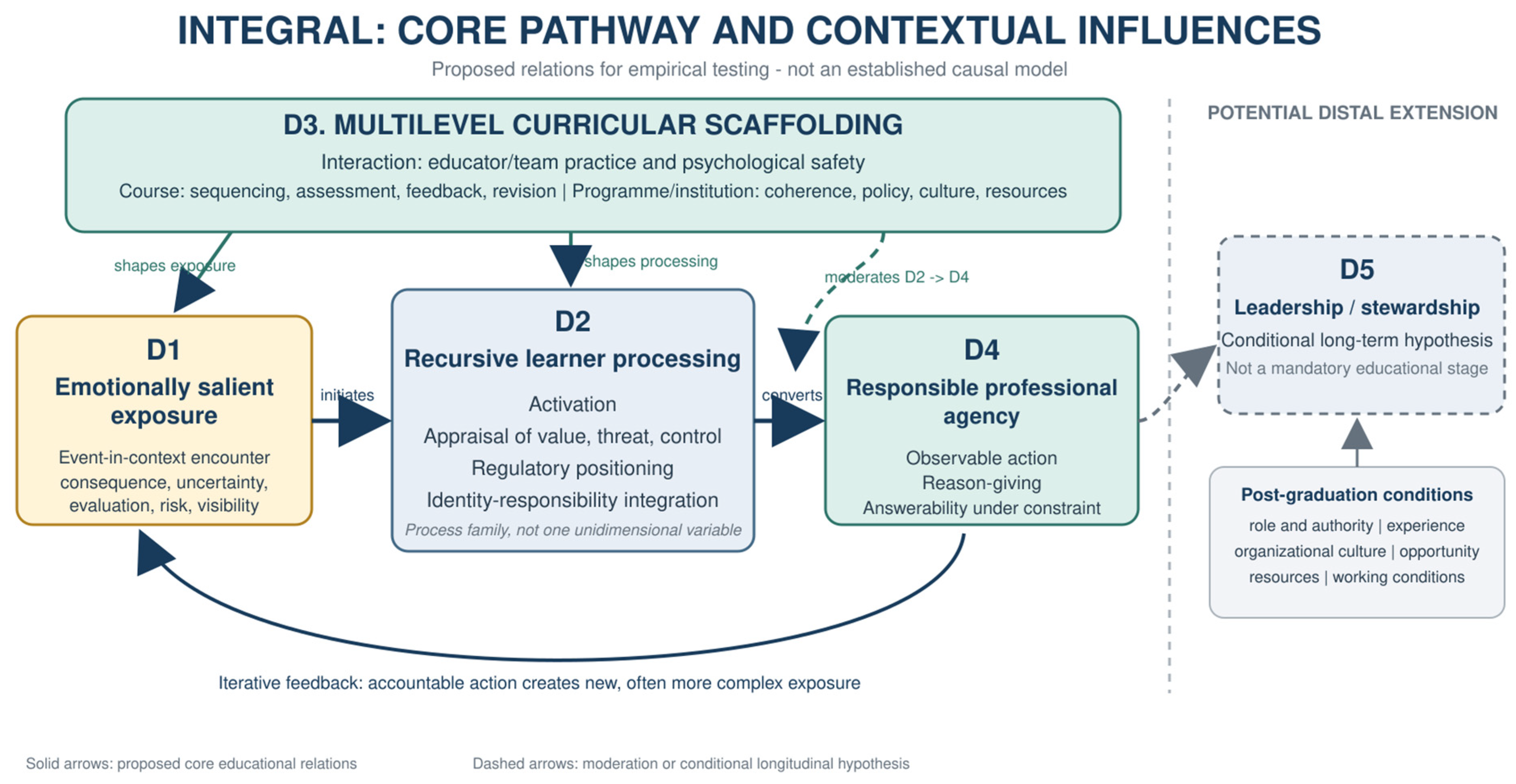
The revised architecture specifies four core educational domains (D1–D4) and one potential distal extension (D5) (Table 2; Figure 1).
Table 2.
Core constructs, analytic functions, and boundaries of INTEGRAL.
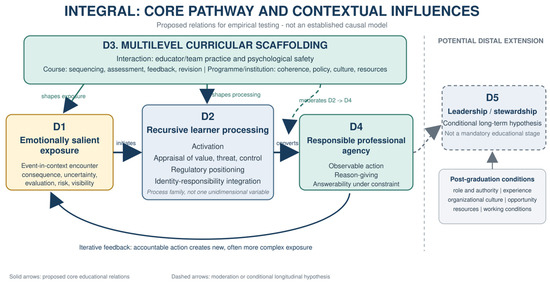
Figure 1.
The revised INTEGRAL architecture: a core educational pathway with multilevel contextual influences and a conditional distal stewardship extension. Revised INTEGRAL architecture. D1 denotes event-in-context exposure, while D2 contains the learner’s recursive activation, appraisal, regulatory positioning, and identity–responsibility integration. D3 is represented as a multilevel curricular configuration with direct contextual influences on D1 and D2 and a moderating influence on the D2 → D4 conversion. D4 remains the proximal educational outcome and returns the learner to new, often more complex exposure. D5 is placed outside the core educational pathway as a conditional long-term extension shaped by post-graduation role, authority, organizational culture, experience, opportunities, resources, and working conditions. Solid arrows represent proposed core relations; dashed arrows represent moderation or conditional hypotheses; the dashed D5 box likewise marks D5 as a conditional, non-mandatory distal extension. The figure is theoretical and not an empirically validated causal model.
D1: Emotionally salient exposure. D1 is the initiating event-in-context condition. It comprises the learner’s encounter with clinically, technically, ethically, evaluatively, relationally, or digitally consequential situations. D1 is characterized by specifiable features of the event and its institutional setting, including uncertainty, vulnerability, risk, evaluation, visibility, and possible consequence. It does not include the learner’s appraisal of value, threat, controllability, belonging, or identity meaning; those processes begin in D2. The same D1 event may therefore generate different D2 patterns across learners and social positions.
D2: Emotional activation, appraisal, regulation, and identity-relevant processing. D2 is the principal learner-level mediating process family. It contains analytically separable but recursive processes through which the learner experiences activation, interprets value and controllability, regulates attention and participation, and connects the event to professional self-understanding and responsibility. These components are grouped because they perform the same explanatory function between exposure and action; they should nevertheless be measured separately and need not form a single score or occur in a fixed order. D2 may be constructive, fragmented, defensive, or avoidant; processing is not equated with growth.
D2 also includes dysregulation pathways in which activation exceeds the learner’s current capacity for attention, working memory, or relational engagement. Cognitive narrowing, freezing, withdrawal, avoidance, defensive compliance, or impulsive action are treated as alternative processing states rather than as evidence of responsible agency. In these circumstances, the immediate priority is proportionate affective stabilization before intensified reflection: reducing immediate demands when feasible; restoring physical and relational safety; offering grounding, trusted support, and meaningful choice; and arranging appropriate student-support or clinical referral when distress is persistent, severe, or associated with risk. D3 remains relevant because institutions determine whether such support is accessible, timely, confidential, and non-punitive; however, curricular scaffolding is not a substitute for clinical assessment or treatment. Reflective and identity-focused work should resume only when the learner has sufficient capacity to participate voluntarily and safely.
D3: Structured curricular scaffolding. D3 is a multilevel configuration rather than one homogeneous construct. At the interactional level, it includes educator and team behavior, psychologically safer dialogue, feedback, and debriefing; at the course level, it includes task sequencing, assessment regimes, mentoring arrangements, and opportunities for revision; and at the program or institutional level, it includes longitudinal coherence, faculty calibration, policy, culture, and resources. These components are grouped because they share a design function: they organize whether experience can be encountered, voiced, revisited, tested, and integrated. They should be analyzed by level and component rather than collapsed into one score. D3 can shape which D1 exposures occur, directly influence D2 through safety, belonging, assessment, and mentoring, and moderate whether D2 consolidates into D4.
D4: Responsible professional agency. D4 is the proximal developmental outcome. It is defined as observable, reason-giving, accountable action under uncertainty and constraint. The definition contains four tests. Agency must be visible in participation or a defensible plan; the learner must be able to give reasons; those reasons must remain answerable to others and to professional obligations; and action must be situated within real constraints rather than imagined as unconstrained autonomy. D4 does not denote confidence, assertiveness, satisfaction, independence, or compliance.
D5: Potential leadership and stewardship extension. D5 is no longer specified as a mandatory fifth stage of the educational pathway. It is a conditional, distal hypothesis: repeated D4 may contribute to later stewardship-oriented action, but only in interaction with post-graduation organizational culture, job role and professional authority, experience, opportunities, resources, and working conditions. Leadership here remains non-positional and may be expressed through protection of standards, support for others’ participation, responsible anticipation, or institutional improvement. The framework does not assume that every learner who demonstrates D4 will progress to D5.
4.3. Positioning INTEGRAL in Relation to Adjacent Frameworks
INTEGRAL is intended as a connective explanatory architecture, not a replacement for the theories from which it draws. Table 3 states the division of conceptual labor. Its added value would be weak if the framework merely renamed reflection-based learning, professional identity formation, psychological safety, or ethics education. The distinct claim is narrower: in consequential professional education, these perspectives can be organized into a moderated pathway whose proximal criterion is answerable action rather than emotional intensity, reflective eloquence, confidence, or identity assertion alone.
Table 3.
Relation between INTEGRAL and adjacent theoretical perspectives.
What would remain unseen without this model? Existing perspectives can explain why an event matters, how identity is negotiated, how reflection is facilitated, or how agency is enacted. INTEGRAL makes visible their cross-level conditional relation: the same exposure and even similarly articulate reflection need not produce the same action, because multilevel scaffolding shapes both the formation of meaning and the conversion of that meaning into answerable performance. The framework therefore predicts a distinctive pattern—D3 → D1 and D3 → D2 direct contextual effects together with D3 × D2 → D4 moderation—and judges development by D4 rather than by emotional intensity, reflective fluency, confidence, or identity assertion alone.
INTEGRAL accommodates two temporal modes of reflective processing. In high-velocity clinical or engineering events, D2 and D4 may be temporally compressed and may alternate within seconds: rapid appraisal and attentional regulation support reflection-in-action while an observable response is unfolding. Temporal proximity does not erase the analytic distinction between the domains: D2 denotes the appraisal, regulatory, and identity-relevant operations through which the situation is interpreted, whereas D4 denotes the accountable act or action plan and the reasons that can be examined. Reflection-on-action subsequently revisits the episode through debriefing, feedback, or portfolio work within D3, allowing D2 to be reappraised and future D4 to be revised. Empirical studies should therefore use event-contingent measures and sequential observation rather than assume a long interval between processing and action.
4.4. Mechanism Statement
The revised framework distinguishes a core educational pathway from a potential distal extension. In the core pathway, D1 initiates D2 and D2 mediates the relation between exposure and D4. D3 has three analytically distinct roles: curriculum design shapes the distribution and form of D1; interactional, assessment, and mentoring conditions directly influence the formation of D2; and the quality and alignment of D3 moderate whether D2 becomes D4. D4 also returns the learner to new D1 experiences because accountable participation increases exposure to more complex responsibility. D5 is not required to complete the core pathway. It is a conditional longitudinal hypothesis that may follow repeated D4 under enabling post-graduation conditions. All arrows express propositions for testing rather than established causal effects.
The mechanism clarifies why reflection is necessary but insufficient. Systematic review evidence supports reflection as a means of learning from experience [31], but higher-education scholarship also cautions that reflection can become a pervasive yet under-specified educational expectation [32]. It becomes developmentally weak when it ends with emotional description, retrospective eloquence, or self-explanation without testing future action. INTEGRAL therefore requires a bridge from interpretation to responsibility: what action follows, why is it justified, who is affected, and what evidence would show revision over time?
The mechanism also clarifies why psychological safety cannot mean freedom from accountability. Safety enables interpersonal risk-taking, speaking up, asking for help, exposing uncertainty, and acknowledging error. Accountability requires that the learner remain answerable for action and revision. Safety without accountability can become protective comfort; accountability without safety can become concealment and compliance. D3 is strongest when it holds both.
4.5. Failure Modes
Four recurrent failure modes sharpen the model.
- Exposure without integration: Emotionally salient events are treated as unavoidable rites of passage. The likely outcomes are silent endurance, defensive adaptation, fragmentation, or disengagement rather than agency.
- Reflection without responsibility: Learners describe feelings and meaning but are not required to identify affected persons, justify action, or demonstrate revision. Reflection becomes expressive closure rather than professional formation.
- Assessment without psychological safety: Learners perceive that disclosure of uncertainty will be penalized. They perform certainty, conceal error, and learn compliance rather than accountable help-seeking.
- Agency without structural analysis: Responsibility is individualized as courage or resilience while hierarchy, workload, exclusion, curriculum design, and institutional norms remain invisible. The outcome is educational heroism: exceptional individuals compensate for weak systems.
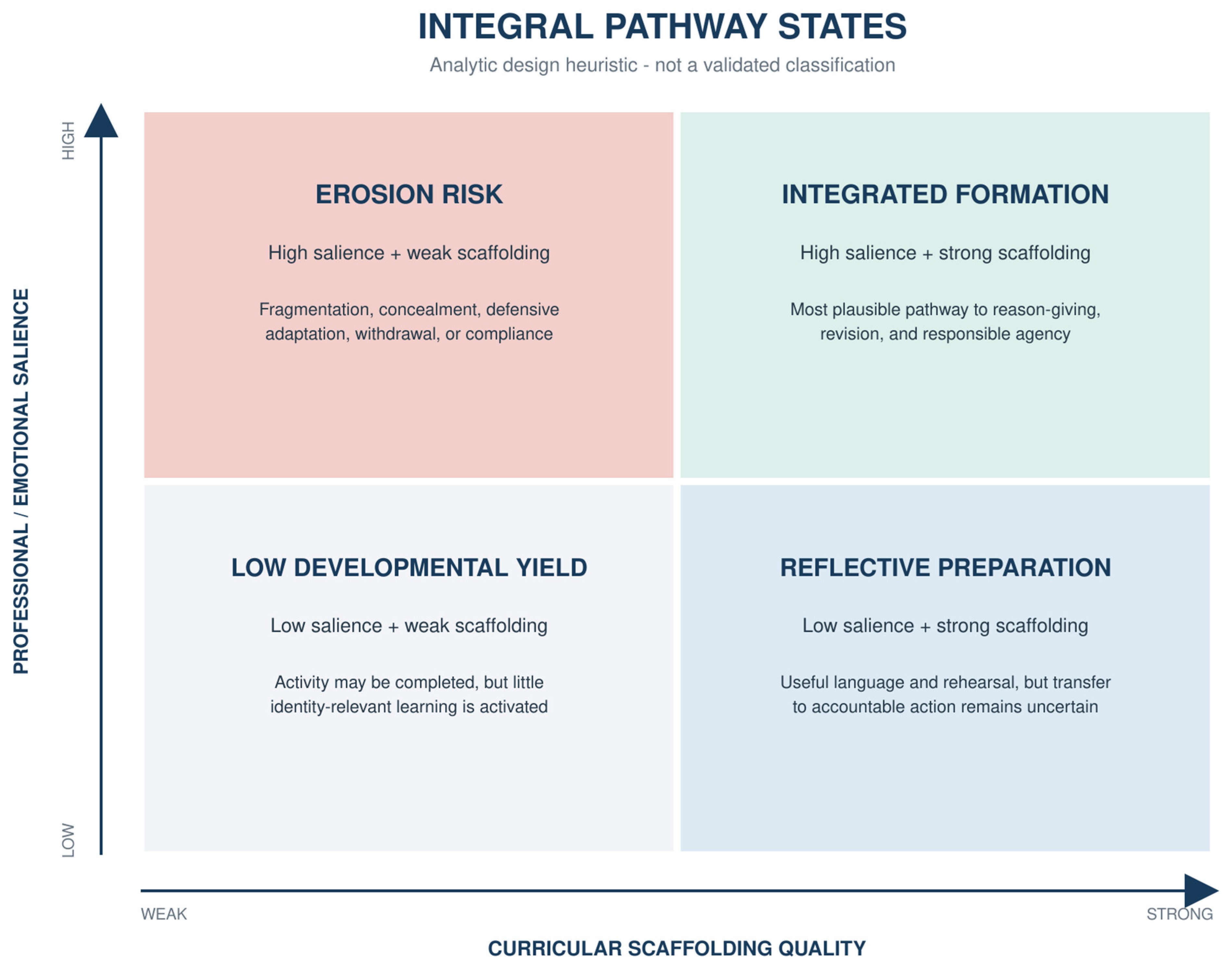
Figure 2 expresses these risks as a heuristic interaction between emotional/professional salience and scaffolding quality. It is not a validated classification. Its purpose is to show that neither exposure nor support is sufficient in isolation.
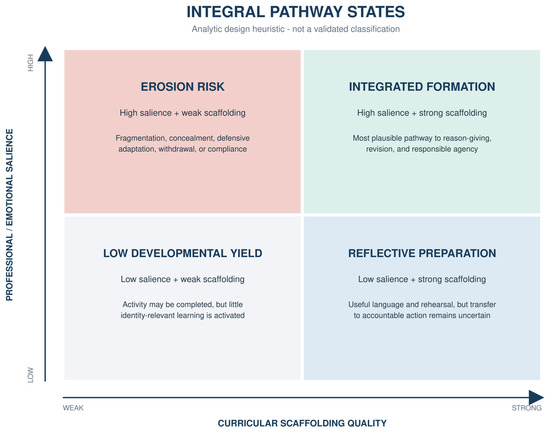
Figure 2.
A two-by-two heuristic showing the interaction between emotional salience and curricular scaffolding. Corrected analytic heuristic of pathway states. The horizontal axis runs from weak to strong curricular scaffolding and the vertical axis from low to high professional/emotional salience. Accordingly, Erosion Risk is located in the upper-left cell (high salience + weak scaffolding), Integrated Formation in the upper-right (high salience + strong scaffolding), Low Developmental Yield in the lower-left (low salience + weak scaffolding), and Reflective Preparation in the lower-right (low salience + strong scaffolding). The matrix is conceptual, not validated, and is intended to guide design and empirical testing. The matrix concerns developmental interpretation and does not demonstrate that strong scaffolding protects mental health or justify avoidable exposure to high-salience conditions.
5. Cross-Disciplinary Application
5.1. Health Sciences Education
Health sciences curricula contain predictable sites of D1: early clinical exposure, simulation, patient deterioration, family distress, moral uncertainty, feedback, interprofessional hierarchy, and digital professionalism. Early exposure can support learning, but its effects depend on participation, supervision, and opportunities to interpret experience [33,34]. A simulation involving deterioration should therefore be designed not only around technical completion. Before the event, learners can be prepared to recognize uncertainty, responsibility, and help-seeking. During the event, faculty can observe communication, prioritization, role negotiation, and response to incomplete information. Afterward, debriefing can connect emotional activation to patient and family consequences, professional obligations, and a justified plan for future action.
The same logic applies to feedback. A learner who receives a serious clinical concern may experience shame or belonging threat. D3 does not remove the concern; it structures an environment in which the learner can acknowledge it, ask questions, understand consequences, and plan repair. Responsible agency is evidenced not by appearing untroubled but by accepting appropriate responsibility without collapsing into defensiveness or silence.
Professional identity scholarship emphasizes reflection, relationship, and resilience as connected processes [35]. Pandemic experience demonstrated how ethical dilemmas can become identity-defining when ordinary educational and clinical structures are disrupted [36]. INTEGRAL adds that identity work should be connected to observable reason-giving and longitudinal evidence. Portfolio entries, repeated simulation observations, clinical evaluations, and mentoring conversations can document whether learners increasingly identify what matters, seek help appropriately, respond to feedback, and revise action.
5.2. Engineering Education
Engineering curricula contain equally consequential but differently configured sites of D1: failed prototypes, design reviews, laboratory risk, team conflict, stakeholder disagreement, sustainability trade-offs, data and software responsibility, and the long temporal distance between a decision and its effects. The recent engineering-education meta-synthesis shows both the importance of emotion and the field’s limited engagement with the breadth of available emotion theory [4]. Psychological safety in first-year project teams influences whether conflict can be named and addressed [6]. Creativity-focused project-based learning likewise depends on conditions in which learners can expose unfinished thinking and learn through uncertainty [11].
A design failure illustrates the complete pathway. The failed test activates emotion and appraisal: the learner may interpret failure as information, incompetence, a threat to belonging, or a reason to obscure the result. D3 consists of review protocols that reward traceability, honest error reporting, stakeholder analysis, and iterative redesign. D4 is not simply a successful second prototype. It is the learner’s capacity to explain why the failure occurred, disclose limitations, identify who could be affected, justify a revised decision, and document uncertainty.
Engineering ethics further shows why responsibility cannot be appended as a final lecture. A recent systematic review found that empathy and prosocial action, moral emotions, and emotional intelligence or regulation were prominent but insufficiently connected frameworks in engineering ethics education [5]. Responsible anticipation requires learners to examine emerging consequences, affected values, inclusion, and responsiveness during design [37]. Ethics and diversity, equity, and inclusion are linked through professional cultures, stakeholder recognition, and engagement strategies [38]. Recent systematic review evidence shows wide variation in engineering ethics interventions and assessments, underscoring the need to connect ethical reasoning to observable professional action [39]. Moral identity measures may support research into whether ethical commitments become central to engineering self-understanding [40], but INTEGRAL cautions that self-report should be paired with behavior, artifacts, and reason-giving.
5.3. What Becomes Visible at the Disciplinary Boundary
Bringing health sciences and engineering together is not a claim that their professional responsibilities are identical. The comparison is analytically productive because each exposes what the other may leave implicit. Health professions education makes relational vulnerability, care, and immediate moral presence difficult to ignore. Engineering education makes distributed causality, system effects, design traceability, sustainability, and responsibility at a distance especially visible. Together, they show that responsible agency must be both relational and systemic.
The comparison also protects the model from discipline-specific reduction. In health sciences, agency can be narrowed to communication or resilience; engineering challenges this by foregrounding material systems and downstream consequences. In engineering, agency can be narrowed to autonomous problem-solving; health sciences challenges this by foregrounding dependency, vulnerability, and the moral claims of another person. INTEGRAL therefore defines agency as situated answerability rather than individual freedom.
Practical wisdom (phronesis) provides a bridge. It concerns context-sensitive judgment about what is fitting and defensible, not rule application alone [41,42]. Professional agency scholarship similarly warns that agency can become a vague celebration of choice unless structural constraint is specified [43]. INTEGRAL connects these insights: the learner acts, but action is justified within professional, relational, technical, ethical, and institutional constraints.
6. Propositions and Candidate Indicators
The framework generates propositions that can be tested, refined, or rejected. Table 4 pairs each proposition with candidate evidence. No single indicator is sufficient; multi-source and longitudinal designs are preferable.
Table 4.
Testable propositions and candidate evidence.
6.1. Measuring D1 and D2
D1 and D2 require temporally and operationally distinct measurement. D1 should be characterized through event and context indicators that can be documented independently of the learner’s appraisal, including uncertainty, evaluative exposure, moral or safety consequence, interpersonal vulnerability, public visibility, and risk to others. D2 begins with the learner’s activation and appraisal and may be examined through event-contingent value/threat/controllability ratings, emotion-regulation measures, stimulated recall, narrative analysis, and identity–responsibility interpretation. Measuring perceived consequence only as D1 would contaminate predictor and mediator; studies should therefore combine independent event characterization with near-event D2 measures and test serial, parallel, or reciprocal relations among D2 components.
6.2. Measuring D3
D3 requires evidence at three distinguishable levels. Interactional indicators include educator behavior, team psychological safety, feedback, and debriefing enactment; course-level indicators include sequencing, assessment regimes, mentoring arrangements, and revision opportunities; program/institutional indicators include longitudinal coherence, faculty calibration, policy, culture, and resources. These components should not be summed automatically. Studies should test both direct paths from D3 to D1/D2 and cross-level moderation of D2 → D4, using multilevel designs that distinguish the existence of scaffolding from its implementation quality and institutional credibility.
6.3. Measuring D4 and D5
D4 should be assessed through converging evidence: reason-giving, accountable participation, context-sensitive judgment, feedback responsiveness, appropriate help-seeking, disclosure of uncertainty, traceability of decisions, stakeholder awareness, and demonstrated revision. Digital professionalism provides a visible context in which identity, boundaries, and accountability can be examined [44]. In engineering, design logs and safety arguments can show how decisions change. In health sciences, simulation, clinical evaluation, and reflective justification can show whether emotion has been connected to professional action.
D5 is a potential distal extension and therefore requires cautious longitudinal designs extending beyond graduation. The relevant question is not whether D4 automatically becomes leadership, but whether D4 predicts later stewardship after organizational culture, job role and professional authority, experience, opportunities, resources, and working conditions are modeled. Evidence might include sustained protection of standards, contribution to team learning, responsible anticipation, mentorship, digital accountability, or institutional improvement. Null or context-dependent findings would refine or disconfirm D5 without invalidating the core D1–D4 educational pathway.
7. Curriculum Design and Assessment Implications
7.1. Map Predictable Sites of Salience
Programs should identify where emotionally and professionally consequential learning predictably occurs. Mapping should include formal and hidden curricula: simulation, placement, laboratory work, design review, feedback, team projects, ethical dilemmas, public presentation, digital conduct, and transition into workplace learning. The aim is not to label all discomfort as educationally valuable. It is to prevent foreseeable high-consequence experiences from remaining pedagogically unheld.
7.2. Design Before, During, and After the Event
Scaffolding should surround rather than merely follow exposure. Before, learners need expectations concerning uncertainty, help-seeking, responsibility, confidentiality, and the purpose of reflection. During, faculty need observation criteria that include communication, role negotiation, traceability, and response to uncertainty. After, debriefing and reflection should connect emotion to interpretation, affected persons, professional standards, action, and future revision. Supplementary File S1 provides cross-disciplinary planning prompts and examples.
7.3. Couple Psychological Safety with Accountable Standards
Psychological safety is not achieved by lowering standards or guaranteeing comfort. Learners need credible assurance that good-faith uncertainty, questions, and acknowledgment of error can be voiced without humiliation. They also need clear expectations that concerns will be addressed, reasons examined, and unsafe action revised. Faculty development should therefore include facilitation of difficult dialogue, response to disclosure, calibration of feedback, and recognition of power asymmetry.
7.4. Assess Action, Not Emotional Conformity
INTEGRAL does not authorize assessment of whether a learner displays the “correct” emotion. Emotional expression varies culturally and individually, and compelled disclosure can itself be unsafe. Assessment should focus on professional meaning and action: does the learner recognize what is at stake? Can they consider affected persons and systems? Do they give defensible reasons? Do they seek help when needed? Can they revise action? Do artifacts show learning over time?
The Supplementary File S1 rubric is therefore a formative design and dialogue aid, not a validated psychometric instrument and not a basis for high-stakes progression decisions. Before local adoption, institutions should test feasibility, examine inter-rater consistency and response-process evidence, review cultural and accessibility implications with stakeholders, and calibrate faculty judgments. Reliability coefficients, cut scores, and claims of construct validity cannot be inferred from the present framework; formal validation would be required before any summative use.
7.5. Build Longitudinal Coherence
Single activities cannot establish a trajectory. Programs should connect experiences across modules and years through portfolios, mentoring, repeated simulation, design logs, clinical evaluations, or capstone review. The unit of development becomes a sequence: encounter, interpretation, supported dialogue, accountable action, feedback, and re-encounter. Longitudinal coherence also makes visible whether apparent growth transfers across clinical, technical, relational, ethical, and digital settings.
8. Discussion
8.1. Theoretical Contribution
INTEGRAL contributes a cross-level conversion mechanism where existing scholarship often offers adjacency. Its original claim is not that emotion, identity, reflection, psychological safety, agency, or stewardship are new constructs. It is that event-in-context exposure and learner processing must be separated; that multilevel curricular architecture can shape both exposure and processing as well as the conversion of processing into action; and that development should be judged by observable, reason-giving, answerable action rather than emotional intensity, reflective eloquence, confidence, or identity assertion alone. This architecture makes it possible to explain why comparable exposure and apparently sophisticated reflection may still yield different patterns of responsible agency.
The cross-disciplinary comparison is a second contribution. Health sciences and engineering are both consequential professions, but their literatures emphasize different moral and epistemic features. Their integration produces a fuller account of professional answerability: responsibility is immediate and distributed, relational and systemic, embodied and technologically mediated. A framework that travels across these settings must therefore remain sensitive to context while preserving a common developmental mechanism. Related scholarship on sustainability in health-professions education [45] and engineering identity during workplace learning [46] further supports examining how professional formation extends across institutional and practice contexts.
A third contribution is institutional. D3 is now specified as a multilevel configuration with direct contextual influence on D1 and D2 as well as moderation of D2 → D4. This prevents curricula, assessment regimes, mentoring relations, and institutional culture from being treated as background scenery or compressed into a learner-level support score. The position aligns with a broader moral–epistemic view of leadership, structure, and culture: institutions shape which experiences occur, which questions can be asked, which interpretations are legitimate, and whether knowledge becomes sustainable practice [47]. INTEGRAL extends that concern into a learner-development pathway without duplicating the Leadership–Structure–Culture theory.
8.2. Boundary Conditions
The framework should not be universalized without attention to boundary conditions. Emotionally salient exposure varies by profession, cultural context, learner history, and social position; D3 may be constrained by hierarchy, accreditation demands, staffing, assessment design, or placement cultures; professional responsibility may be contested; and resource-rich scaffolding cannot be presumed available. D5 is especially contingent after graduation. Organizational culture, role and authority, experience, opportunity, resources, and working conditions may enable, redirect, or block any extension from D4 to stewardship. D5 is therefore optional and empirically separable from the core D1–D4 pathway.
Power and belonging are not secondary moderators. A reflective invitation from a trusted mentor is not equivalent to compelled disclosure to an assessor. A design critique in an inclusive team is not equivalent to public humiliation. A clinical learner whose credibility is routinely discounted does not encounter the same D1 or D3 as a well-recognized peer. Empirical work should therefore examine moderated pathways and negative cases rather than report only average associations.
8.3. Rival Explanations and Empirical Discrimination
INTEGRAL should not become a self-sealing account in which every desirable outcome confirms the framework and every undesirable outcome is attributed to weak scaffolding. Responsible action may also reflect prior competence, conscientiousness, self-efficacy, selection into demanding experiences, general instructional quality, team climate, or profession-specific assessment. D3 may function as a proxy for overall program quality, while D2 may sometimes be reconstructed retrospectively after successful action rather than preceding it.
Empirical work should therefore compare INTEGRAL with simpler and rival models. At minimum, studies could contrast an exposure-only model, a competence or self-efficacy model, the proposed mediated and moderated pathway, and reciprocal models in which action alters subsequent appraisal and identity. Event-contingent measurement, temporal separation of constructs, multilevel designs, negative-case analysis, and triangulation across observation, explanation, and artifacts would help distinguish these accounts. If a simpler model explains D4 equally well, INTEGRAL’s additional constructs would not be justified.
8.4. Limitations
This review has nine limitations. First, it is a purposive conceptual synthesis rather than a systematic review; the iterative search did not generate a valid exhaustive hit denominator, and relevant non-English, contradictory, or adjacent traditions may have been missed. Second, the evidence base is uneven across fields and designs, and no common quality score could validly summarize it. Third, the synthesis began from prior author manuscripts, creating a risk of confirmation bias despite open extraction, construct comparison, negative cases, and disconfirmation criteria. Fourth, the framework has not been empirically validated; arrows are propositions, not established causal effects. Fifth, D2 is a process family whose components may be serial, parallel, or reciprocal and may overlap temporally with D4. Sixth, D3 is multilevel and may proxy general program quality unless its components and levels are measured separately. Seventh, portability across health sciences and engineering remains theoretical, while the D4-to-D5 extension is vulnerable to post-graduation organizational conditions. Eighth, the implementation toolkit is formative and unvalidated and should not be used for high-stakes assessment without local adaptation, stakeholder review, faculty calibration, and psychometric evaluation.
Ninth, because this conceptual review did not measure stress indicators, depressive symptoms, burnout, or emotional exhaustion, it cannot establish that curricular scaffolding buffers distress. Improved performance or D4 indicators could coexist with, or conceal, learned endurance of unsafe high-salience conditions. Future evaluations should assess responsible agency alongside validated wellbeing outcomes, exposure intensity, recovery, and structural hazard indicators, and should prespecify evidence of harmful adaptation. An increase in observable agency accompanied by deteriorating wellbeing should not be interpreted as educational success.
The core model is disconfirmed or requires substantial revision if D1 predicts D4 independently of D2; if D3 has negligible direct influence on D1/D2 and negligible moderation of D2 → D4; or if multi-source D4 indicators add nothing beyond confidence or competence. The optional D5 extension is independently weakened if D4 during training does not predict later stewardship after organizational culture, role, authority, experience, opportunity, resources, and working conditions are considered. A null D5 result would not rescue itself through rhetoric and would not, by itself, falsify the bounded D1–D4 educational pathway.
9. Conclusions
Professional education asks learners to act before certainty is possible and before identity is complete. Emotionally salient experiences are therefore unavoidable, but their educational value is not. Exposure may become judgment, responsibility, and stewardship; it may also become silence, fragmentation, or performance. The difference cannot be explained by learner resilience alone.
INTEGRAL proposes that event-in-context exposure becomes educationally formative through recursive activation, appraisal, regulation, and identity–responsibility integration. Multilevel curricular scaffolding shapes which exposures are encountered, influences their processing, and moderates whether processing becomes responsible professional agency. Agency is evidenced in observable, reason-giving, accountable action under constraint. Leadership and stewardship are not a guaranteed fifth stage; they remain a conditional long-term extension that must be tested against post-graduation organizational conditions.
For health sciences and engineering education, the practical implication is exacting: curricula must do more than expose, support, or assess. They must connect authentic consequence to psychologically safer interpretation, accountable standards, and repeated opportunities for revision. When institutions make that pathway visible, emotion ceases to be treated as a private burden and becomes part of the moral-epistemic architecture through which professionals learn to answer for what they do.
Supplementary Materials
The following supporting information can be downloaded at https://www.mdpi.com/article/10.3390/encyclopedia6090203/s1, Supplementary File S1, INTEGRAL Cross-Professional Curriculum Mapping, Debriefing, and Formative Assessment Toolkit; Supplementary File S2, INTEGRAL Conceptual Development Audit Trail, Search Architecture, and Evidence Map.
Author Contributions
Conceptualization, M.A.-C. and J.C.R.-F.; methodology, M.A.-C. and J.C.R.-F.; investigation, M.A.-C., J.C.R.-F., M.R. and M.R.-A.; formal analysis, M.A.-C., J.C.R.-F., M.R. and M.R.-A.; validation, J.C.R.-F., M.R. and M.R.-A.; writing—original draft preparation, M.A.-C.; writing—review and editing, M.A.-C., J.C.R.-F., M.R. and M.R.-A.; visualization, J.C.R.-F. and M.R.-A.; supervision, M.A.-C. and J.C.R.-F.; project administration, M.A.-C. All authors have read and agreed to the published version of the manuscript.
Funding
This research received no external funding.
Institutional Review Board Statement
Not applicable. This study is a conceptual review and involved no human participants, patient data, or animal research.
Informed Consent Statement
Not applicable.
Data Availability Statement
No new empirical data were created or analyzed in this study. The conceptual audit trail and evidence map supporting the review are provided in Supplementary File S2.
Acknowledgments
During the preparation of this manuscript, the authors used ChatGPT (GPT-5, OpenAI; accessed 10 August 2026) for comparative organization of author-owned drafts, language editing, bibliographic cross-checking, and assistance with code-based figure layout. The authors reviewed and edited the output and take full responsibility for the content of this publication. No empirical data, results, or pictorial content were generated. Further details are provided in Section 2.5.
Conflicts of Interest
The authors declare no conflicts of interest.
References
- Pekrun, R. Control-Value Theory: From achievement emotion to a general theory of human emotions. Educ. Psychol. Rev. 2024, 36, 83. [Google Scholar] [CrossRef] [Scilit]
- Sternszus, R.; Steinert, Y.; Razack, S.; Boudreau, J.D.; Snell, L.; Cruess, R.L. Being, becoming, and belonging: Reconceptualizing professional identity formation in medicine. Front. Med. 2024, 11, 1438082. [Google Scholar] [CrossRef] [Scilit] [PubMed]
- Cornett, M.; Palermo, C.; Ash, S. Professional identity research in the health professions—A scoping review. Adv. Health Sci. Educ. 2023, 28, 589–642. [Google Scholar] [CrossRef] [Scilit] [PubMed]
- Lönngren, J.; Bellocchi, A.; Berge, M.; Bøgelund, P.; Direito, I.; Huff, J.L.; Mohd-Yusof, K.; Murzi, H.; Abdul Rahman, N.F.; Tormey, R. Emotions in engineering education: A configurative meta-synthesis systematic review. J. Eng. Educ. 2024, 113, 1287–1326. [Google Scholar] [CrossRef] [Scilit]
- Tormey, R.; Bellocchi, A.; Bøgelund, P.; Lönngren, J.; Murzi, H.; Polmear, M. Emotions in engineering ethics education: Systematic review and ways forward. Sci. Eng. Ethics 2025, 31, 21. [Google Scholar] [CrossRef] [Scilit] [PubMed]
- Huerta, M.V.; Sajadi, S.; Schibelius, L.; Ryan, O.J.; Fisher, M. An exploration of psychological safety and conflict in first-year engineering student teams. J. Eng. Educ. 2024, 113, 635–666. [Google Scholar] [CrossRef] [Scilit]
- Abdi, M.; Kanzaki Sooudi, O.; Milota, M. Professional identity formation for underrepresented groups in medicine: Challenges and interventions for Dutch medical schools: A systematic scoping review. BMC Med. Educ. 2025, 25, 1715. [Google Scholar] [CrossRef] [Scilit] [PubMed]
- Liquete, E.; Dekoninck, E.; Wisker, G. From student to engineer: Identity formation in engineering education. Eur. J. Eng. Educ. 2026, 51, 537–560. [Google Scholar] [CrossRef] [Scilit]
- Dong, C.; Altshuler, L.; Ban, N.; Wong, L.Y.; Mohammed, F.E.A.; Tang, C.T.; Kachur, E. Psychological safety in health professions education: Insights and strategies from a global community of practice. Front. Med. 2025, 11, 1508992. [Google Scholar] [CrossRef] [Scilit] [PubMed]
- van Oorschot, F.; Brouwers, M.; Muris, J.; Veen, M.; Timmerman, A.; van Dulmen, S. How does guided group reflection work to support professional identity formation in postgraduate medical education: A scoping review. Med. Teach. 2025, 47, 425–435. [Google Scholar] [CrossRef] [Scilit] [PubMed]
- Hansen, S.; Chen, J.; Lyngdorf, N.E.R.; Bertel, L.B.; Du, X. Supporting psychological safety in teamwork: In which ways do engineering students feel safe doing creativity-focused interventions in a PBL environment? Eur. J. Eng. Educ. 2026, 51, 581–600. [Google Scholar] [CrossRef] [Scilit]
- Botha, G.C.; Crafford, L. From understanding to action: A juncture-factor framework for advancing social responsiveness in health professions education. Front. Med. 2024, 11, 1435472. [Google Scholar] [CrossRef] [Scilit] [PubMed]
- Martin, D.A. Defining the responsibilities of engineers: A conceptual framework for engineering ethics education, policy, and practice. Eng. Stud. 2026, 18, 105–130. [Google Scholar] [CrossRef] [Scilit]
- Snyder, H. Literature review as a research methodology: An overview and guidelines. J. Bus. Res. 2019, 104, 333–339. [Google Scholar] [CrossRef] [Scilit]
- Jaakkola, E. Designing conceptual articles: Four approaches. AMS Rev. 2020, 10, 18–26. [Google Scholar] [CrossRef] [Scilit]
- MacInnis, D.J. A framework for conceptual contributions in marketing. J. Mark. 2011, 75, 136–154. [Google Scholar] [CrossRef] [Scilit]
- Timmermans, S.; Tavory, I. Theory construction in qualitative research: From grounded theory to abductive analysis. Sociol. Theory 2012, 30, 167–186. [Google Scholar] [CrossRef] [Scilit]
- Pekrun, R. The control-value theory of achievement emotions: Assumptions, corollaries, and implications for educational research and practice. Educ. Psychol. Rev. 2006, 18, 315–341. [Google Scholar] [CrossRef] [Scilit]
- Dong, X.; Yuan, H.; Xue, H.; Li, Y.; Jia, L.; Chen, J.; Shi, Y.; Zhang, X. The association between online learning environments and academic emotions in medical education: A controlled value theory perspective. BMC Med. Educ. 2026, 26, 250. [Google Scholar] [CrossRef] [Scilit] [PubMed]
- Zeng, Y.; Fu, Y.; Zhang, Y.; Jiang, Y.; Liu, J.; Li, J. Emotion regulation in undergraduate nursing students: A latent profile analysis. Nurse Educ. Pract. 2023, 71, 103722. [Google Scholar] [CrossRef] [Scilit] [PubMed]
- Bynum, W.E.; Goodie, J.L. Shame, guilt, and the medical learner: Ignored connections and why we should care. Med. Educ. 2014, 48, 1045–1054. [Google Scholar] [CrossRef] [Scilit] [PubMed]
- Carel, H.; Kidd, I.J. Epistemic injustice in healthcare: A philosophical analysis. Med. Health Care Philos. 2014, 17, 529–540. [Google Scholar] [CrossRef] [Scilit] [PubMed]
- Volpe, R.L.; Hopkins, M.; Geathers, J.; Watts Smith, C.; Cuffee, Y. Negotiating professional identity formation in medicine as an outsider: The experience of professionalization for minoritized medical students. SSM Qual. Res. Health 2021, 1, 100017. [Google Scholar] [CrossRef] [Scilit]
- Li, W.; Lu, J.; Cao, L.; Xiao, M. University organizational support and engineering identity among engineering postgraduates: The sequential mediating role of major satisfaction and engineering belonging. Behav. Sci. 2026, 16, 199. [Google Scholar] [CrossRef] [Scilit] [PubMed]
- Xu, Y.M.; Gravel, B.E. Making facilitates an engineering student’s identity work in becoming an engineer. J. Eng. Educ. 2025, 114, e70027. [Google Scholar] [CrossRef] [Scilit]
- Johnson, C.E.; Keating, J.L.; Molloy, E.K. Psychological safety in feedback: What does it look like and how can educators work with learners to foster it? Med. Educ. 2020, 54, 559–570. [Google Scholar] [CrossRef] [Scilit] [PubMed]
- Joyce, L.R.; Meeks, M.; Somerville, S.G. Interprofessional co-debriefing in simulation—Role modeling collaboration: A qualitative study. Simul. Healthc. 2025, 20, 357–365. [Google Scholar] [CrossRef] [Scilit] [PubMed]
- Montini, C.; Mellucci, C.; Galletti, C. Structure and utility of e-portfolios for reflection and learning in healthcare professional education: A narrative review. Clin. Teach. 2026, 23, e70366. [Google Scholar] [CrossRef] [Scilit] [PubMed]
- Sellberg, C.; Lindwall, O. Simulation-based training in professional education: Learning, participation, and instructional design. Instr. Sci. 2026, 54, 9. [Google Scholar] [CrossRef] [Scilit]
- Merkebu, J.; Veen, M.; Hosseini, S.; Varpio, L. The case for metacognitive reflection: A theory integrative review with implications for medical education. Adv. Health Sci. Educ. 2024, 29, 1481–1500. [Google Scholar] [CrossRef] [Scilit] [PubMed]
- Mann, K.; Gordon, J.; MacLeod, A. Reflection and reflective practice in health professions education: A systematic review. Adv. Health Sci. Educ. 2009, 14, 595–621. [Google Scholar] [CrossRef] [Scilit] [PubMed]
- Tight, M. Reflection: An assessment and critique of a pervasive trend in higher education. Eur. J. High. Educ. 2024, 14, 324–342. [Google Scholar] [CrossRef] [Scilit]
- Dornan, T.; Littlewood, S.; Margolis, S.A.; Scherpbier, A.; Spencer, J.; Ypinazar, V. How can experience in clinical and community settings contribute to early medical education? A BEME systematic review. Med. Teach. 2006, 28, 3–18. [Google Scholar] [CrossRef] [Scilit] [PubMed]
- Simmenroth, A.; Harding, A.; Vallersnes, O.M.; Dowek, A.; Carelli, F.; Kiknadze, N.; Karppinen, H. Early clinical exposure in undergraduate medical education: A questionnaire survey of 30 European countries. Med. Teach. 2023, 45, 426–432. [Google Scholar] [CrossRef] [Scilit] [PubMed]
- Wald, H.S. Professional identity (trans)formation in medical education: Reflection, relationship, resilience. Acad. Med. 2015, 90, 701–706. [Google Scholar] [CrossRef] [Scilit] [PubMed]
- Wald, H.S.; Ruddy, M. Surreal becomes real: Ethical dilemmas related to the COVID-19 pandemic and professional identity formation of health professionals. J. Contin. Educ. Health Prof. 2021, 41, 124–129. [Google Scholar] [CrossRef] [Scilit] [PubMed]
- van Grunsven, J.; Stone, T.; Marin, L. Fostering responsible anticipation in engineering ethics education: How a multi-disciplinary enrichment of the responsible innovation framework can help. Eur. J. Eng. Educ. 2024, 49, 283–298. [Google Scholar] [CrossRef]
- Hess, J.L.; Lin, A.; Whitehead, A.; Katz, A. How do ethics and diversity, equity, and inclusion relate in engineering? A systematic review. J. Eng. Educ. 2024, 113, 143–163. [Google Scholar] [CrossRef] [Scilit]
- Krishnan, V.V.; DeHoust, B.; Miller, G.; Johnson, M.D.; Nepal, B.; Banerjee, A. Engineering ethics interventions and assessments: A systematic literature review. Sci. Eng. Ethics 2026, 32, 15. [Google Scholar] [CrossRef] [Scilit] [PubMed]
- Kim, D.; McOwen, B. Development and validation of engineering professional moral identity measure. Sci. Eng. Ethics 2026, 32, 24. [Google Scholar] [CrossRef] [Scilit] [PubMed]
- Jameel, S.Y. A critical interpretive literature review of phronesis in medicine. J. Med. Philos. 2025, 50, 117–132. [Google Scholar] [CrossRef] [Scilit] [PubMed]
- Malik, A.; Conroy, M.; Turner, C. Phronesis in medical ethics: Courage and motivation to keep on the track of rightness in decision-making. Health Care Anal. 2020, 28, 158–175. [Google Scholar] [CrossRef] [Scilit] [PubMed]
- Inouye, K.; Lee, S.; Oldac, Y.I. A systematic review of student agency in international higher education. High. Educ. 2023, 86, 891–911. [Google Scholar] [CrossRef] [Scilit] [PubMed]
- Guraya, S.S.; Ennab, F.; Guraya, S.Y. When the self logs in: A critical narrative review of digital identity in health professions education. Front. Med. 2025, 12, 1715752. [Google Scholar] [CrossRef] [Scilit] [PubMed]
- Naidu, T.; Ramani, S. Transforming global health professions education for sustainability. Med. Educ. 2024, 58, 129–135. [Google Scholar] [CrossRef] [Scilit] [PubMed]
- Dehing, A.; Jochems, W.; Baartman, L. The development of engineering students’ professional identity during workplace learning in industry: A study in Dutch bachelor education. Eng. Educ. 2013, 8, 42–64. [Google Scholar] [CrossRef] [Scilit]
- Antuna-Casal, M. Epistemic caring: The Leadership, Structure, and Culture Theory of Nursing Research Advancement. Nurs. Outlook 2026, 74, 102701. [Google Scholar] [CrossRef] [Scilit] [PubMed]

Disclaimer/Publisher’s Note: The statements, opinions and data contained in all publications are solely those of the individual author(s) and contributor(s) and not of MDPI and/or the editor(s). MDPI and/or the editor(s) disclaim responsibility for any injury to people or property resulting from any ideas, methods, instructions or products referred to in the content. |
© 2026 by the authors. Licensee MDPI, Basel, Switzerland. This article is an open access article distributed under the terms and conditions of the Creative Commons Attribution (CC BY) license.