


Definition
Artificial-intelligence-enabled agri-food entrepreneurship is the creation of new ventures and the entrepreneurial renewal of existing firms, whose value propositions and business models are built around learning-based computational systems applied across the food value chain, from primary production and processing to distribution, consumption, and the recovery of losses and by-products. The core enabling technologies are machine learning and computer vision, generative artificial intelligence (AI) and large language models, and AI-enabled robotics and predictive analytics, deployed with complementary digital infrastructure such as the Internet of Things, big data, cloud and edge computing, blockchain, and digital twins. The concept is broader than technology adoption because its subject is the entrepreneur: how opportunities are recognised or created, how business models convert them into revenue, and why so few technically capable solutions become durable businesses. This entry makes four contributions: It specifies a mechanism—because AI lowers the cost of prediction but not of judgement, opportunities concentrate in decisions that are prediction-intensive, recurrent, and attached to an outcome that the customer already measures. It provides a taxonomy of business-model archetypes that separates value creation from value capture. It establishes the boundary conditions under which digital-entrepreneurship theory transfers to food systems—seasonality, fixed adoption costs, contested data governance, and liability. Finally, it converts the synthesis into seven testable propositions and an evidence calibration separating controlled benchmarks, field pilots, and commercial deployment.
1. Introduction and Scope
The agri-food sector—agriculture, fisheries, food processing, distribution, and retail—faces intensifying pressures to feed a growing population, adapt to climate change, use scarce resources efficiently, and meet demands for quality, transparency, and sustainability [1,2]. These coincide with the maturation of digital technologies: successive waves described as precision agriculture, digital agriculture, and Agriculture 4.0 have integrated sensing, connectivity, analytics, and automation across the chain [1,3,4]. Within this digitalisation, artificial intelligence (AI) denotes computational methods—most prominently machine learning (ML) and deep learning—that learn patterns from data to generate predictions or decisions [5,6]. AI has become an increasingly important capability, and the public release of generative AI and large language models (LLMs), beginning in late 2022, extended its reach towards content generation and natural-language interaction [7,8].
The Gap: Three research streams meet here and have matured largely in isolation. Digital transformation and digital entrepreneurship explain how digital technologies reshape opportunity, organisation, and value creation [9,10,11,12], but the account is sector-agnostic and its canonical settings—software, platforms, consumer services—combine near-zero marginal cost, rapid iteration, and short validation cycles, none of which holds in food production. Work on AI in agriculture and food is technically rich but takes the model, the field, or the farm as its unit of analysis, treating the venture that supplies the technology as background [5,6,13,14,15]. Research on AgriFoodTech start-ups is recent and explicitly incomplete: a state-of-the-art review finds the evidence thin, geographically concentrated, and directed at the roles start-ups play in innovation systems rather than at how they create and capture value [16], and a structured review of AI and agricultural business models reaches the same conclusion, identifying only 37 relevant contributions [17]. What falls between the three is the entrepreneurial question itself: not whether a model performs or a farm adopts, but how an opportunity is recognised or created, by whom, through which business model, and why so few capable technologies become durable businesses.
Aim and Contribution: This entry organises that knowledge into a single account and makes the three streams speak to one another. It reports no new empirical data and claims no novel phenomenon, but makes four contributions. First, it specifies a mechanism: AI reduces the cost of prediction while leaving the cost of judgement—determining the payoff associated with each action and accepting responsibility for the consequences—largely unchanged [18], an asymmetry that explains where opportunities concentrate and where they dissipate. Second, it provides constructs: a taxonomy of business-model archetypes that separates value creation from value capture, and an evidence calibration separating controlled benchmarks, field pilots, and commercial deployment. Third, it establishes boundary conditions on the transfer of general digital-entrepreneurship theory to food: biological seasonality, fixed adoption costs that do not scale with output, contested data governance, and liability for agronomic advice. Fourth, it challenges an implicit mechanism: applied work commonly assumes a chain from technical performance to adoption to value, whereas the chain breaks at two transitions, and the breaks—not the performance—are where entrepreneurial action lies. These are stated as seven propositions (Propositions 1–7) so that others can test, refute, or bound them.
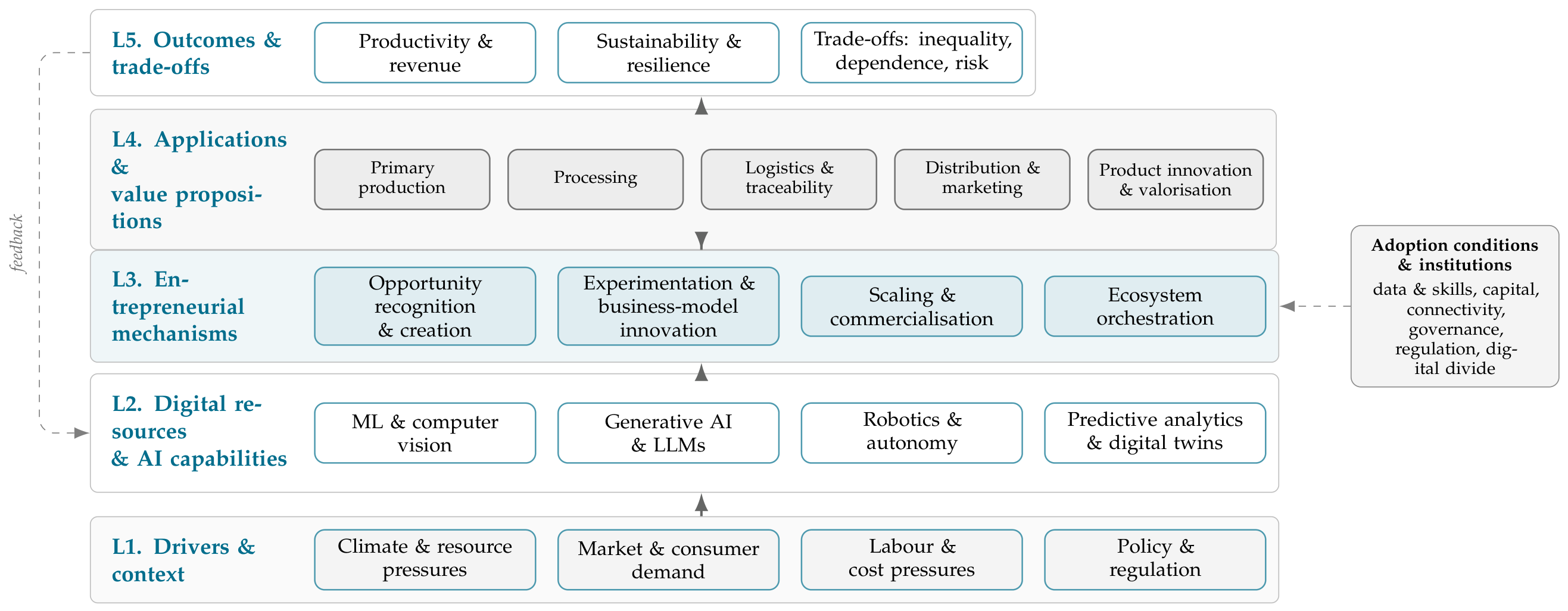
Scope and Approach: This is a narrative, encyclopaedic synthesis rather than a systematic review, drawing primarily on peer-reviewed literature, with policy documents used for legislation, industry reports for market statistics only, and company or company-derived sources only for specific products or firm claims, labelled as such. Complementary technologies (the Internet of Things (IoT), cloud and edge computing, blockchain, digital twins) are treated only where they support AI-enabled value propositions; mechanical automation without learning and biotechnology not involving AI are excluded. Because the subject is entrepreneurship, sustainability, governance, and responsible AI enter as boundary conditions on what a venture can legitimately claim, capture, and retain rather than as parallel topics. Controlled benchmarks, field pilots, and commercial-scale evidence are distinguished throughout, and investment figures are treated as indicators of investor attention, not of adoption, performance, or impact. Figure 1 presents the organising framework, Section 2 explains its construction, Section 3, Section 4, Section 5 and Section 6 develop its levels, Section 7 converts the propositions into an empirical agenda, and Section 8 states what follows. Each substantive section closes with a summary of what is established, what is changing, and what remains unknown.
Figure 1.
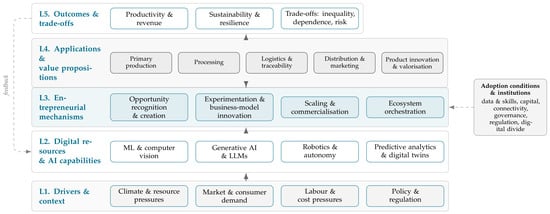
Integrative framework for AI-enabled agri-food entrepreneurship. Contextual drivers (L1) motivate the mobilisation of digital resources and AI capabilities (L2), which entrepreneurs convert—through opportunity recognition and creation, business-model innovation, scaling, and ecosystem orchestration (L3)—into applications and value propositions across the chain (L4), producing outcomes and trade-offs (L5); adoption conditions and institutions moderate the process, with feedback from outcomes to resources. Constructed by mapping three literature streams onto the TOE framework and the dynamic-capabilities view, as explained in Section 2 (authors’ elaboration).
2. Conceptual Foundations and the Integrative Framework
Terminology matters because related notions are often conflated. Digitisation converts analogue information into digital form; digitalisation uses digital technologies to improve existing processes; digital transformation denotes strategic, organisation-wide change that reconfigures value creation, operating models, and stakeholder relationships [9,10]. AI adoption is the incorporation of an AI tool into an organisation, whereas digital entrepreneurship concerns the pursuit of opportunities created or enabled by digital technologies, in which venture boundaries, processes, and outcomes become less predefined and more open to experimentation [11,12]. AI-enabled agri-food entrepreneurship applies that logic to food systems (Table 1).
Table 1.
A conceptual typology distinguishing adoption from entrepreneurship (authors’ elaboration based on [9,10,11,12]).
Two boundary distinctions follow: Adoption and entrepreneurship are not equivalent; a farm that purchases an AI tool, an incumbent that transforms its processes, a start-up that commercialises a solution, a cooperative that builds a data platform, and an equipment maker that shifts from machinery to service are distinct situations, and only some constitute entrepreneurship. Whether AI creates a durable advantage depends on complementary resources and on how firms frame the technology. Two perspectives inform this throughout: the technology–organisation–environment (TOE) framework [19], locating adoption in technological, organisational, and environmental conditions; and the dynamic-capabilities view [20,21], stressing the capacity to sense opportunities, seize them through new business models, and reconfigure resources. Empirical work confirms that value depends less on raw capability than on affordability, usability, data availability, and fit with work practices, and that adoption remains modest [15,22]; firm-level studies add that TOE conditions jointly shape adoption and its performance effects [23], and that adoption also depends on strategic framing—as efficiency tool, differentiator, or resilience instrument—with digitally mature firms embedding AI as a strategic asset, while many small and medium-sized enterprises (SMEs) experiment reactively or not at all [24].
Constructing the Framework: Figure 1 organises the remainder of the entry. It is a conceptual framework, constructed rather than estimated, assembled by mapping the three literature streams of Section 1 onto the two logics above, so that each level has an identifiable provenance. Level 1 (drivers and context) and the moderator block (adoption conditions and institutions) derive from the environmental dimension of TOE [19] and from empirical work on adoption conditions in agriculture [15,22]; Level 2 (digital resources and AI capabilities) summarises the technical literature [5,6,13,14]; Level 3 (entrepreneurial mechanisms) is the core and comes from digital entrepreneurship and dynamic capabilities, with sensing corresponding to opportunity recognition, seizing to business-model innovation, and reconfiguring to scaling and ecosystem orchestration [11,12,20,21,25,26]; Level 4 (applications and value propositions) follows the segmentation conventional in agri-food reviews [2,14]; and Level 5 (outcomes and trade-offs) combines performance outcomes from the adoption literature with the distributional and environmental effects identified in critical and responsible-innovation scholarship [27,28,29,30].
How the Framework Is Used: Its function is threefold: First, it separates objects that are routinely conflated—the capability (Level 2), the application (Level 4), and the venture (Level 3)—since evidence about one is frequently offered as evidence about another: a benchmark accuracy presented as a field result, a field result as a business case, an investment total as adoption. Second, it directs attention to the vertical transitions rather than the levels, because value is lost at the transitions: from capability to entrepreneurial mechanism (Section 5) and from mechanism to application and outcome (Section 4 and Section 6). Third, it generates the propositions, each a claim about one transition or about the moderator block. The framework is not tested here; it is a scaffold whose components are individually supported by the cited literature and whose linking claims are stated as propositions so that others can examine them.
Summary: What matters most is the distinction between a firm that incorporates a tool and a venture whose existence depends on one; TOE and dynamic capabilities organise the conditions of uptake and the mechanisms of conversion, respectively. What remains unknown is whether sector-agnostic mechanisms hold when validation is bounded by biological cycles—the boundary condition developed in this entry.
3. AI Capabilities and Complementary Digital Infrastructure
This section develops Level 2: for each capability, it examines what is offered, its maturity, and its main limitations, distinguishing controlled-benchmark evidence from field and commercial evidence. These capabilities rarely create value alone, depending on complementary infrastructure—IoT sensing, big data, cloud and edge computing, blockchain, or digital twins—that supplies data and connectivity [13,14,15].
Perception and Prediction: Supervised ML and deep learning support classification, detection, and prediction from imagery and sensor data, serving disease and weed detection, fruit counting, quality grading, and livestock monitoring [5,6]. Accuracies can be very high on controlled datasets: a widely cited study classified plant diseases with about 99% accuracy on the curated PlantVillage benchmark, but the same models fell to roughly 31% on images collected under more realistic conditions [31]. The principal limitations are therefore domain shift across regions, cultivars, lighting, and devices; dependence on large annotated datasets; and limited explainability [5]. In targeted (“see-and-spray”) weed control, the developer reports non-residual herbicide reductions of around 50% [32], and independent multi-year soybean trials report reductions of roughly one half in post-emergence use [33]—figures that are crop-, weed-, and management-specific. At the analytical end, big-data methods integrate imagery, sensor streams, telemetry, weather, and market data to forecast yields and support decisions [13,15]. Not all predictive analytics constitute a digital twin, which requires a continuously synchronised link between a physical system and its virtual representation [34]; many systems thus marketed are simulation models or dashboards. Decision-support systems are the analytical backbone of many ventures, but their value depends on data quality and integration [35].
Generative AI and Large Language Models: Generative models create content and can be queried in natural language, lowering the expertise required to use analytical systems [7]. In benchmark evaluations, general-purpose LLMs have answered agronomy examination questions competently and may broaden access to advisory knowledge [7,8], but independent field evaluation with end users is scarce, and validated commercial deployments at scale remain limited [7]. Risks include hallucination, outdated knowledge, unwarranted confidence, weak performance in low-resource languages, data-privacy concerns, and dependence on external providers, making human oversight essential for agronomic and food-safety advice [7,27]. The entrepreneurial consequence appears in Section 5: by lowering the cost of building an advisory product, this capability also lowers the barrier for competitors.
Robotics, Autonomy, and Edge Deployment: Autonomous tractors, robotic harvesters, AI-enabled weeders, and robotic milking systems couple perception with actuation to address labour shortages and input costs [3,36]. Maturity is uneven, and adoption at scale is concentrated in specific crops and regions; constraints include capital cost, safety and liability, maintenance, energy autonomy, interoperability, and adaptation to diverse terrain [15]; and agricultural robotics raises distinct ethical and policy questions including safety regulation, employment effects, and responsibility for autonomous action [37]. Edge AI—running models on or near the device—reduces latency, bandwidth needs, and connectivity dependence and is proposed as an enabler of field-deployable agricultural intelligence [38].
Summary: Maturity is highest where the task is perceptual and repetitive under instrumentable conditions, and lowest where the system must act on a prediction under biological uncertainty. The interface is changing fastest: natural-language access and edge deployment are lowering the skill and connectivity thresholds. What remains unknown is the magnitude of the benchmark-to-field gap outside the few well-studied tasks, and that scarcity of independent evaluation—not the capability—binds the entrepreneurial claims examined next.
4. Applications Across the Agri-Food Value Chain
This section develops Level 4. AI is applied at every stage of the chain, but maturity follows a clear yet uneven pattern, and that pattern—not the inventory—matters for entrepreneurship (Table 2).
Primary Production and Precision Farming: Applications include disease and pest detection, yield prediction, variable-rate inputs, automated weeding and harvesting, irrigation scheduling, and livestock monitoring [5,6]. Precision farming is the most mature family, and its adoption record provides the most informative evidence on how learning-based systems actually diffuse. In the United States, automated guidance and autosteering reach well over half the planted area of maize, cotton, rice, sorghum, soybeans, and winter wheat, whereas the decision-intensive technologies—yield maps, soil maps, and variable-rate technology—reach only about 5–25% of planted area for winter wheat, cotton, sorghum, and rice, with higher shares for maize and soybeans [39]. The gradient recurs throughout: technologies that reduce operator effort diffuse quickly, while technologies requiring the farm to act on a model’s recommendation diffuse slowly, even where the analytics is sound. Adoption also rises sharply with farm size—roughly 52% of mid-size and 70% of large-scale United States crop farms use guidance autosteering, and about 68% of large-scale farms use yield monitors, yield maps, or soil maps, while small family farms record the lowest rates in every category [40]; Section 6 explains why. The addressable market for a decision-support product is therefore far smaller than the installed base of the hardware generating its data.
Processing and Manufacturing: Computer vision and predictive analytics support automated inspection, defect and contamination detection, sorting and grading, predictive maintenance, and process optimisation [14,41]. This is the most commercially settled part of the chain: the environment is instrumented, conditions controlled, the same decision recurs thousands of times a day, and the outcome—whether a rejected unit or an avoided line stoppage—is directly measurable. The entrepreneurial constraint is not feasibility but incumbency, with value accruing largely to equipment suppliers and to processors able to absorb integration costs.
Supply Chains, Logistics, and Traceability: AI supports demand forecasting, inventory and route optimisation, shelf-life prediction, and cold-chain management [13,14,41]. Traceability is often discussed alongside blockchain, which is distinct: blockchain provides tamper-evident records, whereas AI provides prediction and pattern recognition; the two are complementary [42]. The Walmart–IBM Food Trust pilot cut the time to trace mangoes from farm to shelf from around seven days to about 2.2 s, but this is best read as a proof of concept rather than evidence of generalised adoption; it also revealed challenges involving integration costs, data sharing, and scalability [43]. Entrepreneurially, this stage is distinguished by data that already exist as a by-product of transactions, so the venture’s problem is access and interoperability rather than instrumentation.
Distribution, Marketing, and Product Innovation: AI powers marketplaces, recommendation and dynamic pricing, inventory-aware markdown, and generative marketing content; commercial use is widespread, particularly in e-grocery, but margins are thin and the capability is increasingly a condition of competing rather than a source of advantage. In product innovation, ML assists formulation, ingredient screening and, in emerging work, generative design of foods and packaging, although such uses remain exploratory and require independent validation [2].
Loss, Waste, and By-Product Valorisation: This stage is central to agri-food entrepreneurship, and uptake is increasing rapidly, yet it is frequently omitted from AI-in-agriculture reviews. Roughly 13% of the world’s food is lost between post-harvest and retail; a further 1.05 billion tonnes—about 19% of the food available to consumers—was wasted at the household, food-service, and retail levels in 2022; and food loss and waste together are estimated to generate 8–10% of global greenhouse-gas emissions [44]. Three application families have formed around this. Measurement and Prevention: Computer-vision systems above waste bins in commercial kitchens identify and weigh discarded items in real time, convert them into cost and emissions, and drive dashboards and staff coaching; the established firms operate on this model and report reductions of roughly 30–53% across their customer bases, but these are company-reported figures gathered by interview rather than independently verified results [45]. Forecasting and Dynamic Markdown: Demand and shelf-life prediction reduce over-ordering and support automated markdown of short-dated stock, sitting on the transactional data described above. Valorisation and Matching: ML sorts and characterises heterogeneous side-streams, while platform and matching models redirect surplus to buyers or food-recovery organisations, linking AI to circular-economy strategies [46]. Waste is an unusually favourable domain because it satisfies all three conditions developed in Section 5: the decision is prediction-intensive, recurs daily, and its outcome is denominated in a unit—kilograms, and therefore money—that the customer already tracks. For the same reason, this is the clearest case in which the measuring instrument and the seller are the same party, so independent evaluation matters here more than anywhere else in the chain.
Table 2.
AI applications across the agri-food value chain: maturity, business model, and principal limitation (authors’ elaboration; see cited sources).
Summary: Maturity is highest under instrumentable conditions—industrial inspection, machine guidance, and kitchen waste measurement—and lowest where a prediction must become an agronomic action under biological uncertainty, which is why variable-rate application and generative product design remain substantially less mature than guidance and inspection. Uptake appears to be increasing fastest in food-service and retail waste measurement, in supply-chain forecasting where the data already exist, and in autonomy in high-value, labour-scarce crops. The persistent gaps are independent field validation outside the vendor’s instrumentation, evidence of durable commercial use rather than pilots, and any accounting of operating cost at scale. The pattern is economic rather than technological; the next section states its mechanism.
5. Entrepreneurial Opportunity, Business Models, and Ecosystems
This section develops Level 3, the entry’s core: where AI-enabled opportunities come from and how they evolve, why particular business models emerge here, and why so few ventures cross from pilot to durable revenue.
5.1. Where Opportunities Come from and How They Are Evolving
The Underlying Mechanism: AI’s first-order economic effect is to lower the cost of prediction—filling in missing information from available information—while leaving the cost of judgement—determining the payoff of each possible action and bearing responsibility for the consequences—largely unchanged; as prediction becomes cheap, judgement becomes relatively more valuable and scarcer [18]. In agri-food, the asymmetry is unusually sharp: prediction inputs are abundant and growing, because sensing, imagery, and telemetry are inexpensive, while judgement remains costly, because payoffs are biological and lagged, an error may not be observable until the end of a season, and the consequences of acting on an incorrect prediction—a failed treatment, a rejected consignment, or a food-safety incident—fall on a producer with thin margins. Hence, the value-chain pattern of Section 4: applications concentrate where the judgement burden is small or transferable, and they thin out where it is large and must remain with the customer.
Proposition 1 (Opportunity locus).
AI-enabled opportunities in agri-food concentrate where a recurring decision is simultaneously (i) prediction-intensive, (ii) frequent relative to the venture’s cash-flow horizon, and (iii) attached to an outcome that the customer already measures; where any condition fails, technically capable value propositions do not convert into ventures with durable revenue.
Discovery and Creation: Opportunities may be treated as objective conditions awaiting discovery by alert actors, or as endogenous, created through entrepreneurial action under genuine uncertainty [47]; the two logics are unevenly distributed along the chain. Upstream, the decision problem pre-exists the venture—the grower already decides when to spray, irrigate, or harvest—so AI improves an existing decision, validation is technical, and the risk is that the model does not generalise. Downstream and in data-facing segments, the venture must bring the market into being: a data-as-a-service offering must persuade buyers that an indicator they have never bought is worth paying for, and a marketplace must coordinate participants who do not yet transact; validation is commercial, and the risk is that demand never materialises. Ventures that misread which situation they are in mis-specify their evidence requirements, funding agronomic trials when they need reference customers, or vice versa.
Proposition 2 (Opportunity logic by chain position).
Upstream opportunities are predominantly discovery-type, so survival depends on technical validation across sites and seasons; downstream and data-facing opportunities are predominantly creation-type, so survival depends on demand articulation and reference customers. Ventures whose validation strategy is mismatched to their opportunity type show higher pilot-to-revenue attrition.
How Opportunities Are Evolving: Three overlapping waves are visible. The first and largest is efficiency and substitution: input savings, labour substitution, and loss avoidance, sold against a counterfactual that the customer can compute. The second is data assets and verification: data accumulated while delivering the first wave becomes an asset in its own right, supporting indicators, benchmarking, and the substantiation of sustainability and provenance claims that regulation and buyers now demand—so regulation is a source of opportunity, not only a constraint, since a claim that must be verified creates demand for the means of verifying it. The third, still early, is language interfaces and agentic advisory: generative systems reduce the expertise required to interrogate analytical systems and widen the user base beyond the digitally confident [7]. Its effect is twofold—it lowers the cost of building an advisory product, enlarging the set of feasible ventures, but equally lowers the barrier for imitators, so differentiation migrates from the model towards proprietary data, agronomic validation, and distribution into fragmented customer bases. The scarce resource in the third wave is not the model, and treating it as though it were is a recurrent strategic error.
5.2. Entrepreneurial Actors and Business-Model Archetypes
The landscape is heterogeneous: technology start-ups; incumbents pursuing renewal; producer cooperatives building shared data platforms; universities and spin-offs; equipment manufacturers shifting from product sales to services; marketplaces; and consultancies and integrators that help others adopt [16]. The same technology supports very different ventures: a computer-vision weed model becomes a machine feature for an equipment maker, a per-hectare service for a contractor, or a subscription for a software start-up. Ventures are best organised by how they create and, separately, capture value (Table 3): creating value—reducing input use, avoiding loss, or saving labour—does not automatically translate into revenue, and the capture mechanism is a distinct design choice [20,21,25] that a structured review finds substantially under-researched relative to the technical literature [17]. A notable trend is the shift from one-off product sales to recurring, usage- or outcome-based revenue.
Table 3.
AI-enabled business-model archetypes and the sector condition accounting for each (authors’ elaboration based on [11,17,20,21,25]).
Which archetype recurs is predicted less by the AI capability than by three sector conditions. The capital constraint of the customer: where the customer cannot finance an asset, capture must be decoupled from ownership, producing robotics- and equipment-as-a-service. The frequency and seasonality of the decision: daily decisions match subscription pricing; seasonal ones per-operation or per-hectare pricing. The verifiability of the outcome: outcome-based and savings-share contracts require a jointly observable measure, which exists for herbicide volume or kilograms of avoided waste but not for a yield effect confounded by weather, so where verifiability is low, ventures retreat to input-based pricing and must sell on trust. A fourth condition, fragmentation of the customer base, explains why marketplace, cooperative, and intermediary archetypes are disproportionately common: they solve a distribution problem that is not itself technological.
Proposition 3 (Capture-unit alignment).
Ventures whose capture mechanism is denominated in the unit that the customer already uses to measure value—e.g., hectare, animal, tonne, delivery, kilogram of avoided waste—convert pilots into recurring revenue at higher rates than those pricing by seat, licence, or model call, because alignment removes the need for the customer to construct the business case.
Proposition 4 (Archetype selection).
The archetype adopted is better predicted by customer capital constraint, decision frequency, and outcome verifiability than by the AI capability employed: robotics-as-a-service and outcome-based contracts emerge where capital constraint is high and outcomes jointly verifiable; SaaS and advisory models emerge where decisions are frequent but outcomes only weakly verifiable.
5.3. Ecosystems, Investment, and the Pilot-to-Scale Gap
A specialised ecosystem of start-ups, investors, accelerators, and corporate venture arms—often termed AgriFoodTech—has formed around agri-food digitalisation [16], and investment in it is markedly cyclical. According to successive industry reports, global AgriFoodTech funding peaked at roughly USD 51.7 billion in 2021 (2022 report) [48], fell by about 44% to around USD 29.6 billion in 2022 (2023 report) [49], and declined further to about USD 15.6 billion in 2023 (2024 report) [50]. The 2025 report placed 2024 funding at approximately USD 16 billion, 4% below its restated 2023 total [51], whereas the 2026 report placed 2025 funding at USD 16.2 billion, 3% below its restated 2024 total [52]. Two cautions apply: these are industry estimates reflecting investor attention, not measures of adoption, performance, or profitability; and each edition restates prior-year totals as data are revised, so percentages should not be chained across editions. Composition is more informative than the total: in 2024, midstream funding rose about 41% year-on-year, while upstream fell about 22%, downstream rose about 38% on a few large deals—including consumer-facing ventures in India—and recovery was uneven by region, with much of Europe and China still substantially down [51].
The Pilot-to-Scale Gap: Moving from prototype to durable revenue is especially demanding here, and the difficulty is structural: validation is constrained by seasonality, often requiring one or more full growing cycles; biological and climatic diversity limits transfer across regions and crops; sales cycles are long; margins are thin; installation, maintenance, and rural support are costly; equipment is fragmented and often not interoperable; and liability for incorrect recommendations is material [15,22]. Research on AgriFoodTech start-ups identifies a pronounced “valley of death” and adds three population-specific explanations: founders trained in technology are often unfamiliar with agriculture’s temporal cycles and risk profiles; venture-capital horizons sit awkwardly against biological validation times and genuine sustainability commitments; and many ventures become dependent on incumbent partnerships for distribution, resolving the channel problem at the cost of bargaining power [16]. The recurring point of failure is therefore not technical but commercial: an inability to convert a successful pilot, run with the vendor’s own staff on a cooperative customer’s best field, into a contract that renews without continued vendor intervention.
Proposition 5 (Pilot-to-scale conversion).
The probability that a pilot converts into recurring revenue falls with the number of complete biological cycles required to substantiate its central claim, and rises with the degree to which the venture’s data assets improve performance across customers rather than within one; without cross-customer learning economies, validation cost recurs with every customer and does not decline with scale.
Summary: Opportunity is created not by capability as such but by cheap prediction meeting a decision whose payoff the customer can already see. The locus of defensibility is shifting towards proprietary data, validated agronomic performance, and distribution as generative systems lower the cost of building software. Evidence remains limited at the venture level: survival rates, the distribution of capture mechanisms, pilot-to-contract conversion, and whether the archetypes of Table 3 differ in longevity.
6. Adoption, the Digital Divide, and the Conditions for Responsible Scaling
This section develops the moderator block and Level 5: why adoption lags demonstrated technical capability, why the gap between large and small firms persists, and what sustainability and governance imply for what a venture can capture and keep.
6.1. Why Adoption Lags Capability: Beyond Cost
Adoption conditions can be organised using TOE, extended with market and governance dimensions especially relevant to entrepreneurship (Table 4). Cost is cited most often, but four further explanations carry more weight. First, trust and facilitating conditions: interview research with growers and agricultural technology consultants finds that although economic return remains paramount, trust—in the technology’s performance and in the advisors recommending it—determines whether a favourable business case is acted upon, and that support quality, interoperability, and infrastructure shape willingness irrespective of theoretical benefit, with data-governance anxieties ranking below profitability for the growers studied [53]. Second, skills and data capability: survey evidence from food firms in south-western Nigeria reports a lack of skilled personnel and data privacy or security concerns as barriers at least as frequently as implementation cost, while finding significant associations between adoption and reported gains in operational efficiency, customer satisfaction, profitability, and competitive position [54]. This suggests that perceived value can coexist with substantial adoption barriers, although the cross-sectional associations do not establish causal performance effects.
Third, and least appreciated, complementary intangible investment: general-purpose technologies require substantial unmeasured investment in process redesign, data infrastructure, and human capital before benefits appear, and because those investments are costly and largely invisible in conventional accounts, measured productivity follows a J-curve, understating returns early and overstating them later [55]. Agri-food firms fit the pattern: the visible expenditure is a sensor or a subscription, while the substantial and unrecorded expenditure is cleaning field records, redesigning agronomic routines, and training staff—so much of what is described as an adoption paradox may be a measurement artefact of studying a J-curve cross-sectionally. Fourth, the decision-to-action gap of Section 4: effort-reducing technologies diffuse far faster than those asking the operator to act on a model’s recommendation [39], because the second class transfers agronomic risk to the adopter while leaving liability unresolved. Ventures also face cybersecurity risks, including threats to connected machinery, as well as vendor lock-in, long validation and sales cycles, fragmented customer bases, the need for local support, and the uneven distribution of the value of data between producers and providers [15,28,56].
Proposition 6 (Complementary intangibles).
Returns to AI adoption in agri-food firms follow a J-curve driven by complementary intangible investment, so cross-sectional studies understate long-run returns and overstate the adoption paradox; firms investing early in data infrastructure, process redesign, and skills show lower measured performance early and higher performance later.
Table 4.
Enablers and barriers, organised by TOE plus market and governance dimensions (authors’ elaboration; see [15,28,29,53,54,56]).
6.2. Why Large and Small Firms Diverge
The gap between large and small adopters is among the most consistent findings in this literature and the least explained. The mechanism is a cost structure, not a preference: a substantial component of adoption cost is fixed with respect to output—the costs of integrating a system, cleaning data, training staff, and maintaining the installation are broadly similar whether it serves 50 or 5000 hectares—while the benefit scales with the area or volume over which the improved decision applies, so the adoption threshold falls as scale rises. The empirical pattern matches: precision-agriculture adoption in the United States rises sharply with farm size across every category, with small family farms lowest throughout [39,40], and smaller operations face disproportionately higher per-unit implementation costs [53]. The same logic operates in processing and retail, where digitally mature firms embed AI as a strategic asset while smaller firms experiment reactively or abstain [23,24].
The entrepreneurial implication is usually missed. If the binding constraint is a fixed cost rather than a unit price, falling technology prices will not by themselves bring small producers in; what does is an organisational form spreading that cost across many small users. Cooperatives, machinery rings, contract operators, advisory services, and shared data platforms are such forms. This cost-spreading function helps explain why robotics-as-a-service, servitisation, and cooperative platform models recur among the archetypes of Table 3. The intermediary that socialises fixed costs is itself the entrepreneurial opportunity; where such intermediaries are absent, adoption remains uneven between large and small producers and between regions, raising the risk that AI widens rather than narrows existing inequalities—the digital divide [28,29].
Proposition 7 (Fixed costs and the size divide).
Because adoption costs include a fixed component, adoption thresholds fall as scale rises. For small producers, adoption therefore depends less on lower technology prices than on intermediaries that spread fixed costs across users, including cooperatives, contractors, advisory services, and shared platforms. Regions where such intermediaries are institutionally established will show smaller adoption gaps at equal technology prices.
6.3. Sustainability and Governance as Constraints on Value Capture
Sustainability and responsible AI are treated here not as a parallel agenda but as conditions determining what a venture may legitimately claim and retain. The link from capability to environmental benefit is not automatic, and it is useful to distinguish technical potential, pilot results, net impact in operation, and long-term systemic effects [30]. Site-specific management can reduce water, fertiliser, pesticide, and energy use while sustaining output [2,30]; and predictive analytics, traceability, and waste measurement can reduce loss and support circular-economy approaches [2,14,46]. Benefits may nonetheless be offset by rebound effects; increased production intensity; the energy consumed by sensing, cloud computing, and model training and inference; hardware manufacture and disposal; and uneven social distribution, including the exclusion of smaller producers [27,28]. The rebound risk is not hypothetical: efficiency-improving irrigation technology can increase total water consumption when farmers expand irrigated area or switch to thirstier crops [57]. Alignment with the Sustainable Development Goals—notably SDG 2, SDG 12, and SDG 13—should therefore be presented as a potential rather than demonstrated impact. For a venture, this is commercial as much as ethical: an unverified environmental claim is a fragile basis for value capture, whereas the requirement that claims be substantiated is itself a market, which is why verification appears as the second wave in Section 5.
Responsible deployment raises interrelated issues: data governance—including ownership, access, portability, consent, the distribution of value, and the negotiating power of producers—[56,58,59]; algorithmic bias and reliability, including the benchmark-to-field gap and hallucination [27,31]; the concentration of data and AI capabilities and its effect on market power; and the displacement of rural labour [28,60]. Scholars advocate a shift towards a socio-technical understanding of risks and externalities and responsible-innovation approaches involving stakeholders in design [27,59,60]; Table 5 summarises representative risks and mitigations. Policy frameworks are increasingly relevant: the European Green Deal [61], the Farm to Fork strategy [62], and the reformed Common Agricultural Policy encourage digitalisation alongside sustainability, while the EU Artificial Intelligence Act (Regulation (EU) 2024/1689)—the first comprehensive horizontal AI law—distinguishes prohibited practices, high-risk systems, systems subject to specific transparency obligations, and other systems; it entered into force on 1 August 2024 [63]. Agricultural AI is not automatically high-risk: classification depends on intended purpose. A system may be high-risk where it is a safety component of, or is itself, a product covered by listed Union harmonisation legislation and subject to third-party conformity assessment, or where its intended use falls within a specified domain such as employment or the management and operation of critical infrastructure. General agronomic advisory tools are therefore not high-risk solely because they are used in agriculture, although other obligations—including transparency requirements—may apply [63]. Ventures should assess classification case-by-case, treating it as a design input rather than a compliance afterthought.
Table 5.
Representative risks and mitigations (authors’ elaboration based on [27,31,56,58]).
Summary: Adoption lags capability for reasons that are largely organisational and institutional rather than technical: trust, complementary intangible investment, unresolved liability, and the transfer of agronomic risk to the adopter. The arrival of intermediaries and service models that convert a fixed adoption cost into a variable one is the most important change and the mechanism most likely to narrow the size gap. The remaining unknowns are the shape of the J-curve in this context, the net environmental effect once rebound and infrastructure energy are counted, and whether the regulatory demand for verified claims will accrue to producers or to the platforms holding their data.
7. A Research and Practice Agenda for AI-Enabled Agri-Food Entrepreneurship
What this field most needs is not further demonstration of technical feasibility but evidence about ventures. The propositions of Section 5 and Section 6 are formulated so that they can be examined, and Table 6 sets out, for each proposition, the constructs to be measured, the data that could support the measurement and the appropriate designs. None requires unobtainable data; several require only that existing venture-level and farm-level datasets be linked, and all require the patience biological cycles impose.
Table 6.
From propositions to empirical tests (authors’ elaboration).
Beyond the propositions, two questions arise at levels that the propositions do not reach: what an AI application costs to operate at scale once data acquisition, annotation, support, and inference are counted, and who bears that cost (L4); and what the net environmental effect of deployed systems is after rebound and infrastructure energy (L5). Section 8 states the further questions that the framework raises. Three method-level priorities cut across all of them: studies must span at least one complete biological cycle, and preferably several, or explicitly bound their claims to within-season effects; the unit of analysis should shift from the model and the farm to the venture and the transaction; and evidence class—e.g., benchmark, pilot, commercial, vendor-reported—should be recorded as a variable in any synthesis rather than relegated to a limitation. For practice, the agenda reads as four injunctions: ventures should specify the capture mechanism at the same time as the value proposition, not after it; determine early whether their opportunity is of the discovery or the creation type and resource validation accordingly; treat the number of seasons required for validation as a first-order financial parameter; and assume that where they generate their own outcome evidence, buyers will eventually require independent validation. Policy actors concerned with the digital divide should note that the leverage lies in supporting intermediaries that socialise fixed costs, not in subsidising equipment whose implementation costs remain with the smallest users.
8. Conclusions
Four messages summarise this entry: AI, with complementary digital infrastructure, can create value at every stage of the chain, including the recovery of losses and by-products, but the evidence is uneven—strong benchmarks, fewer robust field evaluations, and limited validated commercial deployments. The distribution of that value is not random—because AI lowers the cost of prediction but not of judgement, opportunities concentrate where decisions are prediction-intensive, recurrent, and attached to an outcome that the customer already measures. Capturing value is a distinct challenge, depending on aligning the capture mechanism with the customer’s own unit of measurement and on scaling under constraints structural to agri-food: seasonality, thin margins, fragmentation, and liability. Finally, responsible, inclusive expansion depends on socio-technical conditions—data governance, skills, capital, connectivity, and regulation—and particularly on whether intermediaries emerge that spread fixed adoption costs across small producers, without which the technology will widen rather than narrow the divide.
What Follows for Research: Four changes follow: The unit of analysis should move from the model and the farm to the venture and the transaction, because the unanswered questions—survival, conversion, capture, and longevity by archetype—are venture-level and invisible in technical benchmarks and farm adoption rates alike. Evidence class should be a variable rather than a caveat, since a synthesis pooling benchmarks, pilots, and vendor-reported outcomes yields an uninterpretable aggregate estimate, while investment totals should be dropped as proxies for adoption because they measure attention. Studies of adoption returns should use panel data rather than cross-sectional designs, because returns assessed at a single point in time can misrepresent a J-curve. Finally, research on the digital divide should test the fixed-cost mechanism directly, comparing regions at equal technology prices but different intermediary densities.
New Questions That the Framework Raises: Does the business-model archetype, rather than the technology, predict venture survival in agri-food? Which capture mechanisms remain viable once a full season has elapsed and the counterfactual becomes contestable? As generative AI removes the model as a source of scarcity, does defensibility migrate to proprietary data, to agronomic validation, or to distribution—and does that migration favour incumbents over start-ups? Does the requirement to substantiate sustainability claims create a durable market for verification, and to whom does its value accrue? Can cost-socialising intermediaries be created by policy where they do not arise spontaneously, and does their presence measurably narrow the adoption gap? Framed in this way, AI-enabled agri-food entrepreneurship is not a catalogue of applications but a coherent research programme, with a specified mechanism, stated boundary conditions, and propositions that can be tested and, if necessary, refuted.
Author Contributions
Conceptualisation, A.R.T., A.L.R., and J.V.F.; investigation, A.R.T.; writing—original draft preparation, A.R.T.; writing—review and editing, A.L.R. and J.V.F.; supervision, A.L.R. and J.V.F. All authors have read and agreed to the published version of the manuscript.
Funding
This research received no external funding.
Institutional Review Board Statement
Not applicable.
Informed Consent Statement
Not applicable.
Data Availability Statement
No new data were created or analysed in this study. Data sharing is not applicable to this article.
Acknowledgments
During the preparation of this manuscript, the authors used ChatGPT (OpenAI, GPT-5.6 Sol) for translation and language editing of author-written text. The authors have reviewed and edited all output and take full responsibility for the content of the manuscript, its accuracy, and all citations.
Conflicts of Interest
The authors declare no conflicts of interest.
Abbreviations
The following abbreviations are used in this manuscript:
| AI | Artificial intelligence |
| API | Application programming interface |
| IoT | Internet of Things |
| LLM | Large language model |
| ML | Machine learning |
| SaaS | Software-as-a-service |
| SDG | Sustainable Development Goal |
| SME | Small and medium-sized enterprise |
| TOE | Technology–organisation–environment |
| USD | United States dollar |
References
- Klerkx, L.; Jakku, E.; Labarthe, P. A review of social science on digital agriculture, smart farming and Agriculture 4.0: New contributions and a future research agenda. NJAS Wagening. J. Life Sci. 2019, 90–91, 100315. [Google Scholar] [CrossRef] [Scilit]
- Kostić, M.; Šarac, V.; Narandžić, T.; Bursać Kovačević, D. Digital and green technological drivers of transformation in the agri-food sector. Foods 2026, 15, 1081. [Google Scholar] [CrossRef] [Scilit] [PubMed]
- Liu, Y.; Ma, X.; Shu, L.; Hancke, G.P.; Abu-Mahfouz, A.M. From Industry 4.0 to Agriculture 4.0: Current status, enabling technologies, and research challenges. IEEE Trans. Ind. Inform. 2021, 17, 4322–4334. [Google Scholar] [CrossRef] [Scilit]
- Trivelli, L.; Apicella, A.; Chiarello, F.; Rana, R.; Fantoni, G.; Tarabella, A. From precision agriculture to Industry 4.0: Unveiling technological connections in the agrifood sector. Br. Food J. 2019, 121, 1730–1743. [Google Scholar] [CrossRef] [Scilit]
- Kamilaris, A.; Prenafeta-Boldú, F.X. Deep learning in agriculture: A survey. Comput. Electron. Agric. 2018, 147, 70–90. [Google Scholar] [CrossRef] [Scilit]
- Liakos, K.G.; Busato, P.; Moshou, D.; Pearson, S.; Bochtis, D. Machine learning in agriculture: A review. Sensors 2018, 18, 2674. [Google Scholar] [CrossRef] [Scilit] [PubMed]
- Tzachor, A.; Devare, M.; Richards, C.; Pypers, P.; Ghosh, A.; Koo, J.; Johal, S.; King, B. Large language models and agricultural extension services. Nat. Food 2023, 4, 941–948. [Google Scholar] [CrossRef] [Scilit] [PubMed]
- Silva, B.; Nunes, L.; Estevão, R.; Aski, V.; Chandra, R. GPT-4 as an agronomist assistant? Answering agriculture exams using large language models. arXiv 2023, arXiv:2310.06225. [Google Scholar] [CrossRef] [Scilit]
- Vial, G. Understanding digital transformation: A review and a research agenda. J. Strateg. Inf. Syst. 2019, 28, 118–144. [Google Scholar] [CrossRef] [Scilit]
- Verhoef, P.C.; Broekhuizen, T.; Bart, Y.; Bhattacharya, A.; Qi Dong, J.; Fabian, N.; Haenlein, M. Digital transformation: A multidisciplinary reflection and research agenda. J. Bus. Res. 2021, 122, 889–901. [Google Scholar] [CrossRef] [Scilit]
- Nambisan, S. Digital entrepreneurship: Toward a digital technology perspective of entrepreneurship. Entrep. Theory Pract. 2017, 41, 1029–1055. [Google Scholar] [CrossRef] [Scilit]
- Kraus, S.; Palmer, C.; Kailer, N.; Kallinger, F.L.; Spitzer, J. Digital entrepreneurship: A research agenda on new business models for the twenty-first century. Int. J. Entrep. Behav. Res. 2019, 25, 353–375. [Google Scholar] [CrossRef] [Scilit]
- Wolfert, S.; Ge, L.; Verdouw, C.; Bogaardt, M.-J. Big data in smart farming—A review. Agric. Syst. 2017, 153, 69–80. [Google Scholar] [CrossRef] [Scilit]
- Misra, N.N.; Dixit, Y.; Al-Mallahi, A.; Bhullar, M.S.; Upadhyay, R.; Martynenko, A. IoT, big data, and artificial intelligence in agriculture and food industry. IEEE Internet Things J. 2022, 9, 6305–6324. [Google Scholar] [CrossRef] [Scilit]
- Osinga, S.A.; Paudel, D.; Mouzakitis, S.A.; Athanasiadis, I.N. Big data in agriculture: Between opportunity and solution. Agric. Syst. 2022, 195, 103298. [Google Scholar] [CrossRef] [Scilit]
- Klerkx, L.; Villalobos, P. Are AgriFoodTech start-ups the new drivers of food systems transformation? An overview of the state of the art and a research agenda. Glob. Food Secur. 2024, 40, 100726. [Google Scholar] [CrossRef] [Scilit]
- Cavazza, A.; Dal Mas, F.; Paoloni, P.; Manzo, M. Artificial intelligence and new business models in agriculture: A structured literature review and future research agenda. Br. Food J. 2023, 125, 436–461. [Google Scholar] [CrossRef] [Scilit]
- Agrawal, A.; Gans, J.S.; Goldfarb, A. Exploring the impact of artificial intelligence: Prediction versus judgment. Inf. Econ. Policy 2019, 47, 1–6. [Google Scholar] [CrossRef] [Scilit]
- Tornatzky, L.G.; Fleischer, M. The Processes of Technological Innovation; Lexington Books: Lexington, MA, USA, 1990. [Google Scholar]
- Teece, D.J. Explicating dynamic capabilities: The nature and microfoundations of (sustainable) enterprise performance. Strateg. Manag. J. 2007, 28, 1319–1350. [Google Scholar] [CrossRef] [Scilit]
- Warner, K.S.R.; Wäger, M. Building dynamic capabilities for digital transformation: An ongoing process of strategic renewal. Long Range Plan. 2019, 52, 326–349. [Google Scholar] [CrossRef] [Scilit]
- Weersink, A.; Fraser, E.; Pannell, D.; Duncan, E.; Rotz, S. Opportunities and challenges for big data in agricultural and environmental analysis. Annu. Rev. Resour. Econ. 2018, 10, 19–37. [Google Scholar] [CrossRef] [Scilit]
- Badghish, S.; Soomro, Y.A. Artificial intelligence adoption by SMEs to achieve sustainable business performance: Application of technology–organization–environment framework. Sustainability 2024, 16, 1864. [Google Scholar] [CrossRef] [Scilit]
- Rodríguez Navarro, S.; Ramón-Jerónimo, J.M. Strategic integration of artificial intelligence in Spanish agri-food firms: A framework for digital transformation pathways. Strateg. Bus. Res. 2026, 2, 100075. [Google Scholar] [CrossRef] [Scilit]
- Teece, D.J. Business models and dynamic capabilities. Long Range Plan. 2018, 51, 40–49. [Google Scholar] [CrossRef] [Scilit]
- Autio, E.; Nambisan, S.; Thomas, L.D.W.; Wright, M. Digital affordances, spatial affordances, and the genesis of entrepreneurial ecosystems. Strateg. Entrep. J. 2018, 12, 72–95. [Google Scholar] [CrossRef] [Scilit]
- Tzachor, A.; Devare, M.; King, B.; Avin, S.; Ó hÉigeartaigh, S. Responsible artificial intelligence in agriculture requires systemic understanding of risks and externalities. Nat. Mach. Intell. 2022, 4, 104–109. [Google Scholar] [CrossRef] [Scilit]
- Rotz, S.; Duncan, E.; Small, M.; Botschner, J.; Dara, R.; Mosby, I.; Reed, M.; Fraser, E.D.G. The politics of digital agricultural technologies: A preliminary review. Sociol. Rural. 2019, 59, 203–229. [Google Scholar] [CrossRef] [Scilit]
- Duncan, E.; Glaros, A.; Ross, D.Z.; Nost, E. New but for whom? Discourses of innovation in precision agriculture. Agric. Hum. Values 2021, 38, 1181–1199. [Google Scholar] [CrossRef] [Scilit] [PubMed]
- Basso, B.; Antle, J. Digital agriculture to design sustainable agricultural systems. Nat. Sustain. 2020, 3, 254–256. [Google Scholar] [CrossRef] [Scilit]
- Mohanty, S.P.; Hughes, D.P.; Salathé, M. Using deep learning for image-based plant disease detection. Front. Plant Sci. 2016, 7, 1419. [Google Scholar] [CrossRef] [Scilit] [PubMed]
- Blue River Technology (a John Deere Company). See & Spray™: Targeted Spray Technology. Available online: https://www.bluerivertechnology.com/products/ (accessed on 3 June 2026).
- Arkansas Agricultural Experiment Station. Precision Agriculture Research Measures Effectiveness of See & Spray Technology (Three-Year Soybean Field Trial); University of Arkansas System Division of Agriculture: Fayetteville, AR, USA, 2024; Available online: https://aaes.uada.edu/news/see-and-spray-research/ (accessed on 4 June 2026).
- Verdouw, C.; Tekinerdogan, B.; Beulens, A.; Wolfert, S. Digital twins in smart farming. Agric. Syst. 2021, 189, 103046. [Google Scholar] [CrossRef] [Scilit]
- Zhai, Z.; Martínez, J.F.; Beltran, V.; Martínez, N.L. Decision support systems for Agriculture 4.0: Survey and challenges. Comput. Electron. Agric. 2020, 170, 105256. [Google Scholar] [CrossRef] [Scilit]
- FAO. The State of Food and Agriculture 2022. Leveraging Automation in Agriculture for Transforming Agrifood Systems; FAO: Rome, Italy, 2022. [Google Scholar] [CrossRef] [Scilit]
- Sparrow, R.; Howard, M. Robots in agriculture: Prospects, impacts, ethics, and policy. Precis. Agric. 2021, 22, 818–833. [Google Scholar] [CrossRef] [Scilit]
- El Jarroudi, M.; Kouadio, L.; Delfosse, P.; Bock, C.H.; Mahlein, A.-K.; Fettweis, X.; Mercatoris, B.; Adams, F.; Lenné, J.M.; Hamdioui, S. Leveraging edge artificial intelligence for sustainable agriculture. Nat. Sustain. 2024, 7, 846–854. [Google Scholar] [CrossRef] [Scilit]
- McFadden, J.; Njuki, E.; Griffin, T. Precision Agriculture in the Digital Era: Recent Adoption on U.S. Farms; Economic Information Bulletin No. 248; U.S. Department of Agriculture, Economic Research Service: Washington, DC, USA, 2023. Available online: https://www.ers.usda.gov/publications/pub-details?pubid=105893 (accessed on 19 August 2026).
- Lim, K.; McFadden, J.; Miller, N.; Lacy, K. America’s Farms and Ranches at a Glance: 2024 Edition; Economic Information Bulletin No. 283; U.S. Department of Agriculture, Economic Research Service: Washington, DC, USA, 2024. [CrossRef] [Scilit]
- Ding, H.; Tian, J.; Yu, W.; Wilson, D.I.; Young, B.R.; Cui, X.; Xin, X.; Wang, Z.; Li, W. The application of artificial intelligence and big data in the food industry. Foods 2023, 12, 4511. [Google Scholar] [CrossRef] [Scilit] [PubMed]
- Kamilaris, A.; Fonts, A.; Prenafeta-Boldú, F.X. The rise of blockchain technology in agriculture and food supply chains. Trends Food Sci. Technol. 2019, 91, 640–652. [Google Scholar] [CrossRef] [Scilit]
- Kamath, R. Food traceability on blockchain: Walmart’s pork and mango pilots with IBM. J. Br. Blockchain Assoc. 2018, 1, 47–53. [Google Scholar] [CrossRef] [Scilit] [PubMed]
- United Nations Environment Programme. Food Waste Index Report 2024. Think Eat Save: Tracking Progress to Halve Global Food Waste; UNEP: Nairobi, Kenya, 2024; Available online: https://www.unep.org/resources/publication/food-waste-index-report-2024 (accessed on 19 August 2026).
- Clark, Q.M.; Basavaraja Kanavikar, D.; Clark, J.; Donnelly, P.J. Exploring the potential of AI-driven food waste management strategies used in the hospitality industry for application in household settings. Front. Artif. Intell. 2025, 7, 1429477. [Google Scholar] [CrossRef] [Scilit] [PubMed]
- Onyeaka, H.; Tamasiga, P.; Nwauzoma, U.M.; Miri, T.; Juliet, U.C.; Nwaiwu, O.; Akinsemolu, A.A. Using artificial intelligence to tackle food waste and enhance the circular economy: Maximising resource efficiency and minimising environmental impact: A review. Sustainability 2023, 15, 10482. [Google Scholar] [CrossRef] [Scilit]
- Alvarez, S.A.; Barney, J.B. Discovery and creation: Alternative theories of entrepreneurial action. Strateg. Entrep. J. 2007, 1, 11–26. [Google Scholar] [CrossRef] [Scilit]
- AgFunder. 2022 AgFunder AgriFoodTech Investment Report; AgFunder: San Francisco, CA, USA, 2022; Available online: https://agfunder.com/research/2022-agfunder-agrifoodtech-investment-report/ (accessed on 19 August 2026).
- AgFunder. AgFunder Global AgriFoodTech Investment Report 2023; AgFunder: San Francisco, CA, USA, 2023; Available online: https://agfunder.com/research/agfunder-global-agrifoodtech-investment-report-2023/ (accessed on 19 August 2026).
- AgFunder. AgFunder Global AgriFoodTech Investment Report 2024; AgFunder: San Francisco, CA, USA, 2024; Available online: https://agfunder.com/research/agfunder-global-agrifoodtech-investment-report-2024/ (accessed on 19 August 2026).
- AgFunder. AgFunder Global AgriFoodTech Investment Report 2025; AgFunder: San Francisco, CA, USA, 2025; Available online: https://agfunder.com/research/agfunder-global-agrifoodtech-investment-report-2025/ (accessed on 19 August 2026).
- AgFunder. AgFunder Global AgriFoodTech Investment Report 2026; AgFunder: San Francisco, CA, USA, 2026; Available online: https://agfunder.com/research/agfunder-global-agrifoodtech-investment-report-2026/ (accessed on 19 August 2026).
- Yeo, M.L.; Keske, C.M. From profitability to trust: Factors shaping digital agriculture adoption. Front. Sustain. Food Syst. 2024, 8, 1456991. [Google Scholar] [CrossRef] [Scilit]
- Osakue, I.; Muhyaddin, S.; Kuka, C.; Leyva-Hernández, S.N.; Onyeagwibe, V.; Hernández-Arzaba, J.C. Adoption and impact of big data analytics in the food industry in South-Western Nigeria. Businesses 2026, 6, 32. [Google Scholar] [CrossRef] [Scilit]
- Brynjolfsson, E.; Rock, D.; Syverson, C. The productivity J-curve: How intangibles complement general purpose technologies. Am. Econ. J. Macroecon. 2021, 13, 333–372. [Google Scholar] [CrossRef] [Scilit]
- Bronson, K.; Knezevic, I. Big data in food and agriculture. Big Data Soc. 2016, 3, 2053951716648174. [Google Scholar] [CrossRef] [Scilit]
- Grafton, R.Q.; Williams, J.; Perry, C.J.; Molle, F.; Ringler, C.; Steduto, P.; Udall, B.; Wheeler, S.A.; Wang, Y.; Garrick, D.; et al. The paradox of irrigation efficiency. Science 2018, 361, 748–750. [Google Scholar] [CrossRef] [Scilit] [PubMed]
- Ryan, M. Agricultural big data analytics and the ethics of power. J. Agric. Environ. Ethics 2020, 33, 49–69. [Google Scholar] [CrossRef] [Scilit]
- van der Burg, S.; Bogaardt, M.-J.; Wolfert, S. Ethics of smart farming: Current questions and directions for responsible innovation towards the future. NJAS Wagening. J. Life Sci. 2019, 90–91, 100289. [Google Scholar] [CrossRef] [Scilit]
- Klerkx, L.; Rose, D. Dealing with the game-changing technologies of Agriculture 4.0: How do we manage diversity and responsibility in food system transition pathways? Glob. Food Secur. 2020, 24, 100347. [Google Scholar] [CrossRef] [Scilit]
- European Commission. The European Green Deal; COM(2019) 640 Final; European Commission: Brussels, Belgium, 2019. [Google Scholar]
- European Commission. A Farm to Fork Strategy for a Fair, Healthy and Environmentally-Friendly Food System; COM(2020) 381 Final; European Commission: Brussels, Belgium, 2020. [Google Scholar]
- The European Parliament and the Council of the European Union. Regulation (EU) 2024/1689 of the European Parliament and of the Council of 13 June 2024 Laying Down Harmonised Rules on Artificial Intelligence and Amending Regulations (EC) No 300/2008, (EU) No 167/2013, (EU) No 168/2013, (EU) 2018/858, (EU) 2018/1139 and (EU) 2019/2144 and Directives 2014/90/EU, (EU) 2016/797 and (EU) 2020/1828 (Artificial Intelligence Act) (Text with EEA Relevance). 2024. Available online: https://eur-lex.europa.eu/eli/reg/2024/1689/oj (accessed on 26 August 2026).

Disclaimer/Publisher’s Note: The statements, opinions and data contained in all publications are solely those of the individual author(s) and contributor(s) and not of MDPI and/or the editor(s). MDPI and/or the editor(s) disclaim responsibility for any injury to people or property resulting from any ideas, methods, instructions or products referred to in the content. |
© 2026 by the authors. Licensee MDPI, Basel, Switzerland. This article is an open access article distributed under the terms and conditions of the Creative Commons Attribution (CC BY) license.