


Definition
As an expression of cultural identity, food is rooted in social transformation and, in the area of the Pearl River Delta, the cuisines of Macau and Hong Kong have been shaped by global interactions. Despite a geographical adjacency, both Special Administrative Regions (SARs) display unique foodways. While typical Macanese cuisine integrates not only Portuguese and Chinese but also African and Indian fusions, the Cantonese gastronomy of Hong Kong is heavily based on street food culture and the hybridity of cha chaan teng dishes. This encyclopedia entry looks at local food traditions from colonial culinary practice to globalized consumption. It illustrates a continuous adaptiveness in the wake of socioeconomic change, as well as the resilience needed for preserving heritage.
1. Introduction
As a major cultural expression, food has influenced all societies throughout history. Culinary traditions are a reflection of particular landscapes and climates on which economic systems are defined. For this reason, the study of related historical dynamics has elevated food to a key subject for understanding identity [1,2]. This becomes especially relevant to scholarship on colonialism and migration [3], given the interaction that results in the formation of new cuisines, as is the case in Macau and Hong Kong. Their strategic location on the southern coast of China has long facilitated trade, thereby fostering cultural interaction and identity [4], which is reflected in the diversity of food-related practices.
In the case of Macau, the local culinary identity is a byproduct of more than four centuries of Portuguese presence and the related transformations over time. The city was an early interface of maritime routes between Southeast Asia and India [5] and triggered the movement not only of externally sourced ingredients but also of cooking techniques. Such influences developed, over time, into a blended Sino-Portuguese tradition with elements from Goa, Sri Lanka, Malacca, and Mozambique [6]. Conversely, the culinary transformations in Hong Kong are more recent and accelerated in the mid-1800s, when the establishment of a colony after the First Opium War [7] caused an influx of mainland Chinese migration to the territory. While key elements of the culinary landscape remained predominantly Cantonese, British presence introduced specific practices and ingredients within a globalized trade system [8].
Despite their historical differences, both cuisines rose to international prominence and are frequently portrayed as a key destination attribute [9]. This can be credited to intrinsic quality, yet their respective symbolism, as a cornerstone of collective memory, cannot be understated, either. A community angle is increasingly relevant in response to commodification and technological shifts, which in turn alter consumer behavior for the food industry. Gastronomic tourism in particular has become a driver for the economy, and authenticity is expected to be maintained in tandem with rapid development. In 2017, Macau was designated as a UNESCO Creative City of Gastronomy and Hong Kong positions itself as a prime culinary destination, which underscores the investment by both SARs in strengthening the cultural value of food.
This entry pays attention to the shaping of culinary traditions during colonial history and features the defining elements of Macanese and Hong Kong cuisines. It then focuses on their contribution to cultural identity and their position with regard to globalization.
2. Food as Cultural Identity
During the last few decades, the study of food has developed into an academic field [10], directly stemming from earlier anthropological angles that take food as a necessity or commodity. Current scholarship, however, has increasingly insisted on the cultural aspects that configure systems of meaning and social practice [11]. Key precursors of this angle are Lévi-Strauss and Bourdieu. The former looked at the transformation of raw natural substances into an edible cultural product as an important symbolic element [12], while the latter noticed that food preferences reflect and reproduce social hierarchies [13]. Both perspectives highlighted the different significances assumed by food, other than basic nutritional or transactional reasons. Subsequent studies have derived from multidisciplinary perceptions by examining historical processes through the lens of culinary traditions, and their continuous evolutions and prospects in particular [14]. In the specific cases of Macau and Hong Kong, the hybridity of local cuisines results from intercultural contacts [15] and the ensuing negotiation of cultural identity. More than a passive post-handover dilution, this results in constructive reappropriations of colonial elements that enhance the culinary experience [16].
Colonial networks have undeniably shaped trade, hence ingredient and food systems that include cooking techniques and practices. This is generically true for the Portuguese empire, but local expressions determine the uniqueness of each cuisine. In Macau, the long-lasting interactions that put into contact European settlers and local communities with migrant groups from multiple continents determined an incorporation of global elements [17]. On the other hand, the later and vaster yet shorter-lived British presence resulted in a diversification of Cantonese food expressions [18], rather than forming a distinctive fusion. As an expression of the wider province of Guangdong, Cantonese cuisine [19] is seminal to the traditions of both Macau and Hong Kong. It generally avoids strong seasonings by preferring the inherent flavors of ingredients, extracted by specific cooking techniques. The concept of culinary hybridity fits the sort of dynamics that, by generating a new cultural reality, transcend mere contacts between groups.
Increased globalization has created challenges and opportunities for culinary heritage. If commercialization and standard production might negatively impact the essence of local food culture, they simultaneously offer pathways for conservation and quality management [20]. This type of concern has been at the forefront of efforts to preserve forms of intangible heritage, namely by valuing traditional skills. One such instrument is the designation of Macau as a UNESCO Creative City of Gastronomy [21], which has resulted in a heightened critical mass related to balancing heritage authenticity and commodification. Hong Kong faces a different sort of complexity, given the fact that innovation and change are central to its food culture, and it is therefore challenging to implement a historical sort of conservation. The dynamic nature of food heritage is, in fact, an argument for allowing a permanent reinterpretation of traditional cuisines. Local communities shall continue to evolve in their lifestyles, which is to be reflected in their food preferences.
3. The Development of Macanese Cuisine
3.1. Integrations
Unlike several other colonial settlements, Macau developed as a multicultural society where settlers routinely interacted and intermarried not only with the local population but also with individuals from other Portuguese territories. This regular exposure to ingredients and habits from Goa, Malacca, Mozambique, or Brazil made a decisive contribution to the food produced in Macau [22]. Local families did not simply replicate Portuguese or Cantonese traditions but adapted recipes to the available resources. Many European ingredients were not available in East Asia and so familiarity was maintained by using new products and Chinese techniques. The result arguably represents the first globalized fusion cuisine, produced in family kitchens and built up over generations, leading to multiple variations within the same reduced geography [23].
3.2. Portuguese and Asian Influences
Numerous Portuguese elements were introduced over time. One of the most widespread novelties consisted of olive oil, as traditional Chinese cooking relies on other vegetable oils and animal fats. It provided a new flavoring component as well, but as a non-local product remained comparatively expensive. There is a symbolic value to olive oil as a connection to Portugal and, alongside Chinese seasonings, it remains a staple of Macanese dishes. Salted cod, or bacalhau, is central to Portuguese gastronomy and, as a dry preserved commodity, was commonly transported across great distances. Macau adopted both conventional Portuguese ways of cooking the rehydrated fish and, in addition, created new recipes that incorporate local ingredients. In terms of baking traditions, Chinese methods rely heavily on steaming, braising, and stir-frying and one important introduction is the greater use of oven baking. A direct effect is the creation of bread, pastries, and derivatives, typical of Macanese heritage. At a minor scale, wine plays a part in the cultural landscape, complementing tea as the dominant beverage of choice.
Despite the clear Portuguese elements, food production in Macau cannot be understood without its Chinese foundations in what remains a highly localized area [24]. The use of oyster and soy sauce, and procedures such as wok cooking show that the regional background has remained essential. Fermented products are also widespread. Indian spices such as turmeric, cumin, coriander, and cinnamon are pervasive in Macanese food due to strong connections with Goa. Similarly, the trade routes that integrated not only Malacca but Southeast Asia as a whole introduced shrimp paste, coconut milk, and tropical spices, resulting in common go-to meals.
3.3. Signature Dishes
One of the most iconic specialties is African chicken, which is not of exclusive African origin but integrates influences from across the entire Portuguese empire. It consists of grilled chicken with a sauce made of peanuts, coconut milk, onions, garlic, chili peppers, and a combination of spices. The reason for its designation is the popular belief that Portuguese sailors had initially encountered a similar preparation along the coasts of Africa. Another prominent chicken dish is galinha à portuguesa (Portuguese chicken) and, as in the prior instance, despite its name, it is not typically Portuguese. It includes potatoes, coconut milk, and various spices. Its bright yellow sauce results from the generous inclusion of turmeric and is very contrasting to typical Chinese chicken preparations.
A simple example of Macanese home cooking is minchi, stir-fried minced beef or pork with onions, soy sauce, and potatoes, served over rice and topped with a fried egg. This rather simple dish again combines Chinese techniques with Portuguese elements and has become a family-based comfort food. Another domestic festive dish is the tacho, a rich meat and vegetable stew that may represent abundance and prosperity. Street food is also popular [25], for instance, in the form of the pork chop bun, prepared with a Chinese marinated technique and a crusty European-style bread roll.
The traditional settings in which this food is prepared and consumed vary from private to public events, from the Chinese New Year to Catholic celebrations. Together with home-cooked meals and micro-community practice, they ensure a generational transmission that is to preserve the collective memory of Macau. The city’s multicultural identity is branded partly through colonial symbols [26], linking food not only with the overall leisure industry but with an international awareness of Macau as a culinary destination [27,28].
Because the Macanese are a small part of Macau’s total population, some of the traditional recipes may be at risk, especially as globalization is changing consumer habits. This articulates with further urban developments that make it increasingly difficult for family-owned restaurants to act as heritage custodians, and for younger generations to remain engaged with food traditions.
4. The Development of Hong Kong Cuisine
4.1. Guangdong Distinctiveness
Before British colonization in the mid-1800s, the region of today’s Hong Kong consisted of fishing and agricultural towns, dependent mainly on the Pearl River regional trade. The population of Guangdong province had access to an abundance of seafood and subtropical agricultural produce, which determined the essence of Cantonese cuisine: preserving the freshness of seasonal resources. Contrary to other regional cuisines across China, it selects naturally balanced quality over spice intensity. Under British administration, the food expressions of Hong Kong underwent a dramatic shift. The influx of migrants and travelers expanded the diversity of culinary expressions, although by maintaining a clear Cantonese distinctiveness [29,30].
4.2. Cantonese Foundations and British Influence
The fundamental philosophy of Cantonese cuisine is that of a sophisticated harmony and technical precision, performed on fresh products. Central to the process is the principle that all ingredients need to express their natural flavors instead of relying excessively on sauces and spices. Consequently, it is important to daily select fresh vegetables, seafood, and meats and prepare them shortly before consumption. A typical expression of this practice is the live seafood tank in restaurants. While widely used beyond the region, several cooking procedures are associated with Cantonese cuisine. Steaming allows for the preservation of flavor and moisture without requiring additional fats. In turn, by stir-frying ingredients, they are exposed to a high temperature for a short period, which allows them to retain much of their nutritional value. Cantonese meat roasting is typical as well, due to the unique textures it produces, as is the double boiling technique, which is a form of slow cooking in immersed containers.
The introduction of new items and customs increased after the development of colonial administration [31]. Among these are products taken as basic by the British, such as bread, butter, dairy products, and coffee, and they largely remained associated with the expat community and their trade network. They were selectively assimilated by the Chinese population and encouraged experimentation that resulted in dishes such as baked pork chop rice, macaroni in broth, Hong Kong French toast, milk tea, and Swiss chicken wings, in variations unfamiliar to the cuisines of both Britain and China. From a social perspective, consuming Western food symbolized cosmopolitanism and social mobility in a coexistence with traditional culinary identity.
One of the most characteristic elements of the gastronomy in Hong Kong is dim sum, which translates as “touch the heart”. The institution developed from teahouses [32,33] where small bites, rather than full meals, were served. In the 20th century, it evolved into a culinary art where a multiplicity of refined items is consumed on shared tables, namely during yum cha, or “drink tea”, a typical social and family gathering. Among the several dim sum variations, har gow is a popular shrimp dumpling with a distinctive ultra-thin wrapper, unlike that of the open-topped siu mai, filled with meat or shrimp, and a worldwide icon of dim sum. Other options are char siu bao, steamed buns with barbecued pork, and a sweet and sour balance that is representative of Cantonese gastronomy. Different interpretations of cheung fun, filled rice noodle rolls, are common as well.
4.3. Hybrid and Popular Food Culture
At the same time, the emergence of affordable eateries, or cha chaan tengs that offer food inspired by Western taste, encouraged a certain cosmopolitan yet unique blend. Typical of this trend is the yinyeung, a combination of tea and coffee, and dishes the likes of the pineapple bun [34], which does not actually contain pineapple but displays a rugged crust, and the macaroni soup, a broth containing ham and other western-influenced ingredients. Unlike its European counterparts, the Hong Kong French Toast is served with condensed milk and a peanut butter filling. The cha chaan teng functions as a social space that maintains its intangible popular relevance due to the affordable nature of the menu.
The rapid urban development of Hong Kong triggered a demand for street food. The origins of this affordable reality go back to the needs of low-income segments but grew into a quintessential expression of local heritage. Examples of longstanding street foods are the fish balls in curry sauce, the gai daan jai or egg waffles, curry squid, beef offal, and the ubiquitous fermented stinky tofu.
Seafood consumption, from grouper to crab, lobster, shrimp, and scallops is another foundation of Cantonese cuisine, often associated with family or public celebrations, and recently (re)popularized as low cuisine [35]. Some foods are especially representative. For instance, during the Lunar New Year, fish, dumplings, rice cakes, and longevity noodles respectively symbolize abundance, wealth, advancement, and long life. During the Mid-Autumn Festival, the exchange of mooncakes means family unity. The Dragon Boat Festival sees an increased consumption of zongzi, or rice dumplings, which traditionally are prepared within an intergenerational setting.
More than representing a reproduction and transmission of knowledge, the cuisine of Hong Kong is a living heritage system that is continuously negotiated as it adapts to new collective identities, in the context of postcolonial placemaking [36].
5. Contrasts
5.1. Shared and Distinctive Aspects
As mentioned above, Macau and Hong Kong share a geographical and cultural reality within the Pearl River Delta region. Despite the particulars of both colonial administrations, which induced external influences, they retain strong Cantonese culinary roots. Food came to represent a significant marker of identity and contributes to the collective memory as a medium through which it is remembered and maintained.
The development of a distinctive Macanese food can be considered as one of the first fusion cuisines. More than adapting ways of cooking, over time, the local community crafted new dishes within a relatively small area. This differs in major ways from neighboring Hong Kong, where a diverse culinary landscape was formed not as much by fusion as by innovation and cosmopolitanism. The result is a coexistence of international cuisine, street food, Cantonese tradition, and contemporary experimentation, at a much larger scale than that of Macau. Part of the distinction also results from the many centuries of cultural mix, including regular exogamy and organic food fusion, in Macau, in contrast with Hong Kong, where social distinctions were maintained more clearly during British colonial times.
One illustrative parallel between both SARs is that of the egg tart, which in the Macanese version represents an adaptation from the Portuguese pastel de nata, while the Hong Kong variant follows another trajectory that originates in Cantonese encounters with Western baking. Despite their superficial similarity, both pastries embody a different process. This means that the main distinction between both culinary societies lies in the depth of their cultural hybridity, and the contrasting social mechanisms during colonial times. A chronologically more extended Macanese interaction between global cultures and ethnicities facilitated the incorporation of domestic recipes, whereas demographic and social differentiation in Hong Kong resulted in a different fusion with specific Western food. Against the backdrop of urban development and rapid industrialization of Hong Kong, culinary innovation was stimulated by demographic pressure in a way that the smaller Macanese community was not. Differences are therefore not primarily caused by direct foreign influence but by a certain cumulative fusion in Macau and an adaptive pluralism in Hong Kong. Any further analysis should avoid a simplistic Portuguese versus British angle.
At present, globalization has accelerated change in access to ingredients and inspiration for using them. One outcome potentially detrimental to traditional culinary practice is cultural homogenization. Food in Macau and Hong Kong has become more standardized towards commercialized models. This is both a cause and a result of changing dietary habits. The same streamlined business models also facilitate a worldwide expansion of Macanese and Hong Kong food.
5.2. Culinary Heritage Preservation
The culinary heritage of the two SARs also differs in their institutional framing. The UNESCO Creative City of Gastronomy designation has placed Macau internationally and in a push towards creative tourism. Through its Intangible Cultural Heritage framework, Hong Kong develops a practice-specific approach. The contrast becomes visible mainly in terms of city branding. A commercial result is the expansion of packaged foodways, associated with tourist areas. Purchasing cookies and egg rolls goes beyond dining and enters the souvenir industry as a touchpoint for authenticity. The tourism value of local gastronomy has been more and more recognized as an important economic factor. Casinos have long functioned as the backbone of Macau tourism, but heritage-oriented restaurants linked to culinary tourism have competitively positioned the city, by tapping into nongaming themes [37]. Hong Kong, contrariwise, counts on a longstanding culinary appeal ranging from street food stalls to fine dining [38]. As expressions of intangible heritage, culinary practice depends on continued performance. This requires a transmission of knowledge through daily cooking techniques and dining habits. The places where food is prepared and consumed are an integral part of the heritage experience and may become heavily transformed or disappear altogether in rapidly changing settings. Policymakers have several tools at their disposal to counter a degradation of culinary integrity. Documenting practices and integrating them into educational programs is an essential step for communities to value family-owned restaurants and food businesses. The same message is to be incorporated within other community initiatives so that specific food heritage enters the tourism sector, namely through myths and colonial heritage [39]. This cannot be achieved without sustainable planning and promotion.
Sustainability is indeed central to contemporary food systems and links not only with immediate SAR boundaries but with environmental concerns and global food production. Especially seafood-based cuisines as the Macanese and Hong Kong ones rely on fragile marine ecosystems [40]. Responsible fishing and agricultural practices are therefore a priority to seasonal menus based on locally sourced ingredients. The future of culinary heritage shall need to balance tradition with experimentation in formats that keep respecting the historical foundations of the region.
6. Conclusions
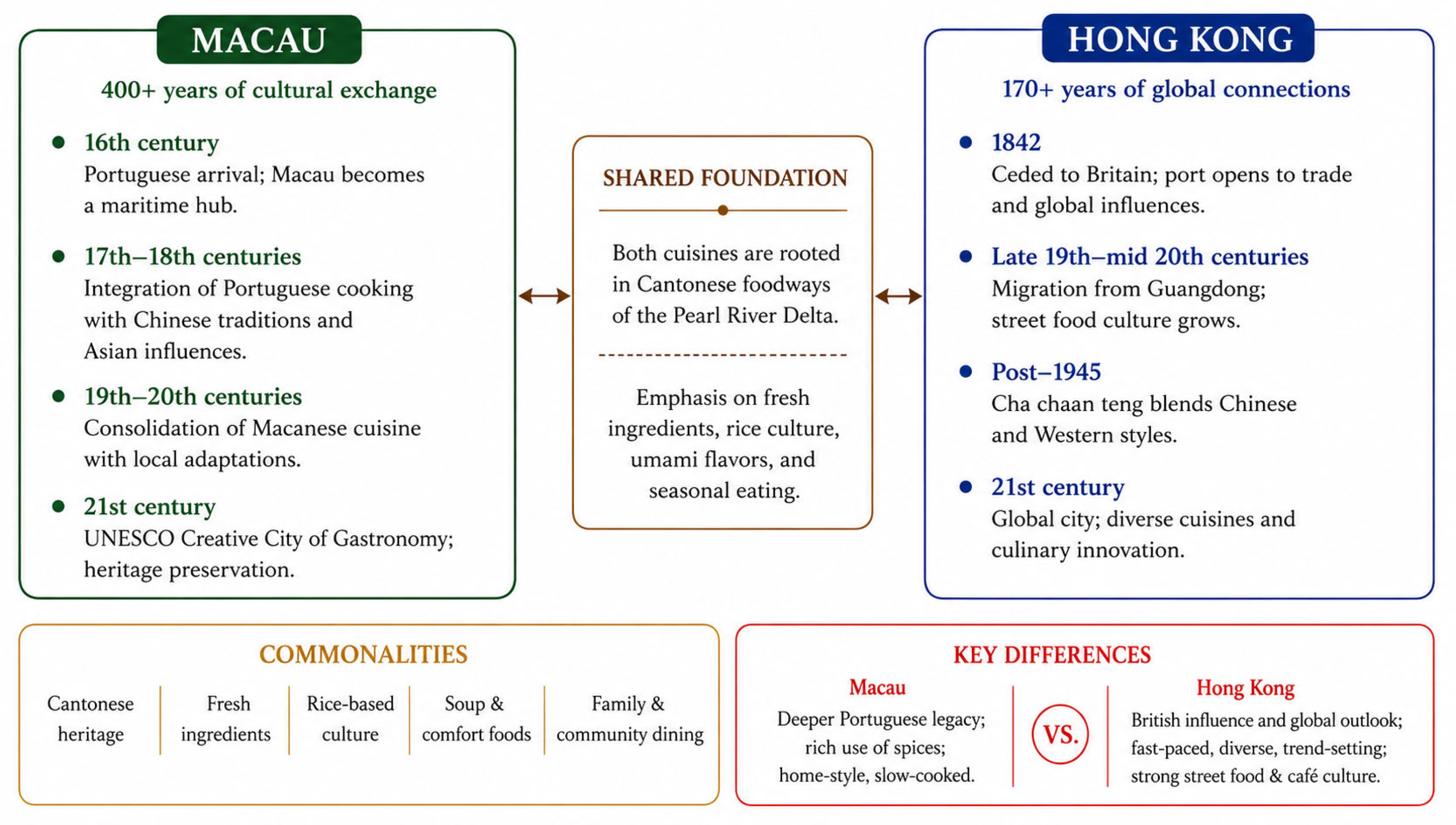
This encyclopedia entry highlights the key attributes of food traditions in Macau and Hong Kong. Both share fundamental Cantonese roots yet experienced divergent trajectories (Figure 1). Trade and globalization have historically represented strong drivers for culinary diversification, which nowadays integrates the cultural tourism mix. To the respective local societies, food represents more than a source of nourishment and signals collective memory through family events, festivals, and other public cultures. As an expression of intangible heritage, it also faces challenges posed by demographics and socioeconomic change. Conservation can be administratively facilitated or even imposed but needs to emerge from community engagement. The dissimilar and unique cuisines of Macau and Hong Kong reveal their capacity of connecting past and present at a global scale. Their food histories intertwine with further expressions of cultural exchange.
Figure 1.
Comparative chart.
Author Contributions
Conceptualization, A.D.M. and A.W.; methodology, A.D.M.; validation, A.D.M.; formal analysis, A.D.M.; investigation, A.D.M.; writing—original draft preparation, A.D.M. and A.W.; writing—review and editing, A.D.M. All authors have read and agreed to the published version of the manuscript.
Funding
This research received no external funding.
Institutional Review Board Statement
Not applicable.
Informed Consent Statement
Not applicable.
Data Availability Statement
No new data were created or analyzed in this study. Data sharing is not applicable to this article.
Conflicts of Interest
The authors declare no conflicts of interest.
References
- Civitello, L. Cuisine and Culture: A History of Food and People; John Wiley & Sons: Hoboken, NJ, USA, 2026. [Google Scholar]
- Pilcher, J.M. Food in World History; Routledge: London, UK, 2023. [Google Scholar] [CrossRef] [Scilit]
- Frost, W.; Laing, J. Cuisine, migration, colonialism and diasporic identities. In Heritage Cuisines; Timothy, D.J., Ed.; Routledge: London, UK, 2015; pp. 37–52. [Google Scholar] [CrossRef] [Scilit]
- Cai, T.; Tang, R.; Wang, H.; Li, S.D. One country two systems: A comparative study of national identity between Hong Kong and Macau. Chin. Sociol. Rev. 2022, 54, 107–130. [Google Scholar] [CrossRef] [Scilit]
- Loureiro, R.M. Macau and the Cape Route. In The Cape Route and the Silk Roads; Brill: Leiden, The Netherlands, 2026; pp. 256–276. [Google Scholar] [CrossRef] [Scilit]
- Jackson, A. Portuguese Culinary Legacy in Asia: An Exploration of Macanese Cuisine. In Global Portuguese: Literary, Historical, Sociolinguistic and Anthropological Approaches; de Silva Jayasuriya, S., Halikowski Smith, S., Eds.; Brill: Leiden, The Netherlands, 2025; pp. 144–164. [Google Scholar] [CrossRef] [Scilit] [PubMed]
- Lee, I. From reciprocity to territoriality: Extradition, the Opium War, and the idea of British sovereignty in Hong Kong, 1842–1844. Law Hist. Rev. 2022, 40, 437–458. [Google Scholar] [CrossRef] [Scilit]
- Yu, A. British values, Hong Kong voices: Tracing Hong Kong’s Britishness and its influences on British immigration policies. Afr. Asian Stud. 2023, 22, 418–451. [Google Scholar] [CrossRef] [Scilit]
- Hsu, C.H.; Song, H. Destination image in travel magazines: A textual and pictorial analysis of Hong Kong and Macau. J. Vacat. Mark. 2013, 19, 253–268, Erratum in J. Vacat. Mark. 2013, 19, 375. https://doi.org/10.1177/1356766713499691. [Google Scholar] [CrossRef] [Scilit]
- Maberly, C.; Reid, D. Gastronomy: An approach to studying food. Nutr. Food Sci. 2014, 44, 272–278. [Google Scholar] [CrossRef] [Scilit]
- Porporato, D.; Grimaldi, P.; Fassino, G. Culture, Heritage, Identity and Food. A Methodological Approach; Franco Angeli: Milan, Italy, 2019. [Google Scholar]
- Lévi-Strauss, C. The Raw and the Cooked; Harper & Row: New York, NY, USA, 1966. [Google Scholar]
- Bourdieu, P. Distinction: A Social Critique of the Judgement of Taste; Harvard University Press: Cambridge, MA, USA, 1984. [Google Scholar]
- Yıkmış, S.; Türkol, M.; Abdi, G.; Imre, M.; Alkan, G.; Aslan, S.T.; Rabail, R.; Aadil, R.M. Culinary trends in future gastronomy: A review. J. Agric. Food Res. 2024, 18, 101363. [Google Scholar] [CrossRef] [Scilit]
- Amaro, V. “We”, “They” and the spaces in-between: Hybridity in intercultural interactions between Portuguese and Chinese residents in Macau. Multilingua 2015, 34, 293–318. [Google Scholar] [CrossRef] [Scilit]
- Lam, W.M. Promoting hybridity: The politics of the new Macau identity. China Q. 2010, 203, 656–674. [Google Scholar] [CrossRef] [Scilit]
- Cao, Y.K.; Wei, W. Willingness to communicate from an English as an International Language perspective: The case of Macau. System 2019, 87, 102149. [Google Scholar] [CrossRef] [Scilit]
- McGuire, C. Hong Kong (Cantonese). In The Ethnomusicologists’ Cookbook, Volume II Complete Meals from Around the World; Williams, S., Ed.; Routledge: London, UK, 2015; pp. 28–34. [Google Scholar] [CrossRef] [Scilit]
- Cheung, S.; Wu, D.Y.H. The Globalisation of Chinese Food; Routledge: London, UK, 2014. [Google Scholar] [CrossRef] [Scilit]
- Trolio, J.; Eckman, M.; Mehta, K. Leveraging globalization to revive traditional foods. J. Sustain. Dev. 2016, 9, 212. [Google Scholar] [CrossRef] [Scilit]
- Hsu, F.C.; Scott, N. Food experience, place attachment, destination image and the role of food-related personality traits. J. Hosp. Tour. Manag. 2020, 44, 79–87. [Google Scholar] [CrossRef] [Scilit]
- Hsu, F.C.; Agyeiwaah, E.; Lynn, I.; Chen, L. Examining food festival attendees’ existential authenticity and experiential value on affective factors and loyalty: An application of stimulus–organism–response paradigm. J. Hosp. Tour. Manag. 2021, 48, 264–274. [Google Scholar] [CrossRef] [Scilit]
- Song, K.; Wan, H.; Jia, Q. A backlash against the high-speed modernity of gastronomy tourism: An analysis of the evolution of Macanese cuisine. Asia Pac. Viewp. 2024, 65, 171–186. [Google Scholar] [CrossRef] [Scilit]
- Lai, I.K. An examination of satisfaction on word of mouth regarding Portuguese foods in Macau: Applying the concept of integrated satisfaction. J. Hosp. Tour. Manag. 2020, 43, 100–110. [Google Scholar] [CrossRef] [Scilit]
- Yu, S.; Li, X.; Zhu, J.J. Culinary linguistic landscapes: Semiotic assemblages of authenticity and attraction in Macau’s street food spaces. J. Multiling. Multicult. Dev. 2026, 47, 1–30. [Google Scholar] [CrossRef] [Scilit]
- Amaro, V. Recasting memory and identity: The Barcelos rooster in Macau’s postcolonial narrative. Port. J. Soc. Sci. 2022, 21, 267–293. [Google Scholar] [CrossRef] [Scilit]
- Fernandes, M.D.; Wang, X.; Yeh, M. Identidade e dinâmicas linguísticas da comunidade macaense em Macau: Um estudo de caso. Diacrítica 2025, 39, 14. [Google Scholar] [CrossRef] [Scilit]
- Agyeiwaah, E.; Zhao, Y. Residents’ perceived social sustainability of food tourism events. Tour. Manag. Perspect. 2024, 53, 101276. [Google Scholar] [CrossRef] [Scilit]
- Chan, S.C. Food, memories, and identities in Hong Kong. Identities 2010, 17, 204–227. [Google Scholar] [CrossRef] [Scilit]
- Chang, R.C.; Kivela, J.; Mak, A.H. Food preferences of Chinese tourists. Ann. Tour. Res. 2010, 37, 989–1011. [Google Scholar] [CrossRef] [Scilit]
- Shing, C.K. Traditionality and hybridity: A village cuisine in metropolitan Hong Kong. In Hybrid Hong Kong; Chan, K., Ed.; Routledge: London, UK, 2013; pp. 218–235. [Google Scholar] [CrossRef] [Scilit]
- Chan, S.C. Tea cafés and the Hong Kong identity: Food culture and hybridity. China Inf. 2019, 33, 311–328. [Google Scholar] [CrossRef] [Scilit]
- Chen, Z. A pilot study of the co-creation experience in traditional Cantonese teahouses in Hong Kong. J. Herit. Tour. 2018, 13, 506–527. [Google Scholar] [CrossRef] [Scilit]
- Wang, C.Y. Hong Kong identities through food: Tracing developments and variations of pineapple buns in modern complexities. Food Cult. Soc. 2022, 25, 917–933. [Google Scholar] [CrossRef] [Scilit]
- Cheung, S.C. Consuming “Low” cuisine after Hong Kong’s handover: Village banquets and private kitchens. Asian Stud. Rev. 2005, 29, 259–273. [Google Scholar] [CrossRef] [Scilit]
- Zhang, C.X.; Yankholmes, A.; Morgan, N. Promoting postcolonial destinations: Paradoxical relations between decolonization and “East meets West”. Tour. Manag. 2022, 90, 104458. [Google Scholar] [CrossRef] [Scilit]
- Mei, W.; Ying, Z. Symbolic repertoires for city branding beyond casinos: The case of Macau. Int. J. Strateg. Commun. 2017, 11, 415–433. [Google Scholar] [CrossRef] [Scilit]
- Zhang, C.X.; Decosta, P.L.; McKercher, B. Politics and tourism promotion: Hong Kong’s myth making. Ann. Tour. Res. 2015, 54, 156–171. [Google Scholar] [CrossRef] [Scilit]
- Cheung, S.C. Hong Kong Foodways; Hong Kong University Press: Hong Kong, China, 2022. [Google Scholar] [CrossRef] [Scilit]
- Wang, Y.; Shi, H.; Zhang, Y.; Li, X.; Zhao, M.; Sun, B. Assessing the foodshed and food self-sufficiency of the Pearl River Delta megacity region in China. Foods 2023, 12, 4210. [Google Scholar] [CrossRef] [Scilit] [PubMed]
Disclaimer/Publisher’s Note: The statements, opinions and data contained in all publications are solely those of the individual author(s) and contributor(s) and not of MDPI and/or the editor(s). MDPI and/or the editor(s) disclaim responsibility for any injury to people or property resulting from any ideas, methods, instructions or products referred to in the content. |
© 2026 by the authors. Licensee MDPI, Basel, Switzerland. This article is an open access article distributed under the terms and conditions of the Creative Commons Attribution (CC BY) license.