Entry

Prosignification in Art Education: Project-Based and Meaningful Learning Towards Active Learning


by
Nora Ramos-Vallecillo
and
Víctor Murillo-Ligorred
*
Department of Musical, Visual Arts and Corporal Expression, Art Expression Didactics, Education Faculty, University of Zaragoza, 50009 Zaragoza, Spain
*
Author to whom correspondence should be addressed.
Encyclopedia 2026, 6(4), 86; https://doi.org/10.3390/encyclopedia6040086
Submission received: 21 November 2025 / Revised: 25 February 2026 / Accepted: 23 March 2026 / Published: 7 April 2026
(This article belongs to the Section Arts & Humanities)

Definition

Prosignification is defined as the process through which the subject generates new meanings by engaging in aesthetic experience, critical reflection, and creative action. Unlike general theories of meaning-making, which primarily describe the cognitive organization of experience, prosignification foregrounds the symbolic–expressive dimension as the central site of meaning production. It refers to the individual and collective capacity to construct meaning from expressive and symbolic experiences, integrating cognitive, emotional, social, and cultural dimensions of learning through intentional creative mediation. Prosignification operates between knowledge construction and subjective experience, enabling learners to connect conceptual understanding with personal interpretation and emotional involvement. Whereas knowledge construction emphasizes epistemic development and transformative learning focuses on perspective transformation through critical reflection, prosignification centers on the aesthetic reconfiguration of experience through symbolic creation and interpretation. Rooted in constructivist and experiential approaches, it unfolds through active, student-centred methodologies, particularly in Project-Based Learning contexts. However, its distinctive contribution may lie in integrating reflection, expression, and creation as interdependent mechanisms of meaning generation. Art education constitutes a particularly relevant context for this process, as its symbolic nature fosters the embodied and shared construction of meaning. Thus, prosignification cannot be reduced to cognitive restructuring or attitudinal change but involves the expressive re-symbolization of lived experience.

1. Introduction

In recent years, debates on educational innovation have incorporated new concepts that seek to account for the complexity of contemporary learning. Among them, prosignification emerges as a category that enables understanding how knowledge acquires meaning through lived experience and the learner’s active relationship with their environment. This term, still under theoretical consolidation, refers to the processes by which individuals re-elaborate meanings through interaction with content, emotions, and cultural contexts, particularly within artistic learning environments. The present contribution is conceptual in nature and seeks to develop a theoretical framework for understanding prosignification within contemporary art education.
In the field of education, this idea is directly linked to the principles of meaningful learning [1,2] and active methodologies, including Project-Based Learning (hereinafter referred to as PBL), which promote teaching centered on experience, autonomy, and collective knowledge construction. From Novak’s [3] perspective, education constitutes a set of cognitive, affective, and psychomotor experiences that empower the individual to face everyday life. In this sense, prosignification extends beyond the mere acquisition of knowledge; it implies a personal transformation in which learning becomes meaningful because it connects with one’s biography, emotions, and actions.
Art education, due to its expressive and symbolic nature, offers fertile ground for the development of these processes. Art, understood as a form of embodied knowledge [4,5], enables the integration of cognitive, emotional, social, and creative dimensions, thereby providing a particularly fertile space for prosignification. Artistic creation entails a constant dialogue between thought and action, reflection and experience; hence, artistic projects can be configured as pedagogical devices where meanings are constructed and reconstructed dynamically.
From this standpoint, the article pursues a threefold purpose:
  • To present the concept of prosignification as an emerging theoretical category within art education.
  • To analyze its relationship with meaningful learning and PBL, exploring the constructivist and experiential foundations that sustain them.
  • To reflect on the role of art and artistic projects in generating deep, transformative, and contextualized learning.
The relevance of addressing this topic lies in the need to rethink art education beyond merely transmitting techniques or styles. It is about recognizing its potential as a meaning-generating practice capable of articulating knowledge with lived experience and fostering a critical understanding of the world. As Dewey [6] suggests, art not only expresses emotions but also reorganizes experience, opening the possibility for new modes of understanding.
Therefore, exploring prosignification in the artistic field also entails questioning the role of the teacher as mediator and co-creator of meanings, as well as that of the student as an active subject in the construction of learning. This approach invites us to transcend transmissive teaching models and to place artistic practice at the heart of contemporary educational processes.

2. Theoretical Framework

2.1. Meaningful Learning

The concept of meaningful learning was formulated by David Ausubel in the 1960s and constitutes one of the cornerstones of the constructivist paradigm. According to Ausubel [1,2], learning becomes meaningful when new information is substantively and non-arbitrarily related to the learner’s prior knowledge. Such knowledge acts as conceptual “anchors” that allow integration and attribution of meaning to new content. Consequently, what the student “already knows” becomes the most important factor influencing what they can learn [7].
This type of learning stands in contrast to rote or mechanical learning, as it promotes deep understanding, long-term retention, and transfer to diverse contexts [8]. Authors such as Coll [9] and Moreira [10] expanded upon these ideas by emphasizing the relevance of logical meaningfulness (the internal coherence of content) and psychological meaningfulness (its relevance and comprehensibility to the learner). When both are combined, learning acquires a transformative dimension: not only are concepts assimilated, but the learner’s cognitive structure is reorganized.
In practice, meaningful learning requires three conditions:
  • That the teaching material be potentially meaningful;
  • That the learner exhibits an intentional disposition to learn; and
  • That substantive interaction occurs between new and prior knowledge [11].
These conditions imply a conception of learning as an active and personal process in which the learner interprets information from their own frame of reference. Therefore, Ausubel’s theory is complemented by the perspectives of Piaget [12], Vygotsky [13], and Bruner [14], who highlight the construction of knowledge through social interaction, reflection, and the resolution of authentic problems.
In the contemporary context, meaningful learning has gained renewed relevance due to the need to promote educational experiences that are lasting, integrative, and emotionally engaging. As Novak [11] asserts, true understanding arises when students can establish connections between the concepts learned and their lived experience—connections that confer genuine meaning upon the act of learning.

2.2. Project-Based Learning (PBL)

PBL is an active methodology grounded in the idea of learning by doing, formulated by John Dewey [6,15] and later developed by Kilpatrick [16]. In PBL, students work around complex questions or challenges that demand research, collaboration, and creativity to produce a tangible final product or outcome [17,18,19].
The logic of PBL is based on several principles:
  • Learning is active and situated: it is built upon real problems and meaningful contexts.
  • The student is the protagonist of their own process, while the teacher acts as a guide and mediator [20].
  • Knowledge is integrated through interdisciplinarity, fostering connections between theory and practice.
  • The final product and its public presentation enhance motivation, as well as individual and group responsibility [21].
Historically, project work has been linked to progressive pedagogical movements such as the New School, the Bauhaus, and the Reggio Emilia approach, all of which regard art and aesthetic experience as privileged paths to learning [22,23]. These experiences demonstrated that artistic creation could become a laboratory for critical thinking and collective knowledge construction.
Several authors have noted that PBL fosters key cognitive, social, and emotional competences for students’ holistic development: autonomy, problem-solving, communication, collaboration, and creative thinking [24,25]. Moreover, it readily adapts to art education, where the processes of production, reflection, and presentation of results are central to learning.
PBL is characterized by allowing multiple solutions and emphasizing creative exploration. In the field of art, this approach translates into the development of artistic projects that link symbolic expression with critical reflection and social action [26,27]. Thus, the project becomes a space of prosignification, where students attribute meaning to their learning through artistic practice and dialogue with others.

2.3. Prosignification

The term “prosignification” emerges as an innovative concept to describe the process through which learning acquires meaning from aesthetic and reflective experiences. Unlike simple “signification”, which refers to the attribution of a static meaning, prosignification implies a dynamic movement: the generation, reconstruction, and expansion of meaning throughout the learning process. From an etymological and phenomenological perspective, to prosignify means to move beyond given meaning, to open knowledge to new interpretations, and to connect it with the learner’s personal, emotional, and social experience.
The term “prosignification” is proposed to denote the active process through which individuals not only construct meaning but also anticipate and project new significations within learning contexts. Although it is not in common use, its linguistic construction reflects its conceptual purpose, distinguishing it from traditional notions of “meaning” or “meaning making” by emphasizing the proactive and transformative dimension of learning. Unlike meaning making, which describes how individuals interpret information based on their context, “prosignification” highlights the intentional action of projecting and anticipating future meanings. Likewise, whereas transformative learning focuses on profound changes in perspectives and beliefs, “prosignification” extends this approach by considering the capacity to generate new significations that transcend immediate experience, thus constituting a bridge between current understanding and future possibilities of knowledge.
In art education, this process manifests when students transform a creative experience into knowledge and, simultaneously, turn knowledge into an embodied experience.
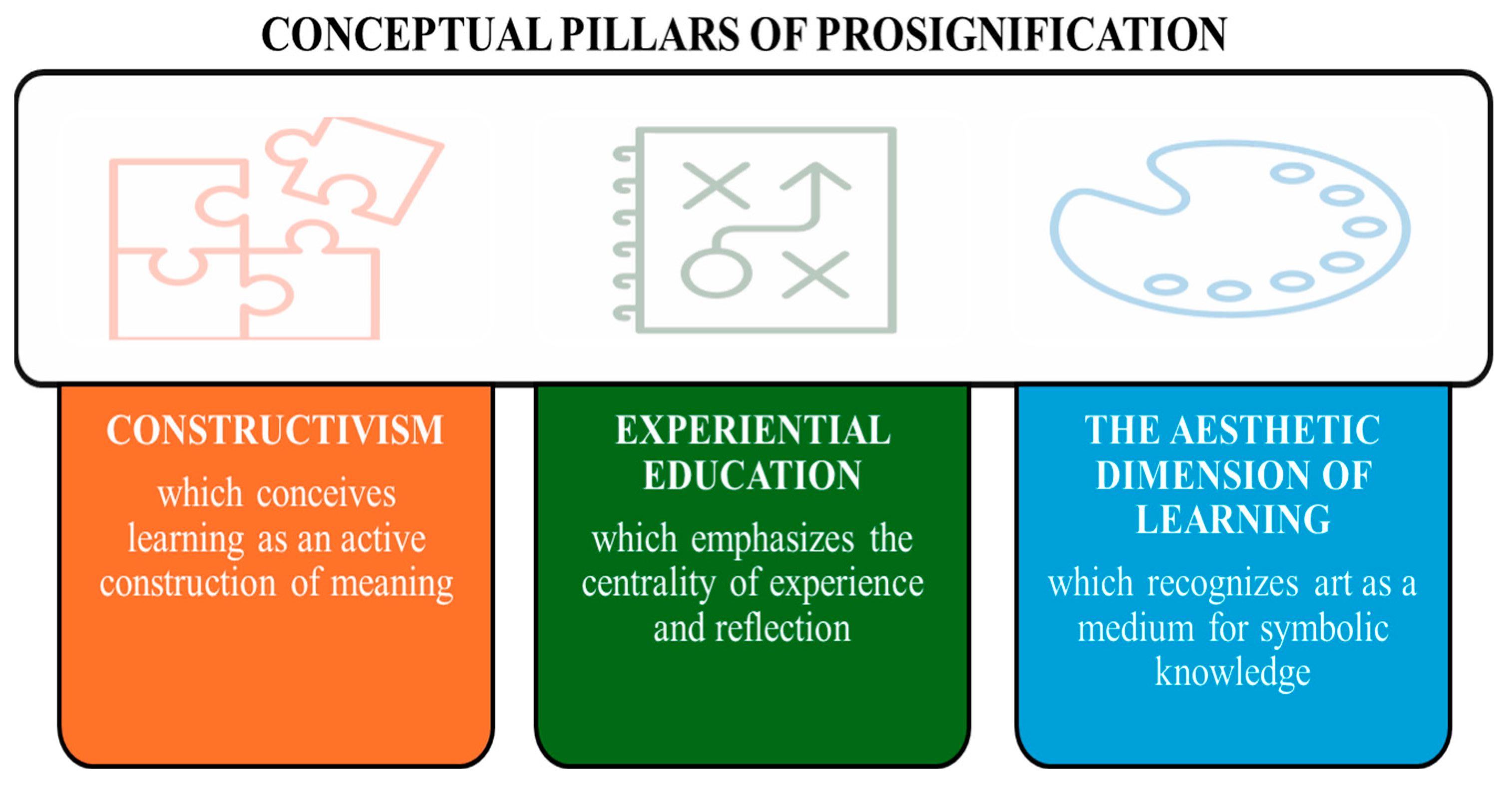
Prosignification draws upon three conceptual pillars (Figure 1):
  • Constructivism, which conceives learning as an active construction of meaning [12,13,14].
  • Experiential education, which emphasizes the centrality of experience and reflection [15,28,29].
  • The aesthetic dimension of learning, which recognizes art as a medium for symbolic knowledge [4,5,30].
As shown in Table 1, the concept of prosignification is positioned in dialogue with established frameworks such as meaning-making and transformative learning, while introducing a distinct contribution particularly relevant to arts education. Whereas meaning-making in artistic contexts focuses on interpreting artworks or aesthetic experiences within existing cultural and personal frameworks, and transformative learning emphasizes critical reflection leading to changes in perspectives or beliefs, prosignification foregrounds the learner’s proactive role in projecting and generating new significations. In arts education, this shift is especially significant, as aesthetic experiences not only invite interpretation or transformation but also foster imaginative anticipation, creative projection, and the exploration of multiple possible meanings. Prosignification thus extends beyond understanding or perspective change, conceptualizing arts-based learning as a dynamic space where learners actively construct future-oriented meanings, thereby suggesting an expansion of the educational potential of artistic practices. From a conceptual standpoint, the distinctions can be summarized as follows:
Prosignification allows us to understand the value of art education not only as a space for cultural transmission but as a domain of meaning transformation. When students develop an artistic project, they do not merely apply techniques or concepts; they re-signify their relationship with knowledge, with others, and with their own learning process.
Consequently, prosignification can be conceptualized as a category of synthesis between meaningful learning and project-based learning, emphasizing that meaning is not transmitted but experientially constructed. This approach invites us to rethink pedagogical models from a more holistic perspective, where learning is also interpreting, feeling, creating, and sharing.

3. Art Education as a Space for Prosignification

3.1. Aesthetic Experience as a Generator of Meaning

In art education, aesthetic experience can be understood as a particularly relevant space for meaning-making. From John Dewey’s [6] perspective, aesthetic experience is not limited to the passive contemplation of beauty; rather, it represents a complete form of experience in which thought, emotion, and action are integrated into a continuous process of transformation. This integrative character turns art into a unique pathway for prosignification, as it connects personal experience with shared cultural and symbolic meanings.
Parsons [30] emphasizes that aesthetic appreciation is an evolutionary process in which intellectual, emotional, and social development play essential roles. He argues that our understanding of art depends on how we process and internalize artworks, asserting that aesthetic responses are explorations of the self and reflect our own history of social and mental development.
Eisner [4] highlights that art provides modes of thought distinct from those of traditional disciplines-modes grounded in perception, intuition, and interpretation. In this sense, artistic practice not only communicates meanings but actively generates them through interaction with context; each creative act can thus be understood as a form of knowledge production, an act of knowledge in which body, emotion, and reason converge [31].
Art education, therefore, transcends the teaching of techniques or styles: it seeks to form individuals capable of reading and intervening in the world symbolically, developing aesthetic sensitivity and critical thinking. When aesthetic experience is reflected upon and shared, it becomes a source of meaningful learning, granting sense to acquired knowledge by situating it within lived experience and emotion.

3.2. The Artistic Project as a Learning Device

The artistic project can be considered a pedagogical device [32,33] of prosignification, insofar as it articulates creation, reflection, and action, functioning as a unifying structure of meaning [34,35].
As Soto Calderón [35] points out, these configurations function as networks that determine how life is organized and managed. In this sense, the project represents a fracture that simultaneously divides and unites, a constellation of practices and knowledge that organizes life to administer, govern, control, and orient it toward meaning [35].
Understood in this way, the project becomes a process through which students formulate questions, investigate, experiment, and produce results that embody their understanding of a subject. As Hernández [20] suggests, project work in art supports a research-based pedagogy in which knowledge is constructed through doing.
Examples of this approach can be found in experiences of community-based art education, collaborative projects, and art-education practices linked to social contexts. Initiatives such as those developed at the Bauhaus, the Taller Total in Córdoba (Argentina), or Art and Community programs [36] illustrate how art can function as a mediator for social transformation and the re-signification of experience.
Within this framework, the teacher’s role is redefined: no longer a transmitter of content, the teacher becomes a mediator, companion, and co-creator. Their function is to foster conditions for dialogue, reflection, and student autonomy, guiding the learning process without imposing meaning. As Freire [29] proposed, education should be an act of freedom and dialogue, in which individuals actively participate in the construction of knowledge.
The artistic project, thus understood, becomes a meeting point between subjectivity and culture, integrating conceptual, procedural, and attitudinal knowledge. Each artwork, performance, or installation created by students can be interpreted as an expression of prosignification-a space where learning becomes experience and experience becomes knowledge [37].

3.3. Dimensions of Prosignification in Art Education

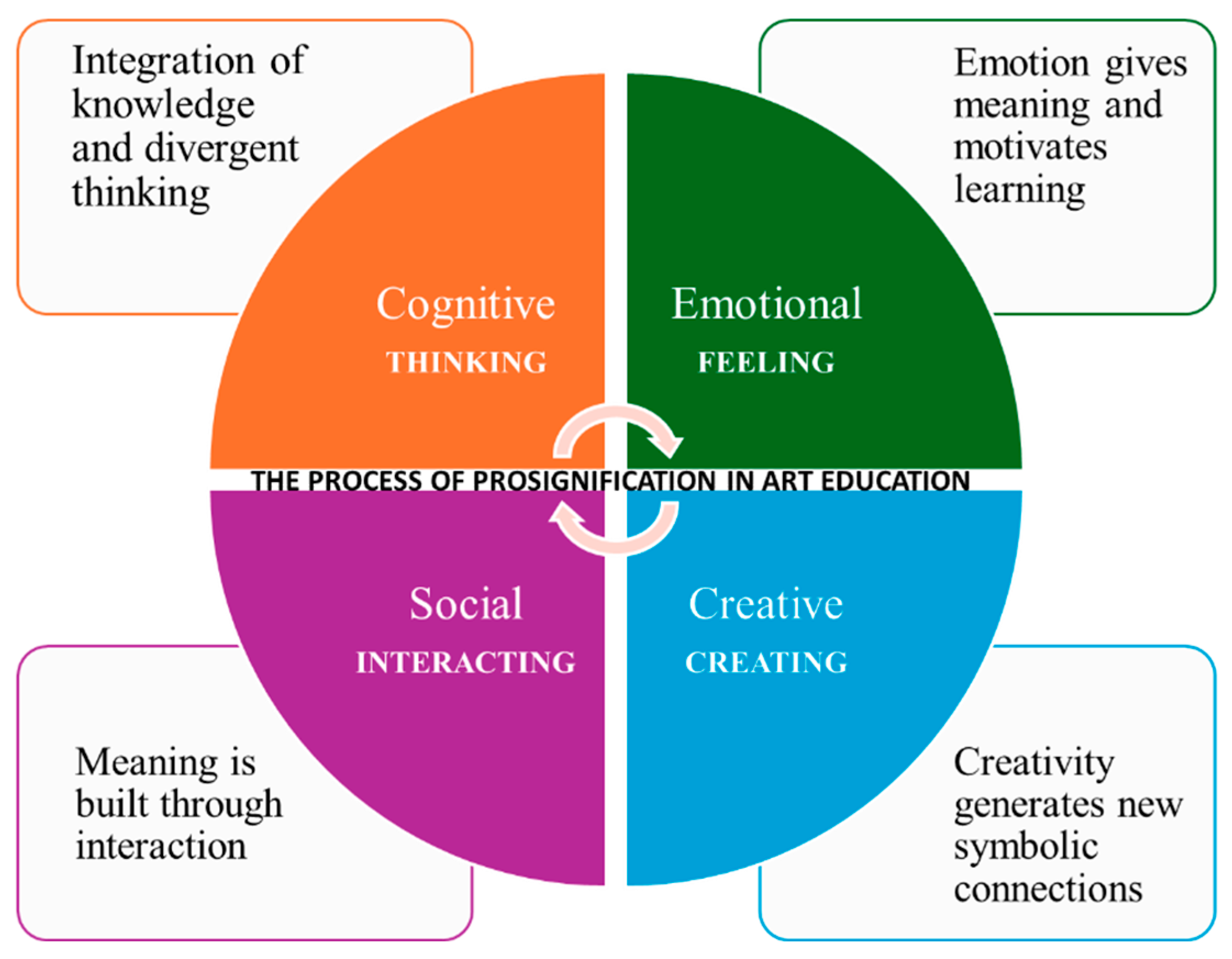
The process of prosignification in art education can be analyzed through four interrelated dimensions (Figure 2):
  • Cognitive dimension: refers to the integration of conceptual, procedural, and attitudinal knowledge. Artistic practice has been associated with divergent thinking and analogical reasoning, fostering a deep understanding of the concepts addressed in class [37,38].
  • Emotional dimension: the student’s affective engagement is essential for learning to acquire personal meaning. Emotions mediate between experience and knowledge, facilitating memory and motivation [39].
  • Social dimension: prosignification is strengthened through dialogue and collaboration. In collective artistic projects, learning is socially constructed through interaction, negotiation of meanings, and shared construction of sense [13].
  • Creative dimension: creativity is understood as the capacity to produce new symbolic connections. In education, this not only implies originality but also the ability to transform reality through expression [40].

4. Discussion

From this perspective, art education can be understood as not only communicating meanings but also actively generating them. Through projects and aesthetic experiences, learning becomes a dialogical process between the individual and their context. Situated at the intersection between knowledge and expertise, prosignification redefines the relationship between knowing, doing, and feeling. This reconceptualization positions art education as a formative space in which learners do not merely assimilate content but actively construct future-oriented meanings that inform both personal and social action. This shift may have broader curricular implications, as it invites reconsideration of content-driven models and aligns with competency-based frameworks that value interpretation, imagination, and ethical positioning.
Project-based learning in art enables students to experience reality, transform it, and, simultaneously, transform their own understanding. As Kolb [28] and Freire [29] note, experience and critical reflection are the foundations of all transformative learning. In this sense, art, because of its symbolic and experiential nature, offers a particularly suitable context for developing these capacities [30]. From a theoretical standpoint, prosignification can be interpreted as a mediating process within project-based learning, potentially supporting students’ capacity to anticipate, reinterpret, and expand meaning beyond the immediate artistic task. Pedagogically, this implies designing learning sequences that intentionally incorporate cycles of symbolic production, dialogic critique, and meta-reflection, rather than treating artistic creation as an isolated activity. It also suggests the need for assessment models capable of capturing processes of meaning projection, not only final products.
Integrating prosignification into pedagogical processes has profound implications. First, it proposes an educational model centered on meaning, in which learning arises from the dialogue between prior knowledge, emotion, and action. Second, it reclaims art education as a space for knowledge, rather than merely expression, thereby challenging its traditional marginalization within school curricula. At a policy level, this supports stronger advocacy for arts integration across disciplines, positioning aesthetic inquiry as epistemically complementary to scientific and technical forms of knowledge. In doing so, prosignification offers a conceptual basis for arguing the epistemic robustness of arts-based practices, with the potential to contribute to interdisciplinary learning and the development of complex cognitive and affective skills.
Finally, it expands the notion of meaningful learning by recognizing that meaning is generated not only cognitively, but also emotionally and symbolically. Prosignification, therefore, provides a theoretical framework that can articulate the intellectual, experiential, aesthetic, and ethical dimensions of learning.
This expanded understanding has broader implications for educational research, as it invites scholars to reconsider how learning outcomes are conceptualized and assessed, particularly in contexts where imagination, creativity, and ethical reflection play a central role. Given the limitations of traditional assessment models, this perspective underscores the need to explore multidimensional evaluation frameworks that integrate narrative documentation, reflective portfolios, and validated psychometric scales sensitive to symbolic engagement and future-oriented thinking.
Future research could focus on examining the concept of prosignification through empirical and methodological diversification. Specifically, longitudinal designs spanning at least one academic year could trace how students’ capacity for symbolic reconfiguration and meaning projection evolves across iterative project cycles. By applying mixed research methodologies that combine qualitative analyses [41,42,43,44,45,46,47], A/r/tographic analyses [48,49,50,51], and quantitative instruments [52,53,54,55], it will be possible to contribute to operationalising prosignification and distinguishing it empirically from related constructs, such as meaning-making and transformative learning. Experimental or quasi-experimental studies comparing arts-integrated PBL environments with non-arts-based PBL contexts could further clarify the distinctive contribution of arts-integrated PBL environments.
Further studies should investigate prosignification across educational levels (primary, secondary, and higher education), diverse cultural contexts, and disciplinary areas beyond the arts to assess its transferability and contextual specificity. Cross-cultural comparative research could examine how symbolic traditions and sociocultural narratives shape the forms and outcomes of prosignification.
From a pedagogical perspective, educational innovation could assess teaching strategies—such as project-based learning [56,57,58,59,60], arts-based inquiry [49,61,62], or reflective and aesthetic practices [63]—most effectively foster prosignification. Design-based research methodologies could iteratively refine instructional prototypes aimed at intentionally cultivating future-oriented meaning generation.
Finally, further inquiry should explore the ethical, social, and civic dimensions of prosignification, particularly its role in supporting students’ engagement with complex social issues such as sustainability, inclusion, or digital citizenship. Intervention studies embedded in community-based or service-learning projects could measure how symbolic creation mediates civic agency and ethical deliberation [64,65,66,67]. These lines of research would clarify the relevance of prosignification as a conceptual framework for understanding learning as a future-oriented and meaning-generative process.

5. Conclusions

Prosignification emerges as a useful conceptual category for understanding teaching and learning processes in art education, as it integrates the cognitive, emotional, social, and creative dimensions of human experience. From this perspective, art education is conceived as a space for meaning construction, where learning is rooted in experience and transformed into situated, meaningful knowledge.
Project-Based Learning, as an active methodology, provides a particularly coherent framework for developing processes of prosignification. By linking creation with reflection and action, artistic projects foster deep and the potential to foster deep and transformative learning, promoting autonomy, cooperation, and critical awareness among students.
Likewise, prosignification bridges Ausubel’s theory of meaningful learning with the experiential approaches of Dewey [6,15], Kolb [28], and Freire [29], offering a holistic view of learning as a vital, emotional, and social process. Knowledge, from this standpoint, becomes embodied experience, and experience becomes reflective knowledge.
In practical terms, this proposal invites educators to reconfigure their role as mediators of meaning and to design pedagogical strategies that integrate emotion, creativity, and action. Future studies may explore the operationalization of prosignification at different educational levels, as well as its impact on the formation of artistic and civic identities.
Ultimately, prosignification represents a synthesis of creation, reflection, and understanding, in which art is established as both a cognitive and transformative experience—one that education is invited to actively engage with. By placing meaning at the centre of learning, we open the possibility of a truly integral education in which learning also means living, feeling, and signifying experience.

Author Contributions

Conceptualization, N.R.-V.; investigation, N.R.-V. and V.M.-L.; writing—original draft preparation, N.R.-V.; writing-review and editing, N.R.-V. and V.M.-L.; visualization, N.R.-V. and V.M.-L.; supervision, N.R.-V. All authors have read and agreed to the published version of the manuscript.

Funding

This research received no external funding.

Institutional Review Board Statement

Not applicable.

Informed Consent Statement

Not applicable.

Data Availability Statement

No new data were created or analyzed in this study. Data sharing is not applicable to this article.

Acknowledgments

The content of the manuscript was created without the help of AI. However, ChatGPT 3.5 was used for an initial translation of preexisting passages of non-English text and for intermediate proofreading of paragraphs of text, i.e., for correcting language that would sound poor to native speakers (across all sections). All such text was subsequently checked manually and corrected manually where necessary. The final compilation and proofreading of the manuscript were performed manually.

Conflicts of Interest

The authors declare no conflicts of interest.

References

  1. Ausubel, D.P. The Psychology of Meaningful Verbal Learning; Grune & Stratton: New York, NY, USA, 1963. [Google Scholar]
  2. Ausubel, D.P. Psicología Educativa: Un Punto de Vista Cognoscitivo; Trillas: Mexico City, Mexico, 1980. [Google Scholar]
  3. Novak, J.D. Learning How to Learn; Cambridge University Press: Cambridge, UK, 1981. [Google Scholar]
  4. Eisner, E. Educar la Visión Artística; Paidós: Barcelona, Spain, 1995. [Google Scholar]
  5. Read, H. Education Through Art; Faber & Faber: London, UK, 1977. [Google Scholar]
  6. Dewey, J. Art as Experience; Minton, Balch & Company: New York, NY, USA, 1934. [Google Scholar]
  7. Ausubel, D.P.; Novak, J.D.; Hanesian, H. Psicología Educativa: Un Punto de Vista Cognoscitivo, 2nd ed.; Trillas: Mexico City, Mexico, 1991. [Google Scholar]
  8. Sexton, S.S. Meaningful Learning—David P. Ausubel. In Science Education in Theory and Practice: An Introductory Guide to Learning Theory; Springer Nature: Cham, Switzerland, 2025; pp. 157–171. [Google Scholar]
  9. Coll, C. Aprendizaje Escolar y Construcción del Conocimiento; Paidós: Barcelona, Spain, 1990. [Google Scholar]
  10. Moreira, M.A. Aprendizaje Significativo: Teoría y Práctica; Universidad Federal de Río Grande do Sul: Porto Alegre, Brazil, 2000. [Google Scholar]
  11. Novak, J.D. Meaningful learning: The essential factor for conceptual change in limited or inappropriate propositional hierarchies leading to empowerment of learners. Sci. Educ. 2013, 92, 548–564. [Google Scholar] [CrossRef]
  12. Piaget, J. Main Trends in Psychology; George Allen & Unwin: Sydney, Australia, 1973. [Google Scholar]
  13. Vygotsky, L.S. Mind in Society: The Development of Higher Psychological Processes; Harvard University Press: Cambridge, MA, USA, 1978. [Google Scholar]
  14. Bruner, J. Desarrollo Cognitivo y Educación; Morata: Madrid, Spain, 1988. [Google Scholar]
  15. Dewey, J. Experience and Education; Macmillan: London, UK, 1949. [Google Scholar]
  16. Kilpatrick, W. The Project Method: The Use of the Purposeful Act in the Educative Process; Teachers College Press: New York, NY, USA, 1918. [Google Scholar]
  17. Novalia, R.; Marini, A.; Bintoro, T.; Muawanah, U. Project-based learning: For higher education students’ learning independence. Soc. Sci. Humanit. Open 2025, 11, 101530. [Google Scholar] [CrossRef]
  18. Rahman, I.; Kaema, M.T.; Nurhapipah, N.; Nelwati, S.; Sabri, A.; Rahmanda, R. Systematic Literature Review: Analysis of Project-based Learning Models from Elementary to High School. Al-Ashri Ilmu-Ilmu Keislam. 2024, 9, 53–66. [Google Scholar]
  19. Matahari, D.B.; Nurohman, S.; Jumadi, J.; Astuti, S.R.D. Research trends in project-based learning models in facilitating 21st century skills: Systematic literature review. J. Penelit. Pendidik. IPA 2023, 9, 1607–1614. [Google Scholar] [CrossRef]
  20. Hernández, F. Educación y Cultura Visual; Octaedro: Barcelona, Spain, 2000. [Google Scholar]
  21. Bobek, V.; Colarič-Jakše, L.M.; Horvat, T. Motivation and Group Dynamics. In Organizational Behavior: Current Science, Models, and Applications; Springer Nature: Cham, Switzerland, 2025; p. 109. [Google Scholar]
  22. Manera, L. Art and aesthetic education in the Reggio Emilia Approach. Educ. 3-13 2022, 50, 483–493. [Google Scholar] [CrossRef]
  23. Sriarun, A.; Srikao, S.; Jantharajit, N. An Experiential Learning Management Model (ELMM) for Early Childhood Based on the Reggio Emilia Approach and Constructivist Theory. J. Educ. Learn. 2025, 14, 298–306. [Google Scholar] [CrossRef]
  24. Ordoñez Reino, B.K.; Fernández Sánchez, L.; Sancho Aguilera, D. Efectividad del Aprendizaje Basado en Proyectos para la adquisición de habilidades sociales en los niños: Una revisión sistemática. Rev. InveCom 2026, 6, 1–12. [Google Scholar] [CrossRef]
  25. Li, H.; Xiao, R.; Nieu, H.; Tseng, Y.J.; Liao, G. From Unseen Needs to Classroom Solutions: Exploring AI Literacy Challenges & Opportunities with Project-Based Learning Toolkit in K-12 Education. Proc. AAAI Conf. Artif. Intell. 2025, 39, 29145–29152. [Google Scholar] [CrossRef]
  26. Fuad, D.R.S.M.; Musa, K.; Hashim, Z. Innovation culture in education: A systematic review of the literature. Manag. Educ. 2022, 36, 135–149. [Google Scholar] [CrossRef]
  27. Isabirye, A.K.; Moloi, K.C.; Lebelo, R.S.; Khan, S. Cultivating Creativity and Innovation in the School Curriculum for the 21st Century: Opportunities and Challenges. J. Ecohumanism 2025, 4, 334–348. [Google Scholar] [CrossRef]
  28. Kolb, D. Experiential Learning: Experience as the Source of Learning and Development; Prentice Hall: Upper Saddle River, NJ, USA; Paidós: Barcelona, Spain, 1984. [Google Scholar]
  29. Freire, P. Pedagogía del Oprimido; Siglo XXI: Mexico City, Mexico, 1970. [Google Scholar]
  30. Parsons, M.J. Cómo Entendemos el Arte: Una Perspectiva Cognitivo-Evolutiva de la Experiencia Estética; Paidós: Barcelona, Spain, 2002. [Google Scholar]
  31. Thomson, P. Why bother with arts education in schools? Aust. Educ. Res. 2025, 52, 781–801. [Google Scholar] [CrossRef]
  32. Agamben, G. ¿Qué es un Dispositivo? Anagrama: Barcelona, Spain, 2015. [Google Scholar]
  33. Deleuze, G. ¿Qué es un Dispositivo? In Michel Foucault, Filósofo; Gedisa: Barselona, Spain, 1989. [Google Scholar]
  34. Foucault, M. Vigilar y Castigar; Siglo XXI: Mexico City, Mexico, 1978. [Google Scholar]
  35. Soto Calderón, A. La Performatividad de las Imágenes; Metales Pesados: Santiago, Chile, 2020. [Google Scholar]
  36. Cartagena, M.F. Arte, educación y transformación social. Index Rev. Arte Contemp. 2015, 00, 44–61. [Google Scholar] [CrossRef]
  37. Ramos-Vallecillo, N.; Murillo-Ligorred, V. Imagen, materia y objeto, una experiencia pedagógica en torno al dispositivo-artístico-didáctico para la construcción de espacios de aprendizaje en el grado de primaria. REXE Rev. Estud. Exp. Educ. 2024, 23, 372–390. [Google Scholar] [CrossRef]
  38. Efland, A. Art and Cognition: Integrating the Visual Arts in the Curriculum; Teachers College Press: New York, NY, USA, 2002. [Google Scholar]
  39. Immordino-Yang, M.H.; Damasio, A. We feel, therefore we learn: The relevance of affective and social neuroscience to education. Mind Brain Educ. 2007, 1, 3–10. [Google Scholar] [CrossRef]
  40. Craft, A. Creativity in Schools: Tensions and Dilemmas; Routledge: London, UK, 2005. [Google Scholar]
  41. Banks, M. Los Datos Visuales en Investigación Cualitativa; Morata: Madrid, Spain, 2010. [Google Scholar]
  42. Bolaños-Motta, J.I.; Pérez-Rodríguez, M.A. Propuestas para la investigación cualitativa en educación artística. Educ. Educ. 2019, 22, 51–63. [Google Scholar] [CrossRef]
  43. Domínguez, J. De la investigación científica a la investigación cualitativa en educación. Rev. Superv. 2015, 21, 1–22. [Google Scholar]
  44. Flick, U. El Diseño de Investigación Cualitativa; Morata: Madrid, Spain, 2015. [Google Scholar]
  45. Löser, J.; Rabenstein, K. The Relevance of Qualitative Research Approaches in Inclusive Education. In Bildung für Alle Stärken–Improve Education for All; Verlag Julius Klinkhardt: Bad Heilbrunn, Germany, 2025; p. 45. [Google Scholar]
  46. Martínez-Barragán, C. Metodología cualitativa aplicada a las Bellas Artes. Rev. Electrónica Investig. Docencia Creat. 2011, 1, 46–62. [Google Scholar]
  47. Kumar, N.; Bombale, G.R.; Ali, K.F.S.; Nagaballi, S.; Shinde, S.D. Research Methodology; RK Publication: Delhi, India, 2025. [Google Scholar]
  48. Irwin, R.L.; García Sierra, D. La práctica de la a/r/tografía. Rev. Educ. Pedagog. 2013, 25, 106–113. Available online: https://revistas.udea.edu.co/index.php/revistaeyp/article/view/328771 (accessed on 21 March 2026).
  49. Irwin, R.L.; de Cosson, A. A/r/tography: Rendering Self Through Arts-Based Living Inquiry; Pacific Educational Press: Vancouver, BC, Canada, 2004. [Google Scholar]
  50. Irwin, R.; Golparian, S.; Barney, D. A/R/Tografía Como Metodología Para la Investigación Visual. In Ideas Visuales: Investigación Basada en Artes e Investigación Artística; Marín-Viadel, D.R., Roldán, J., Eds.; Universidad de Granada: Granada, Spain, 2017. [Google Scholar]
  51. Marín-Viadel, R.; Roldán, J. A/r/tografía e Investigación Educativa Basada en Artes Visuales en el panorama de las metodologías de investigación en Educación Artística. Arte Individuo Soc. 2019, 31, 881–895. [Google Scholar] [CrossRef]
  52. Bolívar, C.R. Instrumentos y Técnicas de Investigación Educativa. Un Enfoque Cuantitativo y Cualitativo para la Recolección y Análisis de Datos; DANAGA: Houston, TX, USA, 2013. [Google Scholar]
  53. Hartas, D. Educational Research and Inquiry: Qualitative and Quantitative Approaches; Bloomsbury Publishing: London, UK, 2025. [Google Scholar]
  54. Tabron, L.A.; Thomas, A.K. Deeper than wordplay: A systematic review of critical quantitative approaches in education research (2007–2021). Rev. Educ. Res. 2023, 5, 756–786. [Google Scholar] [CrossRef]
  55. Trigwell, K. Approaches to teaching design subjects: A quantitative analysis. Art Des. Commun. High. Educ. 2002, 2, 69–80. [Google Scholar] [CrossRef]
  56. Boss, S.; Larmer, J. Project-Based Teaching; ASCD: Alexandria, VA, USA, 2015. [Google Scholar]
  57. Larmer, J. Getting Started with Project-Based Learning; ASCD: Alexandria, VA, USA, 2017. [Google Scholar]
  58. Larmer, J.; Ross, D.; Mergendoller, J.R. Project-Based Learning (PBL) Starter Kit; Buck Institute for Education: Novato, CA, USA, 2017. [Google Scholar]
  59. Mohd Hawari, A.D.; Mohd Noor, A.I. Project-Based Learning Pedagogical Design in STEAM Art Education. Asian J. Univ. Educ. 2020, 16, 102–111. [Google Scholar] [CrossRef]
  60. Turgut, H. Prospective Science Teachers’ Conceptualizations about Project-Based Learning. Online Submiss. Int. J. Instr. 2008, 1, 61–79. [Google Scholar]
  61. Finley, S. Critical arts-based inquiry. Collect. Interpret. Qual. Mater. 2013, 4, 85–117. [Google Scholar]
  62. Simons, H.; McCormack, B. Integrating arts-based inquiry in evaluation methodology: Opportunities and challenges. Qual. Inq. 2007, 13, 292–311. [Google Scholar] [CrossRef]
  63. Ryan, M.E. Reflective Practice in the Arts. In Literacy in the Arts: Retheorising Learning and Teaching; Springer International Publishing: Cham, Switzerland, 2014; pp. 77–90. [Google Scholar]
  64. Adeoye, M.A.; Baharun, H.; Munawwaroh, I. Transformational Leadership in Education: Harmonising Accountability, Innovation and Global Citizenship. Kharisma J. Adm. Dan Manaj. Pendidik. 2025, 4, 14–30. [Google Scholar] [CrossRef]
  65. Kovari, A. Ethical use of ChatGPT in education—Best practices to combat AI-induced plagiarism. Front. Educ. 2025, 9, 1465703. [Google Scholar] [CrossRef]
  66. Iloka, P.C. Teaching Integrity: Strategies for Fostering Ethical Behavior in Students. UNIZIK J. Educ. Res. Policy Stud. 2025, 19, 161–174. [Google Scholar]
  67. Wahi, R.; Chuah, K.M.; Junaini, S.N. Leveraging AI for Nurturing Learners with Empathy, Ethics, and Social Responsibility. In Digital Transformation and Sustainability in Higher Education; IGI Global Scientific Publishing: Hershey, PA, USA, 2026; pp. 205–236. [Google Scholar]
Figure 1. Key concepts underlying artistic meaning. Source: Author’s own data.
Encyclopedia 06 00086 g001
Figure 2. Dimensions of prosignification in art education. Source: Author’s own data.
Encyclopedia 06 00086 g002
Table 1. Conceptual distinctions between meaning making, transformative learning, and prosignification: implications for arts education. Source: Author’s own data.
AspectMeaning MakingTransformative LearningProsignification
FocusInterpretation of experienceTransformation of perspectivesProjection and generation of new meanings
Temporal orientationPresent-orientedRetrospective and reflectiveFuture-oriented
Learner’s roleInterpreterCritical reflectorProactive creator of meaning
Nature of meaningConstructed and stabilizedCritically reconfiguredDynamic and expansive
Arts
education
Understanding artistic meaningTransformative aesthetic experienceExploration and creation of new significations
Disclaimer/Publisher’s Note: The statements, opinions and data contained in all publications are solely those of the individual author(s) and contributor(s) and not of MDPI and/or the editor(s). MDPI and/or the editor(s) disclaim responsibility for any injury to people or property resulting from any ideas, methods, instructions or products referred to in the content.