Entry

Human-Centric, Sustainable and Resilient Smart Cities in Industry 5.0

by
Athanasios Tsipis
1,*,
Vasileios Komianos
2 and
Georgios Tsoumanis
3
1
Department of Digital Media and Communication, Ionian University, 28100 Argostoli, Greece
2
Department of Audio and Visual Arts, Ionian University, 49100 Corfu, Greece
3
Department of Informatics, Ionian University, 49100 Corfu, Greece
*
Author to whom correspondence should be addressed.
Encyclopedia 2026, 6(4), 87; https://doi.org/10.3390/encyclopedia6040087
Submission received: 20 February 2026 / Revised: 25 March 2026 / Accepted: 7 April 2026 / Published: 10 April 2026
(This article belongs to the Collection Encyclopedia of Digital Society, Industry 5.0 and Smart City)

Definition

The concept of “human-centric, sustainable and resilient smart cities” in Industry 5.0 (I5.0) refers to urban socio-technical ecosystems in which digital infrastructures and services are explicitly oriented toward human well-being, ecological stewardship, and systemic resilience rather than purely technological optimization or automation. Grounded in the I5.0 framework, which promotes human-centricity, sustainability, and resilience as equally important pillars, this paradigm repositions smart cities as value-driven environments that integrate enabling technologies such as Artificial Intelligence (AI), the Internet of Things (IoT), Extended Reality (XR), and related digital infrastructures within participatory, transparent, ethical, and accountable governance structures. From this perspective, technologies function as means through which cities develop higher-order capabilities for sensing, decision support, coordination, interaction, and adaptive service delivery. At the same time, they address digital divides and include measures that promote and protect inclusion, trust, and long-term socio-environmental viability. This entry synthesizes the conceptual foundations, technological enablers, capability-oriented architecture, governance implications, and emerging challenges that influence the transformation of smart cities into human-centric, sustainable, and resilient innovation systems in the I5.0 era.

1. Introduction

Smart cities [1] constitute one of the most influential and contested paradigms of contemporary urban transformation. Across policy, research, and practice, the term has been used to describe initiatives leveraging digital technologies to support urban services, governance, and everyday life. While early approaches emphasized efficiency, optimization, and technological modernization, recent scholarship reframes smart cities as socio-technical ecosystems whose outcomes depend on governance, institutional capacity, and value alignment [2,3].
This evolution aligns with the emergence of Industry 5.0 (I5.0) [4], which reorients digital transformation around human-centricity, sustainability, and resilience, positioning technology as a means for societal well-being [5]. These principles extend to smart cities, where digital infrastructures increasingly mediate services, experiences, and responses to long-term risks.
Despite this convergence, a persistent analytical gap remains. The existing literature typically examines either technological enablers (e.g., Artificial Intelligence (AI), Internet of Things (IoT), Extended Reality (XR)) or normative dimensions such as participation, ethics, and sustainability, often in isolation. Consequently, the relationship between technological configurations and the ways cities generate public value remains insufficiently articulated [6], limiting comparability across contexts and complicating governance and evaluation.
To address this limitation, this entry adopts a capability-oriented perspective. Different from past work that treats technologies as determinants of transformation, the focus here is on the capabilities cities develop through their configuration and governance. These capabilities, such as sensing, anticipatory decision-making, coordination, participatory interaction, and secure operation, mediate between technological infrastructures and societal outcomes. This perspective provides an analytical layer that enables synthesis across technologies and clarifies how digital systems translate into policy-relevant urban functions.
The contribution of this entry, therefore, lies in structuring this perspective into a coherent framework that connects I5.0 principles, technological enablers, and urban capabilities, moving beyond technology-centric inventories and purely normative discussions. The objective is not to propose new technologies or empirical models, but to provide a conceptual structure for understanding how smart cities can be interpreted, governed, and evaluated under the I5.0 paradigm. By organizing technological enablers through a capability taxonomy and linking them to human-centric, sustainable, and resilient outcomes, the entry supports both academic synthesis and policy-oriented analysis.
The remainder of the entry is structured as follows. Section 2 outlines the conceptual and policy background of smart cities. Section 3 elaborates the three core values of I5.0. Section 4 reviews the main technological enablers underpinning contemporary and emerging smart cities. Section 5 introduces the capability-oriented taxonomy and its integrated framework. Section 6 discusses governance, policy, and evaluation implications, while Section 7 presents open challenges and future directions. Section 8 concludes the entry.

2. Conceptual Background

The contemporary discussion on human-centric, sustainable and resilient smart cities in I5.0 emerges from two converging trajectories: (i) the evolution of smart city thinking beyond infrastructure-driven optimization, and (ii) a policy shift that reframes digital transformation around human well-being, sustainability, and resilience, as articulated in the European Union’s (EU) “Industry 5.0” vision [5]. Early smart-city paradigms, often aligned with Industry 4.0 (I4.0) logics, focused on large-scale sensing, connectivity, and analytics for operational efficiency [7]. Although these approaches improved performance, research documented technocentric biases, limited participation, privacy concerns, and legitimacy gaps, contributing to civic disengagement [8,9]. This has led to a shift toward citizen-oriented value, trust, transparency, and social outcomes, an initiative known as Smart City 2.0 (SC2.0).
In response, definitions from international bodies increasingly incorporate sustainability and Quality of Life (QoL), framing cities, not as technology testbeds, but as complex socio-technical ecosystems [3]. The ITU/FG-SSC definition of a “smart sustainable city” [1] emphasizes the use of Information and Communication Technologies (ICT) to improve QoL and efficiency while addressing the needs of present and future generations across economic, social, environmental, and cultural dimensions. Although rooted in I4.0, this definition remains foundational for current smart city discourse.
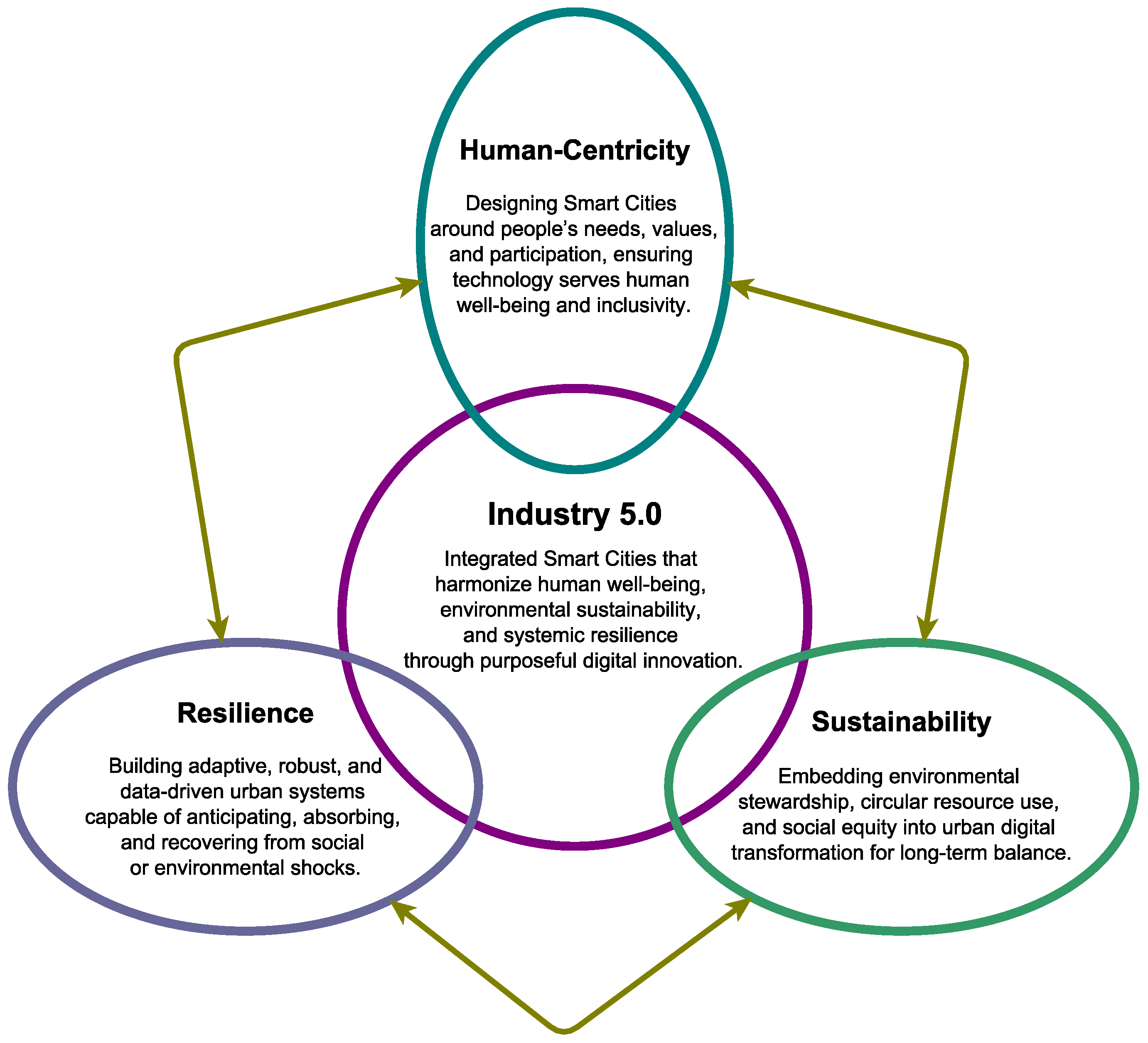
Building on this evolution, I5.0 [4] reorients innovation from automation and shareholder value toward human-centricity, sustainability, and resilience (Figure 1) [5]. Rather than treating humans as components in cyber–physical systems (CPSs), I5.0 emphasizes human–machine collaboration, inclusivity, and ecological responsibility across industrial and urban domains [10]. Accordingly, smart cities are increasingly interpreted as value-mediated socio-technical systems where technological infrastructures are evaluated based on their contribution to human well-being, ecological integrity, and adaptive capacity.
A human-centric smart city operationalizes this shift by embedding participation, inclusion, and ethics throughout the lifecycle of digital services [11], including problem contextualization, data governance, algorithm design, deployment, and evaluation. This reframing elevates citizens from passive data sources to active contributors, treating them as co-designers, supported by governance models grounded in transparency, accountability, explainability, and shared oversight [12]. Empirical studies further highlight the role of participatory governance and equity-oriented design in enhancing legitimacy, responsiveness, and value co-creation [8,13].
Sustainability and resilience agendas, on the other hand, are closely linked to the United Nations’ (UN) Sustainable Development Goals (SDGs), particularly SDG 11 [14]. At the policy level, SDG 11 promotes inclusive, safe, resilient, and sustainable urbanization, while at the implementation level, it translates into targets related to mobility, planning, waste management, disaster resilience, and equitable service access [15,16]. Standardization frameworks such as ISO 37120/37122 [17,18] operationalize these goals through indicator systems that support benchmarking and evidence-based governance [19].
From a technological standpoint, this shift does not diminish innovation but repositions technologies as instruments whose value depends on alignment with socio-economic objectives and governance contexts [20]. Enabling technologies, both established and emerging, such as AI, IoT, XR, and robotics (for more information on technology enablers, consult Section 4), remain central, but are increasingly assessed in terms of societal, environmental, and institutional implications. For example, cloud-edge architectures support energy-aware services [21], XR enables participatory simulation, and Human-Centered AI (HCAI) enhances transparency and controllability [22]. Within the I5.0 perspective, these technologies are explicitly linked to governance mechanisms and policy frameworks.
Despite these advances, the literature remains fragmented regarding how I5.0 principles are translated into operational urban capacities. While policy frameworks articulate values and technological research advances capabilities, fewer integrative approaches explain how these dimensions co-evolve within a coherent analytical structure. This gap motivates the need for a unifying perspective that connects enabling technologies, institutional arrangements, and value-driven urban transformation. Accordingly, this entry adopts a capability-oriented perspective that focuses on the functional capacities through which cities sense, decide, coordinate, interact, and adapt in alignment with I5.0 principles.

3. Core Values of Industry 5.0 in Smart Cities

I5.0 introduces a value-driven framework for smart cities structured around three interdependent pillars: human-centricity, sustainability, and resilience. Unlike earlier efficiency-led models, this triad treats human well-being, ecological responsibility, and adaptive capacity as coequal objectives shaping the design, delivery, and evaluation of digital services (Table 1). It also aligns with broader policy agendas such as SDG 11 [23] and the EU Cities Mission for climate-neutral cities by 2030 [24].

3.1. Human-Centricity: Participation, Inclusion, and Quality of Life

Human-centric smart cities treat digital infrastructures as socio-technical systems evaluated by their contribution to well-being and co-produced with communities. This entails (i) participatory governance, (ii) inclusive design, and (iii) systematic attention to Quality of Experience (QoE) and well-being.

3.1.1. Participation and Co-Creation

A central shift in I5.0 is the move from ICT-driven optimization to embedding human needs in design and governance [28,29]. Technology-led interventions frequently fail due to policy–practice misalignment [30], whereas human-centric approaches emphasize skills, awareness, and human capital as drivers of urban development [31,32].
Levels of participation vary from tokenistic involvement (e.g., information campaigns, surveys) [33] to genuine co-creation that redistributes agenda-setting power to communities [34]. Drawing on the New Public Service (NPS) [35], citizens are positioned as active agents engaged in continuous co-design, evaluation, and problem-solving.
Empirical studies show that Human-Centered Design (HCD) increases relevance, adoption, and early identification of equity issues [36]. Participatory practices such as scenario-building and iterative feedback loops enhance legitimacy and adoption [28], while co-creation reframes users as value co-producers linking design choices to public value [37,38]. These developments underpin the transition toward SC2.0 [2], where the focus moves from technology availability to its socially embedded use. For I5.0 smart cities, this implies bottom-up HCD with participatory planning approaches [39,40].

3.1.2. Inclusion and Equality

In I5.0, inclusion is a structural and productive requirement rather than a corrective measure [10]. It addresses barriers related to gender, income, age, disability, literacy, connectivity, and access to resources. Without targeted intervention, smart city benefits risks exacerbating existing inequalities and digital divides [41,42].
Large-scale experimental evidence indicates that infrastructure, service diversity, and civic platforms can reduce disparities, though outcomes remain context-dependent [43]. This underscores the need for context-sensitive policy mixes combining infrastructure, affordability, skills, and inclusive design [42,44].

3.1.3. Quality of Life and Well-Being

Human-centric evaluation prioritizes lived experience over system performance [25]. This includes QoE, emotional well-being, sense of place, and user satisfaction. In this direction, recent QoL models integrate objective indexes with subjective perceptions, enabling spatially sensitive analysis and targeted interventions [45].
Importantly, QoL is increasingly treated as both outcome and strategic resource linking well-being to urban performance [46]. Yet, regional variation necessitates context-specific indicators and participatory evaluation processes [47,48]. Emerging approaches integrate these dimensions into longitudinal monitoring frameworks supporting scalable policy-making in order to offer viable and dynamic adaptation to community needs [49].

3.2. Sustainability: Aligning Urban Digitalization with Ecological and Social Stewardship

Sustainability in I5.0 is not measured by short-term efficiency gains but by the degree to which it directs digitalization toward long-term ecological and social objectives [5,12]. It aligns with frameworks such as the SDGs [23] and EU climate-neutral strategies [24], guiding technological choices toward decarbonization, circularity, biodiversity protection, and intergenerational equity [15,16].
Operationally, sustainability spans three dimensions [17,18]: (i) environmental (resource efficiency, emissions reduction), (ii) social (equitable distribution of benefits), and (iii) economic (long-term viability of low-carbon transitions). Standards and metrics support benchmarking and evidence-based governance across these dimensions [15].
However, efficiency gains may trigger rebound effects if demand rises or system boundaries are not properly defined, a phenomenon known as Jevons’ Paradox [50]. Accordingly, sustainability-by-design requires lifecycle assessment, transparent data governance, and circular-economy principles. Combined with participatory planning (see Section 3.1), these approaches translate sustainability goals into measurable and socially legitimate deliverables [15,16].

3.3. Resilience: Ensuring Adaptive Capacity and Continuity in Complex Urban Systems

Resilience focuses on the ability of urban systems to endure, adapt, and recover under uncertainty [26]. In I5.0, it encompasses the capacity to anticipate, absorb, and respond while preserving well-being and Quality of Service (QoS) [27]. Comparable perspectives in industrial transitions, from I4.0 to I5.0, emphasize robustness, scalability, and adaptability under disruption [51].
Resilience operates across three domains [52,53]: (i) physical (infrastructure robustness in terms of energy, water, mobility, communications, housing, etc.) [16,27], (ii) digital (ICT reliability, cybersecurity, fault tolerance, or overload) [54,55], and (iii) social (governance capacity, trust, collective adaptation) [26,53]. Together, these domains define the adaptive capacity of smart cities.
Recent work highlights measures such as infrastructure redundancy, decentralized systems, open data platforms, and participatory governance [52,55]. At the same time, a “technology–resilience paradox” emerges, where heavy reliance on complex ICT and automation introduces new vulnerabilities, path dependencies, and failure points if risk management, redundancy, and human factors are not explicitly integrated [51].
Hence, from an I5.0 perspective, resilience must be embedded ex ante in planning and governance to ensure that digital innovation strengthens rather than undermines system robustness [55]. As such, smart cities combining digital infrastructures with institutional capacity and participatory governance have been observed to exhibit higher readiness and adaptive performance [5,55]. In this sense, resilience functions both as an operational capability and as a core expression of the human-centric paradigm [56].

4. Technological Enablers of Industry 5.0 Smart Cities

This section outlines the technological landscape of I5.0 smart cities by examining the principal enablers and technical practices shaping value-oriented urban digital transformation. Table 2 summarizes the main enablers discussed below, highlighting their technical functions, the urban system layers they address, and representative smart city applications. Overall, these enablers show that smart city digitalization spans multiple urban layers, from perception and computation to interaction, embodied action, trust, and security.
The following subsections examine these enablers not as self-sufficient solutions, but as technological conditions whose urban relevance depends on governance, combination, and alignment with public value objectives within broader socio-technical systems. Before detailing their specifics, it is imperative to explicitly reject a purely techno-optimistic framing. The deployment of these advanced digital infrastructures introduces profound societal risks if adopted without critical oversight. Pervasive IoT networks and AI analytics, for example, heighten the risk of surveillance overreach and the erosion of privacy; resource-intensive architectures like the Metaverse, XR, and Digital Twins (DTs) threaten to widen the digital divide and exacerbate digital inequality for marginalized communities; and decentralized or autonomous systems (e.g., blockchain, robotics) introduce severe governance complexity regarding accountability and liability. Consequently, the technologies discussed below must be critically approached not merely as solutions, but as potential vectors for systemic risk, introducing trade-offs that are systematically mapped and addressed later in Section 5.2.
These enablers also differ in maturity. Some are already established in research and practice, while others remain emerging or exploratory, with uneven empirical validation and early-stage deployment. This distinction, summarized in Table 2, is important for interpreting both current smart city foundations and frontier trajectories.

4.1. Established Technological Enablers

Established enablers refer to technologies that are already widely deployed and empirically validated.

4.1.1. Artificial Intelligence and Data Analytics

AI and data analytics constitute the cognitive backbone of I5.0 smart cities, enabling the transition from static and self-contained information systems to integrated, adaptive, and learning urban environments that offer real-time actionable intelligence [57]. In contrast to earlier automation-driven paradigms, AI in the I5.0 context [58] is expected to sharpen human skills, support collaborative decision-making, and align optimization with societal aims [22]. Relevant reviews document deployments across governance, mobility, environment, energy, economy, safety, and public services, while underscoring both transformative potential and systemic risks [59,60].
At a foundational level, AI and advanced analytics integrate and interpret heterogeneous urban data streams, combining User-Generated Content (UGC), IoT sensor data, geospatial information, mobility traces, administrative records, and infrastructure telemetry [6]. These data-driven architectures can then feed Machine Learning (ML) models that enhance situational awareness and operational effectiveness [61,62].
This capability, however, is not pursued solely for optimization, but also for public value, equity, and environmental performance. ML applications and other AI approaches, such as Deep Learning (DL), support energy forecasting and waste management, contributing to emission reduction and resource efficiency when embedded in appropriate governance frameworks [59,63]. Evaluated through transparent indicators such as the SDGs and lifecycle impacts, AI can also support climate and circularity goals, as reflected in the concept of Green AI (GAI) [64]. GAI emphasizes lifecycle-aware, ethical, and equitable AI practices aligned with long-term sustainability objectives.
AI and analytics are also central to urban resilience [65]. Predictive models for extreme events, infrastructure failures, and demand surges enable early warning, scenario analysis, and proactive resource allocation, supporting service continuity and faster recovery [52]. Anomaly detection across energy, water, transport, and communication networks further supports the identification of failures, vulnerabilities, or malicious activity through network science and graph-based learning [66]. These capabilities strengthen resilience when embedded in transparent and accountable decision pipelines [67].
It is noteworthy that a distinctive requirement of the I5.0 paradigm is that AI systems remain human-centric by design [68]. Research on HCAI [22] emphasizes human-in-the-loop architectures, explainability, responsibility, and support for human autonomy [22,69,70]. In the urban context [65], this translates into systems that remain judicious in data access, collection, and use (ethical AI), transparent in how they work and generate results (interpretable AI), and accountable to affected populations (valid AI), jointly captured under Explainable AI (XAI) [71,72]. XAI strengthens collective understanding, transparency, accountability, and trustworthiness in decision-making, while its civic benefits depend on addressing bias, privacy, and opacity in data handling [71,72,73,74,75].
Based on the above, AI is positioned as the “cognitive layer” connecting sensing infrastructures with key management and participation processes [66]. AI-enabled digital representations and simulation environments support scenario testing for land use, mobility, climate adaptation, and infrastructure planning, providing an interface between analytical modeling and stakeholder deliberation. When aligned with I5.0 principles, these tools support more inclusive, evidence-based, and transparent urban planning procedures [68].

4.1.2. Internet of Things and Sensor Networks

The IoT and sensor networks constitute the perception layer of I5.0 smart cities, enabling continuous data collection and interaction with CPSs [76]. They transform otherwise passive infrastructures into responsive systems with real-time feedback, as illustrated by intelligent and self-adjusted vehicular networks [77]. Research on Industrial IoT (IIoT) further shows how distributed sensing, low-power ICT, and interoperable platforms support seamless operation across diverse urban functions [78,79]. It also indicates that IoT-enabled smart cities (IESCs) [80] have matured to the point of supporting applications closely linked to SDG implementation [66], especially when combined with disruptive technologies such as AI and DTs [81].
Within a human-centric and sustainable I5.0 paradigm, IoT infrastructures cannot be treated merely as neutral data funnels. Their design and governance determine what is measured, whose needs are prioritized, and how benefits and risks are distributed [80]. Accordingly, people-centric smart cities rely on context-aware and participatory sensing architectures, where data collection is aligned with public value and service co-design, excluding unfiltered and indiscriminate monitoring [13,82]. Examples include citizen-reporting applications and community-based sensing initiatives that support local environmental monitoring and participatory experiences. In this way, IoT contributes to human-centricity when it improves everyday QoE, remains transparent to users, and incorporates safeguards for privacy, security, and non-discrimination [74].
IESCs also support sustainability through environmental monitoring of land, air, and water quality, smart metering for energy management and waste optimization, and adaptive resource control. When integrated into planning and regulatory processes, they contribute to measurable improvements in efficiency and emissions reduction [66,81]. Within I5.0, these capabilities support climate-oriented planning and more equitable allocation of environmental resources.
From a resilience perspective, the IoT provides the situational awareness required to detect, anticipate, and respond to disruptions. Sensors embedded in critical infrastructures can signal anomalies, failures, or overloads, while environmental alert systems support early warning for natural hazards [78]. Structural monitoring further enables continuous assessment of critical assets, supporting preventive maintenance and risk mitigation. When combined with analytics and clear response protocols, such sensing capabilities shorten detection and reaction times, enhancing the robustness of interdependent systems [52,66]. In future IESCs, these infrastructures are expected to protect vulnerable populations and maintain QoS while respecting rights and equity.

4.1.3. Edge and Cloud Computing Continuum

While cloud computing has historically provided the centralized processing power for smart cities, I5.0 increasingly requires a shift toward the “cloud–edge continuum”, where computation, storage, and intelligence are distributed across devices, near-edge nodes, and hyperscale infrastructures [83,84,85,86]. Contrary to centralized approaches, edge computing refers to processing data directly or near the source of generation (e.g., IoT sensors, smartphones, connected vehicles) without then need for transmitting it to distant data centers [83]. This shift not only offers latency optimization, but an architectural condition for responsive, privacy-aware, and distributed urban services.
From a human-centric perspective, edge computing deployments can strengthen digital rights and QoE by minimizing unnecessary exposure of sensitive data. Moreover, local processing of video streams, mobility traces, or wearable signals reduces reliance on continuous raw-data transfer [87,88]. This local-first approach aligns QoS delivery with proportionality and purpose limitation, both of which are critical for public trust. At the same time, cloud infrastructures remain essential for integrating heterogeneous datasets, supporting model training and auditing, and providing citywide decision-support systems [84,86]. In an I5.0 framing, architectures are therefore neither edge-only nor cloud-only, but rely on functional partitioning, where time-critical and privacy-sensitive processes are handled locally while long-term intelligence and integration remain in the cloud [85].
Latency remains a central technical driver of edge adoption, but its relevance lies in the urban experiences it enables. Ultra-low latency processing supports social interactivity, scalable server provisioning, and safety-critical applications [89], including immersive environments, assistive navigation, cooperative mobility, and telemedicine feedback loops [89,90]. In this sense, the continuum functions as a QoE-preserving design principle that combines local responsiveness with global coordination.
Regarding resilience, edge computing reduces single points of failure and supports continuity when connectivity is degraded. In such scenarios, edge-enabled subsystems can operate locally in “island mode”, preserving critical services such as mobility control, energy systems, and emergency coordination [88,91]. However, resilience also depends on administrative mechanisms that coordinate workloads across tiers while ensuring reliability, isolation, and recovery. Ergo, recent research emphasizes the need for continuum-aware orchestration and monitoring to support deployment, failover, and recovery across edge and cloud environments [92,93].
Edge computing also contributes to sustainability by reducing data transfer and enabling context-aware processing. Local filtering and aggregation of sensor and video data lower bandwidth demand and network energy consumption [94]. However, these gains depend on energy-aware workload placement because decentralization, besides decreasing, can also shift consumption. Research on green cloud–edge systems highlights the need to integrate energy modeling into control, considering renewable availability and carbon intensity across locations and time [95,96]. Moreover, edge-enabled “green IoT” approaches further combine efficiency with secure and adaptive QoS provision [97].
Overall, the I5.0 relevance of the cloud–edge continuum lies in its ability to balance proximity, autonomy, and system-wide intelligence, with various AI and network slicing models being tested for their performance under different 5G (Fifth-Generation) and 6G (Sixth-Generation) communication scenarios [98]. The continuum thus provides a configurable multi-tier computing fabric that supports QoE, privacy, energy-aware operation, and distributed resilience while maintaining coordination across urban systems [84,85,86,93].

4.1.4. Robotics and Autonomous Systems

Robotics and autonomous systems are becoming integral to smart-city ecosystems, supporting mobility, logistics, infrastructure inspection, environmental monitoring, healthcare assistance, and emergency response [99]. Within I5.0, their importance lies not in full automation, but in their role as collaborative, adaptive, and context-aware systems that augment human capabilities and contribute to urban well-being. The focus, hence, is on urban robotics [100] that are socially embedded and evaluated not only by technical performance, but also by usability, safety, trust, and societal impact.
From a human-centric perspective, urban robotics is closely associated with human–robot interaction (HRI) and the governance of robots operating in shared environments. As robots move from controlled settings into public spaces, the central concern becomes how citizens perceive their presence, intentions, and legitimacy [101]. Studies in HRI show that acceptance depends on social appropriateness, predictability, accountability, and understandable behavioral cues that reduce uncertainty during interactions [102]. These considerations reflect the I5.0 emphasis on preserving human agency, indicating that robotic systems must be designed for coexistence instead of solely task execution.
Robotics and autonomous systems also contribute to sustainability by enabling more efficient urban operations. A prominent application domain is last-mile delivery [103], where autonomous delivery robots (ADRs) are examined as alternatives that can reduce congestion and emissions while introducing new regulatory and infrastructural requirements. Research classifies ADR deployment across operational, infrastructural, regulatory, and acceptance dimensions [103], highlighting both environmental benefits and governance challenges. Complementary studies show that perceived environmental performance influences citizens’ willingness to adopt such systems [104]. Beyond logistics, mobile robotic systems are increasingly applied in assistive services and urban mobility, although challenges related to navigation reliability, safety, and security still exist [100].
Urban resilience is another domain where robotics plays a growing role. Autonomous systems such as Unmanned Aerial Vehicles (UAVs) and Unmanned Ground Vehicles (UGVs) are deployed in disaster response, search and rescue, firefighting, and infrastructure assessment, where human access is limited or hazardous [105]. However, real-world deployment remains challenging, particularly in terms of coordination, robustness, and regulatory constraints [106]. Additional concerns include surveillance risks, cybersecurity vulnerabilities, labor displacement, and accountability in autonomous decision-making [107]. In an I5.0 framing, the resilience value of robotics depends on integration into institutional processes, including training, governance frameworks, and cross-agency coordination, ensuring that these systems support, and do not replace, human decision-making [102].

4.1.5. Cybersecurity and Privacy-Preserving Digital Infrastructures

Smart city digital infrastructures integrate growing arrays of connected devices, data platforms, and service systems supporting urban governance, mobility, energy, healthcare, and citizen services. As these systems evolve, they introduce security and privacy challenges that can undermine system reliability, individual rights, and social trust [108]. Cybersecurity in this context encompasses the protection of data flows, computing nodes, networks, and service platforms against unauthorized access, breaches, denial of service, and system-level attacks, while privacy preservation focuses on ensuring that personal data remains confidential and under user control. Within I5.0, these dimensions must be jointly addressed through integrated architectures that support secure operation while enabling data exchange and service provision without exposing sensitive behavioral information [109].
Research underscores the complex threat landscape of smart cities, where heterogeneous devices and dense data flows expand attack surfaces. Studies such as [110] show that cyber incidents can propagate beyond digital layers to produce physical and social disruptions, including failures in energy or transport systems. Accordingly, cybersecurity mechanisms include intrusion detection, access control, encryption, anomaly detection, cyber forensics, and incident response capabilities to preserve integrity and availability while supporting learning from attacks in operational settings [111].
Privacy-preserving approaches further extend this framework by enabling data-driven services without exposing raw personal data. Techniques such as Federated Learning (FL), homomorphic encryption, and secure multiparty computation allow distributed analytics while maintaining confidentiality [112]. For example, FL distributes model training across local nodes, reducing reliance on centralized data collection. These types of architectures can support anomaly detection while embedding cryptographic HCD safeguards [113].
Security must also be treated as a resilience and sustainability concern in preference to a purely technical compliance requirement. Cyber incidents affecting critical infrastructures can disrupt essential services and impose recovery costs that challenge long-term system stability. With that said, cybersecurity is directly linked to sustainable development targets [114], showing that resilience planning must incorporate cyber risk alongside environmental and infrastructural considerations. This perspective aligns with I5.0, where secure operation underpins both continuity and trust in digitally mediated urban systems.
Finally, effective cybersecurity and privacy depend on governance and policy guidelines that complement technical measures. This includes regulatory alignment, standardization, and interdisciplinary oversight to balance data sharing against misuse [110]. In I5.0, such approaches integrate technological, organizational, and user-centric aspects, guiding the adoption of privacy-enhancing technologies, data minimization practices, and security testing procedures. In this way, cybersecurity evolves from a protective layer into a foundational condition for trustworthy, inclusive, and resilient urban digitalization.

4.2. Emerging Technological Enablers

Emerging enablers include actively researched technologies that have begun to appear in real-world smart city settings, but whose stabilization and validation remain uneven.

4.2.1. Blockchain Technologies

Blockchain technologies (e.g., smart contracts, non-fungible tokens (NFTs), cryptocurrencies, tokenization) have emerged as a trust-building toolkit, enabling secure, transparent, and verifiable actions across distributed urban actors without reliance on a single centralized authority [115]. In the I5.0 context, their relevance extends beyond transactional efficiency to institutional concerns such as accountability and human autonomy. Literature has accordingly expanded across governance, energy systems, identity management, logistics, and public services [116,117].
In data-intensive architectures, blockchain contributes primarily by strengthening trust, transparency, and citizen agency. As smart cities increasingly depend on automated decision-making and large-scale data sharing, blockchain-based systems can provide tamper-evident logging, verifiable access control, and auditable data-sharing processes that clarify how data are used and by whom [118]. Research on blockchain-enabled digital identity and credential management further highlights its potential to support inclusive access to e-services and participatory governance (e.g., e-elections), given that systems are designed with usability and accessibility in mind [119]. In this sense, blockchain supports the I5.0 emphasis on accountability and citizen agency in digitally mediated services.
Blockchain also supports sustainability aims by enabling decentralized coordination and verifiable accounting in resource-intensive domains. A prominent example is smart power grids, which facilitate peer-to-peer (P2P) energy trading and automated settlement through smart contracts [120,121]. By doing so, they reduce administrative overhead and improve transparency while supporting distributed renewable energy integration. However, sustainability outcomes depend on architectural choices, since energy-intensive consensus mechanisms may conflict with environmental goals, thereby motivating permissioned modules, authorized access, and in general energy-efficient alternatives [115,121].
Besides, urban systems rely on complex inter-organizational coordination, especially during disruptions. Blockchain’s distributed ledger structure can contribute to resilience by reducing single points of failure and maintaining consistent, verifiable records under partial outages or fragmentation [118]. This has motivated applications in logistics, incident reporting, and cross-agency coordination, where reliable shared information is critical in crisis situations.
Despite these potentials, the literature cautions against viewing blockchain as a universal solution. Scalability limitations, interoperability issues, governance complexity, regulatory uncertainty, and the risk of exacerbating power asymmetries all remain significant concerns for I5.0 smart cities, which must be addressed with public interest in mind [117].

4.2.2. Extended Reality, Metaverse and Digital Twins

Existing planning methods and analytical tools often struggle to address the interdependent nature of urban systems, particularly when integrating citizen needs, environmental dynamics, and cross-domain coordination [122]. As urban environments evolve into complex CPSs, more advanced mechanisms for modeling, visualization, and interaction are required to support decision-making and participatory governance.
Digital Twins (DTs) constitute one such mechanism. Originally introduced by NASA in aerospace engineering [123], the concept now refers to dynamic virtual replicas of physical systems synchronized with real-time data [124]. By integrating IoT streams, geospatial data, and simulation models, DTs support monitoring, scenario analysis, and predictive modeling without direct intervention in real-world systems. While initially employed in IIoT contexts [125], DTs are increasingly adopted in smart cities for cross-domain planning and infrastructure management. Their capacity to support environmental modeling, stress testing, and policy simulation contributes to sustainability and resilience objectives by reducing resource waste and anticipating system vulnerabilities [126].
However, the effectiveness of DTs depends not only on data availability, but also on interoperability standards, open protocols, and institutional coordination [122]. Resource constraints, particularly in smaller municipalities, may also create reliance on external providers, raising governance and dependency concerns [126]. Emerging approaches such as City Information Modeling (CIM) further extend DT capabilities through semantic integration and lifecycle data management [127,128].
While DTs support analysis, they do not inherently provide intuitive interfaces for engagement [129]. XR technologies, including Virtual Reality (VR), Augmented Reality (AR), and Mixed Reality (MR), address this limitation [130,131]. VR enables immersive experiences in fully simulated environments, often through Head-Mounted Displays (HMDs); AR overlays digital elements onto the physical world; and MR integrates virtual and physical elements through spatial alignment and natural interaction modalities [132].
In smart city applications, XR facilitates immersive visualization of DT data, enabling stakeholders to explore traffic simulations, environmental flows, infrastructure dynamics, and disaster scenarios through intuitive three-dimensional (3D) representations [126]. Such interfaces function as translation layers that reduce cognitive complexity and strengthen shared understanding across diverse participants, thereby supporting participatory processes and inclusive engagement.
Beyond planning, XR applications extend to education [133], cultural heritage [134], and inclusion contexts [135], supporting immersive learning and participatory engagement. These developments align with broader I5.0 and Society 5.0 (S5.0) discussions, where immersive interfaces mediate human–computer interaction (HCI) and enhance QoE [136,137,138]. However, their deployment in urban systems remains uneven and context-dependent.
While XR enhances interaction, it does not inherently support persistent multi-user environments, which has contributed to renewed attention toward the “Metaverse” [139]. Although the concept predates contemporary platforms, it has gained visibility through recent industry initiatives [140]. In smart city contexts, it is conceptualized as a virtual layer for social interaction, governance experimentation, and high digital QoS delivery [140].
Studies on “metaverse cities” highlight the convergence of immersive interfaces, sensing infrastructures, and platform-based governance [141]. Within an I5.0 framing, such environments are discussed as possible spaces for participation and policy experimentation [140,142], while also raising concerns regarding governance, data ownership, and platform control [123]. Illustrative examples include DT-based urban platforms such as the Herrenberg prototype [126], which integrates 3D spatial modeling, including digital elevation models (DEMs), mobility simulations, emission analysis, wind-flow modeling, and volunteered geographic information (VGI), into a modular visualization environment for participatory planning. Similar citizen science testbeds demonstrate the integration of IoT infrastructures and XR interfaces for coordinated urban management [122]. These cases show the potential of immersive and simulation-based approaches to improve coordination and resilience. Other metaverse initiatives, such as the Seoul Metaverse project [141], provide early examples of digital service environments [143,144,145]. In Metaverse Seoul, six main services are reported [146]: (i) citizen participation, (ii) industry support, (iii) youth counseling, (iv) tax support, (v) document issuance, and (vi) chat services. However, attempts to access and evaluate the platform from outside South Korea were unsuccessful [147]. This reflects a broader pattern, where many implementations are at pilot stage and empirical validation remains quite limited [142].
Regardless, the literature frequently discusses the potential of DT–XR–metaverse ecosystems for supporting SDG-related objectives [148], including governance innovation, climate modeling, and education [140]. However, associated risks include energy consumption, privacy concerns, digital exclusion, and unequal access to infrastructure [140,149]. Discussions of a “VR winter” further highlight the volatility of immersive technology ecosystems [150,151].
Finally, applications in domains such as smart hospitality [152], cultural heritage [134], and education [133] indicate that XR and DT systems extend beyond planning into experiential services. Overall, these environments constitute a heterogeneous and only partially mature set of enablers whose long-term contribution depends on governance, interoperability, accessibility, and lifecycle sustainability considerations.

4.3. Exploratory Technological Enablers

Exploratory enablers comprise forward-looking concepts with limited empirical validation, but potentially significant relevance for the future evolution of I5.0 smart cities.

4.3.1. Generative Physical AI

Despite being characterized as an emerging technology, Generative Physical AI (GPAI) [153] is frequently described as a paradigm shift relative to traditional robotics, which typically rely on rigid programming for task-specific execution [154]. GPAI refers to a rapidly evolving class of approaches that connect foundation-model representation learning with embodied perception–decision–action loops, enabling robots and autonomous agents to operate more flexibly under open-ended goals and unstructured environments [155]. According to recent definitions, GPAI extends AI from text and images to spatial reasoning and physical interaction, supporting multimodal perception through Vision–Language–Action (VLA) models [156]. These developments are increasingly associated with I5.0 because they suggest a shift toward adaptive HCI and more personalized HRI.
From a human-centric viewpoint, GPAI may reduce interaction barriers and support more natural forms of task specification and shared control. By leveraging Large Language Models (LLMs) and VLA models [153], robots can interpret natural language and reason about human intent, enabling more intuitive interaction with users [157]. Training in high-fidelity simulation environments, such as DT-based scenarios, is frequently proposed to prepare systems for complex, human-populated settings prior to deployment. Although large-scale validation remains limited, such approaches are considered important for improving accessibility and trust in human–machine collaboration [155].
In terms of resilience, GPAI is often presented as a way to address the limitations of traditional automation in handling edge cases. Through Reinforcement Learning (RL) trained on synthetic data, these models seek to develop generalized representations of physical dynamics [158]. This could allow autonomous systems, such as Autonomous Mobile Robots (AMRs) or disaster response drones, to adapt to unstructured environments and unexpected disruptions without retraining, thereby helping to mitigate the “reality gap” [159]. In spite of the obvious advantages, these capabilities remain dependent on controlled conditions and continued improvements in model robustness.
In sustainability terms, GPAI presents a dual perspective. On the one hand, it may reduce reliance on physical prototyping through simulation-based training, thereby lowering material consumption [159]. On the other hand, GPAI models may support logistics and energy optimization through large-scale scenario analysis, potentially improving efficiency and reducing emissions [160]. At the same time, the computational demands of generative models introduce additional energy burdens that remain an open research issue that must be tackled using GAI solutions.

4.3.2. 6G and the Internet of Senses

The evolution from 5G toward 6G and beyond is widely discussed in the literature as a prospective and still developing shift in the architecture of future digital infrastructures, with direct implications for I5.0 smart cities. While 5G laid the foundation for enhanced mobile broadband and massive machine-type communications, 6G is generally anticipated to reach commercial deployment around 2030 and is expected to support ultra-reliable low-latency communication (URLLC) and a unified connectivity fabric integrating terrestrial, aerial, and satellite networks [161]. As such, 6G is often viewed as a digital nervous system for synchronizing cyber, physical, and social domains, thereby contributing to the realization of Cyber–Physical Social Systems (CPSS) [162].
Within this transition, the “Internet of Senses” (IoS) has emerged as a visionary extension of multisensory communication paradigms [163]. IoS research explores the transmission of audiovisual, haptic, and other sensory signals in real time, extending interaction with digital environments across multiple senses. Although still exploratory, studies on the Tactile Internet and multisensory networking provide initial architectural foundations [164,165]. In smart city contexts, these developments are primarily discussed as emerging enablers of immersive telepresence and advanced human–machine interaction, particularly when combined with XR and edge–cloud infrastructures.
From a human-centric perspective, 6G is expected to support haptic communication alongside audio and visual data with sub-millisecond latency, potentially enabling high-fidelity remote interaction. Applications are frequently discussed in healthcare and training contexts. For example, in telemedicine [166], remote procedures with physical feedback may become feasible, while immersive XR environments could support distributed skill transfer. This prospective democratization of expertise aligns with I5.0 objectives, but also raises concerns regarding governance, accessibility, and inclusion [161].
From a resilience perspective, 6G may introduce multi-layer connectivity through Non-Terrestrial Networks (NTN), including satellites and High-Altitude Platform Stations (HAPS) [167]. Such architectures are being investigated as mechanisms for maintaining connectivity in disruption scenarios affecting terrestrial infrastructure. Their multi-layer design, combined with intelligent routing and self-healing protocols, is expected to support service continuity [162], although large-scale deployment remains subject to technical and regulatory constraints.
In sustainability terms, 6G is associated with emerging communication techniques such as backscatter and symbiotic radio, enabling passive IoT devices powered by ambient energy [168]. This approach supports large-scale sensing without battery dependence, reducing e-waste and maintenance demands. Nevertheless, these potential benefits must be evaluated at the system level, since the energy implications of network densification, edge infrastructures, and AI-native networking may offset efficiency gains.

5. A Capability-Oriented Taxonomy for Industry 5.0 Smart Cities

While the technological enablers discussed in Section 4 provide the material and computational substrate of I5.0 smart cities, technologies alone, as already stated, do not determine urban outcomes. Similar technological stacks can produce markedly different societal effects depending on civil and cultural contexts. This points to a central analytical shift: understanding smart cities requires moving beyond the identification of technologies toward examining the functional capacities they enable in practice. For this reason, recent smart city and digital transformation research [2,6] increasingly distinguishes between (i) technologies as means and (ii) capabilities as the functional and organizational capacities that cities develop to act, decide, adapt, and deliver value through those technologies. Building on this distinction, this section introduces a capability-oriented taxonomy as a structured lens for interpreting how heterogeneous technological enablers are translated into urban functions aligned with I5.0 principles.

5.1. From Technological Enablers to Urban Capabilities

A capability-oriented perspective is particularly appropriate for I5.0, whose core values of human-centricity, sustainability, and resilience (Section 3) are normative and intrinsic rather than technology-specific. From this viewpoint, the central analytical question is not merely which technologies are deployed, but what cities become capable of doing with them in terms of sensing, understanding, coordinating, interacting, and responding in ways that advance human well-being and long-term viability. This abstraction layer supports synthesis across heterogeneous technological domains and more directly links digital infrastructures to policy-relevant urban functions.
Building on the literature presented earlier on smart city technology enablers, six high-level capability domains are proposed as a unifying taxonomy for I5.0 smart cities, summarized in Table 3. These domains are not mutually exclusive; on the contrary, they describe interdependent capacities co-produced by combinations of technologies, governance arrangements, and human practices. Individual technologies frequently contribute to more than one capability domain, reinforcing the view that urban adoption emerges from coordinated configurations instead of isolated deployment.
The mapping in Table 3 should therefore be read as indicative and not as deterministic. Technological enablers contribute to specific capability domains, but whether these capabilities translate into human-centric, sustainable, and resilient outcomes depends on governance conditions, implementation choices, and contextual factors. The capability domains themselves are discussed next.

5.1.1. Urban Sensing and Situational Awareness

This capability refers to a city’s capacity to observe and describe its physical, environmental, and social conditions in near-real time [66]. It encompasses distributed sensing, data acquisition, and basic contextualization across domains such as energy, environment, infrastructure, public space, and mobility [78]. Situational awareness thus forms the perceptual foundation for higher-level analytics, planning, and response functions, and is widely recognized as a prerequisite for adaptive urban systems.
In practice, such sensing configurations are already applied in urban contexts, as illustrated in the Sant Andreu district in Barcelona, where quantitative traffic measurements were interpreted through citizen participation to improve local mobility assessment [169]. This example shows that sensing becomes operationally useful when data are not only collected, but also interpreted and integrated through participatory governance, shaping whether situational awareness supports inclusive and context-sensitive interventions.

5.1.2. Intelligent Decision Support and Predictive Foresight

Beyond data collection, smart cities require the capacity to interpret complex information and explore future states. This capability relates to AI, including data analytics and ML, in conjunction with simulation or other reasoning methods (e.g., LLMs) to support pattern detection, forecasting, scenario analysis, and evaluation of alternative interventions [65]. In an I5.0 framing, such systems are intended to augment human judgment, enabling planners, public authorities, and communities to co-evaluate options and trade-offs [68].
This capability is increasingly realized through urban DT deployments, such as in Sydney [170], where historical and real-time data are integrated to support sustainability analysis and traffic-risk forecasting. Such cases illustrate how predictive foresight can inform planning and proactive intervention. More generally, it can support proactive urban decision-making by identifying emerging risks (e.g., congestion patterns or environmental stress) and enabling the evaluation of alternative interventions before implementation, thereby reducing long-term system inefficiencies and vulnerabilities. At the same time, their effectiveness depends on governance arrangements that ensure transparency, participation, and accountability.

5.1.3. Real-Time Service Orchestration and Automation

This capability captures a city’s capacity to coordinate and execute urban services dynamically across distributed infrastructures [90]. It includes low-latency processing, adaptive control, and cross-system coordination for applications such as traffic management, energy balancing, emergency response, and interactive public services. Real-time orchestration is essential for maintaining QoE and operational continuity in complex urban environments [52].
This type of automation is demonstrated in practice by [171], where a real-world cloud–edge microservice architecture comprising 175 nodes is validated for smart city service provisioning, showing that distributed execution combined with centralized management can sustain time-sensitive applications at scale. For instance, in extreme weather scenarios, such orchestration capabilities can support emergency response by dynamically reallocating resources, coordinating distributed infrastructures, and maintaining continuity of critical services under disruption. At the same time, its contribution to urban performance depends on governance mechanisms that balance efficiency with robustness, so that adaptive coordination does not introduce fragility under disruption.

5.1.4. Trusted Data Governance and Secure Infrastructure Operation

Smart cities increasingly depend on large-scale data sharing and automated procedures, a fact that makes trust, security, and privacy operational requirements rather than auxiliary concerns [109]. This capability refers to the capacity to manage data access, provenance, integrity, confidentiality, and accountability across organizational boundaries while ensuring that digital infrastructures remain reliable and resilient.
This need is reflected in implementations such as the NATALIE framework [172], which uses FL to infer traffic behavior from global positioning system (GPS) trajectories without collecting raw personal data. More broadly, such approaches show that trust in future smart cities emerges from the integration of cybersecurity, privacy-preserving mechanisms, and institutional data governance and regulatory frameworks that uphold citizen rights and public trust [110].

5.1.5. Immersive Interaction and Participatory Experience Mediation

This capability concerns how cities communicate information, support engagement, and enable experiential interaction between people and ICT. It includes visual, spatial, and multisensory interfaces, such as those envisioned for the future metaverse, that allow stakeholders to cooperatively explore civil data, simulate scenarios, and participate in planning and co-production processes [140], all key properties to human-centric development [126].
Applied examples include the Tianjin urban park study [173], where a DT was coupled with a physical replica in joint workshops to support scenario simulation and spatial decision-making. This illustrates how immersive mediation can enhance engagement and collective understanding, while also showing that its effectiveness depends on human-in-the-loop conditions that ensure accessibility, representational accuracy, and inclusivity.

5.1.6. Autonomous and Assistive Urban Utilities

This capability refers to the deployment of robotic and autonomous systems that support mobility, logistics, inspection, maintenance, healthcare assistance, and emergency operations [100]. As such, these systems are conceptualized as assistive and collaborative agents that enhance human capabilities and function under meaningful human oversight in public spaces [102].
Results from deployments, such as the Pittsburgh sidewalk delivery robot pilot [174], highlight accessibility, obstruction, and pedestrian-interaction challenges, showing that assistive urban robotics require municipal oversight and HCD criteria for deployment in public space. Their contribution to community well-being thus depends on governance structures that define acceptable roles, responsibilities, and oversight in everyday city life.

5.2. Capability-Level Risks, Trade-Offs, and Safeguards

Although the preceding taxonomy clarifies how I5.0 smart cities translate existing and emerging digital technologies (Section 4) into functional urban capacities, these capabilities also introduce new risks, tensions, and trade-offs. In I5.0 smart cities, such risks cannot be treated as secondary effects, but must be actively anticipated and governed. Table 4 synthesizes the main capability-level challenges and corresponding safeguards required to align smart city development with I5.0 principles, showing how the translation of enabling technologies into capabilities simultaneously advances and exposes the pillars of human-centricity, sustainability, and resilience (Section 3). As opposed to serving as a standalone summary, this table is actually designed to be utilized alongside the taxonomy in Table 3 as a continuous diagnostic matrix. For example, while Table 3 illustrates that ’Intelligent Decision Support’ advances sustainability via resource optimization, this table immediately forces an analytical pivot by flagging the counter-risk of energy-intensive model scaling. This integrated reading compels planners to weigh these cross-pillar tensions systematically without viewing capability benefits in isolation.
Operationally, capability domains can be understood as decision points where governance choices shape outcomes. For instance, real-time orchestration may improve efficiency under normal conditions, yet without redundancy and fallback mechanisms, it can also introduce systemic fragility. The same capability contributes to resilient continuity only when safeguards such as decentralized control, manual override, and failover strategies are embedded.
In more detail, capabilities that directly mediate the relationship between citizens and urban digital systems predominantly expose the human-centricity pillar. This reflects long-standing concerns [58], where data-intensive and AI-driven technologies can undermine inclusion, agency, transparency, and trust if participation, accessibility, and accountability are not embedded by design, for example through HCAI [22] and XAI [71]. In this sense, the risks associated with these capabilities echo the critique of earlier technology-led smart city paradigms discussed in Section 2, reinforcing the I5.0 shift toward human-in-the-loop and participatory governance, especially under the SC2.0 paradigm [2].
On a similar note, resilience is most exposed in capabilities responsible for real-time orchestration and secure infrastructure operation, which rely on tightly coupled edge–cloud architectures, automation, and constant connectivity. As mentioned in Section 4, these factors enhance responsiveness and efficiency, but also increase systemic interdependence and vulnerability to cascading failures, cyber incidents, or operational disruptions [114]. Ergo, instead of brittle optimization, the mitigation mechanisms identified in Table 4 align with the I5.0 emphasis on adaptive capacity, resource redundancy, and service continuity.
Sustainability appears as a cross-cutting and temporally exposed pillar. Unlike human-centricity and resilience, sustainability risks often do not manifest immediately, but accumulate through long-term scaling of AI computation, automation, immersive interfaces, and robotic systems. Energy rebound effects, carbon and resource lock-in, and lifecycle maintenance burdens illustrate how technologies that promise efficiency gains can undermine ecological objectives if deployed without explicit sustainability governance. This observation complements the discussion in Section 3, underscoring that sustainable smart cities, besides technological innovation, require lifecycle-aware design, energy-conscious orchestration, and continuous monitoring of environmental and systemic impacts.
Importantly, the aforementioned issues corroborate the argument that in future smart cities, technologies, however novel or disruptive, do not carry I5.0 core values inherently. Instead, these values are realized or compromised through the capabilities cities develop and the safeguards they establish to mitigate associated risks, thereby shaping concrete integration designs and governance choices.

5.3. An Integrated Capability-Oriented Framework for Industry 5.0 Smart Cities

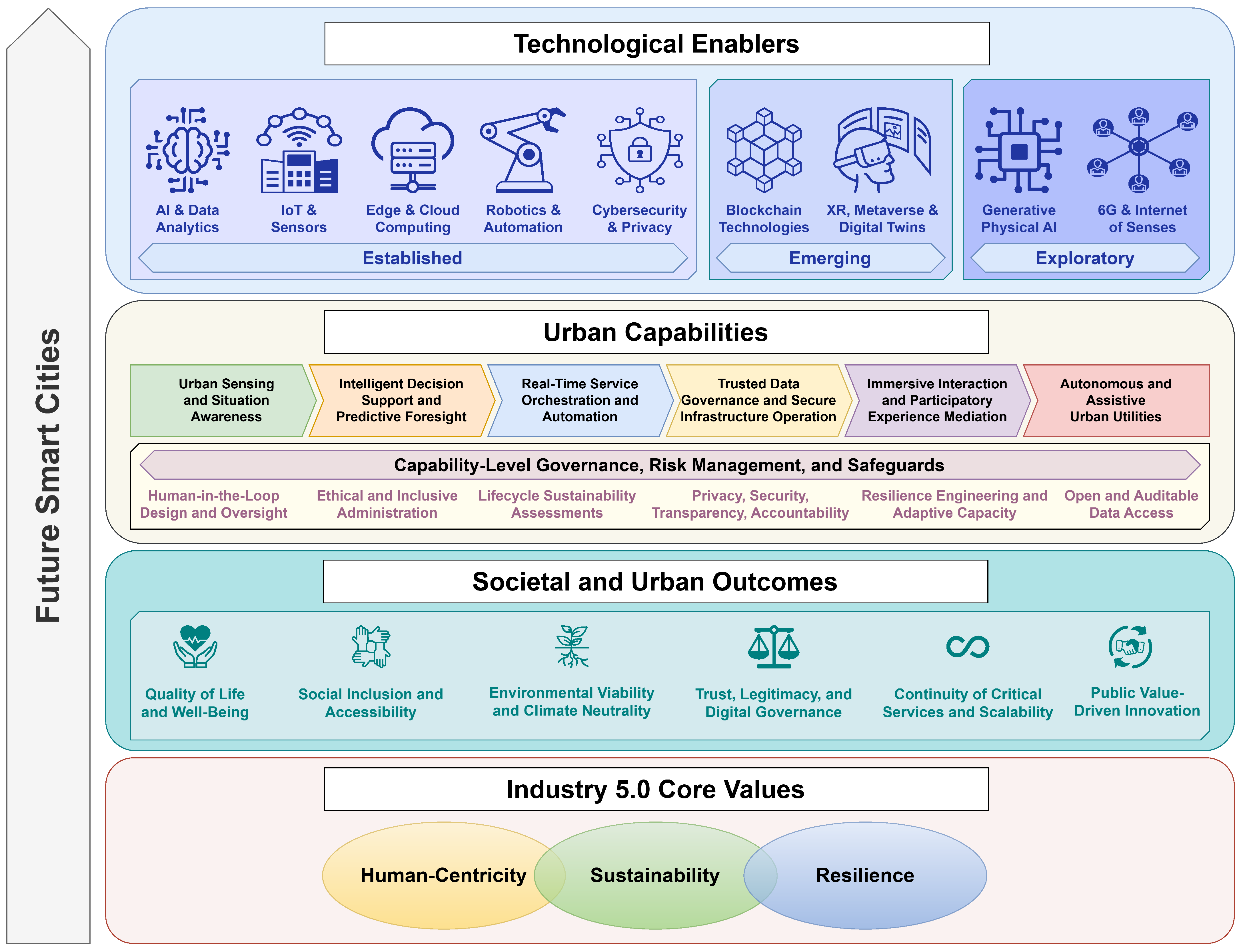
Building on the capability-oriented taxonomy and the analysis of risks, trade-offs, and safeguards discussed above, this subsection presents an integrated framework that consolidates the relationships among I5.0 core values, technological enablers, urban capabilities, governance mechanisms, and societal outcomes. Figure 2 visualizes this integration by positioning human-centricity, sustainability, and resilience as the normative foundation of future smart cities (seen at the base layer of the framework).
I5.0 core values shape both the selection of digital technologies and the priorities guiding urban transformation. The technological enablers discussed in Section 4 provide the technical layer upon which smart city initiatives are built, but they do not determine outcomes on their own. At the core of the framework lie the six interrelated urban capability domains (Section 5.1), which translate technological potential into functional and policy-relevant capacities. By abstracting across individual technologies, the capability layer captures what cities are able to do in practice, facilitating synthesis across heterogeneous configurations and enabling comparison across different urban contexts.
A defining feature of the framework is the explicit representation of capability-level governance, risk management, and safeguards as cross-cutting conditions that continuously shape capability development and deployment. In this sense, governance operates as the integral component through which capabilities are aligned with public value and ethics, translating abstract I5.0 principles into enforceable rules, practices, and decision-making processes that mitigate systemic risks and preserve long-term urban viability.
At the outcome level, the framework connects urban capabilities to a set of societal and urban outcomes that reflect the intended impacts of I5.0-based smart city development. These include improvements in quality of life and well-being, social inclusion and accessibility, environmental viability and climate neutrality, trust and legitimacy in digital governance, continuity of critical services, and public value-driven innovation, to name but a few. These outcomes are co-produced and mutually reinforcing, arising from the interaction of values, capabilities, technological enablers, as well as governance.
Overall, the integrated framework complements the analytical mapping in Table 3 by showcasing how I5.0 principles are translated into actionable urban capacities and socially meaningful outcomes. Crucially, as depicted by the directional flows in the figure, this is not a static hierarchy but an active, continuous feedback loop. The ’Capability-Level Governance’ block acts as the critical filtering layer; it is the analytical bottleneck that prevents raw technological enablers from cascading into unintended societal consequences. By visually nesting these safeguards between the capabilities and the final outcomes, the diagram illustrates that achieving I5.0 targets is entirely contingent on how rigorously this middle governance layer is maintained. In doing so, it reinforces the interpretation of future smart cities as value-driven socio-technical systems in which technological innovation is continuously mediated by governance and oriented toward human-centric, sustainable, and resilient urban development. In addition, this synthesis highlights that the analytical contribution of the capability-oriented perspective lies not only in organizing technologies through their functional urban implications or maturity status (established, emerging, exploratory), but also in enabling systematic comparison of how different cities utilize digital transformation under varying governance conditions and value priorities.

6. Implications for Governance, Policy, and Evaluation

The capability-oriented taxonomy and integrated framework (Section 5) shows that I5.0 smart cities cannot be advanced through linear technological deployment. Instead, urban transformation depends on how technologies are institutionalized into capabilities, and how those capabilities are governed, evaluated, and iteratively reconfigured to remain aligned with the three I5.0 pillars (Section 3).
This section translates the preceding synthesis into practical implications for (i) governance design, (ii) policy and standardization alignment, and (iii) evaluation and monitoring approaches that can support human-centric, sustainable, and resilient smart city outcomes. Table 5 summarizes these dimensions as an operational extension of the capability-oriented taxonomy, indicating where institutional action is required to adhere to I5.0 principles.

6.1. From Technology Procurement to Capability Governance

In earlier smart-city paradigms, governance often followed technology adoption, leaving participation, inclusion, and accountability to be addressed only after data infrastructures and platforms had already been deployed [8,9]. I5.0 implies the opposite ordering: governance becomes a constitutive layer that shapes how capabilities are defined, which risks are acceptable, and which trade-offs are negotiated in public-value terms (Figure 2). This is particularly evident for capabilities that directly mediate citizen experience and agency [12,13], such as urban sensing, AI-driven decision support, immersive participation, and autonomous operations (Table 4). In these cases, legitimacy depends on whether governance secures meaningful participation, accessibility, proportionality of data practices, and clear accountability for decisions affecting residents [35]. To operationalize this human-centricity beyond symbolic consultation, smart city governance must enforce specific administrative mechanisms. These include mandating HCD methodologies during the procurement phase of digital services, institutionalizing participatory data stewardship boards where citizens hold agenda-setting power, and requiring explicit human-in-the-loop decision structures for high-stakes algorithmic systems.
Capability governance also requires cities to treat data stewardship and security as operational foundations. As indicated in Section 4, distributed IoT infrastructures, edge–cloud architectures, and cross-agency data ecosystems expand both capability and exposure. Governance must therefore define robust decision rights for data access and use, auditable provenance, and enforceable responsibility for system operation, especially where critical services depend on continuous connectivity and automation [109,110]. In this sense, cybersecurity and privacy-preserving mechanisms are not only technical controls but institutional commitments that protect human-centricity and sustain resilience by safeguarding continuity of essential services under adversarial conditions [55,108].

6.2. Policy Alignment and Standardization as Enablers of Public Value

I5.0 smart city development sits at the intersection of technological modernization and policy missions that prioritize societal well-being and ecological responsibility [4,5]. Governance and investment priorities therefore benefit from explicit alignment with policy frameworks that articulate long-horizon objectives and enable accountability over time. SDG 11 [15,23] provides a widely adopted reference for inclusive, safe, resilient, and sustainable cities, supporting a common direction for local strategies while enabling cross-city comparability [16]. Similarly, mission-oriented programs such as the “EU Cities Mission” [24] provide concrete targets and implementation pathways that can anchor smart city roadmaps beyond vendor-driven modernization narratives.
Standardization frameworks complement mission alignment by supplying indicator systems and reporting structures that reduce ambiguity about what should be measured and how progress can be compared. In particular, the ISO 37120/37122 standards family [17,18] supports a shift from technology-counting metrics to service- and outcome-oriented indicators, strengthening evidence-based governance and policy cycles that connect investments to societal outcomes [19]. Within the capability-oriented framing, these standards can be interpreted as instruments that stabilize baseline performance across capability domains, such as sensing coverage, service continuity, and infrastructure reliability, while still allowing for contextual adaptation to local needs and constraints.
At the same time, policy alignment does not eliminate trade-offs. Sustainability objectives, for example, can be undermined by rebound effects when efficiency gains increase demand or when system boundaries ignore lifecycle impacts, including the energy and material footprints of computation-intensive services [50,64]. Policy alignment must therefore be accompanied by governance mechanisms that explicitly surface and manage trade-offs between near-term performance gains and long-term viability, especially for capabilities that scale with AI computation, immersive infrastructures, and automated operations (Table 4).

6.3. Human-Centric Assessment Beyond Efficiency Metrics

Human-centricity implies that evaluation must account for what residents experience, not only what systems optimize [25]. This requires combining functional performance indicators with measures of perceived quality [45], accessibility [42,43], and distributional effects across population groups [44]. In practice, this translates into evaluation designs that combine: (i) objective service indicators such as coverage, response times, and reliability; (ii) subjective experience measures (QoL, QoE, satisfaction, trust, and sense of inclusion, etc.); and (iii) equity-sensitive analysis that identifies where benefits concentrate and where exclusion persists across populations.
AI-enabled decision support and automation intensify the need for evaluation frameworks that address interpretability, bias, and accountability [22]. For high-impact urban services, explainability and human oversight become evaluation criteria in their own right, because opaque model-driven decisions can reduce trust and legitimacy even when technical accuracy appears high [71,72,75]. Evaluation must therefore extend beyond predictive performance to include transparency of assumptions, contestability of outcomes, and documented processes for stakeholder involvement in scenario exploration and decision justification, particularly in domains involving risk and vulnerability, such as mobility safety, disaster response, and public health planning [6,52,65].

6.4. Sustainability Assessment as Lifecycle Commitment

Sustainability evaluation must incorporate lifecycle perspectives, including the energy and carbon intensity of digital infrastructures, maintenance burdens, and the possibility of resource lock-in through proprietary platforms and long-lived urban technology contracts. This is especially salient for cloud–edge computing and AI-intensive analytics [64,96], where performance gains depend on how workloads are distributed across tiers and how energy-efficiency rules are turned into standardized policies [86,95]. Consequently, sustainability in I5.0 governance moves beyond abstract environmental goals through the implementation of concrete regulatory and financial mechanisms. These include adopting Green Public Procurement standards [175] for digital infrastructures, enforcing lifecycle-aware assessments that account for the carbon footprint of intensive AI and cloud-edge orchestration, and embedding circular-economy principles directly into vendor contracts to prevent resource lock-in and e-waste.

6.5. Resilience Assessment for Service Continuity

Resilience assessment likewise requires a systemic perspective on interdependencies among physical, digital, and social-institutional domains [53]. Capabilities that coordinate real-time services or depend on secure operation must be evaluated for continuity under disruption, including graceful degradation, redundancy, and recovery capacity under cyber incidents or infrastructure failures [54,55]. In I5.0 terms [5], resilience metrics should capture not only technical robustness but also institutional readiness and governance capacity to sustain essential functions, coordinate stakeholders, and learn from disruptions through iterative improvement cycles [26]. Translating this resilience from a theoretical attribute into a concrete governance mechanism requires proactive institutional protocols. Essentially, this involves mandating redundancy and graceful degradation requirements for critical service architectures, inserting routine cyber-resilience stress testing across interconnected edge-cloud layers, and formalizing cross-agency workflows that ensure continuity during infrastructural or environmental disruptions.

6.6. Implications for Implementing the Capability-Oriented Framework

Taken together, the preceding implications support an implementation logic consistent with the integrated framework presented in Figure 2. First, cities can use capability domains as a shared language for translating technology portfolios into actionable functional priorities, reducing fragmentation across departmental silos and enabling strategic coordination [6,122]. Second, the concepts summarized in Table 4 can function as a governance checklist, linking each capability to anticipated risks and safeguards so that value tensions are surfaced early rather than handled as downstream compliance issues. By explicitly operationalizing these safeguards through the concrete procurement, regulatory, and auditing mechanisms detailed in the preceding subsections, cities can systematically bridge the gap between high-level I5.0 principles and daily administrative practice. Third, evaluation systems can be structured to reflect the three I5.0 pillars simultaneously, ensuring that performance targets (high QoS/QoE and efficiency), societal outcomes (QoL, inclusion, legitimacy), and long-horizon impacts (decarbonization, continuity, adaptive capacity) are monitored as integrated concerns instead of isolated reporting streams [15,17,18]. In this way, the capability-oriented approach (Section 5) provides an actionable bridge between the value-driven goals articulated in the I5.0 triad (Section 3) and the enabling technologies of I5.0 smart cities (Section 4), offering a structured pathway for governing and evaluating smart city transformation (Section 6) as a human-centric, sustainable, and resilient socio-technical project.

7. Open Challenges and Future Outlook

Even though the capability-oriented taxonomy and integrated framework developed in the previous sections provide a coherent lens for understanding I5.0 smart cities, they also bring to the foreground a set of persistent questions that emerge when these capabilities are implemented and governed in real-world settings. Across smart city and S5.0 research, such challenges arise less from individual technologies than from the interaction between urban capabilities, governance arrangements, institutional capacity, and long-term societal objectives [6]. In this respect, the I5.0 framing helps clarify long-standing tensions while also exposing structural constraints that need to be acknowledged. Table 6 synthesizes these challenges by mapping them to capability domains, highlighting where the transition from technological potential to governed urban functionality remains unresolved.
A first overarching challenge concerns the activation of human-centricity at the capability level. Although participation, inclusion, and well-being are widely endorsed, Table 6 shows that capabilities such as sensing, decision support, immersive mediation, and autonomous utilities can reproduce asymmetries in power, access, and representation. Observations from real-world applications repeatedly document difficulties in embedding such practices into smart city development [8,13]. As discussed earlier, citizen engagement often remains confined to consultation phases, while core decisions regarding data governance, algorithmic design, and service orchestration remain institutionally insulated. Research on SC2.0 [2] suggests that, without enforceable co-creation, HCD mechanisms, and human-in-the-loop requirements, human-centricity risks remain somewhat symbolic as opposed to being actionable dimensions of community-oriented smart cities. Conversely, future I5.0 initiatives must move toward formalized participatory administration, where QoE/QoL indicators, accessibility standards, and data governance rights are embedded as capability-level requirements rather than post hoc adjustments [12].
A second challenge concerns sustainability evaluation and, more specifically, the temporal misalignment between capability deployment and sustainability outcomes. As indicated in Table 6, capabilities that optimize efficiency in the short term, such as AI-driven decision support or automated robotic appliances, may generate long-term environmental and resource burdens if lifecycle effects are not explicitly governed. Rebound effects, increased energy demand, and infrastructure lock-in often escape short-term evaluations focused on operational performance [7,50]. Given the SDGs [15], sustainability efforts necessitate stable lifecycle-aware monitoring in favor of isolated project-level optimization. This, in turn, amplifies the need for mission-oriented sustainability planning, where digital infrastructures are assessed against long-term climate neutrality, circularity, fairness, and equity objectives [16].
A third challenge concerns the systemic nature of resilience in capability-driven architectures. Capabilities such as real-time orchestration and secure functionality increase responsiveness but also intensify interdependencies across CPSs. As shown in Table 6, this creates conditions for cascading failures and new vulnerability pathways. Ensuring resilience in such cases requires embedding redundancy, decentralization, and failover mechanisms as intrinsic design properties that move beyond being purely reactive defense measures [52,55]. This aligns with the I5.0 emphasis on continuity of essential services under uncertainty [176].
Beyond individual capability domains, governance capacity emerges as a structural constraint affecting the realization of all I5.0 pillars. The transition from technological deployment to capability governance requires institutional competencies that many cities still lack, including data stewardship, cross-sector coordination, and long-term regulatory oversight. Fragmented responsibilities and vendor dependencies further complicate this transition [2]. In this respect, the capability-oriented perspective highlights that smart city transformation is not only a technological challenge but also a societal one, requiring sustained public-sector know-how and capacity building along governance innovation.
A further cross-cutting challenge concerns the management of capability-level trade-offs. As shown in the preceding analysis, tensions between automation and human agency, personalization and privacy, and efficiency and equity are not anomalies but structural characteristics of capability-driven systems [22,65]. For these tensions to be resolved, new oversight methods must be utilized that make trade-offs visible, contestable, and adaptable over time [110,140].
Notably, these challenges point toward the need for adaptive and learning-oriented governance models. Static planning approaches are increasingly inadequate under evolving technological, environmental, and civil conditions. Instead, capability-oriented smart city development requires continuous feedback loops, iterative policy adjustment, and integration of real-time data into decision-making [52,55].
At the same time, the capability-oriented framework itself is subject to limitations that shape its applicability. By abstracting across heterogeneous technologies, it provides a unifying analytical scope, yet this abstraction may ultimately obscure important contextual differences between cities, including institutional maturity, resource availability, and socio-cultural conditions that otherwise require high granularity. In addition, capabilities such as human-centricity or resilience are deemed difficult to measure and compare because they depend on qualitative, context-sensitive indicators, often requiring long-term observation. Finally, the effectiveness of the framework depends on planning and administrative capacity, meaning that its practical implementation may be uneven across regions. These limitations do not undermine the framework’s analytical value and scalability, but indicate that its application requires contextual adaptation and further empirical validation.
In this sense, the future development of I5.0 smart cities depends not only on technological innovation, but also on strengthening the institutional, governance, and analytical capacities required to translate digital infrastructures into meaningful societal outcomes. The capability-oriented perspective contributes to this effort by structuring these challenges within a coherent framework, while also showing that the realization of human-centric, sustainable, and resilient smart cities remains contingent on how effectively these capabilities are governed, evaluated, and continuously reconfigured over time.

8. Conclusions

This entry examined the evolution of smart cities through the lens of I5.0, arguing that urban digital transformation should be assessed not by technological sophistication alone but by its capacity to deliver human-centric, sustainable, and resilient societal outcomes. Building on established critiques of technology-led smart city paradigms and on the policy turn that reframes innovation around public value, it positions the I5.0 triad as a coherent normative foundation for future smart city development.
A central contribution of this work is the introduction of a capability-oriented perspective that bridges the persistent gap between technological enablers and urban outcomes. The former include established smart city technologies in conjunction with emerging ones, which are in early-stage adoption, as well as vision-driven exploratory alternatives. Regardless of their maturity status, by distinguishing these technologies as means from capabilities as functional and organizational capacities, the proposed taxonomy clarifies how similar technological stacks can yield substantially different results based on configuration choices, governance arrangements, institutional embedding, and civic participation. Hence, the six capability domains recognized in this entry provide a unifying analytical structure for interpreting heterogeneous smart city initiatives under a common I5.0 logic.
The analysis further underscores that I5.0 values are not inherent properties of digital technologies. Conversely, human-centricity, sustainability, and resilience are realized (or compromised) at the point where technologies are translated into functional capabilities and formalized through governance mechanisms, safeguards, and evaluation practices. The systematic articulation of capability-level risks, trade-offs, and safeguards demonstrates that value tensions, such as automation versus agency, personalization versus privacy, or efficiency versus equity, are intrinsic to smart city ecosystems and therefore require proactive management instead of retrospective correction.
Finally, the presented capability-oriented framework consolidates these insights by linking I5.0 values, technological enablers, urban capabilities, governance and risk management, and societal outcomes into a coherent analytical structure. By abstracting across specific technologies, the framework supports cross-city comparability, mission-oriented policy alignment, and evaluation approaches that integrate QoL parameters, including lived experience, inclusion, environmental viability, and service continuity, alongside theoretical effectiveness. In doing so, the entry contributes not only a conceptual synthesis but also an actionable interpretive reference for understanding and guiding smart city transformation as a long-term, value-driven socio-technical project under I5.0.

Author Contributions

Conceptualization, A.T.; methodology, A.T., V.K. and G.T.; software, A.T., V.K. and G.T.; validation, A.T., V.K. and G.T.; formal analysis, A.T., V.K. and G.T.; investigation, A.T., V.K. and G.T.; resources, A.T., V.K. and G.T.; data curation, A.T., V.K. and G.T.; writing—original draft preparation, A.T., V.K. and G.T.; writing—review and editing, A.T., V.K. and G.T.; visualization, A.T.; supervision, A.T. All authors have read and agreed to the published version of the manuscript.

Funding

This research received no external funding.

Institutional Review Board Statement

Not applicable.

Informed Consent Statement

Not applicable.

Data Availability Statement

Data is contained within the article. Further inquiries can be directed to the corresponding author.

Acknowledgments

During the preparation of this study, the authors used ChatGPT 5.2 for the purposes of styling tables in LaTeX and assisting with language refinement. The authors have reviewed and edited the output and take full responsibility for the content of this publication.

Conflicts of Interest

The authors declare no conflicts of interest.

Entry Link

The Link to this entry published on the encyclopedia platform.

Abbreviations

The following abbreviations are used in this manuscript:
3DThree-DimensionalI5.0Industry 5.0
5GFifth-Generation of CommunicationsICTInformation and Communication Technologies
6GSixth-Generation of CommunicationsIESCIoT-enabled Smart City
AIArtificial IntelligenceIIoTIndustrial Internet of Things
ADRAutonomous Delivery RobotIoSInternet of Senses
AMRAutonomous Mobile RobotsIoTInternet of Things
ARAugmented RealityITUInternational Telecommunications Union
UAVUnmanned Aerial VehicleLLMLarge Language Model
UGVUnmanned Ground VehicleMLMachine Learning
CIMCity Information ModelingMRMixed Reality
CPSCyber–Physical SystemNFTNon-Fungible Token
CPSSCyber–Physical Social SystemNPSNew Public Service
DEMDigital Elevation ModelNTNNon-Terrestrial Networks
DLDeep LearningP2PPeer-to-Peer
DTDigital TwinRLReinforcement Learning
EUEuropean UnionS5.0Society 5.0
FG-SSCFocus Group on Smart Sustainable CitiesSC2.0Smart City 2.0
FLFederated LearningSDGSustainable Development Goal
GAIGreen Artificial IntelligenceUGCUser-Generated Content
GHGGreenhouse GasUNUnited Nations
GPAIGenerative Physical Artificial IntelligenceURLLCUltra-Reliable Low-Latency Communication
GPSGlobal Positioning SystemQoEQuality of Experience
HAPSHigh-Altitude Platform StationQoLQuality of Life
HCAIHuman-Centered Artificial IntelligenceQoSQuality of Service
HCDHuman-Centered DesignVGIVolunteered Geographic Information
HCIHuman–Computer InteractionVLAVisual–Language–Action
HMDHead-Mounted DisplayVRVirtual Reality
HRIHuman–Robot InteractionXAIExplainable Artificial Intelligence
I4.0Industry 4.0XRExtended Reality

References

  1. Kondepudi, S.N. Smart Sustainable Cities: An Analysis of Definitions; Technical Report; International Telecommunication Union: Geneva, Switzerland, 2014; Available online: https://www.itu.int/en/itu-t/focusgroups/ssc/documents/approved_deliverables/tr-definitions.docx (accessed on 17 March 2026).
  2. Trencher, G. Towards the smart city 2.0: Empirical evidence of using smartness as a tool for tackling social challenges. Technol. Forecast. Soc. Change 2019, 142, 117–128. [Google Scholar] [CrossRef]
  3. Del-Real, C.; Ward, C.; Sartipi, M. What do people want in a smart city? Exploring the stakeholders’ opinions, priorities and perceived barriers in a medium-sized city in the United States. Int. J. Urban Sci. 2023, 27, 50–74. [Google Scholar] [CrossRef]
  4. European Commission and Directorate-General for Research and Innovation. Industry 5.0, a Transformative Vision for Europe–Governing Systemic Transformations Towards a Sustainable Industry; Publications Office of the European Union: Luxembourg, Luxembourg, 2021. [Google Scholar]
  5. European Commission: Directorate-General for Research and Innovation. Industry 5.0–Towards a Sustainable, Human-Centric and Resilient European Industry; Publications Office of the European Union: Luxembourg, Luxembourg, 2021. [Google Scholar]
  6. Mishra, P.; Thakur, P.; Singh, G. Sustainable Smart City to Society 5.0: State-of-the-Art and Research Challenges. SAIEE Afr. Res. J. 2022, 113, 152–164. [Google Scholar] [CrossRef]
  7. Gracias, J.S.; Parnell, G.S.; Specking, E.; Pohl, E.A.; Buchanan, R. Smart Cities—A Structured Literature Review. Smart Cities 2023, 6, 1719–1743. [Google Scholar] [CrossRef]
  8. van Twist, A.; Ruijer, E.; Meijer, A. Smart cities & citizen discontent: A systematic review of the literature. Gov. Inf. Q. 2023, 40, 101799. [Google Scholar] [CrossRef]
  9. Sánchez-Teba, E.M.; Bermúdez-González, G.J. Are Smart-City Projects Citizen-Centered? Soc. Sci. 2019, 8, 309. [Google Scholar] [CrossRef]
  10. Rajumesh, S. Promoting sustainable and human-centric industry 5.0: A thematic analysis of emerging research topics and opportunities. J. Bus. Socio-Econ. Dev. 2023, 4, 111–126. [Google Scholar] [CrossRef]
  11. Li, L.; Duan, L. Human centric innovation at the heart of industry 5.0–Exploring research challenges and opportunities. Int. J. Prod. Res. 2025, 1–33. [Google Scholar] [CrossRef]
  12. Nahavandi, S. Industry 5.0—A Human-Centric Solution. Sustainability 2019, 11, 4371. [Google Scholar] [CrossRef]
  13. Parappallil Mathew, B.; Bangwal, D. People centric governance model for smart cities development: A systematic review, thematic analysis, and findings. Res. Glob. 2024, 9, 100237. [Google Scholar] [CrossRef]
  14. Küfeoğlu, S. SDG-11: Sustainable Cities and Communities. In Emerging Technologies: Value Creation for Sustainable Development; Springer International Publishing: Cham, Switzerland, 2022; pp. 385–408. [Google Scholar] [CrossRef]
  15. Thomas, R.; Hsu, A.; Weinfurter, A. Sustainable and inclusive–Evaluating urban sustainability indicators’ suitability for measuring progress towards SDG-11. Environ. Plan. B Urban Anal. City Sci. 2021, 48, 2346–2362. [Google Scholar] [CrossRef]
  16. Pérez del Hoyo, R.; Visvizi, A.; Mora, H. Chapter 2—Inclusiveness, safety, resilience, and sustainability in the smart city context. In Smart Cities and the UN SDGs; Visvizi, A., Pérez del Hoyo, R., Eds.; Elsevier: Amsterdam, The Netherlands, 2021; pp. 15–28. [Google Scholar] [CrossRef]
  17. ISO 37120; Sustainable Development of Communities—Indicators for City Services and Quality of Life. International Organization for Standardization: Geneva, Switzerland, 2018. Available online: https://www.iso.org/standard/68498.html (accessed on 14 March 2026).
  18. ISO 37122; Sustainable Cities and Communities—Indicators for Smart Cities. International Organization for Standardization: Geneva, Switzerland, 2019. Available online: https://www.iso.org/standard/69050.html (accessed on 14 March 2025).
  19. Assumang, D.K.; Matthews, J.; Ajani, O.L.; Olotu, T.O.; Larbi, S.Y. Agile Governance for Smart Cities: A Framework for Sustainable Public Infrastructure. J. Econ. Manag. Trade 2025, 31, 99–119. [Google Scholar] [CrossRef]
  20. Rejeb, A.; Rejeb, K.; Zrelli, I.; Süle, E. Industry 5.0 as seen through its academic literature: An investigation using co-word analysis. Discov. Sustain. 2025, 6, 307. [Google Scholar] [CrossRef]
  21. Adel, A. Future of industry 5.0 in society: Human-centric solutions, challenges and prospective research areas. J. Cloud Comput. 2022, 11, 40. [Google Scholar] [CrossRef]
  22. Martini, B.; Bellisario, D.; Coletti, P. Human-Centered and Sustainable Artificial Intelligence in Industry 5.0: Challenges and Perspectives. Sustainability 2024, 16, 5448. [Google Scholar] [CrossRef]
  23. United Nations Department of Economic and Social Affairs. The Sustainable Development Goals Report 2025. Available online: https://unstats.un.org/sdgs/report/2025/ (accessed on 15 March 2026).
  24. European Commission: Directorate-General for Research and Innovation. EU Missions—100 Climate-Neutral and Smart Cities; Publications Office of the European Union: Luxembourg, Luxembourg, 2024. [Google Scholar]
  25. Tyagi, A.K.; Lakshmi Priya, R.; Mishra, A.K.; Balamurugan, G. Industry 5.0. In Privacy Preservation of Genomic and Medical Data; John Wiley & Sons, Ltd.: Hoboken, NJ, USA, 2023; Chapter 17; pp. 409–432. [Google Scholar] [CrossRef]
  26. Meerow, S.; Newell, J.P.; Stults, M. Defining urban resilience: A review. Landsc. Urban Plan. 2016, 147, 38–49. [Google Scholar] [CrossRef]
  27. Sharifi, A. Urban Resilience Assessment: Mapping Knowledge Structure and Trends. Sustainability 2020, 12, 5918. [Google Scholar] [CrossRef]
  28. Zhang, C.; Wang, Z.; Zhou, G.; Chang, F.; Ma, D.; Jing, Y.; Cheng, W.; Ding, K.; Zhao, D. Towards new-generation human-centric smart manufacturing in Industry 5.0: A systematic review. Adv. Eng. Inform. 2023, 57, 102121. [Google Scholar] [CrossRef]
  29. Xu, X.; Lu, Y.; Vogel-Heuser, B.; Wang, L. Industry 4.0 and Industry 5.0—Inception, conception and perception. J. Manuf. Syst. 2021, 61, 530–535. [Google Scholar] [CrossRef]
  30. Hu, W.; Wang, S.; Zhai, W. Human-centric vs. technology-centric approaches in a top-down smart city development regime: Evidence from 341 Chinese cities. Cities 2023, 137, 104271. [Google Scholar] [CrossRef]
  31. Angelidou, M. Smart cities: A conjuncture of four forces. Cities 2015, 47, 95–106. [Google Scholar] [CrossRef]
  32. Kummitha, R.K.R.; Crutzen, N. How do we understand smart cities? An evolutionary perspective. Cities 2017, 67, 43–52. [Google Scholar] [CrossRef]
  33. Naomi, D.S.; Antonio, L.; Roberta, S. Tokenism in Territorial Development: Enabling Factors and Mitigation Measures. Eur. Countrys. 2023, 15, 346–365. [Google Scholar] [CrossRef]
  34. Kummitha, R.K.R. Smart city governance: Assessing modes of active citizen engagement. Reg. Stud. 2025, 59, 2399262. [Google Scholar] [CrossRef]
  35. Denhardt, R.B.; Denhardt, J.V. The New Public Service: Serving Rather than Steering. Public Adm. Rev. 2000, 60, 549–559. [Google Scholar] [CrossRef]
  36. Landa Oregi, I.; Urra-Uriarte, S.; Gonzalez Ochoantesana, I.; Rodríguez, M.A.; Molina-Costa, P. Enhancing Citizen Participation in Citizen-Centered Smart Cities: Insights from Two European Case Studies. Urban Sci. 2025, 9, 140. [Google Scholar] [CrossRef]
  37. Landa-Oregi, I.; Gonzalez-Ochoantesana, I.; Anaya-Rodriguez, M. Understanding the engagement of citizens in the regeneration of urban spaces through human-centered design: A systematic literature review. Cities 2026, 168, 106414. [Google Scholar] [CrossRef]
  38. van der Graaf, S.; Nguyen Long, L.A.; Veeckman, C. Co-Creation and Smart Cities: Looking Beyond Technology; Emerald Publishing Limited: Leeds, UK, 2021. [Google Scholar] [CrossRef]
  39. Beckman, T.; Massi, M. Co-creating the Smart City: Integrating market orientation for sustainable urban planning. In Sustainable and Smart Cities: Governance, Economy and Society, 1st ed.; Khare, A., Beckman, T., Eds.; Routledge: London, UK, 2025; pp. 37–51. [Google Scholar] [CrossRef]
  40. Afzalan, N.; Sanchez, T.W.; Evans-Cowley, J. Creating smarter cities: Considerations for selecting online participatory tools. Cities 2017, 67, 21–30. [Google Scholar] [CrossRef]
  41. Kolotouchkina, O.; Ripoll González, L.; Belabas, W. Smart Cities, Digital Inequalities, and the Challenge of Inclusion. Smart Cities 2024, 7, 3355–3370. [Google Scholar] [CrossRef]
  42. Karelis, C.; Lachana, Z.; Gorelova, I.; Alexopoulos, C.; Lavdaria, N.; Bellini, F.; Charalabidis, Y. Digital Inclusion and Social Cohesion in Smart Cities: Overcoming Barriers in the Digital Age. Conf. Digit. Gov. Res. 2025, 26. [Google Scholar] [CrossRef]
  43. Kim, J.; Lee, D.; Hwang, J.; Lee, J. What makes smart cities inclusive? The spillover effects of the intra-city digital divide on inter-city digital inequality. Sustain. Cities Soc. 2025, 135, 106939. [Google Scholar] [CrossRef]
  44. Colding, J.; Nilsson, C.; Sjöberg, S. Smart Cities for All? Bridging Digital Divides for Socially Sustainable and Inclusive Cities. Smart Cities 2024, 7, 1044–1059. [Google Scholar] [CrossRef]
  45. Dobrowolska, E.; Kopczewska, K. Mapping urban well-being with Quality Of Life Index (QOLI) at the fine-scale of grid data. Sci. Rep. 2024, 14, 9680. [Google Scholar] [CrossRef]
  46. Pazos-García, M.J.; López-López, V.; Iglesias-Antelo, S.; Vila-Vázquez, G. Quality of life in cities: An outcome and a resource? Eur. Res. Manag. Bus. Econ. 2025, 31, 100264. [Google Scholar] [CrossRef]
  47. Roszkowska, E.; Wachowicz, T. Smart Cities and Resident Well-Being: Using the BTOPSIS Method to Assess Citizen Life Satisfaction in European Cities. Appl. Sci. 2024, 14, 11051. [Google Scholar] [CrossRef]
  48. Satheesh, S.; Shukla, K. Industry 5.0, quality of life, and sustainable adaptation to climate change: Challenges and the Transformational Way Forward. In Quality of Life and Climate Change: Impacts, Sustainable Adaptation, and Social-Ecological Resilience; Shukla, K., Patil, Y.B., Estoque, R.C., Lopez de Haro, P., Eds.; IGI Global: Hershey, PA, USA, 2023; pp. 200–219. [Google Scholar] [CrossRef]
  49. Răducan, R.; Lozsa, J.; Vîrga, D.; Matichescu, M. New Integrative Model of the Quality of Urban Life: A Systematic Review. Soc. Indic. Res. 2025, 179, 895–921. [Google Scholar] [CrossRef]
  50. Sorrell, S. Jevons’ Paradox revisited: The evidence for backfire from improved energy efficiency. Energy Policy 2009, 37, 1456–1469. [Google Scholar] [CrossRef]
  51. Aheleroff, S.; Huang, H.; Xu, X.; Zhong, R.Y. Toward sustainability and resilience with Industry 4.0 and Industry 5.0. Front. Manuf. Technol. 2022, 2, 951643. [Google Scholar] [CrossRef]
  52. Umeike, R.; Dao, T.; Crawford, S. State-of-the-art review of resilient smart cities: Progress and challenges. Urban Gov. 2025, 5, 222–239. [Google Scholar] [CrossRef]
  53. Saptono, Y.; Rustiadi, E.; Barus, B.; Pravitasari, A.E. Systematic Literature Review: Research Development of Urban Resilience in Metropolitan Areas. Sustainability 2025, 17, 7380. [Google Scholar] [CrossRef]
  54. de Genaro Chiroli, D.M.; Ferrassa, T.P.; Idalgo, L.d.N.; Mick, M.M.A.P.; Kovaleski, J.L.; Aragão, F.V.; Tebcherani, S.M.; Zola, F.C. Digital Transformation for Smart and Resilient Cities: Assessing Platform Maturity and ISO 37123 Compliance. Platforms 2025, 3, 3. [Google Scholar] [CrossRef]
  55. Almulhim, A.I. Building Urban Resilience Through Smart City Planning: A Systematic Literature Review. Smart Cities 2025, 8, 22. [Google Scholar] [CrossRef]
  56. Ghobakhloo, M.; Mahdiraji, H.A.; Iranmanesh, M.; Jafari-Sadeghi, V. From Industry 4.0 Digital Manufacturing to Industry 5.0 Digital Society: A Roadmap Toward Human-Centric, Sustainable, and Resilient Production. Inf. Syst. Front. 2024. [Google Scholar] [CrossRef]
  57. European Commission: Directorate-General for Research and Innovation. Enabling Technologies for Industry 5.0: Results of a Workshop with Europe’s Technology Leaders; Publications Office of the European Union: Luxembourg, Luxembourg, 2020. [Google Scholar]
  58. Adel, A.; HS Alani, N. Human-Centric Collaboration and Industry 5.0 Framework in Smart Cities and Communities: Fostering Sustainable Development Goals 3, 4, 9, and 11 in Society 5.0. Smart Cities 2024, 7, 1723–1775. [Google Scholar] [CrossRef]
  59. Wolniak, R.; Stecuła, K. Artificial Intelligence in Smart Cities—Applications, Barriers, and Future Directions: A Review. Smart Cities 2024, 7, 1346–1389. [Google Scholar] [CrossRef]
  60. John, J.; David Amar Raj, R.; Karimi, M.; Nazari, R.; Yanamala, R.M.R.; Pallakonda, A. Artificial Intelligence for Smart Cities: A Comprehensive Review Across Six Pillars and Global Case Studies. Urban Sci. 2025, 9, 249. [Google Scholar] [CrossRef]
  61. Zhuang, Y.; Cenci, J.; Zhang, J. Review of Big Data Implementation and Expectations in Smart Cities. Buildings 2024, 14, 3717. [Google Scholar] [CrossRef]
  62. Razavian, B.; Hamed, S.; Fayyaz, M.; Ghasemi, P.; Ozkul, S.; Tirkolaee, E.B. Addressing barriers to big data implementation in sustainable smart cities: Improved zero-sum grey game and grey best-worst method. J. Innov. Knowl. 2024, 9, 100593. [Google Scholar] [CrossRef]
  63. Mrabet, M.; Sliti, M. Integrating machine learning for the sustainable development of smart cities. Front. Sustain. Cities 2024, 6, 1449404. [Google Scholar] [CrossRef]
  64. Yigitcanlar, T.; Mehmood, R.; Corchado, J.M. Green Artificial Intelligence: Towards an Efficient, Sustainable and Equitable Technology for Smart Cities and Futures. Sustainability 2021, 13, 8952. [Google Scholar] [CrossRef]
  65. Luusua, A.; Ylipulli, J.; Foth, M.; Aurigi, A. Correction: Urban AI: Understanding the emerging role of artificial intelligence in smart cities. AI Soc. 2023, 39, 2633. [Google Scholar] [CrossRef]
  66. Sacoto-Cabrera, E.J.; Perez-Torres, A.; Tello-Oquendo, L.; Cerrada, M. IoT, AI, and Digital Twins in Smart Cities: A Systematic Review for a Thematic Mapping and Research Agenda. Smart Cities 2025, 8, 175. [Google Scholar] [CrossRef]
  67. Yigitcanlar, T.; Butler, L.; Windle, E.; Desouza, K.C.; Mehmood, R.; Corchado, J.M. Can Building “Artificially Intelligent Cities” Safeguard Humanity from Natural Disasters, Pandemics, and Other Catastrophes? An Urban Scholar’s Perspective. Sensors 2020, 20, 2988. [Google Scholar] [CrossRef]
  68. Tallat, R.; Hawbani, A.; Wang, X.; Al-Dubai, A.; Zhao, L.; Liu, Z.; Min, G.; Zomaya, A.Y.; Hamood Alsamhi, S. Navigating Industry 5.0: A Survey of Key Enabling Technologies, Trends, Challenges, and Opportunities. IEEE Commun. Surv. Tutor. 2024, 26, 1080–1126. [Google Scholar] [CrossRef]
  69. Yan, J.; Liu, Z.; Leng, J.; Zhao, J.; Chen, C.; Zhang, D.; Tao, Y.; Wang, Y.; Liu, T.; Zhang, C.; et al. Human-centric artificial intelligence towards Industry 5.0: Retrospect and prospect. J. Ind. Inf. Integr. 2025, 47, 100903. [Google Scholar] [CrossRef]
  70. Passalacqua, M.; Pellerin, R.; Magnani, F.; Doyon-Poulin, P.; Del-Aguila, L.; Boasen, J.; Léger, P.M. Human-centred AI in industry 5.0: A systematic review. Int. J. Prod. Res. 2025, 63, 2638–2669. [Google Scholar] [CrossRef]
  71. Dwivedi, R.; Dave, D.; Naik, H.; Singhal, S.; Omer, R.; Patel, P.; Qian, B.; Wen, Z.; Shah, T.; Morgan, G.; et al. Explainable AI (XAI): Core Ideas, Techniques, and Solutions. ACM Comput. Surv. 2023, 55, 194. [Google Scholar] [CrossRef]
  72. Trivedi, C.; Bhattacharya, P.; Prasad, V.K.; Patel, V.; Singh, A.; Tanwar, S.; Sharma, R.; Aluvala, S.; Pau, G.; Sharma, G. Explainable AI for Industry 5.0: Vision, Architecture, and Potential Directions. IEEE Open J. Ind. Appl. 2024, 5, 177–208. [Google Scholar] [CrossRef]
  73. Ahmed, I.; Jeon, G.; Piccialli, F. From Artificial Intelligence to Explainable Artificial Intelligence in Industry 4.0: A Survey on What, How, and Where. IEEE Trans. Ind. Inform. 2022, 18, 5031–5042. [Google Scholar] [CrossRef]
  74. Mastrogiovanni, S. AI-Driven data governance for smart cities: Balancing privacy, efficiency, and public trust. South Fla. J. Dev. 2025, 6, e5810. [Google Scholar] [CrossRef]
  75. Rjab, A.B.; Mellouli, S.; Corbett, J. Barriers to artificial intelligence adoption in smart cities: A systematic literature review and research agenda. Gov. Inf. Q. 2023, 40, 101814. [Google Scholar] [CrossRef]
  76. Zanella, A.; Bui, N.; Castellani, A.; Vangelista, L.; Zorzi, M. Internet of Things for Smart Cities. IEEE Internet Things J. 2014, 1, 22–32. [Google Scholar] [CrossRef]
  77. Vergis, S.; Komianos, V.; Tsoumanis, G.; Tsipis, A.; Oikonomou, K. A Low-Cost Vehicular Traffic Monitoring System Using Fog Computing. Smart Cities 2020, 3, 138–156. [Google Scholar] [CrossRef]
  78. Alavi, A.H.; Jiao, P.; Buttlar, W.G.; Lajnef, N. Internet of Things-enabled smart cities: State-of-the-art and future trends. Measurement 2018, 129, 589–606. [Google Scholar] [CrossRef]
  79. Chi, H.R.; Wu, C.K.; Huang, N.F.; Tsang, K.F.; Radwan, A. A Survey of Network Automation for Industrial Internet-of-Things Toward Industry 5.0. IEEE Trans. Ind. Inform. 2023, 19, 2065–2077. [Google Scholar] [CrossRef]
  80. Omrany, H.; Al-Obaidi, K.M.; Hossain, M.; Alduais, N.A.M.; Al-Duais, H.S.; Ghaffarianhoseini, A. IoT-enabled smart cities: A hybrid systematic analysis of key research areas, challenges, and recommendations for future direction. Discov. Cities 2024, 1, 2. [Google Scholar] [CrossRef]
  81. Sanchez-Gallegos, D.D.; Carrizales-Espinoza, D.E.; Torres-Charles, C.; Carretero, J. Smart Cities: A Systematic Review of Emerging Technologies. Smart Cities 2025, 8, 173. [Google Scholar] [CrossRef]
  82. Adepoju, P.A.; Ige, A.B.; Akinade, A.O.; Afolabi, A.I. Smart Cities and Internet of Things (IoT): A Review of Emerging Technologies and Challenges. Int. J. Res. Innov. Soc. Sci. 2025, 9, 1536–1549. [Google Scholar] [CrossRef]
  83. Gill, S.S.; Tuli, S.; Xu, M.; Singh, I.; Singh, K.V.; Lindsay, D.; Tuli, S.; Smirnova, D.; Singh, M.; Jain, U.; et al. Transformative effects of IoT, Blockchain and Artificial Intelligence on cloud computing: Evolution, vision, trends and open challenges. Internet Things 2019, 8, 100118. [Google Scholar] [CrossRef]
  84. Trigka, M.; Dritsas, E. Edge and Cloud Computing in Smart Cities. Future Internet 2025, 17, 118. [Google Scholar] [CrossRef]
  85. Al-Dulaimy, A.; Jansen, M.; Johansson, B.; Trivedi, A.; Iosup, A.; Ashjaei, M.; Galletta, A.; Kimovski, D.; Prodan, R.; Tserpes, K.; et al. The computing continuum: From IoT to the cloud. Internet Things 2024, 27, 101272. [Google Scholar] [CrossRef]
  86. Lea, R.; Adame, T.; Berne, A.; Azaiez, S. The Internet of Things, Fog, and Cloud Continuum: Integration Challenges and Opportunities for Smart Cities. Future Internet 2025, 17, 281. [Google Scholar] [CrossRef]
  87. Shi, W.; Cao, J.; Zhang, Q.; Li, Y.; Xu, L. Edge computing: Vision and challenges. IEEE Internet Things J. 2016, 3, 637–646. [Google Scholar] [CrossRef]
  88. Jararweh, Y.; Otoum, S.; Ridhawi, I.A. Trustworthy and sustainable smart city services at the edge. Sustain. Cities Soc. 2020, 62, 102394. [Google Scholar] [CrossRef]
  89. Tsipis, A.; Oikonomou, K. Joint optimization of social interactivity and server provisioning for interactive games in edge computing. Comput. Netw. 2022, 212, 109028. [Google Scholar] [CrossRef]
  90. Maddikunta, P.K.R.; Pham, Q.V.; B, P.; Deepa, N.; Dev, K.; Gadekallu, T.R.; Ruby, R.; Liyanage, M. Industry 5.0: A survey on enabling technologies and potential applications. J. Ind. Inf. Integr. 2022, 26, 100257. [Google Scholar] [CrossRef]
  91. Morabito, R.; Cozzolino, V.; Ding, A.Y.; Beijar, N.; Ott, J. Consolidate IoT Edge Computing with Lightweight Virtualization. IEEE Netw. 2018, 32, 102–111. [Google Scholar] [CrossRef]
  92. Ullah, A.; Kiss, T.; Kovács, J.; Tusa, F.; Deslauriers, J.; Dagdeviren, H.; Arjun, R.; Hamzeh, H. Orchestration in the Cloud-to-Things compute continuum: Taxonomy, survey and future directions. J. Cloud Comput. 2023, 12, 135. [Google Scholar] [CrossRef]
  93. Rosmaninho, R.; Raposo, D.; Rito, P.; Sargento, S. Edge-Cloud Continuum Orchestration of Critical Services: A Smart-City Approach. IEEE Trans. Serv. Comput. 2025, 18, 1381–1396. [Google Scholar] [CrossRef]
  94. Mao, Y.; You, C.; Zhang, J.; Huang, K.; Letaief, K.B. A Survey on Mobile Edge Computing: The Communication Perspective. IEEE Commun. Surv. Tutor. 2017, 19, 2322–2358. [Google Scholar] [CrossRef]
  95. Mrabet, M.; Sliti, M. Toward Secure, Trustworthy, and Sustainable Edge Computing for Smart Cities: Innovative Strategies and Future Prospects. IEEE Access 2025, 13, 174236–174253. [Google Scholar] [CrossRef]
  96. Patel, Y.S.; Townend, P.; Singh, A.; Östberg, P.O. Modeling the Green Cloud Continuum: Integrating energy considerations into Cloud–Edge models. Clust. Comput. 2024, 27, 4095–4125. [Google Scholar] [CrossRef]
  97. Haseeb, K.; Ud Din, I.; Almogren, A.; Ahmed, I.; Guizani, M. Intelligent and secure edge-enabled computing model for sustainable cities using green internet of things. Sustain. Cities Soc. 2021, 68, 102779. [Google Scholar] [CrossRef]
  98. Thomatos, E.; Sgora, A.; Tsipis, A.; Chatzimisios, P. AI Methods in Network Slice Life-Cycle Phases: A Survey. Electronics 2025, 14, 4053. [Google Scholar] [CrossRef]
  99. Preethichandra, D.M.G.; Piyathilaka, L.; Izhar, U. Review on Robotic Systems for Environmental Monitoring. IEEE Open J. Instrum. Meas. 2025, 4, 9500317. [Google Scholar] [CrossRef]
  100. Chand, R.; Sharma, B.; Kumar, S.A. Systematic review of mobile robots applications in smart cities with future directions. J. Ind. Inf. Integr. 2025, 45, 100821. [Google Scholar] [CrossRef]
  101. Mintrom, M.; Goddard, P.; Sumartojo, S. Anticipatory policy design for robots in public spaces. J. Asian Public Policy 2025, 1–15. [Google Scholar] [CrossRef]
  102. Bu, F.; Fischer, K.; Ju, W. Making Sense of Robots in Public Spaces: A Study of Trash Barrel Robots. J. Hum.-Robot Interact. 2025, 14, 59. [Google Scholar] [CrossRef]
  103. Alverhed, E.; Hellgren, S.; Isaksson, H.; Olsson, L.; Palmqvist, H.; Flodén, J. Autonomous last-mile delivery robots: A literature review. Eur. Transp. Res. Rev. 2024, 16, 4. [Google Scholar] [CrossRef]
  104. Han, J.J.; Seo, S.; Kim, H.J. Autonomous delivery robots on the rise: How can I cut carbon footprint for restaurant food deliveries? Int. J. Hosp. Manag. 2024, 121, 103804. [Google Scholar] [CrossRef]
  105. Samarakkody, A.; Amaratunga, D.; Haigh, R. Technological Innovations for Enhancing Disaster Resilience in Smart Cities: A Comprehensive Urban Scholar’s Analysis. Sustainability 2023, 15, 12036. [Google Scholar] [CrossRef]
  106. Wilk-Jakubowski, G.; Harabin, R.; Ivanov, S. Robotics in crisis management: A review. Technol. Soc. 2022, 68, 101935. [Google Scholar] [CrossRef]
  107. Battistuzzi, L.; Recchiuto, C.T.; Sgorbissa, A. Ethical concerns in rescue robotics: A scoping review. Ethics Inf. Technol. 2021, 23, 863–875. [Google Scholar] [CrossRef]
  108. Rehman, U.u. A systematic literature review on data privacy and security techniques in smart cities: Trends, gaps, and future directions. Computing 2025, 107, 203. [Google Scholar] [CrossRef]
  109. Panahi Rizi, M.H.; Hosseini Seno, S.A. A systematic review of technologies and solutions to improve security and privacy protection of citizens in the smart city. Internet Things 2022, 20, 100584. [Google Scholar] [CrossRef]
  110. Houichi, M.; Jaidi, F.; Bouhoula, A. Cyber Security within Smart Cities: A Comprehensive Study and a Novel Intrusion Detection-Based Approach. Comput. Mater. Contin. 2024, 81, 393–441. [Google Scholar] [CrossRef]
  111. Kim, K.; Alshenaifi, I.M.; Ramachandran, S.; Kim, J.; Zia, T.; Almorjan, A. Cybersecurity and Cyber Forensics for Smart Cities: A Comprehensive Literature Review and Survey. Sensors 2023, 23, 3681. [Google Scholar] [CrossRef] [PubMed]
  112. Arazzi, M.; Nicolazzo, S.; Nocera, A. A Fully Privacy-Preserving Solution for Anomaly Detection in IoT using Federated Learning and Homomorphic Encryption. Inf. Syst. Front. 2025, 27, 367–390. [Google Scholar] [CrossRef]
  113. Ismagilova, E.; Hughes, L.; Rana, N.P.; Dwivedi, Y.K. Security, Privacy and Risks Within Smart Cities: Literature Review and Development of a Smart City Interaction Framework. Inf. Syst. Front. 2022, 24, 393–414. [Google Scholar] [CrossRef]
  114. Leroy, I.; Zolotaryova, I.; Semenov, S. Impact of Critical Infrastructure Cyber Security on the Sustainable Development of Smart Cities: Insights from Internal Specialists and External Information Security Auditors. Sustainability 2025, 17, 1188. [Google Scholar] [CrossRef]
  115. Bhushan, B.; Khamparia, A.; Sagayam, K.M.; Sharma, S.K.; Ahad, M.A.; Debnath, N.C. Blockchain for smart cities: A review of architectures, integration trends and future research directions. Sustain. Cities Soc. 2020, 61, 102360. [Google Scholar] [CrossRef]
  116. Mohd Shari, N.F.; Malip, A. State-of-the-art solutions of blockchain technology for data dissemination in smart cities: A comprehensive review. Comput. Commun. 2022, 189, 120–147. [Google Scholar] [CrossRef]
  117. Ullah, Z.; Naeem, M.; Coronato, A.; Ribino, P.; De Pietro, G. Blockchain Applications in Sustainable Smart Cities. Sustain. Cities Soc. 2023, 97, 104697. [Google Scholar] [CrossRef]
  118. Rejeb, A.; Rejeb, K.; Simske, S.J.; Keogh, J.G. Blockchain technology in the smart city: A bibliometric review. Qual. Quant. 2022, 56, 2875–2906. [Google Scholar] [CrossRef] [PubMed]
  119. Almulhim, A.I. A Conceptual Framework for Integrating IoT and Blockchain for Smart and Sustainable Urban Development. Smart Cities 2025, 8, 209. [Google Scholar] [CrossRef]
  120. Din, J.; Su, H. Blockchain-Enabled Smart Grids for Optimized Electrical Billing and Peer-to-Peer Energy Trading. Energies 2024, 17, 5744. [Google Scholar] [CrossRef]
  121. Elhajj, M.; Attar, A.E.; Mikati, A. Integrating IoT and blockchain for smart urban energy management: Enhancing sustainability through real-time monitoring and optimization. Clust. Comput. 2025, 28, 960. [Google Scholar] [CrossRef]
  122. Del Campo, G.; Saavedra, E.; Piovano, L.; Luque, F.; Santamaria, A. Virtual reality and internet of things based digital twin for smart city cross-domain interoperability. Appl. Sci. 2024, 14, 2747. [Google Scholar] [CrossRef]
  123. Chaudhuri, A.; Anand, A. Enable the metaverse and smart society with trustworthy and sustainable ‘things’. J. Data Prot. Priv. 2023, 5, 363–373. [Google Scholar] [CrossRef]
  124. Glaessgen, E.; Stargel, D. The digital twin paradigm for future NASA and US Air Force vehicles. In Proceedings of the 53rd AIAA/ASME/ASCE/AHS/ASC Structures, Structural Dynamics and Materials Conference, Honolulu, HI, USA, 23–26 April 2012; p. 1818. [Google Scholar]
  125. Mylonas, G.; Kalogeras, A.; Kalogeras, G.; Anagnostopoulos, C.; Alexakos, C.; Muñoz, L. Digital twins from smart manufacturing to smart cities: A survey. IEEE Access 2021, 9, 143222–143249. [Google Scholar] [CrossRef]
  126. Dembski, F.; Wössner, U.; Letzgus, M.; Ruddat, M.; Yamu, C. Urban Digital Twins for Smart Cities and Citizens: The Case Study of Herrenberg, Germany. Sustainability 2020, 12, 2307. [Google Scholar] [CrossRef]
  127. Chen, Y.; Huang, D.; Liu, Z.; Osmani, M.; Demian, P. Construction 4.0, Industry 4.0, and Building Information Modeling (BIM) for Sustainable Building Development within the Smart City. Sustainability 2022, 14, 10028. [Google Scholar] [CrossRef]
  128. Xue, F.; Wu, L.; Lu, W. Semantic enrichment of building and city information models: A ten-year review. Adv. Eng. Inform. 2021, 47, 101245. [Google Scholar] [CrossRef]
  129. Mike, S.; Mike, C.; Rich, D.; Ed, G.; Jacqueline, L.; Lui, W. Modeling, simulation, information technology & processing roadmap. Natl. Aeronaut. Space Adm. 2012, 32, 1–38. [Google Scholar]
  130. Chuah, S.H.W. Wearable XR-technology: Literature review, conceptual framework and future research directions. Int. J. Technol. Mark. 2019, 13, 205–259. [Google Scholar] [CrossRef]
  131. Krodel, T.; Schott, V.; Ovtcharova, J. XR Technology Deployment in Value Creation. Appl. Sci. 2023, 13, 5048. [Google Scholar] [CrossRef]
  132. Komianos, V. Immersive applications in museums: An analysis of the use of XR technologies and the provided functionality based on systematic literature review. JOIV Int. J. Inform. Vis. 2022, 6, 60–73. [Google Scholar] [CrossRef]
  133. Liatou, K.; Tsipis, A. Cross-Modal Extended Reality Learning in Preschool Education: Design and Evaluation from Teacher and Student Perspectives. Digital 2026, 6, 2. [Google Scholar] [CrossRef]
  134. Komianos, V.; Tsipis, A.; Kontopanagou, K. Introducing Digitized Cultural Heritage to Wider Audiences by Employing Virtual and Augmented Reality Experiences: The Case of the v-Corfu Project. Technologies 2024, 12, 196. [Google Scholar] [CrossRef]
  135. Ricci, M.; Mosca, N.; Rafik, M.; Di Summa, M. How Extended Reality Is Shaping Smart Cities: A Systematic Literature Review. Appl. Sci. 2026, 16, 679. [Google Scholar] [CrossRef]
  136. Narvaez Rojas, C.; Alomia Peñafiel, G.A.; Loaiza Buitrago, D.F.; Tavera Romero, C.A. Society 5.0: A Japanese Concept for a Superintelligent Society. Sustainability 2021, 13, 6567. [Google Scholar] [CrossRef]
  137. Huang, S.; Wang, B.; Li, X.; Zheng, P.; Mourtzis, D.; Wang, L. Industry 5.0 and Society 5.0—Comparison, complementation and co-evolution. J. Manuf. Syst. 2022, 64, 424–428. [Google Scholar] [CrossRef]
  138. Ghaderi, Y.; Ghaderi, M.R. Society 5.0 in the cloud: Harnessing the powerof modern information technologies. Metaverse 2025, 6, 3232. [Google Scholar] [CrossRef]
  139. Mystakidis, S. Metaverse. Encyclopedia 2022, 2, 486–497. [Google Scholar] [CrossRef]
  140. Allam, Z.; Sharifi, A.; Bibri, S.E.; Jones, D.S.; Krogstie, J. The metaverse as a virtual form of smart cities: Opportunities and challenges for environmental, economic, and social sustainability in urban futures. Smart Cities 2022, 5, 771–801. [Google Scholar] [CrossRef]
  141. de Almeida, G.G.F. Cities and Territorial Brand in The Metaverse: The Metaverse SEOUL Case. Sustainability 2023, 15, 116. [Google Scholar] [CrossRef]
  142. Sharifi, A.; Amirzadeh, M.; Khavarian-Garmsir, A.R. Responsible metaverse-powered smart cities can contribute to sustainable development goals. Comput. Urban Sci. 2025, 5, 44. [Google Scholar] [CrossRef]
  143. Seoul Metropolitan Government. Official Release of Metaverse Seoul. 2023. Available online: https://english.seoul.go.kr/official-release-of-metaverse-seoul/ (accessed on 24 March 2026).
  144. World Economic Forum. You Can Now Visit Seoul in the Metaverse. 2023. Available online: https://www.weforum.org/videos/seoul-metaverse/ (accessed on 24 March 2026).
  145. Madsen, I.N. South Korea’s Metaverse Revolution. 2025. Available online: https://icdk.dk/insights/south-koreas-metaverse-revolution (accessed on 23 March 2026).
  146. Seoul, I. Metaverse and Virtual Tech in South Korea: Outlook Report. In Copenhagen: Innovation Centre Denmark; Ministry of Foreign Affairs of Denmark: Seoul, Republic of Korea, 2024. [Google Scholar]
  147. Seoul Metropolitan Government. Metaverse Seoul. 2023. Available online: http://metaverseseoul.kr/ (accessed on 23 March 2026).
  148. Sharifi, A.; Amirzadeh, M.; Khavarian-Garmsir, A.R. The metaverse as a future form of smart cities: A systematic literature review of co-benefits and trade-offs for sustainable development goals. Cities 2025, 161, 105879. [Google Scholar] [CrossRef]
  149. De Giovanni, P. Sustainability of the Metaverse: A Transition to Industry 5.0. Sustainability 2023, 15, 6079. [Google Scholar] [CrossRef]
  150. Porter, J. VR and AR in 2025–A Breakthrough or Stagnation? 2025. Available online: https://www.criticalhit.net/technology/vr-and-ar-in-2025-a-breakthrough-or-stagnation/ (accessed on 18 March 2026).
  151. TechRepublic. Meta’s Reality Labs Cuts Add to Fears of “VR Winter”. 2023. Available online: https://www.techrepublic.com/article/news-meta-vr-winter/ (accessed on 23 March 2026).
  152. Buhalis, D.; O’Connor, P.; Leung, R. Smart hospitality: From smart cities and smart tourism towards agile business ecosystems in networked destinations. Int. J. Contemp. Hosp. Manag. 2022, 35, 369–393. [Google Scholar] [CrossRef]
  153. Xiao, X.; Liu, J.; Wang, Z.; Zhou, Y.; Qi, Y.; Jiang, S.; He, B.; Cheng, Q. Robot learning in the era of foundation models: A survey. Neurocomputing 2025, 638, 129963. [Google Scholar] [CrossRef]
  154. NVIDIA Corporation. NVIDIA Glossary—What is Physical AI? 2025. Available online: https://www.nvidia.com/en-us/glossary/generative-physical-ai/ (accessed on 21 March 2026).
  155. Duan, J.; Yu, S.; Tan, H.L.; Zhu, H.; Tan, C. A Survey of Embodied AI: From Simulators to Research Tasks. IEEE Trans. Emerg. Top. Comput. Intell. 2022, 6, 230–244. [Google Scholar] [CrossRef]
  156. Kawaharazuka, K.; Oh, J.; Yamada, J.; Posner, I.; Zhu, Y. Vision-Language-Action Models for Robotics: A Review Towards Real-World Applications. IEEE Access 2025, 13, 162467–162504. [Google Scholar] [CrossRef]
  157. Ichter, B.; Brohan, A.; Chebotar, Y.; Finn, C.; Hausman, K.; Herzog, A.; Ho, D.; Ibarz, J.; Irpan, A.; Jang, E.; et al. Do As I Can, Not As I Say: Grounding Language in Robotic Affordances. In Proceedings of the 6th Conference on Robot Learning, Auckland, New Zealand, 14–18 December 2022; Volume 205, pp. 287–318. [Google Scholar]
  158. Vemprala, S.H.; Bonatti, R.; Bucker, A.; Kapoor, A. ChatGPT for Robotics: Design Principles and Model Abilities. IEEE Access 2024, 12, 55682–55696. [Google Scholar] [CrossRef]
  159. Salvato, E.; Fenu, G.; Medvet, E.; Pellegrino, F.A. Crossing the Reality Gap: A Survey on Sim-to-Real Transferability of Robot Controllers in Reinforcement Learning. IEEE Access 2021, 9, 153171–153187. [Google Scholar] [CrossRef]
  160. Wang, F.Y.; Yang, J.; Wang, X.; Li, J.; Han, Q.L. Chat with ChatGPT on Industry 5.0: Learning and Decision-Making for Intelligent Industries. IEEE/CAA J. Autom. Sin. 2023, 10, 831–834. [Google Scholar] [CrossRef]
  161. Zeb, S.; Mahmood, A.; Khowaja, S.A.; Dev, K.; Hassan, S.A.; Qureshi, N.M.F.; Gidlund, M.; Bellavista, P. Industry 5.0 is coming: A survey on intelligent nextG wireless networks as technological enablers. arXiv 2022, arXiv:2205.09084. [Google Scholar] [CrossRef]
  162. Zhang, Z.; Xiao, Y.; Ma, Z.; Xiao, M.; Ding, Z.; Lei, X.; Karagiannidis, G.K.; Fan, P. 6G Wireless Networks: Vision, Requirements, Architecture, and Key Technologies. IEEE Veh. Technol. Mag. 2019, 14, 28–41. [Google Scholar] [CrossRef]
  163. Joda, R.; Elsayed, M.; Abou-Zeid, H.; Atawia, R.; Sediq, A.B.; Boudreau, G.; Erol-Kantarci, M.; Hanzo, L. The Internet of Senses: Building on Semantic Communications and Edge Intelligence. IEEE Netw. 2023, 37, 68–75. [Google Scholar] [CrossRef]
  164. Fettweis, G.P. The Tactile Internet: Applications and Challenges. IEEE Veh. Technol. Mag. 2014, 9, 64–70. [Google Scholar] [CrossRef]
  165. Akyildiz, I.F.; Kak, A.; Nie, S. 6G and Beyond: The Future of Wireless Communications Systems. IEEE Access 2020, 8, 133995–134030. [Google Scholar] [CrossRef]
  166. Nayak, S.; Patgiri, R. 6G Communication Technology: A Vision on Intelligent Healthcare. In Health Informatics: A Computational Perspective in Healthcare; Patgiri, R., Biswas, A., Roy, P., Eds.; Springer: Singapore, 2021; pp. 1–18. [Google Scholar] [CrossRef]
  167. Giordani, M.; Polese, M.; Mezzavilla, M.; Rangan, S.; Zorzi, M. Toward 6G Networks: Use Cases and Technologies. IEEE Commun. Mag. 2020, 58, 55–61. [Google Scholar] [CrossRef]
  168. Nguyen, D.C.; Ding, M.; Pathirana, P.N.; Seneviratne, A.; Li, J.; Niyato, D.; Dobre, O.; Poor, H.V. 6G Internet of Things: A Comprehensive Survey. IEEE Internet Things J. 2022, 9, 359–383. [Google Scholar] [CrossRef]
  169. Fonseca, D.; Sanchez-Sepulveda, M.; Necchi, S.; Peña, E. Towards Smart City Governance. Case Study: Improving the Interpretation of Quantitative Traffic Measurement Data through Citizen Participation. Sensors 2021, 21, 5321. [Google Scholar] [CrossRef] [PubMed]
  170. Sohail, A.; Shen, B.; Cheema, M.A.; Ali, M.E.; Ulhaq, A.; Babar, M.A.; Qureshi, A. Beyond Data, Towards Sustainability: A Sydney Case Study On Urban Digital Twins. PFG-J. Photogramm. Remote Sens. Geoinf. Sci. 2025, 93, 365–377. [Google Scholar] [CrossRef]
  171. Roda-Sanchez, L.; Garrido-Hidalgo, C.; Royo, F.; Maté-Gómez, J.L.; Olivares, T.; Fernández-Caballero, A. Cloud–edge microservices architecture and service orchestration: An integral solution for a real-world deployment experience. Internet Things 2023, 22, 100777. [Google Scholar] [CrossRef]
  172. Badu-Marfo, G.; Farooq, B.; Mensah, D.O.; Al Mallah, R. An ensemble federated learning framework for privacy-by-design mobility behaviour inference in smart cities. Sustain. Cities Soc. 2023, 97, 104703. [Google Scholar] [CrossRef]
  173. Luo, J.; Liu, P.; Cao, L. Coupling a Physical Replica with a Digital Twin: A Comparison of Participatory Decision-Making Methods in an Urban Park Environment. ISPRS Int. J. Geo-Inf. 2022, 11, 452. [Google Scholar] [CrossRef]
  174. Weinberg, D.; Dwyer, H.; Fox, S.E.; Martelaro, N. Sharing the Sidewalk: Observing Delivery Robot Interactions with Pedestrians during a Pilot in Pittsburgh, PA. Multimodal Technol. Interact. 2023, 7, 53. [Google Scholar] [CrossRef]
  175. ICLEI-Green Forum of European Commission. Green Public Procurement: Procuring Goods, Services and Works with a Reduced Environmental Impact Throughout Their Life Cycle. Available online: https://green-forum.ec.europa.eu/green-business/green-public-procurement_en/ (accessed on 22 March 2026).
  176. Moroni, S.; Chiffi, D. Uncertainty and Planning: Cities, Technologies and Public Decision-Making. Perspect. Sci. 2022, 30, 237–259. [Google Scholar] [CrossRef]
Figure 1. The triad of I5.0 core values shaping future Smart Cities: human-centricity, sustainability, and resilience.
Encyclopedia 06 00087 g001
Figure 2. Integrated capability-oriented framework for future smart cities in the context of I5.0, where technological enablers are transformed into higher-order urban capabilities through cross-cutting governance, risk management, and safeguards, leading to societal and urban outcomes aligned with the core I5.0 values of human-centricity, sustainability, and resilience.
Encyclopedia 06 00087 g002
Table 1. Operational dimensions of the Industry 5.0 core values in smart cities.
I5.0 PillarConceptual OrientationOperational Focus in Smart CitiesEvaluation Implications
Human-Centricity (Section 3.1)Prioritization of human well-being, participation, and inclusion in socio-technical systems [5,25]Participatory governance, co-creation processes, inclusive service design, accessibility standards, QoE integration, human-in-the-loop AIQoL indicators, inclusion metrics, trust and legitimacy measures, accessibility compliance, bias-aware AI evaluation
Sustainability (Section 3.2)Alignment of digital innovation with long-term ecological integrity and social stewardship [15,23]Decarbonization strategies, circular resource management, lifecycle-aware infrastructure planning, SDG-aligned policy integrationLifecycle assessment, carbon and energy monitoring, circularity metrics, rebound-effect mitigation
Resilience (Section 3.3)Adaptive capacity and continuity of critical services under uncertainty [26,27]Redundancy in infrastructures, cyber-resilience, decentralized architectures, cross-sector coordination, anticipatory governanceStress testing, continuity indicators, recovery-time metrics, cyber-resilience audits
Table 2. Overview of the main technological enablers of Industry 5.0 smart cities.
Technological EnablerPrimary Technical FunctionUrban System Layer AddressedRepresentative Application DomainsLevel of Maturity
Artificial Intelligence and Data Analytics (Section 4.1.1)Learning and inference over heterogeneous data; prediction, optimization, anomaly detection; decision-support tooling (including explainability methods)Cognitive and analytics layer over city data ecosystemsMobility and traffic management; energy demand forecasting and renewables integration; environmental monitoring and risk modeling; infrastructure maintenance; emergency and disruption forecasting; simulation-driven planning supportEstablished
Internet of Things and Sensor Networks (Section 4.1.2)Distributed sensing and telemetry; real-time data capture; event detection; actuation and remote control of connected assetsPerception and cyber–physical interface layerEnvironmental sensing (air/water/heat/noise); smart metering and waste management; transport instrumentation; structural health monitoring; early-warning sensing for hazards; connected public-space servicesEstablished
Edge and Cloud Computing Continuum (Section 4.1.3)Distributed compute and storage placement across device/edge/cloud; low-latency processing; filtering and aggregation; orchestration, scheduling, and failover mechanismsComputing substrate and service execution layer spanning device–edge–cloudLow-latency urban services (e.g., AR-assisted navigation, assistive services); cooperative mobility and real-time control loops; telemedicine feedback; emergency coordination under partial connectivity; continuity of operations via local executionEstablished
Robotics and Autonomous Systems (Section 4.1.4)Embodied sensing and actuation; autonomous/semi-autonomous navigation; inspection, delivery, and assistance operations in physical spaceEmbodied actuation and urban service delivery layerLast-mile logistics and delivery; infrastructure inspection and monitoring; assistive services in public facilities; environmental monitoring via mobile platforms; disaster response and hazardous-area operations (e.g., UAV/UGV deployments)Established
Cybersecurity and Privacy-Preserving Digital Infrastructures (Section 4.1.5)Protection of devices, networks, platforms, and data flows; intrusion detection and anomaly monitoring; encryption; incident response and forensics; privacy-preserving analytics (e.g., federated and cryptographic approaches)Cross-cutting security and privacy layer spanning the full urban digital stackProtection of critical-service platforms (mobility, energy, public services); detection and response to cyber incidents; privacy-preserving data analytics for smart services; secure operation and recovery processes for interconnected infrastructuresEstablished
Blockchain Technologies (Section 4.2.1)Distributed ledger for tamper-evident logging; auditable transactions; decentralized coordination; smart contracts and verifiable access/identity mechanismsCoordination and trust infrastructure layer across organizationsE-government service traceability; identity and credential management; auditable data sharing; peer-to-peer energy trading and energy communities; logistics provenance and coordination; resilient incident reporting and cross-agency workflowsEmerging
Extended Reality, Metaverse and Digital Twins (Section 4.2.2)Digital replicas and simulation for monitoring and scenario testing (DTs); immersive visualization and interaction (XR); networked multi-user virtual environments for collaboration (metaverse)Representation and interaction layer connecting stakeholders to models and dataParticipatory planning and stakeholder engagement; mobility and emissions scenario exploration; cross-domain service monitoring and control in virtual environments; emergency preparedness through simulated scenarios; experiential communication of complex urban dataEmerging
Generative Physical AI (Section 4.3.1)Multimodal perception–reasoning–action in physical agents; instruction-following control; policy learning with strong reliance on simulation and synthetic dataEmbodied intelligence layer within autonomous agents and robotsAdaptive operation in unstructured environments; logistics and routing optimization for autonomous agents; simulation-driven training for safety-critical assistance; autonomous response tasks under uncertainty (e.g., disruption scenarios)Exploratory
6G and the Internet of Senses (Section 4.3.2)Ultra-low latency and high-reliability communications; multisensory/haptic transport; integration of non-terrestrial networks; support for passive and energy-harvesting IoTConnectivity and communications substrate layerRemote expertise and teleoperation with haptic feedback; immersive multisensory interaction; resilient connectivity for critical services during disruptions; large-scale sensing with reduced battery dependence through passive IoT supportExploratory
Table 3. Mapping of technological enablers to smart city capability domains and Industry 5.0 value contributions per pillar.
Technological EnablerPrimary Capability Domain(s)Human-CentricitySustainabilityResilience
Artificial Intelligence and Data Analytics (Section 4.1.1)Intelligent Decision Support and Predictive Foresight; Real-Time Service Orchestration and AutomationDecision augmentation and (hyper-) personalization when transparency and accountability are ensured via XAIResource optimization and emissions reduction under circular planning with energy-aware and policy-aligned usePrediction, early warning, and adaptive response when models are robust and interpretable
Internet of Things and Sensor Networks (Section 4.1.2)Urban Sensing and Situational AwarenessContext-aware services and accessibility support when data collection aligns with citizen needs and rightsEnvironmental monitoring, smart metering, and efficiency gains when data are integrated into planning processesReal-time detection of failures and hazards when sensing coverage is reliable and representative
Edge and Cloud Computing Continuum (Section 4.1.3)Real-Time Service Orchestration and Automation; Trusted Data Governance and Secure Infrastructure OperationLow-latency QoE and privacy-aware processing when data locality and control are maintainedReduced data transfer and energy-aware computing under optimized workload distributionDistributed operation and fault tolerance when orchestration ensures continuity across layers
Robotics and Autonomous Systems (Section 4.1.4)Autonomous and Assistive Urban Utilities; Real-Time Service Orchestration and AutomationAssistive services and safe interaction when human oversight and HRI principles are appliedEfficiency gains in logistics and operations when deployment is context-sensitive and with reduced congestionDisaster response and hazardous inspection when coordination and reliability are ensured
Cybersecurity and Privacy-Preserving Infrastructures (Section 4.1.5)Trusted Data Governance and Secure Infrastructure OperationData protection and user control when governance frameworks enforce accountabilityLong-term service reliability when security measures are sustained over timeCyber-resilience and incident recovery when infrastructures are designed for robustness and response
Blockchain Technologies (Section 4.2.1)Trusted Data Governance and Secure Infrastructure OperationTransparency, accountability, and citizen agency when systems remain accessible and inclusiveDecentralized energy markets and verifiable accounting when energy-efficient architectures are usedTamper-resistant records and coordination under distributed trust models
Extended Reality, Metaverse, and Digital Twins (Section 4.2.2)Immersive Interaction and Participatory Experience Mediation; Intelligent Decision Support and Predictive ForesightCo-creation, visualization and inclusive engagement when accessibility and representation are ensuredSustainable planning and scenario testing when models are accurate and policy-alignedSimulation-based preparedness when scenarios reflect realistic system conditions
Generative Physical AI (Section 4.3.1)Autonomous and Assistive Urban Utilities; Intelligent Decision Support and Predictive ForesightNatural interaction and collaborative autonomy when systems remain interpretable and controllableOptimized logistics and reduced prototyping waste when computational costs are managedAdaptation to unstructured environments when robustness extends beyond controlled settings
6G and Internet of Senses (Section 4.3.2)Immersive Interaction and Participatory Experience Mediation; Real-Time Service Orchestration and AutomationMultisensory interaction and remote expertise when access is equitable and inclusivePassive IoT and reduced battery dependence and e-waste when system-level efficiency is achievedUbiquitous connectivity and continuity when network integration is reliable and self-healing
Table 4. Capability-level risks, trade-offs, and safeguards in Industry 5.0 smart cities.
Capability DomainKey Risks and Trade-OffsSafeguards and Mitigation MechanismsExposed I5.0 Pillar(s)
Urban Sensing and Situational Awareness (Section 5.1.1)Surveillance overreach, privacy intrusion, unequal spatial coverage, data bias, normalization of continuous monitoring through IoT infrastructuresPurpose-limited sensing, participatory data governance, privacy-by-design, representative deployment strategies, proportional data collectionHuman-centricity
Intelligent Decision Support and Predictive Foresight (Section 5.1.2)Algorithmic bias, opacity, over-reliance on AI-driven recommendations, marginalization of contextual or experiential knowledge, energy-intensive model scalingHuman-in-the-loop decision architectures, explainable and interpretable AI, transparent modeling assumptions, participatory scenario evaluation, energy-aware AI governanceHuman-centricity, Sustainability
Real-Time Service Orchestration and Automation (Section 5.1.3)System fragility, cascading failures across interconnected infrastructures, loss of manual override, dependency on continuous connectivity, rebound effects from efficiency gainsGraceful degradation, redundancy across edge–cloud layers, hybrid manual–automated control, stress testing, energy-aware orchestration and throttlingResilience, Sustainability
Trusted Data Governance and Secure Infrastructure Operation (Section 5.1.4)Data misuse, cyberattacks, institutional opacity, long-term digital infrastructure lock-in, high lifecycle maintenance and security costsCybersecurity-by-design, privacy-preserving analytics, auditable data access, open and interoperable standards, regulatory compliance and accountability mechanismsResilience, Sustainability
Immersive Interaction and Participatory Experience Mediation (Section 5.1.5)Digital exclusion, accessibility barriers, misrepresentation of scenarios in XR/digital twins, cognitive overload, unequal access to immersive infrastructures, VR winterUniversal and inclusive design, accessibility standards, facilitation protocols, transparent modeling and visualization assumptions, inclusive participation frameworksHuman-centricity
Autonomous and Assistive Urban Utilities (Section 5.1.6)Safety risks in shared spaces, accountability gaps, labor displacement, ethical ambiguity of autonomous behavior, energy and material intensity of robotic deploymentMeaningful human oversight, certification and liability frameworks, ethical and social guidelines, role clarity between humans and machines, lifecycle assessment of autonomous systemsHuman-centricity, Sustainability
Table 5. Governance, policy, and evaluation dimensions for capability-oriented Industry 5.0 smart cities.
DimensionCore FocusKey Mechanisms, Instruments, and PracticesI5.0 Pillar(s)
Capability-Oriented Governance (Section 6.1)Transition from technology-led acquisition toward governance of functional urban capabilitiesCapability-based planning, participatory governance, data stewardship, human-in-the-loop decision structures, institutional accountabilityHuman-centricity, Resilience
Policy Alignment and Standardization (Section 6.2)Embedding smart city initiatives within long-term societal, ecological, and strategic policy objectives in place of short-term optimization missionsSDG 11 alignment, EU mission-oriented policies, climate-neutral city strategies, interoperable standards (ISO 37120/37122)Sustainability
Human-Centric Evaluation (Section 6.3)Shifting evaluation from system performance to lived experience, inclusion, trust, and public value rather than efficiency aloneQoL indicators, accessibility metrics, trust and legitimacy measures, bias-aware explainable and accountable AI evaluationHuman-centricity
Sustainability Assessment (Section 6.4)Assessing cumulative environmental and resource impacts of digital urban capabilities over time, ensuring infrastructure viability and service support while avoiding rebound effectsLifecycle assessment, energy- and carbon-aware orchestration, circular-economy principles, green AI and CPSs governanceSustainability
Resilience Assessment (Section 6.5)Evaluating the ability of urban systems to absorb shocks, adapt, maintain continuity, and recover under disruptionRedundancy, graceful degradation, cyber-resilience planning, stress testing, institutional preparedness and learningResilience
Integrated Governance, Evaluation, and Safeguards (Section 6.6)Coordinating governance, policy alignment, and evaluation across capabilities to preserve value coherenceCapability–based planning, risk/safeguard mapping, integrated monitoring across I5.0 pillars, adaptive governance and feedback mechanismsHuman-centricity, Sustainability, Resilience
Table 6. Open challenges and future outlook for Industry 5.0 smart cities, structured by capability-oriented considerations.
Challenge DomainKey Open IssuesFuture Outlook and Directions
Operationalizing Human-Centricity (Sensing, Decision Support, Mediation, Utilities)Persistent gap between participatory ideals and implementation; tokenistic engagement; weak integration of QoE and accessibility into procurement and evaluationInstitutionalization of co-creation, human-in-the-loop requirements, and enforceable participation and accessibility standards
Measuring Sustainability Beyond EfficiencyRebound effects, lifecycle emissions, and resource lock-in overlooked by short-term efficiency metricsLifecycle-aware assessment, SDG-aligned indicators, and continuous monitoring of environmental and social impacts
Ensuring Systemic Resilience (Orchestration, Secure Operation)Growing interdependence of digital infrastructures; cascading failures; cyber–physical vulnerabilitiesRedundancy-by-design, decentralized architectures, stress testing, and resilience-oriented administration
Governance Capacity and Institutional ReadinessFragmented responsibilities, limited public-sector expertise, and vendor-driven lock-inCapability-oriented governance, cross-sector coordination, open standards, and public capacity building
Managing Capability-Level Trade-offs (Cross-Capability)Tensions between automation and agency, personalization and privacy, efficiency and equityExplicit trade-off articulation, transparent decision-making, and adaptive governance mechanisms
From Static Planning to Adaptive LearningRigid planning cycles unable to respond to technological, environmental, and social changeContinuous learning models, feedback loops, and iterative policy adaptation
Disclaimer/Publisher’s Note: The statements, opinions and data contained in all publications are solely those of the individual author(s) and contributor(s) and not of MDPI and/or the editor(s). MDPI and/or the editor(s) disclaim responsibility for any injury to people or property resulting from any ideas, methods, instructions or products referred to in the content.