


Abstract
Universities across the Global South are widely reported to have responded to generative artificial intelligence with policies, guidelines and training. This review asks what the available evidence supports, and about whom. Following PRISMA 2020, we searched Scopus, Web of Science, ERIC and SciELO for primary empirical studies published in peer-reviewed journals between January 2023 and July 2026 on institutional responses to generative artificial intelligence in Global South higher education. Of 3707 records, 90 reports were sought and 49 obtained, of which 39 studies met the criteria, and 34 of them were appraised with Joanna Briggs Institute checklists from the full report. Rather than pooling the corpus, we stratified it by unit of analysis, distinguishing studies whose data are institutional artefacts from those whose data are accounts given by people, and synthesised narratively within each stratum before comparing across strata. A second reviewer verified the classification independently, with 94.7 per cent agreement and a Cohen kappa of 0.918. Seven studies analyse policy documents or institutional records and two combine artefacts with institutional actors; 19 survey or interview staff who administer the norm; and 11 study students, who hold no governance function. Claims about what universities have done rest on 9 studies, not 39. The imbalance is sharper in the number of people surveyed: students supply 79.6 per cent of all respondents against 1.1 per cent for the artefact strata, a figure that indexes the size of the populations sampled rather than the strength or representativeness of their evidence. A field describing itself as research on institutional governance is predominantly measuring perception. Every proportion reported here describes the 39 studies reviewed and is not an estimate of the published literature, since full texts could not be obtained for 41 of the 90 reports sought. Screening and extraction were conducted by a single reviewer.
1. Introduction
A university that issues a directive has done something. A lecturer who reports that a directive exists has said something. The two are not equivalent, and the distinction matters for how the literature on generative artificial intelligence in higher education should be read. Since conversational systems became publicly available in late 2022, a substantial body of work has accumulated under the heading of institutional response, policy and governance. Whether that work examines institutions or examines opinions about institutions is a question the literature has not asked of itself.
By institutional response, we mean, throughout this review, the production of an institutional artefact: a policy, a guideline, a regulation or a documented decision attributable to the institution as such. That definition is deliberately narrow, and it is useful to separate it from two adjacent notions with which it is often conflated. Policy development is the production of the instrument. Policy implementation is the set of practices that follow from it, which an instrument does not guarantee. Policy enforcement is the specification of who verifies compliance and what follows from breach. A review that does not separate these three will attribute to institutions a degree of activity that its evidence does not establish, and will also miss the converse error, namely that a formal policy does not demonstrate a changed practice.
The context in which the question arises is one of pronounced asymmetry. The United Nations Educational, Scientific and Cultural Organization [1] reported that fewer than one in ten schools and universities worldwide held formal guidance on artificial intelligence, and Miao and Holmes [2] warned that without regulatory frameworks institutions had no instrument with which to validate these tools before deployment. Resource conditions differ sharply. The Economic Commission for Latin America and the Caribbean and the National Center for Artificial Intelligence [3] report that the region produces 6.6 per cent of world gross domestic product while attracting 1.12 per cent of global investment in artificial intelligence, and the same Commission [4] estimated the economic contribution of these technologies across seventeen Latin American countries at USD 70,748 million during 2023. Universities in these systems are asked to govern a technology whose infrastructure and standards lie beyond their reach.
The choice of the Global South as the unit of delimitation follows from that asymmetry rather than from geography alone. Where regulatory capacity, infrastructure and access to the technology are all constrained simultaneously, the gap between what an institution declares and what it can implement widens, and the evidentiary question this review poses becomes correspondingly more consequential. A policy issued without the conditions to apply it is not the same object as a policy issued with them, and distinguishing the two requires evidence about the instrument itself.
Existing syntheses have not addressed the question. Nikolic et al. [5] reviewed attitudes, intentions and behaviours of teaching academics with global scope and without geographical disaggregation, establishing that acceptance varies with discipline and prior exposure but leaving the institutional level unexamined. Slimi [6] examined authorship, pedagogy and integrity across an equally undifferentiated population, and reports a shift in integrity concerns that our actor-level stratum corroborates. Khoza and van der Walt [7] adopted the Global South as a delimiter but directed the synthesis towards artificial intelligence-enhanced pedagogies, taking the teaching encounter as the unit of analysis. What remains unresolved across the three is whether their aggregate claims about institutional policy rest on studies that examined policies or on studies that asked people about them. None of the three distinguishes, within its corpus, between studies that examine what an institution produced and studies that record what someone said about it.
That conflation has consequences beyond bibliographic tidiness. If a review reports that a given number of studies document institutional policies when most of those studies surveyed perceptions, then readers, and the policymakers who rely on them, will infer a level of institutional activity that the evidence does not establish. Chaka et al. [8] and Jacobs-Basadien and Pather [9], examining South African universities two years apart, and Aydemir and Seferoğlu [10], analysing Turkish policy documents, show what evidence about institutional artefacts looks like when it is gathered. The relevant question is how much of the field does this.
The gap this review addresses is therefore not a gap in volume but a gap in characterisation. The field holds abundant thematic synthesis and refined conceptual frameworks, and lacks a map of what kind of claim each study can carry. Supplying that map is the contribution we attempt, and the stratification by unit of analysis is the instrument through which we attempt it.
This review therefore proceeds differently from a conventional synthesis. Rather than aggregating findings across a corpus, it stratifies the corpus by unit of analysis before synthesising anything, and reports what each stratum can and cannot support. Four objectives follow: to establish the distribution of the evidence by unit of analysis; to characterise what the studies examining institutional artefacts report about regulatory responses, readiness, quality assurance and capacity building; to determine what the remaining strata add and where they cannot substitute for artefact-level evidence; and to appraise methodological quality and delimit the design requirements that would close the gap. The question organising the work is what the available empirical evidence on institutional responses to generative artificial intelligence in Global South higher education permits us to claim, and about whom.
2. Materials and Methods
The review followed the PRISMA 2020 statement [11], and the completed PRISMA 2020 checklist is provided in Supplementary Table S1. Critical appraisal used the Joanna Briggs Institute checklists matched to each design. The protocol was not registered with PROSPERO, as declared here in line with item 24a, since the platform prioritises reviews with health outcomes; no protocol was deposited in any other public registry either, and we address the implications of that omission among the limitations.
2.1. Eligibility Criteria
Criteria were set a priori. The review included primary empirical studies published in peer-reviewed journals between January 2023 and July 2026, in English, Spanish or Portuguese, examining institutional responses to generative artificial intelligence in Global South higher education across at least one of four dimensions: regulatory responses and institutional policy, institutional readiness and governance, quality assurance and academic integrity, and capacity building. Global South status followed the UNCTAD classification of developing economies, cross-checked against World Bank income groupings, resolved by the affiliation of the institutions or population studied rather than that of the authors. Excluded were literature reviews, publications without empirical data, studies of media discourse, technical system development, and samples drawn predominantly from Global North institutions.
The restriction to peer-reviewed journal articles was verified rather than assumed. The document type of every retrieved record was checked against the CrossRef registry and cross-checked against OpenAlex. Five records that had passed full-text assessment did not satisfy the criterion: one book chapter, three conference proceedings and one article published within a conference proceedings series. All five were withdrawn and every figure in this review was recomputed on the resulting corpus of 39 studies. Four of the five belonged to the actor-level stratum and one to the student stratum, so the withdrawal does not affect the artefact-level evidence on which the central argument rests.
The restriction to three languages bears on the geographical scope and is declared as a limitation rather than defended as a design virtue. English, Spanish and Portuguese cover the Latin American and Lusophone African literature well and the Francophone African, Arabic-language and Asian-language literature poorly, so the corpus under-represents systems whose scholarly output is not published in those three languages.
2.2. The Stratification Rule and Its Application to Mixed Populations
One further procedure distinguishes this review. During full-text assessment, each study was classified by unit of analysis, that is, by what constitutes its data rather than by what it claims to be about. Four strata were defined before extraction. The first comprises studies whose data are institutional artefacts: policy documents, guidelines, institutional records or the documented process of their production. The second comprises studies combining artefacts with actors holding institutional responsibility. The third comprises studies whose data are accounts given by academic staff, administrators, librarians or managers, that is, by those who administer or receive the norm. The fourth comprises studies whose data are accounts given by students, who hold no governance function.
Studies drawing on more than one population are frequent, and the rule for resolving them is declared explicitly because its absence was a source of error in our own first pass. Classification proceeds by the strongest evidentiary basis present in the study. A study that incorporates institutional artefacts enters the first or second stratum whatever its other population; a study that does not incorporate them but collects accounts from actors holding institutional responsibility enters the third, even where students were also surveyed; and only a study whose sole population is students enters the fourth. Applying that rule moved six studies from the stratum to which the first pass had assigned them. Two studies previously classified as combining artefacts with actors analyse no document at all, their data being surveys of institutional leaders and focus groups, and moved to the actor-level stratum; one study previously classified at actor level does incorporate policy document analysis alongside its participants and moved to the combined stratum; and three studies previously classified at actor level draw their data entirely from students and moved to the student stratum. The textual basis for every assignment is recorded in the Supplementary Materials.
The stratification is not a quality judgement. A survey of two thousand students may be methodologically exemplary and remain incapable of establishing what a university did. The purpose is to make explicit which claims each body of evidence can carry, so that findings are attributed to the stratum that supports them rather than to the corpus as a whole. The converse holds with equal force: a policy document establishes that an instrument exists and does not establish that anyone follows it.
2.3. Information Sources, Selection and Appraisal
Scopus, Web of Science, ERIC and SciELO were searched on 8 August 2026, retrieving 3707 records. The strategy combined four Boolean blocks covering the technological phenomenon, institutional governance vocabulary, higher education and geographical delimitation, with syntax adapted to each interface; SciELO was searched in Spanish and Portuguese to capture Ibero-American output that commercial databases index incompletely, and the geographical block was omitted there because the database is itself Ibero-American. Geographical eligibility was not settled by the search block in any database. It was verified at full-text assessment against the affiliation of the institutions or population studied, which is the criterion stated above, so that records retrieved through a descriptor as unspecific as the ERIC heading for foreign countries were admitted or excluded on that basis rather than on the descriptor. Deduplication proceeded by normalised digital identifier and, failing that, by normalised title. Because the SciELO export does not include abstracts, records from that database were screened on title, author and journal (Supplementary Table S2). Table 1 reports the cascade stage by stage with the criterion applied at each one.
Table 1.
Selection protocol and screening cascade.
Extraction recorded country, unit of analysis, design, sample size and composition, analytical procedures, theoretical framework, ethical approval and acknowledged limitations, together with adscription to the four dimensions. Appraisal applied the qualitative checklist to qualitative designs and the analytical cross-sectional checklist to quantitative ones, with both applied to mixed-methods studies, and a threshold of seventy per cent of items met for high quality and fifty per cent for moderate. Studies whose report does not state a design were appraised with the checklist corresponding to the design their methods section describes, and that decision is recorded for each. For mixed-methods studies, the two checklists are pooled into a single proportion over all applicable items, which is the procedure that produces the denominators reported in Section 3.6. Pooling asks for a justification, and the first part of it is that the instrument offers no alternative: the Joanna Briggs Institute provides no checklist for mixed-methods designs, so a study of that kind must either be appraised with a different instrument, such as the Mixed-Methods Appraisal Tool, or be appraised with the two checklists that match its components. We chose the second in order to keep one instrument across the corpus, and the choice then raises the question of how the two results combine, since the two checklists are not interchangeable. The items of both address one class of requirement, namely whether the report states what a reader needs in order to judge the inference drawn, and a mixed-methods study is answerable for that requirement in each of its components. Pooling over all applicable items weights each component by the number of items it contributes rather than by a prior judgement of which component carries the study. It also returns one figure per study, which keeping the checklists apart does not: a study whose qualitative component meets 80 per cent of its items and whose quantitative component meets 45 per cent of its own has no defined category under a rule that reports the two separately. The cost is that a deficiency confined to one component is diluted by compliance in the other. That cost is mitigated rather than removed: compliance is reported item by item in Section 3.6 and the continuous proportion is reported for every study in the Supplementary Materials, so a reader who prefers the stricter rule of taking the lower of the two components can apply it. Section 3.7 reports what that rule would change. The thresholds are conventional rather than derived, and we report the continuous proportion alongside the category so that readers who prefer other cut-points can apply them.
2.4. Single-Reviewer Procedure and Independent Verification
Screening and extraction were conducted by a single reviewer, declared here because it bears on interpretation. Criteria and thresholds were fixed before results were examined, and every appraisal decision required locating an explicit textual fragment in the report, recorded in the Supplementary Materials.
Classification by unit of analysis, which carries the central contribution of this review, was additionally verified by an independent second reviewer who had taken no part in the original coding. That reviewer worked through all 39 studies from the textual evidence of each report and, where necessary, from the full text, without sight of the existing assignments. Three disagreements were recorded, and they are of two kinds. For one study, the second reviewer raised eligibility rather than stratum, holding that it fell outside the criteria, so that study carries no second stratum assignment and the agreement statistic is computed on the 38 studies to which both reviewers assigned one. Of those 38, the reviewers agreed on 36 and differed on 2, which is the 94.7 per cent reported, with a Cohen kappa of 0.918, corresponding to almost perfect agreement on the conventional interpretation. The two stratum disagreements concerned Zhang et al. [12], which the second reviewer placed in the student stratum and whose report states that interviews were conducted with sixteen administrative staff from three vocational colleges, and Revesai et al. [13], which the second reviewer placed among institutional actors and whose report states that it examines how undergraduate learners reason about the ethics of generative artificial intelligence. In both cases, the source text identifies the population unambiguously and the disagreement was resolved against it. The eligibility disagreement concerned Tuyen [14]: the second reviewer held that the study fell outside the criteria of Section 2.1, so no stratum was recorded for it, which is why the agreement statistic rests on 38 studies. The study was re-examined against those criteria and retained, so the corpus number is 39. The objection and the textual evidence on which both readings rested are recorded in the verification worksheet supplied as Supplementary File S1. Methodological appraisal remained the work of a single reviewer, and the limitations address what that implies.
2.5. Synthesis
Heterogeneity of designs and contexts ruled out meta-analysis. Findings were synthesised narratively within each stratum and only then compared across strata, following SWiM reporting recommendations. Within each stratum, the synthesis proceeded by identifying convergence, divergence and uncertainty across studies rather than by describing them in sequence. Coverage was additionally cross-tabulated by region and by design, and a sensitivity analysis excluded studies rated low quality, the results of which are reported numerically in Section 3.7.
3. Results
3.1. Selection and Distribution of the Evidence
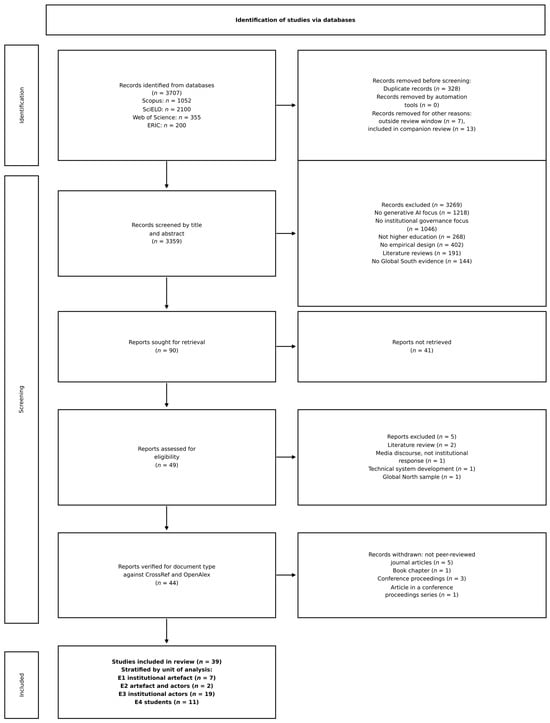
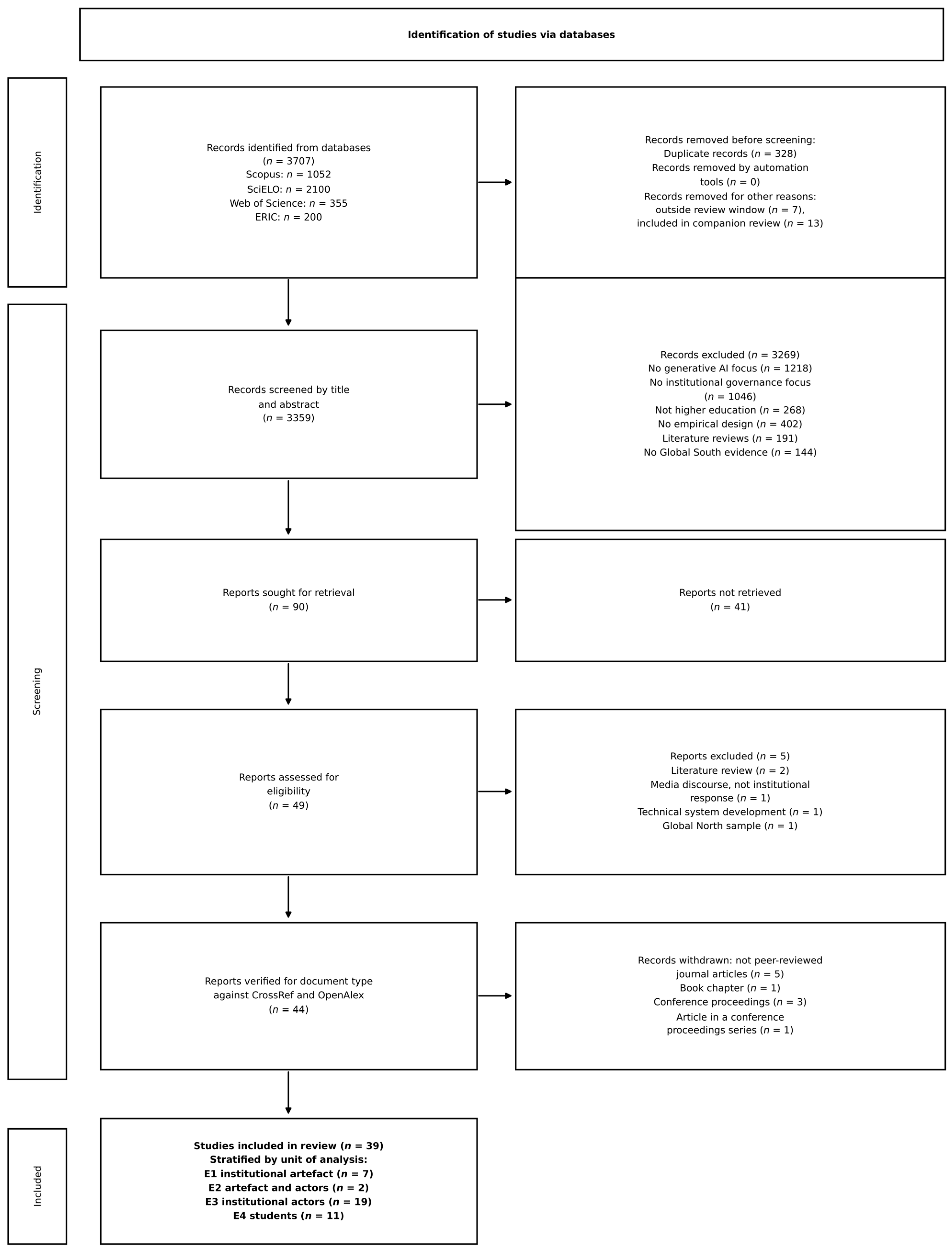
The searches identified 3707 records. After removing 328 duplicates, seven records outside the review window and thirteen belonging to the corpus of a companion review, 3359 records were screened and 3269 excluded. Ninety reports were sought and 49 retrieved and assessed in full, of which five were excluded at that stage: two literature reviews, one analysis of media discourse, one technical system development and one whose sample was drawn from Global North institutions. Verification of document type against the CrossRef and OpenAlex registries then withdrew five further records that did not satisfy the restriction to peer-reviewed journal articles. Thirty-nine studies were included. Figure 1 presents the flow diagram. Three sets of records left the cascade for reasons that are not screening judgements, and they are itemised here because each answers a different question. Thirteen records retrieved by these searches already belonged to the corpus of a companion review, and were set aside at the window stage so that the same studies would not be reported twice as independent evidence across two reviews; that decision concerns how studies are allocated between two reviews and not whether they meet the criteria of Section 2.1. The record of which thirteen records these were was not retained, so they cannot be listed individually, and Section 4.2 states what follows from that and bounds it. Five of the 49 reports read in full were excluded after reading, and the reason for each is recorded: two are literature reviews rather than primary studies, one analyses media discourse rather than an institutional response, one reports the development of a technical system and one draws its sample from Global North institutions. Five further records were withdrawn once their document type was verified against the CrossRef and OpenAlex registries, because they are conference proceedings or book chapters, and Section 2.1 restricts the corpus to peer-reviewed journal articles; those five are named in Supplementary File S1 with the registry evidence for each, and all five were flagged by the third reviewer of the first round.
Figure 1.
PRISMA 2020 [11] flow diagram of the study selection process. Note. Searches were run on 8 August 2026 across four databases, covering January 2023 to July 2026. Exclusion criteria were applied sequentially, so each record is counted once under the first criterion it failed. The document-type verification stage is reported separately because it was applied after full-text assessment. SciELO records were screened on title, author and journal because the export does not include abstracts.
The distribution by unit of analysis is the first result of this review and conditions every subsequent claim. Seven studies analyse institutional artefacts and two combine artefacts with institutional actors, so that nine studies, under a quarter of the corpus, provide evidence about what universities produced. Nineteen studies record accounts given by academic staff, administrators or librarians, and 11 record accounts given by students. Table 2 sets out the strata alongside their coverage of the four dimensions.
Table 2.
Distribution of the corpus by unit of analysis and coverage of the four dimensions.
Two features of that table warrant attention. First, coverage of regulatory responses is near-uniform across strata, from 84.2 per cent among the studies of institutional actors to the whole of both artefact strata. A study of student perceptions and a documentary analysis of university policy are almost equally likely to be coded as addressing regulatory responses, which is precisely why aggregate counts mislead: the coding reflects what a study discusses, not what it demonstrates. Coverage of the other three dimensions is less even, and the widest spread falls on quality assurance and academic integrity, from 52.6 per cent among the studies of institutional actors to 85.7 per cent among those that analyse artefacts. Second, the student studies address regulatory responses at 90.9 per cent, above the 84.2 per cent recorded by the studies that survey the staff who administer the norm, despite examining a population with no governance role. Any synthesis pooling the strata would report evidence on institutional policy as coming in substantial part from studies of undergraduates.
Temporal and geographical distribution follows the pattern reported elsewhere. Three studies correspond to 2024, 14 to 2025 and 22 to the first seven months of 2026. East and South-East Asia contributes 13 studies, Latin America 11, sub-Saharan Africa 7, North Africa and West Asia 5 and South and Central Asia 1; two studies span several regions without a predominant one. A total of 15 studies were qualitative, 13 cross-sectional and 11 used mixed methods. One further characteristic of the corpus bears on what follows: all 39 studies are open access, 18 of them in journals that levy no publication fee, 19 in fee-paying open-access journals and 2 under hybrid arrangements, with none behind a subscription. Table 3 summarises these characteristics.
Table 3.
Characteristics of the 39 included studies.
Sample size requires a distinction that the first version of this review did not draw. Twenty-eight studies have a population of participants with a verifiable figure, with a median of 303 units, an interquartile range from 54 to 701 and a range from 8 to 11,675. Three studies take documents or institutions as their unit, with 26, 6 and 5 units, respectively. The remaining eight do not permit the figure to be verified from the published report and are declared as such rather than estimated.
That distinction yields a result the aggregate count conceals. Summing the verifiable participant figures by stratum, students account for 79.6 per cent of all respondents in the corpus and actor-level studies for 19.3 per cent, while the artefact-level strata account for 1.1 per cent. The number of individuals surveyed in this field therefore comes overwhelmingly from the stratum that by construction cannot report on institutional action. That figure requires care in interpretation. A count of respondents indexes the size of the populations sampled; it does not measure the strength, the quality or the representativeness of the evidence, and a survey of eleven thousand students does not become evidence about an institution by being large. The reason for reporting it is narrower: a reader who encounters this literature in aggregate, as counts of studies or of participants, will be reading mostly about students, and the figure makes that visible. Three student surveys alone contribute more respondents than the rest of the corpus combined.
3.2. What the Artefact-Level Evidence Establishes
Nine studies examine institutional artefacts, and their convergence is the most secure finding available. Chaka et al. [8] conducted an online rapid environmental review of the generative artificial intelligence policies developed by South African higher education institutions and found that most had produced no policy at all, while those that had confined themselves to statements of principle. Jacobs-Basadien and Pather [9] returned to the same system two years later and evaluated the resulting landscape, a sequence that permits observation of an entire system over time rather than a single snapshot. Aydemir and Seferoğlu [10] analysed Turkish education strategies and policy documents through content analysis; Moreira [15] compared normative texts from six Brazilian federal and state universities, finding that formulas such as responsible use recur across institutions while their translation into concrete rules diverges; and Tuyen [14] mapped policy and practice across five Vietnamese university publishing contexts.
Two studies document the production of an artefact rather than its content. Thaldar et al. [16] traced the development of the University of KwaZulu-Natal guidelines through process tracing, comparative policy analysis and institutional records, with the authors participating as members of the institution’s artificial intelligence task team; Breceda Pérez [17] documented the design of ethical guidelines at a Mexican public university from within its ethics committee. Both are single-institution accounts and neither claims generalisability, but they supply something no survey can: an account of how an institutional instrument came to exist.
Read together, these studies support three claims, each stated with the scope its evidence permits. Institutional artefacts do exist and can be located, which qualifies the impression left by the reported scarcity of formal guidance. Their content converges on statements of ethical principle and on prohibition of misuse while diverging on operational detail. And the documentary studies in this corpus do not report provisions specifying who verifies compliance or what follows from breach. That third claim requires a qualification the first version of this review omitted: the studies do not report such provisions, and it does not follow that the policies analysed contain none. Whether enforcement provisions were examined and not found, or simply not examined, is not recoverable from the published reports, and the claim is therefore about the evidence rather than about the instruments.
The two studies combining artefacts with institutional actors extend the picture. Choiriyah et al. [18] combined institutional document analysis with interviews of twenty lecturers and policymakers in Surakarta, and Roengtam [19] combined policy document analysis with focus groups and interviews across twelve Thai universities involving 283 participants. Both report the same disjunction between an existing instrument and the conditions for applying it, and both reach that conclusion by holding the two kinds of evidence against one another. That design, present in 2 of 39 studies, is the one the field most needs.
3.3. What the Actor-Level Evidence Adds, and What It Cannot
Nineteen studies record accounts given by staff who administer or receive the norm. This stratum cannot establish what an institution did, but it addresses questions the documents cannot answer: how the instrument is understood by those expected to act on it, whether it reached them, and what they do in its absence.
On that first question, the stratum converges. Zhang et al. [12] interviewed sixteen administrative staff across three Chinese vocational colleges and found that rules were experienced as external instructions rather than as institutional criteria. Benayoune et al. [20] surveyed thirty-nine institutional leaders across twenty-eight Omani institutions alongside focus groups, and Yang and Balazon [21] combined a survey of 1085 administrators, teachers and students with interviews and on-site observation across Sichuan institutions. Both report institutional unpreparedness and regulatory uncertainty as the dominant barrier. Their evidence concerns what institutional actors report, not what the institutions hold, and the present review classifies them accordingly, a correction to its own first pass.
On capacity, the convergence is stronger still. Trevisol Neto and Varvakis [22] found that Brazilian academic libraries integrated the technology without formal training programmes, and Çuhadar et al. [23] reported the same among Turkish university library managers. Zaim et al. [24], with 191 Indonesian lecturers, identified declared commitment to innovation coexisting with low confidence in collective capacity; Iqbal et al. [25], with 776 faculty in Chinese universities, and Khlaif et al. [26], with 358 across the Middle East, reported curriculum and assessment adaptation proceeding ahead of institutional support. Espartinez [27], through narrative inquiry, and Macías Galeas and Betancourt Anangono [28], through focus groups with Ecuadorian lecturers, document competences acquired through autonomous exploration and, in the latter case, resistance to training perceived as prescriptive. The divergence within this convergence concerns its cause: these studies agree that training is absent and differ on whether the absence reflects institutional neglect or deliberate professional autonomy.
On quality and integrity, the same stratum reports a shift in the object of concern. Nahiyan and Rahman [29] found disciplinary teachers less troubled by detection than by uncertainty over what counts as a student’s own work, a reading Fernandes-Santos et al. [30] and Vallejos-Parás and Galindo-Cuesta [31] corroborate in Brazilian and Mexican settings. Tran and Truong [32] note that institutional responses have privileged control over assessment redesign, and Sawair and Ghazzawi [33] extend the problem to research group formation, where attribution becomes diffuse. Further evidence in this stratum addresses institutional conditions from adjacent angles: Gómez-García et al. [34] assessed digital teaching competence across Paraguayan public higher education; Khan et al. [35] surveyed 305 library professionals across South Asia, Africa and the Middle East on ethical risk and institutional support; Muñiz Apaza et al. [36] used Delphi consultation to project institutional trajectories for Peruvian universities towards 2033; and Yang et al. [37] applied a three-round Delphi with thirty-one experts to derive governance dimensions.
What this stratum cannot do is settle whether the institutions in question hold policies, of what kind, or with what enforcement. When a respondent reports that their university lacks guidance, the study has established a perception, which may be accurate, outdated or a function of poor internal communication. Several studies in the corpus treat such reports as evidence of policy absence. That inference does not follow, and distinguishing the two is the reason for stratifying. The uncertainty is symmetrical: these studies also cannot establish that a policy is absent where respondents report one.
3.4. The Student Stratum and the Limits of Substitution
Eleven studies record accounts given by students, several with substantial samples: Edam-Agbor et al. [38] surveyed 11,675 Nigerian students, Torres-Diaz et al. [39] 4811 across eight Ecuadorian universities and López Fernández et al. [40] 3086 across five countries. These studies are informative, and the first version of this review stated their limits too restrictively. Student accounts constitute legitimate evidence about whether a policy reached its addressees, how it is understood, whether it is perceived as legitimate and how students act in its presence or absence. Those are questions about policy communication, awareness and reception, and no documentary analysis answers them.
What this stratum cannot establish is that an institution produced an instrument, or what that instrument contains. Bakari et al. [41] illustrate the difficulty directly: the study examines institutional readiness in Zanzibar through students’ perspectives, so that a construct defined by organisational capacity is measured by asking those outside the organisation’s decision structures. The same pattern recurs elsewhere in the stratum. Edam-Agbor et al. [38] model institutional policy as a mediating variable in student acceptance without establishing that any policy exists; Abdi and Abdullahi [42] incorporate institutional policy development into an extended acceptance model among Somali students; Chan et al. [43] report barriers attributed to institutions on the basis of student report alone; Wang et al. [44] examine how styles of use relate to academic engagement, with perceived policy clarity as a moderator; and Valdivieso and González [45] address equity and knowledge management through undergraduate accounts. Three studies that the first version of this review placed among institutional actors belong here: Anggraini et al. [46] analyse 133 undergraduate self-reflection texts, Revesai et al. [13] examine how undergraduate learners reason in the absence of institutional guidance, and Riquez Livia et al. [47] survey 312 undergraduates on perceived service quality.
The point is not that such studies are deficient, nor that they say nothing about institutions. It is that a corpus in which 11 of 39 studies address institutional governance by surveying students, and in which those studies account for most of the individuals surveyed, will generate aggregate figures that overstate what is known about institutional action while understating what is known about institutional reception.
3.5. Regional Distribution of the Evidence
Cross-tabulating strata against regions exposes an imbalance that neither dimension reveals alone. Latin America contributes 11 studies, second only to East and South-East Asia, yet only two examine an institutional artefact and none combines artefacts with actors. Sub-Saharan Africa contributes seven studies, of which three are documentary, the highest proportion in the corpus, concentrated in South Africa. Table 4 presents the cross-tabulation, with studies spanning several regions shown in a column of their own so that every row reconciles with its total.
Table 4.
Unit of analysis by region: where each kind of evidence has been produced.
The interpretation of that pattern requires more caution than the first version of this review exercised. What the data establish is a distribution of research: few studies examining Latin American institutional artefacts have been published in the indexed literature within the review window. What they do not establish is why. The region receiving 1.12 per cent of global investment in the sector is also the one whose indexed evidence base on institutional artefacts is thinnest, and the coincidence is worth recording, but this review provides no evidence that the second follows from the first. Nor does the distribution support the inference that Latin American universities hold fewer formal policies. Whether they hold fewer policies, or hold comparable numbers that no one has studied, cannot be determined from secondary evidence, and the distinction is itself a research question.
3.6. Methodological Quality
Appraisal was completed with the full text for 34 of the 39 studies, and the reason it was not completed for the remaining five bears on how the figures below should be read. Every one of the 49 reports retrieved was assessed in full against the eligibility criteria when the search was run in August 2026, and the 39 studies that passed that assessment were classified by unit of analysis and had their characteristics extracted from the full report. Eligibility, classification and extraction therefore rest on the complete report for all 39 studies. What could not be repeated was the appraisal: when the revision required the appraisal to be redone item by item against the textual evidence, five of those full texts were no longer obtainable within the revision window, and the appraisal of those five is reported from their abstracts as a provisional status, declared for each in the Supplementary Materials and excluded from every figure below. The five are Revesai et al. [13], Nahiyan and Rahman [29], Khan et al. [35], Edam-Agbor et al. [38] and Yang et al. [37]; three belong to the actor-level stratum and two to the student stratum, and their designs are one mixed-methods, two qualitative, counting a three-round Delphi study as qualitative, and two cross-sectional. Two consequences follow. The appraisal figures describe 34 studies rather than 39, so no quality-screened statement is available about those five, all of which fall in the actor-level and student strata. The distribution by unit of analysis, which is the result this review rests on, is not affected, because it was established from the full reports. Of the 34 studies appraised in full, 11 were rated high, 13 moderate and 10 low. All artefact-level studies were appraised in full, so the stratum carrying the central argument rests on complete appraisal.
Two deficits bear on the object. The cultural or theoretical location of the researcher is declared in a minority of the studies to which the qualitative checklist applied, which matters in a study examining peripheral institutions responding to a technology produced elsewhere. Confounding factors are identified in a small minority of cross-sectional cases; since institutional size, type and endowment plausibly determine any institutional response, that omission constrains causal reading. Table 5 presents compliance by criterion.
Table 5.
Compliance with Joanna Briggs Institute critical appraisal criteria.
3.7. Coverage by Design and Sensitivity Analysis
Comparing coverage by design separates robust findings from those contingent on the instrument, and it is here that recoding altered a result rather than a figure. The first version of this review reported institutional readiness at 93 per cent of qualitative designs against 38 per cent of cross-sectional ones, and read that gap as evidence that instruments derived from technology acceptance models fail to register organisational capacity. Neither half of the claim survives. Recoded against the declared rule, with the supporting statement recorded for every cell, institutional readiness is addressed by 73.3 per cent of qualitative studies, 76.9 per cent of cross-sectional ones and 81.8 per cent of mixed-methods designs, a spread of 8.5 percentage points. The inference is withdrawn, and so is the observation it rested on.
One divergence by design does hold, and it falls on a different dimension. Quality assurance and academic integrity are addressed by 80.0 per cent of qualitative studies and 30.8 per cent of cross-sectional ones, a spread of 51.0 percentage points, as Table 6 sets out. The reading stays descriptive. A difference in thematic coverage is consistent with several explanations: qualitative designs may select integrity as an object more often, the research questions of the two traditions may differ systematically, and structured instruments may address the construct under other names or distribute it across items that the published report does not name. Establishing that one family of instruments fails to capture a construct would require item-level evidence that this review does not possess.
Table 6.
Coverage of the four dimensions by methodological design.
The sensitivity analysis excluded the studies rated low quality and is reported numerically rather than asserted. Of the 34 studies appraised in full, 24 remain once low-quality studies are removed. The stratification holds: the artefact-level strata move from 23.1 per cent of the corpus to 29.2 per cent of the retained studies, the actor-level stratum from 48.7 to 45.8 per cent and the student stratum from 28.2 to 25.0 per cent. The distribution that organises this review is therefore not an artefact of including weak studies; if anything, the evidence that survives quality screening is proportionally more documentary than the corpus as a whole. Two restrictions bear on that comparison and are stated rather than left implicit. The five studies appraised from the abstract carry no quality rating and therefore fall outside both the appraisal figures and this analysis; all five belong to the actor-level and student strata, and they comprise two qualitative studies, two cross-sectional and one of mixed methods. Their removal is not neutral with respect to the distribution, and the direction is what matters: the artefact-level share is 23.1 per cent of the 39 studies in the corpus, 26.5 per cent of the 34 appraised from full text and 29.2 per cent of the 24 retained once low-quality studies are excluded. Each restriction raises the documentary share, which is the direction opposite to the claim this review makes about the scarcity of artefact-level evidence, so neither restriction can be what produces that scarcity. The worst case can be bounded rather than assumed. Were all five of the studies appraised from the abstract to have been retained after quality screening, which is the assumption least favourable to the argument, the artefact-level share of the retained studies would fall to 7 of 29, or 24.1 per cent, which is still above the 23.1 per cent of the corpus as a whole. The result does not depend on how those five would have been rated. The rule for pooling the two checklists can likewise be tested rather than defended. Of the 10 mixed-methods studies appraised from full text, 3 would change category were the stricter rule applied of taking the weaker of the two components: one falls from high to moderate and two from moderate to low. Carrying that rule into this analysis leaves 22 retained studies rather than 24, and the artefact-level share rises from 29.2 to 31.8 per cent, because both additional exclusions fall outside the artefact strata. Which of the two rules is adopted, therefore, does not bear on the distribution this review reports. What the restrictions do remove is any quality-screened statement about those five studies.
4. Discussion
The review set out to establish what the available evidence permits us to claim about institutional responses to generative artificial intelligence in Global South higher education, and about whom. The answer is narrower than the volume of publication suggests. A total of 9 of 39 studies examine an institutional artefact; the remainder examine what people say, and 11 of those people hold no governance function. Claims about what universities have done rest on that first group, and this review attributes them accordingly.
Three findings survive that attribution, each with its scope stated. Institutional artefacts exist and can be located, which qualifies the picture of near-total absence that survey-based reports of missing guidance convey. Their content converges on ethical principles and the prohibition of misuse while diverging on operational detail, a pattern documented across South Africa, Turkey, Brazil and Vietnam by studies reading the instruments themselves. And the documentary studies do not report provisions specifying who verifies compliance, a finding about the state of the evidence rather than about the content of the policies. The actor-level stratum then supplies what the documents cannot, namely that staff experience the rules as external instruction, that training addresses tool handling rather than the criteria the rules presuppose, and that concern over integrity has shifted from detecting fraud to defining authorship. Those are claims about reception, and this review does not present them as claims about institutional action.
Set against prior syntheses, the difference is procedural rather than substantive, and the substantive agreement is worth stating. Where Slimi [6] reports a shift in integrity concerns from detection towards authorship, our actor-level stratum converges independently. Where Nikolic et al. [5] find acceptance varying with prior exposure, our capacity findings are compatible. Where Khoza and van der Walt [7] document pedagogical adaptation proceeding ahead of institutional support in Global South settings, the present corpus reproduces the pattern at the level of institutional conditions. The present review neither confirms nor challenges those conclusions; it specifies which studies within a corpus can carry them. The consequence is not that their conclusions are wrong; it is that the confidence attaching to any given conclusion cannot be assessed by a reader, because the reader cannot tell which studies support it. Stratifying before synthesising makes that assessable, and the cost is a smaller set of secure claims.
A plausible objection is that the distinction between artefact and account is overdrawn, since a policy that no one follows is arguably less real than a practice everyone observes. The objection has force, and this review does not treat documentary evidence as superior. The relation is not a hierarchy but a division of evidentiary labour: documents establish that an instrument exists and what it says, and establish nothing about whether it is applied; accounts establish how the instrument is received and what people do, and establish nothing about whether it exists. A survey establishing that eighty per cent of respondents report no institutional guidance is compatible with the institution holding guidance that failed to circulate, and only reading the documents distinguishes the cases. The converse holds: a policy document establishes nothing about classroom practice, and only asking people establishes that. Choiriyah et al. [18] and Roengtam [19] demonstrate the value of holding both together.
A further distinction the framework does not capture deserves acknowledgement. Institutional response, as operationalised here, means the production of a formal artefact. Institutions also respond through informal governance arrangements, administrative decisions taken without documentation, professional development activity and changes in teaching and assessment practice, none of which leaves an artefact of the kind this review counts. The framework therefore measures formal policy production specifically, not institutional response broadly, and a corpus thin in artefacts is not evidence of institutions that did nothing. It is evidence of institutions whose doing, if any, has not been documented in a form the indexed literature captures.
A second objection concerns coding. If coverage of the four dimensions were uniform across strata, one might conclude that the strata are equivalent. The inference runs the wrong way. Coverage of regulatory responses is indeed near-uniform, because discussion of institutional policy is nearly universal in this literature; it is the evidentiary basis of that discussion that varies. The student studies address regulatory responses at 90.9 per cent, above the studies that record accounts from the staff who administer the norm, while examining a population external to institutional decision-making, which illustrates the divergence between topic and evidence rather than their equivalence.
4.1. Implications
For research practice, three requirements follow. Studies claiming to examine institutional response should state their unit of analysis in the abstract, since the reader cannot otherwise judge what the findings support. Where perceptions of institutional policy are surveyed, the existence and content of that policy should be established independently rather than inferred from responses. And designs combining documentary analysis with actor-level evidence, presently two of 39, offer the most direct route to the questions the field poses.
For institutional management, the artefact-level evidence supports one recommendation, and the ground it stands on needs stating alongside it. What the documentary studies report is that provisions specifying who verifies compliance do not appear in the policies they analyse. Whether such provisions are absent from the instruments themselves, or present in them and unreported by the studies, this review cannot determine, and the distinction is the same one drawn in Section 4 about unreported enforcement and demonstrated absence. On the first reading, a directive without an identified verifier transfers to individual staff the judgement the institution has declared settled, which gives an institution reason to check whether its own instrument names a verifier. Whether remedying that improves outcomes is not established by this corpus, and the review does not claim it.
For research policy, the regional imbalance suggests that funding for documentary and case-based work on institutional governance in Latin America would address the thinnest part of the indexed evidence base. That recommendation rests on the observed distribution of research and not on any claim about the underlying distribution of policies, which this review cannot observe.
4.2. Limitations
Six limitations condition these results, and their implications for confidence differ. The first is the single-reviewer procedure for screening, extraction and appraisal. Independent verification of the classification was obtained and returned almost perfect agreement, which substantially reduces the risk for the decision that carries the argument; screening and appraisal remain unverified, so the risk of missed records and of idiosyncratic appraisal persists and is not quantified. No further verification of extraction or of appraisal was undertaken for this revision. Extending the second reviewer’s remit would have required a second full pass over 39 reports, which the revision window did not allow, and a partial check of selected decisions would have returned an agreement figure whose denominator we chose after seeing the decisions. The mitigation that does exist is of another kind: every appraisal decision is published with the textual fragment on which it rests, and every unit-of-analysis assignment with the sentence that supports it, so a reader may check any decision individually rather than relying on an agreement statistic. Screening of the SciELO records, whose export does not include abstracts, relied on title, author and journal, which is the most likely source of under-detection in the corpus.
The second is retrieval, and it takes two forms with a common cause. Full text could not be obtained for 41 of the 90 reports that passed screening, a retrieval rate of 54.4 per cent, and five of the reports that were retrieved in August could not be obtained again when the appraisal was redone for this revision. Retrieval was attempted through the institutional subscriptions available to the authors and through the publishers’ own sites. No requests were addressed to corresponding authors and no interlibrary loan was used, which are the two procedures that would most plausibly have reduced the loss, and their omission is a limitation of this review rather than a property of the literature. Whether the loss was differential cannot be established. The screening record of the 41 reports was not retained in a form that permits them to be characterised by region, by design or by unit of analysis, so no comparison between retrieved and unretrieved reports can be offered, and the question the comparison would answer remains open. One characteristic of the retained corpus measures that loss rather than conjecturing about it. All 39 included studies are open access, as recorded in the extraction matrix and verified against the OpenAlex record: 18 appear in journals that levy no publication fee, 19 in fee-paying open access journals and 2 under hybrid arrangements, and not one is behind a subscription. A retrieval procedure indifferent to access conditions would not produce that result, so what the 41 unretrieved reports hold is in all likelihood the subscription literature on this question, which this review cannot speak for. The dimension along which the corpus is incomplete is therefore identified rather than supposed, even though the direction of the effect on the distribution by stratum remains undetermined, since the strata are not evenly spread across venue types and the unretrieved reports cannot be characterised. And the scale of the exposure can be illustrated: applying the inclusion rate observed among the reports that were retrieved, 39 of 49, the 41 unretrieved reports would have contributed in the order of thirty further studies, which is of the same order as the corpus itself. That figure illustrates what is at stake rather than estimating what was lost. This is the limitation most likely to affect the headline proportion, and it is the one a future review with fuller access should test first.
The third is the absence of a registered protocol. Criteria, stratification rules and thresholds were fixed a priori and are reported in full, but no public record predates the analysis, so readers cannot verify that they were not adjusted once results were visible. The published Supplementary Materials mitigate this only partially.
The fourth concerns classification itself. Assignment rests on what each report states about its data, and reports vary in how explicitly they state it; the textual basis for every assignment is provided so that readers may check it, and the independent verification bounds the residual uncertainty.
The fifth is the operationalisation of the Global South through the UNCTAD classification, which admits alternatives that would yield partly different corpora, and the restriction to three languages, which under-represents systems publishing in other languages. Both narrow the scope of the claims rather than biasing them in a known direction.
The sixth is the allocation of studies between this review and a companion one. Thirteen records retrieved by these searches had already been allocated to the corpus of a companion review and were set aside before screening, so they were never assessed against the criteria of Section 2.1, and the record of which thirteen they were was not retained. The absolute counts reported here are therefore computed on a corpus that was deliberately partitioned, and had all thirteen proved eligible, the corpus would have numbered 52 studies rather than 39. The effect on the distribution by stratum, which is what the argument rests on, falls within bounds that can be stated. Were all thirteen artefact-level studies, artefact-level evidence would amount to 22 of 52 studies, or 42.3 per cent; were none of them, to 9 of 52, or 17.3 per cent. Under either bound, the artefact-level stratum remains a minority of the corpus, which is the claim this review makes, so the exclusion cannot be what produces the imbalance reported, although the margin narrows considerably at the upper bound. What the exclusion does remove is any statement about the thirteen themselves, and a reader who wants the undivided set will find it by reading the companion review alongside this one.
Two further procedures foreseen by the reporting guideline were not undertaken. Risk of bias arising from missing results was not assessed, since the heterogeneity of designs and the absence of a common effect measure made funnel-plot and equivalent procedures inapplicable. Certainty in the body of evidence was likewise not graded, since the corpus combines documentary, qualitative and cross-sectional designs for which no single certainty framework applies. Both omissions are declared rather than left unreported, and neither affects the stratification on which the argument rests.
5. Conclusions
This review asked what the available evidence on institutional responses to generative artificial intelligence in Global South higher education permits us to claim. Stratifying 39 studies by unit of analysis before synthesising them shows that 9 examine an institutional artefact, 19 record accounts from staff who administer or receive the norm, and 11 record accounts from students. Those figures describe the studies this review was able to retrieve and assess. Full text was not obtained for 41 of the 90 reports that passed screening, so every proportion reported here is a property of the corpus reviewed rather than an estimate of the literature as published, and no claim made here extends beyond the studies examined.
Each stratum answers a different question, and the conclusions are bounded accordingly. Claims about institutional action rest on the artefact-level studies. Claims about how the norm is understood and applied by those expected to act on it rest on the actor-level stratum. Claims about whether policies reached their addressees, how students understand them and how students act in their presence or absence rest on the student stratum, which supplies evidence about reception that no documentary analysis can supply. What the student stratum cannot establish is that an institution produced an instrument or what that instrument contains, and the first version of this review stated that limit too categorically by describing the stratum as supporting neither action nor reception.
What the artefact-level evidence establishes is that institutional instruments exist and can be located, and that their content converges on ethical principle while diverging on operational detail. What it reports, rather than establishes, is that verification of compliance goes unspecified in the policies as described by the published studies. What the actor-level evidence adds is that the rules are experienced as external instruction and that available training addresses tool handling rather than the criteria those rules presuppose.
Regional distribution compounds the imbalance. Latin America contributes 11 studies and 2 institutional artefacts, so that the systems with least investment in the sector are those about whose institutional response least has been documented in the indexed literature. Whether that reflects fewer policies or fewer studies of them is a question this review poses rather than answers.
The broader implication concerns how this literature is read. A field describing itself as research on institutional governance is predominantly measuring perception, and aggregate counts of studies addressing policy convey an evidentiary base that does not exist at the level claimed. That is not an argument against perception research, which answers questions documentary analysis cannot. It is an argument for stating, in each study and each synthesis, what the data are. Until that becomes routine, reviews in this field will continue to report what researchers found as though it were what universities did.
Supplementary Materials
The following supporting information can be downloaded at: https://www.mdpi.com/article/10.3390/encyclopedia6120270/s1, Supplementary Table S1: PRISMA 2020 checklist; Supplementary Table S2: full search strategies for Scopus, Web of Science, ERIC and SciELO; Supplementary File S1: evidence base workbook comprising Sheet S1.1, concordance between the numbering of the submitted version and that of this revision; Sheet S1.2, list of included studies with their extraction data; Sheet S1.3, textual evidence underpinning every unit-of-analysis assignment; Sheet S1.4, record of the six reclassifications and the five document-type withdrawals; Sheet S1.5, independent verification worksheet with the agreement statistics; Sheet S1.6, appraisal results item by item for every study; Sheet S1.7, records excluded at each stage with the reason for each; Sheet S1.8, recomputation of the main figures reported in Section 3 and Section 4 from the extraction and appraisal sheets; Sheet S1.9, adscription of each included study to the four dimensions, with the supporting statement or the reason for each zero.
Author Contributions
Conceptualisation, J.R.I.E. and P.V.Z.; methodology, J.R.I.E. and M.A.R.V.; validation, P.V.Z., J.A.T.C. and G.S.L.-R.; formal analysis, J.R.I.E. and I.d.M.T.M.; investigation, J.R.I.E.; data curation, J.R.I.E. and I.d.M.T.M.; writing—original draft preparation, J.R.I.E. and J.A.T.C.; writing—review and editing, P.V.Z., M.A.R.V., G.S.L.-R. and I.d.M.T.M.; visualisation, J.A.T.C. and G.S.L.-R.; supervision, P.V.Z. and M.A.R.V.; project administration, J.R.I.E. All authors have read and agreed to the published version of the manuscript.
Funding
This research received no external funding.
Institutional Review Board Statement
Not applicable.
Informed Consent Statement
Not applicable.
Data Availability Statement
The list of included studies, the extraction matrix, the classification by unit of analysis with its textual evidence, the independent verification worksheet and the appraisal results are provided in the Supplementary Materials, together with the PRISMA 2020 checklist and the full search strategies.
Acknowledgments
During the preparation of this manuscript and its revised version, the authors used Claude (latest version available at the time of use; Anthropic, San Francisco, CA, USA) and Gemini (Google, Mountain View, CA, USA) to improve the writing, review the style of the English text, and support the drafting of the sections revised in response to the reviewers. No artificial intelligence tools were used for the literature search, study screening, data extraction, classification by unit of analysis, quality assessment, or analysis. The authors reviewed and edited all content and assume full responsibility for the content of the manuscript.
Conflicts of Interest
The authors declare no conflicts of interest.
References
- UNESCO. UNESCO Survey: Less Than 10% of Schools and Universities Have Formal Guidance on AI. 2023. Available online: https://www.unesco.org/en/articles/unesco-survey-less-10-schools-and-universities-have-formal-guidance-ai (accessed on 12 July 2026).
- Miao, F.; Holmes, W. Guidance for Generative AI in Education and Research; UNESCO: Paris, France, 2023. [Google Scholar] [CrossRef] [Scilit]
- ECLAC; CENIA. Latin American Artificial Intelligence Index (ILIA) 2025; Economic Commission for Latin America and the Caribbean: Santiago, Chile; National Center for Artificial Intelligence: Santiago, Chile, 2025. [Google Scholar]
- ECLAC. Overcoming Development Traps in the Digital Era: The Transformative Potential of Digital Technologies and Artificial Intelligence in Latin America and the Caribbean (LC/CMSI.9/3); Economic Commission for Latin America and the Caribbean: Santiago, Chile, 2024. [Google Scholar]
- Nikolic, S.; Wentworth, S.; Sheridan, L.; Moss, S.; Duursma, E.; Jones, R. A systematic literature review of attitudes, intentions and behaviours of teaching academics pertaining to AI and generative AI. Australas. J. Educ. Technol. 2024, 40, 56–75. [Google Scholar] [CrossRef] [Scilit]
- Slimi, Z. A systematic critical review of generative AI’s impact on authorship, pedagogy, and integrity (2023–2025). Front. Educ. 2026, 11, 1769680. [Google Scholar] [CrossRef] [Scilit]
- Khoza, S.; van der Walt, T. A systematic review on AI-enhanced pedagogies in higher education in the Global South. Front. Educ. 2025, 10, 1667884. [Google Scholar] [CrossRef] [Scilit]
- Chaka, C.; Shange, T.; Nkhobo, T.; Hlatshwayo, V. An Environmental Review of the Generative Artificial Intelligence Policies and Guidelines of South African Higher Education Institutions: A Content Analysis. Int. J. Learn. Teach. Educ. Res. 2024, 23, 487–511. [Google Scholar] [CrossRef] [Scilit]
- Jacobs-Basadien, M.; Pather, S. Assessing AI policy and guideline progress within the South African public higher education system: Insights from documented policies. Univers. Access Inf. Soc. 2026, 25, 71. [Google Scholar] [CrossRef] [Scilit]
- Aydemir, H.; Seferoğlu, S.S. Analyzing Turkey’s Education Strategies and Policy Documents in the Context of Digital Transformation, Development and Artificial Intelligence. Hacet. Univ. J. Educ. 2026, 41, 371–393. [Google Scholar] [CrossRef] [Scilit]
- Page, M.J.; McKenzie, J.E.; Bossuyt, P.M.; Boutron, I.; Hoffmann, T.C.; Mulrow, C.D. The PRISMA 2020 statement: An updated guideline for reporting systematic reviews. BMJ 2021, 372, n71. [Google Scholar] [CrossRef] [Scilit] [PubMed]
- Zhang, Y.; Tian, Y.; Cheah, K.S.L.; Beh, W.F. Exploring administrative staff’s acceptance of generative AI in Chinese vocational colleges: A UTAUT-guided thematic study. PLoS ONE 2026, 21, e0346003. [Google Scholar] [CrossRef] [Scilit] [PubMed]
- Revesai, Z.; Chipfumbu, C.T.; Nyamunda, F. Navigating ethical ambiguity without institutional guidance: Generative AI decision-making among students in Zimbabwean higher education. Cogent Educ. 2026, 13, 2687912. [Google Scholar] [CrossRef] [Scilit]
- Tuyen, T.H. Responsible Use of AI-Generated Content in Vietnamese Scholarly Publishing: Evidence from Journal Policies and Editorial Practices. Veredas Direito 2026, 23, e234029. [Google Scholar] [CrossRef] [Scilit]
- Moreira, J.V. Entre orientar e prescrever: A institucionalização da IA generativa em universidades públicas brasileiras. Prax. Educ. 2026, 21, 1–16. [Google Scholar] [CrossRef] [Scilit]
- Thaldar, D.; Botes, M.; Badru, A.; Chenia, H.; Duma, S.; Dlamini, S.B.; Amin, N.; Hugo, W.; Govender, R.; Bruce-Brand, J.; et al. Generative AI governance in higher education: A case study from Africa. Front. Political Sci. 2025, 7, 1666661. [Google Scholar] [CrossRef] [Scilit]
- Breceda Pérez, J.A. Hacia la regulación ética del uso de inteligencia artificial en la investigación científica, lineamientos desde la Universidad Autónoma de Ciudad Juárez. Rev. Bioética Derecho 2025, 64, 81–97. [Google Scholar] [CrossRef] [Scilit]
- Choiriyah, S.; Nugroho, A.; Ramadhan, S.; Pembangunan, H.R.P.; Muharom, F. Artificial intelligence-driven learning assessment in faculties of education: An exploratory study. Munaddhomah J. Manaj. Pendidik. Islam 2025, 6, 482–495. [Google Scholar] [CrossRef] [Scilit]
- Roengtam, S. A Comprehensive Academic Integrity Ecosystem for Thai Higher Education in the Age of Artificial Intelligence: Aligning with SDG 4 (Quality Education). Veredas Direito 2025, 22, e223951. [Google Scholar] [CrossRef] [Scilit]
- Benayoune, A.; Slimi, Z.; Al Habsi, A. Artificial intelligence policy challenges and institutional readiness in Omani higher education. Discov. Educ. 2026, 5, 86. [Google Scholar] [CrossRef] [Scilit]
- Yang, L.; Balazon, F.G. The use of Artificial Intelligence in higher vocational colleges in Sichuan, China: A mixed-methods study of adoption, utilization, and policy implications. Front. Educ. 2026, 11, 1796803. [Google Scholar] [CrossRef] [Scilit]
- Trevisol Neto, O.; Varvakis, G. Inteligência Artificial nas operações e serviços de bibliotecas universitárias no Brasil. Rev. Digit. Bibliotecon. Ciência Informação 2026, 24, e026023. [Google Scholar] [CrossRef] [Scilit]
- Çuhadar, S.; Mert, S.; Gezer, Ç.; Helvacıoğlu, E.; Arus, O.; Aslan, Ö.; Karslı, M.; Sönmez, Ç.; Taş, A.; Açıkalın, C.; et al. Üniversite Kütüphanecilerinin Yapay Zeka Algıları, Kütüphanelerde Uygulama Alanları ve Geleceği. Bilgi Dünyası 2024, 25, 410–458. [Google Scholar] [CrossRef] [Scilit]
- Zaim, M.; Arsyad, S.; Waluyo, B.; Syafei, A.F.R.; Ratmanida; Zaim, R.A. Aligning Generative AI with Higher Education Workflows: Indonesian Lecturers’ Anxiety–Satisfaction Profiles and Adoption Patterns. Educ. Sci. 2026, 16, 271. [Google Scholar] [CrossRef] [Scilit]
- Iqbal, J.; Asgarova, V.; Hashmi, Z.F.; Ngajie, B.N.; Asghar, M.Z.; Järvenoja, H. Exploring faculty experiences with generative artificial intelligence tools integration in second language curricula in Chinese higher education. Discov. Comput. 2025, 28, 128. [Google Scholar] [CrossRef] [Scilit]
- Khlaif, Z.N.; Ayyoub, A.; Hamamra, B.; Bensalem, E.; Mitwally, M.A.A.; Ayyoub, A.; Hattab, M.K.; Shadid, F. University Teachers’ Views on the Adoption and Integration of Generative AI Tools for Student Assessment in Higher Education. Educ. Sci. 2024, 14, 1090. [Google Scholar] [CrossRef] [Scilit]
- Espartinez, A.S. Between Innovation and Tradition: A Narrative Inquiry of Students’ and Teachers’ Experiences with ChatGPT in Philippine Higher Education. Soc. Sci. 2025, 14, 359. [Google Scholar] [CrossRef] [Scilit]
- Macías Galeas, I.; Betancourt Anangono, D.I. Algoritmos y autonomía docente: Resistencias pedagógicas ante la estandarización EdTech en la era de la IA generativa. Rev. Española Educ. Comp. 2025, 48, 442–460. [Google Scholar] [CrossRef] [Scilit]
- Nahiyan, S.; Rahman, A.G. Academic integrity and generative AI: Disciplinary teachers’ perspectives on ethical dilemmas in assessing writing in EMI universities. Soc. Sci. Humanit. Open 2026, 13, 102729. [Google Scholar] [CrossRef] [Scilit]
- Fernandes-Santos, C.; Pereira, S.; Rabello, C.R.L. Professors’ Perceptions on the Use of ChatGPT in Higher Education: A case study in Brazil. Rev. Latinoam. Tecnol. Educ. 2026, 25, 97–115. [Google Scholar] [CrossRef] [Scilit]
- Vallejos-Parás, C.; Galindo-Cuesta, J.A. Ética e Inteligencia Artificial Generativa en la educación: Perspectivas docentes de Brasil, Colombia y México. Actual. Pedagógicas 2025, 85, e5234. [Google Scholar] [CrossRef] [Scilit]
- Tran, Q.G.; Truong, T.D. Generative AI in Vietnamese higher education: Pedagogical innovation, learning outcomes, and academic integrity. J. Educ. E-Learn. Res. 2026, 13, 10–21. [Google Scholar] [CrossRef] [Scilit]
- Sawair, F.; Ghazzawi, H. Generative AI in Research Group Formation: Academic Perceptions and Institutional Pathways. Information 2025, 16, 1081. [Google Scholar] [CrossRef] [Scilit]
- Gómez-García, M.; Cáceres-Troche, D.; Boumadan-Hamed, M.; Soto-Varela, R. Generative AI Readiness in Public Higher Education: Assessing Digital Teaching Competence in Paraguay Through Machine Learning Models. Appl. Sci. 2026, 16, 4302. [Google Scholar] [CrossRef] [Scilit]
- Khan, Z.I.; Oladokun, B.D.; Upadhyay, A.K.; Kalbande, D. Ethical concerns of generative AI in academic libraries: A cross-regional quantitative study of librarians’ risk perceptions, trust, and governance practices. J. Librariansh. Inf. Sci. 2026, 09610006261461309. [Google Scholar] [CrossRef] [Scilit]
- Muñiz Apaza, M.G.; Acosta-Prado, J.C.; Hernández-Cenzano, C.G. Foresight Study on the Influence of ChatGPT In Peruvian Universities Towards 2033. Electron. J. E-Learn. 2025, 23, 80–98. [Google Scholar] [CrossRef] [Scilit]
- Yang, Z.; Wider, W.; Wu, C.; Ab. Jamil, N.; Jiang, L.; Ma, R.; Peng, B.; Bhatta, D.D.; Tangkiris, S. Toward ethical governance of generative artificial intelligence in higher education: A Delphi study of key dimensions and priorities. Cogent Educ. 2026, 13, 2677267. [Google Scholar] [CrossRef] [Scilit]
- Edam-Agbor, I.; Orim, F.; Ovat, S.V.; Ofem, U.J.; Ukatu, J.; Ekpang, P.; Igajah, M.; Ebaye, A.; Asukwuo, P. Exploring students’ acceptance of ChatGPT in higher education: Application of the extended UTAUT2 model approach. Cogent Educ. 2026, 13, 2690902. [Google Scholar] [CrossRef] [Scilit]
- Torres-Diaz, J.C.; Duart, J.; Rivera, D.; Flandoli, A.B. Artificial intelligence and academic integrity: Exploring plagiarism in Ecuadorian universities. Int. J. Educ. Integr. 2025, 21, 35. [Google Scholar] [CrossRef] [Scilit]
- López Fernández, R.; Sorhegui-Ortega, R.A.; George-Reyes, C.E.; Sandoval-Benítez, L.F. Inteligencia artificial en la universidad: Análisis de género de las perspectivas éticas y regulatorias en cinco escenarios internacionales. Edutec Rev. Electrón. Tecnol. Educ. 2026, 96, 1. [Google Scholar] [CrossRef] [Scilit]
- Bakari, A.D.; Hamad, M.; Massoud, K. Readiness and foresighting of higher learning institutions for large language model in Zanzibar: A student perspective. East Afr. J. Sci. Technol. Innov. 2025, 7. [Google Scholar] [CrossRef] [Scilit]
- Abdi, A.S.; Abdullahi, A.M. Trust, academic integrity, and access constraints in generative AI adoption: An extended TAM study of Somali higher education. Discov. Comput. 2026, 29, 375. [Google Scholar] [CrossRef] [Scilit]
- Chan, J.I.L.; Tan, S.F.; Chew, M.C. Examining GenAI readiness and behavioral intention of adult learners: A PLS-SEM and IPMA approach. Int. J. Eval. Res. Educ. 2025, 14, 1065. [Google Scholar] [CrossRef] [Scilit]
- Wang, Y.; Mi, X.; Tang, W.; Tang, Y.; Gao, H. How Generative AI Use Styles Shape Academic Engagement: The Roles of Academic Impostor Syndrome and AI Policy Clarity. Behav. Sci. 2026, 16, 862. [Google Scholar] [CrossRef] [Scilit] [PubMed]
- Valdivieso, T.; González, O. Generative AI Tools in Salvadoran Higher Education: Balancing Equity, Ethics, and Knowledge Management in the Global South. Educ. Sci. 2025, 15, 214. [Google Scholar] [CrossRef] [Scilit]
- Anggraini, C.N.; Rachmadania, N.; Nugroho, C.; Wulandari, A.; Rina, N. How students make sense of ChatGPT in digital literacy education: Reflections on ethics, dependency, emotion, and evaluation. Front. Political Sci. 2026, 8, 1784691. [Google Scholar] [CrossRef] [Scilit]
- Riquez Livia, D.P.; Mantari Mincami, L.D.; Villa Ricapa, L.F.; Velarde Dávila, L. Inteligencia artificial generativa y calidad percibida del servicio educativo en instituciones de educación superior. Rev. Venez. Gerenc. 2026, 31, e31e154. [Google Scholar] [CrossRef] [Scilit]

Disclaimer/Publisher’s Note: The statements, opinions and data contained in all publications are solely those of the individual author(s) and contributor(s) and not of MDPI and/or the editor(s). MDPI and/or the editor(s) disclaim responsibility for any injury to people or property resulting from any ideas, methods, instructions or products referred to in the content. |
© 2026 by the authors. Licensee MDPI, Basel, Switzerland. This article is an open access article distributed under the terms and conditions of the Creative Commons Attribution (CC BY) license.