


Abstract
This is a systematic review of the literature on how digital technologies shape and influence the internationalization of SMEs through capability development and barrier mitigation. Following the Preferred Reporting Items for Systematic Reviews and Meta-Analyses (PRISMA) 2020 guidelines, a search was conducted on 13 July 2025, in the Scopus and Web of Science databases. The inclusion criteria prioritized peer-reviewed journal articles published between 2020 and 2025. The rigorous selection process resulted in a final sample of 61 studies from an initial group of 1120 records. A descriptive bibliometric analysis and qualitative thematic synthesis were used to classify the evidence according to technologies, internationalization functions, barriers, and contextual characteristics. The results show that the literature primarily focuses on digital transformation and innovation (27.9%), managerial and strategic capabilities (26.2%), and the institutional environment (21.3%). The findings further show that digital technologies play distinct roles: while e-commerce and cross-cutting information and communication technology (ICT) capabilities primarily facilitate market access and adaptation, more advanced technologies such as blockchain, Industry 4.0, and the IoT are directly linked to coordination and international performance. The review also shows that the digital internationalization of SMEs is constrained by multilevel barriers that operate simultaneously, with organizational and strategic limitations, regulatory compliance requirements, and financing costs being the most prominent. In conclusion, the value of digitalization lies in its organizational integration rather than in the mere adoption of technology. Future research with longitudinal designs is needed to examine how these digital resources are transformed into effective capabilities under different internal and environmental conditions.
1. Introduction
The internationalization of small and medium-sized enterprises (SMEs) is currently taking place in an environment characterized by the growing digitalization of information systems. Although traditional models, such as the Uppsala model and the network perspective, remain relevant, they are insufficient on their own to explain how SMEs enter, adapt to, and compete in increasingly digitalized international markets [1]. This situation is particularly complex in developing economies, where a scarcity of financial resources and limited managerial capabilities make it difficult for SMEs to identify opportunities and adapt to international demands [2,3]. Added to this are weak strategic networks and low technology adoption, factors that further restrict their ability to sustain international expansion [4,5].
In this context, digitalization is redefining traditional mechanisms of internationalization by enabling even SMEs with limited resources to access information on foreign markets, coordinate operations remotely, and build relationships with international customers and partners without the need for a gradual physical presence. Technologies such as artificial intelligence (AI), the Internet of Things (IoT), digital platforms, e-commerce, and blockchain can reduce operational barriers and strengthen the capabilities required to participate in international markets [6]. However, Huseynova [2] notes that these benefits are not automatic, as realizing them depends on factors such as technological infrastructure, the availability of specialized personnel, financing, and organizational adaptability.
Despite these advances, the literature remains fragmented: some studies treat technologies as internal resources that improve processes and efficiency, while others prioritize managerial capabilities, networks, institutional conditions, or export performance.
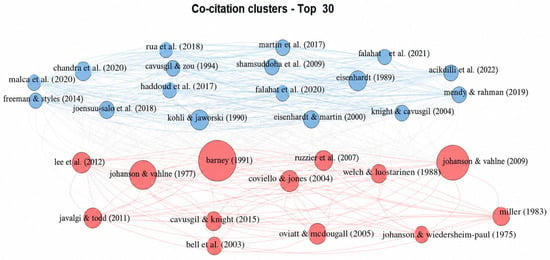
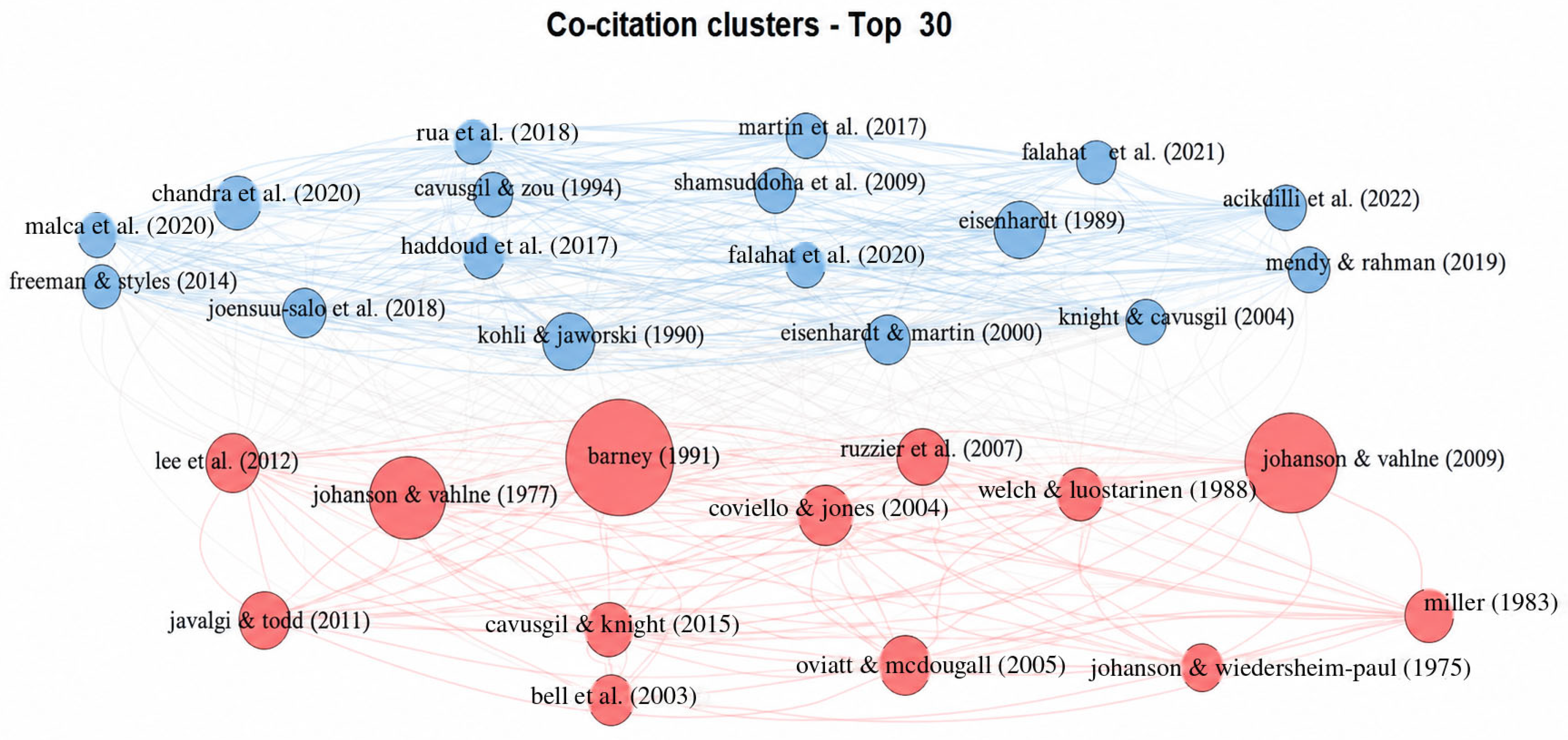
This conceptual fragmentation is reflected in the co-citation network shown in Figure 1.
Figure 1.
Co-citation network of the top 30 references. Analysis generated using the Bibliometrix software package (version 4.1, K-Synth Srl, Naples, Italy) based on the final sample of 61 articles [7,8,9,10]. The red and blue clusters group the studies according to their citation co-occurrence; the minimum threshold was set at 2 co-citations.
The structure of the network reveals two main theoretical frameworks. The first brings together perspectives related to resources, capabilities, and business expansion, such as the resource-based view [7] and models of internationalization [8,9]. The second incorporates approaches related to adaptation to the environment and organizational behavior, including market orientation [10] and resilience. Taken together, these perspectives tend to treat digitalization as an additional resource or capability within already established frameworks, rather than examining it as a phenomenon that transforms the very conditions of internationalization.
While previous reviews and research have contributed to the field, they address the intersection between digitalization and internationalization from partial perspectives. Foundational studies have mapped the historical pathways of SME expansion [1], without focusing on the cross-cutting impact of technological transformation. More recent reviews focus on specific niches: e-commerce and dynamic managerial capabilities [11], the adoption of emerging tools, or resource management in emerging economies [12]. This body of literature often examines technologies in isolation, without explaining how they interact with one another, leaving a gap: the lack of an integrative framework that consolidates which technologies are involved and how they reconfigure operational processes in the face of existing barriers.
Consequently, this review seeks to understand how digitalization is incorporated into the study of SME internationalization, which technologies and digital capabilities are related to this process, how they contribute to international access, adaptation, coordination, and performance, and what barriers limit such contributions. Based on this, the following research questions are posed: (RQ1) How have scientific output, methodological approaches, and the main thematic areas regarding the digitalization and internationalization of SMEs evolved between 2020 and 2025? (RQ2) What digital technologies support the internationalization of SMEs, and how do they facilitate access, adaptation, coordination, and performance in international markets? and (RQ3) What barriers limit the contribution of digitalization to the internationalization of SMEs?
The aim is to provide a framework that guides both future empirical research and the design of business strategies and public policies aimed at strengthening the international competitiveness of SMEs.
2. Theoretical Framework
2.1. Internationalization of SMEs in the Digital Age
The internationalization of small and medium-sized enterprises has traditionally been based on models that explain expansion as a process of continuous learning or leveraging relationships. The Uppsala model [8], for example, emphasizes that internationalization is a gradual process dependent on the accumulation of knowledge and experience in foreign markets. Meanwhile, the network perspective highlights how SMEs compensate for their scarcity of resources by embedding themselves in networks of relationships that facilitate access to new markets, while the “Born Global” approach [9] underscores the role of entrepreneurial vision in accelerating this expansion from the very inception of the firm.
These approaches remain relevant for explaining the dimensions of learning, resource dependence, and network building; however, digitalization is altering the traditional conditions associated with information, distance, and coordination. This raises the question of whether these models remain sufficient to explain internationalization when access to markets—previously mediated by accumulated experience or physical networks—can be achieved through digital tools.
2.2. Digital Resources and Dynamic Capabilities
To understand how digitalization intersects with international expansion, this study draws on the Resource-Based View (RBV) [7] and the Dynamic Capabilities approach [13]. From the RBV perspective, technologies and the intangible resources associated with their use can constitute strategic assets for a firm. However, their availability alone does not guarantee a competitive advantage or an effective contribution to internationalization.
Dynamic capabilities help explain how these resources are integrated, mobilized, and reconfigured to respond to changes in the international environment. From this perspective, a digital capability does not depend solely on technology adoption, but on the SME’s ability to incorporate technologies into its processes, learn from their use, and adapt its resources and organizational routines. This distinction allows us to differentiate between the mere presence of digital tools and their utilization as capabilities that can support internationalization.
2.3. Conceptual Relationship Between Digitalization and Internationalization
From these perspectives, digitalization can be understood as a set of technological resources whose contribution to internationalization depends on a company’s ability to integrate, utilize, and reconfigure them in response to environmental conditions. In doing so, digitalization can transcend its operational function and take on a strategic role in the internationalization process.
However, because technological assimilation requires organizational alignment, the relationship between digitalization and internationalization should not be assumed to be direct or automatic. Its scope and intensity can vary significantly depending on available financial resources, the managerial capabilities of the SME, and institutional pressures from the international environment. Based on this theoretical framework, this systematic review empirically examines which specific technologies emerge in the recent literature, how they relate to different dimensions of the internationalization process (access, adaptation, coordination, and performance), and which structural or internal factors limit this contribution.
3. Materials and Methods
The study was conducted using a Systematic Literature Review (SLR) following the guidelines of the Preferred Reporting Items for Systematic Reviews and Meta-Analyses (PRISMA 2020) statement [14], along with a descriptive bibliometric analysis. The review protocol was not prospectively registered in a public database. The complete checklist is available in the Supplementary Materials. The objective was to identify, characterize, and analyze the scientific literature on the role of digitalization in the internationalization of SMEs, focusing on how digital technologies shape and influence this process.
3.1. Search Strategies
The search was performed on 13 July 2025, in the Scopus and Web of Science (WoS) databases. The search equation was designed to combine terms related to SMEs, internationalization, and digitalization. The following search string was applied:
(“SMEs” OR “Small Enterprises” OR “Medium Enterprises”) AND (“Global Market” OR “Global Business Environment” OR “Internationalization”) AND (“Digitalization” OR “Digital Transformation” OR “Digital Technologies” OR “Digital Capabilities”)
The search terms and syntax were adapted to the specific requirements and indexing characteristics of each database. The initial search yielded 1120 documents, of which 911 were retrieved from Scopus and 209 from Web of Science.
The following inclusion and exclusion criteria were established and applied during the screening and eligibility phases.
3.1.1. Inclusion Criteria
- Peer-reviewed scientific research articles published in indexed journals.
- Publication window between 2020 and 2025.
- Models and studies on SME internationalization: processes, capabilities, conditions, and performance in international markets.
3.1.2. Exclusion Criteria
- Document formats other than scientific articles (conference proceedings, book chapters, editorials, notes, and grey literature).
- Documents without full-text access.
- Research focused exclusively on the technical optimization of digital or manufacturing tools without evaluation of organizational or international performance.
- Duplicate records.
3.2. Screening Procedure
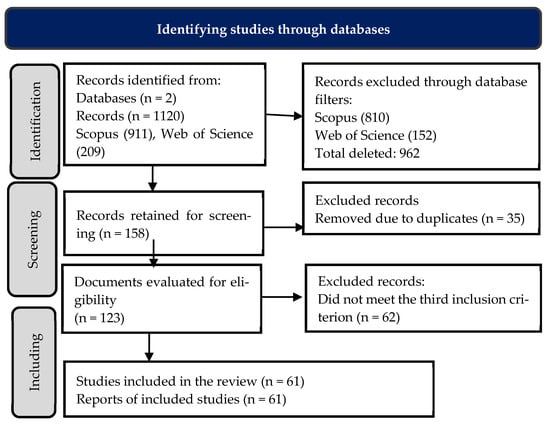
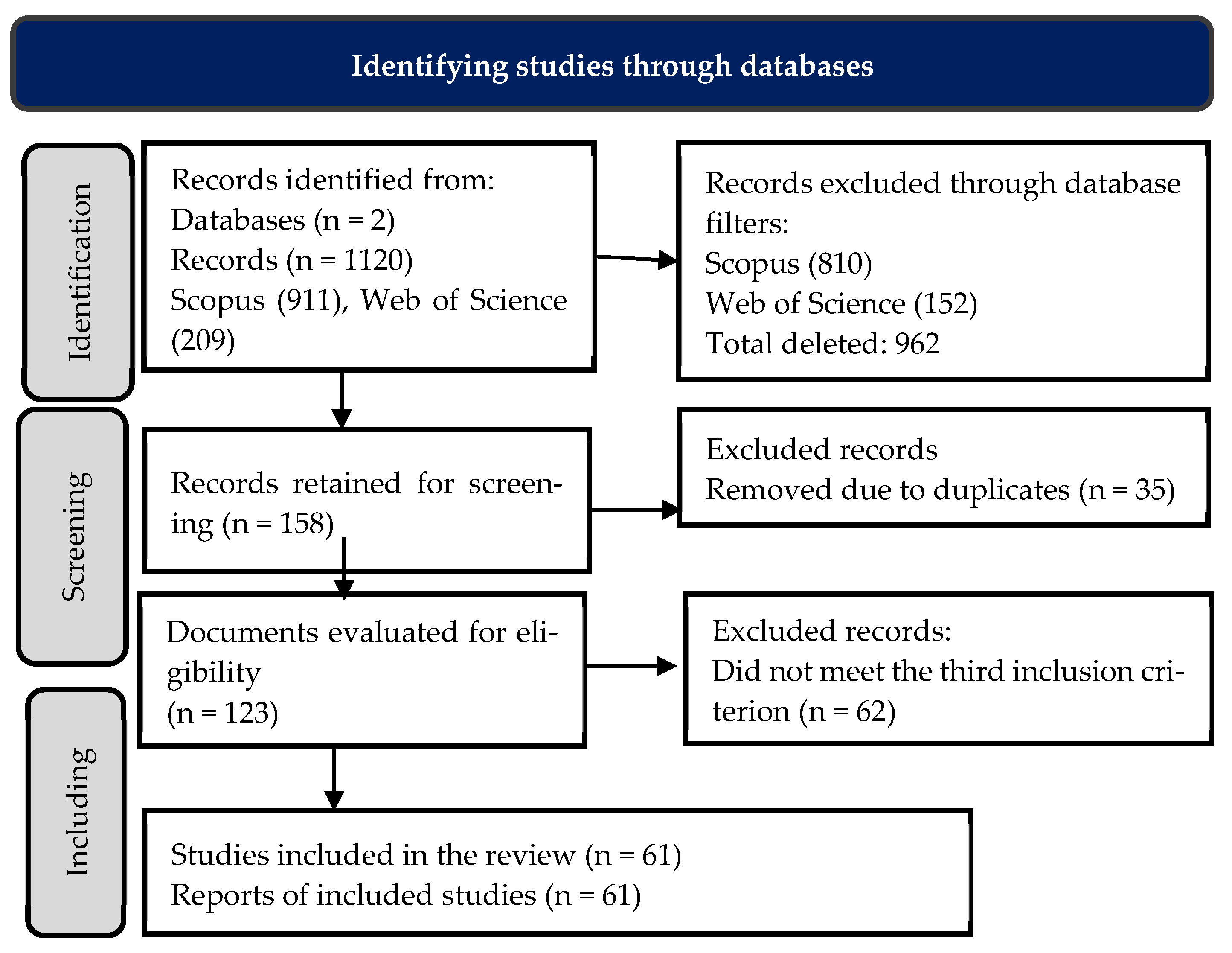
Of the initial 1120 records, 962 were removed using automated database filters based on the time frame and document type. The remaining 158 records were exported to Mendeley Reference Manager software (version 2.103, Elsevier, London, UK) to identify and remove 35 duplicates using the DOI and title of each article.
Microsoft Excel (Office 365, Microsoft Corporation, Redmond, WA, USA) was used to organize the metadata, calculate frequencies, and perform qualitative thematic grouping of the 123 unique documents. Two teams of authors independently evaluated the records, strictly applying the predefined inclusion and exclusion criteria. During this phase, 62 documents were excluded, and discrepancies were resolved by consensus, resulting in a final sample of 61 articles. From this point, bibliographic references were extracted to conduct the co-citation network analysis using the Bibliometrix package (version 4.1, K-Synth Srl, Naples, Italy). It should be noted that the network presented in Figure 1 is not intended to represent the entirety of the literature on SMEs; rather, it was derived exclusively from the final sample of 61 articles with the specific purpose of objectively mapping and highlighting the theoretical fragmentation and research gap addressed by this study. Co-occurrence networks were constructed in Python 3.12.7 (NetworkX v3.4.1, Matplotlib v3.9.2) using the spring-layout algorithm (seed = 42).
To strengthen the contextual interpretation of the review, the final 61-study extraction matrix was additionally coded by geographical setting and sector or business context using the information reported in each study’s sample, methods, results, and discussion. The coding was descriptive and was used to examine whether the roles attributed to technologies, capabilities, and barriers varied across contexts; it did not modify the original thematic assignments or study counts. The expanded contextual coding is reported in Table S4 and File S1 of the Supplementary Material.
3.3. Evaluation of Methodological Quality
The methodological quality of the empirical studies was assessed using the Mixed Methods Appraisal Tool (MMAT, version 2018), according to the criteria applicable to each research design. Non-empirical studies, including review, bibliometric, conceptual, and contextual studies, were retained for the descriptive and theoretical synthesis but were not evaluated using MMAT. The complete identification, screening, and selection process is detailed in Figure 2.
Figure 2.
PRISMA flow diagram of the process of identifying, screening and selecting studies included in the systematic review. Adapted from Ref. [14].
4. Results
This section is structured around five analytical components aligned with the research questions. Section 4.1 and Section 4.2 address RQ1 by examining the temporal evolution of methodological approaches and the predominant thematic lines. Section 4.3 addresses RQ2 by analyzing how digital technologies contribute to market access, adaptation, coordination, and international performance. Section 4.4 addresses RQ3 by synthesizing the multilevel barriers to digital internationalization. Finally, Section 4.5 provides a contextual reading of these patterns across geographical and sectoral settings.
The final corpus comprised 61 studies from diverse geographical and sectoral settings, including Asian, European, Latin American, African, and multi-country contexts. The studies covered e-commerce and digital services, manufacturing and industrial activities, agriculture and agri-food, as well as broader cross-sector SME samples. Detailed study-level geographical and sectoral coding is reported in Table S4 and File S1 of the Supplementary Materials.
4.1. Temporal Evolution of Methodological Approaches (2020–2025)
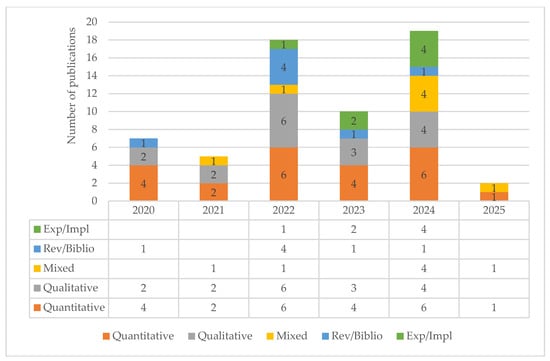
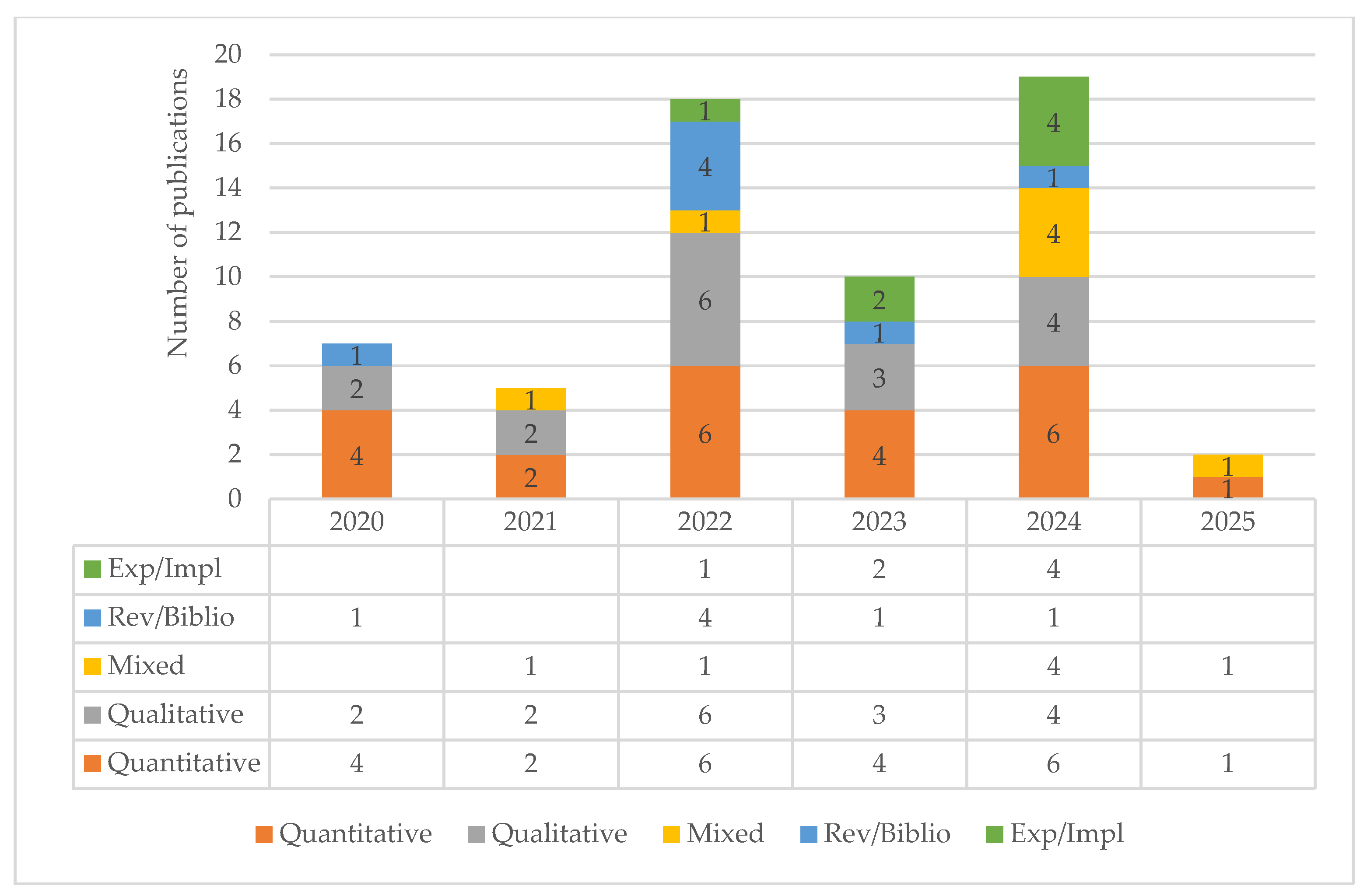
Figure 3 details the annual distribution of the included studies according to the methodological approach used.
Figure 3.
Trends in publications over time by methodological approach (2020–2025). Rev/Biblio: review or bibliometric article; Exp/Impl: experimental/implementation.
Scientific output on the internationalization of SMEs did not show sustained growth; instead, it peaked in 2022 and 2024. Quantitative and qualitative approaches predominated, but beginning in 2022, they diversified to include experimental and implementation studies as well as mixed-methods designs, particularly in 2024. This reflects a gradual expansion of methodological strategies and a growing interest in applied approaches that combine the analysis of relationships between variables with business processes and interventions.
4.2. Predominant Thematic Lines
The thematic classification of the reviewed studies allowed us to identify the researchers’ priorities when evaluating the internationalization of SMEs. Table 1 groups these studies according to their approach and theoretical orientation.
Table 1.
Most frequently addressed lines of research.
The thematic distribution shows that research on the internationalization of SMEs remains multidimensional. Digital transformation, automation, and innovation constitute the most prominent theme (27.9%), followed by managerial, strategic, and entrepreneurial capabilities (26.2%) and the institutional environment and external barriers (21.3%).
Sustainability, cooperation networks, and conceptual studies are less well represented. This distribution implies that they have received less attention within the reviewed corpus. In particular, the prominence of digitalization confirms its growing incorporation into the study of internationalization, although its coexistence with managerial and institutional approaches suggests that it does not yet constitute a standalone explanation of the process. Rather, digital transformation is linked to the company’s internal capabilities, so its impact depends on how SMEs manage to integrate it into their management and international expansion processes.
4.3. The Contribution of Digital Technologies to Internationalization Processes
This section analyzes how digital technologies contribute to various dimensions of SME internationalization. Rather than viewing technology adoption as an isolated factor, the analysis identifies the specific ways in which digital tools support access to international markets, adaptation, coordination, and international performance. Table 2 summarizes these relationships in the studies reviewed.
Table 2.
Digital Technologies and Their Relationship to the Dimensions of Internationalization in SMEs.
For the purposes of this synthesis, market access refers to the ability of SMEs to reach or enter foreign markets and connect with international customers or partners. Adaptation refers to adjustments in products, processes, organizational practices, or market strategies in response to international requirements. Coordination refers to the integration and management of information, operations, transactions, and supply-chain activities across markets. Performance refers to the operational, competitive, export, or international outcomes associated with the use of digital resources and capabilities. Study-level traceability between the technology/capability categories and these internationalization dimensions is reported in Table S5 of the Supplementary Material.
The distribution reveals uneven digital maturity in the literature: 23 studies focus on cross-cutting ICT capabilities, while more advanced technologies appear much less frequently. E-commerce is primarily linked to access and adaptation, while blockchain, Industry 4.0, IoT, and AI are mainly associated with coordination and performance. This suggests that digital internationalization still relies more on integrative capabilities than on highly specialized technologies.
4.4. Multilevel Synthesis of Barriers to the Digital Internationalization of SMEs
To identify how the main constraints affect the digital internationalization of SMEs, the barriers reported in the studies were grouped according to their nature and mechanism of limitation. Table 3 presents the resulting categories, their frequency, and the associated studies.
Table 3.
Barriers to Digital Internationalization.
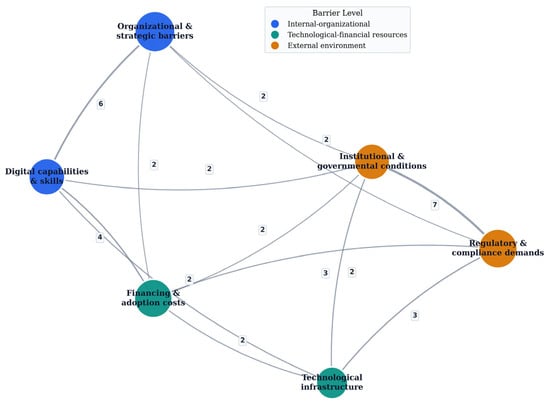
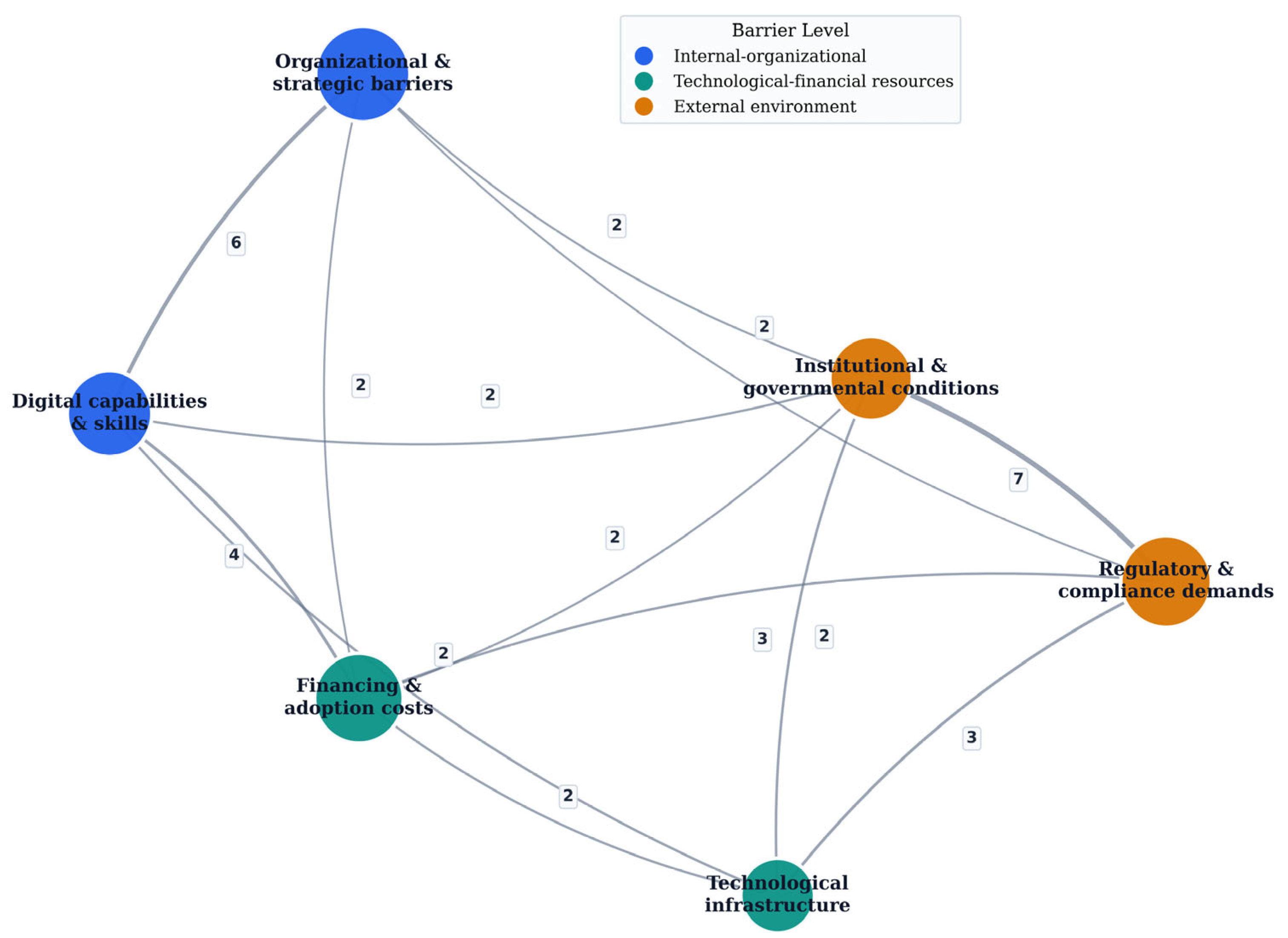
The identified barriers are unevenly distributed across the six categories, with a clear concentration on non-technological dimensions. Organizational and strategic constraints were the most frequent (17 studies; 27.9%), followed by regulatory requirements (15; 24.6%) and funding constraints and adoption costs (14; 23.0%). Figure 4 shows how these barrier categories co-occur within the same studies.
Figure 4.
Co-occurrence network of barriers to digitally enabled SME internationalization. Node size indicates the number of studies reporting each barrier. Numbers on the connecting lines indicate the number of studies reporting both connected barrier categories; for example, 7 indicates that seven studies reported both regulatory and institutional barriers. Line thickness indicates Jaccard similarity. Note. Barrier categories were derived through thematic coding and are non-mutually exclusive; a study could be assigned to more than one category. Article-level coding is reported in Table S3.
The network shows clustering by level: the highest co-occurrences occur within each domain—regulatory with institutional (7 shared studies) and organizational with digital capabilities (6)—while the links between internal and external barriers are consistently weaker (2–4).
4.5. Contextual Variation Across Geographical and Sectoral Settings
The contextual coding of the 61 studies shows that the role attributed to digitalization varies across geographical settings. Studies from Asian and other emerging-market contexts frequently emphasize market-access constraints, financing, digital infrastructure, training, and public support, as illustrated by evidence from Central and West Asia [2], China [16,31], Vietnam [43,63], and Indonesia [24,60,64]. European studies more often examine capability reconfiguration, advanced digital integration, resource efficiency, and technology-enabled performance, including evidence from Finland [19], the Czech Republic [34], multi-country European settings [37,58], Italy [55], Finland and Sweden [65], and Portugal [66]. Studies from Latin American and African contexts more frequently foreground institutional quality, regulation, sector-specific requirements, and public or network support, as illustrated by Brazil [4], Mexico [48], the Amazonian value-chain context [57], Kenya [59], and Bolivia [67]. These patterns are descriptive rather than causal and should be interpreted in light of the uneven distribution of countries and settings in the reviewed corpus.
Sectoral differences are also visible. In e-commerce and digital-service settings, digitalization is mainly associated with market access, customer reach, trust, and adaptation [11,15,19]. In manufacturing and industrial settings, Industry 4.0, automation, innovation, and digitalization are more closely connected with production coordination, efficiency, and performance [21,60,64]. Agriculture and agri-food studies place greater emphasis on quality requirements, sustainability, resource efficiency, traceability, and institutional support [55,57]. Across broader cross-sector SME samples, managerial capabilities, risk management, financing, information systems, and public support remain recurring conditions that shape international outcomes. Table S4 and File S1 provide the study-level contextual coding underlying this interpretation.
5. Discussion
5.1. Digital Technologies and Capabilities in SME Internationalization
The findings suggest that the contribution of digitalization to the internationalization of SMEs is best explained by the capabilities that technologies enable rather than by the mere adoption of specific tools: in the reviewed literature, cross-functional information systems and ICT capabilities—focused on information processing, communication, managerial coordination, and organizational responsiveness—occupy a more established position than highly specialized technologies. From a resource-based and dynamic capabilities perspective, this suggests that the strategic value of digitalization does not lie in the possession of technology itself, but rather in the firm’s ability to integrate digital resources into routines that foster adaptation and international performance, in line with studies that highlight business–IT alignment, managerial capabilities, and the adaptation of business models facilitated by digitalization [11,23,65].
The results also reveal distinct technological functions: e-commerce, digital platforms, and digital marketing are primarily associated with market access and adaptation, as they reduce the information and transactional distance between SMEs and foreign markets and facilitate earlier access to customers, partners, and market knowledge without requiring the same degree of prior physical presence—which challenges a strictly incremental interpretation of international expansion. This does not imply, however, that digitalization eliminates the learning mechanisms of traditional models, but rather that it changes the way knowledge is acquired: market knowledge can be generated through digital interactions, data from platforms, and online networks, although the company still needs the organizational capacity to interpret that information and act accordingly.
In contrast, blockchain, Industry 4.0, automation, the IoT, and artificial intelligence are more closely related to coordination, adaptation, and performance. Therefore, their role is less tied to establishing the first point of contact with the market and more to managing increasingly complex international operations. Blockchain contributes through the traceability and transparency of transactions; Industry 4.0 and automation, through production and logistics efficiency; and the IoT, through supply chain integration. However, unlike the others, the specific role of artificial intelligence cannot yet be clearly established due to the limited number of studies addressing it. This distinction suggests that digital technologies can contribute at different functional stages of internationalization, rather than operating as interchangeable technological resources. Nevertheless, the limited number of studies addressing these advanced technologies prevents this pattern from being interpreted as a sequential technological trajectory or as a maturity model.
This limitation is reinforced by the methodological profile of the field. Although research designs became more diverse starting in 2022—including mixed-methods, experimental, and implementation-oriented approaches—much of the evidence continues to examine digitalization through measures of adoption, managerial perceptions, or cross-sectional relationships. Thus, the literature is stronger at identifying associations between digital resources and international outcomes than at demonstrating how digital capabilities develop and reconfigure over time. The main implication is that research should move beyond the question of whether SMEs adopt digital technologies to examine how these technologies are incorporated as capabilities that transform market access, adaptation, coordination, and performance over time.
5.2. Multilevel Barriers to Digitally Enabled SME Internationalization
The results show that barriers to internationalization tend to occur simultaneously at different levels within the company and its environment. This perspective broadens the interpretation developed in the previous section: if digital technologies gain value when incorporated as organizational capabilities, the barriers affect precisely the conditions necessary for such integration to occur. Therefore, simply having digital tools does not guarantee that an SME will be able to use them to enter, adapt to, coordinate within, or improve its performance in international markets. The literature already warns that limitations in resources, managerial competencies, and environmental conditions constrain this process [2,3,4].
The multilevel synthesis allows us to identify the first set of internal organizational constraints, consisting mainly of strategic barriers and limitations in digital capabilities and knowledge. This combination constitutes one of the most frequent associations in the co-occurrence network (n = 6), showing that digital readiness issues are often accompanied by difficulties related to management, adaptation, or strategic alignment. This is consistent with evidence linking technological effectiveness to alignment between business and information technologies and to the existence of organizational capabilities able to leverage them [23]. Consequently, the digital divide in an SME—in addition to being understood as a lack of technical knowledge—must also be addressed as the difficulty in integrating that knowledge into decisions and routines aimed at international expansion.
A second level comprises technological and financial constraints. Financial constraints can limit the acquisition, upgrading, and scalability of infrastructure, as well as the training and experimentation necessary to develop digital capabilities. Their co-occurrence with limitations in digital knowledge reinforces this relationship, showing that financial resources and capabilities are not entirely separate issues. Evidence on digital transformation in SMEs indicates precisely that technological readiness and learning determine the outcomes resulting from the adoption of emerging tools [6,24]. Therefore, financial constraints can affect not only technological acquisition but also the ability to transform that investment into sustainable internationalization capabilities.
The third level corresponds to the external environment. The strongest association within the network is found between regulatory requirements and institutional and governmental conditions (n = 7). This result suggests that the compliance required to operate internationally is closely related to the quality of the institutional environment, which either facilitates or hinders such compliance. Bureaucracy, regulation, and the availability of public programs can alter SMEs’ opportunities for international access and competitiveness [3,32,33].
Taken together, these links allow us to interpret digital internationalization as a process simultaneously shaped by internal capabilities, resource availability, and institutional characteristics. The network does not demonstrate causal relationships among the barriers, but it does show that several of them are reported in conjunction with one another. This suggests the need to move beyond explanations focused on isolated obstacles and toward approaches that examine how different constraints interact in shaping the international use of digital technologies.
The contextual synthesis qualifies the aggregate patterns by showing that the relevance of technologies and barriers varies across settings. In e-commerce and digital-service contexts, digital tools primarily reduce informational and transactional distance; in manufacturing, they are more closely tied to process coordination, efficiency, and technological upgrading; and in agri-food and sustainability-oriented settings, their contribution is more strongly conditioned by quality standards, traceability, resource efficiency, and regulatory requirements. Likewise, financing, infrastructure, and public-support constraints are especially visible in several emerging-market cases, whereas European studies more frequently emphasize capability reconfiguration and the integration of advanced technologies. These differences are descriptive and were not tested as causal contextual effects, but they help explain why the reviewed studies report heterogeneous patterns.
5.3. Implications and Future Research Directions
The findings of this review have implications for how the relationship between digitalization and the internationalization of SMEs is studied. First, they suggest that technology adoption should not be used on its own as an indicator of digital transformation. Future research needs to distinguish between the availability of a technology and a firm’s ability to incorporate it into its processes, learn from its use, and turn it into an effective capability. This implies moving toward models that analyze the relationship between digital resources, organizational capabilities, and international outcomes, rather than assuming a direct effect between technology adoption and performance.
Second, the distinction observed between access, adaptation, coordination, and performance allows for the formulation of more specific research questions. Rather than making a general assessment of whether digitalization promotes internationalization, future studies could determine which technologies or combinations of capabilities contribute to each of these dimensions and under what conditions. It is also necessary to examine whether technologies play different roles depending on the characteristics of the firm, the target market, or the stage of development of its internationalization process.
A third implication stems from the multilevel structure of the barriers. The identified co-occurrences highlight the need to move beyond models focused on individual constraints and instead analyze configurations in which organizational conditions, digital capabilities, financial resources, infrastructure, and the institutional environment interact. In this regard, future research could employ multilevel models, interaction analysis, or configurational approaches to determine which combinations of conditions facilitate or hinder the use of digital technologies in international markets.
Finally, the implications extend to the business and public policy spheres. For managers, the results indicate that digital investments should be accompanied by training, strategic alignment, and organizational changes that enable firms to leverage these investments internationally. For public policymakers, promoting digitalization requires complementing funding and infrastructure with accessible regulatory frameworks or capacity-building programs. Overall, the future agenda should focus less on demonstrating that digitalization matters and more on explaining how—through which capabilities and under what conditions—it produces effective internationalization outcomes.
6. Conclusions and Prospects
This systematic review shows that the relationship between digitalization and the internationalization of SMEs cannot be explained solely by the adoption of technologies. Although the literature has become methodologically more diverse since 2022, it remains dominated by cross-sectional designs and managerial perceptions, which allow for the identification of associations but limit our understanding of how digital capabilities develop and change over time.
Digital technologies also serve distinct functions within the internationalization process: information systems and cross-cutting ICT capabilities—which feature more prominently in the literature—are associated with adaptation and performance; e-commerce, platforms, and digital marketing primarily facilitate access to external markets; and blockchain, Industry 4.0, IoT, and AI are linked to coordination, adaptation, and performance, confirming that these technologies are not equivalent resources but differ based on the role they play in international expansion.
These contributions are, in turn, shaped by barriers that operate at different levels—organizational, technological–financial, and institutional–regulatory—and that tend to occur simultaneously; therefore, analyzing them in isolation provides an incomplete explanation of the process.
The contextual analysis further indicates that the contribution of digitalization is contingent on sectoral and institutional conditions: market-access functions are more visible in e-commerce and digital-service settings, coordination and efficiency in industrial settings, and certification, traceability, and sustainability requirements in agri-food and resource-oriented contexts.
Taken together, this review integrates technologies, capabilities, internationalization functions, and barriers into a single framework and suggests that future research should move toward longitudinal and implementation-based designs that examine how digital resources are transformed into effective capabilities, and under what internal and external conditions this process yields internationalization outcomes.
Supplementary Materials
The following supporting information can be downloaded at: https://www.mdpi.com/article/10.3390/encyclopedia6110237/s1, Table S1: Comprehensive thematic classification matrix and assigned identifiers (IDs) of the selected studies; Table S2: Full categorization of digital technologies and their linkage to the dimensions of SME internationalization; Table S3: Categorization of barriers to digital internationalization; Table S4: Contextual coding of the 61 studies by geographical and sectoral setting; Table S5: Study-level traceability of technology/capability assignments and internationalization dimensions.
Author Contributions
Conceptualization, J.M.M.C., L.A.F.R. and A.A.J.R.; methodology, J.M.M.C. and A.A.J.R.; software, J.H.C.V.; validation, M.F.M., M.P.C.d.C. and J.H.C.V.; formal analysis, L.A.F.R., M.F.M. and L.P.D.Z.; investigation, M.P.C.d.C. and R.E.Z.S.; resources, R.E.Z.S. and E.R.C.W.; data curation, M.F.M. and M.P.C.d.C.; writing—original draft preparation, J.M.M.C. and L.A.F.R.; writing—review and editing, A.A.J.R., R.E.Z.S., E.R.C.W. and L.P.D.Z.; visualization, J.H.C.V. and E.R.C.W.; supervision, A.A.J.R. and J.M.M.C.; project administration, A.A.J.R. All authors have read and agreed to the published version of the manuscript.
Funding
This research received no external funding.
Institutional Review Board Statement
Not applicable.
Informed Consent Statement
Not applicable.
Data Availability Statement
No new data were created or analyzed in this study. Data sharing is not applicable to this article as the primary sources analyzed are publicly available scientific publications cited in the references.
Conflicts of Interest
The authors declare no conflicts of interest.
Abbreviations
The following abbreviations are used in this manuscript.
| SMEs | Small and medium-sized enterprises. |
| AI | Artificial Intelligence |
| IoT | Internet of Things |
| RBV | Resource-Based View |
| ICT | Information and Communication Technology |
| SLR | Systematic Literature Review |
| PRISMA | Preferred Reporting Items for Systematic Reviews and Meta-Analyses |
| WoS | Web of Science |
| MMAT | Mixed Methods Appraisal Tool |
| SEM/PLS-SEM | Structural equation models/Partial least squares structural equation modeling |
| DOI | Digital Object Identifier |
References
- Dabić, M.; Maley, J.; Dana, L.P.; Novak, I.; Pellegrini, M.M.; Caputo, A. Pathways of SME internationalization: A bibliometric and systematic review. Small Bus. Econ. 2020, 55, 705–725. [Google Scholar] [CrossRef] [Scilit]
- Huseynova, L. Challenges and opportunities in the development of micro, small, and medium-sized enterprises (MSMEs) in Central and West Asia. Probl. Perspect. Manag. 2024, 22, 527–538. [Google Scholar] [CrossRef] [Scilit]
- Heriqbaldi, U.; Esquivias, M.A.; Lau, W.Y.; Cesilia, A.F. Export promotion programs and firm performance: Linking knowledge, commitment, and market strategy to enhance competitiveness. J. Open Innov. Technol. Mark. Complex. 2025, 11, 100479. [Google Scholar] [CrossRef] [Scilit]
- Morini, C.; Polis, M.C.B.; da Silva, D.; Junior, E.I. Export Barriers for SMEs from Emerging Market: A Model of Analysis for Non-Tech Companies. BAR-Braz. Adm. Rev. 2021, 18, e200121. [Google Scholar] [CrossRef] [Scilit]
- Vasani, S.; Abdulkareem, A.M. MSME market presence and competitiveness in a global economy. Cogent Econ. Financ. 2024, 12, 2416992. [Google Scholar] [CrossRef] [Scilit]
- Mohammad, R.I.; Faraji, M.R.; Rashid, M.; Bhuyan, M.K.; Hossain, R.; Ghose, P. Digital Transformation in SMEs Emerging Technological Tools and Technologies for Enhancing the SME’s Strategies and Outcomes. J. Ecohumanism 2024, 3, 211–224. [Google Scholar] [CrossRef] [Scilit]
- Barney, J. Firm resources and sustained competitive advantage. J. Manag. 1991, 17, 99–120. [Google Scholar] [CrossRef] [Scilit]
- Johanson, J.; Vahlne, J.E. The Uppsala internationalization process model revisited: From liability of foreignness to liability of outsidership. J. Int. Bus. Stud. 2009, 40, 1411–1431. [Google Scholar] [CrossRef] [Scilit]
- Knight, G.A.; Cavusgil, S.T. Innovation, organizational capabilities, and the born-global firm. J. Int. Bus. Stud. 2004, 35, 124–141, Correction in J. Int. Bus. Stud. 2004, 35, 334. [Google Scholar] [CrossRef] [Scilit]
- Kohli, A.K.; Jaworski, B.J. Market Orientation: The Construct, Research Propositions, and Managerial Implications. J. Mark. 1990, 54, 1. [Google Scholar] [CrossRef] [Scilit]
- Yao, G.; Dato’mansor, Z.; Ghazali, H.B.; Yan, Z. A comprehensive mixed-methods study on cross-border e-commerce SMEs, digital transformation and dynamic managerial capabilities. Environ. Soc. Psychol. 2024, 9, 2255. [Google Scholar] [CrossRef] [Scilit]
- Winckler, N.C.; Zen, A.C.; Prevot, F. Firm resources for internationalization of SMEs from emerging countries: A multimethod study. Rev. Adm. Mackenzie 2022, 23, eRAMR220165. [Google Scholar] [CrossRef] [Scilit]
- Teece, D.J. Explicating dynamic capabilities: The nature and microfoundations of (sustainable) enterprise performance. Strateg. Manag. J. 2007, 28, 1319–1350. [Google Scholar] [CrossRef] [Scilit]
- Page, M.J.; McKenzie, J.E.; Bossuyt, P.M.; Boutron, I.; Hoffmann, T.C.; Mulrow, C.D.; Shamseer, L.; Tetzlaff, J.M.; Akl, E.A.; Brennan, S.E.; et al. The PRISMA 2020 statement: An updated guideline for reporting systematic reviews. BMJ 2021, 372, n71. [Google Scholar] [CrossRef] [Scilit]
- Drašković, N.; Fraculj, M.; Šebek, V. Born global in the digital age: Exploring the internationalisation strategies of croatian digital marketing agencies. Management 2024, 29, 97–111. [Google Scholar] [CrossRef] [Scilit]
- Liu, W.; Si, S. Disruptive Innovation in the Context of Retailing: Digital Trends and the Internationalization of the Yiwu Commodity Market. Sustainability 2022, 14, 7559. [Google Scholar] [CrossRef] [Scilit]
- Asaithambi, S.; Ravi, L.; Devarajan, M.; Almazyad, A.S.; Xiong, G.; Mohamed, A.W. Enhancing enterprises trust mechanism through integrating blockchain technology into e-commerce platform for SMEs. Egypt. Inform. J. 2024, 25, 100444. [Google Scholar] [CrossRef] [Scilit]
- Makudza, F.; Jaravaza, D.C.; Govha, T.; Mukucha, P.; Saruchera, F. Enhancing supply chain agility through e-procurement in a volatile frontier market. J. Transp. Supply Chain Manag. 2023, 17, 12. [Google Scholar] [CrossRef] [Scilit]
- Maki, M.; Toivola, T. Global Market Entry for Finnish SME eCommerce Companies. Technol. Innov. Manag. Rev. 2021, 11, 11–21. [Google Scholar] [CrossRef] [Scilit]
- Abdulnour, S.; Baril, C.; Abdulnour, G.; Gamache, S. Implementation of Industry 4.0 Principles and Tools: Simulation and Case Study in a Manufacturing SME. Sustainability 2022, 14, 6336. [Google Scholar] [CrossRef] [Scilit]
- Polonara, M.; Romagnoli, A.; Biancini, G.; Carbonari, L. Introduction of Collaborative Robotics in the Production of Automotive Parts: A Case Study. Machines 2024, 12, 196. [Google Scholar] [CrossRef] [Scilit]
- Arici, T.; Usta, A.T.; Cigerim, E.; Gok, M.S. Mediating role of information systems on strategy and performance: Innovation and competition perspective. Proc. Eng. Sci. 2022, 4, 179–190. [Google Scholar] [CrossRef] [Scilit]
- Ajibade, P.; Mutula, S. Promoting SMEs effectiveness through innovative communication strategies and business-IT alignment. Probl. Perspect. Manag. 2020, 18, 233–244. [Google Scholar] [CrossRef] [Scilit]
- Faisol; Widiawati, H.S.; Ramadhani, R.A.; Sumantri, B.A. The role of eco-digital learning in enhancing the impact of IoT, blockchain, and artificial intelligence on green supply chain for SME internationalization. Probl. Perspect. Manag. 2025, 23, 76–89. [Google Scholar] [CrossRef] [Scilit]
- Žužek, T.; Gosar, Ž.; Kušar, J.; Berlec, T. A new product development model for smes: Introducing agility to the plan-driven concurrent product development approach. Sustainability 2021, 13, 12159. [Google Scholar] [CrossRef] [Scilit]
- Vijayalakshmi, B.; Subashini, G.; Jayalakshmi, M.; Umayal, C. A Study on the Perception of SMEs on Foreign Exchange Risk Management. Univers. J. Account. Financ. 2022, 10, 95–101. [Google Scholar] [CrossRef] [Scilit]
- Moreno, J.; Londoño, J.C.; Zapata-Upegui, L.F. Marketing strategy and competitiveness: Evidence from Colombian SMEs. Tec Empres. 2023, 17, 48–64. [Google Scholar] [CrossRef] [Scilit]
- Kuděj, M.; Civelek, M.; Erben, M.; Masárová, J.; Kubálek, J. Navigating global markets: The role of enterprise risk management and human resource management in SME international expansions. Equilib. Q. J. Econ. Econ. Policy 2023, 18, 1075–1103. [Google Scholar] [CrossRef] [Scilit]
- Furiak, K.; Buganová, K.; Prievozník, P.; Hudáková, M.; Slepecký, J. Research on the Impacts of Global Entrepreneurial Environment Changes on Small and Medium-Sized Entrepreneurship. Systems 2024, 12, 234. [Google Scholar] [CrossRef] [Scilit]
- Makaya, W.F.; Nwachukwu, C.; Hieu, V.M. Strategies and Techniques for the Internationalization of Non-Dominant Firms: A Qualitative Study. Int. J. Innov. Res. Sci. Stud. 2021, 4, 291–298. [Google Scholar] [CrossRef] [Scilit]
- Zhao, T.; Ma, R.; Chen, S. The International Operations of China’s Hidden Champions—Based on Fuzzy-Set Qualitative Comparative Analysis. Sage Open 2024, 14, 21582440241271071. [Google Scholar] [CrossRef] [Scilit]
- Sever, T.; Ravšelj, D.; Aristovnik, A.; Kovač, P. Cutting red tape–Legal and institutional tools to promote SMEs. Danube 2020, 11, 195–213. [Google Scholar] [CrossRef] [Scilit]
- Jintana, J.; Limcharoen, A.; Patsopa, Y.; Ramingwong, S. Innovation Ecosystem of ASEAN Countries. Rev. Amazon. Investig. 2020, 9, 356–364. [Google Scholar] [CrossRef] [Scilit]
- Škodová, D.; Novotná, J. Implementation of quality improvements and innovations in agricultural enterprises. Agric. Econ. 2022, 68, 207–218. [Google Scholar] [CrossRef] [Scilit]
- Wang, J.X.; Burke, H.; Zhang, A. Overcoming barriers to circular product design. Int. J. Prod. Econ. 2022, 243, 108346. [Google Scholar] [CrossRef] [Scilit]
- Singh, V.K.; Keshari, A.; Singh, D.; Singh, P.C.; Gautam, A. Green export strategies and SMEs export performance: Mediating roles of innovation, readiness, and activities. J. Innov. Entrep. 2024, 13, 87. [Google Scholar] [CrossRef] [Scilit]
- Chatzistamoulou, N.; Tyllianakis, E. Commitment of European SMEs to resource efficiency actions to achieve sustainability transition. A feasible reality or an elusive goal? J. Environ. Manag. 2022, 321, 115937. [Google Scholar] [CrossRef] [Scilit]
- Lekovic, B.; Vojinovic, Z.; Milutinovic, S. Cooperation as a mediator between entrepreneurial competences and internationalization of new venture. Eng. Econ. 2020, 31, 72–83. [Google Scholar] [CrossRef] [Scilit]
- Chaldun, E.R.; Yudoko, G.; Prasetio, E.A. Developing a Theoretical Framework of Export-Oriented Small Enterprises: A Multiple Case Study in an Emerging Country. Sustainability 2024, 16, 11132. [Google Scholar] [CrossRef] [Scilit]
- Nuryakin. Entrepreneurial orientation and SME export performance: Unveiling the mediating roles of innovation capability and international networking accessibility in the brass industry. J. Entrep. Manag. Innov. 2024, 20, 30–46. [Google Scholar] [CrossRef] [Scilit]
- Gomes, E.; Sousa, C.M.P.; Vendrell-Herrero, F. International marketing agility: Conceptualization and research agenda. Int. Mark. Rev. 2020, 37, 261–272. [Google Scholar] [CrossRef] [Scilit]
- Tian, H.; Akhtar, S.; Qureshi, N.A.; Iqbal, S. Predictors of entrepreneurial intentions: The role of prior business experience, opportunity recognition, and entrepreneurial education. Front. Psychol. 2022, 13, 882159. [Google Scholar] [CrossRef] [Scilit]
- Nguyen, C.Q.; Nguyen, A.M.T.; Tran, P. Assessing the critical determinants of cross-border E-commerce adoption intention in Vietnamese small and medium-sized enterprises: PLS-SEM algorithm approach. J. Open Innov. Technol. Mark. Complex. 2024, 10, 100257. [Google Scholar] [CrossRef] [Scilit]
- Hakeem, A.; Raissi, N. Entrepreneurial Orientation and MSMEs Internationalization: The mediating role of Politicisation. J. Syst. Manag. Sci. 2023, 13, 330–345. [Google Scholar] [CrossRef] [Scilit]
- Maesaroh, S.S.; Rahayu, A.; Ahman, E.; Wibowo, L.A.; Swardana, A. Green Economy Research Trends and Mapping in SMEs: A Bibliometric Analysis. Int. J. Sustain. Dev. Plan. 2024, 19, 1003–1014. [Google Scholar] [CrossRef] [Scilit]
- Osarenkhoe, A.; Fjellström, D. A cluster’s internationalization as a catalyst for its innovation system’s access to global markets. EuroMed J. Bus. 2024, 19, 229–250. [Google Scholar] [CrossRef] [Scilit]
- Prasad, S.; Rao, A.; Lanka, K. Analysing the Barriers for Implementation of Lean-led Sustainable Manufacturing and Potential of Blockchain Technology to Overcome these Barriers: A Conceptual Framework. Int. J. Math. Eng. Manag. Sci. 2022, 7, 791–819. [Google Scholar] [CrossRef] [Scilit]
- García, H.C.E.; Ruíz, J.G.R. Determinants for the internationalization of mexican meat companies. RAE Rev. Adm. Empres. 2024, 64, e2023-0027. [Google Scholar] [CrossRef] [Scilit]
- Alinasab, J.; Mirahmadi, S.M.R.; Ghorbani, H.; Caputo, F. Discovering Knowledge and Cognitive Based Drivers for SMEs Internationalization. J. Knowl. Econ. 2022, 13, 2490–2518. [Google Scholar] [CrossRef] [Scilit]
- Matos, C.T.; Mathieux, F.; Ciacci, L.; Lundhaug, M.C.; León, M.F.G.; Müller, D.B.; Dewulf, J.; Georgitzikis, K.; Huisman, J. Material system analysis: A novel multilayer system approach to correlate EU flows and stocks of Li-ion batteries and their raw materials. J. Ind. Ecol. 2022, 26, 1261–1276. [Google Scholar] [CrossRef] [Scilit]
- Hoxholli, E.; Kërçini, D. Empirical research on the relation between internal influencing factors on the internationalization: Albanian SMES. Int. J. Ecosyst. Ecol. Sci. (IJEES) 2020, 10, 193–202. [Google Scholar] [CrossRef] [Scilit]
- Fiernaningsih, N.; Widayani, A.; Herijanto, P.; Himmah, M.; Utamaningsih, A. Enhancing SME performance in East Java through competency development, leadership, entrepreneurial intent, and resilience. Probl. Perspect. Manag. 2024, 22, 504–516. [Google Scholar] [CrossRef] [Scilit]
- Cortellazzo, L.; Bonesso, S.; Gerli, F. Entrepreneurs’ behavioural competencies for internationalisation: Exploratory insights from the Italian context. Int. J. Entrep. Behav. Res. 2020, 26, 723–747. [Google Scholar] [CrossRef] [Scilit]
- Sandoval, R.J.; Alvarez-Cedillo, J.A.; Sarabia-Alonso, M.T.; Alvarez-Sanchez, T.; Perez-Garcia, R.; Gonzalez-Vasquez, A. Implementation of business culture for mexican SMES versus globalization 4.0. East.-Eur. J. Enterp. Technol. 2022, 4, 34–43. [Google Scholar] [CrossRef] [Scilit]
- Ciasullo, M.V.; Montera, R.; Mercuri, F.; Mugova, S. When Digitalization Meets Omnichannel in International Markets: A Case Study from the Agri-Food Industry. Adm. Sci. 2022, 12, 68. [Google Scholar] [CrossRef] [Scilit]
- Sipos, N.; Bányai, E.; Venczel-Szakó, T. An international empirical study on the relationship between decision-making information complexity and resource-based view in small and medium-sized enterprises. Syst. Res. Behav. Sci. 2024, 41, 453–470. [Google Scholar] [CrossRef] [Scilit]
- Fernandes, K.; Teixeira, D. Assessing the impact of voluntary sustainability standards in Amazonian enterprises involved in the açaí value chain. Heliyon 2024, 10, e34157. [Google Scholar] [CrossRef] [Scilit]
- Valaskova, K.; Nagy, M. Macro-economic development of the eu countries in the context of performance and competitiveness of SMES. Bus. Manag. Econ. Eng. 2023, 21, 124–139. [Google Scholar] [CrossRef] [Scilit]
- Pasquali, G.; De Marchi, V. Public Governance and Technological Capabilities in the Kenyan Leather Industry. Afr. Aff. 2022, 121, 419–441. [Google Scholar] [CrossRef] [Scilit]
- Herlinawati, E.; Machmud, A. The effect of innovation on increasing business performance of SMEs in Indonesia. WSEAS Trans. Bus. Econ. 2020, 17, 51–57. [Google Scholar] [CrossRef] [Scilit]
- Andrei, A.G.; Dincǎ, V.M.; Mitan, A.; Vǎtǎmǎnescu, E.M. Connecting the Dots: Exploring the Knowledge-based Antecedents of SMEs’ Profitability and Development via International Ventures. Manag. Mark. 2021, 16, 167–186. [Google Scholar] [CrossRef] [Scilit]
- Traiyarach, S.; Banjongprasert, J. The Impact of Export Promotion Programs on Export Competitiveness and Export Performance of Craft Products. J. Mar. Sci. Eng. 2022, 10, 892. [Google Scholar] [CrossRef] [Scilit]
- Bozsik, N.; Ngo, D.M.; Vasa, L. The effects of foreign direct investment on the performance of small-medium enterprises: The case of Vietnam. Cent. Sociol. Res. J. Int. Stud. 2023, 16, 2023. [Google Scholar] [CrossRef] [Scilit]
- Djou, L.G.; Udin, U.; Lukiastuti, F.; Filatrovi, E. The Contingency Approach of Digitalization and Entrepreneurial Orientation on Smes Performance in Metal and Machinery Industry. Int. J. Criminol. Sociol. 2022, 9, 2235–2249. [Google Scholar] [CrossRef] [Scilit]
- Reim, W.; Yli-Viitala, P.; Arrasvuori, J.; Parida, V. Tackling business model challenges in SME internationalization through digitalization. J. Innov. Knowl. 2022, 7, 100199. [Google Scholar] [CrossRef] [Scilit]
- Fernandes, C.I.; Ferreira, J.J.M.; Veiga, P.M.; Hu, Q.; Hughes, M. Dynamic capabilities as a moderator: Enhancing the international performance of SMEs with international entrepreneurial orientation. Rev. Manag. Sci. 2024, 19, 1073–1094. [Google Scholar] [CrossRef] [Scilit]
- Vila, A.A. Small and Medium Enterprises in Bolivia, a Look Back to the Future, 1900–2020. J. Evol. Stud. Bus. 2022, 7, 87–120. [Google Scholar] [CrossRef] [Scilit]

Disclaimer/Publisher’s Note: The statements, opinions and data contained in all publications are solely those of the individual author(s) and contributor(s) and not of MDPI and/or the editor(s). MDPI and/or the editor(s) disclaim responsibility for any injury to people or property resulting from any ideas, methods, instructions or products referred to in the content. |
© 2026 by the authors. Licensee MDPI, Basel, Switzerland. This article is an open access article distributed under the terms and conditions of the Creative Commons Attribution (CC BY) license.