Entry

The Relationship of Humans and Horses—A Perspective from the Past to the Future

by
Inês Pereira-Figueiredo
1,2
1
Neuroscience Institute of Castilla y León, University of Salamanca, C/ Pintor Fernando Gallego 1, 37007 Salamanca, Spain
2
TheKidsFellows—Research Group in Anthrozoology, 6060-349 Idanha a Nova, Portugal
Encyclopedia 2025, 5(4), 207; https://doi.org/10.3390/encyclopedia5040207
Submission received: 28 August 2025 / Revised: 25 November 2025 / Accepted: 2 December 2025 / Published: 5 December 2025
(This article belongs to the Section Behavioral Sciences)

Definition

The love for horses is deeply rooted in human history and culture, captivating us with their magnificent nature. For millennia, horses have been crucial to human survival and development, providing transportation, labor, and even status. Currently, interest in human relationships with other animals has grown significantly, in the context of promoting the well-being and essential health of both species. This entry aims to explore the possibilities of human–horse relationships, from early interactions to strong bonds. The literature collected here highlights the complexity of this relationship, with special attention to the various biological and social factors involved. The text compares historical practices with current perspectives, examining how these changes affect the relationship between humans and horses. It examines how connecting with horses potentially benefits both humans and horses, underlining the importance of recognizing horse behavior and noting that our assumptions may not reflect their true needs. This literature enriches our understanding of the multifaceted nature of human–horse relationships, offering a new perspective on horse care, which focuses on positive relationship and well-being, and therefore on the importance of harmonious provision of all domains of well-being, highlighting the importance of healthy behavioral interactions and emotional stability of both species.

1. Historical Perspectives of a Relationship

The affection for horses (Equus caballus) and the history of human–horse relationship are integral parts of our shared past and culture. Horses have undergone a profound evolutionary journey over millions of years, adapting as prey animals in a world where humans stood as their primary predators [1]. With the advent of domestication, a fascinating and intricate transformation unfolded. This evolutionary process has significantly influenced horses throughout the ages, reshaping not only their genetics but also their behaviors and function [2,3]. Domestication profited both humans and horses, as they rely on each other for success [3,4]. Although horses were domesticated later than many other animals, such as dogs, and economically significant livestock—like sheep, goats, cattle, and pigs—they profoundly impacted the trajectory of human civilization [2,3]. Humans derived numerous advantages from horses, notably by their remarkable moving ability, which significantly transformed the transportation of goods and people [2,5,6]. Their capacity to move swiftly over long distances opened new avenues for trade and communication, facilitating the expansion of societies and commerce. Also, horses’ unique strength was invaluable in both military and agricultural contexts [4,5,6].
Conversely, the animals benefited from domestication through the protection and care offered by humans [6]. In this new social structure, horses were provided with food, shelter, and veterinary care, which improved their survival rates and general health. They also became an important part of communities, playing roles in daily life and cultural practices, symbolizing power, loyalty, and companionship.
The successful process of domestication was, most probably, facilitated by the distinct characteristics inherent to each species [6,7]. In the case of horses, their instinctive flight response is complemented by a natural curiosity and a predisposition for social interaction. This blend of flight response and sociability creates a fascinating dynamic. Similarly, humans, as profound social beings, are driven by similar fundamental needs for connection and companionship [6]. According to Ferlazzo et al. [5], this mutual pursuit of social relationships may have initiated the bond between the two species, illustrating “the intricate interplay between instinct and sociability in the context of domestication”. These social traits have been consistently used over time, with each human–horse interaction contributing to the development of a relationship [5].
The domestication of horses transformed both human lives and horses’ lives [3]. By definition, domestication is a “mutualistic relationship wherein one organism exerts significant influence over the reproduction and care of another” [2]. In horses, for example, it has involved selective breeding by humans to enhance features that suited their needs. According to Niskanen [3], the possibility of horseback riding was the trait that drove the selection that resulted in the domestic horses we have today. Meaning “equestrianism” has involved the intended selection for animals with the right temperaments and better physical abilities [3].
Nowadays, horses are used mainly for sport and leisure pursuits [7,8,9,10]. Therefore, horses are regarded either as athletes [10] or as social agents [7,8], participating in leisure events, enduring close contact with humans. Whatever the context, it is generally supposed that those who care for horses typically prioritize their well-being [10]. Nevertheless, an increasing number of studies reveal the opposite [7,8,9,10,11,12,13]. The literature reveals disturbing data on the welfare and living conditions of horses. Even if being provided with advanced accommodation or top performance systems, horses are frequently subjected to inappropriate or intensive training routines, confined housing, and few interactions to conspecifics [7,8,9]. Several reasons are pointed out by the authors as being behind these human decisions, such as insufficient understanding of equine behavior [7,8], misconceptions about their needs [10], or social pressures [9,11,12,13]. Given the variety of opinions on proper horse care and ethical standards, convincing equine professionals and enthusiasts to re-evaluate established methods has proven to be a difficult task [8,10,12,13]. In recent years, organizations such as the Equestrian International Federation (FEI) recruited animal welfare scientists and experts to prepare a document ensuring that the protection and providing a good life for horses are recognized as human responsibilities [10]. However, Cheung et al. [11] carried out a very thorough survey that revealed a worrying trend among horse owners, the “objectification of horses”. In their study, most participants expected horses to perform tasks flawlessly for personal benefit, viewing them mainly as “instruments.” Accordingly, Bornemann [12], citing van Weeren [13], revealed that traditions in equestrian culture, which have been passed down through many generations, are an enduring barrier, where “the essentials of riding and the rules for horse breeding may not have changed for millennia”. Both reports highlight the prevailing attitudes within the equestrian culture, suggesting that changes have not yet happened or are happening slowly.
Many people enjoy interacting with horses, and the connections developed have become a topic of interest and practice [4,5,8,14,15]. Though the affective experiences exhibited when connecting to horses [1,5], limited research has explored the benefits of positive human–horse interactions [14]. Numerous studies have placed greater emphasis on the negative consequences that arise from poor interactions [6,15], often overlooking the importance of understanding equine behavior [7,8,14]. These analyses typically focus on problems like heightened reactions, riding difficulties, and accident risks [6,15]. In their research, Kieson and Abramson [14] found that even within certain models of equine-assisted psychotherapy—where positive horse–human engagement is intended to be central—horses are frequently treated as tools or “metaphors”, rather than as animals or partners. Surprisingly, they also revealed that an understanding of horse behavior was actively discouraged in some settings.
The relationship between humans and horses is a dynamic process that begins with mutual perception and evolves through ongoing communication [16]. Each interaction facilitates the development of trust, confidence, and effective messages, ultimately fostering collaboration between both species [5,6]. It is, however, difficult for us humans to step outside of ourselves and envision the world from an equine “standpoint”. Horses, as conscious beings that they are, experience many of the same feelings that we have [15,16]. While it is useful to understand the parallels of suffering and emotions, anthropomorphism should not represent them as mentally or physically equal to humans. As Fiedler et al. reasoned [16], attributing human characteristics to animals may have benefits, while including a sense of connection to a horse and being protective to neglect, but the authors agreed that it may also lead to mistaken assumptions regarding their mental experiences.
The horse has its own view of the world, and we, in our quest to provide them with a good life, have an obligation to consider it as such. Failing to provide them with suitable social or physical environments can lead to emotional distress and behavioral issues [10,14,16]. It not only complicates the quality of a relationship, often resulting in inconsistent behaviors, but may significantly influence the overall health of the horse [14,17], diminish their sense of well-being [10,11,16], or increase the likelihood of injuries [12,15,18].
In recent years, researchers and practitioners have shifted from focusing solely on understanding uncomfortable animal behaviors to recognizing the importance of positive experiences, as essential components of welfare [12,14,15,16,17,18,19]. The Five Domains framework of welfare has evolved in this direction over the past 30 years [16,19]. The new model focuses on the evidence that animals, consciously and objectively, seek to interact with their environment and other animals [10,17,19,20]. In this concept of well-being, guaranteeing the conditions of survival and nourishment (nutrition, physical environment, or health, i.e., the first three domains) is not enough [17,20]. The harmonious provision of all domains defines healthy behavioral interactions (Domain 4) and emotional stability (Domain 5) as highly important [19]. As such, the motivations that drive horses and how they cope with their environment must be recognized. Horses are motivated not by fear, but by innate curiosity and an openness to engage with other individuals.
This entry will strive to examine the foundational framework of human–horse relationships and their benefits, particularly within the context of a society that is increasingly distanced from nature, offering a new perspective on health and well-being.

2. How Horses Interact with Their Environment

2.1. As Prey Animals

Horses have endured, for millions of years, the frequent transformations that Planet Earth has undergone. Being migratory animals, throughout their selection process, horses have always sought the climates and soils that best adapt to their metabolic requirements, developing the sense organs into the sophisticated apparatus they have today [18,21,22,23,24]. For example, a horse’s skin is an extremely specialized organ with a much greater tactile sensitivity than that of humans [21]. The mouth and limbs are particularly well endowed [22], with a tactile sensitivity, certainly largely underestimated, which requires extreme care in the use of reins and bridles. The eye of the horse is one of the largest among terrestrial vertebrates. Adapted to the open grasslands of their habitat, it allows them to see a wide panorama of the entire horizon; it is particularly sensitive to any movement [21], but has little acuity for closer objects and is dependent on the positioning of the head and neck to achieve visual clarity [22]. Despite the horse’s sense of hearing being apparently weak (the lowest frequency at which horses can hear is 50 Hz, compared to 20 Hz in humans), it exceeds the highest frequencies that can be heard by humans (at 33 kHz compared to 20 kHz for humans) [21], and horses are very sensitive to acoustic pressure [22]. In addition to being very sensitive to stimuli, horses use their senses to share sensory information in a group [12,21,22,23]. For instance, the olfactory perception plays a crucial role in how horses interact with their environment and significantly influences their social behavior [23].
Altogether, the literature indicates that, although horses and humans possess the same five major senses, there are situations where a horse can detect stimuli that humans are unaware of, and vice versa. In addition, horses might be communicating in ways we do not always notice. Recognizing differences in physiognomy, along with variations in sensory range and acuity, is crucial, as this affects their perception of the environment. This knowledge improves communication and strengthens the bonds between people and horses.
The comprehension of how each animal species perceives and interacts with its surroundings has emerged as a significant focus in modern biological research [21,24], following the work of Jakob von Uexküll [25]. Von Uexküll, a German biologist, underscored this significance by introducing the concept of “umwelt” [21,25,26]. This term derives from the German words Um (“around”) and Welt (“world”) and highlights the notion that every organism creates its own unique perceptual world [25]. The umwelt theory suggests that even if two animals of the same species share the same environment, they can experience it very differently, in a reality crafted by own specific sensory capabilities and behavioral adaptations [26]. By delving into these individual perceptual realms, we gain deeper insights into the complexities of animal behavior and the intricate connections between organisms and their environments.
Horses perceive the world very differently from us, humans, not only due to their different physiology and sensory abilities, but also because, for them, the world is a very dangerous place. Unlike other species widely used as pets, such as dogs and cats, horses are prey. Horses descend from the “Hyracotherium”, which was a small, slight equine—characterized by a very low threshold for fear—that ran on tiptoe to escape predators [26,27,28]. These equids needed to be extremely tuned to their surrounding environment and constantly scanning it for predators [24]. Inherent to them, restlessness, distrust, and flight predominate [22,26,29]. Their trend towards mobility, awareness, and defensive characteristics [27,28], intensely selected throughout their phylogenesis (53–36.5 million years ago, since the Eocene), explains the behavior of the horse we currently use [29], since by comparison, their domestication of about 5500 years of co-evolution with humans is very recent.

2.2. Adapting to the Environment

Since the beginning of time, the environment has been constantly sending out various stimuli. In response, every living organism has evolved with millions of neurons and sensory receptors designed to receive and monitor these signals [21,25]. The stimuli detected may include external environmental changes—such as visual cues, smells, or sounds—or internal changes within the body itself. Regardless of their source, once an organism perceives a stimulus, it must respond and adapt [30] to maintain a stable state [31,32,33,34]; in other words, organisms must “maintain stability through change” [35], a crucial trait for survival. With Charles Darwin [30], the adaptation to change was emphasized as an essential feature to survival. This means that to act—whether in defense or to secure food—organisms need to continuously process the information received, identify the pertinent stimuli, and select appropriate behavioral responses, according to the perception mediated at brain level [24,31,34]. If the stimulus is interpreted as a threat, the organism responds immediately. The shift to “preparing for action to survival” triggers sympathetic responses [31], leading to changes in physiology and chemical mediator release [31,32,33], including higher heart rate, breathing, and peripheral circulation [33]. This early response is quick, unconscious, and protective [31], and allows the body to cope with the situation. As an example, against a continuous background of odors in a pasture, a horse will react to an unexpected odor, perhaps that of a predator. It will react immediately with escape responses, creating distance. Then, keeping a distance holding some security, it observes, inspects it, and returns to the group. This captures the paradoxical nature of horses—curious yet cautious.
Neuroscience has shown that all mammals possess a common neural circuitry mediating defensive response [18,35]. Yet, the speed and accuracy demands, imposed on these circuits, are determined by distinctive neurological perception. As a species, horses exhibit unique adaptive mechanisms [18,32]. Their normal breathing rate is relatively slow—8 to 16 breaths per minute compared to an adult human’s 12 to 18—and their resting heart rate is lower as well, at 30 to 40 beats per minute, while humans average 60 to 100. However, when confronted with a potential threat, horses can rapidly increase both their breathing and heart rates [32]. As a consequence, they may react impulsively, becoming easily frightened by any sudden or imperceptible stimuli (for humans). Such behaviors are often reported to be the cause of many accidents, when not predicted, understood, or when escape is not permitted [8,15,36].
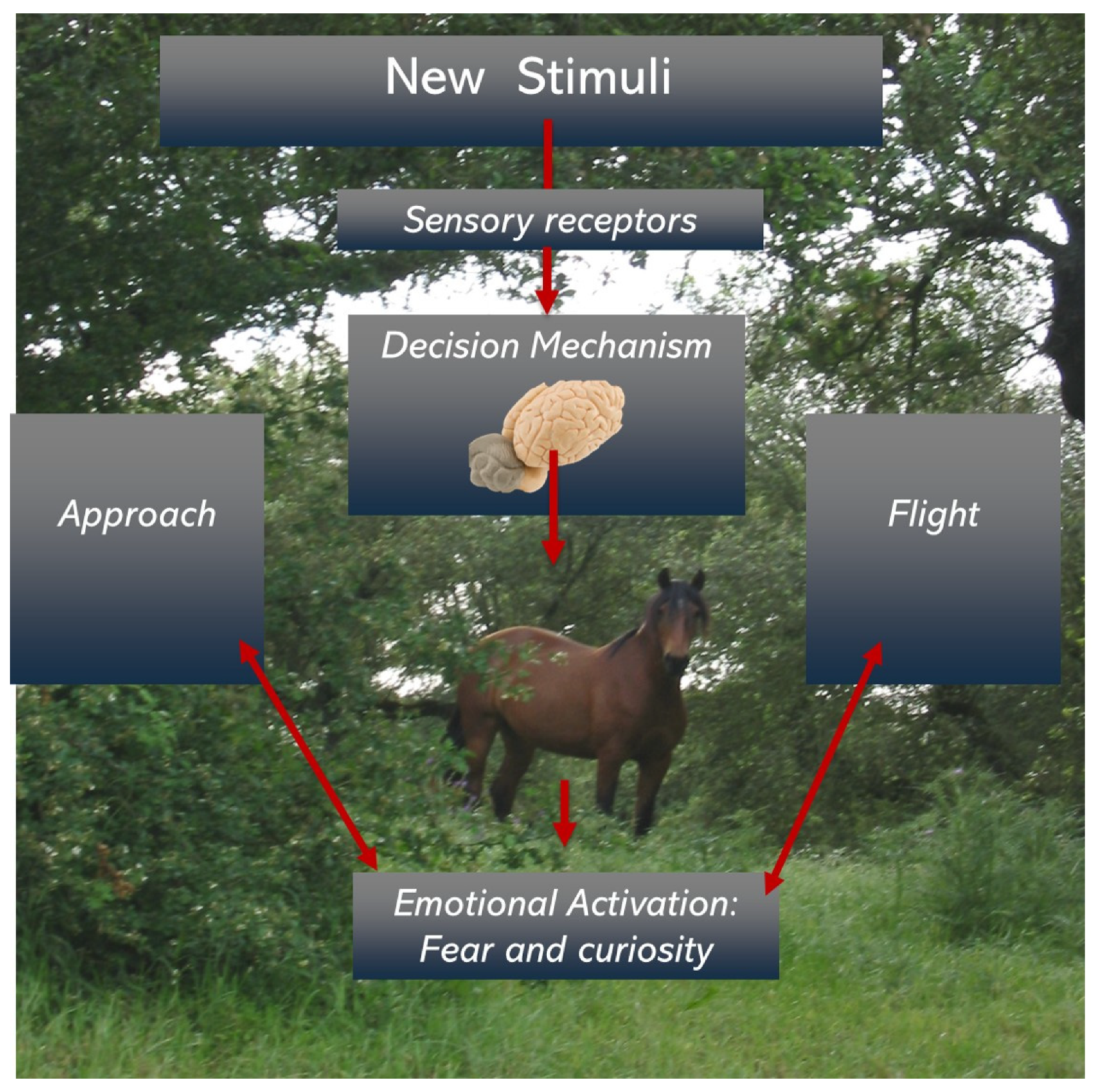
Whilst horses are characterized as “emotionally reactive animals” that tend to avoid situations triggering fear, some studies suggest that having humans present may help them calm down during challenging circumstances [8,36]. These studies offer evidence that, in some contexts, the horse can incorporate recent information about his social context to adjust defensive behaviors. It was shown that horses naturally seek the attention of any new person entering their safe space [6,15,16], as encountering novelty triggers a profound mix of fear and curiosity, leading to both apprehensive and exploratory behaviors (Figure 1). A key theory addressing such “conflict” behavior was formulated by the psychologist Neal Miller [37]. Miller described the gradual approach that an animal displays in face of novelty “as always maintaining maximum attention and an attitude of experiencing intense fear”. Miller’s research illuminated the notion that learned responses—especially those tied to fear and avoidance—are not fixed; rather, they can be skillfully modified or adjusted over time. This process has been later referred to as the “modulation of defensive behavior,” highlighting evidence on the adaptability of both animals and humans to cope with new and challenging stimuli [38]. It emphasizes that each exposure to the stimulus diminishes the novelty, and stimuli that initially seemed strong and attractive are replaced by their aversive or neutral effects. The learning process behind this is habituation, or sensory adaptation. It has an evident functional significance [39], as it helps the central nervous system to distinguish important from irrelevant information, supporting the equilibrium between the organism and its environment. Animals unable to adapt to their environment may experience declining health and welfare [35].
As mentioned above, several studies identified management practices as being harmful to domestic horses and restricting their ability to express natural behaviors [15,29,40,41,42,43]. This limitation not only hinders the development of essential natural conservation mechanisms but also prevents horses from fully adapting [40,42] or failing to habituate to their environment [43]. Therefore, horses facing ongoing adversity, lacking the internal and/or external resources to cope, may exhibit allostatic overload [31,35]. They may simply cease to show their discomfort, reducing behavioral responses, as demonstrated in apathetic horses [14,44,45], which can be misinterpreted as voluntary acceptance of human contacts and actions [46]. This apathy can result in learned helplessness, meaning that the animal learned that movements to escape pain or discomfort were simply useless. Research shows that the social environment may be a key factor in preventing such issues [47].

3. How Horses Interact with Others

3.1. Socialization

Horses are social by nature and form intricate relationships, both with other horses and with animals of various species, humans included [27]. The quality of these social relationships has a significant adaptive value [16,18,47]; recognizing that the social conditions in which they live profoundly influence their emotional well-being and shape their interactions with humans. Their nature demands stability, time, and space organized in vital domains, perfected in a social life based on groups of three to six individuals, remaining in permanent communication [26,28]. Concerns regarding welfare emphasize that understanding these dynamics is crucial to enhance their emotional health [43]. And several studies demonstrated that promoting social environments in horses leads to more harmonious relationships and better connectivity with humans [36,46,47].
In the latter half of the twentieth century, it was posited that one effective method for acclimating young animals to human interaction involved separating them from their mothers and peers and raising them artificially [48,49,50]. It is true that animals kept in stable conditions, with increased human contact, exhibit reduced physiological stress responses during procedures such as restraint, veterinary examinations, or handling, compared to those maintained on pasture, particularly among cattle, pigs, and horses [50,51]. However, extreme cases of interspecific bonding, by depriving young animals of interacting with their peers, have been described in domestic ungulates [52]. Social isolation during development stages can significantly impair learning behavior [51,52]. This detrimental impact can manifest in various ways, ranging from difficulties in engaging to play [52], displaying agonistic behaviors [51], or interacting with humans. Hall [50] observed in bovines that bulls bred in isolation were more aggressive towards their breeders than those bred in groups. According to the author, this aggressiveness could be due to a reduction in fear of humans but also caused because animals have been unable to learn social behaviors and to establish hierarchies.
Early proposals regarding social shaping were made by the pioneering ethologist, Konrad Lorenz [53]. According to Kalikow [53], Lorenz has argued that there are critical phases of behavioral organization and that these would be fixed and irreversible. It was then suggested that the genetic heritage determines when, for example, learning could take place. It is a fact that juvenile animals exhibit a greater capacity for learning than adults. The development of exploratory behavior, as well as social and emotional experiences, combines and forms “the cortical mosaic” that maintains behavior. Lorenz also reasoned that if this learning was insufficient, “the animal will be deprived of some of the functions possessed by other individuals of the same species” [54].
It is later understood that the true moment of each developmental phase would depend more on the learning possibilities effectively found for each individual [55,56]. In other words, only the norm of reaction is innate, and this is a potentiality that will be submitted to the action of the environment. Recent research on mammals suggests that most behaviors are adaptable, allowing a kind of plasticity on the strategies developed, depending on the situation [17]. The literature also indicates that social animals may gain advantages from being socially protected during the stages of development, by staying in regular contact with other group members or humans [46,47,48,49,57].

3.2. From Interacting to a Relationship

The initial research on the effects of human interaction with animals was conducted by the Levine group [58], who revealed the wide-ranging impacts of early manipulations previously unanticipated by the scientific community at the time. In Levine’s experiments, rodents were exposed to a variety of stimuli in the first weeks of life [58]. The authors expected to verify aversive effects on the development of the animals, but soon the opposite became clear, and it was found that they benefited from such manipulations. They also found that the type of manipulation applied seemed to be of little importance, and all the treatments have been shown to reduce the adult animal’s reactivity. Obviously, if the intensity of the stimulus was too high, the reactivity would be increased.
Manipulation by humans was then called “handling” or “gentling” by the Anglo-Saxons and were used in studies with rodents from the 1960s onwards. “Handling” could simply consist of removing an animal from its usual environment and transporting it to another unknown environment. In the case of “gentling”, supposedly pleasant elements would be given, such as caresses, food offerings, etc. Thus, by handling, through habituation, the animal learns by repetition of a stimulus that becomes neutral [46]; and in the case of gentling, learning occurs by conditioning, as the animal learns to associate the presence of a human with the treatments experienced [59].
As suggested above, in numerous mammal species, there are preferential periods of socialization, during which the animals more easily create intra- and interspecific social bonds [47,48,49,50,51,52,55,56]. To clarify, the animals go through specific moments of development, during which they are particularly sensitive to certain influences from the environment. It has been suggested that in such sensitive periods, there is a specific plasticity of the central nervous system, which helps socialize and makes learning faster and easier. According to the authors, any period of social reorganization could become one of these special periods of sensitivity. Ungulates, and specifically the horse, are born with a well-developed brain, and the postpartum moment has been suggested as an ideal period of socialization. Some supporters presented the phenomenon as a form of “imprinting” [60]. Lorenz [61] coined the term “imprinting” as a form of stimulation process, during early life, taking place very rapidly influencing the later development of the individual. This procedure was widely promoted in the equine industry by Robert Miller. Miller claimed that exposing foals to “imprint training” would make the young horse more manageable and safer to train [62].
In most mammals, the postpartum period is a critical time characterized by intense and nurturing interactions between the mother and her offspring. As a result, handling practices during this time have become controversial. Given this, various authors (e.g., [52,63,64]) have reviewed and updated Miller’s original protocol to encourage a more considerate treatment of the foal-mother pair. Regardless, research has shown that forcing the handling of animals just a few hours after birth can lead to behavioral and social disorders [63]. The authors observed that, in horses, this form of connection may result in increased familiarity with humans [52,56], which has been noted as a potential risk factor for accidents, considering we are dealing with a large species [25,63]. Moreover, the very term “imprinting” of foals is inappropriate [63,64]. According to Lorenz’s classic definition of imprinting, this would be a natural time when the young animal develops social preferences, most often with their mother or a similar animal. Therefore, the animal is not really forced to “imprint” on a stimulus, and the practice has fallen into disuse.
The literature suggests the many benefits of early handling in numerous species, including attenuating the response to stress [49,58,60,63,64]. However, some authors have shown that forcing young horses to human contact had controversial results, with either positive or negative consequences (e.g., [56,64]). Handling foals at weaning reduced the fear of various fearful stimuli and human beings [46,47,49] and increased trainability [46], but it also affected the young animal’s health and induced poor welfare [29]. By performing more in-depth research in bibliography, I verified that few studies considered the horse’s motivation, or its choice to interact, on his behavioral response.
A relationship or a bond suggests a mutual benefit for both species, but also a “reciprocal altruism”. The biologist Robert Trivers in 1971 [65], used the concept to describe behaviors established between animals. In recent decades, behavioral scientists have commenced investigations into the concept of bonding in relation to horses [5,8,66,67]. Based on human psychology theories about bonding, it typically demands that “both individuals are receptive to interact and prepared to engage in closeness” [67]. This concept relies on mutual openness, which, by encouraging deep communication, fosters meaningful connections and the development of a relationship [67,68,69].
Horses have a strong herd instinct, but do horses relate to other species? Jung and Yoon [59] observed that after standing with humans or being rubbed by them, plasma oxytocin levels increased in horses—an indicator of bonding and stress reduction. However, according to Janczarek et al. [70], the herd instinct cannot be suppressed by any form of social support provided by humans. Although horses and humans can clearly form relationships, additional research is required to clarify the nature of horse–human bonding from the equine perception.

4. The Impact of a Relationship

Extensive research suggests that horses have remarkable attributes that offer emotional support, educational opportunities, and wellness advantages to humans [59,67,68,69]. Some researchers propose the existence of a “therapeutic alliance” between horses and humans [67,68,71] or highlight a significant connection to them [6]. It was suggested that horses may perceive the subtle signs sent by humans and that through this, their brains may share neural impulses [1] and become synchronized [69]. Nevertheless, the existence of a bond between humans and horses is often romanticized [72].
Like equines, humans also thrive on social connections and meaningful relationships [67], which are essential for maintaining their well-being and preserving mental balance. Social support and the feeling of “belonging to” a community are fundamental tools to enhance stress resilience [31]. Decades of research have documented that some of the social behaviors that promote comfort and connection among people are frequently mirrored in our interactions with companion animals. This is especially true for beloved pets such as dogs, cats, horses, and pet birds, whose presence can evoke feelings of warmth and companionship [3,5,6,7,73]. Positive cross-species experiences can not only prevent the onset of anxieties, fears, and phobias in the horse towards man but are also therapeutic for humans. With proximity, social individuals display positive feelings [1], which confer wellness and health benefits [67,69]. One of the mentioned benefits of connecting with horses is the “secure foundation” that the horse figure provides, which may manifest itself in improved resilience to stress and increased resilience during potential threat [74]. Horses’ unique combination of sensitivity, social personality, and physical strength has been associated with their potential therapeutic. The literature claims that horses can elicit emotions in humans, which is believed to be the basis of initiating a therapeutic process that yields psychological and emotional benefits [71,73,74,75,76,77]. In people who are vulnerable or have experienced trauma, activities like grooming or leading horses can significantly reduce symptoms of depression, anxiety, and posttraumatic stress disorder, fostering a sense of security [73,74,75].
The extensive history of “hippotherapy”, now referred to as equine-assisted services [75], is largely about the use of the horse and its movement for therapeutic or educational means, but also about the lack of interaction. While initially horses were used mostly for medical and therapeutic interventions, focusing only on physical treatments and horseback riding in persons with disabilities or physical illnesses, the practice has evolved into a different focus, with results suggesting recovering mental health and wellness [67,68,69,73,74,75]. Many theories have been constructed about working mechanisms of including horses in equine-assisted services for healing psychological, social, or emotional issues [3,71,74,75,76,77]. Studies indicate that equine-assisted therapy for mental health relies on a mutual, interactive relationship between the client and the horse [67,68,69,71,74,75,76,77]. By connecting with the horses, the clients can increase their awareness of the present moment, helping to process their own emotions and experiences, ultimately leading to a sense of internal strength [71,75,76,77]. Horses are highly sensitive and attentive to nonverbal signals, and, as reported by Punzo et al. [76], respond to them accordingly. Interestingly, these animals seem to better recognize human actions than humans can understand their own emotions.
While horses are sensitive to human emotions, they do not act altruistically to alleviate distress [8], meaning that they deliberately do not try to comfort humans out of empathy. Often, horse owners attribute more empathy and greater cognitive ability to horses than they have. A horse’s response to a person, whether generally or to a particular individual, depends on previous experiences with humans, along with its own personality and temperament. Findings by Merkies and Franzin [8], as well as Lundberg et al. [6], indicate that intentional body movements by skilled handlers can heighten horses’ attention, even compared to animal owners. Additionally, human factors such as attitude, personality, perception, and awareness of animal distress shape these interactions, which, in turn, influence the potential to form a meaningful bond with the horse.
If the emotional state of a human has the potential to influence the emotional state of the horse, it is important for us to work with a positive attitude based on our knowledge of equine affective states. Regardless of the growing body of evidence on the hypothetical humans and horses’ relationship and emotional communication, the underlying mechanisms remain unknown. Additionally, despite the promising effects of connecting with equines in recovery from diverse psychopathologies, the reported studies present several inconsistencies. In a recent review conducted by my group [75], our conclusions align with previous works, which claim that the quality of the collected literature remains poor and that the collected results must be interpreted with caution. At present, we do not have a clear picture of how humans and horses’ connections improve well-being and “heal”. Further investigation is essential to uncover the intricate biological and holistic mechanisms that may elucidate the profound healing benefits derived from the bond between humans and horses.

5. Conclusions and Prospects

The relationship between humans and equines has evolved over a long period and has changed considerably throughout history. Factors such as historical context and biological characteristics have influenced the nature of connections between humans and horses. Historically used as valuable assistants for agricultural or military settings, at present, owners of horses consistently agree upon the wellness and therapeutic potential they provide. Outstanding in their remarkable presence, a wealth of research claims that horses’ unique combination of socio-relational traits, sensitivity, and strength, has healing potential. Connecting with them encompasses care, bonds, and joy upon reunion, and emphasizes the necessity of recognizing their needs and developing a shared language and communication. While we have gained significant insights into a horse’s perception, cognitive abilities, and emotions, our understanding of what horses think or feel remains vague. The gathered literature underscores the significance of delving into the scientific foundations of the bond between horses and humans. By illuminating the nuances of this connection, it paves the way for new and enriching possibilities within this remarkable relationship.

Funding

This research received no external funding.

Institutional Review Board Statement

Not applicable.

Informed Consent Statement

Not applicable.

Data Availability Statement

No new data were created or analyzed in this study. Data sharing is not applicable to this article.

Acknowledgments

I would like to express my sincere gratitude to Costa Fereira, whose encouragement inspired me to pursue the development of this draft manuscript.

Conflicts of Interest

The author declares no conflicts of interest.

References

  1. Callara, A.L.; Scopa, C.; Contalbrigo, L.; Lanatà, A.; Scilingo, E.P.; Baragli, P.; Greco, A. Unveiling directional physiological coupling in human-horse interactions. iScience 2024, 27, 110857. [Google Scholar] [CrossRef]
  2. Outram, A.K. Horse domestication as a multi-centered, multi-stage process: Botai and the role of specialized Eneolithic horse pastoralism in the development of human-equine relationships. Front. Environ. Archaeol. 2023, 2, 1134068. [Google Scholar] [CrossRef]
  3. Niskanen, M. The prehistoric origins of the domestic horse and horseback riding. Bull. Mém. Soc. Anthropol. Paris 2023, 35, 54–73. [Google Scholar] [CrossRef]
  4. Payne, E.; DeAraugo, J.; Bennett, P.; McGreevy, P. Exploring the existence and potential underpinnings of dog–human and horse–human attachment bonds. Behav. Process. 2016, 125, 114–121. [Google Scholar] [CrossRef] [PubMed]
  5. Ferlazzo, A.; Fazio, E.; Cravana, C.; Medica, P. Equine-assisted services: An overview of current scientific contributions on efficacy and outcomes on humans and horses. J. Vet. Behav. 2023, 59, 15–24. [Google Scholar] [CrossRef]
  6. Lundberg, P.; Hartmann, E.; Roth, L.S. Does training style affect the human-horse relationship? Asking the horse in a separation–reunion experiment with the owner and a stranger. Appl. Anim. Behav. Sci. 2020, 233, 105144. [Google Scholar] [CrossRef]
  7. Monterrubio, C.; Dashper, K.; Hernández-Espinosa, R. Human-Horse Relationships, Horse Welfare, and Abuse in Mexico: A Social Representation Approach. Soc. Anim. 2023, 10, 582–601. [Google Scholar] [CrossRef]
  8. Merkies, K.; Franzin, O. Enhanced understanding of horse–human interactions to optimize welfare. Animals 2021, 11, 1347. [Google Scholar] [CrossRef]
  9. Maurício, L.S.; Leme, D.P.; Hötzel, M.J. The Easiest Becomes the Rule: Beliefs, Knowledge and Attitudes of Equine Practitioners and Enthusiasts Regarding Horse Welfare. Animals 2024, 14, 1282. [Google Scholar] [CrossRef] [PubMed]
  10. A Good Life for Horses: A Vision for the Future Involvement of Horses in Sport—Final Report; Equine Ethics and Wellbeing Commission: Lausanne, Switzerland, 2023.
  11. Cheung, E.; Mills, D.; Ventura, B.A. “But my horse is well cared for”: A qualitative exploration of cognitive dissonance and enculturation in equestrian attitudes toward performance horses and their welfare. Anim. Welf. 2025, 34, e50. [Google Scholar] [CrossRef]
  12. Bornemann, D. An explanatory model, using self-determination theory, of the motivations for horse ownership. Qual. Res. Psychol. 2024, 22, 168–191. [Google Scholar] [CrossRef]
  13. van Weeren, P.R. Guest editorial: How long will equestrian traditionalism resist science? Vet. J. 2008, 175, 289–290. [Google Scholar] [CrossRef]
  14. Kieson, E.; Abramson, C.I. Equines as tools vs partners: A critical look at the uses and beliefs surrounding horses in equine therapies and argument for mechanical horses. J. Vet. Behav. 2016, 15, 94–95. [Google Scholar] [CrossRef]
  15. Kelly, K.J.; McDuffee, L.A.; Mears, K. The effect of human–horse interactions on equine behaviour, physiology, and welfare: A scoping review. Animals 2021, 11, 2782. [Google Scholar] [CrossRef] [PubMed]
  16. Fiedler, J.M.; Ayre, M.L.; Rosanowski, S.; Slater, J.D. Horse Sector Participants’ Attitudes towards Anthropomorphism and Animal Welfare and Wellbeing. Animals 2024, 14, 248. [Google Scholar] [CrossRef]
  17. Arndt, S.S.; Goerlich, V.C.; van der Staay, F.J. A dynamic concept of animal welfare: The role of appetitive and adverse internal and external factors and the animal’s ability to adapt to them. Front. Anim. Sci. 2022, 3, 908513. [Google Scholar] [CrossRef]
  18. Aydin, C.; Seyidoglu, N. Assessment of Horse-Human Interaction with New Technologies. In Equine Science-Applications and Implications of New Technologies; IntechOpen: London, UK, 2023. [Google Scholar] [CrossRef]
  19. Mellor, D.J.; Beausoleil, N.J.; Littlewood, K.E.; McLean, A.N.; McGreevy, P.D.; Jones, B.; Wilkins, C. The 2020 Five Domains Model: Including Human–Animal Interactions in Assessments of Animal Welfare. Animals 2020, 10, 1870. [Google Scholar] [CrossRef]
  20. Hall, C.; Kay, R. Living the good life? A systematic review of behavioural signs of affective state in the domestic horse (Equus caballus) and factors relating to quality of life. Part I: Fulfilment of species-specific needs. Anim. Welf. 2024, 33, e40. [Google Scholar] [CrossRef] [PubMed]
  21. Saslow, C.A. Understanding the perceptual world of horses. Appl. Anim. Behav. Sci. 2002, 78, 209–224. [Google Scholar] [CrossRef]
  22. Rørvang, M.V.; Nielsen, B.L.; McLean, A.N. Sensory Abilities of Horses and Their Importance for Equitation Science. Front. Vet. Sci. 2020, 7, 561737. [Google Scholar] [CrossRef] [PubMed]
  23. Jardat, P.; Destrez, A.; Damon, F.; Menard-Peroy, Z.; Parias, C.; Barrière, P.; Keller, M.; Calandreau, L.; Lansade, L. Horses discriminate human body odors between fear and joy contexts in a habituation-discrimination protocol. Sci. Rep. 2023, 13, 3285. [Google Scholar] [CrossRef]
  24. Brubaker, L.; Udell, M.A.R. Cognition and learning in horses (Equus caballus): What we know and why we should ask more. Behav. Process. 2016, 126, 121–131. [Google Scholar] [CrossRef]
  25. Schroer, S.A. Jakob von Uexküll: The Concept of Umwelt and its Potentials for an Anthropology Beyond the Human. Ethnos 2019, 86, 132–152. [Google Scholar] [CrossRef]
  26. Beaver, B.V. Chapter 1—The History of Horses and Their Relationship to Humans. In Equine Behavioral Medicine; Beaver, B.V., Ed.; Academic Press: Cambridge, MA, USA, 2019; pp. 1–30. [Google Scholar] [CrossRef]
  27. Torres Borda, L.; Auer, U.; Jenner, F. Equine Social Behaviour: Love, War and Tolerance. Animals 2023, 13, 1473. [Google Scholar] [CrossRef] [PubMed]
  28. Keiper, R.R. Social Structure. Vet. Clin. N. Am. Equine Pract. 1986, 2, 465–484. [Google Scholar] [CrossRef]
  29. Pereira-Figueiredo, I.; Rosa, I.; Sancho Sanchez, C. Forced Handling Decreases Emotionality but Does Not Improve Young Horses’ Responses toward Humans and their Adaptability to Stress. Animals 2024, 14, 784. [Google Scholar] [CrossRef]
  30. Freeman, R.B. The Works of Charles Darwin: An Annotated Bibliographical Handlist. 1977. Available online: http://darwin-online.org.uk/ (accessed on 25 November 2025).
  31. Pereira-Figueiredo, I.; Umeoka, E.H.L. Stress: Influences and Determinants of Psychopathology. Encyclopedia 2024, 4, 1026–1043. [Google Scholar] [CrossRef]
  32. Budzyńska, M. Stress Reactivity and Coping in Horse Adaptation to Environment. J. Equine Vet. Sci. 2014, 34, 935–941. [Google Scholar] [CrossRef]
  33. Coria-Avila, G.A.; Pfaus, J.G.; Orihuela, A.; Domínguez-Oliva, A.; José-Pérez, N.; Hernández, L.A.; Mota-Rojas, D. The Neurobiology of Behavior and Its Applicability for Animal Welfare: A Review. Animals 2022, 12, 928. [Google Scholar] [CrossRef]
  34. Schlote, S. Applying a Trauma Lens to Equine Welfare. In A Horse Is a Horse, of Course: Compendium from the First International Symposium of Equine Welfare and Wellness; Createspace Independent Publishing Platform: Scottes Valley, CA, USA, 2015; Chapter 15. [Google Scholar]
  35. Juster, R.P.; Misiak, B. Advancing the allostatic load model: From theory to therapy. Psychoneuroendocrinology 2023, 154, 106289. [Google Scholar] [CrossRef]
  36. Hartmann, E.; Rehn, T.; Christensen, J.; Nielsen, P.; McGreevy, P. From the Horse’s Perspective: Investigating Attachment Behaviour and the Effect of Training Method on Fear Reactions and Ease of Handling—A Pilot Study. Animals 2021, 11, 457. [Google Scholar] [CrossRef] [PubMed]
  37. Miller, N.E. Experimental studies of conflict. In Personality and the Behavior Disorders; Hunt, J.M., Ed.; Ronald Press: New York, NY, USA, 1944; pp. 431–465. [Google Scholar]
  38. Narushima, M.; Agetsuma, M.; Nabekura, J. Development and experience-dependent modulation of the defensive behaviors of mice to visual threats. J. Physiol. Sci. 2022, 72, 5. [Google Scholar] [CrossRef] [PubMed]
  39. Colwill, R.M.; Lattal, K.M.; Whitlow, J.W.; Delamater, A.R. Habituation: It’s not what you think it is. Behav. Process. 2023, 207, 104845. [Google Scholar] [CrossRef] [PubMed]
  40. Thompson, K.; McGreevy, P.; McManus, P. A Critical Review of Horse-Related Risk: A Research Agenda for Safer Mounts, Riders and Equestrian Cultures. Animals 2015, 5, 561–575. [Google Scholar] [CrossRef]
  41. McLean, A.N.; McGreevy, P.D. Ethical equitation: Capping the price horses pay for human glory. J. Vet. Behav. Clin. Appl. Res. 2010, 5, 203–209. [Google Scholar] [CrossRef]
  42. Lytvyschenko, L.O.; Lesnovska, O.V.; Pishchan, S.G.; Gutyj, B.V.; Begma, N.A.; Logvinova, V.V.; Sapronova, V.O.; Mylostyvyi, R.V. The Impact of Climatic and Anthropogenic Factors on Modern Equine Management: Challenges and Adaptation Strategies. Ukr. J. Vet. Agric. Sci. 2025, 8, 56–64. [Google Scholar] [CrossRef]
  43. Ruet, A.; Lemarchand, J.; Parias, C.; Mach, N.; Moisan, M.-P.; Foury, A.; Briant, C.; Lansade, L. Housing Horses in Individual Boxes Is a Challenge with Regard to Welfare. Animals 2019, 9, 621. [Google Scholar] [CrossRef]
  44. Fureix, C.; Jego, P.; Henry, S.; Lansade, L.; Hausberger, M. Towards an ethological animal model of depression? A study on horses. PLoS ONE 2012, 7, e39280. [Google Scholar] [CrossRef]
  45. Rochais, C.; Henry, S.; Fureix, C.; Hausberger, M. Investigating attentional processes in depressive-like domestic horses (Equus caballus). Behav. Process. 2016, 124, 93–96. [Google Scholar] [CrossRef]
  46. Pereira-Figueiredo, I.; Costa, H.; Carro, J.; Stilwell, G.; Rosa, I. Behavioural changes induced by handling at different timeframes in Lusitano yearling horses. Appl. Anim. Behav. Sci. 2017, 196, 36–43. [Google Scholar] [CrossRef]
  47. Sankey, C.; Richard-Yris, M.A.; Leroy, H.; Henry, S.; Hausberger, M. Positive interactions lead to lasting positive memories in horses, Equus caballus. Anim. Behav. 2010, 79, 869–875. [Google Scholar] [CrossRef]
  48. Rushen, J.; Taylor, A.A.; de Passillé, A.M. Domestic animals’ fear of humans and its effect on their welfare. Appl. Anim. Behav. Sci. 1999, 65, 285–303. [Google Scholar] [CrossRef]
  49. Spier, S.J.; Berger Pusterla, J.; Villarroel, A.; Pusterla, N. Outcome of tactile conditioning of neonates, or “imprint training” on selected handling measures in foals. Vet. J. 2004, 168, 252–258. [Google Scholar] [CrossRef]
  50. Hall, S.J.G. Chillingham cattle: Social and maintenance behaviour in an ungulate that breeds all year round. Anim. Behav. 1989, 38, 215–225. [Google Scholar] [CrossRef]
  51. Rørvang, M.V.; Nielsen, B.L.; Herskin, M.S.; Jensen, M.B. Prepartum maternal behavior of domesticated cattle: A comparison with managed, feral, and wild ungulates. Front. Vet. Sci. 2018, 5, 329238. [Google Scholar] [CrossRef]
  52. Newberry, R.C.; Swanson, J.C. Implications of breaking mother–young social bonds. Appl. Anim. Behav. Sci. 2008, 110, 3–23. [Google Scholar] [CrossRef]
  53. Kalikow, T.J. Konrad Lorenz on human degeneration and social decline: A chronic preoccupation. Anim. Behav. 2020, 164, 267–272. [Google Scholar] [CrossRef]
  54. Lorenz, K. On Aggression, 2nd ed.; Routledge: London, UK, 2021. [Google Scholar] [CrossRef]
  55. Thomas, A.W.; Caporale, N.; Wu, C.; Wilbrecht, L. Early maternal separation impacts cognitive flexibility at the age of first independence in mice. Dev. Cogn. Neurosci. 2016, 18, 49–56. [Google Scholar] [CrossRef]
  56. Krohn, C.C.; Jago, J.G.; Boivin, X. The effect of early handling on the socialisation of young calves to humans. Appl. Anim. Behav. Sci. 2001, 74, 121–133. [Google Scholar] [CrossRef]
  57. Pessoa, G.O.; Trigo, P.; Neto, F.D.M.; Junior, A.C.C.L.; Sousa, T.M.; Muniz, J.A.; Moura, R.S. Comparative well-being of horses kept under total or partial confinement prior to employment for mounted patrols. Appl. Anim. Behav. Sci. 2016, 184, 51–58. [Google Scholar] [CrossRef]
  58. Levine, S.; Chevalier, J.A.; Korchin, S.J. The effects of early shock and handling on later avoidance learning. J. Personal. 1956, 24, 475–493. [Google Scholar] [CrossRef] [PubMed]
  59. Jung, Y.; Yoon, M. The Effects of Human–Horse Interactions on Oxytocin and Cortisol Levels in Humans and Horses. Animals 2025, 15, 905. [Google Scholar] [CrossRef]
  60. Simpson, B.S. Neonatal foal handling. Appl. Anim. Behav. Sci. 2002, 78, 303–317. [Google Scholar] [CrossRef]
  61. Lorenz, K. Der Kumpan in der Umwelt des Vogels. Der Artgenosse als auslösendes Moment sozialer Verhaltensweisen. J. Ornithol. 1935, 83, 137–213. [Google Scholar] [CrossRef]
  62. Miller, R.M. Imprint Training of the Newborn Foal: A Swift, Effective Method for Permanently Shaping a Horse’s Lifetime Behavior; Western Horseman: Colorado Springs, CO, USA, 1991. [Google Scholar]
  63. Henry, S.; Richard-Yris, M.-A.; Tordjman, S.; Hausberger, M. Neonatal handling affects durably bonding and social development. PLoS ONE 2009, 4, e5216. [Google Scholar] [CrossRef] [PubMed]
  64. Williams, J.L.; Friend, T.H.; Toscano, M.J.; Collins, M.N.; Sisto-Burt, A.; Nevill, C.H. The effects of early training sessions on the reactions of foals at 1, 2, and 3 months of age. Appl. Anim. Behav. Sci. 2002, 77, 105–114. [Google Scholar] [CrossRef]
  65. Trivers, R.L. The Evolution of Reciprocal Altruism. Q. Rev. Biol. 1971, 46, 35–57. [Google Scholar] [CrossRef]
  66. Wijnen, B.; Martens, P. Animals in Animal-Assisted Services: Are They Volunteers or Professionals? Animals 2022, 12, 2564. [Google Scholar] [CrossRef]
  67. Törmälehto, E.; Korkiamäki, R. The Potential of Human-Horse Attachment in Creating Favorable Settings for Professional Care: A Study of Adolescents’ Visit to a Farm. Animals 2020, 10, 1707. [Google Scholar] [CrossRef]
  68. Bachi, K. Application of Attachment Theory to Equine-Facilitated Psychotherapy. J. Contemp. Psychother. 2013, 43, 187–196. [Google Scholar] [CrossRef]
  69. Marchand, W.R. Potential Mechanisms of Action and Outcomes of Equine-Assisted Services for Veterans with a History of Trauma: A Narrative Review of the Literature. Int. J. Environ. Res. Public Health 2023, 20, 6377. [Google Scholar] [CrossRef]
  70. Janczarek, I.; Gazda, I.; Barłowska, J.; Kurnik, J.; Łuszczyński, J. Social Isolation of Horses vs. Support Provided by a Human. Animals 2025, 15, 1649. [Google Scholar] [CrossRef]
  71. Hood, P.; Wilson, C. If You’re Hyper It Calms You Down; Young People’s Experiences of an Irish Equine Facilitated Program. J. Creat. Ment. Health 2021, 16, 153–167. [Google Scholar] [CrossRef]
  72. Merkies, K.; Hayman, B.; Ijichi, C.L. Examining the Human–Horse Bond from the Human Perspective. Anthrozoös 2024, 37, 231–244. [Google Scholar] [CrossRef]
  73. Sullivan, K.; Hemingway, A. Equine-assisted learning reduces anxiety and increases calmness & social skills in young people. Acad. Ment. Health Well-Being 2024, 1, 7424. [Google Scholar] [CrossRef]
  74. Mueller, M.K.; McCullough, L. Effects of Equine-Facilitated Psychotherapy on Post-Traumatic Stress Symptoms in Youth. J. Child Fam. Stud. 2017, 26, 1164–1172. [Google Scholar] [CrossRef]
  75. Pereira-Figueiredo, I.; Akpınar, S.; Özcan, K.; Sancho-Sanchez, C. Equine-Assisted-Psychotherapy in Youth Exposed to Adverse Childhood Experiences or Psychological Trauma: A Scoping Review. HETI J. Int. Res. Pract. 2025, 24, 15–27. [Google Scholar] [CrossRef]
  76. Punzo, K.; Skoglund, M.; Carlsson, I.M.; Jormfeldt, H. Experiences of an Equine-Assisted Therapy Intervention among Children and Adolescents with Mental Illness in Sweden—A Nursing Perspective. Issues Ment. Health Nurs. 2022, 43, 1080–1092. [Google Scholar] [CrossRef] [PubMed]
  77. Craig, E.A.; Nieforth, L.; Rosenfeld, C. Communicating Resilience among Adolescents with Adverse Childhood Experiences (ACEs) through Equine Assisted Psychotherapy (EAP). West. J. Commun. 2020, 84, 400–418. [Google Scholar] [CrossRef]
Figure 1. Equilibrium model of approach/avoidance conflict. Horses are drawn toward new stimuli but often react by avoiding them dramatically, displaying an emotional paradox, mediated at the brain level (specifically in the nucleus accumbens) responding with both fear and curiosity.
Encyclopedia 05 00207 g001
Disclaimer/Publisher’s Note: The statements, opinions and data contained in all publications are solely those of the individual author(s) and contributor(s) and not of MDPI and/or the editor(s). MDPI and/or the editor(s) disclaim responsibility for any injury to people or property resulting from any ideas, methods, instructions or products referred to in the content.