


Abstract
School culture is widely recognised as a key element of educational organisations, shaping relationships, behaviours, and shared norms within schools. Emotional intelligence (EI) has been identified as a leadership capability that may contribute to the development of positive school cultures; however, the nature of this relationship remains fragmented across the literature. This scoping review synthesised evidence from 31 studies examining the relationship between school leaders’ EI and school culture and considers implications for Irish post-primary education. The review included empirical, theoretical, conceptual, and review-based literature from a range of international contexts. Findings revealed considerable variation in the conceptualisation and measurement of both EI and school culture. Across the literature, emotionally intelligent leadership is commonly associated with positive school culture outcomes. These findings highlight the potential importance of EI in shaping school culture while underscoring the need for greater conceptual clarity and methodological rigour in future research. The review provides an evidence-informed foundation for future research on emotionally intelligent leadership and school culture, including context-specific work within Irish post-primary education.
1. Introduction
Despite substantial international interest in leadership and EI, relatively few studies have examined how school leaders’ EI influences school culture, particularly within Irish post-primary contexts. This gap is notable given the increasing policy emphasis on wellbeing, inclusion and effective school leadership. Wang et al. [1,2] argue that since the mid-1990s, research on emotions in leadership has grown significantly. From an organisational perspective, Demerath [3] found that emotional regulation is associated with more cohesive school cultures.
1.1. School Culture
Fullan [4] recognises school culture as a central determinant of school effectiveness, influencing student engagement, staff collaboration and organisational improvement. Culture operates across multiple levels of school life, shaping both formal structures and informal routines that influence behaviour and decision-making. Mannix-McNamara et al. [5] note that positive school cultures are associated with improved wellbeing, engagement and belonging, while weaker or toxic cultures can contribute to disengagement, reduced morale and organisational dysfunction.
To maintain conceptual clarity, this review draws primarily on Schein’s definition [6] of culture as shared assumptions, values and behaviours operating at multiple organisational levels, complemented by Fullan’s [4] emphasis on the dynamic and evolving nature of school culture shaped through leadership and relationships.
1.2. EI and Educational Leadership
Mayer, Salovey and Caruso [7] define EI as the capacity to recognise, understand and manage one’s own emotions and those of others. Across the broader EI literature, a conceptual tension exists between viewing EI as an individual, measurable psychological competency and understanding EI as a socially situated leadership practice enacted through relationships, interactions and cultural norms within schools. While ability-based and trait-based models position EI as an internal skill set residing within the leader, sociocultural perspectives emphasise how emotional competence is shaped by context, relational expectations and organisational culture. This distinction is important for interpreting the findings of this review, as studies vary in whether they conceptualise EI as an individual attribute or as a relational, context-dependent leadership enactment. Within educational leadership, Goleman [8] recognises EI as a key construct linked to relational trust, communication and adaptive responses to change. Srivastava [9] found that leaders with higher EI are better at regulating emotional climates, supporting staff wellbeing and fostering collaborative relationships within schools. Within this framing, EI is positioned as a key relational capability through which leadership influence is enacted.
1.3. Existing Literature on School Culture and EI
Given the centrality of EI to relational leadership practice, it is necessary to consider how these emotional competencies intersect with and contribute to the development of school culture. Schein [6] suggests that a unique talent of leaders is their ability to understand and work with culture, an essential leadership skill. In addition to this, Fullan [4] emphasises the critical role of school leaders in navigating and shaping the evolving dynamics of educational environments. Fullan’s [4] insights underscore the necessity for leaders to be proactive change agents, guiding their institutions through the complexities of educational reform and innovation. Leithwood et al. [10] propose that school leaders play a vital role in setting direction and creating and sustaining a positive school culture.
Goldstein et al. [11] suggest that EI is a fundamental component of effective educational leadership, particularly in efforts to lead change and promote equity. Rosadi [12] advocates that EI has a positive and significant direct effect on school culture, indicating that higher EI among teachers and staff is associated with stronger cultural practices and shared values within high schools. Rosadi [12] found that EI directly strengthens school culture and also contributes indirectly to students’ character development through cultural processes. The study emphasises the mediating role of school culture in translating emotional competencies into both organisational and student outcomes.
Hsieh et al. [13] recommend that investing in the EI development of school principals can nurture a positive school culture which in turn impacts the entire organisation. Several studies have demonstrated a favourable correlation between principal EI and teacher performance. For instance, Al Arabi et al. [14] report that principals with higher levels of EI contribute to increased teacher commitment and play a role in shaping school culture through relational and leadership practices. Similarly, Rahayu et al. [15], using survey data and structural equation modelling, found that EI is positively associated with both school culture and school effectiveness, with school culture also acting as a mediating factor in translating emotional competencies and innovation into improved organisational outcomes. Findings across contexts indicate associations between EI and school culture, although these vary by methodological and contextual factors.
1.4. Irish Context and Gap
Within Ireland, research examining EI in post-primary leadership remains limited. Fullan [4] outlines that while school culture is recognised as central to educational experience and outcomes, Mannix-McNamara et al. [5] suggest that it can also manifest negatively, with toxic cultures associated with bullying, incivility and weak leadership. This highlights the importance of leadership approaches that are responsive to relational and emotional dimensions of school life.
In the Irish policy context, distributed leadership is a key framework guiding practice, yet limited research has examined how EI supports its enactment in post-primary schools. Spillane [16] conceptualises distributed leadership as practice-based, focusing on shared influence and interaction rather than positional authority, and Hickey et al. [17] identify school culture as central to its effectiveness. This suggests a close interdependence between leadership practice and cultural conditions in schools.
Leadership in Irish post-primary schools is shaped by a distinctive policy environment that emphasises wellbeing, inclusion, distributed leadership and school self-evaluation. Frameworks such as Looking at Our School (LAOS) [18], the Wellbeing Policy Statement and Framework for Practice [19], and the School Self-Evaluation (SSE) Guidelines [20] position relational practice, staff support and positive school culture as central to effective leadership. Professional learning is primarily delivered through the Centre for School Leadership (CSL) [21], which provides coaching, mentoring and accredited programmes; however, EI is not yet explicitly embedded within these structures. Given the relational intensity of Irish school leadership and the policy emphasis on collaborative, culturally responsive practice, EI represents a potentially important capability for shaping school culture and supporting the enactment of distributed leadership in ways aligned with national expectations.
School leaders are widely conceptualised as key influences in shaping school culture and influencing conditions for social connection within educational settings. As schools often represent a primary in-person environment for students and staff, leadership practices may contribute to experiences of belonging or exclusion within the school community. Goodenow [22] suggests that when individuals experience recognition and inclusion, levels of engagement increase and learning outcomes may be enhanced. In this context, the design of routines, relational practices and shared values that emphasise connection is associated with the development of more inclusive school environments.
In addition to national policy frameworks, leadership development in Ireland is supported through accredited professional learning programmes. The Postgraduate Diploma in School Leadership (PDSL), delivered nationally by the University of Limerick, University of Galway and University College Dublin, provides structured preparation for aspiring and practising school leaders. The programme emphasises relational leadership, cultural awareness, and the emotional dimensions of leading schools. These components align closely with the focus of this review, as EI and school culture are central to the programme’s conceptualisation of effective leadership practice in Irish post-primary schools. This contextual gap provides the rationale for examining how international evidence may inform leadership practice within Irish post-primary schools.
1.5. Aim of the Review
This scoping review maps international research on the relationship between school leaders’ EI and school culture. It synthesises existing evidence, identifies key themes and methodological limitations, and examines how emotionally intelligent leadership influences school culture. It also considers implications for Irish post-primary education, where empirical research remains limited despite sustained policy attention to leadership and school culture.
2. Materials and Methods
2.1. Purpose and Structure of the Review
A scoping review can be defined as a type of knowledge synthesis that explores a broad research question to map central concepts, forms of evidence and gaps within an existing body of research. Hickey et al. [17] note that this is achieved through a systematic process of searching for, selecting, and synthesising relevant literature in a clearly defined field. A scoping review methodology was selected as the most appropriate approach because it is best suited to mapping the existing body of literature and examining the main ideas and defining features of a concept. Arksey and O’ Malley [23] state that scoping reviews seek to summarise and share existing findings while also highlighting gaps in the current literature.
The approach for this scoping review is informed by Arksey and O’Malley’s five-stage framework, which aims to ensure rigour, transparency, and the ease of replicating search strategies. These five stages include (1) identifying the research questions; (2) identifying relevant studies; (3) study selection; (4) charting the data; (5) collating, summarising and reporting the results. Arksey and O’Malley also propose an optional sixth stage—consultation with stakeholders, which was not undertaken in this review. This review followed the PRISMA-ScR checklist to ensure transparent reporting of scoping review methods (Supplementary Materials).
This review aims to map recent international research on the relationship between school leaders’ EI and school culture, identifying key themes, trends, and implications for post-primary schools in Ireland.
2.2. Identifying the Research Question
Stage 1 involved identification of the research question. For the purpose of this review, the author uses the Participants, Interest and Context (PICo) framework (Table 1). Stern et al. [24] explain that this framework provides a roadmap for researchers to identify their research question for a qualitative review. The PICo step generated the following research question: “What evidence exists on the influence of EI on school culture within educational leadership and school-based contexts?” Although the PICo framework is commonly used for qualitative reviews, it was adopted here to structure the research question and eligibility criteria for a mixed-methods corpus. The framework was used pragmatically to clarify population, interest and context rather than to restrict the review to qualitative designs.
Table 1.
PICo framework.
Stage 2 involved identifying relevant studies in the existing databases. The author initially consulted with a university librarian to ensure that all relevant online databases were identified and included. Fink [25] argues that searching online databases is the most effective method for identifying relevant articles. Table 2 outlines the databases that were searched to identify relevant studies as well as the additional databases examined to ensure that no similar reviews are currently published.
Table 2.
Selected databases.
The author, in collaboration with the university librarian, developed a general search string, which was then tailored for each specific database. To ensure comprehensive coverage of the literature relating to EI, school culture and educational leadership, the search strategy incorporated key terms reflecting the population (school leaders, principals, teachers), the phenomenon of interest (EI), and the cultural context (school culture, organisational culture). The full search strings for all databases, including ERIC (EBSCO), ERIC (ProQuest), Education Source and SCOPUS, are provided in Appendix A.1. Additional synonyms and Boolean combinations were applied across databases to capture variations in terminology used within international educational leadership research.
2.3. Types of Study to Be Included
The empirical, conceptual, theoretical and review literature from any country were eligible for inclusion in the review. A ten-year timeframe (2015–2025) was selected as a pragmatic window to capture recent developments in EI and school culture while maintaining a manageable scope. Database searches were conducted in January 2026. The literature was required to have access to the full text, which was available to view in English and provide either a peer-reviewed text or thesis to qualify for inclusion. Articles were mandated to mention the term “school culture” and “EI” as standalone concepts. Although the primary focus of this review is school leaders, studies involving teachers, higher education leaders and broader educational leadership contexts were included where they examined EI and school culture or closely related constructs. These studies were considered relevant for understanding how emotionally intelligent leadership practices shape educational cultures beyond strictly positional leadership roles.
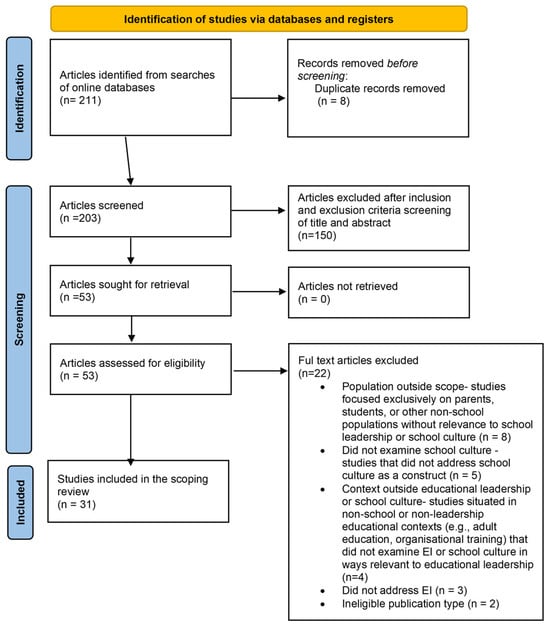
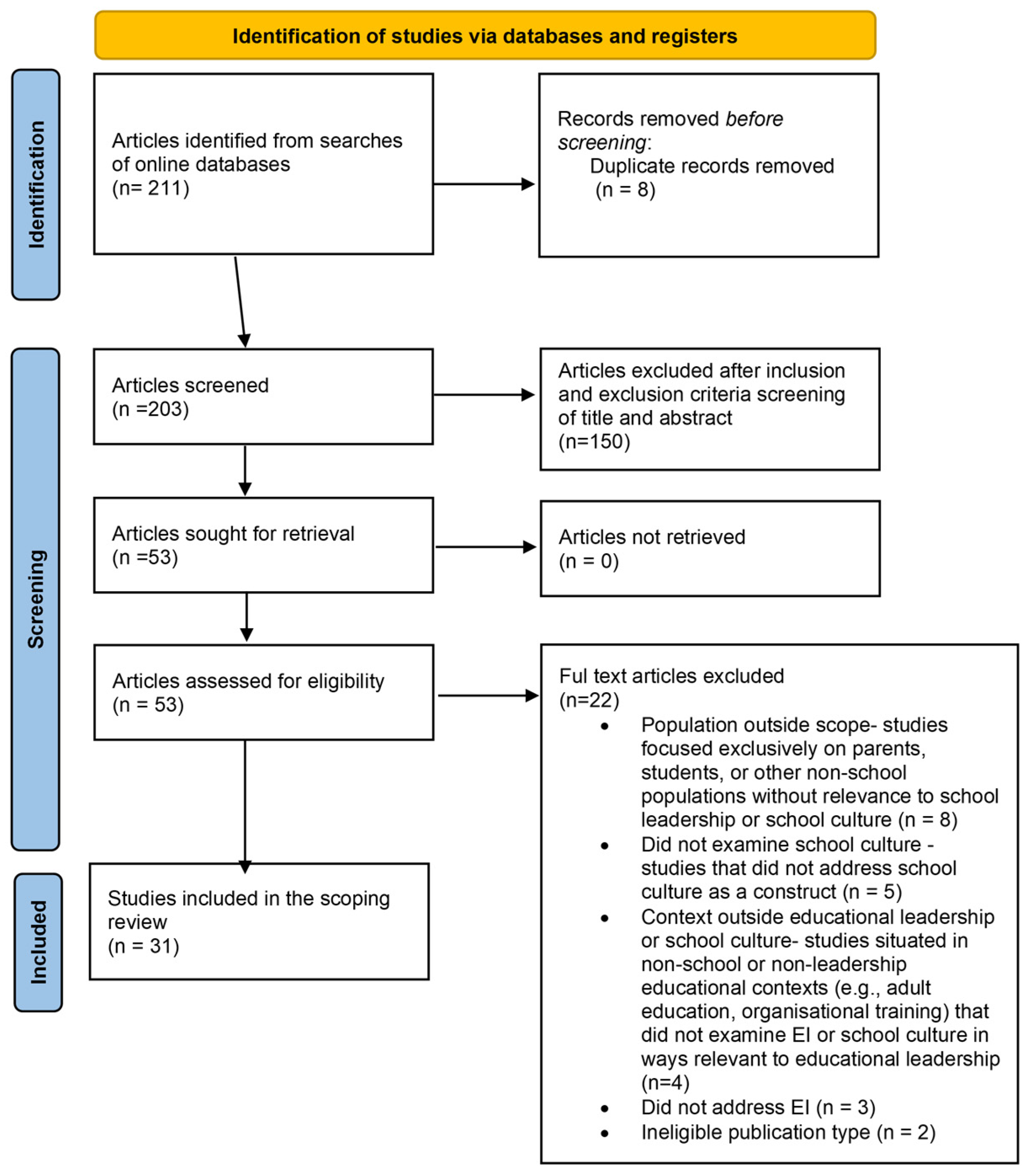
Of the 211 records identified, 8 duplicates were removed, leaving 203 unique records for title and abstract screening. During this stage, studies were excluded if they did not meet the predefined inclusion criteria: (1) did not examine school culture, (2) did not address EI, (3) focused exclusively on student or parent populations, (4) were situated in contexts outside educational leadership or school culture, or (5) were not peer-reviewed or full-text accessible. This screening process resulted in 150 exclusions, leaving 53 full-text articles for detailed eligibility assessment. Full-text review applied the same criteria with greater specificity, leading to the exclusion of 22 articles for the following reasons: the study focused on populations outside the scope (n = 8), did not examine school culture (n = 5), was situated in contexts outside educational leadership or school culture (n = 4), did not address EI (n = 3), or was an ineligible publication type (n = 2). A total of 31 studies met all inclusion criteria and were included in the final review. Arksey and O’ Malley [23] emphasise that inclusion and exclusion criteria should be developed in direct alignment with the research question, and these criteria are outlined in Table 3. The study selection process is presented in the PRISMA-ScR flow diagram (Figure 1).
Table 3.
Inclusion and Exclusion Criteria.
Figure 1.
PRISMA-ScR flow diagram.
A total of 22 articles were excluded during full-text screening based on the inclusion and exclusion criteria. Most were removed because they did not align with the review’s focus on EI and school culture within educational leadership contexts. Arksey and O’ Malley [23] emphasise that scoping reviews typically do not include formal critical appraisal, as their purpose is to map the extent and nature of existing research rather than evaluate study quality. In line with this guidance, no formal critical appraisal was undertaken in this review. Accordingly, no studies were excluded on the basis of quality, and the findings should be interpreted as a descriptive mapping of existing evidence. This approach enabled the inclusion of a broad range of literature relevant to understanding the relationship between school leaders’ EI and school culture. The study selection process is illustrated in Figure 1 using the PRISMA-ScR flow diagram.
Although the review focuses on school leaders, a broader range of educational personnel and contexts was included where studies offered relevant insight into the relationship between EI and school culture. Teacher-focused and mixed-population studies were retained because teachers’ emotional experiences and relational practices form a core part of school culture and shape how leadership influence is enacted within schools.
A small number of higher-education and other non-school educational studies were included where they examined EI in relation to organisational culture or leadership behaviours. These studies help clarify how emotional competence interacts with cultural norms and leadership practices in educational environments, offering mechanisms applicable to school settings. Studies using related constructs such as organisational culture or school climate were included where these aligned with the review’s definition of culture as shared assumptions, values and relational practices.
Stage 4 of the process involves charting the data. Charting involves interpretation of research of a qualitative nature whereby data is “lifted”, a process described by Arksey and O’ Malley [23]. The data extracted in this review, to map the current evidence which exists on the influence of School Leaders’ EI on school culture, can be seen in Table 4.
Table 4.
Data extracted during the charting process.
Stage 5 involved collating, summarising, and reporting the results. Firstly, the author charted and graphed the research methods trends. Following this, the extracted data were synthesised thematically to identify key trends and directions for future research. Stage 6 of the framework, which involves an optional consultation exercise, was not undertaken in this review, as it was not considered necessary for the aims and scope of the study.
2.4. Research Designs
The included sources (Table 5) reflected a wide range of research designs, which is consistent with the mapping purpose of a scoping review. Quantitative studies primarily examined relationships between principals’ EI, self-efficacy, leadership style and teacher-related outcomes, most often using survey-based instruments and correlational analysis. Qualitative approaches, including case studies, interviews and reflective analyses, were used to explore leadership emotion, purpose and complexity within school contexts. A notable proportion of the literature was conceptual or theoretical in nature, offering frameworks related to EI, wisdom development, mentoring and intrapersonal leadership without the collection of primary empirical data. One review synthesised existing empirical evidence on EI in educational leadership. Overall, this methodological diversity suggests a field characterised by ongoing conceptual development alongside a growing, but uneven, empirical evidence base, aligning with the aims of a scoping review.
Table 5.
Research design of studies.
2.5. Limitations of This Scoping Review
This review has several limitations. Firstly, it was limited to studies examining school culture and the role of school leaders’ EI within educational settings. While this ensured conceptual consistency, relevant insights from other organisational contexts may have been excluded. Secondly, only English-language studies were included, potentially resulting in the omission of relevant research published in other languages. Thirdly, although the selected grey literature sources were included, the search was not exhaustive, and the review may therefore be subject to publication bias; consequently, some relevant unpublished studies, reports or doctoral theses may not have been identified. A further limitation is that the initial search used only the British spelling “organisational culture,” which may have reduced retrieval in databases indexing substantial American research. Appendix A.1 lists both spellings for completeness. In addition, no Irish studies were identified, which limits the direct empirical applicability of the findings to the Irish post-primary context; however, the conceptual insights remain transferable given the relational and cultural nature of leadership practice in Irish schools. Fourthly, the screening and selection of studies were conducted by a single author, which may introduce subjective bias and reduce the reliability of inclusion decisions compared with multi-reviewer screening approaches commonly recommended in systematic review methodology. When a study’s eligibility was genuinely unclear, the reviewer revisited the inclusion criteria and sought clarification from the university librarian to ensure consistent and transparent decision-making. Finally, much of the empirical literature consisted of cross-sectional studies, restricting the ability to draw conclusions about causal relationships between school leaders’ EI and school culture.
3. Results
This section maps the emerging trends within research on school culture and leadership, addressing the research question by synthesising evidence published between 2015 and 2025. A scoping review approach was used to identify patterns across study characteristics, methodologies and conceptualisations. These findings are inclusive of trends among the research methods employed and the conceptualisations of school culture that underpin the body of research.
A thematic synthesis approach was used to analyse and organise data extracted from the 31 included studies. This approach, as guided by Thomas and Harden [26], aligns with established guidance for synthesising qualitative and mixed-method evidence, particularly the thematic synthesis procedures which support the systematic coding, grouping and interpretation of extracted data. This involved (1) familiarisation with the extracted data, (2) initial coding of study aims, methods, and key findings, (3) grouping codes into broader categories, and (4) iterative refinement of themes across the dataset. Through this process, five dominant trends were identified: research methodologies and contexts, EI as a core leadership capability, leadership’s role in shaping relational school culture, purpose-driven and reflective leadership, and leadership development through mentoring and coaching. The literature spanned conceptual papers, empirical studies, case studies and review papers. Most studies focused on educational leadership, with particular attention to EI, self-awareness, purpose-driven leadership and professional development approaches such as mentoring and coaching. The evidence base was international in scope and primarily situated within primary and secondary school contexts. Full details of the 31 included studies are provided in Appendix A.2.
3.1. Trend 1: Research Methods—School Culture and EI Used an Array of Methodologies in Varying Contexts
3.1.1. Geographical Considerations
The included literature reflected a diverse geographical spread encompassing Middle Eastern, East Asian, Southeast Asian, Australasian, European, African, and North American contexts. Studies were conducted in the following countries or regions: Israel, including Arar [27], Arar and Oplatka [28], Hijazi [29] and Qadach [30]; China, represented by Qian and Walker [31],; Taiwan, examined by Hsieh et al. [13] and Wu [32]; the United Arab Emirates, reported in the work of Al Shehhi et al. [33] and Al Arabi [14]; Indonesia, as outlined by Wirawan et al. [34], Rosadi [12] and Rayahu et al. [15]; Malaysia, studied by Mei Kin and Abdul Abdull Kareem [35]; Pakistan, investigated by Munir et al. [36]; Australia, outlined by Parks and McKay [37]; New Zealand, discussed by Martin, Sun and Cook [38]; Greece, explored by Brinia et al. [39]; South Africa, as shown by Gage and Smith [40]; Iran, analysed by Cray et al. [41]; the United Kingdom, considered by Eleftheriadou et al. [42]; and the United States, covered in Demerath [3], Barrett et al. [43], Issah [44], Johnson [45], Aidman and Price [46], Chandra Handa [47], Johnson et al. [48], Goldstein et al. [11], Ray [49] and Mathieu-Sher and Coviello [50]. This international distribution demonstrates widespread interest in the relationship between EI and school culture across diverse educational systems, although European contexts remain notably under-represented (see Table 6).
Table 6.
Geographical distribution of included studies.
Despite this breadth, geographical variations were evident in how EI was conceptualised and enacted. In Arab and Chinese contexts, EI was commonly associated with relational harmony, trust, emotional regulation, and the navigation of hierarchical relationships. Studies from Israel and China highlighted the importance of principal–teacher relationships, trust-building, and culturally appropriate emotional regulation in shaping school culture, as shown by Arar [27] and Qian and Walker [31]. Arar and Oplatka [28] further demonstrated how cultural expectations influence emotional display and suppression practices, affecting how emotionally intelligent leadership is enacted within schools.
In contrast, studies from Western contexts more frequently framed EI in relation to leadership effectiveness, teacher empowerment, organisational improvement, and professional development. For example, research from the United States, Australia, New Zealand, and the United Kingdom emphasised coaching, mentoring, emotional labour, crisis leadership, and reflective leadership development as mechanisms through which emotionally intelligent leadership contributes to positive organisational outcomes, as demonstrated by Ray [49], Parks and McKay [37], Martin et al. [38] and Eleftheriadou [42]. Studies conducted during periods of crisis or sustained organisational change also highlighted the intensified emotional demands placed on leaders within accountability-driven educational systems, as shown by Barrett et al. [43] and Mathieu-Sher and Coviello [50].
Several studies further demonstrated that organisational culture is shaped by locally situated social norms, values, and identities. Research from culturally diverse school contexts highlighted how emotionally intelligent leadership is enacted differently depending on governance structures, community expectations, and organisational traditions, as illustrated by Hijazi [29] and Brinia et al. [39]. Collectively, these findings suggest that EI should not be regarded as a culturally neutral construct. Rather, its expression and influence on school culture are shaped by the social, cultural, and organisational contexts within which leadership occurs.
While the review includes studies from a range of geographical regions, some areas remain underrepresented, particularly in relation to context-specific examinations of emotionally intelligent and purpose-driven leadership. The findings therefore indicate a need for further research exploring how EI is enacted across diverse educational and cultural settings.
3.1.2. Study Populations
Study populations varied across the 31 included studies, and several categories overlapped; therefore, the figures reported below are not additive. Eighteen studies examined principals or school leaders, and eight studies explored teachers’ perspectives. Several studies explored leaders’ affective practices in secondary settings, including Johnson et al. [48]. Four studies contributed to both categories because they involved mixed populations of principals and teachers, as shown by Qian and Walker [31], Arar [27], Hsieh et al. [13] and Al Arabi et al. [14].
Six studies were situated in higher-education contexts—Barrett et al. [43], Chandra Handa [47], Munir et al. [36], Cray et al. [41], Goldstein et al. [11] and Gage and Smith [40]. These were included because they examined school leaders or school culture rather than higher education as a sector. Two of these higher-education studies, Chandra Handa [47] and Gage and Smith [40] also formed part of the conceptual category.
Five studies were conceptual in design; although these studies did not specify participant populations within their methodological descriptions, their contextual settings (e.g., higher education, high school, educational leadership) are coded in Appendix A.2 for descriptive purposes. One study from Aidman and Price [46] focused on students, and this study did not overlap with other population categories.
Collectively, the evidence base demonstrates a strong concentration on the experiences and practices of school leaders, with comparatively limited attention given to other stakeholders who contribute to school culture.
3.2. Trend 2: EI as a Core Leadership Capability
As noted by Srivastava et al. [9], schools can be described as intricate settings in which emotions play a central role. As noted earlier, EI is consistently linked to leadership effectiveness, change management, teacher attitudes and relationship-building. The synthesis of the included studies indicates that EI functions as a central construct underpinning multiple dimensions of leadership practice and its relationship with school culture (see Table 7). Across the literature, EI is commonly positioned as influencing relational dynamics, leadership behaviours, and organisational climate, as shown by Wu [32], Al Shehhi et al. [33], Hsieh et al. [13], Mei Kin and Abdull Kareem [35], Al Arabi et al. [14], Rosadi [12] and Rahayu et al. [15]. Similar findings were reported by Munir et al. [36], who identified EI, organisational support and organisational culture as important factors influencing leadership decision-making processes. Viewed through an organisational lens, the capacity to regulate emotions effectively is a key factor in fostering a coherent and supportive school culture. EI is frequently positioned as foundational to leadership effectiveness. Several studies, including Al Arabi et al. [14], Rahayu et al. [15], Rosadi [12] and Hsieh et al. [13], examined the relationship between principals’ EI and outcomes such as teacher attitudes, teacher empowerment, school climate and change management capacity. Rosadi [12], Hsieh et al. [13], Al Arabi et al. [14] and Arar [27] demonstrated that higher levels of EI were associated with improved relational leadership practices, including empathy, communication and trust-building. The review highlighted both positive impacts of EI on educational leadership and ongoing challenges related to its development and evaluation.
Table 7.
Additional constructs examined alongside EI and school culture.
Across Arab, Chinese, and Western contexts, principals’ EI was consistently linked to trust, relational regulation and the quality of principal–teacher relationships. These relational conditions shape teachers’ emotional labour, self-efficacy and willingness to engage with change, as shown by Arar [27], Qian and Walker [31] and Parks and McKay [37]. This theme positions EI as foundational to a relational school culture rather than an individual trait alone. The literature also positions EI alongside broader socio-emotional and cognitive frameworks of leadership capability, with Gage and Smith [40] conceptualising leadership intelligence as a foundational construct, Cray et al. [41] emphasising mindfulness and cultural intelligence as enhancers of emotionally adaptive leadership, and Aidman and Price [46] linking social and emotional learning to relational development within educational settings.
Leadership Style
Transformational, emotionally attuned leadership is associated with coherent, adaptive school cultures, while emotionally unregulated or ego-driven leadership contributes to fragmentation and toxicity, as evidenced by Wirawan et al. [34]. EI functions as a mediating mechanism through which leadership style shapes norms, values, and informal group dynamics.
3.3. Trend 3: Leadership Shapes School Culture Through Trust, Empathy and Relationships
Multiple studies, including Wu [32], Al Shehhi et al. [33] and Rahayu et al. [15] emphasise that leadership behaviours directly influence organisational culture, trust, and staff wellbeing. Trust and empathy emerge as mechanisms through which culture is strengthened, particularly in diverse or high-pressure environments. Extending the earlier discussion of EI as a leadership capability, this relational perspective is consistent with Demerath’s [3] concept of the emotional ecology of school improvement, which positions culture as emerging through ongoing emotional interactions and shared meanings among school members. Self-awareness and reflective practice were repeatedly identified as foundational elements of effective leadership. Multiple sources such as Goldstein et al. [11], Chandra Handa [47], Issah [44], Johnson [45] and Ray [49] argued that sustainable leadership requires leaders to engage in inward reflection, emotional regulation and values-based decision-making. Relationships were consistently highlighted as central to school functioning, with Rosadi [12] linking emotionally intelligent leadership to relational school culture, Al Arabi et al. [14] emphasising the role of principals’ EI in strengthening teachers’ organisational citizenship behaviour through improved interpersonal dynamics, and Hsieh et al. [13] demonstrating how emotionally intelligent leadership supports empowering and sustained principal–teacher relationships that enhance collaboration and school effectiveness. Brinia et al. [39] further demonstrated how informal group dynamics influence school culture, highlighting the importance of leaders’ relational skills in fostering collaboration and managing interpersonal networks within schools.
EI in Change, Crisis and Complexity
Several studies, including Mei Kin and Abdull Kareem [35], Qadach [30], Issah [44], Martin et al. [38] and Mathieu-Sher and Coviello [50], highlight EI as critical during periods of sustained change, uncertainty and crisis, influencing staff morale, attitudes to reform, perceptions of leadership effectiveness, and leaders’ self-efficacy. Emotionally intelligent leaders are better able to contain anxiety, maintain meaning and stabilise culture under pressure. Similar challenges were identified by Barrett et al. [43], whose case study highlighted the emotional demands of leading educational organisations during periods of sustained uncertainty and external pressure.
3.4. Trend 4: Purpose, Meaning and Wisdom in Leadership
Several articles such as Ray [49], Issah [44], Yıldız [51], Chandra Handa [47] and Goldstein et al. [11] focused on leadership grounded in purpose, meaning and wisdom, emphasising self-awareness, reflection, ethical judgement and personal growth as foundations for effective leadership. Johnson [45] similarly emphasised the affective dimensions of leadership, highlighting how leaders’ emotional awareness influences engagement, motivation, and professional relationships. These sources positioned leadership as a moral and developmental process, emphasising alignment between personal values and professional actions. Wisdom development frameworks highlighted the integration of EI, experience, and reflective practice as essential for navigating complex educational environments. A recurring theme in the literature is the inward, developmental dimension of emotionally intelligent leadership. Reflective self-awareness, emotional wisdom, coaching, and ethical restraint are consistently framed as prerequisites for the development of positive school cultures, as evidenced in the work of Issah [44], Ray [49] and Goldstein et al. [11]. Yıldız [51] further highlighted the importance of socially and emotionally informed leadership practices within bureaucratic school cultures, arguing that authentic emotional engagement can coexist with formal organisational structures. In contrast, a critical perspective from Johnson [45] cautions against overly instrumental or superficial applications of EI within leadership practice.
3.5. Trend 5: Leadership Development Through Mentoring and Coaching
Mentoring and coaching emerged as key approaches to leadership development. The literature identified mentoring as a “signature pedagogy” for school leaders, supporting professional identity formation, confidence and retention as outlined by Eleftheriadou et al. [42]. Coaching was described by Ray [49] as an effective form of professional development that enhances leaders’ self-efficacy, reflective capacity and adaptability, particularly when focused on emotional and relational dimensions of leadership.
A smaller subset of studies addressed leadership within complex systems. These sources emphasised agility, adaptability and emotional competence as critical capabilities for leading through uncertainty and change. Self-efficacy and EI were consistently linked to leaders’ ability to respond effectively to complex organisational demands.
The included literature demonstrated a strong emphasis on EI, self-awareness and purpose-driven practice within educational leadership research reflected across work by Issah [44], Goldstein et al. [11], Chandra Handa [47], Johnson [45], Ray [49], Martin et al. [38], Gage and Smith [40] and Cray et al. [41]. While leadership development strategies such as mentoring and coaching are well represented in studies such as Goldstein et al. [11], Ray [49] and Martin et al. [38], fewer studies such as Chandra Handra [47], Johnson [45], Gage and Smith [40] and Cray et al. [41] explicitly examine how reflective or intrapersonal leadership practices are embedded or supported at a systemic level. Overall, the thematic synthesis reveals a conceptually rich but uneven field. While EI is consistently positioned as central to leadership and school culture, the evidence base is limited by methodological constraints and geographical imbalance, highlighting the need for more diverse, contextually grounded empirical research.
4. Discussion
These themes provide the foundation for interpreting how emotionally intelligent leadership shapes school culture across diverse contexts. This scoping review addresses the research question, “What evidence exists on the influence of EI on school culture within educational leadership and school-based contexts?” by identifying a consistent, though methodologically limited, body of evidence positioning EI as a key influence on school culture. However, the evidence base remains uneven, with a predominance of cross-sectional and self-report studies and limited longitudinal or intervention-based research.
While quantitative studies frequently operationalised EI through standardised measures, qualitative and conceptual studies highlighted the contextual and relational nature of emotional leadership. This tension highlights limitations in current measurement approaches for capturing how EI is enacted in school settings.
This perspective bridges psychological models of EI with organisational theories of school culture. While traditional organisational perspectives often emphasise policies, routines and formal systems, the studies included in this review primarily framed culture through trust, interpersonal relationships, emotional regulation and shared meaning.
Given the Irish post-primary context which is characterised by strong pastoral traditions, distributed leadership structures, and sustained policy emphasis on wellbeing, these findings suggest several actionable steps for school leaders. First, middle-leadership teams could integrate structured EI reflection into weekly or fortnightly meetings to support relational coherence and shared cultural norms. Second, schools might use SSE cycles to surface cultural assumptions, identify relational strengths and tensions, and incorporate EI-related indicators into improvement planning. Third, leadership development providers such as Oide (formerly PDST) could embed EI competencies more explicitly within coaching, mentoring and leadership modules, ensuring that emotional and relational dimensions of practice are addressed alongside technical and administrative skills. For practice, the evidence supports leadership development approaches that prioritise self-awareness, emotional regulation, and reflective practice, alongside technical competencies. The themes identified in this review suggest that EI could further strengthen these existing approaches by deepening leaders’ capacity to shape emotionally healthy and inclusive school cultures. Rather than revisiting programme content, the Discussion highlights how the international evidence base complements Ireland’s current leadership development architecture and indicates a clear opportunity to integrate EI more explicitly within national preparation pathways.
For research, there is a clear need for more rigorous, contextually grounded empirical studies within Irish post-primary schools. Advancing the field will also require greater conceptual clarity and integration between measurable models of EI and socially constructed, practice-based understandings. Strengthening this coherence will support both theoretical development and practical application in leadership preparation and school improvement.
4.1. Methodological Considerations
4.1.1. Policy and Context
Across the reviewed literature, emotionally intelligent leadership was situated within policy environments characterised by accountability pressures, reform agendas and heightened emotional demands on school leaders. In Western K–12 contexts, policy-driven change, performance expectations and crisis conditions intensified the relational and emotional work of leadership, shaping how EI was enacted and perceived. Studies from non-Western contexts highlighted the influence of cultural norms, hierarchical structures and collective values on emotional expression, trust and regulation within schools.
Across all contexts, policy frameworks tended to underemphasise the emotional dimensions of leadership despite their clear influence on school culture. This disconnect suggests a need for leadership standards and professional development approaches that recognise emotional labour and support emotionally sustainable leadership practice. The geographical variation identified across studies challenges assumptions that EI is a culturally neutral construct. Western studies often emphasised empowerment, leadership effectiveness and organisational improvement, whereas Arab and East Asian studies more frequently associated EI with relational harmony, emotional regulation and navigating hierarchical relationships. These findings indicate that the enactment of emotionally intelligent leadership is shaped by cultural expectations and organisational norms.
4.1.2. Methodological Patterns
The reviewed literature employed a range of methodological approaches to investigate the relationship between EI and school culture. Quantitative studies frequently used established survey instruments and clearly defined leadership constructs, enabling comparison across diverse educational contexts. Qualitative studies contributed rich, contextually grounded insights into emotionally informed leadership practices, illustrating how EI may influence school culture in practice.
Several methodological patterns were evident. Many studies relied on cross-sectional designs and self-reported data, and the operationalisation of EI varied considerably. Such reliance on self-report measures introduces potential inflation of perceived EI–culture relationships. In addition, some studies were conducted within single schools or specific educational contexts, reflecting the contextual nature of research in this field. Collectively, the literature highlights opportunities for future research employing more diverse methodological approaches, greater consistency in the conceptualisation of EI and investigation across a wider range of educational settings.
4.1.3. Conceptualisations of School Culture and EI
Across the literature, school culture was conceptualised primarily as a relational and emotionally mediated organisational construct. Trust, emotional regulation, shared values and informal norms were consistently identified as central to cultural coherence. EI is framed as a developmental capacity associated with self-awareness, wisdom and ethical judgement and as a mediating construct linking leadership style to organisational outcomes. Through these multiple framings, EI is elevated beyond a discrete competency and situated as foundational to leadership practice. This tension is reflected across the included studies, which vary in whether EI is measured as an internal ability or examined as a relational practice embedded in everyday leadership behaviours. Recognising this distinction is essential for interpreting the variability in definitions, measurement approaches and reported outcomes across the literature.
Three overlapping conceptual strands can be identified across the literature. Firstly, EI is presented as foundational to transformational and emotionally attuned leadership, mediating the influence of leadership behaviours on collective norms and values. Secondly, EI is framed as protective during periods of change and crisis, with leaders’ capacity to regulate emotion and sustain shared meaning contributing to cultural stability under reform pressures or prolonged uncertainty. Thirdly, EI is conceptualised as an inward and reflective practice, with self-awareness, ethical restraint and wisdom development regarded as prerequisites for sustainable culture building.
The literature remains less developed in explaining how these relational processes may contribute to longer-term structural or systemic changes in school culture. Taken together, the five themes identified in this review suggest that emotionally intelligent leadership influences school culture through multiple interconnected pathways. The literature demonstrates that EI functions as a leadership capability associated with school climate, teacher motivation and organisational outcomes; shapes culture through trust, empathy and relationships; supports leaders in navigating change, crisis and complexity; contributes to reflective, purpose-driven leadership; and may be developed through mentoring and coaching. While these themes emerged across diverse educational contexts, they collectively position EI as a relational and developmental construct rather than a discrete technical competency.
Overall, emotionally intelligent leadership appears to influence school culture primarily through relational processes, particularly by fostering trust, collaboration and emotional regulation across diverse educational contexts. While causal claims cannot be established, the consistency of these associations suggests EI may be an important mechanism in shaping and sustaining school culture.
4.2. Future Directions of the Research
The findings of this review highlight several priorities for future research. While an emerging body of literature suggests that EI should be incorporated into leadership preparation and professional learning programmes, including coaching and mentoring initiatives, further research is needed to evaluate the effectiveness of these approaches within educational settings.
Such work would support a more context-specific understanding of EI in leadership practice and clarify how emotionally intelligent leadership aligns with national leadership frameworks. Irish policy structures explicitly emphasise relational, culturally coherent leadership, which strengthens the rationale for dedicated empirical research on emotionally intelligent leadership within Irish post-primary schools. In a system where leadership, wellbeing and school improvement are central policy priorities, further empirical work is needed to examine how EI shapes school culture within these frameworks. Future research should also explore how EI interacts with structural features of Irish post-primary schools, including distributed leadership arrangements and pastoral traditions.
Finally, greater attention should be given to the measurement of EI in educational leadership research. Future studies should examine the validity and reliability of existing EI measures for use with school leaders and work towards establishing contextually appropriate and psychometrically robust instruments. Improved measurement quality would strengthen the evidence base and better inform leadership practices aimed at fostering positive and sustainable school cultures.
5. Conclusions
This scoping review mapped 31 studies examining the relationship between educational leadership, EI, and school culture. Qualitative studies represented the largest proportion of the evidence base (41.9%), followed by quantitative studies (35.5%). Conceptual and theoretical papers accounted for 16.1% of the studies, while one qualitative/conceptual study and one case study each represented 3.2% of the sample. The findings indicate growing international interest in emotionally informed leadership and school culture across diverse educational contexts. However, international representation was uneven: European studies were notably underrepresented, with only two studies originating from Europe, limiting the extent to which findings reflect European educational systems. This review contributes by synthesising this body of research, identifying key themes and trends, and highlighting implications for future research and for leadership practice in Irish post-primary education.
Leaders who demonstrate emotional awareness, empathy, and effective emotion regulation are better equipped to manage change, support staff, and create inclusive environments. These cultural conditions were linked to enhanced teacher commitment, collective efficacy, and organisational resilience. However, there is still no clear consensus in the literature regarding how school culture and EI are conceptualised and measured, limiting comparability across studies.
In the Irish post-primary context, further empirical work is needed to examine how emotionally intelligent leadership aligns with national frameworks such as the LAOS document, the Wellbeing Policy Statement and Framework for Practice, and the SSE Guidelines, and how EI may support culturally coherent, relationally sustainable leadership practice within Irish schools. In parallel, there is a need to examine the integration of EI within leadership development programmes, particularly through coaching approaches, which show potential for enhancing leadership capacity and retention. Overall, this review contributes to the growing evidence base on school leaders’ EI and school culture, highlighting implications for leadership policy, practice, and professional learning, and informing future research within the Irish post-primary context and beyond.
Supplementary Materials
The following supporting information can be downloaded at https://www.mdpi.com/article/10.3390/merits6030022/s1. PRISMA-ScR Checklist.
Author Contributions
Conceptualization, C.D., N.L. and D.O.; methodology, C.D.; search strategy development, C.D.; screening and eligibility assessment, C.D.; data extraction, C.D.; validation, C.D., N.L. and D.O.; formal analysis, C.D.; investigation, C.D.; resources, C.D., N.L. and D.O.; data curation, C.D.; writing—original draft preparation, CD; writing—review and editing, C.D., N.L. and D.O.; visualization, C.D., N.L. and D.O.; supervision, N.L. and D.O.; project administration, C.D. All authors have read and agreed to the published version of the manuscript.
Funding
This research received no external funding.
Institutional Review Board Statement
Not applicable.
Informed Consent Statement
Not applicable.
Data Availability Statement
No new data were created or analysed in this study. Data sharing is not applicable to this article.
Acknowledgments
The authors wish to thank those within the authors’ institution for their support.
Conflicts of Interest
The authors declare no conflicts of interest.
Abbreviations
The following abbreviations are used in this manuscript:
| EI | Emotional Intelligence |
| CSL | Centre for School Leadership |
| LAOS | Looking at our School |
| PDSL | Post Graduate Diploma in School Leadership |
| SSE | School Self Evaluation |
Appendix A
Appendix A.1. Full Search Strings
ERIC (EBSCO)
TX (“emotional intelligence” OR “emotional competence” OR “social-emotional competence” OR “EQ”) AND TX (“school culture” OR “school climate” OR “organisational culture” OR “organizational culture” OR “school ethos”) AND TX (“school leader” OR “principal” OR “educational leadership” OR “school leadership” OR “instructional leadership” OR “teacher leader” OR “middle leader” OR “vice principal” OR “assistant principal”) AND TX (“primary school” OR “post-primary school” OR “secondary school” OR “K-12” OR “elementary school” OR “middle school” OR “high school”) AND PEER(yes) AND LA(English) AND DT(2015–2025)
ERIC (ProQuest)
(“emotional intelligence” OR “emotional competence” OR “EQ”) AND (“school culture” OR “school climate” OR “organisational culture” OR “organizational culture”) AND (“school leader” OR “principal” OR “educational leadership”) AND (“primary school” OR “secondary school” OR “post-primary” OR “K-12”) AND (peer reviewed) AND (English) AND (2015–2025)
Education Source/Education Source Full Text
AB (“emotional intelligence” OR “emotional competence”) AND AB (“school culture” OR “school climate”) AND AB (“school leader” OR principal OR “educational leadership”) AND AB (“primary” OR “post-primary” OR “secondary”) AND (peer reviewed) AND (English) AND (2015–2025)
SCOPUS TITLE-ABS-KEY
(“emotional intelligence” OR “emotional competence”) AND TITLE-ABS-KEY (“school culture” OR “school climate” OR “organisational culture” OR “organizational culture”) AND TITLE-ABS-KEY (“school leader” OR “principal” OR “educational leadership”) AND PUBYEAR > 2014 AND (LIMIT-TO (LANGUAGE, “English”))
Google Scholar (Grey Literature)
“emotional intelligence” AND “school culture” AND “educational leadership” Filters: 2015–2025; English; full text available.
Dissertations and Theses Global
(“emotional intelligence” AND “school culture”) AND (“school leader” OR “principal” OR “educational leadership”) AND (2015–2025) AND (full text)
Novelty Check (PROSPERO, OSF)
“emotional intelligence” AND “school culture” AND “school leadership” Filters: reviews; protocols; educational settings.
Appendix A.2. Included Studies
Table A1.
List of Included Studies.
References
- Wang, H.; Burić, I.; Chang, M.-L.; Gross, J.J. Teachers’ emotion regulation and related environmental, personal, instructional, and well-being factors: A meta-analysis. Soc. Psychol. Educ. 2023, 26, 1651–1696. [Google Scholar] [CrossRef] [Scilit]
- Wang, Y. What is the role of emotions in educational leaders’ decision making? proposing an organizing framework. Educ. Adm. Q. 2021, 57, 372–402. [Google Scholar] [CrossRef] [Scilit]
- Demerath, P. The emotional ecology of school improvement culture: Charged meanings and common moral purpose. J. Educ. Adm. 2018, 56, 488–503. [Google Scholar] [CrossRef] [Scilit]
- Fullan, M. The New Meaning of Educational Change, 6th ed.; Teachers College Press: New York, NY, USA, 2025. [Google Scholar]
- Mannix-McNamara, P.; Hickey, N.; MacCurtain, S.; Blom, N. The dark side of school culture. Societies 2021, 11, 87. [Google Scholar] [CrossRef] [Scilit]
- Schein, E.; Schein, P. Organizational Culture and Leadership, 5th ed.; Wiley: Hoboken, NJ, USA, 2016. [Google Scholar]
- Mayer, J.D.; Salovey, P.; Caruso, D.R. Emotional intelligence: Theory, findings, and implications. Psychol. Inq. 2004, 15, 197–215. [Google Scholar] [CrossRef] [Scilit] [PubMed]
- Goleman, D. Emotional Intelligence; Bantam Books: New York, NY, USA, 1995. [Google Scholar]
- Srivastava, S.; Mehdi, S.A.; Chadha, A. When leaders’ egos rule: Unmasking the impact of narcissism on emotional suppression in academicians—A moderated-mediation analysis. Int. J. Educ. Manag. 2025, 39, 863–883. [Google Scholar] [CrossRef] [Scilit]
- Leithwood, K.; Day, C.; Sammons, P.; Harris, A.; Hopkins, D. Successful School Leadership: What It Is and How It Influences Pupil Learning; University of Nottingham for Department for Education and Skills: Nottingham, UK, 2006. [Google Scholar]
- Goldstein, J.; Orange, T.; Sablo Sutton, S. You cannot change the system without looking inward first: Three California preparation programs with coaching that makes a difference. Educ. Sci. 2025, 15, 1244. [Google Scholar] [CrossRef] [Scilit]
- Rosadi, K.I. The effect of emotional intelligence, spiritual intelligence, and school culture on strengthening senior high school student’s character in Jambi Province. Cogent Soc. Sci. 2023, 9, 2194564. [Google Scholar] [CrossRef] [Scilit]
- Hsieh, C.C.; Li, H.C.; Liang, J.K.; Chiu, Y.C. Empowering teachers through principals’ emotional intelligence: Unlocking the potential of organizational citizenship behavior in Taiwan’s elementary schools. Acta Psychol. 2024, 243, 104142. [Google Scholar] [CrossRef] [Scilit] [PubMed]
- Al Arabi, K.S.; Alsalhi, N.R.; Al Qawasmi, A.A.; Annamalai, N.; Al-Qatawneh, S. The effect of school principals’ emotional intelligence on teachers’ organizational citizenship behavior (OCB): A case study on the UAE school. Soc. Space 2022, 22, 30–49. [Google Scholar]
- Rahayu, S.; Hakim, A.; Ladamay, I. The impact of school culture in mediating teachers innovation and emotional intelligence on school effectiveness. In Proceedings of the 4th Asian Education Symposium (AES 2019), Manado, Indonesia, 15 May 2020; pp. 337–342. [Google Scholar]
- Spillane, J. Distributed leadership. Educ. Forum 2005, 69, 143–150. [Google Scholar] [CrossRef] [Scilit]
- Hickey, N.; Flaherty, A.; Mannix McNamara, P. Distributed leadership: A scoping review mapping current empirical research. Societies 2022, 12, 15. [Google Scholar] [CrossRef] [Scilit]
- Department of Education. Looking at Our School 2022: A Quality Framework for Post-Primary Schools; Irish Department of Education Inspectorate: Dublin, Ireland, 2022.
- Department of Education. Wellbeing Policy Statement and Framework for Practice 2018–2025; Irish Department of Education Inspectorate: Dublin, Ireland, 2018.
- Department of Education. School Self-Evaluation Guidelines for Post-Primary Schools; Irish Department of Education Inspectorate: Dublin, Ireland, 2016.
- Centre for School Leadership. About CSL. Available online: https://www.cslireland.ie (accessed on 13 July 2026).
- Goodenow, C. Classroom belonging among early adolescent students: Relationships to motivation and achievement. J. Early Adolesc. 1993, 13, 21–43. [Google Scholar] [CrossRef] [Scilit]
- Arksey, H.; O’Malley, L. Scoping studies: Towards a methodological framework. Int. J. Soc. Res. Methodol. 2005, 8, 19–32. [Google Scholar] [CrossRef] [Scilit]
- Stern, C.; Jordan, Z.; McArthur, A. Developing the review question and inclusion criteria. Am. J. Nurs. 2014, 114, 53–56. [Google Scholar] [CrossRef] [Scilit] [PubMed]
- Fink, A. Conducting Research Literature Reviews: From the Internet to Paper; SAGE: Thousand Oaks, CA, USA, 2019. [Google Scholar]
- Thomas, J.; Harden, A. Methods for the thematic synthesis of qualitative research in systematic reviews. BMC Med. Res. Methodol. 2008, 8, 45. [Google Scholar] [CrossRef] [Scilit] [PubMed]
- Arar, K. Arab principals’ and teachers’ perceptions of trust and regulation and their contribution to school processes. Leadersh. Policy Sch. 2019, 18, 648–663. [Google Scholar] [CrossRef] [Scilit]
- Arar, K.; Oplatka, I. Emotion display and suppression among Arab and Jewish assistant principals in Israel: The key role of culture, gender and ethnicity. J. Prof. Cap. Community 2018, 3, 173–191. [Google Scholar] [CrossRef] [Scilit]
- Hijazi, M. Cultural distinction within school organizational culture and its effects on teachers’ regulation of emotions in Arab high schools in Israel. Ann. Univ. Oradea Econ. Sci. 2025, 500, 8395–8406. [Google Scholar] [CrossRef] [Scilit] [PubMed]
- Qadach, M. Self-efficacy of school principals for effective school functioning during the COVID-19 crisis. Int. J. Educ. Manag. 2024, 38, 1975–1989. [Google Scholar] [CrossRef] [Scilit]
- Qian, H.; Walker, A. Building emotional principal–teacher relationships in Chinese schools: Reflecting on paternalistic leadership. Asia-Pac. Educ. Res. 2021, 30, 327–338. [Google Scholar] [CrossRef] [Scilit]
- Wu, S.M. The relationship between emotional intelligence of school principals, psychological climate, and teacher motivation. Int. J. Emot. Educ. 2023, 15, 71–85. [Google Scholar] [CrossRef] [Scilit]
- Al Shehhi, M.; Alzouebi, K.; Ankit, A. An examination of the emotional intelligence of school principals and the impact on school climate in public schools in the United Arab Emirates. J. Appl. Res. High. Educ. 2021, 13, 1269–1289. [Google Scholar] [CrossRef] [Scilit]
- Wirawan, H.; Tamar, M.; Bellani, E. Principals’ leadership styles: The role of emotional intelligence and achievement motivation. Int. J. Educ. Manag. 2019, 33, 1094–1105. [Google Scholar] [CrossRef] [Scilit]
- Mei Kin, T.; Abdull Kareem, O. The relationship between emotional intelligence of school principals in managing change and deputy principal change beliefs. Int. J. Learn. Change 2019, 11, 1. [Google Scholar] [CrossRef] [Scilit]
- Munir, S.; Anser, M.K.; Shah, S.T.H.; Islam, T.; Zaman, K. Emotional intelligence, support, and organizational culture’s impact on decision-making: Mediation and moderation analysis in academia. Discov. Educ. 2025, 4, 269. [Google Scholar] [CrossRef] [Scilit]
- Parks, M.; McKay, L. Teacher emotions and emotional labour: The significance of staffroom relationships in an Australian high school. Aust. Educ. Res. 2023, 50, 845–861. [Google Scholar] [CrossRef] [Scilit]
- Martin, M.; Sun, P.Y.T.; Cook, S. Leading through complexity: A single case study on cultivating agility with cultural and emotional intelligence. J. Educ. Leadersh. Policy Pract. 2025, 39, 34–50. [Google Scholar] [CrossRef] [Scilit]
- Brinia, V.; Papadopoulou, G.; Psoni, P. The creation and the dynamics of informal groups: The case of the teacher association in a secondary vocational school. Int. J. Educ. Manag. 2020, 34, 750–766. [Google Scholar] [CrossRef] [Scilit]
- Gage, T.; Smith, C. Leadership intelligence: Unlocking the potential for school leadership effectiveness. S. Afr. J. Educ. 2016, 36, 1–9. [Google Scholar] [CrossRef] [Scilit]
- Cray, D.; McKay, R.; Mittelman, R. Cultural intelligence and mindfulness: Teaching MBAs in Iran. J. Int. Educ. Bus. 2018, 11, 220–240. [Google Scholar] [CrossRef] [Scilit]
- Eleftheriadou, S.; Gu, Q.; Shao, X. Developing and retaining talented mentors as the signature pedagogy for school leaders. Lond. Rev. Educ. 2025, 23, 1–19. [Google Scholar] [CrossRef] [Scilit]
- Barrett, P.; Gaskins, J.; Haug, J. Higher education under fire: Implementing and assessing a culture change for sustainment. J. Organ. Change Manag. 2019, 32, 164–180. [Google Scholar] [CrossRef] [Scilit]
- Issah, M. Change leadership: The role of emotional intelligence. SAGE Open 2018, 8, 1–6. [Google Scholar] [CrossRef] [Scilit]
- Johnson, T. Consideration without pity: Leading with empathy in a post pandemic world. J. Youth Dev. 2022, 17, 1–5. [Google Scholar] [CrossRef] [Scilit]
- Aidman, B.; Price, P. Social and emotional learning at the middle level: One school’s journey. Middle Sch. J. 2018, 49, 26–35. [Google Scholar] [CrossRef] [Scilit]
- Chandra Handa, M. The leading wisdom development framework: An integrated roadmap for cultivating a sense of purpose and meaning. J. Adv. Acad. 2023, 34, 32–67. [Google Scholar] [CrossRef] [Scilit]
- Johnson, M.C.; Gibbons, M.M.; Sexton, K.; Hardin, E.; Bagwell, L. Understanding group leader affect as a factor for career education programming. Int. J. Educ. Vocat. Guid. 2023, 23, 131–147. [Google Scholar] [CrossRef] [Scilit] [PubMed]
- Ray, B. Educational leadership coaching as professional development. Sch. Leadersh. Rev. 2017, 12, 29–38. [Google Scholar]
- Mathieu-Sher, R.; Coviello, J. Leading during long-term crises: An analysis of perceived effective leadership in K-12 schools. J. Educ. Adm. 2024, 62, 559–572. [Google Scholar] [CrossRef] [Scilit]
- Yıldız, S. The narrow corridor of heartfelt leadership: Social and emotional leadership practices in bureaucratic school cultures. Behav. Sci. 2025, 15, 1316. [Google Scholar] [CrossRef] [Scilit] [PubMed]

Disclaimer/Publisher’s Note: The statements, opinions and data contained in all publications are solely those of the individual author(s) and contributor(s) and not of MDPI and/or the editor(s). MDPI and/or the editor(s) disclaim responsibility for any injury to people or property resulting from any ideas, methods, instructions or products referred to in the content. |
© 2026 by the authors. Licensee MDPI, Basel, Switzerland. This article is an open access article distributed under the terms and conditions of the Creative Commons Attribution (CC BY) license.