


Abstract
Diet plays a pivotal role in shaping the gut microbiota, influencing host physiology, immune function, and nutrient metabolism. In this study, we evaluated the impact of three distinct feeding systems—Forage only, Balanced feed only, and Mixed system—on the cecal microbiota of guinea pigs (Cavia porcellus) using 16S rRNA gene amplicon sequencing in a randomized allocation of 18 males across the three diets (n = 6 per group) over 7 weeks. A total of 2,135,852 high-quality reads were obtained, with rarefaction curves and Good’s coverage confirming sufficient sequencing depth. Alpha diversity indices revealed significantly higher microbial richness and evenness in the mixed group, while beta diversity analyses demonstrated distinct microbial community structures across diets. Taxonomic profiling showed that forage-based diets enriched fiber-degrading genera such as Fibrobacter and Treponema, whereas the Balanced feed group favored mucin- and protein-degrading bacteria like Akkermansia and Bacteroides. LEfSe and t-test analyses identified several biomarkers and diet-specific genera, suggesting functional divergence in microbial metabolism. Forage-fed animals showed microbiota associated with short-chain fatty acid production and enhanced fiber utilization, while the Balanced feed group showed microbial traits linked to mucin degradation and potential gut barrier disruption. These findings highlight the strong influence of dietary composition on gut microbial ecology and suggest that fiber-rich diets promote a more diverse and functionally beneficial cecal microbiome in guinea pigs.
1. Introduction
The gastrointestinal microbiota constitutes a highly complex and dynamic microbial ecosystem that performs essential functions for the host, particularly in monogastric and hindgut-fermenting herbivores [1,2,3]. In these animals, the gut microbiome not only facilitates the enzymatic breakdown of dietary fiber and complex polysaccharides—otherwise indigestible by endogenous enzymes—but also contributes to the biosynthesis of essential nutrients such as short-chain fatty acids, B-complex vitamins, and amino acids [4,5,6]. Furthermore, the intestinal microbiota plays an integral role in shaping the host immune system, maintaining mucosal homeostasis, and conferring protection against enteric pathogens [7,8,9]. The intricate relationship between diet and gut microbiota composition has emerged as a critical axis influencing host physiology, metabolic performance, and disease susceptibility [10,11].
In herbivorous rodents like guinea pigs (Cavia porcellus), which possess a highly developed cecum and rely extensively on microbial fermentation, the functional relevance of the gut microbiota is particularly pronounced [12,13,14]. Guinea pigs are native to the Andean region and are widely raised as an important source of animal protein, with their production gaining traction not only in smallholder systems but also in commercial operations due to their rapid growth, high feed conversion efficiency, and cultural and economic value [15,16,17]. Despite this growing relevance, there remains a paucity of scientific information on the intestinal microbiome of guinea pigs, particularly regarding how it responds to varying nutritional regimes [18,19,20]. This knowledge gap limits our capacity to optimize dietary strategies aimed at improving animal welfare, nutrient utilization, and productivity in these systems [21,22].
Dietary inputs are recognized as one of the most potent modulators of gut microbial communities [23,24]. Numerous studies in humans and livestock have demonstrated that alterations in feed composition can induce rapid and significant shifts in the structure, function, and diversity of the gut microbiome [25,26,27]. These changes can either promote a beneficial microbial balance or lead to dysbiosis, with cascading effects on animal health and performance [26,28]. In livestock, optimizing the composition of the gut microbiota through nutritional strategies has shown promising outcomes in improving feed efficiency, growth rates, and immune responses [29,30]. However, most of these studies have focused on species such as pigs, cattle, and poultry, with limited efforts dedicated to minor or non-traditional livestock species such as guinea pigs, which are nonetheless of significant importance in specific agroecological regions [15,31].
In this context, the advent of high-throughput sequencing technologies, particularly 16S rRNA gene-based metagenomic profiling, offers a powerful tool for investigating the diversity and composition of microbial communities in unprecedented detail [32,33,34]. This culture-independent approach enables the identification of taxonomic and ecological shifts in microbial populations across different experimental conditions, allowing researchers to detect microbial biomarkers, evaluate alpha and beta diversity, and assess community-level responses to dietary interventions [35,36,37]. By applying these tools to the study of guinea pigs under different feeding systems, it is possible to uncover how specific dietary components modulate the intestinal ecosystem and to identify microbial signatures associated with desirable physiological states [38,39].
Therefore, the objective of this study was to characterize the effects of three distinct feeding systems on the cecal microbiota of guinea pigs using 16S rRNA gene sequencing. We hypothesized that each dietary regime would exert a differential effect on gut microbial diversity, composition, and structure, leading to distinct microbial profiles with potential implications for animal health and productivity. Through comprehensive metagenomic analysis, this study aims to bridge the knowledge gap regarding microbiome–diet interactions in guinea pigs and to contribute to the development of microbiota-informed nutritional strategies for the sustainable intensification of small livestock production systems.
2. Materials and Methods
2.1. Experimental Design and Animal Management
The study was conducted using eighteen clinically healthy male guinea pigs (Cavia porcellus), each approximately 6 weeks old, obtained from a commercial breeder in Peru. The animals were randomly assigned to three feeding systems (n = 6 per group): (1) forage-only (F), consisting of fresh Medicago sativa (alfalfa); (2) balanced-feed-diet (B), based on a commercial pelleted concentrate; and (3) mixed system (FB), combining equal proportions of alfalfa and concentrate; the proximate analysis is described in Table S1. The feeding trial lasted 7 weeks, during which the animals were housed in standardized conditions with ad libitum access to water. Environmental conditions (temperature, humidity, and light/dark cycle) were maintained constant throughout the experiment.
At the end of the feeding period, animal cecal contents were collected post-mortem from slaughtered guinea pigs obtained from licensed facilities operating under national animal welfare and humane slaughter regulations. The cecal contents were immediately collected under aseptic conditions and stored at −80 °C until DNA extraction.
2.2. DNA Extraction and Quality Assessment
Genomic DNA was extracted from approximately 250 mg of cecal content using the DNeasy PowerSoil DNA Isolation Kit (QIAGEN, Hilden, Germany), following the manufacturer’s protocol. This kit was selected due to its efficacy in removing PCR inhibitors commonly found in fecal and intestinal samples, and its compatibility with metagenomic sequencing. DNA concentration and purity were assessed using a NanoDrop One spectrophotometer (Thermo Fisher Scientific, Waltham, MA, USA). The integrity of DNA was confirmed via 0.8% agarose gel electrophoresis.
2.3. 16S rRNA Gene Amplification and Sequencing
Amplicon libraries were prepared and sequenced by Novogene Co., Ltd. (Beijing, China). The V3–V4 hypervariable regions of the bacterial 16S rRNA gene were amplified using universal primers CCTAYGGGRBGCASCAG (forward) and GGACTACNNGGGTATCTAAT (reverse), both flanked with Illumina adapter sequences and sample-specific barcodes. PCR reactions were conducted using high-fidelity polymerase to minimize amplification errors. The resulting amplicons were purified using AMPure XP beads (Beckman Coulter Inc., Brea, CA, USA) and verified via 2% agarose gel electrophoresis.
Library quantification was performed using Qubit and quantitative real-time PCR. Libraries were pooled equimolarly and sequenced using the Illumina NovaSeq PE250 (Illumina, San Diego, CA, USA) platform, generating 250 bp paired-end reads. A negative control (ddH2O) was included throughout the PCR and library preparation steps to detect potential contamination.
2.4. Bioinformatic Analysis
Raw sequencing reads were subjected to quality filtering and adapter removal using Cutadapt (v3.3) and Fastp (v0.23.1), discarding sequences with ambiguous bases or lengths < 200 bp. Paired-end reads were merged using FLASH (v1.2.11) based on a minimum overlap of 10 bp and maximum mismatch rate of 0.2. Chimeric sequences were identified and removed with VSEARCH (v2.16.0). Clean, non-chimeric sequences (termed effective tags) were used for downstream analysis.
Operational Taxonomic Units (OTUs) were clustered at 97% sequence identity using UPARSE (v7), and a representative sequence from each OTU was taxonomically classified using the QIIME 1.9.1 pipeline against the Greengenes reference database. Alpha diversity metrics—including Observed Species, Chao1, ACE, Shannon, Simpson, and PD Whole Tree—were computed to evaluate within-sample diversity. Beta diversity was analyzed through Principal Coordinates Analysis (PCoA), Principal Component Analysis (PCA), and Non-Metric Multidimensional Scaling (NMDS) based on weighted and unweighted UniFrac distances. Hierarchical clustering was performed using UPGMA.
2.5. Statistical Analysis
Statistical differences in microbial diversity and composition among the three feeding groups were assessed using ANOSIM, MRPP, and Adonis tests. LEfSe (Linear Discriminant Analysis Effect Size) was applied to identify taxa with differential abundance among treatments, using an LDA threshold of 4.0 for significance. Additionally, t-tests, MetaStat, and SIMPER analyses were performed to identify key taxa contributing to group-specific microbial differences. Multiple comparisons were controlled using Benjamini–Hochberg FDR (Q = 0.05). All statistical analyses and data visualizations were conducted in R Studio 2025.09.0+380.
3. Results
3.1. Sequencing Output and Quality Assessment
High-throughput sequencing of the V3–V4 hypervariable regions of the bacterial 16S rRNA gene from cecal samples of 18 guinea pigs yielded a total of 2,721,654 raw paired-end reads, with an average of 151,203 reads per sample. After quality filtering, primer trimming, and chimera removal, a total of 2,135,852 high-quality effective reads were retained for downstream analysis, corresponding to an average of 118,658 effective reads per sample. This represented an overall sequence retention efficiency ranging from 73.6% to 86.8% across all samples (Table 1).
Table 1.
Summary of sequencing output and quality metrics across samples.
The average read length of the effective sequences was approximately 417 base pairs, and the mean GC content ranged between 54.4% and 57.3%. Quality filtering parameters ensured that >98% of the bases had a Phred score above Q20 and >94% exceeded Q30, indicating high sequencing accuracy and reliability. These metrics confirmed the suitability of the data for robust microbial community analysis. The highest number of effective reads was obtained in sample C18 (142,800 reads), while the lowest was recorded in sample C1 (96,192 reads), yet all samples exceeded the recommended threshold for diversity analysis.
The sequencing coverage was further supported by rarefaction curve saturation (see Section 3.2), demonstrating that the sequencing depth was sufficient to capture the majority of microbial diversity present in each sample.
3.2. Alpha Diversity Indices and Rarefaction Analysis
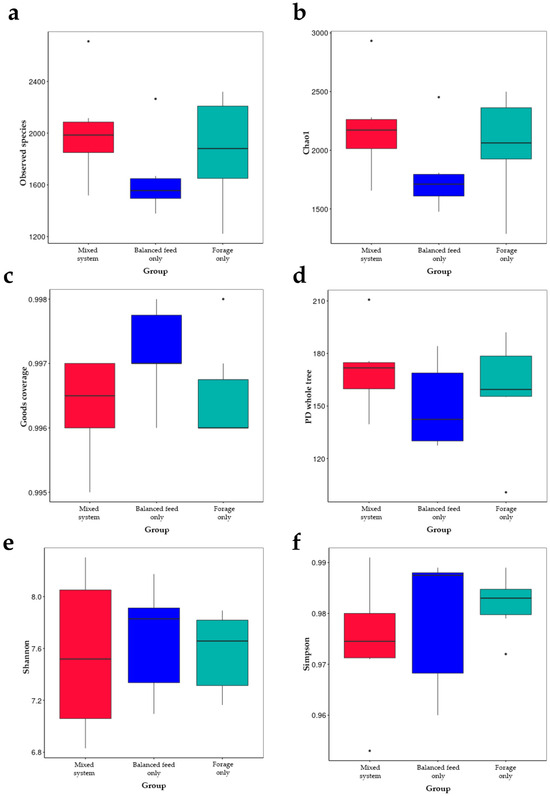
Alpha diversity indices were used to evaluate the within-sample richness, phylogenetic breadth, and community evenness of the cecal microbiota across dietary groups. These metrics included observed species, Chao1, Shannon, Simpson, Faith’s phylogenetic diversity (PD whole tree), and Good’s coverage, and their distributions are illustrated in Figure 1a–f, while detailed values are reported in Supplementary Table S5.
Figure 1.
Alpha diversity metrics of gut microbial communities in guinea pigs subjected to three feeding systems. Boxplots show the distribution of (a) observed species, (b) Chao1 richness estimator, (c) Good’s coverage, (d) phylogenetic diversity whole tree (PD_whole_tree), (e) Shannon index, and (f) Simpson index across the Mixed system, Balanced feed-only, and Forage-only groups. Each boxplot represents the median, interquartile range, and outliers of each index.
The observed species index (Figure 1a) indicated that guinea pigs fed a mixed diet (FB group) exhibited the highest taxonomic richness (range: 1976–2710; mean: 2228.8), followed by those fed forage only (F group) (range: 1222–2269; mean: 1814.4), and the lowest richness was recorded in the balanced-only group (B group) (range: 1378–1669; mean: 1535.6). This pattern was corroborated by the Chao1 estimator (Figure 1b), which adjusts for rare taxa, with the FB group again showing the highest mean value (2394.9), and the B group showing the lowest (1746.1).
Sequencing depth was uniformly adequate, as confirmed by Good’s coverage values above 0.995 for all samples (Figure 1c) and the saturation of rarefaction curves (Supplementary Figure S1), indicating that nearly all taxa present were captured.
The PD whole tree index (Figure 1d) provided insight into the phylogenetic diversity of the communities, with the FB group displaying the highest evolutionary richness (mean: 179.4), followed by the F group (mean: 156.3), and the B group (mean: 145.2). These results suggest that the mixed diet promoted a more phylogenetically diverse microbial community.
In terms of diversity and evenness, the Shannon index (Figure 1e) values were highest in the FB group (range: 7.50–8.30; mean: 7.96), indicating a more complex and balanced microbiota structure. The B group presented the lowest mean Shannon diversity (7.33), while the F group exhibited intermediate values (mean: 7.65). This trend was reflected in the Simpson index (Figure 1f), where the FB group had the greatest evenness (mean: 0.982), with the B and F groups showing slightly lower values (0.975 and 0.980, respectively).
Altogether, these metrics indicate that the mixed feeding system supports higher microbial alpha diversity, both in taxonomic and phylogenetic terms, compared to mono-diet systems.
3.3. Beta Diversity and Microbial Community Structure
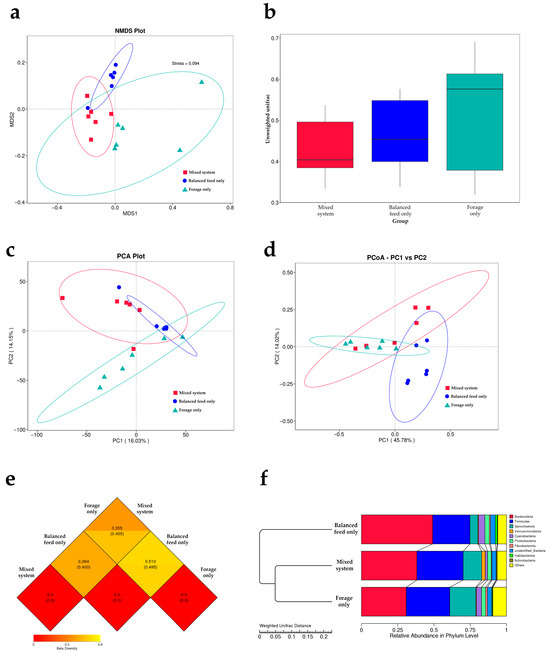
Beta diversity metrics were used to evaluate differences in microbial community composition between the three dietary groups. The analysis incorporated both qualitative and phylogenetic distance-based methods, including unweighted UniFrac, NMDS, PCA, PCoA, distance heatmaps, and UPGMA clustering (Figure 2a–f).
Figure 2.
Beta diversity analysis of gut microbial communities across feeding systems in guinea pigs. (a) NMDS ordination plot based on binary Jaccard distance showing sample clustering by feeding group. (b) Boxplot of unweighted UniFrac distances comparing inter-sample variability. (c) PCA plot of microbial composition. (d) PCoA plot based on unweighted UniFrac distance. (e) Heatmap of pairwise beta diversity values across groups. (f) UPGMA clustering dendrogram based on weighted UniFrac distance with taxonomic composition at the phylum level.
The Non-Metric Multidimensional Scaling (NMDS) based on unweighted UniFrac distances (Figure 2a) revealed clear clustering of microbial communities according to diet. The stress value of 0.094 indicated a good ordination fit. Samples from the FB and B groups formed tight, well-separated clusters, while those from the F group showed greater dispersion, suggesting increased inter-individual variability under a forage-only diet.
Boxplots of unweighted UniFrac distances (Figure 2b) quantitatively supported this distinction, with the F group exhibiting the highest beta diversity (median ~0.58), followed by B (~0.45), and the lowest in FB (~0.41). This indicates a greater microbial community divergence in the forage-only group compared to those with more balanced or mixed feeding strategies.
Principal Component Analysis (PCA) (Figure 2c) and Principal Coordinates Analysis (PCoA) (Figure 2d) further corroborated these trends. In PCA, the first two principal components explained 30.18% of the total variance (PC1 = 16.03%, PC2 = 14.15%). Samples grouped distinctly by diet, with clear separation between F and B groups along PC1, and dispersion of FB samples along PC2. PCoA, based on UniFrac distances, also showed strong separation of groups (PC1 = 45.78%, PC2 = 14.02%), confirming that community structure is shaped significantly by dietary regime.
The beta diversity distance heatmap (Figure 2e) provided pairwise comparisons of compositional dissimilarity between groups. The highest beta diversity was observed between the Balanced feed-only and Forage-only groups (0.510), followed by Balanced vs. Mixed (0.394), and Mixed vs. Forage (0.355), suggesting that shifting from a forage-only to a balanced diet leads to the greatest compositional shift.
Finally, the UPGMA dendrogram based on weighted UniFrac distances (Figure 2f) grouped samples hierarchically according to dietary treatment. The F and B groups formed two distinct branches, while the FB group occupied an intermediate position, reflecting its combined dietary composition. These results suggest that diet is a dominant factor in shaping gut microbial structure, with the forage-only group harboring a distinctly divergent microbiota.
Together, these findings demonstrate that guinea pigs under different feeding regimes harbor significantly different microbial communities, with the most pronounced compositional shifts observed between mono-diet groups, and a more homogeneous and phylogenetically coherent community in the mixed system.
3.4. Taxonomic Composition and Relative Abundance Profiles
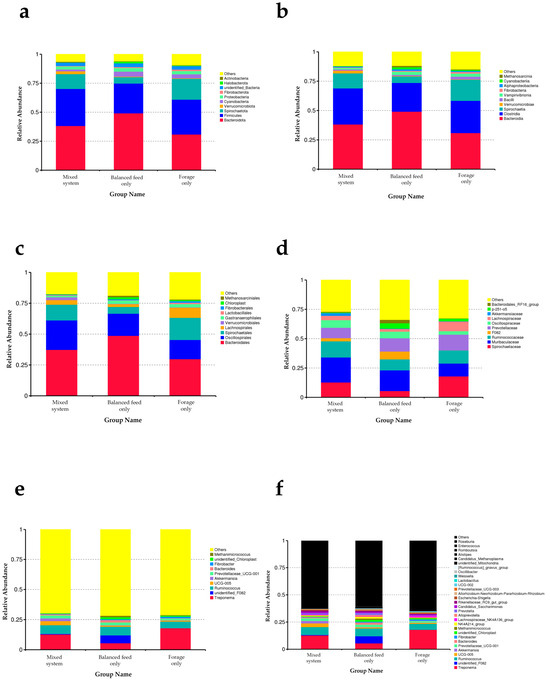
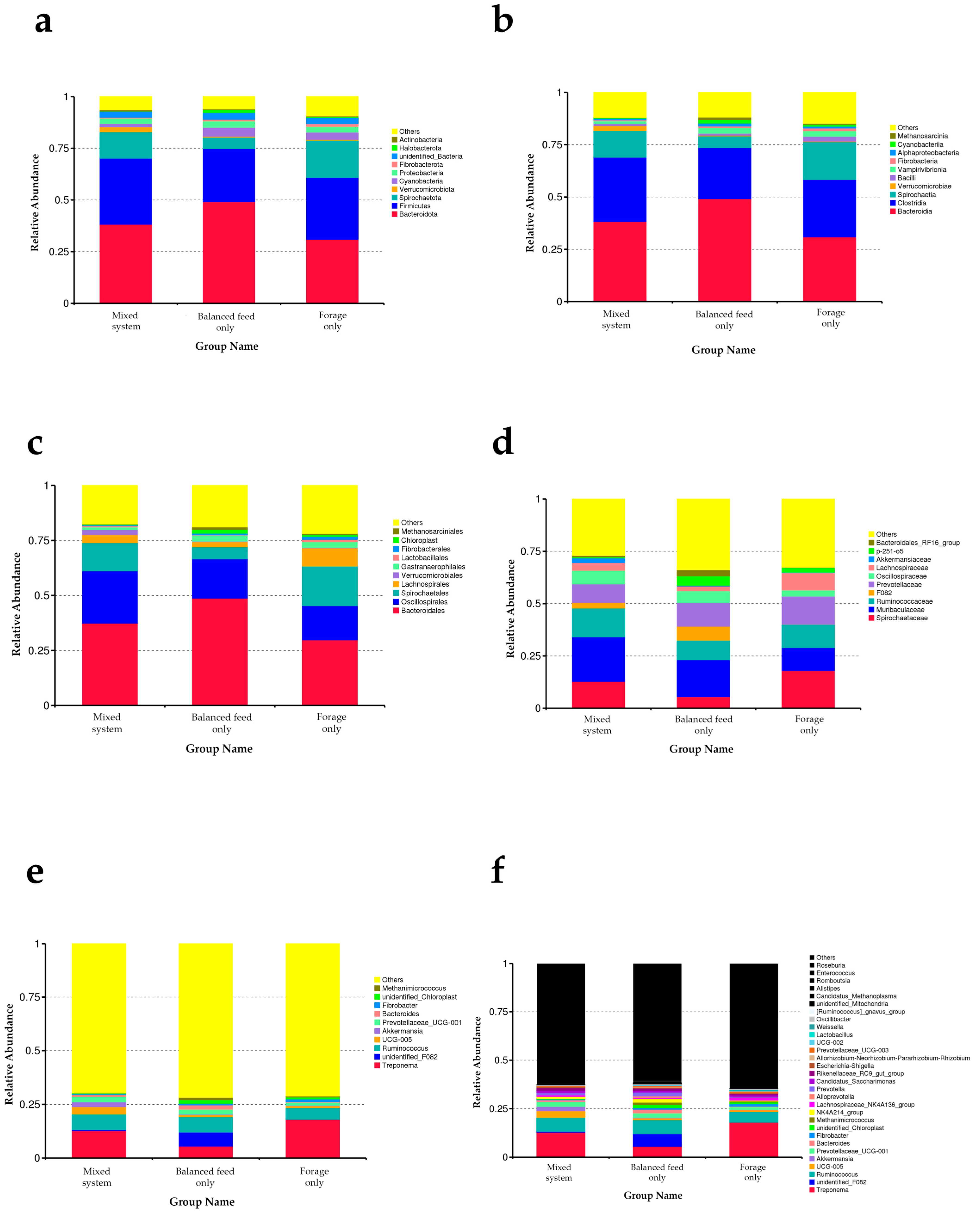
At the phylum level (Figure 3a), microbial communities were dominated by Bacteroidota, Firmicutes, and Spirochaetota, accounting for over 80% of the total reads. Bacteroidota was more abundant in the Balanced feed-only (B) and Mixed system (FB) groups, while Cyanobacteria and Spirochaetota prevailed in the Forage-only (F) group. Minor phyla like Fibrobacterota and Verrucomicrobiota showed notable group-specific trends.
Figure 3.
Relative abundance of microbial taxa at different taxonomic levels in the gut microbiota of guinea pigs. (a) Phylum, (b) Class, (c) Order, (d) Family, (e) Genus, and (f) Top 30 most abundant genera. The stacked bar plots show the average relative abundance of each taxon across feeding groups: mixed system, balanced feed only, and forage only.
At the class level (Figure 3b), Bacteroidia and Clostridia dominated across groups. However, Fibrobacteria, Spirochaetia, and Bacilli increased in the Forage-only group, suggesting microbial adaptation to fiber fermentation. Bacteroidia is more abundant in balanced feed only than in the other two diets, while Vampirivibriona, Cyanobacteriia, and Alphaproteobacteria are more abundant in Forage only and Balanced feed only than in the mixed system. Methanosarcinia is found in greater abundance in Balanced feed only compared to the other diets, where this class is almost absent.
At the order levels (Figure 3c), Bacteroidales, Oscillospirales, and Spirochaetales were prevalent, but the Balanced feed only group showed higher Bacteroidales and Methanosarciniales, while the Forage only group was characterized by Spirochaetales, Lachnospirales, and Fibrobacterales abundance. In forage-only, the concentration of Spirochaetales increased to almost double that of the balanced feed-only diet, similar to the pattern observed for Lactobacillales, where the concentration was almost triple that of the other diets. In the mixed system, the only presence of Verrucomicrobiales was observed.
At the family levels (Figure 3d), Ruminococcaceae and Lachnospiraceae, both core members of the Firmicutes phylum, are most prevalent in animals fed a forage-only diet, where they constitute a substantial portion of the microbial community. In contrast, Muribaculaceae (bright yellow), a family within Bacteroidota, shows the opposite trend. This family dominates the balanced-feed-diet group and remains abundant in the mixed system, but is considerably reduced in the forage group. Prevotellaceae shows a progressive growth from the mixed system to balanced feed only and forage only, where the highest concentration is found in the latter. An opposite trend was observed in Akkermansiaceae, where higher concentration is present in the mixed system compared to other diets.
At the genus level (Figure 3e,f), the composite category Others (yellow) accounted for roughly three-quarters of all reads in every diet, reflecting the long tail of low-abundance genera that individually fell below the 1% plotting threshold. Within the plotted genera: Treponema, Ruminococcus, UCG-005 and Unidentified F082 were abundant, with clear diet-specific patterns. For instance, Fibrobacter and Treponema dominated in Forage only, while Unidentified F082, Methanimicrococcus and Bacteroides were enriched in Balanced feed only. The Mixed system supported both types of genera, suggesting functional complementation, with notable mention of the enrichment of Ruminococcaceae UCG-005 and the Akkermansia genus. The presence of Treponema is low in balanced feed only, medium in the mixed system, and high in forage only, while unidentified F082 is present in high proportions in balanced feed only and very low in the mixed system, but not at all in forage only. Fibrobacter is present in higher quantities in forage only than in balanced feed only; the opposite pattern is observed with the genus Methanimicrococcus.
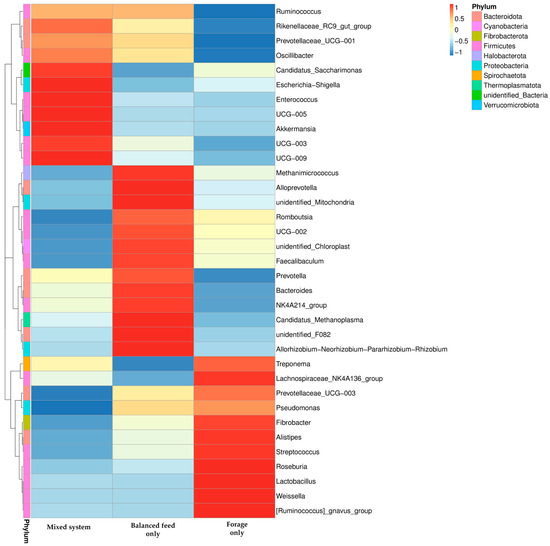
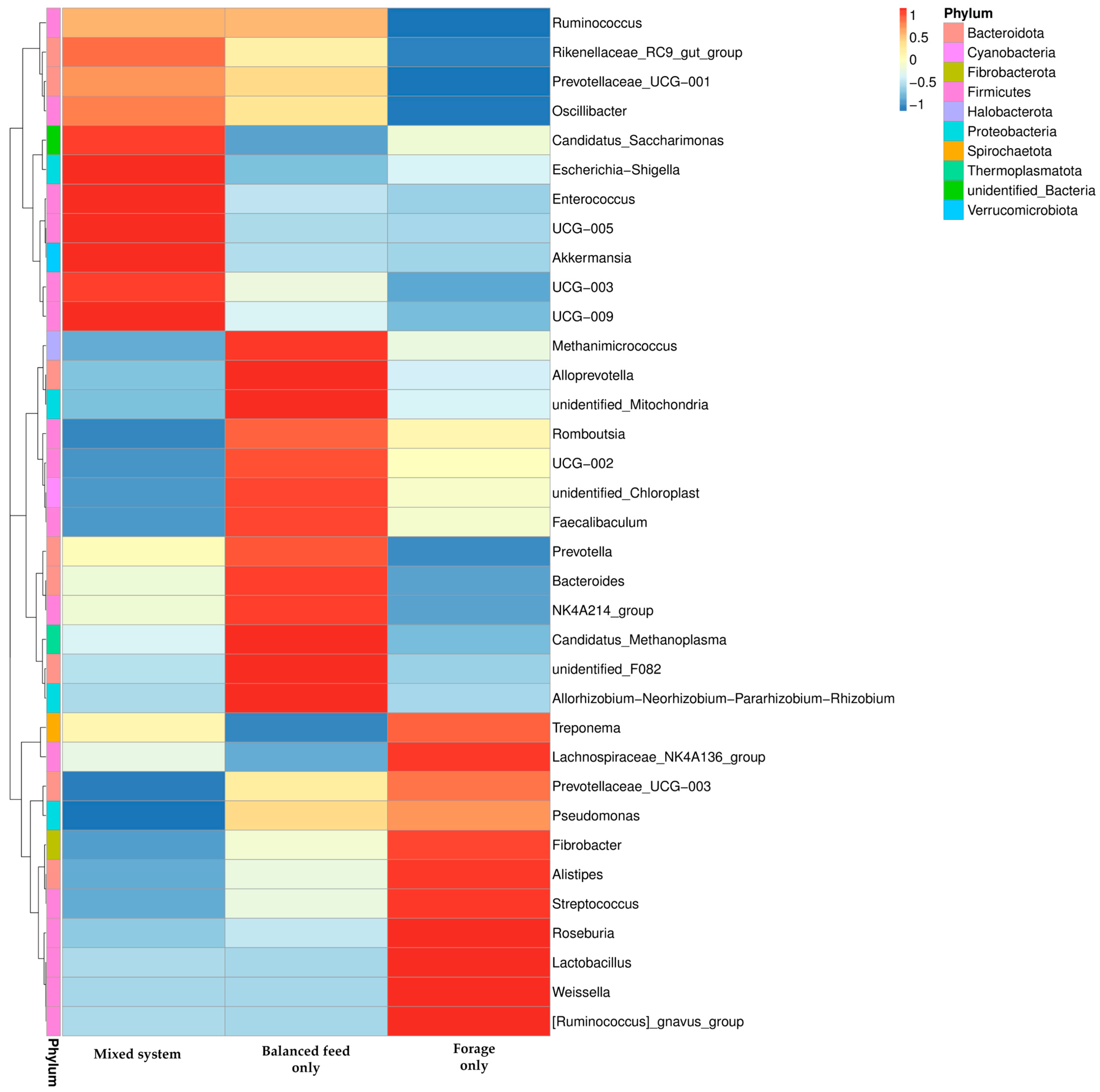
The heatmap (Figure 4) confirmed distinct clustering of samples by diet. Genera such as Oscillibacter, Candidatus Saccharimonas, Enterococcus, UCG-003, UCG-005, UCG-009 and Akkermansia were enriched in FB (mixed system), while Fibrobacter, Treponema, Lactobacillus, Weissella and Roseburia were more prominent in Forage only, and Methanimicrococcus, Alloprevotella, Candidatus Methanoplasma, unidentified F082, Allorhizobium, Faecalibacullum, and Bacteroides in Balanced feed only.
Figure 4.
Hierarchical heatmap of taxonomic abundance at the genus level among the three feeding systems. The corresponding value of the heatmap is the Z value obtained by normalizing the relative abundance of each row. The Z value of a sample on a certain category is the relative abundance of the sample on the classification and the average relative abundance difference is divided by the standard deviation of all samples on the classification.
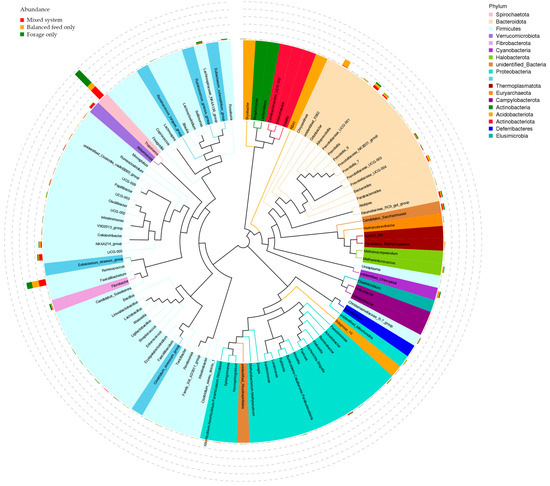
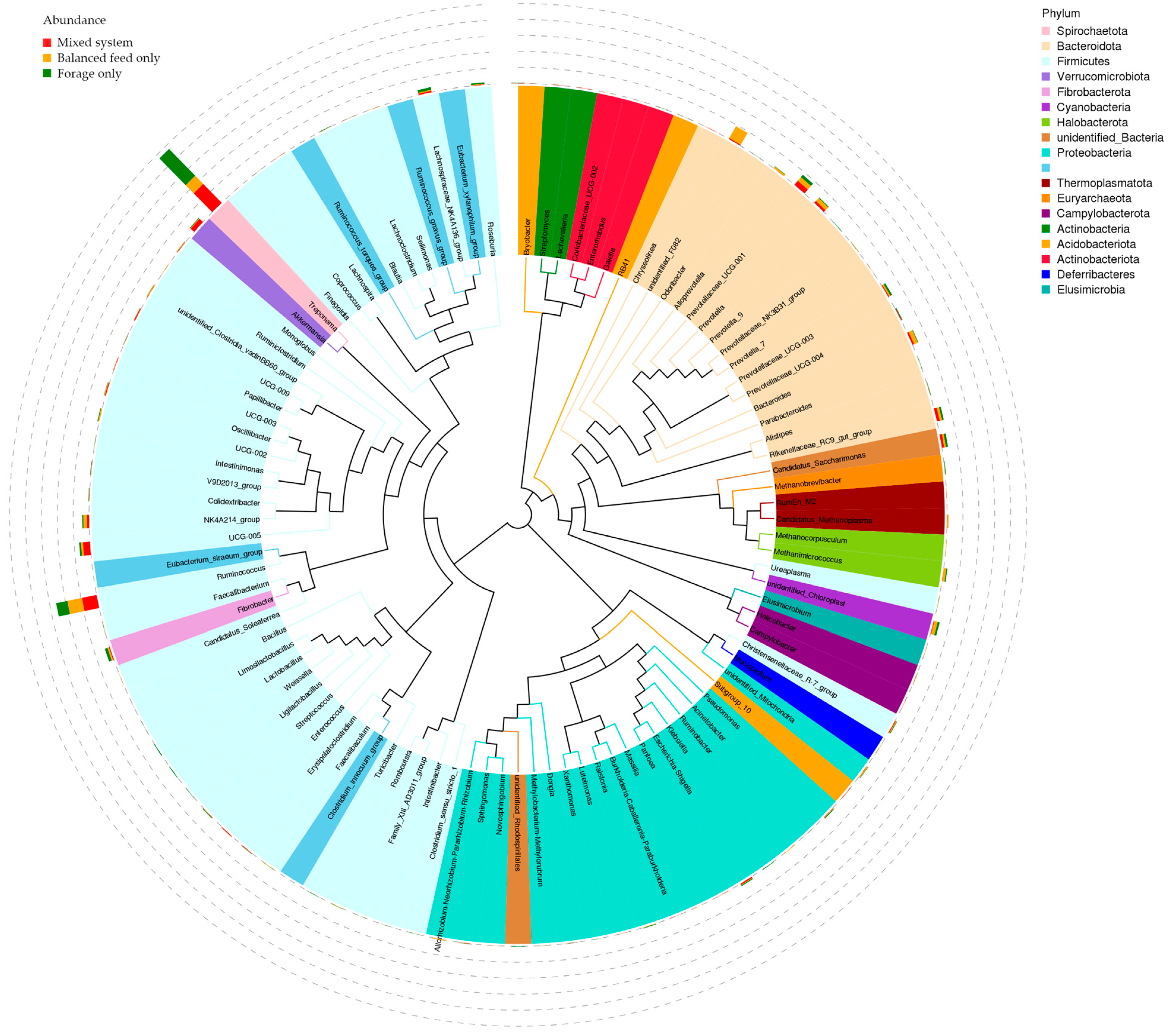
A phylogenetic tree (Figure 5) further illustrated the evolutionary structure of microbial differences where the top 100 genera were selected and the evolutionary tree was drawn using the aligned representative sequences. In this phylogenetic tree we can observe expanded information beyond that already obtained in Figure 4. Almost one-half of the circumference is occupied by Firmicutes phylum. Treponema, Ruminococcus, Fibrobacter, UCG-005, Akkermansia, Prevotellaceae, Rikenellaceae and Escherichia-Shigella are present in the three dietary systems.
Figure 5.
Phylogenetic tree of bacterial genera based on 16S rRNA gene sequences, annotated by relative abundance in guinea pigs fed with a mixed system, balanced feed only, and forage only. The internal tree reflects phylogenetic relationships, while external-colored bars indicate genus-level relative abundance per feeding group and different colors represent different groups. Genera are color-coded by phylum.
The Forage-only group represents the highest group-specific richness. In contrast, the Balanced feed-only group harbored less genera, while the Mixed system had the lowest number. These patterns indicate that forage-based diets promote greater recruitment of specialized microbial taxa, while the mixed system supports greater microbiome overlap with both mono-diet groups, reflecting ecological flexibility. Together, the taxonomic, phylogenetic, and distributional analyses confirm that dietary composition exerts a strong influence on the structure, specificity, and evolutionary diversity of the guinea pig gut microbiota.
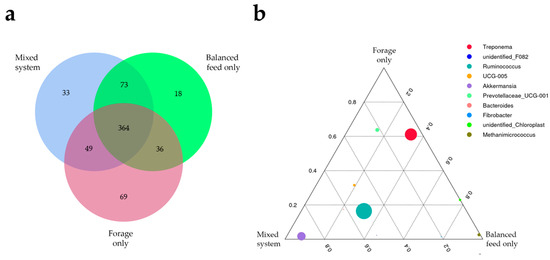
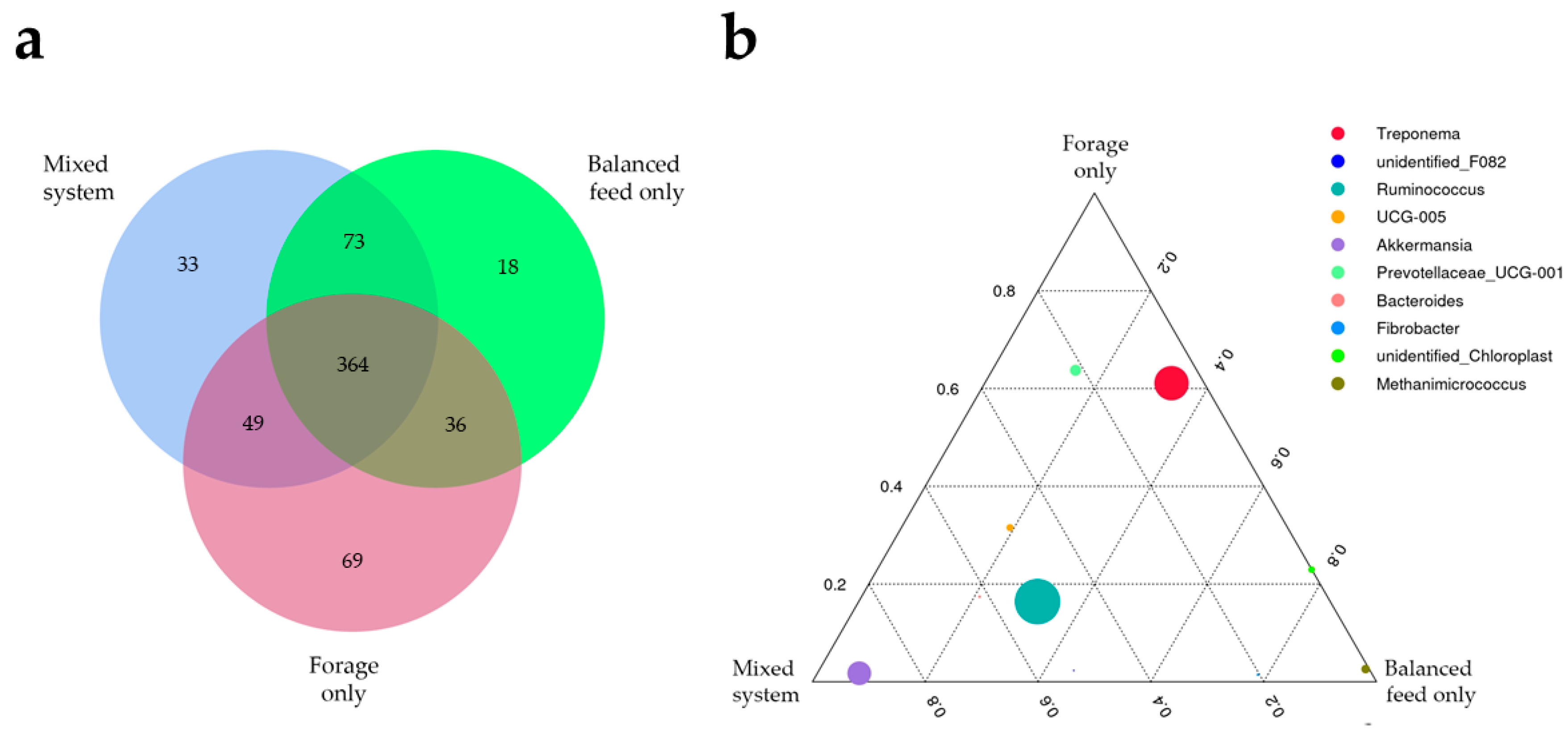
The core and exclusive genera analysis (Figure 6a) revealed that 364 bacterial genera were shared across all groups, forming a core microbiota potentially essential for guinea pig gut function. However, 69 genera were unique to the Forage-only group, representing the highest group-specific richness. In contrast, the Mixed system harbored 33 exclusive genera, while the Balanced feed-only group had the lowest number, with 18 unique genera. Additionally, 73 genera were shared only between the FB and B groups, 49 between FB and F, and 36 between B and F. These patterns indicate that forage-based diets promote greater recruitment of specialized microbial taxa, while the mixed system supports greater microbiome overlap with both mono-diet groups, reflecting ecological flexibility.
Figure 6.
Shared OTU repertoire and diet-biased taxonomic signatures in the cecal microbiota of guinea pigs. (a) Venn diagram illustrating the number of operational taxonomic units (OTUs) that are unique to—or shared among—the mixed system (FB), balanced-feed-diet (B) and forage-only (F) groups. (b) Ternary plot displaying the relative contribution of the top ten bacterial phyla to each dietary group; each symbol’s position within the triangle reflects its proportional abundance in FB (left corner), B (right corner) and F (top corner), allowing visual comparison of diet-driven enrichment patterns.
Figure 6b shows a ternary plot illustrating the distribution of the ten most abundant genera across the three dietary treatments. Treponema, Fibrobacter, and unidentified_Chloroplast are strongly associated with the forage-only group, reflecting their adaptation to fiber-rich diets. Bacteroides and Methanimicrococcus are more abundant in the balanced-feed-diet group, suggesting a preference for readily fermentable nutrients. Genera such as Ruminococcus, Prevotellaceae_UCG-001, Akkermansia, and UCG-005 appear evenly distributed across all diets, indicating their role as part of the core microbiota. Unidentified_F082 shows higher abundance in the mixed system, reflecting its adaptation to combined nutrient sources. These patterns highlight diet as a key driver of microbial community structure.
3.5. Identification of Differential Taxa and Biomarkers
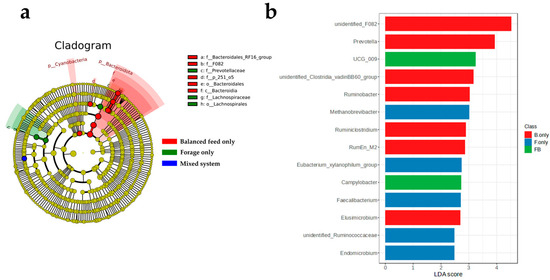
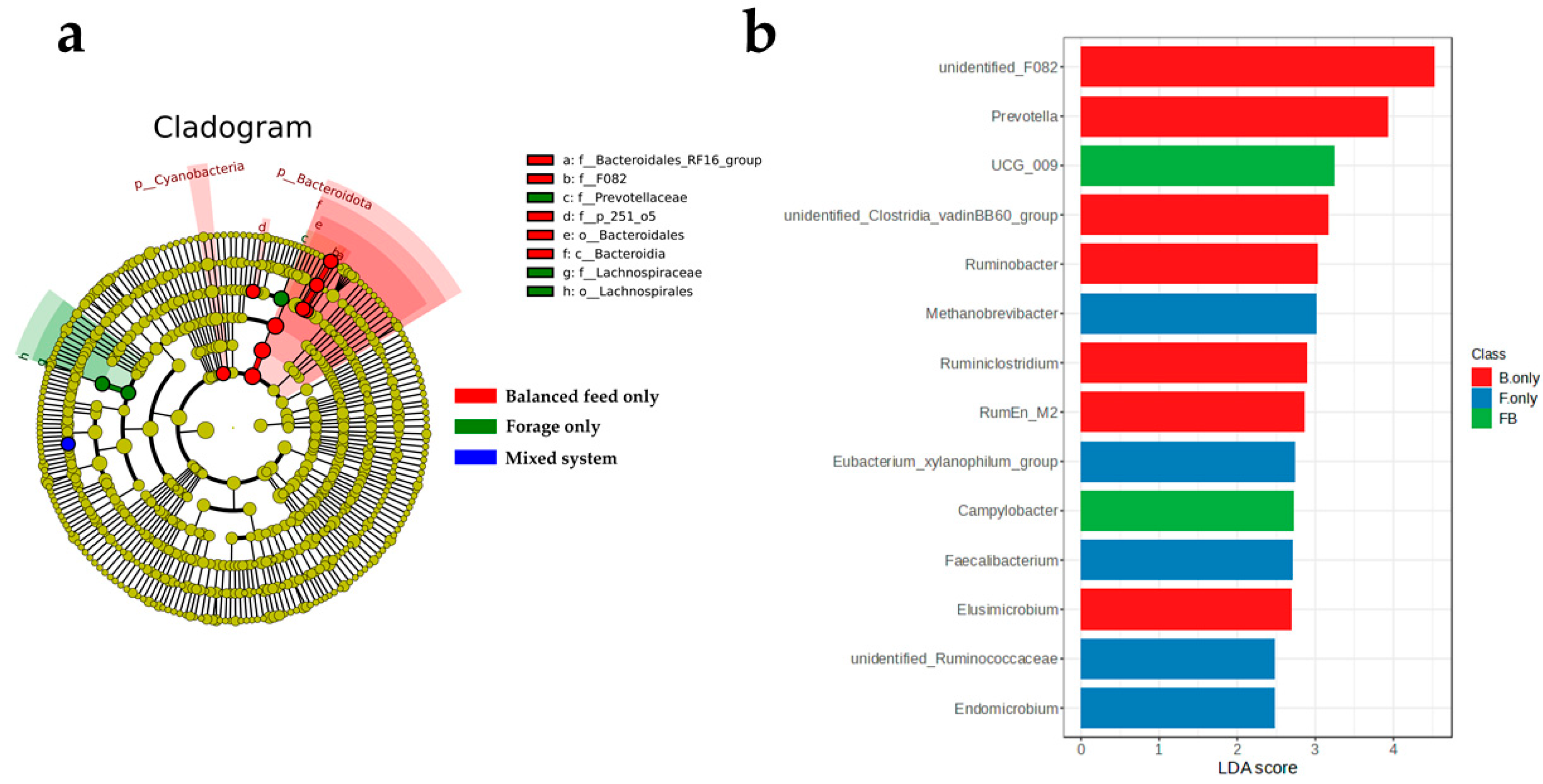
The LEfSe (Linear Discriminant Analysis Effect Size) approach was applied to identify microbial taxa that significantly differed in relative abundance across the three feeding systems, serving as potential biomarkers for each dietary condition. The results are presented in Figure 7a,b.
Figure 7.
LEfSe analysis of bacterial taxa differentially abundant among guinea pigs fed with a mixed system, balanced feed only, and forage only. (a) A cladogram generated by LEfSe displays the phylogenetic distribution of taxa with significant differences among groups. Colored nodes indicate taxa enriched in the corresponding treatment. (b) Linear discriminant analysis (LDA) score plot showing taxa with significant differential abundance (LDA > 2.0, p < 0.05) among feeding systems. Colors indicate the group in which each taxon is enriched: red = forage only, blue = balanced feed only, green = mixed system.
In Figure 7a, the cladogram reveals that the balanced-feed-diet group (red) exhibited the largest number of discriminant taxa, including members of the Bacteroidales RF16 group, F082 family, Prevotellaceae, and the Bacteroidia class within the Bacteroidota phylum. This suggests a strong specialization of the microbiota toward taxa associated with the fermentation of readily available carbohydrates present in the concentrate-based diet. In contrast, the forage-only group (green) was characterized by fewer but distinct taxa, including members of the Lachnospiraceae family and Lachnospirales order, known for their fibrolytic capacity. The mixed system group (blue) presented only a single discriminant taxon related to Clostridia, indicating a more balanced microbial structure without strong specialization.
Figure 7b quantifies these differences, showing that unidentified_F082 and Prevotella had the highest LDA scores in the balanced-feed-diet group, followed by genera such as Ruminobacter, and unidentified Clostridia vadinBB60 group, all significantly enriched in this diet. For the forage-only group, Methanobrevibacter, Faecalibacterium and Eubacterium xylanophilum genus, while the mixed system group showed enrichment of UCG-009 and Campylobacter genus.
Altogether, the LEfSe results confirm that dietary composition not only alters community structure but also determines the selection of specific microbial biomarkers. These taxa may serve as useful indicators of dietary history, gut health status, and microbial functionality in guinea pigs.
3.6. Statistical Validation of Community Differences
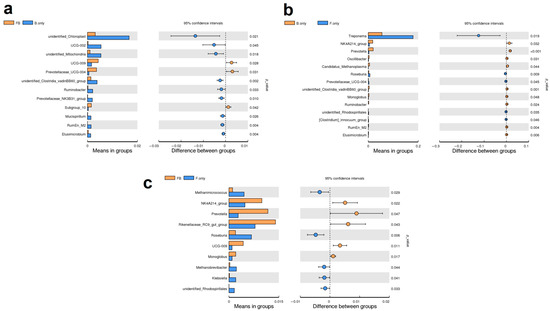
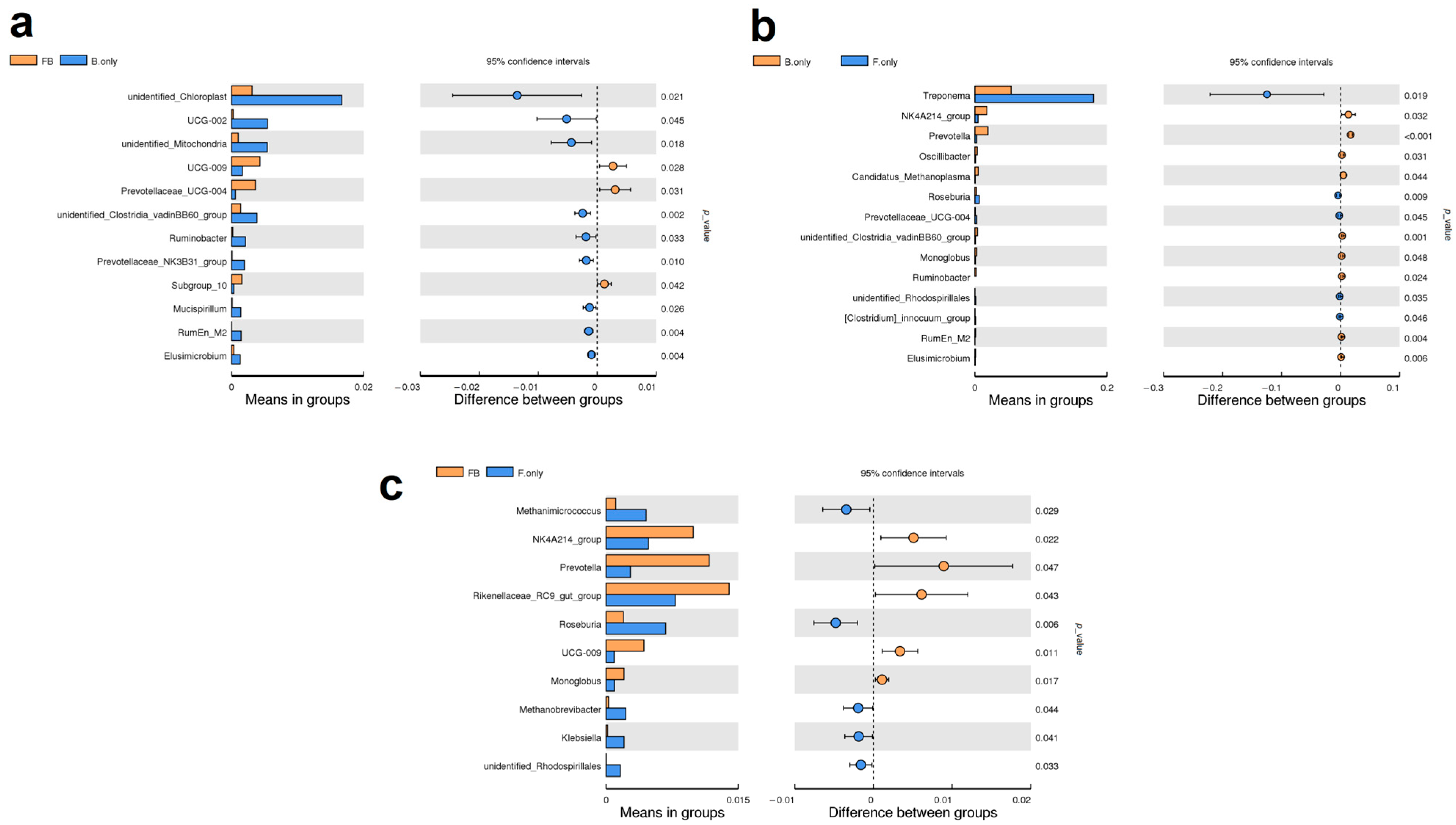
Statistical comparisons of genus-level abundance revealed that the three dietary treatments distinctly modulated the structure of the cecal microbiota in guinea pigs (Figure 8). The comparison between the mixed system and balanced feed only (Figure 8a) showed that several genera were significantly more abundant in the balanced-feed-diet group, including unidentified_Chloroplast, UCG-002, unidentified_Mitochondria, UCG-009, and Prevotellaceae_UCG-004. This suggests that exclusive concentrate feeding promotes specific taxa that were not favored under the mixed diet. In contrast, the mixed system showed no significantly enriched genera in this comparison, indicating that the microbial community in this treatment was less dominated by unique taxa relative to the concentrate-only group.
Figure 8.
Comparison of the relative abundance of predominant bacterial genera across the three feeding systems using pairwise t-tests. Genera are colored according to their phylum classification. Significant differences (p < 0.05) are indicated with p-values and 95% confidence intervals. (a) shows the comparison between guinea pigs fed a balanced diet only (B.only) and those under the mixed feeding system (FB), (b) compares the balanced diet only (B.only) with the forage-only diet (F.only), and (c) contrasts the mixed system (FB) with the forage-only group (F.only).
The comparison between balanced feed only and forage only (Figure 8b) revealed a clear shift favoring the forage-only diet, which showed significantly higher abundances of Treponema, NK4A214_group, Prevotella, Oscillibacter, Candidatus Methanoplasma, and Roseburia. These taxa are typically associated with fiber degradation and syntrophic fermentation, reflecting the high fiber content of the forage diet. Only Monoglobus was relatively more abundant in the balanced-feed group, but this difference was minor compared to the strong enrichment of fibrolytic and hydrogenotrophic taxa in the forage-fed animals.
The results showed a more balanced distribution of enriched taxa when comparing the mixed system and forage only (Figure 8c). The forage-only group had higher levels of Methanimicrococcus, NK4A214_group, Prevotella, Roseburia, and Rikenellaceae_RC9_gut_group, reinforcing its role in promoting fiber-degrading and syntrophic microorganisms. However, the mixed system supported higher abundances of UCG-009, Methanobrevibacter, Monoglobus, Klebsiella, and unidentified_Rhodospirillales, indicating that the combination of forage and concentrate provided ecological niches for both fibrolytic and facultative or hydrogenotrophic bacteria.
Statistical validation of community-level differences using ANOSIM, MRPP, and Adonis confirmed that dietary treatments significantly shaped the cecal microbiota structure (Supplementary Tables S2–S4). ANOSIM revealed significant dissimilarities between all groups (p < 0.005), with the most separation observed between balanced feed only and forage only (R = 0.593), followed by mixed system vs. balanced feed (R = 0.566). MRPP supported these findings, showing higher within-group similarity compared to between-group variation (A = 0.088–0.132, p < 0.003). Adonis analysis indicated that diet explained up to 27.9% of the variance in microbial composition (p ≤ 0.004), with the higher effect again between balanced feed and forage groups (R2 = 0.2786).
These patterns reveal that while forage strongly selects for fibrolytic and methanogenic communities, the mixed system allows the coexistence of both fiber- and starch-associated taxa. Conversely, exclusive concentrate feeding results in a microbial profile dominated by specific genera adapted to soluble carbohydrates. Overall, these results demonstrate that dietary composition shapes not only the diversity but also the functional potential of the guinea pig cecal microbiota by favoring distinct microbial groups under each nutritional strategy.
4. Discussion
Adequate sequencing depth was achieved across all samples, as evidenced by rarefaction curves reaching saturation and Good’s coverage values consistently above 99%. These indicators confirm that the majority of bacterial taxa present in the guinea pig cecal microbiota were effectively captured, reducing the risk of underrepresentation of rare taxa. The average of 118,658 high-quality reads per sample greatly exceeds the commonly accepted thresholds for robust microbial diversity estimation. Recent studies have demonstrated the effectiveness of high-throughput sequencing techniques for analyzing gut microbiomes. Claesson & O’Toole [40] found that 40,000 reads were sufficient to capture the majority of microbial diversity in a sample. Caporaso et al. [41] showed that even 2000 Illumina reads could accurately represent relationships among samples.
This study provides robust evidence that dietary composition is a major driver of gut microbial diversity, community structure, and ecological function in Cavia porcellus. The integration of alpha and beta diversity metrics, taxonomic profiling, biomarker analysis, and statistical validation clearly demonstrates that forage-based diets foster a more diverse, phylogenetically rich, and functionally fibrolytic microbiota, while concentrate-based diets induce taxonomic shifts toward more specialized, mucin- and protein-degrading bacterial lineages.
Guinea pigs fed exclusively on forage exhibited the highest microbial richness and phylogenetic diversity, as indicated by elevated Chao1, observed species, and PD whole tree indices. Additionally, this group demonstrated greater community evenness, reflected in higher Shannon and Simpson index values, compared to those fed balanced feed or a mixed diet. The higher microbial richness and phylogenetic diversity in the forage group corroborates earlier findings in guinea pigs and other herbivores, where high-fiber diets promote the proliferation of fibrolytic taxa capable of degrading complex polysaccharides [42,43,44,45]. In particular, the increased abundance of Fibrobacter, Treponema, and Ruminococcus under forage feeding suggests enhanced metabolic capacity for fermenting structural carbohydrates [10,46,47], likely resulting in greater production of short-chain fatty acids (SCFAs), which play a central role in maintaining mucosal integrity and providing energy to colonocytes [48,49,50].
In contrast, guinea pigs fed exclusively on concentrate-rich balanced feed exhibited reduced alpha diversity and a higher prevalence of Akkermansia, Bacteroides, and Prevotella—taxa known for their capacity to degrade host-derived mucins and dietary proteins [19,39,51,52]. While these microbes are part of the normal gut ecosystem, their overrepresentation has been associated with mucosal barrier erosion, increased gut permeability, and the production of toxic fermentation metabolites such as ammonia, phenols, and indoles [11,53]. This microbial configuration may represent a less resilient and potentially pro-inflammatory state, particularly under chronic concentrate feeding [54,55].
The mixed feeding system produced intermediate taxonomic and functional profiles, supporting microbial groups from both fiber- and starch-degrading guilds [56,57,58]. This coexistence may enhance fermentative flexibility and functional redundancy, supporting both SCFA production and energy extraction from diverse substrates. The presence of Akkermansia, Ruminococcus, and UCG-005 in this group suggests a microbial landscape capable of metabolic plasticity [59,60]. This finding supports earlier reports demonstrating that combining fiber and concentrate sources can buffer microbial community shifts and sustain overall gut functionality, pending metabolomic/histological validation [61,62].
The LEfSe analysis further confirmed the diet-specific microbial signatures, highlighting key biomarkers for each feeding regimen. Notably, Fibrobacter and Treponema were enriched in forage-fed animals, while F082 and Prevotella predominated in concentrate-fed animals—consistent with previous findings in guinea pigs subjected to contrasting dietary regimes [19,51]. These biomarkers not only reflect dietary inputs but may serve as predictive indicators of microbial function and host digestive efficiency [63,64].
The ecological findings align with broader studies on dietary interventions in guinea pigs. For instance, Al et al. [51] demonstrated that postnatal diets—rather than birth weight—induce significant OTU-level shifts in guinea pig microbiota, even when alpha diversity remains unchanged. Similarly, studies examining guinea pigs on high-fiber hay-based diets report community dominance by Bacteroidetes and Firmicutes, mirroring findings in this study and in rabbits [14,65]. Moreover, fasting experiments have shown breed-specific microbiome responses, including altered Firmicutes/Bacteroidetes ratios and the emergence of taxa such as Victivallis [19], suggesting that dietary timing and host genetics modulate microbiome plasticity [35].
Another promising avenue is the use of probiotics derived from agro-industrial waste, as shown by Miranda-Yuquilema et al. [66]. These formulations increased beneficial microbes such as Lactobacillus and yeasts, reduced E. coli, and improved weight gain and intestinal morphology. These results suggest that microbiome-informed supplementation could serve as a sustainable strategy to improve gut function and reduce dependence on antibiotics in guinea pig husbandry. It is also important to know that dietary adaptations affecting oxalate metabolism have revealed that specific microbial families, such as Muribaculaceae, can be enriched to mitigate calcium oxalate crystallization [53]. This highlights the capacity of the guinea pig microbiome to functionally adapt to dietary stressors, a property that may be harnessed in future functional feeding strategies.
Future research should elucidate the mechanistic pathways by which specific dietary components shape microbial metabolism and host health, ideally through longitudinal designs that capture the temporal dynamics and resilience of diet-responsive taxa. To directly connect community shifts with tissue outcomes, future work will integrate intestinal histomorphometry (villus length, crypt depth, goblet cell abundance) and liver microarchitecture to test whether taxonomic/functional changes translate into mucosal remodeling and hepatic structural adaptations. In parallel, investigating the interplay between host genetics and diet-induced microbial shifts could inform personalized nutrition strategies tailored to optimize gut function and metabolic health.
5. Conclusions
The present study provides comprehensive evidence that dietary composition significantly influences the structure, diversity, and functional potential of the cecal microbiota in guinea pigs (Cavia porcellus). High-throughput 16S rRNA gene sequencing revealed that forage-based diets fostered greater microbial richness and diversity, enriched beneficial fiber-degrading taxa such as Fibrobacter and Treponema, and promoted a gut environment conducive to short-chain fatty acid production. In contrast, diets based on commercial balanced feed shifted the microbial composition toward mucin- and protein-degrading taxa, including Akkermansia and Bacteroides, with potential implications for gut barrier integrity and host metabolism. Diet groups differ in fermentative strategy; host barrier status was not assessed.
Beta diversity analyses and biomarker identification through LEfSe further confirmed that each dietary regimen selected for distinct microbial consortia, highlighting the gut microbiota’s adaptive response to dietary substrates. These findings underscore the critical role of diet in modulating gastrointestinal microbial ecosystems and support the use of dietary interventions as a tool for promoting gut health and optimizing nutrition in guinea pigs.
Future research integrating metagenomic or metabolomic approaches would be valuable to elucidate the functional metabolic outputs of these microbial shifts. Such insights could inform precision feeding strategies in guinea pig husbandry and broader applications in herbivorous animal models.
Supplementary Materials
The following supporting information can be downloaded at https://www.mdpi.com/article/10.3390/applmicrobiol6010018/s1. Figure S1: Rarefaction curves; Table S1: Proximate analysis of the commercial concentrate; Table S2: Analysis of Similarity (Anosim); Table S3: Multi-response permutation procedure (MRPP) analysis; Table S4: Adonis analysis result; Table S5: Alpha diversity indices.
Author Contributions
Conceptualization, J.C.S. and H.C.-S.; methodology, J.C.S.; software, H.C.-S.; validation, J.C.S. and H.C.-S.; formal analysis, J.C.S.; investigation, J.C.S.; resources, J.C.S.; data curation, J.C.S.; writing—original draft preparation, J.C.S. and H.C.-S.; writing—review and editing, J.C.S. and H.C.-S.; visualization, J.C.S. and H.C.-S.; supervision, R.B.; project administration, J.C.S.; funding acquisition, J.C.S. All authors have read and agreed to the published version of the manuscript.
Funding
This research received no external funding.
Institutional Review Board Statement
Ethical review and approval were waived for this study due to the reason that no procedures were performed on live animals for this study. Cecal content samples were collected post-mortem from guinea pigs that were commercially slaughtered for food production, under standard animal-welfare and humane-slaughter regulations in Peru. The research team did not administer treatments, perform clinical procedures, or otherwise intervene on live animals for scientific purposes. Under Peru’s national framework—Ley N° 30407 (Protección y Bienestar Animal) and the SENASA welfare and slaughter guidance—the activities we report (i.e., post-mortem sampling only, following routine slaughter conducted for non-research purposes) do not require institutional animal-ethics committee approval. There is no legal or institutional requirement for ethics committee review when no live-animal procedures are undertaken and tissues are obtained after death in the normal course of food production.
Informed Consent Statement
Not applicable.
Data Availability Statement
Data is contained within the article or Supplementary Material.
Conflicts of Interest
The authors declare no conflicts of interest.
References
- Collinder, E.; Björnhag, G.; Cardona, M.; Norin, E.; Rehbinder, C.; Midtvedt, T. Gastrointestinal Host–Microbial Interactions in Mammals and Fish: Comparative Studies in Man, Mice, Rats, Pigs, Horses, Cows, Elks, Reindeers, Salmon and Cod. Microb. Ecol. Health Dis. 2003, 15, 66–78. [Google Scholar] [CrossRef] [Scilit]
- Sahu, N.P.; Kamra, D.N. Microbial Eco-System of the Gastro-Intestinal Tract of Wild Herbivorous Animals. J. Appl. Anim. Res 2002, 21, 207–230. [Google Scholar] [CrossRef] [Scilit]
- Bomba, A.; Jonecová, Z.; Gancar_íková, S.; Nemcová, R. The Gastrointestinal Microbiota of Farm Animals. In Gastrointestinal Microbiology; CRC Press: Boca Raton, FL, USA, 2006; pp. 381–399. [Google Scholar]
- Pierre, J.F.; Leone, V.A. The Microbiome and Health. In Present Knowledge in Nutrition; Elsevier: Amsterdam, The Netherlands, 2020; pp. 605–624. [Google Scholar]
- White, B.A.; Lamed, R.; Bayer, E.A.; Flint, H.J. Biomass Utilization by Gut Microbiomes. Annu. Rev. Microbiol. 2014, 68, 279–296. [Google Scholar] [CrossRef] [Scilit]
- Sanders, J.G.; Beichman, A.C.; Roman, J.; Scott, J.J.; Emerson, D.; McCarthy, J.J.; Girguis, P.R. Baleen Whales Host a Unique Gut Microbiome with Similarities to Both Carnivores and Herbivores. Nat. Commun. 2015, 6, 8285. [Google Scholar] [CrossRef] [Scilit] [PubMed]
- Shi, N.; Li, N.; Duan, X.; Niu, H. Interaction between the Gut Microbiome and Mucosal Immune System. Mil. Med. Res. 2017, 4, 14. [Google Scholar] [CrossRef] [Scilit] [PubMed]
- Yoo, J.; Groer, M.; Dutra, S.; Sarkar, A.; McSkimming, D. Gut Microbiota and Immune System Interactions. Microorganisms 2020, 8, 1587. [Google Scholar] [CrossRef] [Scilit]
- Yurist-Doutsch, S.; Arrieta, M.-C.; Vogt, S.L.; Finlay, B.B. Gastrointestinal Microbiota–Mediated Control of Enteric Pathogens. Annu. Rev. Genet. 2014, 48, 361–382. [Google Scholar] [CrossRef] [Scilit]
- Perler, B.K.; Friedman, E.S.; Wu, G.D. The Role of the Gut Microbiota in the Relationship Between Diet and Human Health. Annu. Rev. Physiol. 2023, 85, 449–468. [Google Scholar] [CrossRef] [Scilit]
- Yamada, T.; Takahashi, D.; Hase, K. The Diet-Microbiota-Metabolite Axis Regulates the Host Physiology. J. Biochem. 2016, 160, 1–10. [Google Scholar] [CrossRef] [Scilit]
- Pinchao, Y.A.; Serna-Cock, L.; Mora, O.O. Probiotic Capacity of Commensal Lactic Acid Bacteria from the Intestine of Guinea Pigs (Cavia porcellus). Heliyon 2024, 10, e29431. [Google Scholar] [CrossRef] [Scilit]
- Frias, H.; Murga Valderrama, N.L.; Flores, G.J.; Cornejo, V.G.; Del Solar, J.C.; Romani, A.C.; Bardales, W.; Segura, G.T.; Polveiro, R.C.; Vieira, D.d.S.; et al. An Analysis of the Cecum Microbiome of Three Breeds of the Guinea Pig: Andina, Inti, and Peru. Res. Vet. Sci. 2023, 161, 50–61. [Google Scholar] [CrossRef] [Scilit]
- Palakawong Na Ayudthaya, S.; van der Oost, H.; van der Oost, J.; van Vliet, D.M.; Plugge, C.M. Microbial Diversity and Organic Acid Production of Guinea Pig Faecal Samples. Curr. Microbiol. 2019, 76, 425–434. [Google Scholar] [CrossRef] [Scilit] [PubMed]
- Salomon, F.; Morales, E. The Guinea Pig: Healing, Food, and Ritual in the Andes. Hisp. Am. Hist. Rev. 1996, 76, 768. [Google Scholar] [CrossRef] [Scilit]
- Morales, E. The Guinea Pig in the Andean Economy: From Household Animal to Market Commodity. Lat. Am. Res. Rev. 1994, 29, 129–142. [Google Scholar] [CrossRef] [Scilit]
- Avilés, D.F.; Martínez, A.M.; Landi, V.; Delgado, J.V. El Cuy (Cavia porcellus): Un Recurso Andino de Interés Agroalimentario The Guinea Pig (Cavia porcellus): An Andean Resource of Interest as an Agricultural Food Source. Anim. Genet. Resour./Ressour. Génétiques Anim. /Recur. Genéticos Anim. 2014, 55, 87–91. [Google Scholar] [CrossRef] [Scilit]
- Knehans, A.W.; O’Dell, B.L. Intestinal Microflora in the Guinea Pig as Observed by Scanning Electron Microscopy. Effect of Fibrous Dietary Supplements. J. Nutr 1980, 110, 1543–1554. [Google Scholar] [CrossRef] [Scilit]
- Frias, H.; Murga Valderrama, N.L.; Flores Durand, G.J.; Cornejo, V.G.; Romani, A.C.; Bardales, W.; Segura, G.T.; Polveiro, R.C.; Vieira, D.d.S.; Ramos Sanchez, E.M.; et al. Comparative Analysis of Fasting Effects on the Cecum Microbiome in Three Guinea Pig Breeds: Andina, Inti, and Peru. Front. Microbiol. 2023, 14, 1283738. [Google Scholar] [CrossRef] [Scilit]
- Frese, S.A.; Parker, K.; Calvert, C.C.; Mills, D.A. Diet Shapes the Gut Microbiome of Pigs during Nursing and Weaning. Microbiome 2015, 3, 28. [Google Scholar] [CrossRef] [Scilit]
- McGrath, J.; Duval, S.M.; Tamassia, L.F.M.; Kindermann, M.; Stemmler, R.T.; de Gouvea, V.N.; Acedo, T.S.; Immig, I.; Williams, S.N.; Celi, P. Nutritional Strategies in Ruminants: A Lifetime Approach. Res. Vet. Sci. 2018, 116, 28–39. [Google Scholar] [CrossRef] [Scilit]
- Khanal, P.; Dhakal, R.; Khanal, T.; Pandey, D.; Devkota, N.R.; Nielsen, M.O. Sustainable Livestock Production in Nepal: A Focus on Animal Nutrition Strategies. Agriculture 2022, 12, 679. [Google Scholar] [CrossRef] [Scilit]
- Conlon, M.; Bird, A. The Impact of Diet and Lifestyle on Gut Microbiota and Human Health. Nutrients 2014, 7, 17–44. [Google Scholar] [CrossRef] [Scilit]
- Yang, Q.; Liang, Q.; Balakrishnan, B.; Belobrajdic, D.P.; Feng, Q.-J.; Zhang, W. Role of Dietary Nutrients in the Modulation of Gut Microbiota: A Narrative Review. Nutrients 2020, 12, 381. [Google Scholar] [CrossRef] [Scilit]
- Singh, R.K.; Chang, H.-W.; Yan, D.; Lee, K.M.; Ucmak, D.; Wong, K.; Abrouk, M.; Farahnik, B.; Nakamura, M.; Zhu, T.H.; et al. Influence of Diet on the Gut Microbiome and Implications for Human Health. J. Transl. Med. 2017, 15, 73. [Google Scholar] [CrossRef] [Scilit]
- Berry, D. Hidden Potential: Diet-driven Changes in Redox Level Shape the Rumen Microbiome. Environ. Microbiol. 2017, 19, 19–20. [Google Scholar] [CrossRef] [Scilit]
- Wolff, S.M.; Ellison, M.J.; Hao, Y.; Cockrum, R.R.; Austin, K.J.; Baraboo, M.; Burch, K.; Lee, H.J.; Maurer, T.; Patil, R.; et al. Diet Shifts Provoke Complex and Variable Changes in the Metabolic Networks of the Ruminal Microbiome. Microbiome 2017, 5, 60. [Google Scholar] [CrossRef] [Scilit]
- David, L.A.; Maurice, C.F.; Carmody, R.N.; Gootenberg, D.B.; Button, J.E.; Wolfe, B.E.; Ling, A.V.; Devlin, A.S.; Varma, Y.; Fischbach, M.A.; et al. Diet Rapidly and Reproducibly Alters the Human Gut Microbiome. Nature 2014, 505, 559–563. [Google Scholar] [CrossRef] [Scilit] [PubMed]
- Biswas, S.; Biswas, O.; Kandasamy, P.; Patnaik, S.; Das, P.K.; Das, S.K. Effect of Feed Additives on the Gut Microbiota Vis-a-Vis Growth, Production and Carcass Quality of Food Animals. Indian J. Anim. Health 2020, 59, 156–163. [Google Scholar] [CrossRef] [Scilit]
- Arshad, M.A.; Hassan, F.; Rehman, M.S.; Huws, S.A.; Cheng, Y.; Din, A.U. Gut Microbiome Colonization and Development in Neonatal Ruminants: Strategies, Prospects, and Opportunities. Anim. Nutr. 2021, 7, 883–895. [Google Scholar] [CrossRef] [Scilit] [PubMed]
- Lammers, P.J.; Carlson, S.L.; Zdorkowski, G.A.; Honeyman, M.S. Reducing Food Insecurity in Developing Countries through Meat Production: The Potential of the Guinea Pig (Cavia porcellus). Renew. Agric. Food Syst. 2009, 24, 155–162. [Google Scholar] [CrossRef] [Scilit]
- Franzosa, E.A.; Hsu, T.; Sirota-Madi, A.; Shafquat, A.; Abu-Ali, G.; Morgan, X.C.; Huttenhower, C. Sequencing and beyond: Integrating Molecular “omics” for Microbial Community Profiling. Nat. Rev. Microbiol. 2015, 13, 360–372. [Google Scholar] [CrossRef] [Scilit]
- Armougom, F. Exploring Microbial Diversity Using 16S RRNA High-Throughput Methods. J. Comput. Sci. Syst. Biol. 2009, 2, 74–92. [Google Scholar] [CrossRef]
- Ong, S.H.; Kukkillaya, V.U.; Wilm, A.; Lay, C.; Ho, E.X.P.; Low, L.; Hibberd, M.L.; Nagarajan, N. Species Identification and Profiling of Complex Microbial Communities Using Shotgun Illumina Sequencing of 16S rRNA Amplicon Sequences. PLoS ONE 2013, 8, e60811. [Google Scholar] [CrossRef] [Scilit] [PubMed]
- Klimenko, N.S.; Odintsova, V.E.; Revel-Muroz, A.; Tyakht, A.V. The Hallmarks of Dietary Intervention-Resilient Gut Microbiome. NPJ Biofilms. Microbiomes 2022, 8, 77. [Google Scholar] [CrossRef] [Scilit] [PubMed]
- Frank, D.N.; Pace, N.R. Gastrointestinal Microbiology Enters the Metagenomics Era. Curr. Opin. Gastroenterol. 2008, 24, 4–10. [Google Scholar] [CrossRef] [Scilit]
- Pérez-Cobas, A.E.; Gomez-Valero, L.; Buchrieser, C. Metagenomic Approaches in Microbial Ecology: An Update on Whole-Genome and Marker Gene Sequencing Analyses. Microb. Genom. 2020, 6, e000409. [Google Scholar] [CrossRef] [Scilit] [PubMed]
- Heinritz, S.N.; Mosenthin, R.; Weiss, E. Use of Pigs as a Potential Model for Research into Dietary Modulation of the Human Gut Microbiota. Nutr. Res. Rev 2013, 26, 191–209. [Google Scholar] [CrossRef] [Scilit]
- Hildebrand, F.; Ebersbach, T.; Nielsen, H.B.; Li, X.; Sonne, S.B.; Bertalan, M.; Dimitrov, P.; Madsen, L.; Qin, J.; Wang, J.; et al. A Comparative Analysis of the Intestinal Metagenomes Present in Guinea Pigs (Cavia porcellus) and Humans (Homo sapiens). BMC Genom. 2012, 13, 514. [Google Scholar] [CrossRef] [Scilit]
- Claesson, M.J.; O’Toole, P.W. Evaluating the Latest High-Throughput Molecular Techniques for the Exploration of Microbial Gut Communities. Gut. Microbes 2010, 1, 277–278. [Google Scholar] [CrossRef] [Scilit]
- Caporaso, J.G.; Lauber, C.L.; Walters, W.A.; Berg-Lyons, D.; Lozupone, C.A.; Turnbaugh, P.J.; Fierer, N.; Knight, R. Global Patterns of 16S rRNA Diversity at a Depth of Millions of Sequences per Sample. Proc. Natl. Acad. Sci. USA 2011, 108, 4516–4522. [Google Scholar] [CrossRef] [Scilit]
- Ellison, M.J.; Conant, G.C.; Cockrum, R.R.; Austin, K.J.; Truong, H.; Becchi, M.; Lamberson, W.R.; Cammack, K.M. Diet Alters Both the Structure and Taxonomy of the Ovine Gut Microbial Ecosystem. DNA Res. 2014, 21, 115–125. [Google Scholar] [CrossRef] [Scilit]
- Larue, R.; Yu, Z.; Parisi, V.A.; Egan, A.R.; Morrison, M. Novel Microbial Diversity Adherent to Plant Biomass in the Herbivore Gastrointestinal Tract, as Revealed by Ribosomal Intergenic Spacer Analysis and Rrs Gene Sequencing. Environ. Microbiol. 2005, 7, 530–543. [Google Scholar] [CrossRef] [Scilit]
- Kohl, K.D.; Dieppa-Colón, E.; Goyco-Blas, J.; Peralta-Martínez, K.; Scafidi, L.; Shah, S.; Zawacki, E.; Barts, N.; Ahn, Y.; Hedayati, S.; et al. Gut Microbial Ecology of Five Species of Sympatric Desert Rodents in Relation to Herbivorous and Insectivorous Feeding Strategies. Integr. Comp. Biol. 2022, 62, 237–251. [Google Scholar] [CrossRef] [Scilit]
- Xu, Q.; Yuan, X.; Gu, T.; Li, Y.; Dai, W.; Shen, X.; Song, Y.; Zhang, Y.; Zhao, W.; Chang, G.; et al. Comparative Characterization of Bacterial Communities in Geese Fed All-Grass or High-Grain Diets. PLoS ONE 2017, 12, e0185590. [Google Scholar] [CrossRef] [Scilit]
- Neumann, A.P.; Suen, G. The Phylogenomic Diversity of Herbivore-Associated Fibrobacter spp. Is Correlated to Lignocellulose-Degrading Potential. mSphere 2018, 3, e00593-18. [Google Scholar] [CrossRef] [Scilit]
- Osorio-Doblado, A.M.; Feldmann, K.P.; Lourenco, J.M.; Stewart, R.L.; Smith, W.B.; Tedeschi, L.O.; Fluharty, F.L.; Callaway, T.R. Forages and Pastures Symposium: Forage Biodegradation: Advances in Ruminal Microbial Ecology. J. Anim. Sci 2023, 101, skad178. [Google Scholar] [CrossRef] [Scilit] [PubMed]
- He, Z.; Dong, H. The Roles of Short-Chain Fatty Acids Derived from Colonic Bacteria Fermentation of Non-Digestible Carbohydrates and Exogenous Forms in Ameliorating Intestinal Mucosal Immunity of Young Ruminants. Front. Immunol 2023, 14, 1291846. [Google Scholar] [CrossRef] [Scilit] [PubMed]
- Kasubuchi, M.; Hasegawa, S.; Hiramatsu, T.; Ichimura, A.; Kimura, I. Dietary Gut Microbial Metabolites, Short-Chain Fatty Acids, and Host Metabolic Regulation. Nutrients 2015, 7, 2839–2849. [Google Scholar] [CrossRef] [Scilit]
- den Besten, G.; van Eunen, K.; Groen, A.K.; Venema, K.; Reijngoud, D.-J.; Bakker, B.M. The Role of Short-Chain Fatty Acids in the Interplay between Diet, Gut Microbiota, and Host Energy Metabolism. J. Lipid. Res. 2013, 54, 2325–2340. [Google Scholar] [CrossRef] [Scilit] [PubMed]
- Al, K.; Sarr, O.; Dunlop, K.; Gloor, G.B.; Reid, G.; Burton, J.; Regnault, T.R.H. Impact of Birth Weight and Postnatal Diet on the Gut Microbiota of Young Adult Guinea Pigs. PeerJ 2017, 5, e2840. [Google Scholar] [CrossRef] [Scilit]
- Burrough, E.R.; Arruda, B.L.; Patience, J.F.; Plummer, P.J. Alterations in the Colonic Microbiota of Pigs Associated with Feeding Distillers Dried Grains with Solubles. PLoS ONE 2015, 10, e0141337. [Google Scholar] [CrossRef] [Scilit]
- Wang, Y.; Sun, J.; Xie, S.; Zhou, Y.; Wang, T.; Liu, Z.; Li, C.; Gao, L.; Pan, T. Increased Abundance of Bacteria of the Family Muribaculaceae Achieved by Fecal Microbiome Transplantation Correlates with the Inhibition of Kidney Calcium Oxalate Stone Deposition in Experimental Rats. Front. Cell. Infect. Microbiol. 2023, 13, 1145196. [Google Scholar] [CrossRef] [Scilit]
- Gilbert, M.S.; Ijssennagger, N.; Kies, A.K.; van Mil, S.W.C. Protein Fermentation in the Gut; Implications for Intestinal Dysfunction in Humans, Pigs, and Poultry. Am. J. Physiolog.-Gastrointest. Liver Physiol. 2018, 315, G159–G170. [Google Scholar] [CrossRef] [Scilit]
- Diether, N.E.; Willing, B.P. Microbial Fermentation of Dietary Protein: An Important Factor in Diet–Microbe–Host Interaction. Microorganisms 2019, 7, 19. [Google Scholar] [CrossRef] [Scilit]
- de Menezes, A.B.; Lewis, E.; O’Donovan, M.; O’Neill, B.F.; Clipson, N.; Doyle, E.M. Microbiome Analysis of Dairy Cows Fed Pasture or Total Mixed Ration Diets. FEMS Microbiol. Ecol. 2011, 78, 256–265. [Google Scholar] [CrossRef] [Scilit]
- Li, Q.S.; Wang, R.; Ma, Z.Y.; Zhang, X.M.; Jiao, J.Z.; Zhang, Z.G.; Ungerfeld, E.M.; Le Yi, K.; Zhang, B.Z.; Long, L.; et al. Dietary Selection of Metabolically Distinct Microorganisms Drives Hydrogen Metabolism in Ruminants. ISME J. 2022, 16, 2535–2546. [Google Scholar] [CrossRef] [Scilit]
- Salfer, I.J.; Crawford, C.E.; Rottman, L.W.; Harvatine, K.J. The Effects of Feeding Rations That Differ in Neutral Detergent Fiber and Starch within a Day on the Daily Pattern of Key Rumen Microbial Populations. JDS Commun. 2021, 2, 334–339. [Google Scholar] [CrossRef] [Scilit]
- Vieira-Silva, S.; Falony, G.; Darzi, Y.; Lima-Mendez, G.; Garcia Yunta, R.; Okuda, S.; Vandeputte, D.; Valles-Colomer, M.; Hildebrand, F.; Chaffron, S.; et al. Species–Function Relationships Shape Ecological Properties of the Human Gut Microbiome. Nat. Microbiol. 2016, 1, 16088. [Google Scholar] [CrossRef] [Scilit]
- Kim, K.S.; Tiffany, E.; Lee, J.-Y.; Oh, A.; Jin, H.-S.; Kim, J.-S.; Lee, J.-S.; Nam, M.H.; Hong, S.-J.; Park, S.; et al. Genome-Wide Multi-Omics Analysis Reveals the Nutrient-Dependent Metabolic Features of Mucin-Degrading Gut Bacteria. Gut. Microbes 2023, 15, 2221811. [Google Scholar] [CrossRef] [Scilit] [PubMed]
- Cheng, W.; Lu, J.; Li, B.; Lin, W.; Zhang, Z.; Wei, X.; Sun, C.; Chi, M.; Bi, W.; Yang, B.; et al. Effect of Functional Oligosaccharides and Ordinary Dietary Fiber on Intestinal Microbiota Diversity. Front. Microbiol. 2017, 8, 01750. [Google Scholar] [CrossRef] [Scilit] [PubMed]
- Faniyi, T.O.; Adegbeye, M.J.; Elghandour, M.M.M.Y.; Pilego, A.B.; Salem, A.Z.M.; Olaniyi, T.A.; Adediran, O.; Adewumi, M.K. Role of Diverse Fermentative Factors towards Microbial Community Shift in Ruminants. J. Appl. Microbiol. 2019, 127, 2–11. [Google Scholar] [CrossRef] [Scilit] [PubMed]
- Ducatelle, R.; Goossens, E.; De Meyer, F.; Eeckhaut, V.; Antonissen, G.; Haesebrouck, F.; Van Immerseel, F. Biomarkers for Monitoring Intestinal Health in Poultry: Present Status and Future Perspectives. Vet. Res. 2018, 49, 43. [Google Scholar] [CrossRef] [Scilit] [PubMed]
- Rathod, A.K.; Dhok, A.P. Faecal Biomarkers of Gastrointestinal Functionality in Animals. J. Anim. Feed. Sci. 2024, 33, 149–158. [Google Scholar] [CrossRef] [Scilit]
- Crowley, E.J.; King, J.M.; Wilkinson, T.; Worgan, H.J.; Huson, K.M.; Rose, M.T.; McEwan, N.R. Comparison of the Microbial Population in Rabbits and Guinea Pigs by next Generation Sequencing. PLoS ONE 2017, 12, e0165779. [Google Scholar] [CrossRef] [Scilit] [PubMed]
- Miranda-Yuquilema, J.; Taboada, J.; Once, V.; Coyago, M.; Briñez, W. Effect of Agroindustrial Waste Substrate Fermented with Lactic Acid Bacteria and Yeast on Changes in the Gut Microbiota of Guinea Pigs. Microorganisms 2024, 12, 133. [Google Scholar] [CrossRef] [Scilit] [PubMed]

Disclaimer/Publisher’s Note: The statements, opinions and data contained in all publications are solely those of the individual author(s) and contributor(s) and not of MDPI and/or the editor(s). MDPI and/or the editor(s) disclaim responsibility for any injury to people or property resulting from any ideas, methods, instructions or products referred to in the content. |
© 2026 by the authors. Licensee MDPI, Basel, Switzerland. This article is an open access article distributed under the terms and conditions of the Creative Commons Attribution (CC BY) license.