


Abstract
Heavy metal stress severely impairs global agricultural productivity, a challenge exacerbated by rising industrial activities. To mitigate chromium (Cr) toxicity in crops, this study evaluated the potential of seed priming with four distinct acids, ascorbic acid (AA), citric acid (CA), nitric acid (NA), and salicylic acid (SA), on broad bean (Vicia faba L.) seedlings exposed to 50 ppm Cr(VI). Cr(VI) exposure alone severely compromised development, reducing root and shoot fresh biomass by 47% and 52.3% and lengths by 60.8% and 62.19%, respectively. This growth inhibition was mirrored by a massive drop in total soluble sugars (over twofold in shoots and threefold in roots) and a twofold spike in toxic hydrogen peroxide (H2O2) accumulation. However, acidic priming agents effectively protected the seedlings from this oxidative crisis. The co-application of these effectors limited the inhibitory effects of Cr(VI), increasing biomass up to twofold and reducing H2O2 levels by around 32% in roots and 26% in shoots. This reduction in oxidative damage subsequently alleviated cellular stress, restoring protein content (by up to 70.72% in shoots under AA) and bringing catalase (CAT) and ascorbate peroxidase (APX) activities back toward baseline levels, reducing them by more than 50% compared to the unprimed Cr(VI) control. Notably, regarding bioaccumulation, only AA priming significantly limited heavy metal uptake, reducing chromium accumulation by 36.5% in roots and 26.5% in shoots. This unique protection is likely linked to a potential chemical reduction of mobile Cr(VI) near the root boundaries and the regulation of internal osmoprotectant systems. These findings suggest that seed priming with these effectors, especially AA, offers a highly scalable, low-cost, and sustainable strategy for enhancing crop tolerance in heavy-metal-polluted soils.
1. Introduction
Global population growth has intensified the demand for food and industrial products, consequently intensifying industrial and human activity [1,2,3]. As a result, the discharges from these activities have increased environmental and soil pollution [4]. Heavy metals (HMs) are among these harmful pollutants. Soil contamination by HMs such as chromium (Cr), Lead (Pb), and Cadmium (Cd) is reaching critical levels and has become a worldwide environmental issue [5,6,7,8]. The bioaccumulation of HMs within the edible parts of plants poses a major health risk for both animals and humans via the food chain [9,10,11].
A high concentration of Cr in soils has a harmful influence on plant physiological systems [12,13,14]. Specifically, metal deposition in plant organs can restrict photosynthesis and chlorophyll pigment production, inactivate plant protein synthesis, and ultimately lead to decreased agricultural yields [14,15]. Cr has no recognized biological role in plant physiology [16]. Therefore, plant tissues exposed to excessive Cr are considered to experience a range of morpho-physiological and biochemical changes [17,18].
Other approaches to improving plant resistance and tolerance to HM stress, as well as germination and development, include the exogenous application of organic compounds such as salicylic acid (SA) [19,20], citric acid (CA), malate, oxalate, and methyl jasmonate [21]. These compounds are often favored because they are safe and biodegradable and have been specifically shown to sequester metal cations [22,23]. In addition, pre-treatment with signaling molecules such as nitric oxide (NO) and hydrogen peroxide (H2O2) has been shown to promote growth and development, improve plant stress tolerance and boost defense mechanisms against oxidative stress induced by HMs [24,25,26]. Rather et al. [27] demonstrated that the pre-treatment of Indian mustard seeds with NO improved amylase activity and reserve mobilization and reduced oxidative damage, reactive oxygen species (ROS) hyperaccumulation, and lipid peroxidation. Various inorganic and organic acids offer several benefits for plants, such as increasing germination rates, stimulating root and shoot development, increasing chlorophyll content in photosynthetic tissues, and improving nutrient uptake efficiency [28]. For instance, ascorbic acid (Vitamin C) was shown by Saad et al. [29] to effectively remediate Cr (VI)-contaminated soil and water by reducing Cr (VI) to Cr (III), which is nontoxic and beneficial to most living organisms.
Seed priming or exogenous spraying with growth regulators such as AA [30,31], CA [32,33], NA [34,35], and SA [36,37,38] can improve the germination rate and plant morpho-physiological parameters under many kinds of abiotic and biotic stress. Several researchers reported that seed priming and the exogenous application of acids such as ascorbic acid (AA), CA, nitric acid (NA), and SA have been shown to provide multiple benefits, including improving the germination rate, enhancing seedling growth, assimilating essential nutrients, increasing photosynthetic pigments, and reducing oxidative damage in several plant types under different biotic and abiotic stresses: rice (Oryza sativa) under Cr exposure [34], maize (Zea mays) [39,40], soybean (Glycine max) under salt stress [41], Linseed (Linum usitatissimum L.) [42], and wheat (Triticum aestivum) under salt stress [43]. Furthermore, Gupa and Seth [44] demonstrated that the exogenous application of 0.5 mM salicylic acid significantly ameliorated Cr-induced physiological distress and promoted the growth of Solanum lycopersicum L. In addition, a study by Kaya et al. [45] demonstrated that the primary role of citric acid in mitigating Cr (VI) toxicity in tomato plants was to promote stress tolerance and reduce oxidative damage, with its mechanism crucially depending on enhancing hydrogen sulfide (H2S) signaling.
While the separate impacts of individual acids under heavy metal stress have been noted in various crops, a comprehensive side-by-side comparative analysis of how ascorbic, citric, nitric, and salicylic acid priming treatments differentially regulate growth, osmolyte dynamics, and antioxidant defenses under Cr(VI) exposure remains unexplored in broad bean (Vicia faba L.). Crucially, it remains unclear whether these various priming agents primarily mitigate toxicity by altering physical heavy metal bioaccumulation within plant tissues or by internally reinforcing biochemical tolerance mechanisms. This study directly addresses this gap by simultaneously evaluating these four priming strategies to identify the most effective approach for broad bean protection.
Therefore, the objective of this study was to comparatively evaluate the specific physiological and biochemical mechanisms by which seed priming with ascorbic, citric, nitric, and salicylic acids alleviates hexavalent chromium [Cr(VI)] toxicity stress in Vicia faba seedlings. We hypothesized that while all four treatments would mitigate Cr(VI) toxicity, they would exhibit distinct, pathway-specific efficiencies—differentiating between direct chemical detoxification (chelation/reduction) and internal antioxidant signaling network reinforcement.
2. Materials and Methods
2.1. Seed Treatments and Germination Conditions
Broad bean (Vicia faba L. var. Defes) seeds were surface-sterilized by immersion in a 2.5% sodium hypochlorite solution for 15 min to prevent fungal contamination, followed by thorough rinsing with distilled water [46].
The seed priming treatments were initiated by completely immersing the seeds for 24 h in glass Petri dishes (120 × 20 mm diameter) lined with filter paper. The filter paper was moistened with either 5 mL of distilled water (hydro-priming control) or a 1 mM solution of ascorbic acid (AA), citric acid (CA), salicylic acid (SA), or nitric acid (NA). All chemical solutions were prepared using the commercial forms of each acid dissolved in distilled water. Nitric acid (NA) was included as an inorganic acid treatment to serve as a comparative baseline against the organic acids (AA, CA, and SA), allowing for differentiation between general tissue acidification and mechanism-driven organic asset protection. Pre-treatment dosages were selected based on established protocols from previous works [47,48,49].
Following the 24 h priming pre-treatment, the seeds proceeded to the germination stage. Due to the large physical size of Vicia faba seeds, a density of 10 seeds per Petri dish was selected to prevent spatial constraints, avoid root entanglement, and minimize the risk of fungal cross-contamination. With four independent biological replicates (n = 40 seeds per treatment combination), this setup ensured uniform exposure while maintaining sufficient statistical power.
To initiate heavy metal stress conditions, the Petri dishes were subsequently moistened with 5 mL of a 50 ppm solution of hexavalent chromium [Cr(VI)] in the form of potassium dichromate (K2Cr2O7) prepared in distilled water, while non-stressed groups received distilled water. This sublethal, toxicologically relevant dose of Cr(VI) was selected based on the established literature [10,12,50,51,52] to induce severe physiological and oxidative stress without causing immediate lethality. All experimental groups were transferred to a growth chamber set at 25 °C in the dark, with relative humidity maintained at 60–70%.
After 10 days of experimental growth, the embryonic axes were harvested and separated cleanly into shoots and roots for subsequent analysis. For all subsequent physiological and biochemical evaluations, the four independent Petri dishes per treatment group were sustained as four distinct biological replicates (n = 4). To ensure precise extraction ratios, tissue sampling for each replicate was standardized by the specific fresh mass required for each distinct protocol rather than a fixed seedling count; the target fresh weight was obtained by either harvesting a representative fraction of a single seedling or by pooling tissues from multiple seedlings from the same Petri dish.
2.2. Growth and Biomass Measurements
To evaluate seedling growth traits, the length of the separated shoots and roots was measured using a graduated ruler. The fresh weight (FW) of the tissues was immediately recorded using a precision digital balance. To obtain the dry weight (DW) required for subsequent elemental analysis, the fresh plant tissues were placed in a forced-air oven at 70 °C for 48 h until they reached a constant mass.
2.3. Determination of Organic Osmolyte Level
Total soluble sugars (TSSs) in broad bean seedlings were determined following the Dubois et al. [53] method, as described by Bouhadi et al. [47] Fresh plant tissue (200 mg) was homogenized and extracted using 80% ethanol, followed by centrifugation. A 1 mL aliquot of the resulting extract was mixed with 5% phenol before the rapid addition of 5 mL concentrated sulfuric acid. The solution was then hydrolyzed, and the color developed by heating at 100 °C for 20 min. After cooling, absorbance was determined spectrophotometrically at 485 nm. The final sugar content was calculated against a glucose standard curve (0–100 μg/mL).
The proline content in broad bean seedlings was determined using the Bergman and Loxley method [54]. Briefly, 200 mg of fresh plant material was extracted with 2.5 mL of 95% ethanol, and the resulting supernatant was partitioned against chloroform and water. The aqueous phase was then reacted with a prepared acidified ninhydrin solution and heated at 100 °C for 45 min to develop a characteristic purple color. The final colored product was extracted into a toluene organic phase. The proline concentration was subsequently determined by measuring the optical density at 520 nm using a spectrophotometer and comparing it to a standardized curve (0–20 μg/mL proline).
2.4. H2O2 Content
H2O2 content was determined following the protocol described by Hossain et al. [55] using Titanium tetrachloride (TiCl4), as described by Bouhadi et al. [47], using the dual-beam UV-6300PC spectrophotometer from VWR (Radnor, PA, USA) with the calibration curve established previously. Briefly, 0.5 g of fresh matter was extracted with 5 mL of sodium phosphate buffer 50 mM (pH 7.8) and centrifuged at 12,000 rpm for 5 min at 4 °C. Subsequently, 3 mL of the supernatant was reacted with 1 mL of 0.1% TiCl4 (prepared in 20% concentrated H2SO4), until a yellow color developed. Absorbance was then measured at 410 nm. The standard range of H2O2 was prepared from a concentration of 0–100 μmol H2O2/L. The concentration of H2O2 in fresh material is expressed as μmol per g of fresh material.
2.5. Determination of Antioxidant Enzymes
Protein content was determined using the Bradford assay, [56] with bovine serum albumin (BSA) as a standard. For extraction, 200 mg of fresh weight seedling tissue was homogenized in 1 mL of 0.1 M Tris-HCl buffer at pH 7.5, establishing a precise tissue-to-buffer ratio of 1:5 (w/v).The homogenate was then centrifuged at 12,000 g for 15 min at 4 °C. The resulting supernatant was used directly for the following three assays: protein concentration dosage, the measurement of catalase (CAT) activity, and the measurement of ascorbate peroxidase (APX) activity.
Catalase activity (CAT, EC 1.11.1.6) was determined using the Chance and Maehly method, [57] with slight modifications. We added 500 μL of potassium phosphate buffer (0.1 M, pH 6.5), 250 μL of distilled water and 200 μL of 75 mM H2O2 to 50 μL of enzyme extract. CAT activity was monitored at 240 nm for 2 min at 25 °C. CAT activity (U per mg protein) was calculated using the molar absorptivity of 36 mM−1 cm−1, while ascorbate peroxidase (APX, EC 1.11.1.11) activity was measured following the Nakano and Asada method [58]. The reaction complex is composed of potassium phosphate buffer 50 mM (pH 7.0), 0.5 mM ascorbate, 0.1 mM H2O2 and 0.1 mL enzyme extract. APX activity was expressed as U per g fresh material, using an extinction coefficient of 2.8 mM−1 cm−1 at 290 nm, as described by Bouhadi et al. [47].
2.6. Cr (VI) Content in Different Parts
To quantify the amount of Cr (VI) in the roots and shoots of broad bean seedlings, the colorimetric method of Clesceri et al. [59] was used, as described in detail by Bouhadi et al. [12]. Briefly, a 0.5 g dry sample was ashed at 600 °C, and the residue was dissolved in 6 N HCl. The resulting filtrate was reacted with 1,5-diphenylcarbazone prepared in H2SO4. This reaction produces a red-violet complex proportional to the Cr (VI) concentration, which was measured spectrophotometrically at 540 nm. The final concentration of chromium within the plant tissues was determined by comparing the absorbance values against a standard curve prepared with known concentrations of potassium dichromate.
2.7. Statistical Analyses
All measurements were taken in four biological replicates (n = 4) per treatment group. The statistical analysis was performed using a two-way Analysis of Variance (ANOVA) with GraphPad Prism (version 9, GraphPad Software, LLC, San Diego, CA, USA). ANOVA was used to assess the significance of variations among the treatment groups. Where significant differences were detected, Tukey’s posthoc test was used to delineate specific pair-wise comparisons between treatment means. In the graphical representations, different lowercase letters indicate statistically significant differences (p ≤ 0.05) among all experimental treatments across both the unstressed (−Cr(VI)) and stressed (+Cr(VI)) conditions.
3. Results
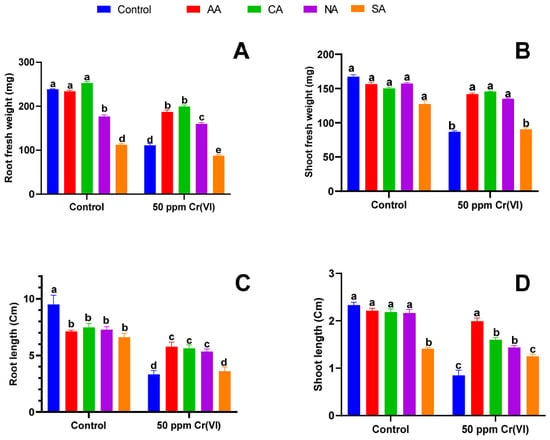
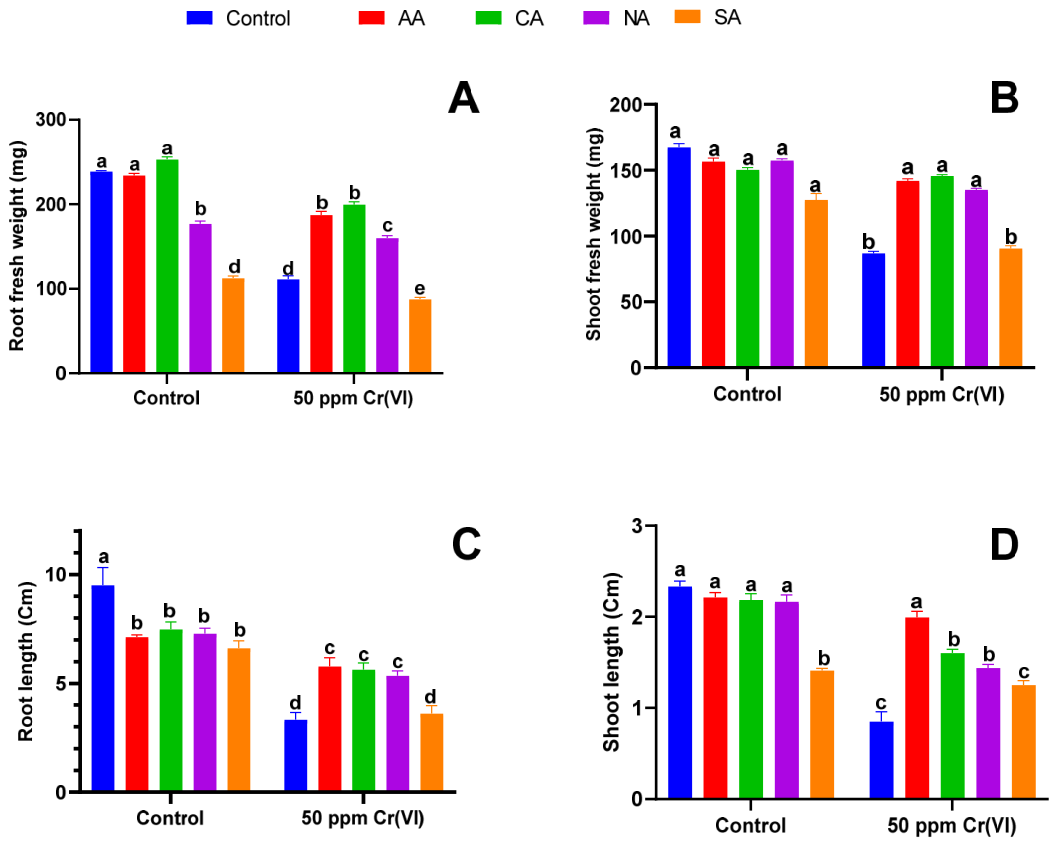
The development and growth of the broad bean seedlings were evaluated after 10 days of treatment. The parameters measured included root length, shoot length, and fresh biomass. These assessments were conducted across all experimental groups, which consisted of control and the acid treatments (AA, CA, NA, SA) applied both alone and in combination with Cr (VI). Cr (VI) exposure significantly reduced biomass and embryonic axis length. Under Cr (VI) stress, fresh biomass and length decreased in roots by 47% and 60.8% and in shoots by 52.3% and 62.19%, respectively, compared with control Vicia faba plants (Figure 1). Treatments with NA and SA showed a significant reduction in fresh root biomass, compared with the control plant. However, the exogenous application of these acids in combination with Cr (VI) limited the inhibitory effect of Cr (VI). Root and shoot biomass increased by a factor of 0.75 to 1.95 and 1 to 2, respectively, compared with plants exposed to Cr (VI) alone (Figure 1A,B). Similarly, root and shoot length increased by more than 109% and 33.33%, respectively, compared with seedlings treated with Cr (VI) without acid application, except SA + Cr (VI) (Figure 1C,D). Crucially, among the tested effectors, ascorbic acid (AA) demonstrated the highest efficacy in restoring growth, consistently driving the maximum recovery in both tissue biomass and embryonic axis elongation compared to the other acid combinations.
Figure 1.
Effects of exogenous acidic priming agents on seedling growth traits of broad bean (Vicia faba L. var. Defes) under hexavalent chromium stress. Panels represent root fresh biomass (A), shoot fresh biomass (B), root length (C), and shoot length (D) measured after 10 days of experimental growth. Data points represent mean values ± standard deviation (n = 4 independent biological replicates, with 10 seedlings pooled per replicate). Different lowercase letters above bars indicate statistically significant differences among all treatment combinations across both non-stressed (−Cr(VI)) and stressed (+Cr(VI)) environments, evaluated via two-way ANOVA followed by Tukey’s posthoc test (p ≤ 0.05). Abbreviations: AA, ascorbic acid; CA, citric acid; NA, nitric acid; SA, salicylic acid; Cr(VI), hexavalent chromium.
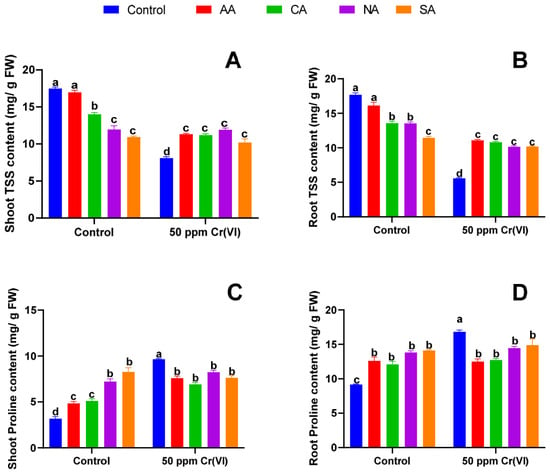
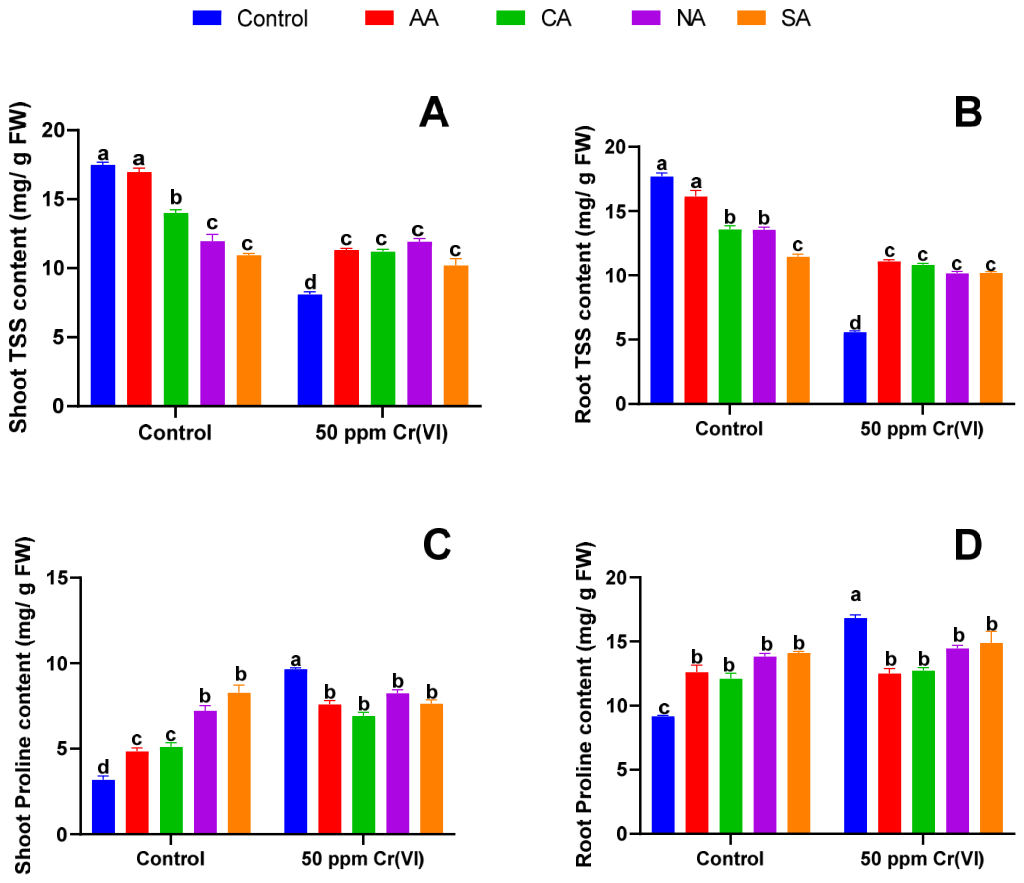
Total soluble sugar (TSS) content decreased significantly following Cr (VI) exposure. TSS content declined by more than two times in the shoots (8.169 mg/g FW) and by more than threefold in the roots (5.6496 mg/g FW) of Cr (VI)-treated seedlings compared with control plants (17.419 mg/g FW and 17.5968 mg/g FW respectively) (Figure 2A,B). However, when Cr (VI) was applied in association with acids, the TSS content increased by 39.05%, 36.4%, 44.43%, and 10.09% in combination with AA, CA, NA, and SA, respectively, compared to seedlings exposed to Cr (VI) stress alone. In contrast, proline content in Cr (VI)-treated embryonic axes increased significantly (p < 0.05). Shoot proline increased by more than twofold in the shoots (9.65 mg/g FW) and 16.83 mg/g FW in the roots of broad bean seedlings compared to the control plant (3.45 mg/g FW and 9.15 mg/g FW respectively) (Figure 2C,D). The application of Cr (VI) led to a significant increase in the accumulation of proline. However, acid treatment significantly reduced the Cr (VI)-induced proline accumulation in both parts of the embryonic axis, as compared to the plants exposed to Cr (VI) alone. Despite this reduction, the proline levels in the acid-treated seedlings still remained significantly greater than those in the unstressed control plants.
Figure 2.
Changes in organic osmolyte accumulation in broad bean (Vicia faba L.) embryonic axes mediated by acid pre-treatments under chromium toxicity. Total soluble sugar (TSS) content in shoots (A) and roots (B), alongside proline content in shoots (C) and roots (D), was quantified following 10 days of exposure to 50 ppm Cr(VI). Values are expressed as milligrams per gram of fresh weight (mg/g FW) and represent mean ± standard deviation (n = 4). Distinct lowercase letters denote statistically significant variations among all experimental groups based on two-way ANOVA coupled with Tukey’s multiple comparisons test (p ≤ 0.05). Abbreviations: AA, ascorbic acid; CA, citric acid; NA, nitric acid; SA, salicylic acid; Cr(VI), hexavalent chromium; TSS, total soluble sugar.
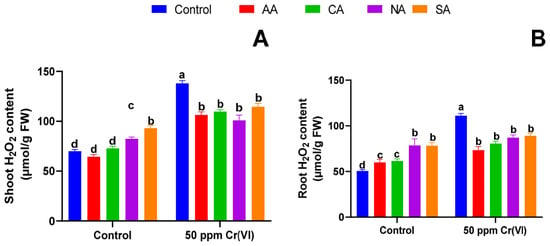
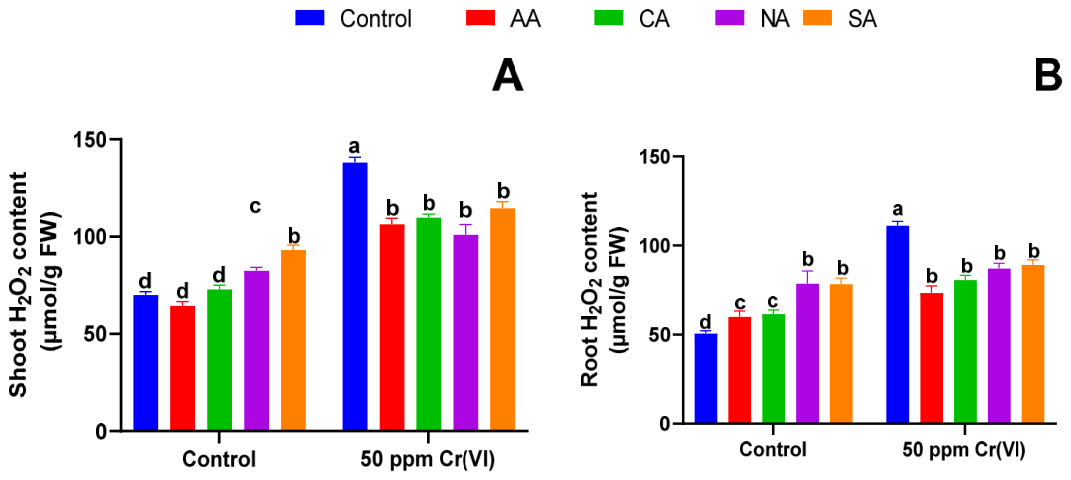
Under Cr (VI) application, H2O2 contents significantly increased (p < 0.05) in shoots (138 µmol/g FW) and roots (110 µmol/g FW) more than twofold compared with control plants (70 and 52 µmol/g FW respectively) (Figure 3). However, when Cr (VI) was applied in association with the four acids, H2O2 levels in roots and shoots were significantly decreased (p < 0.05) by around 32% and 26%, respectively, compared with broad bean seedlings treated with Cr (VI) alone.
Figure 3.
Impact of individual seed priming effectors on hydrogen peroxide (H2O2) accumulation in broad bean (Vicia faba L.) seedlings under heavy metal stress. Levels of H2O2 were spectrophotometrically determined in shoot (A) and root (B) tissues after 10-day cultivation period. Vertical bars represent mean ± standard deviation (n = 4). Columns marked with different lowercase letters are significantly different from one another across both control (−Cr(VI)) and heavy metal (+Cr(VI)) regimes according to Tukey’s posthoc test (p ≤ 0.05). Abbreviations: AA, ascorbic acid; CA, citric acid; NA, nitric acid; SA, salicylic acid; Cr(VI), hexavalent chromium; H2O2, hydrogen peroxide.
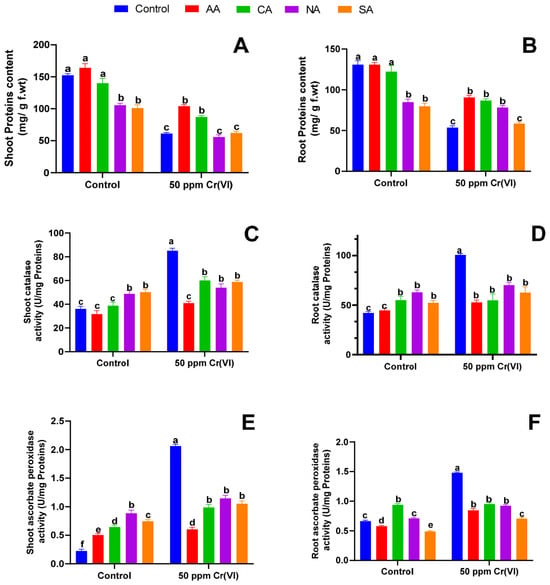
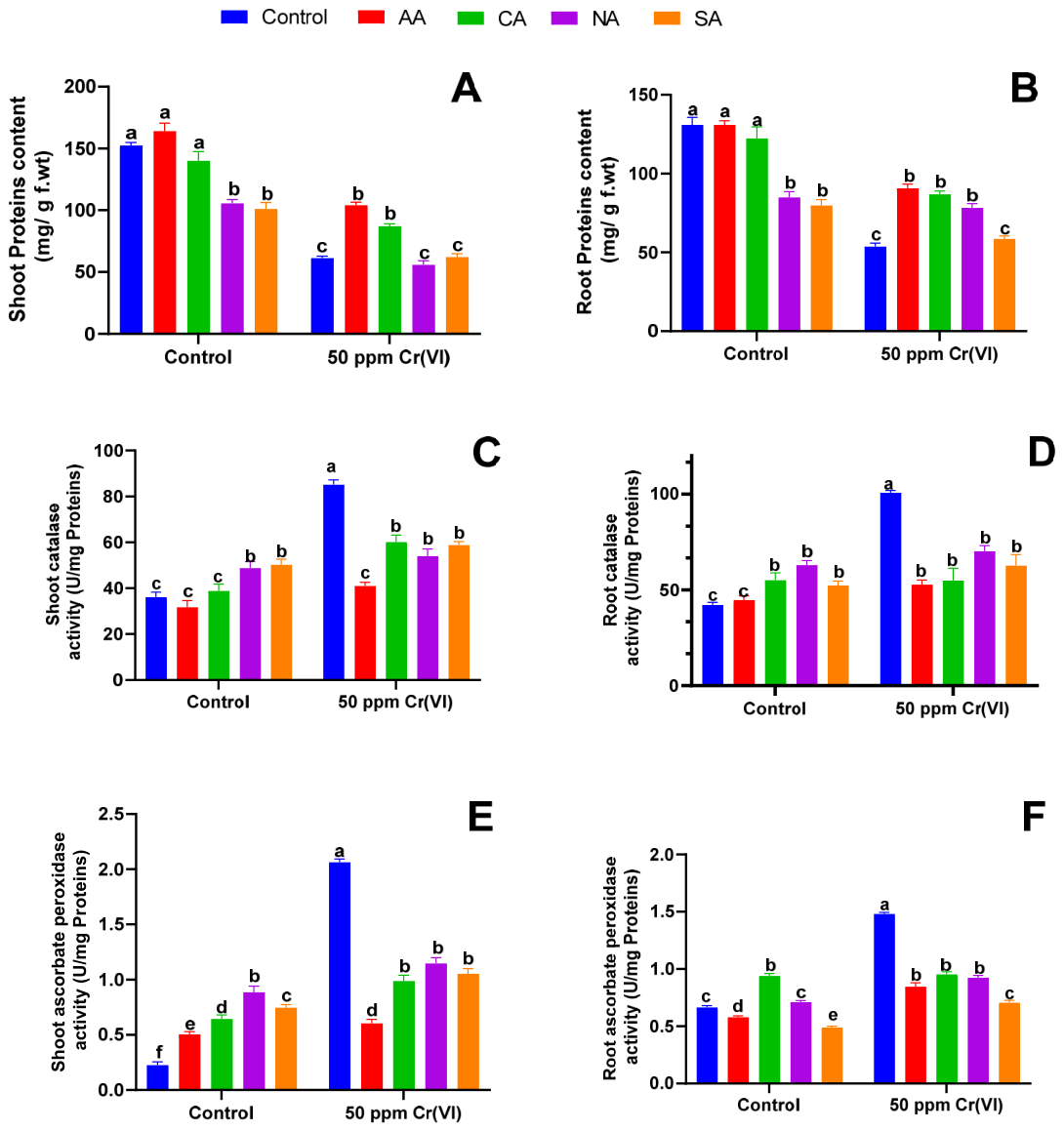
Following 10 days of treatment, the results (Figure 4A,B) showed that protein content was significantly (p < 0.05) affected in the shoots (61.08 mg/g FW) and roots (54.24 mg/g FW) of Cr (VI)-treated broad bean seedlings, showing a reduction of 60% compared with the control plant (153.6 and 136.93 mg/g FW respectively). However, the combination of exogenous acids and Cr (VI) significantly (p < 0.05) restored (with some exceptions of CA + Cr (VI) and SA + Cr (VI)) the protein content by 70.72%, 43.09%, 6.74%, and 2.63% in shoots and by 62.85%, 59.80%, 45.42%, and 7.35% in broad bean roots, respectively, compared with plants exposed to Cr (VI) alone.
Figure 4.
Modulation of total soluble protein content and specific antioxidant enzyme kinetics by acidic priming agents in broad bean (Vicia faba L.) under Cr(VI) stress. Biochemical profiles display total soluble protein levels in shoots (A) and roots (B), specific catalase (CAT) activity in shoots (C) and roots (D), and specific ascorbate peroxidase (APX) activity in shoots (E) and roots (F) after 10 days. Enzyme activities are normalized against total protein content and expressed as units per milligram of protein (U/mg protein). Data reflect mean ± standard deviation (n = 4). Statistical significance is indicated by distinct lowercase letters across all groups using two-way ANOVA with Tukey’s posthoc validation (p ≤ 0.05). Abbreviations: AA, ascorbic acid; CA, citric acid; NA, nitric acid; SA, salicylic acid; Cr(VI), hexavalent chromium; CAT, catalase; APX, ascorbate peroxidase.
On the other hand, broad bean seedlings under Cr (VI) stress showed a significant increase (p < 0.05) in antioxidant activities (CAT and APX) (Figure 4C–F), with activity levels more than twofold higher compared with the control plant. In addition, the combined application with exogenous effectors reduced antioxidant activity in the embryonic axis tissues of broad bean by up to more than 50% in some cases (AA + Cr (VI)) compared with plants treated with Cr (VI) alone.
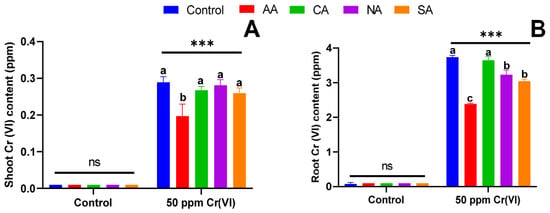
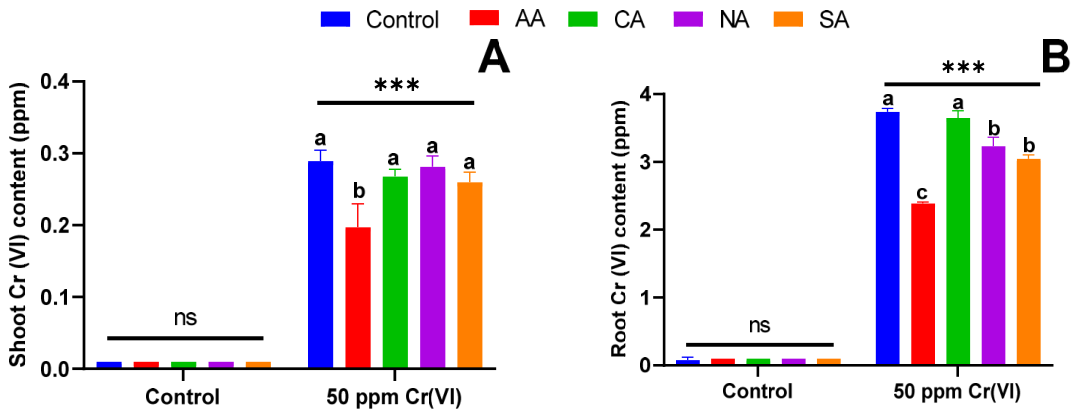
Regarding Cr (VI) accumulation in the shoots and roots of broad bean seedlings (Figure 5), the results indicated that the combination between Cr (VI) and exogenous effectors has no significant (p < 0.05) effect on Cr (VI) bioaccumulation in different parts of broad bean seedlings, with the exception of AA. AA application induced a significant (p < 0.05) decrease in Cr (VI) accumulation in roots and shoots by 36.5% and 26.5%, respectively, compared to plants treated with Cr (VI) without combination with acids.
Figure 5.
Tissue-specific hexavalent chromium [Cr(VI)] bioaccumulation profiles in broad bean (Vicia faba L.) seedlings. Total chromium levels were quantified colorimetrically in shoot parts (A) and root parts (B) after 10 days of exposure to 50 ppm potassium dichromate solution. Graph bars depict mean values ± standard deviation (n = 4). Mean values marked with different lowercase letters indicate statistically significant differences within stressed groups (+Cr(VI)) according to Tukey’s posthoc test (p ≤ 0.05). Asterisks indicate general factor significance level deviations determined by ANOVA (ns: not significant; *** p < 0.01). Abbreviations: AA, ascorbic acid; CA, citric acid; NA, nitric acid; SA, salicylic acid; Cr(VI), hexavalent chromium.
4. Discussion
Numerous studies have documented the harmful effects of Cr(VI) on plant development, showing that this severe environmental pollutant inhibits seed germination, retards vegetative development, and ultimately induces cell death by disrupting core metabolic pathways and driving oxidative stress [10,60]. Consistent with these reports, our investigation revealed a sharp reduction in both embryonic axis length and fresh biomass in Vicia faba seedlings subjected to Cr(VI) toxicity (Figure 1). Strikingly, the application of exogenous acid pre-treatments (AA, CA, NA, and SA) in combination with Cr(VI) significantly mitigated this suppression, promoting robust growth and embryonic axis development. This improved performance, characterized by the substantial recovery of seedling biomass and elongation, strongly implies that the applied elicitors successfully shielded fundamental cellular operations—such as active cell division and structural protein synthesis (Figure 4A,B)—from chromium-mediated inhibition.
Regarding the individual elicitors, ascorbic acid (AA) is known to sustain homeostatic signaling pathways through hormone crosstalk and support vital physiological activities by acting as an essential enzymatic cofactor [61]. In our Vicia faba model, this metabolic support directly protected cell division and expansion under chromium stress, a protective mechanism that parallels findings where exogenous AA reduced Cr(VI) cellular toxicity in Solanum lycopersicum roots [51]. Similarly, citric acid (CA) functioned as a physiological shield, promoting seedling survival against heavy metal injury [62]. This is largely due to its capacity to operate as an intracellular detoxifier, forming stable chelating complexes that sequester toxic metal cations and safely remove them from the active cytoplasm [63]. This protective chelation mechanism could match observed trends where CA application successfully bolstered growth while lowering tissue metal accumulation in species such as Raphanus sativus [64], Brassica napus [50], Corchorus capsularis [65], and Mentha piperita [66]. Furthermore, nitric acid (NA) acts as a crucial substrate for nitrogen-based signaling molecules that regulate plant development under stress [67].
Nitric oxide (NO), generated as a downstream signaling product of our NA pre-treatment, operates as a ubiquitous gaseous signaling molecule crucial for coordinating plant defenses against heavy metal toxicity. In the context of the Cr(VI) stress imposed in this study, NO can act through several coordinated pathways to preserve Vicia faba embryonic vitality. Firstly, it up-regulates the biosynthesis of phytochelatins (PCs)—small, cysteine-rich peptides essential for chelating and sequestering toxic metal ions safely inside the vacuole [68]—thereby complementing the intracellular metal-binding capacity of citric acid. Secondly, NO participates in intricate hormonal crosstalk with SA and abscisic acid (ABA) to optimize stomatal dynamics and maintain strict cellular water balance under metal-induced osmotic stress [69]. Thirdly, NO can directly modify key enzymes or transcription factors involved in stress response pathways via post-translational modifications [70]. This strongly suggests a potential mechanism for why our NA-primed seedlings displayed such an enhanced intrinsic defense capacity, using NO as a metabolic amplifier to suppress Cr(VI)-induced oxidative damage and maintain cellular homeostasis. Salicylic acid (SA) functions as a key phenolic phytohormone that coordinates plant defense responses and systemic tolerance to abiotic stresses. The protective effect of SA observed in our Vicia faba seedlings mirrors the biomass enhancements reported for wheat crops under drought stress [30] and maize plants subjected to salinity stress [39]. In our study, SA actively protected the embryonic axis by serving as a crucial signal transducer in response to chromium-induced injury [71].
To gain a deeper mechanistic insight into how these exogenous effectors enhance the performance of broad bean seedlings under Cr(VI) toxicity, organic osmolytes (proline and total soluble sugars), H2O2 accumulation, and core antioxidant enzyme activities (catalase and ascorbate peroxidase) were systematically evaluated. Osmoprotectants, soluble carbohydrates, and antioxidant defenses are critical components of a plant’s adaptive machinery, serving as cellular signaling molecules, metabolic buffers, and shielding agents under heavy metal exposure. Our experimental results revealed a pronounced accumulation of both endogenous proline and H2O2 within the embryonic axis under unmitigated Cr(VI) stress. Proline and soluble sugars normally function to sustain cellular turgor and facilitate water retention, thereby shielding vulnerable cell membranes and functional proteins from structural denaturation [72]. This active metabolic accumulation of protective solutes in response to toxic Cr(VI) exposure directly aligns with physiological behaviors documented in Vicia faba [47,73] and related crop models [6,7,10].
Conversely, total soluble sugar and protein concentrations markedly declined under standalone Cr(VI) stress. This sharp decline, paired with excessive H2O2 accumulation, indicates a major surge in reactive oxygen species (ROS) production capable of driving extensive protein oxidation [74]. Crucially, our findings demonstrate that the application of AA, CA, NA, and SA to Cr(VI)-exposed seeds was highly effective at suppressing this ROS overproduction, thereby maintaining cellular ultrastructural integrity, stabilizing osmolyte synthesis, and preventing catastrophic protein oxidation. While the literature shows that exogenous treatments like CA can mitigate oxidative damage under diverse abiotic stresses [41], our study highlights distinct protective pathways for each acid against chromium. Specifically, CA forms stable chelation complexes with Cr(VI) to lower its intracellular bioavailability and prevent it from interacting with vital cellular components [75]. Meanwhile, AA acts as an electron-rich direct scavenger that immediately neutralizes free radicals to stabilize metabolic pathways and preserve membrane fluidity [64,76], and SA functions as an efficient biochemical scavenger of hydroxyl radicals and peroxides to halt free radical propagation and limit macromolecular injury [77].
Furthermore, the exposure of broad bean seedlings to 50 ppm Cr(VI) induced a significant increase in the baseline activities of the key antioxidant enzymes APX and CAT. This initial induction clearly reflects the activation of the plant’s intrinsic enzymatic defense mechanisms in response to severe oxidative stress. However, the pre-treatment of the seeds with AA, CA, NA, or SA led to a distinct reduction in these antioxidant enzyme activities in the Cr(VI)-exposed seedlings, returning them to homeostatic levels similar to the non-treated control group. Importantly, a decrease in antioxidant enzyme activity can be bi-directional: it can indicate either a collapsed, overwhelmed defense system or a state of metabolic relief. To accurately interpret this physiological status, these enzymatic changes must be evaluated in conjunction with downstream oxidative damage indicators and growth performance. In our study, the reduction in CAT and APX activities was strictly accompanied by a significant drop in endogenous H2O2 accumulation, a reduction in protein oxidation, and a substantial recovery of embryonic axis length and fresh biomass (Figure 1 and Figure 4). Therefore, rather than indicating a failure of the defense network, this downward adjustment strongly demonstrates upstream stress alleviation. Because the exogenous acid pre-treatments successfully restricted H2O2 overproduction and shielded cellular structures, the primed seedlings did not experience the “oxidative panic” seen in the unmitigated chromium treatment, completely mitigating the physiological requirement for hyper-activating the enzymatic defense network.
Within this defense system, AA stands out as a paramount antioxidant compound for optimizing plant resistance to oxidative injuries [78]. Concurrently, the exogenous application of CA modulated antioxidant activities in both non-stressed and stressed broad bean seedlings, highlighting its regulatory capacity [79], while SA primed the seeds for improved germination and heightened cellular division to actively support seedling development under toxic pressure [19,80]. While the immediate scavenging of ROS by AA is crucial, its sustained protective influence relies heavily on the ascorbate–Glutathione (AsA-GSH) cycle—the core metabolic pathway for regenerating cellular antioxidants. During Cr(VI)-induced oxidative stress, AA neutralizes excess H2O2 via APX, converting itself into its oxidized form, dehydroascorbate (DHA) [81]. The exogenous AA priming treatment is hypothesized to sustain an abundant substrate pool, potentially supporting the operational efficiency of APX, DHAR, and GR required to stabilize the embryonic axis.
Regarding Cr(VI) bioaccumulation in broad bean seedlings, tissue analysis revealed that chromium accumulated predominantly within the roots, exhibiting concentrations approximately 10-fold higher than those recorded in the shoots. Furthermore, the co-application of CA, NA, or SA alongside Cr(VI) did not yield significant differences in tissue metal accumulation compared to seedlings exposed to Cr(VI) alone. In stark contrast, the AA treatment uniquely and significantly lowered Cr(VI) concentration in both root and shoot tissues. This marked decrease in tissue chromium accumulation within the embryonic axes could be partially attributed to an extracellular chemical reduction facilitated by ascorbic acid. It is highly probable that a substantial portion of toxic Cr(VI) was converted to the less mobile trivalent form [Cr(III)] in the surrounding media or directly at the root–solution interface—a protective mechanism frequently supported by the literature [51].
This interpretive framework aligns with the findings of Al-Huqail et al. [51], who demonstrated that exogenous AA application restricts the cellular bioaccumulation of Cr(VI), as well as studies confirming a direct positive correlation between AA availability and the chemical reduction of hexavalent chromium [82]. Similarly, spectrophotometric evaluations by Hu et al. [83] confirmed that the characteristic absorption band of Cr(VI) decreases rapidly upon AA addition, verifying its conversion to Cr(III). As an electron-rich molecule, AA serves as an immediate electron donor that reduces the highly oxidizing Cr(VI) oxyanion into Cr(III), a far less reactive chemical species [84].
A critical initial checkpoint in chromium toxicity is its active entry into seedling cells. Because Cr(VI) exists primarily as the oxyanion chromate (CrO42−), it shares structural similarities with essential macro-nutrient anions such as sulfate (SO2−) and phosphate (PO43−). Consequently, Cr(VI) is not absorbed via dedicated heavy metal channels but instead exploits the high-affinity sulfate or phosphate transporters normally responsible for nutrient uptake [47,48]. The literature indicates that exogenous signaling molecules, including SA and nitric oxide pathways, can modulate this initial cellular entry point by influencing the expression or activity of these key nutrient transporter genes as a systemic stress response [85,86]. This indirect regulatory mechanism presents a plausible hypothesis to explain the restricted influx of the toxic chromate anion observed in our primed groups, though the direct molecular tracking of transporter gene expression is required to definitively confirm this pathway in Vicia faba.
From an agronomic standpoint, seed priming with these organic effectors (AA, CA, NA, and SA) represents a highly feasible, low-cost, and easily scalable technology for smallholder and commercial farmers managing heavy-metal-polluted soils. Unlike soil remediation strategies that require expensive machinery or heavy chemical inputs, seed priming uses trace amounts of benign compounds and fits seamlessly into standard pre-sowing farming routines [87]. However, translating these laboratory successes to large-scale open fields comes with distinct limitations. First, environmental variables such as soil moisture fluctuations, shifting ambient temperatures, and native microbial competition can affect how long the primed state lasts compared to a controlled laboratory environment. Second, determining the optimal concentration across different soil types is critical; an overdose of signaling molecules like SA can sometimes induce phytotoxicity instead of tolerance. Therefore, while seed priming holds immense promise for sustainable crop production, future field-scale trials under variable environmental conditions are essential to standardize safe dosage protocols and verify long-term yield consistency.
5. Conclusions
The current study demonstrates that exogenous pre-treatment with ascorbic, citric, nitric, and salicylic acids effectively mitigates hexavalent chromium toxicity in Vicia faba seedlings. While Cr(VI) exposure severely compromises morphology and triggers oxidative damage, the application of these acids restores physiological homeostasis, as evidenced by the recovery of growth metrics and the stabilization of antioxidant enzyme profiles. Mechanistically, this protection is hypothesized to be dual-faceted: citric and ascorbic acids present a plausible pathway to facilitate direct detoxification through proposed chelation and the potential chemical reduction of Cr(VI), while salicylic and nitric acids may serve as crucial signaling molecules that bolster the plant’s antioxidant defense hierarchy. Beyond the laboratory, these findings suggest that exogenous acid priming offers a scalable, cost-effective, and sustainable strategy for enhancing crop resilience in heavy-metal-polluted soils. To transition this knowledge into practical agriculture, future research should prioritize field-scale trials to optimize dosage and evaluate the long-term impact on broad bean nutritional quality and yield. Additionally, molecular investigations into the transcriptomic regulation of metal transporter genes are warranted to fully decode the proposed signaling pathways.
Author Contributions
Conceptualization, writing—original draft preparation, M.B. and H.F.; methodology, M.B., A.L. and F.-Z.F.; software, L.B. and N.B.; validation, I.P., M.P.P. and S.E.; formal analysis, M.E.K.; investigation, N.B.; resources, L.B. and I.P.; writing—review and editing, M.P.P., I.P. and L.B.; visualization, M.E.K. and S.E.; supervision, M.E.K. and H.F. All authors have read and agreed to the published version of the manuscript.
Funding
This research received no external funding.
Data Availability Statement
The data presented in this study are available on request from the corresponding author due to copyright.
Conflicts of Interest
The authors declare no conflicts of interest.
Abbreviations
The following abbreviations are used in this manuscript:
| AA | Ascorbic acid |
| CA | Citric acid |
| SA | Salicylic acid |
| NA | Nitric acid |
References
- Slimani, Y.; Almessiere, M.; Baykal, A.; Korkmaz, A.D.; Klygach, D.; Trukhanov, S.; Gondal, M.; Astapovich, K.; Trukhanov, A.; Manikandan, A. Impact of the Sc3+/In3+ co-substitution on the structural, magnetic, and microwave characteristics of Co0.5Ni0.5Fe2O4 nanospinel ferrites. Ceram. Int. 2024, 50, 7605–7616. [Google Scholar] [CrossRef] [Scilit]
- Waheed, M.S.; Aman, S.; Gouadria, S.; Alsaiari, N.S.; Manzoor, S.; Zubarv, T.; Tishkevich, D.I.; Trukhanov, S.V.; Al-Buriahi, M.; Trukhanov, A.V. Development of high-performance oxygen evolution reaction electrocatalyst with quick kinetics: Based on ultrafine Cu nanoparticles encircled by N-doped carbon. J. Phys. Chem. Solids 2023, 175, 111173. [Google Scholar] [CrossRef] [Scilit]
- Thakur, A.; Sharma, N.; Bhatti, M.; Sharma, M.; Trukhanov, A.V.; Trukhanov, S.V.; Panina, L.V.; Astapovich, K.A.; Thakur, P. Synthesis of barium ferrite nanoparticles using rhizome extract of Acorus Calamus: Characterization and its efficacy against different plant phytopathogenic fungi. Nano-Struct. Nano-Objects 2020, 24, 100599. [Google Scholar] [CrossRef] [Scilit]
- Soujoud, R.; Lamsaadi, N.; Bouhadi, M.; El Moukhtari, A.; Ourribane, M. Physiological and Biochemical Responses of Maize (Zea mays L.) to the Application of Re-Treated Urban Wastewater Using Wood Waste Biochar. J. Ecol. Eng. 2024, 25, 180–193. [Google Scholar] [CrossRef] [Scilit] [PubMed]
- Ali, S.; Bharwana, S.A.; Rizwan, M.; Farid, M.; Kanwal, S.; Ali, Q.; Ibrahim, M.; Gill, R.A.; Khan, M.D. Fulvic acid mediates chromium (Cr) tolerance in wheat (Triticum aestivum L.) through lowering of Cr uptake and improved antioxidant defense system. Environ. Sci. Pollut. Res. 2015, 22, 10601–10609. [Google Scholar] [CrossRef] [Scilit] [PubMed]
- Bouhadi, M.; El Atmani, Z.; Talbi, M.; Elkouali, M.; Ainane, T. Evaluation of the toxicity of chromium VI contaminated irrigation water on the mint (Mentha spicata) crop. Pharmacologyonline 2021, 3, 421–427. [Google Scholar]
- Bouhadi, M.; El Kouali, M.H.; Samir, K.; Elbouhmadi, K.; Talbi, M.; Fougrach, H. Exogenous Application of Thiamine and Nicotinic Acid Improves Tolerance and Morpho-physiological Parameters of Lens culinaris Under Lead (Pb) Exposure. J. Plant Growth Regul. 2024, 43, 1–14. [Google Scholar] [CrossRef] [Scilit]
- Wani, W.; Masoodi, K.Z.; Zaid, A.; Wani, S.H.; Shah, F.; Meena, V.S.; Wani, S.A.; Mosa, K.A. Engineering plants for heavy metal stress tolerance. Rend. Lincei Sci. Fis. Nat. 2018, 29, 709–723. [Google Scholar] [CrossRef] [Scilit]
- Bhat, M.A.; Gedik, K.; Gaga, E.O. Environmental impacts of nanoparticles: Pros, cons, and future prospects. Synth. Bionanomater. Biomed. Appl. 2022, 2022, 493–528. [Google Scholar] [CrossRef] [Scilit]
- Mohammed, B.; M’hammed, E.; Mohammed, T.; Tarik, A. Effect of Chromium VI on edible plants and their health risks: Case of Radish (Raphanus sativus L.). E3S Web Conf. 2021, 319, 01109. [Google Scholar] [CrossRef] [Scilit]
- Zhao, Y.; Hu, C.; Wang, X.; Qing, X.; Wang, P.; Zhang, Y.; Zhang, X.; Zhao, X. Selenium alleviated chromium stress in Chinese cabbage (Brassica campestris L. ssp. Pekinensis) by regulating root morphology and metal element uptake. Ecotoxicol. Environ. Saf. 2019, 173, 314–321. [Google Scholar] [CrossRef] [Scilit] [PubMed]
- Bouhadi, M.; Lahmidi, A.; Am, A.; Elhajjouji, H.; Talbi, M.; Fougrach, H. Study of the Toxicity and Translocation of Chromium (VI) in Vicia faba Plant. Bull. Environ. Contam. Toxicol. 2024, 112, 1–8. [Google Scholar] [CrossRef] [Scilit] [PubMed]
- Zafar, S.; Khan, I.M.; Ashraf, M.A.; Zafar, M.; Ahmad, M.; Rasheed, R.; Mehmood, A.; Ahmad, K.S. Insights into trehalose mediated physiological and biochemical mechanisms in Zea mays L. under chromium stress. BMC Plant Biol. 2024, 24, 783. [Google Scholar] [CrossRef] [Scilit] [PubMed]
- Khadraji, A.; Bouhadi, M.; Ghoulam, C. Effect of Some Soil Mineral Levels on Their Contents in Different Plant Parts and on the Yield of Chickpea-Rhizobium Symbioses. Am. J. Agric. For. 2023, 11, 12–17. [Google Scholar] [CrossRef] [Scilit]
- Kapoor, R.T.; Mfarrej, M.F.B.; Alam, P.; Rinklebe, J.; Ahmad, P. Accumulation of chromium in plants and its repercussion in animals and humans. Environ. Pollut. 2022, 301, 119044. [Google Scholar] [CrossRef] [Scilit] [PubMed]
- Reale, L.; Ferranti, F.; Mantilacci, S.; Corboli, M.; Aversa, S.; Landucci, F.; Baldisserotto, C.; Ferroni, L.; Pancaldi, S.; Venanzoni, R. Cyto-histological and morpho-physiological responses of common duckweed (Lemna minor L.) to chromium. Chemosphere 2016, 145, 98–105. [Google Scholar] [CrossRef] [Scilit] [PubMed]
- UdDin, I.; Bano, A.; Masood, S. Chromium toxicity tolerance of Solanum nigrum L. and Parthenium hysterophorus L. plants with reference to ion pattern, antioxidation activity and root exudation. Ecotoxicol. Environ. Saf. 2015, 113, 271–278. [Google Scholar] [CrossRef] [Scilit] [PubMed]
- Kamran, M.A.; Bibi, S.; Xu, R.K.; Hussain, S.; Mehmood, K.; Chaudhary, H.J. Phyto-extraction of chromium and influence of plant growth promoting bacteria to enhance plant growth. J. Geochem. Explor. 2017, 182, 269–274. [Google Scholar] [CrossRef] [Scilit]
- Wani, A.B.; Chadar, H.; Wani, A.H.; Singh, S.; Upadhyay, N. Salicylic acid to decrease plant stress. Environ. Chem. Lett. 2017, 15, 101–123. [Google Scholar]
- Zaid, A.; Mohammad, F.; Fariduddin, Q. Plant growth regulators improve growth, photosynthesis, mineral nutrient and antioxidant system under cadmium stress in menthol mint (Mentha arvensis L.). Physiol. Mol. Biol. Plant 2020, 26, 25–39. [Google Scholar] [CrossRef] [Scilit] [PubMed]
- Zaid, A.; Mohammad, F. Methyl jasmonate and nitrogen interact to alleviate cadmium stress in Mentha arvensis by regulating physio-biochemical damages and ROS detoxification. J. Plant Growth Regul. 2018, 37, 1331–1348. [Google Scholar] [CrossRef] [Scilit]
- Alshegaihi, R.M.; Mfarrej, M.F.B.; Saleem, M.H.; Parveen, A.; Ahmad, K.S.; Ali, B.; Abeed, A.H.; Alshehri, D.; Alghamdi, S.A.; Alghanem, S.M.; et al. Effective citric acid and EDTA treatments in cadmium stress tolerance in pepper (Capsicum annuum L.) seedlings by regulating specific gene expression. S. Afr. J. Bot. 2023, 159, 367–380. [Google Scholar] [CrossRef] [Scilit]
- Ahmad, B.; Zaid, A.; Sadiq, Y.; Bashir, S.; Wani, S.H. Role of selective exogenous elicitors in plant responses to abiotic stress tolerance. In Plant Abiotic Stress Tolerance: Agronomic, Molecular and Biotechnological Approaches; Springer International Publishing: Cham, Switzerland, 2019; pp. 273–290. [Google Scholar] [CrossRef] [Scilit]
- Abd_Allah, E.F.; Hashem, A.; Alqarawia, A.A.; Wirth, S.; Egamberdieva, D. Calcium application enhances growth and alleviates the damaging effects induced by Cd stress in sesame (Sesamum indicum L.). J. Plant Interact. 2017, 12, 237–243. [Google Scholar] [CrossRef] [Scilit]
- Jan, I.; Rab, A.; Sajid, M. Influence of calcium chloride on storability and quality of apple fruits. Pak. J. Agric. Sci. 2015, 52, 115–122. [Google Scholar] [CrossRef] [Scilit]
- Ahmad, P.; Sarwat, M.; Bhat, N.A.; Wani, M.R.; Kazi, A.G.; Tran, L.S.P. Alleviation of cadmium toxicity in Brassica juncea L. (Czern. & Coss.) by calcium application involves various physiological and biochemical strategies. PLoS ONE 2015, 10, e0114571. [Google Scholar] [CrossRef] [Scilit] [PubMed]
- Rather, B.A.; Mir, I.R.; Masood, A.; Anjum, N.A.; Khan, N.A. Nitric Oxide Pre-Treatment Advances Seed Germination and Alleviates Copper-Induced Photosynthetic Inhibition in Indian Mustard. Plants 2020, 9, 776. [Google Scholar] [CrossRef] [Scilit] [PubMed]
- Gonzalez-Perez, P.; Zhang, R.; Wang, X.; Ye, J.; Huang, D. Characterization of the amino acid composition of soils under organic and conventional management after addition of different fertilizers. J. Soils Sediments 2015, 15, 890–901. [Google Scholar] [CrossRef] [Scilit]
- Saad, E.M.; Butler, I.S.; Mostafa, S.I. Adsorption of reduced chromium (VI) ions by vitamin C tablets onto a tellurato-functionalized cellulose derivative and its composite with Cyanobacteria green algae in aqueous media. Environ. Prog. Sustain. Energy 2021, 40, e13608. [Google Scholar] [CrossRef] [Scilit]
- El-Hawary, M.M.; Hashem, O.S.; Hasanuzzaman, M. Seed priming and foliar application with ascorbic acid and salicylic acid mitigate salt stress in wheat. Agronomy 2023, 13, 493. [Google Scholar] [CrossRef] [Scilit]
- Zhang, K.; Khan, M.N.; Khan, Z.; Luo, T.; Zhang, B.; Bi, J.; Hu, L.; Luo, L. Seed priming with ascorbic acid and spermidine regulated auxin biosynthesis to promote root growth of rice under drought stress. Front. Plant Sci. 2024, 15, 1482930. [Google Scholar] [CrossRef] [Scilit] [PubMed]
- Jin, X.; Chen, H.; Shi, Y.; Bail, L.; Hou, L.; Zhang, Y. Effect of citric acid seed priming on the growth and physiological characteristics of tomato seedlings under low phosphorus stress. Chin. J. Eco-Agric. 2021, 29, 1159–1170. [Google Scholar]
- Ben Massoud, M.; Karmous, I.; El Ferjani, E.; Chaoui, A. Alleviation of copper toxicity in germinating pea seeds by IAA, GA3, Ca and citric acid. J. Plant Interact. 2018, 13, 21–29. [Google Scholar]
- Basit, F.; Ulhassan, Z.; Mou, Q.; Nazir, M.M.; Hu, J.; Hu, W.; Song, W.; Sheteiwy, M.S.; Zhou, W.; Bhat, J.A.; et al. Seed priming with nitric oxide and/or spermine mitigate the chromium toxicity in rice (Oryza sativa) seedlings by improving the carbon-assimilation and minimising the oxidative damages. Funct. Plant Biol. FPB 2023, 50, 121–135. [Google Scholar] [PubMed]
- Akram, N.A.; Hafeez, N.; Farid-ul-Haq, M.; Ahmad, A.; Sadiq, M.; Ashraf, M. Foliage application and seed priming with nitric oxide causes mitigation of salinity-induced metabolic adversaries in broccoli (Brassica oleracea L.) plants. Acta Physiol. Plant. 2020, 42, 1–9. [Google Scholar] [CrossRef] [Scilit]
- Mohammad, F.; Wajid, M.A.; Bhat, M.A. Effect of salicylic acid sprays on the performance of fenugreek grown with graded levels of salinity. Saudi J. Life Sci. 2019, 26, 346–354. [Google Scholar] [CrossRef] [Scilit]
- Soliman, M.H.; Al-Juhani, R.S.; Hashash, M.A.; Al-Juhani, F.M. Effect of seed priming with salicylic acid on seed germination and seedling growth of broad bean (Vicia faba L.). Int. J. Agric. Technol. 2016, 12, 1125–1138. [Google Scholar]
- Zaid, A.; Mohammad, F.; Siddique, K.H. Salicylic Acid Priming Regulates Stomatal Conductance, Trichome Density and Improves Cadmium Stress Tolerance in Mentha arvensis L. Front. Plant Sci. 2022, 13, 895427. [Google Scholar] [CrossRef] [Scilit] [PubMed]
- Islam, A.T.; Ullah, H.; Himanshu, S.K.; Tisarum, R.; Cha-um, S.; Datta, A. Effect of salicylic acid seed priming on morpho-physiological responses and yield of baby corn under salt stress. Sci. Hortic. 2022, 304, 111304. [Google Scholar] [CrossRef] [Scilit]
- Yiğit, İ.; Atici, Ö. Seed priming with nitric oxide mitigates exogenous methylglyoxal toxicity by restoring glyoxalase and antioxidant systems in germinating maize (Zea mays L.) seeds. Cereal Res. Commun. 2022, 50, 811–820. [Google Scholar]
- Imran, S.; Mahamud, M.; Paul, N.C.; Chakrobortty, J.; Sarker, P.; Paul, S.; Tahjib-Ul-Arif, M.D.; Rhaman, M.S. Seed priming and exogenous application of citric acid enhance seedling growth and photosynthetic pigments and mitigate oxidative damage of soybean (Glycine max) under salt stress. Arch. Biol. Sci. 2023, 75, 407–418. [Google Scholar] [CrossRef] [Scilit]
- Zrig, A.; Yousif Sidahmed Elsheikh, S.; Hamouda, F.; Najar, B.; Alsherif, E.A.; Magdy Korany, S.; Hassan, A.H.A.; AbdElgawad, H. Potassium nitrate and ascorbic acid priming improved tissue chemical composition and antioxidant and antimicrobial activities of linseed (Linum usitatissimum L.) sprouts. ACS Omega 2023, 8, 35975–35987. [Google Scholar] [CrossRef] [Scilit] [PubMed]
- Fairoj, S.A.; Islam, M.M.; Islam, M.A.; Zaman, E.; Momtaz, M.B.; Hossain, M.S.; Jahan, N.A.; Shams, S.-N.-U.; Urmi, T.A.; Rasel, M.A.; et al. Salicylic Acid Improves Agro-Morphology, Yield and Ion Accumulation of Two Wheat (Triticum aestivum L.) Genotypes by Ameliorating the Impact of Salt Stress. Agronomy 2023, 13, 25. [Google Scholar] [CrossRef] [Scilit]
- Gupta, S.; Seth, C.S. Salicylic acid alleviates chromium (VI) toxicity by restricting its uptake, improving photosynthesis and augmenting antioxidant defense in Solanum lycopersicum L. Physiol. Mol. Biol. Plants 2021, 27, 2651–2664. [Google Scholar] [CrossRef] [Scilit] [PubMed]
- Kaya, C.; Ashraf, M.; Alyemeni, M.N.; Rinklebe, J.; Ahmad, P. Citric acid and hydrogen sulfide cooperate to mitigate chromium stress in tomato plants by modulating the ascorbate-glutathione cycle, chromium sequestration, and subcellular allocation of chromium. Environ. Pollut. 2023, 335, 122292. [Google Scholar] [CrossRef] [Scilit] [PubMed]
- Bouhadi, M.; Javed, Q.; Anđelini, D.; Cvitan, D.; Kovačević, T.K.; Palčić, I.; Major, N.; Goreta Ban, S.; Pasković, I.; Ban, D.; et al. Impacts of Olive Pomace Stress on Vicia faba L.’s Growth, Secondary Metabolism, and Nutrient Uptake. Horticulturae 2025, 11, 1350. [Google Scholar] [CrossRef] [Scilit]
- Afshan, S.; Ali, S.; Bharwana, S.A.; Rizwan, M.; Farid, M.; Abbas, F.; Ibrahim, M.; Mehmood, M.A.; Abbasi, G.H. Citric acid enhances the phytoextraction of chromium, plant growth, and photosynthesis by alleviating the oxidative damages in Brassica napus L. Environ. Sci. Pollut. Res. 2015, 22, 11679–11689. [Google Scholar] [CrossRef] [Scilit] [PubMed]
- Al-Huqail, A.A.; Ali, H.M.; Kushwaha, B.K.; Al-Huqail, A.A.; Singh, V.P.; Siddiqui, M.H. Ascorbic acid is essential for inducing chromium (VI) toxicity tolerance in tomato roots. J. Biotech. 2020, 322, 66–73. [Google Scholar] [CrossRef] [Scilit]
- Shah, T.; Latif, S.; Khan, H.; Munsif, F.; Nie, L. Ascorbic acid priming enhances seed germination and seedling growth of winter wheat under low temperature due to late sowing in Pakistan. Agronomy 2019, 9, 757. [Google Scholar] [CrossRef] [Scilit]
- Bouhadi, M.; Daoui, O.; El Hajjouji, H.; Elkhattabi, S.; Chtita, S.; Talbi, M.; Fougrach, H. Physiological and molecular modeling investigations of the relationship between sulfate and chromium VI uptake in Vicia faba L. Biocatal. Agric. Biotechnol. 2023, 47, 102554. [Google Scholar] [CrossRef] [Scilit]
- Bouhadi, M.; Daoui, O.; El Hajjouji, H.; Elkhattabi, S.; Chtita, S.; Talbi, M.; Fougrach, H. Study of the competition between Pi and Cr (VI) for the use of Pi-transporter at Vicia faba L. using molecular modeling. Plant Physiol. Biochem. 2023, 196, 695–702. [Google Scholar] [CrossRef] [Scilit] [PubMed]
- Mohammed, B.; Mohammed, T.; M’hammed, E.; Tarik, A. Physiological and physico-chemical study of the effect of chromium VI on the nutritional quality of maize (Zea mays. L). Procedia Comput. Sci. 2020, 191, 463–468. [Google Scholar] [CrossRef] [Scilit]
- Dubois, M.; Gilles, K.A.; Hamilton, J.K.; Rebers, P.T.; Smith, F. Colorimetric method for determination of sugars and related substances. Anal. Chem. 1956, 28, 350–356. [Google Scholar] [CrossRef] [Scilit]
- Bergman, I.; Loxley, R. The determination of hydroxyproline in urine hydrolysates. Clin. Chim. Acta 1970, 27, 347–349. [Google Scholar] [CrossRef] [Scilit] [PubMed]
- Hossain, M.A.; Hasanuzzaman, M.; Fujita, M. Up-regulation of anti-oxidant and glyoxalase systems by exogenous glycinebetaine and proline in mung bean confer tolerance to cadmium stress. Physiol. Mol. Biol. Plant 2010, 26, 259–272. [Google Scholar] [CrossRef] [Scilit]
- Bradford, M.M. A rapid and sensitive method for the quantitation of microgram quantities of protein utilizing the principle of protein-dye binding. Anal. Biochem. 1976, 72, 248–254. [Google Scholar] [CrossRef] [PubMed]
- Chance, B.; Maehly, A.C. Assay of catalase and peroxidases. Methods Enzymol. 1955, 2, 764–775. [Google Scholar] [CrossRef] [Scilit]
- Nakano, Y.; Asada, K. Purification of ascorbate peroxidase in spinach chloroplasts: Its inactivation in ascorbate depleted medium and reactivation by mono dehydroascorbate radical. Plant Cell Physiol. 1987, 28, 131–140. [Google Scholar]
- Clesceri, L.S.; Greenberg, A.E.; Eaton, A.D. Standard Methods for the Examination of Water and Wastewater; A. P. H. Association: Washington, DC, USA, 1998; p. 366. [Google Scholar]
- Bouhadi, M.; Ainane, A.; M’hammed, E.L.; Talbi, M.; Cherifi, O.; El Yaacoubi, A.; Ainane, T. Role of the macroalgae Corallina officinalis in alleviating the toxicity of hexavalent chromium on Vicia faba L. J. Anal. Sci. Appl. Biotechnol. 2019, 1, 1–2. [Google Scholar] [CrossRef]
- Akram, N.A.; Shafiq, F.; Ashraf, M. Ascorbic Acid-A Potential Oxidant Scavenger and Its Role in Plant Development and Abiotic Stress Tolerance. Front. Plant Sci. 2017, 8, 238088. [Google Scholar] [CrossRef] [Scilit] [PubMed]
- Wang, S.; Dong, Q.; Wang, Z. Differential effects of citric acid on cadmium uptake and accumulation between tall fescue and Kentucky bluegrass. Ecotoxicol. Environ. Saf. 2017, 145, 200–206. [Google Scholar] [CrossRef] [Scilit] [PubMed]
- Osmolovskaya, N.; Dung, V.V.; Kuchaeva, L. The role of organic acids in heavy metal tolerance in plants. Biol. Commun. 2018, 63, 9–16. [Google Scholar] [CrossRef] [Scilit]
- Bouhadi, M.; Elkouali, M.H.; Talbi, M.; Amegrissi, F.; Fougrach, H. Phytoextraction of Chromium VI by Raphanus sativus L. under exogenous application of citric acid. Bot. Pac. 2022, 11, 89–93. [Google Scholar]
- Parveen, A.; Saleem, M.H.; Kamran, M.; Haider, M.Z.; Chen, J.-T.; Malik, Z.; Rana, M.S.; Hassan, A.; Hur, G.; Javed, M.T.; et al. Effect of citric acid on growth, ecophysiology, chloroplast ultrastructure, and phytoremediation potential of jute (Corchorus capsularis L.) seedlings exposed to copper stress. Biomolecules 2020, 10, 592. [Google Scholar] [CrossRef] [Scilit] [PubMed]
- Khair, K.U.; Farid, M.; Ashraf, U.; Zubair, M.; Rizwan, M.; Farid, S.; Ishaq, H.K.; Iftikhar, U.; Ali, S. Citric acid enhanced phytoextraction of nickel (Ni) and alleviate Mentha piperita (L.) from Ni-induced physiological and biochemical damages. Environ. Sci. Pollut. Res. 2020, 27, 27010–27022. [Google Scholar] [CrossRef] [Scilit]
- Asgher, M.; Per, T.S.; Masood, A.; Fatma, M.; Freschi, L.; Corpas, F.J.; Khan, N.A. Nitric oxide signaling and its crosstalk with other plant growth regulators in plant responses to abiotic stress. Environ. Sci. Pollut. Res. 2017, 24, 2273–2285. [Google Scholar]
- Ghorbani, A.; Pishkar, L.; Roodbari, N.; Pehlivan, N.; Wu, C. Nitric oxide could allay arsenic phytotoxicity in tomato (Solanum lycopersicum L.) by modulating photosynthetic pigments, phytochelatin metabolism, molecular redox status and arsenic sequestration. Plant Physiol. Biochem. 2021, 167, 337–348. [Google Scholar] [CrossRef] [Scilit] [PubMed]
- Prakash, V.; Singh, V.P.; Tripathi, D.K.; Sharma, S.; Corpas, F.J. Crosstalk between nitric oxide (NO) and abscisic acid (ABA) signalling molecules in higher plants. Environ. Exp. Bot. 2019, 161, 41–49. [Google Scholar] [CrossRef] [Scilit]
- Zhou, X.; Joshi, S.; Khare, T.; Patil, S.; Shang, J.; Kumar, V. Nitric oxide, crosstalk with stress regulators and plant abiotic stress tolerance. Plant Cell Rep. 2021, 40, 1395–1414. [Google Scholar] [CrossRef] [Scilit] [PubMed]
- Janda, M.; Ruelland, E. Magical mystery tour: Salicylic acid signalling. Environ. Exp. Bot. 2015, 114, 117–128. [Google Scholar] [CrossRef] [Scilit]
- Singh, M.; Kumar, J.; Singh, S.; Singh, V.P.; Prasad, S.M. Roles of osmoprotectants in improving salinity and drought tolerance in plants: A review. Rev. Environ. Sci. Biotechnol. 2015, 14, 407–426. [Google Scholar] [CrossRef] [Scilit]
- Bouhadi, M.; El Kouali, M.H.; Samir, K.; Elbouhmadi, K.; Talbi, M.; Fougrach, H. Genotoxic effects and mitosis aberrations of chromium (VI) on root cells of Vicia faba and its molecular docking analysis. Plant Physiol. Biochem. 2024, 207, 108361. [Google Scholar] [CrossRef] [Scilit] [PubMed]
- Hossain, M.A.; Bhattacharjee, S.; Armin, S.-M.; Qian, P.; Xin, W.; Li, H.-Y.; Burritt, D.J.; Fujita, M.; Tran, L.-S.P. Hydrogen peroxide priming modulates abiotic oxidative stress tolerance: Insights from ROS detoxification and scavenging. Front. Plant Sci. 2015, 6, 420. [Google Scholar] [CrossRef] [Scilit] [PubMed]
- Anjum, S.A.; Ashraf, U.; Imran, K.; Tanveer, M.; Shahid, M.; Shakoor, A.; Longchang, W. Phyto-toxicity of chromium in maize: Oxidative damage, osmolyte accumulation, anti-oxidative defense and chromium uptake. Pedosphere 2017, 27, 262–273. [Google Scholar] [CrossRef] [Scilit]
- Wang, X.; Zhang, Y.; Zhang, Y.; Xu, C. Remediation of Cr (VI)-contaminated soil by sulfidated zero-valent iron: The effect of citric acid as eluant and modifying agent. Chemosphere 2023, 313, 137436. [Google Scholar] [CrossRef] [Scilit] [PubMed]
- Jahan, M.S.; Wang, Y.; Shu, S.; Zhong, M.; Chen, Z.; Wu, J.; Sun, J.; Guo, S. Exogenous salicylic acid increases the heat tolerance in Tomato (Solanum lycopersicum L.) by enhancing photosynthesis efficiency and improving antioxidant defense system through scavenging of reactive oxygen species. Sci. Hortic. 2019, 247, 421–429. [Google Scholar] [CrossRef] [Scilit]
- Akbari, B.; Baghaei-Yazdi, N.; Bahmaie, M.; Mahdavi Abhari, F. The role of plant-derived natural antioxidants in reduction of oxidative stress. BioFactors 2022, 48, 611–633. [Google Scholar] [CrossRef] [Scilit] [PubMed]
- Ashraf, U.; Kanu, A.S.; Mo, Z.; Hussain, S.; Anjum, S.A.; Khan, I.; Abbas, R.N.; Tang, X. Lead toxicity in rice: Effects, mechanisms, and mitigation strategies—A mini review. Environ. Sci. Pollut. Res. 2015, 22, 18318–18332. [Google Scholar] [CrossRef] [Scilit]
- Khan, M.I.R.; Fatma, M.; Per, T.S.; Anjum, N.A.; Khan, N.A. Salicylic acid-induced abiotic stress tolerance and underlying mechanisms in plants. Front. Plant Sci. 2015, 6, 462. [Google Scholar] [CrossRef] [Scilit] [PubMed]
- Wu, P.; Li, B.; Liu, Y.; Bian, Z.; Xiong, J.; Wang, Y.; Zhu, B. Multiple Physiological and Biochemical Functions of Ascorbic Acid in Plant Growth, Development, and Abiotic Stress Response. Int. J. Mol. Sci. 2024, 25, 1832. [Google Scholar] [CrossRef] [Scilit] [PubMed]
- Shi, F.; Zhang, Y.; Na, W.; Zhang, X.; Li, Y.; Su, X. Graphene quantum dots as selective fluorescence sensor for the detection of ascorbic acid and acid phosphatase via Cr (VI)/Cr (III)-modulated redox reaction. J. Mater. Chem. B 2016, 4, 3278–3285. [Google Scholar] [CrossRef] [Scilit] [PubMed]
- Hu, L.; Zhang, Q.; Gan, X.; Yin, W.; Fu, W. Switchable fluorescence of MoS2 quantum dots: A multifunctional probe for sensing of chromium (VI), ascorbic acid, and alkaline phosphatase activity. Anal. Bioanal. Chem. 2018, 410, 7551–7557. [Google Scholar] [CrossRef] [Scilit] [PubMed]
- Padayatty, S.; Levine, M. Vitamin C: The known and the unknown and Goldilocks. Oral Dis. 2016, 22, 463–493. [Google Scholar] [CrossRef] [Scilit] [PubMed]
- Rai, K.K.; Pandey, N.; Rai, N.; Rai, S.K. Salicylic Acid and Nitric Oxide: Insight Into the Transcriptional Regulation of Their Metabolism and Regulatory Functions in Plants. Front. Agron. 2021, 3, 781027. [Google Scholar] [CrossRef] [Scilit]
- Prakash, V.; Singh, V.P.; Tripathi, D.K.; Sharma, S.; Corpas, F.J. Nitric oxide (NO) and salicylic acid (SA): A framework for their relationship in plant development under abiotic stress. Plant Biol. 2021, 23, 39–49. [Google Scholar] [CrossRef] [Scilit] [PubMed]
- Bouhadi, M.; Elkouali, M.; Talbi, M.; Ainane, T. Phytoremediation Review: Bioavailability of heavy metals and the role of bioaccumulative plants in the remediation of contaminated soils. J. Anal. Sci. Appl. Biotechnol. 2021, 3, 1–8. [Google Scholar] [CrossRef]
Disclaimer/Publisher’s Note: The statements, opinions and data contained in all publications are solely those of the individual author(s) and contributor(s) and not of MDPI and/or the editor(s). MDPI and/or the editor(s) disclaim responsibility for any injury to people or property resulting from any ideas, methods, instructions or products referred to in the content. |
© 2026 by the authors. Licensee MDPI, Basel, Switzerland. This article is an open access article distributed under the terms and conditions of the Creative Commons Attribution (CC BY) license.