


Abstract
Railway transport is increasingly recognized as a key pillar of sustainable mobility, offering a low-carbon and energy-efficient alternative to road and air transport and playing a critical role in achieving climate objectives, regional connectivity, and sustainable tourism development. Despite extensive research on service quality, sustainability, and tourism, their interrelationship within the railway sector remains insufficiently explored. This study aims to systematically analyze the intersection of quality management systems (QMS), sustainability, and tourism in passenger railway transport and to identify structural gaps that hinder their integration. A systematic literature review was conducted following the PRISMA methodology, resulting in a final sample of 37 studies. The findings reveal a significant research gap, particularly the absence of integrated and empirically supported QMS frameworks linking passenger satisfaction with sustainability and tourism objectives. Quality-management-oriented constructs appear in 48.6% of the analyzed studies, sustainability in 32.4%, and tourism in 24.3%, while none demonstrate full integration of all three dimensions. The study contributes by providing a conceptual basis for future research on the integration of operational quality management, environmental performance, and passenger-oriented service quality in railway systems.
1. Introduction
Transport remains one of the largest contributors to greenhouse gas emissions and environmental externalities worldwide [1,2]. In response, the European Union has positioned sustainable mobility as a central pillar of its climate and industrial strategy through initiatives such as the European Green Deal and the Sustainable and Smart Mobility Strategy, which aim to reduce transport-related emissions by 90% by 2050. Road transport continues to generate significant non-exhaust particulate emissions and environmental noise [3,4], while global transitions toward zero-emission mobility remain uneven [5].
Within this policy framework, passenger rail transport is increasingly recognized as a structurally sustainable alternative to road and short-haul air transport due to lower emissions per passenger-kilometer and higher energy efficiency [6]. Beyond its environmental contribution, rail systems play a strategic role in strengthening regional cohesion, improving accessibility, and supporting sustainable tourism development. As tourism mobility patterns increasingly shift toward low-carbon options, the quality, reliability, and attractiveness of rail services become decisive factors in shaping modal choice. Within sustainable tourism systems, transport quality represents a critical determinant of destination accessibility, tourist satisfaction, and modal choice behavior. Railway transport increasingly functions not only as a mobility system but also as an integrated component of tourism value chains and destination experience formation. Consequently, operational reliability, accessibility, comfort, information availability, service consistency, and environmental performance become important dimensions influencing both tourism competitiveness and sustainable mobility transitions.
Tourism transport research further emphasizes that passenger travel behavior is shaped not only by infrastructure availability but also by perceived travel quality, intermodality, travel time reliability, and the overall travel experience. In this context, railway systems play an important role in supporting sustainable tourism mobility and reducing dependence on carbon-intensive transport modes.
However, environmental performance alone does not guarantee modal shift. Passenger travel behavior is strongly influenced by perceived service quality, punctuality, comfort, information availability, and overall travel experience. Numerous studies have examined railway passenger satisfaction and service quality using measurement models such as SERVQUAL and RAILQUAL [7,8,9,10,11]. These studies confirm that service quality significantly affects passenger loyalty and the competitiveness of railway undertakings. Nevertheless, measurement-oriented approaches alone do not ensure systematic and continuous improvement unless embedded within structured governance frameworks. In addition, the European standard EN 13816 [12] provides a structured framework for defining, measuring, and evaluating service quality in public passenger transport, including railway systems. The standard emphasizes customer-oriented quality dimensions such as availability, accessibility, information, time, comfort, safety, and environmental impact, thereby representing an important operational reference for quality management in passenger rail transport.
QMS, including ISO 9001-based [13] frameworks and Total Quality Management (TQM) approaches, provide mechanisms for process standardization, documentation control, performance monitoring, and corrective action implementation. Their application within railway organizations has been explored in relation to organizational transformation and business process optimization [14,15,16,17]. More broadly, QMS standards have demonstrated benefits in enhancing operational consistency and facilitating integration with environmental management practices [18]. Despite this, research explicitly linking QMS implementation with sustainability performance and tourism-oriented passenger services remains limited. From a tourism management perspective, QMS-oriented approaches may contribute to service consistency, operational reliability, accessibility, passenger satisfaction, and overall travel experience, which are important determinants of tourism competitiveness and tourist mobility behavior. However, the literature rarely conceptualizes how formal quality management frameworks can support sustainable tourism transport systems by integrating operational quality, environmental responsibility, and passenger-oriented service design. In addition to general quality management standards such as ISO 9001, the railway sector has developed a sector-specific framework, ISO 22163 [19] (formerly ISO/TS 22163), implemented through the International Railway Industry Standard (IRIS) Certification system. This standard extends conventional QMS principles by incorporating industry-specific requirements related to safety, reliability, lifecycle cost management, and supplier integration across the railway value chain.
While ISO 22163/IRIS is widely applied in railway manufacturing and supply chains, its role in passenger railway transport systems and its integration with sustainability and tourism-oriented service quality remain insufficiently explored in academic research. This gap further reinforces the fragmentation identified between quality management, sustainability, and passenger-oriented service dimensions.
Parallel to QMS-focused research, a substantial body of literature addresses the sustainability of railway transport systems, primarily focusing on lifecycle emissions, energy efficiency, risk management, and environmental indicators [20,21,22,23,24]. Additionally, railway tourism has emerged as a distinct research stream examining destination accessibility, tourist mobility behavior, passenger experience, and the role of railway systems within sustainable tourism development [25,26,27]. Previous systematic reviews have examined railway tourism and its sustainability implications [28], yet without explicitly integrating QMS into sustainability-oriented railway governance models or examining how structured quality management may influence tourism-oriented service performance.
Despite the growing volume of research across these domains, the literature remains structurally fragmented across three largely disconnected streams:
- Passenger service quality measurement;
- Sustainability and environmental performance evaluation;
- Implementation of formal QMS within railway organizations.
Studies focusing on passenger satisfaction often rely on survey-based instruments without linking findings to institutionalized management systems [7,10]. Sustainability-oriented research emphasizes environmental indicators without adequately addressing service quality governance mechanisms [20,21]. Conversely, QMS-related research frequently concentrates on certification processes and internal organizational performance without explicitly connecting these systems to sustainability objectives or tourism-driven service strategies [14,15].
As a result, theoretical consolidation remains limited, and railway operators lack an integrated managerial framework that simultaneously addresses operational excellence, environmental responsibility, and passenger-centered service quality in tourism contexts. To address this gap, the present study conducts a systematic literature review aligned with PRISMA principles, focusing on the intersection of QMS, passenger railway transport, and sustainability/tourism outcomes. The objective of this study is to synthesize existing research and identify key gaps and structural inconsistencies in the literature on quality management, sustainability, and tourism in passenger railway transport. These insights provide a basis for future research aimed at better understanding the relationships between these domains and supporting the development of integrative models in this field.
Accordingly, the study seeks to answer the following research questions:
Question 1: How are QMSs conceptualized and operationalized in passenger railway transport literature?
Question 2: To what extent are sustainability and tourism dimensions structurally integrated into QMS-related research?
Question 3: What theoretical and managerial gaps limit the integration of quality management, sustainability, and tourism perspectives in passenger railway transport research?
The study contributes by synthesizing fragmented research, identifying structural gaps, and providing directions for future research on the integration of quality management, sustainability, and tourism in passenger railway transport.
The remainder of the paper is structured as follows. The next section presents the review design and methodological framework. The subsequent section provides descriptive and thematic results of the literature synthesis. The discussion develops an integrative interpretation of the findings and outlines implications for research and practice. The final section concludes the paper and proposes directions for future research.
2. Materials and Methods
This study adopts a systematic literature review methodology developed in accordance with the PRISMA 2020 guidelines. The objective was to ensure methodological transparency, reproducibility, and analytical rigor in examining the intersection between QMS, passenger railway transport, and sustainability or tourism-related outcomes. The review was guided by an integrative governance perspective, focusing on the interrelationship between operational quality management, sustainability-oriented performance, and tourism-related service outcomes in passenger railway systems. This perspective supported the analysis of how these dimensions are conceptually connected within the reviewed literature.
Given the multidisciplinary and conceptually fragmented nature of the field, a structured screening and evaluation protocol was established before data collection. The review was designed to capture research spanning transport studies, management science, sustainability analysis, and tourism research, with particular emphasis on identifying structural overlaps and gaps among these domains. The literature search was conducted in December 2024 across four academic databases: Scopus, Web of Science, Google Scholar, and EBSCO. These databases were selected due to their broad coverage of peer-reviewed research in transport engineering, quality management, tourism studies, and sustainability research.
The search strategy combined three primary conceptual clusters:
- Passenger railway transport;
- QMS;
- Sustainability and tourism.
The final study selection was guided not only by keyword occurrence but also by the conceptual relevance of studies to the intersection of passenger railway transport, quality management, sustainability, and tourism-oriented service dimensions. The authors used the keywords “passenger railway” AND “quality management system” OR “QMS” OR “ISO 9001” OR “Total Quality Management” OR “service quality” AND “sustainable tourism” OR “sustainability” OR “passenger satisfaction”.
The search was limited to publications written in English and selected regional languages to ensure both international and regionally relevant perspectives. Only full-text publications were included to ensure methodological transparency and enable consistent data extraction. No time restrictions were applied, as the aim was to capture both foundational and recent contributions and to provide a comprehensive understanding of the evolution of research in this field. The final sample covered studies published between 2004 and 2023. Given the relatively limited number of studies addressing the intersection of quality management, sustainability, and tourism, applying time constraints could have excluded relevant contributions.
Studies were included if they addressed passenger railway transport and examined QMS, service quality, passenger satisfaction, sustainability-related performance, or tourism-related outcomes. Eligible studies were required to provide empirical, analytical, or structured conceptual contributions and to be published as peer-reviewed journal articles, conference papers, or doctoral dissertations.
Studies were excluded if they focused exclusively on freight transport or addressed purely technical infrastructure engineering without linkage to service quality or management systems. Papers lacking methodological transparency or failing to establish a conceptual or empirical connection to quality management, sustainability, or tourism dimensions were also excluded.
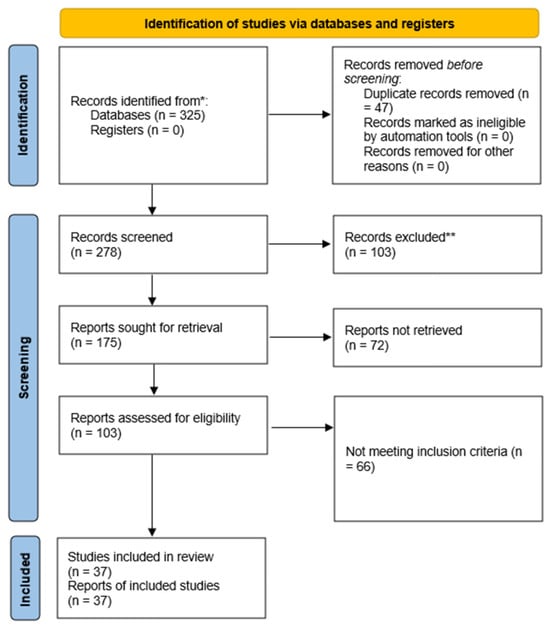
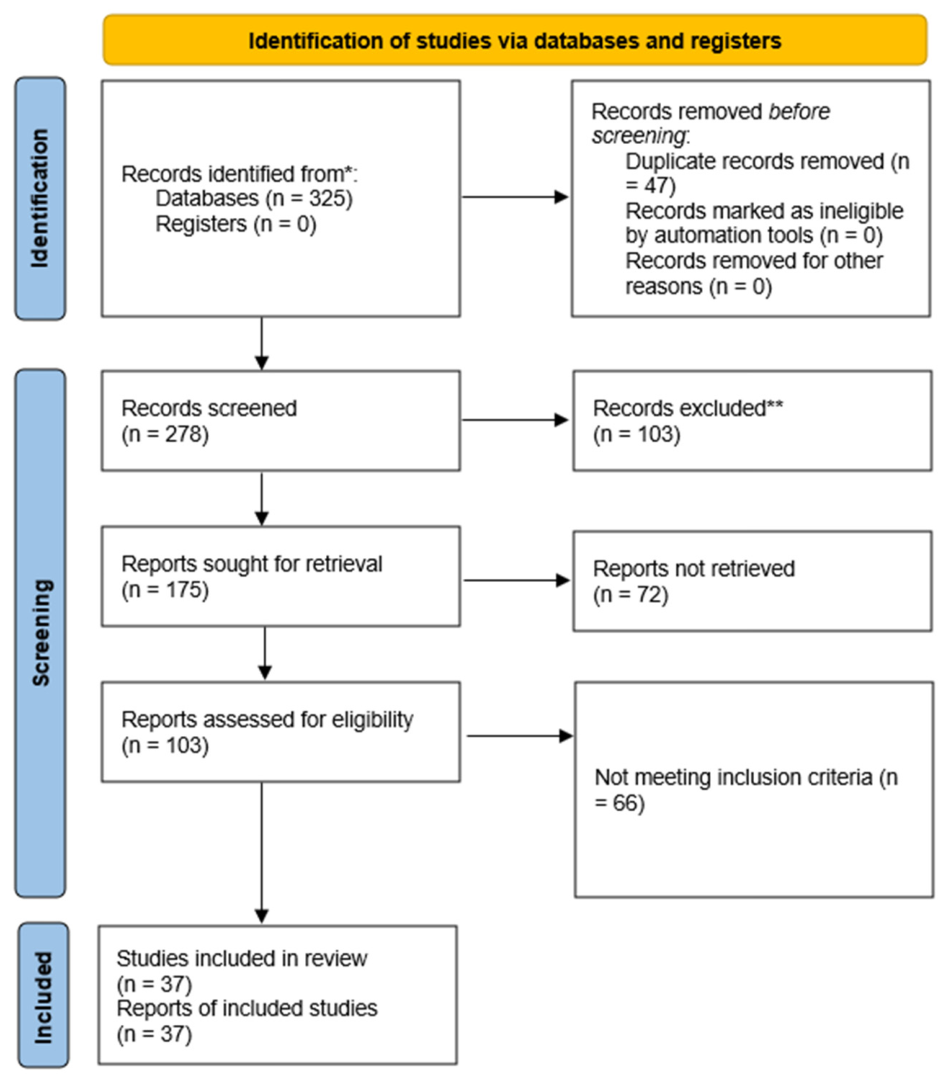
The study selection followed the four-stage PRISMA protocol: identification, screening, eligibility assessment, and final synthesis. A total of 325 records were identified across the selected databases. After removing duplicates, 278 unique records remained. Title and abstract screening reduced the dataset to 175 studies. Full-text eligibility assessment resulted in 103 articles that met the preliminary relevance criteria. Following detailed evaluation against the predefined inclusion and exclusion criteria, 37 studies were included in the final synthesis. During the full-text eligibility assessment, studies were excluded primarily for four reasons:
- (1)
- Exclusive focus on freight railway transport;
- (2)
- Purely technical or infrastructure-oriented engineering focus without relevance to passenger service quality or management systems;
- (3)
- Insufficient methodological transparency;
- (4)
- Absence of a conceptual or empirical connection to quality management, sustainability, or tourism-related dimensions.
The screening and evaluation process was conducted by the author using a predefined structured assessment protocol. As the review was conducted by a single author, formal inter-reviewer disagreement resolution procedures were not required. To improve consistency and reduce selection bias, the inclusion and exclusion criteria were systematically applied throughout all review stages. The complete selection process is illustrated in the PRISMA flow diagram (Figure 1).
Figure 1.
PRISMA diagram. (* Records were identified through database searches. The total number of records identified was 325, including those retrieved from the scientific databases searched. No records were identified through registers. ** Records were excluded during the screening stage based on manual screening of titles, abstracts, and relevance to the review scope. No automation tools were used in the screening or exclusion process).
Rather than applying a formal numerical scoring system, the evaluation focused on methodological transparency, thematic alignment with the study objectives, clarity of analytical approach, and consistency of reported findings. The reviewed literature exhibited substantial methodological heterogeneity, including quantitative surveys, qualitative case studies, systematic literature reviews, conceptual analyses, conference papers, doctoral dissertations, and mixed-methods studies. Due to this diversity, the application of a single standardized appraisal instrument such as CASP, MMAT, AMSTAR, or JBI was considered methodologically unsuitable and potentially inconsistent across study types.
This approach is consistent with qualitative thematic synthesis and narrative review approaches frequently applied in multidisciplinary research contexts characterized by methodological heterogeneity [29,30]. Studies lacking sufficient methodological transparency or conceptual relevance were excluded during the eligibility assessment stage. Accordingly, the included studies were qualitatively assessed based on methodological transparency, relevance to the research objectives, clarity of analytical approach, and consistency of reported findings. This approach was considered appropriate given the conceptual and methodological diversity of the reviewed literature.
Following the eligibility assessment, a structured data extraction process was conducted. For each included study, the following information was recorded: publication year, geographical context, research objectives, methodological approach, key analytical variables, and principal findings.
To analyze the heterogeneous results of the reviewed studies, a thematic synthesis was performed. Studies were grouped according to their dominant research focus and methodological orientation. The classification process was iterative and based on the primary objective of each study rather than secondary analytical dimensions.
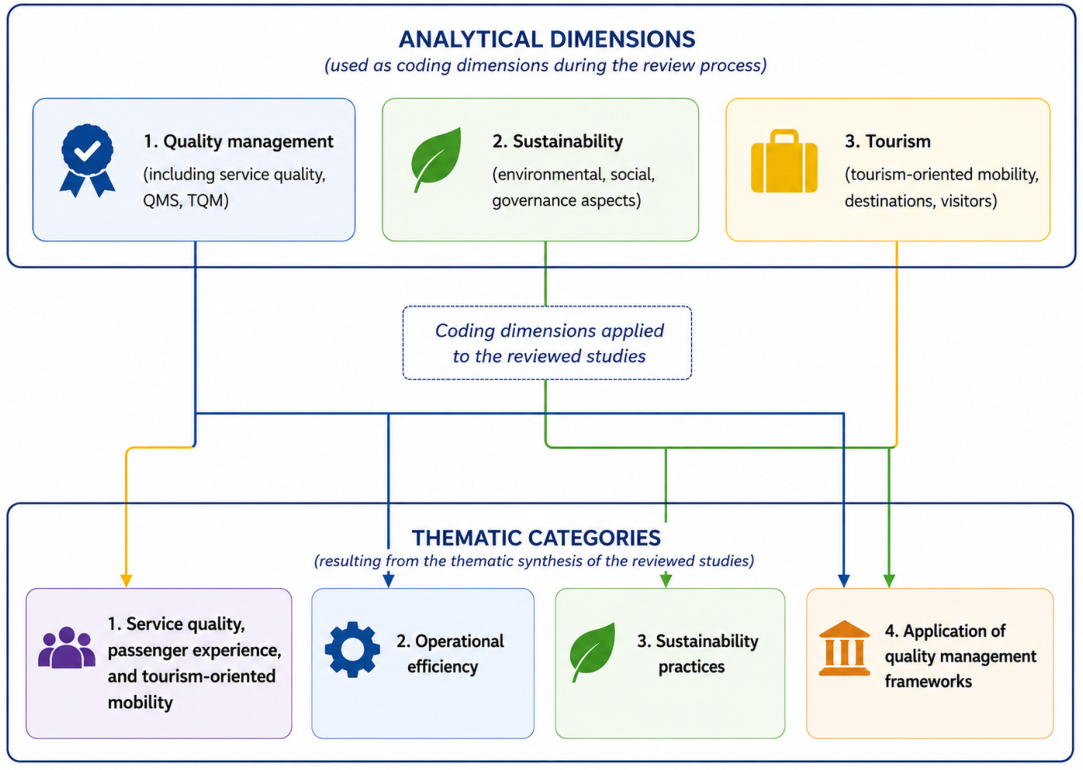
To strengthen analytical consistency, each study was additionally coded according to the presence of three core dimensions: quality management, sustainability, and tourism. The coding procedure was based on the explicit presence of thematic and conceptual elements related to quality-management-oriented constructs, sustainability, and tourism. Classification was determined based on the primary research objective, conceptual framing, analytical variables, and the dominant thematic emphasis of each study. For analytical purposes, the study distinguished between formal QMS-oriented research and service-quality-oriented research. Formal QMS studies included research explicitly addressing ISO standards, TQM, process standardization, continuous improvement mechanisms, safety management integration, or organizational quality governance frameworks. In contrast, service-quality-oriented studies focused primarily on passenger satisfaction, perceived service quality, SERVQUAL/RAILQUAL measurement models, and operational service attributes. Although service-quality studies were included within the broader quality management perspective of this review, they were not treated as equivalent to formal institutional QMS frameworks. As the review was conducted by a single author, formal inter-coder reliability indicators such as Cohen’s kappa or Krippendorff’s alpha were not applicable. To improve consistency and reduce subjective bias, predefined coding criteria and iterative reassessment of study classifications were systematically applied throughout the review process. Studies were allowed to be assigned to multiple dimensions where appropriate. The frequency of occurrence of each dimension was calculated relative to the total number of included studies (n = 37). This coding procedure enabled quantitative mapping of thematic overlaps and facilitated identification of fragmentation patterns within the literature. The analytical procedure provided a conceptual basis for examining structural gaps and relationships between quality management, sustainability, and passenger-oriented service performance in passenger railway transport. The systematic review record was registered on the Open Science Framework (OSF) to enhance methodological transparency and provide a publicly accessible record of the review protocol, search strategy, PRISMA documentation, and supporting materials.
3. Results
To provide a comprehensive and structured overview of the available research, Table 1 presents a systematic analysis of the included studies. For each study, Table 1 summarizes the authors, title, applied methodology, key contribution, and analytical dimensions (quality management, sustainability, tourism). This structured presentation enables a transparent comparison across studies and facilitates identification of dominant research orientations, methodological patterns, and thematic concentrations. Quantitative methods dominate research on passenger satisfaction, while qualitative and case-study approaches are more common in studies addressing operational practices and sustainability.
In addition to thematic grouping, a quantitative mapping of the reviewed studies was conducted based on the coding procedure described in the methodology. Each study was assessed for the explicit presence of three core dimensions: quality-management-oriented constructs, sustainability, and tourism. Studies were allowed to be assigned to multiple dimensions where appropriate.
The analysis reveals a pronounced imbalance in thematic distribution. Quality-management-oriented constructs appear in 48.6% of the reviewed studies, sustainability dimensions in 32.4%, and tourism-related perspectives in 24.3%. However, the review identified important conceptual differences between studies focusing on formal QMS implementation and those examining passenger-oriented service quality measurement.
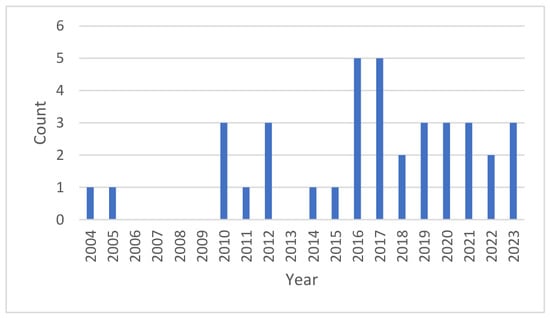
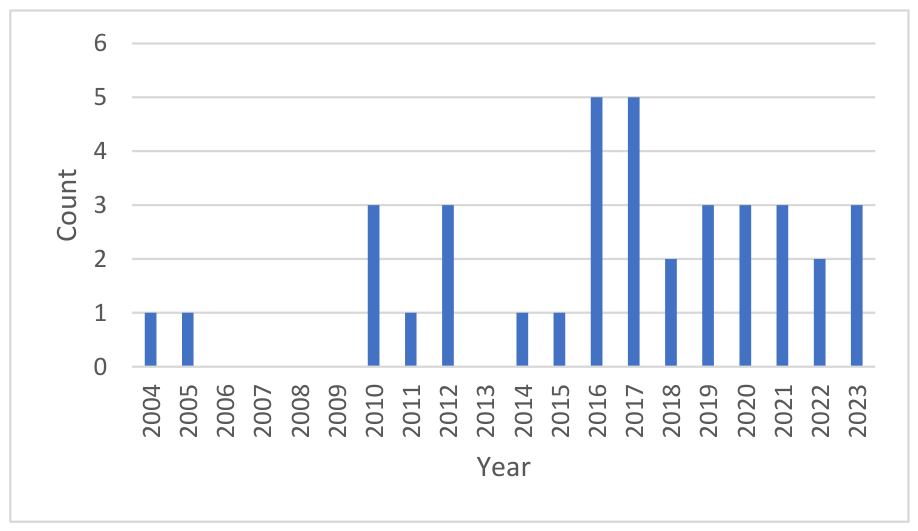
The reviewed studies indicate limited integration between quality management, sustainability, and tourism perspectives in passenger railway transport research. Earlier studies primarily addressed service quality measurement and operational management issues, while more recent contributions increasingly examine sustainability performance, technological innovation, and integrated management approaches. To further examine research trends in this field, the temporal distribution of the analyzed studies was assessed (Figure 2). The results indicate a noticeable increase in publications after 2015, reflecting growing academic and policy interest in sustainable mobility, integrated quality management, and tourism-oriented transport systems.
Figure 2.
Temporal distribution of analyzed studies (by year).
This trend suggests increasing recognition of the need for integrative approaches that link operational quality, environmental performance, and passenger-oriented service delivery. It also indicates the increasing relevance of such approaches for railway companies seeking to align service quality with sustainability and tourism-related development objectives.
The analyzed research covers a wide range of geographical areas, with the majority of studies originating from Europe and Asia. Countries with developed or rapidly transforming railway systems, including India, Slovakia, Poland, and the Netherlands, are particularly prominent. This geographical diversity enhances the representativeness of the synthesis and reflects varying institutional and regulatory contexts in which quality management and sustainability initiatives are implemented.
From a methodological perspective, the field is heterogeneous but exhibits clear dominant patterns. Survey-based quantitative studies focused on passenger satisfaction and perceived service quality represent the most frequent research design. Regression analysis, factor analysis, SERVQUAL-based instruments, and fuzzy logic models are commonly applied. Case study approaches are prevalent in studies examining operational efficiency and sustainability initiatives, particularly where organizational transformation or process optimization is addressed. Systematic literature reviews constitute a smaller but visible segment of the dataset, while longitudinal studies, system-level modelling, and integrative performance frameworks remain comparatively rare.
This methodological distribution suggests that the field is primarily oriented toward the cross-sectional assessment of service quality perceptions, with limited development of comprehensive system-level models capable of linking managerial, environmental, and tourism-related outcomes within a unified analytical structure.
To further analyze the heterogeneous results of the reviewed studies, a thematic synthesis was conducted, grouping papers according to their dominant research focus and methodological orientation. Four principal thematic categories were identified:
- Service quality, passenger experience, and tourism-oriented mobility;
- Operational efficiency;
- Sustainability practices;
- Application of quality management frameworks.
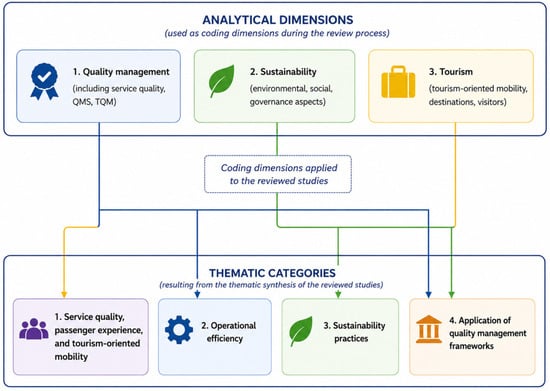
To clarify the relationship between the coding framework and the thematic synthesis, Figure 3 presents the connection between the three analytical dimensions and the four thematic categories identified in the review. The three analytical dimensions were used as coding dimensions to assess the content of each reviewed study. In contrast, the four thematic categories represent broader groupings derived from the thematic synthesis and reflect the dominant research focus of the included literature.
Figure 3.
Relationship between analytical dimensions and thematic categories in the reviewed literature.
Studies within the first thematic category primarily focus on service quality, passenger experience, and tourism-oriented mobility as important determinants of passenger satisfaction and railway competitiveness [7,8,9,10,11,31,32,33,34,35]. Frequently analyzed indicators include punctuality, cleanliness, comfort, staff professionalism, station quality, and overall passenger experience. Quantitative approaches dominate this category, particularly SERVQUAL-based instruments, regression models, factor analysis, and fuzzy logic modelling [7,8,10,11]. These studies provide detailed insights into passenger perceptions and the relationship between service attributes and satisfaction levels. Several studies within this category also address tourism-related dimensions through the analysis of destination accessibility, travel experience, railway attractiveness, and tourism-oriented mobility behavior [25,26,27,28,35,36,37].
Additional studies identified during the screening process further examined passenger satisfaction, traveler perception, behavioral intentions, and service-quality relationships within railway and public transport systems [38,39]. These studies represent an important research stream within transport quality literature and contributed to the broader conceptual understanding of passenger-oriented service evaluation. However, their primary analytical focus was predominantly centered on behavioral modelling, traveler satisfaction relationships, or modal-choice analysis rather than on the integration of formal quality-management systems, sustainability-oriented governance, tourism-oriented mobility frameworks, or structured railway service-governance mechanisms. Consequently, studies lacking an explicit connection to the integrative QMS–sustainability–tourism framework were not retained within the final synthesis adopted in this review.
Nevertheless, the majority of service-quality-oriented studies rarely extend their analysis toward sustainability performance or tourism-related strategic implications. Service quality is typically examined as an operational or marketing variable rather than as a component of an integrated sustainability-oriented management framework. The second thematic category includes six studies focusing on operational efficiency and internal process optimization [15,16,37,39]. Mitreva et al. [15] and Mitreva et al. [40] illustrate this stream by examining TQM-driven organizational transformation and business process optimization within national railway systems. This group examines how railway organizations can improve planning, resource allocation, reliability, staff training, and interdepartmental coordination through the application of quality management principles. While QMS and TQM are frequently presented as mechanisms for enhancing organizational performance [14,15,16], the link to environmental sustainability or tourism-oriented outcomes is generally indirect or absent. Efficiency improvements are discussed primarily within managerial or operational boundaries, reinforcing the compartmentalization of research streams.
Ten studies explicitly address sustainability practices, including environmental performance, lifecycle emissions, energy efficiency, technological innovation, and risk management in railway operations [23,24,25,26,27,30,41,42,43,44,45,46,47]. For instance, Kapetanović et al. [21] conducted a systematic review of lifecycle emissions in passenger rail services, while Wangai et al. [22] analyzed sustainability challenges in developing railway transport systems. Although sustainability is recognized as a strategic priority, it is often analyzed independently of QMS [20,21,22]. In most cases, sustainability is approached from a technical, environmental, or policy perspective rather than from the perspective of integrated quality management. Only a limited number of studies attempt to connect environmental indicators with structured managerial frameworks, and even fewer link sustainability outcomes to passenger satisfaction or tourism development.
Eight studies examine the implementation of QMS, ISO standards, and TQM principles within railway organizations [14,15,16,17,18,39,40,41,48]. Kumar [16] explored TQM-based organizational transformation in Indian Railways, whereas Rahmawati et al. [19] examined ISO 9001:2015 implementation at the national railway company level. These studies analyze process standardization, safety management integration, and organizational transformation [16,17,37].
Although they provide important insights into formal QMS adoption, most studies focus on compliance, certification, or internal process control. Explicit alignment with sustainability metrics or tourism-oriented service performance remains limited. Quality management is frequently treated as an internal governance mechanism rather than as a strategic integrative instrument [15,16]. Although each thematic category contributes valuable insights into specific aspects of railway service improvement, a clear structural fragmentation persists. Quality management is predominantly treated as an internal operational or compliance-oriented mechanism. Sustainability is largely examined through environmental or technological lenses. Tourism is approached from market-oriented or experiential perspectives.
These streams rarely converge within a unified managerial paradigm. The absence of studies demonstrating full tri-dimensional integration underscores the lack of comprehensive models capable of simultaneously aligning operational performance, environmental responsibility, and passenger-oriented service excellence. The findings indicate that the current body of knowledge does not yet provide sufficient integration of quality management, sustainability, and tourism perspectives within passenger railway transport research. The studies presented in Table 1 are organized according to the reference numbering and chronological development of the reviewed literature.
Table 1.
Literature review.
4. Discussion
The synthesis of the findings reveals substantial conceptual separation between research on quality management, sustainability, and tourism in passenger railway transport. Although numerous studies have examined individual dimensions of service quality, operational efficiency, or environmental sustainability, these domains largely develop in parallel rather than within a unified managerial paradigm. The findings of this review provide answers to the research questions posed in the introduction. The analysis shows that quality management, sustainability, and tourism are examined predominantly in isolation in existing studies, whereas studies that simultaneously address all three dimensions remain limited.
Although several studies demonstrate partial overlap across at least two examined dimensions, none of the reviewed papers provides a structured and empirically supported integration of quality management, sustainability, and tourism within a unified analytical framework. The reviewed studies also differ considerably in their methodological approaches and analytical focus. Quantitative studies predominantly examine passenger satisfaction through survey-based instruments, regression analysis, and service quality measurement models [7,8,10,11]. In contrast, qualitative and case-study-based research focuses more strongly on operational management practices and organizational transformation processes [15,22,40]. As a result, comparability among studies remains limited due to inconsistent performance indicators, varying conceptualizations of service quality and sustainability, and the absence of standardized integrative evaluation approaches. An additional distinction emerging from the thematic synthesis concerns the separation between demand-side and supply-side perspectives in railway transport research. Studies grouped within the category “Service quality, passenger experience, and tourism-oriented mobility” predominantly examine passenger perceptions, travel experience, accessibility, and satisfaction outcomes from the user perspective. In contrast, studies focused on operational efficiency and QMS implementation primarily address internal organizational processes, process optimization, compliance structures, resource allocation, and managerial performance from the institutional perspective. Despite addressing interconnected aspects of railway service systems, these two analytical perspectives remain weakly integrated in the reviewed literature, reinforcing the compartmentalization between passenger-oriented service evaluation and organizational quality governance.
The structural gaps identified in the literature can be grouped into three interrelated domains: (1) weak integration between quality management and sustainability, (2) limited alignment between quality management and tourism-oriented service development, and (3) insufficient digital transformation of quality management frameworks.
The first structural gap relates to the limited theoretical integration between quality management and sustainability. Although sustainability is increasingly recognized as a strategic priority within the railway sector, most environmental analyses focus on emissions, energy efficiency, or technological modernization without embedding these indicators into a formal QMS. Moreover, several sustainability-oriented studies primarily approach the issue from technological or policy perspectives [21,22,23], while giving relatively limited attention to organizational implementation challenges and passenger-oriented service outcomes.
The literature rarely conceptualizes quality, safety, and environmental performance within a unified governance model. In practice, ISO 9001-based QMS, ISO 14001 [51] environmental management systems, and safety management frameworks are often implemented as parallel compliance structures. This separation is also evident in the limited consideration of sector-specific standards such as ISO 22163 (IRIS Certification), which are primarily implemented at the operational or supply chain level but are rarely analyzed as part of integrated sustainability-oriented and passenger-centered management frameworks. In addition, relatively limited attention is devoted to EN 13816, the European standard specifically developed for quality management in public passenger transport. The standard defines service quality dimensions related to availability, accessibility, information, time, customer care, comfort, and security, thereby providing a structured framework for evaluating passenger-oriented transport quality. Despite its relevance for railway service governance and passenger satisfaction assessment, EN 13816 remains insufficiently integrated into broader sustainability- and tourism-oriented railway management research [52].
However, empirical research seldom examines how these standards may function within an integrated performance architecture. The absence of integrated indicators linking service quality, environmental accountability, and operational risk illustrates an analytical disconnect between managerial control systems and sustainability objectives. Consequently, sustainability is predominantly treated as a technical or regulatory concern rather than as an embedded dimension of service quality and passenger-oriented performance.
The second structural gap relates to the relationship between quality management and railway tourism. An important conceptual distinction identified in the reviewed literature concerns the difference between passenger-oriented service quality assessment and formal QMS implementation. While service quality studies frequently examine customer perceptions and experiential dimensions of railway services, formal QMS research primarily addresses organizational governance, standardization, compliance mechanisms, and continuous improvement structures. Tourism-oriented studies predominantly conceptualize service quality at the perceptual level, emphasizing passenger experience, satisfaction, comfort, and destination attractiveness. From the perspective of tourism systems, railway transport represents an essential component of the broader tourism mobility chain connecting destinations, transport accessibility, and visitor experience. Consequently, operational quality and service reliability influence not only passenger satisfaction but also destination competitiveness, tourist mobility patterns, and the attractiveness of sustainable transport alternatives. In this context, QMS-oriented governance mechanisms may facilitate more consistent tourism-oriented service delivery through process standardization, operational reliability, accessibility management, and continuous quality improvement. Despite this potential, the reviewed literature rarely examines how formal quality management systems can strategically support tourism-oriented mobility governance and sustainable destination accessibility.
In contrast, QMS-focused studies approach quality as an internal organizational mechanism centered on process standardization, compliance, and operational control. For example, tourism-focused studies emphasize passenger experience and destination attractiveness [25,26], while QMS-oriented studies predominantly examine process standardization and compliance mechanisms [15,18,49]. This conceptual and methodological separation limits the development of integrated managerial approaches.
The analytical linkage between these two levels remains weak. Research on railway tourism rarely examines how structured quality management tools can systematically support tourism-oriented service design. Conversely, studies addressing QMS implementation seldom extend their analysis to tourism competitiveness or experiential value creation. This conceptual separation prevents the development of models in which quality management functions as a strategic instrument for enhancing tourism-oriented railway services. These findings are broadly aligned with the systematic review by Peira et al. [28], which highlighted the growing importance of railway transport in tourism development and passenger experience research. While their review primarily approached the topic from a tourism and mobility perspective, the present study extends the discussion by additionally examining the role of quality management systems and sustainability-oriented management approaches in passenger railway transport. Without such linkage, passenger satisfaction remains primarily a measurement outcome rather than a strategically managed component of sustainable tourism mobility and integrated railway service governance.
The third structural gap concerns the limited digital transformation of QMS in railway transport. Although modernization of infrastructure and adoption of advanced technologies are widely discussed, relatively little attention has been devoted to the digitalization of management systems themselves. Quality management in the reviewed literature is still predominantly conceptualized as a documentation-based and compliance-oriented system. The integration of digital tools such as real-time performance monitoring, predictive analytics, Internet of Things (IoT) applications, and big data-driven decision support remains marginal in QMS-related research.
This indicates that QMS in railway transport has not yet evolved into a dynamic and data-driven governance architecture approach capable of continuously aligning operational quality, environmental performance, and passenger experience. The limited presence of digitalized quality systems further reinforces the fragmentation identified in the quantitative mapping of dimensions.
The findings of this review identify important gaps in the literature and highlight the need for further empirical research on the relationships between quality management, sustainability, and tourism in railway systems. The theoretical implications of this study are reflected in several key aspects. First, the review provides a systematic synthesis of fragmented research across quality management, sustainability, and tourism, contributing to improved conceptual clarity in this field. Second, it highlights the lack of integrated approaches and identifies structural gaps that limit the development of comprehensive QMS-oriented research. These findings establish a conceptual basis for future studies aimed at developing and empirically testing integrative approaches to quality management in railway systems.
In addition to theoretical contributions, the study also provides practical implications. The results suggest that railway companies should move beyond isolated management practices and adopt a more integrated approach that aligns quality management processes with environmental performance and passenger-oriented service outcomes. In operational terms, this includes aligning internal quality management systems (e.g., ISO-based frameworks) with sustainability indicators and passenger satisfaction metrics. Such alignment may support more effective decision-making, improve service consistency, and enhance the overall passenger experience. Furthermore, integrating these dimensions may enable railway operators to better respond to sustainability requirements and evolving tourism demand, while strengthening competitiveness and long-term system efficiency.
Future integrative approaches in this field should include:
- Cross-dimensional performance indicators linking passenger satisfaction, environmental metrics, and operational efficiency;
- Integrated governance structures aligning quality, safety, and environmental standards;
- Digital performance monitoring systems enabling continuous feedback between service delivery and sustainability outcomes.
Advancing research in this direction would reposition quality management from a compliance-based mechanism to a strategic driver of sustainable, passenger-centered transformation in railway transport.
Although this literature review applied a systematic and transparent methodology, several limitations must be acknowledged. The final synthesis included 37 studies, representing a relatively narrow intersection of quality management, sustainability, tourism, and passenger railway transport. While this selectivity ensured analytical focus, it may limit the generalizability of findings. Additionally, the heterogeneity of research designs limited the possibility of conducting quantitative meta-analysis. Despite these limitations, the review provides a structured and transparent mapping of the current state of knowledge and identifies critical structural gaps that warrant further investigation. Without conceptual integration of quality management, sustainability, and passenger-oriented service design, railway systems may remain operationally efficient yet strategically disconnected from broader sustainable mobility objectives.
5. Conclusions
This systematic review demonstrates that research at the intersection of quality management, sustainability, and tourism in passenger railway transport remains insufficiently integrated across these domains. Although QMSs are widely discussed in the literature, their application is predominantly confined to internal process control and compliance-oriented objectives. Sustainability and tourism, in contrast, are often analyzed as separate environmental or experiential domains, without being embedded within a unified quality management architecture.
The quantitative mapping of the thematic dimensions confirms this imbalance. Quality management-related constructs appear in 48.6% of the reviewed studies, sustainability dimensions in 32.4%, and tourism-oriented perspectives in 24.3%. Notably, none of the analyzed studies integrates all three domains within a coherent and empirically supported framework. Even within this limited subset, the integration is largely descriptive rather than supported by operationalized and empirically tested models. This lack of integration restricts the theoretical development of integrative governance approaches capable of aligning operational performance, environmental responsibility, and passenger-oriented service excellence.
The primary contribution of this study, therefore, lies not merely in identifying a research gap but in demonstrating a structural discontinuity in the way knowledge is organized across these domains. By systematically mapping thematic overlaps and methodological orientations, the study provides a foundation for the development of more comprehensive approaches in which quality management functions as a strategic driver of sustainable mobility and tourism-oriented railway transformation. Future research should focus on empirical examination of the relationships between QMS, sustainability indicators, digital performance monitoring tools, and passenger experience metrics. Although the final synthesis included 37 studies and was limited to English-language and selected regional-language publications, the structured methodology ensured transparency and analytical consistency. Despite the limitations of the dataset, the findings provide meaningful insight into the current state of knowledge and highlight the urgent need for interdisciplinary and model-driven research in this field. Without conceptual integration of quality management, sustainability, and passenger-oriented service design, railway systems may remain operationally efficient yet strategically disconnected from broader sustainable mobility objectives.
Author Contributions
Conceptualization, M.P. and N.M.; methodology, M.P.; validation, M.P. and N.M.; formal analysis, M.P.; investigation, M.P.; resources, M.P.; data curation, M.P.; writing—original draft preparation, M.P.; writing—review and editing, N.M.; visualization, M.P.; supervision, N.M.; funding acquisition, M.P. All authors have read and agreed to the published version of the manuscript.
Funding
This paper was supported by the University of Rijeka Foundation through the Prometej Fund for PhD Students (Grant No. N-PROM 2/2025).
Institutional Review Board Statement
Not applicable.
Informed Consent Statement
Not applicable.
Data Availability Statement
The original contributions presented in this study are included in the article. Further inquiries can be directed to the corresponding author.
Acknowledgments
During the preparation of this manuscript, the authors used ChatGPT 5.3 for assistance in preparing the visual representation presented in Figure 3. The authors have reviewed and edited the output and take full responsibility for the content of this publication.
Conflicts of Interest
The author declares no conflicts of interest.
References
- International Energy Agency (IEA). CO2 Emissions in 2022; IEA: Paris, France, 2023; Available online: https://www.iea.org/reports/co2-emissions-in-2022 (accessed on 1 November 2025).
- European Environment Agency (EEA). Nitrogen dioxide (NO2). In Air Quality Status Report 2025; EEA: Copenhagen, Denmark, 2025; Available online: https://www.eea.europa.eu/en/analysis/publications/air-quality-status-report-2025/nitrogen-dioxide (accessed on 1 November 2025).
- Organisation for Economic Co-operation and Development (OECD). Non-Exhaust Particulate Emissions from Road Transport; OECD Publishing: Paris, France, 2020; Available online: https://www.oecd.org/en/publications/non-exhaust-particulate-emissions-from-road-transport_4a4dc6ca-en.html (accessed on 5 November 2025).
- World Health Organization (WHO). Protecting People from Harmful Exposure to Environmental Noise; WHO Regional Office for Europe: Copenhagen, Denmark, 2019; Available online: https://www.who.int/europe/activities/protecting-people-from-harmful-exposure-to-environmental-noise (accessed on 1 November 2025).
- International Council on Clean Transportation (ICCT). Vision 2050: Update on the Global ZEV Transition in 2025; ICCT: Washington, DC, USA, 2025; Available online: https://theicct.org/publication/vision-2050-update-on-the-global-zev-transition-in-2025/ (accessed on 5 November 2025).
- Bleijenberg, A. Air2Rail: Koios Strategy Report; Koios Project. 2020. Available online: https://ariebleijenberg.nl/wp-content/uploads/Air2Rail-Koios-strategy-final.pdf (accessed on 3 November 2025).
- Maruvada, D.P.; Bellamkonda, R.S. Analyzing the Passenger Service Quality of the Indian Railways using Railqual: Examining the applicability of fuzzy logic. Int. J. Innov. Manag. Technol. 2010, 1, 478–482. [Google Scholar]
- Vishnuvarthan, S.; Selvaraj, A. Railway passengers’ satisfaction: A study in Salem division of southern railway. Int. J. Adv. Res. Manag. Soc. Sci. 2012, 1, 92–101. [Google Scholar]
- Singla, A.M.I.T. The Effect of Perceived Service Quality on Customer Satisfaction in Indian Railways. Int. J. Res. Bus. Manag. 2015, 3, 9–18. [Google Scholar]
- Priyadharshini, J.; Muthusamy, S. Service quality and passengers satisfaction of southern railways by ServQual model. Int. J. Trend Res. Dev. 2016, 3, 3–6. [Google Scholar]
- Kriswardhana, W.; Hayati, N.N.; Septiana, D.R. Passenger satisfaction with railway station service quality: An Ordinal Logistic Regression approach. MATEC Web Conf. 2018, 181, 07001. [Google Scholar] [CrossRef] [Scilit]
- EN 13816:2002; Transportation, Logistics and Services. Public Passenger Transport. Service Quality Definition, Targeting and Measurement. European Committee for Standardization: Brussels, Belgium, 2002.
- ISO 9001:2015; Quality Management Systems: Requirements. International Organization for Standardization: Geneva, Switzerland, 2015.
- Kumar, M.R. Total Quality Management as the Basis for Organizational Transformation of Indian Railways: A Study in Action Research. Ph.D. Thesis, Southern Cross University, Lismore, Australia, 2005. [Google Scholar]
- Mitreva, E.; Nikolov, E.; Nikolova, B. Application of Total Quality Management (TQM) in the Macedonian Railways-transport in the Republic of Macedonia. Calitatea-Acces Succes 2016, 17, 55–60. [Google Scholar]
- Novikova, M.; Kondratenko, N.; Schevchenko, V. Quality management technologies of railway transport services. Dev. Manag. 2021, 19, 17–25. [Google Scholar] [CrossRef] [Scilit]
- Rahmawati, A.; Rosdiana, D.; Asbari, M. Implementation of ISO 9001: 2015 at Indonesian Railways Company: A Narrative Literature Review. Int. J. Soc. Manag. Stud. 2023, 4, 72–77. [Google Scholar]
- Tarí, J.J.; Molina-Azorín, J.F.; Heras, I. Benefits of the ISO 9001 and ISO 14001 standards: A literature review. J. Ind. Eng. Manag. (JIEM) 2012, 5, 297–322. [Google Scholar] [CrossRef] [Scilit]
- ISO 22163:2023; Railway Applications: Railway Quality Management System: ISO 9001:2015 and Specific Requirements for Application in the Railway Sector. International Organization for Standardization: Geneva, Switzerland, 2023.
- Kravchenko, O.; Bohomolova, N. Determinants of railway transport sustainability. SHS Web Conf. 2019, 67, 04008. [Google Scholar] [CrossRef] [Scilit]
- Kapetanović, M.; van Oort, N.; Núñez, A.; Goverde, R.M.P. Sustainability of railway passenger services—A review of aspects, issues, contributions and challenges of life cycle emissions. In Proceedings of the 8th International Conference on Railway Operations Modelling and Analysis (ICROMA), Norrköping, Sweden, 17–20 June 2019. [Google Scholar]
- Wangai, A.W.; Rohacs, D.; Boros, A. Supporting the Sustainable Development of Railway Transport in Developing Countries. Sustainability 2020, 12, 3572. [Google Scholar] [CrossRef] [Scilit]
- Nedeliakova, E.; Hudakova, M.; Masar, M.; Lizbetinova, L.; Stasiak-Betlejewska, R.; Šulko, P. Sustainability of railway undertaking services with lean philosophy in risk management—Case study. Sustainability 2020, 12, 5298. [Google Scholar] [CrossRef] [Scilit]
- Kljaić, Z.; Pavković, D.; Cipek, M.; Trstenjak, M.; Mlinarić, T.J.; Nikšić, M. An Overview of Current Challenges and Emerging Technologies to Facilitate Increased Energy Efficiency, Safety, and Sustainability of Railway Transport. Future Internet 2023, 15, 347. [Google Scholar] [CrossRef] [Scilit]
- Michniak, D. Role of railway transport in tourism: Selected problems and examples in Slovakia. Quaest. Geogr. 2016, 35, 107–120. [Google Scholar] [CrossRef] [Scilit]
- Lee, C.; Chen, K. Exploring factors determining the attractiveness of railway tourism. J. Travel Tour. Mark. 2017, 34, 461–474. [Google Scholar] [CrossRef] [Scilit]
- Kozłowski, M.; Pawełczyk, M.; Piotrowska-Piątek, A. Innovativeness of railway transport in the context of the development of tourism in Poland. Qual. Quant. 2020, 54, 1691–1703. [Google Scholar] [CrossRef] [Scilit]
- Peira, G.; Lo Giudice, A.; Miraglia, S. Railway and tourism: A systematic literature review. Tour. Hosp. 2022, 3, 69–79. [Google Scholar] [CrossRef] [Scilit]
- Petrović, D.; Karanović, G. Financial institutions efficiency: A systematic literature review. Zb. Rad. Ekon. Fak. Rijeci Časopis Ekon. Teor. Praksu 2024, 42, 411–446. [Google Scholar] [CrossRef] [Scilit]
- Dasilas, A.; Rigani, A. Machine learning techniques in bankruptcy prediction: A systematic literature review. Expert Syst. Appl. 2024, 255, 124761. [Google Scholar] [CrossRef] [Scilit]
- Prasad, M.D.; Shekhar, B.R. Impact of service quality management (SQM) practices on Indian Railways: A study of South Central Railways. Int. J. Bus. Manag. 2010, 5, 139–146. [Google Scholar] [CrossRef] [Scilit]
- Agunloye, O.O.; Oduwaye, L. Factors influencing the quality of rail transport services in metropolitan Lagos. J. Geogr. Reg. Plan. 2011, 4, 98–103. [Google Scholar]
- Irfan, S.M.; Kee, D.M.H.; Shahbaz, S. Service quality and rail transport in Pakistan: A passenger perspective. World Appl. Sci. J. 2012, 18, 361–369. [Google Scholar]
- Lu, M. Evaluation of Railway Performance Through Quality of Service. Ph.D. Thesis, University of Birmingham, Birmingham, UK, 2017. [Google Scholar]
- Van Hagen, M.; Van Oort, N. Improving railway passengers experience: Two perspectives. J. Traffic Transp. Eng. 2019, 7, 97–110. [Google Scholar] [CrossRef] [Scilit]
- Žvirblis, A.; Butkevičius, J. Evaluation of the competitiveness of the system of passenger transportation by railway. Transport 2004, 19, 157–161. [Google Scholar] [CrossRef] [Scilit]
- Popov, P. Railway safety management system. In Proceedings of the 5th International Scientific Conference “Theoretical and Practical Issues in Transport”, Pardubice, Czech Republic, 11–12 February 2010. [Google Scholar]
- Weinstein, A. Customer satisfaction among transit riders: How customers rank the relative importance of various service attributes. Transp. Res. Rec. 2000, 1735, 123–132. [Google Scholar] [CrossRef] [Scilit]
- Lai, W.-T.; Chen, C.-F. Behavioral intentions of public transit passengers: The roles of service quality, perceived value, satisfaction and involvement. Transp. Policy 2011, 18, 318–325. [Google Scholar] [CrossRef] [Scilit]
- Mitreva, E.; Nikolov, E.; Nikolova, B.; Taskov, N.; Dimitrov, N. Methodology for Optimizations of Business Processes in Macedonian Railways-Transport in the Republic of Macedonia. Mediterr. J. Soc. Sci. 2016, 7, 394–402. [Google Scholar] [CrossRef] [Scilit]
- Abramović, B.; Nedeliakova, E.; Panak, M.; Šipuš, D. Synergy in logistics processes for railway transport. In Proceedings of the 17th International Scientific Conference Business Logistics in Modern Management, Osijek, Croatia, 12–13 October 2017. [Google Scholar]
- Kondratiev, V.V.; Olentsevich, V.A.; Kuznetsov, B.O.; Karlina, A.I. Improving the quality of the railway transportation process. SHS Web Conf. 2021, 112, 00047. [Google Scholar] [CrossRef] [Scilit]
- Nedeliaková, E.; Hranický, M.P.; Valla, M. Risk identification methodology regarding the safety and quality of railway services. Prod. Eng. Arch. 2022, 28, 21–29. [Google Scholar] [CrossRef] [Scilit]
- Van Der Meulen, D.; Möller, F. Competitiveness and sustainability of railways. In Infrastructure Design, Signalling and Security in Railway; IntechOpen: London, UK, 2012; pp. 69–94. [Google Scholar]
- Profillidis, V. Railway Management and Engineering; Routledge: London, UK, 2016. [Google Scholar] [CrossRef] [Scilit]
- Lwesya, F.; Jaffu, R. Customer service quality management in public transport: The case of rail transport in Tanzania. Int. Rev. 2017, 3, 102–117. [Google Scholar] [CrossRef] [Scilit]
- Cinelli, I.; Anfuso, G.; Privitera, S.; Pranzini, E. An overview on railway impacts on coastal environment and beach tourism in Sicily (Italy). Sustainability 2021, 13, 7068. [Google Scholar] [CrossRef] [Scilit]
- Erdős, A.K. Enhancing the competitiveness of passenger railway markets. Procedia Econ. Financ. 2014, 12, 138–143. [Google Scholar] [CrossRef] [Scilit]
- Mapande, T.D. Theoretical perspective of quality management practices (QMPS) assessment from ISO 9001: 2008 perception in a railway industry. Interim Interdiscip. J. 2016, 15, 81–95. [Google Scholar]
- Virkar, A.R.; Mallya, P.D. A review of dimensions of tourism transport affecting tourist satisfaction. Indian J. Commer. Manag. Stud. 2018, 9, 72–80. [Google Scholar] [CrossRef] [Scilit]
- ISO 14001:2015; Environmental Management Systems: Requirements with Guidance for Use. International Organization for Standardization: Geneva, Switzerland, 2015.
- EN 13816:2002; Transportation—Logistics and Services—Public Passenger Transport—Service Quality Definition, Targeting and Measurement. European Committee for Standardization (CEN): Brussels, Belgium, 2002.
Disclaimer/Publisher’s Note: The statements, opinions and data contained in all publications are solely those of the individual author(s) and contributor(s) and not of MDPI and/or the editor(s). MDPI and/or the editor(s) disclaim responsibility for any injury to people or property resulting from any ideas, methods, instructions or products referred to in the content. |
© 2026 by the authors. Licensee MDPI, Basel, Switzerland. This article is an open access article distributed under the terms and conditions of the Creative Commons Attribution (CC BY) license.