


Abstract
Automated alert systems for air traffic controllers (ATCOs) often generate many nuisance visual warnings that ATCOs routinely ignore, potentially compromising safety. To explore an alternative modality, we tested vibrotactile alerts to warn ATCOs of aircraft entering their sector. In two experiments with 118 novice participants, Experiment 1 compared a visual color-change alert to a simple vibrotactile pulse. Using a high-difficulty scenario with nine handoffs, simple vibrotactile alerts elicited significantly faster response times than visual alerts without increasing mental workload or degrading performance. In Experiment 2 we added gradual and continuous vibrotactile alerts, but no further advantage emerged from their implementation. Nevertheless, all vibrotactile alerts reliably captured attention without adverse effects, demonstrating the feasibility of non-invasive tactile devices to augment or replace visual alerts and help ATCOs allocate their cognitive resources more effectively. However, this is an exploratory study at a pre-operational stage without direct practical implications for ATC planning and control.
1. General Introduction
In recent years, there has been a notable increase in the density of aircraft in airspace. Despite the absence of an increase in the number of Air Traffic Controllers (ATCOs), there have been endeavors to consider their cognitive capabilities [1], such as their mental workload (MWL) and situational awareness [2]. These efforts have included the development of automation systems to assist the ATCO. One component of these automation tools is the development of alert systems [3]. The process is straightforward: a computer algorithm is developed to detect potentially conflicting or problematic events in advance. Once the algorithm detects an event that exceeds the conflict thresholds, a signal is generated to notify the controller that a situation requiring attention is imminent. The ATCO receives the alert and can decide whether to respond, as well as when and how to do so [4].
Currently, several types of alerts are implemented in Air Traffic Control (ATC). The most common include: (1) MSAW (Minimum Safe Altitude Warning), which informs the ATCO if an aircraft is projected to be below the required minimum altitude based on its flight plan; (2) CA (Conflict Alert) or STCA (Short-Term Conflict Alert), which generates an alert if the trajectories of two or more aircraft may be in conflict, falling below certain distance thresholds (e.g., less than 1000 feet and 5 nautical miles); and (3) APW (Area Proximity Warning), which alerts when an aircraft is about to enter restricted airspace. These are the most common examples, but there are many alerts designed to inform ATCO about different operational issues. During a work shift, ATCOs experience a high volume and variety of alerts, making it common for ATCO to disregard them. In [4,5], it was observed that enroute ATCOs ignored 62% of CA alerts and 91% of MSAW alerts. This raises an important question: why are these alerts ignored if they are seemingly informative?
One possible explanation for why alerts are being ignored is that the visual system is completely overloaded during ATC tasks, making it difficult to process the alerts. According to the Multiple Resources Theory [6,7,8], individuals have attentional resources of different modalities for task management, but these resources are limited. For this reason, the incorporation of auditory stimulation has been explored to support, relieve, or reduce the strain on the visual system. Although research has demonstrated the potential of auditory signals [9,10,11,12], interviews with ATCOs have revealed that acoustic alerts are often perceived as “unpleasant” [4,13]. Ref. [14] found that, on average, ATC work environments are quite noisy, with ambient sound levels ranging from 52 to 63 dB, necessitating alerts with higher volumes to be effective. In addition, the acoustic system is crucially involved in other ATC subtasks like communication with pilots or other ATCOs. Consequently, an alternative that has been proposed is the introduction of vibrotactile alerts [4,12,15,16,17,18,19].
Unlike vision or hearing, touch is largely underutilized in everyday tasks [20]. Research in ATC, as well as in other contexts such as driving [21,22,23] or intensive care [24,25], has shown that vibrotactile signals improve performance compared to baseline and may even outperform visual alerts when the task imposes high visual but low tactile demands [26,27]. Unlike vision or hearing, vibrotactile stimulation can be provided to different parts of the body [28]. In addition, one of the key advantages of using tactile signals is that they yield positive results without increasing MWL or negatively impacting task performance [15,26,27,29,30].
Returning to the question of why alerts are ignored in ATC, one might assume that this deliberate omission is a reckless strategy that leads to numerous conflicts that might otherwise be entirely avoidable. However, it has been demonstrated that ignoring these alerts is actually the best strategy [4,5,31,32]. In many cases, the situation solves itself, or the alert appears after the ATCO has already intervened [4,5,33]. Therefore, rather than providing useful information, these alerts end up hindering the ATCO’s work. In the literature, such alerts are referred to as “nuisance alerts.” According to [4], the management of nuisance alerts is one of the major challenges currently facing ATC.
When a worker experiences a high frequency of alerts, many of which are neither high priority nor require any action, they tend to become desensitized or fatigued by these alarms [4,25,34]. As a result, they are more likely to ignore alerts and develop a greater distrust of automation [35,36]. This poses a clear risk: when an alert is genuinely urgent and requires action, the worker may disregard it, affecting overall performance [31,37,38,39]. As a result, the ATCOs must identify the conflict on their own, which could reduce the available response time to mitigate the issue [40,41].
In summary, ATC is an extremely complex task that generates a high MWL and requires extensive visual and auditory resources. In addition, ATCOs must contend with a high frequency of alerts, that often feel like an overwhelming bombardment of excessive information. As a result, a significant portion of cognitive resources is devoted to managing nuisance alerts. One of the main issues has been the failure to recognize that conflict detection algorithms and ATCOs operate, gather information, and make decisions in fundamentally different ways. More recently, artificial intelligence has been proposed to enhance human–machine interaction and thereby reduce the frequency of nuisance alerts. Another approach involves implementing graded alerts that convey information about severity, urgency, and/or the likelihood of conflict occurrence [4,23,25,41].
Our research aims to further explore the use of vibrotactile stimulation as a means of conveying information to ATCOs. In [17], various vibrotactile stimulation alerts were integrated into an ATC system and compared to a control condition. This study was performed with naive participants and, therefore, implications for real-world operations are limited. Nevertheless, the findings indicated that participants detected conflicts earlier when the vibration provided spatial information about the conflict location or when it was accompanied by a text display specifying which pair of aircraft were in conflict. These results align with the previous literature [15,26,27]. In the present study, we aim to assist ATCOs during one of the most critical moments in ATC: handoffs. Based on multiple interviews with ATCOs and analyses of alert responses, ref. [4] identified that “alerts occurring near handoffs may be key places to look for human factors issues associated with safety alerts” (p. 56). Essentially, a handoff refers to the transfer of aircraft from one ATCO-managed sector to another. Despite there is a limitation to generalize results due to the exploratory and pre-operational features of the study, the goal of our study is to integrate a vibrotactile alert to indicate the accepting ATCOs when an aircraft is ready to transition to their sector. Additionally, we aim to introduce graded alerts to specify the time available to the ATCOs to accept the aircraft into their sector.
Previous research has already introduced vibrotactile alerts for handoff notifications with promising results [15]. However, in [15], vibrotactile signals were also used to indicate intra-sector conflicts. As a result, the vibrotactile alert lost specificity, requiring the ATCO to determine whether the algorithm detected an inter-sector conflict or a handoff event. Our study seeks to investigate whether limiting vibrotactile alerts exclusively to events that require a response at the sector boundary could help ATCOs reallocate their visual and attentional resources away from border management and toward more efficiently handling of intra-sector operations.
Two experiments were conducted. In Experiment 1, we compared the response times, MWL, and performance produced by using visual alerts or simple vibrotactile alerts in a low-difficulty scenario. In Experiment 2, we compared these factors by introducing novel vibrotactile alerts with different gradations of pulse duration or intensity. With this method, we wanted to study if the vibrotactile alerts were perceived as nuisance alerts. If not, we wanted to test if participants were able to reduce their MWL and allocate more attentional resources, thus improving task performance.
2. General Materials and Methods
2.1. Participants
A total of 118 university students participated in the study. On average, they were 20.33 years old (SD = 4.71). All of them had normal or corrected to normal vision. They had no previous experience with ATC simulation tasks and were specifically trained in the use of the ATC simulator.
2.2. Apparatus
2.2.1. ATC-Labadvanced Simulator
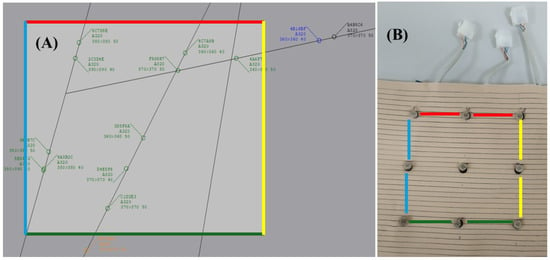
We use ATC-Labadvanced [42] (Australia), a public-access air traffic control simulation package. ATC-Labadvanced offers similar visualization features and participant interaction with the system to those used in an operational environment. The simulator includes the radar image of the airspace, and it allows the main interventions through data-com using keyboard and mouse (Figure 1A).
Figure 1.
Correspondence between the vibrators and the edges of the sector. In (A) it can be seen a screenshot of the ATC-Labadvanced simulator radar screen (active sector magnified). The circles represent the aircraft, along with information about each one of them. Aircraft under the control are green. Aircraft that are about to enter the sector are orange. Approaching aircraft that have not yet announced their entry are blue. Aircraft outside the sector are black. The black lines represent the routes that the aircraft are following. The information for each aircraft includes the callsign, model, current and intended altitude (/100) and speed (/10). The colors lines are a visual guide for the figure to indicate which column of motors vibrate in relation to the location of the incoming aircraft. In (B) it can be seen a picture of the waistband, with the vibrators in a 3 × 3 configuration. In color, the correspondence between the edges of the sector (A) and the vibrators (B).
The simulator allows the participants to accept aircraft in the airspace sector and transfer them to other sectors, as well as modify the altitude, speed and direction of the aircraft. The simulator also offers tools to obtain important information about the aircraft: a ruler to measure the horizontal separation between aircraft, route projection, time prediction and aircraft information labels. The active sector has dimensions of 400 × 250 nmi (nautical miles). There were no operational disruptions (i.e., weather restrictions) in the airspace and only A320 aircraft were included. The speed range of the aircraft was between 400 and 500 nmi per hour, and their altitudes were between 36,000 and 39,000 ft (feet). The objective of the task was to avoid conflicts between aircraft and to adhere to the flight plan. Aircraft conflicts occurred when the vertical separation between two aircraft was less than 1000 ft and the horizontal separation was less than 5 nmi. Participants could make changes to the altitude and speed of the aircraft in order to avoid conflicts. These changes had to be reversed before the aircraft left the sector to adhere to the flight plan.
2.2.2. Vibrotactile Alert Device
The vibrotactile device consisted of nine ERM vibrotactile motors arranged in a 3 × 3 configuration on a waistband (Figure 1B). The purpose of this device was to alert participants of aircraft entering their sector of the airspace. The vibrators were controlled by a National Instruments acquisition device (model NI USB-9162, Madrid, Spain), which sent the information to a power board for power supply the vibrators. We can modulate: (1) the vibration frequency of the motors, which produces different vibration intensities; (2) the duration of vibration pulses of the motors. In the experiments, vibrotactile signals were activated when an aircraft was announced to enter the airspace sector. Once aircraft were accepted for entry into the sector, the vibrations stopped. The functioning of each type of alert is explained in detail in the description of each of the experiments.
The edges of the airspace sector and the vibrators were matched so that the left column corresponded to the left edge of the sector, the top row to the top edge, the right column to the right edge, and the bottom row to the bottom edge (Figure 1). The vibrator in the center was left unused, as it had no function in this experiment. The operation of the device worked as follows. When an aircraft asked to be accepted into the sector, the motors began to vibrate depending on the area through which the airplane was entering (e.g., aircraft entering from the north activated the upper motors of the device.). Once the participant accepted the aircraft, the vibration stopped. If the aircraft had not been accepted, even if the aircraft was inside the sector, the vibrators continued to vibrate until the aircraft was accepted. Aircraft announced their entry into sector 119 s before reaching the edge of the sector.
2.2.3. Mental Workload (MWL) Questionnaires
We employed the Instantaneous Self-Assessment technique (ISA) [43,44] to assess MWL. Participants had to estimate their MWL every two minutes and could give values from 1 (very low) to 7 (very high).
2.3. Design
The type of alert, delivered through the vibrotactile waistband described in Section 2.2.2 and shown in Figure 1B, was the main independent variable in both experiments. Each type of alert will be explained in detail in the description of each experiment. All tasks were performed in a “high difficulty scenario” [45,46] with a density of 12 aircraft and 9 handoffs. In both experiments, participants had to manage a total of nine entries into the sector over the 16-min task duration.
As dependent variables we measured: (1) the response time from receipt of the alert until the aircraft is accepted into the sector; (2) the subjective MWL level by using ISA; (3) the overall performance by assessing the number of conflicts between aircraft within the sector.
2.4. Procedure
As a preliminary phase to the task, participants had a training phase of about 45 min. First, they read the instructions for the simulator. Afterwards, a verbal explanation was given and questions were answered. In the case of the participants who had to use the waistband for the vibrotactile alerts, a small test of the spatial location of the vibrators was done, so that they could clearly locate the edges of the sector on the waistband. Afterwards, participants performed a training scenario on the simulator. In this training scenario, participants operated the simulator following the researcher’s instructions and learned to control their sector of the airspace, read and manage relevant information from each aircraft, accept aircraft into their sector, release aircraft moving to another sector, and resolve potential conflicts between aircraft. In addition, participants were given an instruction sheet with the keyboard and mouse actions they could perform. Each participant performed the training scenario with the alert type for the aircraft entries to be used in the experimental scenario.
After the training phase, the task consisted of a 16-min scenario. Before the start of the scenario, a sheet was located at the top right of the screen with the flight plan information. During the performance of the task, participants had to report verbally on all the interventions they made on the scenario. The researcher acted as a virtual pilot, responding with “copy” to the participants’ verbal instructions. Every two minutes, the researcher asked the participant about the ISA estimate. The whole experimental session lasted approximately one hour.
2.5. Data Processing
We collected two types of information during each task: the ATC-Labadvance .logs and the MWL estimates. By analyzing the .log files using a Python (version 3.11.11) self-routine, the number of conflicts between aircraft inside the sector were obtained for each participant. In addition, during each task, the .log files were computed real-time to obtain the time points at which each sector entry warning occurred and the time points at which each aircraft were accepted. These time points were used to calculate response times for the alerts. The ISA questionnaire was manually registered by the researcher.
3. Experiment 1: Simple Vibrotactile vs. Visual Alert
As suggested in the general introduction, ATC is a complex and highly demanding task that places a significant strain on attentional and visual resources. Some of the information that an ATCO must process must necessarily be presented in a visual format (e.g., the position and properties of aircraft). However, other types of stimuli, such as alerts, could be conveyed through non-visual modalities. In this experiment, we explore the introduction of simple vibrotactile alerts (constant intensity and pulse) to alert ATCOs about in-sector handoffs. Since the vibrations specifically indicate events occurring at the sector boundaries, attentional resources can remain focused on managing intra-sector events.
In Experiment 1, we aim to compare vibrotactile with a visual alert to assess the extent to which vibrotactile alerts can influence performance, positively or negatively. Previous research has shown that vibrotactile alerts are generally highly effective at capturing attention [26,47,48,49]. Additionally, vibrotactile alerts can convey spatial information, which can help direct attention precisely to the event triggering the alert [15]. Studies have also indicated that vibrotactile alerts lead to improved performance compared to baseline conditions [26,27].
Moreover, as long as the task is highly complex and/or imposes a high demand on the visual system, vibrotactile alerts may outperform visual alerts [18,50,51]. However, the literature does not always align on this point, as some studies have found that visual alerts remain the superior alternative in certain scenarios [52,53]. Therefore, it is evident that further research is needed to explore the integration of vibrotactile alerts in ATC environments [54].
3.1. Materials and Method
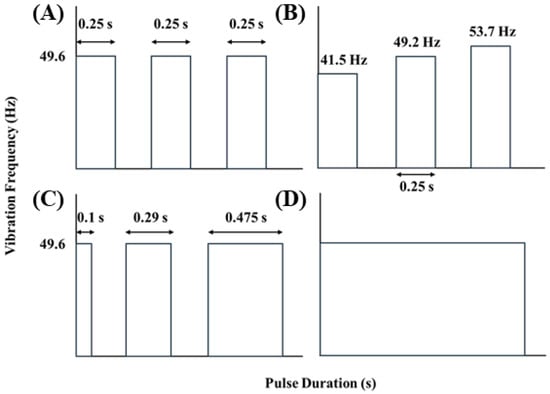
A total of 42 participants performed the experiment. Sample size was determined a priori using GLIMMPSE to ensure 80% statistical power. Participants were divided into two groups: the control group (visual alert) and the vibrotactile alert group. The vibrotactile alert consisted of pulses of constant duration and intensity. The duration of each pulse was 0.25 s and the vibration frequency was 49.6 Hz (see Figure 2A).
Figure 2.
Types of vibrotactile alerts. Note. A schematic representation of the four types of vibrotactile alerts. Simple vibrotactile alert by pulses of constant duration and intensity (A). This alert was used in Experiment 1. Gradual alert by pulses of variable intensity with constant duration (B). Gradual alert by pulses of variable duration with constant intensity (C). Constant continuous signal (D).
For the control group, the sector entry alert was visual, which is the default alert of the simulator. Aircraft that were still outside the sector but would enter it at some point appeared in blue. When the aircraft were ready to enter the sector, the color of the aircraft began to blink between orange and white. For the vibrotactile alert group, the visual alert was removed. Thus, aircraft remained blue when they were announced to enter the sector, and the alert was generated by the vibrators. Regardless of the type of alert, once the aircraft was accepted, the color turned green. For the control group, if the aircraft entered the sector without being accepted, the aircraft continued to blink between orange and white until accepted. For the vibrotactile alert group, if the aircraft entered the sector without being accepted, the color remained blue, and the vibration continued until the aircraft was accepted.
We used mixed models for statistical analysis using R with α = 0.05 to indicate significance. For each dependent variable, we verified that the model assumptions were met, such as normality, outliers, and dispersion (DHARMA package). In case of violation, the appropriate adjustments were made.
3.2. Results
Response time to entries in the sector. Response time was analyzed using a linear mixed-effects model fitted on a normalized response time measure, with alert modality (vibrotactile vs. visual) as fixed effect, aircraft handoff (nine per participant) as a covariate, and participant as a random intercept. The effect of alert modality was not statistically significant, (χ2(1) = 0.19, p = 0.67), indicating comparable response times between vibrotactile and visual alerts. Back-transformed estimated marginal means revealed similar response times for vibrotactile alerts (Table 1). To further assess whether the two alert modalities could be considered practically equivalent, an equivalence test was conducted on the normalized scale, defining equivalence as a difference not exceeding ±0.05. The equivalence test did not reach statistical significance (p = 0.52), and the 90% confidence interval of the contrast exceeded the predefined equivalence margin. This indicates that, although no statistically significant differences in response time were observed between vibrotactile and visual alerts, the data does not provide sufficient evidence to conclude practical equivalence within the specified margin.
Table 1.
Mean and Confident Interval of dependent variables for each type of alert.
ISA. Mental workload was assessed with a cumulative link mixed model including alert modality as fixed effects, time of the simulation as a covariate (8 assessments), and participant as a random intercept. The effect of alert modality was not statistically significant, indicating comparable levels of perceived mental workload between vibrotactile and visual alerts (χ2(1) = 0.30, p = 0.58). Descriptive statistics showed similar mean ISA scores for vibrotactile (M = 3.13, CI = [2.97–3.29]) and visual alerts (M = 3.33, CI = [3.12–3.53]). An equivalence test conducted on the log-odds scale, using a conservative ±10% equivalence margin (odds ratio ∈ [0.9, 1.1]), failed to demonstrate equivalence between alert modalities (p = 0.60), indicating that both alert types did not elicit equivalent levels of perceived mental workload.
Number of conflicts. We conducted a Poisson generalized linear mixed model with alert type as a fixed effect and participant as a random intercept. Overall, conflicts were relatively infrequent (M = 0.76), with approximately half of the observations corresponding to zero conflicts (51.5%). The omnibus test for alert type was not statistically significant, (χ2(4) = 6.60, p = 0.16), indicating that conflict rates did not differ reliably across alert designs. Model estimates suggested a tendency toward fewer conflicts for continuous vibrotactile alert (Figure 2D) compared to the simple vibrotactile alert (Figure 2A) (IRR = 0.30), although this effect did not reach conventional levels of statistical significance (p = 0.067). No other alert type showed a significant difference relative to the reference condition. Pairwise comparisons of estimated marginal means, adjusted for multiple testing, revealed no significant differences between alert types.
3.3. Discussion
In this experiment, we compared a simple vibrotactile alert (with constant pulse intensity and duration) to a visual alert (color changes in aircraft requesting entry into the sector). A high difficulty scenario was used, with nine predefined sector entries. The previous literature has often shown that when a task does not require excessive demands on attentional and visual resources, significant differences between visual and vibrotactile alerts are typically not observed [26,27]. Our results are consistent with previous studies [18,41,48,49], showing that participants allowed access to the sector earlier when vibrotactile alerts were used than when visual alerts were used.
On the other hand, the results showed that there were no significant differences between visual alerts and simple vibrotactile alerts in terms of MWL and task performance and neither significantly equivalent. This result is very important because it is useful for users to notice and respond to alerts, but this attention to alerts cannot impair performance or have other negative consequences. In other words, the vibrotactile alerts were easy to interpret and informative. The duration and frequency, together with the frontal location of the stimulation, were appropriate for its detection [55]. However, it is important to highlight that in [55], the different locations were tested around the waist in a horizontal correspondence with the locating device, whereas our device is in the frontal plane, in correspondence to the frontal radar screen.
Participants did not need to perform additional mental processes to understand what was happening or locate the conflict requiring their attention. That is, our vibrotactile alert appropriately informed of the location of the entering aircraft, a result coherent with previous research that showed how directional vibrotactile alerts outperform non directional and control conditions as well as reduce response times [56]. In addition, the vibrotactile alerts were not so intrusive that they interfered with the performance or resolution of other events that were occurring in parallel. Although these results are fully consistent with the previous literature [15,18,19], we expected better performance and lower MWL in the group that used vibrotactile alerts. These results would have indicated that participants were able to reorganize and allocate their cognitive and attentional resources to events occurring within the sector, since it was not necessary to check what was happening from the boundaries of the sector outward until the vibration was received. In other words, in agreement with previous results that showed that vibrotactile alerts can capture attention timely and without relying on previous visual information [57], we expected that simple vibrotactile alerts could divert or relieve the attentional and visual resources required by the ATC task producing a reduction in the number of conflicts and MWL.
Therefore, we can conclude that the use of vibrotactile alerts holds promising potential in ATC, given their minimal negative impacts and numerous benefits (i.e., they do not cause interference, increase MWL, or degrade performance). However, in this experiment we used ‘simple’ vibrotactile alerts, i.e., they did not change in intensity or pulse duration. Although these simple alerts informed participants of the existence and location of an event requiring their attention, the fact is that participants did not know the level of urgency or severity of such an alert. For this reason, the release of attentional resources was not total, as it was always necessary to be aware of how much time the participants had to allow the aircraft to enter their sector. Therefore, the inclusion of gradual vibrotactile alerts that inform about the degree of urgency may be a good candidate to improve performance and reduce the mental load of ATCOs.
4. Experiment 2: The Inclusion of Gradual Alerts
Ref. [4] highlighted the potential benefits of incorporating graduality into alert systems to indicate the severity, urgency, and/or likelihood of a conflict [41,58,59]. This approach not only captures attention but also allows ATCOs to manage their response time based on the intensity of the alert. In the domain of vibrotactile stimulation, several studies have explored how vibration frequency, intensity, and pulse duration can be modulated [28,60]. For instance, ref. [25] conducted a study using eight different vibrotactile sets to alert intensive care unit staff to different emergencies. Their findings indicated that vibrotactile patterns with pulse duration modulation were more informative than those using intensity variations. It is important, however, to consider the trade-off shown in [61] between the reduction in response times and the poorer user experience reported on gradual vibrotactile alerts. Despite user experience is out of the scope of our study, we will study the possibility of such a trade-off over the MWL of our participant in relation to gradual vibrotactile alerts.
In a context more closely related to ATC, ref. [19] compared a visual alert, a constant vibrotactile alert, and a gradual vibrotactile alert (modulating pulse rate) to warn pilots about adverse weather conditions. Although vibrotactile alerts enabled a faster response, no significant differences were observed between the constant and gradual vibrotactile alerts. However, this was likely because pilots responded immediately to the alert, preventing the gradual alert from developing over time.
In Experiment 2, we introduced a continuous vibrotactile alert and two types of gradual vibrotactile alert: (1) a constant-intensity alert with an increasing pulse rate and (2) a constant-duration pulse alert with increasing intensity. Since handoffs do not demand the same immediate attention and action as in-sector events or conflicts, we expected participants to leverage the gradual alert modulation to manage their visual and attentional resources more efficiently. Compared to the previous experiment, we anticipated longer response times in accepting aircraft in the sector for gradual alerts relative to constant and visual alerts. However, we expected a lower MWL and an improvement in overall performance.
4.1. Materials and Method
Since this experiment used different vibrotactile signals with different intensities and pulse duration, it was necessary to carry out psychophysical tests. These tests help us to determine whether the participants were able to perceive and discriminate the range of stimulation values proposed by the researchers. Depending on the type of vibrotactile signal, some signals varied the intensity of the vibratory impulses while keeping the duration constant. On the other hand, the other signals changed the duration of the pulses while keeping the intensity constant. In the ATC experiment, these changes in the vibrotactile stimulation depend on the proximity of the aircraft to the edge of the sector. Therefore, the closer the aircraft to boundaries of the sector, the greater the signal intensity or the pulse duration.
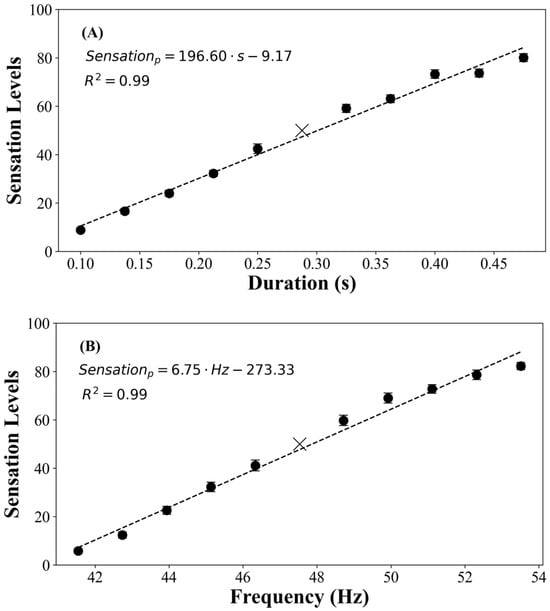
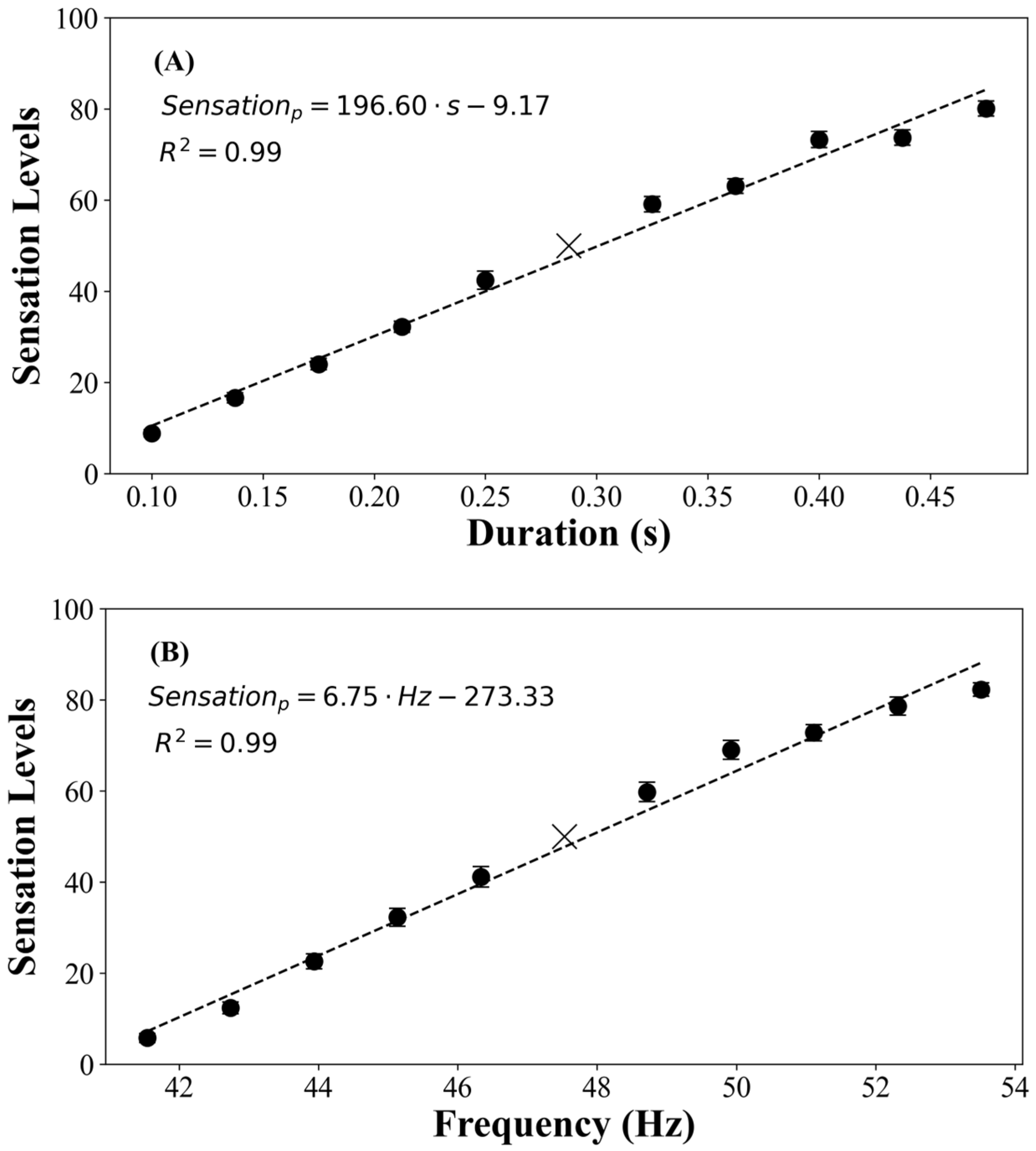
11 students participated exclusively in the psychophysical tests. All the participants performed two psychophysical magnitude estimation tests: the pulse intensity test and the pulse duration test in a random order. For the pulse duration values test, a vibration of 49.6 Hz of intensity was displayed but we modulated the duration of the pulse ranging from 0.1 s to 0.475 s. We discretized this range into 11 values in steps of 0.0375 s. We used the intermediate value of 0.2875 s as a reference for the magnitude estimation task. Therefore, this pulse duration was given the subjective value of 50. Participants were asked to provide a subjective value based on the pulse duration reference (e.g., if the duration of the experienced pulse was twice the reference, it would be expected to receive a subjective value of 100). The order of presentation of the rest of the pulses was randomized and each stimulus was repeated five times. The reference was displayed and informed to the participants after the presentation of five stimuli. For the pulse intensity values test, we used a single pulse duration of 0.25 s with a range of intensity values between 41.54 and 53.51 Hz. The reference value was 47.53 Hz, and the procedure was the same as the previously mentioned test. Finally, these two tests allowed us to establish the range of stimulation for the ATC experiment.
Back to the ATC experiment, for Experiment 2, 65 participants performed the experiment. Participants were divided into five groups with 13 participants per group: (1) simple vibrotactile alerts (constant intensity of 49.6 Hz and duration of 0.25 s, Figure 2A); (2) gradual vibrotactile alert by pulses of variable intensity (linear increase from 42.1 to 52.8 Hz in pulses of 0.25 s, Figure 2B); (3) gradual vibrotactile alert by pulses of variable duration (linear increase from 0.1 to 0.475 s of the pulse with a constant intensity of 49.6 Hz, Figure 2C); (4) vibrotactile alert by constant continuous signal (continuous signal of 49.6 Hz, Figure 2D); (5) visual alerts (color-changes). In the event that an aircraft crossed the sector border without being accepted, the alerts maintained the maximum value of intensity or duration.
For this experiment, we used a slightly modified version of the scenario used in Experiment 1. The scenario contained nine entries but, in this experiment, there were simultaneous entries from different locations (e.g., one from the south and one from the east). The scenario lasted 16 min, and prior to the experiment, participants received the same instruction and familiarization with the simulator as in Experiment 1.
We processed the data in the same way as in Experiment 1 and used RStudio (version (2025.09.1+401) and α = 0.05 for the statistical analysis. We conducted mixed models to analyze the influence of the type of alerts on the same dependent variables. We revised the model assumptions through DHARMa package (normality, outliers, etc.) and perform appropriate transformations and analysis. We expected longer response times for the gradual alerts, but lower MWL and higher performance than simple vibrotactile and visual alerts.
4.2. Results
Psychophysical testing of the devices (Figure 3). For the pulse duration psychophysical test, participants were able to discriminate the steps of the duration range in a random order with high sensitivity (R2 = 0.99). The same happened for the pulse intensity values test (R2 = 0.99). Therefore, these results support the use of the ranges of stimulation for the ATC experiment.
Figure 3.
Results of the two psychophysical tests. Results of the psychophysical magnitude estimation tasks for the pulse duration test with constant intensity (A) and for the pulse intensity test with constant duration (B). The black dots represent the mean value for each stimulus value. The dashed line shows the linear regression. The reference value was included by a cross as a visual guide. Finally, the linear regression equations and the R2 for each type of stimulation were also included. Participants were able to perceive and discriminate the changes in stimulation with great accuracy.
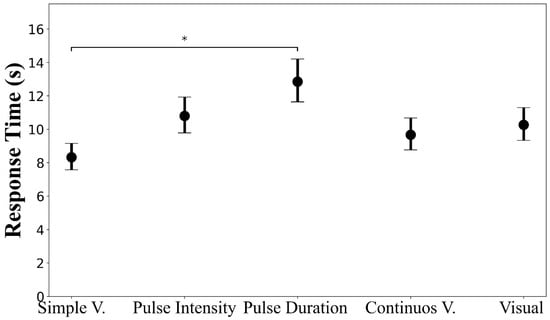
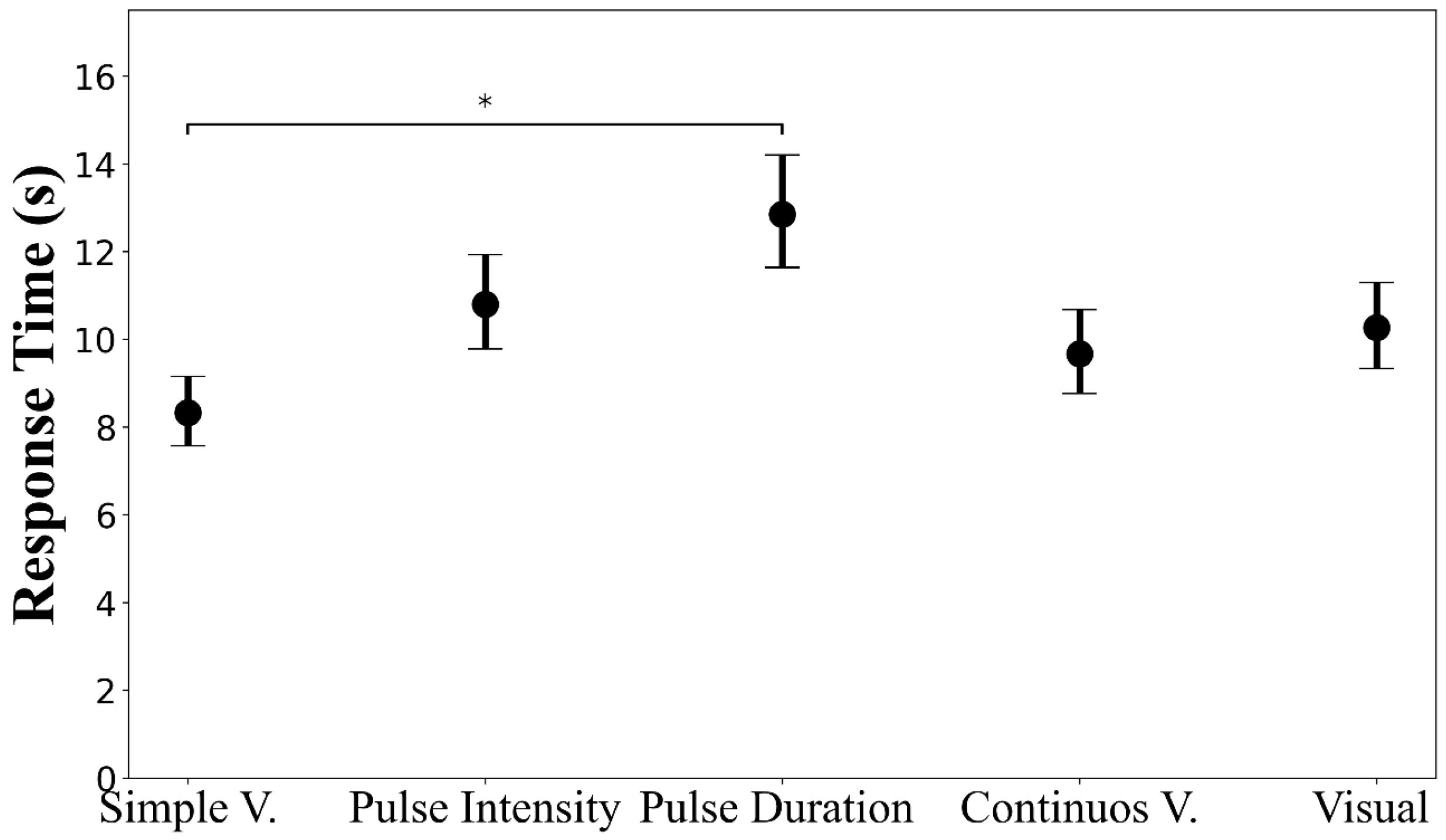
Response time. We conducted a linear mixed-effects model fitted on log-transformed and winsorized response times, with alert type as fixed effect, aircraft handoff (9 entries per participant) as a covariate, and participant as a random intercept. A significant main effect of alert type was observed (χ2(4) = 10.52, p = 0.033), indicating that response times differed across alert types. Post hoc comparisons revealed that response times were significantly longer (t = −3.15, p = 0.021) for vibrotactile alert by pulses of variable duration (Figure 2C) compared to the simple vibrotactile alert (Figure 2A), whereas no other pairwise comparisons reached statistical significance (Table 1). Estimated response times and their corresponding confidence intervals are shown in Figure 4. The overall response time was 10.38 s (SD = 1.65).
Figure 4.
Response time across the type of alerts. Error bars represent the SEM. There was a significant difference between simple vibrotactile alerts and vibrotactile alerts with changes in pulse duration. The asterisk represents significant differences between these groups.
ISA. We assessed the MWL with a cumulative link mixed model including alert modality as fixed effects, time of the simulation as a covariate (8 assessments), and participant as a random intercept. The effect of type of alert was not statistically significant (χ2(4) = 1.08, p = 0.89), indicating comparable levels of perceived mental workload between simple vibrotactile, gradual vibrotactile and visual alerts. The overall ISA score was 3.71 (SD = 1.35).
Number of conflicts. We conducted a Poisson generalized linear mixed model with alert type as a fixed effect and participant as a random intercept. Overall, conflicts were relatively infrequent (M = 0.76), with approximately half of the observations corresponding to zero conflicts (51.5%) (see Table 1). The omnibus test for alert type was not statistically significant, (χ2(4) = 6.60, p = 0.16), indicating that the number of conflicts did not differ reliably across alert types.
4.3. Discussion
In this experiment, we introduced continuous vibrotactile and gradual alerts with changes in intensity or pulse duration to examine how these manipulations affected task performance. As discussed in the introduction, for an alert to be considered effective rather than a nuisance alert, it must provide the highest possible level of information while remaining within the limited resources allocated for its processing [3,4,5]. Gradual alerts not only signal the occurrence of an event that requires the attention of the ATCO (i.e., the presence or absence of the alert) and the location of the event if spatial information is embedded, but they also convey additional information about the severity, urgency, or likelihood through gradual modulation of the event. The integration of these three information components can significantly alleviate the attentional demands placed on the ATCO. Therefore, gradual alerts can be considered as having greater potential to serve as effective alerts [4,5,19].
The first step in Experiment 2 was to conduct a psychophysical test prior to the ATC task to determine whether users could discriminate changes in both intensity (by increasing the motor rotation frequency) and pulse duration (by extending the vibration duration of the motors). Results demonstrated that participants were able to reliably discriminate both increases and decreases in stimulation duration and intensity, achieving an R2 value of 0.99. As noted in the introduction, a critical factor for ensuring alert effectiveness is their perceptibility [3,4,5]. A key challenge of gradual alerts is ensuring that users can perceive the full range of stimulation. If this is not the case, there would be no meaningful difference between simple and gradual alerts. In the case of auditory alerts, ATC environments are often noisy, making it difficult to implement gradual modulation without generating excessive noise levels or discomfort for the alert recipient [14].
In the previous literature, gradual alerts have been found to be more effective than simple alerts. For example, ref. [25] demonstrated that intensive care unit staff often disregard alerts due to the overwhelming frequency of generic and simple notifications, making it difficult to effectively respond. To address this issue, they introduced vibrotactile alerts, which did not interfere with other signals or stimuli related to primary work activities. They also examined different types of gradual modulation. Participants were able to allocate their resources more efficiently, prioritizing the most urgent events thanks to the gradual nature of the alerts.
Our hypotheses about the effects of gradual changes were not completely supported. On the one hand, we expected response times to gradual alerts to be longer, as participants could detect the urgency of the alert, devoting resources to resolving more severe intra-sector conflicts. However, there were only differences between simple vibrotactile alerts and alerts with gradual changes in pulse duration. This result was expected since, if the gradual change was in duration, participants in this group had to wait for the pulse to end to detect how imminent the entry into the sector was, which increased the response time. However, in the alert with gradual changes in intensity, participants responded earlier. In general, participants tried to enter the sector as quickly as possible, preventing the alert from evolving. This result is in line with [19]. In their study, pilots wore a smartwatch that alerted them to meteorological hazards using visual, simple vibrotactile, or gradual vibrotactile alerts. While the alerts were informative and perceived as useful, the gradual increase in alert intensity was not leveraged for a more efficient response. In other words, pilots responded almost immediately to the alert.
We observed the same pattern in our study, with participants responding to the alert in an average of 10.38 s. It is important to recall that the alert started 119 s before the aircraft physically entered the sector, meaning that all changes in alert gradation were distributed over this period. In 10.38 s, there was barely enough time for the user to experience the alert’s evolution. Therefore, both in [19] and in our study, the gradual nature of the alerts served as an additional source of information that was largely disregarded. One possible explanation is the salience of vibrotactile alerts. In other words, we are accustomed to visual and/or acoustic alerts, but not to salient vibrotactile stimulation. Therefore, when we receive this stimulation, all our attention may be focused on responding to it as quickly as possible. In the future, it would be interesting to investigate whether, once users are more accustomed to these alerts, they would use the gradient to better manage their resources.
Another striking result was the increase in response times from one experiment to another. In Experiment 1, we saw that sector entry was accepted at an average of 5.36 s with simple vibrotactile alerts and at 5.56 s with visual alerts. In Experiment 2, response time increased for these two types of alerts (simple pulse = 8.33 s; visual alert = 10.26 s). On the other hand, continuous and gradual alerts took a few extra seconds to respond to (intensity changes = 10.80 s; pulse duration changes = 12.85 s; continuous alert = 9.67 s). The difference between experiments may be due to the changes we proposed in Experiment 2. In other words, although the nine entries into the sector were maintained, several of them occurred simultaneously. This effect increased the difficulty of the task, causing a general delay in the acceptance of aircraft into the sector.
Our main explanation for this phenomenon lies in the changes we made to the scenario. The scenario remained “high difficulty” [46,47] and maintained nine scheduled aircraft entries and exits, the fact is that we changed the timing of these entries into the sector. In other words, unlike Experiment 1, in this scenario multiple requests to enter the sector could be made by different aircraft at different boundaries of the sector. The idea behind this modification was that participants would use the gradual changes in the alert to their advantage to play with the urgency of the event, but this did not happen. Nevertheless, it is worth noting that under conditions involving simultaneous aircraft entries, visual alerts could be expected to provide greater support to ATCOs, given the higher spatial and temporal resolution of the visual system. For instance, if one aircraft was entering the sector from the north and another from the east, visual information would allow controllers to identify both events and their associated urgency in a rapid and nearly effortless manner. In contrast, when relying on vibrotactile alerts, additional time and cognitive resources might be required to determine which motors are vibrating (e.g., the upper row corresponding to an aircraft entering from the north and the right column to an aircraft approaching from the east) and to assess the available margin for accepting aircraft into the sector. Despite these potential limitations, participants were able to extract the relevant information from the vibrotactile alerts and respond just as promptly as when visual alerts were used. In fact, consistent with the findings of Experiment 1, the fastest response times were observed with simple vibrotactile alerts, possibly due to their high perceptual salience.
As discussed previously, participants did not appear to take advantage of the inclusion of gradual alerts. This pattern is also reflected in the absence of significant changes in MWL and in the number of conflicts within the scenario. We originally expected that gradual alerts would help offload and more effectively redirect cognitive resources toward events occurring within the sector. However, participants tended to authorize aircraft entry as quickly as possible, regardless of the type of alert presented (even when the alert was visual).
Thus, similar to the findings reported by [19], participants did not exploit the gradual nature of the alerts to their advantage but rather appeared to treat alerts as events that required an immediate response and needed to be resolved as quickly as possible. Nevertheless, even though our hypothesis was not supported, the absence of an increase in MWL and in the number of conflicts following the introduction of vibrotactile alerts constitutes a promising result. For future experiments, it would be worthwhile to design a paradigm with a substantially longer familiarization period with gradual alerts, allowing users to fully learn and make effective use of the information conveyed by this type of alert.
This study has two main limitations. First, the participants had no prior experience with ATC tasks. Although they were university students with higher cognitive resources than the general population, their organization and management of these resources likely differed significantly from those of expert ATCOs. Nonetheless, the introduction of vibrotactile alerts (both simple and gradual) remains an underexplored field, making it reasonable to conduct exploratory studies with more specifically trained accessible samples.
Second, it is possible that visual and/or vibrotactile alerts (simple or gradual) captured and directed participants’ attention more effectively when no other alerts required a response. Future research should move toward more realistic scenarios, incorporating greater environmental noise, the presence of both visual and auditory alerts, and the need for simultaneous communication with pilots or other ATCOs while responding to vibrotactile alerts. This would allow us to determine whether vibrotactile alerts are truly effective or whether they risk becoming nuisance alerts.
Moving towards a practical implementation of vibrotactile alert systems in real-world air traffic environments would require validation studies with professional ATCOs in realistic environments. In this context, studies must accomplish restrictions on the number of participants and possible experimental conditions. Our study supports the introduction of simple vibrotactile alerts with spatial information concerning the position of the event in the controlled area without including looming information, as the alert system can induce fast response without increasing MWL on the ATCOs.
5. Conclusions
In this study, we supported the idea that vibrotactile alerts can convey spatial information about the location of an event that requires a response. Additionally, vibrotactile alerts tend to elicit faster responses compared to visual alerts. Although many researchers and active ATCOs have advocated for the inclusion of gradual alerts, the effective utilization of gradual vibrotactile alerts has yet to be demonstrated. In contrast, gradual visual and auditory alerts have yielded positive effects on performance. Finally, we have provided further evidence that vibrotactile alerts have the capacity to capture and direct the user’s attention to the event triggering the alert. By utilizing a perceptual channel that is largely untapped in ATC, these alerts are non-invasive and do not appear to increase MWL or degrade performance. Therefore, we believe that this line of research should be pursued further to better understand how to maximize the benefits of gradual vibrotactile alerts.
Author Contributions
C.d.P.: Conceptualization, Methodology, Software, Validation, Formal analysis, Investigation, Data Curation, Writing—Original Draft, Review & Editing, Visualization. A.M.: Methodology, Software, Formal analysis, Investigation, Data Curation. P.L.d.F.: Validation, Resources, Writing—Review & Editing, Supervision, Project administration, Funding acquisition. D.T.: Conceptualization, Methodology, Validation, Formal analysis, Resources, Writing—Original Draft, Review & Editing, Supervision, Project administration, Funding acquisition. All authors have read and agreed to the published version of the manuscript.
Funding
This research was funded by a research contract involving UAM, ENAIRE, and CRIDA (B.O.E.: 164, 11 July 2023; section III, p. 100986; resolution 16131; https://www.boe.es/boe/dias/2023/07/11/pdfs/BOE-A-2023-16131.pdf).
Institutional Review Board Statement
The study was conducted in accordance with the Declaration of Helsinki, and approved by the Institutional Review Board at Autonomous University of Madrid (protocol code: UAM-CEI-110-2163, date of approval: 9 May 2025).
Informed Consent Statement
Informed consent was obtained from all subjects involved in the study.
Data Availability Statement
The data presented in this study are available on request from the corresponding author. The data is not publicly available due to privacy or ethical restrictions.
Conflicts of Interest
Author Patricia López de Frutos was employed by the company CRIDA. The remaining authors declare that the research was conducted in the absence of any commercial or financial relationships that could be construed as a potential conflict of interest. The funders had no role in the design of the study; in the collection, analyses, or interpretation of data; in the writing of the manuscript; or in the decision to publish the results.
Abbreviations
The following abbreviations are used in this manuscript:
| ATCO | Air Traffic Controller |
| ATC | Air Traffic Control |
| MWL | Mental Workload |
| MSAW | Minimum Safe Altitude Warning |
| CA | Conflict Alert |
| STCA | Short-Term Conflict Alert |
| ERM | Eccentric Rotating Mass |
| ISA | Instantaneous Self-Assessment |
References
- Pagnotta, M.; Jacobs, D.M.; De Frutos, P.L.; Rodríguez, R.; Ibáñez-Gijón, J.; Travieso, D. Task difficulty and physiological measures of mental workload in air traffic control: A scoping review. Ergonomics 2022, 65, 1095–1118. [Google Scholar] [CrossRef] [Scilit]
- Endsley, M.R.; Garland, D.J. Situation Awareness Analysis and Measurement; CRC Press: Boca Raton, FL, USA, 2000. [Google Scholar]
- Ruskin, K.J.; Corvin, C.; Rice, S.; Richards, G.; Winter, S.R.; Clebone Ruskin, A. Alarms, alerts, and warnings in air traffic control: An analysis of reports from the Aviation Safety Reporting System. Transp. Res. Interdiscip. Perspect. 2021, 12, 100502. [Google Scholar] [CrossRef] [Scilit]
- Allendoerfer, K.R.; Friedman-Berg, F.; Pai, S. Human Factors Analysis of Safety Alerts in Air Traffic Control; No. DOT/FAA/TC-07/22; United States. Department of Transportation. Federal Aviation Administration. William J. Hughes Technical Center: Washington, DC, USA, 2007.
- Allendoerfer, K.R.; Pai, S.; Friedman-Berg, F.J. The Complexity of Signal Detection in Air Traffic Control Alert Situations. Proc. Hum. Factors Ergon. Soc. Annu. Meet. 2008, 52, 54–58. [Google Scholar] [CrossRef] [Scilit]
- Wickens, C.D. Multiple resources and performance prediction. Theor. Issues Ergon. Sci. 2002, 3, 159–177. [Google Scholar] [CrossRef] [Scilit]
- Wickens, C.D. Multiple Resources and Mental Workload. Hum. Factors 2008, 50, 449–455. [Google Scholar] [CrossRef] [Scilit] [PubMed]
- Wickens, C.D. The Multiple Resource Theory and Model. Some Misconceptions in Data Interpretations. Proc. Hum. Factors Ergon. Soc. Annu. Meet. 2024, 68, 713–717. [Google Scholar] [CrossRef] [Scilit]
- Imbert, J.P.; Hodgetts, H.M.; Parise, R.; Vachon, F.; Dehais, F.; Tremblay, S. Attentional costs and failures in air traffic control notifications. Ergonomics 2014, 57, 1817–1832. [Google Scholar] [CrossRef] [Scilit]
- Ngo, M.K.; Pierce, R.S.; Spence, C. Using Multisensory Cues to Facilitate Air Traffic Management. Hum. Factors 2012, 54, 1093–1103. [Google Scholar] [CrossRef] [Scilit]
- Saint-Lot, J.; Imbert, J.P.; Dehais, F. Red Alert: A Cognitive Countermeasure to Mitigate Attentional Tunneling. In Proceedings of the 2020 CHI Conference on Human Factors in Computing Systems, Honolulu, HI, USA, 25–30 April 2020; pp. 1–6. [Google Scholar] [CrossRef] [Scilit]
- Ruskin, A.; Moore, L.; Kaufmann, K.; Willems, B.; Ruskin, K.J. Creation of a novel microburst alarm for Air Traffic Control using a signal design framework. Transp. Res. Interdiscip. Perspect. 2024, 27, 101239. [Google Scholar] [CrossRef] [Scilit]
- Sarter, N.B. Graded and Multimodal Interruption Cueing in Support of Preattentive Reference and Attention Management. Proc. Hum. Factors Ergon. Soc. Annu. Meet. 2005, 49, 478–481. [Google Scholar] [CrossRef] [Scilit]
- Vicki, A.; Panjwani, G. Auditory Alarms in an Airway Facilities Environment; No. DOT/FAA/CT-TN04/4; Department of Transportation. Federal Aviation Administration. William J. Hughes Technical Center: Washington, DC, USA, 2003.
- Hameed, S.; Jayaraman, S.; Ballard, M.; Sarter, N. Guiding Visual Attention by Exploiting Crossmodal Spatial Links: An Application in Air Traffic Control. Proc. Hum. Factors Ergon. Soc. Annu. Meet. 2007, 51, 220–224. [Google Scholar] [CrossRef] [Scilit]
- Hameed, S.; Ferris, T.; Jayaraman, S.; Sarter, N. Using Informative Peripheral Visual and Tactile Cues to Support Task and Interruption Management. Hum. Factors 2009, 51, 126–135. [Google Scholar] [CrossRef] [Scilit]
- Montes, A.; Ibáñez-Gijón, J.; de Paz, C.; Frutos, P.; Travieso, D. Vibrotactile signals for enroute controllers to ease air traffic conflict detection. Behav. Inf. Technol. 2026; under review.
- Sklar, A.E.; Sarter, N.B. Good Vibrations: Tactile Feedback in Support of Attention Allocation and Human-Automation Coordination in Event-Driven Domains. Hum. Factors 1999, 41, 543–552. [Google Scholar] [CrossRef] [Scilit]
- Tippey, K.G.; Roady, T.; Rodriguez-Paras, C.; Brown, L.J.; Rantz, W.G.; Ferris, T.K. General Aviation Weather Alerting: The Effectiveness of Different Visual and Tactile Display Characteristics in Supporting Weather-Related Decision Making. Int. J. Aerosp. Psychol. 2017, 27, 121–136. [Google Scholar] [CrossRef] [Scilit]
- Spence, C. The Skin as a Medium for Sensory Substitution. Multisensory Res. 2014, 27, 293–312. [Google Scholar] [CrossRef] [Scilit]
- Gray, R.; Ho, C.; Spence, C. A Comparison of Different Informative Vibrotactile Forward Collision Warnings: Does the Warning Need to Be Linked to the Collision Event? PLoS ONE 2014, 9, e87070. [Google Scholar] [CrossRef] [Scilit] [PubMed]
- Ho, C.; Reed, N.; Spence, C. Multisensory In-Car Warning Signals for Collision Avoidance. Hum. Factors 2007, 49, 1107–1114. [Google Scholar] [CrossRef] [Scilit] [PubMed]
- Meng, F.; Spence, C. Tactile warning signals for in-vehicle systems. Accid. Anal. Prev. 2015, 75, 333–346. [Google Scholar] [CrossRef] [Scilit] [PubMed]
- Alirezaee, P.; Weill-Duflos, A.; Schlesinger, J.J.; Cooperstock, J.R. Exploring the Effectiveness of Haptic Alarm Displays for Critical Care Environments. In Proceedings of the 2020 IEEE Haptics Symposium (HAPTICS), Crystal City, VA, USA, 28–31 March 2020; pp. 948–954. [Google Scholar] [CrossRef] [Scilit]
- Cobus, V.; Ehrhardt, B.; Boll, S.; Heuten, W. Vibrotactile Alarm Display for Critical Care. In Proceedings of the 7th ACM International Symposium on Pervasive Displays, Munich, Germany, 6–8 June 2018; pp. 1–7. [Google Scholar] [CrossRef] [Scilit]
- Chai, C.; Shi, J.; Wu, C.; Zhou, Y.; Zhang, W.; Liao, J. When to use vibrotactile displays? A meta-analysis for the role of vibrotactile displays in human–computer interaction. Appl. Ergon. 2022, 103, 103802. [Google Scholar] [CrossRef] [Scilit]
- Prewett, M.S.; Elliott, L.R.; Walvoord, A.G.; Coovert, M.D. A Meta-Analysis of Vibrotactile and Visual Information Displays for Improving Task Performance. IEEE Trans. Syst. Man Cybern. C 2012, 42, 123–132. [Google Scholar] [CrossRef] [Scilit]
- Jones, L.A.; Sarter, N.B. Tactile Displays: Guidance for Their Design and Application. Hum. Factors 2008, 50, 90–111. [Google Scholar] [CrossRef] [Scilit]
- Ho, C.Y.; Nikolic, M.I.; Waters, M.J.; Sarter, N.B. Not Now! Supporting Interruption Management by Indicating the Modality and Urgency of Pending Tasks. Hum. Factors 2004, 46, 399–409. [Google Scholar] [CrossRef]
- Lu, S.A.; Wickens, C.D.; Prinet, J.C.; Hutchins, S.D.; Sarter, N.; Sebok, A. Supporting Interruption Management and Multimodal Interface Design: Three Meta-Analyses of Task Performance as a Function of Interrupting Task Modality. Hum. Factors 2013, 55, 697–724. [Google Scholar] [CrossRef] [Scilit]
- Friedman-Berg, F.; Allendoerfer, K.; Pai, S. Nuisance Alerts in Operational ATC Environments: Classification and Frequencies. Proc. Hum. Factors Ergon. Soc. Annu. Meet. 2008, 52, 104–108. [Google Scholar] [CrossRef] [Scilit]
- Wickens, C.D.; Dixon, S.R. The benefits of imperfect diagnostic automation: A synthesis of the literature. Theor. Issues Ergon. Sci. 2007, 8, 201–212. [Google Scholar] [CrossRef] [Scilit]
- Sanquist, T.F.; Thurman, D.A.; Mahy, H.A. The Human Element in Homeland Security Systems: Application Issues and Research Needs. Proc. Hum. Factors Ergon. Soc. Annu. Meet. 2005, 49, 913–917. [Google Scholar] [CrossRef] [Scilit]
- Wickens, C.D.; Rice, S.; Keller, D.; Hutchins, S.; Hughes, J.; Clayton, K. False Alerts in Air Traffic Control Conflict Alerting System: Is There a “Cry Wolf” Effect? Hum. Factors 2009, 51, 446–462. [Google Scholar] [CrossRef] [Scilit] [PubMed]
- Keller, D.; Rice, S. System-Wide versus Component-Specific Trust Using Multiple Aids. J. Gen. Psychol. 2009, 137, 114–128. [Google Scholar] [CrossRef] [Scilit]
- Rice, S.; Geels, K. Using System-Wide Trust Theory to Make Predictions About Dependence on Four Diagnostic Aids. J. Gen. Psychol. 2010, 137, 362–375. [Google Scholar] [CrossRef] [Scilit] [PubMed]
- Dixon, S.R.; Wickens, C.D. Automation Reliability in Unmanned Aerial Vehicle Control: A Reliance-Compliance Model of Automation Dependence in High Workload. Hum. Factors 2006, 48, 474–486. [Google Scholar] [CrossRef] [Scilit]
- Rovira, E.; Parasuraman, R. Transitioning to Future Air Traffic Management: Effects of Imperfect Automation on Controller Attention and Performance. Hum. Factors 2010, 52, 411–425. [Google Scholar] [CrossRef] [Scilit]
- Ruskin, K.J.; Corvin, C.; Rice, S.C.; Winter, S.R. Autopilots in the Operating Room: Safe Use of Automated Medical Technology. Anesthesiology 2020, 133, 653–665. [Google Scholar] [CrossRef] [Scilit] [PubMed]
- Maltz, M.; Meyer, J. Use of Warnings in an Attentionally Demanding Detection Task. Hum. Factors 2001, 43, 217–226. [Google Scholar] [CrossRef] [Scilit]
- Parasuraman, R.; Riley, V. Humans and Automation: Use, Misuse, Disuse, Abuse. Hum. Factors 1997, 39, 230–253. [Google Scholar] [CrossRef] [Scilit]
- Fothergill, S.; Loft, S.; Neal, A. ATC-lab Advanced: An air traffic control simulator with realism and control. Behav. Res. Methods 2009, 41, 118–127. [Google Scholar] [CrossRef] [Scilit]
- Jordan, C.S.; Brennen, C.D. Instantaneous Self-Assessment of Workload Technique (ISA); Defence Research Agency: Arlington, VA, USA, 1992.
- Tattersall, A.J.; Foord, P.S. An experimental evaluation of instantaneous self-assessment as a measure of workload. Ergonomics 1996, 39, 740–748. [Google Scholar] [CrossRef] [Scilit]
- De Frutos, P.L.; Rodríguez, R.R.; Zhang, D.Z.; Zheng, S.; Cañas, J.J.; Muñoz-de-Escalona, E. COMETA: An Air Traffic Controller’s Mental Workload Model for Calculating and Predicting Demand and Capacity Balancing. In Human Mental Workload: Models and Applications; Springer: Cham, Switzerland, 2019; pp. 85–104. [Google Scholar] [CrossRef] [Scilit]
- Ibáñez-Gijón, J.; Travieso, D.; Navia, J.A.; Montes, A.; Jacobs, D.M.; Frutos, P.L. Experimental validation of COMETA model of mental workload in air traffic control. J. Air Transp. Manag. 2023, 108, 102378. [Google Scholar] [CrossRef] [Scilit]
- Kingsley, C.; Thiry, E.; Flowers, A.; Jenkins, M. Augmented Riding: Multimodal Applications of AR, VR, and MR to Enhance Safety for Motorcyclists and Bicyclists. In Proceedings of the HCI International 2020—Late Breaking Papers: Virtual and Augmented Reality, Copenhagen, Denmark, 19–24 July 2020; Springer: Cham, Switzerland, 2020; pp. 356–367. [Google Scholar] [CrossRef] [Scilit]
- Migliorini, Y.; Imbert, J.P.; Baragona, V.; Roy, R.N.; Dehais, F. Neuroergonomic Evaluation of A Genuine Air Traffic Control Alert. 2021. Available online: https://neuroergonomicsconference.um.ifi.lmu.de/wp-content/uploads/submissions/146.pdf (accessed on 14 April 2025).
- Ng, A.W.; Chan, A.H. Finger response times to visual, auditory and tactile modality stimuli. Int. Multiconference Eng. Comput. Sci. 2012, 2, 1449–1454. [Google Scholar]
- Souza, G.A.D.; Torres, L.A.; Dani, V.S.; Villa, D.S.; Larico, A.T.; Maciel, A.; Nedel, L. Evaluation of Visual, Auditory and Vibro-Tactile Alerts in Supervised Interfaces. In Proceedings of the 2018 20th Symposium on Virtual and Augmented Reality (SVR), Foz do Iguacu, Brazil, 28–30 October 2018; IEEE: New York, NY, USA, 2018; pp. 163–169. [Google Scholar] [CrossRef] [Scilit]
- Van Erp, J.B.F.; Van Veen, H.A.H.C. Vibrotactile in-vehicle navigation system. Transp. Res. F Traffic Psychol. Behav. 2004, 7, 247–256. [Google Scholar] [CrossRef] [Scilit]
- Hecht, D.; Reiner, M. Sensory dominance in combinations of audio, visual and haptic stimuli. Exp. Brain Res. 2009, 193, 307–314. [Google Scholar] [CrossRef] [Scilit]
- Samsel, Z.; Gunia, A.; Jäger, M.I.; Schöning, J. A comparison of vibrotactile patterns in an early warning system for obstacle detection using a haptic vest. Appl. Ergon. 2025, 122, 104396. [Google Scholar] [CrossRef] [Scilit] [PubMed]
- DeLucia, P.R.; Greenlee, E.T. Tactile Vigilance Is Stressful and Demanding. Hum. Factors 2022, 64, 732–745. [Google Scholar] [CrossRef] [Scilit]
- Cholewiak, R.W.; Brill, J.C.; Schwab, A. Vibrotactile localization on the abdomen: Effects of place and space. Percept. Psychophys. 2004, 66, 970–987. [Google Scholar] [CrossRef] [Scilit]
- Shi, J.; Wu, C.; Zheng, H.; Zhang, W.; Zhang, X.; Lu, P.; Chai, C. Toward hazard or action? Effects of directional vibrotactile takeover requests on takeover performance in automated driving. Int. J. Hum. Comput. Interact. 2023, 39, 3786–3801. [Google Scholar] [CrossRef] [Scilit]
- Fitch, G.M.; Hankey, J.M.; Kleiner, B.M.; Dingus, T.A. Driver comprehension of multiple haptic seat alerts intended for use in an integrated collision avoidance system. Transp. Res. Part F Traffic Psychol. Behav. 2011, 14, 278–290. [Google Scholar] [CrossRef] [Scilit]
- Guillaume, A.; Drake, C.; Rivenez, M.; Pellieux, L.; Chastres, V. Perception of urgency and alarm design. In Proceedings of the 8th International Conference on Auditory Display, Kyoto, Japan, 2–5 July 2002; pp. 357–361. [Google Scholar]
- Rodriguez-Paras, C.; McKenzie, J.T.; Choterungruengkorn, P.; Ferris, T.K. Severity-Mapped Vibrotactile Cues to Support Interruption Management with Weather Messaging in the General Aviation Cockpit. Atmosphere 2021, 12, 341. [Google Scholar] [CrossRef] [Scilit]
- Petermeijer, S.M.; De Winter, J.C.F.; Bengler, K.J. Vibrotactile Displays: A Survey with a View on Highly Automated Driving. IEEE Trans. Intell. Transp. Syst. 2016, 17, 897–907. [Google Scholar] [CrossRef] [Scilit]
- Shi, J.; Zhang, W.; Wei, H.; Yang, Z.; Ma, S.; Fan, H.; Chai, C. Investigating looming tactile takeover requests with various levels of urgency in automated vehicles. Accid. Anal. Prev. 2024, 208, 107790. [Google Scholar] [CrossRef] [Scilit] [PubMed]

Disclaimer/Publisher’s Note: The statements, opinions and data contained in all publications are solely those of the individual author(s) and contributor(s) and not of MDPI and/or the editor(s). MDPI and/or the editor(s) disclaim responsibility for any injury to people or property resulting from any ideas, methods, instructions or products referred to in the content. |
© 2026 by the authors. Licensee MDPI, Basel, Switzerland. This article is an open access article distributed under the terms and conditions of the Creative Commons Attribution (CC BY) license.