


Abstract
The development of the railway system has emerged as an imperative in strengthening the freight transportation system, particularly considering the inherent restrictions of road transport. Road congestion, limited carrying capacity, cost inefficiencies, speed constraints, and numerous socio-environmental concerns are common limitations. Nevertheless, the effectiveness of railway development initiatives varies across nations owing to distinct macro-scale influences. Accordingly, developing rail freight requires a systematic evaluation of both its constraining elements and strategic imperatives, tailored to a country’s specific context and competencies in rail freight operations. In response to this necessity, a comprehensive model assessing rail freight performance has been formulated in this research by employing a unique methodology targeting the underlying causal factors. The model consists of an initial phase of problem analysis, identification of rail freight performance drivers, followed by a study of rail freight performance in 64 countries and a subsequent non-linear multiple regression analysis. Key findings from the model emphasize the importance of evaluating controllable and uncontrollable variables, strategic considerations, and factors leading towards degradation of rail freight performance in formulating strategies to enhance rail freight system in a country.
1. Introduction
Currently, rail transport is gaining eminence for freight transportation because of limitations in road transport. During the middle of the 20th century, rail freight volumes declined due to the rise in motorized road transport. However, this trend is now reversed due to limitations in road infrastructure and motorized vehicles, offering an opportunity to revive the railways as a solution to easing road congestion, lessening carbon emissions, and enhancing road safety [1].
The trucking industry contributes considerably to road traffic congestion due to larger vehicle sizes compared to passenger carrying cars. To address this, seaports, major sources of freight, are gradually connected to railroads for freight transportation. Greenhouse gas emissions from global transportation have more than doubled since 1971, with road vehicles contributing for over three quarters of this growth. Rail transport has been shown to emit less carbon than road transport making railway as environmental friendly transport method [2]. As per Friedrich and Quinet (2011), European freight railway accounts for the lowest external costs among road, rail, and inland waterways, including noise pollution, air pollution, climate impact, and accidents [3]. Giuliano et al. (2018) found that about 10 percent of fatal road incidents arise out of freight vehicles and emphasize the urgency to reduce freight traffic on roads [4]. A single freight train can replace approximately fifty Heavy Goods Vehicles (HGVs), effectively reducing road congestion, environmental harm, and accidents [4].
Railway transport driven by greater train capacities that lower transportation costs through economies of scale offers a more economic, speedy, and reliable advantage over road transport. When compared to roads, railways are more dependable and faster due to minimal congestion. Freight railway networks in countries like Italy, France, China, Russia, and Japan achieve high operational speeds utilizing High-Speed Rail originally designated for passengers, with SNCF (France’s national state-owned railway company) reaching speeds of 270 kph [5].
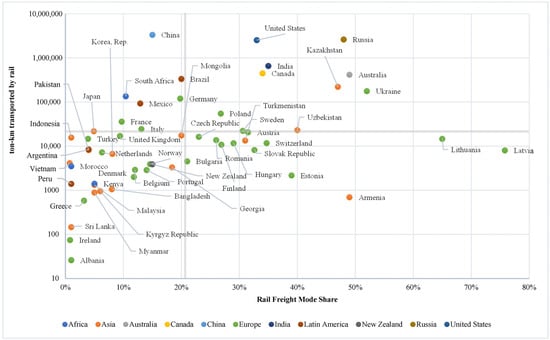
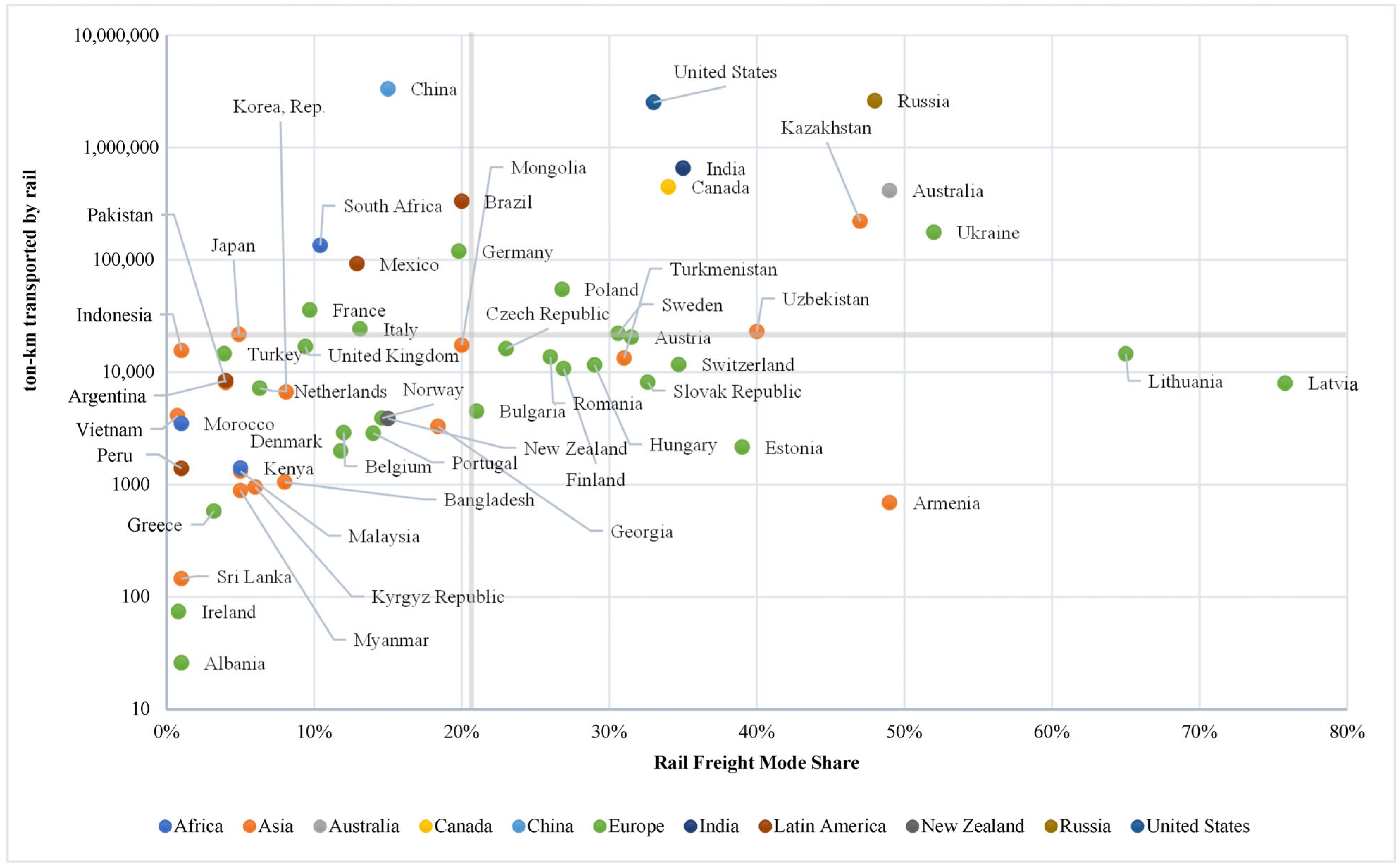
However, the realization of these benefits is not uniform across countries. Consequently, the success of railways in terms of freight transportation volume (measured in ton-kilometers) differs globally, as illustrated in Figure 1. Countries such as China, the United States, Russia, India, Canada, and Australia lead the rail freight volume measured in ton-kilometers, demonstrating profitability, service quality, and significant investment. In the United States, the freight railway sector accounts 50% average profit margin, while in India and Russia, the profits generated by freight railway operations cross-subsidize passenger rail services [6].
Figure 1.
Rail freight performance disparity in the world (Sources: Databases of World Bank (https://data.worldbank.org/ (accessed on 23 June 2024)), Statista (https://www.statista.com/ (accessed on 7 July 2024)), Knoema (https://knoema.com/ (accessed on 4 June 2024)), Eurostat (https://ec.europa.eu/eurostat/data/database (accessed on 8 June 2024)), CEIC data (https://www.ceicdata.com/en (accessed on 11 July 2024)).
Railways in European countries, while trailing in freight volume carried compared to global leaders due to being smaller in geography, hold significant global prominence, as Latvia and Lithuania exceed larger nations in mode share. European governments often subsidize freight railways due to their vital role for national development. Many European railways operate profitably even without subsidies, boasting efficiency, reliability, and punctuality comparable to passenger services [7].
In contrast, Asian countries generally exhibit lower rail freight performance and mode share, often rely on government subsidies due to financial losses. Investment levels in Asian freight railways, particularly in Southeast Asia, remain comparatively low, causing poor infrastructure quality and service inefficiency [8,9].
Freight activities are limited in Africa and Latin America, with notable exceptions in countries like South Africa, Brazil, and Mexico. Many countries in these regions lack operational railways, leading to prolong inefficiencies and financial losses sustained by government subsidies [2,10].
As previously noted, significant disparities exist among different countries in the performance of rail freight, with some nations excelling in the industry while others encountering substantial challenges. These variations indicate that rail freight performance is shaped by a complex interaction of diverse and interrelated factors that are not yet captured within a unified analytical framework.
Despite their current performance levels, all countries possess opportunities to enhance their rail freight capabilities. Therefore, there is a critical need for a well-defined mechanism to facilitate such progress. Consequently, the development of a model that can be universally applied by countries to improve their respective rail freight systems has become a crucial necessity.
Given that the effectiveness of railway performance in each country is influenced by numerous controllable and contextual factors, it is essential to systematically explore and incorporate these determinants into the model development process. Therefore, the research objectives are as follows:
- To identify driving factors influencing the performance of rail freight.
- To develop and validate a quantitative model to assess the performance of rail freight in a given country.
In line with these objectives, this study is guided by the following research question:
How is national rail freight performance systematically assessed by integrating globally adopted strategic measures with structural and contextual factors in order to identify effective interventions for performance improvement?
To answer this research question in a systematic and empirically grounded manner, this study adopts a data-driven approach based on a multi-stage model development process. First, the key performance drivers are identified through an extensive review of the literature and global best practices. Secondly, a cross-country dataset covering 64 nations is then constructed and analyzed using a non-linear multiple regression framework to develop a globally applicable rail freight performance assessment model. Thirdly, the developed model is tested using an independent sample of five countries to examine its predictive accuracy. Finally, the model is further evaluated through elasticity and semi-elasticity analysis to assess its robustness and practical applicability.
This study seeks to address an important gap in the existing literature by proposing a comprehensive and empirically grounded framework for assessing rail freight performance at the national level. The principal contribution of this research lies in the development of a globally applicable quantitative model that systematically integrates diverse strategic factors together with macro-scale determinants within a unified analytical structure. Accordingly, the proposed model serves as a robust decision-support tool for identifying and evaluating strategic initiatives through which a country’s rail freight system can be enhanced and guided toward achieving its desired performance outcomes.
The remainder of the paper is organized as follows. Section 2 reviews the relevant literature and identifies the key factors influencing rail freight performance. Section 3 outlines the research methodology and the stages of the model development process. Section 4 presents and discusses the developed model, the results of the regression analysis, the model validation, and the responsiveness of the model through elasticity and semi-elasticity analysis. Finally, Section 6 concludes the paper by summarizing the main findings and highlighting their policy and strategic implications.
2. Literature Review
This section reviews the existing literature to systematically identify the key determinants of national rail freight performance that are relevant to the research question defined in Section 1. The review is structured to examine how geographical context, economic and industrial activity, organizational and governance arrangements, infrastructure accessibility, and competitive pressures from alternative transport modes shape rail freight performance across different countries. The purpose of this review is not only to summarize prior findings, but also to establish a structured foundation for selecting the explanatory variables and developing a globally applicable performance assessment model. By organizing the literature around these thematic dimensions, this study ensures that the proposed model is firmly grounded in empirical evidence and aligned with its stated objectives
2.1. Examination of Factors Influencing the Success of Global Rail Freight
2.1.1. Geography
On a global scale, the United States, China, Russia, India, Canada, and Australia have emerged as preeminent market leaders in the rail freight industry, primarily owing to their substantial engagement in rail freight operations. Their expansive geographical expanse is the shared characteristics among these nations facilitating the provision of long-distance rail services. It has been proven that long-distance rail travel is more economically viable and advantageous than road transportation [11,12]. Notably, despite the relatively compact geographic size in European countries, they have strategically capitalized on their landlocked status. This advantage is evidenced by the robust prevalence of cross border rail freight activities in Europe, fostering the seamless facilitation of long-distance railway transportation across international transport routes [13].
Small island nations, including Sri Lanka, Cuba, and the Dominican Republic, lack such advantages in terms of cross border rail freight activities while being geographically constrained resulting in minimal freight operations [14]. Nevertheless, certain countries that are geographically disconnected have managed to expand their networks by connecting with other countries through under sea rail tunnels, train ferries, and sea rail bridges. Geographically separated from Europe, the United Kingdom is connected to the European railway network by the Channel Tunnel, an underwater rail tunnel that links England and France [15]. In New Zealand, train ferries have linked the separated rail networks of the country’s two main islands. The Oresund Bridge, which links Denmark and Sweden, facilitates the growth of international rail freight operations across both nations [16].
2.1.2. Role of Rail Freight in Economic Activity
Countries with strong economic activities have the potential to expand their rail freight sector, given the right government policies that allow room for growth through investment. Nations with strong economies, like the United States, Norway, and Switzerland, have demonstrated significant advancements in rail freight. For instance, in the United States, annual investment in freight railway development amounts to approximately USD 25 billion. For the transport of bulk commodities including grain, coal, iron ore, cement, and fertilizer, the railroad is the more suitable mode of transport. Countries that have a stronger economic contribution from rail friendly freight industries have thus acquired an advantage in this regard. In preeminent nations such as the USA and Australia, rail freight operations are principally propelled by the transportation of mining commodities, notably coal and iron ore [17]. The transportation of coal and iron ore comprises about 75% of the total amount of rail freight in Brazil and Australia. The proportion of transportation by rail for coal and iron ore in such nations exceeds 80% [18,19,20].
2.1.3. Commercialization and Business Orientation
In preeminent nations such as the USA, China, Russia and Australia, freight railways prioritize profitability, in contrast to passenger railways that primarily serve public welfare objectives. This profit-oriented strategy has been a key factor contributing to the successful growth of the freight railway industry. In South Africa, freight railways have demonstrated notable profitability, evidenced by a profit margin of 47% in 2018 [21]. The ownership structure of both rail operations and infrastructure significantly impacts the overall success of the railway sector. The considerably greater performance of privatized railways, compared to those directly owned and operated by the government, is evident. Notably, in the leading countries of United States and Canada, railways are entirely privately owned, encompassing both the operations and infrastructure.
In the European context, freight railways are operated by either private entities or state-owned companies. Both models feature independent management structures with a pronounced emphasis on commercial considerations aimed at maximizing profit. This stands in contrast to the model of direct government management, which is primarily oriented towards delivering public value. The independent management structure has, in turn, contributed to the heightened efficiency of freight railway systems across diverse regions.
2.1.4. Accessibility of Railway Infrastructure
An essential determinant in enhancing service delivery to customers is the effective access to infrastructure. In numerous instances, both passenger and freight railways operate on the same track. Across much of Europe, railway infrastructure is usually under the ownership and management of an independent entity, often government owned. This organizational arrangement ensures the equitable allocation of railway tracks, facilitating the optimal functioning of freight railways. Despite the extensive prevalence of passenger transport in Europe, the presence of an equitable track allocation scheme contributes to the efficiency of the freight railway network [22,23].
In the field of freight rail, both infrastructure and rolling stock must be meticulously designed to align with the specific requisites of the freight rail system. The tendency to prioritize passenger transport key performance indicators (KPIs) over freight trains, as observed in Sri Lanka and Japan, emphasizes the critical necessity for an autonomous or freight-oriented infrastructure system [24,25]. Ensuring dedicated infrastructure access tailored to the requirements of the freight railways sets the basis for an independent freight railway. Such dedicated freight rail networks are seen in India, the United States, Germany, Brazil, Canada, Australia, Russia, and China [26].
2.1.5. Navigating Competition Through Regulation and Collaboration
The freight railway sector faces considerable competition from alternative transportation modes such as road, coastal shipping, and inland waterways, with road transport emerging as its primary rival. This competition poses challenges to the growth of railway unless effective measures are implemented to regulate and minimize such competition.
While coastal shipping and inland waterways may not enjoy the same level of popularity as road transport on a global scale, their substantial utilization is evident in specific countries, that capitalize on such geographical advantages and subsequently impact the trajectory of railway development. Consequently, it is imperative for railways to collaborate with these transportation modes to facilitate a more comprehensive and integrated service. Notably, countries such as Japan, Norway, the Philippines, and Indonesia demonstrate heightened engagement in coastal shipping activities, with Japan alone capturing a considerable 40% share of domestic freight transport by leveraging its extensive coastal expanse [27]. Similarly, inland waterway transport finds favor in European nations and Indonesia. In Netherlands, inland waterway freight accounts a noteworthy 42% mode share, underscoring the significance of this transport mode in certain regions [28].
Numerous regulatory measures and collaborative initiatives have been implemented globally with the aim of promoting modal shift. Weight restrictions have been enforced in Europe and the USA for heavy duty trucks on highways [29]. Germany and Switzerland have implemented distance based and weight-based road tolls for trucks. In France, Italy, and the USA, vehicle emission standards have been imposed on trucks to regulate their access to urban areas [30]. Subsidies and incentives have been offered in the United Kingdom and Italy to encourage freight forwarders to shift from road to rail under their modal shift policies. Additionally, the governments of France and Spain support the development of “rail motorways”, which facilitate the loading of trucks onto trains for long distance transport, leveraging the strengths of both rail and road [31]. Japanese policies encourage the use of rail freight by subsidizing the development of logistics facilities that integrate rail and road transport. In Europe, derogations have been implemented to lift weight and dimension restrictions on road transport when integrating road and rail modes [32].
Several nations have implemented various initiatives to integrate rail systems with inland waterways and coastal shipping. The European Union’s “Trans-European Transport Network” program allocates funds to projects aimed at improving connectivity between rail networks and inland waterways, thereby fostering the development of multimodal transport networks [33]. In specific regions of the USA and France, railways are effectively integrated with inland waterways to augment freight transportation efficiency. In India, the Sagarmala project, spearheaded by the government, focuses on modernizing port infrastructure and enhancing rail connectivity to ports. This initiative aims to streamline the movement of cargo between coastal shipping routes and rail networks [34].
2.2. Existing Studies in Modeling Rail Freight
Existing studies in rail freight modeling have examined a broad range of issues related to rail freight systems, but their primary emphasis has generally been on operational or tactical dimensions, country- or corridor-specific applications, and models that address particular aspects of performance rather than comprehensive system-wide evaluation. Much of the existing literature concentrates on service optimization, demand forecasting, emission estimation, and network design within limited geographical or functional scopes, whereas a strategic and macro-level assessment of rail freight performance has not yet been explicitly addressed.
For example, Zhang and Li (2019) developed an optimization-based service model for rail freight transportation in China that integrates pricing, service planning, and emission reduction, with particular attention to containerized freight operations [35]. Their work offers important insights into improving operational efficiency and environmental performance, while leaving scope for extending the analysis to a broader range of rail freight activities relevant to strategic and global performance evaluation [35]. Similarly, Sultanbek et al. (2024) conducted a national-level forecasting study of rail freight demand in Kazakhstan, which is valuable for domestic planning and capacity management, but its country-specific nature does not allow for comparative elasticity analysis, cross-regional assessment, or consideration of global freight flow dynamics [36].
Comparable limitations can be observed in other studies. Solano (2024) analyzed rail freight demand by focusing on four commodity types along Costa Rica’s Pacific Coast Route, providing a localized and commodity-specific perspective rather than a system-wide performance view [37]. Xin (2022) proposed a service network design model tailored to the Chinese railway system, addressing tactical planning and operational efficiency without extending the analysis to macro-level performance evaluation [38]. Heinold (2020) developed an emission estimation model based on operational parameters such as wagon configuration, payload, speed, distance, and route profile, which is valuable for environmental assessment but does not support national-scale performance measurement [39]. Likewise, Fang et al. (2025) presented a service network model for railway express freight operations in a road–rail multimodal context, focusing on tactical planning variables such as schedules, marshalling, and loading plans rather than strategic performance assessment [40].
Taken together, these studies highlight the strong foundation of existing research in operational optimization, demand analysis, emission modeling, and service network design. At the same time, they indicate a clear research gap in the development of a comprehensive, empirically grounded framework for evaluating rail freight performance at the national level. In particular, the integration of strategic and contextual factors within a unified analytical structure remains limited. The present study addresses this gap by proposing a macro scale, cross country, and performance-oriented modeling framework that supports systematic assessment, international comparability, and strategic decision-making for the improvement of national rail freight systems.
3. Methodology
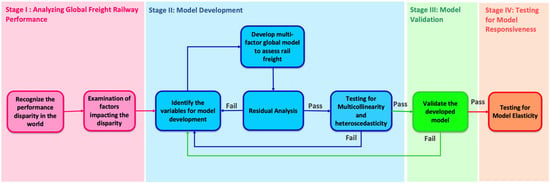
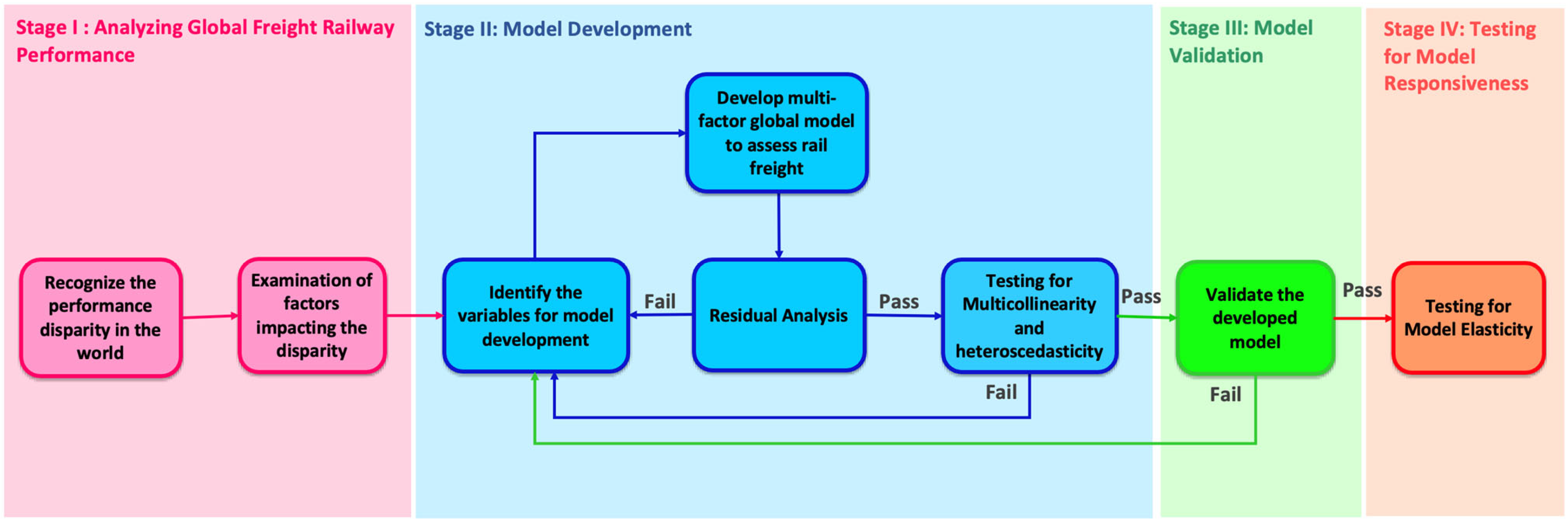
Given the multifarious nature of the rail freight industry and its overarching impact on a nation, it is imperative to formulate a comprehensive approach in developing a model for assessing rail freight performance and developing strategic reforms. Henceforth, a four-stage process, illustrated in Figure 2, has been employed for constructing a model to capture the required strategic interventions.
Figure 2.
Methodology of model formulation.
Accordingly, Stage I encompasses an examination of how various countries, situated in diverse geographical, political, and economic regions, perform in the realm of rail freight. This phase contains a descriptive analysis to discern performance patterns. Upon identifying performance disparities among countries, the next step involves an in-depth literature survey to investigate the factors influencing the observed performance variations, encompassing macro to micro level considerations.
Stage II of the model development, a non-linear multiple regression analysis is used to formulate the mathematical model to determine the contribution of the factors identified in Stage 1. Developing a comprehensive model to assess rail freight performance is essential because analyzing individual factors in isolation does not deliver an accurate understanding of their interrelationships and collective behavior. Regression models facilitate the prediction of future rail freight performance by considering the current values of various identified factors simultaneously. This holistic approach is essential for effective planning and informed decision making in the rail freight sector.
Therefore, in order to carry out regression analysis, a sample of 64 countries has been selected using a convenient sampling method, contains nations with active rail freight systems between 2014 and 2020. This sample represents nearly 60% of the global population of countries operating rail freight networks and thus provides substantial and statistically meaningful coverage of the international rail freight system. The selection was designed to ensure representation from all continents, thereby capturing the diversity of geographical, economic, institutional, and operational contexts that characterize rail freight systems worldwide. Following the development of a statistically valid model, a residual analysis was conducted to measure model error, which was subsequently evaluated for heteroscedasticity. Afterward multicollinearity testing was conducted to eliminate independent variables having high correlation.
In Stage III, model validation is executed through the holdout cross validation method, utilizing a sample of a further five randomly selected countries to test the model predictions with observed values. The successful validation process resulted in a validated model, which will be used in Stage IV to assess the model’s responsiveness to variations in the independent variables.
4. Formulation of a Rail Freight Performance Model
4.1. Factors Influencing Rail Freight Performance
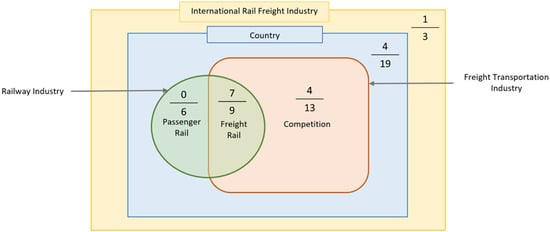
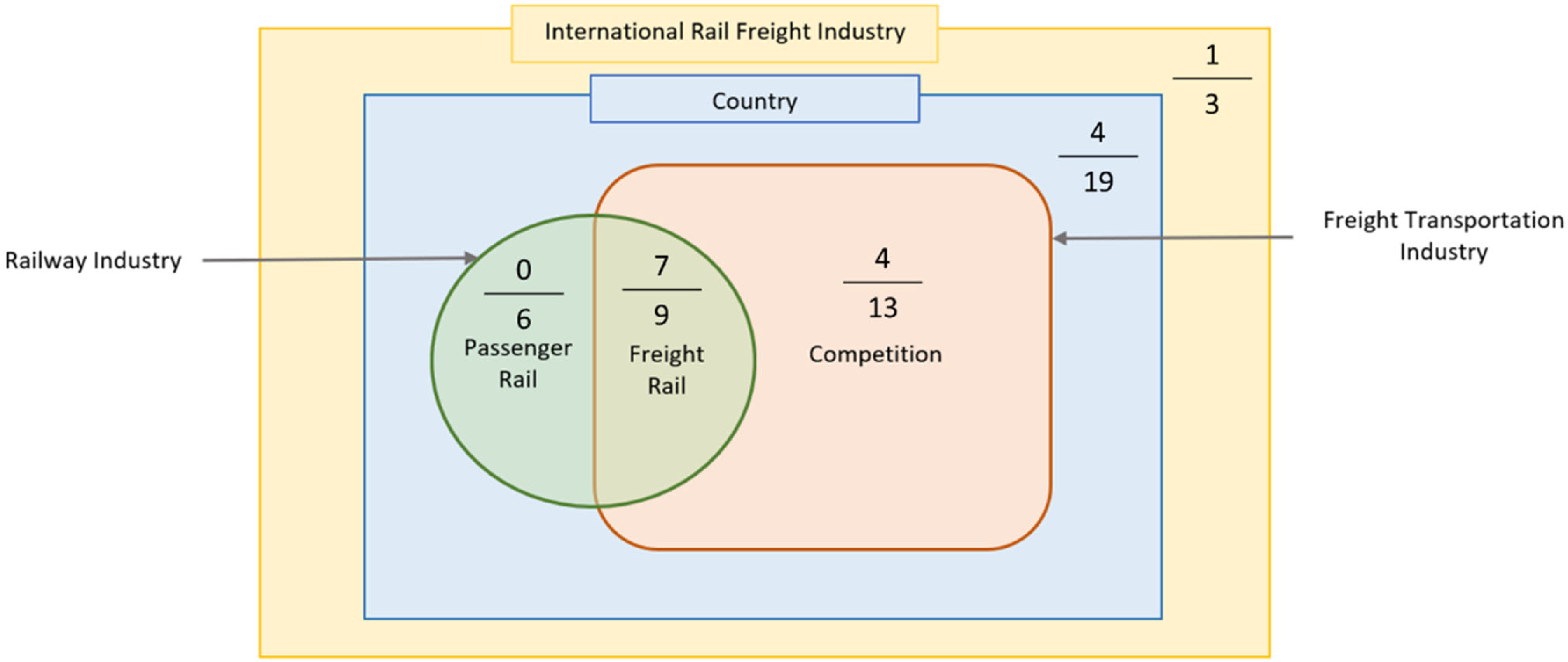
Building on the thematic framework established in Section 2, the selection of explanatory variables followed a rigorous and systematic procedure. To guide this process, a conceptual systems framework was developed, as illustrated in Figure 3, to represent the multi-level environment governing national rail freight performance. The literature review shows that freight railways operate within an international transport market, are shaped by country-specific geographical, economic, and institutional conditions, interact with passenger rail services through shared infrastructure, and compete with alternative freight transport modes. Figure 3 therefore provides an integrated structure for organizing the explanatory variables across contextual, institutional, operational, and competitive dimensions.
Figure 3.
Variables selection by category (the numbers shown in the figure indicate the number of variables retained in the final model relative to the total number of variables initially tested).
The variable selection process commenced with the compilation of a comprehensive pool of potential explanatory variables derived from an extensive review of the literature on rail freight performance, railway economics, transport policy, and freight modal competition, ensuring coverage of all dimensions represented in Figure 3.
Second, this initial pool of 50 candidate variables was systematically screened based on their theoretical relevance to the research question, empirical support in previous studies, data availability, and suitability for cross-country comparison. Variables that were conceptually redundant, weakly supported in the literature, or lacked consistent international data were excluded at this stage.
Third, the shortlisted variables were tested empirically using a stepwise regression procedure. Variables were retained or removed based on their statistical significance, contribution to the explanatory power of the model, and compliance with diagnostic criteria such as multicollinearity and model stability.
Finally, Residual analysis was employed to further examine unexplained variations in performance and to identify potential additional variables, thereby informing refinement of the variable set and directing the process back to Step 1. In this context, passenger rail operational variables were examined but found not to exert a statistically significant influence on rail freight performance and were therefore excluded.
This iterative process reduced the initial pool of 50 candidate variables to a final set of 16 explanatory variables, representing the most influential determinants of national rail freight performance across all dimensions shown in Figure 3. A detailed description of these variables is presented in Table 1.
Table 1.
Accepted Variables.
4.2. The Regression Model
The rail freight performance model is formulated as a non-linear multiplicative function in which national rail freight output is expressed as a function of multiple continuous and categorical explanatory variables. This form is adopted because it allows the combined and interactive influence of geographical, economic, institutional, operational, and competitive factors to be represented within a unified analytical framework, rather than as simple additive effects.
Accordingly, Equation (1) presents the final conceptual model, characterized by a non-linear multiplicative formulation that arises from the stepwise development described in the preceding sections:
where
- denotes national rail freight performance,
- is a constant term,
- are continuous explanatory variables,
- are dummy variables representing categorical effects, and
- and are parameters to be estimated.
Equation (1) represents the theoretical structure of the rail freight performance model and describes how different groups of factors jointly determine national rail freight outcomes. The continuous variables Xi captures quantitative characteristics while the dummy variables Dj represent qualitative attributes across countries. By expressing the model in this form, each factor is allowed to proportionally scale rail freight performance, and the exponential component accommodates discrete effects that shift the level of performance depending on the presence or absence of specific conditions. This structure is consistent with the theoretical understanding that rail freight systems operate within a complex environment where geographical context, national economic structure, institutional arrangements, operational capabilities, and competitive pressures from other transport modes interact simultaneously to influence overall performance.
For empirical estimation, the regression analysis was conducted using the IBM SPSS Statistics (Version 29.0) software. In this process, the non-linear model in Equation (1) was transformed into a linear form by applying the natural logarithm to both sides, yielding:
where ε represents the random error term that captures unexplained variations in rail freight performance.
This transformation converts the original multiplicative relationship into an additive linear form, making it suitable for empirical estimation using conventional regression methods. The transformed model in Equation (2) constitutes the estimable form of the rail freight performance model, while Equation (1) provides its underlying theoretical structure.
Before presenting the empirical results derived from this specification, a series of diagnostic tests are conducted to ensure the statistical validity of the model. Accordingly, Section 4.2.1 and Section 4.2.2 first report the tests for multicollinearity and heteroscedasticity, respectively. After confirming that these fundamental regression assumptions are satisfied, Section 4.2.3 presents the regression results and the final calibrated rail freight performance model.
4.2.1. Testing for Multicollinearity
In the context of regression analysis, it is imperative to ascertain the presence of correlation among the independent variables. The result of, a multicollinearity test is provided in Table 2. According to Rogerson (2001), a Variance Inflation Factor (VIF) below 5 is considered acceptable [41].
Table 2.
Collinearity Statistics.
Furthermore, in accordance with the guidelines proposed by Daoud (2017), a Collinearity Tolerance exceeding 0.1 is deemed acceptable, which is also satisfied as shown in Table 2 confirming there is no multicollinearity among the independent variables in the model [42].
4.2.2. Testing for Heteroscedasticity
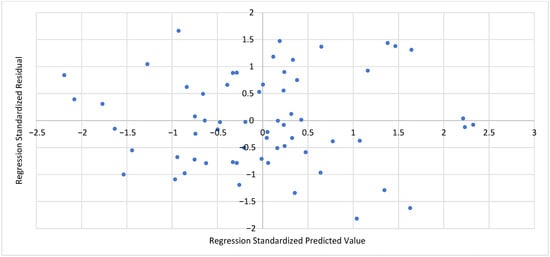
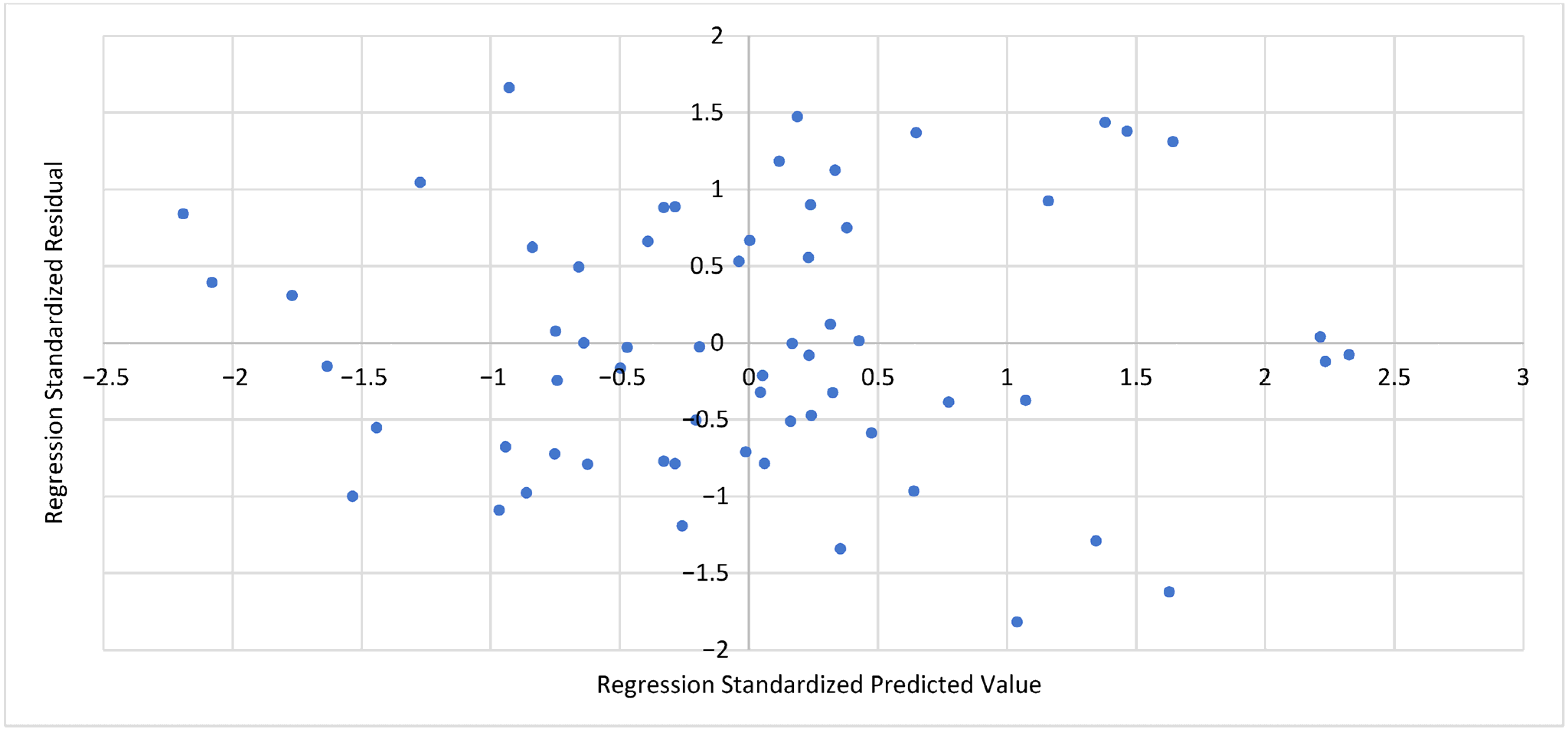
Heteroscedasticity has been examined through two distinct approaches: graphical representation and the application of the Breusch–Pagan test. The graphical representation, employing a scatter plot diagram as depicted in Figure 4, serves as a visual means to assess heteroscedasticity. It confirms the absence of visible patterns indicative of heteroscedasticity, such as a fan or cone shape, within the scatterplot diagram.
Figure 4.
Scatterplot diagram for heteroscedasticity testing.
To further verify the outcomes of the graphical analysis, a Breusch–Pagan test was conducted, and the results presented in Table 3. According to Table 3, the significance values are greater than 0.05, indicating the presence of homoscedasticity.
Table 3.
Breusch–Pagan test results.
4.2.3. Results of Regression Analysis and Final Model
According to the findings of the regression analysis, the R squared is 0.99 which is acceptable, and p-values fall within the conventional significance threshold of less than 0.05 (refer Table 4), suggesting a statistically significant relationship between the independent variable and the dependent variables in the model, signifying heightened confidence in the coefficients as predictors.
Table 4.
Results of Regression Analysis: Coefficient, t-value, p-value.
By incorporating the parameter estimates derived from the regression analysis into the general model specification, the calibrated rail freight performance model is obtained. The resulting empirical formulation is presented in Equation (3):
4.3. Model Validation
The examined model undertakes validation through the inclusion of samples from five distinct countries. These countries were chosen randomly and extracted from the initial dataset prior to model calibration. The validation sample, characterized by its impartial and independent nature, is not representative of the training dataset used in model development. Subsequently, this validation sample is employed to predict the freight railway performance, and the resultant predictions are compared with actual values to evaluate the model’s accuracy. As outlined in Table 5, the disparities between predicted values and actual values, stated as deviations, fall within the range of +/−7%, a magnitude deemed non-significant according to the validation results.
Table 5.
Results of validation.
4.4. The Model Responsiveness to Changes in Independent Variables
The elasticity of the model has been assessed to better understand how the dependent variable responds to variations in the independent variables. All independent variables were evaluated for elasticity, even though some variables, particularly geographical features, are not amenable to change in the short to medium term. Assessing the elasticity of these variables is crucial for strategic decision-making. Table 6 illustrates the elasticity of continuous variables, which reflects the percentage change in ton-kilometers transported by rail (the dependent variable) in response to a 1% increase in each continuous independent variable. Additionally, the semi-elasticity for dummy variables has been computed, as displayed in Table 7. According to the findings in Table 6, the dependent variable exhibits high sensitivity to the independent variables of the area served by rail and the competitiveness of road infrastructure among continuous variables. Moreover, the semi-elasticity results shown in Table 7 indicate that the dependent variable is greatly responsive to dummy independent variables of profit-oriented railways and broad-gauge railways.
Table 6.
Elasticity of Continuous Variables.
Table 7.
Semi Elasticity of Dummy Variable.
5. Discussion of Results
The regression results indicate that national rail freight performance is determined by the combined influence of structural, economic, institutional, operational, and competitive factors rather than by any single determinant. The strong explanatory power of the model confirms that the selected variables effectively capture the main sources of cross-country variation in rail freight performance, while the consistency of coefficient signs and magnitudes with theoretical expectations and international experience supports the robustness and practical relevance of the framework.
Among the geographical variables, the area served by rail exhibits the strongest positive elasticity, highlighting network extent as a fundamental determinant of rail freight potential. Wider rail-served areas support longer haul distances, higher traffic density, and stronger economies of scale, which explains the dominance of countries such as the United States, China, Russia, Canada, and Australia in global rail freight volumes. Cross-border rail freight activity also contributes positively by extending market reach beyond national boundaries. Its importance becomes particularly pronounced when new international links are established for geographically constrained countries through rail bridges, tunnels, or train ferry systems, transforming isolated networks into integral components of regional and international transport corridors.
Economic variables further reinforce the structural logic of rail freight systems. The positive effects of GDP per land area and mining production intensity confirm that rail performs best in economies characterized by concentrated industrial activity and bulk commodity flows. In contrast, the negative elasticity of inflation highlights the vulnerability of rail freight to macroeconomic instability, as rising costs and investment uncertainty weaken competitiveness and long-term planning.
Geographical and economic conditions, together with the existence or absence of cross-border rail freight connectivity, represent largely exogenous factors that cannot be altered in the short term and therefore impose structural constraints on national rail freight performance. As a result, a country’s capacity to achieve high rail freight efficiency is partially bound by these conditions. However, operating within these structural limits does not preclude performance improvement. Instead, it highlights the necessity for countries to adopt strategic initiatives across policy, business, and operational domains.
Against this background of structural constraints, policy, business and operational related variables exhibit some of the largest impacts through their semi-elasticities. Among these, profit orientation emerges as the most influential determinant, indicating that commercially driven railway systems achieve substantially higher freight performance than those operating under purely administrative or welfare-based objectives. In addition, vertically separated or vertically integrated freight rail systems, dedicated freight operations, and broad-gauge networks show strong positive effects on performance. These results demonstrate that governance structures, technical standards, and business models are not secondary considerations but central drivers of success. Railways that operate under commercial principles, enjoy fair access to infrastructure, and prioritize freight operations consistently outperform systems constrained by passenger-centric policies.
Competition from alternative modes is shown to be a critical constraint on rail freight performance. The strongly negative elasticity associated with road infrastructure competitiveness confirms that improvements in road quality, if not matched by parallel investment in rail, significantly weaken rail’s market position. Similarly, the competitive influence of coastal shipping and inland waterways indicates that rail freight must either compete more effectively or be strategically integrated into multimodal logistics systems to maintain its relevance.
The extremely large negative semi-elasticities associated with civil unrest, high poverty levels, and weak government commitment demonstrate that institutional instability represents one of the most severe constraints on rail freight development. Even where favorable geographical and economic conditions exist, political and governance weaknesses can severely undermine performance. This finding is particularly relevant for developing countries, where infrastructure investment alone is insufficient without parallel improvements in institutional capacity, regulatory stability, and political commitment.
Finally, the proposed model functions as a strategic decision-support framework that enables policymakers to identify and prioritize the most influential drivers of national rail freight performance. By translating empirical results into elasticity and semi-elasticity measures, the model allows decision makers to compare alternative policy interventions and to distinguish between structural constraints and policy-sensitive variables. This is especially valuable for developing countries, where financial and institutional resources are limited, as the results highlight that substantial performance gains can be achieved through targeted institutional and business reforms such as promoting profit-oriented management, strengthening governance structures, improving infrastructure access regimes, and adopting balanced policies toward modal competition rather than relying solely on costly infrastructure expansion. Moreover, the model emphasizes the strategic importance of enhancing international connectivity and integrating rail freight into multimodal transport systems. Overall, it provides an evidence-based foundation for designing efficient, prioritized, and sustainable rail freight policies aligned with long-term economic and logistical objectives.
6. Conclusions
Railways have become a focal point for freight transportation due to their ability to alleviate road congestion and provide cost-effective, fast, and socially and environmentally beneficial services. Although previous studies have explored railway performance, they lack a comprehensive quantitative or strategic evaluation. Therefore, there is a critical need for an integrated model that assesses railway performance across multiple dimensions to guide strategic decisions and achieve key objectives.
This study therefore proposes a globally applicable and empirically validated framework for evaluating national rail freight performance by integrating geographical, economic, institutional, operational, and competitive factors into a single analytical model. The development of the model required a systematic methodology to ensure accurate and reliable results. It commenced with an extensive analysis of global rail freight dynamics. The model was then constructed using data from 64 countries and nonlinear multiple regression analysis. Tests for multicollinearity and heteroscedasticity were conducted to improve the accuracy of the model. The model’s effectiveness was validated using an independent sample of five countries to confirm its real-world applicability. Subsequently, the model’s elasticity was tested to evaluate its behavior and responsiveness under varying conditions.
While geographical scale and economic structure define the fundamental potential of rail freight systems, the findings show that policy, business and operational related factors provide the strongest opportunities for performance improvement. In particular, profit orientation, appropriate governance structures, and freight-focused operational strategies emerge as decisive drivers of success. This indicates that effective management and regulatory design are as important as physical infrastructure in strengthening rail freight performance.
The analysis further emphasizes that competition from alternative modes, especially road transport, remains a critical challenge. Balanced transport policies and coordinated investment strategies are therefore essential to maintain the competitiveness of rail freight within national and multimodal transport systems.
This model can be utilized by any country to generate quantitative forecasts for developing strategies tailored to enhance their respective rail freight systems. The study demonstrates that substantial gains in rail freight performance can be achieved through targeted policy and institutional reforms. This insight is especially relevant for developing countries, where financial constraints limit large-scale infrastructure expansion. By focusing on controllable factors such as governance quality, commercial orientation, infrastructure access arrangements, and international connectivity, policymakers can unlock significant performance improvements in a cost-effective manner.
Limitations and Future Research—While the proposed model provides a robust and comprehensive framework for evaluating national rail freight performance, several limitations should be acknowledged. The analysis is constrained by data availability and comparability across countries, which limited both the sample size and the inclusion of certain potentially relevant variables, such as indicators of multimodal integration, logistics performance, and more detailed regulatory factors. Future research could extend this framework by incorporating such variables as more consistent international data become available. In addition, the framework may be applied at the level of an individual country as a focused case study, enabling policymakers to evaluate national strategies, test alternative policy scenarios, and identify priority areas for reform based on country-specific conditions.
Author Contributions
Conceptualization, L.L.W. and A.S.K.; methodology, L.L.W.; software, L.L.W.; validation, L.L.W.; formal analysis, L.L.W.; investigation, L.L.W.; resources, L.L.W.; data curation, L.L.W.; writing—original draft preparation, L.L.W.; writing—review and editing, L.L.W.; visualization, L.L.W.; supervision, A.S.K.; project administration, A.S.K.; funding acquisition, L.L.W. All authors have read and agreed to the published version of the manuscript.
Funding
This research was funded by National Science Foundation of Sri Lanka, grant number is NSF/SCH/2019/06.
Institutional Review Board Statement
Not applicable.
Informed Consent Statement
Not applicable.
Data Availability Statement
The datasets presented in this article are not readily available because the study includes data obtained from multiple institutions, the data are part of an ongoing study. Requests to access the datasets should be directed to the corresponding author.
Conflicts of Interest
The authors declare no conflicts of interest.
References
- Smith, N.L. Railroad History in the Past Decade. Curr. Hist. 1931, 34, 827–833. [Google Scholar] [CrossRef] [Scilit]
- Blumenfeld, M.; Wemakor, W.; Azzouz, L.; Roberts, C. Developing a New Technical Strategy for Rail Infrastructure in Low-Income Countries in Sub-Saharan Africa and South Asia. Sustainability 2019, 11, 4319. [Google Scholar] [CrossRef] [Scilit]
- Friedrich, R.; Quinet, E. External Costs of Transport in Europe. In A Handbook of Transport Economics; Edward Elgar Publishing: Northampton, MA, USA, 2011; pp. 369–395. [Google Scholar] [CrossRef] [Scilit]
- Giuliano, G.; Kang, S.; Yuan, Q. Using proxies to describe the metropolitan freight landscape. Urban Stud. 2017, 55, 1346–1363. [Google Scholar] [CrossRef] [Scilit]
- Troche, G. High-Speed Rail Freight. In Efficient Train Systems for Freight Transport; KTH Railway Group: Stockholm, Sweden, 2005. [Google Scholar]
- Finger, M.; Montero, J. Handbook on Railway Regulation; Edward Elgar Publishing: Northampton, MA, USA, 2020. [Google Scholar]
- Crössmann, K.; Mause, K. Rail subsidisation in the European Union: An issue beyond left and right? Comp. Eur. Politics 2014, 13, 471–492. [Google Scholar] [CrossRef] [Scilit]
- Shibata, J. Myanmar’s National Transport Master Plan; Oriental Consultants Co., Ltd.: Tokyo, Japan, 2014. [Google Scholar]
- Schwab, K. The Global Competitiveness Report; World Economic Forum: Geneva, Switzerland, 2019. [Google Scholar]
- Clemente, J. The Current State of Metro and Railway Systems in Latin America; Economic Commission for Latin America and the Caribbean: Santiago, Chile, 2013. [Google Scholar]
- Forkenbrock, D.J. Comparison of external costs of rail and truck freight transportation. Transp. Res. Part A Policy Pract. 2001, 35, 321–337. [Google Scholar] [CrossRef] [Scilit]
- Mostert, M.; Limbourg, S. External Costs as Competitiveness Factors for Freight Transport—A State of the Art. Transp. Rev. 2016, 36, 692–712. [Google Scholar] [CrossRef] [Scilit]
- European Union Agency for Railways. Cross-border Rail Transport Potential; European Union Agency for Railways: Valenciennes, France, 2022. [Google Scholar] [CrossRef]
- Warnapura, L.; Kumarage, A.S. Analysis of Driving Factors for Developing Rail Freight. In Proceedings of the 14th Eastern Asia Society for Transportation Studies, Hiroshima, Japan, 12–14 September 2021. [Google Scholar]
- Dundon-Smith, D.M.; Gibb, A.R. The Channel Tunnel and regional economic development. J. Transp. Geogr. 1994, 2, 178–189. [Google Scholar] [CrossRef] [Scilit]
- Hansen, K.F.; Larsson, Ö. Øresund Bridge. Transp. Res. Rec. 1999, 1654, 133–140. [Google Scholar] [CrossRef] [Scilit]
- Profillidis, V.A. Railway Managemet and Engineering; Ashgate Publishing Limited: Farnham, UK, 2006. [Google Scholar]
- Avery, S.O.R. Statistical Report—Australian Railways; Department of Infrastructure, Regional Development and Cities, Australian Government: Canberra, Australia, 2019. [Google Scholar]
- Gregg-Macdonald, M. Transnet Integrated Report; Transnet SOC Ltd.: Johannesburg, South Africa, 2019. [Google Scholar]
- Massara, V.M. An overview about Brazilian railway system—Part II: 1930-actual. MOJ Civ. Eng. 2019, 5, 97–100. [Google Scholar] [CrossRef] [Scilit]
- Johnston, B. Freight Rail 2018; Transnet SOC Ltd.: Johannesburg, South Africa, 2018. [Google Scholar]
- Laabsch, C.; Sanner, H. The impact of vertical separation on the success of the railways. Intereconomics 2012, 47, 120–128. [Google Scholar] [CrossRef] [Scilit]
- Mizutani, F.; Uranishi, S. Does vertical separation reduce cost? An empirical analysis of the rail industry in European and East Asian OECD Countries. J. Regul. Econ. 2012, 43, 31–59. [Google Scholar] [CrossRef] [Scilit]
- Warnapura, L.; Kumarage, A.S. A Conceptual Development Strategy for Rail Freight in Sri Lanka. In Research for Transport and Logistics Industry Proceedings of the 7th International Conference; Sri Lanka Society of Transport and Logistics: Moratuwa, Sri Lanka, 2023; pp. 82–84. [Google Scholar]
- Mizutani, J.; Fukuda, S. Issues on modal shift of freight from road to rail in Japan: Review of rail track ownership, investment and access charges after the National Railway restructuring. Res. Transp. Bus. Manag. 2020, 35, 100484. [Google Scholar] [CrossRef] [Scilit]
- Raghuram, G.; Verma, A. Dedicated Freight Corridor: Current Challenges. In Proceedings of the World Conference on Transport Research—WCTR 2019, Mumbai, India, 26–31 May 2019. [Google Scholar]
- Tezuka, K. Current Status of Coastal Shipping in Japan. 2014. Available online: https://www.jttri.or.jp/docs/140307_presentation-06.pdf (accessed on 15 June 2023).
- Eurostat. Modal Split of Freight Transport. 2018. Available online: https://ec.europa.eu/eurostat/databrowser/view/tran_hv_frmod/default/table?lang=en&category=tran.tran_hv_ms (accessed on 22 May 2020).
- Council Directive 96/53/EC of 25 July 1996. 2006. Available online: https://eur-lex.europa.eu/LexUriServ/LexUriServ.do?uri=CONSLEG:2006R1881:20100701:EN:PDF (accessed on 2 March 2023).
- Martini, G.; Giechaskiel, B.; Dilara, P. Future European emission standards for vehicles: The importance of the UN-ECE Particle Measurement Programme. Biomarkers 2009, 14, 29–33. [Google Scholar] [CrossRef] [Scilit] [PubMed]
- European Commission. Atlantic Rail Motorway: Modal Shift of All Types of Semitrailers on the Atlantic Corridor; European Commission: Brussels, Belgium, 2023. [Google Scholar]
- Gleser, M.; Elbert, R. Combined rail-road transport in Europe—A practice-oriented research agenda. Res. Transp. Bus. Manag. 2024, 53, 101101. [Google Scholar] [CrossRef] [Scilit]
- Santos, T.A.; Fonseca, M.Â.; Martins, P.; Soares, C.G. Integrating Short Sea Shipping with Trans-European Transport Networks. J. Mar. Sci. Eng. 2022, 10, 218. [Google Scholar] [CrossRef] [Scilit]
- Mindur, L. The Impact of India’s Economy on The Development of Seaports. Sci. J. Silesian Univ. Technol. Ser. Transp. 2019, 105, 169–182. [Google Scholar] [CrossRef] [Scilit]
- Zhang, X.; Li, L.; Zhang, J. An optimal service model for rail freight transportation: Pricing, planning, and emission reducing. J. Clean. Prod. 2019, 218, 565–574. [Google Scholar] [CrossRef] [Scilit]
- Sultanbek, M.; Adilova, N.; Sładkowski, A.; Karibayev, A. Forecasting the demand for railway freight transportation in Kazakhstan: A case study. Transp. Res. Interdiscip. Perspect. 2024, 23, 101028. [Google Scholar] [CrossRef] [Scilit]
- Coto-Solano, M.E. Demand study of freight transportation via railway of four commodity groups: A case study on Costa Rica’s Pacific Coast Route. Multimodal Transp. 2024, 3, 100157. [Google Scholar] [CrossRef] [Scilit]
- Xin, X. Service network design for freight railway transportation: The Chinese case. PLoS ONE 2022, 17, e0276671. [Google Scholar] [CrossRef] [Scilit]
- Heinold, A. Comparing emission estimation models for rail freight transportation. Transp. Res. Part D Transp. Environ. 2020, 86, 102468. [Google Scholar] [CrossRef] [Scilit]
- Fang, Y.; Zhang, X.; Wang, P.; Tao, Y. Modeling Railway Express Freight Train Operation Plans in Road-Rail Multimodal Transport. IEEE Access 2025, 13, 145996–146007. [Google Scholar] [CrossRef] [Scilit]
- Rogerson, P. Statistical Methods for Geography; SAGE Publications: Thousand Oaks, CA, USA, 2001. [Google Scholar]
- Daoud, J.I. Multicollinearity and Regression Analysis. J. Phys. 2017, 949, 012009. [Google Scholar] [CrossRef] [Scilit]

Disclaimer/Publisher’s Note: The statements, opinions and data contained in all publications are solely those of the individual author(s) and contributor(s) and not of MDPI and/or the editor(s). MDPI and/or the editor(s) disclaim responsibility for any injury to people or property resulting from any ideas, methods, instructions or products referred to in the content. |
© 2026 by the authors. Licensee MDPI, Basel, Switzerland. This article is an open access article distributed under the terms and conditions of the Creative Commons Attribution (CC BY) license.