
Article

Fishing Ground Identification and Activity Analysis Based on AIS Data

1
Department of Ocean Operations and Civil Engineering, Norwegian University of Science and Technology, Larsgaardsvegen 2, 6009 Aalesund, Norway
2
Faculty of Maritime Studies, University of Split, Ruđera Boškovića 37, 21000 Split, Croatia
*
Author to whom correspondence should be addressed.
Future Transp. 2026, 6(1), 34; https://doi.org/10.3390/futuretransp6010034
Submission received: 21 December 2025 / Revised: 16 January 2026 / Accepted: 22 January 2026 / Published: 2 February 2026

Abstract

The sustainable management of marine resources requires accurate knowledge of fishing activity patterns and their interaction with coastal infrastructure. Intelligent Transportation Systems (ITS) are increasingly applied in the maritime domain, where data-driven approaches enhance safety, efficiency, and sustainability. In this context, Automatic Identification System (AIS) data provide valuable insights into vessel behavior and fisheries management. This study employs the Density-Based Spatial Clustering of Applications with Noise (DBSCAN) algorithm to identify fishing grounds, and a density map-based approach to recognize port locations. By integrating AIS data with machine learning techniques, the study detects and analyzes fishing vessel activities, providing deeper insights into behaviors such as fishing ground visit times, durations, and transitions between fishing grounds and ports. A case study in the Aalesund area of Norway demonstrates that DBSCAN effectively reveals fishing activity patterns relevant to regulatory oversight and spatial planning, while density mapping accurately identifies fishing ports. The findings highlight the potential of AIS-based analytics and clustering methods within maritime ITS frameworks to enhance situational awareness, support compliance with fisheries regulations, and contribute to sustainable marine resource management. Using 2023 AIS data from the Aalesund region, 6 recurrent fishing grounds and 15 port locations are identified, and size-stratified visit frequency and residence-time distributions are quantified together with monthly seasonality in ground usage.

1. Introduction

Maritime transportation underpins global trade, and Intelligent Transportation Systems (ITS) have become essential for improving navigational safety and reducing collision risk [1]. In Norway, this safety and efficiency agenda is tightly coupled with the national importance of fisheries: fishing fleets generated NOK 22.2 billion in net value creation in 2023, producing ripple effects across 357 municipalities and supporting employment in coastal communities [2]. At the macroeconomic level, agriculture, forestry, and fishing together contributed about 2 % of Norway’s GDP in 2023 [3]. These indicators underscore the fishing sector’s combined direct and indirect role in Norway’s economy.
Fishing activity is also central to food provision as global demand grows. However, technological advances and the increasing number of fishing vessels have intensified pressures on the maritime environment and fishery resources, including the risk of overfishing, congestion, and ecological degradation. Addressing these challenges requires robust identification of the spatial distribution of fishing effort and a systematic understanding of vessel behavior patterns at operational scales.
Monitoring infrastructures exist but remain fragmented in terms of accessibility and analytical readiness. Under the EU Fisheries Control Regulation, all licensed vessels must carry a Vessel Monitoring System (VMS), which supports regulatory reporting but is not publicly accessible, raising concerns about real-time transparency and independent assessment [4]. In parallel, sustainable transportation frameworks in the maritime domain emphasize efficiency, safety, and reduced ecological impact [5]. AI, IoT, and blockchain technologies are increasingly driving this transformation [6]. Complementing VMS, the Automatic Identification System (AIS), a shipborne radio system that transmits a vessel’s identity, position, course, speed, and time at regular intervals, provides widely available spatiotemporal trajectories for maritime surveillance and research.
Despite its broad availability, extracting meaningful behavioral information from raw AIS streams remains technically challenging due to the high volume of data, irregular sampling, missing reports, measurement noise, and the inherent variability in fishing operations across fleets, gears, and seasons. AIS-driven analytics have increasingly been used to extract operational knowledge and support maritime decision-making in ITS contexts [7,8]. Prior work has therefore developed diverse AIS-driven approaches for identifying fishing activity and characterizing vessel behavior. At a high level, existing research can be grouped into three overlapping directions: (i) supervised machine-learning classification of fishing versus non-fishing behavior using engineered trajectory features [9,10,11,12]; (ii) anomaly and integrity analysis to detect atypical patterns, including AIS “silence” events and potential manipulation [13,14]; (iii) trajectory-based behavior modeling and segmentation methods that infer activity states from geometric or kinematic structure in vessel tracks [15,16].
Related studies also demonstrate the value and limitations of AIS for spatial planning and habitat-oriented analyses. For example, modeling and predicting fishing grounds can be strengthened by integrating AIS with catch and environmental variables, but such work often faces practical constraints such as data sparsity, noisy positioning, limited catch reporting, and environmental variability [17]. These challenges motivate methodological choices that are robust to incomplete observations and capable of producing interpretable spatial outputs for operational decision-making.
Beyond fishing-activity recognition, AIS has also been used to identify and characterize ports and port interactions through vessel movement patterns near shores. Representative approaches include trajectory segmentation [18,19], clustering and density-based analysis [19,20,21], deep learning models [22], and port performance metrics derived from traffic and dwell characteristics [18]. Collectively, these lines of work indicate that port-fishing ground connectivity and dwell/transit dynamics can be inferred from AIS, but the resolution and reliability of such inferences depend strongly on geographic context, traffic patterns, and data quality.
Fishing behavior models have been developed at global and regional scales, yet fewer studies provide high-resolution analyses tailored to specific coastal areas where port interactions, short trips, and mixed-use movements are prevalent. Aalesund, located on the west coast of Norway, is one of the country’s fishing hubs, with a long tradition of both small-scale and industrial fisheries. The region’s waters host diverse fishing operations and form a critical interface between offshore fishing grounds, fjords, and port infrastructure. Despite this importance, detailed AIS-based studies of fishing ground usage and port ground connectivity in the Aalesund area remain limited. Figure 1 situates the study area within Norway.
This paper addresses the above gap by integrating AIS trajectory data with density-based spatial analytics to identify fishing grounds and port activity areas, by quantifying vessel behavior in terms of visit episodes, residence time, and directed transitions between zones. This analysis covers one year of AIS observations (2023) for the Aalesund region and stratifies the results by vessel size to highlight heterogeneous fleet behavior.
Relative to the existing literature, the novelty of this study lies in the joint, end-to-end treatment of (i) fishing ground delineation and (ii) port/harbor recognition from AIS within a single consistent spatial scale, followed by (iii) behavioral connectivity analysis to provide a comparison between these zones. Unlike approaches that focus only on classifying fishing states or only on port detection, here the two components are linked to derive interpretable operational metrics, including "visit frequency, residence time distributions, seasonal usage, and port-ground transitions" that are directly relevant to fisheries oversight and coastal spatial planning. Methodologically, this study (1) reduces AIS noise and computational cost through grid-sampling before clustering, (2) uses Haversine distance for geodesic consistency, (3) validates detected port activity locations against independent OpenStreetMap footprints using an H3-based geofence overlap procedure, and (4) benchmarks the Density-Based Spatial Clustering of Applications with Noise (DBSCAN) against alternative density-based clustering methods (OPTICS and the Hierarchical Density-Based Spatial Clustering of Applications with Noise (HDBSCAN)) to assess the robustness of fishing ground identification to method choice and noise handling.
The remainder of the paper is organized as follows. Section 2 reviews related work on AIS-based fisheries analytics and port/harbor inference. Section 3 presents the methodology, including quay/harbor recognition, fishing ground detection, and ground-port transitions by vessel category. Section 4 reports the experimental results for the Aalesund case study. Section 5 discusses the limitations and implications for maritime ITS and fisheries monitoring, and concludes the paper.

2. Related Work

2.1. Methods for AIS Data Mining

AIS data mining analyzes large volumes of AIS messages to uncover patterns in vessel movement, behavior, and interactions, supporting applications such as fishing activity monitoring, anomaly detection, route prediction, and maritime traffic management. Beyond descriptive mapping, AIS-derived features have been used to infer higher-level maritime situations, including the probabilistic classification of ship encounters from AIS-derived features [23] and AIS-informed planning for COLREGs-compliant collision avoidance [24]. Recent AIS-driven maritime ITS research has further advanced behavioral understanding and prediction, for example, through maneuver detection and knowledge extraction during ship encounters [25] and hybrid learning-based ship trajectory prediction from AIS streams [26]. These studies demonstrate that AIS can support interpretable decision-support functions (situational awareness and prediction), which motivates our AIS-based spatial delineation and zone-to-zone connectivity analytics for fisheries oversight.
AIS data mining techniques can be broadly divided into distance-based methods, (data-driven) neural network-based methods, clustering-based methods, and others.
Distance-based methods, such as Euclidean Distance and Dynamic Time Warping (DTW), identify vessel behaviors by measuring the similarity or dissimilarity between data points, including speed, position, and course. These methods are commonly applied to detect outliers, classify movement patterns, or distinguish fishing activity from transit behavior based on proximity in feature space.
Neural network-based methods include Conventional Neural Networks (CNNs) and Long Short-Term Memory (LSTM) networks. CNNs extract spatial features from vessel trajectory data to recognize fishing patterns, while LTSMs capture temporal dependencies in sequential data, making them well-suited for modeling vessel behavior over time.
Clustering-based methods, such as K-Means, DBSCAN, and HDBSCAN, are unsupervised approaches that group vessel trajectory data into clusters based on similarities in features like speed, direction, and location, thereby helping to distinguish between fishing and non-fishing activities without requiring labeled data. They reveal hidden patterns without needing a labeled dataset. Clustering plays a pivotal role in unsupervised AIS data mining, particularly for trajectory segmentation, fishing event detection, and identifying behavioral patterns. They can be divided into density-based clustering, partition-based clustering, hierarchical clustering, grid-based clustering, model-based clustering, trajectory-specific clustering, and clustering with dimensionality reduction. DBSCAN is a density-based clustering that is widely used to detect loitering behavior and stop points by grouping AIS points that are close in space and time. It is robust to noise and does not require specifying the number of clusters, which is ideal for irregular data. It is favored for use in detecting fishing events, such as low-speed or stationary clusters.
Traditional rule-based approaches detect fishing activity using hand-crafted heuristics such as low-speed thresholds, frequent heading changes, or stop–move patterns. While computationally efficient and easy to implement, these methods often have limited generalization across regions, fleets, and gear types, and they can be sensitive to parameter tuning and data quality. To improve robustness and transferability, a growing body of work applies supervised and semi-supervised machine learning methods to AIS/VMS trajectories. For example, Han et al. [10] proposed a BD-AdaBoost framework that selects informative behavioral features to improve recognition accuracy and reduce overfitting. Ferreira et al. [15] addressed limited labeled data using a semi-supervised architecture that extracts geometric trajectory features from, and applies an RNN for classification. Guan et al. [11] employed a LightGBM model to distinguish fishing vessel types by learning movement patterns in the northern South China Sea. More broadly, Cheng et al. [27] reviewed recent ML and DL applications to AIS/VMS data for extracting and interpreting fishing behaviors in support of fisheries science and management.

2.2. AIS Data Analysis for Fishing Activities

AIS data are frequently used for monitoring fishing vessels because they provide near-real-time information on vessel identity, position, speed, course, and movement patterns. Trajectory-based analysis has also been explored through probabilistic ship route prediction from AIS data, which provides a complementary perspective on movement patterns and connectivity between areas of operation [28]. The Global Fishing Watch project is an international initiative that provides open-access data products and maps of global fishing activity derived from AIS and satellite sources to enhance transparency and support sustainable ocean management [29]. Building on such data streams, large-scale frameworks estimate fishing effort from AIS trajectories, and several studies focus on behavioral inference and surveillance applications. For example, Rodriguez et al. [13] identified suspicious fishing behavior by detecting anomalies in tracking data, including patterns consistent with intentional AIS deactivation, helping to reveal potentially illegal or unreported activities at sea. These techniques identify intentional AIS deactivation, often associated with irregular activity. Simataa et al. [30] reported that the spatial and temporal distribution of fishing activity in Namibia’s Exclusive Economic Zone (EEZ) is closely linked to environmental variability. Other work has proposed architectures to classify fishing vessels from their movement patterns [9], and has used AIS for spatial analysis for fishing activities [31]. Rahmawati et al. [32] reviewed the integration of AIS data with ship simulators for safety applications, highlighting current practice, integration challenges, and emerging directions such as AI-enabled decision support and standardized frameworks.
Beyond monitoring and anomaly detection, AIS is increasingly used to quantify fishing efforts and to characterize maritime infrastructure. Studies estimating effort include habitat suitability modeling for small-scale fisheries [17], deep learning approaches for large-scale fishing activity detection [33], and geospatial overlays methods for mapping passive-gear fleets [34]. AIS has also been used to recognize and classify ports and port-related behavior: e.g., Wijaya et al. [18] extracted port performance indicators using trajectory segmentation and classification, while supervised learning approaches have been applied to port-type prediction in under-documented regions [21]. More comprehensive ship-type classification and port-behavior analysis using ML has also been reported [35].
In addition to activity-state classification, a major research theme is the spatial delineation of recurrent fishing grounds and fishing effort intensity from AIS/VMS trajectories. Density-based hotspot mapping (e.g., KDE on fishing state points) has been used to identify persistent fishing hotspots and evaluate the spatial effectiveness of management measures [36]. Complementary work delineates operational fishing areas using clustering and trajectory segmentation; for example, the DBSCAN-based approaches group repeated low-speed fishing state observations of spatially coherent grounds [37], and optimized DBSCAN variants have been proposed to improve robustness under noisy AIS sampling [38]. Supervised frameworks have also validated AIS-derived fishing inference against independent fisheries records, reporting strong agreement for AIS-observed vessels [39]. These studies suggest combining density-based spatial delineation with visit-duration and connectivity metrics for operational interpretation.

2.3. AIS-Based Port/Harbor Detection and Port-Call Behavior

AIS trajectories are also used to infer port/harbor locations and characterize port-call behavior, supporting maritime infrastructure analytics and coastal planning. Data-driven port-area inference often relies on density estimation of stationary or low-speed AIS points and detection of local maxima, producing port activity hotspots without requiring predefined port polygons [40]. Learning-based approaches can further classify port-related behavior from trajectories; for example, Conv1D models have been applied to AIS sequences to improve port-related transport statistics [22]. Other remote-sensing approaches detect ports and ships from satellite imagery using object detectors such as YOLO (You Only Look Once), including edge-based implementations for low-latency monitoring [41]. Prior work emphasizes that port operations include maneuvering and approach waters in addition to purely stationary berths, motivating geofenced port representations when analyzing port-ground transitions.
However, an AIS-based analysis of fishing vessel behavior in Aalesund, Norway, remains underexplored. This region presents specific challenges, including mixed-use vessel movements, irregular AIS sampling and missing reports, and fine-grained behavioral variability, which motivates the need for tailored AIS data-mining workflows. Together, these studies motivate an integrated pipeline that links fishing-ground delineation with port/harbor inference and then quantifies port-ground connectivity, which is the focus of the present Aalesund case study.

3. Methodology

This section presents the methods employed for port recognition, fishing ground detection, and analysis of vessel transitions between ports and fishing grounds. The density map method and the DBSCAN algorithm are used to achieve these results. The AIS-derived features and vessel attributes used in downstream analysis are listed in Table 1. The AIS dataset, including “time span, spatial extent, fields, total records, and vessel counts”, is summarized in Table 2 in Section 3.
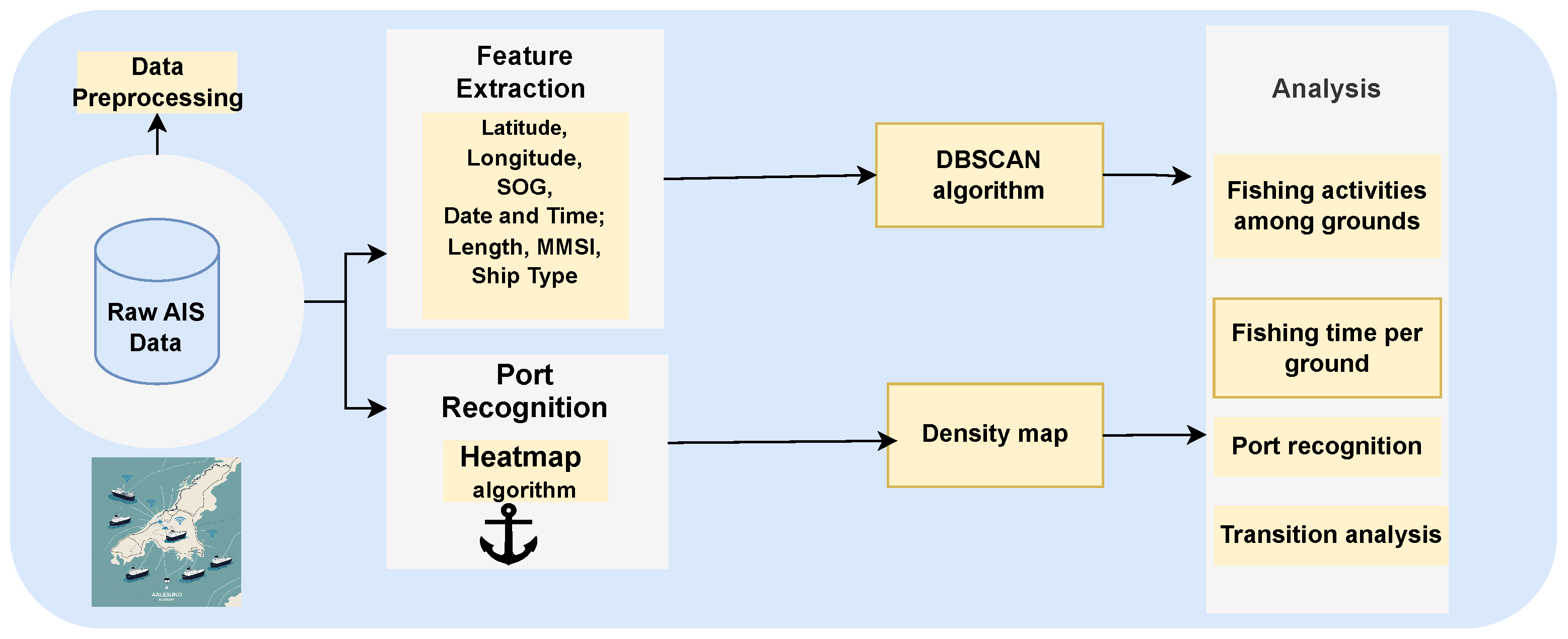
Figure 2 summarizes the workflow adopted in this paper. Raw AIS messages were collected for the Aalesund study area. Static, dynamic, and voyage-related fields were included. The data were then preprocessed. Empty files and duplicate records were removed. Basic cleaning and filtering were applied to retain valid observations.
Feature extraction was then performed. Position, time, speed, and vessel descriptors were derived for downstream steps. Two AIS subsets were used for different tasks. For fishing-activity recognition, fishing vessel messages were retained when the NavStat indicates “engaged in fishing” (Status = 7). Additional kinematic constraints were applied to reduce non-fishing behavior. For port and quay recognition, stationary or low-speed observations from all vessel types were retained. Harbor traffic concentrations were thus captured more robustly.
Port locations were then identified using a density map (KDE) with geographic constraints, see Section 3.1. In parallel, fishing grounds were detected using the DBSCAN algorithm. Spatial features were used to localize recurrent activity. Movement and temporal attributes were used to reduce transit-related noise. Finally, fishing-ground visits and residence durations were quantified. Transitions between fishing grounds and ports were analyzed. Differences were also assessed between category sizes of the vessels.
AIS positions are reported in geographic coordinates (latitude and longitude). Great-circle distance was therefore used instead of Euclidean distance in degrees. All coordinates were converted from degrees to radians before clustering. Let ( ϕ 1 , λ 1 ) and ( ϕ 2 , λ 2 ) denote latitude and longitude in radians. The Haversine great-circle distance is defined as
d ( ϕ 1 , λ 1 ) , ( ϕ 2 , λ 2 ) = 2 R arcsin sin 2 ϕ 2 ϕ 1 2 + cos ( ϕ 1 ) cos ( ϕ 2 ) sin 2 λ 2 λ 1 2 ,
where R is the Earth radius (taken as R = 6371 km).
DBSCAN was applied using the Haversine metric [42]. In this case, the neighborhood radius ϵ must be specified in radians. A desired radius ϵ km (in km) was converted as
ϵ rad = ϵ km R .
Table 1 reports the AIS-derived features and vessel attributes considered in this study.

3.1. Detection and Geolocations of Quay and Harbor Features

Port and harbor inference from AIS have been studied using both learning-based and density-based approaches (see Section 2). In this work, a density-based workflow is applied to recognize quay/harbor activity areas from AIS by (i) extracting stationary positions, (ii) estimating a spatial density surface using kernel density estimation (KDE), (iii) detecting candidate port hotspots as local maxima above a density threshold, and (iv) applying geographic filtering using coastline proximity and a landmask to remove offshore artifacts. The resulting port centers are then used to define port geofences for downstream port filtering and port–ground transition analysis.
The quay and harbor recognition process using AIS data begins with the filtering of stationary vessels. AIS records where the speed over ground ( SOG = 0 ) knots are extracted, since vessels at rest are the most likely candidates for being moored at quays or harbors. Stationary points ( SOG = 0 ) were used to obtain a conservative estimate of port-center hotspots, because true berthing/mooring produces the strongest and most spatially stable density peaks. It was not assumed that ( SOG = 0 ) alone delineates the full port operational area; port activities also include low-speed maneuvering and approach-channel behavior. Therefore, port areas were represented downstream using geofences (buffer radius R p ) and were additionally evaluated through H 3 based footprint expansion during validation, which is designed to include maneuvering waters adjacent to land-based facilities. This step ensures that the analysis focuses on locations where vessels are not in transit but instead engaged in port-related activities.
Once stationary vessels are identified, their positions are rasterized into a density map. The map is generated by dividing into a grid, typically at a resolution of 0 . 01 (approximately 1 km), although finer scales such as 100 m can be applied depending on the spatial detail required. This density map provides a spatial representation of where vessels tend to remain stationary, highlighting potential port areas.
A second filtering step is then applied specifically to the fishing vessels. Records are selected where the vessel type corresponds to fishing, and the NavStat code equals seven, indicating that the vessel is engaged in fishing. Combined with the condition of SOG = 0 knots, this ensures that only fishing vessels at rest are considered. These filtered positions are rasterized into a second density map using the same grid resolution, allowing for direct comparison with the all-vessel density map.
The two density maps, one for all stationary vessels and one for stationary fishing vessels, are then overlaid and compared. This comparison helps distinguish general port activity from fishing-specific port usage, thereby identifying locations that are particularly relevant for fisheries analysis. By examining the overlap and differences between the maps, candidate quay and harbor cells can be identified.
To refine these candidate locations, a thresholding procedure is applied. A density threshold, such as the number of vessel occurrences per grid cell per month, is used to filter out low-activity areas. The threshold can be tuned through sensitivity analysis to balance between detecting genuine port sites and avoiding false positives. This step ensures that only areas with consistent and significant vessel presence are retained.
Following thresholding, a water mask is applied to remove candidate cells that fall on open water surfaces rather than on land-based quay or harbor infrastructure. Shoreline polygons are used to implement this mask, ensuring that the final results correspond to realistic port locations rather than offshore anomalies.
The final recognition step classifies the remaining high-density cells as quays and harbors. These locations represent areas where vessels, particularly fishing vessels, consistently remain stationary and interact with port infrastructure. The complete workflow is summarized in Algorithm 1, which formalizes the sequence of filtering, density mapping, comparison, thresholding, and masking steps.
The parameters h, N, τ , d, and  R p are defined in Algorithm 1, and the numerical values used in experiments are reported in Table 3.
Algorithm 1 Quay and harbor recognition from AIS data (diagnostic intersection; operational union)
Require: AIS dataset A with position ( ϕ , λ ) , SOG , and navigation status NavStat
Require: Coastline/landmask representation as a coastline point set C
Require: KDE bandwidth h, grid size N, local-max window w, relative density threshold τ , coast cutoff d
Require: Peak-merging parameters ϵ p (meters) and minPts p
Ensure: (i) Fishing-associated port hotspots P (diagnostic), (ii) Operational port centers P all for geofences
  1:
Stationary-point sets:
S { p A SOG ( p ) = 0 } , F { p A SOG ( p ) = 0 NavStat ( p ) = 7 }
             ▹F is used as a fishing-associated diagnostic subset
  2:
KDE surfaces (evaluated on an N × N grid):
D all KDE ( S ; h , N ) , D fish KDE ( F ; h , N )
  3:
Peak extractionPeaks( D , w , τ ): local maxima + threshold
Q all P e a k s ( D all , w , τ ) , Q fish P e a k s ( D fish , w , τ )
  ▹Peaks: maximum-filter local maxima in a w × w window with D ( x ) > τ (e.g., τ = 0.01 max D )
  4:
Geographic filtering (remove offshore artifacts):
Q ˜ all { q Q all dist ( q , C ) < d } , Q ˜ fish { q Q fish dist ( q , C ) < d }
  5:
Diagnostic fishing-associated peaks (intersection by proximity):
Q ˜ { q Q ˜ all q f Q ˜ fish : dist ( q , q f ) δ }
 ▹ δ is a small tolerance (e.g., 1 km) used to match peaks from the two KDE surfaces
  6:
Peak mergingMergePeaks( Q ˜ ): DBSCAN + centroid (+ optional snapping)
P M e r g e P e a k s ( Q ˜ ; ϵ p , minPts p ) , P all M e r g e P e a k s ( Q ˜ all ; ϵ p , minPts p )
  ▹MergePeaks: DBSCAN on peak coordinates (e.g., ϵ p 700 m, minPts p = 1 ), centroids; optionally snap to nearest coastline point in C
  7:
return  P , P all

3.2. Fishing Ground Detection via DBSCAN

Identifying fishing areas is important for several aspects: maximizing catch efficiency, ensuring sustainable fisheries, and balancing economic needs with environmental protection. KDE and hotspot analysis using AIS data are used by Chen et al. [36] to identify fishing hotspots and evaluate how well regulatory measures are enforced. Kernel density estimation (KDE) is a non-parametric approach for estimating the spatial intensity of vessel observations from AIS point locations. Given n AIS positions { x i } i = 1 n with x i R 2 , the 2D KDE at location x is  
f ^ ( x ) = 1 n h 2 i = 1 n K x x i h .
where K ( · ) is a bivariate kernel function and h > 0 is the bandwidth controlling the degree of smoothing. A common choice is the isotropic Gaussian kernel
K ( u ) = 1 2 π exp 1 2 u 2 ,
where u R 2 denotes the normalized displacement vector, i.e.,  u = ( x x i ) / h . With this choice, regions with consistently high f ^ ( x ) correspond to spatial hotspots of vessel presence/activity, Silverman et al. [44]. KDE-based hotspot analysis using AIS data has been used to identify fishing hotspots and assess the effectiveness of regulatory measures [36]. To account for heterogeneous sampling intensity or vessel importance, we use a weighted KDE:
f ^ ( x ) = 1 h 2 i = 1 n w i i = 1 n w i K x x i h ,
where w i 0 is the weight assigned with AIS position x i (e.g., proportional to the time between successive messages, vessel size/tonnage, or a user-defined importance factor).
Selecting an appropriate KDE threshold to identify port areas can be non-trivial, motivating data-driven alternatives that reduce reliance on hand-tuned cutoffs. Prior work has demonstrated supervised learning for AIS-based activity inference using external ground truth: Johannsen et al. [39] detected fishing activities from AIS data and validated predictions against Norwegian catch reports, reporting high accuracy for vessels longer than 15 m. Unsupervised methods have also been explored, such as AIS trajectory segmentation combined with DBSCAN to delineate operational zones Linju et al. [37], although performance may degrade under noisy AIS records and the choice of clustering parameters. To improve robustness, Han et al. [38] proposed an optimized DBSCAN variant for modeling vessel behaviors, supporting trajectory analysis, anomaly detection, and situational awareness.
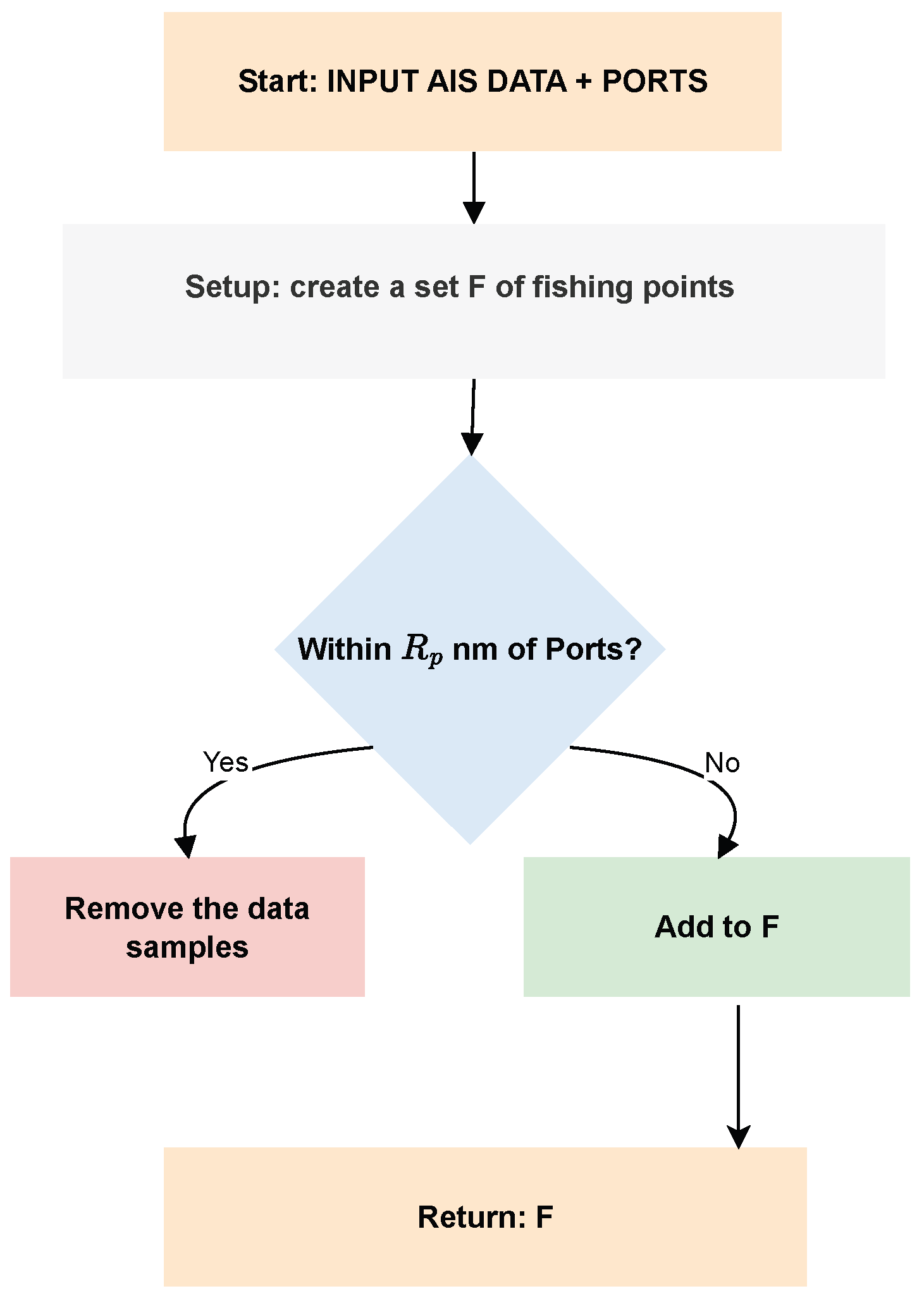
Candidate port areas are defined by buffering each port location with a radius of R p = 1.2 nm, following [43]. Figure 3 shows the port filtering algorithm, which removes AIS points located within R p nm of these ports. After that, the data is ready for the DBSCAN algorithm to be applied. The process of clustering goes through three phases: loading data efficiently, clustering using DBSCAN, and plotting using Basemap or Folium.
DBSCAN calls a point a core point if there are at least minPts points within a distance ϵ of it, and then expands clusters by connecting all points that are density-reachable. Points that are not reachable from any core point are called outliers or noise. The parameters ϵ and minPts are changed to get an acceptable result, because for different values of ϵ and minPts , we obtain different numbers of clusters. The results of DBSCAN are clusters that identify the fishing grounds. The following preprocessing steps are used to generate the analysis dataset from raw AIS records:
  • Time window selection: retain AIS messages within 1 January 2023–1 January 2024 (UTC).
  • Spatial window selection (Aalesund ROI): retain messages inside the bounding box
    [ ϕ [ 62 . 2 , 62 . 7 ] , λ [ 5 . 5 , 7 . 0 ] ] .
  • Basic validity checks: drop records with missing/invalid coordinates or timestamps; remove duplicate messages (same MMSI timestamp).
  • Vessel filtering: retain fishing vessels using NavStat equal fishing and AIS observed vessels (predominantly length greater than or equal to 15 m, where available).
  • Activity cue filtering: retain records with NavStat = 7 (“engaged in fishing”) and speed over ground ( S O G ) [ 0 , 0.6 ] kn.
  • Port proximity filtering: remove records within a radius of 1.2 nautical miles of identified port locations to reduce port-adjacent stationary behavior and maneuvering artifacts.
  • Trajectory segmentation for visit analysis: group by MMSI and split trajectories at time gaps greater than ( Δ t gap ) = [value, e.g., 30–60 min]; compute visits/residence times only within continuous segments.
  • Grid sampling (for cluster robustness): aggregate remaining AIS positions to a spatial grid of 0 . 005 × 0 . 005 and represent each occupied cell by its centroid and count, reducing the influence of uneven AIS reporting and near-duplicate points.
  • Coordinate conversion for clustering: convert coordinates to radians and use the Haversine distance metric for DBSCAN.
This filter order is used consistently for fishing ground clustering and for downstream analysis of visit duration and port-ground transitions.

3.3. Fishing Vessel Behavior Analysis

This section quantifies how fishing vessels move between the detected fishing grounds (FGs) and the recognized port areas (port/quays/harbors), and how these mobility patterns differ by vessel size class. The analysis uses AIS trajectories grouped by unique MMSI and ordered by timestamp; each AIS record contains at least { MMSI , t , ϕ , λ , SOG , NavStat } , with vessel length L and ship type used for stratification and filtering.
To extract transitions, each AIS position is assigned to a discrete zone state. A point is labeled as belonging to the fishing ground F G i if it lies inside the spatial footprint of that ground (cluster extent), or within a buffer radius R FG of the cluster boundary/centroid. Similarly, a point is labeled as belonging to port P o r t j if it lies within a port geofence of radius R P around the detected port center. Points that fall outside all ground and port geofences are labeled as an outside state. In the main analysis, R FG = ϵ = 2.35 km, i.e., equal to the DBSCAN neighborhood radius used to delineate the grounds, and  R P = 1.2 nm. This makes the transition analysis consistent with the spatial scale at which fishing activity density is clustered. A larger buffer R FG = 5 km is used as a sensitivity bound. When a point lies within multiple geofences, it is assigned to the nearest zone (by Haversine distance) to ensure a unique state per AIS record.
For each vessel, the ordered state sequence is compressed into consecutive runs of identical states to remove labels caused by dense sampling within the same zone. A visit episode is defined as a maximal consecutive run within a given zone (a fishing ground or a port), with entry time t in and exit time t out . The residence time of a visit is Δ t = t out t in . A transition is then defined as a change between two consecutive episodes, e.g.,  F G i P o r t j or P o r t j F G i . Thus, an entry–exit cycle (entering a zone and later leaving it) is the basic unit from which transitions are extracted. Because AIS sampling is not continuous and may include gaps, these transitions represent the next observed zone-state changes rather than fully observed trips; therefore, the transition counts together with summary statistics of the inter-message time gaps are reported and, optionally, episode boundaries when the gap between consecutive AIS messages exceeds a threshold (e.g., 24 h) are excluded. Short zone-crossing may reflect boundary effects, maneuvering, or transient low-speed behavior rather than purposeful activity. Therefore, a minimum residence threshold τ is applied, and results for multiple values (e.g., τ { 30 , 60 , 120 } min) are reported to test the robustness of the inferred flows and seasonal patterns to the visit-duration criterion.
Vessels are divided into three size classes based on Norwegian length strata [45]: small ( L < 20.9 m), medium ( 21 L 27.9 m), and large ( L 28 m). This stratification also reflects AIS carriage practice, since AIS is generally required for vessels longer than 15 m [46]. For each size class, the number of visits and total residence time per fishing ground, monthly distributions of visits to capture seasonality, and directed transition summaries between fishing grounds and ports are computed. To avoid dominance by a small number of highly active vessels, both aggregate counts and per-vessel normalized statistics (e.g., median visit per vessel) are reported.
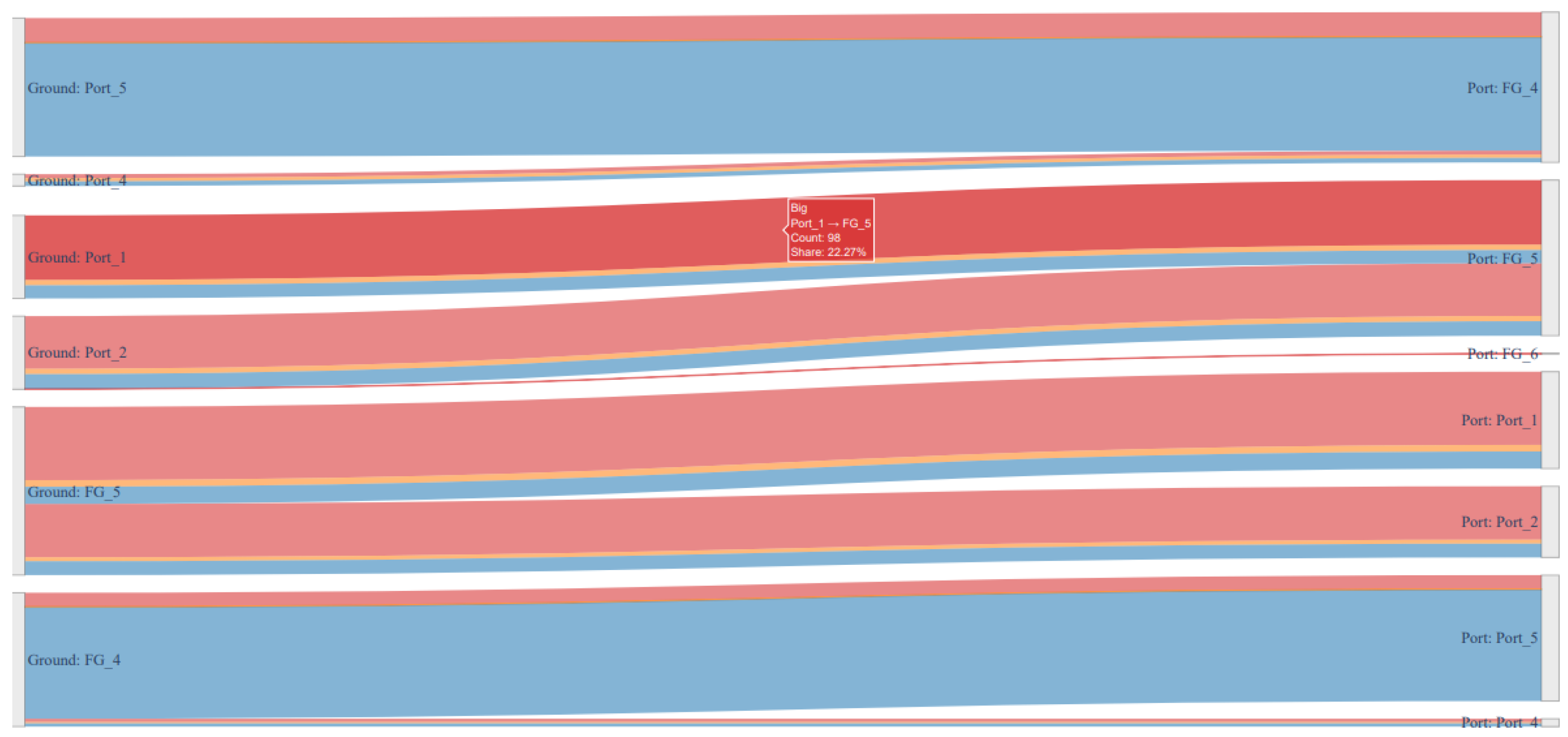
Directed transitions are visualized using flow (parallel-set) diagrams to highlight dominant routes between ports and fishing grounds. The resulting outputs provide an interpretable description of fleet mobility, operational ranges, and temporal variability in fishing ground usage, supporting the downstream analysis in the next section.

4. Experiment and Results

4.1. Dataset and Setup

In this research, the fishing activity in the Aalesund area is examined. Aalesund is a standout among Norwegian municipalities in terms of the economic footprint of its seafood industry. The town of Aalesund is located on the west coast of Norway and is built over seven large islands and many other small islands. Its economy is primarily based on the fishing and maritime industries. The fishing harbor of Aalesund is the most important in Norway, and one of the most modern in Europe. One year of AIS data for the Aalesund area from 1 January 2023 to 1 January 2024 is analyzed to discover fishing grounds. Dataset statistics and filtering outcomes are summarized in Table 2.

4.2. Parameter Setting and Sensitivity Analysis

Table 3 lists the parameters used to detect quay/harbor hotspot centers from stationary AIS density. Figure 2 shows the phases of the DBSCAN clustering algorithm applied to fishing vessels in the Aalesund area. The AIS data used in this study were obtained from the Norwegian Coastal Administration (Kystverket) (Norwegian Coastal Administration (Kystverket), “https://www.kystverket.no/en/sea-transport-and-ports/ais/access-to-ais-data/, Access to AIS data: 25 November 2024”). We extracted one year of AIS messages for the Aalesund study area (Figure 1) and applied the preprocessing steps described in Section 3. The process includes data collection, preprocessing data, feature extraction, port area filtering, applying DBSCAN, and cluster visualization.
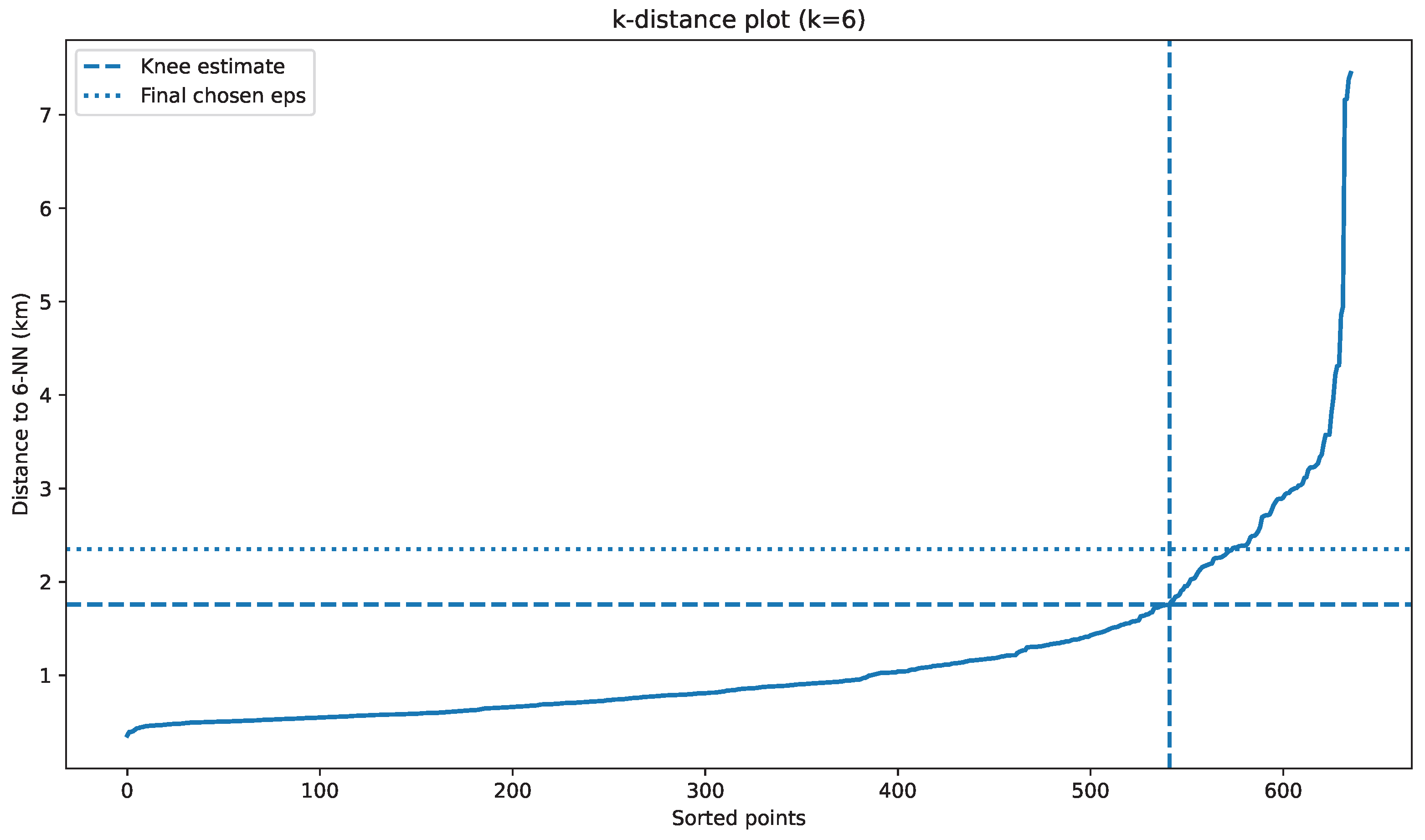
The k-distance plot ( k = minPts = 6 ) exhibited a knee at ϵ 1.76 km (Figure 4), which was used as an initial candidate. Final values were determined by a local sensitivity sweep (Table 4).
To justify the selection of ϵ and minPts , a two-stage, data-driven procedure was applied to the grid-sampled AIS points using the Haversine distance metric. First, the k-distance curve was computed with k = minPts and a knee point was identified ϵ 1.76 km, which was interpreted as a lower-bound neighborhood scale separating dense regions from border/noise. Second, because knee-based values can be conservative and may lead to over-fragmentation, a local sensitivity sweep was subsequently performed over ϵ [ 2.25 , 2.50 ] km and minPts [ 5 , 8 ] . Across the neighborhood, the number of clusters (excluding noise) was observed to remain within 5–7, indicating a stable operating region (Table 4). Within this stable region ϵ = 2.35 km and minPts = 6 were selected because six spatially coherent fishing grounds were obtained while excessive fragmentation was avoided and the noise fraction remained low.
Table 5 reports a seasonal robustness check in which the same DBSCAN settings were applied to every season, DJF/MAM/JJA/SON subsets, summarizing the resulting cluster counts and noise fractions to assess whether the identified fishing grounds persist across seasons.
To assess whether the selected clustering parameters are sensitive to seasonal variability, the fishing-state AIS points were partitioned into meteorological seasons (December, January, February (DJF), March, April, May (MAM), June, July, August (JJA), September, October, November (SON)) and clustered using the same preprocessing pipeline and fixed DBSCAN settings ( ϵ = 2.35 km, and  minPts = 6 ) on the grid-sampled representation. As reported in Table 5, a comparable number of clusters (5–6, excluding noise) was obtained in DJF, MAM, and SON, while JJA yielded fewer clusters (3) and a higher noise fraction. This behavior is consistent with the substantially lower sampling intensity in summer (fewer AIS points and occupied grid cells), which reduces local density and causes marginal areas to be labeled as noise under fixed density thresholds. Taken together, the results indicate that the chosen neighborhood scale is stable for the dominant seasonal operating regimes, while reduced summer activity leads to conservative clustering (higher noise and fewer grounds), which is expected for density-based methods.

4.3. Port Recognition Results and Validation

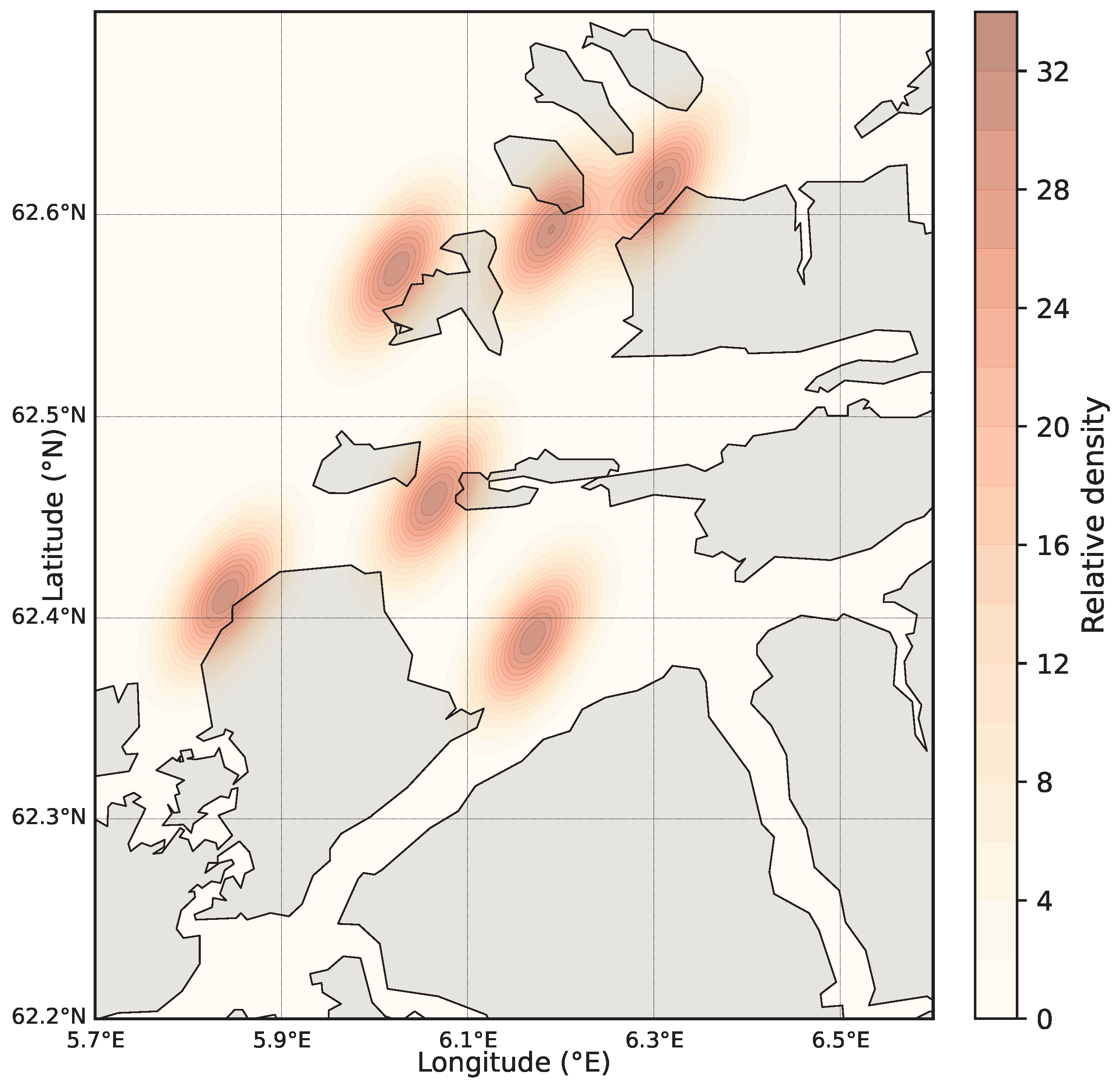
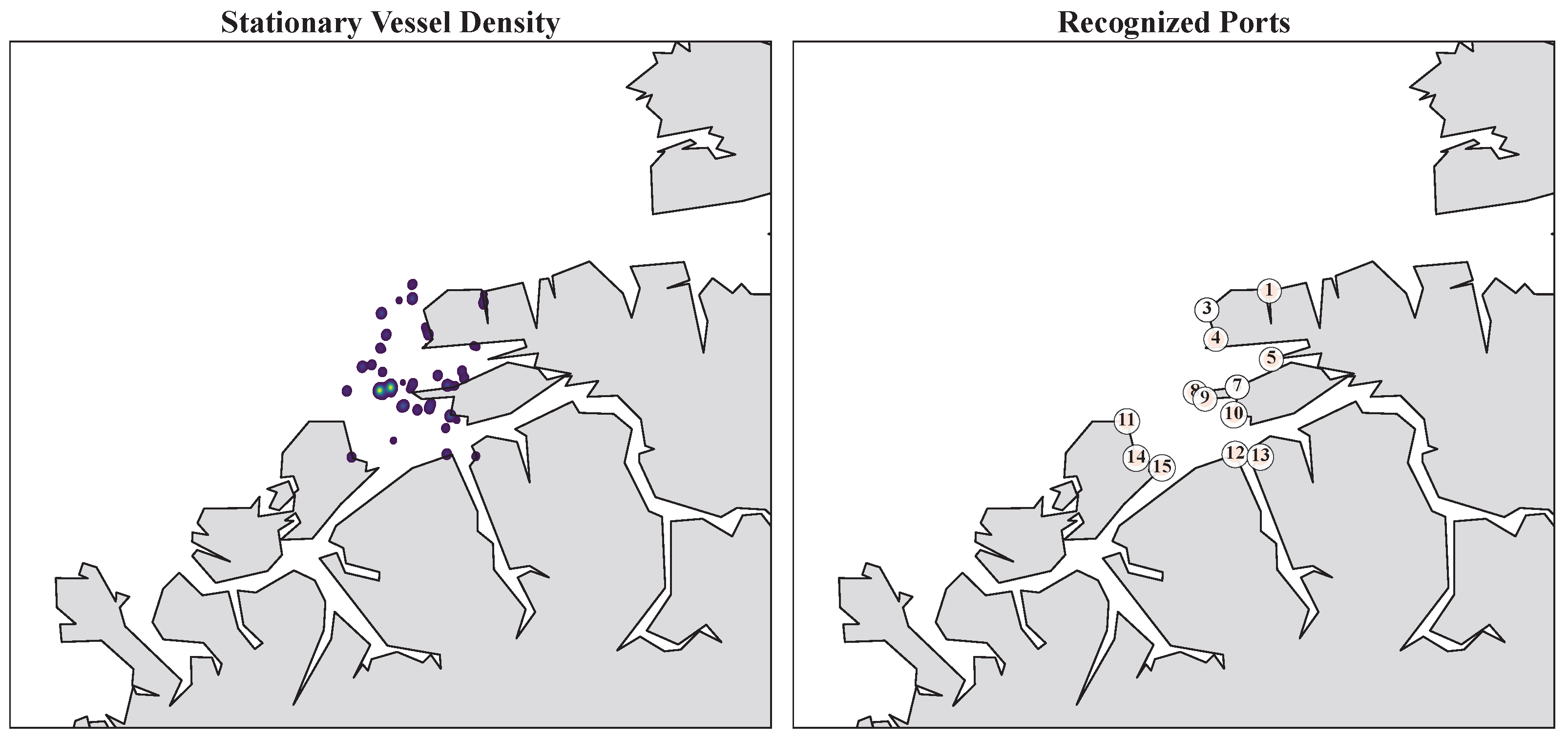
In Figure 5, the port recognition results are shown. Here, 771,576 AIS records were used; the stationary points for non-fishing vessels around Aalesund are 446,053 AIS records, and the stationary points for fishing vessels are 63,100 AIS records. There are six port (quays, harbors) candidates with local maxima above the threshold. After that, the stationary fishing vessels are used to identify ports; there are five port candidates with local maxima above the threshold. When all stationary vessels are used to identify ports, 15 ports (quays, harbors) are detected. Fifteen ports were detected in total; Port 2 and Port 6 are not separately visible in the map because their locations overlap/lie very close to Port 3 and Port 5 at the plotting scale. The detection of port-activity points (from AIS density hotspots) was validated against independent port/harbor footprint polygons extracted from OpenStreetMap (OSM) (https://www.openstreetmap.org, accessed on 25 November 2025). for the study area (56 polygons). Footprint polygons are typically smaller than the analysis grid used to represent harbor-scale areas. The space is discretized using H3 hierarchical hexagonal index at resolution 9 (target “harbor-scale” grid) and each facility footprint polygon is converted into an H3-based geofence. Specifically, polygons were first rasterized to H3 cells at a finer resolution and then aggregated to resolution 9 via the H3 parent–child relationship, yielding a stable footprint-derived geofence at the target scale. A detected point was considered covered if the H3 cell containing the point (resolution 9) belonged to this polygon-derived geofence.
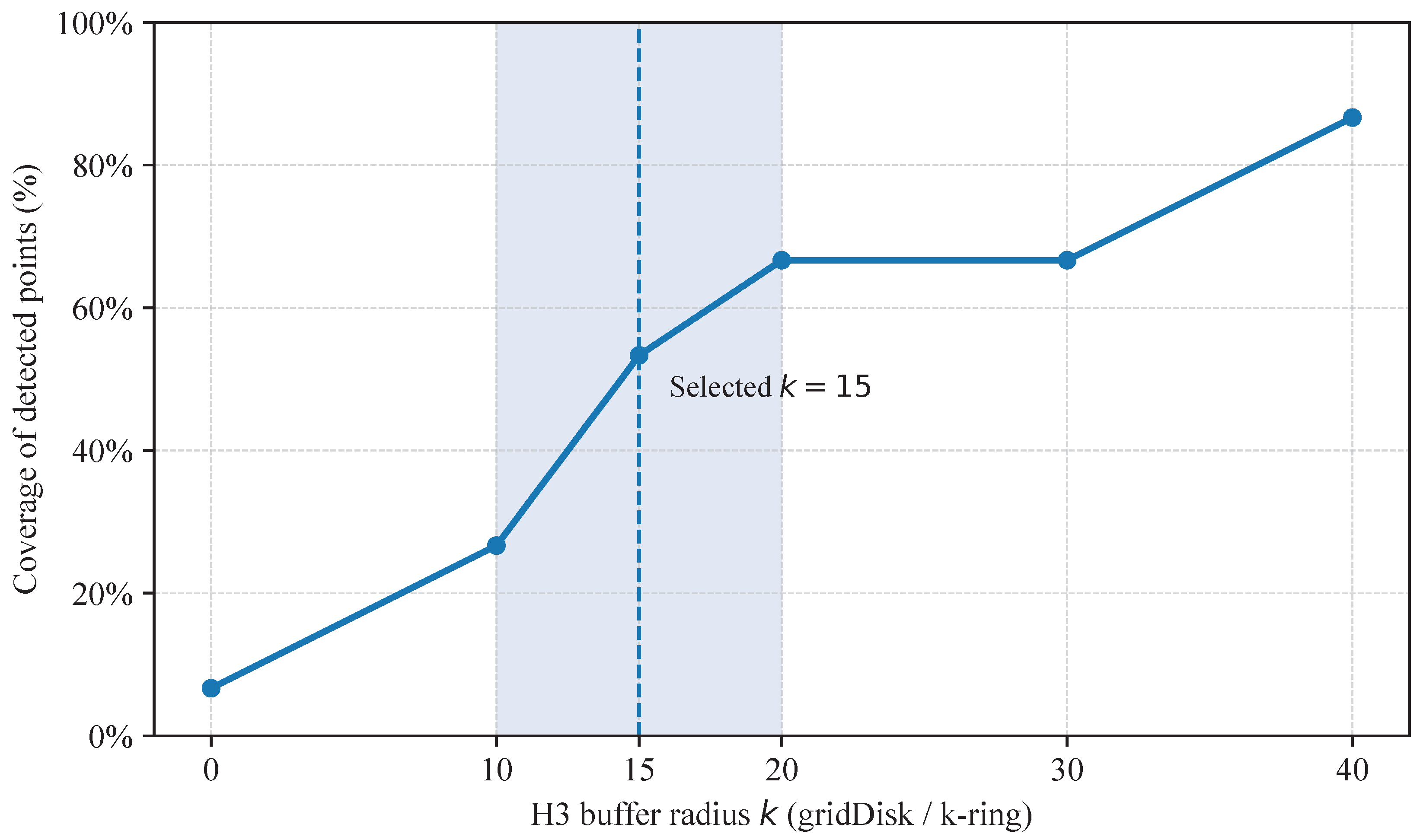
Because vessel operations associated with ports often occur in adjacent water areas (e.g., basins, berths, and approach channels) rather than strictly within the footprints of land facilities, the footprint-derived geofence was further expanded using an H3 grid disk (k-ring) with radius (k), i.e., including all H3 cells within (k) grid steps of the initial geofence. A sensitivity analysis over k was conducted to balance spatial specificity against coverage of detected points.
At a resolution equal to 9 without expansion (k = 0), only 6.7 % detected points fell inside the footprint-derived geofence. As shown in Figure 6, coverage increased as the buffer radius grew: k = 10 covered ( 26.7 % ) ; k = 15 covered ( 53.3 % ) ; and k = 20 covered ( 66.7 % ) . Beyond this range, gains diminished: k = 30 still covered ( 66.7 % ) , whereas k = 40 increased coverage to ( 86.7 % ) but produced a very large geofence (97,174 H3 cells), indicating over-inclusiveness. As an elbow operating point, it was selected k = 15 that balances coverage ( 53.3 % ) with spatial specificity (23,411 H3 cells), and reports k = 10 and k = 20 as sensitivity bounds.
The KDE bandwidth h controls the spatial smoothing scale of the stationary-point density and therefore the splitting/merging of detected port hotspot centers. To justify h, we performed a local sensitivity sweep over h { 0.0075 , 0.01125 , 0.015 , 0.01875 , 0.0225 , 0.03 } while keeping all other settings fixed (grid N = 250 ; local-max window w = 7 ; threshold τ = 0.01 · max ( f ^ ) , and the same coastline proximity filtering and peak-merging step). As h increases, the number of detected centers decreases from 21 to 5, consistent with the expected split-merge behavior: small bandwidths over-segment harbor basins, whereas large bandwidths merge nearby facilities. Importantly, the dominant port centers are spatially stable across a broad range: relative to the baseline h = 0 . 015 , the median displacement is 0 km for h 0 . 0225 , while at h = 0 . 03 the solution shows stronger merging and center shifts (median displacement 1.57 km and only 11/15 baseline centers matched; Table 6). We therefore selected h = 0 . 015 as a harbor-scale operating point that avoids peak-splitting at smaller h and excessive merging at larger h while preserving stable hotspot locations.

4.4. Fishing Ground Identification and Behavioral Connectivity

To distinguish the fishing area near Aalesund, the points in ports by Paraknowledge and at a distance of 1.2 nautical miles radius around ports are filtered. Total points after filtering are 130,834. To improve DBSCAN performance, the analysis is restricted to a bounding box around Aalesund: ϕ [ 62 . 2 , 62 . 7 ] and λ [ 5 . 5 , 7 . 0 ] thereby focusing on the area of interest. This process removes abundant data and speeds up clustering. In the next step, the coordinates are converted to use the Haversine distance, since the DBSCAN by default uses the Euclidean distance. The Haversine distance is more appropriate for geographic data, so it is used for latitude and longitude. First, the  ( l o n , l a t ) are converted into radians, and then the Haversine distance from scikit-learn is used.
Regarding parameter and distance-metric selection, DBSCAN requires specifying the neighborhood radius ϵ and the minimum number of points minPts (or min_samples). For geographic coordinates, ϵ represents a spatial scale (e.g., in km or nautical miles) that controls cluster compactness: smaller values yield smaller clusters and more noise points, whereas larger values may merge nearby activity regions. To suppress smaller clusters and retain only persistent dense fishing zones, the  minPts is set equal to be equal to 6; points not assigned to any cluster are labeled as noise ( 1 ) . To reduce the impact of AIS noise and uneven sampling, AIS positions are grid-sampled before clustering, and remaining points are subsequently assigned to the nearest cluster centroid. Distances are computed using the Haversine metric, which is appropriate for longitude/latitude coordinates on the Earth’s surface. Euclidean distance can be used after planar projection, but projection distortions may affect cluster geometry and parameter interpretation [47]. Unlike DBSCAN, k-means requires a predefined number of clusters and does not explicitly model noise.
Regarding computational performance, DBSCAN can be memory-intensive for large AIS datasets. To mitigate this, precomputing a full distance matrix is avoided, and reliance is placed on tree-based neighbor search (BallTree/KDTree); when needed, the data volume obtained via sampling/aggregation, filtering (e.g., by time or speed), chunked processing, or scalable variants such as HDBSCAN is reduced. Finally, after clustering, the resulting clusters are visualized on a map using Basemap or another mapping tool. Figure 7 shows the distributions of the fishing destinations; only the vessels with a status equal to seven, and a speed over ground of less than 0.6 knots, which refers to fishing, are kept.
After that, the port points are identified using a Paraknowledge ports reference CSV (privately provided; centroid coordinates used for port-proximity filtering), and points within 1.2 nautical miles of ports are removed. After that, the points with speed over ground between 0 and 0.6 knots are filtered. From 31 port datasets and 1913 fishing csv files, we retained AIS records with status equal to seven (fishing) and SOG [ 0 , 0.6 ] (398,380 points) and then removed 107,538 points within 1.2 nm of ports. From the cleaned data set, the unique vessels were filtered, and 74 unique fishing vessels were found.
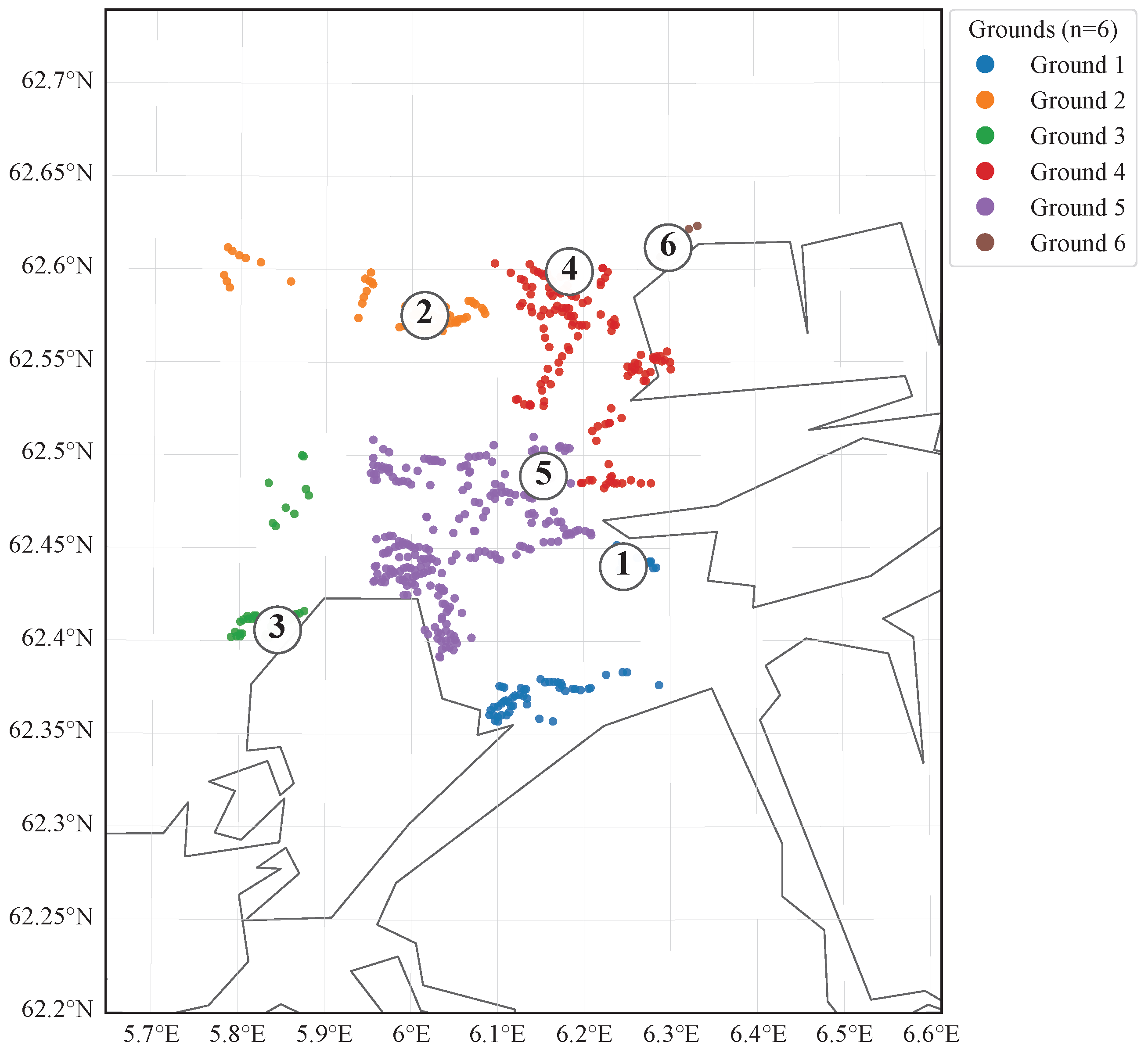
In Figure 8, the fishing grounds detected by DBSCAN are shown.
Using the selected parameters ( ϵ = 2.35 km, minPts = 6 ), DBSCAN identified six fishing ground clusters (excluding noise), consistent with the stable region observed in the sensitivity analysis. Table 4 summarizes the parameter sensitivity in the neighborhood of the selected configuration and shows that the number of clusters remains within 5–7 across plausible settings. (Noise % is computed as the fraction of grid-sampled cells labeled as outliers.) Figure 4 shows the k-distance plot with k = minPts = 6 . The knee point ( ϵ 1.76 km) provides a lower-bound neighborhood scale; however, using ϵ near the knee tended to over-fragment the study area into smaller clusters. We therefore selected ϵ = 2.35 km as a stable operating point after the sensitivity sweep, as it yields six interpretable grounds while avoiding excessive fragmentation and maintaining a low noise rate.
To evaluate whether the density-based fishing grounds may include non-fishing low-speed events (e.g., sheltering or maintenance), behavioral diagnostics were computed on the original AIS messages after assigning each message to a ground (rather than on the grid-sampled representation). Table 7 summarizes, per ground, vessel diversity (unique MMSI), low-speed statistics ( SOG median and IQR), maneuvering indicators (median absolute rate-of-turn and course-change rate), and residence-time distributions. Grounds F G 4 F G 5 show substantial residence times (median 182–446 min; upper quartiles up to 632 min) and are visited by many vessels (25–34 MMSI), supporting their interpretation as persistent operational fishing areas. In contrast, F G 6 contains only eight AIS points and short residence times (median 3 min), and is therefore treated as weak evidence and not emphasized in the behavioral interpretation.
Original points were 168,237, and after grid-sampling, there were 636 points. DBSCAN created six fishing grounds. DBSCAN groups are presented based on density. These clusters represent fishing grounds with notable differences in density. The largest cluster is Cluster 4, containing 126,461 points, followed by Cluster 5 with 16,373 points, while the other clusters contain fewer records. Cluster 1 is located near Aalesund harbor, indicating coastal or fjord fishing. Cluster 2 shows offshore activity in the northwest of Ellingsoy, and Cluster 3 is located in the west of Godoya, possibly demonstrating trawling. Cluster 4 is located in the north of Aalesund, fjord mouth, Cluster 5 is between Aalesund and Giske in sheltered waters, and Cluster 6 is located in the East of Lepsoya, near the archipelago edge. When the epsilon is increasing, the number of clusters is decreasing, and the opposite occurs with minPts . A larger value of minPts provides a larger number of clusters. Cluster centroids from the six fishing grounds detected by DBSCAN were overlaid with the Directory of Fisheries “fiskeriaaktivitet etter redskap” dataset in ArcGIS Desktop (https://portal.fiskeridir.no/portal/apps/webappviewer/index.html?id=f6931eb067324c638628af065f1b9051, accessed on 10 September 2025). Intended meaning is retained. Five clusters overlapped directly with mapped fishing grounds, associated with gear types including trawl, line, net, and snurrevad. One cluster (Cluster 5) was located outside the mapped zones, which could represent emerging activity or not. This confirms that the clustering approach reliably identifies fishing grounds consistent with official records.
To evaluate the sensitivity of fishing ground identification to the choice of density-based clustering method, DBSCAN, OPTICS, and HDBSCAN were compared using the same preprocessing pipeline, grid-sampled AIS representation, and Haversine distance metric. The quantitative comparison is reported in Table 8.
Vessels are commonly grouped into size classes using length, but the thresholds vary across organizations and applications. For example, small, medium, and large categories are often defined using cut-offs such as 12 m and 24 m [48,49]. In Norway, fishing vessels are frequently reported in more detailed length strata (e.g., <10 m, 10–14.9 m, 15–20.9 m, 21–27 m, and >28 m), and an additional high-level distinction is sometimes made between coastal and sea-going fleets using 55 m as a threshold [45].
In this study, vessel-size classes were defined to balance interpretability with AIS coverage. AIS carriage is not obligatory for vessels shorter than 15 m [46], which can lead to under-representation of the smallest vessels in AIS-based analyses. Therefore, a three-class scheme aligned with the Norwegian length strata was adopted: small vessels were defined as L < 20.9 m, medium vessels as 21 27.9 m, and large vessels as L 28 m. This classification was then used to compare fishing-ground usage and ground–port transitions across fleet segments. The small and medium fishing vessels fish throughout the year; instead, the big vessels fish more during Spring and Summer.
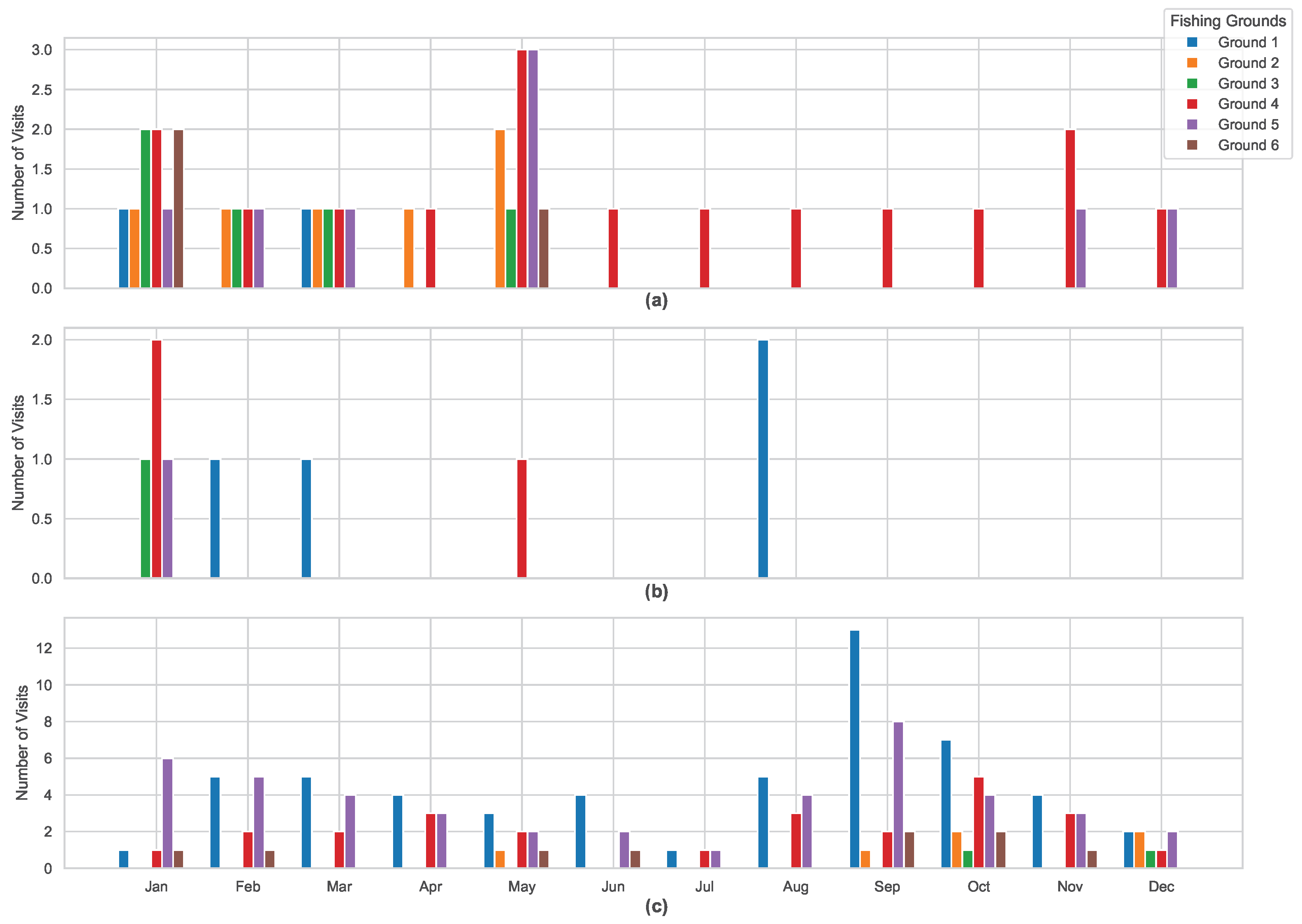
The unique fishing vessels that fish on the Aalesund fishing grounds were classified as shown in Table 9. First, there are medium fishing vessels ( 8.1 % ) , then big vessels ( 78.4 % ) , and the smallest number represents small fishing vessels ( 13.5 % ) . Cluster 1 is the most diverse ground, being visited by vessels of all size classes. Clusters 4 and 5 are visited by medium-sized vessels, and Clusters 2, 3, and 6 are mostly visited by small and medium vessels, maybe during local and regional operations. In Figure 9, we show an illustration of visits to fishing grounds over one year, disaggregated by the category of size vessels and spatially grouped into clusters derived from DBSCAN. For the 30 min threshold, there are 189 visits; for the 60 min threshold, there are 183 visits, and for the 120 min threshold, there are 172 visits. At the ≥30 min residence-time threshold, large vessels account for the majority of visits ( 74.1 % ), followed by small vessels ( 21.2 % ) and medium vessels ( 4.8 % ).
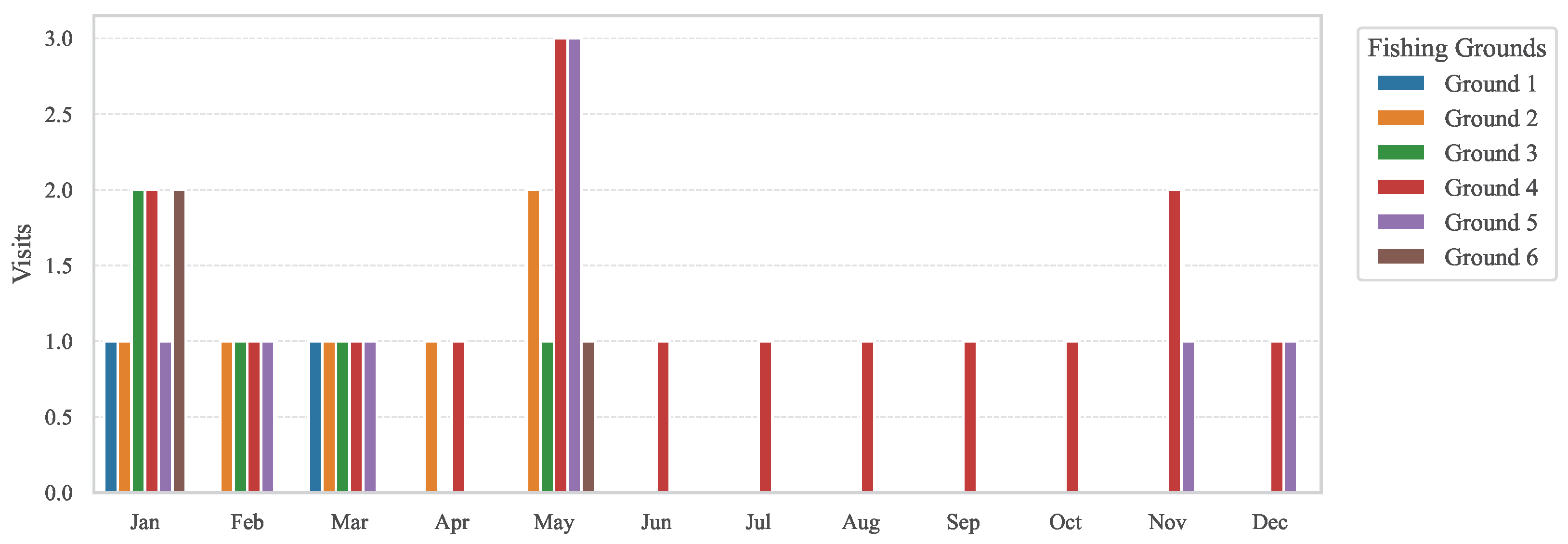
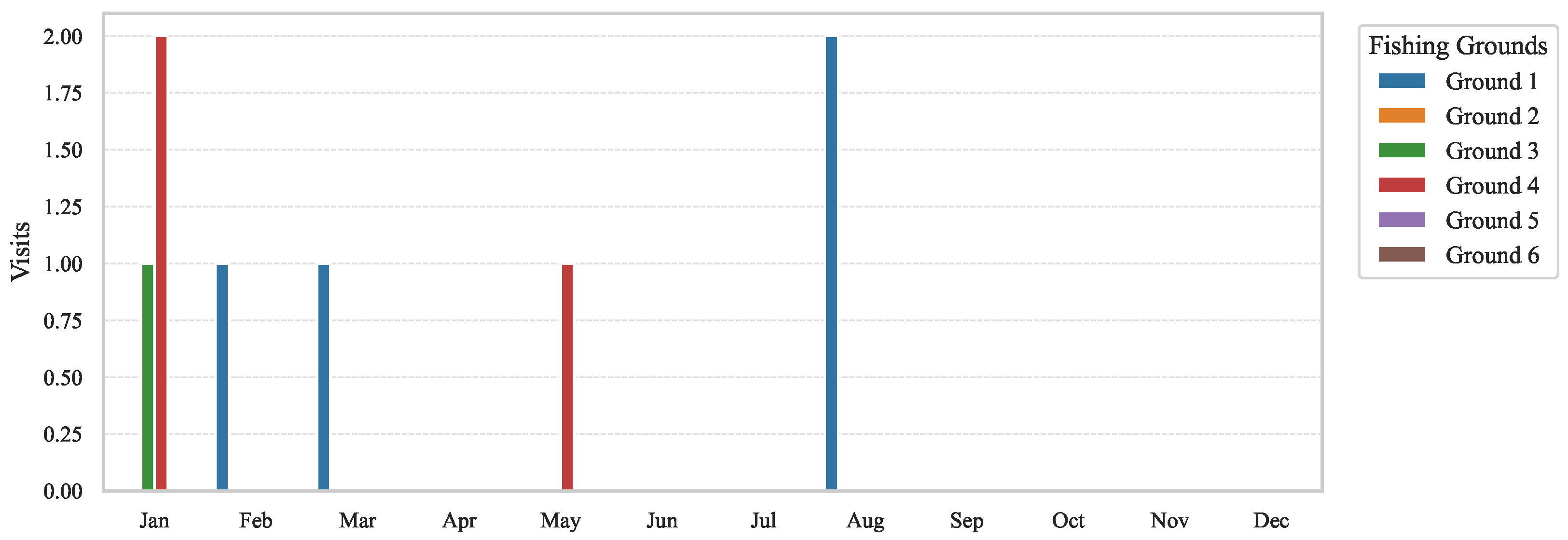
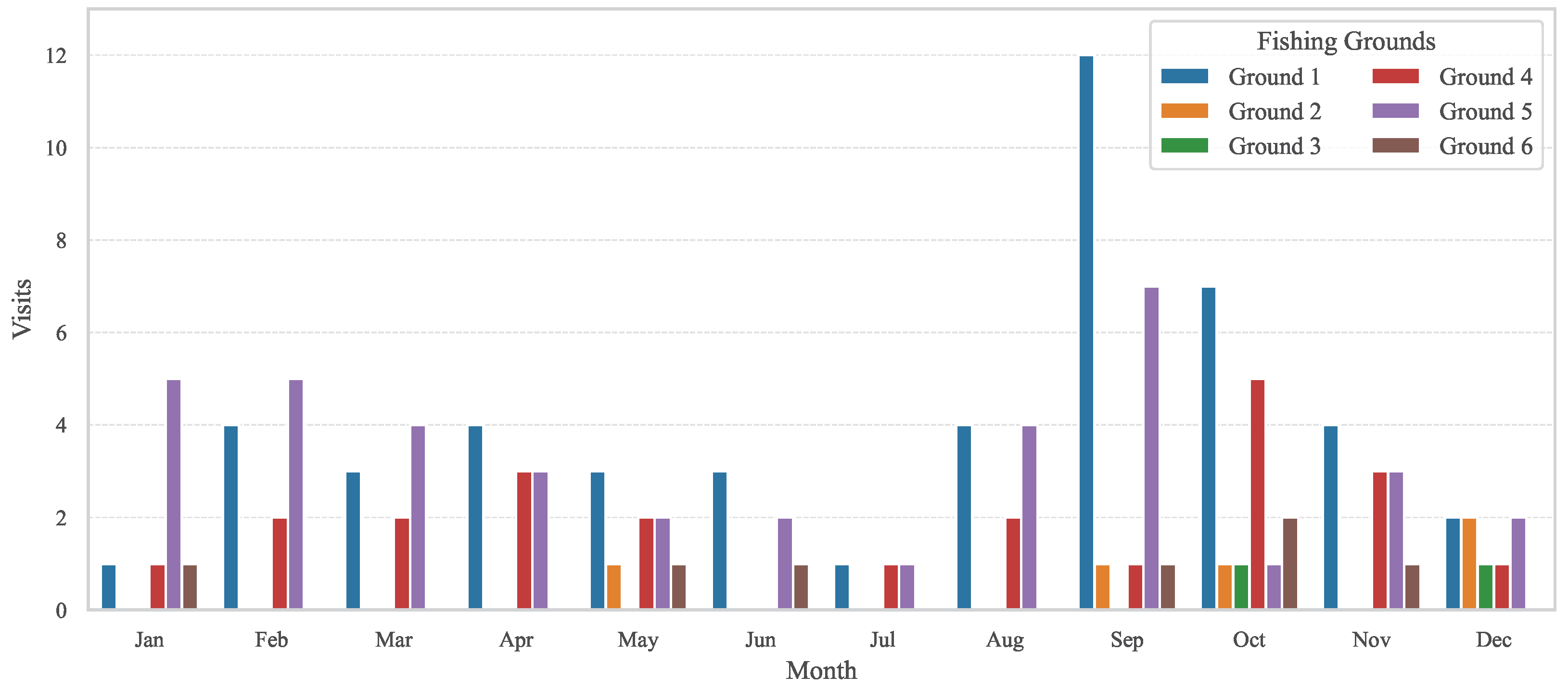
As can be seen in Figure 9, the analysis highlights clear spatial preferences and seasonal trends that vary with vessel size. Small vessels, likely operating close to the shore, show a broader spread and exhibit a strong preference for Clusters 4 and 5, suggesting localized, possibly artisanal fishing. In January and May, they show greater activity. They make shorter trips, with frequent returns.
Medium-sized vessels exhibit a distinct distribution, with peak activity in January and August. Cluster 1 is more frequented, followed by Cluster 4. Very low activity was observed for medium-sized vessels. This pattern aligns with seasonal fishing that targets species such as mackerel or herring, which are abundant in deeper or transitional waters during this period, referring [50]. Cluster 4 shows moderate activity among this group, indicating flexible fishing strategies between inshore and offshore zones.
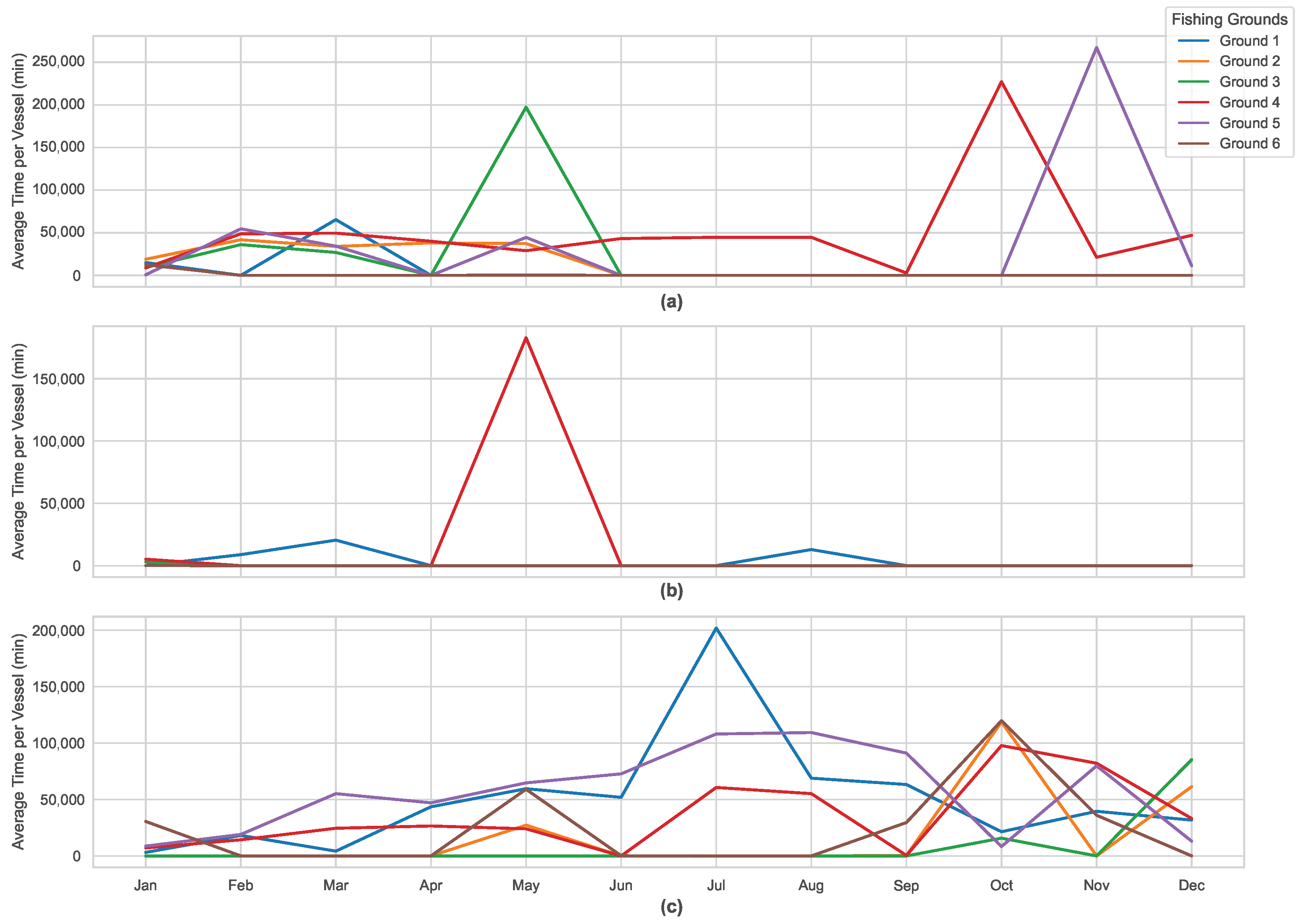
Large vessels show focused and strategic behavior, preferring Clusters 1, 4, and 5. Big vessels show a peak in visits in September and secondary peaks in January, February, and October, then normal activity. Their temporal pattern indicates seasonality, suggesting that these vessels target more stable or commercially intensive grounds, which are often farther offshore but rich in biomass. They make longer trips, with fewer relocations. Figure 10, Figure 11 and Figure 12 summarize the monthly distribution of fishing ground visits by vessel size class: small and medium vessels are shown to have a residence time criterion greater than or equal to 120 min (Figure 10 and Figure 11), while big vessels are reported at 30, 60, and 120 min to assess sensitivity to the duration threshold (Figure 12). The seasonal variations observed in AIS-derived activity likely reflect a combination of (i) biological drivers (e.g., seasonal distribution and availability of target species) and (ii) operational/regulatory drivers (e.g., seasonal openings/closures, quota dynamics, weather constraints, and holidays). In this study, we used AIS to quantify when and where activity occurs, but we did not attribute causality to specific biological or regulatory mechanisms because catch composition, stock indices, quota/timing, and gear information were not integrated. Therefore, the seasonal patterns are reported as empirical activity signatures, and their linkage to stock dynamics or regulations is left for future work combining AIS with landings/logbooks and official management calendars. In Figure 13, the time spent at each fishing ground is illustrated with respect to the size of the vessel for one year.
As shown in Figure 13, the monthly distribution of average fishing time (in minutes) among the groups identified by DBSCAN is stratified by vessel size category. Cluster 4 dominates across all vessel sizes, maybe due to seasonality or biological factors. Small vessels exhibit peaks in May, October, and November, medium vessels in May, and large vessels peak in July. We can see distinct patterns by different fleets, where small vessels show biomodal peaks in spring and autumn, maybe due to local weather, medium vessels demonstrate a peak in late spring, with low activity in autumn, and almost nonexistent activity for the rest of the year, maybe due to their targeting specific species or quotas, and big vessels show a sharp peak in July and autumn, and then just a modest effort, maybe due to the need to meet quotas or industrial fishing. Cluster 1 is used more by big vessels early in the year; it is an offshore zone. Clusters 2 and 3 are used by small and medium-sized vessels nearshore, perhaps indicating artisanal fishing. As we can see, Cluster 6 exhibits low effort but consistent presence, suggesting that it may be related to specific species and seasonality.
If visit frequency is compared with time spent in fishing grounds, it is obvious that small-sized vessels show frequent, but short visits, and big vessels show fewer visits, but longer engagement. Fleet segmentation is clear, so vessel size correlates with spatial and temporal fishing behavior.
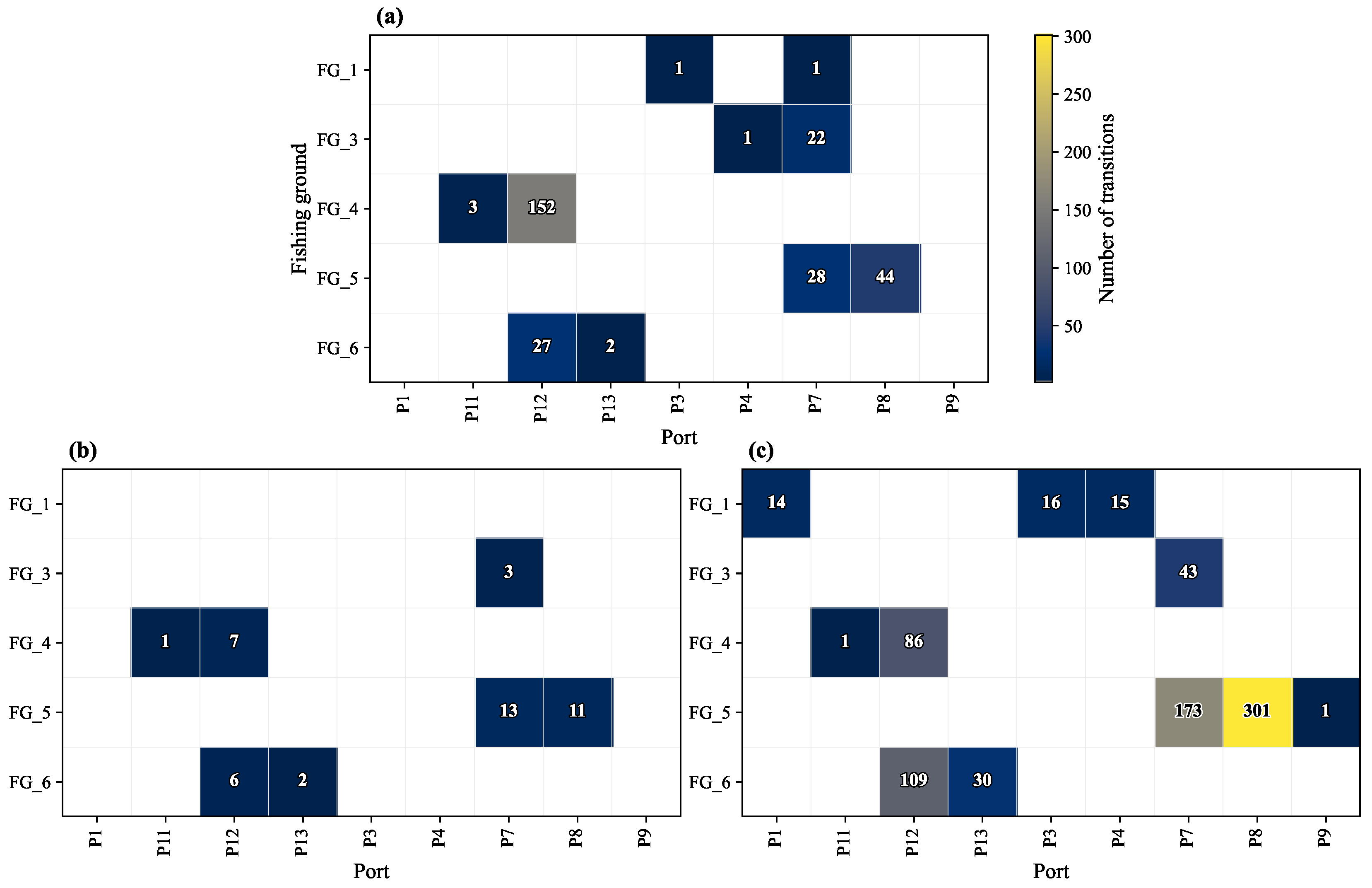
In Figure 14, the transition of fishing vessels between fishing grounds and recognized ports classified by vessel size is shown.
The observed next-state transitions from fishing grounds to ports, quays, and harbors are highly concentrated, as shown in Figure 14 using the baseline ground–assignment radius R FG = ϵ = 2.35 km (equal to the DBSCAN neighborhood radius), and in Figure 15 using R FG = 5 km as a sensitivity test. Across the 321 observed transitions, P o r t 1 2 accounts for 319 transitions ( 99.4 % ) , while P o r t 1 1 and P o r t 1 3 appear only once each. The flows mostly originate from two fishing grounds ( F G 4 and F G 6 ), with F G 4 contributing 186 and F G 6 135 transitions. Transition counts are similar for small (157) and big vessels (154), whereas medium vessels contribute only 10 transitions. However, the small vessels’ signals are strongly driven by a single high-activity vessel, whereas the big vessels’ flows are distributed among many vessels. The transition durations between consecutive zone states vary widely for example median approximately 4.8 h, with 25 % more than 24 h, indicating that the counts represent “next observed zone-state changes” in AIS rather than continuously observed trips. With the buffer of 5 km in Figure 15, we can see more fishing grounds and ports. The flows are more spread out, but some strong and thick bands from some grounds to some ports appear F G 5 to P o r t 7 and P o r t 8 , and F G 4 / F G 6 to P o r t 1 2 .

5. Discussion and Conclusions

This study shows that AIS-based analytics can support the high-resolution characterization of fishing vessel behavior in the Aalesund region, including the spatial organization of recurrent fishing grounds, seasonal variability, and systematic differences across vessel size classes. By integrating density-based port/harbor recognition with DBSCAN clustering of fishing-related AIS observations, recurrent fishing grounds were identified and linked to port usage through zone-based visit, residence time, and transition analysis. Overall, the AIS-observed fishing effort is not uniformly distributed in space or time: activity is concentrated in a limited number of grounds. It exhibits clear seasonal variability, with distinct temporal engagement patterns across vessel-size strata. Fishing grounds were broadly stable across seasons; summer shows higher noise due to lower sampling density (Table 5).
Density-based clustering can aggregate non-fishing low-speed behavior (e.g., sheltering, waiting, or maintenance) into apparent “fishing grounds,” particularly in coastal waters. In this study, this risk is reduced by combining NavStat = 7 , a low-speed filter, and excluding port-adjacent points (1.2 nm). In addition, behavioral diagnostics were used to assess whether detected grounds are consistent with sustained operations: grounds with long residence times across multiple vessels and non-trivial maneuvering signatures are more plausibly interpreted as fishing grounds. The major grounds ( F G 4 , F G 5 , F G 1 ) are supported by many vessels and long residence times, whereas tiny clusters (e.g., F G 6 ) provide weak evidence and are not over-interpreted.
To reduce method dependence, we benchmarked DBSCAN against alternative density-based clustering methods (OPTICS and HDBSCAN). The dominant fishing areas are consistent across methods, while OPTICS can over-merge nearby regions, and HDBSCAN is more conservative in labeling peripheral points as noise. DBSCAN provided the most interpretable balance for this case study and was therefore used for the final fishing ground analytics.
The presented workflow contributes to maritime ITS by transforming raw AIS messages into interpretable operational indicators: recurrent zones of activity, size-stratified visit and residence time summaries, and connectivity proxies between ports and fishing grounds. Such indicators can support situational awareness, coastal spatial planning, and fisheries oversight by highlighting where activity is concentrated, how it varies seasonally, and how different fleet segments use the same space differently.
Several limitations should be considered when interpreting the results:
  • AIS coverage is incomplete and biased toward AIS-equipped vessels, “typically larger vessels”; reception gaps and intentional disabling imply inferred grounds and transitions describe AIS-observed activity rather than total effort.
  • Status codes and kinematic thresholds are imperfect proxies: low-speed behavior could be non-fishing, and some fishing may occur outside selected thresholds; AIS also lacks gear and catch information, so clusters are interpreted as movement/operation regimes rather than fishing types, affecting maps, clustering, and transition counts.
  • Density-based outputs depend on observation density and parameter choice “ ϵ / minPts ; KDE smoothing/threshold and coastline constraints” which can shift port centers or yield conservative labeling in low-sample periods.
  • Ground-port transitions are derived from consecutive zone assignments and can skip intermediate states under transmission gaps; trip-level validation and the casual interpretation of seasonality require external data (e.g., port-call/logistics, landing/logbooks, regulations, and environmental covariates).
Future work should extend the analysis in several directions. Multi-year AIS should be used to test the interannual stability of fishing grounds and seasonality. Activity inference can be strengthened by incorporating additional motion features (e.g., turning rate, acceleration, stop-go structure) and probabilistic state models, as well as by linking AIS-derived zones with external sources, such as landings/logbooks, vessel registry, gear information, and oceanographic covariates. Port representation can be improved using polygonal geofences (footprint-based or learned harbor extents), enabling richer port-performance indicators that are relevant to automated and efficiency-driven terminal operations [51]. In addition, integrating zone-to-zone connectivity metrics with broader maritime logistics sustainability objectives (e.g., operational planning under decarbonization pathways) is a promising direction [52]. Finally, transition inference can be made more faithfully for each trip by enforcing travel-time plausibility, minimum dwell times, and (where available) validation against independent port-call or landing datasets.
This paper presented an AIS-only, end-to-end workflow that links (i) port/harbor hotspot recognition from stationary AIS density, (ii) density-based fishing ground delineation using geodesic DBSCAN on a grid-sampled representation, and (iii) zone-based connectivity analysis through visits, residence time, and transitions stratified by vessel size. In the Aalesund case study (AIS 2023), fishing activity was concentrated in a small set of recurrent grounds and exhibited pronounced seasonal variability, while vessel-strata showed distinct engagement patterns. Robustness checks across seasons and clustering methods support the stability of the dominant spatial structures, while remaining explicit about AIS coverage limits and the uncertainty introduced by transmission gaps.

Author Contributions

Conceptualization, G.L.; methodology, A.D. and G.L.; software, A.D.; validation, A.D. and G.L.; formal analysis, A.D.; investigation, A.D.; data curation, W.T.; writing—original draft, A.D.; writing—review and editing, A.D., G.L., H.Z. and P.V.; visualization, A.D.; supervision, G.L., H.Z. and P.V. All authors have read and agreed to the published version of the manuscript.

Funding

This research was funded by the Ministry of Foreign Affairs of Norway, grant number 987823100 at NTNU.

Institutional Review Board Statement

Not applicable.

Informed Consent Statement

Not applicable.

Data Availability Statement

The datasets presented in this article are not readily available because the data that has been used is confidential. Requests to access the datasets should be directed to corresponding author.

Conflicts of Interest

The authors declare no conflicts of interest.

References

  1. Wang, C.; Han, P.; Zhu, M.; Osen, O.; Zhang, H.; Li, G. AIS data-based hybrid predictor for short-term ship trajectory prediction considering uncertainties. IEEE Trans. Intell. Transp. Syst. 2024, 25, 20268–20279. [Google Scholar] [CrossRef]
  2. Statistics Norway. Value Creation in the Norwegian Fishing Fleet, 2023. 2024. Available online: https://nofima.no/publikasjon/2337453/ (accessed on 25 November 2025).
  3. World Bank. Agriculture, Forestry, and Fishing, Value Added (% of GDP)—Norway. 2024. Available online: https://data.worldbank.org/indicator/NV.AGR.TOTL.ZS?locations=NO (accessed on 25 November 2025).
  4. European Parliament and Council. Regulation (EU) 2023/2842 of 22 November 2023 Amending Council Regulation (EC) No 1224/2009 and Related Acts as Regards Fisheries Control. 2023. Available online: https://eur-lex.europa.eu/eli/reg/2023/2842/oj (accessed on 25 November 2025).
  5. United Nations Development Programme. What Is Sustainable Transport and What Role Does It Play in Tackling Climate Change? 2023. Available online: https://climatepromise.undp.org/news-and-stories/what-sustainable-transport-and-what-role-does-it-play-tackling-climate-change (accessed on 12 December 2025).
  6. Kashem, M.A.; Shamsuddoha, M.; Nasir, T. Digitalization in sustainable transportation operations: A systematic review of AI, IoT, and blockchain applications for future mobility. Future Transp. 2025, 5, 157. [Google Scholar] [CrossRef]
  7. Tian, W.; Sanguino, B.; Zhu, M.; Kjerstad, Ø.K.; Li, G.; Zhang, H. Knowledge Extraction from Decision-Making Data for Maritime Navigation Support. Ocean Eng. 2025, 331, 121268. [Google Scholar] [CrossRef]
  8. Wang, C.; Li, G.; Han, P.; Osen, O.; Zhang, H. Impacts of COVID-19 on Ship Behaviours in Port Area: An AIS Data-Based Pattern Recognition Approach. IEEE Trans. Intell. Transp. Syst. 2022, 23, 25127–25138. [Google Scholar] [CrossRef]
  9. Sánchez Pedroche, D.; Amigo, D.; García, J.; Molina, J.M. Architecture for trajectory-based fishing ship classification with AIS data. Sensors 2020, 20, 3782. [Google Scholar] [CrossRef]
  10. Han, X.; Zhou, Y.; Weng, J.; Chen, L.; Liu, K. Research on fishing vessel recognition based on vessel behavior characteristics from AIS data. Front. Mar. Sci. 2025, 12, 1547658. [Google Scholar] [CrossRef]
  11. Guan, Y.; Zhang, J.; Zhang, X.; Li, Z.; Meng, J.; Liu, G.; Bao, M.; Cao, C. Identification of fishing vessel types and analysis of seasonal activities in the northern South China Sea based on AIS data: A case study of 2018. Remote Sens. 2021, 13, 1952. [Google Scholar] [CrossRef]
  12. Xing, B.; Zhang, L.; Liu, Z.; Sheng, H.; Bi, F.; Xu, J. The study of fishing vessel behavior identification based on AIS data: A case study of the East China Sea. J. Mar. Sci. Eng. 2023, 11, 1093. [Google Scholar] [CrossRef]
  13. Rodríguez, J.P.; Irigoien, X.; Duarte, C.M.; Eguíluz, V.M. Identification of suspicious behavior through anomalies in the tracking data of fishing vessels. EPJ Data Sci. 2024, 13, 23. [Google Scholar] [CrossRef]
  14. Ribeiro, C.V.; Paes, A.; de Oliveira, D. AIS-based maritime anomaly traffic detection: A review. Expert Syst. Appl. 2023, 231, 120561. [Google Scholar] [CrossRef]
  15. Ferreira, M.D.; Spadon, G.; Soares, A.; Matwin, S. A semi-supervised methodology for fishing activity detection using the geometry behind the trajectory of multiple vessels. Sensors 2022, 22, 6063. [Google Scholar] [CrossRef]
  16. Zhang, F.; Yuan, B.; Huang, L.; Wen, Y.; Yang, X.; Song, R.; van Gelder, P. Fishing behavior detection and analysis of squid fishing vessel based on multiscale trajectory characteristics. J. Mar. Sci. Eng. 2023, 11, 1245. [Google Scholar] [CrossRef]
  17. Galparsoro, I.; Pouso, S.; García-Baron, I.; Mugerza, E.; Mateo, M.; Paradinas, I.; Louzao, M.; Borja, A.; Mandiola, G.; Murillas, A. Predicting important fishing grounds for the small-scale fishery, based on automatic identification system records, catches, and environmental data. ICES J. Mar. Sci. 2024, 81, 453–467. [Google Scholar] [CrossRef]
  18. Wijaya, W.M.; Nakamura, Y. Port performance indicators construction based on the AIS-generated trajectory segmentation and classification. Int. J. Data Sci. Anal. 2025, 20, 2473–2492. [Google Scholar] [CrossRef]
  19. Zhang, W.; Li, M. Dynamic maritime traffic pattern recognition with online cleaning, compression, partition, and clustering of AIS data. Sensors 2022, 22, 6307. [Google Scholar] [CrossRef]
  20. Chen, Y.; Wang, Z.; Liu, X. Ship AIS trajectory clustering: An HDBSCAN-based approach. J. Navig. 2021, 74, 1234–1251. [Google Scholar] [CrossRef]
  21. Charrot, T.; Guégan, J.; Napoli, A.; Ray, C. Port type prediction based on Machine Learning and AIS data analysis. In Proceedings of the IEEE/MTS OCEANS 2021, San Diego, CA, USA, 20–23 September 2021. [Google Scholar] [CrossRef]
  22. Pappagallo, A.; Ortame, F.; Massacci, G.; Sisti, F.; Pugliese, F. Deep learning for the classification of ports in maritime transport statistics via AIS data. In Lecture Notes in Computer Science, LION 2024; Springer: Cham, Switzerland, 2025; Volume 14990, pp. 318–332. [Google Scholar] [CrossRef]
  23. Zhu, M.; Tian, W.; Skulstad, R.; Zhang, H.; Li, G. Probability-Based Ship Encounter Classification Using AIS Data. In Proceedings of the 2023 3rd International Conference on Computer, Control and Robotics (ICCCR), Shanghai, China, 24–26 March 2023; pp. 393–398. [Google Scholar] [CrossRef]
  24. Zhu, M.; Skulstad, R.; Zhao, L.; Zhang, H.; Li, G. MPC-Based Path Planning for Ship Collision Avoidance under COLREGS. In Proceedings of the 2022 IEEE International Conference on Systems, Man, and Cybernetics (SMC), Prague, Czech Republic, 9–12 October 2022; pp. 1930–1935. [Google Scholar] [CrossRef]
  25. Tian, W.; Zhu, M.; Han, P.; Kjerstad, Ø.K.; Li, G.; Zhang, H. Leveraging AIS data for maneuver detection and knowledge extraction during ship encounter. Ocean Eng. 2026, 343, 122973. [Google Scholar] [CrossRef]
  26. Zhu, M.; Han, P.; Wang, C.; Skulstad, R.; Zhang, H.; Li, G. An AIS data-driven hybrid approach to ship trajectory prediction. IEEE Trans. Syst. Man Cybern. Syst. 2025, 55, 96–109. [Google Scholar] [CrossRef]
  27. Cheng, X.; Zhang, F.; Chen, X.; Wang, J. Application of artificial intelligence in the study of fishing vessel behavior. Fishes 2023, 8, 516. [Google Scholar] [CrossRef]
  28. Wang, C.; Zhu, M.; Osen, O.L.; Zhang, H.; Li, G. AIS Data-Based Probabilistic Ship Route Prediction. In Proceedings of the 2023 IEEE 6th Information Technology, Networking, Electronic and Automation Control Conference (ITNEC), Chongqing, China, 24–26 February 2023; pp. 167–172. [Google Scholar] [CrossRef]
  29. Global Fishing Watch. Global Fishing Watch Project. 2025. Available online: https://globalfishingwatch.org/ (accessed on 12 December 2025).
  30. Simataa, C.B.; Persendt, F.; Gomez, C. Relationship between the spatial and temporal distribution of fishing vessels and the marine environment in Namibia’s exclusive economic zone (EEZ). Thalassas 2025, 41, 145. [Google Scholar] [CrossRef]
  31. Zhang, H.; Yang, S.L.; Fan, W.; Shi, H.M.; Yuan, S.L. Spatial analysis of the fishing behaviour of tuna purse seiners in the western and central Pacific based on vessel trajectory data. J. Mar. Sci. Eng. 2021, 9, 322. [Google Scholar] [CrossRef]
  32. Rahmawati, M.; Pitana, T.; Handani, D.W.; Siswantoro, N. Utilization of AIS data and ship simulator integration in maritime safety: A systematic literature review. IOP Conf. Ser. Earth Environ. Sci. 2025, 1461, 012049. [Google Scholar] [CrossRef]
  33. Han, Y.; Liu, X.; Zhang, W.; Wang, Z. A comprehensive framework incorporating deep learning for analyzing fishing vessel activity using AIS data. ICES J. Mar. Sci. 2024, 81, 345–359. [Google Scholar] [CrossRef]
  34. Henriques, S.; Pita, C.; Fernandes, J.; Costa, A.; Erzini, K. Mapping and quantifying fishing effort of polyvalent passive gear fleets using geospatial data. ICES J. Mar. Sci. 2023, 80, 1658–1672. [Google Scholar] [CrossRef]
  35. Huang, I.L.; Lee, M.C.; Nieh, C.Y.; Huang, J.C. Ship classification based on AIS data and machine learning methods. Electronics 2024, 13, 98. [Google Scholar] [CrossRef]
  36. Chen, R.; Wu, X.; Liu, B.; Wang, Y.; Gao, Z. Mapping coastal fishing grounds and assessing the effectiveness of fishery regulation measures with AIS data: A case study of the sea area around the Bohai Strait, China. Ocean Coast. Manag. 2022, 225, 106136. [Google Scholar] [CrossRef]
  37. Linju, A.C. Discovering fishing area from AIS data. Int. J. Innov. Res. Technol. 2025. Available online: https://ijirt.org/publishedpaper/IJIRT182287_PAPER.pdf (accessed on 6 November 2025).
  38. Han, X.; Armenakis, C.; Jadidi, M. Modeling vessel behaviours by clustering AIS data using optimized DBSCAN. Sustainability 2021, 13, 8162. [Google Scholar] [CrossRef]
  39. Johannsen, K.; Tai, X.C.; Fonnes, G.; You, J. Learning and predicting fishing activities from AIS data. bioRxiv 2025. [Google Scholar] [CrossRef]
  40. Millefiori, L.M.; Cazzanti, L.; Zissis, D.; Arcieri, G. A distributed approach to estimating sea port operational regions from lots of AIS data. In Proceedings of the 2016 IEEE International Conference on Big Data (Big Data), Washington, DC, USA, 5–8 December 2016; pp. 1627–1632. [Google Scholar] [CrossRef]
  41. Sanikommu, V.; Marripudi, S.P.; Yekkanti, H.R.; Divi, R.; Chandrakanth, R.; Mahindra, P. Edge computing for detection of ship and ship port from remote sensing images using YOLO. Front. Artif. Intell. 2025, 8, 1508664. [Google Scholar] [CrossRef]
  42. Scikit-Learn Developers. Haversine_Distances—Compute the Haversine Distance Between Samples. 2025. Available online: https://scikit-learn.org/stable/modules/generated/sklearn.metrics.pairwise.haversine_distances.html (accessed on 13 December 2025).
  43. Coro, G.; Sana, L.; Ferrà, C.; Bove, P.; Scarcella, G. Estimating hidden fishing activity hotspots from vessel transmitted data. Front. Sustain. Food Syst. 2023, 7, 1152226. [Google Scholar] [CrossRef]
  44. Silverman, B.W. Density Estimation for Statistics and Data Analysis; Monographs on Statistics and Applied Probability; Chapman and Hall: London, UK, 1986. [Google Scholar]
  45. SINTEF Ocean AS. Equipment and Systems in Fishing Vessels; Technical Report COOLFish Report; SINTEF Ocean AS: Trondheim, Norway, 2021. [Google Scholar]
  46. Sjøfartsdirektoratet. Forskrift om Krav til Automatisk Identifikasjonssystem (AIS). 2021. Available online: https://lovdata.no/dokument/SF/forskrift/2012-04-30-375 (accessed on 6 November 2025).
  47. Neil. DBSCAN for Clustering of Geographic Location Data. 2016. Available online: https://stackoverflow.com/questions/34579213/dbscan-for-clustering-of-geographic-location-data (accessed on 24 August 2025).
  48. WWF European Policy Office; ANP|WWF. Setting Sail for Low-Impact Fisheries in the EU—Technical Annex. 2023. Available online: https://wwfeu.awsassets.panda.org/downloads/wwf-low-impact-fisheries-eu-technical-annex-2023.pdf (accessed on 5 November 2025).
  49. Food and Agriculture Organization of the United Nations (FAO). Fishing Vessel Design Database (FVDD)—Vessel Size (LOA) Categories. 2024. Available online: https://www.fao.org/fishery/en/collection/vesseldesign (accessed on 5 November 2025).
  50. Norwegian Directorate of Fisheries. Sea Angling in Norway: Regulations You Should Know. 2025. Available online: https://www.fiskeridir.no/english/sea-angling-in-norway/regulations (accessed on 10 September 2025).
  51. Tsagkaris, P.; Moschovou, T.P. The Impact of Automation on the Efficiency of Port Container Terminals. Future Transp. 2025, 5, 155. [Google Scholar] [CrossRef]
  52. Nunes, L.J.R. Renewable Methanol as an Agent for the Decarbonization of Maritime Logistic Systems: A Review. Future Transp. 2025, 5, 54. [Google Scholar] [CrossRef]
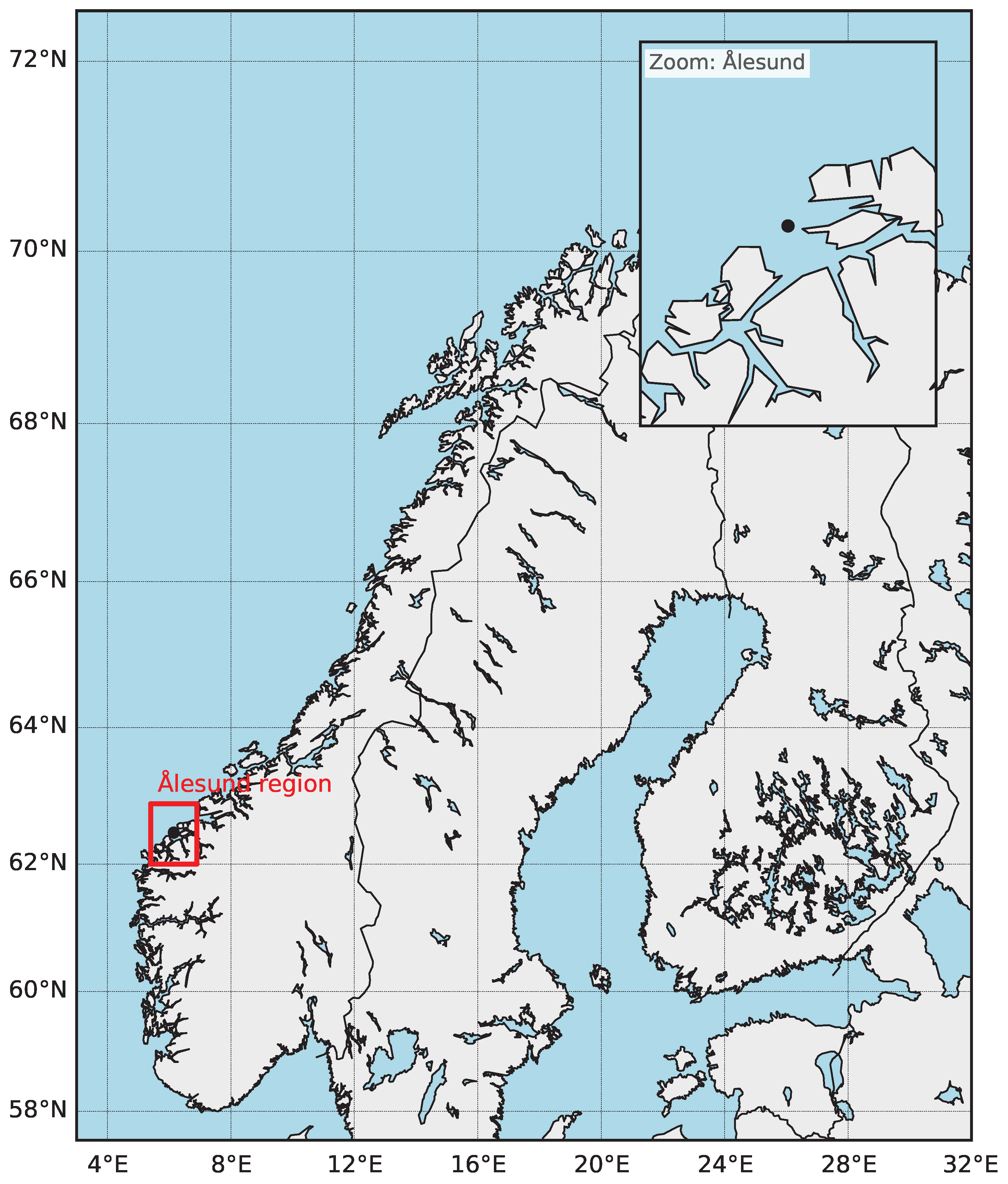
Figure 1. Study area in Norway with the Aalesund case study window.
Futuretransp 06 00034 g001
Figure 2. End-to-end workflow for AIS-based fishing activity detection and analysis, including port recognition, DBSCAN clustering, and KDE analytics.
Futuretransp 06 00034 g002
Figure 3. Flowchart of port filtering.
Futuretransp 06 00034 g003
Figure 4. k-distance ( k = 6 ) plot for DBSCAN ϵ selection (Haversine metric). The knee point suggests ϵ 1.76 km. ϵ = 2.35 km (dotted line) was selected as a stable operating point after sensitivity analysis to reduce over-fragmentation while maintaining low noise.
Futuretransp 06 00034 g004
Figure 5. Port recognition based on AIS data. Left: stationary vessel density (KDE; higher values indicate greater stationary-vessel presence/activity). Right: recognized ports; numbers indicate detected port IDs used in the analysis.
Futuretransp 06 00034 g005
Figure 6. Coverage of detected points as a function of the H3 griDisk (k-ring) radius k at target H3 resolution 9 ( n = 15 ). The dashed line marks the selected operating k = 15; coverage gains diminish beyond k 20 , consistent with increasing geofence over-inclusiveness.
Futuretransp 06 00034 g006
Figure 7. Fishing destination distribution.
Futuretransp 06 00034 g007
Figure 8. Fishing grounds identified from AIS data in the Aalesund study area using DBSCAN and post-processing to obtain n = 6 final grounds. Colored points represent grid-sampled AIS locations assigned to each fishing ground cluster. The numbered white circles (1–6) indicate the fishing ground IDs used in subsequent analysis.
Futuretransp 06 00034 g008
Figure 9. Fishing ground visits with respect to the ship size in one year: (a) small vessels, (b) medium vessels, and (c) big vessels.
Futuretransp 06 00034 g009
Figure 10. Monthly distribution of fishing ground visits by small vessels ( L < 20.9 m) with a residence time greater than 120 min.
Futuretransp 06 00034 g010
Figure 11. Monthly distribution of fishing ground visits by medium vessels ( 20.9 L 27.9 m) with a residence time greater than 120 min.
Futuretransp 06 00034 g011
Figure 12. Monthly distribution of fishing ground visits by big vessels ( L 28 m) to the minimum residence threshold.
Futuretransp 06 00034 g012
Figure 13. Average fishing time with respect to size for one year: (a) small vessels, (b) medium vessels, and (c) big vessels.
Futuretransp 06 00034 g013
Figure 14. Vessel transition between fishing grounds and ports by vessel size. Colors denote vessel-size class (small = blue, medium = orange, large = red), and ribbon width is proportional to the number of observed transitions.
Futuretransp 06 00034 g014
Figure 15. Ground–port transitions for (a) small, (b) medium, and (c) big vessels.
Futuretransp 06 00034 g015
Table 1. Extracted AIS and vessel attributes used in downstream analysis.
FeatureSymbolUnitDescription/Use
Timestampt-AIS message time (UTC); used for ordering trajectories and dwell/
visit duration.
Latitude ϕ degVessel position (WGS84); spatial indexing, clustering, KDEs.
Longitude λ degVessel position (WGS84); spatial indexing, clustering, KDEs.
Speed over ground SOG knKinematic filter to isolate low-speed behavior associated with fishing operations.
NavStat NavStat codeAIS status field; code 7 indicates “engaged in fishing” (ITU-R M.1371); used as a weak activity cue combined with SOG /trajectory features.
MMSI MMSI -Unique vessel identifier; trajectory grouping and per-vessel statistics.
Vessel lengthLmProxy for vessel size; used for stratification/interpretation across vessel categories.
Ship type Type codeAIS ship type category; used for filtering/verification of vessel class.
Absolute rate of turn | RoT | deg/minAIS rate-of-turn magnitude; we summarize this using the median within each zone.
Table 2. AIS dataset summary (Aalesund case study, 2023).
ItemValue
Time range1 January 2023–1 January 2024
Spatial extent (WGS84) ϕ [ 62 . 2 , 62 . 7 ] , λ [ 5 . 5 , 7 . 0 ]
Raw sources31 port datasets + 1913 fishing files
Fields used t , ϕ , λ , SOG , COG , NavStat , MMSI , L , Type
After fishing-status + speed filter398,380
Removed near ports ( R p = 1.2 nm)107,538
Final for ground clustering290,842
Unique fishing vessels74
Fleet scopeAIS-observed vessels (predominantly 15 m)
Table 3. Parameter settings used for port recognition based on stationary AIS density (KDE), coastline proximity filtering, and port-buffer exclusion.
ParameterValueUse in Workflow
Study-area center ( ϕ 0 , λ 0 ) = ( 62.4722 , 6.1549 ) degCenter of the Aalesund window.
Latitude half-range Δ ϕ = 0.5 degSpatial subset: ϕ [ ϕ 0 Δ ϕ , ϕ 0 + Δ ϕ ] .
Longitude half-range Δ λ = 1.2 degSpatial subset: λ [ λ 0 Δ λ , λ 0 + Δ λ ] .
Stationary-point filter SOG = 0 knStationary AIS points used for KDE-based port-center hotspot detection.
Fishing-stationary subset SOG = 0 kn and status NavStat = 7 Optional subset when ports are represented as geofences/buffers/
H 3 expanded footprints.
a KDE bandwidth h = 0 . 015 Smoothing for the KDE on lon/lat coordinates.
KDE grid resolution N = 250 N × N grid for KDE evaluation.
Peak threshold τ = 0.01 · max ( f ^ ) Retain peaks if f ^ ( x ) > τ (i.e., > 1 % of the maximum KDE value).
Local-max neighborhood7 cellsmaximum_filter window size for peak detection.
Coast proximity constraint d < 15 kmRetain peaks within 15 km of coastline (Haversine distance).
Defines the port geofence used to exclude port-adjacent AIS points before fishing ground clustering R p = 1.2 nmRemove AIS points within R p of identified ports (following [43]).
Earth radius (Haversine) R = 6371 kmConstant used in great-circle distance calculation.
Basemap resolutioniCoastline extraction and plotting.
Map projectionMercator (merc), lat _ ts = ϕ 0 Used for map display and coastline sampling.
Table 4. DBSCAN parameter sensitivity near the selected operating region (grid-sampled points, Haversine distance).
ϵ (km) minPts No. of ClustersNoise (%)
2.25675.19
2.25868.33
2.35572.04
2.35665.03
2.50551.26
2.50652.52
Table 5. Seasonal robustness check for DBSCAN fishing-ground delineation using fixed parameters ( ϵ = 2.35 km; minPts = 6 ) on the grid-sampled AIS representation. The number of filtered AIS points, occupied grid cells, pre-merge DBSCAN clusters (excluding noise), and the fraction of noise for both grid cells and original AIS points are reported.
SeasonNo. of PointsNo. of Grid CellsNo. of ClustersNoise (Cells)Noise (Points)
DJF24,017254612.99%4.26%
MAM8834178513.48%7.20%
JJA303254324.07%20.78%
SON19,226151515.89%2.00%
Table 6. KDE bandwidth sensitivity for stationary-AIS port hotspot detection (other settings fixed: N = 250 , w = 7 , τ = 0.01 · max ( f ^ ) ; coast filter d < 15 km; peak merging applied). Displacement is measured relative to the baseline h = 0 . 015 using nearest-neighbor matching (tolerance 5 km).
h (deg)No. of Peaks (Coast)No. of PortsMatched (of 15)Median Disp. (km)
0.007502121150.00
0.011251919150.00
0.015001515150.00
0.018751111140.00
0.022501010130.00
0.0300055111.57
Table 7. Behavioral diagnostics by detected fishing ground (AIS 2023). Metrics are computed on raw AIS points assigned to each ground (not on the grid-sampled representation). SOG is in kn; residence time is in minutes.
FGn ptsn MMSI SOG 50 SOG IQR | RoT | 50 COG-Rate 50 Res 50 Res 75
4135,512250.30.2128260.5445.8631.7
518,771340.40.2044.0182.3346.9
16204290.40.2013.8182.5535.3
2354050.50.3127275.0192.0239.3
3243950.50.3127286.2210.4298.9
6830.60.0300.173.09.0
Notes: COG-rate denotes the median absolute change in course over ground per minute (deg/min). Res 50 and Res 75 are the median and 75th percentile residence times within a ground.
Table 8. Comparison of density-based clustering methods on grid-sampled AIS (Aalesund, 2023, n = 636 ). Raw labels (noise = 1 ) and merged N = 6 grounds.
MethodPre
Clust.
Noise
Cells
Noise
Pts
Post
Grounds
Max
Span
DBSCAN ( ϵ = 2.35 km, minPts = 6 )1311.8%1.05%618.65
OPTICS (DBSCAN-extract, ϵ = 2.35 km)65.5%0.31%636.39
HDBSCAN (mcs = 10, ms = 6)1424.4%9.75%617.15
Table 9. Length-based size distribution of fishing vessels observed in the Aalesund area (AIS 2023).
Vessel CategoryVessel LengthNumber
Small L < 20.9 m10
Medium L [21–27.9] m6
Large L 28 m58
Total-74
Disclaimer/Publisher’s Note: The statements, opinions and data contained in all publications are solely those of the individual author(s) and contributor(s) and not of MDPI and/or the editor(s). MDPI and/or the editor(s) disclaim responsibility for any injury to people or property resulting from any ideas, methods, instructions or products referred to in the content.