


Abstract
This study develops a compact elasticity-based framework for assessing how autonomous truck adoption influences corridor-level performance, freight demand, modal competition, and CO2 emissions in multimodal freight Intelligent Transportation Systems. The model specifies the constant elastic (log-linear) responses of traffic performance and generalized costs to adoption, enabling the closed-form characterization of system-level rebound and road–rail reallocation effects. The analytical results show that an internal adoption threshold emerges, defined by , which separates a beneficial regime (efficiency gains dominate) from an adverse regime (rebound and modal shift dominate). Comparative statics indicate that decreases with stronger ITS capability A and increases with rebound intensity R and the road–rail carbon intensity contrast K. Numerical experiments across representative corridor contexts illustrate induced demand effects exceeding 25% under high-rebound conditions and threshold ranges around –0.4 for plausible parameters. The results provide interpretable guidance for coordinating autonomous truck deployment with intermodal logistics design and decarbonization strategies.
1. Introduction
Freight transportation systems are undergoing rapid transformation driven by advances in autonomous driving, connected vehicle technologies, and data-rich Intelligent Transportation Systems (ITSs). In the road sector, autonomous trucks equipped with cooperative control and platooning capabilities have demonstrated substantial potential to enhance traffic flow stability, improve corridor capacity, and reduce fuel consumption [1,2,3]. These emerging operational gains coincide with broader shifts in multimodal network design, where intermodal and synchromodal logistics strategies increasingly emphasize dynamic coordination across road, rail, and terminal infrastructures [4,5,6]. As a result, automation is no longer a standalone technological upgrade but a system-level element interacting with freight demand, modal competition, terminal efficiency, and environmental performance.
Despite progress in both automation and multimodal freight innovations, existing studies typically address these components separately. Prior work on truck platooning focuses on headways, fuel efficiency, and safety [7], while intermodal freight research examines terminal design, corridor connectivity, and modal shift mechanisms [8,9,10]. Freight decarbonization studies further highlight the importance of low-carbon rail and emission-efficient corridor design [11,12,13]. However, the literature still lacks an analytical framework that links autonomous truck adoption to system-level freight responses—including demand elasticity, modal reallocation, and CO2 emissions.
This gap is especially relevant because automation may induce competing effects. Improvements in travel time, reliability, and generalized cost may increase road attractiveness and stimulate additional freight movement. Such rebound effects—well documented in transport demand elasticity studies [14,15,16,17]—have not been analytically incorporated into models of autonomous truck deployment. Meanwhile, recent empirical studies indicate that the organizational adoption of autonomous trucks is shaped by perceived cost savings, safety improvements, and operational constraints [18,19,20,21,22,23]. Yet the system-wide implications of increasing adoption rates for freight ITSs remain poorly quantified.
To address these limitations, this paper develops a unified, dimensionless elasticity framework that characterizes how autonomous truck adoption influences ITS performance, freight demand, modal allocation, and CO2 emissions at the corridor level. By expressing performance and behavioural responses in normalized form, the framework clarifies how automation interacts with intermodal logistics structures and carbon intensity. In particular, it reveals the existence of critical adoption thresholds at which the net impact of automation transitions from beneficial (capacity and efficiency gains dominate) to adverse (rebound-induced demand and road-oriented modal shifts dominate). Although similar nonlinearities are qualitatively noted in studies of modal shift and freight emissions [24,25], no existing work derives them analytically for autonomous truck deployment.
Here, “elasticity-based” refers to representing each performance, cost, and behavioural component as a normalized variable that responds to adoption through constant semi-elasticities of the form . This specification yields exponential closed-form responses and, crucially, enables the analytical derivation of adoption thresholds and comparative statics in a coupled ITS–logistics–emission system. The resulting transparency complements empirical and simulation-based studies by making the mechanisms and parameter sensitivities explicit.
The present study contributes to freight ITS research in three ways. First, it introduces a dimensionless modelling architecture that unifies traffic flow performance, logistics responses, and environmental evaluation within an adoption-driven elasticity system. Second, it derives closed-form expressions for adoption thresholds, providing interpretable conditions that delineate beneficial and adverse regimes. Third, it demonstrates the framework using corridor-level numerical scenarios calibrated to ranges reported in the literature on platooning performance, intermodal logistics, and freight demand elasticities.
Overall, this work offers a theoretical foundation for evaluating autonomous truck adoption within multimodal freight ITSs. The results provide guidance for corridor managers, regulators, and logistics operators seeking to coordinate automation strategies with decarbonization policies, intermodal service design, and demand management levers.
2. Literature Review
This section synthesizes the major strands of research relevant to autonomous truck deployment in freight ITSs. Prior work spans (i) autonomous trucking and platooning, (ii) intermodal and synchromodal freight systems and their environmental foundations, and (iii) the elasticity-based modelling of freight demand and modal choice. Although each strand has produced substantial insights, their integration remains limited.
2.1. Autonomous Trucks, Platooning, and Corridor Performance
Autonomous trucking has advanced rapidly through improvements in cooperative control, vehicle-to-vehicle communication, and real-time fleet coordination. Early empirical studies showed that Cooperative Adaptive Cruise Control (CACC) stabilizes traffic flow and reduces headways, enhancing corridor throughput under mixed traffic conditions [1]. Subsequent control-theoretic and optimization-based work established that coordinated platoon formation and look-ahead control reduce fuel consumption and improve safety margins for heavy-duty vehicles [2]. Recent computational fluid dynamic research further quantified the aerodynamic benefits of platooning under varying inter-vehicle gaps and crosswind conditions, reinforcing the operational potential of automation-enabled convoying [3].
A broader view of platooning as a logistics operation highlights that feasible deployment depends not only on control strategies but also on dispatch timing, route structures, terminal coordination, and mixed-autonomy interaction policies. Reviews of planning and control strategies emphasize that platooning benefits are highly sensitive to corridor management and require integration with transport management systems to achieve reliable fuel and capacity benefits at scale [7]. These findings position autonomous trucks as contributors to corridor-level ITS performance, where speed reliability, congestion mitigation, and route predictability jointly influence logistics decisions. However, the literature predominantly focuses on operational performance metrics and does not endogenize freight demand responses or modal reallocation induced by automation.
2.2. Intermodal, Synchromodal, and Corridor-Based Freight Systems
Parallel to developments in road automation, a substantial body of literature examines intermodal and synchromodal freight network design. Foundational work describes the evolution of inland terminals and freight corridors, highlighting how directional flows and terminal placement shape the competitiveness of road–rail intermodal transport [8]. Generic frameworks for network design identify structural differences across freight systems and emphasize the role of terminal functionality and network topology in supporting multimodal operations [9,10].
Research on synchromodal logistics extends these ideas to real-time coordination across modes, where routing and scheduling decisions adapt dynamically to network conditions. Studies show that synchromodality enables higher reliability and flexibility by exploiting corridor-level ITS data, digital platforms, and IoT-based monitoring architectures [4,5,6]. Simulation work on synchromodal replanning further demonstrates how agent-based logistics systems can adjust routing decisions in response to disruptions, reinforcing the importance of adaptive multimodal integration within ITS environments [26].
Environmental studies identify modal shift toward rail as a core strategy for reducing freight sector CO2 emissions. Evaluations of dry port and inland terminal systems show that integrating rail and synchromodal operations can substantially reduce energy use and emissions for international supply chains [12]. Reviews of freight decarbonization emphasize the need to coordinate ITS investments, automation, and intermodal service design to achieve long-term emission reductions [11]. At the policy level, the International Transport Forum highlights that freight mode choice remains highly sensitive to relative cost, service quality, and reliability, implying that automation may reshape modal competition through indirect effects rather than operational performance alone [13].
Despite these advances, the intermodal and synchromodal literature typically treats roadway performance as exogenous. This separation limits the ability to predict how automation-induced improvements in road capacity or cost affect mode shares, total freight demand, or emissions. A unified analytical framework linking corridor-level ITS performance and multimodal responses has yet to be developed.
2.3. Elasticities in Freight Demand, Modal Choice, and Technology Adoption
Elasticity models provide a behavioural foundation for analysing freight responses to changes in cost, service quality, and congestion. Classical studies estimate the price elasticities of transport demand, clarifying how shippers adjust shipment levels and mode choice in response to generalized cost variations [14,15]. More recent empirical work extends these analyses, demonstrating that price and cost elasticity values vary systematically across commodities, shipment distances, and logistical constraints [16,17]. These findings are essential for understanding rebound effects, whereby efficiency improvements reduce transport cost and induce additional freight activity.
Elasticity concepts also appear in models of modal competition. Studies of road–rail mode choice show that relative cost, frequency, and reliability interact nonlinearly to shape mode shares [24,25]. Systematic reviews of modal shift policies emphasize that improvements in road performance—such as speed or reliability gains from automation—can inadvertently reduce rail competitiveness unless counterbalanced by policy measures or terminal enhancements. These behavioural insights underline the importance of integrating elastic demand and mode choice models with ITS performance metrics.
The complementary literature examines technology adoption in freight and related transport domains. Empirical models show that the organizational adoption of autonomous or connected vehicles depends on expected cost reductions, operational flexibility, and safety perceptions [18,19,20]. Consumer-focused studies on autonomous and shared vehicles further highlight the importance of perceived risk, trust, and service quality [21,22,23]. Although these studies address adoption likelihood, they do not analytically characterize how increases in adoption propagate through freight demand, modal reallocation, and emissions.
Across all strands of the literature, an analytical gap persists: no existing framework connects autonomous truck adoption to corridor-level ITS performance, elastic freight responses, and environmental outcomes in a dimensionless and unifying manner. This motivates the framework developed in the following sections.
3. Conceptual Framework
This section establishes the theoretical foundation for modelling how autonomous truck adoption influences freight ITS performance. The framework integrates corridor-level traffic dynamics, logistics behaviour, and modal competition into a unified representation. Consistent with evidence from platooning performance, intermodal freight design, and freight demand elasticity studies [1,2,9,17], the framework treats the freight system as a coupled set of technological, behavioural, and environmental subsystems.
3.1. The Structure of the Freight ITS Corridor
We consider a stylized freight corridor connecting an origin–destination pair served by three modes: autonomous trucks, conventional trucks, and rail. This representation reflects widely studied intermodal and synchromodal freight structures [4,5,8]. The road subsystem consists of a mixed-autonomy truck fleet interacting through traffic flow mechanisms that are sensitive to headways, cooperative control, and platoon formation. Empirical evidence shows that automation, CACC, and coordinated platooning increase capacity and improve speed stability relative to conventional operations [1,2,7]. These gains justify modelling road capacity and travel time performance as increasing functions of autonomous truck adoption.
The corridor also includes a rail service characterized by lower CO2 intensity and higher terminal processing times, consistent with findings on intermodal competitiveness [10,12,24]. Terminals operate as logical nodes enabling transshipment, consistent with dry port and synchromodal concepts [4,9]. Freight operators make routing decisions using generalized costs that incorporate time, reliability, monetary costs, and expected service quality.
Autonomous truck adoption is represented by the parameter , denoting the share of trucks capable of automated operations. Increases in P affect corridor performance through changes in headways, speed, platooning feasibility, and reliability—mechanisms that have been demonstrated in both operational studies and reviews of emerging automation technologies [3,7]. These performance changes propagate to logistics behaviour, altering generalized costs, total freight demand, and modal allocation.
3.2. Core Variables and Behavioural Relations
The modelling framework tracks several classes of variables: traffic flow performance, generalized costs, freight demand, modal split, and emissions. For the road subsystem, we denote capacity by C, average speed by v, and delay by . Reliability, represented by , captures schedule adherence and is relevant for shippers sensitive to delivery windows, particularly in synchromodal systems [5,6]. These metrics reflect ITS-level performance monitoring practices and are directly influenced by the automation-enabled stabilization of flow [1].
Freight demand on the corridor is denoted by D and measured in ton-kilometres. Modal throughputs for autonomous trucks, conventional trucks, and rail are denoted by , , and , respectively, satisfying . Generalized costs, for mode m, incorporate travel time, reliability penalties, fuel and operational expenses, and, in the case of autonomous trucks, cost reductions associated with automation, labour substitution, and platoon-enabled efficiencies. Studies of technology adoption and operational performance suggest that cost decreases more substantially for autonomous trucks relative to conventional trucks [18,19,20].
Freight demand responds elastically to generalized cost and service quality, consistent with classical transport economics [14,15]. Improved road performance can therefore induce additional freight activity, generating rebound effects documented in modal shift and freight demand studies [17,24]. Modal split is represented using a utility-based formulation in which shippers choose modes based on relative generalized cost, reliability, and service attributes. Rail’s environmental advantage plays an essential role for corridor-level emissions, echoing evidence from dry port and decarbonization studies [11,12]. Total emissions are computed as the weighted sum of modal flows multiplied by their emission factors, with road modes generally having higher CO2 intensity than electrified rail.
3.3. Dimensionless Formulation and Conceptual Linkages
To integrate diverse performance metrics and behavioural responses, we employ a dimensionless representation in which each variable is normalized by its baseline value under zero adoption. The normalized variable captures proportional change rather than absolute magnitude. This approach facilitates comparison across systems and aligns with elasticity-based models in transport demand and intermodal freight economics [15,17].
Autonomous truck adoption enters the system through three conceptual channels. The first is the technological channel, parametrized by an automation effect coefficient reflecting improvements in capacity, speed, delay, and reliability. The second is the behavioural channel, comprising demand elasticities with respect to cost and service quality and modal choice responsiveness to relative cost changes. The literature on freight mode choice and pricing highlights the importance of these elasticities for predicting modal reallocation under changes in network performance [24,25]. The third is the environmental channel, captured by differences in CO2 intensity between modes. Evidence on rail decarbonization shows that carbon intensity fundamentally shapes the environmental impact of modal shifts [11,12].
By combining these channels, the framework links adoption to system outcomes through a sequence of effects: an increase in P improves road performance through cooperative automation; improved performance reduces generalized cost; reduced cost increases freight activity and shifts demand toward the road; and modal reallocation interacts with relative carbon intensities to determine total emissions. Because these effects can reinforce or counteract one another, the system can exhibit nonlinear responses, including threshold behaviour in which adoption is beneficial at low levels yet detrimental at higher levels.
4. Model Development
This section formalizes the autonomous–conventional mixed freight corridor within the dimensionless, elasticity-based structure introduced above. The goal is to construct a compact analytical system linking autonomous truck adoption to corridor-level performance, generalized costs, freight demand, modal split, and CO2 emissions.
Figure 1 summarizes the architecture of the elasticity-based framework.
Figure 1.
Architecture of elasticity-based framework. Adoption affects road performance and generalized cost, which in turn drives demand (rebound) and road–rail reallocation; these behavioural responses jointly determine corridor emissions.
4.1. Traffic Flow Performance and ITS Response to Automation
Let denote the share of autonomous trucks in the road freight fleet. Adoption influences corridor performance through reductions in effective headways, smoother speed profiles, and improved stability associated with cooperative control and platooning [1,2,7]. For any performance quantity , we denote its normalized value as
where is the baseline value at .
To improve transparency and reproducibility, we note that the exponential forms used below follow directly from a constant semi-elasticity assumption with respect to adoption. Specifically, specifying as a constant implies that for an appropriate coefficient . This provides a compact way to encode the incremental performance and cost improvements reported in platooning and ITS studies while retaining analytical tractability for deriving adoption thresholds and comparative statics.
Improvements in capacity, speed, and reliability are modelled as exponential responses to adoption:
while delay satisfies
Here captures the automation effect intensity, and are elasticity magnitudes.
Solving these yields
4.2. Generalized Cost Formulation Under Mixed Autonomy
Let and denote the generalized costs for autonomous and conventional trucks. Autonomous trucks benefit from technology-induced operating efficiencies [2,18,20]. The cost reductions take the normalized form
where . Solving these, we obtain
A composite road generalized cost is represented as
where denotes the pre-adoption share of shipments handled by autonomous trucks at the margin. Rail cost is treated as exogenous in the corridor-level analysis [8,10].
4.3. Freight Demand Response and Modal Split
Total freight demand responds to generalized cost and corridor quality through elasticities consistent with empirical transport demand studies [14,16,17]. Using normalized demand , we define
where measures rebound intensity, is cost sensitivity, and is performance quality sensitivity.
Substitution yields
Modal split is modelled with a logit formulation:
where captures modal choice sensitivity [24,25]. Modal flows follow
for .
4.4. Emissions
Let denote modal CO2 emission factors. Total emissions are
Normalizing by gives
Differentiating this, we obtain
where K captures the road–rail carbon intensity contrast, and are modal weights.
4.5. Coupled Elasticity System
The full dimensionless system is
5. Analytical Results
This section analyses the qualitative behaviour of the adoption–response system. We focus on (i) the existence of a critical adoption threshold at which the emissions response changes sign, (ii) comparative statics describing how ITS, logistics, and environmental parameters shift this threshold, and (iii) structural conditions characterizing beneficial and adverse adoption regimes.
5.1. The Existence of a Critical Adoption Threshold
Normalized emissions satisfy
with . Differentiating this gives the elasticity-weighted structure in (21).
Theorem 1
(Existence of Adoption Threshold). The following assumptions are made:
- 1.
- Road capacity and speed increase monotonically with adoption.
- 2.
- The generalized cost of road freight decreases with adoption.
- 3.
- Freight demand responds elastically to cost and quality as in (15).
- 4.
- Modal split follows a logit structure with increasing in P.
Under these assumptions, there exists at least one such that
Proof.
At , efficiency gains dominate because capacity and speed increase from their conventional baseline while demand and modal shift have not yet adjusted strongly; thus . At , road cost reductions and improved service quality induce larger freight volumes and stronger modal shifts toward the road, especially when K is large, so . The continuity of (21) implies the existence of by the intermediate value theorem. □
The threshold partitions the adoption domain into beneficial () and adverse () regimes.
5.2. Comparative Statics of Threshold
Let
The threshold is implicitly defined by . Provided near , the implicit function theorem yields
Proposition 1
(Comparative Statics). Under the model assumptions,
Proof.
Increasing A amplifies automation-induced improvements in speed, capacity, and reliability [1,2], lowering emissions in the low-adoption regime; thus the beneficial region expands, and decreases. Increasing R strengthens rebound, raising demand elasticity and intensifying induced road traffic, shifting upward [14,16]. Increasing K increases the marginal environmental penalty of modal shift toward the road, also raising . □
5.3. Regime Conditions
The sign of depends on three composite mechanisms:
Automation is beneficial when rebound is weak, modal shift toward the road is limited, and rail has low carbon intensity [11,12].
6. Numerical Experiments
This section presents numerical experiments illustrating how autonomous truck adoption shapes the performance of a representative freight corridor. Parameter values are selected to reflect empirically supported ranges reported in studies of platooning, freight elasticity, intermodal logistics, and decarbonization [1,2,12,17,24].
6.1. Experimental Design and Parametrization
We consider a 200 km road–rail freight corridor connecting a single origin–destination pair, consistent with common intercity freight architectures [8,10]. Autonomous truck adoption P varies from 0 to 1.
Traffic flow elasticities are chosen as
consistent with reported CACC and platooning effects [1,2]. Demand elasticities follow [14,16,17]:
Modal choice sensitivity lies in [24,25]. Emission factors reflect typical diesel truck and electrified rail ranges [11,12]:
We analyse five representative scenarios:
- High-demand congested corridor: large rebound R, carbon-intensive road freight (high K), modest automation effect A.
- Decarbonized rail environment: low K owing to electrified rail; moderate rebound and automation.
- Strong ITS and automation: high A through active platoon management, V2X, and coordinated ITS operations [4,5].
- Low-rebound but carbon-intensive corridor: small R with high K, representing demand management conditions where induced freight growth is limited but road remains emission-intensive.
- High automation with low carbon intensity gap: high A with low K, representing simultaneous ITS improvements and road decarbonization that mitigates roadward modal shift emissions.
6.2. Simulation Procedure
For each scenario, simulations proceed as follows:
- Compute normalized capacity, speed, delay, and reliability.
- Determine generalized costs for autonomous and conventional trucks and the composite road cost.
- Update total demand using (15).
- Solve the modal split using the logit model.
- Compute modal flows and total emissions .
6.3. Results
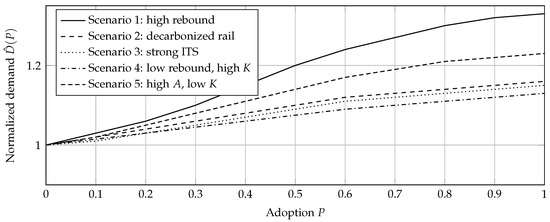
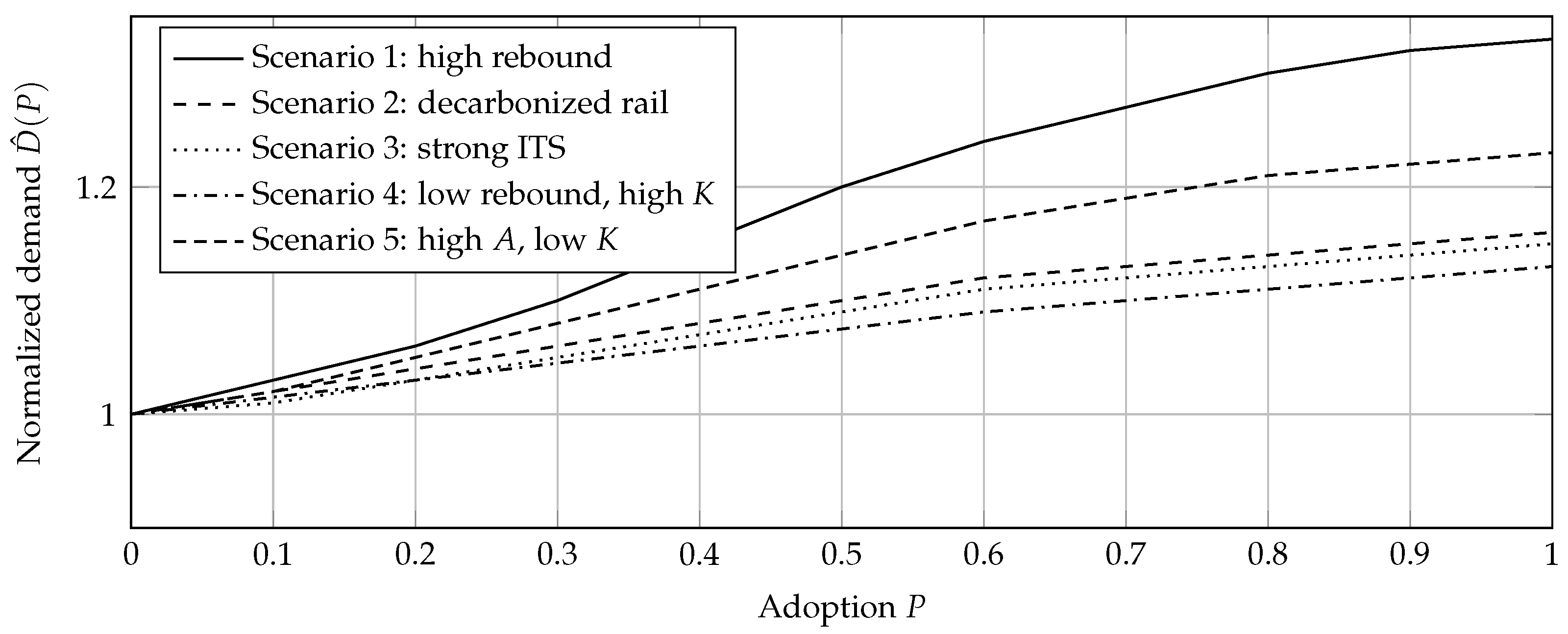
Across all scenarios, capacity and speed increase monotonically with adoption, while delay decreases rapidly at low P; reliability exhibits the strongest early adoption gains, reflecting empirical platoon stabilization effects [1]. Demand grows with adoption, with the magnitude determined by R: in high-rebound settings, total freight activity can increase by more than 25% at full adoption, whereas decarbonized or ITS-enhanced settings produce more moderate demand growth.
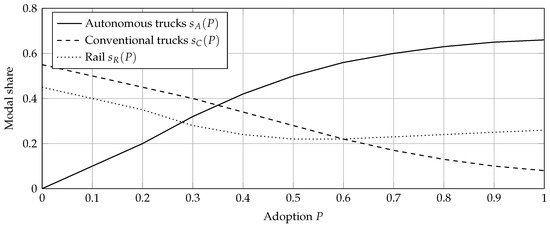
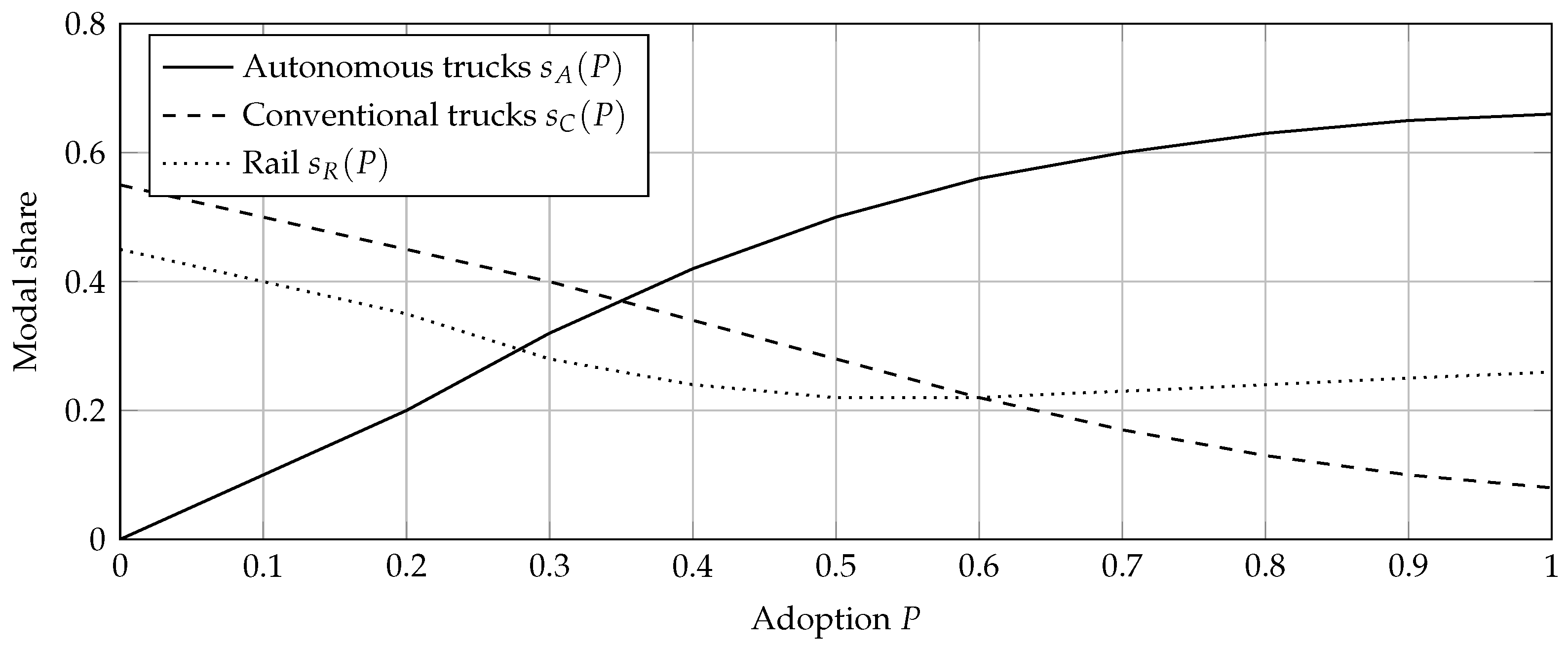
Modal shares evolve in line with cost and performance changes. In a high-rebound, carbon-intensive corridor, autonomous trucks capture a growing share at the expense of both conventional trucks and rail, with road share eventually dominating. In contrast, in a decarbonized rail scenario, rail retains a sizeable share because its environmental and sometimes cost advantages offset improvements in road performance [24,25]. Strong ITS conditions lead to balanced allocations, as performance gains are partially absorbed by reliability improvements rather than pure cost reductions.
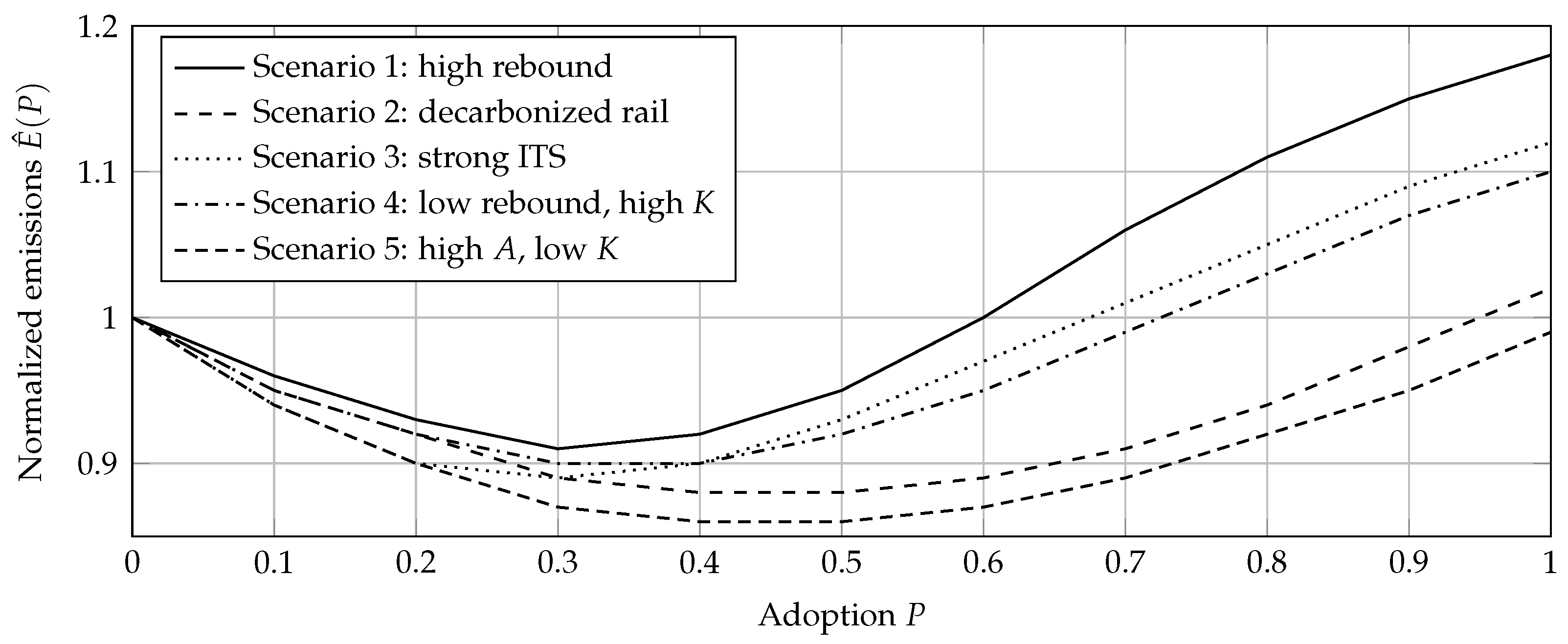
Emission responses exhibit the expected non-monotonic pattern. In a congested, carbon-intensive scenario, decreases initially as platooning reduces fuel use and improves traffic flow, but beyond a threshold (typically in the – range for plausible parameters), rebound and modal shift dominate, and emissions rise above baseline. In a decarbonized rail setting, the threshold shifts to higher adoption levels because low rail carbon intensity tempers the environmental impact of roadward modal shifts; remains below baseline over a wider adoption range. Under strong ITSs, early adoption yields deeper emission reductions, but extremely high adoption still risks entering an adverse regime if rebound remains strong.
6.4. Illustrative Plots
Figure 2, Figure 3 and Figure 4 summarise the qualitative patterns for normalized demand, modal shares, and emissions across adoption levels.
Figure 2.
Normalized freight demand across adoption levels for five representative corridor scenarios. Demand increases with autonomous truck adoption owing to improvements in road capacity, speed, and reliability, with the magnitude of the rebound depending on the elasticity parameters. High-rebound corridors exhibit substantial demand expansion at higher P, whereas decarbonized or ITS-enhanced settings show more moderate growth as generalized cost reductions are partially offset by lower road carbon intensity or stronger reliability effects.
Figure 3.
The evolution of modal shares as adoption P increases in a high-rebound corridor. Autonomous trucks progressively replace both conventional trucks and rail as performance gains reduce generalized road cost and induce additional roadward modal shifts. In this congested and carbon-intensive setting, increasing adoption eventually leads road transport to dominate freight allocations, illustrating the potential for adverse modal reallocation when rebound is strong.
Figure 4.
Normalized emissions across adoption levels and corridor scenarios. Emissions initially decline because platooning improves fuel efficiency and traffic flow; however, beyond a scenario-dependent threshold, rebound and roadward modal shifts can outweigh early gains and raise emissions above baseline. The threshold varies by corridor context, with decarbonized rail environments allowing emissions to remain below baseline over wider adoption ranges, while strong ITS conditions deepen early reductions yet may still enter an adverse regime at high P if rebound persists.
7. Policy Implications
The analytical and numerical results demonstrate that autonomous truck adoption affects freight systems in fundamentally nonlinear ways. While automation improves corridor performance by increasing capacity, stabilizing speeds, and reducing generalized cost, these gains interact with rebound effects and modal competition in ways that may amplify or offset environmental benefits. This section discusses the policy implications of these findings for corridor managers, freight operators, and regulators seeking to integrate automation into multimodal freight strategies. The discussion builds on established insights from modal shift research [24,25], intermodal and synchromodal logistics [4,5], and freight decarbonization studies [11,12].
7.1. ITS Infrastructure and Automation-Aware Corridor Design
The analytical results showed that the adoption threshold , separating beneficial from adverse regimes, depends strongly on the automation effect parameter A. Investments that increase A—such as widespread V2X deployment, coordinated platoon management, and digital freight platforms—expand the beneficial region by reducing delay and stabilizing traffic flow. This suggests that autonomous truck adoption should not be treated as a purely technological decision by fleet owners but as an ITS design variable shaped by infrastructure quality.
Corridors preparing for automation can pursue three complementary strategies. First, coordinated platoon support (dedicated lanes, cooperative merging, dynamic speed limits) can strengthen early adoption benefits, consistent with observed performance improvements in platooning studies [1,2,7]. Second, integrating real-time terminal coordination within synchromodal architectures reduces service variability for both the road and rail, mitigating modal shift pressures that may otherwise emerge when road performance improves [4,5]. Third, digital twins and predictive ITS platforms can incorporate elasticity-based upper-level models to identify the adoption region in which automation remains environmentally beneficial, enabling proactive intervention.
These measures highlight that automation policy must be embedded within a broader ITS strategy rather than pursued in isolation.
7.2. Managing Rebound and Modal Shift Through Pricing and Logistics Policies
The second major implication concerns rebound elasticity R. The numerical experiments reveal that high R can cause emissions to rise even when automation significantly improves corridor performance, especially when carbon intensity K is high. This dynamic underscores the importance of demand management policies.
Policies that target rebound include congestion pricing, differentiated charging for autonomous versus conventional operations, off-peak incentives, and regulations encouraging freight consolidation among shippers. Evidence from freight elasticity studies [14,16,17] suggests that shippers respond strongly to generalized cost changes; therefore, relatively small policy adjustments may yield significant demand effects.
Modal shift requires particular attention. When autonomous trucks reduce generalized cost, road share tends to increase unless rail provides clear advantages in reliability, frequency, or environmental performance. Integrating automation policies with rail enhancement initiatives—such as improved intermodal terminals [10], electrified freight rail services [12], and reduced terminal processing times—is essential to prevent environmentally undesirable roadward reallocation.
7.3. Coordinating Automation with Decarbonization Goals
The third implication relates to the carbon intensity parameter K. The comparative statics show that increases with carbon intensity: as long as road freight remains significantly more carbon-intensive than rail, modal shifts toward the road amplify emissions. This suggests that adoption policies must be aligned with decarbonization strategies.
Three broad directions emerge. First, electrification or low-carbon fuel adoption in heavy-duty vehicles directly reduces K, enlarging the beneficial regime and permitting higher adoption rates without adverse environmental impacts. Second, supporting the decarbonization and capacity of rail freight—through electrification, operational reliability improvements, or service frequency enhancements—ensures that rail remains competitive even as road performance improves [11,12]. Third, policies that integrate autonomous trucking with synchromodal freight networks can maintain a balanced modal allocation by dynamically routing freight through the most environmentally efficient mode [4,5].
In effect, automation and decarbonization policies must be jointly designed: neither can achieve system-level sustainability outcomes when pursued independently.
7.4. Summary
The findings of this study support three overarching policy messages. First, ITS infrastructure investments that amplify automation benefits are essential to ensure that early adoption produces net performance and environmental gains. Second, rebound and modal shift must be explicitly managed through pricing, terminal coordination, and synchromodal planning. Third, autonomous truck adoption should be embedded within broader decarbonization pathways that reduce carbon intensity across all modes. These implications emphasize the need for integrated multimodal freight strategies, in which technological, behavioural, and environmental components are treated as interdependent elements of a single ITS ecosystem.
8. Conclusions
This study developed a dimensionless, elasticity-based analytical framework to evaluate the system-wide impacts of autonomous truck adoption within freight ITSs. While the prior literature has separately advanced understanding in autonomous trucking [1,2], intermodal and synchromodal logistics [4,5], and freight demand elasticity [14,17], an integrated analytical theory linking these components has been lacking. This paper addressed this gap by modelling the coupled interactions among traffic flow performance, generalized cost, freight demand, modal split, and CO2 emissions as functions of autonomous truck adoption.
By expressing system variables in normalized form and characterizing their interactions through elasticities, the proposed framework reveals the inherently nonlinear nature of adoption-driven freight system dynamics. The analytical results demonstrated that an internal adoption threshold necessarily emerges: at low adoption levels, efficiency gains from automation dominate, reducing delays, improving reliability, and lowering emissions; beyond this threshold, rebound effects and roadward modal shifts outweigh these benefits, potentially increasing total emissions. Comparative statics showed that the location of this threshold depends systematically on ITS capability (A), demand elasticity (R), and modal carbon intensity (K). These results clarify why automation can yield divergent outcomes across corridors and highlight the importance of coordinated ITS and decarbonization strategies.
Numerical experiments supported these analytical findings, illustrating threshold behaviour across a range of freight corridor scenarios. In congested, carbon-intensive environments, emissions began rising at moderate adoption levels, while in decarbonized or ITS-enhanced environments, the beneficial adoption region expanded significantly. These patterns align with established evidence on modal shift [24,25], intermodal competitiveness [10], and low-carbon freight pathways [12]. Taken together, the theoretical and numerical findings suggest that autonomous truck adoption should be treated not merely as a technological transition but as a system-level control variable whose impacts depend on broader multimodal and policy environments.
The framework developed here makes three main contributions. First, it provides a unified analytical tool capable of describing how technological, behavioural, and environmental mechanisms interact in freight ITSs. Second, it generates interpretable metrics—such as adoption thresholds and elasticity groupings—that support decision-making for infrastructure managers, logistics operators, and policymakers. Third, it offers a computationally lightweight module suitable for integration into digital twins, corridor management platforms, and large-scale freight simulations.
Future research may extend this work along several directions. Empirical calibration using probe truck trajectories, logistics operator data, or electronic tolling records would refine elasticity estimates and validate threshold locations. Network-level extensions could incorporate routing choices, terminal bottlenecks, and multimarket interactions. Additional coupling with safety, mixed-autonomy behaviour, and stochastic incident models would further enrich the framework’s applicability. Integrating the analytical module into synchromodal optimization tools may also help harmonize automation and decarbonization objectives in operational settings.
Overall, this study contributes a theoretical foundation for understanding when and how autonomous truck adoption enhances freight system efficiency and sustainability. By clarifying the structural dependencies that shape adoption outcomes, the framework provides a basis for designing ITS, logistics, and environmental policies that align automation with long-term transportation and climate goals.
Supplementary proofs and implementation details are provided in Appendix A.
Funding
This research received no external funding.
Institutional Review Board Statement
Not applicable.
Informed Consent Statement
Not applicable.
Data Availability Statement
The original contributions presented in this study are included in the article. Further inquiries can be directed to the corresponding author.
Conflicts of Interest
The author declares no conflict of interest.
Appendix A. Supplementary Material
This appendix summarizes the supplementary theoretical results, robustness checks, parameter definitions, and the simulation procedure supporting the analysis presented in the main text. The goal is to provide transparency regarding the mathematical derivations, model interpretation, and computational reproducibility, without introducing additional assumptions beyond those defined in the main framework.
Appendix A.1. Derivation of Emission Response
This section provides proofs for the two main analytical results: the existence of an adoption threshold and its comparative statics. Full proofs follow directly from the elasticity-based definitions in Section 4 and require only continuity and monotonicity assumptions.
Proof of Theorem 1 (the existence of a threshold).
Recall that normalized emissions are
with modal quantities . Differentiating this, we obtain
where . At , road capacity increases, and generalized cost decreases, while modal shift and rebound effects are negligible. Hence . At , rebound and modal shift dominate cost reductions, especially if road carbon intensity is high, implying that . By continuity, there exists such that . □
Proof of Proposition 1 (comparative statics).
Let . The threshold satisfies . Using the implicit function theorem,
An inspection of F shows the following: (i) increasing A strengthens capacity and speed improvements, reducing emissions at low adoption and thus lowering ; (ii) increasing R amplifies demand growth and modal shift, raising ; and (iii) increasing K raises the penalty for shifting toward the road, also increasing . □
Appendix A.2. Sensitivity Analysis
This section summarizes numerical robustness tests conducted regarding the elasticity parameters.
Increasing the automation effect parameter A steepens early reductions in delay and emissions, shifting downward monotonically. This is consistent with expected ITS improvements from coordinated platooning and V2X [1,2]. Higher rebound elasticity R increases the slope of , accelerating modal shift toward the road; for sufficiently high R, the emission-minimizing region shrinks, and the system exhibits rebound-dominant behaviour. Lower carbon intensity K (for example, through electrified rail or cleaner freight fuels) substantially flattens the emission curve and may even eliminate the adverse adoption regime, aligning with evidence on low-carbon freight corridors [11,12].
Introducing multiplicative uncertainty in demand and speed,
preserves the qualitative shape of for . Instead of a single threshold, a transition band emerges, indicating that the threshold concept is structurally robust.
Appendix A.3. Parameter Definitions
Table A1.
The elasticity families used in the model.
Table A2.
Modal and environmental parameters.
Appendix A.4. Simulation Procedure
The numerical experiments follow the procedure below, designed to maintain full consistency with the elasticity framework while allowing for computational transparency.
| Algorithm A1 Adoption sweep procedure |
|
References
- Shladover, S.E.; Su, D.; Lu, X.Y. Impacts of Cooperative Adaptive Cruise Control on Freeway Traffic Flow. Transp. Res. Rec. 2012, 2324, 63–70. [Google Scholar] [CrossRef] [Scilit]
- Turri, V.; Besselink, B.; Johansson, K.H. Fuel-efficient heavy-duty vehicle platooning by look-ahead control. In Proceedings of the 53rd IEEE Conference on Decision and Control (CDC), Los Angeles, CA, USA, 15–17 December 2014; pp. 654–660. [Google Scholar] [CrossRef] [Scilit]
- Kim, E.; Kang, Y.; Hwang, H.; Song, C.K. Investigating fuel efficiency of heavy-duty vehicle platooning using a CFD model. Asia-Pac. J. Atmos. Sci. 2025, 61, 7. [Google Scholar] [CrossRef] [Scilit]
- Tavasszy, L.; Behdani, B.; Konings, R. Intermodality and Synchromodality: Strategies, Operations and Perspectives. In Ports and Networks; Geerlings, H., Kuipers, B., Zuidwijk, R., Eds.; Routledge: London, UK, 2017; pp. 251–266. [Google Scholar] [CrossRef] [Scilit]
- Dong, Y.; Boute, R.; McKinnon, A.; Verelst, M. Investigating synchromodality from a supply chain perspective. Transp. Res. Part D Transp. Environ. 2018, 61, 42–57. [Google Scholar] [CrossRef] [Scilit]
- Brochado, Ḟ.; Rocha, E.M.; Costa, D. A modular IoT-based architecture for logistics service performance assessment and real-time scheduling towards a synchromodal transport system. Sustainability 2024, 16, 742. [Google Scholar] [CrossRef] [Scilit]
- Olivari, E.; Carboni, A.; Caballini, C.; Pasquale, C.; Dalla Chiara, B.; Sacone, S. Planning and control strategies for truck platooning: A benefit-driven literature review. Future Transp. 2025, 5, 187. [Google Scholar] [CrossRef] [Scilit]
- Wilmsmeier, G.; Monios, J.; Lambert, B. The directional development of intermodal freight corridors in relation to inland terminals. J. Transp. Geogr. 2011, 19, 1379–1386. [Google Scholar] [CrossRef] [Scilit]
- Woxenius, J. Generic framework for transport network designs: Applications and treatment in intermodal freight transport literature. Transp. Rev. 2007, 27, 733–749. [Google Scholar] [CrossRef] [Scilit]
- Bontekoning, Y.M. Importance of New-Generation Freight Terminals for Intermodal Transport. J. Adv. Transp. 2000, 34, 391–413. [Google Scholar] [CrossRef] [Scilit]
- Macharis, C.; Nocera, S. The future of freight transport. Eur. Transp. Res. Rev. 2019, 11, 21. [Google Scholar] [CrossRef] [Scilit]
- Saha, R.C.; Khalil, K.B. The role of dry ports, intermodal, and synchromodal systems in reducing inland freight transport costs, time, and CO2 emissions for international shipping in Bangladesh and Malaysia. J. Shipp. Trade 2025, 10, 28. [Google Scholar] [CrossRef] [Scilit]
- International Transport Forum. Mode Choice in Freight Transport; ITF Research Report; OECD Publishing: Paris, France, 2022. [Google Scholar] [CrossRef] [Scilit]
- Goodwin, P.B. A review of new demand elasticities with special reference to short and long run effects of price changes. J. Transp. Econ. Policy 1992, 26, 155–169. [Google Scholar]
- Oum, T.H.; Waters, W.G.; Yong, J.S. Concepts of price elasticities of transport demand and recent empirical estimates. J. Transp. Econ. Policy 1997, 26, 139–154. [Google Scholar]
- Wardman, M. Meta-analysis of price elasticities of travel demand in Great Britain: Update and extension. Transp. Res. Part A 2022, 158, 1–18. [Google Scholar] [CrossRef] [Scilit]
- Jourquin, B. Direct and cross cost elasticity estimations for freight transport in Europe using constructed dependent variables. Res. Transp. Econ. 2025, 111, 101566. [Google Scholar] [CrossRef] [Scilit]
- Simpson, J.R.; Mishra, S.; Talebian, A.; Golias, M.M. An estimation of the future adoption rate of autonomous trucks by freight organizations. Res. Transp. Econ. 2019, 76, 100737. [Google Scholar] [CrossRef] [Scilit]
- Talebian, A.; Mishra, S. Unfolding the state of the adoption of connected autonomous trucks by the commercial fleet owner industry. Transp. Res. Part E 2022, 158, 102616. [Google Scholar] [CrossRef] [Scilit]
- Mondy, C.; Enz, M.; Rust, D. An empirical analysis of factors affecting the commercial adoption of autonomous trucks. Transp. Res. Interdiscip. Perspect. 2025, 29, 101327. [Google Scholar] [CrossRef] [Scilit]
- Alqahtani, T. Recent trends in the public acceptance of autonomous vehicles: A review. Vehicles 2025, 7, 45. [Google Scholar] [CrossRef] [Scilit]
- Wu, J.; Liao, H.; Wang, J.W. Analysis of consumer attitudes towards autonomous, connected, and electric vehicles: A survey in China. Res. Transp. Econ. 2020, 80, 100828. [Google Scholar] [CrossRef] [Scilit]
- Yuen, K.F.; Huyen, D.T.K.; Wang, X.; Qi, G. Factors influencing the adoption of shared autonomous vehicles. Int. J. Environ. Res. Public Health 2020, 17, 4868. [Google Scholar] [CrossRef] [Scilit]
- Islam, D.M.Z.; Ricci, S.; Nelldal, B.L. How to make modal shift from road to rail possible in the European transport market, as aspired to in the EU Transport White Paper 2011. Eur. Transp. Res. Rev. 2016, 8, 18. [Google Scholar] [CrossRef] [Scilit]
- Regmi, M.B.; Hanaoka, S. Assessment of intermodal transport corridors: Cases from North-East and Central Asia. Res. Transp. Bus. Manag. 2012, 5, 27–37. [Google Scholar] [CrossRef] [Scilit]
- Alaei., S.; Durán-Micco, J.; Macharis, C. Synchromodal transport re-planning: An agent-based simulation approach. Eur. Transp. Res. Rev. 2024, 16, 1. [Google Scholar] [CrossRef] [Scilit]


Disclaimer/Publisher’s Note: The statements, opinions and data contained in all publications are solely those of the individual author(s) and contributor(s) and not of MDPI and/or the editor(s). MDPI and/or the editor(s) disclaim responsibility for any injury to people or property resulting from any ideas, methods, instructions or products referred to in the content. |
© 2026 by the author. Licensee MDPI, Basel, Switzerland. This article is an open access article distributed under the terms and conditions of the Creative Commons Attribution (CC BY) license.