
Navigating Climate Neutrality Planning: How Mobility Management May Support Integrated University Strategy Development, the Case Study of Genoa

Abstract
1. Introduction
2. Background and Methodological Approach
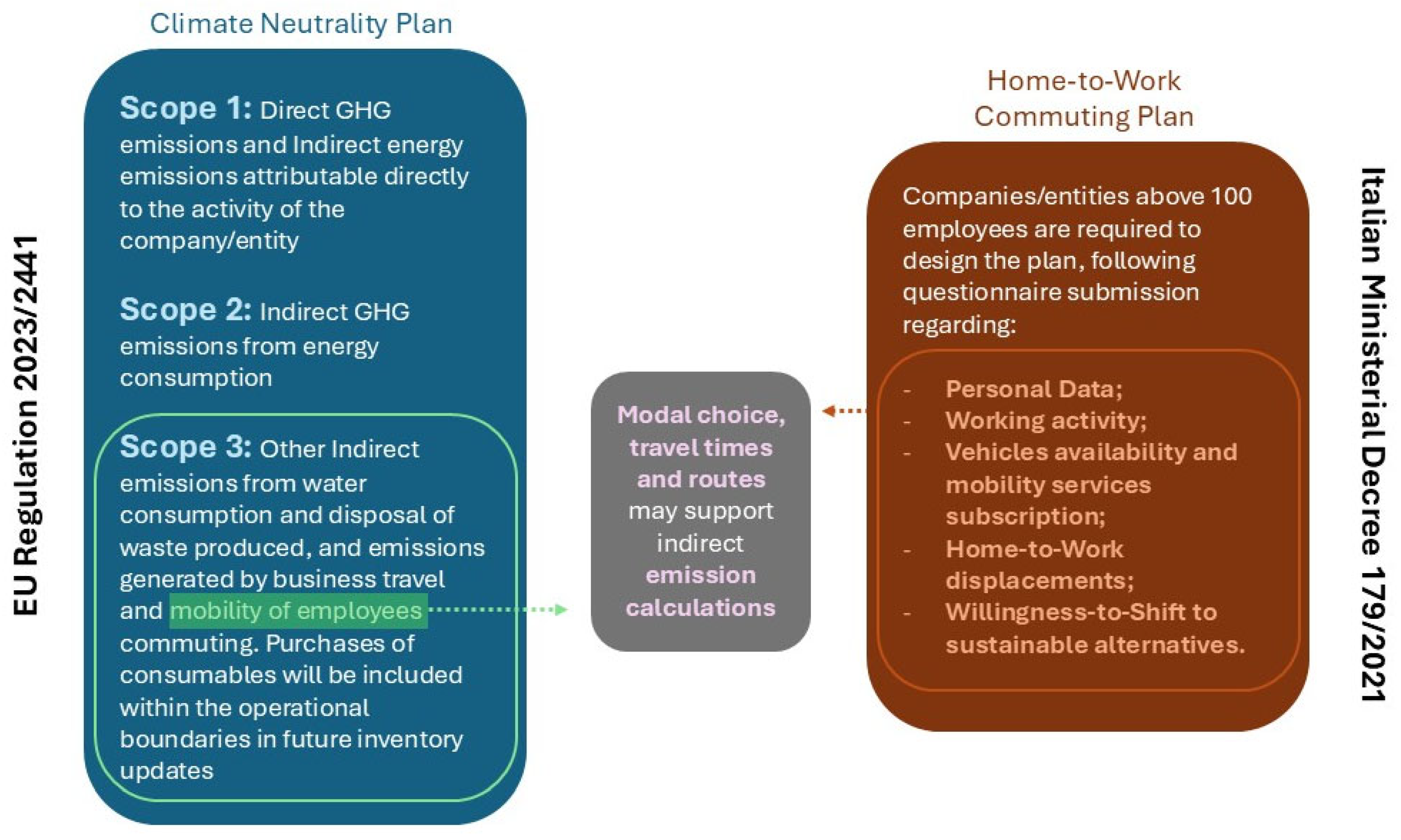
- Scope 1: Direct GHG emissions and indirect energy emissions attributable directly to the activity of the company/entity (emissions from natural gas and diesel fuel and refrigerant gas losses due to periodic maintenance of air conditioning systems and the vehicle fleet) [30].
- Scope 2: Indirect GHG emissions from energy consumption, i.e., those from the use of electricity [30].
- Scope 3: Other indirect emissions from water consumption and disposal of waste produced, and emissions generated by business travel and mobility of employees commuting. Purchases of consumables will be included within the operational boundaries in future inventory updates [31].
3. UniGe Case Study
- Avoiding or reducing greenhouse gas emissions through efficiency and savings;
- Reducing emissions by switching to renewable energy sources;
- Offsetting any residual emissions.
3.1. UniGe Climate Neutrality Plan
- Energy efficiency and retrofit: University runs extensive building energy retrofits (e.g., improved insulation, high-efficiency heating systems, and LED lighting), and contracts integrate energy service providers for optimal management and technical upgrades.
- Renewable energy: Expansion of on-campus solar capacity and the purchase of certified renewable electricity are central to the decarbonization strategy.
- Sustainable mobility: Measures include incentives for public transport and bike sharing, improved cycling infrastructure, discounted fares for students, and collaboration within European university networks for low-carbon mobility.
- Purchasing policy and waste reduction: UniGe promotes green procurement standards and aims for minimal waste generation through the application of “5R” principles (reduce, reuse, recycle, collect, recover). The university organizes information campaigns, provides reusable water bottles, and manages separate waste collection throughout its facilities.
- Offsetting and compensation: Unavoidable residual emissions will be neutralized using certified carbon credits or local sequestration initiatives, following strict social justice and biodiversity protection criteria.
- Education, community engagement, and equity: The strategy integrates climate neutrality, resilience, and sustainability into the curriculum and research activities, supporting a wide inclusion of internal and external stakeholders in climate action planning.
3.2. UniGe Home-to-Work Commuting Plans
- Sustainable modes of infrastructure and services: Installation of e-bike charging stations, increased bike-sharing and velostation agreements, creation of new cycling paths and racks, improved monitored parking, and ongoing mapping of campus accessibility.
- Public transport incentives: Renewal and expansion of discount and free fare arrangements for students and staff, including new providers and more flexible payment solutions.
- Smart working: Institutionalization of remote work for staff, supported by municipal coordination, especially during major urban construction phases.
- Mobility management and MaaS: Pilot university-led testing of MaaS platforms to integrate diverse transport options and payment into seamless digital experiences for users.
- Awareness and education: Targeted campaigns, events tied to European Mobility Week, and specialized mobility management coursework for students and staff.
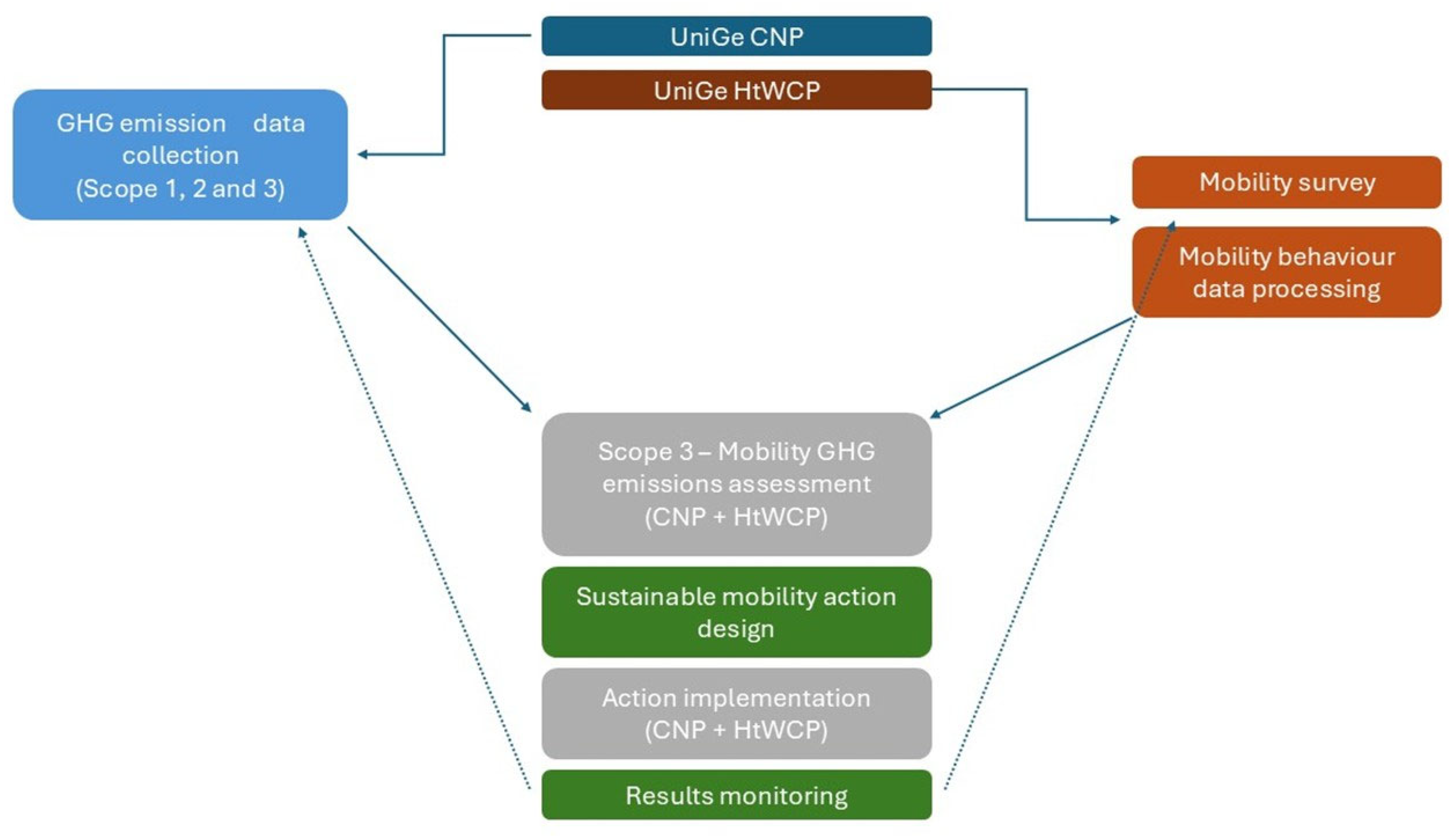
- Modal share;
- Traveled distances;
- Emissions per kilometer according to national official data.
- Low response rate, translating into difficult and ineffective data collection, and non-representativeness of the obtained results;
- Non-uniform responsiveness of different community member segments, resulting in the selected sample potentially being statistically irrelevant;
- The need to rely on standardized methodology to assess and calculate Scope 3-related emissions from data on modal choices.
4. Discussion
4.1. Institutional Perspective
4.2. University Look
4.3. Stakeholders’ Involvement
4.4. Up-Scaling Potential
5. Conclusions
5.1. Research Outcomes
5.2. Policy Inspiration
- Collected data should be quantitatively representative of the current state of the art. In this direction, acting on territorial MM leverages, incentives for sustainable MM could be limited only to companies reaching a relevant response rate (e.g., above 60%).
- Multi-dimensional datasets should be implemented both at the company and territorial levels. Integrated and holistic data sources are necessarily required to implement data-driven planning and actions.
5.3. Research Limitations and Perspectives
Author Contributions
Funding
Institutional Review Board Statement
Informed Consent Statement
Data Availability Statement
Conflicts of Interest
Abbreviations
| ASI | Avoid-Shift-Improve |
| CN | Climate Neutrality |
| CNP | Climate Neutrality Plan |
| EGD | European Green Deal |
| ETS | Emissions Trading System |
| EU | European Union |
| GHG | Greenhouse Gases |
| HtWCP | Home-to-Work Commuting Plan |
| MaaS | Mobility-as-a-Service |
| SUMP | Sustainable Urban Mobility Plan |
| SRACC | Climate Change Adaptation Strategy |
References
- Chen, J.M. Carbon neutrality: Toward a sustainable future. Innovation 2021, 2, 3100127. [Google Scholar] [CrossRef] [PubMed]
- Larrea, I.; Correa, J.M.; López, R.; Giménez, L.; Solaun, K.A. Multicriteria Methodology to Evaluate Climate Neutrality Claims—A Case Study with Spanish Firms. Sustainability 2022, 14, 4310. [Google Scholar] [CrossRef]
- United Nations Environment Programme. Emissions Gap Report 2020; United Nations Environment Programme (UNEP): Nairobi, Kenya, 2020; ISBN 9789280738124. Available online: https://en.wikipedia.org/wiki/United_Nations_Environment_Programme (accessed on 18 July 2025).
- Levin, K.; Rich, D.; Ross, K.; Fransen, T.; Elliott, C. Designing and Communicating Net-Zero Targets; Working Paper; World Resources Institute: Washington, DC, USA, 2020. [Google Scholar]
- European Commission. The European Green Deal; European Commission (EC): Brussels, Belgium, 2019; Available online: https://commission.europa.eu/strategy-and-policy/priorities-2019-2024/european-green-deal_en (accessed on 18 July 2025).
- Dupont, C.; Oberthür, S.; Von Homeyer, I. The COVID-19 crisis: A critical juncture for EU climate policy development? J. Eur. Integr. 2020, 42, 1095–1110. [Google Scholar] [CrossRef]
- European Parliament. Legislative Train Schedule: Fit for 55 Package. Available online: https://www.europarl.europa.eu/legislative-train/theme-environment-public-health-and-food-safety/file-fit-for-55-package (accessed on 18 November 2025).
- Vilela, N.B.; Castihlos, D.S.; Murphy, A.; Oplotnik, Ž. EU’s ‘Fit for 55′ plan, its economic impact and intergovernmental perspective. J. Infrastruct. Policy Dev. 2024, 8, 8445. [Google Scholar] [CrossRef]
- European Union. Regulation (EU) 2021/1119 Establishing the Framework for Achieving Climate Neutrality and Amending Regulations (EC) No 401/2009 and (EU) 2018/1999 (‘European Climate Law’); European Union: Brussels, Belgium, 2021; Available online: https://eur-lex.europa.eu/EN/legal-content/summary/european-union-regulations.html (accessed on 17 July 2025).
- Hale, T.; Smith, S.M.; Black, R.; Cullen, K.; Fay, B.; Lang, J.; Mahmood, S. Assessing the rapidly-emerging landscape of net zero targets. Clim. Policy 2022, 22, 18–29. [Google Scholar] [CrossRef]
- Black, R.; Cullen, K.; Fay, B.; Hale, T.; Lang, J.; Smith, S. Taking Stock: A Global Assessment of Net Zero Targets; Energy & Climate Intelligence Unit and Oxford Net Zero: Oxford, UK, 2021; Available online: https://eciu.net/analysis/reports/2021/taking-stock-assessment-net-zero-targets (accessed on 17 July 2025).
- Global Climate Action. Climate Action Pathway—Finance; Global Climate Action & Marrakech Partnership: Bonn, Germany, 2021; Available online: https://unfccc.int/climate-action/marrakech-partnership/reporting-tracking/pathways/finance-climate-action-pathway (accessed on 18 July 2025).
- SBTi. Science Based Targets Foundations for Science-Based Net-Zero Target Setting in the Corporate Sector; CDP: Berlin, Germany, 2020. [Google Scholar]
- University of Oxford. Mapping of Current Practices Around Net Zero Targets; University of Oxford: Oxford, UK, 2020; Available online: https://4bafc222-18ee-4db3-b866-67628513159f.filesusr.com/ugd/6d11e7_347e267a4a794cd586b1420404e11a57.pdf (accessed on 18 November 2025).
- New Climate Institute; Data-Driven EnviroLab. Navigating the Nuances of Net-Zero Targets; NewClimate Institute & Data-Driven EnviroLab: Berlin, Germany, 2020. Available online: https://newclimate.org/resources/publications/navigating-the-nuances-of-net-zero-targets (accessed on 19 July 2025).
- Taskforce on Scaling Voluntary Carbon Markets; Phase 1—Final Report; Institute of International Finance: Washington, DC, USA, 2021; Available online: https://ppp.worldbank.org/library/taskforce-scaling-voluntary-carbon-markets-final-report (accessed on 17 July 2025).
- Kreibich, N.; Hermwille, L. Caught in between: Credibility and feasibility of the voluntary carbon market post-2020. Clim. Policy 2021, 21, 939–957. [Google Scholar] [CrossRef]
- Lapčík, V.; Lapčík, M.; Lapčík, V., Jr. Current aspects of decarbonisation in the Czech Republic and possibilities of replacement of coal energy sources by renewable sources of electric energy. Inżynieria Mineralna 2022, 1, 87–96. [Google Scholar] [CrossRef]
- Rodrigues, J.F.; Stoefs, W. Financing the green transition: The European Green Deal and the role of public investment. J. Clean. Prod. 2021, 279, 123673. [Google Scholar]
- Ji, X.; Zhang, Y.; Mirza, N.; Umar, M.; Rizvi, S.K.A. The impact of carbon neutrality on the investment performance: Evidence from the equity mutual funds in BRICS. J. Environ. Manag. 2021, 297, 113228. [Google Scholar] [CrossRef]
- Ciot, M.G. On European Green Deal and Sustainable Development Policy (the Case of Romania). Sustainability 2021, 13, 12233. [Google Scholar] [CrossRef]
- University of Cambridge Institute for Sustainability Leadership (CISL). Targeting Net Zero: A Strategic Framework for Business Action; Cambridge Institute for Sustainability Leadership: Cambridge, UK, 2020; Available online: https://www.cisl.cam.ac.uk/resources/low-carbon-transformation-publications/targeting-net-zero (accessed on 20 July 2025).
- Capelo, S.; Soares, T.; Azevedo, I.; Fonseca, W.; Matos, M.A. Design of an energy policy for the decarbonisation of residential and service buildings in Northern Portugal. Energies 2023, 16, 2239. [Google Scholar] [CrossRef]
- Bresciani, S.; Tjahja, C.; Komatsu, T.; Rizzo, F. Prototyping for policy making: Collaboratively synthesizing interdisciplinary knowledge for climate neutrality. In Proceedings of the International Conference 2023 of the Design Research Society Special Interest Group on Experiential Knowledge (EKSIG) Conference, Milan, Italy, 19–20 June 2023; pp. 104–116. [Google Scholar]
- Civiero, P.; Pascual, J.; Arcas Abella, J.; Salom, J. Innovative PEDRERA model tool boosting sustainable and feasible renovation programs at district scale in Spain. Sustainability 2022, 14, 9672. [Google Scholar] [CrossRef]
- Bertolin, A.; Tolentino, S.; Beria, P.; Perotto, E.; Guereschi, F.C.; Baglione, P.; Caserini, S. Assessing the Impact of Changes in Mobility Behaviour to Evaluate Sustainable Transport Policies: Case of University Campuses of Politecnico di Milano. In Proceedings of the Conference on Sustainable Urban Mobility, Skiathos, Island, 24–25 May 2018; pp. 89–97. [Google Scholar]
- Cappelletti, G.M.; Grilli, L.; Russo, C.; Santoro, D. Sustainable mobility in Universities: The case of the University of Foggia (Italy). Environments 2021, 8, 57. [Google Scholar] [CrossRef]
- Tolentino, S.; Shtele, E.; Messori, G.; Perotto, E. Sustainable mobility policies at Universities: What after the pandemic? Case Stud. Transp. Policy 2024, 15, 101155. [Google Scholar] [CrossRef]
- Kachi, A.; Mooldijk, S.; Warnecke, C. Climate Neutrality Claims. How to Distinguish Between Climate Leadership and Greenwashing; New Climate Institut: Cologne, Germany, 2020; Available online: https://newclimate.org/wpcontent/uploads/2020/09/Climate_neutrality_claims_BUND_September2020.pdf (accessed on 18 November 2025).
- World Business Council for Sustainable Development; World Resources Institute. The Greenhouse Gas Protocol: A Corporate Accounting and Reporting Standard; WBCSD & WRI: Geneva, Switzerland, 2004; Available online: http://ghgprotocol.org/corporate-standard (accessed on 18 November 2025).
- World Business Council for Sustainable Development; World Resources Institute. Greenhouse Gas Protocol Corporate Value Chain (Scope 3) Accounting and Reporting Standard; WBCSD & WRI: Geneva, Switzerland, 2011; Available online: https://www.weforum.org/organizations/world-business-council-for-sustainable-development-wbcsd-6c8ce19d35/?gad_source=1&gad_campaignid=22234048793&gclid=EAIaIQobChMIkd7Ei9bakQMV5iKDAx1-AwrKEAAYASAAEgIVnPD_BwE (accessed on 18 November 2025).
- Shin, R.A.A. Evaluating the Greenhouse Gas Emissions of the Ontario Craft Beer Industry: An Assessment of Challenges and Benefits of Greenhouse Gas Accounting. Doctoral Dissertation, Toronto Metropolitan University, Toronto, ON, Canada, 2018. [Google Scholar]
- Inventario GHG. Dichiarazione di Verifica/Verification Statement N°. VEB-0074 dell’inventario delle Emissioni/of the Emissions Inventory; University of Genoa: Genoa, Italy, 2014; Available online: https://unigesostenibile.unige.it/sites/unigesostenibile.unige.it/files/2022-01/Certificazione_Inventario_GHG_UniGe_2013-14.pdf (accessed on 18 November 2025).
- Race to Zero. Interpretation Guide Race to Zero. 2022. Available online: https://www.educationracetozero.org/files/race_to_zero_criteria_3_0_15_06_22_1.pdf (accessed on 18 November 2025).
- Arnz, M.; Göke, L.; Thema, J.; Wiese, F.; Wulff, N.; Kendziorski, M.; Von Hirschhausen, C. Avoid, Shift or Improve passenger transport? Impacts on the energy system. Energy Strategy Rev. 2024, 52, 101302. [Google Scholar] [CrossRef]
- Hazaea, S.A.; Zakari, A.; Alharthi, M.; Mabrouki, M.; Fattah, F.A. Past, present, and future of carbon accounting: Insights from a systematic literature review. Front. Environ. Sci. 2023, 11, 1093646. [Google Scholar] [CrossRef]
- Marlowe, J.; Thomson, C.; Mathews, M.R. Carbon accounting: A systematic literature review and future research directions. Aims Press. 2022, 26, 5347–5373. [Google Scholar] [CrossRef]
- Valls-Val, K.; Bovea, M.D. Carbon footprint in higher education institutions. Environ. Sci. Technol. 2021, 55, 11164–11179. [Google Scholar] [CrossRef]
- Universities for Climate. Universities Tackling Scope 3 Emissions in the Supply Chain. Available online: https://universitiesforclimate.org/ (accessed on 18 November 2025).
- Woszczek, A.; Child, M.; Luoranen, M.; Soukka, R. Opportunities to improve data quality of Scope 3 emissions in the context of carbon neutrality: The case study of LUT University. Int. J. Sustain. High. Educ. 2025, 26, 207–225. [Google Scholar] [CrossRef]
- Yang, C.; Li, X.; Li, S.; Wang, J.; Liu, B. Carbon emissions accounting and uncertainty analysis in higher education: A case study of Sichuan University. Environ. Res. Lett. 2025, 20, 034012. [Google Scholar] [CrossRef]
- Winkler, L.; Notter, B.; Schmidt, S.V. The effect of sustainable mobility transition policies on urban transport carbon budgets. Nature Clim. Change 2023, 13, 315–320. [Google Scholar] [CrossRef]
- Ng, K.M.; Mohsin, M.; Chan, W.Y.; Lim, S.Y.; Wong, J. Urban mobility mode shift to active transport: Associations with sociodemographic characteristics in a prospective cohort. SAGE Open 2024, 14, 21582440231221098. [Google Scholar] [CrossRef]
- Battistini, R.; Bondesan, A.; Calviello, A.; Carrozza, G.; Carlino, G.; Crisci, A.; Vallese, A. How to assess the carbon footprint of a large university? The University of Palermo case study. Energies 2022, 16, 166. [Google Scholar] [CrossRef]
- Smith, C.; Bain-Kerr, F.; van der Horst, D. Participatory Climate Action: Reflections on Community Diversity and the Role of External Experts. Urban Plan. 2024, 9, 8182. [Google Scholar] [CrossRef]
- Restrepo-Mieth, A.; Rozenberg, J.; Lustig, N. Community-based participatory climate action. Glob. Sustain. 2023, 6, e14. [Google Scholar] [CrossRef]
- Ng, W.S.; Acker, A.F. Understanding Urban Travel Behaviour by Gender for Efficient and Equitable Transport; International Transport Forum Discussion Papers; OECD Publishing: Paris, France, 2018; Available online: https://www.econstor.eu/handle/10419/194064 (accessed on 20 July 2025).
- CIVITAS. Gender Equality and Mobility: Mind the Gap! Available online: https://civitas.eu/ (accessed on 18 November 2025).



| Objectives | Methodology | Time Frame | |
|---|---|---|---|
| University Climate Neutrality Plan | Baseline calculation for current GHG emissions’ production by scope and reduction target setting | GHG emissions’ data direct and indirect collection related to Scopes 1, 2, and 3 | 25 years |
| University Home-to-Work Commuting Plan | Commuting mobility management and sustainable modal shift | Actions shaped around structural conditions and commuting mobility data collected through voluntary surveys | 2 years |
Disclaimer/Publisher’s Note: The statements, opinions and data contained in all publications are solely those of the individual author(s) and contributor(s) and not of MDPI and/or the editor(s). MDPI and/or the editor(s) disclaim responsibility for any injury to people or property resulting from any ideas, methods, instructions or products referred to in the content. |
© 2026 by the authors. Licensee MDPI, Basel, Switzerland. This article is an open access article distributed under the terms and conditions of the Creative Commons Attribution (CC BY) license.
Share and Cite
Delponte, I.; Costa, V. Navigating Climate Neutrality Planning: How Mobility Management May Support Integrated University Strategy Development, the Case Study of Genoa. Future Transp. 2026, 6, 19. https://doi.org/10.3390/futuretransp6010019
Delponte I, Costa V. Navigating Climate Neutrality Planning: How Mobility Management May Support Integrated University Strategy Development, the Case Study of Genoa. Future Transportation. 2026; 6(1):19. https://doi.org/10.3390/futuretransp6010019
Chicago/Turabian StyleDelponte, Ilaria, and Valentina Costa. 2026. "Navigating Climate Neutrality Planning: How Mobility Management May Support Integrated University Strategy Development, the Case Study of Genoa" Future Transportation 6, no. 1: 19. https://doi.org/10.3390/futuretransp6010019
APA StyleDelponte, I., & Costa, V. (2026). Navigating Climate Neutrality Planning: How Mobility Management May Support Integrated University Strategy Development, the Case Study of Genoa. Future Transportation, 6(1), 19. https://doi.org/10.3390/futuretransp6010019