


Abstract
Background: One-lung ventilation (OLV) is routinely used during thoracic surgery. Static respiratory risk scores may not capture the physiological changes that occur after lung isolation. This study evaluated whether an early intraoperative risk assessment model based on routinely available perioperative variables could improve the identification of severe hypoxemia during OLV and predict prolonged postoperative mechanical ventilation. Methods: This single-center prospective observational study included 103 adults undergoing thoracic surgery with OLV. Severe hypoxemia was defined as a PaO2/FiO2 ratio < 100 during OLV. Prolonged extubation was defined as postoperative mechanical ventilation > 180 min. Models were developed using routinely available preoperative and intraoperative variables. Logistic regression, LASSO logistic regression, Random Forest, and Gradient Boosting were evaluated using internal cross-validation. Results: Severe hypoxemia occurred in 44 patients (42.7%), whereas prolonged extubation > 180 min occurred in 34 patients (33.0%). The early intraoperative model achieved an OOF AUC of 0.745, while prediction of prolonged extubation was more modest (OOF AUC 0.671). PaCO2 during OLV and ASA ≥ 4 were the leading contributors to Models 2 and 3, respectively. Conclusions: Static preoperative scores provided limited information for identifying severe hypoxemia during OLV. Incorporating routinely available intraoperative variables supported early intraoperative risk assessment, while perioperative variables showed moderate ability to predict prolonged extubation. Further validation in larger cohorts is required.
1. Introduction
One-lung ventilation (OLV) remains a standard technique in thoracic anesthesia because it allows lung isolation and adequate surgical exposure [1,2]. During OLV, intrapulmonary shunt increases, ventilation-perfusion mismatch becomes more pronounced, and oxygenation depends in part on hypoxic pulmonary vasoconstriction [1]. Most desaturation episodes can be corrected during the case, but severe hypoxemia is different, because it may point to limited cardiopulmonary reserve and to a more fragile perioperative course [1,3].
Severe hypoxemia during OLV should not be seen only as an intraoperative event [3,4]. Perioperative respiratory dysfunction has been associated with prolonged extubation, postoperative ventilatory support, unplanned or prolonged intensive care unit (ICU) admission, longer hospitalization, and early postoperative mortality [4,5].
OLV affects pulmonary function through both mechanical and inflammatory mechanisms. Lung isolation can induce atelectasis, ischemia–reperfusion injury, local hypoxia with increased neutrophil recruitment, cytokine release, and alveolar-capillary dysfunction [2,3]. Studies of OLV have described cytokines including interleukin-6, interleukin-8 and tumor necrosis factor alpha and markers of neutrophil and endothelial activation related to ventilator-induced lung injury (VILI) [3]. White blood cell count (WBC), Neutrophil-to-lymphocyte ratio (NLR), Platelet-to-lymphocyte ratio (PLR), C-reactive protein (CRP), blood gas variables, and lactate may provide accessible biological information that complements clinical and intraoperative assessment when more specific inflammatory biomarkers are not routinely available [3,6,7].
Current perioperative respiratory risk assessment relies on preoperative evaluation, clinical judgment, and static scores. Assess Respiratory Risk in Surgical Patients in Catalonia (ARISCAT) and Score for Prediction of Postoperative Respiratory Complications (SPORC) are useful preoperative scores for estimating postoperative respiratory risk. However, they do not predict hypoxemia during OLV and do not follow the patient dynamically [8,9,10,11]. During OLV, risk may change because acid-base status, oxygenation, duration of lung isolation, surgical approach, and patient-related factors can all influence the perioperative course [1,2,11,12].
In routine thoracic anesthesia practice, decisions regarding ventilatory adjustment, postoperative extubation, and ICU planning must often be made using information from different perioperative stages [1,12]. Static preoperative scores provide an initial estimate of risk, but they cannot incorporate physiological changes observed after lung isolation [11,13]. At the same time, real-world perioperative datasets are usually small, heterogeneous, and derived from routine clinical care, which limits the use of complex prediction algorithms [14,15]. Integrating readily available clinical, laboratory, and intraoperative variables into a structured risk-assessment model may help clinicians recognize patients who require closer respiratory monitoring and anticipate the need for prolonged postoperative ventilatory support. Similar machine-learning approaches have been applied in thoracic surgery and lung cancer surgery to predict postoperative pulmonary or cardiopulmonary complications using perioperative and intraoperative data [13,16,17,18]. In OLV settings, risk may be reassessed as new perioperative information becomes available. This approach is not intended to replace clinical judgment, but to organize available information and highlight the changes in risk while decisions are still being made [13,16,19].
Machine learning may be useful here because it can combine variables that clinicians usually assess separately: baseline risk, ventilation variables, blood gas changes, inflammatory markers, and early postoperative endpoints can be read together in a single model [13,16,19,20].
The aim of this study was to evaluate whether machine learning models built from routinely available perioperative data could improve early intraoperative risk assessment of severe hypoxemia during OLV and predict prolonged postoperative mechanical ventilation after thoracic surgery.
2. Materials and Methods
This was a single-center prospective observational study conducted on 103 adult patients undergoing thoracic surgery requiring OLV. The study was conducted in accordance with the principles of the Declaration of Helsinki and was approved by the Ethics Committee (approval no. 35163/12 January 2024). Written informed consent was obtained from all patients before inclusion in the study.
2.1. Study Design and Population
Consecutive adult patients scheduled for thoracic surgical procedures requiring OLV were included. Inclusion criteria: age ≥ 18 years, scheduled thoracic surgery requiring OLV, signed informed consent, and availability of complete perioperative data, including preoperative clinical and laboratory variables, intraoperative arterial blood gas analysis during OLV, surgical and OLV duration, and postoperative mechanical ventilation duration. Exclusion criteria were age < 18 years, refusal to participate, incomplete perioperative data, absence of arterial blood gas analysis during OLV, missing postoperative mechanical ventilation data, or procedures not requiring OLV. Surgical procedures included wedge or atypical resections, lobectomies, pneumonectomies, pleural procedures, mediastinal surgery and other thoracic interventions performed by Video-assisted thoracoscopic surgery (VATS) or thoracotomy.
2.2. Data Collection
Clinical and preoperative variables: age, sex, body mass index (BMI), smoking status, American Society of Anesthesiologists (ASA) physical status, preoperative peripheral oxygen saturation (SpO2), ARISCAT score and SPORC score.
Preoperative biological variables: hemoglobin, NLR, and PLR.
Surgical variables: surgical approach, type of procedure, surgery duration and OLV duration.
Intraoperative variables during OLV: FiO2, arterial blood gas analysis (pH, PaO2, PaCO2, SaO2, lactate, PaO2/FiO2 ratio, and alveolar-arterial oxygen gradient (A-a oxygen gradient), shunt fraction and respiratory index). Arterial blood gas analysis was usually performed during the early phase of OLV, approximately 30 min after lung isolation, as part of routine intraoperative monitoring. However, the exact timing was not strictly protocolized and could vary according to the clinical course. FiO2 was adjusted intraoperatively according to oxygenation status and clinical need.
Postoperative variables: postoperative mechanical ventilation duration, Intensive care unit length of stay (ICU LOS), postoperative arterial blood gas analysis NLR and PLR.
Data were collected in the Department of Anesthesiology and Intensive Care Medicine, County Clinical Emergency Hospital of Târgu Mureș, Romania, between January 2024 and March 2026.
2.3. Outcomes
The study evaluated two primary clinical outcomes:
- (1)
- Severe hypoxemia during OLV, defined as a PaO2/FiO2 ratio < 100 [21];
- (2)
- Prolonged postoperative mechanical ventilation, defined as postoperative mechanical ventilation lasting >180 min.
Secondary exploratory outcomes included prolonged postoperative mechanical ventilation > 120 min, >6 h, >24 h, total postoperative mechanical ventilation duration, and ICU length of stay.
2.4. Machine Learning Models
Three models were evaluated. Model 1 used only preoperative clinical and biological variables to predict severe hypoxemia during OLV. Model 2, early intraoperative severe hypoxemia model, was used to assess severe hypoxemia during OLV. It included the variables from Model 1 and added surgical approach, type of procedure, pH, PaCO2, and lactate measured during OLV. All variables included in Model 2 were available at the time of arterial blood gas sampling, allowing early intraoperative risk assessment. Model 3 was developed to predict prolonged extubation > 180 min; prolonged extubation > 120 min was analyzed as a secondary exploratory outcome. To avoid circular prediction, variables directly derived from oxygenation impairment, including PaO2, PaO2/FiO2 ratio, A-a gradient, shunt fraction, respiratory index, FiO2 during OLV, and SaO2 during OLV, were not included as predictors in Model 2.
2.5. Statistical Analysis
Data distribution was assessed using the Shapiro–Wilk test. Continuous variables are presented as median and interquartile range (IQR), and categorical variables as absolute numbers and percentages.
Patients were compared according to the presence of severe hypoxemia during OLV, and prolonged extubation > 180 min. Continuous variables were compared using the Mann–Whitney U test. Categorical variables were compared using the chi-square test or Fisher’s exact test, as appropriate.
Conventional statistical analyses, including descriptive statistics, group comparisons, binary logistic regression and ROC curve analysis, were performed using IBM SPSS Statistics version 29.0 (IBM Corp., Armonk, NY, USA).
Machine-learning analyses, including logistic regression, LASSO logistic regression, Random Forest, and Gradient Boosting, were performed using Python, version 3.12.13 (Python Software Foundation, Wilmington, DE, USA), with scikit-learn version 1.9.0, NumPy version 2.5.2, pandas version 2.2.3, and SciPy version 1.18.0.Model performance was assessed by stratified cross-validation and reported using the out-of-fold area under the receiver operating characteristic curve (OOF AUC), cross-validation AUC, sensitivity, specificity, Youden index and Brier score. LASSO logistic regression was selected for regularization and variable selection, whereas Random Forest and Gradient Boosting were evaluated as tree-based ensemble methods. Model performance was compared across all algorithms. These algorithms were selected to compare interpretable linear approaches with tree-based ensemble methods capable of capturing non-linear relationships in tabular clinical data.
Model performance was assessed using stratified five-fold cross-validation with a fixed random seed. Performance metrics were calculated from pooled out-of-fold predictions, including OOF AUC, sensitivity, specificity, Youden index, and Brier score. Scaling/standardization, when required by the algorithm, was fitted only within the training folds and applied to validation folds to avoid data leakage. The same cross-validation framework was used for algorithm comparison, model selection, and final internal performance estimation. Therefore, the reported performance should be interpreted as internal validation only. No independent test set or external validation cohort was available.
Feature importance was assessed using permutation importance. For each selected model, baseline AUC was calculated, each predictor was permuted individually, and the decrease in AUC was used as an estimate of variable contribution. Importance values were scaled from 0 to 100 within each model. Stability of feature importance was evaluated by recalculating permutation importance across cross-validation splits using held-out fold predictions.
A p-value < 0.05 was considered statistically significant.
3. Results
3.1. Patient Characteristics
Severe hypoxemia during OLV occurred in 44 patients, while prolonged extubation > 180 min occurred in 34 patients. Patient, surgical and perioperative characteristics were compared according to these two main outcomes.
Patients with severe hypoxemia had lower pH and higher PaCO2 during OLV. They also had higher preoperative WBC values, whereas ARISCAT and SPORC scores did not differ significantly (Table 1). Patients with prolonged extubation > 180 min had higher ASA and ARISCAT scores, lower preoperative SpO2, and were more likely to undergo thoracotomy (Table 2).
Table 1.
Patient, surgical, and perioperative characteristics according to severe hypoxemia during OLV.
Table 2.
Patient, surgical, and perioperative characteristics according to prolonged extubation > 180 min.
Table 3 shows the frequency of the respiratory outcomes used in the analysis. Severe hypoxemia during OLV was present in 44 patients (42.7%). Prolonged extubation was found in 34 patients (33.0%) when the 180 min threshold was used, and in 55 patients (53.4%) with the 120 min threshold. Mechanical ventilation lasting more than 6 h or 24 h was uncommon and was therefore not retained as a modeling endpoint.
Table 3.
Respiratory outcome distribution in the study cohort.
3.2. Model Performance
Three risk-assessment models were developed.
Model 1, the preoperative model, was used to explore severe hypoxemia during OLV using only variables available before surgery: age, sex, body mass index, smoking status, ASA physical status, preoperative SpO2, ARISCAT score, SPORC score, hemoglobin, WBC, NLR and PLR.
Model 2, the early intraoperative OLV model, was used to explore severe hypoxemia during OLV while reducing overlap with the outcome definition. It included the variables from Model 1 and added surgical approach, type of procedure, pH, PaCO2, and lactate during OLV. FiO2, SaO2, surgery duration and OLV duration were excluded from the final Model 2 because they are either close to the oxygenation-based outcome or may reflect procedural duration and local workflow rather than an independent early physiologic risk signal.
Model 3 was developed to explore prolonged extubation, defined as postoperative mechanical ventilation lasting more than 180 min. The variables entered in this model were age, sex, BMI, ASA physical status, ARISCAT score, preoperative SpO2, preoperative NLR, preoperative PLR, surgical approach, OLV duration, FiO2 during OLV, pH during OLV, PaCO2 during OLV, SaO2 during OLV, lactate during OLV, and severe hypoxemia during OLV. A secondary exploratory analysis was performed using a 120 min threshold for postoperative mechanical ventilation.
All models were evaluated using stratified five-fold cross-validation with a fixed random seed, preserving the proportion of events within each fold. No repeated cross-validation was performed. Model performance was calculated from pooled out-of-fold predictions. Scaling/standardization, when required by the algorithm, was fitted only within the training folds and applied to the validation folds to avoid data leakage.
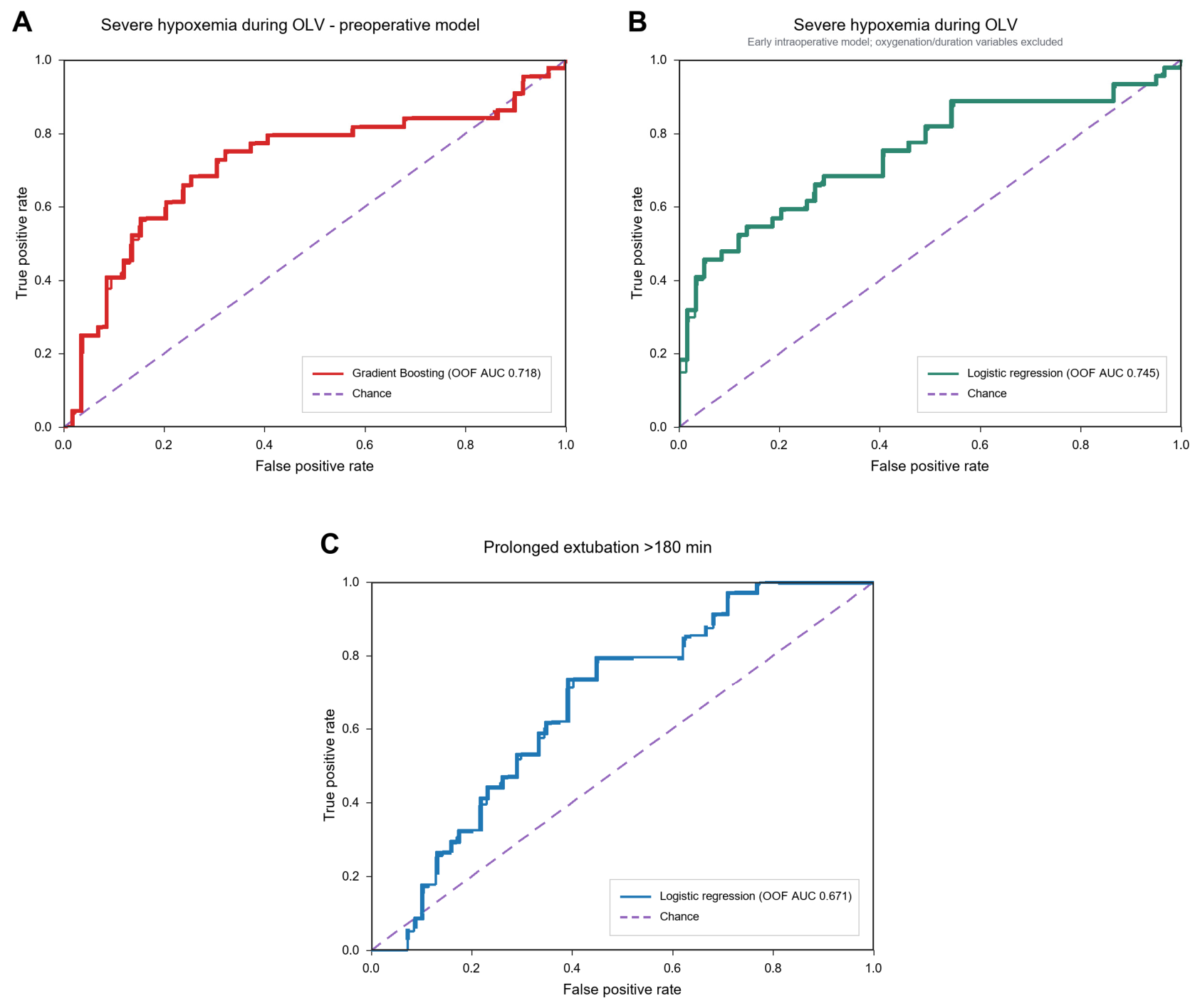
The performance of all evaluated algorithms is shown in Table 4. Gradient Boosting had the highest OOF AUC for the preoperative model (0.718), while logistic regression was retained for the early intraoperative OLV model because it showed discrimination similar to Random Forest (OOF AUC 0.745 vs. 0.746), with better sensitivity and interpretability. Logistic regression performed best for prolonged extubation > 180 min (OOF AUC 0.671), while Random Forest performed best for the secondary > 120 min threshold (OOF AUC 0.627).
Table 4.
Internal validation performance of all evaluated machine-learning algorithms across model specifications.
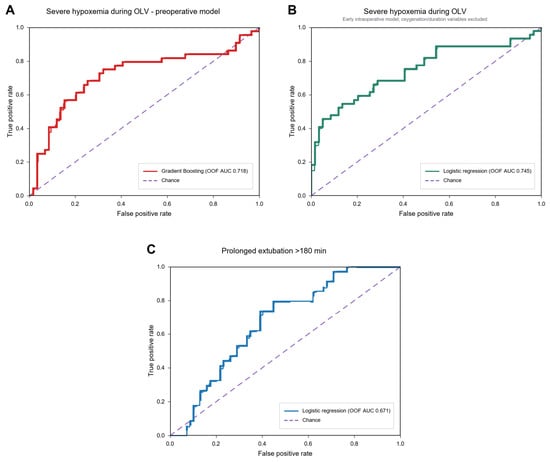
For severe hypoxemia, adding selected intraoperative OLV variables modestly improved the model performance. Model 1 had an OOF AUC of 0.718, while Model 2, after exclusion of FiO2, SaO2, surgery duration and OLV duration, reached an OOF AUC of 0.745. Performance for prolonged extubation was weaker, with an OOF AUC of 0.671 for the 180 min threshold and 0.627 for the 120 min threshold. The early intraoperative OLV model showed a numerically higher OOF AUC than the preoperative model; however, the difference was not statistically significant (ΔAUC = 0.027, 95% CI: −0.080–0.134; bootstrap p = 0.643) (Figure 1).
Figure 1.
ROC curves for the models. (A) Preoperative model for severe hypoxemia during OLV. (B) Early intraoperative risk assessment model for severe hypoxemia during OLV. (C) Model for prolonged extubation > 180 min. ROC, receiver operating characteristic; AUC, area under the curve; OLV, one-lung ventilation.
Calibration assessment, Brier scores, and confusion matrices are provided in the Supplementary Materials. Calibration plots are shown in Supplementary Figure S1, while confusion matrices are presented in Supplementary Table S2. Exploratory decision curve analysis is presented in Supplementary Figure S2.
The predictive performance of conventional static risk scores was also evaluated. ARISCAT and SPORC showed limited discrimination for severe hypoxemia during OLV and for prolonged extubation (Table 5).
Table 5.
Performance of conventional static risk scores.
3.3. Feature Importance and Model Calibration
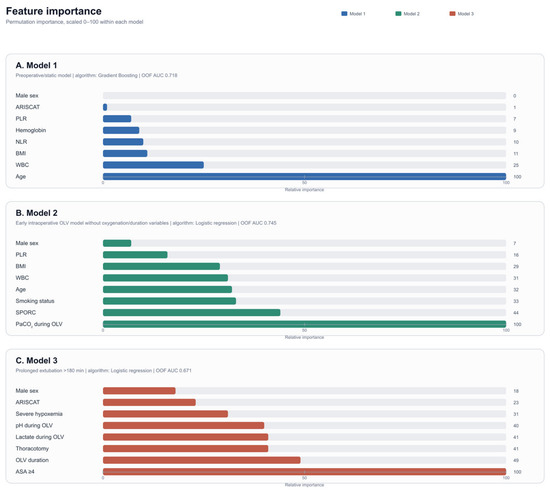
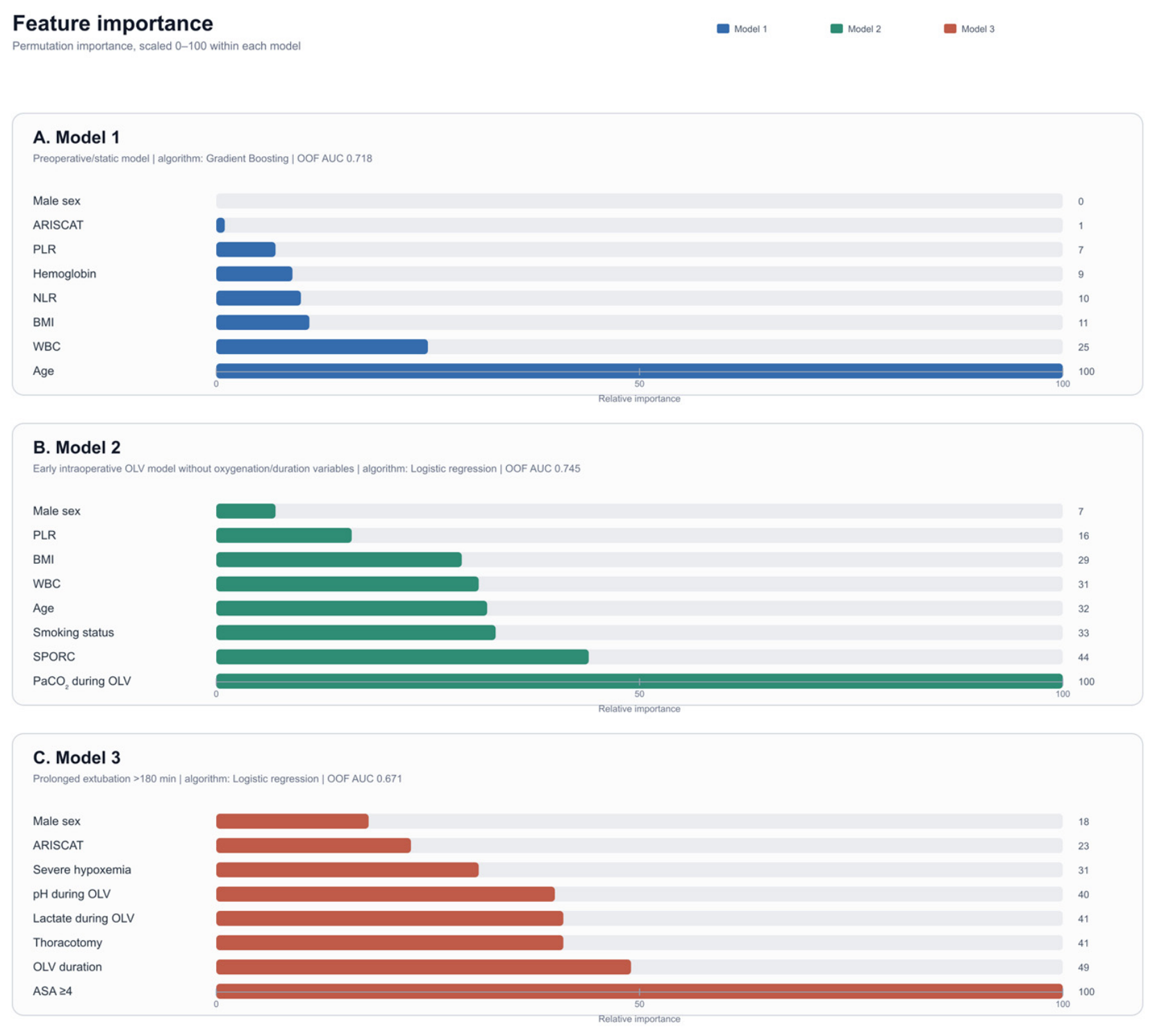
To explore which variables contributed most to model performance, feature importance was analyzed for the three predictive models. In Model 1, age and WBC had the highest relative importance. In Model 2, PaCO2 during OLV was the most important variable followed by SPORC and WBC. In Model 3, ASA class ≥ 4 had the highest relative importance, followed by OLV duration, thoracotomy, lactate and pH during OLV (Figure 2). Because feature importance varied across folds, these results should be interpreted as exploratory.
Figure 2.
Feature importance analysis for the three models. Relative importance was scaled from 0 to 100 within each model. (A) Model 1, preoperative model for severe hypoxemia during OLV. (B) Model 2, early intraoperative risk assessment model for severe hypoxemia during OLV. (C) Model 3, model for prolonged extubation > 180 min.
4. Discussion
4.1. Severe Hypoxemia
The main finding of this study is that severe hypoxemia during OLV appears to be better captured when intraoperative variables are added to baseline preoperative data. Classical preoperative scores are useful for estimating baseline respiratory risk [8,9,10,11,22], but they were not designed to follow the physiological changes that occur after lung isolation begins [1,13]. In our cohort, ARISCAT and SPORC showed limited discrimination for severe hypoxemia during OLV, which supports the need to include variables recorded during OLV [1,13].
In our study, adding selected OLV-related variables increased the OOF AUC from 0.718 in the preoperative model to 0.745 in the early intraoperative model. Because pH, PaCO2, lactate, and the PaO2/FiO2-based outcome were obtained from the same arterial blood gas assessment, Model 2 should be interpreted as early intraoperative risk classification rather than prediction of a future hypoxemic event. Total surgery duration and total OLV duration were removed because they were not available at the time of sampling.
The improvement in discrimination was small and was accompanied by lower sensitivity and higher specificity. At the selected threshold the lower sensitivity indicates that the model may fail to identify a proportion of patients with severe hypoxemia, despite a modest improvement in overall discrimination. Therefore, it cannot currently be considered a standalone screening tool.
This finding is supported by the physiological differences observed between groups. Patients with severe hypoxemia had lower pH and higher PaCO2 during OLV, suggesting that oxygenation impairment occurred together with a broader disturbance in gas exchange. Feature importance analysis also identified PaCO2 as one of the main contributors to Model 2, supporting its physiological relevance during OLV. However, feature importance estimates varied across cross-validation splits and should be interpreted cautiously given the limited sample size. Because pH and PaCO2 reflect related acid–base processes, some degree of collinearity between these variables is expected. Their contribution should therefore be interpreted as complementary physiological information rather than as independent causal effects.
Our findings are in line with recent perioperative studies that show that prediction models perform better when intraoperative respiratory dynamics are added to preoperative data, supporting the idea that pulmonary risk should be reassessed during surgery rather than estimated only once before induction [13].
Hypoxemia during OLV is common, and most episodes can be corrected intraoperatively. However, some patients tolerate lung isolation poorly and develop marked oxygenation impairment. These patients are more likely to require postoperative respiratory support or experience prolonged extubation [1,4,23]. In our study, patients with severe hypoxemia during OLV also required longer postoperative mechanical ventilation. Although this association cannot be interpreted as causal, it supports the clinical relevance of intraoperative hypoxemia as a marker of a more difficult early postoperative respiratory course.
Most OLV-related inflammatory studies have focused on specific biomarkers such as IL-6, IL-8, TNF-α, neutrophil elastase, and endothelial activation markers. However, these tests are not routinely available in most perioperative settings and are usually more expensive [3,24]. In contrast, WBC, NLR, and PLR are inexpensive, rapidly available from routine blood count, and therefore easier to integrate into a bedside perioperative risk-assessment model. In our cohort, WBC was higher in patients with severe hypoxemia, while NLR and PLR were not significantly different. This suggests that simple inflammatory markers may provide a biological context, but they cannot explain OLV-related hypoxemia on their own.
In practice, these results suggest that respiratory risk during OLV should not be judged only before surgery. Preoperative scores may help describe baseline risk, but the patient should be reassessed after lung isolation, when blood gas changes become available. Patients with hypercapnia, lower pH, or increased lactate during OLV may need closer intraoperative monitoring, adjustment of ventilation strategy, and earlier planning of postoperative respiratory support or ICU admission when indicated. These findings should not be used as fixed decision rules, but rather as an additional way to organize clinical attention in patients at higher respiratory risk.
4.2. Prolonged Postoperative Extubation
Unlike Model 2, Model 3 used perioperative variables available before the postoperative outcome and can therefore be interpreted as a predictive model for prolonged extubation. However, its discrimination was limited, with an OOF AUC of 0.671. Our findings are also consistent with previous studies applying machine learning to extubation prediction in critically ill patients. Pai et al. demonstrated that routinely available clinical variables can be integrated into explainable machine learning models to support extubation decisions, although the clinical context and target population differed from the present study [14].
Early extubation is an expected part of recovery after lung surgery, but the decision depends on the patient’s overall stability at the end of the procedure [25]. In our study, the model developed for prolonged extubation > 180 min performed less well than the early intraoperative OLV model. Postoperative ventilation duration reflects several perioperative decisions and not only the patient’s intraoperative gas exchange. The secondary 120 min threshold produced similar but weaker performance, supporting the idea that prolonged extubation is a less specific endpoint than severe hypoxemia during OLV. The 180 min threshold should be interpreted in the context of local postoperative practice. It does not necessarily show postoperative respiratory failure, because the extubation timing may also depend on anesthetic recovery. For this reason, we interpreted this endpoint as prolonged early postoperative mechanical ventilation rather than as a definitive marker of respiratory failure. Longer thresholds, such as >6 h and >24 h, may be clinically more specific, but the small number of events in our cohort limited their use for predictive modeling.
Thoracotomy was more frequent among patients with prolonged extubation > 180 min, while VATS was less frequent in this group. Studies comparing surgical approaches in pulmonary resection suggest that early postoperative recovery differs between minimally invasive and open surgery. This finding is consistent with studies showing better early recovery after VATS compared with open thoracotomy. Lim et al. compared VATS with open lobectomy for early-stage lung cancer and reported better early recovery after the minimally invasive approach [26]. Similarly, Bendixen et al., in a randomized trial comparing VATS lobectomy with anterolateral thoracotomy, reported less postoperative pain and better quality of life after VATS [27]. However, because the number of VATS cases was limited and the comparison did not reach statistical significance, this finding should be interpreted with caution.
5. Conclusions
In this prospective cohort of patients undergoing thoracic surgery with OLV, static preoperative scores showed limited discrimination for severe intraoperative hypoxemia. Adding variables available after lung isolation, especially arterial blood gas parameters, provided a modest improvement in early intraoperative risk assessment. Prediction of prolonged extubation was weaker and should be interpreted cautiously because extubation timing may reflect both patient physiology and local postoperative practice.
The main contribution of this study is to support a staged perioperative approach to respiratory risk assessment, in which preoperative risk is complemented by early intraoperative reassessment during OLV. In daily practice, this may help focus clinical attention on patients with unfavorable blood gas changes who may require closer monitoring and earlier postoperative planning. However, the study was single-center, internally validated only, and based on one intraoperative blood gas sample; therefore, the models should be considered exploratory and not a fully time-updated dynamic prediction framework.
This study has several limitations. It was conducted in a single center and included a relatively small sample size, with internal validation only and no external validation cohort. The limited number of events may increase the risk of model instability and overfitting, especially for prolonged postoperative mechanical ventilation. In addition, prolonged extubation may be influenced by surgical complexity, anesthetic management, ICU practice, and clinician decision-making, not only by respiratory status. Finally, only one arterial blood gas sample was available during OLV, and FiO2 was adjusted according to clinical need; therefore, the intraoperative model should be interpreted as an early intraoperative risk-assessment model rather than a time-updated predictive model. Larger multicenter studies with serial intraoperative measurements and external validation are needed before clinical implementation.
Supplementary Materials
The following supporting information can be downloaded at: https://www.mdpi.com/article/10.3390/biomedinformatics6050064/s1, Figure S1: Calibration plots for selected models; Figure S2: Exploratory decision curve analysis; Table S1: Calibration and prediction error of the selected models; Table S2: Confusion matrices at the selected operating thresholds; Table S3: Cross-validation stability of permutation feature importance and fold-wise permutation importance for the top-ranked predictors; Table S4: Variables included in the study and their use in the prediction models.
Author Contributions
Conceptualization, L.A. and I.S.; methodology, R.-S.F. and I.B.; software, B.L.G.; validation, L.A.; formal analysis, R.-S.F.; investigation, I.S.; resources, R.-S.F.; data curation L.A.; writing—original draft preparation, I.S.; writing—review and editing, I.S.; visualization, L.A.; supervision, L.A.; project administration, B.L.G.; funding acquisition, B.L.G. and I.B. All authors have read and agreed to the published version of the manuscript.
Funding
This research received no external funding.
Institutional Review Board Statement
This study was conducted in accordance with the Declaration of Helsinki and approved by the Ethics Committee of the Emergency County Clinical Hospital of Targu-Mures (35163/12 January 2024) for studies involving humans.
Informed Consent Statement
Written informed consent has been obtained from the patients to publish this paper.
Data Availability Statement
The data used for this study can be found in the database of the Târgu Mures, County Emergency Clinical Hospital, Romania.
Acknowledgments
This work was supported by the project FOCUS: Training and Guidance for UMFST Researchers in Health, contract no. 100455/29 August 2025, project code SMIS 350717. The project is co-funded by the European Union under the Health Program of the Ministry of Investments and European Projects and implemented through the Managing Authority for the Health Programme, PS/688/PS_P3/OP4/ESO4.7/PS_P3_ESO4.7_A6. During the preparation of this manuscript, artificial intelligence-assisted tools were used for language editing purposes.
Conflicts of Interest
The authors declare no conflicts of interest.
Abbreviations
The following abbreviations are used in this manuscript:
| ABG | Arterial blood gas |
| AI | Artificial intelligence |
| A–a gradient | Alveolar–arterial oxygen gradient |
| ARISCAT | Assess Respiratory Risk in Surgical Patients in Catalonia |
| ASA | American Society of Anesthesiologists |
| AUC | Area under the curve |
| BMI | Body mass index |
| CRP | C-reactive protein |
| CV | Cross-validation |
| FiO2 | Fraction of inspired oxygen |
| ICU | Intensive care unit |
| IQR | Interquartile range |
| LASSO | Least absolute shrinkage and selection operator |
| MV | Mechanical ventilation |
| NLR | Neutrophil-to-lymphocyte ratio |
| OLV | One-lung ventilation |
| OOF AUC | Out-of-fold area under the receiver operating characteristic curve |
| PaCO2 | Partial pressure of arterial carbon dioxide |
| PaO2 | Partial pressure of arterial oxygen |
| PaO2/FiO2 | Ratio of arterial oxygen partial pressure to inspired oxygen fraction |
| PF | PaO2/FiO2 ratio |
| PLR | Platelet-to-lymphocyte ratio |
| ROC | Receiver operating characteristic |
| SaO2 | Arterial oxygen saturation |
| SD | Standard deviation |
| SPORC | Score for Prediction of Postoperative Respiratory Complications |
| SPSS | Statistical Package for the Social Sciences |
| VATS | Video-assisted thoracoscopic surgery |
| VILI | Ventilator-induced lung injury |
| WBC | White blood cell count |
References
- Shum, S.; Huang, A.; Slinger, P. Hypoxaemia during one lung ventilation. BJA Educ. 2023, 23, 328–336. [Google Scholar] [CrossRef] [Scilit]
- Canbaz, M.; Senturk, E.; Senturk, M. Mechanical protective ventilation: New paradigms in thoracic surgery. J. Clin. Med. 2025, 14, 1674. [Google Scholar] [CrossRef] [Scilit]
- Bruinooge, A.J.G.; Mao, R.; Gottschalk, T.H.; Srinathan, S.K.; Buduhan, G.; Tan, L.; Halayko, A.J.; Kidane, B. Identifying biomarkers of ventilator induced lung injury during one-lung ventilation surgery: A scoping review. J. Thorac. Dis. 2022, 14, 4506–4520. [Google Scholar] [CrossRef] [Scilit]
- Fernandez-Bustamante, A.; Frendl, G.; Sprung, J.; Kor, D.J.; Subramaniam, B.; Ruiz, R.M.; Lee, J.-W.; Henderson, W.G.; Moss, A.; Mehdiratta, N.; et al. Postoperative pulmonary complications, early mortality, and hospital stay following noncardiothoracic surgery: A multicenter study by the Perioperative Research Network Investigators. JAMA Surg. 2017, 152, 157–166. [Google Scholar] [CrossRef] [Scilit]
- Agostini, P.; Cieslik, H.; Rathinam, S.; Bishay, E.; Kalkat, M.S.; Rajesh, P.B.; Steyn, R.S.; Singh, S.; Naidu, B. Postoperative pulmonary complications following thoracic surgery: Are there any modifiable risk factors? Thorax 2010, 65, 815–818. [Google Scholar] [CrossRef] [Scilit]
- Luka, S.; Golea, A.; Tat, R.M.; Mureșan, E.M.L.; Voicescu, G.T.; Vesa, Ș.C.; Albu, M.A.; Ionescu, D. The use of biomarkers testing in Emergency Department. J. Crit. Care Med. 2025, 11, 164–172. [Google Scholar] [CrossRef] [Scilit]
- Karaaslan, T.; Karaaslan, E. Predictive value of systemic immune-inflammation index in determining mortality in COVID-19 patients. J. Crit. Care Med. 2022, 8, 156–164. [Google Scholar] [CrossRef] [Scilit]
- Canet, J.; Gallart, L.; Gomar, C.; Paluzie, G.; Vallès, J.; Castillo, J.; Sabaté, S.; Mazo, V.; Briones, Z.; Sanchis, J. Prediction of postoperative pulmonary complications in a population-based surgical cohort. Anesthesiology 2010, 113, 1338–1350. [Google Scholar] [CrossRef] [Scilit]
- Lukannek, C.; Shaefi, S.; Platzbecker, K.; Raub, D.; Santer, P.; Nabel, S.; Lecamwasam, H.; Houle, T.; Eikermann, M. The development and validation of the Score for the Prediction of Postoperative Respiratory Complications (SPORC-2) to predict the requirement for early postoperative tracheal re-intubation: A hospital registry study. Anaesthesia 2019, 74, 1165–1174. [Google Scholar] [CrossRef] [Scilit]
- Gupta, H.; Gupta, P.K.; Fang, X.; Miller, W.J.; Cemaj, S.; Forse, R.A.; Morrow, L.E. Development and validation of a risk calculator predicting postoperative respiratory failure. Chest 2011, 140, 1207–1215. [Google Scholar] [CrossRef] [Scilit]
- Zorrilla-Vaca, A.; Grant, M.C.; Rehman, M.; Sarin, P.; Mendez-Pino, L.; Urman, R.D.; Varelmann, D. Performance comparison of pulmonary risk scoring systems in lung resection. J. Cardiothorac. Vasc. Anesth. 2023, 37, 1734–1743. [Google Scholar] [CrossRef] [Scilit]
- Wittenstein, J.; Şentürk, N.M.; Kiss, T.; Schultz, M.J.; Neto, A.S.; de Abreu, M.G.; Cinnella, G.; Falcão, L.F.d.R.; Cohen, E.; El Tahan, M.R.; et al. Effects of intraoperative higher versus lower positive end-expiratory pressure during one-lung ventilation for thoracic surgery on postoperative pulmonary complications (PROTHOR): A multicentre, international, randomised, controlled, phase 3 trial. Lancet Respir. Med. 2026, 14, 17–28. [Google Scholar] [CrossRef] [Scilit]
- Li, P.; Gao, S.; Wang, Y.; Zhou, R.; Chen, G.; Li, W.; Hao, X.; Zhu, T. Utilising intraoperative respiratory dynamic features for developing and validating an explainable machine learning model for postoperative pulmonary complications. Br. J. Anaesth. 2024, 132, 1315–1326. [Google Scholar] [CrossRef] [Scilit]
- Pai, K.C.; Su, S.A.; Chan, M.C.; Wu, C.L.; Chao, W.C. Explainable machine learning approach to predict extubation in critically ill ventilated patients: A retrospective study in central Taiwan. BMC Anesthesiol. 2022, 22, 351. [Google Scholar] [CrossRef] [Scilit]
- Fan, J.; Sun, L.; Chen, S.; Si, Y.; Ahmadi, M.; Pishgar, M. Development and Validation of a CatBoost-Based Model for Predicting Significant Creatinine Elevation in ICU Patients Receiving Vancomycin Therapy. BioMedInformatics 2025, 5, 71. [Google Scholar] [CrossRef] [Scilit]
- Kim, J.H.; Cheon, B.R.; Kim, M.G.; Hwang, S.-M.; Lim, S.-Y.; Lee, J.-J.; Kwon, Y.-S. Harnessing machine learning for prediction of postoperative pulmonary complications: Retrospective cohort design. J. Clin. Med. 2023, 12, 5681. [Google Scholar] [CrossRef] [Scilit]
- Wang, S.; Lin, Y.; Shi, H.; Liang, P.; Luo, Z.; Kong, J.; Huang, J.; Cheng, M.; Zhang, B.; Wang, Y.; et al. Prediction model for postoperative pulmonary complications after thoracoscopic surgery with machine learning algorithms and SHapley Additive exPlanations. J. Thorac. Dis. 2025, 17, 3603–3618. [Google Scholar] [CrossRef] [Scilit]
- Huang, G.; Liu, L.; Wang, L.; Li, S. Prediction of postoperative cardiopulmonary complications after lung resection in a Chinese population: A machine learning-based study. Front. Oncol. 2022, 12, 1003722. [Google Scholar] [CrossRef] [Scilit]
- Azamfirei, R. Artificial intelligence: The next blockbuster drug in critical care? J. Crit. Care Med. 2023, 9, 61–63. [Google Scholar] [CrossRef] [Scilit]
- Feretzakis, G.; Karlis, G.; Loupelis, E.; Kalles, D.; Chatzikyriakou, R.; Trakas, N.; Karakou, E.; Sakagianni, A.; Tzelves, L.; Petropoulou, S.; et al. Using machine learning techniques to predict hospital admission at the emergency department. J. Crit. Care Med. 2022, 8, 107–116. [Google Scholar] [CrossRef] [Scilit]
- Ranieri, V.M.; Rubenfeld, G.D.; Thompson, B.T.; Ferguson, N.D.; Caldwell, E.; Fan, E.; Camporota, L.; Slutsky, A.S. Acute Respiratory Distress Syndrome: The Berlin Definition. JAMA 2012, 307, 2526–2533. [Google Scholar] [CrossRef] [Scilit] [PubMed]
- NIHR Global Health Research Unit on Global Surgery; STARSurg Collaborative. A Prognostic Model for Use before Elective Surgery to Estimate the Risk of Postoperative Pulmonary Complications (GSU-Pulmonary Score): A Development and Validation Study in Three International Cohorts. Lancet Digit. Health 2024, 6, e507–e519. [Google Scholar] [CrossRef] [Scilit]
- Durkin, C.; Romano, K.; Egan, S.; Lohser, J. Hypoxemia during one-lung ventilation: Does it really matter? Curr. Anesthesiol. Rep. 2021, 11, 414–420. [Google Scholar] [CrossRef] [Scilit]
- Pui, M.C.; Butiulca, M.; Cehan, V.; Stoica, F.; Lazar, A. Neutrophil-to-Lymphocyte Ratio and Thrombocyte-to-Lymphocyte Ratio as a Predictor of Severe and Moderate/Mild Acute Respiratory Distress Syndrome Patients: Preliminary Results. J. Crit. Care Med. 2024, 10, 49–55. [Google Scholar] [CrossRef] [Scilit]
- Batchelor, T.J.P.; Rasburn, N.J.; Abdelnour-Berchtold, E.; Brunelli, A.; Cerfolio, R.J.; Gonzalez, M.; Ljungqvist, O.; Petersen, R.H.; Popescu, W.M.; Slinger, P.D.; et al. Guidelines for Enhanced Recovery after Lung Surgery: Recommendations of the Enhanced Recovery After Surgery (ERAS®) Society and the European Society of Thoracic Surgeons (ESTS). Eur. J. Cardiothorac. Surg. 2019, 55, 91–115. [Google Scholar] [CrossRef] [Scilit] [PubMed]
- Lim, E.; Batchelor, T.J.P.; Dunning, J.; Shackcloth, M.; Anikin, V.; Naidu, B.; Belcher, E.; Loubani, M.; Zamvar, V.; Harris, R.A.; et al. Video-Assisted Thoracoscopic or Open Lobectomy in Early-Stage Lung Cancer. NEJM Evid. 2022, 1, EVIDoa2100016. [Google Scholar] [CrossRef] [Scilit] [PubMed]
- Bendixen, M.; Jørgensen, O.D.; Kronborg, C.; Andersen, C.; Licht, P.B. Postoperative Pain and Quality of Life after Lobectomy via Video-Assisted Thoracoscopic Surgery or Anterolateral Thoracotomy for Early Stage Lung Cancer: A Randomised Controlled Trial. Lancet Oncol. 2016, 17, 836–844. [Google Scholar] [CrossRef] [Scilit]

Disclaimer/Publisher’s Note: The statements, opinions and data contained in all publications are solely those of the individual author(s) and contributor(s) and not of MDPI and/or the editor(s). MDPI and/or the editor(s) disclaim responsibility for any injury to people or property resulting from any ideas, methods, instructions or products referred to in the content. |
© 2026 by the authors. Licensee MDPI, Basel, Switzerland. This article is an open access article distributed under the terms and conditions of the Creative Commons Attribution (CC BY) license.