


Abstract
Language significantly influences how disability is perceived and experienced. Within disability studies, terminology carries symbolic, political, and epistemological implications. This essay critically examines the contemporary debate between person-first language (“person with a disability”) and identity-first language (“disabled person”) and proposes the alternative term “person in a situation of disability.” Grounded in the biopsychosocial model, this expression highlights the contextual, dynamic, and relational dimensions of disability. The article draws on historical, conceptual, and practical perspectives to show how environmental and social barriers construct disabling experiences. It argues that this terminology more accurately reflects contemporary understandings of disability as a modifiable interaction between the individual and their context. Such a shift has implications for research, public policy, education, and inclusive practices. Ultimately, adopting “Person in a Situation of Disability” moves beyond mere linguistic preference, representing a commitment to inclusive, anti-stigmatizing, and justice-oriented discourse.
1. Introduction
As a society, we establish connections with the world around us through language—a fundamental tool that, through naming, allows us to identify and make sense of what captures our interest and attention [1,2]. Naming is not a neutral act: it involves assigning a symbolic place to what is named within our experience of the world [3,4]. In this sense, what is not named tends to be excluded from our collective perception and understanding. Naming also requires a shared linguistic code, which builds a common symbolic framework from which meaning is produced [5,6]. Thus, naming not only enables the sharing of references of what is observed but also projects onto it a set of meanings, values, and symbolic connotations that emerge from our social and cultural interactions [4,7,8].
Reflecting on how socially excluded groups have been historically named allows us to make visible the symbolic representations that have mediated their recognition—or invisibility—within the social fabric [9]. This discursive practice, while granting presence and visibility, also reveals the connotations that have shaped the way these groups have been conceived, interpreted, and approached [7,10,11]. In the field of health and the social sciences, understanding these dynamics is essential for advancing inclusive, respectful, and transformative practices [12,13,14,15,16].
Persons with disabilities have been present throughout the development of our societies [17]. However, the ways in which this group has been conceptualized and symbolized have undergone multiple historical transformations [18,19]. A retrospective analysis reveals that a deficit-based perspective has predominated, framing disability as a sign of lack or abnormality [19]. This approach has contributed to the systematic exclusion and marginalization of those who are in this condition [10,19,20,21]. Currently, there is a debate between person-first language or identity-first language perspective, which would result in expressions such as “person with disability” and “disabled person”, respectively [22]. Discussion regarding terminology is common in the literature. However, this manuscript seeks to examine and advocate for the use of an alternative term grounded in a person-centered contextual language perspective, namely the expression “person in a situation of disability”, which may be considered more consistent with the biopsychosocial model.
The introduction of the term “persons in a situation of disability” represents a conceptual inflection that shifts the axis of understanding away from categories that tend to fix disability as an attribute of the subject—whether through its separation (person-first language) or its inscription as identity (identity-first language)—toward a relational and contextual perspective. This shift is grounded in the biopsychosocial framework proposed by the International Classification of Functioning, Disability and Health (ICF), which conceptualizes disability as the result of the interaction between bodily conditions and contextual factors, thereby enabling a reconfiguration of the semantic and analytical field [23].
From this perspective, the term introduces an analytical tool that enables engagement with persistent tensions between explanatory models. By avoiding both clinical reductionism and identity fixation, it allows for an interpretation that simultaneously acknowledges the embodied dimension and the social conditions involved in the production of disability, in line with critical developments in the field. Its relevance is further heightened in the contemporary context, where language has been subject to increasing ethical and political scrutiny, particularly regarding its effects on the configuration of subjectivities and forms of recognition [24,25,26]. In this sense, the notion of “situation” makes it possible to account for the historicity and variability of these experiences, opening an analytical space that renders visible the power relations underlying their construction, as has been extensively discussed in the critical literature on disability and normality [27].
Thus, the use of the term “persons in a situation of disability” contributes to ongoing debates by proposing an alternative theoretical framework that reorients the field through an analysis based on functioning and context.
2. Historical Perspective
A review of historical models makes it possible to understand how social representations have shaped both terminology and approaches toward persons in a situation of disability. This retrospective analysis reveals a transition from punitive and segregating views to integrative frameworks based on the interaction between individuals and the environment [28,29]. It should be noted that the historical trajectory presented below refers predominantly to the European experience. However, this trajectory does not represent a universal model of the paradigms that have shaped the understanding of disability throughout history across all regions of the world. Rather, its conceptions, values, and interpretative frameworks were subsequently transferred and reproduced in different territories through processes of expansion and acculturation. Nevertheless, these paradigms are highlighted here because of their relevance to the development of Western social dynamics. In the Latin American context, many of these perspectives were incorporated through colonial processes, exerting a significant influence on the formation of social and cultural structures and on ways of understanding difference [30,31,32].
The earliest records describe the charity model [20,33], which interpreted disability as a divine punishment or curse affecting both the individual and the family. Under this premise, disability was conceptualized as an anomaly that justified social exclusion, isolation, and, in extreme cases, infanticide [34,35]. Subsequently, during the Middle Ages, the marginalization model emerged, characterized by the confinement of individuals in institutions shared with criminals and people with illnesses [36,37]. During this period, survival depended largely on charity, and although these institutions were socially legitimized, they employed invasive forms of control that deepened segregation and exclusion [37,38,39,40].
With the advent of the French Revolution and the proclamation of human rights, the medical-rehabilitation model emerged and later gained prominence during industrialization and the World Wars. Unlike earlier models based on absolute isolation, this paradigm introduced a deficit-oriented approach, defining disability as a pathological condition or illness that should be diagnosed, corrected, and normalized through specialized clinical interventions [19,35,41,42,43]. Its central objective was to restore a form of functioning considered “normal” in order to reintegrate individuals into the workforce and reduce the economic burden on the State [26,44].
By the mid-twentieth century, in response to biomedical hegemony, the social model emerged, producing a fundamental epistemological shift. This approach relocated the source of disability from the individual body to the social, cultural, architectural, and attitudinal barriers that restrict community participation. This model advocates for inclusion, the recognition of human rights, and the need to transform the social structures that perpetuate exclusion. It also challenges the colonial and positivist practices that have historically defined persons in a situation of disabilities through the normal/abnormal dichotomy [34,45,46]. Disability thus ceased to be understood as a biological dysfunction and came to be regarded as a political category that requires the transformation of social structures and the rejection of the normal/abnormal dichotomy [19,26,34].
At present, two integrative frameworks have emerged in an effort to overcome the limitations of earlier models: the human rights model and the biopsychosocial model. The human rights approach, embodied in the Convention on the Rights of Persons with Disabilities, adopted in 2006 [47], recognizes persons with disabilities as rights holders and promotes the removal of institutional and attitudinal barriers [45,48]. The biopsychosocial model, introduced through the International Classification of Functioning, Disability and Health (ICF) in 2001 [49], redefines disability as a dynamic and modifiable interaction among impairments in body functions and structures, activity limitations, and restrictions in social participation [50,51]. Contemporary debates have also introduced a tension between person-first language and identity-first language, while the language that prioritizes the person tries to distance itself from pathologization, the latter claims disability as a constitutive dimension of being and a basis for collective belonging [22,52]. Finally, crip theory challenges conventional understandings of disability by shifting the discussion toward the social construction of normality itself [53,54].
This historical evolution demonstrates a profound transformation, moving from a conception of disability as a static stigma to a relational and contextual understanding. This conceptual shift has enabled the development of more holistic policies that prioritize individuals’ actual needs and their full inclusion within social environments [55,56,57,58].
3. Theoretical Framework
The following section presents the conceptual foundations of three contemporary perspectives: the Convention on the Rights of Persons with Disabilities (CRPD), the International Classification of Functioning, Disability and Health (ICF), the linguistic approaches of identity-first language and person-first language, and crip theory.
- Convention on the Rights of Persons with Disabilities (CRPD)
Modern theoretical developments were initially consolidated through the Convention on the Rights of Persons with Disabilities (CRPD), which combines elements of the human rights model and the social model [47,59]. This treaty marked a departure from the medical and welfare-oriented paradigm centered on individual deficit by recognizing individuals as “persons with disabilities” [18,47]. Its fundamental principles include inherent dignity, individual autonomy, non-discrimination, and equality before the law. Within this framework, disability is conceptualized as the result of the interaction between individuals and environmental barriers that restrict participation [47,48,59,60]. Responsibility is therefore shifted to the state, which must ensure universal accessibility and reasonable accommodation in order to dismantle systemic exclusion [47,48].
- International Classification of Functioning, Disability and Health (ICF)
In parallel, the International Classification of Functioning, Disability and Health (ICF) proposes a biopsychosocial model characterized by the integration of biomedical and social perspectives [23,50,51,58]. This framework understands disability as the negative outcome of a dynamic interaction between a health condition and contextual factors (physical and social environment) [61], including environmental and personal factors such as age, gender, and lifestyle [49]. Unlike earlier models, the ICF offers a multidimensional perspective in which functioning is understood as the harmonious interaction between the body, the individual, and the environment, whereas disability is specifically manifested as the negative expression between impairments, activity limitations, or participation restrictions [62].
- Person-First Language
Within the linguistic and ethical domain (ethics of recognition), the person-first language approach emerged from a clinical tradition aimed at reducing the historical stigmatization of individuals based on their diagnoses as well as the promotion of respectful nomination methods [63].
Its central principle is to emphasize the primacy of the person over any condition, establishing an explicit distinction between the individual and the disability [21]. Although it enjoys broad institutional acceptance because of its neutral language and alignment with human rights principles, it has been questioned by some sectors, which argue that this separation may obscure social barriers and depoliticize disability identity, reinforcing an individual-centered focus rather than promoting structural transformation [64,65].
- Identity-First Language
As a counterpart, the identity-first language approach emerged from cultural studies and the social model [21,66]. This perspective conceptualizes disability not as a separable or negative attribute, but as a constitutive dimension of experience, subjectivity, and collective belonging linked to processes of recognition, resistance, and community building. Expressions such as “deaf person” or “autistic person” are used as political affirmations in response to historical processes of pathologization [67,68]. This model is distinguished by its recognition of diverse linguistic preferences associated with conditions such as autism, blindness, or deafness [64,67,68]. Through these forms of self-identification, disability is affirmed as a sociopolitical category and as a space for resistance and self-determination. From this perspective, identity is conceived as a category that rejects disability as a negative attribute that should be separated from the subject; however, this view configures disability as a rigid, constant, permanent, and intrinsic characteristic of the subject [22,65,66].
The tensions between these contemporary approaches reflect a dispute between competing rationalities. While the biomedical model, often associated with person-first language, maintains an interpretation centered on individual deficit, the identity-first approach calls for the recognition of collective experience [67]. Language thus emerges as a site of struggle in which power, recognition and self-identification are negotiated [69,70].
This manuscript proposes a functionality-based approach that seeks to integrate these perspectives by recognizing that barriers operate as mechanisms of power and regulation that affect autonomy in heterogeneous ways, depending on the interaction between personal and environmental factors. Indeed, even when a group of people share the same diagnosis, their experiences can differ significantly, depending on the interaction between personal and contextual factors [71,72,73]. In this regard, terminology grounded in a person-first approach and informed by functioning is presented as a conceptual and terminological alternative for addressing the issue from a different perspective. Although the terminology proposed in this manuscript incorporates a person-centered approach, it is important to emphasize that it does not seek to deny the claims advanced by the identity-centered approach or by other forms of naming. Rather, it aims to offer an alternative terminology that broadens the ways in which human experience can be understood and represented.
- Crip Theory
Crip theory emerged to challenge the normative regimes that regulate bodies and legitimize particular forms of existence [53]. This approach breaks with essentialist paradigms by identifying compulsory able-bodiedness as an ideological construct of capitalism, shifting the focus of analysis from the “deviant” subject to the processes through which norms are produced [53,74]. It thus conceptualizes ability as a performative, relational, and incomplete phenomenon, defined through the exclusion of bodies that challenge ideals of productivity [54,75]. Through cripistemology and the notion of crip excess, uncertainty is reclaimed as a form of political resistance within an intersectional dialog involving race, gender, and coloniality [74]. This perspective transforms disability into an oppositional political position in relation to social hierarchies while also making it possible to understand ability not as a natural state, but as a fractured social fiction [75,76].
The development of these theories and perspectives reflects a profound shift from the clinical correction of deficit to the affirmation of identity and social justice. This evolution demonstrates that disability is no longer understood as a static biological condition, but rather as a relational and political category whose meaning is shaped by the ongoing transformation of social and cultural frameworks.
4. The Determinant Role of the Contextual Factors in Functioning
According to the definition presented by the ICF, contextual factors “are the factors that together constitute the complete context of an individual’s life, and, in particular, the background against which health states are classified in the ICF. There are two components of contextual factors: Environmental Factors and Personal Factors”. The first “constitutes a component of the ICF, and refers to all aspects of the external or extrinsic world that form the context of an individual’s life and, as such, have an impact on that person’s functioning” and “includes the physical world and its characteristics, the human-made physical world, other people in different relationships and roles, attitudes and values, social systems and services, and policies, rules and laws”. The second, “are contextual factors that relate to the individual such as age, gender, social status, life experiences among others, which are not currently classified in the ICF but which users may incorporate in their applications of the classification [49]. As previously discussed, contextual factors play a central role in shaping functioning. The conceptual considerations outlined above prompt a critical reflection on this dynamic. Notably, changes in contextual conditions can lead to significant alterations in an individual’s functioning. In other words, a person with a given health condition may experience varying degrees of functioning depending on the context in which they are situated. Consequently, any comprehensive discussion on this subject must include a deeper examination of contextual factors, as they are pivotal to the theoretical argument advanced in this manuscript.
Contextual factors can be classified into four categories based on how they influence the functioning pathway. These categories include moderating, mediating, independent, and confounding factors. Moderating factors affect the strength or direction of the relationship between a health condition and a functioning outcome. For example, the likelihood of employment participation among individuals with activity limitations may vary depending on the presence or absence of environmental adaptations or assistive technologies. Mediating factors explain the mechanism through which a health condition influences functioning. For instance, activity limitations may lead an individual to perceive diminished potential for career advancement, which in turn may reduce actual employment opportunities. Independent contextual factors exert influence on the outcome variable (e.g., participation) regardless of the presence of activity limitations. A clear example would be the closure of a manufacturing plant, which results in job loss for all workers, irrespective of their functioning status. Finally, confounding factors are variables that are related to both the exposure and the outcome, potentially distorting the observed relationship. Age, for example, is often considered an independent factor influencing employment participation. However, it also acts as a confounder, as aging is associated with a higher likelihood of being out of the labor force, regardless of disability status [71].
The scientific literature offers substantial evidence on the impact of contextual factors—particularly environmental ones—on individuals’ lives, health, and functioning. Numerous studies have demonstrated that context can be a key determinant in the social participation of persons with disabilities. For instance, research conducted in Brazil has highlighted how environmental and social contexts influence the participation of “persons in situation of disability” [72]. Similarly, studies focusing on individuals with deafblindness have utilized the International Classification of Functioning, Disability and Health (ICF) framework to identify contextual factors that affect their participation, emphasizing the role of environmental adaptations and support systems [73]. Furthermore, mothers of children with special needs also experience the profound effects of contextual factors. Research indicates that the availability of social support, access to healthcare services, and societal attitudes significantly influence their well-being and ability to care for their [77]. In the context of stroke survivors, age-related differences in functioning have been associated with varying contextual factors, suggesting that tailored interventions considering these factors are crucial for effective rehabilitation [78]. Access to neuropsychological rehabilitation services following brain injury is another area where contextual factors play a pivotal role. The socioeconomic status, geographic location, and healthcare infrastructure can either facilitate or hinder access to necessary services [79]. Adolescents who have survived traumatic brain injury also face challenges influenced by contextual elements, such as family support, educational accommodations, and community resources, which are critical for their reintegration and development [80]. Transgender individuals’ health outcomes are significantly affected by contextual factors, including societal acceptance, access to gender-affirming care, and exposure to discrimination. These factors contribute to disparities in mental and physical health within this population [81]. Finally, in individuals with bipolar disorder, contextual variables such as social support, employment status, and stigma have been linked to variations in functioning, underscoring the need for comprehensive approaches that address these external influences [82]. Collectively, these studies underscore the importance of contextual factors in determining people’s health and functioning. Therefore, it is reasonable that this element is considered in the process of reflecting on the best way to refer to a person with some type of disability.
Building on the dynamic and comprehensive framework of the ICF, as well as the arguments and references previously presented, this essay proposes the use of the term “persons in a situation of disability”, which underscores the contextual and modifiable nature of disability, as an alternative term to “persons with disabilities”. The proposed formulation departs from a static and essentialist understanding, instead adopting a context-dependent expression.
The adoption of the term “persons in a situation of disability” contributes to the contemporary debate by reorganizing forms of naming, interpretation, and intervention within the field of disability. Additionally, the incorporation of the notion of “situation” allows for a more precise articulation of a relational understanding, in line with the biopsychosocial approach, in contrast to the expression “persons with disabilities”, whose formulation may, from a linguistic perspective, suggest a relation of possession.
The ontological shift proposed by the term “persons in a situation of disability” makes it possible to articulate different explanatory frameworks and to attenuate the dualism between the individual and society, fostering an interpretation that avoids unilateral reductions. By emphasizing its contextual nature, disability comes to be configured in relation to environments, supports, and barriers [62,83]. The adoption of terminology grounded in the notion of functioning enables the denaturalization of disability as an essential attribute—often reinforced by person-first language—and problematizes the power relations underlying its definition [64]. From this perspective, disability can be understood as an effect of discursive practices and apparatuses of power that shape functioning, autonomy, and independence, thereby attributing direct responsibility for its production to the social and institutional structures in which it is embedded [37,39,84].
Moreover, this nomenclature enhances critical capacity in relation to regimes of normalization. The notion of “situation” introduces a historical dimension that allows for a re-reading of the contingent conditions that have shaped dichotomies such as normal/abnormal or ability/disability [74]. In this sense, it not only makes it possible to problematize how certain conditions come to be constituted as disability in specific contexts [69], but also to analyze intra-group variability, recognizing that the same condition may not result in disability in accessible environments [85]. In this way, it strengthens an analytical flexibility that is particularly relevant for both research and the formulation of public policy.
Finally, with regard to the term “persons with disabilities” adopted by the Convention on the Rights of Persons with Disabilities (CRPD), although its framework acknowledges the interaction with environmental barriers, the expression “persons in a situation of disability” renders this mediation more explicit [17,48]. Far from contradicting this instrument, the present proposal is situated within the same conceptual orientation, reinforcing and making more visible the relational character that underlies its theoretical foundation [17].
The expression “persons in a situation of disability” contributes to addressing persistent conceptual problems in the field, insofar as the biomedical, social, and biopsychosocial models—as well as person-first, identity-first and crip theory formulations—have not reached a stable consensus [86]. In this context, the notion of “situation” allows for a shift away from these contested terrains by avoiding biomedical essentialism and challenging the idea of deficit as the defining core of the subject or of normality. In this way, disability ceases to be understood as an individual attribute and is instead situated within a dynamic relationship between the subject and their environment, thereby questioning the hegemony of the clinical model [87]. This shift also entails a reconfiguration of loci of responsibility, moving the emphasis from individual adaptation toward the transformation of cultural, social, political, and environmental conditions [27,74,88], while reinforcing the need for interventions aimed at removing barriers that promote autonomy and the exercise of rights [85].
Moreover, the introduction of this term enables the recognition of the heterogeneity of experiences, even among individuals who share the same diagnosis, thereby avoiding homogenizing interpretations. In this line, it contributes to deactivating the polarization between person-first and identity-first approaches by shifting the focus from the naming of disability toward an understanding of functioning. In this way, it simultaneously acknowledges individual, structural, and contextual dimensions, avoiding both the artificial separation between the subject and disability and its identity essentialism [68,89].
Additionally, the proposed expression aligns with an ethics of autonomy and self-determination, insofar as it seeks to respect the ways in which individuals recognize and name themselves, without imposing a universal category that privileges one position over another [65,86,90]. Rather than normatively replacing existing denominations, it is presented as a conceptual alternative that reorients analysis toward functioning and the conditions that enable or constrain it, thereby contributing to overcoming persistent theoretical gaps.
Finally, this terminology facilitates the visibility of structural responsibilities in the production of disability, understood as the effect of a network of discourses and practices that configure specific regimes of truth [91]. In this sense, it strengthens intervention approaches oriented toward the transformation of these conditions, prioritizing the removal of barriers over the correction of the individual, in line with a critical reading of the apparatuses of power that traverse the field of disability [8,92].
Although this terminology allows for overcoming certain conceptual limitations of current models, it also entails risks that must be critically considered. First, the expression “persons in a situation of disability”, by emphasizing a flexible and contextual nature, may introduce ambiguities in both its interpretation and use. This reduced semantic fixation, while theoretically productive, may hinder its comprehension in everyday contexts, generating communicative and symbolic complexity. Likewise, this indeterminacy may extend to the technical domain, particularly in the production of statistical data and in the operationalization of classification systems [23,49], potentially leading to challenges in the design, implementation, and evaluation of public policies.
Moreover, this terminology may come into tension with the forms of self-determination of certain groups that have reclaimed identity-based language as a political and recognition strategy, as is the case in autistic and Deaf communities [27,66,67,86]. In this sense, its adoption could be perceived as a displacement of identity frameworks that have been central to community-building and collective action, as well as—albeit unintentionally—a contribution to the weakening of organizational forms grounded in shared identities, which have historically been relevant in political mobilization [15,44,68,93].
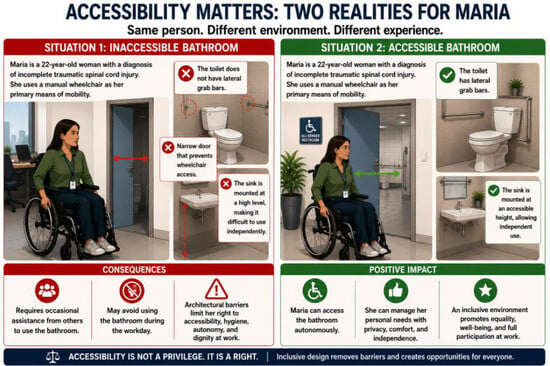
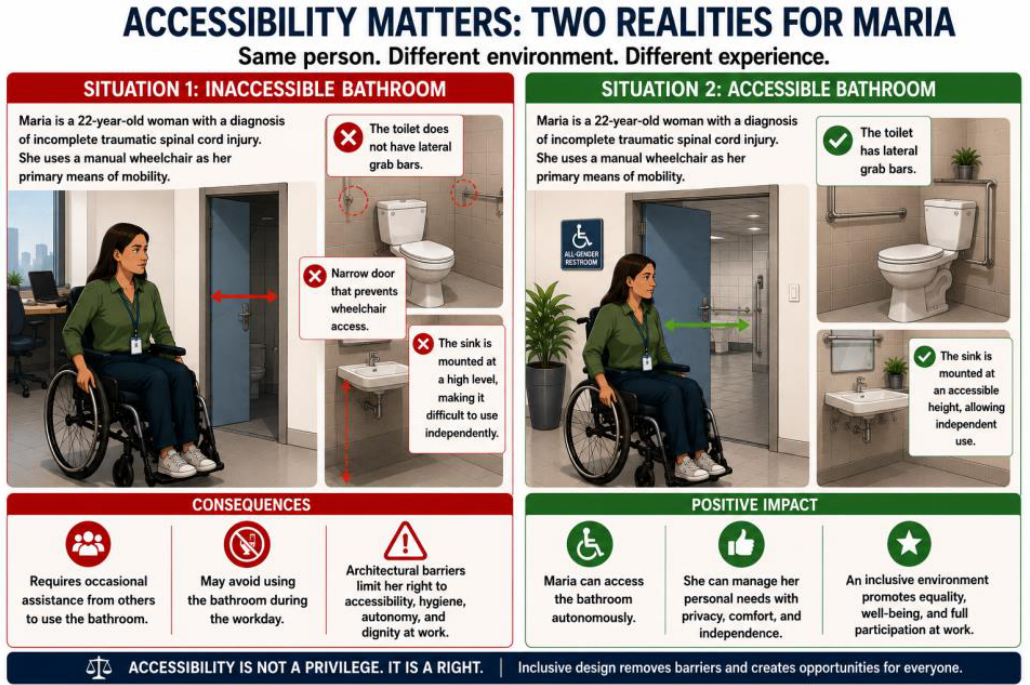
An example illustrates (Figure 1) a woman with the same physical structures and functions in different environmental contexts. In the situation on the left, the absence of a universally designed bathroom—characterized by a narrow doorway, lack of grab bars, and inaccessible sinks—limits María’s autonomous participation in daily activities. In contrast, in the situation on the right, the same woman is able to perform these activities independently. This example demonstrates that, when María is in an accessible environment, she is able to function autonomously and effectively, whereas in environments with accessibility barriers she experiences a situation of disability. Thus, disability does not arise solely as a consequence of bodily impairments; rather, it emerges from the interaction between those impairments and environmental barriers.
Figure 1.
Example case Maria.
Finally, from a critical perspective, the ambiguity of the term opens the possibility of its incorporation into institutional discourse without entailing substantive transformations in the underlying apparatuses of power within the structures that produce disability. Consequently, its adoption requires not only conceptual reflection, but also ongoing critical vigilance regarding its uses and effects across different levels of social intervention.
5. Final Comments
The use of a unified term to refer to people with some kind of disabilities, with international recognition, would provide greater conceptual clarity, facilitating interdisciplinary communication and avoiding ambiguities among researchers, professionals, and users of health and inclusion services. This terminological unification proposed here would also contribute to reducing theoretical and practical gaps, which are often observed due to the coexistence of different expressions.
In addition, standardized terminology facilitates progress in overcoming pejorative, outdated, or stigmatizing expressions that are still present in many social and institutional contexts. Language, as a symbolic tool for constructing reality, plays a central role in combating stigma, prejudice, and the exclusion of people in situation of disability.
Notably, the CRPD adopts the term “persons with disabilities,” as advocated by various social movements due to its focus on individual identity and the recognition of the person prior to the condition [52,64]. This usage seeks to emphasize the person as a whole, noticing that disability is only one of their many attributes. Within this framework, the debate between person-first and identity-first language is incorporated, broadening reflection on the discourses that name disability and their effects [22,65,75]. The use of one or the other is not merely a matter of terminological choice, but rather a way of delineating the place of disability within the social field, its status as a political category, and its inscription in concrete historical experiences.
However, the terminology proposed here—“persons in a situation of disability”—offers an alternative position within this dichotomy by advancing a form of conceptual neutrality. This definition simultaneously acknowledges individual factors (such as impairments in body functions and structures, age, sex, socioeconomic status) and contextual factors (architectural, cultural, social, and barriers, among others, thereby establishing a dynamic relationship between the individual and their environment and more consistently incorporating the role of context in functioning.
Moreover, the expression “in a situation of” denotes a transient and relational condition, suggesting that disability is not a permanent or essential characteristic or inherent state of the person, but rather a contextually determined experience. In other words, a person may or may not be in a situation of disability, depending on the presence or absence of environmental barriers and the existence or lack of appropriate supports that enable their full and equitable participation in society.
Embracing the terminology “person in situation of disability” is not merely a linguistic or terminological gesture, but rather an act of ethical, political, and epistemic responsibility [94,95]. Its use promotes a more neutral, inclusive, and less stigmatizing form of language, while committing those who adopt it to a holistic understanding of the human experience—one that acknowledges both structural and intermediate determinants.
This discursive shift not only enriches the conceptual framework, but also serves as a catalyst for transforming practices and structures that have historically perpetuated exclusion [4,10]. Furthermore, it reaffirms the power of language as a tool for cultural and social transformation [7,96,97,98], and fosters the development of public policies that better attuned to human diversity, and encourages the creation of accessible, inclusive, and respectful environments aimed at ensuring the full exercise of rights for all individuals.
By defining disability as the result of the interaction between a health condition, environmental, and personal factors, the ICF enables an understanding that the challenges faced by these individuals stem largely from the restrictions imposed by a non-inclusive environment. This understanding marks a significant epistemological shift by recognizing disability as a fluid and modifiable category, thereby fostering a more humane, equitable perspective aligned with the principles of social justice promulgated by the CRPD [48]. Despite its contributions, the term “persons in a situation of disability” presents significant risks, including the potential dilution of political identities, challenges in its operationalization, and the risk of euphemistic framing. It may also come into tension with forms of identity-based self-determination and be subject to institutional co-optation without generating structural transformations. Furthermore, it is susceptible to institutional appropriation without substantive changes in the structural conditions that configure disability, which underscores the need for its critical and reflexive use.
Author Contributions
Conceptualization, F.V.Y., T.S. and S.S.d.C.; methodology, F.V.Y. and S.S.d.C.; validation, T.S. and S.S.d.C.; formal analysis, F.V.Y., Shakespeare T.S. and S.S.d.C.; investigation, F.V.Y., T.S. and S.S.d.C.; Writing—original draft preparation, F.V.Y.; Writing—review and editing, T.S. and S.S.d.C. All authors have read and agreed to the published version of the manuscript.
Funding
This research received no external funding.
Institutional Review Board Statement
Not applicable.
Informed Consent Statement
Not applicable.
Data Availability Statement
No new data were created or analyzed in this study. Data sharing does not apply to this article.
Conflicts of Interest
The authors declare no conflicts of interest.
Disability Language/Terminology Positionality Statement
In this paper, the authors develop a critical reflection on the contemporary debate between person-first language (“person with a disability”) and identity-first language (“disabled person”). Building on this discussion, they advance a person-first contextual language, proposing the use of the expression “persons in situations of disability” within the framework of the biopsychosocial model. This perspective emphasizes the contextual, dynamic, and relational nature of disability, understanding it not as a fixed condition but as one that is shaped through the interaction between the individual and their environment. In this way, both individual and contextual factors are recognized as interdependent elements that continuously shape the experience of disability.
Abbreviations
The following abbreviations are used in this manuscript:
| CRPD | Convention on the Rights of Persons with Disabilities |
| ICF | International Classification of Functioning, Disability and Health |
References
- Patiño Alzate, C. La nominación del sujeto masculino no heteronormativo en el francés común contemporáneo. Lenguaje 2021, 49, 303–337. [Google Scholar] [CrossRef] [Scilit]
- Bascopé, C.M. Hacia una renovada relación con el lenguaje: La idea de concepto en Ortega como puente entre la pura nominación y la enunciación dentro del habla Heideggeriana. Rev. Punto Cero 2022, 27, 44. [Google Scholar] [CrossRef] [Scilit]
- Sáez, H.E. La función nominativa en el proceso de la comunicación humana. Veredas Rev. Pensam. Sociol. 2022, 43, 196–206. [Google Scholar]
- Garduño Comparán, C.A. Del orden del discurso al cuidado de sí mismo: Poder y cultura en Michel Foucault. Estud. Sobre Cult. Contemp. 2015, 21, 85–108. [Google Scholar]
- Redondo Salas, D.D.; Puentes Rozo, P.J.; Brito Carrillo, C.J. ¿Cómo aprendieron los niños? Una respuesta desde el constructivismo social subyacente del contexto histórico y sociocultural actual. Rev. UNIMAR 2024, 42, 88–102. [Google Scholar] [CrossRef] [Scilit]
- Vigotsky, L.S. Pensamiento y Lenguaje; Editorial Pueblo y Educación: La Habana, Cuba, 2021; 112p. [Google Scholar]
- Foucault, M. El Orden del Discurso; Tusquets Editores: Barcelona, Spain, 2004. [Google Scholar]
- Foucault, M. Nacimiento de la Biopolítica: Curso del Collège de France (1978–1979); Ediciones AKAL: Madrid, Spain, 2009; 345p. [Google Scholar]
- Foucault, M. Los Anormales; Ediciones AKAL: Madrid, Spain, 2001; 346p. [Google Scholar]
- Prado Filho, K.; Lobo, L.F.; Lemos, F.C.S. A história do presente em Foucault e as lutas atuais. Fractal Rev. Psicol. 2014, 26, 29–42. [Google Scholar] [CrossRef] [Scilit]
- Burghardt, M. Common frailty, constructed oppression: Tensions and debates on the subject of vulnerability. Disabil. Soc. 2013, 28, 556–568. [Google Scholar] [CrossRef] [Scilit]
- Allan, J. Foucault and special educational needs: A “box of tools” for analysing children’s experiences of mainstreaming. Disabil. Soc. 1996, 11, 219–234. [Google Scholar] [CrossRef] [Scilit]
- Hughes, B. The Constitution of Impairment: Modernity and the aesthetic of oppression. Disabil. Soc. 1999, 14, 155–172. [Google Scholar] [CrossRef] [Scilit]
- Carvalho, C.F.D.S.; de Brito, R.S.; de Medeiros, S.M. Análise contextual do atendimento ginecológico da mulher com deficiência física. Rev. Gaúcha Enferm. 2014, 35, 114–117. [Google Scholar] [CrossRef] [Scilit] [PubMed]
- da Rosa, S.V.; Moysés, S.J.; Theis, L.C.; Soares, R.C.; Moysés, S.T.; Werneck, R.I.; Rocha, J.S. Barriers in Access to Dental Services Hindering the Treatment of People with Disabilities: A Systematic Review. Int. J. Dent. 2020, 2020, 9074618. [Google Scholar] [CrossRef] [Scilit] [PubMed] [PubMed Central]
- Callol, J.L.M.; Peña, M.P.; Peña, Y.R.; Turruelles, E.A. Effectiveness of an educational intervention regarding knowledge on responsible sexuality in women with in-tellectual disability. Rev. Cuba. Enfermería 2016, 32. Available online: https://www.medigraphic.com/cgi-bin/new/resumenI.cgi?IDARTICULO=66328 (accessed on 25 March 2026).
- MacKay, D. The United Nations Convention on the Rights of Persons with Disabilities. Syracuse J. Int. Law Commer. 2007, 34, 323. [Google Scholar]
- Valencia, L.A. Breve Historia de las Personas con Discapacidad: De la Opresión a la Lucha por sus Derechos. 2014. Available online: https://rebelion.org/docs/192745.pdf (accessed on 23 March 2026).
- Rojas, G.A.S. De la anomalía a la discapacidad, una larga historia de exclusión social: De la muerte, al destierro y el repudio, a la inclusión educativa (From Anomaly to disability, a long history of social exclusion). Incl. Desarro. 2016, 3, 34–46. [Google Scholar] [CrossRef] [Scilit]
- Hernández-Ponce, K.; Delgado-Sánchez, U.; Martínez-Flores, G.; Ortiz-Rodríguez, M.A. Evolución del concepto de discapacidad: Evolution of disability concept. Rev. De Filos. 2019, 5, 7–12. [Google Scholar]
- Potts, A.; Bednarek, M.A.; Watharow, A. Super, social, medical: Person-first and identity-first representations of disabled people in Australian newspapers, 2000–2019. Discourse Soc. 2023, 34, 405–428. [Google Scholar] [CrossRef] [Scilit]
- Andrews, E.E.; Powell, R.M.; Ayers, K. The evolution of disability language: Choosing terms to describe disability. Disabil. Health J. 2022, 15, 101328. [Google Scholar] [CrossRef] [Scilit] [PubMed]
- Jiménez Buñuales, M.; González Diego, P.; Martín Moreno, J.M. La clasificación internacional del funcionamiento de la discapacidad y de la salud (CIF) 2001. Rev. Esp. Salud Pública 2002, 76, 271–279. [Google Scholar] [PubMed]
- Wolff, E. The Power of Naming: Discursive Politics From the Perspective of Expertise in an Intellectual Disability Advocacy Field. Sociol. Health Illn. 2025, 47, e70048. [Google Scholar] [CrossRef] [Scilit] [PubMed]
- Calandra, J. Discurso de la Discapacidad y Educación Desde una Perspectiva Crítica y Genealógica. Trabajo de grado. Universidad de la República (Uruguay). Facultad de Psicología. 2022. Available online: https://hdl.handle.net/20.500.12008/36862 (accessed on 23 March 2026).
- Samuels, E. Critical Divides: Judith Butler’s Body Theory and the Question of Disability. NWSA J. 2002, 14, 58–76. [Google Scholar]
- Liddiard, K.; Watts, L. Co-production, Participatory and Emancipatory Disability Research. In Living Life to the Fullest: Disability, Youth and Voice; Emerald Publishing Limited: Cambridge, MA, USA, 2022. [Google Scholar] [CrossRef] [Scilit]
- Berghs, M.; Atkin, K.; Graham, H.; Hatton, C.; Thomas, C. Scoping Models and Theories of Disability. In Implications for Public Health Research of Models and Theories of Disability: A Scoping Study and Evidence Synthesis; NIHR Journals Library: Southampton, UK, 2016. Available online: https://www.ncbi.nlm.nih.gov/books/NBK378951/ (accessed on 23 March 2026).
- Forstner, M. Conceptual Models of Disability: The Development of the Consideration of Non-Biomedical Aspects. Disabilities 2022, 2, 540–563. [Google Scholar] [CrossRef] [Scilit]
- Senier, S.; Miranda-Galarza, B. From Colonialism to Postcolonialism and Contemporary Empire. In Disability in the Global South: The Critical Handbook [Internet]; Grech, S., Soldatic, K., Eds.; Springer International Publishing: Cham, Switzerland, 2016; pp. 393–405. [Google Scholar] [CrossRef] [Scilit]
- Lapierre, M. Disability and Latin American indigenous peoples. Disabil. Soc. 2023, 38, 1276–1280. [Google Scholar] [CrossRef] [Scilit]
- Connell, R. Southern Bodies and Disability: Re-thinking concepts. Third World Q. 2011, 32, 1369–1381. [Google Scholar] [CrossRef] [Scilit]
- Padilla-Muñoz, A. Discapacidad: Contexto, concepto y modelos. Int. Law 2010, 16, 381–414. [Google Scholar]
- Avila, X.F.; Núñez, E.F.D.; Colchado, M.M.C. Revisión teórica del modelo social de discapacidad. Propósitos Represent. 2021, 9, e898. [Google Scholar] [CrossRef] [Scilit]
- Dalmeda, M.E.P.; Chhabra, G. Modelos teóricos de discapacidad: Un seguimiento del desarrollo histórico del concepto de discapacidad en las últimas cinco décadas|Theoretical models of disability: Tracing the historical development of disability concept in last five decades. Rev. Española Discapac. 2019, 7, 7–27. [Google Scholar]
- Carbonell Aparici, G.J. El movimiento de vida independiente en España. Rev. Española Discapac. (REDIS) 2019, 7, 201–214. [Google Scholar]
- Arenas, A.d.P.; Melo-Trujillo, D.E. Una mirada a la discapacidad psicosocial desde las ciencias humanas, sociales y de la salud. Hacia Promoción Salud 2021, 26, 69–83. [Google Scholar] [CrossRef] [Scilit]
- da Costa-Rosa, A. Modo Psicossocial: Um Paradigma Das Práticas Substitutivas Ao Modo Asilar. In Ensaios: Subjetividade, Saúde Mental, Sociedade; Amarante, P., Ed.; Editora Fiocruz: Rio de Janeiro, Brazil, 2000. [Google Scholar]
- Jayasooria, D.; Krishnan, B.; Ooi, G. Las personas con discapacidad en una economía en proceso de industrialización: Oportunidades y desafíos en Malasia. In Superar las Barreras de la Discapacidad: 18 Años de Disability and Society; Morata: Madrid, Spain, 2008; pp. 216–225. [Google Scholar]
- de Alencar, A.V.; Rolim, S.G.; Leite, P.N.B. A história da loucura. ID Line Rev. Psicol. 2013, 7, 15–24. [Google Scholar] [CrossRef] [Scilit]
- Foucault, M. Historia de la Locura; Editorial Innisfree: London, UK, 2018; 586p. [Google Scholar]
- Lobo, L.F. Os Infames da História—Pobres Escravos e Deficientes No Brasil; Lamparina: Belo Horizonte, MG, Brazil, 2008. [Google Scholar]
- Liss, M. A normalização das práticas de exclusão na descontinuidade da história do Brasil. Acta Sci. Lang. Cult. 2010, 32, 293–295. [Google Scholar] [CrossRef] [Scilit]
- Chinn, S.E. “Vulnerability and Power”: Disability, Pedagogy, Identity: A Conversation with Ellen Samuels. Transform. J. Incl. Scholarsh. Pedagog. 2014, 25, 147–157. [Google Scholar] [CrossRef] [Scilit]
- Palacios, A. El Modelo Social de Discapacidad: Orígenes, Caracterización y Plasmación en la Convención Internacional Sobre los Derechos de las Personas con Discapacidad; Cermi: Madrid, España, 2008. [Google Scholar]
- da Silva Bampi, L.N.; Guilhem, D.; Alves, E.D. Modelo social: Uma nova abordagem para o tema deficiência. Rev. Lat.-Am. Enferm. 2010, 18, Tela-1. [Google Scholar]
- Martínez, E.A. La Convención Internacional Sobre los Derechos de las Personas con Discapacidad: De los Derechos a los Hechos; Tirant Lo Blanch: Valencia, España, 2015. [Google Scholar]
- Damiani Pellegrini, L.R. Fundamentos teórico-conceptuales de la Convención sobre los Derechos de las Personas con Discapacidad de la Organización de las Naciones Unidas: La teoría de los derechos humanos y el modelo social de la discapacidad. AMDI 2023, 23, 391–424. [Google Scholar] [CrossRef] [Scilit]
- World Health Organization. International Classification of Functioning Disability and Health (ICF); World Health Organization: Geneva, Switzerland, 2001. [Google Scholar]
- Villarreal, J.L.A.; Guzmán-Saldaña, R. Modelo Biopsicosocial: De la teoría a la clínica. Educ. Salud Boletín Científico Inst. Cienc. Salud Univ. Autónoma Estado Hidalgo 2021, 10, 101–102. [Google Scholar] [CrossRef] [Scilit]
- García, J.H.V.; Obando, L.M.G. La Discapacidad, una Mirada Desde la Teoria de Sistemas y el Modelo Biopsicosocial. Hacia Promoción Salud 2007, 12, 51–61. [Google Scholar]
- Dunn, D.S.; Andrews, E.E. Person-first and identity-first language: Developing psychologists’ cultural competence using disability language. Am. Psychol. 2015, 70, 255–264. [Google Scholar] [CrossRef] [Scilit] [PubMed]
- McRuer, R. Capacidad corporal obligatoria y existencia discapacitada queer. Papeles Identidad Contar Investig. Front. 2020, 230. [Google Scholar] [CrossRef] [Scilit]
- McRuer, R. Crip Theory: Cultural Signs of Queerness and Disability. Scand. J. Disabil. Res. 2006, 10, 67–69. [Google Scholar] [CrossRef] [Scilit]
- UNICEF. Cuadernillo 2 Definición y Clasificación de la Discapacidad; UNICEF: Geneva, Switzerland, 2014. [Google Scholar]
- Barreto, M.C.A. A Funcionalidade Como Indicador de Saúde: Dados de Inquérito de Saúde do Chile. 2024. Available online: http://repositorio.ufc.br/handle/riufc/77084 (accessed on 26 May 2025).
- Denu, Z.A.; Yassin, M.O.; Bisetegn, T.A.; Biks, G.A.; Gelaye, K.A. The 12 items Amharic version WHODAS-2 showed cultural adaptation and used to measure disability among road traffic trauma victims in Ethiopia. BMC Psychol. 2021, 9, 1. [Google Scholar] [CrossRef] [Scilit] [PubMed]
- Barreto, M.C.A.; Camerino, C.M.C.; Leite, C.F.; de Castro, S.S. WHODAS como estrategia para la aplicación del modelo biopsicosocial en la práctica clínica: Revisión sistemática. Fisioter. Pesqui. 2025, 32, e23014724en. [Google Scholar] [CrossRef] [Scilit]
- Rosales, P. La nueva Convención Internacional sobre los Derechos de las Personas con Discapacidad. Rev. Jurisprud. Argent. 2007, 2, 817–838. [Google Scholar] [CrossRef] [Scilit]
- Beckett, A.E.; Campbell, T. The social model of disability as an oppositional device. Disabil. Soc. 2015, 30, 270–283. [Google Scholar] [CrossRef] [Scilit]
- Di Nubila, H.; Paula, A.; Marcelino, M.; Maior, I. “Evaluating the model of classification and valuation of disabilities used in Brazil and defining the elaboration and adoption of a unique model for all the country”: Brazilian Interministerial Workgroup Task. BMC Public Health 2011, 11, S10. [Google Scholar] [CrossRef] [Scilit] [PubMed]
- Fernández-López, J.A.; Fernández-Fidalgo, M.; Geoffrey, R.; Stucki, G.; Cieza, A. Funcionamiento y discapacidad: La clasificación internacional del funcionamiento (CIF). Rev. Esp. Salud Pública 2009, 83, 775–783. [Google Scholar] [CrossRef] [Scilit] [PubMed]
- Ricciutti, N.M.; Davis, W. Person-first language and addiction literature: The presence of labeling and emotional language in counseling articles. J. Addctn. Offender Couns. 2025, 46, 39–52. [Google Scholar] [CrossRef] [Scilit]
- Grech, L.B.; Koller, D.; Olley, A. Furthering the person-first versus identity-first language debate. Aust. Psychol. 2023, 58, 223–232. [Google Scholar] [CrossRef] [Scilit]
- Sharif, A.; McCall, A.L.; Bolante, K.R. Should I Say “Disabled People” or “People with Disabilities”? Language Preferences of Disabled People Be-tween Identity- and Person-First Language. In Proceedings of the 24th International ACM SIGACCESS Con-ference on Computers and Accessibility; (ASSETS ’22); Association for Computing Machinery: New York, NY, USA, 2022; pp. 1–18. [Google Scholar] [CrossRef] [Scilit]
- Zajic, M.C.; Gudknecht, J. Person- and identity-first language in autism research: A systematic analysis of abstracts from 11 autism journals. Autism 2024, 28, 2445–2461. [Google Scholar] [CrossRef] [Scilit] [PubMed]
- Taboas, A.; Doepke, K.; Zimmerman, C. Preferences for identity-first versus person-first language in a US sample of autism stakeholders. Autism 2023, 27, 565–570. [Google Scholar] [CrossRef] [Scilit] [PubMed]
- Schuck, R.K.; Chetcuti, L.; Dwyer, P.; Milosavljevic, K.; Bury, S.M.; Hedley, D.; Begeer, S.; Vivanti, G.; Uljarevic, M. Preferences for Identity-First and Person-First Language: A Systematic Review of Research with Autistic Adults/Adults with Autism. J. Autism Dev. Disord. 2025, 25, 1–15. [Google Scholar] [CrossRef] [Scilit] [PubMed]
- Bauman, H.-D.L.; Murray, J.J. Deaf Studies in the 21st Century: ‘‘Deaf-Gain’’ and the Future of Human Diversity. In The Disability Studies Reader; Routledge: London, UK, 2013; pp. 242–255. [Google Scholar]
- Benavides Franco, T.A. El cuerpo como espacio de resistencia: Foucault, las heterotopías y el cuerpo experiencial. Co-Herencia 2019, 16, 247–272. [Google Scholar] [CrossRef] [Scilit]
- Wang, P.; Elizabeth, B.; Gignac, M. Exploring the role of contextual factors in disability models. Disabil. Rehabil. 2006, 28, 135–140. [Google Scholar] [CrossRef] [Scilit] [PubMed]
- Silva, F.C.M.; Sampaio, R.F.; Ferreira, F.R.; Camargos, V.P.; Neves, J.A. Influence of context in social participation of people with disabilities in Brazil. Rev. Panam. Salud Publica 2013, 34, 250–256. [Google Scholar] [PubMed]
- Jaiswal, A.; Aldersey, H.M.; Wittich, W.; Mirza, M.; Finlayson, M. Using the ICF to Identify Contextual Factors That Influence Participation of Persons With Deafblindness. Arch. Phys. Med. Rehabil. 2019, 100, 2324–2333. [Google Scholar] [CrossRef] [Scilit] [PubMed]
- Johnson, M.; McRuer, R. Cripistemologies. J. Lit. Cult. Disabil. Stud. 2014, 8, 127–148. [Google Scholar] [CrossRef] [Scilit]
- Kafer, A.; Kim, E. Disability and the Edges of Intersectionality. In The Cambridge Companion to Literature and Disability; Cambridge University Press: Cambridge, UK, 2017; pp. 123–138. [Google Scholar] [CrossRef] [Scilit]
- Pérez, M. Presentación. La discapacidad más allá del relato: La abyección física en la vida social y la cultura contemporánea. In Papeles Del CEIC; UPV/EHU Press: Leioa, Spain, 2020. [Google Scholar] [CrossRef] [Scilit]
- Matambanadzo, P.; Rhoda, A.J. Contextual factors experienced by mothers of children with special needs. S. Afr. J. Physiother. 2024, 80, 2060. [Google Scholar] [CrossRef] [Scilit] [PubMed]
- Olafsdottir, S.A.; Hjaltadottir, I.; Galvin, R.; Hafsteinsdottir, T.B.; Jonsdottir, H.; Arnadottir, S.A. Age differences in functioning and contextual factors in community-dwelling stroke survivors: A national cross-sectional survey. PLoS ONE 2022, 17, e0273644. [Google Scholar] [CrossRef] [Scilit] [PubMed] [PubMed Central]
- Joosub, N. How local context influences access to neuropsychological rehabilitation after acquired brain injury in South Africa. BMJ Glob. Health 2019, 4, e001353. [Google Scholar] [CrossRef] [Scilit] [PubMed] [PubMed Central]
- Ciccia, A.H.; Threats, T. Role of contextual factors in the rehabilitation of adolescent survivors of traumatic brain injury: Emerging concepts identified through modified narrative review. Int. J. Lang. Commun. Disord. 2015, 50, 436–451. [Google Scholar] [CrossRef] [Scilit] [PubMed]
- Jacob, M.; Cox, S.R. Examining transgender health through the International Classification of Functioning, Disability, and Health’s (ICF) Contextual Factors. Qual. Life Res. 2017, 26, 3177–3185. [Google Scholar] [CrossRef] [Scilit] [PubMed]
- Sanchez-Moreno, J.; Martinez-Aran, A.; Gadelrab, H.F.; Cabello, M.; Torrent, C.; Bonnin, C.d.M.; Ferrer, M.; Leonardi, M.; Ayuso-Mateos, J.L.; Vieta, E. The role and impact of contextual factors on functioning in patients with bipolar disorder. Disabil. Rehabil. 2010, 32, S94–S104. [Google Scholar] [CrossRef] [Scilit] [PubMed]
- Martín, M.T.; Ripollés, M.S.A. La discapacidad dentro del enfoque de capacidades y funcionamientos de Amartya Sen. Araucaria Rev. Iberoam. Filos. Política Humanidades 2008, 10, 64–94. [Google Scholar]
- Consuelo, V.; Claros, J.A.V. Discapacidad y determinantes sociales de la salud estructurales e intermedios: Diferencias por género. Cienc. Innovación Salud 2014, 2, 63–69. [Google Scholar] [CrossRef] [Scilit]
- World Health Organization; World Bank. World Report on Disability 2011; OMS: Ginebra, Suiza, 2011. [Google Scholar]
- Botha, M.; Hanlon, J.; Williams, G.L. Does Language Matter? Identity-First Versus Person-First Language Use in Autism Research: A Response to Vivanti. J. Autism Dev. Disord. 2023, 53, 870–878. [Google Scholar] [CrossRef] [Scilit] [PubMed]
- Oliver, M.; Zarb, G. The Politics of Disability: A New Approach. Disabil. Handicap Soc. 1989, 4, 221–239. [Google Scholar] [CrossRef] [Scilit]
- Barnes, C.; Mercer, G. Understanding impairment and disability: Towards an international perspective. In The Social Model of Disability: Europe and the Majority World; The Disability Press: Leeds, UK, 2005; pp. 1–15. [Google Scholar]
- Keating, C.T.; Hickman, L.; Leung, J.; Monk, R.; Montgomery, A.; Heath, H.; Sowden, S. Autism-related language preferences of English-speaking individuals across the globe: A mixed methods investigation. Autism Res. 2023, 16, 406–428. [Google Scholar] [CrossRef] [Scilit] [PubMed]
- Siu, Y.-T. A Discussion of the Be My Eyes “Inclusive Language Guide”. J. Vis. Impair. Blind. 2024, 118, 276–279. [Google Scholar] [CrossRef] [Scilit]
- Mitra, S.; Shakespeare, T. Remodeling the ICF. Disabil. Health J. 2019, 12, 337–339. [Google Scholar] [CrossRef] [Scilit] [PubMed]
- Suárez González, M.T.; Rojas Bermúdez, L.C. El lenguaje como instrumento de poder. Cuad. Lingüística Hispánica 2009, 1, 35–58. [Google Scholar]
- Shakespeare, T. Social models of disability and other life strategies. Scand. J. Disabil. Res. 2004, 6, 8–21. [Google Scholar] [CrossRef] [Scilit]
- Vigil Zulueta, I.A.; Domínguez Eljaiek, C.F.; Hernández Zayas, M.S.; Domínguez Osorio, C.A. Enfoque bioético de la discapacidad y calidad de vida. Medisan 2013, 17, 148–156. [Google Scholar]
- dos Santos, I.L. Igualdad, equidad y justicia en la salud a la luz de la bioética. Rev. Bioét. 2020, 28, 229–238. [Google Scholar]
- Len, B. Estudios sobre discapacidad y la búsqueda de la inclusividad. Rev. Educ. 2009, 1, 137–152. [Google Scholar]
- Velandia, I.C. Collective health and social inclusion of disabled persons. Investig. Educ. Enferm. 2005, 23, 92–101. [Google Scholar]
- del Pilar Oviedo-Cáceres, M.; Arias-Pineda, K.N.; Yepes-Camacho, M.d.R.; Falla, P.M. Barreras y facilitadores de inclusión social: Una perspectiva desde las experiencias de personas con discapacidad visual. Ustasalud 2022, 21, 102–113. [Google Scholar] [CrossRef] [Scilit]
Disclaimer/Publisher’s Note: The statements, opinions and data contained in all publications are solely those of the individual author(s) and contributor(s) and not of MDPI and/or the editor(s). MDPI and/or the editor(s) disclaim responsibility for any injury to people or property resulting from any ideas, methods, instructions or products referred to in the content. |
© 2026 by the authors. Licensee MDPI, Basel, Switzerland. This article is an open access article distributed under the terms and conditions of the Creative Commons Attribution (CC BY) license.