


Abstract
Stress is increasingly recognised as a key factor underlying health and behavioural problems in people with intellectual disabilities. However, little is known about chronic stressors embedded in residential care environments. This study aimed to identify chronic stressors in residential care for people with intellectual disabilities from the perspective of stakeholders. A group concept mapping design was used, combining qualitative data generation with quantitative clustering analyses. Direct support workers, family members, and experts by experience generated statements describing situations perceived as stressful in residential care settings. After data cleaning, 125 unique statements were retained. Participants subsequently clustered and rated these statements on frequency, impact, and controllability. Thirty-eight statements were identified as daily stressors with high frequency and impact. Ward’s hierarchical cluster analysis grouped the statements into eight clusters representing broader conditions within residential care environments. Several clusters contained multiple high-frequency, high-impact stressors and were therefore interpreted as potential chronic stressors. These clusters reflected structural characteristics of residential care, including dependence on support staff, limited autonomy, and shared living environments. Identifying chronic stressors provides a framework for studying chronic stress in people with intellectual disabilities and may inform organisational and environmental interventions aimed at reducing exposure to such stressors.
1. Introduction
People with intellectual disabilities experience high rates of mental and physical health problems, with stress recognised as a key contributing factor [1,2,3,4]. Their increased vulnerability to stress-related health problems can be understood in at least three ways. First, people with intellectual disabilities are more vulnerable to stress due to their cognitive and adaptive characteristics. These include underdeveloped executive functions [5,6], reduced neuroplasticity [7], and fewer effective coping strategies [8,9]. Second, many individuals with intellectual disabilities have experienced stressful or traumatic events throughout their lives, such as abuse or neglect, which increases their risk of developing stress-related mental health issues [10,11,12,13]. Third, and most importantly for the current study, residential care environments themselves can be a constant source of stress [14,15,16].
Residential care refers to long-term living arrangements in which people with intellectual disabilities live together and receive daily support from paid staff within the same residential setting [17]. Residential services vary in several structural characteristics, including group size, staff-to-resident ratios, and the spatial organisation of housing, which may be dispersed within ordinary neighbourhoods or organised in clustered or campus-based settings [17,18,19,20]. Individuals with intellectual disabilities living in residential care may be exposed to stressors on a recurring basis that are intertwined with the living conditions of residential care environments, such as restrictive measures and environmental constraints [21,22], interpersonal tensions with fellow residents or staff [23], and medical procedures that may be experienced as intrusive or painful [24,25].
Repeated or sustained exposure to recurring stressors can cause stress responses to shift from temporary reactions to a more chronic state. In their unified review of stress research, Epel et al. [26] provide a conceptual framework for understanding this process, emphasising how insufficient recovery after repeated or sustained exposure to stressors can shift the stress system into a state of continuous activation, a condition also described as allostatic overload [27,28]. Allostatic overload is recognised as a central mechanism linking such exposure to stressors to adverse outcomes across multiple domains, including cardiovascular disease, immune suppression, cognitive impairments, and mental health problems such as anxiety and depression [26,29,30,31].
Within Epel et al.’s [26] framework, chronic stressors are defined as enduring conditions that are difficult to avoid and cumulative in their effects. They placed chronic stressors within a broader typology that also includes acute stressors (short-lived events with a clear onset and offset, such as giving a speech in public), daily stressors (recurring hassles embedded in everyday life, such as arguments), and life events (major events with a clear start and substantial impact, such as divorce). This typology can be understood as a spectrum in which stressors increase in duration and persistence. Chronic stressors are at the far end of this spectrum and can have disruptive consequences for health and daily functioning.
Chronic stressors and daily stressors are distinct categories, but they are also conceptually related. When the same daily stressors recur, or when there is a persistent threat that they may occur, they may collectively reflect the presence of a chronic stressor [26,30]. Poverty, for example, is a chronic stressor that may manifest as recurring stressors in everyday life, such as receiving bills in the mail that cannot be paid or being unable to afford basic necessities when shopping. Whether daily stressors are manifestations of a chronic stressor depends on how frequently they occur, how impactful they are, and the extent to which they are perceived as controllable [26,29].
Although several studies have identified a range of daily stressors to which people with intellectual disabilities are exposed, many of which are embedded in residential care environments [15,32], it remains unclear whether these daily stressors collectively constitute one or more chronic stressors, exposure to which has been linked to a chronic state of stress and a wide range of adverse health consequences [26].
Residential care settings vary considerably: some provide safety and predictability, whereas others impose lasting restrictions and tensions [33]. It is therefore important to identify which conditions within residential care environments may be experienced unavoidable and burdensome by residents. Such conditions may function as chronic stressors within residential settings.
The current study aimed to systematically identify chronic stressors in residential care. This will enable future research to examine more precisely how such stressors contribute to chronic stress and to guide adjustments and interventions in residential care.
Daily stressors are part of everyday life and are therefore difficult to recognise for those who experience them. This is partly due to habituation, but also to so-called calibration processes. This means that circumstances that are the same for everyone in a group or environment are less likely to be recognised as individual stressors [26]. These perceptual biases underline the need to include multiple perspectives when identifying stressors in residential care. To address this, we used concept mapping [34], a method that integrates stakeholder perspectives into a structured model and supports the identification of interrelated themes. Concept mapping has been widely applied in healthcare research [35,36,37] and has also been used effectively in studies with people with intellectual disabilities [38,39]. It structures heterogeneous and complex input, such as the diverse viewpoints of stakeholders and the intertwined concepts of daily and chronic stressors, into visual maps that reveal coherent clusters.
This study focused on identifying chronic stressors in the daily lives of people with intellectual disabilities in residential care, based on input from key stakeholders. Given the limited existing knowledge on chronic stressors in residential care, the study was designed as an exploratory, hypothesis-generating study. The central research question is: Which chronic stressors can be identified in residential care for people with intellectual disabilities according to stakeholders?
To address this question, the study was guided by three subquestions. (1) Which daily stressors are experienced by people with intellectual disabilities in residential care, according to different stakeholder perspectives? (2) How are these daily stressors grouped into clusters representing related conditions within residential care environments? And (3) Which clusters include recurrent daily stressors with high perceived impact and may therefore function as chronic stressors in residential care for people living with intellectual disabilities?
2. Materials and Methods
2.1. Study Design and Setting
This study used concept mapping, a participatory mixed-methods approach that combines qualitative data collection with quantitative analysis [34].
2.2. Concept Mapping Procedure
The concept mapping procedure followed five steps: (1) preparation, (2) collection of statements, (3) clustering and scoring of statements, (4) statistical analysis, and (5) interpretation of concept maps [40,41].
- Step 1: Preparation
In concept mapping, the formulation of a focus question is a critical first step, as it shapes both the data collection process and the type of input participants provide [40,41]. The initial question was deliberately phrased in broad terms to elicit a wide range of experiences: “What stimuli or events in a residential or day care setting, or at work, can upset people with intellectual disabilities?” In addition, two domains that frequently appear in the literature on stress in residential care, physical problems and restriction of freedom, were introduced as follow-up prompts [22,25]. These prompts were raised only after the broad question had been discussed extensively and served as a pragmatic safeguard to ensure that multiple domains of stressors were addressed, while leaving participants free to provide their own examples within each domain.
- Step 2: Collecting Statements
In the second step, perspectives from direct support workers, family members, and experts by experience were collected. Each direct support worker was interviewed separately, focusing on their experiences with a specific individual in residential care; responses were recorded in Qualtrics (Qualtrics, Provo, UT, USA). Family members and experts by experience were gathered in two focus groups. During these sessions, a researcher explained the concept mapping process, and participants provided their perspectives in response to the focus question. The discussions were recorded and transcribed verbatim.
The research team analysed the transcripts of the focus groups using NVivo 14 (Lumivero, Denver, CO, USA), applying three levels of coding: open, axial, and selective. To ensure accuracy, two teams independently coded the same transcripts and reached consensus on any differences. The statements derived from the focus groups were then combined with data from the direct support worker interviews. Duplicates and non-generalisable statements were removed, as well as statements that did not describe stressors but rather stress responses. The data cleansing process was conducted by two research teams who discussed and agreed upon the final results.
- Step 3: Clustering and Rating of Statements
In the third step, participants (direct support workers, family members and experts by experience) were asked to individually cluster and rate the statements derived from the second step using the GroupWisdom™ software platform (version 5.0, Concept Systems, Inc., Ithaca, NY, USA) [42]. This statistical research platform provides tools for data collection, analysis, and visualisation in social studies. Participants received an email with a link to a digital environment where they could complete their tasks. A reminder was sent after one month, followed by a second reminder two weeks later. Participants had the flexibility to log in and out of the platform throughout this phase.
Within the digital environment, the statements were presented in random order as digital cards. Participants read the statements and grouped those they considered related based on their content. Participants were asked to group statements about stressors, and after grouping the cards, assign a descriptive name to each pile, reflecting the condition or situation associated with the stressors.
Next, participants provided ratings for the statements based on three dimensions: frequency, impact and controllability. Each dimension was assessed using a 5-point Likert scale. Frequency was estimated by considering how often the event is likely to occur, ranging from 1 (never or once) to 5 (very often, one or more times per day). Impact was evaluated by judging how upsetting the event is generally perceived to be, ranging from 1 (not upsetting at all) to 5 (very upsetting). Controllability was rated by reflecting on how often the individual with intellectual disabilities could be expected to independently avoid the event, ranging from 1 (always avoidable) to 5 (never avoidable).
- Step 4: Statistical Analysis
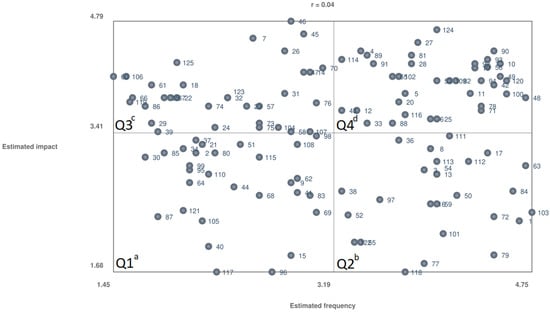
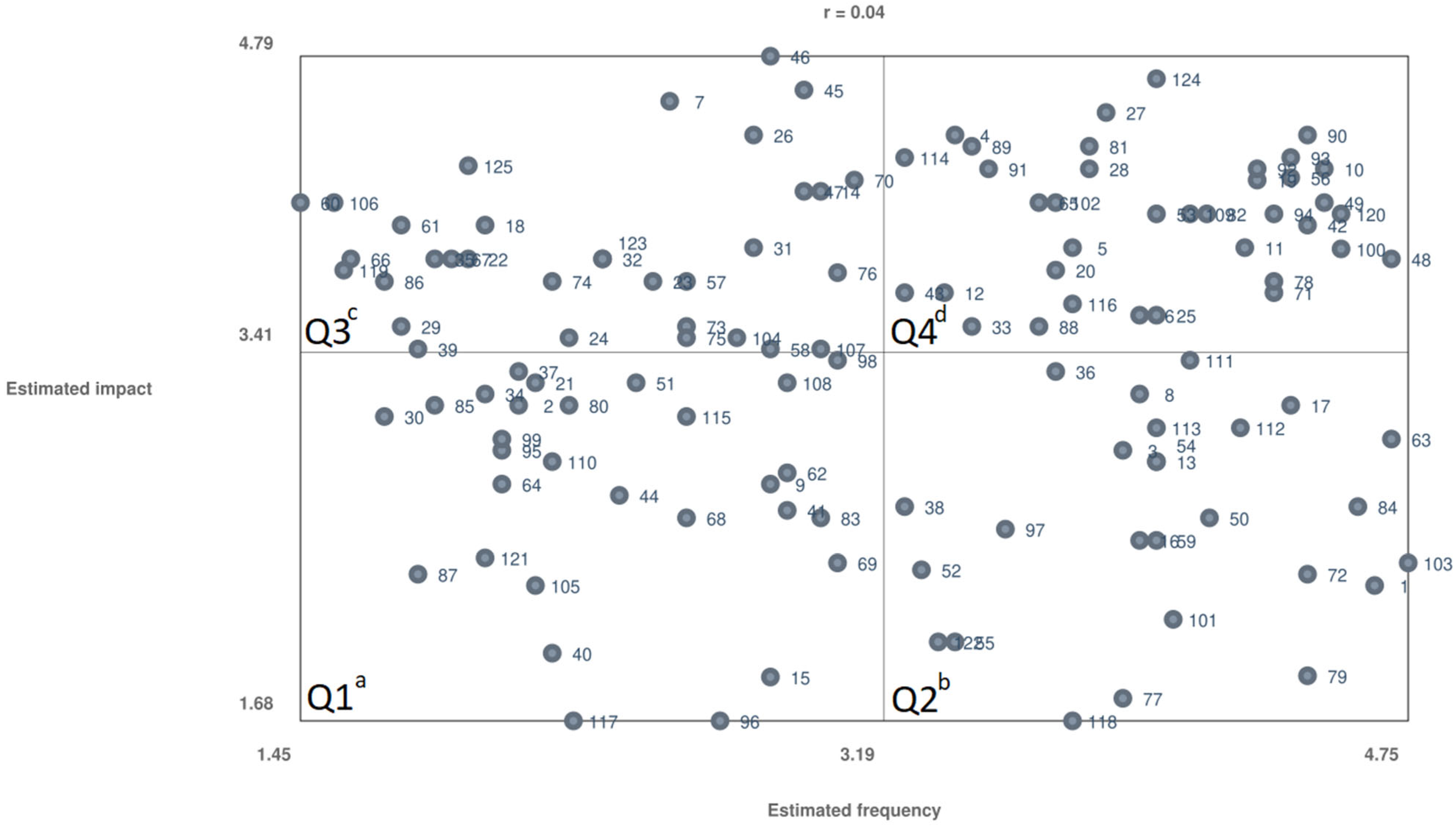
GroupWisdom™ was used to identify daily stressors with high frequency and impact. A G0-Zone analysis was conducted on the full set of statements using the rating data on frequency and impact [34]. The G0-Zone is a bivariate graph that plots the average frequency (X-axis) and average impact (Y-axis) for each statement. Statements located in the upper right quadrant, scoring above the mean on both dimensions, were identified as stressors with high combined frequency and impact and were selected as daily stressors with high frequency and impact. To assess the relationship between frequency and impact, we calculated a Pearson correlation coefficient between the average frequency and impact ratings for each item. Controllability ratings were analysed separately at the cluster level to support the interpretation of clusters as chronic stressors.
GroupWisdom™ combined all individually clustered and rated statements into a two-dimensional point map. Multidimensional scaling was applied to generate the map by assigning XY coordinates to each statement, following the two-step process described by Kane and Trochim [34]. In this process, statements that participants frequently grouped together were positioned closer to each other on the map. GroupWisdom™ iteratively refined the configuration, running 15 internal iterations to optimise the spatial fit.
Bridging indices were calculated for each statement, ranging from 0 to 1. Lower values indicated that a statement was often sorted with statements located close to it on the map, suggesting greater conceptual consistency.
A stress value was then calculated to assess the discrepancy between the original similarity matrix (based on sorting data) and the resulting map configuration. This value is commonly used as an indicator of the goodness of fit in multidimensional scaling [43,44]. Lower stress values indicate stronger agreement among participants’ groupings [41,45].
Ward’s hierarchical cluster analysis was subsequently applied to the point map to identify clusters of statements. To determine the optimal number of clusters, three researchers jointly reviewed the cluster solutions proposed by GroupWisdom™, which ranged from 15 to 4 clusters. Clusters were merged iteratively until the researchers agreed that further merging would result in a loss of interpretative clarity.
- Step 5: Interpretation of Cluster Maps and Mean Scores
The cluster maps were interpreted by three researchers, who reached consensus on cluster labels and on how to label the axes to reflect conceptual relationships between clusters. Mean controllability scores were calculated per cluster and used to order the clusters by perceived difficulty to avoid or manage. For each cluster, the number of daily stressors with high frequency and impact (as identified through the G0-Zone analysis) is also reported.
2.3. Participants
A total of 77 stakeholders were included as participants in the study: 66 direct support workers, 5 family members, and 6 experts by experience. Participants were recruited through four Dutch care organisations, family associations, and a national network of people with intellectual disabilities involved in research and education. The four care organisations provided long-term residential care for adults with varying levels of intellectual disability and offered broadly comparable residential services, including group homes and clustered residential settings located either in ordinary neighbourhoods or on larger care sites, including campus-based locations. All participants received information about the study and provided written informed consent. The procedure was approved by the Faculty Ethics Research Council (EC-22-0057).
Direct support workers were eligible if they had worked for at least six months in residential care settings. They shared their experiences from daily interactions with 80 individuals with intellectual disabilities, ranging in age from 18 to 73 years and covering the full spectrum of intellectual disability. Family members participated with reference to their child or relative, and experts by experience shared perspectives based on their own lived experience.
In Step 2 (Collection of Statements), direct support workers participated in individual interviews, while family members and experts by experience took part in focus groups. In Step 3 (Clustering and Rating), 15 support workers, 4 family members, and 3 experts by experience continued their involvement. Experts by experience were supported individually by a researcher during the clustering process. Because clustering and rating together formed a lengthy and intensive procedure, the experts by experience and the supervisor who supported them in their role as experts by experience jointly decided to focus their contribution on the clustering task. This decision was mainly based on the time investment and accessibility of the full procedure, while ensuring that their perspectives were included in the clustering and structuring of the statements.
3. Results
The results are structured according to the two key constructs: daily stressors with high frequency and impact and chronic stressors.
3.1. Daily Stressors with High Frequency and Impact
A total of 125 unique statements about daily stressors were identified. These were derived from 460 initial data fragments and selected through the filtering process described in Step 2. The final set of 125 statements is presented in Appendix A.
These stressors were rated on three dimensions: frequency, impact, and controllability. The G0-Zone analysis focused on frequency and impact, identifying 38 stressors that scored above the mean on both dimensions (see Figure 1; Q4). Appendix A provides, for each statement, the average frequency, impact, and controllability scores, as well as its placement in the corresponding G0-Zone quadrant.
Figure 1.
Go-Zone plot of daily stressors rated on frequency and impact. Note. The X-axis represents the average estimated frequency (1 = never/once, 5 = very often, one or more times per day). The Y-axis represents the average estimated impact (1 = not upsetting at all, 5 = very upsetting). Quadrants: (a) Q1 = below-average frequency and impact; (b) Q2 = above-average frequency and below-average impact; (c) Q3 = below-average frequency and above-average impact; (d) Q4 = above-average frequency and impact. The exact quadrant classification of each statement is provided in Appendix A.
The correlation between frequency and impact was low (r = 0.04), suggesting that frequently occurring stressors were not necessarily those rated as most impactful, and vice versa. This finding indicates that the two dimensions may capture distinct aspects of stressor exposure.
Examples of stressors with different frequency and impact are: Q1: ‘Having meals in unfamiliar places’ (frequency: 2.19; impact: 2.00); Q2: ‘Being alone during nighttime’ (frequency: 4.00; impact: 2.85); Q3: ‘Needle procedures for medical purposes’ (frequency: 1.95; impact: 3.85); Q4 ‘ Unpredictable behaviours of others’ (frequency: 4.25; impact: 4.95).
3.2. Chronic Stressors
Bridging values across clusters ranged from 0.04 to 0.71, indicating an acceptable level of conceptual coherence among the grouped statements. The stress value of the final two-dimensional point map was 0.29 after 15 iterations, suggesting an adequate fit between the similarity matrix and the spatial configuration. During the clustering process, five statements were reassigned to neighbouring clusters to improve content consistency: Statement 1: Help with daily care activities → from Cluster 1 to Cluster 7; Statement 106: Quarantine → from Cluster 1 to Cluster 2; Statement 111: Need to be socially desirable to housemates → from Cluster 1 to Cluster 4; Statement 27: Conflict → from Cluster 3 to Cluster 4; Statement 109: Yelling → from Cluster 4 to Cluster 3.
Table 1 presents the eight clusters in order of mean controllability scores, indicating how difficult the daily stressors within each cluster were perceived to be to avoid or manage. The first cluster was rated as the least controllable, while the eighth was rated as the most controllable. For each cluster, the number of daily stressors with high frequency and impact, as identified through the G0-Zone analysis, is also reported.
Table 1.
Clusters of daily stressors ordered by mean controllability score.
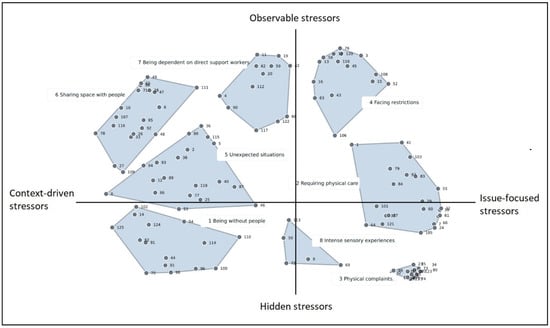
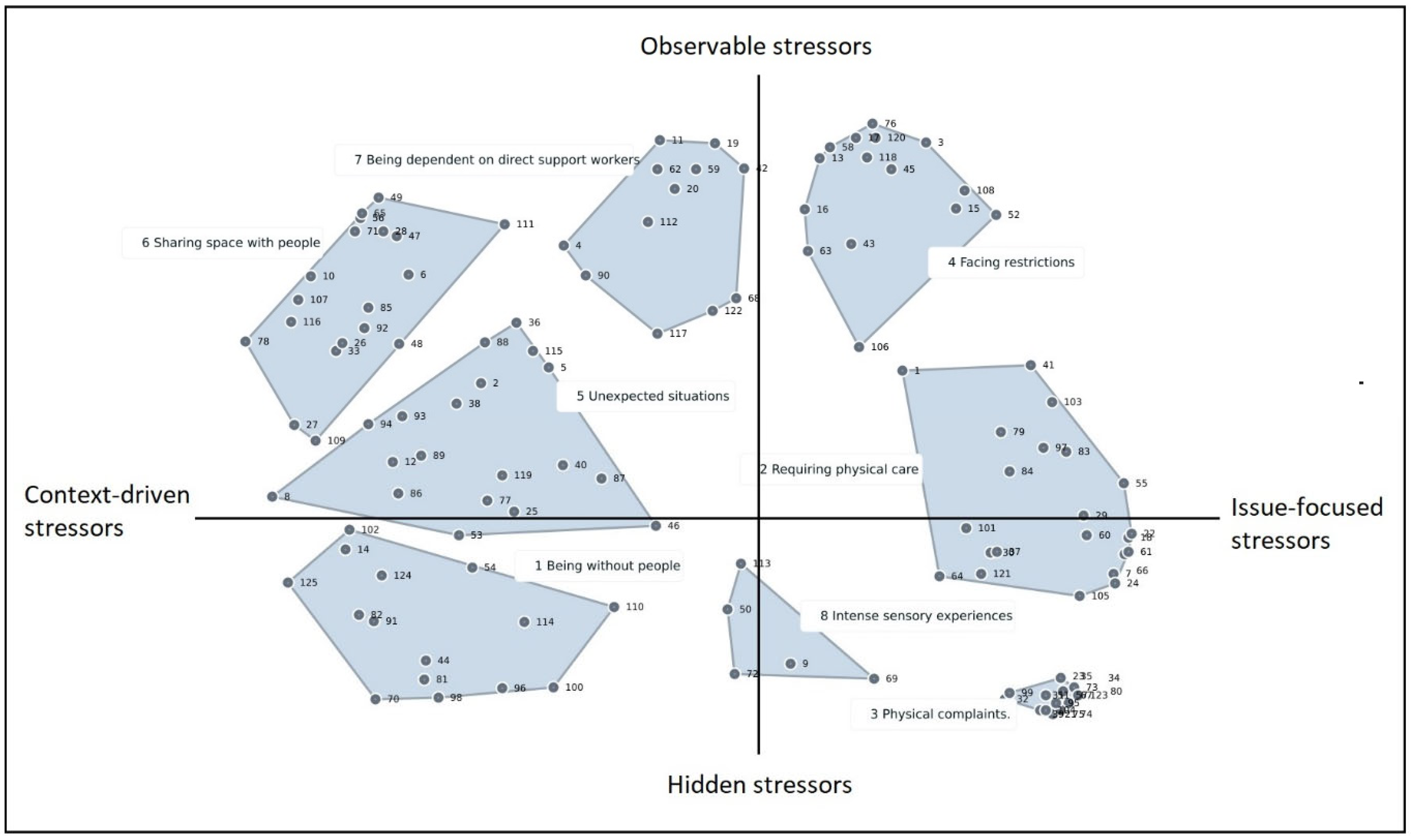
The final concept map (Figure 2) visualises the spatial distribution of the eight clusters along two conceptual axes. These axes were labelled by the researchers to reflect the nature of the daily stressors within each cluster: the x-axis ranges from context-driven to issue-driven stressors, and the y-axis spans from hidden to observable stressors.
Figure 2.
Cluster map of eight stressor clusters experienced by individuals with intellectual disabilities. Note. The spatial distribution of the clusters is organised along two conceptual axes. The x-axis ranges from context-driven to issue-focused stressors, and the y-axis spans from hidden to observable stressors. Axis labels were assigned by the researchers to reflect the nature of the daily stressors within each cluster. The shaded areas represent the eight identified stressor clusters. The exact cluster classification of each statement is provided in Appendix A.
4. Discussion
The aim of this study was to identify chronic stressors in residential care for people with intellectual disabilities from the perspective of stakeholders. Two main findings emerged from the analyses. First, stakeholders identified a range of daily stressors embedded in residential care environments, of which 38 were rated as daily stressors with high frequency and impact. Second, these daily stressors clustered into eight broader conditions within residential care environments. Several of these clusters contained daily stressors with high frequency and impact and were therefore interpreted as potential chronic stressors, in line with the conceptualisation proposed by Epel et al.’s [26] unified review of stress research.
The identification of the daily stressors with high frequency and impact was based on the combined evaluation of ratings for both frequency and impact. Notably, controllability ratings did not meaningfully differentiate between stressors. Across the full set, stressors were generally rated as difficult to avoid or manage. This suggests that limited opportunities to avoid or control stressors may be common in residential care environments.
Many stressors experienced by people with intellectual disabilities have been described in earlier research, particularly in relation to group living, power asymmetries in support relationships, and the unpredictability of residential environments [14,21,23,46]. However, previous studies have typically described such stressors as separate or discrete experiences.
In the cluster map (Figure 2), the eight clusters of daily stressors identified in this study formed patterns along two dimensions, ranging from issue-driven to context-driven stressors and from observable to hidden stressors. This distribution suggests that stressors in residential care differ in the extent to which they are embedded in the care environment and in how visible they are to others.
Several clusters illustrate stressors arising from the organisation of everyday life in residential care. Earlier studies have described stressors inherent to group living, including interpersonal conflict, noise, and unpredictable behaviour among residents [23]. In the present study, such recurring stressors were captured in the cluster Sharing space with people whose behaviour is hard to predict, illustrating how everyday interpersonal stressors may combine into a broader condition within shared living environments. Similarly, previous research has documented power asymmetries and limited autonomy in care relationships [14,46]. These dynamics were reflected in the cluster Being dependent on direct support workers in shaping one’s life, which includes stressors related to rigid rules, broken agreements and limited influence over daily decisions.
Other clusters point to stressors that may be less visible but nevertheless persistent. Bodily interventions such as hygiene routines or medical procedures have been described as potentially intrusive or distressing [4,25]. In the present study, these experiences were captured in the cluster Requiring physical care. Likewise, sensory overstimulation has been reported as a challenge for some individuals with intellectual disabilities [47,48], reflected here in the cluster Being exposed to intense sensory experiences.
Relational continuity also emerged as an important theme. Stable and trusted relationships are widely recognised as crucial for emotional security [49]. In the present study, the cluster Being without people you are used to and trust reflects stress associated with staff turnover or the absence of familiar figures. In addition, earlier studies have documented restrictions and institutional constraints in residential settings [22,24], reflected here in the cluster Facing restrictions in options and choices.
Taken together, these findings suggest that many of the stressors described in previous research are not isolated events but form part of broader conditions within residential care environments. This study provides a basis for considering these conditions as potential chronic stressors. Because of their persistent nature, such stressors may continuously activate the stress system, potentially contributing to chronic stress and adverse physical and mental health outcomes [26,31].
Whereas Epel et al. [26] primarily describe chronic stressors as arising from external or societal domains such as work, caregiving, or financial strain, the present study identified chronic stressors that are embedded in the routines and interactions that structure residential care environments. Interventions may therefore focus on reducing the frequency of such stressors, mitigating their impact, or increasing individuals’ ability to manage or avoid them. For example, reducing exposure to unpredictable behaviour from fellow residents, providing timely emotional reassurance, or offering opportunities to withdraw from stressful situations may help to reduce stressor impact and increase perceived controllability.
Because many of these stressors are closely linked to the organisational context of residential care, effective interventions may need to address not only individual support practices but also systemic features of care provision [33,50]. At the organisational level, this means that residential care environments should be deliberately designed around basic psychological needs [51,52]. At the level of daily support, direct support workers may need concrete guidance in recognising exposure to chronic stressors and in using stress-reducing practices, such as co-regulation, predictable interaction, and relational availability [53]. These findings call for organisational reflection on staffing arrangements, everyday routines, shared living conditions, and opportunities for choice.
Future research should examine the prevalence and duration of exposure to these chronic stressors to determine how widespread this issue is and what it may imply for the organisation of residential care. Future research could also examine whether reductions in stressor exposure lead to measurable changes in behaviour or mental health. Single-case (N = 1) designs may be particularly useful for evaluating person-specific interventions that target the frequency, impact, or controllability of daily stressors.
Strengths and Limitations
A key strength of this study lies in the use of two complementary approaches to identify chronic stressors in people with intellectual disabilities in residential care. This involved the systematic identification of daily stressors with high frequency and impact and the recognition of broader enduring situations in which these stressors occur.
Another strength is the scale and composition of the data collection. Sixty-six direct support workers contributed stressor information related to 80 individuals across four care organisations. This was further complemented by input from five family members and six experts by experience. Their contributions provided important additions and helped to validate and nuance the stressors identified by support staff.
One consideration, however, is the smaller number of participating family members and experts by experience compared to support staff. More family members were invited, but only five were able to attend on the day of the study. Although their input was valuable, their views may be less prominent in the final list of stressors. In addition, because experts by experience contributed to the generation and clustering of statements but not to the rating task, their perspectives are less directly represented in the frequency, impact, and controllability ratings. However, the aim of this work was not to compare stakeholder views, as has been done in other concept mapping studies [38,54,55], but rather to develop a broad and inclusive inventory.
A contextual limitation concerns the timing of data collection. Although the study took place after the acute phase of the COVID-19 pandemic, memories of related restrictions and disruptions were still vivid among participants. This may have influenced the salience of certain stressors, such as limited social contact or constrained routines. It remains unclear to what extent these stressors generalise to non-pandemic settings.
Lastly, the identified chronic stressors reflect conditions within the Dutch residential care system, and more specifically the contexts that participating stakeholders were able to oversee. Residential arrangements vary widely, both nationally and internationally, for example in group size, staff–to–resident ratios, and the extent to which homes are community-based or institutional [17,20,56]. Such structural differences are known to shape quality of life and behaviour, and may also influence which stressors are most salient [22,56]. The present findings are therefore best understood as situated within the Dutch care context. Consequently, the findings should not be assumed to generalise directly to residential care systems in other countries without considering differences in policy, service organisation, staffing models, and living arrangements. It is important to consider organisational variation when interpreting patterns of stressors.
5. Conclusions
People with intellectual disabilities are more frequently exposed to stressors than people without intellectual disabilities [14,15,16]. This study showed that such exposure is not limited to isolated events: chronic stressors are often deeply rooted in the very structure of residential care. Addressing chronic stressors should be a key priority in efforts to improve mental and physical well-being.
Author Contributions
Conceptualization, M.A.H., L.W. and M.J.J.; methodology, M.A.H.; investigation, M.A.H. and L.W.; formal analysis, M.A.H., V.C.O.-P. and E.E.R.; data curation, M.A.H.; visualization, M.A.H., V.C.O.-P. and E.E.R.; writing—original draft preparation, M.A.H.; writing—review and editing, M.A.H., V.C.O.-P., E.E.R., L.W. and M.J.J.; supervision, L.W. and M.J.J.; project administration, M.A.H.; funding acquisition, M.A.H. and M.J.J. All authors have read and agreed to the published version of the manuscript.
Funding
This research received no external funding. M.A.H. conducted this study as part of a PhD trajectory facilitated through a collaboration between Utrecht University and Zozijn Care, Advice and Treatment, which provided institutional support in the form of allocated research time.
Institutional Review Board Statement
The study was conducted in accordance with the Declaration of Helsinki and approved by the Faculty Ethics Review Council of the Faculty of Social and Behavioural Sciences, Utrecht University (protocol code EC-22-0057, date of approval 28 March 2022).
Informed Consent Statement
Informed consent was obtained from all participants involved in the study.
Data Availability Statement
The compiled list of stressor statements generated during the concept mapping process is provided in Appendix A. The underlying qualitative workshop data and individual participant sorting data are not publicly available because they may allow indirect identification of participants despite anonymisation. Aggregated quantitative data underlying the reported analyses (e.g., rating data and clustering outputs) may be made available from the corresponding author upon reasonable request.
Acknowledgments
The authors would like to thank the participating care organisations for facilitating recruitment and enabling staff participation in this study. We are also grateful to the direct support workers, family members, and experts by experience who generously shared their perspectives during the concept mapping process. Their contributions were essential for identifying stressors experienced by people with intellectual disabilities in residential care. The authors also thank the support team of the GroupWisdom™ concept mapping platform for their technical assistance during the data collection and analysis process.
Conflicts of Interest
The authors declare no conflicts of interest. The participating care organisations facilitated recruitment and staff participation but had no role in the design of the study; in the collection, analyses, or interpretation of data; in the writing of the manuscript; or in the decision to publish the results.
Disability Language/Terminology Positionality Statement
This article uses person-first language (e.g., “people with intellectual disabilities”). This choice is consistent with terminology commonly used in intellectual disability research, healthcare, and policy contexts, including the United Nations Convention on the Rights of Persons with Disabilities (CRPD). It also reflects current usage in Dutch and international research and service provision in the field of intellectual disabilities.
Appendix A
Table A1.
Compiled list of stressors.
References
- Buckley, N.; Glasson, E.J.; Chen, W.; Epstein, A.; Leonard, H.; Skoss, R.; Jacoby, P.; Blackmore, A.M.; Srinivasjois, R.; Bourke, J.; et al. Prevalence estimates of mental health problems in children and adolescents with intellectual disability: A systematic review and meta-analysis. Aust. N. Z. J. Psychiatry 2020, 54, 970–984. [Google Scholar] [CrossRef] [Scilit] [PubMed]
- Hamilton, D.; Sutherland, G.; Iacono, T. Further examination of relationships between life events and psychiatric symptoms in adults with intellectual disability. J. Intellect. Disabil. Res. 2005, 49, 839–844. [Google Scholar] [CrossRef] [Scilit]
- Hulbert-Williams, L.; Hastings, R.P. Life events as a risk factor for psychological problems in individuals with intellectual disabilities: A critical review. J. Intellect. Disabil. Res. 2008, 52, 883–895. [Google Scholar] [CrossRef] [Scilit]
- Perera, B.; Audi, S.; Solomou, S.; Courtenay, K.; Ramsay, H. Mental and physical health conditions in people with intellectual disabilities: Comparing local and national data. Br. J. Learn. Disabil. 2020, 48, 19–27. [Google Scholar] [CrossRef] [Scilit]
- Alloway, T.P. Working memory and executive function profiles of individuals with borderline intellectual functioning. J. Intellect. Disabil. Res. 2010, 54, 448–456. [Google Scholar] [CrossRef] [Scilit] [PubMed]
- Carretti, B.; Belacchi, C.; Cornoldi, C. Difficulties in working memory updating in individuals with intellectual disability. J. Intellect. Disabil. Res. 2010, 54, 337–345. [Google Scholar] [CrossRef] [Scilit]
- Edgin, J.O.; Pennington, B.F.; Mervis, C.B. Neuropsychological components of intellectual disability: The contributions of immediate, working, and associative memory. J. Intellect. Disabil. Res. 2010, 54, 406–417. [Google Scholar] [CrossRef] [Scilit]
- Lunsky, Y.; Bramston, P. A preliminary study of perceived stress in adults with intellectual disabilities according to self-report and informant ratings. J. Intellect. Dev. Disabil. 2006, 31, 20–27. [Google Scholar] [CrossRef] [Scilit]
- Scott, H.M.; Havercamp, S.M. Mental health for people with intellectual disability: The impact of stress and social support. Am. J. Intellect. Dev. Disabil. 2014, 119, 552–564. [Google Scholar] [CrossRef] [Scilit]
- Focht-New, G.; Clements, P.T.; Barol, B.; Faulkner, M.J.; Service, K.P. Persons with developmental disabilities exposed to interpersonal violence and crime: Strategies and guidance for assessment. Perspect. Psychiatr. Care 2008, 44, 3–13. [Google Scholar] [CrossRef] [Scilit]
- Hermans, H.; Evenhuis, H.M. Life events and their associations with depression and anxiety in older people with intellectual disabilities: Results of the HA-ID study. J. Affect. Disord. 2012, 138, 79–85. [Google Scholar] [CrossRef] [Scilit]
- Mevissen, L.; Lievegoed, R.; Seubert, A.; De Jongh, A. Treatment of PTSD in people with severe intellectual disabilities: A case series. Dev. Neurorehabilit. 2012, 15, 223–232. [Google Scholar] [CrossRef] [Scilit]
- Vervoort-Schel, J.; Mercera, G.; Wissink, I.; Mink, E.; van der Helm, P.; Lindauer, R.; Moonen, X. Adverse Childhood Experiences in Children with Intellectual Disabilities: An Exploratory Case-File Study in Dutch Residential Care. Int. J. Environ. Res. Public Health 2018, 15, 2136. [Google Scholar] [CrossRef] [Scilit]
- Bramston, P.; Fogarty, G.; Cummins, R.A. The nature of stressors reported by people with an intellectual disability. J. Appl. Res. Intellect. Disabil. 1999, 12, 1–10. [Google Scholar] [CrossRef] [Scilit]
- Van den Bogaard, K.; Lugtenberg, M.; Nijs, S.; Embregts, P. Attributions of people with intellectual disabilities of their own or other clients’ challenging behavior: A systematic review of qualitative studies. J. Ment. Health Res. Intellect. Disabil. 2019, 12, 126–151. [Google Scholar] [CrossRef] [Scilit]
- Koritsas, S.; Iacono, T. Predictors of challenging behaviour in adults with intellectual disability. Adv. Ment. Health Intellect. Disabil. 2015, 9, 312–326. [Google Scholar] [CrossRef] [Scilit]
- Kozma, A.; Mansell, J.; Beadle-Brown, J. Outcomes in different residential settings for people with intellectual disability: A systematic review. Am. J. Intellect. Dev. Disabil. 2009, 114, 193–222. [Google Scholar] [CrossRef] [Scilit] [PubMed]
- Bailey, S.M.; Christensen, P.; Sankaran, S.; Millington, M. Building person-centred homes: A case study of a cluster-designed home for adults with intellectual disability in Australia. J. Hous. Built Environ. 2024, 39, 345–369. [Google Scholar] [CrossRef] [Scilit]
- Dunbar, P.; McGrane, N.; Keyes, L.M. The Association of Organizational, Environmental, and Staffing Characteristics of Residential Care Facilities and the Risk Rating of Statutory Notifications: A Cross-Sectional Study in Ireland. J. Patient Saf. 2024, 20, 131–137. [Google Scholar] [CrossRef] [Scilit] [PubMed]
- Mansell, J.; Beadle-Brown, J. Dispersed or clustered housing for adults with intellectual disability: A systematic review. J. Intellect. Dev. Disabil. 2009, 34, 313–323. [Google Scholar] [CrossRef] [Scilit]
- Beadle-Brown, J.; Hutchinson, A.; Whelton, B. Person-centred active support—Increasing choice, promoting independence and reducing challenging behaviour. J. Appl. Res. Intellect. Disabil. 2012, 25, 291–307. [Google Scholar] [CrossRef] [Scilit]
- Van der Meulen, A.P.S.; Taminiau, E.F.; Hertogh, C.; Embregts, P. Perspective of relatives on restrictions applied to their family members with moderate intellectual disability. Int. J. Dev. Disabil. 2022, 68, 56–63. [Google Scholar] [CrossRef]
- Hartley, S.L.; Maclean, W.E. Stressful social interactions experienced by adults with mild intellectual disability. Am. J. Intellect. Dev. Disabil. 2009, 114, 71–84. [Google Scholar] [CrossRef] [Scilit]
- Fitton, L.; Jones, D.R. Restraint of adults with intellectual disabilities: A critical review of the prevalence and characteristics associated with its use. J. Intellect. Disabil. 2020, 24, 268–283. [Google Scholar] [CrossRef] [Scilit]
- McMahon, M.; Hatton, C. A comparison of the prevalence of health problems among adults with and without intellectual disability: A total administrative population study. J. Appl. Res. Intellect. Disabil. 2021, 34, 316–325. [Google Scholar] [CrossRef] [Scilit]
- Epel, E.S.; Crosswell, A.D.; Mayer, S.E.; Prather, A.A.; Slavich, G.M.; Puterman, E.; Mendes, W.B. More than a feeling: A unified view of stress measurement for population science. Front. Neuroendocrinol. 2018, 49, 146–169. [Google Scholar] [CrossRef] [Scilit] [PubMed]
- McEwen, B.S.; Gianaros, P.J. Stress- and allostasis-induced brain plasticity. Annu. Rev. Med. 2011, 62, 431–445. [Google Scholar] [CrossRef] [Scilit] [PubMed]
- McEwen, B.S. Stress, adaptation, and disease. Allostasis and allostatic load. Ann. N. Y. Acad. Sci. 1998, 840, 33–44. [Google Scholar] [CrossRef] [Scilit] [PubMed]
- Dhabhar, F.S. The short-term stress response–Mother nature’s mechanism for enhancing protection and performance under conditions of threat, challenge, and opportunity. Front. Neuroendocrinol. 2018, 49, 175–192. [Google Scholar] [CrossRef] [Scilit]
- Hobfoll, S.E. The influence of culture, community, and the nested-self in the stress process: Advancing conservation of resources theory. Appl. Psychol. 2001, 50, 337–421. [Google Scholar] [CrossRef] [Scilit]
- McEwen, B.S. Mood disorders and allostatic load. Biol. Psychol. 2003, 54, 200–207. [Google Scholar] [CrossRef] [Scilit] [PubMed]
- McMahon, M.; Bowring, D.L.; Hatton, C. Not such an ordinary life: A comparison of employment, marital status and housing profiles of adults with and without intellectual disabilities. Tizard Learn. Disabil. Rev. 2019, 24, 213–221. [Google Scholar] [CrossRef] [Scilit]
- Jorgensen, M.; Nankervis, K.; Chan, J. ‘Environments of concern’: Reframing challenging behaviour within a human rights approach. Int. J. Dev. Disabil. 2023, 69, 95–100. [Google Scholar] [CrossRef] [Scilit]
- Kane, M.; Trochim, W.M. Concept Mapping for Planning and Evaluation; Sage Publications, Inc.: Thousand Oaks, CA, USA, 2007. [Google Scholar]
- Beckers, T.; Koekkoek, B.; Hutschemaekers, G.; Tiemens, B. Potential predictive factors for successful referral from specialist mental-health services to less intensive treatment: A concept mapping study. PLoS ONE 2018, 13, e0199668. [Google Scholar] [CrossRef] [Scilit]
- Berman, R.L.; Iris, M.; Conrad, K.J.; Robinson, C. Validation of the MedUseQ: A self-administered screener for older adults to assess medication use problems. J. Pharm. Pract. 2019, 32, 509–523. [Google Scholar] [CrossRef] [Scilit]
- Goorden, M.; Willemsen, E.; Bouwmans-Frijters, C.; Busschbach, J.; Noomx, M.; van der Feltz-Cornelis, C.; Uyl-de Groot, C.; Hakkaart-van Roijen, L. Developing a decision tool to identify patients with personality disorders in need of highly specialized care. BMC Psychiatry 2017, 17, 317. [Google Scholar] [CrossRef] [Scilit]
- Nijs, S.; Taminiau, E.; Frielink, N.; Embregts, P. Stakeholders’ perspectives on how to improve the support for persons with an intellectual disability and challenging behaviors: A concept mapping study. Int. J. Dev. Disabil. 2022, 68, 25–34. [Google Scholar] [CrossRef] [Scilit]
- de Wit, W.; Roeg, D.; Embregts, P.J. Using Concept Mapping to Explore the Perspectives of People with Mild to Borderline Intellectual Disabilities Toward Sexual Health. Sex. Disabil. 2023, 41, 603–617. [Google Scholar] [CrossRef] [Scilit]
- Trochim, W.M. An introduction to concept mapping for planning and evaluation. Eval. Program Plan. 1989, 12, 1–16. [Google Scholar] [CrossRef] [Scilit]
- Trochim, W.; Kane, M. Concept mapping: An introduction to structured conceptualization in health care. Int. J. Qual. Health Care 2005, 17, 187–191. [Google Scholar] [CrossRef] [Scilit] [PubMed]
- Concept Systems Incorporated. GroupWisdom; Version 5.0; Concept Systems Incorporated: Ithaca, NY, USA, 2021. [Google Scholar]
- Cox, M.A.A.; Cox, T.F. Multidimensional Scaling. In Handbook of Data Visualization; Chen, C.-H., Härdle, W.K., Unwin, A., Eds.; Springer: Berlin/Heidelberg, Germany, 2008. [Google Scholar]
- Mair, P.; Borg, I.; Rusch, T. Goodness-of-Fit Assessment in Multidimensional Scaling and Unfolding. Multivar. Behav. Res. 2016, 51, 772–789. [Google Scholar] [CrossRef] [Scilit]
- Rosas, S.R. Group concept mapping methodology: Toward an epistemology of group conceptualization, complexity, and emergence. Qual. Quant. 2017, 51, 1403–1416. [Google Scholar] [CrossRef] [Scilit]
- Frielink, N.; Schuengel, C.; Embregts, P. Autonomy support in people with mild-to-borderline intellectual disability: Testing the Health Care Climate Questionnaire-Intellectual Disability. J. Appl. Res. Intellect. Disabil. 2018, 31, 159–163. [Google Scholar] [CrossRef] [Scilit]
- Fava, L.; Strauss, K. Multi-sensory rooms: Comparing effects of the Snoezelen and the Stimulus Preference environment on the behavior of adults with profound mental retardation. Res. Dev. Disabil. 2010, 31, 160–171. [Google Scholar] [CrossRef] [Scilit]
- Lindsay, S.; Proulx, M.; Scott, H.; Thomson, N. Exploring teachers’ strategies for including children with autism spectrum disorder in mainstream classrooms. Int. J. Incl. Educ. 2014, 18, 101–122. [Google Scholar]
- Giesbers, S.A.H.; Hendriks, L.; Jahoda, A.; Hastings, R.P.; Embregts, P. Living with support: Experiences of people with mild intellectual disability. J. Appl. Res. Intellect. Disabil. 2019, 32, 446–456. [Google Scholar] [CrossRef] [Scilit]
- Olivier-Pijpers, V.C.; Cramm, J.M.; Buntinx, W.H.; Nieboer, A.P. Organisational environment and challenging behaviour in services for people with intellectual disabilities. A review of the literature. ALTER Eur. J. Disabil. Res. 2018, 12, 238–253. [Google Scholar] [CrossRef] [Scilit]
- Frielink, N.; Schuengel, C.; Embregts, P.J. Psychometric properties of the basic psychological need satisfaction and frustration scale–intellectual disability (BPNSFS-ID). Eur. J. Psychol. Assess. 2019, 35, 37–45. [Google Scholar] [CrossRef] [Scilit]
- Ryan, R.M.; Deci, E.L. Self-determination theory and the facilitation of intrinsic motivation, social development, and well-being. Am. Psychol. 2000, 55, 68. [Google Scholar] [CrossRef] [Scilit] [PubMed]
- Willems, A.; Embregts, P.; Hendriks, L.; Bosman, A. Towards a framework in interaction training for staff working with clients with intellectual disabilities and challenging behaviour. J. Intellect. Disabil. Res. 2016, 60, 134–148. [Google Scholar] [CrossRef]
- Lokman, S.; Van Oorsouw, W.M.; Didden, R.; Embregts, P.J. Setting up a new team of support staff for people with mild intellectual disability or borderline intellectual functioning and severe challenging behaviour: A concept mapping study. J. Appl. Res. Intellect. Disabil. 2022, 35, 1348–1359. [Google Scholar] [CrossRef] [Scilit] [PubMed]
- Kersten, M.C.O.; Frielink, N.; Weggeman, M.; Embregts, P. Incoming professionals’ perspectives on the application of new knowledge in care organisations for people with intellectual disabilities: A concept mapping study. Int. J. Dev. Disabil. 2025, 71, 208–226. [Google Scholar] [CrossRef] [Scilit]
- Hatton, C.; Ribenfors, F.; Blood, L. 200 Lives: Evaluating Supported Living and Residential Care for Adults with Learning Disabilities; NIHR: Royston, UK, 2022. [Google Scholar]

Disclaimer/Publisher’s Note: The statements, opinions and data contained in all publications are solely those of the individual author(s) and contributor(s) and not of MDPI and/or the editor(s). MDPI and/or the editor(s) disclaim responsibility for any injury to people or property resulting from any ideas, methods, instructions or products referred to in the content. |
© 2026 by the authors. Licensee MDPI, Basel, Switzerland. This article is an open access article distributed under the terms and conditions of the Creative Commons Attribution (CC BY) license.