


Abstract
The increasing penetration of variable renewable energy sources (RESs) poses significant challenges to power system flexibility and reliability, particularly in systems with high solar generation. At the same time, existing Concentrating Solar Power (CSP) plants in Europe face declining economic viability due to high capital costs and the expiration of incentivized tariff schemes. This study proposes and evaluates a novel approach to repurpose CSP plants as flexible energy assets through the integration of cold thermal energy storage (CTES) within a Thermally Integrated Power-to-Heat-to-Power Energy Storage (TI-PTES) framework. The proposed system combines an ice/water-based cold storage with a CO2-based refrigeration cycle to enhance the efficiency of the CSP steam cycle by reducing condenser temperatures, while also enabling temporal shifting of electricity consumption. A techno-economic optimization model based on PyPSA is developed to determine the optimal sizing and operation of the storage and refrigeration system under realistic load and electricity price conditions representative of the Spanish market. Results show that the integration of cold storage significantly alters system operation, shifting the chiller from a continuous demand-following mode to an intermittent, high-intensity regime. This leads to a reduction in annual operating expenditures by approximately 32% and an increase in annual profit and net present value (NPV), despite higher capital investment. While hourly net revenue becomes more volatile, with negative values during charging periods, cumulative annual performance improves due to effective temporal optimization. However, the absence of strong electricity price arbitrage and negative price signals limits the revenue potential of the storage system, which primarily acts as a cost-reduction mechanism. The findings demonstrate that cold thermal storage can successfully reposition CSP plants as flexible, value-generating assets in modern electricity systems. The proposed concept offers a promising pathway for extending the operational lifetime of existing CSP infrastructure while supporting higher integration of renewable energy sources.
1. Introduction
The global transition toward a low-carbon energy system is accelerating at an unprecedented pace [1], driven primarily by the large-scale deployment of renewable energy sources (RESs), particularly wind and solar photovoltaics (PVs). These technologies have experienced remarkable cost reductions and rapid scalability over the past decade [2], positioning them as central pillars of modern energy systems. However, their inherently variable and non-dispatchable nature introduces significant operational challenges for power system stability and reliability [3]. Grid operators are increasingly confronted with issues such as frequency deviations [4], voltage fluctuations [5], and the well-known “duck curve” phenomenon [6], which highlights the growing mismatch between solar generation and demand profiles at the local level. This mismatch emphasizes the residual demand that must be met by dispatchable generation and flexibility assets, thereby underscoring the need for enhanced system adaptability.
To effectively address these challenges, a combination of cleaner and more flexible fossil-based generation technologies [7], alongside energy storage systems deployed at both distributed and utility scales [8], becomes essential. Such solutions are particularly critical in a future energy landscape characterized by increasing electrification of industrial processes [9] and the rapid expansion of energy-intensive infrastructures such as data centers [10]. These emerging demands further amplify the need for reliable, flexible, and dispatchable energy resources capable of maintaining grid resilience under high RES penetration scenarios.
In this context, Concentrating Solar Power (CSP) technology emerged in the early 2000s as a promising pathway toward dispatchable solar electricity generation [11]. A key advantage of CSP lies in its ability to integrate conventional thermodynamic power cycles with thermal energy storage (TES) systems. Unlike PVs, CSP plants equipped with TES can decouple solar energy collection from electricity generation, thereby enabling controlled and dispatchable power output even during periods of low or absent solar irradiance. This capability positions CSP as a strategic technology for mitigating variability and enhancing grid flexibility [12], particularly when further integrated with advanced storage concepts such as Carnot Batteries [13].
Despite these advantages, the economic competitiveness of CSP has been significantly challenged in recent years. The sharp decline in PV costs since 2010 [2], combined with the inherently high capital expenditure (CAPEX) associated with CSP plants—where the solar field alone can account for approximately 60% of total investment costs [14], even considering notable cost reductions achieved over the last decade [15]—has limited its deployment in most markets [16]. Additionally, the lack of strong and sustained policy incentives has contributed to a decline in CSP development, particularly in Europe [17].
This situation is especially critical for existing CSP assets, many of which are located in Spain—the country hosting the majority of CSP installations in Europe [18]. These plants typically feature standardized configurations, often with capacities around 50 MW [19], and were primarily designed under feed-in tariff schemes. As these incentive mechanisms approach expiration, many CSP plants face uncertain economic futures, creating a strong need for alternative valorization strategies that can extend their operational viability and adapt them to evolving market conditions.
In response to these challenges, there is growing interest in repurposing CSP infrastructure to deliver new services aligned with modern energy system requirements, particularly by leveraging their potential as Carnot Batteries [20]. Existing CSP plants possess valuable assets that can be re-utilized for advanced energy storage applications, including large-scale thermal storage systems, high-capacity steam power cycles, and rotating machinery capable of providing inertia and ancillary services. These characteristics enable CSP plants to operate similarly to conventional thermal power plants in terms of grid support, offering capabilities such as fast ramping and frequency regulation. Moreover, their TES systems can be adapted for long-duration energy storage, addressing emerging needs for multi-day and even weekly flexibility in RES-dominated power systems [21].
Building upon an innovative Carnot Battery concept previously proposed by the authors and based on commercially available technologies [22], this study investigates a novel approach for repurposing CSP plants through the integration of a low-cost cold thermal energy storage system based on ice/water slurry. This configuration is implemented within a Thermally Integrated Power-to-Heat-to-Power Energy Storage (TI-PTES) framework, which leverages existing TES and steam cycle infrastructure of CSP plants. The proposed concept combines two complementary operational cycles: (i) a charging phase, where electricity is converted into stored cold energy via a CO2-based refrigeration cycle, and (ii) a discharging phase, where the stored cold energy is used to enhance the efficiency of the existing steam cycle by lowering condenser temperatures. This thermally integrated approach not only improves round-trip efficiency but also maximizes the utilization of existing CSP assets by combining solar thermal input with advanced long-duration energy storage functionalities.
Starting from a reference case based on a 50 MW parabolic trough CSP plant representative of the Spanish market, this paper presents a preliminary techno-economic assessment of the proposed TI-PTES configuration with integrated cold TES. This study focuses on the optimal sizing of the refrigeration system and cold storage capacity, with the objective of quantifying performance improvements and evaluating economic feasibility. The results demonstrate the potential of this approach to reposition CSP plants as key flexibility providers within European electricity markets, thereby supporting higher integration of variable RESs while extending the operational lifetime and economic relevance of existing CSP assets.
2. Materials and Methods
2.1. Concept
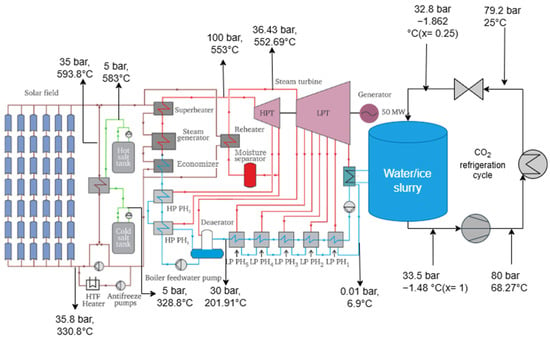
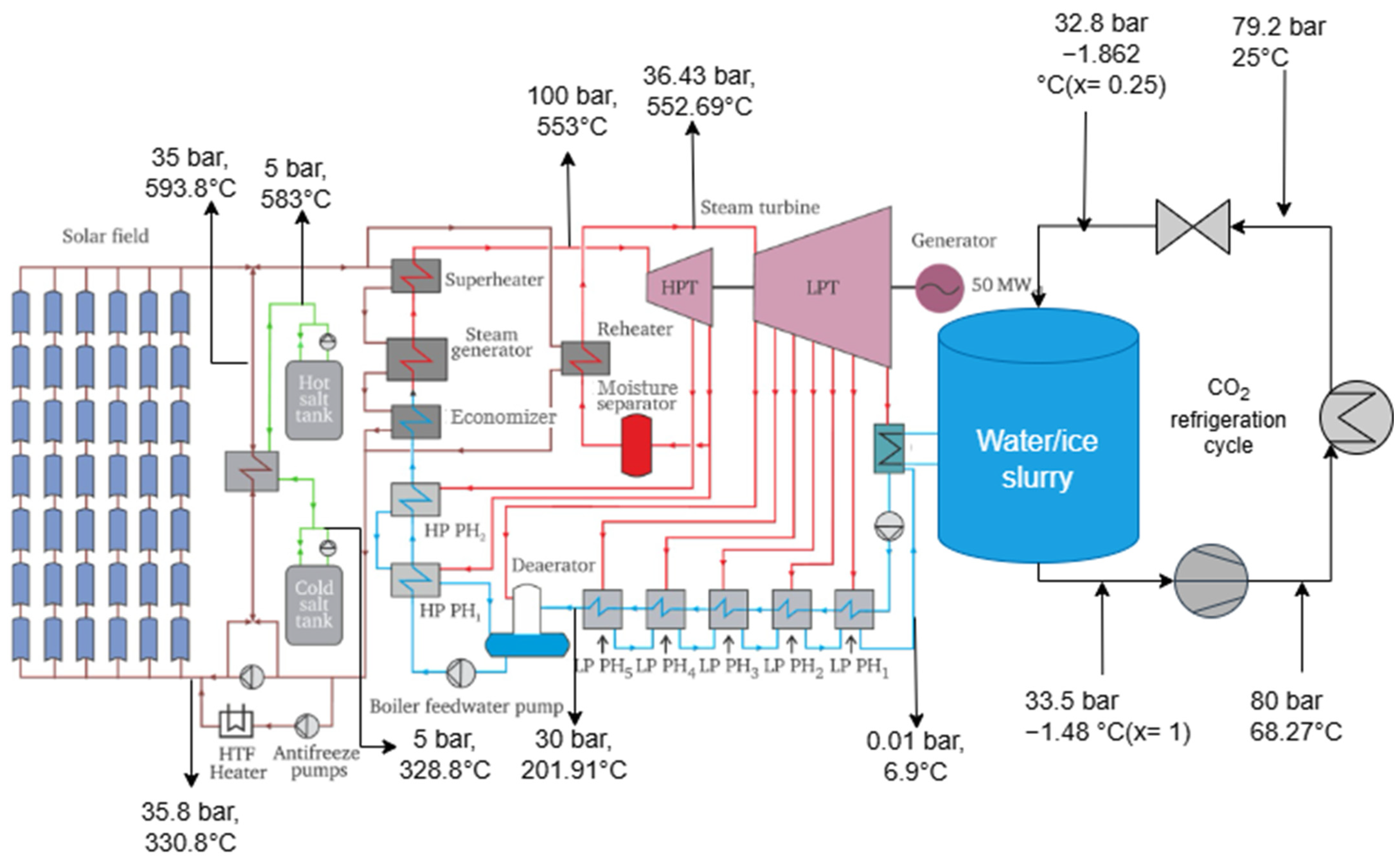
Figure 1 shows a “typical Spanish fed-in” CSP steam plant (like the ANDASOL one [19]) that uses solar field heat production to generate power via a steam power plant integrated with a cooling tower condensation system able to circulate water and to provide a 30 °C inlet while the steam has a condensation temperature of 41 °C, as shown in Table 1, modified through the integration of ice/water storage. Ice/water storage decreases the condensation temperature from 30 °C to 6.9 °C, increasing the power cycle efficiency by around 7 percentage points for the same amount and increasing the power output of the CSP from 35 MW to 50 MW, as shown in Table 1.
Figure 1.
Commercial CSP plant repurposed for grid flexibility.
Table 1.
Parameters of CSP plant compared with the refrigerated counterpart.
The ice/water storage is integrated with a refrigeration cycle that uses peak production electricity from the renewable grid to drive the compressor and then stores it as ice through phase change to be used when required by the CSP plant to generate efficient electricity. The detailed sensitivity, selection and optimization of parameters for the CO2 refrigeration cycle for this application, as well as the selection of storage temperature, have already been done in [22] and will be used as such in this study.
2.2. Demand
The sizing of the cold storage will depend on several factors, one of which is the load demand. Through time-series analysis using Ebsilon Professional [23], the CSP load requirement for the cold storage over the year (i.e., 8760 h) will be determined by selecting the representative day profile for the quarter of the year as shown in Table 2.
Table 2.
CSP load representation over the year.
For the time-series analysis, the discharging is always done on the design electric load of 50 MW to harness the full efficiency of the power cycle of the CSP. The hours of discharging and consequently the hours of thermal load required from the cold storage by the condenser may vary from season to season and will be represented by the selected day for the whole season/quarter due to seasonal irradiation variations.
2.3. Optimal Sizing Model for the Cold Storage and Refrigeration Cycle
The open-source model PYPSA [24] has been used here for capacity expansion modeling. The model has been highly validated and has been used in various studies and is quite reliable. Optimally sizing and operating a cold thermal energy storage (CTES) system integrated with a CO2-based refrigeration plant. The goal of the model is to determine the optimal:
(1) Storage energy capacity Emax [kWhth];
(2) Charging power capacity Pmax [kW];
(3) Hourly operation (charging/discharging/refrigeration output) that minimizes annualized total cost while meeting cooling load every hour of the year.
2.4. Inputs and Data Preparation
The total thermal load is a condenser-side thermal load from the refrigeration cycle (provided for each quarter to be projected to make a year). Other constant parameters are summarized in Table 3.
Table 3.
Inputs for optimal sizing of the cold storage and refrigeration cycle.
2.4.1. Economic Parameters
Capital recovery factor (CRF) for annualization of CAPEX:
where r is the discount rate and n is the number of life years CSP:
CSP only electrical revenue:
CSP annual fixed cost:
CSP annual profit:
FLEX CSP:
Electricity purchase cost:
Cooling revenue:
Annualized cooling CAPEX:
CSP improved revenue:
FLEX CSP annual profit:
Incremental cash flow will represent additional value created by cold storage and chiller integration
Investment cost would be:
2.4.2. Optimization Problem (PYPSA Formulation)
Constrained by energy balance:
Storage dynamics:
Capacity constraints:
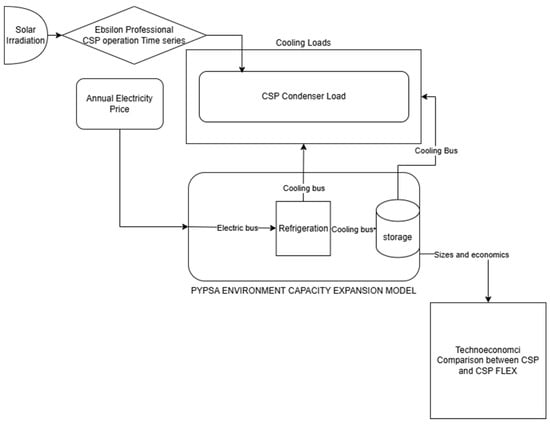
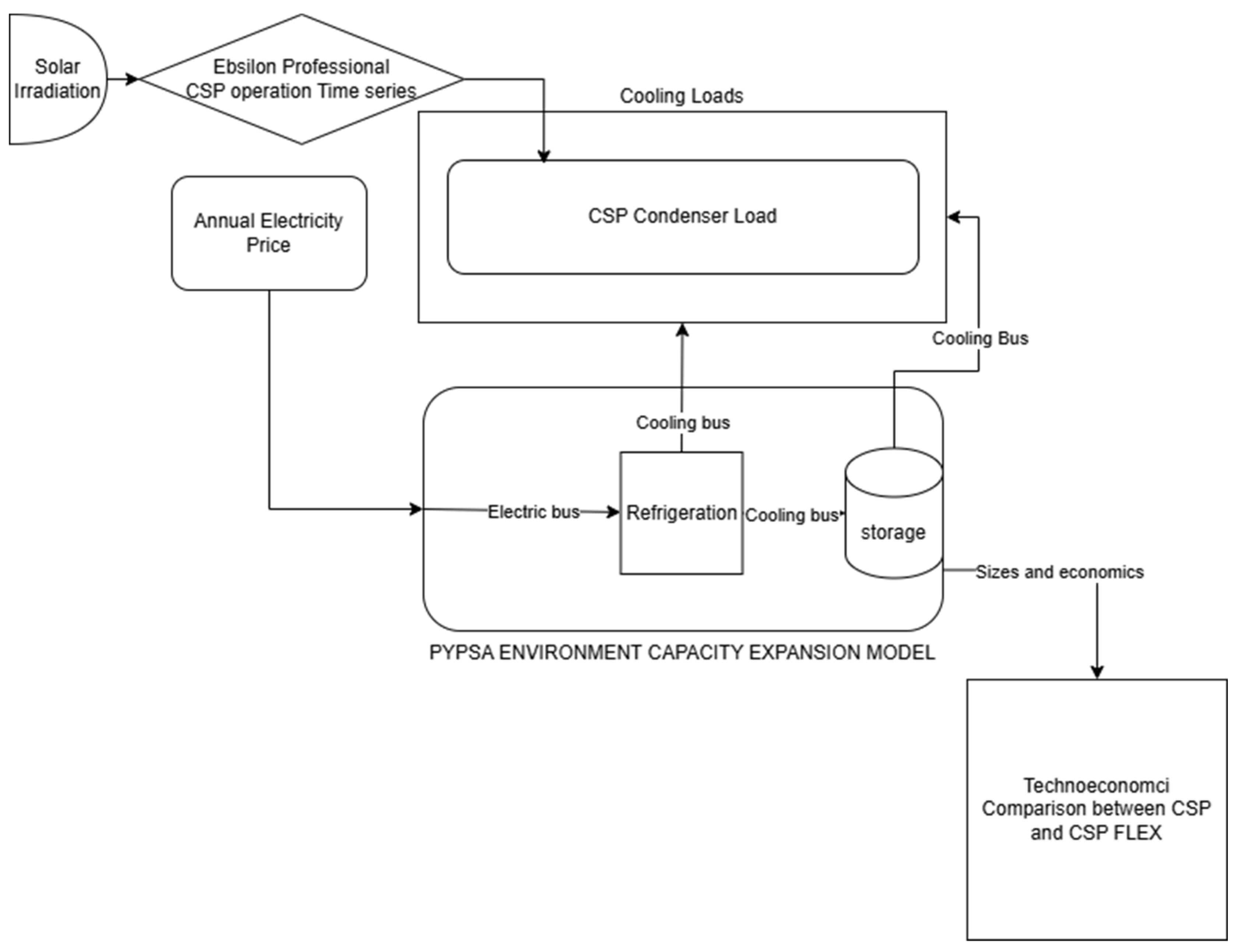
The chosen methodology has been summarized in Figure 2.
Figure 2.
Methodology for the analysis.
Figure 2 presents the overall workflow adopted in this study for the techno-economic assessment of the proposed CSP plant integrated with a refrigeration system and cold thermal energy storage (CTES). The methodology combines dynamic thermodynamic simulations with optimization-based capacity expansion modeling to determine the optimal design and operation of the flexible cooling system.
First, solar irradiation data are used as input to a detailed Ebsilon Professional model of the reference CSP plant. Time-series simulations are performed over representative operating conditions to evaluate the hourly condenser cooling requirements associated with power generation. These simulations generate the cooling load profiles, which are subsequently used as the demand input for the optimization framework.
In parallel, hourly electricity market prices representative of the Spanish market are supplied to the optimization model. The cooling demand profile obtained from the Ebsilon simulations and the electricity price time series are then integrated within the PyPSA capacity expansion model.
Within the PyPSA environment, the refrigeration system is connected to an electricity bus, representing electricity purchased from or valued against the grid, and to a cooling bus, representing the production and distribution of cooling energy. The refrigeration unit converts electrical energy into cooling according to its specified coefficient of performance. The produced cooling can either be delivered directly to satisfy the instantaneous CSP condenser load or stored in the cold thermal energy storage system.
The storage component introduces temporal flexibility by decoupling cooling production from cooling demand. During periods when electricity is economically favorable, the refrigeration system charges the storage by producing excess cooling. Conversely, during periods when direct refrigeration operation is less desirable, the stored cold energy is discharged through the cooling bus to meet the CSP condenser demand. The optimization simultaneously determines the economically optimal storage energy capacity, refrigeration power capacity, and hourly charging and discharging schedule while satisfying operational constraints and energy balance.
Finally, the optimized component sizes and dispatch schedules are used to perform a techno-economic evaluation, including comparisons of capital expenditure (CAPEX), operating expenditure (OPEX), annual profit, and net present value (NPV) between the baseline CSP configuration, the CSP integrated with refrigeration only, and the CSP integrated with both refrigeration and cold thermal storage.
3. Results
To establish the usefulness of the configuration of CSP + chiller and storage, the results first compare the CSP + chiller with the CSP + chiller and storage concept, and then the economics are compared with the base CSP configuration in which there is no refrigeration cycle/chiller present.
The results will first present the load requirements of the CSP plant around the year for different representative quarters; these results informed the optimal sizing tool, which then provides electrical power required by the chiller for the cases of with and without cold storage, while for the latter case, the sizing of the storage is also optimized. For all the cases (base CSP, CSP + chiller, CSP + chiller and storage), the techno-economics are evaluated along with the results.
3.1. Load Demand for the Flex CSP Plant
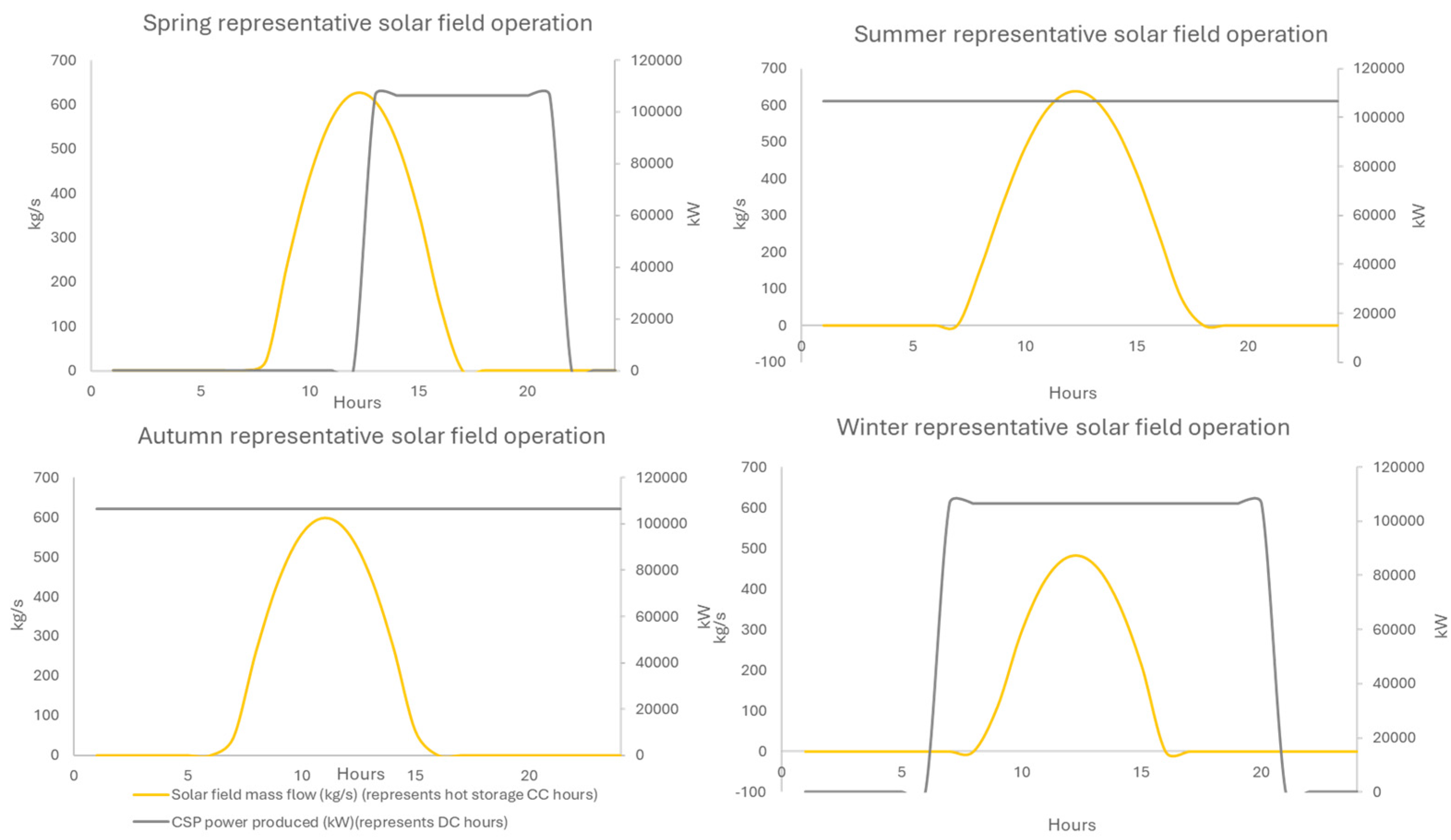
Figure 3 shows the thermal load required by the condenser of the CSP plant to be fulfilled by the cooling apparatus. The thermal load of the condenser of the CSP is shown by the grey line, which is a constant 106,462 kW that enables the CSP the power of 50,000 kW. While the yellow line shows the mass flow in the solar field, depicting the charging of the molten salt tanks, during the day the charging peaks correspond to the solar irradiation while the power production takes place simultaneously. At the start of the year, the two tanks are assumed to be both at an equal state of charge, 50%. From the assumed start of the year, the state shown represents all the days from June to August. The autumn state of charge starts from where the summer state of charge ends, going then to winter and then to spring, completing the whole year cycle with continuous state of charge representation. For summer and autumn, the thermal load required by the condenser is continuous, whereas in winter and spring it is intermittent. The intermittency of the load requirement is due to the unavailable charge in the hot tank due to fewer hours of solar power available in these months. These representative profiles extended to the concerned months are then combined to form a whole year of load, which is then used to optimally size the chiller and the storage.
Figure 3.
Load identification of CSP through representative days to be extended over quarters for full year representation.
3.2. Optimal Sizing of the Plant
Table 4 summarizes the optimal system characteristics obtained from the capacity expansion model for the two configurations: CSP with chiller and CSP with chiller and cold thermal storage.
Table 4.
Optimal characteristics.
For the case without storage, no energy storage capacity is installed, as expected. The optimal chiller capacity is sized at 20,712 kW, which is sufficient to directly meet the cooling demand profile without temporal shifting.
In contrast, when cold thermal storage is introduced, the optimization results indicate a substantial increase in both storage capacity and chiller capacity. The model installs approximately 2.02 GWhth of storage energy capacity, along with a significantly larger chiller capacity of 151,891 kW. This increase reflects the system’s strategy to decouple cooling production from demand by shifting operation across time.
The optimized cold thermal storage capacity of approximately 2.02 GWhth corresponds to an equivalent ice inventory of about 22,000 tonnes, or roughly 22,000–24,000 m3 of ice/water slurry depending on the storage configuration. Although this represents a large installation, the concept is intended for utility-scale CSP plants, which already accommodate extensive thermal storage infrastructure and large equipment footprints. Consequently, the required storage size is considered compatible with the intended application.
The larger chiller capacity in the storage case enables the system to operate intensively during selected periods—typically when electricity prices are lower—producing excess cooling that is stored for later use. The storage then discharges to meet the cooling load during other periods, reducing the need for real-time chiller operation. This operational flexibility explains the simultaneous scaling of both storage energy capacity and chiller power capacity.
Overall, the results highlight that the integration of thermal storage fundamentally changes the optimal system design, favoring higher installed capacities to exploit temporal arbitrage opportunities in electricity prices and improve system-level economic performance.
3.3. Weekly Profiles
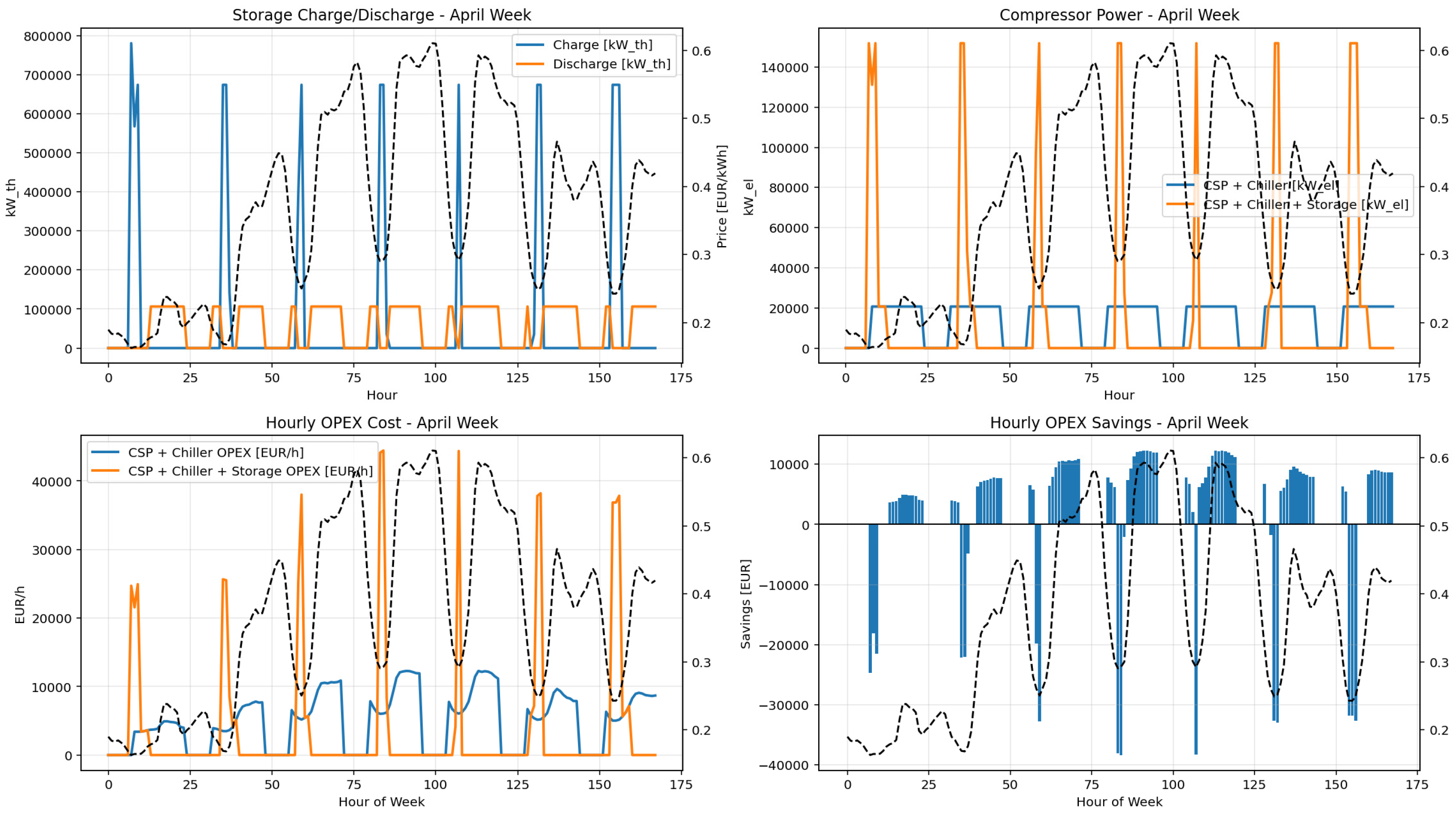
Figure 4 illustrates the operational behavior of the system over a representative week in April, comparing the configurations with CSP + chiller and CSP + chiller + storage. The introduction of cold thermal storage fundamentally alters the system dynamics by decoupling cooling production from demand. In the storage case, charging occurs in short, high-intensity bursts, where excess cooling is produced and stored, while discharging takes place over longer periods to meet the cooling load. This results in an asymmetric pattern, with sharp charging peaks and more sustained discharging profiles, reflecting a strategy of concentrated production followed by gradual utilization.
Figure 4.
Sample week analysis of different parameters with storage (optimized size) and w/o storage (baseline OPEX) where the dotted line shows the electricity price [EUR/kWh].
This behavior is further evident in the compressor power profile. Without storage, the chiller operates at a relatively constant level, closely following the cooling demand and maintaining steady electricity consumption. In contrast, the storage-enabled system exhibits intermittent operation, with very high compressor power during charging periods and near-zero operation during discharge periods. This indicates that the system shifts cooling production to specific hours, rather than producing it continuously, thereby introducing significant operational flexibility. Although the storage-enabled configuration leads to intermittent compressor operation, the charging strategy is based on a small number of relatively long-duration charging events rather than frequent short cycling. Therefore, excessive start–stop operation is not expected under the proposed dispatch strategy. Nevertheless, compressor start-up dynamics, mechanical fatigue, maintenance requirements, and minimum up/down time constraints were not explicitly considered in the present optimization and represent an important direction for future research. Incorporating these operational constraints into the scheduling algorithm could further improve the practical implementation of the proposed concept.
The impact of this shift is clearly visible in the hourly OPEX profile. In the absence of storage, operating costs are moderate and relatively stable, reflecting continuous electricity use. However, with storage, OPEX becomes highly concentrated, with large cost spikes corresponding to charging periods and minimal costs during discharge periods. Consequently, the hourly savings profile shows alternating positive and negative values: negative savings during charging hours due to increased electricity consumption, and positive savings during discharge hours when stored cooling reduces the need for chiller operation.
Overall, the integration of cold storage transforms the system from a demand-following configuration into a temporally optimized system that concentrates production into specific periods and relies on stored energy to meet demand. This results in higher peak capacities and more variable cost patterns but enables strategic shifting of energy use across time.
3.4. Annual Techno-Economic Assessment
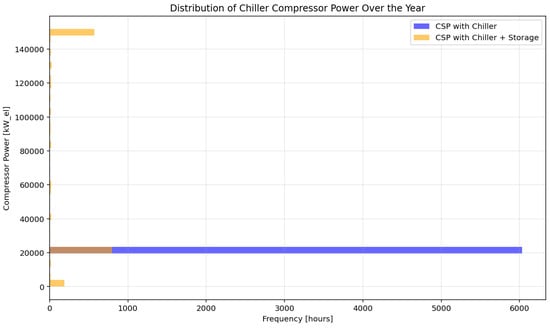
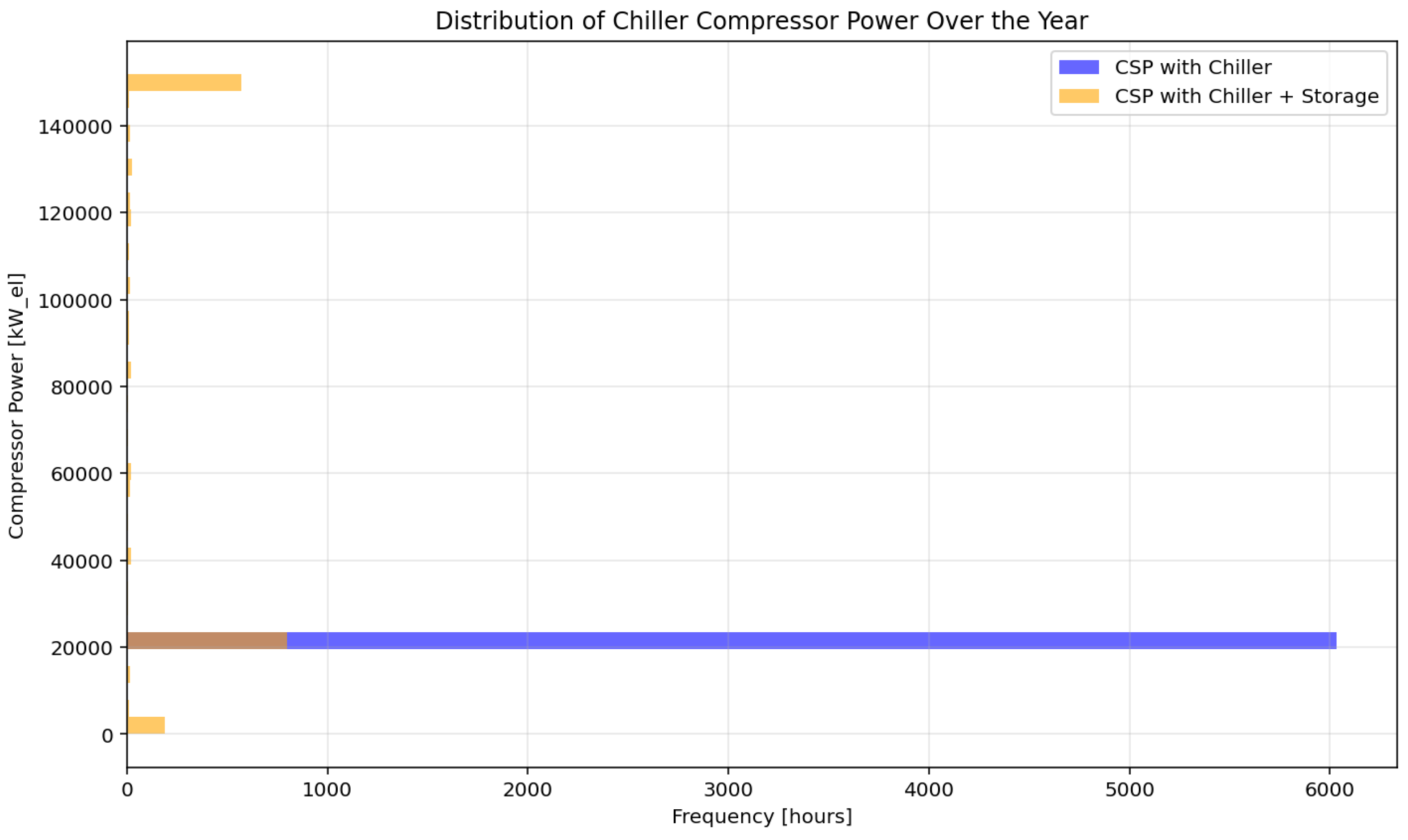
Figure 5 presents the annual distribution of chiller compressor power for the two configurations, CSP with chiller and CSP with chiller and storage. In the absence of storage, the compressor operates predominantly at a nearly constant power level, as indicated by the high frequency concentrated around approximately 20 MWel. This reflects a demand-following operation, where the chiller continuously adjusts to meet the cooling load in real time, resulting in stable and uniform utilization throughout the year.
Figure 5.
Historgram of refrigeration cycle compressor power used over the full year.
In contrast, the introduction of cold thermal storage significantly alters the operating profile. The compressor exhibits a bimodal distribution, characterized by a large number of hours at or near zero power and a smaller number of hours at very high-power levels, reaching up to approximately 150 MWel. This indicates that the system shifts from continuous operation to an intermittent, high-intensity mode, where the chiller operates at maximum capacity during limited periods to charge the storage and remains largely inactive during the remaining hours while the stored cooling is used to satisfy demand.
This shift in the distribution highlights the role of storage in enabling temporal decoupling between production and consumption. While the non-storage case relies on steady operation, the storage-enabled system concentrates cooling production into fewer hours, increasing peak power requirements but reducing the total number of operating hours. Consequently, the system transitions from a base-load-like operation to a more flexible, peak-oriented strategy, which is consistent with the observed dispatch patterns and cost dynamics discussed earlier.
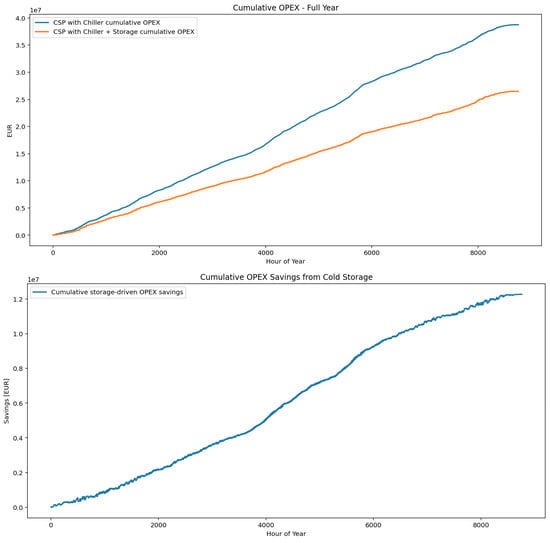
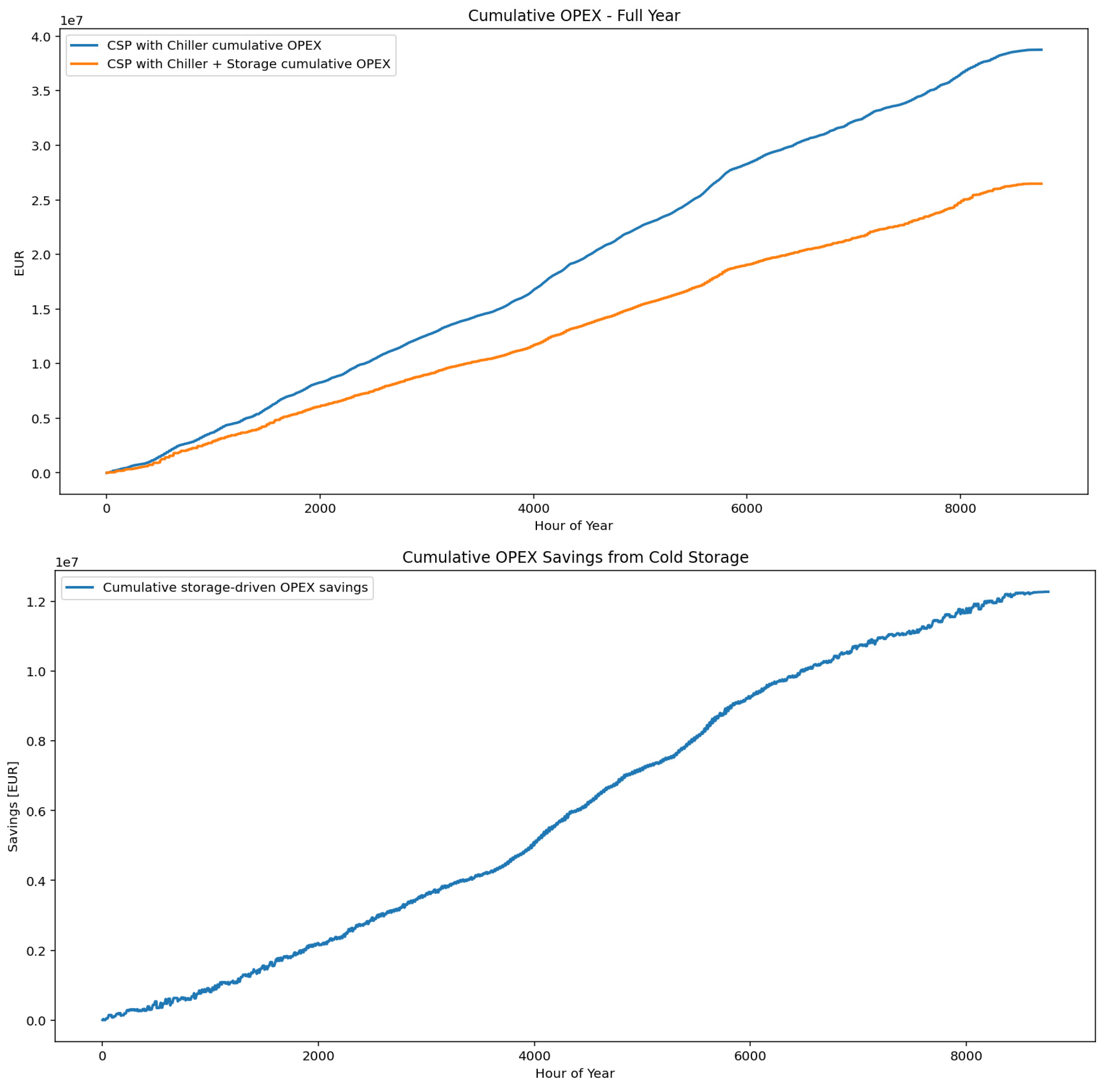
The annual cumulative OPEX profiles clearly demonstrate the economic impact of integrating cold thermal storage into the system. As shown in Figure 6, the configuration with CSP and chiller exhibits a steadily increasing OPEX over the year, reflecting continuous and relatively inflexible electricity consumption required to meet the cooling demand in real time. In contrast, the CSP + chiller + storage configuration shows a consistently lower cumulative OPEX trajectory. This divergence between the two curves increases progressively over time, indicating that the benefits of storage accumulate throughout the year. This effect is further highlighted in the cumulative OPEX savings plot, which shows a monotonic increase in savings. The smooth and consistently upward trend indicates that, despite short-term fluctuations in hourly operation—where storage may incur higher costs during charging periods—the overall system benefits from sustained cost reductions. These savings arise from the ability of storage to shift electricity consumption away from less favorable periods and reduce reliance on continuous chiller operation. Together, these figures confirm that cold thermal storage provides a significant long-term economic advantage by enabling temporal optimization of system operation. While the storage-enabled system introduces more variable and concentrated operating patterns, it ultimately reduces total operating expenditures in a robust and cumulative manner over the annual horizon.
Figure 6.
Cumulative OPEX comparison over the year for refrigeration w/o storage and with storage.
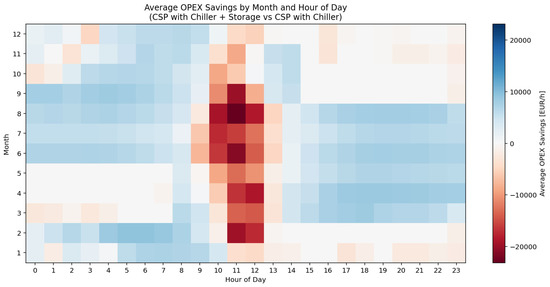
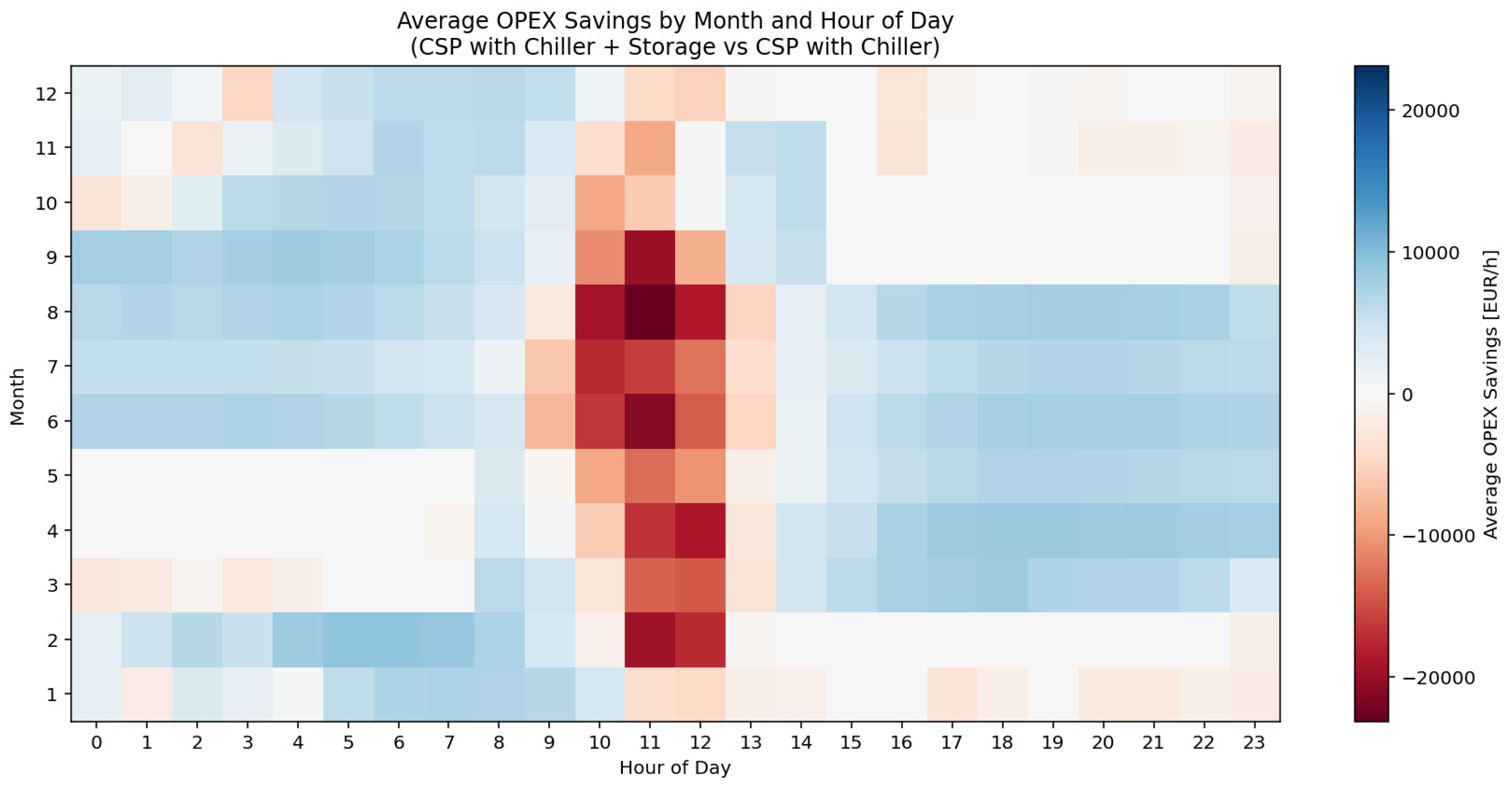
Figure 7 presents the average hourly OPEX savings as a function of month and hour of the day for the CSP + chiller + storage configuration relative to the CSP + chiller case. The heatmap reveals a distinct temporal pattern in the economic performance of storage. Negative savings (shown in red) are concentrated around midday hours, particularly between approximately 10:00 and 13:00, across most months. These periods correspond to storage charging events, during which the system operates the chiller at high power levels, leading to increased electricity consumption and thus higher operating costs compared to the non-storage case.
Figure 7.
Hourly OPEX saving over months of the year starting from January to December.
In contrast, positive savings (shown in blue) are observed predominantly during early morning and evening hours, where the system benefits from discharging stored cooling and reducing the need for real-time chiller operation. These periods exhibit consistent cost reductions, indicating that storage effectively offsets electricity consumption during times when direct operation would otherwise incur higher costs. Seasonal variations are also evident, with stronger positive savings in certain months, reflecting the interaction between the load profile and electricity price dynamics.
Overall, the heatmap highlights the fundamental economic mechanism of cold storage: it shifts energy consumption from periods of higher marginal cost to more favorable periods, albeit at the expense of localized cost increases during charging. The net effect, as shown in the cumulative results, is a significant overall reduction in annual operating expenditures.
Table 5 presents the final annual economic comparison between the CSP + chiller and CSP + chiller + storage configurations. The inclusion of cold thermal storage leads to a higher initial capital investment, increasing CAPEX from 200.7 M€ to 265.9 M€, which is also reflected in the higher annualized CAPEX. However, this increase in investment is offset by a substantial reduction in operating costs, with annual OPEX decreasing from 38.7 M€ to 26.4 M€. Notably, the annual revenue remains unchanged at 93.5 M€ for both configurations, as it is primarily driven by CSP generation, which is identical in both cases.
Table 5.
Economic comparison of CSP + Chiller and CSP + Chiller and storage.
As a result of the reduced operating expenditures, the storage-integrated system achieves a significantly higher annual operating cash flow, increasing from 54.8 M€ to 67.09 M€. After accounting for capital costs, this translates into an increase in annual profit from 40.5 M€ to 48.2 M€. The long-term financial performance further confirms the advantage of storage, with the net present value (NPV) rising from 571.7 M€ to 679.5 M€.
Overall, despite the higher upfront investment, the CSP + chiller + storage configuration demonstrates superior economic performance due to its ability to reduce operating costs through temporal optimization. This confirms that the integration of cold thermal storage provides a robust financial benefit at the system level over the project lifetime.
3.5. Comparison with the Base Case
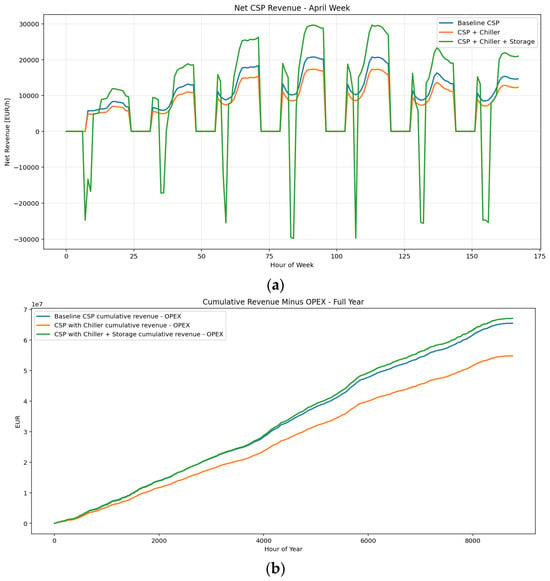
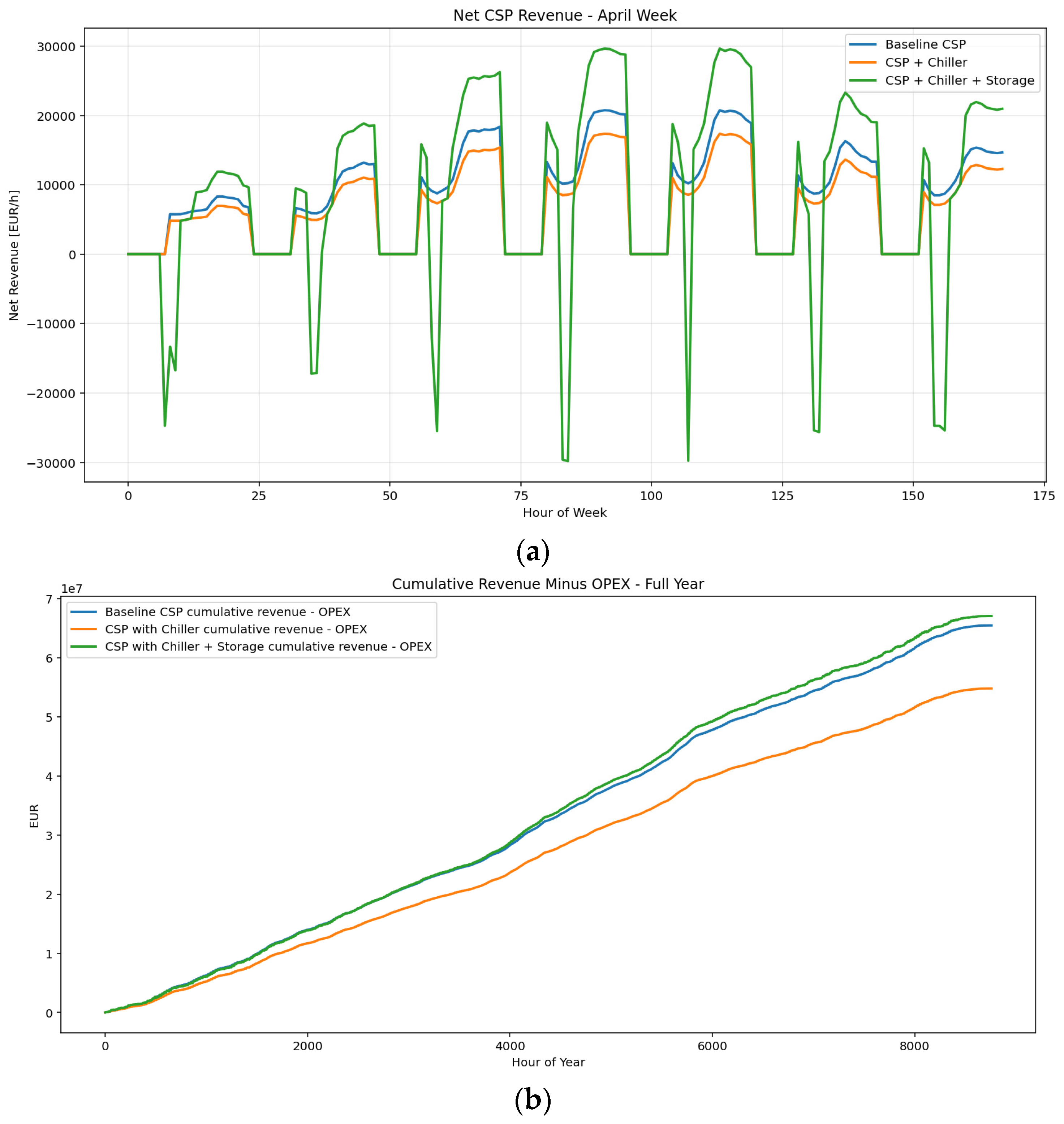
Figure 8a,b present the impact of system configuration on CSP-driven economic performance, comparing the baseline CSP, CSP + chiller, and CSP + chiller + storage cases in terms of hourly net revenue and cumulative annual profitability.
Figure 8.
Cumulative revenue comparison of CSP and CSP flex(for both with storage and without storage configurations). (a) shows the weekly net revenue generation according the electricity price market (b) shows the annual cumulative revenue generation.
The hourly net revenue profile over a representative April week reveals fundamental differences in how CSP generation is utilized across the three configurations. In the baseline CSP case, the net revenue follows a smooth and strictly positive profile, directly reflecting electricity generation and market prices, with no internal consumption. When the chiller is introduced, the net revenue is consistently reduced relative to the baseline, as a portion of the generated electricity is diverted to operate the chiller, thereby reducing the amount of electricity available for sale. This results in a downward shift of the revenue curve while maintaining a relatively stable shape.
In contrast, the CSP + chiller + storage configuration exhibits a highly dynamic revenue profile. While peak revenues exceed those of both other configurations, indicating more effective utilization of CSP generation. This is accompanied by pronounced negative spikes. These negative values occur during periods of intensive storage charging, where electricity consumption by the chiller exceeds the instantaneous CSP generation, leading to net electricity purchases from the grid. This reflects a deliberate operational strategy in which the system incurs temporary losses to enable later gains through stored cooling.
These short-term dynamics are reconciled in the cumulative annual results. As shown in Figure 8b the baseline CSP and CSP + chiller + storage configurations achieve similar cumulative revenue-minus-OPEX trajectories, with the storage case ultimately slightly outperforming the baseline. In contrast, the CSP + chiller case without storage consistently underperforms both alternatives, resulting in a significantly lower cumulative value by the end of the year. This demonstrates that, while the introduction of a chiller alone reduces the economic value of CSP generation due to continuous internal consumption, the addition of storage restores and even enhances overall system performance.
The cumulative curves highlight an important insight: although the storage-enabled system experiences intermittent negative revenue periods, these are offset by higher positive returns during other periods, leading to a net gain over the annual horizon. This confirms that storage enables a form of temporal arbitrage, allowing CSP generation to be effectively “reallocated” across time. As a result, the CSP + chiller + storage configuration not only mitigates the efficiency loss introduced by the chiller but also leverages operational flexibility to slightly surpass the baseline CSP case in long-term profitability.
Overall, these results emphasize that from a CSP-centric perspective, the integration of cold storage is essential to preserving and enhancing economic performance when cooling demand is introduced. Without storage, the coupling of CSP with a chiller leads to a structural reduction in value, whereas the addition of storage transforms the system into a flexible, time-optimized configuration capable of achieving superior economic outcomes despite increased operational variability.
4. Discussion
The results presented across the operational, economic, and temporal analyses consistently demonstrate that the integration of cold thermal storage fundamentally transforms the behavior and performance of the CSP-based cooling system. This transformation is evident in the dispatch patterns, cost structures, and overall economic outcomes when comparing the three configurations: baseline CSP, CSP + chiller, and CSP + chiller + storage.
From an operational perspective, the system without storage exhibits a demand-following behavior, where the chiller operates continuously at a relatively stable power level to directly meet the cooling load. This results in a narrow distribution of compressor power and a smooth OPEX profile over time. In contrast, the introduction of storage leads to a highly intermittent operating regime. The chiller operates in short, high-intensity bursts to charge the storage, followed by extended periods of low or zero operation during which the stored cooling is used to meet demand. This behavior is reflected in the bimodal distribution of compressor power, the sharp charge/discharge cycles, and the highly concentrated OPEX spikes observed in the storage case.
Economically, this shift in operation introduces a clear trade-off between short-term costs and long-term gains. The hourly and weekly analyses show that the storage-enabled system experiences periods of significantly negative net revenue during charging events, where electricity consumption exceeds CSP generation. However, these losses are compensated by periods of enhanced positive revenue when stored cooling reduces the need for real-time electricity consumption. This temporal redistribution of costs is clearly captured in the heatmap of hourly OPEX savings, where charging hours consistently show negative savings and discharging hours exhibit positive savings.
When evaluated over the full year, the benefits of storage become evident. The cumulative OPEX curves show a steadily increasing gap between the CSP + chiller and CSP + chiller + storage configurations, with the latter achieving substantial total savings. This is further confirmed by the monotonic increase in cumulative OPEX savings, indicating that the advantages of storage accumulate consistently over time despite short-term fluctuations. These operational savings translate directly into improved financial performance, as seen in the higher annual cash flow, profit, and net present value (NPV) for the storage-enabled system.
From the CSP-centric perspective, the results highlight an important distinction. The CSP + chiller configuration reduces the economic value of CSP generation, as a portion of the generated electricity is continuously consumed by the chiller, leading to lower net revenue and cumulative returns. In contrast, the CSP + chiller + storage configuration restores and slightly enhances CSP value by enabling temporal flexibility. Although the hourly net revenue profile becomes more volatile—with both higher peaks and deeper troughs—the cumulative revenue-minus-OPEX curve shows that the storage case ultimately outperforms the chiller-only configuration and closely matches or slightly exceeds the baseline CSP case.
A critical factor underlying these results is the structure of the electricity price signal. In the current analysis, electricity prices remain strictly positive and do not exhibit extreme variability or negative values. As a result, the economic benefit of storage is primarily derived from reducing total electricity consumption rather than exploiting strong price arbitrage opportunities. This limits the revenue potential of the storage system, particularly during charging periods, where electricity must be purchased at a positive cost. Consequently, the storage system achieves reduced costs (lower OPEX) rather than significantly enhanced revenue streams.
If the electricity market exhibited stronger price volatility or included negative pricing periods, the role of storage would become even more advantageous. Under such conditions, the system could generate additional revenue by charging storage during negative price periods, effectively being compensated for electricity consumption. This would transform storage from a cost-reduction mechanism into a direct revenue-generating asset, further improving the economic performance of the CSP + chiller + storage configuration and potentially creating a clear advantage over the baseline CSP case.
Finally, it is important to note that the current analysis does not account for the potential value of cold energy as a standalone service. In practice, stored cooling could be directly supplied to external consumers such as data centers, industrial facilities, or district cooling networks. Incorporating such revenue streams would significantly enhance the economic attractiveness of the storage system, as it would allow the system to monetize not only electricity-based arbitrage but also the delivery of thermal energy services. This additional value stream could further justify the higher capital investment associated with storage and shift the system from a cost-optimization framework to a multi-revenue, service-oriented model.
In summary, the results demonstrate that while CSP + chiller alone reduces system efficiency and economic performance, the integration of cold thermal storage enables a flexible, time-optimized operation that significantly improves overall outcomes. The extent of these benefits, however, is closely tied to electricity price dynamics and the inclusion of additional revenue streams, suggesting that the full potential of such systems is best realized in markets with high price variability and in applications where cooling demand itself can be monetized.
5. Conclusions
This study demonstrates the technical and economic potential of repurposing existing CSP plants through the integration of cold thermal energy storage within a Thermally Integrated PTES framework. The results consistently show that while the addition of a chiller alone reduces the economic value of CSP generation due to continuous internal electricity consumption, the incorporation of cold storage fundamentally transforms system operation and restores, and in some cases enhances, overall economic performance.
From an operational standpoint, the system transitions from a demand-following configuration to a temporally optimized system characterized by intermittent, high-intensity chiller operation. The storage-enabled configuration decouples cooling production from demand, enabling concentrated charging periods and extended discharge phases. This behavior is clearly reflected in the compressor power distribution, storage charge/discharge cycles, and the observed OPEX patterns, which shift from smooth and continuous to highly concentrated and time-dependent.
Economically, this transformation introduces a trade-off between short-term inefficiencies and long-term gains. The storage system incurs higher costs during charging periods, as evidenced by negative hourly net revenue values; however, these are offset by reduced operating costs during discharge periods. Over the annual horizon, this results in substantial cumulative OPEX savings and improved financial metrics. The CSP + chiller + storage configuration achieves lower total operating costs, higher annual profit, and a significantly increased net present value (NPV) compared to the CSP + chiller case, thereby demonstrating the economic viability of the proposed concept.
From the CSP perspective, the results highlight a critical insight: without storage, coupling CSP with cooling demand reduces the value of generated electricity, whereas the addition of storage enables temporal flexibility that recovers and enhances system performance. The cumulative revenue-minus-OPEX analysis confirms that the storage-enabled system can match or slightly outperform the baseline CSP configuration, despite increased operational variability.
However, the extent of these benefits is strongly influenced by electricity market conditions. In the present study, electricity prices remain strictly positive and exhibit limited volatility. As a result, the storage system primarily acts as a cost-reduction mechanism rather than a revenue-generating asset. In markets with higher price variability or the presence of negative price periods, the system could exploit arbitrage opportunities more effectively, potentially generating additional revenue during charging phases and significantly improving overall profitability.
It is also important to note that the current analysis does not account for the potential monetization of cold energy as a standalone service. In practical applications, stored cooling could be directly supplied to external consumers such as data centers, industrial facilities, or district cooling networks. The inclusion of such revenue streams would further enhance the economic attractiveness of the system and could fundamentally shift its role from cost optimization to multi-service value generation.
Author Contributions
S.S.M.S.: Conceptualization, methodology, software, validation, formal analysis, investigation, writing—original draft preparation; S.B. writing—review and editing, visualization. supervision, project administration, Funding acquisition, All authors have read and agreed to the published version of the manuscript.
Funding
This paper presents research work realized in the framework of SCO2OP-TES project, which has received funding from the European Union’s Horizon Europe research and innovation programme under grant agreement No 101136000. Views and opinions expressed are however those of the author(s) only and do not necessarily reflect those of EU or CINEA. Neither EU nor the granting authority can be held responsible for them.
Data Availability Statement
Further data can be asked for by contacting the corresponding author.
Conflicts of Interest
The authors declare no conflicts of interest.
Abbreviations
The following abbreviations are used in this manuscript:
| Abbreviation | Definition | |
| CAPEX | Capital expenditure | |
| CB | Carnot Battery | |
| CC | Charging Cycle | |
| CHP | Combined Heat and Power | |
| COP | Coefficient of performance | |
| CSP | Concentrating Solar Power | |
| CTES | Cold thermal energy storage | |
| DC | Discharging Cycle | |
| ENTSOE | European Network of Transmission System Operators for Electricity | |
| FLEX CSP | Flexible Concentrating Solar Power Plant | |
| MILP | Mixed-Integer Linear Programming | |
| NPV | Net present value | |
| OPEX | Operating Expenditure | |
| PTES | Pumped thermal energy storage | |
| PV | Photovoltaic | |
| PyPSA | Python for Power System Analysis | |
| RESs | Renewable energy sources | |
| SOC | State of charge | |
| TES | Thermal energy storage | |
| TI-PTES | Thermally Integrated Power-to-Heat-to-Power Energy Storage | |
| Symbol | Description | Unit |
| E | Cold thermal energy stored | kWhth |
| Emax | Maximum cold thermal storage energy capacity | kWhth |
| P | Power | kW |
| Pmax | Maximum refrigeration charging power | kW |
| Pch | Charging power | kW |
| Pch,max | Maximum allowable charging power | kW |
| Pdis | Discharging power | kW |
| SOC | State of charge of the cold thermal storage | kWhth |
| SOCt | State of charge at time step t | kWhth |
| SOCt+1 | State of charge at time step t + 1 | kWhth |
| COP | Coefficient of performance of the refrigeration cycle | – |
| η | Charging/discharging efficiency | – |
| ηCC | Charging efficiency | – |
| ηDC | Discharging efficiency | – |
| ηCC/DC | Round-trip charging/discharging efficiency | – |
| λ | Thermal loss coefficient | h−1 |
| r | Discount rate | – |
| n | Project lifetime | years |
| CRF | Capital recovery factor | – |
| Q | Thermal energy or cooling load | kWth or kWhth |
| Qload | Required cooling demand | kWth |
| Qstorage | Stored cold thermal energy | kWhth |
| Pel | Electrical power consumed by the compressor | kWel |
| Pcomp | Compressor electrical power | kWel |
| R | Annual revenue | €/year |
| T | Temperature | °C |
| Thot | Hot molten salt temperature | °C |
| Tcold | Cold molten salt temperature | °C |
| Tcoolant | Coolant (ice/water) temperature | °C |
| Tcond | Condensation temperature | °C |
| pcond | Condensation pressure | bar |
| ṁ | Mass flow rate | kg/s |
| m | Mass | kg |
| V | Volume | m3 |
| cp | Specific heat capacity | kJ/(kg·K) |
| h | Specific enthalpy | kJ/kg |
| t | Time index | h |
| Δt | Simulation time step | h |
| πe | Electricity price | €/kWh |
| λloss | Hourly storage heat loss factor | h−1 |
References
- IEA. Renewable 2024, Analysis and Forecast to 2030. Available online: https://iea.blob.core.windows.net/assets/17033b62-07a5-4144-8dd0-651cdb6caa24/Renewables2024.pdf (accessed on 1 December 2025).
- Zhou, Y.; Gu, A. Learning Curve Analysis of Wind Power and Photovoltaics Technology in US: Cost Reduction and the Importance of Research, Development and Demonstration. Sustainability 2019, 11, 2310. [Google Scholar] [CrossRef] [Scilit]
- Ejuh Che, E.; Roland Abeng, K.; Iweh, C.D.; Tsekouras, G.J.; Fopah-Lele, A. The Impact of Integrating Variable Renewable Energy Sources into Grid-Connected Power Systems: Challenges, Mitigation Strategies, and Prospects. Energies 2025, 18, 689. [Google Scholar] [CrossRef] [Scilit]
- Zhang, H.; Liao, K.; Yang, J.; Zheng, S.; He, Z. Frequency-constrained expansion planning for wind and photovoltaic power in wind-photovoltaic-hydro-thermal multi-power system. Appl. Energy 2004, 356, 122401. [Google Scholar] [CrossRef] [Scilit]
- Huda, A.S.N.; Živanović, R. Large-scale integration of distributed generation into distribution networks: Study objectives, review of models and computational tools. Renew. Sustain. Energy Rev. 2017, 76, 974–988. [Google Scholar] [CrossRef] [Scilit]
- Available online: https://www.energy.gov/eere/articles/confronting-duck-curve-how-address-over-generation-solar-energy (accessed on 1 December 2025).
- Vannoni, A.; Garcia, J.A.; Mantilla, W.; Guedez, R.; Sorce, A. Ancillary Services Potential for Flexible Combined Cycles. In Proceedings of the ASME Turbo Expo 2021: Turbomachinery Technical Conference and Exposition. Volume 4: Controls, Diagnostics, and Instrumentation; Cycle Innovations; Cycle Innovations: Energy Storage; Education; Electric Power. Virtual, Online, 7–11 June 2021; ASME: New York, NY, USA, 2021; p. V004T06A015. [Google Scholar] [CrossRef] [Scilit]
- Vannoni, A.; Sorce, A. Electrical storage or gas power plant flexibility by thermal storage? A market analysis. J. Energy Storage 2025, 126, 116823. [Google Scholar] [CrossRef] [Scilit]
- Knittel, T.; Lowry, C.; McPherson, M.; Wild, P.; Rowe, A. Electrifying end-use demands: A rise in capacity and flexibility requirements. Energy 2025, 320, 135373. [Google Scholar] [CrossRef] [Scilit]
- Shehabi, A.; Newkirk, A.; Smith, S.; Hubbard, A.; Lei, N.; Siddik, M.; Holecek, B.; Koomey, J.; Masanet, E.; Sartor, D. 2024 United States Data Center Energy Usage Report; Report #: LBNL-2001637; Lawrence Berkeley National Laboratory: Berkeley, CA, USA, 2024. [CrossRef]
- Alami, A.H.; Olabi, A.G.; Mdallal, A.; Rezk, A.; Radwan, A.; Rahman, S.M.A.; Shah, S.K.; Abdelkareem, M.A. Concentrating solar power (CSP) technologies: Status and analysis. Int. J. Thermofluids 2023, 18, 100340. [Google Scholar] [CrossRef] [Scilit]
- Kennedy, K.M.; Ruggles, T.H.; Rinaldi, K.; Dowling, J.A.; Duan, L.; Caldeira, K.; Lewis, N.S. The role of concentrated solar power with thermal energy storage in least-cost highly reliable electricity systems fully powered by variable renewable energy. Adv. Appl. Energy 2022, 6, 100091. [Google Scholar] [CrossRef] [Scilit]
- Petrollese, M.; Cascetta, M.; Tola, V.; Cocco, D.; Cau, G. Pumped thermal energy storage systems integrated with a concentrating solar power section: Conceptual design and performance evaluation. Energy 2022, 247, 123516. [Google Scholar] [CrossRef] [Scilit]
- Khan, M.I.; Gutiérrez-Alvarez, R.; Asfand, F.; Bicer, Y.; Sgouridis, S.; Al-Ghamdi, S.G.; Jouhara, H.; Asif, M.; Kurniawan, T.A.; Abid, M.; et al. The economics of concentrating solar power (CSP): Assessing cost competitiveness and deployment potential. Renew. Sustain. Energy Rev. 2024, 200, 114551. [Google Scholar] [CrossRef] [Scilit]
- Parthiv, K.; Akar, S.; Glynn, S.; Augustine, C.; Davenport, P. Cost Update: Commercial and Advanced Heliostat Collectors; National Renewable Energy Laboratory: Golden, CO, USA, 2022. [CrossRef] [Scilit]
- NREL Annual Technology Baseling. Concentrating Solar Power. Available online: https://atb.nlr.gov/electricity/2024b/concentrating_solar_power (accessed on 1 December 2025).
- Taylor, N.; Georgakaki, A.; Letout, S.; Kuokkanen, A.; Mountraki, A.; Ince, E.; Shtjefni, D.; Joanny Ordonez, G.; Eulaerts, O.; Grabowska, M. Clean Energy Technology Observatory: Concentrated Solar Power and Heat in the European Union—2022 Status Report on Technology Development, Trends, Value Chains and Markets, EUR 31255 EN; Publications Office of the European Union: Luxembourg, 2022; p. JRC130811. [CrossRef] [PubMed]
- Gómez-Calvet, R.; Martínez-Duart, J.M. On the Assessment of the 2030 Power Sector Transition in Spain. Energies 2019, 12, 1369. [Google Scholar] [CrossRef] [Scilit]
- Available online: https://solarpaces.nlr.gov/by-country/ES (accessed on 1 December 2025).
- José, Q.; Andrés, S.; Ruben, A. Economic assessment of installed CSP plants as Carnot Batteries: Spanish grid market case study. AIP Conf. Proc. 2022, 2445, 050002. [Google Scholar] [CrossRef] [Scilit]
- Borge-Diez, D.; Rosales-Asensio, E.; Palmero-Marrero, A.I.; Acikkalp, E. Optimization of CSP Plants with Thermal Energy Storage for Electricity Price Stability in Spot Markets. Energies 2022, 15, 1672. [Google Scholar] [CrossRef] [Scilit]
- Shamsi, S.S.M.; Barberis, S.; Burlando, A.; Maccarini, S.; Traverso, A. A Novel Thermally Integrated CO2-Carnot Battery Utilizing Cold Thermal Storage. In Proceedings of the ASME Turbo Expo 2024: Turbomachinery Technical Conference and Exposition. Volume 6: Education; Electric Power; Energy Storage; Fans and Blowers. London, UK, 24–28 June 2024; ASME: New York, NY, USA, 2024; p. V006T09A014. [Google Scholar] [CrossRef] [Scilit]
- Available online: https://www.ebsilon.com/en/ (accessed on 1 December 2025).
- Available online: https://pypsa.org/ (accessed on 1 December 2025).
- Available online: https://www.entsoe.eu/ (accessed on 1 December 2025).

Disclaimer/Publisher’s Note: The statements, opinions and data contained in all publications are solely those of the individual author(s) and contributor(s) and not of MDPI and/or the editor(s). MDPI and/or the editor(s) disclaim responsibility for any injury to people or property resulting from any ideas, methods, instructions or products referred to in the content. |
© 2026 by the authors. Licensee MDPI, Basel, Switzerland. This article is an open access article distributed under the terms and conditions of the Creative Commons Attribution (CC BY) license.