


Abstract
The photophysics of a series of Schiff base–BF2 complexes was investigated using steady-state and femtosecond/nanosecond transient absorption spectroscopy, as well as theoretical computations. The native chromophore has a weak fluorescence and a short fluorescence lifetime (<30 ps, determined using the femtosecond fluorescence upconversion method). No triplet state formation was observed for the compounds. Moreover, attachment of a heavy atom (iodine) to the phenyl ring did not enhance intersystem crossing (ISC), which was different from that observed with Bodipy analogs. We attribute the lack of ISC to the short lifetime of the S1 state, which decays rapidly through an efficient non-radiative decay channel, possibly geometry torsion. We also studied a Schiff base–BF2 complex with a twisted molecular structure, which showed a similarly short S1 state lifetime (<100 ps) and weak fluorescence. Using nanosecond transient absorption spectroscopy and intermolecular triplet–triplet energy transfer, we determined the triplet state lifetime of the Schiff base–BF2 complexes to be ca. 20 μs, which is much shorter than that of the Bodipy chromophore (100–800 μs). Based on femtosecond transient absorption spectra, we inferred that the decay of the emissive S1 state takes about 17–20 ps, leading to a non-emissive (dark) state, followed by the formation of a long-lived non-emissive singlet excited state. Theoretical computations demonstrated large spin–orbit coupling matrix elements (SOCMEs, up to 29 cm−1), but the fast non-radiative relaxation of the S1 state inhibits ISC. Thus, we propose that the fast internal conversion inhibits ISC of the iodo-containing molecules. A theoretical study of the zero-field splitting (ZFS) parameters of the triplet state indicates that the ZFS D parameter (45 cm−1) was overestimated for the iodo-containing compounds, whereas a reasonable value was obtained for the iodo-free compounds (ca. 0.03–0.06 cm−1).
1. Introduction
Recently, triplet photosensitizers (PSs) have attracted much attention, not only as model compounds for study of photochemical mechanisms [1,2,3], but also for their promising application in photocatalysis [4,5,6,7,8], photodynamic therapy [9,10,11], photovoltaics [12,13,14], photo-initiated polymerization [15], triplet–triplet annihilation (TTA)-assisted photon upconversion [16,17,18,19], etc. Efficient triplet PSs should show strong absorption in the UV or visible spectral range, efficient intersystem crossing (ISC) (and thus formation of a triplet state upon photoexcitation), long-lived triplet states and proper excited state redox potential [2,10,20]. Among these properties, efficient ISC and long-lived triplet lifetimes are particularly important because the application of PSs often involves intermolecular electron transfer or energy transfer. In organic compounds, ISC is usually enhanced by the spin–orbit coupling (SOC) effect [21,22]. A popular method to enhance the SOC and thus the ISC is the incorporation of heavy atoms in the molecular structure, such as precious metals, Pt, Ir, Ru, Os, heavy halogen atoms (Br, I) or chalcogen atoms (Se) [23]. Although this approach is straightforward, it may induce high synthesis costs, toxicity and shorten the triplet state lifetime [24,25]. Therefore, heavy atom-free triplet PSs are highly desired [26].
Bodipy is a well-studied chromophore because of its strong light absorption, fluorescence, inhibited non-radiative decay of the S1 excited state and feasible derivatization chemistry, allowing for fine tuning of its photophysical properties [20,27,28,29,30]. Bodipy derivatives have been used for preparation of triplet PSs, including heavy atom-free triplet PSs [20,26]. Schiff base–BF2 compounds are structural analogs of Bodipy chromophores, which have been studied for a long time, but mainly for optimizing fluorescence properties [31,32,33]. Nevertheless, little effort has been made in optimizing these compounds as triplet PSs [34,35,36]. Some counter-intuitive results emerged while studying the ISC properties of organic compounds, for instance, the observation of poor ISC for Br-substituted perylenebisimide (PBI) derivatives [37] and the efficient ISC observed for some heavy atom-free Bodipy derivatives with twisted molecular structure [38,39,40]. Recently, we proposed that, in this case, ISC is not directly caused by the distorted structure, which is different from what is observed for helicenes [41,42]. For Schiff base–BF2 complexes, however, related studies are scarce.
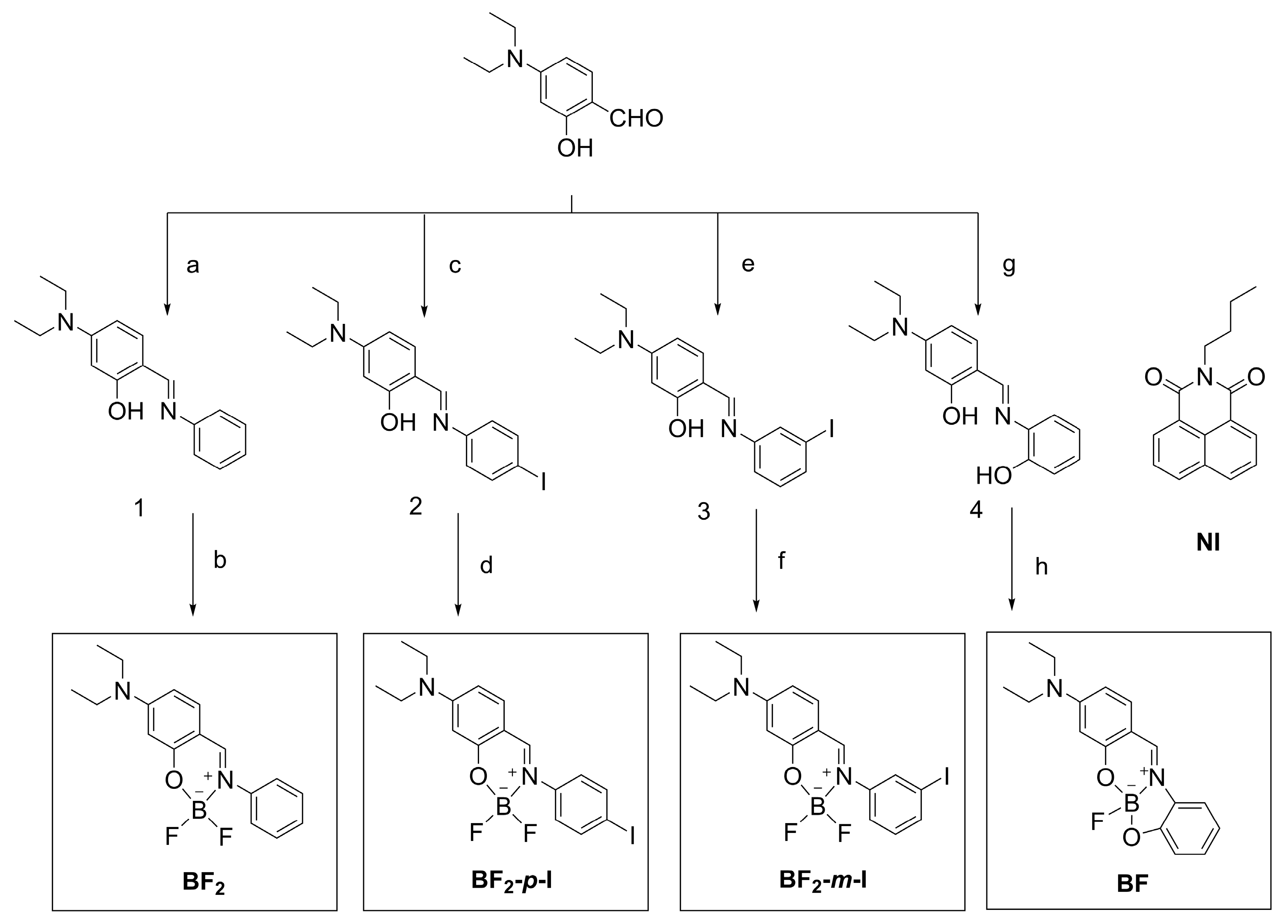
To attain insights into the relationship between molecular structure and the ISC property, we prepared a series of Schiff base–BF2 complexes (Scheme 1) and their photophysical properties were studied using various steady-state and transient spectroscopic methods, as well as theoretical computations. Our results are useful for informing the molecular structure design of new triplet PSs.
2. Materials and Methods
2.1. General Methods and Materials
All the chemicals used for synthesis were analytically pure and were used as received. UV–vis absorption spectra were recorded using a UV–2550 spectrophotometer (Shimadzu Ltd., Kyoto, Japan). Fluorescence spectra were recorded using a FS5 spectrofluorometer (Edinburgh Instrument Ltd., Livingston, UK). Fluorescence quantum yields (ΦF) were measured using an absolute photoluminescence quantum yield spectrometer (Quantaurus-QY plus C13534-11, Hamamatsu Ltd., Hamamatsu, Japan). Fluorescence lifetimes were determined using an OB920 luminescence lifetime spectrometer (Edinburgh Instruments Ltd., Livingston, UK). The synthetic procedures and molecular structure characterization data of the target molecules, i.e., BF2, BF2-p-I, BF2-m-I and BF, are described in the following sections; for the other compounds, please refer to the Supporting Information.
2.2. Compound BF2 [43,44]
Compound 1 (160 mg, 0.60 mmol) was dissolved in dry 1,2-dichloroethane (5 mL) under a N2 atmosphere. A boron trifluoride solution in diethyl etherate (0.18 mL) was added at 85 °C and the reaction mixture was refluxed for 2 h; a yellow precipitate was obtained. Freshly distilled N,N-diisopropylethylamine (0.26 mL) was then added and the reaction mixture was refluxed for an additional hour. After the reaction mixture was cooled down, the solvent was removed under reduced pressure, and the resulting crude product was purified by column chromatography (silica gel, EtOAc/n-hexane 3:7, v/v) to give the product, which was a yellow powder (130 mg, yield: 70%). 1H NMR (500 MHz, CDCl3) δ 1.24 (t, J = 7.10 Hz, 6H), 3.46 (q, J = 7.20 Hz, 4H), 6.26 (d, J = 2.28 Hz, 1H), 6.37 (dd, J = 9.10, 2.40 Hz, 1H), 7.23 (d, J = 8.90 Hz, 1H), 7.35 (t, J = 7.40 Hz, 1H), 7.41–7.45 (m, 2H), 7.51 (d, J = 7.98 Hz, 2H), 8.05 (br s, 1H). HRMS (ESI): calcd for [M + Na]+, m/z 339.1456; found m/z 339.1457.
2.3. Compound BF2-p-I [43,44]
Compound 2 (400 mg, 1.01 mmol) was dissolved in dry 1,2-dichloroethane (5 mL) under a N2 atmosphere. Boron trifluoride diethyl etherate (0.35 mL) was added at 85 °C and the reaction mixture was refluxed for 2 h, producing a yellow precipitate. Freshly distilled N,N-diisopropylethylamine (3.3 mL) was then added and the reaction mixture was refluxed for an additional hour. The reaction mixture was cooled to room temperature, the solvent was removed under reduced pressure and the crude product was purified by column chromatography (silica gel, EtOAc/n-hexane 3:7, v/v). The product was obtained as a yellow powder (292 mg, yield: 78%). 1H NMR (400 MHz, CDCl3) δ 1.24 (t, J = 7.00 Hz, 6H), 3.46 (q, J = 7.13 Hz, 4H), 6.23 (d, J = 2.25 Hz, 1H), 6.37 (dd, J = 9.13, 2.38 Hz, 1H), 7.20–7.26 (m, 3H), 7.74 (d, J = 8.88 Hz, 2H), 8.00 (br s, 1H). HRMS (ESI): calcd for [M + Na]+, m/z 465.0417; found m/z 465.0397.
2.4. Compound BF2-m-I
Compound 3 (831 mg, 2.11 mmol) was dissolved in dry 1,2-dichloroethane (10 mL) under a N2 atmosphere. Boron trifluoride diethyl etherate (0.65 mL) was added at 85 °C and the reaction mixture was refluxed for 2 h, producing a yellow precipitate. Freshly distilled N,N-diisopropylethylamine (0.92 mL) was then added and the reaction mixture was refluxed for an additional hour. After cooling down of the reaction mixture, the solvent was removed under reduced pressure and the resulting crude material was purified by column chromatography (silica gel, EtOAc/n-hexane 3:7, v/v) to afford the product, which was a yellow powder (683 mg, yield: 73%). 1H NMR (400 MHz, CDCl3) δ 1.25 (t, J = 7.13 Hz, 6H), 3.46 (q, J = 7.13 Hz, 4H), 6.25 (d, J = 2.25 Hz, 1H), 6.40 (dd, J = 9.13, 2.38 Hz, 1H), 7.15 (t, J = 8.00 Hz, 1H), 7.23 (d, J = 9.13 Hz, 1H), 7.53 (d, J = 9.13 Hz, 1H), 7.67 (d, J = 6.50 Hz, 1H), 7.80 (s, 1H), 8.00 (br s, 1H). 13C NMR (125 MHz, CDCl3) δ 162.05, 158.10, 156.56, 144.34, 136.57, 134.11, 131.86, 130.75, 122.88, 106.99, 98.05, 94.23, 45.25, 12.65. HRMS (ESI): calcd for [M + Na]+, m/z 465.0417; found m/z 465.0421.
2.5. Compound BF [36,45]
Compound 4 (1 g, 3.52 mmol) was dissolved in dry toluene (70 mL) under a N2 atmosphere at 100 °C. Then, triethylamine (9 mL) and a boron trifluoride solution in diethyl etherate (4.3 mL) was added under a N2 atmosphere. The mixture was refluxed for 24 h. The progress of the reaction was monitored by TLC analysis. After cooling down to room temperature, it was washed with a saturated aqueous solution of NaHCO3 and the mixture was extracted with dichloromethane. The combined organic layers were dried over anhydrous MgSO4 and the solvent was evaporated under reduced pressure. The orange residue was purified by chromatography (silica gel, CH2Cl2), and the crude product was reprecipitated from hexane to afford the neat product, which was a yellow powder (300 mg, yield: 29%). 1H NMR (400 MHz, CDCl3) δ 1.24 (t, J = 7.13 Hz, 6H), 3.46 (q, J = 7.17 Hz, 4H), 6.36–6.45 (m, 2H), 6.88 (t, J = 7.63 Hz, 1H), 7.06 (d, J = 8.13 Hz, 1H), 7.18 (t, J = 7.82 Hz, 1H), 7.30–7.35 (m, 2H), 8.29 (br s, 1H). HRMS (ESI): calcd for [M + Na]+, m/z 335.1338; found m/z 335.1343.
2.6. Picosecond Fluorescence Upconversion Spectroscopy
A mode-locked Ti–sapphire laser (Mai Tai DeepSee, Spectra-Physics, USA) was used as the excitation source for time-resolved fluorescence spectroscopy. The laser generated 800 nm light pulses with a 150 fs duration at a repetition rate of 80 MHz and with an average power of 10 mW. A BBO nonlinear crystal was used to double the frequency of the laser pulse for excitation (λex = 400 nm). Fluorescence kinetics with a 100 fs time resolution were measured with a femtosecond upconversion setup (TRFLS, Newport, USA). A beam splitter was used to separate the residual fundamental pulse from the pump beam. The angle of the polarizations of the excitation and probe beams were set at the magic angle (55°) to eliminate the effect of the rotational diffusion.
2.7. Nanosecond Transient Absorption Spectroscopy
The ns-TA spectra were measured using LP920 and LP980 laser flash photolysis spectrometers (Edinburgh Instruments, Liverston, UK). The sample solution was purged with N2 for 15 min before the measurements, and then excited with a nanosecond pulsed laser (Quantel Nd:YAG nanosecond pulsed laser for LP920, OpoletteTM 355II + UV for LP980). The signal was digitized using a Tektronix TDS 3012B oscilloscope and the data was analyzed using L900 software.
2.8. Femtosecond Transient Absorption Spectroscopy
Femtosecond transient absorption spectra were measured using a home-made pump–probe setup. A mode-locked Ti–sapphire amplified laser system (Spitfire Ace, Spectra-Physics) was split into two beams (10:1 energy ratio). The pump beam in the range of 240–2400 nm was measured using a Ti–sapphire regenerative amplifier laser system (Legend Elite, Coherent), pumped by a femtosecond Ti–sapphire oscillarot (Micra, Coherent). The system delivers 1 KHz 800 nm laser pulses with an average power of 3 W and duration of 40 fs. The pump beam at 350 nm was generated using a commercial Optical Parametric Amplifier (TOPAS, Light Conversion). The probe beam (white light continuum) was generated by focusing a small portion of the 800 nm laser output in a 3 mm CaF2 plate, which was continuously rotated to avoid photodecomposition. Pump–probe delays were introduced by sending the beam used for generating the probe pulse through a movable stage. The samples were contained in 2 mm quartz cuvettes, which were mounted on a movable sample holder to minimize photodegradation. Measurements were performed at room temperature under aerated conditions. The data were analyzed using singular value decomposition and global analysis using the software Glotaran (version 1.5.1) [46].
2.9. Theoretical Computations
The ground state geometries were optimized using B3LYP/def2svp. The excitation energies of the compounds were calculated using the TD-DFT method at the B3LYP/def2svp level. The spin–orbital coupling matrix elements (SOCMEs), the zero-field splitting (ZFS) D and E tensors, and the internal conversion of the S1 state were calculated at the B3LYP/def2svp level using the ORCA 6.0 program [47]. Similar results were obtained from the DFT calculations, which were performed using the Gaussian 09 package [48].
3. Results and Discussion
3.1. Molecular Structure Design Rationale
Compound BF2 was reported previously [43,44,49,50,51,52] and studied for its fluorescence properties; it has also been used as a photoinitiator for polymerization. To study the heavy atom effect on ISC of this structural motif, we attached a iodine atom on the phenyl ring, at two different positions (BF2-p-I and BF2-m-I, Scheme 1), because it was proposed that the substitution position of the heavy atoms may impose different effects on the change in orbital angular momentum, influencing the ISC of the chromophore [53]. We also selected a Schiff base–BF2 complex showing a twisted π-conjugation framework, BF (Scheme 1) [36,45]. The yields of the compounds were satisfactory and the molecular structures have been fully verified (see Section 2).
Scheme 1.
Synthesis of Schiff base–BF2 complexes: (a) aniline, p-toluenesulfonic acid, dry ethanol, reflux, 12 h, yield: 69%; (b) boron trifluoride diethyl etherate, N,N-diisopropylethylamine, dry 1,2-dichloroethane, reflux, 3 h, yield: 70%; (c) 4-iodoaniline, p-toluenesulfonic acid, dry ethanol, reflux, 12 h, yield: 40%; (d) boron trifluoride diethyl etherate, N,N-diisopropylethylamine, dry 1,2-dichloroethane, reflux, 3 h, yield: 78%; (e) 3-iodoaniline, p-toluenesulfonic acid, dry ethanol, reflux, 12 h, yield: 86%; (f) boron trifluoride diethyl etherate, N,N-diisopropylethylamine, dry 1,2-dichloroethane, reflux, 3 h, yield: 73%; (g) 2-aminophenol, CH3COOH, dry ethanol, reflux, 3 h, yield: 75%; (h) boron trifluoride diethyl etherate, triethylamine, dry toluene, reflux, 3 h, yield: 29%. The molecular structure of the reference compound NI used in the study is also presented.
3.2. UV–Vis Absorption and Fluorescence Spectra
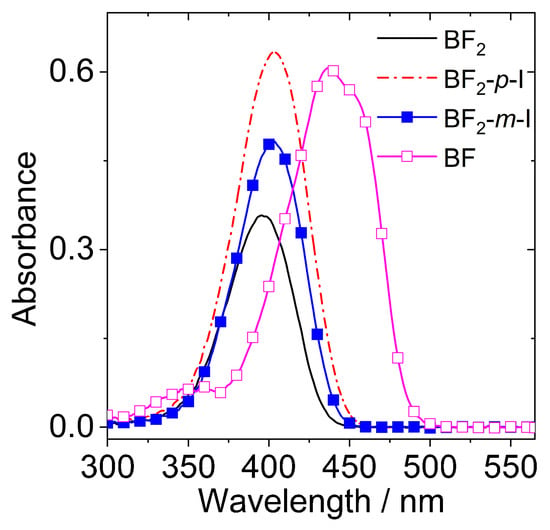
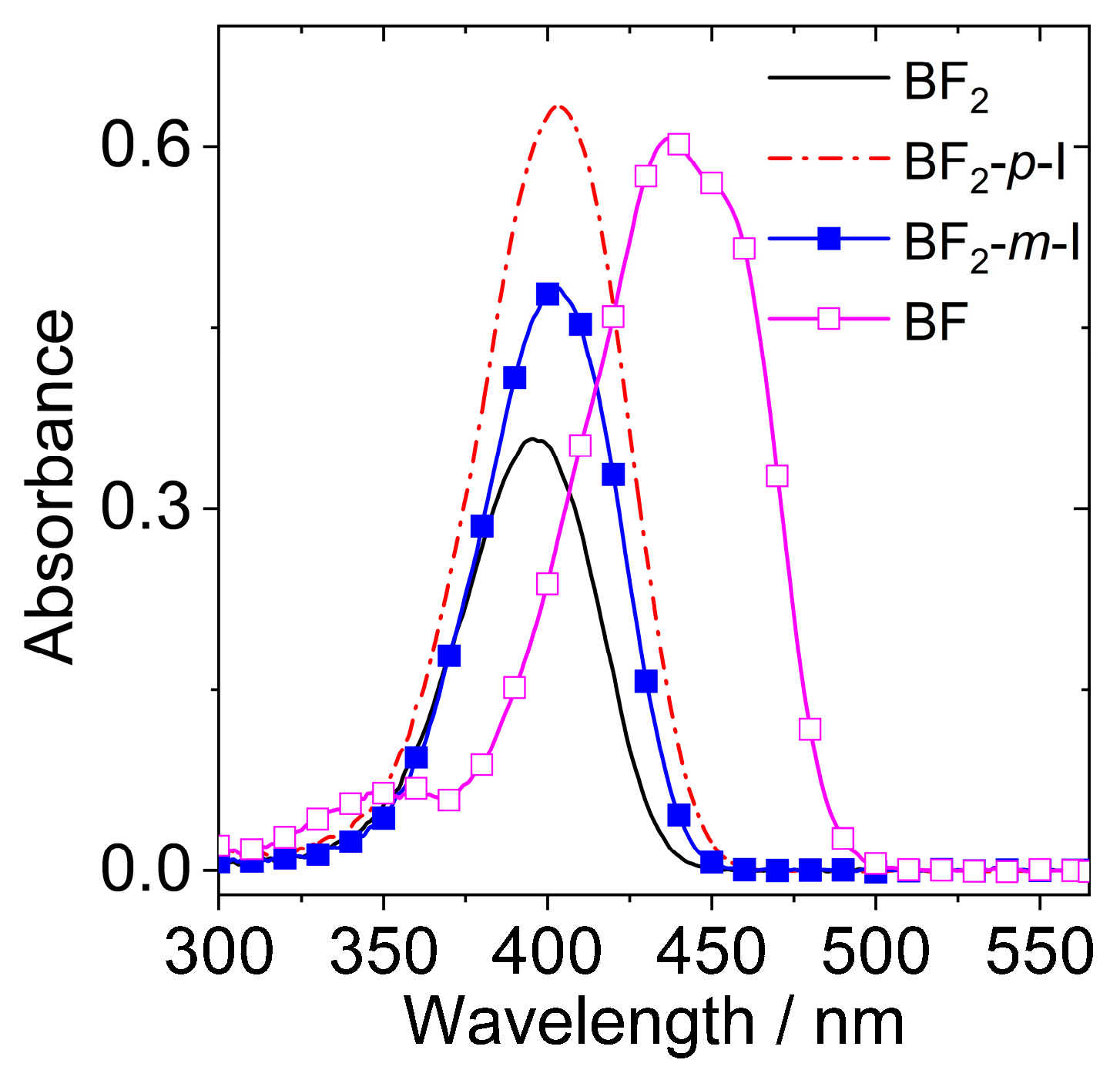
The UV–vis absorption spectra of the compounds were studied (Figure 1). Compound BF2 shows a broad, structureless absorption band centered at 393 nm, which is different from the structured absorption band of Bodipy (S0 → S1 transition) [28,54,55,56]. These results indicate that the molecular structure of BF2 may be less rigid than that of Bodipy, and thus presents more densely packed vibrational energy levels. We found that attachment of iodine on the phenyl ring does not change the absorption wavelength, but increases the molar absorption coefficients (Table 1). The absorption band becomes structured in case of the twisted derivative BF, and it is red-shifted by 2457 cm−1 (Figure 1).
Figure 1.
UV–vis absorption spectra of four compounds in toluene, c = 1.0 × 10⁻⁵ M, 20 °C.
Table 1.
Photophysical data of the compounds.
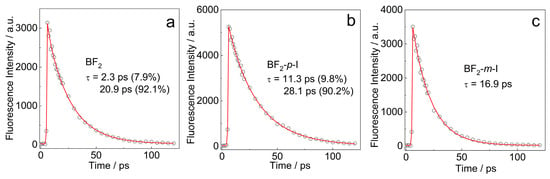
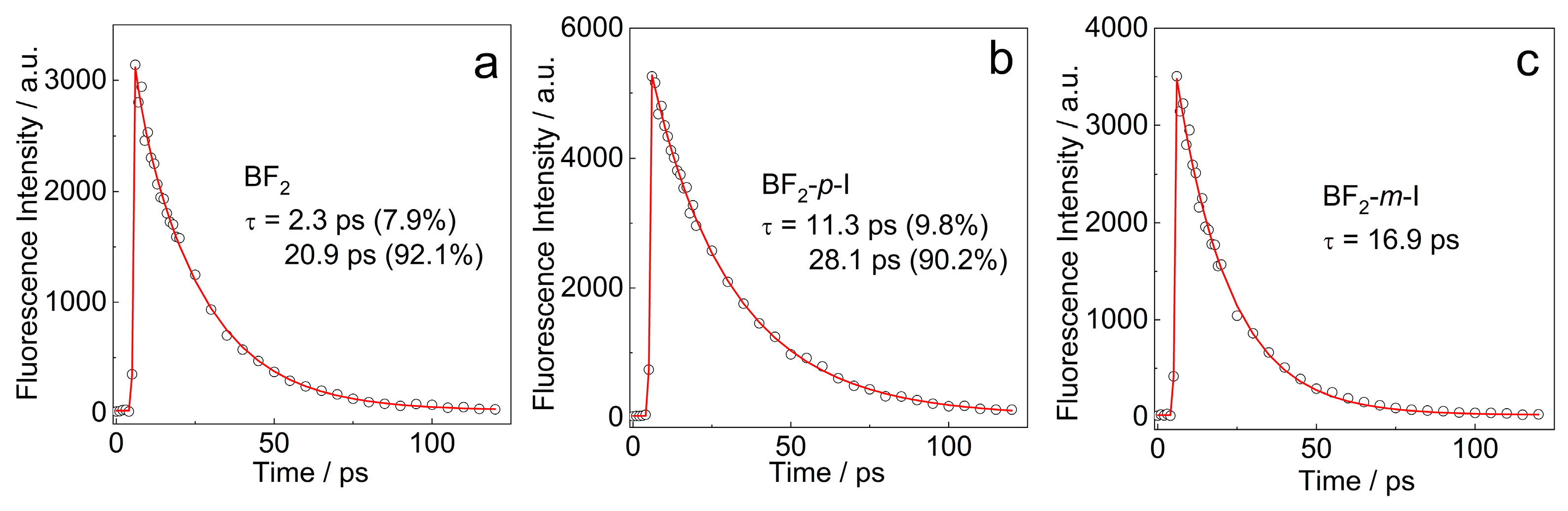
The fluorescence of the compounds is weak, which is different from the efficient fluorescence of Bodipy compounds [57,58,59]. These results point towards the existence of an efficient non-radiative decay of the S1 state, with ISC being one possibility. The fluorescence lifetimes were found to be very short, below the time resolution of ordinary TCSPC techniques. Fluorescence lifetimes were thus measured using the femtosecond fluorescence upconversion method (Figure 2). The fluorescence lifetimes are 20–30 ps in ACN. Furthermore, we did not observe a singlet oxygen (1O2) photosensitizing ability for the compounds, suggesting that ISC is not efficient or that the triplet excited state lifetime is much shorter than 1 μs [60,61]; this was also observed for the iodine substituted compounds BF2-p-I and BF2-m-I.
Figure 2.
Fluorescence decay traces of (a) BF2, (b) BF2-p-I, and (c) BF2-m-I in ACN, measured using the fluorescence upconversion technique, monitored at 480 nm (λex = 400 nm) and 20 °C.
On the contrary, for the iodinated Bodipy, it was found that ISC takes 130 ps [62]. Given that the S1 lifetime of the native BF2 chromophore is very short, ISC is probably not enhanced even if a heavy atom is attached on the chromophore [63].
3.3. Nanosecond Transient Absorption (ns-TA) Spectrum Studies
We measured the ns-TA spectra of the compounds to verify the occurrence of ISC. No triplet state was observed for any compounds [64,65], indicating that ISC is not efficient or that the triplet state is short-lived (the instrument response function of the ns-TA spectrometer, IRF, is ca. 10 ns). Moreover, no triplet state was observed for BF2 even in the presence of iodoethane (external heavy atom effect of the iodine atom may enhance ISC) [23], suggesting that the external heavy atom effect does not work for the compounds. This may be due to two possible reasons: the S1 state lifetime is too short (less than 30 ps) or the T1 state lifetime is too short, and thus the T1 state cannot be detected with the ns-TA spectrometer.
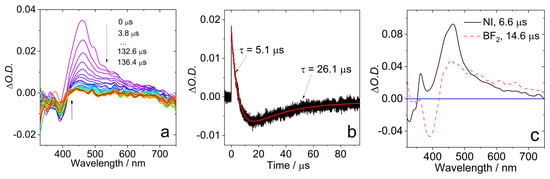
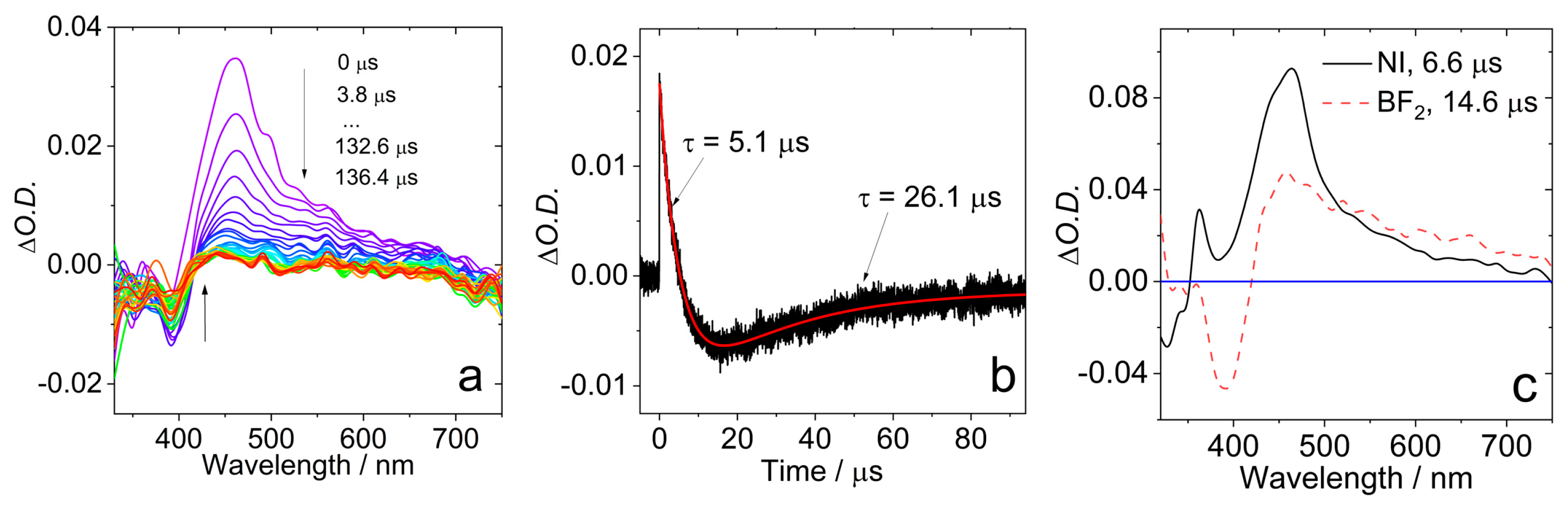
To clarify the abovementioned scenarios, we used triplet-triplet energy transfer (TTET) to populate the triplet excited states of the compounds [66,67]. Based on a preliminary theoretical study, the T1 state energy of BF2 was estimated as 2.37 eV; thus, we selected naphthalimide (NI, Scheme 1) as the triplet photosensitizer (ET1 = 2.39 eV) [68]. Upon photoexcitation of a mixture of NI and BF2 by a 355 nm nanosecond pulsed laser, an excited state absorption (ESA) band in the range of 400–700 nm was observed, as well as a weak ground state bleaching (GSB) band at 400 nm (Figure 3a), in agreement with the steady state absorption of BF2 (Figure 1). Note that the GSB band of NI should be at 325 nm [68], and thus, TTET from NI to BF2 is expected [66,67,69]. We monitored the kinetics of the transient species at 410 nm (GSB band of the BF2). A fast intensity increasing upon photoexcitation was observed, which is attributed to the prompt formation of the 3NI* state. This was followed by a decay phase that took about 5.1 μs, which was attributed to the production of the triplet state of BF2 via TTET. The final phase was a slow recovery of the transient absorption, taking ca. 26.1 μs, which was attributed to the decay of the triplet state of BF2. This result indicates that the triplet state of BF2 is not short-lived, and therefore, the lack of signal in the ns-TA spectra is due to the non-efficient ISC of BF2.
Figure 3.
The transient absorption spectral evolution of the mixture of NI and BF2 during intermolecular triplet-triplet energy transfer (TTET) between the molecules of the two compounds in TOL, measured using ns-TA spectroscopy. (a) ns-TA spectra of a mixture of NI (c = 1.0 × 10⁻⁵ M) and BF2 (c = 2.0 × 10⁻⁵ M), (b) decay trace of the mixture at 410 nm and (c) evolution-associated difference spectra (EADSs) based on sequential model. λex = 355 nm, 20 °C.
In order to further analyze the evolution of the TA spectra of the mixture upon photoexcitation, global fitting and global analysis of the ns-TA spectra (Figure 3a and Figures S20a–S22a) were performed based on a sequential model. The evolution-associated difference spectra (EADSs) are presented in Figure 3c and Figures S20c–S22c. The first species shows two ESA bands at 366 nm and 465 nm, attributed to 3NI* [70,71]. The apparent triplet state lifetime of NI was determined as 6.6 μs, which is much shorter than the triplet state of the pristine compound (274.7 μs) [71]. The second species has a GSB band centered at 400 nm and an ESA band in the range of 500–700 nm, attributed to the triplet state of BF2, which is formed via TTET. The lifetime of this species was determined as 14.6 μs, which is much shorter than that of the unsubstituted Bodipy chromophore (100–300 μs) [72,73,74,75].
Similar results were observed for BF2-p-I, BF2-m-I and BF (Figures S20–S22). These results indicate that the triplet state of the Schiff base–BF2 complexes is not substantially quenched by any non-radiative decay channel, which is the opposite of what occurs for the S1 state [41,76]. Moreover, the triplet state lifetimes of the analogs of BF2, BF2-p-I and BF2-m-I show that the presence of heavy atoms does not shorten the triplet state lifetime. Previously, we found that the T1 state lifetime is not shortened by the heavy atom effect [25].
3.4. Femtosecond Transient Absorption (fs-TA) Spectrum Studies
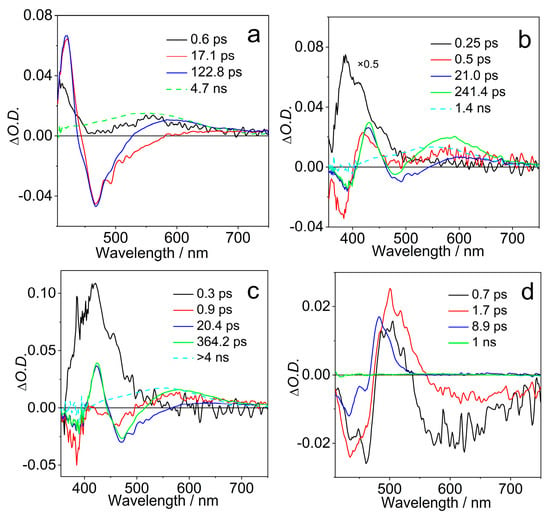
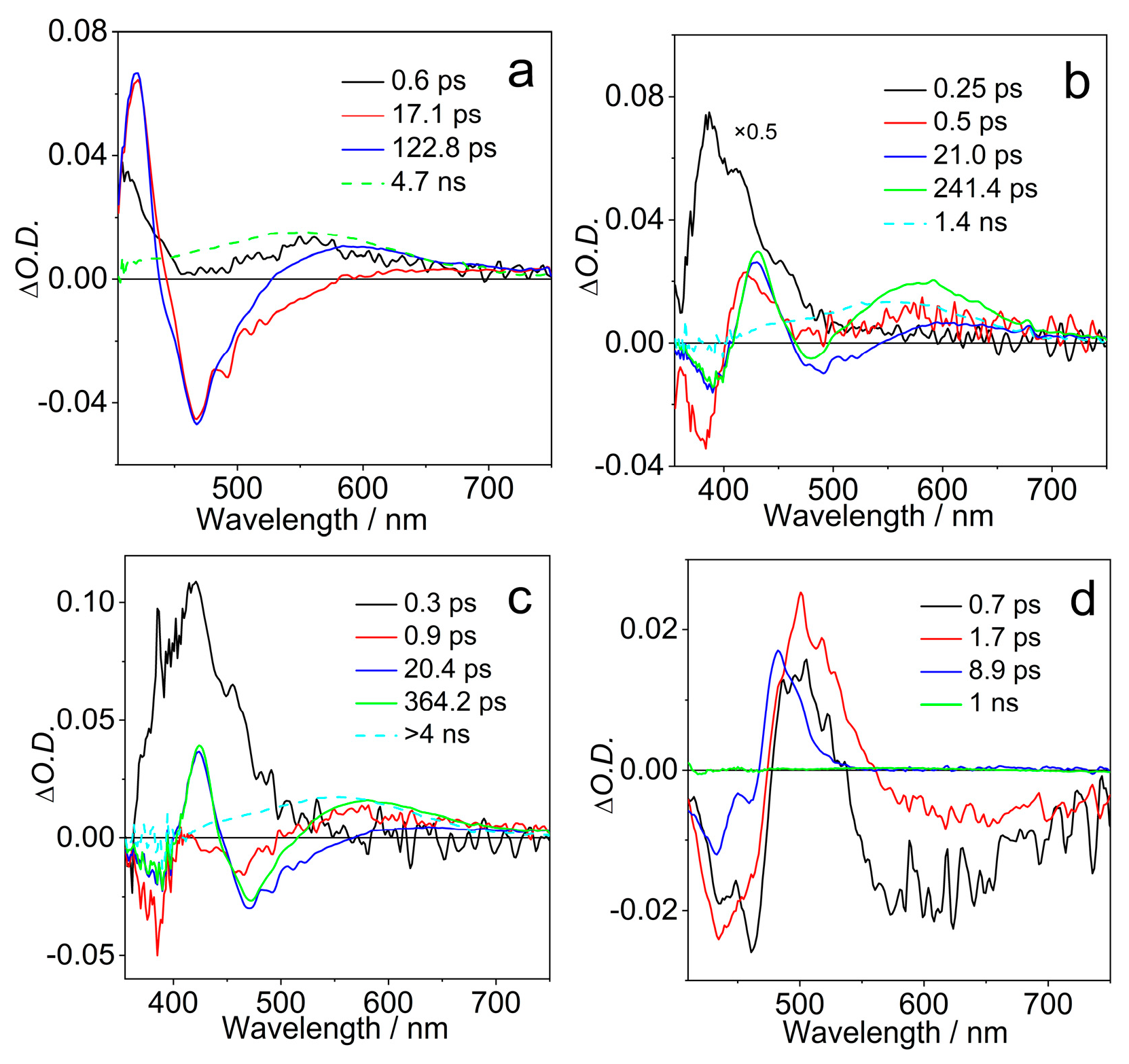
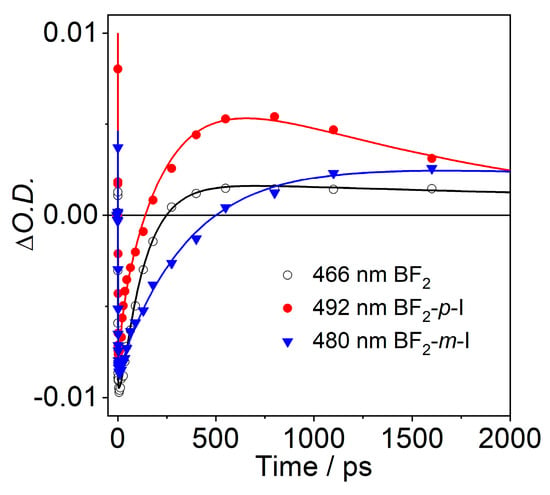
The fast excited state dynamics of the compounds were investigated using TA spectroscopy with a sub-ps time resolution. The compounds BF2, BF2-p-I and BF2-m-I were excited at 350 nm, while for the compound BF, the excitation wavelength was set at 400 nm. The data were analyzed using singular value decomposition (SVD) and global analysis, applying a linear unidirectional decay scheme. The measurements were repeated using three solvents with different polarities: acetonitrile (ACN), dichloromethane (DCM) and toluene (TOL). The EADSs obtained from analyzing the transient data recorded in TOL for the compounds are presented in Figure 4 (the kinetics monitored using a single wavelength is presented in Figure 5).
Figure 4.
EADSs obtained from global analysis of the transient absorption data recorded for (a) BF2; (b) BF2-p-I; (c) BF2-m-I; and (d) BF. Excitation wavelength λex = 350 nm for (a–c); for (d), λex = 400 nm in TOL.
Figure 5.
Selective transient evolving traces measured for BF2, BF2-m-I and BF2-p-I, showing the rise of a positive signal, which did not completely decay within the applied time range.
The data recorded for BF2 and the two compounds containing an iodine substitution are qualitatively similar (Figure 4b,c). For BF2, the transient signal recorded after excitation shows an ESA band at about 425 nm and a second broad and less intense ESA band extending from 450 to 650 nm. This component likely involves a contribution from a fast solvent response, since it is known that TOL may undergo two-photon absorption in the UV range [77]. The initial EADS evolves very rapidly, in about 0.6 ps, giving rise to the second spectral component. We assigned this time component to intramolecular vibrational redistribution (IVR). Here, we noticed an increase in intensity of the ESA peak at about 425 nm and the development of a stimulated emission (SE) band peaked at about 460 nm. The following evolution occurred in about 17 ps: in this time interval, the SE band slightly narrows since a positive feature starts to develop in the 550–600 nm region. Considering the timescale in which this evolution occurs, we attributed it to intermolecular vibrational energy transfer (VET) due to interaction with solvent and possibly conformational relaxation of the molecule in the excited state (see below). The transient signal further evolved in about 122 ps. On this timescale, we observed a noticeable spectral evolution: both the ESA and the SE signals recovered and a new very broad positive band appeared, covering the whole investigated spectral region. This broad signal could be at least partially due to the formation of toluene excimers, as previously documented in the literature [77]. The recovery of SE occurred on a timescale of 120–360 ps (Figure 4).
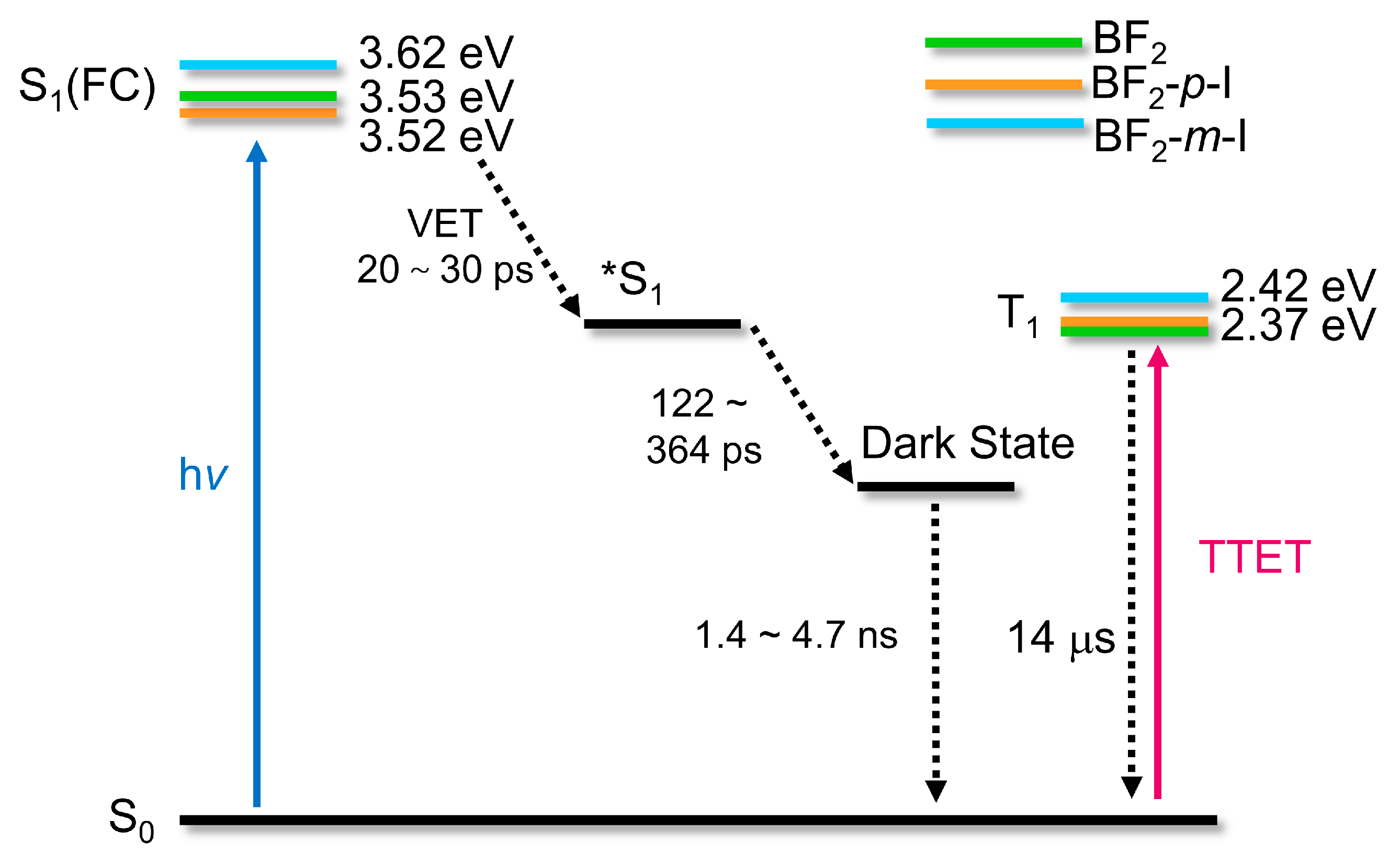
We suggest the following scenario: after excitation to the Frank–Condon state, the molecule undergoes IVR and VET on timescales of 0.6 and 20–30 ps, respectively. On the same timescale as VET, molecules could experience conformational change (e.g., twisted intramolecular charge transfer, TICT) [78], with consequent formation of a non-emissive (dark) state). This is in agreement with both the above data (fluorescence decay lifetimes measured by the up-conversion technique (20–30 ps)) and the recovery of ground state bleaching, measured by fs transient absorption (120–360 ps).
The long-lived components of the fs TA measurements (>4 ns) were attributed to a species with broken B–O bond, as was suggested in our previous publication [79]. Theoretical calculations suggest efficient detachment of one oxygen atom from boron and the typical butterfly structure of the boron complex (which is similar to the molecular structures of BF2) [79]. The formed zwitterionic species should be relatively short lived and the B–O bond will be reformed within few nanoseconds.
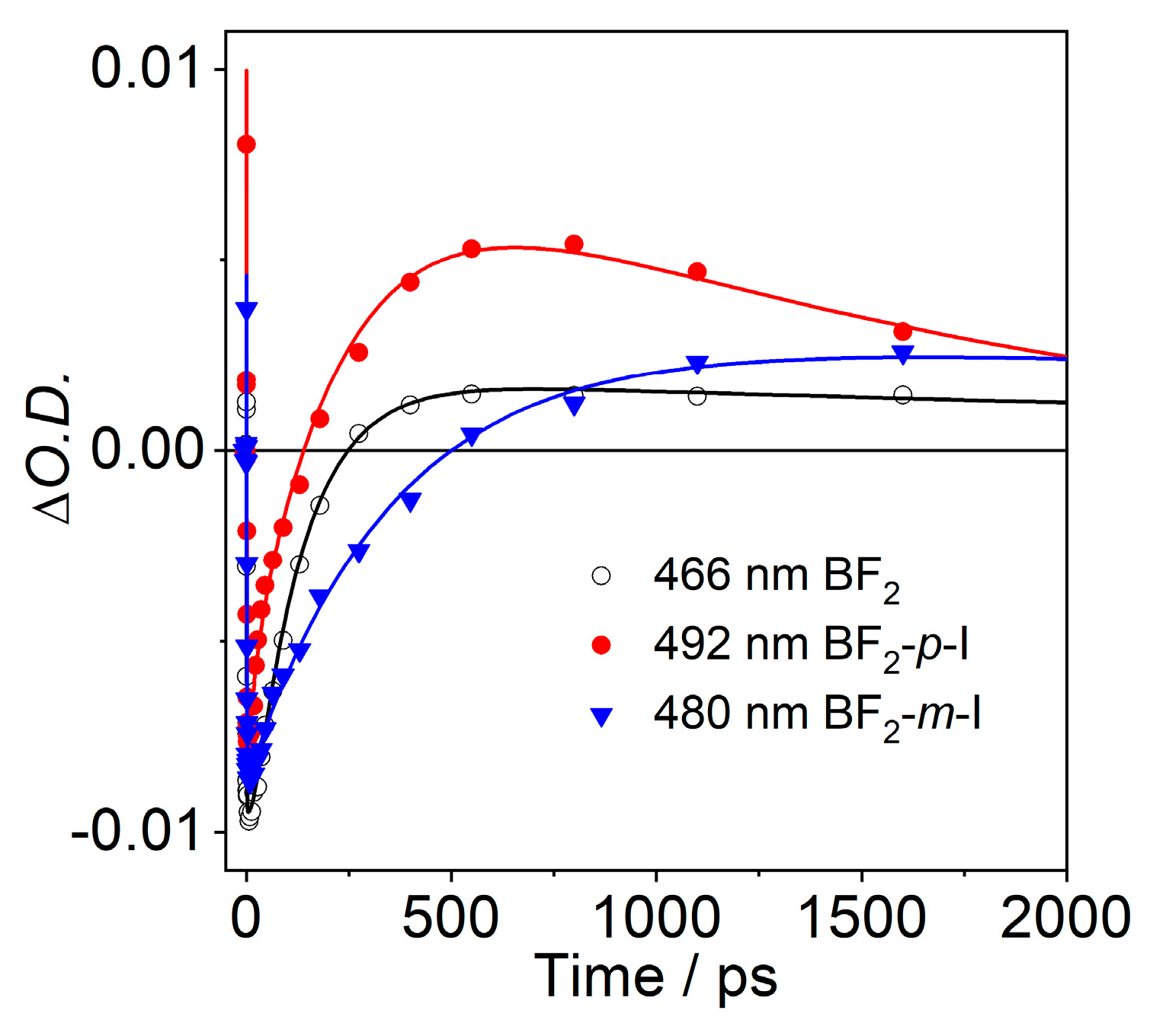
The photophysical property of the compounds is summarized in Scheme 2. Upon photoexcitation, the Franck–Condon (FC) state is populated. Then, via vibrational energy transfer (VET), the relaxed S1 state is produced. Thereafter, the molecules may experience distortion (or breaking of the B–O bond) and a dark state is formed. Both the experimental and theoretical studies ruled out efficient ISC for the compounds, even with iodine atoms attached to the π-conjugation framework. The triplet state of the compounds can be produced via the sensitizing method, i.e., via TTET using a triplet PS. In contrast to the short-lived S1 state, the T1 state has a long lifetime, indicating that the spin flip is the rate-limiting step for the relaxation of the T1 state instead of the distortion of the relaxation of the S1 state.
Scheme 2.
Summary of the photophysical properties of the compounds. FC: Franck–Condon; VET: vibrational energy transfer; TTET: triplet–triplet energy transfer. *S1 stands for a hot S1 excited state.
3.5. Theoretical Calculations
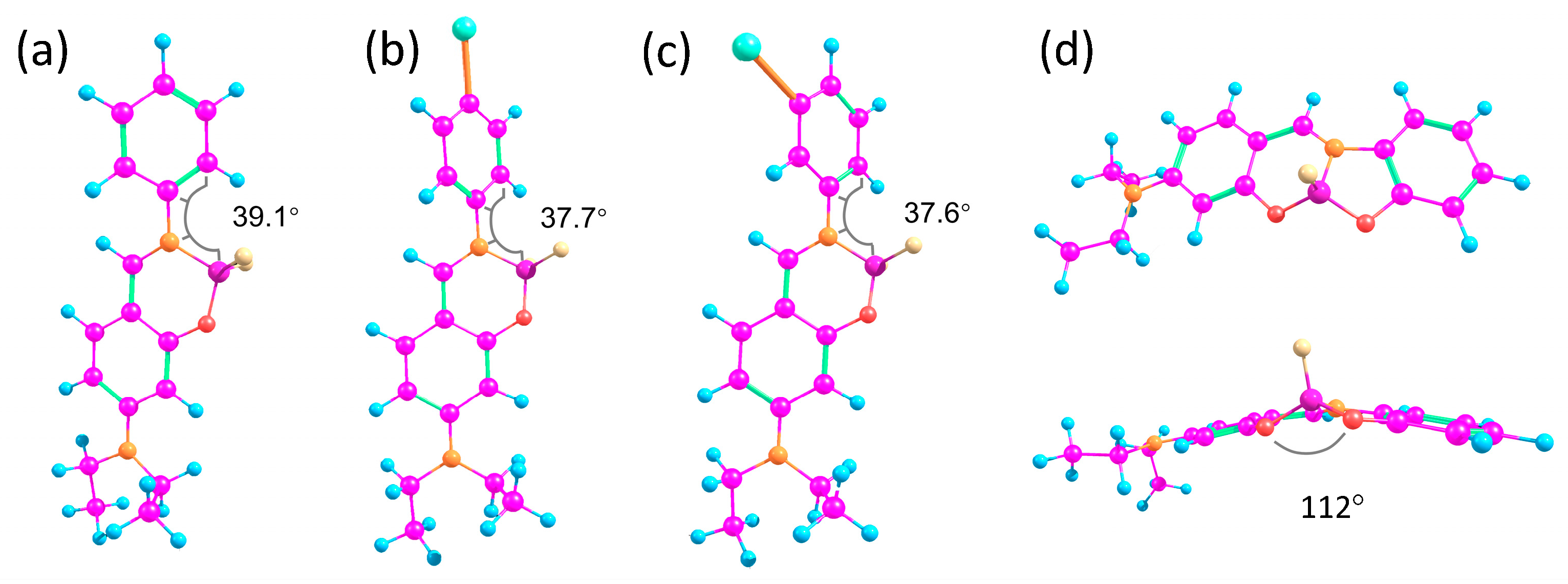
The ground state geometry of the compounds was optimized with DFT calculations (Figure 6). For BF2, BF2-p-I and BF2-m-I, the π-conjugation core of their molecular structure is planar, while there is a severe deviation from planarity for the peripheral phenyl ring, which prevents the full delocalization of molecular orbitals (MOs). For BF, the π-conjugation core is not planar and there is a torsion angle of 112°.
Figure 6.
Optimized ground state geometry of (a) BF2, (b) BF2-p-I, (c) BF2-m-I and (d) BF. Calculated at B3LYP/def2svp level using ORCA 6.0 program.
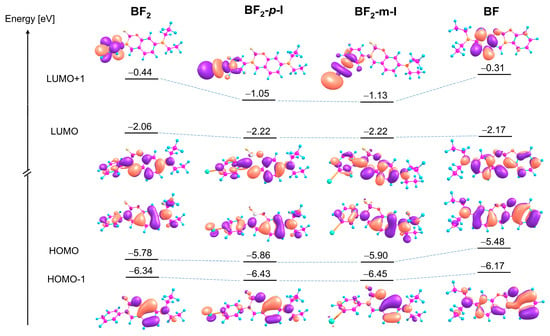
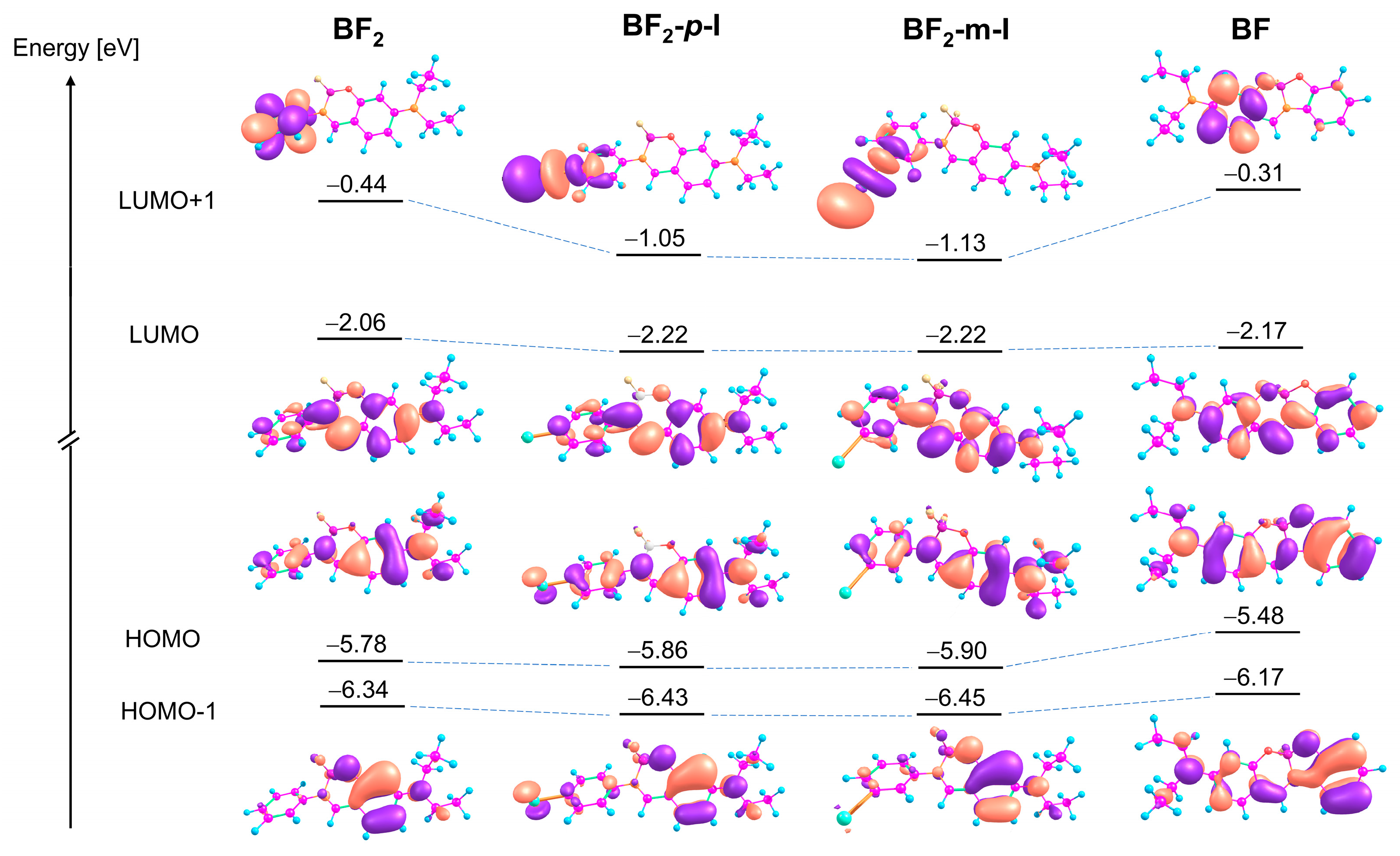
The frontier MOs of the compounds are presented in Figure 7. For all four compounds, the HOMOs and the LUMOs are delocalized over the molecular skeleton. However, both HOMO − 1 and LUMO + 1 are only confined on a part of the molecular structure. In the case of BF, the increased conjugation pushes the energy of both the HOMO and LUMO higher. It should be pointed out that the ordinary hybrids and basis sets are not sufficient for precisely evaluating the photophysical properties of the Bodipy compounds; more sophisticated methods, for instance, based on time-dependent double hybrids with spin-component scaling and long-range correction, etc., are required [80,81], but this is beyond the scope of this work.
Figure 7.
Molecular orbitals and energies of the selected frontier orbitals (isovalue = 0.0004) of BF2, BF2-p-I, BF2-m-I and BF based on the results of optimized ground state geometry. All the compounds were calculated at the B3LYP/def2svp level using the ORCA6.0 program.
We studied the internal conversion (IC) of the S1 state of BF2 using theoretical computation. The calculated IC rate constant was 7.9 × 10¹¹ s−1; this fast IC (ca. 79 ps) is in rough agreement with the fs-TA spectra (Figure 4), and supports the weak fluorescence of BF2. On the other hand, the ISC rate constant of the S1 → T1 of BF2 was calculated as 2.78 × 10⁷ s−1; this theoretically predicted slow ISC (ca. 36 ns) should be out-competed by the fast IC of the S1 state; therefore, no ISC should be observed for BF2. This analysis is in agreement with the weak fluorescence as well as the poor ISC of BF2. A conical intersection on the S1/S0 potential energy surfaces should be responsible for the fast IC of the S1 state [79].
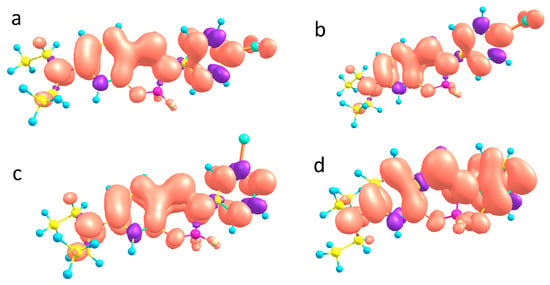
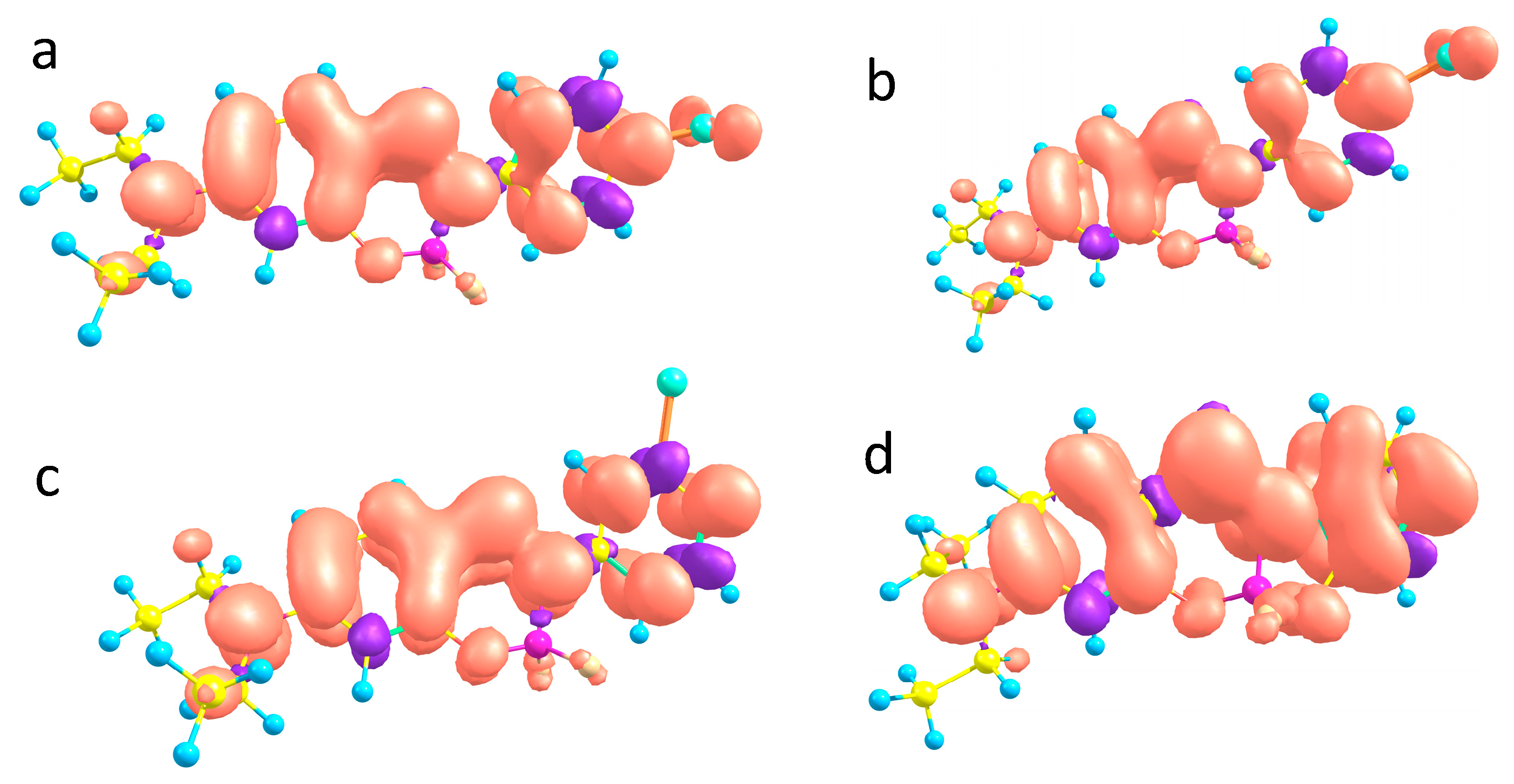
The electron density surfaces of the T1 state of the compounds are depicted in Figure 8. The spin density surfaces of the T1 state of the compounds are fully delocalized on the entire molecular structure. The spin density is localized on the iodine atom in BF2-p-I but not in BF2-m-I, which may lead to different spin–orbit coupling matrix elements (SOCMEs) [23,53].
Figure 8.
Spin density distribution of the triplet state of (a) BF2, (b) BF2-p-I, (c) BF2-m-I and (d) BF (isovalue = 0.0015). Calculated at the B3LYP/def2svp level using the ORCA 6.0 program.
We also calculated the SOCMEs of the compounds. For compounds without iodine atoms in the molecular structures, i.e., BF2 and BF, the SOCMEs are negligible. For instance, the SOCME of the S1 → T3 ISC of BF2 (the energy of the two states was calculated as 3.52 eV and 3.46 eV, respectively) is 1.56 cm−1; for the S1 → T1 ISC (the energy of the T1 state is 2.37 eV), the SOCME is 1.65 cm−1. For BF, the SOCME of the S1 → T3 ISC (the energy of the two states was calculated as 2.99 eV and 3.05 eV, respectively) is 1.60 cm−1; for the S1 → T1 ISC (the energy of the T1 state is 2.07 eV), the SOCME is 0.63 cm−1. For the compounds containing iodine atoms in their molecular structure, the SOCMEs are much larger. For BF2-p-I, the SOCME of the S1 → T3 ISC (the energy of the two states was calculated as 3.53 eV and 3.40 eV, respectively) is 12.8 cm−1; for the S1 → T1 ISC (the energy of the T1 state is 2.37 eV) the SOCME is 2.14 cm−1; for BF2-m-I, the SOCME of the S1 → T3 ISC (the energy of the two states was calculated as 3.62 eV and 3.51 eV, respectively) is 29.4 cm−1; for the S1 → T1 ISC (the energy of the T1 state is 2.42 eV), the SOCME is 15.6 cm−1. However, despite these large SOCMEs, ISC is not efficient because of the fast non-radiative decay of the S1 state to the ground state. A similar result was previously reported for brominated perylenebisimide [66].
The zero-field splitting (ZFS) of the triplet state (T1) is one of the critical photophysical parameters of organic compounds [21,82,83]. The D and E parameters of the ZFS define the energetic splitting of the three triplet spin sublevels in the absence of an external magnetic field [84,85]. They are preliminary determined by the spin–spin interactions and depend on the SOC. We preliminarily studied the ZFS D and E parameters of the triplet excited states of the compounds. For iodo-containing compounds BF2-p-I and BF2-m-I, the ZFS D parameter is 45 cm−1 while the E parameter is ca. 14 cm−1. The spin–spin interaction contribution is in the normal range, but the contribution of the SOC (ca. 45 cm−1) is clearly overestimated [83]. For BF2, the ZFS D was calculated as −0.043 cm−1, and the D value of the triplet state of BF is −0.030 cm−1. On the other hand, the ZFS D of the triplet state of Bodipy was calculated as −0.062 cm−1, and the D of the triplet excited state of the 2,6-diiodoBodipy was calculated as −0.092 cm−1. Both values are close to the experimental results (−0.079 cm−1 and −0.099 cm−1, respectively) obtained with pulse laser excited time-resolved electron paramagnetic resonance (TREPR) spectroscopy [75]. The reason for the overestimation of the D values of the triplet excited state of BF2-p-I and BF2-m-I is unclear.
4. Conclusions
In summary, we prepared a series of Schiff base–BF2 complexes to study their photophysics and ultrafast dynamics in excited states using steady-state, nanosecond/femtosecond transient absorption spectroscopy and theoretical computations. Interestingly, attachment of iodine at different positions on the phenyl ring does not enhance intersystem crossing (ISC). The compounds show weak fluorescence. Fluorescence upconversion spectroscopy confirmed the fast relaxation of the emissive S1 state (takes 17–20 ps). We propose that geometry torsion in the excited state acts as an effective deactivation channel. The fast internal conversion of the S1 state is also supported by theoretical computations, and we propose that it is responsible for the lack of ISC of these compounds, even for those containing iodine atoms in the molecular structure. We used triplet photosensitization (triplet–triplet energy transfer, TTET) to populate the triplet excited states, which are long-lived (ca. 14 μs for BF2, BF2-p-I, BF2-m-I and 50 μs for BF). The theoretical computations demonstrate that the spin–orbit coupling matrix elements (SOCMEs) are large for the iodine-atom-containing compounds, and negligible for the other compounds. The lack of ISC of the iodine-containing compounds is attributed to the fast non-radiative relaxation of the S1 state, which outcompetes the ISC. These results are useful for understanding the photophysical properties of triplet photosensitizers. The overestimation of zero-field splitting (ZFS) in the iodinated compounds and potential applications for this family of Schiff base–BF2 molecules should be addressed in future studies.
Supplementary Materials
The following supporting information can be downloaded at: https://www.mdpi.com/article/10.3390/photochem6030036/s1, Figure S1: 1H NMR of compound 1 (400 MHz, CDCl3), 25 °C; Figure S2: 1H NMR of compound BF2 (500 MHz, CDCl3), 25 °C; Figure S3: 1H NMR of compound 2 (400 MHz, CDCl3), 25 °C; Figure S4: 1H NMR of compound BF2-p-I (400 MHz, CDCl3), 25 °C; Figure S5: 1H NMR of compound 3 (400 MHz, CDCl3), 25 °C; Figure S6: 1H NMR of compound BF2-m-I (400 MHz, CDCl3), 25 °C; Figure S7: 13C NMR of compound BF2-m-I (600 MHz, CDCl3), 25 °C; Figure S8: 1H NMR of compound 4 (400 MHz, DMSO-d6), 25 °C; Figure S9: 1H NMR of compound BF (400 MHz, CDCl3), 25 °C; Figure S10: HRMS of compound [1+H]+; Figure S11: HRMS of compound [BF2+Na]+; Figure S12: HRMS of compound [2-H]−; Figure S13: HRMS of compound [BF2-p-I+Na]+; Figure S14: HRMS of compound [3-H]−•; Figure S15: HRMS of compound [BF2-m-I+Na]+; Figure S16: HRMS of compound [4-H]−•; Figure S17: HRMS of compound [BF+Na]+. 25 °C; Figure S18: UV-vis absorption spectra of four compounds in (a) n-hexane, (b) dichloromethane, (c) tetrahydrofuran, (d) acetonitrile, (e) methanol, c = 1.0 × 10⁻⁵ M, 20 °C; Figure S19: Fluorescence kinetics of (a) BF2, (b) BF2-p-I and (c) BF2-m-I in acetonitrile measured with the femtosecond fluorescence upconversion technique at 530 nm (λex = 400 nm), 20 °C; Figure S20: Intermolecular triplet-triplet energy transfer (TTET) from NI to BF2-p-I in TOL, measured with ns-TA spectroscopy. (a) ns-TA spectra of a mixture of NI (c = 1.0 × 10⁻⁵ M) and BF2-p-I (c = 2.0 × 10⁻⁵ M), (b) decay trace of the mixture at 410 nm and (c) evolution-associated difference spectra (EADS) based on sequential model. λex = 355 nm, 20 °C; Figure S21: Intermolecular triplet-triplet energy transfer (TTET) from NI to BF2-m-I in TOL, measured with ns-TA spectroscopy. (a) ns-TA spectra of a mixture of NI (c = 1.0 × 10⁻⁵ M) and BF2-m-I (c = 2.0 × 10⁻⁵ M), (b) decay trace of the mixture at 410 nm and (c) evolution-associated difference spectra (EADS) based on sequential model. λex = 355 nm, 20 °C; Figure S22: Intermolecular triplet-triplet energy transfer (TTET) from NI-Br to BF in TOL, measured with ns-TA spectroscopy. (a) ns-TA spectra of a mixture of NI-Br (c = 1.0 × 10⁻⁵ M) and BF (c = 1.0 × 10⁻⁵ M), (b) decay trace of the mixture at 440 nm and (c) evolution-associated difference spectra (EADS) based on sequential model. λex = 355 nm, 20 °C; Figure S23: EADS obtained from global analysis of the transient absorption data recorded for BF2 in (a) ACN and (b) DCM; Figure S24: Selected kinetic traces measured for BF2 in ACN, DCM and TOL; Figure S25: EADS obtained from global analysis of the transient absorption data recorded for BF2-p-I in (a) ACN and (b) DCM; Figure S26: Selected kinetic traces measured for BF2-p-I in ACN, DCM and TOL; Figure S27: EADS obtained from global analysis of the transient absorption data recorded for BF2-m-I in (a) ACN and (b) DCM; Figure S28: Selected kinetic traces measured for BF2-m-I in ACN, DCM and TOL; Figure S29: EADS obtained from global analysis of the transient absorption data recorded for BF in (a) ACN and (b) DCM; Figure S30: Selected kinetic traces measured for BF in ACN, DCM and TOL.
Author Contributions
Conceptualization, supervision, and funding acquisition, J.Z. Synthesis, steady-state spectral studies and nanosecond transient absorption spectral studies, W.Z. Fluorescence upconversion experiments and data analysis, G.G.G. Femtosecond transient absorption spectrum measurements and data analysis, S.D. and M.D.D. The corresponding authors wrote the manuscript, and all the authors took part in the revising of the manuscript. All authors have read and agreed to the published version of the manuscript.
Funding
J.Z. thanks the NSFC (U25A20619, 22473021 and W2521100), the Research and Innovation Team Project of Dalian University of Technology (DUT2022TB10), the Fundamental Research Funds for the Central Universities (DUT22LAB610), and the State Key Laboratory of Fine Chemicals of Dalian University of Technology. G.G.G. acknowledges basic research funding from Dalian University of Technology (DUT18GJ205). M.D.D. thanks the European Union’s Horizon 2020 research and innovation program under grant agreement No. 871124 for Laserlab-Europe.
Data Availability Statement
The original data from this work can be requested from the corresponding author.
Conflicts of Interest
The authors declare no conflicts of interest.
References
- Gibbons, D.J.; Farawar, A.; Mazzella, P.; Leroy-Lhez, S.; Williams, R.M. Making Triplets from Photo-Generated Charges: Observations, Mechanisms and Theory. Photochem. Photobiol. Sci. 2020, 19, 136–158. [Google Scholar] [CrossRef] [Scilit] [PubMed]
- Bassan, E.; Gualandi, A.; Cozzi, P.G.; Ceroni, P. Design of Bodipy Dyes as Triplet Photosensitizers: Electronic Properties Tailored for Solar Energy Conversion, Photoredox Catalysis and Photodynamic Therapy. Chem. Sci. 2021, 12, 6607–6628. [Google Scholar] [CrossRef] [Scilit] [PubMed]
- Marian, C.M. Understanding and Controlling Intersystem Crossing in Molecules. Annu. Rev. Phys. Chem. 2021, 72, 617–640. [Google Scholar] [CrossRef] [Scilit] [PubMed]
- Narayanam, J.M.R.; Stephenson, C.R.J. Visible Light Photoredox Catalysis: Applications in Organic Synthesis. Chem. Soc. Rev. 2011, 40, 102–113. [Google Scholar] [CrossRef] [Scilit] [PubMed]
- Shi, L.; Xia, W. Photoredox Functionalization of C–H Bonds Adjacent to a Nitrogen Atom. Chem. Soc. Rev. 2012, 41, 7687–7697. [Google Scholar] [CrossRef] [Scilit] [PubMed]
- Fukuzumi, S.; Ohkubo, K. Selective Photocatalytic Reactions with Organic Photocatalysts. Chem. Sci. 2013, 4, 561–574. [Google Scholar] [CrossRef] [Scilit]
- Hari, D.P.; König, B. The Photocatalyzed Meerwein Arylation: Classic Reaction of Aryl Diazonium Salts in a New Light. Angew. Chem. Int. Ed. 2013, 52, 4734–4743. [Google Scholar] [CrossRef] [Scilit] [PubMed]
- Luo, G.-G.; Lu, H.; Zhang, X.-L.; Dai, J.-C.; Wu, J.-H.; Wu, J.-J. The Relationship between the Boron Dipyrromethene (Bodipy) Structure and the Effectiveness of Homogeneous and Heterogeneous Solar Hydrogen-Generating Systems as Well as Dsscs. Phys. Chem. Chem. Phys. 2015, 17, 9716–9729. [Google Scholar] [CrossRef] [Scilit] [PubMed]
- Kamkaew, A.; Lim, S.H.; Lee, H.B.; Kiew, L.V.; Chung, L.Y.; Burgess, K. Bodipy Dyes in Photodynamic Therapy. Chem. Soc. Rev. 2013, 42, 77–88. [Google Scholar] [CrossRef] [Scilit]
- Zhao, J.; Wu, W.; Sun, J.; Guo, S. Triplet Photosensitizers: From Molecular Design to Applications. Chem. Soc. Rev. 2013, 42, 5323–5351. [Google Scholar] [CrossRef] [Scilit] [PubMed]
- Pham, T.C.; Nguyen, V.-N.; Choi, Y.; Lee, S.; Yoon, J. Recent Strategies to Develop Innovative Photosensitizers for Enhanced Photodynamic Therapy. Chem. Rev. 2021, 121, 13454–13619. [Google Scholar] [CrossRef] [Scilit] [PubMed]
- Schulze, T.F.; Czolk, J.; Cheng, Y.Y.; Fückel, B.; MacQueen, R.W.; Khoury, T.; Crossley, M.J.; Stannowski, B.; Lips, K.; Lemmer, U.; et al. Efficiency Enhancement of Organic and Thin-Film Silicon Solar Cells with Photochemical Upconversion. J. Phys. Chem. C 2012, 116, 22794–22801. [Google Scholar] [CrossRef] [Scilit]
- Salvadori, E.; Luke, N.; Shaikh, J.; Leventis, A.; Bronstein, H.; Kay, C.W.M.; Clarke, T.M. Ultra-Fast Spin-Mixing in a Diketopyrrolopyrrole Monomer/Fullerene Blend Charge Transfer State. J. Mater. Chem. A 2017, 5, 24335–24343. [Google Scholar] [CrossRef] [Scilit]
- Guo, J.; Moss, B.; Clarke, T.M. Quantifying Triplet Formation in Conjugated Polymer/Non-Fullerene Acceptor Blends. J. Mater. Chem. A 2022, 10, 20874–20885. [Google Scholar] [CrossRef] [Scilit]
- Priyadarsini, K.I. Photophysics, Photochemistry and Photobiology of Curcumin: Studies from Organic Solutions, Bio-Mimetics and Living Cells. J. Photochem. Photobiol. C 2009, 10, 81–95. [Google Scholar] [CrossRef] [Scilit]
- Singh-Rachford, T.N.; Castellano, F.N. Photon Upconversion Based on Sensitized Triplet–Triplet Annihilation. Coord. Chem. Rev. 2010, 254, 2560–2573. [Google Scholar] [CrossRef] [Scilit]
- Ye, C.; Zhou, L.; Wang, X.; Liang, Z. Photon Upconversion: From Two-Photon Absorption (TPA) to Triplet–Triplet Annihilation (TTA). Phys. Chem. Chem. Phys. 2016, 18, 10818–10835. [Google Scholar] [CrossRef] [Scilit] [PubMed]
- Fan, C.; Wu, W.; Chruma, J.J.; Zhao, J.; Yang, C. Enhanced Triplet–Triplet Energy Transfer and Upconversion Fluorescence through Host–Guest Complexation. J. Am. Chem. Soc. 2016, 138, 15405–15412. [Google Scholar] [CrossRef] [Scilit] [PubMed]
- Yanai, N.; Kimizuka, N. New Triplet Sensitization Routes for Photon Upconversion: Thermally Activated Delayed Fluorescence Molecules, Inorganic Nanocrystals, and Singlet-to-Triplet Absorption. Acc. Chem. Res. 2017, 50, 2487–2495. [Google Scholar] [CrossRef] [Scilit] [PubMed]
- Zhao, J.; Xu, K.; Yang, W.; Wang, Z.; Zhong, F. The Triplet Excited State of Bodipy: Formation, Modulation and Application. Chem. Soc. Rev. 2015, 44, 8904–8939. [Google Scholar] [CrossRef] [Scilit] [PubMed]
- Levanon, H.; Norris, J.R. The Photoexcited Triplet State and Photosynthesis. Chem. Rev. 1978, 78, 185–198. [Google Scholar] [CrossRef] [Scilit]
- Khudyakov, I.V.; Serebrennikov, Y.A.; Turro, N.J. Spin-Orbit Coupling in Free-Radical Reactions: On the Way to Heavy Elements. Chem. Rev. 1993, 93, 537–570. [Google Scholar] [CrossRef] [Scilit]
- Turro, N.J.; Ramamurthy, V.; Ramamurthy, V.; Scaiano, J.C. Principles of Molecular Photochemistry: An Introduction; University Science Books: Sausalito, CA, USA, 2009. [Google Scholar]
- Hou, Y.; Liu, Q.; Zhao, J. An Exceptionally Long-Lived Triplet State of Red Light-Absorbing Compact Phenothiazine-Styrylbodipy Electron Donor/Acceptor Dyads: A Better Alternative to the Heavy Atom-Effect? Chem. Commun. 2020, 56, 1721–1724. [Google Scholar] [CrossRef] [Scilit] [PubMed]
- Wang, Z.; Toffoletti, A.; Hou, Y.; Zhao, J.; Barbon, A.; Dick, B. Insight into the Drastically Different Triplet Lifetimes of Bodipy Obtained by Optical/Magnetic Spectroscopy and Theoretical Computations. Chem. Sci. 2021, 12, 2829–2840. [Google Scholar] [CrossRef] [Scilit] [PubMed]
- Ullrich, T.; Munz, D.; Guldi, D.M. Unconventional Singlet Fission Materials. Chem. Soc. Rev. 2021, 50, 3485–3518. [Google Scholar] [CrossRef] [Scilit] [PubMed]
- Sasikumar, D.; John, A.T.; Sunny, J.; Hariharan, M. Access to the Triplet Excited States of Organic Chromophores. Chem. Soc. Rev. 2020, 49, 6122–6140. [Google Scholar] [CrossRef] [Scilit] [PubMed]
- Ziessel, R.; Harriman, A. Artificial Light-Harvesting Antennae: Electronic Energy Transfer by Way of Molecular Funnels. Chem. Commun. 2011, 47, 611–631. [Google Scholar] [CrossRef] [Scilit] [PubMed]
- Lu, H.; Mack, J.; Yang, Y.; Shen, Z. Structural Modification Strategies for the Rational Design of Red/Nir Region Bodipys. Chem. Soc. Rev. 2014, 43, 4778–4823. [Google Scholar] [CrossRef] [Scilit] [PubMed]
- Gai, L.; Liu, Y.; Zhou, Z.; Lu, H.; Guo, Z. Bodipy-Based Probes for Hypoxic Environments. Coord. Chem. Rev. 2023, 481, 215041. [Google Scholar] [CrossRef] [Scilit]
- DeRosa, C.A.; Seaman, S.A.; Mathew, A.S.; Gorick, C.M.; Fan, Z.; Demas, J.N.; Peirce, S.M.; Fraser, C.L. Oxygen Sensing Difluoroboron Β-Diketonate Polylactide Materials with Tunable Dynamic Ranges for Wound Imaging. ACS Sens. 2016, 1, 1366–1373. [Google Scholar] [CrossRef] [Scilit] [PubMed]
- Marek-Urban, P.H.; Urban, M.; Wiklińska, M.; Paplińska, K.; Woźniak, K.; Blacha-Grzechnik, A.; Durka, K. Heavy-Atom Free Spiro Organoboron Complexes as Triplet Excited States Photosensitizers for Singlet Oxygen Activation. J. Org. Chem. 2021, 86, 12714–12722. [Google Scholar] [CrossRef] [Scilit] [PubMed]
- Skotnicka, A.; Czeleń, P. Substituted 2-Phenacylbenzoxazole Difluoroboranes: Synthesis, Structure and Properties. Molecules 2020, 25, 5420. [Google Scholar] [CrossRef] [Scilit] [PubMed]
- Zhang, G.; Palmer, G.M.; Dewhirst, M.W.; Fraser, C.L. A Dual-Emissive-Materials Design Concept Enables Tumour Hypoxia Imaging. Nat. Mater. 2009, 8, 747–751. [Google Scholar] [CrossRef] [Scilit] [PubMed]
- Koch, M.; Perumal, K.; Blacque, O.; Garg, J.A.; Saiganesh, R.; Kabilan, S.; Balasubramanian, K.K.; Venkatesan, K. Metal-Free Triplet Phosphors with High Emission Efficiency and High Tunability. Angew. Chem. Int. Ed. 2014, 53, 6378–6382. [Google Scholar] [CrossRef] [Scilit] [PubMed]
- Ohtani, S.; Gon, M.; Tanaka, K.; Chujo, Y. A Flexible, Fused, Schiff base-Boron Complex: Thermochromic Luminescence and Thermosalient Behavior in Structural Transitions between Crystalline Polymorphs. Chem. Eur. J. 2017, 23, 11827–11833. [Google Scholar] [CrossRef] [Scilit] [PubMed]
- Zhang, X.; Sukhanov, A.A.; Yildiz, E.A.; Kandrashkin, Y.E.; Zhao, J.Z.; Yaglioglu, H.G.; Voronkova, V.K. Radical-Enhanced Intersystem Crossing in a Bay-Substituted Perylene Bisimide-Tempo Dyad and the Electron Spin Polarization Dynamics Upon Photoexcitation. ChemPhysChem 2021, 22, 55–68. [Google Scholar] [CrossRef] [Scilit] [PubMed]
- Zhou, Z.; Zhou, J.; Gai, L.; Yuan, A.; Shen, Z. Naphtho[b]-Fused BODIPYs: One Pot Suzuki–Miyaura–Knoevenagel Synthesis and Photophysical Properties. Chem. Commun. 2017, 53, 6621–6624. [Google Scholar] [CrossRef] [Scilit] [PubMed]
- Ito, H.; Sakai, H.; Suzuki, Y.; Kawamata, J.; Hasobe, T. Systematic Control of Structural and Photophysical Properties of π-Extended Mono- and Bis-Bodipy Derivatives. Chem. Eur. J. 2020, 26, 316–325. [Google Scholar] [CrossRef] [Scilit] [PubMed]
- Wang, Z.; Huang, L.; Yan, Y.; El-Zohry, A.M.; Toffoletti, A.; Zhao, J.; Barbon, A.; Dick, B.; Mohammed, O.F.; Han, G. Elucidation of the Intersystem Crossing Mechanism in a Helical Bodipy for Low-Dose Photodynamic Therapy. Angew. Chem. Int. Ed. 2020, 59, 16114–16121. [Google Scholar] [CrossRef] [Scilit] [PubMed]
- Yan, Y.; Sukhanov, A.A.; Bousquet, M.H.; Guan, Q.; Zhao, J.; Voronkova, V.K.; Escudero, D.; Barbon, A.; Xing, Y.; Gurzadyan, G.G.; et al. Does Twisted Π-Conjugation Framework Always Induce Efficient Intersystem Crossing? A Case Study with Benzo[b]- and [a]Phenanthrene-Fused Bodipy Derivatives and Identification of a Dark State. J. Phys. Chem. B 2021, 125, 6280–6295. [Google Scholar] [CrossRef] [Scilit] [PubMed]
- Zhang, X.; Sukhanov, A.A.; Liu, X.; Taddei, M.; Zhao, J.; Harriman, A.; Voronkova, V.K.; Wan, Y.; Dick, B.; Di Donato, M. Origin of Intersystem Crossing in Highly Distorted Organic Molecules: A Case Study with Red Light-Absorbing N,N,O,O-Boron-Chelated Bodipys. Chem. Sci. 2023, 14, 5014–5027. [Google Scholar] [CrossRef] [Scilit] [PubMed]
- Frath, D.; Azizi, S.; Ulrich, G.; Retailleau, P.; Ziessel, R. Facile Synthesis of Highly Fluorescent Boranil Complexes. Org. Lett. 2011, 13, 3414–3417. [Google Scholar] [CrossRef] [Scilit] [PubMed]
- Al-Sharif, H.H.T.; Ziessel, R.; Waddell, P.G.; Dixon, C.; Harriman, A. Origin of Fluorescence from Boranils in the Crystalline Phase. J. Phys. Chem. A 2020, 124, 2160–2172. [Google Scholar] [CrossRef] [Scilit] [PubMed]
- Ohtani, S.; Takeda, Y.; Gon, M.; Tanaka, K.; Chujo, Y. Facile Strategy for Obtaining Luminescent Polymorphs Based on the Chirality of a Boron-Fused Schiff base Complex. Chem. Commun. 2020, 56, 15305–15308. [Google Scholar] [CrossRef] [Scilit] [PubMed]
- Snellenburg, J.J.; Laptenok, S.; Seger, R.; Mullen, K.M.; van Stokkum, I.H.M. Glotaran: A Java-Based Graphical User Interface for the R Package Timp. J. Stat. Softw. 2012, 49, 1–22. [Google Scholar]
- Neese, F. Software Update: The Orca Program System—Version 6.0. WIREs Comput. Mol. Sci. 2025, 15, e70019. [Google Scholar] [CrossRef] [Scilit]
- Frisch, M.J.; Trucks, G.W.; Schlegel, H.B.; Scuseria, G.E.; Robb, M.A.; Cheeseman, J.R.; Scalmani, G.; Barone, V.; Mennucci, B.; Petersson, G.A.; et al. Gaussian 09W, Revision A.1; Gaussian Inc.: Wallingford, CT, USA, 2009. [Google Scholar]
- Telitel, S.; Blanchard, N.; Schweizer, S.; Morlet-Savary, F.; Graff, B.; Fouassier, J.-P.; Lalevée, J. Bodipy Derivatives and Boranil as New Photoinitiating Systems of Cationic Polymerization Exhibiting a Tunable Absorption in the 400–600 nm Spectral Range. Polymer 2013, 54, 2071–2076. [Google Scholar] [CrossRef] [Scilit]
- Shanmugapriya, J.; Rajaguru, K.; Sivaraman, G.; Muthusubramanian, S.; Bhuvanesh, N. Boranil Dye Based “Turn-on” Fluorescent Probes for Detection of Hydrogen Peroxide and Their Cell Imaging Application. RSC Adv. 2016, 6, 85838–85843. [Google Scholar] [CrossRef] [Scilit]
- Agren, S.; Chaabene, M.; Allouche, A.R.; Ben Chaâbane, R.; Lahcinie, M.; Baouab, M.H.V. Blue Highly Fluorescent Boranil Derived from Anil Ligand: Synthesis, Characterization, Experimental and Theoretical Evaluation of Solvent Effect on Structures and Photophysical Properties. Appl. Organomet. Chem. 2020, 34, e5764. [Google Scholar] [CrossRef] [Scilit]
- Ren, A.; Zhu, D.; Luo, Y. A Novel Boranil-Based Turn-on Fluorescent Probe for Imaging of Biothiols in Living Cells. J. Mol. Struct. 2020, 1209, 127914. [Google Scholar] [CrossRef] [Scilit]
- Shao, W.; Jiang, H.; Ansari, R.; Zimmerman, P.M.; Kim, J. Heavy Atom Oriented Orbital Angular Momentum Manipulation in Metal-Free Organic Phosphors. Chem. Sci. 2022, 13, 789–797. [Google Scholar] [CrossRef] [Scilit] [PubMed]
- Gorman, A.; Killoran, J.; O’Shea, C.; Kenna, T.; Gallagher, W.M.; O’Shea, D.F. In Vitro Demonstration of the Heavy-Atom Effect for Photodynamic Therapy. J. Am. Chem. Soc. 2004, 126, 10619–10631. [Google Scholar] [CrossRef] [Scilit] [PubMed]
- Guliyev, R.; Coskun, A.; Akkaya, E.U. Design Strategies for Ratiometric Chemosensors: Modulation of Excitation Energy Transfer at the Energy Donor Site. J. Am. Chem. Soc. 2009, 131, 9007–9013. [Google Scholar] [CrossRef] [Scilit] [PubMed]
- Duman, S.; Cakmak, Y.; Kolemen, S.; Akkaya, E.U.; Dede, Y. Heavy Atom Free Singlet Oxygen Generation: Doubly Substituted Configurations Dominate S1 States of Bis-Bodipys. J. Org. Chem. 2012, 77, 4516–4527. [Google Scholar] [CrossRef] [Scilit] [PubMed]
- Kolemen, S.; Akkaya, E.U. Reaction-Based Bodipy Probes for Selective Bio-Imaging. Coord. Chem. Rev. 2018, 354, 121–134. [Google Scholar] [CrossRef] [Scilit]
- Zhang, J.; Wang, N.N.; Ji, X.; Tao, Y.F.; Wang, J.M.; Zhao, W.L. Bodipy-Based Fluorescent Probes for Biothiols. Chem. Eur. J. 2020, 26, 4172–4192. [Google Scholar] [CrossRef] [Scilit] [PubMed]
- Cheng, H.B.; Cao, X.Q.; Zhang, S.C.; Zhang, K.Y.; Cheng, Y.; Wang, J.Q.; Zhao, J.; Zhou, L.M.; Liang, X.J.; Yoon, J. Bodipy as a Multifunctional Theranostic Reagent in Biomedicine: Self-Assembly, Properties, and Applications. Adv. Mater. 2023, 35, 2207546. [Google Scholar] [CrossRef] [Scilit] [PubMed]
- Chen, X.; Kurganskii, I.V.; Zhuang, Z.; He, Y.; Rehmat, N.; Mahmood, Z.; Zhao, J.; Fedin, M.V.; Luo, L.; Escudero, D.; et al. Thionated Perylenebisimides as Heavy-Atom-Free Triplet Photosensitizers: Intersystem Crossing, Electron Spin Dynamics, and Application in Photodynamic Therapy. Angew. Chem. Int. Ed. 2025, 64, e202500718. [Google Scholar] [CrossRef] [Scilit] [PubMed]
- Tang, J.; Linarello, S.; Chen, W.; Hou, Y.; Wu, Y.; Zhao, J.; Barbon, A.; Toffoletti, A.; Dick, B.; Li, M.-D. Intersystem Crossing and Spin Dynamics of Thionated Perinones: Combined Steady-State/Transient Optical and Electron Paramagnetic Resonance Spectral Analysis. Phys. Chem. Chem. Phys. 2026, 28, 7729–7741. [Google Scholar] [CrossRef] [Scilit] [PubMed]
- Sabatini, R.P.; McCormick, T.M.; Lazarides, T.; Wilson, K.C.; Eisenberg, R.; McCamant, D.W. Intersystem Crossing in Halogenated Bodipy Chromophores Used for Solar Hydrogen Production. J. Phys. Chem. Lett. 2011, 2, 223–227. [Google Scholar] [CrossRef] [Scilit]
- Hayashi, Y.; Morimoto, A.; Maeda, T.; Enoki, T.; Ooyama, Y.; Matsui, Y.; Ikeda, H.; Yagi, S. Synthesis of novel p-extended D–A–D-type Dipyrido [3,2-a:20,30-c]Phenazine Derivatives and Their Photosensitized Singlet Oxygen Generation. New J. Chem. 2021, 45, 2264–2275. [Google Scholar] [CrossRef] [Scilit]
- Wu, W.; Guo, H.; Wu, W.; Ji, S.; Zhao, J. Organic Triplet Sensitizer Library Derived from a Single Chromophore (Bodipy) with Long-Lived Triplet Excited State for Triplet–Triplet Annihilation Based Upconversion. J. Org. Chem. 2011, 76, 7056–7064. [Google Scholar] [CrossRef] [Scilit] [PubMed]
- Zhang, X.-F.; Yang, X. Photosensitizer That Selectively Generates Singlet Oxygen in Nonpolar Environments: Photophysical Mechanism and Efficiency for a Covalent Bodipy Dimer. J. Phys. Chem. B 2013, 117, 9050–9055. [Google Scholar] [CrossRef] [Scilit] [PubMed]
- El-Khouly, M.E.; Fukuzumi, S. Light Harvesting Phthalocyanine/Subphthalocyanine System: Intermolecular Electron-Transfer and Energy-Transfer Reactions via the Triplet Subphthalocyanine. J. Porphyr. Phthalocyanines 2011, 15, 111–117. [Google Scholar] [CrossRef] [Scilit]
- Farrán, A.; Deshayes, K.D. Free Energy Dependence of Intermolecular Triplet Energy Transfer: Observation of the Inverted Region. J. Phys. Chem. 1996, 100, 3305–3307. [Google Scholar] [CrossRef] [Scilit]
- Zhang, X.; Liu, X.; Taddei, M.; Bussotti, L.; Kurganskii, I.; Li, M.; Jiang, X.; Xing, L.; Ji, S.; Huo, Y.; et al. Red Light-Emitting Thermally-Activated Delayed Fluorescence of Naphthalimide-Phenoxazine Electron Donor-Acceptor Dyad: Time-Resolved Optical and Magnetic Spectroscopic Studies. Chem. Eur. J. 2022, 28, e202200510. [Google Scholar] [CrossRef] [Scilit] [PubMed]
- Nakatani, K.; Sato, H.; Fukuda, R. A Catalyzed E/Z Isomerization Mechanism of Stilbene Using para-Benzoquinone as a Triplet Sensitizer. Phys. Chem. Chem. Phys. 2022, 24, 1712–1721. [Google Scholar] [CrossRef] [Scilit] [PubMed]
- Tang, G.; Sukhanov, A.A.; Zhao, J.; Yang, W.; Wang, Z.; Liu, Q.; Voronkova, V.K.; Di Donato, M.; Escudero, D.; Jacquemin, D. Red Thermally Activated Delayed Fluorescence and the Intersystem Crossing Mechanisms in Compact Naphthalimide–Phenothiazine Electron Donor/Acceptor Dyads. J. Phys. Chem. C 2019, 123, 30171–30186. [Google Scholar] [CrossRef] [Scilit]
- Xiao, X.; Yan, Y.; Sukhanov, A.A.; Doria, S.; Iagatti, A.; Bussotti, L.; Zhao, J.; Di Donato, M.; Voronkova, V.K. Long-Lived Charge-Separated State in Naphthalimide–Phenothiazine Compact Electron Donor–Acceptor Dyads: Effect of Molecular Conformation Restriction and Solvent Polarity. J. Phys. Chem. B 2023, 127, 6982–6998. [Google Scholar] [CrossRef] [Scilit] [PubMed]
- Mikulchyk, T.; Karuthedath, S.; De Castro, C.S.P.; Buglak, A.A.; Sheehan, A.; Wieder, A.; Laquai, F.; Naydenova, I.; Filatov, M.A. Charge Transfer Mediated Triplet Excited State Formation in Donor–Acceptor–Donor BODIPY: Application for Recording of Holographic Structures in Photopolymerizable Glass. J. Mater. Chem. C 2022, 10, 11588–11597. [Google Scholar] [CrossRef] [Scilit]
- Hu, W.; Liu, M.; Zhang, X.-F.; Wang, Y.; Wang, Y.; Lan, H.; Zhao, H. Can BODIPY-Electron Acceptor Conjugates Act As Heavy Atom-Free Excited Triplet State and Singlet Oxygen Photosensitizers via Photoinduced Charge Separation-Charge Recombination Mechanism. J. Phys. Chem. C 2019, 123, 15944–15955. [Google Scholar] [CrossRef] [Scilit]
- Wang, Z.; Zhao, J. Bodipy–Anthracene Dyads as Triplet Photosensitizers: Effect of Chromophore Orientation on Triplet-State Formation Efficiency and Application in Triplet–Triplet Annihilation Upconversion. Org. Lett. 2017, 19, 4492–4495. [Google Scholar] [CrossRef] [Scilit] [PubMed]
- Wang, Z.; Sukhanov, A.A.; Toffoletti, A.; Sadiq, F.; Zhao, J.; Barbon, A.; Voronkova, V.K.; Dick, B. Insights into the Efficient Intersystem Crossing of Bodipy-Anthracene Compact Dyads with Steady-State and Time-Resolved Optical/Magnetic Spectroscopies and Observation of the Delayed Fluorescence. J. Phys. Chem. C 2019, 123, 265–274. [Google Scholar] [CrossRef] [Scilit]
- Lou, Z.; Hou, Y.; Chen, K.; Zhao, J.; Ji, S.; Zhong, F.; Dede, Y.; Dick, B. Different Quenching Effect of Intramolecular Rotation on the Singlet and Triplet Excited States of Bodipy. J. Phys. Chem. C 2018, 122, 185–193. [Google Scholar] [CrossRef] [Scilit]
- Miyasaka, H.; Masuhara, H.; Malaga, N. Picosecond Ultraviolet Multiphoton Laser Photolysis and Transient Absorption Spectroscopy of Liquid Benzenes. J. Phys. Chem. 1985, 89, 1631–1636. [Google Scholar] [CrossRef] [Scilit]
- Zhou, Y.; Ma, L.; Lunchev, A.V.; Long, S.; Wu, T.; Ni, W.; Grimsdale, A.C.; Sun, L.; Gurzadyan, G.G. Switching Pathways of Triplet State Formation by Twisted Intramolecular Charge Transfer. J. Phys. Chem. B 2021, 125, 12518–12527. [Google Scholar] [CrossRef] [Scilit] [PubMed]
- Li, B.; Liao, S.; Li, J.; Chen, X.; Zhang, X.; Zhao, J.; Li, M.-D.; Dick, B.; Mazzone, G.; Gurzadyan, G.G. Excited State Dynamics of a Bodipy Derivative with a Twisted Molecular Structure: Combined Experimental and Theoretical Studies. J. Chem. Phys. 2025, 162, 054309. [Google Scholar] [CrossRef] [Scilit] [PubMed]
- Sebastian, S.; Riley, V.; Wanniarachchi, B.; Ritchie, C.; Goerigk, L. Spin-Scaled Double Hybrids with Long-Range Correction Solve the TD-DFT Overestimation Problem in BODIPY Dyes: Benchmarking and Experimental Validation. RSC Adv. 2025, 15, 22419–22431. [Google Scholar] [CrossRef] [Scilit] [PubMed]
- Charaf-Eddin, A.; Le Guennic, B.; Jacquemin, D. Excited-States of BODIPY–Cyanines: Ultimate TDDFT Challenges? RSC Adv. 2014, 4, 49449–49456. [Google Scholar] [CrossRef] [Scilit]
- Richert, S.; Tait, C.E.; Timmel, C.R. Delocalisation of Photoexcited Triplet States Probed by Transient EPR and Hyperfine Spectroscopy. J. Magn. Reson. 2017, 280, 103–116. [Google Scholar] [CrossRef] [Scilit] [PubMed]
- Montalti, M.; Prodi, L.; Rampazzo, E.; Zaccheroni, N. Dye-Doped Silica Nanoparticles as Luminescent Organized Systems for Nanomedicine. Chem. Soc. Rev. 2014, 43, 4243–4268. [Google Scholar] [CrossRef] [Scilit] [PubMed]
- McConnell, H.M. A Theorem on Zero-Field Splittings. Proc. Natl. Acad. Sci. USA 1959, 45, 172–174. [Google Scholar] [CrossRef] [Scilit] [PubMed]
- Sinnecker, S.; Neese, F. Spin−Spin Contributions to the Zero-Field Splitting Tensor in Organic Triplets, Carbenes and Biradicalsa Density Functional and Ab Initio Study. J. Phys. Chem. A 2006, 110, 12267–12275. [Google Scholar] [CrossRef] [Scilit] [PubMed]

Disclaimer/Publisher’s Note: The statements, opinions and data contained in all publications are solely those of the individual author(s) and contributor(s) and not of MDPI and/or the editor(s). MDPI and/or the editor(s) disclaim responsibility for any injury to people or property resulting from any ideas, methods, instructions or products referred to in the content. |
© 2026 by the authors. Licensee MDPI, Basel, Switzerland. This article is an open access article distributed under the terms and conditions of the Creative Commons Attribution (CC BY) license.