


Abstract
Polymer donors occupy a vital position within the active layer of organic solar cells (OSCs), and their rational molecular design and structural modulation are indispensable for the advancement of OSCs. Designing electron-withdrawing units with fused-ring skeletons is an effective strategy for constructing promising polymer donors. Herein, we report a wide-bandgap donor–acceptor (D-A)-type polymer donor, PBDQB-TF, constructed using a seven-membered fused-ring bis[1,2,5]thiadiazolo[3,4-a:3′,4′-c]dithieno[3,2-h:2′,3′-j]phenazine as the electron-withdrawing moiety. This fused aromatic skeleton exhibits strong electron-deficient character and a large conjugated plane. Benefiting from the structural merits, PBDQB-TF features a deep highest occupied molecular orbital (HOMO) energy level, broad visible-light absorption, and tunable aggregation behavior, enabling excellent spectral complementarity and energy-level alignment with classic non-fullerene acceptors BTP-eC9 and L8-BO. Photovoltaic devices fabricated from PBDQB-TF blended with either acceptor achieve promising power conversion efficiency near 10%. The PBDQB-TF:BTP-eC9 device delivers a favorable short-circuit current density of 20.03 mA cm−2, while the PBDQB-TF:L8-BO system affords a higher open-circuit voltage of 0.964 V and a fill factor of 52.15%. Overall, this work validates the great potential of this new seven-membered, fused-ring electron-withdrawing unit and offers a reliable design principle for the development of next-generation potential polymer donor materials.
1. Introduction
Organic solar cells (OSCs) represent a new generation of photovoltaic technology with tremendous development potential [1,2,3,4,5,6,7,8]. Owing to distinctive merits including lightweight, mechanical flexibility and semitransparency, they have become a prominent research hotspot in the photovoltaic community [9,10,11,12,13,14,15,16,17,18]. To date, OSCs have realized power conversion efficiencies (PCEs) in excess of 21% [19,20,21]. State-of-the-art OSC devices adopt a typical sandwich architecture, with a photoactive layer sandwiched between two electrodes [22,23,24,25]. The active layer is generally fabricated by blending conjugated polymer donors with acceptor materials [23]. In recent years, the acceptor materials for OSCs have undergone iterative upgrading and rapid evolution from fullerene-based systems to non-fullerene systems [26,27,28,29]. The booming development of novel non-fullerene acceptors (NFAs) exemplified by ITIC and Y-series molecules has continuously pushed the photovoltaic performance of OSCs to new milestones [27,30,31,32,33]. Against the backdrop of the explosive progress of NFA materials, the research and development of matching donor materials have fallen relatively behind. Emerging NFAs possess unique physical characteristics, such as high crystallinity, broad absorption covering visible to near-infrared regions, and low lowest unoccupied molecular orbital (LUMO) energy levels [34,35,36,37,38]. Therefore, the development of novel polymer donors that are well-matched with NFAs is significant.
Generally, high-performance polymer donors need to satisfy three core criteria: a deep highest occupied molecular orbital (HOMO) energy level to endow devices with a high open-circuit voltage (VOC); absorption spectra that favorably complement those of acceptors to achieve a high short-circuit current density (JSC); and appropriate aggregation behaviors that facilitate the formation of optimal thin-film morphology, thereby boosting the fill factor (FF) [39,40,41,42,43]. At present, dominant polymer donors are donor–acceptor (D-A)-type conjugated polymers constructed via alternating copolymerization of electron-donating (D) and electron-accepting (A) moieties [23,44,45]. Among such D-A-type polymers, benzo [1,2-b:4,5-b′]dithiophene (BDT) serves as the fundamental electron-donating building block [40,45,46,47]. Accordingly, precise molecular design and modulation of electron-withdrawing units often exert a decisive influence on the optoelectronic properties, aggregation morphology and device performance of polymer donors [48,49,50,51,52]. Over recent years, many large fused-ring electron-deficient building blocks have been incorporated into high-efficiency D-A-type polymer donors. Representative examples include dithieno[3′,2′:3,4;2″,3″:5,6]benzo [1,2-c][1,2,5]thiadiazole (DTBT) and dithieno[3,2-f:2′,3′-h]quinoxaline (DTQx), which were first reported by the Ding and Hou groups [53,54,55,56,57]. These conjugated, extended A units exhibit excellent compatibility with NFAs and have attracted extensive research attention. Their key advantages are summarized as follows: strong electron-withdrawing skeletons including thiadiazole and quinoxaline effectively downshift HOMO energy levels, tune light absorption and realize superior matching with NFAs; then, a large, coplanar fused aromatic framework is helpful to strengthen intermolecular stacking and molecular aggregation, enabling efficient intermolecular charge transport [58,59,60,61,62,63].
Inspired by these advances, we further expand the fused aromatic skeleton and develop a conjugated electron-withdrawing building block named bis[1,2,5]thiadiazolo[3,4-a:3′,4′-c]dithieno[3,2-h:2′,3′-j]phenazine. This nitrogen-enriched fused-ring framework possesses multiple structural merits, including strong electron-deficient character and an extended conjugated plane. Based on this seven-membered, fused-ring electron-withdrawing unit, 2-butyloctylthiophene is introduced as the π-bridge to reconcile molecular coplanarity and solution-processable solubility, and difluorinated benzo[1,2-b:4,5-b′]dithiophene (BDT-2F) is utilized as the electron-donating moiety to synthesize polymer donor PBDQB-TF, which possesses a wide optical bandgap, a deep HOMO energy level and favorable aggregation capability. We fabricate OSC devices by blending PBDQB-TF with two classic non-fullerene acceptors, BTP-eC9 and L8-BO. Device characterizations confirm that both blend systems yield encouraging power conversion efficiencies approaching 10%. The PBDQB-TF:BTP-eC9 device achieves an outstanding short-circuit current density of 20.03 mA cm−2, while the PBDQB-TF:L8-BO counterpart delivers a higher open-circuit voltage of 0.964 V and a fill factor of 52.15%. Collectively, this work demonstrates the compelling application potential of this seven-membered, fused-ring electron-withdrawing unit and provides a robust design strategy for the advancement of the structural engineering of next-generation polymer donor materials for organic photovoltaics.
2. Results and Discussion
2.1. Synthesis and Characterization
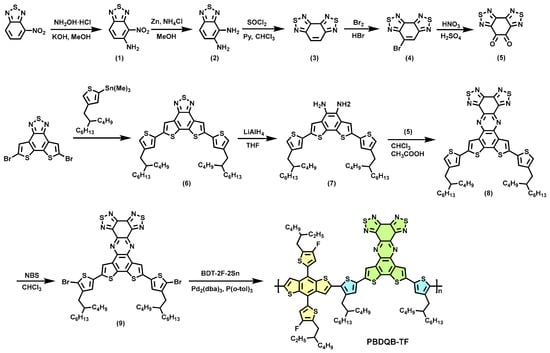
The synthetic routes of monomer precursor M1 and polymer PBDQB-TF are illustrated in Scheme 1. Detailed synthetic procedures and corresponding characterization spectra are summarized in the Supplementary Materials. High-temperature gel permeation chromatography (HT-GPC) measurements reveal that polymer PBDQB-TF possesses a number-average molecular weight (Mn) of 26.52 kDa with a polydispersity index (PDI) of 2.19. Meanwhile, polymer donor PBDQB-TF exhibits outstanding solubility in chlorobenzene and trichlorobenzene, laying a solid foundation for device fabrication via solution spin-coating. Furthermore, thermogravimetric analysis (TGA) and differential scanning calorimetry (DSC) were employed to characterize the thermal properties of PBDQB-TF, and the related test curves are presented in Figure S12. The TGA result demonstrates a 5% weight-loss temperature Td (5%) of 440 °C. A sharp endothermic melting peak appears at 205 °C in the DSC curve, which corresponds to a melting temperature (Tm). Such favorable thermal properties of polymer guarantee robust processing stability during device fabrication.
Scheme 1.
Synthetic routes of monomers and polymer PBDQB-TF.
2.2. Optical and Electrochemical Properties
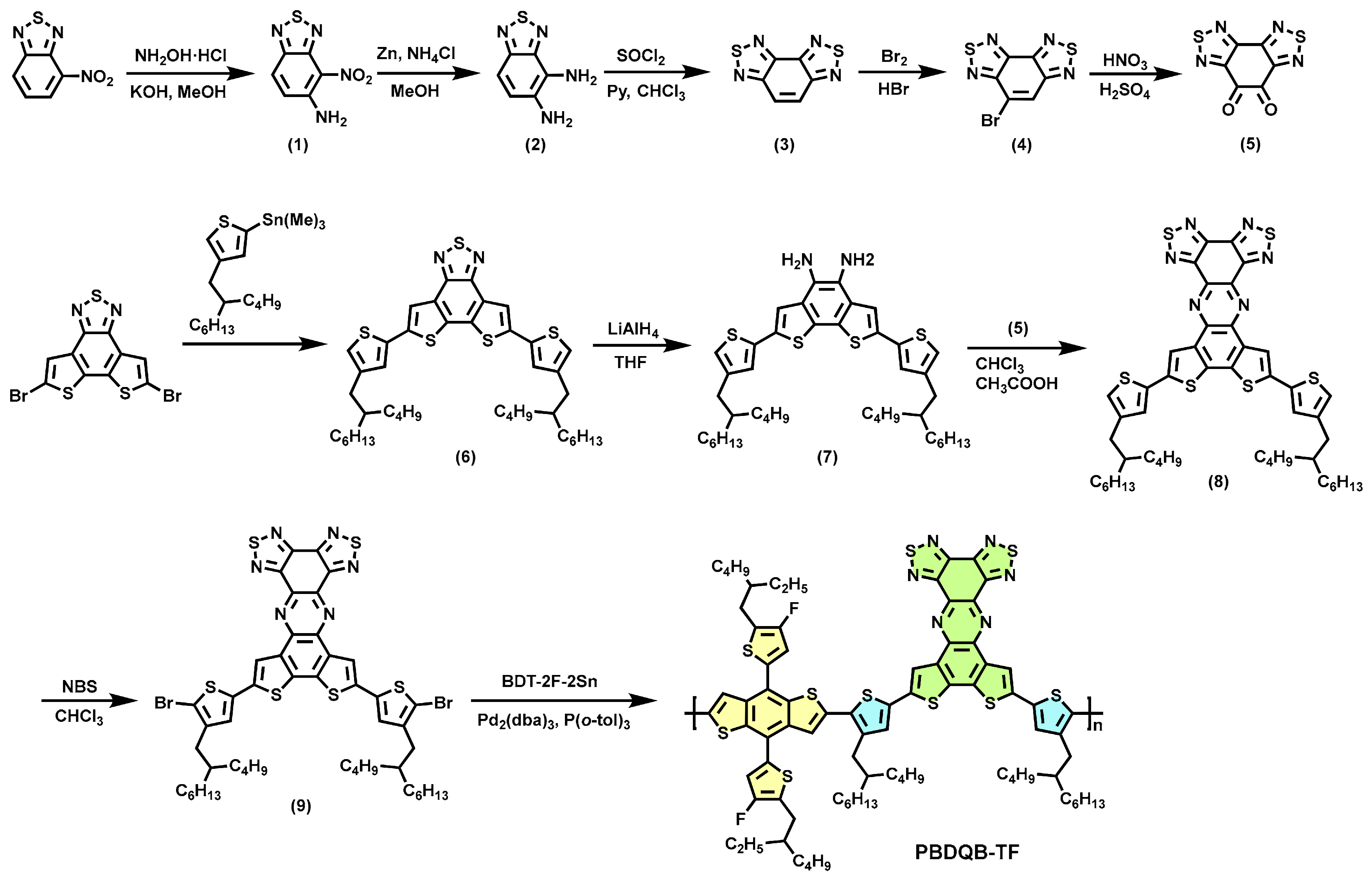
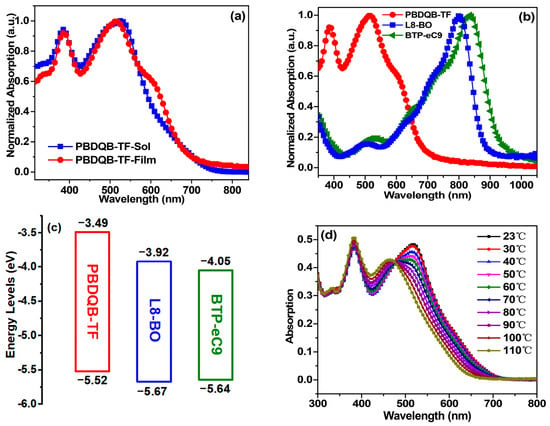
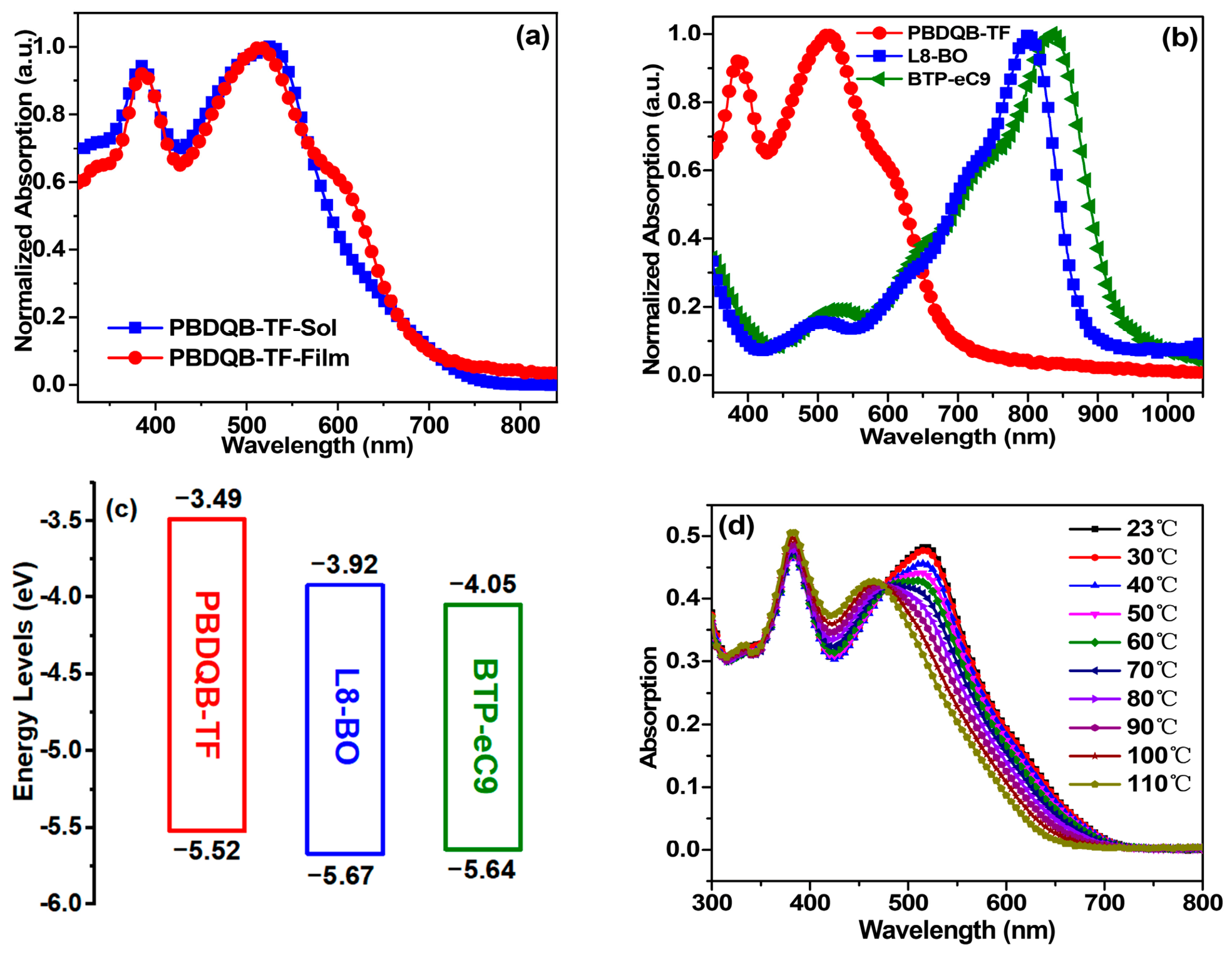
The absorption spectra of polymer donor PBDQB-TF in solution and film states, as well as L8-BO and BTP-eC9 in film states, are displayed in Figure 1a,b. The detailed optical parameters are summarized in Table 1. Figure 1a compares the absorption profiles of PBDQB-TF in solution and thin film. The absorption onset of the PBDQB-TF film corresponds to an optical bandgap of 2.03 eV, indicating its wide-bandgap characteristic. PBDQB-TF exhibits a broad absorption range from 350 nm to 750 nm in both solution and film states. Compared with its solution absorption, the PBDQB-TF film shows a distinct aggregation peak at approximately 597 nm, demonstrating the strong molecular aggregation capability of the polymer donor. The results in Figure 1b reveal that the film absorption spectra of PBDQB-TF, BTP-eC9 and L8-BO achieve excellent spectral complementarity. PBDQB-TF mainly harvests visible light in the range of 400~650 nm, while the two non-fullerene acceptors extend their absorption to the near-infrared region of 600~1000 nm. The blended active layer realizes broad-spectrum solar light utilization, which is beneficial for improving the short-circuit current density of devices. The energy levels of PBDQB-TF were measured via cyclic voltammetry (CV), and the relevant data are presented in Figure 1c and Figure S13. The HOMO and LUMO energy levels of PBDQB-TF are −5.52 eV and −3.49 eV, respectively. The deep HOMO level of PBDQB-TF endows OSC devices with a high open-circuit voltage. In addition, the LUMO energy-level offsets between the donor and acceptor are greater than 0.3 eV, providing sufficient driving force for exciton dissociation. Meanwhile, the stepwise energy-level arrangement establishes independent transport channels for holes and electrons, which effectively suppresses charge recombination.
Figure 1.
(a) The UV-Vis absorption spectra of solution and film states of PBDQB-TF; (b) the UV-Vis absorption spectra in film states; (c) the energy-level diagram of PBDQB-TF, L8-BO and BTP-eC9; and (d) the variable-temperature ultraviolet–visible absorption spectra of PBDQB-TF.
Table 1.
Optical property and energy-level data of PBDQB-TF.
Furthermore, variable-temperature ultraviolet–visible spectra were used to explore the solution aggregation behavior of PBDQB-TF, as shown in Figure 1d. As the temperature increased from 23 °C to 110 °C, the absorbance in the long-wavelength region gradually decreased, along with a continuous blue shift of the absorption peak. This indicates that the enhanced molecular thermal motion upon heating promotes the gradual disaggregation of polymer aggregates into isolated single molecular chains [40,41], confirming the favorable aggregation capability of PBDQB-TF. The solution aggregation behavior of the polymer donor could directly affect active layer morphology during the spin-coating and film-forming process, leading to efficient charge transport of the active layer.
In summary, PBDQB-TF possesses superior characteristics including a wide bandgap, deep HOMO energy level, and temperature-reversible aggregation behavior. It achieves well-matched spectral complementarity and energy-level alignment with L8-BO and BTP-eC9, making it a promising polymer donor for non-fullerene organic solar cell systems.
2.3. Theoretical Calculation
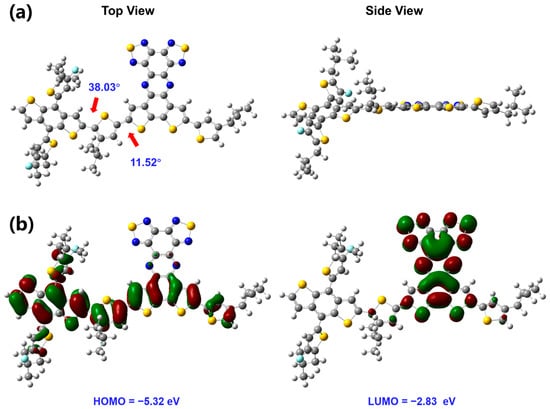
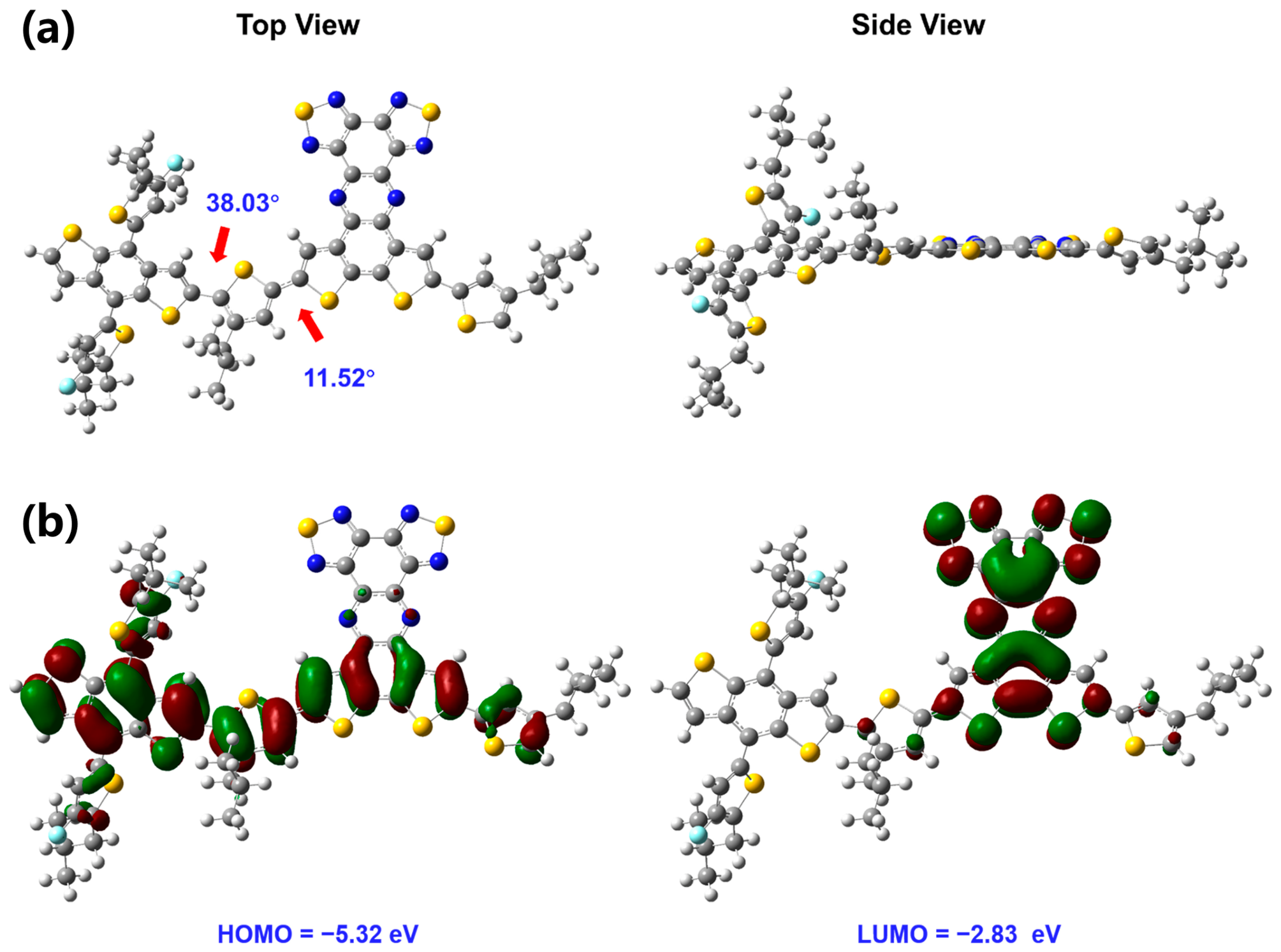
Density functional theory (DFT) calculations were carried out at the B3LYP/6-31G (d,p) level for the dimer model of PBDQB-TF to optimize molecular geometry and compute frontier molecular orbitals. The corresponding computational results are shown in Figure 2. For D-A conjugated polymers, backbone torsion angles, molecular conformations, and frontier-orbital characteristics are predominantly governed by conjugated backbone segments, while long alkyl side chains exert negligible contributions to the HOMO/LUMO orbitals. Accordingly, a dimer model with hydrogen-terminated chain ends and side chains truncated to isopropyl groups was adopted herein. It should be noted that this oligomer model serves solely for qualitative trend analysis, and the absolute computed energy-level values are not intended to quantitatively reproduce the experimentally measured electrochemical HOMO/LUMO.
Figure 2.
(a) The geometric conformation and (b) frontier molecular orbitals of the repeating unit of PBDQB-TF.
As shown in Figure 2a, the top-view molecular conformation reveals two dihedral angles of 38.03° and 11.52° between the donor side chains and conjugated backbones. The large torsional angles of side-chain segments partially disrupt molecular planarity. Nevertheless, the side-view structure demonstrates that the polymer backbone retains an ordered linear conjugated framework, which is helpful for intermolecular charge transfer. As shown in Figure 2b Frontier orbital distributions indicate that the HOMO is fully delocalized over the entire conjugated backbone, while the LUMO is mainly localized on the electron-withdrawing acceptor moiety of bis([1,2,5]thiadiazolo)[3,4-a:3′,4′-c]dithieno[3,2-h:2′,3′-j]phenazine. This classic D-A-type push–pull electronic structure effectively broadens the light absorption range of the material and greatly accelerates intramolecular charge transfer, which is consistent with the experimentally observed broad-spectrum absorption of donor polymer PBDQB-TF. The calculated energy levels of the repeating unit are EHOMO = −5.32 eV and ELUMO = −2.83 eV.
2.4. Photovoltaic Performance
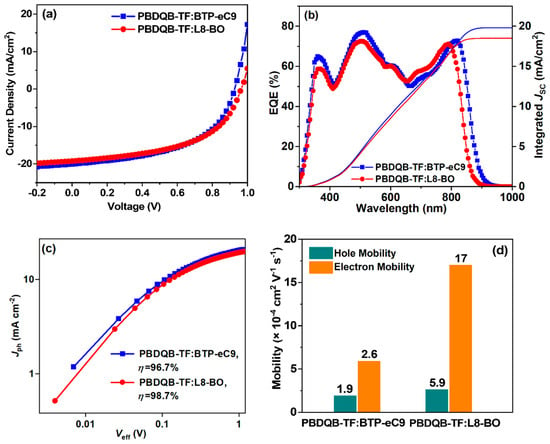
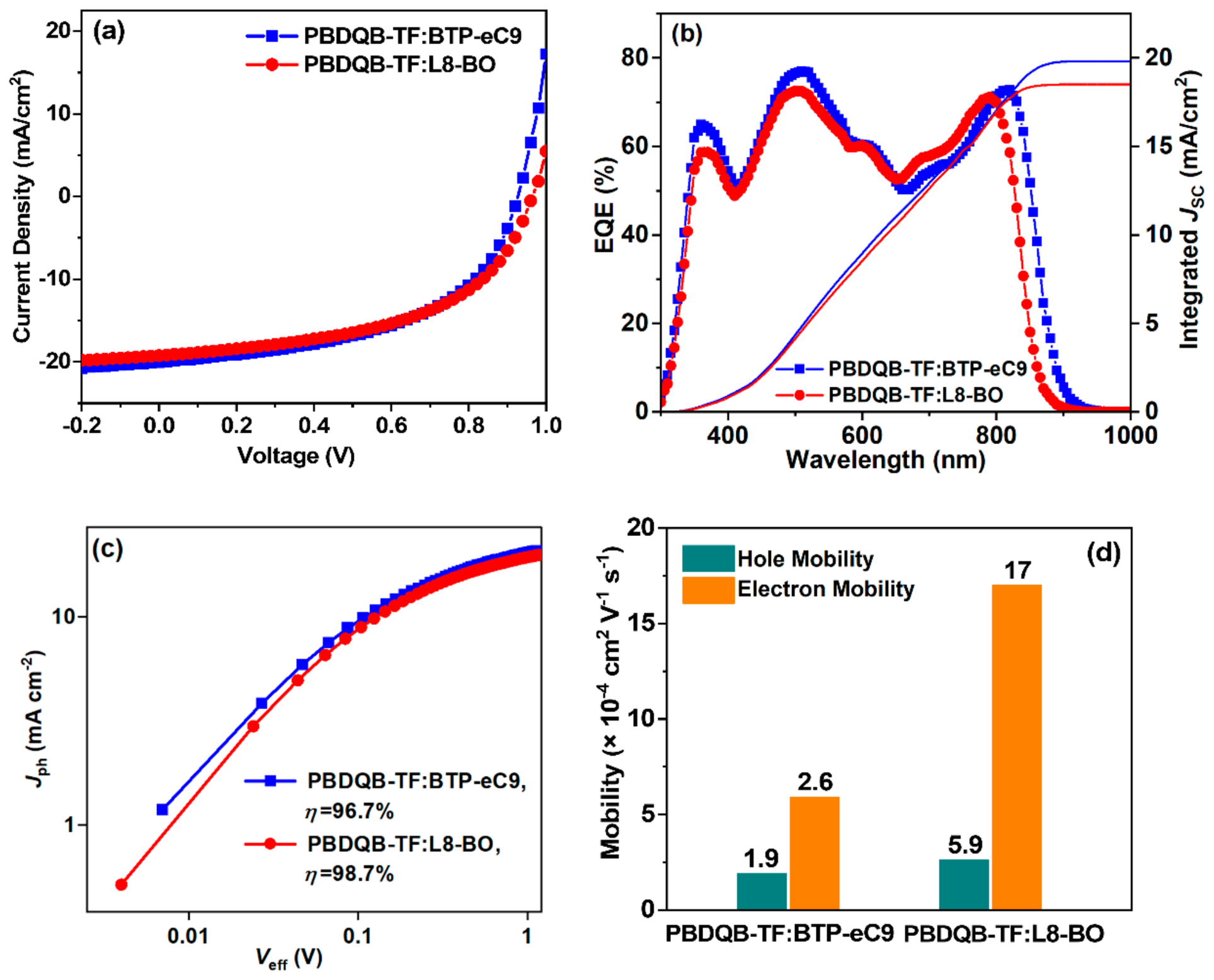
Organic solar-cell devices with the architecture of ITO/PEDOT:PSS/PBDQB-TF:BTP-eC9 or L8-BO/PNDIT-F3N/Ag were fabricated and characterized to further evaluate the photovoltaic performance of the polymer donor. The J-V curves and corresponding photovoltaic parameters of optimized PBDQB-TF:BTP-eC9 and PBDQB-TF:L8-BO devices are displayed in Figure 3a and Table 2. The PBDQB-TF:BTP-eC9-based device yields a power conversion efficiency (PCE) of 9.61%, an open-circuit voltage (VOC) of 0.927 V, a short-circuit current density (JSC) of 20.03 mA cm−2, and a fill factor (FF) of 51.80%. The PBDQB-TF:L8-BO device achieves a PCE of 9.65%, a VOC of 0.964 V, a JSC of 19.30 mA cm−2 and an FF of 52.15%. A higher VOC is obtained when PBDQB-TF is blended with L8-BO, which can be attributed to the shallower LUMO energy level and deeper HOMO energy level of L8-BO relative to BTP-eC9. The enlarged energy-level offset contributes to the prominent enhancement of open-circuit voltage. Furthermore, external quantum efficiency (EQE) measurements were carried out on both devices to investigate their light-harvesting capability, as presented in Figure 3b. The results reveal distinct photo-response behaviors for PBDQB-TF paired with different non-fullerene acceptors. The PBDQB-TF:BTP-eC9 blend exhibits stronger photo-response in the wavelength range of 300~600 nm compared with PBDQB-TF:L8-BO, which sufficiently accounts for the higher JSC achieved by the PBDQB-TF:BTP-eC9 device.
Figure 3.
(a) J-V curves, (b) EQE curves, (c) Jph versus Veff curves, and (d) hole and electron mobility histogram of PBDQB-TF:BTP-eC9- and PBDQB-TF:L8-BO- based devices.
Table 2.
Photovoltaic performance data of optimized PBDQB-TF-based devices.
In addition, exciton dissociation, charge recombination, carrier transport and bimolecular recombination processes in the two devices were characterized to deeply uncover the intrinsic working mechanism of PBDQB-TF when blended with BTP-eC9 and L8-BO. As shown in Figure 3c, the charge generation and extraction efficiency were investigated via photocurrent density (Jph) versus effective voltage (Veff) curves. The charge generation and extraction efficiency are 96.7% and 98.7% for PBDQB-TF:BTP-eC9 and PBDQB-TF:L8-BO, respectively. The hole mobility (μh) and electron mobility (μe) of both devices were characterized using the space-charge limited current (SCLC) method, with the results summarized in Figure 3d and Figure S14. The hole/electron mobilities of PBDQB-TF:BTP-eC9 and PBDQB-TF:L8-BO devices are 1.9 × 10⁻⁴/2.6 × 10−4 cm2 V−1 s−1 and 5.9 × 10⁻⁴/17 × 10−4 cm2 V−1 s−1, respectively. The corresponding μh/μe ratios are 0.32 and 0.15. According to the above data, although the PBDQB-TF:L8-BO device delivers more efficient charge generation and extraction efficiency and faster hole and electron transport, the severe imbalance between hole and electron mobilities restricts its ultimate JSC.
Moreover, the exciton and carrier recombination occurring within the active layer hinders the efficient generation and transport of charge carriers. As displayed in Figure S15a, the dependence of short-circuit current density (JSC) on incident light intensity (Plight) was characterized for both devices. Their correlation follows the power-law relationship of JSC ∝ Plight, where the α exponent reflects the extent of bimolecular recombination inside the device. An α value close to 1 indicates suppressed bimolecular recombination. The extracted α values are 1.09 and 1.11 for PBDQB-TF:BTP-eC9 and PBDQB-TF:L8-BO devices, respectively. These results demonstrate that the PBDQB-TF:BTP-eC9 device exhibits a superior ability to restrain bimolecular recombination and excessive exciton annihilation, which facilitates a higher JSC. Meanwhile, trap-assisted recombination in the two devices was further investigated. The curves of open-circuit voltage (VOC) versus light intensity are plotted in Figure S15b, from which the ideality factor (n) was calculated to be identical at 0.98 kT/q for both PBDQB-TF:BTP-eC9 and PBDQB-TF:L8-BO devices. The identical n values reveal that trap-mediated recombination behaves similarly when PBDQB-TF is blended with either BTP-eC9 or L8-BO.
2.5. Morphological Characterization
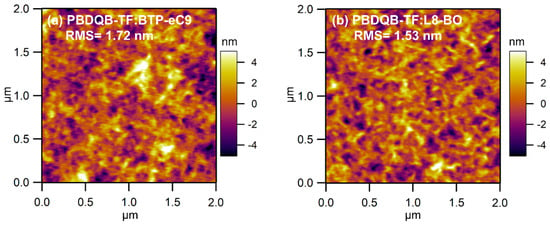
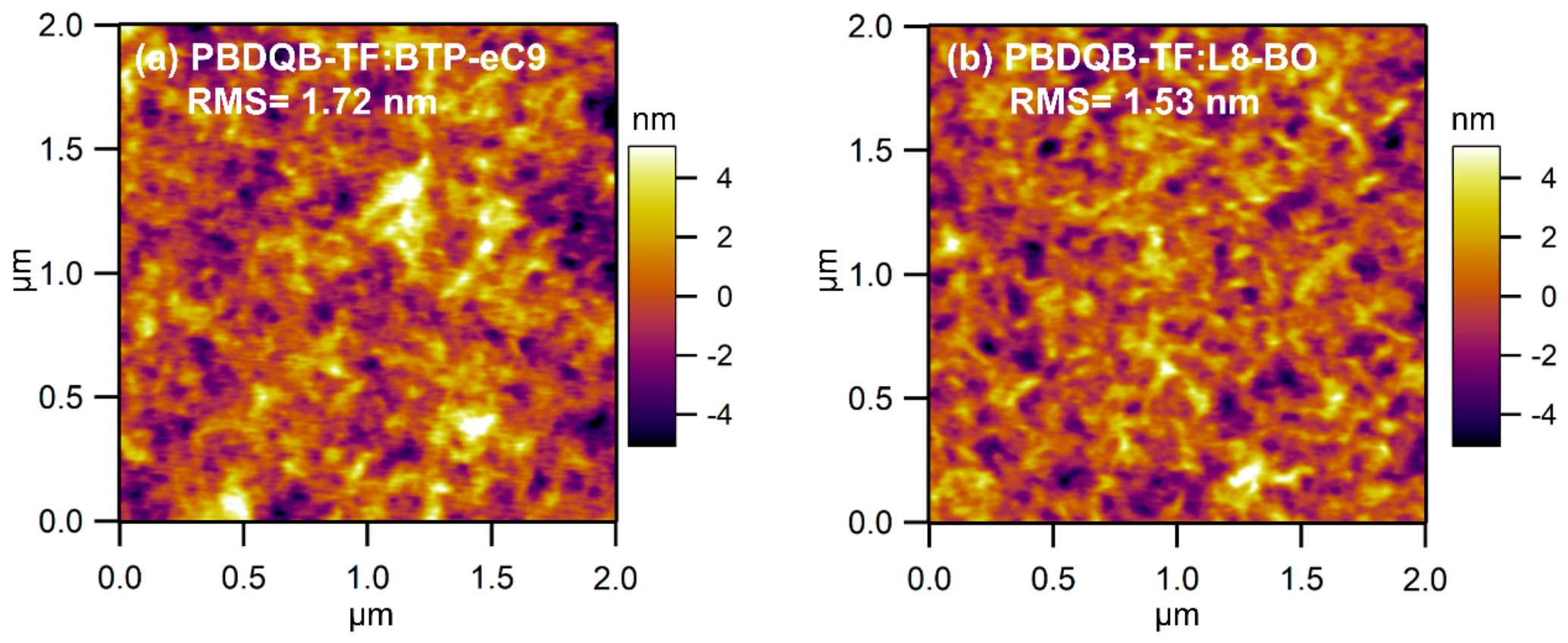
Active layer morphology serves as a bridge between intrinsic material properties and device performance, governing the fill factor and overall photovoltaic output [64]. Atomic force microscopy (AFM) was employed to characterize the film morphologies of PBDQB-TF:BTP-eC9 and PBDQB-TF:L8-BO active layers, and the corresponding AFM images are displayed in Figure 4. The root-mean-square (RMS) surface roughness of the PBDQB-TF:BTP-eC9 and PBDQB-TF:L8-BO blend films are 1.72 and 1.53 nm, respectively. The PBDQB-TF:L8-BO blend film features a relatively smooth surface. Furthermore, compared with the PBDQB-TF:BTP-eC9, the PBDQB-TF:L8-BO blend film delivers a continuous and interconnected interpenetrating network morphology. The relatively enhanced carrier mobility, fill factor and improved photovoltaic performance of PBDQB-TF:L8-BO-based devices could be attributed to the lower surface roughness and well-regulated nanoscale phase separation of the PBDQB-TF:L8-BO blend film.
Figure 4.
AFM images of (a) PBDQB-TF:BTP-eC9 and (b) PBDQB-TF:L8-BO.
3. Conclusions
In this work, a wide-bandgap donor–acceptor (D-A) polymer donor termed PBDQB-TF was rationally designed and synthesized, in which a seven-membered, fused-ring bis[1,2,5]thiadiazolo[3,4-a:3′,4′-c]dithieno[3,2-h:2′,3′-j]phenazine unit serves as the electron-withdrawing building block. The rigid fused aromatic framework of this unit strengthens molecular electron affinity and expands the conjugation plane. Benefiting from its unique structural advantages, PBDQB-TF possesses a deep-lying HOMO level, broad visible-spectrum absorption capability, and temperature-tunable aggregation characteristics. Such superior photoelectric properties enable excellent spectral matching and energy-level compatibility with mainstream non-fullerene acceptors BTP-eC9 and L8-BO. Organic photovoltaic devices based on PBDQB-TF blended with either of the two acceptors yield favorable photovoltaic performance with power conversion efficiencies approaching 10%. Specifically, the PBDQB-TF:BTP-eC9-based device achieves a prominent short-circuit current density of 20.03 mA cm−2, while the PBDQB-TF:L8-BO system exhibits a superior open-circuit voltage (0.964 V) and fill factor (52.15%). This study demonstrates the tremendous application prospect of the developed seven-membered, fused-ring electron-deficient unit and provides a feasible and instructive molecular design strategy for the exploration of high-performance polymer donor materials for organic photovoltaics.
Supplementary Materials
The following supporting information can be downloaded at: https://www.mdpi.com/article/10.3390/photochem6030033/s1, Additional experimental details and figures, including 1H NMR, MALDI-TOF-MS, CV, TGA, DSC, HT-GPC, charge mobility and the relationship curves of JSC or VOC with Plight [65].
Author Contributions
The manuscript was written with the contributions of all of the authors. M.P.: methodology, investigation, writing—original draft, writing—review and editing, and formal analysis. J.S.: investigation, formal analysis, and writing—review and editing. Y.Z.: investigation, formal analysis. C.Z. (Chentu Zhang): investigation, formal analysis. C.Z. (Cheng Zhou): conceptualization, supervision, project administration, investigation, writing—review and editing, and funding acquisition. M.P. and J.S. contributed equally to this work. All authors have read and agreed to the published version of the manuscript.
Funding
This work was financially supported by the National Natural Science Foundation of China (52303229) and Guangdong Basic and Applied Basic Research Foundation (2024A1515011732).
Institutional Review Board Statement
Not applicable.
Informed Consent Statement
Not applicable.
Data Availability Statement
The original contributions presented in this study are included in the article. Further inquiries can be directed to the corresponding authors.
Conflicts of Interest
The authors declare no conflicts of interest.
References
- Zhang, G.C.; Lin, F.R.; Qi, F.; Heumuller, T.; Distler, A.; Egelhaaf, H.-J.; Li, N.; Chow, P.C.Y.; Brabec, C.J.; Jen, A.K.Y.; et al. Renewed Prospects for Organic Photovoltaics. Chem. Rev. 2022, 122, 14180–14274. [Google Scholar] [CrossRef] [Scilit]
- Yao, H.F.; Hou, J.H. Recent Advances in Single-Junction Organic Solar Cells. Angew. Chem. Int. Ed. 2022, 61, 202209021. [Google Scholar] [CrossRef] [Scilit]
- Liu, C.-H.; Lian, Y.-C.; Song, J.-L.; Duan, X.-P.; Wang, Z.; Sun, Y.-M. A Bisphosphonic Acid-functionalized Carbazole for Dual Hydrophilic Interfaces Toward Efficient and Stable Organic Solar Cells. Chin. J. Polym. Sci. 2026, 44, 950–958. [Google Scholar] [CrossRef] [Scilit]
- Cao, Y.; Yang, X.; Wang, Y.; Chen, J.; Tang, H.; Liu, C.; Zhang, K.; Dong, S.; Cao, Y.; Huang, F. Hybrid ionic–electronic semiconductors for interface engineering of ultra-low-dark-current solution-processed SWIR photodetectors. Natl. Sci. Rev. 2026, 13, nwaf531. [Google Scholar] [CrossRef] [Scilit]
- Yang, P.; Cao, Y.; Wang, J.; Zhou, J.; Du, M.; Zheng, D. Recent Advances in Crystallographic Optimization for High-Performance Two-Dimensional Perovskite Photovoltaic Devices. Photochem 2026, 6, 1. [Google Scholar] [CrossRef] [Scilit]
- Grancharov, G.; Gergova, R.; Popkirov, G.; Dikov, H.; Sendova-Vassileva, M. Solar Cells Based on PTB7-Fx: PC71BM Active Layer Processed with Two Types of Solvent Additives and Sputtered Ag Top-Electrode. Int. J. Mol. Sci. 2026, 27, 4064. [Google Scholar] [CrossRef] [Scilit]
- Forti, G.; Pankow, R.M.; Qin, F.; Cho, Y.; Kerwin, B.; Duplessis, I.; Nitti, A.; Jeong, S.; Yang, C.; Facchetti, A.; et al. Anthradithiophene (ADT)-Based Polymerized Non-Fullerene Acceptors for All-Polymer Solar Cells. Chem.—A Eur. J. 2023, 29, e202300653. [Google Scholar] [CrossRef] [Scilit]
- Bianchi, G.; Carbonera, C.; Ciammaruchi, L.; Camaioni, N.; Negarville, N.; Tinti, F.; Forti, G.; Nitti, A.; Pasini, D.; Facchetti, A.; et al. An Anthradithiophene Donor Polymer for Organic Solar Cells with a Good Balance between Efficiency and Synthetic Accessibility. Sol. RRL 2022, 6, 2200643. [Google Scholar] [CrossRef] [Scilit]
- Hu, Y.; Wang, J.; Yan, C.; Cheng, P. The multifaceted potential applications of organic photovoltaics. Nat. Rev. Mater. 2022, 7, 836–838. [Google Scholar] [CrossRef] [Scilit]
- Zhang, J.; Chen, Q.; Li, M.; Zhang, G.; Zhang, Z.; Deng, X.; Xue, J.; Zhao, C.; Xiao, C.; Ma, W.; et al. Carboxylating Elastomer via Thiol-Ene Click Reaction to Improve Miscibility with Conjugated Polymers for Mechanically Robust Organic Solar Cells with Efficiency of 19%. Adv. Mater. 2024, 36, 2312805. [Google Scholar] [CrossRef] [Scilit]
- Lee, S.; Jeon, Y.; Lee, S.Y.; Ma, B.S.; Song, M.; Jeong, D.; Jo, J.; Kim, G.-U.; Lee, J.; Kim, T.-S.; et al. Intrinsically Stretchable Organic Solar Cells without Cracks under 40% Strain. Adv. Energy Mater. 2023, 13, 2301826. [Google Scholar] [CrossRef] [Scilit]
- Xu, T.; Deng, B.; Zheng, K.; Li, H.; Wang, Z.; Zhong, Y.; Zhang, C.; Lévêque, G.; Grandidier, B.; Bachelot, R.; et al. Boosting the Performances of Semitransparent Organic Photovoltaics via Synergetic Near-Infrared Light Management. Adv. Mater. 2024, 36, 2311305. [Google Scholar] [CrossRef] [Scilit]
- Li, M.; Memon, W.A.; Xiong, S.; Ding, Y.; Wang, Y.; Li, H.; Si, J.; Tian, L.; He, F. Unlocking photovoltaic potential: Leveraging unique diazo multimembered ring acceptors. Energy Environ. Sci. 2024, 17, 7895–7907. [Google Scholar] [CrossRef] [Scilit]
- Ding, Y.; Xiong, S.; Memon, W.A.; Zhang, D.; Wang, Z.; Li, M.; Deng, Z.; Li, H.; Shao, M.; He, F. High-Performance Intrinsically-Stretchable Organic Solar Cells Enabled by Electron Acceptors with Flexible Linkers. Angew. Chem. Int. Ed. 2025, 64, e202421430. [Google Scholar] [CrossRef] [Scilit]
- Perkhun, P.; Khodr, A.; Quiroz, Y.A.; Karahan, A.; Alkhatib, H.; Bharwal, A.K.; Duché, D.; Simon, J.-J.; Herrero, C.M.R.; Watanabe, T.; et al. High-Efficiency Thick-Film Organic Cells for Indoor Photovoltaics Printed in Air from Non-Halogenated Solvents. Energies 2026, 19, 1773. [Google Scholar] [CrossRef] [Scilit]
- Ruduss, A.; Rizkova, A.; Boudjenane, F.Z.; Praulina, E.; Traskovskis, K.; Grzibovskis, R. Synthesis and Study of Janus-Dione-Based Compounds for Ternary Organic Solar Cells. Materials 2026, 19, 533. [Google Scholar] [CrossRef] [Scilit]
- Khan, M.R.; Jarząbek, B.; Abd Majid, W.H.; Adamiak, M. Symmetry and Environmental Performance of PTB7-Th:ZY-4Cl Non-Fullerene Solar Cells: LCA, Benchmarking, and Process Optimization. Symmetry 2025, 17, 2106. [Google Scholar] [CrossRef] [Scilit]
- Lai, X.; Chen, S.; Gu, X.; Lai, H.; Wang, Y.; Zhu, Y.; Wang, H.; Qu, J.; Kyaw, A.K.K.; Xia, H.; et al. Phenanthroline-carbolong interface suppress chemical interactions with active layer enabling long-time stable organic solar cells. Nat. Commun. 2023, 14, 3571. [Google Scholar] [CrossRef] [Scilit]
- Tao, J.; Zhang, C.; Zhao, Q.; Tian, C.; Fang, J.; Tang, A.; Zhao, Y.; Qiu, D.; Zhang, H.; Bi, H.; et al. Narrow-bandgap acceptors with low energetic disorder achieve over 21% efficiency in organic solar cells. Nat. Mater. 2026, 25, 1614–1622. [Google Scholar] [CrossRef] [Scilit]
- Gu, X.; Wei, Y.; Zeng, R.; Liu, Y.; Weng, J.; Kan, L.; Zhang, Y.; Bai, X.; Liu, Z.; Zhang, J.; et al. Local Conformational Distortion Enables Ultralow Non-Radiative Recombination Energy Losses in 21%-Efficient Organic Solar Cells. Energy Environ. Sci. 2026. [Google Scholar] [CrossRef] [Scilit]
- Li, Z.; Zhou, R.; Chen, J.; Luo, X.; Liu, X.; He, Y.; Peng, F.; Zhong, W.; Ying, L. Kinetically templated fibrillar self-assembly via two-dimensional nanocrystals enables 21% efficient organic solar cells. Nat. Commun. 2026, 17, 8915. [Google Scholar] [CrossRef] [Scilit]
- Nelson, J. Polymer:fullerene bulk heterojunction solar cells. Mater. Today 2011, 14, 462–470. [Google Scholar] [CrossRef] [Scilit]
- Lu, L.Y.; Zheng, T.Y.; Wu, Q.H.; Schneider, A.M.; Zhao, D.L.; Yu, L.P. Recent Advances in Bulk Heterojunction Polymer Solar Cells. Chem. Rev. 2015, 115, 12666–12731. [Google Scholar] [CrossRef] [Scilit]
- Tu, Y.; Hong, L.; Cai, H.; Huang, Z.; Meng, Y.; Li, H.; Li, Z.; Zhu, S.; Liu, L.; Tang, H.; et al. Homologous Self-Assembled Oligomers as Dual Anode/Cathode Interface Layers for Efficient Organic Photovoltaics. ACS Appl. Mater. Interfaces 2026, 18, 16799–16811. [Google Scholar] [CrossRef] [Scilit]
- Nam, S.A.; Lee, J.; Lim, J. Enhanced Photovoltaic Performance of Ternary Small Molecule/Polymer Bulk Heterojunction Solar Cells. Micromachines 2026, 17, 97. [Google Scholar] [CrossRef] [Scilit]
- Li, S.X.; Li, C.Z.; Shi, M.M.; Chen, H.Z. New Phase for Organic Solar Cell Research: Emergence of Y-Series Electron Acceptors and Their Perspectives. ACS Energy Lett. 2020, 5, 1554–1567. [Google Scholar] [CrossRef] [Scilit]
- Lin, Y.Z.; Wang, J.Y.; Zhang, Z.G.; Bai, H.T.; Li, Y.; Zhu, D.; Zhan, X. An electron acceptor challenging fullerenes for efficient polymer solar cells. Adv. Mater. 2015, 27, 1170–1174. [Google Scholar] [CrossRef] [Scilit]
- Pu, M.; He, F. Material and Device Design for Organic Solar Cells: Towards Efficiency and Stability. Sci. China Chem. 2023, 66, 3484–3494. [Google Scholar] [CrossRef] [Scilit]
- Jarząbek, B.; Khan, M.R.; Hajduk, B.; Marcinkowski, A.; Chaber, P.; Cernescu, A.; Durmaz, Y.C. The Effect of Thermal Annealing on Optical Properties and Surface Morphology of a Polymer: Fullerene- and Non-Fullerene-Blend Films Used in Organic Solar Cells. Polymers 2026, 18, 280. [Google Scholar] [CrossRef] [Scilit]
- Bi, P.; Zhang, S.; Wang, J.; Ren, J.; Hou, J. Progress in Organic Solar Cells: Materials, Physics and Device Engineering. Chin. J. Chem. 2021, 39, 2607–2625. [Google Scholar] [CrossRef] [Scilit]
- Meredith, P.; Li, W.; Armin, A. Nonfullerene Acceptors: A Renaissance in Organic Photovoltaics? Adv. Energy Mater. 2020, 10, 2001788. [Google Scholar] [CrossRef] [Scilit]
- Yuan, J.; Zhang, Y.; Zhou, L.; Zhang, G.; Yip, H.-L.; Lau, T.-K.; Lu, X.; Zhu, C.; Peng, H.; Johnson, P.A.; et al. Single-Junction Organic Solar Cell with over 15% Efficiency Using Fused-Ring Acceptor with Electron-Deficient Core. Joule 2019, 3, 1140–1151. [Google Scholar] [CrossRef] [Scilit]
- Lai, H.; Lai, X.; Chen, Z.-Y.; Zhu, Y.; Wang, H.; Chen, H.; Tan, P.; Zhu, Y.; Zhang, Y.; He, F. Crystallography, Packing Mode, and Aggregation State of Chlorinated Isomers for Efficient Organic Solar Cells. CCS Chem. 2022, 5, 1118–1129. [Google Scholar] [CrossRef] [Scilit]
- Yao, H.F.; Wang, J.W.; Xu, Y.; Hou, J.H. Terminal Groups of Nonfullerene Acceptors: Design and Application. Chem. Mater. 2023, 35, 807–821. [Google Scholar] [CrossRef] [Scilit]
- Yuan, J.; Zou, Y. The history and development of Y6. Org. Electron. 2022, 102, 106436. [Google Scholar] [CrossRef] [Scilit]
- Xu, J.Q.; Lin, F.; Zhu, L.; Zhang, M.; Hao, T.Y.; Zhou, G.; Gao, K.; Zou, Y.; Wei, G.; Yi, Y.; et al. The Crystalline Behavior and Device Function of Nonfullerene Acceptors in Organic Solar Cells. Adv. Energy Mater. 2022, 12, 2201338. [Google Scholar] [CrossRef] [Scilit]
- Lai, H.; He, F. Crystal Engineering in Organic Photovoltaic Acceptors: A 3D Network Approach. Adv. Energy Mater. 2020, 10, 2002678. [Google Scholar] [CrossRef] [Scilit]
- Yang, Y.; Zhai, X.; Jiang, Y.; Wang, J.; Yao, C. Spectra–Stability Relationships in Organic Electron Acceptors: Excited-State Analysis. Molecules 2025, 30, 4392. [Google Scholar] [CrossRef] [Scilit]
- Cao, J.; Yi, L.; Zhang, L.; Zou, Y.; Ding, L. Wide-bandgap polymer donors for nonfullerene organic solar cells. J. Mater. Chem. A 2022, 2, 115–145. [Google Scholar] [CrossRef] [Scilit]
- Zheng, Z.; Yao, H.; Ye, L.; Xu, Y.; Zhang, S.; Hou, J. PBDB-T and its derivatives: A family of polymer donors enables over 17% efficiency in organic photovoltaics. Mater. Today 2019, 35, 115–130. [Google Scholar] [CrossRef] [Scilit]
- Hu, H.W.; Chow, P.C.Y.; Zhang, G.Y.; Ma, T.X.; Liu, J.; Yang, G.F.; Yan, H. Design of Donor Polymers with Strong Temperature-Dependent Aggregation Property for Efficient Organic Photovoltaics. Acc. Chem. Res. 2017, 50, 2519–2528. [Google Scholar] [CrossRef] [Scilit]
- An, C.; Zheng, Z.; Hou, J. Recent progress in wide bandgap conjugated polymer donors for high-performance nonfullerene organic photovoltaics. Chem. Commun. 2020, 56, 4750–4760. [Google Scholar] [CrossRef] [Scilit]
- Cui, C.; Li, Y. High-Performance Conjugated Polymer Donor Materials for Polymer Solar Cells with Narrow-Bandgap Nonfullerene Acceptors. Energy Environ. Sci. 2019, 12, 3225–3246. [Google Scholar] [CrossRef] [Scilit]
- Li, Y.F. Molecular Design of Photovoltaic Materials for Polymer Solar Cells: Toward Suitable Electronic Energy Levels and Broad Absorption. Acc. Chem. Res. 2012, 45, 723–733. [Google Scholar] [CrossRef] [Scilit]
- Yao, H.F.; Ye, L.; Zhang, H.; Li, S.S.; Zhang, S.Q.; Hou, J.H. Molecular Design of Benzodithiophene-Based Organic Photovoltaic Materials. Chem. Rev. 2016, 116, 7397–7457. [Google Scholar] [CrossRef] [Scilit]
- Ye, L.; Zhang, S.Q.; Huo, L.J.; Zhang, M.J.; Hou, J.H. Molecular Design toward Highly Efficient Photovoltaic Polymers Based on Two-Dimensional Conjugated Benzodithiophene. Acc. Chem. Res. 2014, 47, 1595–1603. [Google Scholar] [CrossRef] [Scilit]
- Chao, P.; Chen, H.; Pu, M.; Zhu, Y.; Han, L.; Zheng, N.; Zhou, J.; Chang, X.; Mo, D.; Xie, Z.; et al. Chlorinated Benzo[1,2-b:4,5-c′]dithiophene-4,8-dione Polymer Donor: A Small Atom Makes a Big Difference. Adv. Sci. 2021, 8, 2003641. [Google Scholar] [CrossRef] [Scilit]
- Hacıefendioǧlu, T.; Yildirim, E. Design Principles for the Acceptor Units in Donor–Acceptor Conjugated Polymers. ACS Omega 2022, 7, 38969–38978. [Google Scholar] [CrossRef] [Scilit]
- Pu, M.; Lai, X.; Li, Y.; Zhu, Y.; Wei, Z.; Zhu, Y.; Chen, H.; Tian, L.; He, F. Backbone Tuning Enhances the Solution Aggregation to Refine Fibrillization Network Morphology for Efficient All-Chlorinated Polymer Donor. ACS Mater. Lett. 2023, 5, 2369–2376. [Google Scholar] [CrossRef] [Scilit]
- Wang, Z.; Yang, M.; Chen, Y.; Yang, X.; Xie, B.; Duan, X.; Shen, H.; Wang, C. Distinct Piezochromic Properties of Cyanostilbene- and Cyanostyrene-Based Donor–Acceptor–Donor- and Donor–Acceptor-Structured Organic Luminogens. Photochem 2025, 5, 36. [Google Scholar] [CrossRef] [Scilit]
- Tkachenko, N.V. Effect of the Donor/Acceptor Size on the Rate of Photo-Induced Electron Transfer. Photochem 2022, 2, 918–931. [Google Scholar] [CrossRef] [Scilit]
- Poletavkina, L.A.; Dyadishchev, I.V.; Bakirov, A.V.; Svidchenko, E.A.; Surin, N.M.; Dubinets, N.O.; Balakirev, D.O.; Peregudova, S.M.; Cherkaev, G.V.; Chuyko, I.A.; et al. Donor-Acceptor Derivatives of Indolo[3,2-b]indole and Benzothieno[3,2-b]benzothiophene: Similar Annulated Structures but Divergent Properties. Molecules 2026, 31, 2046. [Google Scholar] [CrossRef] [Scilit]
- Xu, Y.; Cui, Y.; Yao, H.F.; Zhang, T.; Zhang, J.Q.; Ma, L.J.; Wang, J.W.; Wei, Z.X.; Hou, J.H. A New Conjugated Polymer that Enables the Integration of Photovoltaic and Light-Emitting Functions in One Device. Adv. Mater. 2021, 33, 2101090. [Google Scholar] [CrossRef] [Scilit]
- Liu, Q.S.; Jiang, Y.F.; Jin, K.; Qin, J.Q.; Xu, J.G.; Li, W.T.; Xiong, J.; Liu, J.F.; Xiao, Z.; Sun, K.; et al. 18% Efficiency organic solar cells. Sci. Bull. 2020, 65, 272–275. [Google Scholar] [CrossRef] [Scilit]
- Qin, J.Q.; Zhang, L.X.; Zuo, C.T.; Xiao, Z.; Yuan, Y.B.; Yang, S.; Hao, F.; Cheng, M.; Sun, K.; Bao, Q.Y.; et al. A chlorinated copolymer donor demonstrates a 18.13% power conversion efficiency. J. Semicond. 2020, 42, 010501. [Google Scholar] [CrossRef] [Scilit]
- Song, W.; Yu, K.; Zhou, E.; Xie, L.; Hong, L.; Ge, J.; Zhang, J.; Zhang, X.; Peng, R.; Ge, Z. Crumple Durable Ultraflexible Organic Solar Cells with an Excellent Power-per-Weight Performance. Adv. Funct. Mater. 2021, 31, 2102694. [Google Scholar] [CrossRef] [Scilit]
- Zhao, T.X.; Wang, H.; Pu, M.R.; Lai, H.J.; Chen, H.; Zhu, Y.L.; Zheng, N.; He, F. Tuning the Molecular Weight of Chlorine-Substituted Polymer Donors for Small Energy Loss. Chin. J. Chem. 2021, 39, 1651–1658. [Google Scholar] [CrossRef] [Scilit]
- Tong, Y.; Xiao, Z.; Du, X.; Zuo, C.; Li, Y.; Lv, M.; Yuan, Y.; Yi, C.; Hao, F.; Hua, Y.; et al. Progress of the key materials for organic solar cells. Sci. China Chem. 2020, 50, 437–446. [Google Scholar] [CrossRef] [Scilit]
- Duan, C.; Ding, L. The new era for organic solar cells: Polymer donors. Sci. Bull. 2020, 65, 1422–1424. [Google Scholar] [CrossRef] [Scilit]
- Wang, Z.; Wang, X.; Tu, L.; Wang, H.; Du, M.; Dai, T.; Guo, Q.; Shi, Y.; Zhou, E. Dithienoquinoxalineimide-based Polymer Donor Enables All-Polymer Solar Cells over 19% Efficiency. Angew. Chem. Int. Ed. 2024, 63, 202319755. [Google Scholar] [CrossRef] [Scilit]
- Zhao, L.; Li, W.; Qin, H.; Yi, X.; Zeng, W.; Zhao, Y.; Chen, H. Electron-Transporting Conjugated Polymers from Novel Aromatic Five-Membered Diimides: Naphtho[1,2-b:4,3-b′]-dithiophene and -Diselenophene Diimides. Macromolecules 2023, 56, 2990–3003. [Google Scholar] [CrossRef] [Scilit]
- Zhou, Y.; Liu, S.; Wu, H.; Su, J.; Wang, W.; Xue, Z.; Ding, K.; Wang, L.; Lu, G.; Zhao, B.; et al. Photovoltaic performances of two alternating polymers having meta-octyloxy-phenyl modified dithieno[3,2-f:2′,3′-h]quinoxaline unit. Dye. Pigm. 2023, 211, 111049. [Google Scholar] [CrossRef] [Scilit]
- Pu, M.; Lai, X.; Chen, H.; Cao, C.; Wei, Z.; Zhu, Y.; Tian, L.; He, F. Superior aggregation, morphology and photovoltaic performance enabled by fine tuning of fused electron-deficient units in polymer donors. J. Energy Chem. 2022, 77, 19–26. [Google Scholar] [CrossRef] [Scilit]
- Zhu, L.; Zhang, M.; Zhong, W.K.; Leng, S.F.; Zhou, G.; Zou, Y.; Su, X.; Ding, H.; Gu, P.; Liu, F.; et al. Progress and prospects of the morphology of non-fullerene acceptor based high-efficiency organic solar cells. Energy Environ. Sci. 2021, 14, 4341–4357. [Google Scholar] [CrossRef] [Scilit]
- Zhang, M.J.; Guo, X.; Ma, W.; Ade, H.; Hou, J. A Large-Bandgap Conjugated Polymer for Versa-tile Photovoltaic Applications with High Performance. Adv. Mater. 2015, 27, 4655–4660. [Google Scholar] [CrossRef] [Scilit]

Disclaimer/Publisher’s Note: The statements, opinions and data contained in all publications are solely those of the individual author(s) and contributor(s) and not of MDPI and/or the editor(s). MDPI and/or the editor(s) disclaim responsibility for any injury to people or property resulting from any ideas, methods, instructions or products referred to in the content. |
© 2026 by the authors. Licensee MDPI, Basel, Switzerland. This article is an open access article distributed under the terms and conditions of the Creative Commons Attribution (CC BY) license.