


Abstract
Online apparel size recommendation remains difficult because consumers cannot physically assess garment fit before purchase. It is a multi-dimensional fit evaluation problem, particularly for complex garments such as jackets, where multiple body areas jointly influence perceived fit. Existing methods often rely on limited anthropometric measures, heuristic rules, or behavioral data, restricting both accuracy and interpretability. To address this issue, this study proposes an interpretable multi-dimensional fit evaluation framework based on garment ease theory. The framework defines ideal ease as the target fit condition and quantifies deviations through a segment-based weighting mechanism. Section-level mappings between body and garment measurements are established, and differentiated penalties are assigned according to the semantic fit interval of each body area. Section-specific evaluations are aggregated into an overall fit score (OFS) for candidate size ranking and Top-K recommendation, while also providing detailed fit feedback. Experiments involving 270 female participants and two jacket styles show high recommendation accuracy, achieving Top-3 accuracies of 99.6% for the regular-fit jacket and 98.9% for the tight-fit jacket. Compared with traditional heuristic methods, the proposed approach demonstrates clear advantages in both performance and interpretability, offering a practical solution that balances accuracy, transparency, and deployability.
1. Introduction
The rapid expansion of online apparel retail has substantially reshaped consumer purchasing behavior, yet accurate size selection remains a persistent challenge [1,2,3,4]. In the absence of physical try-on, consumers must rely primarily on size charts and product descriptions, which often provide insufficient information for a comprehensive assessment of garment fit [5]. In essence, garment fit is a multi-dimensional compatibility problem arising from the interaction between body measurements and garment structural parameters. Inaccurate size selection frequently results in poor fit and high return rates, generating considerable economic and environmental costs for retailers while undermining consumer confidence in online shopping [6,7,8,9,10,11,12].
This challenge is particularly pronounced for structured garments such as jackets. Unlike simple garments that can often be approximated by a single girth-related measurement, jacket fit depends on the simultaneous compatibility of multiple dimensions, including bust girth, waist girth, shoulder width, and garment length. These dimensions jointly determine both physical comfort and visual proportion. A size that appears appropriate in one dimension may still perform poorly in another, which highlights the inherently multi-dimensional nature of jacket fit evaluation. Therefore, effective size recommendations for jackets should systematically integrate multiple body measurements rather than rely on isolated dimensional matching.
To address the broader problem of online size selection, a variety of recommendation approaches have been developed. The simplest and most widely adopted strategy matches one or two body measurements, typically bust girth and height, to the corresponding values in a brand’s size chart [13,14,15]. This heuristic size recommendation method remains prevalent across e-commerce platforms because it is easy to implement and requires minimal user input. However, its underlying simplification severely limits its effectiveness. By neglecting dimensions such as shoulder width and waist girth, such systems may produce recommendations that are acceptable in terms of bust girth but unsatisfactory at other critical fit points. As a result, consumers may receive garments that are too tight in the shoulders or too loose at the waist.
More advanced methods have been proposed to alleviate these limitations. Some platforms employ detailed questionnaires that collect multiple body measurements together with demographic information, body shape descriptors, style preferences, and prior brand experiences [15,16,17,18]. Others use historical purchase records to infer size preferences from past consumer behavior [19,20,21,22]. A third group of approaches relies on computer vision or three-dimensional body scanning, enabling body dimensions to be estimated from images or digital body models [23,24,25]. These approaches improve either the richness of input information or the precision of body measurement acquisition. Nevertheless, most existing methods still formulate size recommendations primarily as a predictive task aimed at identifying a single optimal size. They rarely model the structural compatibility between body measurements and garment dimensions in an explicit and systematic manner. In addition, their decision processes often remain insufficiently transparent, making it difficult for consumers to understand how specific body dimensions affect the final recommendation. Consequently, users are given little information about section-specific fit deviations, such as whether a garment is likely to be tight at the shoulders or loose at the waist.
The assumption that there is always a single objectively optimal size is also inconsistent with the subjective nature of garment fit. The same consumer may prefer different sizes across garment styles depending on how the clothing is intended to be worn, and even within the same style, more than one size may be acceptable depending on individual preference rather than objective correctness [26,27]. This issue is especially relevant in online shopping contexts, where consumers often make size decisions under uncertainty and may value a ranked set of interpretable alternatives more than a single deterministic output.
To address this gap, we propose an interpretable fit-oriented evaluation framework that reconceptualizes apparel size recommendation as a structured multi-dimensional fit assessment problem rather than a purely predictive matching task. Instead of attempting to identify a single “correct” size, the proposed framework quantitatively evaluates the compatibility between body measurements and garment dimensions across multiple key fit areas. By modeling fit performance at the sectional level and aggregating these local assessments into an overall fit score (OFS), the framework enables ranked size recommendations while preserving interpretability. Specifically, the framework introduces the concept of ideal ease to establish a quantitative mapping between body dimensions and garment measurements. A segment-based weighting mechanism is further designed to capture the non-linear influence of dimensional deviations on perceived fit quality. Sectional fit errors are then integrated into an OFS, which serves as the basis for ranking multiple candidate sizes. In this way, consumers receive not only size recommendations but also explicit feedback on potential tightness or looseness in specific garment regions.
The main contribution of this study is threefold. First, we formulate online apparel size recommendation as a structured fit evaluation problem and propose a multi-dimensional scoring framework that explicitly models the relationship between body measurements, garment dimensions, and style-dependent fit targets. Second, we introduce an interpretable mechanism based on ideal ease and segment-wise weighting, which allows the system to reflect non-linear fit perception while preserving transparency at the sectional level. Third, we construct a ranking-based recommendation strategy that supports Top-K outputs rather than a single deterministic prediction, thereby offering more practical decision support for consumers with heterogeneous fit preferences. The effectiveness of the proposed framework is evaluated using real try-on data collected from 270 female participants and two jacket styles, with analyses focusing on recommendation accuracy, ranking performance, interpretability, and robustness.
2. Related Works
Apparel size recommendation has been widely studied in both academic research and industrial practice. Existing methods differ in data source and modeling strategy, but most still formulate size selection primarily as a matching or prediction task aimed at identifying a single optimal size. In contrast, garment fit is inherently a structured multi-dimensional compatibility problem involving the interaction between body measurements and garment dimensions. This section reviews prior work from the perspectives of measurement-based recommendation, data-driven prediction, and fit-oriented evaluation.
2.1. Measurement-Based Size Recommendation
Measurement-based approaches remain the most widely used strategy in online apparel retail because they are easy to implement and require relatively limited user input. These methods typically match anthropometric measurements, such as bust girth, waist girth, hip girth, height, or shoulder width, against standardized size charts or predefined rules [10,13]. Some studies further incorporate theoretical ease allowances to account for comfort and movement requirements [27,28]. To improve size assignment, several studies have refined the representation of body measurements through statistical or predictive modeling [28,29]. Other work has applied regression or neural-network models to estimate garment dimensions or sizes from a limited set of body measurements [30,31,32,33]. Despite these developments, most measurement-based systems still focus on size assignment or dimensional prediction rather than explicit modeling of fit compatibility across multiple garment regions. As a result, they often return a single recommended size without explaining sectional fit differences or ranking multiple acceptable alternatives.
2.2. Data-Driven and Machine Learning Approaches
With the expansion of e-commerce, data-driven methods have become increasingly important. These approaches typically use purchase records, return behavior, user profiles, or other behavioral signals to infer suitable sizes through Bayesian models, collaborative filtering, embedding methods, and machine learning architectures [15,16,18,19,20,21,33]. In large-scale retail settings, such models can capture latent relationships among users, products, and fit outcomes more effectively than simple rule-based systems [19]. Other studies extended predictive inputs beyond historical behavior [34,35,36]. Although these methods often improve predictive performance, they also have clear limitations. Many depend heavily on large-scale transaction data and are therefore affected by cold-start issues. In addition, they are typically optimized for prediction rather than explanation, which limits transparency from the consumer’s perspective. Most importantly, they still tend to produce a single optimal size output, even though an acceptable fit may reasonably span multiple neighboring sizes depending on style and personal preference.
2.3. Fit Evaluation and Multi-Dimensional Modeling
A smaller body of research has examined garment fit as a structured evaluation problem rather than a direct prediction task. In apparel engineering and patternmaking theory, ease allowance is widely recognized as a core determinant of fit, reflecting the dimensional difference between garment measurements and body measurements at specific fit points [37,38,39,40]. These studies emphasize that fit depends not only on absolute body or garment dimensions, but also on how ease is distributed relative to intended style and comfort requirements. However, ease theory has rarely been translated into an explicit computational framework for online size recommendation. Existing studies often discuss ease in descriptive or design-oriented terms, but do not formally model deviation from a target ease condition as a ranking or optimization problem. Moreover, the relative importance of different body areas is seldom represented through explicit weighting mechanisms. Some multi-criteria decision approaches have acknowledged the multi-dimensional nature of fit. For example, Li et al. [41] proposed an objective multi-criteria model for protective clothing size selection using criteria importance through inter-criteria correlation (CRITIC) weighting. Nevertheless, such work is typically developed for specialized clothing contexts and does not provide sectional interpretability or ranking-based recommendation output for online retail settings.
Overall, existing studies tend to address isolated aspects of the problem, such as anthropometric classification, size prediction, ease allowance, or satisfaction modeling, instead of integrating them into a unified computational framework for interpretable multi-dimensional fit evaluation. These limitations point to the need for a framework that reconceptualizes size recommendation as a multi-dimensional fit evaluation problem. Such a framework should explicitly model deviation from an ideal ease reference, allow weighted aggregation across body regions, and generate interpretable ranking-based size recommendations.
3. Methodology
The proposed multi-dimensional fit evaluation framework is grounded in garment ease theory and reformulates size selection as a structured fit assessment problem, rather than a direct classification task. Instead of predicting a single size label, the method evaluates the compatibility between an individual’s body measurements and the garment dimensions of all candidate sizes across multiple key fit points. Local deviations are quantified with respect to a style-dependent reference condition and then aggregated into an OFS for ranking-based recommendation. The entire framework consists of four main components: garment ease modeling, ideal ease definition, piecewise fit deviation evaluation, and OFS aggregation.
3.1. Theoretical Basis: Garment Ease and Style-Dependent Fit
In this study, the concept of garment ease, defined as the dimensional difference between a garment and the corresponding body measurement at a given fit point, serves as the theoretical basis for fit evaluation by comparing actual garment ease with style-dependent ideal ease targets [42,43,44]. In apparel engineering, this relationship is commonly described by garment ease, defined as the dimensional difference between garment measurements and the corresponding body measurements [37,38]. Ease allowance plays a central role in size development and patternmaking because it influences both physiological comfort and visual proportion. Classical studies generally distinguish among standard ease, dynamic ease, and fabric ease [40,45]. Standard ease refers to the minimum allowance required for basic activities such as breathing and standing [46], while dynamic and fabric ease account for movement requirements and material properties. In practical pattern development, ease may also involve additional components related to material thickness, fabric contraction, fit requirements, and technological or manufacturing considerations. These factors are important in garment construction; however, they are not explicitly parameterized as separate ease categories in the present study. Instead, their combined effects are assumed to be implicitly embodied in the finished-garment measurements used in the subsequent fit evaluation.
Theoretical ease ranges provide qualitative references for judging fit states, such as too tight, tight, just fit, loose, and too loose [39,47]. These ranges are useful in patternmaking practice, but they do not necessarily correspond to the optimal fit target for a specific garment style. For example, a regular-fit jacket and a tight-fit jacket may both satisfy general ease requirements while differing substantially in their preferred fit conditions. Therefore, theoretical ease alone is insufficient for personalized size evaluation in online retail. To address this limitation, the proposed framework introduces ideal ease, which serves as a style-dependent target condition embedded within the broader theoretical ease space.
In the proposed framework, garment measurements refer to finished-garment specification measurements used for fit-related evaluation, rather than arbitrary exterior contour dimensions in a purely geometric sense. For structured garments such as women’s jackets, these measurements may be influenced by silhouette design, material thickness, and local layered construction in specific product areas. In the present study, such factors are not explicitly modeled as separate physical variables. Instead, their combined effects are treated as being implicitly reflected in the finished-garment measurements and in the style-dependent ideal ease targets used for subsequent fit assessment.
Table 1 summarizes literature-based ease reference intervals used only for the initial segmentation of the ease domain. These values are not intended to represent universally standardized garment ease allowances or direct recommendation rules. The final segment boundaries for each jacket were further adjusted according to garment style and calibrated through the pilot study (Section 4.1.2).
Table 1.
Literature-based ease reference intervals used for initial segmentation (unit: cm).
3.2. Framework Overview
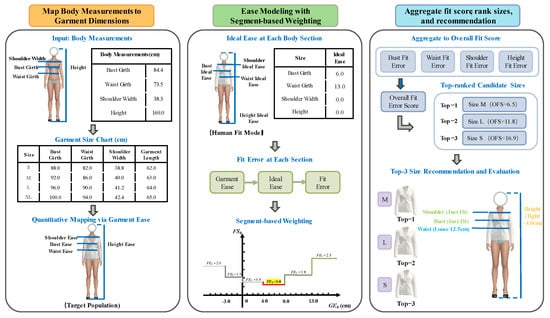
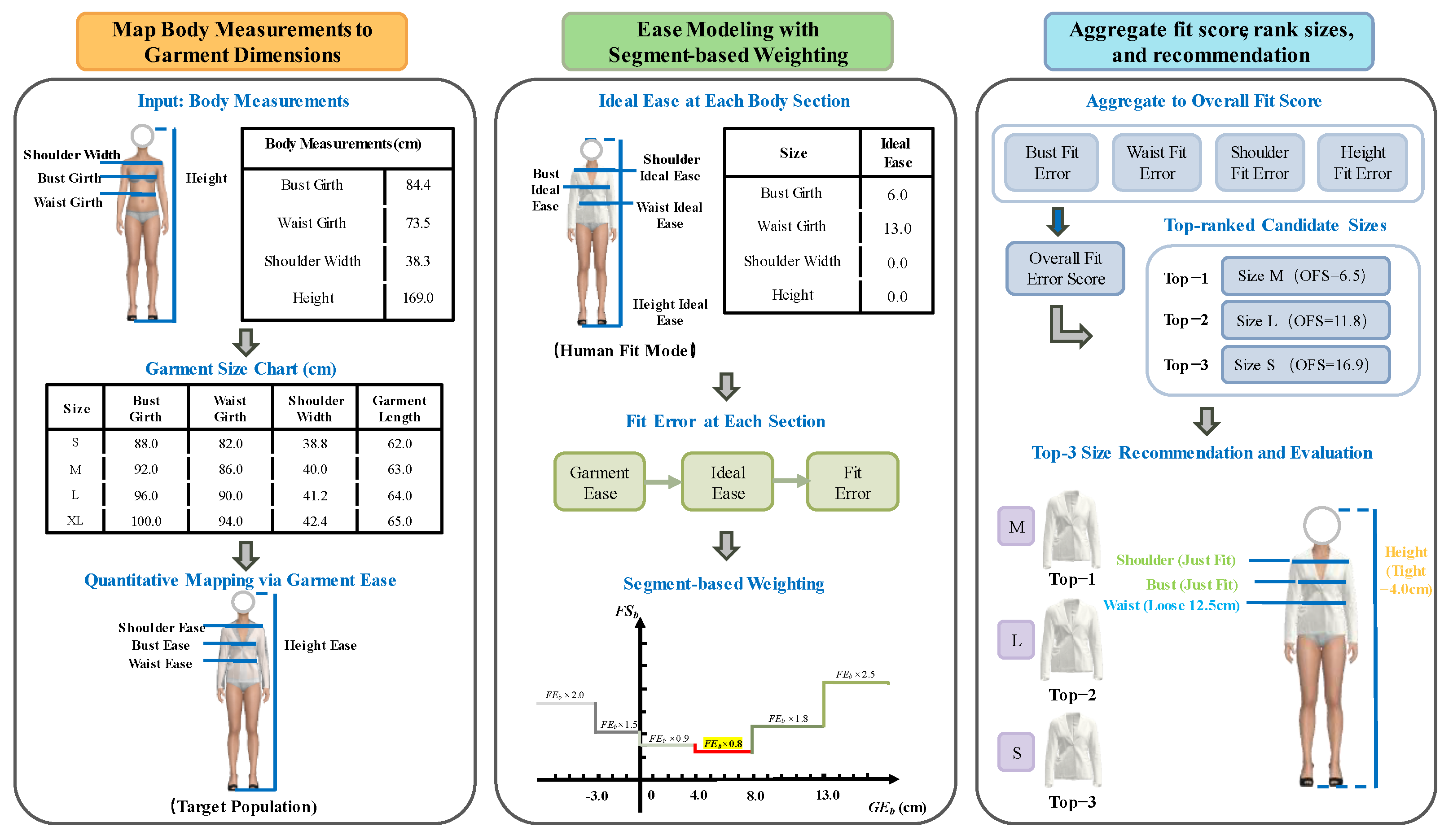
The proposed framework conceptualizes garment size recommendation as a multi-dimensional fit evaluation problem. Rather than identifying a single “correct” size through direct matching, it evaluates the structural compatibility between body measurements and garment dimensions across multiple fit points and ranks all candidate sizes accordingly. As illustrated in Figure 1, the framework consists of three sequential stages: (1) body-garment mapping, in which user measurements are aligned with garment measurements at key fit points; (2) fit deviation evaluation, in which the deviation between actual garment ease and style-dependent ideal ease is quantified; and (3) size ranking, in which local fit deviations are aggregated into an OFS for all candidate sizes.
Figure 1.
Framework of the proposed interpretable garment size recommendation method based on garment ease and ideal ease.
A key distinction between the proposed framework and conventional measurement-matching approaches lies in the role of the reference condition. Traditional methods often compare body measurements directly with garment dimensions or size-chart thresholds, without evaluating whether the resulting ease corresponds to an optimal fit state for a given style. In contrast, the present framework defines fit quality by the proximity between actual garment ease and ideal ease. This formulation transforms size recommendation from a threshold-based matching problem into a deviation-minimization and ranking problem, while preserving interpretability at the sectional level.
3.3. Body-Garment Mapping and Garment Ease Calculation
To quantify fit compatibility, a mapping is first established between body measurements and garment measurements at each relevant fit point. Let I denote the set of fit points considered in the recommendation task. In this study, the key dimensions include bust girth, waist girth, shoulder width, and a length-related body reference derived from height. For each fit point , let denote the body measurement of the wearer, and let denote the garment measurement at fit point i for candidate size k, where and K is the set of available garment sizes.
The body-garment correspondence can therefore be represented as:
Based on this correspondence, garment ease at fit point i for size k is defined as:
where represents the dimensional allowance between the garment and the corresponding body dimension. A positive value indicates that the garment dimension exceeds the body measurement, whereas a negative value indicates insufficient allowance. Since the present study focuses primarily on structured women’s jackets, fabric elasticity is not explicitly considered in the current evaluation framework.
For most circumferential and linear fit points, this formulation is directly applicable. Garment length, however, is evaluated differently: body height is used as a body-side reference index within the adopted size-chart framework to establish correspondence between body size and garment specification, following common apparel sizing conventions [48,49]. In this context, height is not treated as a direct anatomical length comparable to garment length, but as an indirect reference for assessing whether the garment length is appropriate for the corresponding body size range.
Garment ease provides the quantitative basis for evaluating whether a specific size is physically and visually compatible with the wearer. However, garment ease alone does not indicate whether the resulting allowance is optimal for a given garment style. For this reason, a style-dependent target condition is introduced in the next subsection.
3.4. Ideal Ease and Fit Error Modeling
3.4.1. Definition of Ideal Ease
The proposed framework introduces ideal ease as the target allowance associated with a specific garment style. Unlike raw garment ease, which simply describes the dimensional difference between a garment and a wearer, ideal ease reflects the preferred fit condition implied by the correspondence between the human fit model and the garment fit model embedded in the size chart.
For each fit point i, ideal ease is defined as:
where denotes the body measurement of the human fit model underlying the size chart, and denotes the corresponding garment measurement of the garment fit model. Thus, captures the style-dependent target allowance at fit point i.
This definition is important because fit quality is not determined by the magnitude of garment ease alone. A larger ease value is not always better, and a smaller ease value is not always worse. Instead, the most appropriate fit is achieved when the actual garment ease approximates the style-specific target condition.
3.4.2. Fit Error
To measure the deviation between actual garment ease and the target condition, a fit error term is introduced. For candidate size k at fit point i, the fit error is defined as:
The absolute difference is used to reflect the assumption that both insufficient ease and excessive ease represent deviations from the optimal fit state. A smaller value of therefore indicates better agreement between the candidate size and the ideal fit condition at fit point i.
With the introduction of fit error, the recommendation framework moves from direct comparison of garment dimensions to minimizing the absolute deviation between actual garment ease and style-dependent ideal ease. This provides a more meaningful quantitative descriptor of fit quality than garment ease alone.
3.5. Piecewise Fit Evaluation
3.5.1. Ease Segmentation
Although fit error captures the distance between actual and ideal ease, the perceptual impact of this deviation is not uniform across the entire ease domain. The same numerical deviation may be perceived differently depending on whether it occurs near an optimal fit zone or within an extremely tight or loose interval. In addition, different fit points may contribute unequally to overall size perception. To capture these characteristics, the garment ease domain for each fit point is partitioned into a set of predefined segments:
where denotes the jth ease interval for fit point i, and ni is the total number of segments defined for that dimension. The segmentation boundaries are constructed with reference to theoretical ease ranges, the position of , and the fit characteristics of the target garment style.
3.5.2. Segment-Based Weighting
For each segment , a weighting coefficient is assigned to reflect the severity of deviation within that interval. The sectional fit score for fit point i and candidate size k is then defined as:
The weighting coefficients follow three principles. First, the segment containing or closest to receives the smallest weight. Second, weights increase progressively as segments move farther away from the ideal ease region. Third, extreme tight or loose intervals are assigned larger penalties to reflect their greater negative impact on fit perception.
This piecewise design enables the framework to capture the non-linear relationship between dimensional deviation and perceived fit quality. It also provides a direct basis for interpretable fit labels, since each candidate size can be associated with both a numerical fit score and a semantic fit interval.
3.6. OFS and Size Ranking
To evaluate the suitability of each candidate size comprehensively, the sectional fit scores across all fit points are aggregated into an OFS. For candidate size k, the OFS is defined as:
A smaller value of indicates better overall compatibility between the candidate size and the individual’s body measurements. All candidate sizes are ranked in ascending order of , and the top-ranked sizes are returned as the recommendation set. In this study, the top three sizes are reported in order to provide users with both a best match and nearby alternatives that may better reflect subjective preferences for tighter or looser wearing styles.
This ranking-based formulation is particularly suitable for apparel recommendation because fit is not always a single-solution problem. Neighboring sizes may all be acceptable under different wearing preferences, and a ranked output provides more practical decision support than a single deterministic label.
3.7. Interpretable Fit Output
Beyond size ranking, the proposed framework provides an interpretable description of fit at the sectional level. For each recommended size, the following information can be reported for each fit point: (1) actual garment ease , (2) ideal ease , (3) fit error , and (4) the corresponding ease segment . These outputs allow the recommendation result to be translated into intuitive fit interpretations. If is lower than , the garment is relatively tighter than the target condition at fit point i; if is close to , the fit is near optimal; if exceeds , the garment is relatively looser than the target condition. Because the segment-based weighting mechanism is explicitly linked to semantic fit intervals, the system can further generate qualitative labels such as tight, just fit, or loose for each body region. This interpretability mechanism distinguishes the proposed method from opaque recommendation models that output only a size label. By exposing region-specific fit conditions, the framework supports more informed consumer decision-making and provides a transparent basis for understanding why one size is ranked above another.
Taken together, the proposed framework converts apparel size recommendation into a multi-dimensional fit evaluation problem grounded in garment ease theory. By combining body-garment mapping, style-dependent ideal ease, piecewise deviation weighting, and OFS aggregation, the framework produces ranking-based recommendations that are both quantitative and interpretable. This methodological structure also provides a clear basis for subsequent parameter calibration, ablation analysis, and robustness evaluation, which are presented in the following sections.
4. Experimental Verification
4.1. Experimental Setup
4.1.1. Data Preparation
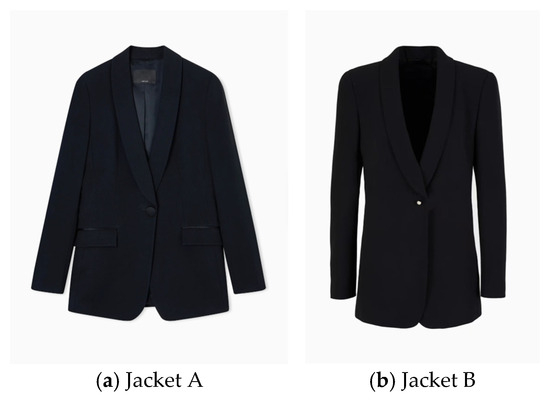
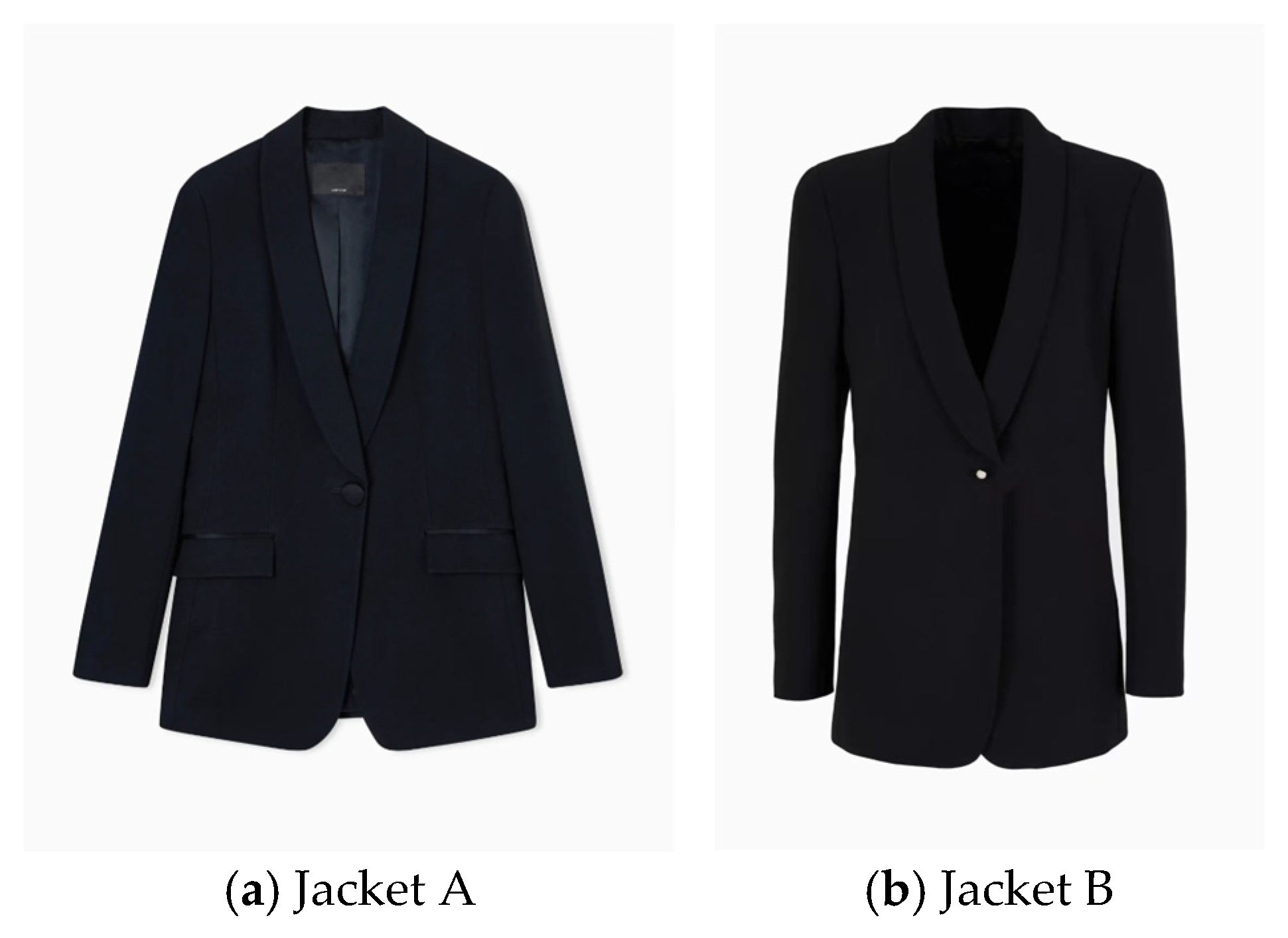
To validate the effectiveness of the proposed size recommendation framework, two female jackets with different fit characteristics were selected as test garments. The first garment was a regular-fit jacket (Jacket A), available in nine sizes ranging from XS to 5XL. The second garment was a tight-fit jacket (Jacket B), available in seven sizes ranging from S to 4XL. The two jackets differed in style, sizing structure, and ease distribution, as shown in Figure 2, providing an appropriate basis for examining whether the proposed framework remains effective across different garment-fit conditions.
Figure 2.
Two jackets used in this study: Jacket A and Jacket B.
A total of 270 female participants were recruited for the study, and all participants completed the fitting trials for both jackets. Anthropometric measurements were obtained using a 3D body scanner to ensure measurement consistency and precision. Four body dimensions were extracted for the experiments: height, bust girth, waist grith and shoulder width. Here, shoulder width was defined as the biacromial breadth, i.e., the linear distance between the left and right acromion landmarks. These four dimensions were selected because they correspond directly to the measurement items provided in the size charts of both jackets and constitute the key fit points used in the proposed framework. Table 2 summarizes the descriptive statistics of the participants. The participant sample thus provided a sufficiently broad anthropometric range for evaluating the proposed recommendation framework across different size conditions.
Table 2.
Basic body measurements of the participants (unit: cm).
For each jacket, every participant tried on all available sizes in a random order to reduce potential order effects. After trying on each size, participants evaluated the overall fit and wearing comfort, and then identified the most suitable size as their preferred option. This preferred size was treated as the ground-truth label in the validation experiments. All fitting trials were conducted in a controlled laboratory environment with a temperature of 22 ± 1 °C and a relative humidity of 50 ± 5%. To minimize external variation, each participant wore a standardized close-fitting undergarment provided by the research team. The recommendation performance of the proposed framework was then evaluated by comparing the ranked output with the participant’s preferred size.
4.1.2. Determination of Ease Segments and Segment-Based Weighting Coefficients
Before the main evaluation, two categories of parameters required by the proposed framework were specified in advance: (1) the ease segment boundaries for each body dimension, and (2) the segment-based weighting coefficients used to convert fit error into sectional fit scores. These parameters were not estimated from the main dataset of 270 participants. Instead, they were determined through a combination of garment patternmaking principles [37,38,39,40], theoretical ease knowledge [42,43,44], and an independent pilot study, so that the subsequent evaluation could be conducted on a fully fixed parameter setting.
The initial ease segments, including categories such as too tight, tight, just fit, loose, and too loose, were derived from the theoretical ease segmentation defined in Table 1 of Section 3. These intervals describe the general relationship between ease magnitude and perceived fit. Because the two test jackets were designed with different fit intentions, the theoretical intervals were further adjusted according to garment style. This style-dependent refinement ensured that the final segment boundaries remained consistent with the intended fit characteristics of each jacket rather than being applied as a single uniform standard.
To further validate the segment definitions and calibrate the weighting coefficients, an independent pilot study was conducted with 30 additional female participants who did not take part in the main experiment. Their anthropometric characteristics were comparable to those of the main sample, with mean values of 163.5 ± 4.4 cm in height, 84.7 ± 7.1 cm in bust girth, 74.2 ± 7.6 cm in waist girth, and 39.3 ± 2.0 cm in shoulder width. This design ensured that the pilot sample was representative while remaining fully independent from the evaluation dataset. In the pilot study, each participant tried on all available sizes of both jackets. For each size, the participant rated the fit satisfaction of the bust girth, waist girth, shoulder width, and overall length using a five-point Likert scale, where value 1 indicated very dissatisfied and value 5 indicated very satisfied. In addition, each section was qualitatively judged as too tight, tight, just right, loose, or too loose. These categorical evaluations were used to examine whether the proposed segment boundaries were consistent with actual subjective fit perception, while the satisfaction scores provided the basis for calibrating the segment-based weighting coefficients.
The weighting coefficients were determined by maximizing the Spearman rank correlation between the framework-computed OFS and the corresponding overall satisfaction rating. During this process, an ordinal constraint was imposed so that the penalty increased as the garment ease deviated further from the ideal range. The calibration was performed separately for Jacket A and Jacket B in order to preserve style-specific fit characteristics. To examine the stability and generalizability of the calibrated coefficients, leave-one-out cross-validation (LOOCV) was applied to the pilot dataset. In each fold, the coefficients were recalibrated using 29 participants and then evaluated on the remaining participant. The mean absolute Spearman correlation across the 30 folds reached 0.86 ± 0.04 for Jacket A and 0.84 ± 0.05 for Jacket B, with fold-wise values ranging from 0.78 to 0.93. These results indicate that the calibrated weighting coefficients were stable and generalized well across pilot samples. However, this generalizability should be understood within the scope of the present pilot setting only. The weighting coefficients are not intended to represent universally quantified constants, as their appropriate values may vary with garment type, fabric properties, wearer characteristics, and usage context. Therefore, when the framework is applied to other garments or target populations, additional recalibration is required. The pilot sample size of 30 was determined based on a power analysis targeting a correlation of 0.7 with and , which indicated that at least 21 participants were required. A slightly larger sample was adopted to provide a margin against possible data-quality loss and to improve calibration reliability.
4.2. Experimental Implementation
4.2.1. Implementation Procedure
The experimental implementation comprised five steps: (1) determination of the fit model, (2) calculation of garment ease, (3) computation of fit error, (4) assignment of segment-based weighting, and (5) calculation of OFS and final size ranking. The same computational procedure was applied to both jackets. However, the fit model, ideal ease values, ease segmentation, and segment-based weighting parameters were specified separately for each garment according to its style and fit characteristics.
4.2.2. Experiment 1: Regular-Fit Jacket A
All 270 participants tried on Jacket A, and the preferred size of each participant was recorded. Table 3 summarizes both the garment size specifications and the corresponding human fit model sizes for Jacket A. Garment ease was calculated for each participant-size pair according to Equation (2) defined in Section 3. Based on the difference between the human fit model and the garment fit model, the ideal ease values for Jacket A were determined as follows: bust ideal ease , waist ideal ease , shoulder ideal ease , height ideal ease .
Table 3.
Garment size chart and human fit model sizes for Jacket A (unit: cm).
The fit error at each fit point was then computed, and the resulting values were mapped to the corresponding ease segments. The segment-based weighting coefficients shown in Table 4 and Table 5 were then applied to obtain the sectional fit scores. Finally, the OFS for each candidate size was computed by aggregating the sectional scores, and all available sizes were ranked in ascending order of OFS. The top three sizes were reported as the final recommendation output.
Table 4.
Derived garment ease segments for Jacket A (unit: cm).
Table 5.
Segment-based weighting coefficients for Jacket A.
It should be clarified that the term “segment” in this study refers to an ordered ease interval within the evaluation range of a given body dimension. The numbered labels 1–6 are used only as interval indices rather than fit scores. They are arranged from lower-ease regions corresponding to relatively tighter fit conditions to higher-ease regions corresponding to relatively looser fit conditions. In this study, six segments were adopted as an application-specific modeling choice to provide sufficient resolution for representing fit variation while maintaining interpretability for the two jacket styles investigated. Therefore, the six-segment structure should not be interpreted as a universal requirement, but rather as a practical setting defined for the present framework.
4.2.3. Experiment 2: Tight-Fit Jacket B
To examine the generalizability of the proposed framework, the same procedure was applied to Jacket B. The garment size chart and corresponding human fit model sizes of Jacket B are summarized in Table 6. The ideal ease values for Jacket B were determined as follows: bust ideal ease , waist ideal ease , shoulder ideal ease , height ideal ease .
Table 6.
Garment size chart and human fit model sizes for Jacket B (unit: cm).
All calculations followed the same protocol as in Experiment 1, with the corresponding ideal ease values and the pre-calibrated segment boundaries and weighting parameters given in Table 7 and Table 8. The final recommendation for each participant consisted of the top three sizes in ascending order of OFS.
Table 7.
Derived garment ease segments for Jacket B (unit: cm).
Table 8.
Segment-based weighting coefficients for Jacket B.
4.3. Evaluation Metrics
To evaluate the recommendation performance of the proposed framework, three ranking-based metrics were used: (1) Top-1 accuracy, the proportion of participants whose preferred size exactly matched the first-ranked recommended size; (2) Top-2 accuracy, the proportion of participants whose preferred size appeared within the first two recommended sizes; (3) Top-3 accuracy, the proportion of participants whose preferred size appeared within the first three recommended sizes. These metrics are particularly appropriate for garment size recommendation because consumers may often accept more than one size depending on personal preference for silhouette, comfort, and looseness. Accordingly, assessing whether the preferred size appears within the top-ranked candidate set provides a more practically meaningful measure than evaluating only a single deterministic prediction.
In addition to the proposed framework, a comparative evaluation was conducted using traditional heuristic size recommendation rules commonly used in online apparel retail. These baseline methods were based on direct matching between body measurements and garment size-chart intervals. In practical online shopping scenarios, height is often used as the primary reference and combined with another measurement such as bust girth, waist girth, or shoulder width. Specifically, three two-measurement heuristic rules were considered: height-bust, height-waist, and height-shoulder. For each rule, a participant was assigned to the garment size whose corresponding size-chart interval contained the participant’s two measurements. If more than one size satisfied the rule, the nearest size in the ordered size chart was selected; if no size fully satisfied the rule, the closest available size was determined according to minimum interval deviation.
For the heuristic methods, Top-1 accuracy was defined as the proportion of participants whose recommended size exactly matched the preferred size identified in the wear trial. To enable comparison under the same ranking-based metrics, Top-2 and Top-3 accuracies were computed by extending the heuristic recommendation to include adjacent neighboring sizes in the ordered size chart. All heuristic baselines were evaluated on the same participant sample, garment size charts, and preferred-size labels as those used for the proposed framework.
5. Results and Discussion
5.1. Recommendation Accuracy
The recommendation performance of the proposed framework on the two jackets with distinct fit characteristics is summarized in Table 9, which reports the Top-1, Top-2, and Top-3 accuracy across all 270 participants.
Table 9.
Recommendation accuracy of the proposed framework.
For Jacket A, the Top-3 accuracy reached 99.6%, with only one participant’s preferred size falling outside the top three recommendations. For Jacket B, the Top-3 accuracy reached 98.9%, with only three participants’ preferred sizes falling outside the top three recommendations. These results indicate that the proposed framework can effectively narrow the size search space to at most three options for the overwhelming majority of consumers, regardless of garment style. The slightly lower performance observed for Jacket B is likely related to its tighter fit profile. Compared with regular-fit garments, tight-fit garments provide less tolerance in ease allowance and are therefore more sensitive to small anthropometric variation and individual preference differences. As a result, the preferred sizes for Jacket B showed slightly greater variability.
5.2. Interpretable Fit Information
A major advantage of the proposed framework is that it provides section-specific interpretable fit feedback in addition to ranked size recommendations. For each candidate size, the framework characterizes the fit at each body section as too tight, tight, just fit, loose, or too loose, based on garment ease relative to the theoretical and style-adjusted ease segments. This information is presented together with the ranked size list, enabling consumers to select a size not only according to the recommendation order but also according to their personal fit preferences. For example, a user may prefer a slightly looser bust or a more fitted waist, even when multiple sizes are all acceptable. This form of interpretability is difficult to obtain from conventional size-chart matching or black-box predictive models. An illustrative example from Experiment 1 is provided in Table 10, which shows the detailed fit analysis for Participant I across nine candidate sizes of Jacket A.
Table 10.
Size recommendation results and section-specific fit analysis for Participant I.
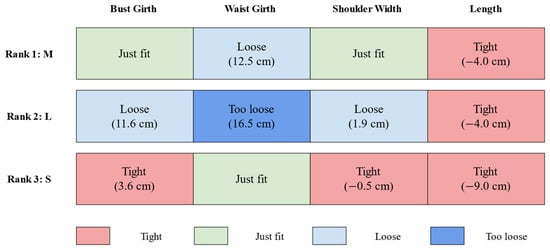
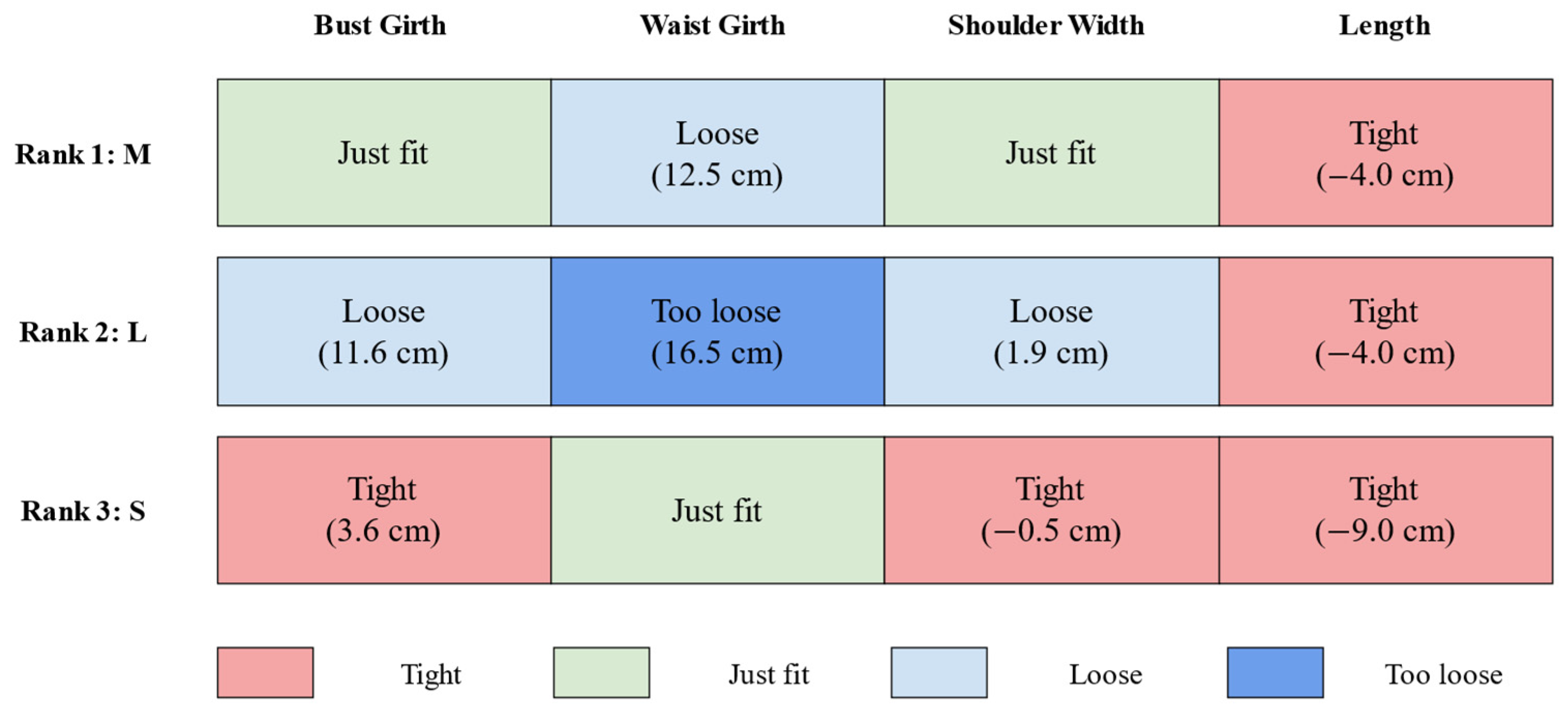
For this participant, the top three recommended sizes were M, L, and S. Among them, size M achieved the best overall fit, with the main deviation concentrated at the waist. Size L was generally looser, especially at the waist, whereas size S produced a tighter fit at the bust and shoulder and a noticeably shorter length. Figure 3 presents the section-specific fit interpretation of the Top-3 recommended sizes for Participant I. Among them, size M achieved the most balanced overall fit, size L was generally looser, particularly at the waist, and size S was tighter at the bust and shoulder with a shorter effective length. This case illustrates that the proposed framework can explain recommendation results through localized fit characteristics rather than only outputting a final size label.
Figure 3.
Section-specific fit interpretation of the Top-3 Recommended Sizes for Participant I.
5.3. Influence of Input Indicator Selection
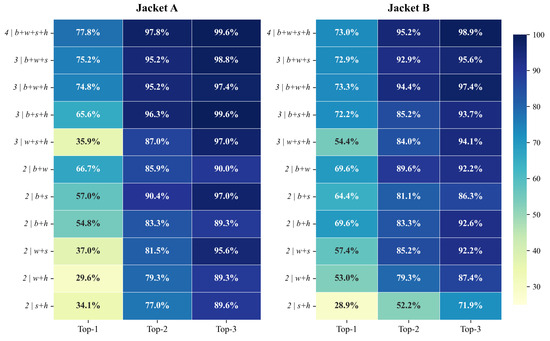
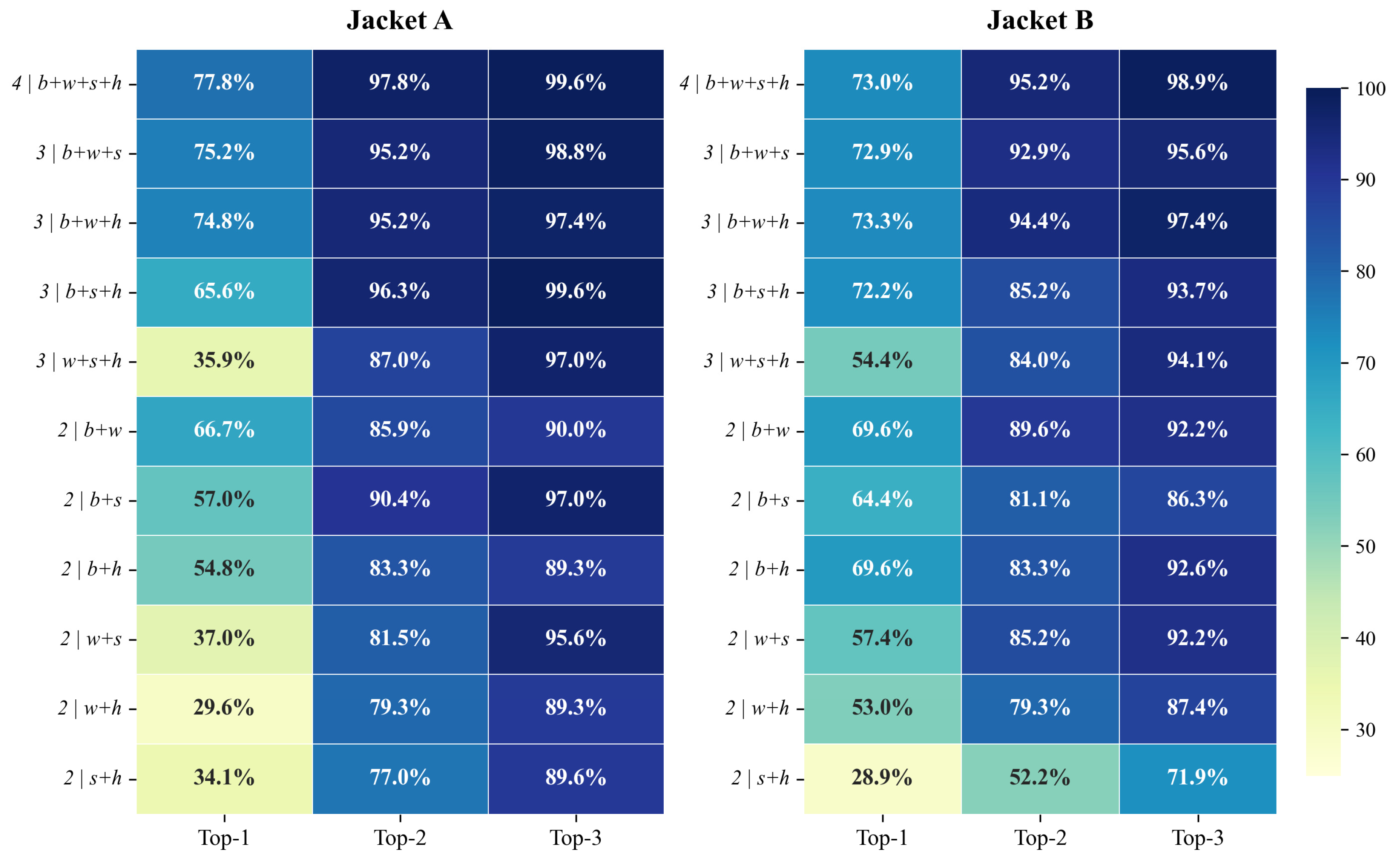
In the proposed framework, the selected body measurements function as the primary input indicators for fit evaluation. For jackets, bust girth, waist girth, shoulder width, and height together reflect both circumferential fit and longitudinal body proportion. To investigate how the choice of indicators affects recommendation performance, additional experiments were conducted using different combinations of these measurements for both Jacket A and Jacket B. Based on the structure of the jacket size charts, the tested combinations were organized into three groups: four-indicator, three-indicator, and two-indicator combinations. The corresponding recommendation accuracies are illustrated in Figure 4.
Figure 4.
Recommendation accuracy for different indicator combinations. (b: bust girth, w: waist girth, s: shoulder width, h: height).
The results reveal a clear overall pattern. For both Jacket A and Jacket B, the full four-indicator combination achieved the best or near-best performance, suggesting that incorporating all body measurements corresponding to the garment size chart leads to more reliable recommendations. This confirms that fit evaluation benefits from a more complete representation of body shape and proportion, rather than relying on only a limited subset of measurements. At the same time, the relationship between the number of indicators and recommendation performance was not strictly monotonic. Although reducing the number of inputs generally lowered Top-1 accuracy, several three-indicator and two-indicator combinations still maintained relatively high Top-3 accuracy. This suggests that different body measurements contribute to recommendation performance to different extents, and that their influence depends on garment style and fit characteristics. A closer comparison between the two jackets further illustrates this point. For Jacket A, which follows a relatively regular fit, combinations involving bust and shoulder tended to produce stronger performance, indicating that these dimensions play a particularly important role in recommendation. For Jacket B, which has a tighter fit, waist-related combinations showed greater importance, implying that waist measurement becomes more critical under a more body-contoured style. These observations are consistent with the style-dependent design of the proposed framework and support the use of garment-specific indicator selection in fit evaluation.
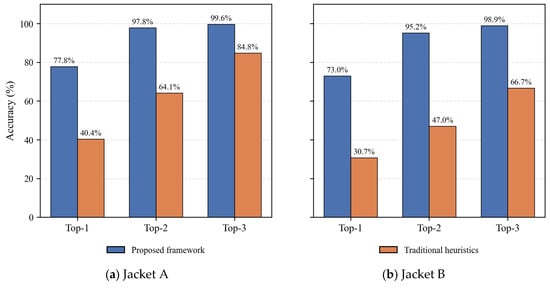
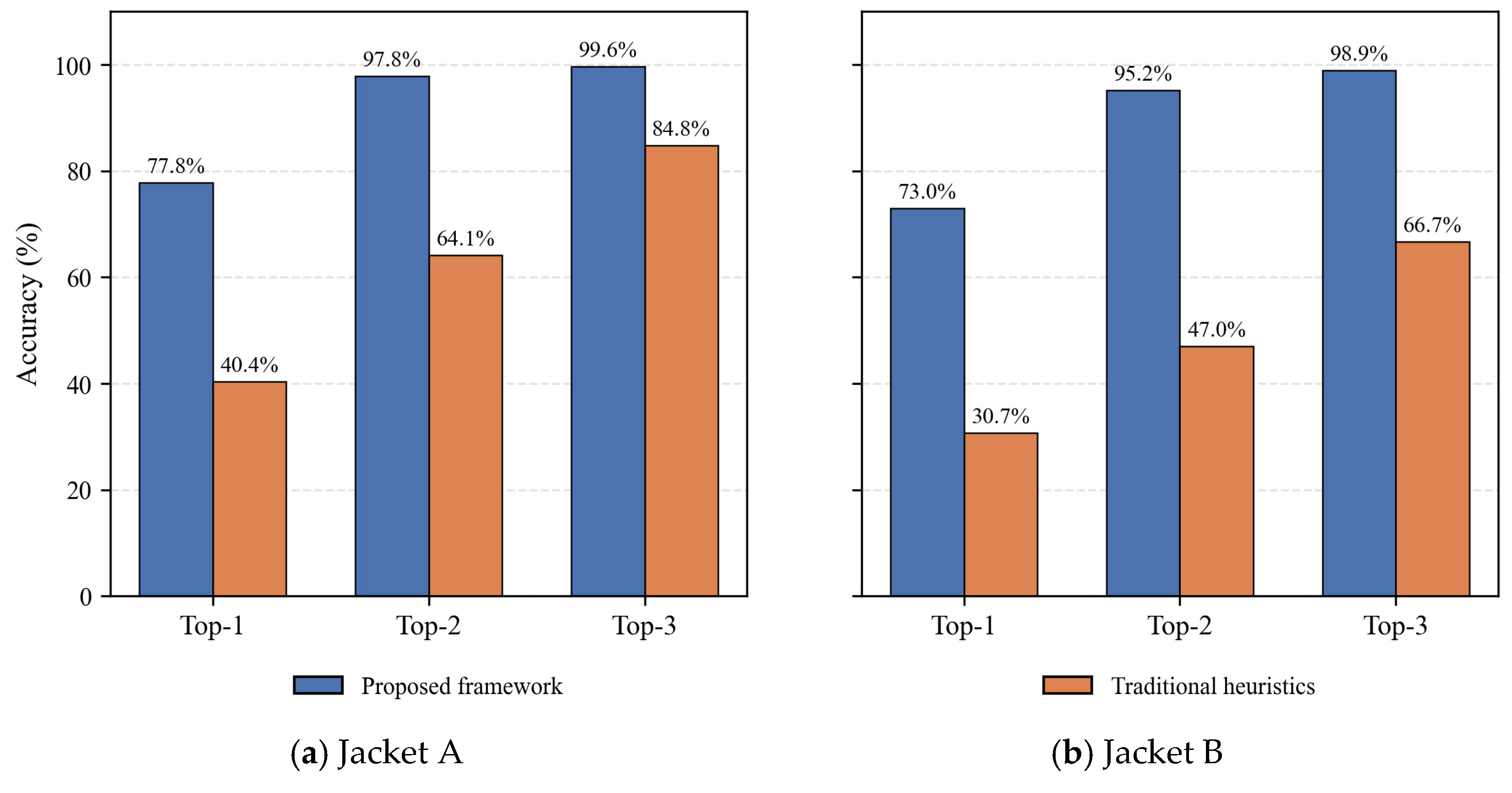
To further assess the effectiveness of the proposed framework, a comparative evaluation was conducted against the traditional heuristic baseline rules defined in Section 4.3. The comparison results are presented in Figure 5, which reports the results of three heuristic measurement combinations: Top-1 Accuracy (height-bust), Top-2 Accuracy (height-waist), and Top-3 Accuracy (height-shoulder).
Figure 5.
Comparison between the proposed framework and the traditional heuristic method.
As shown in Figure 5, the proposed framework consistently outperformed the traditional heuristic method for both garments across all three ranking-based metrics. For Jacket A, the proposed method achieved 77.8% Top-1 accuracy, 97.8% Top-2 accuracy, and 100.0% Top-3 accuracy, compared with 40.4%, 64.1%, and 84.8% for the heuristic method. A similar advantage was observed for Jacket B, where the proposed framework reached 73.0%, 95.2%, and 98.9%, substantially exceeding the heuristic results of 30.7%, 47.0%, and 66.7%. These results indicate that simple measurement matching is insufficient for garments with complex fit requirements. Unlike heuristic rules, which rely only on interval inclusion, the proposed framework explicitly models body-garment correspondence, ideal ease deviation, and section-specific fit quality. This enables a more robust ranking of candidate sizes and improves recommendation accuracy. The two methods also differ in terms of interpretability. The heuristic approach provides only a direct size output and does not explain where local misfit may occur. In contrast, the proposed framework generates a ranked list of candidate sizes together with interpretable fit feedback for each body section. This additional information gives users more practical guidance when selecting among acceptable sizes and better reflects the multi-dimensional nature of garment fit.
The results show that the proposed framework can provide accurate size recommendations for jackets with different fit characteristics while also offering section-specific fit feedback. This suggests that fit evaluation benefits from combining size ranking with interpretable local fit information, rather than relying only on a single overall size output. Another important observation is that fit evaluation is style-dependent. The differences between Jacket A and Jacket B, together with the indicator-combination results, show that the relative importance of body measurements varies across garment styles. In particular, tighter garments are more sensitive to deviations in critical sections, whereas regular-fit garments allow greater tolerance in some dimensions. This supports the use of style-specific ease settings and weighting strategies in the proposed framework. The remaining mismatches are likely related to factors not fully captured by body measurements alone, including individual fit preference, measurement uncertainty, garment manufacturing tolerance, and fabric characteristics. These factors may explain why a small number of cases still differed from the observed size choices. Overall, the proposed framework achieves a useful balance between recommendation accuracy and interpretability. Compared with traditional heuristic methods, it provides more reliable size ranking while also giving more detailed fit information for practical decision-making.
6. Conclusions
This study proposed a multi-dimensional fit evaluation framework for automatic size recommendation in online apparel retail. Unlike existing methods that simply output a single size without explanation, the proposed framework provides interpretable, section-specific fit feedback together with a ranked list of size options. Specifically, the framework identifies the key body measurements that significantly influence jacket fit, quantifies fit errors by comparing actual garment ease with ideal ease allowances, and assigns dimension-specific, segment-based weights to reflect the varying importance of different body areas. Based on these components, an overall fit score is calculated, and the top three most suitable sizes are recommended along with detailed fit information.
Experimental validation on two jacket styles involving 270 female participants produced several important findings. First, the proposed framework achieved top-three accuracies of 99.6% for the regular-fit jacket (Jacket A) and 98.9% for the tight-fit jacket (Jacket B), substantially outperforming traditional heuristic methods, which achieved 84.8% and 66.7%, respectively. Second, for each recommended size, the framework generates fit feedback for each body area, enabling consumers to make informed trade-offs according to their personal preferences. Third, the full combination of bust girth, waist girth, shoulder width, and height yielded the highest accuracy for both jackets. However, the relationship between the number of indicators and recommendation accuracy was not strictly monotonic, suggesting that the relevance of each dimension to garment style is more important than the sheer number of measurements included. Finally, the proposed framework consistently outperformed simple measurement-matching approaches across all evaluation metrics, demonstrating that a multi-dimensional weighted approach is necessary for garments with critical fit requirements.
In the context of the rapid development of apparel e-commerce platforms, the proposed framework also shows strong potential for practical implementation in online apparel retail. In a real-world size recommendation module, consumer body measurements can be matched with garment specification data for each size, and garment ease can then be compared with style-dependent ideal ease targets to generate sectional and overall fit scores. Instead of returning only a single size, the system can provide multiple candidate sizes together with interpretable fit feedback, thereby supporting more informed purchase decisions, improving satisfaction with online size selection, and helping to reduce fit-related returns.
Nevertheless, there are still some limitations that should be acknowledged. The study focused exclusively on female jackets, and therefore, its generalizability to other garment categories and male populations requires further validation. Moreover, the proposed framework does not explicitly model the effects of material thickness, local layered construction, or silhouette-related variation, which are only implicitly captured through the finished-garment measurements and the style-dependent ideal ease targets. Future research should extend the framework to a wider range of garment categories, incorporate individual fit preferences, and develop more robust parameter calibration strategies for different garment styles.
Author Contributions
Conceptualization, X.Z.; writing—original draft, X.Z.; visualization, J.Y.; data curation, H.H. and H.Q.; writing—review and editing, X.Z. and J.Y.; project administration, J.L.; funding acquisition, J.L. Supervision, J.L. All authors have read and agreed to the published version of the manuscript.
Funding
The work of this paper is financially supported by The Philosophy and Social Science Planning Project of Guangdong Province (No. GD25CYS23). The 2nd of art education master studios in Guangdong Province 2022 Guangzhou Education Science Planning Project (Education Research Innovation Team Project) (No. 202213816).
Institutional Review Board Statement
The study was conducted in accordance with the Declaration of Helsinki, and the protocol was approved by the Ethics Committee of Guangzhou University (GD20CYS14) on 7 November 2025.
Informed Consent Statement
Informed consent was obtained from all subjects involved in the study. All participants were informed of the study’s purpose, procedures, potential risks, and benefits, as well as their right to withdraw at any time without penalty.
Data Availability Statement
The original contributions presented in this study are included in the article. Further inquiries can be directed to the corresponding authors.
Conflicts of Interest
The authors declare no conflicts of interest.
References
- Hu, P.; Nourbakhsh, N.; Tian, J.; Sturges, S.; Dadarlat, V.; Munteanu, A. A generic method of wearable items virtual try-on. Text. Res. J. 2020, 90, 2161–2174. [Google Scholar] [CrossRef] [Scilit]
- Zheng, K.; Huo, X.; Jasimuddin, S.; Zhang, J.Z.; Battaïa, O. Logistics distribution optimization: Fuzzy clustering analysis of e-commerce customers’ demands. Comput. Ind. 2023, 151, 103960. [Google Scholar] [CrossRef] [Scilit]
- Wenhui, Z.; Fenfen, W.; Gehui, W.; Yongrong, W. Dual-objective prediction of garment pressure and body contouring efficacy in shapewear: A hybrid GA-BP framework for sizing systems. Expert Syst. Appl. 2025, 299, 129946. [Google Scholar]
- Vergara, M.Á.; Villalobos, M.B.; Castro-Rangel, P.; Alvarez, J.C.; Lepore, R. Productivity improvement model in the garment industry: Application of standardized work and poka yoke with artificial vision. Textiles 2025, 5, 64. [Google Scholar] [CrossRef] [Scilit]
- Zhao, X.; Fan, K.; Shi, X.; Liu, K. Virtual fit evaluation of pants using the adaptive network fuzzy inference system. Text. Res. J. 2021, 91, 2786–2794. [Google Scholar] [CrossRef] [Scilit]
- Ashdown, S.; Loker, S. Mass-customized target market sizing: Extending the sizing paradigm for improved apparel fit. Fash. Pract. 2010, 2, 147–173. [Google Scholar] [CrossRef] [Scilit]
- Almousa, M. Consumer experience of 3D body scanning technology and acceptance of related e-commerce market applications in Saudi Arabia. J. Text. Inst. 2020, 111, 1300–1307. [Google Scholar]
- Baytar, F.; Chung, T.; Shin, E. Evaluating garments in augmented reality when shopping online. J. Fash. Mark. Manag. Int. J. 2020, 24, 667–683. [Google Scholar] [CrossRef] [Scilit]
- Foysal, K.H.; Chang, H.J.; Bruess, F.; Chong, J.W. SmartFit: Smartphone application for garment fit detection. Electronics 2021, 10, 97. [Google Scholar] [CrossRef] [Scilit]
- Meunier, P. Use of body shape information in clothing size selection. In Proceedings of the Human Factors and Ergonomics Society Annual Meeting; SAGE Publications: Los Angeles, CA, USA, 2000; Volume 44, pp. 715–718. [Google Scholar]
- Imran, A.; Ramzan, M.B.; Qureshi, S.M.; Raza, M.; Zaman, S.U. Design and Evaluation of Adaptive Clothing for Diverse Body Shapes Using Auxetic Knitted Structures. Textiles 2026, 6, 44. [Google Scholar] [CrossRef] [Scilit]
- Naveed, T.; Khan, A.; Ramzan, M.B.; Ilyas, R.; Shahid, A.; Khan, I.A.; Awais, M.; Javed, K. Fabric Utilization of Women’s Kameez Designs with Different Types of Sleeves in the Apparel Industry. Textiles 2025, 5, 48. [Google Scholar] [CrossRef] [Scilit]
- Abdulla, G.M.; Borar, S. Size recommendation system for fashion e-commerce. In Proceedings of the KDD Workshop on Machine Learning Meets Fashion, Halifax, NS, Canada, 14 August 2017; Volume 7. [Google Scholar]
- Alhassawi, R.; Gill, S.; Hayes, S.; Brubacher, K. Evaluating machine learning models for clothing size prediction using anthropometric measurements from 3D body scanning. Sci. Rep. 2025, 15, 40781. [Google Scholar] [CrossRef] [Scilit] [PubMed]
- Januszkiewicz, M.; Parker, C.J.; Hayes, S.G.; Gill, S. Online virtual fit is not yet fit for purpose: An analysis of fashion e-commerce interfaces. In Proceedings of the 8th International Conference and Exhibition on 3D Body Scanning and Processing Technologies, Montreal, QC, Canada, 11–12 October 2017. [Google Scholar]
- Baier, S. Analyzing customer feedback for product fit prediction. arXiv 2019, arXiv:1908.10896. [Google Scholar]
- Chi, C.; Zeng, X.; Bruniaux, P.; Tartare, G. An intelligent recommendation system for personalised parametric garment patterns by integrating designer’s knowledge and 3D body measurements. Ergonomics 2025, 68, 317–337. [Google Scholar] [PubMed]
- Guigourès, R.; Ho, Y.K.; Koriagin, E.; Sheikh, A.S.; Bergmann, U.; Shirvany, R. A hierarchical bayesian model for size recommendation in fashion. In Proceedings of the 12th ACM Conference on Recommender Systems, Vancouver, BC, Canada, 2–7 October 2018; pp. 392–396. [Google Scholar]
- Misra, R.; Wan, M.; McAuley, J. Decomposing fit semantics for product size recommendation in metric spaces. In Proceedings of the 12th ACM Conference on Recommender Systems, Vancouver, BC, Canada, 2–7 October 2018; pp. 422–426. [Google Scholar]
- Zhang, J.; Liu, K.; Dong, M.; Yuan, H.; Zhu, C.; Zeng, X. An intelligent garment recommendation system based on fuzzy techniques. J. Text. Inst. 2020, 111, 1324–1330. [Google Scholar]
- Lasserre, J.; Sheikh, A.S.; Koriagin, E.; Bergman, U.; Vollgraf, R.; Shirvany, R. Meta-learning for size and fit recommendation in fashion. In Proceedings of the 2020 SIAM International Conference on Data Minin; Society for Industrial and Applied Mathematics: Philadelphia, PA, USA, 2020; pp. 55–63. [Google Scholar]
- Zhu, S.; Mok, P.Y. Predicting realistic and precise human body models under clothing based on orthogonal-view photos. Procedia Manuf. 2015, 3, 3812–3819. [Google Scholar] [CrossRef] [Scilit]
- Pavlakos, G.; Zhu, L.; Zhou, X.; Daniilidis, K. Learning to estimate 3D human pose and shape from a single-color image. In Proceedings of the IEEE Conference on Computer Vision and Pattern Recognition; IEEE: New York, NY, USA, 2018; pp. 459–468. [Google Scholar]
- Maher, M.; Baytar, F. Validating women’s bilateral body asymmetry thresholds for patternmaking based on 3D body scan data. Int. J. Cloth. Sci. Technol. 2026, 38, 104–118. [Google Scholar]
- Gribbin, E.A. Body shape and its influence on apparel size and consumer choices. In Designing Apparel for Consumers; Woodhead Publishing: Cambridge, UK, 2014; pp. 3–16. [Google Scholar]
- Huang, S.; Wang, Z.; Jiang, Y. Guess your size: A hybrid model for footwear size recommendation. Adv. Eng. Inform. 2018, 36, 64–75. [Google Scholar] [CrossRef] [Scilit]
- Lu, Z.; Stauffer, J. Fit Recommendation via Collaborative Inference. U.S. Patent 8,478,663, 2 July 2013. [Google Scholar]
- Kolose, S.; Stewart, T.; Hume, P.; Tomkinson, G.R. Cluster size prediction for military clothing using 3D body scan data. Appl. Ergon. 2021, 96, 103487. [Google Scholar] [CrossRef] [Scilit] [PubMed]
- Fu, B.; Zheng, R.; Chen, Q.; Zhang, Y. An improved clothing size recommendation approach based on subdivision of female body types. Ergonomics 2023, 66, 167–181. [Google Scholar] [PubMed]
- Liu, K.; Wang, J.; Kamalha, E.; Li, V.; Zeng, X. Construction of a prediction model for body dimensions used in garment pattern making based on anthropometric data learning. J. Text. Inst. 2017, 108, 2107–2114. [Google Scholar] [CrossRef] [Scilit]
- Meyer, P.; Birregah, B.; Beauseroy, P.; Grall, E.; Lauxerrois, A. Missing body measurements prediction in fashion industry: A comparative approach. Fash. Text. 2023, 10, 37. [Google Scholar] [CrossRef] [Scilit]
- Galada, A.; Baytar, F. Developing a prediction model for improving bifurcated garment fit for mass customization. Int. J. Cloth. Sci. Technol. 2023, 35, 397–418. [Google Scholar] [CrossRef] [Scilit]
- Sembium, V.; Rastogi, R.; Tekumalla, L.; Saroop, A. Bayesian models for product size recommendations. In Proceedings of the 2018 World Wide Web Conference, Lyon, France, 23–27 April 2018; pp. 679–687. [Google Scholar]
- Dik, N.Y.; Tsang, P.W.K.; Chan, A.P.; Lo, C.K.; Chu, W.C. A novel approach in predicting virtual garment fitting sizes with psychographic characteristics and 3D body measurements using artificial neural network and visualizing fitted bodies using generative adversarial network. Heliyon 2023, 9, e17916. [Google Scholar] [CrossRef] [Scilit] [PubMed]
- Oosterom, E.B.; Baytar, F.; Akdemir, D.; Kalaoglu, F. Predicting consumers’ garment fit satisfactions by using machine learning. AUTEX Res. J. 2024, 24, 20230016. [Google Scholar] [CrossRef] [Scilit]
- Liu, K.; Wu, H.; Zhu, C.; Wang, J.; Zeng, X.; Tao, X.; Bruniaux, P. An evaluation of garment fit to improve customer body fit of fashion design clothing. Int. J. Adv. Manuf. Technol. 2022, 120, 2685–2699. [Google Scholar] [CrossRef] [Scilit]
- Petrova, A. Creating sizing systems. In Sizing in Clothing: Developing Effective Sizing Systems for Ready-to-Wear Clothing; Woodhead Publishing: Cambridge, UK, 2007; pp. 57–87. [Google Scholar]
- Daanen, H.A.; Reffeltrath, P.A. Function, fit and sizing. In Sizing in Clothing; Woodhead Publishing: Cambridge, UK, 2007; pp. 202–219. [Google Scholar]
- Huang, H.Q.; Mok, P.Y.; Kwok, Y.L.; Au, J.S. Block pattern generation: From parameterizing human bodies to fit feature-aligned and flattenable 3D garments. Comput. Ind. 2012, 63, 680–691. [Google Scholar] [CrossRef] [Scilit]
- Gu, B.; Su, J.; Liu, G.; Xu, B. Pattern alteration of women’s suits based on ease distribution. Int. J. Cloth. Sci. Technol. 2016, 28, 201–215. [Google Scholar] [CrossRef] [Scilit]
- Li, J.; Dai, Y.; Jiang, R.; Li, J. Objective multi-criteria decision-making for optimal firefighter protective clothing size selection. Int. J. Occup. Saf. Ergon. 2024, 30, 968–976. [Google Scholar] [PubMed]
- Beazley, A. Size and fit: The development of size charts for clothing-Part 3. J. Fash. Mark. Manag. Int. J. 1999, 3, 66–84. [Google Scholar]
- Miyoshi, M.; Hirokawa, T. Study on the method of a vacant space distance in a worn jacket for clothing pattern design. J. Jpn. Res. Assoc. Text. End-Uses 2001, 42, 233–241. [Google Scholar]
- Xu, J.; Zhang, W. The vacant distance ease relation between body and garment. In Proceedings of the 2009 Second International Conference on Information and Computing Science, Manchester, UK, 21–22 May 2009; Volume 4, pp. 38–41. [Google Scholar]
- Chen, Y.; Zeng, X.; Happiette, M.; Bruniaux, P.; Ng, R.; Yu, W. Optimisation of garment design using fuzzy logic and sensory evaluation techniques. Eng. Appl. Artif. Intell. 2009, 22, 272–282. [Google Scholar] [CrossRef] [Scilit]
- Reich, N.; Otten, P. Clothing and dressing needs of people with arthritis. Cloth. Text. Res. J. 1991, 9, 34–40. [Google Scholar] [CrossRef] [Scilit]
- Gill, S. Improving garment fit and function through ease quantification. J. Fash. Mark. Manag. Int. J. 2011, 15, 228–241. [Google Scholar] [CrossRef] [Scilit]
- Yuan, Y.; Huh, J.H. Cloth size coding and size recommendation system applicable for personal size automatic extraction and cloth shopping mall. In International Conference on Multimedia and Ubiquitous Engineering; Springer: Singapore, 2018; pp. 725–731. [Google Scholar]
- Liu, K.; Zeng, X.; Wang, J.; Tao, X.; Xu, J.; Jiang, X.; Ren, J.; Kamalha, E.; Agrawal, T.-K.; Bruniaux, P. Parametric design of garment flat based on body dimension. Int. J. Ind. Ergon. 2018, 65, 46–59. [Google Scholar] [CrossRef] [Scilit]

Disclaimer/Publisher’s Note: The statements, opinions and data contained in all publications are solely those of the individual author(s) and contributor(s) and not of MDPI and/or the editor(s). MDPI and/or the editor(s) disclaim responsibility for any injury to people or property resulting from any ideas, methods, instructions or products referred to in the content. |
© 2026 by the authors. Licensee MDPI, Basel, Switzerland. This article is an open access article distributed under the terms and conditions of the Creative Commons Attribution (CC BY) license.