


Abstract
Textile-to-textile recycling is increasingly recognised as essential to reduce the environmental footprint of the textile sector, yet fibre-to-fibre routes remain constrained by complex composition of fibre blends, chemical finishes and the degradation of fibre quality during repeated processing. This review provides a comprehensive overview of recycling strategies for major textile fibres, cotton, polyester, viscose, polyamide, and wool, from a fibre-level perspective, highlighting the relationships between fibre chemistry, structure, and recyclability. Mechanical, chemical, and biological recycling routes are analysed with a particular focus on fibre integrity, yarn and fabric performance, and their suitability for industrial textile applications rather than solely on waste management aspects. The review also examines industrial initiatives and emerging technologies driving the transition towards circular textile systems, critically identifying key barriers such as feedstock heterogeneity, fibre blending, and downcycling. Building on existing review articles on textile recycling, this work synthesises current knowledge on fibre-to-fibre routes, compares different process options in terms of recycled-fibre quality and scalability, and highlights remaining technological and implementation gaps. To advance textile circularity, integrated recycling frameworks are proposed that align material design, process optimisation, and policy instruments. This work contributes a cross-disciplinary understanding of how fibre-level innovation can enable resource-efficient, closed-loop textile production, offering a roadmap for future sustainable materials engineering in industrial textile systems.
1. Introduction
Given the growing environmental and economic pressures associated with textile waste, textile-to-textile recycling is becoming a strategic priority for the industry. This review focuses on fibre-to-fibre recycling routes for the five major textile fibres (cotton, polyester, viscose, polyamide and wool) and evaluates how these technologies can contribute to circularity in industrial textile production. The textile sector, one of the oldest in human history, now produces an unprecedented volume of knitted, woven and nonwoven fabrics for apparel, home and industrial textiles [1]. Nowadays, the textile industry is one of the most polluting industrial sectors, generating a substantial environmental footprint, from fibre cultivation and textile manufacturing to the disposal of post-consumer and post-industrial items in landfills or incinerators [2]. Population growth, improved living conditions, the wide availability of diverse textile materials, and the rapid turnover of fast, low-quality fashion have reduced the reusability of textiles and driven a sharp rise in fibre consumption and production over recent decades [3]. Following a modest decrease in 2020 that can be attributed to the impact of the global pandemic, global fibre production has demonstrated a renewed upward trajectory, reaching a record of 132 million tons in 2024. This signifies a more than a twofold increase in comparison with the 58 million tons in 2000. If current growth continues, production may reach 169 million tonnes by 2030 [4,5]. At the same time, the share of recycled fibres within this total remains low, and most recycled content still comes from bottle-to-fibre polyester rather than genuine textile-to-textile recycling [5,6].
In this review, we use the term fibre-to-fibre recycling to describe recycling routes in which fibres, polymers or monomers are recovered with the explicit aim of being reintroduced into new textile fibres (Figure 1). By contrast, we use the broader term textile recycling to encompass any valorisation pathway of textile waste, including open-loop applications such as insulation materials, composites, fillers or energy recovery. Our focus is therefore on fibre-to-fibre strategies that close the loop at the fibre or polymer level, while other textile recycling options are only discussed when they are directly relevant for understanding current technological and industrial constraints.
Figure 1.
Conceptual framework of this review, illustrating fibre-to-fibre recycling pathways across mechanical, physical and chemical/enzymatic routes, and their application to major textile fibre classes within the broader textile recycling landscape.
This surge in production, fuelled largely by fast fashion, has resulted in unprecedented volumes of textile waste. Globally, only about 15–20% of textiles are currently collected for reuse or recycling, while the majority is landfilled or incinerated, and it is estimated that less than 1% is recycled back into new textile fibres [7,8,9,10,11,12,13]. Therefore, there is an urgent need to develop and implement technologies and methods that promote economic, environmental, and social circularity in this sector [14]. Such approaches involve reducing consumption, minimising resource use (energy, water, and chemicals) during textile production, and extending product lifetimes through reuse, repair, and remanufacturing, thereby conserving resources and limiting dependence on virgin raw materials [15,16]. However, these long-term measures alone cannot address the millions of tonnes of textiles already discarded, which highlights the need to complement them with effective fibre-to-fibre recycling strategies capable of retaining materials in closed loops and delivering high-quality outputs. Promoting a circular model, in which materials are retained within closed loops, requires sustainable production methods, high-quality outputs, and efficient recycling technologies and systems [17,18]. In this context, textile waste recycling is a critical step toward establishing circular resource flows in the industry. The remainder of this review is organised by fibre class and recycling route. After introducing the main fibre-to-fibre recycling approaches, we discuss strategies, limitations, and recent advances for five major fibres—polyester, viscose, polyamide, cotton, and wool—highlighting how chemical structure, blending behaviour, and processing constraints influence recyclability and recovered material quality. We then address blended and multicomponent textiles, including elastane-containing structures, and conclude by summarising the most relevant technological trends, industrial initiatives, and future research needs for advancing circular pathways in industrial textiles.
1.1. Textile Fibres and the Global Market
The textile industry has been directly shaped by the exponential increase in the world population, which in turn drives the rising demand for textile fibres. Regarding per capita production, global fibre output reached approximately 14.6 kg per capita in 2024, compared to around 8.3 kg in 1975 [15]. This growth trend is expected to continue, with an estimated increase of approximately 60–65% by 2030 [19]. According to the most recent global assessments, total textile fibre production reached approximately 132 million tonnes in 2024. In the same year, recycled fibres accounted for about 7.6% of total global fibre production, with the majority of these being derived from recycled polyester fibres from plastic bottles (6.9%), while fibres recycled from textile-to textile routes still represented less than 1% of the global fibre market [5,6]. Synthetic fibres continue to dominate the market, reaching approximately 91 million tonnes in 2024 and accounting for approximately 69% of the total fibre output. Polyester remained the leading fibre, contributing 59% of global fibre output (78 million tonnes). Polyamide, the second most used synthetic fibre, accounted for 8.9 million tonnes, representing about 7% of the global fibre market. Natural fibres, including cotton, jute, hemp and linen, among others, represented around 28% of the global market. Cotton remained by far the most important fibre, with a production of approximately 24–25 million tonnes, equivalent to 19–22% of total global output. The utilisation of natural fibres in textile production has a long historical precedent, dating back to prehistoric times. However, the production of these fibres and their trend of consumption were negatively influenced by the creation and development of synthetic fibres in the mid-20th century. Man-made cellulosic fibres accounted for 8.2 million tonnes, representing 6% of the market share for 2024. Conversely, the market share of animal fibres approached 1% with a production volume of 1.1 million tonnes. From the perspective of fibre-to-fibre recycling, this dominance of synthetic and blended fibres has major implications. Fibre blends containing polyester, polyamide, cellulosic and protein fibres are increasingly prevalent, especially in industrial textiles, but their complex composition makes separation and recycling particularly challenging. Understanding how this evolving fibre mix interacts with existing and emerging recycling technologies is therefore central to the development of circular textile systems.
1.2. Textile Waste and End-of-Life Challenges
It is estimated that only 15–20% of textiles are collected for recycling or reuse, while more than 80% are discarded [8,10,13]. Globally, about 90 million tonnes of textile waste is generated annually, with disposal rates increasing faster than material recovery [8]. The main drivers of this growth include population expansion, higher living standards, the availability and variety of textile materials, and shorter product lifecycles, which together generate substantial volumes of post-industrial and post-consumer waste [20]. The rise of globalisation and the spread of low-cost clothing accelerated the fast fashion model, characterised by mass production, rapid turnover, affordability, and disposability [21,22]. Post-consumer textile waste now represents one of the fastest-growing polymer waste streams worldwide [8]. According to the United Nations and recent assessments, the textile industry ranks among the most polluting sectors globally, being responsible for around 10% of total carbon dioxide (CO2) emissions and 20% of industrial wastewater discharges [5,23]. These figures reflect not only energy demand and water consumption but also transport emissions, excessive packaging and the disposal of massive volumes of waste [24,25,26]. Freshwater ecosystems are particularly threatened, as rivers are often the primary destination for waste and effluents from textile manufacturing [24,27,28].
Textile waste arises from various sources, such as clothing, hospital and household textiles, uniforms, upholstery, production surpluses, deadstock, damaged goods, and returns [29]. It is typically classified into pre-consumer waste—cleaner, easier-to-sort residues from production—and post-consumer waste, which constitutes the largest fraction and often contains contaminants [6,18,20,25,30]. The characteristics of pre-consumer waste are directly related to the type of raw fibre from which it originates (cellulosic, protein or synthetic) and, consequently, to the type of chemicals and materials involved in the production process [6,31]. The various stages of textile production, from fibre extraction to final finishing, differ in their specific environmental profiles but share common pressure points, namely the use of harmful chemicals, water and energy consumption, emissions to the atmosphere, transport and packaging [32]. For cellulosic and natural fibres, large inputs of pesticides, insecticides and fertilisers in agriculture are common practice to stimulate plant growth and protect crops. In the case of animal fibres, the presence of certain parasites necessitates the use of chemicals for fibre cleansing post-crushing and shearing. With regard to synthetic fibres, the various stages involved in their production give rise to the generation of diverse by-products [6,28]. A study by Roos et al. (2016) on the textile industry in Sweden showed that the later stages of textile processing (fabric production, wet treatments) have greater carbon and water impacts than fibre production or product use [33]. Wet treatment, namely dyeing, finishing and printing, contribute significantly to toxic emissions, and the processes of spinning and weaving require the use of fossil fuels, resulting in CO2 emissions and certain particulates [34]. Textiles also involve a broad spectrum of chemicals, representing 5–15% of the weight of a garment, including amines, dyes, halogenated compounds, metals, monomers, solvents, and process aids [15,35]. It has been established that a significant proportion of these substances are capable of persisting in fabrics, evaporating into the atmosphere, or entering into wastewater, which is subsequently released into aquifers without undergoing any form of treatment [17,18]. Their resistance to degradation allows for long-distance transport and bioaccumulation in sediments and organisms, raising concerns due to their carcinogenic and mutagenic potential [36]. The global textile chemicals market is currently valued at around €28.8 billion in 2025, with textile production accounting for the annual consumption of approximately 43 million tonnes of chemicals. In the medium term, the market is predicted to undergo sustained growth, with forecasts indicating a potential reach of nearly €36–38 billion by the year 2030, driven by demand for functional finishes, sustainable auxiliaries, and performance-enhancing treatments [15].
A growing concern about the harmful effects of using these chemicals has led to the creation and implementation of management practices and the identification of systems, standards, policies, and legal requirements [37]. Furthermore, safer and more sustainable chemical approaches and processes have been developed, involving new or alternative products [38,39,40]. From a recycling perspective, however, the presence of these chemicals is a double-edged sword: many functional finishes and auxiliaries are desirable during use but can hinder fibre-to-fibre recycling by affecting dissolution behaviour, depolymerisation reactions or the quality of regenerated fibres. Scientific knowledge regarding the concentrations of these chemicals in real waste streams and their impacts on specific recycling routes remains limited, which represents an important gap for future research. Beyond chemical pollution, concerns extend to rising energy consumption, high water usage, long-distance transport emissions, and packaging made from non-biodegradable, non-renewable sources [24]. Furthermore, the social and environmental costs of textile production are unevenly distributed, with manufacturing concentrated in low-wage countries that bear the highest exposure to impacts, while wealthier nations remain the largest consumers [14,41]. Addressing these challenges requires integrated approaches that maximise resource efficiency by reducing raw material consumption and extending textile lifecycles through reuse and recycling [3,33]. Within this broader context, the development of efficient fibre-to-fibre recycling routes that can handle real, often blended and heavily finished textile waste streams is a key component of more sustainable textile and industrial systems.
2. Existing Reviews and Scope of This Work
In recent years, several reviews have addressed textile recycling from different perspectives, including technology overviews and generic routes for textile recycling and polymer recovery from textile waste [3,7,27,42]. These contributions compare mechanical, chemical and biological recycling pathways in the context of circular textiles and discuss the role of recycling and reuse within broader material circularity frameworks. Other works have focused more specifically on the recovery of natural and synthetic polymers from textile waste and on the performance limits of fossil-based textile polymers in recycling scenarios, as well as on recent advances in recycling technologies for waste textile fabrics, often at the level of generic polymer classes rather than specific fibre types. More chemistry-oriented reviews have examined catalytic chemical recycling of synthetic textiles and polyester textile wastes in detail, with a particular emphasis on solvolysis routes, depolymerisation mechanisms and process efficiency. Compared to these contributions, the present review adopts a fibre-class-centred perspective on fibre-to-fibre recycling routes for the main textile fibres (cotton, wool, polyester, viscose and polyamide), including their blends. Rather than treating textile waste only at the level of generic polymer families, we explicitly link fibre chemistry, morphology and end-use to recyclability, recycled-fibre quality and suitability for fibre-to-fibre applications. Particular attention is given to industrial and technical textiles (e.g. nonwovens, composites, protective and functional textiles) and to multicomponent fibre blends, where performance requirements and material complexity are especially high. In doing so, this work aims to bridge process-level descriptions of recycling technologies (fibre-, polymer- and monomer-level routes) with the practical requirements of fibre-to-fibre circularity in real textile value chains, highlighting quality metrics, technology readiness and scalability constraints for each fibre class.
3. Research Framework and Methodology
This review adopts a structured literature-based research framework to analyse fibre-to-fibre recycling strategies for major textile fibres, with a particular focus on process mechanisms, recycled-fibre quality and scalability. The literature survey was conducted using major scientific databases, including Web of Science, Scopus and Google Scholar, complemented by selected industry and Non-Governmental Organization (NGO) reports. The search covered peer-reviewed articles, review papers and selected industrial and technical reports published predominantly between 2000 and 2025, with a particular emphasis on studies published after 2010, reflecting the rapid development of textile recycling technologies in the last decade. Keywords included combinations of “fibre-to-fibre recycling”, “textile recycling”, “mechanical recycling”, “chemical recycling”, “polyester depolymerisation”, “cotton recycling”, “wool recycling”, “viscose recycling”, “polyamide recycling”, “blended textiles”, “industrial textiles” and “technical textiles”. Initial database queries retrieved several hundred records; after screening titles and abstracts for relevance to fibre-to-fibre routes and the fibre classes in scope, a smaller core set of studies was retained for in-depth analysis. Studies were included when they (i) reported quantitative data on recycling performance (e.g., fibre length retention, tensile properties, thermal or acoustic performance, monomer yield, polymer purity, molecular weight) and/or (ii) provided insights into process scalability, technology readiness level or pilot/industrial implementation. Papers focusing exclusively on energy recovery, incineration or purely open-loop applications with no direct link to fibre-to-fibre strategies were excluded, except when they were necessary to understand current material losses or technological constraints. Open-loop valorisation routes were considered only when they were relevant for understanding material losses, technological constraints or transition pathways toward fibre-to-fibre circularity. The selected literature was systematically analysed and organised according to fibre type and recycling level (fibre-, polymer- and monomer-level), enabling a comparative assessment of recycling routes, quality outcomes and scalability challenges across different textile materials, with a particular emphasis on their applicability to industrial and technical textiles.
4. Overview of Textiles Recycling Technologies
The large volumes of waste generated by the textile industry have severe environmental and social consequences. Within this context, practices such as reuse and recycling—approaches that allow textile products and materials to retain value through repair, redistribution and reintegration into the market—are increasingly recognised as part of the solution. These strategies address a wide range of economic, environmental, and social challenges simultaneously [14,15,43]. Textile reuse extends product lifespans without altering their structure, thereby preventing premature disposal [44]. Textile recycling, in contrast, refers to the post-industrial or post-consumer reprocessing of waste into new textile or non-textile products using mechanical, chemical, biological, thermal, or hybrid processes, with the aim of retaining as much material value as possible. In principle, these technologies aim to convert discarded materials into products of equal or similar value [41]. Recycling technologies are generally categorised into four types - primary, secondary, tertiary, and quaternary approaches [20,27]:
- Primary recycling refers to reprocessing pre-consumer waste in its original form to obtain a product with equivalent value;
- Secondary recycling involves mechanical processing of post-consumer materials into products with altered physical or chemical properties;
- Tertiary recycling (often referred to as chemical recycling) includes techniques such as pyrolysis or hydrolysis to break down materials into their basic chemical constituents—monomers or fuels;
- Quaternary recycling encompasses the conversion of waste into energy, typically through incineration and energy recovery.
When recycled materials lose value or quality, the process is considered downcycling—still the dominant pathway in textiles. Upcycling, on the other hand, adds value, as in the transformation of textile waste into new fashion items. Closed-loop recycling returns materials into the same product type, whereas open-loop systems generate different products [41].
4.1. Fibre-to-Fibre Recycling Technologies: Levels and Definitions
In line with the definitions introduced in the Introduction, we distinguish three levels of fibre-to-fibre recycling in this review (Figure 2) [45]:
Figure 2.
Main principles and process steps associated with fibre-, polymer- and monomer-level fibre-to-fibre recycling routes are schematically presented.
- (i)
- Fibre-level routes, where fibres are mechanically opened and reused in new yarns or nonwovens while largely preserving the original polymer chains;
- (ii)
- Polymer-level routes, where the polymer is recovered in a molten or dissolved state without intentional depolymerisation, enabling re-extrusion or regeneration into new fibres;
- (iii)
- Monomer-level routes, where polymers are chemically depolymerised into monomers or oligomers that are subsequently purified and repolymerised.
In this review, mechanical recycling is used strictly to describe fibre-level routes based on cutting, shredding, opening and re-processing of textile materials while preserving the fibrous form and the polymer backbone. By contrast, we use the term physical recycling for polymer-level routes in which thermoplastic or regenerated polymers are processed in a melt or in solution without intentional chemical depolymerisation, enabling their re-extrusion or regeneration into new fibres. Chemical or enzymatic recycling is reserved for monomer-level routes, where polymers are deliberately depolymerised and subsequently repolymerised or converted into new materials. Recycled-fibre quality is discussed based on quantitative parameters commonly reported in the literature, including fibre length distribution, fineness and tensile properties (for fibre-level routes), molecular weight, intrinsic viscosity and crystallinity (for polymer- and monomer-level routes), as well as spinnability limits and achievable recycled content in yarns and fabrics. Process scalability is assessed considering technology readiness level, demonstrated throughput, solvent and catalyst recovery, energy demand, compatibility with existing textile infrastructure and evidence of pilot or industrial implementation.
4.1.1. Mechanical Recycling
Mechanical methods—classified under secondary recycling—involve physical disintegration of fabrics into fibres through cutting, shredding, tearing, or carding. These steps are often followed by bleaching and re-spinning to produce new yarns [46,47]. However, mechanical recycling typically leads to reduced fibre length, consequently affecting its quality. This method is more suitable for mono-materials such as pure cotton, wool, or acrylic and for relatively clean pre-consumer waste. Mechanically recycled fabrics can usually incorporate only 20-30% recycled fibres without significantly compromising quality [30]. Higher recycled contents are often feasible in nonwoven products or lower-value applications, where requirements on yarn strength and uniformity are less stringent.
4.1.2. Chemical/Enzymatic Recycling
Chemical recycling (typically classified as tertiary recycling) employs solvents, catalysts, or enzymes to depolymerise fibres into their base chemical units [45]. For synthetic fibres, this process typically involves depolymerisation into monomers or oligomers, which are then repolymerised and re-spun into fibres with properties comparable to those of virgin materials [20]. Natural and cellulosic fibres (e.g., cotton, viscose) may be dissolved in solvent systems or chemically derivatised. The former approach yields pulp for re-spinning into regenerated fibres, while the latter enables the production of cellulose-based compounds suitable for fibre production or other applications [30]. Due to the indistinguishability of chemically recycled polymers from virgin ones, specific tracking methodologies are required to ensure traceability of recycled content [48]. In some cases, enzymatic routes are used in combination with chemical pretreatments to enhance selectivity and lower energy demand, particularly for polyester and cellulosic substrates.
4.1.3. Physical Recycling
Physical methods modify the fibre or polymer structure without breaking molecular bonds. These processes involve melting or dissolving fibres while retaining polymer integrity, followed by melt-spinning or solution spinning to produce new filaments [45]. Despite the availability of these technologies, a substantial share of textile waste still ends up in landfills or incineration, and only a limited fraction is currently reused or recycled [3,13,49]. In many regions, collected textiles are exported to other countries, where they may be downcycled or disposed of under less controlled conditions, raising environmental and socio-economic concerns [29]. Significant potential lies in reuse, particularly given that garments are often discarded early in their usable lifespan [27]. There is also considerable potential in fibre-to-fibre recycling at the fibre, polymer and monomer levels. However, current limitations include the lack of robust sorting and separation technologies, difficulties in handling blended and contaminated waste streams, and non-technical barriers such as inadequate infrastructure, limited market demand, and regulatory gaps [11,50]. The following sections examine the recycling of five key textile fibres—polyester, viscose, polyamide, cotton, and wool—focusing on fibre-to-fibre strategies and emerging techniques for handling fibre blends.
4.2. Natural Fibres
4.2.1. Cotton
Cotton, the most widely produced natural textile fibre, is primarily composed of cellulose (88–97%) and is valued for its strength, lightness, and absorbency. The fibres grow around the cotton seed and range from 22 to 32 mm in length, with longer fibres being of higher quality [51]. Conventional cotton production involves arable land use, high water consumption, and agrochemical inputs (pesticides, fertilisers). More sustainable practices, including organic and better-managed conventional systems, aim to reduce environmental impacts through improved water, energy, and fertiliser management. Initiatives such as the Better Cotton Initiative and Textile Exchange promote so-called “preferred cotton fibres”. From fibre to fabric, processing requires considerable chemical and energy inputs to remove natural impurities, improve dye and finish uptake, and confer functionalities like hydrophilicity and softness. Cellulosic fibres (including cotton and regenerated cellulosic fibres) are critical raw materials in the textile sector due to their moisture management, breathability, and comfort properties. Demand for cellulosic fibres is expected to increase by around 50% by 2030. However, cotton production is approaching its agricultural and environmental limits, prompting interest in recycling as an alternative to landfilling and primary production. Within the framework of fibre-to-fibre recycling adopted in this review, cotton represents one of the most extensively studied and technologically mature cases. This is largely due to its high cellulose content, relatively homogeneous chemical structure, and long-standing industrial experience with both mechanical reprocessing and cellulose dissolution–regeneration routes. Mechanical recycling is well-established for both pre- and post-consumer cotton waste. This method enables new yarns to be spun from reclaimed fibres, often blended with virgin fibres for strength and quality, and often avoids re-dyeing by retaining pre-existing colouration. Applications include denim, nonwovens for insulation, automotive felts, and oil-absorbent sheets [52,53]. The main drawback is fibre shortening during shredding and carding, which reduces yarn strength and uniformity. In mechanical cotton recycling, fibre quality loss is therefore typically quantified through changes in fibre length distribution and reductions in yarn tensile strength and uniformity relative to virgin references. Chemical recycling of cotton builds on the cellulosic nature of the fibre and is generally based on cellulose dissolution, following two main routes: (i) depolymerisation into glucose monomers for alternative uses or (ii) polymer dissolution followed by cellulose fibre regeneration. This enables the production of regenerated fibres with properties equivalent to those of virgin materials while reducing the use of toxic chemicals (e.g., carbon disulfide in viscose). Notable chemical recycling methods include the lyocell process (using N-methylmorpholine N-oxide, (NMMO)) and ionic liquid processes (e.g., DBNH acetate, Ionic liquid 1-allyl-3-methylimidazolium chloride (AmimCl)), which are highly effective solvents for cellulose [52,53,54,55]. The Ioncell™ exemplifies this approach, producing high-performance regenerated fibres from post-consumer cotton waste [53]. Biological recycling involves enzymatic hydrolysis of cellulose into glucose, followed by fermentation into bioethanol. The process of breaking down cellulose into simple sugars requires the action of three types of enzymes. These include endoglucanases (EGs), which hydrolyse internal glycosidic bonds along the cellulose polymer chain; cellobiohydrolases (CBHs), which hydrolyse cellobiose from the ends of the chains; and beta-glycosidases (BGs), which hydrolyse cellobiose into two glucose molecules. It has been demonstrated that other enzymes are capable of enhancing the degradation process, including lytic polysaccharide monooxygenases (LPMOs), which oxidatively cleave cellulose chains in the presence of oxygen and electrons and contribute to the disruption of crystalline regions [51]. Overall, cotton recycling provides major environmental benefits, including reduced water and energy use, lower agrochemical demand, and decreased emissions due to avoided cultivation. While mechanical methods dominate at present, advances in chemical and enzymatic routes are expanding the potential for high-quality fibre-to-fibre recycling. The main fibre-to-fibre recycling routes developed for cotton, including mechanical, chemical and biological approaches, together with their typical processing conditions and applications, are summarised in Table 1.
Table 1.
Recycling processes of cotton fibres.
Among the studies reviewed (Table 1), mechanically recycled cotton yarns currently represent the most industrially mature fibre-to-fibre route, but they typically require blending with 60–80% virgin fibres to maintain acceptable strength and evenness, especially in finer yarn counts. By contrast, dissolution–regeneration routes based on N-Methylmorpholine N-oxide (NMMO) or ionic liquids (e.g., Ioncell™-type systems) demonstrate that post-consumer cotton can be converted into regenerated fibres with tenacity comparable to viscose or lyocell, but these processes remain at the pilot scale and depend on efficient solvent recovery and high-quality feedstock. Enzymatic and bioethanol pathways offer additional valorisation options, yet they are presently open-loop from a textile perspective, as the recovered glucose is not reintroduced into fibre production.
From a comparative perspective, mechanical recycling of cotton is currently the most established and scalable route, but it is inherently limited by fibre shortening and progressive quality loss. Chemical recycling routes based on cellulose dissolution enable the production of regenerated fibres with properties comparable to virgin materials, yet they require more complex processing, solvent recovery and higher capital investment. Biological routes remain largely confined to energy or biochemical valorisation rather than true fibre-to-fibre applications, although they offer advantages in terms of selectivity and mild operating conditions.
4.2.2. Wool
Wool stands out among natural protein fibres, with a global annual production of approximately 1.0 million tonnes of clean wool fibre in 2024 [5]. It is a keratin-based fibre harvested from animals such as sheep, goats, and alpacas. Given its excellent thermal comfort, breathability, low flammability, and moisture absorption capacity, wool is widely used in apparel, consumer products, and high-performance technical textiles [70]. These properties make it suitable not only for traditional fabrics but also for demanding applications such as insulation, filtration, and composite reinforcements [71]. Wool is easily dyeable, requires less frequent washing than other fibres, and represents up to 5% of the total weight of garments collected for recycling. It is also considered one of the most reused textile fibres, with recycling practices dating back more than 200 years [72]. Within the context of fibre-to-fibre circularity, wool occupies a particular position because of its high intrinsic value and long service life. Wool-based products are typically reused, incinerated, or sent to landfill. However, closed-loop recycling and upcycling alternatives offer more sustainable options (Table 2) [27]. High-quality wool waste can be mechanically recycled into fibres and spun again into new yarns for clothing. Both pre- and post-consumer wool waste may exist in the form of fibres, yarns, knits, woven or nonwoven textiles. Although post-consumer wool is often unsuitable for re-spinning, it is valuable for other applications such as padding, insulation, mattress fillers, or automotive felts [72]. In these cases, closed-loop recycling enables the regeneration of wool fibres with performance comparable to that of virgin fibres, whereas open-loop routes extend fibre lifetime in lower-value but functional applications. Beyond mechanical approaches, wool waste can be chemically or biotechnologically upcycled. Upcycling approaches include the extraction of high-value keratin from wool waste using green solvents and technologies for applications in cosmetics, pharmaceuticals, and other biotechnological applications [73,74]. Wang et al. (2015) extracted keratin from wool using L-cysteine as a reducing agent for wool dissolution [75], while Tang et al. (2022) used powdered dyed wool waste to produce pigmented polyester yarns, with functional properties such as hazardous gas adsorption, eliminating the need for additional dyeing [70]. Similarly, wool powders have been used for wastewater treatment, removing dyes and metal ions, and for adsorbing gases such as formaldehyde and ammonia [76,77,78]. Wool-rich carpets have also been explored as soil fertilisers to enhance crop yields [79]. In open-loop recycling, wool fibres are repurposed into lower-quality materials, such as acoustic or thermal insulation in ecologically sensible buildings, mattresses, and stuffing. Blended panels made from recycled wool and hemp have demonstrated promising thermal and acoustic performance with low environmental impact [80,81]. Patnaik et al. (2015) produced nonwoven mats from recycled wool and polyester with excellent thermal insulation, moisture absorption, and flame-retardant properties for use in eco-construction [82]. More recent studies on recycled nonwovens and wool-rich composite structures further reinforce the potential of these materials for multifunctional building and insulation applications [83,84]. Taken together, these studies indicate that mechanical recycling of wool into nonwoven insulation and padding is already feasible at scale, with thermal conductivity and acoustic absorption coefficients comparable to commercial insulation materials while preserving wool’s intrinsic flame-retardant behaviour. In contrast, keratin extraction routes using deep eutectic solvents or other green chemistries show high keratin yields and good film-forming ability at the laboratory scale, but they are still constrained by solvent recovery, process cost and the absence of large-scale textile reintegration routes. In these wool-based insulation and nonwoven applications, recycling performance is therefore evaluated through fibre integrity, thermal conductivity, acoustic absorption coefficients and the preservation of wool’s inherent flame-retardant behaviour. From a comparative perspective, mechanical recycling of wool is currently the most straightforward route to fibre-to-fibre circularity, but it is constrained by fibre shortening and quality loss, particularly for post-consumer garments and fibre blends. Chemical and biotechnological keratin extraction routes open higher-value applications in films, hydrogels, biomedical devices and fertilisers, yet they typically break down the fibrous structure and therefore represent an open-loop valorisation pathway rather than strict fibre-to-fibre recycling. Furthermore, most keratin-based processes remain at the laboratory or pilot scale and face challenges related to solvent recovery, process selectivity and the handling of dyed or blended wool waste. Practical obstacles such as the difficulty of separating wool from fibre blends, identifying mixed compositions and dealing with improper garment labelling, as highlighted by WRAP [85], further limit large-scale implementation. Considering these hurdles and wool’s high intrinsic value and multifunctionality, wool waste should be treated as a valuable resource, prioritising reuse and high-quality recycling routes wherever possible, while open-loop applications provide complementary pathways for extending fibre lifetime and displacing more impactful materials. The main recycling routes developed for wool, including mechanical, chemical and biological approaches and their typical processing conditions and applications, are summarised in Table 2.
Table 2.
Recycling processes of wool fibres.
4.3. Man-Made Cellulosic and Synthetic Fibres
Synthetic fibres and man-made cellulosic fibres can be broadly divided into petroleum-based polymers, such as polyester and polyamide, and regenerated cellulosic fibres of natural origin, such as viscose and lyocell. They represent a significant share of global textile production due to their versatility, durability, and cost-effectiveness. However, end-of-life management poses notable environmental challenges, as large volumes are discarded annually, with limited recycling rates. Petroleum-based fibres contribute to microplastic pollution and typically require more complex fibre-to-fibre recycling technologies, while regenerated fibres, being cellulose-based, offer distinct opportunities for dissolution–regeneration and other polymer-level routes. Understanding the specificities of each fibre type is essential for developing efficient fibre-to-fibre recycling strategies and reducing the environmental footprint of the textile sector. For synthetic fibre recycling, polymer quality is typically assessed through monomer yield, purity, molecular weight retention and the ability to re-spin fibres with properties comparable to those of virgin polymers.
4.3.1. Viscose
Viscose, also known as rayon, is the most widely produced man-made cellulosic fibre, obtained by chemically regenerating cellulose, most commonly from wood pulp, through the viscose process. It combines some of the desirable properties of natural fibres, such as breathability and comfort, with the uniformity and versatility of synthetic manufacturing. The textile sector is the primary consumer of viscose, used in apparel, home textiles, and technical fabrics. Despite its natural origin, viscose production is resource-intensive, requiring significant amounts of energy, water, and chemicals and generating waste streams that must be properly managed to mitigate environmental impacts. During weaving, undesirable fibre shortening often occurs, generating large volumes of viscose waste [94,95]. This waste poses both economic and environmental concerns, as most discarded fibres are still sent to landfills or incineration [20,64]. From a fibre-to-fibre perspective, viscose occupies an intermediate position: it is already a regenerated cellulosic fibre, which facilitates dissolution- and regeneration-based recycling, but its process additives, finishes and fibre modifications still impose constraints on recycling routes. One promising recycling pathway for viscose waste is the extraction of nanocellulose. Compared to lignocellulosic fibres, viscose offers a distinct advantage for this application, as it does not require pretreatment steps for removing non-cellulosic components prior to nanocellulose isolation [96]. Recent research and commercial initiatives have focused on recycling viscose waste into regenerated fibres, nanocellulose, adsorptive materials, or blends, thereby reducing disposal impacts and promoting high-value applications. The main recycling processes reported for viscose, including fibre-to-fibre routes and open-loop valorisation pathways, together with typical processing conditions and applications, are summarised in Table 3. In these studies, the quality of regenerated viscose-type fibres is typically assessed through tensile strength, elongation at break, fineness and crystallinity in comparison with virgin or conventionally produced viscose, whereas nanocellulose derived from viscose waste is characterised by crystallinity index, particle size and aspect ratio, which govern its performance in composite and functional applications.
Table 3.
Recycling processes of viscose fibres.
From the studies listed in Table 3, dissolution–regeneration routes such as Sodium hydroxide (NaOH)-based or ionic-liquid-based processes represent the closest analogue to fibre-to-fibre recycling for viscose, as they allow for the production of new regenerated cellulose fibres from viscose waste. Nanocellulose extraction provides high-value materials for composites, packaging and functional applications but generally breaks down the fibrous structure and is therefore better classified as polymer-level or open-loop valorisation rather than strict fibre-to-fibre recycling. Hydrolysis-based routes, including alkaline or enzymatic treatments, are particularly relevant for blends (e.g. polyester/viscose), where selective depolymerisation of the synthetic component can yield relatively pure cellulose fractions, although their subsequent reintroduction into fibre production still depends on additional dissolution and spinning steps. Overall, current viscose recycling technologies remain largely at the laboratory or pilot scale and face challenges associated with solvent recovery, handling of dyes and functional finishes, and the heterogeneous quality of post-consumer waste. Nevertheless, the combination of viscose’s cellulosic nature and its existing industrial infrastructure makes it a promising candidate for future fibre-to-fibre circularity strategies, especially when integrated with advanced sorting and feedstock preparation systems.
4.3.2. Polyester
Polyester is the generic designation for all polymers containing ester linkages in their polymer chain, though in textiles, it most commonly refers to polyethylene terephthalate (PET). As a thermoplastic material, PET can be melted at temperatures above 260 °C and reprocessed into fibres, making it a dominant material in global apparel and technical textiles [45]. From a fibre-to-fibre recycling perspective, polyester is particularly relevant because it can be processed both through melt-based polymer-level routes (mechanical recycling) and through monomer-level chemical or enzymatic depolymerisation. Mechanical bottle-to-fibre and fibre-to-fibre routes rely on collection, sorting, washing, shredding, melting, extrusion and melt-spinning to produce recycled PET (rPET) granules, filaments and staple fibre. These processes are relatively mature and widely implemented, but they require relatively clean and well-sorted feedstock. In practice, transparent PET bottles are often preferred for post-consumer recycling because they yield higher-quality rPET suitable for yarn production, whereas lower-purity or coloured PET streams tend to be downgraded or channelled to more complex chemical routes [104,105,106]. When post-consumer products cannot be adequately cleaned or contain significant amounts of dyes, additives or multilayer structures, chemical recycling becomes more attractive.
In chemical recycling, polyester chains are cleaved into smaller oligomers or monomers via solvolysis, followed by purification and, in some cases, repolymerisation into new PET. Depolymerisation can proceed via hydrolysis, glycolysis, methanolysis/ethanolysis, acidolysis, amilolysis or related interchangeable reactions that produce terephthalic acid (TPA), ethylene glycol (EG), bis (2-hydroxyethyl) terephthalate (BHET) or functional derivatives [104,107,108]. Enzymatic routes, based on PET-hydrolysing enzymes such as cutinases and engineered PETases, offer complementary mild conditions and high selectivity, although they are currently used at the pilot scale. The main mechanical, chemical and enzymatic recycling processes reported for polyester, including typical processing conditions and applications, are summarised in Table 4. In these polymer- and monomer-level routes, recycled PET quality is typically assessed through monomer and oligomer yields, product purity, molecular weight or intrinsic viscosity of the repolymerised PET, and the mechanical performance of rPET fibres (e.g., tensile strength, elongation and fatigue behaviour) relative to those of virgin PET.
Table 4.
Recycling processes of polyester fibres.
The chemical recycling of PET can yield its constituent monomers, namely ethylene glycol and terephthalic acid, or oligomers, such as BHET. This enables the subsequent production of PET with properties comparable to those of the virgin polymer, albeit at a higher process cost and complexity [104]. Processes such as alkaline hydrolysis, glycolysis and methanolysis/ethanolysis have already been demonstrated at the pilot or industrial scale, particularly for relatively homogeneous PET waste streams, whereas more advanced routes (e.g. binary solvent separation or enzymatic depolymerisation) are still emerging and face challenges related to throughput, enzyme stability, solvent recovery and the handling of realistic mixed-textile feedstocks. Furthermore, even when polymer or monomer quality is high, fibre-to-fibre circularity is contingent on the availability of spinning infrastructure and on the ability to integrate recycled PET into high-performance yarns without excessive blending with virgin polymer. Mixed fibres (e.g. PET/cotton or PET/elastane), the persistence of microplastic shedding from rPET and the presence of additives and finishes in textile-grade PET remain key barriers that must be addressed by improved sorting, design-for-recycling and process integration strategies.
4.3.3. Polyamide
Polyamide, also called nylon, is a condensation polymer and thermoplastic material that exhibits high impact resistance, excellent frictional behaviour, and outstanding thermal properties, including a high melting temperature due to the abundance of hydrogen bonds between amide groups. However, as the length of the monomer increases, the melting temperature tends to decrease. Polyamides are also hygroscopic, which influences both the mechanical properties of the fibres and the glass transition temperature [120,121]. Thanks to their mechanical performance and versatility, polyamides—especially nylon-6 and nylon-6,6—are widely used in apparel, technical textiles, and engineering applications. From a fibre-to-fibre recycling perspective, these polymers are particularly relevant because their thermoplastic nature and well-defined monomer chemistry enable both polymer-level and monomer-level circular routes.
Polyamide can be recycled through processes similar to those described previously for polyester (Section 4.3.2 and Table 4), and through specific depolymerisation routes tailored to nylon-6 (Table 5). Physical recycling methods are primarily applied to waste streams such as carpets and fishing nets, where the material is melted and remolded into new fibres of suitable length and strength [108]. In these cases, the fibrous structure is temporarily lost during melting and re-established during extrusion and spinning, corresponding to polymer-level fibre-to-fibre recycling. Chemical recycling is also particularly relevant for nylon; in the case of nylon-6, depolymerisation allows for the recovery of caprolactam, which can be repolymerised to produce new fibres with properties equivalent to those of virgin material. This approach is especially suitable for processing materials that may be contaminated, as the separation of the end product from impurities is facilitated [122]. A range of thermo-chemical and solvent-based processes have been developed for this purpose, including supercritical alcohols or water for ε-caprolactam recovery, selective dissolution of polyamide from carpets and blends, and fractionation strategies that separate PA6, PA66 and elastomeric components (Table 5). In these routes, recycled polyamide quality is typically assessed through ε-caprolactam yield and purity, the molecular weight and polydispersity of the repolymerised nylon, and the tensile and fatigue performance of regenerated fibres compared with virgin PA6 or PA66. More recent research has also explored biodegradation and microbial or enzymatic attack on polyamides as a means of reducing persistence and enabling alternative valorisation routes, although these processes are still at an early stage and not yet suitable for strict fibre-to-fibre recycling. The main recycling processes reported for polyamide, including mechanical, physical, chemical and emerging biological approaches, together with typical processing conditions and applications, are summarised in Table 5.
Table 5.
Recycling processes of polyamide fibres.
Recent industrial initiatives—notably Econyl® (Aquafil), which transforms discarded fishing nets and carpets into regenerated nylon—have demonstrated the feasibility of closed-loop systems, provided that efficient depolymerisation, solvent recovery, robust sorting of polyamide-rich streams and market scaling for regenerated nylon products are achieved [130].
Taken together, the cases of viscose, polyester and polyamide show that technically robust fibre-, polymer- and monomer-level routes already exist for several major synthetic and man-made cellulosic fibres, at least for relatively clean and compositionally simple waste streams. However, real post-consumer textiles are rarely monofibre materials: they are typically multi-layered, finished and blended with other fibres, elastomers and functional components. Consequently, even when recycling technologies for individual fibre classes are available, their effective deployment at scale is critically constrained by the prevalence of blended and multicomponent textile products, which are discussed in the following section.
4.4. Blended Fibres and Multicomponent Textiles
In contrast to monofibre materials, most contemporary textiles are composed of fibre blends and multicomponent structures, as no single material can satisfy the diverse functional and aesthetic requirements of consumers. By combining fibres with distinct properties, manufacturers can enhance comfort, reduce production costs, and optimise processing efficiency [131,132,133]. However, this material complexity represents one of the most critical bottlenecks for achieving textile circularity. From a recycling perspective, blended textiles pose far greater challenges than single-fibre products, as the constituent materials often exhibit incompatible chemical, thermal and mechanical behaviours. In addition, multicomponent textiles frequently include dyes, functional finishes, coatings, elastomeric components and accessories that further complicate end-of-life processing. Conventional mechanical recycling routes are generally ineffective for blends, as fibre opening and shredding do not allow for selective recovery of individual components and typically result in downcycling. As a result, fibre-to-fibre recycling of blended textiles requires advanced strategies capable of selectively separating, dissolving or depolymerising specific components while preserving the integrity of the target polymers or fibres. For blended textiles, recycling performance is therefore quantitatively assessed through separation efficiency, polymer recovery yield, purity and compatibility with downstream spinning or regeneration processes. These approaches often rely on specialised chemical, physical or enzymatic processes, either applied sequentially or in carefully designed combinations. Recent research has demonstrated that selective recycling of blended textiles is technically feasible at laboratory and early pilot scales, as summarised in Table 6.
Table 6.
Recycling processes of blended fibres.
Examples include alkaline or solvent-based solvolysis for selective polyester hydrolysis in cotton/polyester blends, enzymatic degradation of cellulosic or protein components, and selective dissolution routes for elastane- or polyurethane-containing textiles. In some cases, hybrid chemical–physical approaches enable the recovery of multiple polymer streams with minimal cross-contamination. Nevertheless, most of these technologies remain far from large-scale industrial deployment. Key barriers include the need for robust and automated sorting of complex waste streams, efficient recovery and reuse of solvents and auxiliaries, integration with existing spinning and finishing infrastructures, and uncertainties related to process economics, scalability and life-cycle performance. These challenges are particularly relevant given the growing dominance of blended textiles in global fibre consumption. Overall, closing the loop for blended and multicomponent textiles will be decisive for the success of fibre-to-fibre recycling at an industrial scale. Progress in this area will depend not only on further technological development but also on system-level integration, including design-for-recycling strategies, improved material labelling and alignment with emerging industrial initiatives. Several commercial and near-commercial solutions addressing these challenges are discussed in the following section.
As summarised in Figure 3, significant differences emerge in both the maturity and effectiveness of fibre-to-fibre recycling routes. Cotton and polyester currently exhibit the most developed pathways: cotton through mechanical fibre-level recycling and dissolution–regeneration routes and polyester through polymer- and monomer-level chemical recycling processes with demonstrated industrial deployment. Wool and man-made cellulosic fibres occupy an intermediate position, where fibre-to-fibre recycling is technically feasible but often constrained by fibre shortening, contamination, or solvent recovery challenges.
Figure 3.
Comparative overview of fibre-to-fibre recycling routes across major textile fibre classes, distinguishing mechanical (fibre-level), physical (polymer-level) and chemical/enzymatic (monomer-level) approaches. Coloured markers indicate the current technology maturity level reported in the literature (laboratory, pilot, or industrial scale). For blended textiles, reported maturity levels strongly depend on feedstock homogeneity and pre-sorting efficiency and are therefore mainly limited to pilot-scale mechanical routes and laboratory-scale chemical approaches.
Polyamide recycling, particularly for nylon-6, shows strong potential at the monomer level, with high-purity caprolactam recovery and closed-loop regeneration, although large-scale deployment remains dependent on efficient feedstock sorting and solvent management. In contrast, blended and multicomponent textiles represent the most critical bottleneck across all fibre classes, as separation efficiency, recovery yield and polymer purity strongly influence both recycled-fibre quality and process scalability.
Overall, the analysis demonstrates that fibre-to-fibre recycling is technically viable for most major textile fibres under controlled conditions, but its large-scale implementation is uneven and highly dependent on fibre composition, product design, and integration with existing industrial infrastructure.
4.5. Companies and Initiatives for Fibre Recycling
The industrial landscape of textile recycling is rapidly evolving, with commercial and pilot-scale initiatives now spanning all major fibre categories (Table 7). For cotton, mature mechanical routes centre on colour/composition sorting and re-spinning of recycled content (e.g., Frankenhuis/Boer Group, Wolkat, FerreYarns—Recover™, Säntis—RCO100™, as well as regional platforms such as WeTurn and Giotex) [139,140,141,142,143,144]. In wool, long-standing closed-loop systems (Cardato Recycled®, Ecoalf) coexist with emerging low-water technologies such as The Billie System [4,145,146,147,148].
Table 7.
Industrial examples of fibre recycling.
For regenerated cellulosic fibres, solutions combine post-consumer textiles with wood pulp in closed-loop processes: Re:newcell (Circulose®) supplies dissolving pulp for viscose/lyocell [149]; collaborations such as recycled fibre (Finex™) [150] and Birla (Liva Reviva M) [151] integrate post-consumer inputs; and technology developers including Infinited Fibre (Infinna™) [152], SaXcell [153], and Ioncell™ [54] demonstrate carbamation/ionic-liquid dissolution with wet spinning compatible with industrial production. Polyester remains the most industrialised case, with bottle-to-fibre mechanical recycling (Unifi—Repreve® [154], Seaqual® [155], Regen™ [156]) complemented by chemical depolymerisation platforms (Ioniqa [157], Jeplan [105], Infinite Loop™ [158], Carbios [159], Texloop™ [160,161,162], CuRe [106]). Polyamide circularity is led by Econyl® (Aquafil) [163], with additional contributions from Hyosung and Fulgar [156,164].
Blended textiles represent the greatest challenge, yet promising pilot initiatives such as Södra’s OnceMore® [165] and technology developers like Worn Again [166] and Circ [167] are demonstrating separation and valorisation routes. Collectively, these cases underline that textile-to-textile recycling is transitioning from pilot to industrial reality, though significant scale-up and policy support are still required.
Taken together, the technologies and initiatives reviewed in this section show that technically viable routes now exist for fibre-to-fibre recycling across all major textile fibre classes, from cotton and wool to regenerated cellulosics, polyester, polyamide and blends. Mechanical and chemical approaches have reached commercial maturity in certain niches (e.g., mechanical cotton recycling, bottle-to-fibre PET, Econyl® nylon), while enzymatic and advanced solvent-based processes are emerging as promising options for more complex feedstocks such as poly-cotton and elastane-containing blends. Table 7 summarises representative industrial initiatives that illustrate this transition from laboratory concepts to market-ready solutions, whereas a more detailed, non-exhaustive mapping of companies and technologies is provided in Table S1 (Supplementary Information). Despite this progress, deployment remains uneven across regions and fibre types, and key challenges persist in relation to feedstock collection and sorting, process scalability, solvent and energy use, and the integration of recycled outputs into high-performance textile applications. These gaps motivate the more detailed fibre-level analysis and critical discussion presented in the following sections.
5. Conclusions
Despite considerable progress in fibre-to-fibre textile recycling, the analysis presented in this review shows that the maturity, efficiency and scalability of recycling routes vary substantially across fibre classes and recycling levels. Robust fibre-, polymer- and monomer-level pathways already exist for cotton, polyester, polyamide and, to a lesser extent, wool and man-made cellulosic fibres, particularly when relatively clean and well-defined waste streams are available. However, translating these technological advances into large-scale circular systems remains a complex, multi-dimensional challenge.
The growing prevalence of blended and multicomponent textiles, combined with the widespread use of chemical additives, complex finishes, coatings and elastomeric components, continues to make sorting and selective separation particularly difficult. The lack of standardised labelling and robust tracking systems still limits efficient fibre recovery and recycling. Emerging solutions such as digital product passports, embedded markers (e.g., RFID tags and chemical tracers) and AI-driven sorting technologies are poised to enhance traceability and material sorting accuracy. Legislation is a critical lever for accelerating the adoption of circular practices. Regulatory frameworks mandating extended producer responsibility, eco-design requirements and minimum recycled content are beginning to appear in some regions but remain absent or fragmented in many markets. Harmonised international standards, clear definitions for recycled content, and targeted incentives are essential to create a level playing field and stimulate investment in recycling infrastructure.
The economic feasibility of textile recycling is influenced by volatile prices for raw and recycled materials, high operational costs, and insufficient market demand for recycled fibres. Investment in new recycling plants and infrastructure is risky without predictable feedstock supply and stable policy support. Strengthening supply chains, ensuring consistent quality of recycled outputs and fostering demand for circular products are key to market growth. Business models based on closed-loop systems, product-as-a-service, and organised take-back schemes are gaining traction and could improve long-term economic viability. Consumer education and engagement also play a crucial role: raising awareness of the environmental impacts of textile waste, promoting responsible purchasing and disposal habits, and supporting eco-labelling can drive demand for recycled and circular products, while collaborative initiatives involving brands, NGOs, and public authorities can facilitate post-consumer textile collection and improve the quantity and quality of material available for recycling.
From a technological perspective, current recycling methods still face limitations, particularly in processing blended and contaminated textiles while achieving high yields and high-quality outputs suitable for new yarns and technical products. Further development of advanced sorting methods, novel chemical and enzymatic recycling processes, and closed-loop systems will be critical to overcoming these barriers. Innovations in solvent systems, enzymatic degradation and selective separation are especially promising for upcycling complex blends and elastane-containing structures. At the same time, the sustainability of recycling processes must be evaluated holistically through transparent life cycle assessments and circularity metrics, considering not only resource and energy use but also chemical consumption, waste generation, recovery efficiency and valorisation of recycled outputs and potential toxicological impacts. The transition to a circular textile economy must also ensure fair labour practices and equitable distribution of benefits along the value chain.
Looking ahead, fibre-to-fibre recycling is likely to achieve its most rapid and impactful deployment in industrial and technical textile applications, where functional performance often outweighs aesthetic constraints. Nonwovens, composites, automotive and construction textiles, insulation materials and selected biomedical products offer favourable entry points for integrating recycled fibres at a high content while maintaining performance requirements. These sectors may therefore act as critical enablers for scaling circular textile systems and absorbing variability in recycled feedstocks.
Ultimately, achieving systemic circularity in the textile sector will require coordinated progress across material design, recycling technologies, industrial integration and governance. The convergence of digital tools for traceability, biotechnology for selective depolymerisation and advanced materials science for eco-designed fibres and blends has the potential to transform fibre-to-fibre recycling from a niche solution into a central pillar of sustainable textile production. In particular, the fibre-class perspective adopted in this review underscores that future progress will depend on systematically aligning fibre-specific recycling routes with the design and end-use requirements of industrial and technical textiles.
Supplementary Materials
The following supporting information can be downloaded at: https://www.mdpi.com/article/10.3390/textiles6010030/s1, Table S1: Companies and initiatives for fibre recycling.
Author Contributions
A.C.S.: writing—review and editing, supervision, formal analysis, conceptualisation. M.P.B.: writing—original draft, investigation, methodology. T.A.: writing—original draft, investigation. D.B.: visualisation. M.A.T.: writing—original draft, investigation, methodology. R.F.: writing—review and editing, project administration, funding acquisition, resources. D.P.F.: writing—original draft, supervision, resources, funding acquisition, project administration. All authors have read and agreed to the published version of the manuscript.
Funding
This work was financially supported by IAPMEI—Agency for Competitiveness and Innovation, I.P. and the Programa de Recuperação e Resiliência (PRR) through the project Lusitano (Project No. C644933224-00000043 – Agenda mobilizadora para a inovação empresarial da Indústria têxtil e do Vestuário Português). The authors acknowledge support from national funds provided by FCT—Fundação para a Ciência e a Tecnologia and by the Programa de Recuperação e Resiliência (PRR) through NextGenerationEU from the European Union, under the Strategic Projects UID/00264/2025 and UID/PRR/00264/2025 of the 2C2T—Centre for Textile Science and Technology (https://doi.org/10.54499/UID/00264/2025 and https://doi.org/10.54499/UID/PRR/00264/2025).
Data Availability Statement
No new data were created or analysed in this study. Data sharing is not applicable to this article.
Conflicts of Interest
The authors declare no conflicts of interest.
Abbreviations
The following abbreviations are used in this manuscript:
| CO2 | Carbon dioxide |
| WO | Wool |
| CO | Cotton |
| PA | Polyamide |
| NMMO | N-Methylmorpholine N-oxide |
| [DBNH] [OAc] | Ionic liquid formed by the protonation of DBN by acetic acid |
| AmimCl | Ionic liquid 1-allyl-3-methylimidazolium chloride |
| EG | Ethylene glycol |
| EGs | Endoglucanases |
| CBHs | Cellobiohydrolases |
| BGs | Beta-glycosidases |
| LPMOs | Lytic polysaccharide monooxygenases |
| [Bmim] [OAc] | Ionic liquid 1-butyl-3-methylimidazolium acetate |
| NaOH | Sodium hydroxide |
| LiOH | Lithium hydroxide |
| H2SO4 | Sulfuric acid |
| Na2SO4 | Sodium sulfate |
| HCl | Hydrochloric acid |
| RCFs | Regenerated cellulose fibres |
| CNCs | Cellulose nanocrystals |
| Na | Sodium |
| Zn | Zinc |
| WRAP | The Global Environmental Action NGO |
| DESs | Deep eutectic solvents |
| APS | Ammonium persulfate |
| NaIO4 | Sodium periodate |
| NaClO2 | Sodium chlorite |
| PET | Polyethylene terephthalate |
| TPA | Terephthalic acid |
| DMSO | Dimethyl sulfoxide |
| DBN | 1,5-diazabicyclonon-5-ene |
| H3PO4 | Phosphoric acid |
| Mn | Manganese |
| BHET | Bis(2-hydroxyethyl) terephthalate |
| PU | Polyurethane |
| DMT | Dimethylterephthalate |
| DSC | Differential scanning calorimetry |
| DMF | N,N-Dimethylformamide |
| PTA | Phosphotungstic acid |
| MCC | Microcrystalline cellulose |
| KOH | Potassium hydroxide |
| THF | Tetrahydrofuran |
| AcOH | Acetic acid |
| NGOs | Non-governmental organisations |
| IoT | Internet of things |
References
- Crini, G.; Lichtfouse, E.; Chanet, G.; Morin-Crini, N. Applications of Hemp in Textiles, Paper Industry, Insulation and Building Materials, Horticulture, Animal Nutrition, Food and Beverages, Nutraceuticals, Cosmetics and Hygiene, Medicine, Agrochemistry, Energy Production and Environment: A Review. Environ. Chem. Lett. 2020, 18, 1451–1476. [Google Scholar] [CrossRef] [Scilit]
- Stanescu, M.D. State of the Art of Post-Consumer Textile Waste Upcycling to Reach the Zero Waste Milestone. Environ. Sci. Pollut. Res. 2021, 28, 14253–14270. [Google Scholar] [CrossRef] [Scilit]
- Juanga-Labayen, J.P.; Labayen, I.V.; Yuan, Q. A Review on Textile Recycling Practices and Challenges. Textiles 2022, 2, 174–188. [Google Scholar] [CrossRef] [Scilit]
- Textile Exchange. Preferred Fiber and Materials; Textile Exchange: Burbank, CA, USA, 2020. [Google Scholar]
- Textile Exchange. Guide to Recycled Materials; Textile Exchange: Burbank, CA, USA, 2025. [Google Scholar]
- Pensupa, N.; Leu, S.-Y.; Hu, Y.; Du, C.; Liu, H.; Jing, H.; Wang, H.; Lin, C.S.K. Recent Trends in Sustainable Textile Waste Recycling Methods: Current Situation and Future Prospects. In Chemistry and Chemical Technologies in Waste Valorization; Springer: Cham, Switzerland, 2017; pp. 189–228. [Google Scholar] [CrossRef] [Scilit]
- Andini, E.; Bhalode, P.; Gantert, E.; Sadula, S.; Vlachos, D.G. Chemical Recycling of Mixed Textile Waste. Sci. Adv. 2024, 10, eado6827. [Google Scholar] [CrossRef] [Scilit]
- Shamsuzzaman, M.; Islam, M.; Mamun, M.A.A.; Rayyaan, R.; Sowrov, K.; Islam, S.; Sayem, A.S.M. Fashion and Textile Waste Management in the Circular Economy: A Systematic Review. Clean. Waste Syst. 2025, 11, 100268. [Google Scholar] [CrossRef] [Scilit]
- Sajdeh, R.; Martinez-Pardo, C.; Felde, A.M.; Lange, T.; Tieri, E.; Evans, E. Spinning Textile Waste Into Value; Boston Consulting Group: Boston, MA, USA, 2025. [Google Scholar]
- Wojnowska-Baryła, I.; Bernat, K.; Zaborowska, M.; Kulikowska, D. The Growing Problem of Textile Waste Generation—The Current State of Textile Waste Management. Energies 2024, 17, 1528. [Google Scholar] [CrossRef] [Scilit]
- McCauley, E.; Jestratijevic, I. Exploring the Business Case for Textile-to-Textile Recycling Using Post-Consumer Waste in the US: Challenges and Opportunities. Sustainability 2023, 15, 1473. [Google Scholar] [CrossRef] [Scilit]
- Niinimäki, K.; Peters, G.; Dahlbo, H.; Perry, P.; Rissanen, T.; Gwilt, A. The environmental price of fast fashion. Nat. Rev. Earth Environ. 2020, 1, 189–200. [Google Scholar] [CrossRef] [Scilit]
- Clark, J.H. Textile Waste—An Opportunity as Well as a Threat. Green. Carbon. 2023, 1, 146–149. [Google Scholar] [CrossRef] [Scilit]
- Leal Filho, W.; Ellams, D.; Han, S.; Tyler, D.; Boiten, V.J.; Paço, A.; Moora, H.; Balogun, A.-L. A Review of the Socio-Economic Advantages of Textile Recycling. J. Clean. Prod. 2019, 218, 10–20. [Google Scholar] [CrossRef] [Scilit]
- Ellen McArthur Foundation. A New Textiles Economy: Redesigning Fashion’s Future; Ellen McArthur Foundation: Cowes, UK, 2017. [Google Scholar]
- Roos, S.; Sandin, G.; Peters, G.; Spak, B.; Bour, L.S.; Perzon, E.; Jönsson, C. White Paper on Textile Recycling; Mistra Future Fashion: Stockholm, Sweden, 2019; ISBN 978-91-89049-46-8. [Google Scholar]
- Nordås, H. The Global Textile and Clothing Industry Post the Agreement on Textiles and Clothing; World Trade Organization: Geneva, Switzerland, 2004. [Google Scholar]
- Sun, N. Dissolution and Processing of Cellulosic Materials with Ionic Liquids: Fundamentals and Applications; University of Alabama: Tuscaloosa, AL, USA, 2010. [Google Scholar]
- GlobalEdge. Apparel and Textiles: Trade Statistics. Available online: https://globaledge.msu.edu/industries/apparel-and-textiles/tradestats (accessed on 10 April 2023).
- Wang, Y. Fiber and Textile Waste Utilization. Waste Biomass Valorization 2010, 1, 135–143. [Google Scholar] [CrossRef] [Scilit]
- Bukhari, M.A.; Carrasco-gallego, R.; Ponce-cueto, E. Developing a National Programme for Textiles and Clothing Recovery. Waste Manag. Res. J. Sustain. Circ. Econ. 2018, 36, 321–331. [Google Scholar] [CrossRef] [Scilit]
- Claudio, L. Waste Couture: Environmental Impact of the Clothing Industry. Environ. Health Perspect. 2007, 115, 449–454. [Google Scholar] [CrossRef] [Scilit]
- Petrie, L. Sustainability and Circularity in the Textile Value Chain—A Global Roadmap; United Nations Environment Programme: Nairobi, Kenya, 2023. [Google Scholar]
- Kumar, S.; Sahoo, S.K. Eco-Sustainability of the Textile Production: Waste Recovery and Current Recycling in the Composites World. Dogo Rangsang Res. J. 2021, 8, 1916–1940. [Google Scholar]
- Chen, J.C.-C. Low Carbon Intelligent Operations for Textile Industry; Taiwan Textile Research Institute: New Taipei City, China, 2013. [Google Scholar]
- Sustainability in Fashion and Textiles—Values, Design, Production and Consumption; Gardetti, M.A., Torres, A.L., Eds.; Routledge: Abingdon-on-Thames, UK, 2017; ISBN 9781906093785. [Google Scholar]
- Sandin, G.; Peters, G.M. Environmental Impact of Textile Reuse and Recycling—A Review. J. Clean. Prod. 2018, 184, 353–365. [Google Scholar] [CrossRef] [Scilit]
- Stone, C.; Windsor, F.M.; Munday, M.; Durance, I. Natural or Synthetic—How Global Trends in Textile Usage Threaten Freshwater Environments. Sci. Total Environ. 2020, 718, 134689. [Google Scholar] [CrossRef] [Scilit]
- Schumacher, K.; Forster, A. Facilitating a Circular Economy for Textiles; National Institute of Standards and Technology: Gaithersburg, MD, USA, 2022. [Google Scholar]
- Johnson, S.; Echeverria, D.; Venditti, R.; Jameel, H.; Yao, Y. Supply Chain of Waste Cotton Recycling and Reuse: A Review. AATCC J. Res. 2022, 7, 19–31. [Google Scholar] [CrossRef] [Scilit]
- Ghaly, A.E.; Ananthashankar, R.; Alhattab, M.; Ramakrishnan, V.V. Production, Characterization and Treatment of Textile Effluents: A Critical Review. J. Chem. Eng. Process Technol. 2013, 5, 1–19. [Google Scholar] [CrossRef]
- Patti, A.; Cicala, G.; Acierno, D. Eco-Sustainability of the Textile Production: Waste Recovery and Current Recycling in the Composites World. Polymers 2021, 13, 134. [Google Scholar] [CrossRef] [Scilit]
- Roos, S.; Zamani, B.; Sandin, G.; Peters, G.M.; Svanström, M. A Life Cycle Assessment (LCA)-Based Approach to Guiding an Industry Sector towards Sustainability: The Case of the Swedish Apparel Sector. J. Clean. Prod. 2016, 133, 691–700. [Google Scholar] [CrossRef] [Scilit]
- Roos, S.; Sandin, G.; Zamani, B.; Peters, G. Environmental Assessment of Swedish Fashion Consumption; Mistra Future Fashion: Stockholm, Sweden, 2019. [Google Scholar]
- Khattab, T.A.; Abdelrahman, M.S.; Rehan, M. Textile Dyeing Industry: Environmental Impacts and Remediation. Environ. Sci. Pollut. Res. 2020, 27, 3803–3818. [Google Scholar] [CrossRef] [Scilit] [PubMed]
- Madhav, S.; Ahamad, A.; Singh, P.; Mishra, P.K. A Review of Textile Industry: Wet Processing, Environmental Impacts, and Effluent Treatment Methods. Environ. Qual. Manag. 2018, 27, 31–41. [Google Scholar] [CrossRef] [Scilit]
- Schmidt, A.; Watson, D.; Roos, S.; Askham, C.; Poulsen, P.B. Gaining Benefits from Discarded Textiles—LCA of Different Treatment Pathways; Nordic Council of Ministers: Copenhagen, Denmark, 2016; ISBN 92-893-4660-4. [Google Scholar]
- Hossain, A.K.M.N.U.; Sela, S.K.; Nehal, K.; Hasan, N.; Hossain, M.I.; Jalil, M.A. Application of Green Technology to Treat Fibrous (Textile) Waste and Recycling of Used Chemicals for Reutilization of Similar Waste. Clean. Eng. Technol. 2023, 13, 100625. [Google Scholar] [CrossRef] [Scilit]
- Sridharan, R.; Krishnaswamy, V.G. Bioremediation of Textile Dyes for Sustainable Environment—A Review. In Modern Approaches in Waste Bioremediation; Springer: Cham, Switzerland, 2023; pp. 447–460. [Google Scholar] [CrossRef] [Scilit]
- Holkar, C.R.; Jadhav, A.J.; Pinjari, D.V.; Mahamuni, N.M.; Pandit, A.B. A Critical Review on Textile Wastewater Treatments: Possible Approaches. J. Environ. Manag. 2016, 182, 351–366. [Google Scholar] [CrossRef] [Scilit]
- Schumacher, K.A.; Forster, A.L. Textiles in a Circular Economy: An Assessment of the Current Landscape, Challenges, and Opportunities in the United States. Front. Sustain. 2022, 3, 1038323. [Google Scholar] [CrossRef] [Scilit]
- Baloyi, R.B.; Gbadeyan, O.J.; Sithole, B.; Chunilall, V. Recent Advances in Recycling Technologies for Waste Textile Fabrics: A Review. Text. Res. J. 2024, 94, 508–529. [Google Scholar] [CrossRef] [Scilit]
- Rawat, I.; Kumar, R.R.; Mutanda, T.; Bux, F. Biodiesel from Microalgae: A Critical Evaluation from Laboratory to Large Scale Production. Appl. Energy 2013, 103, 444–467. [Google Scholar] [CrossRef] [Scilit]
- Fortuna, L.M.; Diyamandoglu, V. Optimization of Greenhouse Gas Emissions in Second-Hand Consumer Product Recovery through Reuse Platforms. Waste Manag. 2017, 66, 178–189. [Google Scholar] [CrossRef] [Scilit]
- Harmsen, P.; Scheffer, M.; Bos, H. Textiles for Circular Fashion: The Logic behind Recycling Options. Sustainability 2021, 13, 9714. [Google Scholar] [CrossRef] [Scilit]
- Gulich, B. Development of Products Made of Reclaimed Fibres. In Recycling in Textiles; Woodhead Publishing: Cambridge, UK, 2006; pp. 117–136. [Google Scholar]
- Lindström, K.; Sjöblom, T.; Persson, A.; Kadi, N. Improving Mechanical Textile Recycling by Lubricant Pre-Treatment to Mitigate Length Loss of Fibers. Sustainability 2020, 12, 8706. [Google Scholar] [CrossRef] [Scilit]
- Beers, K.; Kneifel, J.; Migler, K.; Morris, K.; Kneifel, J. An Assessment of Mass Balance Accounting Methods for Polymers; National Institute of Standards and Technology: Gaithersburg, MD, USA, 2022. [Google Scholar]
- Wanassi, B.; Azzouz, B.; Hassen, M. Value-Added Waste Cotton Yarn: Optimization of Recycling Process and Spinning of Reclaimed Fibers. Ind. Crops. Prod. 2016, 87, 27–32. [Google Scholar] [CrossRef] [Scilit]
- Elander, M.; Ljungkvist, H. Critical Aspects in Design for Fiber-to-Fiber Recycling of Textiles; Mistra Future Fashion: Stockholm, Sweden, 2016. [Google Scholar]
- Egan, J.; Wang, S.; Shen, J.; Baars, O.; Moxley, G.; Salmon, S. Enzymatic Textile Fiber Separation for Sustainable Waste Processing. Resour. Environ. Sustain. 2023, 13, 100118. [Google Scholar] [CrossRef] [Scilit]
- Ma, Y.; Hummel, M.; Kontro, I.; Sixta, H. High Performance Man-Made Cellulosic Fibres from Recycled Newsprint. Green Chem. 2018, 20, 160–169. [Google Scholar] [CrossRef] [Scilit]
- Asaadi, S.; Hummel, M.; Hellsten, S.; Ma, Y. Renewable High-Performance Fibers from the Chemical Recycling of Cotton Waste Utilizing an Ionic Liquid. ChemSusChem 2016, 9, 3250–3258. [Google Scholar] [CrossRef] [Scilit] [PubMed]
- Michud, A.; Tanttu, M.; Asaadi, S.; Ma, Y.; Persson, A.; Netti, E.; Ka, P.; Berntsson, A.; Hummel, M.; Sixta, H. Ioncell-F: Ionic Liquid-Based Cellulosic Textile Fibers as an Alternative to Viscose and Lyocell. Text. Res. J. 2016, 86, 543–552. [Google Scholar] [CrossRef] [Scilit]
- Silva, R.; Wanga, X.; Byrne, N. Recycling Textiles: The Use of Ionic Liquids in the Separation of Cotton Polyester Blends. RSC Adv. 2014, 4, 29094–29098. [Google Scholar] [CrossRef] [Scilit]
- Esteve-Turrillas, F.A.; Guardia, M. de la Environmental Impact of Recover Cotton in Textile Industry. Resour. Conserv. Recycl. 2017, 116, 107–115. [Google Scholar] [CrossRef] [Scilit]
- Shi, Y.; Jiang, J.; Ye, H.; Sheng, Y.; Zhou, Y.; Foong, S.Y.; Sonne, C.; Chong, W.W.F.; Lam, S.S.; Xie, Y.; et al. Transforming Municipal Cotton Waste into a Multilayer Fibre Biocomposite with High Strength. Environ. Res. 2023, 218, 114967. [Google Scholar] [CrossRef] [Scilit] [PubMed]
- Peña-Pichardo, P.; Martínez-Barrera, G.; Martínez-López, M.; Ureña-Núñez, F.; Reis, J.M.L. Recovery of Cotton Fibers from Waste Blue-Jeans and Its Use in Polyester Concrete. Constr. Build. Mater. 2018, 177, 409–416. [Google Scholar] [CrossRef] [Scilit]
- Lu, L.; Fan, W.; Meng, X.; Xue, L.; Ge, S.; Wang, C.; Foong, S.Y.; Tan, C.S.Y.; Sonne, C.; Aghbashlo, M.; et al. Current Recycling Strategies and High-Value Utilization of Waste Cotton. Sci. Total. Environ. 2023, 856, 158798. [Google Scholar] [CrossRef] [Scilit]
- Haule, L.V.; Carr, C.M.; Rigout, M. Preparation and Physical Properties of Regenerated Cellulose Fibres from Cotton Waste Garments. J. Clean. Prod. 2016, 112, 4445–4451. [Google Scholar] [CrossRef] [Scilit]
- Maciel, M.M.Á.D.; de Carvalho Benini, K.C.C.; Voorwald, H.J.C.; Cioffi, M.O.H. Obtainment and Characterization of Nanocellulose from an Unwoven Industrial Textile Cotton Waste: Effect of Acid Hydrolysis Conditions. Int. J. Biol. Macromol. 2019, 126, 496–506. [Google Scholar] [CrossRef] [Scilit] [PubMed]
- Wang, L.; Huang, S.; Wang, Y. Recycling of Waste Cotton Textile Containing Elastane Fibers through Dissolution and Regeneration. Membranes 2022, 12, 355. [Google Scholar] [CrossRef] [Scilit]
- Zhong, T.; Dhandapani, R.; Liang, D.; Wang, J.; Wolcott, M.P.; Fossen, D.; Liu, H. Nanocellulose from Recycled Indigo-Dyed Denim Fabric and Its Application in Composite Films. Carbohydr. Polym. 2020, 240, 116283. [Google Scholar] [CrossRef] [Scilit]
- Wang, Z.; Yao, Z.J.; Zhou, J.; Zhang, Y. Reuse of Waste Cotton Cloth for the Extraction of Cellulose Nanocrystals. Carbohydr. Polym. 2017, 157, 945–952. [Google Scholar] [CrossRef] [Scilit]
- Mohamed, S.H.; Hossain, M.S.; Kassim, M.H.M.; Ahmad, M.I.; Omar, F.M.; Balakrishnan, V.; Zulkifli, M.; Yahaya, A.N.A. Recycling Waste Cotton Cloths for the Isolation of Cellulose Nanocrystals: A Sustainable Approach. Polymers 2021, 13, 626. [Google Scholar] [CrossRef] [Scilit]
- Wang, F.; Zhang, Y.; Wang, Y. Recycling of Waste Cotton Sheets into Three-Dimensional Biodegradable Carriers for Removal of Methylene Blue. ACS Omega 2021, 6, 34314–34326. [Google Scholar] [CrossRef] [Scilit]
- Huang, X.; Liu, J.; Ding, J.; Deng, Y.; Hu, W.; Zhong, C. Toward Flexible and Wearable Zn-Air Batteries from Cotton Textile Waste. ACS Omega 2019, 4, 19341–19349. [Google Scholar] [CrossRef] [Scilit]
- Jeihanipour, A.; Taherzadeh, M.J. Ethanol Production from Cotton-Based Waste Textiles. Bioresour. Technol. 2009, 100, 1007–1010. [Google Scholar] [CrossRef] [Scilit] [PubMed]
- Nikolić, S.; Lazić, V.; Veljović, Đ.; Mojović, L. Production of Bioethanol from Pre-Treated Cotton Fabrics and Waste Cotton Materials. Carbohydr. Polym. 2017, 164, 136–144. [Google Scholar] [CrossRef] [Scilit] [PubMed]
- Tang, W.; Tang, B.; Bai, W.; Pakdel, E.; Wang, J.; Wang, X. Porous, Colorful and Gas-Adsorption Powder from Wool Waste for Textile Functionalization. J. Clean. Prod. 2022, 366, 132805. [Google Scholar] [CrossRef] [Scilit]
- Russell, I.M. Sustainable Wool Production and Processing. In Sustainable Textiles; Elsevier: Amsterdam, The Netherlands, 2009; pp. 63–87. [Google Scholar]
- Russell, S.; Ireland, A. Review of Wool Recycling and Reuse. In Proceedings of the Natural Fibres: Advances in Science and Technology Towards Industrial Applications; Springer: Berlin/Heidelberg, Germany, 2016; Volume 12, pp. 415–428. [Google Scholar]
- Moore, K.E.; Mangos, D.N.; Slattery, A.D.; Raston, C.L.; Boulos, R.A. Wool deconstruction using a benign eutectic melt. RSC Adv. 2016, 6, 20095–20101. [Google Scholar] [CrossRef] [Scilit]
- Jiang, Z.; Yuan, J.; Wang, P.; Fan, X.; Xu, J.; Wang, Q.; Zhang, L. Dissolution and Regeneration of Wool Keratin in the Deep Eutectic Solvent of Choline Chloride-Urea. Int. J. Biol. Macromol. 2018, 119, 423–430. [Google Scholar] [CrossRef] [Scilit]
- Wang, K.; Li, R.; Ma, J.H.; Jian, Y.K.; Che, J.N. Extracting Keratin from Wool by Using L-Cysteine. Green Chem. 2015, 18, 476–481. [Google Scholar] [CrossRef] [Scilit]
- Tang, B.; Lu, X.; Wang, J.; Yu, H.; Zhu, Y.; Atkinson, S.E.; Wang, X. Kinetic and Thermodynamic Studies on Gas Adsorption Behaviour of Natural Fibres. J. Text. Inst. 2021, 112, 1390–1402. [Google Scholar] [CrossRef] [Scilit]
- Tang, B.; Zeng, T.; Liu, J.; Zhou, J.; Ye, Y.; Wang, X. Waste Fiber Powder Functionalized with Silver Nanoprism for Enhanced Raman Scattering Analysis. Nanoscale Res. Lett. 2017, 12, 341. [Google Scholar] [CrossRef] [Scilit]
- Wen, G.; Naik, R.; Cookson, P.G.; Smith, S.V.; Liu, X.; Wang, X.G. Wool Powders Used as Sorbents to Remove Co2+ Ions from Aqueous Solution. Powder Technol. 2010, 197, 235–240. [Google Scholar] [CrossRef] [Scilit]
- Zoccola, M.; Montarsolo, A.; Mossotti, R.; Patrucco, A.; Tonin, C. Green Hydrolysis as an Emerging Technology to Turn Wool Waste into Organic Nitrogen Fertilizer. Waste Biomass Valorization 2015, 6, 891–897. [Google Scholar] [CrossRef] [Scilit]
- Bosia, D.; Savio, L.; Thiebat, F.; Patrucco, A.; Fantucci, S.; Piccablotto, G.; Marino, D. Sheep Wool for Sustainable Architecture. Energy Procedia 2015, 78, 315–320. [Google Scholar] [CrossRef] [Scilit]
- Pennacchio, R.; Savio, L.; Bosia, D.; Thiebat, F.; Piccablotto, G.; Patrucco, A.; Fantucci, S. Fitness: Sheep-Wool and Hemp Sustainable Insulation Panels. Energy Procedia 2017, 111, 287–297. [Google Scholar] [CrossRef] [Scilit]
- Patnaik, A.; Mvubu, M.; Muniyasamy, S.; Botha, A.; Anandjiwala, R.D. Thermal and Sound Insulation Materials from Waste Wool and Recycled Polyester Fibers and Their Biodegradation Studies. Energy Build. 2015, 92, 161–169. [Google Scholar] [CrossRef] [Scilit]
- Muniyasamy, S.; Patnaik, A. Biodegradable Behavior of Waste Wool and Their Recycled Polyester Preforms in Aqueous and Soil Conditions. J. Renew. Mater. 2021, 9, 1661–1671. [Google Scholar] [CrossRef] [Scilit]
- Alves, D.I.; Carvalho, Ó.; Fernandes, N.A.; Cosentino, L.T.; Junior, A.C.P.; Fangueiro, R.; Ferreira, D.P. Upcycling of Industrial Footwear Waste into Nonwoven Fibrous Structures with Thermal and Acoustic Insulation Properties. J. Environ. Manag. 2024, 363, 121363. [Google Scholar] [CrossRef] [Scilit]
- Philpot, B.; Pye, A.; Stevens, G. De-Labelling Branded Corporatewear for Re-Use; Gnosys Global Ltd.: Guildford, UK, 2013. [Google Scholar]
- Glasper, M.J.; Picerno, G.; Tausif, M.; Russell, S.J. Closed Loop Mechanical Recyclability of Post-Consumer Waste Wool Fabrics Based on Fibre Length Retention. Clean. Eng. Technol. 2024, 22, 100796. [Google Scholar] [CrossRef] [Scilit]
- Choi, B.; Jeong, S.; Park, Y. Exploring the Potential of High Value-Added Recycling of Wool Wastes with the Aid of Sustainable Process. J. Nat. Fibers 2025, 22, 2508285. [Google Scholar] [CrossRef] [Scilit]
- Yamauchi, K.; Yamauchi, A. Preparation of Stable Aqueous Solution of Keratins, and Physicochemical and Biochemical Properties of Films. Am. Chem. Soc. Polym. Prepr. Div. Polym. Chem. 1998, 39, 357–358. [Google Scholar]
- Rouse, J.G.; Dyke, M.E. A Review of Keratin-Based Biomaterials for Biomedical Applications. Materials 2010, 3, 999–1014. [Google Scholar] [CrossRef] [Scilit]
- Vouvoudi, E.C.; Dimaki, M.I.; Ainali, N.M.; Koronaiou, L.A.; Lambropoulou, D.A.; Nikolaidis, N.F.; Bikiaris, D.N. Alkali Hydrolysis of Wool Fibres Using Microwave Irradiation as a Recycling Approach for Handling Wool-Waste. Polym. Degrad. Stab. 2024, 223, 110744. [Google Scholar] [CrossRef] [Scilit]
- Navone, L.; Moffitt, K.; Hansen, K.A.; Blinco, J.; Payne, A.; Speight, R. Closing the Textile Loop: Enzymatic Fibre Separation and Recycling of Wool/Polyester Fabric Blends. Waste Manag. 2020, 102, 149–160. [Google Scholar] [CrossRef] [Scilit] [PubMed]
- Wang, L.; Duan, Z.; Fei, P.; Yan, Z.; Wang, W.; Di, Y.; Lu, J. An Eco-Friendly Rapid Shrink-Proofing Finishing of Wool Fibers by Protease Based on Substrate Activation Strategy. Colloids Surf. Physicochem. Eng. Asp. 2025, 709, 136215. [Google Scholar] [CrossRef] [Scilit]
- Li, Q. Perspectives on Converting Keratin-Containing Wastes Into Biofertilizers for Sustainable Agriculture. Front. Microbiol. 2022, 13, 918262. [Google Scholar] [CrossRef] [Scilit]
- Chen, H.L.; Burns, L.D. Environmental Analysis of Textile Products. Cloth. Text. Res. J. 2006, 24, 248–261. [Google Scholar] [CrossRef] [Scilit]
- Babu, B.R.; Parande, A.K.; Raghu, S.; Kumar, T.P. Cotton Textile Processing: Waste Generation and Effluent Treatment. J. Cotton. Sci. 2007, 22, 141–153. [Google Scholar] [CrossRef] [Scilit]
- Prado, K.S.; Gonzales, D.; Spinacé, M.A.S. Recycling of Viscose Yarn Waste through One-Step Extraction of Nanocellulose. Int. J. Biol. Macromol. 2019, 136, 729–737. [Google Scholar] [CrossRef] [Scilit]
- Li, Y.; Peng, J.; Liu, X.; Song, D.; Xu, W.; Zhu, K. Dissolving Waste Viscose to Spin Cellulose Fibers. Polymer 2021, 237, 124349. [Google Scholar] [CrossRef] [Scilit]
- Ye, S.; Yu, H.Y.; Wang, D.; Zhu, J.; Gu, J. Green Acid-Free One-Step Hydrothermal Ammonium Persulfate Oxidation of Viscose Fiber Wastes to Obtain Carboxylated Spherical Cellulose Nanocrystals for Oil/Water Pickering Emulsion. Cellulose 2018, 25, 5139–5155. [Google Scholar] [CrossRef] [Scilit]
- Ghafar, H.H.A.; Salama, M.; Radwan, E.K.; Salem, T. Recycling of Pre-Consumer Viscose Waste Fibers for the Removal of Cationic Dye from Aqueous Solution. Egypt. J. Chem. 2019, 62, 1457–1467. [Google Scholar] [CrossRef] [Scilit]
- Peterson, A.; Wallinder, J.; Bengtsson, J.; Idström, A.; Bialik, M.; Jedvert, K.; Motte, H. Chemical Recycling of a Textile Blend from Polyester and Viscose, Part I: Process Description, Characterization, and Utilization of the Recycled Cellulose. Sustainability 2022, 14, 7272. [Google Scholar] [CrossRef] [Scilit]
- Bengtsson, J.; Peterson, A.; Idström, A.; De La Motte, H.; Jedvert, K. Chemical Recycling of a Textile Blend from Polyester and Viscose, Part II: Mechanism and Reactivity during Alkaline Hydrolysis of Textile Polyester. Sustainability 2022, 14, 6911. [Google Scholar] [CrossRef] [Scilit]
- Shojaei, K.M.; Dadashian, F.; Montazer, M. Recycling of cellulosic fibers by enzymatic process. Appl. Biochem. Biotechnol. 2012, 166, 744–752. [Google Scholar] [CrossRef] [Scilit] [PubMed]
- Vecchiato, S.; Skopek, L.; Jankova, S.; Pellis, A.; Ipsmiller, W.; Aldrian, A.; Mueller, B.; Acero, E.H.; Guebitz, G.M. Enzymatic Recycling of High-Value Phosphor Flame-Retardant Pigment and Glucose from Rayon Fibers. ACS Sustain. Chem. Eng. 2018, 6, 2386–2394. [Google Scholar] [CrossRef] [Scilit]
- Shen, L.; Worrell, E.; Patel, M.K. Open-Loop Recycling: A LCA Case Study of PET Bottle-to-Fibre Recycling. Resour. Conserv. Recycl. 2010, 55, 34–52. [Google Scholar] [CrossRef] [Scilit]
- Jeplan. Chemical Recycling Polyester Fibers. Available online: https://www.jeplan.co.jp/en/technology/fashion/ (accessed on 27 April 2023).
- About CuRe. Low Energy Recycling Solution for Used Polyester. Available online: https://curetechnology.com/about-cure-technology/ (accessed on 22 April 2023).
- Xanthos, M.; Patel, S.H. Solvolysis. In Frontiers in the Science and Technology of Polymer Recycling; Springer: Dordrecht, The Netherlands, 1998; pp. 425–436. [Google Scholar]
- Datta, J.; Kopczýnska, P. From Polymer Waste to Potential Main Industrial Products: Actual State of Recycling and Recovering. Crit. Rev. Environ. Sci. Technol. 2016, 46, 905–946. [Google Scholar] [CrossRef] [Scilit]
- Rosson, L.; Wang, X.; Byrne, N. Investigating How the Dye Colour Is Impacted When Chemically Separating Polyester-Cotton Blends. J. Text. Inst. 2023, 115, 656–666. [Google Scholar] [CrossRef] [Scilit]
- Ling, C.; Shi, S.; Hou, W.; Yan, Z. Separation of Waste Polyester/Cotton Blended Fabrics by Phosphotungstic Acid and Preparation of Terephthalic Acid. Polym. Degrad. Stab. 2019, 161, 157–165. [Google Scholar] [CrossRef] [Scilit]
- Palme, A.; Peterson, A.; Motte, H.; Theliander, H.; Brelid, H. Development of an Efficient Route for Combined Recycling of PET and Cotton from Mixed Fabrics. Text. Cloth. Sustain. 2017, 3, 4. [Google Scholar] [CrossRef] [Scilit]
- Paszun, D.; Spychaj, T. Chemical Recycling of Poly(Ethylene Terephthalate). Ind. Eng. Chem. Res. 1997, 36, 1373–1383. [Google Scholar] [CrossRef] [Scilit]
- Al-Sabagh, A.M.; Yehia, F.Z.; Eshaq, G.; Rabie, A.M.; ElMetwally, A.E. Greener Routes for Recycling of Polyethylene Terephthalate. Egypt. J. Pet. 2016, 25, 53–64. [Google Scholar] [CrossRef] [Scilit]
- Awang, N.W.B.; Hadiyono, M.A.B.R.; Abdellatif, M.M.; Nomura, K. Depolymerization of PET with Ethanol by Homogeneous Iron Catalysts Applied for Exclusive Chemical Recycling of Cloth Waste. Ind. Chem. Mater. 2025, 3, 49–56. [Google Scholar] [CrossRef] [Scilit]
- Fernandes, J.R.; Amaro, L.P.; Muniz, E.C.; Favaro, S.L.; Radovanovic, E. PET Depolimerization in Supercritical Ethanol Conditions Catalysed by Nanoparticles of Metal Oxides. J. Supercrit. Fluids 2020, 158, 104715. [Google Scholar] [CrossRef] [Scilit]
- Umdagas, L.; Orozco, R.; Heeley, K.; Thom, W.; Al-Duri, B. Advances in Chemical Recycling of Polyethylene Terephthalate (PET) via Hydrolysis: A Comprehensive Review. Polym. Degrad. Stab. 2025, 234, 111246. [Google Scholar] [CrossRef] [Scilit]
- Chan, K.; Zinchenko, A. Design and Synthesis of Functional Materials by Chemical Recycling of Waste Polyethylene Terephthalate (PET) Plastic:Opportunities and Challenges. J. Clean. Prod. 2023, 433, 139828. [Google Scholar] [CrossRef] [Scilit]
- Wei, R.; Haugwitz, G.; Pfaff, L.; Mican, J.; Badenhorst, C.P.S.; Liu, W.; Weber, G.; Austin, H.P.; Bednar, D.; Damborsky, J.; et al. Mechanism-Based Design of Efficient PET Hydrolases. ACS Catal. 2022, 12, 3382–3396. [Google Scholar] [CrossRef] [Scilit]
- Tournier, V.; Topham, C.M.; Gilles, A.; David, B.; Folgoas, C.; Moya-Leclair, E.; Kamionka, E.; Desrousseaux, M.L.; Texier, H.; Gavalda, S.; et al. An Engineered PET Depolymerase to Break down and Recycle Plastic Bottles. Nature 2020, 580, 216–219. [Google Scholar] [CrossRef] [Scilit]
- Jia, N.; Fraenkel, H.A.; Kagan, V.A. Effects of Moisture Conditioning Methods on Mechanical Properties of Injection Molded Nylon 6. J. Reinf. Plast. Compos. 2004, 23, 729–737. [Google Scholar] [CrossRef] [Scilit]
- Venoor, V.; Park, J.H.; Kazmer, D.O.; Sobkowicz, M.J. Understanding the Effect of Water in Polyamides: A Review. Polym. Rev. 2021, 61, 598–645. [Google Scholar] [CrossRef] [Scilit]
- Mihut, C.; Captain, D.K.; Gadala-Maria, F.; Amiridis, M.D. Review: Recycling of Nylon from Carpet Waste. Polym. Eng. Sci. 2001, 41, 1457–1470. [Google Scholar] [CrossRef] [Scilit]
- Sudhakar, M.; Priyadarshini, C.; Doble, M.; Murthy, P.S.; Venkatesan, R. Marine Bacteria Mediated Degradation of Nylon 66 and 6. Int. Biodeterior. Biodegrad. 2007, 60, 144–151. [Google Scholar] [CrossRef] [Scilit]
- Kamimura, A.; Oishi, Y.; Kaiso, K.; Sugimoto, T.; Kashiwagi, K. Supercritical Secondary Alcohols as Useful Media to Convert Polyamide into Monomeric Lactams. ChemSusChem 2008, 1, 82–84. [Google Scholar] [CrossRef] [Scilit]
- Wang, W.; Meng, L.; Huang, Y. Hydrolytic Degradation of Monomer Casting Nylon in Subcritical Water. Polym. Degrad. Stab. 2014, 110, 312–317. [Google Scholar] [CrossRef] [Scilit]
- Colucci, G.; Ostrovskaya, O.; Frache, A.; Martorana, B.; Badini, C. The Effect of Mechanical Recycling on the Microstructure and Properties of PA66 Composites Reinforced with Carbon Fibers. J. Appl. Polym. Sci. 2015, 132, 42275. [Google Scholar] [CrossRef] [Scilit]
- Griffith, A.T.; Park, Y.; Roberts, C.B. Separation and Recovery of Nylon from Carpet Waste Using a Supercritical Fluid Antisolvent Technique. Polym.-Plast. Technol. Eng. 1999, 38, 411–431. [Google Scholar] [CrossRef] [Scilit]
- Kartalis, C.N.; Poulakis, J.G.; Tsenoglou, C.J.; Papaspyrides, C.D. Pure Component Recovery from Polyamide 6/6 6 Mixtures by Selective Dissolution and Reprecipitation. J. Appl. Polym. Sci. 2002, 86, 1924–1930. [Google Scholar] [CrossRef] [Scilit]
- Gong, C.; Zhang, K.; Yang, C.; Chen, J.; Zhang, S.; Yi, C. Simple Process for Separation and Recycling of Nylon 6 and Polyurethane Components from Waste Nylon 6/Polyurethane Debris. Text. Res. J. 2021, 91, 18–27. [Google Scholar] [CrossRef] [Scilit]
- Mondragon, G.; Kortaberria, G.; Mendiburu, E.; González, N.; Arbelaiz, A.; Peña-Rodriguez, C. Thermomechanical Recycling of Polyamide 6 from Fishing Nets Waste. J. Appl. Polym. Sci. 2020, 137, 48442. [Google Scholar] [CrossRef] [Scilit]
- Sinclair, R. Understanding Textile Fibres and Their Properties: What Is a Textile Fibre? In Textiles and Fashion; Sinclair, R., Ed.; Elsevier: London, UK, 2015; pp. 3–27. [Google Scholar]
- Deopura, B.L.; Padaki, N.V. Chapter 5—Synthetic Textile Fibres: Polyamide, Polyester and Aramid Fibres. In Textiles and Fashion—Materials, Design and Technology; Sinclair, R., Ed.; Woodhead Publishing Series in Textiles; Elsevier: London, UK, 2015; pp. 97–114. [Google Scholar]
- Radhakrishnan, S. Denim Recycling. In Textiles and Clothing Sustainability Recycled and Upcycled Textiles and Fashion; Springer: Berlin/Heidelberg, Germany, 2017; pp. 79–125. ISBN 978-981-10-2145-9. [Google Scholar]
- Zhang, S.; Xu, W.; Du, R.; Zhou, X.; Liu, X.; Xu, S.; Wang, Y.Z. Cosolvent-Promoted Selective Non-Aqueous Hydrolysis of PET Wastes and Facile Product Separation. Green Chem. 2022, 24, 3284–3292. [Google Scholar] [CrossRef] [Scilit]
- Piribauer, B.; Jenull-Halver, U.; Quartinello, F.; Ipsmiller, W.; Laminger, T.; Koch, D.; Bartl, A. Tex2mat—next level textile recycling with biocatalysts. Detritus 2020, 13, 78–86. [Google Scholar] [CrossRef] [Scilit]
- Quartinello, F.; Vecchiato, S.; Weinberger, S.; Kremenser, K.; Skopek, L.; Pellis, A.; Guebitz, G.M. Highly Selective Enzymatic Recovery of Building Blocks From Wool-Cotton-Polyester Textile Waste Blends. Polymers 2018, 10, 1107. [Google Scholar] [CrossRef] [Scilit]
- Lv, F.; Yao, D.; Wang, Y.; Wang, C.; Zhu, P.; Hong, Y. Recycling of Waste Nylon 6/Spandex Blended Fabrics by Melt Processing. Compos. Part B Eng. 2015, 77, 232–237. [Google Scholar] [CrossRef] [Scilit]
- Yin, Y.; Yao, D.; Wang, C.; Wang, Y. Removal of Spandex from Nylon/Spandex Blended Fabrics by Selective Polymer Degradation. Text. Res. J. 2014, 84, 16–27. [Google Scholar] [CrossRef] [Scilit]
- Boer Group Circular Textile Solution Provider. Available online: https://frankenhuis.eco (accessed on 3 May 2023).
- WeTurn. Turn Waste Into Value. Available online: https://weturn.eco/en/eco-design/ (accessed on 3 January 2023).
- Giotex Algodón Reciclado: La Fibra Que Está Transformando La Industria Textil. Available online: https://www.giotex.com.mx/Noticia/Algodón%20reciclado:%20la%20fibra%20que%20está%20transformando%20la%20industria%20textil (accessed on 3 May 2023).
- Wolkat. The Only Textile Processor with a Fully Circular Process. Available online: https://wolkat.com/en/the-process/ (accessed on 3 May 2023).
- FerreYarns. Building a Zero-Impact Fashion. Available online: https://ferreyarns.com/products/ (accessed on 3 January 2023).
- Säntis Textiles RCO100TM Fiber Friendly Recycling Technology. Available online: https://www.saentis-textiles.com/rco100/ (accessed on 3 May 2023).
- Ecoalf +600 Recycled Fabrics Developed. Available online: https://ecoalf.com/en-eu/pages/innovacion-y?mdApp_countryCodeDomain=PT (accessed on 5 May 2023).
- The Billie Upcycling. Novetex Textiles Limited. Available online: https://billieupcycling.com/billie-upcycling/ (accessed on 3 March 2023).
- Le, K. Textile Recycling Technologies, Colouring and Finishing Methods; The University of British Columbia: Vancouver, BC, Canada, 2018. [Google Scholar]
- Cardato Riciclato Pratese. Recycled, Recyclable, Durable, Sustainable, Traceable We Regenerate the Past, to Weave the Future for over 200 Years. Available online: https://cardatoriciclatopratese.it/en/ (accessed on 3 May 2023).
- Circulose. We Are a Global Leader in Textile-to-Textile Recycling. Available online: https://circulo.se/en/ (accessed on 3 May 2023).
- Sateri. Recycled Fibre FinexTM. Available online: https://www.sateri.com/products/recycled-fibre-finex/ (accessed on 3 May 2023).
- Birla Cellulose Liva Reviva M—Innovative Next-Gen Fibre Brought to Life From Cotton Waste. Available online: https://www.livabybirlacellulose.com/business/liva-reviva-m (accessed on 3 May 2023).
- InfinitedFibre from Textile Waste to Fashion. Available online: https://infinitedfiber.com/ (accessed on 27 April 2023).
- SaXcell. We Make New Fibers. Available online: https://saxcell.com (accessed on 3 May 2023).
- Unifi REPREVE®—Traceable, Recycled Performance Fiber and Resin. Available online: https://unifi.com/sustainability/repreve (accessed on 3 March 2023).
- Seaqual Initiative Seaqual Yarn. Available online: https://www.seaqual.org/seaqual-yarn/ (accessed on 3 May 2023).
- Hyosung Sustainable Action—MIPAN® Regen. Available online: https://blog.hyosungtnc.com/mipan-regen/ (accessed on 3 May 2023).
- Ioniqa. A Game Changer. Available online: https://ioniqa.com/ (accessed on 27 April 2023).
- Loop Industries InfiniteLoopTM. Available online: https://loopindustries.com/infinite-loop/ (accessed on 27 April 2023).
- Carbios. Enzymatic Biodegradation Carbios Active Provides a Complementary Solution to Recycling. Available online: https://www.carbios.com/en/enzymatic-biodegradation/ (accessed on 3 May 2023).
- Eastman Polyester Renewal Technology. Available online: https://www.eastman.com/en/sustainability/environmental/circularity/circular-solutions/polyester-renewal (accessed on 3 May 2023).
- Eastman Mechanical and Molecular Recycling. Available online: https://www.eastman.com/Company/Circular-Economy/Solutions/Pages/Mechanical-Molecular.aspx (accessed on 3 April 2023).
- Refibertech Texloop Recycling—Recycled Fibers, Fully Traceable. Available online: https://circularsystems.com/texloop#texloop-summary (accessed on 3 February 2023).
- Aquafil Econyl® Regenerated Nylon, Infinitely Recyclable. Available online: https://econyl.aquafil.com (accessed on 2 May 2023).
- Fulgar Q-Nova. Available online: https://www.fulgar.com/eng/products/q-nova (accessed on 2 May 2023).
- Södra. Our Recycling Process. Available online: https://www.sodra.com/en/global/about-us/innovation/oncemore/our-recycling-process/ (accessed on 2 May 2023).
- WornAgain. Our Future Is an Intricate Blend of Equal Parts Circularity and Quality. Available online: https://wornagain.co.uk/ (accessed on 2 May 2023).
- Circ. We Make the Unusable, Reusable. Available online: https://circ.earth/our-technology/ (accessed on 2 March 2023).
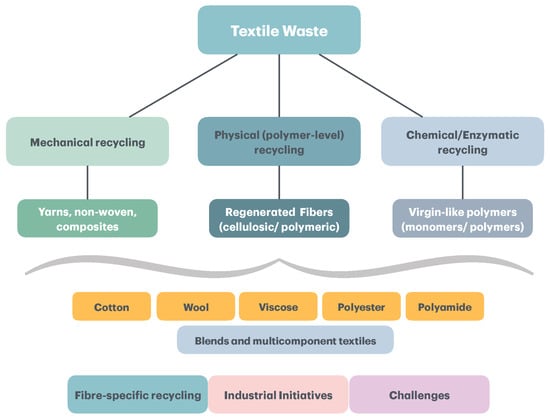
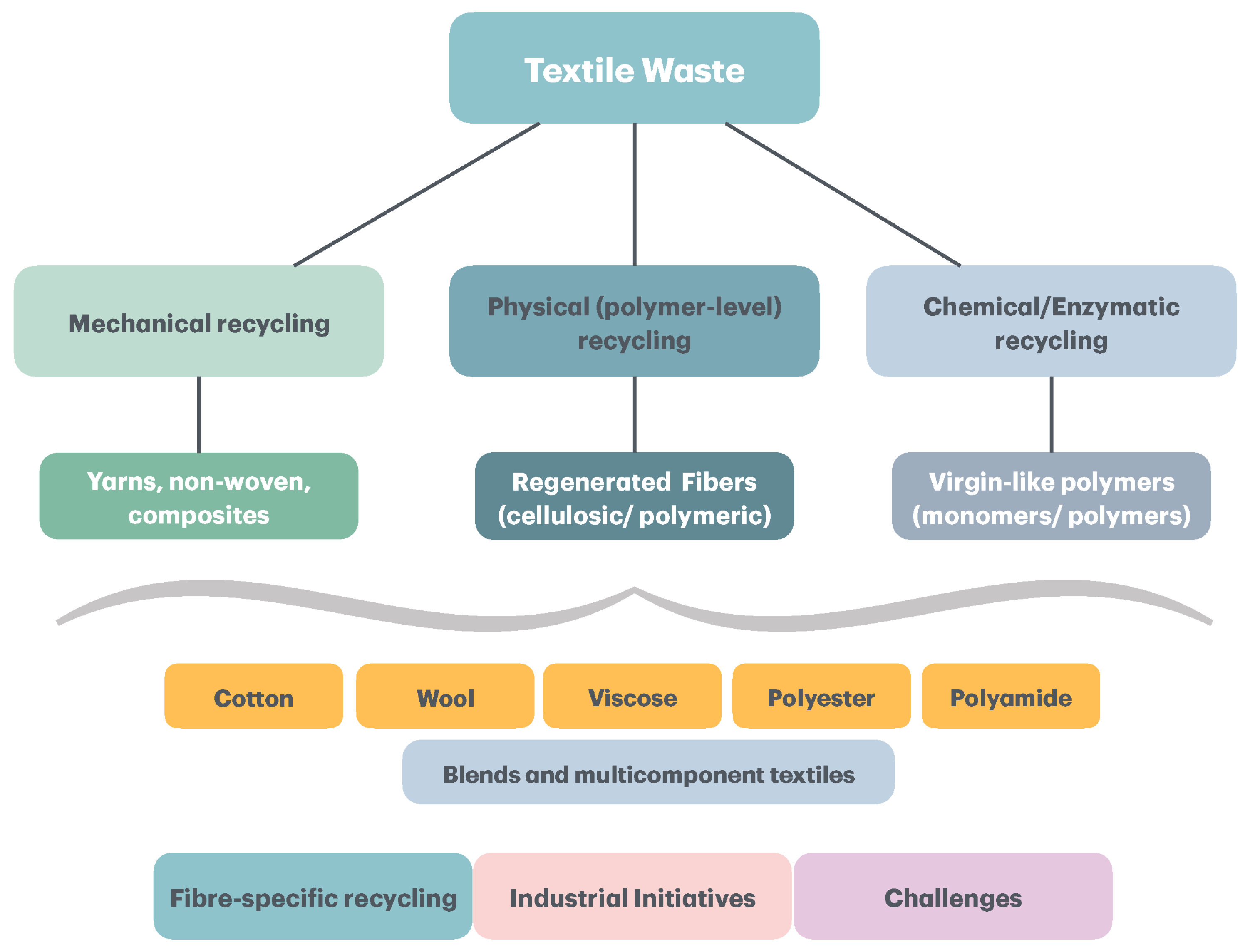
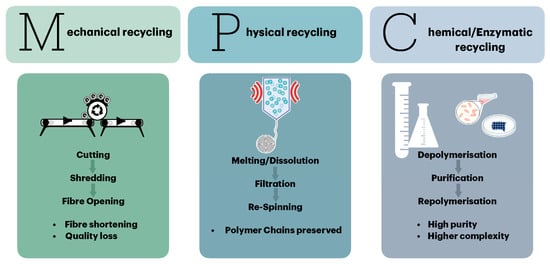
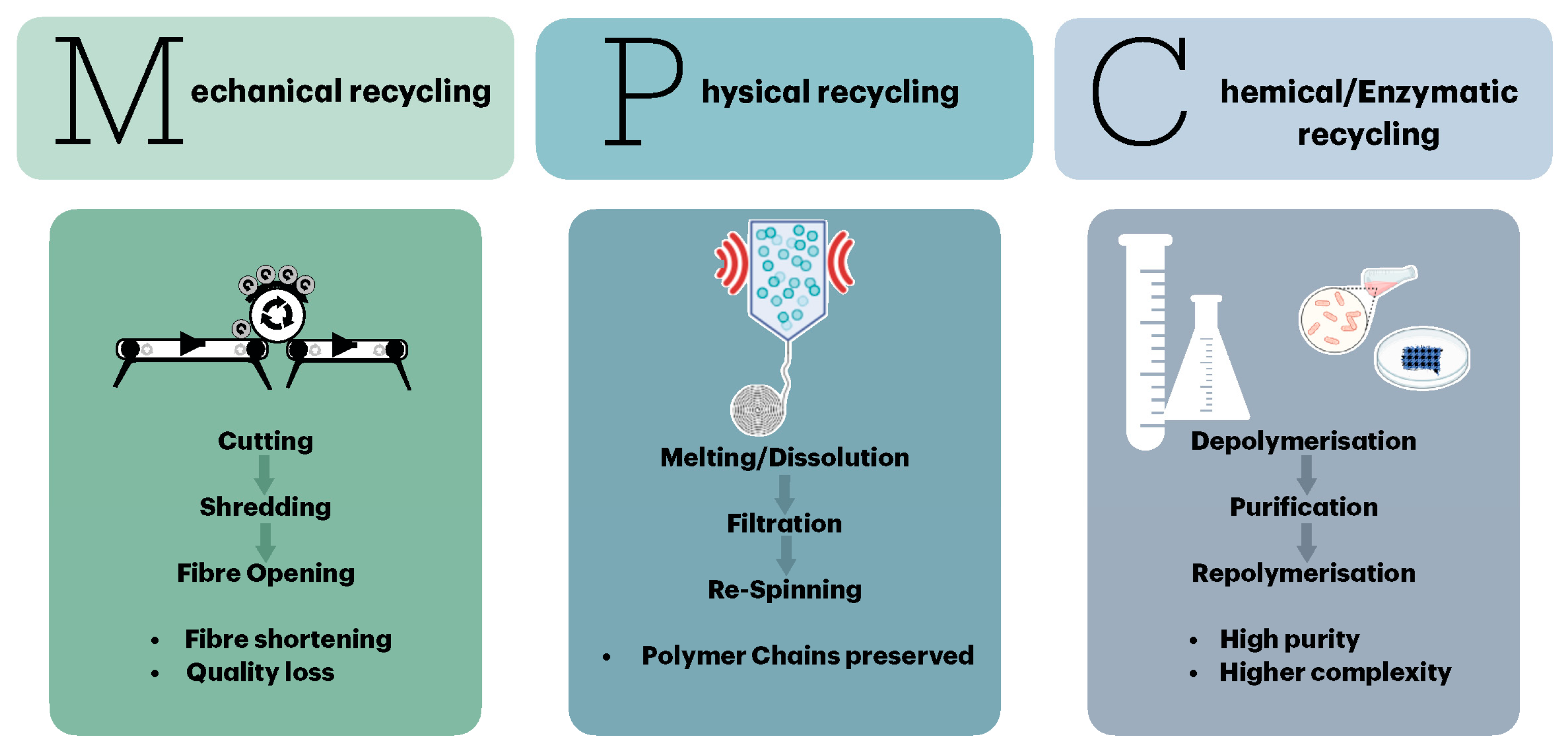
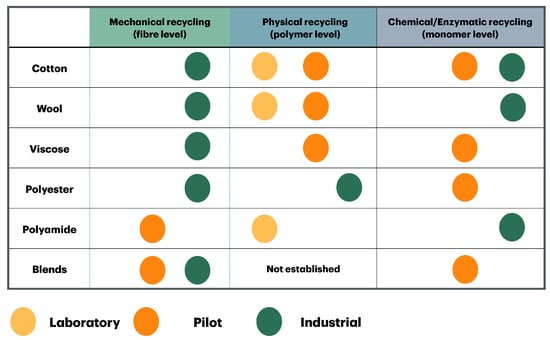
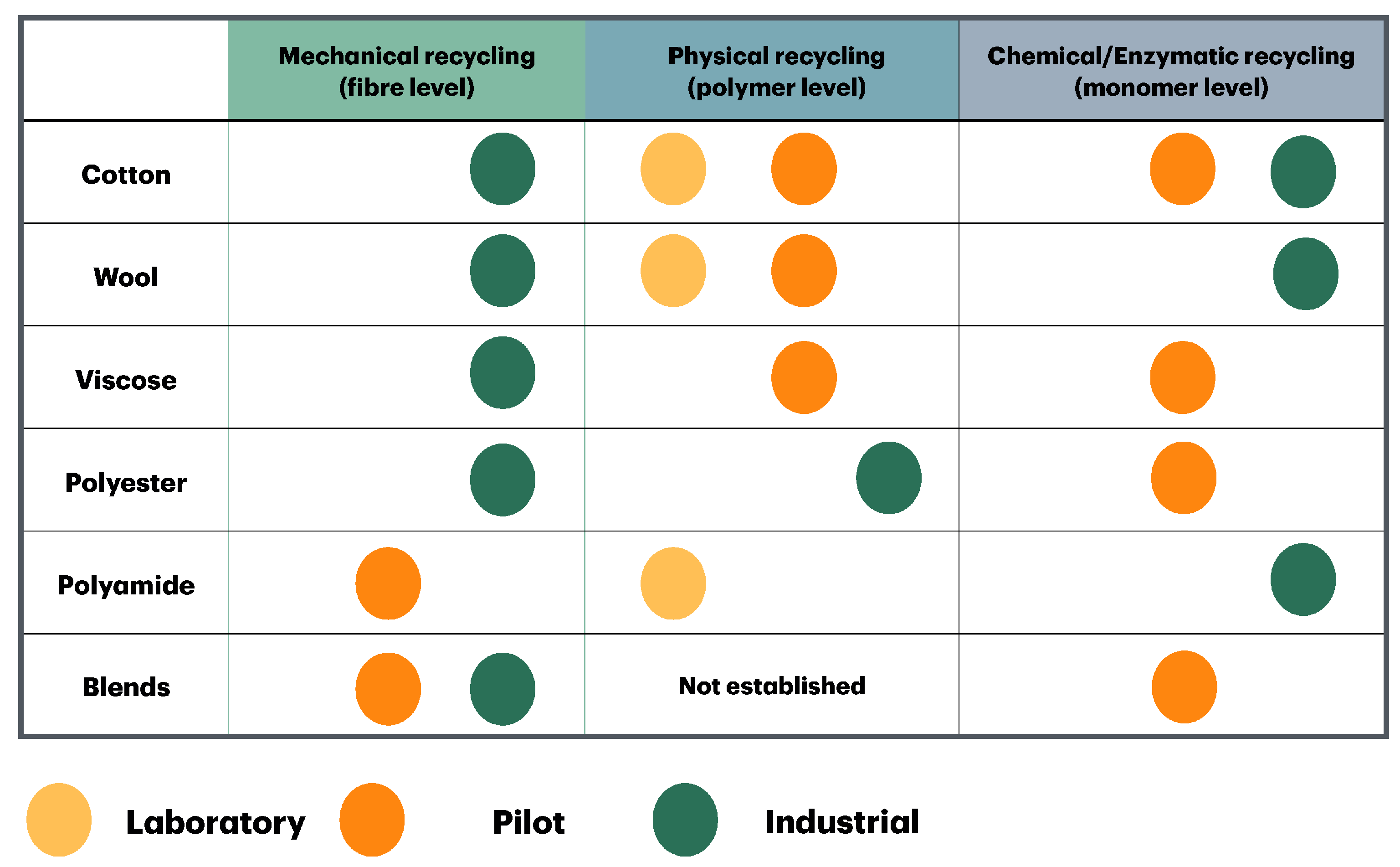

Disclaimer/Publisher’s Note: The statements, opinions and data contained in all publications are solely those of the individual author(s) and contributor(s) and not of MDPI and/or the editor(s). MDPI and/or the editor(s) disclaim responsibility for any injury to people or property resulting from any ideas, methods, instructions or products referred to in the content. |
© 2026 by the authors. Licensee MDPI, Basel, Switzerland. This article is an open access article distributed under the terms and conditions of the Creative Commons Attribution (CC BY) license.