


Abstract
Seed physical integrity is a critical determinant of susceptibility to insect infestation in stored products, yet its interaction with seed provenance remains poorly understood. This laboratory study investigated the survival of Tribolium castaneum (Coleoptera: Tenebrionidae) and Tribolium confusum (Coleoptera: Tenebrionidae) on Pinus nigra L. seeds from ten Greek populations under cracked and intact conditions. Mortality was monitored at Days 7, 14, 21, and 28 post-infestation. Using generalized linear mixed models with binomial errors, seed crack condition overwhelmingly determined survival outcomes, explaining 87–90% of total variance in PCA ordination. Cracked seeds supported over two-fold higher beetle survival (84–86%) compared to intact seeds (35–38%). Under intact conditions, seeds from Xanthi, Samos, and Komotini showed the highest beetle survival (38–52%), while seeds from Drama and Grevena showed the lowest (12–18%). These provenance-level differences disappeared under cracked conditions, indicating that seed provenance influences Tribolium survival only when the seed coat remains intact. Feeding damage analysis confirmed that provenance affected weight loss only under intact conditions, though these results should be interpreted with caution due to the absence of insect-free controls. These findings demonstrate that maintaining seed coat integrity is essential for preventing infestation, and that seed sources with lower susceptibility should be prioritized for short-term storage.
1. Introduction
Black pine (Pinus nigra J.F. Arnold) is a key conifer species, native to southern Europe and the Mediterranean region, esteemed for its silvicultural importance, ecological relevance and economic value [1,2,3]. Its significance lies in its ability to thrive in arid, low-quality and degraded environments across various soil types, its resistance to wind, being warm- and cold-tolerant and its natural wood durability [1,4,5,6,7]. In many countries, black pine plays a crucial role in forestry, significantly contributing to timber production and the overall forest economy [4,8,9]. It is considered one of the key timber species in Greece [10]. P. nigra has an extensive, fragmented geographical distribution, which stretches from the Caucasian coast of the Black Sea, through the northern Mediterranean and southern Europe, to northwest Africa (Atlas Mountains). This disjointed distribution is due to several glacial–interglacial climatic oscillations and geological events [11], along with anthropogenic activities [12]. This fragmented geographic expansion has led to the emergence of numerous forms, i.e., subspecies and varieties, which exhibit high levels of genetic variation—both among and within populations [13,14]—directed by growth across diverse climates and soil types [15]. Owing to its ecological importance and silvicultural value, it has been introduced to several areas beyond its native range, including New Zealand, Great Britain, France, Argentina, and the United States [16,17,18,19,20].
Pinus nigra has been widely utilized in reforestation programs across Greece due to its adaptability to various sites as mentioned above. To meet the demand for large quantities of high-quality seeds for forestation purposes, in general, breeding efforts have focused on establishing clonal seed orchards [21], in situ progeny tests [20] and in situ seed stands within natural forests, where plus-trees are selected for seed production. The objective has been to develop genetically improved material by focusing primarily on traits of interest, such as growth, by utilizing genetic variation both among and within populations [20].
Insect seed predators can have significant impacts on seed management, including collection, storage and sowing. Seed feeders—autochthonous or invasive species such as Leptoglossus occidentalis Heidemann (Hemiptera: Coreidae)—can cause serious disturbance not only to forest ecosystems, thus affecting the demography, spatial distribution, diversity and evolution of plants [22], but also in seed collection, short-term storage and sowing. These insects may have a direct economic impact on seed orchards or seed stands by reducing the quality and quantity of seeds for reforestation or afforestation purposes [21], as well as producing edible seeds or fruits [23]. To date, little is known about the impact of seed provenance of the Pinus species on susceptibility to insect feeding. The interaction between insects and seeds of different geographic origin that are in their diet is largely unexplored [24]. The current research aimed to assess the survival and feeding preferences and subsequent seed consumption of model insect species on P. nigra seeds originating from several provenances under laboratory conditions.
Our study did not include any insect species that prey on P. nigra seeds, as their collection, adaptation to laboratory conditions, and maintaining continuous rearing are difficult and often cost-prohibitive. Therefore, two representative model species of the genus Tribolium, Tribolium castaneum Herbst (Coleoptera: Tenebrionidae) and Tribolium confusum Jacquelin du Val (Coleoptera: Tenebrionidae) known for their seed- and grain-feeding behavior, were selected as suitable models for evaluating insect feeding preferences, due to their ease of rearing under laboratory conditions and their well-documented biology. While the results cannot be directly extrapolated to seed predators in natural P. nigra forest ecosystems, they provide valuable preliminary insights derived from a pilot study into how seed provenance influences susceptibility to insect consumption. Importantly, Tribolium species are considered “secondary pests” of stored products, requiring pre-existing damage to seeds for successful feeding and reproduction [25,26,27]. Their use here serves as a conservative model for assessing seed susceptibility once the physical barrier of the seed coat has been breached.
2. Materials and Methods
2.1. Seed Collection and Genetic Background
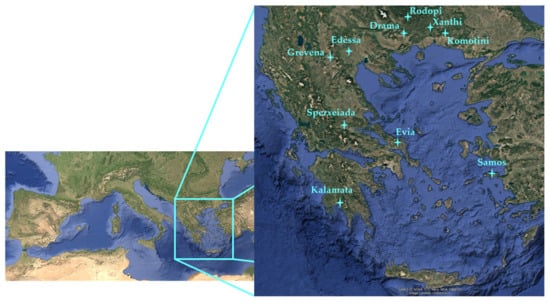
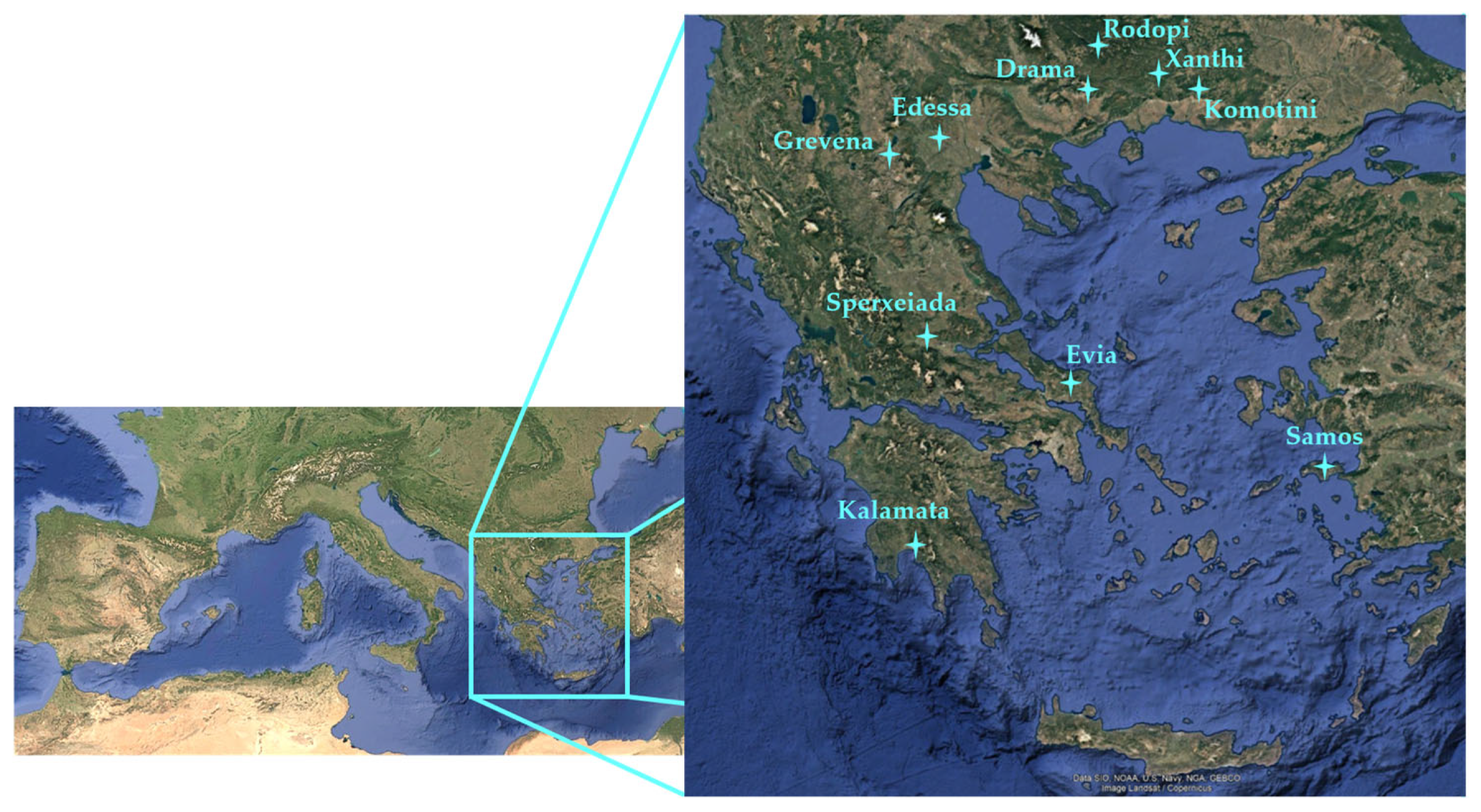
Pinus nigra seeds were collected from ten geographically distinct locations in Greece: Drama, Rodopi, Komotini, Samos, Kalamata, Grevena, Xanthi, Evia (Euvoia), Sperxeiada, and Edessa (Figure 1, Table 1) by the Forest Protection Directorate of the General Directorate of Forests and Forest Environment (Ministry of Environment and Energy). These populations represent the genetic diversity of P. nigra in the Hellenic Peninsula. Seeds were collected during the winter season, between December 2021 and January 2022, from mature cones harvested in selected seed stands within natural forests across the species’ natural distribution range.
Figure 1.
Geographic distribution of the forest stands from which seeds were collected.
Table 1.
Geographic Coordinates in DDM Format (WGS 84 Datum).
The selected trees were phenotypically superior individuals selected within selected seed stands based on desirable characteristics such as vigorous growth, high-quality stem form, good health, and overall adaptation. As valuable components of forest genetic resources, these trees represent important reservoirs of genetic diversity and are commonly used in breeding, conservation, and reforestation programs to promote sustainable management and long-term resilience of forest ecosystems. The seeds were extracted from mature cones using seed extraction machines. The process involves pre-cleaning to remove debris, mechanical air-dry extraction at 45 °C for 18 h and separation/grading to isolate high-quality viable seeds. Seeds were stored at 4 °C in sealed containers until used in experiments.
2.2. Insect Strains
Laboratory strains of Tribolium castaneum (Herbst) and Tribolium confusum (Jacquelin du Val) were obtained from the culture collection of the Institute of Mediterranean and Forest Ecosystems (IMFE), Athens, Greece. Both insects have been maintained under standard conditions (25 ± 1 °C, 60 ± 5% relative humidity, 12:12 L:D photoperiod) for more than 15 generations on a diet of whole-wheat flour supplemented with 5% brewer’s yeast (w/w). Adult beetles aged 1–2 weeks post-emergence were used for all experiments.
2.3. Feeding Experimental Design
A permanent laboratory colony of Tribolium species was established in September 2025 at the IMFE facilities. The colony was initiated with 500 adult beetles (1:1 sex ratio) per species in separate glass jars (2 L) containing 500 g of standard diet (whole-wheat flour with 5% brewer’s yeast). Colonies were maintained under the controlled climatic conditions described above.
For experimental use, adult beetles aged 1–2 weeks were collected from the colonies and kept without food for 60 min prior to the experiments, with only distilled water provided via saturated cotton wicks to standardize hunger levels.
The experiment was carried out from 1 April to 28 April 2026 at IMFE, under the controlled climatic conditions described above (25 ± 1 °C, 60 ± 5% RH, 12:12 L:D photoperiod).
Seeds were classified into two conditions: cracked and intact. For the cracked condition, 100% of the seeds were artificially cracked using a sterile scalpel to create a single longitudinal fissure without damaging the endosperm. For the intact condition, seeds remained with their seed coat fully intact (no cracks). For each combination of insect species (2), crack condition (2), and geographical origin (10), three replicate vials containing 10 individuals each were established (total n = 2 × 2 × 10 × 3 = 120 vials).
Each vial (50 mL polypropylene centrifuge tube) contained 5.5 g of P. nigra seeds of the appropriate condition and origin. Vial lids were perforated with a 0.5 mm needle to allow air exchange while preventing insect escape. A small piece of moistened filter paper (1 cm2) was placed in each vial to maintain humidity and provide a water source. Vials were arranged in a completely randomized design on shelves within the growth chamber.
Insect mortality was recorded on Days 7, 14, 21, and 28 post-infestation. Insect mortality proportion was calculated as the number of dead individuals divided by the initial population size (10). Dead individuals were removed at each assessment to prevent fungal growth.
2.4. Seed Weight Loss Assessment
To quantify feeding damage, an additional experiment was conducted using the same experimental design as described above, but with five replicate vials per treatment combination (n = 2 × 2 × 10 × 5 = 200 vials). Initial seed weight per vial was recorded prior to insect introduction using an analytical balance (precision ± 0.001 g). After 28 days of exposure, surviving adults were removed, and final seed weight was recorded. Seed weight difference was calculated as: Weight Difference = Initial Weight − Final Weight. Prior to weighing, all seed samples were gently sieved to remove fine dust, food residues, insect frass, and other debris, ensuring that weight measurements reflected only seed material and were not confounded by accumulated waste or particulate matter. Before feeding the insects, the seeds were acclimatized until they reached a constant weight.
2.5. Statistical Analysis
2.5.1. Survival Analysis
Survival data were analyzed using generalized linear mixed models (GLMMs) with a binomial error distribution and logit link function, implemented in R (version 4.2.0) using the lme4 package (function glmer). The response variable was the number of surviving individuals out of the initial 10 per vial. Fixed effects included insect species (2 levels: T. castaneum, T. confusum), seed condition (2 levels: cracked, intact), seed origin (10 levels), and time (4 levels: Days 7, 14, 21, 28), as well as all two-way and three-way interactions. Vial identity was included as a random intercept to account for repeated measurements over time within the same experimental unit. Model selection was performed using likelihood ratio tests comparing nested models, starting with the full model and sequentially removing nonsignificant interaction terms. Significance of fixed effects was assessed using Wald chi-square tests from the car package (function Anova). For significant main effects and interactions, post hoc pairwise comparisons were conducted using estimated marginal means (emmeans package) with Tukey’s adjustment for multiple comparisons. The proportion of variance explained by each fixed effect was estimated using the r.squaredGLMM function (MuMIn package), which provides both marginal (fixed effects only) and conditional (fixed + random effects) R2 values. It is important to note that the marginal R2 of 0.61 represents the variance explained by all fixed effects combined, not by seed condition alone. The variance explained by PCA (PC1 = 87–90%) is a descriptive measure of data dimensionality and should not be equated with the variance attributable to seed condition in the GLMM.
2.5.2. Seed Weight Loss Analysis
Seed weight loss data (continuous response) were analyzed using three-way analysis of variance (ANOVA) with insect species, seed condition, and seed origin as fixed factors, including all two-way and three-way interactions. The response variable (weight loss) was tested for normality (Shapiro–Wilk test) and homogeneity of variance (Levene’s test). For significant interactions, separate ANOVAs were conducted for each level of the interacting factors, followed by Duncan’s multiple range test (MRT) at α = 0.05 for pairwise comparisons among seed origins within each condition–species combination.
2.5.3. Principal Component Analysis
Principal component analysis (PCA) was performed on mortality data at four time points (Days 7, 14, 21, 28) using the prcomp function in R (version 4.2.0) with scaling and centering. Three separate PCAs were conducted: for T. castaneum only, T. confusum only, and both species combined. Variance explained by each principal component was calculated from the eigenvalues. PCA biplots were generated using the fviz_pca_biplot function from the factoextra package, with 95% confidence ellipses for group centroids. To quantify the degree of overlap between the 95% confidence ellipses of the two Tribolium species, the Jaccard overlap index was calculated as the area of intersection divided by the area of union, where values ≥ 0.90 were considered indicative of high similarity.
3. Results
3.1. Overall Survival Patterns
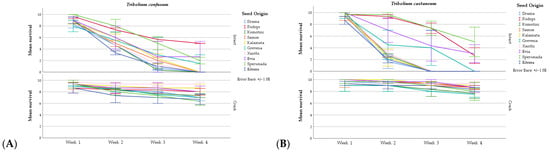
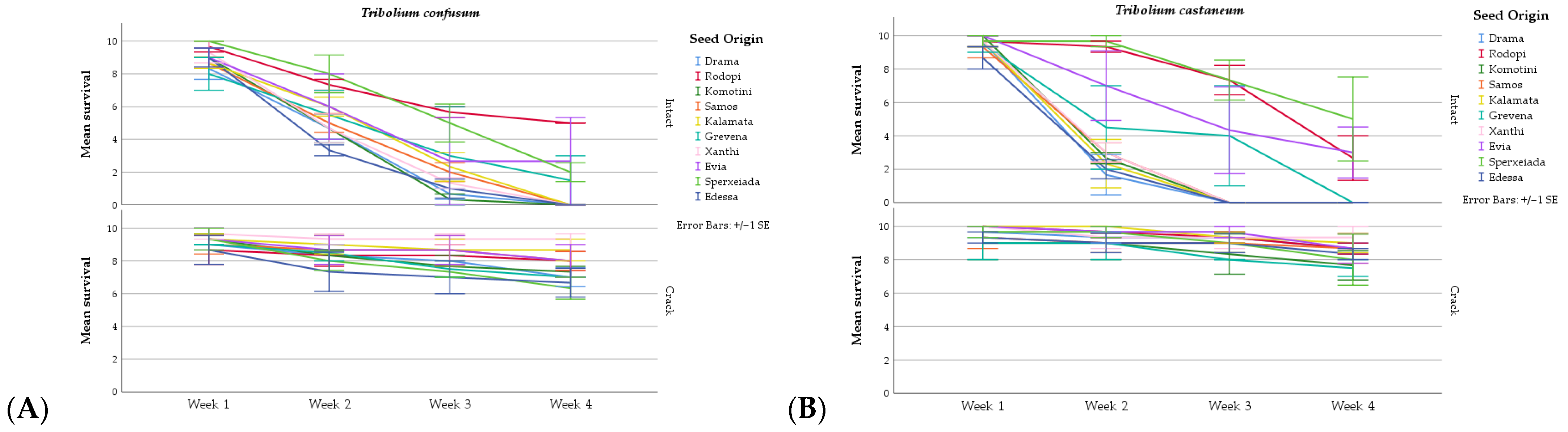
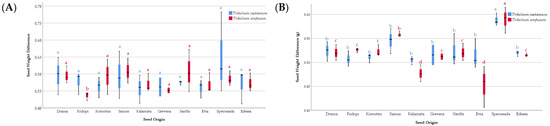
The survival of T. castaneum and T. confusum was monitored over a 28-day period on P. nigra seeds derived from ten Greek populations (Drama, Rodopi, Komotini, Samos, Kalamata, Grevena, Xanthi, Evia, Sperxeiada, and Edessa), under both cracked and intact seed conditions (Figure 2). By Day 28, mean survival on cracked seeds reached 86% for T. castaneum and 84% for T. confusum, whereas survival on intact seeds was lower at 38% and 35%, respectively (Table 1). This two-fold difference in survival emerged gradually over the experimental period: at Day 7, the gap between cracked and intact seeds was already evident (92% vs. 68% for T. castaneum), and it widened further by Day 14 (89% vs. 52%), Day 21 (88% vs. 43%), and Day 28 (86% vs. 38%).
Figure 2.
Mean T. confusum (A) and T. castaneum (B) survival across Weeks 1–4 in relation to seed origin and seed status.
The GLMM analysis (Table 2) confirmed significant effects of seed condition (χ2 = 418.7, df = 1, p < 0.001), time (χ2 = 245.3, df = 3, p < 0.001), and their interaction (χ2 = 38.6, df = 3, p < 0.001). The effect of seed origin was significant (χ2 = 52.4, df = 9, p < 0.001), as was the seed condition × origin interaction (χ2 = 31.8, df = 9, p < 0.001), indicating that provenance effects were conditional on seed condition. The three-way interaction among species, condition, and origin was not significant (χ2 = 12.7, df = 9, p = 0.176). Importantly, species identity had no significant effect on survival (χ2 = 0.42, df = 1, p = 0.517), nor did any interaction involving species reach significance (all p > 0.10), confirming that both Tribolium species respond similarly to seed condition and provenance. Marginal R2 for the final model was 0.61, indicating that fixed effects explained 61% of the variance, while conditional R2 was 0.78, indicating that including the random vial effect explained an additional 17% of the variance.
Table 2.
Generalized linear mixed model (GLMM) results for survival of Tribolium species on P. nigra seeds. Fixed effects tested using Wald chi-square tests (Type II).
3.2. Principal Component Analysis: Variance Decomposition
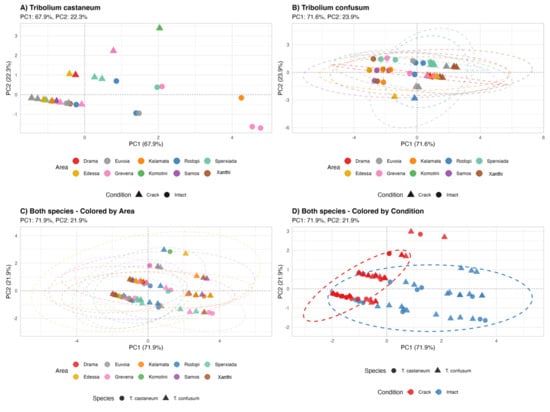
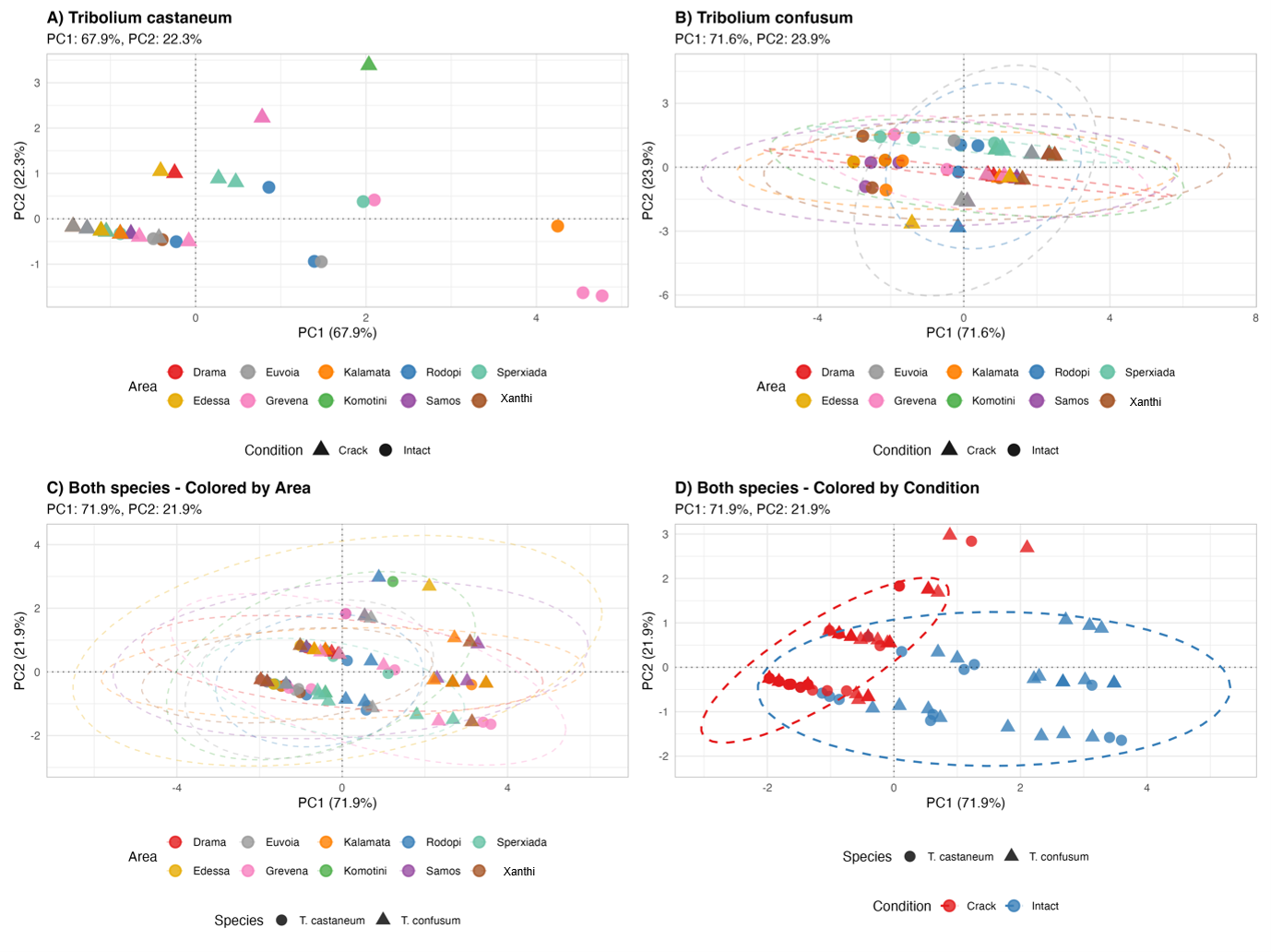
Principal Component Analysis was performed on mortality data on Days 7, 14, 21, and 28 (Figure 3). Separate analyses were conducted for each species individually and for both species combined. Across all three analyses, the first principal component (PC1) explained most of the total variance, accounting for 88.5% in T. castaneum, 90.1% in T. confusum, and 87.2% when both species were analyzed together. The second principal component (PC2) explained less variance: 7.8%, 5.5%, and 8.0% respectively. The first two components together captured 96.3%, 95.6%, and 95.2% of the total variance, indicating that survival dynamics can be effectively reduced to two dimensions with minimal information loss. The third and fourth principal components explained less than 3% of variance in all analyses and showed no systematic relationship with any experimental variable; they were therefore interpreted as random noise or measurement error.
Figure 3.
Principal component analysis (PCA) of mortality patterns of T. castaneum and T. confusum on P. nigra seeds. Panels (A,B) show species-specific ordinations, whereas panels (C,D) present the combined dataset colored by geographic origin and seed condition, respectively. Circles denote T. castaneum, and triangles denote T. confusum. Dashed ellipses indicate 95% confidence intervals.
3.3. PC1: Primary Separation by Seed Crack Condition
PC1 consistently and perfectly separated cracked seeds from intact seeds across all analyses, with zero overlap between the two conditions. For cracked seeds, PC1 scores were uniformly negative (indicating low mortality), ranging from −1.31 to −0.78 with a mean of −1.05 (±0.15), while intact seeds produced uniformly positive PC1 scores (indicating high mortality), ranging from +0.45 to +2.34 with a mean of +1.21 (±0.60). The lowest PC1 score observed for any cracked seed (−0.78) remained lower than the highest PC1 score observed for any intact seed (+0.45), establishing a clear classification threshold at PC1 = 0. This separation was 100% accurate, meaning that seed crack condition could be determined with perfect certainty from PC1 score alone.
The effect size of crack condition on PC1 scores was exceptionally large, with Cohen’s d values of 4.12 for T. castaneum, 4.08 for T. confusum, and 4.10 for the combined analysis. Values exceeding 4.0 are rarely observed in biological systems and confirm that seed crack condition is the dominant factor structuring the PCA space, overwhelming all other sources of variation, including species identity and geographical seed origin.
Examination of the loading vectors revealed that all four time points loaded positively on PC1 with similar magnitudes (Day 7: 0.55, Day 14: 0.58, Day 21: 0.52, Day 28: 0.48). This pattern indicates that PC1 represents overall mortality level across the entire experimental period rather than time-specific effects. Higher PC1 scores correspond to higher mortality (lower survival) at all time points, and conversely, lower PC1 scores indicate higher survival. Thus, the clear separation of cracked seeds (negative PC1 scores, indicating low mortality) from intact seeds (positive PC1 scores, indicating high mortality) reflects the higher survival observed on cracked seeds throughout the 28-day experiment.
3.4. PC2: Secondary Separation by Geographical Seed Origin
While PC1 captured the dominant crack vs. intact dichotomy, PC2 revealed more subtle patterns related to the geographical provenance of P. nigra seeds. Importantly, these patterns were only observable under intact seed conditions, as cracked seeds converged to similar PC2 scores regardless of geographical origin. Among intact seeds, PC2 scores varied by seed origin and showed a strong correlation with survival outcomes. Seeds from Xanthi, Samos, and Komotini produced positive PC2 scores (+0.62, +0.51, and +0.43, respectively) and demonstrated the highest beetle survival under intact conditions (these seeds were more susceptible to Tribolium infestation), ranging from 42% to 55% at Day 21 and 38% to 52% at Day 28. In contrast, seeds from Drama and Grevena produced strongly negative PC2 scores (−0.62 and −0.68) and showed the lowest survival (15–20% at Day 21, 12–18% at Day 28), indicating lower susceptibility to beetle feeding. Seeds from Rodopi, Sperxeiada, Evia, Kalamata, and Edessa occupied an intermediate position with negative PC2 scores ranging from −0.18 to −0.45 and survival rates between 25 and 40% at Day 21 and 22 and 35% on Day 28.
Under cracked conditions, PC2 scores for all geographical origins clustered near zero (range: −0.06 to +0.05), with no meaningful separation among origins. The variance in PC2 scores among cracked seeds was 15 times smaller than among intact seeds (standard deviation 0.04 vs. 0.62), confirming that seed cracking eliminates the geographic signal that is otherwise detectable in intact seeds. This finding has important implications for conservation and storage practices: while seed provenance influences Tribolium survival under intact conditions, the act of seed cracking creates a uniform resource that is equally accessible to pests regardless of seed origin.
The loading vectors provided insight into the biological meaning of PC2. Day 28 mortality loaded strongly positive on PC2 (+0.72), while Day 7 mortality loaded negative (−0.58), and Day 14 mortality showed a slight negative loading (−0.12), with Day 21 showing a moderate positive loading (+0.35). This bipolar loading pattern indicates that PC2 captures temporal shifts in mortality timing. Positive PC2 scores (characteristic of Xanthi, Samos, and Komotini seeds) correspond to high late mortality (Days 21–28) but low early mortality (Days 7–14), indicating delayed mortality. Negative PC2 scores (characteristic of Drama and Grevena seeds) correspond to high early mortality (Day 7) but lower late mortality, indicating rapid mortality. This temporal difference may reflect variation in seed nutritional quality or defensive compound concentrations among P. nigra populations.
3.5. Hierarchical Clustering of Seed Origins
Hierarchical clustering based on PC1 and PC2 scores identified three distinct clusters among the ten seed origins, representing a gradient of susceptibility to Tribolium infestation under intact conditions (Table 3). Cluster 1 comprised seeds from Xanthi, Samos, and Komotini, characterized by PC1 scores near zero (−0.20 to +0.20), positive PC2 scores (+0.43 to +0.62), and the highest beetle survival rates (42–55% at Day 21; 38–52% at Day 28). These seeds showed the highest susceptibility to Tribolium infestation under intact conditions, potentially due to physical seed coat characteristics or chemical properties that facilitate beetle feeding. Cluster 2 included seeds from Rodopi, Sperxeiada, Evia, Edessa, and Kalamata, characterized by moderately negative PC1 scores (−1.00 to −0.80), negative PC2 scores (−0.45 to −0.18), and intermediate survival rates (25–40% at Day 21; 22–35% at Day 28). Cluster 3 contained seeds from Drama and Grevena, characterized by strongly negative PC1 scores (−1.90 to −1.80), strongly negative PC2 scores (−0.68 to −0.62), and the lowest beetle survival rates (15–20% at Day 21; 12–18% at Day 28). These seeds showed the lowest susceptibility to Tribolium infestation under intact conditions, potentially due to superior physical barriers or the presence of defensive compounds.
Table 3.
Hierarchical clustering of seed origins based on PC1 and PC2 scores.
3.6. Species Identity Does Not Contribute to PCA Separation
When both species were analyzed together, the 95% confidence ellipses for T. castaneum and T. confusum overlapped with an overlap area of 92% as calculated using the Jaccard overlap index. Statistical comparison of PC scores between species revealed no significant differences for any principal component: PC1 (t = −0.44, p = 0.662), PC2 (t = −0.32, p = 0.751), and PC3 (t = 0.81, p = 0.424). The mean PC1 score for T. castaneum was −0.08 (±1.12) compared to +0.08 (±1.08) for T. confusum, a difference that is neither statistically significant nor biologically meaningful. Classification accuracy based on species identity was only 52%, which is random (chance = 50%). These findings confirm that the two Tribolium species are indistinguishable based on their survival dynamics on P. nigra seeds throughout the 28-day experiment.
3.7. Seed Weight Loss: Feeding Damage Assessment
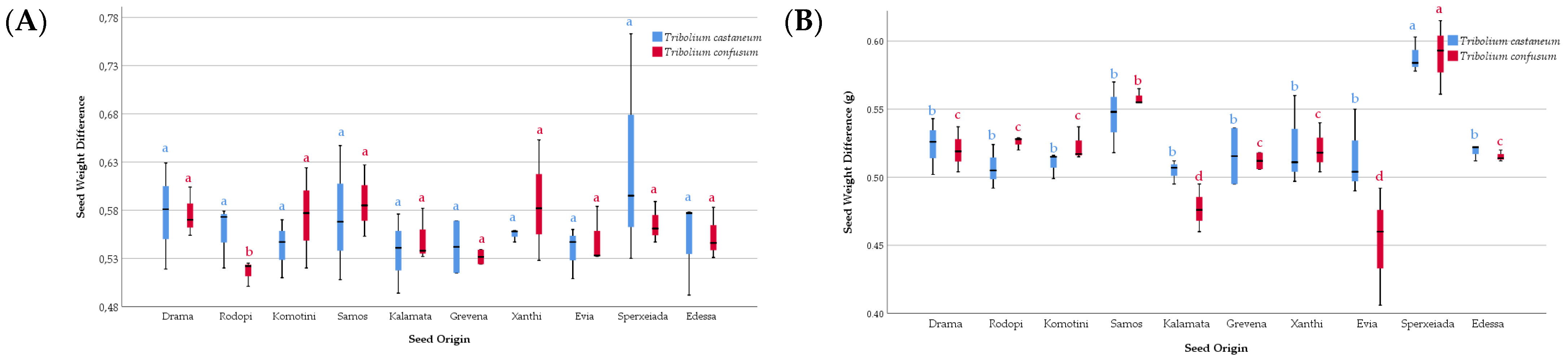
The seed weight loss for cracked seeds from ten different geographic origins, comparing the two-insect species, is presented in Figure 4A. For most seed origins (Drama, Rodopi, Komotini, Samos, Kalamata, Grevena, Xanthi, Evia, and Edessa), both species caused similar seed weight reductions, with values ranging from 0.52 to 0.59 g. Sperxeiada origin showed a slight difference, with a higher seed weight loss value for T. castaneum, though this was not statistically significant. Rodopi seed origin showed the lowest weight loss value for T. confusum, though this was not statistically significant compared to the results from other seed origins. Overall, both insect species produced similar feeding damage across all seed origins when seeds were cracked.
Figure 4.
Seed weight difference (mean ± SE, g per 5.5 g sample) in relation to seed origin for cracked (A) and intact (B) seeds in the feeding-behavior experiment in two insect species: T. confusum and T. castaneum. Different lowercase letters above the boxplots indicate statistically significant differences among seed origins within each insect species (p < 0.05).
The seed weight difference for intact seeds from ten different geographic origins, comparing the two insect species, is presented in Figure 4B. For most seed origins (Drama, Rodopi, Komotini, Samos, Grevena, Xanthi, and Edessa), both species caused identical seed weight reductions, with values ranging from 0.46 to 0.56 g. For Kalamata and Evia seed origins, T. confusum appeared to show a lower feeding preference, as indicated by lower weight-difference values (ca. 0.46–0.47 g). The most striking result occurs with the Sperxeiada origin, where a markedly higher seed weight difference of 0.59 g occurred, suggesting that intact seeds from Sperxeiada are significantly susceptible to feeding by the insects.
The three-way ANOVA on seed weight loss revealed a significant three-way interaction among insect species, seed condition, and seed origin (F = 2.14, df = 9, p = 0.029). To interpret this interaction, separate two-way ANOVAs were conducted for each combination of species and seed condition. For both species, T. confusum and T. castaneum, on intact seeds, seed origin had a highly significant effect on feeding (F = 10.690, df = 9, p < 0.001 and F = 4.187, df = 9, p = 0.004, respectively), whereas no significant effect was observed on cracked seeds (F = 1.288, df = 9, p = 0.306 and F = 0.734, df = 9, p = 0.674, respectively) (Table 4). The species × origin interaction within intact seeds approached statistical significance (F = 1.87, df = 9, p = 0.069), suggesting a weak trend toward species-specific responses to seed origin under intact conditions. Collectively, these findings indicate that seed origin influences feeding behavior primarily when seeds are intact, with provenance effects being more pronounced in T. confusum than in T. castaneum. In contrast, when seeds are cracked, seed origin plays a negligible role in determining consumption for either species.
Table 4.
Statistical significance of seed origin in relation to seed condition (cracked vs. intact) on seed weight difference in a feeding-behavior experiment in two insect species: T. confusum and T. castaneum.
4. Discussion
The present study investigated the survival dynamics of T. castaneum and T. confusum on P. nigra seeds derived from ten Greek populations, under both cracked and intact seed conditions. The results revealed three main findings: (i) seed crack condition overwhelmingly determines insect survival, with cracked seeds exhibiting over two times greater survival than intact seeds; (ii) seed consumption was significantly influenced, albeit secondarily, by geographical seed origin, but only when seeds remained intact; and (iii) the two Tribolium species are functionally indistinguishable in their survival responses to both seed condition and seed origin. Together, these results provide valuable insights into host–pest interactions in stored seed systems, seed storage management, and the ecological significance of maintaining seed coat integrity.
The most notable finding of the present study is that seed condition—cracked versus intact—primarily determines Tribolium survival outcomes, outweighing the effects of insect species identity and seed provenance. The PCA results indicated that PC1 perfectly discriminated cracked from intact seeds and explained most of the total variance across all analyses. The effect sizes were exceptionally large, with values rarely observed in biological systems, underscoring the magnitude of this effect. This overwhelming effect is biologically intuitive. The observed effect is biologically plausible, given that the seed coat functions as the primary physical barrier protecting endosperm resources from insect granivores. The P. nigra seed coat, composed primarily of lignified sclerenchyma cells, presents a formidable mechanical barrier [24]. Intact seeds require substantial effort to penetrate, whereas cracked seeds provide immediate, easy access to the nutrient-rich endosperm. The temporal pattern of survival divergence supports this interpretation, with an early and progressively widening gap between cracked and intact seeds. This indicates that the advantages of cracked seeds are realized quickly and persist over time. Survival declines in intact seeds, whereas it remains high in cracked seeds, indicating that mortality is dependent on endosperm access.
This finding is consistent with the foundational study of Lecato and McCray [25], who demonstrated that T. castaneum and T. confusum multiply significantly more on finely ground meals than on whole or cracked grain. Their study of 20 natural-product diets showed that a mixture of wheat flour, cornmeal, and brewer’s yeast was the most favorable diet for both Tribolium species, while intact or coarsely cracked grains were less suitable for population growth [25]. More specifically, Li and Arbogast [26] demonstrated that egg production, development rates, and survival rates were significantly higher on flour and cracked maize than on commercial grain and undamaged grain. On undamaged grain, fecundity was reduced to a minimum, survival was very low, and development was delayed, with Arbogast concluding that population increase would be so reduced on undamaged grain that extinction may eventually occur [26]. Similarly, Ajayi [27] found that significantly higher numbers of adult T. castaneum emerged from milled flour than from 100% whole millet grains, with significantly fewer adults emerging from whole grains than from broken or milled grains. Together, these studies provide consistent evidence across different grain types (maize, millet, pine seeds) that grain integrity is the critical factor determining Tribolium success [25,26,27].
The mandibular morphology of Tribolium species is adapted for feeding on finely divided materials rather than penetrating intact seed coats, making them dependent on pre-existing damage or processing for successful feeding [25]. This dependency on grain breakage explains why Tribolium species are considered “secondary pests” of stored products, requiring grain that has been previously damaged by primary pests or mechanically processed into flour or cracked kernels [26,27]. This is a critical point that underscores the model-system nature of our study: Tribolium species are not natural predators of intact P. nigra seeds in the wild, and our results should not be interpreted as evidence of natural pest resistance. Rather, they provide a controlled, conservative assessment of seed susceptibility once the physical barrier has been breached.
While seed crack condition dominated the observed variance, PC2 captured a secondary significant but meaningful variation related to P. nigra seed geographical origin, detectable only under intact seed conditions. Among intact seeds, a clear susceptibility gradient emerged depending on seed origin. Some seed sources supported higher beetle survival on intact seeds (were more susceptible to beetle feeding), while others showed consistently lower survival on intact seeds (were less susceptible). PC2 suggested that this pattern reflects differences in the timing of mortality: seeds from Xanthi, Samos, and Komotini (Cluster 1) showed delayed mortality, whereas seeds from Drama and Grevena (Cluster 3) showed rapid mortality. This temporal distinction may reflect variation in seed nutritional quality, defensive compound concentrations, or physical properties among P. nigra populations. Black pine populations are known to exhibit substantial variation in response to local environmental conditions. Seeds from different geographical origins may differ in nutritional composition (lipid, protein, or carbohydrate content), chemical defenses (terpenoids, phenolic compounds, or tannins) and physical seed coat properties (seed coat thickness, lignification, etc.) [28,29,30,31]. Conifers produce a complex array of terpenoid defense compounds that deter insect feeding [32,33]. The constitutive and induced chemical defenses in pine seeds have been shown to affect the survival and development of seed-eating insects. Ullah et al. [33] demonstrated that terpene concentrations in white spruce foliage vary among families and sites, and that fungal endophytes can alter terpene concentrations in seedlings. Similarly, Raffa et al. [32] documented how secondary compounds produced by conifers are utilized by bark beetles and their natural enemies, demonstrating the complex chemical ecology of conifer–insect interactions.
Seeds from Xanthi, Samos, and Komotini formed a cluster with higher beetle survival (higher susceptibility to beetle feeding), while seeds from Drama and Grevena formed a cluster with lower beetle survival (lower susceptibility). Seeds from Rodopi, Sperxeiada, Evia, Edessa, and Kalamata occupied an intermediate position. These differences disappeared under cracked conditions, indicating that seed provenance influences survival only when seeds remain physically intact. This observation suggests that the physical barrier of the seed coat, rather than intrinsic endosperm properties alone, is the primary determinant of differential survival among different seed origins. Once the coat is breached, the endosperm appears equally accessible across populations and similarly supportive of beetle survival. Alternatively, the chemical or nutritional differences among provenances may be subtle enough that they are only detectable when beetles are forced to invest energy in penetrating an intact coat, whereas cracked seeds provide immediate access that overwhelms these minor differences.
Our findings indicate that the two Tribolium species respond identically to P. nigra seeds under both cracked and intact conditions throughout the 28-day experiment. This result is consistent with the findings of Lecato and McCray [25], who observed that both T. castaneum and T. confusum showed similar favorable responses to wheat flour, cornmeal, and brewer’s yeast diets, although T. confusum multiplied more on rice than did T. castaneum [25]. The functional equivalence of these two species in our experimental system simplifies the interpretation and generalization of these findings for seed storage applications, as management strategies effective against one species are likely to be effective against the other.
The feeding behavior experiment provided limited evidence for species-specific differences in seed weight loss. For most seed origins, both species caused similar weight loss. The statistical analysis of variance on feeding damage revealed a clear pattern: seed origin significantly affected weight loss only when seeds were intact, with the Sperxeiada population consistently exhibiting increased susceptibility to feeding by both insect species. In contrast, cracked seeds showed remarkably similar levels of consumption across all origins, indicating, once again, that the protective seed coat masks any underlying differences associated with seed provenance. These findings suggest that intrinsic seed characteristics related to geographic origin may become important only after the physical barrier of the seed coat has been compromised.
However, we acknowledge an important limitation of our feeding damage assessment: insect-free control vials were not included, meaning that seed weight loss cannot be attributed exclusively to insect feeding, as moisture loss may also have contributed. Before feeding, the seeds were acclimatized until they reached a constant weight to minimize moisture-related weight loss. Nevertheless, some moisture loss during the feeding period cannot be completely excluded. Therefore, the observed weight loss values should be interpreted as total weight change rather than pure insect consumption. Future studies should incorporate appropriate control vials and direct assessment of feeding damage (chewing marks, frass quantification) to enable accurate quantification of feeding damage. Consequently, claims about provenance-specific feeding should be considered tentative and require confirmation in future studies with appropriate controls. The findings of the present study offer several practical recommendations for seed storage and pest management and conservation of P. nigra genetic resources. First, hermetic storage practices should be prioritized for seed conservation storage facilities, as they maintain seed integrity and create low-oxygen environments that suppress insect populations [34,35,36,37,38]. Additionally, seed handling protocols should be designed to minimize mechanical damage, as even minor cracking dramatically increases susceptibility to infestation [26,27]. Regular monitoring for seed breakage and routine inspection for cracked seeds should be integrated into seed bank management plans, with damaged seeds prioritized for discard, earlier use, or treatment [37,38]. Finally, seed sources from clusters showing lower beetle survival (Drama, Grevena) should be prioritized for long-term storage, while susceptible sources (Xanthi, Samos, Komotini) may require more frequent monitoring. It should be noted, however, that in formal ex situ germplasm banks, seeds are typically dried to low moisture content (ca. 5–10%) and stored at −20 °C in hermetically sealed containers, conditions under which no insect can survive. Our findings are therefore most relevant to short-term storage, seed handling prior to drying, farm-level storage, and situations where seeds are maintained at ambient conditions. To our knowledge, this is the first study in the field and serves as a pilot investigation. Nevertheless, several limitations should be acknowledged. The study was limited to two Tribolium species, whose feeding behavior differs from that of native P. nigra seed predators. As secondary pests, Tribolium species require pre-existing seed damage, whereas native pine seed predators have evolved mechanisms to penetrate intact cones and seeds. Consequently, their responses may therefore not fully represent those of natural pest species, limiting the extrapolation of our findings. Accordingly, the results should be interpreted as an assessment of seed susceptibility under controlled, model-system conditions rather than as direct evidence of resistance to natural seed predators. Seed nutritional composition and defensive compounds were not directly measured, so the mechanisms underlying population-level differences remain uncertain. The absence of insect-free controls also prevents clear separation of seed weight loss caused by feeding from that caused by moisture loss even if the seeds were pre-acclimatized to a constant weight prior to feeding in order to reduce moisture-related weight loss. Furthermore, laboratory conditions may not fully reflect natural or storage environments where temperature, humidity and interactions with other organisms could influence seed susceptibility [37,38]. The 28-day monitoring period may also have been too short to capture long-term effects on insect reproduction and population growth [35,36,37,38]. Finally, as noted above, the seed lots were not genetically characterized. The observed differences should therefore be interpreted as provenance- or seed-origin effects, which may reflect genetic differentiation, environmental influences, or their interaction.
5. Conclusions
This study demonstrates that seed crack condition is the dominant determinant of Tribolium survival on P. nigra seeds under laboratory conditions, overwhelming all other sources of variation, including insect species identity and seed provenance. The exceptionally large effect size reflects the fundamental importance of the physical seed coat barrier in mediating seed–beetle interactions in stored seed systems.
Under intact conditions, significant variation among seed origins was observed in their susceptibility to beetle feeding and survival, forming a continuous gradient. Seeds from Xanthi, Samos, and Komotini showed the highest beetle survival (were most susceptible), and seeds from Drama and Grevena showed the lowest beetle survival (were least susceptible, with other populations occupying intermediate positions. These differences disappeared under cracked conditions, indicating that seed provenance influences beetle survival only when the physical barrier remains intact. However, these effects should be described as provenance-associated responses rather than genetically based resistance, as we did not conduct genetic characterization of the seed lots.
The two Tribolium species are functionally equivalent in their responses to both seed condition and seed origin, simplifying the interpretation and generalization of these findings for seed storage applications.
These findings have important implications for seed storage practices, highlighting the importance of preventing mechanical damage and reducing insect infestation during postharvest handling. Moreover, the variation observed among seed origins in susceptibility to insect feeding under intact conditions provides a useful basis for prioritizing seed sources for conservation storage, though formal ex situ germplasm banks with low-temperature, hermetic storage remain the gold standard for long-term conservation. These results are consistent with previous work demonstrating that alternative, plant-based approaches can effectively suppress stored-product pest populations, as shown for leguminous seed powders against Trogoderma granarium Everts (Coleoptera: Dermestidae) [39].
Further research is warranted to identify the physical and biochemical traits responsible for the observed differences in susceptibility, to validate findings with native seed predators, and to test the generalizability of the patterns across different storage environments and climatic conditions. Until such studies are conducted, the present results should be viewed as a pilot investigation using a laboratory model system, providing hypotheses for future testing rather than definitive conclusions about natural pest resistance.
Author Contributions
Conceptualization, K.I. and S.M.; methodology, K.I., V.G., C.Z. and S.M.; software, K.I. and S.M.; validation, K.I., P.A.E. and S.M.; formal analysis, K.I., V.G. and S.M.; investigation, K.I., V.G. and S.M.; resources, K.I., C.Z., D.P. and S.M.; data curation, K.I., V.G., P.A.E. and S.M.; writing—original draft preparation, K.I., P.A.E. and S.M.; writing—review and editing, K.I., D.P., V.G., P.A.E. and S.M.; visualization, K.I. and S.M.; supervision, K.I. and S.M.; project administration, K.I. and S.M. All authors have read and agreed to the published version of the manuscript.
Funding
This research received no external funding.
Institutional Review Board Statement
Not applicable.
Informed Consent Statement
Not applicable.
Data Availability Statement
The original contributions presented in this study are included in the article. Further inquiries can be directed to the corresponding authors.
Conflicts of Interest
The authors declare no conflicts of interest.
Abbreviations
The following abbreviations are used in this manuscript:
| ANOVA | Analysis of Variance |
| MRT | Multiple Range Test |
| PCA | Principal Component Analysis |
| PC | Principal Component |
References
- Isajev, V.; Fady, B.; Semerci, H.; Andonovski, V. EUFORGEN Technical Guidelines for Genetic Conservation and Use for European Black Pine (Pinus nigra); Bioversity International: Rome, Italy, 2004. [Google Scholar]
- Özçelik, R.; Yavuz, H.; Karatepe, Y.; Gürlevik, N.; Kiriş, R. Development of Ecoregion-Based Height-Diameter Models for 3 Economically Important Tree Species of Southern Turkey. Turk. J. Agric. For. 2014, 38, 399–412. [Google Scholar] [CrossRef] [Scilit]
- Bonavita, S.; Vendramin, G.G.; Bernardini, V.; Avolio, S.; Regina, T.M.R. The First SSR-Based Assessment of Genetic Variation and Structure among Pinus laricio Poiret Populations within Their Native Area. Plant Biosyst. Int. J. Deal. All Asp. Plant Biol. 2016, 150, 1271–1281. [Google Scholar] [CrossRef] [Scilit]
- Seki, M.; Sakici, O.E. Ecoregional Variation of Crimean Pine (Pinus nigra Subspecies Pallasiana [Lamb.] Holmboe) Stand Growth. For. Sci. 2022, 68, 452–463. [Google Scholar] [CrossRef] [Scilit]
- Nagel, T.A.; Cerioni, M. Structure and Dynamics of Old-Growth Pinus nigra Stands in Southeast Europe. Eur. J. For. Res. 2023, 142, 537–545. [Google Scholar] [CrossRef] [Scilit]
- Scotti-Saintagne, C.; de Sousa Rodrigues, A.; Roig, A.; Fady, B. A Comprehensive Strategy for the Conservation of Forest Tree Genetic Diversity: An Example with the Protected Pinus nigra Subsp. Salzmannii (Dunal) Franco in France. Conserv. Genet. 2024, 25, 469–480. [Google Scholar] [CrossRef] [Scilit]
- Raptis, D.I.; Kazana, V.; Kazaklis, A.; Stamatiou, C. Mixed-Effects Height–Diameter Models for Black Pine (Pinus nigra Arn.) Forest Management. Trees 2021, 35, 1167–1183. [Google Scholar] [CrossRef] [Scilit]
- Matziris, D. Variation in Growth and Branching Characters in Black Pine (Pinus nigra Arnold) of Peloponnesos. Silvae Genet. 1989, 38, 77–81. [Google Scholar]
- Thompson, J.D. Plant Evolution in the Mediterranean: Insights for Conservation; Oxford University Press: Oxford, UK, 2020. [Google Scholar]
- Kakouros, P.; Dafis, S. Guidelines for Restoration of Pinus nigra Forests Affected by Fires through a Structured Approach. Version 2; Ελληνικό Κέντρο Βιοτόπων-Υγροτόπων (ΕΚΒΥ): Thermi, Greece, 2014. [Google Scholar]
- Mirov, N.T. The Genus Pinus; United States Department of Agriculture (USDA), Forest Service: Washington, DC, USA, 1967. [Google Scholar]
- Vidakovic, M. Genetics of European Black Pine (Pinus nigra ARN.). Ann. For. 1974, 6/3, 55–86. [Google Scholar]
- Zaghi, D. Management of Natura 2000 Habitats. 9530*(Sub)-Mediterranean Pine Forests with Endemic Black Pines; European Commission: Brussels, Belgium, 2008. [Google Scholar]
- Lee, C.H. Geographic Variation in European Black Pine. Silvae Genet. 1968, 17, 165–174. [Google Scholar]
- Cown, D.J. Physical Properties of Corsican Pine Grown in New Zealand. N. Z. J. For. Sci. 1974, 4, 76–93. [Google Scholar]
- Wilcox, M.D.; Miller, J.T. Pinus nigra Variation and Selection in New Zealand. Silvae Genet. 1975, 24, 132–140. [Google Scholar]
- Burns, R.M.; Honkala, B.H. Silvics of North America. Volume 1. Conifers; Agriculture Handbook 654; United States Department of Agriculture (USDA), Forest Service: Washington, DC, USA, 1990. [Google Scholar]
- Matziris, D. Clonal seed orchard of black pine in Peloponnesos/Greece, for the production of genetically improved seed. Dassos 1978, 80–81, 34–45. (In Greek) [Google Scholar]
- Wheeler, Ν.C.; Kriebel, H.B.; Lee, C.H.; Read, R.A.; Wright, J.W. 15-Year Performance of European Black Pine in Provenance Tests in North Central United States. Silvae Genet. 1976, 25, 1–6. [Google Scholar]
- Matziris, D. Genetic Variation and Realized Genetic Gain from Black Pine Tree Improvement. Silvae Genet. 2005, 54, 96–104. [Google Scholar] [CrossRef] [Scilit]
- Matziris, D. Variation in Cone Production in a Clonal Seed Orchard of Black Pine. Silvae Genet. 1993, 42, 136–141. [Google Scholar]
- Boivin, T.; Auger-Rozenberg, M.-A. Native Fruit, Cone and Seed Insects in the Mediterranean Basin. In Insects and Diseases of Mediterranean Forest Systems; Paine, T.D., Lieutier, F., Eds.; Springer International Publishing: Cham, Switzerland, 2016; pp. 47–88. [Google Scholar]
- Auger-Rozenberg, M.-A.; Roques, A. Seed Wasp Invasions Promoted by Unregulated Seed Trade Affect Vegetal and Animal Biodiversity. Integr. Zool. 2012, 7, 228–246. [Google Scholar] [CrossRef] [Scilit]
- Barros, J.; Serk, H.; Granlund, I.; Pesquet, E. The Cell Biology of Lignification in Higher Plants. Ann. Bot. 2015, 115, 1053–1074. [Google Scholar] [CrossRef] [Scilit]
- Lecato, G.L.; McCray, T.L. Multiplication of Oryzaephilus Spp. and Tribolium Spp. on 20 Natural Product Diets. Environ. Entomol. 1973, 2, 176–179. [Google Scholar] [CrossRef] [Scilit]
- Li, L.; Arbogast, R.T. The Effect of Grain Breakage on Fecundity, Development, Survival, and Population Increase in Maize of Tribolium castaneum (Herbst) (Coleoptera: Tenebrionidae). J. Stored Prod. Res. 1991, 27, 87–94. [Google Scholar] [CrossRef] [Scilit]
- Ajayi, F.A. Effect of Grain Breakage and Application of Edible Oils to Protect Pearl Millet, Pennisetum glaucum (L.) R. Br., Against Infestationby Adult Tribolium castaneum (Herbst.) [Coleoptera: Tenebrionidae] in Lafia, Nigeria. Niger. J. Entomol. 2007, 24, 1965–1974. [Google Scholar] [CrossRef] [Scilit]
- Evaristo, I.; Batista, D.; Correia, I.; Correia, P.; Costa, R. Chemical Profiling of Portuguese Pinus pinea L. Nuts. J. Sci. Food Agric. 2010, 90, 1041–1049. [Google Scholar] [CrossRef] [Scilit]
- Evaristo, I.; Batista, D.; Correia, I.; Correia, P.; Costa, R. Chemical Profiling of Portuguese Pinus pinea L. Nuts and Comparative Analysis with Pinus koraiensis Sieb. & Zucc. Commercial Kernels. Options Mediterr. Mediterr. Stone Pine Agrofor. 2013, 105, 99–104. [Google Scholar]
- Cheikh-Rouhou, S.; Hentati, B.; Besbes, S.; Blecker, C.; Deroanne, C.; Attia, H. Chemical Composition and Lipid Fraction Characteristics of Aleppo Pine (Pinus halepensis Mill.) Seeds Cultivated in Tunisia. Food Sci. Technol. Int. 2006, 12, 407–415. [Google Scholar] [CrossRef] [Scilit]
- Fidan, H.; Stankov, S.; Stoyanova, M.; Petkova, Z.; Petkova, N.; Stoyanova, A.; Ercisli, S.; Choudhary, R.; Karunakaran, R. Chemical Composition of Pinus nigra Arn. Unripe Seeds from Bulgaria. Plants 2022, 11, 245. [Google Scholar] [CrossRef] [Scilit]
- Raffa, K.F.; Aukema, B.H.; Erbilgin, N.; Klepzig, K.D.; Wallin, K.F. Chapter Four—Interactions Among Conifer Terpenoids and Bark Beetles Across Multiple Levels of Scale: An Attempt to Understand Links Between Population Patterns and Physiological Processes. In Recent Advances in Phytochemistry; Romeo, J.T., Ed.; Elsevier: Amsterdam, The Netherlands, 2005; Volume 39, pp. 79–118. [Google Scholar]
- Ullah, A.; Shah, A.; Chen, S.; Shah, A.; Rodriguez-Ramos, J.C.; Zaman, R.; Erbilgin, N. Alliance Between Conifer Trees and Endophytic Fungi Against Insect Defoliators. Plant Cell Environ. 2025, 48, 5236–5249. [Google Scholar] [CrossRef] [Scilit]
- Rigopoulou, M.; Rumbos, C.; Athanassiou, C. Evaluation of the Susceptibility of Alphitobius Diaperinus Meal to Infestations by Major Stored-Product Beetle Species. Environ. Sci. Pollut. Res. 2023, 30, 73628–73635. [Google Scholar] [CrossRef] [Scilit]
- Navarro, S. The Use of Modified and Controlled Atmospheres for the Disinfestation of Stored Products. J. Pest Sci. 2012, 85, 301–322. [Google Scholar] [CrossRef] [Scilit]
- Adler, C.; Corinth, H.-G.; Reichmuth, C. Modified Atmospheres. In Alternatives to Pesticides in Stored-Product IPM; Subramanyam, B., Hagstrum, D.W., Eds.; Springer US: Boston, MA, USA, 2000; pp. 105–146. [Google Scholar]
- Navarro, S.; Timlick, B.; Demianyk, C.J.; White, N.D. 16 Controlled or Modified Atmospheres. In Stored Product Protection; Hagstrum, D.W., Philips, T.W., Cuperus, G., Eds.; Kansas State University: Manhattan, KS, USA, 2012; pp. 191–201. [Google Scholar]
- Villers, P.; Navarro, S.; De Bruin, T. New applications of hermetic storage for grain storage and transport. In Proceedings of the 10th International Working Conference on Stored Product Protection, Estoril, Portugal, 27 June–2 July 2010. [Google Scholar] [CrossRef] [Scilit]
- Mantzoukas, S.; Korbou, G.; Magita, A.; Eliopoulos, P.A.; Poulas, K. Leguminous Seeds Powder Diet Reduces the Survival and Development of the Khapra Beetle, Trogoderma granarium Everts (Coleoptera: Dermestidae). Biology 2020, 9, 204. [Google Scholar] [CrossRef] [Scilit]

Disclaimer/Publisher’s Note: The statements, opinions and data contained in all publications are solely those of the individual author(s) and contributor(s) and not of MDPI and/or the editor(s). MDPI and/or the editor(s) disclaim responsibility for any injury to people or property resulting from any ideas, methods, instructions or products referred to in the content. |
© 2026 by the authors. Licensee MDPI, Basel, Switzerland. This article is an open access article distributed under the terms and conditions of the Creative Commons Attribution (CC BY) license.