


Abstract
Ecosystem restoration on Mediterranean islands is often hindered by the residual effects of past land use and invasive species. Decades of holm oak forest exploitation, the establishment of secondary pine plantations, and the introduction of invasive mammals have altered habitat configurations. Consequently, converting these conifer stands to promote the recovery of native Quercus ilex L. communities has become a conservation priority. This study investigates the regeneration constraints of Q. ilex in Mediterranean insular environments, focusing on the inhibitory role of conifer-derived litter and seed predation by invasive rodents and lagomorphs. We integrated an ex situ experiment (384 acorns) testing germination under varying local pine-forest soil and commercial substrate conditions, with an in situ field experiment (300 acorns) across five areas, comparing three treatments: closed cages (exclusion of all mammals), open cages (exclusion of lagomorphs), and unfenced controls. Results indicate that, while ex situ, local pine-forest soil significantly favoured germination over the commercial mixture, predation represents the main obstacle in situ, outweighing any soil-mediated effects. Seedling emergence was substantially reduced by early predation and, to a lesser extent, by litter presence. These findings highlight the necessity of integrated management strategies in insular ecosystems.
1. Introduction
The Mediterranean Basin is one of the world’s biodiversity hotspots [1], particularly due to its high levels of endemism and habitat heterogeneity, which are especially pronounced on islands [2]. Insular systems host unique and highly specialized plant communities but are also inherently vulnerable because of the limited available space and sensitivity to external pressures [3,4].
Since ancient times, human activities such as grazing, deforestation, and the introduction of alien species have altered the dynamics of Mediterranean vegetation, profoundly reshaping forest structures and degrading natural habitats, especially on islands [5,6,7]. According to Blondel et al. (2010) [8], nowhere else has nature moulded people and landscapes as much as in the Mediterranean region.
During the 20th century, concerns over soil erosion and fertility loss led many Mediterranean countries to implement large-scale reforestation programs, often based on fast-growing pioneer species such as Pinus spp., selected for their ability to rapidly colonize degraded soils and stabilize slopes [9,10]. Although these interventions increased forest cover and reduced erosion, they also generated unintended ecological effects, including reduced biodiversity, altered soil microbial communities, and constraints on the regeneration of native sclerophyllous species [11,12,13]. Moreover, the monospecific and barely age-structured of many pine plantations increases their vulnerability to disturbances and limits their capacity to evolve toward more diverse and mature forest systems [14,15].
Alongside reforestation, the spread of invasive alien species has emerged as an additional driver of ecological change in Mediterranean ecosystems [4,16,17]. Invasive species can alter successional processes, modify competition for resources, and hinder native species regeneration, with particularly strong impacts in insular environments characterized by high endemism and habitat fragmentation [18,19]. In particular, the introduction of herbivores (e.g., rabbits, feral goats and sheep) can strongly impact native island vegetation, causing habitat loss and erosion and altering nutrient dynamics, with cascading effects on ecosystem functioning [17].
Within the Mediterranean context—characterized by arid summer, recurrent droughts, and nutrient-poor soils—these pressures further limit ecosystem resilience and regeneration capacity. Under such conditions, sclerophyllous species of the genus Quercus, especially Quercus ilex L. (holm oak), play a key role in Mediterranean evergreen forests and exhibit functional adaptations that allow persistence under water-limited conditions [20,21,22]. Nevertheless, holm oak regeneration is frequently constrained by seed desiccation, herbivory, and increasing aridity [23,24]. Seedling establishment is often enhanced in shaded or protected microsites, and moderately dense pine plantations may, in some cases, act as transitional communities facilitating long-term forest recovery [11,25,26,27].
In light of this background, prioritizing the recovery of holm oak ecosystems over existing pine plantations is crucial for the conservation of the ecological heritage of Mediterranean islands. To achieve this, direct acorn sowing offers a cost-effective alternative to traditional planting. However, its success is often hampered by poor microsite conditions and seed predation [28]. In particular, invasive mammals such as rats and rabbits significantly hinder natural regeneration by predating on both seeds and seedlings [17,29].
Building on these challenges, the present study evaluates the effectiveness of direct seeding in a vulnerable island ecosystem, particularly susceptible to invasive alien predators [16,17]. We selected the island of Giglio (Tuscan Archipelago, Italy) as a focal site, where previous attempts to sow Q. ilex seeds—conducted as part of the LIFE LETSGO Giglio project—yielded poor results, necessitating a deeper investigation into successful restoration strategies.
Specifically, this study aims to evaluate the germination and emergence success of Q. ilex acorns under the combined pressure of vertebrate predation and the specific soil/litter conditions of pine plantations. By adopting a complementary experimental approach—combining in situ field trials with ex situ controlled experiments—we aim to isolate the factors driving regeneration failure. For the ex situ component, we hypothesized that pine forest soil and litter would negatively affect germination and early seedling growth compared to a commercial substrate, due to the potential inhibitory chemical or physical properties of pine-derived organic matter [11,30,31,32]. The specific objectives were to: (i) evaluate the germination and emergence rates of Q. ilex acorns under ex situ conditions, specifically testing the influence of pine forest soil and litter; (ii) assess early seedling growth responses (e.g., biomass and morphological traits) to pine-derived soil and litter; (iii) analyse the temporal patterns of seedling emergence associated with different substrate treatments; (iv) quantify the impact of predation by rodents and rabbits on acorn emergence and seedling establishment under in situ conditions. Regarding the in situ experiment, we predicted that predation would be the main constraint on recruitment, and we tested two main hypotheses: (i) that the different exclusion treatments would influence the presence of animal tracks, and (ii) that seedling emergence rates would be higher under exclusion treatments (open and closed cages).
2. Materials and Methods
2.1. Study Area
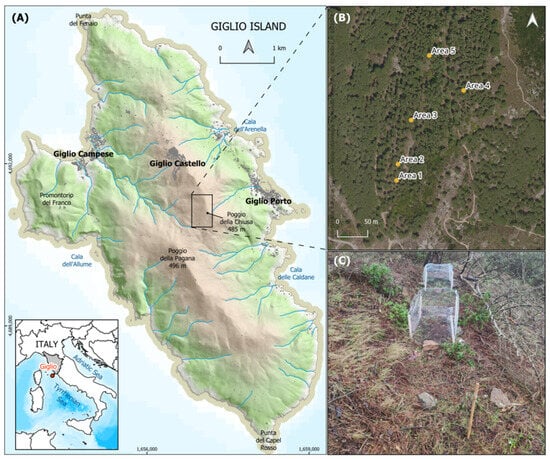
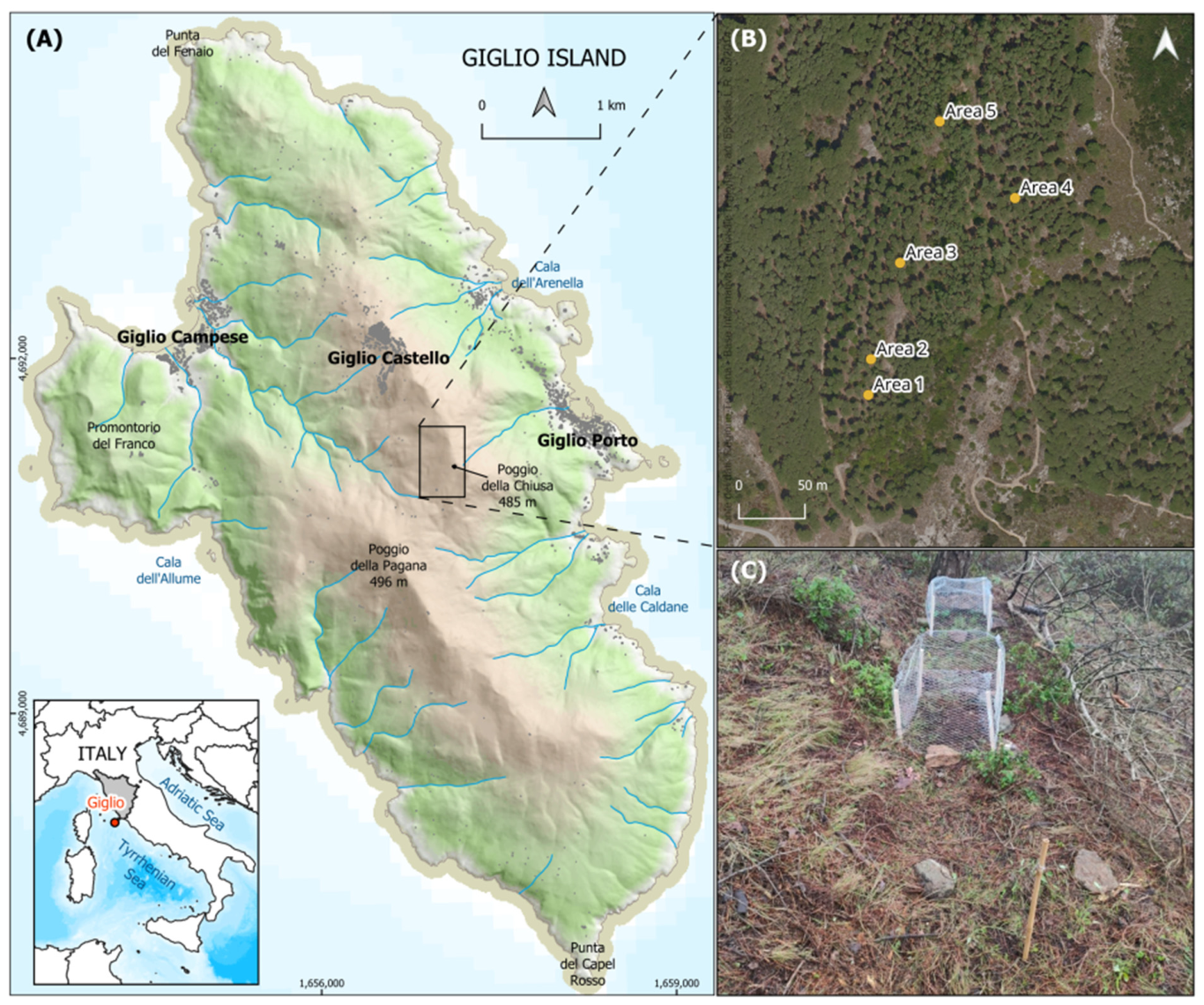
Giglio Island (WGS84: 42.35527° N, 10.90134° E) is part of the Tuscan Archipelago in the northern Tyrrhenian Sea (Figure 1). It is the second largest island of the archipelago, it has a surface of 21.2 km2, and it lies approximately 15 km off the mainland [30]. Nearly the entire island is included within the Natura 2000 network as a Special Area of Conservation (SAC/SPA IT51A0023). In addition, about 8.9 km2 of its territory are encompassed by the Tuscan Archipelago National Park.
Figure 1.
Geographical setting of the study area. (A) Giglio Island and its location; (B) five experimental areas, each comprising three square subplots; (C) example of the three subplots (Closed, Open cages and Control) (photo by Benedetta Favre).
The climate is typically Mediterranean, with mild, rainy winters and hot, dry summers that reach their peak in July and August [33,34]. The island is predominantly mountainous, characterised by steep slopes and a maximum elevation of 496 m at Poggio della Pagana. The vegetation is representative of the Mediterranean biome, dominated by Q. ilex forests, particularly in the central areas and on the Franco promontory. The upper canopy consists mainly of Q. ilex and Arbutus unedo L., while the shrub layer includes Erica arborea L. and Pistacia lentiscus L. [34]. In the areas of Poggio delle Serre, Poggio delle Vacchereccie, and extending to Le Porte, holm oak woodlands are interspersed with artificial plantations of Pinus spp., established in the past to stabilise soils affected by erosion. To enhance the biodiversity and resilience of these woodlands, the LIFE LETSGO Giglio project (LIFE18NAT/IT/000828, see https://webgate.ec.europa.eu/life/publicWebsite/project/LIFE18-NAT-IT-000828/less-alien-species-in-the-tuscan-archipelago-new-actions-to-protect-giglio-island-habitats accessed on 8 April 2026) focused one of its actions on the restoration of pine stands and the recovery of Q. ilex forests—a habitat of Community interest (code 9340) under the EU Habitats Directive 92/43/EEC. Furthermore, typical Mediterranean garrigue scrublands dominated by Cistus and Helichrysum species occur towards the coast [34].
2.2. Experimental Design
The study was based on two experimental designs: one conducted ex situ at the Botanical Garden of Florence, and the other in situ in the Poggio alle Serre area of Giglio Island, near the village of Giglio Castello. Both experiments were monitored from 18 January 2024 to 19 April 2024.
For the ex situ experiment, Q. ilex acorns were collected in December 2023 from three distinct populations—one near Giglio Castello, one from the locality of Le Porte, and one from the Franco promontory—to ensure as high a level of genetic variability as possible. The acorns were then stored at 4 °C in the laboratory (see [28]). Additionally, soil and litter samples were collected from a pine plantation in the Poggio alle Serre area: soil was taken from a depth of approximately 5–8 cm below the surface, and litter from the upper 5 cm.
The ex situ experimental design included two factorial levels: (i) soil type and (ii) presence or absence of litter. For the soil type factor, we used a commercial soil mixture (80% commercial soil and 20% perlite) as the control substrate (from now on, control soil).
To assess acorn viability, we performed a flotation test (see [35]). Viable acorns were then weighed using a RADWAG AS R2 PLUS analytical balance and sown in four separate trays (60 cm × 40 cm), corresponding to the four treatment combinations of soil types and litter presence. In particular, each tray was subdivided into a grid of 5 cm × 5 cm cells, each cell assigned an alphanumeric code to facilitate individual tracking. A single acorn was placed in each cell at a depth of 2 cm, for a total of 96 acorns per tray. Irrigation was carried out regularly, and germination was monitored twice weekly from 18 January to 19 April 2024 (tot. 93 days). We considered the acorns to have germinated as soon as the seedling became visible. Successively, we removed, collected and dried the seedlings, including the roots and the acorns, in an oven at 70 °C for 72 h. The dry weights of the acorn, root, and above-ground parts were then measured separately. For acorns that did not germinate, only the dry weight of the acorn was recorded.
For the in situ experiment, Q. ilex acorns were collected in December 2023 from a single population located near the village of Giglio Castello. The field trial was developed as part of an active conservation action within the LIFE LETSGO Giglio project. To comply with the project’s restoration protocols and prevent genetic pollution or local maladaptation, the translocation of non-local seeds was avoided; thus, acorns were sourced exclusively from this native population. While the ex situ design offered the operational flexibility to test multiple populations under controlled conditions, the in situ trial prioritized the ecological and management constraints associated with the restoration of the island itself. Five experimental areas were selected within a pine forest near Giglio Castello that had been previously thinned as part of the LIFE LETSGO Giglio project. These areas were chosen due to their high densities of rodents and rabbits, as well as their inclusion in the LIFE LETSGO Giglio restoration program, which aims to promote the recovery of the holm oak forest.
Within each area, three square subplots (0.5 m × 0.5 m) were established to represent three different treatments: (i) a closed cage to exclude all predators (no-predation treatment), (ii) an open cage designed to primarily discourage larger lagomorphs while potentially allowing access to smaller and more agile mammals, such as rodents (rodent-predation treatment), and (iii) an uncaged control subplot exposed to all potential predators (full-predation treatment). Each subplot contained 20 acorns, sown in four rows.
The cages were approximately 0.5 m high and constructed from triple-twist hexagonal wire mesh with a 20 mm × 30 mm mesh size. The closed cages were fully enclosed, including a top cover, whereas the open cages lacked the upper closure. This design intended to act as a physical and behavioural deterrent for rabbits, as the confined space and the height of the barrier typically discourage entry by these cautious foragers, while remaining accessible to smaller rodents.
The monitoring was conducted once a month for a period of four months (T1, T2, T3 and T4). During each survey, we recorded the number of emerged holm oak seedlings, visible signs of predation (e.g., tracks, burrows, or fur within or near the subplots), and the percentage of disturbed soil. While these signs were used as a proxy for vertebrate presence, we acknowledge that unequivocal taxonomic identification between rodents and lagomorphs based solely on such traces is inherently difficult under field conditions; therefore, the distinction between these groups was treated as presumptive.
2.3. Data Analysis
For the ex situ experiment, we tested whether seedling emergence of Q. ilex was influenced by soil type, presence of litter, and acorn fresh weight. A mixed-effects logistic regression model (binomial GLMM) was applied, fitted using the glmer function from lme4 package [36], with seedling emergence (presence/absence) as the response variable, and soil type, litter, and acorn fresh weight as fixed effects. The population of origin of each acorn was included as a random effect to account for between-population variability. As no significant interactions were detected, a Type II ANOVA (function Anova from car package; [37]) was used to assess the individual effects of the explanatory variables. Seedling emergence over time was further analysed using survival analysis. Kaplan–Meier curves were generated, using the survfit function from R survival package [38], to compare germination dynamics among treatments, considering soil type and litter as explanatory factors. Differences between germination curves were tested using a Cox proportional hazards model (coxph function from R survival package; [38]), including population as a stratification term, and hazard ratios were calculated to estimate the relative germination risk among treatments. Survival curves were visualized using ggplot2, with model objects processed using the R ggfortify package [39]. Finally, for the subset of emerged seedlings, we tested whether total biomass (sum of root and shoot dry weight) was affected by the same explanatory variables (soil type, litter, acorn fresh weight). A linear model using lm function from base R stats followed by ANOVA Type III from car package, was applied to evaluate factor effects. Graphical representations, including spine plots from base R graphics and scatterplots with fitted linear regression lines generated using ggplot2 [40], were produced to visualize model predictions across treatments. Data were imported from Excel files using the openxlsx package [41].
In the in situ experiment, to test whether the different exclusion treatments influenced the presence of animal tracks, data from the final monitoring period (T4) were analysed using a binomial generalized linear model (GLM) with a logit link function (function glm, family = binomial). The response variable was the presence or absence of animal tracks (0/1), and treatment type was included as the explanatory variable. The significance of the treatment effect was assessed using a likelihood-ratio Chi-square test comparing the full model with treatment as predictor against the corresponding null model. Differences among treatments were further visualized using mosaic plots. As a primary analysis for testing treatment effects across the whole monitoring period, to account for temporal dependence among monitoring events, seedling emergence rates over time were analysed using a linear mixed-effects model fitted with the lmer function from lmerTest package [42], including treatment and monitoring time as fixed effects and cage identity as a random intercept. Model-predicted effects and confidence intervals were extracted using the effect function [37] and visualized with ggplot2 [40]. In addition, to evaluate restoration success at the end of the establishment period, we performed a complementary endpoint analysis on the final monitoring period (T4) only. For this purpose, final seedling emergence rates were compared among treatments using a one-way ANOVA, followed by Tukey’s HSD test when significant. Data normality was verified using the Shapiro–Wilk test.
All analyses were conducted in R using RStudio, version 2026.01.0, Build 392.
3. Results
3.1. Study Ex Situ
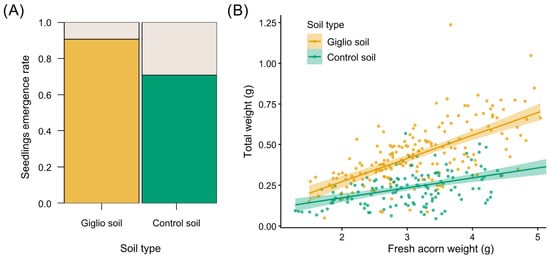
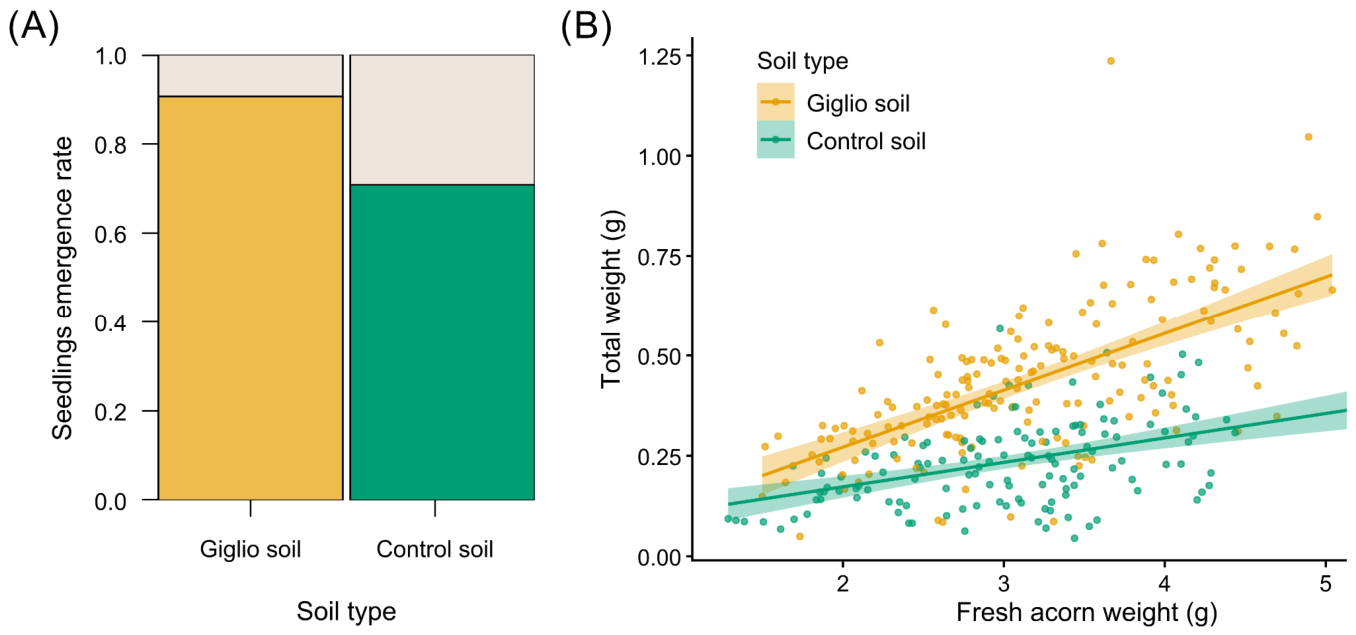
The first seedling emergence was recorded on 12 March and the last on 19 April 2024. Seedling emergence was significantly influenced by soil type (p < 0.001, Table 1), whereas neither litter presence nor acorn fresh weight had a significant effect, and no interaction terms were significant (Table 1). The emergence rate differed by more than 20% between soil types, with 90.6% of seeds germinating in Giglio soil compared to 70.8% in the control soil (Figure 2A). Regarding the final total weight of emerged seedlings, we found a significant interaction between fresh acorn weight and soil type (p < 0.01). The main effect of fresh acorn weight alone was also significant (p < 0.001, Table 2). As shown in Figure 2B and Table 2, for a given acorn fresh weight, seedlings grown in Giglio soil attained a higher total biomass than those grown in control soil. Furthermore, seedlings originating from heavier acorns exhibited greater total biomass, with this effect being more pronounced in Giglio soil than in the control substrate.
Table 1.
Results of the deviance analysis on the emergence of Quercus ilex L. seedlings. χ2: Chi-squared; df: degrees of freedom; p: *** < 0.001.
Figure 2.
Effects of soil type on seedling emergence and early growth. (A) Proportion of emerged seedlings in Giglio soil and the control soil. Colour bars represent the emergence success, with the grey portion indicating emergence failure. (B) Relationship between fresh acorn weight and total seedling biomass grown in the two soil types. Points represent observations, solid lines indicate linear regression fits, and shaded areas represent confidence intervals. Colours denote soil treatment (Giglio soil: orange; control soil: green).
Table 2.
Results of the variance analysis related to the total seedling weight. Sum Sq: sum of squares; df: degrees of freedom; F: the overall F-statistic of the ANOVA model; p: ** < 0.01; *** < 0.001.
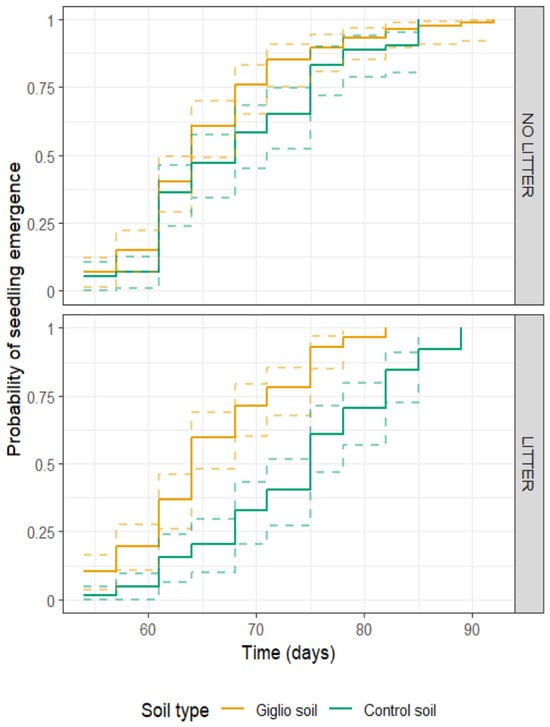
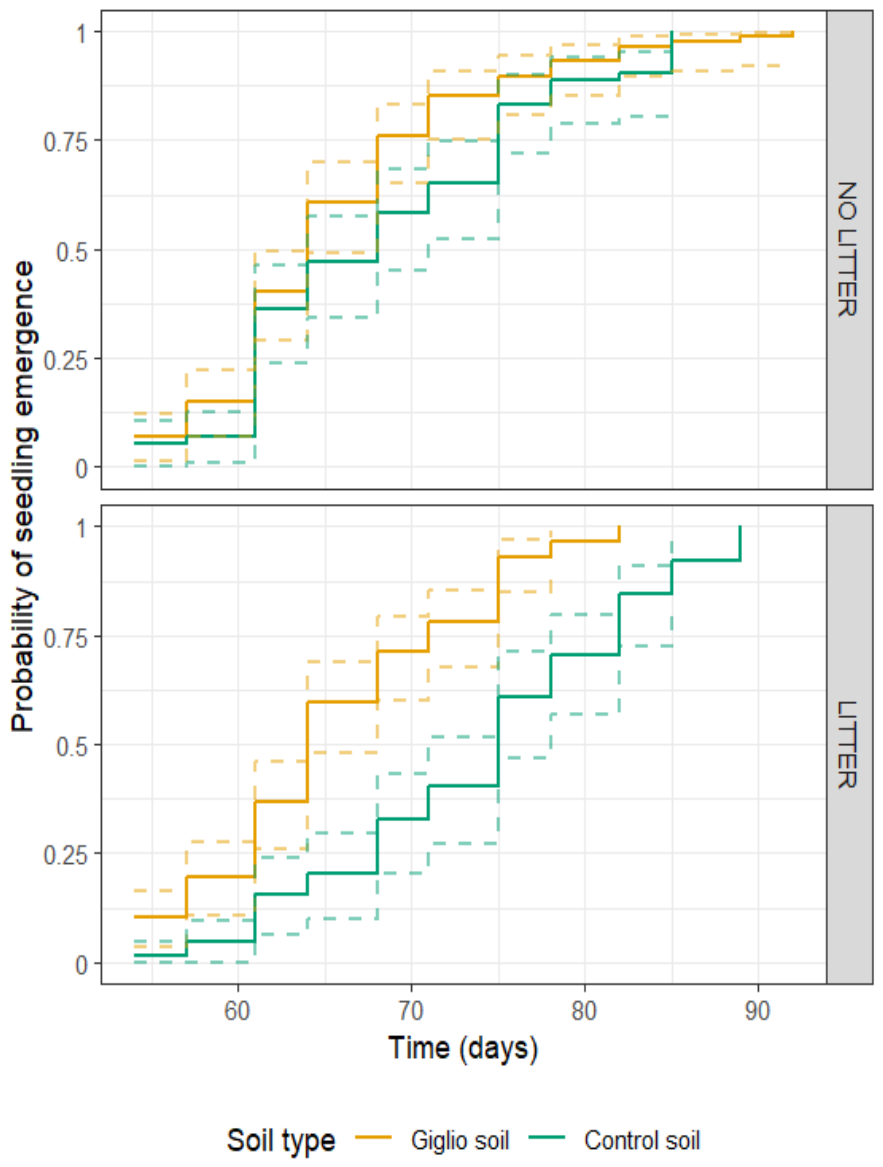
We then analysed seedling emergence time in relation to soil type and litter presence to assess whether significant differences occurred among treatments. We used a Cox proportional hazards model, which is a standard approach in survival analysis. In this context, we interpreted the ‘hazard’ as the ‘probability of seedling emergence’; thus, a lower Hazard Ratio (HR) indicates a slower emergence process. Results from the Cox regression model and ANOVA indicated a significant interaction between litter and soil type (p = 0.016, Table 3, Figure 3), suggesting that the combined effect of these two factors substantially influences seedling emergence. Specifically, the interaction between control soil and litter showed that when both factors are present, the emergence probability is further reduced (hazard ratio, HR = 0.561) compared to control soil alone (Table 4). Moreover, control soil independently decreased the emergence probability for oak seedlings relative to Giglio soil (HR = 0.716, p = 0.043, Table 4).
Table 3.
Results of the analysis of variance for the Cox regression model on the survival over time of seedlings. Loglik: Log-Likelihood; df: degrees of freedom; p: * < 0.05; *** < 0.001.
Figure 3.
Cumulative emergence curves showing the emergence rates of Quercus ilex L. seedlings over time (in days) under different soil and litter conditions. Step curves represent the probability of seedling emergence through time (days since sowing) in Giglio soil (orange) and control soil (green). The upper panel shows treatments without litter, while the lower panel shows treatments with litter. Solid lines indicate the estimated emergence probability, and dashed lines represent the corresponding confidence intervals.
Table 4.
Summary of the Cox regression model results for seedling emergence time. Coeff: estimated regression coefficient; exp(coeff): Hazard Ratio; SE (coeff): standard error of the coefficient; z-value: Wald statistic; p: * < 0.05.
The ANOVA results (Table 3) and the corresponding cumulative emergence plot (Figure 3) revealed a significant effect of soil type, as well as a significant interaction between soil and litter. Seedlings grown in Giglio soil emerged earlier and in higher numbers over time compared to those grown in control soil. Furthermore, the soil–litter interaction indicated that, in the presence of litter, seedlings in control soil exhibited both lower emergence rates and slower emergence compared to those in control soil without litter.
3.2. Study In Situ
We detected a significant difference in animal presence across the three treatments (χ2 = 13.998, df = 2, p < 0.001). Treatments involving cages significantly reduced the presence of animal tracks, with the closed cage particularly excluding all signs of presence attributable to rats and rabbits from the subplot (Table S1 in Supplementary Information).
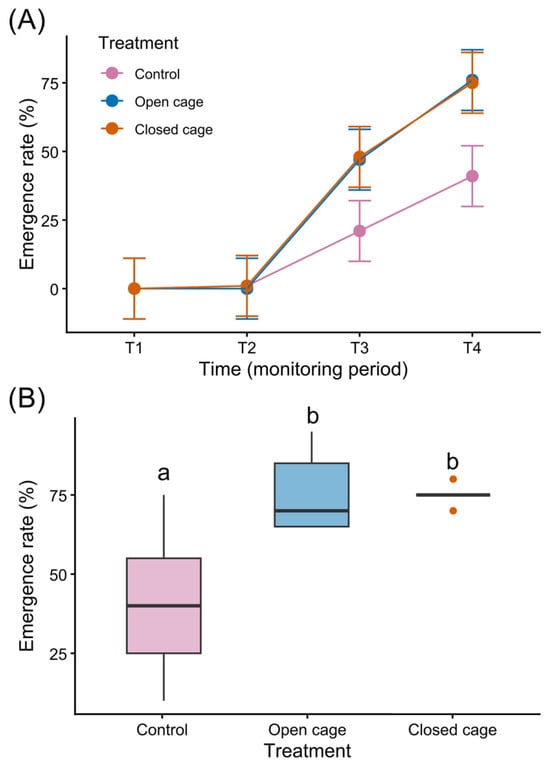
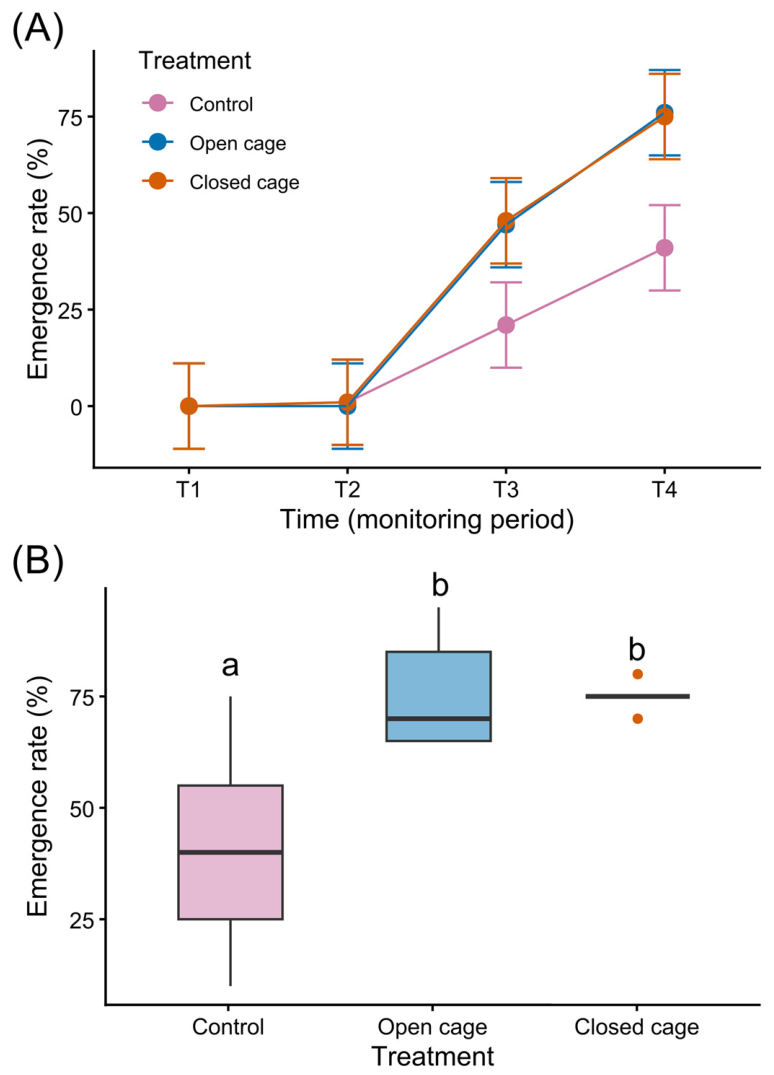
The interaction between treatment and time (monitoring period) has a significant effect on the seedling emergence rate (Table 5). From the early stages, predation in the control group led to a significant reduction in the emergence rate (Figure 4A).
Table 5.
Results of the analysis of variance on the emergence rate of Quercus ilex L. seedlings over time (monitoring period). Sum Sq: sum of squares; Mean Sq: mean squares; Num Df: numerator degrees of freedom; Den Df: denominator degrees of freedom; F: the overall F-statistic of the ANOVA model; p: * < 0.05; ** < 0.01; *** < 0.001.
Figure 4.
Emergence dynamics of Quercus ilex L. seedlings under different treatments: Control (pink), Open cage (blue), Closed cage (orange). (A) Emergence rate of Quercus ilex L. seedlings over the monitoring period (T1–T4). Seedling emergence was minimal during T1 and T2, but increased significantly at T3 and T4, particularly in the Open and Closed cage treatments. (B) Seedling emergence rate (%) across experimental treatments. Boxplots represent the distribution of the data (horizontal line: median; box: interquartile range; whiskers: data range; orange dots represent outliers). Different letters denote significant differences among treatments (Tukey HSD test).
Final emergence rates at T4 were significantly higher in cages than in the control (F = 7.13, df = 2, 12, p = 0.009), indicating strong predation of acorns by lagomorphs and rodents at the site (Figure 4B). The average rate of final seedling emergence was 41% for controls, 75% for treatments with open cage and 76% for closed cage treatments. There appears to be no significant difference in seedling emergence between the open and closed cage treatments (Figure 4B). The cages show a similar mean of seedlings emergence, excluding differences in predation in the two treatments.
4. Discussion
Our study demonstrates that while the local soil conditions on Giglio Island are highly suitable for Q. ilex recruitment, natural regeneration is severely threatened during the early seedling establishment phase by the pressure of introduced invasive herbivores such as lagomorphs and rodents. We found that Q. ilex displays higher germination capacity in the native Giglio soil and that artificial sowing combined with protective cages against invasive mammals significantly enhances regeneration success. These findings highlight that controlling invasive fauna should be considered a key step toward the ecological restoration and renaturalization of the island.
These local restoration challenges on Giglio Island reflect broader environmental pressures observed globally. Indeed, factors such as increasing drought, over-exploitation, the spread of pests and invasive species, wildfires, and soil degradation are driving forest decline and dieback across many areas of the Mediterranean Basin [43]. In particular, the limited regeneration of Q. ilex under increasing aridity raises concerns about the long-term viability of these forests. Although adult trees show strong resistance to disturbance and drought [24], population size may decline because seeds and seedlings are highly sensitive to dehydration and depend on microhabitats that buffer desiccation [44,45]. Moreover, in some cases, late-successional oak forests have sometimes been thinned in favour of secondary pine plantations [9,11], which, however, host less plant diversity than the former [43].
The ex situ experiment revealed that both soil type and the presence of litter significantly affected germination and emergence. Seeds grown in Giglio soil showed higher emergence rates over time than those in control soil. This finding is particularly noteworthy; while several studies report that pine-dominated soils tend to be less favourable for oak due to lower moisture, acidification, accumulation of organic matter or reduced fertility [11,30,31,32,46,47,48,49], our results indicate that the native substrate on Giglio Island—despite originating from pine plantations—actually facilitates Q. ilex germination and early growth relative to the commercial mixture. This suggests that the local soil does not represent a chemical or physical barrier to recruitment; rather, it appears to provide a suitable environment for establishment. This, in turn, suggests that the island may possess the edaphic potential for forest recovery, but that potential is currently neutralized by heavy pressure from invasive fauna. However, since we did not perform physical or chemical analyses of the Giglio soil, we cannot identify which specific properties underlie its apparent suitability. Consequently, these findings should be treated as a phenomenological observation of local soil suitability and must be interpreted with caution, as they might reflect substrate advantages specific to local microhabitats rather than a broad edaphic trait.
In addition to soil type, while the main effect of pine litter on final emergence was not significant, its impact was modulated by soil type through a significant soil–litter interaction (Table 3), affecting the timing and rate of emergence primarily in the control soil. Despite being consistent with the idea that pine litter may limit water retention or act as a physical barrier, our results show that Q. ilex acorns possess high germination vigour capable of overcoming this constraint in Giglio native soil [50], although the underlying mechanism cannot be determined with certainty. We did not compare different litter types or measure moisture dynamics, allelopathic compounds, or temperature buffering. While previous work suggested that pine litter may expose acorns to desiccation more than oak litter [51], our experimental design does not allow direct attribution of the inhibitory effect to any specific factor. Nonetheless, the consistent negative influence of pine litter across treatments indicates that its role in germination deserves further attention. With our work, we certainly provide a useful basis for future investigation.
Seedlings grown in Giglio soil also produced greater total biomass relative to acorn fresh weight, suggesting either a better nutrient environment or a stronger local adaptation of island populations to the native substrate.
The in situ experiment confirmed that the lack of natural regeneration is mainly driven by herbivore pressure rather than seed viability. As supported by our field observations, the widespread activity of these mammals—including soil disturbance, browsing, and burrows—was evident throughout the monitored areas, especially where protection was lacking. Seed and seedling predation is a globally recognized bottleneck for oak regeneration [52,53]. In general, specific ecological factors such as litter cover can alter predator behaviour, acting as a physical shield but also affecting seedling survival, while post-emergence damage to apical buds often drives total recruitment failure [54]. However, on Mediterranean islands, these ecological dynamics are profoundly amplified: the intense pressure is driven by introduced, invasive mammals operating on a restricted spatial scale without natural predators, transforming widespread ecological processes into a severe threat to ecosystem restoration [16]. In this regard, the ecological impacts of introduced lagomorphs are widely documented, especially on islands [55,56,57,58]. They can alter nutrient availability and trophic cycles because of their high consumption rates and their abundance [59,60], and can physically modify the environment through burrowing, reducing substrate stability [55]. Oryctolagus cuniculus, listed among the ‘100 of the world’s worst invasive alien species’ [61,62], is widespread across Giglio Island and likely plays a major role in preventing oak recruitment. Similar impacts on native species have been documented in other exotic ranges: Lepus americanus reduced seedling recruitment on Hay Island, Canada [57], and Oryctolagus cuniculus has inhibited the regeneration of Acacia trees and other shrubs in Australia [63]. In some cases, their nutritional preference for native species may also facilitate the spread of exotic plants [64], while soil disturbance can promote invasive species establishment [65,66], resulting in altered ecosystem structure [67,68]. Our results showed that both open and closed cages effectively prevented herbivore access. Protected plots exhibited fewer animal traces and higher emergence rates compared to controls. Notably, the nearly identical emergence rates between open and closed cages suggest that acorn predation by small rodents was likely negligible at this stage, pointing to larger herbivores excluded by the mesh, such as lagomorphs, as the primary biotic driver preventing oak recruitment. These outcomes confirm that direct seeding alone is insufficient under current herbivore pressure and that protective measures are essential for successful renaturalisation.
Furthermore, although the in situ experiment was conducted on a relatively small scale (n = 5 experimental areas), the stark contrast between protected and control subplots suggests a biologically relevant signal of predation pressure, despite the high spatial variability of Mediterranean landscapes. This indicates that while ex situ data demonstrate that soil conditions significantly influence early recruitment, this favourable edaphic effect is largely overshadowed by vertebrate predation in the field.
However, we acknowledge that our study was limited to a single four-month growing season (January–April 2024). In arid Mediterranean ecosystems, predation intensity and soil-fauna dynamics may vary significantly across years due to climatic variability or reproductive cycles, while subsequent summer droughts and post-emergence competition represent major constraints on long-term seedling survival. Therefore, while our results provide a fundamental baseline, extended monitoring over multiple seasons and larger spatial scales remain essential to fully validate restoration protocols for the island.
Looking ahead, future studies would significantly benefit from a detailed physicochemical characterisation of Giglio soils to clarify the exact mechanisms underlying the higher germination performance observed. Similarly, assessing moisture dynamics, temperature buffering, and potential allelopathic effects of pine litter would allow a more comprehensive evaluation of germination patterns.
5. Conclusions
Our findings underscored the central role of invasive herbivores in limiting the early natural regeneration of Q. ilex on Giglio Island and highlighted the broader implications of unmanaged exotic fauna for Mediterranean forest dynamics. Despite the intrinsic resilience of holm oak ecosystems, the persistent pressure exerted by introduced lagomorphs and rodents can disrupt recruitment processes to the point of compromising long-term population viability. Therefore, effective management of these invasive species therefore represents not only a necessary condition for restoring local oak woodlands but also a crucial component of biodiversity conservation in insular environments. Notably, the similar emergence rates observed between open and closed cages suggest that larger herbivores, specifically lagomorphs, may exert a more decisive pressure on recruitment than smaller rodents. If confirmed by further studies, for example using camera traps, this hypothesis has important management implications, as it suggests that even simplified protective structures—such as open-top fencing designed to deter rabbits—could be a cost-effective strategy for large-scale restoration via direct seeding. Therefore, prioritizing the control of Oryctolagus cuniculus might be more urgent than targeting rodent populations for the recovery of these ecosystems. Implementing targeted control actions, combined with protective measures that facilitate seedling establishment, could significantly enhance initial regeneration success and help safeguard native forest communities, which are also under increasing threat from human activity and climate change.
Supplementary Materials
The following supporting information can be downloaded at: https://www.mdpi.com/article/10.3390/conservation6030076/s1, Table S1: Contingency table showing the frequency of animal track presence across different experimental treatments (Control, Open Cage, and Closed Cage) over the monitoring period (T1–T4), n = 5. Identification of animal presence was based on tracks, soil disturbance, and hair samples. While these signs provided a proxy for activity, the distinction between rodents and lagomorphs should be interpreted with caution, as unequivocal taxonomic identification based on such traces is inherently challenging in field conditions. Table S2: Raw data from the ex situ experiment and from the in situ experiment.
Author Contributions
B.F. (Benedetta Favre): Methodology, Investigation, Data Curation, Formal analysis, Visualization, Writing—Original Draft; A.M.: Methodology, Investigation, Data Curation, Visualization, Writing—Original Draft; R.B.: Validation, Writing—Review and Editing; B.F. (Bruno Foggi): Validation, Writing—Review and Editing; M.G.: Conceptualization, Writing—Review and Editing; M.M.: Investigation, Writing—Review and Editing; V.A.V.: Investigation, Writing—Review and Editing; E.S.: Investigation, Writing—Review and Editing; L.L.: Conceptualization, Methodology, Validation, Writing—Review and Editing. All authors have read and agreed to the published version of the manuscript.
Funding
The research was funded by the European Union through the LIFE Programme, under the LIFE Nature and Biodiversity project LIFE LETSGO GIGLIO “Less alien species in the Tuscan Archipelago: new actions to protect Giglio island habitats” (project/grant number LIFE18 NAT/IT/000828).
Institutional Review Board Statement
Not applicable.
Informed Consent Statement
Not applicable.
Data Availability Statement
The original contributions presented in this study are included in the article/Supplementary Materials. Further inquiries can be directed to the corresponding author.
Acknowledgments
The authors acknowledge the support of the other partners of the LIFE LETSGO GIGLIO project, the Tuscan Archipelago National Park and NEMO Nature and Environment Management Operators s.r.l., for their support.
Conflicts of Interest
Author Michele Giunti was employed by the company Nature and Environment Management Operators S.r.l. The remaining authors declare that the research was conducted in the absence of any commercial or financial relationships that could be construed as a potential conflict of interest.
References
- Mittermeier, R.A.; Turner, W.R.; Larsen, F.W.; Brooks, T.M.; Gascon, C. Global biodiversity conservation: The critical role of hotspots. In Biodiversity Hotspots; Zachos, F.E., Habel, J., Eds.; Springer: Berlin/Heidelberg, Germany, 2011; pp. 3–22. [Google Scholar] [CrossRef] [Scilit]
- Cuttelod, A.; García, N.; Malak, D.A.; Temple, H.; Katariya, V. The Mediterranean: A biodiversity hotspot under threat. In Wildlife in a Changing World—An Analysis of the 2008 IUCN Red List of Threatened Species; International Union for Conservation of Nature and Natural Resources: Gland, Switzerland, 2009; Volume 89, pp. 1–4. [Google Scholar]
- Brundu, G. Invasive alien plants in protected areas in mediterranean islands: Knowledge gaps and main threats. In Plant Invasions in Protected Areas; Foxcroft, L., Pyšek, P., Richardson, D., Genovesi, P., Eds.; Invading Nature—Springer Series in Invasion Ecology; Springer: Dordrecht, The Netherlands, 2013; Volume 7. [Google Scholar] [CrossRef] [Scilit]
- Celesti-Grapow, L.; Bassi, L.; Brundu, G.; Camarda, I.; Carli, E.; D’Auria, G.; Del Guacchio, E.; Domina, G.; Ferretti, G.; Foggi, B.; et al. Plant invasions on small Mediterranean islands: An overview. Plant Biosyst.-Int. J. Deal. All Asp. Plant Biol. 2016, 150, 1119–1133. [Google Scholar] [CrossRef] [Scilit]
- Vogiatzakis, I.N.; Pungetti, G.; Mannion, A.M. (Eds.) Mediterranean Island Landscapes: Natural and Cultural Approaches; Springer Science & Business Media: Dordrecht, The Netherlands, 2008; Volume 9. [Google Scholar]
- Kumar Rai, P.; Singh, J.S. Invasive alien plant species: Their impact on environment, ecosystem services and human health. Ecol. Indic. 2020, 111, 106020. [Google Scholar] [CrossRef] [Scilit] [PubMed]
- Pyšek, P.; Hulme, P.E.; Simberloff, D.; Bacher, S.; Blackburn, T.M.; Carlton, J.T.; Dawson, W.; Essl, F.; Foxcroft, L.C.; Genovesi, P.; et al. Scientists’ warning on invasive alien species. Biol. Rev. 2020, 95, 1511–1534. [Google Scholar] [CrossRef] [Scilit] [PubMed]
- Blondel, J.; Aronson, J.; Bodiou, J.Y.; Boeuf, G. The Mediterranean Region: Biological Diversity in Space and Time, 2nd ed.; Oxford University Press: New York, NY, USA, 2010. [Google Scholar]
- Pausas, J.G.; Bladé, C.; Valdecantos, A.; Seva, J.P.; Fuentes, D.; Alloza, J.A.; Vilagrosa, A.; Bautista, S.; Cortina, J.; Vallejo, R. Pines and oaks in the restoration of Mediterranean landscapes of Spain: New perspectives for an old practice—A review. Plant Ecol. 2004, 171, 209–220. [Google Scholar] [CrossRef] [Scilit]
- De Frutos, S.; Bravo-Fernández, J.A.; Roig-Gómez, S.; Del Rio, M.; Ruiz-Peinado, R. Natural regeneration and species diversification after seed-tree method cutting in a maritime pine reforestation. iForest 2022, 15, 500–508. [Google Scholar] [CrossRef] [Scilit]
- Maestre, F.T.; Cortina, J. Are Pinus halepensis plantations useful as a restoration tool in semiarid Mediterranean areas? For. Ecol. Manag. 2004, 198, 303–317. [Google Scholar] [CrossRef] [Scilit]
- Arrieta, S.; Suarez, F. Scots pine (Pinus sylvestris L.) plantations contribute to the regeneration of holly (Ilex aquifolium L.) in Mediterranean central Spain. Eur. J. For. Res. 2006, 125, 271–279. [Google Scholar] [CrossRef] [Scilit]
- Gómez-González, S.; Ochoa-Hueso, R.; Pausas, J.G. Afforestation falls short as a biodiversity strategy. Science 2020, 368, 1439. [Google Scholar] [CrossRef] [Scilit] [PubMed]
- Griess, V.C.; Knoke, T. Growth performance, windthrow, and insects: Meta-analyses of parameters influencing performance of mixed-species stands in boreal and northern temperate biomes. Can. J. For. Res. 2011, 41, 1141–1159. [Google Scholar] [CrossRef] [Scilit]
- Badalamenti, E.; Bueno, R.D.S.; Campo, O.; Gallo, M.; Veca, D.S.L.M.; Pasta, S.; Sala, G.; La Mantia, T. Pine Stand Density Influences the Regeneration of Acacia saligna Labill. HL Wendl. and native Woody species in a Mediterranean coastal pine plantation. Forests 2018, 9, 359. [Google Scholar] [CrossRef] [Scilit]
- IPBES. Summary for Policymakers of the Thematic Assessment Report on Invasive Alien Species and their Control of the Intergovernmental Science-Policy Platform on Biodiversity and Ecosystem Services; Roy, H.E., Pauchard, A., Stoett, P., Renard Truong, T., Bacher, S., Galil, B.S., Hulme, P.E., Ikeda, T., Sankaran, K.V., McGeoch, M.A., et al., Eds.; IPBES Secretariat: Bonn, Germany, 2023. [Google Scholar] [CrossRef]
- Russell, J.C.; Meyer, J.Y.; Holmes, N.D.; Pagad, S. Invasive alien species on islands: Impacts, distribution, interactions and management. Environ. Conserv. 2017, 44, 359–370. [Google Scholar] [CrossRef] [Scilit]
- Tershy, B.R.; Shen, K.W.; Newton, K.M.; Holmes, N.D.; Croll, D.A. The importance of islands for the protection of biological and linguistic diversity. BioScience 2015, 65, 592–597. [Google Scholar] [CrossRef] [Scilit]
- Bellard, C.; Cassey, P.; Blackburn, T.M. Alien species as a driver of recent extinctions. Biol. Lett. 2016, 12, 20150623. [Google Scholar] [CrossRef] [Scilit] [PubMed]
- Barbero, M.R.P.F.; Loisel, R.; Quézel, P. Biogeography 1992 ecology and history of Mediterranean Quercus ilex ecosystems. Vegetatio 1992, 99–100, 19–34. [Google Scholar] [CrossRef] [Scilit]
- Petroselli, A.; Vessella, F.; Cavagnuolo, L.; Piovesan, G.; Schirone, B. Ecological behavior of Quercus suber and Quercus ilex inferred by topographic wetness index (TWI). Trees 2013, 27, 1201–1215. [Google Scholar] [CrossRef] [Scilit]
- Panico, S.C.; Memoli, V.; Santorufo, L.; Aiello, S.; Barile, R.; De Marco, A.; Maisto, G. Soil biological responses under different vegetation types in Mediterranean area. Int. J. Environ. Res. Public Health 2022, 19, 903. [Google Scholar] [CrossRef] [Scilit] [PubMed]
- Pulido, F.J.; Díaz, M. Regeneration of a Mediterranean oak: A whole-cycle approach. Ecoscience 2005, 12, 92–102. [Google Scholar] [CrossRef] [Scilit]
- Garcia-Fayos, P.; Monleon, V.J.; Espigares, T.; Nicolau, J.M.; Bochet, E. Increasing aridity threatens the sexual regeneration of Quercus ilex (holm oak) in Mediterranean ecosystems. PLoS ONE 2020, 15, e0239755. [Google Scholar] [CrossRef] [Scilit] [PubMed]
- Lookingbill, T.R.; Zavala, M.A. Spatial pattern of Quercus ilex and Quercus pubescens recruitment in Pinus halepensis dominated woodlands. J. Veg. Sci. 2000, 11, 607–612. [Google Scholar] [CrossRef] [Scilit]
- Castro, J.; Zamora, R.; Hodar, J.A.; Gomez, J.M.; Gómez-Aparicio, L. Benefits of using shrubs as nurse plants for reforestation in Mediterranean mountains: A 4-year study. Restor. Ecol. 2004, 12, 352–358. [Google Scholar] [CrossRef] [Scilit]
- Giunti, M.; Foggi, B. Germinazione dei semi e sopravvivenza dei semenzali di leccio (Quercus ilex L.) in interventi finalizzati alla rinaturalizzazione delle pinete di pino d’Aleppo (Pinus halepensis Mill.) dell’isola di Pianosa (Arcipelago Toscano, LI): Risultati preliminari. For.-J. Silvic. For. Ecol. 2014, 11, 172. [Google Scholar] [CrossRef] [Scilit]
- Navarro, F.B.; Cano, A.B.; Galvez, C.; Kazani, A.; Carbonero, M.D.; Jimenez, M.N. Key factors in direct acorn seeding for the successful restoration of open oak woodlands. For. Ecol. Manag. 2023, 546, 121314. [Google Scholar] [CrossRef] [Scilit]
- Mancilla-Leytón, J.M.; Cambrollé, J.; Vicente, Á.M. The impact of the common rabbit on cork oak regeneration in SW Spain. Plant Ecol. 2012, 213, 1503–1510. [Google Scholar] [CrossRef] [Scilit]
- Ovington, J.D. Studies of the development of woodland conditions under different trees: I. Soils pH. J. Ecol. 1953, 41, 13. [Google Scholar] [CrossRef] [Scilit]
- Ovington, J.D. Studies of the development of woodland conditions under different trees: The forest floor. J. Ecol. 1954, 42, 71. [Google Scholar] [CrossRef] [Scilit]
- Zinke, P.J. The pattern of influence of individual forest trees on soil properties. Ecology 1962, 43, 60. [Google Scholar] [CrossRef] [Scilit]
- Baldini, R.M. Flora vascolare dell’isola del Giglio (Arcipelago toscano): Revisione tassonomica ed aggiornamento. Webbia 1998, 52, 307–404. [Google Scholar] [CrossRef] [Scilit]
- Foggi, B.; Pancioli, V. Contributo alla conoscenza della vegetazione dell’Isola del Giglio (Arcipelago Toscano, Toscana meridionale). Webbia 2008, 63, 25–48. [Google Scholar] [CrossRef] [Scilit]
- Gribko, L.S.; Jones, W.E. Test of the float method of assessing northern red oak acorn condition. Tree Plant. Notes 1995, 46, 143–147. [Google Scholar]
- Bates, D.; Mächler, M.; Bolker, B.; Walker, S. Fitting Linear Mixed-Effects Models Using lme4. J. Stat. Softw. 2015, 67, 48. [Google Scholar] [CrossRef] [Scilit]
- Fox, J.; Weisberg, S. An R Companion to Applied Regression, 3rd ed.; Sage: Thousand Oaks, CA, USA, 2019; Available online: https://www.john-fox.ca/Companion/ (accessed on 4 June 2026).
- Therneau, T. A Package for Survival Analysis in R. R Package Version 3.8-6. 2026. Available online: https://CRAN.R-project.org/package=survival (accessed on 4 June 2026).
- Tang, Y.; Horikoshi, M.; Li, W. ggfortify: Unified Interface to Visualize Statistical Result of Popular R Packages. R J. 2016, 8, 474–485. [Google Scholar] [CrossRef] [Scilit]
- Wickham, H. ggplot2: Elegant Graphics for Data Analysis; Springer: New York, NY, USA, 2016; ISBN 978-3-319-24277-4. Available online: https://ggplot2.tidyverse.org (accessed on 4 June 2026).
- Schauberger, P.; Walker, A. openxlsx: Read, Write and Edit xlsx Files. R Package Version 4.2.8. 2025. Available online: https://ycphs.github.io/openxlsx/index.html (accessed on 4 June 2026).
- Kuznetsova, A.; Brockhoff, P.B.; Christensen, R.H.B. lmerTest Package: Tests in Linear Mixed Effects Models. J. Stat. Softw. 2017, 82, 1–26. [Google Scholar] [CrossRef] [Scilit]
- Peñuelas, J.; Sardans, J. Global change and forest disturbances in the Mediterranean basin: Breakthroughs, knowledge gaps, and recommendations. Forests 2021, 12, 603. [Google Scholar] [CrossRef] [Scilit]
- López-Sánchez, A.; Peláez, M.; Dirzo, R.; Fernandes, G.W.; Seminatore, M.; Perea, R. Spatio-temporal variation of biotic and abiotic stress agents determines seedling survival in assisted oak regeneration. J. Appl. Ecol. 2019, 56, 2663–2674. [Google Scholar] [CrossRef] [Scilit]
- Retana, J.; Espelta, J.; Gracia, M.; Riba, M. Seedling recruitment: Ecology of Mediterranean Evergreen Oak Forests, Ecological Studies (Analysis and Synthesis); Springer: Berlin/Heidelberg, Germany, 1999; Volume 137. [Google Scholar] [CrossRef] [Scilit]
- Reh, U.; Kratz, W.; Kraepelin, G.; Angehrn-Bettinazzi, C. Analysis of leaf and needle litter decomposition by differential scanning calorimetry and differential thermogravimetry. Biol. Fertil. Soils 1990, 9, 188–191. [Google Scholar] [CrossRef] [Scilit]
- Bellot, J.; Maestre, F.T.; Chirino, E.; Hernández, N.; De Urbina, J.O. Afforestation with Pinus halepensis reduces native shrub performance in a Mediterranean semiarid area. Acta Oecol. 2004, 25, 7–15. [Google Scholar] [CrossRef] [Scilit]
- Maestre, F.T.; Cortina, J.; Bautista, S.; Bellot, J. Does Pinus halepensis facilitate the establishment of shrubs in Mediterranean semi-arid afforestations? For. Ecol. Manag. 2003, 176, 147–160. [Google Scholar] [CrossRef] [Scilit]
- Sheffer, E. A review of the development of Mediterranean pine–oak ecosystems after land abandonment and afforestation: Are they novel ecosystems? Ann. For. Sci. 2012, 69, 429–443. [Google Scholar] [CrossRef] [Scilit]
- Gómez, J.M. Bigger is not always better: Conflicting selective pressures on seed size in Quercus ilex. Evolution 2004, 58, 71–80. [Google Scholar] [CrossRef] [Scilit] [PubMed]
- López-Barrera, F.; González-Espinosa, M. Influence of litter on emergence and early growth of Quercus rugosa: A laboratory study. New For. 2001, 21, 59–70. [Google Scholar] [CrossRef] [Scilit]
- Crawley, M.J. Herbivory—The Dynamics of Animal-Plant Interactions. Stud. Ecol. 1983, 10, 437. [Google Scholar]
- Antoniella, G.; Capizzi, D.; Calò, A.; Corsanici, R.; Cimini, D.; Salvati, R.; Zapparoli, M.; Scarascia Mugnozza, G.; Papale, D.; Chiti, T.; et al. High acorn predation limits assisted regeneration in Mediterranean oak woodlands. Sci. Total Environ. 2026, 1032, 181834. [Google Scholar] [CrossRef] [Scilit] [PubMed]
- Zhang, J.; Yan, X.; Dayananda, B.; Luo, Y.; Li, J. Frequency-dependent predation and seedling fate: Effect of forest litter on regeneration of the Quercus wutaishanica seedling. Glob. Ecol. Conserv. 2022, 38, e02233. [Google Scholar] [CrossRef] [Scilit]
- Barbar, F.; Lambertucci, S.A. The roles of leporid species that have been translocated: A review of their ecosystem effects as native and exotic species. Mammal Rev. 2018, 48, 245–260. [Google Scholar] [CrossRef] [Scilit]
- Denyer, J.L.; Hartley, S.E.; John, E.A. Both bottom-up and top-down processes contribute to plant diversity maintenance in an edaphically heterogeneous ecosystem. J. Ecol. 2010, 98, 498–508. [Google Scholar] [CrossRef] [Scilit]
- Wheelwright, N.T. Eradication of an ecosystem engineer. Front. Ecol. Environ. 2016, 14, 53–54. [Google Scholar] [CrossRef] [Scilit]
- Reid, N. European hare (Lepus europaeus) invasion ecology: Implication for the conservation of the endemic Irish hare (Lepus timidus hibernicus). Biol. Invasions 2011, 13, 559–569. [Google Scholar] [CrossRef] [Scilit]
- Bakker, E.S.; Olff, H.; Boekhoff, M.; Gleichman, J.M.; Berendse, F. Impact of herbivores on nitrogen cycling: Contrasting effects of small and large species. Oecologia 2004, 138, 91–101. [Google Scholar] [CrossRef] [Scilit] [PubMed]
- De Mazancourt, C.D.; Loreau, M.; Abbadie, L. Grazing optimization and nutrient cycling: When do herbivores enhance plant production? Ecology 1998, 79, 2242–2252. [Google Scholar] [CrossRef]
- Lowe, S.; Browne, M.; Boudjelas, S.; De Poorter, M. 100 of the world’s worst invasive alien species: A selection from the global invasive species database. In Encyclopedia of Biological Invasions; University of California Press: Oakland, CA, USA, 2000; pp. 715–716. [Google Scholar] [CrossRef] [Scilit]
- Pimentel, D.; McNair, S.; Janecka, J.; Wightman, J.; Simmonds, C.; O’Connell, C.; Wong, E.; Russel, L.; Zern, J.; Aquino, T.; et al. Economic and environmental threats of alien plant, animal, and microbe invasions. Agric. Ecosyst. Environ. 2001, 84, 1–20. [Google Scholar] [CrossRef] [Scilit]
- Cooke, B.; Chudleigh, P.; Simpson, S.; Saunders, G. The economic benefits of the biological control of rabbits in Australia, 1950–2011. Aust. Econ. Hist. Rev. 2013, 53, 91–107. [Google Scholar] [CrossRef] [Scilit]
- Meserve, P.L.; Kelt, D.A.; Previtali, M.A.; Milstead, W.B.; Gutiérrez, J.R. Global climate change and small mammal populations in north-central Chile. J. Mammal. 2011, 92, 1223–1235. [Google Scholar] [CrossRef] [Scilit]
- Eldridge, D.J.; Simpson, R. Rabbit (Oryctolagus cuniculus L.) impacts on vegetation and soils, and implications for management of wooded rangelands. Basic Appl. Ecol. 2002, 3, 19–29. [Google Scholar] [CrossRef] [Scilit]
- Holmgren, M.; Avilés, R.; Sierralta, L.; Segura, A.M.; Fuentes, E.R. Why have European herbs so successfully invaded the Chilean matorral? Effects of herbivory, soil nutrients, and fire. J. Arid. Environ. 2000, 44, 197–211. [Google Scholar] [CrossRef] [Scilit]
- James, A.I.; Eldridge, D.J.; Hill, B.M. Foraging animals create fertile patches in an Australian desert shrubland. Ecography 2009, 32, 723–732. [Google Scholar] [CrossRef] [Scilit]
- James, A.I.; Eldridge, D.J. Reintroduction of fossorial native mammals and potential impacts on ecosystem processes in an Australian desert landscape. Biol. Conserv. 2007, 138, 351–359. [Google Scholar] [CrossRef] [Scilit]

Disclaimer/Publisher’s Note: The statements, opinions and data contained in all publications are solely those of the individual author(s) and contributor(s) and not of MDPI and/or the editor(s). MDPI and/or the editor(s) disclaim responsibility for any injury to people or property resulting from any ideas, methods, instructions or products referred to in the content. |
© 2026 by the authors. Licensee MDPI, Basel, Switzerland. This article is an open access article distributed under the terms and conditions of the Creative Commons Attribution (CC BY) license.