


Abstract
Sunflower broomrape (Orobanche cumana Wallr. var. helianthi) is traditionally regarded as strictly host-specific, parasitizing cultivated sunflower (Helianthus annuus L.). Arctium lappa L. (burdock) was recently identified as a novel susceptible host, but whether this susceptibility is uniform across different sunflower O. cumana races remained unknown. Here, three naturally occurring A. lappa populations from north-eastern Bulgaria and a susceptible sunflower inbred line (AD-66) were challenged under controlled glasshouse conditions with three O. cumana races of increasing virulence (F, G, and G+/H), and tubercle number was recorded 45 days after inoculation (n = 50 plants per host × race combination). Race F was largely unable to establish infection on A. lappa (0–4% infected plants) while remaining highly infective on sunflower (96%), whereas races G and G+/H retained substantial infectivity on A. lappa (68–96%), though with up to two-to-three-fold lower mean tubercle numbers than on sunflower. A negative binomial generalized linear model showed that race accounted for the largest share of explained variation in tubercle number, with weaker and less robust host and host × race effects. Additive Main Effects and Multiplicative Interaction (AMMI) and genotype plus genotype-by-environment (GGE) biplot analyses further resolved this interaction into a single dominant axis, along which A. lappa was disproportionately susceptible to race G+/H and disproportionately resistant to race F. These results demonstrate that, under controlled glasshouse conditions, A. lappa is a race-dependent, alternative host for O. cumana. Whether this translates into a field-relevant reservoir capacity beyond the sunflower cropping cycle remains to be established.
1. Introduction
Orobanche cumana Wallr. (sunflower broomrape) is an obligate root holoparasite of the family Orobanchaceae and one of the most damaging biotic constraints to sunflower (Helianthus annuus L.) production across Europe and Asia [1]. Within its natural range, extending from Central Asia to south-eastern Europe, the species is primarily associated with wild Asteraceae, chiefly Artemisia spp. [2,3]. Parasitism of cultivated sunflower was first recorded in Russia in the 1890s and in Bulgaria in 1935, and the crop-adapted lineage is now formally distinguished as O. cumana var. helianthi (Tzvelev, 2015, as cited in Sharma et al. [4]), a taxon separate from the wild-type populations. The parasite’s economic and geographic significance continues to grow, with recent first reports extending its range into new sunflower-producing regions [5,6]. The sunflower-O. cumana pathosystem follows a well-characterized gene-for-gene model, in which dominant resistance genes (Or1-Or7) in the host correspond to matching avirulence loci in the parasite [2,7]. Widespread deployment of monogenic resistant cultivars has repeatedly selected for new physiological races, historically designated A through E and later followed by the more aggressive F, G, and G+/H races that have successively overcome resistance genes in most sunflower-growing regions, including Bulgaria [2,8,9,10,11]. Race evolution remains an active process, arising both through point mutation [12,13,14,15] and through recombination between distinct gene pools [16], and has recently been compounded by the first documented case of herbicide resistance in this parasite [14], underscoring the adaptive capacity of O. cumana under sustained selection pressure and the continuing need for new resistance sources [13,17].
Molecular marker studies (SSR and SNP) have shown that weedy O. cumana populations parasitizing sunflower are organized into distinct, genetically depauperate gene pools that are geographically structured, such as the Guadalquivir Valley and Cuenca gene pools in Spain or the Eastern European gene pool that includes Bulgarian populations [2,3,12]. Along the Bulgarian Black Sea coast, wild populations parasitizing Artemisia maritima display clear signatures of introgression from weedy, sunflower-adapted populations, indicating active, bidirectional gene flow between the two ecological forms that may accelerate the emergence of new virulent races in cultivated fields [3]. Morphometric comparisons of broomrape seeds collected from H. annuus, Artemisia spp., and Matricaria sp. further indicate that host identity is the principal driver of phenotypic divergence among O. cumana seed populations [11].
Although O. cumana has long been regarded as a narrowly host-specific parasite, confined to sunflower among cultivated crops and to Artemisia spp. in the wild [1], accumulating evidence indicates that its host range is broader and more dynamic than previously assumed. In the Western Himalaya of India, wild-type O. cumana was recently confirmed for the first time parasitizing Artemisia japonica, a species not previously reported as a host for any Orobanche species [4]. In Xinjiang, China, where the parasite causes substantial losses in both sunflower and tomato (Solanum lycopersicum) fields, a systematic comparison of host-derived populations demonstrated that tomato-infesting and sunflower-infesting broomrape belong to the same species and gene pool, with tomato acting as an opportunistic rather than a preferred host [18]. Independent surveys from the same region have documented further, previously unreported hosts of sunflower O. cumana, including the desert shrub Karelinia caspia [19], the noxious weed Cirsium arvense (Canada thistle) [20], and the ornamental genus Coleus [21], each representing an expansion of the known host range of the parasite beyond Helianthus and Artemisia. Most recently, controlled inoculation trials in Bulgaria demonstrated that sunflower-O. cumana can also complete its parasitic cycle on Arctium lappa L. (burdock), forming viable tubercles and emerging shoots on this species, whereas eight other tested Asteraceae taxa remained fully resistant [22]. This finding is particularly notable because A. lappa belongs to a different tribe of the Asteraceae than either Helianthus or Artemisia, suggesting that host specificity in O. cumana may be less evolutionarily constrained than previously believed and that additional, currently unrecognized alternative hosts could act as reservoirs of infection and genetic diversity within agricultural landscapes.
The discovery of A. lappa as a susceptible host raises the question of whether its response to O. cumana mirrors that of sunflower or instead represents a qualitatively different, less compatible interaction that can nonetheless still support parasite development under field conditions. Because sunflower resistance to O. cumana is governed by physiological races of differing virulence [2,10], it is essential to determine whether the ability of the parasite to infect A. lappa is uniform across races or, as in sunflower, race-dependent, and whether the intensity of parasitism, measured as the number of tubercles produced per plant, differs quantitatively between this novel host and a fully susceptible sunflower genotype. Clarifying these host × race interactions is of direct practical relevance, since perennial, widely distributed weeds such as A. lappa growing at field margins could act as an alternative green bridge, sustaining O. cumana populations and their genetic diversity independently of the sunflower cropping cycle [3,18]. We hypothesized that the susceptibility of A. lappa to O. cumana would not be uniform but would instead depend on the virulence of the challenging parasite race, mirroring the race-specific compatibility patterns already established for sunflower.
The objective of the present study was therefore to characterize, under controlled glasshouse conditions, the parasitic stress dynamics of three O. cumana races differing in virulence (F, G, and G+/H) on three natural populations of A. lappa in comparison with a fully susceptible sunflower inbred line, using tubercle number as a quantitative measure of infection intensity, and to evaluate host × race interaction patterns through negative binomial modelling, Additive Main Effects and Multiplicative Interaction (AMMI) analysis, and genotype plus genotype-by-environment (GGE) biplot analysis.
2. Results
2.1. Infection Frequency and Tubercle Production Across Hosts and Races
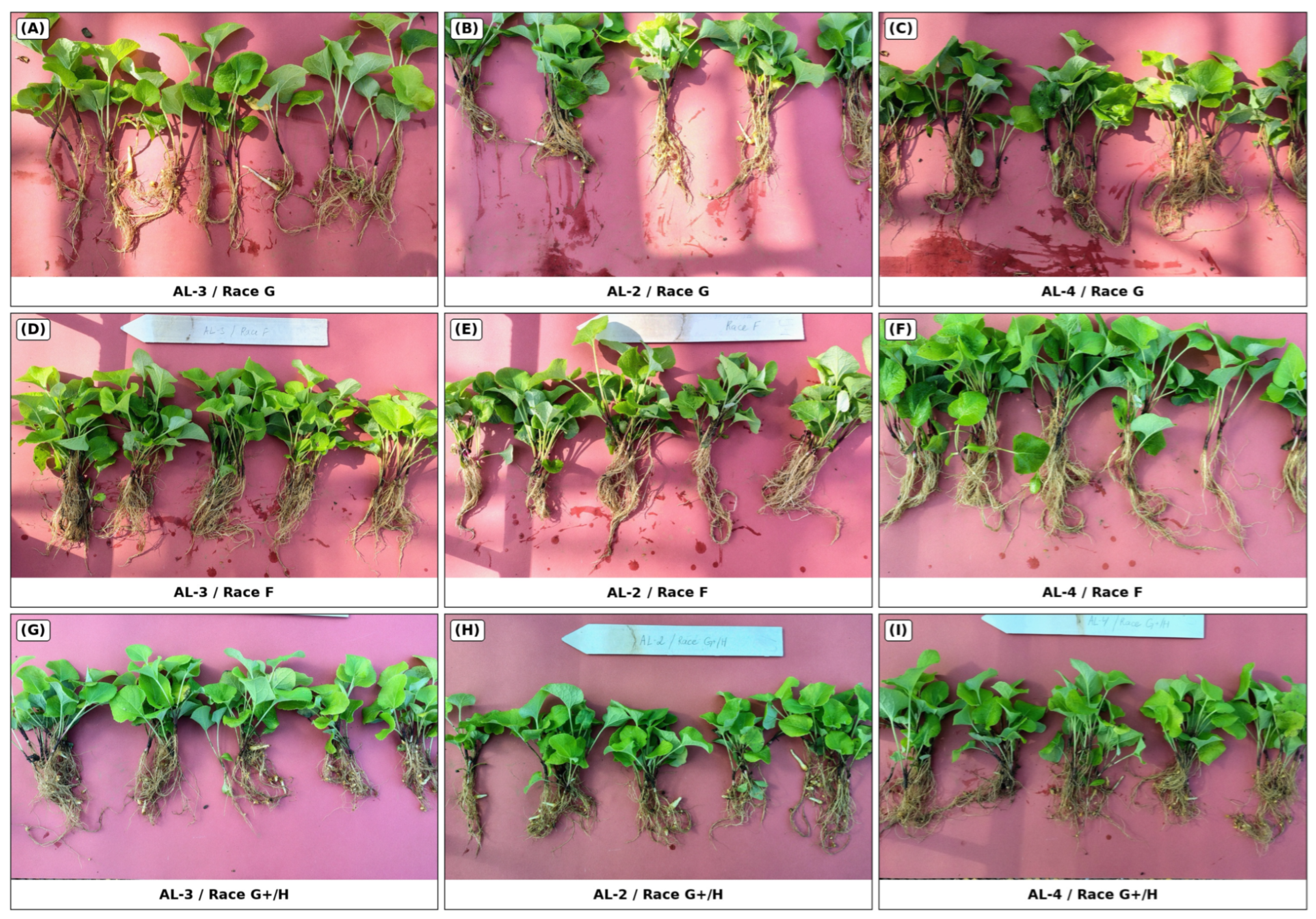
Across all twelve host × race combinations, tubercle counts ranged from complete absence of infection to a maximum of 20 tubercles per plant, and every combination showed pronounced overdispersion, with standard deviations frequently exceeding half of the corresponding mean (Table 1, Appendix A, Figure A1).
Table 1.
Descriptive statistics of tubercle number and infection frequency of three Orobanche cumana races on sunflower and A. lappa hosts.
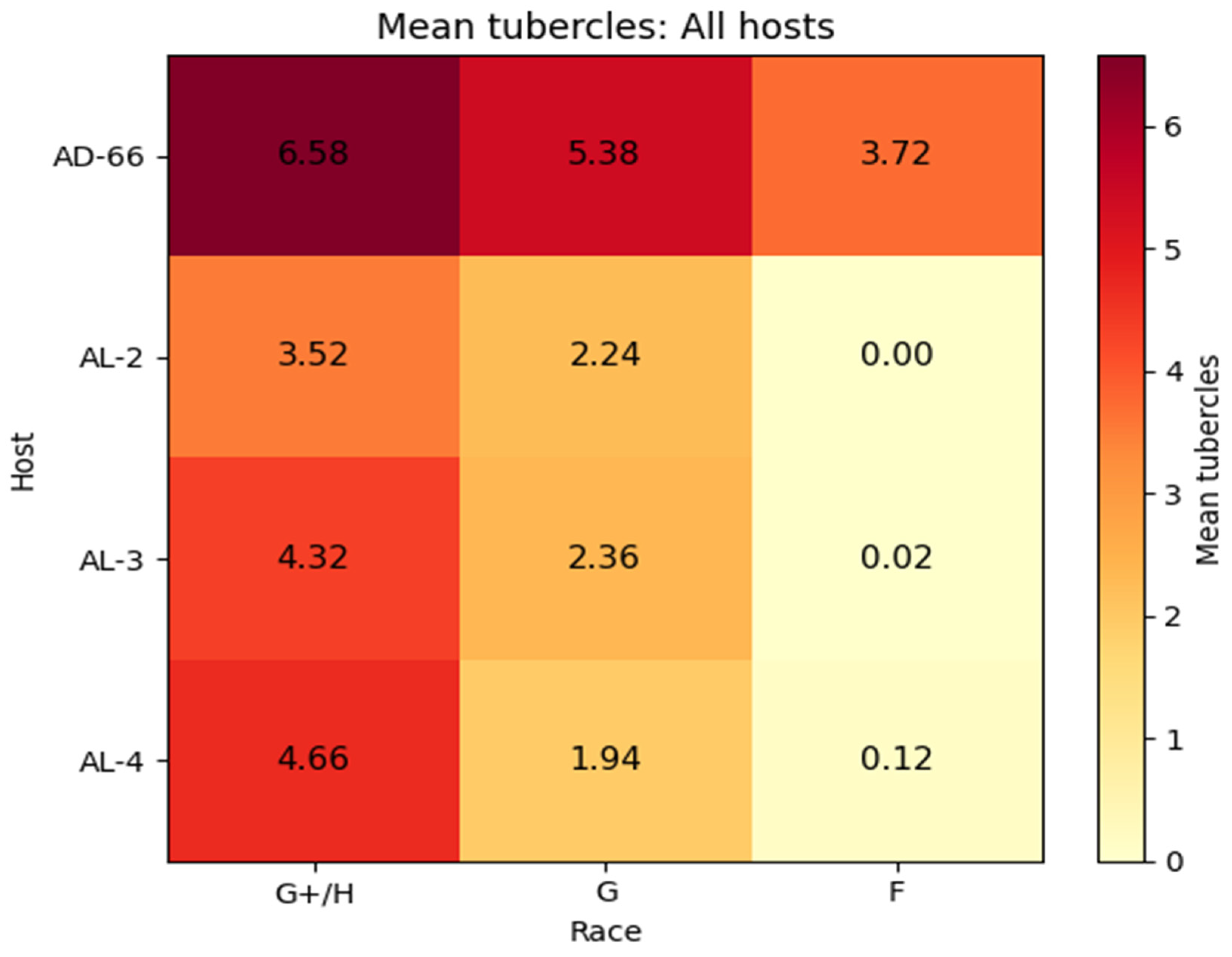
The susceptible sunflower inbred line AD-66 supported the highest overall level of parasitism among the four hosts tested. Mean tubercle numbers on AD-66 were 6.58 ± 3.39 for race G+/H, 5.38 ± 2.55 for race G, and 3.72 ± 1.73 for race F, and infection frequency remained at or near 100% irrespective of race (100%, 100%, and 96% for G+/H, G, and F, respectively; Table 1). Statistical comparison among races within this host (likelihood-ratio-based pairwise contrasts; Table 2 and Table 3) indicated that G+/H and G did not differ significantly from one another (both assigned letter “a”), whereas F produced significantly fewer tubercles (letter “b”), pointing to a two-tier virulence hierarchy on sunflower in which the two most aggressive races behave similarly.
Table 2.
Likelihood ratio tests from the negative binomial generalized linear model evaluating the effects of host, race and their interaction on Orobanche cumana tubercle number.
Table 3.
Model-estimated marginal means, standard errors, and 95% confidence intervals for Orobanche cumana tubercle number across host × race combinations (negative binomial GLM), with compact letter displays comparing races within each host and hosts within each race under both Wald- and likelihood-ratio-based inference.
A markedly different pattern emerged on the three Arctium lappa populations. Averaged across AL-2, AL-3, and AL-4, model-estimated mean tubercle numbers were 4.17 for race G+/H and 2.18 for race G—consistently lower than the corresponding sunflower values (Table 1 and Table 3). Unlike the two-tier response observed in AD-66, all three A. lappa populations displayed a fully resolved three-tier virulence hierarchy under likelihood-ratio-based pairwise comparisons, with G+/H, G, and F assigned to three statistically distinct groups (“a”, “b”, “c”) in every population (Table 3); under the Wald-based test, this distinction is less sharp for AL-2 × race F specifically, reflecting the complete-separation issue noted for this near-zero-infection combination. This indicates that, on A. lappa, the parasite races are more clearly discriminated from one another than on the fully susceptible sunflower host, where the two most virulent races reach a similar performance ceiling.
Race F was essentially unable to infect A. lappa, and no tubercles were observed on the AL-2 plants; only 2% of AL-3 and 4% of AL-4 seedlings were infected. In contrast, race F resulted in 96% infection of sunflower. By comparison, races G and G+/H displayed substantial infectivity on all three A. lappa populations, with infection frequencies ranging from 68% (AL-4, race G) to 96% (AL-3 and AL-4, race G+/H). This demonstrates that the ability of O. cumana to parasitize this novel host is race-dependent.
Among the three A. lappa populations, subtle differences in mean tubercle number and infection frequency were also apparent, although these population-level differences were not statistically significant when formally tested. AL-3 and AL-4 supported slightly higher mean tubercle numbers under race G+/H (4.32 ± 3.25 and 4.66 ± 4.26, respectively) than AL-2 (3.52 ± 2.55), and a comparable ranking was reflected, in reverse, in the population-level infection frequency for race G, which was highest in AL-2 (82%) and lowest in AL-4 (68%). Notably, the single highest tubercle count recorded under race G+/H occurred on an AL-4 plant (20 tubercles), exceeding the sunflower maximum (16 tubercles). This single observation should not be read as evidence that A. lappa can match sunflower in infection severity: it represents one plant among 50 in this combination, within a distribution whose mean (4.66 ± 4.26) remained well below the corresponding sunflower value (6.58 ± 3.39), and its interpretation is further limited by the single-container design (Section 4.1). It does, however, indicate that under the most virulent race tested, individual A. lappa plants are occasionally capable of supporting heavy parasite loads, even though this is not representative of the population as a whole.
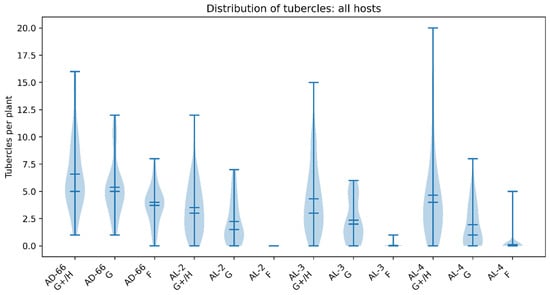
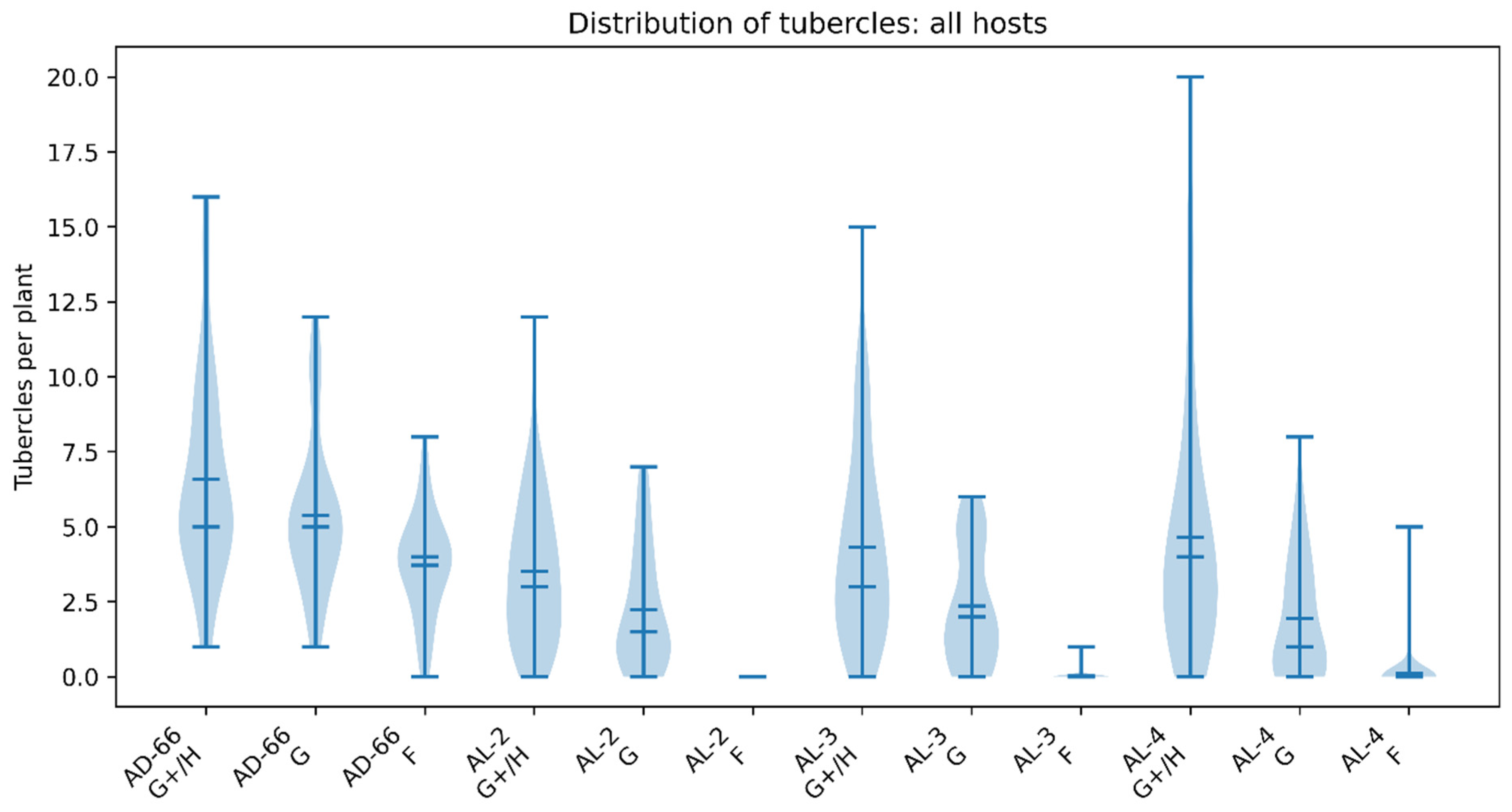
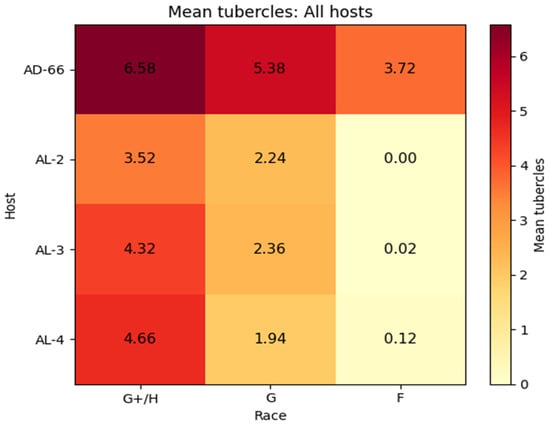
The violin plots (Figure 1) and heatmap (Figure 2) illustrate these patterns, with tubercle distributions for race F on A. lappa reduced almost to zero in contrast to the broader, right-skewed distributions displayed by G and G+/H.
Figure 1.
Distribution of raw per-plant Orobanche cumana tubercle counts across all 600 plants in infested soil (violin plots), grouped by host × race combination. Each combination reflects 50 plants grown within a single shared container.
Figure 2.
Heatmap of mean Orobanche cumana tubercle numbers across host–race combinations.
2.2. Effects of Host, Race, and Their Interaction on the Level of Parasitism
Table 2 presents the results of the negative binomial generalized linear model used to formally partition the effects of host genotype, Orobanche cumana race, and their interaction on tubercle number. When all four host genotypes were considered jointly, the plant-level negative binomial model detected statistically significant effects of host, race, and host × race interaction (likelihood ratio χ2 = 200.09, df = 3; χ2 = 296.19, df = 2; and χ2 = 209.62, df = 6, respectively; all p < 0.001), consistent with the patterns apparent in the descriptive statistics and graphical summaries (Table 1, Figure 1 and Figure 2).
To assess the relative magnitude, rather than merely the statistical significance, of each effect, McFadden’s pseudo-R2 was calculated for each model term (Supplementary Methods, Section S1.4). Race alone accounted for a larger share of explained deviance than host alone (pseudo-R2 = 0.066 vs. 0.030), and this ranking was consistent with the AMMI variance partitioning reported below (Section 2.3), in which race explained a larger percentage of total sum of squares than host (33.42% vs. 22.53%; Table 4). Race was therefore the larger source of variation by these model-based effect-size measures, not solely by virtue of its likelihood-ratio chi-square value, which is not directly comparable across terms with unequal degrees of freedom.
Table 4.
AMMI analysis of variance for the interaction between host and Orobanche cumana race based on square-root transformed tubercle numbers √(x + 0.5).
The host effect, while highly significant, was smaller in magnitude than the race effect and was driven predominantly by the contrast between the fully susceptible sunflower line AD-66 and the three Arctium lappa populations, which as a group supported consistently lower tubercle numbers (Table 1). This is in line with the reduction in mean tubercle production observed on A. lappa relative to sunflower for both race G and race G+/H, and the absence of infection recorded for race F on A. lappa.
The plant-level negative binomial model also detected a statistically significant host × race interaction, indicating that the observed race-response pattern was not identical across host genotypes. However, this interaction was substantially less robust than the host and race main effects under the pseudoreplication diagnostics and alternative two-part models described below. We therefore used AMMI and GGE analyses primarily to explore and visualize the structure of the observed interaction pattern rather than to provide independent inferential confirmation.
To evaluate whether the interaction effect was driven solely by the contrast between sunflower and Arctium, or whether it also reflected true differential responses among the three A. lappa populations, the negative binomial model was refitted using only the A. lappa subset of the data. In this restricted analysis, race remained highly significant (χ2 = 370.71, df = 2, p < 0.001), and the host × race interaction remained statistically significant but comparatively modest (χ2 = 11.99, df = 4, p = 0.018; Table 2). However, the host effect itself, reflecting differences among the three A. lappa populations alone, was not statistically significant once sunflower was excluded from the analysis (χ2 = 1.79, df = 2, p = 0.408). This indicates that, while race remains an overwhelming determinant of tubercle production on A. lappa and some degree of race-dependent variation exists among the three populations, the three A. lappa populations do not differ significantly in their overall level of susceptibility once the dominant sunflower-versus-Arctium contrast is removed. This qualifies our earlier suggestion that the host × race interaction reflects a strong, independent population-level effect. The modest but significant interaction more plausibly reflects subtle, race-specific differences among populations superimposed on an otherwise uniform overall susceptibility level.
Pairwise comparisons of estimated marginal means, adjusted for multiple testing using the Holm procedure, corroborated these overall model results and are summarized by the compact letter displays reported in Table 3.
Because tubercle counts contained a substantial proportion of zeros, the standard NB-GLM was compared against hurdle-NB and zero-inflated NB alternatives (Table S5). AIC favoured the hurdle-NB model (2095.8) over the standard NB-GLM (2104.8) and zero-inflated NB (2100.6), whereas BIC favoured the standard NB-GLM (2162.0) over both zero-augmented alternatives (2205.7 and 2210.5), reflecting their substantially larger parameter count (25 vs. 13). A two-part model separating infection incidence from severity among infected plants showed host and race remained highly significant determinants of both components (all p < 0.001), but the host × race interaction was not significant in either component (infection incidence: χ2 = 5.11, df = 6, p = 0.530; severity given infection: χ2 = 4.73, df = 5, p = 0.449), consistent with the reduced robustness of this term already noted.
2.3. AMMI Analysis of the Host × Race Interaction
The AMMI analysis of variance (Table 4), based on square-root transformed tubercle counts, provided a complementary partitioning of the sources of variation identified by the generalized linear model and allowed the host × race interaction to be decomposed into interpretable components. As in the negative binomial model, host and race main effects were both highly significant and accounted for the largest shares of total variation (host: SS = 10.775, F = 109.681, p < 0.001, 22.53% of total sum of squares; race: SS = 15.984, F = 244.051, p < 0.001, 33.42% of total sum of squares). Together, the two main effects accounted for more than half of the total variance in the dataset, confirming that host identity and, even more so, parasite race were the dominant drivers of tubercle production.
The host × race interaction, although comparatively modest in relative terms (SS = 1.815, 3.79% of total sum of squares), was nonetheless statistically significant (F = 9.237, p < 0.001), yielding a pattern consistent with the interaction detected by the negative binomial model, although subject to the same container-level pseudoreplication constraint. Partitioning of this interaction sum of squares into interaction principal component axes showed that the first axis, IPC1, was highly significant (F = 12.833, p < 0.001) and captured the great majority of the interaction variance, accounting for 3.51 of the 3.79 percentage points of total sum of squares attributable to the interaction, equivalent to approximately 93% of the interaction sum of squares. The second axis, IPC2, was not statistically significant (F = 2.044, p = 0.1305) and explained only the residual 0.28% of total variance. The predominance of IPC1 therefore motivated the use of the AMMI1 biplot as a descriptive visualization of the observed interaction structure.
It is worth emphasizing that, although statistically significant, the host × race interaction accounted for only 3.79% of total sum of squares—several-fold smaller than either main effect (host: 22.53%; race: 33.42%; Table 4). Thus, the low p-value should not be interpreted as evidence that the interaction is practically large: its contribution to total variation was modest relative to either main effect. This distinction is consistent with the reduced robustness of the interaction term already noted under the pseudoreplication diagnostics (Section 4.2) and the two-part incidence/severity model (Section 2.2), and it should temper any interpretation of host × race compatibility patterns as a dominant feature of this pathosystem.
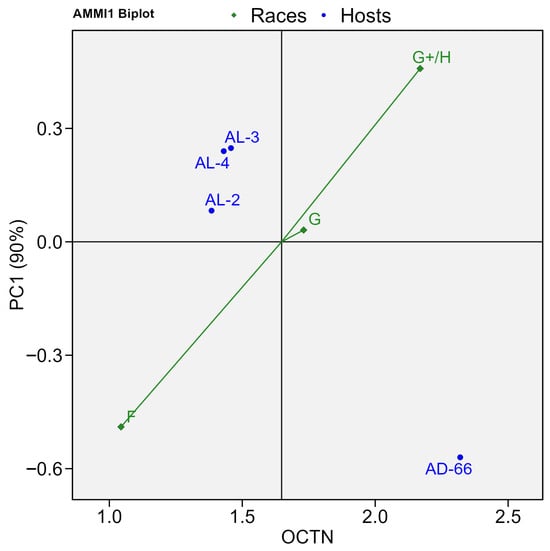
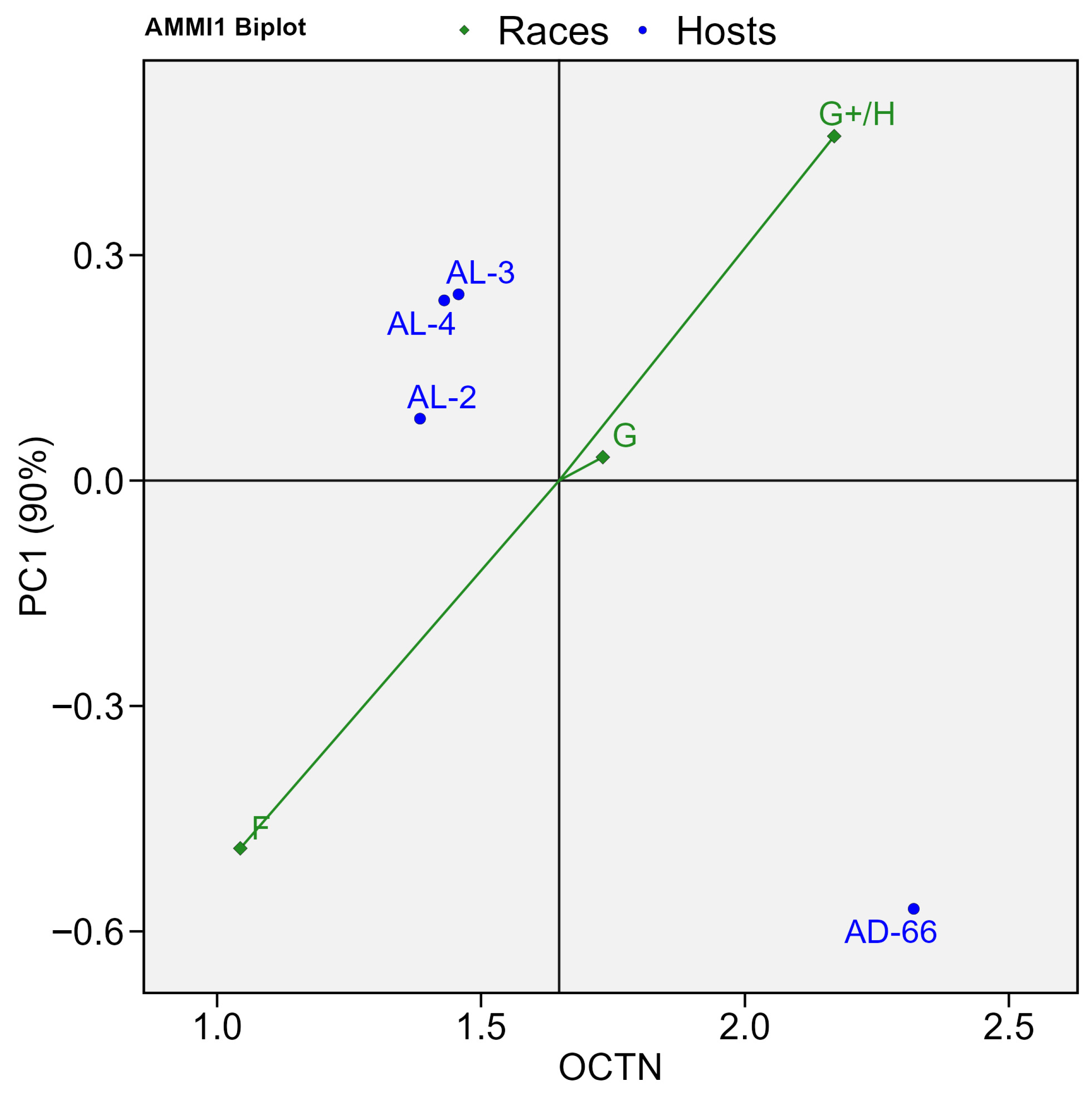
In the AMMI1 biplot (Figure 3), along the main-effect axis, races were clearly separated according to their overall virulence, with G+/H positioned furthest to the right, G in an intermediate position, and F furthest to the left. Among hosts, AD-66 occupied the most positive position on the main-effect axis, consistent with its higher overall tubercle production relative to the three Arctium lappa populations, which clustered together at lower, more similar main-effect values.
Figure 3.
AMMI1 biplot of the host × race interaction for Orobanche cumana tubercle development. Horizontal axis (OCTN): additive main effect of each host or race on square-root-transformed tubercle number (√(x + 0.5)). Vertical axis (IPC1): first interaction principal component score. Blue circles = hosts; green diamonds = races.
The distribution of IPC1 scores revealed a clear pattern of differential interaction between host groups and races. Race G+/H and the three A. lappa populations shared IPC1 scores of the same, positive sign, indicating a positive interaction between this host group and this race: A. lappa plants performed relatively better against G+/H than would be predicted from the main effects alone, consistent with G+/H remaining the only race capable of producing very high tubercle numbers on individual A. lappa plants (Table 1). Conversely, race F and the three A. lappa populations displayed IPC1 scores of opposite sign, indicating a negative interaction that reinforced the already very low main effect of race F on this host group, consistent with the near-complete absence of infection recorded for race F on A. lappa (Table 1).
The sunflower line AD-66 showed the opposite pattern to that of A. lappa. Its IPC1 score was strongly negative, placing it on the same side of the biplot as race F. This positive interaction term accounts, in the AMMI decomposition, for the fact that F, despite being the least virulent race overall, achieved a comparatively high infection frequency (96%) and low tubercle production on sunflower, exceeding what would be expected from the race main effect alone. Conversely, the opposite signs of the IPC1 scores for AD-66 (negative) and G+/H (positive) indicate a mild negative interaction between this host and its most virulent challenger, tempering, without reversing, the already high tubercle numbers produced by G+/H on sunflower.
2.4. GGE Biplot Analysis: Race Discrimination and Host Ranking
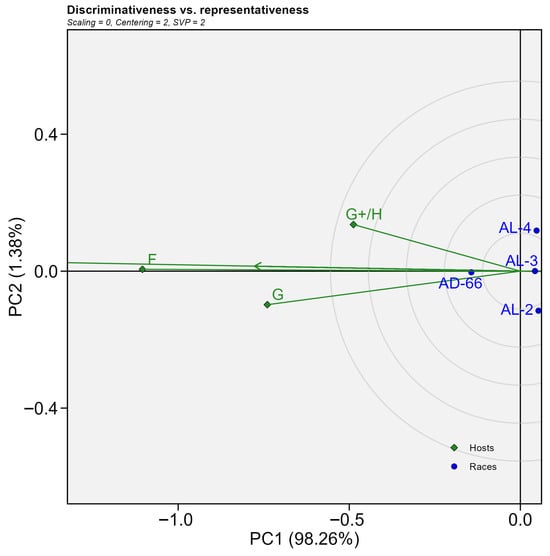
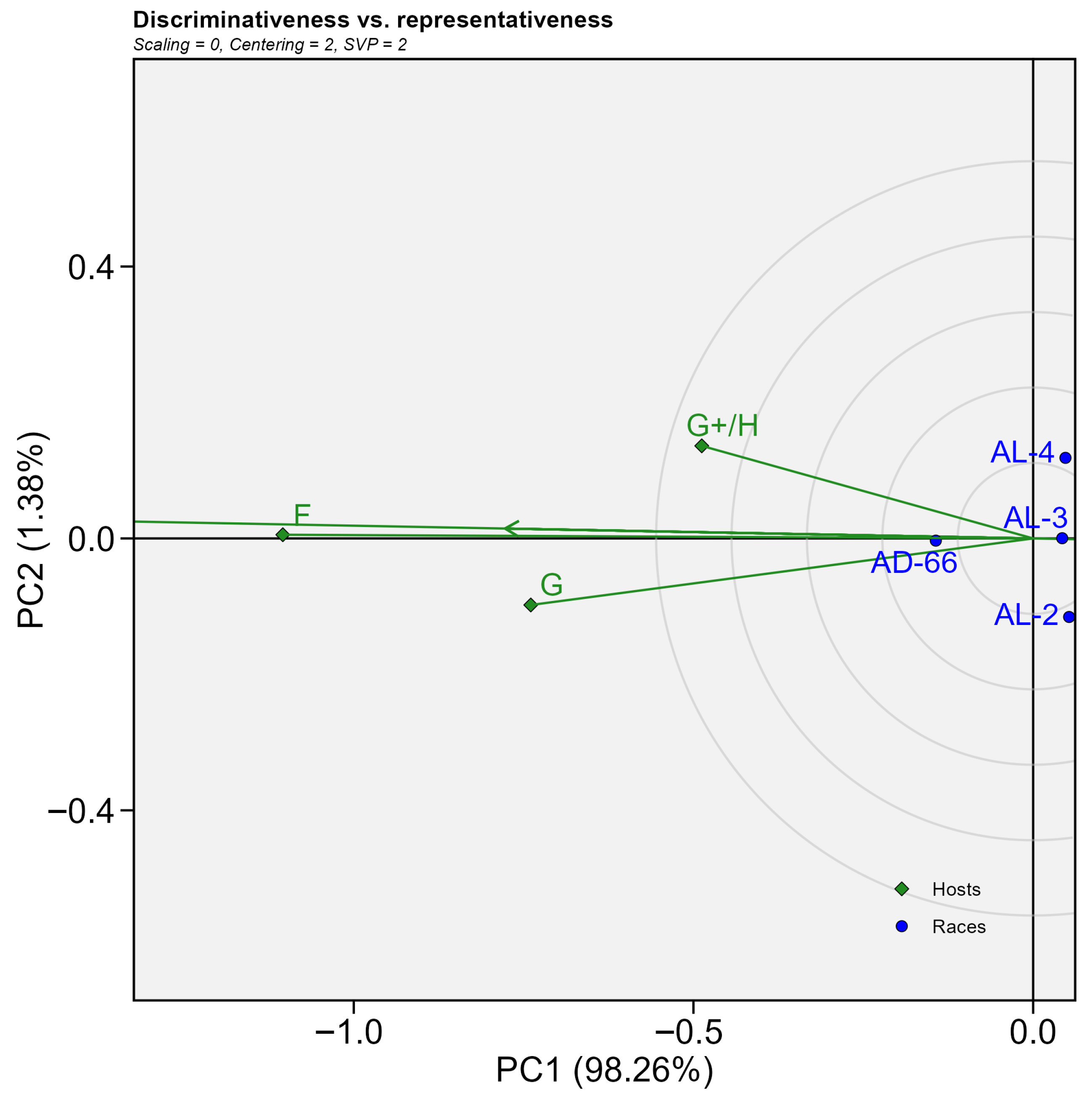
The genotype plus genotype-by-environment (GGE) biplot analysis, performed on the same square-root transformed tubercle data used for the AMMI analysis, provided two complementary perspectives on the host × race interaction: the discriminating ability and representativeness of individual races (Figure 4), and the ranking of hosts according to their overall response across races (Figure 5). In both biplots, the first principal component explained 98.26% of the total variation among host × race means, while the second principal component accounted for only 1.38%, indicating that the observed pattern was predominantly structured along a single axis. In the discriminativeness-versus-representativeness view (Figure 4), each O. cumana race is represented as a vector radiating from the biplot origin, with vector length indicating the discriminating ability of that race, that is, its capacity to differentiate among host genotypes, and the angle between each vector and the average-race axis indicating how representative that race is of the overall pattern of host discrimination.
Figure 4.
Discriminating ability and representativeness of Orobanche cumana races (GGE biplot; Scaling = 0, Centering = 2, SVP = 2). PC1 and PC2 explain the percentages of host × race mean variation indicated on each axis. Vector length from the origin reflects a race’s discriminating ability among hosts; the angle between a race vector and the average-race axis (heavy line) reflects how representative that race is of the overall discrimination pattern. Vector length and angle are descriptive ordination properties, not evidence of a physiological or molecular mechanism.
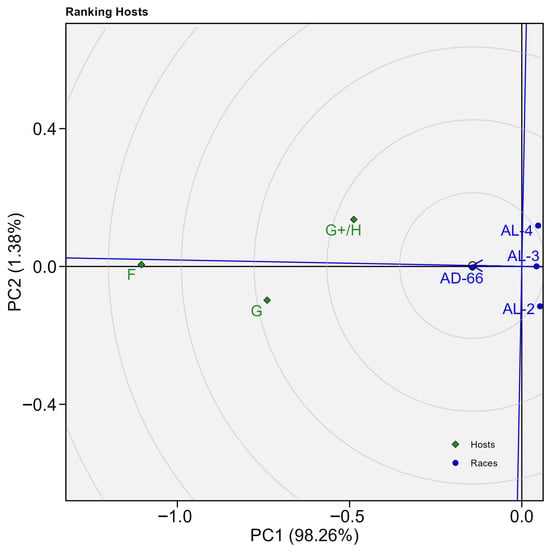
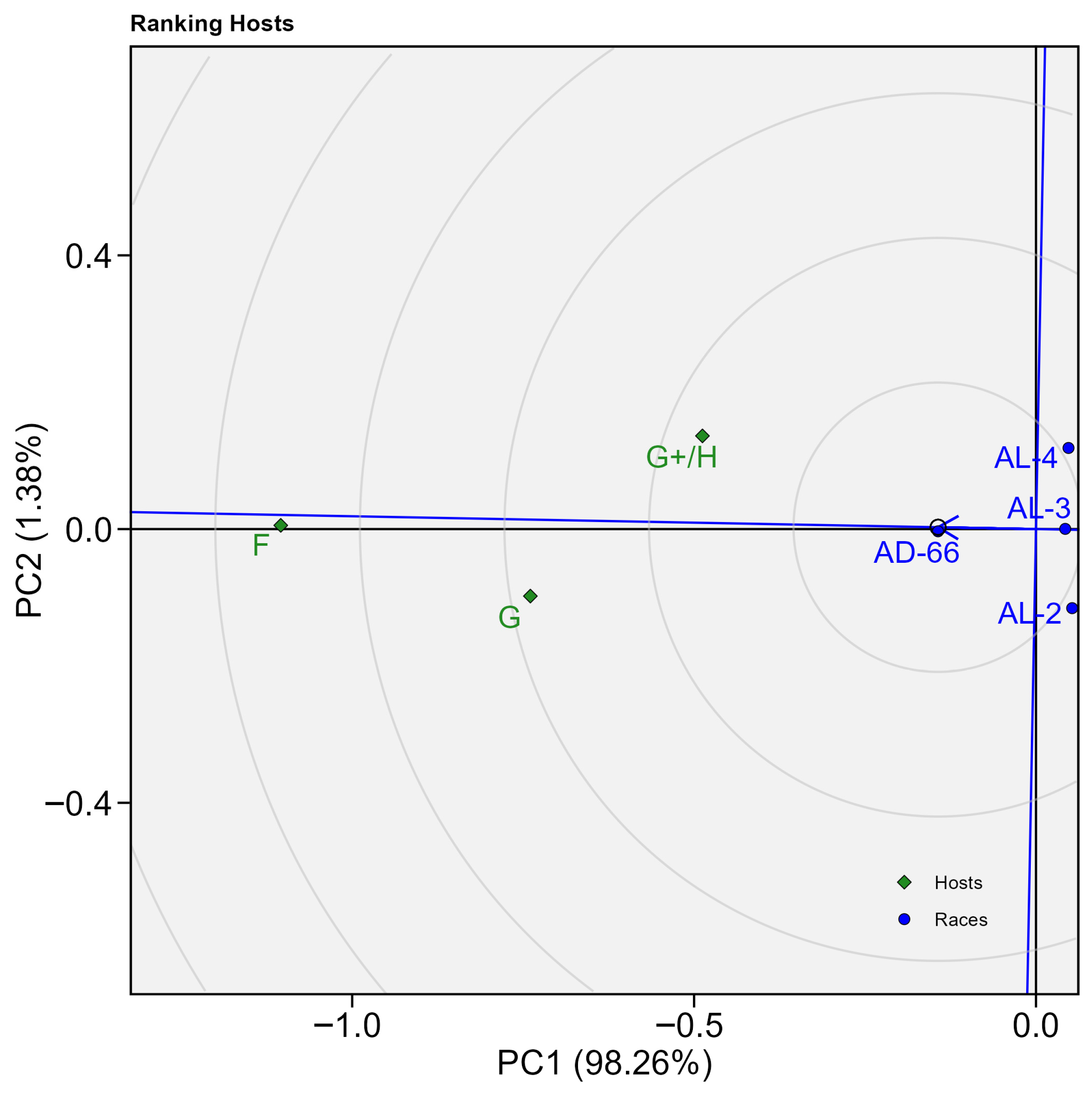
Figure 5.
GGE biplot ranking of hosts by response to Orobanche cumana races. Hosts are ranked by projection onto the average-race axis (heavy line), approximating mean performance across races.
Race F produced the longest vector among the three races tested, identifying it as the most discriminating environment in the GGE sense, despite being the least virulent race overall. This apparent paradox is readily explained by the extreme contrast in host response already documented for race F: while it retained a high infection frequency on sunflower (96%), it was almost entirely unable to infect any of the three A. lappa populations (0–4% infection frequency; Table 1), producing the largest relative spread among host responses of any race tested. Races G and G+/H produced comparatively shorter vectors, reflecting their more homogeneous performance across the four hosts: both races achieved moderate-to-high infection frequencies on all four genotypes (68–100%), and therefore discriminated less sharply between sunflower and A. lappa than race F did.
The angular relationships among the three race vectors in Figure 4 were relatively small, indicating that G, G+/H, and F, despite differing in discriminating power, tended to rank hosts in a broadly similar order rather than producing contradictory patterns of host response, a result consistent with the absence of any host reversing its relative ranking, that is, no crossover interaction, across races in the descriptive data (Table 1). This pattern is consistent with the AMMI representation and suggests that the observed host × race interaction is better characterized as quantitative and non-crossover, reflecting differences in the magnitude of response rather than changes in host ranking across races.
The ranking-hosts biplot (Figure 5) uses the same underlying principal component scores but adds an average-race coordinate axis, allowing hosts to be ranked according to their projection onto this axis, which approximates their overall mean performance across the three races tested, while their perpendicular distance from the axis reflects the degree to which their response departed from this average, race-independent expectation.
Sunflower (AD-66) was clearly separated from the cluster formed by the three A. lappa populations along this ranking axis, consistent with its higher tubercle production documented throughout the descriptive, GLM, and AMMI analyses. Among the three A. lappa populations, AL-2, AL-3, and AL-4 occupied closely neighbouring, though not identical, positions in the biplot, consistent with the absence of a significant overall population effect in the A. lappa-only negative binomial model (p = 0.408), while allowing for the subtle race-specific differences reflected in the modest host × race interaction (p = 0.018; Table 2).
Taken as a whole, the GGE biplot analyses provide a descriptive visualization of the host × race patterns identified in the preceding analyses. Together with the results reported in the preceding sections, these patterns indicate that, under the glasshouse conditions tested, A. lappa exhibited race-dependent compatibility with O. cumana, with susceptibility to the more virulent races approaching, but not matching, that observed in sunflower.
3. Discussion
The present results extend the initial report of Arctium lappa as a novel host of O. cumana [22] by demonstrating that its susceptibility is not a fixed property of the host but a race-dependent outcome, ranging from near-complete resistance to race F to substantial, though consistently lower than sunflower-level, susceptibility to races G and G+/H. This race-specificity confirms that the host range of O. cumana is wider than previously thought and not confined to Artemisia in the wild and cultivated Helianthus [1,4,18,19,20,21].
The observation that races differed sharply in their ability to parasitize A. lappa, while none of them showed a corresponding qualitative shift on sunflower, parallels findings in other O. cumana populations in which changes in the specificity of seed germination in response to host-derived stimulants have been directly linked to host-range expansion. Dor et al. [23] described a novel O. cumana race able to parasitize tomato because its seeds, unlike typical O. cumana, responded to strigolactones in addition to dehydrocostus lactone, the principal germination stimulant exuded by sunflower roots [24]. A comparable, though not yet characterized, shift in stimulant perception may explain the ability of races G and G+/H to establish tubercles on A. lappa, a host phylogenetically distant from both Helianthus and Artemisia. It is possible that such shifts are mediated through changes in the KAI2d receptor family, which has recently been shown to govern recognition of strigolactones and sesquiterpene lactones in O. cumana seeds more generally [25]. Comparative genomic analyses of Orobanche species with contrasting host ranges have similarly identified lineage-specific expansions in gene families associated with host recognition [26], offering a molecular framework for testing—rather than explaining—the race-dependent compatibility pattern reported here in future work.
The clear separation of races according to virulence on both hosts is consistent with the gene-for-gene framework long established for the sunflower-O. cumana pathosystem [2,10], recently refined through direct mapping of an avirulence locus segregating between race F and race G populations [27], and with accumulating evidence that new, more aggressive races arise both through point mutation [12] and through recombination between distinct gene pools, a process associated with elevated intrapopulation genetic diversity in highly virulent Spanish populations [28]. Comparable population-level surveys from Serbia [29] and Spain [30] similarly show that gains in virulence against sunflower are frequently accompanied by measurable shifts in gene-pool composition; whether the capacity to parasitize A. lappa is associated with a specific genetic background within the G and G+/H race complex used here, or is instead a more general property shared by highly virulent isolates regardless of geographic origin, remains an open question that will require genotyping of these Bulgarian races alongside reference populations such as those recently characterized in Serbia [29] and Spain [27,30].
The pattern uncovered here, in which host compatibility is race-, rather than species-dependent, has clear parallels elsewhere in the Orobanchaceae. Cryptic, host-associated genetic divergence has been documented among broomrape lineages parasitizing different host genera in the Western Hemisphere [31], and Moroccan populations of Orobanche foetida have been shown to be evolving from parasitism of wild legumes toward compatibility with cultivated vetch [32], illustrating that host shifts driven by within-species genetic variation, rather than by speciation, may be a general feature of broomrape biology rather than a peculiarity of O. cumana. Because host specificity in Orobanchaceae is primarily governed by the chemical dialogue between host root exudates and parasite seed receptors [24,33], future work should determine whether A. lappa roots release germination stimulants recognized preferentially by races G and G+/H, which would provide a mechanistic explanation for the AMMI and GGE results reported here.
From a methodological standpoint, AMMI and GGE biplot analysis, tools originally developed for genotype-by-environment interaction in multi-environment yield trials with independently replicated genotype × environment combinations [34,35], were applied here to a host × parasite-race dataset in which each combination was represented by a single, non-independently replicated container. We therefore present the resulting decomposition of the host × race interaction as an exploratory visualization of the observed pattern rather than as independently validated statistical evidence of interaction structure, consistent with the reduced robustness of the interaction term already noted in Section 2.2. Applying this framework to independently replicated host × race data in future work would allow the single-axis pattern identified here to be formally tested, and may usefully complement conventional differential-host virulence assays [2,10] in future characterizations of O. cumana race structure.
From an applied perspective, the demonstration that A. lappa can sustain substantial O. cumana infection under the most virulent races evaluated reinforces concerns, already raised for tomato in China [18] and for wild Artemisia populations along the Bulgarian Black Sea coast [3], that alternative hosts growing at field margins could possibly function as a green bridge, maintaining inoculum and potentially facilitating gene flow between wild and weedy O. cumana populations independently of the sunflower cropping cycle, with implications for the broader threat this parasite poses to food security [6]. These conclusions should be interpreted with the caveat that the present experiment was conducted under controlled glasshouse conditions with only three races and three A. lappa populations from a single geographic region; field validation, a broader race and population panel, and molecular characterization of the A. lappa-infecting isolates, following approaches recently applied to wild-derived resistance sources in sunflower [36], represent important next steps toward establishing the epidemiological significance of this novel host relationship.
4. Materials and Methods
4.1. Plant Material, Experimental Design and Inoculation
Three naturally occurring populations of Arctium lappa L. collected from northeastern Bulgaria and one susceptible sunflower (Helianthus annuus L.) inbred line were evaluated for their response to Orobanche cumana Wallr. infestation. The A. lappa populations originated from Dobrich (AL-2; 43.591299° N, 27.857399° E), Varna (AL-3; 43.268915° N, 27.870598° E), and Debrene (AL-4; 43.388185° N, 27.855436° E). Each population sample was bulk-collected from multiple individual plants within the respective wild stand and is genetically heterogeneous. Original seed samples were cleaned of broken, damaged, and non-seed material. No further pre-sowing treatment was applied. The sunflower genotype (AD-66) is an inbred line, lacking Or resistance genes against O. cumana [37]. The three A. lappa populations and the susceptible sunflower line were treated as four independent host genotypes throughout the study.
Three O. cumana races, designated G+/H, G and F, were used for artificial inoculation. These races are established reference populations of documented field origin, previously identified through standard differential host assays (according to methodology described in [38]) and routinely used in the sunflower breeding programme at the Dobrudzha Agricultural Institute for the screening of breeding material. Seed stocks of each race were maintained in sealed glass containers under standard storage conditions between experiments.
The experiment was conducted in a regulated glasshouse with controlled temperature and ventilation. Relative humidity was not independently controlled or recorded. Plants were grown in rectangular metal containers measuring 30 × 30 × 7 cm (length × width × height), without drainage holes. Prior to the experiment, this soil source was screened for the absence of a native O. cumana seed bank by growing the highly susceptible sunflower genotype AD-66 in the unamended substrate for 60 days. No tubercle formation was observed, confirming the substrate to be free of viable O. cumana propagules before intentional inoculation. Irrigation was applied manually as needed, based on visual assessment of substrate moisture, without a fixed schedule or recorded volume. Within each container, seeds were sown in a 5-row × 10-column arrangement (n = 50 sowing positions per container). Given the high germination rate of the seed lots used (100%), no post-emergence thinning was required.
Each container represented one host × race combination and contained 50 plants arranged in a 5-row × 10-column grid. A total of twelve host × race combinations were evaluated, each in a single container, resulting in 600 plants in total. Because each host × race combination was represented by a single container, the container constitutes the true experimental unit for this design, and the 50 plants within it are correlated subsamples rather than independent replicates. The implications of this hierarchical structure for statistical inference, and the diagnostic analyses undertaken to quantify and address it, are described below.
The growth substrate consisted of a 1:1 (v/v) mixture of soil and sand. O. cumana seeds were thoroughly mixed with the substrate before sowing to ensure uniform parasite distribution throughout the rooting zone. The amount of inoculum applied followed the procedure described by Panchenko [39], which was applied without modification.
Plants were maintained under identical environmental conditions throughout the experiment. Container positions within the glasshouse were assigned completely at random, with no formal blocking structure. Containers remained in their assigned positions for the duration of the experiment and were not rotated. Glasshouse temperature was maintained at 22–25 °C during the day and 18–20 °C at night under natural photoperiod and light conditions; microenvironmental gradients were not separately monitored. Forty-five days after sowing, plants were carefully removed from the substrate, and the root systems were washed to expose attached parasite structures. Only visible O. cumana tubercles were counted. The number of tubercles per plant was recorded individually, resulting in fifty plant-level observations for each host × race combination.
4.2. Statistical Analysis
The single-container-per-treatment design reflects a well-documented constraint of controlled-environment experiments, in which the growth chamber or glasshouse unit—rather than the individual plants within it—frequently constitutes the true experimental unit [40,41]. Because each host × race combination in this experiment was represented by a single, non-independently replicated container, the diagnostic and modelling strategy described below was designed to quantify, rather than eliminate, the statistical consequences of this design. These diagnostics do not substitute for independent container replication. Results should accordingly be interpreted as provisional pending confirmatory replication.
To assess whether the fixed-effects results reported below are robust to the non-independence of plants within a container, three complementary diagnostics were performed and are reported in full in the Supplementary Methods (Sections S1.1–S1.3; Tables S1–S4): estimation of the intraclass correlation and design effect for plants sharing a row within a container; a mixed model testing for a row-within-container random effect; and a Monte Carlo simulation comparing plant-level and container-level inference across a range of intraclass correlations spanning the estimated value for this dataset.
The number of O. cumana tubercles (OCTN) per plant was used as the primary response variable. Descriptive statistics, including mean, standard deviation, median, minimum, maximum, and the percentage of infected and non-infected plants, were calculated for each host × race combination.
Because tubercle counts represent discrete count data with numerous zero observations and evident overdispersion, treatment effects were analyzed using a negative binomial generalized linear model (NB-GLM). The model included host genotype, broomrape race, and their interaction as fixed effects:
The significance of model terms was evaluated using likelihood ratio chi-square (LR χ2) tests. Pairwise comparisons among estimated marginal means were performed using Holm-adjusted multiple comparisons.
Because tubercle counts contain a substantial proportion of zero observations, the standard NB-GLM was additionally compared against hurdle-NB and zero-inflated NB alternatives using AIC and BIC, and a two-part model separating infection incidence (binomial) from tubercle number among infected plants (negative binomial) was fitted to test whether these represent distinct biological processes. Full specifications and results are reported in the Supplementary Methods (Section S1.4, Table S5).
The primary negative binomial model converged without warnings (θ = 4.51, SE = 0.71, 95% CI: 3.12–5.91); DHARMa diagnostics showed no evidence of residual misspecification (dispersion test p = 0.936; KS test p = 0.992; outlier test p = 0.337), and Cook’s distance identified no observation with undue influence (max = 0.335; Table S13).
To further investigate the host × race interaction pattern, an Additive Main Effects and Multiplicative Interaction (AMMI) analysis was performed. Prior to AMMI analysis, tubercle counts were square root transformed according to √(x + 0.5) in order to stabilize variance and improve compliance with ANOVA assumptions for count data. The interaction sum of squares was partitioned into Interaction Principal Component Axes (IPCAs), and the significance of each component was assessed using F-tests. The first interaction principal component (IPC1), which explained the majority of the interaction variation, was subsequently used for biological interpretation.
Genotype plus genotype-by-environment (GGE) biplot analysis was conducted using the transformed data to visualize host responses across broomrape races and to evaluate the discriminative ability and representativeness of individual races. Mean tubercle numbers were additionally illustrated using heatmaps, whereas the distribution of observations within each host × race combination was visualized using violin plots.
Because AMMI and GGE require independently replicated genotype × environment combinations, which this single-container design does not provide, the analyses are presented as an exploratory decomposition of the host × race means rather than as independently validated inferential results.
Data management, descriptive statistics, the violin plots, and heatmap were produced in Python (version 3.14.0) using pandas, NumPy, and Matplotlib. The AMMI analysis of variance was likewise implemented in Python (NumPy, SciPy), with the host × race interaction matrix decomposed by singular value decomposition into interaction principal component axes; the corresponding AMMI and GGE biplots were generated separately in R (in RStudio, version 2025.05.0+496) using the metan package [42]. All remaining inferential statistical modelling was performed in R. Negative binomial generalized linear models were fitted using the MASS package, and the significance of host, race, and host × race effects was evaluated through likelihood ratio chi-square tests. Pairwise comparisons were derived from a saturated cell-means negative binomial model; compact letter displays based on Holm-adjusted likelihood-ratio tests were produced using the multcompView package. Comparison of the standard NB-GLM against hurdle-NB and zero-inflated NB alternatives, and the two-part incidence/severity model, were implemented using the pscl package together with MASS. Diagnostics for the pseudoreplication structure—the row-within-container mixed model, residual checks, and spatial autocorrelation testing—were conducted using glmmTMB, DHARMa, and ape, and the Monte Carlo comparison of plant-level versus container-level inference was implemented as a custom parallelized simulation using the future and future.apply packages. Diagnostics for the main negative binomial model (dispersion parameter, simulated residual checks, and identification of influential observations) were conducted using DHARMa and base R functions. Statistical significance was declared at p < 0.05.
5. Limitations
Several aspects of the experimental design constrain the interpretation of these results. First, each host × race combination was represented by a single container housing 50 plants—the container, not the individual plant, is the true experimental unit. Although the host and race main effects were robust to the estimated degree of within-container clustering, the host × race interaction was less robust, and these diagnostic analyses cannot substitute for independently replicated containers. The results should therefore be regarded as provisional pending such replication. Second, the experiment was conducted as a single glasshouse run, so day-to-day or seasonal environmental variation cannot be distinguished from treatment effects. Third, relative humidity was not independently controlled or recorded, and irrigation was applied manually without a fixed schedule. Fourth, the three A. lappa populations originated from a single geographic region of north-eastern Bulgaria, and the race panel was limited to three of the several physiological races known in Bulgarian O. cumana populations—neither sampling captures the full genetic diversity of either species. Fifth, only one sunflower genotype (AD-66) was included as a reference host, so the sunflower comparison reflects a single point on the range of cultivated susceptibility rather than its full diversity. Finally, the experiment measured only tubercle formation 45 days after artificial inoculation; parasite emergence, flowering, viable seed production, inoculum persistence, and field transmission were not assessed, all of which are required to establish A. lappa as an epidemiologically meaningful reservoir. These limitations constrain the inferential strength and generalizability of the observed race-dependent compatibility pattern, define the scope within which it should be interpreted, and motivate the priorities identified in the Section 3 and Section 6.
6. Conclusions
This study provides the first quantitative, multi-race characterization of Orobanche cumana parasitism on Arctium lappa. Under the glasshouse conditions tested here, tubercle formation on three A. lappa populations was consistently lower than on a fully susceptible sunflower line, and this difference was strongly race-dependent: race F almost failed to parasitize A. lappa, while races G and G+/H produced tubercle numbers approaching, though still below, those recorded on sunflower. Negative binomial modelling identified strong host and race effects, whereas evidence for the host × race interaction was less robust across alternative analyses. AMMI and GGE analyses suggested a coherent, predominantly single-axis structure in the observed interaction pattern, but, given the single-container design, these results should be regarded as exploratory rather than independently validated evidence. These results demonstrate that A. lappa’s compatibility with O. cumana, under the controlled glasshouse conditions tested, is race-dependent rather than a fixed trait of the host. This conclusion rests on a single-container-per-treatment design and awaits confirmation through independently replicated trials. Whether A. lappa can sustain broomrape populations independently of the sunflower cropping cycle under field conditions remains an open epidemiological question, one that lies beyond the scope of the present study and warrants dedicated field-based and molecular investigation.
Supplementary Materials
The following supporting information can be downloaded at: https://www.mdpi.com/article/10.3390/stresses6030060/s1. Additional information and analyses supporting the findings of this study are provided in the Supplementary Materials. Citations to references [43,44,45,46,47,48,49,50,51,52,53] are presented there. Here are all the table captions in the Supplementary Materials document: Table S1. Intraclass correlation coefficient (ICC) and design effect for the container-level clustering structure. Table S1b. Variance components of the row-within-container random effect. Table S2a. Likelihood-ratio test for the row-within-container random effect (negative binomial GLMM). Table S2b. Moran’s I spatial autocorrelation statistic computed separately for each of the 12 host × race containers. Table S2c. Summary of Moran’s I spatial autocorrelation testing across containers. Table S3. Monte Carlo simulation: Type I error calibration under the null scenario, naive vs. proper analysis. Table S4. Monte Carlo simulation: power and significance retention under the observed effect sizes, naive vs. proper analysis. Table S5. Model comparison: standard negative binomial GLM vs. hurdle-NB vs. zero-inflated NB (AIC/BIC). Table S6. Two-part model likelihood-ratio tests: infection incidence and severity given infection. Table S7. McFadden’s pseudo-R2 by model term (negative binomial GLM, full dataset). Table S8. Host pairwise comparisons within race—Wald test, Holm-adjusted. Table S9. Race pairwise comparisons within host—Wald test, Holm-adjusted. Table S10. Host pairwise comparisons within race—likelihood-ratio test, Holm-adjusted. Table S11. Race pairwise comparisons within host—likelihood-ratio test, Holm-adjusted. Table S12. Model-estimated marginal means and 95% CIs for tubercle number, Arctium lappa subset only (9 host × race combinations), with compact letter displays. Table S13. Diagnostic summary for the primary negative binomial GLM.
Author Contributions
Conceptualization, M.S.P. and H.P.S.; methodology, M.S.P. and H.P.S.; software, M.S.P. and H.P.S.; validation, M.S.P. and H.P.S.; formal analysis, M.S.P. and H.P.S.; investigation, M.S.P. and H.P.S.; resources, M.S.P. and H.P.S.; data curation, M.S.P. and H.P.S.; writing—original draft preparation, M.S.P. and H.P.S.; writing—review and editing, M.S.P. and H.P.S.; visualization, M.S.P. and H.P.S.; supervision, M.S.P. and H.P.S.; project administration, M.S.P. and H.P.S.; funding acquisition, M.S.P. and H.P.S. All authors have read and agreed to the published version of the manuscript.
Funding
This research received no external funding.
Institutional Review Board Statement
Not applicable.
Informed Consent Statement
Not applicable.
Data Availability Statement
The raw plant-level dataset and analysis code (Python and R) are deposited at Zenodo: https://doi.org/10.5281/zenodo.21891331.
Acknowledgments
The authors are very grateful to the anonymous reviewers whose valuable comments and suggestions improved the quality of the paper. During the preparation of the original manuscript, the authors used Claude (Sonnet 5, Anthropic) and ChatGPT (GPT-5.6 Sol, OpenAI) for academic language polishing of the text. During the revision process, the same tools were additionally used for debugging and troubleshooting of the Python and R analysis code, with outputs cross-checked between the two tools and subsequently reviewed by the authors. The authors have reviewed and edited all AI-assisted output and take full responsibility for the content of this publication.
Conflicts of Interest
The authors declare no conflicts of interest.
Abbreviations
The following abbreviations are used in this manuscript:
| AMMI | Additive Main effects and Multiplicative Interaction |
| GGE | Genotype + Genotype × Environment |
| ANOVA | Analysis of Variance |
| IPC | Interaction Principal Component |
Appendix A
Figure A1.
Root-system phenotypes of the three natural Arctium lappa populations (AL-2, AL-3, AL-4) excavated 45 days after inoculation with three Orobanche cumana races of increasing virulence (F, G, and G+/H). (A) AL-3/Race G; (B) AL-2/Race G; (C) AL-4/Race G; (D) AL-3/Race F; (E) AL-2/Race F; (F) AL-4/Race F; (G) AL-3/Race G+/H; (H) AL-2/Race G+/H; (I) AL-4/Race G+/H. Attached O. cumana tubercles are visible along the host root systems in panels exposed to races G and G+/H, whereas roots challenged with race F remain essentially tubercle-free, consistent with the race-dependent susceptibility pattern described in Section 2.1.
References
- Fernández-Martínez, J.M.; Pérez-Vich, B.; Velasco, L. Sunflower broomrape (Orobanche cumana Wallr.). In Sunflower: Chemistry, Production, Processing and Utilization; Martínez-Force, E., Dunford, N.T., Salas, J.J., Eds.; AOCS Press: Champaign, IL, USA, 2015; pp. 129–156. [Google Scholar]
- Calderón-González, Á.; Pouilly, N.; Muños, S.; Grand, X.; Coque, M.; Velasco, L.; Pérez-Vich, B. An SSR-SNP Linkage Map of the Parasitic Weed Orobanche cumana Wallr. Including a Gene for Plant Pigmentation. Front. Plant Sci. 2019, 10, 797. [Google Scholar] [CrossRef] [Scilit]
- Pineda-Martos, R.; Pujadas-Salvà, A.J.; Fernández-Martínez, J.M.; Stoyanov, K.; Velasco, L.; Pérez-Vich, B. The Genetic Structure of Wild Orobanche cumana Wallr. (Orobanchaceae) Populations in Eastern Bulgaria Reflects Introgressions from Weedy Populations. Sci. World J. 2014, 2014, 150432. [Google Scholar] [CrossRef] [Scilit]
- Sharma, A.; Singh, N.; Rawat, D.S.; Sharma, S.D. Orobanche cumana (Orobanchaceae), an addition to the flora of India from Himachal Pradesh (Western Himalaya) with a new host record. Jard. Bot. Guyane 2021, 5, 189–205. [Google Scholar]
- Barea, G.; García-Carneros, A.B.; Baltazar, L.; Coimbra-Melgar, D.C.; Zankiz-Salvatierra, M.; Zomeño, P.; Molinero-Ruiz, L. First Report of Orobanche cumana Wallr. (Sunflower Broomrape) in South America. Plant Dis. 2025, 109, 2448. [Google Scholar] [CrossRef] [Scilit]
- Runo, S.; Wicke, S.; Thorogood, C. Parasitic Plants Are Models for Examining Global Food Security, Biodiversity Loss and Host–Parasite Evolution, in a Changing World. Plants People Planet 2025, 7, 303–307. [Google Scholar] [CrossRef] [Scilit]
- Vrânceanu, A.V.; Tudor, V.A.; Stoenescu, F.M.; Pirvu, N. Virulence groups of Orobanche cumana Wallr. differential hosts and resistance sources and genes in sunflower. In Proceedings of the 9th International Sunflower Conference, Torremolinos, Spain, 8–9 June 1980; pp. 74–80. [Google Scholar]
- Li, J.; Pan, T.; Xu, L.; Najeeb, U.; Farooq, M.A.; Huang, Q.; Yun, X.; Liu, F.; Zhou, W. Monitoring of Parasite Orobanche cumana Using Vis–NIR Hyperspectral Imaging Combining with Physio-Biochemical Parameters on Host Crop Helianthus annuus. Plant Cell Rep. 2024, 43, 220. [Google Scholar] [CrossRef] [Scilit]
- Zhang, X.; Du, J.; Wang, P.; Wang, P.; Liu, Z.; Yao, Z.; Zhao, S.; Xi, H. Identification and Genetic Diversity Analysis of Broomrape in Xinjiang, China. Mol. Biol. Rep. 2024, 51, 326. [Google Scholar] [CrossRef] [Scilit]
- Albanova, I.A.; Zagorchev, L.I.; Teofanova, D.R.; Odjakova, M.K.; Kutueva, L.I.; Ashapkin, V.V. Host Resistance to Parasitic Plants–Current Knowledge and Future Perspectives. Plants 2023, 12, 1447. [Google Scholar] [CrossRef] [Scilit]
- Duca, M.; Clapco, S.; Port, A.; Boicu, A.; Martea, R.; Krupp, A.; Spring, O. Morphological Variability of Broomrape’s Seeds Collected from Different Host Plants. Rev. Bot. 2020, 21, 120. [Google Scholar] [CrossRef] [Scilit]
- Fernández-Melero, B.; Martín-Sanz, A.; Del Moral, L.; Pérez-Vich, B.; Velasco, L. A Novel Sunflower Broomrape Race with Unusual Virulence Potentially Caused by a Mutation. Front. Plant Sci. 2023, 14, 1236511. [Google Scholar] [CrossRef] [Scilit]
- Fernández-Melero, B.; Del Moral, L.; Todesco, M.; Rieseberg, L.H.; Owens, G.L.; Carrère, S.; Chabaud, M.; Muños, S.; Velasco, L.; Pérez-Vich, B. Development and Characterization of a New Sunflower Source of Resistance to Race G of Orobanche cumana Wallr. Derived from Helianthus anomalus. Theor. Appl. Genet. 2024, 137, 56. [Google Scholar] [CrossRef] [Scilit]
- Kaundun, S.S.; Martin-Sanz, A.; Rodríguez, M.; Serbanoiu, T.; Moreno, J.; Mcindoe, E.; Le Goupil, G. First Case of Evolved Herbicide Resistance in the Holoparasite Sunflower Broomrape, Orobanche cumana Wallr. Front. Plant Sci. 2024, 15, 1420009. [Google Scholar] [CrossRef] [Scilit]
- Zhao, R.; Li, L.; Xu, R.; Bai, R.; Bao, A.; Qing, H.; Yan, F.; Lin, X.; Wuriyanghan, H. The Development and Cell Death Domain-Containing Protein HaB2 Enhances Sunflower Resistance to Orobanche cumana via the ABA Signaling Pathway. Plant Cell Physiol. 2026, 67, 519–536. [Google Scholar] [CrossRef] [Scilit]
- Kilic, Y.; Goksoy, A.T. Effect of an aggressive new race broomrape (Orobanche cumana L.) on agronomical and technological traits of the sunflower in Mediterranean environments. Agric. Biol. Res. 2024, 40, 1338–1342. [Google Scholar] [CrossRef] [Scilit]
- Nenova, N. Krasela–The First Bulgarian Sunflower Hybrid, Resistant to Broomrape (Race H) and Stable Yield Potential under Limited Moisture Conditions. Bulg. J. Agric. Sci. 2025, 31, 367–371. [Google Scholar]
- Zhao, N.; Ge, N.; Peng, W.; Bolatihali, C.; Qiang, S. A Systematic Comparison of Two Host-Sourced Populations Suggests Tomato to Be an Opportunistic Host for Orobanche cumana. Plant Dis. 2026, 110, 1193–1202. [Google Scholar] [CrossRef] [Scilit]
- Ma, Q.Q.; Hu, L.J.; Xi, H.; Yao, Z.Q.; Wang, P.; Zhao, S.F.; Zhang, X.K. First Report of Karelinia caspia as a New Host of Orobanche cumana in Xinjiang, China. Plant Dis. 2023, 107, 3323. [Google Scholar] [CrossRef] [Scilit]
- Cao, X.L.; Zhao, S.F.; Yao, Z.Q.; Dong, X.; Zhang, L.; Zhao, Q.Y. First Report of Cirsium arvense (Canada Thistle) as a New Host of Orobanche cumana in Xinjiang, China. Plant Dis. 2022, 106, 1765. [Google Scholar] [CrossRef] [Scilit]
- Cao, X.L.; Zhao, S.F.; Zhang, L.; Hao, T.L.; Ma, Q.Q.; Yao, Z.Q. First Report of Orobanche cumana on Coleus in Xinjiang, China. Plant Dis. 2023, 107, 3322. [Google Scholar] [CrossRef] [Scilit]
- Petrova, M.; Stoyanov, H. Study of New Hosts of Sunflower Broomrape (Orobanche cumana Wallr.). Helia 2025, 48, 84–93. [Google Scholar] [CrossRef] [Scilit]
- Dor, E.; Plakhine, D.; Joel, D.M.; Larose, H.; Westwood, J.H.; Smirnov, E.; Ziadna, H.; Hershenhorn, J. A New Race of Sunflower Broomrape (Orobanche cumana) with a Wider Host Range Due to Changes in Seed Response to Strigolactones. Weed Sci. 2020, 68, 134–142. [Google Scholar] [CrossRef] [Scilit]
- Joel, D.M.; Chaudhuri, S.K.; Plakhine, D.; Ziadna, H.; Steffens, J.C. Dehydrocostus Lactone Is Exuded from Sunflower Roots and Stimulates Germination of the Root Parasite Orobanche cumana. Phytochemistry 2011, 72, 624–634. [Google Scholar] [CrossRef] [Scilit]
- Affholder, J.; Lambret, L.; Penaranda, S.; Cornu, D.; Lebris, P.; Keita, A.; Delgrange, S.; Muños, S.; Téletchéa, S.; Boyer, F.-D.; et al. Strigolactones and Sesquiterpene Lactones Induce Orobanche cumana Germination via KAI2d Receptors through Distinct Processes. Plant J. 2026, 126, e70852. [Google Scholar] [CrossRef] [Scilit]
- Bürger, M.; Soco, C.F.; García, M.A.; Seto, Y.; Leyva, A. Three Orobanche Genomes Reveal Distinct Molecular Repertoires in Species with Different Host Ranges. Plant Cell Physiol. 2026, 67, 479–489. [Google Scholar] [CrossRef] [Scilit]
- Calderón-González, Á.; Fernández-Melero, B.; Del Moral, L.; Muños, S.; Velasco, L.; Pérez-Vich, B. Mapping an Avirulence Gene in the Sunflower Parasitic Weed Orobanche cumana and Characterization of Host Selection Based on Virulence Alleles. BMC Plant Biol. 2024, 24, 1147. [Google Scholar] [CrossRef] [Scilit]
- Martín-Sanz, A.; Malek, J.; Fernández-Martínez, J.M.; Pérez-Vich, B.; Velasco, L. Increased Virulence in Sunflower Broomrape (Orobanche cumana Wallr.) Populations from Southern Spain Is Associated with Greater Genetic Diversity. Front. Plant Sci. 2016, 7, 589. [Google Scholar] [CrossRef] [Scilit]
- Dedić, B.; Martin-Sanz, A.; Sayago, A.; Perez-Vich, B.; Velasco, L.; Cvejić, S. Population Genetics and Virulence Patterns of Sunflower Broomrape Populations from Serbia. Weed Res. 2026, 66, e70072. [Google Scholar] [CrossRef] [Scilit]
- Fernández-Melero, B.; del Moral Navarrete, L.; Martín-Sanz, A.; Pérez-Vich, B.; Velasco, L. Inbred-Race Recovery from a Mixed Population of the Parasitic Weed Sunflower Broomrape (Orobanche cumana Wallr.). Weed Res. 2026, 66, e70059. [Google Scholar] [CrossRef] [Scilit]
- Schneider, A.C.; Colwell, A.E.L.; Schneeweiss, G.M.; Baldwin, B.G. Cryptic Host-Specific Diversity among Western Hemisphere Broomrapes (Orobanche s.l., Orobanchaceae). Ann. Bot. 2016, 118, 1101–1111. [Google Scholar] [CrossRef] [Scilit]
- Vaz Patto, M.C.; Díaz-Ruiz, R.; Satovic, Z.; Román, B.; Pujadas-Salvà, A.J.; Rubiales, D. Genetic Diversity of Moroccan Populations of Orobanche foetida: Evolving from Parasitising Wild Hosts to Crop Plants. Weed Res. 2008, 48, 179–186. [Google Scholar] [CrossRef] [Scilit]
- Yoneyama, K.; Ruyter-Spira, C.; Bouwmeester, H. Induction of Germination. In Parasitic Orobanchaceae: Parasitic Mechanisms and Control Strategies; Joel, D.M., Gressel, J., Musselman, L.J., Eds.; Springer: Berlin/Heidelberg, Germany, 2013; pp. 167–194. [Google Scholar]
- Gauch, H.G., Jr. Statistical Analysis of Yield Trials by AMMI and GGE. Crop Sci. 2006, 46, 1488–1500. [Google Scholar] [CrossRef] [Scilit]
- Yan, W.; Kang, M.S. GGE Biplot Analysis: A Graphical Tool for Breeders, Geneticists, and Agronomists; CRC Press: Boca Raton, FL, USA, 2002. [Google Scholar]
- Sisou, D.; Ziadna, H.; Eizenberg-Weiss, M.; Eizenberg, H.; Hübner, S. Wild Genes to the Rescue: High-Throughput Genomics Reveals the Wild Source of Broomrape Resistance in Sunflower. J. Exp. Bot. 2026, 77, 4435–4448. [Google Scholar] [CrossRef] [Scilit]
- Shi, B.X.; Chen, G.H.; Zhang, Z.J.; Hao, J.J.; Jing, L.; Zhou, H.Y.; Zhao, J. First Report of Race Composition and Distribution of Sunflower Broomrape, Orobanche cumana, in China. Plant Dis. 2015, 99, 291. [Google Scholar] [CrossRef] [Scilit]
- Shindrova, P.; Penchev, E. Race Composition and Distribution of Broomrape (Orobanche cumana Wallr.) in Bulgaria during 2007–2011. Helia 2012, 35, 87–94. [Google Scholar] [CrossRef] [Scilit]
- Panchenko, A.Y. Early Diagnosis of Broomrape Resistance in Breeding and Improving Seed Production. Vestn. S.-kh. Nauki 1975, 2, 107–115. [Google Scholar]
- Potvin, C.; Tardif, S. Sources of Variability and Experimental Designs in Growth Chambers. Funct. Ecol. 1988, 2, 123–130. [Google Scholar] [CrossRef] [Scilit]
- Rogers, A.; Dietz, K.-J.; Gifford, M.L.; Lunn, J.E. The Importance of Independent Replication of Treatments in Plant Science. J. Exp. Bot. 2021, 72, 5270–5274. [Google Scholar] [CrossRef] [Scilit]
- Olivoto, T.; Lúcio, A.D. metan: An R package for multi-environment trial analysis. Methods Ecol. Evol. 2020, 11, 783–789. [Google Scholar] [CrossRef] [Scilit]
- R Core Team. R: A Language and Environment for Statistical Computing; R Foundation for Statistical Computing: Vienna, Austria, 2024. [Google Scholar]
- Bates, D.; Mächler, M.; Bolker, B.; Walker, S. Fitting Linear Mixed-Effects Models Using lme4. J. Stat. Softw. 2015, 67, 1–48. [Google Scholar] [CrossRef] [Scilit]
- Brooks, M.E.; Kristensen, K.; van Benthem, K.J.; Magnusson, A.; Berg, C.W.; Nielsen, A.; Skaug, H.J.; Mächler, M.; Bolker, B.M. glmmTMB Balances Speed and Flexibility Among Packages for Zero-Inflated Generalized Linear Mixed Modeling. R J. 2017, 9, 378–400. [Google Scholar] [CrossRef] [Scilit]
- Hartig, F. DHARMa: Residual Diagnostics for Hierarchical (Multi-Level/Mixed) Regression Models. R Package. Available online: https://CRAN.R-project.org/package=DHARMa (accessed on 11 August 2026).
- Paradis, E.; Schliep, K. ape 5.0: An Environment for Modern Phylogenetics and Evolutionary Analyses in R. Bioinformatics 2019, 35, 526–528. [Google Scholar] [CrossRef] [Scilit] [PubMed]
- Bengtsson, H. A Unifying Framework for Parallel and Distributed Processing in R Using Futures. R J. 2021, 13, 208–227. [Google Scholar] [CrossRef] [Scilit]
- Venables, W.N.; Ripley, B.D. Modern Applied Statistics with S, 4th ed.; Springer: New York, NY, USA, 2002. [Google Scholar]
- Zeileis, A.; Kleiber, C.; Jackman, S. Regression Models for Count Data in R. J. Stat. Softw. 2008, 27, 1–25. [Google Scholar] [CrossRef] [Scilit]
- Holm, S. A Simple Sequentially Rejective Multiple Test Procedure. Scand. J. Stat. 1979, 6, 65–70. [Google Scholar]
- Piepho, H.-P. An Algorithm for a Letter-Based Representation of All-Pairwise Comparisons. J. Comput. Graph. Stat. 2004, 13, 456–466. [Google Scholar] [CrossRef] [Scilit]
- Hauck, W.W.; Donner, A. Wald’s Test as Applied to Hypotheses in Logit Analysis. J. Am. Stat. Assoc. 1977, 72, 851–853. [Google Scholar] [CrossRef] [Scilit]

Disclaimer/Publisher’s Note: The statements, opinions and data contained in all publications are solely those of the individual author(s) and contributor(s) and not of MDPI and/or the editor(s). MDPI and/or the editor(s) disclaim responsibility for any injury to people or property resulting from any ideas, methods, instructions or products referred to in the content. |
© 2026 by the authors. Licensee MDPI, Basel, Switzerland. This article is an open access article distributed under the terms and conditions of the Creative Commons Attribution (CC BY) license.