


Abstract
Digital signage is increasingly used in retail spaces, enabling contextually relevant forms of commercial communication. Despite its widespread adoption, relatively little research has examined how contextual variables influence the persuasive effectiveness of digital signage, particularly in developing markets. To address this gap, this study examines how digital signage attributes, advertising value and contextual advertising are associated with consumer persuasion. A conceptual model was developed integrating Advertising Value Theory and Congruity Theory to explain how context-aware communication functions within interactive retail environments. Data were collected from 200 shoppers at a South African shopping mall under three advertising conditions: no contextual content, a contextual advertisement referencing local news, or a promotional advertisement referencing local products. Consumer persuasion was analysed using linear regression and comparative statistics. The results indicate that digital signage attributes positively influence consumer persuasion. However, perceived advertising value of the content was not significantly associated with persuasion. In contrast, persuasion was higher when advertising content was contextually aligned with the surrounding environment. No significant differences in persuasion were found between local news and promotional conditions. These findings highlight the importance of contextual alignment between message and environment in shaping persuasive outcomes and demonstrate how context-aware digital signage functions as an adaptive interactive marketing touchpoint in which message, medium, and context contribute to persuasive communication.
1. Introduction
Digital signage can make a physical space feel more modern and connected to digital channels (Dennis et al., 2012; Roux et al., 2020), enhance the brand experience (Dennis et al., 2013), enable personalisation and interactivity (Van De Sanden et al., 2020), and support omnichannel integration by linking in-store and digital touchpoints (Nöjd et al., 2020). Together, these capabilities can influence shoppers’ perceptions, emotions, and behaviour, thereby shaping their overall experiences in increasingly technology-mediated retail environments (Nanni & Ordanini, 2024).
This evolution is consistent with the broader interactive marketing perspective, which emphasises consumer engagement, interaction, and value creation through technology-enabled communication (Wang, 2024). Recent technological developments demonstrate the increasing sophistication of digital technologies across retail and marketing. Hyper-personalisation tailors experiences to individual customers’ preferences using data and environmental cues. Touchless interactions increasingly rely on gesture-based, voice-controlled, or mobile-device-enabled technologies. Augmented reality (AR) enhances product visualisation and engagement by layering digital content over the physical environment, while context-aware content adapts according to customer behaviour, time of day, weather and geographic location (Fan et al., 2025; Pfeifer et al., 2023; Sherbina, 2024). These emerging digital trends reflect a shift away from static displays of information toward dynamic, adaptable communication systems that can be adjusted based on consumer needs and environmental conditions. They also reflect the increasing emphasis within interactive marketing on active consumer engagement, participation, and interaction through connected technologies (Peltier et al., 2026; Wang, 2024). This study contributes to the ‘technology and interactivity’ and ‘advertising and communication’ streams identified by Peltier et al. (2026) by examining how message value, digital signage and contextual alignment are associated with persuasive communication within connected retail environments.
Contemporary applications demonstrate how digital signage is evolving into a platform for context-aware communication. McDonald’s, for example, uses temperature and time sensors to adjust menu advertising according to current weather conditions. Virgin Trains uses vehicle recognition and traffic data to provide passengers with real-time travel updates. Sephora has adopted touchscreen and facial recognition technology that allows customers to access personalised product information, virtually test beauty products, and receive customised recommendations (Vaughan, 2024). These examples are consistent with recent studies showing that AI-enabled digital signage, interactive design features, and adaptive content improve consumer engagement, user experience, and shopping behaviour (Hsiao et al., 2026; Mposi et al., 2025; Roux et al., 2025).
Collectively, they show that digital signage has evolved into an interactive communication touchpoint capable of responding to both consumer and environmental cues. Despite these technological advances, research has not kept pace with practice. Although recent interactive marketing research increasingly recognises connected consumer interactions across multiple touchpoints (Peltier et al., 2026; Wang, 2024), research has yet to explain how message value, the attributes of digital signage and contextualised content jointly influence persuasive communication within digital out-of-home (DOOH) environments.
Digital signage is rapidly gaining popularity across commercial markets but remains one of the least researched media types (Avant et al., 2017; Khang et al., 2016; Wilson, 2023). Past studies have predominantly examined the effectiveness of in-store digital signage within retail environments in Europe (Burke, 2009; Dennis et al., 2013; Garaus & Wagner, 2019; Garaus et al., 2021; Van De Sanden et al., 2022) and the United States (Roggeveen et al., 2016), primarily at the point of sale. Studies assessing signage in public mall settings have confirmed that digital signage can influence shoppers’ behaviour and increase sales (Burke, 2009; Garaus et al., 2017; Nanni & Ordanini, 2024). More recent studies further demonstrate that digital signage design, interactivity, and AI-enabled communication enhance user experience, consumer engagement and shopping behaviour (Hsiao et al., 2026; Mposi et al., 2025; Roux et al., 2025; Roux & Maree, 2021).
However, relatively little research has examined the roles of message value, digital signage attributes, and contextualised alignment in persuasive communication in digital out-of-home (DOOH) environments, particularly in real-world retail settings.
Given that digital signage operates across multiple touchpoints within mall environments, its effectiveness depends on the alignment between advertising content and the surrounding context. Branding within mall environments offers brands opportunities to engage consumers throughout the shopping journey, from entry to the point of sale.
Therefore, this research advances understanding of how digital signage attributes, message value, and contextual alignment shape persuasive communication within real-world retail environments.
Although prior studies have identified the characteristics of digital signage, there is relatively little knowledge about how message value, digital signage attributes and contextualised content influence persuasion in actual retail environments through the mechanisms proposed by Advertising Value Theory (Ducoffe, 1995) and Congruity Theory (Osgood & Tannenbaum, 1955).
These gaps are significant for the use of interactive marketing across different geographic markets. As global brands continue to customise their promotional communications to reflect local cultural or economic conditions while simultaneously maintaining a unified global image (The Global Marketing, 2024; Liu et al., 2020; Makri et al., 2019), they may use digital signage to provide context-specific information about their campaigns while maintaining an international brand image (He & Wang, 2017; Unbabel, 2023). Thus, contextual variables play an important role in the effectiveness of communication.
To address this gap, the current study examines how digital signage attributes, perceived message value, and contextual advertising (e.g., local news and promotions) are associated with consumer persuasion in a retail environment. Context-aware communication refers to using digital signage to adjust the promotional message displayed on the screen based on the consumer’s physical surroundings (Herhausen et al., 2026). To assess whether digital signage attributes, perceived advertising value, and contextual advertising collectively affect persuasion, this study draws upon Advertising Value Theory and Congruity Theory.
Regarding technological advancements, digital signage has progressed from being simply an outlet for displaying advertisements to functioning as a communication platform within larger data-driven marketing systems. The integration of intelligent sensors, AI-driven analysis, and connectivity technologies enables promotional content to be adapted to both consumers’ needs and environmental cues (Van De Sanden et al., 2020; Satoh, 2020).
As these smart marketing systems continue to evolve, digital signage increasingly operates alongside mobile applications, analytical tools, virtual and augmented reality technologies, and numerous other interconnected consumer interfaces. By investigating the roles of message value, digital signage attributes and contextual alignment in persuasive communication, this study seeks to extend theoretical knowledge of context-aware communication in interactive retail environments. The next section describes the relevant literature review, followed by the methodology and results.
2. Literature Review
The study draws on Advertising Value Theory (Ducoffe, 1995) to explain how message value influences persuasion, and Congruity Theory (Osgood & Tannenbaum, 1955) to examine how alignment between message and context shapes persuasive communication in interactive retail touchpoints.
2.1. Advertising Value Theory and Message Value
Advertising Value Theory provides a theoretical basis for understanding how message content shapes perceived value and, in turn, persuasive outcomes. This theory conceptualises advertisements as communication exchanges, with value derived from the content’s informativeness and entertainment value (Ducoffe, 1995; Ducoffe & Curlo, 2000). These insights suggest that perceived message value is one potential mechanism shaping persuasive communication across interactive retail environments.
Supporting this, Maslowska et al. (2016) identified three personalisation strategies in online advertising: (i) expectation management (i.e., creating awareness of the personalised nature of the content); (ii) identification (i.e., using personal traits such as a name or geographical location); and (iii) contextualisation (i.e., adapting messages to situational characteristics), all of which enhance message relevance and perceived value. These studies demonstrate how message value can be enhanced through personalisation and contextualisation, but they primarily focus on online communication environments.
However, while the informative and persuasive power of content is central, limited research has examined these relationships in the context of DOOH media. Rosengren and Dahlén (2013, 2015) highlighted the role of content characteristics in shaping perceptions of media credibility and effectiveness, thereby reinforcing the importance of contextual relevance in shaping communication responses. Their research, however, focused on traditional OOH advertising, limiting its applicability to dynamic DOOH environments, such as shopping malls. As DOOH media have become increasingly dynamic and context-aware (Wilson, 2023; Mposi et al., 2025), further research is needed to understand whether message value alone adequately explains persuasive communication within these environments.
2.2. Congruity Theory and Contextual Alignment
Congruity Theory explains how alignment between a message and its environment enhances message acceptance by creating cognitive consistency. Building upon this concept of congruity within digital media environments, De Keyzer et al. (2022) demonstrated that consumers respond favourably to targeted, location-based communications. However, they also noted that consumers continue to have privacy concerns regarding data collection. Similarly, Breward et al. (2017) found that the benefits of using biometrics to enhance the consumer experience come at the cost of increased privacy risk.
While these studies focused primarily on online environments, the extent to which personalisation affects consumer decision-making in physical environments remains understudied, especially regarding digital signage. This distinction is important because digital signage combines characteristics of both physical and digital communication environments, yet consumer responses to contextually aligned messages in these settings remain poorly understood. Accordingly, messages that align with their surrounding contexts establish cognitive consistency and create greater opportunities for message acceptance and persuasion (Osgood & Tannenbaum, 1955). Congruity Theory therefore complements Advertising Value Theory by explaining a dimension that message value alone does not capture: the alignment between communication and the environment in which it is encountered.
2.3. Integrating Message and Context
This study’s two complementary theoretical frameworks are Advertising Value Theory, which explains how the perceived value of a message may shape persuasion, and Congruity Theory, which explains how the acceptance or rejection of messages depends on the compatibility of those messages with the context in which they are presented.
These two theories suggest that effective persuasive communication depends on both message content and the context of its delivery. This provides a theoretical basis for understanding context-aware communication. From an interactive marketing perspective, this approach recognises that the efficacy of communication is contingent upon interactions among consumer behaviour, technology, and environmental variables (Wang, 2024; Peltier et al., 2026). Therefore, digital signage can be conceptualised as an interactive communication touchpoint within a broader connected retail environment.
2.4. Digital Signage Attributes
Digital signage attributes refer to the perceptual characteristics and experiential qualities inherent to the medium itself, such as image quality and the ways in which audiences interact with the content (Roux et al., 2020; Xaba et al., 2020). In this study, the focus is on audience perceptions of these attributes in high-traffic areas, where factors such as lighting, screen clarity, and visibility are critical. Both spatial placement (location/positioning) and the design of the communication content are central to assessing the effectiveness of the OOH environment.
Prior research has indicated that shoppers’ responses to OOH advertising are influenced by several factors, including the size and position of the screens, the angle at which viewers view the screens, the duration and frequency of exposure to the advertising, and whether the advertising is relevant to the shopper’s current circumstances (Donthu et al., 1993; Bhargava & Donthu, 1999; Wilson & Till, 2008, 2011; Wilson & Suh, 2018). Collectively, these attributes determine the extent to which advertising attracts attention and the degree to which communication facilitates message processing, which in turn influences consumer behaviour. The environmental conditions surrounding the advertising (for example, crowd density, viewer movement, and adjacent activity) also moderate these effects (Wilson & Till, 2008; Wilson & Suh, 2018). More recent studies suggest that digital signage design features and interactivity contribute to positive shopper responses and user experience within retail environments (Mposi et al., 2025; Roux et al., 2025). Together, these studies suggest that positive evaluations of digital signage attributes create conditions that facilitate more effective persuasive communication.
Given this, it is expected that consumers’ positive perceptions of digital signage attributes will enhance persuasive communication outcomes.
H1.
Positive evaluations of digital signage attributes will be associated with higher levels of persuasive communication, regardless of the contextual advertising conditions.
2.5. Content Value and Persuasion
In addition to the physical design of the signage, its content is equally important in influencing consumer responses (Xaba et al., 2020). For example, Dennis et al. (2014) examined two types of content (hedonic and utilitarian) within the same high-end shopping environment. They found that hedonic content was more appealing to consumers and had a greater effect on both their in-store experience and advertising attitudes than informational content. Bae et al. (2016) similarly concluded that both hedonic and utilitarian benefits were evident in consumers’ engagement with digital signage. Hsiao et al. (2026) found that AI-enabled digital signage enhances consumer engagement through more interactive and personalised communication experiences, thereby reinforcing the importance of perceived content value in digital communication.
According to Advertising Value Theory (Ducoffe, 1995), advertising attitudes are shaped by perceived advertising value, particularly informativeness and entertainment. When content displayed on digital signage is perceived as valuable, it is more likely to generate favourable responses and influence persuasion. Accordingly, higher perceived advertising value should result in more favourable persuasive responses. Based on these findings, the following hypothesis is proposed:
H2.
Perceived advertising value will have a significant positive effect on persuasive outcomes across contextual advertising conditions.
While content value is central to persuasion, previous research suggests that its effects should not be considered independently of the medium through which the content is presented. The persuasive power of digital signage also relates to consumers’ evaluation of both its content and design characteristics. Wilson and Suh (2018) concluded that movement, sound, and interactivity increase attention to and interest in OOH advertising. Xaba et al. (2020) similarly found that the type and message relevance of signage influenced consumers’ responses, suggesting an interdependent relationship between medium characteristics and message value, irrespective of contextual advertising conditions.
However, message value alone may not fully explain persuasive communication when messages are delivered within changing retail environments. This suggests that message value should also be considered together with the characteristics of the communication environment. The surrounding context is therefore also likely to influence how consumers interpret and respond to message content. This provides the conceptual link between Advertising Value Theory and Congruity Theory in the present study.
Similarly, consumers’ evaluations of message content are likely to be influenced by their perceptions of the digital signage itself. Digital signage that is visually appealing, easy to read, and interactive is more likely to enhance perceptions of advertising value by attracting attention and facilitating message processing (Roux et al., 2025; Wilson & Suh, 2018; Xaba et al., 2020). Accordingly, positive evaluations of digital signage attributes are expected to enhance perceived advertising value.
H3.
Positive evaluations of digital signage attributes will be associated with higher perceived advertising value.
2.6. Contextual Advertising and Congruity
Contextual advertising delivers content that is relevant and timely, adapting instantly to the viewer’s environment and allowing communication to respond to immediate environmental conditions (IAB, 2021). Unlike personalised advertising, contextual advertising relies on situational cues rather than personal data such as browsing history or demographic information, thereby reducing many privacy concerns. There is also a growing demand for timely, relevant messages (Bauer et al., 2016). While personalised advertising may increase engagement (Bright & Daugherty, 2012; Aguirre et al., 2015; De Keyzer et al., 2022), contextual advertising can achieve similar results without compromising privacy.
According to Congruity Theory (Osgood & Tannenbaum, 1955), messages that are congruent with their context create cognitive consistency, thereby increasing the likelihood of message acceptance and persuasion. This suggests that contextual relevance enhances the effectiveness of DOOH communication. In this way, Congruity Theory complements Advertising Value Theory by explaining how alignment between messages and the surrounding environment may contribute to persuasion beyond the message’s perceived value.
Digital signage attributes attract initial attention, while contextual fit may facilitate deeper content processing. Context is therefore not merely incidental but an important consideration of message effectiveness. In digital signage, such fit can be achieved by tailoring content to its immediate surroundings, local shops, the time of day, or current events to create messages that are timelier and more relevant.
Consumers may respond more favourably to communication that aligns with their environment, frame of mind, and needs in a specific context. Recent reviews indicate that advances in DOOH increasingly enable contextually customised communication across multiple retail environments (Wilson, 2023). Qualitative studies with advertising media practitioners support this view. While static OOH media can target fast-moving vehicular traffic effectively, advancements in DOOH formats enable more flexible placement across indoor and outdoor sites. Roberts (2018) advised Irish advertising media practitioners to strategically place DOOH content in environments that are compatible with its intended use.
Similarly, Roux (2018) emphasised the adaptability of DOOH platforms to local conditions and their ability to communicate with consumers at the right time in South African markets.
Digital signage that is well integrated into its environment is expected to generate more favourable consumer responses. Recent quantitative studies similarly suggest that adaptive and interactive digital signage strengthens consumer responses within retail environments (Herhausen et al., 2026; Mposi et al., 2025; Roux et al., 2025).
Other research in retail settings also supports this conclusion, showing that functional or promotional content can shape shopper moods and perceptions of the retail environment, leading to higher levels of engagement and approach behaviour among consumers (Dennis et al., 2010; Dennis et al., 2012). Informative content such as local news or community notices can also elevate moods and stimulate interaction with the display itself (Dennis et al., 2010; Dennis et al., 2012). Digital signage promoting local shops or restaurants can increase purchase likelihood and dwell time when the offers are relevant and appealing (Burke, 2009; Roggeveen et al., 2016).
To examine these relationships, the study compared two types of contextual content.
- Local news updates—relating to community events or significant local occurrences.
- Location-based promotions—highlighting available stores and restaurants in the mall.
Collectively, these theories and empirical findings provide the theoretical basis for the following hypotheses concerning contextual alignment and persuasion.
H4a.
There will be a significant variation in persuasion levels across the three advertising conditions.
H4b.
In the condition where contextual content is available in the form of local news (Treatment 1), persuasion will be significantly greater than when consumers are exposed to no contextual advertising (Control).
H4c.
In the condition where contextual content is in the form of local promotions for local stores and restaurants (Treatment 2), persuasion will be significantly greater than when consumers are exposed to no contextual advertising (Control).
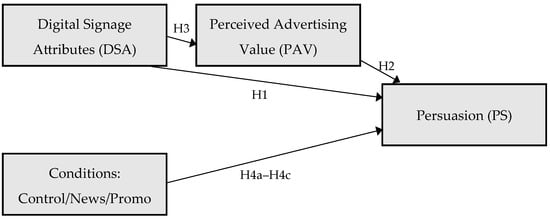
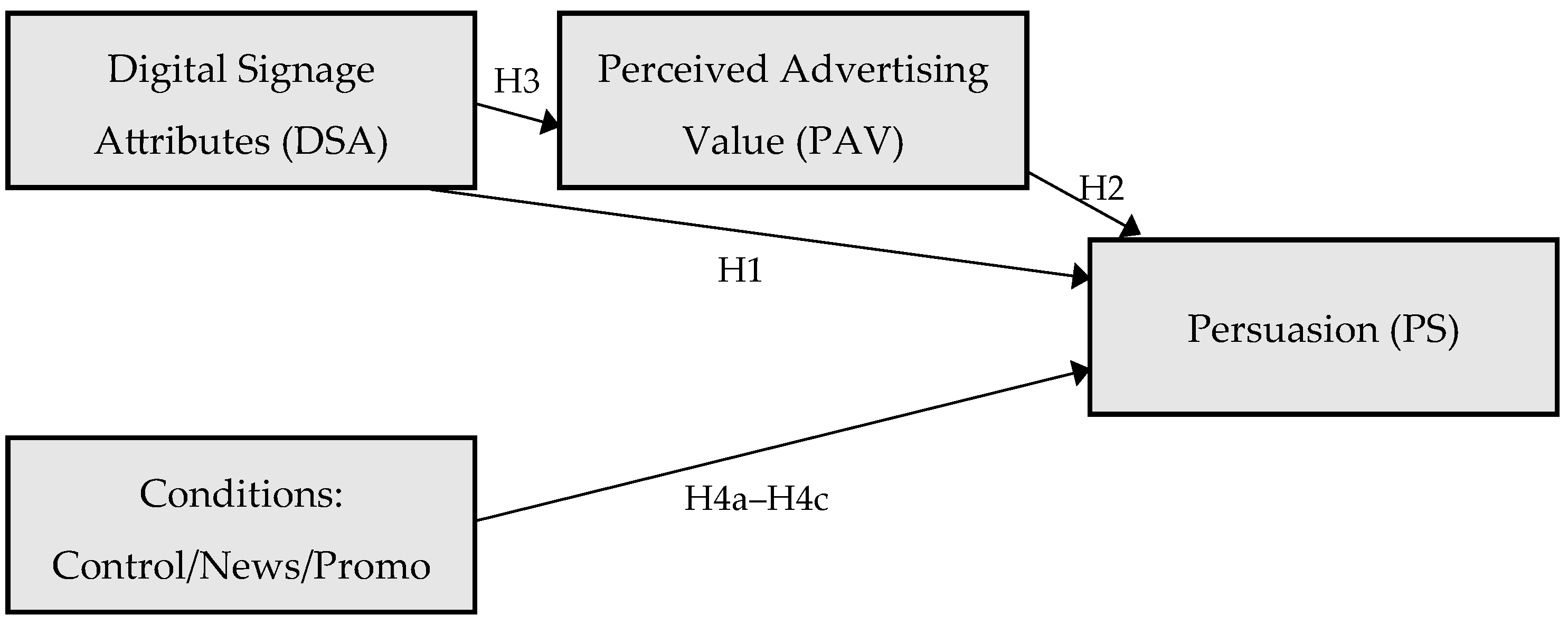
The conceptual model, illustrated in Figure 1, integrates Advertising Value Theory and Congruity Theory by proposing that persuasive communication (dependent variable) is influenced by digital signage attributes and perceived advertising value (independent variables), while Congruity Theory provides the basis for examining persuasion across contextual conditions
Figure 1.
Conceptual model of hypothesised relationships. Author’s conceptualisation.
Contextual advertising is examined through three experimental conditions: no contextual advertising (Control), local news (Treatment 1), and location-based promotions (Treatment 2). According to the proposed model, digital signage attributes are expected to directly affect persuasion (H1) and perceived advertising value (H3). Perceived advertising value is also expected to affect persuasion (H2). Finally, contextual advertising conditions, in the form of local news or location-based promotions, are expected to be associated with persuasion outcomes (H4a–H4c).
3. Research Design and Method
The study adopted a quasi-experimental design and was conducted at a large, upmarket shopping mall in South Africa. The shopping mall was chosen because it comprised multiple levels and a typical mix of retail outlets, restaurants, and service providers that use digital signage advertising. A large OOH advertising media company installed numerous interactive digital signage touchscreens and cylindrical LED screens throughout the property, making it an ideal site for data collection on contextual advertising. The mall environment makes effective mall advertising planning challenging due to the high level of competition for shoppers’ attention, making it a valuable setting for investigating persuasive communication under real-world conditions.
Conducting the study in a real shopping mall allowed consumers to respond under natural shopping conditions rather than in controlled laboratory settings, providing insight into consumer responses under real-world conditions. Shopping malls represent ideal environments for digital signage; its effectiveness is shaped by factors such as visibility and the relevance of contextual and situational content. Insights from under-researched markets such as South Africa can deepen understanding of how audiences react to digital signage in real-world retail settings. While the current study was conducted in South Africa, an emerging market, the challenges are relevant to retail environments globally.
A non-probability quota sampling method was used to reflect the shopper patronage patterns of upmarket shopping malls. Quota sampling divides the population into subgroups, selecting participants according to predetermined characteristics, and offers a practical compromise among representativeness, cost-effectiveness, and time-effectiveness (Hair et al., 2024).
Shoppers were approached by fieldworkers at two high-traffic locations, the food court and the main concourse, approximately 5 m from the digital signage displays, and invited to participate in the study. The three advertising conditions were displayed at different data-collection periods across these locations. Fieldworkers recorded the content displayed at the time of interception to ensure that each participant was allocated to the correct condition.
A total of 355 shoppers were approached, of whom 134 declined to participate, and 221 completed the questionnaire. This resulted in a completion rate of 62.3%, which is typical of intercept surveys conducted in busy shopping mall environments where shoppers are often time-constrained. Of the 221 questionnaires completed, 21 were excluded following data screening and quality checks because they were incomplete or contained inconsistent responses. The final sample comprised 200 completed questionnaires, representing a usable completion rate of 56.3%, all of which were suitable for analysis.
Data were collected only after ethical approval was obtained from the relevant institutional Research Ethics Committee (Approval Code: REC2024-06-009). Participation was voluntary, informed consent was obtained from all participants prior to data collection, and responses were collected anonymously and treated confidentially throughout the study in accordance with institutional ethical guidelines.
Trained fieldworkers collected data by approaching shoppers over a two-week period. Participants were screened to ensure that they were older than 18 years and were not employed by a business in the mall, after which they provided informed consent. Participants were surveyed on weekdays and weekends, in both peak and off-peak hours, to capture shoppers across different data-collection periods. The conditions were implemented across two mall locations during these periods, although they were not equally distributed across all location and time combinations.
Participants were divided into three groups: a control group (n = 60), which viewed non-contextual content, and two treatment groups (n = 70 each), which were exposed to different types of contextual content: local news (i.e., community events and current news) and local promotions (i.e., regular deals and discounts from nearby local stores). The planned quotas were 60 participants for the control condition and 70 for each contextual advertising condition. The slightly larger treatment groups allowed for sufficient observations for two separate comparisons with the control condition.
Respondents were approached after being within viewing distance of the digital signage for approximately three minutes during their normal movement through the mall. They then completed the questionnaire in approximately 10 min.
Participants were assigned to groups based on the content displayed on the digital signage nearest where they were intercepted. This ensured that exposure reflected naturally occurring contextual advertising rather than an artificially controlled experimental setting. During data collection, the digital signage displayed content consistent with each condition, including hyperlocal news headlines, neighbourhood weather updates, and mall-specific promotional banners. Field workers administered the questionnaire, where participants first evaluated the digital signage attributes, followed by the perceived advertising value of the displayed content. The survey concluded with items measuring persuasive communication and demographic characteristics.
Collecting data directly in the mall setting was a methodological strength because it captured consumers’ real-time responses in a naturalistic shopping environment. This contrasts with many previous studies that relied on retrospective or post-exposure surveys and online panels, which often produced less realistic results. The present study therefore provides more contextually grounded and applicable insights for advertisers and mall managers. The survey instrument (see Appendix A) included the following three five-point Likert scales, each using response anchors ranging from strongly disagree (1) to strongly agree (5).
- Digital Signage Attributes (7 items)—adapted from an established OOH media measurement scale (Roux, 2017).
- Perceived Advertising Value (7 items)—reflecting utilitarian and hedonic value based on Advertising Value Theory (Ducoffe, 1995; Ducoffe & Curlo, 2000).
- Persuasion (4 items)—measuring favourable purchase intent, adapted from Mehta (2000).
The measurement scales were assessed for reliability prior to hypothesis testing. Domain experts reviewed the questionnaire, which was pilot tested with ten marketing students, and the instrument was then refined based on feedback. Ducoffe’s (1995) original scale items were adapted to reflect the spatial context of digital signage in a shopping mall environment. Based on the pilot study, minor wording and layout refinements were made to improve clarity and respondent understanding.
A sensitivity power analysis indicated that the final sample of 200 respondents exceeded the minimum sample required to detect medium-sized effects across the three advertising conditions at the 5% significance level and 80% statistical power.
Statistical analysis included linear regressions to test the relationships specified in (H1–H3). Contextual advertising was treated as a categorical independent variable with three levels: no contextual advertising, local news content, and local promotion content. An ANOVA was conducted to test whether mean persuasion differed across the three conditions (H4a), followed by Tukey HSD post hoc tests to compare the local news and local promotion conditions with the control condition to identify significant differences in persuasion outcomes (H4b and H4c).
4. Results
4.1. Sample Profile and Descriptive Statistics
Table 1 presents the demographic profile of the 200 respondents by age, gender, and home language. Sampling quotas for these characteristics were based on the shopping mall’s shopper profile. The sample closely reflects the targeted demographic composition of the mall’s shoppers, confirming that the planned quotas were met.
Table 1.
Demographic characteristics of the sample.
Two hundred (n = 200) completed questionnaires were used for the analysis. Most of the sample consisted of female respondents (61%), respondents younger than 35 years (58.5%) and respondents who spoke an African language at home (47.5%). The sample reflected the planned shopper profile of visitors to the shopping mall (Pareto, 2025) and that of a typical upscale shopping mall in South Africa (Vogue Business, 2024).
Content recognition checks were conducted with 20 participants who were not included in the main study sample. Ten participants evaluated the local news condition and ten evaluated the local promotion condition. Participants in the local news condition (M = 4.13, SD = 0.53) reported recognition scores significantly above the neutral midpoint of 3 on the 5-point Likert scale (t(9) = 6.10, p < 0.001). Participants in the local promotion condition (M = 4.10, SD = 0.57) also reported recognition scores above the neutral midpoint t(9) = 6.10, p < 0.001. These findings indicate that participants recognised the content presented in the respective treatment conditions as intended. As shown in Table 2, all constructs demonstrated acceptable reliability, with Cronbach’s alphas ranging from 0.74 to 0.90.
Table 2.
Descriptive and reliability statistics.
After establishing reliability, mean values were calculated for each construct and used in the ensuing analysis. The digital signage attributes received higher mean ratings (M = 4.16, SD = 0.67) than perceived advertising value (M = 2.81, SD = 1.01). The mean persuasion score was also relatively high (M = 4.60, SD = 0.59).
4.2. Hypothesis Testing Results
Table 3 presents the results of three simple linear regression analyses conducted to test H1–H3.
Table 3.
Simple linear regression analyses (H1–H3).
4.2.1. H1: Digital Signage Attributes and Persuasion
The results show that the digital signage attributes significantly predict persuasion, with a strong positive relationship (B = 0.7087, p < 0.001, R2 = 0.6324). This model explained approximately 63% of the variation in persuasion, indicating that high-quality signage design and spatial placement are essential factors.
The unstandardised coefficient for digital signage attributes implies that for every one-unit increase in the composite score of signage attributes, persuasion increased by approximately 0.71 units. These findings provide support for H1.
4.2.2. H2: Perceived Advertising Value and Persuasion
However, the perceived advertising value did not significantly predict persuasion (B = 0.0538, p = 0.142, R2 = 0.0109). Therefore, H2 was not supported.
4.2.3. H3: Digital Signage Attributes and Perceived Advertising Value
The regression indicates that digital signage attributes were positively associated with perceived advertising value (B = 0.347, SE = 0.120, t(198) = 2.889, p = 0.004, 95% CI [0.110, 0.583]). H3 was therefore supported. Although statistically significant, the relatively small proportion of explained variance indicates that other factors also contributed to perceived advertising values.
4.2.4. H4a: Persuasion Across the Contextual Advertising Conditions
Table 4 presents ANOVA and post hoc test results. The average persuasion scores were as follows: Control (M = 3.88, SD = 0.59), Local News (M = 4.87, SD = 0.16), and Local Promotions (M = 4.95, SD = 0.12). These results support H4a, indicating that persuasion differed significantly across the three advertising conditions.
Table 4.
ANOVA and post hoc test results.
The Tukey HSD post hoc analysis showed that persuasion was significantly higher in both contextual advertising conditions than in the control condition. However, no significant difference in persuasion between the Local News and Local Promotion conditions was found (mean difference = −0.08, p = 0.350, 95% CI [−0.22, 0.06]).
4.2.5. H4b: Exposure to Recent Local News (Treatment 1) Versus No Contextual Advertising (Control)
The Tukey HSD post hoc analysis revealed a significant difference in persuasion between the Local News and Control groups (mean difference = 0.98, p < 0.001, 95% CI [0.84, 1.13]). Participants exposed to local news content reported significantly higher persuasion than participants in the control condition. These findings support H4b.
4.2.6. H4c: Exposure to Local Promotions (Treatment 2) Versus No Contextual Advertising (Control)
A significant difference was also found between the Local Promotions and Control groups (mean difference = 1.06, p < 0.001, 95% CI [0.92, 1.21]). Participants exposed to local promotional content for nearby stores and restaurants reported significantly higher persuasion than those in the control condition. These findings support H4c.
5. Discussion
The primary objective of this study was to examine how digital signage attributes, perceived advertising value, and contextual advertising conditions are associated with persuasive communication in a real-world retail environment. More specifically, it determined whether the contextual relevance of the advertising was associated with greater persuasive effectiveness of digital signage.
By conducting this research in an actual retail (shopping) mall environment, this study provides new knowledge about persuasive communication in DOOH settings and contributes to understanding DOOH communication in connected retail environments.
Overall, the findings provide a more nuanced application of Advertising Value Theory and Congruity Theory by showing that digital signage attributes significantly predicted persuasion, perceived advertising value alone did not, and contextual alignment was associated with greater persuasion.
Together, these findings suggest that persuasive communication in DOOH environments should be considered in relation to both the communication medium and its surrounding context, rather than the message value alone. Regression analyses supported H1 and H3. Digital signage attributes were positively associated with both persuasion and perceived advertising value. However, perceived advertising value was not significantly associated with persuasion. The contrast is important because it suggests that perceived value of the advertising message alone may not adequately explain persuasion in the real-world retail environment.
Consistent with the supported hypotheses, positive evaluations of digital design attributes were positively associated with persuasion and perceived advertising value. This is consistent with prior research suggesting that spatial characteristics such as design quality, sign visibility, and placement can facilitate message processing and persuasive communication (Bhargava & Donthu, 1999; Donthu et al., 1993; Wilson & Till, 2008, 2011; Wilson & Suh, 2018).
Peripheral characteristics of the medium, such as layout, screen size, and visibility, can serve as cues that guide consumers’ cognitive processing of information. This complements Advertising Value Theory by suggesting the characteristics of the medium may also contribute to how consumers value advertising within DOOH environments. Moreover, the findings emphasise that consumer perceptions of signage quality and conspicuousness within the retail environment are critical to communication effectiveness (Wilson & Suh, 2018; Xaba et al., 2020).
Contrary to H2, no significant relationship was found between perceived advertising value and persuasion in the regression analysis. This is an important finding because Advertising Value Theory would suggest that higher perceived advertising value should be associated with more favourable persuasive responses. This suggests that the persuasive power of advertising content on digital signage may not be explained by perceived message value alone and may relate to the medium’s ability to attract attention through its design and placement. Consumers may therefore respond to the visibility and prominence of the digital signage when evaluating the advertising message itself.
This finding suggests that perceived advertising value may be influenced by the communication environment in which the message is delivered. These results differ from earlier studies, which emphasised the importance of content in influencing consumer responses (Bae et al., 2016; Dennis et al., 2014; Hsiao et al., 2026; Xaba et al., 2020). One possible explanation for this divergence is the complexity of real retail settings compared with more controlled environments. In mall settings with high pedestrian traffic, environmental distractions, visual clutter, and competing stimuli may influence audience cognitive processing unless signage is visually dominant.
The implication is that effective design may facilitate message processing; in high-traffic retail environments, environmental conditions may influence how consumers engage with the medium and evaluate the advertising message itself.
This finding suggests that Advertising Value Theory should be considered alongside the communication environment when explaining persuasion in DOOH settings. The results support H4a–H4c. Both local news and local promotions were associated with significantly higher persuasion levels than the non-contextual content condition. As hypothesised, audiences reported more positive persuasion responses to digital signage when it addressed their immediate context, such as nearby stores, local community events, and current weather, than when non-contextual content was displayed. These findings are consistent with prior literature demonstrating that messages that aligned with an individual’s situational context are more effective (Aguirre et al., 2015; Bauer et al., 2016; Bright & Daugherty, 2012; De Keyzer et al., 2022).
These findings are also consistent with previous research showing that contextually relevant digital signage enhances communication effectiveness and consumer engagement within retail environments (Dennis et al., 2010, 2012; Mposi et al., 2025; Roux, 2018; Wilson, 2023).
They also support the theoretical underpinnings of Congruity Theory (Osgood & Tannenbaum, 1955), which proposes that alignment between messages and environmental cues creates greater cognitive consistency and supports persuasiveness. Therefore, when signage content is contextualised within the consumer’s immediate environment, consumers perceive it more positively and as more persuasive.
The findings suggest the interdependence of signage attributes, content, and context, indicating that persuasion may be more effective when environmental stimuli are integrated into signage content in real time. This supports the proposition that contextual alignment is important for persuasive communication in DOOH environments.
Retail marketers and advertisers are advised to develop and display location-specific signage content, such as local sales promotions, seasonal events, and community news, rather than general branding content that does not reflect the physical environment where the signage is displayed. Prior research has demonstrated that localised promotional opportunities elicit higher levels of consumer engagement and responsiveness (Roberts, 2018; Roux, 2018). Likewise, localised opportunities for promotion have been shown to increase consumers’ likelihood of responding positively to promotional messages (Burke, 2009; Dennis et al., 2010; Dennis et al., 2012; Roggeveen et al., 2016).
Conversely, the results suggest that perceived advertising value alone may not explain persuasion in response to digital signage messages. Positive consumer response may be more likely when digital signage attributes and the consumer’s context are aligned both temporally and spatially. Accordingly, effective digital signage should be viewed not simply as a display medium, but as an interactive communication touchpoint within a connected retail environment.
Overall, the study supports H1, H3, and H4a–H4c, while H2 was not supported. Together, these findings suggest that the persuasive effectiveness of digital signage should be considered in relation to the message value, the attributes of the digital signage itself, and its contextual relevance. The study therefore contributes to understanding persuasive communication in DOOH environments by showing that message value alone may not adequately explain persuasion and that digital signage attributes and contextual congruity also need to be considered in real-world retail environments.
5.1. Theoretical Implications
The findings contribute to the application of Advertising Value Theory and Congruity Theory in DOOH environments by highlighting the importance of considering message value in relation to the medium and its surrounding context. More specifically, the findings suggest that message value alone may be insufficient to explain persuasive communication in DOOH environments. Digital signage attributes were positively associated with perceived message value and persuasion; perceived advertising value itself was not significantly associated with persuasion. This suggests that message value should be considered alongside the characteristics of the digital signage medium and its contextual alignment. The results also show contextual alignment as an important component of DOOH communication, as both local news and local promotions were associated with higher persuasion than non-contextual content.
From an interactive marketing perspective, these findings reinforce the importance of understanding persuasive communication as a technology-enabled process shaped by the surrounding environment, rather than as a function of message content alone (Peltier et al., 2026; Wang, 2024). The findings that news and local promotions did not differ significantly further suggest that contextual relevance may apply across different forms of locally relevant content.
They further suggest that contextual relevance may play an important role in how convergent smart marketing systems facilitate persuasive communication across connected consumer touchpoints. Accordingly, persuasive communication should be understood not only in terms of message content, but also in terms of how message value, technology, and context are considered together within connected retail environments.
5.2. Managerial Implications
This study offers actionable insights to practitioners involved in DOOH communication, retail marketing, interactive marketing, and emerging smart marketing systems. While the design quality and positioning of digital advertising remain crucial for attracting attention, the findings indicate that contextual alignment, through locally relevant content, is associated with greater persuasive communication. Promotions for nearby stores were as persuasive as local news since there was no significant difference between the two contextual conditions.
Table 5 presents key practical implications arising from the findings, which are summarised below.
Table 5.
Managerial implications for contextual digital signage.
- Localise communication for peak dwell times
Digital signage should be used strategically to maximise visibility and generate sales during peak hours by placing it in high-traffic areas where large volumes of people are likely to pass, including food courts, main entrances/exits, and main corridors. The digital signs can display different messages during periods of high pedestrian traffic. By displaying the exact location of the sale or discount and its duration (i.e., “10% off all Chuck Taylor All Stars @ Converse Today Only on level One”), retailers can create an immediate call to action. Messages can be refreshed regularly to prevent audiences from becoming desensitised to the content. Based on pedestrian traffic patterns, the message type and rotation frequency may vary.
- Use contextually relevant content to maintain engagement
The aim is to keep customers engaged through contextually relevant communication. When direct advertising is not being displayed, this type of content can be used. Displays located near escalators, queues, or waiting areas can reinforce contextual relevance by providing local information such as public transportation schedules, weather forecasts, sports events, or cultural happenings, helping maintain audience engagement when promotional advertising is not being displayed.
- Align placements with decision-making contexts
The placement of digital signage is important alongside the type of content being displayed. Digital signage needs to be positioned at eye level, unobstructed and viewable from different vantage points. When retailers place digital signage near entrance doors, checkout counters, or the products being advertised, they make the message more relevant to the customer’s immediate shopping context, which may support persuasive communication.
Positioning digital signage in these strategic locations allows advertisers to reach consumers within the immediate shopping context. Media planners should consider screen placement, display quality, and content contextualisation to maximise responses. While message content might create an initial impact, the findings suggest consumer responses may also reflect contextual relevance. Thus, persuasion in the DOOH environment should be considered in relation to the medium in which it is presented.
6. Limitations and Future Research
When evaluating the limitations of this study, several factors should be considered. Because of quota sampling and the restriction of collecting data from a single shopping mall, the generalisability of the findings is limited. The retail setting reflects typical DOOH exposure conditions among affluent urban residents to DOOH communication in South Africa. However, it does not account for potential differences across income groups, geographical areas, or different retail environments (for example, suburban shopping malls, transport nodes, or discount grocers). Future research could extend this study across multiple retail environments to determine whether the findings are generalisable across different contexts and market segments. A further limitation is that participants were assigned according to the content displayed nearest to where they were intercepted rather than through random allocation.
The advertising condition may therefore have been influenced by differences between mall locations, such as shopper movement, nearby stores and competing visual stimuli, as well as the time of data collection. Future studies could rotate the conditions across locations and data collection times or randomly assign participants to reduce this possible confounding effect. Although the study focused on in-situ contextual advertising, it did not assess mediators such as message frequency, consumer interaction, proximity to the point of purchase, and interactivity. Factors related to the environmental conditions (e.g., dense crowds, ambient background noise, competing visual stimuli) were not evaluated. To isolate these factors, future studies could adopt controlled or quasi-experimental designs to directly measure these environmental and media factors.
The findings focus on self-reported persuasion variables rather than behavioural or objective sales data. While this approach provides valuable insights into consumers’ attitudes and perceptions, self-report measures may be influenced by social desirability bias. Thus, some participants may inadvertently over- or understate their level of interest in certain promotional messages. The relatively high persuasion scores in the two contextual conditions should also be considered when interpreting the differences between contextual and control conditions. In future studies, it would be valuable to integrate behavioural measures, such as sales data, redemption rates, or consumers’ interactions with interactive screens, where such data are available, to validate and extend these findings.
The study was guided by Advertising Value Theory and Congruity Theory because they are well suited to the objectives of this study. Future studies, however, could explore context-aware communication using alternative perspectives such as the Stimulus–Organism–Response (S–O–R) framework, Media Richness Theory, or the Technology Acceptance Model (TAM).
Artificial Intelligence may further enhance these capabilities by enabling continuous optimisation of interactive customer journeys, identifying patterns of consumer engagement, and dynamically adapting promotional content in real time to improve communication effectiveness. Therefore, future research should investigate how attitudinal and behavioural metrics can be combined to assess communication effectiveness within multi-channel and increasingly converged marketing systems.
Retailers could leverage digital signage as an interactive touchpoint within a comprehensive omnichannel customer journey by making the experience context-aware. Using technologies such as QR codes and NFC, retailers could provide consumers with seamless transitions from watching promotions on digital signage to accessing digital coupons, participating in AR product experiences via their mobile apps, and engaging with other digital content. If retailers integrate AR-enabled mobile applications or smart-glasses interfaces with the digital signage in retail stores, they could transform the messages provided on the digital signage into an immersive product visualisation experience and provide personalised promotional offers. Similarly, VR environments could complement the in-store experience by extending brand engagement before or after a store visit. Although these technologies were not examined in the present study, they illustrate how contextual communication may evolve within future retail environments.
Collectively, these connected paths show how retailers can use digital signage as an interactive, context-aware touchpoint that integrates physical, mobile, and immersive media.
Finally, the study is limited to two contextual conditions of content: localised news and on-site promotional content. Future studies could therefore examine a broader range of contextual factors including audience-related variables (e.g., dwell time, community demographic composition, and language preferences) and operational factors (such as message scheduling frequency or integration with loyalty programmes). Emerging possibilities such as interactive AI-driven content, biometric feedback, mobile integration, and immersive consumer experiences may enable more dynamic, real-time, context-responsive communication, offering further avenues for research. These developments point to increasingly convergent smart marketing ecosystems, where multiple technologies operate in an integrated, coordinated manner. Future research should therefore examine how AI, immersive technologies, and connected devices interact within unified platforms to deliver seamless, context-aware, and personalised consumer experiences across physical and digital environments.
One key benefit of contextual communication is that it enables relevant promotional messages to be delivered to customers without requiring the extensive use of personally identifiable customer information. The ability to deliver context-aware promotional messages has also been shown to reduce many of the privacy risks typically associated with personalised advertising.
As AI-enabled, biometric, and other emerging technologies become more widely adopted in retail environments, future research can explore how these technologies create new perceived risks related to consumer consent, transparency, and responsible data usage. As marketers continue to develop more sophisticated interactive and convergent marketing systems, ensuring both contextual relevance and consumer trust will require greater attention.
Funding
This research received no external funding.
Institutional Review Board Statement
The study was conducted in accordance with the Declaration of Helsinki and approved by the TUT Human Research Ethics Committee (Approval Code: REC2024-06-009; September 2024).
Informed Consent Statement
Informed consent was obtained from all participants involved in the study.
Data Availability Statement
The data generated and analysed during this study are not publicly available but are available from the author upon reasonable request.
Acknowledgments
Grammarly (v. 14.1325.0) was used for language refinement and spelling checks. OpenAI ChatGPT (GPT-5.6 Sol) was used to review the reference list for consistency and completeness. The author takes full responsibility for the accuracy of the manuscript.
Conflicts of Interest
The author declares no conflicts of interest.
Appendix A. Measurement Scales and Items
| Recognition of the intended content: Local news/Local promotion |
|
|
|
| Digital Signage Attributes |
| 1. The digital signage creates a favourable overall impression. |
| 2. The design of the digital signage is attractive. |
| 3. The size of the digital signage screens is appropriate. |
| 4. The digital signage screens are clearly visible. |
| 5. The quality of the digital signage screens is high. |
| 6. The digital signage screens are well placed in the shopping mall. |
| 7. The speed at which information and advertisements are displayed was appropriate. |
| Perceived Advertising Value |
| 1. The advertising content displayed on the digital signage is entertaining. |
| 2. The advertising content displayed on the digital signage is interesting. |
| 3. The advertising content displayed on the digital signage is attractive. |
| 4. The advertising content displayed on the digital signage is informative. |
| 5. The advertising content displayed on the digital signage is useful. |
| 6. The advertising content displayed on the digital signage is relevant to me. |
| 7. Overall, the advertising content displayed on the digital signage is valuable. |
| Persuasion |
| 1. I would be likely to purchase a product advertised on the digital signage. |
| 2. I would like to try a product advertised on the digital signage. |
| 3. I would recommend a product advertised on the digital signage to other people. |
| 4. I would consider purchasing a product advertised on the digital signage in the future. |
References
- Aguirre, E., Mahr, D., Grewal, D., De Ruyter, K., & Wetzels, M. (2015). Unravelling the personalisation paradox: The effect of information collection and trust-building strategies on online advertisement effectiveness. Journal of Retailing, 91(1), 34–49. [Google Scholar] [CrossRef] [Scilit]
- Avant, J. A., Kim, K., & Hayes, J. L. (2017). Thirty years of advertising research in leading communication and marketing journals: Learning from the parent disciplines. Journal of Current Issues & Research in Advertising, 38(1), 44–64. [Google Scholar] [CrossRef] [Scilit]
- Bae, Y. H., Jun, J. W., & Hough, M. (2016). Uses and gratifications of digital signage and relationships with the user interface. Journal of International Consumer Marketing, 28(5), 323–331. [Google Scholar] [CrossRef] [Scilit]
- Bauer, C., Kryvinska, N., & Strauss, C. (2016). The business with digital signage for advertising. In Information and communication technologies in organizations and society (pp. 285–302). Springer. [Google Scholar] [CrossRef] [Scilit]
- Bhargava, M., & Donthu, N. (1999). Sales response to outdoor advertising. Journal of Advertising Research, 39(4), 7–17. [Google Scholar] [CrossRef] [Scilit]
- Breward, M., Hassanein, K., & Head, M. (2017). Understanding consumers’ attitudes toward controversial information technologies: A contextualization approach. Information Systems Research, 28(4), 760–774. [Google Scholar] [CrossRef] [Scilit]
- Bright, L. F., & Daugherty, T. (2012). Does customisation impact advertising effectiveness? An exploratory study of consumer perceptions of advertising in customised online environments. Journal of Marketing Communications, 18(1), 19–37. [Google Scholar] [CrossRef] [Scilit]
- Burke, R. R. (2009). Behavioral effects of digital signage. Journal of Advertising Research, 49(2), 180–185. [Google Scholar] [CrossRef] [Scilit]
- De Keyzer, F., Van Noort, G., & Kruikemeier, S. (2022). Going too far? How consumers respond to personalized advertising from different sources. Journal of Electronic Commerce Research, 23(3), 138–159. Available online: https://edepot.wur.nl/575826 (accessed on 1 October 2025).
- Dennis, C., Brakus, J. J., Gupta, S., & Alamanos, E. (2014). The effect of digital signage on shoppers’ behaviour: The role of the evoked experience. Journal of Business Research, 67(11), 2250–2257. [Google Scholar] [CrossRef] [Scilit]
- Dennis, C., Joško Brakus, J., & Alamanos, E. (2013). The wallpaper matters: Digital signage as customer-experience provider at the Harrod department stores (London, UK). Journal of Marketing Management, 29(3–4), 338–355. [Google Scholar] [CrossRef] [Scilit]
- Dennis, C., Michon, R., Brakus, J. J., Newman, A., & Alamanos, E. (2012). New insights into the impact of digital signage as a retail atmospheric tool. Journal of Consumer Behaviour, 11(6), 454–466. [Google Scholar] [CrossRef] [Scilit]
- Dennis, C., Newman, A., Michon, R., Brakus, J. J., & Wright, L. T. (2010). The mediating effects of perception and emotion: Digital signage in mall atmospherics. Journal of Retailing and Consumer Services, 17(3), 205–215. [Google Scholar] [CrossRef] [Scilit]
- Donthu, N., Cherian, J., & Bhargava, M. (1993). Factors influencing recall of outdoor advertising. Journal of Advertising Research, 33(3), 64–72. [Google Scholar] [CrossRef] [Scilit]
- Ducoffe, R. H. (1995). How consumers assess the value of advertising. Journal of Current Issues & Research in Advertising, 17(1), 1–18. [Google Scholar] [CrossRef] [Scilit]
- Ducoffe, R. H., & Curlo, E. (2000). Advertising value and advertising processing. Journal of Marketing Communications, 6(4), 247–262. [Google Scholar] [CrossRef] [Scilit]
- Fan, X., Xun, J., Dolega, L., & Xiong, L. (2025). The role of augmented and virtual reality in shaping retail marketing: A meta-analysis. Sustainability, 17(2), 728. [Google Scholar] [CrossRef] [Scilit]
- Garaus, M., & Wagner, U. (2019). Let me entertain you—Increasing overall store satisfaction through digital signage in retail waiting areas. Journal of Retailing and Consumer Services, 47, 331–338. [Google Scholar] [CrossRef] [Scilit]
- Garaus, M., Wagner, U., & Manzinger, S. (2017). Happy grocery shopper: The creation of positive emotions through affective digital signage content. Technological Forecasting and Social Change, 124, 295–305. [Google Scholar] [CrossRef] [Scilit]
- Garaus, M., Wagner, U., & Rainer, R. C. (2021). Emotional targeting using digital signage systems and facial recognition at the point-of-sale. Journal of Business Research, 131, 747–762. [Google Scholar] [CrossRef] [Scilit]
- Hair, J. F., Ortinau, D. J., & Harrison, D. E. (2024). Essentials of marketing research: The foundation for intelligent decision making. McGraw Hill Education. [Google Scholar]
- He, J., & Wang, C. (2017). How global brands incorporating local cultural elements increase consumer purchase likelihood: An empirical study in China. International Marketing Review, 34(4), 463–479. [Google Scholar] [CrossRef] [Scilit]
- Herhausen, D., de Jong, D., & Grewal, D. (2026). In-store advertising with digital signage. Journal of Marketing, 90(3), 81–103. [Google Scholar] [CrossRef] [Scilit]
- Hsiao, W.-H., Tsai, P.-H., & Chen, C.-J. (2026). Exploring the factors influencing consumers’ engagement with AI digital signage in retailing: Evidence from Taiwan. Journal of Enterprise Information Management, 39(4), 1401–1428. [Google Scholar] [CrossRef] [Scilit]
- IAB. (2021). IAB Europe guide to contextual advertising. Available online: https://iabeurope.eu/wp-content/uploads/IAB-Europe-Guide-to-Contextual-Advertising-July-2021.pdf (accessed on 1 October 2025).
- Khang, H., Han, S., Shin, S., Jung, A. R., & Kim, M. J. (2016). A retrospective on the state of international advertising research in advertising, communication, and marketing journals: 1963–2014. International Journal of Advertising, 35(3), 540–568. [Google Scholar] [CrossRef] [Scilit]
- Liu, H., Schoefer, K., Fastoso, F., & Tzemou, E. (2020). Perceived brand globalness/localness: A systematic review of the literature and directions for further research. Journal of International Marketing, 29(1), 77–94. [Google Scholar] [CrossRef] [Scilit]
- Makri, K., Papadas, K., & Schlegelmilch, B. (2019). Global-local consumer identities as drivers of global digital brand usage. International Marketing Review, 36(4), 544–567. [Google Scholar] [CrossRef] [Scilit]
- Maslowska, E., Smit, E. G., & Van den Putte, B. (2016). It is all in the name: A study of consumers’ responses to personalized communication. Journal of Interactive Advertising, 16(1), 74–85. [Google Scholar] [CrossRef] [Scilit]
- Mehta, A. (2000). Advertising attitudes and advertising effectiveness. Journal of Advertising Research, 40(3), 1–6. [Google Scholar] [CrossRef] [Scilit]
- Mposi, Z. S., Roux, T., & Van Zyl, D. (2025). Content and process as motivational factors in digital out-of-home media: The mediating role of interaction in user experience. Human Behavior and Emerging Technologies, 2025, 8820265. [Google Scholar] [CrossRef] [Scilit]
- Nanni, A., & Ordanini, A. (2024). Digital signage for promoting price discounts: First insights into customer spending on distant and nearby discounted products. Journal of Retailing, 100(2), 186–198. [Google Scholar] [CrossRef] [Scilit]
- Nöjd, S., Trischler, J., Otterbring, T., Andersson, P., & Wästlund, E. (2020). Bridging the valuescape with digital technology: A mixed methods study on customers’ value creation process in the physical retail space. Journal of Retailing and Consumer Services, 56, 102161. [Google Scholar] [CrossRef] [Scilit]
- Osgood, C. E., & Tannenbaum, P. H. (1955). The principle of congruity in the prediction of attitude change. Psychological Review, 62(1), 42–55. [Google Scholar] [CrossRef] [Scilit] [PubMed]
- Pareto. (2025). Our portfolio. Available online: https://www.pareto.co.za/our-portfolio/ (accessed on 1 October 2025).
- Peltier, J. W., Dahl, A. J., Drury, L., Khan, T., & Wang, C. L. (2026). Where’s the interactive marketing in the interactive marketing literature? A state-of-the-art review and research agenda. Journal of Research in Interactive Marketing, 20(3), 397–439. [Google Scholar] [CrossRef] [Scilit]
- Pfeifer, P., Hilken, T., Heller, J., Alimamy, S., & Di Palma, R. (2023). More than meets the eye: In-store retail experiences with augmented reality smart glasses. Computers in Human Behavior, 146, 107816. [Google Scholar] [CrossRef] [Scilit]
- Roberts, L. (2018). How digital out-of-home contributes to traditional out-of-home advertising: An exploratory study from the perspective of Irish industry practitioners [Unpublished doctoral dissertation, National College of Ireland]. [Google Scholar]
- Roggeveen, A. L., Nordfält, J., & Grewal, D. (2016). Do digital displays enhance sales? Role of retail format and message content. Journal of Retailing, 92(1), 122–131. [Google Scholar] [CrossRef] [Scilit]
- Rosengren, S., & Dahlén, M. (2013). Judging a magazine by its advertising: Exploring the effects of advertising content on perceptions of a media vehicle. Journal of Advertising Research, 53(1), 65–74. [Google Scholar] [CrossRef] [Scilit]
- Rosengren, S., & Dahlén, M. (2015). Exploring advertising equity: How a brand’s past advertising may affect consumer willingness to approach its future ads. Journal of Advertising, 44(1), 1–13. [Google Scholar] [CrossRef] [Scilit]
- Roux, A. T., & Maree, T. (2021). Joy to the (shopper) world: An SOR view of digital place-based media in upmarket shopping malls. Journal of Promotion Management, 27(7), 1031–1060. [Google Scholar] [CrossRef] [Scilit]
- Roux, T. (2017). Finding Cinderella’s shoe: Guidelines for the planning of contemporary outdoor advertising media. African Journal of Hospitality, Tourism and Leisure, 6(2), 1–20. Available online: https://www.ajhtl.com/uploads/7/1/6/3/7163688/article_36_vol_6__2__2017.pdf (accessed on 1 October 2025).
- Roux, T. (2018). Industry perspectives on digital out-of-home advertising in South Africa. Communicare: Journal for Communication Sciences in Southern Africa, 37(1), 17–37. Available online: https://hdl.handle.net/10520/EJC-10573becf7 (accessed on 1 October 2025). [CrossRef] [Scilit]
- Roux, T., Mahlangu, S., & Manetje, T. (2020). Digital signage as an opportunity to enhance the mall environment: A moderated mediation model. International Journal of Retail & Distribution Management, 48(10), 1099–1119. [Google Scholar] [CrossRef] [Scilit]
- Roux, T., Mahlangu, S., & Xaba, M. (2025). The effects of digital signage design features and interactivity on shoppers’ behaviour: The mediated effect of positive shopping mall ambience. International Journal of Electronic Marketing and Retailing, 16(2), 175–197. [Google Scholar] [CrossRef] [Scilit]
- Satoh, I. (2020). Context-aware information for smart retailers. In Distributed computing and artificial intelligence, 17th international conference (pp. 71–80). Springer International Publishing. [Google Scholar] [CrossRef] [Scilit]
- Sherbina, N. (2024). Unlocking the benefits of digital signage for marketing communications. Available online: https://www.aiscreen.io/digital-signage-employee-communications/benefits-marketing-communications// (accessed on 1 October 2025).
- The Global Marketing. (2024). Local marketing for global brands: Stand out in your market. Available online: https://veracontent.com/mix/local-marketing-global-brands/ (accessed on 1 March 2025).
- Unbabel. (2023). Global trends in marketing localization. Available online: https://unbabel.com/wp-content/uploads/2023/07/global-trends-in-marketing-localization-2023-copy.pdf (accessed on 1 October 2025).
- Van De Sanden, S., Willems, K., & Brengman, M. (2022). In-store location-based marketing with beacons: From inflated expectations to smart use in retailing. In The role of smart technologies in decision making (pp. 148–175). Routledge. [Google Scholar]
- Van De Sanden, S., Willems, K., Poncin, I., & Brengman, M. (2020). Digital signage in the store atmosphere: Balancing gains and pains. In Retail futures: The good, the bad and the ugly of the digital transformation. Emerald Publishing Limited. [Google Scholar] [CrossRef] [Scilit]
- Vaughan, P. (2024). The future of digital signage in the retail sector. Available online: https://www.poppulo.com/blog/the-future-of-digital-signage-in-the-retail-sector (accessed on 1 October 2025).
- Vogue Business. (2024). Understanding luxury in South Africa. Retail ›advanced. Available online: https://www.vogue.com/article/understanding-luxury-in-south-africa (accessed on 1 March 2025).
- Wang, C. L. (2024). What is an interactive marketing perspective and what are emerging research areas? Journal of Research in Interactive Marketing, 18(2), 161–165. [Google Scholar] [CrossRef] [Scilit]
- Wilson, R. T. (2023). Out-of-home advertising: A systematic review and research agenda. Journal of Advertising, 52(2), 279–299. [Google Scholar] [CrossRef] [Scilit]
- Wilson, R. T., & Suh, T. (2018). Advertising to the masses: The effects of crowding on the attention to place-based advertising. International Journal of Advertising, 37(3), 402–420. [Google Scholar] [CrossRef] [Scilit]
- Wilson, R. T., & Till, B. D. (2008). Airport advertising effectiveness: An exploratory field study. Journal of Advertising, 37(1), 59–72. [Google Scholar] [CrossRef] [Scilit]
- Wilson, R. T., & Till, B. D. (2011). Product placements in movies and on Broadway: A field study. International Journal of Advertising, 30(3), 373–398. [Google Scholar] [CrossRef] [Scilit]
- Xaba, E. M., Roux, A. T., & Drotsky, G. A. P. (2020). Taxonomy of digital signage message execution and media placement considerations. The Retail and Marketing Review, 16(1), 11–25. Available online: https://hdl.handle.net/10520/EJC-1ea75e8f56 (accessed on 1 October 2025).

Disclaimer/Publisher’s Note: The statements, opinions and data contained in all publications are solely those of the individual author(s) and contributor(s) and not of MDPI and/or the editor(s). MDPI and/or the editor(s) disclaim responsibility for any injury to people or property resulting from any ideas, methods, instructions or products referred to in the content. |
© 2026 by the author. Licensee MDPI, Basel, Switzerland. This article is an open access article distributed under the terms and conditions of the Creative Commons Attribution (CC BY) license.