A Novel Strategy for Developing Engineered Cementitious Composites: Synergistic Incorporation of Volcanic Materials and PE-PVA Fibers

 ,
, 
 and
and
Abstract
1. Introduction
2. Research Significance
3. Materials and Methods
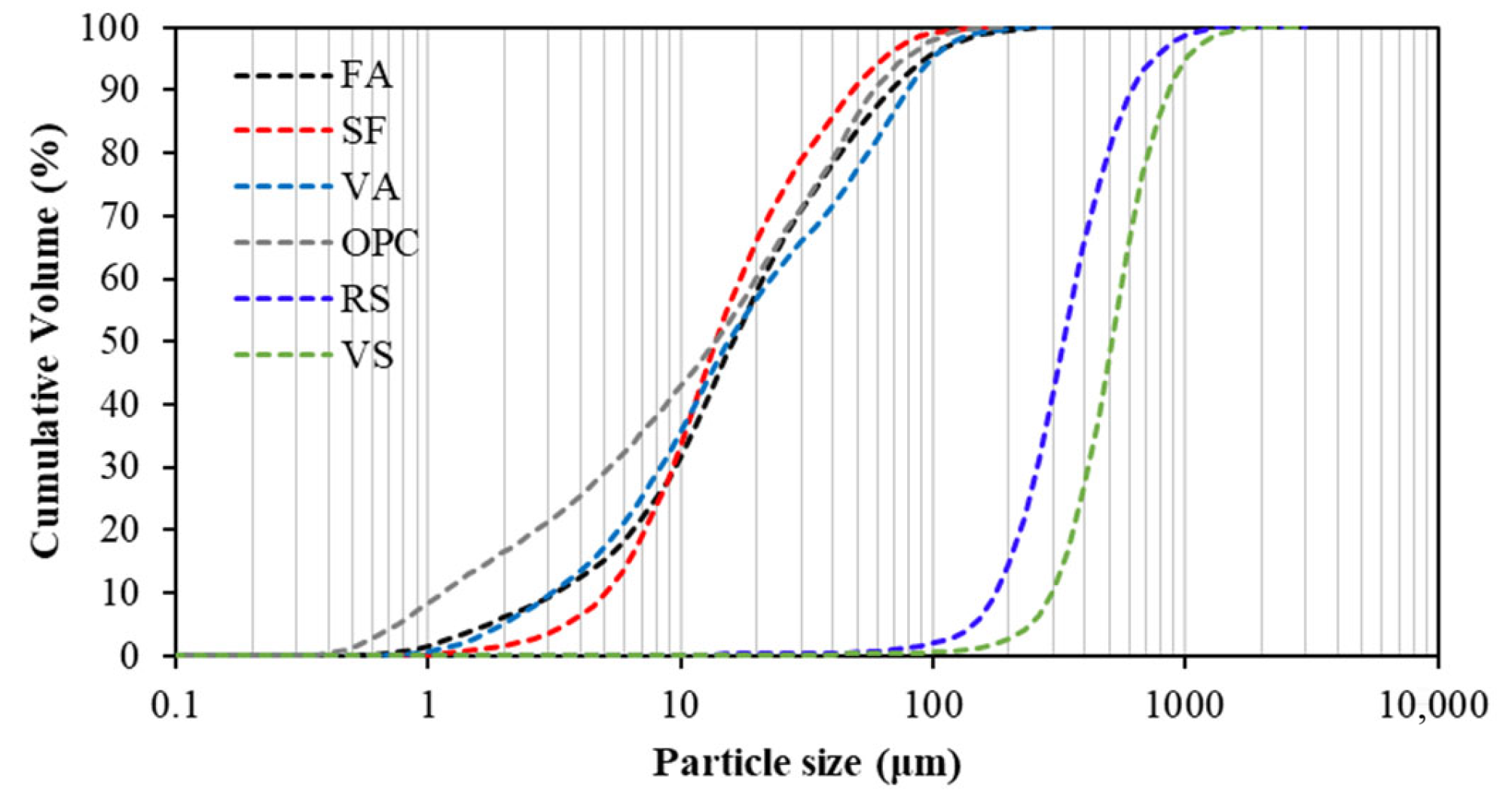
3.1. Materials
3.2. Mix Design
3.3. Sample Preparation
3.4. Test Methods
3.4.1. Flowability
3.4.2. Compressive Strength
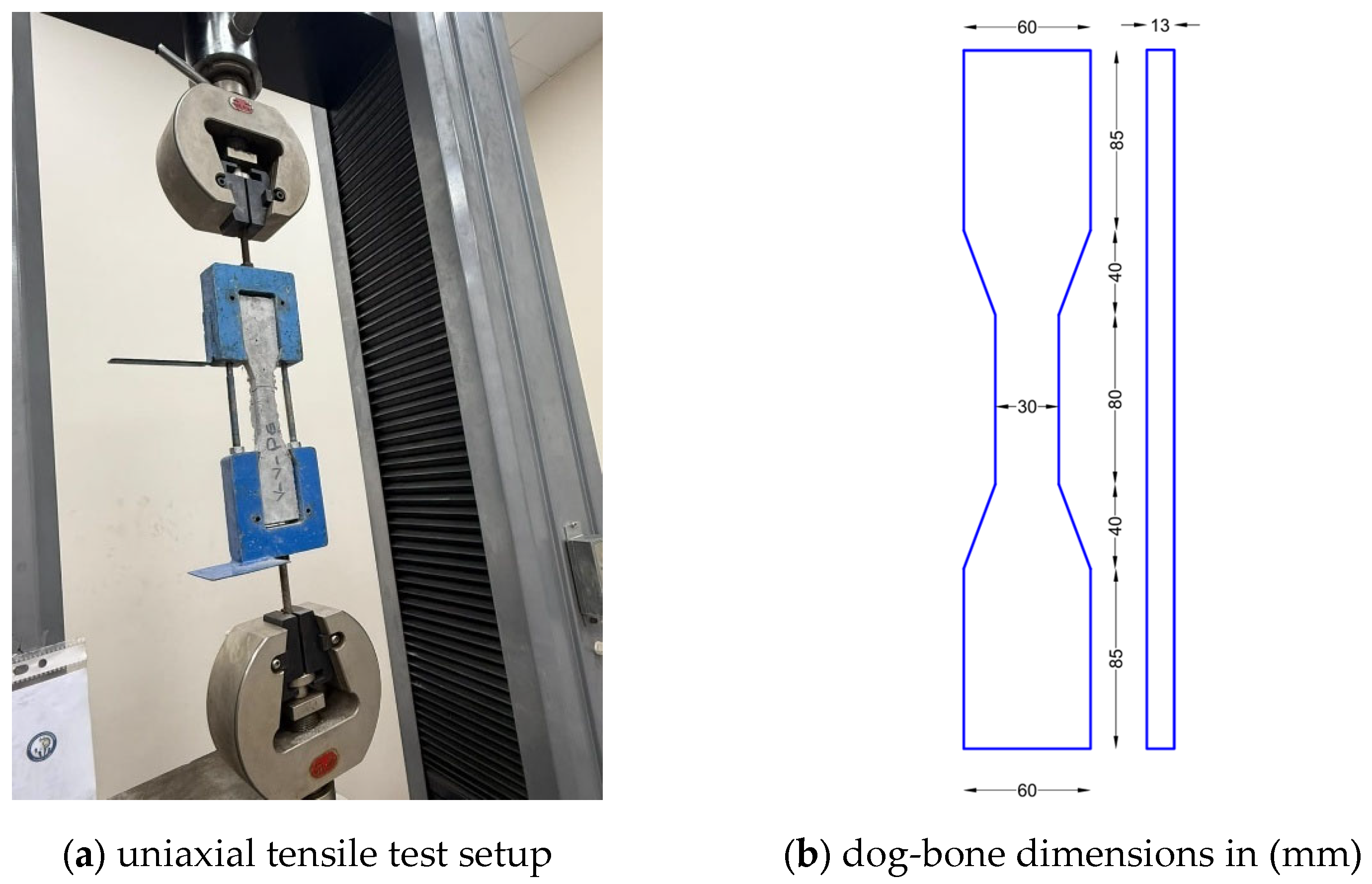
3.4.3. Uniaxial Tensile Load Displacement Test
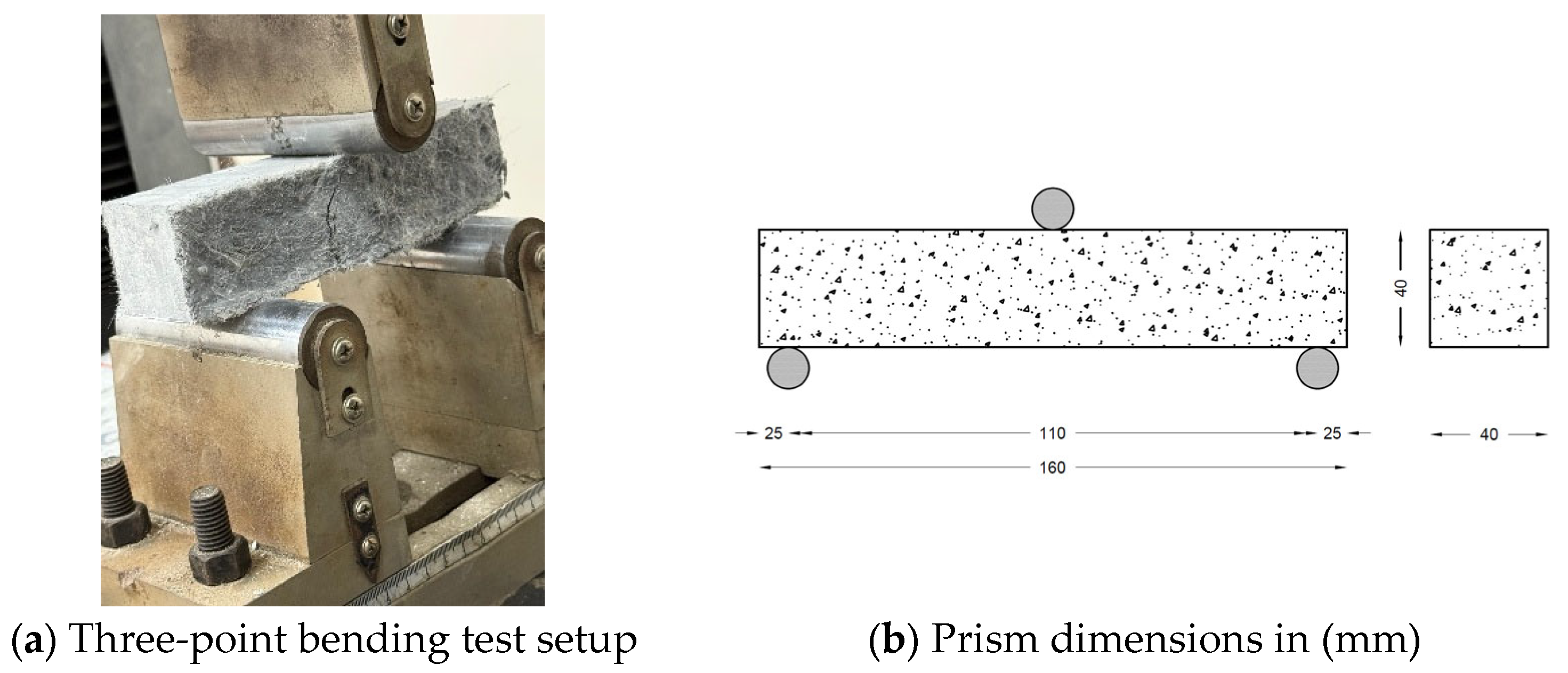
3.4.4. Three-Point Bending Test
3.4.5. Water Absorption
3.4.6. Abrasion Test
3.4.7. Microstructure Performance
4. Results and Discussions
4.1. Flowability
4.2. Mechanical Properties
4.2.1. Compressive Strength
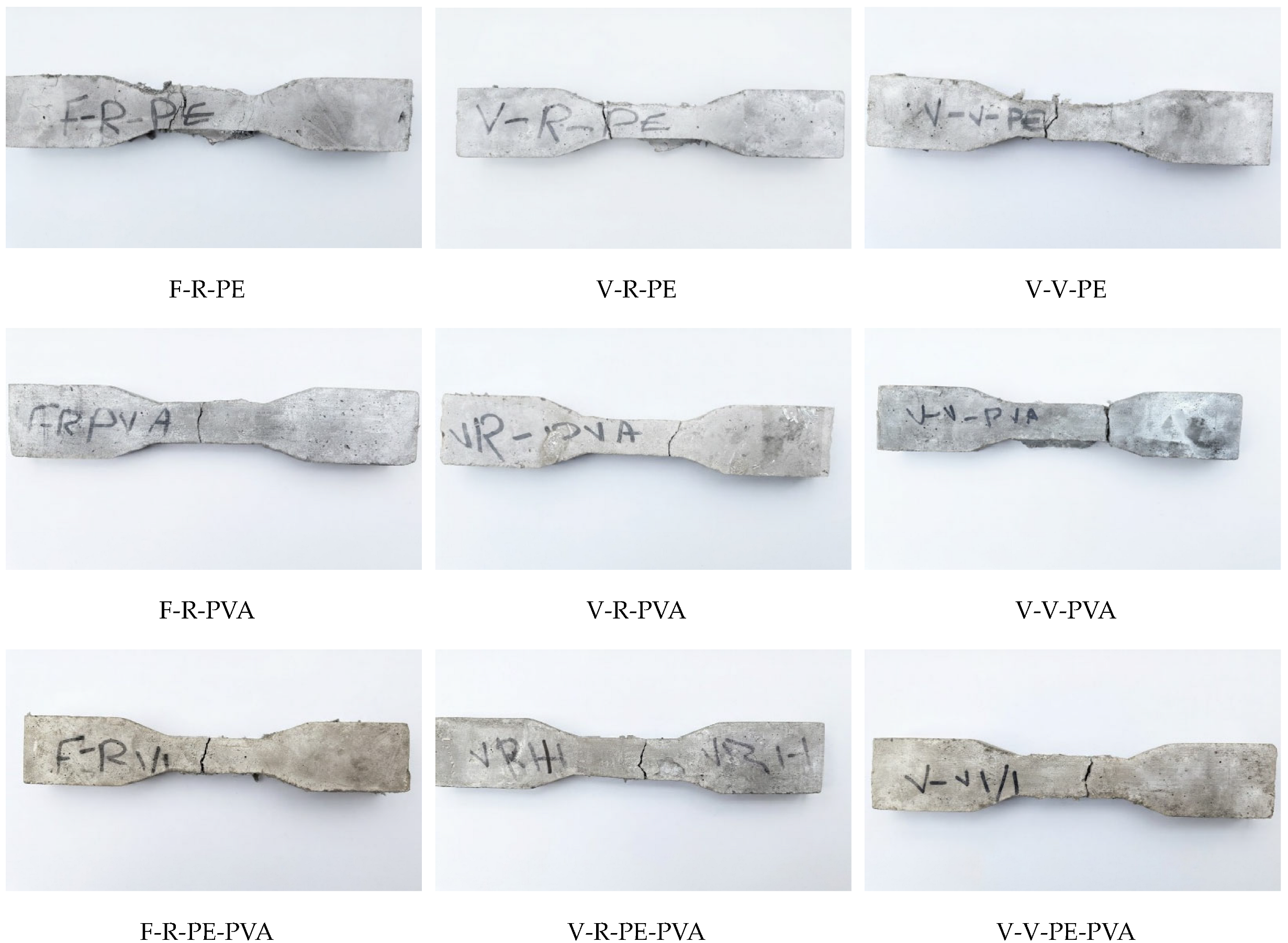
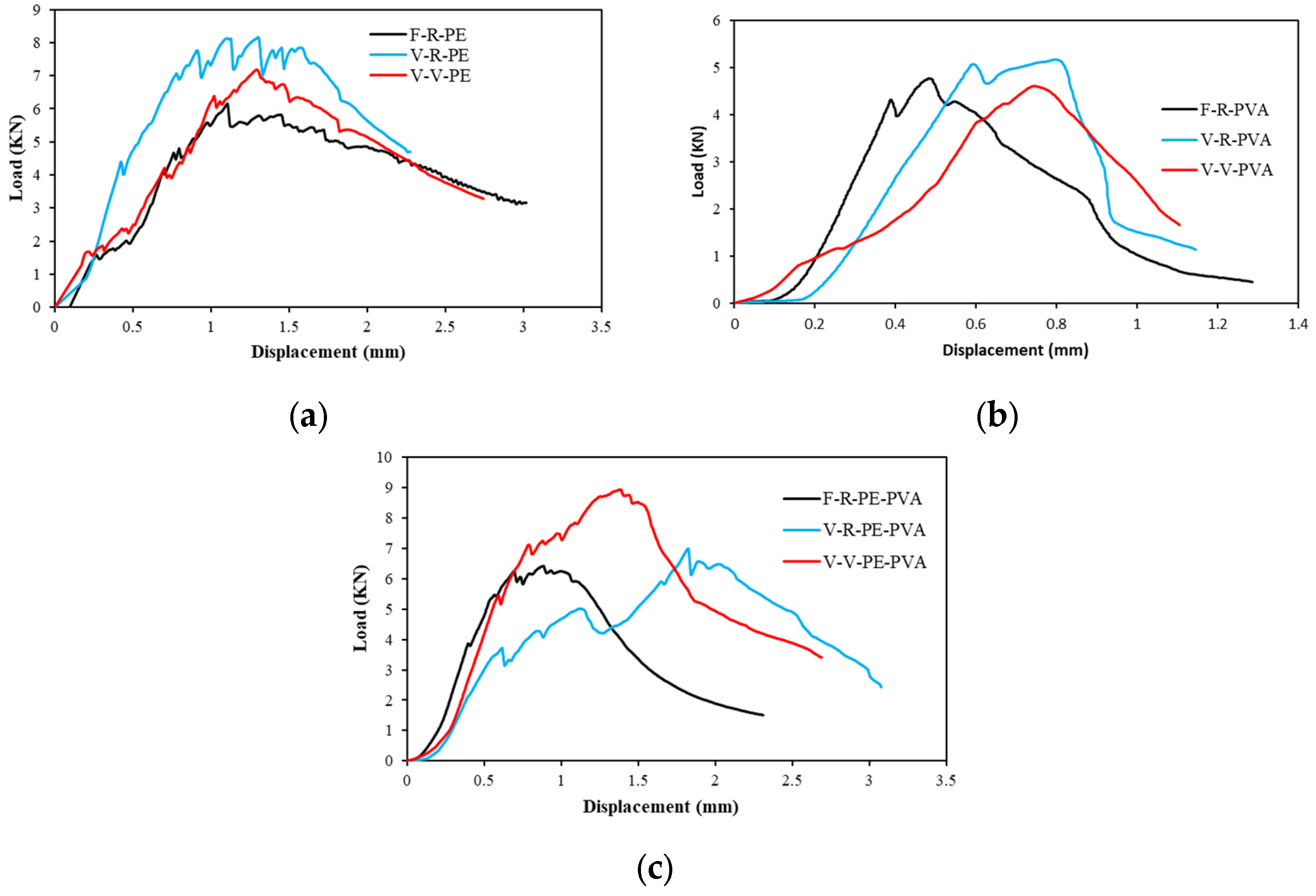
4.2.2. Uniaxial Tensile Load Displacement Response
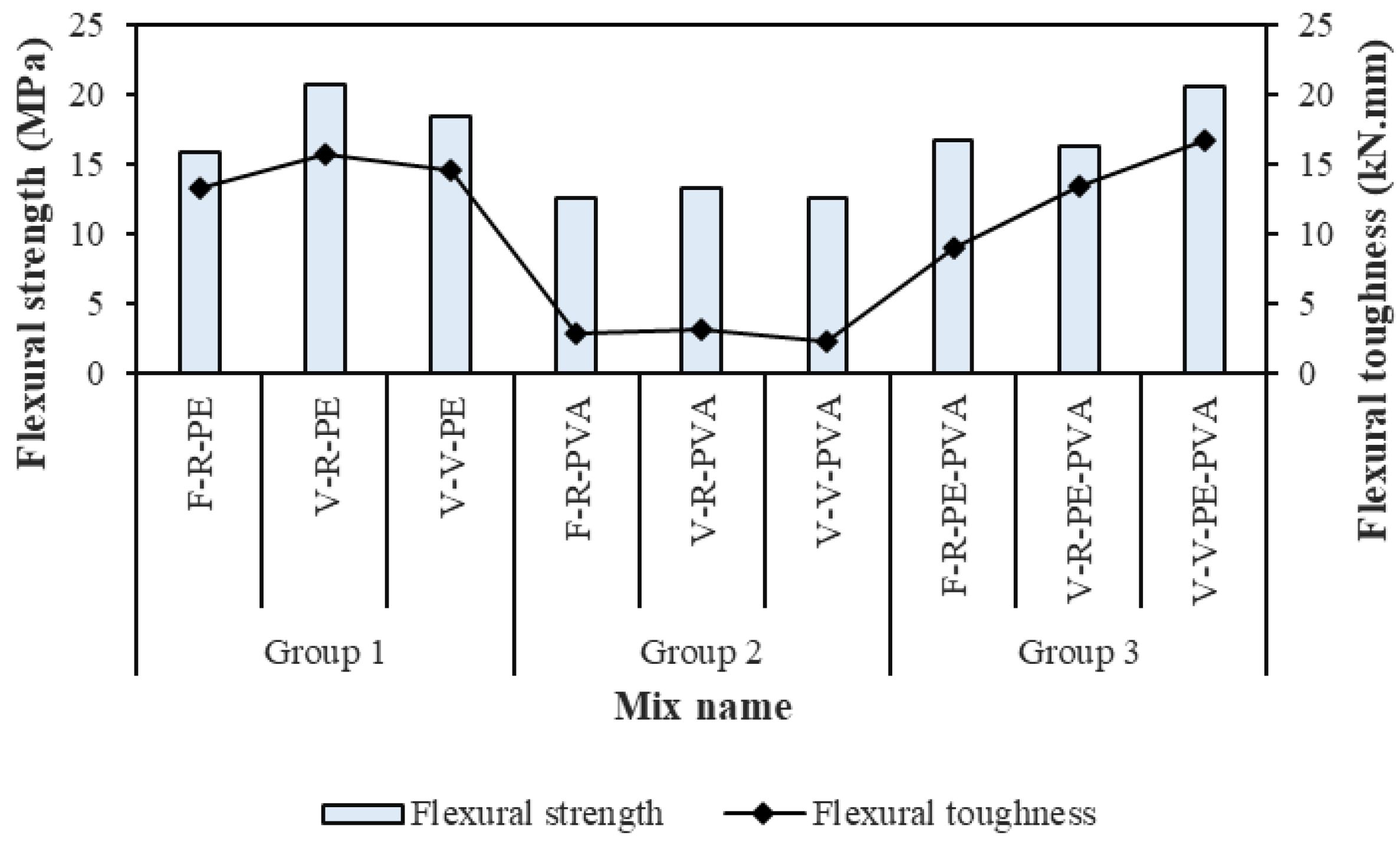
4.2.3. Flexural Load—Displacement Response
4.3. Physical Properties
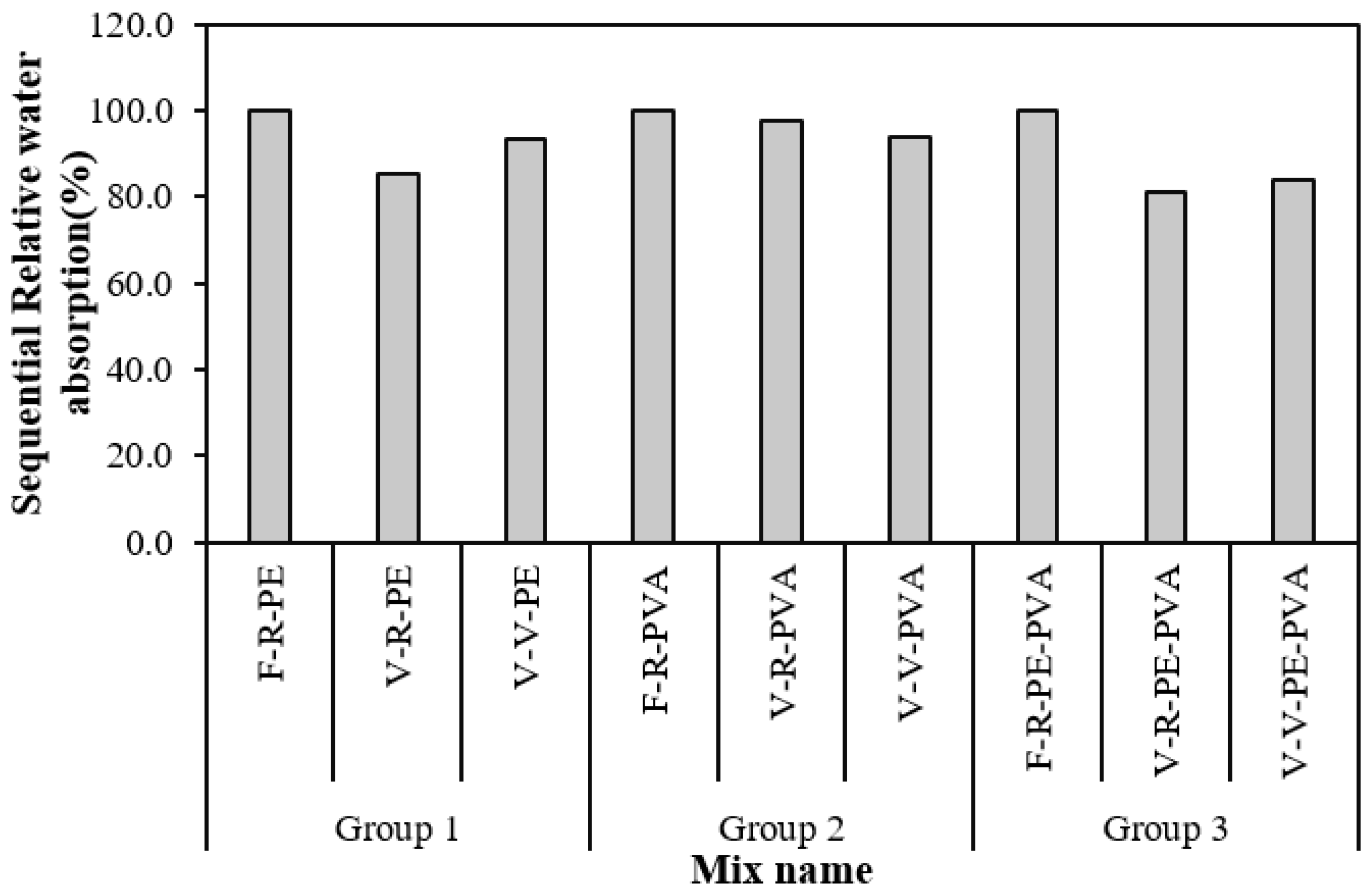
4.3.1. Water Absorption
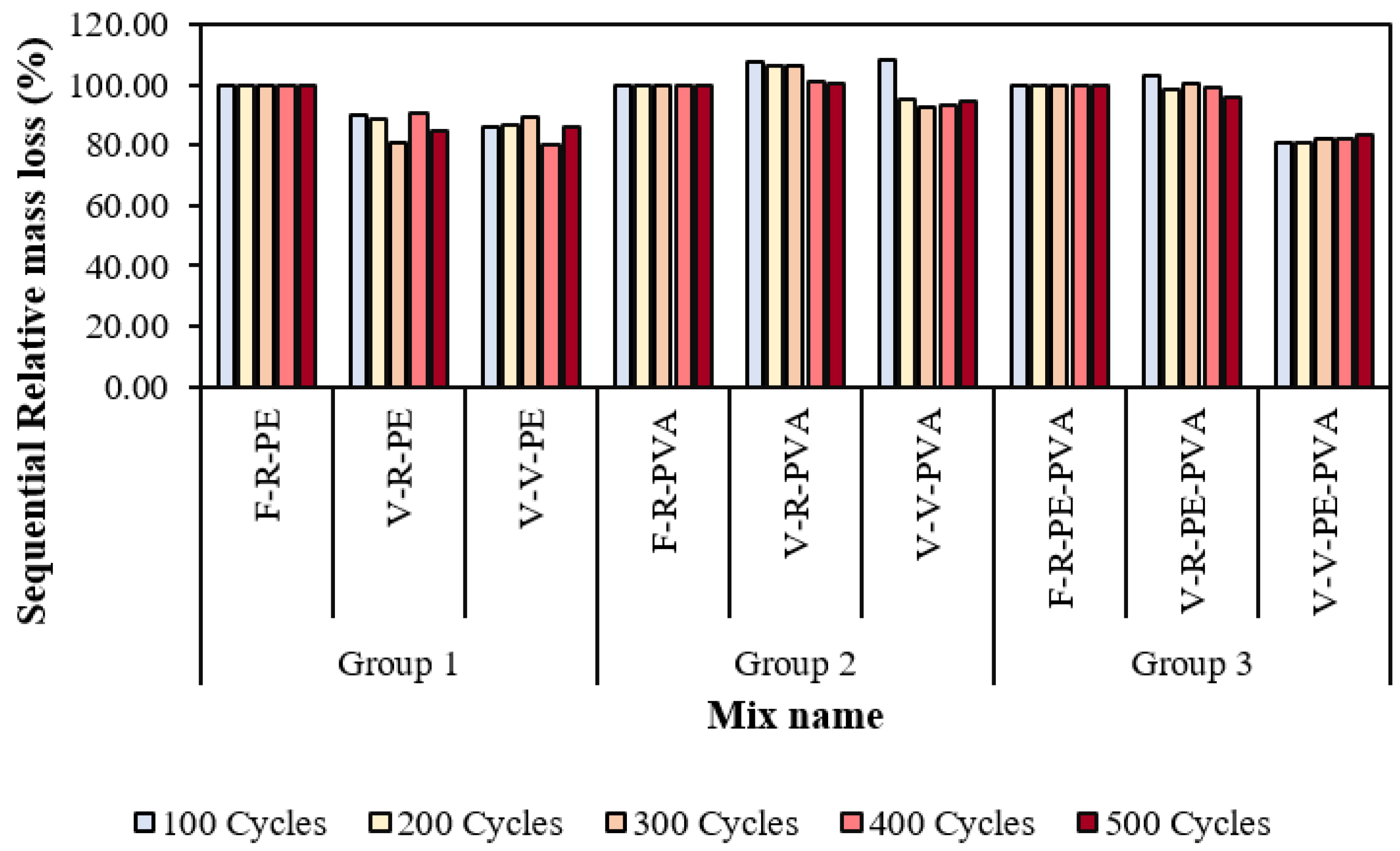
4.3.2. Abrasion Test
4.4. Microstructure of ECC
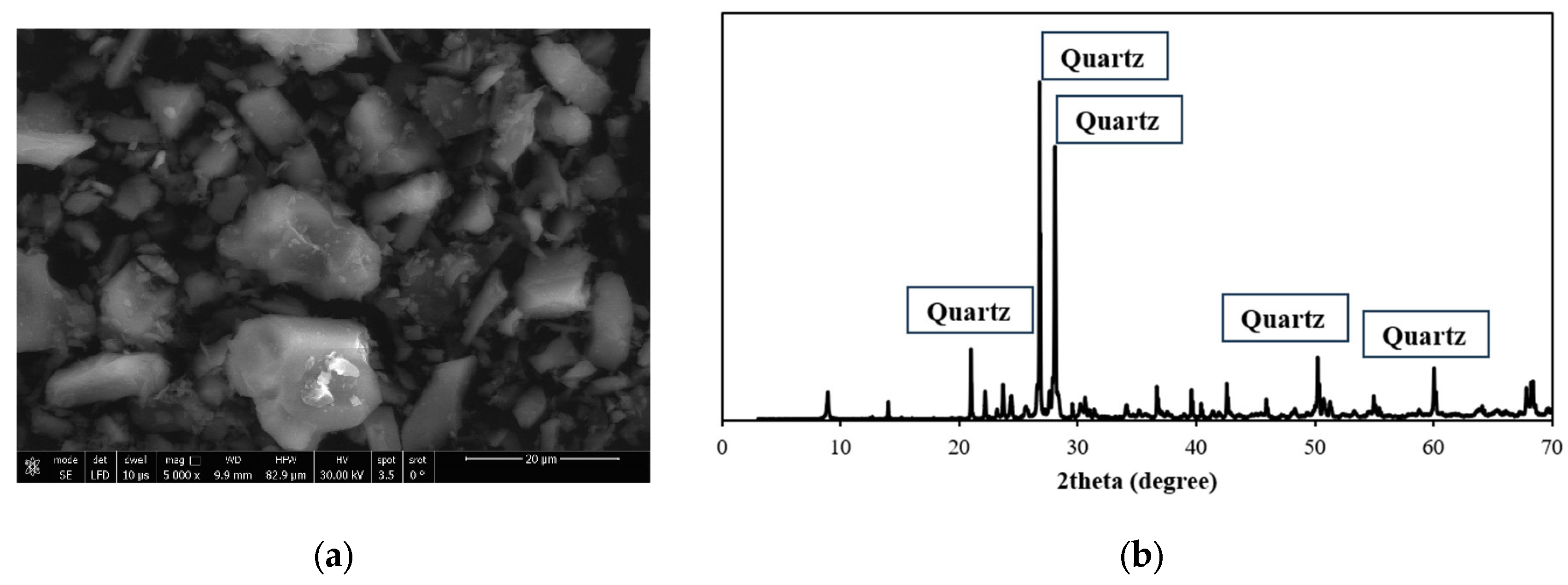
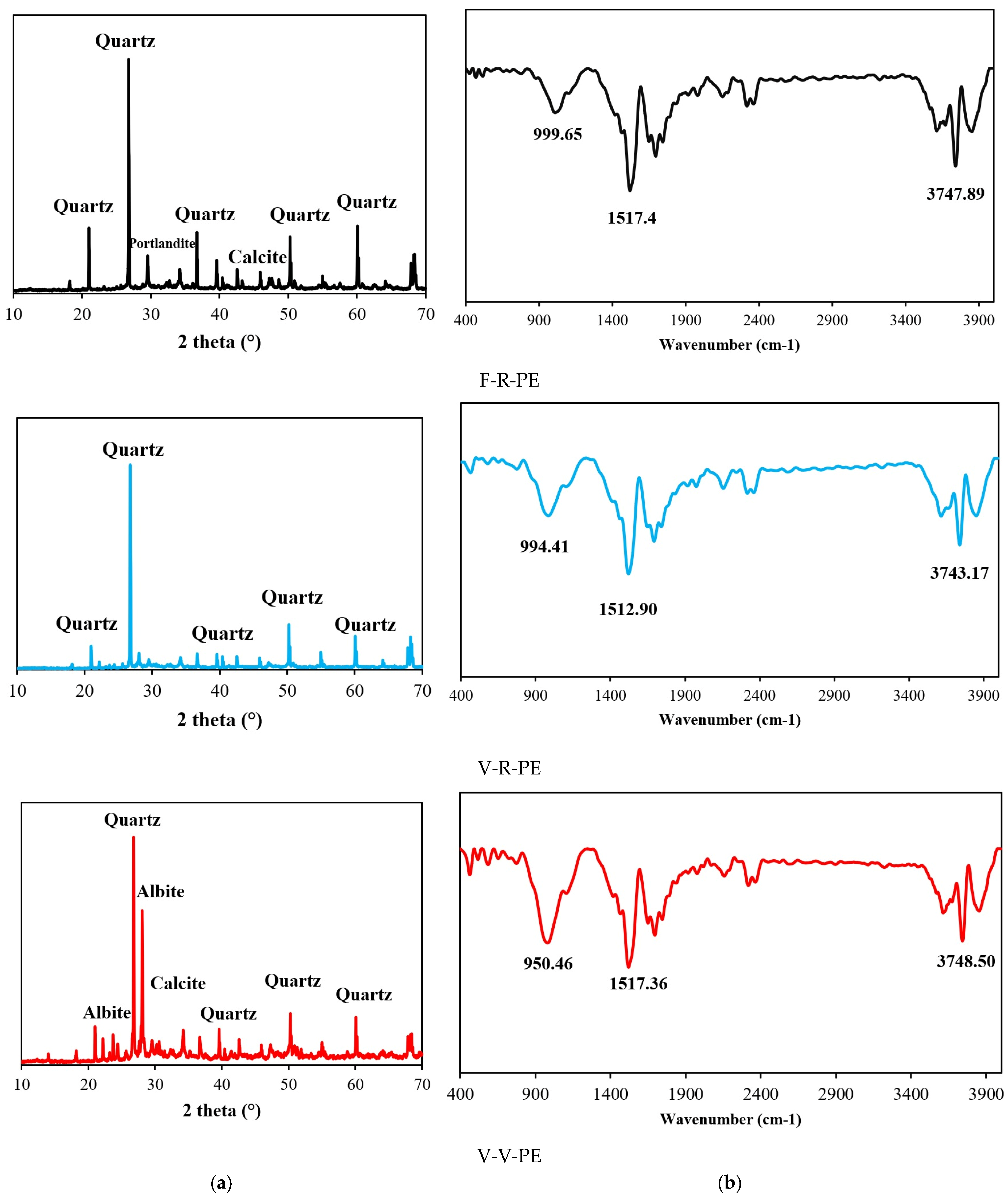
4.4.1. XRD and FTIR Analysis
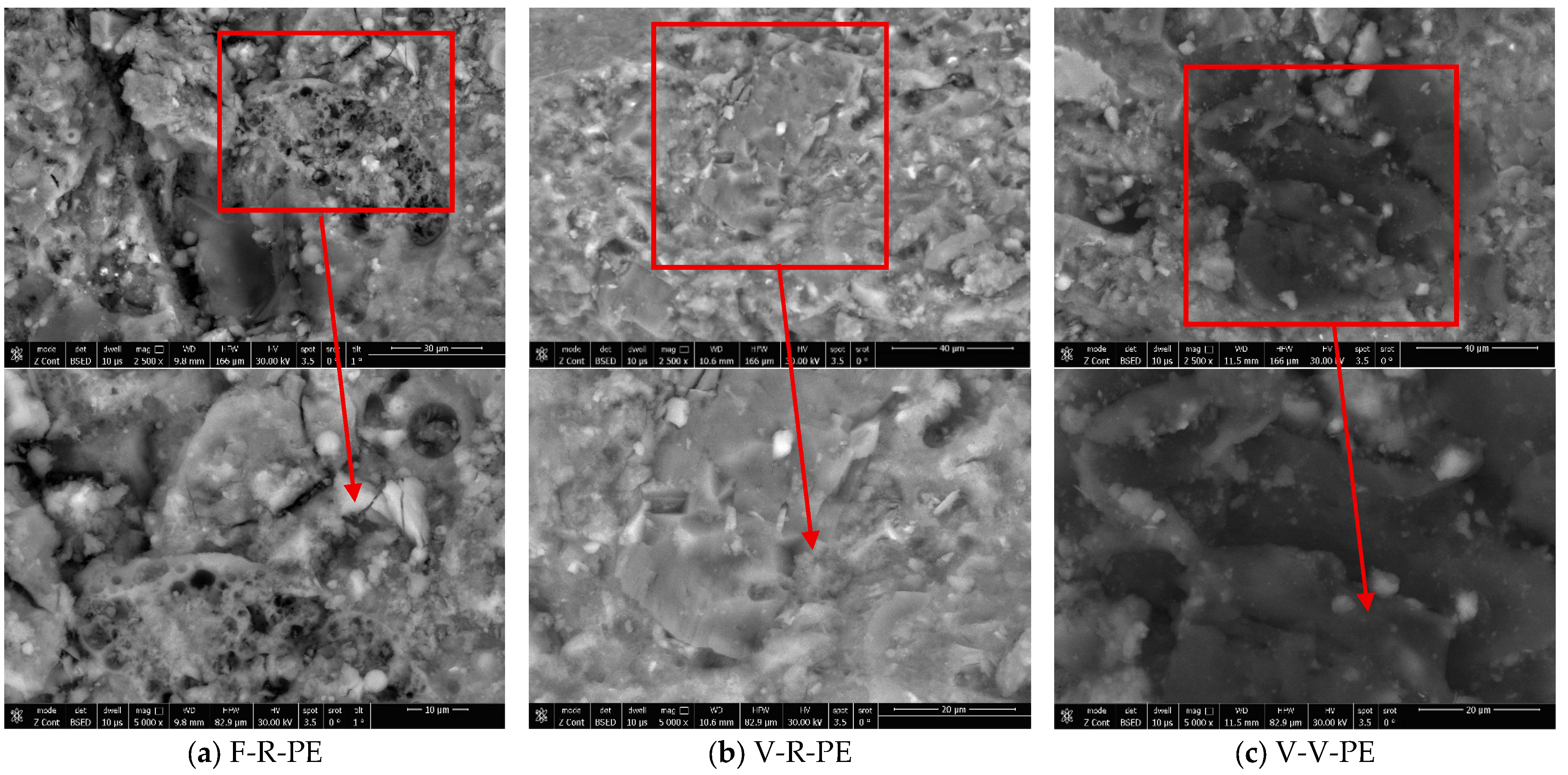
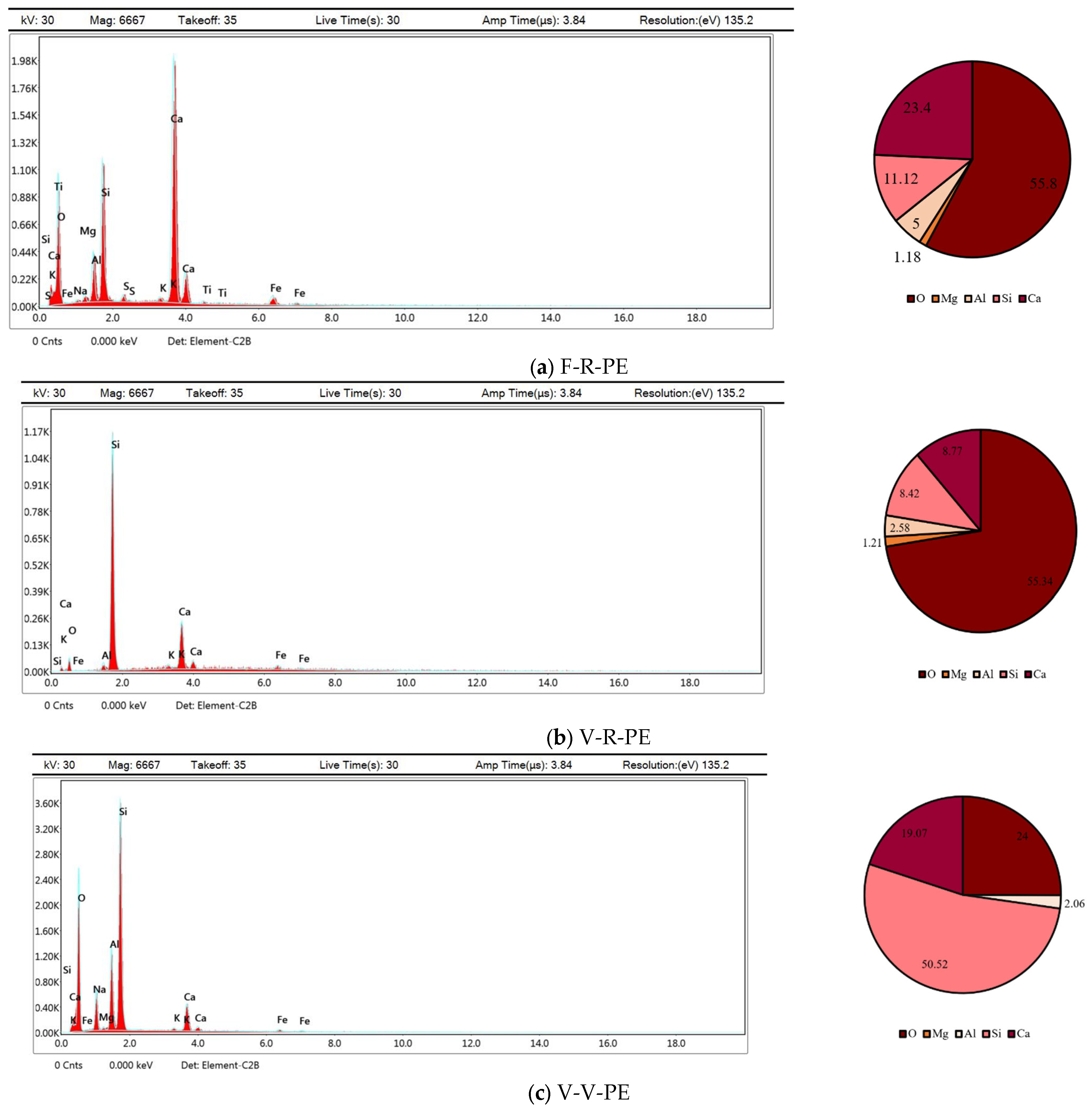
4.4.2. SEM and EDX Analysis of ECC
4.5. Comparison with Previous Studies
5. Limitation and Future Work of the Study
- -
- The study focused on using either VA or VS as a full replacement of FA and RS, respectively, and it is recommended to consider different ratios of VA and VS in the future work.
- -
- PE and PVA fibers were used in a specific ratio (2%) or (1% + 1%); it is recommended to assess the performance of ECC using different ratios of PE and PVA fibers.
- -
- It is also recommended to use the VA as a partial replacement of OPC and compared the results to the obtained results of the study.
- -
- For the statistical evaluation, it is recommended to make AVONA test in future work to assess the effect of using volcanic materials with the types of fibers used.
- -
- It is recommended to make large-scale ECC structural models to investigate their structural behavior and to evaluate the effectiveness of using volcanic-based ECC for repairing and retrofitting structural members.
6. Conclusions
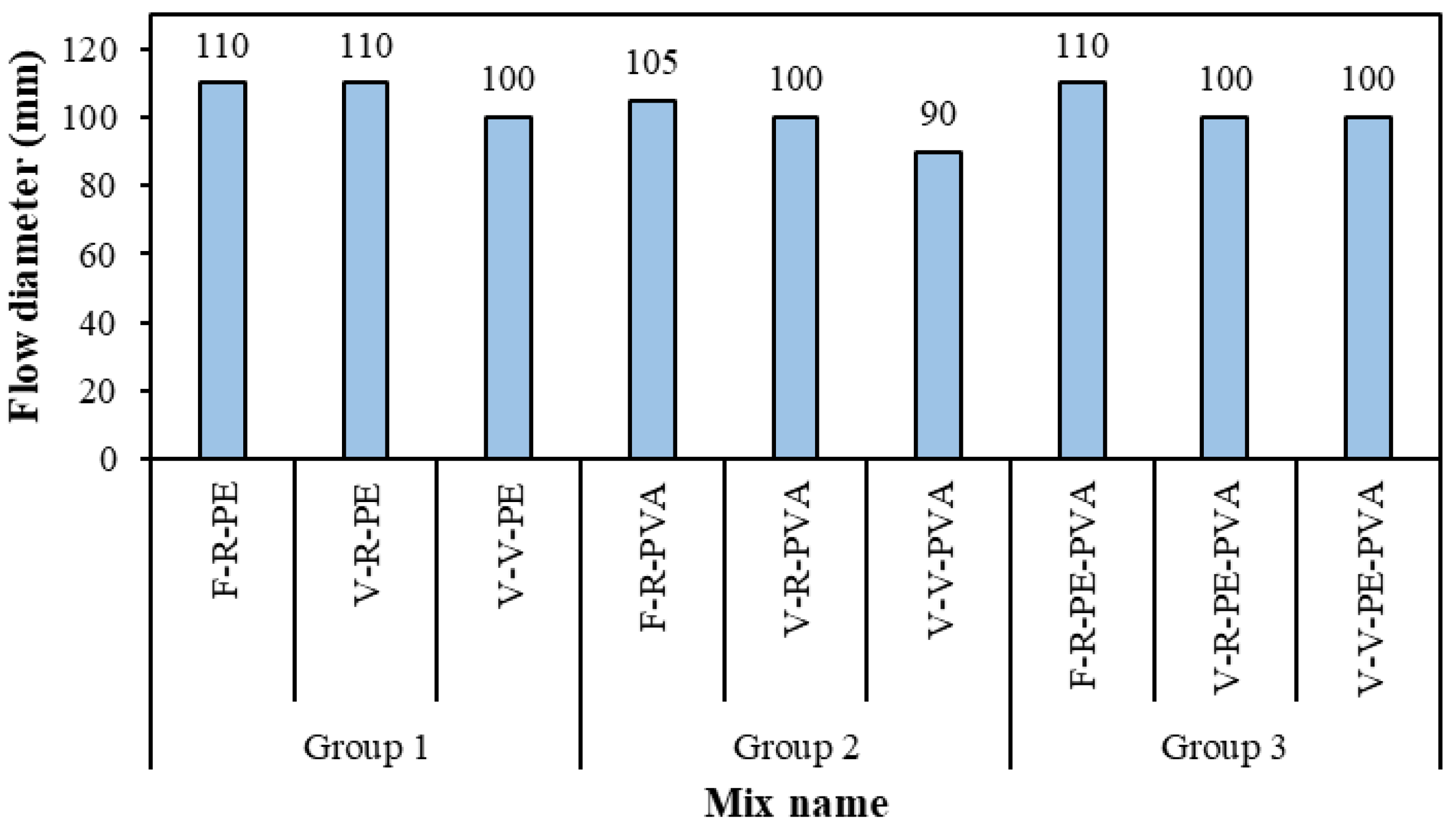
- The incorporation of volcanic sand and PVA fibers significantly reduces the workability of ECC mixtures up to 9%. This reduction is primarily driven by the high angularity of volcanic particles, which increases internal friction, and the chemical affinity of PVA fibers with the cementitious matrix.
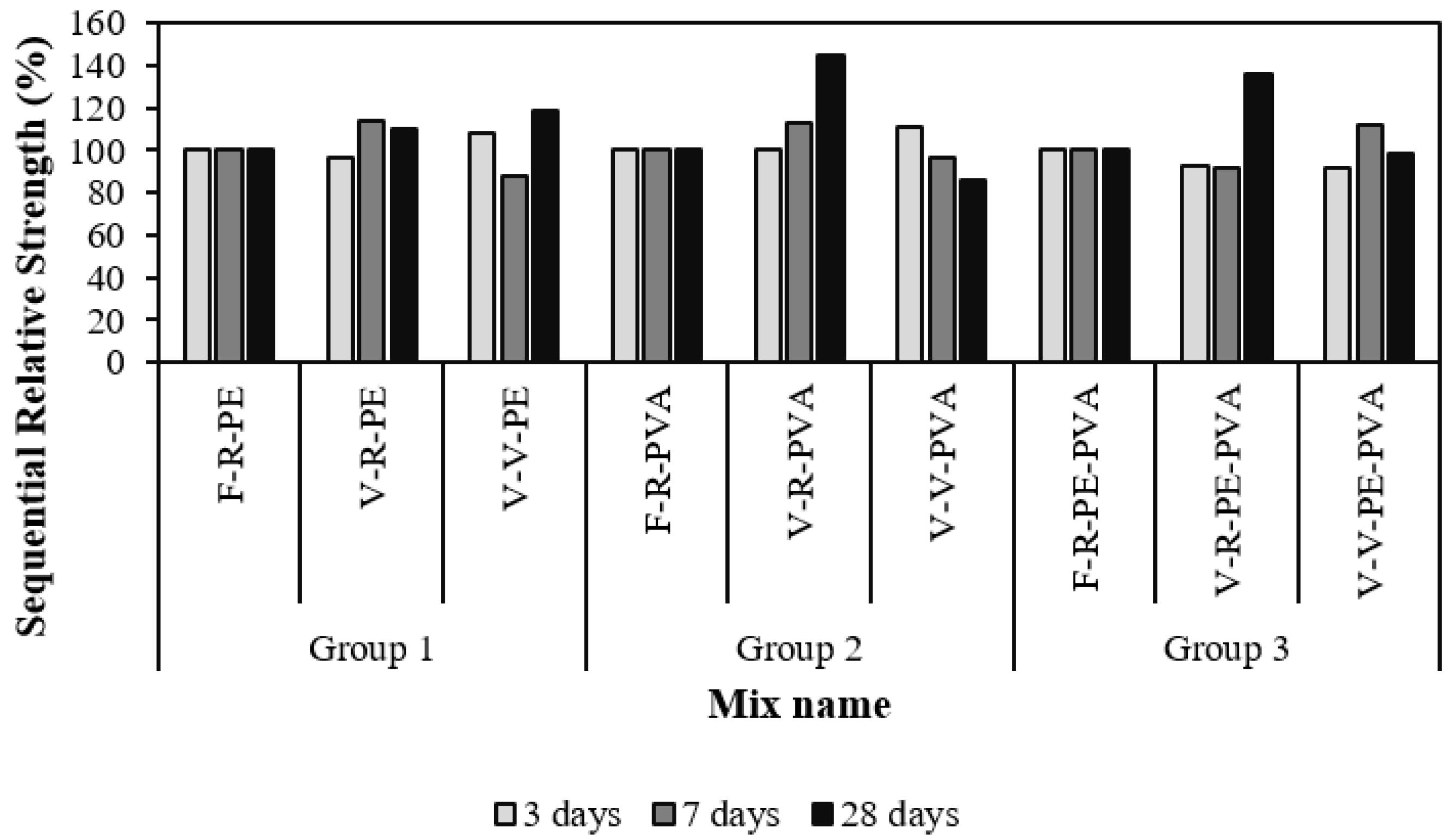
- The inclusion of volcanic materials significantly enhances the compressive strength of ECC mixtures up to 48%, particularly after the 28-day hydration period. This improvement is primarily driven by the strong pozzolanic activity of volcanic ash, which generates additional calcium silicate hydrate (C-S-H) to densify the matrix and the superior interfacial bonding between volcanic sand and fibers.
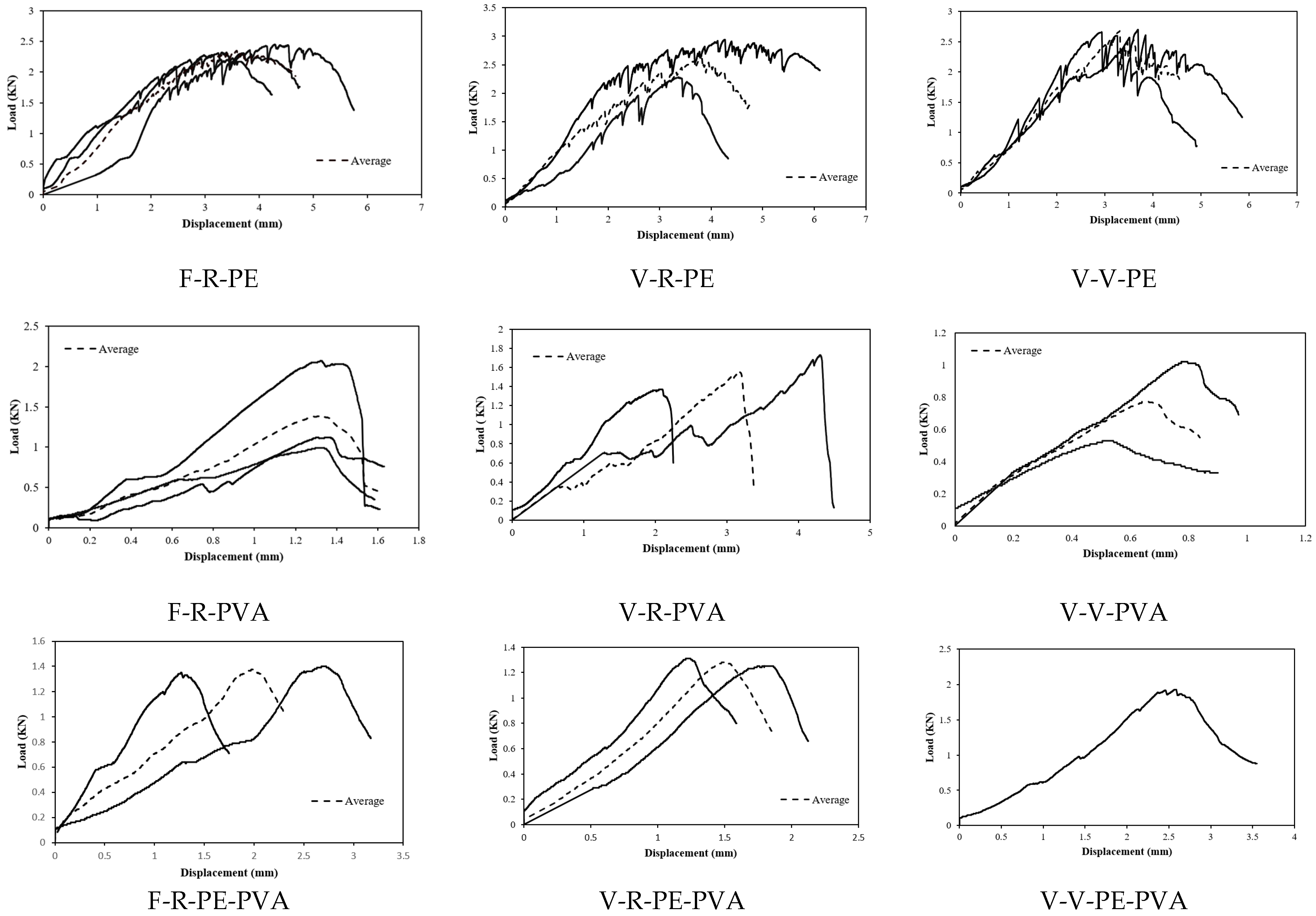
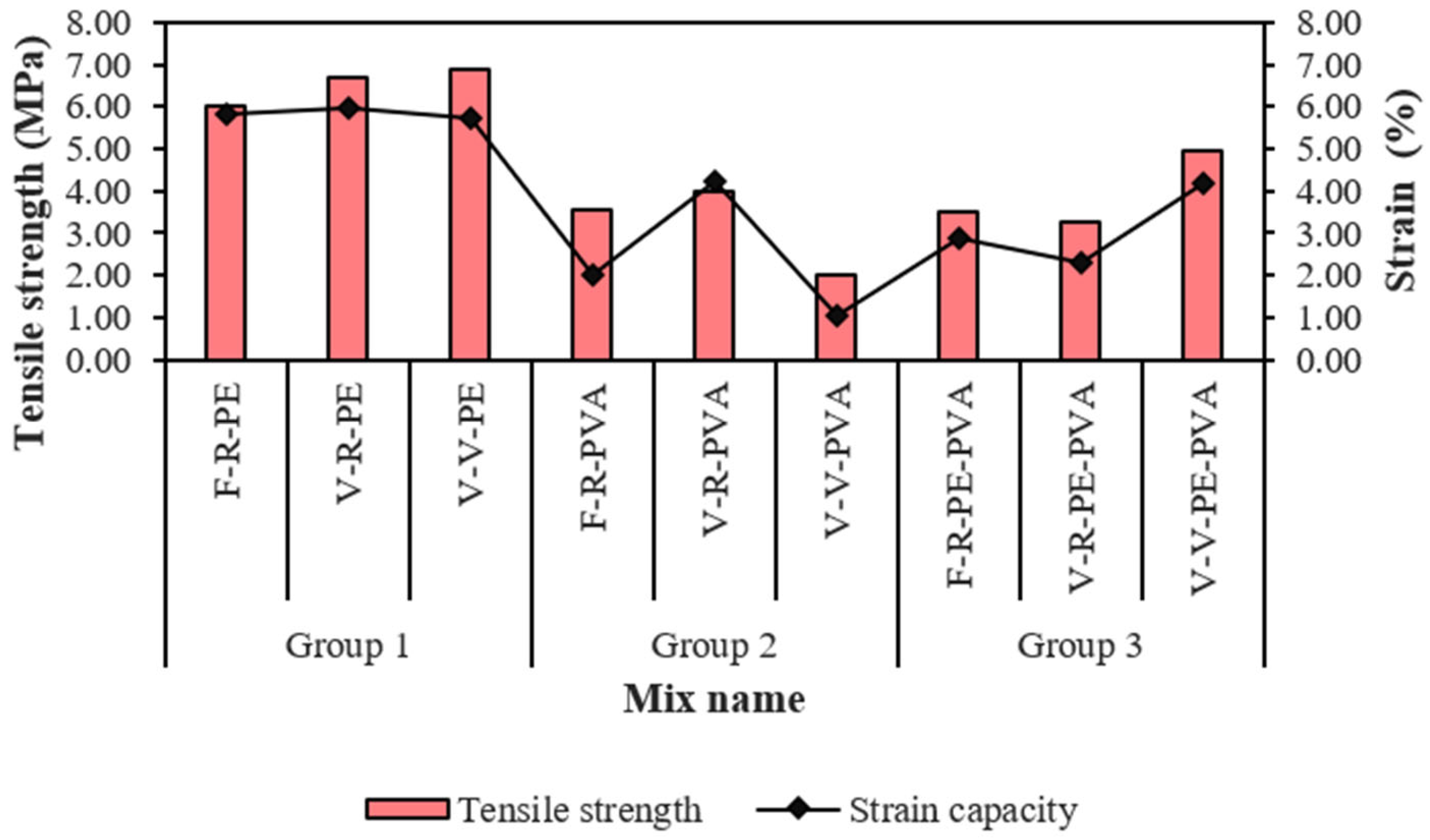
- The study demonstrates that PE fibers provide superior tensile strain, while the integration of volcanic materials significantly boosts tensile strength through improved pozzolanic activity and matrix cohesion.
- The results also confirm that volcanic materials significantly enhance flexural strength and toughness when combined with a hybrid PE/PVA fiber system. While PE fibers remain superior for energy absorption, the synergistic interaction between volcanic components and hybrid fibers effectively optimizes the mechanical balance, demonstrating that volcanic-based ECC can achieve high strength and ductility as a sustainable alternative to traditional mixtures.
- The consistent reduction in water absorption by up to 19% confirms that volcanic materials effectively densify the ECC matrix. By reducing capillary porosity through their strong pozzolanic activity, these materials significantly improve the overall durability of the ECC mixtures.
- The inclusion of volcanic materials significantly improves the surface durability of ECC mixtures by increasing matrix hardness and densifying the interfacial transition zone against abrasion resistance, while PVA fibers may present minor challenges due to their specific surface properties.
- Microstructural analysis confirms that volcanic materials refine the ECC matrix by promoting a more uniform fiber distribution and effectively eliminating microcracks.
Author Contributions
Funding
Data Availability Statement
Conflicts of Interest
References
- Li, P.; Huang, M.; Shang, Y.; Kuang, Y.; Xiong, G.; Tang, X. Study on mechanical properties of coarse-fine polypropylene fiber blended concrete. Buildings 2025, 15, 2971. [Google Scholar] [CrossRef] [Scilit]
- Zhou, S.; Jiang, Z.; Ou, Q.; Liu, J.; Wang, C. Analysis on flexural toughness of steel fiber reinforced concrete based on acoustic emission and digital image correlation techniques. Constr. Build. Mater. 2025, 492, 143039. [Google Scholar] [CrossRef] [Scilit]
- Helal, K.A.; Tahwia, A.M.; Youssf, O. Performance of Eco-Friendly ECC Made of Pre-treated Crumb Rubber and Waste Quarry Dust. J. Build. Eng. 2024, 97, 110820. [Google Scholar] [CrossRef] [Scilit]
- Chen, B.; Hou, L.; Yan, R.G.; Zhang, X.Y.; Meng, H.; Li, J.T. Flexural Performance and Flexural Toughness Evaluation Method of High-Strength Engineered Cementitious Composites. Buildings 2025, 15, 4003. [Google Scholar] [CrossRef] [Scilit]
- Youssf, O.; Eltawil, K.A.; Elshikh, M.M.Y.; Keshta, M.M. Performance of High Strength Fiber Reinforced Mortar Made with Ceramic Powder, Metakaolin, and Magnetized Water. Infrastructures 2025, 10, 124. [Google Scholar] [CrossRef] [Scilit]
- Zheng, Y.; Lv, X.; Hu, S.; Zhuo, J.; Wan, C.; Liu, J. Mechanical properties and durability of steel fiber reinforced concrete: A review. J. Build. Eng. 2024, 82, 108025. [Google Scholar] [CrossRef] [Scilit]
- Manso-Morato, J.; Hurtado-Alonso, N.; Revilla-Cuesta, V.; Skaf, M.; Ortega-López, V. Fiber-Reinforced concrete and its life cycle assessment: A systematic review. J. Build. Eng. 2024, 94, 110062. [Google Scholar] [CrossRef] [Scilit]
- Ding, L.; Lin, Z.; Xu, C.; Xu, H.; Li, B.; Shen, J. Study on the hybrid effect of basalt and polypropylene fibers on the mechanical properties of concrete. Buildings 2025, 15, 3197. [Google Scholar] [CrossRef] [Scilit]
- Chen, W.; Liang, L.; Jiang, F.; Tang, Z.; Sun, X.; Yu, J.; Li, V.C.; Yu, K. New opportunity: Materials genome strategy for engineered cementitious composites (ECC) design. Cem. Concr. Compos. 2025, 159, 106009. [Google Scholar] [CrossRef] [Scilit]
- Xu, S.; Li, W.; Wang, X.; Zhang, H.; Liu, J.; Jiang, H.; Wang, X.; Ma, H.; Shi, J.; Yu, Z.; et al. The mechanical properties and durability of the pe-bfrp hybrid-fiber-engineered cementitious composite (ECC). Buildings 2025, 15, 1860. [Google Scholar] [CrossRef] [Scilit]
- Hu, Z.; Elchalakani, M.; Yehia, S.; Ran, H.; Sadakkathulla, M.A.; Guo, X. Engineered cementitious composite (ECC) strengthening of reinforced concrete structures: A state-of-the-art review. J. Build. Eng. 2024, 86, 108941. [Google Scholar] [CrossRef] [Scilit]
- Helal, K.A.; Tahwia, A.M.; Youssf, O. Behavior of functionally graded concrete beams made of eco-friendly engineered cementitious composites. Innov. Infrastruct. Solut. 2025, 10, 287. [Google Scholar] [CrossRef] [Scilit]
- Singh, M.; Saini, B.; Chalak, H.D. Performance and composition analysis of engineered cementitious composite (ECC)–A review. J. Build. Eng. 2019, 26, 100851. [Google Scholar] [CrossRef] [Scilit]
- Yuan, F.; Pan, J.; Leung, C.K.Y. Flexural behaviors of ECC and concrete/ECC composite beams reinforced with basalt fiber-reinforced polymer. J. Compos. Constr. 2013, 17, 591–602. [Google Scholar] [CrossRef] [Scilit]
- Helal, K.A.; Tahwia, A.M.; Youssf, O. Assessment of the efficiency of hybrid basalt fibre sustainable ECC incorporating industrial waste materials. Constr. Build. Mater. 2025, 461, 139933. [Google Scholar] [CrossRef] [Scilit]
- Yu, P.; Yao, J.; He, S.; Li, Z. Effects of different fiber types and curing methods on the mechanical performance of seawater coral sand engineered cementitious composites. J. Build. Eng. 2025, 105, 112450. [Google Scholar] [CrossRef] [Scilit]
- Li, V.C. From micromechanics to structural engineering the design of cementitious composites for civil engineering applications. Doboku Gakkai Ronbunshu 1993, 1993, 1–12. [Google Scholar]
- Li, V.C.; Mishra, D.K.; Wu, H.C. Matrix design for pseudo-strain-hardening fibre reinforced cementitious composites. Mater. Struct. 1995, 28, 586–595. [Google Scholar] [CrossRef] [Scilit]
- Eltawil, K.A.; Keshta, M.M.; Elshikh, M.M.Y.; El-Demerdash, W.E.; Youssf, O. Performance of Engineered Cementitious Composites Containing High Volume of Ceramic Powder and Magnetized Water. Hybrid. Adv. 2025, 8, 100371. [Google Scholar] [CrossRef] [Scilit]
- Yu, K.; Wang, Y.; Yu, J.; Xu, S. A strain-hardening cementitious composites with the tensile capacity up to 8%. Constr. Build. Mater. 2017, 137, 410–419. [Google Scholar] [CrossRef] [Scilit]
- Yu, K.; Li, L.; Yu, J.; Wang, Y.; Ye, J.; Xu, Q. Direct tensile properties of engineered cementitious composites: A review. Constr. Build. Mater. 2018, 165, 346–362. [Google Scholar] [CrossRef] [Scilit]
- Liu, L.; Xiao, J.; Wu, Z. The effect of fiber content on the static and dynamic performance of PE-ECC. Case Stud. Constr. Mater. 2024, 20, e03041. [Google Scholar] [CrossRef] [Scilit]
- Fu, C.; Chen, M.; Guo, R.; Qi, R. Green-engineered cementitious composite production with high-strength synthetic fiber and aggregate replacement. Materials 2022, 15, 3047. [Google Scholar] [CrossRef] [Scilit] [PubMed]
- Ma, H.; He, L.; Wu, C. Development of Reactive MgO Cement-Silica Fume–Based Strain-Hardening Engineered Cementitious Composite. J. Mater. Civ. Eng. 2023, 35, 04023354. [Google Scholar] [CrossRef] [Scilit]
- Handayani, A.F.; Rosyidah, D.H.; Sulaksitaningrum, R.; Susanto, P.B.; Umniati, S. Andesite waste powder as mineral admixture in concrete: A Review. In E3S Web of Conferences; EDP Sciences: Les Ulis, France, 2023; Volume 445, p. 01030. [Google Scholar]
- Heriyadi, B.; Nata, R.A.; Tanjung, A.A.; Fadhilah. The Impact of Microwave Treatment on the Andesite Rock Mechanical Properties. In Journal of Physics: Conference Series; IOP Publishing: Bristol, UK, 2023; Volume 2582, p. 012023. [Google Scholar]
- Keshta, M.M.; Elshikh, M.M.Y.; Abd Elrahman, M.; Youssf, O. Utilizing of magnetized water in enhancing of volcanic concrete characteristics. J. Compos. Sci. 2022, 6, 320. [Google Scholar] [CrossRef] [Scilit]
- Kupwade-Patil, K.; De Wolf, C.; Chin, S.; Ochsendorf, J.; Hajiah, A.E.; Al-Mumin, A.; Büyüköztürk, O. Impact of Embodied Energy on materials/buildings with partial replacement of ordinary Portland Cement (OPC) by natural Pozzolanic Volcanic Ash. J. Clean. Prod. 2018, 177, 547–554. [Google Scholar] [CrossRef] [Scilit]
- Hamada, H.M.; Abed, F.; Beddu, S.; Humada, A.M.; Majdi, A. Effect of Volcanic Ash and Natural Pozzolana on mechanical properties of sustainable cement concrete: A comprehensive review. Case Stud. Constr. Mater. 2023, 19, e02425. [Google Scholar] [CrossRef] [Scilit]
- Al Asmari, A.F.; Bashir, M.I.; Farooq, F.; Asif, U. Investigating the effect of locally available volcanic ash on mechanical and microstructure properties of concrete. Rev. Adv. Mater. Sci. 2025, 64, 20240085. [Google Scholar] [CrossRef] [Scilit]
- Sebayang, M.D. Analyze the proportion of volcanic ash of Sinabung volcano at the most optimum to get the compressive strength and tensile strength of concrete. In IOP Conference Series: Materials Science and Engineering; IOP Publishing: Bristol, UK, 2020; Volume 725, p. 012044. [Google Scholar]
- Karolina, R.; Panatap Simanjuntak, M. The influence of using volcanic ash and lime ash as filler on compressive strength in self compacting concrete. In IOP Conference Series: Earth and Environmental Science; IOP Publishing: Bristol, UK, 2018; Volume 126, p. 012038. [Google Scholar]
- Hossain, K.M.A.; Lachemi, M. Strength, durability and micro-structural aspects of high performance volcanic ash concrete. Cem. Concr. Res. 2007, 37, 759–766. [Google Scholar] [CrossRef] [Scilit]
- Abdullah, G.M.; Alshaikh, I.M.; Zeyad, A.M.; Magbool, H.M.; Bakar, B.A. The effect of openings on the performance of self-compacting concrete with volcanic pumice powder and different steel fibers. Case Stud. Constr. Mater. 2022, 17, e01148. [Google Scholar] [CrossRef] [Scilit]
- Al-Fadala, S.; Chakkamalayath, J.; Al-Bahar, S.; Al-Aibani, A.; Ahmed, S. Significance of performance based specifications in the qualification and characterization of blended cement using volcanic ash. Constr. Build. Mater. 2017, 144, 532–540. [Google Scholar] [CrossRef] [Scilit]
- Hu, W.; Zhu, H.; An, Y.; Bhutta, A.; Zapsas, G.; Nasser, W.; Ellis, B.R.; Li, V.C. Development of volcanic ash based self-stressing engineered cementitious composites (ECC). Cem. Concr. Compos. 2026, 168, 106468. [Google Scholar] [CrossRef] [Scilit]
- Zhu, H.; Hu, W.H.; Mehthel, M.; Villette, T.; Vidal, O.S.; Nasser, W.N.; Li, V.C. Engineered cementitious composites (ECC) with a high volume of volcanic ash: Rheological, mechanical, and micro performance. Cem. Concr. Compos. 2023, 139, 105051. [Google Scholar] [CrossRef] [Scilit]
- El-Desoky, H.; Abd El-Hafez, N.; Khalil, A.; Arafat, A.; Hasan, M.G.; Youssef, T. The geology, petrography, and geochemistry of Egyptian Dokhan volcanics: A potential source for construction aggregate. Minerals 2023, 13, 635. [Google Scholar] [CrossRef] [Scilit]
- El-Desoky, H.M.; Khalil, A.E. Petrography and geochemistry of Basic Dokhan Volcanics from the Eastern Desert of Egypt and their use as aggregates in concrete mixes. Arab. J. Geosci. 2015, 8, 6791–6809. [Google Scholar] [CrossRef] [Scilit]
- Elsheikh, M.Y.; Elshami, A.A.; Mohsen, I.A. Green Concrete Utilizing Andesite and Rhyolite Aggregate. Int. J. Civ. Eng. Technol. 2020, 11, 1–15. [Google Scholar] [CrossRef] [Scilit]
- Yu, K.; Zhu, H.; Hou, M.; Li, V.C. Self-healing of PE-fiber reinforced lightweight high-strength engineered cementitious composite. Cem. Concr. Compos. 2021, 123, 104209. [Google Scholar] [CrossRef] [Scilit]
- Hou, M.J.; Xu, K.; Monteiro, P.J.M.; Li, V.C. Rubber particle bridging effect on crack width control of low carbon Engineered Cementitious Composites (ECC). Cem. Concr. Compos. 2023, 140, 105106. [Google Scholar] [CrossRef] [Scilit]
- Guo, J.; Shi, J.; Wang, L.; Huang, C.; Tao, X.; Li, C.; Chen, Z. Evaluation of axial compressive and tensile properties of PE/PVA hybrid fiber reinforced strain-hardening geopolymer composites. Materials 2024, 17, 4356. [Google Scholar] [CrossRef] [Scilit] [PubMed]
- ASTM C1437; Standard Test Method for Flow of Hydraulic Cement Mortar. ASTM International: Washington, DC, USA, 2015.
- ASTM C109; Standard Test Method for Compressive Strength of Hydraulic Cement Mortars. ASTM International: Washington, DC, USA, 2014.
- JSCE. Recommendations for Design and Construction of High Performance Fiber Reinforced Cement Composites with Multiple Fine Cracks; Japan Society of Civil Engineers: Tokyo, Japan, 2008. [Google Scholar]
- ASTM C 349–08; Standard Test Method for Flexural Strength of Hydraulic-Cement Mortars. ASTM International: West Conshohocken, PA, USA, 2021. [CrossRef] [Scilit]
- ASTM C642-13; Test Method for Density, Absorption, and Voids in Hardened Concrete. ASTM International: Washington, DC, USA, 2022. [CrossRef] [Scilit]
- ASTM C1747; Standard Test Method for Determining Potential Resistance to Degradation of Pervious Concrete by Impact and Abrasion. ASTM: West Conshohocken, PA, USA, 2013.
- Kong, H.J.; Bike, S.G.; Li, V.C. Constitutive rheological control to develop a self-consolidating engineered cementitious composite reinforced with hydrophilic poly (vinyl alcohol) fibers. Cem. Concr. Compos. 2003, 25, 333–341. [Google Scholar] [CrossRef] [Scilit]
- Bawab, J.; El-Dieb, A.; El-Hassan, H.; Khatib, J. Effect of different activation techniques on the engineering properties of cement-free binder containing volcanic ash and calcium carbide residue. Constr. Build. Mater. 2023, 408, 133734. [Google Scholar] [CrossRef] [Scilit]
- Nguyễn, H.H.; Nguyễn, P.H.; Lương, Q.H.; Meng, W.; Lee, B.Y. Mechanical and autogenous healing properties of high-strength and ultra-ductility engineered geopolymer composites reinforced by PE-PVA hybrid fibers. Cem. Concr. Compos. 2023, 142, 105155. [Google Scholar] [CrossRef] [Scilit]
- Wang, Y.; Liu, F.; Yu, J.; Dong, F.; Ye, J. Effect of polyethylene fiber content on physical and mechanical properties of engineered cementitious composites. Constr. Build. Mater. 2020, 251, 118917. [Google Scholar] [CrossRef] [Scilit]
- Gao, X.; Li, W.; Ke, L.; Wang, P.; Wei, J.; Zhong, Y.; Wu, H.; Zhou, Y. Effects of saline contents on tensile behavior and fiber-matrix interaction in seawater sea-sand engineered cementitious composite (SS-ECC). Constr. Build. Mater. 2025, 467, 140306. [Google Scholar] [CrossRef] [Scilit]
- Jiang, Z.; Zhu, Z.; Fang, D.; Fu, C.; Li, S.; Jing, Y. Multi-Dimensional Assessment of Low-Carbon Engineering Cement-Based Composites Based on Rheological, Mechanical and Sustainability Factors. Materials 2026, 19, 424. [Google Scholar] [CrossRef] [Scilit] [PubMed]
- Zeyad, A.M.; Khan, A.H.; Tayeh, B.A. Durability and strength characteristics of high-strength concrete incorporated with volcanic pumice powder and polypropylene fibers. J. Mater. Res. Technol. 2020, 9, 806–818. [Google Scholar] [CrossRef] [Scilit]
- Eken, M. Mechanical and durability properties of concrete with volcanic rock additives. J. Mater. Civ. Eng. 2023, 35, 04023196. [Google Scholar] [CrossRef] [Scilit]
- Chandrasekhar, C.; Ransinchung, G.D. Assessment of interface characteristics and durability aspects of manufactured sand (M-sand) in engineered cementitious composites. J. Build. Eng. 2024, 91, 109705. [Google Scholar] [CrossRef] [Scilit]
- Chen, Y.; Lu, C.; Zhang, Z.; Abdalla, J.A.; Hawileh, R.A.; Zhang, X. Multiple-scaled investigations on mechanical properties of medium-early-strength PVA-ECC with recycled tire crumb rubber incorporated. Case Stud. Constr. Mater. 2025, 23, e04931. [Google Scholar] [CrossRef] [Scilit]
- Adesina, A.; Das, S. Mechanical performance of engineered cementitious composite incorporating glass as aggregates. J. Clean. Prod. 2020, 260, 121113. [Google Scholar] [CrossRef] [Scilit]
- Bai, M.; Wu, Y.; Xiao, J.; Ding, T.; Yu, K. Workability and hardened properties of 3D printed engineered cementitious composites incorporating recycled sand and PE fibers. J. Build. Eng. 2023, 71, 106477. [Google Scholar] [CrossRef] [Scilit]



| Element | CaO | SiO2 | Al2O3 | Fe2O3 | MgO | SO3 | Na2O | LOI * | K2O | ZnO | TiO2 |
|---|---|---|---|---|---|---|---|---|---|---|---|
| FA | 18.23 | 33.7 | 24.71 | 3.41 | 0.71 | 0.64 | 0.69 | 15.3 | 0.46 | 0.007 | 1.32 |
| SF | 0.818 | 91.93 | 0.87 | 1.99 | 0.39 | 0.23 | 0.5 | 2.4 | 0.59 | 0.01 | -- |
| VA | 1.75 | 66.2 | 14.96 | 3.65 | 1.18 | 0.086 | 7.88 | 1.2 | 2.21 | 0.006 | 0.37 |
| OPC | 62.7 | 20.2 | 6 | 3.3 | 2 | 2.2 | 0.01 | 1.7 | ---- | ---- | ---- |
| Fiber Type | Length (mm) | Specific Gravity (gm/cm3) | Elastic Modulus (GPa) | Tensile Strength (MPa) |
|---|---|---|---|---|
| PE | 12 | 0.97 | 126 | 3120 |
| PVA | 12 | 1.29 | 40 | 1810 |
| Group | Mix Designation | OPC | FA | VA | SF | RS | VS | PE | PVA | Water | SP | ||
|---|---|---|---|---|---|---|---|---|---|---|---|---|---|
| Weight | Vf (%) | Weight | Vf (%) | ||||||||||
| 1 | F-R-PE | 646 | 451 | 0 | 100 | 560 | -- | 20 | 2 | -- | -- | 300 | 5 |
| V-R-PE | 646 | -- | 549 | 100 | 560 | -- | 20 | 2 | -- | -- | 300 | 5 | |
| V-V-PE | 646 | -- | 549 | 100 | -- | 564 | 20 | 2 | -- | -- | 300 | 5 | |
| 2 | F-R-PVA | 646 | 451 | 0 | 100 | 560 | -- | -- | -- | 26 | 2 | 300 | 5 |
| V-R-PVA | 646 | -- | 549 | 100 | 560 | -- | -- | -- | 26 | 2 | 300 | 5 | |
| V-V-PVA | 646 | -- | 549 | 100 | -- | 564 | -- | -- | 26 | 2 | 300 | 5 | |
| 3 | F-R-PE-PVA | 646 | 451 | 0 | 100 | 560 | -- | 10 | 1 | 13 | 1 | 300 | 5 |
| V-R-PE-PVA | 646 | -- | 549 | 100 | 560 | -- | 10 | 1 | 13 | 1 | 300 | 5 | |
| V-V-PE-PVA | 646 | -- | 549 | 100 | -- | 564 | 10 | 1 | 13 | 1 | 300 | 5 | |
| Group | Mix Name | Compressive Strength (MPa) | Strength Development (%) | Uniaxial Tensile Strength (MPa) | Uniaxial Tensile Strain (%) | Flexural Strength (MPa) | Toughness (kN.mm) | |||
|---|---|---|---|---|---|---|---|---|---|---|
| 3 Days | 7 Days | 28 Days | 3 to 7 Days | 7 to 28 Days | ||||||
| 1 | F-R-PE | 38 ± 0.23 | 46 ± 0.61 | 66 ± 3.00 | 21 | 43 | 6.03 ± 0.23 | 5.84 | 15.92 ±1.42 | 13.34 |
| V-R-PE | 37 ± 0.23 | 52 ± 2.89 | 73 ± 2.60 | 41 | 40 | 6.69 ± 1.20 | 5.97 | 20.70 ± 0.51 | 15.78 | |
| V-V-PE | 40 ± 4.42 | 46 ± 0.40 | 86 ± 3.59 | 15 | 87 | 6.87 ± 0.09 | 5.73 | 18.51 ± 3.86 | 14.58 | |
| 2 | F-R-PVA | 33 ± 0.92 | 40 ± 3.27 | 59 ± 1.74 | 21 | 48 | 3.57 ± 1.51 | 2.00 | 12.65 ± 0.82 | 2.85 |
| V-R-PVA | 33 ± 1.97 | 45 ± 2.43 | 86 ± 1.83 | 36 | 91 | 3.97 ± 0.65 | 4.22 | 13.38 ± 0.77 | 3.21 | |
| V-V-PVA | 37 ± 1.01 | 43 ± 4.24 | 74 ± 0.92 | 16 | 72 | 1.99 ± 0.89 | 1.05 | 12.58 ± 3.27 | 2.27 | |
| 3 | F-R-PE-PVA | 44 ± 3.42 | 48 ± 3.59 | 58 ± 0.40 | 9 | 21 | 3.53 ± 0.09 | 2.90 | 16.67 ± 2.25 | 9.10 |
| V-R-PE-PVA | 41 ± 3.74 | 44 ± 1.80 | 80 ± 2.71 | 7 | 82 | 3.28 ± 0.11 | 2.32 | 16.29 ± 2.54 | 13.50 | |
| V-V-PE-PVA | 37 ± 2.60 | 50 ± 4.00 | 78 ± 1.70 | 35 | 56 | 4.95 ± 0.00 | 4.19 | 20.66 ± 2.22 | 16.70 | |
| Group | Mix Name | Water Absorption (%) | Abrasion Mass Loss (%) | ||||
|---|---|---|---|---|---|---|---|
| 100 Cycles | 200 Cycles | 300 Cycles | 400 Cycles | 500 Cycles | |||
| 1 | F-R-PE | 2.92 ± 0.44 | 3.14 ± 0.79 | 5.57 ± 0.77 | 8.22 ± 0.75 | 10.00 ± 0.56 | 11.85 ± 0.52 |
| V-R-PE | 2.49 ± 0.05 | 2.81 ± 0.53 | 4.95 ± 0.90 | 6.66 ± 1.09 | 9.07 ± 0.99 | 10.04 ± 1.32 | |
| V-V-PE | 2.33 ± 0.06 | 2.43 ± 0.50 | 4.31 ± 0.63 | 5.94 ± 0.58 | 7.28 ± 0.62 | 8.67 ± 0.83 | |
| 2 | F-R-PVA | 2.79 ± 0.19 | 3.32 ± 0.15 | 5.61 ± 0.25 | 7.74 ± 0.40 | 9.93 ± 0.22 | 11.79 ± 0.38 |
| V-R-PVA | 2.72 ± 0.36 | 3.58 ± 0.51 | 5.96 ± 0.77 | 8.24 ± 0.79 | 10.02 ± 0.56 | 11.82 ± 0.55 | |
| V-V-PVA | 2.56 ± 0.23 | 3.87 ± 1.56 | 5.67 ± 1.20 | 7.62 ± 1.29 | 9.36 ± 1.06 | 11.22 ± 1.43 | |
| 3 | F-R-PE-PVA | 3.34 ± 1.02 | 3.31 ± 0.49 | 5.65 ± 0.58 | 7.50 ± 0.68 | 9.30 ± 0.54 | 11.35 ± 0.28 |
| V-R-PE-PVA | 2.71 ± 0.21 | 3.40 ± 0.18 | 5.56 ± 0.15 | 7.53 ± 0.35 | 9.21 ± 0.06 | 10.89 ± 0.19 | |
| V-V-PE-PVA | 2.27 ± 0.12 | 2.76 ± 0.12 | 4.49 ± 0.08 | 6.19 ± 0.34 | 7.58 ± 0.36 | 9.10 ± 0.52 | |
| Ref. | Binder Used | Fiber Type | Main Sand | Alternative Sand | Compressive Strength (MPa) | Uniaxial Tensile Strength (MPa) | Tensile Strain Capacity (%) | |
|---|---|---|---|---|---|---|---|---|
| Type | Dosages (%) | |||||||
| [58] | OPC/FA | PVA | River sand | M-sand | 0 | 38 | 4.30 | 3.54 |
| 100 | 50 | 4.80 | 2.29 | |||||
| [59] | OPC/FA | PVA | Silica sand | Crumb rubber | 0 | 52 | 6.83 | 2.30 |
| 25 | 43 | 6.46 | 3.61 | |||||
| 40 | 33 | 4.82 | 3.60 | |||||
| [60] | OPC/FA | PVA | Silica sand | Glass sand | 0 | 50 | 2.99 | 2.74 |
| 100 | 57 | 4.40 | 3.31 | |||||
| [61] | OPC/FA/SF | PE | Quartz sand | Recycled concrete sand | 0 | 65 | 7.51 | 5.40 |
| 100 | 62 | 6.31 | 8.50 | |||||
| Current study | OPC/VA/SF | PE | River sand | Volcanic sand | 0 | 66 | 6.03 | 5.94 |
| 100 | 86 | 6.62 | 6.13 | |||||
Disclaimer/Publisher’s Note: The statements, opinions and data contained in all publications are solely those of the individual author(s) and contributor(s) and not of MDPI and/or the editor(s). MDPI and/or the editor(s) disclaim responsibility for any injury to people or property resulting from any ideas, methods, instructions or products referred to in the content. |
© 2026 by the authors. Licensee MDPI, Basel, Switzerland. This article is an open access article distributed under the terms and conditions of the Creative Commons Attribution (CC BY) license.
Share and Cite
Keshta, M.M.; Elshikh, M.M.Y.; Youssf, O.; Abd El-Mohsen, I. A Novel Strategy for Developing Engineered Cementitious Composites: Synergistic Incorporation of Volcanic Materials and PE-PVA Fibers. Constr. Mater. 2026, 6, 67. https://doi.org/10.3390/constrmater6050067
Keshta MM, Elshikh MMY, Youssf O, Abd El-Mohsen I. A Novel Strategy for Developing Engineered Cementitious Composites: Synergistic Incorporation of Volcanic Materials and PE-PVA Fibers. Construction Materials. 2026; 6(5):67. https://doi.org/10.3390/constrmater6050067
Chicago/Turabian StyleKeshta, Mostafa M., Mohamed M. Yousry Elshikh, Osama Youssf, and Ibrahim Abd El-Mohsen. 2026. "A Novel Strategy for Developing Engineered Cementitious Composites: Synergistic Incorporation of Volcanic Materials and PE-PVA Fibers" Construction Materials 6, no. 5: 67. https://doi.org/10.3390/constrmater6050067
APA StyleKeshta, M. M., Elshikh, M. M. Y., Youssf, O., & Abd El-Mohsen, I. (2026). A Novel Strategy for Developing Engineered Cementitious Composites: Synergistic Incorporation of Volcanic Materials and PE-PVA Fibers. Construction Materials, 6(5), 67. https://doi.org/10.3390/constrmater6050067