


Abstract
Objectives: The aim of this study was to compare postural balance before (PRE) and 10 min after (POST) a warm-up sequence, under unmanipulated and manipulated sensory conditions using tendon vibration. Methods: Forty-three participants were divided into two groups: warm-up (n = 23) and control (n = 20). The warm-up sequence consisted of 17 min exercises. Bipedal postural balance was assessed using a force platform. Spatio-temporal parameters of the displacement of the centre of the feet pressure (CoP) were recorded. PRE-POST differences were tested using paired sample Wilcoxon signed rank tests. Spearman’ correlations were performed to assess whether beneficial effects of warm-up were related to the participant’s balance abilities at baseline. Results: In the unmanipulated condition, the CoP surface and the CoP Y velocity significantly increased POST-warm-up. In the manipulated condition, CoP parameters significantly decreased post warm-up. In both conditions, moderate to strong correlations were observed, thus suggesting that subjects’ abilities to take advantage from the warm-up sequence depended on participants’ intrinsic balance abilities. Conclusions: Participants who exhibited the worst postural balance at baseline benefited more from the effects of the warm-up. Since the effects of the same warm-up sequence differ from one individual to another, the content of the optimal warm-up should be sought for each individual before a performance.
Keywords:
warm-up; acute exercise; postural control; posture; tendon vibration; sensory manipulation 1. Introduction
The effects of warm-up exercises are widely recognised as providing both effective injury prevention and motor performance [1,2,3]. These exercises are performed in order to increase body temperature by activating the nervous, muscular, breathing and cardiovascular systems. To this end, they must be sufficiently intense but must not generate fatigue [4,5,6,7]. The physiological changes induced by warm-up exercises have a direct impact not only on motor performance—e.g., muscle strength and power—but also on ability to control movement—e.g., postural balance [4,8,9,10,11]. The factors that optimise muscle performance are currently well known (e.g., muscle contractility), but the factors that improve postural balance have yet to be fully explored. Improved postural balance would theoretically depend on better transmission of sensory information from peripheral structures and/or better integration of information at the central level under the effects of warm-up exercises [12,13,14,15,16,17].
The deprivation of visual cues is commonly used to emphasise the importance and contribution of somatosensory information in postural regulation [18] but it is also relevant to explore the effects of the deprivation or manipulation of other sources of information that play a key role in the perception of whole-body and body segment position. To study the contribution of a particular sensory channel and the weight of the information it generates in postural regulation, sensory manipulation techniques are commonly used, in particular the tendon vibration technique (TV) concerning proprioception [19]. TV applied to the muscles and tendons activates proprioceptive receptors such as the primary afferents of the neuromuscular spindles [20,21]. Applied to the triceps surae, TV can induce an illusion of change in muscle length and backwards tilting of the body [22], disrupting postural balance as proprioception is also disrupted [23]. In this condition of manipulated proprioception, the optimising effects of a warm-up sequence are expected to be attenuated or neutralised. However, the motor response and adaptation to TV is likely to vary from one individual to another. Intrinsic interindividual variability linked to each individual’s natural sensitivity to disturbance techniques can indeed lead to divergent effects between different individuals for the same warm-up sequence [24]. In addition, the initial/intrinsic postural balance abilities could also influence the postural response to any types of beneficial or disruptive intervention—i.e., warm-up or TV respectively—as previously reported for other types of interventions (e.g., [25,26]).
The objective was therefore to analyse the acute effects of a warm-up sequence on postural balance in different sensory conditions (without and with TV). The first hypothesis is that warm-up would improve postural balance only in the non-manipulated sensory condition. The second hypothesis is that the warm-up sequence does not induce the same levels of improvement in all participants, depending on their initial/intrinsic postural balance abilities.
2. Methods
2.1. Participants
Forty-three healthy sports science students were recruited and divided in 2 groups. The warmup group included 23 participants (10 women, 13 men): age (21 ± 1.6 years), height (169.35 ± 9.3 cm), and weight (66.07 ± 10.2 kg). The control group included 20 participants (10 women, 10 men): age (21 ± 1.5 years), height (171.25 ± 8.9 cm), and weight, (68.16 ± 9.8 kg).
Eligible participants were healthy sports science students between the aged of 18 to 25 years, free from any injuries or pain at the time of the experiment. Exclusion criteria included any postural, neurological, musculoskeletal, or joint disorder medically documented within 12 months prior to the test. Participants taking medication likely to affect neuromuscular performance or postural balance were also excluded. Participants were asked to avoid any intense physical activity two days prior to data collection. All participants voluntarily gave their informed consent to take part in the experiment in accordance with the Declaration of Helsinki.
2.2. Procedure and Measurement
Postural balance was assessed before and after a structured warm-up sequence in unmanipulated (bipedal standing with eyes closed) and manipulated sensory conditions (bipedal standing with eyes closed and bilateral Achilles tendon vibration). To avoid learning effect across different measures, participants completed a familiarisation period before postural assessment, which consisted of 2 trials of bipedal standing with eyes closed while trying to sway as little as possible. At the end of the familiarisation period, initial measurements (PRE) were performed in unmanipulated and manipulated sensory conditions. Initial postural balance assessments were followed by a 17 min warm-up period in the warm-up group. Immediately after the warm-up session, there was a 10 min rest period with water restriction to avoid any potential adverse effect of warm-up due to metabolic activation [9]. Post warm-up evaluation (POST) consisted of the same tests than before warm-up (thus achieved 27 min after the initial measurement). The control group underwent a 27 min rest period instead of the warm-up procedure before POST evaluations.
2.2.1. Postural Balance Assessment
Participants were equipped with two inertial vibrators (VB 115, Techno Concept™, Mane, France) attached with strap bands and positioned on a force platform (Techno Concept, Manes, France; 40 Hz frequency, 12-bit A/D conversion) according to precise reference marks (feet formed a 30° angle with an inter-malleolar distance of 5 cm) with straight legs. Their arms were crossed over their chest with their hands touching their shoulders. They had to fix their eyes on a square target measuring 4 cm2 at eye level and located 1.5 m in front of them. They were then instructed to close their eyes and stay as still as possible for 51.2 s.
In the unmanipulated sensory condition, the vibrators were not triggered. In the manipulated sensory condition, the vibratory stimuli were applied onto both Achilles tendons (80 Hz, amplitude 0.85 mm) for the entire duration of the postural assessment. Sensory conditions were counterbalanced to avoid order effects.
2.2.2. Warm-Up Task
The warm-up consisted of a standardised 17 min sequence and included cardio-respiratory exercises and dynamic lower-body exercises. The first part consisted of pedalling for 15 min on an ergometer (Monark® Ergomedic E874, Vansbro, Sweden) at a target heart rate determined as a percentage of heart rate reserve (HRR = max HR − rest HR). Maximum heart rate was estimated using the formula max HR = 220 − age. Participants were required to complete 5 stages (i.e., 5 min at 50% of HRR, 5 min at 70% of HRR, 2 min at 80% of HRR, 1 min of active recovery, and 2 min at 80% of HRR). Resistance was adjusted individually to reach the target heart rates. These were monitored using a heart rate monitor (Polar© H10, Kempele, Finland). Then participants were instructed to perform 2 sets of 20 empty squats at maximum amplitude possible and at their own pace, separated by 30 s of rest, to complete the warm-up.
2.3. Data Analysis
Centre of pressure (CoP) displacements were recorded and analysed to characterise postural balance. The CoP surface (S, 90% confidence ellipse) and mean CoP velocity on the medio-lateral (X) and antero-posterior directions (Y) (cumulative sum of the displacements of the CoP divided by the acquisition time) were calculated. It is widely accepted that the smaller the CoP surface area and the CoP velocity, the better the postural performance and the postural control [27].
The relative increase between PRE and POST measurements was calculated for each CoP parameter for both groups (warm-up and control) as follows:
Relative increase (RI) = (POST − PRE)/PRE × 100
RI enables to differentiate participants who benefit (negative RI) from a warm-up sequence (warm-up group) or a rest period (control group) and those who do not (positive RI).
2.4. Statistical Analysis
The normal distribution of data was checked using Shapiro–Wilk tests. Because normality was skewed in some cases, statistical analysis was performed using non-parametric tests. The age and the anthropometrical data were compared using the Mann–Whitney tests for unpaired data.
PRE-POST differences among repeated measures were tested for both groups (control group and warm-up) using paired sample Wilcoxon signed rank tests. To determine whether there were differences between the control and warm-up groups the Mann–Whitney tests for unpaired data were performed. All the temporal and/or spatial parameters of the CoP displacements and the relative increases were compared. Effect sizes |r| were also calculated for both Wilcoxon signed-rank tests and Mann–Whitney tests in order to estimate the magnitude of the observed differences. Spearman correlation tests and their 95% confidence intervals were also conducted between postural parameters at PRE and their relative increases to assess whether potential beneficial effects of warm-up could be related to the participant’s balance abilities at baseline. Spearman’s correlation coefficients were interpreted as negligible (|ρ| < 0.10), weak (0.10 ≤ |ρ| < 0.40), moderate (0.40 ≤ |ρ| < 0.70), strong (0.70 ≤ |ρ| < 0.90), and very strong (|ρ| ≥ 0.90) [28]. Statistical analyses were performed with R statistical software (R version 4.1.2, 1 November 2021). The significance level was set at p < 0.05.
3. Results
3.1. Unmanipulated Sensory Condition
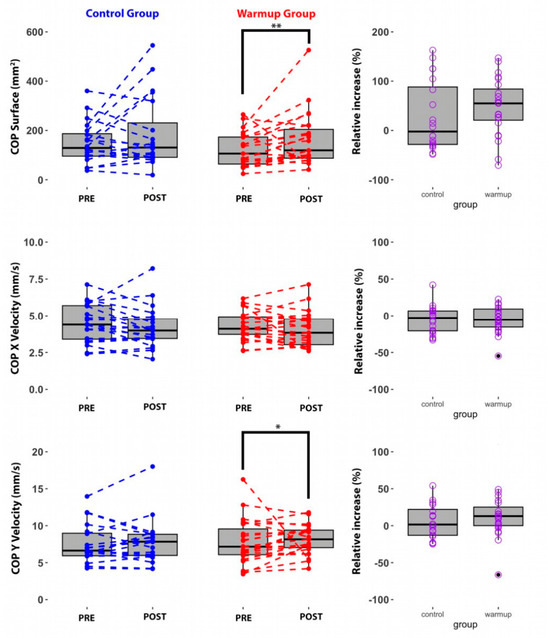
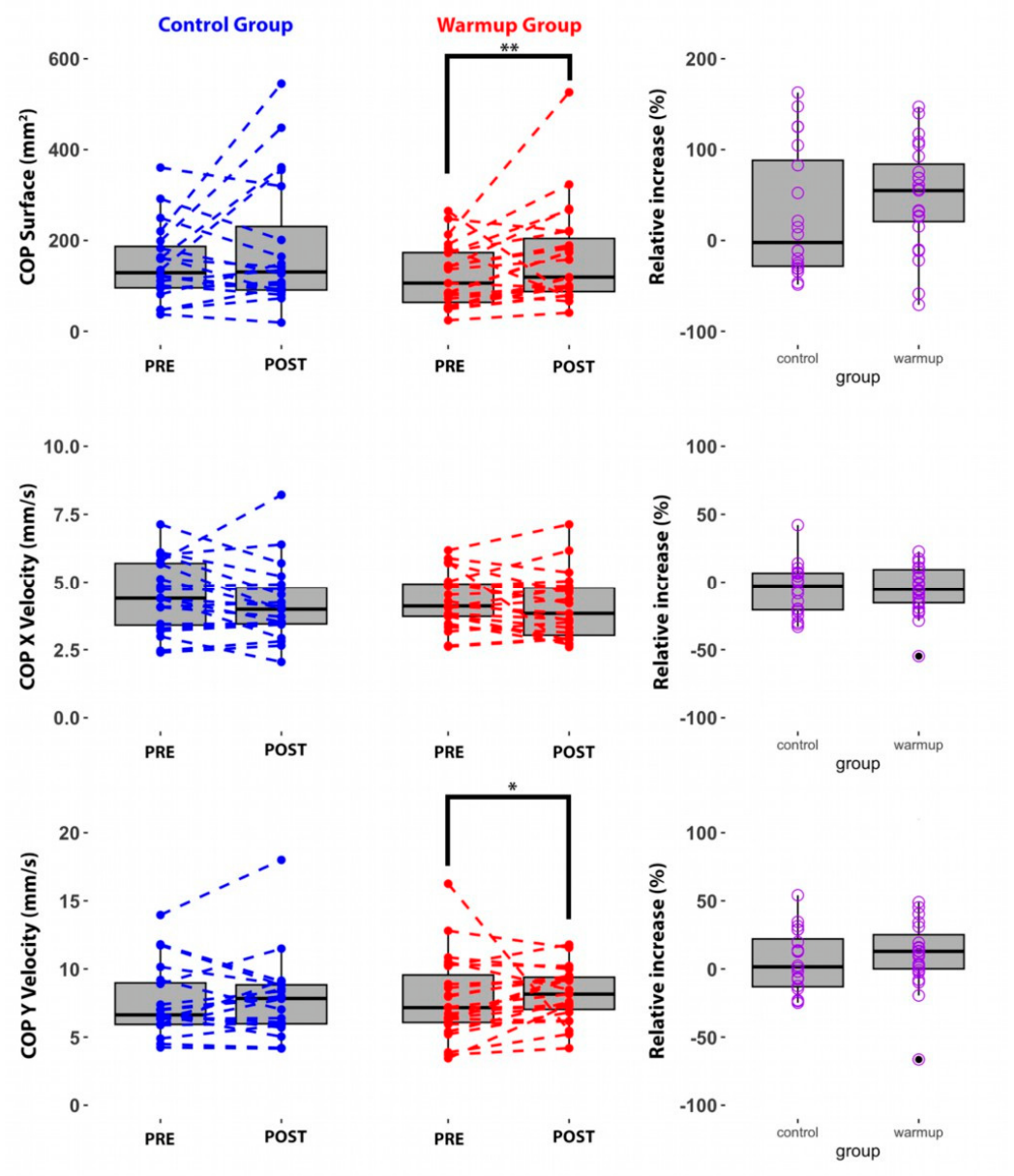
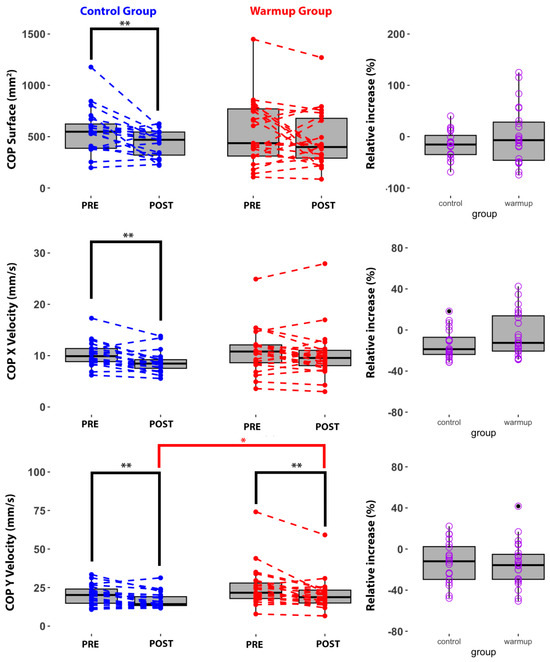
Figure 1 presents the median values of the CoP parameters and the results from pairwise comparisons in the unmanipulated sensory condition. Concerning the CoP surface area (V = 52, p < 0.01, |r| = 0.54) and the CoP Y velocity (V = 68, p < 0.01, |r| = 0.44), there were significant difference between the pre- and post-intervention condition only for the warm-up group. The CoP surface area and the CoP Y velocity were significantly higher in the post-condition in comparison to the pre-condition (Figure 1).
Figure 1.
Boxplot Representation of the centre of feet pressure displacement surface, velocities in the anteroposterior (Y) and mediolateral (X) directions, and their relative rates of increase for control and warm-up group in PRE and POST unmanipulated sensory condition. * indicates p < 0.05, ** indicates p < 0.01 for comparisons by Wilcoxon signed rank test between PRE and POST conditions.
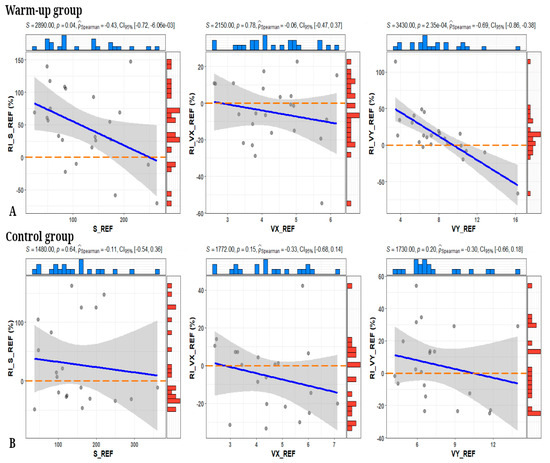
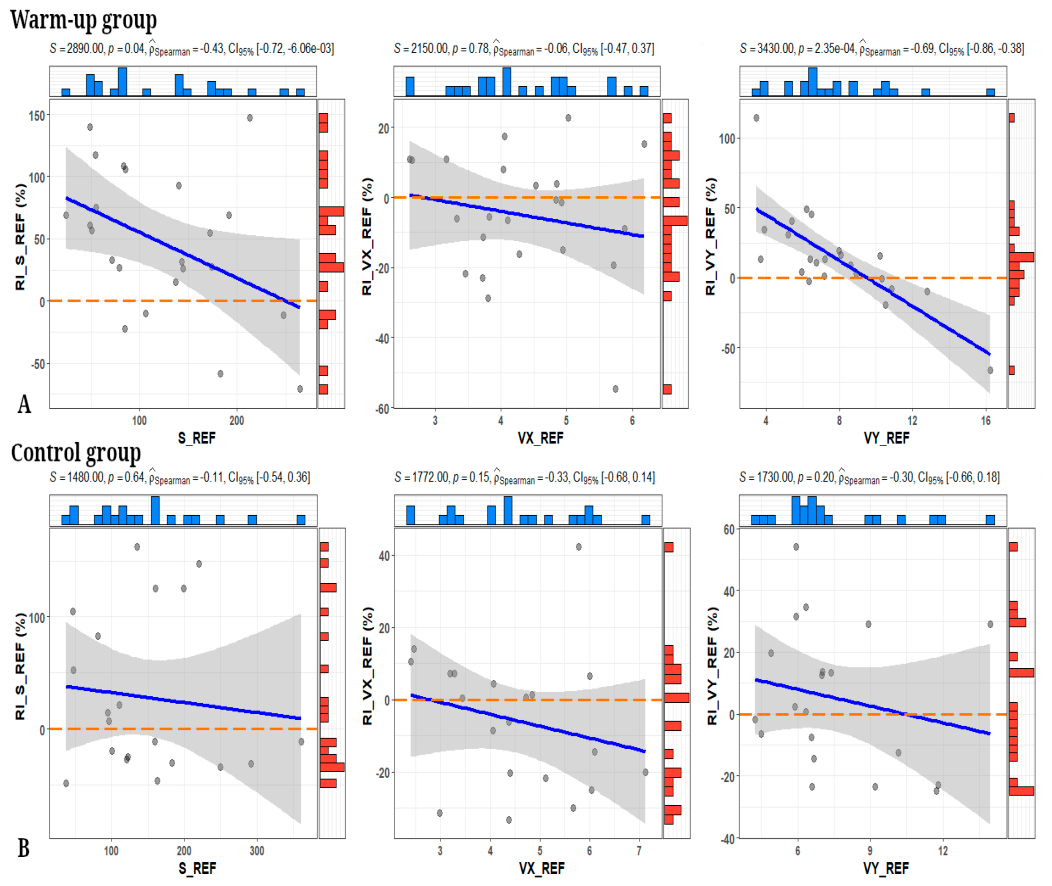
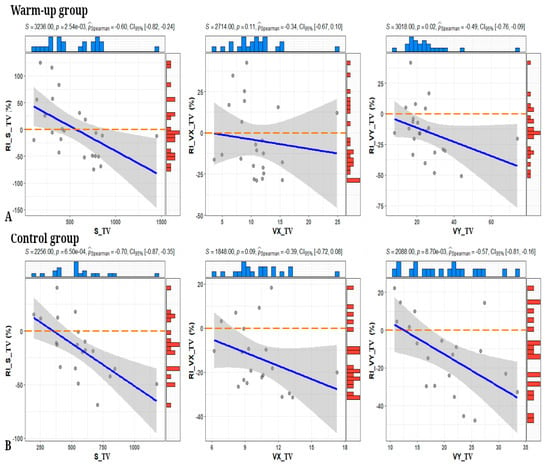
The scatter plots (Figure 2A) illustrate the correlations between the initial CoP parameters and their respective RIs for the warm-up group. There were significant moderate negative correlations between the CoP surface area (ρ = −0.43, p < 0.05), the CoP Y velocity (ρ = −0.69, p < 0.001) and their respective relative increases. This result indicates that the participants in the warm-up group who exhibited the highest initial CoP surface and CoP Y velocity values improved their postural balance the most after the warm-up sequence. By contrast, participants who exhibited the lowest initial CoP surface area and the CoP Y velocity values were the most disturbed by the warm-up sequence.
Figure 2.
Scatter plots representing the correlations between initial values of the CoP parameters (S, VX and VY) in the REF condition and their respective relative rate of increases (RIs) for the eyes closed bipedal condition for the warm-up (A) and control (B) groups.
The scatter plots (Figure 2B) illustrates that there was no significant correlation between the CoP parameters and their respective RIs for the control group.
3.2. Manipulated Sensory Condition
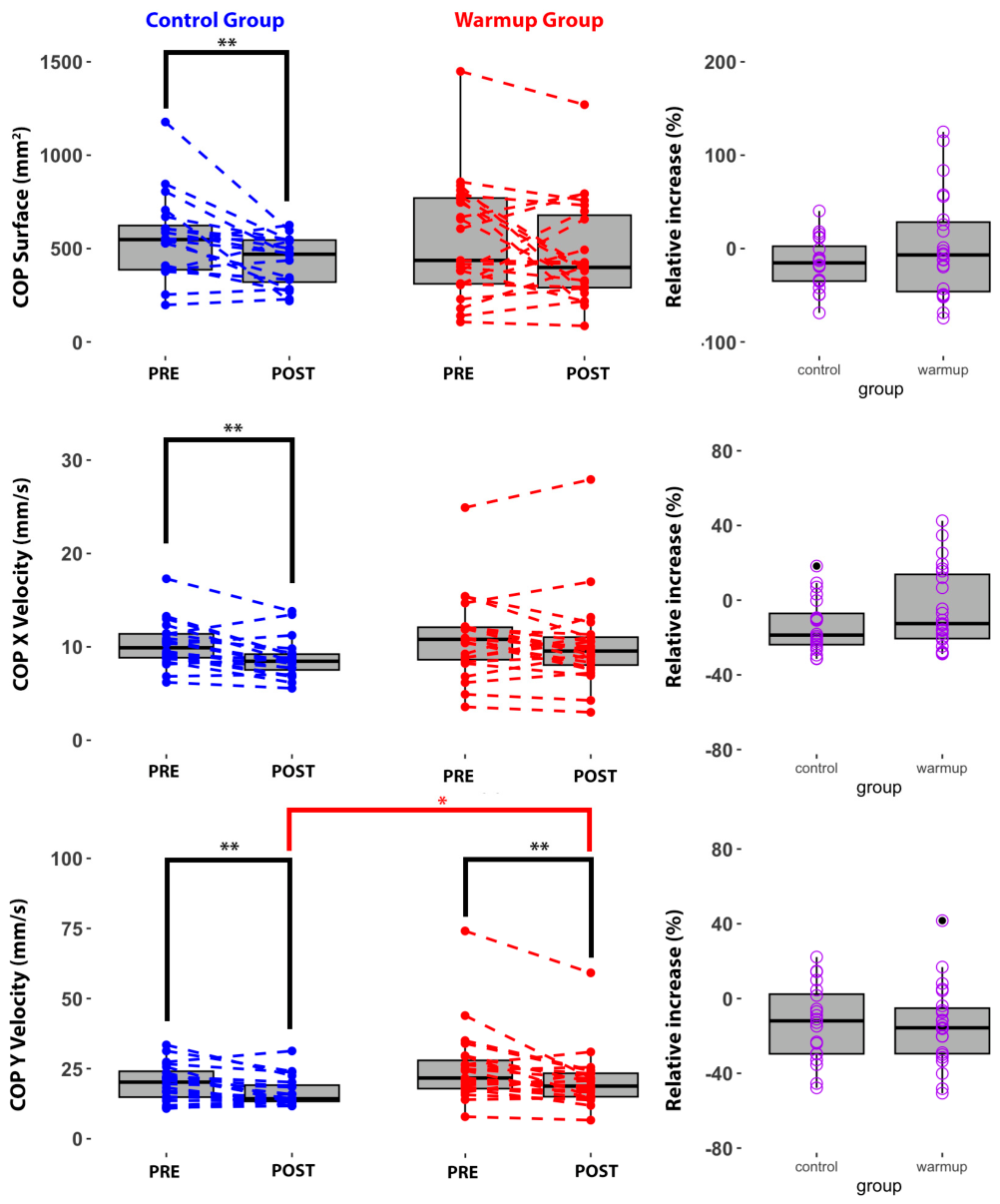
Figure 3 presents the median values of the CoP parameters and the results from pairwise comparisons in the manipulated sensory condition. The CoP surface area (V = 177, p < 0.01, |r| = 0.60), CoP X (V = 187, p < 0.01, |r| = 0.68) and CoP Y (V = 187, p < 0.01, |r| = 0.59) velocities were significantly lower in POST than in PRE for the control group. In the warm-up group, the CoP Y velocity (V = 234, p < 0.01, |r| = 0.61) was significantly lower in POST than in PRE.
Figure 3.
Boxplot Representation of the centre of feet pressure displacement surface, velocities in the anteroposterior (Y) and mediolateral (X) directions, and their relative rates of increase for control and warm-up groups in PRE and POST sensory manipulation conditions (i.e., tendon vibration). * indicates p < 0.05, ** indicates p < 0.01 for comparisons by Wilcoxon signed rank test between PRE and POST conditions.
The COP Y velocity in POST was significantly higher for the warm-up group than for the control group (W = 145, p < 0.05, |r| = 0.31).
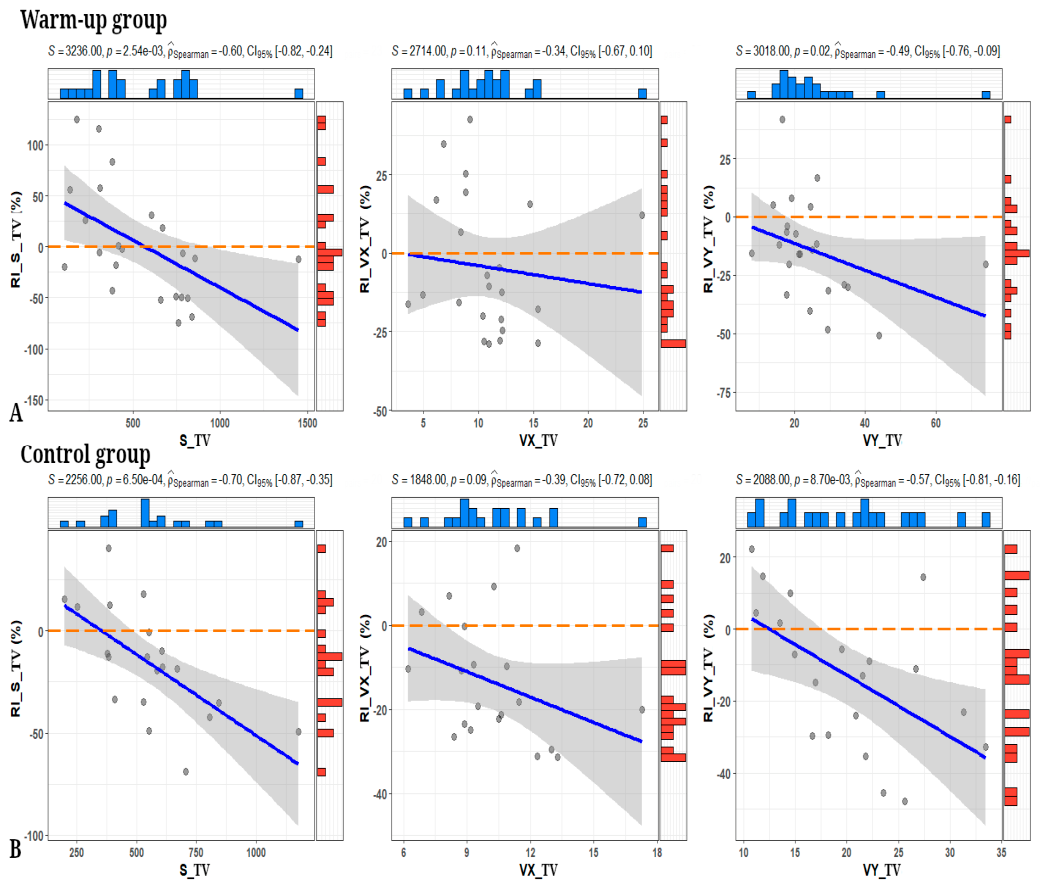
The scatter plots (Figure 4A) illustrate the correlations between the initial CoP parameters and their respective RIs for the warm-up group. There were significant moderate negative correlations between the CoP surface (ρ = −0.60, p < 0.01), CoP Y velocity (ρ = −0.49, p < 0.05) and their respective RIs. This result indicates that the participants who exhibited the highest initial CoP surface and CoP Y velocity values improved their postural balance the most in the post-intervention condition. By contrast, participants who exhibited the lowest initial CoP surface and CoP Y velocity values were the most affected in the post-intervention condition.
Figure 4.
Scatter plots representing the correlations between initial values of the CoP parameters (S, VX and VY) in the PRE TV condition and the relative rate of increases (RIs) for the sensory manipulation condition for the warm-up (A) and control (B) groups.
The scatter plots (Figure 4B) illustrate the correlations between the initial CoP parameters and their respective relative increases in the pre- and post-intervention conditions for the control group. There were significant strong (ρ = −0.70, p < 0.001) and moderate (ρ = −0.57, p < 0.001) negative correlations between the CoP surface area, CoP Y velocity in the initial sensory manipulation conditions and their respective RIs. This result indicates that the participants in the control group who exhibited the highest initial CoP surface area and CoP Y velocity values improved their postural balance the most in the post-intervention condition. By contrast, participants who exhibited the lowest initial CoP surface area and CoP Y velocity values were the most affected in the post-intervention condition.
4. Discussion
The objective was to analyse the acute effects of a warm-up sequence on postural balance in a bipedal postural task with and without proprioceptive sensory manipulation. Contrary to expectations, pairwise comparisons showed that there was no real postural difference between the warm-up group and the control group. The warm-up exercise could nevertheless alter postural balance since postural balance was disrupted after the warm-up sequence for the warm-up group in the unmanipulated condition. With sensory manipulation, both groups improved their postural balance in the POST condition. The scatter plots indicate that postural balance would be altered by the warm-up sequence for some participants, but not for others with and without sensory manipulation. The evidence suggests that the participants’ ability to benefit from the warm-up sequence varied according to their initial balance abilities. The participants who naturally had the worst postural balance benefited more from the effects of the warm-up sequence than the participants who naturally had the best initial postural balance. In light of these results, the first hypothesis that warming up improves postural balance only under unmanipulated sensory conditions is not confirmed. However, the second hypothesis which postulated that the effects of warming up might differ depending on participants’ initial postural balance abilities is confirmed.
In the unmanipulated condition, warm-up modified postural balance, since in the warm-up group, CoP parameters (CoP S and CoP VY) were significantly higher post warm-up. However, there was a high degree of inter-individual variability in response to the warm-up sequence: some participants benefited from the warm-up while others did not, and some were even negatively affected. Spearman correlations showed that individuals with the worst postural balance at baseline (characterised by high values of CoP parameters) benefited the most from the warm-up, while those who were most performant initially (high-performing participants) were even negatively affected by the warm-up sequence.
It is yet well known that the beneficial effects of warm-up on postural balance are based on a series of complex physiological changes in the sensory, central and motor components of the postural function in relation to acute metabolic and neurological adaptations [9]. The increase in body temperature contributes to the modification of the properties of the neuronal membrane, facilitating the propagation of action potentials along the nerve fibres [13]. The proposed warm-up sequence promotes active mobilisation and increased stimulation of the joints of the lower limbs and associated muscle mass, making neural discharges from all stimulated proprioceptive sources (neuromuscular spindles, Golgi tendinous organs, and joint receptors) more relevant [7,12]. This improvement in afferent transmission contributes to optimised central integration [9], facilitating the adjustment of corollary discharges essential for the development of an appropriate motor response [7,12]. Furthermore, under the influence of corticospinal facilitation, the increased excitability of alpha motor neurons could favour more coordinated muscle activation that is better adapted to postural demands. At the same time, warm-up could also influence the sensitivity of the neuromuscular spindles through an increase in gamma motor spindle activity, which would contribute to improved motor coordination and optimised postural control [7]. At last, the warm-up also influences the viscoelastic properties of the muscle–tendon tissues, which directly improves the production of force and also contributes to the improvement of postural function. All of the above adaptations would theoretically explain the optimising effects of warm-up on postural balance.
However, the present results show that the optimising effects of warm-up on postural balance would not be the same for all participants. Indeed, participants who naturally had the best initial postural balance showed no benefit or even a deterioration in this function after the warm-up sequence, which may make the results surprising. The negative effect of the warm-up on postural balance in some individuals could be linked to an unsuitable warm-up for them. Indeed, the optimising effect of warm-up depends on several parameters—duration, intensity, type of exercises [4]. It could be considered that the proposed warm-up sequence was too demanding for some individuals and may have caused (onset) fatigue in some of the participants. It is well known that fatigue impairs postural balance [29] and is accompanied by biomechanical changes [30], making the distinction between warm-up exercise and fatiguing exercise very fine. Compared to other warm-up protocols, particularly that of Paillard et al. [9] which is the closest to the present protocol, ergocycle pedalling consisted of a shorter and less intense sequence and was therefore less challenging overall. Another notable difference is the inclusion of two sets of 20 squats in the protocol presented in the present study, increasing the total activity volume of the warm-up sequence. Given the demanding nature of the exercise (in terms of volume and intensity), the 10 min recovery time was likely insufficient for high-performing participants to start benefiting from the physiological effects of the warm-up. Conversely, participants with lower postural proficiency may have benefited earlier from minimal physiological changes, even before reaching the optimal recovery period.
Regarding the proprioceptive sensory manipulation (TV), the overall results show that postural balance was significantly better in the POST condition than in the PRE condition for both groups (Figure 2). For the warm-up group, the CoP VY was significantly lower in POST condition than in PRE condition. Nevertheless, for the control group, the COP S, CoP VY and CoP VX variables were also significantly lower in the POST condition than in the PRE condition. Thus, these results raise the questions about the real effectiveness of the warm-up. The analysis of populations between PRE and POST condition (Figure 2) also reveals a great heterogeneity of responses to TV. The Spearman correlation between the initial variables CoP S and its relative increase, for the warm-up group (−0.60) and the control group (−0.70), as well as on the initial variables CoP VY and its relative increase, for the warm-up group (−0.49) and the control group (−0.57), revealed moderate to strong negative correlations in the two groups (Figure 4), showing that those who were initially less efficient benefited the most from the repeated trials compared to those who were initially more efficient and were more negatively impacted whatever the group. The improvement in postural performance between the PRE and POST conditions in both groups could be explained by a general adaptive process related to task repetition. In this protocol, participants repeated the postural balance task only twice, which is likely insufficient to induce a learning effect related to the performance of a complex task [31]. The observed changes therefore appear more consistent with an adaptation response to sensory perturbation [32,33] than with a learning effect, regardless of the effects induced by the warm-up.
During the POST condition, the reduction in postural sway could stem from the individuals’ ability to rapidly modulate local neuromuscular components and use other available sensory information to counterbalance the disruptive effects and absence of visual cues [23]. A local response would be to increase the joint stiffness to reduce postural oscillations generated [32,33]. Regarding general adaptive responses, when confronted with incoherent sensory signals from the disturbed region, a sensory switch promoting proprioceptive information from more reliable and proximal joint regions such as the knee and hip would contribute to an effective readjustment of the weight of the various available proprioceptive sources as this can be observed in fatigue condition [29]. This general sensory switch could also be enhanced by the additional integration of sensory information stemming from available or unmanipulated sensory channels in particular plantar cutaneous and vestibular information [14,15,34,35,36]. Although the vestibular system provides no relevant information in a quiet bipedal position [37], the head acceleration could indeed possibly reach the vestibular detection threshold under the condition of tendon vibration used.
Finally, the data presented show great variability in responses between individuals. This phenomenon could result from intrinsic factors, such as individual sensitivity of sensory receptors or variations in neural plasticity. Some participants would adapt quickly to reduce the effects of the stimulation, while others would need more time to adjust their new postural control strategy [32]. This difference could be accentuated by contextual variables that could influence each individual’s response, such as specific motor practices and living conditions [24].
Strengths, Future Research Directions, and Limitations of the Study
Although this study is original in its ability to explore a relatively understudied phenomenon, it can be noted that it has certain limitations. The small sample size may limit statistical power and the ability to create subgroups to better understand the phenomenon. Future studies should integrate additional physiological and neuromuscular measurements to describe more precisely the underlying mechanisms. They should also explore various parameters that constitute the warm up sequence (i.e., intensity, volume, duration), with different balance tasks (e.g., dynamic, monopedal), and tests of vestibular or plantar cutaneous function, in different kinds of participants (e.g., pathological, aged), while controlling the sleep quality, the precise level of daily fatigue, and the actual level of physical activity. Future studies should also examine the potential influence of sex and training status. Furthermore, although the inclusion of a control group that performed the postural task without performing the warm-up sequence helped to control for the potential effects of adaptation with the task, implementing a crossover design may further reduce inter-individual variability.
5. Conclusions
The present study provides additional information on the impact of a warm-up sequence depending on the initial level of postural balance of each participant. The results suggest that not all individuals benefit from the same warm-up sequence. Those with the lower initial performance levels benefit from the warm-up sequence, while those with the higher initial performance levels, on the contrary, tend to see a decline in their postural performance. From a practical perspective, the results highlight significant individual variability in postural responses following the implementation of a warm-up sequence. The effects on each individual depend on the participants’ initial functional characteristics.
Author Contributions
Conceptualization, T.P.; methodology, A.S., J.M. and T.P.; software, J.M.; validation, A.S., J.M., M.D.C., N.R., T.P. and F.N.; formal analysis, A.S., J.M., F.N. and T.P.; investigation, A.S., J.M., M.D.C. and N.R. and T.P.; data curation, A.S., J.M., M.D.C., N.R., F.N. and T.P.; writing—original draft preparation, A.S., J.M., and T.P.; writing—review & editing, A.S., J.M., F.N. and T.P.; visualization, A.S., J.M., F.N. and T.P.; supervision, J.M. and T.P.; project administration, T.P. All authors have read and agreed to the published version of the manuscript.
Funding
This research received no external funding.
Institutional Review Board Statement
The study was conducted in accordance with the Declaration of Helsinki, and approved by the Institutional Review Board of STAPS-TD of University of Pau and pays de l’Adour (12102023MEPS, 2023-12-10).
Informed Consent Statement
Informed consent was obtained from all subjects involved in the study.
Data Availability Statement
The datasets analyzed during the current study are available from the corresponding author on reasonable request.
Acknowledgments
The authors sincerely thank all participants for their involvement and cooperation throughout the study.
Conflicts of Interest
The authors declare no conflicts of interest.
References
- Abalos, E.; Hung, Y.-J. Immediate Effect of Warm-Up on Single-Leg Balance in Individuals with and without Functional Ankle Instability. Int. J. Exerc. Sci. 2022, 15, 1019–1027. [Google Scholar] [CrossRef] [Scilit]
- Karvonen, J. Importance of Warm-Up and Cool Down on Exercise Performance. In Medicine and Sport Science; Karvonen, J., Lemon, P.W.R., Iliev, I., Eds.; Karger Publishers: Basel, Switzerland, 1992; Volume 35, pp. 189–214. [Google Scholar] [CrossRef] [Scilit]
- Woods, K.; Bishop, P.; Jones, E. Warm-Up and Stretching in the Prevention of Muscular Injury. Sports Med. 2007, 37, 1089–1099. [Google Scholar] [CrossRef] [Scilit]
- Bishop, D. Warm Up II: Performance Changes Following Active Warm Up and How to Structure the Warm Up. Sports Med. 2003, 33, 483–498. [Google Scholar] [CrossRef] [Scilit]
- Bishop, D.; Bonetti, D.; Dawson, B. The effect of three different warm-up intensities on kayak ergometer performance. Med. Sci. Sports Exerc. 2001, 33, 1026–1032. [Google Scholar] [CrossRef] [Scilit]
- Stewart, I.B.; Sleivert, G.G. The Effect of Warm-Up Intensity on Range of Motion and Anaerobic Performance. J. Orthop. Sports Phys. Ther. 1998, 27, 154–161. [Google Scholar] [CrossRef] [Scilit] [PubMed]
- Subasi, S.S.; Gelecek, N.; Aksakoglu, G. Effects of Different Warm-Up Periods on Knee Proprioception and Balance in Healthy Young Individuals. J. Sport Rehabil. 2008, 17, 186–205. [Google Scholar] [CrossRef] [Scilit]
- McGowan, C.J.; Pyne, D.B.; Thompson, K.G.; Rattray, B. Warm-Up Strategies for Sport and Exercise: Mechanisms and Applications. Sports Med. 2015, 45, 1523–1546. [Google Scholar] [CrossRef] [Scilit] [PubMed]
- Paillard, T.; Kadri, M.A.; Nouar, M.B.; Noé, F. Warm-up Optimizes Postural Control but Requires Some Minutes of Recovery. J. Strength Cond. Res. 2018, 32, 2725–2729. [Google Scholar] [CrossRef] [Scilit]
- Peterka, R.J. Sensorimotor Integration in Human Postural Control. J. Neurophysiol. 2002, 88, 1097–1118. [Google Scholar] [CrossRef] [Scilit]
- Salgado, E.; Ribeiro, F.; Oliveira, J. Joint-position sense is altered by football pre-participation warm-up exercise and match induced fatigue. Knee 2015, 22, 243–248. [Google Scholar] [CrossRef] [Scilit] [PubMed]
- Bartlett, M.J.; Warren, P.J. Effect of warming up on knee proprioception before sporting activity. Br. J. Sports Med. 2002, 36, 132–134. [Google Scholar] [CrossRef] [Scilit]
- Fradkin, A.J.; Zazryn, T.R.; Smoliga, J.M. Effects of Warming-up on Physical Performance: A Systematic Review with Meta-analysis. J. Strength Cond. Res. 2010, 24, 140–148. [Google Scholar] [CrossRef] [Scilit]
- Machado, M.S.; Machado, Á.S.; Guadagnin, E.C.; Schmidt, D.; Germano, A.M.C.; Carpes, F.P. Effects of increasing temperature in different foot regions on foot sensitivity and postural control in young adults. Foot 2022, 50, 101887. [Google Scholar] [CrossRef] [Scilit]
- Machado, M.S.; Machado, Á.S.; Guadagnin, E.C.; Schmidt, D.; Germano, A.M.C.; Carpes, F.P. Short-term foot warming impacts foot sensitivity and body sway differently in older adults. Gait Posture 2023, 102, 132–138. [Google Scholar] [CrossRef] [Scilit]
- Magalhães, T.; Ribeiro, F.; Pinheiro, A.; Oliveira, J. Warming-up before sporting activity improves knee position sense. Phys. Ther. Sport 2010, 11, 86–90. [Google Scholar] [CrossRef] [Scilit] [PubMed]
- Schmidt, D.; Germano, A.M.C.; Milani, T.L. Effects of active and passive warming of the foot sole on vibration perception thresholds. Clin. Neurophysiol. Pract. 2017, 2, 38–43. [Google Scholar] [CrossRef] [Scilit]
- Burdet, C.; Vuillerme, N.; Rougier, P.R. How Performing a Repetitive One-Legged Stance Modifies Two-Legged Postural Control. J. Strength Cond. Res. 2011, 25, 2911–2918. [Google Scholar] [CrossRef] [Scilit]
- Bove, M.; Courtine, G.; Schieppati, M. Neck Muscle Vibration and Spatial Orientation During Stepping in Place in Humans. J. Neurophysiol. 2002, 88, 2232–2241. [Google Scholar] [CrossRef] [Scilit]
- Fallon, J.B.; Macefield, V.G. Vibration sensitivity of human muscle spindles and golgi tendon organs. Muscle Nerve 2007, 36, 21–29. [Google Scholar] [CrossRef] [Scilit] [PubMed]
- Roll, J.P.; Vedel, J.P.; Ribot, E. Alteration of proprioceptive messages induced by tendon vibration in man: A microneurographic study. Exp. Brain Res. 1989, 76, 213–222. [Google Scholar] [CrossRef] [Scilit] [PubMed]
- Ceyte, H.; Cian, C.; Zory, R.; Barraud, P.-A.; Roux, A.; Guerraz, M. Effect of Achilles tendon vibration on postural orientation. Neurosci. Lett. 2007, 416, 71–75. [Google Scholar] [CrossRef] [Scilit]
- Maitre, J.; Serres, I.; Lhuisset, L.; Bois, J.; Gasnier, Y.; Paillard, T. Regular physical activity reduces the effects of A chilles tendon vibration on postural control for older women. Scand. J. Med. Sci. Sports 2015, 25, e82–e88. [Google Scholar] [CrossRef] [Scilit]
- El-Kahky, A.M. Balance Control Near the Limit of Stability in Various Sensory Conditions in Healthy Subjects and Patients Suffering from Vertigo or Balance Disorders: Impact of Sensory Input on Balance Control. Acta Oto-Laryngol. 2000, 120, 508–516. [Google Scholar] [CrossRef] [Scilit]
- Maitre, J.; Jully, J.-L.; Gasnier, Y.; Paillard, T. Chronic physical activity preserves efficiency of proprioception in postural control in older women. J. Rehabil. Res. Dev. 2013, 50, 843–854. [Google Scholar] [CrossRef] [Scilit]
- Paillard, T.; Zéronian, S.; Noé, F. The optimal exploitation of sensory electrical stimulation for regulating postural balance depends on participants’ intrinsic balance abilities. J. Clin. Neurosci. 2021, 93, 88–91. [Google Scholar] [CrossRef] [Scilit]
- Paillard, T.; Noé, F. Techniques and methods for testing the postural function in healthy and pathological subjects. BioMed Res. Int. 2015, 891390. [Google Scholar] [CrossRef] [Scilit] [PubMed]
- Schober, P.; Boer, C.; Schwarte, L.A. Correlation Coefficients: Appropriate Use and Interpretation. Anesth. Analg. 2018, 126, 1763–1768. [Google Scholar] [CrossRef] [Scilit]
- Paillard, T. Effects of general and local fatigue on postural control: A review. Neurosci. Biobehav. Rev. 2012, 36, 162–176. [Google Scholar] [CrossRef] [Scilit] [PubMed]
- Xu, D.; Zhou, H.; Quan, W.; Gusztav, F.; Wang, M.; Baker, J.S.; Gu, Y. Accurately and effectively predict the ACL force: Utilizing biomechanical landing pattern before and after-fatigue. Comput. Methods Programs Biomed. 2023, 241, 107761. [Google Scholar] [CrossRef] [Scilit]
- Cug, M.; Wikstrom, E.A. Learning effects associated with the least stable level of the biodex® stability system during dual and single limb stance. J. Sports Sci. Med. 2014, 13, 387–392. [Google Scholar] [PubMed]
- Fransson, P.A.; Johansson, R.; Tjernstrom, F.; Magnusson, M. Adaptation to vibratory perturbations in postural control. IEEE Eng. Med. Biol. Mag. 2003, 22, 53–57. [Google Scholar] [CrossRef] [Scilit]
- Fransson, P.-A.; Hafstrom, A.; Karlberg, M.; Magnusson, M.; Tjader, A.; Johansson, R. Postural control adaptation during galvanic vestibular and vibratory proprioceptive stimulation. IEEE Trans. Biomed. Eng. 2003, 50, 1310–1319. [Google Scholar] [CrossRef]
- Abrahámová, D.; Mancini, M.; Hlavačka, F.; Chiari, L. The age-related changes of trunk responses to Achilles tendon vibration. Neurosci. Lett. 2009, 467, 220–224. [Google Scholar] [CrossRef] [Scilit]
- Doumas, M.; Valkanidis, T.C.; Hatzitaki, V. Putting proprioception for balance to the test: Contrasting and combining sway referencing and tendon vibration. Gait Posture 2019, 67, 201–206. [Google Scholar] [CrossRef] [Scilit] [PubMed]
- Kavounoudias, A.; Roll, R.; Roll, J.P. Foot sole and ankle muscle inputs contribute jointly to human erect posture regulation. J. Physiol. 2001, 532, 869–878. [Google Scholar] [CrossRef] [Scilit] [PubMed]
- Fitzpatrick, R.; McCloskey, D.I. Proprioceptive, visual and vestibular thresholds for the perception of sway during standing in humans. J. Physiol. 1994, 478, 173–186. [Google Scholar] [CrossRef] [Scilit] [PubMed]
Disclaimer/Publisher’s Note: The statements, opinions and data contained in all publications are solely those of the individual author(s) and contributor(s) and not of MDPI and/or the editor(s). MDPI and/or the editor(s) disclaim responsibility for any injury to people or property resulting from any ideas, methods, instructions or products referred to in the content. |
© 2026 by the authors. Licensee MDPI, Basel, Switzerland. This article is an open access article distributed under the terms and conditions of the Creative Commons Attribution (CC BY) license.