


Abstract
Background: During adolescence, depression is a major concern due to its high prevalence and long-term impact on well-being. Effective intervention requires accurate assessment through culturally and linguistically adapted instruments with strong psychometric properties. Aims: This study aims to adapt and evaluate the metric properties of the Beck Depression Inventory (BDI-II) in the Moroccan context and to conduct a preliminary comparison of depressive symptomatology between the participating Spanish and Moroccan school samples, by gender and age. Method: A total of 1141 students (514 from Spain and 627 from Morocco), aged 14–19 years, completed the modified 19-item version of the BDI-II and the BASC-S3 questionnaires. Results: The Spanish and Moroccan modified 19-item versions of the BDI-II demonstrated adequate metric properties and gender- and age-invariance, both within and between countries. Intra-country comparisons revealed significant gender differences in both Spain and Morocco samples, with female adolescents reporting higher levels of depressive symptoms than their male counterparts. No differences were observed according to age. The cross-country comparison revealed a large difference in latent depression levels between the Spanish and Moroccan samples included in this study. Conclusions: This modified version of the BDI-II may provide a useful tool for assessing depressive symptoms in the Moroccan and Spanish school populations sampled in this study. The findings also highlight the importance of considering cultural and contextual factors when interpreting depressive symptomatology.
1. Introduction
Adolescence is characterised by the emergence of multiple individual and increasingly complex social dynamics [1]. Adaptation to these changes and the performance of new tasks are important sources of opportunities but also of difficulties that, if not properly managed, can increase the risk of maladjustment at this stage. In this context, depression emerges as a particularly relevant and concerning disorder [2] due to its high prevalence and profound, long-lasting impact on health and well-being, especially considering that, according to the World Health Organisation [3], depressive disorders affect approximately 1.3% of adolescents aged 10–14 years and 3.4% of those aged 15–19 years worldwide.
Although there has been considerable interest in recent decades in the study of cross-cultural variations in the epidemiology of depression, we still know little about the nature of depression and about variations in its frequency and manifestations across cultures [4,5]. Several studies have found that industrialised countries exhibit more cognitive-affective symptomatology, whereas developing countries exhibit more somatic-vegetative symptomatology. More specifically, less somatic symptomatology has been found in the North American or European population than in the Latin American [6,7], Arab [8,9] and Eastern [7,10,11] population. Although there are also studies that contradict these results, both in the East [12] and in Africa [13]. However, differences in depressive symptom expression should not be interpreted exclusively in terms of broad cultural categories such as “Western”, “Arab”, “industrialised”, or “developing” societies. Current cross-cultural research suggests that the manifestation and reporting of depressive symptoms are also shaped by contextual factors, such as gender norms, exposure to violence, school environments, access to mental health services, or stigma surrounding psychological distress [7,14,15]. This perspective is particularly relevant when comparing Spain and Morocco. Although both countries share geographical proximity and historical links, they differ in several social determinants associated with adolescent mental health. Studies conducted with Moroccan adolescents have highlighted the role of gendered social expectations, family dynamics, experiences of violence, and limited access to mental health resources in shaping adolescents’ psychological wellbeing [16,17]. In addition, stigma towards mental health problems remains an important barrier to help-seeking among young people in many Middle Eastern and North African contexts [18]. In Spain, although important socioeconomic and gender inequalities also persist, adolescents generally have greater access to school-based and community mental health services within a more developed mental healthcare infrastructure [15]. Consequently, potential differences in depressive symptomatology between Spanish and Moroccan adolescents should be understood as the result of the interaction between cultural meanings of distress and broader social, educational, and healthcare contexts, rather than as the expression of homogeneous cultural characteristics.
Moreover, there is a major gap in the scientific literature examining cross-cultural differences in depressive symptomatology: most studies have been based on clinical samples of adults, leaving very little information on cross-cultural patterns in the normal adolescent population.
Depression during adolescence has unique characteristics that differentiate it from depression in other age groups. During this developmental stage, signs of depression can be difficult to detect because adolescents may express symptoms differently from adults. They may be irritable, experience changes in appetite or sleep, lose interest in activities they previously enjoyed, or present recurrent physical complaints with no apparent medical cause. Although these symptoms may also occur in adults with depression, in adolescents, they are often mistaken for typical developmental or behavioural changes. As a result, these signs are frequently misunderstood or minimised [2], delaying diagnosis and appropriate intervention. This is particularly concerning given that the duration of untreated depressive illness is an important predictor of recurrence in adulthood and may increase the risk of suicide [19], making early detection essential [20]. This need for early identification is further reinforced by recent evidence suggesting a progressive shift in severe affective psychopathology toward younger ages. For example, a longitudinal study of psychiatric admissions in Italy reported a progressive reduction in age at admission for major depression and bipolar disorder, indicating that severe affective disorders may be emerging and requiring intensive treatment at increasingly younger ages [21].
Therefore, the primary objective of this study was to examine the preliminary cross-cultural psychometric properties of the Beck Depression Inventory-II (BDI-II) [22] in the participating Spanish and Moroccan school samples, including its factorial structure, reliability, and measurement invariance. A secondary objective was to compare latent levels of depressive symptomatology between the participating Spanish and Moroccan school samples once measurement equivalence had been established. The Moroccan population was selected because Moroccans represent the largest immigrant population in Spain and one of the largest in Europe. Given the limited availability of assessment instruments with demonstrated validity for this population [23], the first specific objective was to linguistically and culturally adapt the BDI-II, one of the most widely used depression measures internationally, to the Moroccan context (French and Arabic versions) and to analyse its psychometric properties in a sample of Moroccan adolescents living in Morocco. The second objective was to compare the participating school samples from Spain and Morocco, two geographically close but culturally distinct contexts, through structural equation modelling. Ultimately, this study aims to contribute to more appropriate psychological care by promoting accurate assessment that is free from language barriers and sensitive to cultural differences between countries of origin and destination.
2. Methods
2.1. Research Design
The study was a descriptive, correlational, and cross-sectional study. This was conducted in accordance with the Declaration of Helsinki and approved by the Ethics Committee for Research involving Human Beings, their Samples and their Data (CEISH) of the University of the Basque Country (EHU), the study’s promoting institution (reference number: M10_2018_185, project “Psychosocial adjustment in adolescence and its association with individual, family and school factors. A cross-cultural study of Spain and Morocco”. This approval explicitly covered the Spain–Morocco study as a whole, including the authorizations and agreements necessary to conduct the research in both countries. School-level authorization was additionally obtained for data collection in Morocco; no separate approval from a Moroccan research ethics committee was sought, as data collection there was covered under the CEISH-EHU approval for the joint project.
2.2. Sample and Sampling
The study was cross-cultural and multicentre. A non-probabilistic convenience sampling strategy was used and conducted in two stages, first in Spain and subsequently in Morocco. Schools were selected to ensure heterogeneity in terms of school type (public, publicly subsidised, and private) and geographical context (provincial capitals and smaller towns). Educational centres were contacted based on their accessibility and willingness to participate in the study.
All provisions of the General Data Protection Regulation (EU) 2016/679 were complied with. Written informed consent was obtained from the parents or legal guardians of all participants, and informed assent was obtained from all adolescents prior to participation. Authorization to conduct the study was also obtained from the management of the participating schools. The personal data collected through the battery of instruments were processed exclusively for scientific research purposes and in accordance with applicable data protection regulations.
A total of 1141 students participated: 514 residents in Spain from 4 educational centres and 627 in Morocco from 5 centres, aged between 14 and 19 years (M = 16.09, SD = 1.45) (see Table 1). Most participants (93.2%) came from urban environments, and the majority were classified as having a medium-high socioeconomic status based on the sociodemographic information collected during the study.
Table 1.
Characteristics of participants.
2.3. Instruments
A booklet was designed that included 3 questionnaires.
- -
- Ad hoc questionnaire assessing sociodemographic and school-related characteristics (e.g., gender, age, place of residence, type of school, and participants’ and parents’ place of birth).
- -
- Modified 19-item version of the BDI-II. Depression Inventory-II (BDI-II) [22], administered using the Spanish version [24], modified by removing the items assessing suicidal ideation and loss of sexual interest prior to administration. Consequently, the instrument used in the present study consisted of 19 items. This self-report questionnaire assesses the severity of depressive symptoms experienced during the previous two weeks using a four-point descriptive scale (0–3), with higher scores indicating greater symptom severity. The total score is obtained by summing the responses across the 19 items, yielding a possible range of 0–57. The original BDI-II severity categories and cut-off points are not used for scoring or classification purposes in this study, other than as an operational referral safeguard described in the Procedure section. The questionnaire can be completed in approximately 5–10 min. The original Spanish version of the BDI-II has shown good psychometric properties in Spanish, Chilean, Mexican, and American adolescent samples.
- -
- Depression subscale of the Behaviour Assessment System for Children and Adolescents (BASC-3S) [25] in its Spanish and Moroccan versions, both of which have demonstrated adequate psychometric properties [26]. It comprises 185 true-or-false statements (0–1) grouped into 14 scales and 3 global dimensions: Personal Adjustment, Clinical Maladjustment, and School Maladjustment. It takes 30–45 min to complete. It has shown adequate psychometric properties in Spanish, Basque and Persian samples.
2.4. Procedure
Following the guidelines of the International Test Commission [27], the intellectual property rights of the questionnaires were checked, and the process of linguistic, conceptual and cultural adaptation was conducted entirely in Morocco in 3 steps:
- (1)
- Linguistic adaptation of the instruments: The existing French version of the instruments was reviewed for use in the Moroccan context and independently translated into Moroccan Arabic (Darija) by two bilingual Moroccan translators with experience in education. The two forward translations were compared and synthesised into a preliminary version, which was subsequently validated by an independent bilingual translator following a back-translation procedure into French. Similarities and discrepancies were assessed using Hambleton and Zenisky’s [28] checklist for quality control of item translation and adaptation.
- (2)
- Adaptation to the cultural context: This was done by expert judgement in a multidisciplinary committee consisting of a methodologist, three teachers, a head teacher and a mother. The relevance of the test content, conceptual equivalence and its local comprehensibility were assessed.
- (3)
- Analysis of metric properties: This included the layout and paper-based administration of the instruments, contact with schools and approval of participation, group data collection in classrooms during school hours and always in the presence of the main researcher, as well as quality control, data entry, and data analysis.
In accordance with the study protocol, and following the conventional severity categories of the original BDI-II (minimal: 0–13; mild: 14–19; moderate: 20–28; severe: ≥29), participants whose total scores on the modified 19-item BDI-II fell within the moderate-to-severe range (total score ≥20) were flagged for referral by the principal investigator after data collection, as an operational participant-protection safeguard independent of the psychometric validation reported in this study, since these thresholds have not been validated for the modified 19-item version. Of the 514 participants in Spain, 8 (1.6%) and 9 (1.8%) scored within the moderate and severe ranges, respectively; of the 627 participants in Morocco, 134 (21.3%) and 51 (8.1%) scored within these ranges. In total, 17 cases in Spain and 185 cases in Morocco (3.4% and 29.5% of the respective subsamples) were flagged for referral. Schools were contacted within one month of data collection. Identification of cases and communication with schools were carried out exclusively by the principal investigator, who was the only member of the research team with access to the correspondence between participant identity and BDI-II score. Cases were confidentially referred to the school counselling service of their respective schools, following the procedures established by each institution. The school counselling service reviewed each case and determined, in accordance with its standard protocols, whether the family should be informed and whether referral to additional educational or healthcare services was warranted. Any subsequent assessment, intervention, or follow-up was conducted exclusively by the school counselling services, and not by the research team.
2.5. Data Analysis
Initially, the presence and pattern of missing data and outliers were examined. The proportion of missing responses was low, with no item exceeding 9.07% missing values. Visual inspection of the missing data patterns did not reveal systematic missingness across items or study groups. Because the analyses involved ordinal indicators estimated using the WLSMV estimator in lavaan, missing responses were handled using the pairwise present approach implemented by the software to estimate the polychoric correlation matrix and thresholds. Because participants were nested within schools, the intraclass correlation coefficient (ICC) for depressive symptom scores was estimated to assess the extent of school-level clustering. The resulting ICC (0.046) indicated relatively limited clustering; therefore, observations were treated as independent and multilevel analyses were not performed.
The metric properties of the instruments were then evaluated in the target samples. As a first approach to the behaviour of each item, descriptive statistics were calculated (% ground, % ceiling, mean and its 95% confidence interval [CI], standard deviation, skewness, kurtosis and homogeneity index). Secondly, the factorial structure of the instrument was examined using confirmatory factor analysis with the robust weighted least squares mean and variance adjusted (WLSMV) estimator and theta parameterisation, which are appropriate for ordinal variables with few response categories and robust to non-normality. The assessment of the fit of the models to the data was based on the chi-square/df ratio (χ2/df), together with information provided by the incremental goodness-of-fit index (CFI), the root mean squared error of approximation (RMSEA) and the standardized root mean square residual (SRMR). Models with values equal to or less than 5 in the ratio χ2/df, equal to or greater than 0.90 in CFI and equal to or less than 0.08 in RMSEA and SRMS [29] were considered acceptable. Competing factorial models, including one-factor, correlated two-factor, second-order, and bifactor models, were compared in both countries. To evaluate the extent to which responses were driven by a general depression factor, bifactor reliability indices, including omega hierarchical (ωH), explained common variance (ECV), and the percentage of uncontaminated correlations (PUC), were estimated.
To obtain evidence of external convergence validity, the association between scores on the BASC-3S Depression scale and scores on the modified version of the BDI-II was analysed using Spearman’s correlation coefficient (r). Composite reliability (CR), McDonald’s omega (ω), and ordinal alpha (αo) were calculated for the final unidimensional model, providing indicators of the internal consistency of the total score in both language versions. The minimum value considered good is 0.70 for both indicators.
Finally, based on the evidence supporting the essential unidimensionality of the modified BDI-II, the description of questionnaire scores and the analysis of possible group differences were conducted using the total depression factor. In a first step, a stepwise measurement invariance analysis of the unidimensional model across groups (gender, age, and country) was conducted, taking into account the items’ ordinal nature [30]. Age was categorised a priori into two developmental stages: middle adolescence (14–16 years) and late adolescence (17–18 years). This classification was based on developmental considerations and was also intended to ensure adequate sample sizes within each subgroup for the measurement invariance analyses. Using the WLSMV estimator and theta parameterisation, configural invariance tested the equivalence of the factorial structure across groups; metric invariance constrained factor loadings to equality; scalar invariance additionally constrained item thresholds; and strict invariance further constrained residual variances. As acceptance criteria for metric, scalar, and strict invariance, changes in fit indices between nested models were examined: ΔCFI < 0.010, ΔRMSEA < 0.015, and ΔSRMR < 0.030 [31]. In a second step, after establishing scalar invariance, latent mean differences were examined by fixing the reference group’s latent mean to zero and freely estimating the comparison groups’ latent means. Effect sizes were reported as standardised latent mean differences (d), obtained by dividing the latent mean difference by the standard deviation of the latent factor in the reference group [32,33]. Following Cohen’s [34] guidelines, values of 0.20, 0.50, and 0.80 were interpreted as small, moderate, and large effects, respectively.
The analyses were carried out in the Lavaan 0.6-21 package in the R 4.6.0 environment [35].
3. Results
3.1. Adaptation Process
The linguistic and cultural adaptation was conducted in accordance with internationally recommended guidelines for the cross-cultural adaptation of psychological instruments. First, the original French version of the BDI-II was translated into Moroccan Darija independently by two bilingual translators familiar with both Moroccan culture and mental health terminology. The two forward translations were compared and synthesised into a preliminary version through discussion among the translators and the research team. This version was subsequently back-translated into French by an independent bilingual translator who had not been involved in the initial translation process and was blind to the original instrument. The original, translated, and back-translated versions were then reviewed by the research team to identify potential discrepancies in meaning, conceptual equivalence, and cultural relevance.
Any translation discrepancies were discussed and resolved through consensus among the translators, researchers, and members of a multidisciplinary expert committee. The committee included researchers with expertise in adolescent mental health and psychometrics, as well as key stakeholders from the educational community, including school principals, teachers, and family representatives. Particular attention was paid to ensuring conceptual equivalence and cultural appropriateness rather than literal linguistic correspondence.
To further assess the comprehensibility and acceptability of the adapted instrument, a pilot administration was conducted with five Moroccan adolescents from the target age group. Participants were asked to complete the questionnaire and provide feedback regarding item clarity, wording, comprehensibility, and any content perceived as confusing or inappropriate. Overall, the instrument was considered understandable and acceptable, and no major difficulties in comprehension were identified.
During the expert review and content validation stages, stakeholders from the educational community considered the items assessing suicidal ideation and loss of sexual interest to be inappropriate for administration in the participating school settings and recommended their exclusion. This recommendation was adopted before data collection. The decision was based on considerations of cultural acceptability and feasibility within the educational context rather than on statistical or psychometric criteria.
Although both French and Moroccan Arabic (Darija) versions were produced following the ITC guidelines as part of the cultural adaptation process, only the French version was administered in the present study because French was the language of instruction in all participating Moroccan schools. Consequently, the psychometric analyses reported in this study are based exclusively on the French version. To ensure comparability between countries, the same reduced version of the questionnaire was subsequently administered in both the Moroccan and Spanish samples.
3.2. Psychometric Properties of the 19-Item Modified Version of the Beck Depression Inventory-II (BDI-II) in Spain and Morocco
Missing data were generally low across study variables, with percentages ranging from 0.35% to 9.07% across groups. Although the proportion of missing responses was very low in the Spanish sample (0.35%), it was higher in the Moroccan sample (9.07%) and among adolescents aged 14–16 years (6.32%) than among those aged 17 years or older (3.25%). A Little’s MCAR test rejected the MCAR assumption for the pooled sample, χ2(1642) = 2447.49, p < 0.001, consistent with this country-level disparity; however, the assumption was not rejected within either country considered separately (Spain: p = 0.998; Morocco: p = 0.145), suggesting the missingness is plausibly random conditional on country. A complete-case sensitivity analysis further indicated that the magnitude of the Spain–Morocco difference in depressive symptoms was materially unchanged between complete cases (d = 0.98) and all available cases (d = 0.96). Taken together, these checks suggest the differential missingness does not appear to be driving the reported cross-country difference, although, as noted above, it compounds the broader country/school confound and should still be considered when interpreting the cross-group comparisons reported in this study.
Table 2 presents the mean and standard deviation of each item of the final 19-item modified version of the BDI-II in the Spanish and Moroccan samples. Additional descriptive statistics, including floor and ceiling effects, skewness, kurtosis, and corrected item-total correlations, are reported in Table A1. In both countries, the mean scores for all items were below the theoretical midpoint of the response scale (1.5), indicating generally low levels of depressive symptomatology in the two samples. Furthermore, the supplementary analyses revealed positively skewed distributions and substantial floor effects for most items, suggesting that responses tended to cluster at the lower end of the scale (i.e., the asymptomatic pole). Finally, all corrected item-total correlations exceeded the recommended minimum threshold, supporting the instrument’s adequate homogeneity and internal consistency.
Table 2.
Descriptive statistics for each of the 19 items of the modified version of the BDI-II for the Spanish/Moroccan adolescent population.
When the internal structure of the questionnaire was examined in both countries, all competing models demonstrated acceptable to excellent fit according to the robust (scaled) fit indices. In Spain, the bifactor model showed the best statistical fit (CFI = 0.980, TLI = 0.975, RMSEA = 0.037, SRMR = 0.052), followed by the correlated two-factor model (CFI = 0.970, TLI = 0.965, RMSEA = 0.044, SRMR = 0.060) and the unidimensional model (CFI = 0.965, TLI = 0.961, RMSEA = 0.046, SRMR = 0.062). A similar pattern was observed in Morocco, where the bifactor model again provided the best fit (CFI = 0.975, TLI = 0.968, RMSEA = 0.037, SRMR = 0.047), followed by the correlated two-factor (CFI = 0.962, TLI = 0.957, RMSEA = 0.043, SRMR = 0.056) and unidimensional models (CFI = 0.954, TLI = 0.948, RMSEA = 0.047, SRMR = 0.058).
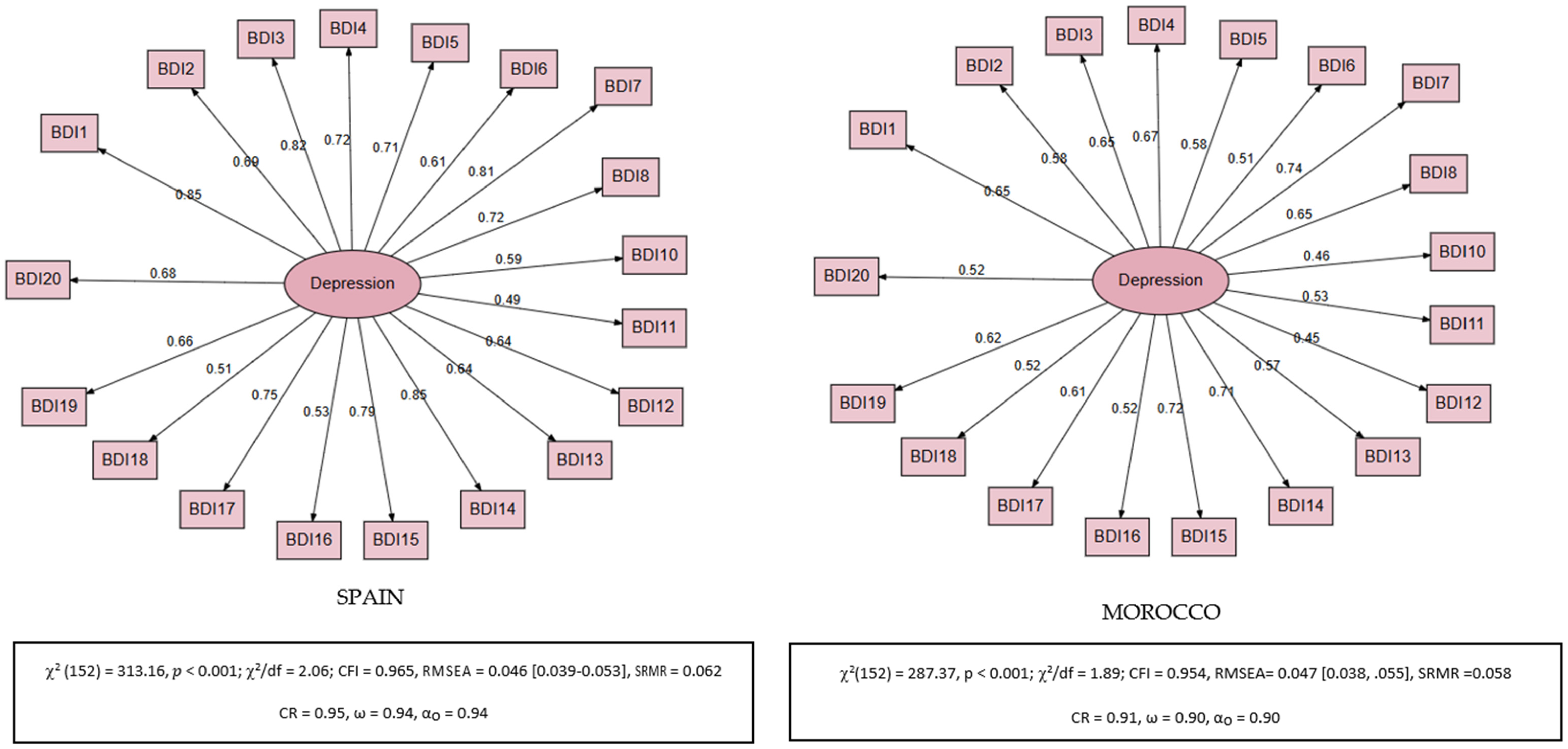
However, despite the superior fit of the bifactor solution, bifactor-specific indices consistently indicated that the modified BDI-II is essentially unidimensional in both samples. Specifically, the general factor accounted for approximately 80% of the reliable variance in the total score (ωH = 0.800 in Spain and 0.799 in Morocco) and explained more than 84% of the common variance among items (ECV = 0.854 and 0.848, respectively). In contrast, the specific cognitive-affective and somatic-vegetative factors explained only a small proportion of unique variance (ECV values ranging from 0.070 to 0.077). Although the PUC values were moderate (0.456 in both samples), the combination of high ωH and high ECV values provides strong evidence that a single general depression factor predominantly drives responses. Therefore, the modified BDI-II can be considered an essentially unidimensional instrument, justifying the retention of the more parsimonious one-factor model for subsequent analyses. Figure 1 presents the final unidimensional measurement model.
Figure 1.
Standardised factor loadings of the one-factor model of the 19-item modified version of the BDI-II in the Spanish and Moroccan samples.
Evidence of convergent validity was also obtained. Associations between the total 19-item modified version of the BDI-II score and the BASC-3S Depression dimension were positive, moderate to strong, and statistically significant both in Spain (r = 0.71, p < 0.001) and Morocco (r = 0.68, p < 0.001), indicating that higher levels of depressive symptomatology assessed by the modified BDI-II were associated with higher levels of depression measured by the BASC-3S.
In terms of reliability, internal consistency was very high in both countries, exceeding 0.70 for all coefficients.
3.3. Cross-Country Differences in Depressive Symptoms
Regarding subgroup differences, the analysis began with a preliminary study of stepwise invariance, with scalar invariance as the minimum requirement for comparing means (latent and observed).
The results (see Table 3 and Table 4) generally supported the measurement invariance of the modified version of the BDI-II across gender and age groups within each country. Configural and metric invariance were supported in all within-country comparisons. Scalar invariance was also generally supported, although the Spanish and Moroccan gender comparisons showed a slightly larger-than-recommended decrease in CFI (ΔCFI = 0.012), while the corresponding changes in RMSEA and SRMR remained within the recommended thresholds. In contrast, strict invariance was fully supported for the age-group comparisons but received only partial support across gender, as the Spanish gender comparison showed a larger deterioration in CFI at the strict level. Overall, these findings indicate that the instrument measures depressive symptoms equivalently across genders and age groups, allowing meaningful comparisons of latent means within each country.
Table 3.
The 19-item modified version of the BDI-II factorial invariance fit indices by gender and age within and between countries.
Table 4.
Changes in fit indices between consecutive measurement invariance models.
In the cross-country analyses, configural and metric invariance were supported, but full scalar invariance was not clearly supported by the criteria defined above: the transition from the metric to the scalar model showed a decrease in CFI at the specified threshold (ΔCFI = 0.010) accompanied by a corresponding increase in RMSEA beyond the specified cut-off (ΔRMSEA = 0.015), even though ΔSRMR remained within bounds. Because these two indices jointly, rather than a single criterion in isolation, pointed to non-invariance, full scalar invariance across countries was not retained. A partial scalar invariance model was therefore estimated, freeing the threshold parameters of the item showing the largest violation in a score test (BDI11), which met all three criteria relative to the metric model (ΔCFI = −0.009, ΔRMSEA = 0.002, ΔSRMR = 0.005; see Table 4). In contrast, the substantial deterioration in model fit observed for the strict model (CFI = 0.855, RMSEA = 0.079, SRMR = 0.133) indicates that residual variances differ between Spain and Morocco. Latent mean comparisons between countries are therefore reported under this partial scalar invariance model, in which the threshold parameters of BDI11 were allowed to differ across countries, rather than under full scalar invariance; the lack of strict invariance further suggests that measurement error may vary across countries and, therefore, these comparisons should be interpreted with appropriate caution.
Latent mean comparisons revealed significant gender differences in both countries. Females reported higher levels of latent depression than males in Spain and Morocco. No significant age differences were observed in either sample, as shown in Table 5. There were no significant differences due to the gender-by-age range interaction.
Table 5.
Latent mean differences in depressive symptomatology according to gender and age within and between countries.
The cross-country comparison, estimated under the partial scalar invariance model described above (with the threshold parameters of BDI11 freed across countries), revealed a large difference in latent depression levels between the Spanish and Moroccan samples included in this study, with Moroccan adolescents exhibiting higher levels of depressive symptoms than their Spanish counterparts.
4. Discussion
Childhood and adolescent depression is not only an individual burden, but also a significant challenge for society as a whole. The negative effects of depression during these early stages of life may have long-term repercussions on academic performance, interpersonal relationships, physical health, and socio-emotional development both in the affected individuals and their families [36]. The first step in adequate intervention is to ensure a valid assessment using culturally and linguistically adapted instruments with good psychometric properties. The aim of this study was to adapt and evaluate the preliminary metric properties of the Beck Depression Inventory (BDI-II) in the Moroccan context. Moreover, a comparison of depressive symptomatology between the participating Spanish and Moroccan school samples, by gender and age, was conducted.
The results indicated that the modified 19-item version of the BDI-II (after removing the items assessing suicidal ideation and decreased sexual desire) exhibited excellent psychometric properties in both the Spanish and Moroccan samples. Although the correlated two-factor model showed an acceptable fit, the bifactor analyses demonstrated the presence of a dominant general depression factor, supporting the interpretation of the instrument as essentially unidimensional. Accordingly, the modified BDI-II demonstrated excellent internal consistency and can be considered a reliable measure of overall depressive symptom severity in adolescents. However, the exclusion of the suicidal-ideation item inevitably reduces the clinical coverage of the depression construct. Therefore, although the modified instrument appears psychometrically robust for assessing general depressive symptoms, it should not be regarded as a comprehensive screening instrument for adolescent depression.
These findings are broadly consistent with previous studies reporting both multidimensional and essentially unidimensional representations of the BDI-II [36,37] and support the use of the questionnaire with adequate psychometric guarantees. Furthermore, the present study contributes to addressing the scarcity of validated assessment tools for Moroccan adolescents [23] and extends the applicability of the modified BDI-II to the Moroccan school context studied here.
Finally, measurement invariance was fully supported across gender and age groups within each country, up to at least scalar (and, in most comparisons, strict) invariance, supporting meaningful comparisons of latent depression levels by gender and age within each national sample. Across countries, however, only partial scalar invariance was established, after freeing the threshold parameters of one item (BDI11, assessing irritability), and full strict invariance was not supported. This is consistent with prior cross-cultural work on the BDI and BDI-II, which has repeatedly identified the irritability item as showing differential item functioning or score differences across countries [38,39], suggesting that this item may be particularly sensitive to cultural norms surrounding the expression of irritability and anger, rather than reflecting a measurement artefact specific to the present study. This indicates that the modified 19-item BDI-II assesses depressive symptomatology in a broadly, but not fully, comparable manner across the Spanish and Moroccan samples: cross-country latent mean comparisons are interpretable under the partial invariance model reported here, but the differences in measurement error implied by the lack of strict invariance mean these comparisons should be interpreted with caution, and should not be read as evidence of full cross-cultural equivalence of the instrument.
In both Spain and Morocco samples, higher levels of depressive symptomatology were observed among female adolescents compared to males, whereas no significant differences emerged across age groups. These findings are consistent with previous studies reporting a greater burden of depressive symptoms among adolescent girls [40,41]. Although some authors have suggested that sociocultural factors, gender norms and contextual pressures may contribute to these gender differences, particularly in non-Western settings [42], these variables were not directly assessed in the present study. Therefore, such explanations should be considered tentative and warrant further empirical investigation.
In the comparison between countries, the Moroccan sample included in this study showed higher latent levels of depressive symptomatology than the Spanish sample. Moreover, because the samples were obtained through convenience sampling, the observed differences should be considered descriptive of the groups included in this study rather than definitive evidence of population-level differences between Spanish and Moroccan adolescents.
Although previous studies have documented substantial variability in estimates of adolescent depression in both Morocco and Spain, differences in study designs, instruments, sampling procedures and diagnostic approaches limit direct comparisons with the present findings. For example, studies conducted in Spain have reported prevalence estimates ranging from 2.3% [43] to 19.5% [44], whereas a study conducted among Moroccan adolescents estimated the prevalence of major depressive disorder at 26.5% [45]. These prevalence estimates should be interpreted with caution, as they were obtained from different study designs, populations, assessment instruments and diagnostic criteria.
A range of contextual factors may potentially contribute to cross-national differences in the reporting of depressive symptoms, including socioeconomic conditions, educational environments, access to mental health services, cultural norms, language of administration and response styles [46]. However, none of these variables was directly measured or statistically examined in the present study. Consequently, any interpretation regarding their role in explaining the observed differences remains speculative and should be regarded as a hypothesis to be tested in future research rather than as a conclusion supported by the current data.
In line with previous cross-cultural research, differences in the expression of depressive symptoms have been identified as one of the most consistent findings in studies of depression across cultures [8]. However, because the modified BDI-II used in this study is essentially unidimensional and the present design did not directly assess cultural beliefs, stigma, or symptom expression, the present data cannot adjudicate between possible explanations for the observed differences, which should be regarded as a hypothesis for future research rather than as a finding of this study.
Although the Spanish and Moroccan school contexts studied here may share similar challenges in terms of adolescent mental health, the differences observed in the present study highlight the importance of considering cultural and contextual factors when developing and adapting assessment and intervention strategies. Further research using more representative samples and directly measuring relevant contextual variables is needed to better understand the mechanisms underlying cross-national differences in the reporting of depressive symptoms.
Limitations
Given that two original BDI-II items assessing suicidal ideation and changes in sexual interest were excluded during the content validation process, the instrument used in this study should be considered a modified Moroccan version of the BDI-II rather than the original scale. This decision followed the recommendations of an expert committee comprising school principals, teachers and family representatives, who considered these items culturally inappropriate and unacceptable for administration in Moroccan school settings. Although this reduced version was also used in the Spanish sample included in this research, the exclusion of these items may affect the scale’s content validity and influence total scores, factor structure, severity classifications and comparability with studies using the original 21-item instrument. Consequently, findings derived from this modified version should be interpreted with caution.
The original BDI-II cut-off points, which are not validated for the modified 19-item version used in this study, were nonetheless applied as a conservative threshold to flag participants for referral to school counselling services. This decision reflected an ethical trade-off between the statistical uncertainty of an unvalidated threshold and the imperative not to overlook adolescents potentially in need of support; it necessarily means that the referral procedure carries an unknown rate of false positives and negatives with respect to the modified scale. This limitation should be considered when evaluating the safeguards used in this study and is directly relevant to future work aiming to validate scale-specific referral thresholds. Future research should further evaluate the psychometric performance of this modified version, compare it with the full BDI-II and clinical diagnostic interviews, and establish and validate appropriate cut-off scores using clinical samples and external diagnostic reference standards.
Participant protection in this study relied exclusively on the score-based referral procedure described in the Procedure section (total score ≥ 20 on the retained items); no additional, universal safeguard reaching all participants regardless of score was implemented, which means that a student experiencing suicidal ideation without an otherwise elevated total score would not have been identified by this study’s protocol. Future adaptations of this or similar instruments for school-based use in comparable educational contexts should explore alternative, culturally acceptable mechanisms for assessing suicide-risk content that do not compromise participant protection—for example, separate confidential risk-screening protocols with a defined escalation pathway, or a universal safeguard (e.g., support-service contact information provided to all participants) implemented independently of scale scores—agreed with educational stakeholders in advance, rather than exclusion of the item without a compensating measure.
In addition, although configural and metric invariance were supported across countries, full scalar invariance was not achieved between the Spanish and Moroccan samples: the metric-to-scalar transition exceeded the pre-specified ΔCFI and ΔRMSEA thresholds, and only a partial scalar invariance model, freeing the threshold parameters of one item (BDI11, assessing irritability), met the invariance criteria. Strict invariance was not achieved either. These findings suggest that some item thresholds and residual variances differ across cultural contexts, potentially reflecting differences in measurement error or item-specific influences not captured by the general depression factor. Consequently, while the latent mean comparison between countries reported in this study is based on this partial scalar invariance model rather than on full scalar invariance, cross-cultural differences in observed scores should be interpreted with appropriate caution. Future research should further investigate the sources of residual non-invariance and examine whether cultural factors influence the functioning of specific depressive symptoms across countries. Furthermore, the factor structure was not examined in a clinical sample of adolescents diagnosed with depressive disorders according to Diagnostic and Statistical Manual of Mental Disorders-DSM-5 criteria.
Another limitation is the use of a convenience sampling strategy, which may have introduced selection bias, limiting the representativeness of the sample. In addition, the sample was composed predominantly of adolescents from urban settings (93.2%) and mainly from medium-high socioeconomic backgrounds. Consequently, the findings may not be generalizable to adolescents living in rural areas or to those from lower socioeconomic backgrounds, whose experiences and expressions of depressive symptomatology may differ. Future studies should aim to include more diverse and representative samples to enhance the external validity of the findings.
The unequal distribution of missing data across groups should also be acknowledged as a limitation. Although the WLSMV estimator appropriately accommodates missing ordinal data, these differences may have affected the precision of the cross-group comparisons and should therefore be considered when interpreting the findings.
Age was analysed using two predefined developmental stages rather than as a continuous variable. Although this categorisation was theoretically justified and ensured adequate subgroup sizes for the measurement invariance analyses, it may have reduced sensitivity to detect more subtle age-related differences in depressive symptomatology. Therefore, the absence of significant age differences should be interpreted with caution. Future studies should examine age as a continuous variable or employ more finely stratified age groups when larger samples are available.
Although the observed ICC suggested limited clustering of depressive symptom scores within schools, participants were nested within only nine schools, and school membership was closely associated with country. Consequently, part of the observed cross-country differences may reflect unmeasured school-level, educational, socioeconomic, or recruitment characteristics rather than cultural differences alone. Future studies including a larger number of schools should examine the robustness of these findings using multilevel models or cluster-robust estimation procedures.
Finally, because of the cross-sectional design, causal inferences cannot be drawn regarding the relationships between depressive symptoms and the variables examined. Longitudinal studies are needed to evaluate temporal stability, examine developmental trajectories of depressive symptomatology, and clarify the direction of the observed associations.
5. Conclusions
In response to the need identified by El-Ammari et al. (2023) [23] for culturally appropriate assessment tools for the Moroccan population, the present study provides preliminary psychometric evidence supporting the validity and reliability of a modified 19-item version of the Beck Depression Inventory-II (BDI-II) for assessing depressive symptoms among the Moroccan school sample studied here. However, the exclusion of the suicidal-ideation item limits the instrument’s clinical scope, and it should not be regarded as a comprehensive screening instrument for adolescent depression or suicide risk.
Although depression is a widespread clinical mental health disorder, it is essential to consider cultural and social context, as understanding these differences can help design more effective preventive interventions and improve psychological assessment and care.
Author Contributions
All authors contributed to the conception and design of the study. Material and data preparation were carried out by J.J. and E.B. in Spain and by P.B. in Morocco. P.B. performed the statistical analysis and wrote the main text of the manuscript. J.J. and E.B. reviewed and commented on the manuscript. All authors have read and agreed to the published version of the manuscript.
Funding
This research received no external funding.
Institutional Review Board Statement
The study was conducted in accordance with the Declaration of Helsinki, and approved by the Ethics Committee of the University of the Basque Country (EHU) (reference number: M10_2018_185), approved on 18 May 2018.
Informed Consent Statement
Informed consent was obtained from all participants involved in the study.
Data Availability Statement
The corresponding authors hold the datasets generated and analysed during the study and are willing to share them upon request.
Conflicts of Interest
The authors declare no conflicts of interest.
Appendix A
Table A1.
Item-level distributional characteristics and corrected item-total correlations of the 19-item modified BDI-II in the Spanish and Moroccan samples.
References
- Viejo Almanzor, C.; Ortega Ruiz, R. Cambios y riesgos asociados a la adolescencia [Changes and Risks Associated with Adolescence]. Psychol. Soc. Educ. 2015, 7, 109–118. [Google Scholar]
- Garaigordobil, M.; Bernaras, E.; Jaureguizar, J. Depresión Infantojuvenil: Evaluación, Prevención y Tratamiento [Child and Adolescent Depression: Assessment, Prevention and Treatment], 2nd ed.; Consejo General de la Psicología de España: Madrid, Spain, 2023. [Google Scholar]
- World Health Organization. Mental Health of Adolescents; World Health Organization: Geneva, Switzerland, 2025; Available online: https://www.who.int/news-room/fact-sheets/detail/adolescent-mental-health (accessed on 12 May 2025).
- Birtel, M.D.; Mitchell, B.L. Cross-Cultural Differences in Depression between White British and South Asians: Causal Attributions, Stigma by Association, Discriminatory Potential. Psychol. Psychother. 2023, 96, 101–116. [Google Scholar] [CrossRef] [Scilit] [PubMed]
- Xiang, Y.; Cao, R.; Li, X. Parental Education Level and Adolescent Depression: A Multi-Country Meta-Analysis. J. Affect. Disord. 2024, 347, 645–655. [Google Scholar] [CrossRef] [Scilit] [PubMed]
- Guerrero, M.J. Diferencias Culturales en la Estructuración de la Depresión Según el Género: Un Análisis Transcultural en las Poblaciones Española Y Cubana. Ph.D. Thesis, University of Murcia, Murcia, Spain, 2014. Available online: http://hdl.handle.net/10201/40888 (accessed on 15 April 2025).
- Koenig, L.R.; Blum, R.W.; Shervington, D.; Green, J.; Li, M.; Tabana, H.; Moreau, C. Unequal Gender Norms Are Related to Symptoms of Depression among Young Adolescents: A Cross-Sectional, Cross-Cultural Study. J. Adolesc. Health 2021, 69, 47–55. [Google Scholar] [CrossRef] [Scilit] [PubMed]
- Dardas, L.A.; Bailey, D.E., Jr.; Simmons, L.A. Adolescent Depression in the Arab Region: A Systematic Literature Review. Issues Ment. Health Nurs. 2016, 37, 569–585. [Google Scholar] [CrossRef] [Scilit] [PubMed]
- Sulaiman, S.; Dinesh, B.; Silva, P. Síntomas de la depresión en mujeres de Dubai: Un estudio piloto [Symptoms of Depression in Women in Dubai: A Pilot Study]. Eur. J. Psychiatry 2003, 17, 22–32. [Google Scholar]
- Chang, M.X.L.; Jetten, J.; Cruwys, T.; Haslam, C. Cultural Identity and the Expression of Depression: A Social Identity Perspective. J. Community Appl. Soc. Psychol. 2017, 27, 16–34. [Google Scholar] [CrossRef] [Scilit]
- Stewart, S.; Kennard, B.; Lee, P.; Hughes, C.; Mayes, T.; Emslie, G.; Lewinsohn, P. A Cross-Cultural Investigation of Cognitions and Depressive Symptoms in Adolescents. J. Abnorm. Psychol. 2004, 113, 248–257. [Google Scholar] [CrossRef] [Scilit] [PubMed]
- Kim, H.; Kim, K.; Kim, J.W. The Reliability and Validity of the Korean Version of the Mood and Feelings Questionnaire for Depression in Youth: A Cross-Cultural Perspective. Child Psychiatry Hum. Dev. 2021, 52, 399–408. [Google Scholar] [CrossRef] [Scilit] [PubMed]
- De la Torre-Luque, A.; Ojagbemi, A.; Caballero, F.F.; Lara, E.; Moreno-Agostino, D.; Bello, T.; Ayuso-Mateos, J.L. Cross-Cultural Comparison of Symptom Networks in Late-Life Major Depressive Disorder: Yoruba Africans and the Spanish Population. Int. J. Geriatr. Psychiatry 2020, 35, 1060–1068. [Google Scholar] [CrossRef] [Scilit] [PubMed]
- Moustakbal, M.; Maataoui, S.B. Depression Symptoms among Adolescents in Morocco: A School-Based Cross-Sectional Study. Pan Afr. Med. J. 2023, 44, 147. [Google Scholar]
- Patel, V.; Saxena, S.; Lund, C.; Thornicroft, G.; Baingana, F.; Bolton, P.; Chisholm, D.; Collins, P.Y.; Cooper, J.L.; Eaton, J.; et al. The Lancet Commission on Global Mental Health and Sustainable Development. Lancet 2018, 392, 1553–1598. [Google Scholar] [CrossRef] [Scilit] [PubMed]
- Pulido-Martos, M.; Cortés-Denia, D.; El Ghoudani, K.; Luque-Reca, O.; Lopez-Zafra, E. Socioemotional Resources and Mental Health in Moroccan Adolescents: A Person-Centered Approach. Front. Psychol. 2022, 13, 830987. [Google Scholar] [CrossRef] [Scilit] [PubMed]
- Zouini, B.; Sfendla, A.; Hedman Ahlström, B.; Senhaji, M.; Kerekes, N. Mental Health Profile and Its Relation with Parental Alcohol Use Problems and/or the Experience of Abuse in a Sample of Moroccan High School Students: An Explorative Study. Ann. Gen. Psychiatry 2019, 18, 27. [Google Scholar] [CrossRef] [Scilit] [PubMed]
- Dardas, L.A.; Simmons, L.A. The Stigma of Mental Illness in Arab Families: A Concept Analysis. J. Psychiatr. Ment. Health Nurs. 2015, 22, 668–679. [Google Scholar] [CrossRef] [Scilit] [PubMed]
- Patton, G.C.; Coffey, C.; Romaniuk, H.; Mackinnon, A.; Carlin, J.B.; Degenhardt, L.; Olsson, C.A.; Moran, P. The Prognosis of Common Mental Disorders in Adolescents: A 14-Year Prospective Cohort Study. Lancet 2014, 383, 1404–1411. [Google Scholar] [CrossRef] [Scilit] [PubMed]
- Pelkonen, M.; Marttunen, M.; Kaprio, J.; Huurre, T.; Aro, H. Adolescent Risk Factors for Episodic and Persistent Depression in Adulthood: A 16-Year Prospective Follow-Up Study of Adolescents. J. Affect. Disord. 2008, 106, 123–131. [Google Scholar] [CrossRef] [Scilit] [PubMed]
- Barlattani, T.; Salfi, F.; Socci, V.; Renzi, G.; Bologna, A.; Tamanti, S.; Trebbi, E.; Rossi, A.; Romano, F.; Pacitti, F. Long-term Trends in Age at Psychiatric Admission (2006–2022): Influence of Sex, Diagnosis, and Admission Type in a Single Italian Catchment. Ann. Gen. Psychiatry 2026, 25, 65. [Google Scholar] [CrossRef] [Scilit] [PubMed]
- Beck, A.T.; Steer, R.A.; Brown, G.K. Manual for the Beck Depression Inventory-II; Psychological Corporation: San Antonio, TX, USA, 1996. [Google Scholar]
- El-Ammari, A.; El Malki, H.; Moutawakkil, S.G.; El Hilaly, J.; El Houari, F.; El Gnaoui, S.; Ragala, M.E.A.; El Rhazi, K.; Zarrouq, B. Validation of the Center for Epidemiologic Studies Depression Scale (CES-D) in a Moroccan Sample with Substance Use Disorder. BMC Psychiatry 2023, 23, 723. [Google Scholar] [CrossRef] [Scilit] [PubMed]
- Sanz, J.; Perdigón, A.L.; Vázquez, C. Adaptación española del Inventario para la Depresión de Beck-II (BDI-II): 2. Propiedades psicométricas en población general [Spanish Adaptation of the Beck Depression Inventory-II (BDI-II): 2. Psychometric Properties in the General Population]. Clín. Salud 2003, 14, 249–280. [Google Scholar]
- Reynolds, C.R.; Kamphaus, R.W. Behavior Assessment System for Children: Manual; American Guidance Service: Circle Pines, MN, USA, 1992. [Google Scholar]
- Bully, P.; Jaureguizar, J.; Bernaras, E. Spanish-Moroccan Differences in School, Clinical, and Personal Maladjustment during Adolescence. Rev. Psicodidact. 2025, 30, 500160. [Google Scholar] [CrossRef] [Scilit]
- International Test Commission. The ITC Guidelines for Translating and Adapting Tests, 2nd ed.; International Test Commission: Montreal, QC, Canada, 2017. [Google Scholar]
- Hambleton, R.K.; Zenisky, A.L. Translating and Adapting Tests for Cross-Cultural Assessments. In Culture and Psychology: Cross-Cultural Research Methods in Psychology; Matsumoto, D., van de Vijver, F.J.R., Eds.; Cambridge University Press: New York, NY, USA, 2011; pp. 46–74. [Google Scholar]
- Tabachnick, B.G.; Fidell, L.S.; Ullman, J.B. Using Multivariate Statistics, 5th ed.; Pearson: Boston, MA, USA, 2005. [Google Scholar]
- Tse, W.; Lai, M.; Zhang, Y. Does Strict Invariance Matter? Valid Group Mean Comparisons with Ordered-Categorical Items. Behav. Res. Methods 2023, 56, 3117–3139. [Google Scholar] [CrossRef] [Scilit] [PubMed]
- Chen, F.F. Sensitivity of Goodness of Fit Indexes to Lack of Measurement Invariance. Struct. Equ. Model. 2007, 14, 464–504. [Google Scholar] [CrossRef] [Scilit]
- Hancock, G.R. Effect Size, Power, and Sample Size Determination for Structured Means Modeling and MIMIC Approaches to Between-Groups Hypothesis Testing of Means on a Single Latent Construct. Psychometrika 2001, 66, 373–388. [Google Scholar] [CrossRef] [Scilit]
- Hong, S.; Malik, M.L.; Lee, M.-K. Testing Configural, Metric, Scalar, and Latent Mean Invariance across Genders in Sociotropy and Autonomy Using a Non-Western Sample. Educ. Psychol. Meas. 2003, 63, 636–654. [Google Scholar] [CrossRef] [Scilit]
- Cohen, J. Statistical Power Analysis for the Behavioral Sciences, 2nd ed.; Lawrence Erlbaum Associates: Hillsdale, NJ, USA, 1988. [Google Scholar]
- R Development Core Team. R: A Language and Environment for Statistical Computing; R Foundation for Statistical Computing: Vienna, Austria, 2022; Available online: https://www.r-project.org/ (accessed on 20 December 2024).
- Clayborne, Z.M.; Varin, M.; Colman, I. Systematic Review and Meta-Analysis: Adolescent Depression and Long-Term Psychosocial Outcomes. J. Am. Acad. Child Adolesc. Psychiatry 2019, 58, 72–79. [Google Scholar] [CrossRef] [Scilit] [PubMed]
- Contreras-Valdez, J.A.; Hernández-Guzmán, L.; Freyre, M.-Á. Validez de constructo del Inventario de Depresión de Beck II para adolescentes [Construct Validity of the Beck Depression Inventory II for Adolescents]. Ter. Psicol. 2015, 33, 195–203. [Google Scholar] [CrossRef] [Scilit]
- Nuevo, R.; Dunn, G.; Dowrick, C.; Vázquez-Barquero, J.L.; Casey, P.; Dalgard, O.S.; Lehtinen, V.; Ayuso-Mateos, J.L. Cross-Cultural Equivalence of the Beck Depression Inventory: A Five-Country Analysis from the ODIN Study. J. Affect. Disord. 2009, 114, 156–162. [Google Scholar] [CrossRef] [Scilit] [PubMed]
- Seppänen, M.; Lankila, T.; Auvinen, J.; Miettunen, J.; Korpelainen, R.; Timonen, M. Cross-Cultural Comparison of Depressive Symptoms on the Beck Depression Inventory-II, across Six Population Samples. BJPsych Open 2022, 8, e46. [Google Scholar] [CrossRef] [Scilit] [PubMed]
- Melipillán, A.R.; Cova, S.F.; Rincón, G.P.; Valdivia, P.M. Propiedades psicométricas del Inventario de Depresión de Beck-II en adolescentes chilenos [Psychometric Properties of the Beck Depression Inventory-II in Chilean Adolescents]. Ter. Psicol. 2008, 26, 59–69. [Google Scholar]
- Lewis, A.J.; Kremer, P.; Douglas, K.; Toumbourou, J.W.; Hameed, M.A.; Patton, G.C.; Williams, J. Gender Differences in Adolescent Depression: Differential Female Susceptibility to Stressors Affecting Family Functioning. Aust. J. Psychol. 2015, 67, 131–139. [Google Scholar] [CrossRef] [Scilit]
- Wartberg, L.; Kriston, L.; Thomasius, R. Depressive Symptoms in Adolescents. Dtsch. Arztebl. Int. 2018, 115, 549–555. [Google Scholar] [CrossRef] [Scilit] [PubMed]
- Jaureguizar, J.; Bernaras, E.; Soroa, M.; Sarasa, M.; Garaigordobil, M. Sintomatología depresiva en adolescentes y variables asociadas al contexto escolar y clínico [Depressive Symptoms in Adolescents and Factors Associated with the School and Clinical Context]. Behav. Psychol./Psicol. Conduct. 2015, 23, 245–264. [Google Scholar]
- Aláez-Fernández, M.; Martínez-Arias, R.; Rodríguez-Sutil, C. Prevalencia de trastornos psicológicos en niños y adolescentes, su relación con la edad y el género [Prevalence of psychological disorders in children and adolescents, and their relationship with age and gender]. Psicothema 2000, 12, 525–532. [Google Scholar]
- Kadri, N.; Agoub, M.; Assouab, F.; Tazi, M.A.; Didouh, A.; Stewart, R.; Paes, M.; Toufiq, J.; Moussaoui, D. Moroccan National Study on Prevalence of Mental Disorders: A Community-Based Epidemiological Study. Acta Psychiatr. Scand. 2010, 121, 71–74. [Google Scholar] [CrossRef] [Scilit] [PubMed]
- Ryder, A.G.; Yang, J.; Zhu, X.; Yao, S.; Yi, J.; Heine, S.J.; Bagby, R.M. The Cultural Shaping of Depression: Somatic Symptoms in China, Psychological Symptoms in North America. J. Abnorm. Psychol. 2008, 117, 300–313. [Google Scholar] [CrossRef] [Scilit] [PubMed]

Disclaimer/Publisher’s Note: The statements, opinions and data contained in all publications are solely those of the individual author(s) and contributor(s) and not of MDPI and/or the editor(s). MDPI and/or the editor(s) disclaim responsibility for any injury to people or property resulting from any ideas, methods, instructions or products referred to in the content. |
© 2026 by the authors. Licensee MDPI, Basel, Switzerland. This article is an open access article distributed under the terms and conditions of the Creative Commons Attribution (CC BY) license.