


Abstract
In Japan, national crude suicide mortality rates (CMR-suicides) consistently decreased during the 2010s, whereas adolescent CMR-suicides have increased from the mid-2010s. However, the high-risk groups and their causalities remain to be clarified. Temporal fluctuations of adolescent CMR-suicides disaggregated by gender, age, social standing, and suicide motive were analyzed with joinpoint regression and linear mixed-effect models using two government suicide databases. CMR-suicides among female elementary school students, middle school students, high school students, university students, and <20-year-old individuals with social withdrawal syndrome (SWS) increased from the mid-2010s. CMR-suicides among male elementary school, middle school, and high school students also increased from the mid-2010s, while those of university students were unchanged. In contrast, CMR-suicides of males aged <20 and 20–29 with SWS unexpectedly decreased. Surprisingly, the increasing trends of CMR-suicides of female students were greater than males; consequently, CMR-suicides of female students in middle school and high school became greater than those of male students in the 2020s. The highest suicide risk among those under 20 years of age was observed among part-time high school students. Among individuals 20–29 years of age, those with SWS were in the highest-risk group for suicide, while CMR-suicides of individuals with SWS aged under 20 years were almost equivalent to those of middle school students. The leading suicide motives for elementary school students were family-related, including family discord and parental reprimand (there was no difference in gender in terms of leading suicide motive). Among middle school female students and older, the leading suicide motives were mental issues followed by school-related problems. Among male middle school students and older, the leading suicide motives were underachievement followed by mental issues. CMR-suicides caused by mental issues (for both genders) and underachievement (in males) increased from the mid-2010s. These results suggest that increasing internalizing problems may be a fundamental factor contributing to the currently increasing suicides among adolescents (particularly females) in Japan. Although the recent promotion of inclusive education in Japan has successfully provided educational opportunities for individuals with internalizing problems, these statistics highlight the need for a further enhancement of psychosocial support for adolescents with internalizing problems who are at a high risk for suicide.
1. Introduction
Suicide is a preventable cause of death with profound social consequences [1,2]. Recognizing its preventability and societal impact, the WHO established a global target of reducing suicides by one-third between 2013 and 2030 as part of the Comprehensive Mental Health Action Plan 2013–2030. Japan enacted the General Principles of Suicide Prevention Policy (GPSPP) in 2007, achieving a 35% reduction in suicides nationwide (predominantly among working-age males) during the 2010s; however, some studies reported that this decreasing trend began attenuating from the mid-2010s [3,4,5], and emerging findings suggest that the current composition of high-suicide-risk groups has shifted since 2020 compared to the 2010s [3,4,5,6,7]. Internationally, the majority of high-income countries have lower rates of youth suicide and prioritize upstream interventions for working-age or elderly people [8,9,10,11]; however, Japan has implemented suicide prevention measures targeting all age groups, which contributed to decreasing suicides nationwide [5]. Globally, youth suicide has recently been recognized as a serious public health concern [1,2,12,13,14,15]; however, in Japan, a more serious concern is the increasing suicides among males aged under 20 years and among females aged under 30 years from the mid-2010s onwards [5,16], with suicide becoming not only the leading cause of death but also constituting over 50% of all youth deaths, a distinction not observed in any other OECD country [17,18]. The divergence in temporal fluctuations between youth and working-age generations in Japan underscores the need for detailed epidemiological analyses to understand policy developments and the persistence of youth vulnerability.
In response, the Japanese government positioned the “further promotion of suicide countermeasures for children and youth” as a central pillar of the fourth GPSPP during 2022–2027; subsequently, a suicide countermeasures office and inter-ministerial liaison were established in the Children and Families Agency (CFA) in 2023 [19]. As described above, the legal and governmental framework for a comprehensive youth suicide prevention strategy, founded on evidence-based policymaking, was completed in Japan. Despite these efforts, adolescent suicides continue to increase, underscoring the need to identify high-risk subgroups and implement targeted interventions. Indeed, in 2024, Japan recorded 527 suicides among students—the highest since national statistics began [20]. Based on these currently increasing suicide rates among students in Japan, the specific aim of this study was to identify the temporal fluctuation in student suicides and to clarify their potential causalities using two government suicide statistics: “suicide statistics” (SSNPA) and the “Survey on Undesirable Behavior and School Non-attendance of Students” (SUBSNAS).
2. Materials and Methods
2.1. Ethics
The Medical Ethics Review Committee of Mie University waived the need for ethical approval owing to the use of publicly available governmental data in the SSNPA and SUBSNAS. The study adhered to the Strengthening the Reporting of Observational Studies in Epidemiology (STROBE) guidelines. There were no missing data. The funder had no role in the design and conduct of the study; collection, management, analysis, and interpretation of the data; preparation, review, or approval of the manuscript; or decision to submit the manuscript for publication.
2.2. Data Sources
The government of Japan mainly provides three national suicide databases for adolescents: the Vital Statistics Registration (VSR) collected by the Ministry of Health, Labor and Welfare (MHLW); the Suicide Statistics (SSNPA) collected by the National Police Agency (NPA); and the “Survey on Undesirable Behavior and School Non-attendance of Students” (SUBSNAS) collected by the Ministry of Education, Culture, Sports, Science and Technology (MEXT). As these databases differ in their survey methods and main publication targets, suicide statistics of students and adolescents must be analyzed based on the usefulness and limitations of each database to identify the actual situation of diverse student suicides.
The VSR managed by the MHLW provides all cause-of-death statistics of Japanese people disaggregated by 5-year age grade, ICD-10 codes (X60–X84, Y87.0), according to diagnosis in death certificates (clinical statistics). Japanese data in the WHO Mortality Database are obtained from the VSR. The VSR was not adopted in this study, as it does not provide data on student suicides.
2.2.1. “Suicide Statistics Collected by the National Police Agency” (SSNPA) and “Basic Data on Suicide in Region” (BDSR)
Detailed data in the SSNPA were also provided in “Basic Data on Suicide in Region” (BDSR), which is a re-edited SSNPA by the MHLW. SSNPA/BDSR have published suicide statistics in Japan since 2007, revising the survey methodology in 2009 and 2022 [20,21,22]. SSNPA/BDSR provide various suicide statistics, including annual/monthly numbers of suicide victims disaggregated by gender, social standing, suicide method, suicide motives, age by 10-year grade and the locations where were resident and discovered (prefecture/municipal). The “Medical Practitioners Act” in Japan stipulates that any abnormal deaths must be reported to the NPA within 24 h. The NPA must conduct physiological examinations to determine the cause of death in all abnormal deaths. The police investigate the personal characteristics (including age, sex, and social standing) and background factors (suicide motives, place, time, and address) of each suicide case. SSNPA collects information on suicide victims in each region under the jurisdiction of local police stations. Therefore, SSNPA/BDSR are judicial statistics compiled from survey results by jurisdiction. In SSNPA/BDSR, suicide motives are classified into seven major categories (health-related, family-related, economic-related, romance-related, employment-related, school-related, and others) and subcategories. Since it is impossible to collect actual suicide motives from the victims themselves directly, to eliminate subjectivity as much as possible, the local police investigate suicide motives based on evidence, including suicide notes and official documentation (e.g., medical certificates and clinical recordings).
In 2022, the survey methods of SSNPA/BDSR were significantly revised. Firstly, it is now permitted to identify the suicide motives based on testimony from family members and/or others who knew the individual well. Secondly, the maximum number of suicide motives that could be included was expanded from 3 to 4, and the number of suicidal subcategory lists in SSNPA increased from 52 to 75. Thirdly, the categories of social standing for suicide victims were also revised; of particular relevance to this study, suicide numbers and their motives among high school students were divided into statistics for students in regular-time, part-time and special needs high schools. Furthermore, this study calculated the monthly numbers of suicides among individuals who do not belong in the categories of students, employed, or unemployed individuals as the “social withdrawal spectrum” (SWS) (by subtracting the number of suicides of students, employed, and unemployed individuals from the total number of suicides among individuals under 20 years of age and 20–29 years of age), which includes suicides among those with extreme social withdrawal (ESW: HIKIKOMORI), freelancers, NEETs (not in employment, education, or training), and/or those who are unable to undertake employment or education due to their disabilities [23].
2.2.2. Survey on Undesirable Behavior and School Non-Attendance of Students Collected by the Ministry of Education, Culture, Sports, Science and Technology (SUBSNAS)
Suicide data in SUBSNAS include the results of surveys concerning suicides among elementary school, middle school, and high school students, independent of the VSR or SSNPA/BDSR [24]. SUBSNAS provides annual suicide numbers for each grade (ranging from students in the first grade of elementary school to the fourth grade of high school) and categorizes causes into 14 suicide motives, including family discord, parental reprimanding, underachievement, a career path issue, interrelation with a teacher, punishment or inappropriate guidance by teachers, unstable peer relations (excluding bullying), bullying, pessimism, a physical issue, romance, a mental issue, unspecified, and others. Suicide statistics in SUBSNAS are composed of the results from two surveys: “Quantitative Monitoring” and “Qualitative and Contextual Analysis”. “Quantitative Monitoring” compiles data on the suicide motives identified by schools for cases of suicide among students attending school. When a school or administrator (usually prefectural/municipal board of education) determines that a detailed investigation by a third-party committee is required, “Qualitative and Contextual Analysis” can be conducted with consent from the parents/guardians. Therefore, SUBSNAS is an optional administrative statistic with no legal mandate; however, SUBSNAS possibly provides more detailed and specific suicide factors for students, since it obtains information from school educators who are most familiar with the individual’s daily life, quite different from SSNPA/BDSR or VSR. However, while SUBSNAS compiles the number of cases known to schools regarding the causes of student suicide, it does not investigate all student suicides.
2.2.3. Populations
Populations disaggregated by gender and age were obtained from the “Surveys of Population, Population Change and the Number of Households based on the Basic Resident Registration” published in e-Stat (Ministry of Internal Affairs and Communications) [25]. Populations of employed and unemployed individuals disaggregated by gender and age were obtained from the “Labor Force Survey” of the MHLW [26]. Student numbers in elementary school, middle school, regular-time high school, part-time high school, special needs high school, and university (under and over 20 years of age), disaggregated by gender, were obtained from the “School Basic Survey” of the MEXT.
2.3. School Education System in Japan
The Japanese educational system in schools must be explained due to the manner in which it differs from that of Western countries. Elementary school (1~6 grades: from 7 to 12 years of age) and middle school (1~3 grades: from 13 to 15 years of age) education is compulsory until 15 years of age. After graduating from middle school, students pursue further education in high schools. The rate of enrollment in high school is over 98% for middle school students in Japan. High schools are mainly categorized into regular-time and part-time high schools. In Japan, the “School Education Act” established the standard duration of enrollment at 3 years for regular-time high schools and longer than 3 years (mainly 4 years) for part-time high schools. In particular, academic credit in the part-time high school system is granted through a combination of distance-learning assignments, in-person instructional sessions, and formal examinations. Although there are no explicit regulations regarding the number of days that students must attend school, most part-time high schools require a mandatory attendance of only 10–20 days per year. Upon successful completion of the required credits, students become eligible for high school graduation and qualify to sit for university entrance examinations. From 2010 to 2024, in Japan, the number of regular-time high school students decreased (from 3.3 to 3.1 million); conversely, the number of part-time high school students increased from 0.30 million to 0.38 million [27]. One of the major factors behind the increasing number of part-time high school students is an increase in students who were unable to attend middle school due to school refusal or disabilities, enrolled in part-time high schools (more than 80% of middle school students who were absent for a long period of time enrolled in part-time high schools) [24,27].
Until 2021, SSNPA counted the total number of suicides among regular-time and part-time high school students and special needs students as the number of suicides among high school students; meanwhile, since the 2022 revision, it has counted the number of suicides among regular-time and part-time high school students separately. In contrast, SUBSNAS does not count the number of suicides among regular-time and part-time high school students but counts the number of suicides disaggregated by grade level for first- to fourth-year high school students. Therefore, while it was possible to compare CMR-suicides of regular- and part-time high school students in recent years (between 2022 and 2024), it was not possible to analyze temporal fluctuations in CMR-suicides separately for regular- and part-time high school students during the full observation period. However, the fourth-year high school students in SUBSNAS indicate that the data include only part-time high school students and not students in regular-time high school.
2.4. Statistical Analyses
Annual/monthly suicide numbers disaggregated by gender (male/female), age (ten-year grade, <20/20–29), and social standing (elementary school, middle school, overall high school, regular-time high school, part-time high school, university students, or SWS) from 2007, 2009 or 2022 to 2024 and the related suicide motives were obtained from the SSNPA/BDSR [21,22]. Annual suicide numbers of students disaggregated by grade (from first grade in elementary school to fourth grade in high school) and suicide motive from 2007 to 2023 were obtained from SUBSNAS [24]. Annual/monthly crude suicide mortality per 100,000 population (CMR-suicides) was calculated by dividing the annual/monthly suicide numbers by the population of corresponding groups in the same period. Monthly CMR-suicides were converted to annualized values over 365 days.
Temporal fluctuations of CMR-suicides were analyzed using standard-model joinpoint regression (JPRA) (Joinpoint Regression Program ver. 4.9.1.0, National Cancer Institute, Bethesda, MD, USA) [28,29,30] or interrupted time-series analysis (ITSA) (Stata ver. 17 for Windows, StataCorp, College Station, TX, USA) [31,32,33]. Survey methods regarding suicidal motives in SSNPA/BDSR were revised from January 2022 [34,35]. In 2022, the number of subcategories of suicide motives in the revised SSNPA/BDSR increased from 52 to 75, and the maximum number of permitted suicide motives in each case also increased from 3 to 4. Accordingly, fluctuations of CMR-suicides disaggregated by suicide motive were analyzed using jump-model JPRA, which can detect fluctuations when coding changes cause discontinuities (jump effects) [28,36].
Additionally, following the revision of the survey method of SSNPA/BDSR in 2022, previous overall suicide data of high school students were disaggregated into regular-time and part-time high schools. Therefore, although the observation period was short, differences in the average CMR-suicides, including among these high school students between 2022 and 2024, were analyzed using a linear mixed-effect model (LMM) with Scheffe’s post hoc test using IBM SPSS Statistics 30.0 for Windows (IBM, Armonk, NY, USA). Age-dependent increasing CMR-suicides among students (from 1st grade of elementary school to 4th grade of high school) from 2007 to 2023 were also analyzed using LMM with Scheffe’s post hoc test.
3. Results
The descriptive statistics in SSNPA/BDSR and SUBSNAS are described in Table 1 and Table 2, respectively. The results of the statistical analysis from JPRA are described in Supplementary Table S1.
Table 1.
Descriptive statistics of suicides from 2009 to 2024 in SSNPA/BDSR.
Table 2.
Descriptive statistics of student suicides from 2007 to 2023 in SUBSNAS.
3.1. Temporal Fluctuations Analyses
3.1.1. Fluctuation of CMR-Suicides Disaggregated by Gender, Age and Social-Standing (SSNPA/BDSR)
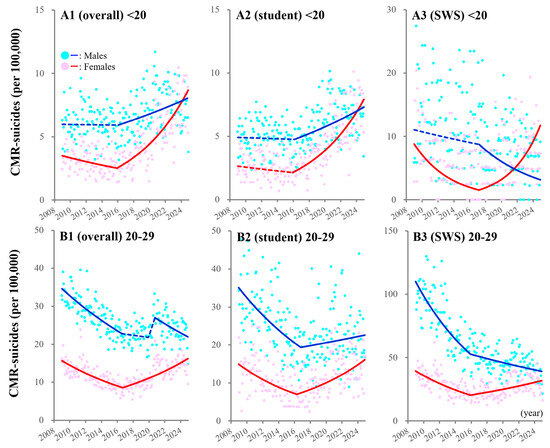
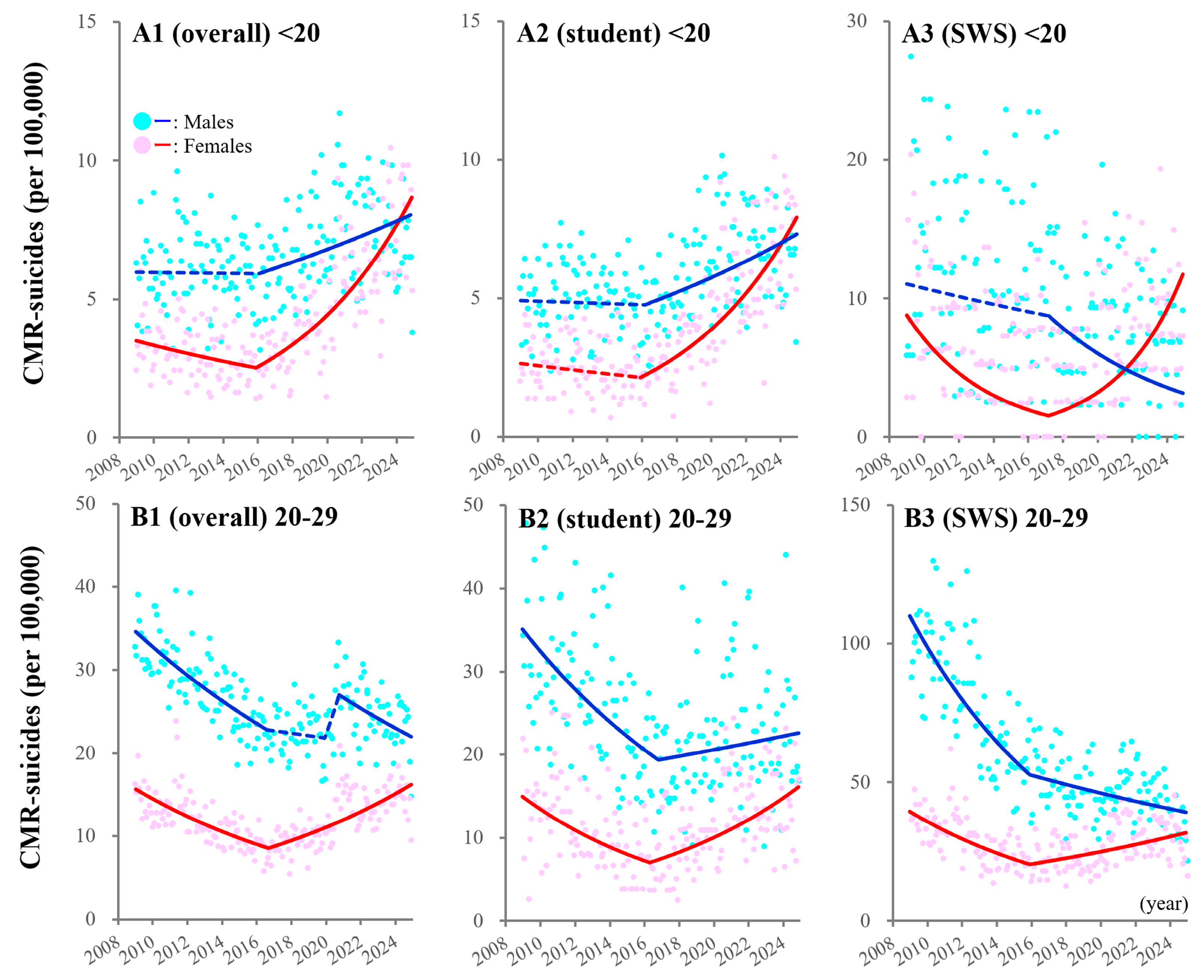
Among individuals under 20 years of age, overall CMR-suicides among females shifted from decreasing to increasing in 2016, whereas those among males shifted from unchanging to increasing (Figure 1). CMR-suicides among both male and female students transitioned from unchanging to increasing in 2016 (Figure 1). In contrast, CMR-suicides among females with SWS shifted from decreasing to increasing, while those among males shifted from unchanging to decreasing in 2016 (Figure 1). Notably, female CMR-suicides overall and among students and individuals with SWS exceeded those of males in 2024, 2023, and 2022, respectively.
Figure 1.
Temporal fluctuations of CMR-suicide for generation under 30 years of age in Japan (SSNPA/BDSR). Temporal fluctuation of annual CMR-suicides from 2009 to 2024 among generations under 20 years of age (A1–A3) and 20–29 years of age (B1–B3), including overall (A1,B1), students (A2,B2), and individuals with SWS (A3,B3), obtained from SSNPA/BDSR. Ordinates indicate the annualized monthly crude suicide mortality per 100,000 (CMR-suicide). Abscissas indicate calendar years. Blue and red indicated males and females, respectively. Circles indicate the observed data. Solid and dotted lines indicate the significant and nonsignificant trends of CMR-suicides detected using standard-model joinpoint regression analysis (JPRA), respectively.
Among individuals aged 20–29 years, overall female CMR-suicides and those among students and individuals with SWS also shifted from decreasing to increasing in 2016 (Figure 1). Overall CMR-suicides among males shifted from decreasing to unchanging in 2016, rose sharply in 2020, and subsequently decreased (Figure 1 and Supplementary Figure S1). Among male students, CMR-suicides shifted from decreasing to increasing in 2016, whereas CMR-suicides among males with SWS were consistently decreasing, although the decreasing trend attenuated in 2016 (Figure 1).
A well-recognized pattern in suicide epidemiology is that, generally, male suicides exceed those of females, a phenomenon often referred to as the “gender gap,” which has also been documented in adolescent suicides globally [12,17,18,37,38]. In Japan, this gender gap (males > females) was evident among individuals younger than 30 years during the 2010s. However, in the 2020s, female CMR-suicides overall and among students and individuals with SWS under 20 years of age exceeded those of males. Among individuals aged 20–29 years, male CMR-suicides remained higher than female CMR-suicides, yet the magnitude of the increasing trend was greater among females than among males beginning in 2016.
3.1.2. Fluctuation of CMR-Suicides of Students (SSNPA)
Temporal fluctuation analyses of monthly CMR-suicides among elementary school students could not be conducted because the number of suicides was too small for JPRA; therefore, fluctuations were examined using annual CMR-suicides (Table 1 and Supplementary Figure S2). Among elementary school students, CMR-suicides increased consistently for both males and females, and the levels remained nearly equivalent between genders throughout 2009–2024 (Supplementary Figure S2).
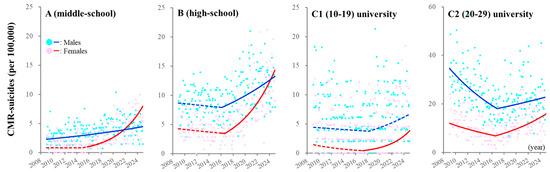
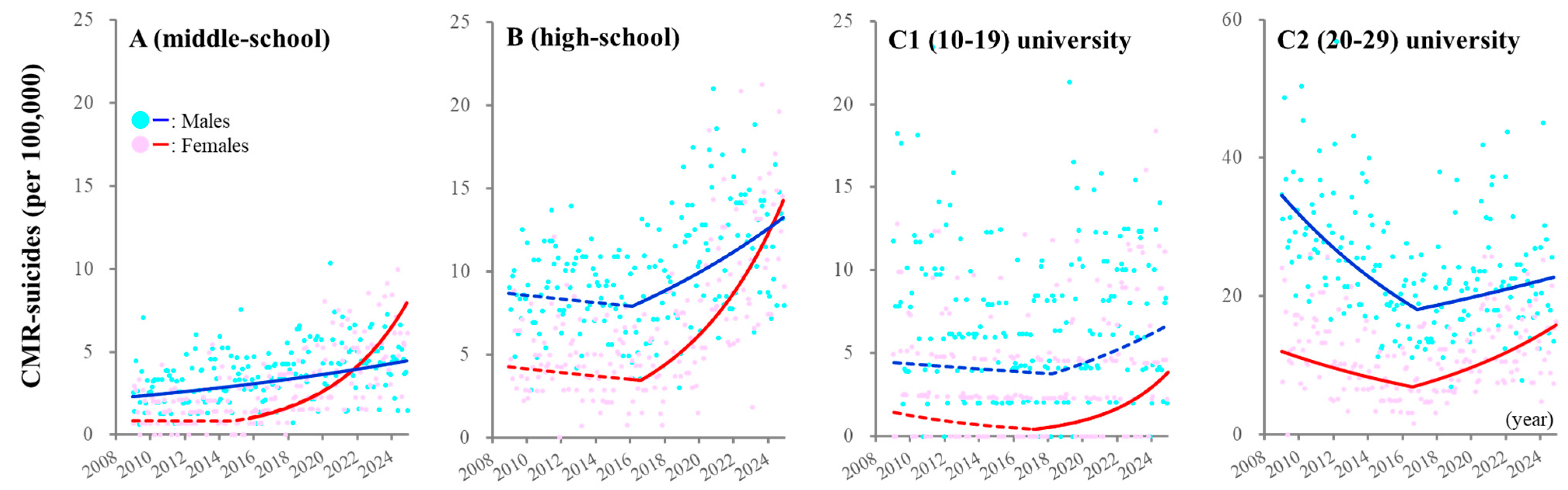
Among middle school students, CMR-suicides among males increased consistently from 2009 to 2024, whereas those among females changed from unchanging to increasing in 2016. Among high school students, CMR-suicides for both genders shifted from stable to increasing trends in 2016 (Figure 2). As a result, CMR-suicides of female middle school students surpassed those of males beginning in 2021 (Figure 2).
Figure 2.
Temporal fluctuations of CMR-suicide OK middle school, high school and university students (SSNPA/BDSR). Temporal fluctuation of annualized monthly CMR-suicides among middle school (A), high school (B), and university students under 20 years of age (C1) and over 20 years of age (C2), from 2009 to 2024, obtained from SSNPA/BDSR. Ordinates indicate the annualized monthly CMR-suicides (per 100,000). Abscissas indicate calendar years. Blue and red indicate males and females, respectively. Circles indicate the observed data. Solid and dotted lines indicate the significant and nonsignificant trends of CMR-suicides detected through standard-model JPRA, respectively.
Among university students younger than 20 years, CMR-suicides among males remained consistently unchanged from 2009 to 2024, whereas those among females shifted from unchanging to increasing in 2016. Among university students aged 20 years or older, CMR-suicides for both genders shifted from decreasing to increasing trends in 2016 (Figure 2). Female CMR-suicides among middle school and high school students exceeded those of males in 2022 and 2024, respectively. Although CMR-suicides among male university students remained higher than those among females in the 2020s, the increasing trend was more pronounced among females, raising concern that female university students may surpass males in the future.
Taken together with the findings in the above section, these results suggest that the marked increase in suicide rates among female youth in Japan may originate at earlier developmental stages, with the most pronounced changes emerging first in middle school, followed by high school and then university.
SSNPA/BDSR had previously reported only the total number of suicides among all high school students up to 2021, whereas SSNPA/BDSR began publishing suicide numbers separately for regular-time and part-time high school students in 2022. Therefore, although the observation period was short, differences in the average CMR-suicides, including among high school students between 2022 and 2024, were analyzed by LMM.
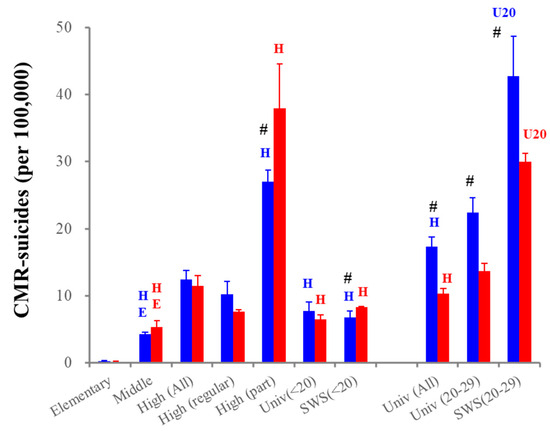
CMR-suicides of part-time high school (males < females) students and individuals with SWS were greatest (males > females) among those under and over 20 years of age, respectively (Figure 3). Notably, CMR-suicides among male and female part-time high school students were approximately three-fold and five-fold higher, respectively, than those of regular-time high school students (Figure 3). In contrast, CMR-suicides among individuals with SWS under 20 years of age were almost equivalent to those of middle school students and lower than those of all high school students (regular-time plus part-time high school students). Among university students younger than 20 years, CMR-suicides were lower than those of all high school students but comparable to those of regular-time high school students, underscoring the substantial impact of the markedly elevated CMR-suicides observed among part-time high school students (Figure 3).
Figure 3.
Average CMR-suicides of generation under 30 years of age from 2022 to 2024. Blue and red bars indicate average CMR-suicides of males and females from 2022 to 2024, respectively. Ordinates indicate the mean ± SD of annual CMR-suicides (per 100,000). #: p < 0.05 vs. average female CMR-suicides. E: p < 0.05 vs. average CMR-suicides of elementary school students. H: p < 0.05 vs. average CMR-suicides of high school students [High (All)]. U20: p < 0.05 vs. average CMR-suicides of university students under 20 years of age [Univ (<20)] using linear mixed effect model (LMM) with Scheffe’s post hoc test.
3.1.3. Fluctuation of CMR-Suicides of Students Disaggregated by Grade (SUBSNAS)
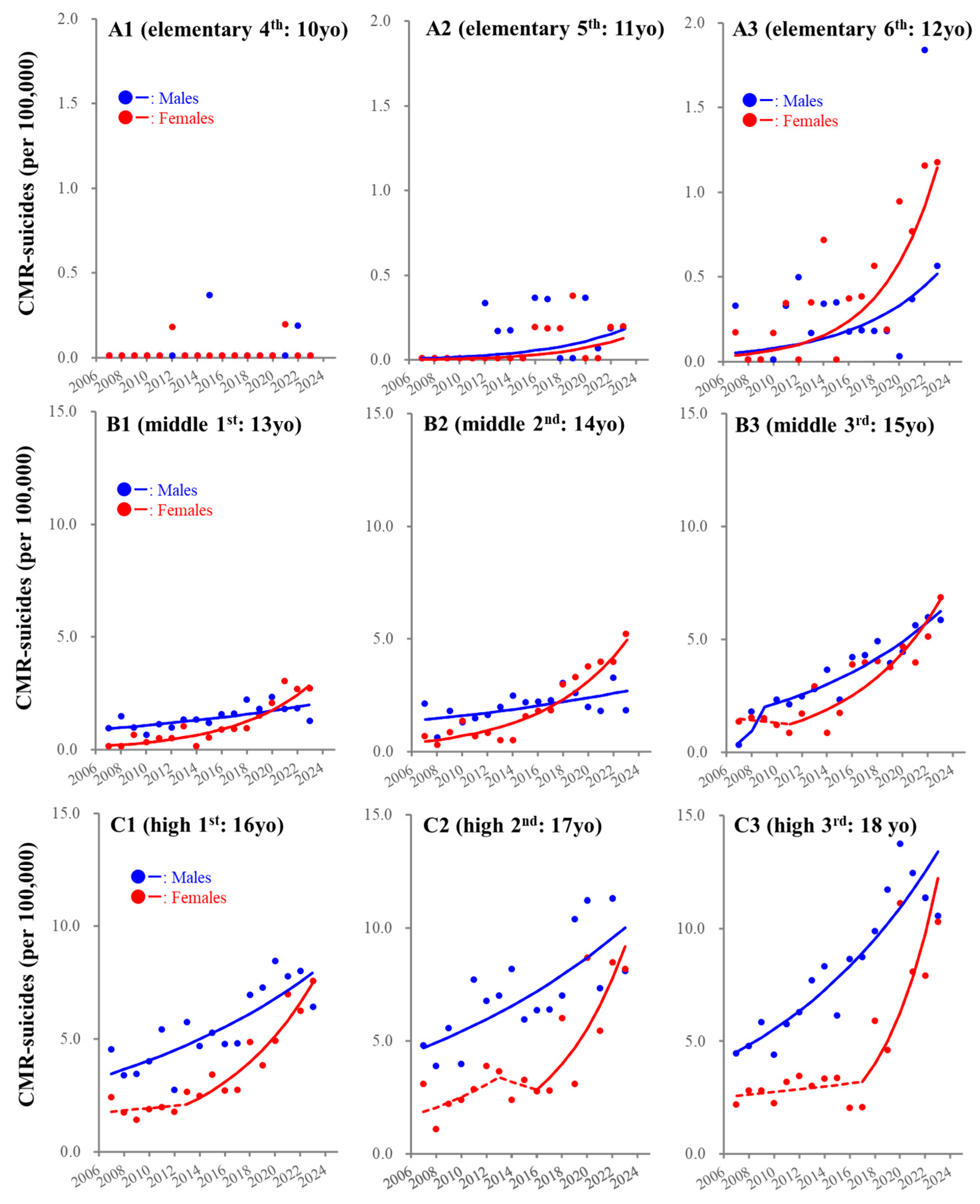
SUBSNAS provides annual suicide numbers for each school grade, from the first grade in elementary school to the fourth grade in high school, up to 2023, enabling more precise analyses of age- and grade-dependent trends in suicide rates. Because the number of suicides among elementary school students in the fourth grade and below was extremely small, statistical analyses using JPRA were not feasible for these grades (Figure 4). Among fifth- and sixth-grade elementary school students, CMR-suicides increased consistently for both males and females from 2009 to 2023. CMR-suicides among fifth-grade female students were nearly equivalent to those of males throughout 2007–2023, whereas, among sixth-grade students, female CMR-suicides became more frequent than those of males beginning in the mid-2010s (Figure 3).
Figure 4.
Temporal fluctuations of CMR-suicides for elementary school, middle school and high school students (SUBSNAS). Temporal fluctuation of annual CMR-suicides among 4th (A1), 5th (A2) and 6th (A3) grades for elementary school students, among 1st (B1), 2nd (B2) and 3rd (B3) grades for middle school students, and among 1st (C1), 2nd (C2) and 3rd (C3) grades for high school students from 2007 to 2023, obtained from SUBSNAS. Ordinates indicate the annual CMR-suicides (per 100,000). Abscissas indicate calendar years. Blue and red indicate males and females, respectively. Circles indicate the observed data. Solid and dotted lines indicate the significant and nonsignificant trends in CMR-suicides detected using standard-model JPRA, respectively.
Among middle school students, CMR-suicides among males in all grades increased consistently from 2007 to 2023. CMR-suicides among first- and second-grade female middle school students also increased consistently during this period, while those among third-grade female students shifted from stable to increasing trends beginning in 2011. Among high school students, CMR-suicides among males in all grades consistently increased from 2007 to 2023. Among females, CMR-suicides in the first, second, and third grades shifted from stable to increasing trends in 2013, 2016, and 2017, respectively. Notably, CMR-suicides among fourth-grade male and female high school students were markedly higher than those observed in other high school grades.
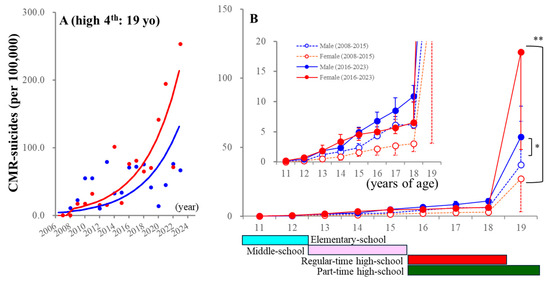
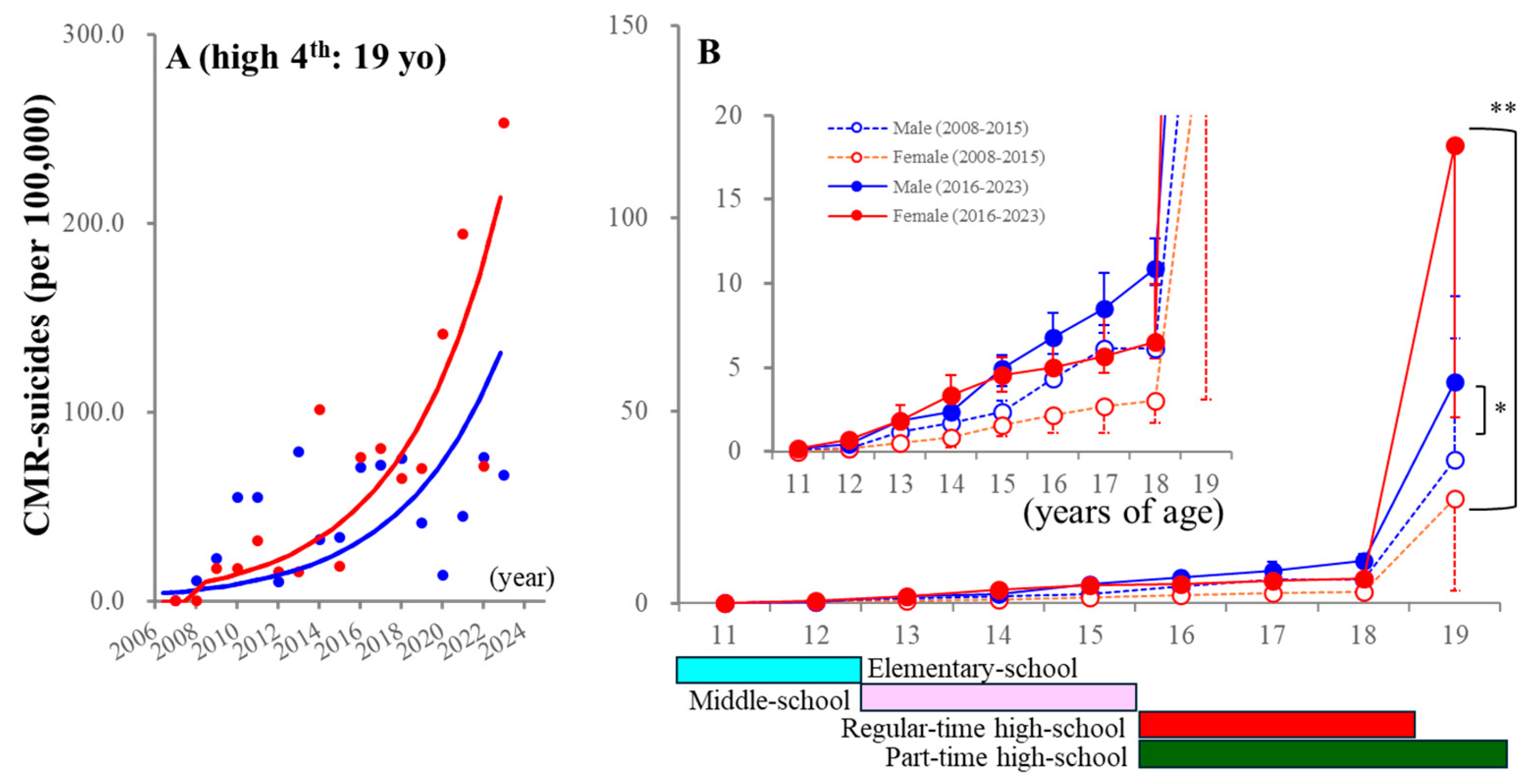
LMM identified age-dependent increases in CMR-suicides among male and female students from the fifth grade of elementary school to the fourth grade of high school (Figure 5). For both genders, CMR-suicides were more frequent during 2016–2023 than during 2007–2015 (Figure 5). From 2007 to 2015, CMR-suicides were consistently higher among male students than among females; however, this gender gap was no longer evident during 2016–2023. Notably, among fourth-grade high school students (19 years of age), CMR-suicides were more frequent among females than males throughout 2016–2023 (Figure 5).
Figure 5.
Temporal fluctuations of CMR-suicides for 4th grade high school students (SUBSNAS) (A) and average CMR-suicides of students between 11 (5th grade of elementary school) and 19 years of age (4th grade of high school) from 2016 to 2023 (B). Ordinate in panel (A) indicates annual CMR-suicides (per 100,000) of 4th-grade high school students (19 years of age: 19 yo). Abscissas indicate calendar years. Blue and red indicate males and females, respectively. Circles indicate the observed data. Solid and dotted lines indicate the significant and nonsignificant trends of CMR-suicides detected using standard-model JPRA, respectively. Ordinates in panel (B) indicate average annual CMR-suicides (per 100,000) from 5th grade of elementary school (11 years of age) to 4th grade of high school (19 years of age) from 2007 to 2015 (opened circles) and from 2016 to 2023 (closed circles), which were determined using LMM with Scheffe’s post hoc test. Blue and red indicate males and females, respectively. * p < 0.05, ** p < 0.01 vs. from 2007 to 2015.
Strikingly, CMR-suicides among fourth-grade high school students were more than ten-fold higher for males and more than twenty-fold higher for females compared with third-grade high school students (18 years of age) (Figure 5). Given that fourth-grade high school students in Japan attend only part-time high schools but not regular-time high schools, the extremely elevated CMR-suicides observed in this group likely reinforce the finding that CMR-suicide rates among part-time high school students reported by SSNPA are substantially higher than those of regular-time high school students.
In Japan, the “School Education Act” established the standard duration of enrollment at three years for regular-time high schools and at longer than three years for part-time high schools. Therefore, the results regarding part-time high school (Figure 3) and fourth-grade high school (19 years of age) (Figure 5) emphasized the possibility that students enrolled in part-time high school are in the highest-risk group for suicide among individuals under 20 years of age in Japan.
3.2. Causality Analyses
Fluctuation analyses revealed that CMR-suicides of males under 20 years of age (excluding university students and individuals with SWS) and females under 30 years of age (all groups) consistently increased from the mid-2010s, particularly around 2016. Notably, in the mid-2010s, in terms of the gender differences regarding fluctuations in CMR-suicides of individuals with SWS under 20 years of age, CMR-suicides of males and females with SWS decreased and increased, respectively. These discrepancies suggest that the factors associated with education that contributed to the increasing suicides of those under 20 years of age in the mid-2010s were not identical between males and females.
3.2.1. Fluctuation of Monthly CMR-Suicides of Youth Generations Disaggregated by Major Category of Suicide Motives (SSNPA/BDSR)
CMR-suicides disaggregated by suicide cause derived from SSNPA/BDSR were analyzed using jump-model JPRA and ITSA, which are effective statistical methods for detecting fluctuations under coding changes [28,31,32,33,36], due to the revision of the survey method for SSNPA in 2022 [34,35].
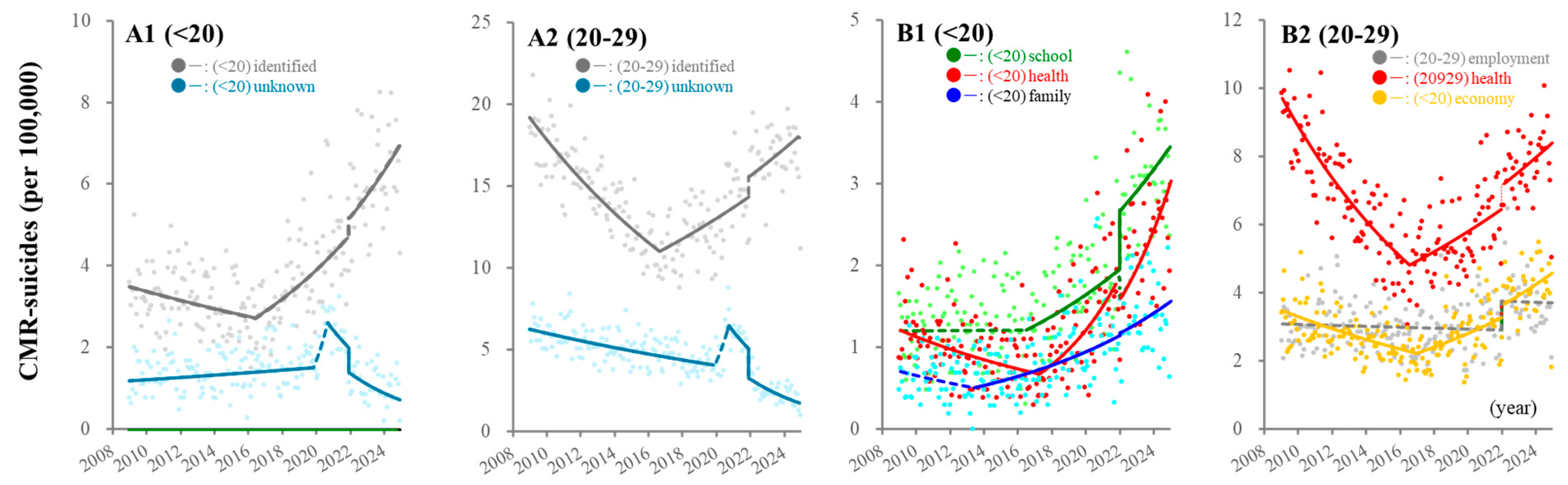
Among individuals aged < 20 and 20–29 years, jump-model JPRA and ITSA indicated that CMR-suicides with unspecified motives increased sharply following the onset of the COVID-19 pandemic in 2020, with a negative discontinuity (jump effect) detected in 2022, corresponding to the revision of the SSNPA survey method (Figure 6 and Supplementary Figure S3). In contrast, CMR-suicides with specified motives shifted from decreasing to increasing trends in 2016, without a significant discontinuity associated with the survey revision (Figure 6).
Figure 6.
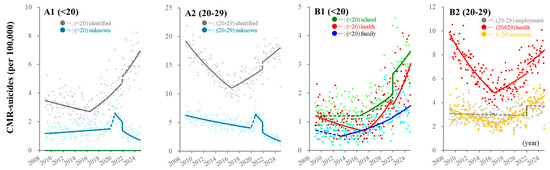
Temporal fluctuations of CMR-suicide caused by major suicidal motives of generations <20 and 20–29 from 2009 to 2024 in Japan. Temporal fluctuation of annualized monthly CMR-suicides caused by major motives among generations under 20 years (A1,B1) and 20–29 years of age (A2,B2) in Japan using jump-model JPRA. Panels (A1,A2) indicate CMR-suicides of individuals <20 and 20–29 with identified and unspecified suicidal motives, respectively. Panel (B1) indicates CMR-suicides of individuals <20 caused by school-, health- and family-related problems. Panel (B2) indicates CMR-suicides of individuals 20–29 years of age caused by health-, economy- and employment-related problems. Ordinates indicate the annualized monthly CMR-suicides (per 100,000). Abscissas indicate calendar years. Circles indicate the observed data. Solid and dotted lines indicate the significant and nonsignificant trends of CMR-suicides detected using jump-model JPRA, respectively.
During the 2020s, school-related, health-related, and family-related motives were the predominant suicide motives among individuals aged < 20 years, whereas health-related, economy-related, and employment-related motives were dominant among those aged 20–29 years (Figure 6). CMR-suicides attributed to health-related motives in both age groups, as well as those attributed to economy-related motives among individuals aged 20–29 years, shifted from decreasing to increasing trends in 2016, without significant discontinuity following the survey revision. CMR-suicides due to school-related motives among those aged < 20 years also shifted from decreasing to increasing in 2016, accompanied by a positive discontinuity at the time of survey revision. CMR-suicides attributed to family-related motives among individuals aged < 20 years shifted from stable to increasing trends in 2014, without evidence of discontinuity. Trends in CMR-suicides due to employment-related motives among individuals aged 20–29 years remained unchanged from 2009 to 2024 but demonstrated a positive discontinuity associated with the survey revision (Figure 6).
Due to the revision of the survey methodology of SSNPA in 2022, growing concerns were reported that accurate analyses of causality related to suicide rates in Japan have become exceedingly difficult [34,35]. However, this study indicated that fluctuations in CMR-suicides disaggregated by motives can be analyzed using jump-model JPRA [28,36,39], since CMR-suicides caused by suicide motives are affected by survey revision; however, the fluctuation trends were maintained before and after the survey revision in 2022.
3.2.2. Fluctuation of Students CMR-Suicides Disaggregated by Subcategory of Suicide Motives (SSNPA/BDSR)
Among elementary school students, the leading suicide motives were family-related factors, including parental reprimand and family discord. Among male middle school students and older, underachievement was the predominant school-related suicide motive, followed by unstable peer relations. In contrast, among female middle school students and older, the leading school-related suicide motives were depression and other mental illnesses, followed by underachievement and unstable peer relations [5,16,40,41] (Supplementary Figures S4 and S5).
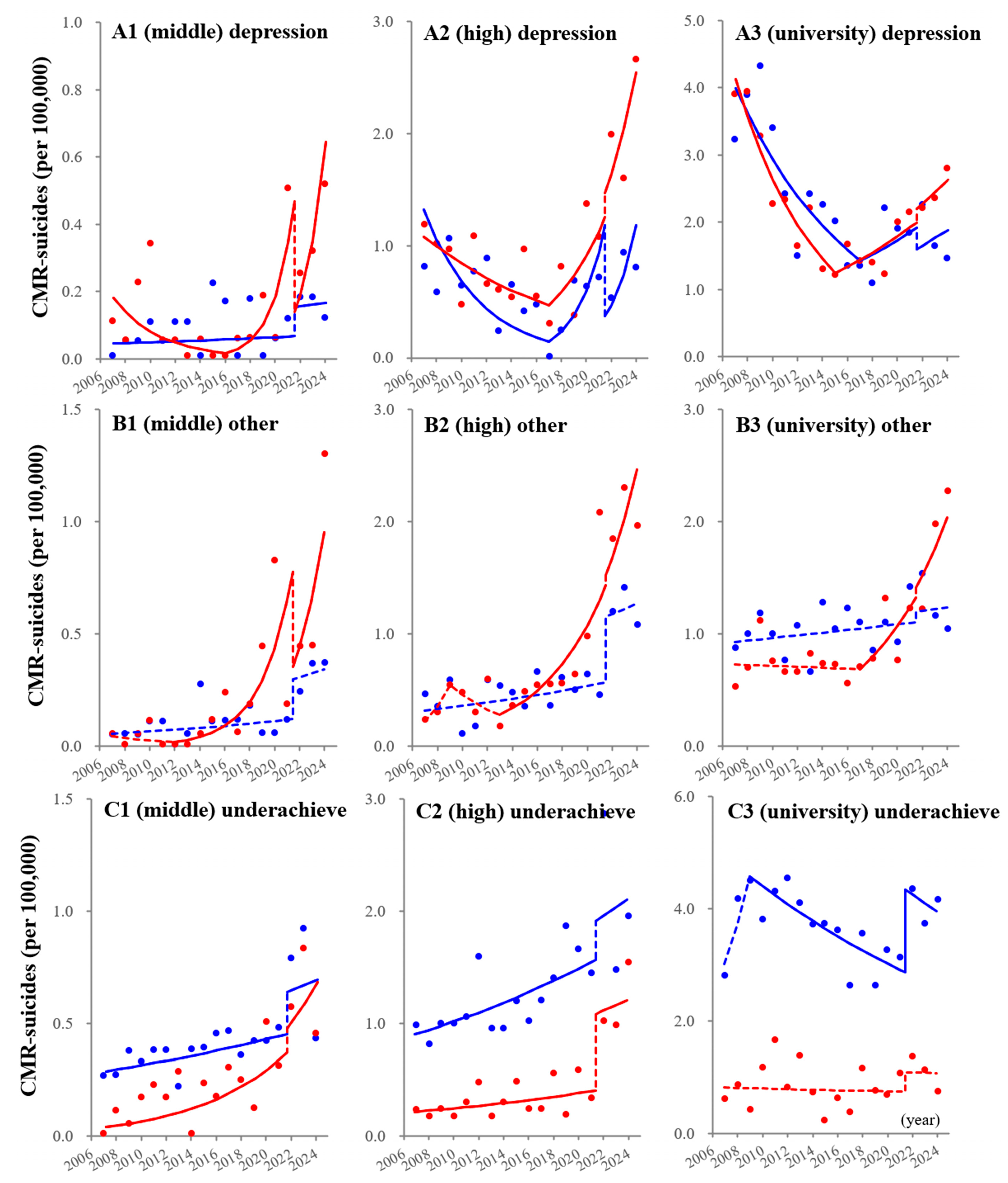
Temporal fluctuation analyses of annual CMR-suicides among elementary school students disaggregated by suicide motive could not be conducted using JPRA because the number of suicides was too small in both SSNPA and SUBSNAS datasets (Supplementary Figures S4 and S5). Among female students in middle school, high school, and university, annual CMR-suicides attributed to depression and other mental illnesses began increasing in the mid-2010s (Figure 5). CMR-suicides among male middle school and high school students caused by underachievement increased in 2017, while those among middle school males showed a consistent upward trend throughout the study period.
In contrast, CMR-suicides among middle school and high school students motivated by underachievement increased consistently from 2009 to 2024, whereas, among university students, CMR-suicides attributed to underachievement decreased among males and remained unchanged among females (Figure 7).
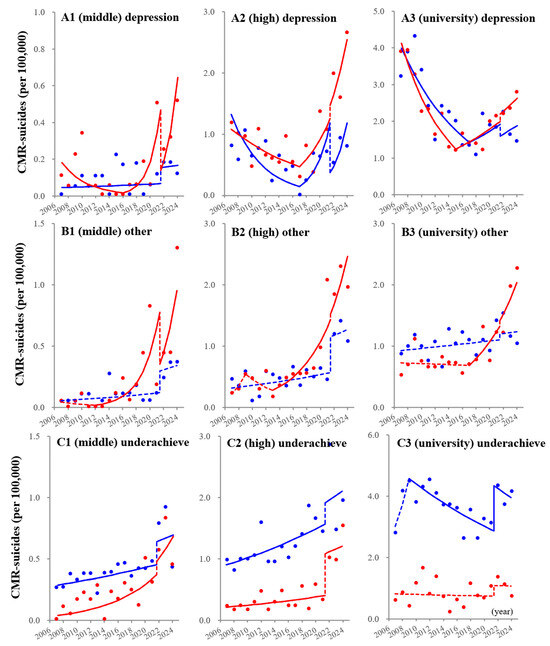
Figure 7.
Temporal fluctuations of student CMR-suicides caused by depression, other mental illness, and underachievement from 2007 to 2024 in Japan. Temporal fluctuations of student CMR-suicides caused by depression (A1–A3), other mental illness (B1–B3) and underachievement (C1–C3) among middle school (A1,B1,C1), high school (A2,B2,C2) and university (A3,B3,C3) students in Japan from 2007 to 2024 using jump-model JPRA. Ordinates indicate the annual CMR-suicides (per 100,000). Abscissas indicate calendar years. Circles indicate the observed data. Solid and dotted lines indicate the significant and nonsignificant trends of CMR-suicides detected using JPRA, respectively. Blue and red indicate males and females, respectively.
4. Discussion
This study revealed distinctive statistics in youth suicides in Japan (using two government suicide databases: SSNPA/BDSR and SUBSNAS) that diverge from the prevailing consensus. The identified findings were as follows: CMR-suicides among males under 20 years of age and among females under 30 years of age began increasing in the mid-2010s; however, these temporal fluctuations in youth CMR-suicides obviously differed from those in working-age individuals, which consistently decreased from 2009 onwards [3,4,39,42,43]. From the mid-2010s onwards, among all subgroups under 20 years of age, increasing trends of females CMR-suicides have been more pronounced than males, resulting in female CMR-suicides surpassing those of males in various groups; particularly for middle school students, high school students, and individuals with SWS in the 2020s. The disappearance of the gender gap in suicides of individuals under 20 years of age is a characteristic of contemporary Japan that has not been observed elsewhere and can be considered to be a unique and important finding in the field of suicide statistics. Notably, CMR-suicides of part-time high school students were highest among those under 20 years of age. In contrast, among those aged 20–29, individuals with SWS exhibited the highest rate of CMR-suicides, whereas, among those aged < 20, CMR-suicides among individuals with SWS were lower than among high school and university students. The leading suicide motive among females was psychiatric disorders, whereas underachievement was more prominent among males. These findings suggest that mental health deterioration—particularly psychologically internalizing problems, including depression and anxiety disorder [44,45]—plays an important role in the currently increasing CMR-suicide rates among youth in Japan, predominantly among females compared to males.
4.1. Potential Causalities Underlying Recent Increasing Suicides of Students in Japan
Several studies have already attempted to explore the causalities underlying the recently increasing rates of adolescent suicides. The impacts of financial expenditure, one’s household situation, GDP per capita, the Emergency Fund to Enhance Community-Based Suicide Countermeasures, the General Principles of Suicide Prevention Policy (GPSPP) during 2010s, and the COVID-19 pandemic on adolescent suicides have been analyzed, whereas clear impacts on adolescent suicides could not be detected [5,46,47,48,49]. In particular, during the initial phase of the COVID-19 pandemic, the positively significant impact of the outbreak of the pandemic on adolescent suicide was detectable [4,16,39,50]; however, in this study, subsequent temporal fluctuation analyses of data obtained after the resolution of the pandemic could not detect such positive impacts. These discrepancies emphasize that increasing adolescent suicides began before the pandemic, and the increase in adolescent suicides after the resolution of the pandemic was greater than the increase related to the pandemic.
This study indicates the possibility that internalizing problems probably contributed to the increasing suicides among adolescents in Japan (in particular, their impacts were predominant for females compared to males). Psychological issues, such as anxiety, worry, depressed mood, and social withdrawal behaviors are frequently observed signs in individuals with internalizing problems of school age [44,45]. Furthermore, long-term studies have revealed that students who have internalizing problems are more likely to experience future unemployment, criminal convictions, lower earnings, welfare receipt, intimate partnering difficulties, and earlier mortality [51,52]. In particular, SWS is one of the severe phenotypes of internalizing problems in adolescents [53]. Individuals with SWS, including NEETs and those with ESW, have been reported to be at risk for suicide due to a high level of loneliness, vulnerability to interaction with social networks, or secondary SWS, comorbid with psychiatric disorders [54,55,56,57,58,59]. Considering the psychological features of individuals with SWS, the early intervention and even prevention for youth with SWS, via supporting school attendance, have been considered to be effective for psychosocial prognosis [23,60,61]. In Japan, since the enactment of the “Act for Eliminating Discrimination against Persons with Disabilities” in 2016, provisions of reasonable accommodation for individuals with any disabilities (including psychiatric disorders) in an inclusive education system have been promoted to ensure equitable learning opportunities for students with physical and mental disabilities in public educational institutions [5,62]. In the context of university entrance examinations, support for applicants with disabilities has been significantly strengthened, contributing to a continual increase in the number of university entrants with physical, developmental, or mental health conditions; as a result, the promotion of support systems for students with disabilities in Japanese universities has become an important issue, and a support system for such students has been developing in Japan [5,16,63].
Moreover, these changes have affected not only university students but also those in high school [5,16]. Recently, enrollment in part-time high schools by middle school students who were unable to attend middle school due to school refusal or their own disabilities has increased by over 80% [24,27]. Academic credit in the part-time high school system is granted through a combination of distance-learning assignments, in-person instructional sessions (approximately 10–20 days per year of attendance), and formal examinations. Upon the successful completion of the required credits, students become eligible for high school graduation and qualify to sit for university entrance examinations. Therefore, advancing to part-time high school, which has more lenient attendance requirements compared to regular-time high school, has become an attractive educational opportunity for those who wish to obtain the qualifications to take the entrance exam for Japanese universities, where admission and study requirements are sympathetic towards individuals who had difficulty obtaining a regular-time high school diploma due to school refusal or disabilities. Based on these currently changing educational path orientations, analyzing the temporal fluctuations in suicide motives among CMR-suicides in students under 20 years of age can potentially identify some of the impactful factors underlying the gender differences among these individuals.
Considering the psychological features of individuals with SWS, early intervention (and even prevention) for youth with SWS, via supporting school attendance, has been considered to be effective for psychosocial prognosis [23,60,61]. Indeed, this study also detected decreasing CMR-suicides in males under 20 years of age with SWS. Therefore, the promotion of an inclusive educational system in Japan since 2016 could be playing an important role in decreasing CMR-suicides among those belonging to certain high-risk groups, such as males with SWS. However, the finding in this study that suicides among those under 20 years of age increased in all categories except for males with SWS suggests that the impacts of the promotion of an inclusive education system on the prevention of adolescent suicides might be limited. Pedagogical/didactic theories regarding the methods in which inclusive education may affect students with special educational needs cannot be fully established. Indeed, it has been postulated that a segregated education system can lead to stigmatization and social isolation, which may have detrimental effects on the self-concept and self-confidence of students with special educational needs; in particular, this system may negatively impact the self-esteem and confidence of students with special needs. However, placing students with special needs in regular classrooms without sufficient time/resources to provide individualized support can also lead to significant negative consequences [64,65]. Unfortunately, it has been reported that the allocations and performed roles of school counselors, school social workers, and school nurses are limited in part-time high schools compared to regular-time high schools in Japan [66,67]. Specifically, the majority of part-time high schools are attached to regular-time high schools in each region, and school counselors, school social workers, and school nurses assigned to each regular-time high school serve the part-time high school concurrently. Therefore, in order to effectively limit suicide among students in part-time high school, where attendance is not mandatory, it is necessary to develop and enhance methodological approaches to psychological support systems.
4.2. Potential Causalities Underlying Recent Increasing Suicides of Adolescents in Japan
This study suggests that internalizing problems probably contribute to the presently increasing suicide rates among adolescent females in Japan. It has been reported that internalization impacted not only high-risk subgroups but may also exert a dominant influence on females aged <30 compared to males in Japan, as suggested by an analysis using data provided from social media. Expressions concerning the “pain of living” or the fact that it is “hard to live” have gained attention as indicators of an impaired capacity to form autonomous social relationships, often accompanied by feelings of loneliness, anxiety, low self-esteem, hopelessness, and anger [68,69,70,71,72]. On social media in Japan, the use of the terms “pain of living” or “hard to live” has increased among males aged >30, whereas, among females, the frequency of their usage is already high among those under 30 years of age, with the highest posting rates observed in the 20–29 age group. Moreover, for those aged <20, the frequency of usage of these words by females was over five times greater than that by males. The alignment between age groups with a high usage of these expressions and with those in groups of individuals at an age with a high risk for suicide (or increasing CMR-suicide groups) suggests that impaired social relationship formation—namely, internalizing disorders—may be significantly occurring among adolescent females [5,16,17,18].
Numerous psychological studies have reported that parental rearing behavior plays an important role in the development of internalizing symptoms in children [70,71,72]. In 2020, the CFA launched a pilot initiative, the “Prefectural Child Death Review (CDR) System Development Model Project,” which incorporated school-based investigations into suicide motives—recognizing that schools, as institutions with the most daily contact with students, are uniquely positioned to observe behavioral changes [19]. However, SUBSNAS, which operates under administrative authority and requires parental consent for third-party investigations, conducted its “Qualitative and Contextual Analysis” in only 10% of cases. These data suggest that Japan could benefit from establishing a CDR framework similar to those in the United States and United Kingdom, where judicial authority is granted and bereavement support systems are mandated [73,74,75]. Such models can contribute to providing more comprehensive/fundamental insights into adolescent suicide and provide important contextual factors for enhancing home, school, and community suicide prevention strategies, which are urgently needed as suicide rates in this age group increase.
4.3. Limitations
This study has several limitations. While SSNPA/BDSR provides suicide statistics for students in middle school, high school, and university that are disaggregated by 72 subcategories of suicide motives, suicide data for employed and unemployed individuals aged <30 are only classified into seven major categories of suicide motives. As a result, the specific causalities among suicides of individuals with SWS under 30 years could not be analyzed. Additionally, because this is a cross-sectional observational study, the findings may be subject to ecological fallacy. Comparisons of CMR-suicide rates across different populations during the same period, or within the same population over time, are potentially influenced by unmeasured confounding factors. Therefore, any positive temporal associations observed between population characteristics and CMR-suicide fluctuations in Japan should be interpreted with caution and validated through more detailed, individual-level analyses in future research.
5. Conclusions
This study revealed increasing youth suicides among males under 20 years of age and females under 30 years of age from the 2010s to the mid-2020s in Japan. Importantly, CMR-suicides among females under 20 years of age have already been greater than those of males in the 2020s. Widespread increasing suicide rates for females under 30 years of age were largely influenced by internalizing problems, whereas school-related problems were the major suicide causes for male students (<20 years of age). The period when CMR-suicides of the generation of youth began increasing (in 2016) coincided with the start of the promotion of the inclusive education system in Japan. Therefore, the promotion of the inclusive education system may have contributed in some way to the increasing student suicides and the decreasing suicides among males with SWS under the age of 20. In other words, the promotion of the inclusive education system is probably successful in attracting individuals with SWS (suicide high risk) under the age of 20 to school, but this shifting of suicidal high risk individuals from SWS to school may be partially responsible for the increasing student suicides statistically. In light of the evidence indicating that a considerable proportion of adolescents at high risk for suicide in current Japan are enrolled in part-time high school, it is imperative to establish institutional frameworks and to implement the concentrated deployment of appropriately trained personnel—particularly professionals in psychology and mental health—capable of addressing the psychological characteristics of these students, including their pronounced internalizing problems.
Supplementary Materials
The following supporting information can be downloaded at: https://www.mdpi.com/article/10.3390/adolescents6010018/s1, Supplementary Table S1: Temporal fluctuations of monthly CMR-suicides from 2009 to 2024 in Japan; Supplementary Figure S1: Temporal fluctuations of CMR-suicides of males aged 20–29 from 2009 to 2024 using ITSA; Supplementary Figure S2: Temporal fluctuations of CMR-suicides for elementary school students from 2009 to 2024 using JPRA; Supplementary Figure S3: Temporal fluctuations of CMR-suicides of individuals <20 and 20–29 with unspecified suicidal motives from 2009 to 2024 using ITSA; Supplementary Figure S4: Average CMR-suicides caused by suicide motives among students from 2022 to 2024; Supplementary Figure S5: Temporal fluctuations of student CMR-suicides caused by suicide motives in SUBSNAS.
Author Contributions
M.O. conceptualized the study, contributed to the study design and methodology, and drafted and reviewed the manuscript. T.O. contributed to the study design and methodology, and coordinated extraction of the data. R.M. contributed to the study design and methodology, verified the underlying data, performed the statistical analysis and generated figures, and drafted and reviewed the manuscript. E.M. contributed to the study design and methodology, and coordinated extraction of the data. All authors have read and agreed to the published version of the manuscript.
Funding
This study is supported by Japan Society for the Promotion of Science (23K06987) and Regional Suicide Countermeasures Emergency Enhancement Fund of Mie Prefecture (2024-40). The funder had no role in the design and conduct of the study; collection, management, analysis, and interpretation of the data; preparation, review, or approval of the manuscript; or decision to submit the manuscript for publication.
Institutional Review Board Statement
Medical Ethics Review Committee of Mie University waived the need for ethical approval owing to the use of publicly available governmental data in the SSNPA and SUBSNAS.
Informed Consent Statement
Informed consent was not required in this study, since all data were obtained from anonymized government databases.
Data Availability Statement
The data presented in this study are available in Japanese national databases from SSNPA (Suicide Statistics): https://www.npa.go.jp/publications/statistics/safetylife/jisatsu.html (accessed on 1 November 2025); BDSR (Basic Data on Suicide in Region): https://www.mhlw.go.jp/stf/seisakunitsuite/bunya/0000140901.html (accessed on 1 November 2025); SUBSNAS: Survey on Undesirable Behavior and School Non-attendance of Students) https://www.mext.go.jp/b_menu/toukei/chousa01/shidou/1267646.htm (accessed on 1 November 2025); Surveys of Population, Population Change and the Number of Households based on the Basic Resident Registration https://www.e-stat.go.jp/en/statistics/00200241 (accessed on 1 November 2025); Labor Force Survey https://www.e-stat.go.jp/en/statistics/00200531 (accessed on 1 November 2025); School Basic Survey https://www.e-stat.go.jp/en/statistics/00400001 (accessed on 1 November 2025).
Acknowledgments
The authors are grateful for all the participants in the research.
Conflicts of Interest
The authors declare no conflicts of interest.
Abbreviations
The following abbreviations are used in this manuscript:
| BDSR | Basic Data on Suicide in Region |
| CDR | Prefectural Child Death Review |
| CMR | Crude Mortality Rate |
| CFA | Children and Families Agency |
| ESW | Extreme Social Withdrawal |
| JPRA | Joinpoint Regression Analysis |
| GPSPP | General Principles of Suicide Prevention Policy |
| LMM | Linear Mixed-Effect Model |
| MHLW | Ministry of Health, Labor and Welfare |
| METX | Ministry of Education, Culture, Sports, Science and Technology |
| Neets | Not in Employment, Education, or Training |
| NPA | National Police Agency |
| SSNPA | Suicide Statistics |
| SUBSNAS | Survey on Undesirable Behavior and School Non-attendance of Students |
| SWS | Social Withdrawal Spectrum |
| VSR | Vital Statistics Registration |
References
- Na, P.J.; Shin, J.; Kwak, H.R.; Lee, J.; Jester, D.J.; Bandara, P.; Kim, J.Y.; Moutier, C.Y.; Pietrzak, R.H.; Oquendo, M.A.; et al. Social Determinants of Health and Suicide-Related Outcomes: A Review of Meta-Analyses. JAMA Psychiatry 2025, 82, 337–346. [Google Scholar] [CrossRef] [Scilit] [PubMed]
- Favril, L.; Yu, R.; Geddes, J.R.; Fazel, S. Individual-Level Risk Factors for Suicide Mortality in the General Population: An Umbrella Review. Lancet Public Health 2023, 8, e868–e877. [Google Scholar] [PubMed]
- Okada, M.; Matsumoto, R.; Motomura, E.; Shiroyama, T.; Murata, M. Exploring Characteristics of Increased Suicide during the COVID-19 Pandemic in Japan Using Provisional Governmental Data. Lancet Reg. Health West. Pac. 2022, 24, 100481. [Google Scholar] [CrossRef] [Scilit] [PubMed]
- Matsumoto, R.; Motomura, E.; Okada, M. Fluctuation of Suicide Mortality and Temporal Causality from Unemployment Duration to Suicide Mortality in Japan During 2009–2022. Asian J. Psychiatr. 2023, 84, 103574. [Google Scholar] [CrossRef] [Scilit]
- Matsumoto, R.; Motomura, E.; Shiroyama, T.; Okada, M. Impact of the Japanese Government’s “General Policies for Comprehensive Measures against Suicide” on Youth Suicide from 2007–2022. BJPsy Open 2023, 10, e16. [Google Scholar] [CrossRef] [Scilit]
- Oka, T.; Matsumoto, R.; Motomura, E.; Okada, M. Suicides Mortality of Unemployed Individuals Becomes a Serious Public Health Concern in Japan in Post-COVID-19 Pandemic Era. Int. J. Environ. Res. Public Health 2025, 22, 1315. [Google Scholar] [CrossRef] [Scilit]
- Okubo, R.; Matsumoto, R.; Motomura, E.; Okada, M. Uncertainties of Economic Policy and Government Management Stability Played Important Roles in Increasing Suicides in Japan from 2009 to 2023. Int. J. Environ. Res. Public Health 2024, 21, 1366. [Google Scholar] [CrossRef] [Scilit]
- Baker, S.R.; Bloom, N.; Davis, S.J. Measuring Economic Policy Uncertainty*. Q. J. Econ. 2016, 131, 1593–1636. [Google Scholar] [CrossRef] [Scilit]
- Brent, D.A. Commentary: Reducing Adolescent Suicide: A Global Imperative—A Reflection on Glenn et al. (2020). J. Child Psychol. Psychiatry 2020, 61, 309–311. [Google Scholar] [CrossRef] [Scilit]
- Campisi, S.C.; Carducci, B.; Akseer, N.; Zasowski, C.; Szatmari, P.; Bhutta, Z.A. Suicidal Behaviours among Adolescents from 90 Countries: A Pooled Analysis of the Global School-Based Student Health Survey. BMC Public Health 2020, 20, 1102. [Google Scholar] [CrossRef] [Scilit]
- Abio, A.; Owusu, P.N.; Posti, J.P.; Barnighausen, T.; Shaikh, M.A.; Shankar, V.; Lowery Wilson, M. Cross-National Examination of Adolescent Suicidal Behavior: A Pooled and Multi-Level Analysis of 193,484 Students from 53 LMIC Countries. Soc. Psychiatry Psychiatr. Epidemiol. 2022, 57, 1603–1613. [Google Scholar] [CrossRef] [Scilit]
- Hughes, J.L.; Horowitz, L.M.; Ackerman, J.P.; Adrian, M.C.; Campo, J.V.; Bridge, J.A. Suicide in Young People: Screening, Risk Assessment, and Intervention. BMJ 2023, 381, e070630. [Google Scholar] [CrossRef] [Scilit] [PubMed]
- Naghavi, M.; Global Burden of Disease Self-Harm Collaborators. Global, Regional, and National Burden of Suicide Mortality 1990 to 2016: Systematic Analysis for the Global Burden of Disease Study 2016. BMJ 2019, 364, l94. [Google Scholar] [CrossRef] [Scilit] [PubMed]
- Turecki, G.; Brent, D.A.; Gunnell, D.; O’Connor, R.C.; Oquendo, M.A.; Pirkis, J.; Stanley, B.H. Suicide and Suicide Risk. Nat. Rev. Dis. Primers 2019, 5, 74. [Google Scholar] [CrossRef] [Scilit] [PubMed]
- Goldston, D.B.; Walrath, C. The Garrett Lee Smith Memorial Act: A Description and Review of the Suicide Prevention Initiative. Annu. Rev. Clin. Psychol. 2023, 19, 261–275. [Google Scholar] [CrossRef] [Scilit]
- Okada, M.; Matsumoto, R.; Shiroyama, T.; Motomura, E. Suicidal Mortality and Motives among Middle-School, High-School and University Students. JAMA Netw. Open 2023, 6, e2328144. [Google Scholar] [CrossRef] [Scilit]
- Okubo, R.; Matsumoto, R.; Motomura, E.; Okada, M. Adolescent Suicides in the Western Pacific Region Have Become a More Serious Public Health Problem Than in Other Regions. Psychiatry Int. 2024, 5, 564–584. [Google Scholar] [CrossRef] [Scilit]
- Okubo, R.; Matsumoto, R.; Motomura, E.; Okada, M. Temporal Fluctuations of Adolescent Suicides in OECD Countries from 1990–2019. J. Affect. Disord. Rep. 2025, 19, 100857. [Google Scholar] [CrossRef] [Scilit]
- CO. Children and Families Agency. Available online: https://www.cfa.go.jp/en (accessed on 1 September 2025).
- MHLW. The 2024 White Paper on Suicide Countermeasures. Available online: https://www.mhlw.go.jp/content/001464705.pdf (accessed on 1 April 2025).
- Basic Data on Suicide in Region. Available online: https://www.mhlw.go.jp/stf/seisakunitsuite/bunya/0000140901.html (accessed on 1 April 2025).
- NPA. Suicide Statistics. Available online: https://www.npa.go.jp/publications/statistics/safetylife/jisatsu.html (accessed on 1 April 2025).
- Muris, P.; Ollendick, T.H. Contemporary Hermits: A Developmental Psychopathology Account of Extreme Social Withdrawal (Hikikomori) in Young People. Clin. Child Fam. Psychol. Rev. 2023, 26, 459–481. [Google Scholar] [CrossRef] [Scilit]
- MEXT. Survey on Undesirable Behavior and School Non-Attendance of Students. Available online: https://www.mext.go.jp/b_menu/toukei/chousa01/shidou/1267646.htm (accessed on 1 April 2025).
- MIAC. Surveys of Population, Population Change and the Number of Households Based on the Basic Resident Registration. Available online: https://www.e-stat.go.jp/en/statistics/00200241 (accessed on 1 April 2025).
- MHLW. Labor Force Survey. Available online: https://www.e-stat.go.jp/en/statistics/00200531 (accessed on 1 April 2025).
- MEXT. School Basic Survey. Available online: https://www.e-stat.go.jp/en/statistics/00400001 (accessed on 1 April 2025).
- Kim, H.J.; Fay, M.P.; Feuer, E.J.; Midthune, D.N. Permutation Tests for Joinpoint Regression with Applications to Cancer Rates. Stat. Med. 2000, 19, 335–351. [Google Scholar] [CrossRef] [Scilit]
- Li, J.; Chan, N.B.; Xue, J.; Tsoi, K.K.F. Time Series Models Show Comparable Projection Performance with Joinpoint Regression: A Comparison Using Historical Cancer Data from World Health Organization. Front. Public Health 2022, 10, 1003162. [Google Scholar] [CrossRef] [Scilit]
- Liu, B.; Kim, H.-J.; Feuer, E.J.; Graubard, B.I. Joinpoint Regression Methods of Aggregate Outcomes for Complex Survey Data. J. Surv. Stat. Methodol. 2023, 11, 967–989. [Google Scholar] [CrossRef] [Scilit]
- Linden, A. Conducting Interrupted Time-Series Analysis for Single- and Multiple-Group Comparisons. Stata J. Promot. Commun. Stat. Stata 2015, 15, 480–500. [Google Scholar] [CrossRef] [Scilit]
- Bernal, J.L.; Cummins, S.; Gasparrini, A. Interrupted Time Series Regression for the Evaluation of Public Health Interventions: A Tutorial. Int. J. Epidemiol. 2017, 46, 348–355. [Google Scholar] [CrossRef] [Scilit] [PubMed]
- Linden, A. A Comprehensive Set of Postestimation Measures to Enrich Interrupted Time-Series Analysis. Stata J. Promot. Commun. Stat. Stata 2017, 17, 73–88. [Google Scholar] [CrossRef] [Scilit]
- Harada, N.; Koda, M.; Nomura, S. Early Outcomes of Changes to Collection of Suicide Data in Japan. JAMA Netw. Open 2023, 6, e2347543. [Google Scholar] [CrossRef] [Scilit]
- Inoue, K.; Takeshima, T.; Yamauchi, T.; Fukunaga, T. An Urgent Problem: The Major Revisions of Suicide Statistics in Japan Greatly Hamper the Research. Lancet Reg. Health West. Pac. 2023, 39, 100852. [Google Scholar] [CrossRef] [Scilit]
- Chen, H.S.; Zeichner, S.; Anderson, R.N.; Espey, D.K.; Kim, H.J.; Feuer, E.J. The Joinpoint-Jump and Joinpoint-Comparability Ratio Model for Trend Analysis with Applications to Coding Changes in Health Statistics. J. Off. Stat. 2020, 36, 49–62. [Google Scholar] [CrossRef] [Scilit]
- Ruch, D.A.; Sheftall, A.H.; Schlagbaum, P.; Rausch, J.; Campo, J.V.; Bridge, J.A. Trends in Suicide among Youth Aged 10 to 19 Years in the United States, 1975 to 2016. JAMA Netw. Open 2019, 2, e193886. [Google Scholar] [CrossRef] [Scilit]
- Yu, B.; Chen, X. Age and Birth Cohort-Adjusted Rates of Suicide Mortality among US Male and Female Youths Aged 10 to 19 Years from 1999 to 2017. JAMA Netw. Open 2019, 2, e1911383. [Google Scholar] [CrossRef] [Scilit]
- Okada, M.; Matsumoto, R.; Motomura, E. Suicide Mortality Rates in Japan before and Beyond the COVID-19 Pandemic Era. Psychiatry Clin. Neurosci. Rep. 2024, 3, e188. [Google Scholar] [CrossRef] [Scilit]
- Nagamitsu, S.; Mimaki, M.; Koyanagi, K.; Tokita, N.; Kobayashi, Y.; Hattori, R.; Ishii, R.; Matsuoka, M.; Yamashita, Y.; Yamagata, Z.; et al. Prevalence and Associated Factors of Suicidality in Japanese Adolescents: Results from a Population-Based Questionnaire Survey. BMC Pediatr. 2020, 20, 467. [Google Scholar] [CrossRef] [Scilit] [PubMed]
- Mizuno, K.; Shu, Y.; Ota, M.; Kato, H. Inter-Peer Group Status and School Bullying: The Case of Middle-School Students in Japan. Adolescents 2022, 2, 252–262. [Google Scholar] [CrossRef] [Scilit]
- Goto, R.; Okubo, Y.; Skokauskas, N. Reasons and Trends in Youth’s Suicide Rates during the COVID-19 Pandemic. Lancet Reg. Health West. Pac. 2022, 27, 100567. [Google Scholar] [CrossRef] [Scilit] [PubMed]
- Tanaka, T.; Okamoto, S. Increase in Suicide Following an Initial Decline during the COVID-19 Pandemic in Japan. Nat. Hum. Behav. 2021, 5, 229–238. [Google Scholar] [CrossRef] [Scilit]
- Achenbach, T.M.; Edelbrock, C.S. The Classification of Child Psychopathology: A Review and Analysis of Empirical Efforts. Psychol. Bull. 1978, 85, 1275–1301. [Google Scholar] [CrossRef]
- Vasileva, M.; Graf, R.K.; Reinelt, T.; Petermann, U.; Petermann, F. Research Review: A Meta-Analysis of the International Prevalence and Comorbidity of Mental Disorders in Children between 1 and 7 Years. J. Child Psychol. Psychiatry 2021, 62, 372–381. [Google Scholar] [CrossRef] [Scilit]
- Kato, R.; Okada, M. Can Financial Support Reduce Suicide Mortality Rates? Int. J. Environ. Res. Public Health 2019, 16, 4797. [Google Scholar] [CrossRef] [Scilit]
- Okada, M.; Hasegawa, T.; Kato, R.; Shiroyama, T. Analysing Regional Unemployment Rates, Gdp Per Capita and Financial Support for Regional Suicide Prevention Programme on Suicide Mortality in Japan Using Governmental Statistical Data. BMJ Open 2020, 10, e037537. [Google Scholar] [CrossRef] [Scilit]
- Nakamoto, M.; Nakagawa, T.; Murata, M.; Okada, M. Impacts of Dual-Income Household Rate on Suicide Mortalities in Japan. Int. J. Environ. Res. Public Health 2021, 18, 5670. [Google Scholar] [CrossRef] [Scilit]
- Shiroyama, T.; Fukuyama, K.; Okada, M. Effects of Financial Expenditure of Prefectures/Municipalities on Regional Suicide Mortality in Japan. Int. J. Environ. Res. Public Health 2021, 18, 8639. [Google Scholar] [CrossRef] [Scilit]
- Okada, M. Is an Increase in Japan’s Suicides Caused by COVID-19 Alone? Asian J. Psychiatr. 2022, 78, 103320. [Google Scholar] [CrossRef] [Scilit] [PubMed]
- Vergunst, F.; Zheng, Y.; Domond, P.; Vitaro, F.; Tremblay, R.E.; Nagin, D.; Park, J.; Cote, S.M. Behavior in Childhood Is Associated with Romantic Partnering Patterns in Adulthood. J. Child Psychol. Psychiatry 2021, 62, 842–852. [Google Scholar] [CrossRef] [Scilit] [PubMed]
- Knapp, M.; King, D.; Healey, A.; Thomas, C. Economic Outcomes in Adulthood and Their Associations with Antisocial Conduct, Attention Deficit and Anxiety Problems in Childhood. J. Ment. Health Policy Econ. 2011, 14, 137–147. [Google Scholar] [PubMed]
- Nonaka, S.; Takeda, T.; Sakai, M. The Bidirectional Relationship between Hikikomori Behavioral Tendencies and Depressive Symptoms: A Three-Wave Longitudinal Study. J. Affect. Disord. 2026, 393, 120292. [Google Scholar] [CrossRef] [Scilit]
- Zhu, S.; Lee, P.H.; Wong, P.W.C. Investigating Prolonged Social Withdrawal Behaviour as a Risk Factor for Self-Harm and Suicidal Behaviours. BJPsych Open 2021, 7, e90. [Google Scholar] [CrossRef] [Scilit]
- Yong, R.; Nomura, K. Hikikomori Is Most Associated with Interpersonal Relationships, Followed by Suicide Risks: A Secondary Analysis of a National Cross-Sectional Study. Front. Psychiatry 2019, 10, 247. [Google Scholar] [CrossRef] [Scilit]
- Teo, A.R.; Fetters, M.D.; Stufflebam, K.; Tateno, M.; Balhara, Y.; Choi, T.Y.; Kanba, S.; Mathews, C.A.; Kato, T.A. Identification of the Hikikomori Syndrome of Social Withdrawal: Psychosocial Features and Treatment Preferences in Four Countries. Int. J. Soc. Psychiatry 2015, 61, 64–72. [Google Scholar] [CrossRef] [Scilit]
- Wong, P.W.; Li, T.M.; Chan, M.; Law, Y.W.; Chau, M.; Cheng, C.; Fu, K.W.; Bacon-Shone, J.; Yip, P.S. The Prevalence and Correlates of Severe Social Withdrawal (Hikikomori) in Hong Kong: A Cross-Sectional Telephone-Based Survey Study. Int. J. Soc. Psychiatry 2015, 61, 330–342. [Google Scholar] [CrossRef] [Scilit]
- Kato, T.A.; Tateno, M.; Shinfuku, N.; Fujisawa, D.; Teo, A.R.; Sartorius, N.; Akiyama, T.; Ishida, T.; Choi, T.Y.; Balhara, Y.P.; et al. Does the ‘Hikikomori’ Syndrome of Social Withdrawal Exist Outside Japan? A Preliminary International Investigation. Soc. Psychiatry Psychiatr. Epidemiol. 2012, 47, 1061–1075. [Google Scholar] [CrossRef] [Scilit]
- Frankova, I. Similar but Different: Psychological and Psychopathological Features of Primary and Secondary Hikikomori. Front. Psychiatry 2019, 10, 558. [Google Scholar] [CrossRef] [Scilit]
- Kato, T.A.; Kanba, S.; Teo, A.R. Hikikomori: Multidimensional Understanding, Assessment, and Future International Perspectives. Psychiatry Clin. Neurosci. 2019, 73, 427–440. [Google Scholar] [CrossRef] [Scilit] [PubMed]
- Li, T.M.; Wong, P.W. Youth Social Withdrawal Behavior (Hikikomori): A Systematic Review of Qualitative and Quantitative Studies. Aust. N. Z. J. Psychiatry 2015, 49, 595–609. [Google Scholar] [CrossRef] [Scilit] [PubMed]
- Ishii, T.; Tachikawa, H.; Shiratori, Y.; Hori, T.; Aiba, M.; Kuga, K.; Arai, T. What Kinds of Factors Affect the Academic Outcomes of University Students with Mental Disorders? A Retrospective Study Based on Medical Records. Asian J. Psychiatr. 2018, 32, 67–72. [Google Scholar] [CrossRef] [Scilit] [PubMed]
- Adachi, H.; Yamamura, A.; Nakamura-Taira, N.; Tanimukai, H.; Fujino, R.; Kudo, T.; Hirai, K. Factors That Influence Psychiatric Help-Seeking Behavior in Japanese University Students. Asian J. Psychiatr. 2020, 51, 102058. [Google Scholar] [CrossRef] [Scilit]
- Dalgaard, N.T.; Bondebjerg, A.; Viinholt, B.C.A.; Filges, T. The Effects of Inclusion on Academic Achievement, Socioemotional Development and Wellbeing of Children with Special Educational Needs. Campbell Syst. Rev. 2022, 18, e1291. [Google Scholar] [CrossRef] [Scilit]
- Tremblay, P. Comparative Outcomes of two Instructional Models for Students with Learning Disabilities: Inclusion with Co-Teaching and Solo-Taught Special Education. J. Res. Spec. Educ. Needs 2013, 13, 251–258. [Google Scholar] [CrossRef] [Scilit]
- Nishio, A.; Kakimoto, M.; Horita, R.; Yamamoto, M. Compulsory Educational Mental Health Support System in Japan. Pediatr. Int. 2020, 62, 529–534. [Google Scholar] [CrossRef] [Scilit]
- Yamaguchi, S.; Foo, J.C.; Kitagawa, Y.; Togo, F.; Sasaki, T. A Survey of Mental Health Literacy in Japanese High School Teachers. BMC Psychiatry 2021, 21, 478. [Google Scholar] [CrossRef] [Scilit]
- Nae, N. Quo Vadis? Japanese Youth and the Burden of Living. Euromentor J.-Stud. About Educ. 2018, 9, 15–25. [Google Scholar]
- Tsuno, K.; Arimoto, A.; Imamatsu, Y.; Kobayashi, Y.; Satoh, M.; Miyazaki, T. Expressions of “Ikizurasa” in Posts on X (Formerly Twitter) in Japan in 2023: Descriptive Analysis. JMIR Form. Res. 2025, 9, e70613. [Google Scholar] [CrossRef] [Scilit]
- Perez, J.C.; Huerta, P.; Rubio, B.; Fernandez, O. Parental Psychological Control: Maternal, Adolescent, and Contextual Predictors. Front. Psychol. 2021, 12, 712087. [Google Scholar] [CrossRef] [Scilit]
- Khaleque, A. Perceived Parental Hostility and Aggression, and Children’s Psychological Maladjustment, and Negative Personality Dispositions: A Meta-Analysis. J. Child Fam. Stud. 2016, 26, 977–988. [Google Scholar] [CrossRef] [Scilit]
- Manuele, S.J.; Yap, M.B.H.; Lin, S.C.; Pozzi, E.; Whittle, S. Associations between Paternal Versus Maternal Parenting Behaviors and Child and Adolescent Internalizing Problems: A Systematic Review and Meta-Analysis. Clin. Psychol. Rev. 2023, 105, 102339. [Google Scholar] [CrossRef] [Scilit]
- NCFRP. Keeping Kids Alive: Child Death Review in the United States. 2020. Available online: https://ncfrp.org/what-we-do/cdr/ (accessed on 1 April 2025).
- DHSC. Child Death Review: Statutory and Operational Guidance (England). Available online: https://assets.publishing.service.gov.uk/government/uploads/system/uploads/attachment_data/file/1120062/child-death-review-statutory-and-operational-guidance-england.pdf (accessed on 1 April 2025).
- DfE. Working Together to Safeguard Children 2023: A Guide to Multi-Agency Working to Help, Protect and Promote the Welfare of Children. Available online: https://assets.publishing.service.gov.uk/media/6849a7b67cba25f610c7db3f/Working_together_to_safeguard_children_2023_-_statutory_guidance.pdf (accessed on 1 April 2025).

Disclaimer/Publisher’s Note: The statements, opinions and data contained in all publications are solely those of the individual author(s) and contributor(s) and not of MDPI and/or the editor(s). MDPI and/or the editor(s) disclaim responsibility for any injury to people or property resulting from any ideas, methods, instructions or products referred to in the content. |
© 2026 by the authors. Licensee MDPI, Basel, Switzerland. This article is an open access article distributed under the terms and conditions of the Creative Commons Attribution (CC BY) license.