
A Participatory Evaluation of the No le entres App Prototype for Tobacco Prevention Among Mexican Adolescents
 , ,
, ,  and
and
Abstract
1. Introduction
2. Materials and Methods
2.1. Study Design
2.2. Context
2.3. Sampling and Recruitment of Participants
2.4. Description of the Medium-Fidelity Prototype of No le entres
2.5. Data Collection
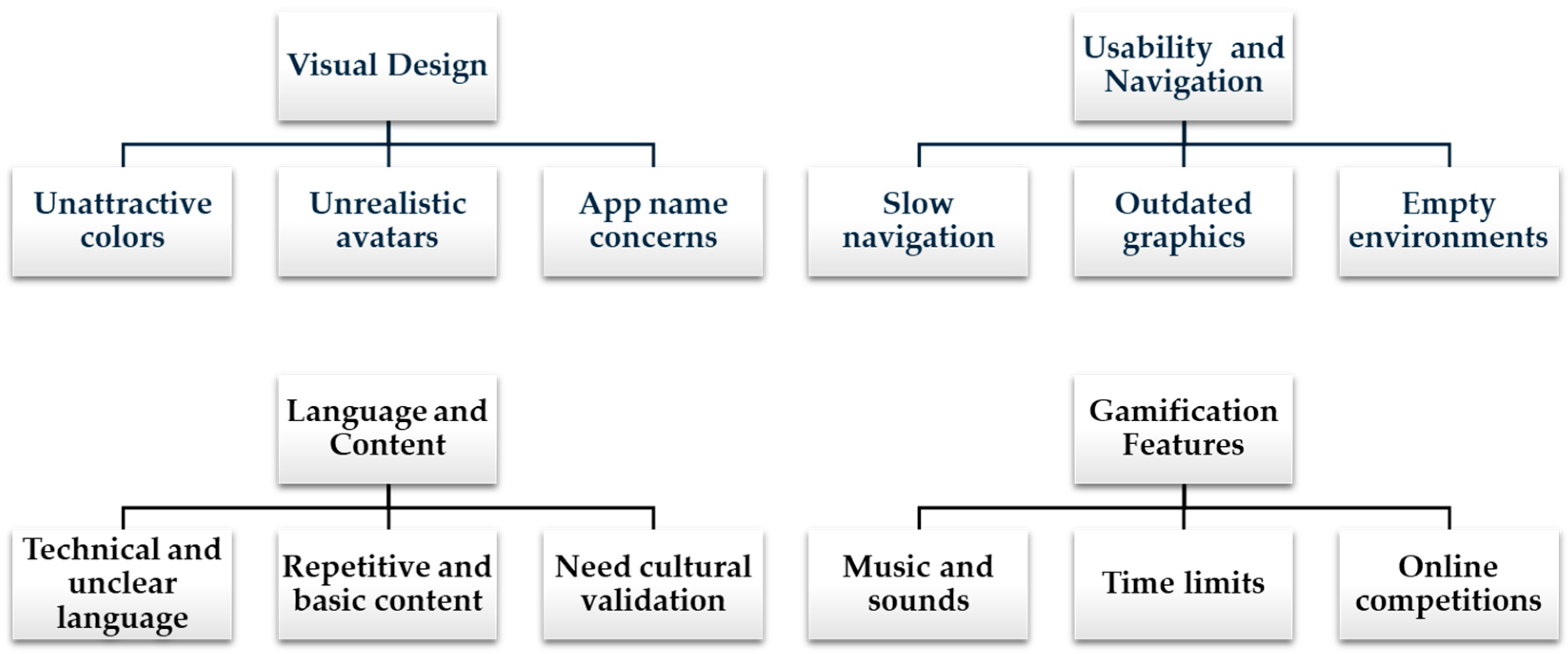
2.6. Analytic Categories and Subthemes Defined a Priori
2.6.1. Visual Design
2.6.2. Usability and Navigation
2.6.3. Language and Content
2.6.4. Gamification Features
2.7. Data Processing and Analysis
2.8. Trustworthiness, Triangulation, and Theoretical Saturation
2.9. Ethical Considerations
2.10. Use of Artificial Intelligence
3. Results
3.1. Interaction with the Prototype and Participants’ Experiences
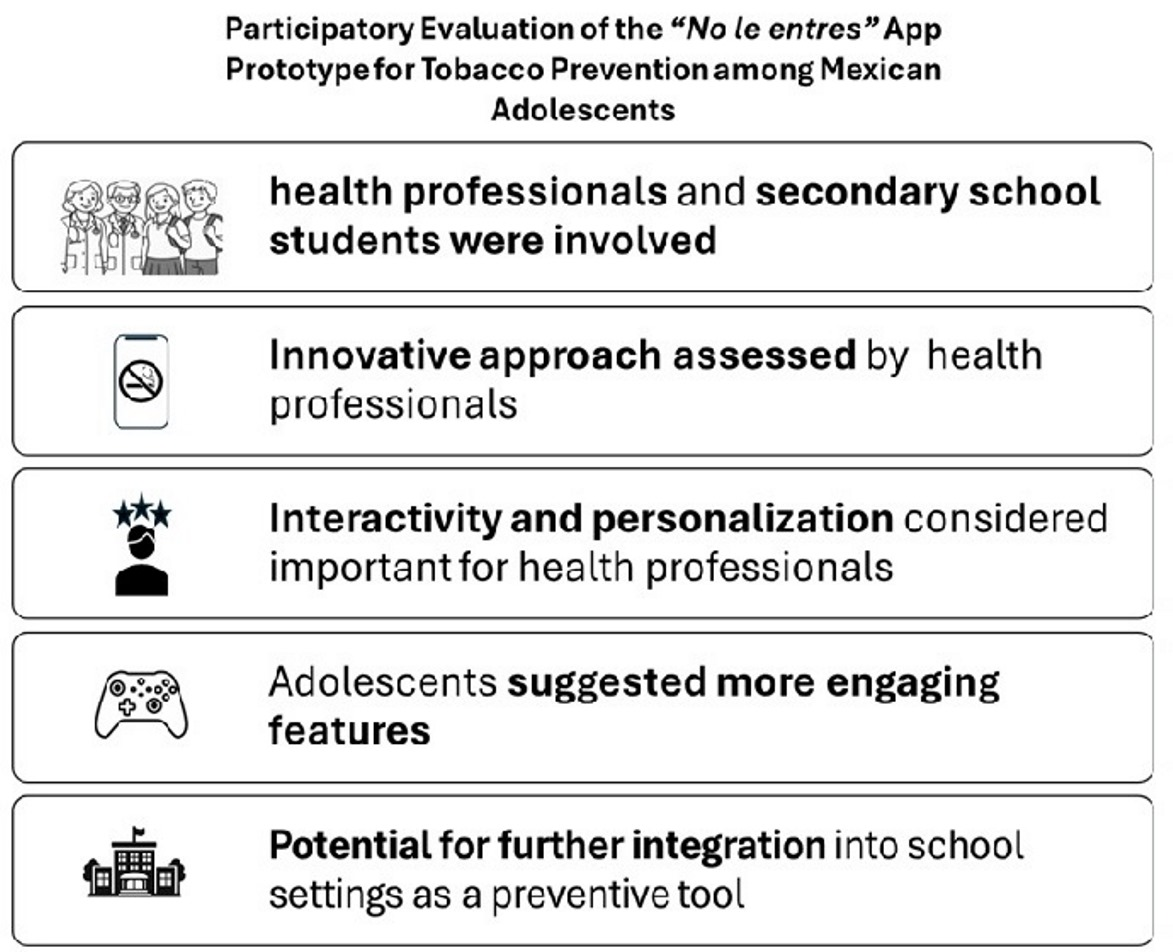
3.2. Overall Positive Reactions to the Prototype
3.3. Initial Analytic Categories Derived from the Study Framework
3.3.1. Visual Design
“Colors should be much more eye-catching for adolescents… the ones used looked too neutral”(Professional, Female)
“It focuses on a single color… it should change colors by level”(Student, Male)
“The avatars look strange, with big heads and small bodies… they don’t seem like teenagers”(Student, Male)
“The brain does not process the word ‘No,’ so subliminally it induces ‘Go ahead’”(Professional, Male)
“The name is attractive, it’s like telling you directly: don’t do it, don’t get into it… it’s concrete”(Student, Female)
3.3.2. Usability and Navigation
“In the end, they are going to say: this is too slow for what I’m looking for. It should be more interactive, with better resolution or faster progression”(Professional, Male)
“It looks kind of old, like from a long time ago. I would quit using it easily”(Student, Male)
“The open world feels very empty… there should be cars or more people”(Student, Male)
3.3.3. Language and Content
“Level 1 felt tedious because of too much text”(Student, Female)
“It’s very basic, like what they always tell you in school”(Student, Female)
“It would be better if instead of showing the typical, it was presented differently to catch our attention”(Student, Female)
“Showing tobacco images over and over… I’m not sure if it could be counterproductive”(Professional, Male)
“It can be useful… but not exclusively. Work with users must be approached from several angles. This application can help, yes, it can help”(Professional, Female)
3.3.4. Gamification Features
“If you put a countdown, people will feel pressured to win”(Student, Female)
“They could play in teams online, and if a teacher is watching in class… they’ll earn points”(Student, Female)
“Eventually, an app that sends you follow-up images of tobacco could create a feeling of disgust”(Professional, Male)
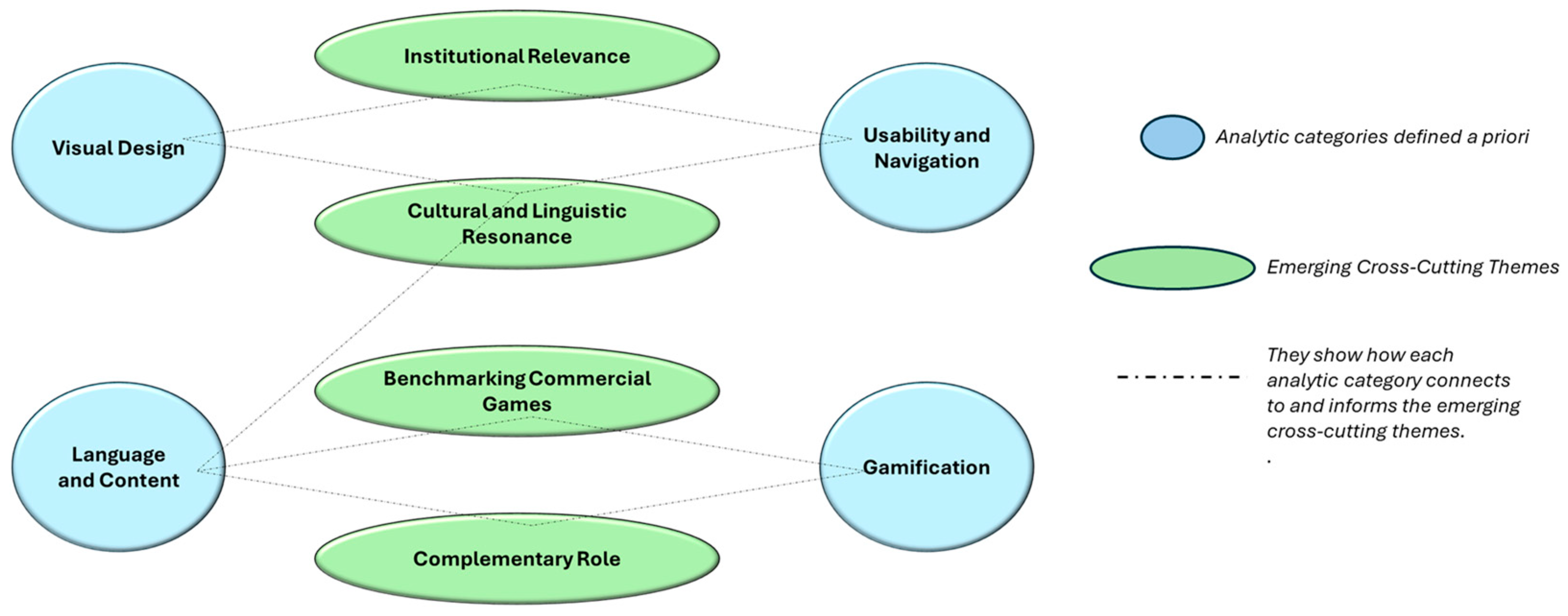
3.4. Emerging Cross-Cutting Themes
- Institutional Relevance: Health professionals emphasized the importance of embedding the application into school routines and existing prevention programs. Rather than being seen as a stand-alone product, its sustainability depends on institutional alignment and integration into broader public health strategies:“If it is not linked to the school program and to prevention activities that are already being carried out, the app will remain isolated and lose impact”(Professional, Female)
- Cultural and Linguistic Resonance: Although language clarity was considered within the main categories, both groups highlighted the need for content to be congruent with their culture and way of expression, ensuring resonance both culturally and linguistically:“The words they use should sound like the way we speak; otherwise, we are not going to take it seriously”(Student, Male)“The language has to be very clear, not prone to misinterpretations, and understandable for the kids according to their culture”(Professional, Female)
- Comparison with Commercial Video Games: Adolescents consistently evaluated the app in relation to commercial video games, setting higher expectations for visual quality, interactivity, and overall playability. This tendency illustrates that engagement with preventive applications is strongly conditioned by adolescents’ everyday digital experiences:“It looks very simple, like it’s for little kids, not like the games we usually play”(Student, Male)“If it were more like the games we play on our phones, with better graphics and more things to do, we would want to use it”(Student, Female)
- Complementary Role of the Application. Professionals considered No le entres not as a replacement for educational or therapeutic programs, but as a complementary tool. One professional summarized this perspective by stating:“It can be useful… but not exclusively. Work with users must be approached from several angles. This app can help, yes, it can help”(Professional, Female)“It can help, yes, but users need more than just an app. It must be part of a bigger plan”(Professional, Female)
3.5. Integration of Perspectives
3.6. Comparative Analysis of Themes Across Participant Groups
4. Discussion
5. Conclusions
Supplementary Materials
Author Contributions
Funding
Institutional Review Board Statement
Informed Consent Statement
Data Availability Statement
Acknowledgments
Conflicts of Interest
Abbreviations
| ENSANUT | National Health and Nutrition Survey |
| UNEME CECOSAMA | Medical Specialty Units—Community Mental Health and Addiction Centers |
| WHO | World Health Organization |
References
- Dahl, R.E. Adolescent Brain Development: A Period of Vulnerabilities and Opportunities. Ann. N Y Acad. Sci. 2004, 1021, 1–22. [Google Scholar] [CrossRef] [PubMed]
- Sawyer, S.M.; Azzopardi, P.S.; Wickremarathne, D.; Patton, G.C. The age of adolescence. Lancet Child Adolesc. Health 2018, 2, 223–228. [Google Scholar] [CrossRef] [PubMed]
- Miguel-Aguilar, C.F.; Rodríguez-Bolaños, R.d.L.Á.; Caballero, M.; Arillo-Santillán, E.; Reynales-Shigematsu, L.M. Smoking among adolescents: Quantitative and qualitative analysis of psychosocial factors associated with the decision to Mexican students smoking. Salud Publica Mex 2017, 59, S63–S72. [Google Scholar] [CrossRef] [PubMed]
- Urrutia-Pereira, M.; Solé, D.; Chong Neto, H.J.; Badellino, H.; Acosta, V.; Castro-Almarales, R.L.; León, M.; Avalos, M.; Fernández, C.; Sisul-Alvariza, J.; et al. Youth tobacco use in Latin America: What is the real extent of the problem? Allergol. Immunopathol. 2019, 47, 328–335. [Google Scholar] [CrossRef]
- Santano-Mogena, E.; Franco-Antonio, C.; Chimento-Díaz, S.; Rico-Martín, S.; Cordovilla-Guardia, S. Factors associated with smoking susceptibility among high school students in western Spain. Sci. Rep. 2021, 11, 1988. [Google Scholar] [CrossRef]
- Barrera-Nunez, D.A.; Lopez-Olmedo, N.; Zavala-Arciniega, L.; Barrientos-Gutierrez, I.; Reynales-Shigematsu, L.M. Tobacco consumption and e-cigarette use in Mexican adolescents and adults. Ensanut Continua 2022. Salud Publica Mex 2023, 65, S65–S74. [Google Scholar]
- Drope, S.; Hamill, S.; Chaloupka, F.; Guerrero, C.; Lee, H.M.; Mirza, M. The Tobacco Atlas 7th Edition [Internet]; World Health Organization: New York, NY, USA, 2022. Available online: https://www.vitalstrategies.org/resources/the-tobacco-atlas-7th-edition/ (accessed on 20 September 2024).
- Gianfredi, V.; Barbati, C.; Sgueglia, A.C.; Bertuccio, P.; Traverso, L.; Odone, A. Digital interventions in to-bacco prevention for school-aged children: Results of systematic review. Public Health 2025, 245, 105799. [Google Scholar] [CrossRef]
- Al-Mahrouqi, T.; Al-Ghailani, F.; Al-Maqbali, M.; Al Saidi, M.; Prashanth, G.P. A cluster randomized trial comparing photoaging app and school based educational intervention for tobacco use prevention in adolescents. Sci. Rep. 2025, 15, 15374. [Google Scholar] [CrossRef]
- Khalil, G.E.; McLean, D.; Ramirez, E.; Mihaj, P.P.; Zhao, B.; Dhar, B.; Khan, M. De-veloping a text-message library for tobacco prevention among adolescents: A qualitative study. PLoS ONE 2024, 19, e0296503. [Google Scholar] [CrossRef]
- Sweileh, W.M. Technology-based interventions for tobacco smoking prevention and treatment: A 20-year bibliometric analysis (2003–2022). Subst. Abus. Treat. Prev. Policy 2024, 19, 13. [Google Scholar] [CrossRef]
- Alsahli, F.A.; Alruwais, N.M.; Alsultan, L.S.; Abojalid, B.S.; Nughays, R.O.; Humedi, A.M.; Alosaimi, A.; Alrubaiaan, M.T.; Almuteri, D.Z.; Alkhunizan, M.A. Interventions for Prevention of Tobacco Smoking in School-Aged Children and Adolescents: A Systematic Review and Meta-Analysis. Cureus 2025, 17, e77008. [Google Scholar] [CrossRef] [PubMed]
- Valdivieso López, E.; Rey-Reñones, C.; Rodriguez-Blanco, T.; Ferre Grau, C.; Arija, V.; Barrera Uriarte, M.L.; Granado-Font, E.; Flores-Mateo, G.; TAB_ES Study Group. Efficacy of a smoking prevention programme in Catalan secondary schools: A cluster-randomized controlled trial in Spain. Addiction 2015, 110, 852–860. [Google Scholar] [CrossRef] [PubMed]
- Brinker, T.J.; Holzapfel, J.; Baudson, T.G.; Sies, K.; Jakob, L.; Baumert, H.M.; Heckl, M.; Cirac, A.; Suhre, J.L.; Mathes, V.; et al. Photoaging smartphone app promoting poster campaign to reduce smoking prevalence in secondary schools: The Smokerface Randomized Trial: Design and baseline characteristics. Open 2016, 6, 14288. [Google Scholar] [CrossRef] [PubMed]
- Uribe-Madrigal, R.D.; Gogeascoechea-Trejo, M.d.C.; Mota-Morales, M.d.L.; Ortiz-Chacha, C.S.; Salas-García, B.; Romero-Pedraza, E.; Ortiz-León, M.C. Secondary school students’ perceptions of a mobile application design for smoking prevention. Tob. Prev. Cessat. 2021, 7, 24. [Google Scholar] [CrossRef]
- Chan, A.; Kow, R.; Cheng, J.K. Adolescents’ Perceptions on Smartphone Applications (Apps) for Health Management. J. Mob. Technol. Med. 2017, 6, 47–55. [Google Scholar] [CrossRef]
- Leech, T.; Dorstyn, D.; Taylor, A.; Li, W. Mental health apps for adolescents and young adults: A systematic review of randomised controlled trials. Child Youth Serv. Rev. 2021, 127, 106073. [Google Scholar] [CrossRef]
- Ghosh, P.; Proffitt, R.; Bosworth, K.T.; Koopman, R.J.; Flowers, L.; Wilson, G.; Tosh, A.K.; Braddock, A.S. mHealth app features that facilitate adolescent use for lifestyle management, and are endorsed by caregivers and health care providers. Mhealth 2024, 10, 21. [Google Scholar] [CrossRef]
- Wang, Y.; Xue, H.; Huang, Y.; Huang, L.; Zhang, D. A systematic review of application and effectiveness of mHealth interventions for obesity and diabetes treatment and self-management. Adv. Nutr. 2017, 8, 449–462. [Google Scholar] [CrossRef]
- Li, Z.R.; Lu, F.Y.; Wu, J.Y.; Bao, R.J.; Rao, Y.X.; Yang, Y.; Wang, H. Usability and Effectiveness of eHealth and mHealth Interven-tions That Support Self-Management and Health Care Transition in Adolescents and Young Adults with Chronic Disease: Systematic Review. J. Med. Internet Res. 2024, 26, e56556. [Google Scholar] [CrossRef]
- Zhou, X.; Wei, X.; Cheng, A.; Liu, Z.; Su, Z.; Li, J.; Qin, R.; Zhao, L.; Xie, Y.; Huang, Z. Mobile Phone-Based Interventions for Smoking Cessation Among Young People: Systematic Review and Meta-Analysis. JMIR mHealth uHealth 2023, 11, e48253. [Google Scholar] [CrossRef]
- Brinker, T.J.; Seeger, W.; Buslaff, F. Photoaging mobile apps in school-based tobacco prevention: The mirroring approach. J. Med. Internet Res. 2016, 18, e183. [Google Scholar] [CrossRef]
- Freire, K.; Pope, R.; Jeffrey, K.; Andrews, K.; Nott, M.; Bowman, T. Engaging with Children and Adolescents: A Systematic Review of Participatory Methods and Approaches in Research Informing the Development of Health Re-sources and Interventions. Adolesc. Res. Rev. 2022, 7, 335–354. [Google Scholar] [CrossRef]
- Litke, S.G.; Resnikoff, A.; Anil, A.; Montgomery, M.; Matta, R.; Huh-Yoo, J.; Daly, B.P. Mobile Technologies for Supporting Mental Health in Youths: Scoping Review of Effectiveness, Limitations, and Inclusivity. JMIR Ment. Health 2023, 10, e46949. [Google Scholar] [CrossRef] [PubMed]
- McGovern, Ó.; Glennon, S.; Walsh, I.; Gallagher, P.; McCashin, D. The use of co-design with young people for digital mental health support development: A systematic review. Internet Interv. 2025, 41, 100835. [Google Scholar] [CrossRef] [PubMed]
- Micalizzi, L.; Mattingly, D.T.; Hart, J.L.; Jensen, J.K.; Mahabee-Gittens, E.M.; Garrison, K.A. Smartphone Apps Targeting Youth Tobacco Use Prevention and Cessation: An Assessment of Credibility and Quality. Curr. Addict. Rep. 2023, 10, 649–663. [Google Scholar] [CrossRef]
- Zhou, S.; Brunetta, P.; Silvasstar, J.; Feldman, G.; Oromi, N.; Bull, S. Initial Evaluation of Acceptability, Engagement, and Effectiveness of the MO App to Provide Tailored and Comprehensive Support for Smoking Cessation: Development and Usability Study. JMIR mHealth uHealth 2024, 12, e55239. [Google Scholar] [CrossRef]
- Ho, D.S.H.; Jabir, F.; Sallahuddin, S.N.; Ahwan, N.A.M.; Sathiyaseelan, G.; Zahari, M.I.; Hassan, M.R.; Nawi, A.M. The impact of gamification on smoking cessation: A systematic review and meta-analysis. Tob. Induc. Dis. 2025, 23, 10-18332. [Google Scholar] [CrossRef]
- Khalil, G.E.; Kim, J.; McLean, D.; Ramirez, E.; Zhao, B.; Salloum, R.G. Identifying adolescents’ gaming preferences for a tobacco prevention social game: A qualitative study. PLoS ONE 2023, 18, e0289319. [Google Scholar] [CrossRef]
- White, J.S.; Salem, M.K.; Toussaert, S.; Lee Westmaas, J.; Raiff, B.R.; Crane, D.; Warrender, E.; Lyles, C.; Abroms, L.; Thrul, J. Developing a Game (Inner Dragon) Within a Leading Smartphone App for Smoking Cessation: Design and Feasibility Evaluation Study. JMIR Serious Games 2023, 11, e46602. [Google Scholar] [CrossRef]
- Rajani, N.B.; Bustamante, L.; Weth, D.; Romo, L.; Mastellos, N.; Filippidis, F.T. Engagement With Gamification Elements in a Smoking Cessation App and Short-term Smoking Abstinence: Quantitative Assessment. JMIR Serious Games 2023, 11, e39975. [Google Scholar] [CrossRef]
- Rezaee, R.; Ghaffari, M.; Rabiei, R.; Kavousi, A.; Rakhshanderou, S. Design and usability evaluation of a mobile ap-plication for self-care among Iranian adolescents. BMC Public Health 2024, 24, 892. [Google Scholar] [CrossRef]
- Bendotti, H.; Lawler, S.; Chan, G.C.K.; Gartner, C.; Ireland, D.; Marshall, H.M. Conversational artificial intelligence inter-ventions to support smoking cessation: A systematic review and meta-analysis. Digit. Health 2023, 9, 20552076231211634. [Google Scholar] [CrossRef] [PubMed]
- Greenhalgh, T.; Wherton, J.; Papoutsi, C.; Lynch, J.; Hughes, G.; A’Court, C.; Hinder, S.; Fahy, N.; Procter, R.; Shaw, S. Beyond adoption: A new framework for theorizing and evaluating nonadoption, abandonment, and challenges to the scale-up, spread, and sustainability of health and care technologies. J. Med. Internet Res. 2017, 19, e367. [Google Scholar] [CrossRef] [PubMed]
- Jakob, R.; Harperink, S.; Rudolf, A.M.; Fleisch, E.; Haug, S.; Mair, J.L.; Salamanca-Sanabria, A.; Kowatsch, T. Factors Influencing Adherence to mHealth Apps for Prevention or Management of Noncommunicable Diseases: Systematic Review. J. Med. Internet Res. 2022, 24, e35371. [Google Scholar] [CrossRef]
- Ryan, R.M.; Deci, E.L. Self-Determination Theory and the Facilitation of Intrinsic Motivation, Social Development, and Well-Being Self-Determination Theory. Am. Psychol. 2000, 55, 68–78. [Google Scholar] [CrossRef] [PubMed]
- Bandura, A. Social Learning Theory; Cliffs, N., Ed.; Prentice-Hall: Englewood, CO, USA, 1977; pp. 1–4. [Google Scholar]
- Zimmermann, E.; Tomczyk, S. The Ways of Using Social Media for Health Promotion Among Ado-lescents: Qualitative Interview and Focus Group Study. J. Med. Internet Res. 2025, 27, e71510. [Google Scholar] [CrossRef]
- Park, E.; Chang, Y.P. Using digital media to empower adolescents in smoking prevention: Mixed methods study. JMIR Pediatr. Parent. 2020, 3, e13031. [Google Scholar] [CrossRef]
- Molina-Recio, G.; Molina-Luque, R.; Romero-Saldaña, M. The importance of knowing and listening to all those involved in the design and use of nutrition mobile apps. Getting to know the great GApp. Nutr. Hosp. 2021, 38, 555–562. [Google Scholar] [CrossRef]
- World Health Organization. Youth-Centred Digital Health Interventions a Framework for Planning, Developing and Implementing Solutions with and for Young People; World Health Organization: Geneva, Switzerland, 2020.
- Graneheim, U.H.; Lundman, B. Qualitative content analysis in nursing research: Concepts, procedures and measures to achieve trustworthiness. Nurse Educ. Today 2004, 24, 105–112. [Google Scholar] [CrossRef]
- Krueger, R.A.; Casey, M.A. Focus Groups: A Practical Guide for Applied Research; Sage Publications, Inc.: New York, NY, USA, 2014. [Google Scholar]
- Harte, R.; Glynn, L.; Rodríguez-Molinero, A.; Baker, P.M.A.; Scharf, T.; Quinlan, L.R.; ÓLaighin, G. A Human-centered design methodology to enhance the usability, human factors, and user experience of connected health systems: A three-phase methodology. JMIR Hum. Factors 2017, 4, e8. [Google Scholar] [CrossRef]
- Noorbergen, T.J.; Adam, M.T.P.; Teubner, T.; Collins, C.E. Using co-design in mobile health system development: A qualitative study with experts in co-design and mobile health system development. JMIR mHealth uHealth 2021, 9, e27896. [Google Scholar] [CrossRef] [PubMed]
- Secretaria de Salud. Modelo de Recursos Para la Planeación de Unidades Médicas de la Secretaría de Salud; Unidades de Especialidades en Salud Mental (UNEME-CECOSAMA); Secretaria de Salud: Ciudad de México, México, 2022. Available online: https://www.gob.mx/cms/uploads/attachment/file/756397/UNEME_CECOSAMA_FINAL_2.2.pdf (accessed on 9 November 2025).
- Secretaria de Salud. UNEME CECOSAMA: Innovación y Compromiso en la Atención a Las Adicciones; Secretaría de Salud: Ciudad de México, México, 2021.
- Braun, V.; Clarke, V. Using thematic analysis in psychology. Qual. Res. Psychol. 2006, 3, 77–101. [Google Scholar] [CrossRef]
- Ringold, D.J. Boomerang effects in response to public health interventions: Some unintended conse-quences in the alcoholic beverage market. J. Consum. Policy 2002, 25, 27–63. [Google Scholar] [CrossRef]
- Cho, H.; Salmon, C.T. Unintended effects of health communication campaigns. J. Commun. 2007, 57, 293–317. [Google Scholar] [CrossRef]
- Badawy, S.M.; Kuhns, L.M. Texting and mobile phone app interventions for improving adherence to preventive behavior in adolescents: A systematic review. JMIR mHealth uHealth 2017, 5, e50. [Google Scholar] [CrossRef] [PubMed]
- Oh, C.; Carducci, B.; Vaivada, T.; Bhutta, Z.A. Digital Interventions for Universal Health Promotion in Children and Adolescents: A Systematic Review. Pediatrics 2022, 149, e2021053852H. [Google Scholar] [CrossRef]
- Valentine, L.; Hinton, J.D.X.; Bajaj, K.; Boyd, L.; O’Sullivan, S.; Sorenson, R.P.; Bell, I.H.; Vega, M.S.; Liu, P.; Peters, W.; et al. A meta-analysis of persuasive design, engagement, and efficacy in 92 RCTs of mental health apps. NPJ Digit. Med. 2025, 8, 229. [Google Scholar] [CrossRef]
- World Health Organization. WHO Report on the Global Tobacco Epidemic 2019; Offer Help to Quit Tobacco Use; World Health Organization: Geneva, Switzerland, 2019.
- World Health Organization. Freedom from Tobacco and Nicotine Guide for Schools [Internet]; World Health Organization: Geneva, Switzerland, 2023. Available online: www.wipo.int/amc/en/mediation/rules/ (accessed on 15 November 2025).
- Pierce, J.P.; Choi, W.S.; Gilpin, E.A.; Farkas, A.J.; Merritt, R.K. Validation of susceptibility as a predictor of which adolescents take up smoking. Tob. Control. 1996, 5, 37–43. [Google Scholar] [CrossRef]
- Sussman, S.; Dent, C.W.; Stacy, A.W. Project Towards No Tobacco Use (TNT): 1-year outcomes. Prev. Med. 2002, 34, 373–381. [Google Scholar] [CrossRef]
- Caldwell, L.L.; Faulk, M. Adolescent Leisure from a Developmental and Prevention Perspective. In Organized Activities as Contexts of Development: Extracurricular Activities, After-School and Community Programs; Mahoney, J.L., Larson, R.W., Eccles, J.S., Eds.; Psychology Press/Taylor & Francis Group: Oxfordshire, UK, 2013; pp. 55–73. [Google Scholar] [CrossRef]
- Cugelman, B. Gamification: What it is and why it matters to digital health behavior change. JMIR Serious Games 2013, 1, e3. [Google Scholar] [CrossRef]
- World Health Organization. Global Strategy on Digital Health 2020–2025; World Health Organization: Geneva, Switzerland, 2021.
- United Nations. The 2030 Agenda for Sustainable Development [Internet]. 2015. Available online: https://sdgs.un.org/2030agenda (accessed on 11 September 2024). [CrossRef]



| Focus Group Dimension | Description of Topics Explored |
|---|---|
| Visual Design | Colors, logo, avatars, graphic quality, attractiveness, realism, and alignment with adolescents’ preferences. |
| Usability and Navigation | App speed, ease of interaction, clarity of instructions, flow across levels, accessibility, technical issues. |
| Language and Content | Clarity, tone, age appropriateness, redundancy, relevance of messages, usefulness for tobacco prevention. |
| Gamification Features | Engagement, rewards, competition, interactivity, suggestions for enhanced playability. |
| Institutional Relevance (professionals only) | Feasibility of incorporating the app in prevention programs, alignment with clinical/school contexts. |
| Perceived Preventive Impact | Perceptions of whether the app could influence knowledge, attitudes, or behaviors related to tobacco use. |
| Element | Modification | Cross-Cutting Theme |
|---|---|---|
| Color | Replace the current color palette with more attractive shades (blues, greens, reds). | Comparison with Commercial Video Games |
| Avatar | Improve avatars with youthful and modern style, adding hairstyles, clothing, accessories, and colors for individuality. | Comparison with Commercial Video Games |
| App Name | Rename the app to convey a positive tobacco-free lifestyle (e.g., ‘Breathe and Play’). | Institutional Relevance/Cultural and Linguistic Resonance |
| Graphics | Review and enhance graphic elements, e.g., city environment. | Comparison with Commercial Video Games |
| Message Content | Shorten and update questions/messages with novel content. | Cultural and Linguistic Resonance |
| Audio | Add music and audio to the levels. | Complementary Role of the App |
| Websites | Include links to websites related to tobacco and vaping prevention. | Institutional Relevance/Complementary Role of the App |
| Theme Area | Adolescents | Health Professionals | Shared Themes |
|---|---|---|---|
| Visual Design | Compared app to commercial games; requested more attractive graphics, dynamic environments, and avatar personalization. | Highlighted clarity and coherence; noted unrealistic or childish avatars. | Improve overall visual appeal and strengthen interface and avatar design. |
| Usability and Navigation | Reported slow navigation, limited interactivity, lack of dynamism. | Emphasized intuitive, responsive navigation; noted outdated graphics and empty environments. | Navigation should be faster, smoother, and more interactive. |
| Language and Content | Found content repetitive or unengaging; preferred conversational, culturally aligned language. | Prioritized linguistic clarity, cultural adequacy, and avoidance of ambiguity. | Content must be clearer, more relevant, and culturally adapted. |
| Gamification Features | Requested challenges, competitions, music, rewards, team play. | Considered gamification secondary but useful; cautioned against overstimulation. | Gamification increases engagement and should be strengthened. |
| Emerging Cross-Cutting Themes | Compared app to commercial games; requested personalization and immersive environments. | Emphasized institutional relevance, cultural resonance, and complementary educational role. | Both highlighted the need to balance entertainment with credible, developmentally appropriate health messaging. |
Disclaimer/Publisher’s Note: The statements, opinions and data contained in all publications are solely those of the individual author(s) and contributor(s) and not of MDPI and/or the editor(s). MDPI and/or the editor(s) disclaim responsibility for any injury to people or property resulting from any ideas, methods, instructions or products referred to in the content. |
© 2026 by the authors. Licensee MDPI, Basel, Switzerland. This article is an open access article distributed under the terms and conditions of the Creative Commons Attribution (CC BY) license.
Share and Cite
Uribe-Madrigal, R.D.; Salas-García, B.; Gogeascoechea-Trejo, M.d.C.; de San Jorge-Cárdenas, X.; Gutiérrez-Méndez, J.M.; Ortiz-León, M.C. A Participatory Evaluation of the No le entres App Prototype for Tobacco Prevention Among Mexican Adolescents. Adolescents 2026, 6, 17. https://doi.org/10.3390/adolescents6010017
Uribe-Madrigal RD, Salas-García B, Gogeascoechea-Trejo MdC, de San Jorge-Cárdenas X, Gutiérrez-Méndez JM, Ortiz-León MC. A Participatory Evaluation of the No le entres App Prototype for Tobacco Prevention Among Mexican Adolescents. Adolescents. 2026; 6(1):17. https://doi.org/10.3390/adolescents6010017
Chicago/Turabian StyleUribe-Madrigal, Rosa Dabinia, Betzaida Salas-García, María del Carmen Gogeascoechea-Trejo, Xóchilt de San Jorge-Cárdenas, Juan Manuel Gutiérrez-Méndez, and María Cristina Ortiz-León. 2026. "A Participatory Evaluation of the No le entres App Prototype for Tobacco Prevention Among Mexican Adolescents" Adolescents 6, no. 1: 17. https://doi.org/10.3390/adolescents6010017
APA StyleUribe-Madrigal, R. D., Salas-García, B., Gogeascoechea-Trejo, M. d. C., de San Jorge-Cárdenas, X., Gutiérrez-Méndez, J. M., & Ortiz-León, M. C. (2026). A Participatory Evaluation of the No le entres App Prototype for Tobacco Prevention Among Mexican Adolescents. Adolescents, 6(1), 17. https://doi.org/10.3390/adolescents6010017