


Abstract
Cyclic trimetaphosphate (cTmp) has been used as a prebiotically plausible compound to generate chemically activated nucleoside 5′-phosphates. While cTmp is mainly available as a trisodium salt, some experiments benefit from different cations. This study describes a simple procedure for exchanging the sodium with potassium in solution and isolating the K3cTmp via ethanol precipitation, involving materials and equipment available in most biochemistry and molecular biology laboratories. Repeating the solution exchange and precipitation cycle four times allowed conversion of Na3cTmp, with more than 99% ion exchange efficiency, into K3cTmp, with an overall yield of 92%. This method has advantages over the usually used ion exchange chromatography and may be especially useful to prebiotic chemists working on cyclic trimetaphosphate. Analogous solution/precipitation ion exchange cycles could also be useful for ion exchange procedures of other compounds.
1. Introduction
Any self-replicating molecular system requires a source of energy [1]. Therefore, laboratories studying early forms of life have explored different energy sources, including temperature cycling [2], mineral surface reactions [3], chemical gradients [4], and chemically activated compounds such as carbodiimides [5], isocyanide [6,7] and polyphosphates [8]. One of the polyphosphates, cyclic trimetaphosphate (cTmp), is particularly attractive because it can form in volcanic environments [9,10] and by the erosion of prebiotically available phosphite minerals [11,12,13]. The reaction of cTmp with nucleoside 5′-hydroxyl groups leads to nucleoside 5′-triphophates [8,14,15], which are used as energy currency by all known forms of life. There are several additional aspects that make cTmp attractive as a possible prebiotic energy source: In contrast to all other polyphosphates, cTmp is soluble at high Mg2+ concentrations and relatively high Ca2+ concentrations, which supports its availability in origins-of-life scenarios [16]. In addition, cTmp can be used as substrate by catalytic RNAs to generate 5′-triphosphate and energetically drive ligation and polymerization reactions [17,18]. Therefore, cTmp is a promising compound in regard to acting as source of phosphorus and as an energy metabolite in early lifeforms.
Nearly all trimetaphosphates are prepared from trisodium trimetaphosphate ([19], page 683), possibly because the sodium salt allows its efficient synthesis from sodium dihydrogen phosphate [9]. While Na3cTmp is commercially available (Thermo-Fisher, Chem-Impex, Santa Cruz Biotechnology), K3cTmp cannot be obtained on the US market (as of the time of writing). However, the activity of catalytic RNAs with potassium salts is often different than that with sodium salts. For example, Na+ and K+ have different effects on the catalytic reaction pathway of the HDV ribozyme, where Na+, but not K+, competes with Mg2+ as the catalytic metal ion, and Na+ and K+ mediate different reaction pathways in the VS ribozyme when no Mg2+ is present [20,21,22]. Therefore, an easy method of converting Na3cTmp into K3cTmp would be useful for studying the effects of metal ions on catalytic RNAs that use cTmp as a substrate.
While the conversion of Na3cTmp into K3cTmp can be done on an ion exchange column, the elution of cTmp from the ion exchange resin requires either an excess of potassium salt or the elution of cTmp as free acid [23,24]. However, an excess of potassium salt can confound later experiments, and the elution as free acid can lead to cTmp reorganization (page 686 in [19]) or hydrolysis [25,26]. Additionally, the capacity of ion exchange columns is limited, and expensive equipment may be required, depending on the scale. Other methods of purifying cTmp rely on paper chromatography or with cTmp as lead salt [9]. However, the highly charged character of cTmp opens up the possibility of precipitating cTmp by the addition of ethanol [27,28,29]. If this were to be done from a solution containing an excess of potassium over sodium, the cTmp salt could be converted step-wise into a potassium salt.
Here, we show that tripotassium-cTmp can be obtained from trisodium-cTmp over 1–2 days in >99% purity and >90% yield using equipment that is available in life-science laboratories. While the procedure was optimized for a 50 mL scale, leading to 1.35 g (3.8 mmol) of K3cTmp, it should be possible to scale the procedure up or down without difficulty.
2. Materials and Methods
2.1. Materials
Sodium trimetaphosphate (Na3cTmp) was obtained from Sigma-Aldrich, St. Louis, USA (>95%; cat. # T5508). Potassium acetate was obtained from EMD, Darmstadt, Germany (>99%, cat. # PX1330-1). Anhydrous ethanol (200 proof) was purchased from Koptek/Decon labs, King of Prussia, USA (>99.5%, <0.1% water, cat. # V1001). Glacial acetic acid was obtained from J.T. Baker/Avantor, Radnor, USA (>99.7%, cat # 9508-33). All procedures were conducted in conical 50 mL screw-cap tubes from Greiner, Kremsmünster, Austria (cat.# 227-261). The centrifuge was from Eppendorf, Hamburg, Germany (5804 R) and used a fixed-angle rotor (F34-6-38) with delrin adapters for the conical 50 mL tubes.
2.2. Ion Exchange Procedure
For a standard 50 mL preparation, 8.3 mL of 0.5 M Na3cTmp (1.27 g; 4.15 mmol) was mixed with 16.6 mL of 5 M KOAc (8.14 g; 83 mmol) and 0.286 mL of glacial acetic acid (5.0 mmol) in a 50 mL screw-cap tube and mixed vigorously for five seconds. This resulted in a clear solution. After the addition of 25 mL of 200-proof (100%) ethanol and vigorous mixing, a thick, white precipitate developed immediately. The mixture was vortexed vigorously for 10 s and then centrifuged for 5 min at 5000× g and 22 °C. The supernatant was discarded, and the pellet was suspended in 30 mL of ethanol, which required about one minute of vortexing. It is important to break up any lumps of the pellet to mediate efficient exchange between pellet and supernatant. The suspension was centrifuged again for 5 min, the supernatant was discarded, and the ethanol washing step was repeated once more. The white pellet was dried in diaphragm vacuum (about 3 h) or oil vacuum (about 30 min), completing one cycle of ion exchange. It is important to remove all ethanol from the pellet; otherwise, the dried powder may not generate a clear solution in the next cycle. Usually, four drying cycles were used with intermittent warming of the bottom of the tube because the cooling effect of evaporating ethanol slowed down its evaporation. The dried powder was then dissolved in 8.3 mL of water. The addition of 16.6 mL of 5 M KOAc/HOAc initiated the next ion exchange cycle. After the last ion exchange cycle, the pellet was weighed and stored in dry form at room temperature.
2.3. Analysis of Metal Ions by Inductively Coupled Mass Spectrometry (ICP-MS)
The ICP-MS analysis was performed by the Environmental and Complex Analysis Laboratory at UCSD (ECAL). The instrument used was an iCAP RQ ICP-MS (Thermo Fisher Scientific, Waltham, USA). Two calibration standards (standard 71A for external control, cat. # IV-ICPMS-71A, and standard 71D for internal control, cat. # IV-ICPMS-71D) were obtained from Inorganic Ventures (Christiansburg, USA) and used at a concentration of 1000 ng/mL, generating calibration points at 10 ppb, 100 ppb, and 1000 ppb. Calibration standard 71A contained 43 different elements (Ag, Al, As, B, Ba, Be, Ca, Cd, Ce, Co, Cr, Cs, Cu, Dy, Er, Eu, Fe, Ga, Gd, Ho, K, La, Lu, Mg, Mn, Na, Nd, Ni, P, Pb, Pr, Rb, S, Se, Sm, Sr, Th, Tl, Tm, U, V, Yb, Zn), including Na+ and K+, with a certified concentration of 10 µg/mL for each element, in 3% HNO3. Calibration standard 71D contained six elements (Bi, In, Li, Sc, Tb, Y), not including Na+ or K+, with a certified concentration of 10 µg/mL for each of the six elements, in 3% HNO3. About 10 mg of each sample containing cTmp was dissolved in 10 mL of ultrapure water to about 1 mg/mL and then diluted to about 100 ng/mL in ~1% (v/v) HNO3. After the standards were measured, the values for samples containing cTmp were reported as ppb of 23Na and 39K. These values were converted via their atomic weights to the molar fractions. Graphs were generated by microsoft excel version 16.101.
3. Results
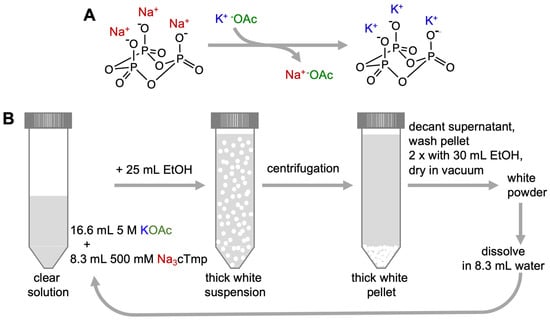
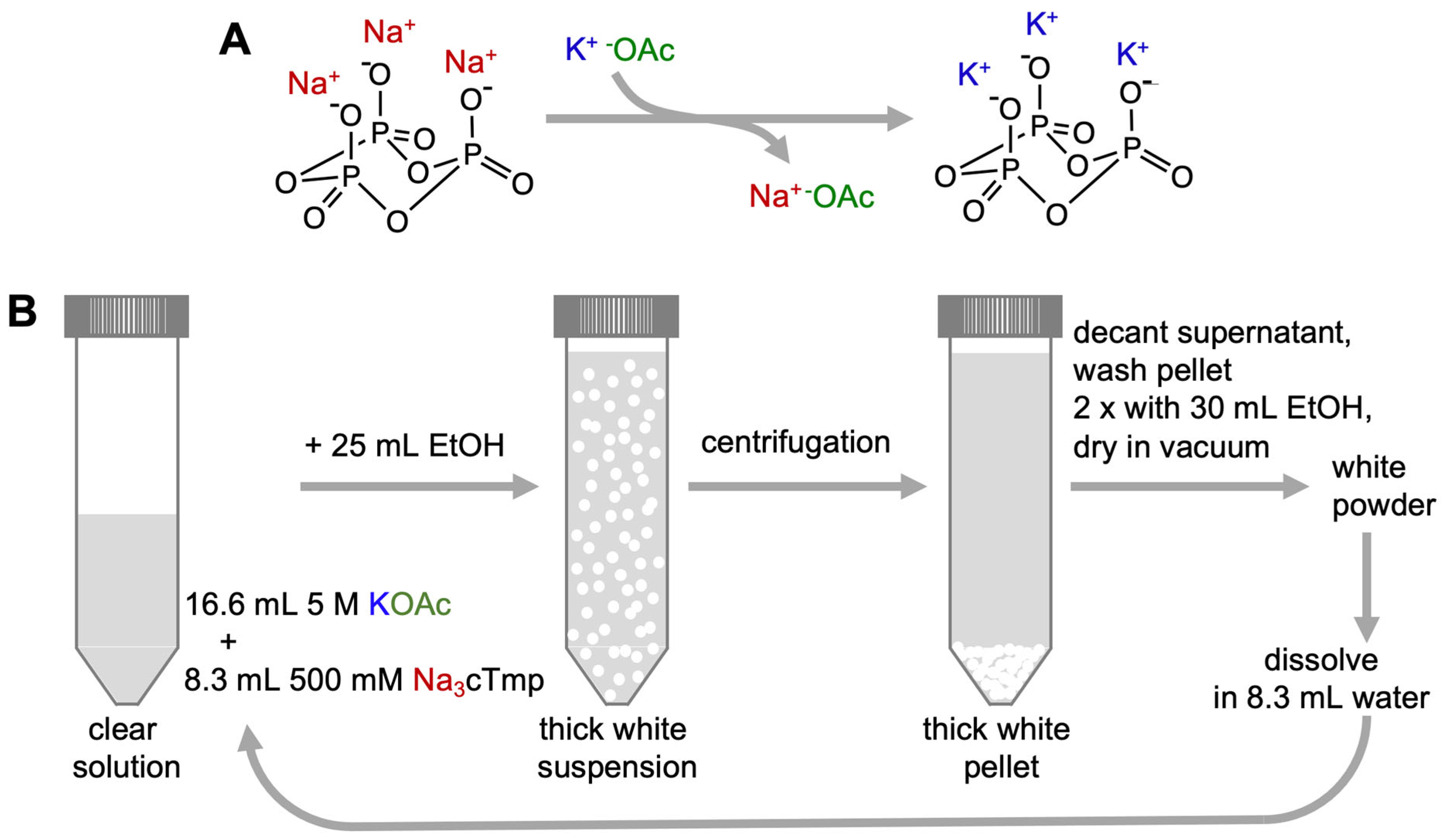
To exchange the sodium in Na3cTmp with potassium, a three-step procedure was established (Figure 1). In the first step (“equilibration”), Na3cTmp was equilibrated with a 20-fold molar excess of potassium acetate (KOAc) in aqueous solution to replace Na+ as a counterion of cTmp with K+. The concentrations of 167 mM Na3cTmp and 3.33 M KOAc were chosen for this aqueous phase because these concentrations allowed the convenient preparation of stock solutions near their solubility limits. Because the pH of KOAc was about 9 and alkaline conditions can lead to the hydrolysis of cTmp [30,31], the 5 M KOAc solution was brought to 0.3 M HOAc by the addition of a small volume of acetic acid; this brought the final pH close to 6, where the hydrolysis of cTmp was negligible at room temperature during the duration of the procedure [25,26,28]. In the second step (“precipitation”), mixing of one volume of the aqueous phase with one volume of ethanol and centrifugation allowed separation of the cTmp salts from the majority of the acetate salts. Ethanol and methanol were both suitable for this step, while isopropanol and acetone caused some precipitation of KOAc, and acetonitrile led to the formation of two liquid phases (Figure S1). Ethanol was chosen over methanol due to its lower toxicity. One volume of ethanol was chosen because 0.6 volumes and 0.8 volumes of ethanol did not completely precipitate cTmp salts, while 1.0 volume of ethanol did (Figure S2). In the third step (“washing”), the insoluble cTmp pellet was finely suspended in 1.2 volumes of ethanol and then centrifuged to remove dissolved acetate salt from the pellet. This washing step was performed twice in each ion exchange cycle, and it was conducted a total of four times after the last ion exchange cycle. Due to the high solubility of sodium/potassium acetate and acetic acid in ethanol, the 10-fold-larger volume of the clear supernatant compared to the pellet, and the repetitions of the washing steps, led to the efficient removal of potassium/sodium acetate and acetic acid. The product was dried in an oil vacuum with intermittent warming and weighing of the tube until the weight had plateaued, confirming that all ethanol had been removed.
Figure 1.
Ion exchange procedure converting Na3cTmp into K3cTmp. (A) Molecular structure of cTmp before and after ion exchange. The cTmp molecule is shown in black, with its three negatively charged oxygens pointed upwards. Sodium ions are shown in red, potassium ions in blue, and acetate ions in green. During the procedure, the ethanol-soluble acetate salts are used to introduce an excess of potassium and remove sodium in the supernatant. (B) Schematic of the ion exchange. The first three steps are illustrated with a focus on ion exchange between potassium acetate and trisodium trimetaphosphate and ethanol precipitation. The schematic shows one complete cycle, of which four cycles were conducted in this study. After the last cycle of ion exchange, four washes with ethanol were conducted to remove traces of sodium/potassium acetate and acetic acid.
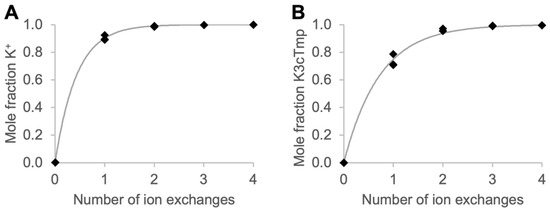
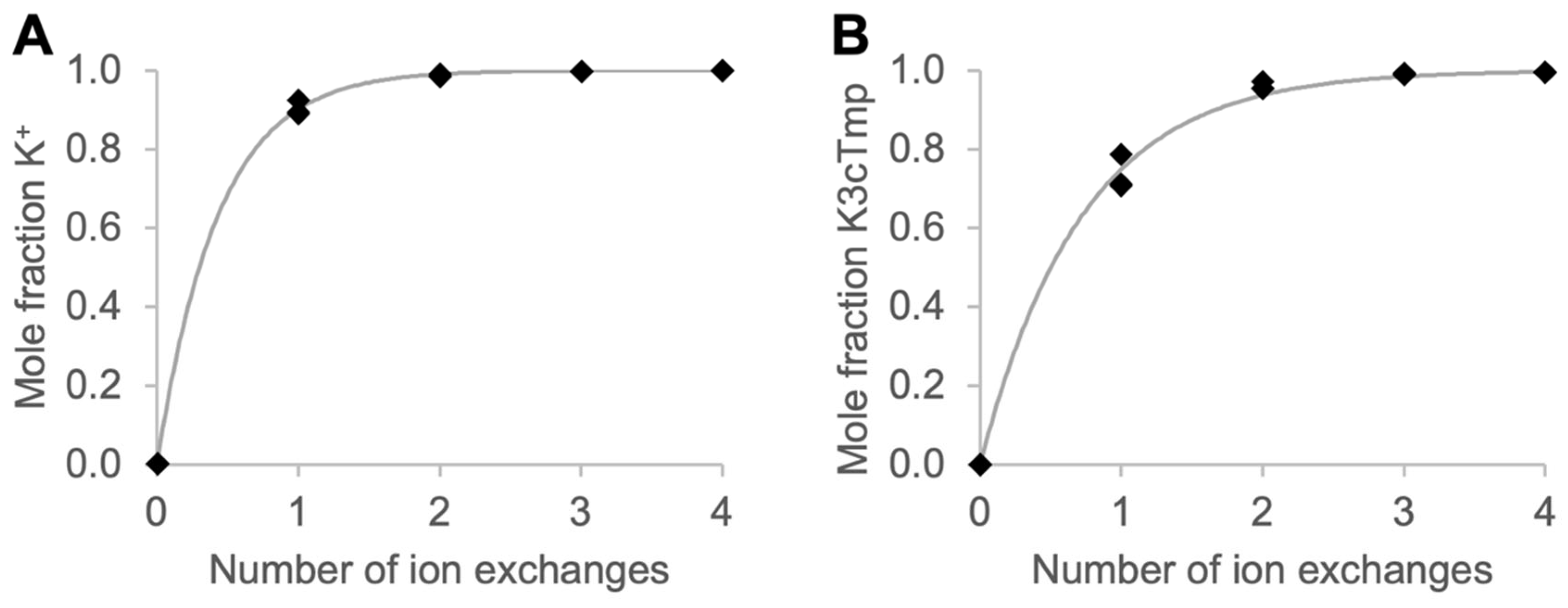
Using these conditions, three parallel preparations of K3cTmp were performed, each undergoing four ion exchange cycles. Samples of each 50 mg were collected after each ion exchange cycle and analyzed for K+ and Na+ by inductively coupled plasma mass spectrometry (ICP-MS) (Figure 2). The mole fractions of K+ after each ion exchange cycle were 90.2 ± 1.8%, 98.6 ± 0.3%, 99.69 ± 0.07%, and 99.83 ± 0.02%, respectively (Figure 2A). While these values are fit well with a single-exponential curve (the black curve in Figure 2A), the values are slightly below the theoretical values that can be calculated from the 20-fold molar excess of K+ over Na+ in each exchange step (95.24%, 99.77%, 99.989%, and 99.9995%, respectively). Nevertheless, the procedure is efficient enough to generate K3cTmp for use in most experiments.
Figure 2.
Analysis of Na+ replacement by K+ using ICP-MS. (A) The mole fraction of K+ of the total monovalent cations plotted as a function of the number of ion exchange cycles. (B) The mole fraction of K3cTmp of all cTmp species (Na3cTmp, NaK2cTmp, Na2KcTmp, K3cTmp) plotted as a function of the number of ion exchange cycles. The values were calculated under the assumption that Na+ and K+ distribute equally over cTmp molecules (see Discussion). Each black diamond symbol in (A) and (B) corresponds to one measured sample in three independent experiments. The gray lines are single-exponential curve fits that were fitted with the least squares method to all data points.
Since each molecule of K3cTmp contains three monovalent ions, the fraction of K3cTmp can be calculated as the cube of the mole fraction of K+, resulting in the mole fraction of K3cTmp out of the total of K3cTmp, K2NaTmp, KNa2Tmp, and Na3Tmp. These fractions of K3cTmp after each ion exchange cycle were thereby determined to be 73.4%, 96.0%, 99.1%, and 99.5%, respectively (Figure 2B). The overall yield of one preparation (in which no samples were withdrawn for analysis) over four ion exchange cycles was 1.35 g of K3cTmp, or 3.82 mmol, corresponding to an overall yield of 92%. This shows that the procedure described can prepare K3cTmp from Na3cTmp in over 90% yield and more than 99% ion replacement efficiency.
4. Discussion
The procedure described here uses cheap and widely available Na3cTmp to give access to K3cTmp, using equipment that exists in most life-science laboratories. The procedure can be performed within 5 h if an oil vacuum pump is available and within 2 days if less powerful diaphragm pumps are available. The product has more than 99% ion exchange efficiency and is therefore suitable for direct applications in experiments testing whether cTmp can serve as an energy source for potential prebiotic reactions. Due to its simplicity, the procedure can be scaled up or down. While volumes between 1 mL and 50 mL were tested as part of this study, this procedure should also work well at the liter scale.
The observed values for K+ were 90.2 ± 1.8%, 98.6 ± 0.3%, 99.69 ± 0.07%, and 99.83 ± 0.02% after each of the four exchanges, which corresponds to a 10.2-fold reduction in Na+ per exchange. In contrast, the theoretical values for a 20-fold replacement of cations at each step are 95%, 99.75%, 99.988%, and 99.999%. The difference between the observed and theoretical values for the first two exchange cycles is likely not due to the technical limitations of ICP-MS: The measured values suggest that a difference of only up to 0.05% can be explained, because the mole ratio for Na+ in the starting material Na3cTmp was 99.95%. The increased carryover of Na+ could contribute to this less-than-ideal separation during the centrifugation step, where a small volume of supernatant remains trapped in the ethanol pellet. Specifically, the weight of the wet pellet was 2.77 g greater than that of the dry pellet, suggesting a volume of 3.5 mL of liquid existed within the pellet (δ (ethanol) = 0.789 g/mL at 20 °C). However, this volume cannot explain the 10.2-fold enrichment, because the pellet was washed twice more with 30 mL of ethanol, which should have resulted in a combined 1050-fold reduction when the 3.5 mL carryover of liquid is considered. It is currently unclear what causes this difference between the 20-fold theoretical enrichment and the 10.2-fold observed enrichment.
Methanol can replace ethanol for this procedure, depending on the experimenter’s preferences regarding price, toxicity, and availability. Methanol precipitates cTmp at the same volume concentration as ethanol (Figure S2), and potassium acetate is soluble at 2.3 M in 100% methanol and at 8.3 M in 50% methanol (Supplement Material S3). Therefore, the standard procedure described in this manuscript works well by simply replacing the same volume of ethanol with methanol.
5. Conclusions
The compound cyclic trimetaphosphate (cTmp) is increasingly studied as a possible energy source for early life stages, for example, in stages dominated by catalytic RNAs. Since catalytic RNAs are often inhibited by sodium ions but not potassium ions, mechanistic studies of them and optimization of the corresponding reaction conditions would be helped by the availability of cTmp as a potassium salt, which is not commercially available in all countries. This study describes a procedure in which the generally available Na3cTmp can be converted into K3cTmp with a yield of more than 90% and an ion exchange efficiency of more than 99% using cheap reagents and equipment that is available in most biochemistry and molecular biology laboratories.
Supplementary Materials
The following supporting information can be downloaded at: https://www.mdpi.com/article/10.3390/compounds6030051/s1, Figure S1: Screening of different solvents for the precipitation of cTmp salts. Figure S2: Titration of ethanol and methanol for the precipitation of Na3cTmp. Supplement Material S3: Solubility of potassium acetate in 50% methanol and 100% methanol.
Funding
This work was supported in part by a sub-award, given to U.F.M., of NASA ICAR 80NSSC21K0596 given to Donald H. Burke, U. Missouri.
Data Availability Statement
The original contributions presented in this study are included in the article/Supplementary Material. Further inquiries can be directed to the corresponding author.
Acknowledgments
I thank Neal Arakawa for the excellent technical support provided by the Environmental and Complex Analysis Laboratory at UCSD (ECAL).
Conflicts of Interest
The author declares no conflict of interest.
References
- Prigogine, I.; Nicolis, G.; Babloyantz, A. Thermodynamics of Evolution. Phys. Today 1972, 25, 23–28. [Google Scholar] [CrossRef] [Scilit]
- Forsythe, J.G.; Yu, S.-S.; Mamajanov, I.; Grover, M.A.; Krishnamurthy, M.; Fernandez, F.M.; Hud, N.V. Ester-Mediated Amide Bond Formation Driven by Wet-Dry Cycles: A Possible Path to Polypeptides on the Prebiotic Earth. Angew. Chem. Int. Ed. Engl. 2015, 54, 9871–9875. [Google Scholar] [CrossRef] [Scilit]
- Weber, J.M.; Henderson, B.L.; LaRowe, D.E.; Goldman, A.D.; Perl, S.M.; Billings, K.; Barge, L.M. Testing Abiotic Reduction of NAD+ Directly Mediated by Iron/Sulfur Minerals. Astrobiology 2022, 22, 25–34. [Google Scholar] [CrossRef] [Scilit]
- Lane, N.; Martin, W.F. The Origin of Membrane Bioenergetics. Cell 2012, 151, 1406–1416. [Google Scholar] [CrossRef] [Scilit]
- Jauker, M.; Griesser, H.; Richert, C. Copying of RNA Sequences without Pre-Activation. Angew. Chem. Int. Ed. 2015, 54, 14559–14563. [Google Scholar] [CrossRef] [Scilit]
- Mariani, A.; Russell, D.A.; Javelle, T.; Sutherland, J.D. A Light-Releasable Potentially Prebiotic Nucleotide Activating Agent. J. Am. Chem. Soc. 2018, 140, 8657–8661. [Google Scholar] [CrossRef] [Scilit]
- Zhang, S.J.; Jia, X.; DasGupta, S.; Szostak, J.W. Potentially Prebiotic Isocyanide Activation Chemistry Drives RNA Assembly via Both Nonenzymatic and Ribozyme-Catalyzed Ligation. bioRxiv 2025. [Google Scholar] [CrossRef] [Scilit]
- Etaix, E.; Orgel, L.E. Phosphorylation of Nucleosides in Aqueous Solution Using Trimetaphosphate: Formation of Nucleoside Triphosphates. J. Carbohydr. Nucleosides Nucleotides 1978, 5, 91–110. [Google Scholar]
- Thilo, E. Zur Strukturchemie Der Kondensierten Anorganischen Phosphate. Angew. Chem. 1965, 77, 1056–1066. [Google Scholar] [CrossRef] [Scilit]
- Yamagata, Y.; Watanabe, H.; Saitoh, M.; Namba, T. Volcanic Production of Polyphosphates and Its Relevance to Prebiotic Evolution. Nature 1991, 352, 516–519. [Google Scholar] [CrossRef] [Scilit]
- Pasek, M.A.; Kee, T.P.; Bryant, D.E.; Pavlov, A.A.; Lunine, J.I. Production of Potentially Prebiotic Condensed Phosphates by Phosphorus Redox Chemistry. Angew. Chem. Int. Ed. Engl. 2008, 47, 7918–7920. [Google Scholar] [CrossRef] [Scilit]
- Pasek, M.A.; Harnmeijer, J.P.; Buick, R.; Gull, M.; Atlas, Z. Evidence for Reactive Reduced Phosphorus Species in the Early Archean Ocean. Proc. Natl. Acad. Sci. USA 2013, 110, 10089–10094. [Google Scholar] [CrossRef] [Scilit]
- Herschy, B.; Chang, S.J.; Blake, R.; Lepland, A.; Abbott-Lyon, H.; Sampson, J.; Atlas, Z.; Kee, T.P.; Pasek, M.A. Archean Phosphorus Liberation Induced by Iron Redox Geochemistry. Nat. Commun. 2018, 9, 1346. [Google Scholar] [CrossRef] [Scilit]
- Cheng, C.; Fan, C.; Wan, R.; Tong, C.; Miao, Z.; Chen, J.; Zhao, Y. Phosphorylation of Adenosine with Trimetaphosphate under Simulated Prebiotic Conditions. Orig. Life Evol. Biosph. 2002, 32, 219–224. [Google Scholar] [CrossRef] [Scilit]
- Chizzolini, F.; Kent, A.D.; Passalacqua, L.F.M.; Lupták, A. Enzymatic RNA Production from NTPs Synthesized from Nucleosides and Trimetaphosphate**. ChemBioChem 2021, 22, 2098–2101. [Google Scholar] [CrossRef] [Scilit]
- Bachant, M.G.; Müller, U.F. The Exceptional Solubility of Cyclic Trimetaphosphate in the Presence of Mg2+ and Ca2+. Life 2026, 16, 184. [Google Scholar] [CrossRef] [Scilit]
- Moretti, J.E.; Muller, U.F. A Ribozyme That Triphosphorylates RNA 5′-Hydroxyl Groups. Nucleic Acids Res. 2014, 42, 4767–4778. [Google Scholar] [CrossRef] [Scilit]
- Akoopie, A.; Arriola, J.T.; Magde, D.; Müller, U.F. A GTP-Synthesizing Ribozyme Selected by Metabolic Coupling to an RNA Polymerase Ribozyme. Sci. Adv. 2021, 7, eabj7487. [Google Scholar] [CrossRef] [Scilit]
- Van Wazer, J.R. Phosphorus and Its Compounds/Vol.I, Chemistry; Interscience Publishers: New York, NY, USA, 1958. [Google Scholar]
- Thaplyal, P.; Ganguly, A.; Hammes-Schiffer, S.; Bevilacqua, P.C. Inverse Thio Effects in the Hepatitis Delta Virus Ribozyme Reveal That the Reaction Pathway Is Controlled by Metal Ion Charge Density. Biochemistry 2015, 54, 2160–2175. [Google Scholar] [CrossRef] [Scilit]
- Veeraraghavan, N.; Ganguly, A.; Chen, J.-H.; Bevilacqua, P.C.; Hammes-Schiffer, S.; Golden, B.L. Metal Binding Motif in the Active Site of the HDV Ribozyme Binds Divalent and Monovalent Ions. Biochemistry 2011, 50, 2672–2682. [Google Scholar] [CrossRef] [Scilit][Green Version]
- Smith, M.D.; Mehdizadeh, R.; Olive, J.E.; Collins, R.A. The Ionic Environment Determines Ribozyme Cleavage Rate by Modulation of Nucleobase pKa. RNA 2008, 14, 1942–1949. [Google Scholar] [CrossRef] [Scilit]
- Christ, J.J.; Willbold, S.; Blank, L.M. Methods for the Analysis of Polyphosphate in the Life Sciences. Anal. Chem. 2020, 92, 4167–4176. [Google Scholar] [CrossRef] [Scilit]
- Beukenkamp, J.; Rieman, W.; Lindenbaum, S. Behavior of Condensed Phosphates in Anion-Exchange Chromatography. Anal. Chem. 1954, 26, 505–512. [Google Scholar] [CrossRef] [Scilit]
- Kura, G. Hydrolysis Reaction of Inorganic Cyclophosphates at Various Acid Strengths. Polyhedron 1987, 6, 531–533. [Google Scholar] [CrossRef] [Scilit]
- Kura, G.; Nakashima, T.; Oshima, F. Study of the Acidic Hydrolysis of Cyclic Trimetaphosphate by Liquid Chromatography. J. Chromatogr. A 1987, 219, 385–391. [Google Scholar] [CrossRef] [Scilit]
- Nylen, P. Zur Molekulargröße Einiger Metaphosphate. Z. Anorg. Allg. Chem. 1936, 229, 30–35. [Google Scholar] [CrossRef] [Scilit]
- Davies, C.W.; Monk, C.B. 94. The Condensed Phosphoric Acids and Their Salts. Part I. Metaphosphates. J. Chem. Soc. 1949, 152, 413. [Google Scholar] [CrossRef] [Scilit]
- Fees, J.; Christ, J.J.; Willbold, S.; Blank, L.M. Biotechnological Production of Polyphosphate from Industrial Wash Water. Biotech. Bioeng. 2023, 120, 456–464. [Google Scholar] [CrossRef] [Scilit]
- Kura, G. Alkaline Hydrolysis of Inorganic Cyclo-Polyphosphates. Bull. Chem. Soc. Jpn. 1987, 60, 2857–2860. [Google Scholar] [CrossRef] [Scilit]
- Miyazaki, Y.; Kura, G.; Tsuzuki, H.; Sakashita, H. Hydrolysis of Condensed Phosphates in an Anion-Exchange Resin. Faraday Trans. 1996, 92, 3587. [Google Scholar] [CrossRef] [Scilit]
Disclaimer/Publisher’s Note: The statements, opinions and data contained in all publications are solely those of the individual author(s) and contributor(s) and not of MDPI and/or the editor(s). MDPI and/or the editor(s) disclaim responsibility for any injury to people or property resulting from any ideas, methods, instructions or products referred to in the content. |
© 2026 by the author. Licensee MDPI, Basel, Switzerland. This article is an open access article distributed under the terms and conditions of the Creative Commons Attribution (CC BY) license.