


Abstract
Chagas disease and trichomoniasis are two neglected parasitic infections (NPIs) in need for new therapies that address both the toxicity and limited bioavailability impacting on the effectiveness of benznidazole (BZ) and nifurtimox, the only drugs available for treating the infection caused by Trypanosoma cruzi, as well as the resistance that Trichomonas vaginalis has developed to 5-nitroimidazoles. Herein, we report the outcomes of the primary screening of a series of eighteen quinoxaline-1,4-di-N-oxides (QdNOs) carried out against both protozoan parasites. Computational approaches revealed that these derivatives have adequate oral bioavailability and do not pose toxicity risks associated with their chemical structures. Meanwhile, biological studies disclosed that compounds 4b and 4m exhibit considerable activity against T. cruzi at the highest concentration tested, showing 4m a trypanocidal profile (IC50 = 23.66 µM) similar to that of BZ (IC50 = 21.66 µM), and a selectivity index (SI) > 5.32. Regarding the activity on T. vaginalis, derivative 4n stands out with an IC50 value of 9.85 µM, showing no cytotoxicity towards mammalian cells. However, their potency decreases when tested over resistant parasites. Alterations in either the hydrogenosomal membrane potential or the production of reactive oxygen species (ROS) were also explored. The findings suggest that the trichomonacidal activity of compound 4n is not mediated by a direct disruption of hydrogenosomal bioenergetics or a pro-oxidant effect. Altogether, these preliminary results support that the QdNO scaffold could be introduced as a proper template for developing novel trypanocidal and trichomonacidal agents.
1. Introduction
Neglected parasitic infections (NPIs) are described as diseases caused by parasites that significantly impact on the health of people and animals, particularly in low-income regions. These infections are often overlooked due to the limited economic resources invested in developing treatment and control programs. Two of the top five NPIs in the United States (U.S.), as designated by the Centers for Disease Control and Prevention (CDC), are Chagas disease and trichomoniasis [1].
Chagas disease (American trypanosomiasis), whose etiological agent is the protozoan hemoflagellate Trypanosoma cruzi, is a vector-borne parasitosis transmitted by the feces of hematophagous bugs of the family Reduviidae. This infection is endemic in the rural areas of 21 Latin American countries, where the vector is naturally distributed [2]. However, the existence of non-vectorial transmission routes (e.g., transfusion of infected blood, transplantation of contaminated organs and mother-to-child, among others) and population mobility have led to the spread of the illness to non-endemic regions [3]. In fact, cases of the disease have been detected in 44 countries [2], with the U.S. and Spain as the most affected ones [4,5]. One of the main obstacles for properly managing Chagas disease is the lack of a completely effective treatment, which is currently based on the two old nitroheterocyclic drugs benznidazole (BZ) and nifurtimox [6]. Both treatments are effective when administered during the acute infection, but their effectiveness decreases as the disease progresses to the chronic symptomatic phase, which targets cardiac tissue and/or the digestive tract [3]. Other drawbacks, such as the occurrence of adverse effects in patients and the appearance of natural resistance among parasite strains, also hinder the success of these therapies [6].
Trichomoniasis is one of the most common curable sexually transmitted infections (STIs), whose prevalence is higher than that of chlamydia, gonorrhea or syphilis [7]. This parasitosis is asymptomatic in 80% of men and in almost half of women [8], which explains its widespread dissemination, reaching an estimated incidence of 156 million cases worldwide [9]. The presence of Trichomonas vaginalis in the genitourinary tract triggers an inflammatory response that can lead to serious reproductive morbidity in pregnant women, such as premature rupture of membranes, low birth weight or preterm birth [10]. Moreover, trichomoniasis is significantly associated with an increased risk of developing cervical cancer [11]. T. vaginalis also promotes the colonization of the genital tract by other sexually transmitted pathogens, such as HIV and HPV, among others [12,13]. Despite its high incidence and the aforementioned serious consequences, this STI still remains as a non-notifiable disease for which new treatments are underdeveloped. Currently, two 5-nitroimidazoles—metronidazole (MTZ) and tinidazole—are the only drugs approved for the treatment of trichomoniasis in Europe and the U.S. In 2021, the U.S. Food and Drug Administration (FDA) approved secnidazole, which belongs to the same chemical family, for use against T. vaginalis infections with the oral administration of a single 2 g dose [14]. However, there are no effective pharmacological alternatives for treating patients who are hypersensitive or resistant to 5-nitroimidazoles [15,16].
According to this scenario, there is an urgent need to identify novel compounds, potentially applicable to the treatment of these parasitic diseases.
Quinoxalines constitute a class of molecules that are known for their diverse pharmacological activities, which encompass antineoplastic, anti-inflammatory, antidiabetic or anti-Alzheimer, among others [17,18,19]. In addition, some antibacterial compounds contain a quinoxaline scaffold that is responsible for their mode of action involving the inhibition of dihydrofolate reductase [20,21]. Moreover, it is well known that the oxidation of both nitrogen atoms of this heterocyclic system enhances the biological properties of these compounds, including their antiparasitic activity [22,23].
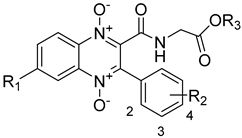
Concretely, quinoxaline-1,4-di-N-oxides (QdNOs) form a chemical family of compounds that have demonstrated potential as antiparasitic agents, showing promising in silico activity against T. cruzi, and T. vaginalis, among others, by means of molecular dynamics and docking simulations [24]. Also in this context, a particular series of QdNOs containing an amino acidic side chain, whose chemical structures are depicted in Table 1, has recently exhibited remarkable leishmanicidal profile in vitro [25]. Leishmania spp. and T. cruzi are both kinetoplastid protozoa and share several drug targets and pathways (e.g., trypanothione metabolism, nitroreductases, and sterol biosynthesis) [6]. Therefore, cross-activity between them is relatively common for certain scaffolds, such as nitroheterocycles, quinoxalines and indazoles. T. vaginalis, in contrast, is a flagellated parasite with different biology [16], but it still shares sensitivity to some chemotypes that depend on redox activation. In particular, nitroheterocycles [26] and derivatives of the quinoxaline N,N′-dioxide framework [17,23] have yielded compounds that are active against Leishmania, T. cruzi and T. vaginalis.
Table 1.
Chemical structures for the studied QdNOs.
Given the interesting antiprotozoal effects of such molecules [24,25] and the limited variety of drugs currently available for treating either Chagas disease or trichomoniasis, the present study evaluates in vitro the activity of this series of QdNO compounds against both T. cruzi and T. vaginalis, aiming to identify novel antiparasitic agents among these synthetic molecules.
2. Materials and Methods
2.1. Source of Compounds
The compounds under study were synthesized according to known methods [25]. Stock solutions of these QdNOs, the reference antichagasic drug BZ, and the reference trichomonacidal drug MTZ were prepared in dimethyl sulfoxide (DMSO) and extemporaneously added to the cultures. The final concentration of the vehicle did not exceed 0.2% (v/v), which has no toxic effect on both parasites and mammalian cells [27,28,29]. BZ was kindly provided by LAFEPE, Laboratório Farmacêutico do Estado do Pernambuco (Brazil), and MTZ was purchased from Sigma-Aldrich (St. Louis, MO, USA).
2.2. Computational Methods
2.2.1. Physicochemical Properties Analysis
Physicochemical properties related to Lipinski’s rule of five (Ro5)—i.e., molecular weight (MW), lipophilicity (logP), number of hydrogen acceptors (nON) and number of hydrogen donors (nOHNH)—and Veber’s rule—i.e., number of rotatable bonds (nRB) and topological surface area (TPSA)—were predicted in silico by using the Molinspiration free services (http://www.molinspiration.com, accessed on 4 November 2025), as previously reported [27,28,29].
2.2.2. Toxicity Risk Profile and Drug-Likeness Assessment
The occurrence of potential risks associated with molecular fragments present in these compounds was evaluated in silico with the free platform OSIRIS Property Explorer (http://www.organic-chemistry.org/prog/peo/, accessed on 6 November 2025). By performing a topological analysis, this program provides information about possible risks—mutagenic (Mut), tumorigenic (Tum), irritant (Irr) and reproductive effects (Rep Eff)—induced by these molecules, with such predictions evaluated and color coded: drug-conform (green), middle risk (yellow) and undesired effects (red). Also, drug-likeness and drug-score parameters were computed, by comparing the chemical structures of the studied compounds with those of a database of commercialized drugs [27,28].
2.3. Parasites
Axenic cultures of epimastigotes (extracellular replicative form of the parasite) of either Trypanosoma cruzi CL-B5 lacZ (DTU TcVI) [30] or Y (DTU TcII) strain, initially isolated from an acute human case [31], were grown at 28 °C in Liver Infusion Tryptose (LIT) medium at pH 7.4, supplemented with 10% (v/v) fetal bovine serum (FBS)—heat-inactivated at 56 °C, 30 min—, 0.1% hemin and antibiotics (i.e., 100 U/mL penicillin and 100 µg/mL streptomycin). Cultures were continuously maintained in exponential phase by performing weekly passages in fresh LIT [27,32].
Trichomonas vaginalis MTZ-sensitive isolate JH31A#4 (ATCC, Manassas, VA, USA) and MTZ-resistant IR78 (ATCC, Manassas, VA, USA) were cultivated in Pyrex® glass tubes with Trypticase-Yeast-Maltose (TYM) modified medium at pH 6.4, supplemented with 10% (v/v) heat-inactivated FBS, 100 U/mL penicillin and 100 µg/mL streptomycin, and incubated at 37 °C with 5% CO2. Parasites were examined by light microscopy and sub-cultured into fresh medium every 48–72 h [29].
2.4. Mammalian Cells
The cytotoxicity was evaluated using three different cell lines: L929 murine fibroblasts, J774 murine macrophages and CCL-81 Vero epithelial cells, purchased from the American Type Culture Collection (ATCC, Manassas, VA, USA).
Cultures of L929 fibroblasts were grown at 37 °C with 5% CO2 in 75 cm2 plastic culture flasks sustained with Minimal Essential Medium (MEM) without phenol red (Sigma-Aldrich, St. Louis, MO, USA), supplemented with 10% heat-inactivated FBS, penicillin (100 U/mL) and streptomycin (100 μg/mL), as previously depicted [27,32].
Either J774 or Vero CCL-81 cells were maintained at 37 °C and 5% CO2 in RPMI-1640 medium without phenol-red (Sigma-Aldrich, St. Louis, MO, USA), supplemented with 10% heat-inactivated FBS, 100 U/mL penicillin, and 100 μg/mL streptomycin [25,29].
In all cases, cultures reaching more than 90% of cell confluence were detached using a solution of 0.03% EDTA and 0.05% trypsin in phosphate-buffered saline (PBS), centrifuged and finally resuspended in the respective culture medium for performing the corresponding cytotoxicity assays [27,32].
2.5. Trypanocidal In Vitro Assays
2.5.1. Susceptibility Assays on CL-B5 Strain Epimastigotes
The activity of these QdNO derivatives was first assayed in vitro on T. cruzi epimastigotes of the CL-B5 strain (DTU TcVI), which is widely known to be drug-sensitive [33]. These experiments were carried out by following the colorimetric method standardized by Vega et al. [34], with minor modifications [27]. Accordingly, a suspension of 250.000 log-phase epimastigotes/mL were distributed in 96-well microplates, by adding 200 µL per well, and treated with different concentrations of compounds (100–3.12 µM) at 28 °C for 72 h. Each concentration was tested in triplicate and growth, medium and drug controls were included in every plate. Also, BZ was tested in all plates as a reference antichagasic drug. Finally, 50 µL of 1 mM CPRG (chlorophenol red β-D-galactopyranoside) solution prepared in 0.9% Triton x-100 (pH 7.4) was added and, after 3 h of incubation at 37 °C, absorbance was read at 595 nm in an Infinite 200 TECAN multifunctional microplate reader (Tecan, Mannedorf, Switzerland).
2.5.2. Susceptibility Assays on Y-Strain Epimastigotes
The most promising compounds were further evaluated against the extracellular forms of T. cruzi Y (DTU TcII), defined as a moderately drug resistant strain [35], by applying the resazurin-based procedure described by Rolón et al. [36]. Briefly, log-phase epimastigotes were seeded in 96-well microplates at a density of 3 × 10⁶ parasites/mL (200 µL/well) and incubated within serial dilutions of the compounds (100–3.12 µM) for 48 h at 28 °C. Each concentration was tested in triplicate and growth, medium and drug controls were included in every plate. Also, BZ was tested in all plates as reference antichagasic drug. Finally, 20 µL of 3 mM resazurin (Sigma-Aldrich, St. Louis, MO, USA) solution in PBS (pH 7.0) was added and, after 5 h of incubation at 28 °C, fluorescence was read at 535 nm (excitation) and 590 nm (emission) in an Infinite 200 TECAN multifunctional microplate reader [37].
For both strains, assays were similarly performed three times separately (n = 3). IC50 values, i.e., concentration that causes 50% of parasite growth inhibition (PGI), were estimated from the dose–response curve obtained by plotting drug concentrations versus percentages of PGI. Activity results are expressed as the mean value of IC50 with the 95% confidence interval provided [32,37].
The non-parametric Mann–Whitney U test was applied for comparing the activity profile in vitro (IC50) of compounds with that of the reference drug BZ, as well as the susceptibility observed between the different T. cruzi strains (SPSS Statistics Software, v.29, IBM, Armonk, NY, USA). p < 0.05 was considered statistically significant.
2.5.3. Cytotoxicity Assays over L929 Cells
Cytotoxic effects exerted by these compounds over cultures of L929 fibroblasts were also explored in vitro [27,28,32]. So, a suspension containing 100,000 cells/mL was distributed in 96-well microplates, by seeding 100 µL per well. After cell attachment, medium was discarded and cultures were treated for 72 h (37 °C, 5% CO2) with 200 µL of serial dilutions of compounds prepared in fresh MEM (100–3.12 µM). Each concentration was tested in triplicate and growth, medium and drug controls were included in every plate. In all plates, the reference drug BZ was also tested. Then, 20 µL of 2 mM resazurin solution in PBS (pH 7.0) was added and, after 3 h of incubation at 37 °C with 5% CO2, fluorescence was read at 535 nm (excitation) and 590 nm (emission) in an Infinite 200 TECAN multifunctional microplate reader.
2.5.4. Cytotoxicity Assays over J774 Cells
The most promising compounds were moved to a further cytotoxicity assay carried out in vitro with J774 macrophages [37,38]. Accordingly, a suspension containing 500,000 cells/mL were seeded in 96-well microplates (100 µL/well). Once attached, medium was replaced by 200 µL of fresh RPMI with different concentrations of the compounds (100–3.12 µM) and cells incubated for 48 h (37 °C, 5% CO2). Each concentration was tested in triplicate and growth, medium and drug controls were included in every plate. The reference drug BZ was also tested in all plates. Then, 20 µL of 1 mM resazurin solution in PBS (pH 7.0) was added. Finally, after 3 h of incubation at 37 °C with 5% CO2, fluorescence was read at 535 nm (excitation) and 590 nm (emission) in an Infinite 200 TECAN multifunctional microplate reader.
For both cell lines, experiments were performed in similar conditions for three (n = 3). CC50 values, i.e., concentration that causes 50% of cytotoxicity (C), were estimated from the dose–response curve obtained by plotting drug concentrations versus percentages of C. Cytotoxicity results are expressed as the mean value of CC50 with the 95% confidence interval provided [32,37].
Selectivity indexes (SI) were also calculated for each compound and parasite strain, as follows: SI (CL) = CC50 L929/IC50 CL and SI (Y) = CC50 J774/IC50 Y.
2.6. Trichomonacidal In Vitro Assays
2.6.1. Susceptibility Assays on Trichomonas vaginalis
In vitro activity against T. vaginalis was tested by following the methodology previously described by Ibáñez-Escribano et al. [39]. Briefly, QdNO compounds were added to cultures of T. vaginalis (1 × 10⁵ parasites/mL) in exponential growth phase at six different concentrations, ranging from 100 to 3.12 µM. After 24 h of incubation at 37 °C with 5% CO2, medium was discarded and trophozoites were seeded in 96-well plates. Then, 20 µL of 3 mM resazurin solution in PBS (pH 7.0) was added and the plates were incubated for 1 h at 37 °C and 5% CO2. Afterwards, fluorescence was measured, using an Infinite 200 TECAN multifunctional microplate reader, at 535 nm (excitation) and 590 nm (emission). All the plates included growth controls, positive controls containing 24 µM MTZ, and blanks without trophozoites to detect whether compounds can reduce the redox dye in the absence of cells.
These experiments were carried out in triplicate (n = 3) and IC50 values with 95% confidence intervals were calculated by PROBIT analysis (SPSS, v.29, IBM, Armonk, NY, USA) [29,37]. %PGI values used to determine these parameters presented standard deviations (SD) lower than 10%.
The non-parametric Mann–Whitney U test was applied for comparing the activity profile in vitro (IC50) of compounds with that of the reference drug MTZ, as well as the susceptibility observed between the different T. vaginalis isolates (SPSS Statistics Software, v.29, IBM, Armonk, NY, USA). p < 0.05 was considered statistically significant.
2.6.2. Cytotoxicity Assays Against Vero CCL-81 Cells
Those compounds that showed adequate IC50 values on the parasite advanced into cytotoxicity assays against this line of epithelial cells, according to the sequential procedure routinely employed in our laboratory [39]. Vero fibroblasts were seeded at a density of 5 × 10⁴ cells/well (100 µL) in 96-well microtiter plates maintained for 5 h in a humidified 5% CO2 incubator at 37 °C. After this adhesion period, 100 µL/well of fresh RPMI medium containing the molecules (100–3.12 µM) was added, and the plates incubated for 24 h (37 °C, 5% CO2). Then, 20 µL of resazurin solution in PBS (1 mM, pH 7.0) was added and fluorescence intensity read at 535 nm (excitation) and 590 nm (emission) in an Infinite 200 TECAN multifunctional microplate reader, after 3 h of incubation within the dye.
Cytotoxicity determinations against Vero CCL-81 cells were carried out in triplicate (n = 3) and CC50 values with 95% confidence intervals were calculated by PROBIT analysis (SPSS, v.29, IBM, Armonk, NY, USA) [29,37]. %C values used to determine these parameters presented SD < 10%.
Selectivity indexes (SI) were calculated as follows: SI = CC50 Vero CCL-81/IC50 T. vaginalis.
2.6.3. Determination of Hydrogenosomal Membrane Potential Alteration
To assess the potential impact of the most promising compounds on T. vaginalis hydrogenosome, a suspension containing 5 × 10⁵ trophozoites/mL was incubated for 90 min (37 °C, 5% CO2) in glass tubes within the IC90 of the compound. Then, 200 µL taken from each tube was seeded per triplicate in 96-well microplates. Afterwards, TYM medium was discarded, and trophozoites were resuspended in 200 µL of PBS (pH 7.0) containing 20 µL of JC-1 dye (MedChemExpress EU, Sollentuna, Sweden) at a final concentration of 1 µM. After 30 min of incubation at 37 °C, the plates were washed twice with PBS and finally, the presence of J-aggregates measured at 535 nm (excitation) and 590 nm (emission) in an Infinite 200 TECAN multifunctional microplate reader [37]. A positive control of parasites treated with 200 µM of the protonophore CCCP (carbonyl cyanide m-chlorophenyl hydrazone) was run in parallel.
2.6.4. Determination of Reactive Oxygen Species (ROS) Production in T. vaginalis
The induction of reactive oxygen species (ROS) was determined by following the procedure described by Ibáñez-Escribano et al. [37]. Thus, a suspension of 5 × 10⁵ T. vaginalis/mL in exponential growth phase was seeded in 96-well plates and incubated with 10 µM 2’7’-dichlorodihydrofluorescein diacetate (Sigma-Aldrich, St. Louis, MO, USA) at 37 °C in an atmosphere containing 5% CO2. After 1 h, the plates were washed once and trophozoites resuspended in PBS. Parasites were then treated with the IC90 of the compound and after 1 h of incubation at the aforementioned conditions, fluorescence was read at 535 nm (excitation) and 590 nm (emission) in an Infinite 200 TECAN multifunctional microplate reader. All plates included growth and positive controls, the latter with parasites treated with 4.2 mM hydrogen peroxide.
For both JC-1 and ROS determinations, results were expressed as the median and interquartile range (IQR) obtained from three independent experiments performed in triplicate (n = 3). Differences between experimental groups (i.e., growth control, positive control, and compound) were assessed by applying the non-parametric Kruskal–Wallis test. When statistical significance was reached (p < 0.05), Dunn’s multiple post hoc test was performed for pairwise comparison. These statistical analyses and graphical representations were performed using GraphPad Prism software version 5.0. (GraphPad Software Inc., La Jolla, CA, USA).
3. Results and Discussion
3.1. Physicochemical Properties Analysis
According to the Lipinski’s rule of five (Ro5) analysis carried out in silico, the only compound of this series non-suitable for being orally administered is 4e [40,41]. This molecule registers two violations of the rule, i.e., MW > 500 g/moL and 10 hydrogen acceptors in their chemical structure (Table 2). Moreover, compound 4e does not fulfill the two criteria established by Veber et al. [42], since it has 10 rotatable bonds and also exceeds the TPSA value of 140 Å2, being not expected to permeate properly across biological membranes. Therefore, these molecules are generally predicted to have appropriate TPSA, which point to good membrane permeation (TPSA ≤ 140 Å2) without crossing the blood–brain barrier (TPSA > 60 Å2) [41]. This conclusion deserves special mention, since the oral route is the preferred one for drug administration; these treatments are easier to manage and more affordable than drugs given parenterally [43], which is primordial in the development of new therapies for treating neglected infections [44,45]. Similar results have previously been obtained with a different series of QdNO compounds [46].
Table 2.
Lipinski’s rule of five (Ro5) and Veber’s rule (nRB and TPSA) for the studied QdNOs.
3.2. Toxicity Risk Profile and Drug-Likeness Assessment
A critical finding of this study is that these molecules are predicted to have safer profiles than those observed for the current clinical treatments of these two parasitoses. Both BZ and MTZ display high-risk alerts (red) for reproductive effects, whereas all the QdNOs are forecasted to be in the safety zone for all toxicological categories: mutagenicity, tumorigenicity, irritant effects, and reproductive toxicity (Table 3).
Table 3.
Toxicity risk, drug-likeness and drug-score parameters for the studied QdNOs.
On the one hand, BZ can cause fetal harm when administered to pregnant women, with it recommended that those of childbearing age use barrier contraception methods during treatment and even after the conclusion of this period [3,47]. Also, findings in rodents suggest that BZ can potentially impair the fertility of males [48]; although, there is no evidence of such an effect in humans. On the other hand, the FDA classifies MTZ as a pregnancy category B drug, whose administration is contraindicated during gestation, especially in the first trimester, because the excellent bioavailability of the drug allows its passage through the maternal–fetal barrier [49]. Recent animal studies [50] have confirmed the presence of significant placental lesions during pregnancy, involving intrauterine growth restriction, teratogenicity, and damage in both the maternal and fetal liver. Moreover, MTZ can affect male fertility, exhibiting cytotoxicity towards sperm and significantly reducing the weight of the testes and epididymis after its administration to rats [51].
Furthermore, the predictions compiled in Table 3 suggest that structural patterns of these QdNOs successfully mitigate the mutagenicity that is frequently associated with this class of molecules [17,23,52]. Nevertheless, such in silico results should be interpreted with caution as preliminary and hypothesis-based outcomes, with future in vivo studies required for the confirmation of these findings.
Regarding drug-likeness values, all the QdNOs show negative scores, ranging from −15.26 (4e) to −3.29 (4f). This qualitative descriptor assesses the structural similarity of a molecule to commercial drugs [53,54]. In fact, negative values are commonly found in early-stage drug discovery and reflect the structural originality of these derivatives [28]. Complementarily, the drug-score balances the drug-likeness value with key physicochemical parameters, such as MW, cLogP and solubility, and predicted toxicological risks [54]. The results listed in Table 3 show that these molecules yield positive drug-scores, between 0.17 and 0.25. Although these scores are lower than those computed for BZ (0.33) and MTZ (0.51), which is probably due to their negative drug-likeness values, the favorable physicochemical properties and the absence of toxicity hazards predicted for this new series of QdNOs stand out.
3.3. Trypanocidal Activity
The activity on T. cruzi was evaluated by following a sequential screening procedure performed in vitro, as previously reported by our research group [27,28,32]. First, the trypanocidal profile of these molecules was explored over cultures of T. cruzi CL-B5 epimastigotes, a strain that is defined as drug-sensitive and representative of a DTU frequently associated with human infections, i.e., DTU TcVI [55,56]. As reflected in Table 4, most of the compounds show IC50 values > 100 µM against this parasite form. This general lack of activity has previously been shown by other QdNO derivatives assayed against T. cruzi parasites of the Tulahuen strain, also classified in DTU TcVI [46]. In fact, only two compounds of this series (4b and 4m) are active on this extracellular form of T. cruzi, inhibiting the growth of epimastigotes more than 80% at the highest concentration tested, with derivative 4m showing a trypanocidal profile against the CL-B5 strain comparable to that of the reference drug: IC50 (4m) = 23.66 µM and IC50 (BZ) = 21.66 µM (p > 0.05). A similar behavior has recently been observed when these molecules were tested over promastigotes of Leishmania spp.; among them, 4m shows considerable activity against the extracellular form of this parasite, with IC50 values of 62.8 and 84.4 µM, for L. amazonensis and L. donovani, respectively [25]. Nevertheless, some tentative structure–activity relationships (SAR) can be proposed, based on the percentages of growth inhibition obtained at 100 µM (PGI, Table 4):
Table 4.
Trypanocidal activity of the studied QdNOs against epimastigotes of T. cruzi CL-B5 strain (DTU TcVI) and cytotoxicity over cultures of L929 cells, expressed as IC50 (µM) and CC50 (µM), respectively.
- (a)
- Esters 4 are more active than the corresponding carboxylic acids 5. Thus, compounds 4d, 4f and 4h (entries 4, 6 and 8) display higher %PGI values than their respective carboxylic acid analogs 5d, 5f and 5h (entries 16, 17 and 18). This observation can be explained by better membrane crossing, associated with higher lipophilicity, and agrees with previous observations on Leishmania spp. [25]. In agreement with this explanation, the higher lipophilicity of the ester substituent seems to lead to better activity, as shown by comparison of the benzyl ester in entry 5 with the methyl ester in entry 15.
- (b)
- The presence of substituents at the quinoxaline C-6 position increases activity, as revealed by comparison of compound 4a (entry 1) with 4f and 4n (entries 6 and 14, respectively), with electron-releasing substituents showing greater effect (entry 6).
- (c)
- The effect of substitutions at the aromatic ring introduced at the quinoxaline C-3 position is less clear-cut, as it generally favors activity if C-6 is unsubstituted, as shown by the comparison of 4a (entry 1) with 4b, 4d and 4e (entries 2, 4 and 5, respectively); however, it has the opposite effect for 6-methoxy derivatives (compare entry 6 with entries 7–11).
- (d)
- The optimal substituents at the C-3 of the aromatic ring are 4-F (entries 4 and 13, compounds 4d and 4m, respectively) and 3-OMe (entry 2, compound 4b). Thus, the electronic nature (electron-withdrawing or electron-releasing) of the substituents does not seem to bear a direct connection with their activity. This contrasts with prior reports on the activity of quinoxaline-1,4-dioxides (not bearing an amino acidic side chain), where the presence of electron-withdrawing substituents has a positive impact on the activity against trypanosomatid parasites [57].
In parallel, cytotoxicity was evaluated over cultures of L929 cells (Table 4), with only three QdNOs (4e, 4n and 4o) being harmful to these fibroblasts. Among them, derivative 4e exerts the highest toxic effect on this cell line (CC50 = 11.60 µM), as previously observed when tested towards J774 macrophages [25]. Indeed, 15 compounds of this series, out of 18, are not toxic at the highest concentration evaluated, showing CC50 > 100 µM (CC50 > 126 µM for 4m). The results obtained in this primary screening allowed the calculation of the selectivity index (SI) of five derivatives; the SI of compound 4m stands out (SI > 5.32), since this value improves the cut-off established by the reference drug (SI > 4.62). Accordingly, derivative 4m shows comparable activity to BZ against the drug-sensitive CL-B5 strain (p > 0.05) and therefore, could be considered a suitable starting point for hit-to-lead optimization.
The next step in the sequential screening procedure involved the evaluation of trypanocidal activity against Y-strain epimastigotes [32,37]. This moderately drug-resistant strain is representative of DTU TcII, which is also related to frequent human infections [55,56]. Only compound 4m, offering the highest activity and SI in the previous study (Table 4), progressed to these assays (Table 5), showing a slight decrease in the antiparasitic activity against T. cruzi: %PGI (126 µM) = 79.44% and IC50 = 41.09 µM. Variations in the glutathione content—either free or conjugated as trypanothione—have been proposed as a plausible cause of the different susceptibility of T. cruzi strains to the reference drugs, due to the involvement of these thiols in the antioxidant defenses of the parasite [58]. However, similar levels of glutathione have formerly been detected in CL and Y epimastigotes [59], which explains the similar response of these strains to BZ (Table 4 and Table 5, p > 0.05). Otherwise, the decrease observed in the activity of 4m against this moderately resistant strain, suggests it could be triggering mechanisms of action in epimastigotes other than the accumulation of free radical species [60]. Moreover, no cytotoxicity is induced by 4n over cultures of J774 cells (CC50 > 126 µM), confirming the lack of toxic effects exerted by this QdNO compound on different mammalian cell lines, i.e., L929 fibroblasts (Table 4) and J774 macrophages (Table 5).
Table 5.
Trypanocidal activity of the most active QdNO (4m) against epimastigotes of T. cruzi Y-strain (DTU TcII) and cytotoxicity over cultures of J774 cells, expressed as IC50 (µM) and CC50 (µM), respectively.
3.4. Trichomonacidal Activity
Trichomonacidal activity was evaluated by applying the sequential procedure implemented in our laboratory [39]. Briefly, the library of 18 QdNOs was first evaluated against T. vaginalis JH31A#4 isolate, which is sensitive to the reference drug MTZ. Secondly, those compounds that exhibited good antiparasitic activity (IC50 ≤ 20 µM) were evaluated for cytotoxicity against Vero CCL-81 cells. Then, those derivatives that showed both antiparasitic activity and low cytotoxicity were evaluated against the resistant T. vaginalis IR78 isolate. As shown in Table 6, all the compounds are significantly less active than MTZ (p < 0.05), except derivative 4n, whose IC50 is similar to that of the reference drug. Compounds 4c, 4d, 4e, 4h, and 4l display IC50 values in the 20–50 µM range; however, only 4n meets the aforementioned criteria and was further evaluated against either mammalian cells or MTZ-resistant parasites. This compound does not present toxicity in Vero cells after 24 h of treatment (CC50 > 100 µM) and shows an IC50 = 46.99 µM when tested against the resistant isolate IR78 (Table 7), being ca. 5-fold less active on these parasites (p < 0.05).
Table 6.
Trichomonacidal activity of the studied QdNOs against the T. vaginalis MTZ-sensitive isolate (JH31A#4) and nonspecific cytotoxicity over Vero CCL-81 cell line, expressed as IC50 (µM) and CC50 (µM), respectively.
Table 7.
Trichomonacidal activity of the most active QdNO derivative (4n) against the T. vaginalis MTZ-resistant isolate IR78, expressed as IC50 (µM).
A significant challenge that must be addressed is the paucity of effective treatments for trichomoniasis in cases of resistance. Therefore, our research group has implemented a sequential protocol that involves testing compounds, which have previously demonstrated outstanding selectivity towards sensitive parasites, against resistant T. vaginalis isolates [39]. Unfortunately, the only molecule of this series that reached this stage (4n) does not prove to be a suitable candidate against the resistant isolate, as reflected by an IC50 ca. 50 µM and a PGI at 100 µM that does not attain 100%. Further studies must be directed to investigate how these resistant parasites evade the trichomonacidal action of this compound.
The main structure–activity relationships that can be derived from the data summarized above are the following:
- (a)
- As in the case of T. cruzi, esters 4 show higher activity than the corresponding carboxylic acids 5, as revealed by the comparison of compounds 4d, 4f and 4h (entries 4, 6 and 8) with 5d, 5f and 5h (entries 16, 17 and 18). Again, this can be ascribed to an improved membrane permeability, and more lipophilic esters display higher activity, as shown by comparing the benzyl ester 4e (entry 5) with the corresponding methyl ester 4o (entry 15).
- (b)
- Interestingly, the most active derivative 4n differs from the other compounds, as it contains a trifluoromethyl (CF3) group in position 6 of the quinoxaline ring, which may be key to its activity against T. vaginalis. This finding is consistent with the results published by Soto-Sanchez and Ospina-Villa [23], who showed that the presence of the CF3 group enhances the trichomonacidal activity of another QdNO derivative. Likewise, the introduction of other electron-withdrawing groups (e.g., fluorine substituents) in positions 6 and 7 of the QdNO moiety has previously led to compounds with higher trichomonacidal activity than MTZ [61].
Additional studies were carried out to explore the possible mechanism of action triggered by derivative 4n in the parasite, focusing on the effect of this compound on the hydrogenosomal membrane potential and the production of reactive oxygen species (ROS).
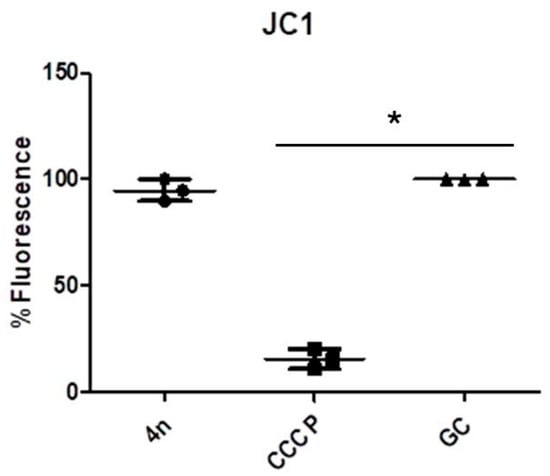
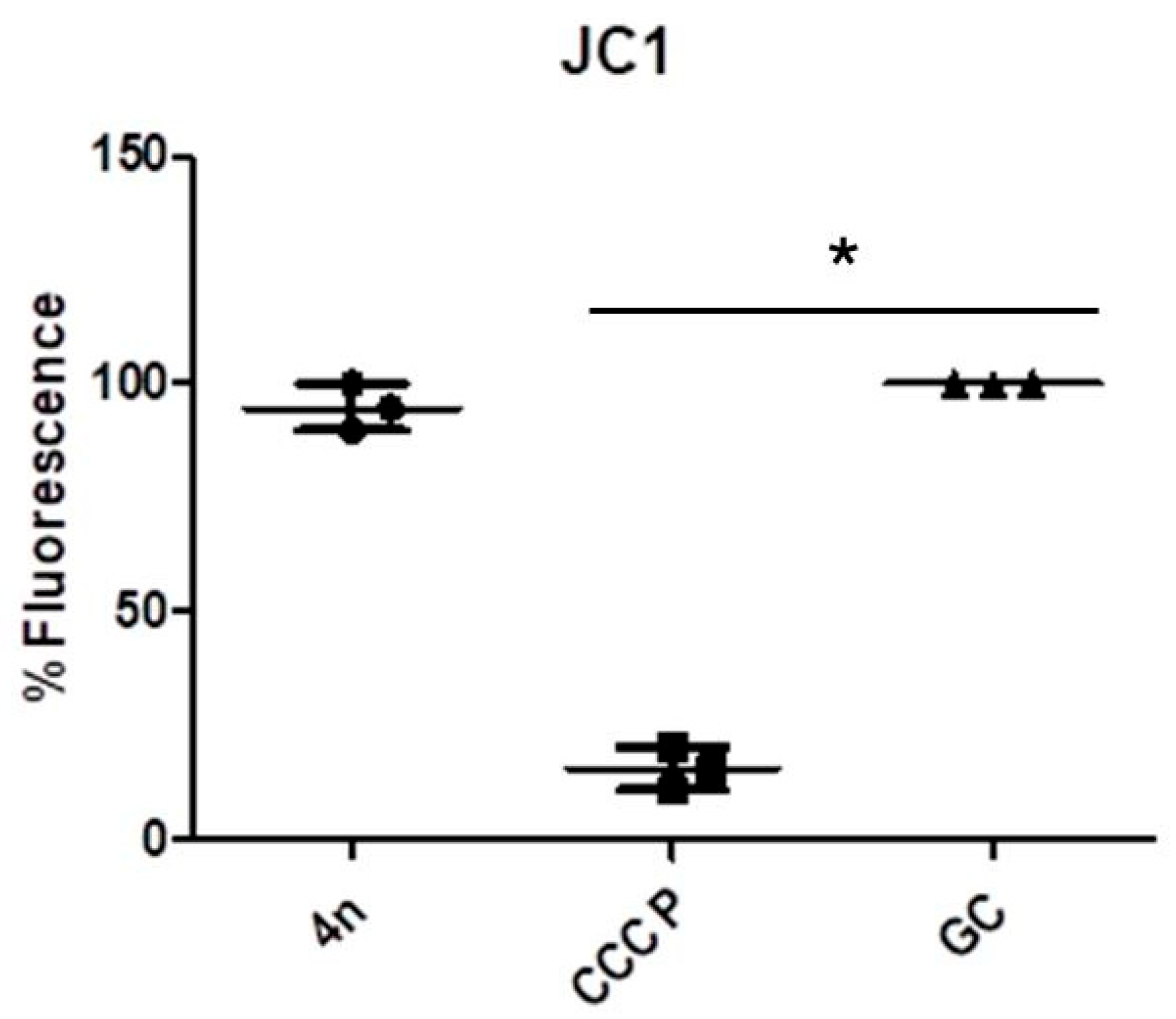
Regarding alterations of the hydrogenosomal potential of T. vaginalis, tests carried out with the JC-1 dye, commonly used for studying mitochondrial membrane potential, point out that, when treated with 4n, these parasites generate J-aggregates at levels resembling those of the growth control (GC) (Figure 1). Therefore, it appears that the hydrogenosome of T. vaginalis is unaffected by the treatment with this compound.
Figure 1.
Determination of J-aggregates in the hydrogenosome of T. vaginalis trophozoites treated with 4n, CCCP (positive control) and without treatment (GC). Data are presented as scatter dot plots with the median and interquartile range (IQR) obtained from three independent experiments (n = 3). Statistical analysis was performed using the Kruskal–Wallis test followed by Dunn’s post hoc test. Asterisks indicate statistical significance (p < 0.05) compared to the growth control (GC).
These findings coincide with those previously reported by Avila-Bonilla et al. [62], which proposed that QdNOs tested against Entamoeba histolytica may trigger their antiparasitic activity by modulating the expression of proteins related to cytoskeleton organization, intracellular traffic and redox homeostasis. In this regard, and given that both are microaerophilic protozoa, the mechanism of action of 4n is likely involved in the interaction with specific molecular targets or metabolic pathways of T. vaginalis yet to be elucidated.
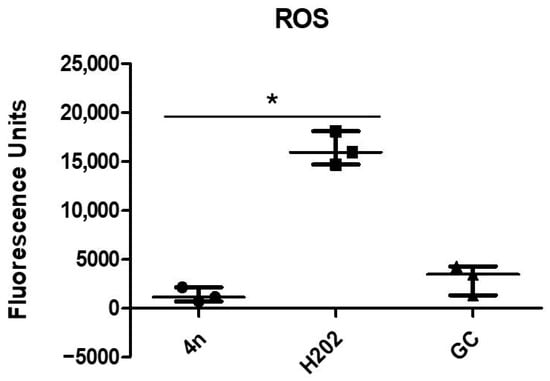
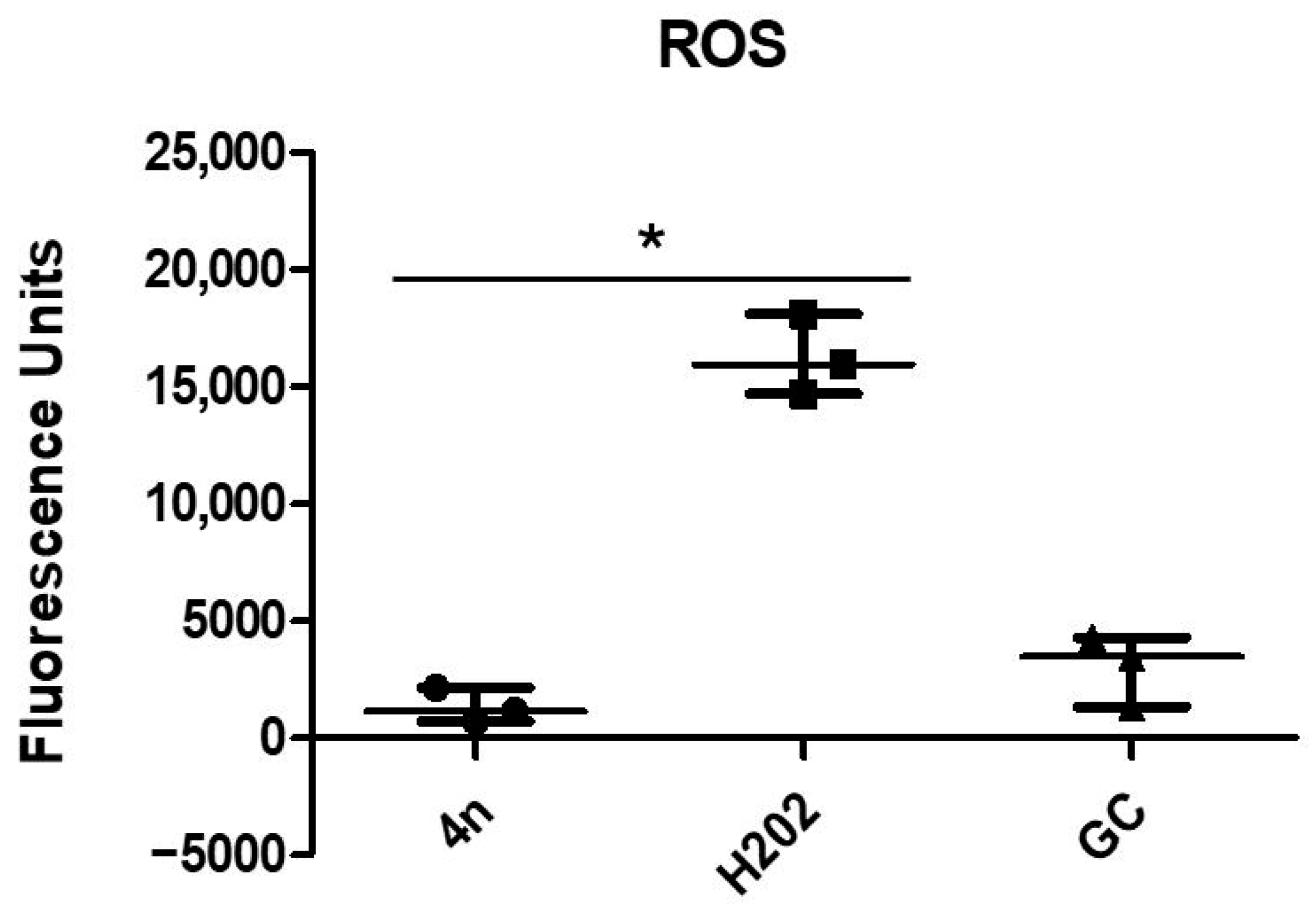
Furthermore, the evaluation of oxidative stress induction showed that 4n does not elicit ROS in the parasite, exhibiting levels that are significantly lower than those of the H2O2-treated group (p < 0.05), as depicted in Figure 2.
Figure 2.
Determination of intracellular ROS production in T. vaginalis treated with 4n, hydrogen peroxide (positive control) and without treatment (GC). Data are presented as scatter dot plots with the median and interquartile range (IQR) obtained from three independent experiments (n = 3). Statistical analysis was performed using the Kruskal–Wallis test followed by Dunn’s post hoc test. Asterisks indicate statistical significance (p < 0.05) compared to the growth control (GC) or between indicated groups.
While previous studies have associated the mechanism of action of primaquine–QdNO hybrids in hepatic cells infected with Plasmodium spp. with the induction of ROS [63], our results suggest that the mode of action triggered in T. vaginalis by these QdNO derivatives differs from the one previously published. It is important to highlight that Bonilla-Ramírez et al. [63] associated ROS induction in Plasmodium spp. with a significant decrease in the production of glutathione. T. vaginalis lacks glutathione; however, it possesses a potent antioxidant machinery that allows the parasite to survive and colonize the hostile genitourinary tract [64,65], with this redox system likely to be effective enough to regulate the ROS produced by QdNO compounds.
Although the exact molecular target remains unknown, these data conclusively demonstrate that 4n acts via a mechanism distinct from that of the reference drug, a result that may explain its residual activity against MTZ-resistant parasites.
4. Conclusions
In this study, the antiparasitic activity of a library of quinoxaline-1,4-di-N-oxides (QdNOs) previously studied against Leishmania spp., is extended towards Trypanosoma cruzi and Trichomonas vaginalis, etiological agents of Chagas disease and trichomoniasis, respectively. This was prompted by the existence of cross-activity between these parasites for several scaffolds, including QdNOs.
Computational studies show that these QdNOs, containing an amino acidic side chain, are predicted to have adequate oral bioavailability and suggest, therefore, that they are suitable for the development of drugs in solid dosage forms—an important feature in the discovery of compounds targeting neglected parasitic diseases. Moreover, these compounds do not show toxicity-associated structural alarms, unlike the reference antiparasitic drugs, benznidazole (Chagas disease) and metronidazole (trichomoniasis).
Regarding in vitro assays performed on T. cruzi, compound 4m displays an activity profile comparable to that of BZ against epimastigotes of the drug-sensitive CL-B5 strain, as well as low cytotoxicity towards cultures of mammalian cells. Future studies to explore the preservation of such relevant activity over infective forms of the parasite (i.e., trypomastigotes and amastigotes) are needed to confirm whether 4m can serve as a template for hit-to-lead optimization, aiming for the discovery of novel trypanocidal agents. Likewise, compound 4n is here postulated as a starting point for the development of new synthetic derivatives against T. vaginalis. However, both molecules require structural modifications directed to attain significant improvements in their potency towards resistant parasites. Studies focused on elucidating the mechanism of action of 4n confirm that neither alterations of the hydrogenosomal membrane potential nor ROS production are sufficient to cause parasite death. While this negative result is important, the absence of deeper mechanistic probing limits biological interpretation. Further research is required to disclose evidence concerning the mechanism of action triggered by these compounds in these parasites.
Author Contributions
Conceptualization, J.F.G., A.I.-E. and C.F.-B.; methodology, M.L.-A., T.E.-B., L.H., A.I.-E. and C.F.-B.; investigation, M.L.-A., T.E.-B., A.I.-E. and C.F.-B.; writing—original draft preparation, A.I.-E. and C.F.-B.; writing—review and editing, J.C.M., A.I.-E. and C.F.-B.; visualization, A.I.-E. and C.F.-B.; supervision, J.F.G., J.C.M., A.I.-E. and C.F.-B.; funding acquisition, J.C.M., M.L.-A. and T.E.-B. contributed equally to this paper as first authors. A.I.-E. and C.F.-B. contributed equally to this paper as senior authors. All authors have read and agreed to the published version of the manuscript.
Funding
This research study was funded by the Ministerio de Ciencia e Innovación, Spain, grant number TED2021-129408B-I00, and by the UCM Research Group PARADET (ref. 911120: Diagnosis, Epidemiology and Antiparasitic Therapy). The APC was not funded.
Institutional Review Board Statement
Not applicable.
Informed Consent Statement
Not applicable.
Data Availability Statement
The original contributions presented in this study are included in the article. Further inquiries can be directed to the corresponding authors.
Conflicts of Interest
The authors declare no conflicts of interest.
References
- Parise, M.E.; Hotez, P.J.; Slutsker, L. Neglected Parasitic Infections in the United States: Need and opportunities. Am. J. Trop. Med. Hyg. 2014, 90, 783–785. [Google Scholar] [CrossRef] [Scilit]
- World Health Organization. Global Report on Neglected Tropical Diseases; World Health Organization: Geneva, Switzerland, 2025. [Google Scholar]
- de Sousa, A.S.; Vermeij, D.; Ramos, A.N.; Luquetti, A.O. Chagas Disease. Lancet 2024, 403, 203–218. [Google Scholar] [CrossRef] [Scilit]
- Miranda-Arboleda, A.F.; Zaidel, E.J.; Marcus, R.; Pinazo, M.J.; Echeverría, L.E.; Saldarriaga, C.; Liprandi, A.S.; Baranchuk, A.; on behalf of the Neglected Tropical Diseases and other Infectious Diseases affecting the Heart (NET-Heart) project. Roadblocks in Chagas disease care in endemic and nonendemic countries: Argentina, Colombia, Spain, and the United States. The NET-Heart project. PLoS Negl. Trop. Dis. 2023, 15, e0009954. [Google Scholar] [CrossRef] [Scilit] [PubMed]
- González-Sanz, M.; Crespillo-Andújar, C.; Chamorro-Tojeiro, S.; Monge-Maillo, B.; Pérez-Molina, J.A.; Norman, F.F. Chagas Disease in Europe. Trop. Med. Infect. Dis. 2023, 8, 513. [Google Scholar] [CrossRef] [Scilit]
- Ebiloma, G.U.; Alhejeli, A.; de Koning, H.P. Interventions for neglected diseases caused by Kinetoplastid parasites: A One Health approach to drug discovery, development, and deployment. Pharmaceuticals 2025, 18, 1415. [Google Scholar] [CrossRef] [Scilit]
- Rowley, J.; Vander Hoorn, S.; Korenromp, E.; Low, N.; Unemo, M.; Abu-Raddad, L.J.; Matthew Chico, R.; Smolak, A.; Newman, L.; Gottlieb, S.; et al. Chlamydia, gonorrhoea, trichomoniasis and syphilis: Global prevalence and incidence estimates, 2016. Bull. World Health Organ. 2019, 97, 548–562. [Google Scholar] [CrossRef] [Scilit] [PubMed]
- Kissinger, P.J.; Gaydos, C.A.; Seña, A.C.; McClelland, R.S.; Soper, D.; Secor, W.E.; Legendre, D.; Workowski, K.A.; Muzny, C.A. Diagnosis and Management of Trichomonas vaginalis: Summary of Evidence Reviewed for the 2021 Centers for Disease Control and Prevention Sexually Transmitted Infections Treatment Guidelines. Clin. Infect. Dis. 2022, 74, S152–S161. [Google Scholar] [CrossRef] [Scilit] [PubMed]
- World Health Organization. Sexually Transmitted Infections (STIs). Available online: https://www.who.int/news-room/fact-sheets/detail/sexually-transmitted-infections-(stis) (accessed on 1 February 2026).
- Simhan, H.N.; Anderson, B.L.; Krohn, M.A.; Heine, R.P.; Martínez de Tejada, B.; Landers, D.V.; Hillier, S.L. Host immune consequences of asymptomatic Trichomonas vaginalis infection in pregnancy. Am. J. Obstet. Gynecol. 2007, 196, 59.e1–59.e5. [Google Scholar] [CrossRef] [Scilit]
- Fazlollahpour-Naghibi, A.; Bagheri, K.; Almukhtar, M.; Taha, S.R.; Zadeh, M.S.; Moghadam, K.B.; Tadi, M.J.; Rouholamin, S.; Razavi, M.; Sepidarkish, M.; et al. Trichomonas vaginalis infection and risk of cervical neoplasia: A systematic review and meta-analysis. PLoS ONE 2023, 18, e0288443. [Google Scholar] [CrossRef] [Scilit]
- Masha, S.C.; Cools, P.; Sanders, E.J.; Vaneechoutte, M.; Crucitti, T. Trichomonas vaginalis and HIV infection acquisition: A systematic review and meta-analysis. Sex. Transm. Infect. 2019, 95, 36–42. [Google Scholar] [CrossRef] [Scilit]
- Mei, X.; Zhang, R.; Li, D.; Xie, X.; Yao, Y.; Gao, M.; Zhao, L.; Zhu, S.; Tian, X.; Yang, Z.; et al. Association between the infections of Trichomonas vaginalis and uterine cervical human papillomavirus: A meta-analysis. J. Obstet. Gynaecol. 2023, 43, 2194986. [Google Scholar] [CrossRef] [Scilit] [PubMed]
- U.S. Food and Drug Administration. Drugs@FDA: FDA-Approved Drugs. Available online: https://www.accessdata.fda.gov/scripts/cder/daf/index.cfm?event=BasicSearch.process (accessed on 2 September 2025).
- Van Gerwen, O.T.; Camino, A.F.; Bourla, L.N.; Legendre, D.; Muzny, C.A. Management of trichomoniasis in the setting of 5-nitroimidazole hypersensitivity. Sex. Transm. Dis. 2021, 48, e111–e115. [Google Scholar] [CrossRef] [Scilit] [PubMed]
- Ibáñez Escribano, A.; Tasca, T.; Margarita, V. Editorial: Biomolecular approaches to trichomoniasis: Epidemiology, diagnosis, and treatment. Front. Parasitol. 2025, 4, 1691804. [Google Scholar] [CrossRef] [Scilit]
- Cheng, G.; Sa, W.; Cao, C.; Guo, L.; Hao, H.; Liu, Z.; Wang, X.; Yuan, Z. Quinoxaline 1,4-di-N-oxides: Biological activities and mechanisms of actions. Front. Pharmacol. 2016, 7, 64. [Google Scholar] [CrossRef] [Scilit]
- Chawla, G.; Gupta, O.; Pradhan, T. A review on multipurpose potential of bioactive heterocycle quinoxaline. ChemistrySelect 2023, 8, e20230140. [Google Scholar] [CrossRef] [Scilit]
- Montero, V.; Montana, M.; Carré, M.; Vanelle, P. Quinoxaline derivatives: Recent discoveries and development strategies towards anticancer agents. Eur. J. Med. Chem. 2024, 271, 116360. [Google Scholar] [CrossRef] [Scilit]
- Jampilek, J. Recent advances in design of potential quinoxaline anti-infectives. Curr. Med. Chem. 2014, 21, 4347–4373. [Google Scholar] [CrossRef] [Scilit]
- Dewangan, D.; Nakhate, K.; Mishra, A.; Thakur, A.S.; Rajak, H.; Dwivedi, J.; Sharma, S.; Paliwal, S. Design, synthesis, and characterization of quinoxaline derivatives as a potent antimicrobial agent. J. Heterocycl. Chem. 2019, 56, 566–578. [Google Scholar] [CrossRef] [Scilit]
- Chacón-Vargas, K.F.; Nogueda-Torres, B.; Sánchez-Torres, L.E.; Suarez-Contreras, E.; Villalobos-Rocha, J.C.; Torres-Martinez, Y.; Lara-Ramirez, E.E.; Fiorani, G.; Krauth-Siegel, R.L.; Bolognesi, M.L.; et al. Trypanocidal activity of quinoxaline 1,4 di-N-oxide derivatives as trypanothione reductase inhibitors. Molecules 2017, 22, 220. [Google Scholar] [CrossRef] [Scilit]
- Soto-Sánchez, J.; Ospina-Villa, J.D. Current status of quinoxaline and quinoxaline 1,4-di-N-oxides derivatives as potential antiparasitic agents. Chem. Biol. Drug. Des. 2021, 98, 683–699. [Google Scholar] [CrossRef] [Scilit]
- González-González, A.; Méndez-Álvarez, D.; Vázquez-Jiménez, L.K.; Delgado-Maldonado, T.; Ortiz-Pérez, E.; Paz-González, A.D.; Bandyopadhyay, D.; Rivera, G. Molecular docking and dynamic simulations of quinoxaline 1,4-di-N-oxide as inhibitors for targets from Trypanosoma cruzi, Trichomonas vaginalis, and Fasciola hepatica. J. Mol. Mod. 2023, 29, 180. [Google Scholar] [CrossRef] [Scilit]
- González, J.F.; Dea-Ayuela, M.-A.; Huck, L.; Orduña, J.M.; Bolás-Fernández, F.; de la Cuesta, E.; Haseen, N.; Mohammed, A.A.; Menéndez, J.C. Dual antitubercular and antileishmanial profiles of quinoxaline di-N-oxides containing an amino acidic side chain. Pharmaceuticals 2024, 17, 487. [Google Scholar] [CrossRef] [Scilit]
- Fonseca-Berzal, C.; Ibáñez-Escribano, A.; Vela, N.; Cumella, J.; Nogal-Ruiz, J.J.; Escario, J.A.; da Silva, P.B.; Batista, M.M.; Soeiro, M.N.C.; Sifontes-Rodríguez, S.; et al. Antichagasic, leishmanicidal, and trichomonacidal activity of 2-benzyl-5-nitroindazole-derived amines. ChemMedChem 2018, 13, 1246–1259. [Google Scholar] [CrossRef] [Scilit]
- Fonseca-Berzal, C.; Arenas, D.R.M.; Bohórquez, A.R.R.; Escario, J.A.; Kouznetsov, V.V.; Gómez-Barrio, A. Selective activity of 2,4-diaryl-1,2,3,4-tetrahydroquinolines on Trypanosoma cruzi epimastigotes and amastigotes expressing β-galactosidase. Bioorg. Med. Chem. Lett. 2013, 23, 4851–4856. [Google Scholar] [CrossRef] [Scilit] [PubMed]
- Fonseca-Berzal, C.; Ibáñez-Escribano, A.; de Castro, S.; Escario, J.A.; Gómez-Barrio, A.; Arán, V.J. 5-Nitroindazole-based compounds: Further studies for activity optimization as anti-Trypanosoma cruzi agents. Acta Trop. 2022, 234, 106607. [Google Scholar] [CrossRef] [Scilit]
- Ibáñez-Escribano, A.; Reviriego, F.; Vela, N.; Fonseca-Berzal, C.; Nogal-Ruiz, J.J.; Arán, V.J.; Escario, J.A.; Gómez-Barrio, A. Promising hit compounds against resistant trichomoniasis: Synthesis and antiparasitic activity of 3-(ω-aminoalkoxy)-1-benzyl-5-nitroindazoles. Bioorg. Med. Chem. Lett. 2021, 37, 127843. [Google Scholar] [CrossRef] [Scilit]
- Buckner, F.S.; Verlinde, C.L.; La Flamme, A.C.; Van Voorhis, W.C. Efficient technique for screening drugs for activity against Trypanosoma cruzi using parasites expressing beta-galactosidase. Antimicrob. Agents Chemother. 1996, 40, 2592–2597. [Google Scholar] [CrossRef] [Scilit]
- Silva, L.H.; Nussenzweig, V. Sobre uma cepa de Trypanosoma cruzi altamente virulenta para o camundongo branco. Folha Clin. Biol. 1953, 20, 191–207. [Google Scholar]
- Fonseca-Berzal, C.; Ibáñez-Escribano, A.; Reviriego, F.; Cumella, J.; Morales, P.; Jagerovic, N.; Nogal-Ruiz, J.J.; Escario, J.A.; da Silva, P.B.; Soeiro, M.N.C.; et al. Antichagasic and trichomonacidal activity of 1-substituted 2-benzyl-5-nitroindazolin-3-ones and 3-alkoxy-2-benzyl-5-nitro-2H-indazoles. Eur. J. Med. Chem. 2016, 115, 295–310. [Google Scholar] [CrossRef] [Scilit] [PubMed]
- Filardi, L.S.; Brener, Z. Susceptibility and natural resistance of Trypanosoma cruzi strains to drugs used clinically in Chagas disease. Trans. R. Soc. Trop. Med. Hyg. 1987, 81, 755–759. [Google Scholar] [CrossRef] [Scilit] [PubMed]
- Vega, C.; Rolón, M.; Martínez-Fernández, A.R.; Escario, J.A.; Gómez-Barrio, A. A new pharmacological screening assay with Trypanosoma cruzi epimastigotes expressing β-galactosidase. Parasitol. Res. 2005, 95, 296–298. [Google Scholar] [CrossRef] [Scilit]
- Romanha, A.J.; de Castro, S.L.; Soeiro, M.N.C.; Lannes-Vieira, J.; Ribeiro, I.; Talvani, A.; Bourdin, B.; Blum, B.; Olivieri, B.; Zani, C.; et al. In vitro and in vivo experimental models for drug screening and development for Chagas disease. Mem. Inst. Oswaldo Cruz 2010, 105, 233–238. [Google Scholar] [CrossRef] [Scilit]
- Rolón, M.; Vega, C.; Escario, J.A.; Gómez-Barrio, A. Development of resazurin microtiter assay for drug sensibility testing of Trypanosoma cruzi epimastigotes. Parasitol. Res. 2006, 99, 103–107. [Google Scholar] [CrossRef] [Scilit]
- Ibáñez-Escribano, A.; Fonseca-Berzal, C.; Martínez-Montiel, M.; Álvarez-Márquez, M.; Gómez-Núñez, M.; Lacueva-Arnedo, M.; Espinosa-Buitrago, T.; Martín-Pérez, T.; Escario, J.A.; Merino-Montiel, P.; et al. Thio- and selenosemicarbazones as antiprotozoal agents against Trypanosoma cruzi and Trichomonas vaginalis. J. Enzym. Inhib. Med. Chem. 2022, 37, 781–791. [Google Scholar] [CrossRef] [Scilit] [PubMed]
- Vega, M.C.; Rolón, M.; Montero-Torres, A.; Fonseca-Berzal, C.; Escario, J.A.; Gómez-Barrio, A.; Gálvez, J.; Marrero-Ponce, Y.; Arán, V.J. Synthesis, biological evaluation and chemometric analysis of indazole derivatives. 1,2-Disubstituted 5-nitroindazolinones, new prototypes of antichagasic drug. Eur. J. Med. Chem. 2012, 58, 214–227. [Google Scholar] [CrossRef] [Scilit]
- Ibáñez-Escribano, A.; Meneses-Marcel, A.; Marrero-Ponce, Y.; Nogal-Ruiz, J.J.; Arán, V.J.; Gómez-Barrio, A.; Escario, J.A. A sequential procedure for rapid and accurate identification of putative trichomonacidal agents. J. Microbiol. Methods 2014, 105, 162–167. [Google Scholar] [CrossRef] [Scilit] [PubMed]
- Lipinski, C.A.; Lombardo, F.; Dominy, B.W.; Feeney, P.J. Experimental and computational approaches to estimate solubility and permeability in drug discovery and development settings. Adv. Drug Deliv. Rev. 1997, 23, 3–25. [Google Scholar] [CrossRef] [Scilit]
- Lipinski, C.A. Lead- and drug-like compounds: The rule-of-five revolution. Drug Discov. Today Tecnhol. 2004, 1, 337–341. [Google Scholar] [CrossRef] [Scilit]
- Veber, D.F.; Johnson, S.R.; Cheng, H.Y.; Smith, B.R.; Ward, K.W.; Kopple, K.D. Molecular properties that influence the oral bioavailability of drug candidates. J. Med. Chem. 2002, 45, 2615–2623. [Google Scholar] [CrossRef] [Scilit] [PubMed]
- Vllasaliu, D. Grand challenges in oral drug delivery. Front. Drug Deliv. 2025, 5, 1571982. [Google Scholar] [CrossRef] [Scilit]
- Nwaka, S.; Ramirez, B.; Brun, R.; Maes, L.; Douglas, F.; Ridley, R. Advancing drug innovation for neglected diseases-criteria for lead progression. PLoS Negl. Trop. Dis. 2009, 3, e440. [Google Scholar] [CrossRef] [Scilit]
- Soeiro, M.N.C.; Sales-Junior, P.A.; Pereira, V.R.A.; Vannier-Santos, M.A.; Murta, S.M.F.; de Sousa, A.S.D.; Sangenis, L.H.C.; Hasslocher Moreno, A.M.; Boechat, N.; Branco, F.S.C.; et al. Drug screening and development cascade for Chagas disease: An update of in vitro and in vivo experimental models. Mem. Inst. Oswaldo Cruz 2024, 119, e240057. [Google Scholar] [CrossRef] [Scilit]
- Estevez, Y.; Quiliano, M.; Burguete, A.; Cabanillas, B.; Zimic, M.; Málaga, E.; Verástegui, M.; Pérez-Silanes, S.; Aldana, I.; Monge, A.; et al. Trypanocidal properties, structure–activity relationship and computational studies of quinoxaline 1,4-di-N-oxide derivatives. Exp. Parasitol. 2011, 127, 745–751. [Google Scholar] [CrossRef] [Scilit]
- Mendes, F.S.N.S.; Perez-Molina, J.A.; Angheben, A.; Meymandi, S.K.; Sosa-Estani, S.; Molina, I. Critical analysis of Chagas disease treatment in different countries. Mem. Inst. Oswaldo Cruz 2022, 117, e210034. [Google Scholar] [CrossRef] [Scilit]
- Drobnis, E.Z.; Nangia, A.K. Antimicrobials and male reproduction. Adv. Exp. Med. Biol. 2017, 1034, 131–161. [Google Scholar] [CrossRef] [Scilit]
- Koss, C.A.; Baras, D.C.; Lane, S.D.; Aubry, R.; Marcus, M.; Markowitz, L.E.; Koumans, E.H. Investigation of metronidazole use during pregnancy and adverse birth outcomes. Antimicrob. Agents Chemother. 2012, 56, 4800–4805. [Google Scholar] [CrossRef] [Scilit]
- AbdRabou, M.A.; Alrashdi, B.M.; Alruwaili, H.K.; Elmazoudy, R.H.; Alwaili, M.A.; Othman, S.I.; Alghamdi, F.A.; Fahmy, G.H. Exploration of maternal and fetal toxicity risks for metronidazole-related teratogenicity and hepatotoxicity through an assessment in albino rats. Toxics 2023, 11, 303. [Google Scholar] [CrossRef] [Scilit]
- El-Nahas, A.F.; El-Ashmawy, I.M. Reproductive and cytogenetic toxicity of metronidazole in male mice. Basic Clin. Pharmacol. Toxicol. 2004, 94, 226–231. [Google Scholar] [CrossRef] [Scilit] [PubMed]
- Buravchenko, G.I.; Shchekotikhin, A.E. Quinoxaline 1,4-dioxides: Advances in chemistry and chemotherapeutic drug development. Pharmaceuticals 2023, 16, 1174. [Google Scholar] [CrossRef] [Scilit] [PubMed]
- Tian, S.; Wang, J.; Li, Y.; Li, D.; Xu, L.; Hou, T. The application of in silico drug-likeness predictions in pharmaceutical research. Adv. Drug Deliv. Rev. 2015, 86, 2–10. [Google Scholar] [CrossRef] [Scilit]
- Rajan, V.K.; Ragi, C.; Muraleedharan, K. A computational exploration into the structure, antioxidant capacity, toxicity and drug-like activity of the anthocyanidin “Petunidin”. Heliyon 2019, 5, e02115. [Google Scholar] [CrossRef] [Scilit] [PubMed]
- Zingales, B.; Andrade, S.G.; Briones, M.R.S.; Campbell, D.A.; Chiari, E.; Fernandes, O.; Guhl, F.; Lages-Silva, E.; Macedo, A.M.; Machado, C.R.; et al. A new consensus for Trypanosoma cruzi intraspecific nomenclature: Second revision meeting recommends TcI to TcVI. Mem. Inst. Oswaldo Cruz 2009, 104, 1051–1054. [Google Scholar] [CrossRef] [Scilit]
- Zingales, B.; Miles, M.A.; Moraes, C.B.; Luquetti, A.; Guhl, F.; Schijman, A.G.; Ribeiro, I. Drug discovery for Chagas disease should consider Trypanosoma cruzi strain diversity. Mem. Inst. Oswaldo Cruz 2014, 109, 828–833. [Google Scholar] [CrossRef] [Scilit] [PubMed]
- Benitez, D.; Cabrera, M.; Hernández, P.; Boiani, L.; Lavaggi, M.L.; Di Maio, R.; Yaluff, G.; Serna, E.; Torres, S.; Ferreira, M.E.; et al. 3-Trifluoromethylquinoxaline N,N′-dioxides as anti-trypanosomatid agents. Identification of optimal anti-T. cruzi agents and mechanism of action studies. J. Med. Chem. 2011, 54, 3624–3636. [Google Scholar] [CrossRef] [Scilit]
- Repetto, Y.; Opazo, E.; Maya, J.D.; Agosin, M.; Morello, A. Glutathione and trypanothione in several strains of Trypanosoma cruzi: Effect of drugs. Comp. Biochem. Physiol. B Biochem. Mol. Biol. 1996, 115, 281–285. [Google Scholar] [CrossRef] [Scilit]
- Irigoin, F.; Cibils, L.; Comini, M.A.; Wilkinson, S.R.; Flohe, L.; Radi, R. Insights into the redox biology of Trypanosoma cruzi: Trypanothione metabolism and oxidant detoxification. Free Rad. Biol. Med. 2008, 45, 733–742. [Google Scholar] [CrossRef] [Scilit] [PubMed]
- Mesías, A.C.; Garg, N.J.; Zago, M.P. Redox balance keepers and possible cell functions managed by redox homeostasis in Trypanosoma cruzi. Front. Cell. Infect. Microbiol. 2019, 9, 435. [Google Scholar] [CrossRef] [Scilit]
- Carta, A.; Loriga, M.; Paglietti, G.; Mattana, A.; Fiori, P.L.; Mollicotti, P.; Sechi, L.; Zanetti, S. Synthesis, anti-Mycobacterial, anti-Trichomonas and anti-Candida in vitro activities of 2-substituted-6,7-difluoro-3-methylquinoxaline 1,4-dioxides. Eur. J. Med. Chem. 2004, 3, 195–203. [Google Scholar] [CrossRef] [Scilit]
- Avila-Bonilla, R.G.; López-Sandoval, Á.; Soto-Sánchez, J.; Marchat, L.A.; Rivera, G.; Medina-Contreras, O.; Ramírez-Moreno, E. Proteomic and functional analysis of the effects of quinoxaline derivatives on Entamoeba histolytica. Front. Cell. Infect. Microbiol. 2022, 12, 887647. [Google Scholar] [CrossRef] [Scilit]
- Bonilla-Ramírez, L.; Galiano, S.; Quiliano, M.; Aldana, I.; Pabón, A. Primaquine–quinoxaline 1,4-di-N-oxide hybrids with action on the exo-erythrocytic forms of Plasmodium induce their effect by the production of reactive oxygen species. Malar. J. 2019, 18, 201. [Google Scholar] [CrossRef] [Scilit]
- Coombs, G.H.; Westrop, G.D.; Suchan, P.; Puzova, G.; Hirt, R.P.; Embley, T.M.; Mottram, J.C.; Muller, S. The amitochondriate eukaryote Trichomonas vaginalis contains a divergent thioredoxin-linked peroxiredoxin antioxidant system. J. Biol. Chem. 2004, 279, 5249–5256. [Google Scholar] [CrossRef] [Scilit]
- Menezes, C.B.; Tasca, T. Trichomoniasis immunity and the involvement of the purinergic signaling. Biomed. J. 2016, 39, 234–243. [Google Scholar] [CrossRef] [Scilit]

Disclaimer/Publisher’s Note: The statements, opinions and data contained in all publications are solely those of the individual author(s) and contributor(s) and not of MDPI and/or the editor(s). MDPI and/or the editor(s) disclaim responsibility for any injury to people or property resulting from any ideas, methods, instructions or products referred to in the content. |
© 2026 by the authors. Licensee MDPI, Basel, Switzerland. This article is an open access article distributed under the terms and conditions of the Creative Commons Attribution (CC BY) license.