


Abstract
Background/Objectives: 3,4-Methylenedioxy-alpha-pyrrolidinohexanophenone (MDPHP) is a pyrrolidinophenone synthetic cathinone whose post-mortem interpretation is particularly difficult when advanced decomposition prevents blood-based toxicology. This case report examined instrument-derived semiquantitative MDPHP values in solid tissues and necrophagous larvae and assessed the complementary evidential value of larval matrices. Methods: Post-mortem computed tomography, complete autopsy, histology, and liquid chromatography–high-resolution mass spectrometry (LC-HRMS) were performed in an adult decedent found in advanced decomposition. Brain, liver, kidney, and four separately collected larval groups were analyzed using a procedure previously validated in blood but not validated in tissues or larvae. Results: No fatal traumatic lesion was identified. Pulmonary edema and myocardial fibrofatty replacement were documented. Instrument-derived semiquantitative MDPHP values were 0.45 ng/mg in brain, 0.75 ng/mg in liver, and 2.44 ng/mg in kidney; the four larval groups yielded <0.06, 0.43, 1.58, and 0.22 ng/mg, respectively. These values are exploratory and semiquantitative because matrix-specific validation data are unavailable. The Larvae III extract also showed signals tentatively assigned to M3.1, M5.2, and M9.1. Conclusions: Necrophagous larvae preserved evidence of MDPHP exposure and phase-I metabolite signals. The findings do not establish validated quantitative concentrations, a lethal threshold, or a tissue-to-larva relationship. In the integrated medicolegal context, MDPHP intoxication remained a plausible contributor, but causal interpretation was limited by the single-case design, decomposition, underlying myocardial pathology, absence of conventional matrices, and lack of tissue- and larva-specific method validation.
1. Introduction
Synthetic cathinones are stimulant new psychoactive substances that interact primarily with monoamine transporters and can cause severe neuropsychiatric, cardiovascular, respiratory, and hyperthermic toxicity [1,2,3]. Among the pyrrolidinophenone derivatives, 3,4-methylenedioxy-alpha-pyrrolidinohexanophenone (MDPHP) is structurally related to 3,4-methylenedioxypyrovalerone (MDPV) and has been present in European drug markets since the mid-2010s. Despite increasing analytical recognition, its pharmacokinetics, dose–response relationships, and post-mortem interpretation remain incompletely defined [1,4,5,6].
Fatal and severe MDPHP cases now include fetal death after combined maternal exposure to MDPHP and alpha-PHP, a fatal intoxication reported without other co-ingested drugs, a post-mortem distribution study across multiple conventional matrices, and a polydrug fatality in which MDPHP and several related compounds were identified [7,8,9,10]. More recent case-series work has also emphasized the need to distinguish MDPHP from the structural isomer MDPiHP chromatographically and analytically [11]. Across these reports, the available matrices, co-exposures, and post-mortem conditions differ substantially, limiting direct comparison.
MDPHP undergoes extensive phase-I and phase-II metabolism. High-resolution and gas chromatographic studies have described pathways involving carbonyl reduction, hydroxylation, oxidation and opening of the pyrrolidine ring, demethylenation, methylation, carboxylation, and conjugation [5,12,13]. Metabolite detection can therefore strengthen evidence of prior exposure when the parent compound is low or conventional biological matrices are compromised.
Advanced decomposition may make blood, urine, and other conventional matrices unavailable or analytically unreliable. Necrophagous larvae have consequently been investigated as complementary toxicological specimens [14,15,16,17,18]. Authentic case series and controlled studies show that drugs and metabolites can be detected in larvae, while also demonstrating that larval concentration is influenced by feeding substrate, species, developmental stage, local contamination, and insect metabolism [17,18,19,20,21,22,23]. Concentrations in larvae therefore cannot be translated directly into human tissue or blood concentrations.
The present case report examined MDPHP in brain, liver, kidney, and four groups of necrophagous larvae recovered from a human body in advanced decomposition. The aims were to document multi-matrix LC-HRMS findings, evaluate signals tentatively assigned to phase-I metabolites in larvae, and define the evidential contribution and interpretive limits of entomotoxicological findings in a case lacking blood. Human advanced-decomposition cases documenting MDPHP in larvae, particularly with tentative phase-I metabolite signals, remain insufficiently documented.
2. Materials and Methods
2.1. Study Design and Forensic Context
This was a single-case observational forensic study. The case was derived from a judicial death investigation involving an adult decedent found outdoors in advanced decomposition. Circumstantial information documented an altered psychophysical state after reported drug use in the period preceding death. The case has been de-identified, and no direct personal identifiers are included in the manuscript.
2.2. Post-Mortem Examination and Sample Collection
Post-mortem computed tomography and a complete judicial autopsy were performed. External and internal examinations were supplemented by histology. Lung, kidney, heart, and liver specimens were fixed in 10% neutral buffered formalin, sectioned, stained with hematoxylin and eosin, and examined microscopically. Brain, liver, and kidney specimens were retained for toxicological analysis. No blood sample suitable for toxicological interpretation was available because of the advanced decomposition.
2.3. Entomological Sampling
Larvae were collected separately from four heavily colonized anatomical regions. The analytical groups corresponded to the following collection sites: Larvae I, face/head; Larvae II, thorax and pelvis; Larvae III, genital/inguinal region; and Larvae IV, lower limbs. After collection, the four analytical groups were stored at −20 °C, washed with deionized water and blotted on filter paper before analysis. The preserved records do not specify the number or duration of washing steps. The 80 mg analytical aliquot represented dry mass. Species and developmental stage were not determined, and no archived larval material remains available for retrospective taxonomic or developmental-stage identification. Because the groups may not have belonged to the same species or developmental stage and were not standardized by feeding history, no site-specific statistical inference was performed.
2.4. Chemicals and Reagents
Methanol, water, acetonitrile, isopropanol, acetone, ammonium formate, and ammonium hydrogen carbonate were obtained from Merck Life Science S.r.l. (Milan, Italy). 3,4-Methylenedioxymethamphetamine-d5 (MDMA-d5) was obtained from LGC Standards S.r.l. (Milan, Italy). MDPHP reference material was supplied by the Istituto Superiore di Sanità (Rome, Italy). Other certified reference materials and deuterated analogues were obtained as methanolic or acetonitrile solutions from LGC Standards S.r.l.
2.5. Sample Preparation
Each tissue matrix was processed from approximately 500 mg. The four site-specific larval groups were processed separately after washing with deionized water and blotting on filter paper. According to the author clarification obtained after editorial precheck, an 80 mg larval aliquot after this preparative step was used from each anatomical group. The 80 mg analytical aliquot represented dry mass. Approximately 200 mg were available per group, although the exact total mass was not recorded; the analyzed portion therefore represented a subsample. Tissue and larval portions were homogenized in reinforced vials with cold acetonitrile/methanol (75:25, v/v) to a nominal concentration of 100 mg/mL, using ten 2.8 mm stainless-steel beads and a Precellys 24 Tissue Homogenizer at 6500 rpm for 60 s.
After an initial centrifugation, for which speed/RCF, duration, and temperature were not preserved in the available records, 100 µL of each homogenate was transferred to a microcentrifuge tube. MDMA-d5 (10 µL, 10 µg/mL) and 400 µL of an aqueous solution containing 10 mM ammonium formate and 0.1% formic acid were added. Samples were vortex-mixed for 1 min and centrifuged for 10 min at the originally reported speed of 1200 rpm. Because the rotor radius was not preserved, the RCF for the second centrifugation cannot be calculated reliably retrospectively. Temperature for this step and the LC-HRMS injection volume were not recorded in the available documentation.
2.6. LC-HRMS Instrumentation and Analytical Procedure
Analyses were performed using a Dionex UltiMate 3000 UHPLC system with an integrated Transcend TLX TurboFlow sample-preparation system coupled to a Q-Exactive Plus Orbitrap mass spectrometer (Thermo Fisher Scientific, San Jose, CA, USA). Positive-ion electrospray full-scan acquisition covered m/z 100–800. Source settings were: sheath gas 45 arbitrary units (AU), auxiliary gas 15 AU, sweep gas 2 AU, spray voltage 3.7 kV, heater temperature 400 °C, ion-transfer capillary temperature 320 °C, and S-lens RF level 60.0. Full-scan resolution was 70,000, with one microscan, an automatic gain-control target of 1 × 10⁶, and a maximum injection time of 250 ms.
Samples were injected with an HTS PAL autosampler (CTC Analytics AG, Zwingen, Switzerland) maintained at 10 °C. A Cyclone-P TurboFlow column (50 mm × 0.5 mm; Thermo Fisher Scientific) was used for online sample preparation. Chromatographic separation used a Cadenza CD-C18 HT analytical column (100 mm × 3 mm, 3 µm; Imtakt, Kyoto, Japan) maintained at 40 °C.
TurboFlow eluents were: A, water containing 0.1% formic acid and 10 mM ammonium formate; B, water containing 0.05% ammonium hydroxide and 10 mM ammonium bicarbonate; C, acetonitrile; and D, acetone/acetonitrile/isopropanol (10:45:45, v/v/v). Analytical eluents were: A, water containing 0.1% formic acid and 10 mM ammonium formate; and B, methanol containing 0.1% formic acid.
2.7. Identification and Quantitative Reporting
MDPHP was detected using the reference material and the LC-HRMS procedure described above. The procedure had previously been validated in blood but was not validated or verified in post-mortem tissues or necrophagous larvae. Accordingly, the numerical values reported for this case are retained as exploratory, semiquantitative instrument-derived results rather than as matrix-specifically validated concentrations. Three additional accurate-mass signals in the Larvae III extract were tentatively assigned to the phase-I metabolites designated M3.1, M5.2, and M9.1 using the nomenclature of Kavanagh et al. [12]. The laboratory record reports <0.06 ng/mg for Larvae I, but the preserved documentation does not establish whether 0.06 ng/mg represents an LOD, LLOQ, reporting limit, or another threshold; it is therefore not interpreted as a validated quantitative value. Although MDPHP reference material was used, the available records do not document a retention-time comparison with an MDPiHP reference standard, chromatographic resolution, or diagnostic MS/MS criteria sufficient to exclude MDPiHP.
2.8. Analytical Validation Status
No matrix-specific validation or fit-for-purpose verification was performed in post-mortem brain, liver, kidney, or necrophagous larvae. Validation was limited to blood and cannot be transferred automatically to these matrices. Matrix-specific calibration performance, LOD/LLOQ, bias, within- and between-run precision, selectivity, carry-over, ionization suppression/enhancement, recovery/process efficiency, dilution integrity, processed-sample stability, and batch-specific QC data were not available. The seven case findings cannot substitute for validation experiments; therefore, all numerical values are interpreted descriptively and semiquantitatively.
2.9. Use of Generative Artificial Intelligence
OpenAI ChatGPT (version 6.0 astra) was used for literature-search support, language editing, structural organization, and consistency checking during manuscript preparation. It was not used to generate experimental data or perform laboratory analyses. The authors reviewed and edited all AI-assisted text and retain full responsibility for the manuscript.
3. Results
3.1. Post-Mortem Findings
Post-mortem imaging did not identify recent skeletal fractures. External and internal examinations were substantially limited by decomposition, but no fatal traumatic lesion was established. The lungs showed basal congestion and extensive pulmonary edema. Histology documented pulmonary edema with vascular congestion and areas of fibrofatty replacement in the left ventricular myocardium. These myocardial findings were treated as a potential substrate of vulnerability rather than dismissed as incidental.
3.2. Toxicological Findings in Solid Tissues
LC-HRMS screening detected MDPHP in brain, liver, and kidney. The reported instrument-derived results were 0.45 ng/mg in brain, 0.75 ng/mg in liver, and 2.44 ng/mg in kidney (Table 1). Because the procedure was not validated in these tissues, the values are presented as exploratory and semiquantitative. Within the reported analytical scope, no other pharmacologically active compound was identified. Ethanol and other volatile substances could not be assessed.
Table 1.
Reported instrument-derived MDPHP results in solid tissues and larval groups. The values are exploratory and semiquantitative because the procedure was not validated in these matrices. * The source table reports <0.06 ng/mg without specifying whether 0.06 represents the LOD, LLOQ, or another reporting threshold.
3.3. Toxicological Findings in Larvae
The laboratory report recorded an instrument-derived value of <0.06 ng/mg for Larvae I (face/head), and 0.43 ng/mg in Larvae II (thorax and pelvis), 1.58 ng/mg in Larvae III (genital/inguinal region), and 0.22 ng/mg in Larvae IV (lower limbs) (Table 1). The available records do not define the analytical status of the <0.06 ng/mg value; it is therefore not interpreted as a confirmed quantitative value or a validated detection threshold. These values are exploratory and semiquantitative because no larva-specific validation was performed. No site-specific statistical inference was undertaken.
3.4. Detection of Phase-I Metabolite Signals
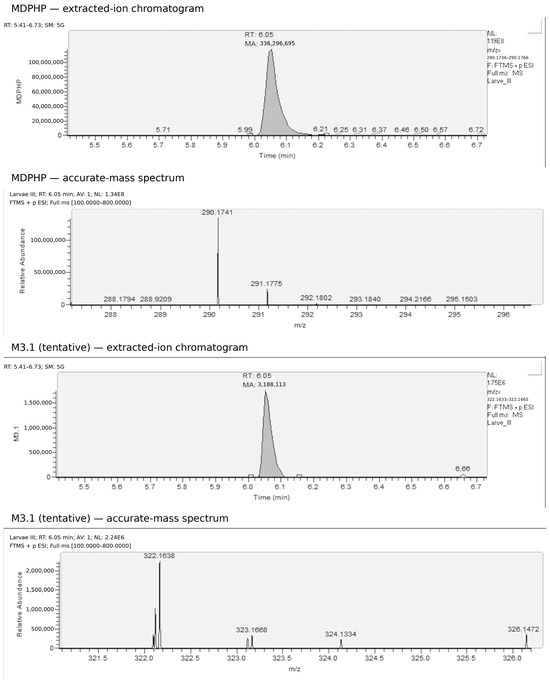
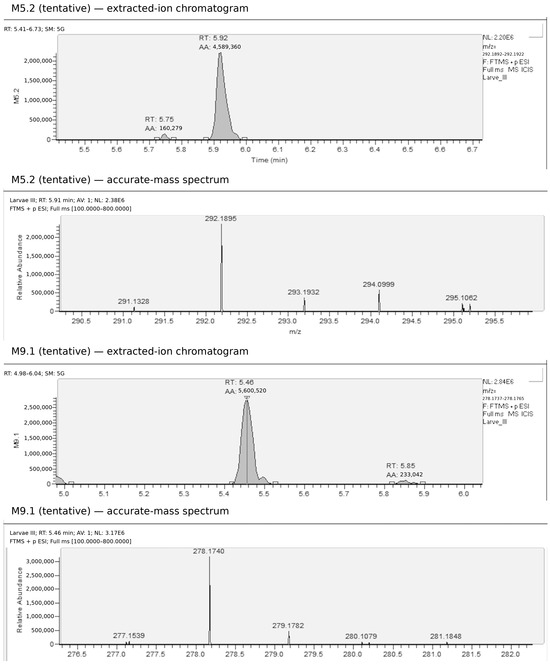
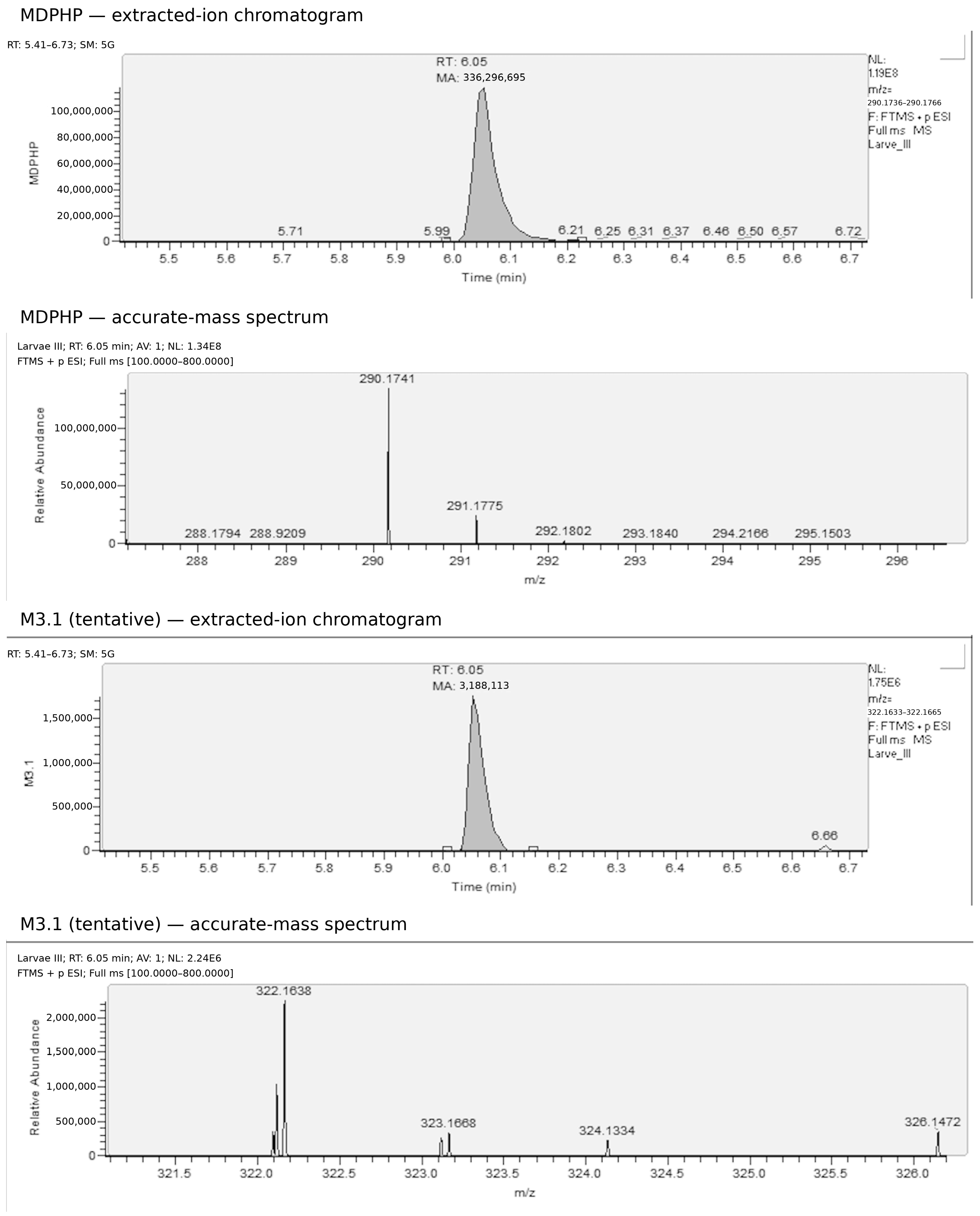
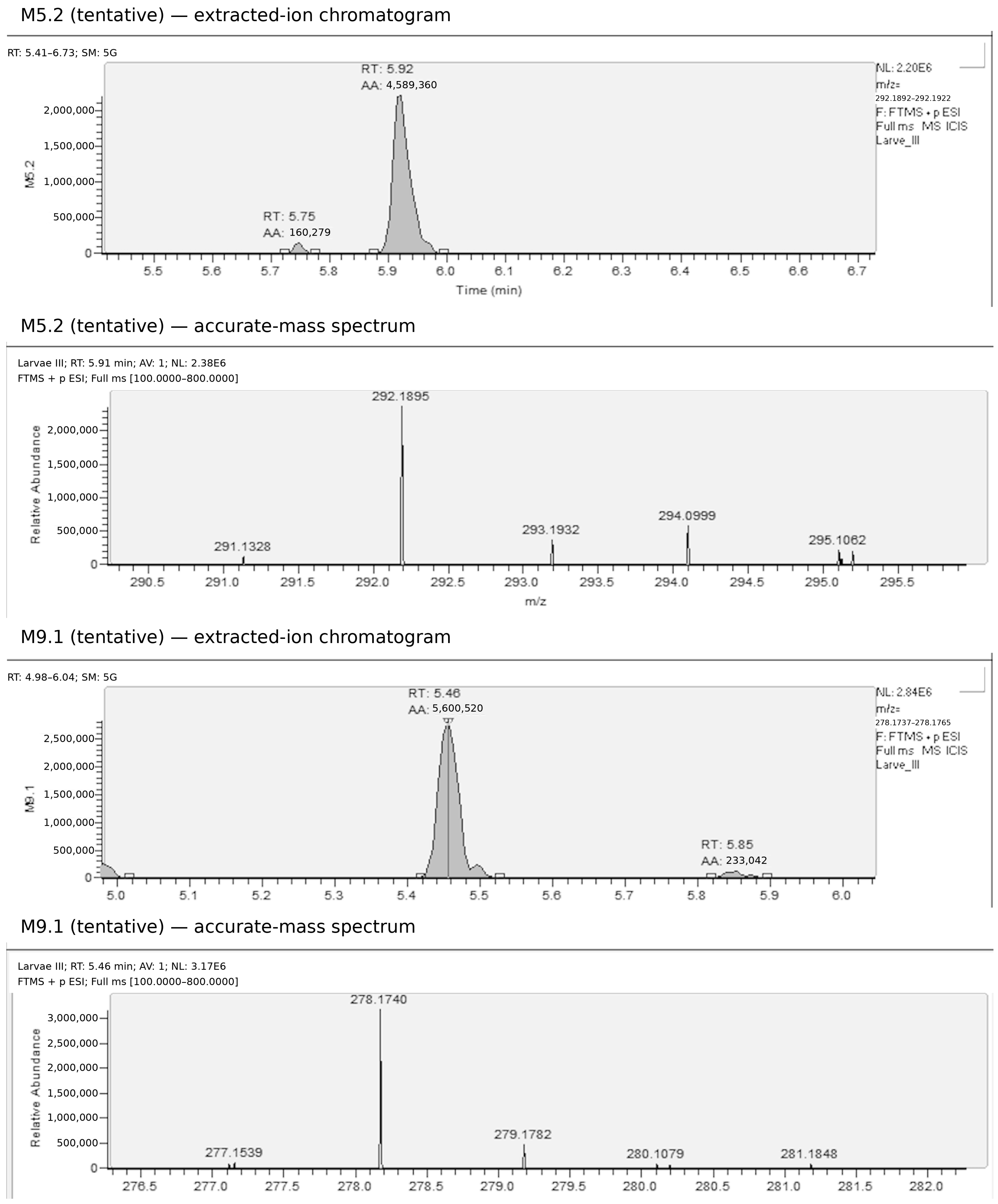
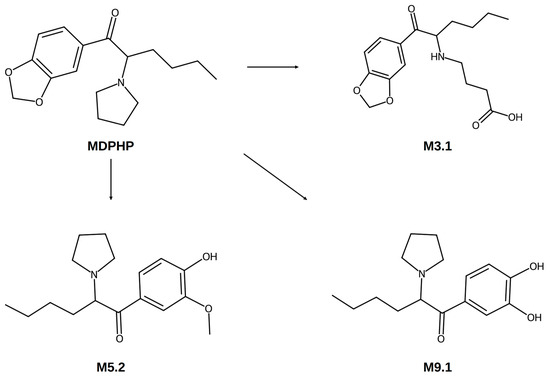
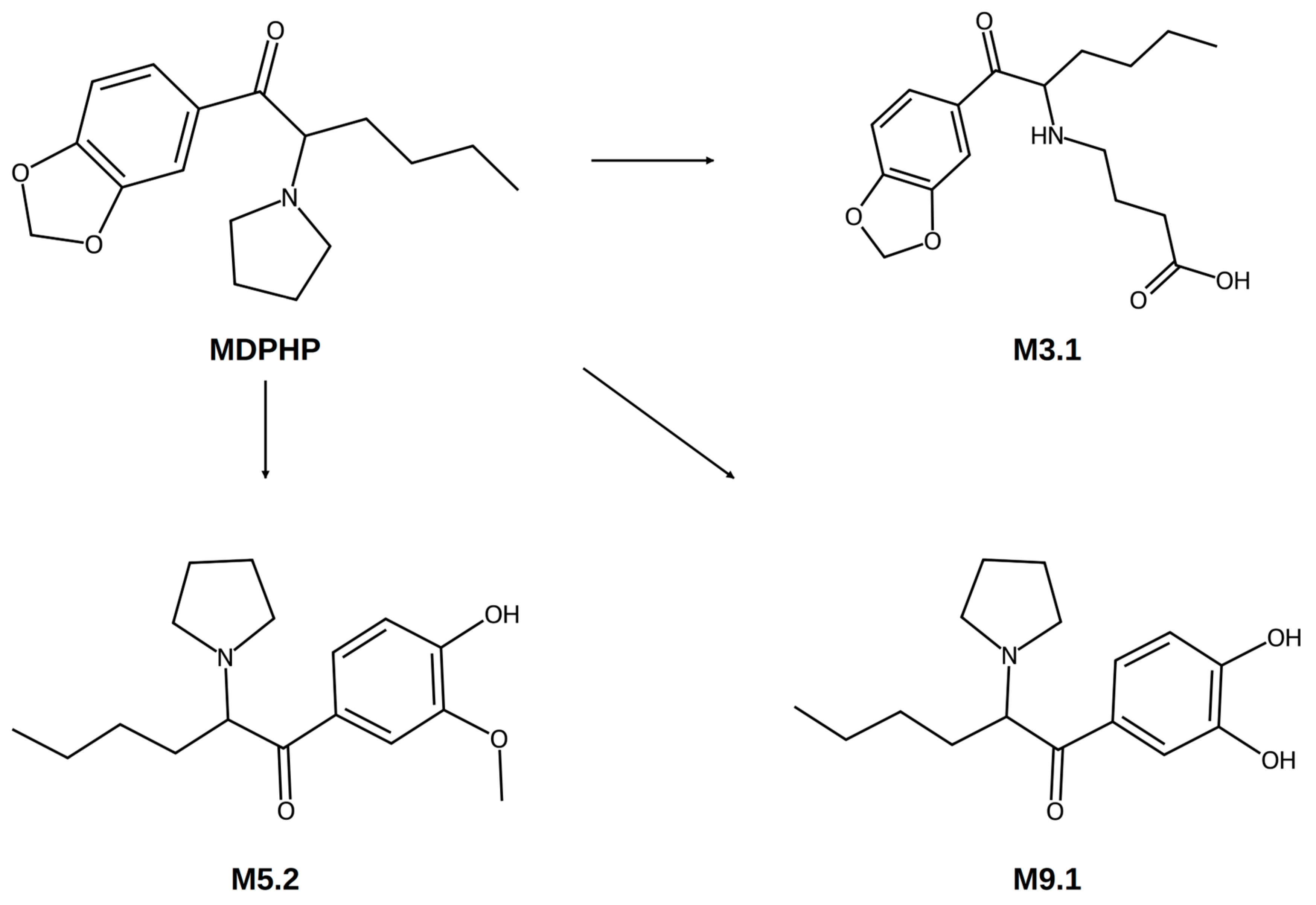
The Larvae III extract showed chromatographic peaks and accurate-mass spectra for MDPHP and three signals tentatively assigned to M3.1, M5.2, and M9.1 according to Kavanagh et al. [12] (Figure 1). The observed precursor-ion m/z values and retention times were 290.1741 at 6.05 min for MDPHP, 322.1638 at 6.05 min for M3.1, 292.1895 at 5.92 min for M5.2, and 278.1740 at 5.46 min for M9.1. The proposed structures are summarized in Figure 2.
Figure 1.
Extracted-ion chromatograms and accurate-mass spectra for MDPHP and the tentative M3.1 assignment enlarged extracted-ion chromatograms and corresponding positive-ion full-scan accurate-mass spectra, displayed consecutively for each analyte obtained from the Larvae III extract for MDPHP (m/z 290.1741; RT 6.05 min) and signals tentatively assigned to M3.1 (m/z 322.1638; RT 6.05 min), M5.2 (m/z 292.1895; RT 5.92 min), and M9.1 (m/z 278.1740; RT 5.46 min). Key precursor ions and retention times are indicated to facilitate inspection. Assignments follow the nomenclature of Kavanagh et al. [12]. The analytical traces and numerical values were preserved; only panel layout, grayscale presentation and annotation typography were modified. Nonessential instrument-interface icons and scan-number annotations were omitted.
Figure 2.
Proposed, tentative structures and schematic metabolic pathways for MDPHP and the phase-I metabolites designated M3.1, M5.2, and M9.1, based on the signal assignments and nomenclature reported by Kavanagh et al. [12]. These pathways were not directly demonstrated or experimentally confirmed in the present case; structural assignments remain tentative pending toxicological verification. The scheme was redrawn in vector format from the original figure without adding structural or stereochemical assignments.
3.5. Descriptive Multi-Matrix Comparison
The kidney yielded the highest reported instrument-derived MDPHP value among the solid tissues, and Larvae III had the highest reported instrument-derived value among the larval groups. These observations were descriptive only. No quantitative tissue-to-larva extrapolation, post-mortem interval estimate, or anatomical-site effect was inferred.
4. Discussion
4.1. Principal Findings and Novelty
This case report documents MDPHP in three solid tissues and four necrophagous-larval groups from a body in advanced decomposition and reports phase-I metabolite signals in a larval extract. Its principal contribution is the combined multi-matrix detection of MDPHP exposure when blood was unavailable, together with parent-drug and tentative metabolite evidence from larvae; human advanced-decomposition cases documenting this combination remain insufficiently documented. Because the procedure was not validated in tissues or larvae, the numerical results are exploratory and semiquantitative and do not establish matrix-specific quantitative performance.
4.2. MDPHP Toxicology and Previous Fatal Cases
Published fatal MDPHP cases are heterogeneous. Adamowicz and Hydzik reported fetal death after combined exposure to MDPHP and alpha-PHP [7]. Di Candia et al. described a fatal intoxication with 399 ng/mL MDPHP in femoral blood and no detected co-ingestion [8]. Croce et al. characterized post-mortem distribution in central and peripheral blood, vitreous humor, urine, gastric content, and hair, reporting very high concentrations but no larval analysis [9]. Casati et al. described a polydrug fatality involving MDPHP and related designer drugs, including metabolite characterization [10]. Gomonit et al. subsequently emphasized the analytical separation of MDPHP from MDPiHP and other structural isomers in forensic investigations [11]. These reports provide essential context but do not establish a transferable lethal threshold for decomposed solid tissues or larvae. A focused comparison of these studies is provided in Table 2.
Table 2.
Focused comparison of published MDPHP studies relevant to novelty and interpretation.
4.3. Interpretation of Solid-Tissue Concentrations
The detection of MDPHP in brain documents distribution to the central nervous system but does not, by itself, quantify psychomotor impairment at death. The higher kidney concentration is compatible with tissue distribution and elimination processes, but it cannot establish the time between ingestion and death. Post-mortem redistribution, decomposition, tissue water loss, heterogeneous sampling, and matrix-specific extraction can all affect measured concentrations. Blood-based fatal concentrations should therefore not be converted into tissue thresholds or used to declare a lethal dose in this case.
4.4. Metabolism, Metabolite Assignment, and Isomer Discrimination
Signals tentatively assigned to M3.1, M5.2, and M9.1 are analytically relevant because metabolite evidence may support prior biotransformation and can extend the detection window beyond the parent drug [5,12,13]. However, metabolites detected in larvae may derive from human metabolism before death, local tissue metabolism, post-mortem chemical change, or insect-associated transformation. Accurate mass alone does not establish structural identity with the same confidence as reference-standard or diagnostic MS/MS confirmation.
MDPHP also has a structural isomer, MDPiHP, whose forensic relevance has increased [11]. Although MDPHP reference material was used, the available records do not document a retention-time comparison with an MDPiHP reference standard, chromatographic resolution, or diagnostic MS/MS criteria sufficient to exclude MDPiHP. The analyte assignment is therefore interpreted with this unresolved analytical limitation.
4.5. Entomotoxicological Significance
The reported instrument-derived MDPHP values across the larval groups support the potential use of necrophagous insects as complementary toxicological matrices in advanced decomposition. This observation is consistent with authentic case reports and controlled studies showing that larvae can retain drugs and, in some circumstances, provide information not obtained from available human matrices [14,17,18,19,20,21,22]. In this case, however, absence of larva-specific validation limits the result to evidence of exposure and prevents validated quantitative interpretation.
Larval instrument responses and reported values are not equivalent to validated human tissue or blood concentrations. Feeding location, tissue preference, larval species, instar, developmental stage, gut content, depuration, storage, washing, extraction, matrix effects, and insect metabolism can all influence detection [15,19,20,21,22,23]. Accordingly, the larval findings demonstrate exposure but cannot establish a lethal human concentration, a dose–response relationship, or a validated tissue-to-larva conversion.
4.6. Variation Among Larval Groups
The four larval groups showed a broad range of reported instrument-derived values, from <0.06 to 1.58 ng/mg. Larvae III, collected from the genital/inguinal region, had the highest reported value in this single case. The observed variation cannot distinguish among heterogeneous drug distribution within the corpse, differential feeding substrates, local contamination by decomposition or excreted fluids, post-mortem diffusion, insect metabolism, or differences in larval species, instar, developmental stage, and other biological or environmental factors. Because groups from different anatomical sites may not have belonged to the same species or developmental stage, the anatomical mapping supports only a descriptive observation and does not establish preferential accumulation or a reproducible anatomical-site distribution pattern.
4.7. Causal Interpretation of Death
MDPHP was the only pharmacologically active compound identified within the reported LC-HRMS screening scope, witness information supported recent drug-related psychophysical alteration, and no fatal traumatic lesion was established. These elements make MDPHP intoxication a plausible and potentially important contributor and the most plausible toxicological explanation in the available case record. Causation cannot, however, be expressed as proven acute MDPHP overdose. Blood was unavailable, volatile substances could not be assessed, no validated lethal threshold exists for the measured tissues or larvae, decomposition limited pathology, and fibrofatty myocardial replacement provided a potential cardiac substrate. The medicolegal interpretation is therefore best expressed as acute circulatory failure with pulmonary edema in the setting of recent MDPHP exposure and underlying myocardial vulnerability.
4.8. Strengths and Limitations
Strengths include high-resolution mass spectrometry, analysis of three solid tissues and four separately collected larval groups, recovery of a high-resolution analytical figure, and detection of phase-I metabolite signals in larvae. Limitations include the single-case design; advanced decomposition; absence of blood; inability to assess ethanol and other volatile substances; use of a procedure validated in blood but not in tissues or larvae; unavailable matrix-specific validation and batch-QC data; approximate rather than recorded total larval mass; incomplete first-centrifugation and injection-volume records; unresolved analytical status of <0.06 ng/mg; insufficient preserved documentation to exclude MDPiHP; absence of species and developmental-stage identification; lack of experimental entomological controls; and possible post-mortem redistribution, local contamination, or insect metabolism.
No archived entomological material remains available for retrospective COI barcoding or developmental-stage identification; this prevents resolution of potential species- or stage-related differences among the four groups.
5. Conclusions
Instrument-derived MDPHP values were reported in brain, liver, kidney, and four groups of necrophagous larvae from a body in advanced decomposition. The Larvae III extract also contained signals tentatively assigned to three phase-I metabolites. These findings show that necrophagous larvae may preserve analytically useful evidence of exposure to a synthetic cathinone when conventional matrices are unavailable. Because the procedure was validated in blood but not in tissues or larvae, the reported numerical values are exploratory and semiquantitative; they do not establish validated concentrations, a lethal threshold, or a quantitative relationship between matrices. Within the integrated medicolegal context, MDPHP intoxication was a plausible contributor, while its precise causal role remained limited by decomposition, lack of blood and volatile analysis, matrix-specific validation limitations, and underlying myocardial pathology. Future controlled studies incorporating species identification, developmental staging, and matrix-specific validation are needed before quantitative entomotoxicological interpretation can be attempted.
Author Contributions
Conceptualization, M.G., F.S., J.L., A.S. and S.C.; data curation, A.B., F.S. and S.C.; writing—original draft preparation, M.G. and F.S.; writing—review and editing, M.G., F.S., A.S., S.C., J.L. and M.D.P.; supervision, M.D.P. and S.C. All authors have read and agreed to the published version of the manuscript.
Funding
This research received no external funding.
Institutional Review Board Statement
The study was conducted in accordance with the Declaration of Helsinki. In the Italian legal framework, forensic examinations and technical investigations ordered by the Judicial Authority are governed by the Italian Code of Criminal Procedure, including Articles 359 and 360 concerning technical investigations appointed by the Public Prosecutor. Ethical review and approval were not required for this study because no experimental intervention or additional sampling was performed for research purposes. The biological material was explicitly collected for institutional and judicial purposes, and all samples and data were fully anonymized.
Informed Consent Statement
Patient consent was waived due to the nature of the study involving deceased subjects under judicial investigation. The authors were unable to contact the next of kin, but strict anonymization measures were applied. Data were processed in accordance with the applicable data-protection requirements (the Regulation (EU) 2016/679 (GDPR) and the Italian Legislative Decree 196/2003, as amended by Legislative Decree 101/2018). The scientific interpretations presented in this article are those of the authors and do not represent official conclusions of the competent Judicial Authority.
Data Availability Statement
The data presented in this study are available on request from the corresponding author. The data are not publicly available due to investigative secrecy. Additional raw analytical outputs may be provided only if legally shareable and approved by the forensic toxicology laboratory.
Conflicts of Interest
The authors declare no conflicts of interest.
References
- Bassi, M.; Bilel, S.; Tirri, M.; Corli, G.; Di Rosa, F.; Gregori, A.; Alkilany, A.M.; Rachid, O.; Roda, E.; De Luca, F.; et al. The Synthetic Cathinones MDPHP and MDPV: Comparison of the Acute Effects in Mice, In Silico ADMET Profiles and Clinical Reports. Neurotoxicology 2024, 103, 230–255. [Google Scholar] [CrossRef] [Scilit] [PubMed]
- Chen, S.; Zhou, W.; Lai, M. Synthetic Cathinones: Epidemiology, Toxicity, Potential for Abuse, and Current Public Health Perspective. Brain Sci. 2024, 14, 334. [Google Scholar] [CrossRef] [Scilit] [PubMed]
- Baumann, M.H.; Bukhari, M.O.; Lehner, K.R.; Anizan, S.; Rice, K.C.; Concheiro, M.; Huestis, M.A. Neuropharmacology of 3,4-Methylenedioxypyrovalerone (MDPV), Its Metabolites, and Related Analogs. Curr. Top. Behav. Neurosci. 2017, 32, 93–117. [Google Scholar] [CrossRef] [Scilit] [PubMed]
- Kriikku, P.; Ojanperä, I. Findings of Synthetic Cathinones in Post-Mortem Toxicology. Forensic Sci. Int. 2024, 365, 112297. [Google Scholar] [CrossRef] [Scilit] [PubMed]
- Grapp, M.; Kaufmann, C.; Schwelm, H.M.; Neukamm, M.A.; Blaschke, S.; Eidizadeh, A. Intoxication Cases Associated with the Novel Designer Drug 3′,4′-Methylenedioxy-alpha-pyrrolidinohexanophenone and Studies on Its Human Metabolism Using High-Resolution Mass Spectrometry. Drug Test. Anal. 2020, 12, 1320–1335. [Google Scholar] [CrossRef] [Scilit] [PubMed]
- Arillotta, D.; Totti, A.; Dimitrova, A.; Croce, E.B.; Di Milia, M.G.; Gambassi, F.; Gualco, B.; Pieraccini, G.; Mannaioni, G.; Vaiano, F. Clinical Manifestations and Analytical Reports for MDPHP Acute Intoxication Cases. J. Pharm. Biomed. Anal. 2024, 241, 115974. [Google Scholar] [CrossRef] [Scilit] [PubMed]
- Adamowicz, P.; Hydzik, P. Fetal Death Associated with the Use of 3,4-MDPHP and alpha-PHP. Clin. Toxicol. 2019, 57, 112–116. [Google Scholar] [CrossRef] [Scilit] [PubMed]
- Di Candia, D.; Boracchi, M.; Ciprandi, B.; Giordano, G.; Zoja, R. A Unique Case of Death by MDPHP with No Other Co-Ingestion: A Forensic Toxicology Case. Int. J. Leg. Med. 2022, 136, 1291–1296. [Google Scholar] [CrossRef] [Scilit] [PubMed]
- Croce, E.B.; Dimitrova, A.; Di Milia, M.G.; Pierotti, S.; Arillotta, D.; Barbaresi, M.; Focardi, M.; Vaiano, F. Postmortem Distribution of MDPHP in a Fatal Intoxication Case. J. Anal. Toxicol. 2025, 49, 137–141. [Google Scholar] [CrossRef] [Scilit] [PubMed]
- Casati, S.; Ravelli, A.; Dei Cas, M.; Bergamaschi, R.F.; Vanerio, S.; Sicuro, L.; Faraone, C.; Rossi, M.; Galante, N.; Mollica, L.; et al. Polydrug Fatal Intoxication Involving MDPHP: Detection and In Silico Investigation of Multiple 3,4-Methylenedioxy-Derived Designer Drugs and Their Metabolites. J. Anal. Toxicol. 2025, 49, 384–393. [Google Scholar] [CrossRef] [Scilit] [PubMed]
- Gomonit, M.M.; Walton, S.E.; Papsun, D.M.; Lamb, M.E.; Chronister, C.W.; Krotulski, A.J.; Elliott, S.; Taylor, K.; Truver, M.T.; Goldberger, B.A.; et al. Case Series Involving the Synthetic Cathinones alpha-PHP, alpha-PiHP, MDPHP, and MDPiHP in Forensic Investigations. Forensic Sci. Int. 2026, 384, 112917. [Google Scholar] [CrossRef] [Scilit] [PubMed]
- Kavanagh, P.; Gofenberg, M.; Shevyrin, V.; Dvorskaya, O.; Dowling, G.; Grigoryev, A. Tentative Identification of the Phase I and II Metabolites of Two Synthetic Cathinones, MDPHP and alpha-PBP, in Human Urine. Drug Test. Anal. 2020, 12, 1442–1451. [Google Scholar] [CrossRef] [Scilit] [PubMed]
- Brueckner, I.; Welter-Luedeke, J.; Gutjahr-Ruhland, C.; Graw, M.; Paul, L.D. Toxicological Detection of the New Psychoactive Substances MDPHP and MDPHpP in Human Urine Samples by Elucidation of Their Urinary Metabolites Using Gas Chromatography-Mass Spectrometry. J. Anal. Toxicol. 2025, 49, 299–314. [Google Scholar] [CrossRef] [Scilit] [PubMed]
- Campobasso, C.P.; Gherardi, M.; Caligara, M.; Sironi, L.; Introna, F. Drug Analysis in Blowfly Larvae and in Human Tissues: A Comparative Study. Int. J. Leg. Med. 2004, 118, 210–214. [Google Scholar] [CrossRef] [Scilit] [PubMed]
- Chophi, R.; Sharma, S.; Sharma, S.; Singh, R. Forensic Entomotoxicology: Current Concepts, Trends and Challenges. J. Forensic Leg. Med. 2019, 67, 28–36. [Google Scholar] [CrossRef] [Scilit] [PubMed]
- Ishak, N.; Ahmad, A.H.; Mohamad Noor, S.A.; Ahmad, A. Detection of Heroin Metabolites at Different Developmental Stages of Lucilia cuprina (Diptera: Calliphoridae) Reared in Heroin-Treated Meat: A Preliminary Analysis. Egypt. J. Forensic Sci. 2019, 9, 65. [Google Scholar] [CrossRef] [Scilit]
- Groth, O.; Franz, S.; Fels, H.; Krueger, J.; Roider, G.; Dame, T.; Musshoff, F.; Graw, M. Unexpected Results Found in Larvae Samples from Two Postmortem Forensic Cases. Forensic Toxicol. 2022, 40, 144–155. [Google Scholar] [CrossRef] [Scilit] [PubMed]
- Peruch, M.; Buffon, M.; Jakovski, Z.; Spiliopoulou, C.; Addobbati, R.; Franzin, M.; Magni, P.A.; D’Errico, S. Comparative Toxicological Analyses of Traditional Matrices and Blow Fly Larvae in Four Cases of Highly Decomposed Human Cadavers. Insects 2024, 15, 500. [Google Scholar] [CrossRef] [Scilit] [PubMed]
- Groth, O.C.; Pi, A.; Jensen, A.E.; Reckel, F.; Hodecek, J.; Kori Yahia, A.; Rahaus, S.; Villet, M.H.; Graw, M. Evaluating the Value of Entomotoxicology in Forensic Toxicology Casework Using the First Minipig Model. Forensic Toxicol. 2025, 43, 333–348. [Google Scholar] [CrossRef] [Scilit] [PubMed]
- Blavier, C.A.K.; Villet, M.H.; Zschiesche, A.; Auwärter, V.; Graw, M.; Geffert, C.; Groth, O.C. Entomological Consequences and Toxicological Detection of Synthetic Cannabinoid Receptor Agonists in Necrophagous Larvae. Int. J. Leg. Med. 2026, 140, 1349–1365. [Google Scholar] [CrossRef] [Scilit] [PubMed]
- Siemon, L.; Niederegger, S.; Wissenbach, D.K. Development of a Standardized Routine Workflow for Entomological and Toxicological Analysis Using Larvae of Two Forensically Relevant Fly Species. Forensic Sci. Int. 2026, 381, 112855. [Google Scholar] [CrossRef] [Scilit] [PubMed]
- Buratti, E.; Cerioni, A.; Mietti, G.; Cippitelli, M.; Ricchezze, G.; Froldi, R.; Cingolani, M.; Scendoni, R. Absence of Ethyl Glucuronide Production in Ethanol-Fed Lucilia sericata Larvae: A Pilot Study for Forensic Applications. Leg. Med. 2026, 83, 102839. [Google Scholar] [CrossRef] [Scilit] [PubMed]
- Beltrame, B.; Franceschetti, L.; Lodetti, G.; Manelli, L.; Verzeletti, A.; Bugelli, V. Forensic Entomotoxicology: Where Are We Going? 30 Years in a Review. Leg. Med. 2026, 83, 102843. [Google Scholar] [CrossRef] [Scilit] [PubMed]

Disclaimer/Publisher’s Note: The statements, opinions and data contained in all publications are solely those of the individual author(s) and contributor(s) and not of MDPI and/or the editor(s). MDPI and/or the editor(s) disclaim responsibility for any injury to people or property resulting from any ideas, methods, instructions or products referred to in the content. |
© 2026 by the authors. Licensee MDPI, Basel, Switzerland. This article is an open access article distributed under the terms and conditions of the Creative Commons Attribution (CC BY) license.