


Abstract
Among the life forms that have adapted to the harsh Antarctic environment, springtails and mites are the most abundant arthropod groups of the terrestrial ecosystem, both in continental and maritime Antarctica. The study of the systematics of these organisms originates at the beginning of the last century and, in recent years, has received considerable contributions. The taxonomy of springtail species from continental Antarctica has undergone more systematic revisions by way of the integration of modern morphological characters and molecular techniques, the latter of which prompted us to further investigate the morphology of supposed “cryptic species” within the springtail Cryptopygus terranovus from Victoria Land, Antarctica. In this study, a careful morphological analysis was conducted to parse these strongly divergent genetic lineages in order to characterize, from a morphological point of view, these new taxonomic entities. Results from our investigation reveal consistent morphological differences that strongly coincide with geographic and previously reported molecular evidence. With this, we have described two new species, C. fratii sp. nov. and C. dallaii sp. nov., bringing the total number of species of Cryptopygus within continental Antarctica to six.
1. Introduction
Springtails (Collembola) comprise one of the most diverse free-living, terrestrial animal groups in Antarctica. Restricted to ice-free habitats, particularly in coastal regions, they play key roles in soil ecosystem functioning [1]. Recent integration of molecular data with detailed morphological analyses has uncovered previously overlooked speciation in Antarctic Collembola, resulting in the description of multiple species previously treated as a single taxon [2]. Prior to this report, the genus Cryptopygus was represented in Antarctica by six species, two of which are found on the Antarctic Peninsula (maritime Antarctica) and Scotia Arc Island: C. antarcticus antarcticus Willem, 1901, and C. badasa Greenslade, 1995. These two species have a wide distribution that includes, in addition to the topotypical localities, several sub-Antarctic islands and the islands offshore of the Antarctic Peninsula. The other four species are distributed in continental Antarctica. Two of them, C. sverdrupi Lawrence, 1978 and C. cisantarcticus Wise, 1967, have a distribution limited to the topotypical localities; the other two species distributed in continental Antarctica are C. terranovus (Wise, 1967) [3] and C. nivicolus (Salmon, 1965) (Figure 1). The systematic position of these two species has recently been reconsidered by Greenslade [4], who, by reanalyzing some morphological characters and, above all, considering the phylogenetic analysis obtained by Stevens et al. [5], places the genera Gressittacantha and Neocryptopygus, to which C. terranovus and C. nivicolus previously belonged, in synonymy.
Among the Isotomidae Anurophorinae, the genus Cryptopygus Willem, 1902 is easily recognizable by the fusion of the fifth and sixth abdomen, the usually well-developed furca, and the bidentate mucro. The body is slender, cylindrical, and medium-small in size. The color varies from white species such as C. exilis to species with pigment granules scattered over the body, to species such as those found in Antarctica, which are intensely dark-pigmented over their entire body. In Antarctic species, compared to closely related genera in the Palearctic, there may be spines or spiny setae on the fused terminal abdominal segments. Tibiotarsi with or without clavate hairs, sometimes very robust when present. Species with chaetotaxis ranging from normal to intensely plurichaetose, have bristles that are usually short, becoming macro especially on the last abdominal segments [6]. Following the most recent diagnosis [7], Cryptopygus is restricted to the Southern Hemisphere.
C. terranovus was described by Wise [3] with specimens collected in the Northern Foothills, to the south of the Campbell Glacier in central Victoria Land. Wise recognized the affinity of this species with the genus Cryptopygus, but was particularly struck by the presence of six spines on the sixth abdominal segment and, considering this a generic characteristic, established the genus Gressittacantha for this species. Dallai et al. [8] redescribed the species with specimens collected on Kay Island but, while also noting its affinity with the genus Cryptopygus, did not propose any systematic revision of the genus, which was instead undertaken by Greenslade [4].
C. terranovus has been the subject of various studies of a biogeographical and ecological nature [9,10,11], physiological [12] and phylogenetic systematic [4,13,14,15]. The latter are of particular interest, especially the phylogenetic reconstructions and the extent of genetic divergence observed among geographically distinct populations. The data emerging from these analyses suggest that among the populations of C. terranovus distributed along a north–south geographical gradient, the levels of genetic divergence are so high as to suggest the presence of possible cryptic species. This led us to reconsider the various populations studied using a combination of molecular and traditional taxonomy. This was done by taxonomically examining specimens from the most genetically differentiated populations. This led us to reconsider the various populations studied using biomolecular methods, also employing classic techniques for morphological characterization, whereby several specimens, especially from the most genetically differentiated populations, were prepared on slides or viewed using scanning electron microscopy. This led to the identification of two new species of Cryptopygus which are described here, while we also provide a taxonomic key to the species of this genus in Antarctica.
2. Materials and Methods
2.1. Study Area and Sampling
Victoria Land is an expansive territory located in continental, east Antarctica along the western side of the Ross Sea and Ross Ice Shelf. This area is divided by a prominent glacial feature, the Drygalksi Ice Tongue, into two Antarctic Biogeographic Conservation Regions (ACBRs) [16,17]. C. terranovus, C. cisantarcticus and the two newly described Cryptopygus species are endemic to North Victoria Land, ACBR 8. The 14 localities sampled in this study span latitudes of 74.9° S and 72.32° S (Figure 1; Table 1). Field sampling was completed during the Programma Nazionale Di Ricerche in Antartide (PNRA) expeditions in the Antarctic austral summers between 2017 and 2019. Living specimens were collected using a mechanical aspirator from each of the 14 sites (Table 1), identified as Cryptopygus sp. and preserved in 95% ethanol.
Figure 1.
Map depicting Cryptopygus species in peninsular and continental Antarctica and approximate range of four species in North Victoria Land (ACBR 8), including two newly described species. Two additional localities are included for C. cisantarcticus to display southward populations and refine geographic delimitation with C. fratii sp. nov. [3,18]. The map was generated using QGIS version 3.44 [19], with Antarctica basemap layers obtained from the Quantarctica dataset [20]. * = type localities of new species, CCI = Crater Cirque, RCR = Redcastle Ridge. Other population acronyms as described in Table 1, as well as in ‘Abbreviations’ section.
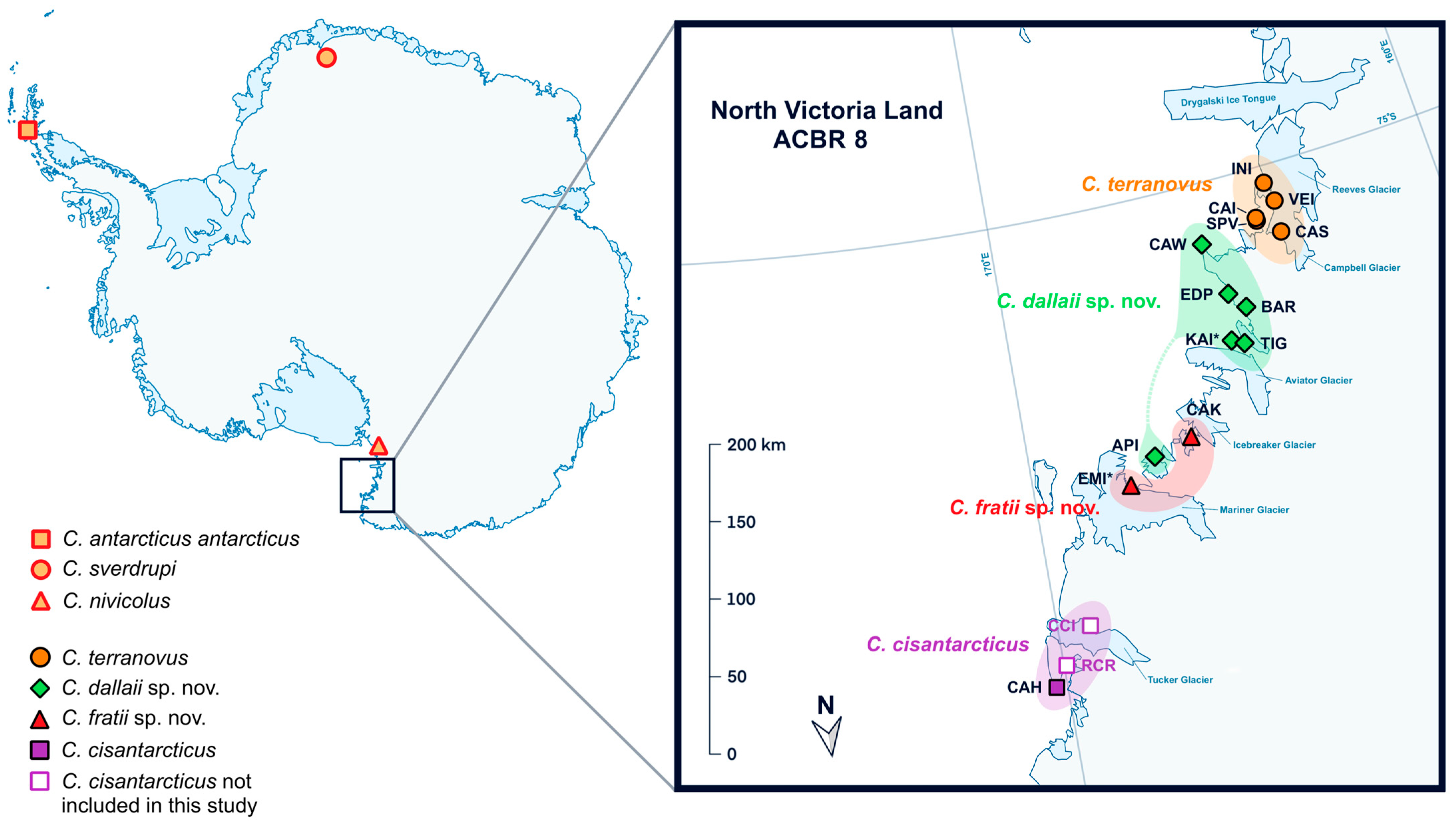
Table 1.
Information on collection localities, associated species, and number of specimens analyzed.
2.2. Preparation and Analysis
Morphological descriptions were derived from light microscopy of multiple slide-mounted individuals from each population, to capture both diagnostic characters and intraspecific variation (Table 1). Scanning electron microscopy (SEM) was employed selectively to confirm and illustrate diagnostic characters, particularly fine-scale structures such as sensillae. No consistent differences in chaetotaxy or other morphological characters were observed between preparation methods, indicating that specimen preservation did not influence character interpretation. Type material was selected based on quality and visibility of diagnostic characters. Holotype and paratypes were accessioned and deposited at the Museo Nazionale dell’Antartide, Genova, Italy. Museum repository and slide accession codes are provided in the Data Availability Statement (DAS) section.
Following Rusek [21], slide preparation was completed by firstly clearing individuals in 10% KOH, then transferring to chloralphenol and mounting in Hoyer’s medium. Morphological analyses were completed using a Nikon Eclipse Ci-L plus (Kanagawa, Japan) equipped with phase contrast optics and a camera lucida to draw morphological characters. Body length, antennae, furca ratios, and cephalic diagonal were measured when possible. Specimens selected for SEM were dehydrated via graded alcohol series and dried using a Balzers CDP 01 (FEI Company, Hillsboro, OR, USA) critical point dryer, then gold-coated using a Balzers Med 010 (FEI Company, Hillsboro, OR, USA). Following preparation, specimens were examined using an ESEM Quanta 400 (FEI Company, Hillsboro, OR, USA) scanning electron microscope operating at 20 kV.
A list of abbreviations used in the figures and text can be found in the ‘Abbreviations’ section. Nomenclature used follows Fjellberg [22] and Potapov [6].
3. Results
3.1. Species Descriptions
- Cryptopygus terranovus (Wise, 1967)
Gressittacantha terranova Wise, 1967
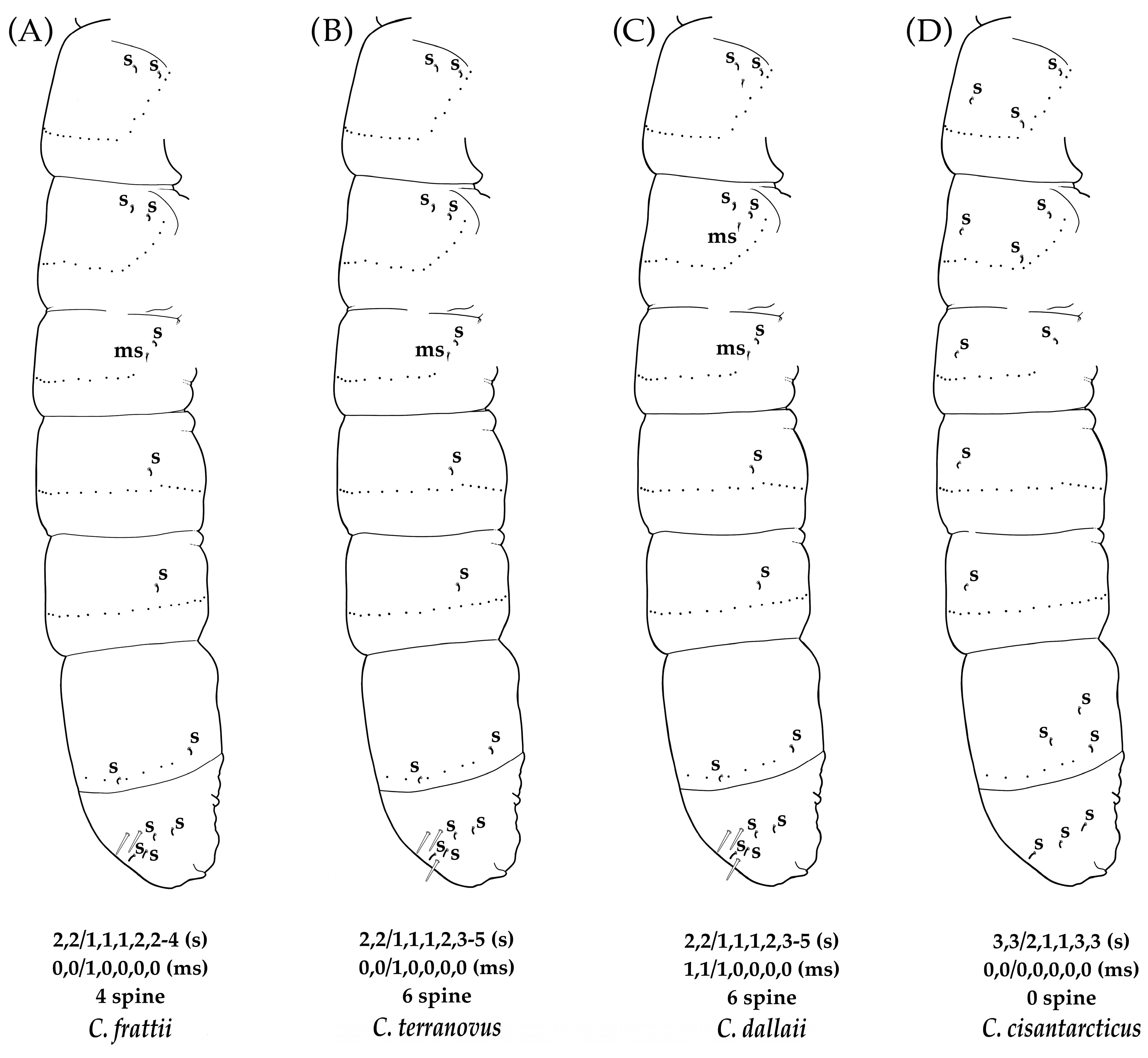
Diagnosis. Cryptopygus terranovus, with 6 + 6 ocelli; Ant. IV with an apical vesicle; tibiotarsi I, II and III with 2, 2 and 3 strong clavate hairs; Abd. V with 6 straight stout spines, arranged 2 + 2 in a transversal row and 1 + 1 more posteriorly (Figure 13); sensillary formula per half tergite: 2,2/1,1,1,2,3–5 (s), 0,0/1,0,0,0,0 (ms); claws without inner but with 2 lateral teeth.
Material examined. In total, 38 specimens from the following localities in Victoria Land were selected for analysis: Cape Sastrugi (3 ♀, 3 ♂), Campo Icaro (8 ♀, 6 ♂), Springtail Valley (2 ♀, 1 ♂), Inexpressible Island (3 ♀, 6 ♂) and Vegetation Island (2 ♀, 4 ♂) (Table 1).
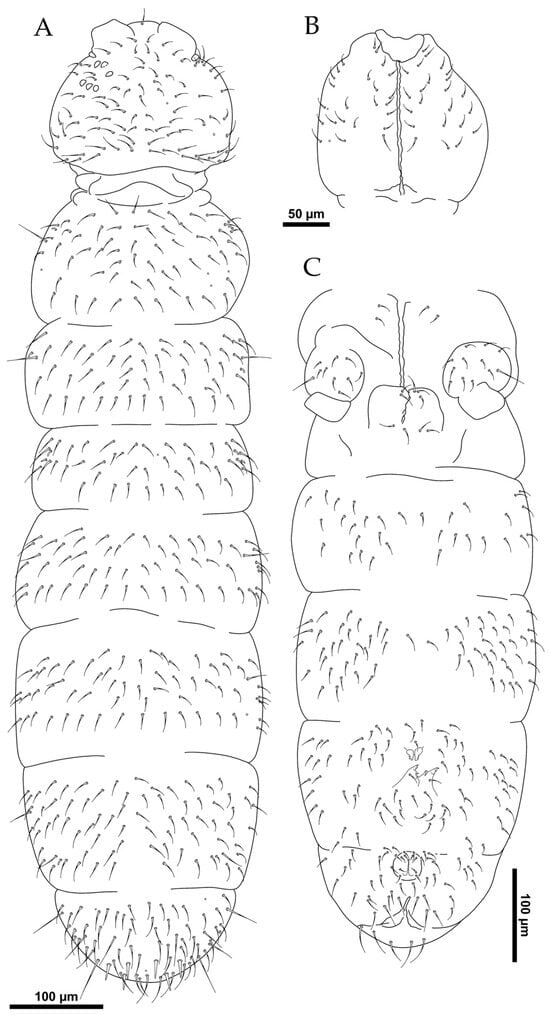
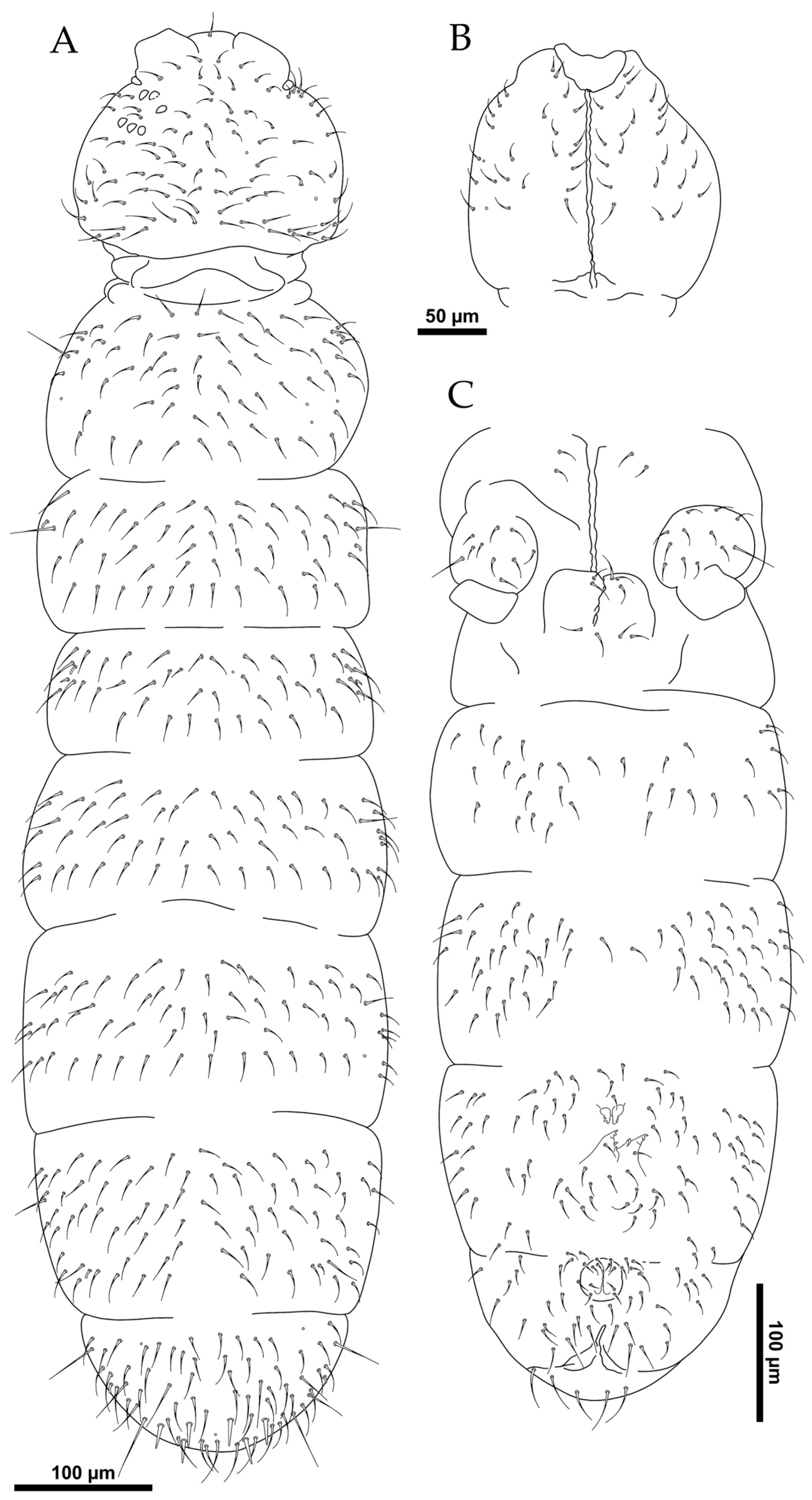
Redescription. Average body length of examined specimens 1.02 mm. Color dark blue-purple to black, juveniles slightly paler. General chaetotaxy as in Figure 2A–C. Labrum with two prelabral and 5,5,4 labral setae. Maxillary outer lobe bifurcated with one sublobal hair. Labial palp with 5 papillae and a reduced number of guard setae (a1, b1–3, c0, d1–3, e1–3, 5–6). Abdominal tergites V–VI with unpaired setae a0, m0, p0. Sensillar formula per half tergites as 2,2/1,1,1,2,3–5; ms 0,0/1,0,0,0,0 (Figure 13); sensilla small curved and cylindrical, ms on Abd. I of spinescent shape. Sensilla on Abd. V–VI showing the “3 + 2” [23] pattern with some variability in total number of sensillae, dorsal triplet with accp1 and accp2 short, as macrosetae-like; lateral sensilla (accp3, accp4) short. Elongated sensilla-like structure on Abd. VI with 6 straight stout spines, arranged 4 in a transversal row and 2 more posteriorly. Tibiotarsi I, II, and III with 2, 2, and 3 clavate tenent hairs, in addition to 20, 20 and 22 setae, respectively; precoxae I, II, III with 1, 3, 3 large spine-like chaetae (Greenslade [4] records 1, 2, 3; Wise [3] records 2, 2, 3), respectively; claw III with a slender elongated empodium and two external basal teeth. Tenaculum with 3 + 3 teeth and 1 chaeta (Greenslade [4] reports 1, 2, or 3 chaetae). Furca reduced, dentes with 2 + 2 (sometimes 3 + 3) posterior and 1 + 1 anterior chaetae (Greenslade [4] notes 1 + 1 both anterior and posterior chaetae). Anterior of manubrium without chaetae, 16 posterior chaetae present.
Figure 2.
C. terranovus (A) dorsal chaetotaxy; (B) ventral chaetotaxy of head; (C) ventral chaetotaxy.
Remarks. Both Wise [3] and Greenslade [4] describe specimens sourced from the Northern Foothills locality, which serves as the type locality for this species. Campo Icaro and the additional localities assessed in this study come from the near surrounding regions (Figure 1) and serve as paratypes for C. terranovus, as molecular evidence places individuals from these localities within the same genetic cluster [15]. The redescription of this species by Dallai et al. [8] was completed with specimens from Kay Island, a locality further north, and according to Carapelli et al. [15], largely shares haplotypes with C. dallaii sp. nov. It should be noted that no descriptions reported the thoracic and abdominal sensillary formula, particularly the micro s-chaetae, which serves as the defining characteristic between these species. Sensillae on Abd V/VI show intra- and interspecies variability, ranging from 2–4 smaller accp sensillae and 1 as elongated, potentially a form of foil-chaetae that is common in the family Isotomidae [24].
- 2.
- Cryptopygus cisantarcticus Wise, 1967
Diagnosis. Cryptopygus cisantarcticus with 6 + 6 (5 + 5 in some specimens) ocelli; Ant. IV with apical vesicle; sensillary formula per half tergite: 3,3/2,1,1,3,3–4 (s), 0,0/0,0,0,0,0 (ms); manubrium with anterior chaetae; macrochaetae on Abd. V and VI; tibiotarsi I with 1 clavate tenent hair; without straight, spine-like chaetae on Abd. VI.
Material examined. Ten specimens (7 ♀, 3 ♂) mounted on slides from Cape Hallett, Victoria Land, Antarctica (Table 1).
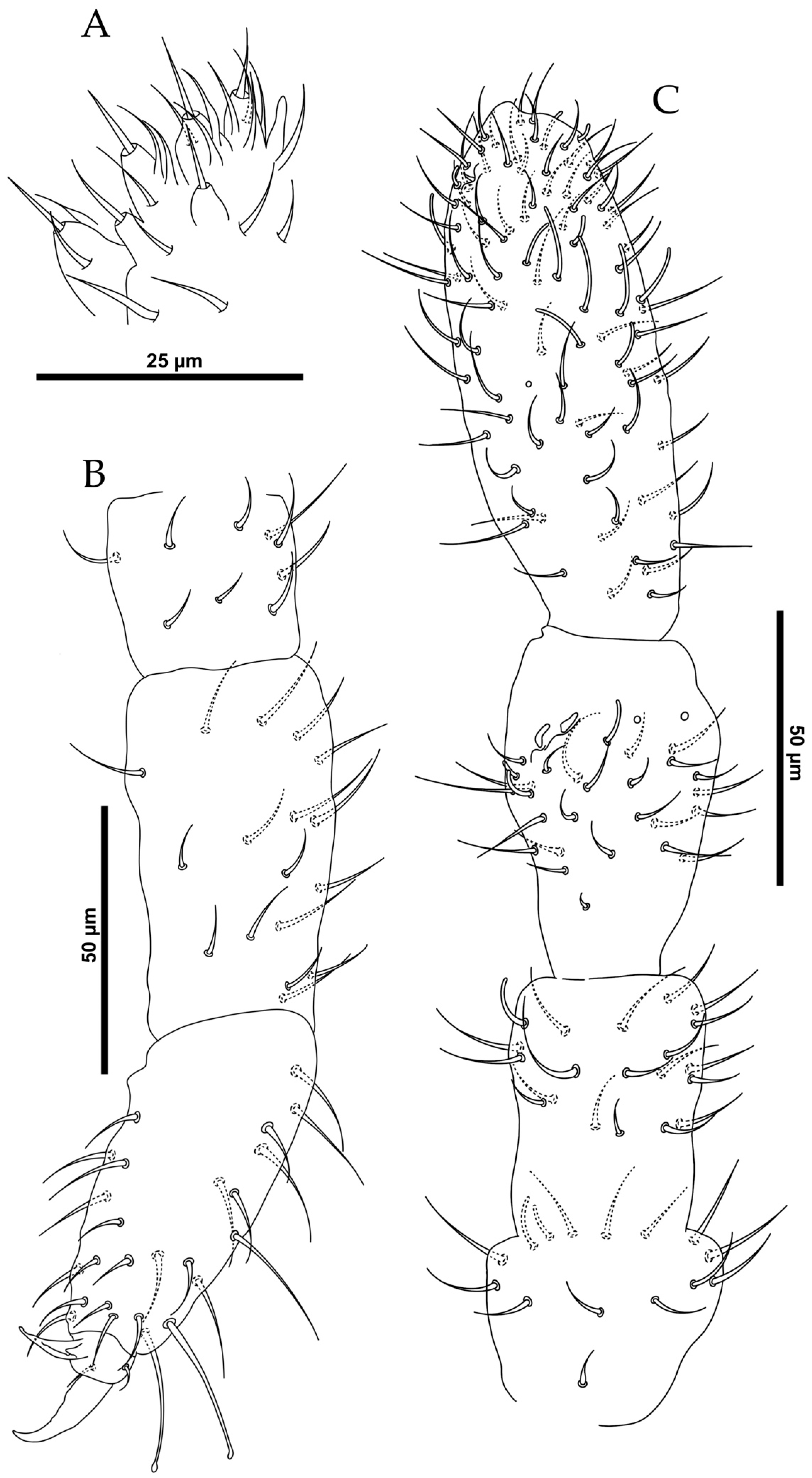
Redescription. Average body length of examined specimens 1.03 mm. Color dark blue to blue-black, juveniles slightly paler. General chaetotaxy of body as in Figure 3A–C. Labial palp with 5 papillae and a reduced number of guard setae (a1, b3, c0, d3, e5) (Figure 4A). Chaetotaxy of antenna as in Figure 4C. Sensillar formula per half tergites as 3,3/2,1,1,3,3–4 (s), 0,0/0,0,0,0,0 (ms) (Figure 13). Tibiotarsi I, II, and III with 1, 2, and 2 clavate tenent hairs, in addition to 20, 21–22, and 25 setae, respectively (Figure 4B). Tenaculum with 4 + 4 teeth and 2 chaetae (Figure 3D). Furca reduced, dentes with 4 + 4 posterior chaetae and 2 + 2 anterior chaetae (Figure 3D). Anterior of manubrium with 2–3 chaetae, 21–22 posterior chaetae present.
Remarks. This partial redescription of C. cisantarcticus serves as a morphological outgroup to emphasize the subtle variation between C. terranovus, C. dallaii sp. nov. and C. fratii sp. nov., as C. cisantarcticus is geographically close, but morphologically distinct. Particularly, the lack of spine-like chaetae on Abd. VI, nor micro-sensillae on the dorsal tergites, distinguish this species. The three sensillae on the dorsal thoracic segments are spread over the tergite, with one situated mesially, close to the mid-line. This mesial sensilla is replicated in Abd. I–III, contrasting the more laterally situated sensillae in the other three species. Additionally, each section of the furca is significantly longer, with additional chaetae in each segment. Known latitudinal distribution of C. cisantarcticus extends from the south side of the Tucker Glacier (72.63° S) north to the Balleny Islands (66.79° S) [3,18], displaying a much greater distribution than the other species in this report. Based on this distribution, it appears that the Mariner Glacier acts as a barrier between C. cisantarcticus and C. fratii sp. nov. (Figure 1).
- 3.
- Cryptopygus dallaii sp. nov.
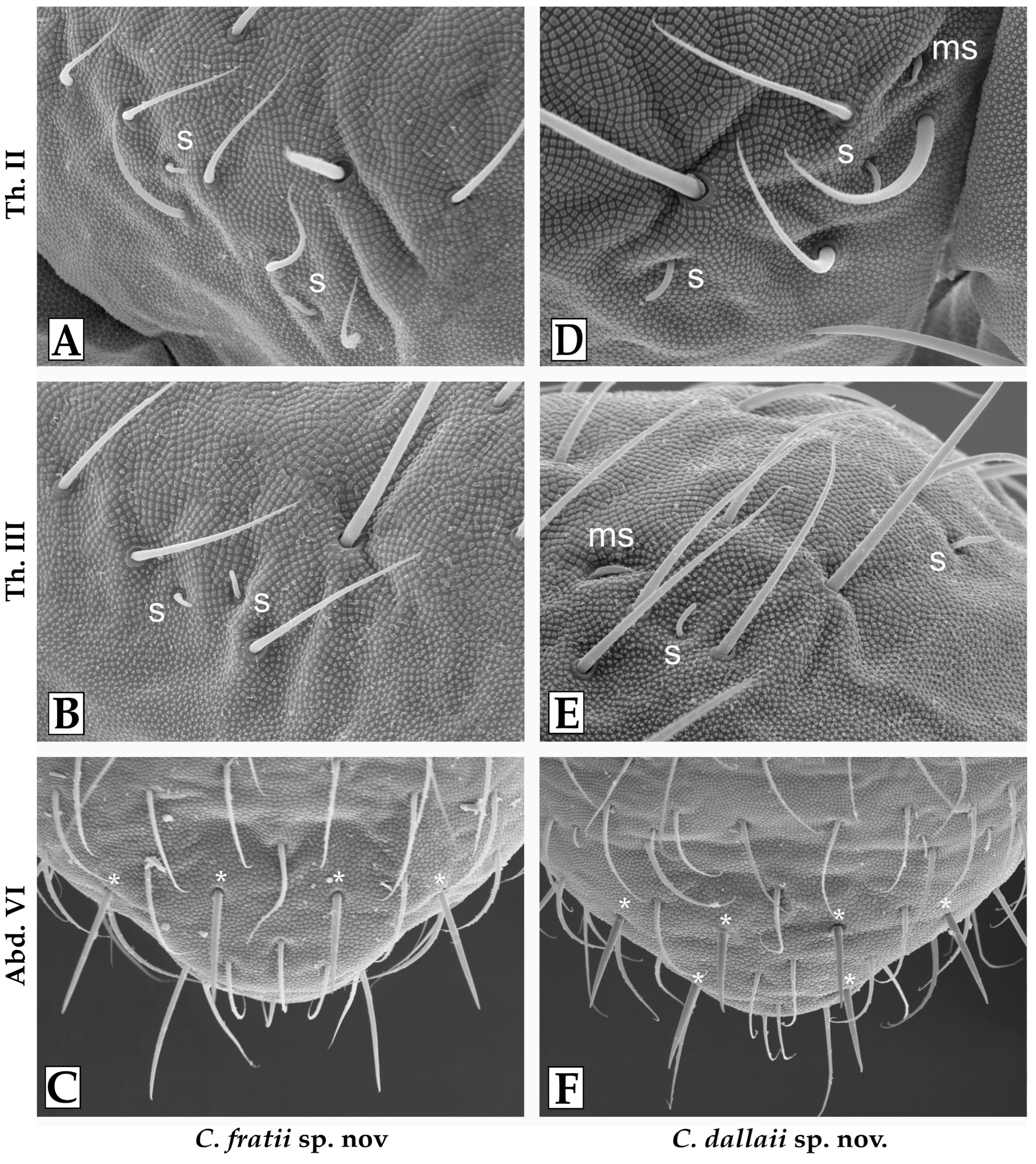
Diagnosis. Cryptopygus dallaii sp. nov., with 6 + 6 ocelli; Ant. IV with an apical vesicle; tibiotarsi I, II, and III with 2, 2, and 3 strong clavate hairs; Abd. VI with 6 straight spine-like chaetae, arranged 2 + 2 in a transversal row and 1 + 1 more posteriorly (Figure 12F); sensillary formula per half tergite: 2,2/1,1,1,2,3–5 (s), 1,1/1,0,0,0,0 (ms); claws without inner but with 2 lateral teeth.
Type material. Holotype ♂ and 8 paratypes (4 ♀, 4 ♂) mounted on slides from Kay Island, Victoria Land, Antarctica (74.07056 S, 165.31667 E). Holotype and paratypes are deposited at the Museo Nationale dell’Antartide, Genova, Italy.
Figure 3.
C. cisantarcticus (A) dorsal chaetotaxy; (B) ventral chaetotaxy of head; (C) ventral chaetotaxy of Abd. II–VI; (D) furca and tenaculum.
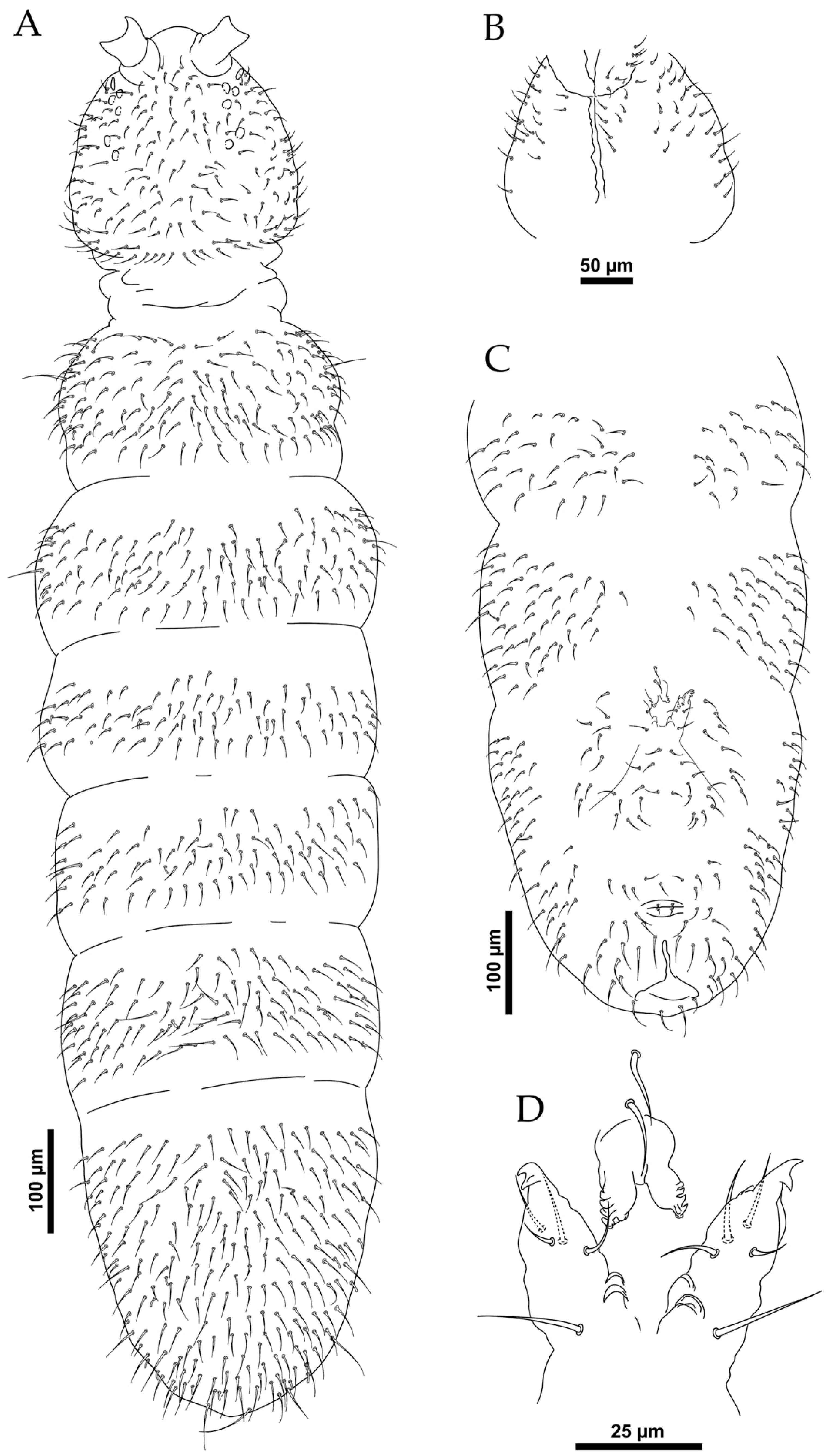
Figure 4.
C. cisantarcticus (A) labial palp; (B) Chaetotaxy of leg III; (C) chaetotaxy of Ant. I–IV.
Other material. Tinker Glacier (3 ♀, 4 ♂), Baker Rocks (3 ♀, 5 ♂), Cape Washington (3 ♀, 7 ♂), Apostrophe Island (1 ♀, 4 ♂) and Edmonson Point (5 ♀, 4 ♂) (Table 1).
Description. Average body length of female and male of type series 0.94 mm and 0.91 mm, respectively. Color dark blue-purple to black, juveniles slightly paler. Body cylindrical, parallel sided (Figure 5A and Figure 6A). Abd. V and VI dorsally fused, clearly separated from Abd IV. Cuticle granulation very fine, constituted by small roundish polygons homogeneously distributed, slightly larger towards the posterior part of Abd. V–VI.
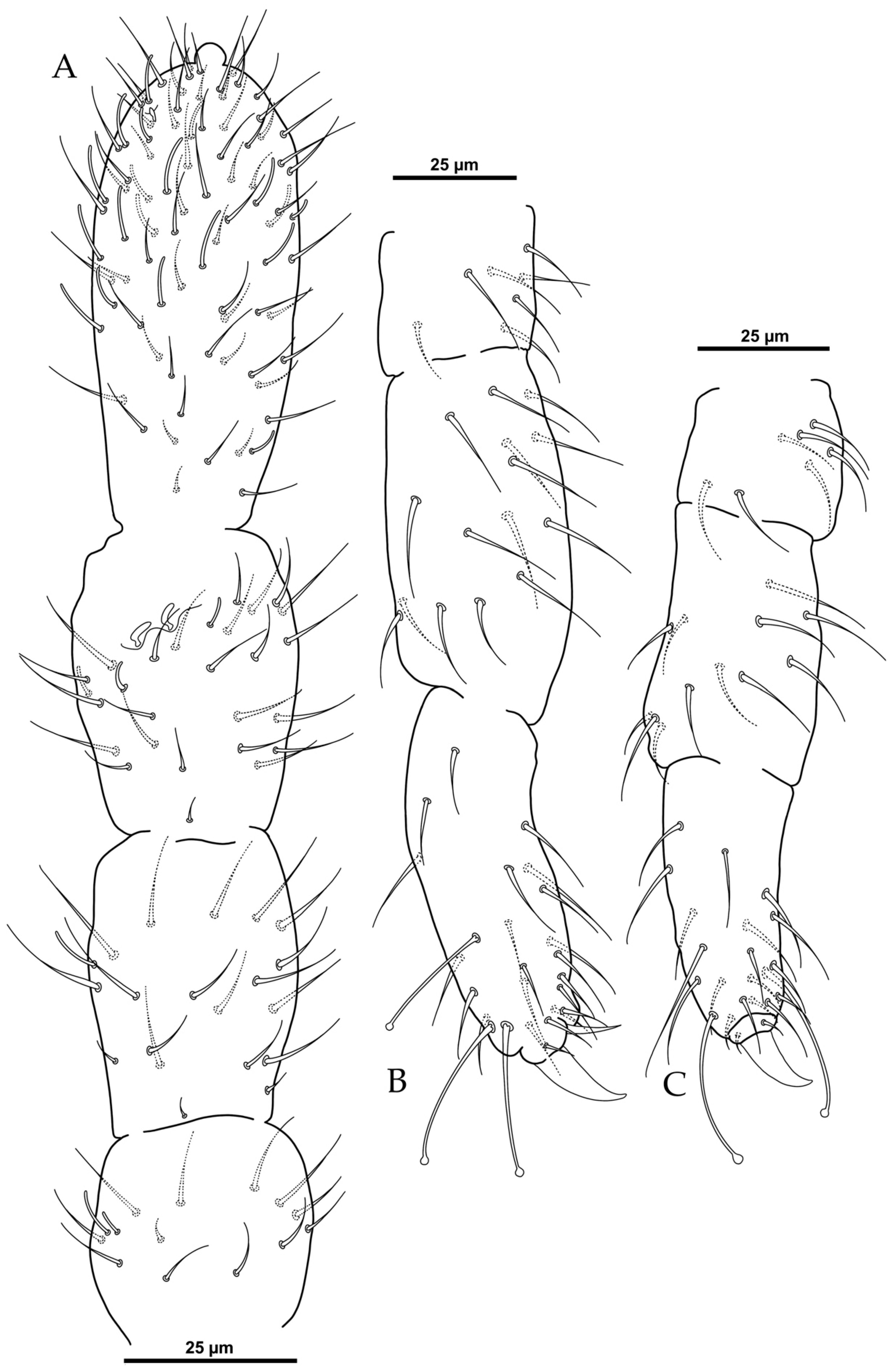
Ventral chaetotaxy of head and abdomen as in Figure 6B and Figure 6C, respectively. Six eyes positioned in two groups, three anterior in a triangular shape and three posterior in a row, ocellus G smaller than the others (Figure 5D). Postantennal organ elongated about twice as long as the ocellus A, surrounded by 2–3 guard setae (Figure 5D). Labrum with two prelabral and 5, 5, 4 labral setae (Figure 5G). Maxillary outer lobe bifurcated with one sublobal hair. Labial palp with 5 papillae and a reduced number of guard setae (a1, b1–3, c0, d1–3, e1–3, 5–6) (Figure 5H). Species plurichaetose, as for the genus, with ordinary chaetae smooth and acuminate, becoming longer toward the lateral part of terga and in the last abdominal segments (V–VI) where, in some specimens, they also appear slightly serrated (Figure 6A–C). Macrosetae well distinct on Th. II–III, where they appear stiff and longer than ordinary ones; macrosetae on abdomen, not well distinguishable, probable formula per half tergite as 1,1/1,1,2,3,6–7. Axial setae with some asymmetries, most common formula 6,4–5/3,3,4,5–6. Abdominal tergites V–VI with unpaired setae a0, m0, p0. Sensillar formula per half tergites as 2,2/1,1,1,2,3–5; ms 1,1/1,0,0,0,0 (Figure 12D,E); sensilla small, curved and cylindrical, ms on Abd. I of spinescent shape (Figures 12D,E and 13C). Sensilla on Abd. V–VI variable, with 2–4 small sensillae and one elongated sensilla. Abd. VI with 6 straight stout spines, arranged 4 in a transversal row and 2 more posteriorly (Figure 5I and Figure 12F). Antennae about as long as the head diagonal, their ratio = 1; Ant. I with 11–12 chaetae, 10 longer in circum-antennal row, two basal microchaetae (one dorsal, one ventral), one short and one longer ventrolateral sensilla (Figure 5E and Figure 7A); Ant. II with about 16–18 setae, 3–4 basal microchaetae (one dorsal, one ventral and two ventrolateral), one sensilla enlarged laterally (Figure 7A). Ant. III with 19–21 chaetae, one basal microchaetae, AO consisting of two bent sensilla hidden within cuticle folds, two guard sensilla and a lateral enlarged sensilla (Figure 5C and Figure 7A). Ant. IV with apical papilla and more than 20 sensilla of different size, subapical swelling organite not exposed, and an ms (Figure 5B and Figure 7A); antennal segment ratio I:II:III:IV = 1:1.6:1.6:2.4. Tibiotarsi I, II, and III with 2, 2, and 3 clavate tenent hairs, in addition to 20, 20, and 22 setae, respectively (Figure 5F and Figure 7B,C); precoxae I, II, III with 1, 3, and 3 large spine-like chaetae, respectively; claw III with a slender elongated empodium and two external basal teeth. Ventral tube with 3 + 3 laterodistal and 4–5 posterior chaetae (Figure 6C), anterior without chaetae. Tenaculum with 3 + 3 teeth and 1 chaeta (Figure 5J). Furca reduced, dentes with 2 + 2 posterior and 1 + 1 anterior chaetae. Anterior of manubrium without chaetae, 16–18 posterior chaetae present (Figure 5J). Male genital opening as in Figure 5J.
Etymology. This species is named in honor of Emeritus Professor Romano Dallai for his decades-long research and fundamental contributions to the knowledge of Antarctic Collembola, with special reference to the fauna of Victoria Land.
Figure 5.
SEM of C. dallaii sp. nov. (A) habitus; (B) apical vesicle on distal end of Ant. IV; (C) AO on Ant. III; (D) ocelli and PAO; (E) chaetotaxy of Ant. I; (F) tibiotarsus III with clavate tenent hairs; (G) labrum and clypeal area; (H) labial palp; (J) Tenaculum, furca and male genital opening; (I) posterior of Abd. VI displaying 6 spine-like chaetae; (K) basomedial field.
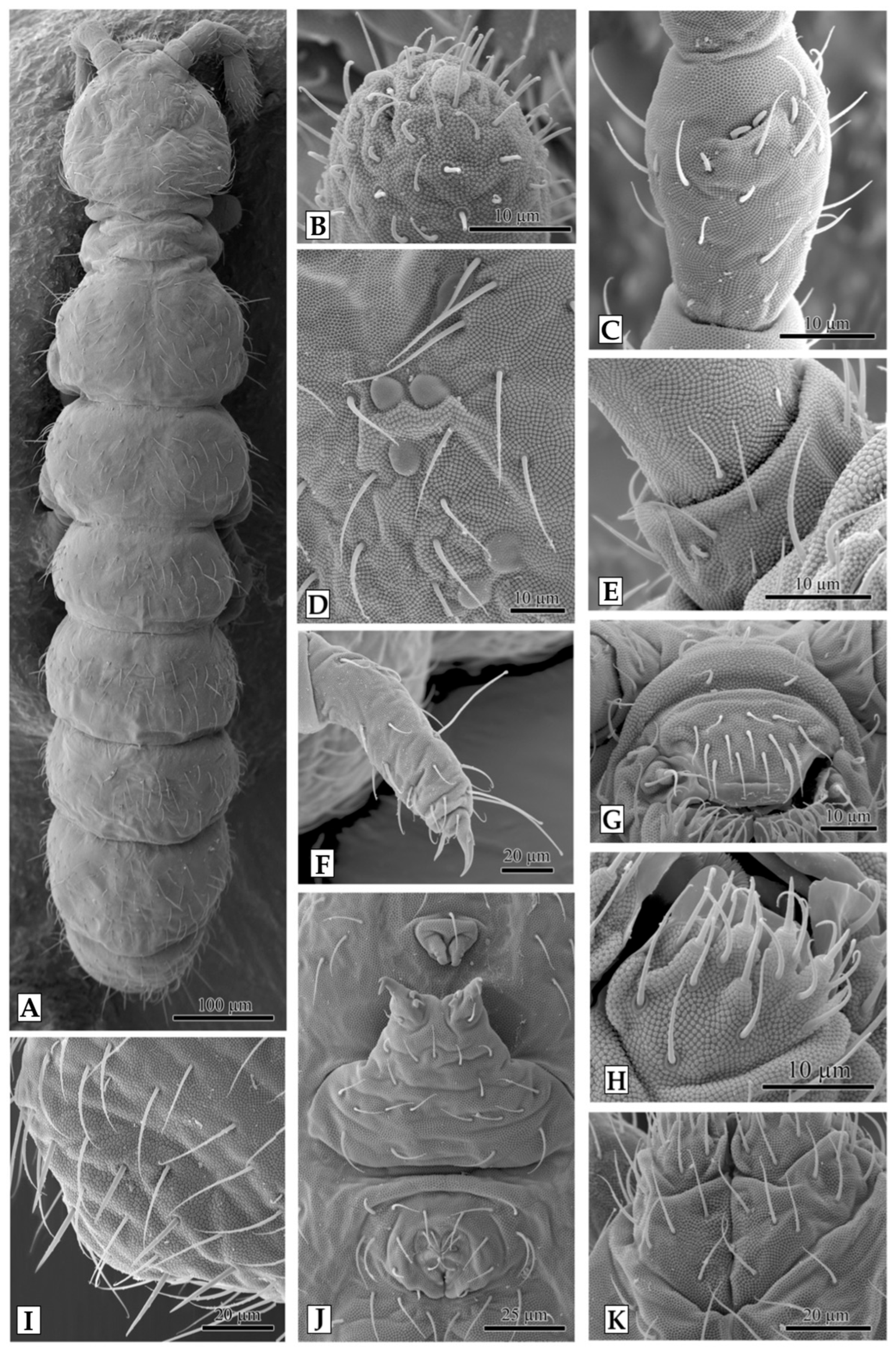
Figure 6.
C. dallaii sp. nov. (A) dorsal chaetotaxy; (B) ventral chaetotaxy of head; (C) ventral chaetotaxy of abdomen.
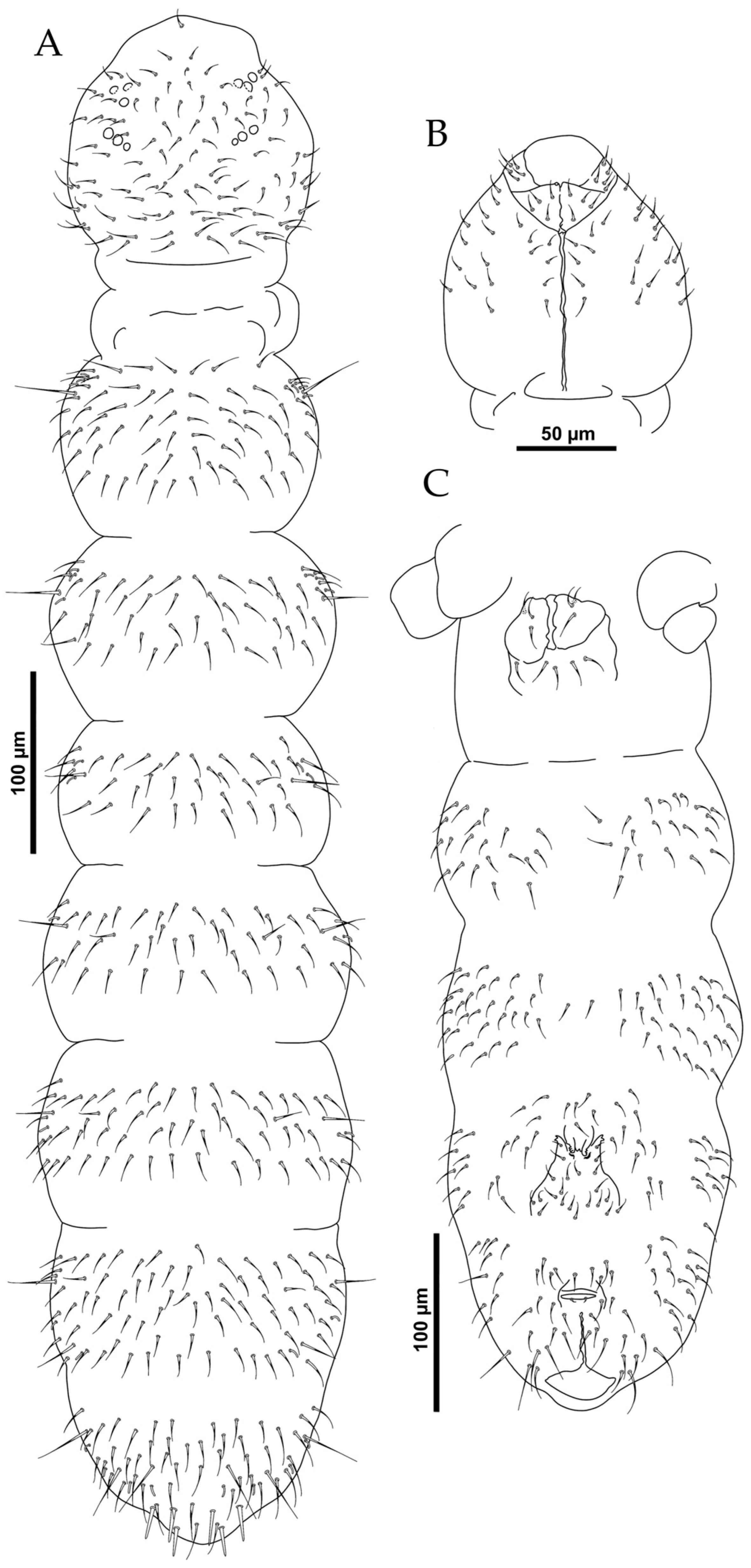
Figure 7.
C. dallaii sp. nov. (A) Chaetotaxy of Ant. I–IV; (B) chaetotaxy of leg III; (C) chaetotaxy of leg I.
Remarks. Compared to C. fratii sp. nov., the morphological characters that distinguish C. dallaii sp. nov. from C. terranovus are significantly less conspicuous, as both species present 6 spine-like chaetae on Abd. VI. Previously, sensillar (s) formulas, and particularly, micro-sensillar (ms) formulas, have been important in distinguishing characters within Folsomia [25,26] and Subisotoma [27]. Between the species analyzed in this report, apart from C. cisantarcticus, the sensillar placement and formula remain consistent (2,2/1,1,1,2,3–5; Figure 13). On the other hand, C. terranovus and C. fratii sp. nov. share a micro-sensillar formula, potentially representing a shared ancestral trait, whereas C. dallaii sp. nov. displays an additional ms in the vicinity of the lateral sensillae on both the Th. II and III segments (1,1/1,0,0,0,0; Figures 12 and 13). Both mitochondrial molecular data [15] and allozyme screening [13] exhibited that specimens collected from the northern locality, Apostrophe Island, are more closely related to central populations. Upon examination of specimens from this locality, we have in fact found them to share the aforementioned morphological characters with the central populations, rather than the geographically adjacent northern localities. Therefore, we deem this consistent morphological character, in addition to the concordant geographic and molecular data [13,15], as sufficient evidence to consider C. dallaii sp. nov. as a monophyletic lineage and a diagnosable species.
- 4.
- Cryptopygus fratii sp. nov.
Diagnosis. Cryptopygus fratii sp. nov. with 6 + 6 ocelli; Ant. IV with an apical vesicle; tibiotarsi I, II and III with a 2, 2 and 3 strong clavate hairs; Abd. V with 4 straight stout spines, arranged 2 + 2 in a transversal row (Figures 9D and 12C); sensillary formula per half tergite: 2,2/1,1,1,2,3–5 (s), 0,0/1,0,0,0,0 (ms); claws without inner but with 2 lateral teeth; sensillary pattern of s-chaetae on Abd. V as “3 + 2” [19].
Type material. Holotype ♂ and 9 paratypes (7 ♀ and 2 ♂) mounted on slides from Emerging Island, Victoria Land, Antarctica (73.38333° S, 168.03333° E). Holotype and paratypes are deposited at the Museo Nationale dell’Antartide, Genova, Italy.
Other material. Collected from Cape King, Victoria, Antarctica (coordinates 73.58333° S, 166.61667° E) (14 specimens mounted on slides; 10 ♀ and 4 ♂) with the same previous modalities.
Description. Average body length of female and male of type series 1.11 mm and 1.04 mm, respectively. Color dark blue-purple to black, juveniles slightly paler. Body cylindrical, parallel sided (Figure 8A and Figure 9A). Abd. V and VI dorsally fused, clearly separated from Abd IV. Cuticle granulation very fine, constituted by small roundish polygons homogeneously distributed, slightly larger towards the posterior part of Abd. V–VI. Six eyes positioned in two groups, three anterior in a triangular shape and three posterior in a row, ocellus G smaller than the others (Figure 8F and Figure 10E). PAO elongated about twice as long as the ocellus A, surrounded by 2–3 guard setae (Figure 8F and Figure 10E). Labrum with two prelabral and 5, 5, 4 labral setae. Maxillary outer lobe bifurcated with one sublobal hair (Figure 8G). Labial palp with 5 papillae and a reduced number of guard setae (a1, b1–3, c0, d1–3, e1–3, 5–6) (Figure 8E and Figure 10B). Species plurichaetose, as for the genus (Figure 8 and Figure 9), with ordinary chaetae smooth and acuminate, becoming longer toward the lateral part of terga and in the last abdominal segments (V–VI) where, in some specimens, they also appear slightly serrated (Figure 9A). Macrosetae well distinct on Th. II–III, where they appear stiff and longer than ordinary ones; macrosetae on abdomen not well distinguishable, probable formula per half tergite as 1,1/1,1,2,3,6–7. Ventral chaetotaxy of head and abdomen as in Figure 9B and Figure 9C, respectively. Axial setae with some asymmetries, most common formula 7,4–5/3,3,3–4,4–5. Abdominal tergites V–VI with unpaired setae a0, m0, p0. Sensillar formula per half tergites as 2,2/1,1,1,2,3–5; ms 0,0/1,0,0,0,0 (Figure 13); sensilla small, curved and cylindrical, ms on Abd. I of spinescent shape. Sensilla on Abd. V–VI variable, with 2–4 small sensillae and one as elongated sensilla. Abd. VI with 4 straight stout spines, arranged 2 + 2 in a transversal row (Figure 8H, Figure 9D and Figure 12C). Antennae about as long as the head diagonal, their ratio = 1; Ant. I with 11–12 chaetae, 10–11 longer in circum-antennal row, two basal microchaetae (one dorsal, one ventral) one short and one longer ventrolateral sensilla (Figure 10A); Ant. II with about 16–18 setae, 3–4 basal microchaetae (one dorsal, one ventral and two ventrolateral), one sensilla enlarged laterally (Figure 10A). Ant. III with 20–23 chaetae, one basal microchaeta, AO consisting of two bent sensilla hidden within cuticle folds, two guard sensilla and a lateral enlarged sensilla (Figure 8C and Figure 10A). Ant. IV with apical papilla and more than 16 sensilla of different size, subapical swelling organite not exposed and an ms (Figure 8B,D and Figure 10A); antennal segment ratio I:II:III:IV = 1:1.7:1.7:2.2. Tibiotarsi I, II, and III with 2, 2, and 3 clavate tenent hairs, in addition to 20, 20 and 22 setae, respectively (Figure 10C,D and Figure 11A,D); precoxae I, II, III with 1, 3, 3 large spine-like chaetae, respectively; claw III with a slender elongated empodium and two external basal teeth. Ventral tube with 3 + 3 laterodistal and 4–5 posterior chaetae (Figure 9C), anterior without chaetae. Tenaculum with 3 + 3 teeth and 1 chaeta (Figure 11B,E). Furca reduced, dentes with 2 + 2 posterior and 1 + 1 anterior chaeta, mucro bidentate (Figure 11C). Anterior of manubrium without chaetae, 16–18 posterior chaetae present. Ratio manubrium:dens:mucro = 1:2.5:9.2.
Etymology. The species is dedicated to Professor Francesco Frati, in recognition of his longstanding and significant contributions to the study of Antarctic springtails, particularly those from Victoria Land.
Remarks. In this species, the consistent presence of only 4 spine-like chaetae on Abd. V–VI clearly distinguishes it from both C. terranovus and dallaii sp. nov. (6 spines), as well as other species within Cryptopygus (without spines). These spines, which were originally used to erect a distinct genus [3], were later argued to be of lesser taxonomic importance [4]. This was on the basis that some Isotomidae species develop spines when exposed to adverse environmental conditions, or intra-population variability, such as Antarctic species Friesea tillbrooki Wise, 1970 displaying a range of 7 to 11 spines [28]. Additionally, Gompiocephalus hodgsoni, a species found in South Victoria Land, displays a north to south latitudinal gradient in which chaetae tend to become shorter and spine-like [29]. Despite the apparent variability in similar chaetae structures, we suggest that the number of spines present serves as an important character to differentiate between the three species included in this analysis, though, in agreement with Greenslade [4], they are not a sufficient generic character. This morphological evidence, in addition to marked geographic isolation and concordant genomic patterns [13,15], particularly, pairwise distances of cox1 haplotypes reaching 15% from C. terranovus and 11% from C. dallaii sp. nov., we consider C. fratii sp. nov. to represent a monotypic lineage and therefore a diagnosable species.
3.2. Key to Cryptopygus Species of Continental and Peninsular Antarctica
- Abdominal segment VI with 4–6 stout, spine-like chaetae extending posteriorly, dens with 1 anterior chaeta………………………………………………………………………2
- -
- Abdominal segment VI without spine-like chaetae, dens with 2 or more anterior chaetae…………………………………………………………………………………4
- Abdominal segment VI with 4 spine-like chaetae, arranged 2 + 2 in a transversal row (Figure 12C and Figure 13)…………………………………………………………………C. fratii sp. nov.
- -
- Abdominal segment VI with 6 spine-like chaetae, arranged 2 + 2 in a transversal row and 1 + 1 more posteriorly (Figure 12F and Figure 13)………………………………………….3
- Micro-sensillar formula per half tergite 1,1/1,0,0,0,0 (Figure 13)…………………….……………………………………………………C. dallaii sp. nov.
- -
- Micro-sensillary formula per half tergite 0,0/1,0,0,0,0 (Figure 13)…………………….………………………………………C. terranovus Wise, 1967
- Manubrium without anterior chaetae……………………………………………………5
- -
- Manubrium with anterior chaetae…………………………………………………6
- Mucro with 2 teeth, dens with 2 anterior chaetae, ventral tube with 4 posterior chaetae……………………………………………………………C. sverdrupi Lawrence, 1978
- -
- Mucro without teeth, dens with 4 anterior chaetae, ventral tube without posterior chaetae…………………………………………………C. nivicolus Salmon, 1965
- Macrochaetae on abdominal segment V/VI only, antennal segment I with 9 chaetae, tibiotarsi I with 1 C1 tenent hair……………………………C. cisantarcticus Wise, 1967
- -
- Macrochaetae on all thoracic and abdominal segments, antennal segment I with 13 chaetae, tibiotarsi I with 2 C1 tenent hairs……………………………………………………..C. antarcticus Willem, 1901
Figure 8.
SEM of C. fratii sp. nov. (A) habitus; (B) apical vesicle on distal end of Ant. IV; (C) AO on Ant. III; (D) subapical depressed organite on distal end of Ant. IV; (E) labial palp; (F) ocelli and PAO; (G) maxillary outer lobe. (H) posterior of Abd. IV displaying 4 spine-like chaetae. * = spines on Abd. VI.
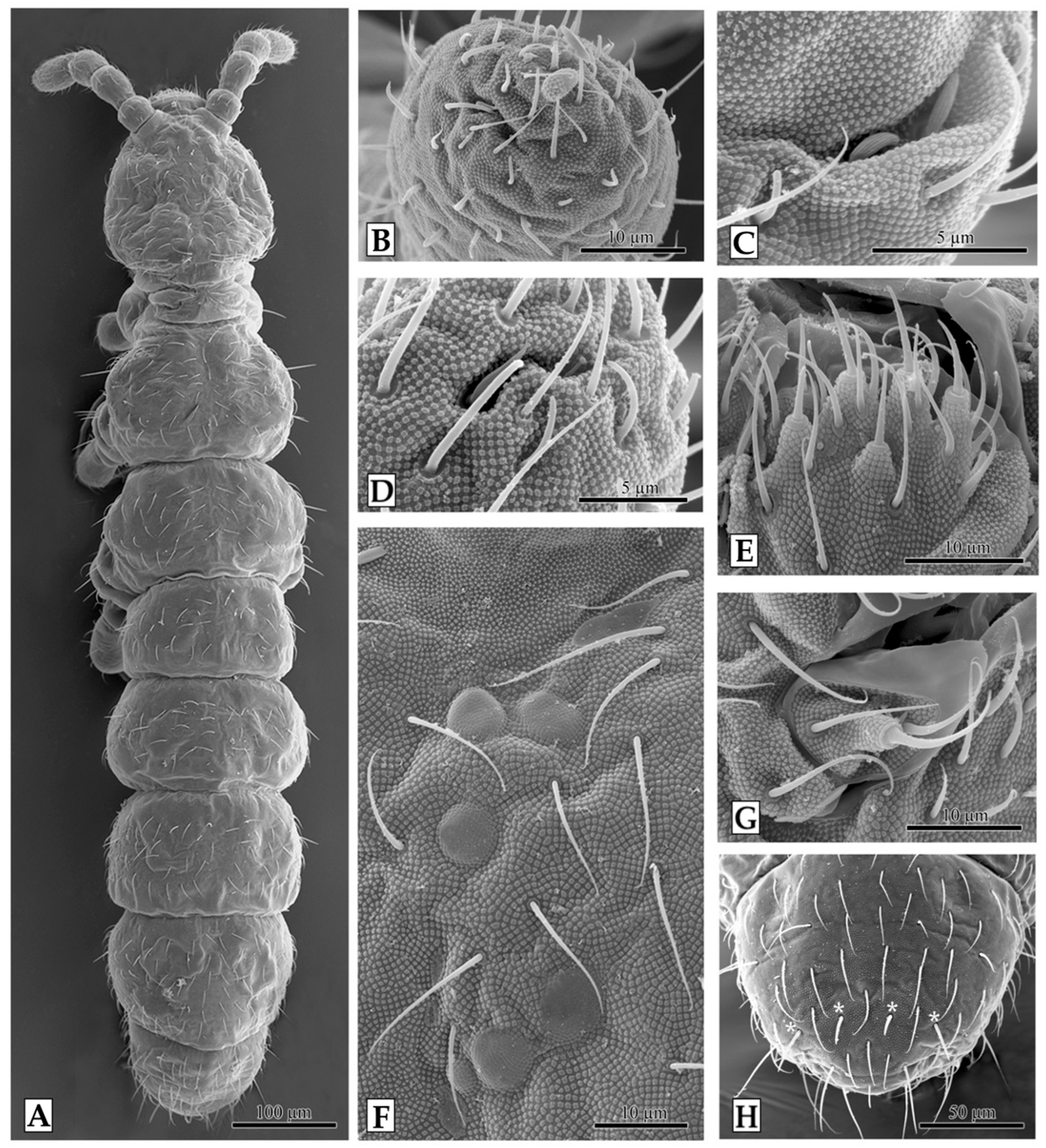
Figure 9.
C. fratii sp. nov. (A) dorsal chaetotaxy; (B) ventral chaetotaxy of head; (C) ventral chaetotaxy of abdomen; (D) chaetotaxy of the last abdominal segment.
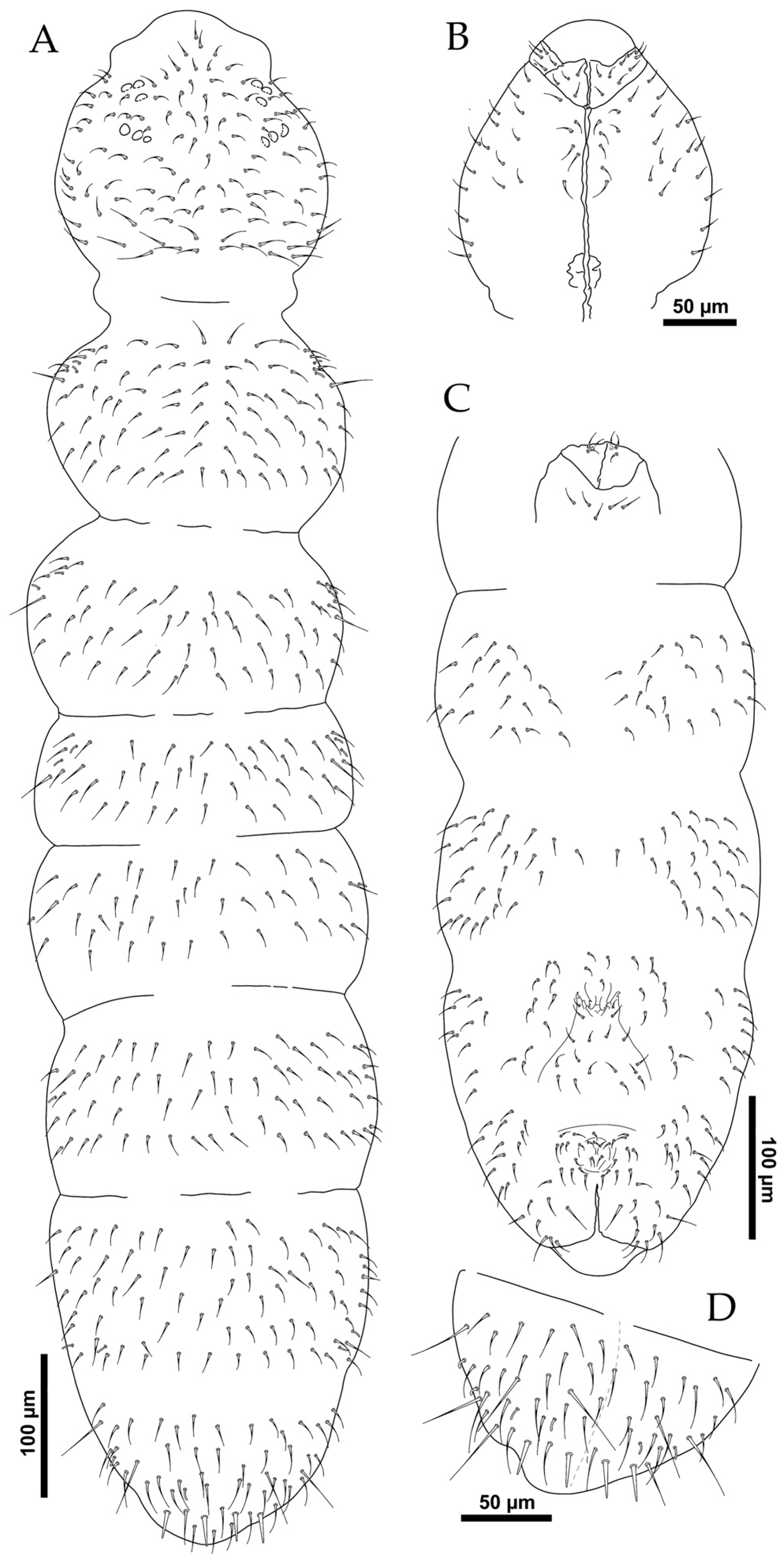
Figure 10.
C. fratii sp. nov. (A) chaetotaxy of Ant. I–IV; (B) labial palp; (C) chaetotaxy of leg I; (D) chaetotaxy of leg III; (E) ocelli and PAO.
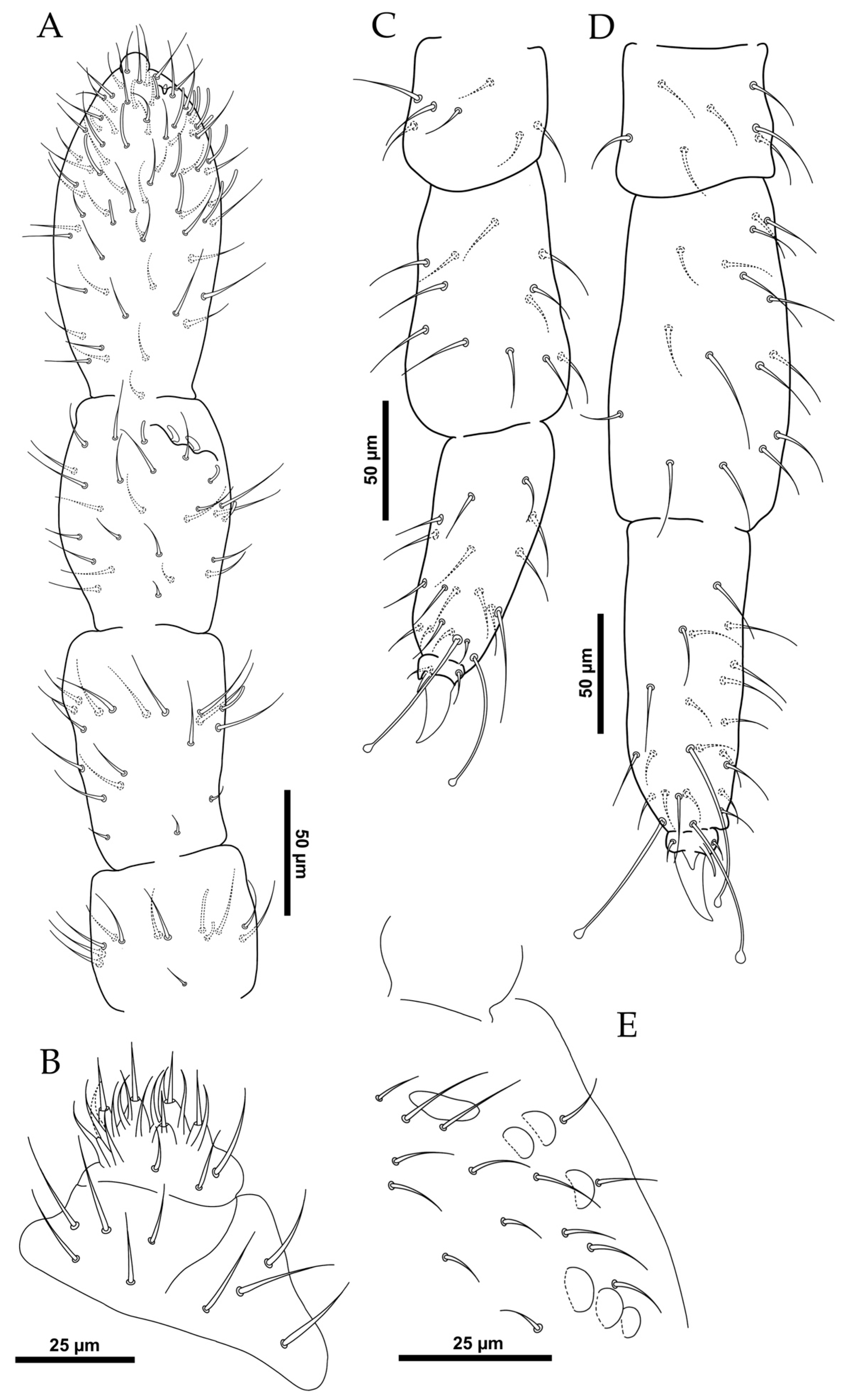
Figure 11.
SEM of C. fratii sp. nov. (A) tibiotarsus III; (B) tenaculum, furca and female genital opening; (C) dens and mucro; (D) claw and clavate tenent hair; (E) tenaculum.
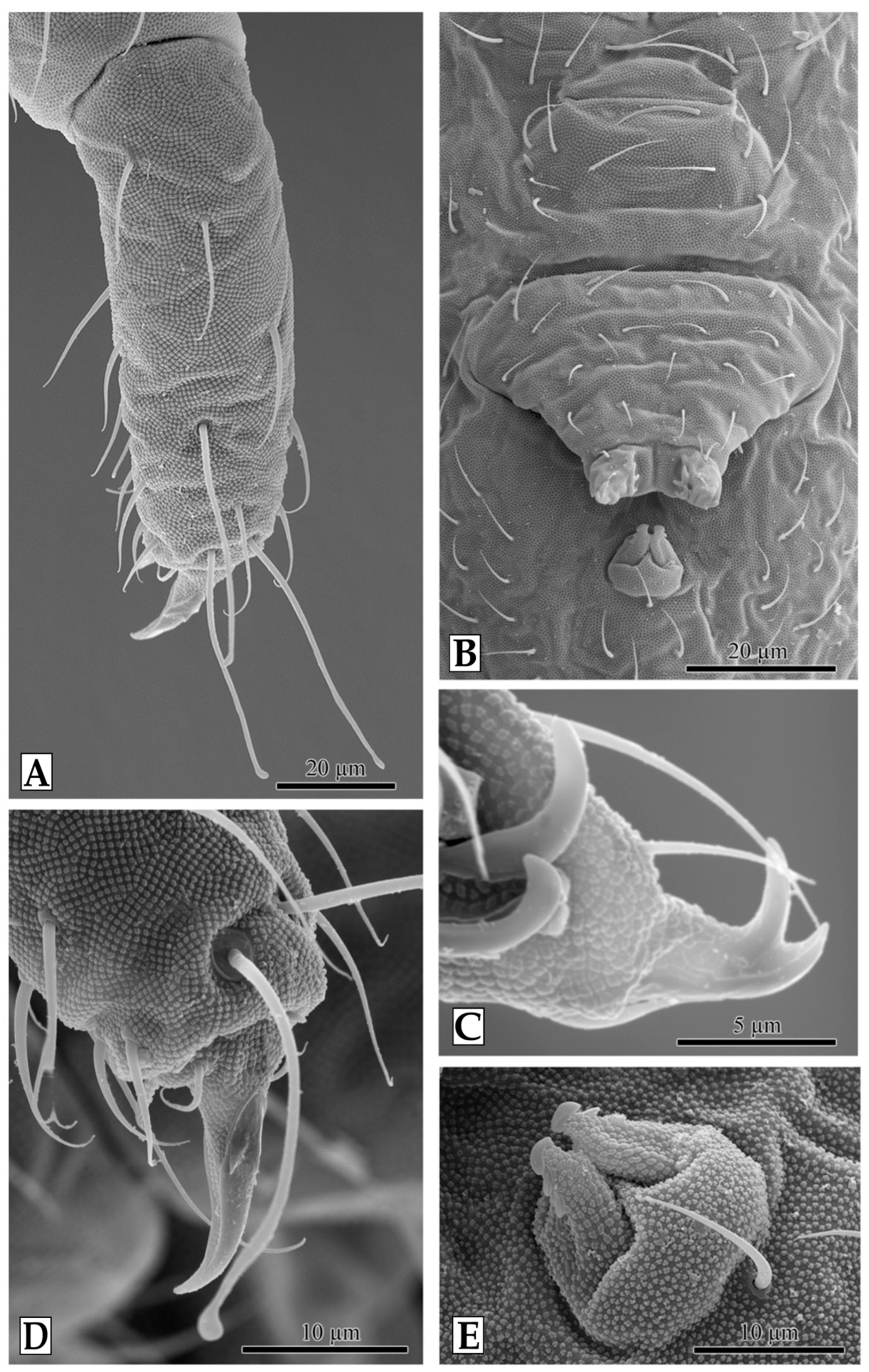
Figure 12.
SEM images of species delimiting features: C. fratii sp. nov., (A) Thoracic segment II; (B) Thoracic segment III; (C) terminal abdominal segment exhibiting four spines; and C. dallaii sp. nov. (D) Thoracic segment II; (E) Thoracic segment III; (F) terminal abdominal segment with six spines; s = sensilla, ms = micro-sensilla, * = spines on Abd. VI.
4. Discussion
Our results provide clear morphological evidence for the existence of distinct evolutionary lineages within populations previously assigned to C. terranovus. These findings are fully congruent with molecular studies that have reported pronounced genetic structuring among geographically separated populations in Victoria Land [13,15]. In particular, Carapelli et al. [15] documented levels of mitochondrial divergence and suggested that a substantial portion of this diversity may correspond to morphologically diagnosable species rather than intraspecific variation. Results of the present study align with this latter view.
The strong correspondence between molecular lineages and stable morphological traits (most notably, the number of spine-like chaetae on Abd. VI and the micro-sensillar (ms) formula) supports the use of an integrative taxonomic framework for Antarctic Collembola. Although Antarctic isotomids have often been considered morphologically conservative, our results show that fine-scale chaetotaxis characters may provide reliable diagnostic features, as previously demonstrated in other isotomid genera [25,26,27]. The observed species distributions of the genus in Victoria Land are consistent with long-term isolation in Pleistocene refugia and are incompatible with recent gene flow, instead indicating prolonged allopatric divergence. The parsing of C. terranovus into three species emphasizes the tendency of short-range endemics in Antarctica, presumably due to long-standing glacial barriers like the Drygalski Ice Tongue [30,31], ancient origins [5,32] and limited dispersal ability [12]. The assignment of Apostrophe Island populations to C. fratii sp. nov., despite their northern geographic position, indicates that historical connectivity and stochastic dispersal means, rather than simple latitudinal proximity, have played a key role in shaping current species distributions. Together, these results reinforce the view that Victoria Land harbors a substantial level of previously unrecognized endemic diversity within the Cryptopygus species complex. The description of C. fratii sp. nov. and C. dallaii sp. nov. increases the number of congeneric species in continental Antarctica to six and underscores the extent to which Antarctic biodiversity has been underestimated. Failure to recognize deeply divergent lineages may obscure patterns of endemism and evolutionary history, with implications for conservation planning within Antarctic Biogeographic Conservation Regions. Overall, this study highlights the importance of integrating morphology and molecular data to accurately document Antarctic terrestrial diversity and to better understand the evolutionary processes shaping these extreme ecosystems.
Figure 13.
Simplified diagram highlighting the sensillar (s) and micro-sensillar (ms) formula per half tergite, in addition to the spine-like chaetae located on Abd. VI. (A) C. fratii sp. nov.; (B) C. terranovus; (C) C. dallaii sp. nov.; (D) C. cisantarcticus.
Author Contributions
Conceptualization, K.R.F. and A.C.; methodology, K.R.F. and P.P.F.; software, K.R.F. and P.P.F.; validation, K.R.F. and A.C.; formal analysis, K.R.F. and P.P.F.; investigation, K.R.F. and P.P.F.; resources, A.C.; data curation, K.R.F. and P.P.F.; writing—original draft preparation, K.R.F., A.C. and P.P.F.; writing—review and editing, K.R.F. and A.C.; visualization, K.R.F. and P.P.F.; supervision, A.C.; project administration, K.R.F. and A.C.; funding acquisition, K.R.F. and A.C. All authors have read and agreed to the published version of the manuscript.
Funding
This research was funded by the Italian Program of Research in Antarctica (PNRA16_00234) to A.C. and as well as by NBFC to University of Siena/Department of Life Sciences, funded by the Italian Ministry of University and Research, PNRR, Missione 4 Componente 2, “dalla ricerca all’impresa”, Investimento 1.4, Project CN00000033.
Data Availability Statement
Holotype and paratypes of both new species are accessioned and deposited at the Museo Nazionale dell’Antartide, Genova, Italy, as follows: C. dallai holotype, code MNA 17568; C. dallai paratypes, codes MNA 17569–17585. C. fratii holotype, code MNA 17586; C. fratii paratypes, codes MNA 17587–17591. Other slide material from congeneric species: C. cisantarticus, codes MNA 17592–17594; C. terranovus, codes MNA 17554–17567.
Acknowledgments
We wish to thank Pietro Lupetti for technical assistance with SEM imaging analyses, and three anonymous reviewers for critically suggesting revisions to the drafted manuscript.
Conflicts of Interest
The authors declare no conflicts of interest. The funders had no role in the design of the study; in the collection, analyses, or interpretation of data; in the writing of the manuscript; or in the decision to publish the results.
Abbreviations
The following abbreviations are used in this manuscript:
| Abd. | Abdominal segment |
| ACBR | Antarctic Conservation Biogeographic Region |
| accp. | s-chaeta(a) situated near or within p-row of chaetae |
| Ant. | Antennal segment |
| AO | Antennal organ |
| as | Anterosubmedial setae |
| ms | Micro s-chaeta(e) or ms-chaeta(e) |
| PAO | Postantennal organ |
| PNRA | Programma Nazionale Di Ricerche in Antartide |
| s | Macro s-chaetae |
| SEM | Scanning electron microscopy |
| Th. | Thoracic segment |
| API | Apostrophe Island |
| BAR | Baker Rocks |
| CAH | Cape Hallett |
| CAI | Campo Icaro |
| CAK | Cape King |
| CAS | Cape Sastrugi |
| CAW | Cape Washington |
| CCI | Crater Cirque |
| EDP | Edmonson Point |
| EMI | Emerging Island |
| INI | Inexpressible Island |
| KAI | Kay Island |
| RCR | Redcastle Ridge |
| SPV | Springtail Vallet |
| TIG | Tinker Glacier |
| VEI | Vegetation Island |
References
- Chown, S.L.; Convey, P. Spatial and Temporal Variability across Life’s Hierarchies in the Terrestrial Antarctic. Phil. Trans. R. Soc. B 2007, 362, 2307–2331. [Google Scholar] [CrossRef] [Scilit]
- Carapelli, A.; Greenslade, P.; Nardi, F.; Leo, C.; Convey, P.; Frati, F.; Fanciulli, P.P. Evidence for Cryptic Diversity in the “Pan-Antarctic” Springtail Friesea antarctica and the Description of Two New Species. Insects 2020, 11, 141. [Google Scholar] [CrossRef] [Scilit]
- Wise, K.A.J. Collembola (Springtails). In Antarctic Research Series; Gressitt, J.L., Ed.; American Geophysical Union: Washington, DC, USA, 1967; pp. 123–148. [Google Scholar]
- Greenslade, P. Synonymy of Two Monobasic Anurophorinae Genera (Collembola: Isotomidae) from the Antarctic Continent. N. Z. Entomol. 2015, 38, 134–141. [Google Scholar] [CrossRef] [Scilit]
- Stevens, M.I.; Greenslade, P.; Hogg, I.D.; Sunnucks, P. Southern Hemisphere Springtails: Could Any Have Survived Glaciation of Antarctica? Mol. Biol. Evol. 2006, 23, 874–882. [Google Scholar] [CrossRef] [Scilit]
- Potapov, M. Synopses on Palaearctic Collembola (Vol. 3) Isotomidae; Abhandlungen und Berichte des Naturkundemuseums Görlitz: Görlitz, Germany, 2001; 603p. [Google Scholar]
- Rusek, J. Do We Have Cryptopygus—Representatives (Collembola: Isotomidae) in Europe? Pedobiologia 2002, 46, 302–310. [Google Scholar] [CrossRef] [Scilit]
- Dallai, R.; Malatesta, E.; Focardi, S. On Two Antarctic Collembola Gressittacantha terranova and Friesea grisea. Rev. Ecol. Biol. Sol. 1988, 25, 365–372. [Google Scholar]
- Frati, F.; Fanciulli, P.; Carapelli, A.; Dallai, R. The Collembola of Northern Victoria Land (Antarctica): Distribution and Ecological Remarks. Pedobiologia 1997, 41, 50–55. [Google Scholar] [CrossRef] [Scilit]
- Caruso, T.; Borghini, F.; Bucci, C.; Colacevich, A.; Bargagli, R. Modelling Local-Scale Determinants and the Probability of Microarthropod Species Occurrence in Antarctic Soils. Soil Biol. Biochem. 2007, 39, 2949–2956. [Google Scholar] [CrossRef] [Scilit]
- Caruso, T.; Hogg, I.D.; Carapelli, A.; Frati, F.; Bargagli, R. Large-Scale Spatial Patterns in the Distribution of Collembola (Hexapoda) Species in Antarctic Terrestrial Ecosystems. J. Biogeogr. 2009, 36, 879–886. [Google Scholar] [CrossRef] [Scilit]
- Hawes, T.C. Rafting in the Antarctic Springtail, Gomphiocephalus hodgsoni. Antarct. Sci. 2011, 23, 456–460. [Google Scholar] [CrossRef] [Scilit]
- Fanciulli, P.P.; Summa, D.; Dallai, R.; Frati, F. High Levels of Genetic Variability and Population Differentiation in Gressittacantha terranova (Collembola, Hexapoda) from Victoria Land, Antarctica. Antarct. Sci. 2001, 13, 246–254. [Google Scholar] [CrossRef] [Scilit]
- Hawes, T.C.; Torricelli, G.; Stevens, M.I. Haplotype Diversity in the Antarctic Springtail Gressittacantha terranova at Fine Spatial Scales—A Holocene Twist to a Pliocene Tale. Antarct. Sci. 2010, 22, 766–773. [Google Scholar] [CrossRef] [Scilit]
- Carapelli, A.; Leo, C.; Frati, F. High Levels of Genetic Structuring in the Antarctic Springtail Cryptopygus terranovus. Antarct. Sci. 2017, 29, 311–323. [Google Scholar] [CrossRef] [Scilit]
- Terauds, A.; Chown, S.L.; Morgan, F.; Peat, H.J.; Watts, D.J.; Keys, H.; Convey, P.; Bergstrom, D.M. Conservation Biogeography of the Antarctic. Divers. Distrib. 2012, 18, 726–741. [Google Scholar] [CrossRef] [Scilit]
- Terauds, A.; Lee, J.R. Antarctic Biogeography Revisited: Updating the Antarctic Conservation Biogeographic Regions. Divers. Distrib. 2016, 22, 836–840. [Google Scholar] [CrossRef] [Scilit]
- Collins, G.E.; Hogg, I.D.; Convey, P.; Barnes, A.D.; McDonald, I.R. Spatial and Temporal Scales Matter When Assessing the Species and Genetic Diversity of Springtails (Collembola) in Antarctica. Front. Ecol. Evol. 2019, 7, 76. [Google Scholar] [CrossRef] [Scilit]
- Dawson, N.; Fischer, J.; Kuhn, M.; Pasotti, A.; Mhugent; Rouzaud, D.; Bruy, A.; Sutton, T.; Dobias, M.; Pellerin, M.; et al. Qgis/QGIS: 3.44.0. 2025. Available online: https://www.qgis.org/downloads-list/ (accessed on 27 September 2025).
- Matsuoka, K.; Skoglund, A.; Roth, G.; de Pomereu, J.; Griffiths, H.; Headland, R.; Herried, B.; Katsumata, K.; Le Brocq, A.; Licht, K.; et al. Quantarctica. 2018. Available online: https://npolar.no/quantarctica/ (accessed on 27 September 2025).
- Rusek, J. Eine Präparationstechnik für Springschwänze und Ähnliche Gliederfüsser. Mikrokosmos 1975, 12, 376–381. [Google Scholar]
- Fjellberg, A. The Labial Palp in Collembola. Zool. Anz. 1999, 237, 309–330. [Google Scholar]
- Potapov, M.; Janion-Scheepers, C.; Deharveng, L. Taxonomy of the Cryptopygus Complex. II. Affinity of Austral Cryptopygus s.s. and Folsomia, with the Description of Two New Folsomia Species (Collembola, Isotomidae). ZooKeys 2017, 658, 131–146. [Google Scholar] [CrossRef] [Scilit]
- Potapov, M.B. Foil-Setae, a New Type of Setae in the Family Isotomidae (Collembola). Pedobiologia 2002, 46, 296–301. [Google Scholar] [CrossRef] [Scilit]
- Potapov, M.B.; Greenslade, P. Redescription of Folsomia loftyensis Womersley with Notes on the Sensillary Arrangement of the Genital Segment in the Genus (Collembola: Isotomidae). Zool. Anz.-A J. Comp. Zool. 2010, 249, 13–20. [Google Scholar] [CrossRef] [Scilit]
- Schulz, H.-J.; Potapov, M.B. A New Species of Folsomia from Mofette Fields of the Northwest Czechia (Collembola, Isotomidae). Zootaxa 2010, 2553, 60–64. [Google Scholar] [CrossRef] [Scilit]
- Potapov, M.; Babenko, A.; Fjellberg, A.; Greenslade, P. Taxonomy of the Proisotoma complex. II. A Revision of the Genus Subisotoma and a Description of Isotopenola Gen. Nov. (Collembola: Isotomidae). Zootaxa 2009, 2314, 1–40. [Google Scholar] [CrossRef] [Scilit]
- Greenslade, P.; Deharveng, L. Revision of Friesea Species (Collembola: Neanuridae) of Australia and Offshore Islands, with Biogeographical Notes and Key to Species. Invertebr. Taxon. 1997, 11, 321–331. [Google Scholar] [CrossRef] [Scilit]
- Greenslade, P.; Stevens, M.I.; Torricelli, G.; D’Haese, C. Redescription of Gomphiocephalus hodgsoni Carpenter, 1908 (Collembola: Hypogastruridae): Morphology and Molecular Data Restore an Ancient Antarctic Endemic Genus. Syst. Entomol. 2011, 36, 223–240. [Google Scholar] [CrossRef] [Scilit]
- Convey, P.; Stevens, M.I.; Hodgson, D.A.; Smellie, J.L.; Hillenbrand, C.-D.; Barnes, D.K.A.; Clarke, A.; Pugh, P.J.A.; Linse, K.; Cary, S.C. Exploring Biological Constraints on the Glacial History of Antarctica. Quat. Sci. Rev. 2009, 28, 3035–3048. [Google Scholar] [CrossRef] [Scilit]
- Collins, G.E.; Hogg, I.D.; Convey, P.; Sancho, L.G.; Cowan, D.A.; Lyons, W.B.; Adams, B.J.; Wall, D.H.; Green, T.G.A. Genetic Diversity of Soil Invertebrates Corroborates Timing Estimates for Past Collapses of the West Antarctic Ice Sheet. Proc. Natl. Acad. Sci. USA 2020, 117, 22293–22302. [Google Scholar] [CrossRef] [Scilit]
- McGaughran, A.; Stevens, M.I.; Hogg, I.D.; Carapelli, A. Extreme Glacial Legacies: A Synthesis of the Antarctic Springtail Phylogeographic Record. Insects 2011, 2, 62–82. [Google Scholar] [CrossRef] [Scilit]
Disclaimer/Publisher’s Note: The statements, opinions and data contained in all publications are solely those of the individual author(s) and contributor(s) and not of MDPI and/or the editor(s). MDPI and/or the editor(s) disclaim responsibility for any injury to people or property resulting from any ideas, methods, instructions or products referred to in the content. |
© 2026 by the authors. Licensee MDPI, Basel, Switzerland. This article is an open access article distributed under the terms and conditions of the Creative Commons Attribution (CC BY) license.