


Abstract
The selective separation of chalcopyrite from pyritic ores represents a major industrial challenge due to inadvertent copper activation. This study systematically investigates the batch flotation kinetics of a complex sulfide ore (Draa Sfar North, Morocco) using a first-order kinetic model (). The impacts of pulp pH, chemical depressants, and specialized collectors were evaluated to optimize the copper/iron selectivity index (). The results reveal a high-alkalinity paradox: At pH 11.0, chalcopyrite kinetics experience a severe passivation bottleneck (). At pH 11.5, selectivity collapses () due to persistent iron sulfide floatability (). Conversely, natural pH () provides a superior baseline (), where 40 g/t sodium cyanide (NaCN) yielded a peak index of . As an eco-friendly substitute, sodium lignosulfonate (LSNa) achieved outstanding performance (), reducing iron kinetics to their lowest level () via ferric–anionic complexation. Furthermore, Danafloat 271 secured the highest collector-driven selectivity () by suppressing the iron matrix () following Hard–Soft Acid–Base principles. This study clarifies specific aspects of selective copper–iron flotation, demonstrating that natural pH circuits with green depressants or selective collectors offer a sustainable alternative.
1. Introduction
The beneficiation of complex polymetallic sulfide ores via selective flotation remains a formidable challenge in modern mineral processing. This difficulty is particularly pronounced when separating valuable chalcopyrite (CuFeS2) from abundant iron sulfide gangue minerals, primarily pyrite (FeS2) and pyrrhotite (Fe7S8) [1]. In industrial circuits, the primary objective is to maximize copper recovery and concentrate grade while minimizing the true flotation and mechanical entrainment of these iron sulfides. However, the selectivity of this separation is frequently compromised by complex physical, hydrodynamic, and chemical factors [2]. Among these, chemical mechanisms, most notably the inadvertent activation of iron sulfides by dissolved heavy metal cations (Cu2+, Pb2+, Zn2+), are the most challenging to control [3].
These activator ions originate either from the continuous recycling of process water or from the partial dissolution of valuable minerals and electrochemical interactions during the grinding stage [4,5]. By adsorbing onto the iron sulfide surfaces, these metal cations alter their electrochemical properties and reduce their natural hydrophilicity, thereby promoting the non-selective adsorption of sulfhydryl collectors [6]. Furthermore, surface oxidation during grinding generates iron hydroxides and oxyhydroxides that can either mask active sites or unpredictably complex with reagents [7], making the modulation of pulp pH and redox potential critical for regulating relative mineral floatability [8].
To counteract this loss of selectivity, conventional industrial practices often rely on extreme alkaline environments (pH > 11) using lime, or potent inorganic depressants such as sodium cyanide (NaCN) [9]. While highly alkaline conditions can depress pyrite by promoting the rapid oxidation of its surface and the formation of hydrophilic iron hydroxides, they also lead to the non-selective depression of chalcopyrite due to extensive surface fouling. Moreover, the severe environmental and toxicity risks associated with cyanide have strongly incentivized the industry to seek sustainable alternatives [10].
Consequently, recent research has shifted toward the application of eco-friendly macromolecular organic depressants, such as dextrins and lignosulfonates (e.g., ammonium lignosulfonate [ALS] and sodium lignosulfonate [LSNa]) [1,11]. These biodegradable, non-toxic polymers selectively adsorb onto the oxidized patches of iron sulfides (such as sites) via hydrogen bonding or complexation. This creates a protective hydrophilic barrier that hinders subsequent collector adsorption without penalizing chalcopyrite floatability [12,13]. Concurrently, the deployment of specialized or blended collectors has demonstrated remarkable molecular synergies. For instance, blends combining dithiophosphates and mercaptobenzothiazoles exhibit enhanced adsorption rates by effectively targeting mineral surface sites with varying degrees of oxidation and metal-to-sulfur ratios [14].
Despite these fundamental chemical advances on pure minerals, their direct application to massive, highly pyritic complex ores remains inadequately documented. Such mineral matrices suffer from intense chemical fouling and severe mechanical entrainment. The complex polymetallic ore from the Draa Sfar North deposit (Morocco) perfectly exemplifies this challenge, as it is characterized by a uniquely high iron sulfide-to-chalcopyrite ratio, grading 39.56% Fe and only 2.39% Cu.
To bridge this gap, this study presents a systematic investigation into the selective flotation of chalcopyrite from the Draa Sfar North ore using a first-order kinetic modeling approach. This work comparatively evaluates the competitive effects of pulp pH, inorganic (NaCN) versus organic macromolecular depressants (dextrin, ALS, LSNa), and six distinct simple and blended sulfhydryl collectors. By accurately quantifying ultimate recoveries () and modified kinetic constants (Kmod), this research establishes a robust phenomenological framework to optimize selectivity indices (SI (Cu/Fe)), ultimately providing practical insights for the sustainable and efficient processing of complex pyritic ores.
2. Materials and Methods
2.1. Mineral Ore and Characterization
A representative 100 kg batch sample of complex sulfide ore was obtained from the copper mineralization zone of the Draa Sfar North mine (Morocco). The run-of-mine ore was crushed down to 2 mm using laboratory roll crushers (Denver Equipment Company, Denver, CO, USA), homogenized, and split into 1 kg sub-samples. To minimize sulfide mineral oxidation, all 1 kg batches were packed and stored in vacuum-sealed bags until flotation testing.
Elemental chemical analysis was performed using Inductively Coupled Plasma Atomic Emission Spectrometry (ICP-AES; Activa, Horiba Jobin Yvon, Longjumeau, France), while mineralogical phases were quantified via X-ray Diffraction (XRD; Bruker D8 Advance, Bruker AXS GmbH, Karlsruhe, Germany) at the REMINEX Research Center (Managem Group, Marrakech, Morocco). The resulting chemical and mineralogical compositions are summarized in Table 1 and Table 2, respectively.
Table 1.
Chemical composition of the Draa Sfar North ore determined by ICP-AES analysis.
Table 2.
Mineralogical composition of the Draa Sfar North ore determined by XRD analysis.
2.2. Flotation Reagents
Potassium Amyl Xanthate (PAX; supplied by Mathiesen, Santiago, Chile) was used as the primary collector, and Methyl Isobutyl Carbinol (MIBC; supplied by Cytec Industries Inc., Woodland Park, NJ, USA) was employed as the frother at a constant dosage of 25 g/t. Sodium hydroxide (NaOH; supplied by Merck KGaA, Darmstadt, Germany) was utilized as the pH regulator to strictly isolate the pure pH effect (hydroxyl concentration) and avoid any confounding chemical depressing effects of calcium ions associated with lime.
To evaluate selective iron sulfide depression, four depressants were investigated: inorganic sodium cyanide (NaCN; supplied by Sigma-Aldrich, St. Louis, MO, USA), and three organic macromolecular polymers: dextrin (supplied by Sigma-Aldrich, St. Louis, MO, USA), ammonium lignosulfonate (LSA; supplied by Borregaard LignoTech, Sarpsborg, Norway), and sodium lignosulfonate (LSNa; supplied by Borregaard LignoTech, Sarpsborg, Norway). To explore selectivity synergies, five specialized sulfhydryl collectors from the Danafloat series (DF123, DF233, DF271, and DF468; supplied by Cheminova A/S, Lemvig, Denmark) and sodium diisobutyl dithiophosphinate (Aerophine 3418A; supplied by Cytec Industries Inc., Woodland Park, NJ, USA) were tested against baseline PAX. The detailed reagent suites and experimental dosages are detailed in Table 3.
Table 3.
List of flotation reagents (collectors and depressants) evaluated in this study and their respective dosages.
2.3. Grinding and Batch Flotation Procedures
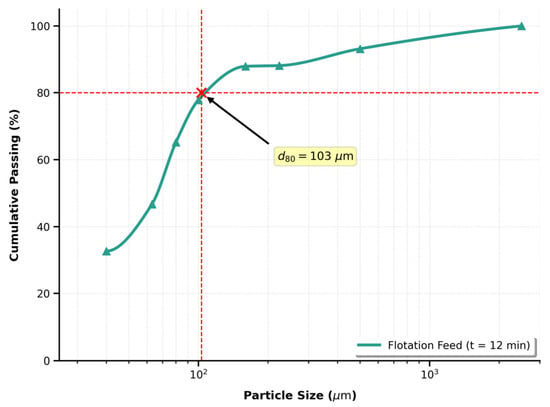
Prior to each flotation test, a 1 kg ore batch was milled at 66% solids (500 mL tap water) in a laboratory Denver ball mill (Denver Equipment Company, Denver, CO, USA) with a 10 kg grinding charge. To reach the target mineral liberation mesh (~100 μm), grinding calibration trials were systematically performed at 0, 10, 12, and 14 min. As illustrated in the cumulative particle size distribution (PSD) curve (Figure 1), the optimal grinding time was fixed at 12 min to consistently achieve a product d80 of ~103 μm.
Figure 1.
Cumulative particle size distribution (PSD) curve of the flotation feed (grinding time = 12 min, d80 = 103 μm).
The milled pulp was transferred to a 2.5 L Denver-type laboratory flotation cell (Denver Equipment Company, Denver, CO, USA), adjusting the initial pulp density to 30% solids by weight. The impeller speed was maintained at 1200 rpm across all tests. Reagent conditioning followed a sequential addition: pH adjustment (if required), depressant addition (2 min conditioning time), collector addition (40 g/t, fixed concentration), and MIBC frother addition (25 g/t, fixed).
All tests were carried out as time-resolved kinetic trials over a total flotation period of 8 min. Four distinct concentrate fractions were collected cumulatively at 2, 4, 6, and 8 min by manual scraping every 5 s. Collected concentrates and tailings were filtered, dried at 60 °C, weighed, and analyzed via Atomic Absorption Spectroscopy (AAS; Varian AA240FS, Varian Inc., Palo Alto, CA, USA) to determine Cu and Fe grades.
Although the raw ore contains 1.15 g/t of Au (determined by ICP-AES as shown in Table 1), a systematic assay of gold in the time-resolved flotation products was not performed because this study focuses primarily on Cu/Fe separation kinetics. Mineralogically, the gold in this volcanogenic massive sulfide (VMS) ore is expected to partition between the chalcopyrite phase (thus reporting to the copper concentrate) and sub-microscopic refractory inclusions within the pyrite and pyrrhotite matrices (thus reporting to the tailings).
2.4. Kinetic Modeling and Selectivity Calculations
The experimental cumulative metal recoveries () were calculated using the standard mass balance equation:
where and represent the dry mass weights of the concentrate and feed, while and denote the respective metal grades (%).
To evaluate the separation kinetics, experimental data were fitted to a first-order classical kinetic model using MATLAB software (Version R2022a; MathWorks Inc., Natick, MA, USA):
where is the recovery at time , is the ultimate recovery (%), and is the flotation rate constant (). A modified kinetic constant () integrating both parameters was calculated:
The efficiency of chalcopyrite separation from iron sulfides was quantified using the Selectivity Index (), expressed as:
3. Results and Discussion
3.1. Effect of Pulp pH on Flotation Kinetics and Selectivity
The experimental kinetic data for chalcopyrite and iron sulfide flotation at various pulp pH levels (6.0, 9.0, 10.0, 11.0, and 11.5) were successfully fitted to the first-order classical kinetic model [15]. As summarized in Table 4, the correlation coefficients () systematically exceeded 0.952, ranging up to 0.997. This high level of statistical correlation rigorously validates the mathematical framework selected to monitor the flotation separation rates.
Table 4.
Kinetic parameters, ultimate recoveries, and copper/iron selectivity indices () as a function of pulp pH.
An analysis of the kinetic parameters reveals a compelling correlation between pulp alkalinity and mineral floatability. At slightly acidic to neutral conditions (pH 6.0), the system demonstrated a remarkable baseline selectivity index (), characterized by an ultimate copper recovery () of 100% and a high flotation rate constant (). When the pH was modulated to moderately alkaline (pH 9.0), the chalcopyrite flotation kinetics accelerated drastically, achieving its maximum velocity (, ). However, this was accompanied by a simultaneous increase in iron sulfide flotation kinetics (), resulting in a slight decay of the selectivity index to .
Crucially, entering highly alkaline regions (pH 11.0 to 11.5) proved detrimental to selective separation. At pH 11.0, a massive kinetic depression of chalcopyrite itself was observed, whose kinetic constant plummeted to its minimum value of (), despite maintaining an ultimate recovery of .
When the alkalinity was further increased to pH 11.5, the selectivity index collapsed to its lowest value across the entire study (). This structural drop in selectivity is driven by the fact that iron sulfides maintained a significant persistent floatability and rapid velocity, characterized by a calculated ultimate recovery of and a kinetic constant of (). Concurrently, the valuable copper phase experienced both a recovery and kinetic bottleneck ( and ). This demonstrates that conventional industrial reliance on high alkalinity additions to depress iron sulfides induces an inadvertent and severe kinetic depression of chalcopyrite within this specific complex ore matrix.
The fundamental mechanism underlying this behavior is governed by the surface electrochemistry and oxidation kinetics of sulfide minerals. In highly alkaline media, the surface of iron sulfides undergoes rapid collectorless oxidation, promoting the precipitation of a hydrophilic layer composed of iron hydroxides and oxyhydroxides (, ). As outlined by Bocharov and Ignatkina [16] and Ma and Bruckard [17], these hydrophilic species strategically mask the active anodic sites, preventing the necessary electrochemical oxidation of xanthate ions () into stable, hydrophobic dixanthogen species . Furthermore, as highlighted by the non-linear fluctuation of across the pH range, the flotation behavior is heavily controlled by the mixed potential system (). At highly alkaline pH, the electrochemical potential shifts downward into reducing conditions, which, according to López-Valdivieso et al. [6] and Ferihan Göktepe [8], hinders the oxygen reduction reaction necessary to couple with xanthate adsorption.
Concurrently, the persistent floatability of iron sulfides under high pH conditions could be attributed to inadvertent copper activation () triggered during the grinding stage [18]. As demonstrated recently by Castellón et al. [3] and Bai et al. [19], dissolved copper ions from chalcopyrite form stable, hydrophobic CuS-like surface lattices on iron sulfides. These species are highly resistant to standard alkaline depression, thereby emphasizing the requirement for specialized chemical depressants rather than simple pH modulation to treat this complex ore matrix.
Additionally, because the pulp pH of approximately 6.0 represents the natural pH of the Draa Sfar North ore, this circuit operates without any acid addition. This completely prevents any risk of accelerated acid-induced corrosion on grinding media and liners, while preserving the economic and environmental advantages of the process by avoiding reagent consumption.
3.2. Depressants’ Effect on Chalcopyrite and Iron Sulfide Selectivity
3.2.1. Effect of Sodium Cyanide (NaCN)
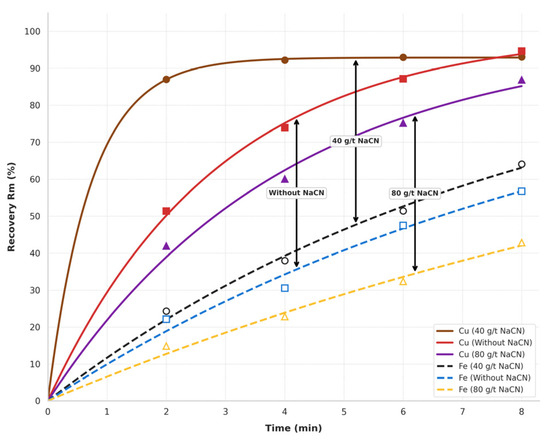
To evaluate the competitive performance of baseline inorganic parameters, batch flotation kinetics were conducted at a natural pulp pH () under shifting specific chemical consumption levels of sodium cyanide (: 0, 40, and 80 g/t). The fitted first-order kinetic parameters generated via MATLAB—specifically the kinetic constants () and calculated ultimate recoveries () along with the subsequent calculated indicators (, ) are compiled in Table 5. Concurrently, the time-resolved experimental cumulative recoveries () reflecting the raw physical separation flow over time are illustrated in Figure 2 (The kinetic curves of Cu and Fe recovery for different cyanide specific consumptions).
Table 5.
Kinetic parameters and selectivity indices as a function of sodium cyanide (NaCN) specific consumption at natural pH.
Figure 2.
Time-resolved cumulative recovery curves of chalcopyrite (Cu) and iron sulfides (Fe) as a function of sodium cyanide (NaCN) specific consumption (0, 40, and 80 g/t) at natural pH ().
The quantitative data in Table 5 reveal that the addition of a minor dose of cyanide (40 g/t) significantly optimizes the separation system, securing a peak selectivity index of compared to the baseline condition without depressant (). This behavior is strongly supported by the calculated parameters, where the chalcopyrite kinetic constant dramatically accelerated from its baseline value of to a maximum of , which yields a modified rate constant of despite a slight compromise in the calculated ultimate recovery (). This sharp copper kinetic acceleration is chemically driven by the selective dissolution of passivating hydrophilic iron hydroxide surface layers (such as Fe(OH)3 and FeOOH) by the low cyanide dosage, exposing the pristine hydrophobic chalcopyrite lattice, in agreement with the surface-cleaning mechanisms described by Wang and Forssberg [9].
This fast kinetic advantage is visually confirmed by the experimental trends in Figure 2, where the slope of the experimental recovery curve () for 40 g/t is the steepest during the initial minutes of flotation. Simultaneously, Table 5 shows that iron sulfide floatability is controlled, maintaining a low kinetic constant (). This minor increase from the baseline of 0.1048 min−1 is not due to chemical activation by cyanide but rather represents a physical consequence of mechanical entrainment of fine, liberated iron sulfide gangue particles triggered by the highly rapid and massive flotation of the hydrophobic copper phase within the first two minutes, as modeled in our previous work on this specific ore matrix by Abidi et al. [2]. To verify the mathematical stability of these estimations against potential fitting artifacts, the high correlation coefficients (R2 = 0.9946 for Cu and 0.9853 for Fe) demonstrate that the first-order kinetic model describes the experimental data with high statistical reliability.
Conversely, further doubling the inorganic dosage to 80 g/t induced an extensive decay in the separation efficacy, with the calculated selectivity index dropping sharply to . At this stage, the computed ultimate recovery of chalcopyrite shifts back to , but its underlying kinetic constant plummets severely to (). Because the flotation kinetics are severely slowed down at this high dosage, the experimental curve does not plateau within the 8 min testing time, leading the non-linear regression model to mathematically project this high theoretical ultimate recovery of 98.22% at infinite time, reflecting a standard mathematical trade-off between the rate constant (K) and ultimate recovery () when kinetics are highly constrained.
This severe kinetic slowing is explicitly mirrored in the graphic presentation of Figure 2, where the experimental recovery curves () for both copper and iron sulfide phases fail to achieve competitive separation speeds. Because the free cyanide ions undergo unselective complexation across all sulfide nodes at 80 g/t, the initial recovery rate of the valuable copper phase is heavily bottlenecked, neutralizing the required physical kinetics for selective chalcopyrite recovery over iron sulfides (, ).
The fundamental mechanism explaining this depressive behavior revolves around structural surface passivation and the electrochemical reduction in potential at the mineral interface. Under weakly acidic/neutral environments, the primary active cathodic and anodic sites of iron sulfides (especially pyrite) interact with free cyanide ions () to induce the formation of stable hydrophilic ferrocyanide complexes, predominantly matching stable species like and . As outlined by Wang and Forssberg [9], these strong hydrophilic surface layers strategically block the active coordination nodes required for collector attachment.
Furthermore, according to Guo et al. [20], the extensive adsorption of cyanide alters the surface redox potential (), shifting the local electrochemical environment below the reversible potential line required to generate stable hydrophobic dixanthogen out of xanthate monomers (). However, when an excessive dosage of cyanide is introduced (80 g/t), the ions lose their structural selectivity threshold. At this stage, free cyanides actively complex with copper sites on the chalcopyrite surface as well, yielding stable hydrophilic copper–cyanide species that induce an identical, involuntary kinetic depression of the primary valuable phase, which fully explains the dramatic drop observed in the selectivity index.
3.2.2. Effect of Organic Macromolecular Depressants (Dextrin, LSA, and LSNa)
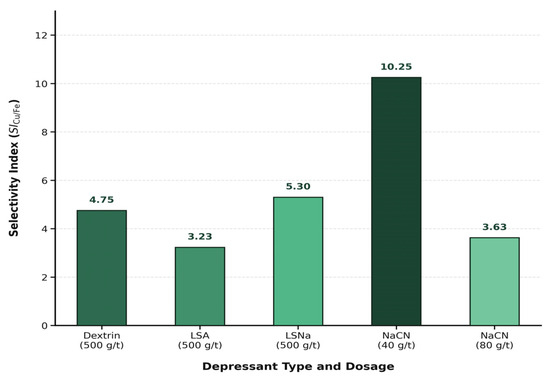
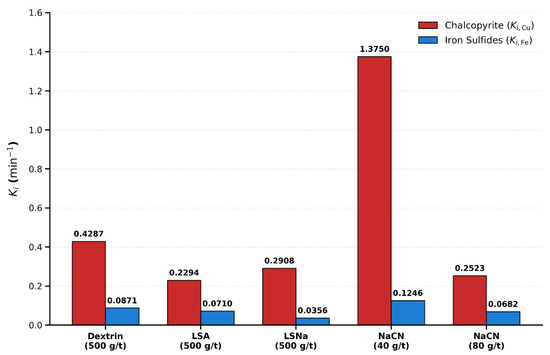
To explore eco-friendly and non-toxic alternatives to sodium cyanide, the depressive efficiency of three organic macromolecular polymers dextrin, ammonium lignosulfonate (LSA), and sodium lignosulfonate (LSNa) was systematically evaluated at a baseline dosage of 500 g/t under natural pH conditions () [21]. The comparative kinetic parameters computed via MATLAB are compiled in Table 6, while the graphical representations of the copper/iron selectivity indices () and the corresponding kinetic constants () are illustrated in Figure 3 and Figure 4, respectively.
Table 6.
Kinetic parameters and selectivity indices for different organic macromolecular depressants at a dosage of 500 g/t.
Figure 3.
Copper/iron selectivity indices () obtained using different organic macromolecular depressants (Dextrin, LSA, and LSNa) at a dosage of 500 g/t under natural pH conditions ().
Figure 4.
First-order kinetic constants () of chalcopyrite and iron sulfides for the evaluated organic macromolecular depressants (Dextrin, LSA, and LSNa) at a dosage of 500 g/t under natural pH conditions ().
The experimental parameters demonstrate that the organic depressants exhibit highly contrasting separation efficiencies, deeply dependent on the polymer’s structural configuration and functional groups. As illustrated by the selectivity metrics in Figure 3, dextrin achieved a strong selective baseline, yielding a selectivity index of . Under dextrin conditioning, chalcopyrite maintained rapid flotation kinetics, achieving a high kinetic constant of (Figure 4) (with a corresponding modified rate constant and an ultimate recovery ), while successfully limiting iron sulfide kinetics (, ).
Conversely, ammonium lignosulfonate (LSA) delivered the lowest selective response among the evaluated series (, Figure 3). As confirmed by the kinetic constants plotted in Figure 3, LSA induced a severe kinetic deceleration of chalcopyrite velocity (), while failing to achieve a sufficient structural depression of the iron sulfide gangue phases (, ).
The most outstanding selective separation barrier was achieved by sodium lignosulfonate (LSNa), which optimized the selectivity index to a maximum value of , as graphically summarized in Figure 3. This peak performance is driven by a powerful kinetic suppression of iron sulfides, which reached the lowest recorded kinetic constant in this section ( and , Figure 4). However, as displayed by the kinetic trends, this high iron rejection came at the expense of a partial co-depression of chalcopyrite, whose kinetic constant dropped to () with an ultimate recovery limited to . Despite this recovery compromise, the quantitative comparison in Figure 3 confirms that the chemical architecture of LSNa offers the strongest thermodynamic framework for competitive iron sulfide inhibition under natural pH environments [22].
The distinct mechanisms driving these polymeric interactions are governed by structural surface configurations and selective chemical affinity. The selective action of dextrin is structurally explained by its reliance on hydrophobic interactions and hydrogen bonding with specific mineral patches. As established by Rath et al. [23] and Liu et al. [24], dextrin molecules can selectively adsorb onto mildly oxidized mineral matrices via interactions between the polymer’s hydroxyl groups () and the hydrated species on the mineral surfaces, creating a localized hydrophilic coating that controls the xanthate adsorption balance without harming the main copper phase kinetics.
In contrast, the highly aggressive depression of iron sulfides achieved by sodium lignosulfonate (LSNa) is driven by its dense anionic surface charge and specific chemical complexation. According to Mu et al. [25] and Yang et al. [7], LSNa is a highly branched biopolymer containing a large density of hydrophilic sulfonate () and phenolic hydroxyl groups. Because iron sulfides (specifically pyrite and pyrrhotite undergoing minor surface oxidation) exhibit a high density of strongly charged ferric/ferrous active sites (), the anodic sulfonate groups of LSNa interact via strong chemical complexation with these iron nodes.
Concurrently, as demonstrated by Mu et al. [13] and Semoto et al. [26], the highly branched spatial structure of these biopolymers creates a steric hindrance barrier on the iron sulfide surfaces, physically blocking the diffusion of the primary collector (PAX), which justifies the massive drop in iron velocity visible in Figure 4. However, the efficiency of this steric barrier is highly governed by the nature of the polymer’s counter-ion, as reviewed by Li et al. [1] and Xue et al. [27]. The ammonium ion (NH4+) in LSA forms strong intra- and inter-molecular hydrogen bonds with the sulfonate (SO3-) and phenolic hydroxyl (OH-) groups of the polymer, forcing LSA into a coiled, compact globular conformation in water. This structural coiling limits its surface masking efficiency and results in a higher iron rate constant (Ki,Fe = 0.0710 min−1).
In contrast, the highly hydrophilic sodium ion (Na+) in LSNa ensures maximum electrostatic dissociation, allowing the macromolecule to adopt a fully extended, branched anionic conformation in water. Upon adsorption, this stretched conformation forms a much denser and highly hydrated steric barrier, driving the iron rate constant to its lowest value (Ki,Fe = 0.0356 min−1), in agreement with the competitive xanthate blocking mechanisms proposed by Mu et al. [25].
The concurrent partial depression of chalcopyrite () highlights that at a high dosage of 500 g/t, this highly extended LSNa barrier loses part of its mineralogical specificity, unselectively blocking a fraction of the copper active nodes as well [28].
3.3. Effect of Specific Sulfhydryl Collectors on Flotation Kinetics and Separation Selectivity
To explore selective alternatives to standard Potassium Amyl Xanthate (PAX), five specialized collectors from the Danafloat series (DF123, DF233, DF271, and DF468) and the dithiophosphinate Aerophine (3418A) were systematically evaluated at natural pH. The fitted first-order kinetic parameters generated via MATLAB (, , , and ) are summarized in Table 7.
Table 7.
Kinetic parameters and selectivity indices for various specialized sulfhydryl collectors at a baseline dosage of 40 g/t.
The experimental data demonstrate that the choice of collector structural formulation drastically impacts both flotation velocity and separation selectivity. Under baseline conditions with PAX, chalcopyrite flotation displayed a modified rate constant (), while iron sulfides retained high flotation kinetics (), yielding a limited baseline selectivity index (). When testing alternative formulations, Aerophine 3418A significantly accelerated the chalcopyrite flotation rate, achieving the highest copper modified rate constant (), though its selectivity index was restricted to due to a concurrent elevated iron sulfide recovery rate ().
Crucially, the highest selective separation performance was achieved by the specialized formulation Danafloat 271, optimizing the selectivity index to a maximum of . Under DF271 conditioning, iron sulfide flotation kinetics were heavily suppressed, dropping to the lowest reported values ( and ), while chalcopyrite maintained an acceptable ultimate recovery (). Danafloat 468 also demonstrated strong selective potential, yielding a selectivity index of with a faster copper kinetic response () compared to DF271. These results clearly indicate that modifying the collector structural chemistry can successfully enhance iron sulfide rejection at natural pH without the mandatory requirement of inorganic depressants.
The fundamental mechanism driving this selectivity gap is directly related to the structural configuration of the collector’s functional groups and its interaction according to the Hard–Soft Acid–Base (HSAB) principle. PAX, as a typical sulfhydryl xanthate, non-selectively adsorbs via electrochemical oxidation into dixanthogen on both chalcopyrite and iron sulfide surfaces once minor surface oxidation occurs during grinding, as supported by Nagaraj and Ravishankar [29] and López-Valdivieso et al. [6].
Conversely, specialized formulations like Danafloat 271, which contains a synergistic mixture of sodium butyl dithiophosphate and mercaptobenzothiazole (MBT), feature modified polar groups. As demonstrated by Chanturiya et al. [30] and Buckley et al. [31], these advanced collectors possess a high chemical affinity for “soft” copper cations (Cu+) and (Cu2+) on the chalcopyrite lattice, while displaying low affinity for ‘hard’ iron active sites (Fe2+/Fe3+) governing the surfaces of pyrite and pyrrhotite.
The MBT component plays a crucial role; as highlighted by Lotter and Bradshaw [14], the combination of dithiophosphates and MBT exhibits enhanced adsorption rates by effectively targeting copper surface sites with varying oxidation states. Upon selective chemisorption, the bulky aromatic ring of MBT and the butyl chains of the dithiophosphate generate localized steric hindrance, as outlined by Fairthorne et al. [32], physically blocking subsequent collector adsorption on iron gangue matrices. This chemical synergy justifies the strong iron kinetic suppression (= 0.0306 min−1) observed under DF271 conditioning in Table 7.
4. Conclusions
The kinetic flotation separation of chalcopyrite from iron sulfide gangue within the complex polymetallic ore matrix of the Draa Sfar North mine (Morocco) was systematically investigated. By decoupling thermodynamic recovery limits from time-resolved flotation velocities using first-order classical kinetic modeling, this study establishes critical scientific insights that challenge conventional industrial practices:
- Kinetic Model Validation: The first-order classical kinetic model implemented via MATLAB demonstrated excellent reliability in describing the flotation system. Across all experimental suites, the correlation coefficients () consistently exceeded 0.95, providing a robust mathematical framework to quantify separation velocities (, ) and ultimate recoveries ().
- The High-Alkalinity Paradox: Modulating the pulp alkalinity revealed that traditional industrial reliance on highly alkaline environments introduces a severe kinetic bottleneck. At pH 11.0, the chalcopyrite flotation rate constant plummets to its absolute minimum (), despite theoretically retaining an ultimate recovery of . At pH 11.5, the selectivity index collapses to its lowest value () because iron sulfides achieve persistent floatability ( and ) driven by electrochemical copper activation () that is highly resistant to standard hydroxide depression.
- Inorganic vs. Green Organic Depressants: At natural pH, the addition of a moderate dosage of sodium cyanide (40 g/t NaCN) optimized the kinetic separation to a maximum selectivity index of , though higher dosages induced severe co-depression of chalcopyrite. As a non-toxic, eco-friendly alternative, sodium lignosulfonate (LSNa) outperformed dextrin and ammonium lignosulfonate (LSA), achieving a highly promising selectivity index () and successfully driving the iron sulfide kinetic constant down to its minimum value () through strategic ferric–anionic chemical complexation and steric hindrance on iron sulfide active surface sites.
- Collector Polar Chemistry Design: Evaluating specific sulfhydryl collectors at natural pH confirmed that modifying the polar head architecture significantly enhances separation efficiency without mandatory inorganic depression, directly addressing the structural limitations of standard Potassium Amyl Xanthate (PAX). While Aerophine 3418A secured the fastest chalcopyrite flotation velocity, achieving the highest copper kinetic constant () and modified rate constant (), the structurally modified polar head of Danafloat 271 delivered the most precise collector-driven selectivity (). This peak selective performance was driven by a powerful suppression of the iron sulfide phases, dropping their kinetic constant and modified rate constant to their absolute minimum values ( and ), thereby verifying the Hard–Soft Acid–Base (HSAB) interface affinity principles.
In summary, this study clarifies specific aspects of selective copper–iron flotation, demonstrating that natural pH operations with green biopolymers or selective collectors provide a technically feasible and sustainable alternative for complex pyritic ores.
Author Contributions
Conceptualization, K.B., A.A. and K.E.A.; methodology, K.B., A.A. and K.E.A.; software, A.A. and K.B.; validation, A.A. and K.B.; formal analysis, K.B., D.-S.H. and A.A.; investigation, K.B. and I.A.; resources, A.A. and K.E.A.; data curation, K.B. and A.A.; writing—original draft preparation, K.B.; writing—review and editing, A.A., K.E.A., D.-S.H., I.A., O.J. and P.M.-P.; visualization, K.B. and P.M.-P.; supervision, A.A. and K.E.A. All authors have read and agreed to the published version of the manuscript.
Funding
This research received no external funding.
Data Availability Statement
The datasets generated and the MATLAB computational models analyzed during the current study are available from the corresponding author on reasonable request.
Acknowledgments
The authors acknowledge the REMINEX Research Center (Managem Group, Morocco) for their technical support in performing the ICP-AES and XRD mineralogical analyses.
Conflicts of Interest
The authors declare no conflicts of interest.
References
- Li, Y.; Cheng, G.; Zhang, M.; Cao, Y.; Lau, E.V. Advances in depressants used for pyrite flotation separation from coal/minerals. Int. J. Coal Sci. Technol. 2022, 9, 54. [Google Scholar] [CrossRef] [Scilit]
- Abidi, A.; Elamari, K.; Bacaoui, A.; Yacoubi, A. Entrainment and true flotation of a natural complex ore sulphide. J. Min. Sci. 2014, 50, 1061–1068. [Google Scholar] [CrossRef] [Scilit]
- Castellón, C.I.; Toledo, P.; Rojas, F.; Sepúlveda, F.D.; Jeldres, R.I. Pyrite Depression by Sodium Metabisulfite in Freshwater and Seawater with Copper Activation. Minerals 2024, 14, 1036. [Google Scholar] [CrossRef] [Scilit]
- Boujounoui, K.; Abidi, A.; Bacaoui, A.; El Amari, K.; Yaacoubi, A. The influence of water quality on the flotation performance of complex sulphide ores: Case study at Hajar Mine, Morocco. J. S. Afr. Inst. Min. Metall. 2015, 115, 1243–1251. [Google Scholar] [CrossRef] [Scilit]
- Boujounoui, K.; Abidi, A.; Bacaoui, A.; El Amari, K.; Yaacoubi, A. Effect of water quality on the performance of the galena and blend flotation: Case of Draa Sfar complex sulphide ore, Morocco. Moroc. J. Chem. 2019, 7, 337–345. [Google Scholar]
- López-Valdivieso, A.; López, A.S.; Song, S. On the cathodic reaction coupled with the oxidation of xanthates at the pyrite/aqueous solution interface. Int. J. Miner. Process. 2005, 77, 154–164. [Google Scholar] [CrossRef] [Scilit]
- Yang, X.; Albijanic, B.; Liu, G.; Zhou, Y. Structure-activity relationship of xanthates with different hydrophobic groups in the flotation of pyrite. Miner. Eng. 2018, 125, 155–164. [Google Scholar] [CrossRef] [Scilit]
- Göktepe, F. Effect of pH on pulp potential and sulphide mineral flotation. Turk. J. Eng. Environ. Sci. 2002, 26, 309–318. [Google Scholar]
- Wang, X.H.; Forssberg, K.S.E. The solution electrochemistry of sulfide-xanthate-cyanide systems in sulfide mineral flotation. Miner. Eng. 1996, 9, 527–546. [Google Scholar] [CrossRef] [Scilit]
- Mu, Y.; Peng, Y. The role of sodium metabisulphite in depressing pyrite in chalcopyrite flotation using saline water. Miner. Eng. 2019, 142, 105921. [Google Scholar] [CrossRef] [Scilit]
- Bulut, G.; Yenial, U. Effects of polymer depressants on chalcopyrite and pyrite flotation. Miner. Eng. 2016, 96, 54–61. [Google Scholar]
- Bogusz, E.; Brienne, S.R.; Butler, I.; Rao, S.R.; Finch, J.A. Metal ions and dextrin adsorption on pyrite. Miner. Eng. 1997, 10, 441–445. [Google Scholar] [CrossRef] [Scilit]
- Mu, Y.; Peng, Y.; Lauten, R.A. Electrochemistry aspects of pyrite in the presence of potassium amyl xanthate and a lignosulfonate-based biopolymer depressant. Electrochim. Acta 2015, 174, 133–142. [Google Scholar] [CrossRef] [Scilit]
- Lotter, N.O.; Bradshaw, D.J. The formulation and use of mixed collectors in sulphide flotation. Miner. Eng. 2010, 23, 945–951. [Google Scholar] [CrossRef] [Scilit]
- Castellón, C.I.; Toro, N.; Gálvez, E.; Robles, P.; Leiva, W.H.; Jeldres, R.I. Froth flotation of chalcopyrite/pyrite ore: A critical review. Materials 2022, 15, 6536. [Google Scholar] [CrossRef] [Scilit]
- Bocharov, V.A.; Ignatkina, V.A. The role of iron and its compounds in processes of enrichment of sulfide ores of non-ferrous and noble metals. Russ. J. Non-Ferr. Met. 2007, 48, 313–321. [Google Scholar] [CrossRef] [Scilit]
- Ma, X.; Bruckard, W.J. Rejection of arsenic minerals in sulfide flotation—A literature review. Int. J. Miner. Process. 2009, 93, 89–94. [Google Scholar] [CrossRef] [Scilit]
- Yang, X.; Mu, Y.; Peng, Y. Comparing lead and copper activation on pyrite with different degrees of surface oxidation. Miner. Eng. 2021, 168, 106926. [Google Scholar] [CrossRef] [Scilit]
- Bai, S.J.; Bi, Y.X.; Li, J.; Yu, P.; Ding, Z.; Lv, C.; Wen, S.M. Innovative utilization of acid mine drainage (AMD): A promising activator for pyrite flotation once depressed in a high alkali solution (HAS)—Gearing towards a cleaner production concept of copper sulfide ore. Miner. Eng. 2021, 170, 106997. [Google Scholar] [CrossRef] [Scilit]
- Guo, B.; Peng, Y.; Parker, G. Electrochemical and spectroscopic studies of pyrite-cyanide interactions in relation to the depression of pyrite flotation. Miner. Eng. 2016, 92, 78–85. [Google Scholar] [CrossRef] [Scilit]
- Aarab, I.; El Amari, K.; He, D.; Fu, Y.; Boujounoui, K.; Etahiri, A. Eco-friendly apatite flotation: Unlocking the potential of spent coffee grounds as a bio-based collector. Miner. Eng. 2025, 233, 109652. [Google Scholar] [CrossRef] [Scilit]
- Chen, Y.; Chen, X.; Peng, Y. The depression of molybdenite flotation by sodium metabisulphite in fresh water and seawater. Miner. Eng. 2021, 168, 106939. [Google Scholar] [CrossRef] [Scilit]
- Rath, R.K.; Subramanian, S.; Pradeep, T. Surface chemical studies on pyrite in the presence of polysaccharide-based flotation depressants. J. Colloid Interface Sci. 2000, 229, 82–91. [Google Scholar] [CrossRef] [Scilit]
- Liu, Q.; Zhang, Y.; Laskowski, J.S. The adsorption of polysaccharides onto mineral surfaces: An acid/base interaction. Int. J. Miner. Process. 2000, 60, 229–245. [Google Scholar] [CrossRef] [Scilit]
- Mu, Y.; Peng, Y.; Lauten, R.A. The mechanism of pyrite depression at acidic pH by lignosulfonate-based biopolymers with different molecular compositions. Miner. Eng. 2016, 92, 37–46. [Google Scholar] [CrossRef] [Scilit]
- Semoto, Y.; Suyantara, G.P.W.; Miki, H.; Sasaki, K.; Hirajima, T.; Tanaka, Y.; Aoki, Y.; Ura, K. Effect of sodium metabisulfite on selective flotation of chalcopyrite and molybdenite. Minerals 2021, 11, 1377. [Google Scholar] [CrossRef] [Scilit]
- Xue, J.; Fuchida, S.; Ishida, S.; Tokoro, C. Insight on exogenous calcium/magnesium in weakening pyrite floatability with prolonged pre-oxidation. Minerals 2022, 12, 115. [Google Scholar] [CrossRef] [Scilit]
- Kalam, S.; Abu-Khamsin, S.A.; Kamal, M.S.; Patil, S. Surfactant adsorption isotherms: A review. ACS Omega 2021, 6, 32342–32348. [Google Scholar] [CrossRef] [Scilit]
- Nagaraj, D.R.; Ravishankar, S.A. Long-term trends and recent advances in industrial flotation reagents. Miner. Eng. 2007, 20, 974–988. [Google Scholar]
- Chanturiya, V.A.; Bunin, I.Z.; Ryazantseva, M.V. Theory and applications of electrochemical and selective collector conditioning for complex sulfide ore flotation. Miner. Eng. 2014, 66, 122–131. [Google Scholar]
- Buckley, A.N.; Hope, G.A.; Parker, G.K. Adsorption of dithiophosphinate collectors on sulfide minerals: A surface analytical study. Int. J. Miner. Process. 2016, 150, 23–32. [Google Scholar]
- Fairthorne, G.; Fornasiero, D.; Ralston, J. Effect of surface oxidation on the flotation of chalcopyrite with dithiophosphinate. Int. J. Miner. Process. 1997, 49, 31–48. [Google Scholar]

Disclaimer/Publisher’s Note: The statements, opinions and data contained in all publications are solely those of the individual author(s) and contributor(s) and not of MDPI and/or the editor(s). MDPI and/or the editor(s) disclaim responsibility for any injury to people or property resulting from any ideas, methods, instructions or products referred to in the content. |
© 2026 by the authors. Licensee MDPI, Basel, Switzerland. This article is an open access article distributed under the terms and conditions of the Creative Commons Attribution (CC BY) license.