


Abstract
Conventional pavement design methods are generally intended for highways and are not suited to the extreme loading conditions experienced by mining haul roads. This study presents an innovative pavement design for a heavily trafficked phosphate mine haul road (≈22.35 kT·day−1) constructed entirely from phosphate mine waste rock (PMWR), offering a sustainable alternative to conventional aggregates. The proposed structure comprises a 0.35 m sub-base (0–100 mm), a 0.25 m base (0–63 mm), and a 0.07 m semi-granular asphalt concrete (BBSG 0–20 mm) wearing course designed to combine high mechanical performance with effective dust control. The design was validated through an integrated experimental program that included repeated load triaxial testing (RLTT), asphalt stiffness, fatigue and rutting tests, thermogravimetric analysis (TGA), and full-scale field trials involving EV2 plate-load testing, dust monitoring, and emergency braking tests using a Komatsu 730E haul truck. The results demonstrate that the proposed pavement provides excellent structural performance. The asphalt mixture achieved a stiffness modulus of 9160 MPa, a fatigue resistance of 139.6 µε, and a proportional rut depth (PRD) of only 2.2%. In the field, the compacted sub-base and base reached average EV2 values of 153 MPa and 181 MPa, respectively, confirming their high load-bearing capacity. The paved haul road reduced airborne dust emissions by approximately 91%, surpassing the mine’s target of 80%, while also enabling haul-truck operating speeds to double, with associated reductions in tire wear and maintenance. Despite these performance gains, the proposed solution remains economically attractive, with a construction cost of approximately 23.97 €/m2. Overall, the study demonstrates that phosphate mine waste rock can be successfully transformed into a durable, cost-effective, and environmentally sustainable pavement solution for heavy-haul mining roads, providing a practical example of circular economy principles in mining infrastructure.
1. Introduction
Flexible pavements typically consist of asphalt surface courses placed over unbound granular layers, which are laid on an embankment or directly on a prepared subgrade, depending on site conditions. However, in specific contexts such as mining sites, traffic intensity and axle loads are abnormally high, far exceeding the design assumptions of conventional road systems. In these environments, traditional pavement structures rapidly exhibit severe distress, including rutting, permanent deformation, and fatigue, compromising their serviceability. As such, there is a growing need to develop innovative pavement structures that are both mechanically resilient and economically sustainable.
In this context, the OCP Group (National Moroccan phosphate company), has initiated a transformative strategy to improve sustainability within its mining operations. A key pillar of this strategy is the optimization of haul road infrastructure, which plays a vital role in operational efficiency but also represents a major source of fugitive dust emissions, structural degradation, and logistical delays. Dust from unpaved or lightly bound haul roads significantly affects air quality, equipment wear, and worker safety. According to the U.S. EPA AP-42 methodology [1], dust emissions scale with silt content, vehicle speed, moisture levels, and wheel loading. OCP has therefore set two ambitious targets: (i) to reduce airborne dust emissions by over 80%, and (ii) to double haul truck operating speeds.
Meeting these objectives would significantly enhance workplace safety, limit workers’ exposure to harmful airborne particles, and increase overall productivity. From both structural and environmental standpoints, it is thus essential to design granular gradations that minimize fines while maintaining a robust skeleton for load support. Several engineering handbooks and research articles stress the importance of silt control and heavy axle accommodation in haul road design [2,3,4,5].
Soil-stabilization methods using various chemical or biological agents have previously been trialed on the OCP site; however, none delivered satisfactory performance under the site’s demanding operational conditions, showing a marked drop in bearing capacity after wetting. This outcome reinforces the need for a performance-based granular design that suppresses fines on the surface, preserves a coarse load-bearing skeleton, and remains economically viable at scale. Beyond structural performance, haul-road dust is a documented health hazard for workers and an operational safety risk by impairing visibility, underscoring the imperative to control fines and surface break-up [6,7].
In parallel, the increasing emphasis on circular-economy principles and sustainable construction has led researchers and professionals to explore the valorization of mining and industrial by-products as alternative resources in road engineering [8,9,10,11]. These materials, often available at large volumes near mining operations, offer significant potential for reducing the environmental footprint of infrastructure projects [8,12]. Various studies have demonstrated that, with appropriate processing and material management, such by-products can deliver mechanical performance comparable to conventional aggregates while reducing costs and minimizing landfill disposal [11,12,13].
Among the most studied by-products are phosphate-related wastes (such as phosphogypsum and phosphate mine waste rock) along with other industrial and mining by-products including coal mine waste rocks, steel slag, and fly ash. Several Moroccan case studies have demonstrated the geotechnical suitability of PMWR in embankments and pavement layers. For instance, several studies [11,14,15,16] showed that compacted PMWR could be successfully integrated into road embankments with controlled collapsibility and satisfactory load-bearing behavior. Another study by Amrani et al. [17] highlighted the field and economic feasibility of using phosphate screening waste rocks in low-traffic pavement structures. Furthermore, phosphogypsum has been examined as a partial replacement in the structural layers of road construction [18] and steel slag has been reported to improve rutting and fatigue resistance due to its angularity and high stiffness [19].
Mechanistically, aggregate size distribution, especially the proportion of coarse elements and the structure of the 2–20 mm skeleton, plays a pivotal role in pavement performance [13,20]. Larger nominal maximum aggregate sizes promote stone-on-stone interlock, improving rutting resistance, resilient modulus, and long-term stability. Studies such as those by Tutumluer et al. [21,22] and Thom & Brown [23] confirm the positive influence of maximum grain particle size (Dmax) values on the control of permanent deformation under repeated loads. A well-graded crushed unbound granular material with controlled fines content and an optimized intermediate skeleton provides high stiffness, especially when compacted to a dense state. Moreover, increasing the particle size enhances the internal friction angle of the material, thereby improving the shear strength and bearing capacity of the entire structure, as demonstrated by Boudia and Berga [24] and corroborated by El Naggar et al. [25]. Against this technical, operational, and environmental backdrop, the present study proposes and validates an innovative, economically grounded pavement structure for a heavily trafficked mining haul road using locally available mining waste aggregates. This work extends the author’s prior research on PMWR valorization [17] to high-load scenarios. The innovation introduced in this study lies in the use of a multi-layer pavement structure entirely derived from phosphate-related materials, specifically engineered to withstand the extreme mechanical demands of heavy mining traffic. The structure consists of three layers: a 0.35 m sub-base of 0–100 mm crushed PMWR (main load-distribution platform), a 0.25 m base of 0–63 mm crushed PMWR (intermediate stiffness and rutting resistance), and a 0.07 m surface layer of BBSG 0–20 mm manufactured from phosphated flint and modified bitumen (enhanced durability and effective dust control).
This pavement design was developed following performance-oriented criteria, with particular attention to balancing load-bearing capacity, resistance to permanent deformation, and environmental considerations such as dust control. In support of this design, three innovative gradation envelopes were proposed (one for each structural layer) based on detailed laboratory testing, field validation, and the need to accommodate material variability while maintaining constructability and mechanical performance.
It should be emphasized that the novelty of this study does not lie in the use of locally available phosphate mine waste rock itself, as the utilization of local mine materials for haul-road construction is a well-established practice. Rather, the innovation resides in the development of a performance-based pavement design specifically tailored to the extreme loading conditions of heavy-haul mining roads. This approach combines optimized, non-conventional aggregate gradations for each pavement layer with laboratory characterization and full-scale field validation to achieve enhanced structural performance, dust suppression, and operational efficiency. The proposed grading envelopes provide a practical and reproducible framework for constructing durable haul roads capable of withstanding ultra-heavy mining traffic. The design delivered >80% dust-emission reduction and enabled a doubling of haul-truck operating speed, resulting in measurable operational gains. Overall, the study demonstrates that severe haul-road demands can be met through a circular, performance-based granular design that prioritizes fines control and a percolating coarse skeleton while maintaining economic viability.
2. Materials and Methods
2.1. Studied Raw Materials
Known as screening waste rocks (SWR), these wastes appear as a heterogeneous mixture of flint, limestone, indurated phosphate nodules, and siliceous clays [26,27]. This category (part of PMWR) corresponds to materials previously tested by Amrani et al. [17], who used a multi-scale approach combining laboratory and field investigations to validate their suitability for capping-layer construction.
In the Benguerir phosphate mining area, SWR is generated at an annual rate exceeding 2 million tons and is considered an abundant solid waste derived from on-site operations.
Using a loader, stockpiled 0–160 mm SWR materials were loaded and hauled to a nearby crushing station for further processing. The aim is to produce unbound crushed gravel with a 0–100 mm gradation for application in subbase layers, and a 0–63 mm material suitable for base layer construction.
In addition, to obtain a homogeneous sample, large phosphated flint (PF) blocks were collected directly from the intercalation layers immediately after blasting during phosphate extraction at the Benguerir open-pit mine site. The collected blocks were then crushed to a maximum grain size of 20 mm for use as aggregate in the asphalt wearing course.
2.2. Raw Materials Characterization
From an environmental perspective, the phosphate mine waste rock investigated in this study has been the subject of previous comprehensive characterization, including environmental assessments. In particular, leaching investigations reported by several researchers [26,27] demonstrated that this material exhibits low contaminant release under standard leaching conditions and does not present acid mine drainage potential owing to its carbonate-rich mineralogy and alkaline buffering capacity. Consequently, the present study focuses on the engineering, operational, and economic performance of PMWR for heavy-haul mining road applications rather than repeating previously published environmental evaluations.
The characterization program was designed to determine the physical, chemical, and mechanical properties required for the assessment and design of pavement materials. The selected investigations aimed to evaluate aggregate durability, granular material behavior under monotonic and cyclic loading conditions, and asphalt mixture performance under traffic-induced stresses, namely rutting resistance, complex modulus, and fatigue performance. Beyond the intrinsic characterization of the materials, performance-oriented assessments addressing specific requirements of mining haul roads were also conducted to evaluate dust emission behavior under operational conditions. Accordingly, a comprehensive characterization approach based on standardized laboratory tests and operational measurements was adopted.
In this investigation, the particle size distribution curves were defined according to the NF EN 933-1 standard [28]. The concentrations of major and trace elements in the analyzed samples were determined using X-ray fluorescence (Bruker, Tiger Model, Bruker, Billerica, MA, USA) and inductively coupled plasma with atomic emission spectroscopy (ICP-AES) (Perkin Elmer Optima 3100 RL, Waltham, MA, USA).
X-ray diffraction analyses were performed to characterize the crystalline phases present in the powdered samples of SWR and phosphated flint. The identification and quantification of mineral species and their relative abundances were conducted using Diffrac Plus EVA (v.9.0 rel. 2003) and TOPAS (version number 2011) software, respectively.
The mechanical characteristics of used aggregates related to wear and abrasion resistance were quantitatively assessed on the 10–14 mm particle size fraction using standardized Micro-Deval (MD) [29] and Los Angeles (LA) tests [30] conducted in accordance with the procedures specified in standards NF EN 1097-1 [29]and NF EN 1097-2 [30], respectively.
The modified Proctor test was conducted using the automatic method NF-P94-093 [31]. Based on the results, the optimum water content of used crushed SWR materials was found to be 9.3%, and the maximum dry density was 1.99 g/cm3 [32].
The monotonic triaxial tests were initially conducted to identify the appropriate stress level for subsequent repeated load triaxial testing, as well as to define the material’s failure envelope. For specimen stability reasons, the granular fraction subjected to the test was 0–20 mm. These tests were performed at a controlled water content of 9.3%, under two confining pressures (σ3 = 40 kPa and 70 kPa). Loading was applied at a constant strain rate of 0.1%/min and terminated upon reaching 5% axial strain, with the drainage holes open. Since no water loss occurred during the test, it can be considered an undrained test.
Repeated Load Triaxial Tests (RLTTs) were carried out in accordance with NF EN 13286-7 [33], under variable confining pressure (VCP) conditions, in which axial and lateral stresses were applied simultaneously. Cylindrical specimens measuring 150 mm in diameter and 300 mm in height were compacted using the vibrating hammer method described in NF P 94-086 [34]. All samples were prepared at a dry density of 1.89 g/cm3, representing 95% of the maximum dry density.
Rutting tests were performed to simulate repeated traffic loading on the asphalt surface layer at high temperatures, over 30,000 cycles at 60 °C, in accordance with the guidelines provided in the technical standard EN 12697-22 [35]. The complex modulus tests were carried out using the two-point bending configuration (2PB) as specified in EN 12697-26 [36]. The fatigue performance of the asphalt mixture was assessed following the procedures specified in EN 12697-24 [37]. To comply with the dimensional constraints of the testing molds and ensure specimen stability, the granular mixture was limited to the 0–14 mm fraction, rather than the full 0–20 mm grading.
The sand cleanliness and its impact on the mechanical properties of gravel mate-rials were assessed using the sand equivalent test as per the requirements of NF EN 933-8 standard [38].
Dust emission measurements, including both PM2.5 and PM10 fractions, were conducted on mining haul roads using a handheld 3026 IAQ optical laser particle counter (Lighthouse Worldwide Solutions, White City, OR, USA), equipped with an internal suction pump that continuously sampled ambient air along the roadway. The recorded data were stored in the instrument’s internal memory for subsequent processing and quantitative analysis. PM2.5 and PM10 are defined as particulate matter with aerodynamic diameters less than 2.5 μm and 10 μm, respectively.
2.3. Pavement Structural Design
This section presents a mechanistic–empirical design for a heavy-haul mine road, integrating a traffic survey, climate effects, and the coupled hydro-mechanical response of all layers, with emphasis on subgrade bearing capacity and cyclic mechanical behavior (resilient and permanent strains). The design is executed, verifying rutting and fatigue limit states under appropriate reliability and a durability target ≥ 2 years. Characteristic moduli are established for each layer, and the allowable vertical compressive strain at the top of the subgrade is verified.
2.3.1. Traffic Survey
To quantify the loading conditions applied to the haul road network at the Benguerir phosphate mine, a detailed traffic survey was conducted on the most heavily trafficked segments. Manual counting methods were employed to record the cumulative number of truck passes in each direction over representative operating days.
The survey focused on the primary haul road and included all major truck types operating on site, namely Terex MT 3300, Komatsu 730E, and standard 8 × 4 trucks. For each vehicle category, both the average number of daily passes and the corresponding fully loaded vehicle weights were documented and subsequently used to compute the total daily transported mass.
2.3.2. Concept of Pavement Design
In the context of extreme loading conditions typical of mining haul roads, conventional flexible pavement designs become both technically and economically impractical, primarily due to the excessive layer thicknesses required to resist deformation and fatigue. While rigid pavement solutions (such as reinforced concrete slabs) are often considered for such high-load scenarios, their suitability is significantly limited in mining environments. High initial construction costs, recurring repairs from rockfall impacts, and susceptibility to thermal cracking due to seasonal temperature fluctuations severely compromise their long-term viability.
To address these challenges, this study proposes a high-performance flexible pavement concept specifically tailored to resist the dominant failure modes observed under high axle loads (namely, permanent deformation and structural rutting) while ensuring both economic feasibility and operational resilience. This approach introduces two key features: the exclusive use of untreated, continuously graded granular materials with a dominant coarse fraction, and a high-stiffness bituminous wearing course with a dense skeleton structure capable of withstanding extreme shear and thermal stresses.
2.3.3. Sub-Base & Base Layer of the Proposed Pavement Structure
The granular structure comprises a 0–100 mm aggregate gradation for the subbase and a 0–63 mm gradation for the base layer, both of which exceed conventional specifications that generally limit particle sizes to 0–60 mm and 0–40 mm, respectively. This unconventional sizing is intended to enhance interlocking, mechanical stability, and load-bearing capacity. All SWR aggregates exhibit a crushing index of 100%, providing high angularity and strong interlock, which enhances structural stability and resistance to degradation under repeated loading.
As an alternative aggregate source for heavily trafficked pavement applications, it is crucial to characterize their mechanical behavior under realistic loading conditions. This includes evaluating their resilient modulus, permanent deformation properties, and their ability to limit surface elastic deflection. The structural design methodology used in this study was based on rutting verification using ALIZE software, version 1.5.1, supported by guidance from R.J. Thompson’s Australian manual on mining roads [39]. In the absence of well-established fatigue or deformation models for SWR, design inputs were initially based on parameters from conventional materials.
To improve the accuracy of these assumptions, a dedicated laboratory campaign was conducted using Repeated Load Triaxial Tests (RLTT). These tests allowed for the quantification of both resilient and plastic deformations under cyclic loading and provided essential data to support the future development of mechanistic-empirical models tailored to the behavior of SWR under heavy traffic.
2.3.4. Wearing Course
The surface layer is composed of a semi-coarse asphalt concrete (BBSG 0–20 mm), which exceeds the standard Moroccan maximum aggregate size of 0–14 mm for wearing courses. This bituminous layer is designed to fulfil multiple structural and functional roles: withstand high traffic-induced stresses, prevent water infiltration, and ensure strong bonding with the underlying granular base. Its performance is particularly critical, especially in the absence of a traditional bituminous base layer.
This layer was specifically designed to meet stringent mechanical requirements under high-traffic conditions, targeting a stiffness modulus exceeding 8000 MPa, a fatigue resistance over 130 microstrains and a rutting depth below 2.5% under simulated loading. To achieve this target stiffness modulus, the design strategy focused on the key parameters that most significantly influence the mechanical behavior of asphalt mixtures-namely, the bulk density, effective binder content, maximum aggregate size (Dmax), and the coarse-aggregate-to-sand ratio. These factors were selected based on their demonstrated impact on asphalt-concrete stiffness, in accordance with the predictive empirical model developed by Amrani et al. [40]. For this reason, the wearing course was intentionally produced using phosphated flint, which, in addition to its superior mechanical properties, exhibits a very high specific density, further enhancing the stiffness of the asphalt mixture.
The asphalt mix was engineered with a carefully optimized aggregate gradation, consisting of 40% sand (0–4 mm), 35% intermediate aggregate (4–14 mm), and 25% coarse aggregate (14–20 mm). A modified 35/50 bitumen was selected to address the specific challenges posed by the non-conventional BBSG 0–20 mixture under severe loading conditions. The presence of coarse aggregate elements (>14–20 mm) in the wearing course can reduce internal cohesion and increase the risk of fatigue cracking, especially under aggressive traffic. The improved rheological properties (particularly the enhanced elasticity) of the modified binder promote better adhesion between coarse particles, which in turn contributes to improved fatigue resistance and a higher resilient modulus of the asphalt mixture.
Three different bitumen contents were tested (4.9%, 5.1%, and 5.3%) with the objective of producing a dense, interlocked aggregate skeleton capable of withstanding high shear forces under heavy loading conditions. The optimum bitumen content was selected based on a performance balance between complex modulus, rutting resistance, and fatigue behavior, considering that higher binder contents generally improve fatigue resistance, while excessive binder contents may reduce mixture stiffness and in-crease susceptibility to permanent deformation. At a bitumen content of 5.1%, the mix achieved its optimal mechanical and volumetric performance, exhibiting a stiffness modulus of 9160 MPa, a fatigue resistance of 139.6 microstrains at failure, and a rutting depth limited to 2.2% under simulated loading conditions. In parallel, the mixture reached an apparent bulk density (ρa) of 2.48 t/m3, indicating a high degree of compaction and low air void content. These results confirm the development of a dense, well-interlocked aggregate skeleton combined with an effective bitumen film thickness, ensuring enhanced load distribution capacity, improved resistance to permanent deformation, and satisfactory fatigue durability under heavy-haul traffic conditions.
2.4. Cyclic Mechanical Behavior
2.4.1. Monotonic Triaxial Test
To determine the shear strength parameters of the SWR materials, monotonic undrained triaxial tests were first performed under different confining pressures (σ3 = 40 kPa, and 70 kPa). The specimens were compacted in seven layers to a dry density of 1.99 g/cm3, with an average water content of 9.3%. These static triaxial tests also served to define the stress threshold to be applied in the subsequent repeated load triaxial tests. For each test, the axial stress at failure (σ1) was determined, along with the mean stress p = (σ1 + 2σ3)/3 and the deviatoric stress q = (σ1 − σ3).
2.4.2. Permanent Deformations
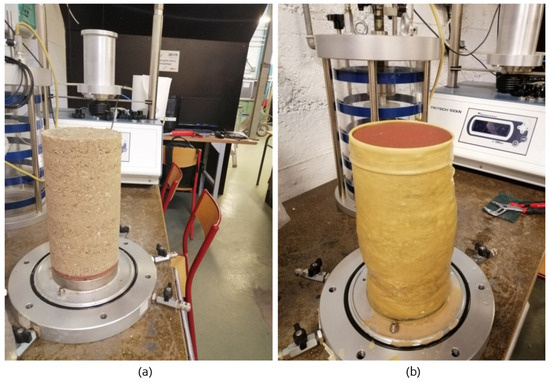
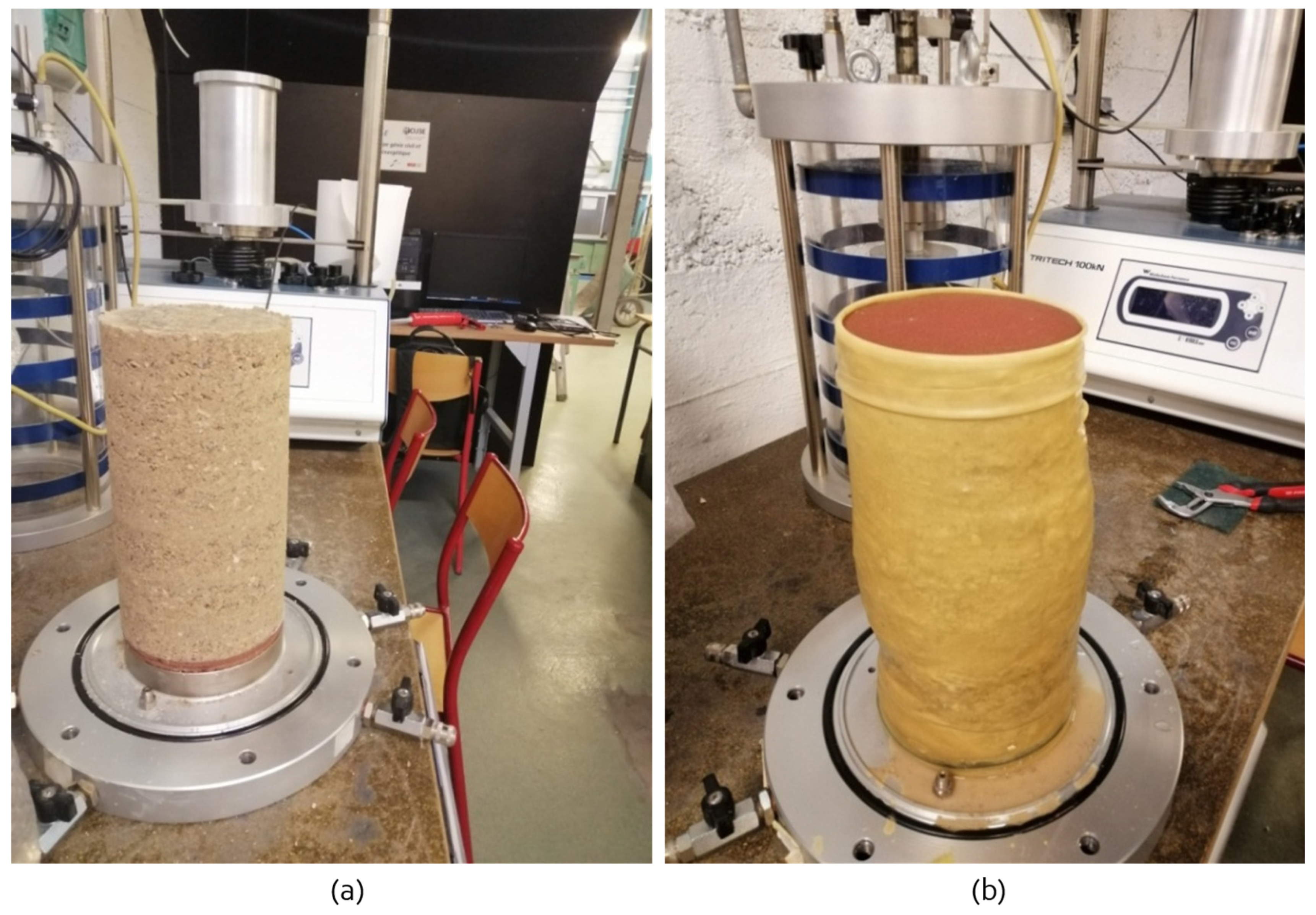
Repeated load triaxial tests were conducted on the crushed SWR materials, allowing for the characterization of both the material conditioning behavior and its resilient response (see Figure 1).
Figure 1.
Specimen appearance: (a) before the RLT Test. (b) after the RLT Test.
2.5. Pavement Structure
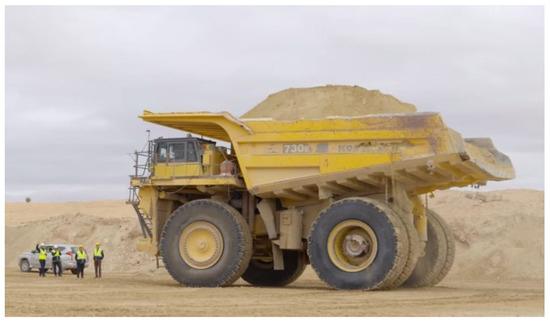
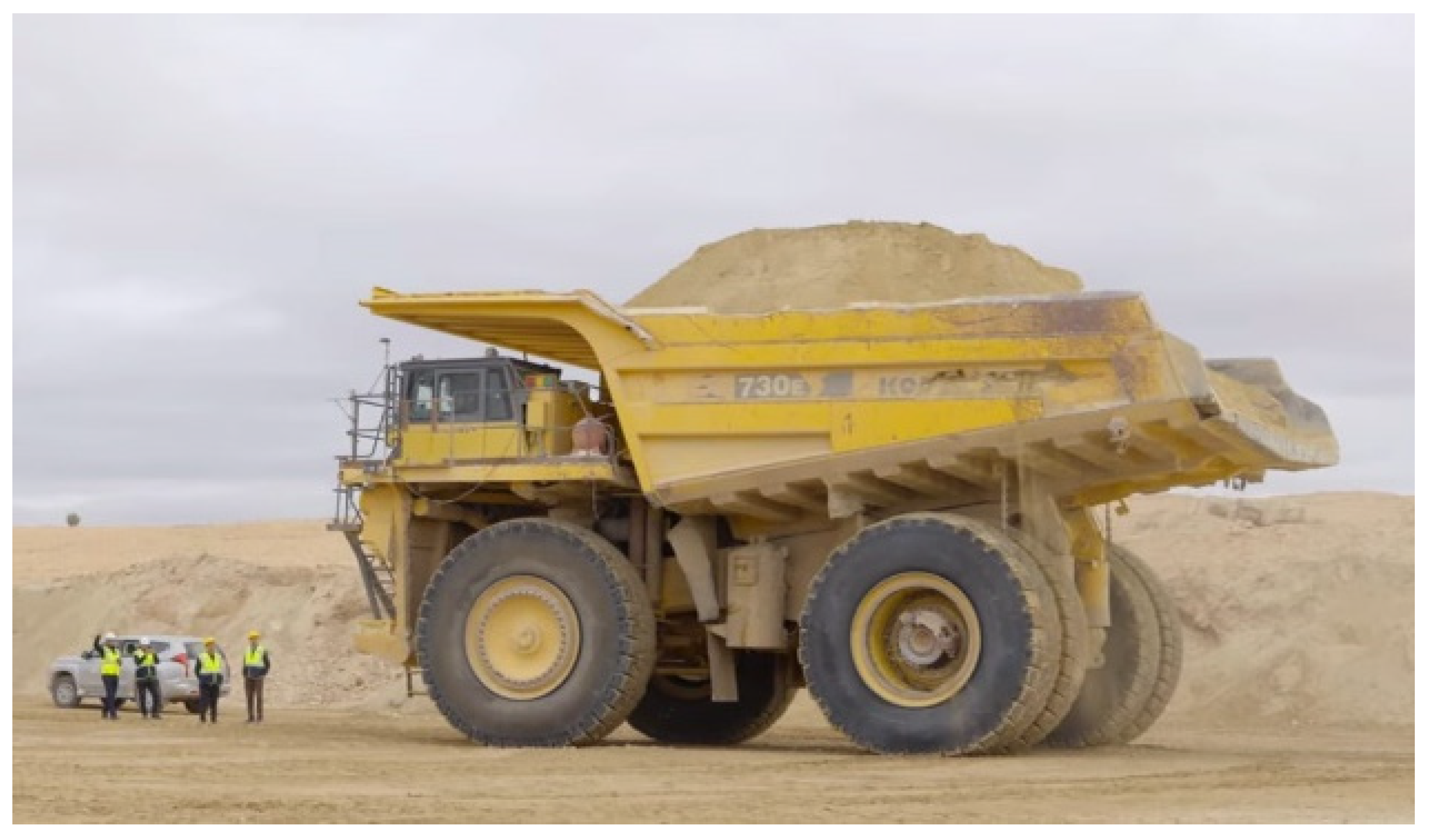
The rear wheel of the Komatsu 730E truck (Figure 2) was considered as the single wheel generating the highest contact pressure, estimated at 1.05 MPa. The maximum stress states encountered, as well as the calculation of the pavement layer thicknesses, were evaluated using the ALIZE software. The pavement structure was optimized through iterative mechanistic–empirical simulations performed using ALIZE. Several structural configurations were evaluated using the experimentally determined material properties and the expected mining traffic conditions. The optimization aimed to identify the minimum pavement thickness capable of satisfying the required structural performance criteria, particularly the allowable vertical strain at the top of the subgrade. Particular emphasis was placed on increasing the bearing capacity of the supporting platform, thereby reducing the required thickness of the overlying layers and improving the overall cost-effectiveness of the pavement design.
Figure 2.
Komatsu 730E haul truck used for phosphate transport at the Benguerir mine.
In addition to the stress analysis, the allowable vertical strain (εz) was determined according to the methodology outlined by R.J. Thompson’s Australian manual on mining roads.
Based on the predicted daily traffic, which remains below 50 kT, the pavement structure is classified within a specific design category associated with a defined allowable vertical deformation, corresponding to category III. However, the total weight of the Komatsu 730E truck, approximately 340 tons, exceeds the maximum load limit prescribed for this category (288 tons). Consequently, a category II pavement design was adopted, corresponding to an allowable vertical strain of 2000 microstrains (εz = 2000 μdef).
Field observations indicate a near-surface yet heterogeneous bedrock with variable thickness and high consolidation. For design purposes, the substratum was introduced in ALIZE as a rigid elastic layer (E = 10 GPa). Based on this configuration, the pavement selected for in situ validation comprises 0.35 m subbase (0–100 mm) + 0.25 m base (0–63 mm) + 0.07 m BBSG wearing course (0–20 mm). Performance requirements were set at both layer and system levels—bearing capacity (EV2), stiffness modulus, rutting resistance, and thermo-rheological behavior of the BBSG. Table 1 summarizes the design inputs and target thresholds.
Table 1.
Design criteria and performance specifications for the optimized pavement.
2.6. Field Testing Campaigns
A full-scale field test was conducted to evaluate the mechanical behavior and performance of crushed phosphate waste rocks subjected to repeated loading from heavy-duty mining trucks with capacities of up to 340 tons.
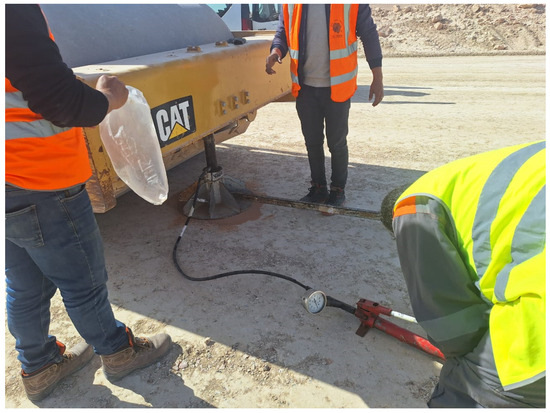
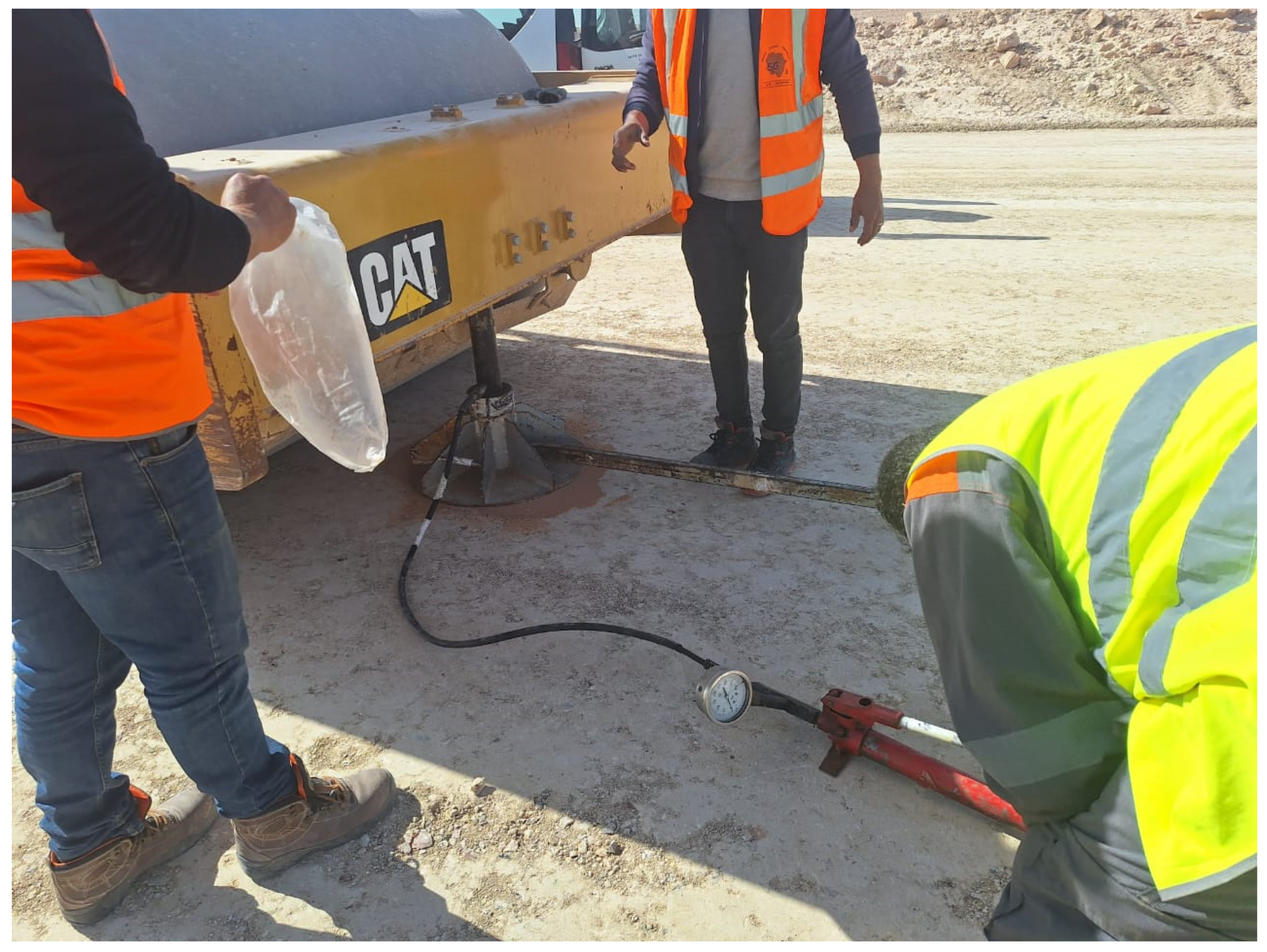
The bearing capacity was assessed (Figure 3) by determining the elastic modulus (EV2) under static loading conditions using a rigid plate, in accordance with the methodology specified in standard NF-P94-117-1 [41].
Figure 3.
In situ measurements of elastic plate test modulus.
A gravel impregnation treatment was applied to the surface of the compacted base course, consisting of approximately 1.32 kg/m2 of 55% cationic bitumen emulsion and 4–6 mm chippings.
The choice of a cationic bitumen emulsion for the construction of the wearing course using phosphated flint aggregates is primarily justified by interfacial electrochemical considerations. Phosphated flint aggregates are mainly composed of silica and apatite, two mineral phases that exhibit a net negative surface charge over a wide range of pH values, as evidenced by zeta potential (ZP) measurements [42]. This parameter is a critical for explaining and predicting physicochemical phenomena occurring at the solid–liquid interface, particularly those governing adhesion in bituminous systems.
The negatively charged surfaces of silica and apatite favor strong electrostatic attraction with the positively charged droplets of cationic bitumen emulsions, leading to enhanced bitumen–aggregate affinity. This electrostatic compatibility promotes rapid emulsion breaking, improved aggregate coating, and stronger adhesive bonding, which are essential for the mechanical performance and durability of the wearing course.
A tack coat consisting of a 65% bitumen emulsion was applied at a residual bitumen application rate of 250 g/m2 before placing a 7 cm-thick semi-coarse asphalt concrete wearing course (BBSG 0-20), which was subsequently compacted to achieve the required surface performance. The 35/50 modified bitumen used in this study exhibits an elastic recovery of 71% at 25 °C and a ring-and-ball softening point of 75 °C, confirming its enhanced viscoelastic behavior and its suitability for high-stress applications.
2.7. Dust Measurements
The tests, targeting both PM2.5 and PM10 fractions, were conducted at two distinct locations along the same experimental haul road within the Benguerir mine site. The first measurement point was on the unpaved platform section, reflecting baseline dust emissions under conventional mine practices, which consist of daily watering and routine grading to stabilize the road surface. The second set of measurements was performed after the construction of the full pavement structure, which consisted of a 0–100 mm granular subbase, a 0–63 mm screening waste rock (SWR) base layer, and a 0–20 mm BBSG wearing course produced from phosphated flint aggregates. This dual-location approach enabled a comparative assessment of airborne particulate emissions before and after pavement construction, providing insight into the effectiveness of the roadway improvement in reducing dust generation.
2.8. Economic Evaluation
Several soil-stabilization approaches based on chemical and biological agents have previously been tested at the OCP site; however, in the absence of €/m2 cost data, this study focuses solely on the proposed solution.
Following the rationale of Amrani et al. [16], this preliminary economic analysis reports the total cost per square meter of the proposed solution, based on average prices currently applied in the Moroccan road construction industry for works to be executed by external contractors, which constitutes an essential complement to technical feasibility for OCP’s decision-making. The €/m2 cost was structured around a detailed quantification of all construction activities required for the pavement structure. The analysis began with the identification of cost items associated with each layer, including subgrade preparation, sub-base and base layers, gravel impregnation treatment, and the BBSG wearing course. For the granular layers, unit costs were evaluated separately for material acquisition, crushing operations, loading and transportation, and on-site implementation, all expressed per cubic meter. A bulking-and-wastage allowance was incorporated to account for volumetric expansion and material losses during handling. Surface-based items, such as subgrade preparation, gravel impregnation, and the wearing course, were assessed per square meter. This systematic breakdown enabled the development of a comprehensive cost model that reflects both material-related and operational expenditures throughout the construction process.
3. Results and Discussion
3.1. Characterization of Raw Materials
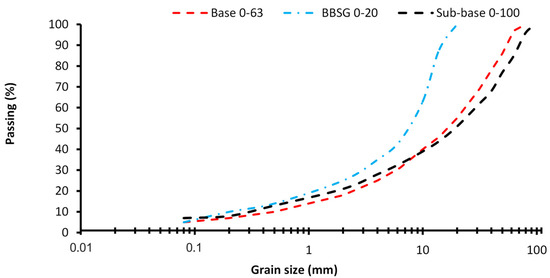
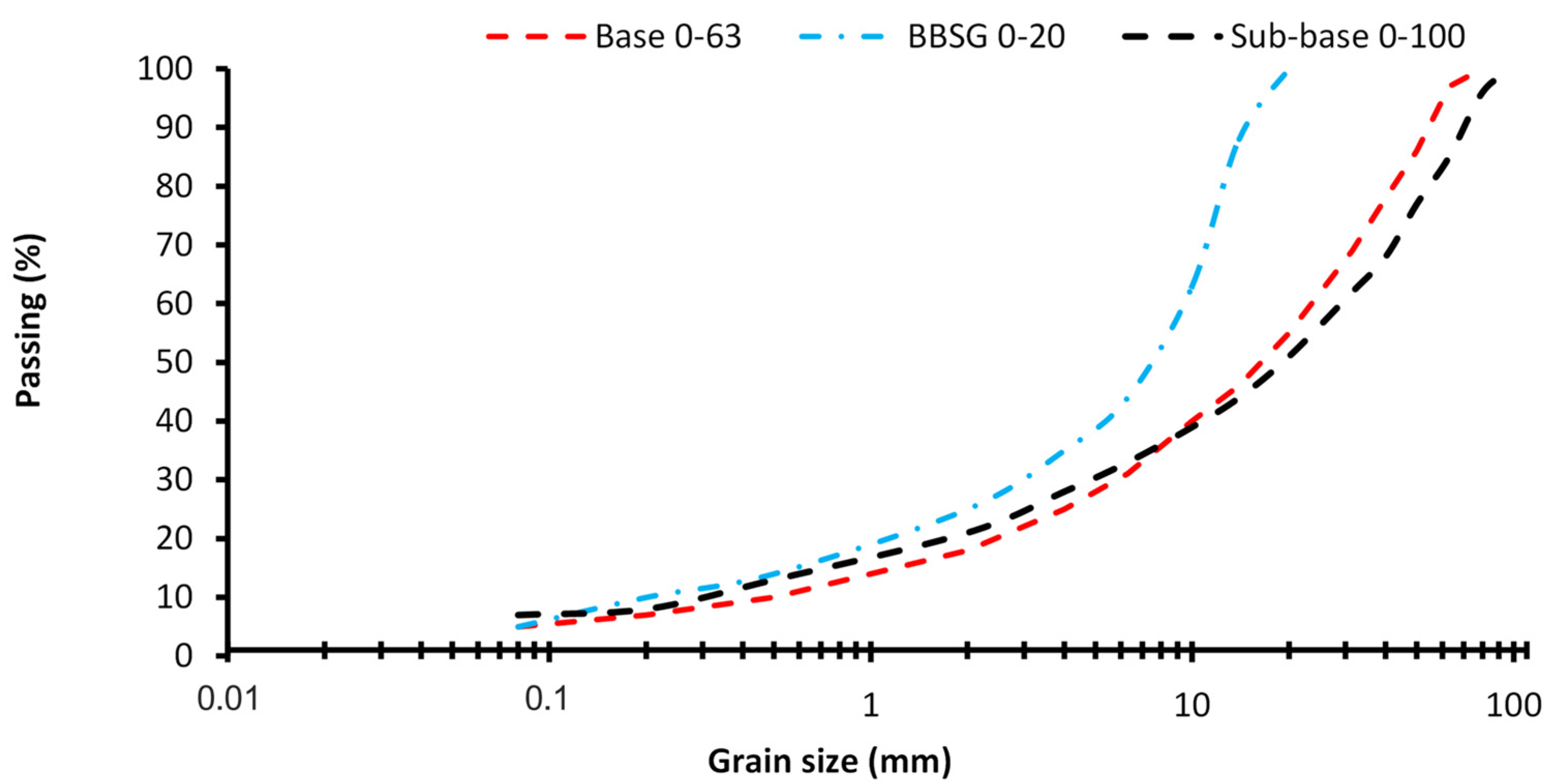
The typical particle size distribution curves of the crushed materials used in this study are shown in Figure 4. The aggregates employed for the foundation layer (0–100 mm) and the base layer (0–63 mm) exhibit a gravelly texture. Approximately 7% of the sub-base material and 5% of the base material pass through the 80 μm sieve, while 86% and 77% by weight, respectively, consist of particles larger than 50 mm [28]. For both materials, the uniformity coefficient (Cu) is greater than 2, and the coefficient of curvature (Cc) falls within the range of 1 to 3, indicating a continuous and well-graded particle size distribution.
Figure 4.
Particle size distribution curves of used materials.
In addition, due to a proportion of particles exceeding 20 mm that significantly surpasses the standard threshold of 30%, the used SWR cannot be Proctor-tested in accordance with the Proctor standard [31]. However, the test was carried out on the 0–20 mm fraction, with the results being limited to determining its optimum moisture content.
Table 2 summarizes the main mechanical properties of the materials used in this study. Based on the Los Angeles (LA) [30] and Micro-Deval (MD) [29] test results, SWR shows moderate resistance to fragmentation and abrasive wear, while PF performs excellently in both aspects.
Table 2.
Geotechnical properties of the used material.
The chemical and mineralogical compositions of the studied materials are presented in Table 3. The results show that the SWR is composed of various oxides, with notable concentrations of SiO2 (29.11%) and CaO (26.52%). A noticeable amount of P2O5 is also present in the aggregates, while Al2O3, MgO, and Na2O appear in lesser proportions. X-ray diffraction analysis indicates that the SWR sample is predominantly made up of quartz (36%), dolomite (28%), fluorapatite (20%), calcite (6%) and total clays (10%) [15,27]. In comparison, the PF material displays a higher content of SiO2 (38.49%) and a lower concentration of CaO (32.87%) and P2O5 (19.04%). Mineralogically, PF is dominated by quartz (50%) and fluorapatite (40%), calcite (4%), and dolomite (6%). The higher quartz content suggests greater hardness, while the lower carbonate and apatite fractions may reduce reactivity.
Table 3.
Chemical and mineralogical properties of studied materials.
The chemical and mineralogical compositions of SWR are in good agreement with those reported in previous investigations on waste rocks from the Benguerir phosphate deposit [14,15,17,27]. The predominance of SiO2 and CaO, together with the presence of P2O5, reflects the characteristic mineral assemblage of quartz, fluorapatite, dolomite, and calcite commonly observed in Moroccan phosphate mine waste rocks. The relatively minor proportions of Al2O3, Fe2O3, Na2O, and K2O are also consistent with earlier studies, confirming the low abundance of aluminosilicate minerals. Furthermore, the X-ray diffraction results closely match those previously reported, with quartz, dolomite, fluorapatite, and calcite identified as the dominant crystalline phases.
3.2. Traffic Survey
A detailed traffic study on the most frequently used haul roads at the Benguerir mining site produced the data in Table 4. The analysis is based on manual counts of cumulative traffic by direction on the busiest road.
Table 4.
Average daily traffic on haul roads at the Benguerir phosphate mine.
Accordingly, the total daily traffic considered in this structural pavement design study is estimated at 22.35 kilotons. This level of heavy-duty vehicles is exceptionally high and far exceeds the limits defined by conventional traffic classification systems with an annual traffic growth rate of 4% adopted for the pavement design.
3.3. Cyclic Mechanical Behavior
3.3.1. Monotonic Triaxial Test
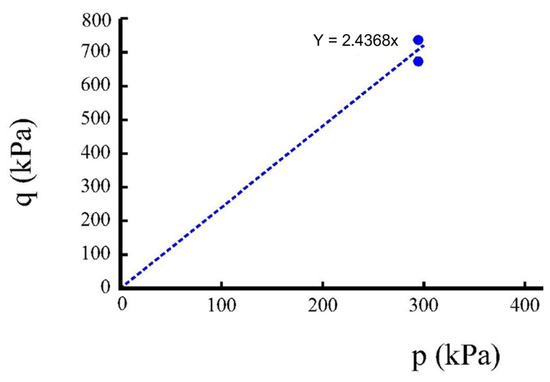
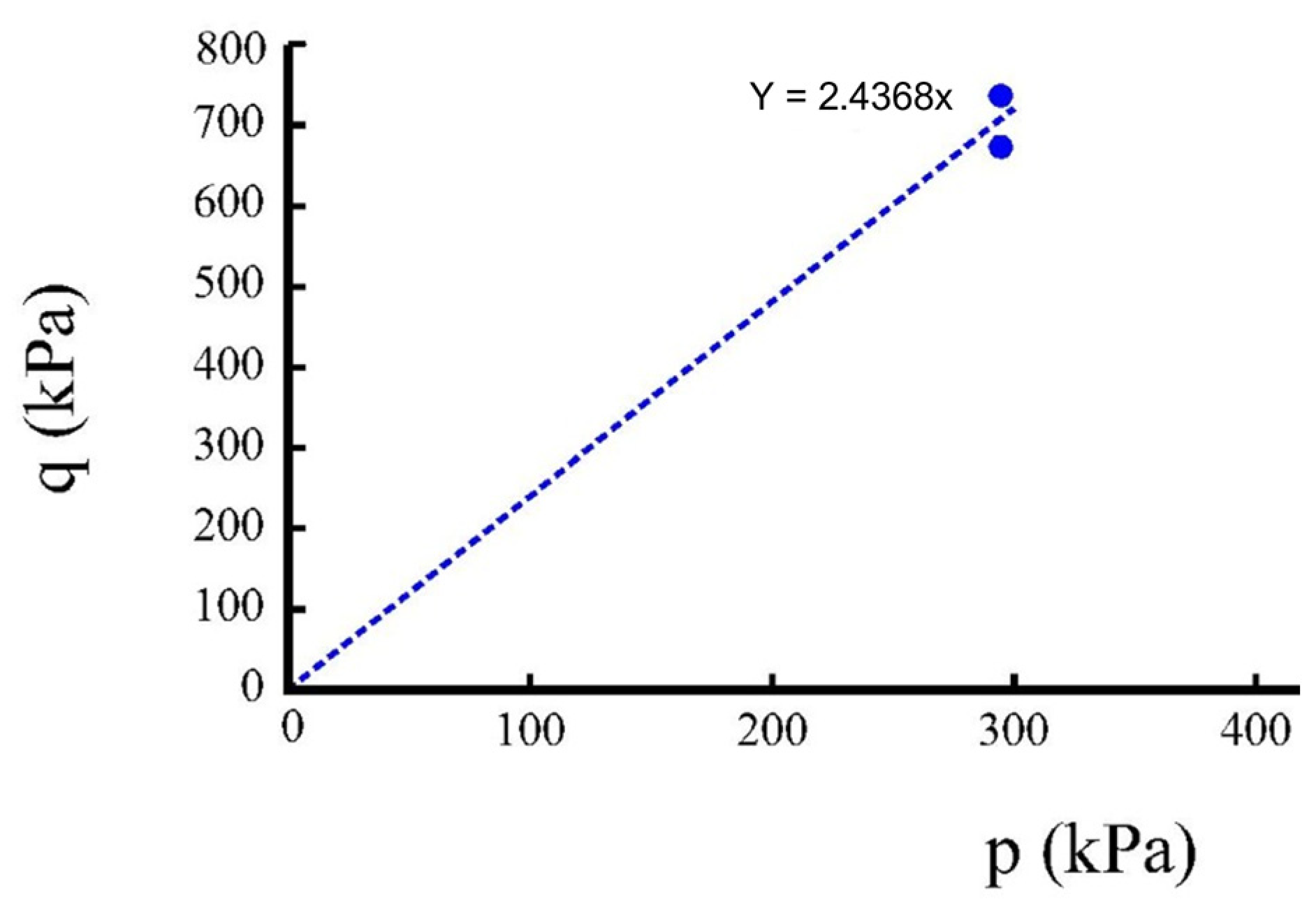
At the peak, the material exhibits a friction angle φ of 60°, as indicated by the failure envelope (Figure 5).
Figure 5.
Failure envelope diagram of the SWR materials.
Crushed SWR can be considered a material with high shear strength, reflecting strong structural stability under mechanical loading and high resistance to deformation, making it particularly suitable for heavy-duty pavement applications.
3.3.2. Permanent Deformations
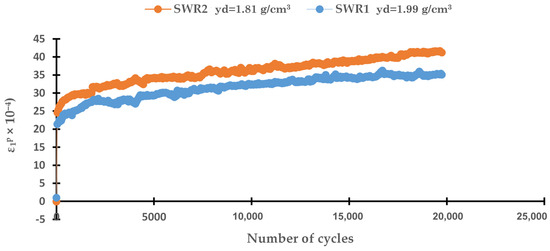
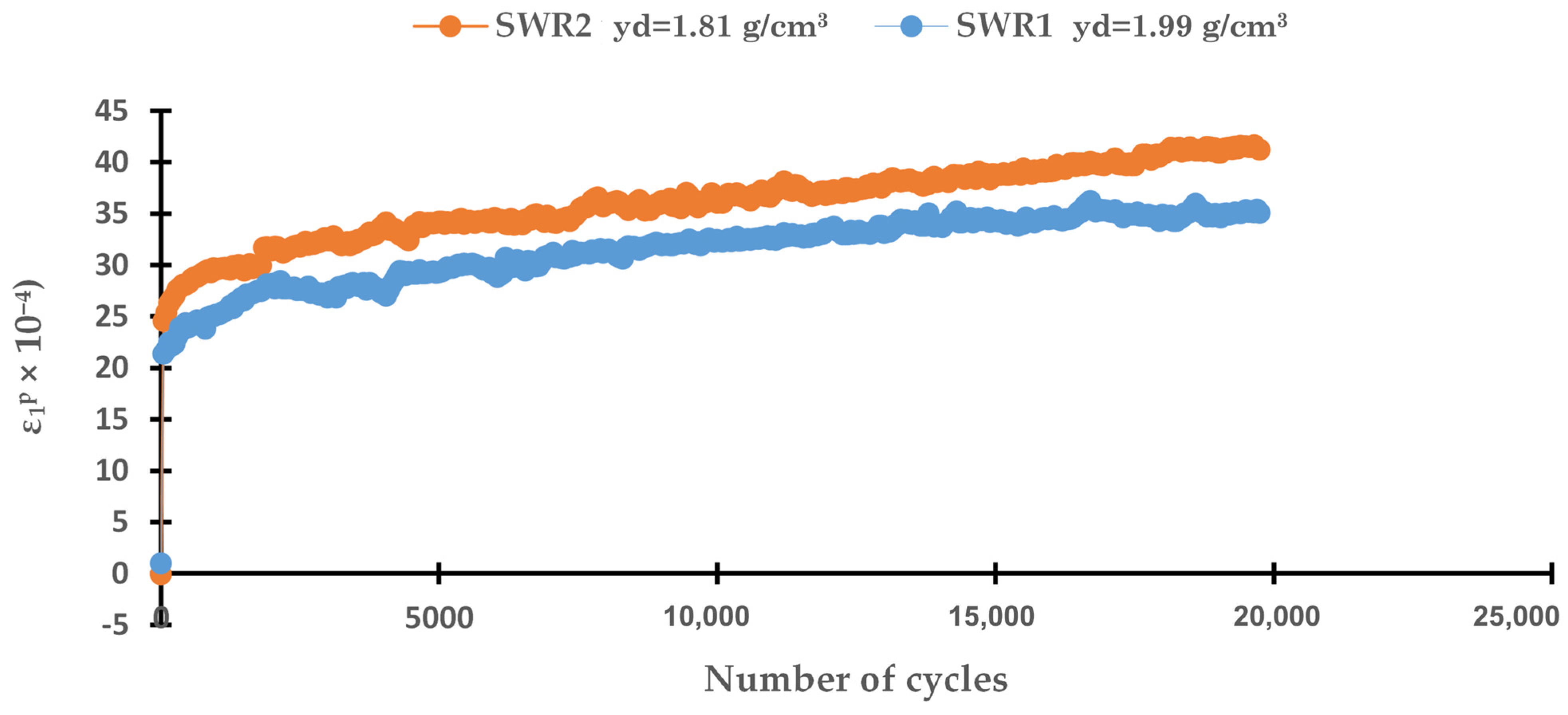
Figure 6 illustrates the evolution of permanent axial deformations observed in repeated load triaxial tests conducted on SWR1 and SWR2 materials, compacted at two distinct dry bulk densities. SWR1 corresponds to the screening waste rock compacted at a dry bulk density of 1.99 g/cm3, whereas SWR2 corresponds to the same material compacted at a lower dry bulk density of 1.88 g/cm3. The results reveal an inverse relationship between dry density and permanent deformation: as the dry bulk density decreases, accumulated plastic strain increases. Specifically, the final cycle permanent deformation increased significantly from 35.28 × 10⁻⁴ to 41.21 × 10⁻⁴ when the dry bulk density was reduced from 1.99 to 1.81 g/cm3.
Figure 6.
Evolution of permanent deformations during conditioning of SWR 1 and SWR 2 specimens, 20,000 cycles at 1 Hz, P0 = 70 kPa, Δq/Δp = 3, qmax = 400 kPa (w = 9.3%).
Both SWR types exhibited rapid deformation accumulation during the initial conditioning phase, followed by a stabilization trend around 20,000 load cycles. Notably, the permanent deformation values obtained for the crushed SWR materials were comparable to or even lower than those typically recorded for conventional road aggregates, highlighting their promising mechanical performance.
In addition, a noticeable plateau is observed during the final thousands of cycles, providing a consistent basis for the subsequent evaluation of resilient response.
3.3.3. Resilient Behavior
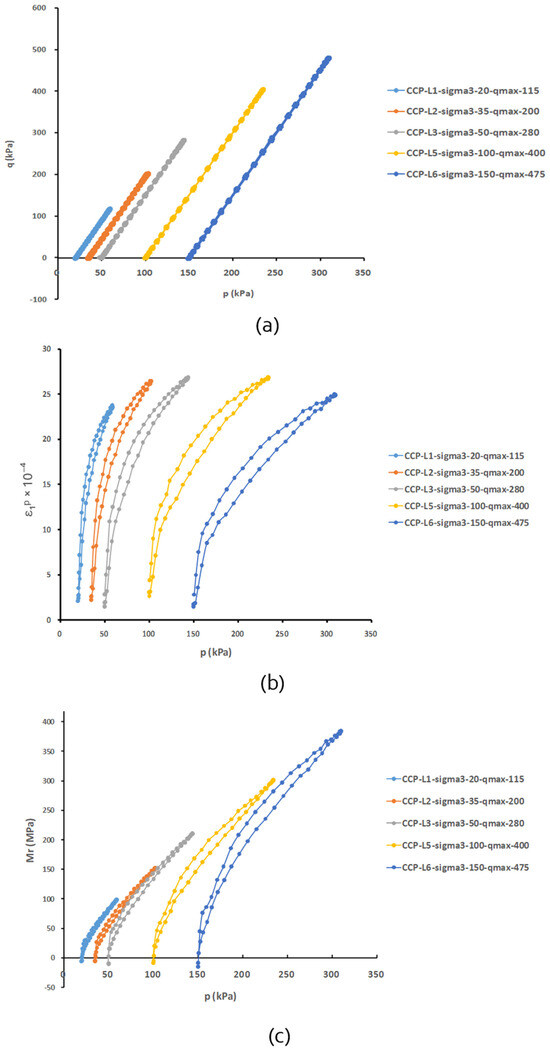
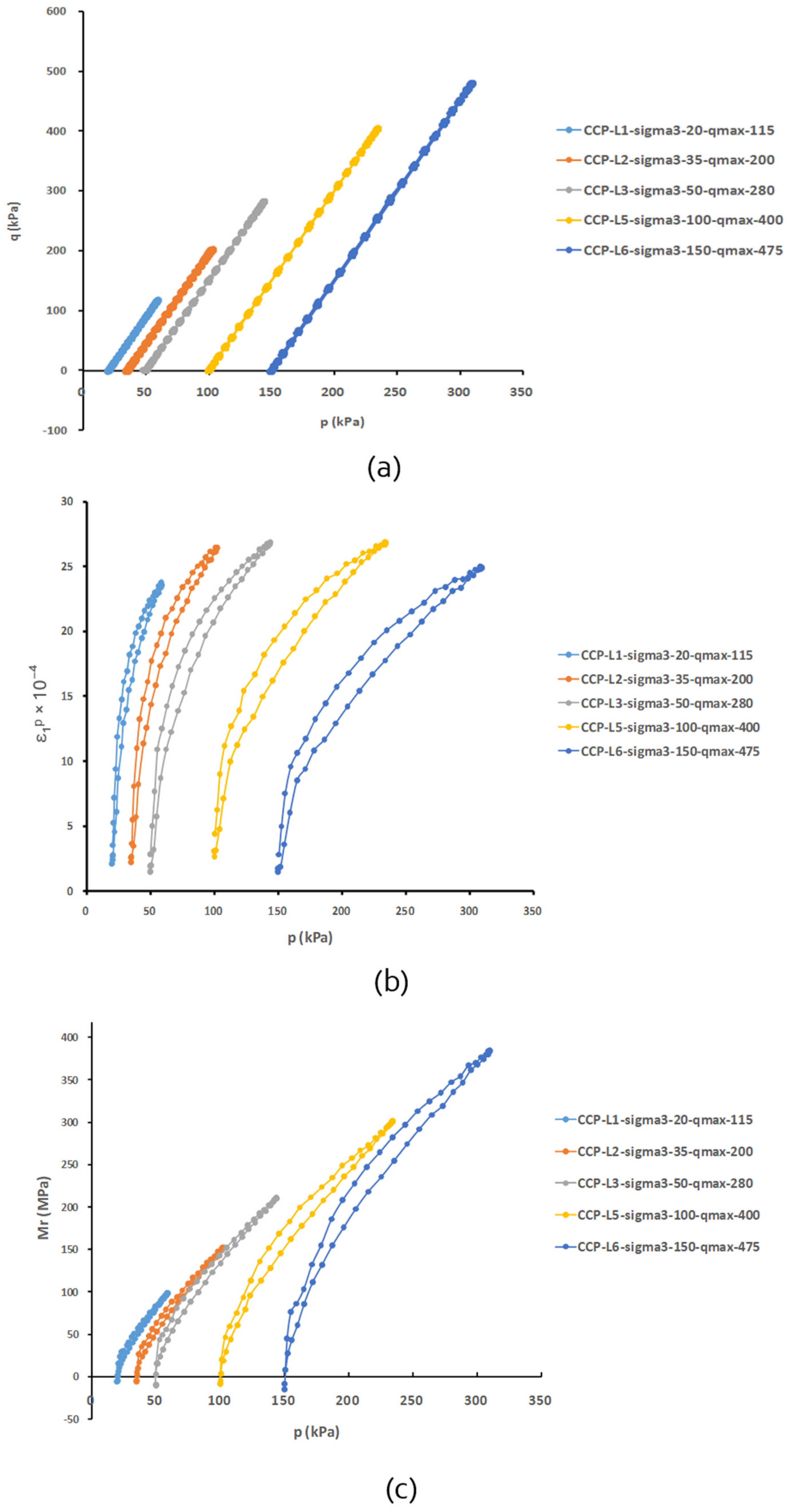
The loading paths permitted by the standard (NF EN 13286-7) for the study of resilient behavior are presented in Figure 7a.
Figure 7.
Resilient behavior under cyclic loading of SWR: (a) stress paths for resilient behavior (100 cycles are performed for each path), frequency 0.5 Hz of SWR. (b) axial resilient strain from the final loading cycle. (c) resilient modulus from the final loading cycle.
A frequency of 0.5 Hz is used to prevent the generation of pore overpressures. To prevent potential damage to the specimen, axial deformations were recorded using an external LVDT sensor mounted on the triaxial cell, rather than employing internal Hall effect transducers.
A clear linear trend is observed for all paths, indicating elastic behavior within the applied loading ranges. As expected, the maximum deviator stress qmax increases with increasing σ3. This proportional relationship confirms that the material exhibits enhanced stiffness and resistance to axial loading under greater confinement, a typical behavior of dense granular media.
As shown in Figure 7b, and as expected, the resilient response exhibits non-linear behavior that depends on the instantaneous stress state. This leads to a non-linear resilient modulus (Mr), as illustrated in Figure 7c. The modulus is calculated as the ratio of the deviatoric stress (q) to the axial resilient strain, which is measured using the LVDT.
3.3.4. Characteristic Modulus
The characteristic modulus (Ec) is determined for loading conditions of qmax = 500 kPa and pmax = 250 kPa, in accordance with NF EN 13286-7. To improve the accuracy of axial resilient strain measurement, a locally estimated value was used based on data from the Hall-effect sensor, which corresponds to half the deformation measured by the global LVDT sensor. The experimentally obtained resilient moduli are as follows:
- For confining pressure σ3 =100 kPa, qmax = 400 kPa, pmax = 233 kPa et Mr = 301 MPa;
- For confining pressure σ 3 = 150 kPa, qmax = 475 kPa, pmax = 308 kPa et Mr = 385 MPa.
To estimate the characteristic modulus at the target stress levels (qmax = 500 kPa and pmax = 250 kPa), the resilient test was calibrated across different confinement levels (Figure 7a), using experimental data and fitted with both the k-θ and Uzan models. Based on the results presented in Table 5, the adopted characteristic modulus of SWR materials is Ec = 325 MPa. This is a significant value, broadly equivalent to the modulus typically observed for conventional untreated granular materials used in foundation and base layers.
Table 5.
Characteristic modulus values of SWR obtained using k-θ and Uzan models.
3.4. Field Testing Campaigns
3.4.1. Full Scale Test
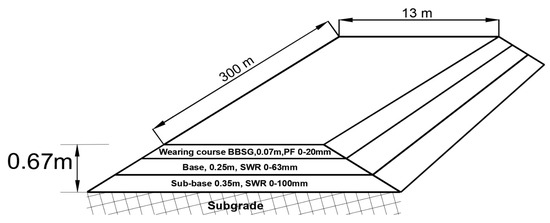
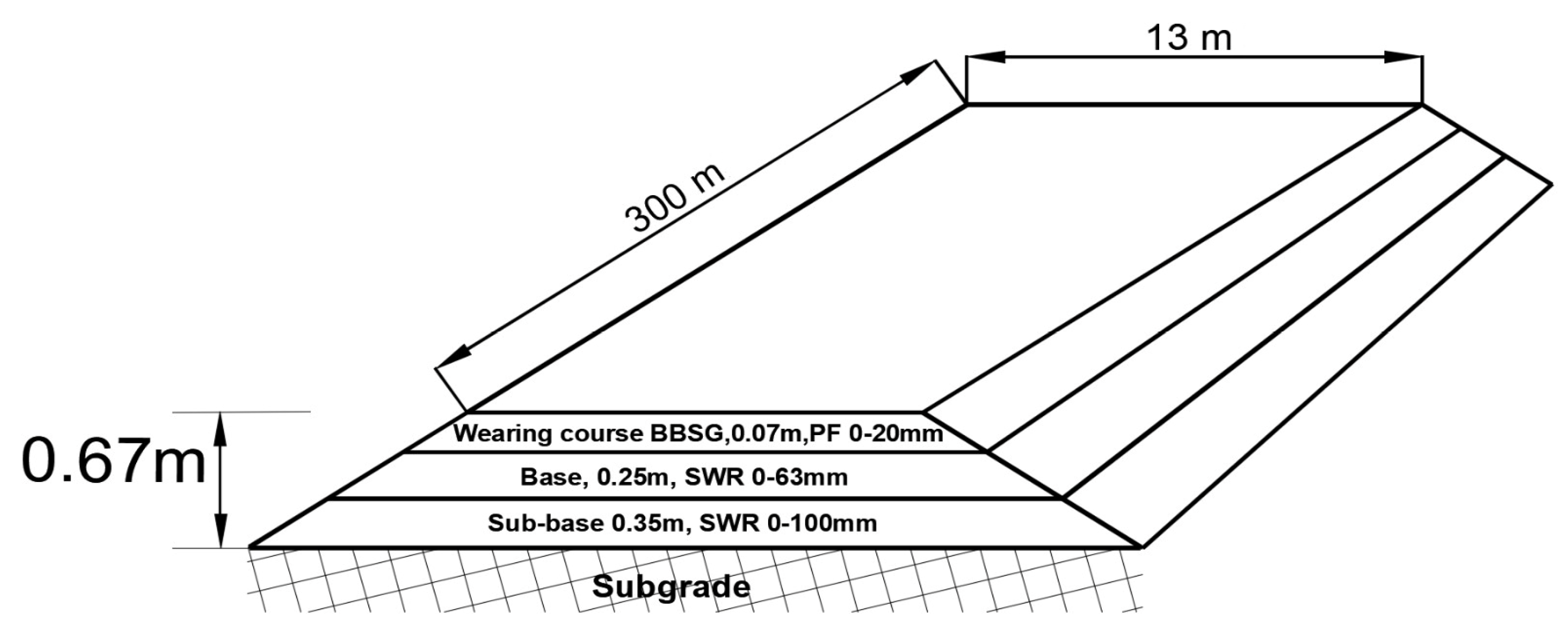
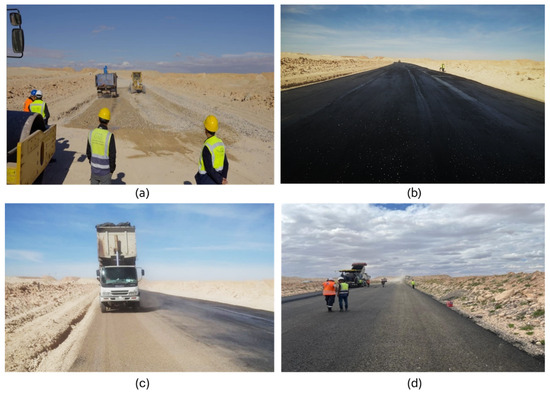
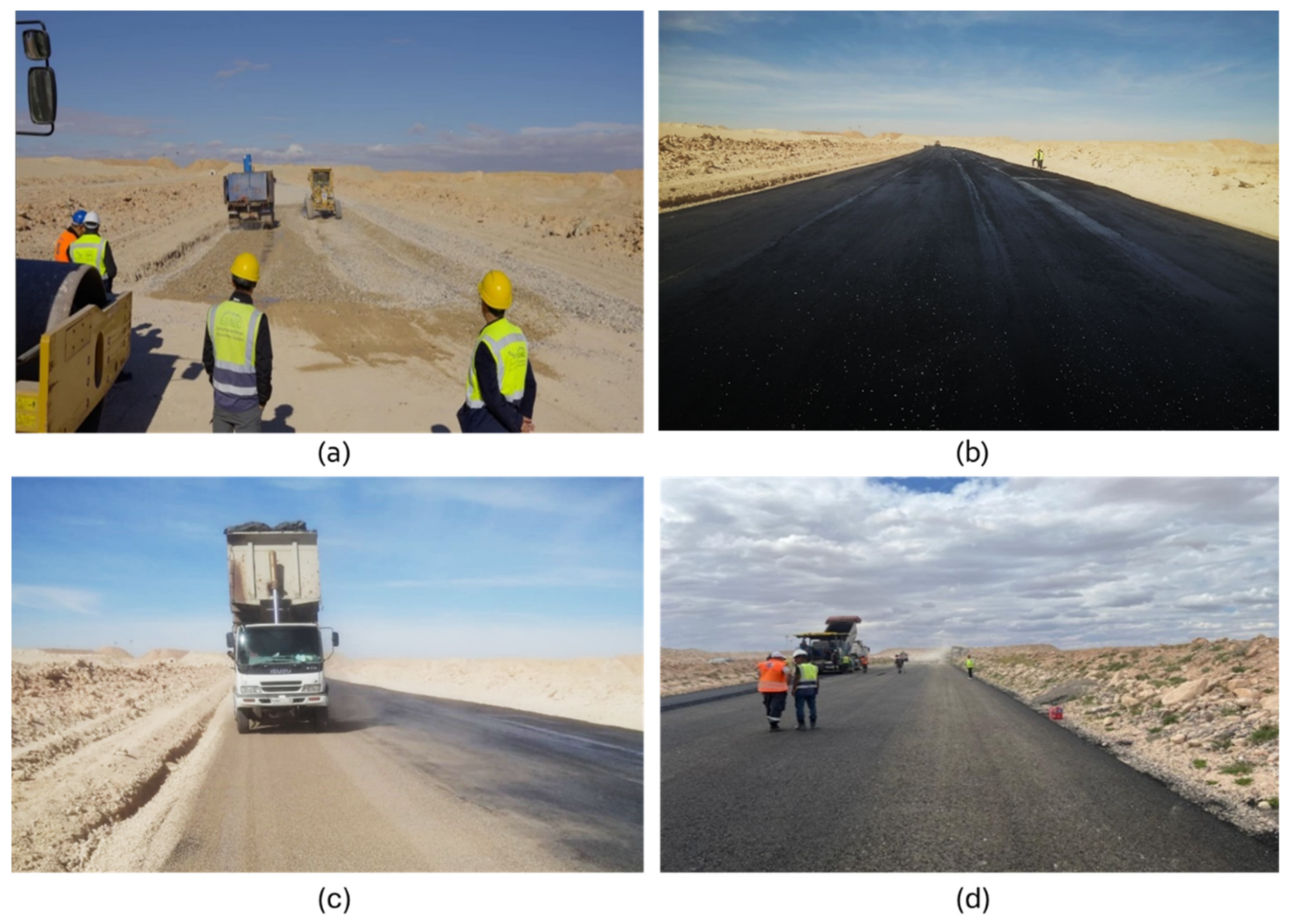
As shown earlier, the experimental test section was constructed on an existing unpaved haul road in straight alignment within the Benguerir phosphate mine. This full-scale experimental segment, implemented under actual mining operating conditions extended 300 m in length and 13 m in width. It had a total thickness of 0.67 m, built atop a pre-compacted embankment layer with an average EV2 modulus of 112.06 MPa, as shown in Figure 8. To promote efficient road drainage, the sub-grade was shaped with an adequate crown slope (4%) to divert runoff away from the pavement structure. Two successive granular layers were compacted at their optimum moisture content using a calibrated vibratory roller. The sub-base layer was composed of a 0–100 mm granular fraction, while the base layer consisted of a 0–63 mm fraction. A tack coat consisting of a 65% bitumen emulsion was applied at a residual bitumen application rate of 250 g/m2 before placing a 7 cm-thick semi-coarse asphalt concrete wearing course (BBSG 0-20), which was subsequently compacted to achieve the required surface performance, as illustrated in Figure 9.
Figure 8.
Typical cross-section of the proposed pavement structure.
Figure 9.
Various stages of full-scale field testing: (a) moistening and mixing of the sub-base layer. (b) application of the impregnation coat. (c) spreading 4–6 mm chippings. (d) placement of the BBSG 0–20 mm wearing course.
Figure 9a–d summarize the successive stages in constructing the experimental haul-road section.
After opening the haul road to traffic, an emergency hard-braking test was performed with a Komatsu 730E traveling at ~40 km/h (approximately twice the average operating speed) to assess the wearing course’s skid resistance and overall performance. The test was conclusive: the surface showed no visible distress (no tearing, no raveling, no debonding). The truck’s peak braking effort was estimated at ~850 kN, providing a stringent loading case that confirms the texture, bond quality, and integrity of the wearing course under severe operational demands.
The emergency braking test was conducted as an operational validation under real mining conditions rather than as an instrumented structural experiment. Accordingly, the pavement response was evaluated through a detailed visual inspection immediately after the test, focusing on the presence of tearing, raveling, debonding, rutting, or any other visible surface distress. No such defects were observed, confirming that the pavement maintained its integrity under the estimated braking force of approximately 850 kN.
One of the operational objectives defined by OCP was thus achieved, as the enhancement of haul-road conditions enabled haul trucks to increase their operating speed from values below 20 km/h, imposed by safety constraints under the previous degraded conditions, to approximately 40 km/h under the upgraded pavement conditions. This operational improvement contributed to enhanced haulage efficiency and supported increased mining productivity.
3.4.2. Bearing Capacity Assessments
The average values of the elastic modulus (EV2) and the k-ratio (EV2/EV1 < 2) presented in Table 6 demonstrate both the excellent compaction quality and the high stiffness achieved across all pavement layers. The results confirm that the design targets were successfully met, with average EV2 values exceeding 150 MPa for the sub-base, and 180 MPa for the base layer. This performance not only meets but significantly exceeds the minimum technical requirements for heavy-haul road foundations, thereby underscoring the structural robustness and construction quality of the tested pavement section.
Table 6.
Summary of average plate load modulus (EV2) measurements after layer compaction.
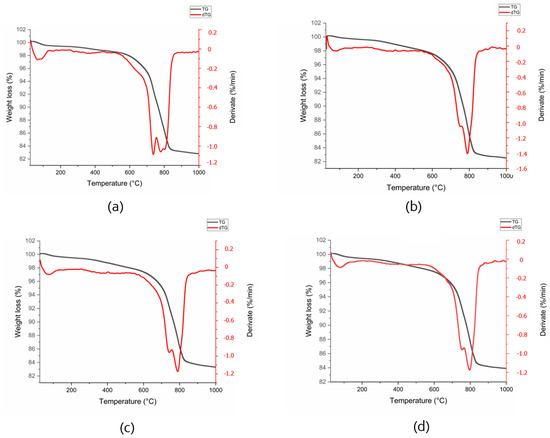
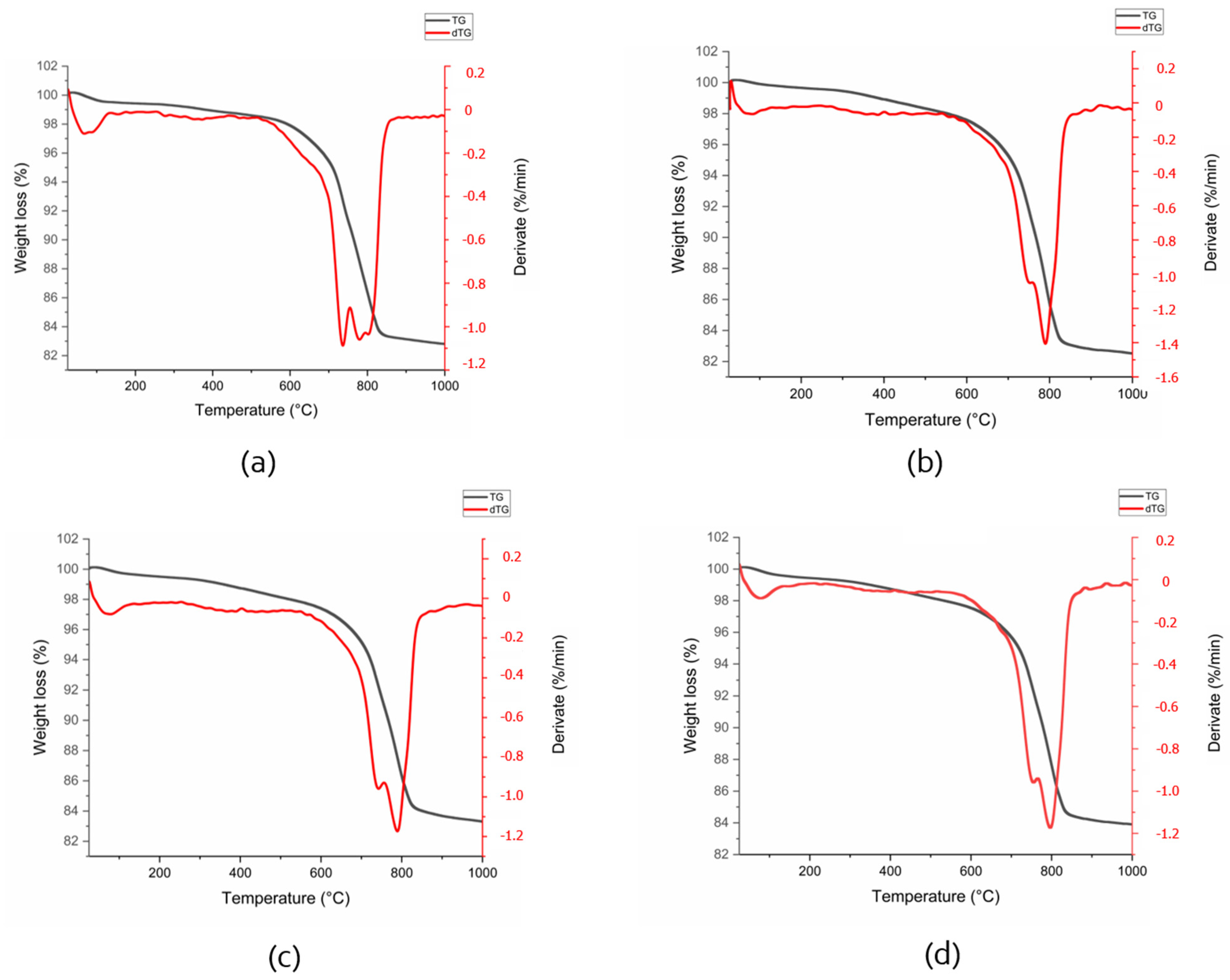
This performance can be attributed to the coarse grading, which contains a high proportion of large particles (about 23% in the 50–100 mm fraction in the 0–100 sub-base and 14% in the 50–63 mm fraction in the 0–63 base) promoting a percolating load-bearing skeleton and efficient force-chain transfer under loading. The effect is reinforced by the very high internal friction angle (φ ≈ 60°), consistent with fully crushed, angular aggregates and strong interlock. Beyond grading effects, part of the unusually high bearing capacity may stem from chemical cementation at grain contacts (potentially including C–S–H) type phases formed by pozzolanic reactions. To investigate this possibility, complementary thermogravimetric analysis (TGA) on core samples (C1–C4) extracted from the Benguerir experimental section (Figure 10).
Figure 10.
Thermogravimetric curves on core samples extracted from the Benguerir experimental section: (a) sample C1. (b) sample C2. (c) Sample C3. (d) sample C4.
TGA analyses revealed a dominant CaCO3 signature (major decomposition peak at ~770 °C), with no significant response attributable to portlandite (400–550 °C) and no clear evidence of ettringite formation (80–150 °C), apart from a very minor trace. Consistent with the bulk chemistry and mineralogy of the SWR, the spontaneous formation of portlandite or ettringite (or other C–S–H/C–A–S–H gels) in quantities sufficient to ‘cement’ the skeleton is therefore highly unlikely. Accordingly, the very high EV2 is attributed primarily to granular mechanics (a percolating coarse skeleton, a high friction angle, and high compaction) while a minor contribution from micro-scale cementation cannot be ruled out but is not supported by TGA.
3.5. Dust Measurements
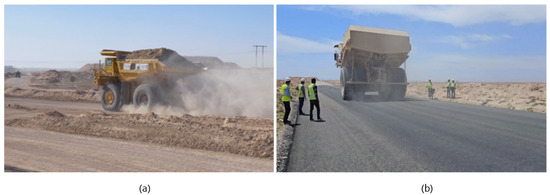
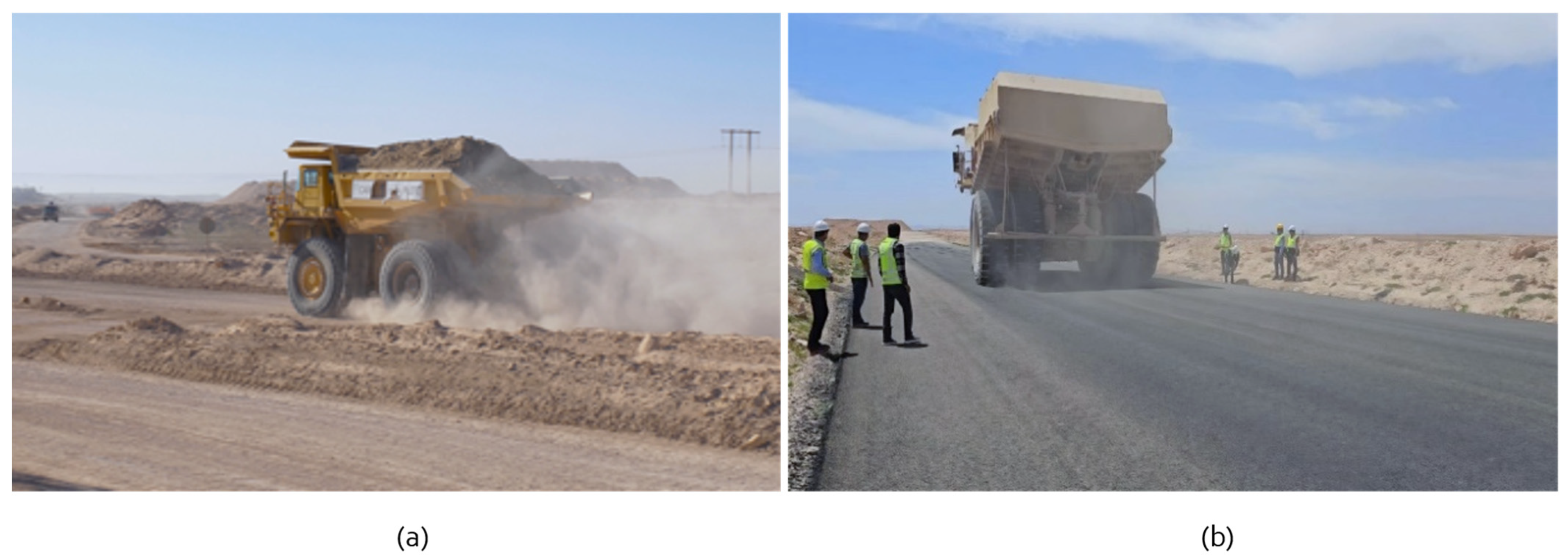
Comparison of the haul road environment before and after the BBSG 0–20 mm wearing course, highlighting the substantial improvement in surface conditions. Prior to paving (Figure 11a), the road exhibited an unpaved surface characterized by pronounced dust emissions generated under heavy truck traffic. Following the application of the wearing course (Figure 11b), the haul road exhibited a smoother and more stable surface, with improved visibility and reduced surface roughness, accompanied by a marked reduction in airborne dust. This clearly demonstrates the effectiveness of the BBSG layer in mitigating dust generation and enhancing overall road performance.
Figure 11.
Visual comparison of haul road conditions before and after the application of the BBSG 0–20 mm wearing course: (a) unpaved surface with high dust emissions. (b) paved surface showing a significant reduction in airborne dust.
The comparison of results presented in Table 7 reveals a substantial reduction in dust emissions attributable to the paved surface. Specifically, the average dust concentration on the unpaved section of the haul road reached 91,730.16 µg/m3, whereas the asphalt-treated section recorded a significantly lower value of 8570.10 µg/m3, corresponding to an overall reduction of approximately 91%. This reduction exceeds the performance threshold defined by OCP Group, thereby confirming that the dust emission control objective (>80% reduction) has been achieved, while also contributing to improved operational safety and a lower risk of dust-related respiratory exposure.
Table 7.
Summary of total dust emission measurements on paved and unpaved haul road sections at Benguerir mine.
3.6. Economic Evaluation
The €/m2 cost is obtained by aggregating the unit rates listed in Table 8 (referenced to the as-built, compacted thickness) and including all execution requirements specified for each item.
Table 8.
Cost summary per square meter for the proposed haul-road solution.
The 25% bulking-and-wastage allowance accounts for the additional material required to achieve the specified compacted layer thickness after compaction, as well as material losses and lateral spreading during construction. It reflects standard road construction practice and ensures compliance with the required compaction specifications.
In this framework, crushing costs for the 0–100 mm and 0–63 mm fractions are taken as comparable for unbound foundation and base layers, with the same loss factor and implementation rates applied to both. It is further stipulated that the crushing unit is installed within the mine and no more than 5 km from the works, and that the asphalt plant is within 25 km of the site.
Applying this procedure to the innovative haul-road configuration yields a total cost of ≈ 23.97 €/m2 a level remains substantially lower than comparable conventional alternatives. The estimate includes the upfront construction investment for a ≥2-year warranty. In the worst case (severely cracked wearing course at year 2), the surface is milled (~1.5 €/m2) and renewed (≈15 €/m2). The millings are immediately reclaimed for base reuse (blended with 0–63). Under the planned cycle, a second wearing-course renewal occurs by year 4, when a base intervention is scheduled and the accumulated millings are reincorporated, reducing virgin aggregate demand. In parallel, OCP’s budget for landscaping/encapsulation of phosphate waste piles is partially offset: the pavement upcycles thousands of tons of residues into functional layers, delivering verifiable cost savings and circular-economy outcomes. In addition, reduced fleet maintenance (fewer tire replacements and repairs) and the elimination or sharp reduction in daily road watering further lower operating costs.
For the proposed pavement solution, the construction cost was estimated at 23.97 €/m2 for the full-scale experimental section. Under the site’s operating and safety requirements, the improved pavement condition enabled haul trucks to operate at higher speeds.
Following 15 months of continuous operation under actual mining traffic conditions, an internal assessment conducted by the mine operator (OCP) indicated that large-scale implementation of the proposed solution could result in an estimated annual productivity gain of approximately 15%. According to this operational assessment, the expected economic benefits arise from several complementary factors, including reduced replacement of spare parts (particularly tires and wheel motors, which are highly sensitive to dust), improved operational performance through higher haul-truck operating speeds, extended service life of the mining fleet, and reduced daily haul-road maintenance requirements. Furthermore, the substantial reduction in airborne dust is expected to improve working conditions for operators, although these occupational health benefits cannot be readily quantified in economic terms.
A comprehensive life-cycle cost and cost–benefit analysis integrating these long-term operational benefits remains beyond the scope of the present study and is recommended for future research.
Furthermore, the initial investment cost could be further reduced if the mine operator carries out the crushing operations and the construction of the granular pavement layers using its own equipment and workforce. Under this arrangement, only the gravel impregnation treatment and the asphalt wearing course would be subcontracted, thereby reducing the required CAPEX while maintaining construction quality.
3.7. Proposed Grading Envelopes
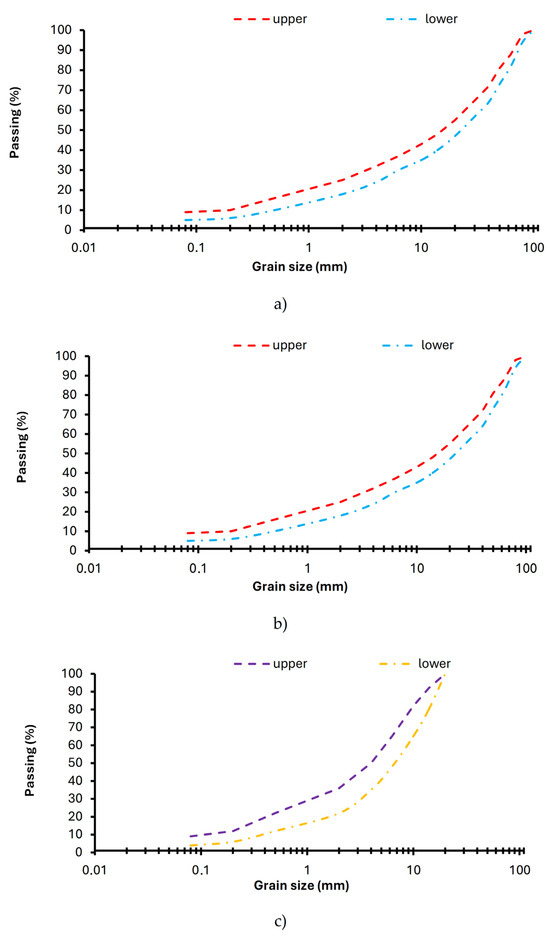
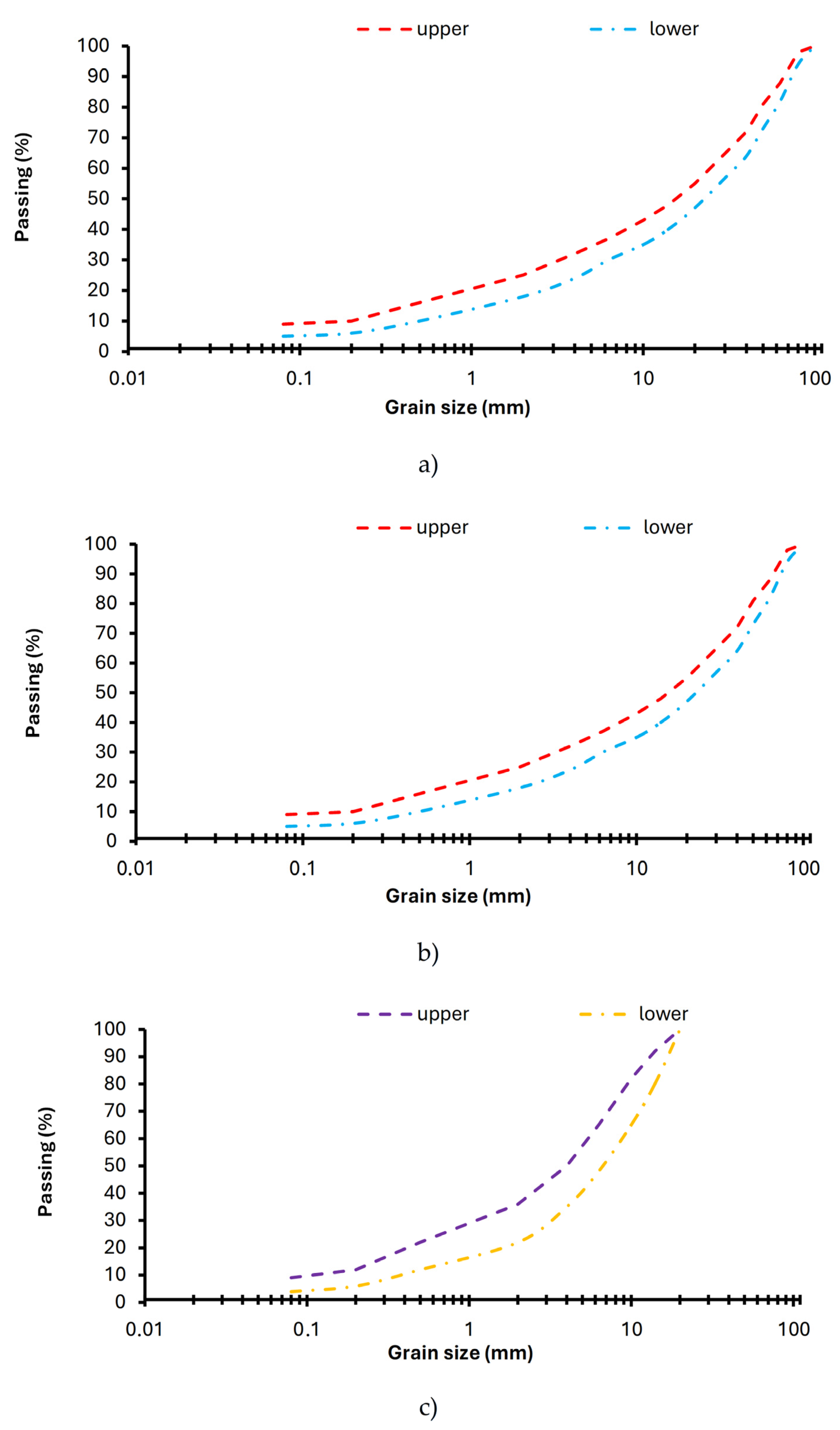
Based on laboratory characterization and field verification by in situ plate-bearing tests on compacted trial pads, a 0–100 mm sub-base gradation envelope is specified to preserve a percolating coarse skeleton (50–100 mm) while capping fines to limit plasticity and moisture sensitivity (≤9% at 0.08 mm; Figure 12a). Technically, the envelope enforces upward granular continuity and low void ratio, with a moderately widened 50–100 mm band to maintain a discontinuous yet interconnected load-carrying mesh, consistent with the measured EV2. To formalize grading continuity, any particle size distribution within the envelope must also satisfy and From a productivity standpoint, the envelope is compatible with standard field compaction and lean quality control (routine particle size distribution checks and periodic EV2 spot tests), minimizing rework and time at risk. Industrial robustness is ensured by asymmetric tolerances that accommodate normal production variability without breaking the skeleton (≈±3–4 points for fine/intermediate fractions; ±4–6 points for the coarse fraction), and by process-capability monitoring on critical sieves.
Figure 12.
Proposed regularity envelopes for sub-base, base, and wearing course layers: (a) 0–100 mm sub-base—proposed regularity envelope. (b) 0–63 mm base—proposed regularity envelope. (c) 0–20 mm wearing course—proposed regularity envelope.
For layer compatibility and repeatability across the structure, analogous performance-oriented envelopes are provided for the 0–63 mm base and 0–20 mm wearing course (Figure 12b,c), ensuring a continuous aggregate skeleton through depth while fines are consistently capped, thereby securing compaction efficiency, durability under heavy mining traffic, and reproducible field performance.
4. Conclusions
This paper reports a multi-scale, in-depth laboratory and field program supporting the validation of an innovative haul-road pavement built solely with phosphate waste-rock aggregates. The results lead to the following conclusions:
- Tested under exceptionally high mining traffic conditions, the proposed non-standardized pavement structure demonstrated its technical feasibility and operational effectiveness. The quantified construction cost, together with the observed improvement in haul-road operating conditions and the resulting productivity gain, highlights its economic potential for large-scale implementation;
- The study demonstrated that defining performance-based material specifications, in situ bearing-capacity requirements, and optimized grading envelopes for each pavement layer is essential to achieve adequate mechanical behavior and field performance under ultra-heavy mining traffic conditions;
- Following deployment of this innovative haul-road structure at the OCP Benguerir mine, operational records indicate a twofold increase in haul speed, annual phosphate-productivity gains commensurate with that uplift, a reduction in fugitive dust emissions exceeding 90%, and near-zero maintenance interventions over a 24-month warranty period, achieved at lower construction cost than conventional haul roads and accompanied by measurable improvements in fleet operating efficiency (fuel consumption per ton-kilometer and cycle-time performance) thereby delivering a durable, low-maintenance, and economically superior solution for heavy mining traffic;
- This study further demonstrates the feasibility of using locally available alternative aggregates (specifically phosphate mine waste rock) as primary constituents of high-duty haul-road pavements, without compromising performance, cost-effectiveness, or operational safety, providing a strong example of the circular economy in practice.
Given the unprecedented granular design adopted for extreme mining traffic (0–100 mm sub-base and 0–63 mm base), long-term non-linear behavior under cyclic loading must be explicitly considered, reflecting the combined effects of particle rearrangement, fragmentation, the high coarse fraction, and the lithologic heterogeneity of the aggregate skeleton (flint, marl, limestone). Accordingly, an in-depth degradation/rearrangement assessment under representative cyclic loading is recommended to quantify changes in particle-size distribution, void-ratio evolution, and stiffness, with microstructural confirmation of contact damage and fines generation.
Second, a base treatment with a modified bituminous emulsion formulated for the SWR aggregates is recommended to raise fatigue resistance and stiffness. The resulting reduction in base-layer thickness decreases material use, extends durability, and lowers CO2 emissions.
Third, to enable a successful scale-up from the experimental section to full mine-haul-road construction, we recommend a dedicated selective production strategy (paired with a segregated stockpiling protocol) to separate waste rocks and alternative materials by lithology and origin (notably phosphated flint, dolomite, and hard limestones).
Finally, a comprehensive life cycle assessment (LCA) of the proposed SWR-based haul-road solution, performed in accordance with ISO 14040-44 standards, is recommended to quantify its net environmental benefits relative to conventional pavement designs, in terms of embodied energy, greenhouse-gas emissions, and resource efficiency.
Author Contributions
Conceptualization, M.A.; methodology, M.A., Y.T., O.I. and R.H.; software, M.A.; validation, M.A. and R.H.; formal analysis, M.A.; investigation, M.A. and O.I.; resources, R.H.; data curation, M.A.; writing—original draft preparation, M.A. and O.I.; writing—review and editing, Y.T., M.B. and R.H.; visualization, M.A. and O.I.; supervision, Y.T. and R.H.; project administration, O.I. and R.H.; funding acquisition, R.H. All authors have read and agreed to the published version of the manuscript.
Funding
This research was funded under the special agreement OCP-UM6P RE01 between the OCP Group and UM6P University.
Data Availability Statement
All data that support the findings of this study are included within the article.
Acknowledgments
The authors would like to express their gratitude to OCP GROUP, especially A. BOURKOKO from the Benguerir plant, for his valuable technical support and assistance throughout all the project’s implementation stages. The authors also wish to sincerely thank the anonymous reviewers for their evaluation of the manuscript and for their constructive comments. Their valuable feedback has significantly contributed to improving the clarity, quality, and scientific rigor of this work. The authors used ChatGPT 5.5 (OpenAI, Educative license) to assist with language editing and improvement of the manuscript. The authors reviewed and approved all content and take full responsibility for the final version of the manuscript.
Conflicts of Interest
The authors declare no conflicts of interest.
Abbreviations
The following abbreviations are used in this manuscript:
| BBSG | Semi-granular asphalt concrete |
| Cu | uniformity coefficient |
| Cc | coefficient of curvature |
| C–S–H | Calcium Silicate Hydrate |
| C–A–S–H | Calcium Aluminosilicate Hydrate |
| CaCO3 | Calcium carbonate |
| CAPEX | Capital Expenditure |
| Dmax | Maximum grain particle size |
| EV2 | Second load deformation modulus |
| GPa | Gigapascal |
| ICP-AES | Inductively coupled plasma with atomic emission spectroscopy |
| k–θ | Resilient modulus to the bulk stress (θ) |
| LVDT | Linear Variable Differential Transformer |
| LA | Los Angeles test |
| LCA | Life cycle assessment |
| MPa | Megapascal |
| MD | Micro-Deval test |
| OCP | National Moroccan phosphate company |
| PMWR | Phosphate mine waste rock |
| PF | Phosphated flint |
| PM2.5 | Particulate matter with aerodynamic diameters less than 2.5 μm |
| PM10 | Particulate matter with aerodynamic diameters less than 10 μm |
| p | Mean stress |
| q | Deviatoric stress |
| RLTT | Repeated load triaxial testing |
| SWR | Screening waste rocks |
| SWR 1 | Screening waste rock compacted at a dry bulk density of 1.99 g/cm3 |
| SWR 2 | Screening waste rock compacted at a dry bulk density of 1.88 g/cm3 |
| TGA | Thermogravimetric analysis |
| US EPA | United States Environmental Protection Agency |
| Uzan | k–θ model by including the effect of deviatoric (shear) stress |
| VCP | Variable confining pressure |
| ZP | Zeta potential |
| φ | friction angle |
| vertical compressive strain | |
| σ1 | Major principal stress |
| σ3 | Minor principal stress |
| μdef | Micro deformation |
References
- US-EPA. Air Emissions Factors and Quantification. AP 42 Section 13.2.2 Unpaved Roads—Compilation of Air Pollutant Emission Factors; U.S. Environmental Protection Agency: Washington, DC, USA, 2006. [Google Scholar]
- Organiscak, J.A.; Reed, W.R. Haul Road Dust Control. CDC STACKS. 2007. Available online: https://stacks.cdc.gov/view/cdc/8897/cdc_8897_DS1.pdf (accessed on 2 January 2026).
- Parvej, S.; Naik, D.L.; Sajid, H.U.; Kiran, R.; Huang, Y.; Thanki, N. Fugitive Dust Suppression in Unpaved Roads: State of the Art Research Review. Sustainability 2021, 13, 2399. [Google Scholar] [CrossRef] [Scilit]
- Gillies, J.A.; Etyemezian, V.; Kuhns, H.; Nikolic, D.; Gillette, D.A. Effect of Vehicle Characteristics on Unpaved Road Dust Emissions. Atmos. Environ. 2005, 39, 2341–2347. [Google Scholar] [CrossRef] [Scilit]
- Thompson, R.J. Design, Construction, and Maintenance of Haul Roads; Society for Mining, Metallurgy, and Exploration Lyttleton: Englewood, CO, USA, 2011; Volume 1. [Google Scholar]
- Anlimah, F.; Gopaldasani, V.; MacPhail, C.; Davies, B. A Systematic Review of the Effectiveness of Dust Control Measures Adopted to Reduce Workplace Exposure. Environ. Sci. Pollut. Res. 2023, 30, 54407–54428. [Google Scholar] [CrossRef] [Scilit] [PubMed]
- Du Plessis, J.J.L.; Janse van Rensburg, L.; Jansen van Rensburg, L.P. Effectiveness of Applying Dust Suppression Palliatives on Haul Roads. J. Mine Vent. Soc. S. Afr. 2016, 69, 15. [Google Scholar]
- Hidalgo, D.; Verdugo, F. Harnessing Secondary Resources for Sustainable and Circular Practices in the Construction Sector: A Scoping Review. Appl. Sci. 2025, 15, 5410. [Google Scholar] [CrossRef] [Scilit]
- Bommi, S.; Parameswari, E.; Dhevagi, P.; Janaki, P.; Davamani, V.; Sebastian, S.P.; Suganthy, M.; Krishnan, R.; Thirugnanasambandham, K. Transforming Mining Waste into Resources: A Review on Sustainable Construction and Agricultural Utilization. Environ. Geochem. Health 2026, 48, 54. [Google Scholar] [CrossRef] [Scilit] [PubMed]
- Maqsoom, A.; Saqib, S.E.; Basharat, M.U.; Prasittisopin, L. Integrating Circular Economy into Sustainable Construction: Research Trends and Gaps Identified. Archit. Eng. Des. Manag. 2025, 21, 1349–1372. [Google Scholar] [CrossRef] [Scilit]
- Gökalp, İ.; Uz, V.E.; Saltan, M.; Tutumluer, E. Technical and Environmental Evaluation of Metallurgical Slags as Aggregate for Sustainable Pavement Layer Applications. Transp. Geotech. 2018, 14, 61–69. [Google Scholar] [CrossRef] [Scilit]
- Mashaan, N.S.; Kibutu, S.; Dassanayake, C.; Ghodrati, A. Sustainable Utilisation of Mining Waste in Road Construction: A Review. JETA 2025, 3, 19. [Google Scholar] [CrossRef] [Scilit]
- Zhao, Y.; Xu, T.; Huang, X.; Li, Z. Gradation Design of the Aggregate Skeleton in Asphalt Mixture. J. Test. Eval. 2012, 40, 20120142. [Google Scholar] [CrossRef] [Scilit]
- Amrani, M.; Taha, Y.; Elghali, A.; Benzaazoua, M.; Kchikach, A.; Hakkou, R. An Experimental Investigation on Collapsible Behavior of Dry Compacted Phosphate Mine Waste Rock in Road Embankment. Transp. Geotech. 2021, 26, 100439. [Google Scholar] [CrossRef] [Scilit]
- Inabi, O.; Taha, Y.; Ghorfi, M.E.; Hakkou, R.; Benzaazoua, M.; Khalil, A. Transforming Waste into Resources: Circular Economy Assessment of Phosphate Mine Waste Rock as Alternative Road and Railway Embankments. Bull. Eng. Geol. Environ. 2026, 85, 383. [Google Scholar] [CrossRef] [Scilit]
- Amrani, M.; Taha, Y.; El Haloui, Y.; Benzaazoua, M.; Hakkou, R. Sustainable Reuse of Coal Mine Waste: Experimental and Economic Assessments for Embankments and Pavement Layer Applications in Morocco. Minerals 2020, 10, 851. [Google Scholar] [CrossRef] [Scilit]
- Amrani, M.; Taha, Y.; Kchikach, A.; Benzaazoua, M.; Hakkou, R. Field and Economic Studies on Mine Waste: Sustainable Reuse as Aggregates for Low Traffic Pavement Structure. Sustainability 2022, 14, 12540. [Google Scholar] [CrossRef] [Scilit]
- Amrani, M.; Taha, Y.; Kchikach, A.; Benzaazoua, M.; Hakkou, R. Phosphogypsum Recycling: New Horizons for a More Sustainable Road Material Application. J. Build. Eng. 2020, 30, 101267. [Google Scholar] [CrossRef] [Scilit]
- Asi, I.M.; Qasrawi, H.Y.; Shalabi, F.I. Use of Steel Slag Aggregate in Asphalt Concrete Mixes. Can. J. Civ. Eng. 2007, 34, 902–911. [Google Scholar] [CrossRef] [Scilit]
- Niu, D.; Shi, W.; Wang, C.; Xie, X.; Niu, Y. Effect of Coordination Number of Particle Contact Force on Rutting Resistance of Asphalt Mixture. Constr. Build. Mater. 2023, 392, 131784. [Google Scholar] [CrossRef] [Scilit]
- Pan, T.; Tutumluer, E.; Anochie-Boateng, J. Aggregate Morphology Affecting Resilient Behavior of Unbound Granular Materials. Transp. Res. Rec. 2006, 1952, 12–20. [Google Scholar] [CrossRef]
- Tutumluer, E.; Pan, T. Aggregate Morphology Affecting Strength and Permanent Deformation Behavior of Unbound Aggregate Materials. J. Mater. Civ. Eng. 2008, 20, 617–627. [Google Scholar] [CrossRef] [Scilit]
- Thom, N.H.; Brown, S.F. The Effect of Grading and Density on the Mechanical Properties of a Crushed Dolomitic Limestone. In Proceedings of the Australian Road Research Board (ARRB) Conference, 14th, Canberra, Australia, 28 August–2 September 1988; Volume 14. [Google Scholar]
- Boudia, A.; Berga, A. Effect of Grain Size and Distribution on Mechanical Behavior of Dune Sand. Civ. Eng. J. 2021, 7, 1355–1377. [Google Scholar] [CrossRef] [Scilit]
- El Naggar, H.; Zahran, K. Effect of the Particle Size on TDA Shear Strength Parameters in Triaxial Tests. Buildings 2021, 11, 76. [Google Scholar] [CrossRef] [Scilit]
- Inabi, O.; Taha, Y.; Khalil, A.; El Ghorfi, M.; Hakkou, R.; Benzaazoua, M. Investigating the Potential Valorization of Phosphate Mine Waste Rock as Railway Ballast Alternative Aggregates: A Novel Opportunity to Advance Sustainable Transport Infrastructure Initiatives. Bull. Eng. Geol. Environ. 2025, 84, 272. [Google Scholar] [CrossRef] [Scilit]
- Amrani, M.; Taha, Y.; Kchikach, A.; Benzaazoua, M.; Hakkou, R. Valorization of Phosphate Mine Waste Rocks as Materials for Road Construction. Minerals 2019, 9, 237. [Google Scholar] [CrossRef] [Scilit]
- NF EN 933-1; Essais Pour Déterminer Les Caractéristiques Géométriques Des Granulats-Partie 1: Détermination de La Granularité-Analyse Granulométrique Par Tamisage. Afnor: La Plaine Saint-Denis, France, 2012.
- NF EN 1097-1; Tests for Mechanical and Physical Properties of Aggregates—Part 1: Determination of the Resistance to Wear (Micro-Deval). Afnor: La Plaine Saint-Denis, France, 2023. Available online: https://www.boutique.afnor.org/fr-fr/norme/nf-en-10971/essais-pour-determiner-les-caracteristiques-mecaniques-et-physiques-des-gra/fa192180/414219 (accessed on 2 January 2026).
- NF EN 1097-2; Tests for Mechanical and Physical Properties of Aggregates—Part 2: Methods for the Determination of Resistance to Fragmentation. Afnor: La Plaine Saint-Denis, France, 2020. Available online: https://www.boutique.afnor.org/fr-fr/norme/nf-en-10972/essais-pour-determiner-les-caracteristiques-mecaniques-et-physiques-des-gra/fa192649/85563 (accessed on 2 January 2026).
- NF P94-093; Sols: Reconnaissance et Essais—Détermination Des Références de Compactage d’un Matériau—Essai Proctor Normal—Essai Proctor Modifié. Association Française de Normalisation: Paris, France, 2014. Available online: https://www.boutique.afnor.org/fr-fr/norme/nf-p94093/sols-reconnaissance-et-essais-determination-des-references-de-compactage-du/fa185491/43924 (accessed on 2 January 2026).
- ISO 17892-1:2014; Geotechnical Investigation and Testing—Laboratory Testing of Soil—Part 1: Determination of Water Content. International Organization for Standardization: New York, NY, USA, 2014.
- NF EN 13286-7; Mélanges Avec Ou sans Liant Hydraulique—Partie 7: Essai Triaxial Sous Charge Cyclique Pour Mélanges sans Liant Hydraulique. Afnor: La Plaine Saint-Denis, France, 2004. Available online: https://Www.Boutique.Afnor.Org/Fr-Fr/Norme/Nf-En-132867/Melanges-Avec-Ou-sans-Liant-Hydraulique-Partie-7-Essai-Triaxial-Sous-Charge/Fa117225/641 (accessed on 2 January 2026).
- NF P98-086; Road Pavement Structural Design—Application to New Pavement. Afnor: La Plaine Saint-Denis, France, 2019. Available online: https://Www.Boutique.Afnor.Org/En-Gb/Standard/Nf-P98086/Road-Pavement-Structural-Design-Application-to-New-Pavement/Fa191354/82623 (accessed on 2 January 2026).
- NF EN 12697-22; Bituminous Mixtures—Test Methods—Part 22: Wheel Tracking. Afnor: La Plaine Saint-Denis, France, 2020. Available online: https://www.Boutique.Afnor.Org/En-Gb/Standard/Nf-En-1269722/Bituminous-Mixtures-Test-Methods-Part-22-Wheel-Tracking/Fa193162/85993 (accessed on 2 January 2026).
- NF EN 12697-26+A1; Bituminous Mixtures—Test Methods—Part 26: Stiffness. Afnor: La Plaine Saint-Denis, France, 2022. Available online: https://Www.Boutique.Afnor.Org/En-Gb/Standard/Nf-En-1269726-A1/Bituminous-Mixtures-Test-Methods-Part-26-Stiffness/Fa205885/340374 (accessed on 2 January 2026).
- NF EN 12697-24; Mélanges Bitumineux—Méthodes d’essai Pour Mélange Hydrocarboné à Chaud—Partie 24: Résistance à La Fatigue. AFNOR: Paris, France, 2018. Available online: https://Www.Boutique.Afnor.Org/Fr-Fr/Norme/Nf-En-1269724/Melanges-Bitumineux-Methodes-Dessai-Pour-Melange-Hydrocarbone-a-Chaud-Parti/Fa060245/83302 (accessed on 2 January 2026).
- NF EN 933-8+A1; Essais Pour Déterminer Les Caractéristiques Géométriques Des Granulats—Partie 8: Évaluation Des Fines—Équivalent de Sable. Afnor: La Plaine Saint-Denis, France, 2015. Available online: https://www.boutique.afnor.org/fr-fr/norme/nf-en-9338-a1/essais-pour-determiner-les-caracteristiques-geometriques-des-granulats-part/fa059660/45460 (accessed on 2 January 2026).
- Thompson, R.; Peroni, R.; Visser, A. Mining Haul Roads: Theory and Practice; CRC Press: Boca Raton, FL, USA, 2019. [Google Scholar]
- Amrani, M.; El Haloui, Y.; Tlidi, A.; Barbachi, M.; Taha, Y. A New Empirical Model for Predicting Complex Modulus of Asphalt Concrete Materials. Mater. Today Proc. 2021, 37, 3913–3920. [Google Scholar] [CrossRef] [Scilit]
- NF P94-117-1; Sols: Reconnaissance et Essais-Portance Des Plates-Formes-Partie 1: Module Sous Chargement Statique à La Plaque (EV2). Association Française de Normalisation: Paris, France, 2000.
- Derhy, M.; Taha, Y.; Benzaazoua, M.; El-Bahi, A.; Ait-Khouia, Y.; Hakkou, R. Assessment of the Selective Flotation of Calcite, Apatite and Quartz Using Bio-Based Collectors: Flaxseed, Nigella, and Olive Oils. Miner. Eng. 2022, 182, 107589. [Google Scholar] [CrossRef] [Scilit]

Disclaimer/Publisher’s Note: The statements, opinions and data contained in all publications are solely those of the individual author(s) and contributor(s) and not of MDPI and/or the editor(s). MDPI and/or the editor(s) disclaim responsibility for any injury to people or property resulting from any ideas, methods, instructions or products referred to in the content. |
© 2026 by the authors. Licensee MDPI, Basel, Switzerland. This article is an open access article distributed under the terms and conditions of the Creative Commons Attribution (CC BY) license.